The Basics of
Newswriting
Mr. Manfred Evanz M. Palcat
What is news?
– News is a new information or a report about
something that has happened recently.
--- Merriam Webster Dictionary
In other words…
Recent information
Current events
Somebody or something interesting
Something previously unknown
Values of Newsworthiness
 Timeliness
 Proximity or Nearness
 Significance
 Prominence
 Oddity or Unusualness
 Conflict
 Progress
Essential Qualities of News
Accuracy
Brevity (briefness)
Clarity
Objectivity
Common Examples of School News
Classroom story
Enrolment story
Meeting story
Program/Party Story
Honor roll
Common Examples of School News
Awards story
School Improvement story
Election story
School Organization/Club story
Out-of-School Activity
Where can we gather news?
 Offices, departments, library
 School calendar
 Invitations and memos
 Different clubs and organizations
 Sports teams
 Students and teachers
 Community
Kinds of News
Straight news – consists of facts reported
without elaboration.
News feature – based on facts; writer may
give his impressions, may describe and
narrate without resorting to biased opinion.
Kinds of News
Straight news – consists of facts reported
without elaboration.
News feature – based on facts; writer may
give his impressions, may describe and
narrate without resorting to biased opinion.
Basic News Structure
The Inverted Pyramid of
news suggests that news
be told in order of most
interesting or important
to least interesting or
important.
Lead or Lede
– A lead or lede paragraph is the opening paragraph
of an article, essay, news story or book chapter.
Often called “the lead”, it usually occurs together
with the headline or title. It precedes the main
body of the article, and it gives the reader the
main idea of the story.
– It is typically a one-sentence paragraph that
summarizes the basic facts of a story and conveys
to the reader what the reporter found out in
his/her reporting. It provides answer to the five
Ws and one H of news reporting – who, what,
where, when, why and how.
The Lead or Lede
The 1st paragraph: Most important part of the
article, summarizes the story
The Hook: Arouses the readers interest
Answers right away the most important
questions: 5 W’s and 1 H
The Lead or Lede
_____
The Angle
– The main idea of a news
story and lead is called
the “angle”. It is the main
point that the rest of the
story will try to support.
Writing the Lead
Kinds of Lead
 Straight Lead – depending on the nature of the
story and its driving news elements, a straight
lead can focus on one or a few of the six question
words.
 Novelty Lead
Straight Lead
5 Ws and
1 H Formula
 Who?
 What?
 When?
 Where?
 Why?
 How?
Writing a Straight Lead
 Many students in SAC are getting bald early.
 The GJC board had a meeting.
 The meeting was held last night.
 They ate chicharon during the meeting.
 One of the causes of baldness might be the wearing of caps.
 The board passed a resolution banning the wearing of hats
in the school.
 The board voted 9-1 in favor of the resolution.
One Story, Six Possible Leads
– Who? — The school
board passed a
resolution last night
banning the wearing
of caps in all school
buildings.
– What? — Cap
wearing was banned
in all school buildings
last night after the
school board passed a
new resolution.
One Story, Six Possible Leads
– Where? — In St.
Anthony’s College
last night, the school
board passed a
resolution to ban the
wearing of caps in all
school buildings.
– When? — Last night,
the school board
passed a resolution
banning cap wearing
in all school buildings.
One Story, Six Possible Leads
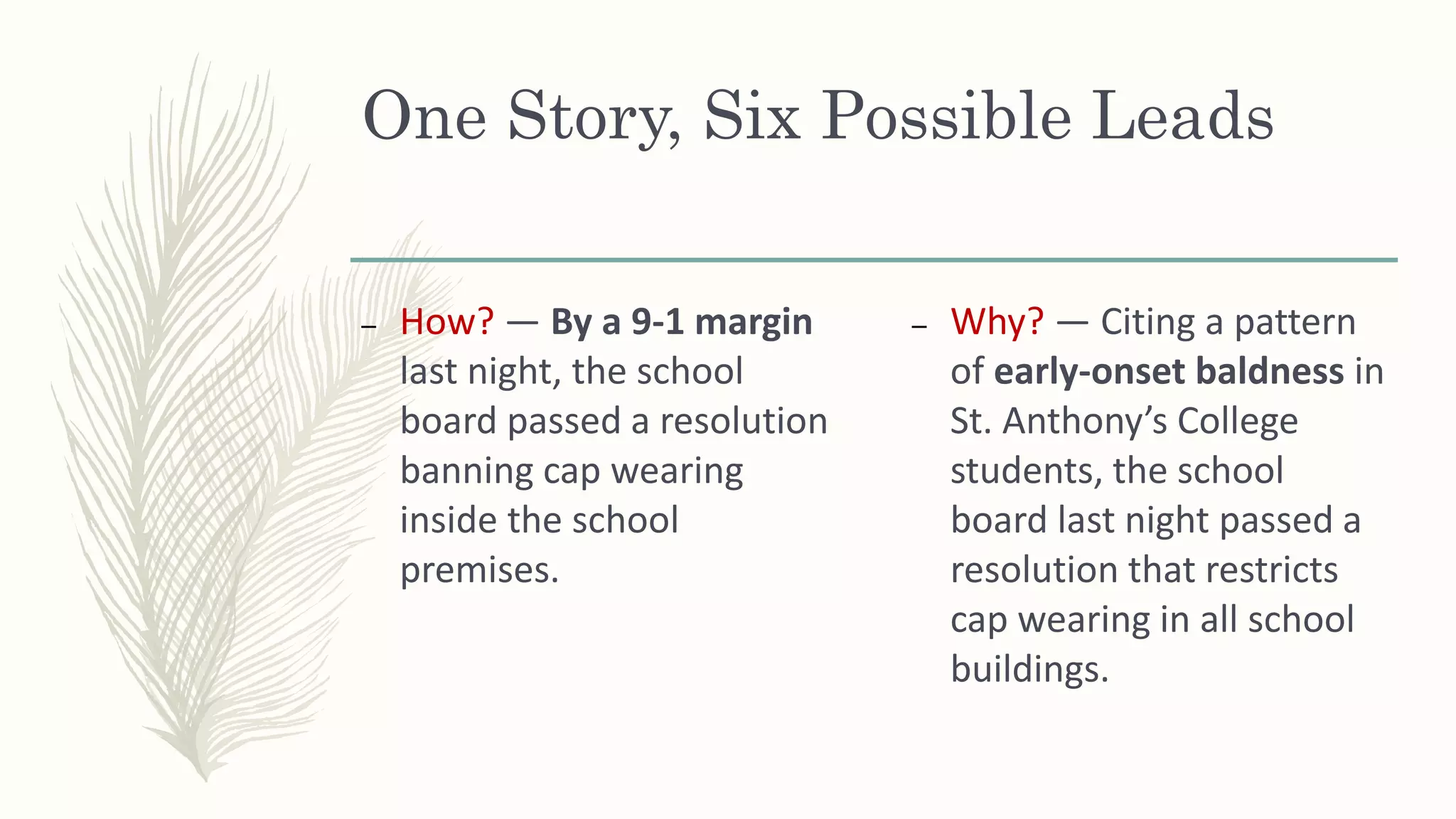
– How? — By a 9-1 margin
last night, the school
board passed a resolution
banning cap wearing
inside the school
premises.
– Why? — Citing a pattern
of early-onset baldness in
St. Anthony’s College
students, the school
board last night passed a
resolution that restricts
cap wearing in all school
buildings.
Novelty Leads
 Astonisher Lead
Better attend your
classes on November 5!
 Contrast Lead
Twenty years ago,
he was the school’s
janitor. Now, he came
back to become the
college dean.
Novelty Leads
 Epigram Lead – verse,
quotation
Like father, like
son…
 Picture Lead –
describes to create a
mental picture of the
subject.
The new dean,
although only in his 30s,
is already silver-haired.
Novelty Leads
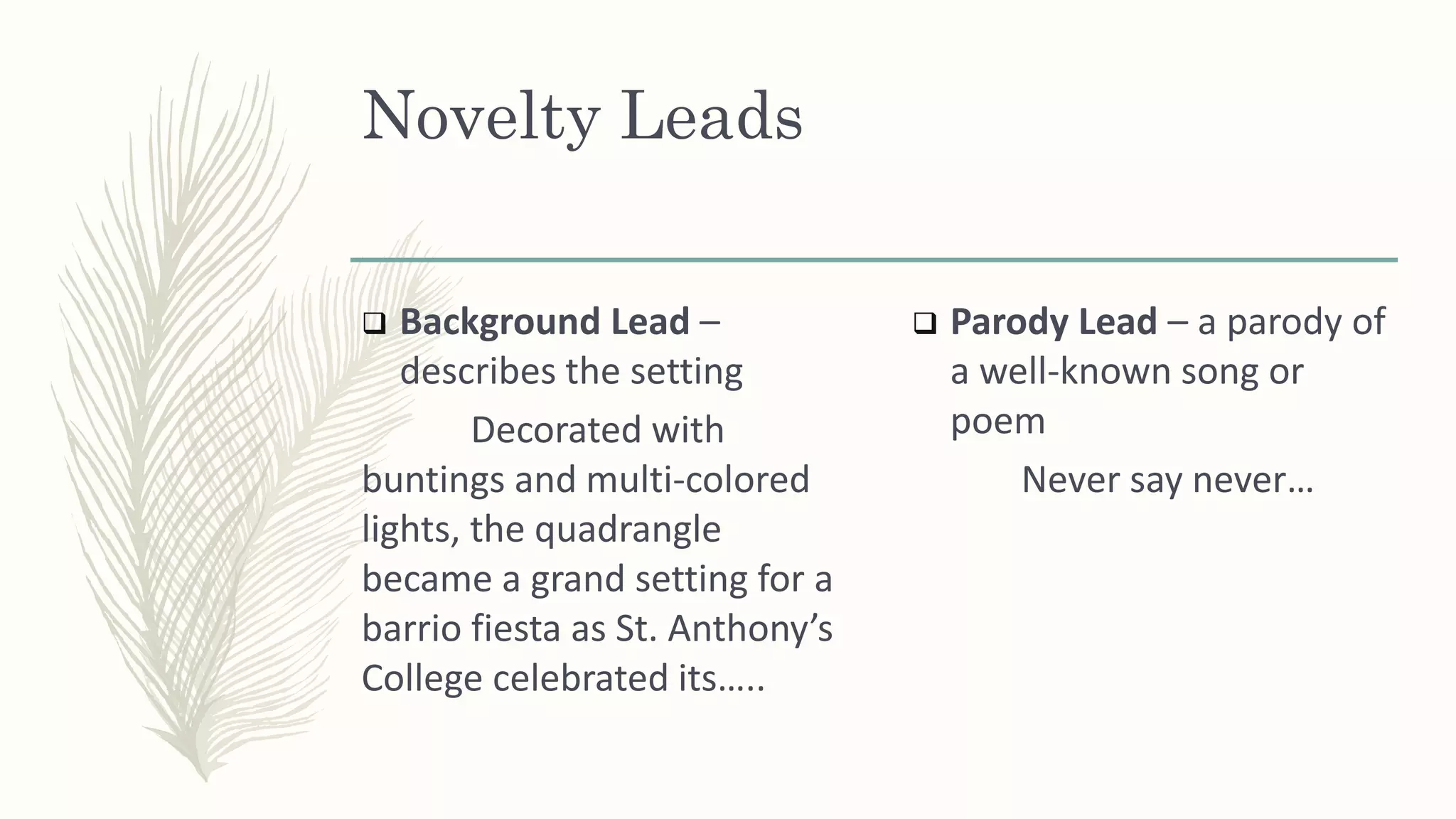
 Background Lead –
describes the setting
Decorated with
buntings and multi-colored
lights, the quadrangle
became a grand setting for a
barrio fiesta as St. Anthony’s
College celebrated its…..
 Parody Lead – a parody of
a well-known song or
poem
Never say never…
Novelty Leads
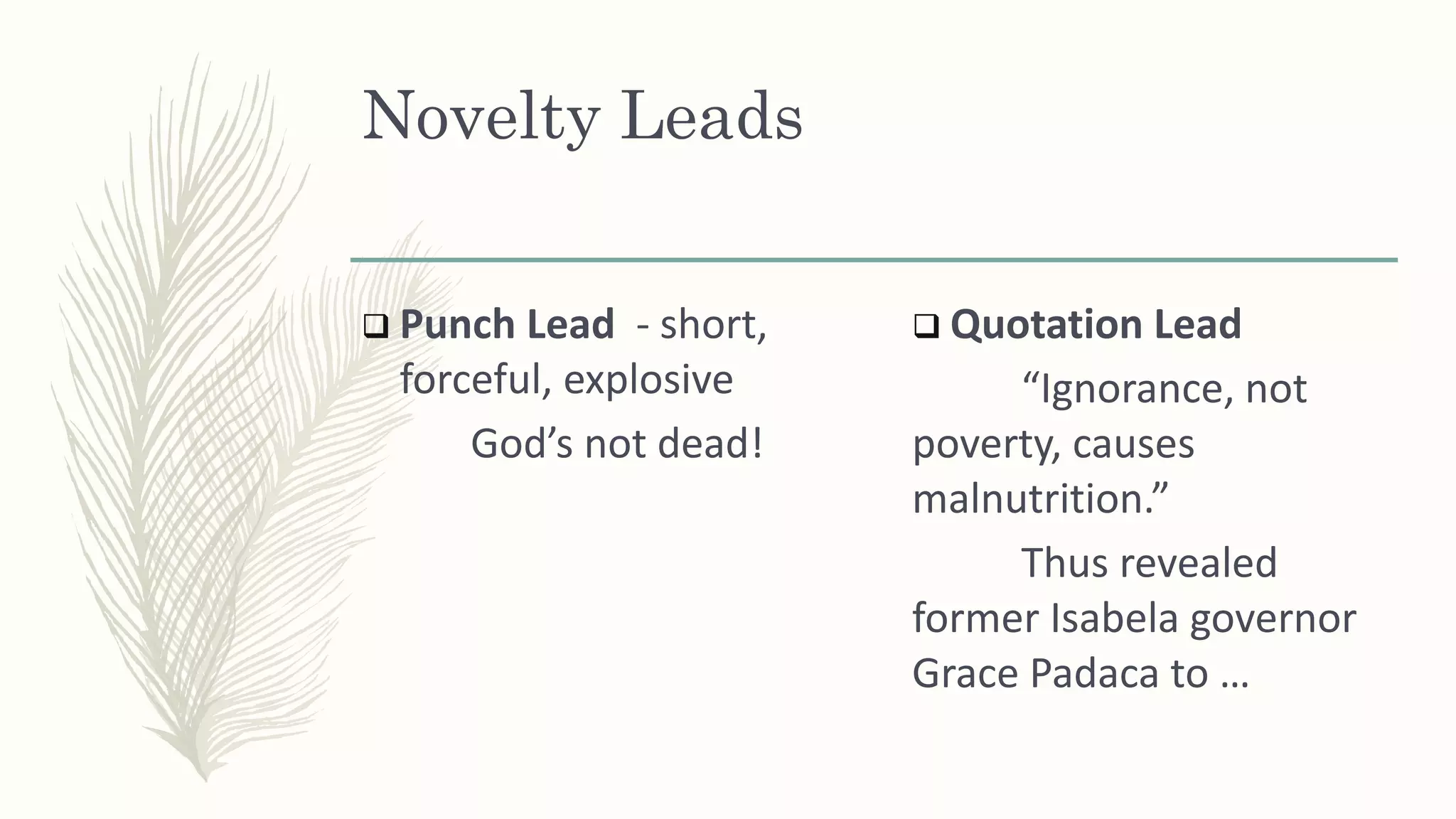
 Punch Lead - short,
forceful, explosive
God’s not dead!
 Quotation Lead
“Ignorance, not
poverty, causes
malnutrition.”
Thus revealed
former Isabela governor
Grace Padaca to …
Novelty Leads
 Question Lead
Who will be the
next Antique governor?
The answer will be
known on…
Guidelines in Writing the Lead
 Pack the most important info in one sentence
 Start with the most important or unusual idea of
the news event.
 Go direct to the point
Guidelines in Writing the Lead
 Rarely use the “when” and “where” leads
 Use less than 30 words
 Avoid starting with articles: a, an, the
 Do not mention names in the lead unless the
person is well-known
The Body
 The details of the lead
 Arranged from most important to the least important
 One sentence, one paragraph
 Sentences are generally less than 25 words
 Include quotations from at least two different people
The Ending
 Wraps up the remaining details of the story
 One way to end is with a “kicker”, which is often a
catchy quote
Pointers in Newswriting
1. One idea per sentence - As much as possible, write one-idea, one-
sentence paragraphs.
2. Limit the sentence length to not more than 25 words - Simplify.
The simplest and clearest way of saying something is often the
shortest and most eloquent.
3. Follow the subject-verb-object format - Good news writing starts
with good sentence structure, and that means simple construction:
Subject-verb-object. Refrain from using a lot of commas.
Pointers in Newswriting
4. Use strong verbs and an active voice - Write most of your
sentences like this: “somebody does something”. Note also that
when a sentence is recast into active voice, it becomes shorter.
5. Reduce difficult words to their simplest terms - As much as
possible, use words that are understandable by the average reader.
When it is necessary to use unfamiliar or technical terms, explain
them briefly. Prefer concrete, specific words to abstract and general
ones.
Pointers in Newswriting
6. Use no more than three prepositional phrases per sentence.
7. Choose the precise word.
8. Keep it simple - Write to express not to impress.
9. Show, don’t tell - Don’t just describe something. Reveal a piece of
the world to yourself and to your readers.
10. Give your source when necessary - Those people and documents
need to be cited in attribution because that helps the reader
evaluate the reliability of information.
Pointers in Newswriting
11. Identify all persons - Write their full names the first time they are
mentioned.
12. Keep it objective - Stay completely impartial. Do not use “I” and
“me” unless you are quoting someone.
13. Have an angle - It can help make the purpose of the story clear
and give it focus.
14. Quote people.
15. Avoid preaching at the end of the story.
Pointers in Newswriting
16. Be very careful - Choose your words with care. Do not
assume their meaning. Use dictionary to make sure of word
meanings. Watch your grammar, spelling, capitalization,
punctuation, use of abbreviations and sentence construction.
17. Read newspaper everyday - Study constantly the
construction of news stories in good national newspaper to
improve your writing style and technique.
Tips in News Gathering
See for your self
Find the person who
knows
Compare all versions
Get both sides
Do not give up too easily
Be tactful and courteous
Make and keep friends
Get into print
Research
Observe proper
attribution.
End of Lecture
Let’s test your
knowledge and see
what you have learned!
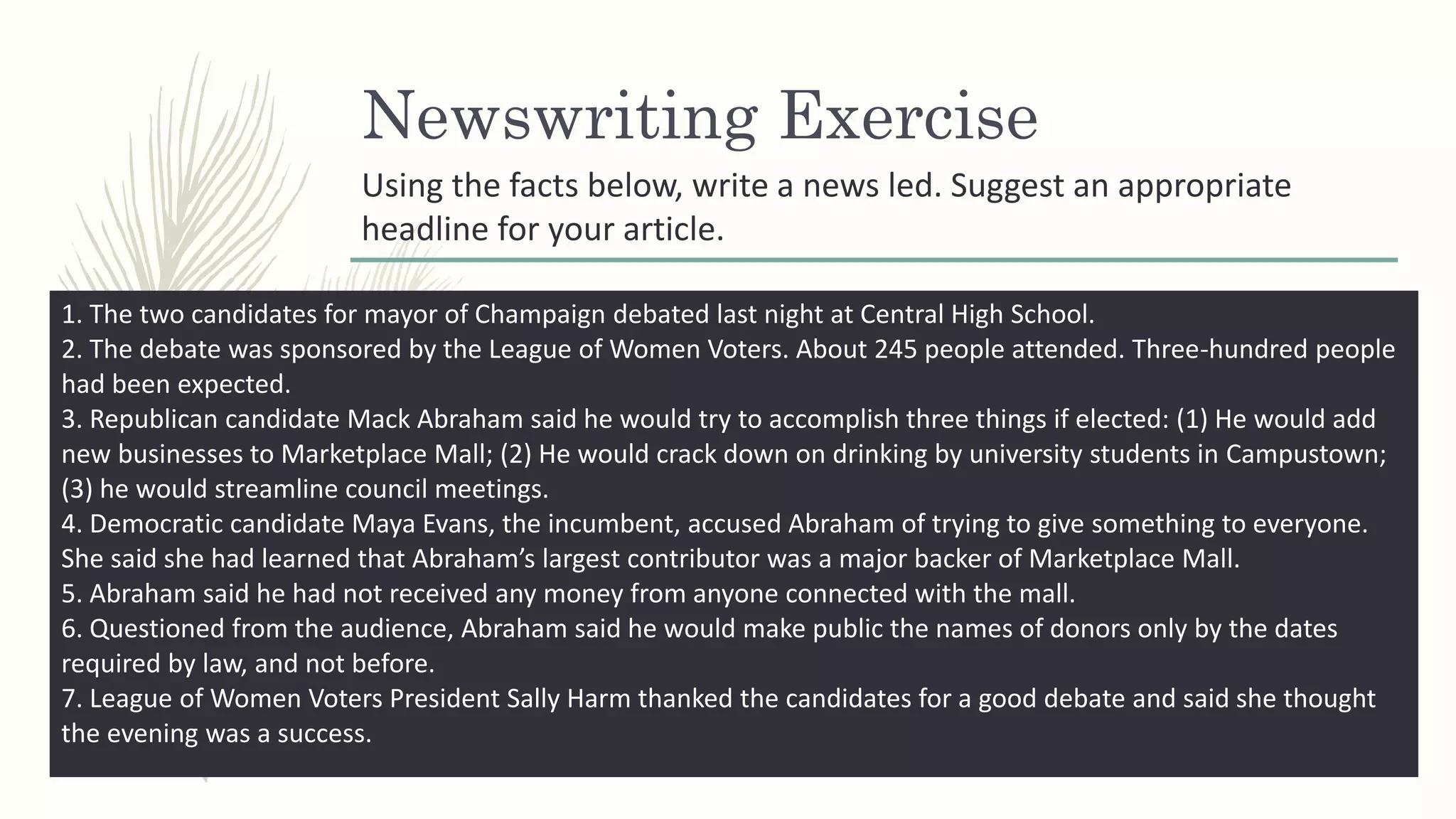
Newswriting Exercise
1. The two candidates for mayor of Champaign debated last night at Central High School.
2. The debate was sponsored by the League of Women Voters. About 245 people attended. Three-hundred people
had been expected.
3. Republican candidate Mack Abraham said he would try to accomplish three things if elected: (1) He would add
new businesses to Marketplace Mall; (2) He would crack down on drinking by university students in Campustown;
(3) he would streamline council meetings.
4. Democratic candidate Maya Evans, the incumbent, accused Abraham of trying to give something to everyone.
She said she had learned that Abraham’s largest contributor was a major backer of Marketplace Mall.
5. Abraham said he had not received any money from anyone connected with the mall.
6. Questioned from the audience, Abraham said he would make public the names of donors only by the dates
required by law, and not before.
7. League of Women Voters President Sally Harm thanked the candidates for a good debate and said she thought
the evening was a success.
Using the facts below, write a news led. Suggest an appropriate
headline for your article.

Basics of Newswriting

  • 1.
    The Basics of Newswriting Mr.Manfred Evanz M. Palcat
  • 2.
    What is news? –News is a new information or a report about something that has happened recently. --- Merriam Webster Dictionary
  • 3.
    In other words… Recentinformation Current events Somebody or something interesting Something previously unknown
  • 4.
    Values of Newsworthiness Timeliness  Proximity or Nearness  Significance  Prominence  Oddity or Unusualness  Conflict  Progress
  • 5.
    Essential Qualities ofNews Accuracy Brevity (briefness) Clarity Objectivity
  • 6.
    Common Examples ofSchool News Classroom story Enrolment story Meeting story Program/Party Story Honor roll
  • 7.
    Common Examples ofSchool News Awards story School Improvement story Election story School Organization/Club story Out-of-School Activity
  • 8.
    Where can wegather news?  Offices, departments, library  School calendar  Invitations and memos  Different clubs and organizations  Sports teams  Students and teachers  Community
  • 9.
    Kinds of News Straightnews – consists of facts reported without elaboration. News feature – based on facts; writer may give his impressions, may describe and narrate without resorting to biased opinion.
  • 10.
    Kinds of News Straightnews – consists of facts reported without elaboration. News feature – based on facts; writer may give his impressions, may describe and narrate without resorting to biased opinion.
  • 11.
  • 12.
    The Inverted Pyramidof news suggests that news be told in order of most interesting or important to least interesting or important.
  • 13.
    Lead or Lede –A lead or lede paragraph is the opening paragraph of an article, essay, news story or book chapter. Often called “the lead”, it usually occurs together with the headline or title. It precedes the main body of the article, and it gives the reader the main idea of the story.
  • 14.
    – It istypically a one-sentence paragraph that summarizes the basic facts of a story and conveys to the reader what the reporter found out in his/her reporting. It provides answer to the five Ws and one H of news reporting – who, what, where, when, why and how. The Lead or Lede
  • 15.
    The 1st paragraph:Most important part of the article, summarizes the story The Hook: Arouses the readers interest Answers right away the most important questions: 5 W’s and 1 H The Lead or Lede _____
  • 16.
    The Angle – Themain idea of a news story and lead is called the “angle”. It is the main point that the rest of the story will try to support. Writing the Lead
  • 17.
    Kinds of Lead Straight Lead – depending on the nature of the story and its driving news elements, a straight lead can focus on one or a few of the six question words.  Novelty Lead
  • 18.
    Straight Lead 5 Wsand 1 H Formula  Who?  What?  When?  Where?  Why?  How?
  • 19.
    Writing a StraightLead  Many students in SAC are getting bald early.  The GJC board had a meeting.  The meeting was held last night.  They ate chicharon during the meeting.  One of the causes of baldness might be the wearing of caps.  The board passed a resolution banning the wearing of hats in the school.  The board voted 9-1 in favor of the resolution.
  • 20.
    One Story, SixPossible Leads – Who? — The school board passed a resolution last night banning the wearing of caps in all school buildings. – What? — Cap wearing was banned in all school buildings last night after the school board passed a new resolution.
  • 21.
    One Story, SixPossible Leads – Where? — In St. Anthony’s College last night, the school board passed a resolution to ban the wearing of caps in all school buildings. – When? — Last night, the school board passed a resolution banning cap wearing in all school buildings.
  • 22.
    One Story, SixPossible Leads – How? — By a 9-1 margin last night, the school board passed a resolution banning cap wearing inside the school premises. – Why? — Citing a pattern of early-onset baldness in St. Anthony’s College students, the school board last night passed a resolution that restricts cap wearing in all school buildings.
  • 23.
    Novelty Leads  AstonisherLead Better attend your classes on November 5!  Contrast Lead Twenty years ago, he was the school’s janitor. Now, he came back to become the college dean.
  • 24.
    Novelty Leads  EpigramLead – verse, quotation Like father, like son…  Picture Lead – describes to create a mental picture of the subject. The new dean, although only in his 30s, is already silver-haired.
  • 25.
    Novelty Leads  BackgroundLead – describes the setting Decorated with buntings and multi-colored lights, the quadrangle became a grand setting for a barrio fiesta as St. Anthony’s College celebrated its…..  Parody Lead – a parody of a well-known song or poem Never say never…
  • 26.
    Novelty Leads  PunchLead - short, forceful, explosive God’s not dead!  Quotation Lead “Ignorance, not poverty, causes malnutrition.” Thus revealed former Isabela governor Grace Padaca to …
  • 27.
    Novelty Leads  QuestionLead Who will be the next Antique governor? The answer will be known on…
  • 28.
    Guidelines in Writingthe Lead  Pack the most important info in one sentence  Start with the most important or unusual idea of the news event.  Go direct to the point
  • 29.
    Guidelines in Writingthe Lead  Rarely use the “when” and “where” leads  Use less than 30 words  Avoid starting with articles: a, an, the  Do not mention names in the lead unless the person is well-known
  • 30.
    The Body  Thedetails of the lead  Arranged from most important to the least important  One sentence, one paragraph  Sentences are generally less than 25 words  Include quotations from at least two different people
  • 31.
    The Ending  Wrapsup the remaining details of the story  One way to end is with a “kicker”, which is often a catchy quote
  • 32.
    Pointers in Newswriting 1.One idea per sentence - As much as possible, write one-idea, one- sentence paragraphs. 2. Limit the sentence length to not more than 25 words - Simplify. The simplest and clearest way of saying something is often the shortest and most eloquent. 3. Follow the subject-verb-object format - Good news writing starts with good sentence structure, and that means simple construction: Subject-verb-object. Refrain from using a lot of commas.
  • 33.
    Pointers in Newswriting 4.Use strong verbs and an active voice - Write most of your sentences like this: “somebody does something”. Note also that when a sentence is recast into active voice, it becomes shorter. 5. Reduce difficult words to their simplest terms - As much as possible, use words that are understandable by the average reader. When it is necessary to use unfamiliar or technical terms, explain them briefly. Prefer concrete, specific words to abstract and general ones.
  • 34.
    Pointers in Newswriting 6.Use no more than three prepositional phrases per sentence. 7. Choose the precise word. 8. Keep it simple - Write to express not to impress. 9. Show, don’t tell - Don’t just describe something. Reveal a piece of the world to yourself and to your readers. 10. Give your source when necessary - Those people and documents need to be cited in attribution because that helps the reader evaluate the reliability of information.
  • 35.
    Pointers in Newswriting 11.Identify all persons - Write their full names the first time they are mentioned. 12. Keep it objective - Stay completely impartial. Do not use “I” and “me” unless you are quoting someone. 13. Have an angle - It can help make the purpose of the story clear and give it focus. 14. Quote people. 15. Avoid preaching at the end of the story.
  • 36.
    Pointers in Newswriting 16.Be very careful - Choose your words with care. Do not assume their meaning. Use dictionary to make sure of word meanings. Watch your grammar, spelling, capitalization, punctuation, use of abbreviations and sentence construction. 17. Read newspaper everyday - Study constantly the construction of news stories in good national newspaper to improve your writing style and technique.
  • 37.
    Tips in NewsGathering See for your self Find the person who knows Compare all versions Get both sides Do not give up too easily Be tactful and courteous Make and keep friends Get into print Research Observe proper attribution.
  • 38.
  • 39.
    Let’s test your knowledgeand see what you have learned!
  • 40.
    Newswriting Exercise 1. Thetwo candidates for mayor of Champaign debated last night at Central High School. 2. The debate was sponsored by the League of Women Voters. About 245 people attended. Three-hundred people had been expected. 3. Republican candidate Mack Abraham said he would try to accomplish three things if elected: (1) He would add new businesses to Marketplace Mall; (2) He would crack down on drinking by university students in Campustown; (3) he would streamline council meetings. 4. Democratic candidate Maya Evans, the incumbent, accused Abraham of trying to give something to everyone. She said she had learned that Abraham’s largest contributor was a major backer of Marketplace Mall. 5. Abraham said he had not received any money from anyone connected with the mall. 6. Questioned from the audience, Abraham said he would make public the names of donors only by the dates required by law, and not before. 7. League of Women Voters President Sally Harm thanked the candidates for a good debate and said she thought the evening was a success. Using the facts below, write a news led. Suggest an appropriate headline for your article.