Basics of
Bitcoin & Mining
Akhilesh Arora
@akhilesharora
linkedin.com/in/akhilesharora
facebook.com/akhilesharora
The Technology Behind BTC
• Hashing (double-SHA256, RIPEMD-160)
• Proof-of-work (hashcash proof)
• Dual key encryption (Elliptical Curve
Digital Signature Algorithm, Merkle
Trees )
• Peer-To-Peer Networking (similar to IRC
Internet Relay Chat)
Hashing
• Hashing is applying an algorithm to find a
short number (digest) of a block of data
• A checksum is an example hashing
algorithm
• Every time you apply a hash to some
data, you get the same hash number
• Hashes are one-way. If you have the data,
you can find the hash. But, if you have
the hash, you can’t figure out the data.
• Hashes are useful for verifying data
Dual-key Encryption
• Fundamental to understanding virtual
currencies
• Encrypting with a password is single-key
• Dual-key encryption uses two keys
• If one key is used to encrypt, the other
key can be used to decrypt
• And vice-versa
• The key that encrypted CANNOT decrypt
Private and Public Keys
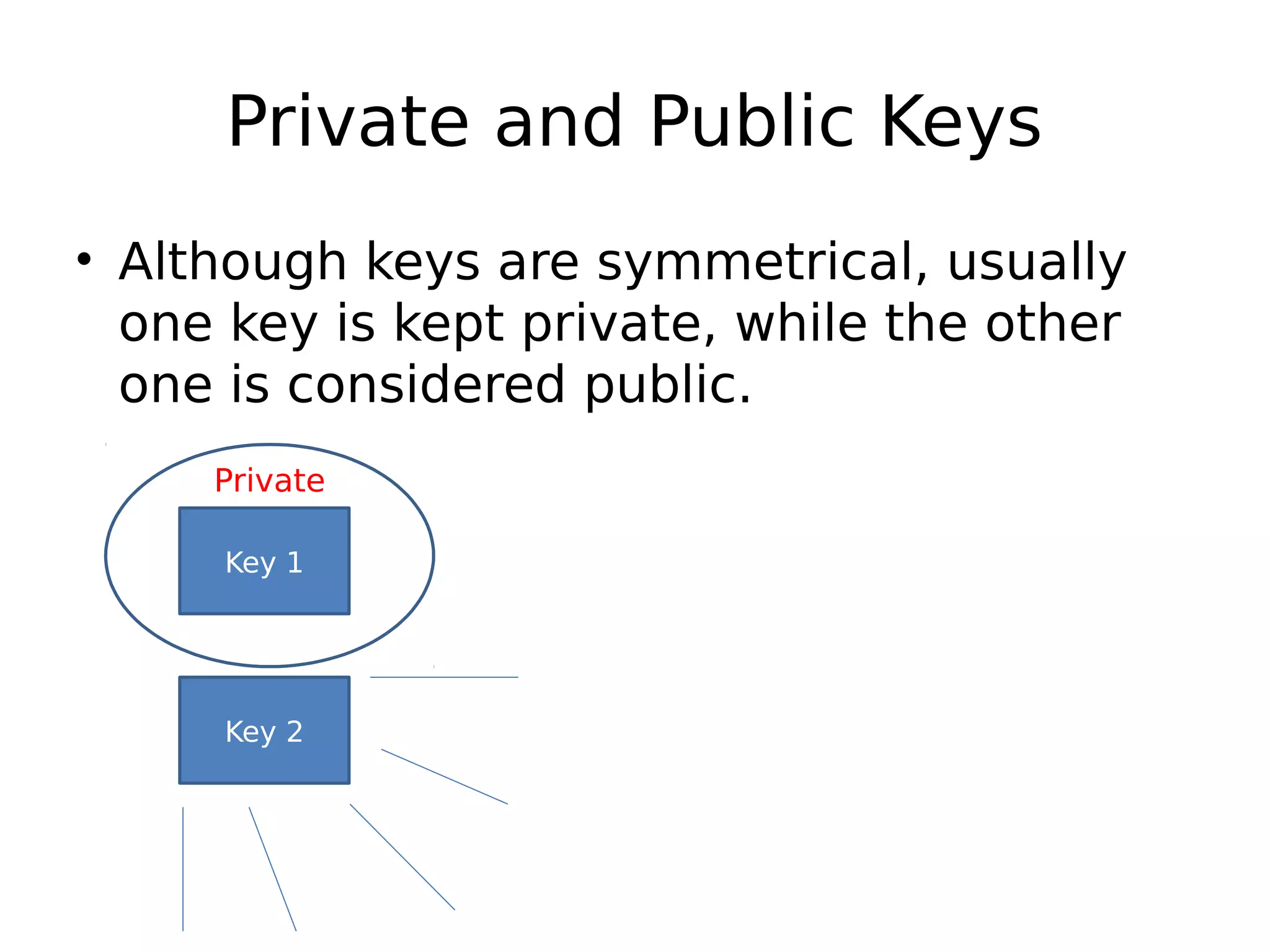
• Although keys are symmetrical, usually
one key is kept private, while the other
one is considered public.
Key 1
Key 2
Private
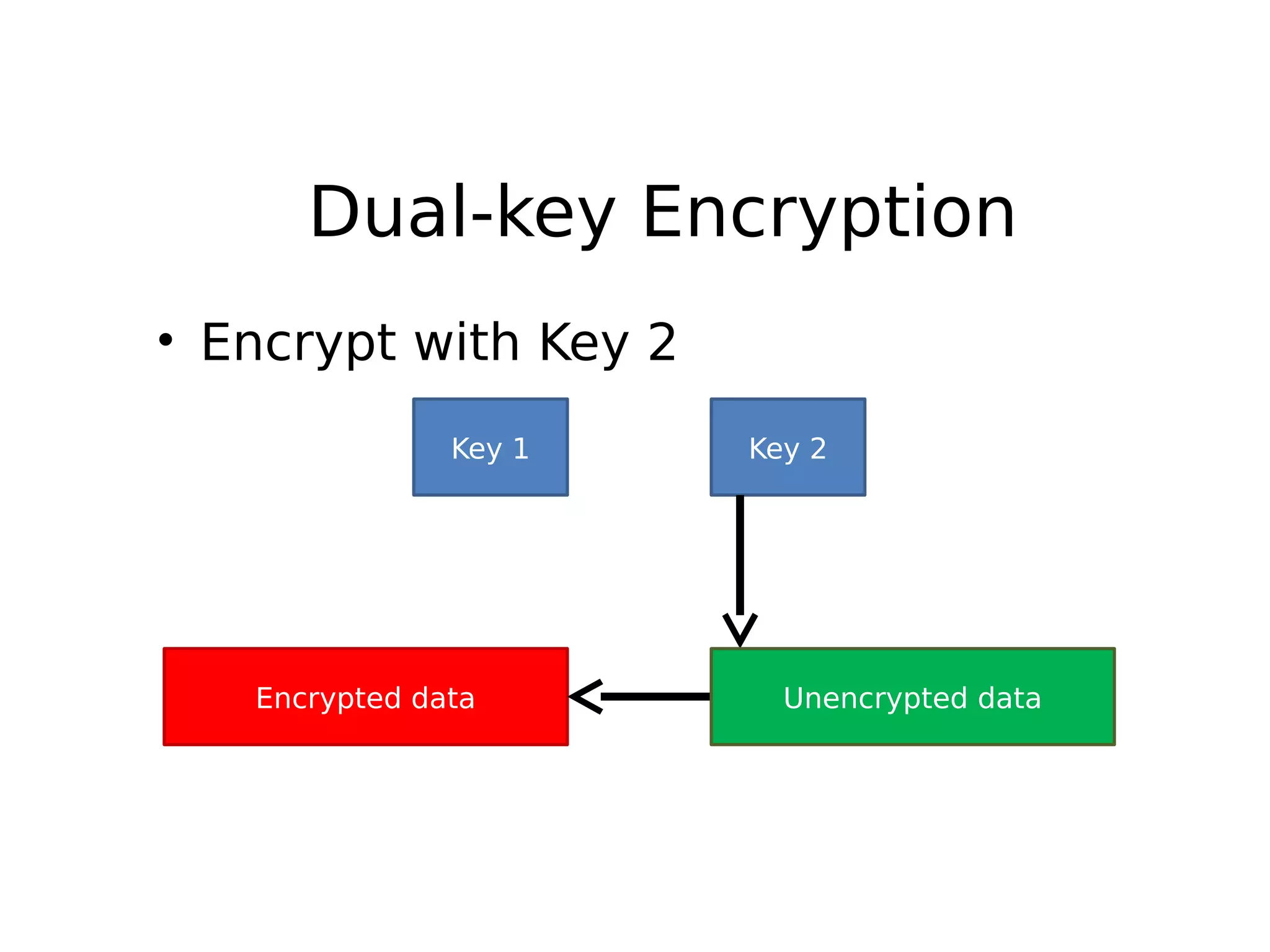
Dual-key Encryption
• Encrypt with Key 2
Key 1 Key 2
Encrypted data Unencrypted data
Mining
• Byproduct of publishing the blockchain
• This is the way new Bitcoins are created
– Miners publish blocks on the blockchain
– As a reward for publishing blocks, they get to keep Bitcoins.
(50 for the first 4 years, 25 now, halving every four years)
– Miners also get transaction fees
• Race to find a conforming hash every 10 minutes
• Don’t do it (unless you have cash, time, and an
underutilized electrical engineering skill)
• Incredibly competitive
• High upfront investment
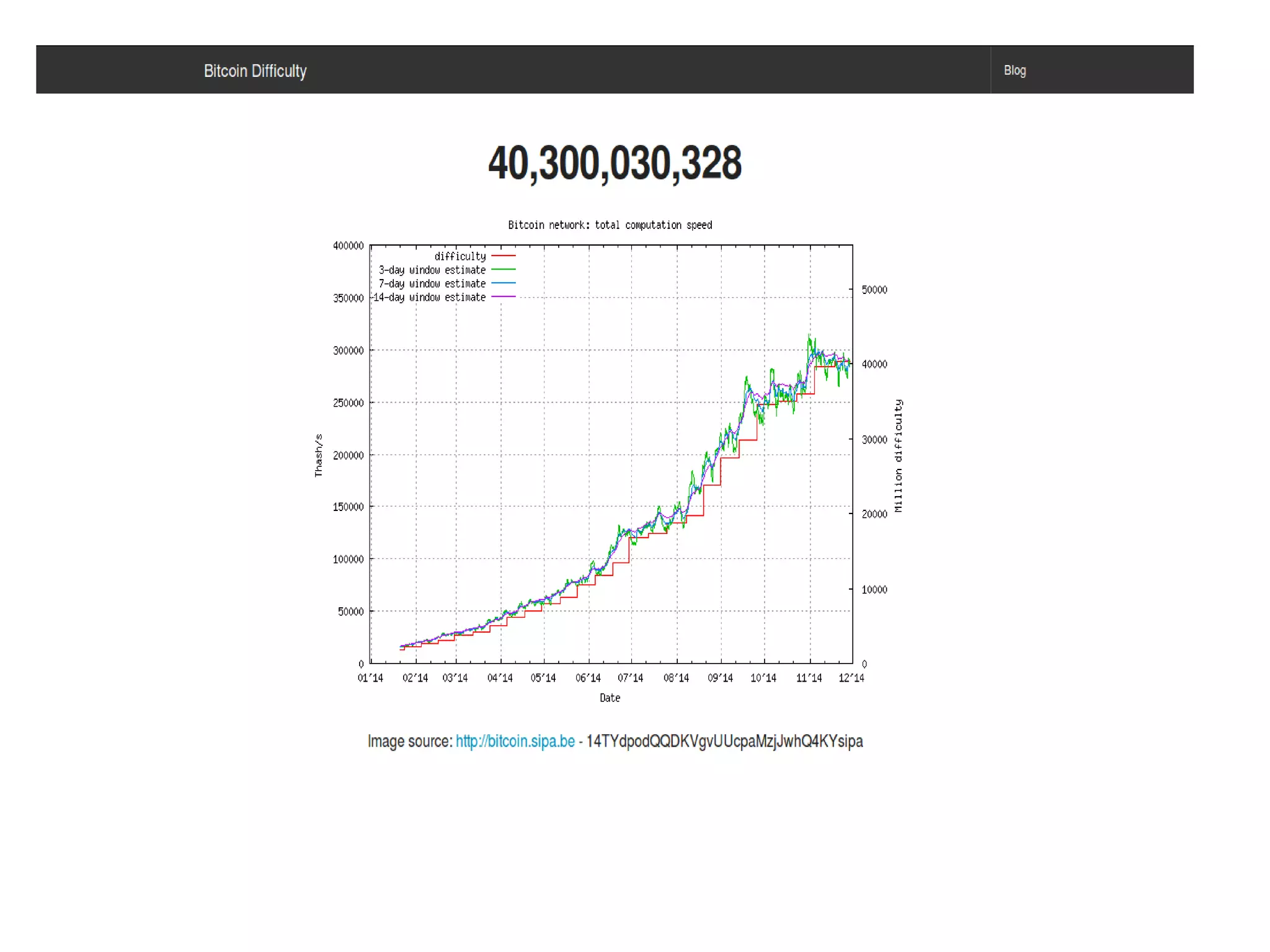
• Dificulty is increasing rapidly
• Now requires specialized hardware (ASIC chip)
How Bitcoins are Created
• Every 10 minutes (average), miners try to
solve a proof-of-work problem
• The first one to solve the problem publishes
a “block” on the “blockchain” that includes
all transactions from the last 10 minutes
• In 2009, the reward for publishing a block
was 50 Bitcoins. Now it is 25. In 2016 it will
be 12.5 Bitcoins
• With the constant halving, eventually there
will only be about 21 million Bitcoins
How Bitcoins are NOT Created
• You can’t pay to create extra coins. They
can only be mined
• There is no central bank to make them
• The developers can’t add extra Bitcoins.
Other users would rebel and not take the
new version of the software (Litecoin)
• Miners can’t mine extra or faster in
response to market forces
Blockchain
• Miners publish a block of recent transactions
every 10 minutes on average
• Each block is provably related to the
previous
• Every transaction ever is stored in the
blockchain
• If there are disagreements about valid
blocks, the blockchain can fork
• Miners add to the longest good chain
• Searching the blockchain can reveal
interesting things
Bitcoins Have Been Stolen
• Some big heists have been pulled of with
very large numbers of Bitcoins stolen
• The thieves are usually hackers, not burglars
• Generally, the stolen Bitcoins are never seen
again on the blockchain
• It is very important to protect your private
key
• Viruses can steal your Bitcoins
• Other viruses can encrypt your hard drive
and only decrypt if you provide Bitcoins
• Botnets have mined Bitcoins
Bitcoin Wallet Security
• Keep keys offline if you can
• Encrypt your wallet
• Make backup copies of your wallet
• If you are going to keep your savings at home,
put them on a computer you ONLY use for
bitcoins
• Keep multiple wallets
• Always receive money to a new address
• Online wallets: use 2-factor authentication
• Don’t spend from your “savings” address(es)
• Don’t brag about how many coins you have or
where you stash them
Doom and Gloom
• Some people say Bitcoin is not a currency
and is doomed to fail
• Almost everyone predicting the downfall
of Bitcoin doesn’t really understand
bitcoin
• The arguments generally fall into the
following categories
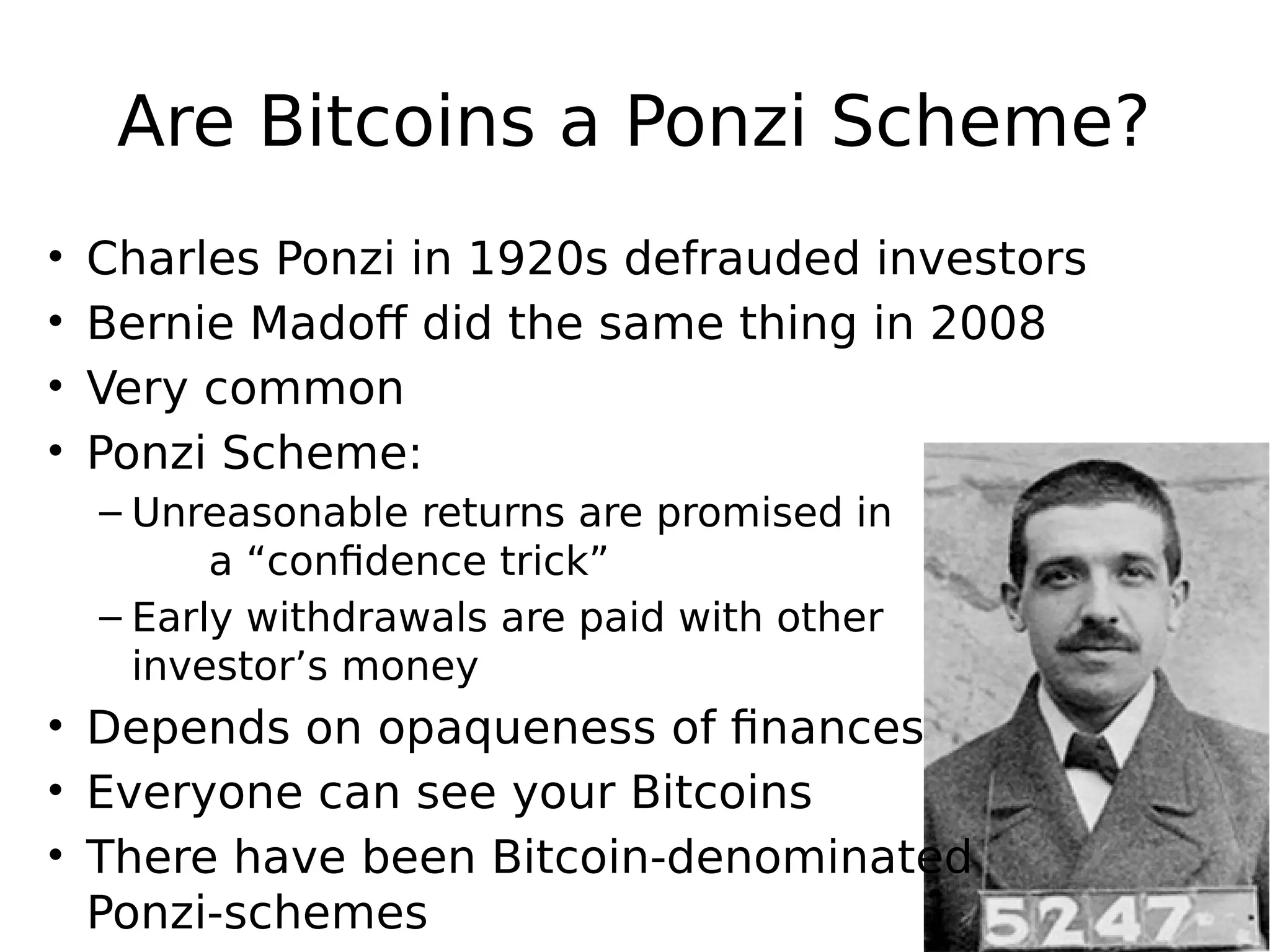
Are Bitcoins a Ponzi Scheme?
• Charles Ponzi in 1920s defrauded investors
• Bernie Madoff did the same thing in 2008
• Very common
• Ponzi Scheme:
– Unreasonable returns are promised in
a “confidence trick”
– Early withdrawals are paid with other
investor’s money
• Depends on opaqueness of finances
• Everyone can see your Bitcoins
• There have been Bitcoin-denominated
Ponzi-schemes
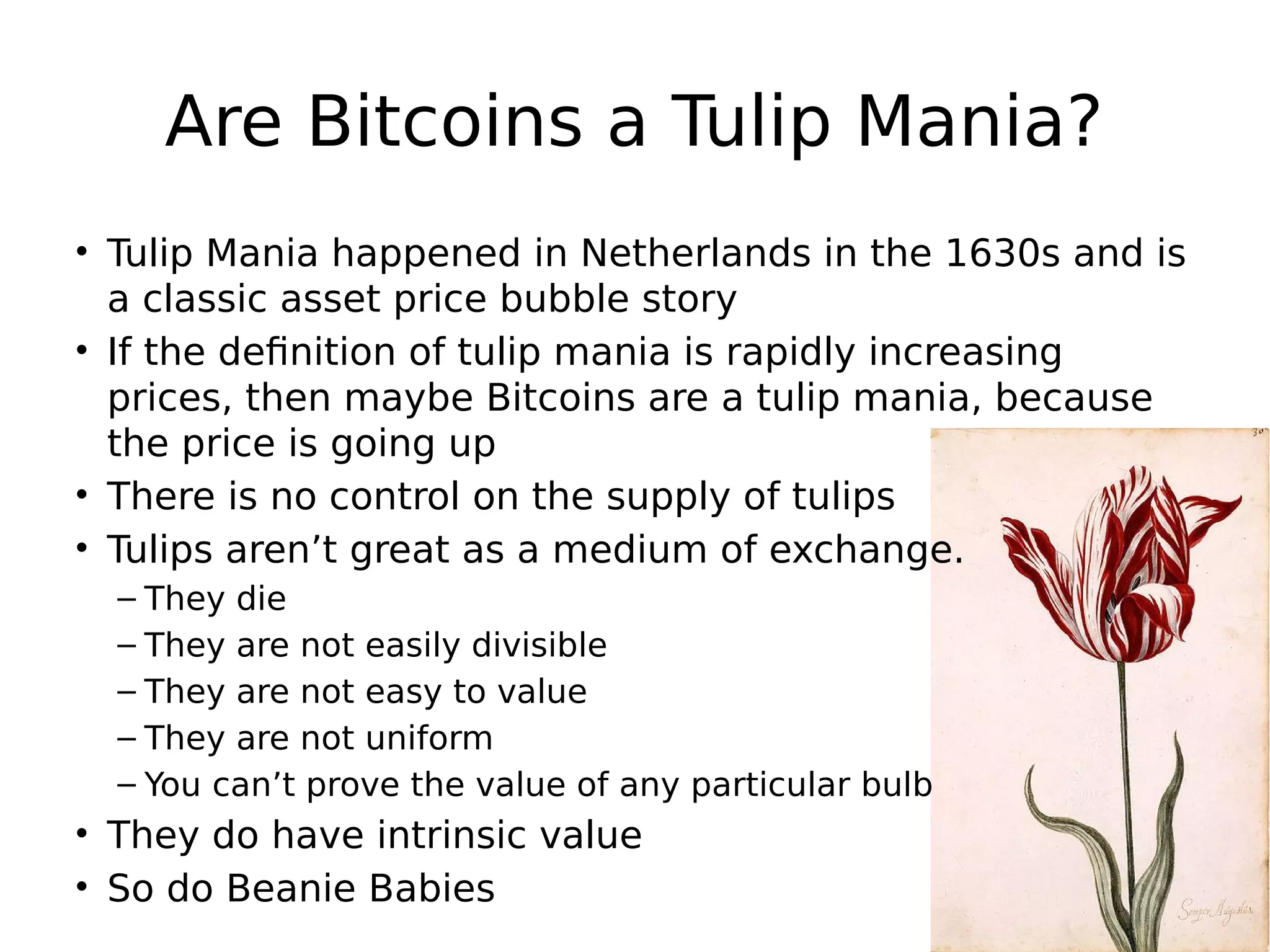
Are Bitcoins a Tulip Mania?
• Tulip Mania happened in Netherlands in the 1630s and is
a classic asset price bubble story
• If the definition of tulip mania is rapidly increasing
prices, then maybe Bitcoins are a tulip mania, because
the price is going up
• There is no control on the supply of tulips
• Tulips aren’t great as a medium of exchange.
– They die
– They are not easily divisible
– They are not easy to value
– They are not uniform
– You can’t prove the value of any particular bulb
• They do have intrinsic value
• So do Beanie Babies
Bitcoin Asset Bubble?
• Maybe
• Will the price shoot up and then fall back down
rapidly?
• Offshore US Dollars
– Americans keep $1.5 Trillion outside the US
– If they stored 5% of that in Bitcoin, BTC=$3,740
• Foreigners with US Dollars
– Foreigners hold $3.4 trillion
– 5% would be BTC=$8,095
• US-based prepaid debit cards $77 billion/year
• Western Union makes $5B/year on money transfers
• Currently, millions of dollars worth of Bitcoin are being
created each day
There Aren’t Enough Bitcoins To Go
Around
• 7,000 million people can’t each have one
of 21 million Bitcoins
• If/when they become common, few
individuals will have a “full” bitcoin.
Bitcoin Mining is Wasteful
• The Hashcash algorithm is almost useless
except for within Bitcoin
– Must show that work was done
– Must be based on the previous block
– Must be easily checkable
• If the algorithm is useful to someone, that
someone probably has an advantage
• Changing the algorithm would be very
disruptive to Bitcoin
• Some altcoins attempt to solve this problem,
but open vulnerabilities to do so
• Nobody has found an acceptable alternative
Types of Mining Hardware
1.CPU
2.FPGA
3.ASIC
4.GPU
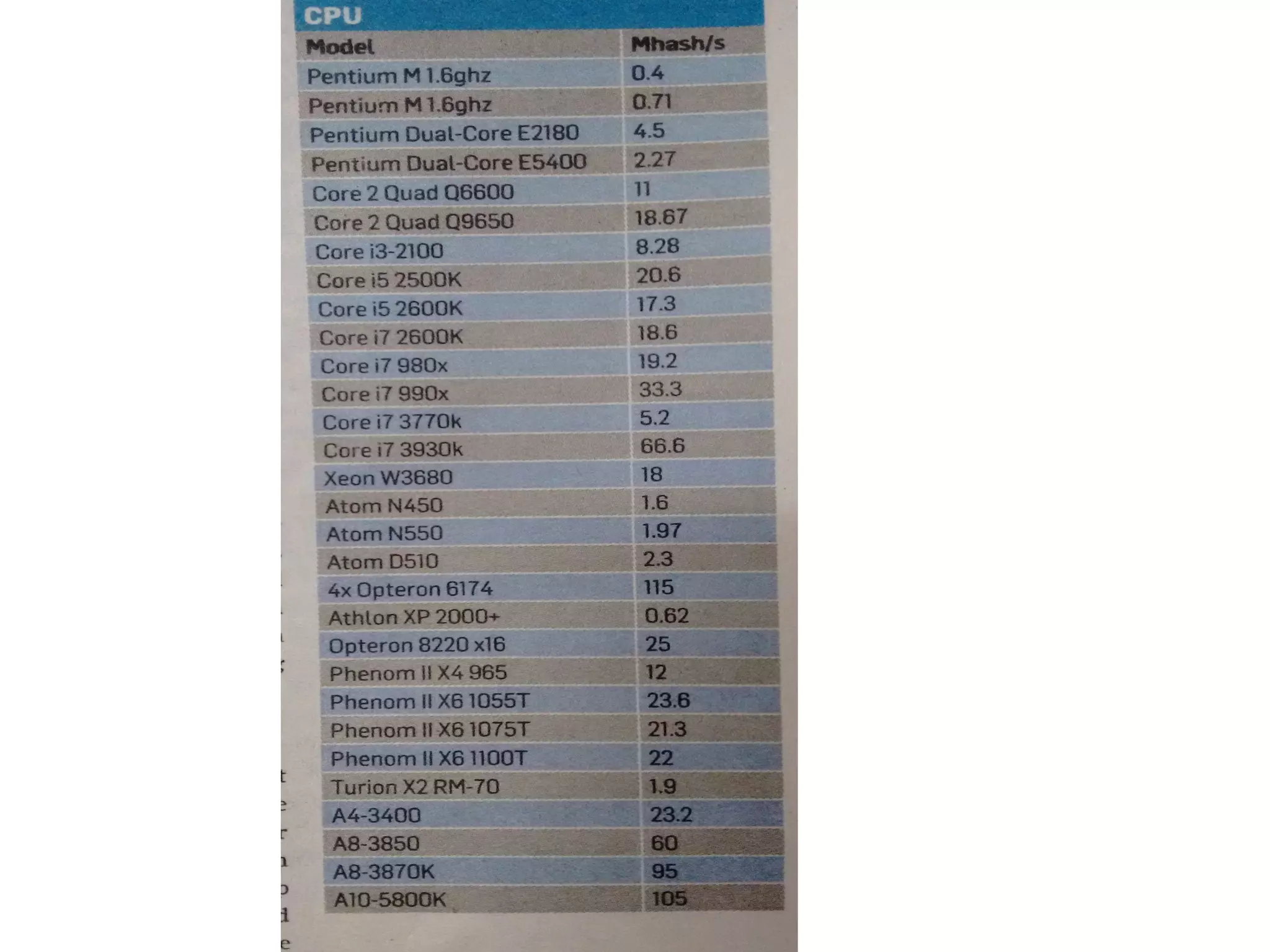
CPU Mining
● Most easiest & commonly obtainable
hardware.
● Problem Assosiated: Not designed for
high volume of calculations.
● Can mine coins but will be
astronomical and in no way to break
even with COSTs involved.
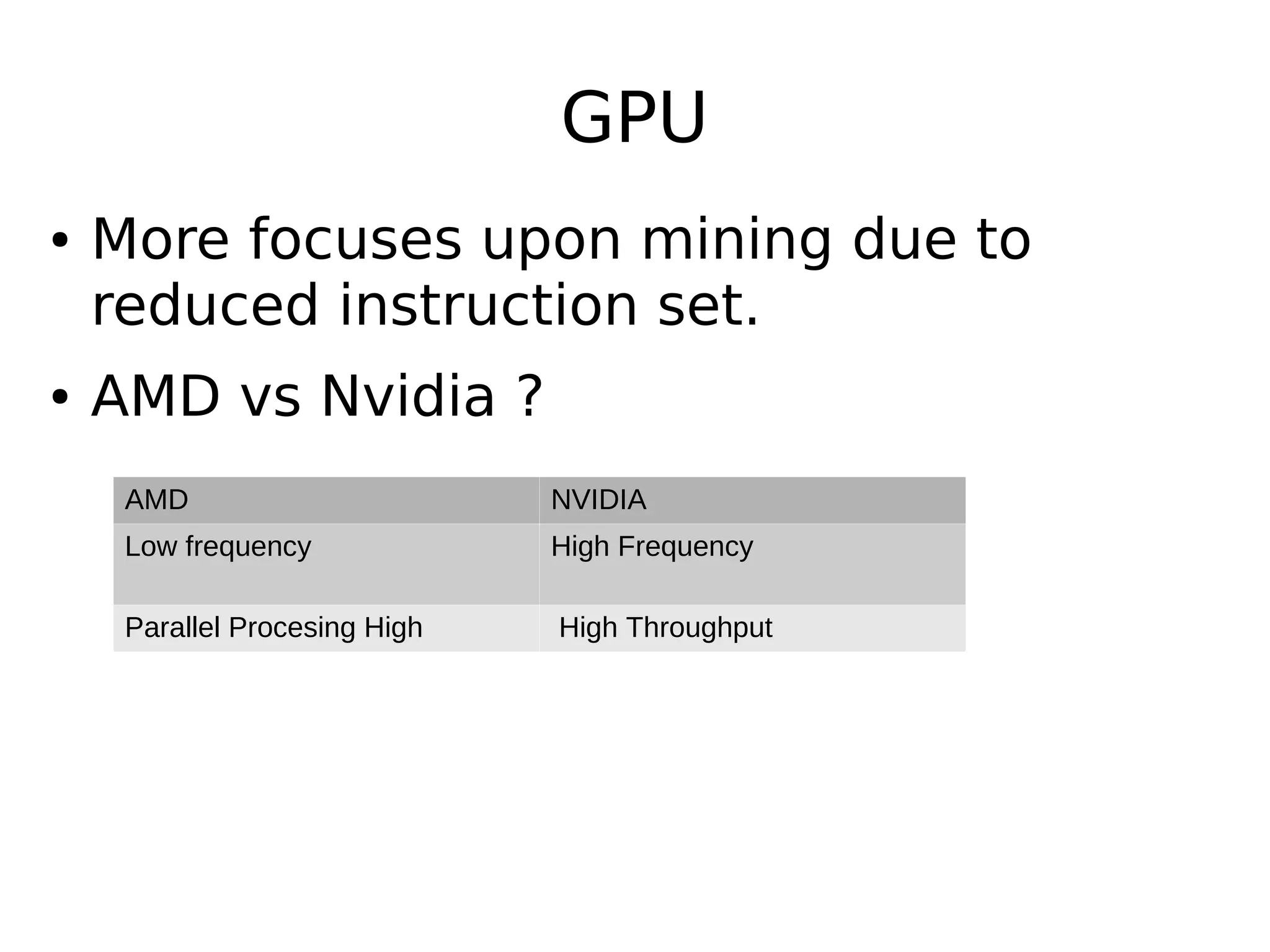
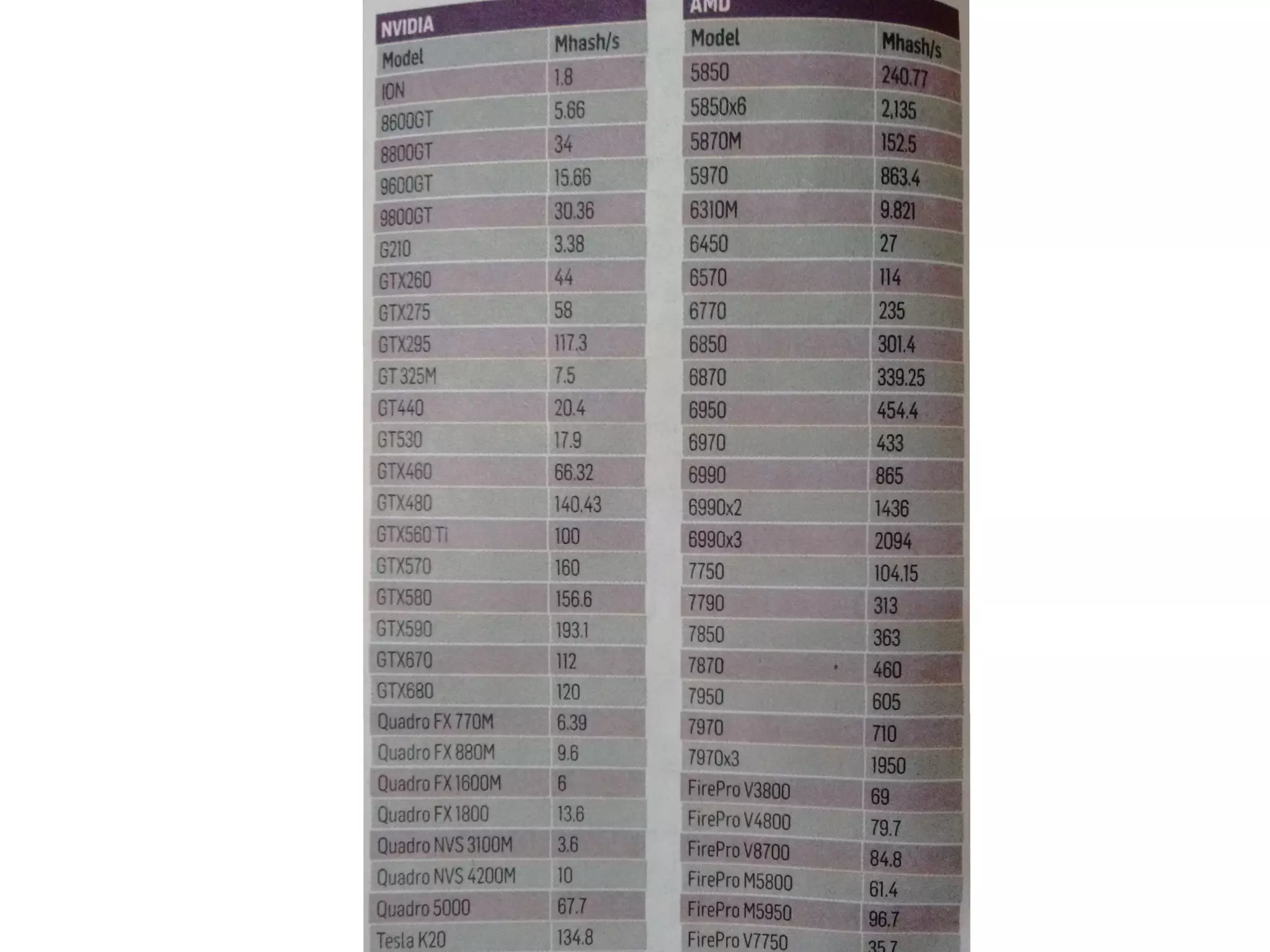
GPU
● More focuses upon mining due to
reduced instruction set.
● AMD vs Nvidia ?
AMD NVIDIA
Low frequency High Frequency
Parallel Procesing High High Throughput
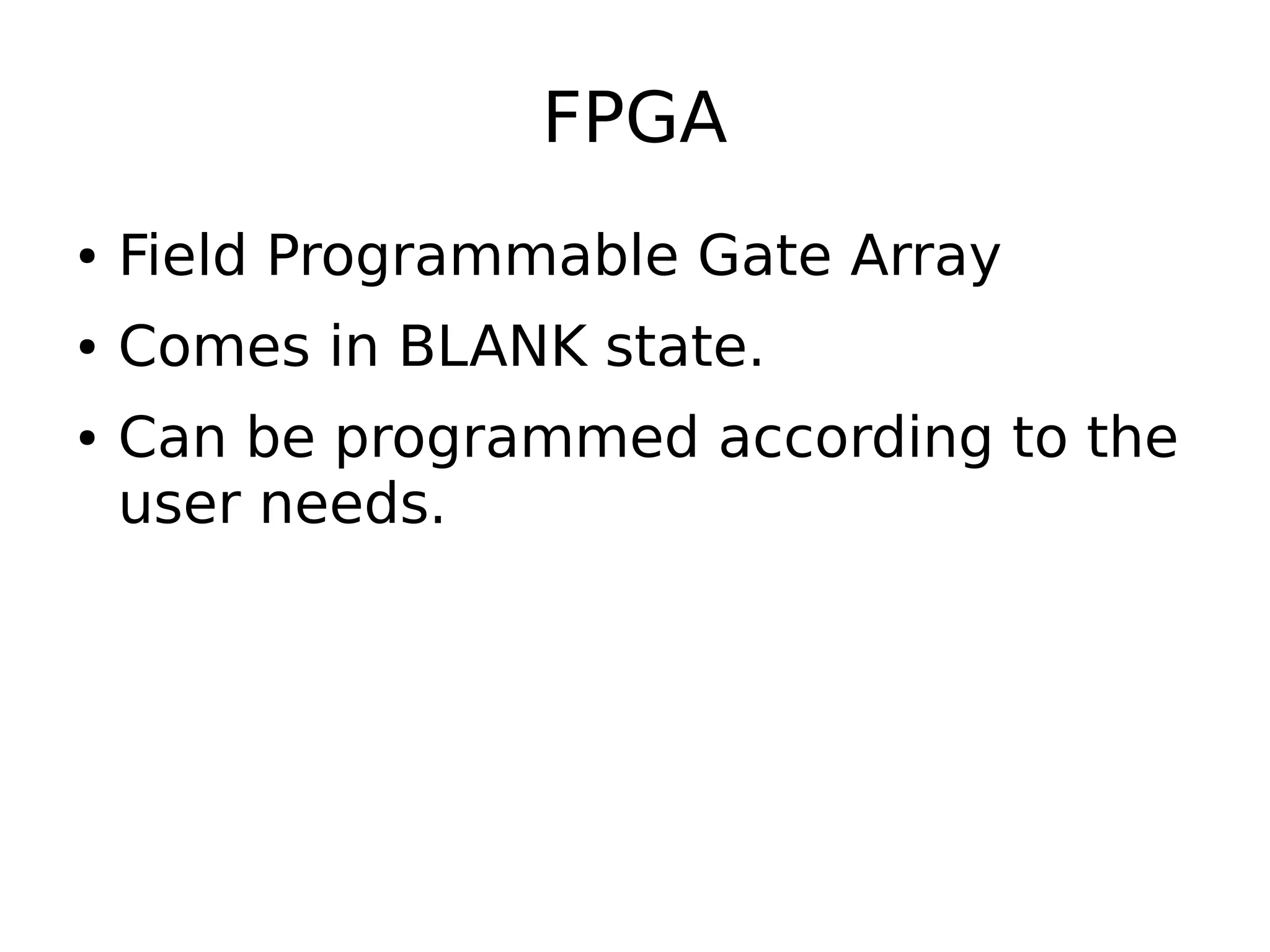
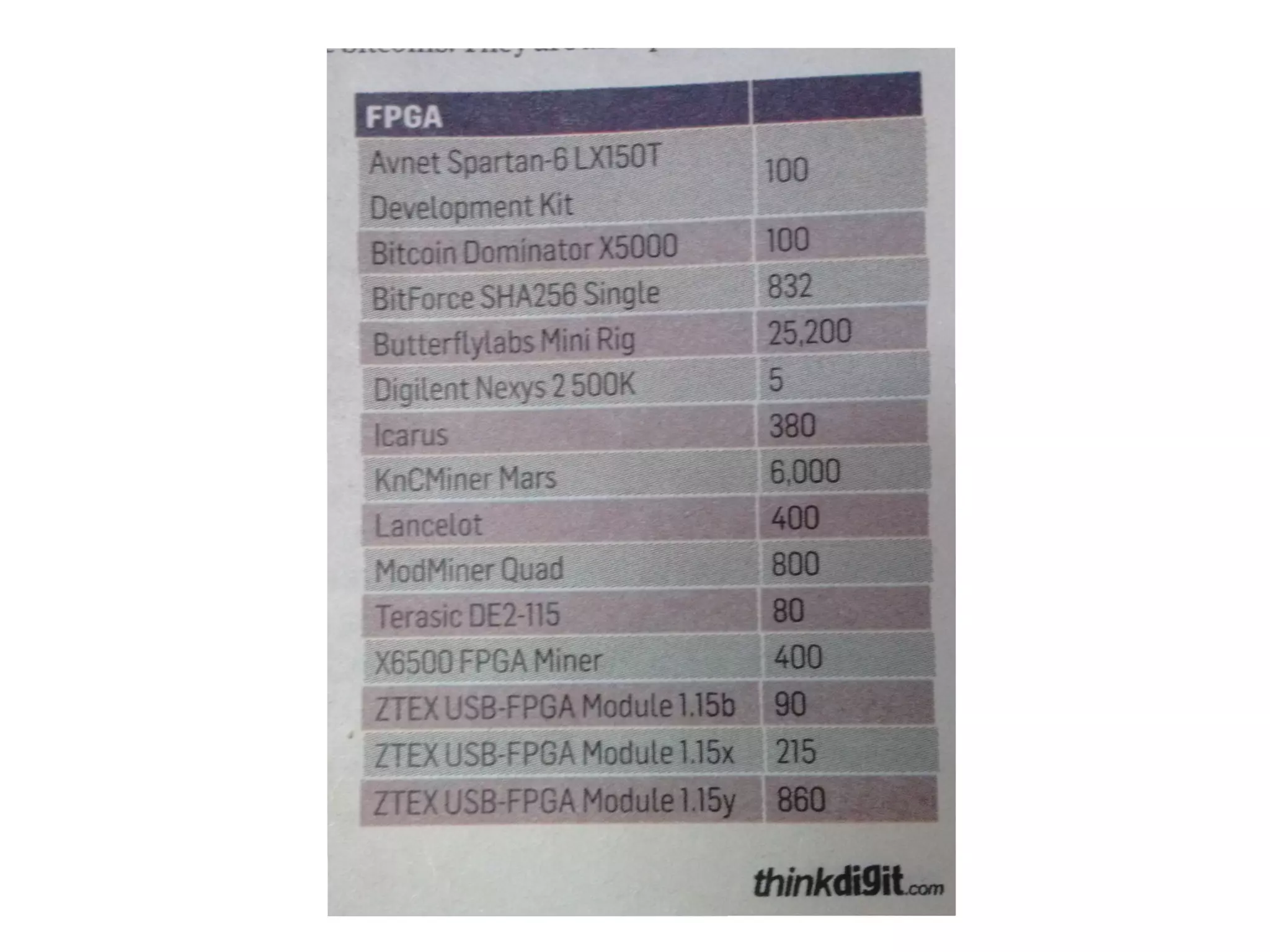
FPGA
● Field Programmable Gate Array
● Comes in BLANK state.
● Can be programmed according to the
user needs.
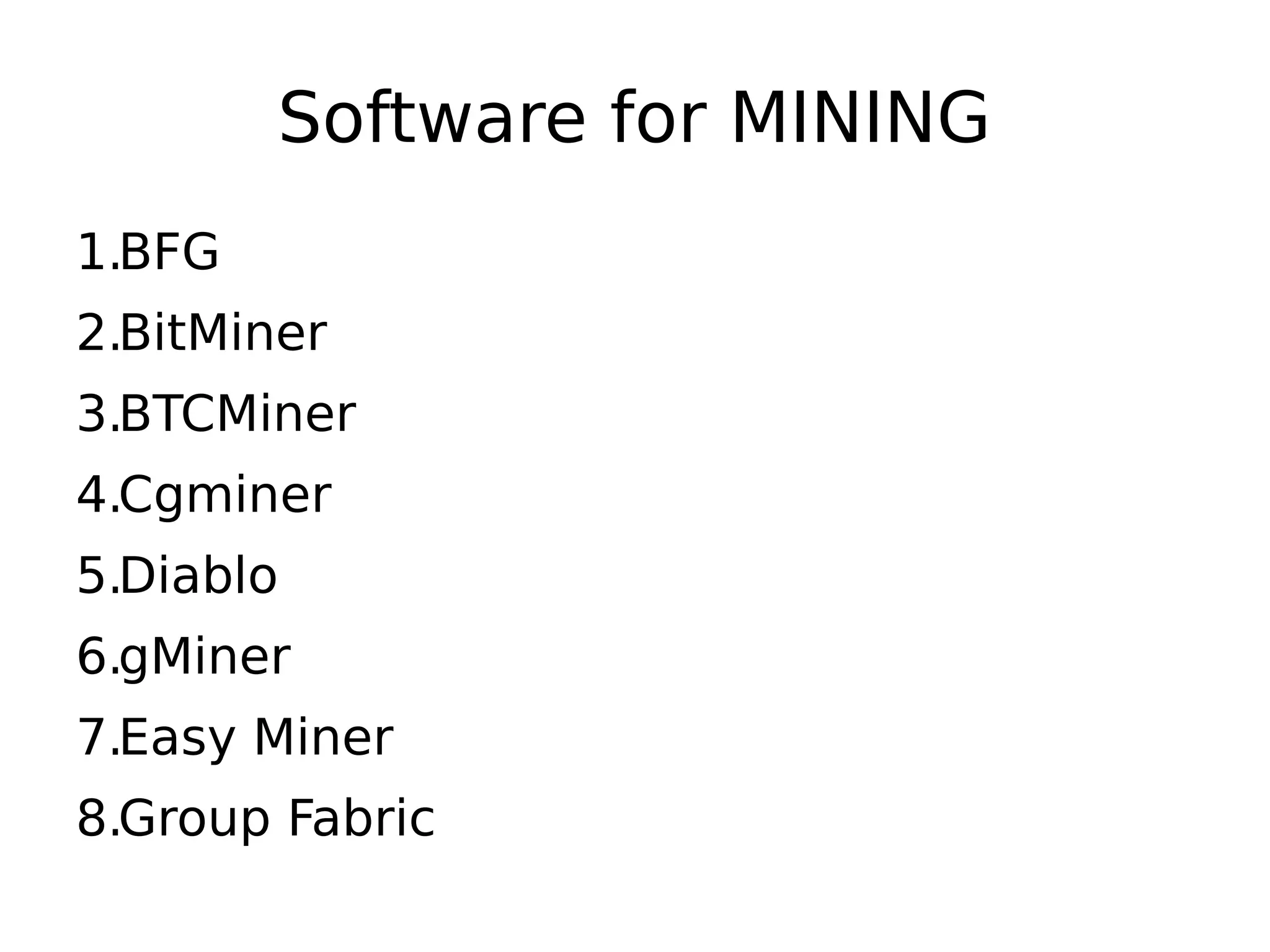
Software for MINING
1.BFG
2.BitMiner
3.BTCMiner
4.Cgminer
5.Diablo
6.gMiner
7.Easy Miner
8.Group Fabric
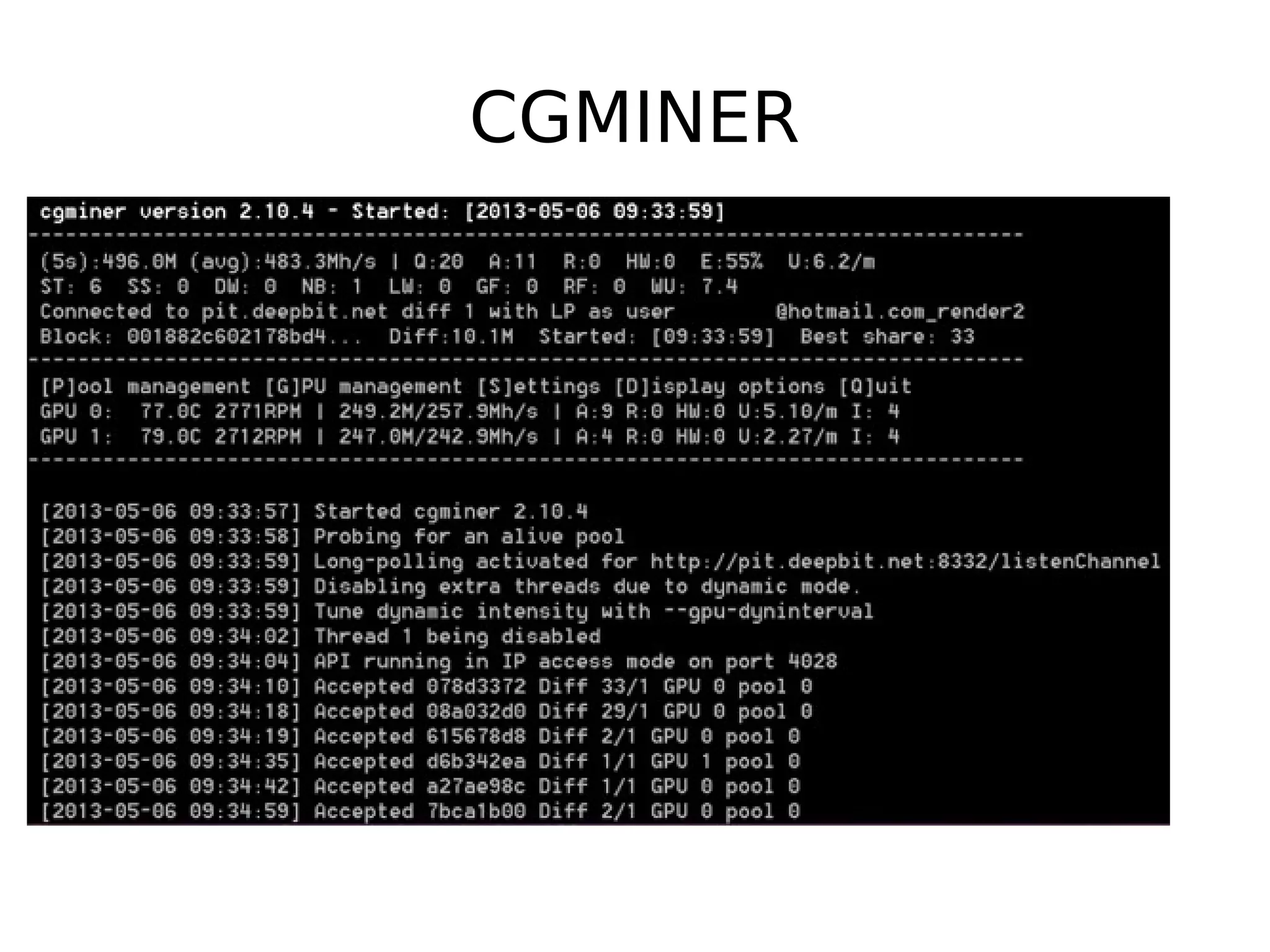
CGMINER
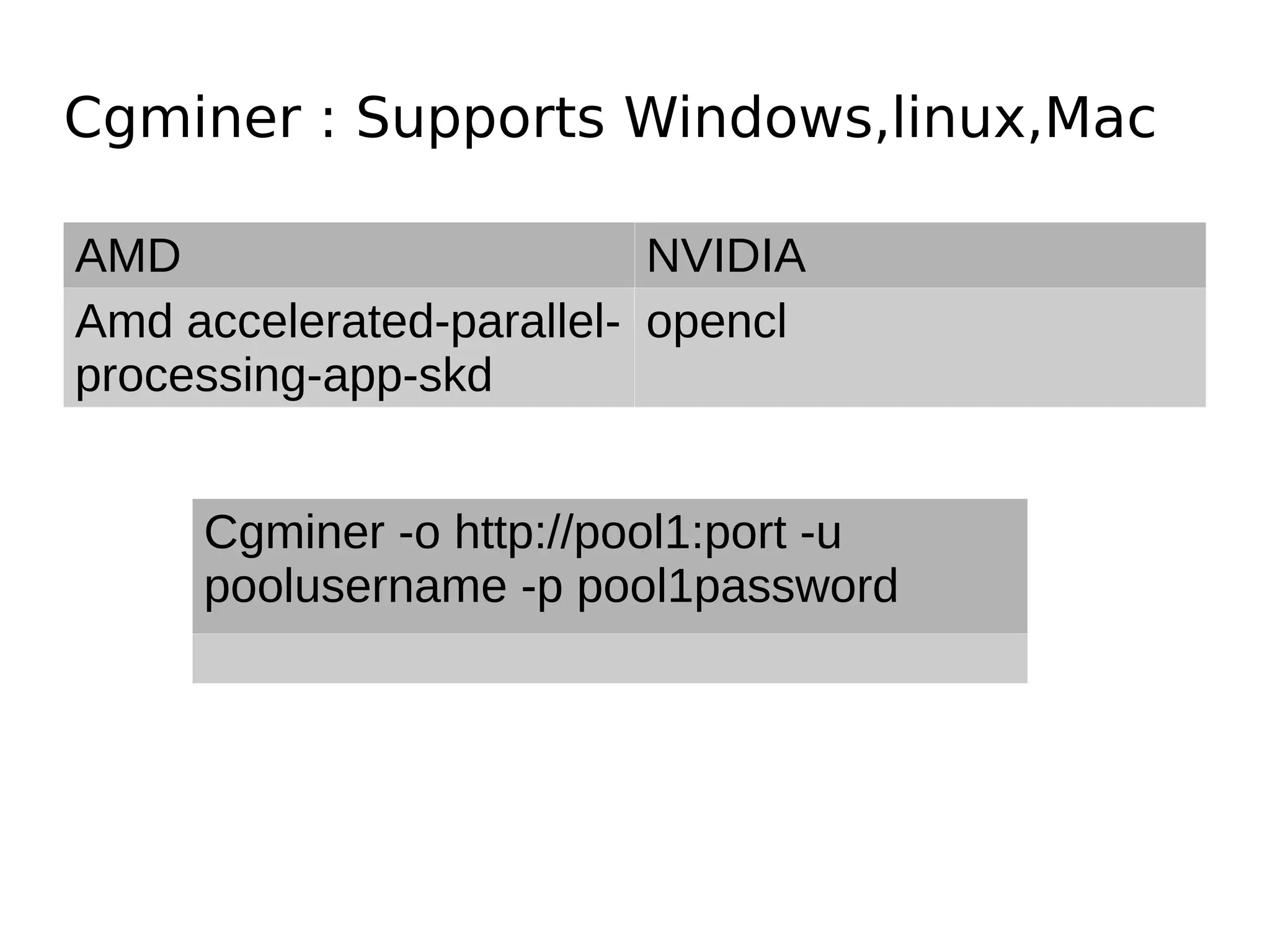
Cgminer : Supports Windows,linux,Mac
AMD NVIDIA
Amd accelerated-parallel-
processing-app-skd
opencl
Cgminer -o http://pool1:port -u
poolusername -p pool1password
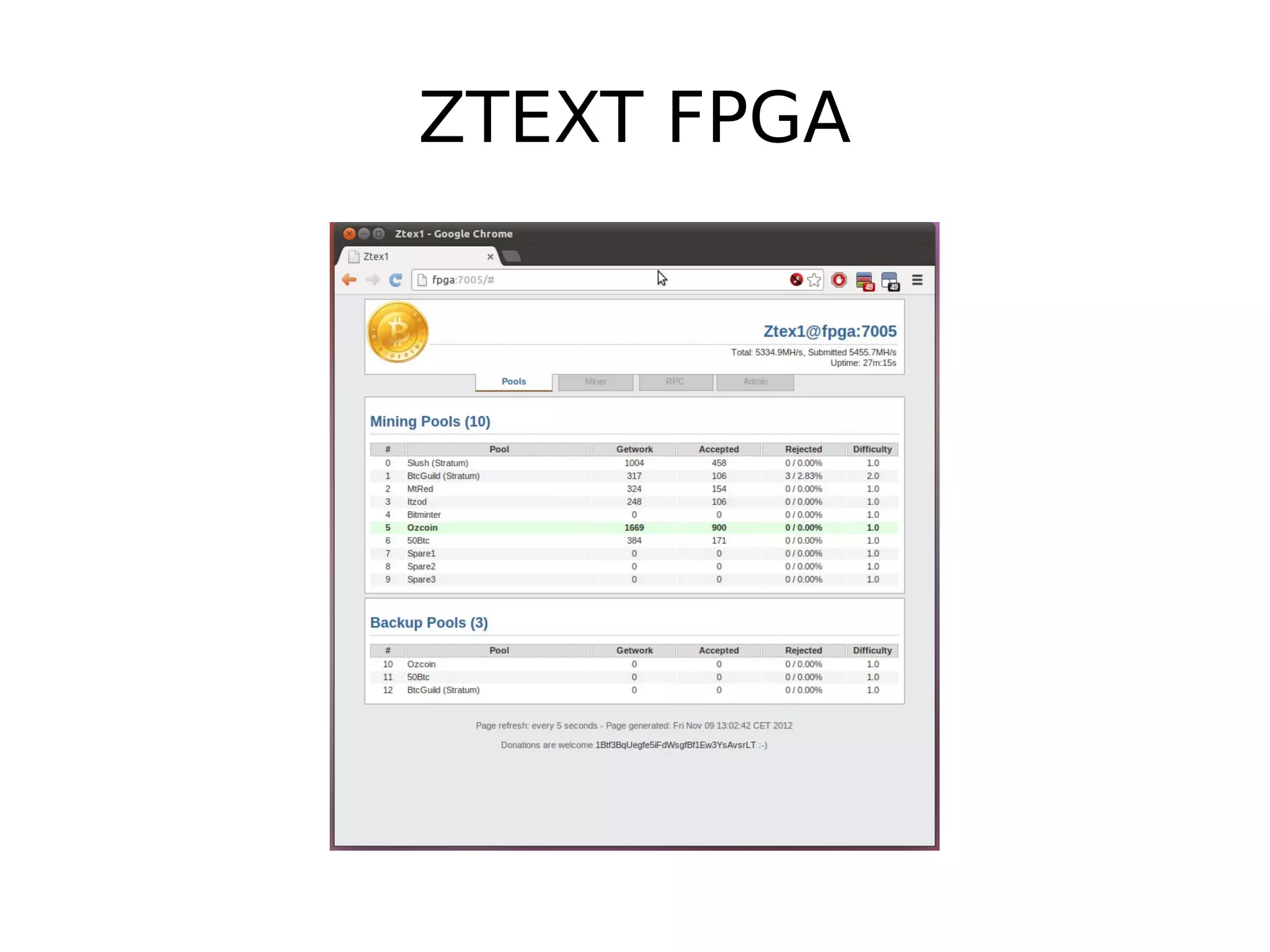
ZTEXT FPGA
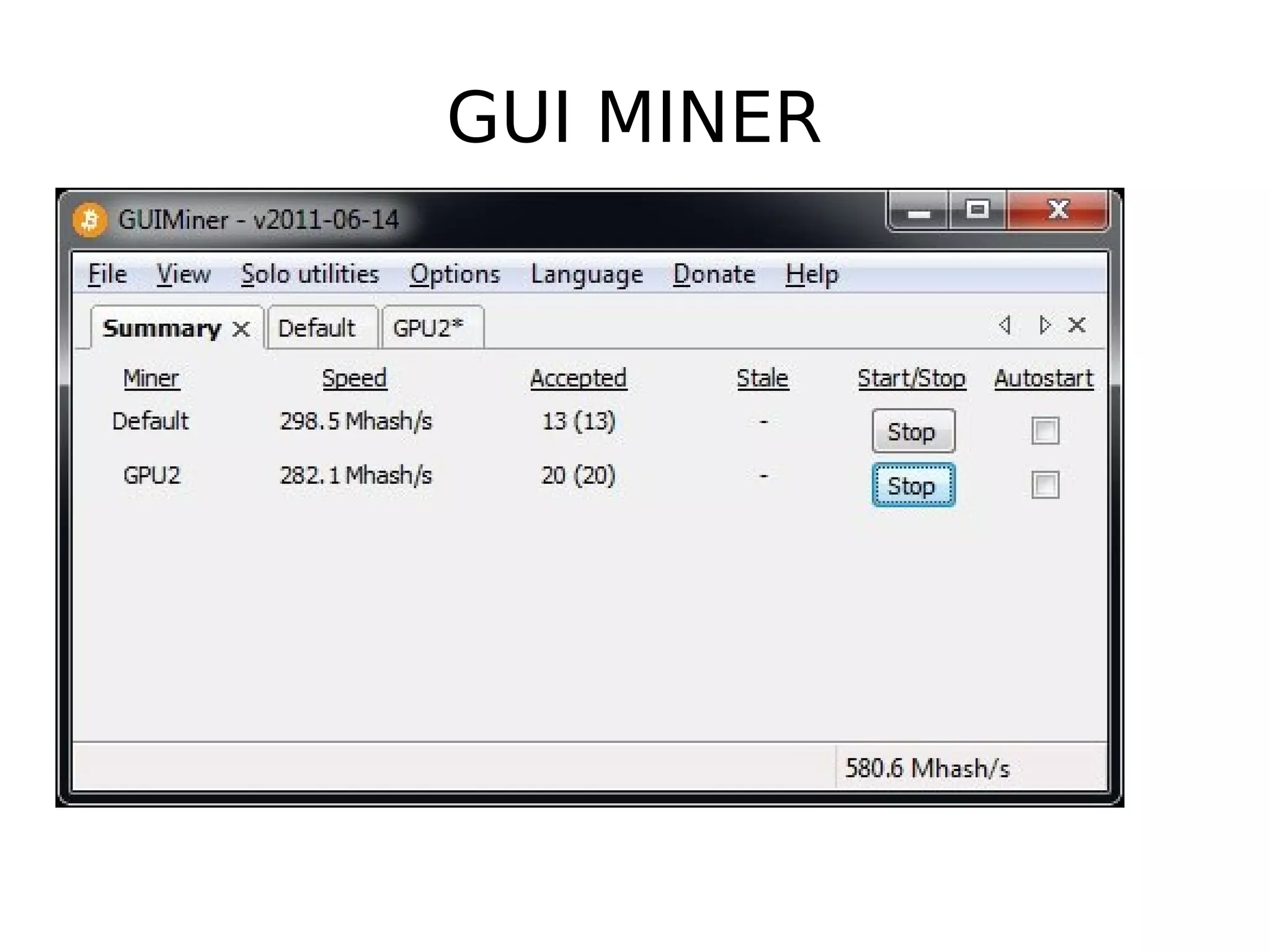
GUI MINER
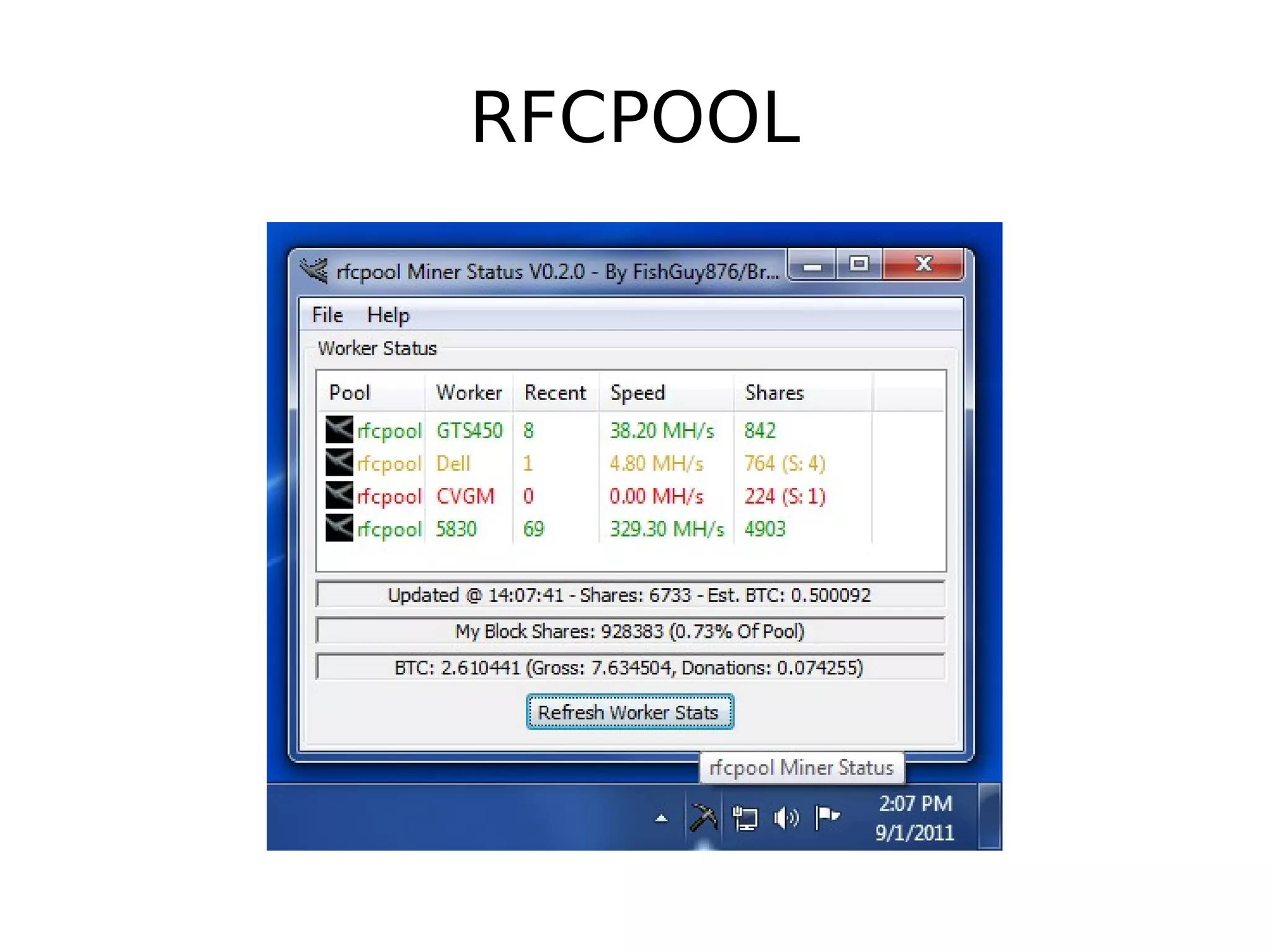
RFCPOOL
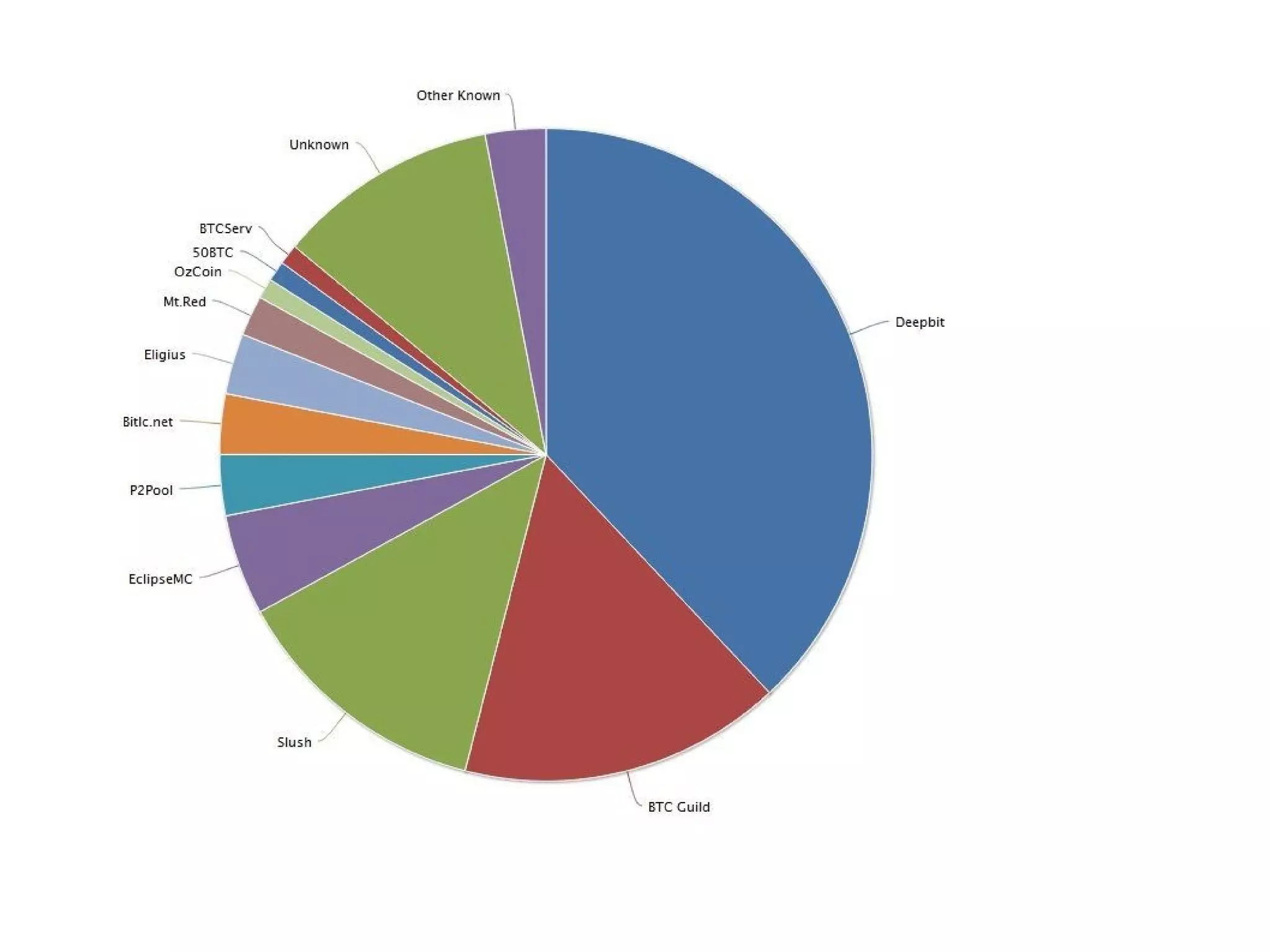
Why not join a Pool?
● Slush's Pool
● BTC Guild
● Eligius
● Ghash.IO
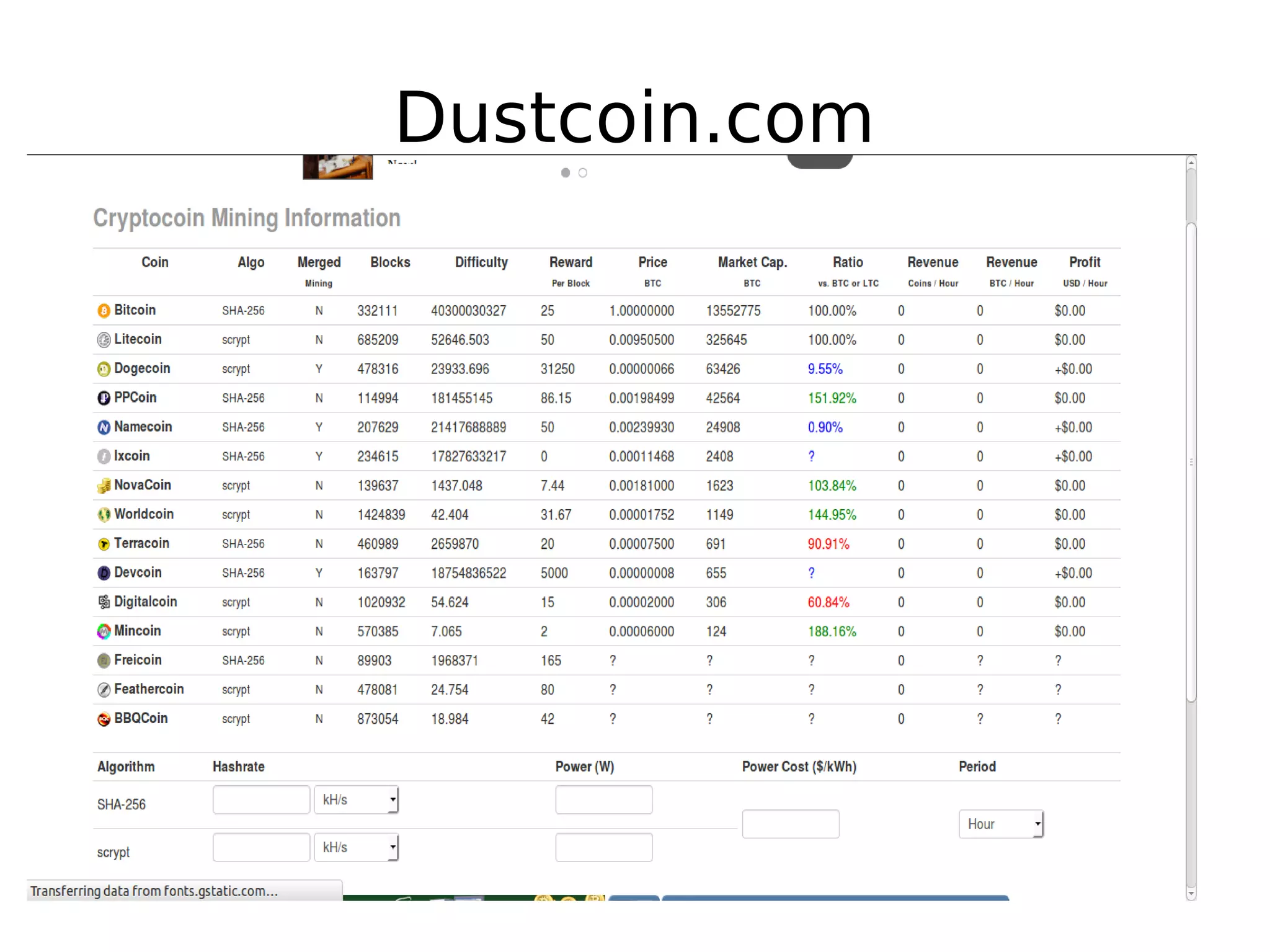
Dustcoin.com
Bibliography
● https://en.bitcoin.it/wiki/Mining_rig
● http://www.networkworld.com/article/2226506/opensource-sub
net/massive-bitcoin-mining-rig-earns--8-million-per-month.
html
● http://www.coinminingrigs.com/
● http://bitcoinmagazine.com/
● http://bitcoinmagazine.com/1524/growing-decentralization-in
-the-bitcoin-economy/
● http://dustcoin.com/
● https://bitcointalk.org/

Basics of Bitcoin & Mining

  • 1.
    Basics of Bitcoin &Mining Akhilesh Arora @akhilesharora linkedin.com/in/akhilesharora facebook.com/akhilesharora
  • 2.
    The Technology BehindBTC • Hashing (double-SHA256, RIPEMD-160) • Proof-of-work (hashcash proof) • Dual key encryption (Elliptical Curve Digital Signature Algorithm, Merkle Trees ) • Peer-To-Peer Networking (similar to IRC Internet Relay Chat)
  • 3.
    Hashing • Hashing isapplying an algorithm to find a short number (digest) of a block of data • A checksum is an example hashing algorithm • Every time you apply a hash to some data, you get the same hash number • Hashes are one-way. If you have the data, you can find the hash. But, if you have the hash, you can’t figure out the data. • Hashes are useful for verifying data
  • 4.
    Dual-key Encryption • Fundamentalto understanding virtual currencies • Encrypting with a password is single-key • Dual-key encryption uses two keys • If one key is used to encrypt, the other key can be used to decrypt • And vice-versa • The key that encrypted CANNOT decrypt
  • 5.
    Private and PublicKeys • Although keys are symmetrical, usually one key is kept private, while the other one is considered public. Key 1 Key 2 Private
  • 6.
    Dual-key Encryption • Encryptwith Key 2 Key 1 Key 2 Encrypted data Unencrypted data
  • 7.
    Mining • Byproduct ofpublishing the blockchain • This is the way new Bitcoins are created – Miners publish blocks on the blockchain – As a reward for publishing blocks, they get to keep Bitcoins. (50 for the first 4 years, 25 now, halving every four years) – Miners also get transaction fees • Race to find a conforming hash every 10 minutes • Don’t do it (unless you have cash, time, and an underutilized electrical engineering skill) • Incredibly competitive • High upfront investment • Dificulty is increasing rapidly • Now requires specialized hardware (ASIC chip)
  • 8.
    How Bitcoins areCreated • Every 10 minutes (average), miners try to solve a proof-of-work problem • The first one to solve the problem publishes a “block” on the “blockchain” that includes all transactions from the last 10 minutes • In 2009, the reward for publishing a block was 50 Bitcoins. Now it is 25. In 2016 it will be 12.5 Bitcoins • With the constant halving, eventually there will only be about 21 million Bitcoins
  • 9.
    How Bitcoins areNOT Created • You can’t pay to create extra coins. They can only be mined • There is no central bank to make them • The developers can’t add extra Bitcoins. Other users would rebel and not take the new version of the software (Litecoin) • Miners can’t mine extra or faster in response to market forces
  • 10.
    Blockchain • Miners publisha block of recent transactions every 10 minutes on average • Each block is provably related to the previous • Every transaction ever is stored in the blockchain • If there are disagreements about valid blocks, the blockchain can fork • Miners add to the longest good chain • Searching the blockchain can reveal interesting things
  • 11.
    Bitcoins Have BeenStolen • Some big heists have been pulled of with very large numbers of Bitcoins stolen • The thieves are usually hackers, not burglars • Generally, the stolen Bitcoins are never seen again on the blockchain • It is very important to protect your private key • Viruses can steal your Bitcoins • Other viruses can encrypt your hard drive and only decrypt if you provide Bitcoins • Botnets have mined Bitcoins
  • 12.
    Bitcoin Wallet Security •Keep keys offline if you can • Encrypt your wallet • Make backup copies of your wallet • If you are going to keep your savings at home, put them on a computer you ONLY use for bitcoins • Keep multiple wallets • Always receive money to a new address • Online wallets: use 2-factor authentication • Don’t spend from your “savings” address(es) • Don’t brag about how many coins you have or where you stash them
  • 13.
    Doom and Gloom •Some people say Bitcoin is not a currency and is doomed to fail • Almost everyone predicting the downfall of Bitcoin doesn’t really understand bitcoin • The arguments generally fall into the following categories
  • 14.
    Are Bitcoins aPonzi Scheme? • Charles Ponzi in 1920s defrauded investors • Bernie Madoff did the same thing in 2008 • Very common • Ponzi Scheme: – Unreasonable returns are promised in a “confidence trick” – Early withdrawals are paid with other investor’s money • Depends on opaqueness of finances • Everyone can see your Bitcoins • There have been Bitcoin-denominated Ponzi-schemes
  • 15.
    Are Bitcoins aTulip Mania? • Tulip Mania happened in Netherlands in the 1630s and is a classic asset price bubble story • If the definition of tulip mania is rapidly increasing prices, then maybe Bitcoins are a tulip mania, because the price is going up • There is no control on the supply of tulips • Tulips aren’t great as a medium of exchange. – They die – They are not easily divisible – They are not easy to value – They are not uniform – You can’t prove the value of any particular bulb • They do have intrinsic value • So do Beanie Babies
  • 16.
    Bitcoin Asset Bubble? •Maybe • Will the price shoot up and then fall back down rapidly? • Offshore US Dollars – Americans keep $1.5 Trillion outside the US – If they stored 5% of that in Bitcoin, BTC=$3,740 • Foreigners with US Dollars – Foreigners hold $3.4 trillion – 5% would be BTC=$8,095 • US-based prepaid debit cards $77 billion/year • Western Union makes $5B/year on money transfers • Currently, millions of dollars worth of Bitcoin are being created each day
  • 17.
    There Aren’t EnoughBitcoins To Go Around • 7,000 million people can’t each have one of 21 million Bitcoins • If/when they become common, few individuals will have a “full” bitcoin.
  • 18.
    Bitcoin Mining isWasteful • The Hashcash algorithm is almost useless except for within Bitcoin – Must show that work was done – Must be based on the previous block – Must be easily checkable • If the algorithm is useful to someone, that someone probably has an advantage • Changing the algorithm would be very disruptive to Bitcoin • Some altcoins attempt to solve this problem, but open vulnerabilities to do so • Nobody has found an acceptable alternative
  • 19.
    Types of MiningHardware 1.CPU 2.FPGA 3.ASIC 4.GPU
  • 20.
    CPU Mining ● Mosteasiest & commonly obtainable hardware. ● Problem Assosiated: Not designed for high volume of calculations. ● Can mine coins but will be astronomical and in no way to break even with COSTs involved.
  • 22.
    GPU ● More focusesupon mining due to reduced instruction set. ● AMD vs Nvidia ? AMD NVIDIA Low frequency High Frequency Parallel Procesing High High Throughput
  • 24.
    FPGA ● Field ProgrammableGate Array ● Comes in BLANK state. ● Can be programmed according to the user needs.
  • 26.
  • 27.
  • 28.
    Cgminer : SupportsWindows,linux,Mac AMD NVIDIA Amd accelerated-parallel- processing-app-skd opencl Cgminer -o http://pool1:port -u poolusername -p pool1password
  • 29.
  • 30.
  • 31.
  • 32.
    Why not joina Pool? ● Slush's Pool ● BTC Guild ● Eligius ● Ghash.IO
  • 34.
  • 36.
    Bibliography ● https://en.bitcoin.it/wiki/Mining_rig ● http://www.networkworld.com/article/2226506/opensource-sub net/massive-bitcoin-mining-rig-earns--8-million-per-month. html ●http://www.coinminingrigs.com/ ● http://bitcoinmagazine.com/ ● http://bitcoinmagazine.com/1524/growing-decentralization-in -the-bitcoin-economy/ ● http://dustcoin.com/ ● https://bitcointalk.org/