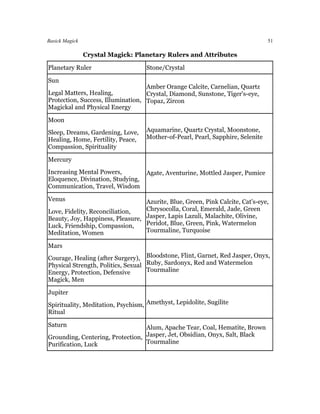
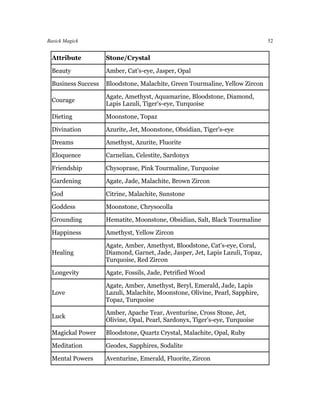
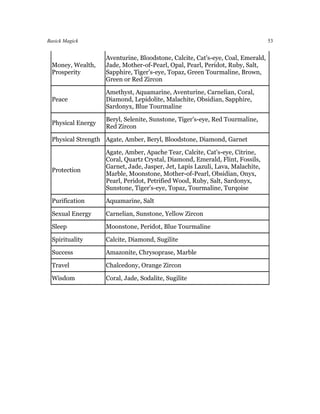
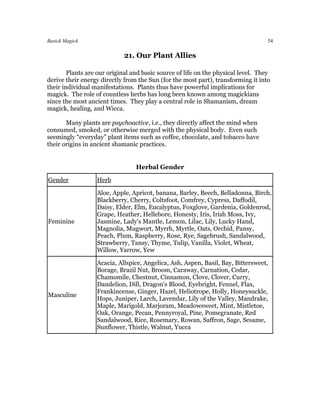
Basick Magick                                              1


                BASICK MAGICK
            Your Path to Self Knowledge and Power

                  2nd REVISED EDITION 2007
                       Edited with Introductions by

                       Fra. Petros Xristos Magister


© 2007 Mountain Center Pubs.
1533 E. Lupine Ave.
Phoenix AZ 85020-1208                                 $11.66
Phone 602-678-0644
Basick Magick                                      2


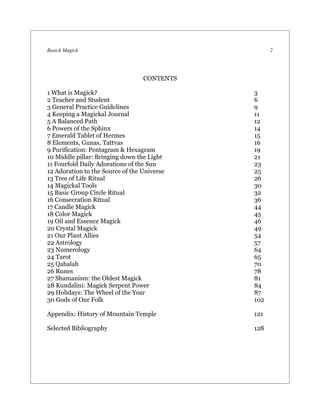
                                  CONTENTS

1 What is Magick?                            3
2 Teacher and Student                        6
3 General Practice Guidelines                9
4 Keeping a Magickal Journal                 11
5 A Balanced Path                            12
6 Powers of the Sphinx                       14
7 Emerald Tablet of Hermes                   15
8 Elements, Gunas, Tattvas                   16
9 Purification: Pentagram & Hexagram         19
10 Middle pillar: Bringing down the Light    21
11 Fourfold Daily Adorations of the Sun      23
12 Adoration to the Source of the Universe   25
13 Tree of Life Ritual                       26
14 Magickal Tools                            30
15 Basic Group Circle Ritual                 32
16 Consecration Ritual                       36
17 Candle Magick                             44
18 Color Magick                              45
19 Oil and Essence Magick                    46
20 Crystal Magick                            49
21 Our Plant Allies                          54
22 Astrology                                 57
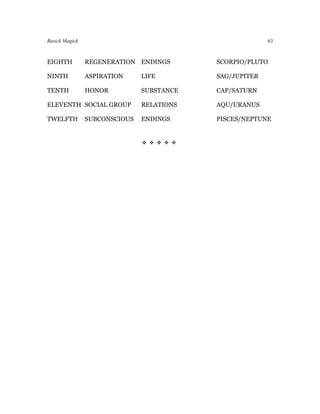
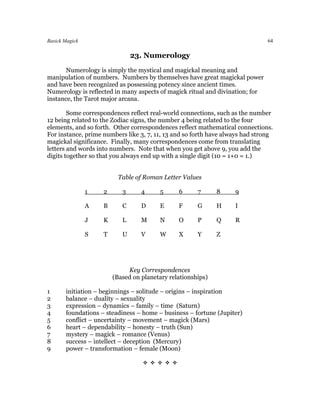
23 Numerology                                64
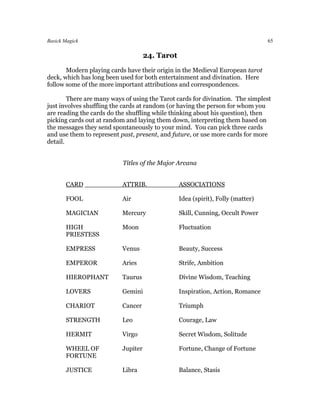
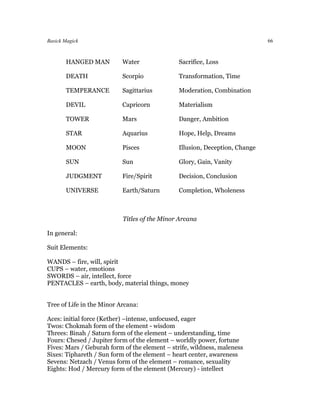
24 Tarot                                     65
25 Qabalah                                   70
26 Runes                                     78
27 Shamanism: the Oldest Magick              81
28 Kundalini: Magick Serpent Power           84
29 Holidays: The Wheel of the Year           87
30 Gods of Our Folk                          102

Appendix: History of Mountain Temple         121

Selected Bibliography                        128
Basick Magick                                                                            3


                    1. Introduction: What is Magick?
                                   by Petros Xristos


“Magick is the Highest, most Absolute, and most Divine Knowledge of Natural
Philosophy, advanced in its works and wonderful operations by a right
understanding of the inward and outward hidden virtue of things; so that true
Agents being applied to proper Subjects, strange and admirable effects will
thereby be produced.” – from The Goetia.


       Magick is spiritual force in action.

       It is an art, a science, and a craft.

       It is an art, meaning there is a lot of room for individual creativity; it is a
science, meaning that there are certain consistent, established principles which
we can benefit from studying; and it is a craft, requiring hands-on application
and practice.

      Magick is the art, science, and craft of changing your consciousness and
your world to better reflect what you really want.

       Magick is based on the idea that everything in the world around you
reflects your inner consciousness. As you change your consciousness you change
your world.

        Magick is a lifestyle and a path, it is not an organization, although various
organizations exist to help magicians in their learning. Your only commitment
ever is to your higher self and your spiritual development. Magick is an
individualistic pursuit, though it can be practiced very effectively in groups too.
Often, small groups or even one-on-one mentorship is the best way to learn and
practice your craft, without the social pressures of a large group.

       Spirituality can be practiced without magick, in which case it is usually
known as prayer or meditation and has no deliberate outward force. Magick can
be practiced without spirituality, and this is generally known as low magick or
witchcraft in the generic sense, where force is projected outward in spells and
incantations in order to accomplish some simple mundane goal (love, money,
Basick Magick                                                                        4

etc.) When spirituality and magick are combined it is called high magick, which
is spiritual force projected outward into the world for purposes of inner
development.

       In magick, initiation is an important first step. “Initiation” simply means
the formal recognition that you have stepped onto the path of conscious
evolution. Most magicians are self-initiated. To initiate yourself is simply to
make a firm decision to set out on the path of spiritual growth. Once you have
made this step you are an initiate. To be an initiate is to have begun a journey,
not finished it.

       Since magick is such an individualistic and creative pursuit, outside of a
particular organization there are no “grades” as such, but one can speak
informally of approximate levels of advancement that may exist in different
magicians. Individuals may be considered Students, Adepts, or Masters,
depending on their level of personal advancement, or they can be referred to
generically as “magicians” which can refer to any degree of advancement.

        A student is anyone who is curious about the path of magick and has
begun studying it, with or without an external teacher. An adept is someone
who’s been at it a long time (years, not months) and should be able at minimum
to answer most any question put by a student, and should know all the basic
rituals in this book by heart, and preferably many more. The success of an
adept’s practice should be evident by looking at his demeanor and overall life. An
advanced adept may not be in need of external teacher, though many of them still
maintain ties with their old teacher(s), since there’s always something to be
learned. A Master is a rarity and is often known by the fact that other adepts look
to him as an example. Adepts teach students; Masters teach adepts.

       This book will aim to teach basic magick to anyone who has a curiosity
about it, or has just set out on the path of wisdom. It has been assembled from a
wide variety of pre-published (public domain) sources, specially chosen to be
most helpful to new students or those needing a quick refresher course. It is
meant as a ready handbook and resource guide. The arrangement proceeds
logically from basic principles, to rituals which may be of use in any
circumstances, to forms of divination and magick which will be more helpful to a
student who has mastered the basics first.
Basick Magick                                                                        5

Why the “K?”

       It is believed that Aleister Crowley was the first modern master to add the
k onto the word magic, for two reasons: 1. To distinguish sorcery from stage
magic and 2. “K” is the eleventh letter of the alphabet, and 11 is a key magical
number. Notice that by adding a k to the end of the word “basic” we ensure that
both words have six letters, thus 6 + 6 = 12, the number of the Zodiac. (See also
Chapter 22, Numerology.)

                                   
Basick Magick                                                                           6


                          2. Teacher and Student
       While you don’t need an external teacher to learn magick, such a one can
certainly be of help. There are many things that cannot easily be learned only
from books, and require the actual presence of a person with whom one can
communicate and receive feedback. This is especially true in an area as creative
and esoteric as magick.

      The first step in learning anything is knowing that you need to learn
something.

       If you know you need to learn something, you will realize that you also
need a teacher or teachers to teach you that thing.

      The teacher or teachers you need must be individuals who have already
learned what it is you want to learn.

       A teacher is first and foremost a lifelong student, one who was once in the
position of his student and who in fact will still be growing and may even have a
more advanced teacher beyond him.

       Regardless of this fact, you do a disservice to the teacher and to yourself if
you bring skepticism and constant doubt into the relationship with the teacher.
You must have gone beyond this point before seeking out and settling on a
teacher. If you constantly doubt and are skeptical of the teacher, you will learn
nothing. If you have such deep doubts, it is best to find another teacher or
reevaluate your goals.

      When the student is ready, the teacher appears – this is an ancient truth
and remains true. You will come across the right teacher for you at a given time
when you are open to the possibility. You will be actively looking for such a
teacher at that time.

        You may have more than one teacher, as different teachers may specialize
in different aspects of what you need to learn. No teacher is expert in all areas.
Also, you may move from one teacher to another as you grow and your needs
change. Often, one teacher may suggest that you move on and may give you the
name of another, or point you in the right direction, if he feels your growth may
better be served in another direction. Still, you must be grateful to the first
teacher for taking you as far as he did. He served a purpose, even if it was a
limited one. Time to move on without regret.
Basick Magick                                                                     7


       There are more “false students” than false teachers – that is, students that
only think they are students, but who aren’t sincere, or have false motives.

      A teacher may be deliberately acting as a “bad example” in order to show
you what not to do. Be grateful for the lesson.

      A teacher may deliberately aim lessons at your weakest spots, to bring
them to your attention. Remember that pain is a great teaching tool.

       A student holds a great responsibility, but the teacher holds an even
greater one.

       Excessive skepticism is the opposite of the magickal attitude.
       Excessive negativity is the opposite of the magickal attitude.

       It is your responsibility to choose your path with care.
       It is your responsibility to choose a teacher with care.

        Avoid mixing and matching of paths. While simply studying or reading you
can study any path or tradition, but when actually putting your knowledge into
practice, you must utilize one at a time. You cannot specialize in too many
different traditions at once, or your power and focus will be dispersed. You may
utilize several traditions that are closely related or have a connection between
them, however. Some traditions work better in combination than others.

      You should open your awareness and see which path or tradition pulls you
the most. If possible, find a tradition that is suited to your own culture and
mindset. For most European students, a tradition based upon Indo-European
archetypes and heritage will prove more fruitful than those which are “alien” or
which properly belong to another heritage. This is a matter of respecting your
own as well as other peoples’ heritages.

       Student and teacher are equal in terms of the role each must serve – but
the student must not supplant the teacher. If the student has advanced beyond
the teacher, it is time to separate, without rancor or regret.

      If at any time you feel you know more than the teacher, it is time to
separate and move on. Even if you are wrong, the feeling you know more will
prevent you from further learning from that teacher.
Basick Magick                                                                       8

        Backsliding is impossible – only the appearance of backsliding. In fact,
growth always goes forward. A tree cannot turn back into an acorn, though it can
certainly be stunted or broken down and turned into lumber or kindling. But this
is not going backwards.

      Go for quality, not quantity. It doesn’t matter if you are the only student
and your teacher is the only teacher. In the end this is always the case anyway!

      It is difficult to judge one’s own progress objectively – i.e., am I
progressing too slowly? – because one’s judgment is naturally distorted by
wishful thinking or hyper-criticism. The teacher is a better judge of the student’s
progress than the student, and this is one of the great benefits of a teacher.

      You cannot always choose your magickal curriculum anymore than you
can choose your life experiences. But you can use them for your evolution.

      Anyone can be a teacher up to the level of beingness that they are in. They
cannot teach beyond that, however. Thus, if you’ve been studying magick for one
month, you can teach someone who’s only been studying it for one day, but both
you and your student will quickly reach your limits.


                                   
Basick Magick                                                                           9


                     3. General Practice Guidelines
                                       by P.X.

       All magickal students will find their practice more effective if the following
basic “environmental” matters are properly arranged.

       Magickal or Spiritual work requires a certain degree of stability and
quietness in one’s immediate environment. The ability to set aside some time
each day without distractions is important. A separate room exclusively devoted
to one’s studies and meditations is ideal, but if this is not possible, a corner of a
room will do. A walk-in closet can be ideal, as there are no distractions from the
outside world, and it can easily be sealed off from prying eyes.

       A personal Altar is a crucial focusing object. Any kind of wooden table or
convenient platform will do (even a shelf if necessary.) It should be
approximately navel-height for easy use without having to bend over. Some
magicians find that two cubical boxes, stacked vertically and covered with a sheet
or drape, works well and is in conformity with ancient symbolism. The altar
should be along the eastern wall of the room if possible.

        Nothing should be placed on top of the altar but one’s magickal tools,
significant focusing symbols, a lamp or candles and incense burner. The lamp or
candle represents the Higher Self reaching down, while the incense represents
the mundane self aspiring upwards. It is best if the altar can be concealed from
mundane view, but this is not mandatory.

       Every magician should keep a Magickal Journal in which to record one’s
experiences and practices. This need not be elaborate. A simple notation such as
“Performed Banishing ritual” with date and time is enough. This should be kept
on or in the altar. This diary will eventually become one’s “passport” to higher
attainments, and a weapon or shield against inner obstacles such as laziness or
dryness. In Wicca, this diary is known as a “Book of Shadows” (see Tools chapter
below, also the chapter on Keeping a Magickal Journal.)

       One may feel free to make whatever other adjustments in one’s life one
feels necessary to add to one’s peace and quiet and focus, such as dietary or
sexual discipline.

       Daily practice of the basic rituals is one of the most important things you
can do to build a strong magickal craft. Practice makes perfect and habit makes
for the subconscious reinforcement that is the essence of magick. Aim for
consistency.
Basick Magick                                                                       10

        Study the basic rituals regularly, especially the Banishing Ritual of the
Pentagram and Drawing Down the Light (Middle Pillar), until you are very
familiar with them. Eventually all the symbols should be understood as well as
all the keywords and motions. One should then be able to put oneself through
the ceremonies purely by astral (visualized) means, seeing all the symbols in their
appropriate places. Do it over and over again until you can do it smoothly and
with confidence, and automatically recognize the meaning of the symbols
involved. Record any insights you receive, especially the spontaneous
appearance of symbols not previously seen or expected.

      One specific sign of advancement is the ability to rely less and less on
physical rituals and objects and to work more with “astral” rituals or visualized
magical performances.

       The purpose of all magical work is to awaken oneself to a conscious
recognition of one’s true nature as immortal spirit. All other practices and
techniques are only valuable as stepping stones to this ultimate goal. This
recognition usually does not come all at once or in a stable fashion. The magician
who works diligently will experience hints of its truth here and there, in bits and
pieces, unevenly, but more and more stably and certainly as one advances.
Indeed, this is the only sure sign of attainment in the work and one can only
know it certainly for oneself when it comes.


                                  
Basick Magick                                                                       11

                      4. Keeping a Magical Journal
                                        P.X.

       The keeping of a magical journal is a critical discipline for practicing
magician. It enables him to keep track of his progress upon the Path and
provides a concrete record of rituals and ceremonies, initiations undertaken,
evocations and invocations attempted, and any experiments that he or she may
perform along the lines of practical magic. The immediate, mundane benefit of
the journal is that it supplements one’s often-unreliable memory and provides
one with material to review months or even years after the fact. The more subtle
benefit of the magical journal is that it serves one as a token or “passport” to one’s
own higher development. Used properly in this fashion, it becomes a veritable
magical implement just as the Wand, Cup, or Sword.

        Many magicians keep their journal near or upon their Altar, although this
is not necessary. What is necessary, however, is that one practice the utmost
rigorous honesty with oneself when keeping the diary. One should avoid the
temptation to exaggerate or put a good shine on one’s magical experiments and
failures. Ultimately, one’s failures will become as important to defining oneself
as one’s successes, if not more so. The act of regularly keeping the magical diary
is an act of self-definition and self-transcendence. Confronted with obstacles
mundane or supramundane, its presence near one’s hand at the altar can serve as
both shield against fear and weakness and as an offensive weapon against the
demons of negativity and self-doubt that will inevitably assail one as one moves
further along the Path.

        If one is already accustomed to keeping a daily journal, the magical journal
should be an easy additional habit to acquire. However, be careful to separate
one’s magical journal from one’s mundane diary. Use two separate books.
Nothing should go into the magical journal that does not relate to one’s progress
on the path. It need not be wordy or even very detailed all the time; often, a
single line entry of a ritual performed will be sufficient. When conducting more
complex operations, treat them as a scientist would treat his experiments: list all
relevant information regarding one’s set-up and temple arrangements, time and
date, and any other conditions of the operation. Carefully record results
obtained, whether desirable or undesirable. This way one will gradually but
inexorably build up a powerful ally in one’s work, training one’s subconscious to
remember one’s continuing efforts.

       A magical journal should be treated as a confidential tool, exactly as one’s
other temple tools. It is at one’s discretion whether to share any portions of one’s
journals with other practitioners.

                                    
Basick Magick                                                                      12

                             5. A Balanced Path
   (Excerpts from “Liber Librae, The Book of the Balance” by Aleister Crowley,
                 based on G.D. rituals. Freely adapted by P.X.)

       Magickal students should first learn that equilibrium is the basis of the
work. Without a solid foundation, one has no place on which to stand to enact
one’s magick.

        As all are incarnated in the world with the darkness of materialism all
around them, and the struggle of diverse forces and energies, so the aspirant’s
first task is to seek the light of spirit-energy behind all this.

       Use the inevitable trials that you will encounter as fuel for your
advancement. In challenges is strength, and by their means is a pathway opened
to the Light of awareness. The greater the trial, the greater the potential growth,
but only if you have awareness.

       Do not become ego-inflated due to magickal advancements, as with
increase of knowledge should come increase of wisdom. The truly wise know the
limits of their knowledge.

       Beware of fear in the magickal work. Fear is failure, and the forerunner of
failure: and courage is the beginning of virtue. Fear not spirits or visions but be
strong in utilizing them. Command or curse as needed, but do not mock them.

        As below, so above: A Magician’s work affects not only the magician but all
that is around him.

        Control but do not punish the physical vehicle that you use in your craft, as
it is the link between the inner world of spirit-energy and the outer world of
apparent manifestation.

      The Magician’s mental steadfastness and equilibrium is most important to
his work, so let your inner mind be above disturbance by petty material
manifestations.

       Remember that unbalanced force is evil; that unbalanced severity is but
cruelty and oppression; but that also unbalanced mercy is but weakness which
would allow and abet Evil.

       Plan ambitiously, act passionately, think rationally, be Oneself.

       True ritual is as much action as word; it is Will.
Basick Magick                                                                      13

       The sin which is unpardonable is knowingly and willfully to reject truth, to
fear knowledge lest that knowledge pander not to one’s presumptions.

       To obtain Magical Power, learn to control thought; admit only those ideas
that are in harmony with the end desired, and not every stray and contradictory
idea that presents itself. Focus.

       Fixed, focused thought is a means to a magickal end. Therefore, pay
attention to the power of silent thought and meditation. The material
manifestation is but the outer manifestation of an inner state.

       Thought is the commencement of action, and if a chance thought can
produce much effect, consider how much more focused thought can do. This is
the essence of magick.

       Be swift and active as the Sylphs (the Elementals of Air), but avoid frivolity
and lack of focus.

       Be energetic and strong like the Salamanders (the Elementals of Fire), but
avoid irritability and excessive ferocity.

       Be fluid and reflective like the Undines (the Elementals of Water), but
avoid excess passivity and mutability.

       Be laborious and patient like the Gnomes (the Elementals of Earth), but
avoid crudity and avarice.


                                    
Basick Magick                                                                       14

                    6. The Four Powers of the Sphinx:
                      Emblem of Balanced Completion

       Visualize the ancient image of the Sphinx, a composite creature formed of
the head of a Man, the front body of a Lion, the haunches of a Bull, and the wings
of an Eagle. These represent balanced magickal development and should be kept
in mind as you progress.

       The Man      Knowledge     Aquarius
       The Bull     Will          Taurus
       The Lion     Daring        Leo
       The Eagle    Silence       Scorpio

       Ultimately, the Sphinx represents the Magician perfected in his craft, the
four elements brought into equilibrium. From these four arises spontaneously
the Fifth Element, Spirit-Energy Essence.


                                    
Basick Magick                                                 15

                    7. The Emerald Tablet of Hermes:
                  First Codification of Magickal Principles


As above, so below;
As without, so within,
All to one End!

As all things are derived from the One,
By the will and by the word of the One,
Which manifested it in its Heart,
So all things owe their existence to this Unity
And are evolved as they move again toward it.

Its Father is the Sun
Its Mother is the Moon
The Wind carries it in its womb,
And its nurse is the Earth.

Separate the Earth from the Fire,
The subtle from the gross,
Wisely, with Judgment and Craft.

It ascends from Earth to Heaven,
And descends, renewed, to the Earth,
Taking unto itself thereby the power of Both.

Thus the splendor of the Cosmos will be thine,
And all darkness shall flee from thee.

This is the strongest of all Powers,
The Force of all Forces,
For it overcomes all subtle things
And can penetrate all that is solid.


                                   
Basick Magick                                                                        16

                             8. Elements, Gunas, Tattvas
        The elements are the ancient “qualities” of manifested material existence.
 The Magician must work with all of them easily and knowledgably. They are not
 identical to modern scientific concepts of “element,” but are esoteric symbols.
 They are involved in most all magick that will follow, and are found in astrology
 and elsewhere. Each element can be connected with many other things in the
 world inside and out. Below are just a few of the correspondences.

        Earth               solidity     the body            north        pentacle
        Air                 swiftness    the intellect       east         sword
        Fire                ferocity     the willpower       south        wand
        Water               reflection   the emotions        west         cup


                              Elements: Table of Correspondences
Element          Fire              Water              Air            Earth
Direction        South             West               East           North
Color            Red               Blue               Yellow         Green
Season           Summer            Fall               Spring         Winter
Time             Noon              Sunset             Dawn           Midnight
Moon Phase       Waxing            Full               Waning         New
Tarot suit       Wands             Cups               Swords         Pentacles
Elemental        Salamanders,      Undines,           Sylphs,        Gnomes,
Spirits          Sprites           Merfolk            Faeries        Dryads
                 Flexible,         caring,            logical,       practical,
                 creative,         imaginative,       aesthetic,     skilled,
Strengths
                 passionate        expressive         fair           determined

                 Proud,            enmeshed,          thoughtless,   stubborn,
                 selfish,          moody,             judgmental,    possessive,
Dangers
                 restless          unrealistic        critical       unimaginative

                 Inspire           flow               communicate crystallize
                 act               diffuse            strive      ground
Verbs
                 begin             dissolve           disperse    solidify

Descriptive Flare up,              Wash away,         blow it off,   plant an idea,
Phrases     consuming              flow with it,      breeze         feet on the ground
            passion,               still waters run   through,
            hot-blooded            deep               air concerns
Basick Magick                                                                      17

The Gunas

       The three gunas are the ancient Vedic (Indian) qualities of manifest
existence. The successful Magician must endeavor to unite them all in perfect
balance and thus go beyond them. They are all technically equal, but there seems
to be an evolution from tamas upward to sattva. Still, each is imperfect by itself.
They can also be associated with the classical elements salt, sulphur, and
mercury.

Tamas        inertia, obscurity, earth, minerals, physical body or corpse,
depression, dreamless sleep, color black, salt

Rajas        dynamism, brightness, fire and air, mind and willpower (excess),
anger, nightmares or over-active dreams, color red, sulphur

Sattvas      lucidity, purity, order, balance, sweetness, meditative mind, lucid
dreaming or visions, color white, mercury


The Tattvas

         The five tattvas (pancha mahabhuta = five great elements) are another
way of looking at the elemental divisions or qualities and are, like the gunas,
originally a Vedic (Indian) development which may have influenced the ancient
Greek idea of the four elements. “Tattva” simply means that-ness or “that which
is,” i.e., basic principle of reality. The main benefit of the tattvas from a Western
Magick perspective is their very clear and simple visualization symbols. Unlike
the European elements, each of these tattvas is also the name of a god or goddess
associated with that element, so there is an element of divine consciousness
already inherent in the word itself. The Unseen is taken to have created the four
manifest elements out of Akasha.

Prithvi
Earth. “Mother Earth” Goddess

Vayu / Prana
Air. “Mukhya Vayu” or “Mukhya Prana,” the Lord of Life. From vayu we get the
Latin word for life, vita.

Ap
Water


Agni
Basick Magick                                                                     18

Fire. Agni is a great Vedic god. From agni as a noun we also get the Latin word
ignis, from which we get words like “ignite,” “ignition,” and so forth.

Akasha. Aether. Can also refer to the sky.


                                  
Basick Magick                                                                     19

                       9. Purifying the Space:
                the Pentagram and Hexagram Rituals
        Banishing rituals are among the first rituals you will need to learn in
magick, and the most important. Before performing any kind of magickal ritual
you will want to purify the space around you of any negative influences. After a
ritual, it is usually necessary to banish in order to clear out any unwanted
influences. Banishing rituals can be done in an individual or group environment.

        The Pentagram Banishing ritual is a general-purpose movement to cleanse
one’s energetic environment and reduce or eliminate negative influences. When
one is new on the path, it should be performed more frequently, at least once a
day. It is especially important to do before meditations or astral experiments, or
when consecrating a new temple space. It can be done in less than five minutes.
It will quickly become memorized, and the sooner this is done the better, as it will
be used throughout one’s magickal lifetime.

      Use the Right hand or a Wand always when gesturing. Do not speak the
parenthetical words, these are only for explanation while reading the text!
Speak only the words in all CAPS. If discretion is required, you may whisper or
even perform the whole ritual silently, saying the words only in your mind.

Touch Forehead: ATEH (Unto Thee)
Genitals: MALKUTH (The Kingdom)
R Shoulder: VE-GEBURAH (Power)
L Shoulder: VE-GEDULAH (Glory)
Chest: LE-OLAM (Eternity), AUM!

(The above is called the Qabalistic Cross.)

Facing E: Make a Yellow Pentagram in the air with right hand or wand, saying:
YEHOVAH

Turn to S: Red Pentagram: ADONAI
Turn to W: Blue Pentagram: EHIEH (pronounced AY-I-AY)
Turn to N: Green Pentagram: AGALA

(Return to facing East, with arms outstretched to each side)

BEFORE ME . . . RAPHAEL!
BEHIND ME . . . GABRIEL!
ON MY RIGHT HAND . . . MICHAEL!
ON MY LEFT HAND . . . AURIEL!
FOR ABOUT ME FLAME THE PENTAGRAMS AND UPON THE COLUMN
STANDS THE SIX RAYED STAR OF FORCE AND FIRE!
Basick Magick                                                                   20


Repeat the Qabalistic Cross and you have completed the ritual.


Hexagram Banishing ritual

       This is a more sophisticated form of banishing ritual than the above, which
can complement the Pentagram ritual or stand on its own. If both are to be done,
the Hexagram ritual is done after the Pentagram ritual. It invokes somewhat
different energies than the Pentagram ritual.


Towards the East.

Qabalistic Cross (Atah – Malkuth – Ve-Geburah – Ve-Gedulah – Le-Olam –
AMN)
Arms outstretched: Before me RAPHIEL. Behind me GABRIEL. To my right
hand MICHAEL. To my left hand AURIEL. For about me flames the Pentagram
and upon the Column stands the Six-Rayed Star of Force and Fire!

Banishing hexagram of Fire in East. ARARITA
Banishing hexagram of Earth in south. ARARITA
Banishing hexagram of Air in West. ARARITA
Banishing hexagram of Water in North. ARARITA

Towards East again and (in Tau cross form):

I-N-R-I
Yod . . .Nun. . . Resh . . . Yod
Virgo: Isis, mighty Mother!
Scorpio: Apophis, Destroyer!
Sol: Osiris, Slain and Risen!
Isis . . . Apophis . . . Osiris: IIIIIAAAAOOOO!

The Sign of Osiris Slain. (“X”)
The Sign of the Mourning of Isis. (svastika)
The Sign of Typhon and Apophis. (“V”)
The Sign of Osiris Risen. (“T”)
L. . .V . . .X: Lux, the Light of the Cross!

                                  
Basick Magick                                                                         21

                       10. The Middle Pillar Ritual:
                Bringing Down the Light of the Higher Self
       This is a powerful energy-invoking exercise used to bring down the Light
of Spirit or awareness or the Higher Self into the body of the magician. Once the
Light has been installed in the Heart (point 9 below), it may effectively be
channeled outward as healing and transformative energy.

       When used in this fashion, the Light that has been installed in the Heart
center in point 9 is channeled through the palm of the hand as a pure white Ray
of force, towards whatever object is intended as recipient.

       This exercise stands by itself as an energy focusing work, and may be
utilized by any magician on a regular basis – and certainly ought to be activated
before attempting any transmittal of healing energy.

       It may also be done as part of a longer ritual process, such as following the
LBRP and the Rose+Cross Rite, in that order. In this way, the LBRP clears and
purifies your space; the Rose+Cross establishes a clear white background upon
which to work.

       Do not banish after invoking the Light! If you need to banish it should be
done before invoking the Light. By the time the Light has successfully descended
there will be no need to banish anything. You do not banish the Light, it will
dissipate or remained stored as needed.


1. Stand in the Temple (or other location) facing West. (This is because you are
taken to be standing in the East, source of the Light of the Golden Dawn as it
manifests on the Earth plane.) Arms are stretched out straight to both sides. On
your right (the North) is the Black Pillar of Severity; on your left (the South) is the
White Pillar of Mercy. You stand in between as the Middle Pillar of Balance.

2. A blindingly brilliant white light, the Light of the Infinite God (Ain Soph Aur)
originates far above your head, coming from the Crown. (Saharshra).

3. The light descends to the top of your forehead, forming a sphere the size of
your head. Vibrate, strongly: EH-EI-EH (“I AM”)

4. When this is felt strongly, allow the light to descend to the Daath center (throat
chakkra). Vibrate: YHVH ELOHIM (I Am the Mighty One of God.)

5. Allow the Light to descend further to the heart center (Tiphareth/Anahatta
chakra). Vibrate: YHVH ELOAH VE-DAATH. (I Am the Lord of Knowledge.)
Basick Magick                                                                      22

6. Allow the Light to descend through the Solar Plexus, down to the Svadisthana
Chakra (generational center) at Yesod. Vibrate: SHADDAI EL-CHAI (Lord of
Life.)

7. Allow the Light to descend further, through the Muladhara Chakra (root
center) and all the way down to the earth, gaining density as it progresses.
Vibrate: ADNI HA-ARETZ (Lord of the Earth.)

8. The Light of the Golden Dawn now surrounds the whole body of the Initiate.

9. Allow it to ascend back up to center it in the Heart, where it becomes
established in fullness.

10. From this Center the Light may be channeled as a healing energy, through the
palm of the right hand, as a white ray of force aimed at an object. The Light may
also be established in the Heart and utilized as a catalyst for meditative states and
visions, if it is meant to be so.


                                  
Basick Magick                                                                     23

            11. The Fourfold Daily Adorations of the Sun
       A short devotional prayer to the Sun for focusing the practitioner’s
energies and attention on a daily basis. If practiced regularly, it will easily
become memorized and eventually become automatic. This is a sign of great
success in the practice. If the student feels strongly moved by this exercise, he
should make a commitment to perform it four times daily for at least a month.
This may require at least one disturbance from sleep or interruption of one’s
regular work for the few moments it takes to perform the adoration. This is also a
sign and tool of strengthening Will. If necessary, it can be performed silently or
mentally, though doing it aloud and physically is preferable.

       The image is of the Sun-God, Ra (under various names), who is envisioned
as traveling over the dome of the sky in a great Boat. At the prow stands Tahuti
(Thoth), God of Wisdom, and at the steering-helm in the rear stands Horus (Ra-
Hoor), the Warrior God. One can see this image frequently in Egyptian art.
When performing the adorations face in the indicated direction and hold up one’s
arms in the attitude of worship. Alternately, extend the right arm, palm
downward, in the ancient “solar salute.”


1. Dawn. Face East.

Hail Unto Thee who art Ra in thy Rising, even unto Thee who art Ra in Thy
Strength Who travellest over the Heavens in Thy bark at the uprising of the Sun
Tahuti standeth in His splendor at the prow, and Ra-Hoor abideth at the Helm
Hail unto Thee from the Abodes of Night!

2. Noon. Face South.

Hail Unto Thee who art Ahathoor in thy Triumphing, even unto Thee who art
Ahathoor in thy Beauty Who travellest over the Heavens in Thy bark at the mid-
course of the Sun. Tahuti standeth in His splendor at the prow, and Ra-Hoor
abideth at the Helm. Hail unto Thee from the Abodes of Morn!

3. Sunset. Face West.

Hail Unto Thee who art Tum in thy Setting, even unto Thee who art Tum in thy
Joy Who travellest over the Heavens in Thy bark at the down-going of the Sun.
Tahuti standeth in His splendor at the prow, and Ra-Hoor abideth at the Helm.
Hail unto Thee from the Abodes of Day!
Basick Magick                                                                   24

4. Midnight. Face North.

Hail Unto Thee who art Khepra in thy Hiding, even unto Thee who art Khepra in
thy Silence Who travellest over the Heavens in Thy bark at the midnight hour of
the Sun. Tahuti standeth in His splendor at the prow, and Ra-Hoor abideth at the
Helm. Hail unto Thee from the Abodes of Evening!

AUM

Do not add the Thelemic epilogue recitation (“Unity uttermost showed . . .” etc.)
This quotation from the Book of the Law is not necessary at this point unless
you are specifically committed to the Thelemic path.


                                 
Basick Magick                                                                        25

                12. Adoration to the Source of the Universe
       To be performed at Dawn and Dusk, with option to add a Noontide and
Midnight recitation as a substitute for the Adorations of the Sun. In each
instance, face to the East, not to each cardinal point as in the Adorations of the
Sun, for this rite is addressed to the One Unseen Principle, which riseth ever,
symbolically, in the East. Suitable for all levels of practice and suitable for
solitary or group use. Commonly used to end a group ritual.


       Holy Art Thou, Source of the Universe!
       Holy Art Thou, Whom Nature hath not Formed!
       Holy Art Thou, the Vast and the Mighty One!
       Source of the Light and of the Darkness!
       Khabs Am Pekt – Konx Om Pax – Light in Extension!


                                  
Basick Magick                                                                        26


                            13. Tree of Life Ritual
        A quite extensive and relatively lengthy ritual which encompasses all Ten
of the Spheres of the Tree of Life. It is for consecration of a ritual space, object or
individual. Do your banishing before the ritual, not afterward. It can be a very
effective group ritual, with up to ten participants, each representing (and reading
for) one of the ten spheres, and robed in an appropriate colored robe. If you have
fewer participants, they can double up or triple up in some logical way. If done
by only one person he simply reads for all of the spheres and there is no handing
over of the sword of course. As each Sphere is read in order, strongly visualize
its appropriate colors and energies emanating outward from your body.


Kether: In the beginning there was nothingness. This is the Ain, Ain Soph and
Ain Soph Aur. Nothingness was composed of all the energies of the Divine
Universe at a time before our existence, for this is the primal point that we came
from and to which we shall return. Thus the Divine Spirit began to manifest
through energies each denser than the last. Each stage came from that which was
before it. And there came ten energies unique and individual unto themselves
with the physical universe. And these ten energies formed a tree that had twenty-
two branches. And this tree is the Tree of Life of which the Bible spoke, for it is
the blueprint of the Universe and only the divine knows it completely. We shall
now invoke the tree, for it is said that that which is above is as that which is
below.

Kether: I am Kether, the crown, represented by the name of God Eheieh, the
name that was given to Moses at the burning bush and means “I am that I am.”
My angel is Metatron the greatest of angelic beings. I rule the universe and
represent on this plane completion of the Great work. With this sword I pass on
to my place on the tree.

Hands sword to Chokmah and goes to his place.

Chokmah: I am Chokmah, wisdom. I am represented by the name of god Yah
which means Divine Ideal Wisdom. My angel is Ratziel, the prince of knowledge
of hidden things. I rule the solar system and represent on this plane devotion.
With this sword I pass on to my place on the tree.

Hands sword to Binah and goes to his place.

Binah: I am Binah, understanding. I am represented by the name of god Jehovah
Elohim which means Lord God. My angel is Tzaphkiel, the prince of spiritual
struggle against evil. I rule Saturn, and on this plane I represent silence but can
represent avarice. With this sword I pass on to my place on the tree.
Basick Magick                                                                      27


Hands sword to Chesed and goes to his place.

Chesed: I am Chesed, mercy and justice. I am represented by the name of god El
which means God the Mighty One. My angel is Tzadkiel, the prince of mercy and
beneficence. I rule Jupiter and represent elemental salt. On this plane I
represent obedience to a higher will but can represent pride and hypocrisy. With
this sword I pass on to my place on the tree.

Hands sword to Geburah and goes to his place.

Geburah: I am Geburah, severity and strength. I am represented by the name of
god Elohim Gebor which means God Almighty. My angel is Kamael the prince of
strength and courage. I rule Mars and represent elemental sulfur. On this plane
I represent energy and courage but can represent cruelty. With this sword I pass
on to my place on the tree.

Hands sword to Tiphareth and goes to his place.

Tiphareth: I am Tiphareth, beauty. I am represented by the name of god Jehovah
Aloah Va Daath which means God of Knowledge and Wisdom. My angel is
Raphael archangel of brightness, beauty, healing and life. I rule the Sun and
represent elemental mercury, on this plane I represent devotion to the great work
but I can also represent false pride. With this sword I pass on to my place on the
tree.

Hands sword to Netzach and goes to his place.

Netzach: I am Netzach, victory. I am represented by the name of god Jehovah
Tzabaoth which means God of hosts. My angel is Haniel archangel of love and
harmony. I rule Venus and represent initiation into the element of fire. On this
plane I represent unselfishness but I can also represent lust and impurity. With
this sword I pass on to my place on the tree.

Hands sword to Hod and goes to his place.

Hod: I am Hod, glory. I am represented by the name of god Elohim Tzabaoth
which means God of hosts ruling the universe in wisdom and harmony. My angel
is Michael the Archangel Prince of splendor and wisdom and the great protector.
I rule Mercury and represent initiation into the element of water. On this plane I
represent truth but I can also represent dishonesty. With this sword I pass on to
my place on the tree.

Hands sword to Yesod and goes to his place.
Basick Magick                                                                 28

Yesod: I am Yesod, the foundation. I am represented by the name of god Shaddai
El Chai which means Almighty Living God. My angel is Gabriel archangel of
truth. I rule the Moon and represent initiation into the element of air, on this
plane I represent independence but can also represent idleness. With this sword
I pass on to my place on the tree.

Hands sword to Malkuth and goes to his place.

Malkuth: I am Malkuth, the kingdom. I am represented by the name of god
Adonai Ha Aretz which means Lord of the Earth and Visible Universe. My angel
is the archangel Sandalphon the approacher and prince of prayer. I rule the
Earth and represent initiation into the element of earth. On this plane I
represent discernment but can also represent avarice. With this sword I pass on
to my place on the tree.

Takes sword and lays it on altar.

Kether:         AS ABOVE
Malkuth:        SO BELOW
Kether:         AS IT IS IN THE HEAVENS
Malkuth:        SO IT IS IN THE EARTH
Kether:         AS MALKUTH IS IN KETHER
Malkuth:        SO KETHER IS IN MALKUTH

Kether: We will now purify, consecrate and empower this space and those within
with elemental salt, sulfur, and mercury and the elements fire, water, air and
earth.

Chesed Takes salt and going around area sprinkles salt on ground and those
who are in the area and says

I purify, consecrate and empower with salt this space and those within.

Returns to his place.

Geburah takes sulfur and going around area sprinkles sulfur on ground and
those who are in the area and says

I purify, consecrate and empower with sulfur this space and those within.

Returns to his place.

Tiphareth takes mercury(crushed cinnabar) and going around area sprinkles
mercury on ground and those who are in the area and says
Basick Magick                                                                 29

I PURIFY, CONSECRATE AND EMPOWER WITH MERCURY THIS SPACE
AND THOSE WITHIN.

Returns to his place.

Netzach takes candle and going around area and those who are in the area and
says

I PURIFY, CONSECRATE AND EMPOWER WITH FIRE THIS SPACE AND
THOSE WITHIN.

Returns to his place.

Hod takes water and going around area sprinkles water on ground and those
who are in the area and says

I PURIFY, CONSECRATE AND EMPOWER WITH WATER THIS SPACE AND
THOSE WITHIN.

Returns to his place.

Yesod takes incense and going around area and those who are in the area and
says

I PURIFY, CONSECRATE AND EMPOWER WITH AIR THIS SPACE AND
THOSE WITHIN.

Returns to his place.

Malkuth takes earth and going around area sprinkles earth on ground and
those who are in the area and says

I PURIFY, CONSECRATE AND EMPOWER WITH EARTH THIS SPACE AND
THOSE WITHIN.

Returns to his place.

(Do not finish with LBRP, as you have just consecrated the place.)


                                 
Basick Magick                                                                       30

                              14. Magickal Tools
       Tools are physical symbols to help you manipulate and direct your
magickal intention. While many of the rituals discussed above can be done with
or without tools, having tools will enable you to perform more elaborate
workings.

       You should try to make your own tools if at all possible, preferably doing
as much of the basic work as you possibly can. The more energy you put into
your tools, the more powerful they will be. You should consecrate your tools for
magickal purposes only, never using them for any mundane purpose. Keep them
on your altar or carefully stored.

Temple

        Not technically a “tool,” yet for effective practice it is good if one can set
aside a room for the specific purpose of your magick. A walk-in closet can also be
ideal for this purpose as it can be closed off and has no windows to distract one
from one’s magick. Any room you dedicate to the purpose of your magick thus
becomes the Temple.

Altar

       Most books about Magickal tools forget that the Altar is also an important
tool. It provides the surface upon which the other tools will rest, and represents
the focused, centered intention of the Magickian. It should be located either in
the exact center of your Temple (work room), or else along the middle of the
Eastern wall if possible. The best design is a simple double cube.

Knife / Athame
       The knife (or athame, in Wicca) is normally a dark or black handled,
double-sided knife or dagger. As it is used only to direct energy and not to cut
anything, the edge need not be sharpened. Magickal symbols of import are
engraved or written on the blade or handle. Its direction is associated with the
East and with the Air element. A sword is sometimes used instead of a knife, but
a knife tends to be more practical in enclosed spaces. The knife / sword
represents the magician’s intellect, which “cuts” or analyzes things. It should be
used for banishing or any “forceful” or aggressive ritual or intention.
Basick Magick                                                                       31

The Wand
        The wand is an all-purpose magickal tool dating back to the medieval
period if not earlier, and familiar in many different cultures worldwide (recall the
“Rod of Aaron” from the Bible.) It can be made of various types of wood, or
metal or crystal. It has the same purpose as the staff, but being smaller, may be
more practical on a day to day basis, and in small enclosed spaces. The wand or
staff represents the magician’s will, directed outward to accomplish magickal
purposes.

The Pentacle

       The pentacle is usually a flat piece of metal or wood inscribed with a
pentagram, although despite the name it can be inscribed with many other types
of symbol that are significant to the individual magician using it. In this way it is
similar to the yantra, or sacred diagram representing the cosmos. The
traditional practice of inscribing a five-pointed star upon its surface reflects the
symbolism of the star, which is that of a human figure with arms and legs
extended. It is used to consecrate objects such as amulets and charms. The
pentacle is the tool of the North and is associated with Earth. It also represents
the microcosm or body of the magician, solidly resting upon the earth (the altar.)

The Cup

       The cup is used to hold various liquids that may be drunk during a given
ceremony, or most commonly, purified water which might also be used as a
divination aid. It represents the emotion or reflective imagination of the
magician, and the element of water, and the direction West.

The Censer
       The censer is used to burn the incense that are often offered to the Deities,
as well as being used to invoke the spirits of the Air, the Sylphs and Faery. The
censer is a tool of the element Air. It represents the aspiration of the magician,
rising upwards to the spirit world.

The Book of Shadows
     This is the Wiccan term for what we mentioned earlier (above) as the
Magickal Journal. It is a personal book, to be kept safe and solely used for
making entries of a magickal or spiritual nature.
Basick Magick                                                                      32

                     15. Basic Group Circle Ritual

       This ritual is used when a temporary consecrated space is required for
some work or celebration, usually outdoors. The Priest(ess) or elder Magician
will have previously banished the area and drawn the outline of the circle large
enough for all expected participants.

      Walk to the entrance of the circle and stand there while you are anointed
with Holy Oil by the Priest(ess.) You will also have a Celtic Cross touched to your
forehead, and a Pentagram touched to your left breast. At this point you are
requested to enter the Circle.


                                The Fivefold Kiss

       This traditional Wiccan practice is used to welcome each participant into
the Circle.

1 Blessed be thy feet, that have brought thee in these ways! (R & L foot)
2 Blessed be thy knees, that shall kneel at the sacred altar (R & L knee)
3 Blessed be thy phallus [womb], with out which we would not be (Genital area)
4 Blessed be thy breast formed in strength (beauty) (R & L breast)
5 Blessed be thy lips, that utter the sacred names (Lips)


Participant: I ENTER THIS CIRCLE WITH PERFECT LOVE AND PERFECT
TRUST.

When everyone is in the circle it will be sealed so that no one may enter except
when a door is created by the priest/priestess.

Walls of protection will then be created by using the elemental substances.

The person representing the north, starting in the north, will go around the
property and the circle clockwise with salt and say:

North: I BANISH ALL NEGATIVITY AND CREATE WITH SALT THE EARTH
ELEMENT WALL OF PROTECTION.

The person representing the east starting in the east will go around the
property and the circle clockwise with incense and say:
Basick Magick                                                                    33

East: I BANISH ALL NEGATIVITY AND CREATE WITH INCENSE THE AIR
ELEMENT WALL OF PROTECTION.

The person representing the south starting in the south will go around the
property and the circle clockwise with a candle and say:

South: I BANISH ALL NEGATIVITY AND CREATE WITH A CANDLE THE FIRE
ELEMENT WALL OF PROTECTION.

The person representing the west starting in the west will go around the
property and the circle clockwise with a cup of consecrated water and say:

West: I BANISH ALL NEGATIVITY AND CREATE WITH THIS HOLY WATER
THE WATER ELEMENT WALL OF PROTECTION.

The person representing the spirit starting in the center will go around the
property and the circle clockwise with a sword and say

Spirit: I BANISH ALL NEGATIVITY AND CREATE WITH THIS SWORD THE
SPIRIT ELEMENT WALL OF PROTECTION.

When these magickal walls have been raised, it is time for calling in the
elemental spirits. This is done by the persons representing the four elemental
directions going to their individual corners.

East goes to his station and draws invoking pentagram of air and lights yellow
candle.

East: LORDS OF THE WATCHTOWER OF THE EAST, LORDS OF AIR, I
INVOKE, SUMMON, AND CALL UPON YOU TO WITNESS, STIR, PROTECT
AND GUARD THIS CIRCLE, AND ASSIST THOSE WHO PERFORM THE
MAGICK WITHIN!

South goes to his station and draws invoking pentagram of fire and light red
candle.

South: : LORDS OF THE WATCHTOWER OF THE SOUTH, LORDS OF FIRE, I
INVOKE, SUMMON, AND CALL UPON YOU TO WITNESS, STIR, PROTECT
AND GUARD THIS CIRCLE, AND ASSIST THOSE WHO PERFORM THE
MAGICK WITHIN!

West goes to his station and draws invoking pentagram of water and light blue
candle.
Basick Magick                                                                  34

West: LORDS OF THE WATCHTOWER OF THE WEST, LORDS OF WATER, I
INVOKE, SUMMON, AND CALL UPON YOU TO WITNESS, STIR, PROTECT
AND GUARD THIS CIRCLE, AND ASSIST THOSE WHO PERFORM THE
MAGICK WITHIN!

North goes to his station and draws invoking pentagram of earth and light
green candle.

North: LORDS OF THE WATCHTOWER OF THE NORTH, LORDS OF EARTH, I
INVOKE, SUMMON, AND CALL UPON YOU TO WITNESS, STIR, PROTECT
AND GUARD THIS CIRCLE, AND ASSIST THOSE WHO PERFORM THE
MAGICK WITHIN!


       After all the above has been completed to satisfaction, the specific
ceremony that has been planned (celebration, sabbat, etc.) can now begin. At the
time of closing, the following protocol is followed.


                                    Closing

North goes to his station and with his athame or right hand draws a banishing
pentagram of earth and says:

North: LORDS OF THE WATCHTOWER OF THE NORTH, LORDS OF EARTH,
WE THANK YOU FOR ATTENDING OUR RITE; AND BEFORE YOU RETURN
TO YOUR SACRED REALM, WE RELEASE YOU AND OFFER THANKS FOR
YOUR AID. HAIL AND FAREWELL!

All: HAIL AND FAIRWELL!

North blows out green candle

West goes to his station and with his athame or right hand draws a banishing
pentagram of water and says:

West: LORDS OF THE WATCHTOWER OF THE WEST, LORDS OF WATER,
WE THANK YOU FOR ATTENDING OUR RITE; AND BEFORE YOU RETURN
TO YOUR SACRED REALM, WE RELEASE YOU AND OFFER THANKS FOR
YOUR AID. HAIL AND FAREWELL!

All: HAIL AND FAIRWELL!
Basick Magick                                                                  35

West blows out blue candle

South goes to his/her place and with his/her athame or finger draws a
banishing pentagram of fire and says:

South: LORDS OF THE WATCHTOWER OF THE SOUTH, LORDS OF FIRE, WE
THANK YOU FOR ATTENDING OUR RITE; AND BEFORE YOU RETURN TO
YOUR SACRED REALM, WE RELEASE YOU AND OFFER THANKS FOR YOUR
AID. HAIL AND FAREWELL!

All: HAIL AND FAIRWELL!

South blows out red candle

Person representing east goes to his/her station and with his/her athame or
finger draws a banishing pentagram of air and says:

East: LORDS OF THE WATCHTOWER OF THE EAST, LORDS OF AIR, WE
THANK YOU FOR ATTENDING OUR RITE; AND BEFORE YOU RETURN TO
YOUR SACRED REALM, WE RELEASE YOU AND OFFER THANKS FOR YOUR
AID. HAIL AND FAREWELL!

All: HAIL AND FAIRWELL!

East blows our yellow candle.

Priest/priestess goes around circle with sword counterclockwise starting in
East.

All: THE CIRCLE IS OPEN BUT UNBROKEN. MERRY MEET MERRY PART
AND MERRY MEET AGAIN.

      All participants exit quietly and solemnly after which the Priest(ess)
perform banishing ritual.


                                   
Basick Magick                                                                       36

                     16. Consecration Group Ritual
                                    a. Opening

1. The ritual begins with all participants taking a ritual cleansing bath in the
sacred bath water. The bath is initiated by the consecration of salt, with the
sacred athame (ritual knife) and the words I CONSECRATE THIS CREATURE
OF SALT THAT IT MAY PURIFY ME FOR THE WORKING OF MY MAGICK!
The salt is then thrown into the water of the bath.

2. Touch the water with the athame, vocalizing the following: I CONSECRATE
THIS CREATURE OF WATER, THAT IT MAY WASH ALL IMPURITIES FROM
ME, THAT I MAY DO MY MAGICK AS A CLEAN AND A PURE SPIRIT!

3. The ritual bath may be undertaken individually (one by one) or as a group. In
group use, males must bathe female, and female must bathe male, in order to
maintain a balance of energies.

4. As each participant enters the holy well, his or her partner touches the 12 or 13
openings of his or her body, visualizing the dispersal of all impurities and
negativities, and saying: BE THOU SEALED AGAINST ALL EVIL AND
IMPURITY, O WORKER OF THE SACRED AND HIGH ART OF MAGICK!

5. When cleansed, purified and sealed, participants may come into the circle.
Participants must be either sky clad or appropriately robed (and must be sky clad
under the robe, only footwear being exempted.)

6. At the circle the priest/priestess will have completed a full banishing ritual
(such as the Pentagram Banishing or similar.)

7. At the circle entrance the participants will be anointed with holy oil by the
priest/priestess.

8. They will have a Celtic cross placed upon their foreheads and a pentagram on
their left breast. Participants then enter the circle with a kiss from the high
priest/priestess, and the words: I HEREBY ENTER THIS SACRED CIRCLE
WITH PERFECT LOVE AND PERFECT TRUST!

9. When every one is in the circle it will be sealed that no one and nothing may
enter except when a door is created by the priest/priestess. Walls of protection
will then be created by using the elemental substances.

10. The person representing the north will go around the property and the circle
clockwise with salt and say I BANISH ALL NEGATIVITY AND IMPURITIES,
AND CREATE WITH SALT, THE EARTH ELEMENT WALL OF PROTECTION!
Basick Magick                                                                       37


11. The person representing the east will go around the property and the circle
clockwise with incense and say I BANISH ALL NEGATIVITY AND IMPURITIES,
AND CREATE WITH INCENSE, THE AIR ELEMENT WALL OF PROTECTION!

12. The person representing the south will go around the property and the circle
clockwise with a candle and say I BANISH ALL NEGATIVITY AND
IMPURITIES, AND CREATE WITH A CANDLE, THE FIRE ELEMENT WALL
OF PROTECTION!

13. The person representing the west will go around the property and the circle
clockwise with a cup of consecrated water and say I BANISH ALL NEGATIVITY
AND CREATE WITH THIS HOLY WATER THE WATER ELEMENT WALL OF
PROTECTION

14. The person representing the spirit will go around the property and the circle
clockwise with a sword and say I BANISH ALL NEGATIVITY AND CREATE
WITH THIS SWORD THE SPIRIT ELEMENT WALL OF PROTECTION

15. When the walls have been erected it is time for calling in the elemental spirits.
This is done by the persons representing the four elemental directions going to
their respective corners and, starting in the east, saying:

East: YE LORDS OF THE WATCHTOWER OF THE EAST YE LORDS OF AIR I
INVOKE, SUMMON AND CALL UPON YOU TO WITNESS, STIR, PROTECT
AND GUARD THIS CIRCLE AND ASSIST AND HELP THOSE WHO PERFORM
THE MAGICK WITHIN!

Draw invoking pentagram of air and light yellow candle.

South: YE LORDS OF THE WATCHTOWER OF THE SOUTH, YE LORDS OF
FIRE I INVOKE, SUMMON AND CALL UPON YOU TO WITNESS, STIR,
PROTECT AND GUARD THIS CIRCLE AND ASSIST AND HELP THOSE WHO
PERFORM THE MAGICK WITHIN!

Draw invoking pentagram of fire and light red candle.

West: YE LORDS OF THE WATCHTOWER OF THE WEST YE LORDS OF
WATER I INVOKE, SUMMON AND CALL UPON YOU TO WITNESS, STIR,
PROTECT AND GUARD THIS CIRCLE AND ASSIST AND HELP THOSE WHO
PERFORM THE MAGICK WITHIN!

Draw invoking pentagram of water and light blue candle.
Basick Magick                                                                           38

North: YE LORDS OF THE WATCHTOWER OF THE NORTH YE LORDS OF
EARTH I INVOKE, SUMMON AND CALL UPON YOU TO WITNESS, STIR
PROTECT AND GUARD THIS CIRCLE AND ASSIST AND HELP THOSE WHO
PERFORM THE MAGICK WITHIN!

Draw invoking pentagram of earth and light green candle.


                                    b. Purification

1. The high priest will give the high priestess the fivefold kiss, saying WITH THIS
KISS I CREATE THE GODDESS WITHIN THEE!

2. The high priestess will give the high priest the fivefold kiss saying WITH THIS
KISS I CREATE THE GOD WITHIN THEE!

3. Single file, all participants will enter the circle from the northeast and will be
given the fivefold kiss. After receiving the kiss priest/priestess will say, WITH
THIS KISS I INVOKE THE SPIRIT OF THIS RITE WITHIN THEE!

4. In the circle a fire will be in the caldron. The person who represents fire will
have a lantern and will go around each person entering and then have him/her
leap over the flaming caldron, saying, WITH THIS FIRE I CLEANSE AND BURN
AWAY ALL IMPURITIES OF YOUR SOUL!

5. The person representing air will incense the individual with these words:
WITH THIS SMOKE I FREE THY SPIRIT TO THE HEAVENS!

6. The person representing earth will have salt. The participant will lie on the
earth and the person representing earth will sprinkle salt on him/her, saying,
MAN (OR WOMAN) OF EARTH, WITH THIS SALT I PURIFY THY SOUL!

7. The person representing water will await the next participant in the bath. The
participant, will get into the sacred bath and be cleansed by the person
representing water saying, WITH THIS WATER I CLEANSE ALL IMPURITIES
FROM THY SOUL AND SET YOU FREE!

8. All participants then retire for communion with bread and wine. The blessing
is as follows:

9. High priest says, holding up bread, THIS IS THE BREAD OF LIFE! MAY IT
SUSTAIN THEE IN HEALTH AND IN LIFE EVERLASTING!
Basick Magick                                                                       39

10. High priestess says, holding up chalice, THIS IS THE CHALICE OF THE
BLOOD OF ETERNAL LIFE! MAY IT SUSTAIN THEE IN LOVE AND LIFE
EVERLASTING!

11. All will feast.


                                  c. Consecration

        This is an individual ritual for the purpose of consecrating the magickal
tools. It requires a male and a female participant. All others will leave.

1. The woman will stand in front of the altar. The man kneels in front of her,
giving her the fivefold kiss. When done he says: WITH THIS KISS I INVOKE
THE POWER OF THE GREAT GODDESS WITHIN YOU TO ASSIST US IN THE
MAKING OF THE TOOLS OF THE CRAFT!

2. The man will stand in front of the altar. The woman kneels in front of him and
gives him the fivefold kiss and when done says: WITH THIS KISS I INVOKE THE
POWER OF THE GREAT GOD WITHIN YOU TO ASSIST US IN THE MAKING
OF THE TOOLS OF THE CRAFT!

Altar consecration

Ritual will begin with the making of the altar. This is done through the Great Rite.
The woman will lay on her back in front of the altar with her legs spread and the
man will kneel in front of her and say:

ASSIST ME, O WOMAN, TO ERECT THE MOST ANCIENT ALTAR, AT WHICH
IN DARK EONS LONG PAST ALL TRUE FOLLOWERS OF THE OLD GODS
WORSHIPPED, THE GREAT ALTAR OF ALL THINGS IN THE HEAVENS AND
THE EARTH. FOR IN ANCIENT TIMES WOMAN WAS THE ALTAR. IN THIS
WISE WAS THE ALTAR CONSTRUCTED AND PLACED, AND THE SACRED
POINT WAS THE POINT WITHIN THE CENTER OF THE CIRCLE, AS WE
HAVE SINCE THE BEGINNING OF DAYS BEEN TAUGHT THAT THE POINT
WITHIN THE CENTER IS THE ORIGIN OF ALL THINGS,
THEREFORE LET US ADORE IT! Kiss.

AND WHOM WE ADORE LET US ALSO NOW INVOKE, BY THE POWER OF
THE LIFTED LANCE! Man touches his penis.

O BEAUTEOUS CIRCLE OF SHINING STARS! Kiss.

WHEREOF OUR FATHER IS BUT THE YOUNGER BROTHER! Kiss.
Basick Magick                                                                      40


MARVEL BEYOND ALL IMAGINATION, SOUL OF INFINITE SPACE AND THE
INFINITE STARS THEREOF, BEFORE WHOM TIME IS BEWILDERED AND
UNDERSTANDING DARK, NOT UNTO THEE MAY WE ATTAIN UNLESS
THINE IMAGE BE LOVE ITSELF! Kiss.

THEREFORE BY SEED AND ROOT, BY STEM AND BUD, BY LEAF AND
FLOWER AND FRUIT, DO WE INVOKE THEE, O QUEEN OF SPACE, O DEW
OF LIGHT, CONTINUOUS ONE OF THE HEAVENS! Kiss.

LET IT BE EVER THUS, THAT MEN SPEAK NOT OF THEE AS ONE, BUT AS
NONE, AND LET THEM NOT SPEAK OF THEE AT ALL, SINCE THOU ART
CONTINUOUS, FOR THOU ART THE POINT WITHIN THE CIRCLE! Kiss.

WHICH WE ARE BOUND TO ADORE! Kiss.

THOU FOUNT OF IMMORTAL LIFE WITHOUT WHICH WE WOULD NOT BE!
Kiss.

AND IN THIS WAY ARE ERECTED THE HOLY TWIN PILLARS. Kisses left,
then right breast.

IN GLORIOUS BEAUTY AND IN NOURISHING STRENGTH WERE THEY
ERECTED, TO THE WONDER AND GLORY OF ALL MANKIND, O SECRET OF
SECRETS, THOU ART HIDDEN IN THE BEING OF ALL LIVES! NOT THEE
DO WE ADORE, FOR THAT WHICH ADORETH IS ALSO THOU, THOU ART
THAT , AND THAT AM I! Kiss.

I, I AM THE FIREY FLAME THAT BURNETH IN THE VERY HEART OF EVERY
MAN, AND IN THE INFINITE CORE OF EVERY BRIGHT STAR! I AM LIFE,
AND THE GIVER OF LIFE, YET THEREFORE THE KNOWLEDGE OF ME IS
THE KNOWLEDGE OF DEATH. I AM ALONE, THE LORD WITHIN
OURSELVES, WHOSE NAME IS MYSTERY OF MYSTERIES!

He kisses pubic area, right foot, left knee, right knee, left foot and pubic area, he
then kisses lips, left breast, right breast and lips again, the man then lays
himself upon the woman and puts himself inside and says:

OPEN WIDE THE PATH OF LIFE’S GENERATION BETWEEN US, FOR THESE
TRULY ARE THE FIVE POINTS OF FELLOWSHIP:
     FOOT TO FOOT,
     KNEE TO KNEE,
     LANCE TO GRAIL,
     BREAST TO BREAST,
     LIPS TO LIPS,
Basick Magick                                                                         41


BY THE GREAT AND HOLY NAMES OF GOD, AND THE LOVELY GODDESS,
ENCOURAGE OUR HEARTS, LET THE DIVINE LIGHT CRYSTALLIZE ITSELF
IN OUR LIFE’S BLOOD, FULFILLING IN US THE PROMISE OF
RESURRECTION, FOR VERILY THERE IS NO PART OF US THAT IS NOT OF
GOD!


                        d. Consecrating the salt and water

1. Place bowl of water on pentacle, hold tip of the athame in the water, saying: I
EXORCISE THEE, O CREATURE OF WATER, THAT THOU CAST OUT FROM
THEE ALL IMPURITIES AND UNCLEANNESS OF THE SPIRITS OF THE
WORLD OF PHANTASM BY THE GREAT AND HOLY NAMES GOD!

2. Remove the bowl from the pentacle and replace it with the bowl of salt. Hold
the tip of the athame in the salt and say: BLESSING BE UPON THEE, O
CREATURE OF SALT! LET ALL MALIGNITY AND NEGATIVITY BE CAST
FORTH FROM THEE! LET ALL GOOD ENTER THEREIN, WHEREFORE I
BLESS THEE AND INVOKE THEE, THAT THOU MAYEST AID ME IN THE
EXECUTION OF MY WILL!

3. Changing over the bowls again, and pouring the salt into the water, say: BUT
MIND THEE ALWAYS THAT THOUGH WATER PURIFIES THE BODY, ONLY
THE SCOURGE PURIFIES THE SOUL!

4. Thrust the athame into the salt and water and say: IN THE NAME OF THE
GOD AND THE GODDESS, I BLESS THIS HOLY WATER TO ASSIST US IN
THE MAKING OF THE TOOLS OF MAGICK.


                      e. Consecration of the Magickal Tools.

1. Altar requirements are:
        a bowl of salt
        a chalice of holy water
        a candle and incense.

2. If possible, all the tools should be touching older tools that have been
consecrated previously. Taking a tool, place it on the altar so that it is touching
another tool and the pentacle.
Basick Magick                                                                        42

3. Man and woman place their right hands on the tools and say: THROUGH THE
MIGHTY POWER OF THE GREAT GOD AND GODDESS WHO LIVE WITHIN
US, WE HEREBY CONSECRATE THIS (NAME OF TOOL) FOR THE
PERFORMANCE OF MAGIC POWER AND PROTECTION!

4. Pass tool through the incense three times then blow on it three times and say:
THROUGH THE POWER OF AIR WE BREATH LIFE AND KNOWLEDGE INTO
THEE!

5. Pass tool through the candle three times and say: THROUGH THE POWER OF
FIRE WE INVOKE WITHIN THEE THE STRENGTH OF RIGHTEOUS WILL!

6. Sprinkle tool with holy water three times and say: THROUGH THE POWERS
OF WATER DO WE INVOKE THE BOTTOMLESS OCEAN OF POWER TO
DARE WHAT CAN BE DONE TO BE DONE!

7. Sprinkle tool three times with salt and place right hand on it and say:
THROUGH THE PURITY OF SALT WE CONSECRATE AND INSTILL WITHIN
THEE THE POWER OF EARTH AND SILENCE!

8. Say: KNOW YE, O GREAT GODS AND GODDESSES, THAT WE HAVE
PASSED THIS (NAME OF TOOL) THROUGH THE FOUR ELEMENTS AND
THE FOUR POWERS OF THE SPHINX WHICH ARE: TO KNOW , TO WILL,
TO DARE AND TO KEEP SILENT, WHICH ARE THE FOUNDATION OF ALL
MAGICK!

9. Woman lays down in front of the altar and puts tool between her breasts. Man
kneels and gives her the fivefold kiss and lays upon her and inserts himself in her
and says: WITH THIS ACT WE JOIN TOGETHER AS ONE! LET THE MINGLED
ENERGIES OF OUR BODIES GIVE LIFE TO THIS TOOL, SO THAT IT MAY
GIVE GLORY TO THE GODS IN THE PERFORMANCE OF OUR MAGICAL
WILL!

10. Owner then anoints tool with personal essences which are tears, earwax,
mucus, spit, breast milk, navel dust, urine, feces, blood, sweat and the elixir of
life, which is the joined discharge of the male and female generative essences.
Anoint with magical oils to enhance the tool’s energy.

Warning. When banishing the circle, have the tool behind you as not to bring
down its energy.

Owner of the tool will then call the quarters with newly consecrated tool.
Basick Magick                                                                    43

                                  f. Closing ritual

1. North goes to his/her place and with his/her athame or finger draws a
banishing pentagram of earth and says: O YE LORDS OF THE WATCHTOWERS
OF THE NORTH , YE LORDS OF EARTH, WE DO THANK YOU FOR
ATTENDING OUR RITES; AND ERE YOU RETURN TO YOUR SACRED
REALM, WE RELEASE YOU AND OFFER YOU THANKS FOR YOUR HELP
AND ASSISTANCE IN OUR SACRED RITES! HAIL AND FAREWELL!
Everyone repeats HAIL AND FAREWELL) North blows out green candle.

2. West goes to his/her place and with his/her athame or finger draws a
banishing pentagram of water and says: O YE LORDS OF THE WATCHTOWER
OF THE WEST, YE LORDS OF WATER, WE DO THANK YOU FOR
ATTENDING OUR RITES; AND ERE YOU RETURN TO YOUR SACRED
REALM WE RELEASE YOU AND OFFER YOU THANKS FOR YOUR HELP AND
ASSISTANCE IN OUR SACRED RITES! HAIL AND FAREWELL! (Everyone
repeats HAIL AND FAREWELL) West blows out blue candle.

3. South goes to his/her place and with his/her athame or finger draws a
banishing pentagram of fire and says: O YE LORDS OF THE WATCHTOWER
OF THE SOUTH, YE LORDS OF FIRE, WE DO THANK YOU FOR ATTENDING
OUR RITES; AND ERE YOU RETURN TO YOUR SACRED REALM WE
RELEASE YOU AND OFFER YOU THANKS FOR YOUR HELP AND
ASSISTANCE IN OUR SACRED RITES! HAIL AND FAREWELL! (Everyone
repeats HAIL AND FAREWELL) South blows out red candle.

4. Person representing east goes to his/her place and with his/her athame or
finger draws a banishing pentagram of air and says:

O YE LORDS OF THE WATCHTOWER OF THE EAST, YE LORDS OF AIR, WE
DO THANK YOU FOR ATTENDING OUR RITES; AND ERE YOU RETURN TO
YOUR SACRED REALM WE RELEASE YOU AND OFFER YOU THANKS FOR
YOUR HELP AND ASSISTANCE IN OUR SACRED RITES! HAIL AND
FAREWELL! (Everyone repeats HAIL AND FAREWELL) East blows our yellow
candle.

5. Priest/priestess goes around circle with sword counterclockwise starting in
east.

All: THE CIRCLE IS OPEN BUT UNBROKEN. MERRY MEET, MERRY PART,
MERRY MEET AGAIN.

6. All leave.

7. Priest/priestess do banishing ritual.
Basick Magick                                                                     44


                             17. Candle Magick

       Here is a basic recipe for manufacturing your own candles for magickal
purposes. When you make your own candles, you put all of your energy into
them, ensuring that it will work for you in whatever spell or ritual is required.
See the list of color correspondences in the following chapter for which colors to
use for candles.


Supplies:

Parafin or Gulf Wax
Sealable quart-sized freezer bags
Wicks
Wick weights
Containers (will determine the shape of the final candle, so choose wisely!)
Dye (choose based on esoteric significance – see below)
Scent (perfume or essential oils – again, choose wisely based on significance!)
Candy thermometer


Process:

1. Heat a large pan ¾ full of water at 150 degrees
2. Allow about ½ pound wax for each baggie.
3. Add about one teaspoon dye to baggie.
4. Close baggie and put in hot water.
5. Allow wax to melt.
6. While waiting, set up containers with wicks.
7. Make wicks about one inch longer than the top of the container.
8. Center wick if necessary, holding in place with a toothpick, etc.
9. When wax is melted, add scent if wanted.
10. Pour from baggie into container.
11. Allow to cool, straightening wick as necessary.
12. Approx. 4 hours later, unmold.


                                   
Basick Magick                                                                     45


                      18. Color Correspondences
       Knowing the mystical significances of some common colors is an essential
part of performing effective magick. Colors are involved in many aspects of
magickal ritual including candles, robes, tools, and so forth.


Black: Banishing, Crone Magick, Mourning, Loss, Meditation, Abstinence,
Feminine Divine

Blue: Peace, Healing, Tranquility, Truth, Sleep, Prophetic Dreams, Friendship,
Physical Protection, Hope

Brown: Animal Magick, Home, Locate Lost Objects

Gold: Solar Deities, God (Masculine Divine)

Green: Beauty, Employment, Fertility, Healing, Success, Good Luck, Prosperity,
Money, Rejuvenation, Masculine Divine

Orange: Creativity, Attraction, Stimulate Energy, Legal Matters, Success, New
Home

Pink: Love, Honor, Friendship, Fidelity, Femininity

Purple: Psychic Ability, Wisdom, Spirituality, Success, Independence, Spiritual
Growth, Power, Healing, Feminine Divine

Red: Lust, Strength, Courage, Power, Health, Energy, Vitality, Love, Magnetism,
Willpower

Silver: Remove Negativity, Encourage Stability, Psychic Protection, Goddess

White: Meditation, Healing, Truth, Peace, Spiritual Strength, Lunar Magick,
Purity, Protection, Happiness, Masculine Divine
Yellow: Charm, Confidence, Attraction, Wisdom, Visions, Psychic Powers, Mental
Powers, New Home


                                  
Basick Magick                                                                 46

                     19. Oils and Essences Magick

Elemental Rulers and Substitutions:

Earth (Peace, Fertility, Money, Business Success, Growth, Employment)
Cypress, Honeysuckle, Patchouli, Vetivert.

Air (Communication, Travel, Intellect, Eloquence, Divination, Freedom,
Wisdom) Lavender, Lemongrass, Mace, Peppermint.

Fire (Communication, Defensive Magick, Physical Strength, Magickal Power,
Courage, Will Power, Purification) Basil, Bay, Cedarwood, Cinnamon, Clove,
Frankincense, Juniper, Lime, Orange, Peppermint, Rosemary, Tangerine.

Water (Love, Healing, Peace, Compassion, Reconciliation, Friendship, Sleep,
Dreams) Lemon Balm, Camomile, Cherry, Eucalyptus, Jasmine, Lemon, Myrrh,
Rose, Sandalwood, Spearmint, Vanilla, Violet.


Planetary Rulers and Substitutions:

Sun (Illumination – Energy – Magickal Power – Protection) Bay, Cedar,
Cinnamon, Frankincense, Juniper, Orange, Sandalwood, Tangerine etc.

Moon (Psychic awareness – emotions – dreams – woman – cycles – reflectivity)
Camphor, Jasmine, Lemon, Myrrh.

Mercury (Intelligence – communication – divination) Lavendar, Peppermint,
Lemongrass.

Venus (Love, Fidelity, Reconciliation, Beauty, Youth, Happiness, Pleasure, Luck,
Friendship, Meditation) Cardamom, Geranium, Heather, Lilac, Rose, Spearmint,
Violet.
Basick Magick                                                                      47

Mars (Courage, Healing, Physical Strength, Politics, Sexual Energy, Protection,
Defensive Magick): Basil, Coriander, Ginger, Peppermint, Pine.
Jupiter (Spirituality, Meditation, Money, Prosperity): Basil, Coriander, Ginger,
Peppermint, Pine.
Jupiter (Spirituality, Meditation, Money, Prosperity): Clove, Honeysuckle,
Nutmeg.
Saturn (Protection, Purification, Longevity, Visions): Cypress, Patchouli.


Oil and Essence Magickal Intentions:

(Table next page)
Basick Magick                                                                48


Magickal Intention   Oil/Essence

Courage              Black Pepper, Frankincense, Geranium, Thyme

Happiness            Lavender, Meadowsweet

                     Bay, Cedarwood, Cinnamon, Coriander, Eucalyptus,
Healing/Health       Juniper, Lemon Balm, Lime, Palmarosa, Peppermint,
                     Pine, Rose, Rosemary, Sandalwood, Spearmint, Violet

                     Apricot, Basil, Camomile, Cinnamon, Clove, Coriander,
                     Geranium, Ginger, Jasmine, Juniper, Lavender, Lemon,
Love
                     Orange, Peppermint, Rose, Rosemary, Vetivert, Violet,
                     Yarrow

Luck                 Nutmeg, Orange, Rose, Vetivert, Violet

                     Cinnamon, Clove, Ginger, Lemongrass, Olive, Patchouli,
Lust
                     Peppermint, Rosemary, Vanilla

                     Basil, Camomile, Cedarwood, Cinnamon, Clove, Ginger,
Money and Riches     Honeysuckle, Jasmine, Nutmeg, Orange, Patchouli,
                     Peppermint, Pine, Vetivert, Wood Aloe

Peace                Lavender, Pennyroyal, Violet

Magickal Power       Ginger, Tangerine, Vanilla

                     Anise, Basil, Bay, Black Pepper, Cedarwood, Cinnamon,
                     Clove, Cypress, Eucalyptus, Frankincense, Geranium,
Protection
                     Honeysuckle, Juniper, Lavender, Lime, Myrrh,
                     Patchouli, Pennyroyal, Peppermint, Pine, Rose,

                     Bay, Camphor, Cassia, Cinnamon, Clove, Honeysuckle,
Psychic Awareness    Lemongrass, Lilac, Mace, Nutmeg, Orange, Peppermint,
                     Rose, Thyme, Yarrow

                     Benzoin, Camomile, Camphor, Cedarwood, Cinnamon,
Purification         Eucalyptus, Frankincense, Lemon, Lime, Musk, Myrrh,
                     Peppermint, Pine, Rosemary, Sandalwood

                     Cassia, Cinnamon, Frankincense, Jasmine, Myrrh,
Spirituality
                     Sandalwood, Wisteria
Basick Magick                                                                       49

                            20. Crystal Magick
       There are two basic energies that stones possess. They are either
projective, or receptive. Projective stones tend to be strong, bright, forceful.
Receptive stones are calm, inward, peaceful. Follow the chart below to learn more
about these unique energies and the stones that fall into each category.


                                      Black, Brown and Red Agate, Amber,
Projective                            Apache Tears, Aventurine, Bloodstone,
Masculine; Healing, Protection,       Carnelian, Cat's-eye, Citrine, Cross Stone,
Intellectual Powers, Luck, Success,   Diamond, Garnet, Red Jasper, Lava,
Will Power, Courage, Self             Obsidian, Onyx, Opal, Ruby, Sardonyx,
Confidence                            Sunstone, Tiger's-eye, Red Tourmaline,
                                      Zircon

                                     Blue Lace and Green Agate, Amethyst,
                                     Aquamarine, Azurite, Blue Calcite, Pink
Receptive                            Calcite, Chrysocolla, Chrysoprase, Coal,
Feminine; Soothing, Love, Wisdom, Coral, Cross Stone, Quartz Crystal,
Compassion, Eloquence, Sleep,        Emerald, Fossils, Jade, Brown and Green
Dreams, Friendship, Growth,          Jasper, Jet, Lapis Lazuli, Malachite,
Fertility, Prosperity, Spirituality, Moonstone, Mother-of-Pearl, Olivine, Opal,
Psychism, Mysticism                  Pearl, Peridot, Salt, Sapphire, Sugilite,
                                     Black, Blue, Green and Pink Tourmaline,
                                     Turquoise


CONTINUED
Basick Magick                                                                     50

                    Crystal Magick: Elemental Rulers

Element                         Stone/Crystal

Earth                           Green Agate, Green Calcite, Cat's-eye,
Peace, Grounding, Centering,    Chrysoprase, Coal, Emerald, Brown and Green
Fertility, Money, Business      Jasper, Jet, Malachite, Olivine, Peridot, Salt,
Success, Stability, Gardening   Black and Green Tourmaline, Turquoise

Air
Communication, Travel,          Aventurine, Mottled Jasper, Mica, Pumice
Intellect

Fire                          Banded, Black, Brown, Red Agate, Amber,
                              Apache Tear, Bloodstone, Carnelian, Citrine,
Protection, Defensive Magick, Quartz Crystal, Diamond, Garnet, Hematite, Red
Physical Strength, Energy,    Jasper, Lava, Obsidian, Onyx, Ruby, Sardonyx,
Courage, Will, Purification   Sunstone, Tiger's-eye, Topaz

Water                         Blue Lace Agate, Amethyst, Aquamarine,
Love, Healing, Compassion,    Azurite, Blue and Pink Calcite, Chrysocolla,
Reconciliation, Friendship,   Coral, Quartz, Jade, Lapis Lazuli, Moonstone,
Purification, De-stressing,   Mother-of-Pearl, Pearl, Sapphire, Selenite,
Peace, Dreams, Sleep, Psychic Sodalite, Sugilite, Blue, Green, Pink Tourmaline
Basick Magick                                                                   51

                Crystal Magick: Planetary Rulers and Attributes

Planetary Ruler                    Stone/Crystal

Sun
                                   Amber Orange Calcite, Carnelian, Quartz
Legal Matters, Healing,            Crystal, Diamond, Sunstone, Tiger's-eye,
Protection, Success, Illumination, Topaz, Zircon
Magickal and Physical Energy

Moon
Sleep, Dreams, Gardening, Love,    Aquamarine, Quartz Crystal, Moonstone,
Healing, Home, Fertility, Peace,   Mother-of-Pearl, Pearl, Sapphire, Selenite
Compassion, Spirituality

Mercury
Increasing Mental Powers,          Agate, Aventurine, Mottled Jasper, Pumice
Eloquence, Divination, Studying,
Communication, Travel, Wisdom

Venus                             Azurite, Blue, Green, Pink Calcite, Cat's-eye,
Love, Fidelity, Reconciliation,   Chrysocolla, Coral, Emerald, Jade, Green
Beauty, Joy, Happiness, Pleasure, Jasper, Lapis Lazuli, Malachite, Olivine,
Luck, Friendship, Compassion,     Peridot, Blue, Green, Pink, Watermelon
Meditation, Women                 Tourmaline, Turquoise

Mars
Courage, Healing (after Surgery), Bloodstone, Flint, Garnet, Red Jasper, Onyx,
Physical Strength, Politics, Sexual Ruby, Sardonyx, Red and Watermelon
Energy, Protection, Defensive       Tourmaline
Magick, Men

Jupiter
Spirituality, Meditation, Psychism, Amethyst, Lepidolite, Sugilite
Ritual

Saturn                            Alum, Apache Tear, Coal, Hematite, Brown
Grounding, Centering, Protection, Jasper, Jet, Obsidian, Onyx, Salt, Black
Purification, Luck                Tourmaline
Basick Magick                                                                  52


 Attribute          Stone/Crystal

 Beauty             Amber, Cat's-eye, Jasper, Opal

 Business Success   Bloodstone, Malachite, Green Tourmaline, Yellow Zircon

                    Agate, Amethyst, Aquamarine, Bloodstone, Diamond,
 Courage
                    Lapis Lazuli, Tiger's-eye, Turquoise

 Dieting            Moonstone, Topaz

 Divination         Azurite, Jet, Moonstone, Obsidian, Tiger's-eye

 Dreams             Amethyst, Azurite, Fluorite

 Eloquence          Carnelian, Celestite, Sardonyx

 Friendship         Chysoprase, Pink Tourmaline, Turquoise

 Gardening          Agate, Jade, Malachite, Brown Zircon

 God                Citrine, Malachite, Sunstone

 Goddess            Moonstone, Chrysocolla

 Grounding          Hematite, Moonstone, Obsidian, Salt, Black Tourmaline

 Happiness          Amethyst, Yellow Zircon

                    Agate, Amber, Amethyst, Bloodstone, Cat's-eye, Coral,
 Healing            Diamond, Garnet, Jade, Jasper, Jet, Lapis Lazuli, Topaz,
                    Turquoise, Red Zircon

 Longevity          Agate, Fossils, Jade, Petrified Wood

                    Agate, Amber, Amethyst, Beryl, Emerald, Jade, Lapis
 Love               Lazuli, Malachite, Moonstone, Olivine, Pearl, Sapphire,
                    Topaz, Turquoise

                    Amber, Apache Tear, Aventurine, Cross Stone, Jet,
 Luck
                    Olivine, Opal, Pearl, Sardonyx, Tiger's-eye, Turquoise

 Magickal Power     Bloodstone, Quartz Crystal, Malachite, Opal, Ruby

 Meditation         Geodes, Sapphires, Sodalite

 Mental Powers      Aventurine, Emerald, Fluorite, Zircon
Basick Magick                                                                   53


                   Aventurine, Bloodstone, Calcite, Cat's-eye, Coal, Emerald,
 Money, Wealth,    Jade, Mother-of-Pearl, Opal, Pearl, Peridot, Ruby, Salt,
 Prosperity        Sapphire, Tiger's-eye, Topaz, Green Tourmaline, Brown,
                   Green or Red Zircon

                   Amethyst, Aquamarine, Aventurine, Carnelian, Coral,
 Peace             Diamond, Lepidolite, Malachite, Obsidian, Sapphire,
                   Sardonyx, Blue Tourmaline

                   Beryl, Selenite, Sunstone, Tiger's-eye, Red Tourmaline,
 Physical Energy
                   Red Zircon

 Physical Strength Agate, Amber, Beryl, Bloodstone, Diamond, Garnet

                   Agate, Amber, Apache Tear, Calcite, Cat's-eye, Citrine,
                   Coral, Quartz Crystal, Diamond, Emerald, Flint, Fossils,
                   Garnet, Jade, Jasper, Jet, Lapis Lazuli, Lava, Malachite,
 Protection
                   Marble, Moonstone, Mother-of-Pearl, Obsidian, Onyx,
                   Pearl, Peridot, Petrified Wood, Ruby, Salt, Sardonyx,
                   Sunstone, Tiger's-eye, Topaz, Tourmaline, Turqoise

 Purification      Aquamarine, Salt

 Sexual Energy     Carnelian, Sunstone, Yellow Zircon

 Sleep             Moonstone, Peridot, Blue Tourmaline

 Spirituality      Calcite, Diamond, Sugilite

 Success           Amazonite, Chrysoprase, Marble

 Travel            Chalcedony, Orange Zircon

 Wisdom            Coral, Jade, Sodalite, Sugilite
Basick Magick                                                                      54

                            21. Our Plant Allies

        Plants are our original and basic source of life on the physical level. They
derive their energy directly from the Sun (for the most part), transforming it into
their individual manifestations. Plants thus have powerful implications for
magick. The role of countless herbs has long been known among magickians
since the most ancient times. They play a central role in Shamanism, dream
magick, healing, and Wicca.

       Many plants are psychoactive, i.e., they directly affect the mind when
consumed, smoked, or otherwise merged with the physical body. Even such
seemingly “everyday” plant items such as coffee, chocolate, and tobacco have
their origins in ancient shamanic practices.


                                 Herbal Gender

Gender            Herb

                  Aloe, Apple, Apricot, banana, Barley, Beech, Belladonna, Birch,
                  Blackberry, Cherry, Coltsfoot, Comfrey, Cypress, Daffodil,
                  Daisy, Elder, Elm, Eucalyptus, Foxglove, Gardenia, Goldenrod,
                  Grape, Heather, Hellebore, Honesty, Iris, Irish Moss, Ivy,
Feminine          Jasmine, Lady's Mantle, Lemon, Lilac, Lily, Lucky Hand,
                  Magnolia, Mugwort, Myrrh, Myrtle, Oats, Orchid, Pansy,
                  Peach, Plum, Raspberry, Rose, Rye, Sagebrush, Sandalwood,
                  Strawberry, Tansy, Thyme, Tulip, Vanilla, Violet, Wheat,
                  Willow, Yarrow, Yew

                  Acacia, Allspice, Angelica, Ash, Aspen, Basil, Bay, Bittersweet,
                  Borage, Brazil Nut, Broom, Caraway, Carnation, Cedar,
                  Chamomile, Chestnut, Cinnamon, Clove, Clover, Curry,
                  Dandelion, Dill, Dragon's Blood, Eyebright, Fennel, Flax,
                  Frankincense, Ginger, Hazel, Heliotrope, Holly, Honeysuckle,
Masculine
                  Hops, Juniper, Larch, Lavendar, Lily of the Valley, Mandrake,
                  Maple, Marigold, Marjoram, Meadowsweet, Mint, Mistletoe,
                  Oak, Orange, Pecan, Pennyroyal, Pine, Pomegranate, Red
                  Sandalwood, Rice, Rosemary, Rowan, Saffron, Sage, Sesame,
                  Sunflower, Thistle, Walnut, Yucca
Basick Magick                                                              55

                         Herbs and Elements

Element         Herb

                Alfalfa, Barley, Buckwheat, Corn, Cotton, Cypress, Fern,
Earth           Honeysuckle, Magnolia, Mugwort, Oats, Patchouli, Pea,
                Potato, Rye, Sage, Tulip, Vervain, Wheat

                Acacia, Almond, Aspen, Bittersweet, Bodhi, Brazil Nut,
                Broom, Caraway, Clover, Dandelion, Goldenrod, Hazel,
Air
                Hops, Lavendar, Maple, Marjoram, Meadowsweet, Mistletoe,
                Mulberry, Pecan, Pine, Rice Senna

                Allspice, Ash, Bay, Carnation, Cedar, Cinnamon, Clove,
                Cumin, Dill, Dragon's Blood, Flax, Frankincense, Ginger,
Fire
                Holly, Juniper, Lovage, Mandrake, Marigold, Oak, Orange,
                Pepper, Rosemary, Sunflower, Tea, Thistle, Walnut

                Aloe, Apple, Apricot, Birch, Blackberry, Chamomile, Cherry,
                Comfrey, Daffodil, Daisy, Elder, Foxglove, Heather,
                Hellebore, Iris, Irish Moss, Jasmine, Lemon, Lilac, Lily,
Water
                Myrrh, Orris, Peach, Plum, Poppy, Raspberry, Rose,
                Sandalwood, Strawberry, Tansy, Thyme, Vanilla, Violet,
                Willow, Yew
Basick Magick                                                                56

                           Herbs and Planets

Planetary Ruler   Herbs Associated

                  Acacia, Ash, Bay, Carnation, Cedar, Chamomile, Cinnamon,
                  Hazel, Heliotrope, Juniper, Marigold, Mistletoe, Oak,
Sun
                  Orange, Pam, Peony, Rice, Rosemary, Saffron, Sunflower,
                  Tea, Walnut

                  Aloe, Cotton, Dulse, Eucalyptus, Gardenia, Grape, Irish
Moon              Moss, Jasmine, Lemon, Lily, Myrrh, Poppy, Potato,
                  Sandalwood, Willow

                  Almond, Aspen, Bittersweet, Brazil Nut, Caraway, Clover,
Mercury           Dill, Fennel, Fern, Flax, Lavendar, Mandrake, Marjoram,
                  Mint, Mulberry, parsley, Pecan, Senna

                  Apple, Apricot, Avocado, Barley, Birch, Blackberry, Cherry,
                  Corn, Cowslip, Daffodil, Daisy, Elder, Foxglove, Goldenrod,
Venus
                  Iris, Lilac, Magnolia, Oats, Pea, Peach, Plum, Raspberry,
                  Rose, Sugar Cane, Thyme, Vanilla, Violet, Willow

                  Allspice, Basil, Bryony, Broom, Carrot, Chili Pepper,
Mars              Dragon's Blood, Ginger, Holly, Hops, Onion, Pennyroyal,
                  Pine, Reed, Thistle, Woodruff

                  Anise, Bodhi, Chestnut, Clove, Honeysuckle, Maple,
Jupiter
                  Meadowsweet, Nutmeg, Sage, Witch Grass

                  Amaranth, Beech, Belladonna, Cypress, Elm, Hellebore, Ivy,
Saturn
                  Lady's Slipper, Mimosa, Pansy, Patchouli, Tamarisk, Yew
Basick Magick                                                                     57


                                22. Astrology
       In keeping with the universal magickal concept of as above so below,
astrology is based on the idea that the outer cosmos reflects the inner cosmos. A
medieval saying was, suspiciendo despicio, i.e. “looking up, I see below.”

       The focus of the magician in astrology is to discover more of one’s own life
by learning about the cosmic symbols above. It can also be used as a form of
divination, or discovering about events in general, and this is how it was used in
ancient times.

      The most important parts of the astrological alphabet are the planets,
zodiacal signs, and houses.

In European standard astrology there are
      7 planets
      12 signs
      12 houses
Which we need to know about. In addition, knowledge of the four classical
elements (earth, air, fire, water) is involved as we shall see.


The Moon

      The Earth’s Moon is, next to the Sun, the most important “planet”
(symbol) in Astrology. As the Sun represents all that is male and active, the
Moon represents the female and the receptive. It is especially important in some
forms of Witchcraft and Paganity, and in female oriented rites actually takes
precedence over the Sun in significance. In ancient times, Moon-based calendars
came before the Solar calendar. Moon-oriented magick and spirituality tends to
represent the most archaic and matriarchal form of religion and practice.

       The fact that the Earth’s Moon goes through predictable and very visible
phases is a critical point which has deep implications for magick. Performing a
spell or ritual during the correct phase of the Moon is in many cases the most
important point to remember.


The Lunar Nodes

       The Lunar Nodes are another important point to know about. They are
used a lot in Indian astrology (jyotish.) The nodes are the two points in the
Basick Magick                                                                       58

zodiac where the Moon crosses over the ecliptic (i.e. the path of the Sun across
the sky). The point where it passes to the north of the ecliptic is the ascending
node. The opposite point, where it passes to the south of the ecliptic, is the
descending node. Eclipses can only happen near these nodes of course because
that’s where the Moon has a chance to obscure the Sun (if they both happen to be
at the same point simultaneously.) The ascending node is known in astrology as
the Head of the Dragon (Caput Draconis); the descending node is known as the
Tail of the Dragon (Cauda Draconis). In Jyotish, they are called Rahu and Ketu
respectively.

       In general, the north node is viewed a point of opportunity for growth and
development and represents positive objectives, while the south node is seen to
represent things that may restrict growth. The north node carries the positive
and beneficial tone of Jupiter, while the south node expresses the restrictions and
obstacles of Saturn. Most astrological charts show the nodes, and birth charts
can be drawn with the points of the nodes indicated.

       Since the Moon is inclined about 5 degrees, that is about as far north or
south of the ecliptic that it can ever travel. This cycle of extreme declination takes
18.6 years. The effects of the Moon (either positive or negative) can be especially
powerful during such periods. This peak is the lunar equivalent of the “solstice”
as the Moon appears to stand still. It last reached such a peak in 2006, which
means that it is currently (2007) returning back to its normal range. The next
peak will take place in 2024.

      The Wheel of the Moon, is approximately 28 1/2 days long, thus giving us
our months.


Waxing

       Waxing Moon means the moon is getting larger in the sky, moving from
the New Moon towards the Full Moon. This is a time for spells that attract, that
bring positive change, spells for love, good luck, growth. This is a time for new
beginnings, to conceptualize ideas, to invoke. At this time the moon represents
the Goddess in her Maiden aspect, give praise to Epona, Artemis or one of the
other Maiden Goddesses. The period of the waxing moon lasts about 14 days.

Full

        Full Moon is when the moon has reached its zenith, it forms a perfect
silvery sphere in the sky. This is a time for spells that transform, increase psychic
ability, for fertility spells and invocation to lunar goddesses. This is a time of
strength, love and power. At this time the moon represents the Goddess in her
Basick Magick                                                                    59

Mother aspect, give praise to Cerridwen, Isis or one of the other Mother
Goddesses. The period of the Full Moon lasts from about 3 days before to 3 days
after the actual full moon.

Waning

       Waning Moon means the moon is decreasing in size, moving from the Full
Moon towards the New Moon. This is a time for spells that banish, release,
reverse. This is a time to break bad habits or bad addictions, to end bad
relationships. This is a time of deep intuition and a time for divination. At this
time the moon represents the Goddess in her Crone Aspect, give praise to Hecate,
Morrigan or one of the other Crone Goddesses. The period of the waning moon
lasts about 14 days.

       As the Wheel of the Moon continues on its never ending course, the moon
also travels through the different astrological signs, just as the sun does, only
more rapidly. When the moon resides within the various signs, the sign
influences the magickal aspect of the moon.


Elements and the Moon

EARTH spells should be preformed when the moon is in one of the astrological
signs governed by that element: Taurus, Virgo, Capricorn.

AIR spells should be preformed when the moon is in one of the astrological signs
governed by that element: Gemini, Libra, Aquarius.

FIRE spells should be performed when the moon is in one of the astrological
signs governed by that element: Aries, Leo, Sagittarius.

WATER spells should be preformed when the moon is in one of the astrological
signs governed by that element: Cancer, Scorpio, Pisces.


Signs and the Moon

Moon in ARIES is the best time for spells involving authority, rebirth, leadership;
healing spells of the face and head.

Moon in TAURUS is the best time for spells involving love, money, acquisition;
healing spells for the throat and neck.
Basick Magick                                                                      60

Moon in GEMINI is the best time for spells involving communication, writing,
travel; healing spells for the arms, hands, and lungs.

Moon in CANCER is the best time for spells involving the home and for honoring
lunar gods and goddesses; healing of the chest and stomach.

Moon in LEO is the best time for spells involving authority, courage, fertility;
healing of the upper back, spine, heart.

Moon in VIRGO is the best time for spells involving employment, health, diet;
healing of the intestines and nervous system.

Moon in LIBRA is the best time for spells involving justice, unions, balance
(spiritual and otherwise), artistry; healing of the lower back and kidneys

Moon in SCORPIO is the best time for spells involving power, psychic growth,
sex; healing of the reproductive organs.

Moon in SAGITTARIUS is the best time for spells involving travel, sports, truth,
horses; healing of the liver and thighs.

Moon in CAPRICORN is the best time for spells involving organization, ambition,
career, politics; healing of the knees, bones, teeth, skin.

Moon in AQUARIUS is the best time for spells involving science, freedom,
friendship, breaking bad habits or addictions; healing of the calves, ankles, blood.

Moon in PISCES is the best time for spells involving music, art, telepathy,
dreams; healing of the feet and lymph glands.

In magick, timing is very important. Consult published or online almanacs and
timing tables to find the best local time for your ritual or spell.


Cardinal signs: Aries – Cancer – Libra – Capricorn
Fixed signs: Leo – Scorpio – Aquarius – Taurus
Mutable signs: Sagittarius – Pisces – Gemini – Virgo
Basick Magick                                             61


                       Zodiacal Signs and Keywords


Sign            Key Phrase                Key Word

ARIES           I AM                      ACTIVITY
(Fire)

TAURUS          I HAVE                    STABILITY
(Earth)

GEMINI          I THINK                   VERSATILITY
(Air)

CANCER          I FEEL                    DEVOTION
(Water)

LEO             I WILL                    MAGNETISM
(Fire)

VIRGO           I ANALYZE                 PRACTICALITY
(Earth)

LIBRA           I BALANCE                 HARMONY
(Air)

SCORPIO         I DESIRE                  INTENSITY
(Water)

SAGITTARIUS     I UNDERSTAND              VISUALIZATION
(Fire)

CAPRICORN       I USE                     AMBITION
(Earth)

AQUARIUS        I KNOW                    IMAGINATION
(Air)

PISCES          I BELIEVE                 UNDERSTANDING
(Water)
Basick Magick                                                             62


Planet          Keyword          Represents

SUN             INNER SELF       PERSONALITY, EGO, POWER URGE

MOON            EMOTIONS         DOMESTIC, NURTURING URGE

MERCURY         REASONING        INTELLECTUAL URGE

VENUS           AFFECTION        SOCIAL URGE, SENSE OF VALUE

MARS            ENERGY           ACTION, AGGRESSION, INITIATIVE

JUPITER         EXPANSION        WEALTH, PROPERTY, POSSESSIONS

SATURN          TEACHER          URGE FOR SECURITY AND SAFETY

URANUS          AWAKENER         FREEDOM URGE, ORIGINALITY

NEPTUNE         INTUITION        SPIRITUAL OR ESCAPIST URGE

PLUTO           TRANSFORMER      DESTROYING OR REFORMING


                       Houses, Keywords, Correspondences

House           Keyword          Represents                Sign/Ruler

FIRST           IDENTITY         LIFE                      MARS/ARIES

SECOND          VALUES           SUBSTANCE                 TAURUS/VENUS

THIRD           AWARENESS        SOCIAL RELATIONS          GEM/MERCURY

FOURTH          SECURITY         ENDINGS                   CANCER/MOON

FIFTH           CREATIVITY       LIFE                      LEO/SUN

SIXTH           DUTY             SUBSTANCE                 VIRGO/MERCURY

SEVENTH         COOPERATION      PUBLIC RELATIONS          LIBRA/VENUS
Basick Magick                                            63


EIGHTH          REGENERATION ENDINGS       SCORPIO/PLUTO

NINTH           ASPIRATION     LIFE        SAG/JUPITER

TENTH           HONOR          SUBSTANCE   CAP/SATURN

ELEVENTH SOCIAL GROUP          RELATIONS   AQU/URANUS

TWELFTH         SUBCONSCIOUS   ENDINGS     PISCES/NEPTUNE


                               
Basick Magick                                                                  64

                               23. Numerology
       Numerology is simply the mystical and magickal meaning and
manipulation of numbers. Numbers by themselves have great magickal power
and have been recognized as possessing potency since ancient times.
Numerology is reflected in many aspects of magick ritual and divination; for
instance, the Tarot major arcana.

        Some correspondences reflect real-world connections, such as the number
12 being related to the Zodiac signs, the number 4 being related to the four
elements, and so forth. Other correspondences reflect mathematical connections.
For instance, prime numbers like 3, 7, 11, 13 and so forth have always had strong
magickal significance. Finally, many correspondences come from translating
letters and words into numbers. Note that when you get above 9, you add the
digits together so that you always end up with a single digit (10 = 1+0 = 1.)


                          Table of Roman Letter Values

                1   2      3      4      5     6      7      8     9

                A   B      C      D      E     F      G      H     I

                J   K      L      M      N     O      P      Q     R

                S   T      U      V      W     X      Y      Z


                             Key Correspondences
                        (Based on planetary relationships)

1      initiation – beginnings – solitude – origins – inspiration
2      balance – duality – sexuality
3      expression – dynamics – family – time (Saturn)
4      foundations – steadiness – home – business – fortune (Jupiter)
5      conflict – uncertainty – movement – magick (Mars)
6      heart – dependability – honesty – truth (Sun)
7      mystery – magick – romance (Venus)
8      success – intellect – deception (Mercury)
9      power – transformation – female (Moon)

                                  
Basick Magick                                                                    65

                                     24. Tarot
       Modern playing cards have their origin in the Medieval European tarot
deck, which has long been used for both entertainment and divination. Here
follow some of the more important attributions and correspondences.

        There are many ways of using the Tarot cards for divination. The simplest
just involves shuffling the cards at random (or having the person for whom you
are reading the cards do the shuffling while thinking about his question), then
picking cards out at random and laying them down, interpreting them based on
the messages they send spontaneously to your mind. You can pick three cards
and use them to represent past, present, and future, or use more cards for more
detail.


                           Titles of the Major Arcana


       CARD                ATTRIB.               ASSOCIATIONS

       FOOL                Air                   Idea (spirit), Folly (matter)

       MAGICIAN            Mercury               Skill, Cunning, Occult Power

       HIGH                Moon                  Fluctuation
       PRIESTESS

       EMPRESS             Venus                 Beauty, Success

       EMPEROR             Aries                 Strife, Ambition

       HIEROPHANT          Taurus                Divine Wisdom, Teaching

       LOVERS              Gemini                Inspiration, Action, Romance

       CHARIOT             Cancer                Triumph

       STRENGTH            Leo                   Courage, Law

       HERMIT              Virgo                 Secret Wisdom, Solitude

       WHEEL OF            Jupiter               Fortune, Change of Fortune
       FORTUNE

       JUSTICE             Libra                 Balance, Stasis
Basick Magick                                                                66


       HANGED MAN          Water               Sacrifice, Loss

       DEATH               Scorpio             Transformation, Time

       TEMPERANCE          Sagittarius         Moderation, Combination

       DEVIL               Capricorn           Materialism

       TOWER               Mars                Danger, Ambition

       STAR                Aquarius            Hope, Help, Dreams

       MOON                Pisces              Illusion, Deception, Change

       SUN                 Sun                 Glory, Gain, Vanity

       JUDGMENT            Fire/Spirit         Decision, Conclusion

       UNIVERSE            Earth/Saturn        Completion, Wholeness


                           Titles of the Minor Arcana

In general:

Suit Elements:

WANDS – fire, will, spirit
CUPS – water, emotions
SWORDS – air, intellect, force
PENTACLES – earth, body, material things, money


Tree of Life in the Minor Arcana:

Aces: initial force (Kether) –intense, unfocused, eager
Twos: Chokmah form of the element - wisdom
Threes: Binah / Saturn form of the element – understanding, time
Fours: Chesed / Jupiter form of the element – worldly power, fortune
Fives: Mars / Geburah form of the element – strife, wildness, maleness
Sixes: Tiphareth / Sun form of the element – heart center, awareness
Sevens: Netzach / Venus form of the element – romance, sexuality
Eights: Hod / Mercury form of the element (Mercury) - intellect
Basick Magick                                                                    67

Nines: Yesod / Moon form of the element – transience, changeability
Tens: Malkuth / Earth form of the element; most material embodiment


Once you have learned the attributions above (elements of suits and the ten
number meanings), any minor arcana card should be immediately obvious.


Ace of Wands        The Root of the Powers of Fire
Ace of Swords       The Root of the Powers of Air
Ace of Cups         The Root of the Powers of Water
Ace of Disks        The Root of the Powers of Earth


The Fire Court

King of Wands: Lord of Flame and Lightning, The King of the Spirits of Fire
Queen of Wands: Queen of the Thrones of Flame
Prince of Wands: Prince of the Chariots of Fire
Princess of Wands: Princess of the Shining Flame, Rose of the Palace of Fire

The Air Court

King of Swords: Lord of the Winds and Breezes, Lord of the Spirits of Air
Queen of Swords: Queen of the Thrones of Air
Prince of Swords: Prince of the Chariots of Air
Princess of Swords: Princess of the Rushing Winds, Lotus of the Palace of Air

The Water Court

King of Cups: Lord of the Waves and Waters, The King of the Hosts of the Sea
Queen of Cups: Queen of the Thrones of the Waters
Prince of Cups: Prince of the Chariot of the Waters
Princess of Cups: Princess of the Waters, Lotus Of the Palace of the Floods

The Earth Court

King of Disks: Lord of the Wide and Fertile Land, King of the Spirits of the Earth
Queen of Disks: Queen of the Thrones of Earth
Prince of Disks: Prince of the Chariot of the Earth
Princess of Disks: Princess of the Echoing Hills, Rose of the Palace of the Earth
Basick Magick                                   68

                The Numbers and the Suits

                Fire / Spirit / Will:

                2 of Wands     Dominion
                3 of Wands     Virtue
                4 of Wands     Completion
                5 of Wands     Strife
                6 of Wands     Victory
                7 of Wands     Valor
                8 of Wands     Swiftness
                9 of Wands     Strength
                10 of Wands    Oppression


                Air / Intellect:

                2 of Swords    Peace
                3 of Swords    Sorrow
                4 of Swords    Truce
                5 of Swords    Defeat
                6 of Swords    Science
                7 of Swords    Futility
                8 of Swords    Interference
                9 of Swords    Cruelty
                10 of Swords   Ruin


                Water / Emotions:

                2 of Cups      Love
                3 of Cups      Abundance
                4 of Cups      Luxury
                5 of Cups      Disappointment
                6 of Cups      Pleasure
                7 of Cups      Debauch
                8 of Cups      Indolence
                9 of Cups      Happiness
                10 of Cups     Satiety


                Earth / Body:
Basick Magick                             69

                2 of Disks    Change
                3 of Disks    Work
                4 of Disks    Power
                5 of Disks    Worry
                6 of Disks    Success
                7 of Disks    Failure
                8 of Disks    Prudence
                9 of Disks    Gain
                10 of Disks   Wealth


                              
Basick Magick                                                                       70

                             25. Basick Qabala
                                       P.X.
       The Qabala is the mystic theory of numbers and letters. It literally means
received tradition in Hebrew and was first developed as a way of finding esoteric
meaning in the words of the Bible by means of translating them into numbers.
Every number had a meaning, and words that had similar or identical number
values were interpreted as being magickally connected.
      The word in Hebrew letters can be written as “QBL.” If we turn this into
the appropriate numbers, we get the following:
       QBL = Qabala = Qoph Beth Lamed = 100 + 2 + 30 = 132 = 12 x 11
       The number 132 by itself is not very revealing, so Qabalists often have to
find ways of breaking a large number down into its smaller multiples in order to
derive a meaning. The number 132 can be broken down into 12 x 11, which can be
read as the number of the Zodiac (12) times the number of Magick (11). Other
numbers can also be derived.
     If the word is spelled “QBLH” in Hebrew (as is more common), the
numerical meaning changes:
       QBLH = Qabalah = Qoph Beth Lamed He = 100 + 2 + 30 + 5 = 136
        The number 136 can be broken down in different ways. In Qabala, if we
can get it down to a multiple of a prime number we can stop there and analyze.
So, 136 breaks down to 17 x 8. We can see that the number of Mercury or
Intelligence (8) is part of the equation now. This process can be done with any
word.
       A central unifying concept of Qabala is the symbol of the Tree of Life, an
emblem consisting of ten “emanations” (sefirot) which represents the entire
Cosmos beginning with the Divine (1) and descending all the way down to the
solidity of matter (10). Each sefira has unique qualities, most of which can be
related to the astrological planets.


CONTINUED
Basick Magick                                                                          71


                                 Axioms of Qabala
1. The Qabalah is based upon a numerical conception of the Universe.
2. It is a method for reducing all observed experiences to a numerical base. The
purpose is to aid the attainment of the magician by linking various experiences to
a common thread.
 3. The basics of the Qabala should be memorized as one memorizes an alphabet
in order to communicate with others and understand complex meanings.
 4. The Tree of Life (10 Sephira) is also an emblem of the Magician’s progress
from material darkness to the Light of Truth.
 5. Meanings of the Qabalah are infinitely expandable and are limited only by the
imagination and level of attainment of the student.

6. The Tree of Life, as symbolic of the Universe, begins from an infitesimal point,
Kether (1), which sets into action a response, Chokmah (2), and equilibrates into
a synthesis, Binah (3). From this Supernal Triad follows the remainder of the
Tree and the lower Spheres.
7. The concept of a Fall and Redemption, though standard in the Gnostic
Christian tradition, is not inevitable nor absolutely necessary to an understanding
of the Qabalah, nor to one's individual progress and spiritual development. The
higher implications of this consideration are a matter for advanced study.
8. The Veil of the Abyss separates the Supernal Triad (1-2-3) from the remainder
of the Tree. It is the task of the Magickal Adept to cross this Abyss in the process
of attaining to Mastery.
 9. The most critical Sphere is that of Tiphareth (6), the Heart-Center of the entire
Tree, balanced both vertically and horizontally. It possesses the most Paths of any
Sphere (eight), and is the only direct link from the lower worlds to the Highest,
Kether. It represents the task of the Adept, and is the goal of all Magicians,
though few will attain to it in this incarnation. Spiritually it stands for one who
has experienced an awakening of Heart against the materialistic philosophies of
mundane life.
 10. Malkuth, the final Sphere (10), represents the material world and is the
lowest crystallization of the energy of the Universe. Spiritually it represents the
naive materialistic viewpoint or philosophy. It is the natural starting-place of all
students of spirituality, and the gateway to Initiation.
Basick Magick                                                                   72

                                     Planets & Gods
                0 Nothingness
                1 Kether      Primum Mobile
                2 Chokmah Stars / Zodiac
                3 Binah       Saturn
                4 Chesed      Jupiter
                5 Geburah     Mars
                6 Tiphareth Sol
                7 Netzach     Venus
                8 Hod         Mercury
                9 Yesod       Moon
                10 Malkuth Earth / Four Elements


        The 22 paths, linking the Spheres of the Tree of Life, should be memorized
early on. The numbers below are the numbers of the Spheres (i.e, 1+2 means the
path connects Kether and Chokmah.) This list shows Tarot trumps and Hebrew
letters.


                        1+2 Fool; Aleph
                        1+3 Magician; Beth
                        1+6 High Priestess; Gimel
                        2+3 Empress; Daleth
                        2+6 Emperor
                        2+4 Hierophant; Vau
                        3+6 Lovers; Zayin
                        3+5 Chariot; Cheth
                        4+5 Strength; Teth
                        4+6 Hermit; Yod
                        4+7 Wheel of Fortune; Kaph
                        5+6 Justice; Lamed
                        5+8 Hanged Man; Mem
Basick Magick                                                                    73

                     6+7 Death; Nun
                     6+9 Temperence; Samekh
                     6+8 Devil; Oyin
                     7+8 Tower; Pe
                     7+9 Star; Tzaddi
                     7+10 Moon; Qoph
                     8+9 Sun; Resh
                     8+10 Last Judgment; Shin
                     9+10 World (Universe); Tau


                     Hebrew Alphabet and Numerical Values
       A        Aleph      1
       B        Beth       2
       G        Gimel      3
       D        Daleth     4
       H/E      He         5
       F/V      Vau        6
       Z        Zayin      7
       Ch       Cheth      8
       T        Teth       9
       I/J/Y    Yod        10
       K        Kaph       20    Final: 500
       L        Lamed      30
       M        Mem        40    Final: 600
       N        Nun        50    Final: 700
       S        Samek      60
       Ai       Ayin       70
       P        Pe         80    Final: 800
       Tz       Tzaddi     90    Final: 900
       Q        Qoph       100
       R        Resh       200
       Sh       Shin       300
       T        Tau        400
"Final" means the numerical value when that letter comes at the end of a word.
Thus, "P" at the end of a word is 800; otherwise it’s 80.
Basick Magick                                                                     74

       Students should know how to find numerical significance of important
terms, and creatively develop the significances thereof based on elementary
mathematics. For instance:
YHVH = 10+5+6+5 = 26 (2 x 13)
ADNI = 1+4+50+10 = 65 (6 + 5 = 11) (5 x 13)
YHShVH = 10+5+300+6+5 = 326 (3+2+6 = 11)
QBL (Qabalah) = 132 (12 x 11)
AMN (Amen) = 1 + 40 + 700 = 741


                            Mothers, Singles, Doubles
3 Mother letters = 3 elements (Aleph =air, Mem = water, Shin = fire)
7 Double letters = 7 Planets (Beth = Mercury, Gimel = Moon, Daleth = Venus,
Kaph = Jupiter, Peh = Mars, Resh = Sun, Tau = Saturn)
12 Single letters = 12 Signs (He = Aries, Vau = Taurus, Zayin = Gemini, Cheth =
Cancer, Teth = Leo, Yod = Virgo, Lamed = Libra, Nun = Scorpio, Samekh =
Sagittarius, Ayin = Capricorn, Tzaddi = Aquarius, Qoph = Pisces)


                             Five Parts of the Psyche
Nefesh (N P Sh) = lower or “animal” soul
      Ruach (R V Ch) = “spirit” or breath of life
             Neshamah (N Sh M H) = higher self
                    Chayyah (Ch Y He) = divine awareness self
                           Yehihdah (Y He Y D He) = divine union self


                       The Four Worlds and Ten Heavens

       The four worlds (Hebrew: olam) actually represent four distinct but
interpenetrating dimensions or levels of reality. Each level may be thought of as
containing (or being contained by) an appropriate and full Tree of Life. The four
worlds or dimensions thus represent four different levels of abstraction, ranging
from the most concrete physical reality (Assiah) to the most rarified abstract and
invisible reality (Atziluth.) They also possess a relationship to the Indian
Basick Magick                                                                       75

tradition of the various lokas or spheres of existence (Physical, Astral, Mental,
Causal, and so forth; systems vary in nomenclature and hierarchy.)
      Also, each level of reality is mystically tied to one of the letters of the
Divine Fourfold Name, Yod-He-Vau-He.
       Our main focus of attention from a magickal self-transformation
perspective will be on the forces that make up the Middle Pillar, the four
vertically linked centers (Kether, Tiphareth, Yesod and Malkuth) which equate
(in the world of Assiah, the material world) to the four major chakras of the body
(ajna, anahata, manipura and svadisthana, in that order, from highest to
lowest.)
        In magick we learn to generate and experience the circular flow of energy
in which the Divine Light of Kether is brought down the spine to the Heart center
(Tiphareth), thence to the rest of the body, and recirculated once again. This is
the significance of KHABS AM PEKHT or Light in Extension. The Light extends
itself outwards and downwards from a point, getting more “concrete” and
material as it does so.


       1. Atziluth: The Divine Level of Reality; the Firey, Archetypal Sphere.
       2. Briah: The Creative-Intellective Level of Reality; the Watery,
       Archangelic Sphere.
       3. Yetzirah: The Formative Level of Reality; the Airy, Astral and Angelic
       Sphere.
       4. Assiah: The Physical Level of Reality; the Solid, Action-Reaction
       (Karmic) Sphere.


      The Ten Heavens or Worlds of Assiah are the equivalents, in the realm of
Assiah, to the Ten Sephiroth. They are specifically "concrete" or manifest
appearances that receive the energy of the archetypal Sephira but in a stepped-
down intensity. They are as follows:


1 Rashith ha-Gilgalim (First Revolvings). Primum Mobile. Ajna Chakra.
2 Mazloth (Stations). The Zodiacal Belt.
3 Shabbathai (Seventh). Saturn.
4 Tzedek (Righteous). Jupiter.
Basick Magick                                                                      76

5 Madim (Might). Mars.
6 Shemesh (Solar). Sun. Anahata Chakra.
7 Nogah (Shiner). Venus.
8 Kokab (Star). Mercury.
9 Levannah (Moon). Moon. Svadisthana Chakra.
10 Olam Yesodoth. (World of Foundations). The Four Elements. Muladhara
Chakra.


                The Divine and Archangelic Rulers of the Sephiroth
       Keeping in mind the previous section in which the Four Worlds or Levels
of Reality were explicated, what follows is a listing of the Entities which govern or
typify each Sephiroth for the two highest worlds, the Divine and the Archangelic.
The Entities of the Sephiroth of the 3rd world, Yetzirah (various orders of angels)
and the lowest world, Assiah (mainly planetary governors) will not be dealt with
here.
      Remember that as you go down the list the progression is from abstraction
toward concrete manifestation.


                      Divine Names (1st World – Atziluthic)
1 AHIH (I Am). This is the literal Hebrew transliteration of the four letters of this
Name (Aleph-Heh-Yod-Heh) and is analogous to the Y-H-V-H with reference to
the Four Principles (Fire-Water-Air-Earth) or the forces of Initiation - Reflection
- Modification - Stabilization.
2 YH (To Be.) The Lord. Powerful initial motive force.
3 YHVH ELHIM (Lord God.) Modified male/female motive force.
4 EL (God or Mighty One.) Father God, a more concrete and accessible
manifestation of YH. Jovian.
5 ELHIM GBIR (Powerful God.) God of Warfare, especially spiritual and inner
warfare. Martial.
6 YHVH ELVH V-DAAT (Lord God of Knowledge.) Radiant deity of harmonious
Knowledge; also ruler of Holy Guardian Angel and heart-center. Solar.
Basick Magick                                                                   77

7 YHVH TZABATH (Lord of Hosts) Venusian/emotive.
8 ELHIM TZABATH (God of Hosts) Mercurial/intellectual.
9 ShDI EL ChI (Almighty God of the Life-force).
10 ADNI HARETZ (Lord of Earth). Divine manifestation for the material plane
though emanating from the Atzilutic world.


                    Archangelic Names (2nd world – Briatic)
1 METATRON (The One Near to the Throne of God). Perhaps an exalted form of
Enoch. Original transmitter of the Kabalah from God to humans.
2 RAZIEL (Herald of the Mysteries God.) Patron of Initiatic mysteries.
3 TzAPHQIEL (Reflector of God.) Patroness of Initiatory brotherhoods and
temple ritual.
4 TzADQIEL (Righteousness of God.)
5 KHAMAEL (Severe Avenger of God.)
6 RAPHAEL (Healer of God.) Patron of hermeticism in general.
7 HANIEL (Beauty of God.) Representative of emotional aspects of the divine.
8 MICHAEL (Like Unto God.) Representative of intellectual aspects of the divine.
9 GABRIEL (Strength of God.) A divine messenger; patron of psychic abilities,
intuition, and visions and revelations.
10 SANDALPHON (Sound [phon] and Light [san] of God [al] on Earth.)
Complement of Metatron.
Basick Magick                                                                      78

                           26. Runic Divination
       Runes are various ancient European alphabets used to write Germanic
languages prior to the introduction of the Roman alphabet. They were also used
for divination, which is the main use to which magicians put them today. The
technical term is futhark, which is an anagram made from the first six letters of
the most common runic alphabet: F, U, Th, A, R, K (the “Th” is one letter.) They
look the way they do because they were designed to be inscribed on wood and
stone, which required simple straight strokes.

       There are about a dozen variations, but the one shown here (the Elder
Futhark) is the simplest and most commonly used by magicians today. It is the
oldest known runic alphabet, originally used to write Old Norse. It consists of
three sets of eight symbols, each one referred to as an aett (“eight.”)

      Due to their simplicity and ancient origins, runes have become closely
connected with shamanism and may be seen as a type of shamanic divination.


First Aett:

Fehu: [F] “Cattle, wealth.” Similar to the English word fee (as in, “pay a fee”)
and related to feudal. Compare Sanksrit pashu. Transitory or transportable
wealth.

Uruz: [U] “Aurochs,” a breed of wild cattle prevalent in ancient Europe (they are
seen in some cave paintings). They were known for being very aggressive.
Symbolizes vitality, animal power, passion, life force, courage.

Thurz or Thurisaz: [TH] “Giant.” Represents the hammer of Thor, and also
thorn. Symbolizes power, offensive attack, or chaos.

Ansuz: [A] “Ancestors / Gods”. Indicates that the gods / ancestors are taking an
active interest in the question. Good advice from unexpected source.
Communication. Pay attention.

Raidho: [R] “Raid / journey.” Wagon / chariot. Travel. New beginnings or new
opportunities.

Kenaz: [K or hard C] “Torch.” Controlled fire / light. Hearth and home. Mystery
revealed. Hidden knowledge uncovered. Education.

Gebo: [G] “Gift,” contract, social obligation to be met. Mutual exchange. May
imply giving OR receiving, or the need to give.

Wunjo: [W or V] “Joy.” Joy, happiness, completion, accomplishment, perhaps
with an obligation attached or required.
Basick Magick                                                                        79


Second Aett

Hagalaz: [H] “Hail.” Discomfort, unpleasant changes, potential disaster
(depending on other runes), painful losses but perhaps necessary. Warning to
take cover and take steps of protection.

Nauthiz: [N] “Need-fire.” Something needed that is not fulfilled, or that remains
to be fulfilled. Protection / safety.

Isa: [I] (ice). Ice: stasis, blockage, obstacles.

Jera: [J or Y] “Year.” Wheel of the year, cycle of life and seasons; karmic
changes and returns. Similar to wheel of fortune. Patience may be called for.

Eihwaz: [E] “Yew.” Defend! Bows, spear hafts and staffs were made from the
wood of the yew tree. Gather weapons and prepare for an attack, which may be
internal too.

Pertho: [P] “Lot cup.” The dice cup or lot cup. Fortune good or ill, yet to be
decided. Take a gamble or don’t, depending on other runes and factors.

Algiz: [Z] “Elk.” Symbol of sacrifice as the elk sacrifices itself to provide food and
clothing and tools. Indicates safety and freedom from immediate need through
sacrifice.

Sowilo: [ S] Sun – warmth, light, new day dawning, beginning of new phase.


Third Aett

Tiwaz: [T] Rune of Tyr, the god of war and victory. Truth, honor, victory in a just
battle but only if one acts justly. Badly indicated can mean strife and defeat by a
better enemy.

Berkana: [B] Birch, symbol of Freya. Life, birth / rebirth, spring, maternal
instincts.

Ehwaz: [E] “Horse.” Related to Slepnir, Odin’s eight-legged steed. Change or
combined effort to accomplish goal; assistance, aid. Travel, but not as clearly as
raidho.
Basick Magick                                                                      80

Mannaz: [M] “Man.” Rune of humanity. Cooperation of a group through
intelligence to attain goal. Need for collaboration.

Laguz: [L] (lake or water). Emotion, fluidity, time to seek the depths for an
answer. Subconscious or dreams.

Inguz: [NG] Freya. The seed in the womb – need to wait for it to germinate.
Transformation / initiation in progress but not yet complete.

Othila (Ogthala): [O] “Ancestral land.” Home land, relatives, kin folk. Find
safety or answer in a return to what you once knew.

Dagaz: [D] Day: the near future, a very short cycle. Answer or resolution
coming shortly. Or, be aware to the answer which is in your grasp or in front of
you.

Wyrd: “Weird.” Mystery, unknowable at this time. Obscurity.


Divination with the Runes

      There are any number of ways of using the runes for divination, the
simplest being just to pick one at random from a bag. With a little more effort
you can just arrange multiple runes chosen at random in order, as below.

Three rune layout: Past (or problem under inquiry), Present, Future.

1 Rune of Asgard – The higher self, inspiration, matters of honor or obligation
2 Rune of Vanaheim – Feelings, eroticism, and relationships
3 Rune of Lightalfheim – Intellect, art, creativity, plants, and trees
4 Rune of Muspelheim – Intuition, Pushing past boundaries into the unknown
5 Rune of Nifelheim – The shadow or darker aspect of the self.
6 Rune of Midgard – The ego or mundane self.
7 Rune of Svartalfheim – Sensation and change.
8 Rune of Jotunheim – The Animus or male portion of the self
9 Rune of Hel – Anima or female portion of the self.


                                   
Basick Magick                                                                      81

                               27. Shamanism
       Shamanism is the most ancient of all Magicks in the world, predating even
what we have come to think of as the “Old Religions” of our Pagan folk. It has
been practiced in most every tribal culture around the world, though in different
forms and with differing names and characteristics. Shamanism is a general term
for the phenomenon, it is not any kind of organization or structured “religion” in
the modern sense.

       It some areas of the world it continues today, mainly among aboriginal
peoples such as the Native Americans and some South American tribes, not to
mention some ancient Siberian and other Asian peoples. A modern-day
interpretation of Shamanism has always been a big part of many New Age
religions including Wicca, and it has been a large inspiration behind the work
that goes on at Mountain Temple.

      The word shaman means he who knows. A shaman is a type of magician,
but not all magicians are necessarily shamans.

       A shaman is essentially an intermediary between the world of the tribe and
the spirit world. He or she can “travel” in spirit vision between the lower world
and the upper world, with the goal of bringing back useful wisdom for others,
most commonly to help healing of illnesses or divining and prophesying future
events or avoiding calamities. Shamans work with the dream world and with
various spirits as well, and with astral projection. Shamans are always very
closely tied to their natural environment – the plants, stones and animals –
which are a critical part of the work they do. Thus, it is rare to find shamans in an
urban environment, although our modern “neo-shamanism” is an attempt to do
this. The natural world exists even in the midst of the urban environment, after
all.

        Shamans are not exactly like priests or priestesses, as they tend to be
unorganized and not part of a larger formal organization which they answer to
(other than the spirits and the tribe in general.) They are more individualistic
than priests/priestesses and do much of their work in isolation, only returning
later with the desired wisdom to share. Also, shamans are most often self-
initiated, usually as the consequence of some intense personal crisis such as a
breakdown or serious illness, often one in which they lose consciousness for a
period of time or even come close to death. In short, shamans operate more on
the subconscious level whereas priests and magicians operate more on a
conscious, rational level.

       The main techniques of shamanic work include drumming, dance and
music (usually chanting) to create an ecstatic atmosphere and alter the state of
the shaman’s consciousness so that the spirit world may be temporarily more
Basick Magick                                                                     82

accessible via trance. Other ways of altering consciousness used by neo-shamans
include the sweat lodge, psychoactive herbal substances, and fasting. Magickal
rituals are also an important part of the process. Shamanic work also makes use
of spirit travel (astral vision), dream work, and healing. Shamans also engage in
divination, but they use techniques tied to their environment and the natural
world such as plants and animal behavior, dream omens, casting of lots, etc.

       Modern shamans also use the technique of body painting and/or mud
painting in order to bring their consciousness up to the desired trance level by the
use of symbols. Changing the appearance of the body in this way is a form of
personal metamorphosis and encourages the mind to also change.

      The plural for shaman is shamans; the feminine form is shamanka. The
word comes from the Turkic-Mongol language of the area around Siberia and
Mongolia. European practitioners of shamanism may also use other words for
themselves taken from their own traditions, such as volva or seidkona, drawn
from the old Sagas.


The Sweat Lodge
        The sweat lodge is a shamanic technique for altering the consciousness of
the magician and other participants in order to better access the inner worlds of
spirit and catalyze personal transformation. Sweat lodges were used by the
Native Americans, but they can be found in other cultures as well, such as the
saunas of Northern Europe.
      They can be constructed in a variety of different ways depending on
resources and purposes, and can be as simple as a hole dug in the ground and
covered, to a cave specially modified to hold in the heat, or even a totally modern
construction such as a sauna. They can be temporary or permanent structures.
       The original sweat lodges use very hot stones, heated in a fireplace, and
placed in the middle of the floor. Water is carefully ladled over the stones at
regular intervals by the keeper in order to provide a consistent heat and vapor. In
addition to water, herbs and psychoactive plants may be burnt over the stones,
creating a very consciousness-altering atmosphere for the participants.
       Sweat lodge sessions are often accompanied by rituals including
banishings and consecration rituals to prepare participants for the event.
Drumming and chanting are often used as well to aid in the raising of
consciousness. At other times, a sweat lodge may be conducted in complete
silence.
        Sweat lodge protocol is just as important as the protocol of a consecrated
Circle. Participants must keep in mind that the experience is a spiritual, magickal
Basick Magick                                                              83

and energetic ceremony, and should maintain silence and a reverent, open
attitude when not engaged in structured chanting or drumming. There will
usually be one leader of the sweat lodge (the most experienced shaman or
magician present) whose guidance should be followed.


                               
Basick Magick                                                                      84


                28. Kundalini: Magickal Serpent Power

       Kundalini is the ancient Indian mystical concept of the “coiled serpent” or
potential life-energy which is taken to lie dormant at the base of the human spine,
until awakened by magickal practice or meditation. As the “serpent energy”
awakens it arises and works it way up the spinal column like an electrical impulse
or lightning bolt, activating in turn each of the seven chakras that it hits on the
way up to its final goal, the crown of the head, representing full enlightened
consciousness.

       The concept of the chakras is another ancient Indian mystical / magical
way of dealing with the human body and how it works on subtle energy levels. It
is based on the idea that within the body, going up the line of the spinal column,
are seven chakras (“wheels” or “centers”), starting at the base of the spine and
ending at the top of the skull. Each one has a different quality to it and governs
different parts of the whole person. This has several implications or uses.

       In Magick craft, as in meditation, the idea is to work your way up from the
lowest chakra to the highest as you advance in awareness and personal growth,
gradually moving the center of your attention upwards. The great Magi are
renowned for having activated their seventh or highest chakras. In some cases it
may even be possible for sensitive or practiced people to actually see light coming
from the head of a very advanced adept. This is the source of the idea of the
“halo” often seen around the heads of saints and deities in art in many cultures
around the world.

       From a more mundane perspective, the chakras can be a good way to
address the various illnesses of the physical body. Chakras can go out of balance
for various reasons, and balancing them is a way to bring them all back into
alignment. Put another way, balancing the chakras is a way to remove the knots
or obstacles that keep the flow of magickal / spiritual energy from flowing as
smoothly as it should through the body. This is part of the ancient Indian
mystical science of ayurveda (“life wisdom.”)

        The energy that flows through the material and spiritual bodies is known
as the prana, which can mean simply air, breath, wind (like the Hebrew “ruach”
or Greek “pneuma”) or on a more mystical level, energy. In Chinese medicine it
is of course known as the chi and plays a big part in martial arts.

       Trained practitioners and magicians who have studied this particular area,
or who have a special knack for it, are able to “read” the chakras on another
person’s body, sort of like seeing an aura, but more specific and detailed. Such
individuals are talented at balancing chakras and removing energy obstacles
inside the body.
Basick Magick                                                                        85


     Chakras can be brought into balance in a variety of ways, including by
means of yoga and meditation, magickal ceremonies and rites, special diet, herbs
and medicines, sounds and chanting, or by the use of crystals, or any
combination of the above.

     The chakras are usually visualized as lotuses or wheels with differing
numbers of petals and different colors.

       The chakras may be compared with the Middle Pillar of the Tree of Life,
and in the same way: the lower ones are the most material, while as you move up
the column (spinal column) they become more and more spiritualized. The
muladhara chakra at the base of the spine can be associated with Malkuth, the
heart chakra (Anahata) can be equated with Tiphareth, while the Sahasrara
chakra at the top of the head can be equated with Kether. The left and right
energy channels (nadis), the ida and pingali (moon and sun) can be equated with
the two side pillars of the Tree of Life.

       Each of the seven chakras has specific physiological / metaphysical
functions that relate to the nature of the given blockages and the physical issues
they may create.


The Chakras: Wheels of the Body

1 Muladhara. The base or root chakra. Related to instinct, security, survival.
Located in the region between the genitals and the anus. Relates to the adrenal
medulla, responsible for the fight or flight response. Four-petalled red lotus.
Earth.

2 Svadisthana. The sacral chakra. Located in the genital region and related to
sexuality. Related to sexual hormones. Six petalled orange lotus. Water.

3 Manipura. Navel (hara.) The solar plexus chakra. Related to the transition
from base to higher emotions, energy and digestion, and corresponds to the roles
played by the pancreas nd the outer adrenal glands, the adrenal cortex. These
play a valuable role in digenstion, the conversion of food matter into energy for
the body. Ten-petalled yellow lotus. Fire.

4 Anahata. Heart chakra. Related to higher emotions, compassion, love,
equilibrium, and well-being. Associated with the thymus, located in the chest.
This organ is part of immune & endocrine systems and is adversely affected by
stress. Twelve-petalled green lotus. Air.
Basick Magick                                                                        86

5 Visuddha. Throat chakra, is associated with the thyroid gland, related to
communication and growth, growth being a form of expression. This chakra is
paralleled to the thyroid, a gland that is also in the throat, and which produces
thyroid hormone, responsible for growth and maturation. 16-petalled blue lotus.
Speech.

6 Ajna. "Third Eye," between the eyes. It is associated with hormonal production,
the intuition, mystical perception. Ajna (said by some to correspond to the third
eye) is linked to the pituitary and pineal glands. Ajna is the chakra of time and
awareness and of light. The pineal gland is a light sensitive gland, that produces
the hormone melatonin, which regulates the instincts of going to sleep and
awakening. Two-petalled indigo lotus. Time / Light / Intuition.

7 Sahasrara. Top of the skull (fons) is associated with elevated spiritual
consciousness, the pineal gland, and the color violet or white. Sahashrar the
crown chakra is said to be the chakra of consciousness, the master chakra that
controls all the others. Its role would be very similar to that of the pituitary gland,
which secretes hormones to control the rest of the endocrine system, and also
connects to the central nervous system via the hypothalamus. This is thought to
have a key role in the physical basis of consciousness. Symbolised by a white or
violet lotus with a thousand petals, it is located above the head outside the body.
Space / Thought.


       Some traditions postulate a transpersonal chakra above the Sahasrara,
located a little distance above the physical body, connecting it in a network with
other beings and with higher Divine realities. In ordinary unawakened beings it
may be so close to the sahasrara as to be undistinguishable from it; as one attains
higher Magicko-spiritual development, it extends further upward from the head.
In highly advanced spiritual beings it may be infinitely far above the “physical”
body.

       There is also experiential evidence of an “Earth-Grounding chakra”
(bhumi-prithivi chakra), located just below the feet in a line extending from the
base of the spine, which “grounds” the body to the center of gravity below it. It
may be visualized as a closed lotus, earth-tone or black (onyx) in color, and
“heavy” like a ballast.

      Minor chakras may also be located in the palms (useful in healing energy
work) and the eyes (responsible for hypnotism, projection of vision, etc.)

                                     
Basick Magick                                                                      87

                 29. Holidays: the Wheel of the Year

Below are listed in brief the original Holy Days of our Ancient European religion.
In modern Wicca they are referred to as Sabbats. Most of the information has
been drawn from online public domain sources such as Wikipedia, with
emendations.

Imbolc
       Imbolc is one of the four principal festivals of the Irish calendar,
celebrated either at the beginning of February or at the first local signs of Spring.
Originally dedicated to the goddess Brigid, in the Christian period it was adopted
as St Brigid's Day.
       Imbolc is traditionally a time of weather prognostication, and the old
tradition of watching to see if serpents or badgers came from their winter dens is
perhaps a precursor to Groundhog Day.
       Fire and purification are an important aspect of this festival. Brigid (also
known as Brighid is the Goddess of poetry, healing and smithcraft. As both
goddess and saint she is also associated with holy wells, sacred flames, and
healing. The lighting of candles and fires represents the return of warmth and the
increasing power of the Sun over the coming months.
       In Irish, Imbolc from the Old Irish, meaning "in the belly" (i mbolg),
referring to the pregnancy of ewes, and is also a Celtic term for spring. Another
name is Oimelc, meaning "ewe's milk". Some Celts and Neopagans shorten the
name to Brigid, referring to the Celtic goddess of healing, poetry and smithcraft,
to whom the day is sacred.
        That Imbolc was an important time to the ancient inhabitants of Ireland
can be seen at a number of Megalithic and Neolithic sites, such as at the
Loughcrew burial mounds and the Mound of the Hostages in Tara, Ireland. Here,
the inner chamber of the passage tombs are perfectly aligned with the rising sun
of both Imbolc and Samhain. Similar to the phenomena seen at Newgrange, the
rising Imbolc sun shines down the long passageway and illuminates the inner
chamber of the tomb.
       The holiday is a festival of the hearth and home, and a celebration of the
lengthening days and the early signs of spring. Rituals often involve hearthfires,
special foods, divination or simply watching for omens (whether performed in all
seriousness or as children's games), a great deal of candles, and perhaps an
outdoor bonfire if the weather permits
       In the modern Irish Calendar, Imbolc is variously known as the Feast of
Saint Brigid (Secondary Patron of Ireland), Lá Fhéile Bríde, and Lá Feabhra —
Basick Magick                                                                           88

the first day of Spring. Christians may call the day "Candlemas" or "the feast of
the Purification of the Virgin".
        One folk tradition that continues in both Christian and Pagan homes on St.
Brigid's Day (or Imbolc) is that of the Brigid's Bed. The girls and young,
unmarried women of the household or village create a corn dolly to represent
Brigid, called the Brideog ("little Brigid" or "young Brigid"), adorning it with
ribbons and baubles like shells or stones. Brigid is said to walk the earth on
Imbolc eve. Before going to bed, each member of the household may leave a
piece of clothing or strip of cloth outside for Brigid to bless. The head of the
household will smother the fire and rake the ashes smooth. In the morning, they
look for some kind of mark on the ashes, a sign that Brigid has passed that way in
the night or morning. The clothes or strips of cloth are brought inside, and
believed to now have powers of healing and protection. On the following day, the
girls carry the Brideog through the village or neighborhood, from house to house,
where this representation of the Saint/goddess is welcomed with great honor.
Since Brigid represents the light half of the year, and the power that will bring
people from the dark season of winter into spring, her presence is very important
at this time of year.
        Neopagans of diverse traditions observe this holiday in numerous ways. As
forms of Neopaganism can be quite different and have very different origins,
these representations can vary considerably despite the shared name. Some
celebrate in a manner as close as possible to how the Ancient Celts and Living
Celtic cultures have maintained the traditions, while others observe the holiday
with rituals culled from numerous other unrelated sources, Celtic cultures being
only one of the sources used.
        In more recent times the occasion has been generally celebrated by
modern Pagans on Feb. 1 or 2. Some Neopagans relate this celebration to the
midpoint between the winter solstice and spring equinox, which actually falls
later in the first week of the month. Since the Celtic year was based on both lunar
and solar cycles, it is most likely that the holiday would be celebrated on the full
moon nearest the midpoint between the winter solstice and vernal equinox, or
when the primroses, dandelions, or other spring flowers rise up through the
snow.
       Celtic Reconstructionist Pagans place emphasis on historical accuracy.
They base their celebrations and rituals on traditional lore from the living Celtic
cultures, as well as research into the older beliefs of the polytheistic Celts. They
usually celebrate the festival when the first stirrings of spring are felt, or on the
full moon that falls closest to this time. Many use traditional songs and rites
from sources such as The Silver Bough and The Carmina Gadelica. It is
especially a time of honoring the Goddess Brighid, and many of her dedicants
choose this time of year for rituals to her.
Basick Magick                                                                     89

       Wiccans celebrate a variation of Imbolc as one of four "fire festivals",
which make up half of the eight holidays (or "sabbats"), of the wheel of the year.
Imbolc is defined as a cross-quarter day, midway between the winter solstice
(Yule) and the spring equinox (Ostara). The precise astrological midpoint in the
Northern hemisphere is when the sun reaches fifteen degrees of Aquarius. In the
Southern hemisphere, if celebrated as the beginning of Spring, the date is the
midpoint of Leo. Among Reclaiming-style Wiccans, Imbolc is considered a
traditional time for rededication and pledges for the coming year.


Ostara

       Ostara is loosely based on several holidays which were celebrated around
the Vernal Equinox, and does not have a strong relation to any known historical
Pagan religious observation. The name goes back to Jakob Grimm, who, in his
Deutsche Mythologie, speculated about an ancient German goddess Ostara, after
whom the Easter festival could have been named. Grimm's main source is a book
by the Venerable Bede. Bede had put forward the thesis that the Anglo-Saxon
name for April: Eosturmonath was named after a goddess Eostre.
       Ostara is one of the eight major Wiccan holidays or sabbats of the Wheel
of the Year. It is celebrated on the Vernal Equinox, in the Northern hemisphere
around March 21 and in the Southern hemisphere around September 23,
depending upon the specific timing of the equinox.
       It is often celebrated by a communal meal (“cakes and ale”) shared with
Frigga and Freya.
       In the book Eight Sabbats for Witches by Janet and Stewart Farrar, Ostara
is characterized by the rejoining of the Mother Goddess and her lover-consort-
son, who spent the winter months in death. Other variations include the young
God regaining strength in his youth after being born at Yule, and the Goddess
returning to her Maiden aspect.


Beltane

        Beltane is an ancient Gaelic holiday celebrated around May 1. Historically,
this festival was celebrated in Ireland, Scotland and the Isle of Man. There were
similar festivals held at the same time in the other Celtic countries of Wales,
Brittany and Cornwall. The festival survives in folkloric practices in the Celtic
Nations and the diaspora, and has experienced a degree of revival in recent
decades.
      For the Celts, Beltane marked the beginning of the pastoral summer
season when the herds of livestock were driven out to the summer pastures and
Basick Magick                                                                     90

mountain grazing lands. In modern Irish, Mí na Bealtaine ('month of Bealtaine')
is the name for the month of May. The name of the month is often abbreviated to
Bealtaine, with the festival day itself being known as Lá Bealtaine. The lighting of
bonfires on Oidhche Bhealtaine ('the eve of Bealtaine') on mountains and hills of
ritual and political significance was one of the main activities of the festival.
       In ancient Ireland the main Bealtaine fire was held on the central hill of
Uisneach 'the navel of Ireland', the ritual centre of the country, which is located
in what is now County Westmeath. In Ireland the lighting of bonfires on Oidhche
Bhealtaine seems only to have survived to the present day in parts of County
Limerick, especially in Limerick itself, as their yearly bonfire night, though some
cultural groups have expressed an interest in reviving the custom at Uisneach and
perhaps at the Hill of Tara. The lighting of a community Bealtaine fire from
which individual hearth fires are then relit is also observed in modern times in
some parts of the Celtic diaspora and by some Neopagan groups, though in the
majority of these cases this practice is a cultural revival rather than an unbroken
survival of the ancient tradition.
       Another common aspect of the festival which survived up until the early
20th century in Ireland was the hanging of May Boughs on the doors and
windows of houses and of the erection of May Bushes in farmyards, which usually
consisted either of a branch of rowan (mountain ash) or whitethorn (hawthorn)
which is in bloom at the time and is commonly called the 'May Bush' in Hiberno-
English. The practice of decorating the May Bush with flowers, ribbons, garlands
and colored egg shells has survived to some extent among the diaspora as well,
most notably in Newfoundland, and in some Easter traditions observed on the
East Coast of the United States.
        Beltane is a cross-quarter day, marking the midpoint in the Sun's progress
between the vernal equinox and summer solstice. Since the Celtic year was based
on both lunar and solar cycles, it is possible that the holiday was celebrated on
the full moon nearest the midpoint between the vernal equinox and the summer
solstice. The astronomical date for this midpoint is closer to May 5 or May 7, but
this can vary from year to year.
       In Irish mythology, the beginning of the summer season for the Tuatha Dé
Danann and the Milesians started at Bealtaine. Great bonfires would mark a time
of purification and transition, heralding in the season in the hope of a good
harvest later in the year, and were accompanied with ritual acts to protect the
people from any harm by Otherworldly spirits, such as the Sídhe.
      Like the festival of Samhain, opposite Beltane on Oct. 31, Beltane was a
time when the Otherworld was seen as particularly close at hand.
        Early Gaelic sources from around the 10th century state that the druids of
the community would create a need-fire on top of a hill on this day and drive the
village's cattle through the fires to purify them and bring luck. In Scotland,
Basick Magick                                                                       91

boughs of juniper were sometimes thrown on the fires to add an additional
element of purification and blessing to the smoke. People would also pass
between the two fires to purify themselves. The festival persisted widely up until
the 1950s, and in some places the celebration of Beltane continues today. A
revived Beltane Fire Festival has been held every year since 1988 during the night
of 30 April on Calton Hill in Edinburgh, Scotland and attended by up to 15,000
people.
       Bealtaine is a specifically Gaelic holiday. Other Celtic cultures, such as the
Welsh, Bretons, and Cornish, do not celebrate Bealtaine, but do celebrate
festivals similar to it at the same time of year. In Wales, the day is known as
Calan Mai, and the Gaulish name for the day is Belotenia.
       The word Beltane derives directly from the Old Irish Beltain, which later
evolved into the Modern Irish Bealtaine. In Scottish Gaelic it is spelled
Bealltainn. Both are from Old Irish Beltene ('bright fire') from belo-te(p)niâ.
Beltane was formerly spelled 'Bealtuinn' in Scottish Gaelic; in Manx it is spelt
'Boaltinn' or 'Boaldyn'.
      In Modern Irish, Oíche Bealtaine is May Eve, and Lá Bealtaine is May
Day. Mí na Bealtaine, or simply Bealtaine is the name of the month of May.
       In the word belo-te(p)niâ) the element belo- is cognate with the English
word bale (as in 'bale-fire'), the Anglo-Saxon bael, and also the Lithuanian
baltas, meaning 'white' or 'shining' and from which the Baltic Sea takes its name.
        From the same Proto-Celtic roots we get a wide range of other words: the
verb beothaich, from Early Celtic belo-thaich ('to kindle, light, revive, or re-
animate'); baos, from baelos ('shining'); beòlach ('ashes with hot embers') from
beò/belo + luathach, ('shiny-ashes' or 'live-ashes'). Similarly boil/boile ('fiery
madness'), through Irish buile and Early Irish baile/boillsg ('gleam'), and bolg-s-
cio-, related to Latin fulgeo ('shine'), and English 'effulgent'.
       Beltane is observed by Neopagans in various forms, and by a variety of
names. As forms of Neopaganism can be quite different and have very different
origins, these representations can vary considerably despite the shared name.
Some celebrate in a manner as close as possible to how the Ancient Celts and
Living Celtic cultures have maintained the traditions, while others observe the
holiday with rituals culled from numerous other unrelated sources, Celtic culture
being only one of the sources used.
       Celtic Reconstructionists usually celebrate Lá Bealtaine when the local
hawthorn trees are in bloom, or on the full moon that falls closest to this event.
Many observe the traditional bonfire rites, to whatever extent this is feasible
where they live, including the dousing of the household hearth flame and
relighting of it from the community festival fire. Some decorate May Bushes and
prepare traditional festival foods. Pilgrimages to holy wells are traditional at this
Basick Magick                                                                         92

time, and offerings and prayers to the spirits or deities of the wells are usually
part of this practice. Crafts such as the making of equal-armed rowan crosses are
common, and often part of rituals performed for the blessing and protection of
the household and land.
        Wiccans and Wiccan-inspired Neopagans celebrate a variation of Beltane
as a sabbat, one of the eight solar holidays. Although the holiday may use features
of the Gaelic Bealtaine, such as the bonfire, it bears more relation to the
Germanic May Day festival, both in its significance (focusing on fertility) and its
rituals (such as maypole dancing). Some Wiccans celebrate 'High Beltaine' by
enacting a ritual union of the May Lord and Lady.


Midsummer
        Midsummer is the period of time centered upon the summer solstice and
the religious celebrations that accompany it. Midsummer-related holidays,
traditions and celebrations, many of which are non-Christian in origin, are
particularly important in Scandanavia, but found also in other parts of Germanic
Europe and elsewhere. Midsummer is also sometimes referred to as Litha.
       Solstitial celebrations still centre upon 24 June, which is no longer the
longest day of the year. The difference between the Julian calendar year (365.25
days) and the tropical year (365.2422 days) moved the day associated with the
actual astronomical solstice forward approximately three days every four
centuries until Pope Gregory XIII changed the calendar bringing the solstice to
around 21 June. In the Gregorian calendar, the solstice moves around only about
one day in 3000 years.
        Mid-Summer has been Christianized as the feast of Saint John the Baptist:
notably, unlike all other saints' days, this feast is celebrated on his birthday and
not on the day of his martyrdom, which is separately observed as the "Decollation
of John the Baptist" on 29 August. The Roman Catholic Church celebrates the
Nativity of John the Baptist (June 24) as a Solemnity, which is the highest degree
a liturgical feast can have. It is even one of the few saint's feasts that is celebrated
even when it falls on a Sunday; typically the feast of a saint is superseded when it
falls on a Sunday. There is hardly any way that the feast of St John the Baptist
could be given more emphasis in the liturgical calendar.
       The celebration of Midsummer's Eve was from ancient times linked to the
summer solstice. People believed that mid-summer plants had miraculous and
healing powers and they therefore picked them on this night. Bonfires were lit to
protect against evil spirits which were believed to roam freely when the sun was
turning southwards again.
Basick Magick                                                                       93

       The solstice itself has remained a special moment of the annual cycle of
the year since Neolithic times. The concentration of the observance is not on the
day as we reckon it, commencing at midnight or at dawn, but the pre-Christian
beginning of the day, which falls on the previous eve. In Sweden and Finland,
Midsummer's Eve is considered the greatest festival of the year, comparable only
with Walpurgis Night, Christmas Eve, and New Year's Eve.
      Midsummer or Litha is listed on the reconstructed Germanic calendar
used by some Germanic Neopagans. In modern times, Litha is celebrated by
Germanic Neopagans or Heathens who emphasize the reconstruction of Anglo-
Saxon Germanic paganism.
       Litha is one of the eight solar holidays or sabbats observed by Wiccans,
though the New Forest traditions (those referred to as British Traditional Wicca)
tend to use the traditional name Midsummer. It is celebrated on or close to the
Summer Solstice. The holiday is considered the turning point at which summer
reaches its height and the sun shines longest.


Lammas / Lughnasadh

        Lammas is a Gaelic holiday celebrated on the first of August, or at the time
of the ripening of the local berry crop, or on the full moon nearest the midpoint
between the summer solstice and autumnal equinox.
       Lughnasadh was one of the four main festivals of the medieval Irish
calendar: Imbolc at the beginning of February, Beltane on the first of May,
Lughnasadh in August and Samhain in October. The early Celtic calendar was
based on the lunar, solar, and vegetative cycles, so the actual calendar date was
variable.
        Lughnasadh marked the beginning of the harvest season, the ripening of
first fruits, and was traditionally a time of community gatherings, market
festivals, horse races and reunions with distant family and friends. Among the
Irish it was a favored time for handfastings - trial marriages that would generally
last a year and a day, with the option of ending the contract before the new year,
or later formalizing it as a more permanent marriage.
       In Celtic mythology, the Lughnasadh festival is said to have been begun by
the god Lugh, as a funeral feast and games commemorating his foster-mother,
Tailtiu, who died of exhaustion after clearing the plains of Ireland for agriculture.
The first location of the Áenach Tailteann was at the site of modern Teltown,
located between Navan and Kells. Historically, the Áenach Tailteann gathering
was a time for contests of strength and skill, and a favored time for contracting
marriages and winter lodgings. A peace was declared at the festival, and religious
celebrations were also held.
Basick Magick                                                                      94

       A festival corresponding to Lughnasadh may have been observed by the
Gauls at least up to the 1st century; the same date was later adopted for the
meeting of all the representatives of Gaul at the Condate Altar in Gallo-Roman
times. During the reign of Augustus Caesar the Romans instituted a celebration
on August 1 to the genius of the emperor in Lyon, a place believed to have also
been named for the Celtic god Lugh.
        On mainland Europe and in Ireland many people continue to celebrate the
holiday with bonfires and dancing. The Christian church has established the
ritual of blessing the fields on this day. In the Irish diaspora, survivals of the Lá
Lúnasa festivities are often seen by some families still choosing August as the
traditional time for family reunions and parties, though due to modern work
schedules sometimes these have been moved to the Fourth of July secular
holiday.
       On 1 August, the national holiday of Switzerland, it is traditional to
celebrate with bonfires. This practice may trace back to the Lughnasadh
celebrations of the Helvetii, Celtic people of the Iron Age who lived in what is now
Switzerland. In Northern Italy, e.g. in Canzo, Lughnasadh traditions are still
incorporated into modern 1 August festivities.
       In Old Irish, the name of the festival has at various points in time been
written Lughnasa, Lughnasad or Lughnassadh. In Modern Irish (Gaeilge), the
name for the month of August is Lúnasa, with the festival itself being called Lá
Lúnasa. In Modern Scottish Gaelic (Gàidhlig), the name for the festival is
Lùnasdal or Lùnastal. In Gaulish, the festival is called Lugunassatis, and in
Welsh (Cymraeg), Calan Awst.
        Celtic Reconstructionist Pagans tend to celebrate Lughnasadh at the time
of first fruits, or on the full moon that falls closest to this time. In the
Northeastern United States, this is often the time of the blueberry harvest, while
in the Pacific Northwest the blackberries are often the festival fruit. In Celtic
Reconstructionism, Lá Lúnasa is seen as a time to give thanks to the spirits and
deities for the beginning of the harvest season, and to propitiate them with
offerings and prayers to not harm the still-ripening crops. The god Lugh is
honored by many at this time, as he is a deity of storms and lightning, especially
the storms of late summer. Many CRs also honor the goddess Tailitu on this day,
and may seek to keep the Cailleachan ("Storm Hags") from damaging the crops,
much in the way appeals are made to Lugh.
        In Wicca, Lughnasadh is one of the eight sabbats or solar festivals in the
Wiccan Wheel of the Year. It is the first of the three autumn harvest festivals, the
other two being Mabon and Samhain. One telling of the story commemorates the
sacrifice and death of the Wiccan Corn God; in its cycle of death, nurturing the
people, and rebirth, the corn is considered an aspect of their Sun God. Some
Neopagans mark the holiday by baking a figure of the god in bread, and then
Basick Magick                                                                         95

symbolically sacrificing and eating it. These celebrations are not based on Celtic
culture, despite using the Celtic name for the sabbat.
       Some Wiccans and other Neopagans also use the name Lammas for the
sabbat, taken from the Anglo-Saxon and Christian holiday which occurs at about
the same time. As the name (from the Anglo-Saxon hlafmæsse "loaf-mass",
"loaves festival") implies, it is an agrarian-based festival and feast of thanksgiving
for grain and bread, which symbolizes the first fruits of the harvest. Wiccan and
other eclectic Neopagan rituals may incorporate elements from either festival.


Mabon
       Mabon is the name used by some Wiccans and other Neopagans for one of
the eight solar holidays or sabbats. It is celebrated on the Autumnal Equinox,
which in the northern hemisphere occurs around September 21-23rd.
      Also called Harvest Home, the Feast of the Ingathering, or simply Autumn
Equinox, this holiday is a ritual of thanksgiving for the fruits of the earth and a
recognition of the need to share them to secure the blessings of the Goddess and
God during the winter months. The name may derive from Mabon ap Modron,
although the connection is unclear. It is the second of the three harvest festivals,
preceded by Lammas and followed by Samhain.
         Mabon was not an authentic ancient festival either in name or date. There
is little evidence that the autumnal equinox was celebrated in Celtic countries,
while all that is known about Anglo-Saxon customs of that time was that
September was known as haleg-monath or 'holy month'.
       The name Mabon has only been applied to the Neopagan festival of the
autumn equinox very recently; the term was invented by Aidan Kelly in the 1970s
as part of a religious studies project (the use of Litha for the Summer Solstice is
also attributed to Kelly). Previously, in Gardnerian Wicca the festival was simply
known as the 'Autumnal Equinox', and many Neopagans still refer to it as such.
       The name Mabon was chosen to impart a more authentic-sounding
"Celtic" feel to the event, since all the other festivals either had names deriving
from genuine tradition, or had had names grafted on to them. The Spring
Equinox had already been termed 'Ostara', and so only the Autumnal Equinox
was left with a technical rather than an evocative title. Accordingly, the name
Mabon was given to it, having been drawn from Welsh mythology.
       The use of the name Mabon is much more prevalent in America than
Britain, where many Neopagans are dismissive of it as an unauthentic name. The
increasing number of American Pagan publications sold in Britain by such
Basick Magick                                                                      96

publishers as Llewellyn has however resulted in some British Pagans adopting
the term.


Samhain
       Samhain is the word for November in the Irish language. The Scottish
Gaelic spelling is Samhainn or Samhuinn (for the feast), or an t-Samhain (for the
month). The Festival of Samhain is a celebration of the end of the harvest season
in Gaelic culture, and is generally regarded as 'The Celtic New Year'.
       The same word was used for a month in the ancient Celtic calendar, in
particular the first three nights of this month, with the festival marking the end of
the summer season and the end of the harvest. A modernized version of this
festival continues today in some of the traditions of the Catholic All Souls' Day,
the secular Halloween, and in folk practices of Samhain itself in the Celtic
Nations and the Irish and Scottish diasporas. The festival is also now observed in
a variety of forms by types of Neopagans.
        The Gaulish calendar may have divided the year into two halves, the 'dark'
half, beginning with the month Samonios (the October/November lunation), and
the 'light half', beginning with the month Giamonios (the April/May lunation).
The entire year appears to have been considered as beginning with the 'dark' half,
so that the beginning of Samonios may be considered the Celtic New Year's day.
       All months began at full moon, and the celebration of New Year took place
during the 'three nights of Samonios' the full moon nearest the midpoint between
the autumnal equinox and the winter solstice. The full moons marking the middle
of each half-year may also have been specific festivals.
       Note that the seasons are not oriented at the solar year, viz. solstice and
equinox, so that the mid-summer festival would be considerably later than
summer solstice, around 1 August (Lughnasadh). It appears that the calendar was
designed to align the lunations with the agricultural cycle of vegetation, and that
the exact astronomical position of the Sun at that time was less important.
       In medieval Ireland, Samhain remained the principal festival, celebrated
with a great assembly at the royal court in Tara, lasting for three days, consistent
with the Gaulish testimony.
      The Ulster Cycle is peppered with references to Samhain. Many of the
adventures and campaigns undertaken by the characters therein begin at the
Samhain Night feast.
Basick Magick                                                                         97

      The Samhain celebrations have survived in several guises as a festival
dedicated to the harvest and the dead. In Ireland and Scotland, the Féile na
Marbh, the 'festival of the dead' took place on Samhain.
        The night of Samhain, in Irish, Oíche Shamhna and Scots Gaelic, Oidhche
Shamhna, is one of the principal festivals of the Celtic calendar, and falls on the
31st of October. It represents the final harvest. In modern Ireland and Scotland,
the name by which Halloween is known in the Gaelic language is still
Oíche/Oidhche Shamhna. It is still the custom in some areas to set a place for the
dead at the Samhain feast, and to tell tales of the ancestors on that night.
       Traditionally, Samhain was time to take stock of the herds and grain
supplies, and decide which animals would need to be slaughtered in order for the
people and livestock to survive the winter. This custom is still observed by many
who farm and raise livestock.
        Bonfires played a large part in the festivities celebrated down through the
last several centuries, and up through the present day in some rural areas of the
Celtic nations and the diaspora. Villagers were said to have cast the bones of the
slaughtered cattle upon the flames. Samhain was the traditional time for
slaughter, for preparing stores of meat and grain to last through the coming
winter.
       The word 'bonfire', or 'bonefire' is a direct translation of the Gaelic tine
cnámh. With the bonfire ablaze, the villagers extinguished all other fires. Each
family then solemnly lit its hearth from the common flame, thus bonding the
families of the village together. Often two bonfires would be built side by side,
and the people would walk between the fires as a ritual of purification.
       Divination, usually involving apples and nuts, is a common folkloric
practice that has also survived in rural areas. The most common uses were to
determine the identity of one's future spouse, the location of one's future home,
and how many children a person might have.
       In parts of western Brittany, Samhain is still heralded by the baking of
kornigou, cakes baked in the shape of antlers to commemorate the god of winter
shedding his 'cuckold' horns as he returns to his kingdom in the Otherworld. The
Romans identified Samhain with their own feast of the dead, the Lemuria. This,
however, was observed in the days leading up to May 13. With Christianization,
the festival in November (not the Roman festival in May) became All Hallows'
Day on November 1st followed by All Souls' Day, on November 2nd. Over time,
the night of October 31 came to be called All Hallow's Eve, and the remnants
festival dedicated to the dead eventually morphed into the secular holiday known
as Halloween.
      The Irish word Samhain is derived from the Old Irish samain, samuin, or
samfuin, all referring to 1 November and the festival and royal assembly held on
Basick Magick                                                                       98

that date in medieval Ireland (oenaig na samna: 'samhain assembly'). Its
meaning is glossed as 'summer's end', and the frequent spelling with f suggests
analysis by popular etymology as sam ('summer') and fuin ('sunset', 'end').
      Bealtaine, Lúnasa and Samhain are still today the names of the months of
May, August and November in the Irish language. Similarly, Lùnasdal and
Samhain are the modern Scots Gaelic names for August and November.
       Popular and scholarly literature over the last century has given birth to the
near-universal assumption that Samhain was the 'Celtic New Year'. Some
historians have begun to question this belief. Historian Ronald Hutton writes
that there are no references earlier than the 18th century, in either church or civic
records, which attest to this usage. Although it may be correct to refer to
Samhain as 'Summer's End', this point of descent into the year's darkness may
need better proof for us to cite this 'end' as also being a definitive 'beginning'.
Whether or not the ancient Celts saw Samhain as the beginning of the year, or
just one turning point among others in the cycle of the seasons, Samhain is still
largely regarded as the Celtic New Year in the living Celtic cultures, both in the
Six Celtic Nations and the diaspora.

        Samhain is observed by various Neopagans in various ways. As forms of
Neopaganism can be quite different and have very different origins, these
representations can vary considerably despite the shared name. Some
Neopagans have elaborate rituals to honor the dead, and the deities who are
associated with the dead in their particular culture or tradition. Some celebrate
in a manner as close as possible to how the Ancient Celts and Living Celtic
cultures have maintained the traditions, while others observe the holiday with
rituals culled from numerous other unrelated sources, Celtic culture being only
one of the sources used.
        Celtic Reconstructionist Pagans tend to celebrate Samhain on the date of
first frost, or when the last of the harvest is in and the ground is dry enough to
have a bonfire. Like other Reconstructionist traditions, Celtic Reconstructionists
place emphasis on historical accuracy, and base their celebrations and rituals on
traditional lore from the living Celtic cultures, as well as research into the older
beliefs of the polytheistic Celts.
        According to Celtic lore, Samhain is a time when the boundaries between
the world of the living and the world of the dead become thinner, at times even
fading away completely, allowing spirits and other supernatural entities to pass
between the worlds to socialize with humans. It is the time of the year when
ancestors and other departed souls are especially honored. Often a meal will be
prepared of favorite foods of the family's and community's beloved dead, a place
set for them at the table, and traditional songs, poetry and dances performed to
entertain them. A door or window may be opened to the west and the beloved
dead specifically invited to attend. Many leave a candle or other light burning in
Basick Magick                                                                      99

a western window to guide the dead home. Divination for the coming year is
often done, whether in all solemnity or as games for the children. The more
mystically inclined may also see this as a time for deeply communing with the
deities, especially those whom the lore mentions as being particularly connected
with this festival.
       Samhain is one of the eight annual holidays, often referred to as 'Sabbats',
observed as part of the Wiccan Wheel of the Year. It is considered by most
Wiccans to be the most important of the four 'greater Sabbats'. Its date is not
universally agreed upon. It is generally observed on October 31 in the Northern
Hemisphere. Samhain is considered by most Wiccans as a celebration of death
and of the dead, and it often involves paying respect to ancestors, family
members, elders of the faith, friends, pets and other loved ones who have died. In
some rituals the spirits of the departed are invited to attend the festivities. It is
seen as a festival of darkness and death, which is balanced at the opposite point
of the wheel by the spring festival of Beltane, which Wiccans celebrate as a
festival of life and fertility. In many Wiccan circles, Samhain is also
commemorated as the death of the God.


Yule
       Yule is a winter festival celebrated in Northern Europe since ancient times.
In pre-Christian times, Anglo-Saxon, Scandinavian and Germanic pagans
celebrated Yule in late December or early January on a date determined by a
lunar calendar. With the coming of Christianity and the adoption of the Julian
calendar, Yule was placed on December 25 in order to correspond with
Christmas. In Denmark, Norway and Sweden the term jul is the most common
way to refer to the celebration, including among Christians. In Finland,
Christmas is called joulu, in Estonia jõulud, and in Iceland and the Faroe Islands
jól.
      Yule is an important festival for modern Wiccans and other Neopagans,
who observe the holiday on the winter solstice (December 21 or 22 in the
Northern Hemisphere, June 20 or 21 in the Southern Hemisphere).
        Of the contested origin of Jól, one popular connection is to Old Norse hjól,
wheel, to identify the moment when the wheel of the year is at its low point, ready
to rise again. Linguists suggest that Jól has been inherited by Germanic
languages from a pre-Indo-European substrate language and either borrowed
into Old English from Old Norse or directly inherited from Proto-Germanic.
      In the Scandinavian Germanic languages, the term Jul covers both Yule
and Christmas, and is also occasionally used to denote other holidays in
December, e.g., "jødisk jul" or "judisk jul" (tr. "Jewish Yule") for Hanukkah. The
word "jul" has also been borrowed into the neighboring Finnic languages, most
notably to Finnish and Estonian (where it has been modified to "joulu" and
Basick Magick                                                                   100

"jõul", respectively, and denotes Christmas in modern usage), although the Finnic
languages have a linguistic origin different from Germanic languages. In Old
English, geóla originally referred to the month of December; although the ancient
Anglo-Saxon calendar had two "tides" of 60 day periods: "Litha Tide", roughly
equivalent to modern June and July, and "Giuli Tide", being essentially
December and January (the remaining months of the year were lunar, 29 day
periods--the New Year began with the second half of that tide, also known as
"Wulfmonath"). There was also a period of time, twelve days, intercalary
between the two halves the which becoming the traditional Twelve Days of
Christmas. The definition later narrowed to mean Christmas day only.
        Yule celebrations at the winter solstice predate the conversion to
Christianity. It was, in pre-conversion times, the name of a feast celebrated by
sacrifice on mid-winter night of January 12th according to the Norwegian
historian Olav Bø. Though there are numerous references to Yule in the Icelandic
sagas, there are few accounts of how Yule was actually celebrated, beyond the fact
that it was a time for feasting. According to Adam of Bremen, the Swedish kings
sacrificed male slaves every ninth year during the Yule sacrifices at the Temple at
Uppsala. 'Yule-Joy', with dancing, continued through the Middle Ages in Iceland,
but was frowned upon when the Reformation arrived. The custom of ritually
slaughtering a boar on Yule survives in the modern tradition of the Christmas
ham and the Boar's Head Carol.
       The confraternities of artisans of the 9th century, which developed into the
medieval guilds, were denounced by Catholic clergy for their "conjurations" when
they swore to support one another in coming adversity and in business ventures.
        Many of the symbols and motifs associated with the modern holiday of
Christmas are derived from traditional pagan northern European Yule
celebrations. The burning of the Yule log, the decorating of Christmas trees, the
eating of ham, the hanging of boughs, holly, mistletoe, etc. are all historically
practices associated with Yule. When the Christianization of the Germanic
peoples began, missionaries found it convenient to provide a Christian
reinterpretation of popular pagan holidays such as Yule and allow the
celebrations themselves to go on largely unchanged, versus trying to confront and
suppress them. The Scandinavian tradition of slaughtering a pig at Christmas is
probably salient evidence of this. The tradition is thought to be derived from the
sacrifice of boars to the god Freyr at the Yule celebrations. Halloween and Easter
are likewise assimilated from northern European pagan festivals.
       In Germanic Neopagan sects, Yule is celebrated with gatherings that often
involve a meal and gift giving. Further attempts at reconstruction of surviving
accounts of historical celebrations are often made, a hallmark being variations of
the traditional. However it has been pointed out that this is not really
reconstruction as these traditions never died out - they have merely removed the
superficial Christian elements from the celebrations blot.
Basick Magick                                                                       101

       Groups such as Asatru Assembly in the United States recognize the
celebration as lasting for 12 days, beginning on the date of the winter solstice.
        Wiccan based sects favor a plethora of sources on winter solstice holidays
to recreate a type of "Yule" holiday. While the name "Yule" is used, it is not an
absolute reconstruction of the original holiday. Wreaths, Yule logs, decoration of
trees, decorating with mistletoe, holly, and ivy, exchanges of presents, and even
wassailing are incorporated and regarded as sacred. The return of the Sun as
Frey is commemorated in some groups. However, due to the eclectic nature of
modern Wicca, many solstice narratives from outside mythologies are
incorporated or even substituted.
       In some Wiccan sects (e.g., the Farrars) the holiday is observed in a
manner that commemorates the death of the Holly King identified with the wren
bird (symbolizing the old year and the shortened sun) at the hands of his son and
successor, the robin redbreast Oak King (the new year and the new sun that
begins to grow). In most Wiccan sects, this holiday is also celebrated as the
rebirth of the Great God, who is viewed as the newborn solstice sun.


                                   
Basick Magick                                                                   102

           30. Some Gods and Goddeses of The Old Way

                                      Celtic

ANGUS OF THE BRUGH God of youth, son of the Dagda. Counterpart of Cupid.

ARIANRHOD "Silver Wheel," "High Fruitful Mother." One of the Three Virgins
of Britain, her palace is Caer Arianrhod, the Celtic name for the Aurora Borealis.

BADB A goddess of war. One of a triad of war goddesses known collectively as
the Morrigan. Bird shaped and crimson mouthed, Badb uses her magic to decide
battles. Badb lusts after men and is often seen at fords washing the armor and
weapons of men about to die in combat.

BRIGHID / BRIGIT. Goddess of healing and craftsmanship, especially
metalwork. Also a patron of learning and poetry. In Wales she is Caridwen, who
possesses the cauldron of knowledge and inspiration. Became a Christian saint.

CARIDWEN / HEN WEN / BRIGHID (Wales). "White Grain," "Old White
One." Corn goddess. Mother of Taliesen, greatest and wisest of all the bards, and
therefore a patron of poets. The "white goddess" of Robert Graves. Caridwen
lives among the stars in the land of Caer Sidi. Caridwen is connected with wolves,
and some claim her cult dates to the neolithic era.

CERNUNNOS Horned god of virility. Cernunnos wears the torc (neck-ring) and
is ever in the company of a ram-headed serpent and a stag. Extremely popular
among the Celts, the Druids encouraged the worship of Cernunnos, attempting to
replace the plethora of local deities and spirits with a national religion.

DAGDA Earth and father god. Dagda possesses a bottomless cauldron of plenty
and rules the seasons with the music of his harp. On the day of the New Year,
Dagda mates with the raven goddess of the Morrigan who while making love
straddles a river with one foot on each bank. A slightly comical figure.

DANU Mother goddess, an aspect of the Great Mother. Another of a triad of war
goddesses known collectively as the Morrigan. Connected with the moon goddess
Aine of Knockaine, who protects crops and cattle. Most importantly, the mother
of the Tuatha de' Danann, the tribe of the gods.

DIS PATER Originally a god of death and the underworld, later the cheif god of
the Gauls. The Gauls believed, as their Druids taught, that Dis Pater is the
ancestor of all the Gauls.
Basick Magick                                                                    103

DONN Irish counterpart to Dis Pater. Donn sends storms and wrecks ships, but
he protects crops and cattle as well. Donn's descendents come to his island after
death.

EPONA Horse goddess. Usually portrayed as riding a mare, sometimes with a
foal. Roman legionaires, deeply impressed with Celtic horsemanship, took up the
worship of Epona themselves and eventually imported her cult to Rome itself.

GOVANNON The smith god. The weapons Govannon makes are unfailing in
their aim and deadliness, the armor unfailing in its protection. Also a healer.
Those who attend the feast of Govannon and drink of the god's sacred cup need
no longer fear old age and infirmity.

LUG / LUGH A sun god and a hero god, young, strong, radiant with hair of gold,
master of all arts, skills and crafts. One day Lug arrived at the court of the Dagda
and demanded to be admitted to the company of the gods. The gatekeeper asked
him what he could do. For every skill or art Lug named, the gatekeeper replied
that there was already one among the company who had mastered it. Lug at last
pointed out that they had no one who had mastered them all, and so gained a
place among the deities, eventually leading them to victory in the second battle of
Moytura against the Formorian invaders. The Romans identified Lug with
Mercury. The most popular and widely worshipped of the Celtic gods, Lug's
name in its various forms was taken by the cities of Lyons, Loudun, Laon, Leon,
Lieden, Leignitz, Carlisle and Vienna.

MACHA "Crow." The third of the triad of war goddesses known as the Morrigan,
Macha feeds on the heads of slain enemies. Macha often dominates her male
lovers through cunning or simple brute strength.

MEDB "Drunk Woman." A goddess of war, not one of the Morrigan. Where the
Morrigan use magic, Medb wields a weapon herself. The sight of Medb blinds
enemies, and she runs faster than the fastest horse. A bawdy girl, Medb needs
thirty men a day to satisfy her sexual appetite.

MORRIGAN, THE A war goddess, forerunner of the Arthurian Morgan La Fey.
Like Odin, fickle and unfaithful, not to be trusted. A hag with a demonic laugh,
the Morrigan appears as a grotesque apparition to men about to die in battle.
Her name is also used for a triad of war goddesses, who are often thought of as
different aspects of the Morrigan.

NUADHU / NUD / NODENS / LUD. "Nuadhu of the silver arm." God of
healing and water; his name suggests "wealth-bringer" and "cloud-maker." At
the first battle of Moytura, Nuadhu lost an arm, and Dian Cecht replaced it with a
new one made out of silver. Because of this, Nuadhu was obliged to turn
leadership of the Tuatha de' Dannan over to Lug. People came to be healed at
Basick Magick                                                                   104

Nuadhu's temple at Lydney, and small votive limbs made of silver have been
found there.

OGMIOS also OGMA "Sun Face." A hero god like Hercules, a god of eloquence,
language, genius. Generally portrayed as an old man dressed in a lion skin.
From his tongue hang fine gold chains attached to the ears of his eager followers.

SUCELLUS Guardian of forests, patron of agriculture. His consort is
Nantosvelta, whose name suggests brooks and streams. Sometimes considered
synonomous with Cernunnos or Daghda.

TUATHA DE' DANANN The divine tribes and people descended from the
goddess Danu. Skilled in druidry and magic, the Tuatha de' Danann possess four
talismans of great power: the stone of Fal which shrieked under the true heir to
the throne; the spear of Lug which made victory certain; the sword of Nuadhu
which slays all enemies; and the ever full cauldron of Daghda from which no man
ever goes away hungry.


                                     Egypt

AMMON / AMON / AMUN / AMEN. "Hidden." King of the gods of Egypt.
Patron of the Pharoahs. Originally a god of fertility, a local deity of Memphis.
Ammon became linked with the sun god Ra through the royal family, becoming
Ammon-Ra.

ANUBIS. The jackal-headed god. Anubis can foresee a mortal's destiny and is
associated with magic and divination. Anubis supervises the weighing of the soul
when the departed are brought to the hall of the dead.

ASTARTE. The Assyro-Babylonian goddess Ishtar, inducted into the Egyptian
pantheon and made a daughter of Ammon-Ra. Sometimes identified with Isis.

ATUM. The first of the gods, the self-created. By sheer will, Atum formed
himself out of the stagnant waters of Nun. Atum was hermaprhoditic (like the
Indian Ardhanara). The Memphis cosmology saw Atum (along with Nun, Shu,
and Tefnut) as manifestations of Ptah.
BAST / BASTET. Cat-headed goddess, local deity of the Nile Delta region (Lower
Egypt.) Goddess of music and dancing. Cats were sacred to Bast as a symbol of
animal passion. Bast's devotees celebrated their lady with processions of flower-
laden barges and orgiastic ceremonies.
Basick Magick                                                                       105


HATHOR. A sky goddess, often seen as a woman with cow's horns between
which is a Solar disc; otherwise portrayed as simply a cow. Mother and wife of
Ra. Hathor relates to beauty, love and marriage, and watches over childbirth.
Hathor is also, paradoxically, a goddess of death and offers guidance to the
recently deceased as they pass into the Otherworld.

HORUS. Falcon-headed, heroic god of many aspects:

       Horus the Elder, a sky god whose eyes are the sun and the moon,
       continually at war with Set, the god of evil;

       Horus of the Horizon, symbolized by the rising and setting sun;

       Horus the Child, whose frequent depictions as a baby at the breast of his
       mother Isis influenced Christian images of the Madonna and the Christ
       child;

       Horus, son of Isis, avenger of Osiris.

ISIS. Wife and sister of Osiris. Goddess of domestic life rather than of the
priestly bureaucracy. After the 26th Dynasty, Isis is increasingly portrayed as a
nursing mother, and her sect eventually spread throughout the Roman empire.

MAAT. Goddess of truth and justice. Her symbol is the feather and balance.

MIN. A god of fertility and sexual potency. An ancient god of pre-dynastic
origins. His symbol is the thunderbolt. Orgiastic festivals were held in his honor.

NUN. God of the primal waters. Nun was a mass of stagnant water which filled
all the universe.

OSIRIS. At first the god of corn; later the god of the dead. Osiris brought
civilization to the Egyptians, teaching them the uses of corn and wine, weaving,
sculpture, religion, music and law. Set slew him and dismembered the body; but
Osiris’s consort, Isis, reassembled the body and brought him back to life. Osiris
then retired to the underworld. Osiris is the god of the Nile which rises and falls
every year; the god of corn and the vine, which flourish, die, and flourish once
more; and the god of the rising and setting sun.

PTAH. The creator god, the artificer. The source of manifest creation in the
Memphis cosmology. God of artisans and artists, designers, builders, architects,
masons, metal workers. Ptah's consort is Sekhmut, goddess of war.

RA. God of the sun, sometimes identified with Atum. A creator of mankind.
Basick Magick                                                                  106


SEKHMUT. Goddess of war and battles, consort of Ptah. Hathor took Sekhmut's
shape when she made war on men. Sekhmut is usually portrayed as a woman
with the head of a lionness, sometimes brandishing a knife in an upraised hand.

SET. The god of evil, of drought, of destruction, thunder and storm. Set tore
himself from his mother's womb in his hurry to be born. Every month Set attacks
and devours the moon, the sanctuary of Osiris and the gathering place of the
souls of the recently dead.

THOTH. "Thrice Greatest." God of wisdom, music, magic, medicine, astronomy,
geometry, surveying, art and and writing. Historian, scribe and judge. Thoth's
priests claimed Thoth was the deity who created everything from sound. It was
said that Thoth wrote books in which he set forth a fabulous knowldege of magic
and incantation, and then concealed them in a crypt.


                                     Greece

ADONIS. Central figure of a widespread fertility cult, god of vegetation and re-
birth. Linked with Tammuz, the Assyro-Babylonion god of death/resurrection.
Adonis is the Greek version of the Phoenician term Adon, which means "Lord,”
and is seen in Hebrew as Adonai.

APHRODITE. Goddess of fertility, love and beauty, born from the sea-foam after
Zeus killed Uranus and threw his genitalia into the ocean. As Aphrodite stepped
from the ocean, flowers grew where her feet touched the earth. Related to Ishtar
and Astarte. Aphrodite is a many-faceted deity with many names.

APOLLO. The god of light, prophecy and divine music, medicine, flocks and
herds, the divine archer. After Zeus and Athene, the greatest of the Gods. Wise,
beauteous, all-knowing, ever young. Apollo urges forgiveness to all offenses, even
the blackest of crimes, so long as the offender was truly penitent. Apollo's most
important place of worship was the famous temple and oracle at Delphi. Often
portrayed wielding bow and lyre, a gift from the Hermes. Twin of Artemis.

ARES. God of war and strife, but seen as excessively spiteful and bloodthirsty, to
the Greeks he was more like Set, the chaotic fighter. Ares was the first god to be
placed on trial for murder, and the place in Athens where he was supposed to be
have been tried was called the Aeropagus, the Hill of Ares. By custom trials for
murder were held at the Aeropagus.
Basick Magick                                                                    107

ARTEMIS. Fertility goddess, patron of maidens, goddess of childbirth.
Identified with the Moon, as her brother Apollo is identified with the sun. The
Virgin Huntress. Usually benevolent, but stern and demanding, dangerous to
cross. Artemis lived in Arcadia with a band of nymphs subject to her strict
discipline; those who dallied with men, as did Callisto, might be shot down with
an arrow or otherwise punished. No man or god ever gained the love of Artemis.

ASCLEPIUS. God of medicine and healing, son of Apollo. Originally a mortal.
So great was Asclepius' skill that he could revive the dead. Zeus killed Asclepius
after Hades complained that he was being cheated of his lawful due, but
Asclepius' virtues and good deeds won him a place among the gods. Those who
wished a cure of Asclepius would sleep in his temple, where he would appear to
them in a dream and advise them. Snakes are his symbol and were allowed to
wander freely in his temple at Epidaurus. This is carried over to this day in the
symbol of medicine, two intertwined snakes around a staff.

ATHENE / MINERVA. Goddess of wisdom, of architects and sculptors, of
weavers, of oxen and horses. A goddess of war. Like Artemis, an eternal virgin.
Often associated with birds, particularly the owl. Athene taught men to tame
horses and invented the potter's wheel. Her city is Athens, which she won in a
contest with Poseidon.

CHARON. The ferryman who carries dead souls across the river Styx to Hades.

CRONUS. Chief of the Titans, the race of giants who preceded the Olympian
gods. In very ancient times, Cronus was probably a corn god. Told that he would
be overthrown by one of his own sons, Cronus devoured them all as they were
born until his wife Rhea deceived him to save Zeus. Wrapping a stone in
swaddling clothes, Rhea gave the stone to Cronus and spirited Zeus away to a
hiding place. After defeating Cronus, Zeus imprisoned him and the rest of the
Titans, thus beginning the age of the Olympian gods.

DEMETER / CERES. Goddess of grain and the fruitful earth. An earth mother
who was certainly one of the oldest of the gods. Demeter's immensely popular
festivals, held twice a year at Eleusis, were so highly revered that no initiate was
ever known to break the vow of secrecy. Demeter gave the gift of grain to men
and instituted the Eleusinian Mysteries, which celebrated the Lesser Mysteries in
February of every year and the Greater Mysteries in September of every fifth year.
The rites included processions, ritual cleansing and religious dramas.

DIONYSIUS. God of religious ecstasy and wine, accompanied always by satyrs
and nymphs. The force of life in all growing things. Dionysius is the Greek form
of Thracian and Phrygian deities of vegetation and fetility, who followers worked
themselves into a frenzy and ritually tore apart their god in the form of a goat, a
bull or a man. The cult survived the introduction of the Olympian gods and
Basick Magick                                                                    108

proved so popular that it finally had to be accepted by the Dorian Greeks. In the
dark age which followed the decline of the Myceneans, the cult of Dionysius
spread rapidly, especially among women. His followers were known as maenads
(mad women) and it was best not to be near when their frenzy came upon them.
Animals, and sometimes people, were torn apart and sometimes eaten in the
belief that they were devouring the god himself. Drunk, lawless and noisy, the
followers of Dionysius were often unwelcome. His worshippers danced wildly,
and his rites were designed to cleanse men of lowly irrational emotions and
desires.

ERIS. The dark sister of Eros. Goddess of chaos and discord, Eris loves
confusion and conflict. It was Eris who gave the goddesses the golden apple
inscribed "To the Fairest," which set in motion the chain of events that led to the
Trojan War.

EROS. God of love both heterosexual and homosexual, though his domain is not
limited solely to sexual love and includes love in all its broadest senses. One of
the oldest of the gods, the center of his worship was at Thespiae. The ancient
Greeks feared Eros. Eros can cause havoc, and there is an air of maliciousness
about him. Eros can drive men and women to noble self-sacrfice, but he can also
torture them to madness and drive them to self-destruction.

GAIA. "Mother of all things." The Earth itself, mother of the Titans, the old gods.
Usually represented as a giant woman. Before anything else existed, there was
only Chaos (the Void, the Nothingness, the Emptiness) and the Earth. Gaia
nurses the ill and watches over marriages. Gaia is an oracle as well, and the
temple at Delphi was hers before it was Apollo's. The Greeks had no tales about
Gaia, because she belonged to the distant past.

HADES / PLUTO. "The Unseen," "the Rich." God of wealth and the
underworld. Hades is stern but just, and rejects all pleas for mercy, but he is in
no sense evil or destructive. His realm is not a place of flames and torment, as is
the Christian hell. Most dead souls dwell on the plain of Asphodel, where they
wander aimlessly as mere shadows of their earthly selves. The blessed go to the
Elysian Fields, a place of great joy and beauty, while the abominably wicked go to
the dismal plain of Tartarus.
HECATE. Goddess of black magic and evil ghosts. Often portrayed with three
faces: maiden, mother and crone. The poor and down trodden often turned to
Hecate for protection or vengance. Hecate defends children and appears with her
dogs at crossroads and tombs.

HELIOS. God of the sun, the charioteer who drives the sun across the sky. From
his great height, Helios sees everything and was often called upon to witness
contracts and oaths. From the fifth century onward, Helios was considered
identical with Apollo.
Basick Magick                                                                    109


HEPHAESTUS / VULCAN. The lame blacksmith god, patron of craftsman and
metalworkers, god of fire. The centers of his cult could be found wherever
metalworkers congregated and near volcanos. Hephaestus was so ugly that his
mother Hera kept him out of sight, and the other gods laughed at his lame gait. In
revenge, Hephaestus tricked the gods into giving him Aphrodite for his wife,
though he never succeeded in keeping her faithful.

HERA / JUNO. Wife of Zeus, queen of the gods. Zeus and Hera were on
opposite sides during the Trojan War, and they squabble all the way through the
Iliad. At first a sky goddess, Hera later became the embodiment of womanliness.
Like Dionysius, Hera is a pre-Olympian deity whose cult was so strong that it had
to be adopted by the Dorian Greeks. Hera was worshipped in high places, and
her temples were built on mountain peaks. Her festival, held at Argos and called
the Heraia, involved athletic contests.

HERMES / MERCURY. The messenger of the gods, the god of eloquence, the
god of luck. God of travelers, merchants and athletes. Originally a pastoral and
fertility god in Arcadia, in his oldest monuments Hermes is represented simply as
a phallus. Easygoing, kind and obliging, Hermes is quite helpful to both gods and
men, though he appears in some stories as a trickster. Hermes invented the lyre,
which he gave to Apollo to get out of a mess he'd made by stealing Apollo's cattle.
Hermes' image was often found at crossroads and junctions, and he is shown
with winged sandals and a winged helmet.

HYPNOS. God of sleep. Brother of Thanatos (Death). Hypnos has power even
over the gods.

IRIS. Goddess of the rainbow. Like Hermes, a messenger for the gods. The
center of her cult was at Delos, and the proper offerings to her were dried figs and
honeycakes.

MOROS. God of destiny. Dark, unknowable, all powerful. Even the gods are
subject to Moros.

MORPHEUS. God of dreams. His name is the root word of "morphine."

NEMESIS. Goddess of destiny and inevitability, the repayment of sin and crime.

NIKE / VICTORIA. Goddess of victory. Portrayed as a winged maiden holding
high a wreath of bay leaves, the victor's laurel. Her most famous temple was in
Athens.
Basick Magick                                                                     110

OCEANUS. Ancient god of the oceans, eventually displaced by Poseidon. With
his sister, Tethys, he had six thousand children, half of them sea spirits, the other
half river spirits.

PAN. "The Pasturer," "the Feeder of Flocks." God of herds, fertility and male
sexuality. Pan has the horns and legs of a goat and plays a syrinx, a pipe withs
seven reeds. An ancient god, he has no moral or social aspect whatsoever, and is
simply the embodiment of pure, basic instinct. Some said that Pan taught Apollo
the art of prophecy. Pan especially loves mountains and wild country. Pan has a
dark aspect as well, causing men and animals to go suddenly mad with terror in
distant, lonely places. His name is the root word of "panic."

PERSEPHONE / KORE. "Maiden." Daughter of Demeter, wife of Hades. Hades
kidnapped Persephone and took her to the underworld to be his queen. When
Demeter heard, she wandered the earth in mourning, abandoning her
responsibilities, and the earth grew gray and barren. The growing famine forced
Zeus to demand that Hades return Persephone to the surface world. But
Persephone had eaten part of a pomegranate, and eating of the food of the dead
bound her to their world. Zeus and Hades struck a bargain -- Persephone would
spend seven months a year in the world of the living and five in the world of the
dead. When Persephone is in the world, her mother Demeter is content, and the
world blooms and lives. When she is in the underworld, Demeter mourns, the
world languishes, and we have winter.

POSEIDON. God of the sea and earthquakes. Horses and bulls are sacred to
him. Originally the god of earth tremors, of vegetation and fecundity, Poseidon
fought for the Olympians against the Titans, and his reward after the victory was
dominion over the seas, lakes and rivers. Poseidon's fits of rage manifest as
storms, and seamen dread his anger. Bulls were thrown into the sea as sacrifices
to Poseidon. His amorous adventures played an important role in Greek
mythology, and he loved men no less than women.

THANATOS. God of death. Sometimes portrayed as a winged spirit, at other
times as a man robed in black armed with a sword.

URANUS. Heaven personified. The son born to Gaia when she first emerged
from Chaos. Uranus' rain made Gaia fruitful, and she brought forth the Titans.
Jealous of his children, Uranus confined them to the earth, and Gaia conspired
wth Cronus, the boldest of her children, to overthrow him. Cronus castrated
Uranus with a sickle, only to be overthrown by Zeus in his turn.

ZEUS / JUPITER. "Cloud Gatherer." The ruler of the Olympian gods, god of the
sky, thunder, and lightening, the upholder of custom and tradition. Zeus had
many names:
Basick Magick                                                                   111

       Soter, father and saviour of mankind;
       Herkeios, guardian of the home;
       Xenios, keeper of the rules of hospitality;
       Ktesios, protector of property;
       Gamelios, god of marriage;
       Zeus Chronius, god of the earth and fertility;
       Zeus Eluetherious, protector of freedom;
       Zeus Polieus, god of the civic virtues.


                                 Mesopotamia

(Mesopotamia literally means “between the rivers,” referring to the Tigris and
Euphrates rivers. This region included a succession of different cultures over the
millennia, including the Sumerian, the Assyrian, and the Babylonian.)

ANU. God of the sky, source of Sun and Rain. Lord of all, the fountainhead of
order in both natural and supernatural worlds. The stars are his warriors, the
Milky Way his personal highway. Anu dwells exclusively in the celestial heaven.
Unapproachable, remote and otherwordly, he cares little about men and seldom
intervenes in their affairs.

APSU. The Abyss. The waters upon which the earth floats. When the gods were
first created, their noise disturbed Apsu, who complained to his mother, the great
dragon Tiamat. Tiamat made war on the gods and was slain by Marduk.

ANSHAR. Father of Anu and all the other gods. His consort is his sister, Kishu.
Anshar is the male principle, Kishu the female principle. Anshar is the sky, Kishu
the earth. Anshar led the gods in the war against Tiamat.

EA / ENKI. "Lord of the Sacred Eye." God of water, supreme god of magic and
wisdom, patron of the arts. An oracle. Ea is the god of fresh waters. Ea is
portrayed as a goat with a fish's tail or a human with water flowing from his
shoulders. Mating with Ninhursag ("Lady Mountain") he created the plants and
gave men agriculture.

ENLIL. The god of earth and wind. The master of men's fates. The god who
dries up the flood waters after the Tigris and Euphrates have overflowed their
banks; who brings rain; who fills the sails of ships and boats; who fetrilizes the
palm blossoms. The god who struggles against the suffering of the world. Enlil's
power moves all; he is the active principle which drives the earth. Enlil sent the
flood which destroyed all mankind except Utnapishtim and his family. Enlil can
be found in the howling storm and the ruins and ashes of war.
Basick Magick                                                                   112


ERESHKIGAL. Goddess of the underworld, consort of Nergal. A dark apect of
Ishtar. When Ishtar descended into the underworld to save Tammuz, Ereshkigal
tricked her into leaving some part of her clothing or insignias at each of the
underworld's seven gates as she passed through them. Standing naked at the
seventh gate, Ishtar threw herself on Ereshkigal; but without her magickal
garments she was powerless. Ereshkigal confined Ishtar in the underworld until
the wily Ea contrived her release with a trick.

GILGAMESH. A hero-god, part divine and part human. Undertaking many
adventures, he sought and acquired immortality, only to realize its futility.

ISHTAR / INANNA /ASTARTE. Great mother goddess of fertility, the moon, war
and battles. Reflected in Venus and symbolized by the lion. An Egyptian
sculpture portrays her nude, standing on a lion, holding a lotus blossom in her
right hand. Ishtar's worship involved phallic symbols, sacred whores and painted
priests in women's clothing. At her shrine at Uruk the priestesses performed a
sexual rite in her honor. A priestess played the goddess; the priest who played
the god was slain.

KINGU. Tiamat's general in the war against the gods. Keeper of the tablets of
destiny, which hold the divine plan for all the cosmos. Ninhursag used Kingu's
blood to make the first man, and from this comes the demonic, rebellious aspect
of human nature.

MARDUK. The great god of Babylon, King of Kings, Guardian of the Law, the
Great Sorcerer, the Great Healer, slayer of Tiamat. Marduk is Order fighting
against Chaos, the conflict from which all Creation emerges. Defeating Tiamat,
Marduk brought order and life to the world. When the tablets of destiny were
seized from Kingu, Marduk fastened to his own breast, and so brought control of
the earth under the divine authority of the gods. The stele of Hammurabi shows
Marduk on his throne with a horned headdress, giving Hammurabi his ring and
sceptre.

NEBO. God of writing and speech, the speaker for the gods. He maintains
records of men's deeds and produces them for judgment after death. His symbol
is the stylus.

NERGAL. God of the underworld, destruction and plague, consort of Ereshkigal.
Exiled from the heavens, he stormed the underworld with fourteen demons until
Ereshkigal consented to marry him.

NINHURSAG. "Lady Mountain." An earth goddess. She molded the first man
out of clay and brought him to life with the blood of Kingu.
Basick Magick                                                                    113

SHAMASH / UTU. The sun. Son of the moon god Sin, brother and husband to
Ishtar. The great god of justice. In Sumer, a god of divination. The enemy of
darkness and all the evil darkness brings. Every morning, scorpion-men throw
open the gates of his great palace, and Shamash mounts his chariot. He then
crosses the sky from one horizon to the other, casting his rays upon the earth like
a net, seeing all the evils and wrongs of the world. Entering the earth on the
eastern horizon, Shamash travels through the underworld back to his palace.
Shamash requires justice of earthly kings and champions their subjects,
especially the poor.

SIN. The moon god. Wise and secretive, the enemy of all evil spirits. An old man
with a long beard who flies through the sky in his sailboat every night.

TAMMUZ. God of the harvest. The god who dies and is reborn. The love of
Ishtar killed him, and Ishtar fought Ereshkigal in the underworld to bring him
back.

TIAMAT. Goddess of the primeval depths, the chaos from which Marduk formed
the world. She took the form of a dragon and swam in the primal waters. Tiamat
warred on the gods, spawning a brood of dragons, sphinxes, scorpion-men and
other demons and monsters for her army. Marduk slew her, defeating her with
magic and powerful winds. Splitting her in two, Marduk cast one half of Tiamat
into the sky to form the heavens and the other he cast down to form the earth.


                                      Norse

ANGRBODA. The giantess who mated with Loki to create Hel, Fenrir and the
Midgard Serpent.

BALDER. A dying and resurrecting hero god. Fair haired, wise and well beloved.
He will come again to rule after Ragnarok, the Twilight of the Old Gods.

BRAGI. God of poetry and eloquence, husband of Iduun. It is Bragi's duty to
prepare Valhalla for new arrivals.

DONAR. German god of thunder and storms, forerunner of Thor. His symbol is
the swastika. Oak trees are sacred to Donar, as they are to Jove.
Basick Magick                                                                       114


FENRIR. A monstrous wolf conceived by Loki. Fenrir was raised in Asgard, the
home of the gods, until he became so immense and feroucious that only the god
Tyr was brave enough to feed him. Tyr bound Fenrir until the day of Ragnarok,
when Fenrir will break loose to slay Odin.

FORSETI. God of justice, the great arbiter, the god who "stills all strife." Forseti
dwells in a hall of gold and silver called Giltnir.

FREYR. "The god of the world," son of Njord, husband of Freyja. God of fertility,
sunlight and rain, peace and contentment. Freyr and his sister/wife Freyja were
of the Vanir, a family or race of gods which originally competed with the Aesir
and later became allies.

FREYJA. Goddess of magic and death and sex, daughter of the shape-shifter
Njord who often took the form of a falcon. Patroness of seithr, a practice in
which a sorceress would enter a trance to foretell the future. The women who
practiced siethr, who were known as the Volva, wandered freely about the
country performing spellwork and prophesying. Freyja's worshippers involved
orgiastic rites. Half of all those slain in battle belonged to Freyja, the other half
belonging to Odin.

FRIGG. Fertility goddess, queen of Asgard, wife of Odin, mother of Balder.

HEIMDALL. The god who guards the Bifrost Rainbow Bridge, the entryway into
Asgard, the gods’ realm. He can see for immense distances, and his ear is so
sensitive that he can hear the grass grow. On the day of Ragnarok, he will blow
the great horn Gjallarhorn, and in the ensuing battle will slay Loki.

HEL. Ruler of Niflheim (Mist Land), goddess of death, daughter of Loki.

HODER. Blind god who will join with Balder in the recreated world after
Ragnarok. Tricked by Loki into killing Balder with a sprig of mistletoe, he made
up for his unwilling misdeed and is the god of seeing through or revealing
deception.


LOKI. Trickster god, an untrustworthy master thief and bearer of chaos like the
Egyptian Set. On the positive side he is charismatic and clever. He is also a
metamorph (shapeshifter) who can change into various animal forms. As a
trickster, he is a revealer of illusion and subverter of hubris and compacency.

MIDGARD SERPENT. The great snake which lies in the ocean and encircles the
world (midgard), with its tail in its mouth. On the day of Ragnarok, the world
Basick Magick                                                                      115

will disappear under the ocean's waters when the Midgard Serpent rises from the
sea. Thor will kill the Midgard Serpent but will be killed by the Serpent's poision.

MIMIR. The guardian of a spring of wisdom at the root of Yggdrasill, the world
tree which connects the lower and higher worlds and is the source of all life. Odin
gave an eye to drink from that spring.

NJORD. The chief of the Vanir, who warred with the Aesir. Lord of the winds
and of the sea, giver of wealth.

ODIN / WOTAN. Chief of the Aesir, ruler of the gods, who sacrificed one of his
eyes in order to gain knowledge. On his shoulders perch two ravens: Hugin
(thought) and Munin (memory) who act as his familiars, bringing him knowledge
from all over the world. A masculine god of war, heroic death and magick. Often
capricious in his favors, though often called upon to aid heroes in his service.
Human sacrifices to him were hung on gallows, to imitate Odin’s own self-
crucifixion when he hung on an oak tree for nine nights to gain wisdom.

RAGNAROK. The Twilight of the Gods, the “Armageddon” at the end of the
present cycle of time when the Gods will battle the Frost Giants, destroying the
present world and setting the stage for a total rebirth.

THOR. God of thunder, order, and champion of the people; an occasional rival of
Odin. Red-bearded and red-eyed, he wields the magickal tool Mjolnir, his
hammer, and wears a magickal strength-giving belt and iron gloves. His symbol,
the hammer, is still a frequent image for the whole of the Norse faith.

TYR / TIWAZ. One-handed sky and war god of the Germanic folk. Though his
work was later taken over by Thor and Wotan, he remains a powerful force for
order and justice. Tiwaz is also known as Irmin, and his sacred pillar Irminsul
symbollically held up the cosmos, similar to a Tree of Life.

WELAND / VOLUNDR / WIELAND God of smiths and metal workers and the
son of a giant. Weland has much in common with other smith gods such as
Govannon, Hephaistos and Vulcan. Metalsmiths and other technical workers
formed a sort of ancient guild or brotherhood similar to the Masons.
Basick Magick                                                                      116

                                      Roman

ATTIS. A vegetation god similar to Tammuz or Adonis, but derived from Persia.
Attis' priests were eunuchs.

BELLONA. War goddess. Bellona's priests were recruited from the gladiators,
and emissaries were received at her temple.

CYBELE. A healing goddess, mistress of fertility and nature, a protector in war.
Shown accompanied by two lions. Cybele granted immortality to those who
worshipped her. Cybele's priests danced wildly and mutilated themselves. Her
festivals, held at the beginning of spring, were occasions for wild orgies.

FAUNUS. God of crops and herds. An oracle. Faunus' temple, the Lupercal, was
supposed to have been the site where the she-wolf suckled Romulus and Remus.
Goats and dogs were sacrificed at his festival, the Lupercalia.

FEBRUUS. The Etruscan god of the underworld, later associated with Dis Pater,
the Latin equivalent of Hades. The month of the dead, February, is named after
him.

FLORA. Goddess of flowers and blooming plants. Usually shown with a wreath
of flowers in her hair. A favorite deity of courtesans, Flora's festivals were held in
April and May.

FORTUNA. Goddess of fate and chance. Fortuna's statue was kept veiled,
because she was ashamed of the capriciousness of her favors. Fortuna is
represented by the sphere, the ship's rudder, the cornucopia, and the wheel. To
this day, wheels of fortune can be found in casinos, and the wheel on the tenth
card of the Major Arcana is Fortuna.

JANUS. Guardian of entrances and exits, the opener of all things who looks
inward as well as outward, custodian of the universe. Janus' two-faced image was
usually displayed over doorways and gates. Janus signifies both past and future
wisdom. Janus is the god of beginnings, so the first month of each year, the first
day of each month, and the first hour of each day are dedicated to him. Janus
was the first god to be mentioned in prayers, even before Jupiter.

MARS. God of farming, war and springtime. Like the typical Roman citizen,
Mars was first a farmer and then a soldier. The wolf, the oak and the woodpecker
are sacred to Mars. Similar to but less chaotic than Ares.

MITHRAS. A dying and resurrecting savior god, imported from Persia. Strong
associations with the Sun. A strong competitor with Christianity during the
waning years of the Empire. Symbolized by a bull.
Basick Magick                                                                      117


QUIRINIAS. Originally a pre-Roman war god, elevated to official status by the
Romans.

TELLUS MATER. An ancient earth goddess. One of the very oldest gods, dating
back to the time before the Roman religion was formalized.

VESTA. "The Shining One,” Goddess of domestic life and the hearth.
Worshipped privately in the home and publicly in Vesta's temple. In the home,
Vesta lived near the hearth and was offered food and drink at every meal. The
Vestal Virgins served her, and (apart from mothers who were allowed to bring
offerings during festivals) were the only ones allowed to enter her temple. The
Vestal Virgins, chosen only from the nobility, tended a sacred fire which was the
symbol of the hearth of the nation.


                                     Slavic

BABA YAGA. Goddess of death and regeneration. Baba Yaga can appear as
either an old crone or a beautiful young woman. Baba Yaga lives in darkness and
is a cannibal, but she has the gift of prophecy.

BELOBOG / BELUN. The White God, the god of the day, the god of Heaven, the
bringer of good luck, the god of heavenly light, the god of happiness and peace,
the judge who rewards good and punishes evil. A wise old man with a long beard
dressed in white.

CHERNOBOG. The Black God, the god of night, the god of Hell, the bringer of
evil luck, the god of infernal darkness, the opposite of Belobog in every way.
Chernobog and Belogbog are personifications of opposing principles of good and
evil, light and dark, chaos and order.

DAZHBOG. Sun god. Each morning Dazhbog mounts a diamond chariot and
drives forth from his golden palace in the east, starting the day as a young man
and ending the day as a dying old man. His attendants are two virgins, the
morning and evening stars; a wise old counsellor, the moon; seven judges, the
planets; and seven messengers, the comets. Dazhbog ages with the year and
takes on a different aspect with each season.

DOMOVOI. The protector of the house. Every home had its own domovoe who
dwelled behind the oven and who might abandon the house if he was not
properly honored. The Domovois protected not only the human inhabitants of
the house but their herds and household animals as well. In some areas the Slavs
believed that prosperity and well-being could not exist in a new house until the
head of the family died and became its guadian spirit.
Basick Magick                                                                   118


KUPULA. A goddess of water, sorcery and herbal lore. Kuplula personifies the
magickal power inherent in water, and Kupula's devotees worshipped her with
ritual baths and offerings of flowers cast upon water. Since fire as well as water
has powers of purification, her worshippers also danced aroudn and leaped over
huge bonfires. Frequently her effigy was burned or cast into pools of water.
Kupula's cult preserved an extensive lore of magical plants and herbs which gave
men the power to read minds, control evil spirits, find hidden treasures, and win
the love of beautiful women.

MATI SYRA ZEMLIA. Moist Mother Earth, an earth goddess. The most ancient
and possibly the most important of the Slavic gods. Ever fruitful and powerful,
Mati Syra Zemlia was worshipped well into the twentieth century. Mother Earth
was an oracle whom anyone could consult without any need for a priest or
shaman as a go-between. The Slavs felt the profoundest respect for Mother
Earth.

MOKOSH / MOKUSH. The goddess who both gives and takes life, the spinner of
the thread of life, the giver of the water of life. Mokosh later became
PARASKEVA-PIATNITSA, a goddess of spinning, water, fertility, health with
marriage.

PERUN / PYERUN. "Lord of the Whole World." God of thunder, justice, and
war, chief adversary of the Black God. Perun's weapons are thunderbolts. The
Slavs made sacrifices of goats and bulls to Perun in a grove with an oak tree.
With the coming of Chritianity, Perun merged with St. Elijah, who is portrayed in
icons flying across the sky in a chariot.

VED'MA. A demon goddess who flies over the clouds and mountains on a broom
or rake. Ved'ma causes storms, keeps the water of life and death, and knows the
magical properties of plants. Ved'ma can be young and beautiful or old and ugly
as she pleases.

VELES / VOLOS. Veles was worshipped in two aspects. As Veles he is god of
death and the underworld, god of music, and a sorcerer. As Volos he is god of
cattle wealth and commerce.

ZORIA / ZARIA. The heavenly bride, goddess of beauty and morning.
Basick Magick                                                                    119

                                      Vedic
AGNI. The god of the sacred fire and also the fire itself; as such, he is also the
messenger of the gods. Immortal, but ever-young as his fire is renewed every
day. Represented as red and two-faced, with black eyes and hair, three legs and
seven arms. Seven rays of light emanate from his body. Called the Minister of
Sacrifice, the Invoker. Twin brother of Indra and second most important Vedic
god.
ASHVINS. The twin horsemen, sons of Surya; they symbolize the light of dawn
and sunset, appearing in a golden chariot and averting misfortune. They are the
doctors of gods and patrons of Ayurvedic medicine.
DEVAS and ASURAS. The two “families” of deities, similar to the Norse asatru
and vanir. Early on, the asuras are not demonic.
DYAUS PITAR. “Sky Father.” Husband of Prithvi (Earth) and father of Agni
(Fire) and Indra. Can appear as a red bull thunderously bellowing, or as a black
horse bedecked with pearls (representing the sky with stars.) His name evolved
into various god-names such as zeus, theos, deus, deity, etc.
INDRA. Powerful, heroic god, lord of weather and warfare. Chief of the pantheon
of Vedic deities. He is fond of the sacred soma drink, and is known for smashing
stone fortresses to liberate his friends. Not much worshipped in modern-day
India, however; he was humiliated by Krishna in an old pro-Krishna story,
showing the importance of the “new gods” in later times.
MARUTS / RUDRAS. A group of violent storm gods, up to sixty in number, sons
of Rudra and attendants to Indra. Aggressive, armed with golden thunderbolts
and driving golden chariots.
MITRA. Patron god of honesty, friendship, contracts, oaths and meetings. An
important deity in the Rig Veda, closely connected with VARUNA. Part of a
group of solar deities, the Adityas, keepers of order and law (dharma, divine
order, originally known as rta). His name carried over to the Zoroastrians of Iran
and later into the Roman Empire as MITHRA.
RUDRA. Literally, the “Howler.” God of the storm, wind, nature, hunting and
death. Shoots arrows which cause disease. He may be an early incarnation of
Siva, as “Rudra” is also one of Siva’s names.
SOMA. God of the sacred ritual drink of the same name. The soma was an
important part of Vedic ritual, and many hymns exist to it; scholars today are still
unsure exactly what plant or drink it represented. In Zoroastrianism, it is
Haoma. The word means pressed, as in pressing stalks of a plant to get the juice
out. Like the sacred amrita (nectar of the gods), which became in Greek
ambrosia, it was the divine food/drink that gave the gods their power. A hymn
reads, “We have drunk the Soma and become immortal, we have attained the
Basick Magick                                                                   120

light, the Gods revealed.” Later became a moon god associated with Chandra,
since the moon was the cup from which the gods drank the soma.
SURYA / SAVITUR. The personification of the Sun, chief solar deity and chief of
the seven Adityas (solar gods.) Hair and arms of gold, with a chariot pulled by
seven horses said to symbolize the seven chakras. Worshipped at dawn with the
solar salutation (Surya namaskara), consisting of mantras and ten yogic
postures. Also associated with the Gayatri Mantra.
VARUNA. God of the dark half of the sky, rain, and the celestial ocean; also
keeper of the divine order (dharma) and the underworld. Also god of the “dark
half” of the Sun (during its nightly course under the earth.)
VAYU / VATA / PRANA. The deity of wind, breath and life (in as much as the
breath evidences life.) The word came into Latin as vita meaning “life.”
USHAS. The Dawn, the most prominent goddess of the Rig Veda. Beautiful and
auspicious daughter of Dyaus.
YAMA / YAMARAJA. The first mortal who died and entered into the
Otherworld, thus becoming Lord of Death and of the Dead. Depicted with green
or red skin, red clothes, and riding a water buffalo; he holds a noose with which
he pulls the spirit from the corpse. In Buddhism, he becomes a Judge of the
Dead. Also found in Zoroastrian and other mythologies.
Basick Magick                                                                   121


                Appendix: History of Mountain Temple Center
                                By Petros Xristos


1. Prehistory of the Mountain
       It has been suggested to several persons while visioning on the Astral
Plane and higher Occult realms, and confirmed by archaeological findings, that
the sacred space known to us today as "The Mountain" was utilized as an ancient
Hohokam Indian sacred space. In this area of the Sonoran Desert that has now
been swallowed up by the very recent growth of the city known to the white man
as Phoenix (itself a Magickal term representing Resurrection and Continual
Rebirth), just a few miles from The Mountain ancient Hohokam petroglyphs have
been found dating to 1000 A.D. (visit the Deer Valley Rock Art Center to see
them.) We all know that many ancient cultures utilized the high places available
to them both for their spiritual astronomical observations and for ritual uses.
         The Mountain is the remains of what once was a much larger rising of
volcanic rock surrounded on all sides by a gently rolling valley, rocky and lightly
covered with various types of desert brush. It is bounded both on the East and on
the West by two much higher desert ranges that seem to function as etheric "wall"
of protection, making the Mountain itself a well-guarded hub of pyramidal
energy. What is most interesting to Magickians, and what was discovered by Mr.
Crowley himself during his long residence here, is that both of these ranges (the
Eastern and the Western) are cut out in the rough silouhettes of the God and the
Goddess. The range to the East of the Mountain forms several gently rolling
curvatures that, to those properly guided, form the outline of the breasts and
"mound of Venus" of the ancient fertility Goddess. The Western range likewise
makes an outline against the horizon of the God. In between them The Mountain
itself sits like a Magickal Child of both. No doubt, such features would not have
been overlooked by the spiritually attuned Hohokam.


2. Establishment and Growth of the Center
       Mountain Temple Center is co-owned and co-operated by Michael J.
Crowley and his wife Shari. Michael had been a student of the occult sciences for
forty years and Shari for over twenty. The couple bought the property on the
Mountain in July 1972. Originally the portion which is now the center itself
consisted of a small single-story house, which was added to by the Crowley's in
the 1980s to the point where today (2002) the Center is three stories with about
2,000 square feet of space.
Basick Magick                                                                    122

        The "discovery" of this sacred power site by Mr. Crowley is itself an
intriguing magical tale and one only recently having come to light. It seems that
in his early days as a motorcycle enthusiast and amateur afficianado of the occult,
Crowley happened to ride into one of those "Psychic Consultation" shops that
have always been ubiquitous in larger cities. This one happened to be in the rustic
town of Guadalupe, Arizona, a small enclave of Yaqui Indians who had
immigrated to the U.S. generations previously but who still maintained some
aspects of their traditional life amidst the usual modern conveniences such as
shops and gas stations. There, he was accosted by an old Mexican-Indian woman
who immediately noticed his intense aura. Among other things that have not
been publically revealed, she told him that it was his destiny to lead a "sacred
place of magic on a hill." She prophesied that an owl would lead him to this place.
Of course Mike, being a hard-headed biker at the time, was initially sceptical, as
was his wife.
         Weeks passed and Michael had all but forgotten about the old brujera's
prophecy. And yet -- one hot summer evening while riding his Harley around
northern Phoenix, he noticed a low-flying owl that seemed to keep a flight path
almost parallel to his bike. Remembering the prediction, and more or less on a
whim, he decided to follow the owl to see if it would actually lead him anywhere
or if it would simply go out of sight. In fact, it shortly led him up a treacherous-
looking incline on Lupine Avenue. Mike of course was an expert rider and had
little difficulty riding up the slope, though the wheels kicked up a lot of dust and
pebbles. The owl flew to the top of the hill and alighted on a power line, under
which Mike finally brought his bike to a rest. From the top of the hill he could see
a large swath of northern Phoenix and, in the setting sun, could detect the
faintest of purple "auras" seeming to encircle the hill like a vortex. Somehow, he
knew that this was the place the old witch predicted in the psychic reading. He
made a note of the location and told his wife Shari about it that night; within a
day or two the couple returned to the site and both agreed that it would be a
perfect location for the new home they had been looking for. They were pleased
to find that it was in fact for sale and at a very reasonable price.
       That owl, or perhaps a descendent of it, can still be seen to this day (2003)
in the vicinity of the Mountain, and has been known to occasionally alight on the
rooftop or a nearby telephone pole, as if watching over the progress of Mr.
Crowley and his magical endeavors. (The old Mexican seer, sadly, is long gone.)
       When it was decided to open the Mountain for public events and
ceremonies, the first tradition to be established was that of Gardnerian Wicca.
Michael was an avid student of Gerald Gardner's pioneering work in 20th-
century Witchcraft, and credits Gardner's classic High Magick's Aid with being
one of his earliest introductions to the ancient Craft of Wicca. Michael was and
remains, also, a student of the works of Janet and Stewart Farrar, with their
emphasis on sex magick. In 1986 the Mountain hosted its first public Wiccan
ceremony, in league with another local Coven.
Basick Magick                                                                       123

        The Gods must have smiled upon the fledgling efforts of Mike and Shari,
for in January of 1987 Shari won a substantial amount of money in the Arizona
Lottery. This gift from "on high" was used the best way possible, to finish the
expansion of the Temple, so that the community could immediately benefit from
this karmic largesse.
       The Temple, in Phoenix, Arizona, sits atop a small mountain in the middle
of the Phoenix Mountain Preserve, in the north-central part of the city. Like most
of the hills in this desert city, it is rocky and nearly treeless save for a few small
mesquite and sage bushes around the perimeter. The only animal life that can
survive in the harsh climate tends to reflect the intensity of the Magick here --
scorpions, wild jackrabbits, and birds of prey (such as the owl that is occasionally
seen perched on a nearby telephone pole and seems to return seasonally.) The
Mountain is also surrounded by other mountains on top of which can be seen to
those with a bit of subtle vision, see a goddess form on one side (the East) and a
god form on the other (to the West.)
        The Center opened itself more widely to the public in 1992 when it began
to be publicized as a learning and study center, with a sizable non-lending
research library. Today the library at the Temple is one of its most popular and
talked-about features, as it seems to be one of the first things that visitors see
upon walking through the sliding glass doors. Painstakingly assembled over a
period of twenty years or more, the Library now consists of thousands of volumes
of books, never yet counted, filling ceiling-high shelves all around the room. The
collection covers all aspects of the occult arts and sciences, including astrology,
numerology, mythology of various cultures and historical periods, Wicca,
Masonic lore, Meditation and Spiritualism, New Age teachings and Healing,
Rosicrucianism, and of course, the Golden Dawn. Mr. Crowley also has (as one
would expect) a sizable collection of rare Crowley works (Aleister Crowley, that
is). The library itself contains numerous out-of-print and hard to find editions of
other works.
       The center has a look of spontaneity and organic growth in its design; it
has been converted from a private residence into a mixed public/private
structure. The center is intimite in size, with an area on the first floor reserved for
the permanent residents. The second floor has an office/computer room,
conference room, and the excellent library already described. On the top floor
two flights up, veiled for restricted access, is the most sacred ritual space in the
Temple, used for higher-level Golden Dawn and other ceremonies. This sacred
space has a porch which overlooks the outdoor space. This outdoor area consists
of a magical working area in a thirty-nine foot perimeter circle, marked off by
standing stones constructed to look like a miniature Stonehenge. It is large
enough to accomodate upwards of fifty or more persons, and on at least one
occasion there have been closer to a hundred present, during one of the major
annual Pagan festivals.
Basick Magick                                                                     124

       The Center has other facilities which function both for entertainment or
relaxation and also possess a spiritual purpose. For instance, it has a large hot tub
which has become rather famous (or infamous!) in the community. While the hot
tub can be a fun place for relaxing after a ritual, it is also used regularly for the
purification of participants prior to certain ceremonies. Mike Crowley also uses it
for practicing the technique of "rebirthing" on students who may be interested in
this, where he guides the individual, floating in the water, into psychic or astral
perceptions.
       A small (three- to six-person) sweat lodge was recently completed (2002),
handbuilt from cinder blocks on site by officials and students of the Temple. This
new addition to the center will enable further exploration of higher states of
spiritual consciousness and permit those who are interested in this method of
self-development to go deeper into their psyches (with suitable guidance from
trained mentors here.)
       Mountain temple center has had its ups and downs, and has experienced a
certain amount of gossip and backbiting from others in the Pagan community of
Phoenix. This sort of thing is widespread among pagans and magickal groups all
over, but the Center has attracted more than its share due to the controversial
nature of Mike Crowley, not to mention Aleister Crowley. Mike has never claimed
to be a "white lighter," and anyone who is familiar with the work of Aleister
Crowley knows that Aleister was not exactly a "goody-two-shoe" character either.
Oftentimes, Mike's upfront, free expression of sexuality (such as tantric magick
and Gardnerian wicca) have caused some "puritanical pagans" to whine a little,
and occasionally one may read a vague letter to the editor in some local pagan
newspaper complaining about Mike or the Mountain, but without actually
mentioning his name. Of course, those who are truly serious about magickal work
and spiritual growth know better than to take this sort of stuff at face value. If
anything, Mike has often said, it only increases his reputation in the community,
and helps scare away the "wannabees" and undesirables.


3. The Farrars
       In May of 1993 the Mountain welcomed the Farrars and Gavin Bone, who
were visiting Phoenix on a lecture tour. While in Phoenix they all visited the
Mountain, along with a number of other people from the local magical and pagan
community. While at the Mountain the Farrars and Gavin enjoyed the hot tub
along with a great number of the other guests all at the same time. The Farrars
and Gavin blessed the circle and told Mike Crowley to be careful in utilizing the
energies of sex or tantric magick.


4. Brief Interlude with the O.T.O.
Basick Magick                                                                   125

        Also in 1993 the Crowleys met with members of the Ordo Templi Orientis
(O.T.O.) and became initiates in October of that year. On April 23, 1994 an
official O.T.O. Camp named Mountain Camp was established. A "Camp" in O.T.O.
terminology refers to an officially approved meeting place. Initially successful
and popular, seeing a number of new initiates come through the doors, in July of
1996 the Camp was terminated by mutual agreement between Mr. Crowley and
the O.T.O. At the time, the house was being used by other family members for
non-O.T.O. gatherings and activities, and it was felt that the needed privacy could
not be guaranteed. Also, Michael Crowley wished to focus his energies on what he
felt was the more spiritually fruitful and legitimate order, namely the Golden
Dawn, and felt the O.T.O. to be a distraction from this end. Time has shown this
to be a wise decision, as seven years later, the Golden Dawn temple continues to
thrive here at Mountain Center.


5. A.U.M.
       The Mountain Center has always, thanks to Mike's insistence, been a place
of study and learning, as the library can prove. In May 1994, Mr. Crowley (in
league with Fra. Xristos) founded A.T.U.M., the Arizona Thelemic University of
Magick, to teach willing students the basics of Aleister Crowley's philosophy. It's
scope soon broadened to cover all forms of magick, spirituality and myth, and it's
now known simply as the Arizona University of Magick (A.U.M.).
        A.U.M. promotes talks and classes on all aspects of magickal theory and
practice, including workshops and "hands-on" demonstrations of techniques and
rituals. In the nine years since its founding, A.U.M. has welcomed many local
(and a few visiting) lecturers and has provided dozens of classes and worshops on
such topics as Astrology, Wicca, Norse Magick, Spiritualism, Herbs and Plants,
and so on. Classes have been held in several local bookshops and halls, and are
now primarily held in the Mountain's own library/conference room, or in the
outdoor circle. A.U.M. offers non-accredited basic and advanced Certificates in
Esoteric Studies and Certificates in Magickal Studies, as well as a Ministerial
credential.


6. Golden Dawn
       On December 4, 1994 there was established at Mountain Center a Golden
Dawn Temple, chartered through The Hermetic Temple and Order of the Golden
Dawn in association with a national foundation, though as of 2001 Mountain
Temple became independent. This Temple has proven to be very successful and
has initiated scores of candidates over the past nine years. The Temple maintains
Basick Magick                                                                  126

a website and, with the help of Petros (an independent spiritual teacher who
works with the Temple) serves initiates around the world thorugh e-mail
correspondence lessons and guidance. Mountain Temple G.D. currently has
"long-distance" initiates in Brazil, South Africa, Canada, Germany, and
elsewhere, as well as locally based.


7. Other visitors and Tirtha Maharaj
       In addition to Janet and Stewart Farrar, Mountain Center has hosted other
bright lights of occultism and esoteric spirituality. These include Lon Milo
DuQuette and, in 1999, a Hindu holy man by the name of Srila Bhakti Ballabh
Tirtha Maharaj, the President / Acharya of a Vaishnavite (Krishna consciousness)
sect spreading the teachings of Krishna and Lord Chaitanya throughout the
world.
        Maharaj (as he is known by his disciples) appeared at Mountain Center on
August 16 of 1999. When told that he was to speak at the home of a magician, he
quipped, "Ah ho!" and reminded his listeners of boyhood encounters he had had
with similar magicians in his own homeland. Maharaj's visit was not without an
unusual, perhaps supernatural element, as so often happens during events up
here. As he got into his lecture, shortly after sunset, a seasonal monsoon storm
began to brew. Common at this time of the year in Phoenix, these storms can be
violent and electrifying. With the thunder cracking and lightning flashing all
around, some of Maharaj's devotees began to get a little worried about the
Master's safety. Maharaj called the lightning and thunder "Krishna's magic!" and
compared its potency and beauty to the illusions of man-made "magic" such as
technology. Maharaj made it clear that "So long as we remember Krishna, maya
[illusion] cannot come. The moment we forget Krishna, maya comes."
       As Maharaj was leaving later with his devotees, those with him noticed
that the bottom of the Mountain was muddy and drenched with rain from the
wild storm. Only the top of the Mountain, in the sacred circle where Maharaj held
his satsang, had been spared the deluge. No doubt he would attribute it to the
grace of Krishna, and this is only fitting for such a sacred space.


8. The Beasts
        No description of the mystical, magickal Mountain would be complete
without mention of its two occult "mascots," symbols of its weird energy: Harley,
a fullblooded gray wolf with a friendly disposition (except towards Mr. Crowley's
pit-bulls) and high intelligence; and Dragon Monster, a twenty-one foot, one-
hundred pound reticulated python who used to lurk in a small closet under the
Basick Magick                                                                   127

stairs, meditating on its heated rock. No one was ever able to figure out if Dragon
Monster was a male or female, and no one was brave enough to investigate it so
closely.
        Sadly and weirdly, both of these magnificent beasts made their individual
transition to the higher realms in February of 1999. Both died within a week of
each other, Harley a week prior to and Dragon on the night of Mike Crowley's
50th birthday celebration. Mike interpreted the loss of both beasts as a necessary
sacrifice to the Gods, to enable further growth here. (Another serpent, somewhat
smaller than the first, later called Mountain Temple home; it too died in 2006.)
       One of the Mountain's three pit-bull terriers, Max (an Adeptus Minor in
the G.D., perhaps the only canine ever so recognized) passed away peacefully at
the foot of his mistress' bed in December of 2002, at a respectably advanced age.
As of 2005, the other two terriers were living elsewhere, and the Mountain is now
home to two white wolf hybrids by the names of Wizard and Storm.


9. Conclusion
Let's let Mike Crowley speak for the Center:
"Mountain Center practices freedom, acceptance, and tolerance of all religious
or spiritual aspects of life, and all beliefs. Over time the Center has evolved as
we all do, as time goes on. We continue to promote freedom. We now focus on
Golden Dawn work; however, we continue to allow other groups rent the
[outside] area and certain (non-consecrated) ritual tools in order to do their
own thing. Groups who have enjoyed our facilities include ceremonial
Magickians, several Wiccan covens, the Discordians, Chaos Magickians, Strega
(Italian wicca), Voodoo, Spiritualists, American Indian, Hindu, and Buddhist
practitioners. People come to the Mountain for research and for intelligent
conversations. Or just a good old bullshit session on any subject or anything.
Everyone has the right to say what ever they want without being afraid of
being told to shut up or they're wrong. That's not to say you will not get an
argument or a heated discussion on that particular subject. The Mountain has
had some wild parties just to have a party and it can be very fun exciting,
erotic, and strange. Plain old fun with out the worry of being politically
correct!"

                                  
Basick Magick                                                                            128

                                   Selected Bibliography


Arrien, Angeles. The Tarot Handbook. Putnam 1997.

Aswyn, Freya. Northern Mysteries and Magick. Llewellyn 2002.

Blavatsky, Helena. The Secret Doctrine. Quest Books 1993.

Buckland, Raymond. The Witch Book: The Encyclopedia of Witchcraft, Wicca, and Neo-

        paganism. Visible Ink Press 2002.

        --. Buckland’s Complete Book of Witchcraft. 2nd ed. Llewellyn 2002.

        --. Wicca for One: The Path of Solitary Witchcraft. Citadel 2004.

        --. Buckland’s Book of Spirit Communications. 2nd ed. Llewellyn 2004.

        --. Practical Candleburning Rituals. Llewellyn 2002.

        --. Advanced Candle Magick. Llewellyn 2002.

        --. The Magick of Chant-O-Matics. Prentice Hall 2002.

Campbell, Joseph P. The Masks of God, Vol. I: Primitive Mythology. Penguin 1991.

        --. The Masks of God, Vol. II: Oriental Mythology. Penguin 1991.

        --. The Masks of God, Vol. III: Occidental Mythology. Penguin 1991.

        --. The Masks of God, Vol. IV: Creative Mythology. Penguin 1991.

Case, Paul Foster. Tarot: A Key to the Wisdom of the Ages. Penguin 2006.

Castaneda, Carlos. Teachings of Don Juan: A Yaqui Way of Knowledge. Simon & Schuster 1968.

        --. A Separate Reality. Simon & Schuster 1971.

        --. Journey to Ixtlan. Simon & Schuster 1972.

Cicero, Chic and Sandra Cicero. Secrets of a Golden Dawn Temple. Llewellyn 1995.

        --. The Essential Golden Dawn: An Introduction to High Magick. Llewellyn 2003.

        --. Self-Initiation into the Golden Dawn Tradition. Llewellyn 2002.

Cooper, Philip. Basic Magic: A Practical Guide. Weiser 1996.

Crowley, Aleister. Eight Lectures on Yoga. Falcon Press 1985.

        --. Magick: Book Four. Weiser 1997.

        --. Magick Without Tears. Falcon Press 1973.
Basick Magick                                                                             129


Cunningham, Scott. Cunningham’s Encyclopedia of Magickal Herbs. Llewellyn 2002.

        --. Cunningham’s Encyclopedia of Crystal, Gem & Mineral Magick. Llewellyn 2001.

        --. The Truth About Witchcraft Today. Llewellyn 2002.

        --. Wicca: A Guide for the Solitary Practitioner. Llewellyn 1999.

DuQuette, Lon Milo. Understanding Aleister Crowley’s Thoth Tarot. Weiser 2003.

Farrar, Janet and Stewart Farrar. A Witches’ Bible. London: Robt Hale 2002.

Fortune, Dion. Mystical Qabalah. 2nd Ed. Weiser 2000.

        --. Psychic Self-Defense. Rev. Ed. Weiser 2001.

        --. The Training and Work of an Initiate. Rev. Ed. Weiser 2000.

Frost, Gavin. The Witches’ Bible. Nash Publications 1972.

        --. The Solitary Wiccan’s Bible. Weiser 2004.

Gardner, Gerald. High Magick’s Aid. Godolphin House 1996.

        --. The Meaning of Witchcraft. New Ed. Weiser 2004.

        --. Witchcraft Today. Citadel 2004.

Hall, Manly. P. The Secret Teachings of All Ages. Philosophical Research Society 1978.

Kaplan, Aryeh. Meditation and the Kabbalah. Aronson 1994.

Luhrmann, T. Persuasions of the Witch's Craft: Ritual Magic in Contemporary England.

        Picador 1994.

Rabinovitch, Shelly and James R. Lewis, eds. The Encyclopedia of Modern Witchcraft and Neo-

        Paganism. Kensington Publishing 2002.

Regardie, Francis. The Middle Pillar. 3rd ed. Llewellyn 2002.

        --. The Tree of Life: An Illustrated Study in Magick. Llewellyn 2000.

        --. A Garden of Pomegranates. Llewellyn 1995.

        --. Foundations of Practical Magick. HarperCollins 1998.

        --. Golden Dawn. 6th Ed. Llewellyn 2002.

Scholem, Gershom. Origins of the Kabbalah. Princeton 1991.

        --. On the Kabbalah and its Symbolism. Shocken 1986.
Basick Magick                                                                         130

       --. Kabbalah. Plume 1978.

Thorsson, Edred (Stephen Flowers.) Futhark: A Handbook of Rune Magick. Weiser 1983.

       --. Runelore: A Handbook of Esoteric Runology. Weiser 1987.

       --. The Secret of the Runes. Inner Traditions 1988.

Valiente, Doreen. Natural Magick. Robt Hale Ltd. 1999.

Woolfolk, Joanna. The Only Astrology Book You’ll Ever Need. Madison 2001.

Basick magick

  • 1.
    Basick Magick 1 BASICK MAGICK Your Path to Self Knowledge and Power 2nd REVISED EDITION 2007 Edited with Introductions by Fra. Petros Xristos Magister © 2007 Mountain Center Pubs. 1533 E. Lupine Ave. Phoenix AZ 85020-1208 $11.66 Phone 602-678-0644
  • 2.
    Basick Magick 2 CONTENTS 1 What is Magick? 3 2 Teacher and Student 6 3 General Practice Guidelines 9 4 Keeping a Magickal Journal 11 5 A Balanced Path 12 6 Powers of the Sphinx 14 7 Emerald Tablet of Hermes 15 8 Elements, Gunas, Tattvas 16 9 Purification: Pentagram & Hexagram 19 10 Middle pillar: Bringing down the Light 21 11 Fourfold Daily Adorations of the Sun 23 12 Adoration to the Source of the Universe 25 13 Tree of Life Ritual 26 14 Magickal Tools 30 15 Basic Group Circle Ritual 32 16 Consecration Ritual 36 17 Candle Magick 44 18 Color Magick 45 19 Oil and Essence Magick 46 20 Crystal Magick 49 21 Our Plant Allies 54 22 Astrology 57 23 Numerology 64 24 Tarot 65 25 Qabalah 70 26 Runes 78 27 Shamanism: the Oldest Magick 81 28 Kundalini: Magick Serpent Power 84 29 Holidays: The Wheel of the Year 87 30 Gods of Our Folk 102 Appendix: History of Mountain Temple 121 Selected Bibliography 128
  • 3.
    Basick Magick 3 1. Introduction: What is Magick? by Petros Xristos “Magick is the Highest, most Absolute, and most Divine Knowledge of Natural Philosophy, advanced in its works and wonderful operations by a right understanding of the inward and outward hidden virtue of things; so that true Agents being applied to proper Subjects, strange and admirable effects will thereby be produced.” – from The Goetia. Magick is spiritual force in action. It is an art, a science, and a craft. It is an art, meaning there is a lot of room for individual creativity; it is a science, meaning that there are certain consistent, established principles which we can benefit from studying; and it is a craft, requiring hands-on application and practice. Magick is the art, science, and craft of changing your consciousness and your world to better reflect what you really want. Magick is based on the idea that everything in the world around you reflects your inner consciousness. As you change your consciousness you change your world. Magick is a lifestyle and a path, it is not an organization, although various organizations exist to help magicians in their learning. Your only commitment ever is to your higher self and your spiritual development. Magick is an individualistic pursuit, though it can be practiced very effectively in groups too. Often, small groups or even one-on-one mentorship is the best way to learn and practice your craft, without the social pressures of a large group. Spirituality can be practiced without magick, in which case it is usually known as prayer or meditation and has no deliberate outward force. Magick can be practiced without spirituality, and this is generally known as low magick or witchcraft in the generic sense, where force is projected outward in spells and incantations in order to accomplish some simple mundane goal (love, money,
  • 4.
    Basick Magick 4 etc.) When spirituality and magick are combined it is called high magick, which is spiritual force projected outward into the world for purposes of inner development. In magick, initiation is an important first step. “Initiation” simply means the formal recognition that you have stepped onto the path of conscious evolution. Most magicians are self-initiated. To initiate yourself is simply to make a firm decision to set out on the path of spiritual growth. Once you have made this step you are an initiate. To be an initiate is to have begun a journey, not finished it. Since magick is such an individualistic and creative pursuit, outside of a particular organization there are no “grades” as such, but one can speak informally of approximate levels of advancement that may exist in different magicians. Individuals may be considered Students, Adepts, or Masters, depending on their level of personal advancement, or they can be referred to generically as “magicians” which can refer to any degree of advancement. A student is anyone who is curious about the path of magick and has begun studying it, with or without an external teacher. An adept is someone who’s been at it a long time (years, not months) and should be able at minimum to answer most any question put by a student, and should know all the basic rituals in this book by heart, and preferably many more. The success of an adept’s practice should be evident by looking at his demeanor and overall life. An advanced adept may not be in need of external teacher, though many of them still maintain ties with their old teacher(s), since there’s always something to be learned. A Master is a rarity and is often known by the fact that other adepts look to him as an example. Adepts teach students; Masters teach adepts. This book will aim to teach basic magick to anyone who has a curiosity about it, or has just set out on the path of wisdom. It has been assembled from a wide variety of pre-published (public domain) sources, specially chosen to be most helpful to new students or those needing a quick refresher course. It is meant as a ready handbook and resource guide. The arrangement proceeds logically from basic principles, to rituals which may be of use in any circumstances, to forms of divination and magick which will be more helpful to a student who has mastered the basics first.
  • 5.
    Basick Magick 5 Why the “K?” It is believed that Aleister Crowley was the first modern master to add the k onto the word magic, for two reasons: 1. To distinguish sorcery from stage magic and 2. “K” is the eleventh letter of the alphabet, and 11 is a key magical number. Notice that by adding a k to the end of the word “basic” we ensure that both words have six letters, thus 6 + 6 = 12, the number of the Zodiac. (See also Chapter 22, Numerology.) 
  • 6.
    Basick Magick 6 2. Teacher and Student While you don’t need an external teacher to learn magick, such a one can certainly be of help. There are many things that cannot easily be learned only from books, and require the actual presence of a person with whom one can communicate and receive feedback. This is especially true in an area as creative and esoteric as magick. The first step in learning anything is knowing that you need to learn something. If you know you need to learn something, you will realize that you also need a teacher or teachers to teach you that thing. The teacher or teachers you need must be individuals who have already learned what it is you want to learn. A teacher is first and foremost a lifelong student, one who was once in the position of his student and who in fact will still be growing and may even have a more advanced teacher beyond him. Regardless of this fact, you do a disservice to the teacher and to yourself if you bring skepticism and constant doubt into the relationship with the teacher. You must have gone beyond this point before seeking out and settling on a teacher. If you constantly doubt and are skeptical of the teacher, you will learn nothing. If you have such deep doubts, it is best to find another teacher or reevaluate your goals. When the student is ready, the teacher appears – this is an ancient truth and remains true. You will come across the right teacher for you at a given time when you are open to the possibility. You will be actively looking for such a teacher at that time. You may have more than one teacher, as different teachers may specialize in different aspects of what you need to learn. No teacher is expert in all areas. Also, you may move from one teacher to another as you grow and your needs change. Often, one teacher may suggest that you move on and may give you the name of another, or point you in the right direction, if he feels your growth may better be served in another direction. Still, you must be grateful to the first teacher for taking you as far as he did. He served a purpose, even if it was a limited one. Time to move on without regret.
  • 7.
    Basick Magick 7 There are more “false students” than false teachers – that is, students that only think they are students, but who aren’t sincere, or have false motives. A teacher may be deliberately acting as a “bad example” in order to show you what not to do. Be grateful for the lesson. A teacher may deliberately aim lessons at your weakest spots, to bring them to your attention. Remember that pain is a great teaching tool. A student holds a great responsibility, but the teacher holds an even greater one. Excessive skepticism is the opposite of the magickal attitude. Excessive negativity is the opposite of the magickal attitude. It is your responsibility to choose your path with care. It is your responsibility to choose a teacher with care. Avoid mixing and matching of paths. While simply studying or reading you can study any path or tradition, but when actually putting your knowledge into practice, you must utilize one at a time. You cannot specialize in too many different traditions at once, or your power and focus will be dispersed. You may utilize several traditions that are closely related or have a connection between them, however. Some traditions work better in combination than others. You should open your awareness and see which path or tradition pulls you the most. If possible, find a tradition that is suited to your own culture and mindset. For most European students, a tradition based upon Indo-European archetypes and heritage will prove more fruitful than those which are “alien” or which properly belong to another heritage. This is a matter of respecting your own as well as other peoples’ heritages. Student and teacher are equal in terms of the role each must serve – but the student must not supplant the teacher. If the student has advanced beyond the teacher, it is time to separate, without rancor or regret. If at any time you feel you know more than the teacher, it is time to separate and move on. Even if you are wrong, the feeling you know more will prevent you from further learning from that teacher.
  • 8.
    Basick Magick 8 Backsliding is impossible – only the appearance of backsliding. In fact, growth always goes forward. A tree cannot turn back into an acorn, though it can certainly be stunted or broken down and turned into lumber or kindling. But this is not going backwards. Go for quality, not quantity. It doesn’t matter if you are the only student and your teacher is the only teacher. In the end this is always the case anyway! It is difficult to judge one’s own progress objectively – i.e., am I progressing too slowly? – because one’s judgment is naturally distorted by wishful thinking or hyper-criticism. The teacher is a better judge of the student’s progress than the student, and this is one of the great benefits of a teacher. You cannot always choose your magickal curriculum anymore than you can choose your life experiences. But you can use them for your evolution. Anyone can be a teacher up to the level of beingness that they are in. They cannot teach beyond that, however. Thus, if you’ve been studying magick for one month, you can teach someone who’s only been studying it for one day, but both you and your student will quickly reach your limits. 
  • 9.
    Basick Magick 9 3. General Practice Guidelines by P.X. All magickal students will find their practice more effective if the following basic “environmental” matters are properly arranged. Magickal or Spiritual work requires a certain degree of stability and quietness in one’s immediate environment. The ability to set aside some time each day without distractions is important. A separate room exclusively devoted to one’s studies and meditations is ideal, but if this is not possible, a corner of a room will do. A walk-in closet can be ideal, as there are no distractions from the outside world, and it can easily be sealed off from prying eyes. A personal Altar is a crucial focusing object. Any kind of wooden table or convenient platform will do (even a shelf if necessary.) It should be approximately navel-height for easy use without having to bend over. Some magicians find that two cubical boxes, stacked vertically and covered with a sheet or drape, works well and is in conformity with ancient symbolism. The altar should be along the eastern wall of the room if possible. Nothing should be placed on top of the altar but one’s magickal tools, significant focusing symbols, a lamp or candles and incense burner. The lamp or candle represents the Higher Self reaching down, while the incense represents the mundane self aspiring upwards. It is best if the altar can be concealed from mundane view, but this is not mandatory. Every magician should keep a Magickal Journal in which to record one’s experiences and practices. This need not be elaborate. A simple notation such as “Performed Banishing ritual” with date and time is enough. This should be kept on or in the altar. This diary will eventually become one’s “passport” to higher attainments, and a weapon or shield against inner obstacles such as laziness or dryness. In Wicca, this diary is known as a “Book of Shadows” (see Tools chapter below, also the chapter on Keeping a Magickal Journal.) One may feel free to make whatever other adjustments in one’s life one feels necessary to add to one’s peace and quiet and focus, such as dietary or sexual discipline. Daily practice of the basic rituals is one of the most important things you can do to build a strong magickal craft. Practice makes perfect and habit makes for the subconscious reinforcement that is the essence of magick. Aim for consistency.
  • 10.
    Basick Magick 10 Study the basic rituals regularly, especially the Banishing Ritual of the Pentagram and Drawing Down the Light (Middle Pillar), until you are very familiar with them. Eventually all the symbols should be understood as well as all the keywords and motions. One should then be able to put oneself through the ceremonies purely by astral (visualized) means, seeing all the symbols in their appropriate places. Do it over and over again until you can do it smoothly and with confidence, and automatically recognize the meaning of the symbols involved. Record any insights you receive, especially the spontaneous appearance of symbols not previously seen or expected. One specific sign of advancement is the ability to rely less and less on physical rituals and objects and to work more with “astral” rituals or visualized magical performances. The purpose of all magical work is to awaken oneself to a conscious recognition of one’s true nature as immortal spirit. All other practices and techniques are only valuable as stepping stones to this ultimate goal. This recognition usually does not come all at once or in a stable fashion. The magician who works diligently will experience hints of its truth here and there, in bits and pieces, unevenly, but more and more stably and certainly as one advances. Indeed, this is the only sure sign of attainment in the work and one can only know it certainly for oneself when it comes. 
  • 11.
    Basick Magick 11 4. Keeping a Magical Journal P.X. The keeping of a magical journal is a critical discipline for practicing magician. It enables him to keep track of his progress upon the Path and provides a concrete record of rituals and ceremonies, initiations undertaken, evocations and invocations attempted, and any experiments that he or she may perform along the lines of practical magic. The immediate, mundane benefit of the journal is that it supplements one’s often-unreliable memory and provides one with material to review months or even years after the fact. The more subtle benefit of the magical journal is that it serves one as a token or “passport” to one’s own higher development. Used properly in this fashion, it becomes a veritable magical implement just as the Wand, Cup, or Sword. Many magicians keep their journal near or upon their Altar, although this is not necessary. What is necessary, however, is that one practice the utmost rigorous honesty with oneself when keeping the diary. One should avoid the temptation to exaggerate or put a good shine on one’s magical experiments and failures. Ultimately, one’s failures will become as important to defining oneself as one’s successes, if not more so. The act of regularly keeping the magical diary is an act of self-definition and self-transcendence. Confronted with obstacles mundane or supramundane, its presence near one’s hand at the altar can serve as both shield against fear and weakness and as an offensive weapon against the demons of negativity and self-doubt that will inevitably assail one as one moves further along the Path. If one is already accustomed to keeping a daily journal, the magical journal should be an easy additional habit to acquire. However, be careful to separate one’s magical journal from one’s mundane diary. Use two separate books. Nothing should go into the magical journal that does not relate to one’s progress on the path. It need not be wordy or even very detailed all the time; often, a single line entry of a ritual performed will be sufficient. When conducting more complex operations, treat them as a scientist would treat his experiments: list all relevant information regarding one’s set-up and temple arrangements, time and date, and any other conditions of the operation. Carefully record results obtained, whether desirable or undesirable. This way one will gradually but inexorably build up a powerful ally in one’s work, training one’s subconscious to remember one’s continuing efforts. A magical journal should be treated as a confidential tool, exactly as one’s other temple tools. It is at one’s discretion whether to share any portions of one’s journals with other practitioners. 
  • 12.
    Basick Magick 12 5. A Balanced Path (Excerpts from “Liber Librae, The Book of the Balance” by Aleister Crowley, based on G.D. rituals. Freely adapted by P.X.) Magickal students should first learn that equilibrium is the basis of the work. Without a solid foundation, one has no place on which to stand to enact one’s magick. As all are incarnated in the world with the darkness of materialism all around them, and the struggle of diverse forces and energies, so the aspirant’s first task is to seek the light of spirit-energy behind all this. Use the inevitable trials that you will encounter as fuel for your advancement. In challenges is strength, and by their means is a pathway opened to the Light of awareness. The greater the trial, the greater the potential growth, but only if you have awareness. Do not become ego-inflated due to magickal advancements, as with increase of knowledge should come increase of wisdom. The truly wise know the limits of their knowledge. Beware of fear in the magickal work. Fear is failure, and the forerunner of failure: and courage is the beginning of virtue. Fear not spirits or visions but be strong in utilizing them. Command or curse as needed, but do not mock them. As below, so above: A Magician’s work affects not only the magician but all that is around him. Control but do not punish the physical vehicle that you use in your craft, as it is the link between the inner world of spirit-energy and the outer world of apparent manifestation. The Magician’s mental steadfastness and equilibrium is most important to his work, so let your inner mind be above disturbance by petty material manifestations. Remember that unbalanced force is evil; that unbalanced severity is but cruelty and oppression; but that also unbalanced mercy is but weakness which would allow and abet Evil. Plan ambitiously, act passionately, think rationally, be Oneself. True ritual is as much action as word; it is Will.
  • 13.
    Basick Magick 13 The sin which is unpardonable is knowingly and willfully to reject truth, to fear knowledge lest that knowledge pander not to one’s presumptions. To obtain Magical Power, learn to control thought; admit only those ideas that are in harmony with the end desired, and not every stray and contradictory idea that presents itself. Focus. Fixed, focused thought is a means to a magickal end. Therefore, pay attention to the power of silent thought and meditation. The material manifestation is but the outer manifestation of an inner state. Thought is the commencement of action, and if a chance thought can produce much effect, consider how much more focused thought can do. This is the essence of magick. Be swift and active as the Sylphs (the Elementals of Air), but avoid frivolity and lack of focus. Be energetic and strong like the Salamanders (the Elementals of Fire), but avoid irritability and excessive ferocity. Be fluid and reflective like the Undines (the Elementals of Water), but avoid excess passivity and mutability. Be laborious and patient like the Gnomes (the Elementals of Earth), but avoid crudity and avarice. 
  • 14.
    Basick Magick 14 6. The Four Powers of the Sphinx: Emblem of Balanced Completion Visualize the ancient image of the Sphinx, a composite creature formed of the head of a Man, the front body of a Lion, the haunches of a Bull, and the wings of an Eagle. These represent balanced magickal development and should be kept in mind as you progress. The Man Knowledge Aquarius The Bull Will Taurus The Lion Daring Leo The Eagle Silence Scorpio Ultimately, the Sphinx represents the Magician perfected in his craft, the four elements brought into equilibrium. From these four arises spontaneously the Fifth Element, Spirit-Energy Essence. 
  • 15.
    Basick Magick 15 7. The Emerald Tablet of Hermes: First Codification of Magickal Principles As above, so below; As without, so within, All to one End! As all things are derived from the One, By the will and by the word of the One, Which manifested it in its Heart, So all things owe their existence to this Unity And are evolved as they move again toward it. Its Father is the Sun Its Mother is the Moon The Wind carries it in its womb, And its nurse is the Earth. Separate the Earth from the Fire, The subtle from the gross, Wisely, with Judgment and Craft. It ascends from Earth to Heaven, And descends, renewed, to the Earth, Taking unto itself thereby the power of Both. Thus the splendor of the Cosmos will be thine, And all darkness shall flee from thee. This is the strongest of all Powers, The Force of all Forces, For it overcomes all subtle things And can penetrate all that is solid. 
  • 16.
    Basick Magick 16 8. Elements, Gunas, Tattvas The elements are the ancient “qualities” of manifested material existence. The Magician must work with all of them easily and knowledgably. They are not identical to modern scientific concepts of “element,” but are esoteric symbols. They are involved in most all magick that will follow, and are found in astrology and elsewhere. Each element can be connected with many other things in the world inside and out. Below are just a few of the correspondences. Earth solidity the body north pentacle Air swiftness the intellect east sword Fire ferocity the willpower south wand Water reflection the emotions west cup Elements: Table of Correspondences Element Fire Water Air Earth Direction South West East North Color Red Blue Yellow Green Season Summer Fall Spring Winter Time Noon Sunset Dawn Midnight Moon Phase Waxing Full Waning New Tarot suit Wands Cups Swords Pentacles Elemental Salamanders, Undines, Sylphs, Gnomes, Spirits Sprites Merfolk Faeries Dryads Flexible, caring, logical, practical, creative, imaginative, aesthetic, skilled, Strengths passionate expressive fair determined Proud, enmeshed, thoughtless, stubborn, selfish, moody, judgmental, possessive, Dangers restless unrealistic critical unimaginative Inspire flow communicate crystallize act diffuse strive ground Verbs begin dissolve disperse solidify Descriptive Flare up, Wash away, blow it off, plant an idea, Phrases consuming flow with it, breeze feet on the ground passion, still waters run through, hot-blooded deep air concerns
  • 17.
    Basick Magick 17 The Gunas The three gunas are the ancient Vedic (Indian) qualities of manifest existence. The successful Magician must endeavor to unite them all in perfect balance and thus go beyond them. They are all technically equal, but there seems to be an evolution from tamas upward to sattva. Still, each is imperfect by itself. They can also be associated with the classical elements salt, sulphur, and mercury. Tamas inertia, obscurity, earth, minerals, physical body or corpse, depression, dreamless sleep, color black, salt Rajas dynamism, brightness, fire and air, mind and willpower (excess), anger, nightmares or over-active dreams, color red, sulphur Sattvas lucidity, purity, order, balance, sweetness, meditative mind, lucid dreaming or visions, color white, mercury The Tattvas The five tattvas (pancha mahabhuta = five great elements) are another way of looking at the elemental divisions or qualities and are, like the gunas, originally a Vedic (Indian) development which may have influenced the ancient Greek idea of the four elements. “Tattva” simply means that-ness or “that which is,” i.e., basic principle of reality. The main benefit of the tattvas from a Western Magick perspective is their very clear and simple visualization symbols. Unlike the European elements, each of these tattvas is also the name of a god or goddess associated with that element, so there is an element of divine consciousness already inherent in the word itself. The Unseen is taken to have created the four manifest elements out of Akasha. Prithvi Earth. “Mother Earth” Goddess Vayu / Prana Air. “Mukhya Vayu” or “Mukhya Prana,” the Lord of Life. From vayu we get the Latin word for life, vita. Ap Water Agni
  • 18.
    Basick Magick 18 Fire. Agni is a great Vedic god. From agni as a noun we also get the Latin word ignis, from which we get words like “ignite,” “ignition,” and so forth. Akasha. Aether. Can also refer to the sky. 
  • 19.
    Basick Magick 19 9. Purifying the Space: the Pentagram and Hexagram Rituals Banishing rituals are among the first rituals you will need to learn in magick, and the most important. Before performing any kind of magickal ritual you will want to purify the space around you of any negative influences. After a ritual, it is usually necessary to banish in order to clear out any unwanted influences. Banishing rituals can be done in an individual or group environment. The Pentagram Banishing ritual is a general-purpose movement to cleanse one’s energetic environment and reduce or eliminate negative influences. When one is new on the path, it should be performed more frequently, at least once a day. It is especially important to do before meditations or astral experiments, or when consecrating a new temple space. It can be done in less than five minutes. It will quickly become memorized, and the sooner this is done the better, as it will be used throughout one’s magickal lifetime. Use the Right hand or a Wand always when gesturing. Do not speak the parenthetical words, these are only for explanation while reading the text! Speak only the words in all CAPS. If discretion is required, you may whisper or even perform the whole ritual silently, saying the words only in your mind. Touch Forehead: ATEH (Unto Thee) Genitals: MALKUTH (The Kingdom) R Shoulder: VE-GEBURAH (Power) L Shoulder: VE-GEDULAH (Glory) Chest: LE-OLAM (Eternity), AUM! (The above is called the Qabalistic Cross.) Facing E: Make a Yellow Pentagram in the air with right hand or wand, saying: YEHOVAH Turn to S: Red Pentagram: ADONAI Turn to W: Blue Pentagram: EHIEH (pronounced AY-I-AY) Turn to N: Green Pentagram: AGALA (Return to facing East, with arms outstretched to each side) BEFORE ME . . . RAPHAEL! BEHIND ME . . . GABRIEL! ON MY RIGHT HAND . . . MICHAEL! ON MY LEFT HAND . . . AURIEL! FOR ABOUT ME FLAME THE PENTAGRAMS AND UPON THE COLUMN STANDS THE SIX RAYED STAR OF FORCE AND FIRE!
  • 20.
    Basick Magick 20 Repeat the Qabalistic Cross and you have completed the ritual. Hexagram Banishing ritual This is a more sophisticated form of banishing ritual than the above, which can complement the Pentagram ritual or stand on its own. If both are to be done, the Hexagram ritual is done after the Pentagram ritual. It invokes somewhat different energies than the Pentagram ritual. Towards the East. Qabalistic Cross (Atah – Malkuth – Ve-Geburah – Ve-Gedulah – Le-Olam – AMN) Arms outstretched: Before me RAPHIEL. Behind me GABRIEL. To my right hand MICHAEL. To my left hand AURIEL. For about me flames the Pentagram and upon the Column stands the Six-Rayed Star of Force and Fire! Banishing hexagram of Fire in East. ARARITA Banishing hexagram of Earth in south. ARARITA Banishing hexagram of Air in West. ARARITA Banishing hexagram of Water in North. ARARITA Towards East again and (in Tau cross form): I-N-R-I Yod . . .Nun. . . Resh . . . Yod Virgo: Isis, mighty Mother! Scorpio: Apophis, Destroyer! Sol: Osiris, Slain and Risen! Isis . . . Apophis . . . Osiris: IIIIIAAAAOOOO! The Sign of Osiris Slain. (“X”) The Sign of the Mourning of Isis. (svastika) The Sign of Typhon and Apophis. (“V”) The Sign of Osiris Risen. (“T”) L. . .V . . .X: Lux, the Light of the Cross! 
  • 21.
    Basick Magick 21 10. The Middle Pillar Ritual: Bringing Down the Light of the Higher Self This is a powerful energy-invoking exercise used to bring down the Light of Spirit or awareness or the Higher Self into the body of the magician. Once the Light has been installed in the Heart (point 9 below), it may effectively be channeled outward as healing and transformative energy. When used in this fashion, the Light that has been installed in the Heart center in point 9 is channeled through the palm of the hand as a pure white Ray of force, towards whatever object is intended as recipient. This exercise stands by itself as an energy focusing work, and may be utilized by any magician on a regular basis – and certainly ought to be activated before attempting any transmittal of healing energy. It may also be done as part of a longer ritual process, such as following the LBRP and the Rose+Cross Rite, in that order. In this way, the LBRP clears and purifies your space; the Rose+Cross establishes a clear white background upon which to work. Do not banish after invoking the Light! If you need to banish it should be done before invoking the Light. By the time the Light has successfully descended there will be no need to banish anything. You do not banish the Light, it will dissipate or remained stored as needed. 1. Stand in the Temple (or other location) facing West. (This is because you are taken to be standing in the East, source of the Light of the Golden Dawn as it manifests on the Earth plane.) Arms are stretched out straight to both sides. On your right (the North) is the Black Pillar of Severity; on your left (the South) is the White Pillar of Mercy. You stand in between as the Middle Pillar of Balance. 2. A blindingly brilliant white light, the Light of the Infinite God (Ain Soph Aur) originates far above your head, coming from the Crown. (Saharshra). 3. The light descends to the top of your forehead, forming a sphere the size of your head. Vibrate, strongly: EH-EI-EH (“I AM”) 4. When this is felt strongly, allow the light to descend to the Daath center (throat chakkra). Vibrate: YHVH ELOHIM (I Am the Mighty One of God.) 5. Allow the Light to descend further to the heart center (Tiphareth/Anahatta chakra). Vibrate: YHVH ELOAH VE-DAATH. (I Am the Lord of Knowledge.)
  • 22.
    Basick Magick 22 6. Allow the Light to descend through the Solar Plexus, down to the Svadisthana Chakra (generational center) at Yesod. Vibrate: SHADDAI EL-CHAI (Lord of Life.) 7. Allow the Light to descend further, through the Muladhara Chakra (root center) and all the way down to the earth, gaining density as it progresses. Vibrate: ADNI HA-ARETZ (Lord of the Earth.) 8. The Light of the Golden Dawn now surrounds the whole body of the Initiate. 9. Allow it to ascend back up to center it in the Heart, where it becomes established in fullness. 10. From this Center the Light may be channeled as a healing energy, through the palm of the right hand, as a white ray of force aimed at an object. The Light may also be established in the Heart and utilized as a catalyst for meditative states and visions, if it is meant to be so. 
  • 23.
    Basick Magick 23 11. The Fourfold Daily Adorations of the Sun A short devotional prayer to the Sun for focusing the practitioner’s energies and attention on a daily basis. If practiced regularly, it will easily become memorized and eventually become automatic. This is a sign of great success in the practice. If the student feels strongly moved by this exercise, he should make a commitment to perform it four times daily for at least a month. This may require at least one disturbance from sleep or interruption of one’s regular work for the few moments it takes to perform the adoration. This is also a sign and tool of strengthening Will. If necessary, it can be performed silently or mentally, though doing it aloud and physically is preferable. The image is of the Sun-God, Ra (under various names), who is envisioned as traveling over the dome of the sky in a great Boat. At the prow stands Tahuti (Thoth), God of Wisdom, and at the steering-helm in the rear stands Horus (Ra- Hoor), the Warrior God. One can see this image frequently in Egyptian art. When performing the adorations face in the indicated direction and hold up one’s arms in the attitude of worship. Alternately, extend the right arm, palm downward, in the ancient “solar salute.” 1. Dawn. Face East. Hail Unto Thee who art Ra in thy Rising, even unto Thee who art Ra in Thy Strength Who travellest over the Heavens in Thy bark at the uprising of the Sun Tahuti standeth in His splendor at the prow, and Ra-Hoor abideth at the Helm Hail unto Thee from the Abodes of Night! 2. Noon. Face South. Hail Unto Thee who art Ahathoor in thy Triumphing, even unto Thee who art Ahathoor in thy Beauty Who travellest over the Heavens in Thy bark at the mid- course of the Sun. Tahuti standeth in His splendor at the prow, and Ra-Hoor abideth at the Helm. Hail unto Thee from the Abodes of Morn! 3. Sunset. Face West. Hail Unto Thee who art Tum in thy Setting, even unto Thee who art Tum in thy Joy Who travellest over the Heavens in Thy bark at the down-going of the Sun. Tahuti standeth in His splendor at the prow, and Ra-Hoor abideth at the Helm. Hail unto Thee from the Abodes of Day!
  • 24.
    Basick Magick 24 4. Midnight. Face North. Hail Unto Thee who art Khepra in thy Hiding, even unto Thee who art Khepra in thy Silence Who travellest over the Heavens in Thy bark at the midnight hour of the Sun. Tahuti standeth in His splendor at the prow, and Ra-Hoor abideth at the Helm. Hail unto Thee from the Abodes of Evening! AUM Do not add the Thelemic epilogue recitation (“Unity uttermost showed . . .” etc.) This quotation from the Book of the Law is not necessary at this point unless you are specifically committed to the Thelemic path. 
  • 25.
    Basick Magick 25 12. Adoration to the Source of the Universe To be performed at Dawn and Dusk, with option to add a Noontide and Midnight recitation as a substitute for the Adorations of the Sun. In each instance, face to the East, not to each cardinal point as in the Adorations of the Sun, for this rite is addressed to the One Unseen Principle, which riseth ever, symbolically, in the East. Suitable for all levels of practice and suitable for solitary or group use. Commonly used to end a group ritual. Holy Art Thou, Source of the Universe! Holy Art Thou, Whom Nature hath not Formed! Holy Art Thou, the Vast and the Mighty One! Source of the Light and of the Darkness! Khabs Am Pekt – Konx Om Pax – Light in Extension! 
  • 26.
    Basick Magick 26 13. Tree of Life Ritual A quite extensive and relatively lengthy ritual which encompasses all Ten of the Spheres of the Tree of Life. It is for consecration of a ritual space, object or individual. Do your banishing before the ritual, not afterward. It can be a very effective group ritual, with up to ten participants, each representing (and reading for) one of the ten spheres, and robed in an appropriate colored robe. If you have fewer participants, they can double up or triple up in some logical way. If done by only one person he simply reads for all of the spheres and there is no handing over of the sword of course. As each Sphere is read in order, strongly visualize its appropriate colors and energies emanating outward from your body. Kether: In the beginning there was nothingness. This is the Ain, Ain Soph and Ain Soph Aur. Nothingness was composed of all the energies of the Divine Universe at a time before our existence, for this is the primal point that we came from and to which we shall return. Thus the Divine Spirit began to manifest through energies each denser than the last. Each stage came from that which was before it. And there came ten energies unique and individual unto themselves with the physical universe. And these ten energies formed a tree that had twenty- two branches. And this tree is the Tree of Life of which the Bible spoke, for it is the blueprint of the Universe and only the divine knows it completely. We shall now invoke the tree, for it is said that that which is above is as that which is below. Kether: I am Kether, the crown, represented by the name of God Eheieh, the name that was given to Moses at the burning bush and means “I am that I am.” My angel is Metatron the greatest of angelic beings. I rule the universe and represent on this plane completion of the Great work. With this sword I pass on to my place on the tree. Hands sword to Chokmah and goes to his place. Chokmah: I am Chokmah, wisdom. I am represented by the name of god Yah which means Divine Ideal Wisdom. My angel is Ratziel, the prince of knowledge of hidden things. I rule the solar system and represent on this plane devotion. With this sword I pass on to my place on the tree. Hands sword to Binah and goes to his place. Binah: I am Binah, understanding. I am represented by the name of god Jehovah Elohim which means Lord God. My angel is Tzaphkiel, the prince of spiritual struggle against evil. I rule Saturn, and on this plane I represent silence but can represent avarice. With this sword I pass on to my place on the tree.
  • 27.
    Basick Magick 27 Hands sword to Chesed and goes to his place. Chesed: I am Chesed, mercy and justice. I am represented by the name of god El which means God the Mighty One. My angel is Tzadkiel, the prince of mercy and beneficence. I rule Jupiter and represent elemental salt. On this plane I represent obedience to a higher will but can represent pride and hypocrisy. With this sword I pass on to my place on the tree. Hands sword to Geburah and goes to his place. Geburah: I am Geburah, severity and strength. I am represented by the name of god Elohim Gebor which means God Almighty. My angel is Kamael the prince of strength and courage. I rule Mars and represent elemental sulfur. On this plane I represent energy and courage but can represent cruelty. With this sword I pass on to my place on the tree. Hands sword to Tiphareth and goes to his place. Tiphareth: I am Tiphareth, beauty. I am represented by the name of god Jehovah Aloah Va Daath which means God of Knowledge and Wisdom. My angel is Raphael archangel of brightness, beauty, healing and life. I rule the Sun and represent elemental mercury, on this plane I represent devotion to the great work but I can also represent false pride. With this sword I pass on to my place on the tree. Hands sword to Netzach and goes to his place. Netzach: I am Netzach, victory. I am represented by the name of god Jehovah Tzabaoth which means God of hosts. My angel is Haniel archangel of love and harmony. I rule Venus and represent initiation into the element of fire. On this plane I represent unselfishness but I can also represent lust and impurity. With this sword I pass on to my place on the tree. Hands sword to Hod and goes to his place. Hod: I am Hod, glory. I am represented by the name of god Elohim Tzabaoth which means God of hosts ruling the universe in wisdom and harmony. My angel is Michael the Archangel Prince of splendor and wisdom and the great protector. I rule Mercury and represent initiation into the element of water. On this plane I represent truth but I can also represent dishonesty. With this sword I pass on to my place on the tree. Hands sword to Yesod and goes to his place.
  • 28.
    Basick Magick 28 Yesod: I am Yesod, the foundation. I am represented by the name of god Shaddai El Chai which means Almighty Living God. My angel is Gabriel archangel of truth. I rule the Moon and represent initiation into the element of air, on this plane I represent independence but can also represent idleness. With this sword I pass on to my place on the tree. Hands sword to Malkuth and goes to his place. Malkuth: I am Malkuth, the kingdom. I am represented by the name of god Adonai Ha Aretz which means Lord of the Earth and Visible Universe. My angel is the archangel Sandalphon the approacher and prince of prayer. I rule the Earth and represent initiation into the element of earth. On this plane I represent discernment but can also represent avarice. With this sword I pass on to my place on the tree. Takes sword and lays it on altar. Kether: AS ABOVE Malkuth: SO BELOW Kether: AS IT IS IN THE HEAVENS Malkuth: SO IT IS IN THE EARTH Kether: AS MALKUTH IS IN KETHER Malkuth: SO KETHER IS IN MALKUTH Kether: We will now purify, consecrate and empower this space and those within with elemental salt, sulfur, and mercury and the elements fire, water, air and earth. Chesed Takes salt and going around area sprinkles salt on ground and those who are in the area and says I purify, consecrate and empower with salt this space and those within. Returns to his place. Geburah takes sulfur and going around area sprinkles sulfur on ground and those who are in the area and says I purify, consecrate and empower with sulfur this space and those within. Returns to his place. Tiphareth takes mercury(crushed cinnabar) and going around area sprinkles mercury on ground and those who are in the area and says
  • 29.
    Basick Magick 29 I PURIFY, CONSECRATE AND EMPOWER WITH MERCURY THIS SPACE AND THOSE WITHIN. Returns to his place. Netzach takes candle and going around area and those who are in the area and says I PURIFY, CONSECRATE AND EMPOWER WITH FIRE THIS SPACE AND THOSE WITHIN. Returns to his place. Hod takes water and going around area sprinkles water on ground and those who are in the area and says I PURIFY, CONSECRATE AND EMPOWER WITH WATER THIS SPACE AND THOSE WITHIN. Returns to his place. Yesod takes incense and going around area and those who are in the area and says I PURIFY, CONSECRATE AND EMPOWER WITH AIR THIS SPACE AND THOSE WITHIN. Returns to his place. Malkuth takes earth and going around area sprinkles earth on ground and those who are in the area and says I PURIFY, CONSECRATE AND EMPOWER WITH EARTH THIS SPACE AND THOSE WITHIN. Returns to his place. (Do not finish with LBRP, as you have just consecrated the place.) 
  • 30.
    Basick Magick 30 14. Magickal Tools Tools are physical symbols to help you manipulate and direct your magickal intention. While many of the rituals discussed above can be done with or without tools, having tools will enable you to perform more elaborate workings. You should try to make your own tools if at all possible, preferably doing as much of the basic work as you possibly can. The more energy you put into your tools, the more powerful they will be. You should consecrate your tools for magickal purposes only, never using them for any mundane purpose. Keep them on your altar or carefully stored. Temple Not technically a “tool,” yet for effective practice it is good if one can set aside a room for the specific purpose of your magick. A walk-in closet can also be ideal for this purpose as it can be closed off and has no windows to distract one from one’s magick. Any room you dedicate to the purpose of your magick thus becomes the Temple. Altar Most books about Magickal tools forget that the Altar is also an important tool. It provides the surface upon which the other tools will rest, and represents the focused, centered intention of the Magickian. It should be located either in the exact center of your Temple (work room), or else along the middle of the Eastern wall if possible. The best design is a simple double cube. Knife / Athame The knife (or athame, in Wicca) is normally a dark or black handled, double-sided knife or dagger. As it is used only to direct energy and not to cut anything, the edge need not be sharpened. Magickal symbols of import are engraved or written on the blade or handle. Its direction is associated with the East and with the Air element. A sword is sometimes used instead of a knife, but a knife tends to be more practical in enclosed spaces. The knife / sword represents the magician’s intellect, which “cuts” or analyzes things. It should be used for banishing or any “forceful” or aggressive ritual or intention.
  • 31.
    Basick Magick 31 The Wand The wand is an all-purpose magickal tool dating back to the medieval period if not earlier, and familiar in many different cultures worldwide (recall the “Rod of Aaron” from the Bible.) It can be made of various types of wood, or metal or crystal. It has the same purpose as the staff, but being smaller, may be more practical on a day to day basis, and in small enclosed spaces. The wand or staff represents the magician’s will, directed outward to accomplish magickal purposes. The Pentacle The pentacle is usually a flat piece of metal or wood inscribed with a pentagram, although despite the name it can be inscribed with many other types of symbol that are significant to the individual magician using it. In this way it is similar to the yantra, or sacred diagram representing the cosmos. The traditional practice of inscribing a five-pointed star upon its surface reflects the symbolism of the star, which is that of a human figure with arms and legs extended. It is used to consecrate objects such as amulets and charms. The pentacle is the tool of the North and is associated with Earth. It also represents the microcosm or body of the magician, solidly resting upon the earth (the altar.) The Cup The cup is used to hold various liquids that may be drunk during a given ceremony, or most commonly, purified water which might also be used as a divination aid. It represents the emotion or reflective imagination of the magician, and the element of water, and the direction West. The Censer The censer is used to burn the incense that are often offered to the Deities, as well as being used to invoke the spirits of the Air, the Sylphs and Faery. The censer is a tool of the element Air. It represents the aspiration of the magician, rising upwards to the spirit world. The Book of Shadows This is the Wiccan term for what we mentioned earlier (above) as the Magickal Journal. It is a personal book, to be kept safe and solely used for making entries of a magickal or spiritual nature.
  • 32.
    Basick Magick 32 15. Basic Group Circle Ritual This ritual is used when a temporary consecrated space is required for some work or celebration, usually outdoors. The Priest(ess) or elder Magician will have previously banished the area and drawn the outline of the circle large enough for all expected participants. Walk to the entrance of the circle and stand there while you are anointed with Holy Oil by the Priest(ess.) You will also have a Celtic Cross touched to your forehead, and a Pentagram touched to your left breast. At this point you are requested to enter the Circle. The Fivefold Kiss This traditional Wiccan practice is used to welcome each participant into the Circle. 1 Blessed be thy feet, that have brought thee in these ways! (R & L foot) 2 Blessed be thy knees, that shall kneel at the sacred altar (R & L knee) 3 Blessed be thy phallus [womb], with out which we would not be (Genital area) 4 Blessed be thy breast formed in strength (beauty) (R & L breast) 5 Blessed be thy lips, that utter the sacred names (Lips) Participant: I ENTER THIS CIRCLE WITH PERFECT LOVE AND PERFECT TRUST. When everyone is in the circle it will be sealed so that no one may enter except when a door is created by the priest/priestess. Walls of protection will then be created by using the elemental substances. The person representing the north, starting in the north, will go around the property and the circle clockwise with salt and say: North: I BANISH ALL NEGATIVITY AND CREATE WITH SALT THE EARTH ELEMENT WALL OF PROTECTION. The person representing the east starting in the east will go around the property and the circle clockwise with incense and say:
  • 33.
    Basick Magick 33 East: I BANISH ALL NEGATIVITY AND CREATE WITH INCENSE THE AIR ELEMENT WALL OF PROTECTION. The person representing the south starting in the south will go around the property and the circle clockwise with a candle and say: South: I BANISH ALL NEGATIVITY AND CREATE WITH A CANDLE THE FIRE ELEMENT WALL OF PROTECTION. The person representing the west starting in the west will go around the property and the circle clockwise with a cup of consecrated water and say: West: I BANISH ALL NEGATIVITY AND CREATE WITH THIS HOLY WATER THE WATER ELEMENT WALL OF PROTECTION. The person representing the spirit starting in the center will go around the property and the circle clockwise with a sword and say Spirit: I BANISH ALL NEGATIVITY AND CREATE WITH THIS SWORD THE SPIRIT ELEMENT WALL OF PROTECTION. When these magickal walls have been raised, it is time for calling in the elemental spirits. This is done by the persons representing the four elemental directions going to their individual corners. East goes to his station and draws invoking pentagram of air and lights yellow candle. East: LORDS OF THE WATCHTOWER OF THE EAST, LORDS OF AIR, I INVOKE, SUMMON, AND CALL UPON YOU TO WITNESS, STIR, PROTECT AND GUARD THIS CIRCLE, AND ASSIST THOSE WHO PERFORM THE MAGICK WITHIN! South goes to his station and draws invoking pentagram of fire and light red candle. South: : LORDS OF THE WATCHTOWER OF THE SOUTH, LORDS OF FIRE, I INVOKE, SUMMON, AND CALL UPON YOU TO WITNESS, STIR, PROTECT AND GUARD THIS CIRCLE, AND ASSIST THOSE WHO PERFORM THE MAGICK WITHIN! West goes to his station and draws invoking pentagram of water and light blue candle.
  • 34.
    Basick Magick 34 West: LORDS OF THE WATCHTOWER OF THE WEST, LORDS OF WATER, I INVOKE, SUMMON, AND CALL UPON YOU TO WITNESS, STIR, PROTECT AND GUARD THIS CIRCLE, AND ASSIST THOSE WHO PERFORM THE MAGICK WITHIN! North goes to his station and draws invoking pentagram of earth and light green candle. North: LORDS OF THE WATCHTOWER OF THE NORTH, LORDS OF EARTH, I INVOKE, SUMMON, AND CALL UPON YOU TO WITNESS, STIR, PROTECT AND GUARD THIS CIRCLE, AND ASSIST THOSE WHO PERFORM THE MAGICK WITHIN! After all the above has been completed to satisfaction, the specific ceremony that has been planned (celebration, sabbat, etc.) can now begin. At the time of closing, the following protocol is followed. Closing North goes to his station and with his athame or right hand draws a banishing pentagram of earth and says: North: LORDS OF THE WATCHTOWER OF THE NORTH, LORDS OF EARTH, WE THANK YOU FOR ATTENDING OUR RITE; AND BEFORE YOU RETURN TO YOUR SACRED REALM, WE RELEASE YOU AND OFFER THANKS FOR YOUR AID. HAIL AND FAREWELL! All: HAIL AND FAIRWELL! North blows out green candle West goes to his station and with his athame or right hand draws a banishing pentagram of water and says: West: LORDS OF THE WATCHTOWER OF THE WEST, LORDS OF WATER, WE THANK YOU FOR ATTENDING OUR RITE; AND BEFORE YOU RETURN TO YOUR SACRED REALM, WE RELEASE YOU AND OFFER THANKS FOR YOUR AID. HAIL AND FAREWELL! All: HAIL AND FAIRWELL!
  • 35.
    Basick Magick 35 West blows out blue candle South goes to his/her place and with his/her athame or finger draws a banishing pentagram of fire and says: South: LORDS OF THE WATCHTOWER OF THE SOUTH, LORDS OF FIRE, WE THANK YOU FOR ATTENDING OUR RITE; AND BEFORE YOU RETURN TO YOUR SACRED REALM, WE RELEASE YOU AND OFFER THANKS FOR YOUR AID. HAIL AND FAREWELL! All: HAIL AND FAIRWELL! South blows out red candle Person representing east goes to his/her station and with his/her athame or finger draws a banishing pentagram of air and says: East: LORDS OF THE WATCHTOWER OF THE EAST, LORDS OF AIR, WE THANK YOU FOR ATTENDING OUR RITE; AND BEFORE YOU RETURN TO YOUR SACRED REALM, WE RELEASE YOU AND OFFER THANKS FOR YOUR AID. HAIL AND FAREWELL! All: HAIL AND FAIRWELL! East blows our yellow candle. Priest/priestess goes around circle with sword counterclockwise starting in East. All: THE CIRCLE IS OPEN BUT UNBROKEN. MERRY MEET MERRY PART AND MERRY MEET AGAIN. All participants exit quietly and solemnly after which the Priest(ess) perform banishing ritual. 
  • 36.
    Basick Magick 36 16. Consecration Group Ritual a. Opening 1. The ritual begins with all participants taking a ritual cleansing bath in the sacred bath water. The bath is initiated by the consecration of salt, with the sacred athame (ritual knife) and the words I CONSECRATE THIS CREATURE OF SALT THAT IT MAY PURIFY ME FOR THE WORKING OF MY MAGICK! The salt is then thrown into the water of the bath. 2. Touch the water with the athame, vocalizing the following: I CONSECRATE THIS CREATURE OF WATER, THAT IT MAY WASH ALL IMPURITIES FROM ME, THAT I MAY DO MY MAGICK AS A CLEAN AND A PURE SPIRIT! 3. The ritual bath may be undertaken individually (one by one) or as a group. In group use, males must bathe female, and female must bathe male, in order to maintain a balance of energies. 4. As each participant enters the holy well, his or her partner touches the 12 or 13 openings of his or her body, visualizing the dispersal of all impurities and negativities, and saying: BE THOU SEALED AGAINST ALL EVIL AND IMPURITY, O WORKER OF THE SACRED AND HIGH ART OF MAGICK! 5. When cleansed, purified and sealed, participants may come into the circle. Participants must be either sky clad or appropriately robed (and must be sky clad under the robe, only footwear being exempted.) 6. At the circle the priest/priestess will have completed a full banishing ritual (such as the Pentagram Banishing or similar.) 7. At the circle entrance the participants will be anointed with holy oil by the priest/priestess. 8. They will have a Celtic cross placed upon their foreheads and a pentagram on their left breast. Participants then enter the circle with a kiss from the high priest/priestess, and the words: I HEREBY ENTER THIS SACRED CIRCLE WITH PERFECT LOVE AND PERFECT TRUST! 9. When every one is in the circle it will be sealed that no one and nothing may enter except when a door is created by the priest/priestess. Walls of protection will then be created by using the elemental substances. 10. The person representing the north will go around the property and the circle clockwise with salt and say I BANISH ALL NEGATIVITY AND IMPURITIES, AND CREATE WITH SALT, THE EARTH ELEMENT WALL OF PROTECTION!
  • 37.
    Basick Magick 37 11. The person representing the east will go around the property and the circle clockwise with incense and say I BANISH ALL NEGATIVITY AND IMPURITIES, AND CREATE WITH INCENSE, THE AIR ELEMENT WALL OF PROTECTION! 12. The person representing the south will go around the property and the circle clockwise with a candle and say I BANISH ALL NEGATIVITY AND IMPURITIES, AND CREATE WITH A CANDLE, THE FIRE ELEMENT WALL OF PROTECTION! 13. The person representing the west will go around the property and the circle clockwise with a cup of consecrated water and say I BANISH ALL NEGATIVITY AND CREATE WITH THIS HOLY WATER THE WATER ELEMENT WALL OF PROTECTION 14. The person representing the spirit will go around the property and the circle clockwise with a sword and say I BANISH ALL NEGATIVITY AND CREATE WITH THIS SWORD THE SPIRIT ELEMENT WALL OF PROTECTION 15. When the walls have been erected it is time for calling in the elemental spirits. This is done by the persons representing the four elemental directions going to their respective corners and, starting in the east, saying: East: YE LORDS OF THE WATCHTOWER OF THE EAST YE LORDS OF AIR I INVOKE, SUMMON AND CALL UPON YOU TO WITNESS, STIR, PROTECT AND GUARD THIS CIRCLE AND ASSIST AND HELP THOSE WHO PERFORM THE MAGICK WITHIN! Draw invoking pentagram of air and light yellow candle. South: YE LORDS OF THE WATCHTOWER OF THE SOUTH, YE LORDS OF FIRE I INVOKE, SUMMON AND CALL UPON YOU TO WITNESS, STIR, PROTECT AND GUARD THIS CIRCLE AND ASSIST AND HELP THOSE WHO PERFORM THE MAGICK WITHIN! Draw invoking pentagram of fire and light red candle. West: YE LORDS OF THE WATCHTOWER OF THE WEST YE LORDS OF WATER I INVOKE, SUMMON AND CALL UPON YOU TO WITNESS, STIR, PROTECT AND GUARD THIS CIRCLE AND ASSIST AND HELP THOSE WHO PERFORM THE MAGICK WITHIN! Draw invoking pentagram of water and light blue candle.
  • 38.
    Basick Magick 38 North: YE LORDS OF THE WATCHTOWER OF THE NORTH YE LORDS OF EARTH I INVOKE, SUMMON AND CALL UPON YOU TO WITNESS, STIR PROTECT AND GUARD THIS CIRCLE AND ASSIST AND HELP THOSE WHO PERFORM THE MAGICK WITHIN! Draw invoking pentagram of earth and light green candle. b. Purification 1. The high priest will give the high priestess the fivefold kiss, saying WITH THIS KISS I CREATE THE GODDESS WITHIN THEE! 2. The high priestess will give the high priest the fivefold kiss saying WITH THIS KISS I CREATE THE GOD WITHIN THEE! 3. Single file, all participants will enter the circle from the northeast and will be given the fivefold kiss. After receiving the kiss priest/priestess will say, WITH THIS KISS I INVOKE THE SPIRIT OF THIS RITE WITHIN THEE! 4. In the circle a fire will be in the caldron. The person who represents fire will have a lantern and will go around each person entering and then have him/her leap over the flaming caldron, saying, WITH THIS FIRE I CLEANSE AND BURN AWAY ALL IMPURITIES OF YOUR SOUL! 5. The person representing air will incense the individual with these words: WITH THIS SMOKE I FREE THY SPIRIT TO THE HEAVENS! 6. The person representing earth will have salt. The participant will lie on the earth and the person representing earth will sprinkle salt on him/her, saying, MAN (OR WOMAN) OF EARTH, WITH THIS SALT I PURIFY THY SOUL! 7. The person representing water will await the next participant in the bath. The participant, will get into the sacred bath and be cleansed by the person representing water saying, WITH THIS WATER I CLEANSE ALL IMPURITIES FROM THY SOUL AND SET YOU FREE! 8. All participants then retire for communion with bread and wine. The blessing is as follows: 9. High priest says, holding up bread, THIS IS THE BREAD OF LIFE! MAY IT SUSTAIN THEE IN HEALTH AND IN LIFE EVERLASTING!
  • 39.
    Basick Magick 39 10. High priestess says, holding up chalice, THIS IS THE CHALICE OF THE BLOOD OF ETERNAL LIFE! MAY IT SUSTAIN THEE IN LOVE AND LIFE EVERLASTING! 11. All will feast. c. Consecration This is an individual ritual for the purpose of consecrating the magickal tools. It requires a male and a female participant. All others will leave. 1. The woman will stand in front of the altar. The man kneels in front of her, giving her the fivefold kiss. When done he says: WITH THIS KISS I INVOKE THE POWER OF THE GREAT GODDESS WITHIN YOU TO ASSIST US IN THE MAKING OF THE TOOLS OF THE CRAFT! 2. The man will stand in front of the altar. The woman kneels in front of him and gives him the fivefold kiss and when done says: WITH THIS KISS I INVOKE THE POWER OF THE GREAT GOD WITHIN YOU TO ASSIST US IN THE MAKING OF THE TOOLS OF THE CRAFT! Altar consecration Ritual will begin with the making of the altar. This is done through the Great Rite. The woman will lay on her back in front of the altar with her legs spread and the man will kneel in front of her and say: ASSIST ME, O WOMAN, TO ERECT THE MOST ANCIENT ALTAR, AT WHICH IN DARK EONS LONG PAST ALL TRUE FOLLOWERS OF THE OLD GODS WORSHIPPED, THE GREAT ALTAR OF ALL THINGS IN THE HEAVENS AND THE EARTH. FOR IN ANCIENT TIMES WOMAN WAS THE ALTAR. IN THIS WISE WAS THE ALTAR CONSTRUCTED AND PLACED, AND THE SACRED POINT WAS THE POINT WITHIN THE CENTER OF THE CIRCLE, AS WE HAVE SINCE THE BEGINNING OF DAYS BEEN TAUGHT THAT THE POINT WITHIN THE CENTER IS THE ORIGIN OF ALL THINGS, THEREFORE LET US ADORE IT! Kiss. AND WHOM WE ADORE LET US ALSO NOW INVOKE, BY THE POWER OF THE LIFTED LANCE! Man touches his penis. O BEAUTEOUS CIRCLE OF SHINING STARS! Kiss. WHEREOF OUR FATHER IS BUT THE YOUNGER BROTHER! Kiss.
  • 40.
    Basick Magick 40 MARVEL BEYOND ALL IMAGINATION, SOUL OF INFINITE SPACE AND THE INFINITE STARS THEREOF, BEFORE WHOM TIME IS BEWILDERED AND UNDERSTANDING DARK, NOT UNTO THEE MAY WE ATTAIN UNLESS THINE IMAGE BE LOVE ITSELF! Kiss. THEREFORE BY SEED AND ROOT, BY STEM AND BUD, BY LEAF AND FLOWER AND FRUIT, DO WE INVOKE THEE, O QUEEN OF SPACE, O DEW OF LIGHT, CONTINUOUS ONE OF THE HEAVENS! Kiss. LET IT BE EVER THUS, THAT MEN SPEAK NOT OF THEE AS ONE, BUT AS NONE, AND LET THEM NOT SPEAK OF THEE AT ALL, SINCE THOU ART CONTINUOUS, FOR THOU ART THE POINT WITHIN THE CIRCLE! Kiss. WHICH WE ARE BOUND TO ADORE! Kiss. THOU FOUNT OF IMMORTAL LIFE WITHOUT WHICH WE WOULD NOT BE! Kiss. AND IN THIS WAY ARE ERECTED THE HOLY TWIN PILLARS. Kisses left, then right breast. IN GLORIOUS BEAUTY AND IN NOURISHING STRENGTH WERE THEY ERECTED, TO THE WONDER AND GLORY OF ALL MANKIND, O SECRET OF SECRETS, THOU ART HIDDEN IN THE BEING OF ALL LIVES! NOT THEE DO WE ADORE, FOR THAT WHICH ADORETH IS ALSO THOU, THOU ART THAT , AND THAT AM I! Kiss. I, I AM THE FIREY FLAME THAT BURNETH IN THE VERY HEART OF EVERY MAN, AND IN THE INFINITE CORE OF EVERY BRIGHT STAR! I AM LIFE, AND THE GIVER OF LIFE, YET THEREFORE THE KNOWLEDGE OF ME IS THE KNOWLEDGE OF DEATH. I AM ALONE, THE LORD WITHIN OURSELVES, WHOSE NAME IS MYSTERY OF MYSTERIES! He kisses pubic area, right foot, left knee, right knee, left foot and pubic area, he then kisses lips, left breast, right breast and lips again, the man then lays himself upon the woman and puts himself inside and says: OPEN WIDE THE PATH OF LIFE’S GENERATION BETWEEN US, FOR THESE TRULY ARE THE FIVE POINTS OF FELLOWSHIP: FOOT TO FOOT, KNEE TO KNEE, LANCE TO GRAIL, BREAST TO BREAST, LIPS TO LIPS,
  • 41.
    Basick Magick 41 BY THE GREAT AND HOLY NAMES OF GOD, AND THE LOVELY GODDESS, ENCOURAGE OUR HEARTS, LET THE DIVINE LIGHT CRYSTALLIZE ITSELF IN OUR LIFE’S BLOOD, FULFILLING IN US THE PROMISE OF RESURRECTION, FOR VERILY THERE IS NO PART OF US THAT IS NOT OF GOD! d. Consecrating the salt and water 1. Place bowl of water on pentacle, hold tip of the athame in the water, saying: I EXORCISE THEE, O CREATURE OF WATER, THAT THOU CAST OUT FROM THEE ALL IMPURITIES AND UNCLEANNESS OF THE SPIRITS OF THE WORLD OF PHANTASM BY THE GREAT AND HOLY NAMES GOD! 2. Remove the bowl from the pentacle and replace it with the bowl of salt. Hold the tip of the athame in the salt and say: BLESSING BE UPON THEE, O CREATURE OF SALT! LET ALL MALIGNITY AND NEGATIVITY BE CAST FORTH FROM THEE! LET ALL GOOD ENTER THEREIN, WHEREFORE I BLESS THEE AND INVOKE THEE, THAT THOU MAYEST AID ME IN THE EXECUTION OF MY WILL! 3. Changing over the bowls again, and pouring the salt into the water, say: BUT MIND THEE ALWAYS THAT THOUGH WATER PURIFIES THE BODY, ONLY THE SCOURGE PURIFIES THE SOUL! 4. Thrust the athame into the salt and water and say: IN THE NAME OF THE GOD AND THE GODDESS, I BLESS THIS HOLY WATER TO ASSIST US IN THE MAKING OF THE TOOLS OF MAGICK. e. Consecration of the Magickal Tools. 1. Altar requirements are: a bowl of salt a chalice of holy water a candle and incense. 2. If possible, all the tools should be touching older tools that have been consecrated previously. Taking a tool, place it on the altar so that it is touching another tool and the pentacle.
  • 42.
    Basick Magick 42 3. Man and woman place their right hands on the tools and say: THROUGH THE MIGHTY POWER OF THE GREAT GOD AND GODDESS WHO LIVE WITHIN US, WE HEREBY CONSECRATE THIS (NAME OF TOOL) FOR THE PERFORMANCE OF MAGIC POWER AND PROTECTION! 4. Pass tool through the incense three times then blow on it three times and say: THROUGH THE POWER OF AIR WE BREATH LIFE AND KNOWLEDGE INTO THEE! 5. Pass tool through the candle three times and say: THROUGH THE POWER OF FIRE WE INVOKE WITHIN THEE THE STRENGTH OF RIGHTEOUS WILL! 6. Sprinkle tool with holy water three times and say: THROUGH THE POWERS OF WATER DO WE INVOKE THE BOTTOMLESS OCEAN OF POWER TO DARE WHAT CAN BE DONE TO BE DONE! 7. Sprinkle tool three times with salt and place right hand on it and say: THROUGH THE PURITY OF SALT WE CONSECRATE AND INSTILL WITHIN THEE THE POWER OF EARTH AND SILENCE! 8. Say: KNOW YE, O GREAT GODS AND GODDESSES, THAT WE HAVE PASSED THIS (NAME OF TOOL) THROUGH THE FOUR ELEMENTS AND THE FOUR POWERS OF THE SPHINX WHICH ARE: TO KNOW , TO WILL, TO DARE AND TO KEEP SILENT, WHICH ARE THE FOUNDATION OF ALL MAGICK! 9. Woman lays down in front of the altar and puts tool between her breasts. Man kneels and gives her the fivefold kiss and lays upon her and inserts himself in her and says: WITH THIS ACT WE JOIN TOGETHER AS ONE! LET THE MINGLED ENERGIES OF OUR BODIES GIVE LIFE TO THIS TOOL, SO THAT IT MAY GIVE GLORY TO THE GODS IN THE PERFORMANCE OF OUR MAGICAL WILL! 10. Owner then anoints tool with personal essences which are tears, earwax, mucus, spit, breast milk, navel dust, urine, feces, blood, sweat and the elixir of life, which is the joined discharge of the male and female generative essences. Anoint with magical oils to enhance the tool’s energy. Warning. When banishing the circle, have the tool behind you as not to bring down its energy. Owner of the tool will then call the quarters with newly consecrated tool.
  • 43.
    Basick Magick 43 f. Closing ritual 1. North goes to his/her place and with his/her athame or finger draws a banishing pentagram of earth and says: O YE LORDS OF THE WATCHTOWERS OF THE NORTH , YE LORDS OF EARTH, WE DO THANK YOU FOR ATTENDING OUR RITES; AND ERE YOU RETURN TO YOUR SACRED REALM, WE RELEASE YOU AND OFFER YOU THANKS FOR YOUR HELP AND ASSISTANCE IN OUR SACRED RITES! HAIL AND FAREWELL! Everyone repeats HAIL AND FAREWELL) North blows out green candle. 2. West goes to his/her place and with his/her athame or finger draws a banishing pentagram of water and says: O YE LORDS OF THE WATCHTOWER OF THE WEST, YE LORDS OF WATER, WE DO THANK YOU FOR ATTENDING OUR RITES; AND ERE YOU RETURN TO YOUR SACRED REALM WE RELEASE YOU AND OFFER YOU THANKS FOR YOUR HELP AND ASSISTANCE IN OUR SACRED RITES! HAIL AND FAREWELL! (Everyone repeats HAIL AND FAREWELL) West blows out blue candle. 3. South goes to his/her place and with his/her athame or finger draws a banishing pentagram of fire and says: O YE LORDS OF THE WATCHTOWER OF THE SOUTH, YE LORDS OF FIRE, WE DO THANK YOU FOR ATTENDING OUR RITES; AND ERE YOU RETURN TO YOUR SACRED REALM WE RELEASE YOU AND OFFER YOU THANKS FOR YOUR HELP AND ASSISTANCE IN OUR SACRED RITES! HAIL AND FAREWELL! (Everyone repeats HAIL AND FAREWELL) South blows out red candle. 4. Person representing east goes to his/her place and with his/her athame or finger draws a banishing pentagram of air and says: O YE LORDS OF THE WATCHTOWER OF THE EAST, YE LORDS OF AIR, WE DO THANK YOU FOR ATTENDING OUR RITES; AND ERE YOU RETURN TO YOUR SACRED REALM WE RELEASE YOU AND OFFER YOU THANKS FOR YOUR HELP AND ASSISTANCE IN OUR SACRED RITES! HAIL AND FAREWELL! (Everyone repeats HAIL AND FAREWELL) East blows our yellow candle. 5. Priest/priestess goes around circle with sword counterclockwise starting in east. All: THE CIRCLE IS OPEN BUT UNBROKEN. MERRY MEET, MERRY PART, MERRY MEET AGAIN. 6. All leave. 7. Priest/priestess do banishing ritual.
  • 44.
    Basick Magick 44 17. Candle Magick Here is a basic recipe for manufacturing your own candles for magickal purposes. When you make your own candles, you put all of your energy into them, ensuring that it will work for you in whatever spell or ritual is required. See the list of color correspondences in the following chapter for which colors to use for candles. Supplies: Parafin or Gulf Wax Sealable quart-sized freezer bags Wicks Wick weights Containers (will determine the shape of the final candle, so choose wisely!) Dye (choose based on esoteric significance – see below) Scent (perfume or essential oils – again, choose wisely based on significance!) Candy thermometer Process: 1. Heat a large pan ¾ full of water at 150 degrees 2. Allow about ½ pound wax for each baggie. 3. Add about one teaspoon dye to baggie. 4. Close baggie and put in hot water. 5. Allow wax to melt. 6. While waiting, set up containers with wicks. 7. Make wicks about one inch longer than the top of the container. 8. Center wick if necessary, holding in place with a toothpick, etc. 9. When wax is melted, add scent if wanted. 10. Pour from baggie into container. 11. Allow to cool, straightening wick as necessary. 12. Approx. 4 hours later, unmold. 
  • 45.
    Basick Magick 45 18. Color Correspondences Knowing the mystical significances of some common colors is an essential part of performing effective magick. Colors are involved in many aspects of magickal ritual including candles, robes, tools, and so forth. Black: Banishing, Crone Magick, Mourning, Loss, Meditation, Abstinence, Feminine Divine Blue: Peace, Healing, Tranquility, Truth, Sleep, Prophetic Dreams, Friendship, Physical Protection, Hope Brown: Animal Magick, Home, Locate Lost Objects Gold: Solar Deities, God (Masculine Divine) Green: Beauty, Employment, Fertility, Healing, Success, Good Luck, Prosperity, Money, Rejuvenation, Masculine Divine Orange: Creativity, Attraction, Stimulate Energy, Legal Matters, Success, New Home Pink: Love, Honor, Friendship, Fidelity, Femininity Purple: Psychic Ability, Wisdom, Spirituality, Success, Independence, Spiritual Growth, Power, Healing, Feminine Divine Red: Lust, Strength, Courage, Power, Health, Energy, Vitality, Love, Magnetism, Willpower Silver: Remove Negativity, Encourage Stability, Psychic Protection, Goddess White: Meditation, Healing, Truth, Peace, Spiritual Strength, Lunar Magick, Purity, Protection, Happiness, Masculine Divine Yellow: Charm, Confidence, Attraction, Wisdom, Visions, Psychic Powers, Mental Powers, New Home 
  • 46.
    Basick Magick 46 19. Oils and Essences Magick Elemental Rulers and Substitutions: Earth (Peace, Fertility, Money, Business Success, Growth, Employment) Cypress, Honeysuckle, Patchouli, Vetivert. Air (Communication, Travel, Intellect, Eloquence, Divination, Freedom, Wisdom) Lavender, Lemongrass, Mace, Peppermint. Fire (Communication, Defensive Magick, Physical Strength, Magickal Power, Courage, Will Power, Purification) Basil, Bay, Cedarwood, Cinnamon, Clove, Frankincense, Juniper, Lime, Orange, Peppermint, Rosemary, Tangerine. Water (Love, Healing, Peace, Compassion, Reconciliation, Friendship, Sleep, Dreams) Lemon Balm, Camomile, Cherry, Eucalyptus, Jasmine, Lemon, Myrrh, Rose, Sandalwood, Spearmint, Vanilla, Violet. Planetary Rulers and Substitutions: Sun (Illumination – Energy – Magickal Power – Protection) Bay, Cedar, Cinnamon, Frankincense, Juniper, Orange, Sandalwood, Tangerine etc. Moon (Psychic awareness – emotions – dreams – woman – cycles – reflectivity) Camphor, Jasmine, Lemon, Myrrh. Mercury (Intelligence – communication – divination) Lavendar, Peppermint, Lemongrass. Venus (Love, Fidelity, Reconciliation, Beauty, Youth, Happiness, Pleasure, Luck, Friendship, Meditation) Cardamom, Geranium, Heather, Lilac, Rose, Spearmint, Violet.
  • 47.
    Basick Magick 47 Mars (Courage, Healing, Physical Strength, Politics, Sexual Energy, Protection, Defensive Magick): Basil, Coriander, Ginger, Peppermint, Pine. Jupiter (Spirituality, Meditation, Money, Prosperity): Basil, Coriander, Ginger, Peppermint, Pine. Jupiter (Spirituality, Meditation, Money, Prosperity): Clove, Honeysuckle, Nutmeg. Saturn (Protection, Purification, Longevity, Visions): Cypress, Patchouli. Oil and Essence Magickal Intentions: (Table next page)
  • 48.
    Basick Magick 48 Magickal Intention Oil/Essence Courage Black Pepper, Frankincense, Geranium, Thyme Happiness Lavender, Meadowsweet Bay, Cedarwood, Cinnamon, Coriander, Eucalyptus, Healing/Health Juniper, Lemon Balm, Lime, Palmarosa, Peppermint, Pine, Rose, Rosemary, Sandalwood, Spearmint, Violet Apricot, Basil, Camomile, Cinnamon, Clove, Coriander, Geranium, Ginger, Jasmine, Juniper, Lavender, Lemon, Love Orange, Peppermint, Rose, Rosemary, Vetivert, Violet, Yarrow Luck Nutmeg, Orange, Rose, Vetivert, Violet Cinnamon, Clove, Ginger, Lemongrass, Olive, Patchouli, Lust Peppermint, Rosemary, Vanilla Basil, Camomile, Cedarwood, Cinnamon, Clove, Ginger, Money and Riches Honeysuckle, Jasmine, Nutmeg, Orange, Patchouli, Peppermint, Pine, Vetivert, Wood Aloe Peace Lavender, Pennyroyal, Violet Magickal Power Ginger, Tangerine, Vanilla Anise, Basil, Bay, Black Pepper, Cedarwood, Cinnamon, Clove, Cypress, Eucalyptus, Frankincense, Geranium, Protection Honeysuckle, Juniper, Lavender, Lime, Myrrh, Patchouli, Pennyroyal, Peppermint, Pine, Rose, Bay, Camphor, Cassia, Cinnamon, Clove, Honeysuckle, Psychic Awareness Lemongrass, Lilac, Mace, Nutmeg, Orange, Peppermint, Rose, Thyme, Yarrow Benzoin, Camomile, Camphor, Cedarwood, Cinnamon, Purification Eucalyptus, Frankincense, Lemon, Lime, Musk, Myrrh, Peppermint, Pine, Rosemary, Sandalwood Cassia, Cinnamon, Frankincense, Jasmine, Myrrh, Spirituality Sandalwood, Wisteria
  • 49.
    Basick Magick 49 20. Crystal Magick There are two basic energies that stones possess. They are either projective, or receptive. Projective stones tend to be strong, bright, forceful. Receptive stones are calm, inward, peaceful. Follow the chart below to learn more about these unique energies and the stones that fall into each category. Black, Brown and Red Agate, Amber, Projective Apache Tears, Aventurine, Bloodstone, Masculine; Healing, Protection, Carnelian, Cat's-eye, Citrine, Cross Stone, Intellectual Powers, Luck, Success, Diamond, Garnet, Red Jasper, Lava, Will Power, Courage, Self Obsidian, Onyx, Opal, Ruby, Sardonyx, Confidence Sunstone, Tiger's-eye, Red Tourmaline, Zircon Blue Lace and Green Agate, Amethyst, Aquamarine, Azurite, Blue Calcite, Pink Receptive Calcite, Chrysocolla, Chrysoprase, Coal, Feminine; Soothing, Love, Wisdom, Coral, Cross Stone, Quartz Crystal, Compassion, Eloquence, Sleep, Emerald, Fossils, Jade, Brown and Green Dreams, Friendship, Growth, Jasper, Jet, Lapis Lazuli, Malachite, Fertility, Prosperity, Spirituality, Moonstone, Mother-of-Pearl, Olivine, Opal, Psychism, Mysticism Pearl, Peridot, Salt, Sapphire, Sugilite, Black, Blue, Green and Pink Tourmaline, Turquoise CONTINUED
  • 50.
    Basick Magick 50 Crystal Magick: Elemental Rulers Element Stone/Crystal Earth Green Agate, Green Calcite, Cat's-eye, Peace, Grounding, Centering, Chrysoprase, Coal, Emerald, Brown and Green Fertility, Money, Business Jasper, Jet, Malachite, Olivine, Peridot, Salt, Success, Stability, Gardening Black and Green Tourmaline, Turquoise Air Communication, Travel, Aventurine, Mottled Jasper, Mica, Pumice Intellect Fire Banded, Black, Brown, Red Agate, Amber, Apache Tear, Bloodstone, Carnelian, Citrine, Protection, Defensive Magick, Quartz Crystal, Diamond, Garnet, Hematite, Red Physical Strength, Energy, Jasper, Lava, Obsidian, Onyx, Ruby, Sardonyx, Courage, Will, Purification Sunstone, Tiger's-eye, Topaz Water Blue Lace Agate, Amethyst, Aquamarine, Love, Healing, Compassion, Azurite, Blue and Pink Calcite, Chrysocolla, Reconciliation, Friendship, Coral, Quartz, Jade, Lapis Lazuli, Moonstone, Purification, De-stressing, Mother-of-Pearl, Pearl, Sapphire, Selenite, Peace, Dreams, Sleep, Psychic Sodalite, Sugilite, Blue, Green, Pink Tourmaline
  • 51.
    Basick Magick 51 Crystal Magick: Planetary Rulers and Attributes Planetary Ruler Stone/Crystal Sun Amber Orange Calcite, Carnelian, Quartz Legal Matters, Healing, Crystal, Diamond, Sunstone, Tiger's-eye, Protection, Success, Illumination, Topaz, Zircon Magickal and Physical Energy Moon Sleep, Dreams, Gardening, Love, Aquamarine, Quartz Crystal, Moonstone, Healing, Home, Fertility, Peace, Mother-of-Pearl, Pearl, Sapphire, Selenite Compassion, Spirituality Mercury Increasing Mental Powers, Agate, Aventurine, Mottled Jasper, Pumice Eloquence, Divination, Studying, Communication, Travel, Wisdom Venus Azurite, Blue, Green, Pink Calcite, Cat's-eye, Love, Fidelity, Reconciliation, Chrysocolla, Coral, Emerald, Jade, Green Beauty, Joy, Happiness, Pleasure, Jasper, Lapis Lazuli, Malachite, Olivine, Luck, Friendship, Compassion, Peridot, Blue, Green, Pink, Watermelon Meditation, Women Tourmaline, Turquoise Mars Courage, Healing (after Surgery), Bloodstone, Flint, Garnet, Red Jasper, Onyx, Physical Strength, Politics, Sexual Ruby, Sardonyx, Red and Watermelon Energy, Protection, Defensive Tourmaline Magick, Men Jupiter Spirituality, Meditation, Psychism, Amethyst, Lepidolite, Sugilite Ritual Saturn Alum, Apache Tear, Coal, Hematite, Brown Grounding, Centering, Protection, Jasper, Jet, Obsidian, Onyx, Salt, Black Purification, Luck Tourmaline
  • 52.
    Basick Magick 52 Attribute Stone/Crystal Beauty Amber, Cat's-eye, Jasper, Opal Business Success Bloodstone, Malachite, Green Tourmaline, Yellow Zircon Agate, Amethyst, Aquamarine, Bloodstone, Diamond, Courage Lapis Lazuli, Tiger's-eye, Turquoise Dieting Moonstone, Topaz Divination Azurite, Jet, Moonstone, Obsidian, Tiger's-eye Dreams Amethyst, Azurite, Fluorite Eloquence Carnelian, Celestite, Sardonyx Friendship Chysoprase, Pink Tourmaline, Turquoise Gardening Agate, Jade, Malachite, Brown Zircon God Citrine, Malachite, Sunstone Goddess Moonstone, Chrysocolla Grounding Hematite, Moonstone, Obsidian, Salt, Black Tourmaline Happiness Amethyst, Yellow Zircon Agate, Amber, Amethyst, Bloodstone, Cat's-eye, Coral, Healing Diamond, Garnet, Jade, Jasper, Jet, Lapis Lazuli, Topaz, Turquoise, Red Zircon Longevity Agate, Fossils, Jade, Petrified Wood Agate, Amber, Amethyst, Beryl, Emerald, Jade, Lapis Love Lazuli, Malachite, Moonstone, Olivine, Pearl, Sapphire, Topaz, Turquoise Amber, Apache Tear, Aventurine, Cross Stone, Jet, Luck Olivine, Opal, Pearl, Sardonyx, Tiger's-eye, Turquoise Magickal Power Bloodstone, Quartz Crystal, Malachite, Opal, Ruby Meditation Geodes, Sapphires, Sodalite Mental Powers Aventurine, Emerald, Fluorite, Zircon
  • 53.
    Basick Magick 53 Aventurine, Bloodstone, Calcite, Cat's-eye, Coal, Emerald, Money, Wealth, Jade, Mother-of-Pearl, Opal, Pearl, Peridot, Ruby, Salt, Prosperity Sapphire, Tiger's-eye, Topaz, Green Tourmaline, Brown, Green or Red Zircon Amethyst, Aquamarine, Aventurine, Carnelian, Coral, Peace Diamond, Lepidolite, Malachite, Obsidian, Sapphire, Sardonyx, Blue Tourmaline Beryl, Selenite, Sunstone, Tiger's-eye, Red Tourmaline, Physical Energy Red Zircon Physical Strength Agate, Amber, Beryl, Bloodstone, Diamond, Garnet Agate, Amber, Apache Tear, Calcite, Cat's-eye, Citrine, Coral, Quartz Crystal, Diamond, Emerald, Flint, Fossils, Garnet, Jade, Jasper, Jet, Lapis Lazuli, Lava, Malachite, Protection Marble, Moonstone, Mother-of-Pearl, Obsidian, Onyx, Pearl, Peridot, Petrified Wood, Ruby, Salt, Sardonyx, Sunstone, Tiger's-eye, Topaz, Tourmaline, Turqoise Purification Aquamarine, Salt Sexual Energy Carnelian, Sunstone, Yellow Zircon Sleep Moonstone, Peridot, Blue Tourmaline Spirituality Calcite, Diamond, Sugilite Success Amazonite, Chrysoprase, Marble Travel Chalcedony, Orange Zircon Wisdom Coral, Jade, Sodalite, Sugilite
  • 54.
    Basick Magick 54 21. Our Plant Allies Plants are our original and basic source of life on the physical level. They derive their energy directly from the Sun (for the most part), transforming it into their individual manifestations. Plants thus have powerful implications for magick. The role of countless herbs has long been known among magickians since the most ancient times. They play a central role in Shamanism, dream magick, healing, and Wicca. Many plants are psychoactive, i.e., they directly affect the mind when consumed, smoked, or otherwise merged with the physical body. Even such seemingly “everyday” plant items such as coffee, chocolate, and tobacco have their origins in ancient shamanic practices. Herbal Gender Gender Herb Aloe, Apple, Apricot, banana, Barley, Beech, Belladonna, Birch, Blackberry, Cherry, Coltsfoot, Comfrey, Cypress, Daffodil, Daisy, Elder, Elm, Eucalyptus, Foxglove, Gardenia, Goldenrod, Grape, Heather, Hellebore, Honesty, Iris, Irish Moss, Ivy, Feminine Jasmine, Lady's Mantle, Lemon, Lilac, Lily, Lucky Hand, Magnolia, Mugwort, Myrrh, Myrtle, Oats, Orchid, Pansy, Peach, Plum, Raspberry, Rose, Rye, Sagebrush, Sandalwood, Strawberry, Tansy, Thyme, Tulip, Vanilla, Violet, Wheat, Willow, Yarrow, Yew Acacia, Allspice, Angelica, Ash, Aspen, Basil, Bay, Bittersweet, Borage, Brazil Nut, Broom, Caraway, Carnation, Cedar, Chamomile, Chestnut, Cinnamon, Clove, Clover, Curry, Dandelion, Dill, Dragon's Blood, Eyebright, Fennel, Flax, Frankincense, Ginger, Hazel, Heliotrope, Holly, Honeysuckle, Masculine Hops, Juniper, Larch, Lavendar, Lily of the Valley, Mandrake, Maple, Marigold, Marjoram, Meadowsweet, Mint, Mistletoe, Oak, Orange, Pecan, Pennyroyal, Pine, Pomegranate, Red Sandalwood, Rice, Rosemary, Rowan, Saffron, Sage, Sesame, Sunflower, Thistle, Walnut, Yucca
  • 55.
    Basick Magick 55 Herbs and Elements Element Herb Alfalfa, Barley, Buckwheat, Corn, Cotton, Cypress, Fern, Earth Honeysuckle, Magnolia, Mugwort, Oats, Patchouli, Pea, Potato, Rye, Sage, Tulip, Vervain, Wheat Acacia, Almond, Aspen, Bittersweet, Bodhi, Brazil Nut, Broom, Caraway, Clover, Dandelion, Goldenrod, Hazel, Air Hops, Lavendar, Maple, Marjoram, Meadowsweet, Mistletoe, Mulberry, Pecan, Pine, Rice Senna Allspice, Ash, Bay, Carnation, Cedar, Cinnamon, Clove, Cumin, Dill, Dragon's Blood, Flax, Frankincense, Ginger, Fire Holly, Juniper, Lovage, Mandrake, Marigold, Oak, Orange, Pepper, Rosemary, Sunflower, Tea, Thistle, Walnut Aloe, Apple, Apricot, Birch, Blackberry, Chamomile, Cherry, Comfrey, Daffodil, Daisy, Elder, Foxglove, Heather, Hellebore, Iris, Irish Moss, Jasmine, Lemon, Lilac, Lily, Water Myrrh, Orris, Peach, Plum, Poppy, Raspberry, Rose, Sandalwood, Strawberry, Tansy, Thyme, Vanilla, Violet, Willow, Yew
  • 56.
    Basick Magick 56 Herbs and Planets Planetary Ruler Herbs Associated Acacia, Ash, Bay, Carnation, Cedar, Chamomile, Cinnamon, Hazel, Heliotrope, Juniper, Marigold, Mistletoe, Oak, Sun Orange, Pam, Peony, Rice, Rosemary, Saffron, Sunflower, Tea, Walnut Aloe, Cotton, Dulse, Eucalyptus, Gardenia, Grape, Irish Moon Moss, Jasmine, Lemon, Lily, Myrrh, Poppy, Potato, Sandalwood, Willow Almond, Aspen, Bittersweet, Brazil Nut, Caraway, Clover, Mercury Dill, Fennel, Fern, Flax, Lavendar, Mandrake, Marjoram, Mint, Mulberry, parsley, Pecan, Senna Apple, Apricot, Avocado, Barley, Birch, Blackberry, Cherry, Corn, Cowslip, Daffodil, Daisy, Elder, Foxglove, Goldenrod, Venus Iris, Lilac, Magnolia, Oats, Pea, Peach, Plum, Raspberry, Rose, Sugar Cane, Thyme, Vanilla, Violet, Willow Allspice, Basil, Bryony, Broom, Carrot, Chili Pepper, Mars Dragon's Blood, Ginger, Holly, Hops, Onion, Pennyroyal, Pine, Reed, Thistle, Woodruff Anise, Bodhi, Chestnut, Clove, Honeysuckle, Maple, Jupiter Meadowsweet, Nutmeg, Sage, Witch Grass Amaranth, Beech, Belladonna, Cypress, Elm, Hellebore, Ivy, Saturn Lady's Slipper, Mimosa, Pansy, Patchouli, Tamarisk, Yew
  • 57.
    Basick Magick 57 22. Astrology In keeping with the universal magickal concept of as above so below, astrology is based on the idea that the outer cosmos reflects the inner cosmos. A medieval saying was, suspiciendo despicio, i.e. “looking up, I see below.” The focus of the magician in astrology is to discover more of one’s own life by learning about the cosmic symbols above. It can also be used as a form of divination, or discovering about events in general, and this is how it was used in ancient times. The most important parts of the astrological alphabet are the planets, zodiacal signs, and houses. In European standard astrology there are 7 planets 12 signs 12 houses Which we need to know about. In addition, knowledge of the four classical elements (earth, air, fire, water) is involved as we shall see. The Moon The Earth’s Moon is, next to the Sun, the most important “planet” (symbol) in Astrology. As the Sun represents all that is male and active, the Moon represents the female and the receptive. It is especially important in some forms of Witchcraft and Paganity, and in female oriented rites actually takes precedence over the Sun in significance. In ancient times, Moon-based calendars came before the Solar calendar. Moon-oriented magick and spirituality tends to represent the most archaic and matriarchal form of religion and practice. The fact that the Earth’s Moon goes through predictable and very visible phases is a critical point which has deep implications for magick. Performing a spell or ritual during the correct phase of the Moon is in many cases the most important point to remember. The Lunar Nodes The Lunar Nodes are another important point to know about. They are used a lot in Indian astrology (jyotish.) The nodes are the two points in the
  • 58.
    Basick Magick 58 zodiac where the Moon crosses over the ecliptic (i.e. the path of the Sun across the sky). The point where it passes to the north of the ecliptic is the ascending node. The opposite point, where it passes to the south of the ecliptic, is the descending node. Eclipses can only happen near these nodes of course because that’s where the Moon has a chance to obscure the Sun (if they both happen to be at the same point simultaneously.) The ascending node is known in astrology as the Head of the Dragon (Caput Draconis); the descending node is known as the Tail of the Dragon (Cauda Draconis). In Jyotish, they are called Rahu and Ketu respectively. In general, the north node is viewed a point of opportunity for growth and development and represents positive objectives, while the south node is seen to represent things that may restrict growth. The north node carries the positive and beneficial tone of Jupiter, while the south node expresses the restrictions and obstacles of Saturn. Most astrological charts show the nodes, and birth charts can be drawn with the points of the nodes indicated. Since the Moon is inclined about 5 degrees, that is about as far north or south of the ecliptic that it can ever travel. This cycle of extreme declination takes 18.6 years. The effects of the Moon (either positive or negative) can be especially powerful during such periods. This peak is the lunar equivalent of the “solstice” as the Moon appears to stand still. It last reached such a peak in 2006, which means that it is currently (2007) returning back to its normal range. The next peak will take place in 2024. The Wheel of the Moon, is approximately 28 1/2 days long, thus giving us our months. Waxing Waxing Moon means the moon is getting larger in the sky, moving from the New Moon towards the Full Moon. This is a time for spells that attract, that bring positive change, spells for love, good luck, growth. This is a time for new beginnings, to conceptualize ideas, to invoke. At this time the moon represents the Goddess in her Maiden aspect, give praise to Epona, Artemis or one of the other Maiden Goddesses. The period of the waxing moon lasts about 14 days. Full Full Moon is when the moon has reached its zenith, it forms a perfect silvery sphere in the sky. This is a time for spells that transform, increase psychic ability, for fertility spells and invocation to lunar goddesses. This is a time of strength, love and power. At this time the moon represents the Goddess in her
  • 59.
    Basick Magick 59 Mother aspect, give praise to Cerridwen, Isis or one of the other Mother Goddesses. The period of the Full Moon lasts from about 3 days before to 3 days after the actual full moon. Waning Waning Moon means the moon is decreasing in size, moving from the Full Moon towards the New Moon. This is a time for spells that banish, release, reverse. This is a time to break bad habits or bad addictions, to end bad relationships. This is a time of deep intuition and a time for divination. At this time the moon represents the Goddess in her Crone Aspect, give praise to Hecate, Morrigan or one of the other Crone Goddesses. The period of the waning moon lasts about 14 days. As the Wheel of the Moon continues on its never ending course, the moon also travels through the different astrological signs, just as the sun does, only more rapidly. When the moon resides within the various signs, the sign influences the magickal aspect of the moon. Elements and the Moon EARTH spells should be preformed when the moon is in one of the astrological signs governed by that element: Taurus, Virgo, Capricorn. AIR spells should be preformed when the moon is in one of the astrological signs governed by that element: Gemini, Libra, Aquarius. FIRE spells should be performed when the moon is in one of the astrological signs governed by that element: Aries, Leo, Sagittarius. WATER spells should be preformed when the moon is in one of the astrological signs governed by that element: Cancer, Scorpio, Pisces. Signs and the Moon Moon in ARIES is the best time for spells involving authority, rebirth, leadership; healing spells of the face and head. Moon in TAURUS is the best time for spells involving love, money, acquisition; healing spells for the throat and neck.
  • 60.
    Basick Magick 60 Moon in GEMINI is the best time for spells involving communication, writing, travel; healing spells for the arms, hands, and lungs. Moon in CANCER is the best time for spells involving the home and for honoring lunar gods and goddesses; healing of the chest and stomach. Moon in LEO is the best time for spells involving authority, courage, fertility; healing of the upper back, spine, heart. Moon in VIRGO is the best time for spells involving employment, health, diet; healing of the intestines and nervous system. Moon in LIBRA is the best time for spells involving justice, unions, balance (spiritual and otherwise), artistry; healing of the lower back and kidneys Moon in SCORPIO is the best time for spells involving power, psychic growth, sex; healing of the reproductive organs. Moon in SAGITTARIUS is the best time for spells involving travel, sports, truth, horses; healing of the liver and thighs. Moon in CAPRICORN is the best time for spells involving organization, ambition, career, politics; healing of the knees, bones, teeth, skin. Moon in AQUARIUS is the best time for spells involving science, freedom, friendship, breaking bad habits or addictions; healing of the calves, ankles, blood. Moon in PISCES is the best time for spells involving music, art, telepathy, dreams; healing of the feet and lymph glands. In magick, timing is very important. Consult published or online almanacs and timing tables to find the best local time for your ritual or spell. Cardinal signs: Aries – Cancer – Libra – Capricorn Fixed signs: Leo – Scorpio – Aquarius – Taurus Mutable signs: Sagittarius – Pisces – Gemini – Virgo
  • 61.
    Basick Magick 61 Zodiacal Signs and Keywords Sign Key Phrase Key Word ARIES I AM ACTIVITY (Fire) TAURUS I HAVE STABILITY (Earth) GEMINI I THINK VERSATILITY (Air) CANCER I FEEL DEVOTION (Water) LEO I WILL MAGNETISM (Fire) VIRGO I ANALYZE PRACTICALITY (Earth) LIBRA I BALANCE HARMONY (Air) SCORPIO I DESIRE INTENSITY (Water) SAGITTARIUS I UNDERSTAND VISUALIZATION (Fire) CAPRICORN I USE AMBITION (Earth) AQUARIUS I KNOW IMAGINATION (Air) PISCES I BELIEVE UNDERSTANDING (Water)
  • 62.
    Basick Magick 62 Planet Keyword Represents SUN INNER SELF PERSONALITY, EGO, POWER URGE MOON EMOTIONS DOMESTIC, NURTURING URGE MERCURY REASONING INTELLECTUAL URGE VENUS AFFECTION SOCIAL URGE, SENSE OF VALUE MARS ENERGY ACTION, AGGRESSION, INITIATIVE JUPITER EXPANSION WEALTH, PROPERTY, POSSESSIONS SATURN TEACHER URGE FOR SECURITY AND SAFETY URANUS AWAKENER FREEDOM URGE, ORIGINALITY NEPTUNE INTUITION SPIRITUAL OR ESCAPIST URGE PLUTO TRANSFORMER DESTROYING OR REFORMING Houses, Keywords, Correspondences House Keyword Represents Sign/Ruler FIRST IDENTITY LIFE MARS/ARIES SECOND VALUES SUBSTANCE TAURUS/VENUS THIRD AWARENESS SOCIAL RELATIONS GEM/MERCURY FOURTH SECURITY ENDINGS CANCER/MOON FIFTH CREATIVITY LIFE LEO/SUN SIXTH DUTY SUBSTANCE VIRGO/MERCURY SEVENTH COOPERATION PUBLIC RELATIONS LIBRA/VENUS
  • 63.
    Basick Magick 63 EIGHTH REGENERATION ENDINGS SCORPIO/PLUTO NINTH ASPIRATION LIFE SAG/JUPITER TENTH HONOR SUBSTANCE CAP/SATURN ELEVENTH SOCIAL GROUP RELATIONS AQU/URANUS TWELFTH SUBCONSCIOUS ENDINGS PISCES/NEPTUNE 
  • 64.
    Basick Magick 64 23. Numerology Numerology is simply the mystical and magickal meaning and manipulation of numbers. Numbers by themselves have great magickal power and have been recognized as possessing potency since ancient times. Numerology is reflected in many aspects of magick ritual and divination; for instance, the Tarot major arcana. Some correspondences reflect real-world connections, such as the number 12 being related to the Zodiac signs, the number 4 being related to the four elements, and so forth. Other correspondences reflect mathematical connections. For instance, prime numbers like 3, 7, 11, 13 and so forth have always had strong magickal significance. Finally, many correspondences come from translating letters and words into numbers. Note that when you get above 9, you add the digits together so that you always end up with a single digit (10 = 1+0 = 1.) Table of Roman Letter Values 1 2 3 4 5 6 7 8 9 A B C D E F G H I J K L M N O P Q R S T U V W X Y Z Key Correspondences (Based on planetary relationships) 1 initiation – beginnings – solitude – origins – inspiration 2 balance – duality – sexuality 3 expression – dynamics – family – time (Saturn) 4 foundations – steadiness – home – business – fortune (Jupiter) 5 conflict – uncertainty – movement – magick (Mars) 6 heart – dependability – honesty – truth (Sun) 7 mystery – magick – romance (Venus) 8 success – intellect – deception (Mercury) 9 power – transformation – female (Moon) 
  • 65.
    Basick Magick 65 24. Tarot Modern playing cards have their origin in the Medieval European tarot deck, which has long been used for both entertainment and divination. Here follow some of the more important attributions and correspondences. There are many ways of using the Tarot cards for divination. The simplest just involves shuffling the cards at random (or having the person for whom you are reading the cards do the shuffling while thinking about his question), then picking cards out at random and laying them down, interpreting them based on the messages they send spontaneously to your mind. You can pick three cards and use them to represent past, present, and future, or use more cards for more detail. Titles of the Major Arcana CARD ATTRIB. ASSOCIATIONS FOOL Air Idea (spirit), Folly (matter) MAGICIAN Mercury Skill, Cunning, Occult Power HIGH Moon Fluctuation PRIESTESS EMPRESS Venus Beauty, Success EMPEROR Aries Strife, Ambition HIEROPHANT Taurus Divine Wisdom, Teaching LOVERS Gemini Inspiration, Action, Romance CHARIOT Cancer Triumph STRENGTH Leo Courage, Law HERMIT Virgo Secret Wisdom, Solitude WHEEL OF Jupiter Fortune, Change of Fortune FORTUNE JUSTICE Libra Balance, Stasis
  • 66.
    Basick Magick 66 HANGED MAN Water Sacrifice, Loss DEATH Scorpio Transformation, Time TEMPERANCE Sagittarius Moderation, Combination DEVIL Capricorn Materialism TOWER Mars Danger, Ambition STAR Aquarius Hope, Help, Dreams MOON Pisces Illusion, Deception, Change SUN Sun Glory, Gain, Vanity JUDGMENT Fire/Spirit Decision, Conclusion UNIVERSE Earth/Saturn Completion, Wholeness Titles of the Minor Arcana In general: Suit Elements: WANDS – fire, will, spirit CUPS – water, emotions SWORDS – air, intellect, force PENTACLES – earth, body, material things, money Tree of Life in the Minor Arcana: Aces: initial force (Kether) –intense, unfocused, eager Twos: Chokmah form of the element - wisdom Threes: Binah / Saturn form of the element – understanding, time Fours: Chesed / Jupiter form of the element – worldly power, fortune Fives: Mars / Geburah form of the element – strife, wildness, maleness Sixes: Tiphareth / Sun form of the element – heart center, awareness Sevens: Netzach / Venus form of the element – romance, sexuality Eights: Hod / Mercury form of the element (Mercury) - intellect
  • 67.
    Basick Magick 67 Nines: Yesod / Moon form of the element – transience, changeability Tens: Malkuth / Earth form of the element; most material embodiment Once you have learned the attributions above (elements of suits and the ten number meanings), any minor arcana card should be immediately obvious. Ace of Wands The Root of the Powers of Fire Ace of Swords The Root of the Powers of Air Ace of Cups The Root of the Powers of Water Ace of Disks The Root of the Powers of Earth The Fire Court King of Wands: Lord of Flame and Lightning, The King of the Spirits of Fire Queen of Wands: Queen of the Thrones of Flame Prince of Wands: Prince of the Chariots of Fire Princess of Wands: Princess of the Shining Flame, Rose of the Palace of Fire The Air Court King of Swords: Lord of the Winds and Breezes, Lord of the Spirits of Air Queen of Swords: Queen of the Thrones of Air Prince of Swords: Prince of the Chariots of Air Princess of Swords: Princess of the Rushing Winds, Lotus of the Palace of Air The Water Court King of Cups: Lord of the Waves and Waters, The King of the Hosts of the Sea Queen of Cups: Queen of the Thrones of the Waters Prince of Cups: Prince of the Chariot of the Waters Princess of Cups: Princess of the Waters, Lotus Of the Palace of the Floods The Earth Court King of Disks: Lord of the Wide and Fertile Land, King of the Spirits of the Earth Queen of Disks: Queen of the Thrones of Earth Prince of Disks: Prince of the Chariot of the Earth Princess of Disks: Princess of the Echoing Hills, Rose of the Palace of the Earth
  • 68.
    Basick Magick 68 The Numbers and the Suits Fire / Spirit / Will: 2 of Wands Dominion 3 of Wands Virtue 4 of Wands Completion 5 of Wands Strife 6 of Wands Victory 7 of Wands Valor 8 of Wands Swiftness 9 of Wands Strength 10 of Wands Oppression Air / Intellect: 2 of Swords Peace 3 of Swords Sorrow 4 of Swords Truce 5 of Swords Defeat 6 of Swords Science 7 of Swords Futility 8 of Swords Interference 9 of Swords Cruelty 10 of Swords Ruin Water / Emotions: 2 of Cups Love 3 of Cups Abundance 4 of Cups Luxury 5 of Cups Disappointment 6 of Cups Pleasure 7 of Cups Debauch 8 of Cups Indolence 9 of Cups Happiness 10 of Cups Satiety Earth / Body:
  • 69.
    Basick Magick 69 2 of Disks Change 3 of Disks Work 4 of Disks Power 5 of Disks Worry 6 of Disks Success 7 of Disks Failure 8 of Disks Prudence 9 of Disks Gain 10 of Disks Wealth 
  • 70.
    Basick Magick 70 25. Basick Qabala P.X. The Qabala is the mystic theory of numbers and letters. It literally means received tradition in Hebrew and was first developed as a way of finding esoteric meaning in the words of the Bible by means of translating them into numbers. Every number had a meaning, and words that had similar or identical number values were interpreted as being magickally connected. The word in Hebrew letters can be written as “QBL.” If we turn this into the appropriate numbers, we get the following: QBL = Qabala = Qoph Beth Lamed = 100 + 2 + 30 = 132 = 12 x 11 The number 132 by itself is not very revealing, so Qabalists often have to find ways of breaking a large number down into its smaller multiples in order to derive a meaning. The number 132 can be broken down into 12 x 11, which can be read as the number of the Zodiac (12) times the number of Magick (11). Other numbers can also be derived. If the word is spelled “QBLH” in Hebrew (as is more common), the numerical meaning changes: QBLH = Qabalah = Qoph Beth Lamed He = 100 + 2 + 30 + 5 = 136 The number 136 can be broken down in different ways. In Qabala, if we can get it down to a multiple of a prime number we can stop there and analyze. So, 136 breaks down to 17 x 8. We can see that the number of Mercury or Intelligence (8) is part of the equation now. This process can be done with any word. A central unifying concept of Qabala is the symbol of the Tree of Life, an emblem consisting of ten “emanations” (sefirot) which represents the entire Cosmos beginning with the Divine (1) and descending all the way down to the solidity of matter (10). Each sefira has unique qualities, most of which can be related to the astrological planets. CONTINUED
  • 71.
    Basick Magick 71 Axioms of Qabala 1. The Qabalah is based upon a numerical conception of the Universe. 2. It is a method for reducing all observed experiences to a numerical base. The purpose is to aid the attainment of the magician by linking various experiences to a common thread. 3. The basics of the Qabala should be memorized as one memorizes an alphabet in order to communicate with others and understand complex meanings. 4. The Tree of Life (10 Sephira) is also an emblem of the Magician’s progress from material darkness to the Light of Truth. 5. Meanings of the Qabalah are infinitely expandable and are limited only by the imagination and level of attainment of the student. 6. The Tree of Life, as symbolic of the Universe, begins from an infitesimal point, Kether (1), which sets into action a response, Chokmah (2), and equilibrates into a synthesis, Binah (3). From this Supernal Triad follows the remainder of the Tree and the lower Spheres. 7. The concept of a Fall and Redemption, though standard in the Gnostic Christian tradition, is not inevitable nor absolutely necessary to an understanding of the Qabalah, nor to one's individual progress and spiritual development. The higher implications of this consideration are a matter for advanced study. 8. The Veil of the Abyss separates the Supernal Triad (1-2-3) from the remainder of the Tree. It is the task of the Magickal Adept to cross this Abyss in the process of attaining to Mastery. 9. The most critical Sphere is that of Tiphareth (6), the Heart-Center of the entire Tree, balanced both vertically and horizontally. It possesses the most Paths of any Sphere (eight), and is the only direct link from the lower worlds to the Highest, Kether. It represents the task of the Adept, and is the goal of all Magicians, though few will attain to it in this incarnation. Spiritually it stands for one who has experienced an awakening of Heart against the materialistic philosophies of mundane life. 10. Malkuth, the final Sphere (10), represents the material world and is the lowest crystallization of the energy of the Universe. Spiritually it represents the naive materialistic viewpoint or philosophy. It is the natural starting-place of all students of spirituality, and the gateway to Initiation.
  • 72.
    Basick Magick 72 Planets & Gods 0 Nothingness 1 Kether Primum Mobile 2 Chokmah Stars / Zodiac 3 Binah Saturn 4 Chesed Jupiter 5 Geburah Mars 6 Tiphareth Sol 7 Netzach Venus 8 Hod Mercury 9 Yesod Moon 10 Malkuth Earth / Four Elements The 22 paths, linking the Spheres of the Tree of Life, should be memorized early on. The numbers below are the numbers of the Spheres (i.e, 1+2 means the path connects Kether and Chokmah.) This list shows Tarot trumps and Hebrew letters. 1+2 Fool; Aleph 1+3 Magician; Beth 1+6 High Priestess; Gimel 2+3 Empress; Daleth 2+6 Emperor 2+4 Hierophant; Vau 3+6 Lovers; Zayin 3+5 Chariot; Cheth 4+5 Strength; Teth 4+6 Hermit; Yod 4+7 Wheel of Fortune; Kaph 5+6 Justice; Lamed 5+8 Hanged Man; Mem
  • 73.
    Basick Magick 73 6+7 Death; Nun 6+9 Temperence; Samekh 6+8 Devil; Oyin 7+8 Tower; Pe 7+9 Star; Tzaddi 7+10 Moon; Qoph 8+9 Sun; Resh 8+10 Last Judgment; Shin 9+10 World (Universe); Tau Hebrew Alphabet and Numerical Values A Aleph 1 B Beth 2 G Gimel 3 D Daleth 4 H/E He 5 F/V Vau 6 Z Zayin 7 Ch Cheth 8 T Teth 9 I/J/Y Yod 10 K Kaph 20 Final: 500 L Lamed 30 M Mem 40 Final: 600 N Nun 50 Final: 700 S Samek 60 Ai Ayin 70 P Pe 80 Final: 800 Tz Tzaddi 90 Final: 900 Q Qoph 100 R Resh 200 Sh Shin 300 T Tau 400 "Final" means the numerical value when that letter comes at the end of a word. Thus, "P" at the end of a word is 800; otherwise it’s 80.
  • 74.
    Basick Magick 74 Students should know how to find numerical significance of important terms, and creatively develop the significances thereof based on elementary mathematics. For instance: YHVH = 10+5+6+5 = 26 (2 x 13) ADNI = 1+4+50+10 = 65 (6 + 5 = 11) (5 x 13) YHShVH = 10+5+300+6+5 = 326 (3+2+6 = 11) QBL (Qabalah) = 132 (12 x 11) AMN (Amen) = 1 + 40 + 700 = 741 Mothers, Singles, Doubles 3 Mother letters = 3 elements (Aleph =air, Mem = water, Shin = fire) 7 Double letters = 7 Planets (Beth = Mercury, Gimel = Moon, Daleth = Venus, Kaph = Jupiter, Peh = Mars, Resh = Sun, Tau = Saturn) 12 Single letters = 12 Signs (He = Aries, Vau = Taurus, Zayin = Gemini, Cheth = Cancer, Teth = Leo, Yod = Virgo, Lamed = Libra, Nun = Scorpio, Samekh = Sagittarius, Ayin = Capricorn, Tzaddi = Aquarius, Qoph = Pisces) Five Parts of the Psyche Nefesh (N P Sh) = lower or “animal” soul Ruach (R V Ch) = “spirit” or breath of life Neshamah (N Sh M H) = higher self Chayyah (Ch Y He) = divine awareness self Yehihdah (Y He Y D He) = divine union self The Four Worlds and Ten Heavens The four worlds (Hebrew: olam) actually represent four distinct but interpenetrating dimensions or levels of reality. Each level may be thought of as containing (or being contained by) an appropriate and full Tree of Life. The four worlds or dimensions thus represent four different levels of abstraction, ranging from the most concrete physical reality (Assiah) to the most rarified abstract and invisible reality (Atziluth.) They also possess a relationship to the Indian
  • 75.
    Basick Magick 75 tradition of the various lokas or spheres of existence (Physical, Astral, Mental, Causal, and so forth; systems vary in nomenclature and hierarchy.) Also, each level of reality is mystically tied to one of the letters of the Divine Fourfold Name, Yod-He-Vau-He. Our main focus of attention from a magickal self-transformation perspective will be on the forces that make up the Middle Pillar, the four vertically linked centers (Kether, Tiphareth, Yesod and Malkuth) which equate (in the world of Assiah, the material world) to the four major chakras of the body (ajna, anahata, manipura and svadisthana, in that order, from highest to lowest.) In magick we learn to generate and experience the circular flow of energy in which the Divine Light of Kether is brought down the spine to the Heart center (Tiphareth), thence to the rest of the body, and recirculated once again. This is the significance of KHABS AM PEKHT or Light in Extension. The Light extends itself outwards and downwards from a point, getting more “concrete” and material as it does so. 1. Atziluth: The Divine Level of Reality; the Firey, Archetypal Sphere. 2. Briah: The Creative-Intellective Level of Reality; the Watery, Archangelic Sphere. 3. Yetzirah: The Formative Level of Reality; the Airy, Astral and Angelic Sphere. 4. Assiah: The Physical Level of Reality; the Solid, Action-Reaction (Karmic) Sphere. The Ten Heavens or Worlds of Assiah are the equivalents, in the realm of Assiah, to the Ten Sephiroth. They are specifically "concrete" or manifest appearances that receive the energy of the archetypal Sephira but in a stepped- down intensity. They are as follows: 1 Rashith ha-Gilgalim (First Revolvings). Primum Mobile. Ajna Chakra. 2 Mazloth (Stations). The Zodiacal Belt. 3 Shabbathai (Seventh). Saturn. 4 Tzedek (Righteous). Jupiter.
  • 76.
    Basick Magick 76 5 Madim (Might). Mars. 6 Shemesh (Solar). Sun. Anahata Chakra. 7 Nogah (Shiner). Venus. 8 Kokab (Star). Mercury. 9 Levannah (Moon). Moon. Svadisthana Chakra. 10 Olam Yesodoth. (World of Foundations). The Four Elements. Muladhara Chakra. The Divine and Archangelic Rulers of the Sephiroth Keeping in mind the previous section in which the Four Worlds or Levels of Reality were explicated, what follows is a listing of the Entities which govern or typify each Sephiroth for the two highest worlds, the Divine and the Archangelic. The Entities of the Sephiroth of the 3rd world, Yetzirah (various orders of angels) and the lowest world, Assiah (mainly planetary governors) will not be dealt with here. Remember that as you go down the list the progression is from abstraction toward concrete manifestation. Divine Names (1st World – Atziluthic) 1 AHIH (I Am). This is the literal Hebrew transliteration of the four letters of this Name (Aleph-Heh-Yod-Heh) and is analogous to the Y-H-V-H with reference to the Four Principles (Fire-Water-Air-Earth) or the forces of Initiation - Reflection - Modification - Stabilization. 2 YH (To Be.) The Lord. Powerful initial motive force. 3 YHVH ELHIM (Lord God.) Modified male/female motive force. 4 EL (God or Mighty One.) Father God, a more concrete and accessible manifestation of YH. Jovian. 5 ELHIM GBIR (Powerful God.) God of Warfare, especially spiritual and inner warfare. Martial. 6 YHVH ELVH V-DAAT (Lord God of Knowledge.) Radiant deity of harmonious Knowledge; also ruler of Holy Guardian Angel and heart-center. Solar.
  • 77.
    Basick Magick 77 7 YHVH TZABATH (Lord of Hosts) Venusian/emotive. 8 ELHIM TZABATH (God of Hosts) Mercurial/intellectual. 9 ShDI EL ChI (Almighty God of the Life-force). 10 ADNI HARETZ (Lord of Earth). Divine manifestation for the material plane though emanating from the Atzilutic world. Archangelic Names (2nd world – Briatic) 1 METATRON (The One Near to the Throne of God). Perhaps an exalted form of Enoch. Original transmitter of the Kabalah from God to humans. 2 RAZIEL (Herald of the Mysteries God.) Patron of Initiatic mysteries. 3 TzAPHQIEL (Reflector of God.) Patroness of Initiatory brotherhoods and temple ritual. 4 TzADQIEL (Righteousness of God.) 5 KHAMAEL (Severe Avenger of God.) 6 RAPHAEL (Healer of God.) Patron of hermeticism in general. 7 HANIEL (Beauty of God.) Representative of emotional aspects of the divine. 8 MICHAEL (Like Unto God.) Representative of intellectual aspects of the divine. 9 GABRIEL (Strength of God.) A divine messenger; patron of psychic abilities, intuition, and visions and revelations. 10 SANDALPHON (Sound [phon] and Light [san] of God [al] on Earth.) Complement of Metatron.
  • 78.
    Basick Magick 78 26. Runic Divination Runes are various ancient European alphabets used to write Germanic languages prior to the introduction of the Roman alphabet. They were also used for divination, which is the main use to which magicians put them today. The technical term is futhark, which is an anagram made from the first six letters of the most common runic alphabet: F, U, Th, A, R, K (the “Th” is one letter.) They look the way they do because they were designed to be inscribed on wood and stone, which required simple straight strokes. There are about a dozen variations, but the one shown here (the Elder Futhark) is the simplest and most commonly used by magicians today. It is the oldest known runic alphabet, originally used to write Old Norse. It consists of three sets of eight symbols, each one referred to as an aett (“eight.”) Due to their simplicity and ancient origins, runes have become closely connected with shamanism and may be seen as a type of shamanic divination. First Aett: Fehu: [F] “Cattle, wealth.” Similar to the English word fee (as in, “pay a fee”) and related to feudal. Compare Sanksrit pashu. Transitory or transportable wealth. Uruz: [U] “Aurochs,” a breed of wild cattle prevalent in ancient Europe (they are seen in some cave paintings). They were known for being very aggressive. Symbolizes vitality, animal power, passion, life force, courage. Thurz or Thurisaz: [TH] “Giant.” Represents the hammer of Thor, and also thorn. Symbolizes power, offensive attack, or chaos. Ansuz: [A] “Ancestors / Gods”. Indicates that the gods / ancestors are taking an active interest in the question. Good advice from unexpected source. Communication. Pay attention. Raidho: [R] “Raid / journey.” Wagon / chariot. Travel. New beginnings or new opportunities. Kenaz: [K or hard C] “Torch.” Controlled fire / light. Hearth and home. Mystery revealed. Hidden knowledge uncovered. Education. Gebo: [G] “Gift,” contract, social obligation to be met. Mutual exchange. May imply giving OR receiving, or the need to give. Wunjo: [W or V] “Joy.” Joy, happiness, completion, accomplishment, perhaps with an obligation attached or required.
  • 79.
    Basick Magick 79 Second Aett Hagalaz: [H] “Hail.” Discomfort, unpleasant changes, potential disaster (depending on other runes), painful losses but perhaps necessary. Warning to take cover and take steps of protection. Nauthiz: [N] “Need-fire.” Something needed that is not fulfilled, or that remains to be fulfilled. Protection / safety. Isa: [I] (ice). Ice: stasis, blockage, obstacles. Jera: [J or Y] “Year.” Wheel of the year, cycle of life and seasons; karmic changes and returns. Similar to wheel of fortune. Patience may be called for. Eihwaz: [E] “Yew.” Defend! Bows, spear hafts and staffs were made from the wood of the yew tree. Gather weapons and prepare for an attack, which may be internal too. Pertho: [P] “Lot cup.” The dice cup or lot cup. Fortune good or ill, yet to be decided. Take a gamble or don’t, depending on other runes and factors. Algiz: [Z] “Elk.” Symbol of sacrifice as the elk sacrifices itself to provide food and clothing and tools. Indicates safety and freedom from immediate need through sacrifice. Sowilo: [ S] Sun – warmth, light, new day dawning, beginning of new phase. Third Aett Tiwaz: [T] Rune of Tyr, the god of war and victory. Truth, honor, victory in a just battle but only if one acts justly. Badly indicated can mean strife and defeat by a better enemy. Berkana: [B] Birch, symbol of Freya. Life, birth / rebirth, spring, maternal instincts. Ehwaz: [E] “Horse.” Related to Slepnir, Odin’s eight-legged steed. Change or combined effort to accomplish goal; assistance, aid. Travel, but not as clearly as raidho.
  • 80.
    Basick Magick 80 Mannaz: [M] “Man.” Rune of humanity. Cooperation of a group through intelligence to attain goal. Need for collaboration. Laguz: [L] (lake or water). Emotion, fluidity, time to seek the depths for an answer. Subconscious or dreams. Inguz: [NG] Freya. The seed in the womb – need to wait for it to germinate. Transformation / initiation in progress but not yet complete. Othila (Ogthala): [O] “Ancestral land.” Home land, relatives, kin folk. Find safety or answer in a return to what you once knew. Dagaz: [D] Day: the near future, a very short cycle. Answer or resolution coming shortly. Or, be aware to the answer which is in your grasp or in front of you. Wyrd: “Weird.” Mystery, unknowable at this time. Obscurity. Divination with the Runes There are any number of ways of using the runes for divination, the simplest being just to pick one at random from a bag. With a little more effort you can just arrange multiple runes chosen at random in order, as below. Three rune layout: Past (or problem under inquiry), Present, Future. 1 Rune of Asgard – The higher self, inspiration, matters of honor or obligation 2 Rune of Vanaheim – Feelings, eroticism, and relationships 3 Rune of Lightalfheim – Intellect, art, creativity, plants, and trees 4 Rune of Muspelheim – Intuition, Pushing past boundaries into the unknown 5 Rune of Nifelheim – The shadow or darker aspect of the self. 6 Rune of Midgard – The ego or mundane self. 7 Rune of Svartalfheim – Sensation and change. 8 Rune of Jotunheim – The Animus or male portion of the self 9 Rune of Hel – Anima or female portion of the self. 
  • 81.
    Basick Magick 81 27. Shamanism Shamanism is the most ancient of all Magicks in the world, predating even what we have come to think of as the “Old Religions” of our Pagan folk. It has been practiced in most every tribal culture around the world, though in different forms and with differing names and characteristics. Shamanism is a general term for the phenomenon, it is not any kind of organization or structured “religion” in the modern sense. It some areas of the world it continues today, mainly among aboriginal peoples such as the Native Americans and some South American tribes, not to mention some ancient Siberian and other Asian peoples. A modern-day interpretation of Shamanism has always been a big part of many New Age religions including Wicca, and it has been a large inspiration behind the work that goes on at Mountain Temple. The word shaman means he who knows. A shaman is a type of magician, but not all magicians are necessarily shamans. A shaman is essentially an intermediary between the world of the tribe and the spirit world. He or she can “travel” in spirit vision between the lower world and the upper world, with the goal of bringing back useful wisdom for others, most commonly to help healing of illnesses or divining and prophesying future events or avoiding calamities. Shamans work with the dream world and with various spirits as well, and with astral projection. Shamans are always very closely tied to their natural environment – the plants, stones and animals – which are a critical part of the work they do. Thus, it is rare to find shamans in an urban environment, although our modern “neo-shamanism” is an attempt to do this. The natural world exists even in the midst of the urban environment, after all. Shamans are not exactly like priests or priestesses, as they tend to be unorganized and not part of a larger formal organization which they answer to (other than the spirits and the tribe in general.) They are more individualistic than priests/priestesses and do much of their work in isolation, only returning later with the desired wisdom to share. Also, shamans are most often self- initiated, usually as the consequence of some intense personal crisis such as a breakdown or serious illness, often one in which they lose consciousness for a period of time or even come close to death. In short, shamans operate more on the subconscious level whereas priests and magicians operate more on a conscious, rational level. The main techniques of shamanic work include drumming, dance and music (usually chanting) to create an ecstatic atmosphere and alter the state of the shaman’s consciousness so that the spirit world may be temporarily more
  • 82.
    Basick Magick 82 accessible via trance. Other ways of altering consciousness used by neo-shamans include the sweat lodge, psychoactive herbal substances, and fasting. Magickal rituals are also an important part of the process. Shamanic work also makes use of spirit travel (astral vision), dream work, and healing. Shamans also engage in divination, but they use techniques tied to their environment and the natural world such as plants and animal behavior, dream omens, casting of lots, etc. Modern shamans also use the technique of body painting and/or mud painting in order to bring their consciousness up to the desired trance level by the use of symbols. Changing the appearance of the body in this way is a form of personal metamorphosis and encourages the mind to also change. The plural for shaman is shamans; the feminine form is shamanka. The word comes from the Turkic-Mongol language of the area around Siberia and Mongolia. European practitioners of shamanism may also use other words for themselves taken from their own traditions, such as volva or seidkona, drawn from the old Sagas. The Sweat Lodge The sweat lodge is a shamanic technique for altering the consciousness of the magician and other participants in order to better access the inner worlds of spirit and catalyze personal transformation. Sweat lodges were used by the Native Americans, but they can be found in other cultures as well, such as the saunas of Northern Europe. They can be constructed in a variety of different ways depending on resources and purposes, and can be as simple as a hole dug in the ground and covered, to a cave specially modified to hold in the heat, or even a totally modern construction such as a sauna. They can be temporary or permanent structures. The original sweat lodges use very hot stones, heated in a fireplace, and placed in the middle of the floor. Water is carefully ladled over the stones at regular intervals by the keeper in order to provide a consistent heat and vapor. In addition to water, herbs and psychoactive plants may be burnt over the stones, creating a very consciousness-altering atmosphere for the participants. Sweat lodge sessions are often accompanied by rituals including banishings and consecration rituals to prepare participants for the event. Drumming and chanting are often used as well to aid in the raising of consciousness. At other times, a sweat lodge may be conducted in complete silence. Sweat lodge protocol is just as important as the protocol of a consecrated Circle. Participants must keep in mind that the experience is a spiritual, magickal
  • 83.
    Basick Magick 83 and energetic ceremony, and should maintain silence and a reverent, open attitude when not engaged in structured chanting or drumming. There will usually be one leader of the sweat lodge (the most experienced shaman or magician present) whose guidance should be followed. 
  • 84.
    Basick Magick 84 28. Kundalini: Magickal Serpent Power Kundalini is the ancient Indian mystical concept of the “coiled serpent” or potential life-energy which is taken to lie dormant at the base of the human spine, until awakened by magickal practice or meditation. As the “serpent energy” awakens it arises and works it way up the spinal column like an electrical impulse or lightning bolt, activating in turn each of the seven chakras that it hits on the way up to its final goal, the crown of the head, representing full enlightened consciousness. The concept of the chakras is another ancient Indian mystical / magical way of dealing with the human body and how it works on subtle energy levels. It is based on the idea that within the body, going up the line of the spinal column, are seven chakras (“wheels” or “centers”), starting at the base of the spine and ending at the top of the skull. Each one has a different quality to it and governs different parts of the whole person. This has several implications or uses. In Magick craft, as in meditation, the idea is to work your way up from the lowest chakra to the highest as you advance in awareness and personal growth, gradually moving the center of your attention upwards. The great Magi are renowned for having activated their seventh or highest chakras. In some cases it may even be possible for sensitive or practiced people to actually see light coming from the head of a very advanced adept. This is the source of the idea of the “halo” often seen around the heads of saints and deities in art in many cultures around the world. From a more mundane perspective, the chakras can be a good way to address the various illnesses of the physical body. Chakras can go out of balance for various reasons, and balancing them is a way to bring them all back into alignment. Put another way, balancing the chakras is a way to remove the knots or obstacles that keep the flow of magickal / spiritual energy from flowing as smoothly as it should through the body. This is part of the ancient Indian mystical science of ayurveda (“life wisdom.”) The energy that flows through the material and spiritual bodies is known as the prana, which can mean simply air, breath, wind (like the Hebrew “ruach” or Greek “pneuma”) or on a more mystical level, energy. In Chinese medicine it is of course known as the chi and plays a big part in martial arts. Trained practitioners and magicians who have studied this particular area, or who have a special knack for it, are able to “read” the chakras on another person’s body, sort of like seeing an aura, but more specific and detailed. Such individuals are talented at balancing chakras and removing energy obstacles inside the body.
  • 85.
    Basick Magick 85 Chakras can be brought into balance in a variety of ways, including by means of yoga and meditation, magickal ceremonies and rites, special diet, herbs and medicines, sounds and chanting, or by the use of crystals, or any combination of the above. The chakras are usually visualized as lotuses or wheels with differing numbers of petals and different colors. The chakras may be compared with the Middle Pillar of the Tree of Life, and in the same way: the lower ones are the most material, while as you move up the column (spinal column) they become more and more spiritualized. The muladhara chakra at the base of the spine can be associated with Malkuth, the heart chakra (Anahata) can be equated with Tiphareth, while the Sahasrara chakra at the top of the head can be equated with Kether. The left and right energy channels (nadis), the ida and pingali (moon and sun) can be equated with the two side pillars of the Tree of Life. Each of the seven chakras has specific physiological / metaphysical functions that relate to the nature of the given blockages and the physical issues they may create. The Chakras: Wheels of the Body 1 Muladhara. The base or root chakra. Related to instinct, security, survival. Located in the region between the genitals and the anus. Relates to the adrenal medulla, responsible for the fight or flight response. Four-petalled red lotus. Earth. 2 Svadisthana. The sacral chakra. Located in the genital region and related to sexuality. Related to sexual hormones. Six petalled orange lotus. Water. 3 Manipura. Navel (hara.) The solar plexus chakra. Related to the transition from base to higher emotions, energy and digestion, and corresponds to the roles played by the pancreas nd the outer adrenal glands, the adrenal cortex. These play a valuable role in digenstion, the conversion of food matter into energy for the body. Ten-petalled yellow lotus. Fire. 4 Anahata. Heart chakra. Related to higher emotions, compassion, love, equilibrium, and well-being. Associated with the thymus, located in the chest. This organ is part of immune & endocrine systems and is adversely affected by stress. Twelve-petalled green lotus. Air.
  • 86.
    Basick Magick 86 5 Visuddha. Throat chakra, is associated with the thyroid gland, related to communication and growth, growth being a form of expression. This chakra is paralleled to the thyroid, a gland that is also in the throat, and which produces thyroid hormone, responsible for growth and maturation. 16-petalled blue lotus. Speech. 6 Ajna. "Third Eye," between the eyes. It is associated with hormonal production, the intuition, mystical perception. Ajna (said by some to correspond to the third eye) is linked to the pituitary and pineal glands. Ajna is the chakra of time and awareness and of light. The pineal gland is a light sensitive gland, that produces the hormone melatonin, which regulates the instincts of going to sleep and awakening. Two-petalled indigo lotus. Time / Light / Intuition. 7 Sahasrara. Top of the skull (fons) is associated with elevated spiritual consciousness, the pineal gland, and the color violet or white. Sahashrar the crown chakra is said to be the chakra of consciousness, the master chakra that controls all the others. Its role would be very similar to that of the pituitary gland, which secretes hormones to control the rest of the endocrine system, and also connects to the central nervous system via the hypothalamus. This is thought to have a key role in the physical basis of consciousness. Symbolised by a white or violet lotus with a thousand petals, it is located above the head outside the body. Space / Thought. Some traditions postulate a transpersonal chakra above the Sahasrara, located a little distance above the physical body, connecting it in a network with other beings and with higher Divine realities. In ordinary unawakened beings it may be so close to the sahasrara as to be undistinguishable from it; as one attains higher Magicko-spiritual development, it extends further upward from the head. In highly advanced spiritual beings it may be infinitely far above the “physical” body. There is also experiential evidence of an “Earth-Grounding chakra” (bhumi-prithivi chakra), located just below the feet in a line extending from the base of the spine, which “grounds” the body to the center of gravity below it. It may be visualized as a closed lotus, earth-tone or black (onyx) in color, and “heavy” like a ballast. Minor chakras may also be located in the palms (useful in healing energy work) and the eyes (responsible for hypnotism, projection of vision, etc.) 
  • 87.
    Basick Magick 87 29. Holidays: the Wheel of the Year Below are listed in brief the original Holy Days of our Ancient European religion. In modern Wicca they are referred to as Sabbats. Most of the information has been drawn from online public domain sources such as Wikipedia, with emendations. Imbolc Imbolc is one of the four principal festivals of the Irish calendar, celebrated either at the beginning of February or at the first local signs of Spring. Originally dedicated to the goddess Brigid, in the Christian period it was adopted as St Brigid's Day. Imbolc is traditionally a time of weather prognostication, and the old tradition of watching to see if serpents or badgers came from their winter dens is perhaps a precursor to Groundhog Day. Fire and purification are an important aspect of this festival. Brigid (also known as Brighid is the Goddess of poetry, healing and smithcraft. As both goddess and saint she is also associated with holy wells, sacred flames, and healing. The lighting of candles and fires represents the return of warmth and the increasing power of the Sun over the coming months. In Irish, Imbolc from the Old Irish, meaning "in the belly" (i mbolg), referring to the pregnancy of ewes, and is also a Celtic term for spring. Another name is Oimelc, meaning "ewe's milk". Some Celts and Neopagans shorten the name to Brigid, referring to the Celtic goddess of healing, poetry and smithcraft, to whom the day is sacred. That Imbolc was an important time to the ancient inhabitants of Ireland can be seen at a number of Megalithic and Neolithic sites, such as at the Loughcrew burial mounds and the Mound of the Hostages in Tara, Ireland. Here, the inner chamber of the passage tombs are perfectly aligned with the rising sun of both Imbolc and Samhain. Similar to the phenomena seen at Newgrange, the rising Imbolc sun shines down the long passageway and illuminates the inner chamber of the tomb. The holiday is a festival of the hearth and home, and a celebration of the lengthening days and the early signs of spring. Rituals often involve hearthfires, special foods, divination or simply watching for omens (whether performed in all seriousness or as children's games), a great deal of candles, and perhaps an outdoor bonfire if the weather permits In the modern Irish Calendar, Imbolc is variously known as the Feast of Saint Brigid (Secondary Patron of Ireland), Lá Fhéile Bríde, and Lá Feabhra —
  • 88.
    Basick Magick 88 the first day of Spring. Christians may call the day "Candlemas" or "the feast of the Purification of the Virgin". One folk tradition that continues in both Christian and Pagan homes on St. Brigid's Day (or Imbolc) is that of the Brigid's Bed. The girls and young, unmarried women of the household or village create a corn dolly to represent Brigid, called the Brideog ("little Brigid" or "young Brigid"), adorning it with ribbons and baubles like shells or stones. Brigid is said to walk the earth on Imbolc eve. Before going to bed, each member of the household may leave a piece of clothing or strip of cloth outside for Brigid to bless. The head of the household will smother the fire and rake the ashes smooth. In the morning, they look for some kind of mark on the ashes, a sign that Brigid has passed that way in the night or morning. The clothes or strips of cloth are brought inside, and believed to now have powers of healing and protection. On the following day, the girls carry the Brideog through the village or neighborhood, from house to house, where this representation of the Saint/goddess is welcomed with great honor. Since Brigid represents the light half of the year, and the power that will bring people from the dark season of winter into spring, her presence is very important at this time of year. Neopagans of diverse traditions observe this holiday in numerous ways. As forms of Neopaganism can be quite different and have very different origins, these representations can vary considerably despite the shared name. Some celebrate in a manner as close as possible to how the Ancient Celts and Living Celtic cultures have maintained the traditions, while others observe the holiday with rituals culled from numerous other unrelated sources, Celtic cultures being only one of the sources used. In more recent times the occasion has been generally celebrated by modern Pagans on Feb. 1 or 2. Some Neopagans relate this celebration to the midpoint between the winter solstice and spring equinox, which actually falls later in the first week of the month. Since the Celtic year was based on both lunar and solar cycles, it is most likely that the holiday would be celebrated on the full moon nearest the midpoint between the winter solstice and vernal equinox, or when the primroses, dandelions, or other spring flowers rise up through the snow. Celtic Reconstructionist Pagans place emphasis on historical accuracy. They base their celebrations and rituals on traditional lore from the living Celtic cultures, as well as research into the older beliefs of the polytheistic Celts. They usually celebrate the festival when the first stirrings of spring are felt, or on the full moon that falls closest to this time. Many use traditional songs and rites from sources such as The Silver Bough and The Carmina Gadelica. It is especially a time of honoring the Goddess Brighid, and many of her dedicants choose this time of year for rituals to her.
  • 89.
    Basick Magick 89 Wiccans celebrate a variation of Imbolc as one of four "fire festivals", which make up half of the eight holidays (or "sabbats"), of the wheel of the year. Imbolc is defined as a cross-quarter day, midway between the winter solstice (Yule) and the spring equinox (Ostara). The precise astrological midpoint in the Northern hemisphere is when the sun reaches fifteen degrees of Aquarius. In the Southern hemisphere, if celebrated as the beginning of Spring, the date is the midpoint of Leo. Among Reclaiming-style Wiccans, Imbolc is considered a traditional time for rededication and pledges for the coming year. Ostara Ostara is loosely based on several holidays which were celebrated around the Vernal Equinox, and does not have a strong relation to any known historical Pagan religious observation. The name goes back to Jakob Grimm, who, in his Deutsche Mythologie, speculated about an ancient German goddess Ostara, after whom the Easter festival could have been named. Grimm's main source is a book by the Venerable Bede. Bede had put forward the thesis that the Anglo-Saxon name for April: Eosturmonath was named after a goddess Eostre. Ostara is one of the eight major Wiccan holidays or sabbats of the Wheel of the Year. It is celebrated on the Vernal Equinox, in the Northern hemisphere around March 21 and in the Southern hemisphere around September 23, depending upon the specific timing of the equinox. It is often celebrated by a communal meal (“cakes and ale”) shared with Frigga and Freya. In the book Eight Sabbats for Witches by Janet and Stewart Farrar, Ostara is characterized by the rejoining of the Mother Goddess and her lover-consort- son, who spent the winter months in death. Other variations include the young God regaining strength in his youth after being born at Yule, and the Goddess returning to her Maiden aspect. Beltane Beltane is an ancient Gaelic holiday celebrated around May 1. Historically, this festival was celebrated in Ireland, Scotland and the Isle of Man. There were similar festivals held at the same time in the other Celtic countries of Wales, Brittany and Cornwall. The festival survives in folkloric practices in the Celtic Nations and the diaspora, and has experienced a degree of revival in recent decades. For the Celts, Beltane marked the beginning of the pastoral summer season when the herds of livestock were driven out to the summer pastures and
  • 90.
    Basick Magick 90 mountain grazing lands. In modern Irish, Mí na Bealtaine ('month of Bealtaine') is the name for the month of May. The name of the month is often abbreviated to Bealtaine, with the festival day itself being known as Lá Bealtaine. The lighting of bonfires on Oidhche Bhealtaine ('the eve of Bealtaine') on mountains and hills of ritual and political significance was one of the main activities of the festival. In ancient Ireland the main Bealtaine fire was held on the central hill of Uisneach 'the navel of Ireland', the ritual centre of the country, which is located in what is now County Westmeath. In Ireland the lighting of bonfires on Oidhche Bhealtaine seems only to have survived to the present day in parts of County Limerick, especially in Limerick itself, as their yearly bonfire night, though some cultural groups have expressed an interest in reviving the custom at Uisneach and perhaps at the Hill of Tara. The lighting of a community Bealtaine fire from which individual hearth fires are then relit is also observed in modern times in some parts of the Celtic diaspora and by some Neopagan groups, though in the majority of these cases this practice is a cultural revival rather than an unbroken survival of the ancient tradition. Another common aspect of the festival which survived up until the early 20th century in Ireland was the hanging of May Boughs on the doors and windows of houses and of the erection of May Bushes in farmyards, which usually consisted either of a branch of rowan (mountain ash) or whitethorn (hawthorn) which is in bloom at the time and is commonly called the 'May Bush' in Hiberno- English. The practice of decorating the May Bush with flowers, ribbons, garlands and colored egg shells has survived to some extent among the diaspora as well, most notably in Newfoundland, and in some Easter traditions observed on the East Coast of the United States. Beltane is a cross-quarter day, marking the midpoint in the Sun's progress between the vernal equinox and summer solstice. Since the Celtic year was based on both lunar and solar cycles, it is possible that the holiday was celebrated on the full moon nearest the midpoint between the vernal equinox and the summer solstice. The astronomical date for this midpoint is closer to May 5 or May 7, but this can vary from year to year. In Irish mythology, the beginning of the summer season for the Tuatha Dé Danann and the Milesians started at Bealtaine. Great bonfires would mark a time of purification and transition, heralding in the season in the hope of a good harvest later in the year, and were accompanied with ritual acts to protect the people from any harm by Otherworldly spirits, such as the Sídhe. Like the festival of Samhain, opposite Beltane on Oct. 31, Beltane was a time when the Otherworld was seen as particularly close at hand. Early Gaelic sources from around the 10th century state that the druids of the community would create a need-fire on top of a hill on this day and drive the village's cattle through the fires to purify them and bring luck. In Scotland,
  • 91.
    Basick Magick 91 boughs of juniper were sometimes thrown on the fires to add an additional element of purification and blessing to the smoke. People would also pass between the two fires to purify themselves. The festival persisted widely up until the 1950s, and in some places the celebration of Beltane continues today. A revived Beltane Fire Festival has been held every year since 1988 during the night of 30 April on Calton Hill in Edinburgh, Scotland and attended by up to 15,000 people. Bealtaine is a specifically Gaelic holiday. Other Celtic cultures, such as the Welsh, Bretons, and Cornish, do not celebrate Bealtaine, but do celebrate festivals similar to it at the same time of year. In Wales, the day is known as Calan Mai, and the Gaulish name for the day is Belotenia. The word Beltane derives directly from the Old Irish Beltain, which later evolved into the Modern Irish Bealtaine. In Scottish Gaelic it is spelled Bealltainn. Both are from Old Irish Beltene ('bright fire') from belo-te(p)niâ. Beltane was formerly spelled 'Bealtuinn' in Scottish Gaelic; in Manx it is spelt 'Boaltinn' or 'Boaldyn'. In Modern Irish, Oíche Bealtaine is May Eve, and Lá Bealtaine is May Day. Mí na Bealtaine, or simply Bealtaine is the name of the month of May. In the word belo-te(p)niâ) the element belo- is cognate with the English word bale (as in 'bale-fire'), the Anglo-Saxon bael, and also the Lithuanian baltas, meaning 'white' or 'shining' and from which the Baltic Sea takes its name. From the same Proto-Celtic roots we get a wide range of other words: the verb beothaich, from Early Celtic belo-thaich ('to kindle, light, revive, or re- animate'); baos, from baelos ('shining'); beòlach ('ashes with hot embers') from beò/belo + luathach, ('shiny-ashes' or 'live-ashes'). Similarly boil/boile ('fiery madness'), through Irish buile and Early Irish baile/boillsg ('gleam'), and bolg-s- cio-, related to Latin fulgeo ('shine'), and English 'effulgent'. Beltane is observed by Neopagans in various forms, and by a variety of names. As forms of Neopaganism can be quite different and have very different origins, these representations can vary considerably despite the shared name. Some celebrate in a manner as close as possible to how the Ancient Celts and Living Celtic cultures have maintained the traditions, while others observe the holiday with rituals culled from numerous other unrelated sources, Celtic culture being only one of the sources used. Celtic Reconstructionists usually celebrate Lá Bealtaine when the local hawthorn trees are in bloom, or on the full moon that falls closest to this event. Many observe the traditional bonfire rites, to whatever extent this is feasible where they live, including the dousing of the household hearth flame and relighting of it from the community festival fire. Some decorate May Bushes and prepare traditional festival foods. Pilgrimages to holy wells are traditional at this
  • 92.
    Basick Magick 92 time, and offerings and prayers to the spirits or deities of the wells are usually part of this practice. Crafts such as the making of equal-armed rowan crosses are common, and often part of rituals performed for the blessing and protection of the household and land. Wiccans and Wiccan-inspired Neopagans celebrate a variation of Beltane as a sabbat, one of the eight solar holidays. Although the holiday may use features of the Gaelic Bealtaine, such as the bonfire, it bears more relation to the Germanic May Day festival, both in its significance (focusing on fertility) and its rituals (such as maypole dancing). Some Wiccans celebrate 'High Beltaine' by enacting a ritual union of the May Lord and Lady. Midsummer Midsummer is the period of time centered upon the summer solstice and the religious celebrations that accompany it. Midsummer-related holidays, traditions and celebrations, many of which are non-Christian in origin, are particularly important in Scandanavia, but found also in other parts of Germanic Europe and elsewhere. Midsummer is also sometimes referred to as Litha. Solstitial celebrations still centre upon 24 June, which is no longer the longest day of the year. The difference between the Julian calendar year (365.25 days) and the tropical year (365.2422 days) moved the day associated with the actual astronomical solstice forward approximately three days every four centuries until Pope Gregory XIII changed the calendar bringing the solstice to around 21 June. In the Gregorian calendar, the solstice moves around only about one day in 3000 years. Mid-Summer has been Christianized as the feast of Saint John the Baptist: notably, unlike all other saints' days, this feast is celebrated on his birthday and not on the day of his martyrdom, which is separately observed as the "Decollation of John the Baptist" on 29 August. The Roman Catholic Church celebrates the Nativity of John the Baptist (June 24) as a Solemnity, which is the highest degree a liturgical feast can have. It is even one of the few saint's feasts that is celebrated even when it falls on a Sunday; typically the feast of a saint is superseded when it falls on a Sunday. There is hardly any way that the feast of St John the Baptist could be given more emphasis in the liturgical calendar. The celebration of Midsummer's Eve was from ancient times linked to the summer solstice. People believed that mid-summer plants had miraculous and healing powers and they therefore picked them on this night. Bonfires were lit to protect against evil spirits which were believed to roam freely when the sun was turning southwards again.
  • 93.
    Basick Magick 93 The solstice itself has remained a special moment of the annual cycle of the year since Neolithic times. The concentration of the observance is not on the day as we reckon it, commencing at midnight or at dawn, but the pre-Christian beginning of the day, which falls on the previous eve. In Sweden and Finland, Midsummer's Eve is considered the greatest festival of the year, comparable only with Walpurgis Night, Christmas Eve, and New Year's Eve. Midsummer or Litha is listed on the reconstructed Germanic calendar used by some Germanic Neopagans. In modern times, Litha is celebrated by Germanic Neopagans or Heathens who emphasize the reconstruction of Anglo- Saxon Germanic paganism. Litha is one of the eight solar holidays or sabbats observed by Wiccans, though the New Forest traditions (those referred to as British Traditional Wicca) tend to use the traditional name Midsummer. It is celebrated on or close to the Summer Solstice. The holiday is considered the turning point at which summer reaches its height and the sun shines longest. Lammas / Lughnasadh Lammas is a Gaelic holiday celebrated on the first of August, or at the time of the ripening of the local berry crop, or on the full moon nearest the midpoint between the summer solstice and autumnal equinox. Lughnasadh was one of the four main festivals of the medieval Irish calendar: Imbolc at the beginning of February, Beltane on the first of May, Lughnasadh in August and Samhain in October. The early Celtic calendar was based on the lunar, solar, and vegetative cycles, so the actual calendar date was variable. Lughnasadh marked the beginning of the harvest season, the ripening of first fruits, and was traditionally a time of community gatherings, market festivals, horse races and reunions with distant family and friends. Among the Irish it was a favored time for handfastings - trial marriages that would generally last a year and a day, with the option of ending the contract before the new year, or later formalizing it as a more permanent marriage. In Celtic mythology, the Lughnasadh festival is said to have been begun by the god Lugh, as a funeral feast and games commemorating his foster-mother, Tailtiu, who died of exhaustion after clearing the plains of Ireland for agriculture. The first location of the Áenach Tailteann was at the site of modern Teltown, located between Navan and Kells. Historically, the Áenach Tailteann gathering was a time for contests of strength and skill, and a favored time for contracting marriages and winter lodgings. A peace was declared at the festival, and religious celebrations were also held.
  • 94.
    Basick Magick 94 A festival corresponding to Lughnasadh may have been observed by the Gauls at least up to the 1st century; the same date was later adopted for the meeting of all the representatives of Gaul at the Condate Altar in Gallo-Roman times. During the reign of Augustus Caesar the Romans instituted a celebration on August 1 to the genius of the emperor in Lyon, a place believed to have also been named for the Celtic god Lugh. On mainland Europe and in Ireland many people continue to celebrate the holiday with bonfires and dancing. The Christian church has established the ritual of blessing the fields on this day. In the Irish diaspora, survivals of the Lá Lúnasa festivities are often seen by some families still choosing August as the traditional time for family reunions and parties, though due to modern work schedules sometimes these have been moved to the Fourth of July secular holiday. On 1 August, the national holiday of Switzerland, it is traditional to celebrate with bonfires. This practice may trace back to the Lughnasadh celebrations of the Helvetii, Celtic people of the Iron Age who lived in what is now Switzerland. In Northern Italy, e.g. in Canzo, Lughnasadh traditions are still incorporated into modern 1 August festivities. In Old Irish, the name of the festival has at various points in time been written Lughnasa, Lughnasad or Lughnassadh. In Modern Irish (Gaeilge), the name for the month of August is Lúnasa, with the festival itself being called Lá Lúnasa. In Modern Scottish Gaelic (Gàidhlig), the name for the festival is Lùnasdal or Lùnastal. In Gaulish, the festival is called Lugunassatis, and in Welsh (Cymraeg), Calan Awst. Celtic Reconstructionist Pagans tend to celebrate Lughnasadh at the time of first fruits, or on the full moon that falls closest to this time. In the Northeastern United States, this is often the time of the blueberry harvest, while in the Pacific Northwest the blackberries are often the festival fruit. In Celtic Reconstructionism, Lá Lúnasa is seen as a time to give thanks to the spirits and deities for the beginning of the harvest season, and to propitiate them with offerings and prayers to not harm the still-ripening crops. The god Lugh is honored by many at this time, as he is a deity of storms and lightning, especially the storms of late summer. Many CRs also honor the goddess Tailitu on this day, and may seek to keep the Cailleachan ("Storm Hags") from damaging the crops, much in the way appeals are made to Lugh. In Wicca, Lughnasadh is one of the eight sabbats or solar festivals in the Wiccan Wheel of the Year. It is the first of the three autumn harvest festivals, the other two being Mabon and Samhain. One telling of the story commemorates the sacrifice and death of the Wiccan Corn God; in its cycle of death, nurturing the people, and rebirth, the corn is considered an aspect of their Sun God. Some Neopagans mark the holiday by baking a figure of the god in bread, and then
  • 95.
    Basick Magick 95 symbolically sacrificing and eating it. These celebrations are not based on Celtic culture, despite using the Celtic name for the sabbat. Some Wiccans and other Neopagans also use the name Lammas for the sabbat, taken from the Anglo-Saxon and Christian holiday which occurs at about the same time. As the name (from the Anglo-Saxon hlafmæsse "loaf-mass", "loaves festival") implies, it is an agrarian-based festival and feast of thanksgiving for grain and bread, which symbolizes the first fruits of the harvest. Wiccan and other eclectic Neopagan rituals may incorporate elements from either festival. Mabon Mabon is the name used by some Wiccans and other Neopagans for one of the eight solar holidays or sabbats. It is celebrated on the Autumnal Equinox, which in the northern hemisphere occurs around September 21-23rd. Also called Harvest Home, the Feast of the Ingathering, or simply Autumn Equinox, this holiday is a ritual of thanksgiving for the fruits of the earth and a recognition of the need to share them to secure the blessings of the Goddess and God during the winter months. The name may derive from Mabon ap Modron, although the connection is unclear. It is the second of the three harvest festivals, preceded by Lammas and followed by Samhain. Mabon was not an authentic ancient festival either in name or date. There is little evidence that the autumnal equinox was celebrated in Celtic countries, while all that is known about Anglo-Saxon customs of that time was that September was known as haleg-monath or 'holy month'. The name Mabon has only been applied to the Neopagan festival of the autumn equinox very recently; the term was invented by Aidan Kelly in the 1970s as part of a religious studies project (the use of Litha for the Summer Solstice is also attributed to Kelly). Previously, in Gardnerian Wicca the festival was simply known as the 'Autumnal Equinox', and many Neopagans still refer to it as such. The name Mabon was chosen to impart a more authentic-sounding "Celtic" feel to the event, since all the other festivals either had names deriving from genuine tradition, or had had names grafted on to them. The Spring Equinox had already been termed 'Ostara', and so only the Autumnal Equinox was left with a technical rather than an evocative title. Accordingly, the name Mabon was given to it, having been drawn from Welsh mythology. The use of the name Mabon is much more prevalent in America than Britain, where many Neopagans are dismissive of it as an unauthentic name. The increasing number of American Pagan publications sold in Britain by such
  • 96.
    Basick Magick 96 publishers as Llewellyn has however resulted in some British Pagans adopting the term. Samhain Samhain is the word for November in the Irish language. The Scottish Gaelic spelling is Samhainn or Samhuinn (for the feast), or an t-Samhain (for the month). The Festival of Samhain is a celebration of the end of the harvest season in Gaelic culture, and is generally regarded as 'The Celtic New Year'. The same word was used for a month in the ancient Celtic calendar, in particular the first three nights of this month, with the festival marking the end of the summer season and the end of the harvest. A modernized version of this festival continues today in some of the traditions of the Catholic All Souls' Day, the secular Halloween, and in folk practices of Samhain itself in the Celtic Nations and the Irish and Scottish diasporas. The festival is also now observed in a variety of forms by types of Neopagans. The Gaulish calendar may have divided the year into two halves, the 'dark' half, beginning with the month Samonios (the October/November lunation), and the 'light half', beginning with the month Giamonios (the April/May lunation). The entire year appears to have been considered as beginning with the 'dark' half, so that the beginning of Samonios may be considered the Celtic New Year's day. All months began at full moon, and the celebration of New Year took place during the 'three nights of Samonios' the full moon nearest the midpoint between the autumnal equinox and the winter solstice. The full moons marking the middle of each half-year may also have been specific festivals. Note that the seasons are not oriented at the solar year, viz. solstice and equinox, so that the mid-summer festival would be considerably later than summer solstice, around 1 August (Lughnasadh). It appears that the calendar was designed to align the lunations with the agricultural cycle of vegetation, and that the exact astronomical position of the Sun at that time was less important. In medieval Ireland, Samhain remained the principal festival, celebrated with a great assembly at the royal court in Tara, lasting for three days, consistent with the Gaulish testimony. The Ulster Cycle is peppered with references to Samhain. Many of the adventures and campaigns undertaken by the characters therein begin at the Samhain Night feast.
  • 97.
    Basick Magick 97 The Samhain celebrations have survived in several guises as a festival dedicated to the harvest and the dead. In Ireland and Scotland, the Féile na Marbh, the 'festival of the dead' took place on Samhain. The night of Samhain, in Irish, Oíche Shamhna and Scots Gaelic, Oidhche Shamhna, is one of the principal festivals of the Celtic calendar, and falls on the 31st of October. It represents the final harvest. In modern Ireland and Scotland, the name by which Halloween is known in the Gaelic language is still Oíche/Oidhche Shamhna. It is still the custom in some areas to set a place for the dead at the Samhain feast, and to tell tales of the ancestors on that night. Traditionally, Samhain was time to take stock of the herds and grain supplies, and decide which animals would need to be slaughtered in order for the people and livestock to survive the winter. This custom is still observed by many who farm and raise livestock. Bonfires played a large part in the festivities celebrated down through the last several centuries, and up through the present day in some rural areas of the Celtic nations and the diaspora. Villagers were said to have cast the bones of the slaughtered cattle upon the flames. Samhain was the traditional time for slaughter, for preparing stores of meat and grain to last through the coming winter. The word 'bonfire', or 'bonefire' is a direct translation of the Gaelic tine cnámh. With the bonfire ablaze, the villagers extinguished all other fires. Each family then solemnly lit its hearth from the common flame, thus bonding the families of the village together. Often two bonfires would be built side by side, and the people would walk between the fires as a ritual of purification. Divination, usually involving apples and nuts, is a common folkloric practice that has also survived in rural areas. The most common uses were to determine the identity of one's future spouse, the location of one's future home, and how many children a person might have. In parts of western Brittany, Samhain is still heralded by the baking of kornigou, cakes baked in the shape of antlers to commemorate the god of winter shedding his 'cuckold' horns as he returns to his kingdom in the Otherworld. The Romans identified Samhain with their own feast of the dead, the Lemuria. This, however, was observed in the days leading up to May 13. With Christianization, the festival in November (not the Roman festival in May) became All Hallows' Day on November 1st followed by All Souls' Day, on November 2nd. Over time, the night of October 31 came to be called All Hallow's Eve, and the remnants festival dedicated to the dead eventually morphed into the secular holiday known as Halloween. The Irish word Samhain is derived from the Old Irish samain, samuin, or samfuin, all referring to 1 November and the festival and royal assembly held on
  • 98.
    Basick Magick 98 that date in medieval Ireland (oenaig na samna: 'samhain assembly'). Its meaning is glossed as 'summer's end', and the frequent spelling with f suggests analysis by popular etymology as sam ('summer') and fuin ('sunset', 'end'). Bealtaine, Lúnasa and Samhain are still today the names of the months of May, August and November in the Irish language. Similarly, Lùnasdal and Samhain are the modern Scots Gaelic names for August and November. Popular and scholarly literature over the last century has given birth to the near-universal assumption that Samhain was the 'Celtic New Year'. Some historians have begun to question this belief. Historian Ronald Hutton writes that there are no references earlier than the 18th century, in either church or civic records, which attest to this usage. Although it may be correct to refer to Samhain as 'Summer's End', this point of descent into the year's darkness may need better proof for us to cite this 'end' as also being a definitive 'beginning'. Whether or not the ancient Celts saw Samhain as the beginning of the year, or just one turning point among others in the cycle of the seasons, Samhain is still largely regarded as the Celtic New Year in the living Celtic cultures, both in the Six Celtic Nations and the diaspora. Samhain is observed by various Neopagans in various ways. As forms of Neopaganism can be quite different and have very different origins, these representations can vary considerably despite the shared name. Some Neopagans have elaborate rituals to honor the dead, and the deities who are associated with the dead in their particular culture or tradition. Some celebrate in a manner as close as possible to how the Ancient Celts and Living Celtic cultures have maintained the traditions, while others observe the holiday with rituals culled from numerous other unrelated sources, Celtic culture being only one of the sources used. Celtic Reconstructionist Pagans tend to celebrate Samhain on the date of first frost, or when the last of the harvest is in and the ground is dry enough to have a bonfire. Like other Reconstructionist traditions, Celtic Reconstructionists place emphasis on historical accuracy, and base their celebrations and rituals on traditional lore from the living Celtic cultures, as well as research into the older beliefs of the polytheistic Celts. According to Celtic lore, Samhain is a time when the boundaries between the world of the living and the world of the dead become thinner, at times even fading away completely, allowing spirits and other supernatural entities to pass between the worlds to socialize with humans. It is the time of the year when ancestors and other departed souls are especially honored. Often a meal will be prepared of favorite foods of the family's and community's beloved dead, a place set for them at the table, and traditional songs, poetry and dances performed to entertain them. A door or window may be opened to the west and the beloved dead specifically invited to attend. Many leave a candle or other light burning in
  • 99.
    Basick Magick 99 a western window to guide the dead home. Divination for the coming year is often done, whether in all solemnity or as games for the children. The more mystically inclined may also see this as a time for deeply communing with the deities, especially those whom the lore mentions as being particularly connected with this festival. Samhain is one of the eight annual holidays, often referred to as 'Sabbats', observed as part of the Wiccan Wheel of the Year. It is considered by most Wiccans to be the most important of the four 'greater Sabbats'. Its date is not universally agreed upon. It is generally observed on October 31 in the Northern Hemisphere. Samhain is considered by most Wiccans as a celebration of death and of the dead, and it often involves paying respect to ancestors, family members, elders of the faith, friends, pets and other loved ones who have died. In some rituals the spirits of the departed are invited to attend the festivities. It is seen as a festival of darkness and death, which is balanced at the opposite point of the wheel by the spring festival of Beltane, which Wiccans celebrate as a festival of life and fertility. In many Wiccan circles, Samhain is also commemorated as the death of the God. Yule Yule is a winter festival celebrated in Northern Europe since ancient times. In pre-Christian times, Anglo-Saxon, Scandinavian and Germanic pagans celebrated Yule in late December or early January on a date determined by a lunar calendar. With the coming of Christianity and the adoption of the Julian calendar, Yule was placed on December 25 in order to correspond with Christmas. In Denmark, Norway and Sweden the term jul is the most common way to refer to the celebration, including among Christians. In Finland, Christmas is called joulu, in Estonia jõulud, and in Iceland and the Faroe Islands jól. Yule is an important festival for modern Wiccans and other Neopagans, who observe the holiday on the winter solstice (December 21 or 22 in the Northern Hemisphere, June 20 or 21 in the Southern Hemisphere). Of the contested origin of Jól, one popular connection is to Old Norse hjól, wheel, to identify the moment when the wheel of the year is at its low point, ready to rise again. Linguists suggest that Jól has been inherited by Germanic languages from a pre-Indo-European substrate language and either borrowed into Old English from Old Norse or directly inherited from Proto-Germanic. In the Scandinavian Germanic languages, the term Jul covers both Yule and Christmas, and is also occasionally used to denote other holidays in December, e.g., "jødisk jul" or "judisk jul" (tr. "Jewish Yule") for Hanukkah. The word "jul" has also been borrowed into the neighboring Finnic languages, most notably to Finnish and Estonian (where it has been modified to "joulu" and
  • 100.
    Basick Magick 100 "jõul", respectively, and denotes Christmas in modern usage), although the Finnic languages have a linguistic origin different from Germanic languages. In Old English, geóla originally referred to the month of December; although the ancient Anglo-Saxon calendar had two "tides" of 60 day periods: "Litha Tide", roughly equivalent to modern June and July, and "Giuli Tide", being essentially December and January (the remaining months of the year were lunar, 29 day periods--the New Year began with the second half of that tide, also known as "Wulfmonath"). There was also a period of time, twelve days, intercalary between the two halves the which becoming the traditional Twelve Days of Christmas. The definition later narrowed to mean Christmas day only. Yule celebrations at the winter solstice predate the conversion to Christianity. It was, in pre-conversion times, the name of a feast celebrated by sacrifice on mid-winter night of January 12th according to the Norwegian historian Olav Bø. Though there are numerous references to Yule in the Icelandic sagas, there are few accounts of how Yule was actually celebrated, beyond the fact that it was a time for feasting. According to Adam of Bremen, the Swedish kings sacrificed male slaves every ninth year during the Yule sacrifices at the Temple at Uppsala. 'Yule-Joy', with dancing, continued through the Middle Ages in Iceland, but was frowned upon when the Reformation arrived. The custom of ritually slaughtering a boar on Yule survives in the modern tradition of the Christmas ham and the Boar's Head Carol. The confraternities of artisans of the 9th century, which developed into the medieval guilds, were denounced by Catholic clergy for their "conjurations" when they swore to support one another in coming adversity and in business ventures. Many of the symbols and motifs associated with the modern holiday of Christmas are derived from traditional pagan northern European Yule celebrations. The burning of the Yule log, the decorating of Christmas trees, the eating of ham, the hanging of boughs, holly, mistletoe, etc. are all historically practices associated with Yule. When the Christianization of the Germanic peoples began, missionaries found it convenient to provide a Christian reinterpretation of popular pagan holidays such as Yule and allow the celebrations themselves to go on largely unchanged, versus trying to confront and suppress them. The Scandinavian tradition of slaughtering a pig at Christmas is probably salient evidence of this. The tradition is thought to be derived from the sacrifice of boars to the god Freyr at the Yule celebrations. Halloween and Easter are likewise assimilated from northern European pagan festivals. In Germanic Neopagan sects, Yule is celebrated with gatherings that often involve a meal and gift giving. Further attempts at reconstruction of surviving accounts of historical celebrations are often made, a hallmark being variations of the traditional. However it has been pointed out that this is not really reconstruction as these traditions never died out - they have merely removed the superficial Christian elements from the celebrations blot.
  • 101.
    Basick Magick 101 Groups such as Asatru Assembly in the United States recognize the celebration as lasting for 12 days, beginning on the date of the winter solstice. Wiccan based sects favor a plethora of sources on winter solstice holidays to recreate a type of "Yule" holiday. While the name "Yule" is used, it is not an absolute reconstruction of the original holiday. Wreaths, Yule logs, decoration of trees, decorating with mistletoe, holly, and ivy, exchanges of presents, and even wassailing are incorporated and regarded as sacred. The return of the Sun as Frey is commemorated in some groups. However, due to the eclectic nature of modern Wicca, many solstice narratives from outside mythologies are incorporated or even substituted. In some Wiccan sects (e.g., the Farrars) the holiday is observed in a manner that commemorates the death of the Holly King identified with the wren bird (symbolizing the old year and the shortened sun) at the hands of his son and successor, the robin redbreast Oak King (the new year and the new sun that begins to grow). In most Wiccan sects, this holiday is also celebrated as the rebirth of the Great God, who is viewed as the newborn solstice sun. 
  • 102.
    Basick Magick 102 30. Some Gods and Goddeses of The Old Way Celtic ANGUS OF THE BRUGH God of youth, son of the Dagda. Counterpart of Cupid. ARIANRHOD "Silver Wheel," "High Fruitful Mother." One of the Three Virgins of Britain, her palace is Caer Arianrhod, the Celtic name for the Aurora Borealis. BADB A goddess of war. One of a triad of war goddesses known collectively as the Morrigan. Bird shaped and crimson mouthed, Badb uses her magic to decide battles. Badb lusts after men and is often seen at fords washing the armor and weapons of men about to die in combat. BRIGHID / BRIGIT. Goddess of healing and craftsmanship, especially metalwork. Also a patron of learning and poetry. In Wales she is Caridwen, who possesses the cauldron of knowledge and inspiration. Became a Christian saint. CARIDWEN / HEN WEN / BRIGHID (Wales). "White Grain," "Old White One." Corn goddess. Mother of Taliesen, greatest and wisest of all the bards, and therefore a patron of poets. The "white goddess" of Robert Graves. Caridwen lives among the stars in the land of Caer Sidi. Caridwen is connected with wolves, and some claim her cult dates to the neolithic era. CERNUNNOS Horned god of virility. Cernunnos wears the torc (neck-ring) and is ever in the company of a ram-headed serpent and a stag. Extremely popular among the Celts, the Druids encouraged the worship of Cernunnos, attempting to replace the plethora of local deities and spirits with a national religion. DAGDA Earth and father god. Dagda possesses a bottomless cauldron of plenty and rules the seasons with the music of his harp. On the day of the New Year, Dagda mates with the raven goddess of the Morrigan who while making love straddles a river with one foot on each bank. A slightly comical figure. DANU Mother goddess, an aspect of the Great Mother. Another of a triad of war goddesses known collectively as the Morrigan. Connected with the moon goddess Aine of Knockaine, who protects crops and cattle. Most importantly, the mother of the Tuatha de' Danann, the tribe of the gods. DIS PATER Originally a god of death and the underworld, later the cheif god of the Gauls. The Gauls believed, as their Druids taught, that Dis Pater is the ancestor of all the Gauls.
  • 103.
    Basick Magick 103 DONN Irish counterpart to Dis Pater. Donn sends storms and wrecks ships, but he protects crops and cattle as well. Donn's descendents come to his island after death. EPONA Horse goddess. Usually portrayed as riding a mare, sometimes with a foal. Roman legionaires, deeply impressed with Celtic horsemanship, took up the worship of Epona themselves and eventually imported her cult to Rome itself. GOVANNON The smith god. The weapons Govannon makes are unfailing in their aim and deadliness, the armor unfailing in its protection. Also a healer. Those who attend the feast of Govannon and drink of the god's sacred cup need no longer fear old age and infirmity. LUG / LUGH A sun god and a hero god, young, strong, radiant with hair of gold, master of all arts, skills and crafts. One day Lug arrived at the court of the Dagda and demanded to be admitted to the company of the gods. The gatekeeper asked him what he could do. For every skill or art Lug named, the gatekeeper replied that there was already one among the company who had mastered it. Lug at last pointed out that they had no one who had mastered them all, and so gained a place among the deities, eventually leading them to victory in the second battle of Moytura against the Formorian invaders. The Romans identified Lug with Mercury. The most popular and widely worshipped of the Celtic gods, Lug's name in its various forms was taken by the cities of Lyons, Loudun, Laon, Leon, Lieden, Leignitz, Carlisle and Vienna. MACHA "Crow." The third of the triad of war goddesses known as the Morrigan, Macha feeds on the heads of slain enemies. Macha often dominates her male lovers through cunning or simple brute strength. MEDB "Drunk Woman." A goddess of war, not one of the Morrigan. Where the Morrigan use magic, Medb wields a weapon herself. The sight of Medb blinds enemies, and she runs faster than the fastest horse. A bawdy girl, Medb needs thirty men a day to satisfy her sexual appetite. MORRIGAN, THE A war goddess, forerunner of the Arthurian Morgan La Fey. Like Odin, fickle and unfaithful, not to be trusted. A hag with a demonic laugh, the Morrigan appears as a grotesque apparition to men about to die in battle. Her name is also used for a triad of war goddesses, who are often thought of as different aspects of the Morrigan. NUADHU / NUD / NODENS / LUD. "Nuadhu of the silver arm." God of healing and water; his name suggests "wealth-bringer" and "cloud-maker." At the first battle of Moytura, Nuadhu lost an arm, and Dian Cecht replaced it with a new one made out of silver. Because of this, Nuadhu was obliged to turn leadership of the Tuatha de' Dannan over to Lug. People came to be healed at
  • 104.
    Basick Magick 104 Nuadhu's temple at Lydney, and small votive limbs made of silver have been found there. OGMIOS also OGMA "Sun Face." A hero god like Hercules, a god of eloquence, language, genius. Generally portrayed as an old man dressed in a lion skin. From his tongue hang fine gold chains attached to the ears of his eager followers. SUCELLUS Guardian of forests, patron of agriculture. His consort is Nantosvelta, whose name suggests brooks and streams. Sometimes considered synonomous with Cernunnos or Daghda. TUATHA DE' DANANN The divine tribes and people descended from the goddess Danu. Skilled in druidry and magic, the Tuatha de' Danann possess four talismans of great power: the stone of Fal which shrieked under the true heir to the throne; the spear of Lug which made victory certain; the sword of Nuadhu which slays all enemies; and the ever full cauldron of Daghda from which no man ever goes away hungry. Egypt AMMON / AMON / AMUN / AMEN. "Hidden." King of the gods of Egypt. Patron of the Pharoahs. Originally a god of fertility, a local deity of Memphis. Ammon became linked with the sun god Ra through the royal family, becoming Ammon-Ra. ANUBIS. The jackal-headed god. Anubis can foresee a mortal's destiny and is associated with magic and divination. Anubis supervises the weighing of the soul when the departed are brought to the hall of the dead. ASTARTE. The Assyro-Babylonian goddess Ishtar, inducted into the Egyptian pantheon and made a daughter of Ammon-Ra. Sometimes identified with Isis. ATUM. The first of the gods, the self-created. By sheer will, Atum formed himself out of the stagnant waters of Nun. Atum was hermaprhoditic (like the Indian Ardhanara). The Memphis cosmology saw Atum (along with Nun, Shu, and Tefnut) as manifestations of Ptah. BAST / BASTET. Cat-headed goddess, local deity of the Nile Delta region (Lower Egypt.) Goddess of music and dancing. Cats were sacred to Bast as a symbol of animal passion. Bast's devotees celebrated their lady with processions of flower- laden barges and orgiastic ceremonies.
  • 105.
    Basick Magick 105 HATHOR. A sky goddess, often seen as a woman with cow's horns between which is a Solar disc; otherwise portrayed as simply a cow. Mother and wife of Ra. Hathor relates to beauty, love and marriage, and watches over childbirth. Hathor is also, paradoxically, a goddess of death and offers guidance to the recently deceased as they pass into the Otherworld. HORUS. Falcon-headed, heroic god of many aspects: Horus the Elder, a sky god whose eyes are the sun and the moon, continually at war with Set, the god of evil; Horus of the Horizon, symbolized by the rising and setting sun; Horus the Child, whose frequent depictions as a baby at the breast of his mother Isis influenced Christian images of the Madonna and the Christ child; Horus, son of Isis, avenger of Osiris. ISIS. Wife and sister of Osiris. Goddess of domestic life rather than of the priestly bureaucracy. After the 26th Dynasty, Isis is increasingly portrayed as a nursing mother, and her sect eventually spread throughout the Roman empire. MAAT. Goddess of truth and justice. Her symbol is the feather and balance. MIN. A god of fertility and sexual potency. An ancient god of pre-dynastic origins. His symbol is the thunderbolt. Orgiastic festivals were held in his honor. NUN. God of the primal waters. Nun was a mass of stagnant water which filled all the universe. OSIRIS. At first the god of corn; later the god of the dead. Osiris brought civilization to the Egyptians, teaching them the uses of corn and wine, weaving, sculpture, religion, music and law. Set slew him and dismembered the body; but Osiris’s consort, Isis, reassembled the body and brought him back to life. Osiris then retired to the underworld. Osiris is the god of the Nile which rises and falls every year; the god of corn and the vine, which flourish, die, and flourish once more; and the god of the rising and setting sun. PTAH. The creator god, the artificer. The source of manifest creation in the Memphis cosmology. God of artisans and artists, designers, builders, architects, masons, metal workers. Ptah's consort is Sekhmut, goddess of war. RA. God of the sun, sometimes identified with Atum. A creator of mankind.
  • 106.
    Basick Magick 106 SEKHMUT. Goddess of war and battles, consort of Ptah. Hathor took Sekhmut's shape when she made war on men. Sekhmut is usually portrayed as a woman with the head of a lionness, sometimes brandishing a knife in an upraised hand. SET. The god of evil, of drought, of destruction, thunder and storm. Set tore himself from his mother's womb in his hurry to be born. Every month Set attacks and devours the moon, the sanctuary of Osiris and the gathering place of the souls of the recently dead. THOTH. "Thrice Greatest." God of wisdom, music, magic, medicine, astronomy, geometry, surveying, art and and writing. Historian, scribe and judge. Thoth's priests claimed Thoth was the deity who created everything from sound. It was said that Thoth wrote books in which he set forth a fabulous knowldege of magic and incantation, and then concealed them in a crypt. Greece ADONIS. Central figure of a widespread fertility cult, god of vegetation and re- birth. Linked with Tammuz, the Assyro-Babylonion god of death/resurrection. Adonis is the Greek version of the Phoenician term Adon, which means "Lord,” and is seen in Hebrew as Adonai. APHRODITE. Goddess of fertility, love and beauty, born from the sea-foam after Zeus killed Uranus and threw his genitalia into the ocean. As Aphrodite stepped from the ocean, flowers grew where her feet touched the earth. Related to Ishtar and Astarte. Aphrodite is a many-faceted deity with many names. APOLLO. The god of light, prophecy and divine music, medicine, flocks and herds, the divine archer. After Zeus and Athene, the greatest of the Gods. Wise, beauteous, all-knowing, ever young. Apollo urges forgiveness to all offenses, even the blackest of crimes, so long as the offender was truly penitent. Apollo's most important place of worship was the famous temple and oracle at Delphi. Often portrayed wielding bow and lyre, a gift from the Hermes. Twin of Artemis. ARES. God of war and strife, but seen as excessively spiteful and bloodthirsty, to the Greeks he was more like Set, the chaotic fighter. Ares was the first god to be placed on trial for murder, and the place in Athens where he was supposed to be have been tried was called the Aeropagus, the Hill of Ares. By custom trials for murder were held at the Aeropagus.
  • 107.
    Basick Magick 107 ARTEMIS. Fertility goddess, patron of maidens, goddess of childbirth. Identified with the Moon, as her brother Apollo is identified with the sun. The Virgin Huntress. Usually benevolent, but stern and demanding, dangerous to cross. Artemis lived in Arcadia with a band of nymphs subject to her strict discipline; those who dallied with men, as did Callisto, might be shot down with an arrow or otherwise punished. No man or god ever gained the love of Artemis. ASCLEPIUS. God of medicine and healing, son of Apollo. Originally a mortal. So great was Asclepius' skill that he could revive the dead. Zeus killed Asclepius after Hades complained that he was being cheated of his lawful due, but Asclepius' virtues and good deeds won him a place among the gods. Those who wished a cure of Asclepius would sleep in his temple, where he would appear to them in a dream and advise them. Snakes are his symbol and were allowed to wander freely in his temple at Epidaurus. This is carried over to this day in the symbol of medicine, two intertwined snakes around a staff. ATHENE / MINERVA. Goddess of wisdom, of architects and sculptors, of weavers, of oxen and horses. A goddess of war. Like Artemis, an eternal virgin. Often associated with birds, particularly the owl. Athene taught men to tame horses and invented the potter's wheel. Her city is Athens, which she won in a contest with Poseidon. CHARON. The ferryman who carries dead souls across the river Styx to Hades. CRONUS. Chief of the Titans, the race of giants who preceded the Olympian gods. In very ancient times, Cronus was probably a corn god. Told that he would be overthrown by one of his own sons, Cronus devoured them all as they were born until his wife Rhea deceived him to save Zeus. Wrapping a stone in swaddling clothes, Rhea gave the stone to Cronus and spirited Zeus away to a hiding place. After defeating Cronus, Zeus imprisoned him and the rest of the Titans, thus beginning the age of the Olympian gods. DEMETER / CERES. Goddess of grain and the fruitful earth. An earth mother who was certainly one of the oldest of the gods. Demeter's immensely popular festivals, held twice a year at Eleusis, were so highly revered that no initiate was ever known to break the vow of secrecy. Demeter gave the gift of grain to men and instituted the Eleusinian Mysteries, which celebrated the Lesser Mysteries in February of every year and the Greater Mysteries in September of every fifth year. The rites included processions, ritual cleansing and religious dramas. DIONYSIUS. God of religious ecstasy and wine, accompanied always by satyrs and nymphs. The force of life in all growing things. Dionysius is the Greek form of Thracian and Phrygian deities of vegetation and fetility, who followers worked themselves into a frenzy and ritually tore apart their god in the form of a goat, a bull or a man. The cult survived the introduction of the Olympian gods and
  • 108.
    Basick Magick 108 proved so popular that it finally had to be accepted by the Dorian Greeks. In the dark age which followed the decline of the Myceneans, the cult of Dionysius spread rapidly, especially among women. His followers were known as maenads (mad women) and it was best not to be near when their frenzy came upon them. Animals, and sometimes people, were torn apart and sometimes eaten in the belief that they were devouring the god himself. Drunk, lawless and noisy, the followers of Dionysius were often unwelcome. His worshippers danced wildly, and his rites were designed to cleanse men of lowly irrational emotions and desires. ERIS. The dark sister of Eros. Goddess of chaos and discord, Eris loves confusion and conflict. It was Eris who gave the goddesses the golden apple inscribed "To the Fairest," which set in motion the chain of events that led to the Trojan War. EROS. God of love both heterosexual and homosexual, though his domain is not limited solely to sexual love and includes love in all its broadest senses. One of the oldest of the gods, the center of his worship was at Thespiae. The ancient Greeks feared Eros. Eros can cause havoc, and there is an air of maliciousness about him. Eros can drive men and women to noble self-sacrfice, but he can also torture them to madness and drive them to self-destruction. GAIA. "Mother of all things." The Earth itself, mother of the Titans, the old gods. Usually represented as a giant woman. Before anything else existed, there was only Chaos (the Void, the Nothingness, the Emptiness) and the Earth. Gaia nurses the ill and watches over marriages. Gaia is an oracle as well, and the temple at Delphi was hers before it was Apollo's. The Greeks had no tales about Gaia, because she belonged to the distant past. HADES / PLUTO. "The Unseen," "the Rich." God of wealth and the underworld. Hades is stern but just, and rejects all pleas for mercy, but he is in no sense evil or destructive. His realm is not a place of flames and torment, as is the Christian hell. Most dead souls dwell on the plain of Asphodel, where they wander aimlessly as mere shadows of their earthly selves. The blessed go to the Elysian Fields, a place of great joy and beauty, while the abominably wicked go to the dismal plain of Tartarus. HECATE. Goddess of black magic and evil ghosts. Often portrayed with three faces: maiden, mother and crone. The poor and down trodden often turned to Hecate for protection or vengance. Hecate defends children and appears with her dogs at crossroads and tombs. HELIOS. God of the sun, the charioteer who drives the sun across the sky. From his great height, Helios sees everything and was often called upon to witness contracts and oaths. From the fifth century onward, Helios was considered identical with Apollo.
  • 109.
    Basick Magick 109 HEPHAESTUS / VULCAN. The lame blacksmith god, patron of craftsman and metalworkers, god of fire. The centers of his cult could be found wherever metalworkers congregated and near volcanos. Hephaestus was so ugly that his mother Hera kept him out of sight, and the other gods laughed at his lame gait. In revenge, Hephaestus tricked the gods into giving him Aphrodite for his wife, though he never succeeded in keeping her faithful. HERA / JUNO. Wife of Zeus, queen of the gods. Zeus and Hera were on opposite sides during the Trojan War, and they squabble all the way through the Iliad. At first a sky goddess, Hera later became the embodiment of womanliness. Like Dionysius, Hera is a pre-Olympian deity whose cult was so strong that it had to be adopted by the Dorian Greeks. Hera was worshipped in high places, and her temples were built on mountain peaks. Her festival, held at Argos and called the Heraia, involved athletic contests. HERMES / MERCURY. The messenger of the gods, the god of eloquence, the god of luck. God of travelers, merchants and athletes. Originally a pastoral and fertility god in Arcadia, in his oldest monuments Hermes is represented simply as a phallus. Easygoing, kind and obliging, Hermes is quite helpful to both gods and men, though he appears in some stories as a trickster. Hermes invented the lyre, which he gave to Apollo to get out of a mess he'd made by stealing Apollo's cattle. Hermes' image was often found at crossroads and junctions, and he is shown with winged sandals and a winged helmet. HYPNOS. God of sleep. Brother of Thanatos (Death). Hypnos has power even over the gods. IRIS. Goddess of the rainbow. Like Hermes, a messenger for the gods. The center of her cult was at Delos, and the proper offerings to her were dried figs and honeycakes. MOROS. God of destiny. Dark, unknowable, all powerful. Even the gods are subject to Moros. MORPHEUS. God of dreams. His name is the root word of "morphine." NEMESIS. Goddess of destiny and inevitability, the repayment of sin and crime. NIKE / VICTORIA. Goddess of victory. Portrayed as a winged maiden holding high a wreath of bay leaves, the victor's laurel. Her most famous temple was in Athens.
  • 110.
    Basick Magick 110 OCEANUS. Ancient god of the oceans, eventually displaced by Poseidon. With his sister, Tethys, he had six thousand children, half of them sea spirits, the other half river spirits. PAN. "The Pasturer," "the Feeder of Flocks." God of herds, fertility and male sexuality. Pan has the horns and legs of a goat and plays a syrinx, a pipe withs seven reeds. An ancient god, he has no moral or social aspect whatsoever, and is simply the embodiment of pure, basic instinct. Some said that Pan taught Apollo the art of prophecy. Pan especially loves mountains and wild country. Pan has a dark aspect as well, causing men and animals to go suddenly mad with terror in distant, lonely places. His name is the root word of "panic." PERSEPHONE / KORE. "Maiden." Daughter of Demeter, wife of Hades. Hades kidnapped Persephone and took her to the underworld to be his queen. When Demeter heard, she wandered the earth in mourning, abandoning her responsibilities, and the earth grew gray and barren. The growing famine forced Zeus to demand that Hades return Persephone to the surface world. But Persephone had eaten part of a pomegranate, and eating of the food of the dead bound her to their world. Zeus and Hades struck a bargain -- Persephone would spend seven months a year in the world of the living and five in the world of the dead. When Persephone is in the world, her mother Demeter is content, and the world blooms and lives. When she is in the underworld, Demeter mourns, the world languishes, and we have winter. POSEIDON. God of the sea and earthquakes. Horses and bulls are sacred to him. Originally the god of earth tremors, of vegetation and fecundity, Poseidon fought for the Olympians against the Titans, and his reward after the victory was dominion over the seas, lakes and rivers. Poseidon's fits of rage manifest as storms, and seamen dread his anger. Bulls were thrown into the sea as sacrifices to Poseidon. His amorous adventures played an important role in Greek mythology, and he loved men no less than women. THANATOS. God of death. Sometimes portrayed as a winged spirit, at other times as a man robed in black armed with a sword. URANUS. Heaven personified. The son born to Gaia when she first emerged from Chaos. Uranus' rain made Gaia fruitful, and she brought forth the Titans. Jealous of his children, Uranus confined them to the earth, and Gaia conspired wth Cronus, the boldest of her children, to overthrow him. Cronus castrated Uranus with a sickle, only to be overthrown by Zeus in his turn. ZEUS / JUPITER. "Cloud Gatherer." The ruler of the Olympian gods, god of the sky, thunder, and lightening, the upholder of custom and tradition. Zeus had many names:
  • 111.
    Basick Magick 111 Soter, father and saviour of mankind; Herkeios, guardian of the home; Xenios, keeper of the rules of hospitality; Ktesios, protector of property; Gamelios, god of marriage; Zeus Chronius, god of the earth and fertility; Zeus Eluetherious, protector of freedom; Zeus Polieus, god of the civic virtues. Mesopotamia (Mesopotamia literally means “between the rivers,” referring to the Tigris and Euphrates rivers. This region included a succession of different cultures over the millennia, including the Sumerian, the Assyrian, and the Babylonian.) ANU. God of the sky, source of Sun and Rain. Lord of all, the fountainhead of order in both natural and supernatural worlds. The stars are his warriors, the Milky Way his personal highway. Anu dwells exclusively in the celestial heaven. Unapproachable, remote and otherwordly, he cares little about men and seldom intervenes in their affairs. APSU. The Abyss. The waters upon which the earth floats. When the gods were first created, their noise disturbed Apsu, who complained to his mother, the great dragon Tiamat. Tiamat made war on the gods and was slain by Marduk. ANSHAR. Father of Anu and all the other gods. His consort is his sister, Kishu. Anshar is the male principle, Kishu the female principle. Anshar is the sky, Kishu the earth. Anshar led the gods in the war against Tiamat. EA / ENKI. "Lord of the Sacred Eye." God of water, supreme god of magic and wisdom, patron of the arts. An oracle. Ea is the god of fresh waters. Ea is portrayed as a goat with a fish's tail or a human with water flowing from his shoulders. Mating with Ninhursag ("Lady Mountain") he created the plants and gave men agriculture. ENLIL. The god of earth and wind. The master of men's fates. The god who dries up the flood waters after the Tigris and Euphrates have overflowed their banks; who brings rain; who fills the sails of ships and boats; who fetrilizes the palm blossoms. The god who struggles against the suffering of the world. Enlil's power moves all; he is the active principle which drives the earth. Enlil sent the flood which destroyed all mankind except Utnapishtim and his family. Enlil can be found in the howling storm and the ruins and ashes of war.
  • 112.
    Basick Magick 112 ERESHKIGAL. Goddess of the underworld, consort of Nergal. A dark apect of Ishtar. When Ishtar descended into the underworld to save Tammuz, Ereshkigal tricked her into leaving some part of her clothing or insignias at each of the underworld's seven gates as she passed through them. Standing naked at the seventh gate, Ishtar threw herself on Ereshkigal; but without her magickal garments she was powerless. Ereshkigal confined Ishtar in the underworld until the wily Ea contrived her release with a trick. GILGAMESH. A hero-god, part divine and part human. Undertaking many adventures, he sought and acquired immortality, only to realize its futility. ISHTAR / INANNA /ASTARTE. Great mother goddess of fertility, the moon, war and battles. Reflected in Venus and symbolized by the lion. An Egyptian sculpture portrays her nude, standing on a lion, holding a lotus blossom in her right hand. Ishtar's worship involved phallic symbols, sacred whores and painted priests in women's clothing. At her shrine at Uruk the priestesses performed a sexual rite in her honor. A priestess played the goddess; the priest who played the god was slain. KINGU. Tiamat's general in the war against the gods. Keeper of the tablets of destiny, which hold the divine plan for all the cosmos. Ninhursag used Kingu's blood to make the first man, and from this comes the demonic, rebellious aspect of human nature. MARDUK. The great god of Babylon, King of Kings, Guardian of the Law, the Great Sorcerer, the Great Healer, slayer of Tiamat. Marduk is Order fighting against Chaos, the conflict from which all Creation emerges. Defeating Tiamat, Marduk brought order and life to the world. When the tablets of destiny were seized from Kingu, Marduk fastened to his own breast, and so brought control of the earth under the divine authority of the gods. The stele of Hammurabi shows Marduk on his throne with a horned headdress, giving Hammurabi his ring and sceptre. NEBO. God of writing and speech, the speaker for the gods. He maintains records of men's deeds and produces them for judgment after death. His symbol is the stylus. NERGAL. God of the underworld, destruction and plague, consort of Ereshkigal. Exiled from the heavens, he stormed the underworld with fourteen demons until Ereshkigal consented to marry him. NINHURSAG. "Lady Mountain." An earth goddess. She molded the first man out of clay and brought him to life with the blood of Kingu.
  • 113.
    Basick Magick 113 SHAMASH / UTU. The sun. Son of the moon god Sin, brother and husband to Ishtar. The great god of justice. In Sumer, a god of divination. The enemy of darkness and all the evil darkness brings. Every morning, scorpion-men throw open the gates of his great palace, and Shamash mounts his chariot. He then crosses the sky from one horizon to the other, casting his rays upon the earth like a net, seeing all the evils and wrongs of the world. Entering the earth on the eastern horizon, Shamash travels through the underworld back to his palace. Shamash requires justice of earthly kings and champions their subjects, especially the poor. SIN. The moon god. Wise and secretive, the enemy of all evil spirits. An old man with a long beard who flies through the sky in his sailboat every night. TAMMUZ. God of the harvest. The god who dies and is reborn. The love of Ishtar killed him, and Ishtar fought Ereshkigal in the underworld to bring him back. TIAMAT. Goddess of the primeval depths, the chaos from which Marduk formed the world. She took the form of a dragon and swam in the primal waters. Tiamat warred on the gods, spawning a brood of dragons, sphinxes, scorpion-men and other demons and monsters for her army. Marduk slew her, defeating her with magic and powerful winds. Splitting her in two, Marduk cast one half of Tiamat into the sky to form the heavens and the other he cast down to form the earth. Norse ANGRBODA. The giantess who mated with Loki to create Hel, Fenrir and the Midgard Serpent. BALDER. A dying and resurrecting hero god. Fair haired, wise and well beloved. He will come again to rule after Ragnarok, the Twilight of the Old Gods. BRAGI. God of poetry and eloquence, husband of Iduun. It is Bragi's duty to prepare Valhalla for new arrivals. DONAR. German god of thunder and storms, forerunner of Thor. His symbol is the swastika. Oak trees are sacred to Donar, as they are to Jove.
  • 114.
    Basick Magick 114 FENRIR. A monstrous wolf conceived by Loki. Fenrir was raised in Asgard, the home of the gods, until he became so immense and feroucious that only the god Tyr was brave enough to feed him. Tyr bound Fenrir until the day of Ragnarok, when Fenrir will break loose to slay Odin. FORSETI. God of justice, the great arbiter, the god who "stills all strife." Forseti dwells in a hall of gold and silver called Giltnir. FREYR. "The god of the world," son of Njord, husband of Freyja. God of fertility, sunlight and rain, peace and contentment. Freyr and his sister/wife Freyja were of the Vanir, a family or race of gods which originally competed with the Aesir and later became allies. FREYJA. Goddess of magic and death and sex, daughter of the shape-shifter Njord who often took the form of a falcon. Patroness of seithr, a practice in which a sorceress would enter a trance to foretell the future. The women who practiced siethr, who were known as the Volva, wandered freely about the country performing spellwork and prophesying. Freyja's worshippers involved orgiastic rites. Half of all those slain in battle belonged to Freyja, the other half belonging to Odin. FRIGG. Fertility goddess, queen of Asgard, wife of Odin, mother of Balder. HEIMDALL. The god who guards the Bifrost Rainbow Bridge, the entryway into Asgard, the gods’ realm. He can see for immense distances, and his ear is so sensitive that he can hear the grass grow. On the day of Ragnarok, he will blow the great horn Gjallarhorn, and in the ensuing battle will slay Loki. HEL. Ruler of Niflheim (Mist Land), goddess of death, daughter of Loki. HODER. Blind god who will join with Balder in the recreated world after Ragnarok. Tricked by Loki into killing Balder with a sprig of mistletoe, he made up for his unwilling misdeed and is the god of seeing through or revealing deception. LOKI. Trickster god, an untrustworthy master thief and bearer of chaos like the Egyptian Set. On the positive side he is charismatic and clever. He is also a metamorph (shapeshifter) who can change into various animal forms. As a trickster, he is a revealer of illusion and subverter of hubris and compacency. MIDGARD SERPENT. The great snake which lies in the ocean and encircles the world (midgard), with its tail in its mouth. On the day of Ragnarok, the world
  • 115.
    Basick Magick 115 will disappear under the ocean's waters when the Midgard Serpent rises from the sea. Thor will kill the Midgard Serpent but will be killed by the Serpent's poision. MIMIR. The guardian of a spring of wisdom at the root of Yggdrasill, the world tree which connects the lower and higher worlds and is the source of all life. Odin gave an eye to drink from that spring. NJORD. The chief of the Vanir, who warred with the Aesir. Lord of the winds and of the sea, giver of wealth. ODIN / WOTAN. Chief of the Aesir, ruler of the gods, who sacrificed one of his eyes in order to gain knowledge. On his shoulders perch two ravens: Hugin (thought) and Munin (memory) who act as his familiars, bringing him knowledge from all over the world. A masculine god of war, heroic death and magick. Often capricious in his favors, though often called upon to aid heroes in his service. Human sacrifices to him were hung on gallows, to imitate Odin’s own self- crucifixion when he hung on an oak tree for nine nights to gain wisdom. RAGNAROK. The Twilight of the Gods, the “Armageddon” at the end of the present cycle of time when the Gods will battle the Frost Giants, destroying the present world and setting the stage for a total rebirth. THOR. God of thunder, order, and champion of the people; an occasional rival of Odin. Red-bearded and red-eyed, he wields the magickal tool Mjolnir, his hammer, and wears a magickal strength-giving belt and iron gloves. His symbol, the hammer, is still a frequent image for the whole of the Norse faith. TYR / TIWAZ. One-handed sky and war god of the Germanic folk. Though his work was later taken over by Thor and Wotan, he remains a powerful force for order and justice. Tiwaz is also known as Irmin, and his sacred pillar Irminsul symbollically held up the cosmos, similar to a Tree of Life. WELAND / VOLUNDR / WIELAND God of smiths and metal workers and the son of a giant. Weland has much in common with other smith gods such as Govannon, Hephaistos and Vulcan. Metalsmiths and other technical workers formed a sort of ancient guild or brotherhood similar to the Masons.
  • 116.
    Basick Magick 116 Roman ATTIS. A vegetation god similar to Tammuz or Adonis, but derived from Persia. Attis' priests were eunuchs. BELLONA. War goddess. Bellona's priests were recruited from the gladiators, and emissaries were received at her temple. CYBELE. A healing goddess, mistress of fertility and nature, a protector in war. Shown accompanied by two lions. Cybele granted immortality to those who worshipped her. Cybele's priests danced wildly and mutilated themselves. Her festivals, held at the beginning of spring, were occasions for wild orgies. FAUNUS. God of crops and herds. An oracle. Faunus' temple, the Lupercal, was supposed to have been the site where the she-wolf suckled Romulus and Remus. Goats and dogs were sacrificed at his festival, the Lupercalia. FEBRUUS. The Etruscan god of the underworld, later associated with Dis Pater, the Latin equivalent of Hades. The month of the dead, February, is named after him. FLORA. Goddess of flowers and blooming plants. Usually shown with a wreath of flowers in her hair. A favorite deity of courtesans, Flora's festivals were held in April and May. FORTUNA. Goddess of fate and chance. Fortuna's statue was kept veiled, because she was ashamed of the capriciousness of her favors. Fortuna is represented by the sphere, the ship's rudder, the cornucopia, and the wheel. To this day, wheels of fortune can be found in casinos, and the wheel on the tenth card of the Major Arcana is Fortuna. JANUS. Guardian of entrances and exits, the opener of all things who looks inward as well as outward, custodian of the universe. Janus' two-faced image was usually displayed over doorways and gates. Janus signifies both past and future wisdom. Janus is the god of beginnings, so the first month of each year, the first day of each month, and the first hour of each day are dedicated to him. Janus was the first god to be mentioned in prayers, even before Jupiter. MARS. God of farming, war and springtime. Like the typical Roman citizen, Mars was first a farmer and then a soldier. The wolf, the oak and the woodpecker are sacred to Mars. Similar to but less chaotic than Ares. MITHRAS. A dying and resurrecting savior god, imported from Persia. Strong associations with the Sun. A strong competitor with Christianity during the waning years of the Empire. Symbolized by a bull.
  • 117.
    Basick Magick 117 QUIRINIAS. Originally a pre-Roman war god, elevated to official status by the Romans. TELLUS MATER. An ancient earth goddess. One of the very oldest gods, dating back to the time before the Roman religion was formalized. VESTA. "The Shining One,” Goddess of domestic life and the hearth. Worshipped privately in the home and publicly in Vesta's temple. In the home, Vesta lived near the hearth and was offered food and drink at every meal. The Vestal Virgins served her, and (apart from mothers who were allowed to bring offerings during festivals) were the only ones allowed to enter her temple. The Vestal Virgins, chosen only from the nobility, tended a sacred fire which was the symbol of the hearth of the nation. Slavic BABA YAGA. Goddess of death and regeneration. Baba Yaga can appear as either an old crone or a beautiful young woman. Baba Yaga lives in darkness and is a cannibal, but she has the gift of prophecy. BELOBOG / BELUN. The White God, the god of the day, the god of Heaven, the bringer of good luck, the god of heavenly light, the god of happiness and peace, the judge who rewards good and punishes evil. A wise old man with a long beard dressed in white. CHERNOBOG. The Black God, the god of night, the god of Hell, the bringer of evil luck, the god of infernal darkness, the opposite of Belobog in every way. Chernobog and Belogbog are personifications of opposing principles of good and evil, light and dark, chaos and order. DAZHBOG. Sun god. Each morning Dazhbog mounts a diamond chariot and drives forth from his golden palace in the east, starting the day as a young man and ending the day as a dying old man. His attendants are two virgins, the morning and evening stars; a wise old counsellor, the moon; seven judges, the planets; and seven messengers, the comets. Dazhbog ages with the year and takes on a different aspect with each season. DOMOVOI. The protector of the house. Every home had its own domovoe who dwelled behind the oven and who might abandon the house if he was not properly honored. The Domovois protected not only the human inhabitants of the house but their herds and household animals as well. In some areas the Slavs believed that prosperity and well-being could not exist in a new house until the head of the family died and became its guadian spirit.
  • 118.
    Basick Magick 118 KUPULA. A goddess of water, sorcery and herbal lore. Kuplula personifies the magickal power inherent in water, and Kupula's devotees worshipped her with ritual baths and offerings of flowers cast upon water. Since fire as well as water has powers of purification, her worshippers also danced aroudn and leaped over huge bonfires. Frequently her effigy was burned or cast into pools of water. Kupula's cult preserved an extensive lore of magical plants and herbs which gave men the power to read minds, control evil spirits, find hidden treasures, and win the love of beautiful women. MATI SYRA ZEMLIA. Moist Mother Earth, an earth goddess. The most ancient and possibly the most important of the Slavic gods. Ever fruitful and powerful, Mati Syra Zemlia was worshipped well into the twentieth century. Mother Earth was an oracle whom anyone could consult without any need for a priest or shaman as a go-between. The Slavs felt the profoundest respect for Mother Earth. MOKOSH / MOKUSH. The goddess who both gives and takes life, the spinner of the thread of life, the giver of the water of life. Mokosh later became PARASKEVA-PIATNITSA, a goddess of spinning, water, fertility, health with marriage. PERUN / PYERUN. "Lord of the Whole World." God of thunder, justice, and war, chief adversary of the Black God. Perun's weapons are thunderbolts. The Slavs made sacrifices of goats and bulls to Perun in a grove with an oak tree. With the coming of Chritianity, Perun merged with St. Elijah, who is portrayed in icons flying across the sky in a chariot. VED'MA. A demon goddess who flies over the clouds and mountains on a broom or rake. Ved'ma causes storms, keeps the water of life and death, and knows the magical properties of plants. Ved'ma can be young and beautiful or old and ugly as she pleases. VELES / VOLOS. Veles was worshipped in two aspects. As Veles he is god of death and the underworld, god of music, and a sorcerer. As Volos he is god of cattle wealth and commerce. ZORIA / ZARIA. The heavenly bride, goddess of beauty and morning.
  • 119.
    Basick Magick 119 Vedic AGNI. The god of the sacred fire and also the fire itself; as such, he is also the messenger of the gods. Immortal, but ever-young as his fire is renewed every day. Represented as red and two-faced, with black eyes and hair, three legs and seven arms. Seven rays of light emanate from his body. Called the Minister of Sacrifice, the Invoker. Twin brother of Indra and second most important Vedic god. ASHVINS. The twin horsemen, sons of Surya; they symbolize the light of dawn and sunset, appearing in a golden chariot and averting misfortune. They are the doctors of gods and patrons of Ayurvedic medicine. DEVAS and ASURAS. The two “families” of deities, similar to the Norse asatru and vanir. Early on, the asuras are not demonic. DYAUS PITAR. “Sky Father.” Husband of Prithvi (Earth) and father of Agni (Fire) and Indra. Can appear as a red bull thunderously bellowing, or as a black horse bedecked with pearls (representing the sky with stars.) His name evolved into various god-names such as zeus, theos, deus, deity, etc. INDRA. Powerful, heroic god, lord of weather and warfare. Chief of the pantheon of Vedic deities. He is fond of the sacred soma drink, and is known for smashing stone fortresses to liberate his friends. Not much worshipped in modern-day India, however; he was humiliated by Krishna in an old pro-Krishna story, showing the importance of the “new gods” in later times. MARUTS / RUDRAS. A group of violent storm gods, up to sixty in number, sons of Rudra and attendants to Indra. Aggressive, armed with golden thunderbolts and driving golden chariots. MITRA. Patron god of honesty, friendship, contracts, oaths and meetings. An important deity in the Rig Veda, closely connected with VARUNA. Part of a group of solar deities, the Adityas, keepers of order and law (dharma, divine order, originally known as rta). His name carried over to the Zoroastrians of Iran and later into the Roman Empire as MITHRA. RUDRA. Literally, the “Howler.” God of the storm, wind, nature, hunting and death. Shoots arrows which cause disease. He may be an early incarnation of Siva, as “Rudra” is also one of Siva’s names. SOMA. God of the sacred ritual drink of the same name. The soma was an important part of Vedic ritual, and many hymns exist to it; scholars today are still unsure exactly what plant or drink it represented. In Zoroastrianism, it is Haoma. The word means pressed, as in pressing stalks of a plant to get the juice out. Like the sacred amrita (nectar of the gods), which became in Greek ambrosia, it was the divine food/drink that gave the gods their power. A hymn reads, “We have drunk the Soma and become immortal, we have attained the
  • 120.
    Basick Magick 120 light, the Gods revealed.” Later became a moon god associated with Chandra, since the moon was the cup from which the gods drank the soma. SURYA / SAVITUR. The personification of the Sun, chief solar deity and chief of the seven Adityas (solar gods.) Hair and arms of gold, with a chariot pulled by seven horses said to symbolize the seven chakras. Worshipped at dawn with the solar salutation (Surya namaskara), consisting of mantras and ten yogic postures. Also associated with the Gayatri Mantra. VARUNA. God of the dark half of the sky, rain, and the celestial ocean; also keeper of the divine order (dharma) and the underworld. Also god of the “dark half” of the Sun (during its nightly course under the earth.) VAYU / VATA / PRANA. The deity of wind, breath and life (in as much as the breath evidences life.) The word came into Latin as vita meaning “life.” USHAS. The Dawn, the most prominent goddess of the Rig Veda. Beautiful and auspicious daughter of Dyaus. YAMA / YAMARAJA. The first mortal who died and entered into the Otherworld, thus becoming Lord of Death and of the Dead. Depicted with green or red skin, red clothes, and riding a water buffalo; he holds a noose with which he pulls the spirit from the corpse. In Buddhism, he becomes a Judge of the Dead. Also found in Zoroastrian and other mythologies.
  • 121.
    Basick Magick 121 Appendix: History of Mountain Temple Center By Petros Xristos 1. Prehistory of the Mountain It has been suggested to several persons while visioning on the Astral Plane and higher Occult realms, and confirmed by archaeological findings, that the sacred space known to us today as "The Mountain" was utilized as an ancient Hohokam Indian sacred space. In this area of the Sonoran Desert that has now been swallowed up by the very recent growth of the city known to the white man as Phoenix (itself a Magickal term representing Resurrection and Continual Rebirth), just a few miles from The Mountain ancient Hohokam petroglyphs have been found dating to 1000 A.D. (visit the Deer Valley Rock Art Center to see them.) We all know that many ancient cultures utilized the high places available to them both for their spiritual astronomical observations and for ritual uses. The Mountain is the remains of what once was a much larger rising of volcanic rock surrounded on all sides by a gently rolling valley, rocky and lightly covered with various types of desert brush. It is bounded both on the East and on the West by two much higher desert ranges that seem to function as etheric "wall" of protection, making the Mountain itself a well-guarded hub of pyramidal energy. What is most interesting to Magickians, and what was discovered by Mr. Crowley himself during his long residence here, is that both of these ranges (the Eastern and the Western) are cut out in the rough silouhettes of the God and the Goddess. The range to the East of the Mountain forms several gently rolling curvatures that, to those properly guided, form the outline of the breasts and "mound of Venus" of the ancient fertility Goddess. The Western range likewise makes an outline against the horizon of the God. In between them The Mountain itself sits like a Magickal Child of both. No doubt, such features would not have been overlooked by the spiritually attuned Hohokam. 2. Establishment and Growth of the Center Mountain Temple Center is co-owned and co-operated by Michael J. Crowley and his wife Shari. Michael had been a student of the occult sciences for forty years and Shari for over twenty. The couple bought the property on the Mountain in July 1972. Originally the portion which is now the center itself consisted of a small single-story house, which was added to by the Crowley's in the 1980s to the point where today (2002) the Center is three stories with about 2,000 square feet of space.
  • 122.
    Basick Magick 122 The "discovery" of this sacred power site by Mr. Crowley is itself an intriguing magical tale and one only recently having come to light. It seems that in his early days as a motorcycle enthusiast and amateur afficianado of the occult, Crowley happened to ride into one of those "Psychic Consultation" shops that have always been ubiquitous in larger cities. This one happened to be in the rustic town of Guadalupe, Arizona, a small enclave of Yaqui Indians who had immigrated to the U.S. generations previously but who still maintained some aspects of their traditional life amidst the usual modern conveniences such as shops and gas stations. There, he was accosted by an old Mexican-Indian woman who immediately noticed his intense aura. Among other things that have not been publically revealed, she told him that it was his destiny to lead a "sacred place of magic on a hill." She prophesied that an owl would lead him to this place. Of course Mike, being a hard-headed biker at the time, was initially sceptical, as was his wife. Weeks passed and Michael had all but forgotten about the old brujera's prophecy. And yet -- one hot summer evening while riding his Harley around northern Phoenix, he noticed a low-flying owl that seemed to keep a flight path almost parallel to his bike. Remembering the prediction, and more or less on a whim, he decided to follow the owl to see if it would actually lead him anywhere or if it would simply go out of sight. In fact, it shortly led him up a treacherous- looking incline on Lupine Avenue. Mike of course was an expert rider and had little difficulty riding up the slope, though the wheels kicked up a lot of dust and pebbles. The owl flew to the top of the hill and alighted on a power line, under which Mike finally brought his bike to a rest. From the top of the hill he could see a large swath of northern Phoenix and, in the setting sun, could detect the faintest of purple "auras" seeming to encircle the hill like a vortex. Somehow, he knew that this was the place the old witch predicted in the psychic reading. He made a note of the location and told his wife Shari about it that night; within a day or two the couple returned to the site and both agreed that it would be a perfect location for the new home they had been looking for. They were pleased to find that it was in fact for sale and at a very reasonable price. That owl, or perhaps a descendent of it, can still be seen to this day (2003) in the vicinity of the Mountain, and has been known to occasionally alight on the rooftop or a nearby telephone pole, as if watching over the progress of Mr. Crowley and his magical endeavors. (The old Mexican seer, sadly, is long gone.) When it was decided to open the Mountain for public events and ceremonies, the first tradition to be established was that of Gardnerian Wicca. Michael was an avid student of Gerald Gardner's pioneering work in 20th- century Witchcraft, and credits Gardner's classic High Magick's Aid with being one of his earliest introductions to the ancient Craft of Wicca. Michael was and remains, also, a student of the works of Janet and Stewart Farrar, with their emphasis on sex magick. In 1986 the Mountain hosted its first public Wiccan ceremony, in league with another local Coven.
  • 123.
    Basick Magick 123 The Gods must have smiled upon the fledgling efforts of Mike and Shari, for in January of 1987 Shari won a substantial amount of money in the Arizona Lottery. This gift from "on high" was used the best way possible, to finish the expansion of the Temple, so that the community could immediately benefit from this karmic largesse. The Temple, in Phoenix, Arizona, sits atop a small mountain in the middle of the Phoenix Mountain Preserve, in the north-central part of the city. Like most of the hills in this desert city, it is rocky and nearly treeless save for a few small mesquite and sage bushes around the perimeter. The only animal life that can survive in the harsh climate tends to reflect the intensity of the Magick here -- scorpions, wild jackrabbits, and birds of prey (such as the owl that is occasionally seen perched on a nearby telephone pole and seems to return seasonally.) The Mountain is also surrounded by other mountains on top of which can be seen to those with a bit of subtle vision, see a goddess form on one side (the East) and a god form on the other (to the West.) The Center opened itself more widely to the public in 1992 when it began to be publicized as a learning and study center, with a sizable non-lending research library. Today the library at the Temple is one of its most popular and talked-about features, as it seems to be one of the first things that visitors see upon walking through the sliding glass doors. Painstakingly assembled over a period of twenty years or more, the Library now consists of thousands of volumes of books, never yet counted, filling ceiling-high shelves all around the room. The collection covers all aspects of the occult arts and sciences, including astrology, numerology, mythology of various cultures and historical periods, Wicca, Masonic lore, Meditation and Spiritualism, New Age teachings and Healing, Rosicrucianism, and of course, the Golden Dawn. Mr. Crowley also has (as one would expect) a sizable collection of rare Crowley works (Aleister Crowley, that is). The library itself contains numerous out-of-print and hard to find editions of other works. The center has a look of spontaneity and organic growth in its design; it has been converted from a private residence into a mixed public/private structure. The center is intimite in size, with an area on the first floor reserved for the permanent residents. The second floor has an office/computer room, conference room, and the excellent library already described. On the top floor two flights up, veiled for restricted access, is the most sacred ritual space in the Temple, used for higher-level Golden Dawn and other ceremonies. This sacred space has a porch which overlooks the outdoor space. This outdoor area consists of a magical working area in a thirty-nine foot perimeter circle, marked off by standing stones constructed to look like a miniature Stonehenge. It is large enough to accomodate upwards of fifty or more persons, and on at least one occasion there have been closer to a hundred present, during one of the major annual Pagan festivals.
  • 124.
    Basick Magick 124 The Center has other facilities which function both for entertainment or relaxation and also possess a spiritual purpose. For instance, it has a large hot tub which has become rather famous (or infamous!) in the community. While the hot tub can be a fun place for relaxing after a ritual, it is also used regularly for the purification of participants prior to certain ceremonies. Mike Crowley also uses it for practicing the technique of "rebirthing" on students who may be interested in this, where he guides the individual, floating in the water, into psychic or astral perceptions. A small (three- to six-person) sweat lodge was recently completed (2002), handbuilt from cinder blocks on site by officials and students of the Temple. This new addition to the center will enable further exploration of higher states of spiritual consciousness and permit those who are interested in this method of self-development to go deeper into their psyches (with suitable guidance from trained mentors here.) Mountain temple center has had its ups and downs, and has experienced a certain amount of gossip and backbiting from others in the Pagan community of Phoenix. This sort of thing is widespread among pagans and magickal groups all over, but the Center has attracted more than its share due to the controversial nature of Mike Crowley, not to mention Aleister Crowley. Mike has never claimed to be a "white lighter," and anyone who is familiar with the work of Aleister Crowley knows that Aleister was not exactly a "goody-two-shoe" character either. Oftentimes, Mike's upfront, free expression of sexuality (such as tantric magick and Gardnerian wicca) have caused some "puritanical pagans" to whine a little, and occasionally one may read a vague letter to the editor in some local pagan newspaper complaining about Mike or the Mountain, but without actually mentioning his name. Of course, those who are truly serious about magickal work and spiritual growth know better than to take this sort of stuff at face value. If anything, Mike has often said, it only increases his reputation in the community, and helps scare away the "wannabees" and undesirables. 3. The Farrars In May of 1993 the Mountain welcomed the Farrars and Gavin Bone, who were visiting Phoenix on a lecture tour. While in Phoenix they all visited the Mountain, along with a number of other people from the local magical and pagan community. While at the Mountain the Farrars and Gavin enjoyed the hot tub along with a great number of the other guests all at the same time. The Farrars and Gavin blessed the circle and told Mike Crowley to be careful in utilizing the energies of sex or tantric magick. 4. Brief Interlude with the O.T.O.
  • 125.
    Basick Magick 125 Also in 1993 the Crowleys met with members of the Ordo Templi Orientis (O.T.O.) and became initiates in October of that year. On April 23, 1994 an official O.T.O. Camp named Mountain Camp was established. A "Camp" in O.T.O. terminology refers to an officially approved meeting place. Initially successful and popular, seeing a number of new initiates come through the doors, in July of 1996 the Camp was terminated by mutual agreement between Mr. Crowley and the O.T.O. At the time, the house was being used by other family members for non-O.T.O. gatherings and activities, and it was felt that the needed privacy could not be guaranteed. Also, Michael Crowley wished to focus his energies on what he felt was the more spiritually fruitful and legitimate order, namely the Golden Dawn, and felt the O.T.O. to be a distraction from this end. Time has shown this to be a wise decision, as seven years later, the Golden Dawn temple continues to thrive here at Mountain Center. 5. A.U.M. The Mountain Center has always, thanks to Mike's insistence, been a place of study and learning, as the library can prove. In May 1994, Mr. Crowley (in league with Fra. Xristos) founded A.T.U.M., the Arizona Thelemic University of Magick, to teach willing students the basics of Aleister Crowley's philosophy. It's scope soon broadened to cover all forms of magick, spirituality and myth, and it's now known simply as the Arizona University of Magick (A.U.M.). A.U.M. promotes talks and classes on all aspects of magickal theory and practice, including workshops and "hands-on" demonstrations of techniques and rituals. In the nine years since its founding, A.U.M. has welcomed many local (and a few visiting) lecturers and has provided dozens of classes and worshops on such topics as Astrology, Wicca, Norse Magick, Spiritualism, Herbs and Plants, and so on. Classes have been held in several local bookshops and halls, and are now primarily held in the Mountain's own library/conference room, or in the outdoor circle. A.U.M. offers non-accredited basic and advanced Certificates in Esoteric Studies and Certificates in Magickal Studies, as well as a Ministerial credential. 6. Golden Dawn On December 4, 1994 there was established at Mountain Center a Golden Dawn Temple, chartered through The Hermetic Temple and Order of the Golden Dawn in association with a national foundation, though as of 2001 Mountain Temple became independent. This Temple has proven to be very successful and has initiated scores of candidates over the past nine years. The Temple maintains
  • 126.
    Basick Magick 126 a website and, with the help of Petros (an independent spiritual teacher who works with the Temple) serves initiates around the world thorugh e-mail correspondence lessons and guidance. Mountain Temple G.D. currently has "long-distance" initiates in Brazil, South Africa, Canada, Germany, and elsewhere, as well as locally based. 7. Other visitors and Tirtha Maharaj In addition to Janet and Stewart Farrar, Mountain Center has hosted other bright lights of occultism and esoteric spirituality. These include Lon Milo DuQuette and, in 1999, a Hindu holy man by the name of Srila Bhakti Ballabh Tirtha Maharaj, the President / Acharya of a Vaishnavite (Krishna consciousness) sect spreading the teachings of Krishna and Lord Chaitanya throughout the world. Maharaj (as he is known by his disciples) appeared at Mountain Center on August 16 of 1999. When told that he was to speak at the home of a magician, he quipped, "Ah ho!" and reminded his listeners of boyhood encounters he had had with similar magicians in his own homeland. Maharaj's visit was not without an unusual, perhaps supernatural element, as so often happens during events up here. As he got into his lecture, shortly after sunset, a seasonal monsoon storm began to brew. Common at this time of the year in Phoenix, these storms can be violent and electrifying. With the thunder cracking and lightning flashing all around, some of Maharaj's devotees began to get a little worried about the Master's safety. Maharaj called the lightning and thunder "Krishna's magic!" and compared its potency and beauty to the illusions of man-made "magic" such as technology. Maharaj made it clear that "So long as we remember Krishna, maya [illusion] cannot come. The moment we forget Krishna, maya comes." As Maharaj was leaving later with his devotees, those with him noticed that the bottom of the Mountain was muddy and drenched with rain from the wild storm. Only the top of the Mountain, in the sacred circle where Maharaj held his satsang, had been spared the deluge. No doubt he would attribute it to the grace of Krishna, and this is only fitting for such a sacred space. 8. The Beasts No description of the mystical, magickal Mountain would be complete without mention of its two occult "mascots," symbols of its weird energy: Harley, a fullblooded gray wolf with a friendly disposition (except towards Mr. Crowley's pit-bulls) and high intelligence; and Dragon Monster, a twenty-one foot, one- hundred pound reticulated python who used to lurk in a small closet under the
  • 127.
    Basick Magick 127 stairs, meditating on its heated rock. No one was ever able to figure out if Dragon Monster was a male or female, and no one was brave enough to investigate it so closely. Sadly and weirdly, both of these magnificent beasts made their individual transition to the higher realms in February of 1999. Both died within a week of each other, Harley a week prior to and Dragon on the night of Mike Crowley's 50th birthday celebration. Mike interpreted the loss of both beasts as a necessary sacrifice to the Gods, to enable further growth here. (Another serpent, somewhat smaller than the first, later called Mountain Temple home; it too died in 2006.) One of the Mountain's three pit-bull terriers, Max (an Adeptus Minor in the G.D., perhaps the only canine ever so recognized) passed away peacefully at the foot of his mistress' bed in December of 2002, at a respectably advanced age. As of 2005, the other two terriers were living elsewhere, and the Mountain is now home to two white wolf hybrids by the names of Wizard and Storm. 9. Conclusion Let's let Mike Crowley speak for the Center: "Mountain Center practices freedom, acceptance, and tolerance of all religious or spiritual aspects of life, and all beliefs. Over time the Center has evolved as we all do, as time goes on. We continue to promote freedom. We now focus on Golden Dawn work; however, we continue to allow other groups rent the [outside] area and certain (non-consecrated) ritual tools in order to do their own thing. Groups who have enjoyed our facilities include ceremonial Magickians, several Wiccan covens, the Discordians, Chaos Magickians, Strega (Italian wicca), Voodoo, Spiritualists, American Indian, Hindu, and Buddhist practitioners. People come to the Mountain for research and for intelligent conversations. Or just a good old bullshit session on any subject or anything. Everyone has the right to say what ever they want without being afraid of being told to shut up or they're wrong. That's not to say you will not get an argument or a heated discussion on that particular subject. The Mountain has had some wild parties just to have a party and it can be very fun exciting, erotic, and strange. Plain old fun with out the worry of being politically correct!" 
  • 128.
    Basick Magick 128 Selected Bibliography Arrien, Angeles. The Tarot Handbook. Putnam 1997. Aswyn, Freya. Northern Mysteries and Magick. Llewellyn 2002. Blavatsky, Helena. The Secret Doctrine. Quest Books 1993. Buckland, Raymond. The Witch Book: The Encyclopedia of Witchcraft, Wicca, and Neo- paganism. Visible Ink Press 2002. --. Buckland’s Complete Book of Witchcraft. 2nd ed. Llewellyn 2002. --. Wicca for One: The Path of Solitary Witchcraft. Citadel 2004. --. Buckland’s Book of Spirit Communications. 2nd ed. Llewellyn 2004. --. Practical Candleburning Rituals. Llewellyn 2002. --. Advanced Candle Magick. Llewellyn 2002. --. The Magick of Chant-O-Matics. Prentice Hall 2002. Campbell, Joseph P. The Masks of God, Vol. I: Primitive Mythology. Penguin 1991. --. The Masks of God, Vol. II: Oriental Mythology. Penguin 1991. --. The Masks of God, Vol. III: Occidental Mythology. Penguin 1991. --. The Masks of God, Vol. IV: Creative Mythology. Penguin 1991. Case, Paul Foster. Tarot: A Key to the Wisdom of the Ages. Penguin 2006. Castaneda, Carlos. Teachings of Don Juan: A Yaqui Way of Knowledge. Simon & Schuster 1968. --. A Separate Reality. Simon & Schuster 1971. --. Journey to Ixtlan. Simon & Schuster 1972. Cicero, Chic and Sandra Cicero. Secrets of a Golden Dawn Temple. Llewellyn 1995. --. The Essential Golden Dawn: An Introduction to High Magick. Llewellyn 2003. --. Self-Initiation into the Golden Dawn Tradition. Llewellyn 2002. Cooper, Philip. Basic Magic: A Practical Guide. Weiser 1996. Crowley, Aleister. Eight Lectures on Yoga. Falcon Press 1985. --. Magick: Book Four. Weiser 1997. --. Magick Without Tears. Falcon Press 1973.
  • 129.
    Basick Magick 129 Cunningham, Scott. Cunningham’s Encyclopedia of Magickal Herbs. Llewellyn 2002. --. Cunningham’s Encyclopedia of Crystal, Gem & Mineral Magick. Llewellyn 2001. --. The Truth About Witchcraft Today. Llewellyn 2002. --. Wicca: A Guide for the Solitary Practitioner. Llewellyn 1999. DuQuette, Lon Milo. Understanding Aleister Crowley’s Thoth Tarot. Weiser 2003. Farrar, Janet and Stewart Farrar. A Witches’ Bible. London: Robt Hale 2002. Fortune, Dion. Mystical Qabalah. 2nd Ed. Weiser 2000. --. Psychic Self-Defense. Rev. Ed. Weiser 2001. --. The Training and Work of an Initiate. Rev. Ed. Weiser 2000. Frost, Gavin. The Witches’ Bible. Nash Publications 1972. --. The Solitary Wiccan’s Bible. Weiser 2004. Gardner, Gerald. High Magick’s Aid. Godolphin House 1996. --. The Meaning of Witchcraft. New Ed. Weiser 2004. --. Witchcraft Today. Citadel 2004. Hall, Manly. P. The Secret Teachings of All Ages. Philosophical Research Society 1978. Kaplan, Aryeh. Meditation and the Kabbalah. Aronson 1994. Luhrmann, T. Persuasions of the Witch's Craft: Ritual Magic in Contemporary England. Picador 1994. Rabinovitch, Shelly and James R. Lewis, eds. The Encyclopedia of Modern Witchcraft and Neo- Paganism. Kensington Publishing 2002. Regardie, Francis. The Middle Pillar. 3rd ed. Llewellyn 2002. --. The Tree of Life: An Illustrated Study in Magick. Llewellyn 2000. --. A Garden of Pomegranates. Llewellyn 1995. --. Foundations of Practical Magick. HarperCollins 1998. --. Golden Dawn. 6th Ed. Llewellyn 2002. Scholem, Gershom. Origins of the Kabbalah. Princeton 1991. --. On the Kabbalah and its Symbolism. Shocken 1986.
  • 130.
    Basick Magick 130 --. Kabbalah. Plume 1978. Thorsson, Edred (Stephen Flowers.) Futhark: A Handbook of Rune Magick. Weiser 1983. --. Runelore: A Handbook of Esoteric Runology. Weiser 1987. --. The Secret of the Runes. Inner Traditions 1988. Valiente, Doreen. Natural Magick. Robt Hale Ltd. 1999. Woolfolk, Joanna. The Only Astrology Book You’ll Ever Need. Madison 2001.