MATERIAL BALANCE
EQUATION
Explained
Contact us:
Material Balance Drive Indices
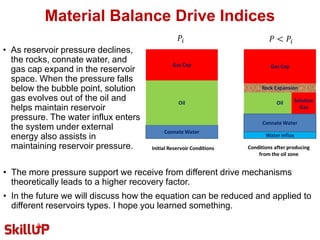
• As reservoir pressure declines,
the rocks, connate water, and
gas cap expand in the reservoir
space. When the pressure falls
below the bubble point, solution
gas evolves out of the oil and
helps maintain reservoir
pressure. The water influx enters
the system under external
energy also assists in
maintaining reservoir pressure.
• The more pressure support we receive from different drive mechanisms
theoretically leads to a higher recovery factor.
• In the future we will discuss how the equation can be reduced and applied to
different reservoirs types. I hope you learned something.
Overview of Material Balance
• The material balance equation is one of the fundamental equations a
reservoir engineer needs to understand.
• Some of it’s applications include the following:
• Determining the initial hydrocarbon in place
• Predicting an overall recovery factor
• Determining reservoir drive mechanisms
• The material balance equation can be intimidating for someone looking at it
for the first time. It was for me, but it is really not too bad if you understand the
basic concepts behind it.
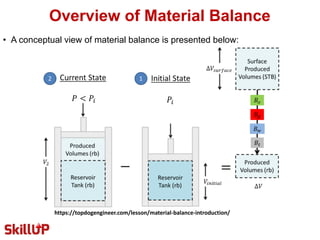
• Material balance simply compares the original volumes at initial reservoir
pressure to the current volumes at a lower pressure. It is zero dimensional,
meaning that it compares the initial state to the current state and nothing else.
• The concept of material balance is easy to understand if viewed as an
expanding piston.
Overview of Material Balance
• A conceptual view of material balance is presented below:
https://topdogengineer.com/lesson/material-balance-introduction/
Fluid Expansion
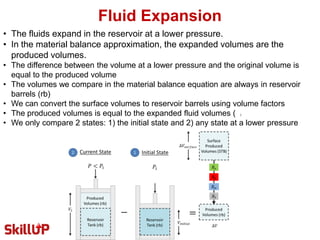
• The fluids expand in the reservoir at a lower pressure.
• In the material balance approximation, the expanded volumes are the
produced volumes.
• The difference between the volume at a lower pressure and the original volume is
equal to the produced volume
• The volumes we compare in the material balance equation are always in reservoir
barrels (rb)
• We can convert the surface volumes to reservoir barrels using volume factors
• The produced volumes is equal to the expanded fluid volumes ( )
• We only compare 2 states: 1) the initial state and 2) any state at a lower pressure
Material Balance Equation
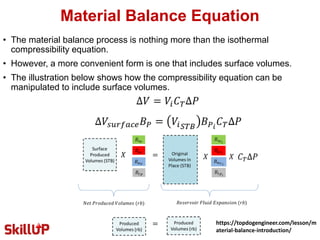
• The material balance process is nothing more than the isothermal
compressibility equation.
• However, a more convenient form is one that includes surface volumes.
• The illustration below shows how the compressibility equation can be
manipulated to include surface volumes.
https://topdogengineer.com/lesson/m
aterial-balance-introduction/
Material Balance Equation
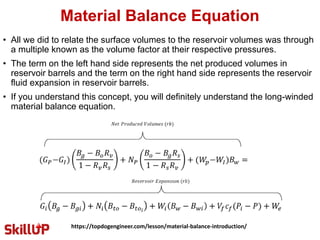
• All we did to relate the surface volumes to the reservoir volumes was through
a multiple known as the volume factor at their respective pressures.
• The term on the left hand side represents the net produced volumes in
reservoir barrels and the term on the right hand side represents the reservoir
fluid expansion in reservoir barrels.
• If you understand this concept, you will definitely understand the long-winded
material balance equation.
https://topdogengineer.com/lesson/material-balance-introduction/
Material Balance Drive Indices
• One of the most powerful applications of the material balance equation is it
can be used to infer the reservoir drive mechanisms (also known as reservoir
drive indices).
• Reservoir drive mechanisms is the natural energy used to move oil and gas
to the wellbore.
• The reservoir drive mechanisms associated with primary recovery:
• Gas Cap Drive
• Solution Gas Drive
• Connate Water Expansion
• Rock Compaction Drive
• Water Drive
Material Balance Drive Indices
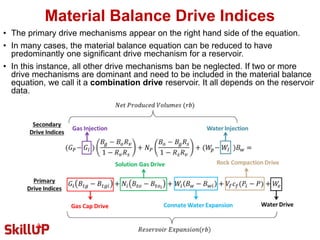
• The primary drive mechanisms appear on the right hand side of the equation.
• In many cases, the material balance equation can be reduced to have
predominantly one significant drive mechanism for a reservoir.
• In this instance, all other drive mechanisms ban be neglected. If two or more
drive mechanisms are dominant and need to be included in the material balance
equation, we call it a combination drive reservoir. It all depends on the reservoir
data.
Material Balance Drive Indices
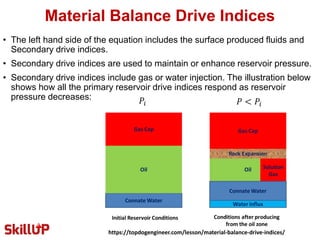
• The left hand side of the equation includes the surface produced fluids and
Secondary drive indices.
• Secondary drive indices are used to maintain or enhance reservoir pressure.

• Secondary drive indices include gas or water injection. The illustration below
shows how all the primary reservoir drive indices respond as reservoir
pressure decreases:
https://topdogengineer.com/lesson/material-balance-drive-indices/
Basic_Material balance equation explained.pdf

Basic_Material balance equation explained.pdf

  • 1.
  • 2.
    Material Balance DriveIndices • As reservoir pressure declines, the rocks, connate water, and gas cap expand in the reservoir space. When the pressure falls below the bubble point, solution gas evolves out of the oil and helps maintain reservoir pressure. The water influx enters the system under external energy also assists in maintaining reservoir pressure. • The more pressure support we receive from different drive mechanisms theoretically leads to a higher recovery factor. • In the future we will discuss how the equation can be reduced and applied to different reservoirs types. I hope you learned something.
  • 3.
    Overview of MaterialBalance • The material balance equation is one of the fundamental equations a reservoir engineer needs to understand. • Some of it’s applications include the following: • Determining the initial hydrocarbon in place • Predicting an overall recovery factor • Determining reservoir drive mechanisms • The material balance equation can be intimidating for someone looking at it for the first time. It was for me, but it is really not too bad if you understand the basic concepts behind it. • Material balance simply compares the original volumes at initial reservoir pressure to the current volumes at a lower pressure. It is zero dimensional, meaning that it compares the initial state to the current state and nothing else. • The concept of material balance is easy to understand if viewed as an expanding piston.
  • 4.
    Overview of MaterialBalance • A conceptual view of material balance is presented below: https://topdogengineer.com/lesson/material-balance-introduction/
  • 5.
    Fluid Expansion • Thefluids expand in the reservoir at a lower pressure. • In the material balance approximation, the expanded volumes are the produced volumes. • The difference between the volume at a lower pressure and the original volume is equal to the produced volume • The volumes we compare in the material balance equation are always in reservoir barrels (rb) • We can convert the surface volumes to reservoir barrels using volume factors • The produced volumes is equal to the expanded fluid volumes ( ) • We only compare 2 states: 1) the initial state and 2) any state at a lower pressure
  • 6.
    Material Balance Equation •The material balance process is nothing more than the isothermal compressibility equation. • However, a more convenient form is one that includes surface volumes. • The illustration below shows how the compressibility equation can be manipulated to include surface volumes. https://topdogengineer.com/lesson/m aterial-balance-introduction/
  • 7.
    Material Balance Equation •All we did to relate the surface volumes to the reservoir volumes was through a multiple known as the volume factor at their respective pressures. • The term on the left hand side represents the net produced volumes in reservoir barrels and the term on the right hand side represents the reservoir fluid expansion in reservoir barrels. • If you understand this concept, you will definitely understand the long-winded material balance equation. https://topdogengineer.com/lesson/material-balance-introduction/
  • 8.
    Material Balance DriveIndices • One of the most powerful applications of the material balance equation is it can be used to infer the reservoir drive mechanisms (also known as reservoir drive indices). • Reservoir drive mechanisms is the natural energy used to move oil and gas to the wellbore. • The reservoir drive mechanisms associated with primary recovery: • Gas Cap Drive • Solution Gas Drive • Connate Water Expansion • Rock Compaction Drive • Water Drive
  • 9.
    Material Balance DriveIndices • The primary drive mechanisms appear on the right hand side of the equation. • In many cases, the material balance equation can be reduced to have predominantly one significant drive mechanism for a reservoir. • In this instance, all other drive mechanisms ban be neglected. If two or more drive mechanisms are dominant and need to be included in the material balance equation, we call it a combination drive reservoir. It all depends on the reservoir data.
  • 10.
    Material Balance DriveIndices • The left hand side of the equation includes the surface produced fluids and Secondary drive indices. • Secondary drive indices are used to maintain or enhance reservoir pressure. • Secondary drive indices include gas or water injection. The illustration below shows how all the primary reservoir drive indices respond as reservoir pressure decreases: https://topdogengineer.com/lesson/material-balance-drive-indices/