1
1. What is FHS
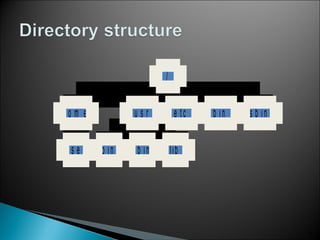
2. What is Structure of Root Directory
3. Discuss in detail all directories
4. Conclusion
2
◦ Red Hat Enterprise Linux uses the File Hierarchy System (FHS)
is a file system structure, which defines the names, locations,
and permissions for many file types and directories.
3
4
u s e r
h o m e
b in s b in lib
u s r e tc b in s b in
/
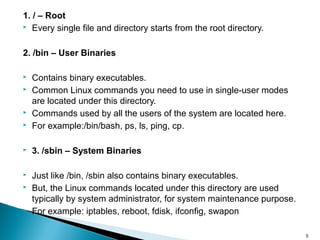
1. / – Root
 Every single file and directory starts from the root directory.
2. /bin – User Binaries
 Contains binary executables.
 Common Linux commands you need to use in single-user modes
are located under this directory.
 Commands used by all the users of the system are located here.
 For example:/bin/bash, ps, ls, ping, cp.
 3. /sbin – System Binaries
 Just like /bin, /sbin also contains binary executables.
 But, the Linux commands located under this directory are used
typically by system administrator, for system maintenance purpose.
 For example: iptables, reboot, fdisk, ifconfig, swapon
5
6
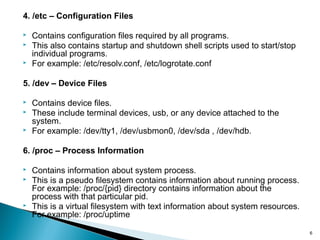
4. /etc – Configuration Files
 Contains configuration files required by all programs.
 This also contains startup and shutdown shell scripts used to start/stop
individual programs.
 For example: /etc/resolv.conf, /etc/logrotate.conf
5. /dev – Device Files
 Contains device files.
 These include terminal devices, usb, or any device attached to the
system.
 For example: /dev/tty1, /dev/usbmon0, /dev/sda , /dev/hdb.
6. /proc – Process Information
 Contains information about system process.
 This is a pseudo filesystem contains information about running process.
For example: /proc/{pid} directory contains information about the
process with that particular pid.
 This is a virtual filesystem with text information about system resources.
For example: /proc/uptime
7
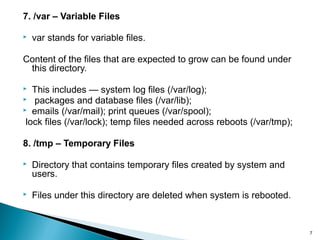
7. /var – Variable Files
 var stands for variable files.
Content of the files that are expected to grow can be found under
this directory.
 This includes — system log files (/var/log);
 packages and database files (/var/lib);
 emails (/var/mail); print queues (/var/spool);
lock files (/var/lock); temp files needed across reboots (/var/tmp);
8. /tmp – Temporary Files
 Directory that contains temporary files created by system and
users.
 Files under this directory are deleted when system is rebooted.
8
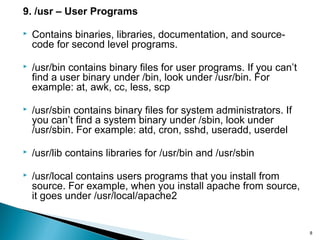
9. /usr – User Programs
 Contains binaries, libraries, documentation, and source-
code for second level programs.
 /usr/bin contains binary files for user programs. If you can’t
find a user binary under /bin, look under /usr/bin. For
example: at, awk, cc, less, scp
 /usr/sbin contains binary files for system administrators. If
you can’t find a system binary under /sbin, look under
/usr/sbin. For example: atd, cron, sshd, useradd, userdel
 /usr/lib contains libraries for /usr/bin and /usr/sbin
 /usr/local contains users programs that you install from
source. For example, when you install apache from source,
it goes under /usr/local/apache2
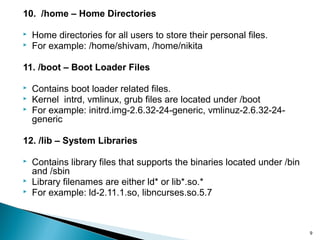
10. /home – Home Directories
 Home directories for all users to store their personal files.
 For example: /home/shivam, /home/nikita
11. /boot – Boot Loader Files
 Contains boot loader related files.
 Kernel intrd, vmlinux, grub files are located under /boot
 For example: initrd.img-2.6.32-24-generic, vmlinuz-2.6.32-24-
generic
12. /lib – System Libraries
 Contains library files that supports the binaries located under /bin
and /sbin
 Library filenames are either ld* or lib*.so.*
 For example: ld-2.11.1.so, libncurses.so.5.7
9
10
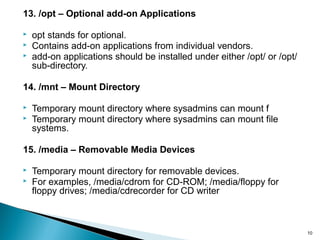
13. /opt – Optional add-on Applications
 opt stands for optional.
 Contains add-on applications from individual vendors.
 add-on applications should be installed under either /opt/ or /opt/
sub-directory.
14. /mnt – Mount Directory
 Temporary mount directory where sysadmins can mount f
 Temporary mount directory where sysadmins can mount file
systems.
15. /media – Removable Media Devices
 Temporary mount directory for removable devices.
 For examples, /media/cdrom for CD-ROM; /media/floppy for
floppy drives; /media/cdrecorder for CD writer
 Manage Directories and Files in Linux
 Understand the Filesystem Hierarchy Standard(FHS)
 Identify File Types in the Linux System
 Change Directories and List Directory Contents
 Create and View Files
 Manage Files and Directories
 Search File Content
11
Thanks
presented by: Shivam Tiwari
Asst. S/W Engineer
12

Basic linux architecture

  • 1.
  • 2.
    1. What isFHS 2. What is Structure of Root Directory 3. Discuss in detail all directories 4. Conclusion 2
  • 3.
    ◦ Red HatEnterprise Linux uses the File Hierarchy System (FHS) is a file system structure, which defines the names, locations, and permissions for many file types and directories. 3
  • 4.
    4 u s er h o m e b in s b in lib u s r e tc b in s b in /
  • 5.
    1. / –Root  Every single file and directory starts from the root directory. 2. /bin – User Binaries  Contains binary executables.  Common Linux commands you need to use in single-user modes are located under this directory.  Commands used by all the users of the system are located here.  For example:/bin/bash, ps, ls, ping, cp.  3. /sbin – System Binaries  Just like /bin, /sbin also contains binary executables.  But, the Linux commands located under this directory are used typically by system administrator, for system maintenance purpose.  For example: iptables, reboot, fdisk, ifconfig, swapon 5
  • 6.
    6 4. /etc –Configuration Files  Contains configuration files required by all programs.  This also contains startup and shutdown shell scripts used to start/stop individual programs.  For example: /etc/resolv.conf, /etc/logrotate.conf 5. /dev – Device Files  Contains device files.  These include terminal devices, usb, or any device attached to the system.  For example: /dev/tty1, /dev/usbmon0, /dev/sda , /dev/hdb. 6. /proc – Process Information  Contains information about system process.  This is a pseudo filesystem contains information about running process. For example: /proc/{pid} directory contains information about the process with that particular pid.  This is a virtual filesystem with text information about system resources. For example: /proc/uptime
  • 7.
    7 7. /var –Variable Files  var stands for variable files. Content of the files that are expected to grow can be found under this directory.  This includes — system log files (/var/log);  packages and database files (/var/lib);  emails (/var/mail); print queues (/var/spool); lock files (/var/lock); temp files needed across reboots (/var/tmp); 8. /tmp – Temporary Files  Directory that contains temporary files created by system and users.  Files under this directory are deleted when system is rebooted.
  • 8.
    8 9. /usr –User Programs  Contains binaries, libraries, documentation, and source- code for second level programs.  /usr/bin contains binary files for user programs. If you can’t find a user binary under /bin, look under /usr/bin. For example: at, awk, cc, less, scp  /usr/sbin contains binary files for system administrators. If you can’t find a system binary under /sbin, look under /usr/sbin. For example: atd, cron, sshd, useradd, userdel  /usr/lib contains libraries for /usr/bin and /usr/sbin  /usr/local contains users programs that you install from source. For example, when you install apache from source, it goes under /usr/local/apache2
  • 9.
    10. /home –Home Directories  Home directories for all users to store their personal files.  For example: /home/shivam, /home/nikita 11. /boot – Boot Loader Files  Contains boot loader related files.  Kernel intrd, vmlinux, grub files are located under /boot  For example: initrd.img-2.6.32-24-generic, vmlinuz-2.6.32-24- generic 12. /lib – System Libraries  Contains library files that supports the binaries located under /bin and /sbin  Library filenames are either ld* or lib*.so.*  For example: ld-2.11.1.so, libncurses.so.5.7 9
  • 10.
    10 13. /opt –Optional add-on Applications  opt stands for optional.  Contains add-on applications from individual vendors.  add-on applications should be installed under either /opt/ or /opt/ sub-directory. 14. /mnt – Mount Directory  Temporary mount directory where sysadmins can mount f  Temporary mount directory where sysadmins can mount file systems. 15. /media – Removable Media Devices  Temporary mount directory for removable devices.  For examples, /media/cdrom for CD-ROM; /media/floppy for floppy drives; /media/cdrecorder for CD writer
  • 11.
     Manage Directoriesand Files in Linux  Understand the Filesystem Hierarchy Standard(FHS)  Identify File Types in the Linux System  Change Directories and List Directory Contents  Create and View Files  Manage Files and Directories  Search File Content 11
  • 12.
    Thanks presented by: ShivamTiwari Asst. S/W Engineer 12