McGraw-Hill/Irwin Copyright © 2010 by The McGraw-Hill Companies, Inc. All rights reserved.
Basic Financial StatementsBasic Financial Statements
otaleem.blogspot.comotaleem.blogspot.com
for more presentation(follow me)for more presentation(follow me)
Chapter 2
2-2
Introduction to FinancialIntroduction to Financial
StatementsStatements
Three primary
financial
statements.
Income Statement
Balance Sheet
Statement of Cash Flows
We will use a corporation to describe these
statements.
2-3
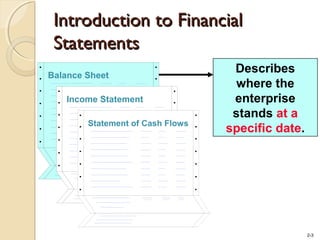
Describes
where the
enterprise
stands at a
specific date.
Income Statement
Balance Sheet
Statement of Cash Flows
Introduction to FinancialIntroduction to Financial
StatementsStatements
2-4
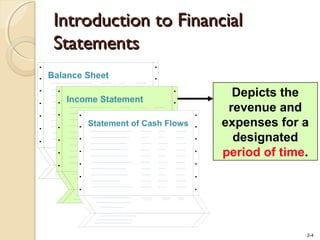
Depicts the
revenue and
expenses for a
designated
period of time.
Income Statement
Balance Sheet
Statement of Cash Flows
Introduction to FinancialIntroduction to Financial
StatementsStatements
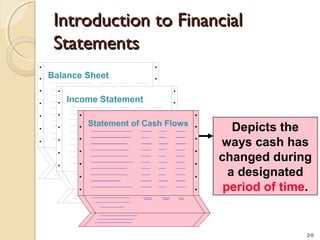
2-5
Depicts the
ways cash has
changed during
a designated
period of time.
Income Statement
Balance Sheet
Statement of Cash Flows
Introduction to FinancialIntroduction to Financial
StatementsStatements
2-6
Basic Financial StatementsBasic Financial Statements
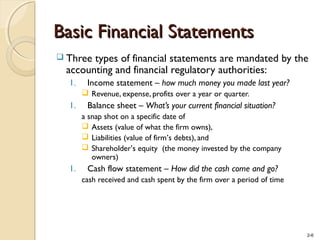
 Three types of financial statements are mandated by the
accounting and financial regulatory authorities:
1. Income statement – how much money you made last year?
 Revenue, expense, profits over a year or quarter.
1. Balance sheet – What’s your current financial situation?
a snap shot on a specific date of
 Assets (value of what the firm owns),
 Liabilities (value of firm’s debts), and
 Shareholder’s equity (the money invested by the company
owners)
1. Cash flow statement – How did the cash come and go?
cash received and cash spent by the firm over a period of time
2-7
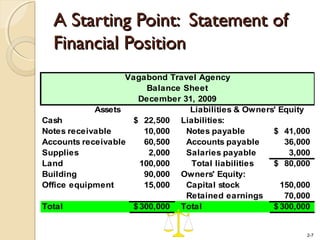
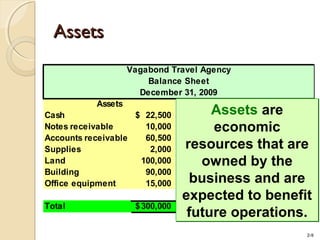
Vagabond Travel Agency
Balance Sheet
December 31, 2009
Assets Liabilities & Owners' Equity
Cash 22,500$ Liabilities:
Notes receivable 10,000 Notes payable 41,000$
Accounts receivable 60,500 Accounts payable 36,000
Supplies 2,000 Salaries payable 3,000
Land 100,000 Total liabilities 80,000$
Building 90,000 Owners' Equity:
Office equipment 15,000 Capital stock 150,000
Retained earnings 70,000
Total 300,000$ Total 300,000$
A Starting Point: Statement ofA Starting Point: Statement of
Financial PositionFinancial Position
2-8
The Concept of the BusinessThe Concept of the Business
EntityEntity
Vagabond
Travel
Agency
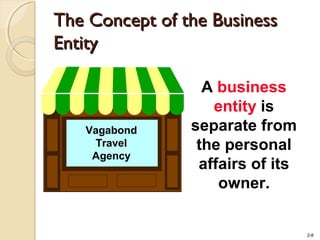
A business
entity is
separate from
the personal
affairs of its
owner.
2-9
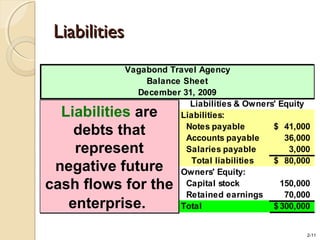
Vagabond Travel Agency
Balance Sheet
December 31, 2009
Assets Liabilities & Owners' Equity
Cash 22,500$ Liabilities:
Notes receivable 10,000 Notes payable 41,000$
Accounts receivable 60,500 Accounts payable 36,000
Supplies 2,000 Salaries payable 3,000
Land 100,000 Total liabilities 80,000$
Building 90,000 Owners' Equity:
Office equipment 15,000 Capital stock 150,000
Retained earnings 70,000
Total 300,000$ Total 300,000$
AssetsAssets
Assets are
economic
resources that are
owned by the
business and are
expected to benefit
future operations.
Assets are
economic
resources that are
owned by the
business and are
expected to benefit
future operations.
2-10
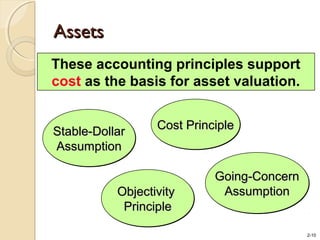
AssetsAssets
Cost PrincipleCost PrincipleCost PrincipleCost Principle
Going-ConcernGoing-Concern
AssumptionAssumption
Going-ConcernGoing-Concern
AssumptionAssumptionObjectivityObjectivity
PrinciplePrinciple
ObjectivityObjectivity
PrinciplePrinciple
Stable-DollarStable-Dollar
AssumptionAssumption
Stable-DollarStable-Dollar
AssumptionAssumption
These accounting principles support
cost as the basis for asset valuation.
2-11
Vagabond Travel Agency
Balance Sheet
December 31, 2009
Assets Liabilities & Owners' Equity
Cash 22,500$ Liabilities:
Notes receivable 10,000 Notes payable 41,000$
Accounts receivable 60,500 Accounts payable 36,000
Supplies 2,000 Salaries payable 3,000
Land 100,000 Total liabilities 80,000$
Building 90,000 Owners' Equity:
Office equipment 15,000 Capital stock 150,000
Retained earnings 70,000
Total 300,000$ Total 300,000$
LiabilitiesLiabilities
Liabilities are
debts that
represent
negative future
cash flows for the
enterprise.
Liabilities are
debts that
represent
negative future
cash flows for the
enterprise.
2-12
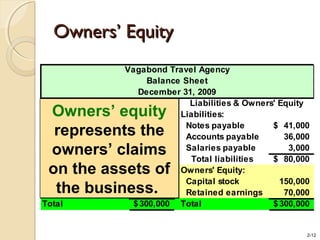
Owners’ EquityOwners’ Equity
Vagabond Travel Agency
Balance Sheet
December 31, 2009
Assets Liabilities & Owners' Equity
Cash 22,500$ Liabilities:
Notes receivable 10,000 Notes payable 41,000$
Accounts receivable 60,500 Accounts payable 36,000
Supplies 2,000 Salaries payable 3,000
Land 100,000 Total liabilities 80,000$
Building 90,000 Owners' Equity:
Office equipment 15,000 Capital stock 150,000
Retained earnings 70,000
Total 300,000$ Total 300,000$
Owners’ equity
represents the
owners’ claims
on the assets of
the business.
Owners’ equity
represents the
owners’ claims
on the assets of
the business.
2-13
Vagabond Travel Agency
Balance Sheet
December 31, 2009
Assets Liabilities & Owners' Equity
Cash 22,500$ Liabilities:
Notes receivable 10,000 Notes payable 41,000$
Accounts receivable 60,500 Accounts payable 36,000
Supplies 2,000 Salaries payable 3,000
Land 100,000 Total liabilities 80,000$
Building 90,000 Owners' Equity
Office equipment 15,000 Capital stock 150,000
Retained earnings 70,000
Total 300,000$ Total 300,000$
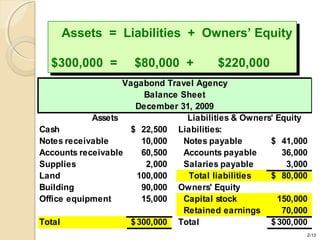
The Accounting EquationThe Accounting EquationAssets = Liabilities + Owners’ Equity
$300,000 = $80,000 + $220,000
Assets = Liabilities + Owners’ Equity
$300,000 = $80,000 + $220,000
2-14
An Income StatementAn Income Statement
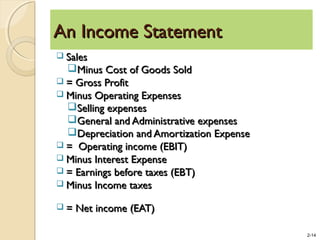
 SalesSales
Minus Cost of Goods SoldMinus Cost of Goods Sold
 = Gross Profit= Gross Profit
 Minus Operating ExpensesMinus Operating Expenses
Selling expensesSelling expenses
General and Administrative expensesGeneral and Administrative expenses
Depreciation and Amortization ExpenseDepreciation and Amortization Expense
 = Operating income (EBIT)= Operating income (EBIT)
 Minus Interest ExpenseMinus Interest Expense
 = Earnings before taxes (EBT)= Earnings before taxes (EBT)
 Minus Income taxesMinus Income taxes
 = Net income (EAT)= Net income (EAT)
2-15
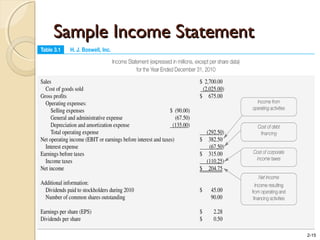
Sample Income StatementSample Income Statement
2-16
The Cash Flow StatementThe Cash Flow Statement
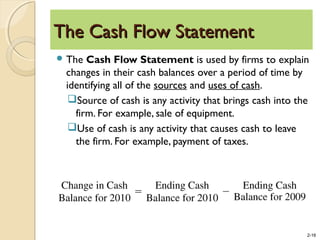
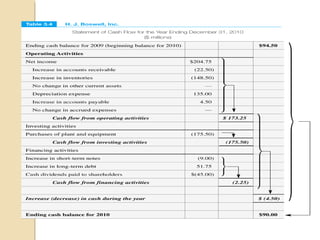
 The Cash Flow Statement is used by firms to explain
changes in their cash balances over a period of time by
identifying all of the sources and uses of cash.
Source of cash is any activity that brings cash into the
firm. For example, sale of equipment.
Use of cash is any activity that causes cash to leave
the firm. For example, payment of taxes.
2-17
Cash Flow StatementCash Flow Statement
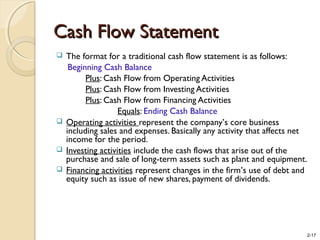
 The format for a traditional cash flow statement is as follows:
Beginning Cash Balance
Plus: Cash Flow from Operating Activities
Plus: Cash Flow from Investing Activities
Plus: Cash Flow from Financing Activities
Equals: Ending Cash Balance
 Operating activities represent the company’s core business
including sales and expenses. Basically any activity that affects net
income for the period.
 Investing activities include the cash flows that arise out of the
purchase and sale of long-term assets such as plant and equipment.
 Financing activities represent changes in the firm’s use of debt and
equity such as issue of new shares, payment of dividends.
2-19
Statement
of Cash
Flows
Balance
Sheet
Income
Statement
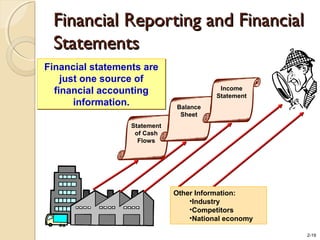
Other Information:
•Industry
•Competitors
•National economy
Financial Reporting and FinancialFinancial Reporting and Financial
StatementsStatements
Financial statements are
just one source of
financial accounting
information.
Financial statements are
just one source of
financial accounting
information.
2-20
End of Chapter 2End of Chapter 2

Basic Financial Statements

  • 1.
    McGraw-Hill/Irwin Copyright ©2010 by The McGraw-Hill Companies, Inc. All rights reserved. Basic Financial StatementsBasic Financial Statements otaleem.blogspot.comotaleem.blogspot.com for more presentation(follow me)for more presentation(follow me) Chapter 2
  • 2.
    2-2 Introduction to FinancialIntroductionto Financial StatementsStatements Three primary financial statements. Income Statement Balance Sheet Statement of Cash Flows We will use a corporation to describe these statements.
  • 3.
    2-3 Describes where the enterprise stands ata specific date. Income Statement Balance Sheet Statement of Cash Flows Introduction to FinancialIntroduction to Financial StatementsStatements
  • 4.
    2-4 Depicts the revenue and expensesfor a designated period of time. Income Statement Balance Sheet Statement of Cash Flows Introduction to FinancialIntroduction to Financial StatementsStatements
  • 5.
    2-5 Depicts the ways cashhas changed during a designated period of time. Income Statement Balance Sheet Statement of Cash Flows Introduction to FinancialIntroduction to Financial StatementsStatements
  • 6.
    2-6 Basic Financial StatementsBasicFinancial Statements  Three types of financial statements are mandated by the accounting and financial regulatory authorities: 1. Income statement – how much money you made last year?  Revenue, expense, profits over a year or quarter. 1. Balance sheet – What’s your current financial situation? a snap shot on a specific date of  Assets (value of what the firm owns),  Liabilities (value of firm’s debts), and  Shareholder’s equity (the money invested by the company owners) 1. Cash flow statement – How did the cash come and go? cash received and cash spent by the firm over a period of time
  • 7.
    2-7 Vagabond Travel Agency BalanceSheet December 31, 2009 Assets Liabilities & Owners' Equity Cash 22,500$ Liabilities: Notes receivable 10,000 Notes payable 41,000$ Accounts receivable 60,500 Accounts payable 36,000 Supplies 2,000 Salaries payable 3,000 Land 100,000 Total liabilities 80,000$ Building 90,000 Owners' Equity: Office equipment 15,000 Capital stock 150,000 Retained earnings 70,000 Total 300,000$ Total 300,000$ A Starting Point: Statement ofA Starting Point: Statement of Financial PositionFinancial Position
  • 8.
    2-8 The Concept ofthe BusinessThe Concept of the Business EntityEntity Vagabond Travel Agency A business entity is separate from the personal affairs of its owner.
  • 9.
    2-9 Vagabond Travel Agency BalanceSheet December 31, 2009 Assets Liabilities & Owners' Equity Cash 22,500$ Liabilities: Notes receivable 10,000 Notes payable 41,000$ Accounts receivable 60,500 Accounts payable 36,000 Supplies 2,000 Salaries payable 3,000 Land 100,000 Total liabilities 80,000$ Building 90,000 Owners' Equity: Office equipment 15,000 Capital stock 150,000 Retained earnings 70,000 Total 300,000$ Total 300,000$ AssetsAssets Assets are economic resources that are owned by the business and are expected to benefit future operations. Assets are economic resources that are owned by the business and are expected to benefit future operations.
  • 10.
    2-10 AssetsAssets Cost PrincipleCost PrincipleCostPrincipleCost Principle Going-ConcernGoing-Concern AssumptionAssumption Going-ConcernGoing-Concern AssumptionAssumptionObjectivityObjectivity PrinciplePrinciple ObjectivityObjectivity PrinciplePrinciple Stable-DollarStable-Dollar AssumptionAssumption Stable-DollarStable-Dollar AssumptionAssumption These accounting principles support cost as the basis for asset valuation.
  • 11.
    2-11 Vagabond Travel Agency BalanceSheet December 31, 2009 Assets Liabilities & Owners' Equity Cash 22,500$ Liabilities: Notes receivable 10,000 Notes payable 41,000$ Accounts receivable 60,500 Accounts payable 36,000 Supplies 2,000 Salaries payable 3,000 Land 100,000 Total liabilities 80,000$ Building 90,000 Owners' Equity: Office equipment 15,000 Capital stock 150,000 Retained earnings 70,000 Total 300,000$ Total 300,000$ LiabilitiesLiabilities Liabilities are debts that represent negative future cash flows for the enterprise. Liabilities are debts that represent negative future cash flows for the enterprise.
  • 12.
    2-12 Owners’ EquityOwners’ Equity VagabondTravel Agency Balance Sheet December 31, 2009 Assets Liabilities & Owners' Equity Cash 22,500$ Liabilities: Notes receivable 10,000 Notes payable 41,000$ Accounts receivable 60,500 Accounts payable 36,000 Supplies 2,000 Salaries payable 3,000 Land 100,000 Total liabilities 80,000$ Building 90,000 Owners' Equity: Office equipment 15,000 Capital stock 150,000 Retained earnings 70,000 Total 300,000$ Total 300,000$ Owners’ equity represents the owners’ claims on the assets of the business. Owners’ equity represents the owners’ claims on the assets of the business.
  • 13.
    2-13 Vagabond Travel Agency BalanceSheet December 31, 2009 Assets Liabilities & Owners' Equity Cash 22,500$ Liabilities: Notes receivable 10,000 Notes payable 41,000$ Accounts receivable 60,500 Accounts payable 36,000 Supplies 2,000 Salaries payable 3,000 Land 100,000 Total liabilities 80,000$ Building 90,000 Owners' Equity Office equipment 15,000 Capital stock 150,000 Retained earnings 70,000 Total 300,000$ Total 300,000$ The Accounting EquationThe Accounting EquationAssets = Liabilities + Owners’ Equity $300,000 = $80,000 + $220,000 Assets = Liabilities + Owners’ Equity $300,000 = $80,000 + $220,000
  • 14.
    2-14 An Income StatementAnIncome Statement  SalesSales Minus Cost of Goods SoldMinus Cost of Goods Sold  = Gross Profit= Gross Profit  Minus Operating ExpensesMinus Operating Expenses Selling expensesSelling expenses General and Administrative expensesGeneral and Administrative expenses Depreciation and Amortization ExpenseDepreciation and Amortization Expense  = Operating income (EBIT)= Operating income (EBIT)  Minus Interest ExpenseMinus Interest Expense  = Earnings before taxes (EBT)= Earnings before taxes (EBT)  Minus Income taxesMinus Income taxes  = Net income (EAT)= Net income (EAT)
  • 15.
  • 16.
    2-16 The Cash FlowStatementThe Cash Flow Statement  The Cash Flow Statement is used by firms to explain changes in their cash balances over a period of time by identifying all of the sources and uses of cash. Source of cash is any activity that brings cash into the firm. For example, sale of equipment. Use of cash is any activity that causes cash to leave the firm. For example, payment of taxes.
  • 17.
    2-17 Cash Flow StatementCashFlow Statement  The format for a traditional cash flow statement is as follows: Beginning Cash Balance Plus: Cash Flow from Operating Activities Plus: Cash Flow from Investing Activities Plus: Cash Flow from Financing Activities Equals: Ending Cash Balance  Operating activities represent the company’s core business including sales and expenses. Basically any activity that affects net income for the period.  Investing activities include the cash flows that arise out of the purchase and sale of long-term assets such as plant and equipment.  Financing activities represent changes in the firm’s use of debt and equity such as issue of new shares, payment of dividends.
  • 19.
    2-19 Statement of Cash Flows Balance Sheet Income Statement Other Information: •Industry •Competitors •Nationaleconomy Financial Reporting and FinancialFinancial Reporting and Financial StatementsStatements Financial statements are just one source of financial accounting information. Financial statements are just one source of financial accounting information.
  • 20.
    2-20 End of Chapter2End of Chapter 2

Editor's Notes

  • #2 Chapter 2: Basic Financial Statements.
  • #3 There are three fundamental financial statements used in accounting. The income statement shows revenues and expenses. The balance sheet is a listing of all asset, liability, and equity account balances that do not appear on the income statement. The statement of cash flows shows how the company receives and spends its cash. This chapter will look at the financial statements of a corporation.
  • #4 The balance sheet (also referred to as the statement of position) describes the financial position of a company at a specific point in time. A balance sheet may be prepared monthly, quarterly, or annually depending on the needs of management and external users. The balance sheet is sometimes referred to as the statement of financial position.
  • #5 Net income is defined as the excess of revenues over expenses. Financial statements begin with a three-line title comprised of the company name, the name of the statement, and the period covered by the report. The income statement lists revenues and expenses that were incurred over a period of time. Most companies prepare monthly income statements. In the long-run, revenues will generate positive cash inflows to the company and expenses will result in negative cash flows to the company. Just remember, revenues and expenses that appear on the income statement may not always produce cash flows in the current accounting period. Net income (or net loss) is simply the difference between revenues and expenses. When revenues exceed expenses, the result is net income. When expenses exceed revenues, the result is a net loss.
  • #6 The statement of cash flows will be covered in detail in a later chapter. The statement of cash flows is divided into three major sections: (1) cash flows from operating activities; (2) cash flows from investing activities, and (3) cash flows from financing activities. The statement describes cash inflows and outflows over a period of time.
  • #8 The statement of financial position, commonly referred to as the balance sheet, is an inventory of assets, liabilities, and equity at the end of the month. Our total assets are equal to $300,000. This includes cash of $22,500, notes receivable of $10,000, supplies of $2,000, and the balances in the remaining asset accounts. Liabilities include notes payable of $41,000, accounts payable of $36,000 and salaries payable of $3,000. The accounts in the owners’ equity section of the balance sheet are capital stock of $150,000 and retained earnings of $70,000. Notice that the total assets are equal to the total liabilities plus owners’ equity.
  • #9 The business entity principle states that the transactions of individual owners of a business and those of the business must be separate.
  • #10 Assets are resources owned or controlled by an entity. They include such items as cash, accounts receivable (amounts owed to the company by customers), land, building and equipment, and supplies.
  • #11 The cost principle tells us that accounting information is based upon actual cost incurred. We refer to this as historical cost. The going-concern assumption states that in the absence of information to the contrary, the business entity is assumed to continue operations into the foreseeable future. The objectivity principle states that accounting information must be unbiased and based upon independent evidence. The stable-dollar assumption tells us that we will only record accounting information that can be expressed in monetary units, usually dollars in the United States.
  • #12 Liabilities represent the claims of creditors on an entity’s assets. Liabilities include accounts payable (amounts owed to creditors for assets purchased on account), taxes payable, and wages payable (amounts owed to our employees at the end of the accounting period).
  • #13 The equities of an entity include investments by owners, withdrawals by owners, and earnings retained by the business. Investments by owners and net income increase owners’ equity. Payments to owners and net losses decrease owners’ equity.
  • #14 The basic accounting equation states that assets are equal to liabilities plus equity of a company. The equation makes sense because it states that assets must be equal to the claims against those assets. There are two broad categories of claims against an asset: Claims by creditors (called liabilities), or after all creditor claims are satisfied, the residual owners (the stockholders) have a claim on those assets.
  • #20 Financial statements are only one source of information about the operations of a company. The financial statements of a company can be compared to those of other companies in the same industry, major national or international competitors, and to the norms for the national economy.
  • #21 End of chapter 2.