Subject: Basic Computer organization
 the basics of computer system organization
 the stored program concept
 how computer’s main memory is organized
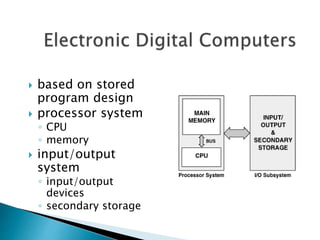
 based on stored
program design
 processor system
◦ CPU
◦ memory
 input/output
system
◦ input/output
devices
◦ secondary storage
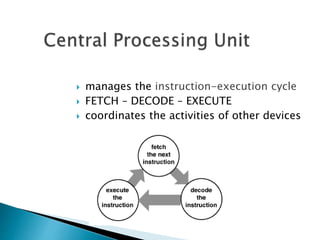
 manages the instruction-execution cycle
 FETCH – DECODE – EXECUTE
 coordinates the activities of other devices
 (fast access) storage device for preserving
binary data and instructions
 memory is divided into units or words
 each is usually a standard size or fixed-
length
 each memory word has a unique address for
random access
 Random Access
Memory (RAM)
◦ readable
◦ writeable
◦ usually volatile (e.g.,
Dynamic RAM or
DRAM)
◦ general storage
 Read Only Memory
(ROM)
◦ readable
◦ permanent
◦ nonvolatile
◦ special-purpose
storage for data and
instructions
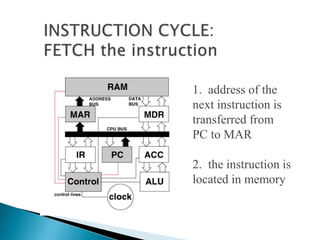
1. address of the
next instruction is
transferred from
PC to MAR
2. the instruction is
located in memory
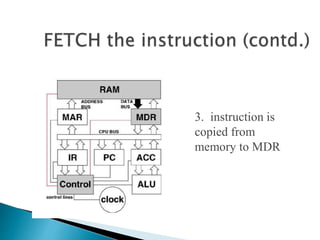
3. instruction is
copied from
memory to MDR
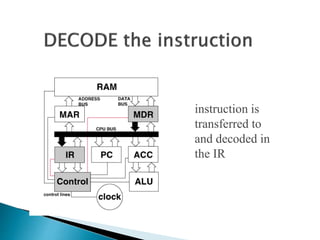
instruction is
transferred to
and decoded in
the IR
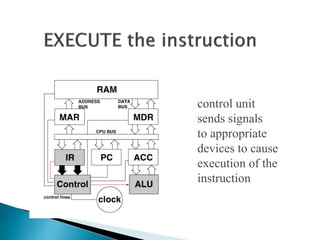
control unit
sends signals
to appropriate
devices to cause
execution of the
instruction
 Data Movement
Operations
◦ moving data from
memory to the CPU
◦ moving data from
memory to memory
◦ input and output
 Arithmetic and
Logical Operations
◦ integer arithmetic
◦ comparing two
quantities
◦ shifting, rotating bits
in a quantity
◦ testing, comparing,
and converting bits
 Program Control
◦ starting a program
◦ halting a program
◦ skipping to other
instructions
◦ testing data to decide
whether to skip over
some instructions
Thanks

Basic computer organization

  • 1.
  • 2.
     the basicsof computer system organization  the stored program concept  how computer’s main memory is organized
  • 3.
     based onstored program design  processor system ◦ CPU ◦ memory  input/output system ◦ input/output devices ◦ secondary storage
  • 4.
     manages theinstruction-execution cycle  FETCH – DECODE – EXECUTE  coordinates the activities of other devices
  • 5.
     (fast access)storage device for preserving binary data and instructions  memory is divided into units or words  each is usually a standard size or fixed- length  each memory word has a unique address for random access
  • 6.
     Random Access Memory(RAM) ◦ readable ◦ writeable ◦ usually volatile (e.g., Dynamic RAM or DRAM) ◦ general storage  Read Only Memory (ROM) ◦ readable ◦ permanent ◦ nonvolatile ◦ special-purpose storage for data and instructions
  • 7.
    1. address ofthe next instruction is transferred from PC to MAR 2. the instruction is located in memory
  • 8.
    3. instruction is copiedfrom memory to MDR
  • 9.
  • 10.
    control unit sends signals toappropriate devices to cause execution of the instruction
  • 11.
     Data Movement Operations ◦moving data from memory to the CPU ◦ moving data from memory to memory ◦ input and output  Arithmetic and Logical Operations ◦ integer arithmetic ◦ comparing two quantities ◦ shifting, rotating bits in a quantity ◦ testing, comparing, and converting bits
  • 12.
     Program Control ◦starting a program ◦ halting a program ◦ skipping to other instructions ◦ testing data to decide whether to skip over some instructions
  • 13.