Agenda
Object-Oriented Concepts
Abstraction and Encapsulation
Inheritance
Polymorphism
Interfaces and Abstract Classes
Virtual Methods
Classes
Sealed Classes
C# programming with examples
 Encapsulation and abstraction is the advanced
mechanism in C# that lets your program to hide
unwanted code within a capsule and shows only
essential features of an object.
 Encapsulation is used to hide its members from outside
class or interface, whereas abstraction is used to show
only essential features.
 Access Modifier – Public, Private, Protected, Internal &
Protected Internal
Key Object-Oriented Concepts
Foreach
 using System;
namespace foreach_loop
{
class Program
{
static void Main(string[] args)
{
string[] arr = new string[5]; // declaring array
//Storing value in array element
arr[0] = "Steven";
arr[1] = "Clark";
arr[2] = "Mark";
arr[3] = "Thompson";
arr[4] = "John";
//retrieving value using foreach loop
foreach (string name in arr)
{
Console.WriteLine("Hello " + name);
}
Console.ReadLine();
}
}
}
switch case
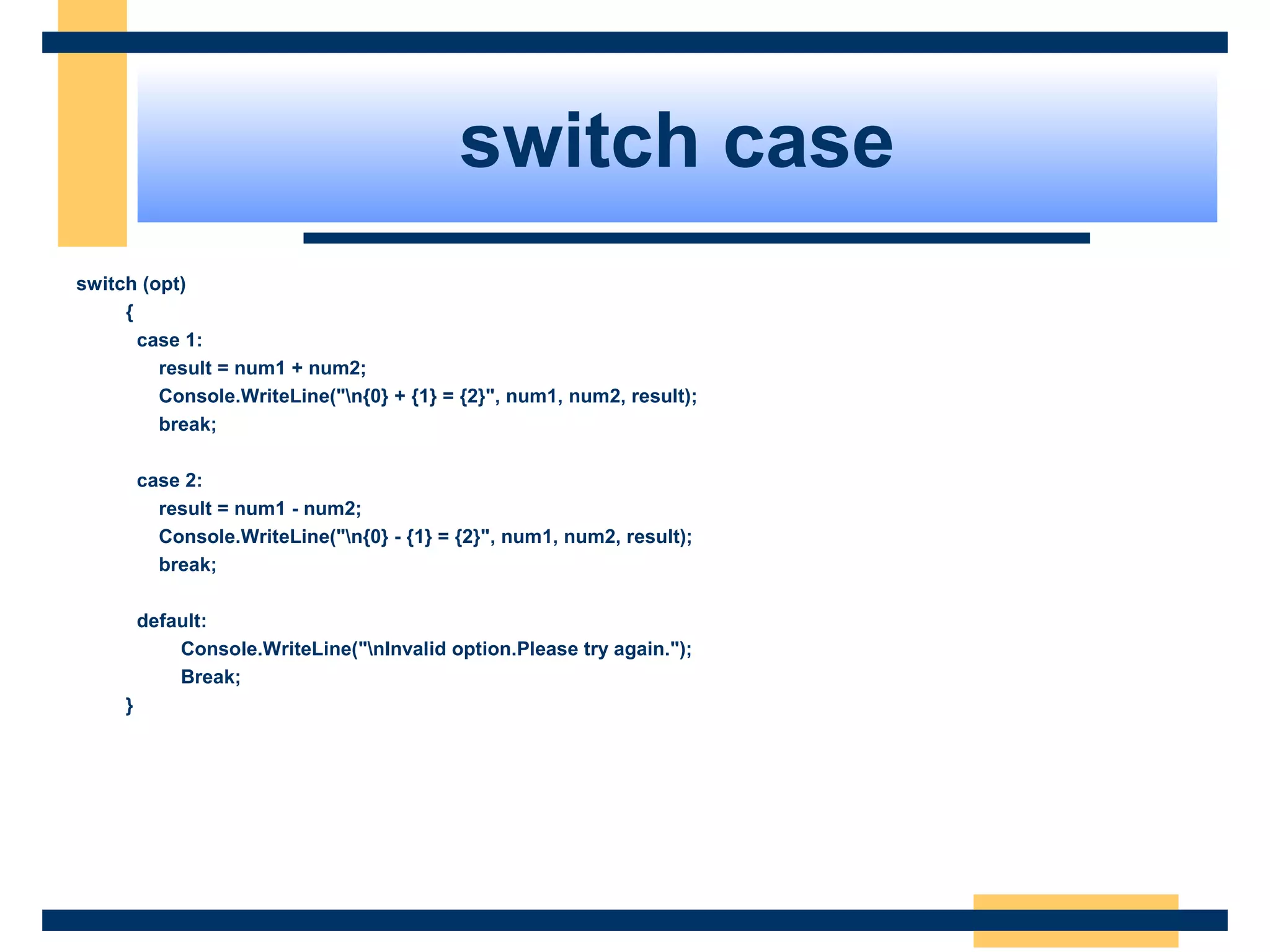
switch (opt)
{
case 1:
result = num1 + num2;
Console.WriteLine("n{0} + {1} = {2}", num1, num2, result);
break;
case 2:
result = num1 - num2;
Console.WriteLine("n{0} - {1} = {2}", num1, num2, result);
break;
default:
Console.WriteLine("nInvalid option.Please try again.");
Break;
}
Array
using System;
namespace Declare_Array
{
class Program
{
static void Main(string[] args)
{
int[] num = new int[6]; //Declaring Array
//Initializing array
num[0] = 6;
num[1] = 23;
num[2] = 12;
num[3] = 9;
num[4] = 14;
num[5] = 52;
//Showing value of Array
Console.WriteLine("1st value:t{0}", num[0]);
Console.WriteLine("2nd value:t{0}", num[1]);
Console.WriteLine("3rd value:t{0}", num[2]);
Console.WriteLine("4th value:t{0}", num[3]);
Console.WriteLine("5th value:t{0}", num[4]);
Console.WriteLine("6th value:t{0}", num[5]);
Console.ReadLine();
}
}
}
Data Types
 C# is a strongly typed language. It means, that you cannot use
variable without data types.
 Data types tell the compiler that which type of data is used for
processing.
 Such as if you want to work with string value then you will have to
assign string type variable to work with.
 C# provides two types of data types: Value types and Reference types.
 A Value type data type stores copy of the value whereas the Reference
typedata types stores the address of the value.
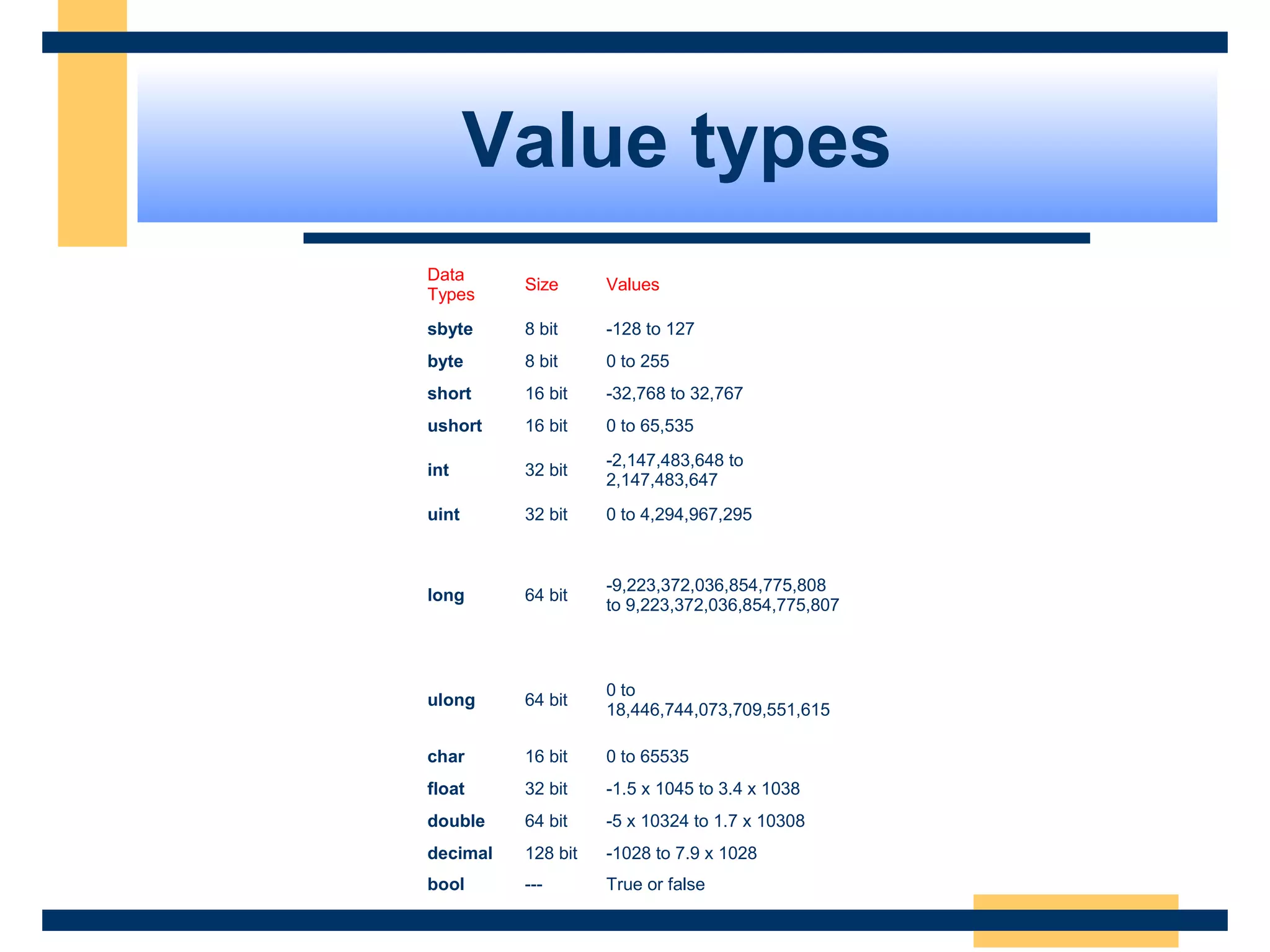
Value types
Data
Types
Size Values
sbyte 8 bit -128 to 127
byte 8 bit 0 to 255
short 16 bit -32,768 to 32,767
ushort 16 bit 0 to 65,535
int 32 bit
-2,147,483,648 to
2,147,483,647
uint 32 bit 0 to 4,294,967,295
long 64 bit
-9,223,372,036,854,775,808
to 9,223,372,036,854,775,807
ulong 64 bit
0 to
18,446,744,073,709,551,615
char 16 bit 0 to 65535
float 32 bit -1.5 x 1045 to 3.4 x 1038
double 64 bit -5 x 10324 to 1.7 x 10308
decimal 128 bit -1028 to 7.9 x 1028
bool --- True or false
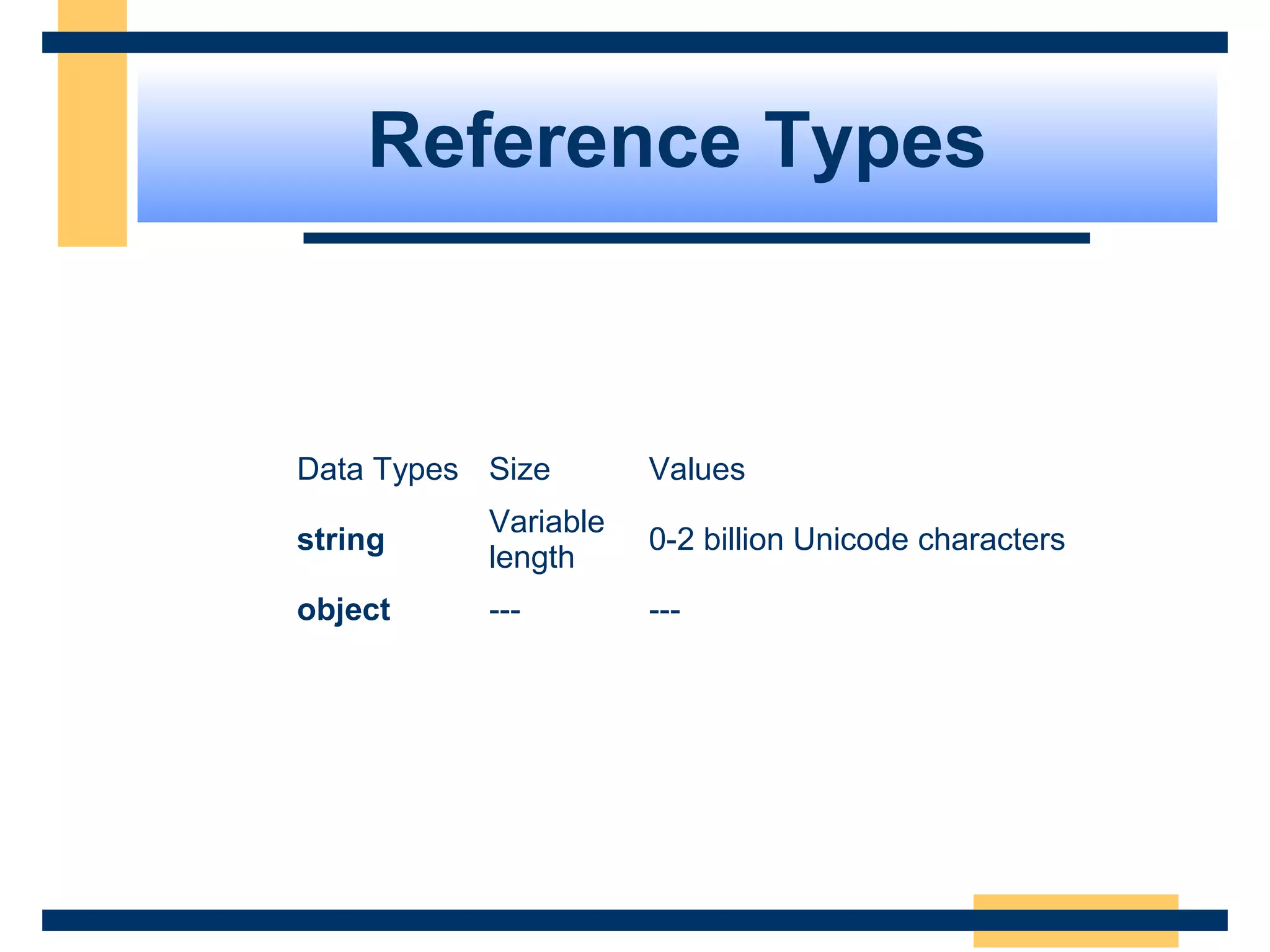
Reference Types
Data Types Size Values
string
Variable
length
0-2 billion Unicode characters
object --- ---
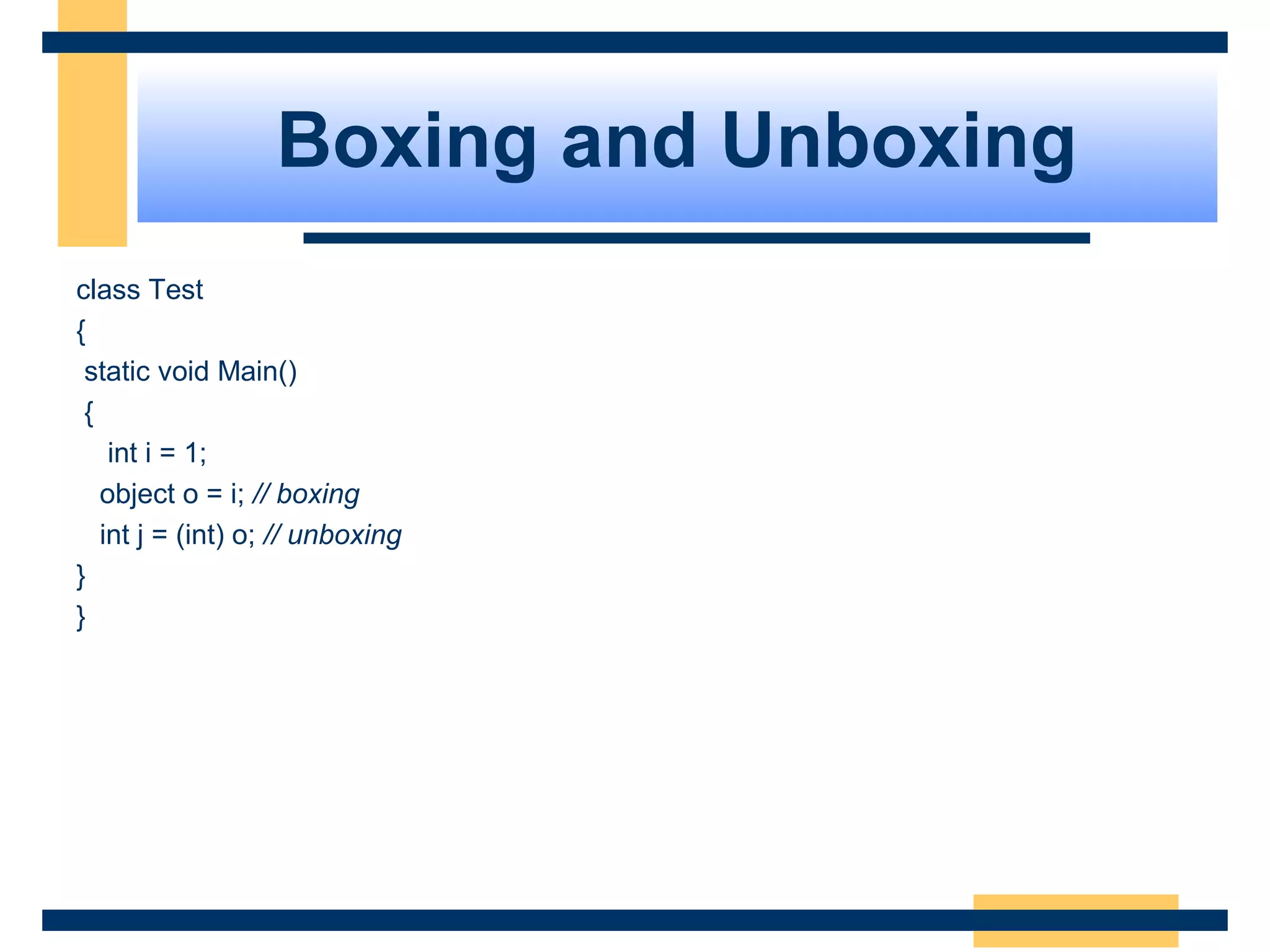
Boxing and Unboxing
class Test
{
static void Main()
{
int i = 1;
object o = i; // boxing
int j = (int) o; // unboxing
}
}
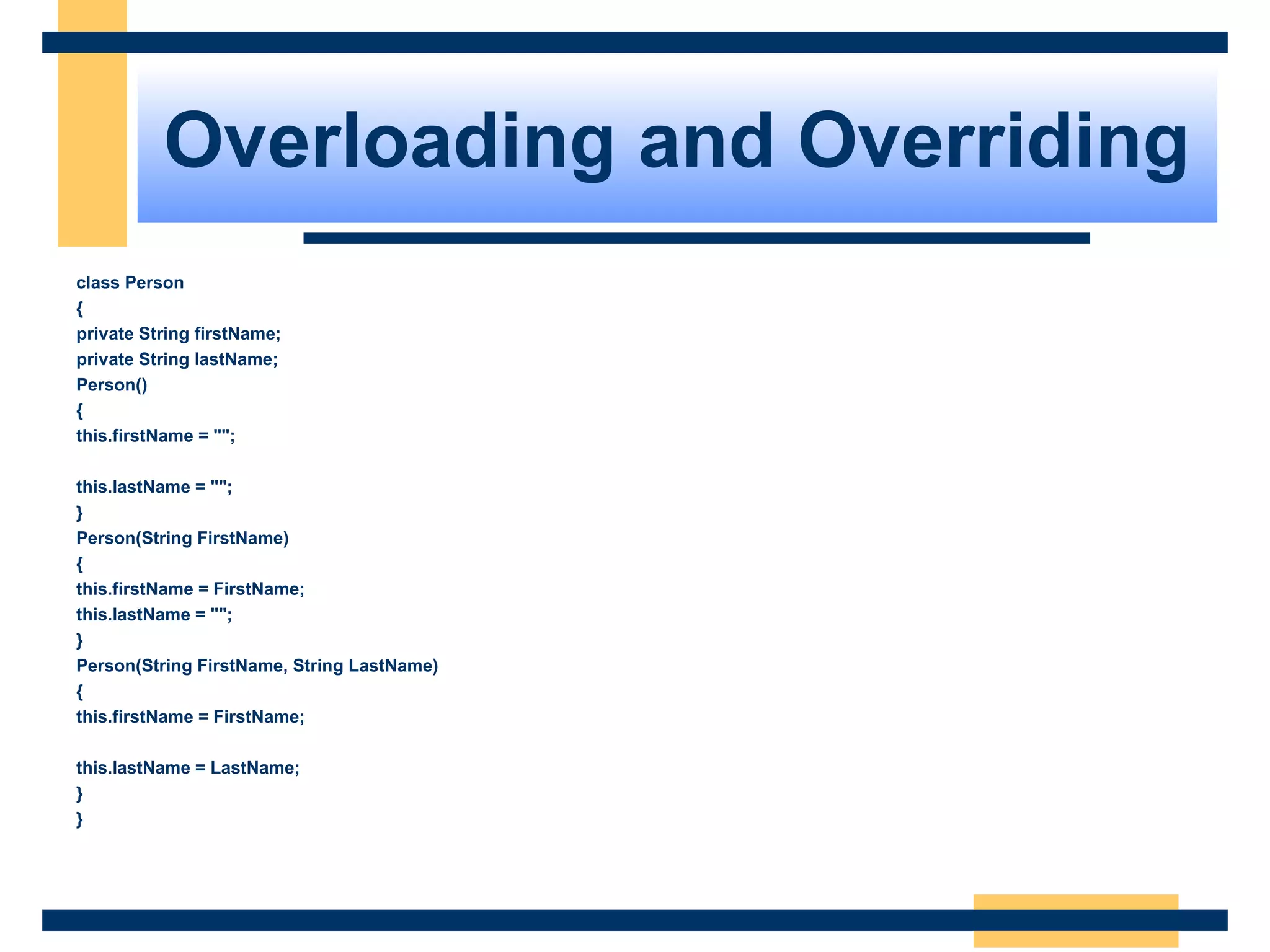
Overloading and Overriding
class Person
{
private String firstName;
private String lastName;
Person()
{
this.firstName = "";
this.lastName = "";
}
Person(String FirstName)
{
this.firstName = FirstName;
this.lastName = "";
}
Person(String FirstName, String LastName)
{
this.firstName = FirstName;
this.lastName = LastName;
}
}
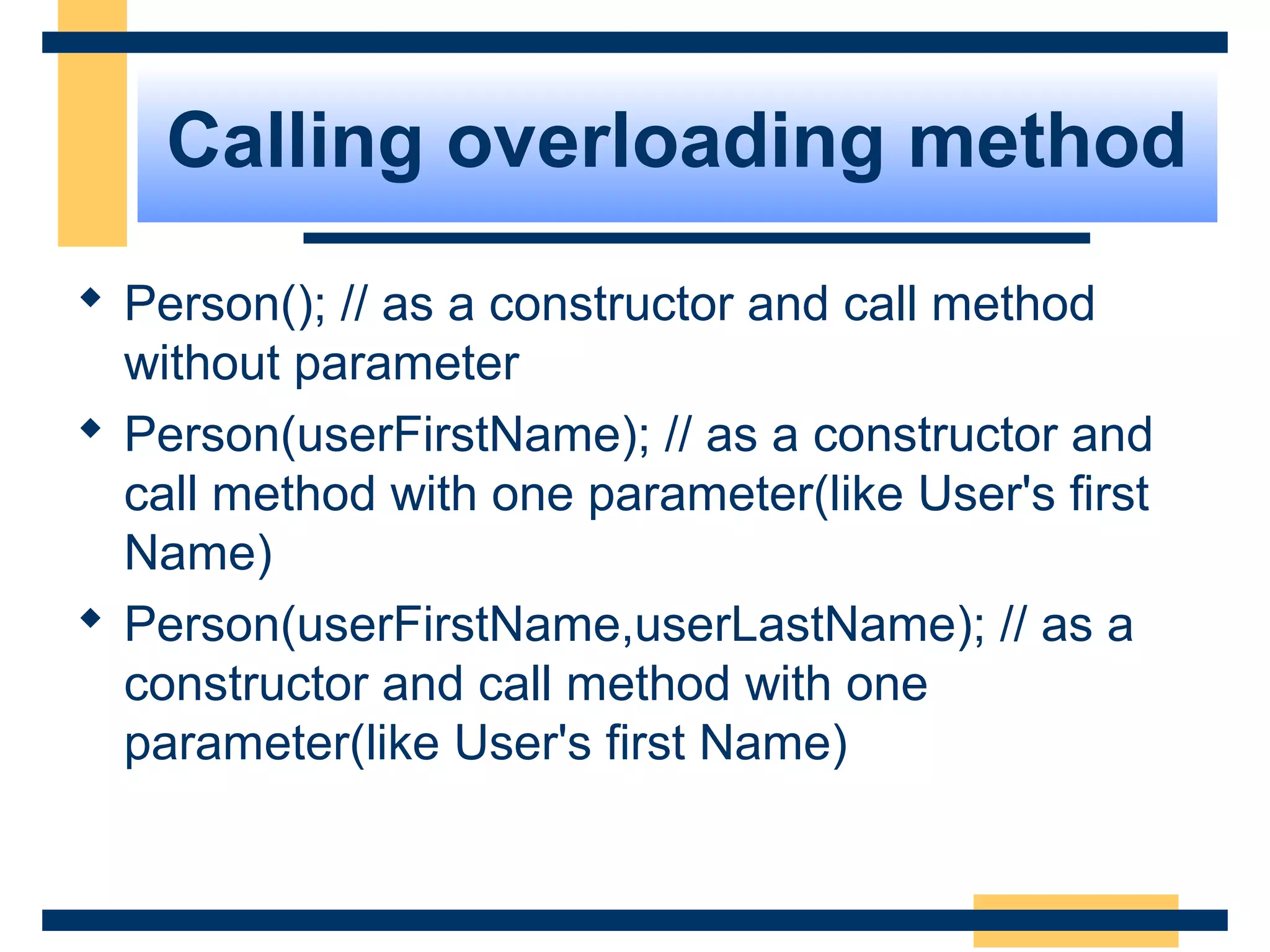
Calling overloading method
 Person(); // as a constructor and call method
without parameter
 Person(userFirstName); // as a constructor and
call method with one parameter(like User's first
Name)
 Person(userFirstName,userLastName); // as a
constructor and call method with one
parameter(like User's first Name)
Polymorphism
Polymorphism provides following features:
It allows you to invoke methods of derived class through base class reference during runtime.
It has the ability for classes to provide different implementations of methods that are called through the same name.
Polymorphism is of two types:
Compile time polymorphism/Overloading
Runtime polymorphism/Overriding
Polymorphism
Compile Time Polymorphism
 
Compile time polymorphism is method and operators overloading. It is also called early binding.
 
In method overloading method performs the different task at the different input parameters.
 
Runtime Time Polymorphism
 
Runtime time polymorphism is done using inheritance and virtual functions. Method overriding is called runtime polymorphism. It 
is also called late binding.
 
“When overriding a method, you change the behavior of the method for the derived class. Overloading a method simply
involves having another method with the same prototype.”
Interfaces
 An interface defines a contract
 An interface is a type
 Includes methods, properties, indexers, events
 Any class or struct implementing an interface must support all parts of the contract
 Interfaces provide no implementation
 When a class or struct implements an interface it must provide the implementation
 Interfaces provide polymorphism
 Many classes and structs may implement 
a particular interface
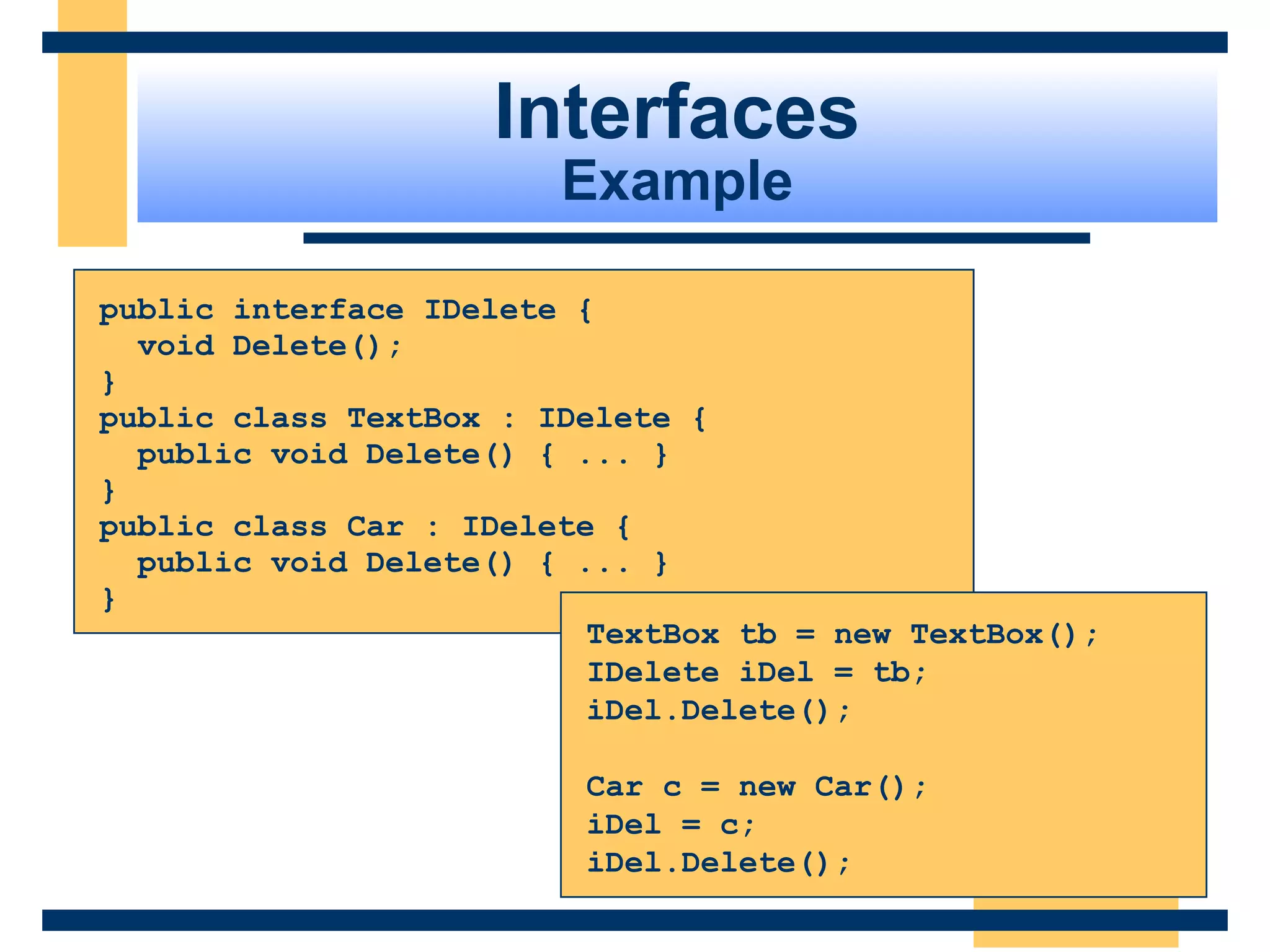
public interface IDelete {
void Delete();
}
public class TextBox : IDelete {
public void Delete() { ... }
}
public class Car : IDelete {
public void Delete() { ... }
}
TextBox tb = new TextBox();
IDelete iDel = tb;
iDel.Delete();
Car c = new Car();
iDel = c;
iDel.Delete();
Interfaces
Example
interface IControl {
void Paint();
}
interface IListBox: IControl {
void SetItems(string[] items);
}
interface IComboBox: ITextBox, IListBox {
}
Interfaces
Multiple Inheritance
 Classes and structs can inherit from 
multiple interfaces
 Interfaces can inherit from multiple interfaces
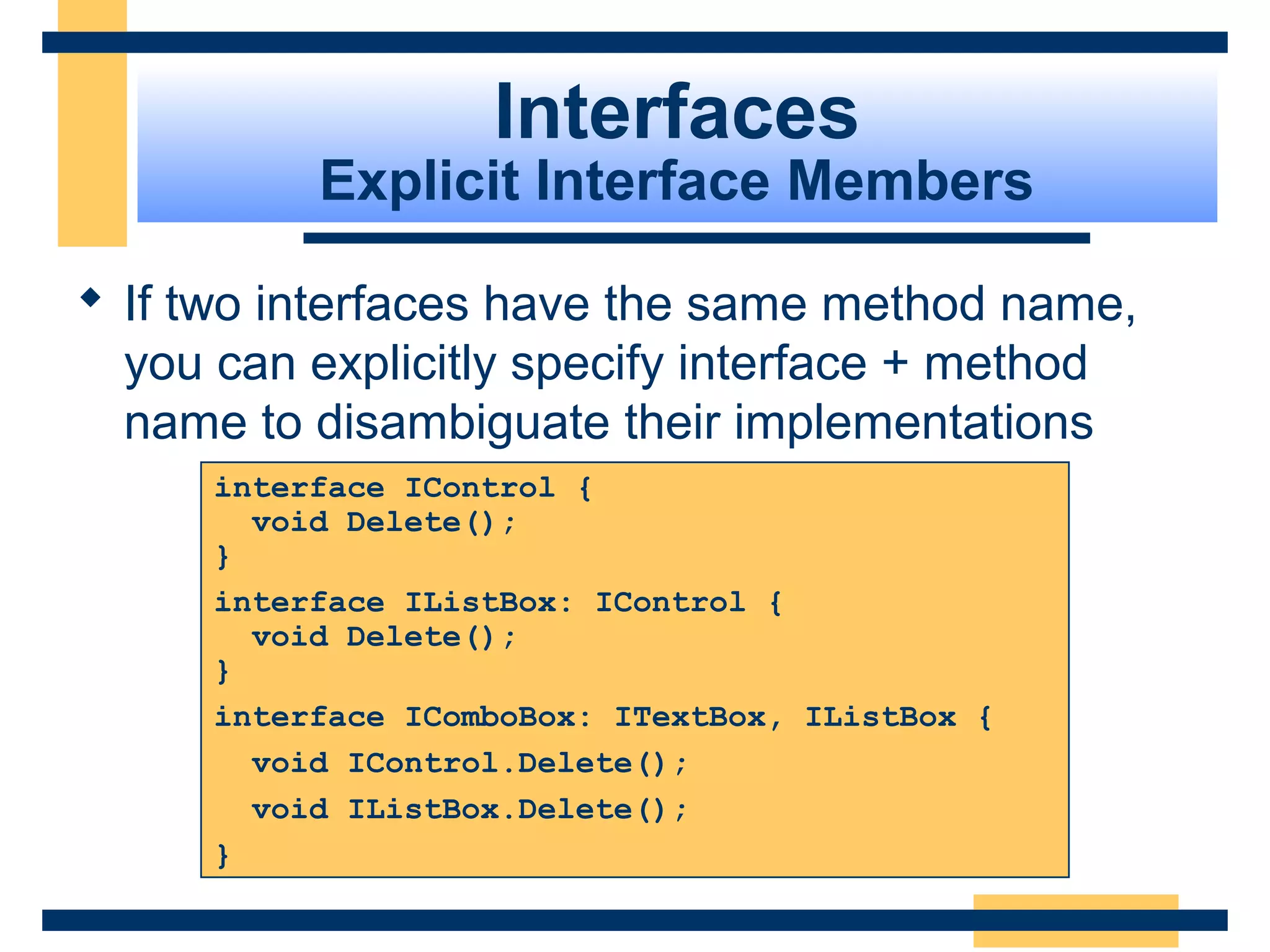
interface IControl {
void Delete();
}
interface IListBox: IControl {
void Delete();
}
interface IComboBox: ITextBox, IListBox {
void IControl.Delete();
void IListBox.Delete();
}
Interfaces
Explicit Interface Members
 If two interfaces have the same method name, 
you can explicitly specify interface + method 
name to disambiguate their implementations
Classes and Structs
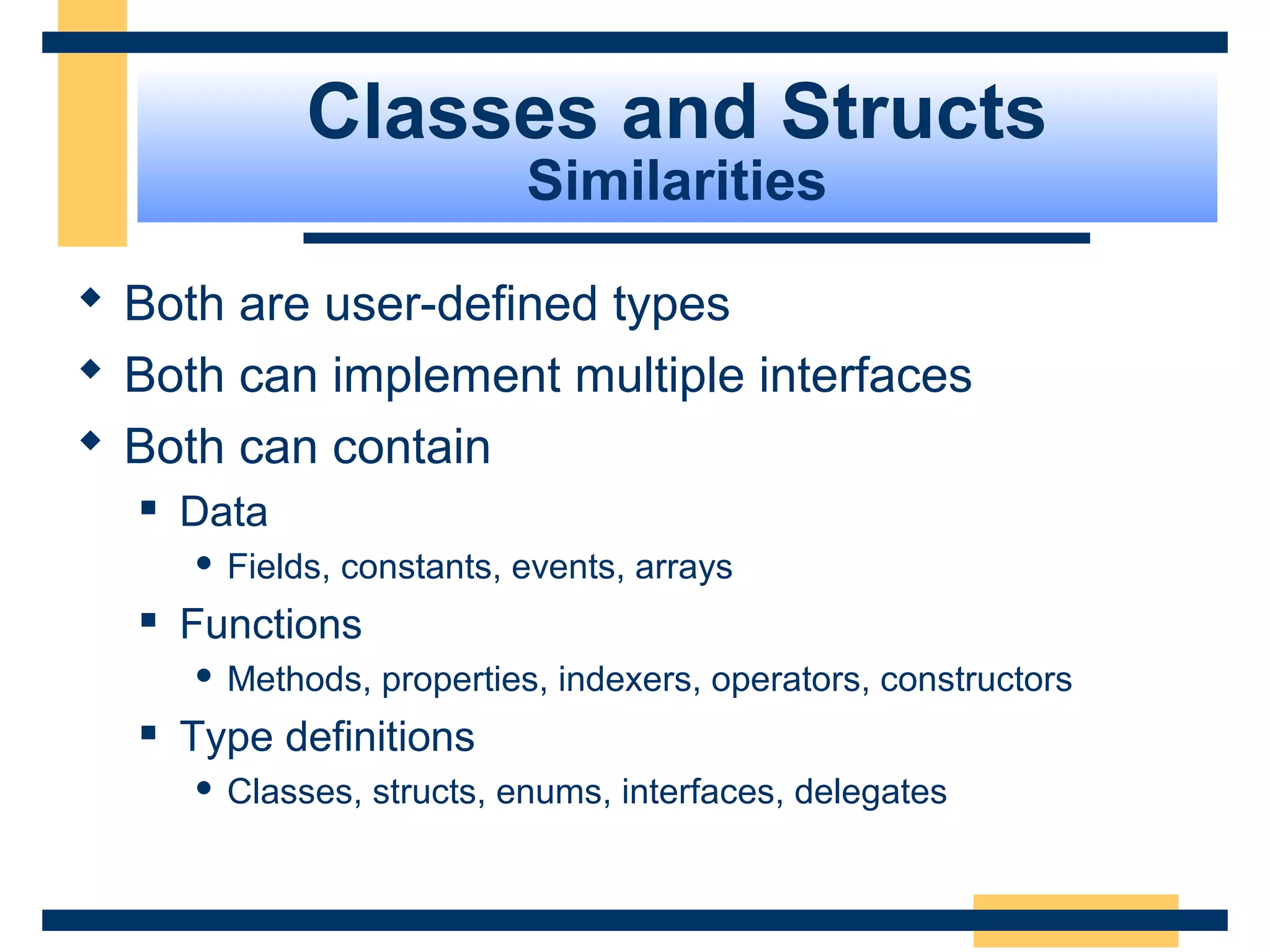
Similarities
 Both are user-defined types
 Both can implement multiple interfaces
 Both can contain
 Data 
 Fields, constants, events, arrays
 Functions 
 Methods, properties, indexers, operators, constructors
 Type definitions
 Classes, structs, enums, interfaces, delegates
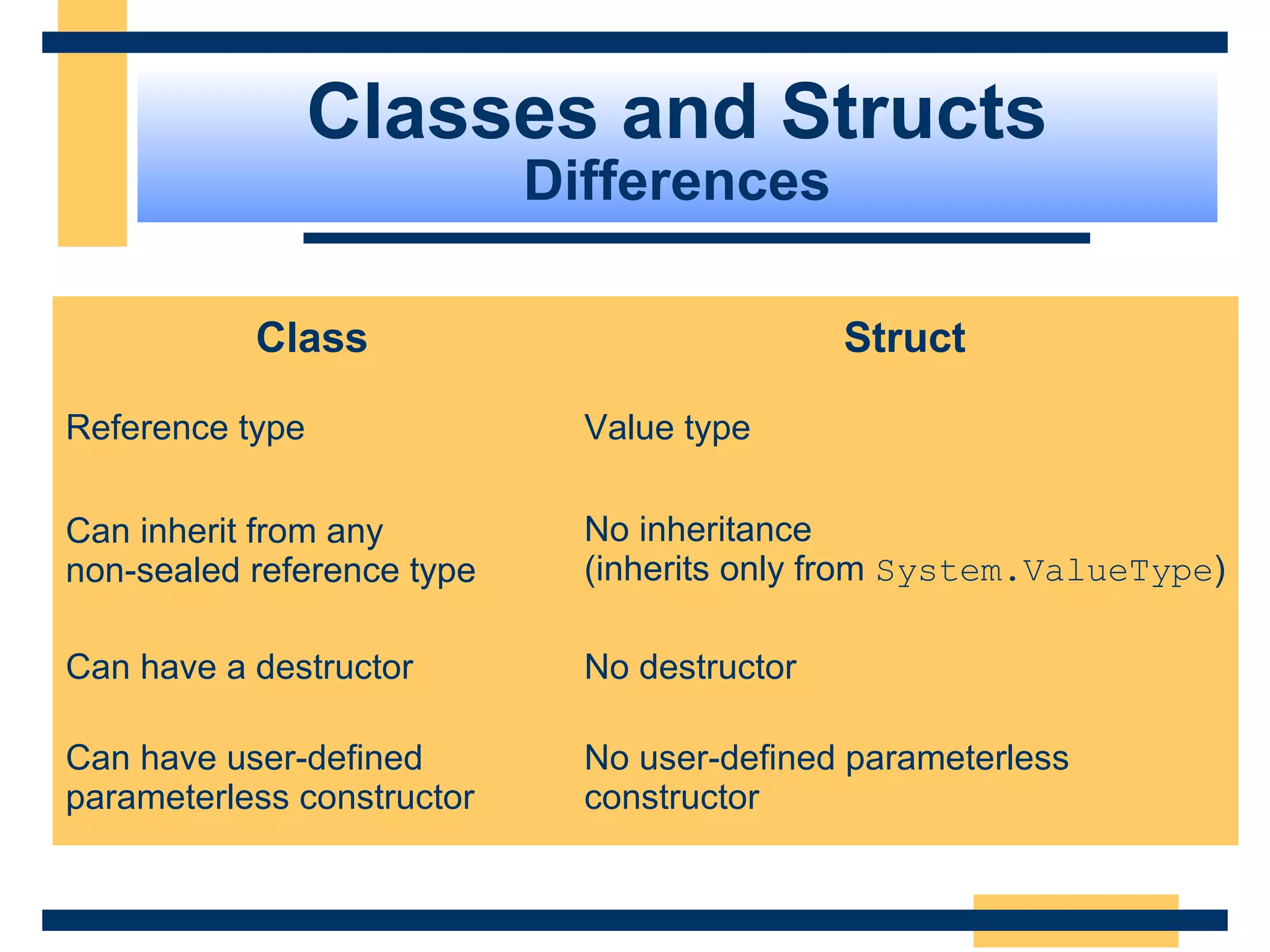
Class Struct
Reference type Value type
Can inherit from any
non-sealed reference type
No inheritance
(inherits only from System.ValueType)
Can have a destructor No destructor
Can have user-defined
parameterless constructor
No user-defined parameterless
constructor
Classes and Structs
Differences
Classes and Structs
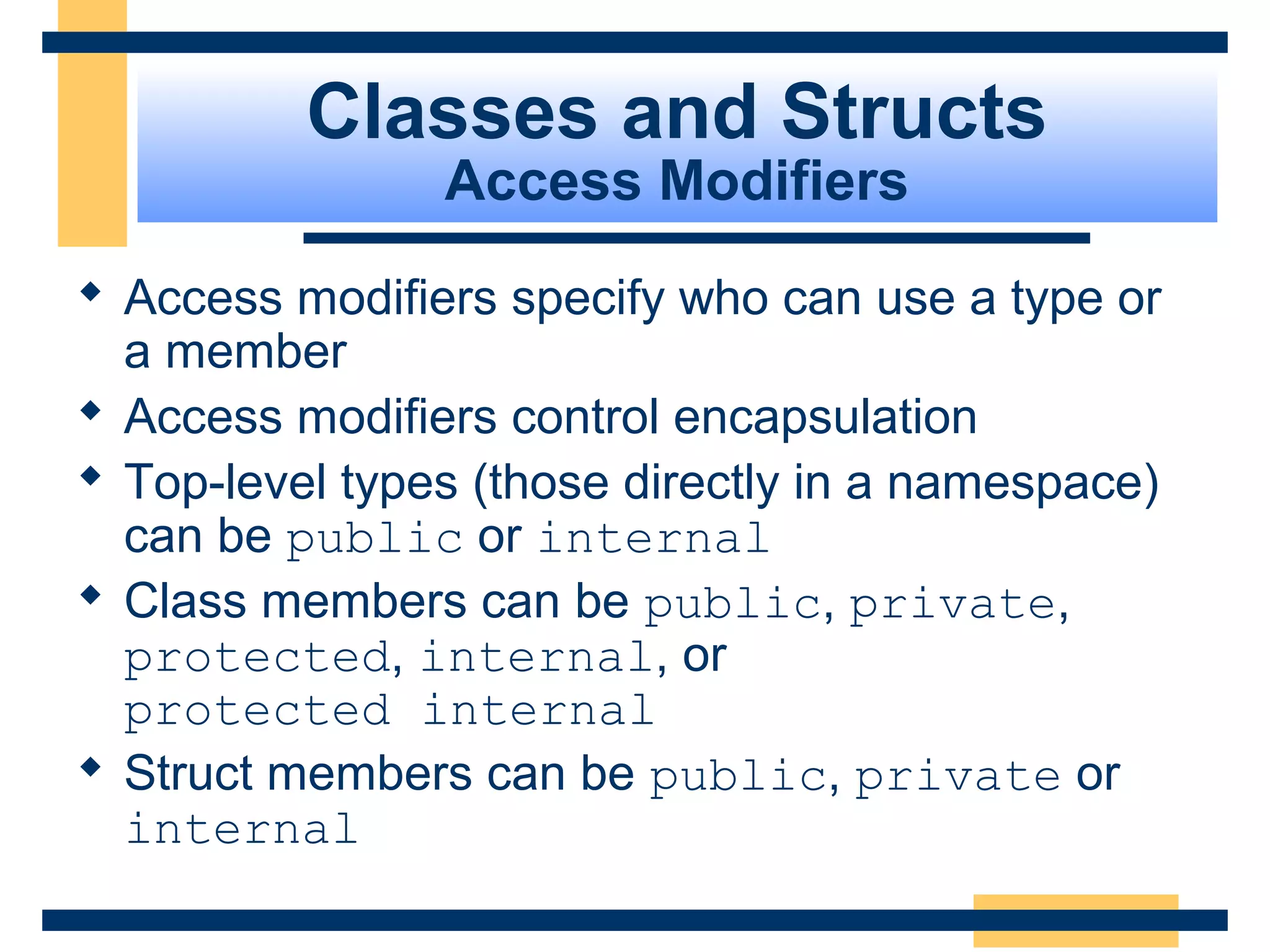
Access Modifiers
 Access modifiers specify who can use a type or
a member
 Access modifiers control encapsulation
 Top-level types (those directly in a namespace)
can be public or internal
 Class members can be public, private,
protected, internal, or
protected internal
 Struct members can be public, private or
internal
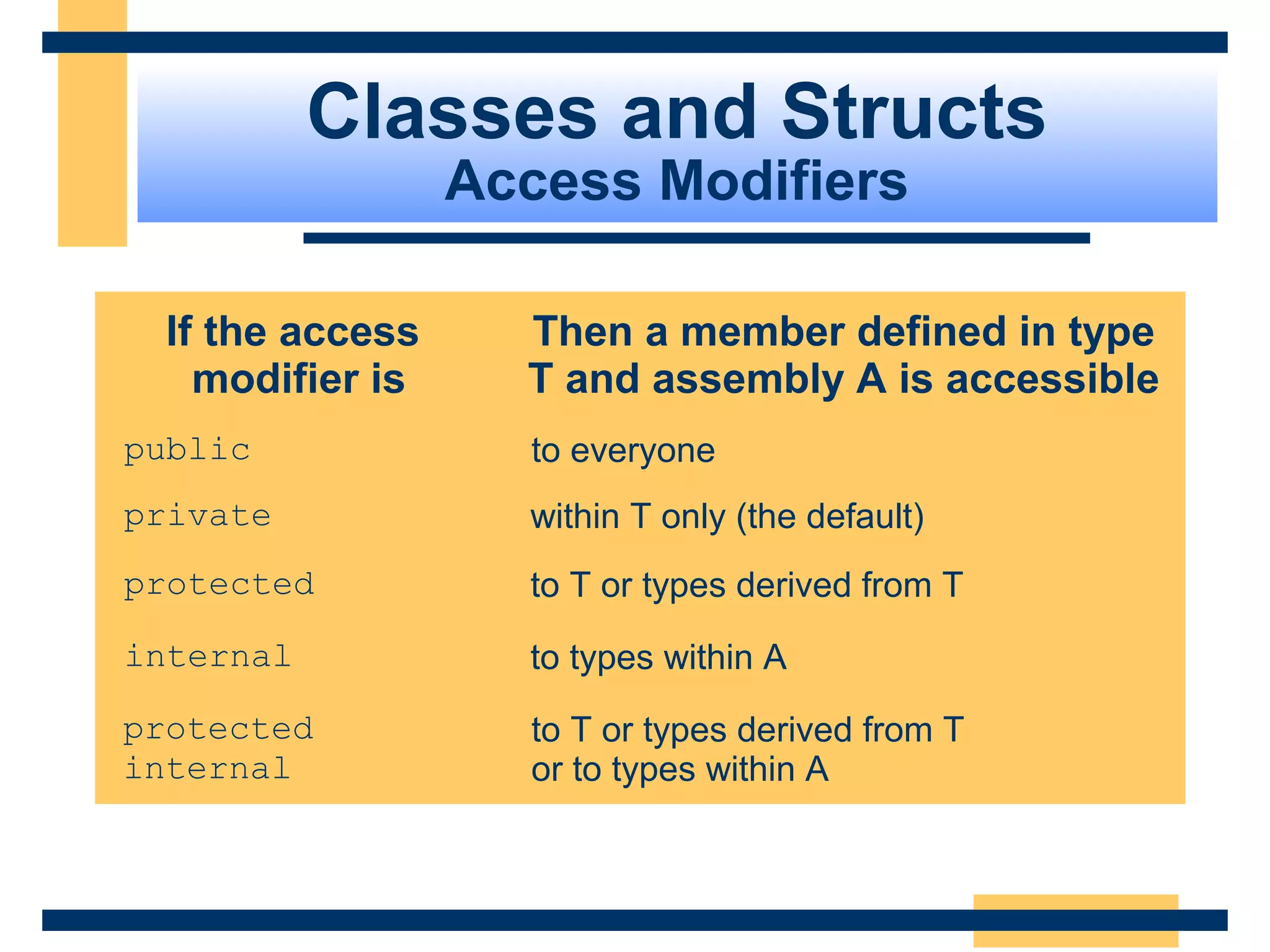
If the access
modifier is
Then a member defined in type
T and assembly A is accessible
public to everyone
private within T only (the default)
protected to T or types derived from T
internal to types within A
protected
internal
to T or types derived from T
or to types within A
Classes and Structs
Access Modifiers
Classes and Structs
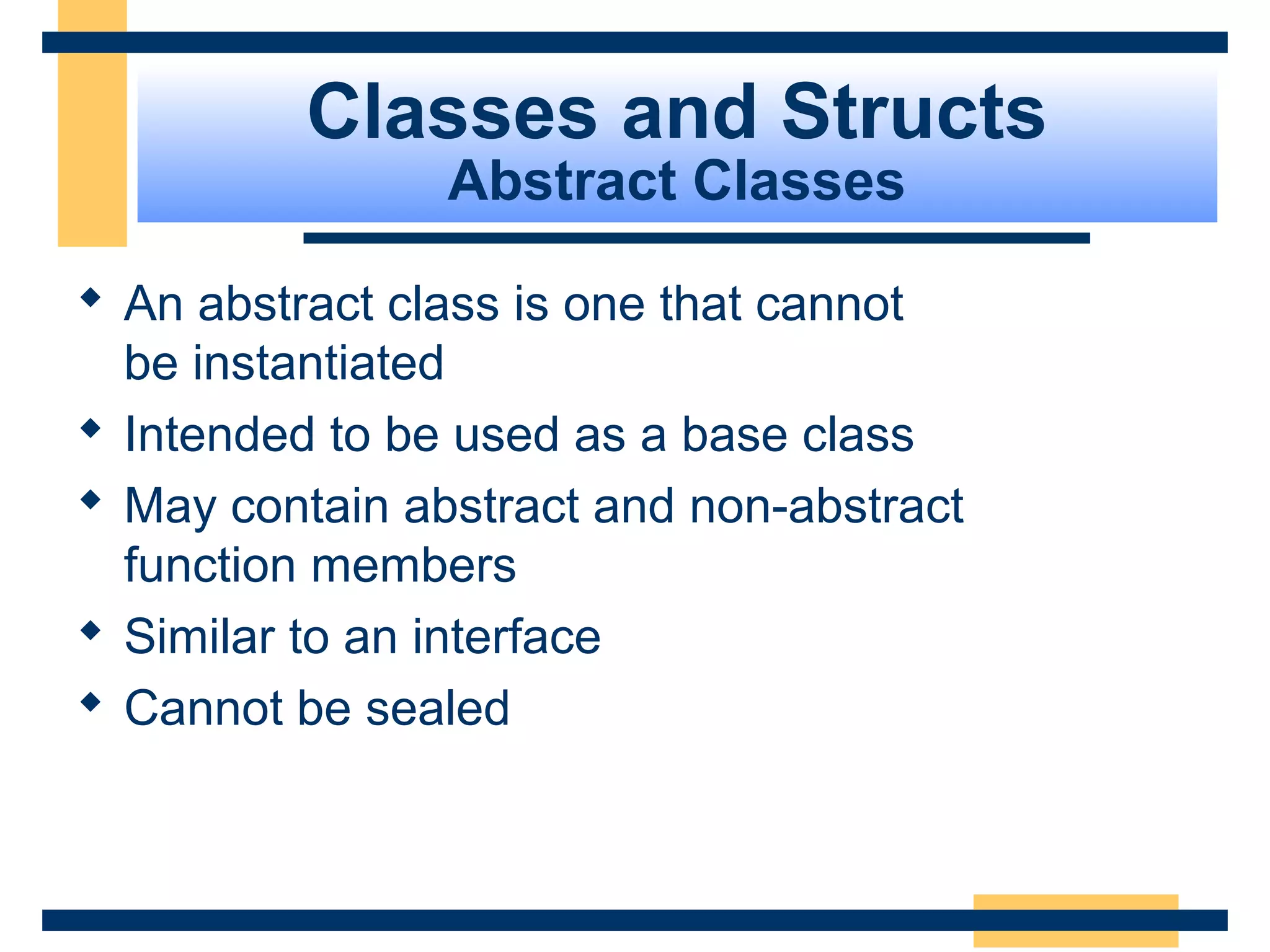
Abstract Classes
 An abstract class is one that cannot
be instantiated
 Intended to be used as a base class
 May contain abstract and non-abstract
function members
 Similar to an interface
 Cannot be sealed
Classes and Structs
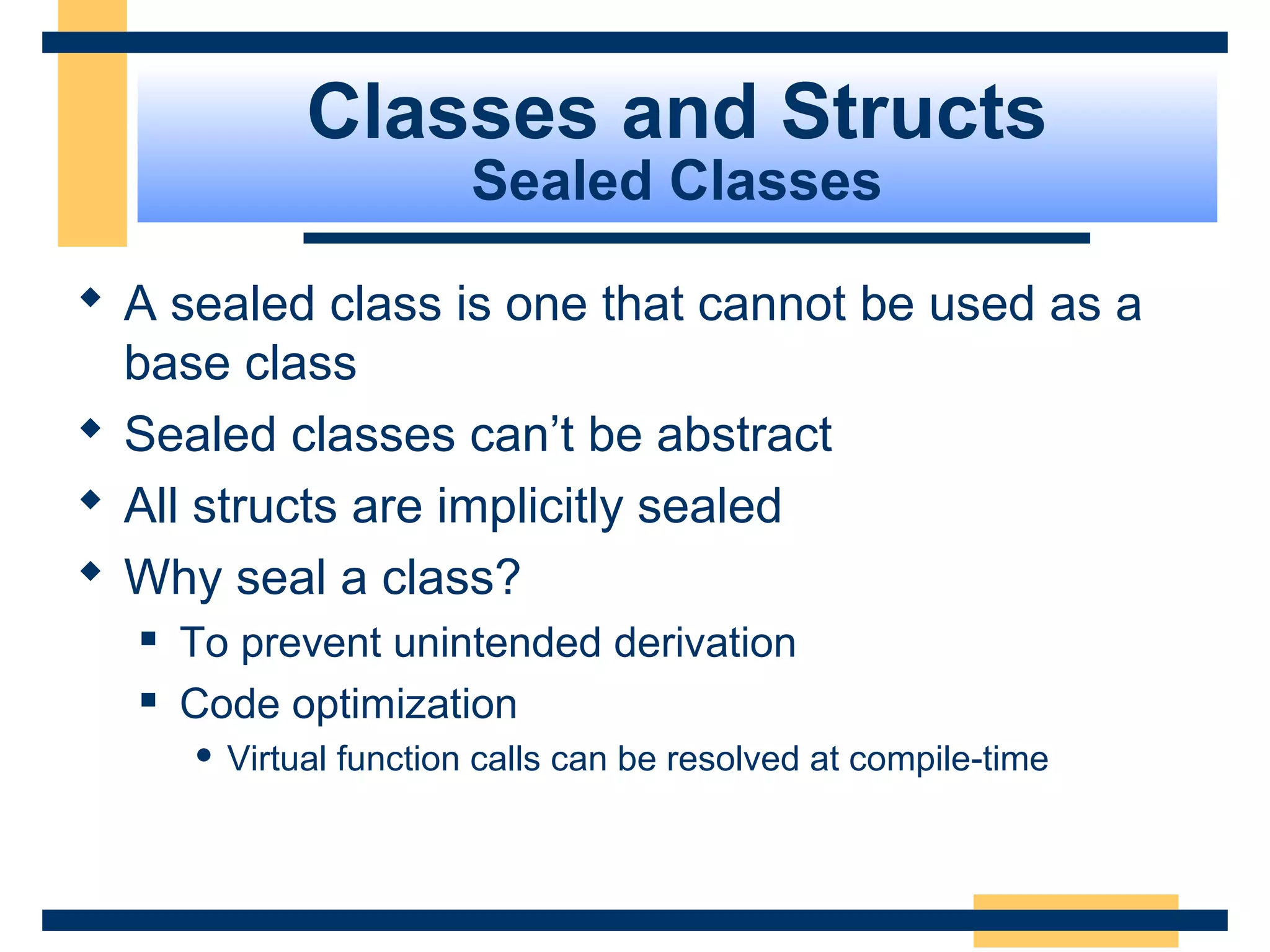
Sealed Classes
 A sealed class is one that cannot be used as a
base class
 Sealed classes can’t be abstract
 All structs are implicitly sealed
 Why seal a class?
 To prevent unintended derivation
 Code optimization
 Virtual function calls can be resolved at compile-time

Basic c#

  • 1.
    Agenda Object-Oriented Concepts Abstraction andEncapsulation Inheritance Polymorphism Interfaces and Abstract Classes Virtual Methods Classes Sealed Classes C# programming with examples
  • 2.
     Encapsulation andabstraction is the advanced mechanism in C# that lets your program to hide unwanted code within a capsule and shows only essential features of an object.  Encapsulation is used to hide its members from outside class or interface, whereas abstraction is used to show only essential features.  Access Modifier – Public, Private, Protected, Internal & Protected Internal Key Object-Oriented Concepts
  • 3.
    Foreach  using System; namespaceforeach_loop { class Program { static void Main(string[] args) { string[] arr = new string[5]; // declaring array //Storing value in array element arr[0] = "Steven"; arr[1] = "Clark"; arr[2] = "Mark"; arr[3] = "Thompson"; arr[4] = "John"; //retrieving value using foreach loop foreach (string name in arr) { Console.WriteLine("Hello " + name); } Console.ReadLine(); } } }
  • 4.
    switch case switch (opt) { case1: result = num1 + num2; Console.WriteLine("n{0} + {1} = {2}", num1, num2, result); break; case 2: result = num1 - num2; Console.WriteLine("n{0} - {1} = {2}", num1, num2, result); break; default: Console.WriteLine("nInvalid option.Please try again."); Break; }
  • 5.
    Array using System; namespace Declare_Array { classProgram { static void Main(string[] args) { int[] num = new int[6]; //Declaring Array //Initializing array num[0] = 6; num[1] = 23; num[2] = 12; num[3] = 9; num[4] = 14; num[5] = 52; //Showing value of Array Console.WriteLine("1st value:t{0}", num[0]); Console.WriteLine("2nd value:t{0}", num[1]); Console.WriteLine("3rd value:t{0}", num[2]); Console.WriteLine("4th value:t{0}", num[3]); Console.WriteLine("5th value:t{0}", num[4]); Console.WriteLine("6th value:t{0}", num[5]); Console.ReadLine(); } } }
  • 6.
    Data Types  C#is a strongly typed language. It means, that you cannot use variable without data types.  Data types tell the compiler that which type of data is used for processing.  Such as if you want to work with string value then you will have to assign string type variable to work with.  C# provides two types of data types: Value types and Reference types.  A Value type data type stores copy of the value whereas the Reference typedata types stores the address of the value.
  • 7.
    Value types Data Types Size Values sbyte8 bit -128 to 127 byte 8 bit 0 to 255 short 16 bit -32,768 to 32,767 ushort 16 bit 0 to 65,535 int 32 bit -2,147,483,648 to 2,147,483,647 uint 32 bit 0 to 4,294,967,295 long 64 bit -9,223,372,036,854,775,808 to 9,223,372,036,854,775,807 ulong 64 bit 0 to 18,446,744,073,709,551,615 char 16 bit 0 to 65535 float 32 bit -1.5 x 1045 to 3.4 x 1038 double 64 bit -5 x 10324 to 1.7 x 10308 decimal 128 bit -1028 to 7.9 x 1028 bool --- True or false
  • 8.
    Reference Types Data TypesSize Values string Variable length 0-2 billion Unicode characters object --- ---
  • 9.
    Boxing and Unboxing classTest { static void Main() { int i = 1; object o = i; // boxing int j = (int) o; // unboxing } }
  • 10.
    Overloading and Overriding classPerson { private String firstName; private String lastName; Person() { this.firstName = ""; this.lastName = ""; } Person(String FirstName) { this.firstName = FirstName; this.lastName = ""; } Person(String FirstName, String LastName) { this.firstName = FirstName; this.lastName = LastName; } }
  • 11.
    Calling overloading method Person(); // as a constructor and call method without parameter  Person(userFirstName); // as a constructor and call method with one parameter(like User's first Name)  Person(userFirstName,userLastName); // as a constructor and call method with one parameter(like User's first Name)
  • 12.
    Polymorphism Polymorphism provides followingfeatures: It allows you to invoke methods of derived class through base class reference during runtime. It has the ability for classes to provide different implementations of methods that are called through the same name. Polymorphism is of two types: Compile time polymorphism/Overloading Runtime polymorphism/Overriding
  • 13.
    Polymorphism Compile Time Polymorphism   Compile time polymorphism is method and operators overloading. It is also called early binding.   In method overloading method performs the different task at the different input parameters.   RuntimeTime Polymorphism   Runtime time polymorphism is done using inheritance and virtual functions. Method overriding is called runtime polymorphism. It  is also called late binding.   “When overriding a method, you change the behavior of the method for the derived class. Overloading a method simply involves having another method with the same prototype.”
  • 14.
    Interfaces  An interface defines a contract  An interface is a type Includes methods, properties, indexers, events  Any class or struct implementing an interface must support all parts of the contract  Interfaces provide no implementation  When a class or struct implements an interface it must provide the implementation  Interfaces provide polymorphism  Many classes and structs may implement  a particular interface
  • 15.
    public interface IDelete{ void Delete(); } public class TextBox : IDelete { public void Delete() { ... } } public class Car : IDelete { public void Delete() { ... } } TextBox tb = new TextBox(); IDelete iDel = tb; iDel.Delete(); Car c = new Car(); iDel = c; iDel.Delete(); Interfaces Example
  • 16.
    interface IControl { voidPaint(); } interface IListBox: IControl { void SetItems(string[] items); } interface IComboBox: ITextBox, IListBox { } Interfaces Multiple Inheritance  Classes and structs can inherit from  multiple interfaces  Interfaces can inherit from multiple interfaces
  • 17.
    interface IControl { voidDelete(); } interface IListBox: IControl { void Delete(); } interface IComboBox: ITextBox, IListBox { void IControl.Delete(); void IListBox.Delete(); } Interfaces Explicit Interface Members  If two interfaces have the same method name,  you can explicitly specify interface + method  name to disambiguate their implementations
  • 18.
    Classes and Structs Similarities Both are user-defined types  Both can implement multiple interfaces  Both can contain  Data   Fields, constants, events, arrays  Functions   Methods, properties, indexers, operators, constructors  Type definitions  Classes, structs, enums, interfaces, delegates
  • 19.
    Class Struct Reference typeValue type Can inherit from any non-sealed reference type No inheritance (inherits only from System.ValueType) Can have a destructor No destructor Can have user-defined parameterless constructor No user-defined parameterless constructor Classes and Structs Differences
  • 20.
    Classes and Structs AccessModifiers  Access modifiers specify who can use a type or a member  Access modifiers control encapsulation  Top-level types (those directly in a namespace) can be public or internal  Class members can be public, private, protected, internal, or protected internal  Struct members can be public, private or internal
  • 21.
    If the access modifieris Then a member defined in type T and assembly A is accessible public to everyone private within T only (the default) protected to T or types derived from T internal to types within A protected internal to T or types derived from T or to types within A Classes and Structs Access Modifiers
  • 22.
    Classes and Structs AbstractClasses  An abstract class is one that cannot be instantiated  Intended to be used as a base class  May contain abstract and non-abstract function members  Similar to an interface  Cannot be sealed
  • 23.
    Classes and Structs SealedClasses  A sealed class is one that cannot be used as a base class  Sealed classes can’t be abstract  All structs are implicitly sealed  Why seal a class?  To prevent unintended derivation  Code optimization  Virtual function calls can be resolved at compile-time

Editor's Notes

  • #3 The term object sometimes refers to an instance and sometimes to a class. It’s meaning can usually be determined by context.
  • #4 An interface is a well-defined set of methods (functions). Interfaces do not contain data members. Type is different from class. The type specifies the interfaces, the class specifies the implementation.
  • #13 Polymorphism is achieved through: Inheritance: a base type can have multiple derived types Interfaces: multiple types can implement a given interface Late binding: you can use any object, as long as it implements the methods you want to call. In C# you can use reflection to dynamically determine if an object implements a method, and then call it. Interfaces can also be used in a late-bound manner. In order to handle multiple types without polymorphism you have to write conditional code (using if or switch statements) that tests the type of an instance and then runs the appropriate code. Such code is brittle and not easily extended. Many Object-Oriented design concepts are motivated by minimizing dependencies. You want to be able to develop independent modules, so that making a change to one doesn’t force you to have to go back and change others.
  • #15 In scenarios where completely different objects need to support some kind of shared functionality like, let’s say, persist to XML, classes can implement interfaces that make them compatible with even if they don’t share the same base class. This provides most of the benefits of multiple class inheritance without the nasty side-effects that this usually brings. Interface members are implicitly public and abstract.
  • #18 If there’s no ambiguity then you do not have to specify the name of the interface.
  • #19 Classes and structs provide a way to create user-defined types.
  • #22 protected internal = protected OR internal. No way to define protected AND internal.