Barriers to adoption: policy &
institutional arrangements to support CSA
Leslie Lipper, Solomon Asfaw, Giacomo Branca, Andrea Cattaneo, Romina Cavatassi,
Uwe Grewer, Misael Kokwe, Nguyen Van Linh, Wendy Mann, Nancy McCarthy,
Adriana Paolantonio, George Phiri, Alessandro Spairani
Food and Agriculture Organization of the United Nations
Outline of the presentation
• Barriers to adopting what?
• Changing weather patterns means farmers need to adapt
• Though CSA is a site specific concept, there are key features of
what it will take & specific barriers associated with them
• Policy levers to reduce barriers
• Policy coordination and financing needs
2
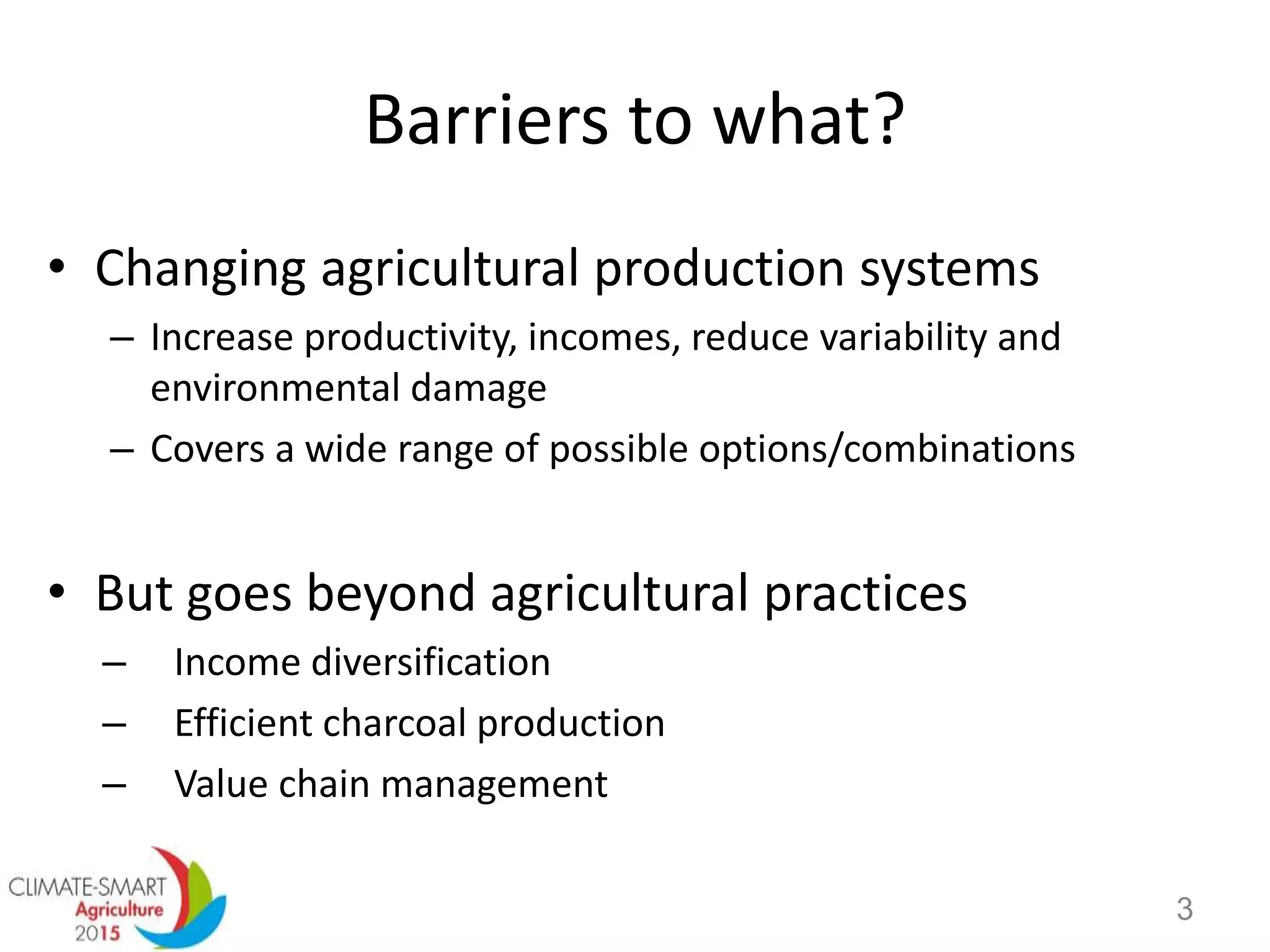
Barriers to what?
• Changing agricultural production systems
– Increase productivity, incomes, reduce variability and
environmental damage
– Covers a wide range of possible options/combinations
• But goes beyond agricultural practices
– Income diversification
– Efficient charcoal production
– Value chain management
3
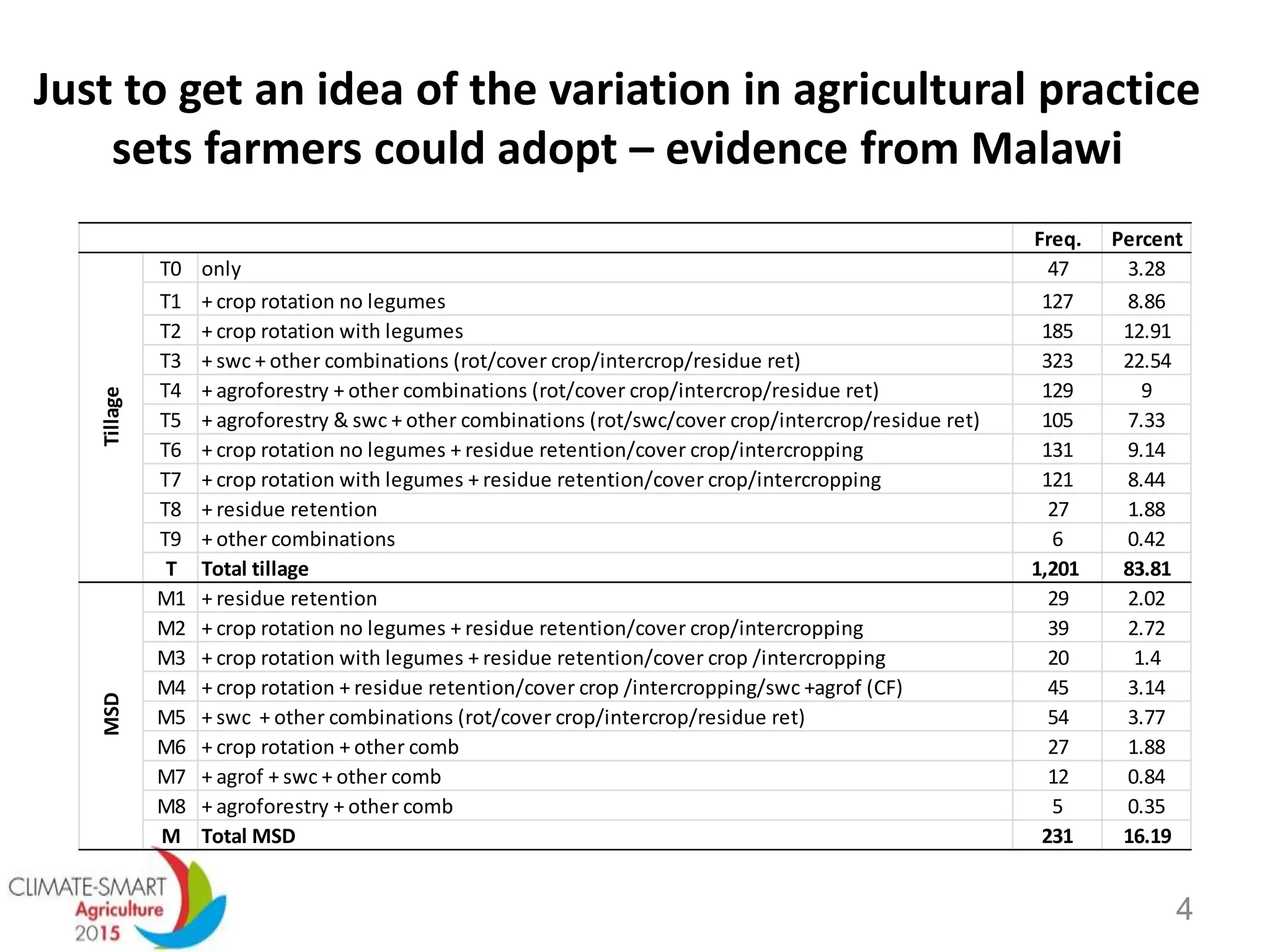
Just to get an idea of the variation in agricultural practice
sets farmers could adopt – evidence from Malawi
4
Freq. Percent
T0 only 47 3.28
T1 + crop rotation no legumes 127 8.86
T2 + crop rotation with legumes 185 12.91
T3 + swc + other combinations (rot/cover crop/intercrop/residue ret) 323 22.54
T4 + agroforestry + other combinations (rot/cover crop/intercrop/residue ret) 129 9
T5 + agroforestry & swc + other combinations (rot/swc/cover crop/intercrop/residue ret) 105 7.33
T6 + crop rotation no legumes + residue retention/cover crop/intercropping 131 9.14
T7 + crop rotation with legumes + residue retention/cover crop/intercropping 121 8.44
T8 + residue retention 27 1.88
T9 + other combinations 6 0.42
T Total tillage 1,201 83.81
M1 + residue retention 29 2.02
M2 + crop rotation no legumes + residue retention/cover crop/intercropping 39 2.72
M3 + crop rotation with legumes + residue retention/cover crop /intercropping 20 1.4
M4 + crop rotation + residue retention/cover crop /intercropping/swc +agrof (CF) 45 3.14
M5 + swc + other combinations (rot/cover crop/intercrop/residue ret) 54 3.77
M6 + crop rotation + other comb 27 1.88
M7 + agrof + swc + other comb 12 0.84
M8 + agroforestry + other comb 5 0.35
M Total MSD 231 16.19
TillageMSD
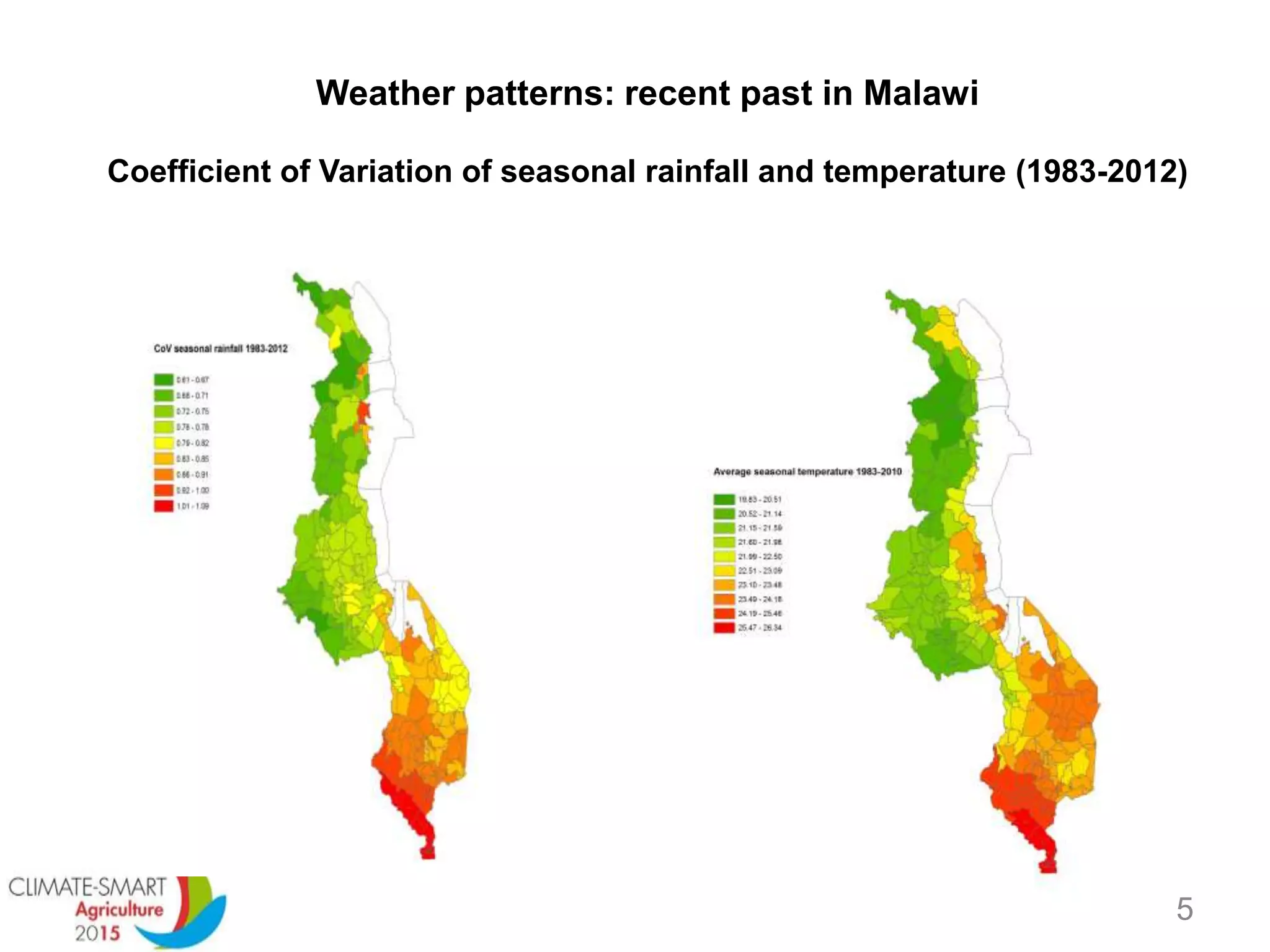
Weather patterns: recent past in Malawi
Coefficient of Variation of seasonal rainfall and temperature (1983-2012)
5
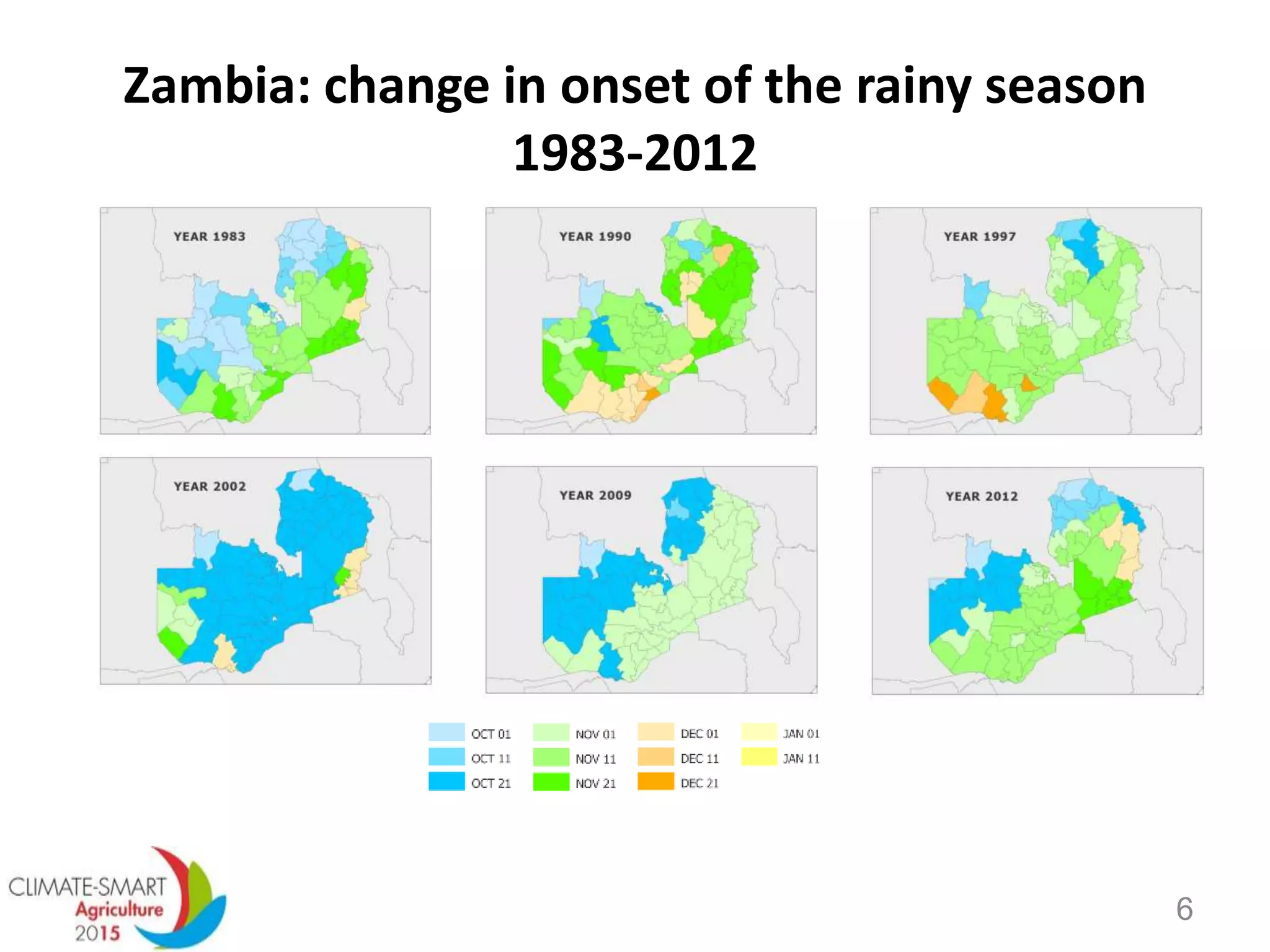
Zambia: change in onset of the rainy season
1983-2012
6
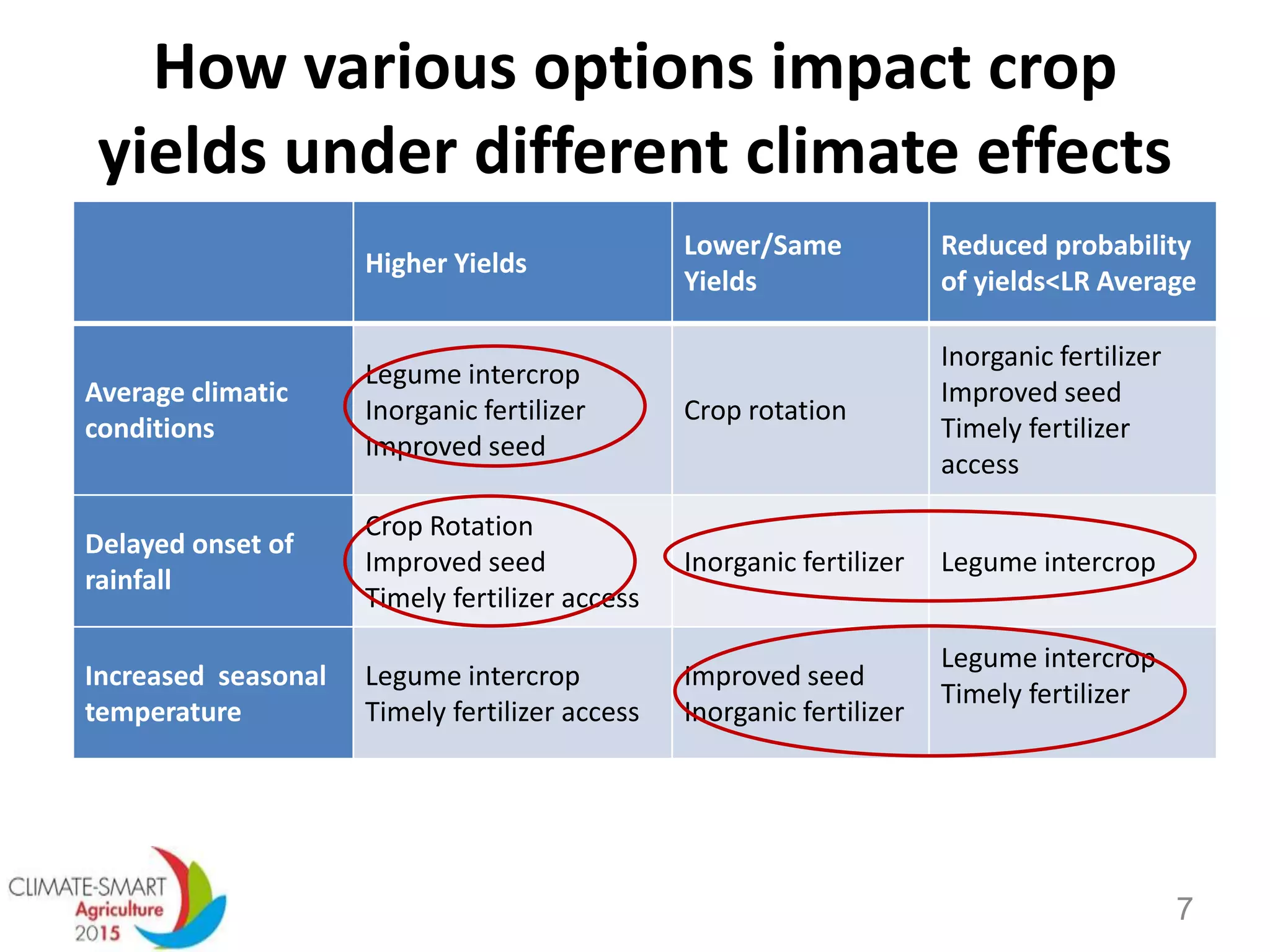
How various options impact crop
yields under different climate effects
Higher Yields
Lower/Same
Yields
Reduced probability
of yields<LR Average
Average climatic
conditions
Legume intercrop
Inorganic fertilizer
Improved seed
Crop rotation
Inorganic fertilizer
Improved seed
Timely fertilizer
access
Delayed onset of
rainfall
Crop Rotation
Improved seed
Timely fertilizer access
Inorganic fertilizer Legume intercrop
Increased seasonal
temperature
Legume intercrop
Timely fertilizer access
Improved seed
Inorganic fertilizer
Legume intercrop
Timely fertilizer
7
II. Although CSA benefits & costs are site
specific – we can identify some universal
characteristics of CSA practices and
technologies
… as well as the barriers to their adoption
8
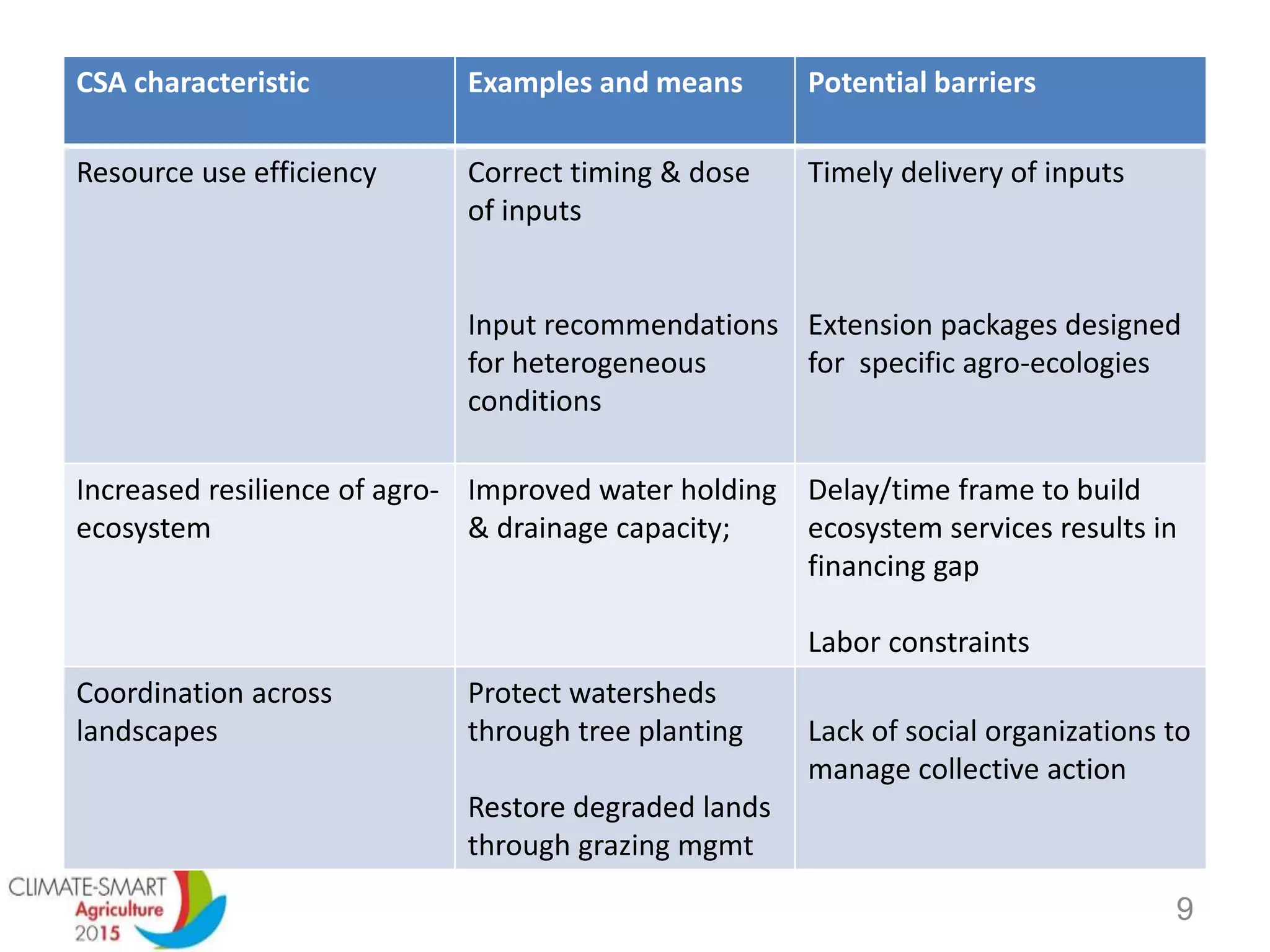
CSA characteristic Examples and means Potential barriers
Resource use efficiency Correct timing & dose
of inputs
Input recommendations
for heterogeneous
conditions
Timely delivery of inputs
Extension packages designed
for specific agro-ecologies
Increased resilience of agro-
ecosystem
Improved water holding
& drainage capacity;
Delay/time frame to build
ecosystem services results in
financing gap
Labor constraints
Coordination across
landscapes
Protect watersheds
through tree planting
Restore degraded lands
through grazing mgmt
Lack of social organizations to
manage collective action
9
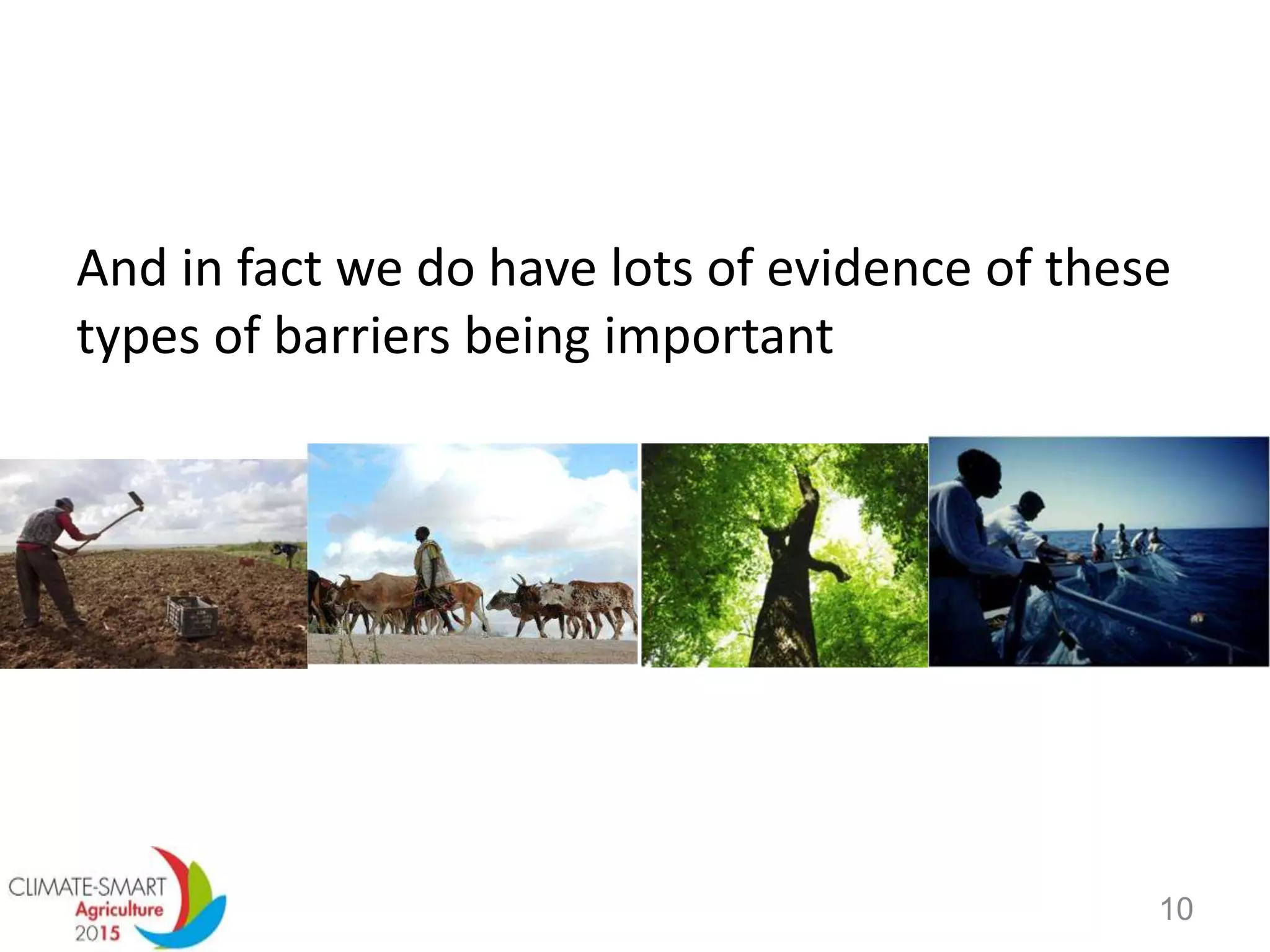
And in fact we do have lots of evidence of these
types of barriers being important
10
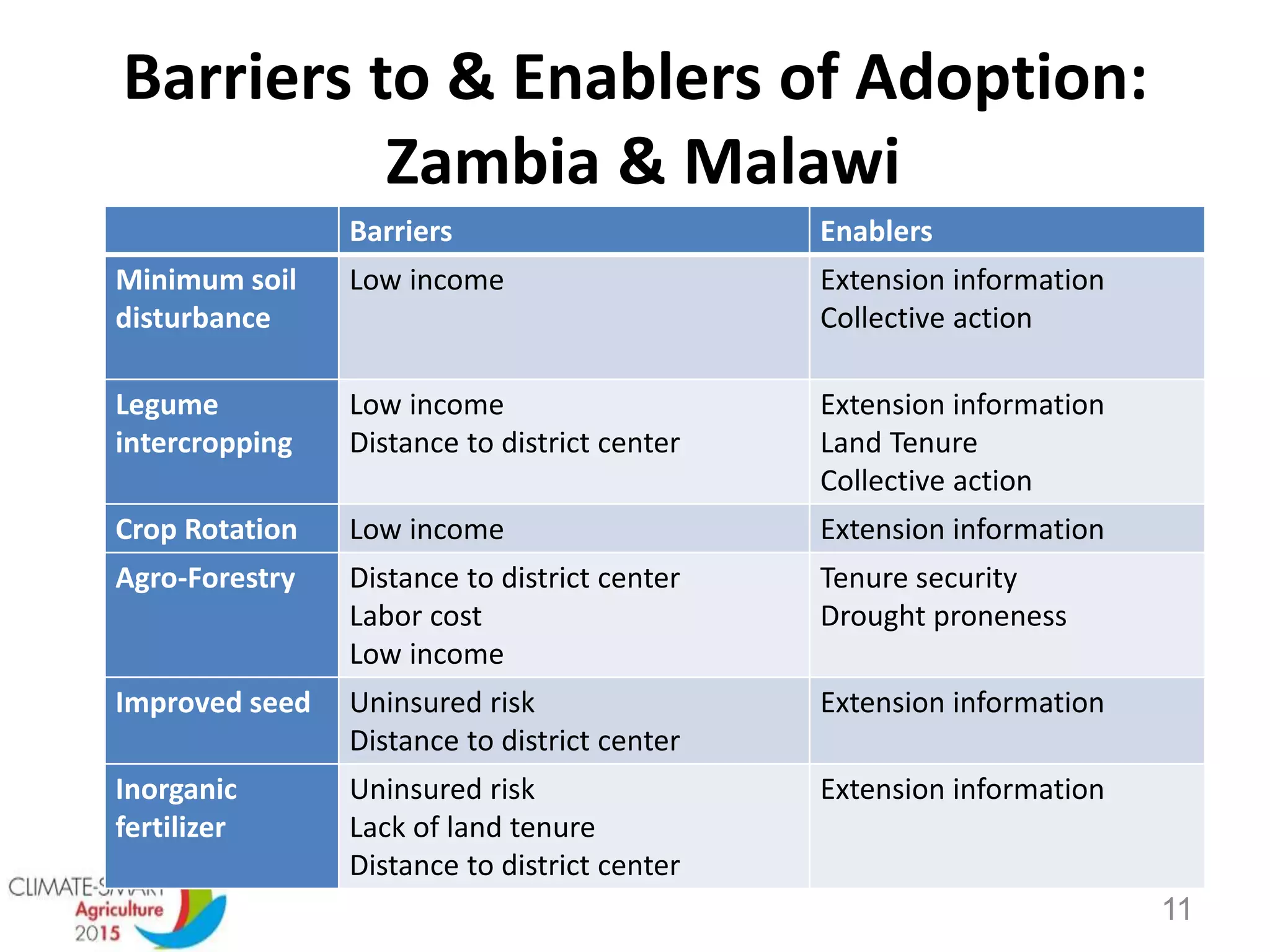
Barriers Enablers
Minimum soil
disturbance
Low income Extension information
Collective action
Legume
intercropping
Low income
Distance to district center
Extension information
Land Tenure
Collective action
Crop Rotation Low income Extension information
Agro-Forestry Distance to district center
Labor cost
Low income
Tenure security
Drought proneness
Improved seed Uninsured risk
Distance to district center
Extension information
Inorganic
fertilizer
Uninsured risk
Lack of land tenure
Distance to district center
Extension information
Barriers to & Enablers of Adoption:
Zambia & Malawi
11
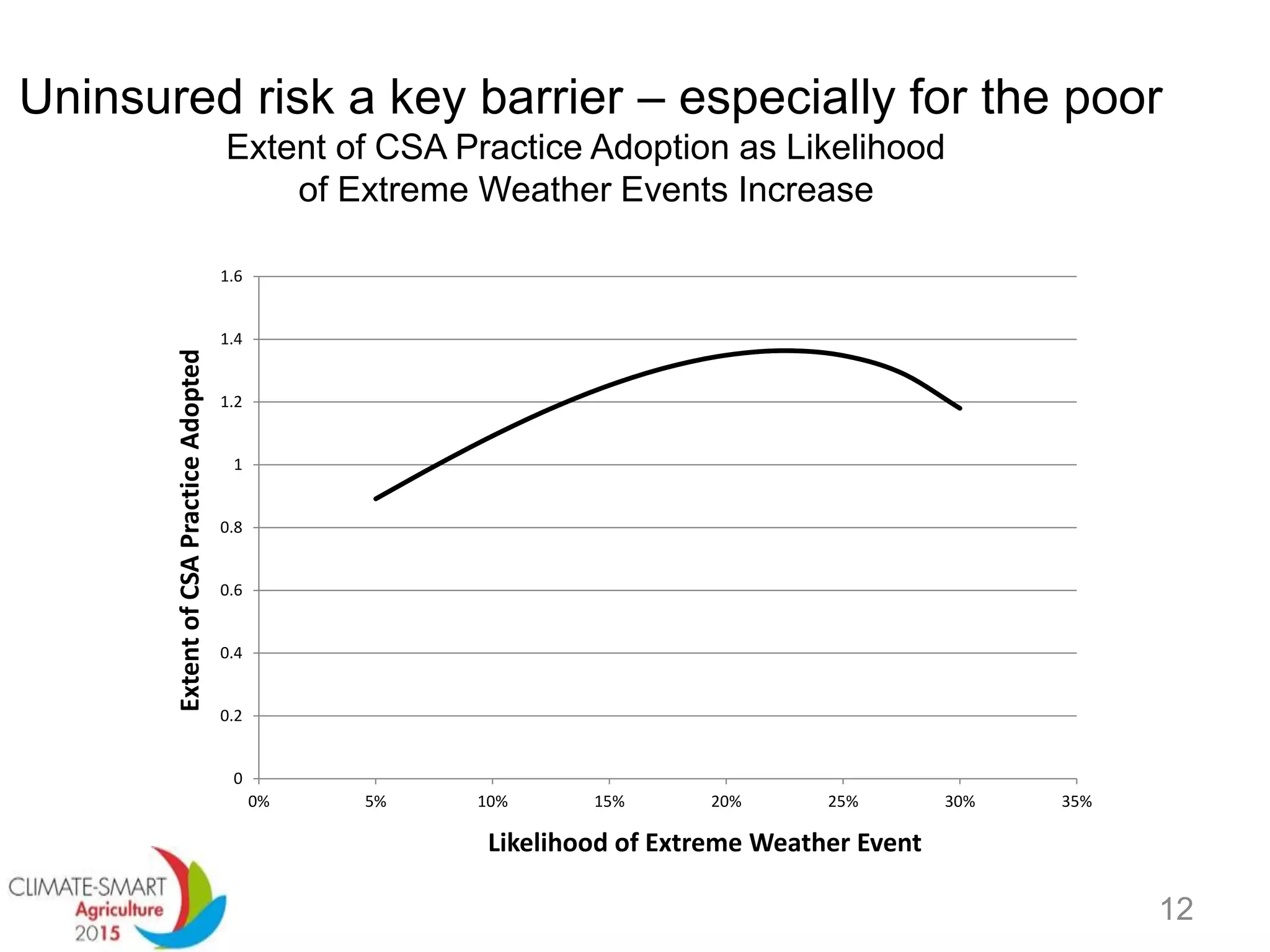
Uninsured risk a key barrier – especially for the poor
Extent of CSA Practice Adoption as Likelihood
of Extreme Weather Events Increase
0
0.2
0.4
0.6
0.8
1
1.2
1.4
1.6
0% 5% 10% 15% 20% 25% 30% 35%
ExtentofCSAPracticeAdopted
Likelihood of Extreme Weather Event
12
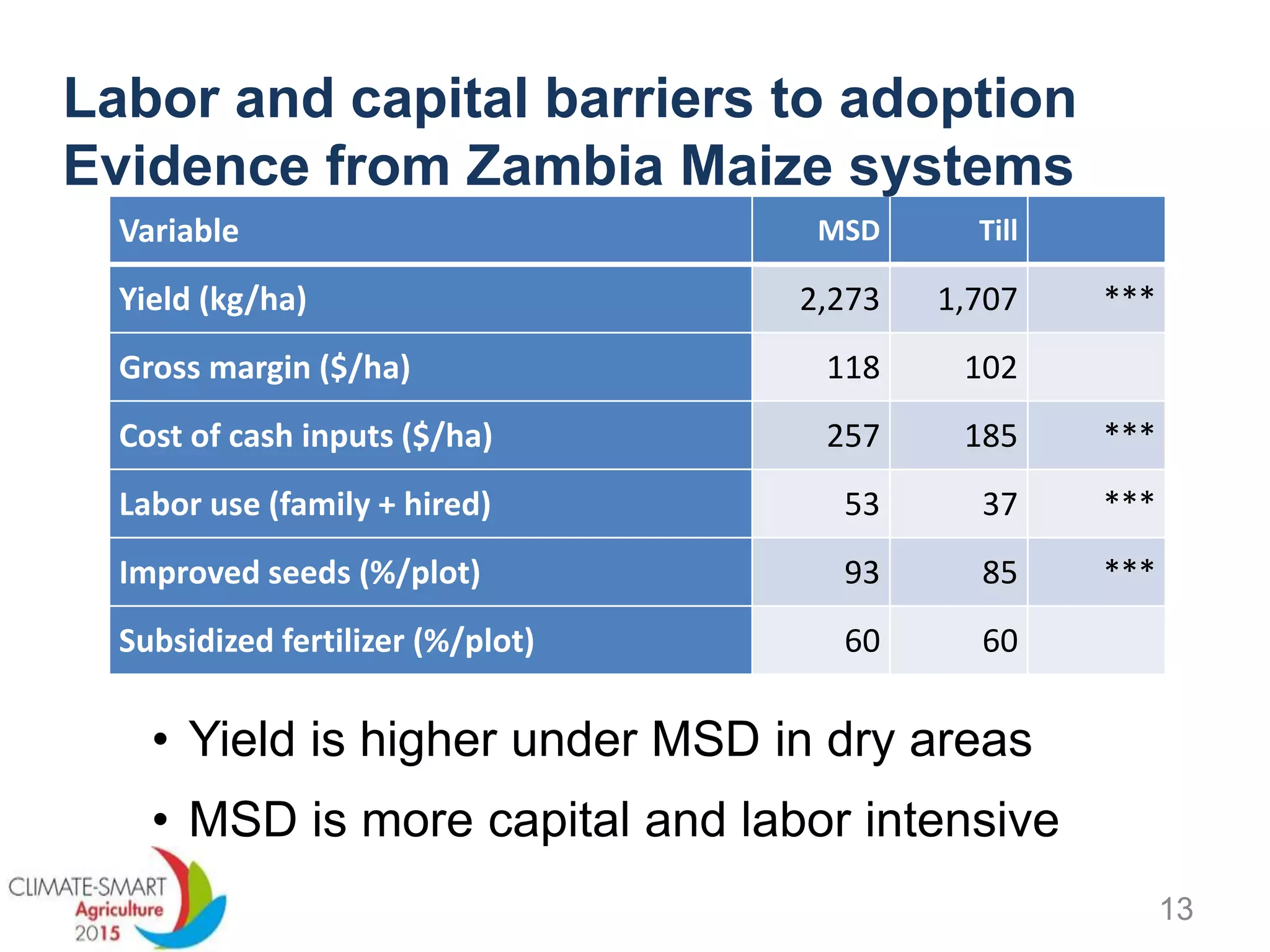
Variable MSD Till
Yield (kg/ha) 2,273 1,707 ***
Gross margin ($/ha) 118 102
Cost of cash inputs ($/ha) 257 185 ***
Labor use (family + hired) 53 37 ***
Improved seeds (%/plot) 93 85 ***
Subsidized fertilizer (%/plot) 60 60
Labor and capital barriers to adoption
Evidence from Zambia Maize systems
• Yield is higher under MSD in dry areas
• MSD is more capital and labor intensive
13
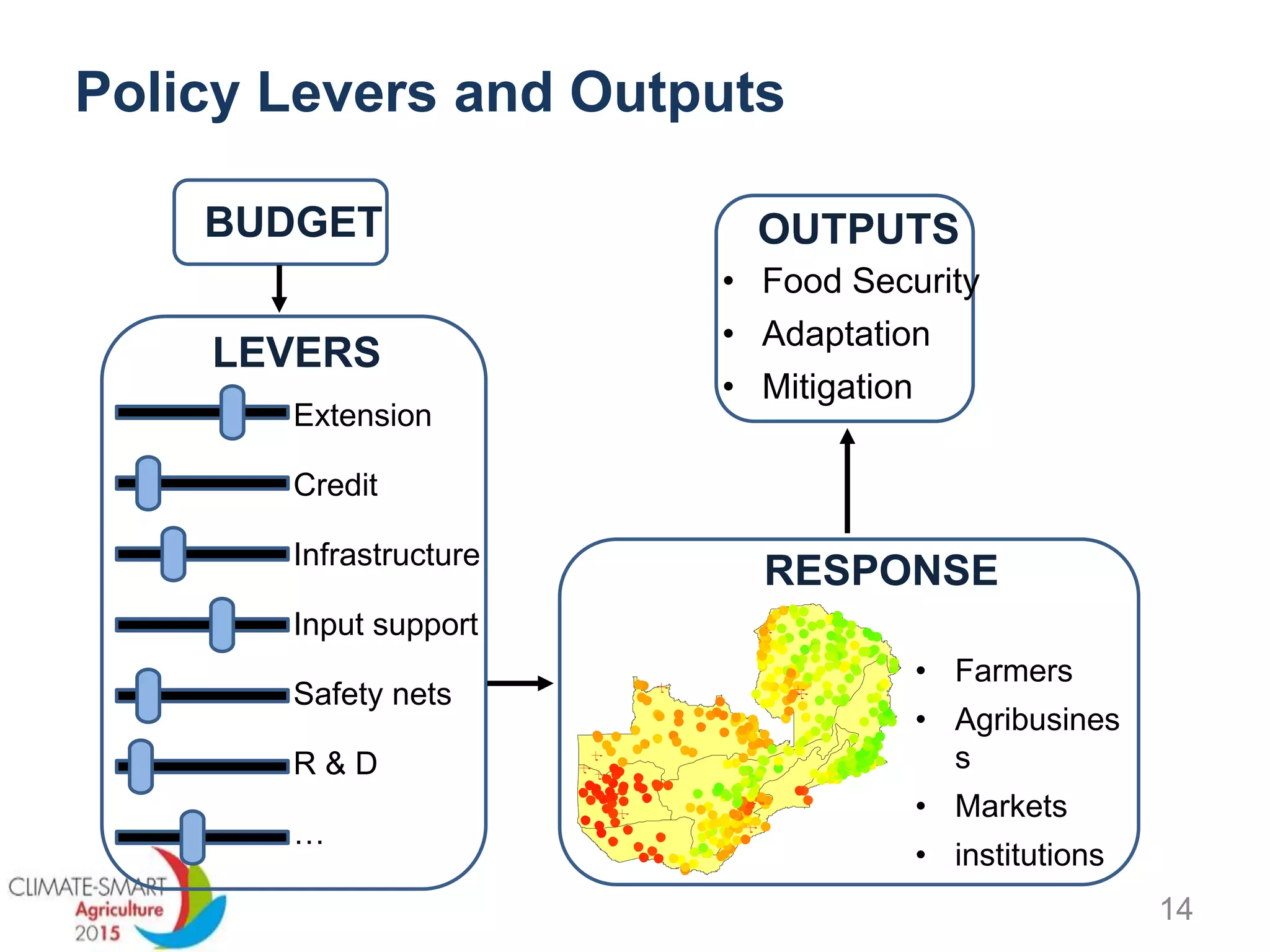
Policy Levers and Outputs
Extension
Credit
Infrastructure
Input support
Safety nets
R & D
…
LEVERS
OUTPUTS
• Food Security
• Adaptation
• Mitigation
20 22 24 26 28 30 32 34
-20
-18
-16
-14
-12
-10
-8
Mean of predicted adoption by SEA
0
0.1
0.2
0.3
0.4
0.5
0.6
0.7
0.8
0.9
1
RESPONSE
• Farmers
• Agribusines
s
• Markets
• institutions
BUDGET
14
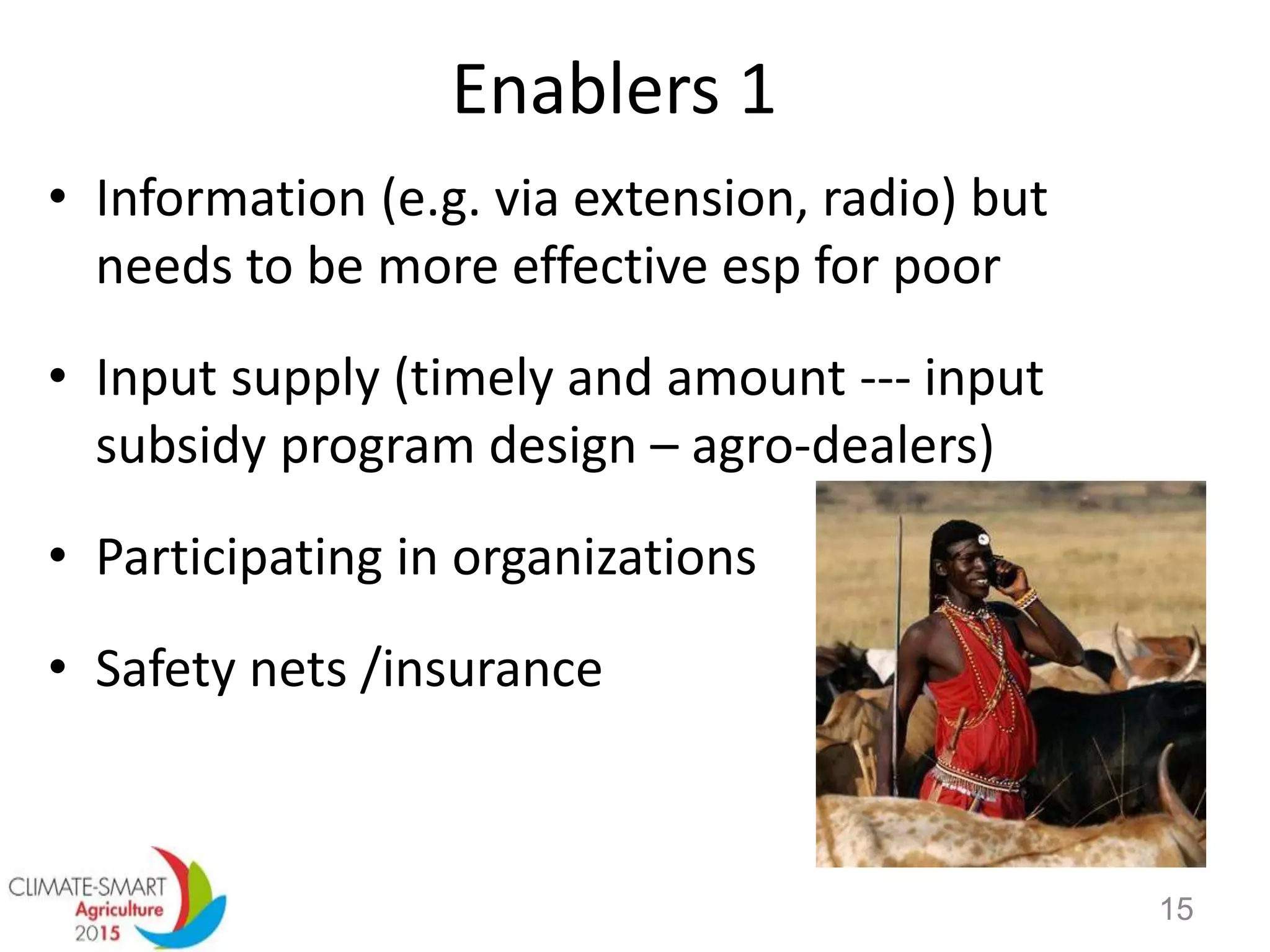
Enablers 1
• Information (e.g. via extension, radio) but
needs to be more effective esp for poor
• Input supply (timely and amount --- input
subsidy program design – agro-dealers)
• Participating in organizations
• Safety nets /insurance
15
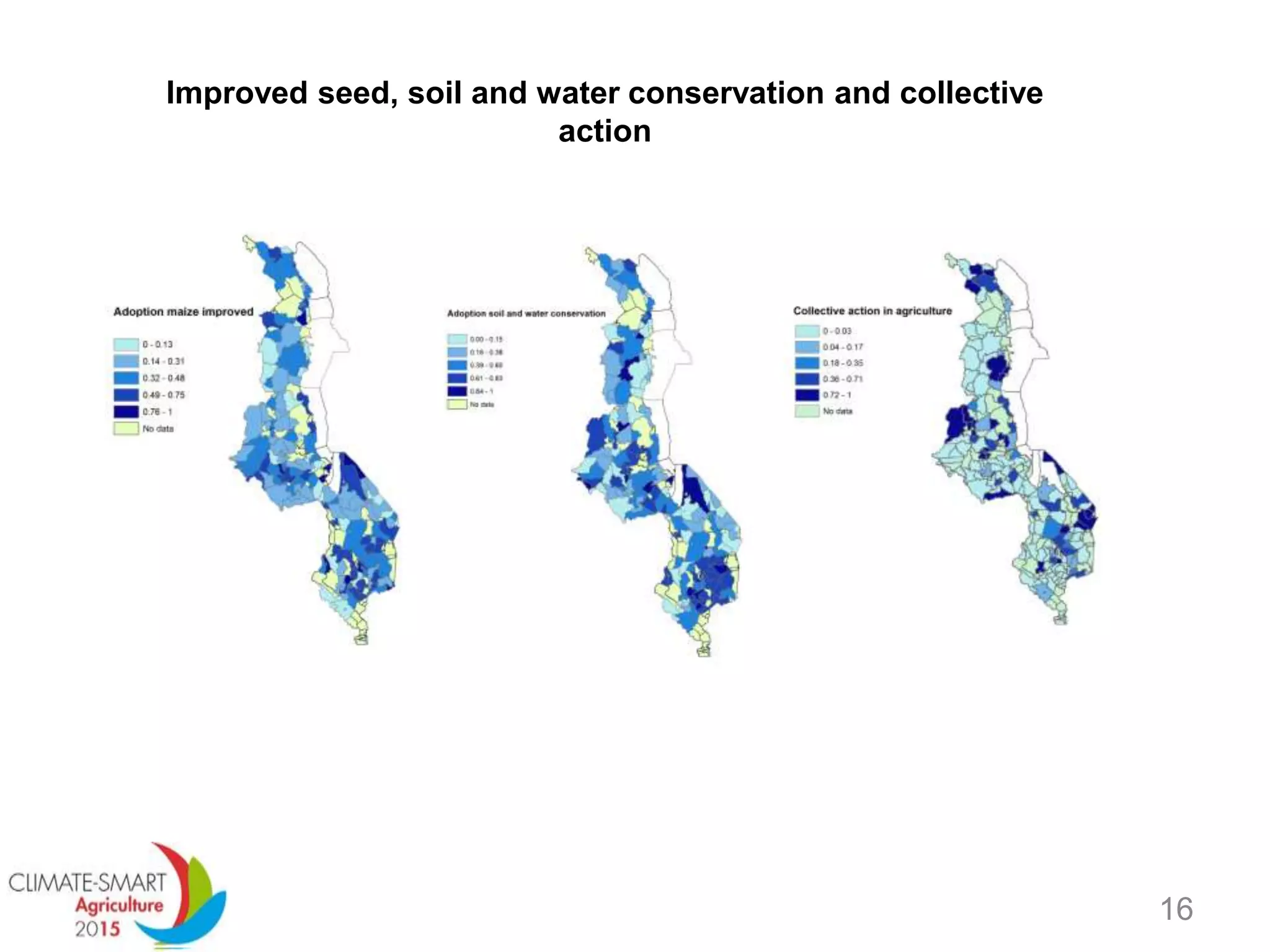
Improved seed, soil and water conservation and collective
action
16
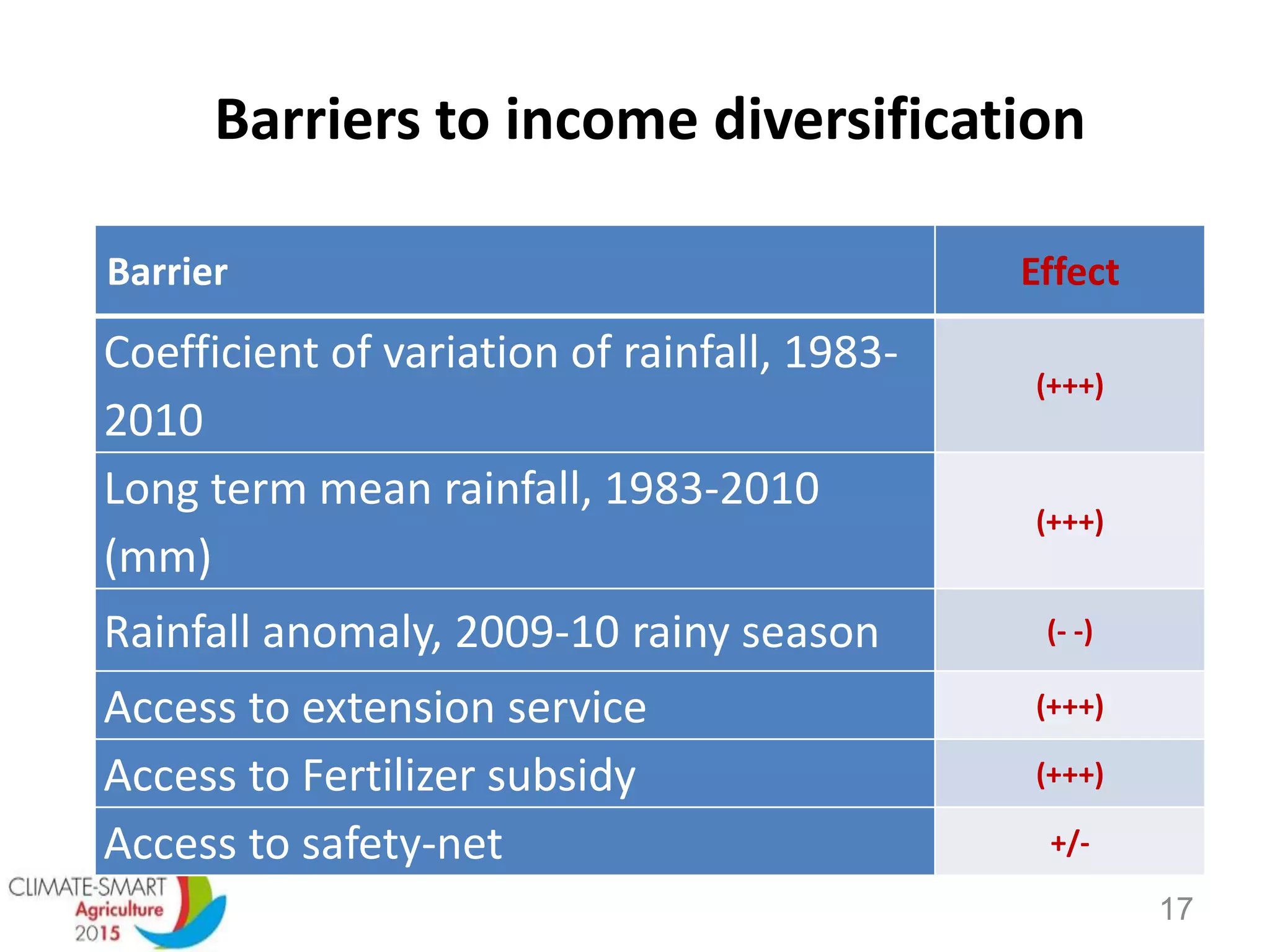
Barriers to income diversification
Barrier Effect
Coefficient of variation of rainfall, 1983-
2010
(+++)
Long term mean rainfall, 1983-2010
(mm)
(+++)
Rainfall anomaly, 2009-10 rainy season (- -)
Access to extension service (+++)
Access to Fertilizer subsidy (+++)
Access to safety-net +/-
17
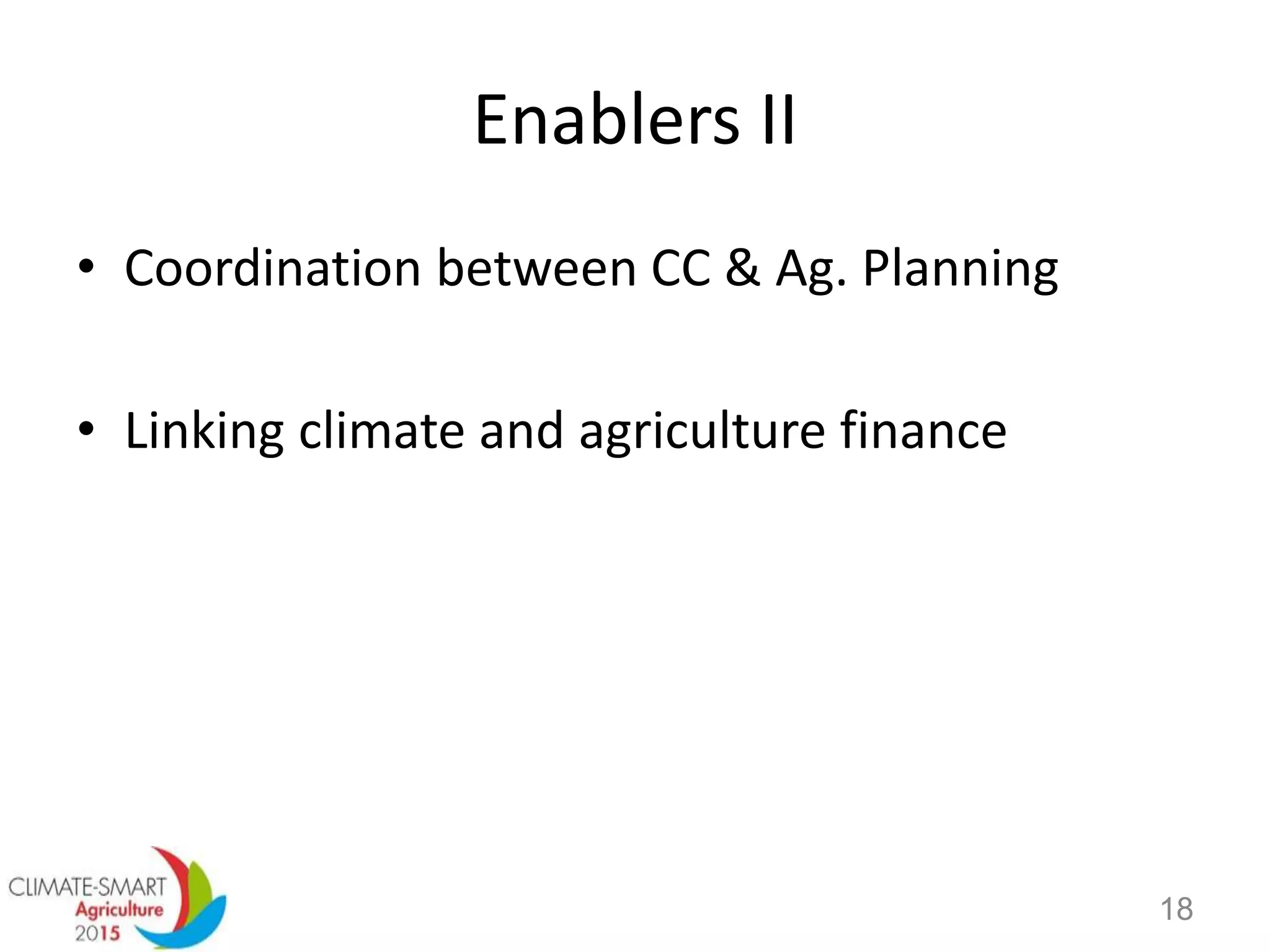
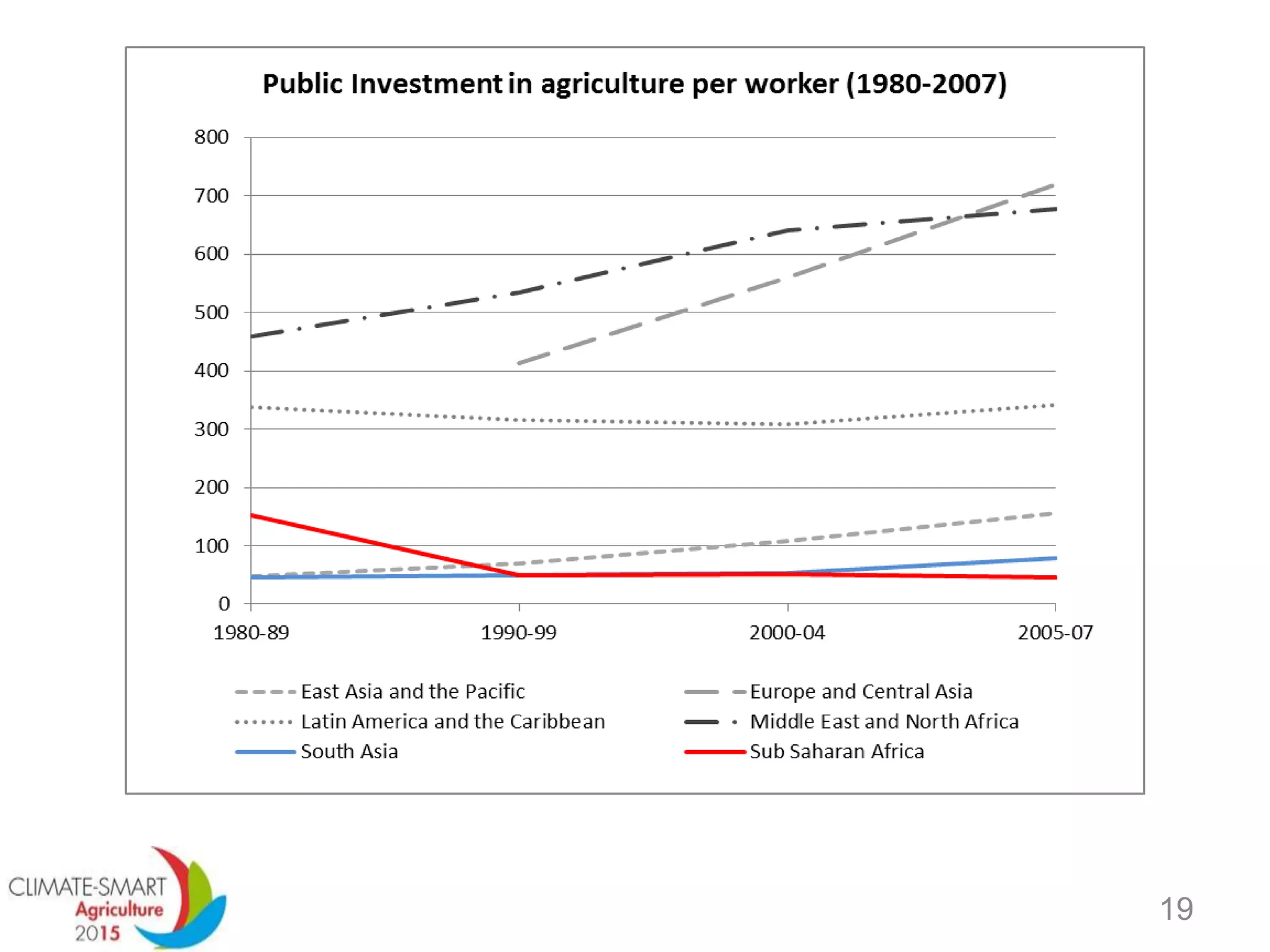
• Coordination between CC & Ag. Planning
• Linking climate and agriculture finance
Enablers II
18
19
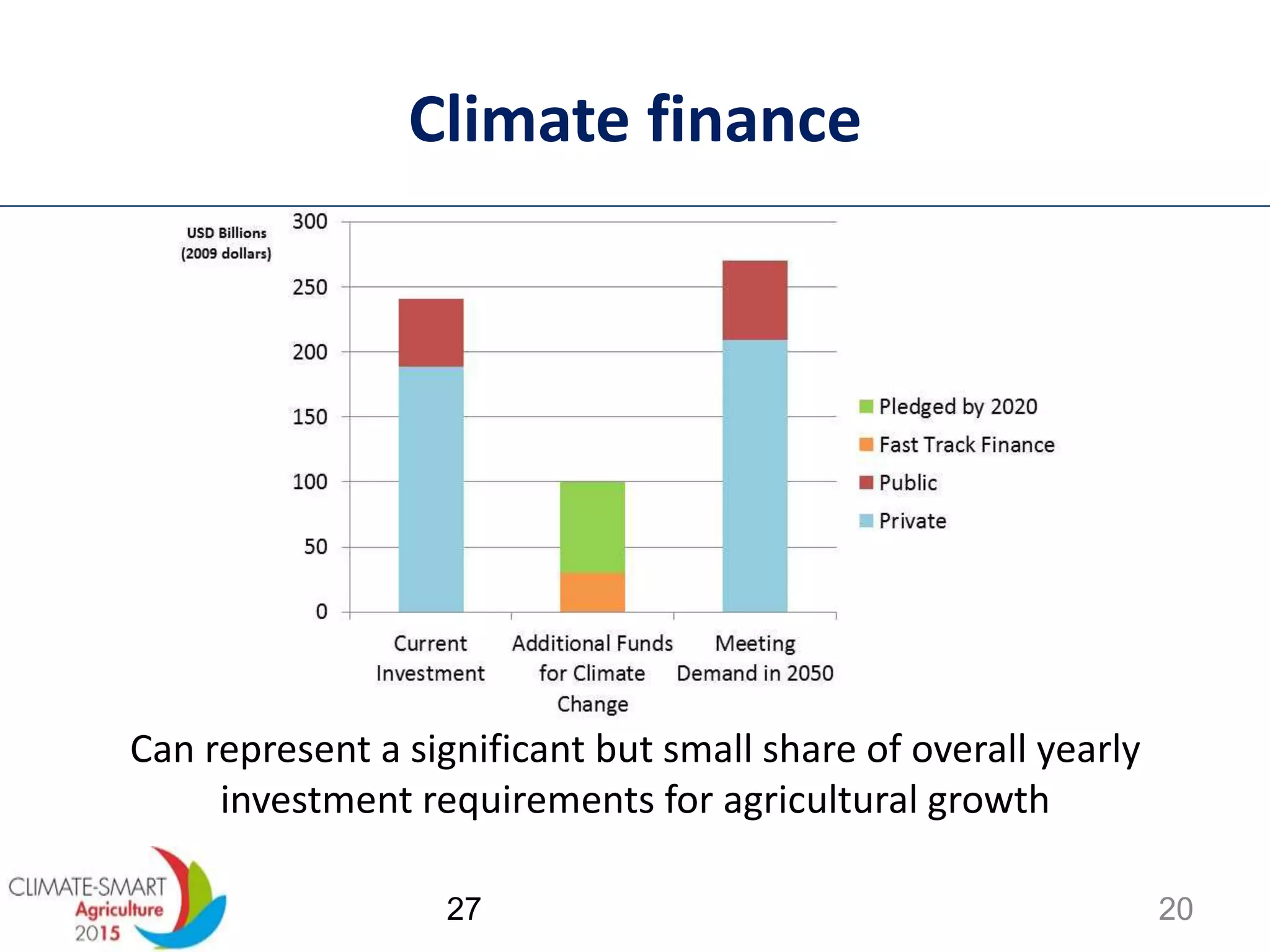
Climate finance
Can represent a significant but small share of overall yearly
investment requirements for agricultural growth
27 20
Summing up II
- Weather variability is key determinant of
which practices will give yield, stability and
income increases
- We already know a lot about the
characteristics of the practices we need for
CSA & the types of practices that can generate
them under some condition
21
Summing up II
• We also have a pretty good idea of which levers are key, but
need more info on how to best operate them
• We need to look beyond changing ag. Practice for CSA, but
in many cases we will be dealing with the same levers
• The scale & urgency of transformation needed indicates the
need for enhanced (e.g. coordinated) policy & financing
response
22
Thanks!
www.fao.org/climatechange/epic

Barriers to adoption: policy & institutional arrangements to support CSA

  • 1.
    Barriers to adoption:policy & institutional arrangements to support CSA Leslie Lipper, Solomon Asfaw, Giacomo Branca, Andrea Cattaneo, Romina Cavatassi, Uwe Grewer, Misael Kokwe, Nguyen Van Linh, Wendy Mann, Nancy McCarthy, Adriana Paolantonio, George Phiri, Alessandro Spairani Food and Agriculture Organization of the United Nations
  • 2.
    Outline of thepresentation • Barriers to adopting what? • Changing weather patterns means farmers need to adapt • Though CSA is a site specific concept, there are key features of what it will take & specific barriers associated with them • Policy levers to reduce barriers • Policy coordination and financing needs 2
  • 3.
    Barriers to what? •Changing agricultural production systems – Increase productivity, incomes, reduce variability and environmental damage – Covers a wide range of possible options/combinations • But goes beyond agricultural practices – Income diversification – Efficient charcoal production – Value chain management 3
  • 4.
    Just to getan idea of the variation in agricultural practice sets farmers could adopt – evidence from Malawi 4 Freq. Percent T0 only 47 3.28 T1 + crop rotation no legumes 127 8.86 T2 + crop rotation with legumes 185 12.91 T3 + swc + other combinations (rot/cover crop/intercrop/residue ret) 323 22.54 T4 + agroforestry + other combinations (rot/cover crop/intercrop/residue ret) 129 9 T5 + agroforestry & swc + other combinations (rot/swc/cover crop/intercrop/residue ret) 105 7.33 T6 + crop rotation no legumes + residue retention/cover crop/intercropping 131 9.14 T7 + crop rotation with legumes + residue retention/cover crop/intercropping 121 8.44 T8 + residue retention 27 1.88 T9 + other combinations 6 0.42 T Total tillage 1,201 83.81 M1 + residue retention 29 2.02 M2 + crop rotation no legumes + residue retention/cover crop/intercropping 39 2.72 M3 + crop rotation with legumes + residue retention/cover crop /intercropping 20 1.4 M4 + crop rotation + residue retention/cover crop /intercropping/swc +agrof (CF) 45 3.14 M5 + swc + other combinations (rot/cover crop/intercrop/residue ret) 54 3.77 M6 + crop rotation + other comb 27 1.88 M7 + agrof + swc + other comb 12 0.84 M8 + agroforestry + other comb 5 0.35 M Total MSD 231 16.19 TillageMSD
  • 5.
    Weather patterns: recentpast in Malawi Coefficient of Variation of seasonal rainfall and temperature (1983-2012) 5
  • 6.
    Zambia: change inonset of the rainy season 1983-2012 6
  • 7.
    How various optionsimpact crop yields under different climate effects Higher Yields Lower/Same Yields Reduced probability of yields<LR Average Average climatic conditions Legume intercrop Inorganic fertilizer Improved seed Crop rotation Inorganic fertilizer Improved seed Timely fertilizer access Delayed onset of rainfall Crop Rotation Improved seed Timely fertilizer access Inorganic fertilizer Legume intercrop Increased seasonal temperature Legume intercrop Timely fertilizer access Improved seed Inorganic fertilizer Legume intercrop Timely fertilizer 7
  • 8.
    II. Although CSAbenefits & costs are site specific – we can identify some universal characteristics of CSA practices and technologies … as well as the barriers to their adoption 8
  • 9.
    CSA characteristic Examplesand means Potential barriers Resource use efficiency Correct timing & dose of inputs Input recommendations for heterogeneous conditions Timely delivery of inputs Extension packages designed for specific agro-ecologies Increased resilience of agro- ecosystem Improved water holding & drainage capacity; Delay/time frame to build ecosystem services results in financing gap Labor constraints Coordination across landscapes Protect watersheds through tree planting Restore degraded lands through grazing mgmt Lack of social organizations to manage collective action 9
  • 10.
    And in factwe do have lots of evidence of these types of barriers being important 10
  • 11.
    Barriers Enablers Minimum soil disturbance Lowincome Extension information Collective action Legume intercropping Low income Distance to district center Extension information Land Tenure Collective action Crop Rotation Low income Extension information Agro-Forestry Distance to district center Labor cost Low income Tenure security Drought proneness Improved seed Uninsured risk Distance to district center Extension information Inorganic fertilizer Uninsured risk Lack of land tenure Distance to district center Extension information Barriers to & Enablers of Adoption: Zambia & Malawi 11
  • 12.
    Uninsured risk akey barrier – especially for the poor Extent of CSA Practice Adoption as Likelihood of Extreme Weather Events Increase 0 0.2 0.4 0.6 0.8 1 1.2 1.4 1.6 0% 5% 10% 15% 20% 25% 30% 35% ExtentofCSAPracticeAdopted Likelihood of Extreme Weather Event 12
  • 13.
    Variable MSD Till Yield(kg/ha) 2,273 1,707 *** Gross margin ($/ha) 118 102 Cost of cash inputs ($/ha) 257 185 *** Labor use (family + hired) 53 37 *** Improved seeds (%/plot) 93 85 *** Subsidized fertilizer (%/plot) 60 60 Labor and capital barriers to adoption Evidence from Zambia Maize systems • Yield is higher under MSD in dry areas • MSD is more capital and labor intensive 13
  • 14.
    Policy Levers andOutputs Extension Credit Infrastructure Input support Safety nets R & D … LEVERS OUTPUTS • Food Security • Adaptation • Mitigation 20 22 24 26 28 30 32 34 -20 -18 -16 -14 -12 -10 -8 Mean of predicted adoption by SEA 0 0.1 0.2 0.3 0.4 0.5 0.6 0.7 0.8 0.9 1 RESPONSE • Farmers • Agribusines s • Markets • institutions BUDGET 14
  • 15.
    Enablers 1 • Information(e.g. via extension, radio) but needs to be more effective esp for poor • Input supply (timely and amount --- input subsidy program design – agro-dealers) • Participating in organizations • Safety nets /insurance 15
  • 16.
    Improved seed, soiland water conservation and collective action 16
  • 17.
    Barriers to incomediversification Barrier Effect Coefficient of variation of rainfall, 1983- 2010 (+++) Long term mean rainfall, 1983-2010 (mm) (+++) Rainfall anomaly, 2009-10 rainy season (- -) Access to extension service (+++) Access to Fertilizer subsidy (+++) Access to safety-net +/- 17
  • 18.
    • Coordination betweenCC & Ag. Planning • Linking climate and agriculture finance Enablers II 18
  • 19.
  • 20.
    Climate finance Can representa significant but small share of overall yearly investment requirements for agricultural growth 27 20
  • 21.
    Summing up II -Weather variability is key determinant of which practices will give yield, stability and income increases - We already know a lot about the characteristics of the practices we need for CSA & the types of practices that can generate them under some condition 21
  • 22.
    Summing up II •We also have a pretty good idea of which levers are key, but need more info on how to best operate them • We need to look beyond changing ag. Practice for CSA, but in many cases we will be dealing with the same levers • The scale & urgency of transformation needed indicates the need for enhanced (e.g. coordinated) policy & financing response 22
  • 23.