Bankruptcy Basics
© 2019, Federal Reserve Bank of St. Louis. Permission is granted to reprint or photocopy this presentation in its entirety for
educational purposes provided the user credits the Federal Reserve Bank of St. Louis, www.stlouisfed.org/education.
What Is Bankruptcy?
• Legal process
• Declares a person or business is unable to pay
debts
• Federal laws and court proceeding to help
individuals/businesses address debt problems
Bankruptcy Basics
© 2019, Federal Reserve Bank of St. Louis. Permission is granted to reprint or photocopy this presentation in its entirety for
educational purposes provided the user credits the Federal Reserve Bank of St. Louis, www.stlouisfed.org/education.
Purpose of Bankruptcy
Fresh
Start
Fair
Treatment
Bankruptcy Basics
© 2019, Federal Reserve Bank of St. Louis. Permission is granted to reprint or photocopy this presentation in its entirety for
educational purposes provided the user credits the Federal Reserve Bank of St. Louis, www.stlouisfed.org/education.
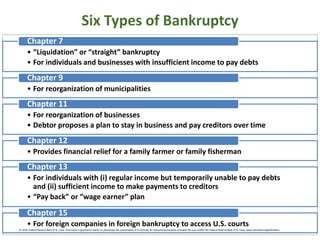
Six Types of Bankruptcy
• “Liquidation” or “straight” bankruptcy
• For individuals and businesses with insufficient income to pay debts
Chapter 7
• For reorganization of municipalities
Chapter 9
• For reorganization of businesses
• Debtor proposes a plan to stay in business and pay creditors over time
Chapter 11
• Provides financial relief for a family farmer or family fisherman
Chapter 12
• For individuals with (i) regular income but temporarily unable to pay debts
and (ii) sufficient income to make payments to creditors
• “Pay back” or “wage earner” plan
Chapter 13
• For foreign companies in foreign bankruptcy to access U.S. courts
Chapter 15
© 2019, Federal Reserve Bank of St. Louis. Permission is granted to reprint or photocopy this presentation in its entirety for educational purposes provided the user credits the Federal Reserve Bank of St. Louis, www.stlouisfed.org/education.
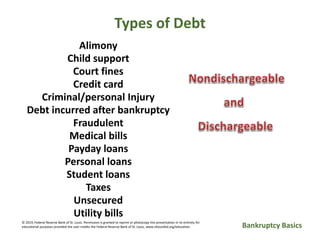
Types of Debt
Alimony
Child support
Court fines
Credit card
Criminal/personal Injury
Debt incurred after bankruptcy
Fraudulent
Medical bills
Payday loans
Personal loans
Student loans
Taxes
Unsecured
Utility bills
Bankruptcy Basics
© 2019, Federal Reserve Bank of St. Louis. Permission is granted to reprint or photocopy this presentation in its entirety for
educational purposes provided the user credits the Federal Reserve Bank of St. Louis, www.stlouisfed.org/education.
• Alimony
• Child support
• Court fines
• Criminal/
personal injury
• Debt incurred after
bankruptcy
• Fraudulent
• Most student loans
• Most taxes
• Credit card
• Medical bills
• Payday loans
• Personal loans
• Unsecured
• Utility bills
Types of Debt
Bankruptcy Basics
© 2019, Federal Reserve Bank of St. Louis. Permission is granted to reprint or photocopy this presentation in its entirety for
educational purposes provided the user credits the Federal Reserve Bank of St. Louis, www.stlouisfed.org/education.
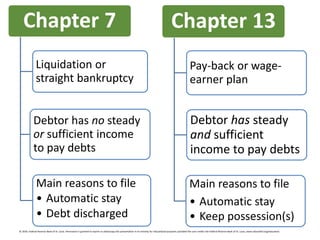
Chapter 7
Liquidation or
straight bankruptcy
Debtor has no steady
or sufficient income
to pay debts
Main reasons to file
• Automatic stay
• Debt discharged
Chapter 13
Pay-back or wage-
earner plan
Debtor has steady
and sufficient
income to pay debts
Main reasons to file
• Automatic stay
• Keep possession(s)
© 2019, Federal Reserve Bank of St. Louis. Permission is granted to reprint or photocopy this presentation in its entirety for educational purposes provided the user credits the Federal Reserve Bank of St. Louis, www.stlouisfed.org/education.
Basic Procedures for Chapter 7
1. Debtor Takes Credit Counseling
• Mandatory by law
• Debtor must use approved provider
• Case dismissed if counseling not completed
Bankruptcy Basics
© 2019, Federal Reserve Bank of St. Louis. Permission is granted to reprint or photocopy this presentation in its entirety for
educational purposes provided the user credits the Federal Reserve Bank of St. Louis, www.stlouisfed.org/education.
Basic Procedures for Chapter 7
2. Bankruptcy Petition Filed
• Involves multiple forms and paying a filing
fee (fee same for all)
• Provides information for a means test,
which determines if the debtor has
sufficient income or assets to pay debts
Bankruptcy Basics
© 2019, Federal Reserve Bank of St. Louis. Permission is granted to reprint or photocopy this presentation in its entirety for
educational purposes provided the user credits the Federal Reserve Bank of St. Louis, www.stlouisfed.org/education.
Basic Procedures for Chapter 7
3. Automatic Stay Takes Effect
• Begins the minute petition is filed
• Creditors notified
• Stops collections: e.g., letters/calls, wage
garnishments, foreclosures, and
repossessions
• One of the main reasons debtors file
Bankruptcy Basics
© 2019, Federal Reserve Bank of St. Louis. Permission is granted to reprint or photocopy this presentation in its entirety for
educational purposes provided the user credits the Federal Reserve Bank of St. Louis, www.stlouisfed.org/education.
Basic Procedures for Chapter 7
4. Bankruptcy Trustee Assigned to Case
• Independent person appointed to represent
the unsecured creditors
• Reviews case
• Begins collecting debtor’s nonexempt
property (e.g., cash, investments, and/or
valuable items) to pay creditors
Bankruptcy Basics
© 2019, Federal Reserve Bank of St. Louis. Permission is granted to reprint or photocopy this presentation in its entirety for
educational purposes provided the user credits the Federal Reserve Bank of St. Louis, www.stlouisfed.org/education.
Basic Procedures for Chapter 7
5. 341 Meeting with Creditors
• Debtor required to answer questions under
oath regarding finances
• Determines if debtor qualifies for Chapter 7
• Includes the debtor, debtor attorney,
bankruptcy trustee, and creditors
• Makes sure debtor isn’t “hiding” assets
Bankruptcy Basics
© 2019, Federal Reserve Bank of St. Louis. Permission is granted to reprint or photocopy this presentation in its entirety for
educational purposes provided the user credits the Federal Reserve Bank of St. Louis, www.stlouisfed.org/education.
Basic Procedures for Chapter 7
6. Bankruptcy Trustee Begins Liquidation
Process
• Collects collateral and gives to creditors
• Debtor can keep exempt property
(necessary clothing and household goods
and furnishings, tools for a trade or
profession, and pensions and public
benefits)
• Nonexempt property may be sold to pay
creditors
Bankruptcy Basics
© 2019, Federal Reserve Bank of St. Louis. Permission is granted to reprint or photocopy this presentation in its entirety for
educational purposes provided the user credits the Federal Reserve Bank of St. Louis, www.stlouisfed.org/education.
Basic Procedures for Chapter 7
7. Debtor Takes Personal Finance Education
Course
• Mandatory by law
• Debtor must use approved provider
• Debtor must file certificate of completion or
case will be dismissed without discharge
Bankruptcy Basics
© 2019, Federal Reserve Bank of St. Louis. Permission is granted to reprint or photocopy this presentation in its entirety for
educational purposes provided the user credits the Federal Reserve Bank of St. Louis, www.stlouisfed.org/education.
Basic Procedures for Chapter 7
8. Discharge Granted
• Debtor’s obligation to pay dischargeable
debt eliminated (wiped out)
• Automatic stay lifted (removed)
• Main reason debtors file
Bankruptcy Basics
© 2019, Federal Reserve Bank of St. Louis. Permission is granted to reprint or photocopy this presentation in its entirety for
educational purposes provided the user credits the Federal Reserve Bank of St. Louis, www.stlouisfed.org/education.
Basic Procedures for Chapter 7
9. Case Closed
• Bankruptcy remains on debtor’s credit
report for 10 years
• Debtor can file for bankruptcy again at any
time, but cannot discharge debts again for
8 years
• Debtor should keep documents for future
reference
Bankruptcy Basics
© 2019, Federal Reserve Bank of St. Louis. Permission is granted to reprint or photocopy this presentation in its entirety for
educational purposes provided the user credits the Federal Reserve Bank of St. Louis, www.stlouisfed.org/education.
Basic Procedures for Chapter 13
1. Debtor Takes Credit Counseling
• Mandatory by law
• Debtor must use approved provider
• Case dismissed if not completed
Bankruptcy Basics
© 2019, Federal Reserve Bank of St. Louis. Permission is granted to reprint or photocopy this presentation in its entirety for
educational purposes provided the user credits the Federal Reserve Bank of St. Louis, www.stlouisfed.org/education.
Basic Procedures for Chapter 13
2. Bankruptcy Petition Filed
• Includes multiple forms and paying a filing
fee (fee same for all)
• Bankruptcy plan must be submitted
• Plan can be revised if necessary
Bankruptcy Basics
© 2019, Federal Reserve Bank of St. Louis. Permission is granted to reprint or photocopy this presentation in its entirety for
educational purposes provided the user credits the Federal Reserve Bank of St. Louis, www.stlouisfed.org/education.
Basic Procedures for Chapter 13
3. Chapter 13 Standing Bankruptcy Trustee
Assigned
• Reviews bankruptcy plan and paperwork
• Approves or rejects plan
• If rejected, case dismissed or plan
revised/resubmitted
Bankruptcy Basics
© 2019, Federal Reserve Bank of St. Louis. Permission is granted to reprint or photocopy this presentation in its entirety for
educational purposes provided the user credits the Federal Reserve Bank of St. Louis, www.stlouisfed.org/education.
Basic Procedures for Chapter 13
4. Automatic Stay
• Begins the minute petition is filed
• Creditors notified
• Stops collections: e.g., letters/calls, wage
garnishments, foreclosures, and
repossessions
• One of the main reasons debtors file
Bankruptcy Basics
© 2019, Federal Reserve Bank of St. Louis. Permission is granted to reprint or photocopy this presentation in its entirety for
educational purposes provided the user credits the Federal Reserve Bank of St. Louis, www.stlouisfed.org/education.
Basic Procedures for Chapter 13
5. 341 Meeting with Creditors
• Debtor required to answer questions under
oath regarding finances and bankruptcy plan
• Includes the debtor, debtor attorney,
bankruptcy trustee, and creditors
• Creditors can object to bankruptcy plan
• If debtor doesn’t attend, case can be
dismissed
Bankruptcy Basics
© 2019, Federal Reserve Bank of St. Louis. Permission is granted to reprint or photocopy this presentation in its entirety for
educational purposes provided the user credits the Federal Reserve Bank of St. Louis, www.stlouisfed.org/education.
Basic Procedures for Chapter 13
6. Confirmation Hearing
• Bankruptcy judge hears the case
• Trustee or creditors can object to plan
• Judge approves or rejects plan
• If rejected, debtor revises/resubmits plan
and another hearing held
Bankruptcy Basics
© 2019, Federal Reserve Bank of St. Louis. Permission is granted to reprint or photocopy this presentation in its entirety for
educational purposes provided the user credits the Federal Reserve Bank of St. Louis, www.stlouisfed.org/education.
Basic Procedures for Chapter 13
7. Bankruptcy Plan Begins
• Debtor pays single monthly payments to
bankruptcy trustee
• Bankruptcy trustee disburses money to creditors
who filed proof of claim
• Typically, plan remains in effect 3-5 years
Bankruptcy Basics
© 2019, Federal Reserve Bank of St. Louis. Permission is granted to reprint or photocopy this presentation in its entirety for
educational purposes provided the user credits the Federal Reserve Bank of St. Louis, www.stlouisfed.org/education.
Basic Procedures for Chapter 13
8. Debtor Takes Personal Finance Education
Course
• Mandatory by law
• Debtor must use approved provider
• Debtor must file certificate of completion
or case will be dismissed without discharge
Bankruptcy Basics
© 2019, Federal Reserve Bank of St. Louis. Permission is granted to reprint or photocopy this presentation in its entirety for
educational purposes provided the user credits the Federal Reserve Bank of St. Louis, www.stlouisfed.org/education.
Basic Procedures for Chapter 13
9. Discharge Granted at End of Plan
• Debt eliminatedspecifically, the
percentage of unsecured debt not paid
during the plan
• Only dischargeablenot nondischargeable
debt eliminated
• Automatic stay lifted
Bankruptcy Basics
© 2019, Federal Reserve Bank of St. Louis. Permission is granted to reprint or photocopy this presentation in its entirety for
educational purposes provided the user credits the Federal Reserve Bank of St. Louis, www.stlouisfed.org/education.
Basic Procedures for Chapter 13
10. Case Closed
• Bankruptcy can remain on debtor’s credit
report for up to 7 years
• Debtor may file again, if necessary  rules
and time frames apply
• Debtor should keep documents for future
reference
Bankruptcy Basics
© 2019, Federal Reserve Bank of St. Louis. Permission is granted to reprint or photocopy this presentation in its entirety for
educational purposes provided the user credits the Federal Reserve Bank of St. Louis, www.stlouisfed.org/education.
Common
Causes of
Bankruptcy
Medical
bills Unemployment
Reduced
income
Business
failure
Credit
debt
Lack of
financial
planning
Divorce
Disasters
Accidents
Bankruptcy Basics
© 2019, Federal Reserve Bank of St. Louis. Permission is granted to reprint or photocopy this presentation in its entirety for
educational purposes provided the user credits the Federal Reserve Bank of St. Louis, www.stlouisfed.org/education.
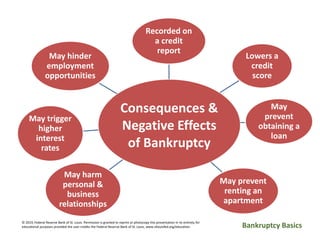
Consequences &
Negative Effects
of Bankruptcy
Recorded on
a credit
report
Lowers a
credit
score
May prevent
renting an
apartment
May
prevent
obtaining a
loan
May trigger
higher
interest
rates
May harm
personal &
business
relationships
May hinder
employment
opportunities
Bankruptcy Basics
© 2019, Federal Reserve Bank of St. Louis. Permission is granted to reprint or photocopy this presentation in its entirety for
educational purposes provided the user credits the Federal Reserve Bank of St. Louis, www.stlouisfed.org/education.

bankruptcy_basics.pptx

  • 1.
    Bankruptcy Basics © 2019,Federal Reserve Bank of St. Louis. Permission is granted to reprint or photocopy this presentation in its entirety for educational purposes provided the user credits the Federal Reserve Bank of St. Louis, www.stlouisfed.org/education.
  • 2.
    What Is Bankruptcy? •Legal process • Declares a person or business is unable to pay debts • Federal laws and court proceeding to help individuals/businesses address debt problems Bankruptcy Basics © 2019, Federal Reserve Bank of St. Louis. Permission is granted to reprint or photocopy this presentation in its entirety for educational purposes provided the user credits the Federal Reserve Bank of St. Louis, www.stlouisfed.org/education.
  • 3.
    Purpose of Bankruptcy Fresh Start Fair Treatment BankruptcyBasics © 2019, Federal Reserve Bank of St. Louis. Permission is granted to reprint or photocopy this presentation in its entirety for educational purposes provided the user credits the Federal Reserve Bank of St. Louis, www.stlouisfed.org/education.
  • 4.
    Six Types ofBankruptcy • “Liquidation” or “straight” bankruptcy • For individuals and businesses with insufficient income to pay debts Chapter 7 • For reorganization of municipalities Chapter 9 • For reorganization of businesses • Debtor proposes a plan to stay in business and pay creditors over time Chapter 11 • Provides financial relief for a family farmer or family fisherman Chapter 12 • For individuals with (i) regular income but temporarily unable to pay debts and (ii) sufficient income to make payments to creditors • “Pay back” or “wage earner” plan Chapter 13 • For foreign companies in foreign bankruptcy to access U.S. courts Chapter 15 © 2019, Federal Reserve Bank of St. Louis. Permission is granted to reprint or photocopy this presentation in its entirety for educational purposes provided the user credits the Federal Reserve Bank of St. Louis, www.stlouisfed.org/education.
  • 5.
    Types of Debt Alimony Childsupport Court fines Credit card Criminal/personal Injury Debt incurred after bankruptcy Fraudulent Medical bills Payday loans Personal loans Student loans Taxes Unsecured Utility bills Bankruptcy Basics © 2019, Federal Reserve Bank of St. Louis. Permission is granted to reprint or photocopy this presentation in its entirety for educational purposes provided the user credits the Federal Reserve Bank of St. Louis, www.stlouisfed.org/education.
  • 6.
    • Alimony • Childsupport • Court fines • Criminal/ personal injury • Debt incurred after bankruptcy • Fraudulent • Most student loans • Most taxes • Credit card • Medical bills • Payday loans • Personal loans • Unsecured • Utility bills Types of Debt Bankruptcy Basics © 2019, Federal Reserve Bank of St. Louis. Permission is granted to reprint or photocopy this presentation in its entirety for educational purposes provided the user credits the Federal Reserve Bank of St. Louis, www.stlouisfed.org/education.
  • 7.
    Chapter 7 Liquidation or straightbankruptcy Debtor has no steady or sufficient income to pay debts Main reasons to file • Automatic stay • Debt discharged Chapter 13 Pay-back or wage- earner plan Debtor has steady and sufficient income to pay debts Main reasons to file • Automatic stay • Keep possession(s) © 2019, Federal Reserve Bank of St. Louis. Permission is granted to reprint or photocopy this presentation in its entirety for educational purposes provided the user credits the Federal Reserve Bank of St. Louis, www.stlouisfed.org/education.
  • 8.
    Basic Procedures forChapter 7 1. Debtor Takes Credit Counseling • Mandatory by law • Debtor must use approved provider • Case dismissed if counseling not completed Bankruptcy Basics © 2019, Federal Reserve Bank of St. Louis. Permission is granted to reprint or photocopy this presentation in its entirety for educational purposes provided the user credits the Federal Reserve Bank of St. Louis, www.stlouisfed.org/education.
  • 9.
    Basic Procedures forChapter 7 2. Bankruptcy Petition Filed • Involves multiple forms and paying a filing fee (fee same for all) • Provides information for a means test, which determines if the debtor has sufficient income or assets to pay debts Bankruptcy Basics © 2019, Federal Reserve Bank of St. Louis. Permission is granted to reprint or photocopy this presentation in its entirety for educational purposes provided the user credits the Federal Reserve Bank of St. Louis, www.stlouisfed.org/education.
  • 10.
    Basic Procedures forChapter 7 3. Automatic Stay Takes Effect • Begins the minute petition is filed • Creditors notified • Stops collections: e.g., letters/calls, wage garnishments, foreclosures, and repossessions • One of the main reasons debtors file Bankruptcy Basics © 2019, Federal Reserve Bank of St. Louis. Permission is granted to reprint or photocopy this presentation in its entirety for educational purposes provided the user credits the Federal Reserve Bank of St. Louis, www.stlouisfed.org/education.
  • 11.
    Basic Procedures forChapter 7 4. Bankruptcy Trustee Assigned to Case • Independent person appointed to represent the unsecured creditors • Reviews case • Begins collecting debtor’s nonexempt property (e.g., cash, investments, and/or valuable items) to pay creditors Bankruptcy Basics © 2019, Federal Reserve Bank of St. Louis. Permission is granted to reprint or photocopy this presentation in its entirety for educational purposes provided the user credits the Federal Reserve Bank of St. Louis, www.stlouisfed.org/education.
  • 12.
    Basic Procedures forChapter 7 5. 341 Meeting with Creditors • Debtor required to answer questions under oath regarding finances • Determines if debtor qualifies for Chapter 7 • Includes the debtor, debtor attorney, bankruptcy trustee, and creditors • Makes sure debtor isn’t “hiding” assets Bankruptcy Basics © 2019, Federal Reserve Bank of St. Louis. Permission is granted to reprint or photocopy this presentation in its entirety for educational purposes provided the user credits the Federal Reserve Bank of St. Louis, www.stlouisfed.org/education.
  • 13.
    Basic Procedures forChapter 7 6. Bankruptcy Trustee Begins Liquidation Process • Collects collateral and gives to creditors • Debtor can keep exempt property (necessary clothing and household goods and furnishings, tools for a trade or profession, and pensions and public benefits) • Nonexempt property may be sold to pay creditors Bankruptcy Basics © 2019, Federal Reserve Bank of St. Louis. Permission is granted to reprint or photocopy this presentation in its entirety for educational purposes provided the user credits the Federal Reserve Bank of St. Louis, www.stlouisfed.org/education.
  • 14.
    Basic Procedures forChapter 7 7. Debtor Takes Personal Finance Education Course • Mandatory by law • Debtor must use approved provider • Debtor must file certificate of completion or case will be dismissed without discharge Bankruptcy Basics © 2019, Federal Reserve Bank of St. Louis. Permission is granted to reprint or photocopy this presentation in its entirety for educational purposes provided the user credits the Federal Reserve Bank of St. Louis, www.stlouisfed.org/education.
  • 15.
    Basic Procedures forChapter 7 8. Discharge Granted • Debtor’s obligation to pay dischargeable debt eliminated (wiped out) • Automatic stay lifted (removed) • Main reason debtors file Bankruptcy Basics © 2019, Federal Reserve Bank of St. Louis. Permission is granted to reprint or photocopy this presentation in its entirety for educational purposes provided the user credits the Federal Reserve Bank of St. Louis, www.stlouisfed.org/education.
  • 16.
    Basic Procedures forChapter 7 9. Case Closed • Bankruptcy remains on debtor’s credit report for 10 years • Debtor can file for bankruptcy again at any time, but cannot discharge debts again for 8 years • Debtor should keep documents for future reference Bankruptcy Basics © 2019, Federal Reserve Bank of St. Louis. Permission is granted to reprint or photocopy this presentation in its entirety for educational purposes provided the user credits the Federal Reserve Bank of St. Louis, www.stlouisfed.org/education.
  • 17.
    Basic Procedures forChapter 13 1. Debtor Takes Credit Counseling • Mandatory by law • Debtor must use approved provider • Case dismissed if not completed Bankruptcy Basics © 2019, Federal Reserve Bank of St. Louis. Permission is granted to reprint or photocopy this presentation in its entirety for educational purposes provided the user credits the Federal Reserve Bank of St. Louis, www.stlouisfed.org/education.
  • 18.
    Basic Procedures forChapter 13 2. Bankruptcy Petition Filed • Includes multiple forms and paying a filing fee (fee same for all) • Bankruptcy plan must be submitted • Plan can be revised if necessary Bankruptcy Basics © 2019, Federal Reserve Bank of St. Louis. Permission is granted to reprint or photocopy this presentation in its entirety for educational purposes provided the user credits the Federal Reserve Bank of St. Louis, www.stlouisfed.org/education.
  • 19.
    Basic Procedures forChapter 13 3. Chapter 13 Standing Bankruptcy Trustee Assigned • Reviews bankruptcy plan and paperwork • Approves or rejects plan • If rejected, case dismissed or plan revised/resubmitted Bankruptcy Basics © 2019, Federal Reserve Bank of St. Louis. Permission is granted to reprint or photocopy this presentation in its entirety for educational purposes provided the user credits the Federal Reserve Bank of St. Louis, www.stlouisfed.org/education.
  • 20.
    Basic Procedures forChapter 13 4. Automatic Stay • Begins the minute petition is filed • Creditors notified • Stops collections: e.g., letters/calls, wage garnishments, foreclosures, and repossessions • One of the main reasons debtors file Bankruptcy Basics © 2019, Federal Reserve Bank of St. Louis. Permission is granted to reprint or photocopy this presentation in its entirety for educational purposes provided the user credits the Federal Reserve Bank of St. Louis, www.stlouisfed.org/education.
  • 21.
    Basic Procedures forChapter 13 5. 341 Meeting with Creditors • Debtor required to answer questions under oath regarding finances and bankruptcy plan • Includes the debtor, debtor attorney, bankruptcy trustee, and creditors • Creditors can object to bankruptcy plan • If debtor doesn’t attend, case can be dismissed Bankruptcy Basics © 2019, Federal Reserve Bank of St. Louis. Permission is granted to reprint or photocopy this presentation in its entirety for educational purposes provided the user credits the Federal Reserve Bank of St. Louis, www.stlouisfed.org/education.
  • 22.
    Basic Procedures forChapter 13 6. Confirmation Hearing • Bankruptcy judge hears the case • Trustee or creditors can object to plan • Judge approves or rejects plan • If rejected, debtor revises/resubmits plan and another hearing held Bankruptcy Basics © 2019, Federal Reserve Bank of St. Louis. Permission is granted to reprint or photocopy this presentation in its entirety for educational purposes provided the user credits the Federal Reserve Bank of St. Louis, www.stlouisfed.org/education.
  • 23.
    Basic Procedures forChapter 13 7. Bankruptcy Plan Begins • Debtor pays single monthly payments to bankruptcy trustee • Bankruptcy trustee disburses money to creditors who filed proof of claim • Typically, plan remains in effect 3-5 years Bankruptcy Basics © 2019, Federal Reserve Bank of St. Louis. Permission is granted to reprint or photocopy this presentation in its entirety for educational purposes provided the user credits the Federal Reserve Bank of St. Louis, www.stlouisfed.org/education.
  • 24.
    Basic Procedures forChapter 13 8. Debtor Takes Personal Finance Education Course • Mandatory by law • Debtor must use approved provider • Debtor must file certificate of completion or case will be dismissed without discharge Bankruptcy Basics © 2019, Federal Reserve Bank of St. Louis. Permission is granted to reprint or photocopy this presentation in its entirety for educational purposes provided the user credits the Federal Reserve Bank of St. Louis, www.stlouisfed.org/education.
  • 25.
    Basic Procedures forChapter 13 9. Discharge Granted at End of Plan • Debt eliminatedspecifically, the percentage of unsecured debt not paid during the plan • Only dischargeablenot nondischargeable debt eliminated • Automatic stay lifted Bankruptcy Basics © 2019, Federal Reserve Bank of St. Louis. Permission is granted to reprint or photocopy this presentation in its entirety for educational purposes provided the user credits the Federal Reserve Bank of St. Louis, www.stlouisfed.org/education.
  • 26.
    Basic Procedures forChapter 13 10. Case Closed • Bankruptcy can remain on debtor’s credit report for up to 7 years • Debtor may file again, if necessary  rules and time frames apply • Debtor should keep documents for future reference Bankruptcy Basics © 2019, Federal Reserve Bank of St. Louis. Permission is granted to reprint or photocopy this presentation in its entirety for educational purposes provided the user credits the Federal Reserve Bank of St. Louis, www.stlouisfed.org/education.
  • 27.
    Common Causes of Bankruptcy Medical bills Unemployment Reduced income Business failure Credit debt Lackof financial planning Divorce Disasters Accidents Bankruptcy Basics © 2019, Federal Reserve Bank of St. Louis. Permission is granted to reprint or photocopy this presentation in its entirety for educational purposes provided the user credits the Federal Reserve Bank of St. Louis, www.stlouisfed.org/education.
  • 28.
    Consequences & Negative Effects ofBankruptcy Recorded on a credit report Lowers a credit score May prevent renting an apartment May prevent obtaining a loan May trigger higher interest rates May harm personal & business relationships May hinder employment opportunities Bankruptcy Basics © 2019, Federal Reserve Bank of St. Louis. Permission is granted to reprint or photocopy this presentation in its entirety for educational purposes provided the user credits the Federal Reserve Bank of St. Louis, www.stlouisfed.org/education.