IBPS GENERAL AWARENESS MCQs
1. Which among the following is not the nationalized bank?
1) Andhra Bank
2) Syndicate bank
3) Axis bank
4) Central Bank of India
5) Oriental Bank of Commerce
2. Banks cannot accept ...........
1) Cash
2) Postal Stamps
3) Drafts
4) Bill of exchange
5) pay order
3. Cheque facility is not available in ...........?
1) Savings Account
2) Current Account
3) Recurring Account
4) Savings and Current Account
5) All of above
4. The Demand Draft can be issued to ...........?
1) Farmer
2) Student
3) Government employee
4) Business man
5) All of above
5. Core banking means ...........?
1) Connectivity between all branches and RBI
2) Connectivity between all branches and the branches of other bank
3) Connectivity of branches, ATM and online systems of all
branches
4) Connectivity between all RRB's and RBI
5) None
6. Which of the following rate usually not declared by RBI?
1) SLR
2) CRR
3) Base rate
4) Repo Rate
5) Reverse repo Rate
7. In private sector bank, the government may have the stake up to
........... percent?
1) 50
2) 51
3) 100
4) 49
5) 0
8. In public sector bank, the government stake must be least
...........percent?
1) 50
2) 100
3) 90
4) 51
5)1
9. NEFT rules are given. Pick the wrong one?
1) NEFT means National Electronic Fund Transfer
2) Up to 2 lakhs the amount can be transferred
3) Both in Savings and Current Account the funds can be transferred
4) The minimum charge on this type of transfer is Rs.1000
5) Many private and Public Sector banks offer this facility these
days
10. RTGS rules are given. Pick the wrong one?
1) RTGS means Real Time Gross Settlement
2) Above 2 lakhs the funds can be transferred
3) RTGS facility not available in current account
4) The charges of RTGS to be paid by the customer
5) All of above
11 All savings bank accounts carry nominee name. A nominee
cannot be ...........?
1) Friend
2) Mother
3) Father
4) Son
5) Daughter
12. On 19 October 2011, Pranab Mukarjee said the Union
Government inject the funds in to public sector banks to maintain
Tier Capital of ...........percent?
1) 5
2) 10
3) 6
4) 7
5) 8
13. The negotiable instrument is ...........?
1) Cheque
2) Demand draft
3) Bill of Exchange
4) Treasury Bills
5) All of above
14. Negotialble instruments rules and regulations mentioned by
...........?
1) Negotiable cheque Act 1901
2) Negotiable instruments Act 1901
3) Negotiable instruments Act 1818
4) Negotiable instruments Act 1881
5) None
15. Usually there are three parties in the case of Cheque. The drawer
is ...........?
1) One who writes cheque
2) One who receives cheque
3) One who mediates cheque
4) 1 & 3
5) None
16. In the cheques, the drawee is...........
1) One who writes cheque
2) One who mediates cheque
3) RBI
4) Bank
5) All of above
17. Drawing two or three lines on the left head of cheque is called
...........?
1) Nullity
2) Paid
3) Offering
4) Crossing
5) Nothing
18. Crossing means the bank should ...........?
1) Make the payment stop
2) Make the payment late
3) Make the payment to payee through account only
4) Pay the amount to anybody
5) None
19. The cheque bounce due to ...........?
1) If the correct date written
2) If the Sunday date written
3) If the public holiday date written
4) If the date is the 30th of any month
5) Post date written
20. Cheque bounce due to ...........?
1) More funds
2) Funds not excessive at least Rs.1000
3) Lack of funds
4) If the amount has paise denomination
5) In all above cases
21. Cheque bounce due to ...........?
1) If the cheque is given with signature
2) If the cheque issued to government employee
3) Alteration made without signature
4) If the cheque value is more than 50 lakhs
5) In all above cases
22. On 20th October 2011, State Bank of India declared it earned
3.5 NIM in the second quarter. NIM stands for ...........?
1) Net Interest Minimum
2) Not Interest Margin
3) Net Internal Margin
4) Net Interest Module
5) Net Interest Margin
23. ETF stands for ...........(In these days the people are buying
GOLD ETF bonds)
1) Extra Trade Forum
2) Exchange Trade Finance
3) Eternal Trade Fund
4) Exchange Trade Forum
5) Exchange Traded Fund
24. Chairman of the National Advisory Committee on Accounting
Standards is ...........?
1) D.Subba Rao
2) Y.V.Reddy
3) Y.H.Malegam
4) K.C.Chakravarthy
5) Montek Singh Ahluwalia
25. Which financial institute declared October month as Social
Security Month?
1) SBI
2) Religare
3) LIC
4) India First
5) GIC
26. FAO conference on East Africa famine concluded in ...........?
1) Rome
2) Vienna
3) Newyork
4) Washington
5) Canberaa
27. UN AIDS ambassador ...........participated in International AIDS
conference on 7 Oct 2011 at Moscow?
1) Preity Zinta
2) Sharmila Tagore
3) Leela Samson
4) Mamatha Sharma
5) Shantha Sinha
28. Two public sector enterprises applied for the status of
Maharatna recently. They are ...........?
1) CIL,HCL
2) ONGC,SBI
3) IOC,NTPC
4) SAIL,BEL
5) BHEL,GAIL
29. H- 1 (2011-2012)tax collection increased by ........... percent
leading the collection to Rs.4,25,712 crores?
1) 14.5
2) 20.6
3) 22.1
4)18.9
5) 25.6
30. The global economic growth in 2011 will be nearer to ...........
percent only, compare to 4 percent in 2010?
1) Eight
2) Ten
3) Six
4) Seven
5) Three
31. ...........has introduced the nation's first petrol pump with self
service refuelling facility in New Delhi?
1) ONGC
2) HP
3) IOC
4) BP
5) None
32. The second highest test Century (35) maker is Dravid. He is the
cricketer from ...........?
1) Andhra Pradesh
2) Mumbai
3) Delhi
4) West Bengal
5) Karnataka
33. Baichiung Bhutia retired from international events. He is the
former Indian ........... captain?
1) Volley ball
2) Foot Ball
3) Cricket
4) Kho Kho
5) Kabbaddi
34. The term gully used in ...........?
1) Foot ball
2) Volley ball
3) Hand ball
4) Hockey
5) Cricket
35. The FIFA(Federation of International Football Association)
world cup venues given. Pick the correct one?
1) 2010-South Africa
2) 2014-Brazil
3) 2018-Russia
4) 2022-Qatar
5) All of above
36. ...........released $ 1.5 billion aid to Libya on 27 August 2011?
1) USA
2) Russia
3) UNO
4) IBRD
5) IMF
37. Union government sanctioned Rs............crores for tracking
cyclones in coastal states?
1) 1500
2) 2500
3) 2000
4) 1700
5) 900
38. Fast attack warship ........... commissioned in Indian Navy on 26
August 2011?
1) Kaurava
2) Pandava
3) Karna
4) Salya
5) None
39. The Prime Minister announced the free import of 61 items from
Bangladesh. The currency of Bangladesh is...........?
1) Dollar
2) Rupee
3) Ngultrum
4) Pound
5) Taka
40. Among 28 states in India, 17 states have Lokayukta. The first
Lokayukta established in 1970 is ...........
1) Odisha
2) Andhra Pradesh
3) Assom
4) Tamilnadu
5) Sikkim
41. The Lokayukta who inducted Yedurappa, the chief minister of
Karnataka is ...........?
1) Justice Rey
2) Justice Kania
3) Justice Panduranga
4) Justice Sudha Misra
5) Justice Santosh Hegdey
42. The Lokayukta who resigned in Karnataka on the allegations of
Land Scam?
1) Justice Nanavathi
2) Justice Bhagavathi
3) Justice Chandra Chud
4) Justice Mukarjee
5) Justice Sivaraj Patil
43. Recently the inventor of iPad died. He is ...........?
1) Edwin H. Armstrong
2) Charles Babbage
3) Steve Jobs
4) William Seward Burroughs
5) George Eastman
44. On 17th August 2011, ...........topped as most valuable firm
crossing RIL ( Reliance Industries Limited) in market
capitalization?
1) BHEL
2) ISRO
3) Bharati Cement
4) Coco-Cola
5) Coal India Limited
45. Top three destinations of Indian exports as per e-Bay site?
1) Eurpoe,USA and UK
2) USA,UK and Germany
3) USA, Indonesia and China
4) USA,UK and Europe
5) USA,UK and Australia
46. The export promotion scheme 'Focus: LAC' applies to ...........?
1) European Union
2) North America
3) South East Asia
4) Africa
5) South America
47. 100th International Labour Organization summit held in
...........on 13 June 2011?
1) Geneva
2) Paris
3) New York
4) Washington
5) Rome
48. National convention of Parliamentarians, Legislators, zilla
parishad chairpersons and mayors on HIV/ AIDS held in...........on 4,
5 July 2011?
1) Mumbai
2) Hyderabad
3) Chennai
4) New Delhi
5) Pune
49. World Investors summit will be held in ..........
1) Hyderabad
2) New Delhi
3) Bengaluru
4) Chennai
5) Kolkata
ANSWERS:
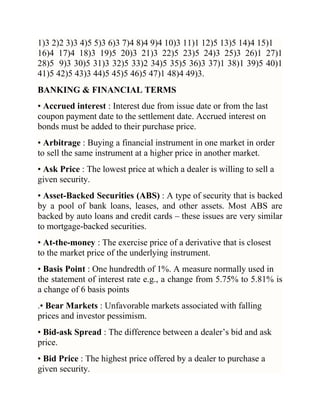
1)3 2)2 3)3 4)5 5)3 6)3 7)4 8)4 9)4 10)3 11)1 12)5 13)5 14)4 15)1
16)4 17)4 18)3 19)5 20)3 21)3 22)5 23)5 24)3 25)3 26)1 27)1
28)5 9)3 30)5 31)3 32)5 33)2 34)5 35)5 36)3 37)1 38)1 39)5 40)1
41)5 42)5 43)3 44)5 45)5 46)5 47)1 48)4 49)3.
BANKING & FINANCIAL TERMS
• Accrued interest : Interest due from issue date or from the last
coupon payment date to the settlement date. Accrued interest on
bonds must be added to their purchase price.
• Arbitrage : Buying a financial instrument in one market in order
to sell the same instrument at a higher price in another market.
• Ask Price : The lowest price at which a dealer is willing to sell a
given security.
• Asset-Backed Securities (ABS) : A type of security that is backed
by a pool of bank loans, leases, and other assets. Most ABS are
backed by auto loans and credit cards – these issues are very similar
to mortgage-backed securities.
• At-the-money : The exercise price of a derivative that is closest
to the market price of the underlying instrument.
• Basis Point : One hundredth of 1%. A measure normally used in
the statement of interest rate e.g., a change from 5.75% to 5.81% is
a change of 6 basis points
.• Bear Markets : Unfavorable markets associated with falling
prices and investor pessimism.
• Bid-ask Spread : The difference between a dealer‘s bid and ask
price.
• Bid Price : The highest price offered by a dealer to purchase a
given security.
• Blue Chips : Blue chips are unsurpassed in quality and have a
long and stable record of earnings and dividends. They are issued by
large and well-established firms that have impeccable financial
credentials.
• Bond : Publicly traded long-term debt securities, issued by
corporations and governments, whereby the issuer agrees to pay a
fixed amount of interest over a specified period of time and to
repay fixed amount of principal at maturity.
• Book Value : The amount of stockholders‘ equity in a firm equals
the amount of the firm‘s assets minus the firm‘s liabilities and
preferred stock. /p>
• Broker : Individuals licensed by stock exchanges to enable
investors to buy and sell securities.
• Brokerage Fee : The commission charged by a broker.
• Bull Markets : Favorable markets associated with rising prices
and investor optimism.
• Call Option : The right to buy the underlying securities at a
specified exercise price on or before a specified expiration date.
• Callable Bonds : Bonds that give the issuer the right to redeem
the bonds before their stated maturity.
• Capital Gain : The amount by which the proceeds from the sale
of a capital asset exceed its original purchase price.
• Capital Markets : The market in which long-term securities such
as stocks and bonds are bought and sold.
• Certificate of Deposits (CDs) : Savings instrument in which funds
must remain on deposit for a specified period, and premature
withdrawals incur interest penalties.
• Closed-end (Mutual) Fund : A fund with a fixed number of
shares issued, and all trading is done between investors in the open
market. The share prices are determined by market prices instead of
their net asset value.
• Collateral : A specific asset pledged against possible default on
a bond. Mortgage bonds are backed by claims on property.
Collateral trusts bonds are backed by claims on other securities.
Equipment obligation bonds are backed by claims on equipment.
• Commercial Paper : Short-term and unsecured promissory notes
issued by corporations with very high credit standings.
• Common Stock : Equity investment representing ownership in a
corporation; each share represents a fractional ownership interest in
the firm.
• Compound Interest : Interest paid not only on the initial deposit
but also on any interest accumulated from one period to the
next.
• Contract Note : A note which must accompany every security
transaction which contains information such as the dealer‘s name
(whether he is acting as principal or agent) and the date of contract.
• Controlling Shareholder : Any person who is, or group of
persons who together are, entitled to exercise or control the exercise
of a certain amount of shares in a company at a level (which differs
by jurisdiction) that triggers a mandatory general offer, or more of
the voting power at general meetings of the issuer, or who is or are
in a position to control the composition of a majority of the board of
directors of the issuer.
• Convertible Bond : A bond with an option, allowing the
bondholder to exchange the bond for a specified number of shares of
common stock in the firm. A conversion price is the specified value
of the shares for which the bond may be exchanged. The conversion
premium is the excess of the bond‘s value over the conversion price.
• Corporate Bond : Long-term debt issued by private corporations.
• Coupon : The feature on a bond that defines the amount of
annual interest income.
• Coupon Frequency : The number of coupon payments per year.
• Coupon Rate : The annual rate of interest on the bond‘s face
value that a bond‘s issuer promises to pay the bondholder. It is the
bond‘s interest payment per dollar of par value.
• Covered Warrants : Derivative call warrants on shares which
have been separately deposited by the issuer so that they are
available for delivery upon exercise.
• Credit Rating : An assessment of the likelihood of an individual
or business being able to meet its financial obligations. Credit
ratings are provided by credit agencies or rating agencies to verify
the financial strength of the issuer for investors.
• Currency Board : A monetary system in which the monetary base
is fully backed by foreign reserves. Any changes in the size of the
monetary base has to be fully matched by corresponding changes in
the foreign reserves.
• Current Yield : A return measure that indicates the amount of
current income a bond provides relative to its market price. It is
shown as: Coupon Rate divided by Price multiplied by 100%.
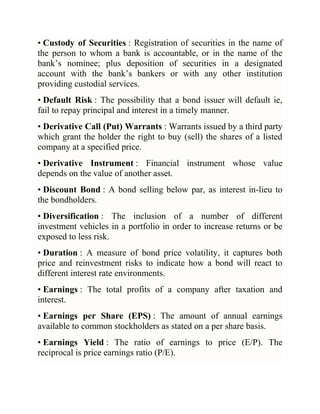
• Custody of Securities : Registration of securities in the name of
the person to whom a bank is accountable, or in the name of the
bank‘s nominee; plus deposition of securities in a designated
account with the bank‘s bankers or with any other institution
providing custodial services.
• Default Risk : The possibility that a bond issuer will default ie,
fail to repay principal and interest in a timely manner.
• Derivative Call (Put) Warrants : Warrants issued by a third party
which grant the holder the right to buy (sell) the shares of a listed
company at a specified price.
• Derivative Instrument : Financial instrument whose value
depends on the value of another asset.
• Discount Bond : A bond selling below par, as interest in-lieu to
the bondholders.
• Diversification : The inclusion of a number of different
investment vehicles in a portfolio in order to increase returns or be
exposed to less risk.
• Duration : A measure of bond price volatility, it captures both
price and reinvestment risks to indicate how a bond will react to
different interest rate environments.
• Earnings : The total profits of a company after taxation and
interest.
• Earnings per Share (EPS) : The amount of annual earnings
available to common stockholders as stated on a per share basis.
• Earnings Yield : The ratio of earnings to price (E/P). The
reciprocal is price earnings ratio (P/E).
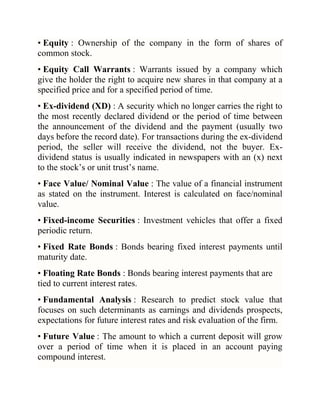
• Equity : Ownership of the company in the form of shares of
common stock.
• Equity Call Warrants : Warrants issued by a company which
give the holder the right to acquire new shares in that company at a
specified price and for a specified period of time.
• Ex-dividend (XD) : A security which no longer carries the right to
the most recently declared dividend or the period of time between
the announcement of the dividend and the payment (usually two
days before the record date). For transactions during the ex-dividend
period, the seller will receive the dividend, not the buyer. Exdividend status is usually indicated in newspapers with an (x) next
to the stock‘s or unit trust‘s name.
• Face Value/ Nominal Value : The value of a financial instrument
as stated on the instrument. Interest is calculated on face/nominal
value.
• Fixed-income Securities : Investment vehicles that offer a fixed
periodic return.
• Fixed Rate Bonds : Bonds bearing fixed interest payments until
maturity date.
• Floating Rate Bonds : Bonds bearing interest payments that are
tied to current interest rates.
• Fundamental Analysis : Research to predict stock value that
focuses on such determinants as earnings and dividends prospects,
expectations for future interest rates and risk evaluation of the firm.
• Future Value : The amount to which a current deposit will grow
over a period of time when it is placed in an account paying
compound interest.
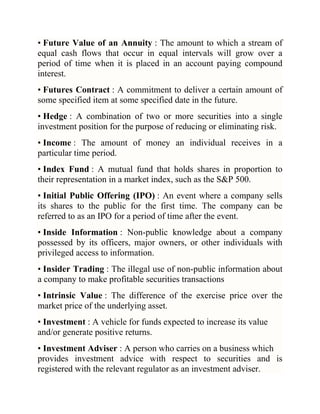
• Future Value of an Annuity : The amount to which a stream of
equal cash flows that occur in equal intervals will grow over a
period of time when it is placed in an account paying compound
interest.
• Futures Contract : A commitment to deliver a certain amount of
some specified item at some specified date in the future.
• Hedge : A combination of two or more securities into a single
investment position for the purpose of reducing or eliminating risk.
• Income : The amount of money an individual receives in a
particular time period.
• Index Fund : A mutual fund that holds shares in proportion to
their representation in a market index, such as the S&P 500.
• Initial Public Offering (IPO) : An event where a company sells
its shares to the public for the first time. The company can be
referred to as an IPO for a period of time after the event.
• Inside Information : Non-public knowledge about a company
possessed by its officers, major owners, or other individuals with
privileged access to information.
• Insider Trading : The illegal use of non-public information about
a company to make profitable securities transactions
• Intrinsic Value : The difference of the exercise price over the
market price of the underlying asset.
• Investment : A vehicle for funds expected to increase its value
and/or generate positive returns.
• Investment Adviser : A person who carries on a business which
provides investment advice with respect to securities and is
registered with the relevant regulator as an investment adviser.
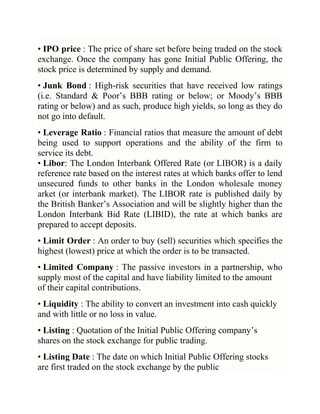
• IPO price : The price of share set before being traded on the stock
exchange. Once the company has gone Initial Public Offering, the
stock price is determined by supply and demand.
• Junk Bond : High-risk securities that have received low ratings
(i.e. Standard & Poor‘s BBB rating or below; or Moody‘s BBB
rating or below) and as such, produce high yields, so long as they do
not go into default.
• Leverage Ratio : Financial ratios that measure the amount of debt
being used to support operations and the ability of the firm to
service its debt.
• Libor: The London Interbank Offered Rate (or LIBOR) is a daily
reference rate based on the interest rates at which banks offer to lend
unsecured funds to other banks in the London wholesale money
arket (or interbank market). The LIBOR rate is published daily by
the British Banker‘s Association and will be slightly higher than the
London Interbank Bid Rate (LIBID), the rate at which banks are
prepared to accept deposits.
• Limit Order : An order to buy (sell) securities which specifies the
highest (lowest) price at which the order is to be transacted.
• Limited Company : The passive investors in a partnership, who
supply most of the capital and have liability limited to the amount
of their capital contributions.
• Liquidity : The ability to convert an investment into cash quickly
and with little or no loss in value.
• Listing : Quotation of the Initial Public Offering company‘s
shares on the stock exchange for public trading.
• Listing Date : The date on which Initial Public Offering stocks
are first traded on the stock exchange by the public
• Margin Call : A notice to a client that it must provide money to
satisfy a minimum margin requirement set by an Exchange or by a
bank / broking firm.
• Market Capitalization : The product of the number of the
company‘s outstanding ordinary shares and the market price of each
share.
• Market Maker : A dealer who maintains an inventory in one or
more stocks and undertakes to make continuous two-sided quotes.
• Market Order : An order to buy or an order to sell securities
which is to be executed at the prevailing market price.
• Money Market : Market in which short-term securities are bought
and sold.
• Mutual Fund : A company that invests in and professionally
manages a diversified portfolio of securities and sells shares of the
portfolio to investors.
• Net Asset Value : The underlying value of a share of stock in a
particular mutual fund; also used with preferred stock.
• Offer for Sale : An offer to the public by, or on behalf of, the
holders of securities already in issue.
• Offer for Subscription : The offer of new securities to the public
by the issuer or by someone on behalf of the issuer.
• Open-end (Mutual) Fund : There is no limit to the number of
shares the fund can issue. The fund issues new shares of stock and
fills the purchase order with those new shares. Investors buy their
shares from, and sell them back to, the mutual fund itself. The share
prices are determined by their net asset value.
• Open Offer : An offer to current holders of securities to subscribe
for securities whether or not in proportion to their existing holdings.
• Option : A security that gives the holder the right to buy or sell a
certain amount of an underlying financial asset at a specified price
for a specified period of time.
• Oversubscribed : When an Initial Public Offering has more
applications than actual shares available. Investors will often apply
for more shares than required in anticipation of only receiving a
fraction of the requested number. Investors and underwriters will
often look to see if an IPO is oversubscribed as an indication of the
public‘s perception of the business potential of the IPO company.
• Par Bond : A bond selling at par (i.e. at its face value).
• Par Value : The face value of a security.
• Perpetual Bonds : Bonds which have no maturity date.
• Placing : Obtaining subscriptions for, or the sale of, primary
market, where the new securities of issuing companies are initially
sold.
• Portfolio : A collection of investment vehicles assembled to meet
one or more investment goals.
• Preference Shares : A corporate security that pays a fixed
dividend each period. It is senior to ordinary shares but junior to
bonds in its claims on corporate income and assets in case of
bankruptcy.
• Premium (Warrants) : The difference of the market price of a
warrant over its intrinsic value.
• Premium Bond : Bond selling above par.
• Present Value : The amount to which a future deposit will
discount back to present when it is depreciated in an account
paying compound interest.
• Present Value of an Annuity : The amount to which a stream of
equal cash flows that occur in equal intervals will discount back to
present when it is depreciated in an account paying compound
interest.
• Price/Earnings Ratio (P/E) : The measure to determine how the
market is pricing the company‘s common stock. The price/earnings
(P/E) ratio relates the company‘s earnings per share (EPS) to the
market price of its stock.
• Privatization : The sale of government-owned equity in
nationalized industry or other commercial enterprises to private
investors.
• Prospectus : A detailed report published by the Initial Public
Offering company, which includes all terms and conditions,
application procedures, IPO prices etc, for the IPO
• Put Option : The right to sell the underlying securities at a
specified exercise price on of before a specified expiration date.
• Rate of Return : A percentage showing the amount of investment
gain or loss against the initial investment.
• Real Interest Rate : The net interest rate over the inflation rate.
The growth rate of purchasing power derived from an investment.
• Redemption Value : The value of a bond when redeemed.
• Reinvestment Value : The rate at which an investor assumes
interest payments made on a bond which can be reinvested over the
life of that security.
• Relative Strength Index (RSI) : A stock‘s price that changes over
a period of time relative to that of a market index such as the
Standard & Poor‘s 500, usually measured on a scale from 1 to 100,
1 being the worst and 100 being the best.
• Repurchase Agreement : An arrangement in which a security is
sold and later bought back at an agreed price and time.
• Resistance Level : A price at which sellers consistently outnumber
buyers, preventing further price rises.
• Return : Amount of investment gain or loss.
• Rights Issue : An offer by way of rights to current holders of
securities that allows them to subscribe for securities in proportion
to their existing holdings.
• Risk-Averse, Risk-Neutral, Risk-Taking :
Risk-averse describes an investor who requires greater return in
exchange for greater risk. Risk-neutral describes an investor who
does not require greater return in exchange for greater risk. Risktaking describes an investor who will accept a lower return in
exchange for greater risk.
• Senior Bond : A bond that has priority over other bonds in
claiming assets and dividends.
• Short Hedge : A transaction that protects the value of an asset
held by taking a short position in a futures contract.
• Settlement : Conclusion of a securities transaction when a
customer pays a broker/dealer for securities purchased or delivered,
securities sold, and receives from the broker the proceeds of a sale.
• Short Position : Investors sell securities in the hope that they
will ecrease in value and can be bought at a later date for profit.
• Short Selling : The sale of borrowed securities, their eventual
repurchase by the short seller at a lower price and their return to
the lender.
• Speculation : The process of buying investment vehicles in which
the future value and level of expected earnings are highly uncertain.
• Stock Splits : Wholesale changes in the number of shares. For
example, a two for one split doubles the number of shares but
does not change the share capital.
• Subordinated Bond : An issue that ranks after secured debt,
debenture, and other bonds, and after some general creditors in its
claim on assets and earnings. Owners of this kind of bond stand last
in line among creditors, but before equity holders, when an issuer
fails financially.
• Substantial Shareholder : A person acquires an interest in
relevant share capital equal to, or exceeding, 10% of the share
capital.
• Support Level : A price at which buyers consistently outnumber
sellers, preventing further price falls.
• Technical Analysis : A method of evaluating securities by relying
on the assumption that market data, such as charts of price, volume,
and open interest, can help predict future (usually short-term)
market trends. Contrasted with fundamental analysis which involves
the study of financial accounts and other information about the
company. (It is an attempt to predict movements in security prices
from their trading volume history.)
• Time Horizon : The duration of time an investment is intended
for.
• Trading Rules : Stipulation of parameters for opening and intraday quotations, permissible spreads according to the prices of
securities available for trading and board lot sizes for each security.
• Trust Deed : A formal document that creates a trust. It states the
purpose and terms of the name of the trustees and beneficiaries.
• Underlying Security : The security subject to being purchased or
sold upon exercise of the option contract.
• Valuation : Process by which an investor determines the worth of
a security using risk and return concept.
• Warrant : An option for a longer period of time giving the buyer
the right to buy a number of shares of common stock in company at
a specified price for a specified period of time.
• Window Dressing : Financial adjustments made solely for the
purpose of accounting presentation, normally at the time of auditing
of company accounts.
• Yield (Internal rate of Return) : The compound annual rate of
return earned by an investment
• Yield to Maturity : The rate of return yield by a bond held to
maturity when both compound interest payments and the investor‘s
capital gain or loss on the security are taken into account.
• Zero Coupon Bond : A bond with no coupon that is sold at a
deep discount from par value.
BANKING TERMINOLOGY
Anytime Banking : With introduction of ATMs, Tele-Banking and
internet banking, customers can conduct their business anytime of
the day and night. The 'Banking Hours' is not a constraint for
transacting banking business.
Anywhere Banking : Refers to banking not only by ATMs, TeleBanking and internet banking, but also to core banking solutions
brought in by banks where customer can deposit his money, cheques
and also withdraw money from any branch connected with
the ystem. All major banks in India have brought in core banking in
their operations to make banking truly anywhere banking.
ATM :ATMs are Automatic Teller Machines, which do the job of a
teller in a bank through Computer Network. ATMs are located on
the branch premises or off branch premises. ATMs are useful to
dispense cash, receive cash, accept cheques, give balances in the
accounts and also give mini-statements to the customers.
Bank Ombudsman : Bank Ombudsman is the authority to look into
complaints against Banks in the main areas of collection of cheque /
bills, issue of demand drafts, non-adherence to prescribed hours of
working, failure to honour guarantee / letter of credit commitments,
operations in deposit accounts and also in the areas of loans and
advances where banks flout directions / instructions of RBI. This
Scheme was announced in 1995 and is functioning with
new guidelines from 2007. This scheme covers all scheduled banks,
the RRBs and co-operative banks.
Bancassurance : Bancassurance refers to the distribution of
insurance products and the insurance policies of insurance
companies which may be life policies or non-life policies like home
insurance - car insurance, medi-policies and others, by banks as
corporate agents through their branches located in different parts of
the country by charging a fee.
Banker's Lien : Bankers lien is a special right of lien exercised by
the bankers, who can retain goods bailed to them as a security for
general balance of account. Bankers can have this right in the
absence of a contract to the contrary.
Banking : Accepting for the purpose of lending or investment of
deposits of money from Public, Repayable on demand or otherwise
and withdrawable by cheques, drafts, order, etc.
Basel-II : The Committee on Banking Regulations and Supervisory
Practices, popularity known as Basel Committee, submitted its
revised version of norms in June, 2004. Under the revised accord the
capital requirement is to be calculated for credit, market and
operational risks. The minimum requirement continues to be 8% of
capital fund (Tier I & II Capital) Tier II shall continue to be not
more than 100% of Tier I Capital.
Brick & Mortar Banking : Brick and Mortar Banking refers to
traditional system of banking done only in a fixed branch premises
made of brick and mortar. Now there are banking channels like
ATM, Internet Banking,tele banking etc.
Business of Banking : Accepting deposits, borrowing money,
lending money, investing, dealing in bills, dealing in Foreign
Exchange, Hiring Lockers, Opening Safe Custody Accounts, Issuing
Letters of Credit, Traveller's Cheques, doing Mutual Fund business,
Insurance Business, acting as Trustee or doing any other business
which Central Government may notify in the official Gazette.
Bouncing of a cheque : Where an account does not have sufficient
balance to honour the cheque issued by the customer , the cheque is
returned by the bank with the reason "funds insufficient" or
"Exceeds arrangement".This is known as 'Bouncing of a cheque' .
Certificate of Deposit :. Certificate of Deposits are
negotiable receipts in bearer form which can be freely traded
among investors. This is also a money market instrument,issued for
a period ranging from 7 days to f one year .The minimum deposit
amount is Rs. 1 lakh and they are transferable by endorsement and
delivery.
Cheque : Cheque is a Bill of Exchange drawn on a specified banker
ordering the banker to pay a certain sum of money to the drawer of
cheque or another person. Money is generally withdrawn by clients
by cheques. Cheque is always payable on demand.
Cheque Truncation : Cheque truncation, truncates or stops the
flow of cheques through the banking system. Generally truncation
takes place at the collecting branch, which sends the electronic
image of the cheques to the paying branch through the clearing
house and stores the paper cheques with it.
Collecting Banker : Also called receiving banker, who collects on
instruments like a cheque, draft or bill of exchange, lodged with
himself for the credit of his customer's account.
Consumer Protection Act : It is implemented from 1987 to enforce
consumer rights through a simple legal procedure. Banks also are
covered under the Act. A consumer can file complaint for deficiency
of service with Consumer District Forum for amounts upto Rs.20
Lacs in District Court, and for amounts above Rs.20 Lacs to Rs.1
Crore in State Commission and for amounts above Rs.1 Crore in
National Commission.
Co-operative Bank : An association of persons who collectively
own and operate a bank for the benefit of consumers / customers,
like Saraswat Co-operative Bank or Abhyudaya Co-operative Bank
and other such banks.
Co-operative Society : When an association of persons collectively
own and operate a unit for the benefit of those using its services like
Apna Bazar Co-operative Society or Sahakar Bhandar or a Cooperative Housing Society.
Core Banking Solutions (CBS) : Core Banking Solutions is a buzz
word in Indian banking at present, where branches of the bank are
connected to a central host and the customers of
connected branches can do banking at any breach with core banking
facility.
Creditworthiness : It is the capacity of a borrower to repay the loan
/ advance in time alongwith interest as per agreed terms.
Crossing of Cheques : Crossing refers to drawing two parallel
lines cross the face of the cheque.A crossed cheque cannot be paid
in cash across the counter, and is to be paid through a bank either by
transfer, collection or clearing.A general crossing means that cheque
can be paid through any bank and a special crossing, where the
name of a bank is indicated on the cheque, can be paid only through
the named bank.
Current Account : Current account with a bank can be opened
generally for business purpose. There are no restrictions on
withdrawals in this type of account. No interest is paid in this type
of account.
Customer : A person who maintains any type of account with a
bank is a bank customer. Consumer Protection Act has a wider
definition for consumer as the one who purchases any service for a
fee like purchasing a demand draft or a pay order. The term
customer is defined differently by Laws, softwares and countries.
Debit Card : A plastic card issued by banks to customers to
withdraw money electronically from their accounts. When you
purchase things on the basis of Debit Card the amount due is debited
immediately to the account . Many banks issue Debit-Cum-ATM
Cards.
Debtor : A person who takes some money on loan from another
person.
Demand Deposits : Deposits which are withdrawn on demand by
customers.E.g. savings bank and current account deposits.
Demat Account : Demat Account concept has revolutionized the
capital market of India. When a depository company takes paper
shares from an investor and converts them in electronic form
through the concerned company, it is called Dematerialization of
Shares. These converted Share Certificates in Electronic form are
kept in a Demat Account by the Depository Company, like a bank
keeps money in a deposit account. Investor can withdraw the shares
or purchase more shares through this demat Account.
Dishonour of Cheque : Non-payment of a cheque by the paying
banker with a return memo giving reasons for the non-payment.
Debit Card : A plastic card issued by banks to customers to
withdraw money electronically from their accounts. When you
purchase things on the basis of Debit Card the amount due is debited
immediately to the account . Many banks issue Debit-Cum-ATM
Cards.
Debtor : A person who takes some money on loan from another
person.
Demand Deposits : Deposits which are withdrawn on demand by
customers.E.g. savings bank and current account deposits.
Demat Account : Demat Account concept has revolutionized the
capital market of India. When a depository company takes paper
shares from an investor and converts them in electronic form
through the concerned company, it is called Dematerialization of
Shares. These converted Share Certificates in Electronic form are
kept in a Demat Account by the Depository Company, like a bank
keeps money in a deposit account. Investor can withdraw the shares
or purchase more shares through this demat Account.
Dishonour of Cheque : Non-payment of a cheque by the paying
banker with a return memo giving reasons for the non-payment.
E-Banking : E-Banking or electronic banking is a form of banking
where funds are transferred through exchange of electronic signals
between banks and financial institution and customers ATMs, Credit
Cards, Debit Cards, International Cards, Internet Banking and new
fund transfer devices like SWIFT, RTGS belong to this category.
EFT - (Electronic Fund Transfer) : EFT is a device to facilitate
automatic transmission and processing of messages as well as
funds rom one bank branch to another bank branch and even from
one ranch of a bank to a branch of another bank. EFT allows
transfer of funds electronically with debit and credit to relative
accounts.
Either or Survivor : Refers to operation of the account opened in
two names with a bank. It means that any one of the account holders
have powers to withdraw money from the account, issue cheques,
give stop payment instructions etc. In the event of death of one of
the account holder, the surviving account holder gets all the powers
of operation.
Electronic Commerce (E-Commerce): E-Commerce is the
paperless commerce where the exchange of business takes place by
Electronic means.
Endorsement : When a Negotiable Instrument contains, on the
back of the instrument an endorsement, signed by the holder or
payee of an order instrument, transferring the title to the other
person, it is called endorsement.
Endorsement in Blank : Where the name of the endorsee or
transferee is not mentioned on the instrument.
Endorsement in Full : Where the name of the endorsee or
transferee appears on the instrument while making endorsement.
Execution of Documents : Execution of documents is done by
putting signature of the person, or affixing his thumb impression or
putting signature with stamp or affixing common seal of the
company on the documents with or without signatures of directors
as per articles of association of the company.
Factoring : Business of buying trade debts at a discount and making
a profit when debt is realized and also taking over collection of trade
debts at agreed prices.
Foreign Banks : Banks incorporated outside India but operating in
India and regulated by the Reserve Bank of India (RBI),. e..g.,
Barclays Bank, HSBC, Citibank, Standard Chartered Bank, etc.
Forfaiting : In International Trade when an exporter finds it
difficult to realize money from the importer, he sells the right to
receive money at a discount to a forfaiter, who undertakes inherent
political and commercial risks to finance the exporter, of course
with assumption of a profit in the venture.
Forgery : when a material alteration is made on a document or a
Negotiable Instrument like a cheque, to change the mandate of the
drawer, with intention to defraud.
Garnishee Order : When a Court directs a bank to attach the funds
to the credit of customer's account under provisions of Section 60 of
the Code of Civil Procedure, 1908.
General Lien : A right of the creditors to retain possession of all
goods given in security to him by the debtor for any outstanding
debt.
Guarantee : A contract between guarantor and beneficiary to
ensure performance of a promise or discharge the liability of a third
person. If promise is broken or not performed, the guarantor pays
contracted amount to the beneficiary.
Holder : Holder means any person entitled in his own name to the
possession of the cheque, bill of exchange or promissory note and
who is entitled to receive or recover the amount due on it from the
parties. For example, if I give a cheque to my friend to withdraw
money from my bank,he becomes holder of that cheque. Even if he
loses the cheque, he continues to be holder. Finder cannot become
the holder.
Holder in due course : A person who receives a Negotiable
Instrument for value, before it was due and in good faith, without
notice of any defect in it, he is called holder in due course as per
Negotiable Instrument Act. In the earlier example if my friend lends
some money to me on the basis of the cheque, which I have given
to him for encashment, he becomes holder-in-due course.
Hypothecation : Charge against property for an amount of debt
where neither ownership nor possession is passed to the creditor. In
pledge, possession of property is passed on to the lender but in
hypothecation, the property remains with the borrower in trust for
the lender.
Identification : When a person provides a document to a bank or is
being identified by a person, who is known to the bank, it is called
identification. Banks ask for identification before paying an order
cheque or a demand draft across the counter.
Indemnifier : When a person indemnifies or guarantees to make
good any loss caused to the lender from his actions or others'
actions.
Indemnity : Indemnity is a bond where the indemnifier undertakes
to reimburse the beneficiary from any loss arising due to his actions
or third party actions.
Insolvent : Insolvent is a person who is unable to pay his debts as
they mature, as his liabilities are more than the assets . Civil Courts
declare such persons insolvent. Banks do not open accounts of
insolvent persons as they cannot enter into contract as per law.
Interest Warrant : When cheque is given by a company or an
organization in payment of interest on deposit , it is called interest
warrant. Interest warrant has all the characteristics of a cheque.
International Banking : involves more than two nations or
countries. If an Indian Bank has branches in different countries like
State Bank of India, it is said to do International Banking.
Introduction : Banks are careful in opening any account for a
customer as the prospective customer has to be introduced by an
existing account holder or a staff member or by any other person
known to the bank for opening of account. If bank does not take
introduction, it will amount to negligence and will not get protection
under law.
JHF Account : Joint Hindu Family Account is account of a firm
whose business is carried out by Karta of the Joint family, acting for
all the family members.. The family members have common
ancestor and generally maintain a common residence and are subject
to common social, economic and religious regulations.
Joint Account : When two or more individuals jointly open an
account with a bank.
Karta : Manager of a Hindu Undivided Family (HUF) who handles
the family business. He is usually the eldest male member of the
undivided family.
Kiosk Banking : Doing banking from a cubicle from which food,
newspapers, tickets etc. are also sold.
KYC Norms : Know your customer norms are imposed by R.B.I.
on banks and other financial institutions to ensure that they know
their customers and to ensure that customers deal only in legitimate
banking operations and not in money laundering or frauds.
Law of Limitation : Limitation Act of 1963 fixes the limitation
period of debts and obligations including banks loans and advances.
If the period fixed for particular debt or loan expires, one can not
file a suit for is recovery, but the fact of the debt or loan is not
denied. It is said that law of limitation bars the remedy but does not
extinguish the right.
Lease Financing : Financing for the business of renting houses or
lands for a specified period of time and also hiring out of an asset
for the duration of its economic life. Leasing of a car or heavy
machinery for a specific period at specific price is an example.
Letter of Credit : A document issued by importers bank to
its branch or agent abroad authorizing the payment of a specified
sum to a person named in Letter of Credit (usually exporter from
abroad). Letters of Credit are covered by rules framed under
Uniform Customs and Practices of Documentary Credits framed by
International Chamber of Commerce in Paris.
Limited Companies Accounts : Accounts of companies
incorporated under the Companies Act, 1956 . A company may be
private or public. Liability of the shareholders of a company is
generally limited to the face value of shares held by them.
Mandate : Written authority issued by a customer to another person
to act on his behalf, to sign cheques or to operate a bank account.
Material Alteration : Alteration in an instrument so as to alter the
character of an instrument for example when date, amount, name of
the payee are altered or making a cheque payable to bearer from an
order one or opening the crossing on a cheque.
Merchant Banking : When a bank provides to a customer various
types of financial services like accepting bills arising out of trade,
arranging and providing underwriting, new issues, providing advice,
information or assistance on starting new business, acquisitions,
mergers and foreign exchange.
Micro Finance: Micro Finance aims at alleviation of poverty and
empowerment of weaker sections in India. In micro finance, very
small amounts are given as credit to poor in rural, semi-urban and
urban areas to enable them to raise their income levels and living
standards.
Minor Accounts : A minor is a person who has not attained legal
age of 18 years. As per Contract Act a minor cannot enter into a
contract but as per Negotiable Instrument Act, a minor can draw,
negotiate, endorse, receive payment on a Negotiable Instrument so
as to bind all the persons, except himself. In order to boost their
deposits many banks open minor accounts with some restrictions
Mobile Banking : With the help of M-Banking or mobile banking
customer can check his bank balance, order a demand draft, stop
payment of a cheque, request for a cheque book and have
information about latest interest rates.
Money Laundering : When a customer uses banking channels to
cover up his suspicious and unlawful financial activities, it is called
money laundering.
Money Market : Money market is not an organized market like
Bombay Stock Exchange but is an informal network of banks,
financial institutions who deal in money market instruments of short
term like CP, CD and Treasury bills of Government.
Moratorium : R.B.I. imposes moratorium on operations of a bank;
if the affairs of the bank are not conducted as per banking norms.
After moratorium R.B.I. and Government explore the options of
safeguarding the interests of depositors by way of change in
management, amalgamation or take over or by other means.
Mortgage : Transfer of an interest in specific immovable property
for the purpose of offering a security for taking a loan or advance
from another. It may be existing or future debt or performance of an
agreement which may create monetary obligation for the transferor
(mortgagor).
NABARD : National Bank for Agriculture & Rural
Development as setup in 1982 under the Act of 1981. NABARD
finances and regulates rural financing and also is responsible for
development agriculture and rural industries.
Negotiation : In the context of banking, negotiation means an act of
transferring or assigning a money instrument from one person to
another person in the course of business.
Non-Fund Based Limits : Non-Fund Based Limits are those type
of limits where banker does not part with the funds but may have
topart with funds in case of default by the borrowers, like
guarantees, letter of credit and acceptance facility.
Non-Resident : A person who is not a resident of India is a nonresident. Non-Resident Accounts : Accounts of non-resident Indian
citizens opened and maintained as per R.B.I. Rules.
Notary Public : A Lawyer who is authorized by Government to
certify copies of documents .
NPA Account : If interest and instalments and other bank dues are
not paid in any loan account within a specified time limit, it is being
treated as non-performing assets of a bank.
Off Balance Sheet Items : Those items which affect the financial
position of a business concern, but do not appear in the Balance
Sheet E,g guarantees, letters of credit . The mention "off Balance
Sheet items" is often found in Auditors Reports or Directors
Reports.
Online Banking : Banking through internet site of the bank which
is made interactive.
Pass Book : A record of all debit and credit entries in a customer's
account. Generally all banks issue pass books to Savings
Bank/Current Account Holders.
Personal Identification Number (PIN) : Personal Identification
Number is a number which an ATM card holder has to key in before
he is authorized to do any banking transaction in a ATM .
Plastic Money : Credit Cards, Debit Cards, ATM Cards and
International Cards are considered plastic money as like money they
can enable us to get goods and services.
Pledge : A bailment of goods as security for payment of a debt or
performance of a promise, e.g pledge of stock by a borrower to a
banker for a credit limit. Pledge can be made in movable goods
only.
Post-Dated Cheque : A Cheque which bears the date which is
subsequent to the date when it is drawn. For example, a cheque
drawn on 8th of February, 2007 bears the date of 12th February,
2007.
Power of Attorney : It is a document executed by one person Donor or Principal, in favour of another person , Donee or Agent o act on behalf of the former, strictly as per authority given in the
document.
Premature Withdrawals : Term deposits like Fixed Deposits, Call
Deposits, Short Deposits and Recurring Deposits have to mature on
a particular day. When these deposits are sought to be withdrawn
before maturity , it is premature withdrawal.
Prime Lending Rate (PLR) : The rate at which banks lend to their
best (prime) customers.
Priority Sector Advances : consist of loans and advances to
Agriculture, Small Scale Industry, Small Road and Water Transport
Operators, Retail Trade, Small Business with limits on investment in
equipments, professional and self employed persons, state sponsored
organisations for lending to SC/ST, Educational Loans, Housing
Finance up to certain limits, self-help groups and consumption
loans.
Promissory Note : Promissory Note is a promise / undertaking
given by one person in writing to another person, to pay to that
person , a certain sum of money on demand or on a future day.
Provisioning : Provisioning is made for the likely loss in the profit
and loss account while finalizing accounts of banks. All banks are
supposed to make assets classification . and make appropriate
provisions for likely losses in their balance sheets.
Public Sector Bank : A bank fully or partly owned by the
Government.
Rescheduling of Payment : Rearranging the repayment of a debt
over a longer period than originally agreed upon due to financial
difficulties of the borrower.
Restrictive Endorsement : Where endorser desires that instrument
is to be paid to particular person only, he restricts further negotiation
or transfer by such words as "Pay to Ashok only". Now Ashok
cannot negotiate the instrument further.
Right of Appropriation : As per Section 59 of the Indian Contract
Act, 1972 while making the payment, a debtor has the right to direct
his creditor to appropriate such amount against discharge of some
particular debt. If the debtor does not do so, the banker can
appropriate the payment to any debt of his customer.
Right of Set-Off : When a banker combines two accounts in the
name of the same customer and adjusts the debit balance in one
account with the credit balance in other account, it is called right of
set-off. For example, debit balance of Rs.50,000/- in overdraft
account can be set off against credit balance of Rs.75,000/- in the
Savings Bank Account of the same customer, leaving a balance of
Rs.25,000/- credit in the savings account.
Safe Custody : When articles of value like jewellery, boxes, shares,
debentures, Government bonds, Wills or other documents or articles
are given to a bank for safe keeping in its safe vault,it is called safe
custody.. Bank charges a fee from its clients for such safe custody.
Savings Bank Account : All banks in India are having the facility
of opening savings bank account with a nominal balance. This
account is used for personal purposes and not for business purpose
and there are certain restrictions on withdrawals from this type of
account. Account holder gets nominal interest in this account.
Teller : Teller is a staff member of a bank who accepts deposits,
cashes cheques and performs other banking services for the public.
Underwriting : is an agreement by the underwriter to buy on a
fixed date and at a fixed rate, the unsubscribed portion of shares or
debentures or other issues. Underwriter gets commission for this
agreement.
Universal Banking : When Banks and Financial Institutions are
allowed to undertake all types of activities related to banking like
acceptance of deposits, granting of advances, investment, issue of
credit cards, project finance, venture capital finance, foreign
exchange business, insurance etc. it is called Universal Banking.
Virtual Banking : Virtual banking is also called internet banking,
through which financial and banking services are accessed via
internet's world wide web. It is called virtual banking because an
internet bank has no boundaries of brick and mortar and it exists
only on the internet.
Wholesale Banking : Wholesale banking is different from Retail
Banking as its focus is on providing for financial needs of industry
and institutional clients.
FINANCIAL & BANKING AWARENESS MCQs
1) At present number of public sector banks inIndia:
a) 26
b) 27
c) 28
d) 29
e) None of these
2) At present number of private sector banks inIndia:
a) 21
b) 22
c) 23
d) 24
e) None of these
3) Nationalisation of 14 major banks in…………………..
a) 1949
b) 1955
c) 1959
d) 1969
e) None of these
4) Nationalisation of six banks in…………………………..
a) ) 1949
b) 1955
c) 1959
d) 1969
e) 1980
5)The largest commercial bank inIndia:
a) SBI
b) ICICI Bank
c) PNB
d) HDFC Bank
e) None of these
6) The Second largest public sector commercial bank inIndia:
a) Punjab National Bank
b) Bank of Baroda
c) Bank of India
d) IDBI Bank
e) Corporation Bank
7) The Largest private sector commercial bank inIndia:
a) AXIS Bank
b) HDFC Bank
c) ICICI Bank
d) Federal Bank
e) None of these
8) The second largest private sector commercial bank inIndia:
a) IDBI Bank
b) AXIS Bank
c) HDFC Bank
d) ICICI Bank
e) None of these
9) The first Indian bank to open a branch outsideIndiainLondonin
1946:
a) State Bank of India
b) Punjab National Bank
c) Bank of Baroda
d) Canara Bank
e) Bank of India
10) Latest Public Sector Bank inIndia:
a) SBI
b) ICICI Bank
c) HDFC Bank
d) IDBI Bank
e) None of these
11) Latest Private Sector Bank inIndia:
a) Federal Bank
b) South Indian Bank
c) YES Bank
d) Kotak Mahindra Bank
e) None of these
12) The Largest foreign bank operating inIndia:
a) Citi Bank
b) HSBC
c) Barclays Bank
d) ABN Amro Bank
e) Standard Chartered Bank
13) Which bank is the largest issuer of credit cards inIndia?
a) SBI
b) ICICI Bank
c) HDFC Bank
d) IDBI Bank
e) None of these
14) Who is the current MD & CEO of ICICI Bank?
a) Shyamala Gopinath
b) Shikha Sharma
c) Chanda Kochhar
d) Renu Challu
e) Sushma Nath
15) The Chairman of Indian Banks Association(IBA) (For 2011-12):
a) M.D.Mallya
b) Pratip Chaudhuri
c) D.Subbarao
d) Subir Gokarn
e) U.K.Sinha
16) The largest bank inChina:
a) Industrial and Commercial Bank of China Ltd. (ICBC)
b) Hongkong and Shanghai Banking Corporation(HSBC)
c) Deutsche Bank AG
d) BNP Paribas
e) DBS Bank
17) Bad loans in banking terminology are generally known
as…………………
a) CBS
b) PLR
c) NPAs
d) CRR
e) None of these
18) In Financial Term NPA, P stands for………..
a) Potential
b) Peforming
c) Prodiction
d) Professional
e) None of these
19) Which of the following pairings is wrong? (Bank & Country)
a) Citi Bank : USA
b) ABN AMRO Bank : TheNetherlands
c) BNP Paribas :Russia
d) Hongkong and Shanghai Banking Corporation(HSBC) :United
Kingdom
e) Deutsche Bank AG :Germany
20) Which of the following pairings is wrong? (Bank & Country)
a) Barclays Bank : United Kingdom
b) J P Morgan Chase Bank :USA
c) Societe Generale :France
d) Standard Chartered Bank :South Africa
e) Sonali Bank :Bangladesh
21) The New Capital Adequacy Framework prescribed for the banks
is commonly known as ………….
a)KYC norms
b)Credit Policy
c)Basel Accord
d)Fiscal Policy
e) None of these
22) The central bank of theUnited States:
a) Citi Group
b) Bank ofAmerica
c) JP Morgan Chase
d) Federal Reserve
e) Bank for International Settlements
23) Which of the following pairings is wrong? (Bank & Tagline)
a) State Bank ofIndia: With you all the way
b) Punjab National Bank : The name you can BANK upon!
c) Bank ofBaroda:India‘s International Bank
d) Oriental Bank of Commerce : Where every individual committed
e) Bank of India : The World‘s local bank
24) Axis Bank previously called as……….
a) IDBI Bank
b) HDFC Bank
c) YES Bank
d) ICICI Bank
e) UTI Bank
25) Which of the following is not a commercial bank?
a) IDBI Bank
b) HDFC Bank
c) ICICI Bank
d) EXIM Bank
e) AXIS Bank
26) Which of the following pairings is wrong?(Bank/Financial
Institution & Establishment Year)
a) RBI : April 1, 1935
b) SBI : July 1, 1955
c) NABARD : July 12, 1982
d) NHB : July 9, 1988
e) SIDBI : April 1, 1990
27) The largest bank inPakistan:
a) State Bank of Pakistan
b) Habib Bank Limited
c) Sonali Bank
d) DBS Bank
e) None of these
28) Consider the following sentences:
A. Non Performing Asset (NPA) is an asset, including a leased
asset, becomes non performing when it ceases to generate income
for the bank.
B. Core banking is a general term used to describe the services
provided by a group of networked bank branches. The platform
where communication technology and information technology are
merged to suit core needs of banking is known as Core Banking
Solutions.
C. Banking Ombudsman is an independent dispute resolution
authority provided by RBI to deal with disputes that bank customers
have with their respective banks.
D. Base Rate is the minimum rate of interest that a bank is allowed
to charge from its customers. Unless mandated by the government,
RBI rule stipulates that no bank can offer loans at a rate lower than
base Rate to any of its customers.
E. NBFC or Non Banking Financial Companies is a company
inIndia, which is registered under the Companies Act, 1956, and
which provides banking services without meeting the legal
definition of a bank.
Which of the statements given above is/are correct?
a) Only A & B
b) Only B & C
c) Only C & D
d) Only D & E
e) All are correct
29) Which of the following is the Apex level institution for housing?
a) EXIM Bank
b) NABARD
c) NHB
d) SIDBI
e) None of these
30) Which of the following is not a nationalized bank?
a) PNB
b) Indian Bank
c) Bank of India
d) Karnataka Bank
e) Canara Bank
31) Which of the following banks was merged with ICICI Bank in
2010?
a) Bank of Rajasthan
b) Bank of Maharashtra
c) Karnataka Bank
d) State Bank ofIndore
e) Global Trust Bank
32) Which of the following banks was merged with SBI in 2010?
a) State Bank of Travancore
b) State Bank of Mysore
c) State Bank of Indore
d) State Bank of Saurashtra
e) State Bank of Hyderabad
ANSWERS
1) a 2) b 3) d 4) e 5)a 6)a 7) c 8) c 9) e 10) d 11) c 12) e 13) b 14) c
5) a 16) a 17) c 18) b 19) c 20) d 21) c 22) d 23) e 24) e 25) d 26) e
27) b 28) e 29) c 30) d 31) a 32)c
IBPS GENERAL AWARENESS PRACTICE QUESTIONS
1. Which of the following teams won this season‘s Indian Premier
League (IPL) cricket cup?
a) Royal Challengers Bengalore
b) Mumbai Indians
c) Kolkata Knight Riders
d) Deccan Chargers
e) Chennai Super Kings
2. In the run-up to the free trade agreement between India and the
European Union (EU), which of the following subjects has the EU
taken up with the World Trade Organisation (WTO) pressing for its
inclusion much to India‘s discomfort?
a) Farm goods
b) Defence articles
c) Intellectual Property Rights
d) Visa norms
e) Industrial goods
3. Which of the following cities has been declared as the costliest
city in the world?
a) Kobe
b) Paris
c) Zurich
d) Oslo
e) Tokyo
4. What is the Minimum Support Price (MSP) per quintal fixed by
the Centre for wheat for the season 2010-11?
a) Rs. 1,000
b) Rs.1,100
c) Rs.1,200
d) Rs.1,300
e) Rs.1,250
5.Who is to take over as non-executive chairman of India‘s second
larges IT company, Infosys, when the incumbent chairman NR
Narayana Murthy retires in August this year?
a) KV Kamath
b) Amit Mitra
c) Renuka Ramnath
d) Samidha Sharma
e) Vinita Bali
6 In which of the following countries has Tata Motors launched its
Nano cars, touted to be the cheapest car of the world, for the first
time outside India?
A) Sri Lanka
B) Nepal
C) Malaysia
D) Indonesia
a) Only (B)
b) Only (A) Indonesia
c) Only (C)
d) Only (A), (B) and (D)
e) None of these
7. Which f the following business ownership structure companies
has been given green signal by the stock market regulator, SEBI, to
get membership of stock exchanges and make brokers?
a) Sole proprietorship companies
b) Limited liability companies
c) Non-profit organizations
d) Cooperative companies
e) None of these
8.Which of the following teams has won the Santosh Trophy
football tournament?
a) Manipur
b) Delhi
c) Haryana
d) West Bengal
e) Madhya Pradesh
9.With which of the trading partners do Indian farm goods face
market access problems on the grounds of arbitrary SPS (Sanitary
and Phyto-Sanitary) standards and CCC (chemical residues)?
a) US
b) ASEAN
c) SAARC
d) EU
e) Japan
10.Indian Railways is to construct the longest tunnel (11km long) on
its network in the under-construction railway segments of
a) Indo-Burma rail project
b) West Coast Railways of India
c) Katra-Qazigund Pir Panjal Tunnel
d) Arunachal railway project
e) Gangtok - Siliguri railway project
11. There has been stalemate in the drafting committee of Lokpal
Bill between the civil activists and political leader over the contents
of he Bill. Which of the following are the major bones of contention
between the two sides?
I. Inclusion of the office of the Prime Minister under anti-corruption
watchdog
II. Bringing higher judiciary under the purview of Lokpal
III. Bringing the office of the Chief Ministers under Lokpal.
IV. In camera monitoring of the activities of MPs in Parliament.
a) Only I and II
b) Only IV
c) Only I, II and IV
d) All the above
e) None of these
12. Which of the following teams has recently won the Champions
Leagues final at Wembley in London?
a) Manchester United
b) Barcelona
c) Real Madrid
d) AC Milan
e) Chelsea FC
13.Which of the following countries has recently decided to phase
out all it nuclear power plants by 2022?
a) Japan
b) Italy
c) Ukraine
d) Germany
e) Spain
14.Who has been honoured with the prestigious Jawaharlal Nehru
Award for International Understanding for 2009?
a) Angela Merkel
b) Hillary Clinton
c) Aung San Suu Kyi
380
d) Lula da Silva
e) Sheikh Hasina
15.G-4 is an alliance of four countries for the purpose of supporting
each other‘s bid for permanent seat in the United Nations Security
Council. Apart from India, which are the other three countries
constitution G4?
a) Brazil, Germany and Japan
b) Brazil, South Africa and Japan
c) Mexico, Brazil and South Africa
d) Japan, Brazil and Mexico
e) None of these
16.In which of the following international universities has a chair
been instituted in the memory of India‘s pioneering development
economist, Sanjay Lall?
a) Cambridge University
b) Stanford University
c) Oxford University
d) Moscow University
e) San Carlos University
17.Name the new non-linked health insurance plan of the Life
Insurance Corporation (LIC) of India which offers comprehensive
hospitalization benefits for the whole family and parents-in-law of
the principal insured?
a) Rishtey
b) Jeevan Sathi
c) Anmol Jeevan
d) Health Plus
e) Jeevan Arogya
18.Who has been nominated for the CK Naidu Lifetime
Achievement award?
a) Lala Amarnath
b) Salim Durrani
c) Syed Mushtaq Ali
d) KN Prabhu
e) Syed Kirmani
19. British - born Sierra Leonean novelist Aminatta Forma won the
2011 Commonwealth Writers‘ Prize for which of the following
novels?
a) The Devil that Danced on the Water
b) Ancestor Stones
c) The Memory of Love
d) Ancestor Love
e) All for Love
20. Which of the following rules has/have not been scrapped by the
insurance regulator IRDA?
a) Commission on the sale of ULIP
b) Profitability clause of three years for floating initial public offer
(IPOs)
382
c) Traditional insurance plans have to make 50% investment in
government bonds
d) Only a and b
e) Only a and c
21.Small Industries Development Bank of India (SIDBI) has been
operating under SWS. What is the full form of SWS?
a) Small Welfare Scheme
b) Single Window Scheme
c) Small Window Service
d) Single Window Service
e) None of these
22. Which of the following is the target fixed by the 11 thfive-year
plan pertaining to increase literacy, level by the 2012 The level
should be increased to
a) 50%
b) 60%
c) 70%
d) 85%
e) 90%
23.‗Blue Revolution‘ is related to
a) Space Research
b) Fisheries
c) Drinking Water
d) Poultry
e) Milk
24.Normally two types of factors are responsible for industrial
sickness - external and internal. Which of the following is not an
internal factor of industrial sickness?
a) Shortage of power
b) Mismanagement
c) Diversion of funds
d) Excessive overheads
e) Overestimation of demand
25.Which of the following is an employment - generating scheme?
a) Ganga Kalyan Yojana
b) IRDA
c) Swarnjayanti Shahri Rozgar Yojana
d) Mid-Day Meal Scheme
e) All of the above.
26.Ethanol - mixed petrol is being sold in various states wef January
1, 2003. The percentage of ethanol in petrol is
a) 10%
b) 7%
c) 6%
d) 5.5%
e) 5%
27. Which of the following is the correct sequence in the decreasing
order of contribution of different sectors to the Gross Domestic
Product of India?
a) Services - Industry - Agriculture
b) Services - Agriculture - Industry
c) Industry - Services - Agriculture
d) Industry - Agriculture - Services
e) None of these
28.Which of the following agencies recently laid down
guidelines for foreign companies who wish to raise money from the
Indian capital markets?
a) RBI
b) IRDA
c) Registrar of companies
d) SEBI
e) None of these
29. Consider the following statements:
A) The repo rate is the rate at which other banks borrow money
from the Reserve Bank of India.
B) A value of one for Gini co-efficient in a country implies that
there is perfectly equal income for everyone in its population.
C) Higher interest rates can make EMIs costly. Which of the
statements given above is/are correct?
a) Only A
b) Only A and C
c) Only B and C
d) All the above
e) None of these
30. These days, more and more banks in Indian are setting up their
ATMs and discouraging people to visit their branches for
transaction. Which of the following is/are the limitations of the
ATMs which force people to go to branch for transactions?
A) Lack of human interface
B) Communication gap
C) Limited cash - dispensing ability
a) Only A
b) Only B
c) Only C
d) Both A and B
e) A, B, and C All
31.Which of the following countries has the largest stock of foreign
exchange reserves in the world?
a) USA
b) China
c) Japan
d) India
e) None of these
32.Which of the following taxes is exclusively and totally assigned
To the state government by the Constitutions?
a) Estate duty
b) Sales Tax
c) Taxes on Railway fares and freights
d) Corporation tax
e) Entertainment
33. The tax on import and export is known as
a) Income tax
b) Trade tax
c) Customs duty
d) Commercial tax
e) None of the above
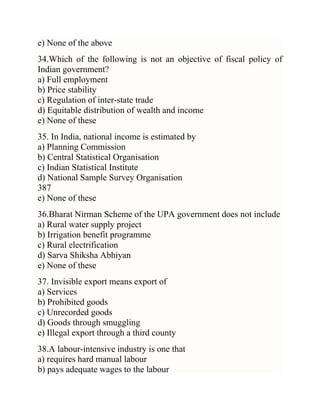
34.Which of the following is not an objective of fiscal policy of
Indian government?
a) Full employment
b) Price stability
c) Regulation of inter-state trade
d) Equitable distribution of wealth and income
e) None of these
35. In India, national income is estimated by
a) Planning Commission
b) Central Statistical Organisation
c) Indian Statistical Institute
d) National Sample Survey Organisation
387
e) None of these
36.Bharat Nirman Scheme of the UPA government does not include
a) Rural water supply project
b) Irrigation benefit programme
c) Rural electrification
d) Sarva Shiksha Abhiyan
e) None of these
37. Invisible export means export of
a) Services
b) Prohibited goods
c) Unrecorded goods
d) Goods through smuggling
e) Illegal export through a third county
38.A labour-intensive industry is one that
a) requires hard manual labour
b) pays adequate wages to the labour
c) employs more hands
d) provides facilities to labour
e) None of these
39.In the law of demand, the statement ‗other things remain
constant‘ means.
a) income of consumer should not change
b) prices of other goods should not change
c) taste of consumer should not change
d) All the above
e) None of these
40.A firm is in equilibrium when its
a) Marginal cost equals the marginal revenue
b) Total cost is minimum
c) Total revenue is maximum
d) Average revenue and marginal revenue are equal
e) None of these
41.Bhagyam oil fields which are being explored by Carins India, is
located in
a) Assam
b) Gujarat
c) Rajasthan
d) Karnataka
e) None of the above
42.In which of the following regions of India has the Archaeological
Survey of India (ASI) found evidences of hearths built by cutting
natural mountains belonging to periods 3,000 to 4,000 years ago, for
the first time?
a) Garo Hills, Meghalaya
b) Mishmi Hills, Arunachal Pradesh
c) Western Ghats
d) Ladakh Valley
e) Satpura Range, Madhya Pradesh
43.Which of the following famous tabloids of Britain recently
ceased its operations after its 168year - long history of scoops and
scandals?
a) The Sun
b) Daily Mirror
c) The Morning Star
d) News of the World
e) None of these
44.Which of the following mobile operators has launched its mobile
newspaper, Newswrap, for its customers in Hyderabad?
a) Airtel
b) Reliance
c) Idea
d) Vodafone
e) Aircel
45.Which of the following countries has taken over the rotational
presidency of the European Union (EU) on July 1, 2011?
a) Denmark
b) Britain
c) Germany
d) Poland
e) Netherlands
46.Which of the following is the youngest country of the world that
has joined the community of nations on July 9, 2011?
a) South Sudan
b) Maldova
c) Estonia
d) East Timor
e) None of these
47. Name the Indian woman athlete who has clinched gold medal in
high jump in the Asian Athletic Championship in Kobe, Japan.
a) Shiny Wilson
b) Mayookha Johny
c) Soma Biswas
d) Neelam Jaswant Singh
e) None of these
48.As on June 30, 2011, which of the following rates stipulated by
the Reserve Bank of India (RBI) is the lowest?
a) Bank Rate
b) Repo Rate
c) Savings Bank Rate
d) Cash Reserve Ratio
e) Statutory Liquidity Ratio
49.Consider the following statements about the contentious issues
in the upcoming India-EU free trade agreement.
A) Intellectual property should be included in the investment
chapter
B) Government procurement policy in agriculture should be kept out
of the purview of the agreement.
C) Greater mutual market access for products such as automobiles,
liquor, textile and liquor.
Which of the above statements is/are true?
a) Only A
b) Only A and B
c) Only A and C
d) All the above
e) None of these
50.Which of the following states has unveiled ―Vision 2025‖
containing clear-cut policies for promoting investments in
infrastructure such as power, ports, and ship building?
a) Andhra Pradesh
b) Tamil Nadu
c) Gujarat
d) Karnataka
e) None of these
ANSWERS:
1.e 2.c 3.e 4.b 5.a 6.d 7.b 8.d 9.b 10.c 11.c 12.b 13.d 14.a 15.a 16.c
17.e 18.d 19.c 20.d 21.d 22.d 23.b 24.a 25.c 26.e 27.a 28.d 29.d 30.c
31.b 32.b 33.c 34.c 35.b 36.d 37.a 38.c 39.d 40.a 41.c 42.d 43.d 44.d
45.d 46.a 47.b 48.c 49.d 50.b
GENERAL AWARENESS MCQs FOR BANK EXAMS
1. Equity schemes managed strong NAV gains, which boost their
assets' was a news in some financial newspapers. What is the full
form of the term NAV as used in above head lines ?
(A) Nil Accounting Variation
(B) Net Accounting Venture
(C) Net Asset Value
(D) New Asset Venture
(D) None of these
Ans : (C)
2. As per reports published in various news papers, mutual fund
companies showed 94 per cent growth in their total profits during
2009-10. This means the profits earned by these companies were 94
percent—
(A) Of the total investments they made collectively during the year
(B) More than their profits during previous year
(C) Of the total capital of the company
(D) Less than the total expenditure of the companies
(D) None of these
Ans : (B)
3. As per the news published in various news papers Pakistan has
imposed 15 per cent regulatory duty on exports of cotton yarn. Why
countries are required to impose regulatory duties on exports of
some of their commodities while in the eyes of the layman more
exports means more foreign exchange and more revenue for the
Govt. ?
1. It is done to control the exports of a commodity as it may be
needed more in local markets than in foreign countries.
2. It is done to control the general inflation in the country as the
inordinate exports of various commodities create imbalance and
also cost push inflation.
3. It is a good short time measure to collect more revenue from the
exports of the commodity which is in high demand in overseas
markets.
(A) Only 1
(B) Only 2
(C) Only 3
(D) All 1, 2 and 3
(E) None of these
Ans : (A)
4. As per the reports published in some major news papers 'ADAG
companies' made good profits during the year. ADAG companies
are popularly known as—
(A) Companies owned by Tata Group
(B) Aditya Birla Companies
(C) Reliance companies
(D) Companies owned by Aptech
(E) None of these
Ans : (C)
5. ONGC – Mittal Energy finds hydrocarbons in two blocks OPL79 & OPL-285 in Nigerian sea was the news in some major news
papers. what is the full form of the term OPL as used in the above
head line ?
(A) Oil Prospecting License
(B) Ownership and Partnership Lease
(C) Overseas Private Line
(D) ONGC Petroleum Ltd.
(E) None of these
Ans : (A)
6. "Mutual Funds reported exceptional performance in 2009-10"
was the news in major financial news papers recently. What is a
mutual fund ?
1. A type of collective investment scheme that pools money from
many investors and invest it in stocks, bonds or other money market
instruments.
2. It is a subsidiary of a bank or financial company created specially
to ralse money to be invested in a particular industry i.e. housing or
insurance etc. The money raised thus cannot be invested anywhere
else.
3. When several banks and financial companies come together and
create a common pool of money to fund mega infrastructural project
like bridges, roads, power plants etc. the common pool is known as
Mutual Fund.
(A) Only 1
(B) Only 2
(C) Only 3
(D) All 1, 2 and 3
(E) None of these
Ans : (B)
7. As we all know the Bank Rate at present is fixed at 6%. What
does it mean in context to the banking operations ?
(A) No bank will be able to give loan to any party on a rate lower
than the Bank Rate
(B) Bank should give loan to their priority sector
customers/borrowers at the rate of 6% only. They cannot charge less
or more than this from their priority sector clients
(C) Banks are required to invest 6% of their total capital on financial
inclusion and inclusive banking operations
(D) Banks will be required to give 6% of their total deposits to the
Govt. of India for meeting its Balance of Trade requirements
(E) None of these
Ans : (A)
8. As per the reports in various news papers many private
companies are trying to obtain the licences to launch a banking
company in India. Which of the following organizations/agencies
issue the licence for the same ?
(A) Securities & Exchange Board of India (SEBI)
(B) Indian Institute of Banking & Finance (IIBF)
(C) Indian Bank Association
(D) Registrar of Companies
(E) None of these
Ans : (E)
9. We very frequently read about Europe's Sovereign—debt crisis
these day. Which of the following statement/s is/are true about the
same ?
1. In early 2010 the Euro crisis developed in some countries like
Greece, Spain and Portugal.
2. This created a credit default swap between the countries of the
European Union.
3. SAARC countries have offered some assistance to some of
severely affected countries like Portugal, Spain & Greece.
(A) Only 1
(B) Only 2
(C) Only 1 and 2
(D) All 1, 2 and 3
(E) None of these
Ans : (A)
10. As we all know the RBI has raised the Cash Reserve Ratio
(CRR) by 25 bps. in April 2010. What action banks will have to take
to implement the same ?
1. They will have to deposit some more money with the RBI as a
reserved money.
2. Banks will be required to give some more loan to projects of the
priority sector.
3. Banks will be required to give loan equivalent to the CRR to the
Govt. of India for its day to day expenditure as and when required.
(A) Only 1
(B) Only 2
(C) Only 3
(D) Only 1 and 2
(E) All 1, 2 and 3
Ans : (A)
11. As per estimates given by the RBI the Economic Growth during
the year 2010-11 will be at which of the following levels ?
(A) 6.5%
(B) 7%
(C) 7.5%
(D) 8%
(E) None of these
Ans : (D)
12. Which of the following is/are correct about the RBI's credit
policy announced in April 2010 ?
1. Repo rate raised by 25 bps.
2. A new reporting platform was introduced for secondary market
transactions in Certificate of Deposits (CDs) and Commercial
Papers (CPs).
3. Core Investment Companies (CICs) having an asset size of Rs.
100 crore are required to register also with the RBI.
(A) Only 1
(B) Only 2
(C) Only 3
(D) All 1, 2 and 3
(E) None of these
Ans : (A)
13. As per the announcement made by the RBI some Stock
Exchanges in India are allowed to introduce Plain Vanilla Currency
Options. The term Plain Vanilla Currency Options is associated with
which of the following activities / operations ?
(A) Dollar – Rupee Exchange Rate
(B) Floating of Commercial Papers
(C) Launch of new mutual funds
(D) Deciding the opening price of a share on a particular business
day
(E) None of these
Ans : (A)
14. Which of the following is not a term related to banking/finance
operations ?
(A) Provision Coverage Ratio
(B) Securitization
(C) Consolidation
(D) Commodification
(E) Derivatives
Ans : (C)
15. The process of "Artificial Application of Water to the soil
usually for assisting in growing crops", is technically known as—
(A) water harvesting
(B) irrigation
(C) water recharging
351
(D) percolation
(E) None of these
Ans : (B)
16. As per the news published in major news papers/journals
henceforth the Credit Card holders will be able to access their credit
card information though automated interactive voice response
system over the phone instead of speaking to the staff. This decision
of the banks/credit card companies will provide—
1. an additional hurdle to the customers as people feel comfortable
in talking to the staff instead of talking to a machine.
2. an additional security to the customers as this does not allow any
staff to handle any transaction directly.
3. some comfort to the banks as they will be able to reduce their
staff strength.
(A) Only 1
(B) Only 2
(C) Only 3
(D) All 1, 2 and 3
(E) Only 1 and 3
Ans : (B)
17. The 34th National Game which were postponed several times
are scheduled to be held in which of the following states ?
(A) Gujarat
(B) Kerala
(C) Tamil Nadu
(D) Uttar Pradesh
(E) Jharkhand
Ans : (E)
18. Waste Water generates which of the following gases which is
more powerful and dangerous than CO2 ?
(A) Nitrogen
(B) Sulphur di-oxide
(C) Hydrogen
(D) Methane
(E) None of these
Ans : (D)
19. Which of the following days was observed as World Water Day
2010 ?
(A) 20th June
(B) 22nd July
(C) 22nd March
(D) 20th May
(E) None of these
Ans : (C)
20. Late Vinda Karandikar who died a few months back was a
famous—
(A) Author
(B) Cine-Actor
(C) Sportsman
(D) Classical Singer
(E) Social Worker
Ans : (A)
21. As per the reports published recently the Govt. of India has
decided to create a separate agency/body scrutinize all Foreign
Direct Investments (FDIs) officially. Up till now the security
screening was being done by the—
(A) Ministry of Foreign Affairs Govt. of India
(B) Reserve Bank of India
(C) Securities & Exchange Board of India
(D) Ministry of Finance, Govt. of India
(E) Ministry of Home Affairs Govt. of India
Ans : (E)
22. As per the news reports in various news papers the USA has
outlined some major policy goals to prevent the danger of nuclear
terrorism. Which of the following is/are included in those policy
goals ?
1. Convene a nuclear security summit within a year's time under the
leadership of the USA.
2. A new agreement/pact should be introduced in place of present
Nuclear Non Proliferation Treaty (NPT).
3. Call for a global effort to secure all nuclear weapons at all
vulnerable sites all over the world.
(A) Only 1
(B) Only 2
(C) Only 1 and 3
(D) Only 2 and 3
(E) All 1, 2 and 3
Ans : (E)
23. 'Indira Gandhi Canal' which is around 450 km long provide
irrigation facility mainly to which of the following states ?
(A) Punjab
(B) Haryana
(C) Madhya Pradesh
(D) Gujarat
(E) Rajasthan
Ans : (E)
24. Former caption of the Indian Cricket team, Ajit Wadekar is
conferred which of the following awards for the year 2010 ?
(A) Bharat Ratna
(B) Khel Shri Award
(C) Dronacharya Award
(D) Rajiv Gandhi Khel Ratna Award
(E) None of these
Ans : (E)
25. Who amongst the following is the director of the popular Hindi
film "Oye Lucky ! Lucky Oye" ?
(A) Mani Ratnam
(B) David Dhavan
(C) Dibankar Banerjee
(D) R. Balakrishnan
(E) None of these
Ans : (C)
26. India recently signed an agreement to import Liquified Natural
Gas (LNG) from a country which is the largest LNG producer and
supplier of the world. Which is that country ?
(A) Kuwait
(B) Qatar
(C) Iran
(D) Saudi Arabia
(E) None of these
Ans : (B)
27. As a measure to help countries hit by global financial meltdown
the RBI has purchased notes worth US $ 10 billion in terms of
Special Drawing Rights from a World Organisation/agency. Which
is this agency/organization ?
(A) Federal Reserve of U.S.A.
(B) Asian Development Bank
(C) World Bank
(D) International Monetary Fund
(E) None of these
Ans : (D)
28. Which of the following is not a public sector undertaking under
the Ministry of Defence, Govt. of India ?
(A) Mazagaon Dock Ltd.
(B) Garden Reach Shipbuilders and Engineers Ltd.
(C) Bharat Heavy Electricals Ltd.
(D) Hindustan Aeronautics Ltd.
(E) Bharat Earth Movers Ltd.
Ans : (C)
29. Which of the following states won the senior National Women's
Football Tournament 2010 ?
(A) Manipur
(B) Assam
(C) Tamil Nadu
(D) Kerala
(E) Delhi
Ans : (A)
30. Which of the following is not a missile developed by the
Defence Research and Development Organisation (DRDO) ?
(A) Shaurya
(B) Pinaka
(C) Brahmos
(D) Agni
(E) Nag
Ans : (A)
31. Which of the following declarations/treaties was adopted by the
BRIC countries recently to promote Global Food Security ?
(A) Moscow Declaration
(B) Doha Treaty
(C) Delhi Declaration
(D) Kabul Treaty
(E) None of these
Ans : (A)
32. Which of the following statements represent(s) the main
objective(s) of the revised National Health Policy–2002 of the Govt.
of India ?
1. Increase Public expenditure from 0•9 per cent to 2 per cent of the
GDP.
2. Setting up of Medical Grants Commission for funding new Govt.
Medical & Dental colleges.
3. Mandatory two years rural posting before awarding the degree to
Medical Graduates.
(A) Only 1
(B) Only 2
(C) Only 3
(D) Only 1 and 3
(E) All 1, 2 and 3
Ans : (E)
33. Which of the following metals is used for genration of nuclear
Energy by most of the Nuclear Power Plants ?
(A) Zinc
(B) Platinum
(C) Uranium
(D) Nickel
(E) None of these
Ans : (C)
34. Indus Water Treaty is a pact on sharing of river water between
India and—
(A) Bangladesh
(B) Pakistan
(C) Nepal
(D) Afghanistan
(E) Myanmar
Ans : (B)
35. The Union Cabinet recently cleared Prohibition of unfair
Practices in Technical Medical Educational Institutes and
Universities Bill 2010. As per the bill which of the following will
now be treated as a cognizable offence ?
(A) Accepting capitation fee from the students
(B) Running a private college
(C) Not allowing students to change their course in between
(D) Running a college without proper facilities
(E) None of these
Ans : (A)
36. Which of the following is/are considered a Renewable Source of
Energy ?
1. Wind Energy
2. Solar Energy
3. Nuclear Energy
(A) Only 1
(B) Only 2
(C) Only 3
(D) Only 1 and 2
(E) All 1, 2 and 3
Ans : (D)
37. Which of the following countries is not amongst the top ten in
industrial production in the world during 2010 ?
(A) India
(B) Iran
(C) China
(D) France
(E) U.S.A.
Ans : (B)
38. Commonwealth Games 2010 are being organized in which of
the following countries ?
(A) Australia
(B) South Africa
(C) Canada
(D) New Zealand
(E) India
Ans : (E)
39. Which of the following is not a banking related term ?
(A) Radiation
(B) Outstanding amount
(C) Benchmark Prime Lending Rate
(D) Explicit Guarantee
(E) Creditor
Ans : (A)
40. Insurance service provided by various banks is commonly
known as—
(A) Investment Banking
(B) Portfolio Management
(C) Merchant Banking
(D) Bancassurance
(E) Micro Finance
Ans : (D)
41. Who amongst the following has recently taken over as the
Chairman of the 19th Law Commission ?
(A) Mr. A. R. Lakshmanan
(B) Mr. P. V. Reddy
(C) Mr. Yashwant Sinha
(D) Mr. Ranjan Bharti Mittal
(E) None of these
Ans : (B)
42. Moortidevi Award is given for excellence in the field of—
(A) Classical dance
(B) Literature
(C) Classical music
(D) Cinematography
(E) Social service
Ans : (B)
43. Which of the following terms is used in the game of Cricket ?
(A) Love
(B) Tee
(C) Penalty stroke
(D) No Ball
(E) None of these
Ans : (D)
44. Which of the following awards is given by an agency of the
United Nations Organization ?
(A) Normon Borloug Award
(B) Kalinga Prize
(C) Ramon Magsaysay Award
(D) Pulitzer Prize
(E) None of these
Ans : (B)
45. Which of the following countries won the Hockey World Cup
2010 ?
(A) Spain
(B) England
(C) India
(D) Australia
(E) None of these
Ans : (D)
46. Who amongst the following is the author of the English novel
'solo', which was given Common Wealth Writers' Prize 2010 ?
(A) Aamer Hussain
(B) Jonathan Tel
(C) Rana Dasgupta
(D) John Torrence Tate
(E) None of these
Ans : (C)
47. Mr. Surjit Patar who was awarded Saraswati Samman recently is
a well known poet of—
(A) Hindi
362
(B) English
(C) Punjabi
(D) Urdu
(E) Bengali
Ans : (C)
48. Which of the following is the book written by Kiran Desai ?
(A) Higher than Everest
(B) A Passage to England
(C) Affluent Society
(D) All my Yester Years
(E) The Inheritance of Loss
Ans : (E)
49. Which of the following Trophies/cups is associated with the
game of Hockey ?
(A) Durand Cup
(B) Santosh Trophy
(C) Rangaswami Cup
(D) Ranji Trophy
(E) K. D. Singh Babu Trophy
Ans : (C)
50. Sandra Bullock who was awarded Oscar recently is a famous—
(A) Actress
(B) Director
(C) Music Composer
(D) Screen play writer
(E) None of these
Ans : (A)
IBPS GENERAL AWARENESS SOLVED QUESTIONS
1. Which of the following statements about CHOGM 2011 is/are
true?
1) The Commonwealth Heads of Government Meeting 2011,
commonly known as CHOGM 2011, was held in Perth, Australia in
October 2011.
2) The 22nd Meeting of the Heads of Government of the
Commonwealth of Nations was chaired by Julia Gillard, the Prime
Minister of Australia.
3) Hamid Ansari, the Vice President, represented India at the
Summit.
4) Canadian Prime Minister Stephen Harper had threatened to
boycott the 2013 CHOGM, to be held in Sri Lanka, if allegations of
human rights abuses against the country's Tamil minority were not
investigated.
5) All the statements are correct.
2. Muammar Qadhafi was killed in October 2011 in his hometown
Sirte. He was the former leader of which of the following countries?
1) Tunisia
2) Egypt
3) Syria
4) Libya
5) Yemen
3. The Election Commission has disqualified Umlesh Yadav, an
MLA from Uttar Pradesh, from contesting again for three years for
suppressing expenditure (the amount spent for issuing the
advertisements) in her election accounts. She is the first political
victim of the paid news phenomenon. She was elected from which
of the following political parties?
1) Rashtriya Janata Dal
2) Samajwadi Party
3) Rashtriya Parivartan Dal
4) Bharatiya Janata Party
5) Bahujan Samaj Party
4. Alain Juppe visited India in October 2011. He is the Minister for
Foreign Affairs of which of the following countries?
1) Germany
2) Italy
3) United Kingdom
4) France
5) Spain
5. M.K.Mani has been honoured with the 40th Dhanvantari Award.
In which of the following fields is this prestigious award given
annually?
1) Print Journalism
2) Cinema
3) Architecture
4) Medical Science
5) Literature
6. The South India's first metro rail service was started in which of
the following cities in October 2011?
1) Chennai
2) Bangalore
3) Hyderabad
4) Cochin
5) None of these
7. Who is the Chairman of the Prime Minister's Economic Advisory
Council (PMEAC)?
1) Bimal Jalan
2) Suresh Tendulkar
3) C.Rangarajan
4) Y.V.Reddy
5) Montek Singh Ahluwalia
8. Shakti-2011 is a joint army exercise between India and which of
the following countries? (It was conducted in Uttarakhand in
October 2011)
1) Sri Lanka
2) France
3) USA
4) China
5) Philippines
9. Who won the National Chess title in Aurangabad in October
2011?
1) Abhijeet Gupta
2) Deepan Chakkravarthy
3) S.P.Sethuraman
4) M.R.Venkatesh
5) Vidit Gujarathi
10. Who has been honoured with the Presidential Citizens Medal by
U.S. President Barack Obama for her courage in overcoming and
speaking out against domestic abuse in the Indian-American
community?
1) Kavya Lahiri
2) Vijaya Emani
3) Kalpana Sen
4) Anuradha Sen
5) None of these
11. Which English cricketer is the author of the book 'The Breaks
are off-My Autobiography'?
1) Kevin Pietersen
2) Graeme Swann
3) Alastair Cook
4) Ian Bell
5) Andrew Strauss
12. Who made history by winning the inaugural Formula One Indian
Grand Prix at the Buddh International Circuit in Greater Noida in
October 2011?
1) Sebastian Vettel
2) Jenson Button
3) Fernando Alonso
4) Mark Webber
5) Michael Schumacher
13. Who was re-appointed the Commonwealth Secretary- General
for four more years in October 2011?
1) Don McKinnon
2) Arnold Smith
3) Kamalesh Sharma
4) Shridath Ramphal
5) None
14. Who received "The Hindu Lite-rary Prize for Best Fiction 2011"
for his/her debut novel "The Sly Company of People Who Care" in
October 2011?
1) N.S.Madhavan
2) Rahul Bhattacharya
3) Amitav Ghosh
4) Anuradha Roy
5) None
15. Who is the author of the book 'The TCS Story…and Beyond'?
1) Ratan Tata
2) N.Chandrasekaran
3) S.Ramadorai
4) N.R.Narayana Murty
5) Nandan Nilekani
16. The National Development Council (NDC) meeting was held in
New Delhi recently. Who is the Chairman of the NDC?
1) Manmohan Singh
2) P.Chidambaram
3) Pranab Mukherjee
4) Sonia Gandhi
5) Montek Singh Ahluwalia
17. Jigme Khesar Namgyel Wangchuck visited India recently. He is
the king of which of the following countries?
1) Nepal
2) Mauritius
3) Thailand
4) Bhutan
5) None of these
18. New Zealand won the Rugby World Cup in October 2011 after
defeating which of the following countries in the final held in
Auckland, New Zealand?
1) USA
2) UK
3) Canada
4) Australia
5) France
19. Ellen Johnson Sirleaf is one of the three recipients of the Nobel
Peace Prize for 2011. She is the President of which of the following
countries?
1) Yemen
2) Liberia
3) Rwanda
4) Sudan
5) Kenya
20. Who is considered as the father of the white revolution in India?
1) M.S.Swaminathan
2) H.G. Khorana
3) U.R.Rao
4) Verghese Kurien
5) None
21. Which of the following terms is used in the game of hockey?
1) Deuce
2) Penalty Corner
3) LBW
4) No Ball
5) Back Hand
22. Which city hosted the 5th IBSA Summit in October 2011?
1) Cape Town
2) Durban
3) Pretoria
4) Johannesburg
5) Bloemfontein
23. Who among the following leaders did not attend the IBSA
Summit in October 2011?
1) Dilma Rousseff
2) Jacob Zuma
3) Manmohan Singh
4) Dmitri Medvedev
5) None of these
24. Who among as following has been elected the President of
Kyrgyzstan? (He is the present Prime Minister)
1) Adakhan Madumarov
2) Kamchibek Tashiyev
3) Almazbek Atambayev
4) Nursultan Nazarbayev
5) None of these
25. Who was presented the Indira Gandhi Award for National
Integration 2010 for his yeoman service in promoting and
preserving the spirit of national integration on October 31, 2011, the
death anniversary of Indira Gandhi?
1) Vijay Darda
2) Mohan Dharia
3) Jaipal Reddy
4) Pranab Mukherjee
5) A.K.Antony
26. Who headed the Committee on direct transfer of subsidies on
Kerosene, LPG and Fertilizers to the beneficiaries?
1) Manmohan Singh
2) Pranab Mukherjee
3) C.Rangarajan
4) Nandan Nilekani
5) Montek Singh Ahluwalia
27. Which of the following programmes launched by the
Government of India aims at enhancing the Livelihood security of
the people in rural areas by guaranteeing hundred days of
employment in a financial year to a rural household?
1) JNNURM
2) ASHA
3) Kutir Jyoyhi
4) Bharat Nirman
5) MGNREGS
28. Which of the following is the period of the first Five Year Plan
in India?
1) 1950-55
2) 1947-52
3) 1951-56
4) 1948-53
5) None of these
29. What is the name of the scheme that was launched by the
Government of India for adolescent girls in November 2010?
1) ASHA
2) Swabhiman
3) Swawalamban
4) SABALA
5) Aadhar
30. PIIGS is an acronym for nations of which of the following
continents?
1) Asia
2) Africa
3) Europe
4)South America
5) North America
31. Who among the following has never worked as RBI Governor?
1) C.Rangarajan
2) Bimal Jalan
3) Manmohan Singh
4) L.K.Jha
5) Yashwant Sinha
32. Which bank has taken over the Centurion Bank of Punjab?
1) ICICI Bank
2) HDFC Bank
3) IDBI Bank
4) AXIS Bank
5) OBC
33. Which country is considered as the pioneer of Micro Finance?
1) India
2) Pakistan
3) Bangladesh
4) Sri Lanka
5) China
Answers
1) 5 2) 4 3) 3 4) 4 5) 4 6) 2 7) 3 8) 2 9) 1 10) 2 11) 2 12) 1 13) 3 14)
2 15) 3 16) 1 17) 4 18) 5 19) 2 20) 4 21) 2 22) 3 23) 4 24) 3 25) 2
26) 4 27) 5 28) 3 29) 4 30) 3 31) 5 32) 2 33) 3
Human Development Report 2011
The 2011 Report—Sustainability and Equity: A Better Future for
All—released by the United Nations Development Programme
(UNDP) on November 2, 2011, notes that Norway, Australia and the
Netherlands lead the world in the 2011 Human Development Index
(HDI), while the Democratic Republic of the Congo, Niger and
Burundi are at the bottom of the Human Development Report‘s
annual rankings of national achievement in health, education and
income. The United States, New Zealand, Canada, Ireland,
Liechtenstein, Germany and Sweden round out the top 10 countries
in the 2011 HDI, but when the Index is adjusted for internal
inequalities in health, education and income, some of the wealthiest
nations drop out of the HDI‘s top 20: the United States falls from #4
to #23, the Republic of Korea from #15 to #32, and Israel from #17
to #25. Gender Inequality Index ranks India at 129 and Inequality
Adjusted HDI rank is 93.
The 2011 HDI covers a record 187 countries and territories, up from
169 in 2010, reflecting in part improved data availability for many
small island states of the Caribbean and the Pacific. The 2011
Report also notes that income distribution has worsened in most of
the world, with Latin America remaining the most unequal region in
income terms, even though several countries, including Brazil and
Chile, are narrowing internal income gaps. Yet in overall IHDI
terms, including life expectancy and schooling, Latin America is
more equitable than sub-Saharan Africa or South Asia. To assess
income distribution, as well as varying levels of life expectancy and
schooling within national populations, the IHDI uses methodology
developed by the renowned British economist Sir Anthony Barnes
Atkinson. Average HDI levels have risen greatly since 1970—41
percent globally and 61 percent in today‘s low-HDI countries—
reflecting major overall gains in health, education and income. The
2011 HDI charts progress over five years to show recent national
trends: 72 nations moved up in rank from 2006 to 2011, led by Cuba
(+10 to #51), Venezuela and Tanzania (+7 each to #73 and #152,
respectively), while another 72 fell in rank, including Kuwait (-8 to
#63) and Finland (-7 to #22).
The 10 countries that place last in the 2011 HDI are all in subSaharan Africa: Guinea, Central African Republic, Sierra Leone,
Burkina Faso, Liberia, Chad, Mozambique, Burundi, Niger, and the
Democratic Republic of the Congo. The Gender Inequality Index
(GII) shows that Sweden leads the world in gender equality, as
measured by this composite index of reproductive health, years of
schooling, parliamentary representation, and participation in the
labour market. Sweden is followed in the gender inequality rankings
by the Netherlands, Denmark, Switzerland, Finland, Norway,
Germany, Singapore, Iceland and France.
Yemen ranks as the least equitable of the 146 countries in the GII,
followed by Chad, Niger, Mali, Democratic Republic of the Congo,
Afghanistan, Papua New Guinea, Liberia, Central African Republic
and Sierra Leone.
The Multi-dimensional Poverty Index (MPI) examines factors at the
family level—such as access to clean water and cooking fuel and
health services, as well as basic household goods and home
construction standards—that together provide a fuller portrait of
poverty than income measurements alone.
Some 1.7 billion people in 109 countries lived in ‗multidimensional‘ poverty in the decade ending in 2010, by the
MPI alculus, or almost a third of the countries‘ entire combined
population of 5.5 billion. That compares to the 1.3 billion people
estimated to live on US$1.25 a day or less, the measure used in the
UN Millennium Development Goals, which seeks to eradicate
―extreme‖ poverty by 2015.
Niger has the highest share of multi-dimensionally poor, at 92
percent of the population, followed by Ethiopia and Mali, with 89
percent and 87 percent, respectively. The 10 poorest nations as
measured by the MPI are all in sub-Saharan Africa. But the largest
group of multi-dimensionally poor is South Asian: India, Pakistan
and Bangladesh have some of the highest absolute numbers of MPI
poor.
India has by far the largest number of multi-dimensionally poor,
according to the Report–612 million, more than half the country‘s
population, and larger than the total number of people measured
according to the same criteria in all sub-Saharan countries. The MPI
also provides insight into environmental problems in the poorest
households, including indoor air pollution and disease from
contaminated water supplies. The Report notes that in South Asia
and sub-Saharan Africa, more than 90 percent of the multidimensionally poor cannot afford clean cooking fuel, relying
principally on firewood, while some 85 percent lack basic sanitation
services.
The 2011 Human Development Report offers important new
contributions to the global dialogue on this challenge, showing how
sustainability is inextricably linked to basic questions of equity—
hat is, of fairness and social justice and of greater access to a better
quality of life. Sustainability is not exclusively or even primarily an
environmental issue, as the Report so persuasively argues. It is
fundamentally about how we choose to live our lives, with an
awareness that everything we do has consequences for the 7 billion
of us here today, as well as for the billions more who will follow, or
centuries to come. Understanding the links between environmental
sustainability and equity is critical if we are to expand human
freedoms for current and future generations. The remarkable
progress in human development over recent decades, which the
global Human Development Reports have documented, cannot
continue without bold global steps to reduce both environmental
risks and inequality. The Report identifies pathways for people,
local communities, countries and the international community to
promote environmental sustainability and equity in mutually
reinforcing ways. In the 176 countries and territories where the
United Nations Development Programme is working every day,
many disadvantaged people carry a double burden of deprivation.
They are more vulnerable to the wider effects of environmental
degradation, because of more severe stresses and fewer coping tools.
They must also deal with threats to their immediate environment
from indoor air pollution, dirty water and unimproved sanitation.
Forecasts suggest that continuing failure to reduce the grave
environmental risks and deepening social inequalities threatens to
slow decades of sustained progress by the world‘s poor majority—
and even to reverse the global convergence in human development.
Major disparities in power shape these patterns. New analysis shows
how power imbalances and gender inequalities at the national level
are linked to reduced access to clean water and improved sanitation,
land degradation and deaths due to indoor and outdoor air pollution,
amplifying the effects associated with income disparities. Gender
inequalities also interact with environmental outcomes and make
them worse. At the global level governance arrangements often
weaken the voices of developing countries and exclude
marginalized groups. Yet, there are alternatives to inequality and unsustainability.
Growth driven by fossil fuel consumption is not a prerequisite for a
better life in broader human development terms. Investments that
improve equity—in access, for example, to renewable energy, water
and sanitation, and reproductive healthcare—could advance both
sustainability and human development. Stronger accountability and
democratic processes, in part through support for an active civil
society and media, can also improve outcomes. Successful
approaches rely on community management, inclusive institutions
that pay particular attention to disadvantaged groups, and crosscutting approaches that coordinate budgets and mechanisms across
government agencies and development partners. The financing
needed for development—including for environmental and social
protection— will have to be many times greater than current official
development assistance. Today‘s spending on low-carbon energy
sources, for example, is only 1.6 percent of even the lowest estimate
of need, while spending on climate change adaptation and
mitigation is around 11 percent of estimated need. Hope rests on
new climate finance. While market mechanisms and private funding
will be vital, they must be supported and leveraged by proactive
public investment. Beyond raising new sources of funds to address
pressing environmental threats equitably, the Report advocates
reforms that promote equity and voice. Financing flows need to be
channelled towards the critical challenges of un-sustainability and
inequity— and not exacerbate existing disparities.
Human development, which is about expanding people‘s choices,
builds on shared natural resources. Promoting human
development requires addressing sustainability—locally, nationally
and globally—and this can and should be done in ways that are
equitable and empowering, says the Report. The environmental
disaster scenario leads to a turning point before 2050 in developing
countries—their convergence with rich countries in HDI
achievements begins to reverse. These projections suggest that in
many cases the most disadvantaged people bear and will continue to
bear the repercussions of environmental deterioration, even if they
contribute little to the problem. For example, low HDI countries
have contributed the least to global climate change, but they have
experienced the greatest loss in rainfall and the greatest increase in
its variability, with implications for agricultural production and
livelihoods. Around the world rising HDI has been associated with
environmental degradation. Countries with faster improvements in
the HDI have also experienced faster increases in carbon dioxide
emissions per capita. These changes over time—rather than the
snapshot relationship—highlight what to expect tomorrow as a
result of development today.
On the other hand, while incomes and economic growth have an
important explanatory role for emissions, the relationship is not
deterministic. And complex interactions of broader forces change
the risk patterns. For example, international trade allows countries to
outsource the production of goods that degrade the environment;
large-scale commercial use of natural resources has different
impacts than subsistence exploitation; and urban and rural
environmental profiles differ. Several countries have achieved
significant progress both in the HDI and in equity and
environmental sustainability. Sweden is notable for its high
reforestation rate compared with regional and global averages.
More generally, however, environmental trends over recent decades
show deterioration on several fronts, with adverse repercussions for
human development, especially for the millions of people who
depend directly on natural resources for their livelihoods. Globally,
nearly 40 percent of land is degraded due to soil erosion, reduced
fertility and overgrazing. Land productivity is declining, with
estimated yield loss as high as 50 percent in the most adverse
scenarios. Agriculture accounts for 70–85 percent of water use, and
an estimated 20 percent of global grain production uses water unustainably, imperilling future agricultural growth.
Deforestation is a major challenge. Between 1990 and 2010, Latin
America and the Caribbean and Sub-Saharan Africa experienced
the reatest forest losses, followed by the Arab States. The other
regions ave seen minor gains in forest cover. Desertification
threatens the dry-lands that are home to about a third of the world‘s
people. Some areas are particularly vulnerable—notably SubSaharan Africa, where the dry-lands are highly sensitive and
adaptive capacity is low.
Adverse environmental factors are expected to boost world food
prices 30–50 percent in real terms in the coming decades and to
increase price volatility, with harsh repercussions for poor
households. The largest risks are faced by the 1.3 billion people
involved in agriculture, fishing, forestry, hunting and gathering. To
the extent that women in poor countries are disproportionately
involved in subsistence farming and water collection, they face
greater adverse consequences of environmental degradation. Many
indigenous peoples also rely heavily on natural resources and live in
ecosystems especially vulnerable to the effects of climate change,
such as small, island developing States, arctic regions and high
altitudes.
Evidence suggests that traditional practices can protect natural
resources, yet such knowledge is often overlooked or downplayed.
The effects of climate change on farmers‘ livelihoods depend on the
crop, region and season, underlining the importance of in-depth,
local analysis. Impacts will also differ depending on household
production and consumption patterns, access to resources, poverty
levels and ability to cope. Taken together, however, the net
biophysical impacts of climate change on irrigated and rain-fed
crops by 2050 will likely be negative—and worst in low HDI
countries.
The MPI measures serious deficits in health, education and living
standards, looking at both the number of deprived people and the
intensity of their deprivations. This year the report explores the
pervasiveness of environmental deprivations among the multiimensionally poor and their overlaps at the household level, an
innovation in the MPI.
The poverty-focused lens allows us to examine environmental
deprivations in access to modern cooking fuel, clean water and basic
sanitation, the report says. These absolute deprivations, important
in hemselves, are major violations of human rights. Ending these
deprivations could increase higher order capabilities, expanding
people‘s choices and advancing human development. In developing
countries at least 6 people in 10 experience one of these
environmental deprivations, and 4 in 10 experience two or more.
These deprivations are especially acute among multi-dimensionally
poor people, more than 9 in 10 of whom experience at least one.
Most suffer overlapping deprivations: 8 in 10 multi-dimensionally
poor people have two or more, and nearly 1 in 3 (29 percent) is
deprived in all three. These environmental deprivations
disproportionately contribute to multi-dimensional poverty,
accounting for 20 percent of the MPI—above their 17 percent
weight in the index. Across most developing countries deprivations
are highest in access to cooking fuel, though lack of water is
paramount in several Arab States. Countries with the lowest share of
poor people facing at least one deprivation are mainly in the Arab
States and Latin American and the Caribbean (7 of the top 10). Of
the countries with the fewest multi-dimensionally poor people with
all three environmental deprivations, better performers are
concentrated in South Asia—5 of the top 10. Several South Asian
countries have reduced some environmental deprivations, notably
access to potable water, even as other deprivations have remained
severe. And five countries are in both top 10 lists—not only is their
environmental poverty relatively low, it is also less intense.
The disease burden arising from indoor and outdoor air pollution,
dirty water and unimproved sanitation is greatest for people in poor
countries, especially for deprived groups. Indoor air pollution
kills times more people living in low HDI countries than
people lsewhere. Disadvantaged groups in low, medium and high
HDI countries face greater risk from outdoor air pollution because
of both higher exposure and greater vulnerability. In low
HDI ountries more than 6 people in 10 lack ready access to
improved water, while early 4 in 10 lack sanitary toilets,
contributing to both disease and alnourishment. Climate change
threatens to worsen these disparities hrough the spread of tropical
diseases such as malaria and dengue ever and through declining
crop yields. Despite near universal primary school enrolment in
many parts of the world, gaps remain. Nearly 3 in 10 children of
primary school age in low HDI countries are not even enrolled in
primary school, and multiple constraints, some environmental,
persist even for enrolled children. Lack of electricity, for example,
has both direct and indirect effects. Electricity access can enable
better lighting, allowing increased study time, as well as the use of
modern stoves, reducing time spent collecting fuel wood and water,
activities shown to slow education progress and lower school
enrolment. Girls are more often adversely affected because they are
more likely to combine resource collection and schooling. Access to
clean water and improved sanitation is also especially important for
girls‘ education, affording them health gains, time savings and
privacy. Household environmental deprivations can coincide with
wider environmental stresses, constricting people‘s choices in a
wide range of contexts and making it harder to earn a living from
natural resources: people have to work more to achieve the same
returns or may even have to migrate to escape environmental
degradation. Environmental stress has also been linked to an
increased likelihood of conflict. The link is not direct, however, and
is influenced by the broader political economy and contextual
factors that make individuals, communities and society vulnerable to
the effects of environmental degradation.
The Gender Inequality Index (GII), updated this year for 145
countries, shows how reproductive health constraints contribute to
gender inequality. This is important because in countries where
effective control of reproduction is universal, women have fewer
children, with attendant gains for maternal and child health and
reduced greenhouse gas emissions. For instance, in Cuba, Mauritius,
Thailand and Tunisia, where reproductive healthcare and
contraceptives are readily available, fertility rates are below two
births per woman. But substantial unmet need persists worldwide,
and evidence suggests that if all women could exercise reproductive
choice, population growth would slow enough to bring greenhouse
gas emissions below current levels. Meeting unmet need for family
planning by 2050 would lower the world‘s carbon emissions an
estimated 17 percent below what they are today.
The GII also focuses on women‘s participation in political decisionmaking, highlighting that women lag behind men across the world,
especially in Sub-Saharan Africa, South Asia and the Arab States.
This has important implications for sustainability and equity.
Because women often shoulder the heaviest burden of resource
collection and are the most exposed to indoor air pollution, they are
often more affected than men by decisions related to natural
resources. Recent studies reveal that not only is women‘s
participation important but also how they participate—and how
much .And because women often show more concern for the
environment, support pro-environmental policies and vote for proenvironmental leaders, their greater involvement in politics and in
non-governmental organizations could result in environmental
gains, with multiplier effects across all the Millennium
Development Goals.
These arguments are not new, but they reaffirm the value of
expanding women‘s effective freedoms. Thus, women‘s
participation in decision-making has both intrinsic value and
instrumental importance in addressing equity and environmental
degradation.
Evidence is accumulating that power inequalities, mediated through
political institutions, affect environmental outcomes in a range of
countries and contexts. This means that poor people and other
disadvantaged groups disproportionately suffer the effects of
environmental degradation. New analysis for the Report covering
some 100 countries confirms that greater equity in power
distribution, broadly defined, is positively associated with better
environmental outcomes, including better access to water, less land
degradation and fewer deaths due to indoor and outdoor air
pollution and dirty water—suggesting an important scope for
positive synergies. The large disparities across people, groups and
countries that add to the large and growing environmental threats
pose massive policy challenges. But there is cause for optimism. In
many respects the conditions today are more conducive to progress
than ever—given innovative policies and initiatives in some parts of
the world. Taking the debate further entails bold thinking, especially
on the eve of the UN Conference on Sustainable Development
(Rio+20) and the dawn of the post-2015 era. The Report advances a
new vision for promoting human development through the joint lens
of sustainability and equity.
A key theme of the Report is the need to fully integrate equity
concerns into policies that affect the environment. Traditional
methods of assessing environmental policies fall short. They might
expose the impacts on the path of future emissions, for example, but
they are often silent on distributive issues. Even when the effects on
different groups are considered, attention is typically restricted to
people‘s incomes. The importance of equity and inclusion is already
explicit in the objectives of green economy policies. The report
proposes taking the agenda further.
Embedding environmental rights in national constitutions and
legislation can be effective, not least by empowering citizens to
protect such rights. At least 120 countries have constitutions that
address environmental norms. And many countries without explicit
environmental rights interpret general constitutional provisions for
individual rights to include a fundamental right to a healthy
environment. Constitutionally recognizing equal rights to a healthy
environment promotes equity by no longer limiting access to those
who can afford it. And embodying this right in the legal framework
can affect government priorities and resource allocations.
Alongside legal recognition of equal rights to a healthy, well
functioning environment is the need for enabling institutions,
including a fair and independent judiciary, and the right to
information from governments and corporations. The international
community, too, increasingly recognizes a right to environmental
information.
Where governments are responsive to popular concerns, change is
more likely. An environment in which civil society thrives also
engenders accountability at the local, national and global levels,
while freedom of press is vital in raising awareness and facilitating
public participation.
The Report proposes an emphasis on four country-level sets of tools
to take this agenda forward:
• Low-emission, climate-resilient strategies—to align human
development, equity and climate change goals.
• Public-private partnerships—to catalyse capital from businesses
and households.
• Climate deal-flow facilities—to bring about equitable access to
international public finance.
• Coordinated implementation and monitoring, reporting and
verification systems—to bring about long-term, efficient results and
accountability to local populations as well as partners.
Finally, it calls for a high-profile, global Universal Energy Access
Initiative with advocacy and awareness and dedicated support to
developing clean energy at the country level. Such an initiative
could kick-start efforts to shift from incremental to transformative
change.
The Report casts light on the links between sustainability and equity
and shows how human development can become more sustainable
and more equitable. It reveals how environmental degradation hurts
poor and vulnerable groups more than others

STOCK
EXCHANGE,
RELATED TERMS

COMMODITY

EXCHANGE

Arbitration :Arbitration is an alternative dispute resolution mechanism provided
by a stock exchange for resolving disputes between the trading
members and their clients in respect of trades done on the exchange.
Barcode Labelling :- A Barcode is a printed code that consists of a
series of vertical bars, which vary in thickness. Barcodes are capable
of being ‗read‘ and decoded by barcode scanners. They are used in
various industries as application tools. They are used to identify
retail sales items, identification cards, library books and other
products. They are also utilised to manage work in progress, to track
documents and for many other automated identification
applications.
Basis Point (bps) :One basis point is one-hundredth of a percentage point.
Book Building :A process used to ascertain and record the indicative subscription
bids of interested investors to a planned issue of securities. The
advantages of this technique of obtaining advance feedback, are that
it results in optimal pricing and removes uncertainty regarding
mobilisation of funds.
Book Value :Book value is the net worth that comprises of equity capital plus
reserves and surplus minus accumulated losses divided by the
number of shares outstanding as rendered in the latest annual report
of a company. The book value of an equity share tends to increase
as the ratio of reserves and surplus to the paid-up equity capital
increases.
Calendar Spread :This is done between futures contracts. The investor buys the near
month contract (ex. October gold) when prices rise or sell the
positions in the near months and purchase the forward months
contracts. This trading is popular in gold, soya, silver, crude, chana,
urad, jeera and chilli.
CDs :-
A Certificate of Deposit (CD) is a negotiable promissory note issued
by the banks and the Financial Institutions (FIs) with a maturity date
of upto a year. It is secure in nature and issued at a discount to the
face value (the redemption to investors takes place at the face
value).
Collateralised Borrowings Lending Obligation (CBLO) :Collateralised Borrowings Lending Obligation (CBLO) is a money
market instrument for borrowing against the securities, held in
custody by the Clearing Corporation of India Limited (CCIL) for the
amount lent.
Commodity Exchange :Like stock exchanges in capital markets, a commodity exchange is
an association or a company or any other body corporate that is
organising futures trading in commodities. The new generation
National-level
exchanges
have
been
set
up
in
corporatised/demutualised environment. There are three nationally
recognised commodity exchanges in India and 22 regional
exchanges. The National exchanges are Multi Commodities
Exchange of India (MCX) in Mumbai, National Commodities and
Derivatives Exchange of India (NCDEX) and National Multi
Commodities Exchange (NMCE).
Commodity:
A commodity is a product having commercial value that can be
produced, bought, sold and consumed. It is normally in a basic raw
unprocessed state. But products derived from primary sector and
structured products are also traded at these exchanges. In India, the
list includes previous metals, ferrous and non-ferrous metals, spices,
pulses, plantation crops, sugar and other soft commodities.
Trading done in the Commodity Exchanges:
Like the stock market online trading system, commodity exchanges
are also typically on the online trading system. It is an order-driven,
transparent trading platform, which is reachable to the various
participants through the Internet, VSAT and leased line modes
operated by members or sub-brokers spread around country.
Demutualisation :- It essentially means segregating the trading
rights to member brokers from the ownership and management of
the exchanges. It aims at curbing the clout of member-brokers in
running the exchanges.
Due Diligence :An internal audit of a target firm by an acquiring firm. Offers are
often made contingent upon resolution of the due dilengence
process.
Exchange Rate :Just as the price of any asset, the exchange rates is the price at which
you can buy that currency. If at any given rate, the demand for a
currency is greater (lesser) than its supply, its price will rise (fall).
What makes currency rates move ?
The exchange rate reflects the strength of an economy in terms of its
growth performance, balance of payments etc. as well as economic
expectations that drive the ‗market sentiment‘ and how much the
market has reacted or ‗discounted‘ the anticipated information.
Are exchange rates entirely market-determined ?
Under the current managed float regime, most currencies, including
India, let their rates fluctuate according to market forces. But if a
currency appears to be ‗overvalued‘ or ‗undervalued‘ by the market
or if rate movements are significantly adversely affecting an
economy‘s macroeconomic performance, then Central banks
intervene to depreciate (or appreciate) their currency. Exchange
rates also move on expectations of change in regulations relating to
exchange markets and official intervention. In India, the Reserve
Bank‘s basic philosophy is a flexible one, without any particular
‗target‘ for the rupee‘s rate. With a broad objective to avoid
excessive volatility, facilitate growth of Indian exports and generate
confidence among overseas investors.
Futures contract :Futures contract is an agreement between two parties to buy or sell a
specified quantity and defined quality of a commodity at a certain
time in future at a price agreed upon at the time of entering into the
contract. This is typically traded at regulated commodity exchanges.
Futures and options :A futures contract is an agreement between two parties to buy or sell
an underlying asset at a certain time in the future at a certain price. It
has a standardised date and month of delivery, quantity and price.
An option gives the buyer the right but not the obligation to buy the
underlying asset. A futures contract on the other hand is obligatory
on both the buyer and the seller is a transaction between the buyer
and seller to buy or sell an asset at an agreed price at a future date.
This is a common feature of options trading in shares, stocks and
commodities.
Geographic Information Systems (GIS) :-
The GIS are computer systems used to store and process geographic
data. The GIS scores over other data management systems in its
ability to present spatial relationships in a digital map form that is
easy to visualise and understand. Data is the central resource of a
GIS system. The GIS systems process two kinds of data-spatial and
attribute. Spatial data gives the geographic location of a point of
interest (e.g. railway station, school, bank branch, the ATM etc).
Attribute data contains other characteristics of that point of interest.
Hot Money :Money that moves across country borders in response to interest rate
differences and that moves away when the interest rate differential
disappears.
Independent Director :An independent Director is a non-executive Director on the board of
a company who has integrity, expertise and independence to balance
the interests of the various stakeholders. The idea of having them is
to bring objectivity to the board decisions and to protect general
interests of the company, including that of the minority and the
small shareholders. The independent Directors are expected to
improve the corporate governance in a company.
Who cannot be an independent Director in a listed company ?
According to the SEBI, having a ‗pecuniary‘ relationship with the
company or its arms, other than receiving the Director‘s
remuneration, is a disqualification. The independent Director must
not be related to the promoters or anyone in the senior management
position from one level below the board. He should not have been
an executive of the company or of its audit, consulting or legal firms
in the past three financial years.
Which listed entities are outside the scope of the revised Clause
49 ?
The Clause will apply to the listed entities which are not companies
but body corporates such as the private and the PSU banks, the
Financial Institutions (FIs) and the insurance companies, only to the
extent that it does not violate the laws governing them. Revised
Clause 49 does not apply to mutual funds.
Inter-exchange arbitrage :This is popular among liquid commodities like gold and silver,
where the arbitrage can take place between the Indian exchanges
and the foreign exchanges, where contract specifications are similar.
Interest Rate Swaps (IRS) :Interest Rate Swaps (IRS) are Over-The-Counter (OTC) products
that involve an exchange of cash flows between the two counter
parties at pre-determined specifications wherein the fixed rate
interest payments are exchanged for floating rate payments.
Islamic Banking :It is banking practiced as per the Islamic principles as prescribed in
the ‗shariah‘ known as ‗Fiqh al-Muamalat‘ (Islamic rules on
transaction). The Islamic law prohibits interest on both the loans and
the deposits. Interest is also called ‗riba‘ in Islamic discourse. The
argument against interest is that money is not good and profit should
be earned on goods and services only and not on control of money
itself.
What are the different products offered ?
Investment finance is offered by these banks through ‗Musharka‘,
where a bank participates as a Joint Venture (JV) partner in a project
and shares the profits and losses. Investment finance is also offered
through ‗Mudabha‘, where the banks contribute the finance and the
client provides the expertise, management and labour and the profits
are shared in a pre-arranged proportion, while the loss is borne by
the bank.
Where is it practised ?
Islamic banks have come into being since the early 70s. There are
nearly 30 Islamic banks all over the world, from Africa, Europe to
Asia and Australia and are regulated even within the conventional
banking system.
Kaizen :Kaizen comes from two words : Kai, which means ‗to change‘ and
zen, which means ‗good or for the better‘. Together, the words mean
continuous change for the better. It is not just a philosophy of the
workplace, it also means continuously improving in every facet of
life, including business, industry, commerce Government and
diplomacy, among others. In full implementation, it becomes the
foundation of all activities. Kaizen requires everyone in the
organisation to be involved in the improvement process executives,
management, supervisors and workers.
Letter of Offer :A Letter of Offer is a document addressed to the shareholders of the
target company containing disclosures of the acquirer/Persons
Acting in Concert (PACs), target company, their financials,
justification of the offer price, the offer price, number of shares to
be acquired from the public, purpose of acquisition, future plans of
acquirer, if any, regarding the target company, change in control
over the target company, if any, the procedure to be followed by
acquirer in accepting the shares tendered by the shareholders and the
period within which all the formalities pertaining to the offer will be
completed.
Merchant Banker :An intermediary who provides various financial services, other than
lending money, such as managing public issues, underwriting new
issues, arranging loan syndications and giving advice on portfolio
management, financial restructuring, mergers and acquisitions.
Mid-cap stock :The name 'mid-cap' originates from the term medium capitalised. It
is based on the market capitalisation of the stock. The National
Stock Exchange (NSE) defines the mid-cap as stocks whose average
six months' market capitalisation is between Rs.75 crore and Rs.750
crore. In the US, the midcap shares are those stocks that have a
market capitalisation ranging from Rs.9,000 crore to Rs.45,000
crore. In India, these shares are classified as large-cap shares.
MIFOR :- MIFOR is an interest rate derivative, which is calculated
by adding dollar London Interbank Offered Rate (LIBOR) rates
with he rupee-dollar forward premia. The MIFOR rate is hence, the
borrowing cost from overseas. It is utilised to hedge against the
movement of global interest rates. LIBOR is the term money
benchmark for the Euro-dollar market.
Net worth :Net worth is the difference between the total assets and total
liabilities.
Participatory Notes (PNs) :- Participatory Notes (PNs) are a
derivative instrument issued by the FIIs to their overseas clients,
who are not registered with the Indian regulators.
Plea Bargaining :-Plea Bargaining is the import of principles of
contract into criminal law.
Penny Stocks :-Penny stocks is a term used to define cheaply
available stocks of typically loss-making companies. Penny stock is
used in the context of general equities. The stocks that typically sell
for less than $1 share, although it may rise to as much as $10/share
after the Initial Public Offering (IPO), usually because of heavy
promotion.
Podcasting :-A term based on the name of Apple‘s portable media
player, allows customers to download audio and now video
segments for free, to their computers and portable devices.
Profit Booking :-Selling shares when their prices have risen above
their purchase price.
Profit taking :-Selling commodities, securities etc. at a profit, either
after a market rise or because they show a profit at current levels but
will not do so if an expected fall in prices occurs.
Settlement :-Settlement refers to the import of principles of contract
into civil or administrative law.
The Cash and Carry Arbitrage :- This is the easiest form of
arbitrage, where the investor has to buy the commodity in the spot
market and sell it in the futures market. This is largely successful in
gold and silver and is also popular among various agricultural
commodities.
The Price Earning ratio (P/E ratio) :-The P/E ratio is the ratio
between the Market Price of the Share (MPS) and the Earning Per
Share (EPS). This ratio tells us how many times the market price of
the shares is vis-à-vis its earning per share.
IBPS CLERKS EXAM GENERAL STUDIES PRACTICE
QUESTIONS
1. We read in the newspapers about the deregulation of the pricing
of petroleum products by the Government of India. Consider the
following outcomes of the above step:
A This will make petroleum products prices cheaper and the pricing
system will become more transparent.
B. This will improve the financial health of the country's Oil
Marketing Companies (OMCs) and contribute to fiscal
consolidation
C. This will end the subsidy on petroleum products. Which of the
above statements holds correct?
a. Only A
b. Only B
c. Only B and C
d. Only A and C
e. None of these
2. Which of the following committees
recommendations on "Financial inclusion"?
a. Vaghul Committee
b. Raghuram Rajan Committee
c. Rakesh Mohan Committee
d. Kelkar Committee
e. None of these

has

given

its

3. The agricultural census is done at which of the following
intervals?
a. There is no fixed term
b. Every year
c. Once in 3 years
d. Once in 10 years
e. Once in 5 years
4. Development of watershed and dry land farming is the part of
which of the following points of the Twenty point Programe of the
Government of India?
a. Kisan Mitra
b. Khadya Suraksha
c. Garibi Hatao
d. Jan Shakti
e. None of these
5. The high rate growth of economy certainly reduces
a. Gender inequalities
b. Poverty
c. Population of a county
d. Flow of foreign investment
e. None of these
6. In economic, it is generally believed that the main objective of a
public sector financial company, like bank is to
a. Employ more and more people
b. Maximise total profits
c. Maximise total production
d. Provide financial services to the people across the country
e. Sell goods at subsidized
7. Whenever the RBI does some Open Market Operation
transaction, it actually wishes to regulate which of the following?
a. Inflation only
b. Liquidity in economy
c. Borrowing powers of the banks
d. Flow of foreign direct investment
e. None of these
8. What is Repo Rate?
a. It is the rate at which RBI sells government securities to banks.
b. It is the rate at which banks borrow rupees from RBI.
c. It is the rate at which RBI allows small loans in the market
d. It is the rate which is offered by banks to their most valued
customers or prime customers
e. None of these
9. In a company, the use of price-sensitive corporate information by
the company people to make gains or cover losses is known as
a. Insider trading
b. Future trading
c. Foreign trading
d. Stock trading
e. None of these
10. As per the instructions of the RBI, banks are required to give
what percentage of their priority sector lending to weaker sections
of the society?
a.15%
b.25% .
c. 30%
d. 35%
e. 40%
11. The process of the total valuation of the financial assets of a
company is technically known as ' :
a. Market capitalization
b. Gross Domestic Product
c. Net wealth of the country
d. Gross Domestic Resources
e. None of these
12. Many a time, we read about rural indebtedness in various
newspapers and magazines. What are the main causes of the rural
indebtedness?
A Poverty
B. Inability to repay loans
C. Zamindari System, which prevented farmers from owning the
land
a. Only A
b. Only B
c. Both A and B
d. Only C
e. All of these
13. Very often we read about Special Economic Zones (SEZs) in
newspapers. What is the purpose of promoting SEZs in India?
A. They are established to promote exports.
B. They are established to attract investments from foreign
countries.
C They are established to help the poorest of the poor in India as
the activities of these zones are reserved only for the poor and
those living below the poverty line.
a. Only A
b. Only B
c. Only C
d. Only A and B
e. None of these
14. Which of the following is the percentage up to which FDI in
defence sector is allowed?
a. 26%
b.41%
c. 31%
d.49%
e. None of these
15. The maximum amount of the total revenue earned by the
Government of India comes from
a. Income Tax
b. Customs Duty
c. Excise Duty
d. Value Added Tax
e. Corporate Tax
16. Which public sector bank celebrated its Platinum Jubilee in late
2010?
a. Dena Bank
b. Bank of Maharashtra
c. Bank of Baroda
d. Canara Bank
e. None of these
17. Which of the following is not among the six infrastructure
industries that comprise the "Core Sector"?
a. Crude oil
b. Petroleum refinery products
c. Chemicals and fertilizers
d. Coal
e. All the above
18. Who among the following will the chairperson of the committee
set up by the RBI on "Customer Services in Banks"?
a. YV Reddy
b. Deepak Prakash
c. M Damodaran
d. Subbarao
e. None of these
19. Which of the following is the full form of 'BRA" as used in
banking industry?
a. Brazilian and Russian Association
b. Banking Restructuring Act
c. Borrowing Risk Assessment
d. Banking Regulation Act
e. None of these
20. The Securities and Exchange Board of India has decided to
allow _____ to visit SEBI Bhavan to help them learn about the
capital market regulator. .
a. Students
b. Foreign investors
c. Tourists d. Press
d. Press
e. None of these
21. Which state government has announced to undertake a detailed
census of cancer patients in the state?
a. Delhi
b. Haryana
c. Punjab
d. Orissa
e. None of these
22. The Central Government has revised wages of agricultural
labourers under the Mahatma Gandhi National Rural Employment.
The basic wage is revised once in
a. 2 Years
b. 3 Years
c. 4 Years
d. 5 Years
e. None of these
23. Which of the following cannot be called a Debt Instrument as
referred in financial transactions?
a. Certificate of Deposits
b. Bonds
c. Stocks
d. Commercial Papers
e. Loans
24. Which of the following correctly describes sub-prime lending?
A. Lending to people with less than ideal credit status
B. Lending to people who are valued customers of the banks
C. Lending to those who are not regular customers of a bank
a. Only A
b. Only B
c. Only C
d. Only A and B
e. None of these
25. Which of the following services provided by a bank in India is
not liable for taxation for Service Tax as per existing laws?
a. Safe Deposit Lockers
b. Merchant Banking Services
c. Credit cards
d. Discount earned on certain discounted bills
e. None of these
26. For the revival of which of the following fertilizer units of the
Fertilizer Corporation of India has the Steel Authority of India
Limited been the given the go-ahead by the Cabinet Committee on
Economic Affairs (CCEA) recently?
a. Burnpur
b. Sindri
c. Rourkela
d. Bhilai
e. None of these
27. According to the latest figures released by the Commerce
Ministry. What Is the percentage growth of India's exports durina
2010 -11?
a.46.%
b.45.7 %
c. 52 %
d. 56.9 %
e. None of these
28. Telecom Commission, the apex decision-making body of the
Department of Telecom has permitted Imposition of a uniform
licence fee of _______ on all telecom operators.
a. 6%
b. 6.6%
c. 8.5%
d.10%
e. None of these
29. Securities and Exchange Board of India (SEBI) has proposed to
create regulations for alternative investment funds under the title
'SEBI (Alternative Investment Fund) Regulations'. With regard to
this proposal, which of the following is/are not true?
a. SEBI made it optional for all types of private pools of capital or
investment funds to seek registration with SEBI.
b. For PE funds, investments would be mainly in unlisted companies
or companies proposed to be listed.
c. For infrastructure equity funds, minimum half of the investment
would, have to be in equity of infrastructure projects/companies.
d. Only 1 and 2
e. None of these
30. Name the sports channel that has acquired the exclusive
broadcast rights for Euro 2012 in the Indian subcontinent (India,
Pakistan, Sri Lanka, Bangladesh, Nepal, Bhutan and Maldives) for
`100 crore.
a. ESPN
b. DD Sports
c. Neo Sports
d. Ten Sports
e. None of these
31. NASA scientists have recently announced that they have found
the first evidence of flowing water on which of the following
planets.
a. Mars
b. Jupiter
c. Mercury
d. Venus
e. None of these
32. Italy approved a draft law banning women from wearing veils in
public. Besides Italy which of the following nations have banned
women from wearing veil in public?
a. India and Pakistan
b. China and Afghanistan
c. Belgium and France
d. Bangladesh and Bhutan
e. None of these
33. The Prime Ministers Economic Advisory Council headed by C
Rangarajan has submitted its report on economy-"The Economic
Outlook and the Review". Who among the following is not a
member of it?
a. Suman K Bery
b. Dr Sumitra Chaudhary
c. M Govinda Rao
d. BB Bhattacharya
e. Dr KP Krishnan
34. Which of the following departments of the Government of India
has initiated the Public Bicycle Scheme for 10 cities under the
Mission for Sustainable Habitat?
a. Rural Development Ministry
b. Urban Development Ministry
c. Environment Ministry
d. Surface Transport Ministry
e. None of these
35. After allegations of bio-piracy complaints against US based
multinational Monsanto with regard to Bt brinjal, for the hybrid
research of which of the folio wing vegetable products is the
National Biodiversity Authority of India (NBA) processing
Monsanto's application?
a. Cauliflower
b. Bittergourd
c. Cabbage
d. Potato
e. Onion
36. Consider the following negative impacts on the Indian economy
in the context of the ongoing US debt crisis:
A. Adverse impact on Indian exports
B. RBI will be forced to cut down interest rates
C. FDI flow will slow down.
a. Only A
b. Only A and B
c. Only A and C
d. All A, B and C
e. None of the above
37. Name the Indian executive in the global credit rating agency
Standard and Poor's under whose leadership the decision of the
historic credit downgrade of the United States was taken and later
he was forced to step down.
a. Sanjay Saini
b. Karan Bhagat
c. Rajat Gupta
d. Devesh Sharma
e. None of these
38. Who has written the book The Financial inclusion: Imperative
and Sustainable Approaches?'
a. Deepali Pant Joshi
b. C Rangarajan
c. M Damodaran
d. Amartya Sen.
e. None of these
39. Who is the author of the book Last Man In Tower?
a. Jhumpa Lahiri
b. Samit Basu
c. Aravind Adiga
d. Amit Chaudhary
e. None of these
40. Goldman Sachs; citing improvement in macroeconomic
situation, has recently upgraded India's rating from 'underweight' to
a. Overweight
b. Market weight
c. In-line
d. Underperformer
e. Market outperformer
41. In which of the following states did the Sadar Hills District hood
Demand Committee (SHDDC) recently impose an economic
blockade in pursuance of their demand for a separate district?
a. Manipur
b. Meghalaya
c. Tripura
d. Assam
e. Arunachal Pradesh
42. In which of the following public sector companies has the
government recently offloaded its stake to mop up revenue to the
tune of Rs.1,144 crores?
a. Indian Oil Corporation
b. Rashtriya Ispat Nigam Limited
c. Power Finance Corporation
d. Hindustan Copper
e. None of these
43. What is the revenue target from disinvestment in Central public
sector enterprises set in the Union Budget 2011-12?
a. Rs. 40,000 crore
b. Rs. 50,000 crore
c. Rs. 70,000 crore
d. Rs. 90,000 crore
e. None of these
44. In which of the following Western countries did large scale
rioting take place in predominantly African and Caribbean
neighbourhoods recently?
a. France
b. Germany
c. Italy
d. England
e. None of these
45. PC Alexander, who died recently, was a veteran
a. Bureaucrat
b. Nuclear scientist
c. Educationist
d. Environmentalist
e. None of these
46. Who is the chairman of the National Commission for Scheduled
Castes?
a. Justice KG Balakrishnan
b. Wajahat Habibullah
c. Justice MN Rao
d. PL Punia
e. None of these
47. Justice Soumitra Sen, against whom impeachment proceedings
have been initiated in the Parliament, is the judge of
a. Sikkim High Court
b. Kamataka High Court
c. Calcutta High Court
d. Guwahati High Court
e. None of these
48. Name the chief of the three-member interlocution team on
Kashmir which is to submit its report to the government shortly.
a. NM Ansari
b. Rdha Kumar
c. Dileep Padgaonkar
d. Karan Singh
e. None of these
49. Who is the author of the book Through the Corridors of Power:
Insider Story?
a. HNHaksar
b. Brijesh Mishra
c..CP Bhambhri
d. Kuldip Nayar
e. PC Alexander
50 Which of the following states provides the Vishwakarma
Contributory Pension Scheme to the labourers of 20 trades of the
unorganized sector?
a. Uttar Pradesh
b. Punjab
c. Madhya Pradesh
d. Bihar
e..Rajasthan
ANSWERS:
1. b 2. b 3. e 4. a 5. b 6. d 7. b 8. b 9. a 10. A 11. a 12. e 13. d 14. a
15. c 16. b 17. c 18. c 19. d 20. A 21. c 22. d 23. c 24. a 25. c 26.
b 7. d 28. c 29. C 30. c 31. a 32. c 33. d 34. b 35. e 36. c 37. d 38. a
39. c 40. B 41. a 42. c 43. a 44. d 45. a 46. d 47. c 48. c 49. e 50. e

Banking gk

  • 1.
    IBPS GENERAL AWARENESSMCQs 1. Which among the following is not the nationalized bank? 1) Andhra Bank 2) Syndicate bank 3) Axis bank 4) Central Bank of India 5) Oriental Bank of Commerce 2. Banks cannot accept ........... 1) Cash 2) Postal Stamps 3) Drafts 4) Bill of exchange 5) pay order 3. Cheque facility is not available in ...........? 1) Savings Account 2) Current Account 3) Recurring Account 4) Savings and Current Account 5) All of above 4. The Demand Draft can be issued to ...........? 1) Farmer 2) Student 3) Government employee 4) Business man 5) All of above 5. Core banking means ...........? 1) Connectivity between all branches and RBI 2) Connectivity between all branches and the branches of other bank 3) Connectivity of branches, ATM and online systems of all branches
  • 2.
    4) Connectivity betweenall RRB's and RBI 5) None 6. Which of the following rate usually not declared by RBI? 1) SLR 2) CRR 3) Base rate 4) Repo Rate 5) Reverse repo Rate 7. In private sector bank, the government may have the stake up to ........... percent? 1) 50 2) 51 3) 100 4) 49 5) 0 8. In public sector bank, the government stake must be least ...........percent? 1) 50 2) 100 3) 90 4) 51 5)1 9. NEFT rules are given. Pick the wrong one? 1) NEFT means National Electronic Fund Transfer 2) Up to 2 lakhs the amount can be transferred 3) Both in Savings and Current Account the funds can be transferred 4) The minimum charge on this type of transfer is Rs.1000 5) Many private and Public Sector banks offer this facility these days 10. RTGS rules are given. Pick the wrong one?
  • 3.
    1) RTGS meansReal Time Gross Settlement 2) Above 2 lakhs the funds can be transferred 3) RTGS facility not available in current account 4) The charges of RTGS to be paid by the customer 5) All of above 11 All savings bank accounts carry nominee name. A nominee cannot be ...........? 1) Friend 2) Mother 3) Father 4) Son 5) Daughter 12. On 19 October 2011, Pranab Mukarjee said the Union Government inject the funds in to public sector banks to maintain Tier Capital of ...........percent? 1) 5 2) 10 3) 6 4) 7 5) 8 13. The negotiable instrument is ...........? 1) Cheque 2) Demand draft 3) Bill of Exchange 4) Treasury Bills 5) All of above 14. Negotialble instruments rules and regulations mentioned by ...........? 1) Negotiable cheque Act 1901 2) Negotiable instruments Act 1901 3) Negotiable instruments Act 1818
  • 4.
    4) Negotiable instrumentsAct 1881 5) None 15. Usually there are three parties in the case of Cheque. The drawer is ...........? 1) One who writes cheque 2) One who receives cheque 3) One who mediates cheque 4) 1 & 3 5) None 16. In the cheques, the drawee is........... 1) One who writes cheque 2) One who mediates cheque 3) RBI 4) Bank 5) All of above 17. Drawing two or three lines on the left head of cheque is called ...........? 1) Nullity 2) Paid 3) Offering 4) Crossing 5) Nothing 18. Crossing means the bank should ...........? 1) Make the payment stop 2) Make the payment late 3) Make the payment to payee through account only 4) Pay the amount to anybody 5) None 19. The cheque bounce due to ...........? 1) If the correct date written
  • 5.
    2) If theSunday date written 3) If the public holiday date written 4) If the date is the 30th of any month 5) Post date written 20. Cheque bounce due to ...........? 1) More funds 2) Funds not excessive at least Rs.1000 3) Lack of funds 4) If the amount has paise denomination 5) In all above cases 21. Cheque bounce due to ...........? 1) If the cheque is given with signature 2) If the cheque issued to government employee 3) Alteration made without signature 4) If the cheque value is more than 50 lakhs 5) In all above cases 22. On 20th October 2011, State Bank of India declared it earned 3.5 NIM in the second quarter. NIM stands for ...........? 1) Net Interest Minimum 2) Not Interest Margin 3) Net Internal Margin 4) Net Interest Module 5) Net Interest Margin 23. ETF stands for ...........(In these days the people are buying GOLD ETF bonds) 1) Extra Trade Forum 2) Exchange Trade Finance 3) Eternal Trade Fund 4) Exchange Trade Forum 5) Exchange Traded Fund
  • 6.
    24. Chairman ofthe National Advisory Committee on Accounting Standards is ...........? 1) D.Subba Rao 2) Y.V.Reddy 3) Y.H.Malegam 4) K.C.Chakravarthy 5) Montek Singh Ahluwalia 25. Which financial institute declared October month as Social Security Month? 1) SBI 2) Religare 3) LIC 4) India First 5) GIC 26. FAO conference on East Africa famine concluded in ...........? 1) Rome 2) Vienna 3) Newyork 4) Washington 5) Canberaa 27. UN AIDS ambassador ...........participated in International AIDS conference on 7 Oct 2011 at Moscow? 1) Preity Zinta 2) Sharmila Tagore 3) Leela Samson 4) Mamatha Sharma 5) Shantha Sinha 28. Two public sector enterprises applied for the status of Maharatna recently. They are ...........? 1) CIL,HCL
  • 7.
    2) ONGC,SBI 3) IOC,NTPC 4)SAIL,BEL 5) BHEL,GAIL 29. H- 1 (2011-2012)tax collection increased by ........... percent leading the collection to Rs.4,25,712 crores? 1) 14.5 2) 20.6 3) 22.1 4)18.9 5) 25.6 30. The global economic growth in 2011 will be nearer to ........... percent only, compare to 4 percent in 2010? 1) Eight 2) Ten 3) Six 4) Seven 5) Three 31. ...........has introduced the nation's first petrol pump with self service refuelling facility in New Delhi? 1) ONGC 2) HP 3) IOC 4) BP 5) None 32. The second highest test Century (35) maker is Dravid. He is the cricketer from ...........? 1) Andhra Pradesh 2) Mumbai 3) Delhi
  • 8.
    4) West Bengal 5)Karnataka 33. Baichiung Bhutia retired from international events. He is the former Indian ........... captain? 1) Volley ball 2) Foot Ball 3) Cricket 4) Kho Kho 5) Kabbaddi 34. The term gully used in ...........? 1) Foot ball 2) Volley ball 3) Hand ball 4) Hockey 5) Cricket 35. The FIFA(Federation of International Football Association) world cup venues given. Pick the correct one? 1) 2010-South Africa 2) 2014-Brazil 3) 2018-Russia 4) 2022-Qatar 5) All of above 36. ...........released $ 1.5 billion aid to Libya on 27 August 2011? 1) USA 2) Russia 3) UNO 4) IBRD 5) IMF 37. Union government sanctioned Rs............crores for tracking cyclones in coastal states?
  • 9.
    1) 1500 2) 2500 3)2000 4) 1700 5) 900 38. Fast attack warship ........... commissioned in Indian Navy on 26 August 2011? 1) Kaurava 2) Pandava 3) Karna 4) Salya 5) None 39. The Prime Minister announced the free import of 61 items from Bangladesh. The currency of Bangladesh is...........? 1) Dollar 2) Rupee 3) Ngultrum 4) Pound 5) Taka 40. Among 28 states in India, 17 states have Lokayukta. The first Lokayukta established in 1970 is ........... 1) Odisha 2) Andhra Pradesh 3) Assom 4) Tamilnadu 5) Sikkim 41. The Lokayukta who inducted Yedurappa, the chief minister of Karnataka is ...........? 1) Justice Rey
  • 10.
    2) Justice Kania 3)Justice Panduranga 4) Justice Sudha Misra 5) Justice Santosh Hegdey 42. The Lokayukta who resigned in Karnataka on the allegations of Land Scam? 1) Justice Nanavathi 2) Justice Bhagavathi 3) Justice Chandra Chud 4) Justice Mukarjee 5) Justice Sivaraj Patil 43. Recently the inventor of iPad died. He is ...........? 1) Edwin H. Armstrong 2) Charles Babbage 3) Steve Jobs 4) William Seward Burroughs 5) George Eastman 44. On 17th August 2011, ...........topped as most valuable firm crossing RIL ( Reliance Industries Limited) in market capitalization? 1) BHEL 2) ISRO 3) Bharati Cement 4) Coco-Cola 5) Coal India Limited 45. Top three destinations of Indian exports as per e-Bay site? 1) Eurpoe,USA and UK 2) USA,UK and Germany 3) USA, Indonesia and China 4) USA,UK and Europe
  • 11.
    5) USA,UK andAustralia 46. The export promotion scheme 'Focus: LAC' applies to ...........? 1) European Union 2) North America 3) South East Asia 4) Africa 5) South America 47. 100th International Labour Organization summit held in ...........on 13 June 2011? 1) Geneva 2) Paris 3) New York 4) Washington 5) Rome 48. National convention of Parliamentarians, Legislators, zilla parishad chairpersons and mayors on HIV/ AIDS held in...........on 4, 5 July 2011? 1) Mumbai 2) Hyderabad 3) Chennai 4) New Delhi 5) Pune 49. World Investors summit will be held in .......... 1) Hyderabad 2) New Delhi 3) Bengaluru 4) Chennai 5) Kolkata ANSWERS:
  • 12.
    1)3 2)2 3)34)5 5)3 6)3 7)4 8)4 9)4 10)3 11)1 12)5 13)5 14)4 15)1 16)4 17)4 18)3 19)5 20)3 21)3 22)5 23)5 24)3 25)3 26)1 27)1 28)5 9)3 30)5 31)3 32)5 33)2 34)5 35)5 36)3 37)1 38)1 39)5 40)1 41)5 42)5 43)3 44)5 45)5 46)5 47)1 48)4 49)3. BANKING & FINANCIAL TERMS • Accrued interest : Interest due from issue date or from the last coupon payment date to the settlement date. Accrued interest on bonds must be added to their purchase price. • Arbitrage : Buying a financial instrument in one market in order to sell the same instrument at a higher price in another market. • Ask Price : The lowest price at which a dealer is willing to sell a given security. • Asset-Backed Securities (ABS) : A type of security that is backed by a pool of bank loans, leases, and other assets. Most ABS are backed by auto loans and credit cards – these issues are very similar to mortgage-backed securities. • At-the-money : The exercise price of a derivative that is closest to the market price of the underlying instrument. • Basis Point : One hundredth of 1%. A measure normally used in the statement of interest rate e.g., a change from 5.75% to 5.81% is a change of 6 basis points .• Bear Markets : Unfavorable markets associated with falling prices and investor pessimism. • Bid-ask Spread : The difference between a dealer‘s bid and ask price. • Bid Price : The highest price offered by a dealer to purchase a given security.
  • 13.
    • Blue Chips: Blue chips are unsurpassed in quality and have a long and stable record of earnings and dividends. They are issued by large and well-established firms that have impeccable financial credentials. • Bond : Publicly traded long-term debt securities, issued by corporations and governments, whereby the issuer agrees to pay a fixed amount of interest over a specified period of time and to repay fixed amount of principal at maturity. • Book Value : The amount of stockholders‘ equity in a firm equals the amount of the firm‘s assets minus the firm‘s liabilities and preferred stock. /p> • Broker : Individuals licensed by stock exchanges to enable investors to buy and sell securities. • Brokerage Fee : The commission charged by a broker. • Bull Markets : Favorable markets associated with rising prices and investor optimism. • Call Option : The right to buy the underlying securities at a specified exercise price on or before a specified expiration date. • Callable Bonds : Bonds that give the issuer the right to redeem the bonds before their stated maturity. • Capital Gain : The amount by which the proceeds from the sale of a capital asset exceed its original purchase price. • Capital Markets : The market in which long-term securities such as stocks and bonds are bought and sold.
  • 14.
    • Certificate ofDeposits (CDs) : Savings instrument in which funds must remain on deposit for a specified period, and premature withdrawals incur interest penalties. • Closed-end (Mutual) Fund : A fund with a fixed number of shares issued, and all trading is done between investors in the open market. The share prices are determined by market prices instead of their net asset value. • Collateral : A specific asset pledged against possible default on a bond. Mortgage bonds are backed by claims on property. Collateral trusts bonds are backed by claims on other securities. Equipment obligation bonds are backed by claims on equipment. • Commercial Paper : Short-term and unsecured promissory notes issued by corporations with very high credit standings. • Common Stock : Equity investment representing ownership in a corporation; each share represents a fractional ownership interest in the firm. • Compound Interest : Interest paid not only on the initial deposit but also on any interest accumulated from one period to the next. • Contract Note : A note which must accompany every security transaction which contains information such as the dealer‘s name (whether he is acting as principal or agent) and the date of contract. • Controlling Shareholder : Any person who is, or group of persons who together are, entitled to exercise or control the exercise of a certain amount of shares in a company at a level (which differs by jurisdiction) that triggers a mandatory general offer, or more of the voting power at general meetings of the issuer, or who is or are in a position to control the composition of a majority of the board of directors of the issuer.
  • 15.
    • Convertible Bond: A bond with an option, allowing the bondholder to exchange the bond for a specified number of shares of common stock in the firm. A conversion price is the specified value of the shares for which the bond may be exchanged. The conversion premium is the excess of the bond‘s value over the conversion price. • Corporate Bond : Long-term debt issued by private corporations. • Coupon : The feature on a bond that defines the amount of annual interest income. • Coupon Frequency : The number of coupon payments per year. • Coupon Rate : The annual rate of interest on the bond‘s face value that a bond‘s issuer promises to pay the bondholder. It is the bond‘s interest payment per dollar of par value. • Covered Warrants : Derivative call warrants on shares which have been separately deposited by the issuer so that they are available for delivery upon exercise. • Credit Rating : An assessment of the likelihood of an individual or business being able to meet its financial obligations. Credit ratings are provided by credit agencies or rating agencies to verify the financial strength of the issuer for investors. • Currency Board : A monetary system in which the monetary base is fully backed by foreign reserves. Any changes in the size of the monetary base has to be fully matched by corresponding changes in the foreign reserves. • Current Yield : A return measure that indicates the amount of current income a bond provides relative to its market price. It is shown as: Coupon Rate divided by Price multiplied by 100%.
  • 16.
    • Custody ofSecurities : Registration of securities in the name of the person to whom a bank is accountable, or in the name of the bank‘s nominee; plus deposition of securities in a designated account with the bank‘s bankers or with any other institution providing custodial services. • Default Risk : The possibility that a bond issuer will default ie, fail to repay principal and interest in a timely manner. • Derivative Call (Put) Warrants : Warrants issued by a third party which grant the holder the right to buy (sell) the shares of a listed company at a specified price. • Derivative Instrument : Financial instrument whose value depends on the value of another asset. • Discount Bond : A bond selling below par, as interest in-lieu to the bondholders. • Diversification : The inclusion of a number of different investment vehicles in a portfolio in order to increase returns or be exposed to less risk. • Duration : A measure of bond price volatility, it captures both price and reinvestment risks to indicate how a bond will react to different interest rate environments. • Earnings : The total profits of a company after taxation and interest. • Earnings per Share (EPS) : The amount of annual earnings available to common stockholders as stated on a per share basis. • Earnings Yield : The ratio of earnings to price (E/P). The reciprocal is price earnings ratio (P/E).
  • 17.
    • Equity :Ownership of the company in the form of shares of common stock. • Equity Call Warrants : Warrants issued by a company which give the holder the right to acquire new shares in that company at a specified price and for a specified period of time. • Ex-dividend (XD) : A security which no longer carries the right to the most recently declared dividend or the period of time between the announcement of the dividend and the payment (usually two days before the record date). For transactions during the ex-dividend period, the seller will receive the dividend, not the buyer. Exdividend status is usually indicated in newspapers with an (x) next to the stock‘s or unit trust‘s name. • Face Value/ Nominal Value : The value of a financial instrument as stated on the instrument. Interest is calculated on face/nominal value. • Fixed-income Securities : Investment vehicles that offer a fixed periodic return. • Fixed Rate Bonds : Bonds bearing fixed interest payments until maturity date. • Floating Rate Bonds : Bonds bearing interest payments that are tied to current interest rates. • Fundamental Analysis : Research to predict stock value that focuses on such determinants as earnings and dividends prospects, expectations for future interest rates and risk evaluation of the firm. • Future Value : The amount to which a current deposit will grow over a period of time when it is placed in an account paying compound interest.
  • 18.
    • Future Valueof an Annuity : The amount to which a stream of equal cash flows that occur in equal intervals will grow over a period of time when it is placed in an account paying compound interest. • Futures Contract : A commitment to deliver a certain amount of some specified item at some specified date in the future. • Hedge : A combination of two or more securities into a single investment position for the purpose of reducing or eliminating risk. • Income : The amount of money an individual receives in a particular time period. • Index Fund : A mutual fund that holds shares in proportion to their representation in a market index, such as the S&P 500. • Initial Public Offering (IPO) : An event where a company sells its shares to the public for the first time. The company can be referred to as an IPO for a period of time after the event. • Inside Information : Non-public knowledge about a company possessed by its officers, major owners, or other individuals with privileged access to information. • Insider Trading : The illegal use of non-public information about a company to make profitable securities transactions • Intrinsic Value : The difference of the exercise price over the market price of the underlying asset. • Investment : A vehicle for funds expected to increase its value and/or generate positive returns. • Investment Adviser : A person who carries on a business which provides investment advice with respect to securities and is registered with the relevant regulator as an investment adviser.
  • 19.
    • IPO price: The price of share set before being traded on the stock exchange. Once the company has gone Initial Public Offering, the stock price is determined by supply and demand. • Junk Bond : High-risk securities that have received low ratings (i.e. Standard & Poor‘s BBB rating or below; or Moody‘s BBB rating or below) and as such, produce high yields, so long as they do not go into default. • Leverage Ratio : Financial ratios that measure the amount of debt being used to support operations and the ability of the firm to service its debt. • Libor: The London Interbank Offered Rate (or LIBOR) is a daily reference rate based on the interest rates at which banks offer to lend unsecured funds to other banks in the London wholesale money arket (or interbank market). The LIBOR rate is published daily by the British Banker‘s Association and will be slightly higher than the London Interbank Bid Rate (LIBID), the rate at which banks are prepared to accept deposits. • Limit Order : An order to buy (sell) securities which specifies the highest (lowest) price at which the order is to be transacted. • Limited Company : The passive investors in a partnership, who supply most of the capital and have liability limited to the amount of their capital contributions. • Liquidity : The ability to convert an investment into cash quickly and with little or no loss in value. • Listing : Quotation of the Initial Public Offering company‘s shares on the stock exchange for public trading. • Listing Date : The date on which Initial Public Offering stocks are first traded on the stock exchange by the public
  • 20.
    • Margin Call: A notice to a client that it must provide money to satisfy a minimum margin requirement set by an Exchange or by a bank / broking firm. • Market Capitalization : The product of the number of the company‘s outstanding ordinary shares and the market price of each share. • Market Maker : A dealer who maintains an inventory in one or more stocks and undertakes to make continuous two-sided quotes. • Market Order : An order to buy or an order to sell securities which is to be executed at the prevailing market price. • Money Market : Market in which short-term securities are bought and sold. • Mutual Fund : A company that invests in and professionally manages a diversified portfolio of securities and sells shares of the portfolio to investors. • Net Asset Value : The underlying value of a share of stock in a particular mutual fund; also used with preferred stock. • Offer for Sale : An offer to the public by, or on behalf of, the holders of securities already in issue. • Offer for Subscription : The offer of new securities to the public by the issuer or by someone on behalf of the issuer. • Open-end (Mutual) Fund : There is no limit to the number of shares the fund can issue. The fund issues new shares of stock and fills the purchase order with those new shares. Investors buy their shares from, and sell them back to, the mutual fund itself. The share prices are determined by their net asset value.
  • 21.
    • Open Offer: An offer to current holders of securities to subscribe for securities whether or not in proportion to their existing holdings. • Option : A security that gives the holder the right to buy or sell a certain amount of an underlying financial asset at a specified price for a specified period of time. • Oversubscribed : When an Initial Public Offering has more applications than actual shares available. Investors will often apply for more shares than required in anticipation of only receiving a fraction of the requested number. Investors and underwriters will often look to see if an IPO is oversubscribed as an indication of the public‘s perception of the business potential of the IPO company. • Par Bond : A bond selling at par (i.e. at its face value). • Par Value : The face value of a security. • Perpetual Bonds : Bonds which have no maturity date. • Placing : Obtaining subscriptions for, or the sale of, primary market, where the new securities of issuing companies are initially sold. • Portfolio : A collection of investment vehicles assembled to meet one or more investment goals. • Preference Shares : A corporate security that pays a fixed dividend each period. It is senior to ordinary shares but junior to bonds in its claims on corporate income and assets in case of bankruptcy. • Premium (Warrants) : The difference of the market price of a warrant over its intrinsic value. • Premium Bond : Bond selling above par.
  • 22.
    • Present Value: The amount to which a future deposit will discount back to present when it is depreciated in an account paying compound interest. • Present Value of an Annuity : The amount to which a stream of equal cash flows that occur in equal intervals will discount back to present when it is depreciated in an account paying compound interest. • Price/Earnings Ratio (P/E) : The measure to determine how the market is pricing the company‘s common stock. The price/earnings (P/E) ratio relates the company‘s earnings per share (EPS) to the market price of its stock. • Privatization : The sale of government-owned equity in nationalized industry or other commercial enterprises to private investors. • Prospectus : A detailed report published by the Initial Public Offering company, which includes all terms and conditions, application procedures, IPO prices etc, for the IPO • Put Option : The right to sell the underlying securities at a specified exercise price on of before a specified expiration date. • Rate of Return : A percentage showing the amount of investment gain or loss against the initial investment. • Real Interest Rate : The net interest rate over the inflation rate. The growth rate of purchasing power derived from an investment. • Redemption Value : The value of a bond when redeemed. • Reinvestment Value : The rate at which an investor assumes interest payments made on a bond which can be reinvested over the life of that security.
  • 23.
    • Relative StrengthIndex (RSI) : A stock‘s price that changes over a period of time relative to that of a market index such as the Standard & Poor‘s 500, usually measured on a scale from 1 to 100, 1 being the worst and 100 being the best. • Repurchase Agreement : An arrangement in which a security is sold and later bought back at an agreed price and time. • Resistance Level : A price at which sellers consistently outnumber buyers, preventing further price rises. • Return : Amount of investment gain or loss. • Rights Issue : An offer by way of rights to current holders of securities that allows them to subscribe for securities in proportion to their existing holdings. • Risk-Averse, Risk-Neutral, Risk-Taking : Risk-averse describes an investor who requires greater return in exchange for greater risk. Risk-neutral describes an investor who does not require greater return in exchange for greater risk. Risktaking describes an investor who will accept a lower return in exchange for greater risk. • Senior Bond : A bond that has priority over other bonds in claiming assets and dividends. • Short Hedge : A transaction that protects the value of an asset held by taking a short position in a futures contract. • Settlement : Conclusion of a securities transaction when a customer pays a broker/dealer for securities purchased or delivered, securities sold, and receives from the broker the proceeds of a sale. • Short Position : Investors sell securities in the hope that they will ecrease in value and can be bought at a later date for profit.
  • 24.
    • Short Selling: The sale of borrowed securities, their eventual repurchase by the short seller at a lower price and their return to the lender. • Speculation : The process of buying investment vehicles in which the future value and level of expected earnings are highly uncertain. • Stock Splits : Wholesale changes in the number of shares. For example, a two for one split doubles the number of shares but does not change the share capital. • Subordinated Bond : An issue that ranks after secured debt, debenture, and other bonds, and after some general creditors in its claim on assets and earnings. Owners of this kind of bond stand last in line among creditors, but before equity holders, when an issuer fails financially. • Substantial Shareholder : A person acquires an interest in relevant share capital equal to, or exceeding, 10% of the share capital. • Support Level : A price at which buyers consistently outnumber sellers, preventing further price falls. • Technical Analysis : A method of evaluating securities by relying on the assumption that market data, such as charts of price, volume, and open interest, can help predict future (usually short-term) market trends. Contrasted with fundamental analysis which involves the study of financial accounts and other information about the company. (It is an attempt to predict movements in security prices from their trading volume history.) • Time Horizon : The duration of time an investment is intended for.
  • 25.
    • Trading Rules: Stipulation of parameters for opening and intraday quotations, permissible spreads according to the prices of securities available for trading and board lot sizes for each security. • Trust Deed : A formal document that creates a trust. It states the purpose and terms of the name of the trustees and beneficiaries. • Underlying Security : The security subject to being purchased or sold upon exercise of the option contract. • Valuation : Process by which an investor determines the worth of a security using risk and return concept. • Warrant : An option for a longer period of time giving the buyer the right to buy a number of shares of common stock in company at a specified price for a specified period of time. • Window Dressing : Financial adjustments made solely for the purpose of accounting presentation, normally at the time of auditing of company accounts. • Yield (Internal rate of Return) : The compound annual rate of return earned by an investment • Yield to Maturity : The rate of return yield by a bond held to maturity when both compound interest payments and the investor‘s capital gain or loss on the security are taken into account. • Zero Coupon Bond : A bond with no coupon that is sold at a deep discount from par value. BANKING TERMINOLOGY Anytime Banking : With introduction of ATMs, Tele-Banking and internet banking, customers can conduct their business anytime of the day and night. The 'Banking Hours' is not a constraint for transacting banking business.
  • 26.
    Anywhere Banking :Refers to banking not only by ATMs, TeleBanking and internet banking, but also to core banking solutions brought in by banks where customer can deposit his money, cheques and also withdraw money from any branch connected with the ystem. All major banks in India have brought in core banking in their operations to make banking truly anywhere banking. ATM :ATMs are Automatic Teller Machines, which do the job of a teller in a bank through Computer Network. ATMs are located on the branch premises or off branch premises. ATMs are useful to dispense cash, receive cash, accept cheques, give balances in the accounts and also give mini-statements to the customers. Bank Ombudsman : Bank Ombudsman is the authority to look into complaints against Banks in the main areas of collection of cheque / bills, issue of demand drafts, non-adherence to prescribed hours of working, failure to honour guarantee / letter of credit commitments, operations in deposit accounts and also in the areas of loans and advances where banks flout directions / instructions of RBI. This Scheme was announced in 1995 and is functioning with new guidelines from 2007. This scheme covers all scheduled banks, the RRBs and co-operative banks. Bancassurance : Bancassurance refers to the distribution of insurance products and the insurance policies of insurance companies which may be life policies or non-life policies like home insurance - car insurance, medi-policies and others, by banks as corporate agents through their branches located in different parts of the country by charging a fee. Banker's Lien : Bankers lien is a special right of lien exercised by the bankers, who can retain goods bailed to them as a security for general balance of account. Bankers can have this right in the absence of a contract to the contrary.
  • 27.
    Banking : Acceptingfor the purpose of lending or investment of deposits of money from Public, Repayable on demand or otherwise and withdrawable by cheques, drafts, order, etc. Basel-II : The Committee on Banking Regulations and Supervisory Practices, popularity known as Basel Committee, submitted its revised version of norms in June, 2004. Under the revised accord the capital requirement is to be calculated for credit, market and operational risks. The minimum requirement continues to be 8% of capital fund (Tier I & II Capital) Tier II shall continue to be not more than 100% of Tier I Capital. Brick & Mortar Banking : Brick and Mortar Banking refers to traditional system of banking done only in a fixed branch premises made of brick and mortar. Now there are banking channels like ATM, Internet Banking,tele banking etc. Business of Banking : Accepting deposits, borrowing money, lending money, investing, dealing in bills, dealing in Foreign Exchange, Hiring Lockers, Opening Safe Custody Accounts, Issuing Letters of Credit, Traveller's Cheques, doing Mutual Fund business, Insurance Business, acting as Trustee or doing any other business which Central Government may notify in the official Gazette. Bouncing of a cheque : Where an account does not have sufficient balance to honour the cheque issued by the customer , the cheque is returned by the bank with the reason "funds insufficient" or "Exceeds arrangement".This is known as 'Bouncing of a cheque' . Certificate of Deposit :. Certificate of Deposits are negotiable receipts in bearer form which can be freely traded among investors. This is also a money market instrument,issued for a period ranging from 7 days to f one year .The minimum deposit
  • 28.
    amount is Rs.1 lakh and they are transferable by endorsement and delivery. Cheque : Cheque is a Bill of Exchange drawn on a specified banker ordering the banker to pay a certain sum of money to the drawer of cheque or another person. Money is generally withdrawn by clients by cheques. Cheque is always payable on demand. Cheque Truncation : Cheque truncation, truncates or stops the flow of cheques through the banking system. Generally truncation takes place at the collecting branch, which sends the electronic image of the cheques to the paying branch through the clearing house and stores the paper cheques with it. Collecting Banker : Also called receiving banker, who collects on instruments like a cheque, draft or bill of exchange, lodged with himself for the credit of his customer's account. Consumer Protection Act : It is implemented from 1987 to enforce consumer rights through a simple legal procedure. Banks also are covered under the Act. A consumer can file complaint for deficiency of service with Consumer District Forum for amounts upto Rs.20 Lacs in District Court, and for amounts above Rs.20 Lacs to Rs.1 Crore in State Commission and for amounts above Rs.1 Crore in National Commission. Co-operative Bank : An association of persons who collectively own and operate a bank for the benefit of consumers / customers, like Saraswat Co-operative Bank or Abhyudaya Co-operative Bank and other such banks. Co-operative Society : When an association of persons collectively own and operate a unit for the benefit of those using its services like Apna Bazar Co-operative Society or Sahakar Bhandar or a Cooperative Housing Society.
  • 29.
    Core Banking Solutions(CBS) : Core Banking Solutions is a buzz word in Indian banking at present, where branches of the bank are connected to a central host and the customers of connected branches can do banking at any breach with core banking facility. Creditworthiness : It is the capacity of a borrower to repay the loan / advance in time alongwith interest as per agreed terms. Crossing of Cheques : Crossing refers to drawing two parallel lines cross the face of the cheque.A crossed cheque cannot be paid in cash across the counter, and is to be paid through a bank either by transfer, collection or clearing.A general crossing means that cheque can be paid through any bank and a special crossing, where the name of a bank is indicated on the cheque, can be paid only through the named bank. Current Account : Current account with a bank can be opened generally for business purpose. There are no restrictions on withdrawals in this type of account. No interest is paid in this type of account. Customer : A person who maintains any type of account with a bank is a bank customer. Consumer Protection Act has a wider definition for consumer as the one who purchases any service for a fee like purchasing a demand draft or a pay order. The term customer is defined differently by Laws, softwares and countries. Debit Card : A plastic card issued by banks to customers to withdraw money electronically from their accounts. When you purchase things on the basis of Debit Card the amount due is debited immediately to the account . Many banks issue Debit-Cum-ATM Cards.
  • 30.
    Debtor : Aperson who takes some money on loan from another person. Demand Deposits : Deposits which are withdrawn on demand by customers.E.g. savings bank and current account deposits. Demat Account : Demat Account concept has revolutionized the capital market of India. When a depository company takes paper shares from an investor and converts them in electronic form through the concerned company, it is called Dematerialization of Shares. These converted Share Certificates in Electronic form are kept in a Demat Account by the Depository Company, like a bank keeps money in a deposit account. Investor can withdraw the shares or purchase more shares through this demat Account. Dishonour of Cheque : Non-payment of a cheque by the paying banker with a return memo giving reasons for the non-payment. Debit Card : A plastic card issued by banks to customers to withdraw money electronically from their accounts. When you purchase things on the basis of Debit Card the amount due is debited immediately to the account . Many banks issue Debit-Cum-ATM Cards. Debtor : A person who takes some money on loan from another person. Demand Deposits : Deposits which are withdrawn on demand by customers.E.g. savings bank and current account deposits. Demat Account : Demat Account concept has revolutionized the capital market of India. When a depository company takes paper shares from an investor and converts them in electronic form through the concerned company, it is called Dematerialization of Shares. These converted Share Certificates in Electronic form are kept in a Demat Account by the Depository Company, like a bank
  • 31.
    keeps money ina deposit account. Investor can withdraw the shares or purchase more shares through this demat Account. Dishonour of Cheque : Non-payment of a cheque by the paying banker with a return memo giving reasons for the non-payment. E-Banking : E-Banking or electronic banking is a form of banking where funds are transferred through exchange of electronic signals between banks and financial institution and customers ATMs, Credit Cards, Debit Cards, International Cards, Internet Banking and new fund transfer devices like SWIFT, RTGS belong to this category. EFT - (Electronic Fund Transfer) : EFT is a device to facilitate automatic transmission and processing of messages as well as funds rom one bank branch to another bank branch and even from one ranch of a bank to a branch of another bank. EFT allows transfer of funds electronically with debit and credit to relative accounts. Either or Survivor : Refers to operation of the account opened in two names with a bank. It means that any one of the account holders have powers to withdraw money from the account, issue cheques, give stop payment instructions etc. In the event of death of one of the account holder, the surviving account holder gets all the powers of operation. Electronic Commerce (E-Commerce): E-Commerce is the paperless commerce where the exchange of business takes place by Electronic means. Endorsement : When a Negotiable Instrument contains, on the back of the instrument an endorsement, signed by the holder or payee of an order instrument, transferring the title to the other person, it is called endorsement.
  • 32.
    Endorsement in Blank: Where the name of the endorsee or transferee is not mentioned on the instrument. Endorsement in Full : Where the name of the endorsee or transferee appears on the instrument while making endorsement. Execution of Documents : Execution of documents is done by putting signature of the person, or affixing his thumb impression or putting signature with stamp or affixing common seal of the company on the documents with or without signatures of directors as per articles of association of the company. Factoring : Business of buying trade debts at a discount and making a profit when debt is realized and also taking over collection of trade debts at agreed prices. Foreign Banks : Banks incorporated outside India but operating in India and regulated by the Reserve Bank of India (RBI),. e..g., Barclays Bank, HSBC, Citibank, Standard Chartered Bank, etc. Forfaiting : In International Trade when an exporter finds it difficult to realize money from the importer, he sells the right to receive money at a discount to a forfaiter, who undertakes inherent political and commercial risks to finance the exporter, of course with assumption of a profit in the venture. Forgery : when a material alteration is made on a document or a Negotiable Instrument like a cheque, to change the mandate of the drawer, with intention to defraud. Garnishee Order : When a Court directs a bank to attach the funds to the credit of customer's account under provisions of Section 60 of the Code of Civil Procedure, 1908. General Lien : A right of the creditors to retain possession of all goods given in security to him by the debtor for any outstanding debt.
  • 33.
    Guarantee : Acontract between guarantor and beneficiary to ensure performance of a promise or discharge the liability of a third person. If promise is broken or not performed, the guarantor pays contracted amount to the beneficiary. Holder : Holder means any person entitled in his own name to the possession of the cheque, bill of exchange or promissory note and who is entitled to receive or recover the amount due on it from the parties. For example, if I give a cheque to my friend to withdraw money from my bank,he becomes holder of that cheque. Even if he loses the cheque, he continues to be holder. Finder cannot become the holder. Holder in due course : A person who receives a Negotiable Instrument for value, before it was due and in good faith, without notice of any defect in it, he is called holder in due course as per Negotiable Instrument Act. In the earlier example if my friend lends some money to me on the basis of the cheque, which I have given to him for encashment, he becomes holder-in-due course. Hypothecation : Charge against property for an amount of debt where neither ownership nor possession is passed to the creditor. In pledge, possession of property is passed on to the lender but in hypothecation, the property remains with the borrower in trust for the lender. Identification : When a person provides a document to a bank or is being identified by a person, who is known to the bank, it is called identification. Banks ask for identification before paying an order cheque or a demand draft across the counter. Indemnifier : When a person indemnifies or guarantees to make good any loss caused to the lender from his actions or others' actions.
  • 34.
    Indemnity : Indemnityis a bond where the indemnifier undertakes to reimburse the beneficiary from any loss arising due to his actions or third party actions. Insolvent : Insolvent is a person who is unable to pay his debts as they mature, as his liabilities are more than the assets . Civil Courts declare such persons insolvent. Banks do not open accounts of insolvent persons as they cannot enter into contract as per law. Interest Warrant : When cheque is given by a company or an organization in payment of interest on deposit , it is called interest warrant. Interest warrant has all the characteristics of a cheque. International Banking : involves more than two nations or countries. If an Indian Bank has branches in different countries like State Bank of India, it is said to do International Banking. Introduction : Banks are careful in opening any account for a customer as the prospective customer has to be introduced by an existing account holder or a staff member or by any other person known to the bank for opening of account. If bank does not take introduction, it will amount to negligence and will not get protection under law. JHF Account : Joint Hindu Family Account is account of a firm whose business is carried out by Karta of the Joint family, acting for all the family members.. The family members have common ancestor and generally maintain a common residence and are subject to common social, economic and religious regulations. Joint Account : When two or more individuals jointly open an account with a bank. Karta : Manager of a Hindu Undivided Family (HUF) who handles the family business. He is usually the eldest male member of the undivided family.
  • 35.
    Kiosk Banking :Doing banking from a cubicle from which food, newspapers, tickets etc. are also sold. KYC Norms : Know your customer norms are imposed by R.B.I. on banks and other financial institutions to ensure that they know their customers and to ensure that customers deal only in legitimate banking operations and not in money laundering or frauds. Law of Limitation : Limitation Act of 1963 fixes the limitation period of debts and obligations including banks loans and advances. If the period fixed for particular debt or loan expires, one can not file a suit for is recovery, but the fact of the debt or loan is not denied. It is said that law of limitation bars the remedy but does not extinguish the right. Lease Financing : Financing for the business of renting houses or lands for a specified period of time and also hiring out of an asset for the duration of its economic life. Leasing of a car or heavy machinery for a specific period at specific price is an example. Letter of Credit : A document issued by importers bank to its branch or agent abroad authorizing the payment of a specified sum to a person named in Letter of Credit (usually exporter from abroad). Letters of Credit are covered by rules framed under Uniform Customs and Practices of Documentary Credits framed by International Chamber of Commerce in Paris. Limited Companies Accounts : Accounts of companies incorporated under the Companies Act, 1956 . A company may be private or public. Liability of the shareholders of a company is generally limited to the face value of shares held by them. Mandate : Written authority issued by a customer to another person to act on his behalf, to sign cheques or to operate a bank account.
  • 36.
    Material Alteration :Alteration in an instrument so as to alter the character of an instrument for example when date, amount, name of the payee are altered or making a cheque payable to bearer from an order one or opening the crossing on a cheque. Merchant Banking : When a bank provides to a customer various types of financial services like accepting bills arising out of trade, arranging and providing underwriting, new issues, providing advice, information or assistance on starting new business, acquisitions, mergers and foreign exchange. Micro Finance: Micro Finance aims at alleviation of poverty and empowerment of weaker sections in India. In micro finance, very small amounts are given as credit to poor in rural, semi-urban and urban areas to enable them to raise their income levels and living standards. Minor Accounts : A minor is a person who has not attained legal age of 18 years. As per Contract Act a minor cannot enter into a contract but as per Negotiable Instrument Act, a minor can draw, negotiate, endorse, receive payment on a Negotiable Instrument so as to bind all the persons, except himself. In order to boost their deposits many banks open minor accounts with some restrictions Mobile Banking : With the help of M-Banking or mobile banking customer can check his bank balance, order a demand draft, stop payment of a cheque, request for a cheque book and have information about latest interest rates. Money Laundering : When a customer uses banking channels to cover up his suspicious and unlawful financial activities, it is called money laundering. Money Market : Money market is not an organized market like Bombay Stock Exchange but is an informal network of banks,
  • 37.
    financial institutions whodeal in money market instruments of short term like CP, CD and Treasury bills of Government. Moratorium : R.B.I. imposes moratorium on operations of a bank; if the affairs of the bank are not conducted as per banking norms. After moratorium R.B.I. and Government explore the options of safeguarding the interests of depositors by way of change in management, amalgamation or take over or by other means. Mortgage : Transfer of an interest in specific immovable property for the purpose of offering a security for taking a loan or advance from another. It may be existing or future debt or performance of an agreement which may create monetary obligation for the transferor (mortgagor). NABARD : National Bank for Agriculture & Rural Development as setup in 1982 under the Act of 1981. NABARD finances and regulates rural financing and also is responsible for development agriculture and rural industries. Negotiation : In the context of banking, negotiation means an act of transferring or assigning a money instrument from one person to another person in the course of business. Non-Fund Based Limits : Non-Fund Based Limits are those type of limits where banker does not part with the funds but may have topart with funds in case of default by the borrowers, like guarantees, letter of credit and acceptance facility. Non-Resident : A person who is not a resident of India is a nonresident. Non-Resident Accounts : Accounts of non-resident Indian citizens opened and maintained as per R.B.I. Rules. Notary Public : A Lawyer who is authorized by Government to certify copies of documents .
  • 38.
    NPA Account :If interest and instalments and other bank dues are not paid in any loan account within a specified time limit, it is being treated as non-performing assets of a bank. Off Balance Sheet Items : Those items which affect the financial position of a business concern, but do not appear in the Balance Sheet E,g guarantees, letters of credit . The mention "off Balance Sheet items" is often found in Auditors Reports or Directors Reports. Online Banking : Banking through internet site of the bank which is made interactive. Pass Book : A record of all debit and credit entries in a customer's account. Generally all banks issue pass books to Savings Bank/Current Account Holders. Personal Identification Number (PIN) : Personal Identification Number is a number which an ATM card holder has to key in before he is authorized to do any banking transaction in a ATM . Plastic Money : Credit Cards, Debit Cards, ATM Cards and International Cards are considered plastic money as like money they can enable us to get goods and services. Pledge : A bailment of goods as security for payment of a debt or performance of a promise, e.g pledge of stock by a borrower to a banker for a credit limit. Pledge can be made in movable goods only. Post-Dated Cheque : A Cheque which bears the date which is subsequent to the date when it is drawn. For example, a cheque drawn on 8th of February, 2007 bears the date of 12th February, 2007.
  • 39.
    Power of Attorney: It is a document executed by one person Donor or Principal, in favour of another person , Donee or Agent o act on behalf of the former, strictly as per authority given in the document. Premature Withdrawals : Term deposits like Fixed Deposits, Call Deposits, Short Deposits and Recurring Deposits have to mature on a particular day. When these deposits are sought to be withdrawn before maturity , it is premature withdrawal. Prime Lending Rate (PLR) : The rate at which banks lend to their best (prime) customers. Priority Sector Advances : consist of loans and advances to Agriculture, Small Scale Industry, Small Road and Water Transport Operators, Retail Trade, Small Business with limits on investment in equipments, professional and self employed persons, state sponsored organisations for lending to SC/ST, Educational Loans, Housing Finance up to certain limits, self-help groups and consumption loans. Promissory Note : Promissory Note is a promise / undertaking given by one person in writing to another person, to pay to that person , a certain sum of money on demand or on a future day. Provisioning : Provisioning is made for the likely loss in the profit and loss account while finalizing accounts of banks. All banks are supposed to make assets classification . and make appropriate provisions for likely losses in their balance sheets. Public Sector Bank : A bank fully or partly owned by the Government. Rescheduling of Payment : Rearranging the repayment of a debt over a longer period than originally agreed upon due to financial difficulties of the borrower.
  • 40.
    Restrictive Endorsement :Where endorser desires that instrument is to be paid to particular person only, he restricts further negotiation or transfer by such words as "Pay to Ashok only". Now Ashok cannot negotiate the instrument further. Right of Appropriation : As per Section 59 of the Indian Contract Act, 1972 while making the payment, a debtor has the right to direct his creditor to appropriate such amount against discharge of some particular debt. If the debtor does not do so, the banker can appropriate the payment to any debt of his customer. Right of Set-Off : When a banker combines two accounts in the name of the same customer and adjusts the debit balance in one account with the credit balance in other account, it is called right of set-off. For example, debit balance of Rs.50,000/- in overdraft account can be set off against credit balance of Rs.75,000/- in the Savings Bank Account of the same customer, leaving a balance of Rs.25,000/- credit in the savings account. Safe Custody : When articles of value like jewellery, boxes, shares, debentures, Government bonds, Wills or other documents or articles are given to a bank for safe keeping in its safe vault,it is called safe custody.. Bank charges a fee from its clients for such safe custody. Savings Bank Account : All banks in India are having the facility of opening savings bank account with a nominal balance. This account is used for personal purposes and not for business purpose and there are certain restrictions on withdrawals from this type of account. Account holder gets nominal interest in this account. Teller : Teller is a staff member of a bank who accepts deposits, cashes cheques and performs other banking services for the public.
  • 41.
    Underwriting : isan agreement by the underwriter to buy on a fixed date and at a fixed rate, the unsubscribed portion of shares or debentures or other issues. Underwriter gets commission for this agreement. Universal Banking : When Banks and Financial Institutions are allowed to undertake all types of activities related to banking like acceptance of deposits, granting of advances, investment, issue of credit cards, project finance, venture capital finance, foreign exchange business, insurance etc. it is called Universal Banking. Virtual Banking : Virtual banking is also called internet banking, through which financial and banking services are accessed via internet's world wide web. It is called virtual banking because an internet bank has no boundaries of brick and mortar and it exists only on the internet. Wholesale Banking : Wholesale banking is different from Retail Banking as its focus is on providing for financial needs of industry and institutional clients. FINANCIAL & BANKING AWARENESS MCQs 1) At present number of public sector banks inIndia: a) 26 b) 27 c) 28 d) 29 e) None of these 2) At present number of private sector banks inIndia: a) 21 b) 22 c) 23 d) 24
  • 42.
    e) None ofthese 3) Nationalisation of 14 major banks in………………….. a) 1949 b) 1955 c) 1959 d) 1969 e) None of these 4) Nationalisation of six banks in………………………….. a) ) 1949 b) 1955 c) 1959 d) 1969 e) 1980 5)The largest commercial bank inIndia: a) SBI b) ICICI Bank c) PNB d) HDFC Bank e) None of these 6) The Second largest public sector commercial bank inIndia: a) Punjab National Bank b) Bank of Baroda c) Bank of India d) IDBI Bank e) Corporation Bank 7) The Largest private sector commercial bank inIndia: a) AXIS Bank b) HDFC Bank c) ICICI Bank d) Federal Bank
  • 43.
    e) None ofthese 8) The second largest private sector commercial bank inIndia: a) IDBI Bank b) AXIS Bank c) HDFC Bank d) ICICI Bank e) None of these 9) The first Indian bank to open a branch outsideIndiainLondonin 1946: a) State Bank of India b) Punjab National Bank c) Bank of Baroda d) Canara Bank e) Bank of India 10) Latest Public Sector Bank inIndia: a) SBI b) ICICI Bank c) HDFC Bank d) IDBI Bank e) None of these 11) Latest Private Sector Bank inIndia: a) Federal Bank b) South Indian Bank c) YES Bank d) Kotak Mahindra Bank e) None of these 12) The Largest foreign bank operating inIndia: a) Citi Bank b) HSBC
  • 44.
    c) Barclays Bank d)ABN Amro Bank e) Standard Chartered Bank 13) Which bank is the largest issuer of credit cards inIndia? a) SBI b) ICICI Bank c) HDFC Bank d) IDBI Bank e) None of these 14) Who is the current MD & CEO of ICICI Bank? a) Shyamala Gopinath b) Shikha Sharma c) Chanda Kochhar d) Renu Challu e) Sushma Nath 15) The Chairman of Indian Banks Association(IBA) (For 2011-12): a) M.D.Mallya b) Pratip Chaudhuri c) D.Subbarao d) Subir Gokarn e) U.K.Sinha 16) The largest bank inChina: a) Industrial and Commercial Bank of China Ltd. (ICBC) b) Hongkong and Shanghai Banking Corporation(HSBC) c) Deutsche Bank AG d) BNP Paribas e) DBS Bank 17) Bad loans in banking terminology are generally known as…………………
  • 45.
    a) CBS b) PLR c)NPAs d) CRR e) None of these 18) In Financial Term NPA, P stands for……….. a) Potential b) Peforming c) Prodiction d) Professional e) None of these 19) Which of the following pairings is wrong? (Bank & Country) a) Citi Bank : USA b) ABN AMRO Bank : TheNetherlands c) BNP Paribas :Russia d) Hongkong and Shanghai Banking Corporation(HSBC) :United Kingdom e) Deutsche Bank AG :Germany 20) Which of the following pairings is wrong? (Bank & Country) a) Barclays Bank : United Kingdom b) J P Morgan Chase Bank :USA c) Societe Generale :France d) Standard Chartered Bank :South Africa e) Sonali Bank :Bangladesh 21) The New Capital Adequacy Framework prescribed for the banks is commonly known as …………. a)KYC norms b)Credit Policy c)Basel Accord d)Fiscal Policy
  • 46.
    e) None ofthese 22) The central bank of theUnited States: a) Citi Group b) Bank ofAmerica c) JP Morgan Chase d) Federal Reserve e) Bank for International Settlements 23) Which of the following pairings is wrong? (Bank & Tagline) a) State Bank ofIndia: With you all the way b) Punjab National Bank : The name you can BANK upon! c) Bank ofBaroda:India‘s International Bank d) Oriental Bank of Commerce : Where every individual committed e) Bank of India : The World‘s local bank 24) Axis Bank previously called as………. a) IDBI Bank b) HDFC Bank c) YES Bank d) ICICI Bank e) UTI Bank 25) Which of the following is not a commercial bank? a) IDBI Bank b) HDFC Bank c) ICICI Bank d) EXIM Bank e) AXIS Bank 26) Which of the following pairings is wrong?(Bank/Financial Institution & Establishment Year) a) RBI : April 1, 1935 b) SBI : July 1, 1955 c) NABARD : July 12, 1982
  • 47.
    d) NHB :July 9, 1988 e) SIDBI : April 1, 1990 27) The largest bank inPakistan: a) State Bank of Pakistan b) Habib Bank Limited c) Sonali Bank d) DBS Bank e) None of these 28) Consider the following sentences: A. Non Performing Asset (NPA) is an asset, including a leased asset, becomes non performing when it ceases to generate income for the bank. B. Core banking is a general term used to describe the services provided by a group of networked bank branches. The platform where communication technology and information technology are merged to suit core needs of banking is known as Core Banking Solutions. C. Banking Ombudsman is an independent dispute resolution authority provided by RBI to deal with disputes that bank customers have with their respective banks. D. Base Rate is the minimum rate of interest that a bank is allowed to charge from its customers. Unless mandated by the government, RBI rule stipulates that no bank can offer loans at a rate lower than base Rate to any of its customers. E. NBFC or Non Banking Financial Companies is a company inIndia, which is registered under the Companies Act, 1956, and which provides banking services without meeting the legal definition of a bank. Which of the statements given above is/are correct? a) Only A & B b) Only B & C
  • 48.
    c) Only C& D d) Only D & E e) All are correct 29) Which of the following is the Apex level institution for housing? a) EXIM Bank b) NABARD c) NHB d) SIDBI e) None of these 30) Which of the following is not a nationalized bank? a) PNB b) Indian Bank c) Bank of India d) Karnataka Bank e) Canara Bank 31) Which of the following banks was merged with ICICI Bank in 2010? a) Bank of Rajasthan b) Bank of Maharashtra c) Karnataka Bank d) State Bank ofIndore e) Global Trust Bank 32) Which of the following banks was merged with SBI in 2010? a) State Bank of Travancore b) State Bank of Mysore c) State Bank of Indore d) State Bank of Saurashtra e) State Bank of Hyderabad ANSWERS
  • 49.
    1) a 2)b 3) d 4) e 5)a 6)a 7) c 8) c 9) e 10) d 11) c 12) e 13) b 14) c 5) a 16) a 17) c 18) b 19) c 20) d 21) c 22) d 23) e 24) e 25) d 26) e 27) b 28) e 29) c 30) d 31) a 32)c IBPS GENERAL AWARENESS PRACTICE QUESTIONS 1. Which of the following teams won this season‘s Indian Premier League (IPL) cricket cup? a) Royal Challengers Bengalore b) Mumbai Indians c) Kolkata Knight Riders d) Deccan Chargers e) Chennai Super Kings 2. In the run-up to the free trade agreement between India and the European Union (EU), which of the following subjects has the EU taken up with the World Trade Organisation (WTO) pressing for its inclusion much to India‘s discomfort? a) Farm goods b) Defence articles c) Intellectual Property Rights d) Visa norms e) Industrial goods 3. Which of the following cities has been declared as the costliest city in the world? a) Kobe b) Paris c) Zurich d) Oslo e) Tokyo 4. What is the Minimum Support Price (MSP) per quintal fixed by the Centre for wheat for the season 2010-11? a) Rs. 1,000
  • 50.
    b) Rs.1,100 c) Rs.1,200 d)Rs.1,300 e) Rs.1,250 5.Who is to take over as non-executive chairman of India‘s second larges IT company, Infosys, when the incumbent chairman NR Narayana Murthy retires in August this year? a) KV Kamath b) Amit Mitra c) Renuka Ramnath d) Samidha Sharma e) Vinita Bali 6 In which of the following countries has Tata Motors launched its Nano cars, touted to be the cheapest car of the world, for the first time outside India? A) Sri Lanka B) Nepal C) Malaysia D) Indonesia a) Only (B) b) Only (A) Indonesia c) Only (C) d) Only (A), (B) and (D) e) None of these 7. Which f the following business ownership structure companies has been given green signal by the stock market regulator, SEBI, to get membership of stock exchanges and make brokers? a) Sole proprietorship companies b) Limited liability companies c) Non-profit organizations d) Cooperative companies
  • 51.
    e) None ofthese 8.Which of the following teams has won the Santosh Trophy football tournament? a) Manipur b) Delhi c) Haryana d) West Bengal e) Madhya Pradesh 9.With which of the trading partners do Indian farm goods face market access problems on the grounds of arbitrary SPS (Sanitary and Phyto-Sanitary) standards and CCC (chemical residues)? a) US b) ASEAN c) SAARC d) EU e) Japan 10.Indian Railways is to construct the longest tunnel (11km long) on its network in the under-construction railway segments of a) Indo-Burma rail project b) West Coast Railways of India c) Katra-Qazigund Pir Panjal Tunnel d) Arunachal railway project e) Gangtok - Siliguri railway project 11. There has been stalemate in the drafting committee of Lokpal Bill between the civil activists and political leader over the contents of he Bill. Which of the following are the major bones of contention between the two sides? I. Inclusion of the office of the Prime Minister under anti-corruption watchdog II. Bringing higher judiciary under the purview of Lokpal
  • 52.
    III. Bringing theoffice of the Chief Ministers under Lokpal. IV. In camera monitoring of the activities of MPs in Parliament. a) Only I and II b) Only IV c) Only I, II and IV d) All the above e) None of these 12. Which of the following teams has recently won the Champions Leagues final at Wembley in London? a) Manchester United b) Barcelona c) Real Madrid d) AC Milan e) Chelsea FC 13.Which of the following countries has recently decided to phase out all it nuclear power plants by 2022? a) Japan b) Italy c) Ukraine d) Germany e) Spain 14.Who has been honoured with the prestigious Jawaharlal Nehru Award for International Understanding for 2009? a) Angela Merkel b) Hillary Clinton c) Aung San Suu Kyi 380 d) Lula da Silva e) Sheikh Hasina
  • 53.
    15.G-4 is analliance of four countries for the purpose of supporting each other‘s bid for permanent seat in the United Nations Security Council. Apart from India, which are the other three countries constitution G4? a) Brazil, Germany and Japan b) Brazil, South Africa and Japan c) Mexico, Brazil and South Africa d) Japan, Brazil and Mexico e) None of these 16.In which of the following international universities has a chair been instituted in the memory of India‘s pioneering development economist, Sanjay Lall? a) Cambridge University b) Stanford University c) Oxford University d) Moscow University e) San Carlos University 17.Name the new non-linked health insurance plan of the Life Insurance Corporation (LIC) of India which offers comprehensive hospitalization benefits for the whole family and parents-in-law of the principal insured? a) Rishtey b) Jeevan Sathi c) Anmol Jeevan d) Health Plus e) Jeevan Arogya 18.Who has been nominated for the CK Naidu Lifetime Achievement award? a) Lala Amarnath b) Salim Durrani c) Syed Mushtaq Ali
  • 54.
    d) KN Prabhu e)Syed Kirmani 19. British - born Sierra Leonean novelist Aminatta Forma won the 2011 Commonwealth Writers‘ Prize for which of the following novels? a) The Devil that Danced on the Water b) Ancestor Stones c) The Memory of Love d) Ancestor Love e) All for Love 20. Which of the following rules has/have not been scrapped by the insurance regulator IRDA? a) Commission on the sale of ULIP b) Profitability clause of three years for floating initial public offer (IPOs) 382 c) Traditional insurance plans have to make 50% investment in government bonds d) Only a and b e) Only a and c 21.Small Industries Development Bank of India (SIDBI) has been operating under SWS. What is the full form of SWS? a) Small Welfare Scheme b) Single Window Scheme c) Small Window Service d) Single Window Service e) None of these 22. Which of the following is the target fixed by the 11 thfive-year plan pertaining to increase literacy, level by the 2012 The level should be increased to
  • 55.
    a) 50% b) 60% c)70% d) 85% e) 90% 23.‗Blue Revolution‘ is related to a) Space Research b) Fisheries c) Drinking Water d) Poultry e) Milk 24.Normally two types of factors are responsible for industrial sickness - external and internal. Which of the following is not an internal factor of industrial sickness? a) Shortage of power b) Mismanagement c) Diversion of funds d) Excessive overheads e) Overestimation of demand 25.Which of the following is an employment - generating scheme? a) Ganga Kalyan Yojana b) IRDA c) Swarnjayanti Shahri Rozgar Yojana d) Mid-Day Meal Scheme e) All of the above. 26.Ethanol - mixed petrol is being sold in various states wef January 1, 2003. The percentage of ethanol in petrol is a) 10% b) 7% c) 6%
  • 56.
    d) 5.5% e) 5% 27.Which of the following is the correct sequence in the decreasing order of contribution of different sectors to the Gross Domestic Product of India? a) Services - Industry - Agriculture b) Services - Agriculture - Industry c) Industry - Services - Agriculture d) Industry - Agriculture - Services e) None of these 28.Which of the following agencies recently laid down guidelines for foreign companies who wish to raise money from the Indian capital markets? a) RBI b) IRDA c) Registrar of companies d) SEBI e) None of these 29. Consider the following statements: A) The repo rate is the rate at which other banks borrow money from the Reserve Bank of India. B) A value of one for Gini co-efficient in a country implies that there is perfectly equal income for everyone in its population. C) Higher interest rates can make EMIs costly. Which of the statements given above is/are correct? a) Only A b) Only A and C c) Only B and C d) All the above e) None of these
  • 57.
    30. These days,more and more banks in Indian are setting up their ATMs and discouraging people to visit their branches for transaction. Which of the following is/are the limitations of the ATMs which force people to go to branch for transactions? A) Lack of human interface B) Communication gap C) Limited cash - dispensing ability a) Only A b) Only B c) Only C d) Both A and B e) A, B, and C All 31.Which of the following countries has the largest stock of foreign exchange reserves in the world? a) USA b) China c) Japan d) India e) None of these 32.Which of the following taxes is exclusively and totally assigned To the state government by the Constitutions? a) Estate duty b) Sales Tax c) Taxes on Railway fares and freights d) Corporation tax e) Entertainment 33. The tax on import and export is known as a) Income tax b) Trade tax c) Customs duty d) Commercial tax
  • 58.
    e) None ofthe above 34.Which of the following is not an objective of fiscal policy of Indian government? a) Full employment b) Price stability c) Regulation of inter-state trade d) Equitable distribution of wealth and income e) None of these 35. In India, national income is estimated by a) Planning Commission b) Central Statistical Organisation c) Indian Statistical Institute d) National Sample Survey Organisation 387 e) None of these 36.Bharat Nirman Scheme of the UPA government does not include a) Rural water supply project b) Irrigation benefit programme c) Rural electrification d) Sarva Shiksha Abhiyan e) None of these 37. Invisible export means export of a) Services b) Prohibited goods c) Unrecorded goods d) Goods through smuggling e) Illegal export through a third county 38.A labour-intensive industry is one that a) requires hard manual labour b) pays adequate wages to the labour
  • 59.
    c) employs morehands d) provides facilities to labour e) None of these 39.In the law of demand, the statement ‗other things remain constant‘ means. a) income of consumer should not change b) prices of other goods should not change c) taste of consumer should not change d) All the above e) None of these 40.A firm is in equilibrium when its a) Marginal cost equals the marginal revenue b) Total cost is minimum c) Total revenue is maximum d) Average revenue and marginal revenue are equal e) None of these 41.Bhagyam oil fields which are being explored by Carins India, is located in a) Assam b) Gujarat c) Rajasthan d) Karnataka e) None of the above 42.In which of the following regions of India has the Archaeological Survey of India (ASI) found evidences of hearths built by cutting natural mountains belonging to periods 3,000 to 4,000 years ago, for the first time? a) Garo Hills, Meghalaya b) Mishmi Hills, Arunachal Pradesh c) Western Ghats
  • 60.
    d) Ladakh Valley e)Satpura Range, Madhya Pradesh 43.Which of the following famous tabloids of Britain recently ceased its operations after its 168year - long history of scoops and scandals? a) The Sun b) Daily Mirror c) The Morning Star d) News of the World e) None of these 44.Which of the following mobile operators has launched its mobile newspaper, Newswrap, for its customers in Hyderabad? a) Airtel b) Reliance c) Idea d) Vodafone e) Aircel 45.Which of the following countries has taken over the rotational presidency of the European Union (EU) on July 1, 2011? a) Denmark b) Britain c) Germany d) Poland e) Netherlands 46.Which of the following is the youngest country of the world that has joined the community of nations on July 9, 2011? a) South Sudan b) Maldova c) Estonia d) East Timor
  • 61.
    e) None ofthese 47. Name the Indian woman athlete who has clinched gold medal in high jump in the Asian Athletic Championship in Kobe, Japan. a) Shiny Wilson b) Mayookha Johny c) Soma Biswas d) Neelam Jaswant Singh e) None of these 48.As on June 30, 2011, which of the following rates stipulated by the Reserve Bank of India (RBI) is the lowest? a) Bank Rate b) Repo Rate c) Savings Bank Rate d) Cash Reserve Ratio e) Statutory Liquidity Ratio 49.Consider the following statements about the contentious issues in the upcoming India-EU free trade agreement. A) Intellectual property should be included in the investment chapter B) Government procurement policy in agriculture should be kept out of the purview of the agreement. C) Greater mutual market access for products such as automobiles, liquor, textile and liquor. Which of the above statements is/are true? a) Only A b) Only A and B c) Only A and C d) All the above e) None of these
  • 62.
    50.Which of thefollowing states has unveiled ―Vision 2025‖ containing clear-cut policies for promoting investments in infrastructure such as power, ports, and ship building? a) Andhra Pradesh b) Tamil Nadu c) Gujarat d) Karnataka e) None of these ANSWERS: 1.e 2.c 3.e 4.b 5.a 6.d 7.b 8.d 9.b 10.c 11.c 12.b 13.d 14.a 15.a 16.c 17.e 18.d 19.c 20.d 21.d 22.d 23.b 24.a 25.c 26.e 27.a 28.d 29.d 30.c 31.b 32.b 33.c 34.c 35.b 36.d 37.a 38.c 39.d 40.a 41.c 42.d 43.d 44.d 45.d 46.a 47.b 48.c 49.d 50.b GENERAL AWARENESS MCQs FOR BANK EXAMS 1. Equity schemes managed strong NAV gains, which boost their assets' was a news in some financial newspapers. What is the full form of the term NAV as used in above head lines ? (A) Nil Accounting Variation (B) Net Accounting Venture (C) Net Asset Value (D) New Asset Venture (D) None of these Ans : (C) 2. As per reports published in various news papers, mutual fund companies showed 94 per cent growth in their total profits during 2009-10. This means the profits earned by these companies were 94 percent— (A) Of the total investments they made collectively during the year (B) More than their profits during previous year (C) Of the total capital of the company
  • 63.
    (D) Less thanthe total expenditure of the companies (D) None of these Ans : (B) 3. As per the news published in various news papers Pakistan has imposed 15 per cent regulatory duty on exports of cotton yarn. Why countries are required to impose regulatory duties on exports of some of their commodities while in the eyes of the layman more exports means more foreign exchange and more revenue for the Govt. ? 1. It is done to control the exports of a commodity as it may be needed more in local markets than in foreign countries. 2. It is done to control the general inflation in the country as the inordinate exports of various commodities create imbalance and also cost push inflation. 3. It is a good short time measure to collect more revenue from the exports of the commodity which is in high demand in overseas markets. (A) Only 1 (B) Only 2 (C) Only 3 (D) All 1, 2 and 3 (E) None of these Ans : (A) 4. As per the reports published in some major news papers 'ADAG companies' made good profits during the year. ADAG companies are popularly known as— (A) Companies owned by Tata Group (B) Aditya Birla Companies (C) Reliance companies (D) Companies owned by Aptech (E) None of these
  • 64.
    Ans : (C) 5.ONGC – Mittal Energy finds hydrocarbons in two blocks OPL79 & OPL-285 in Nigerian sea was the news in some major news papers. what is the full form of the term OPL as used in the above head line ? (A) Oil Prospecting License (B) Ownership and Partnership Lease (C) Overseas Private Line (D) ONGC Petroleum Ltd. (E) None of these Ans : (A) 6. "Mutual Funds reported exceptional performance in 2009-10" was the news in major financial news papers recently. What is a mutual fund ? 1. A type of collective investment scheme that pools money from many investors and invest it in stocks, bonds or other money market instruments. 2. It is a subsidiary of a bank or financial company created specially to ralse money to be invested in a particular industry i.e. housing or insurance etc. The money raised thus cannot be invested anywhere else. 3. When several banks and financial companies come together and create a common pool of money to fund mega infrastructural project like bridges, roads, power plants etc. the common pool is known as Mutual Fund. (A) Only 1 (B) Only 2 (C) Only 3 (D) All 1, 2 and 3 (E) None of these Ans : (B)
  • 65.
    7. As weall know the Bank Rate at present is fixed at 6%. What does it mean in context to the banking operations ? (A) No bank will be able to give loan to any party on a rate lower than the Bank Rate (B) Bank should give loan to their priority sector customers/borrowers at the rate of 6% only. They cannot charge less or more than this from their priority sector clients (C) Banks are required to invest 6% of their total capital on financial inclusion and inclusive banking operations (D) Banks will be required to give 6% of their total deposits to the Govt. of India for meeting its Balance of Trade requirements (E) None of these Ans : (A) 8. As per the reports in various news papers many private companies are trying to obtain the licences to launch a banking company in India. Which of the following organizations/agencies issue the licence for the same ? (A) Securities & Exchange Board of India (SEBI) (B) Indian Institute of Banking & Finance (IIBF) (C) Indian Bank Association (D) Registrar of Companies (E) None of these Ans : (E) 9. We very frequently read about Europe's Sovereign—debt crisis these day. Which of the following statement/s is/are true about the same ? 1. In early 2010 the Euro crisis developed in some countries like Greece, Spain and Portugal. 2. This created a credit default swap between the countries of the European Union. 3. SAARC countries have offered some assistance to some of
  • 66.
    severely affected countrieslike Portugal, Spain & Greece. (A) Only 1 (B) Only 2 (C) Only 1 and 2 (D) All 1, 2 and 3 (E) None of these Ans : (A) 10. As we all know the RBI has raised the Cash Reserve Ratio (CRR) by 25 bps. in April 2010. What action banks will have to take to implement the same ? 1. They will have to deposit some more money with the RBI as a reserved money. 2. Banks will be required to give some more loan to projects of the priority sector. 3. Banks will be required to give loan equivalent to the CRR to the Govt. of India for its day to day expenditure as and when required. (A) Only 1 (B) Only 2 (C) Only 3 (D) Only 1 and 2 (E) All 1, 2 and 3 Ans : (A) 11. As per estimates given by the RBI the Economic Growth during the year 2010-11 will be at which of the following levels ? (A) 6.5% (B) 7% (C) 7.5% (D) 8% (E) None of these Ans : (D)
  • 67.
    12. Which ofthe following is/are correct about the RBI's credit policy announced in April 2010 ? 1. Repo rate raised by 25 bps. 2. A new reporting platform was introduced for secondary market transactions in Certificate of Deposits (CDs) and Commercial Papers (CPs). 3. Core Investment Companies (CICs) having an asset size of Rs. 100 crore are required to register also with the RBI. (A) Only 1 (B) Only 2 (C) Only 3 (D) All 1, 2 and 3 (E) None of these Ans : (A) 13. As per the announcement made by the RBI some Stock Exchanges in India are allowed to introduce Plain Vanilla Currency Options. The term Plain Vanilla Currency Options is associated with which of the following activities / operations ? (A) Dollar – Rupee Exchange Rate (B) Floating of Commercial Papers (C) Launch of new mutual funds (D) Deciding the opening price of a share on a particular business day (E) None of these Ans : (A) 14. Which of the following is not a term related to banking/finance operations ? (A) Provision Coverage Ratio (B) Securitization (C) Consolidation (D) Commodification
  • 68.
    (E) Derivatives Ans :(C) 15. The process of "Artificial Application of Water to the soil usually for assisting in growing crops", is technically known as— (A) water harvesting (B) irrigation (C) water recharging 351 (D) percolation (E) None of these Ans : (B) 16. As per the news published in major news papers/journals henceforth the Credit Card holders will be able to access their credit card information though automated interactive voice response system over the phone instead of speaking to the staff. This decision of the banks/credit card companies will provide— 1. an additional hurdle to the customers as people feel comfortable in talking to the staff instead of talking to a machine. 2. an additional security to the customers as this does not allow any staff to handle any transaction directly. 3. some comfort to the banks as they will be able to reduce their staff strength. (A) Only 1 (B) Only 2 (C) Only 3 (D) All 1, 2 and 3 (E) Only 1 and 3 Ans : (B) 17. The 34th National Game which were postponed several times are scheduled to be held in which of the following states ? (A) Gujarat
  • 69.
    (B) Kerala (C) TamilNadu (D) Uttar Pradesh (E) Jharkhand Ans : (E) 18. Waste Water generates which of the following gases which is more powerful and dangerous than CO2 ? (A) Nitrogen (B) Sulphur di-oxide (C) Hydrogen (D) Methane (E) None of these Ans : (D) 19. Which of the following days was observed as World Water Day 2010 ? (A) 20th June (B) 22nd July (C) 22nd March (D) 20th May (E) None of these Ans : (C) 20. Late Vinda Karandikar who died a few months back was a famous— (A) Author (B) Cine-Actor (C) Sportsman (D) Classical Singer (E) Social Worker Ans : (A)
  • 70.
    21. As perthe reports published recently the Govt. of India has decided to create a separate agency/body scrutinize all Foreign Direct Investments (FDIs) officially. Up till now the security screening was being done by the— (A) Ministry of Foreign Affairs Govt. of India (B) Reserve Bank of India (C) Securities & Exchange Board of India (D) Ministry of Finance, Govt. of India (E) Ministry of Home Affairs Govt. of India Ans : (E) 22. As per the news reports in various news papers the USA has outlined some major policy goals to prevent the danger of nuclear terrorism. Which of the following is/are included in those policy goals ? 1. Convene a nuclear security summit within a year's time under the leadership of the USA. 2. A new agreement/pact should be introduced in place of present Nuclear Non Proliferation Treaty (NPT). 3. Call for a global effort to secure all nuclear weapons at all vulnerable sites all over the world. (A) Only 1 (B) Only 2 (C) Only 1 and 3 (D) Only 2 and 3 (E) All 1, 2 and 3 Ans : (E) 23. 'Indira Gandhi Canal' which is around 450 km long provide irrigation facility mainly to which of the following states ? (A) Punjab (B) Haryana (C) Madhya Pradesh
  • 71.
    (D) Gujarat (E) Rajasthan Ans: (E) 24. Former caption of the Indian Cricket team, Ajit Wadekar is conferred which of the following awards for the year 2010 ? (A) Bharat Ratna (B) Khel Shri Award (C) Dronacharya Award (D) Rajiv Gandhi Khel Ratna Award (E) None of these Ans : (E) 25. Who amongst the following is the director of the popular Hindi film "Oye Lucky ! Lucky Oye" ? (A) Mani Ratnam (B) David Dhavan (C) Dibankar Banerjee (D) R. Balakrishnan (E) None of these Ans : (C) 26. India recently signed an agreement to import Liquified Natural Gas (LNG) from a country which is the largest LNG producer and supplier of the world. Which is that country ? (A) Kuwait (B) Qatar (C) Iran (D) Saudi Arabia (E) None of these Ans : (B) 27. As a measure to help countries hit by global financial meltdown
  • 72.
    the RBI haspurchased notes worth US $ 10 billion in terms of Special Drawing Rights from a World Organisation/agency. Which is this agency/organization ? (A) Federal Reserve of U.S.A. (B) Asian Development Bank (C) World Bank (D) International Monetary Fund (E) None of these Ans : (D) 28. Which of the following is not a public sector undertaking under the Ministry of Defence, Govt. of India ? (A) Mazagaon Dock Ltd. (B) Garden Reach Shipbuilders and Engineers Ltd. (C) Bharat Heavy Electricals Ltd. (D) Hindustan Aeronautics Ltd. (E) Bharat Earth Movers Ltd. Ans : (C) 29. Which of the following states won the senior National Women's Football Tournament 2010 ? (A) Manipur (B) Assam (C) Tamil Nadu (D) Kerala (E) Delhi Ans : (A) 30. Which of the following is not a missile developed by the Defence Research and Development Organisation (DRDO) ? (A) Shaurya (B) Pinaka (C) Brahmos (D) Agni
  • 73.
    (E) Nag Ans :(A) 31. Which of the following declarations/treaties was adopted by the BRIC countries recently to promote Global Food Security ? (A) Moscow Declaration (B) Doha Treaty (C) Delhi Declaration (D) Kabul Treaty (E) None of these Ans : (A) 32. Which of the following statements represent(s) the main objective(s) of the revised National Health Policy–2002 of the Govt. of India ? 1. Increase Public expenditure from 0•9 per cent to 2 per cent of the GDP. 2. Setting up of Medical Grants Commission for funding new Govt. Medical & Dental colleges. 3. Mandatory two years rural posting before awarding the degree to Medical Graduates. (A) Only 1 (B) Only 2 (C) Only 3 (D) Only 1 and 3 (E) All 1, 2 and 3 Ans : (E) 33. Which of the following metals is used for genration of nuclear Energy by most of the Nuclear Power Plants ? (A) Zinc (B) Platinum (C) Uranium (D) Nickel
  • 74.
    (E) None ofthese Ans : (C) 34. Indus Water Treaty is a pact on sharing of river water between India and— (A) Bangladesh (B) Pakistan (C) Nepal (D) Afghanistan (E) Myanmar Ans : (B) 35. The Union Cabinet recently cleared Prohibition of unfair Practices in Technical Medical Educational Institutes and Universities Bill 2010. As per the bill which of the following will now be treated as a cognizable offence ? (A) Accepting capitation fee from the students (B) Running a private college (C) Not allowing students to change their course in between (D) Running a college without proper facilities (E) None of these Ans : (A) 36. Which of the following is/are considered a Renewable Source of Energy ? 1. Wind Energy 2. Solar Energy 3. Nuclear Energy (A) Only 1 (B) Only 2 (C) Only 3 (D) Only 1 and 2 (E) All 1, 2 and 3 Ans : (D)
  • 75.
    37. Which ofthe following countries is not amongst the top ten in industrial production in the world during 2010 ? (A) India (B) Iran (C) China (D) France (E) U.S.A. Ans : (B) 38. Commonwealth Games 2010 are being organized in which of the following countries ? (A) Australia (B) South Africa (C) Canada (D) New Zealand (E) India Ans : (E) 39. Which of the following is not a banking related term ? (A) Radiation (B) Outstanding amount (C) Benchmark Prime Lending Rate (D) Explicit Guarantee (E) Creditor Ans : (A) 40. Insurance service provided by various banks is commonly known as— (A) Investment Banking (B) Portfolio Management (C) Merchant Banking (D) Bancassurance (E) Micro Finance
  • 76.
    Ans : (D) 41.Who amongst the following has recently taken over as the Chairman of the 19th Law Commission ? (A) Mr. A. R. Lakshmanan (B) Mr. P. V. Reddy (C) Mr. Yashwant Sinha (D) Mr. Ranjan Bharti Mittal (E) None of these Ans : (B) 42. Moortidevi Award is given for excellence in the field of— (A) Classical dance (B) Literature (C) Classical music (D) Cinematography (E) Social service Ans : (B) 43. Which of the following terms is used in the game of Cricket ? (A) Love (B) Tee (C) Penalty stroke (D) No Ball (E) None of these Ans : (D) 44. Which of the following awards is given by an agency of the United Nations Organization ? (A) Normon Borloug Award (B) Kalinga Prize (C) Ramon Magsaysay Award (D) Pulitzer Prize (E) None of these
  • 77.
    Ans : (B) 45.Which of the following countries won the Hockey World Cup 2010 ? (A) Spain (B) England (C) India (D) Australia (E) None of these Ans : (D) 46. Who amongst the following is the author of the English novel 'solo', which was given Common Wealth Writers' Prize 2010 ? (A) Aamer Hussain (B) Jonathan Tel (C) Rana Dasgupta (D) John Torrence Tate (E) None of these Ans : (C) 47. Mr. Surjit Patar who was awarded Saraswati Samman recently is a well known poet of— (A) Hindi 362 (B) English (C) Punjabi (D) Urdu (E) Bengali Ans : (C) 48. Which of the following is the book written by Kiran Desai ? (A) Higher than Everest (B) A Passage to England (C) Affluent Society
  • 78.
    (D) All myYester Years (E) The Inheritance of Loss Ans : (E) 49. Which of the following Trophies/cups is associated with the game of Hockey ? (A) Durand Cup (B) Santosh Trophy (C) Rangaswami Cup (D) Ranji Trophy (E) K. D. Singh Babu Trophy Ans : (C) 50. Sandra Bullock who was awarded Oscar recently is a famous— (A) Actress (B) Director (C) Music Composer (D) Screen play writer (E) None of these Ans : (A) IBPS GENERAL AWARENESS SOLVED QUESTIONS 1. Which of the following statements about CHOGM 2011 is/are true? 1) The Commonwealth Heads of Government Meeting 2011, commonly known as CHOGM 2011, was held in Perth, Australia in October 2011. 2) The 22nd Meeting of the Heads of Government of the Commonwealth of Nations was chaired by Julia Gillard, the Prime Minister of Australia. 3) Hamid Ansari, the Vice President, represented India at the Summit.
  • 79.
    4) Canadian PrimeMinister Stephen Harper had threatened to boycott the 2013 CHOGM, to be held in Sri Lanka, if allegations of human rights abuses against the country's Tamil minority were not investigated. 5) All the statements are correct. 2. Muammar Qadhafi was killed in October 2011 in his hometown Sirte. He was the former leader of which of the following countries? 1) Tunisia 2) Egypt 3) Syria 4) Libya 5) Yemen 3. The Election Commission has disqualified Umlesh Yadav, an MLA from Uttar Pradesh, from contesting again for three years for suppressing expenditure (the amount spent for issuing the advertisements) in her election accounts. She is the first political victim of the paid news phenomenon. She was elected from which of the following political parties? 1) Rashtriya Janata Dal 2) Samajwadi Party 3) Rashtriya Parivartan Dal 4) Bharatiya Janata Party 5) Bahujan Samaj Party 4. Alain Juppe visited India in October 2011. He is the Minister for Foreign Affairs of which of the following countries? 1) Germany 2) Italy 3) United Kingdom 4) France
  • 80.
    5) Spain 5. M.K.Manihas been honoured with the 40th Dhanvantari Award. In which of the following fields is this prestigious award given annually? 1) Print Journalism 2) Cinema 3) Architecture 4) Medical Science 5) Literature 6. The South India's first metro rail service was started in which of the following cities in October 2011? 1) Chennai 2) Bangalore 3) Hyderabad 4) Cochin 5) None of these 7. Who is the Chairman of the Prime Minister's Economic Advisory Council (PMEAC)? 1) Bimal Jalan 2) Suresh Tendulkar 3) C.Rangarajan 4) Y.V.Reddy 5) Montek Singh Ahluwalia 8. Shakti-2011 is a joint army exercise between India and which of the following countries? (It was conducted in Uttarakhand in October 2011) 1) Sri Lanka 2) France 3) USA 4) China
  • 81.
    5) Philippines 9. Whowon the National Chess title in Aurangabad in October 2011? 1) Abhijeet Gupta 2) Deepan Chakkravarthy 3) S.P.Sethuraman 4) M.R.Venkatesh 5) Vidit Gujarathi 10. Who has been honoured with the Presidential Citizens Medal by U.S. President Barack Obama for her courage in overcoming and speaking out against domestic abuse in the Indian-American community? 1) Kavya Lahiri 2) Vijaya Emani 3) Kalpana Sen 4) Anuradha Sen 5) None of these 11. Which English cricketer is the author of the book 'The Breaks are off-My Autobiography'? 1) Kevin Pietersen 2) Graeme Swann 3) Alastair Cook 4) Ian Bell 5) Andrew Strauss 12. Who made history by winning the inaugural Formula One Indian Grand Prix at the Buddh International Circuit in Greater Noida in October 2011? 1) Sebastian Vettel 2) Jenson Button 3) Fernando Alonso 4) Mark Webber
  • 82.
    5) Michael Schumacher 13.Who was re-appointed the Commonwealth Secretary- General for four more years in October 2011? 1) Don McKinnon 2) Arnold Smith 3) Kamalesh Sharma 4) Shridath Ramphal 5) None 14. Who received "The Hindu Lite-rary Prize for Best Fiction 2011" for his/her debut novel "The Sly Company of People Who Care" in October 2011? 1) N.S.Madhavan 2) Rahul Bhattacharya 3) Amitav Ghosh 4) Anuradha Roy 5) None 15. Who is the author of the book 'The TCS Story…and Beyond'? 1) Ratan Tata 2) N.Chandrasekaran 3) S.Ramadorai 4) N.R.Narayana Murty 5) Nandan Nilekani 16. The National Development Council (NDC) meeting was held in New Delhi recently. Who is the Chairman of the NDC? 1) Manmohan Singh 2) P.Chidambaram 3) Pranab Mukherjee 4) Sonia Gandhi 5) Montek Singh Ahluwalia
  • 83.
    17. Jigme KhesarNamgyel Wangchuck visited India recently. He is the king of which of the following countries? 1) Nepal 2) Mauritius 3) Thailand 4) Bhutan 5) None of these 18. New Zealand won the Rugby World Cup in October 2011 after defeating which of the following countries in the final held in Auckland, New Zealand? 1) USA 2) UK 3) Canada 4) Australia 5) France 19. Ellen Johnson Sirleaf is one of the three recipients of the Nobel Peace Prize for 2011. She is the President of which of the following countries? 1) Yemen 2) Liberia 3) Rwanda 4) Sudan 5) Kenya 20. Who is considered as the father of the white revolution in India? 1) M.S.Swaminathan 2) H.G. Khorana 3) U.R.Rao 4) Verghese Kurien 5) None 21. Which of the following terms is used in the game of hockey?
  • 84.
    1) Deuce 2) PenaltyCorner 3) LBW 4) No Ball 5) Back Hand 22. Which city hosted the 5th IBSA Summit in October 2011? 1) Cape Town 2) Durban 3) Pretoria 4) Johannesburg 5) Bloemfontein 23. Who among the following leaders did not attend the IBSA Summit in October 2011? 1) Dilma Rousseff 2) Jacob Zuma 3) Manmohan Singh 4) Dmitri Medvedev 5) None of these 24. Who among as following has been elected the President of Kyrgyzstan? (He is the present Prime Minister) 1) Adakhan Madumarov 2) Kamchibek Tashiyev 3) Almazbek Atambayev 4) Nursultan Nazarbayev 5) None of these 25. Who was presented the Indira Gandhi Award for National Integration 2010 for his yeoman service in promoting and preserving the spirit of national integration on October 31, 2011, the death anniversary of Indira Gandhi? 1) Vijay Darda
  • 85.
    2) Mohan Dharia 3)Jaipal Reddy 4) Pranab Mukherjee 5) A.K.Antony 26. Who headed the Committee on direct transfer of subsidies on Kerosene, LPG and Fertilizers to the beneficiaries? 1) Manmohan Singh 2) Pranab Mukherjee 3) C.Rangarajan 4) Nandan Nilekani 5) Montek Singh Ahluwalia 27. Which of the following programmes launched by the Government of India aims at enhancing the Livelihood security of the people in rural areas by guaranteeing hundred days of employment in a financial year to a rural household? 1) JNNURM 2) ASHA 3) Kutir Jyoyhi 4) Bharat Nirman 5) MGNREGS 28. Which of the following is the period of the first Five Year Plan in India? 1) 1950-55 2) 1947-52 3) 1951-56 4) 1948-53 5) None of these 29. What is the name of the scheme that was launched by the Government of India for adolescent girls in November 2010? 1) ASHA
  • 86.
    2) Swabhiman 3) Swawalamban 4)SABALA 5) Aadhar 30. PIIGS is an acronym for nations of which of the following continents? 1) Asia 2) Africa 3) Europe 4)South America 5) North America 31. Who among the following has never worked as RBI Governor? 1) C.Rangarajan 2) Bimal Jalan 3) Manmohan Singh 4) L.K.Jha 5) Yashwant Sinha 32. Which bank has taken over the Centurion Bank of Punjab? 1) ICICI Bank 2) HDFC Bank 3) IDBI Bank 4) AXIS Bank 5) OBC 33. Which country is considered as the pioneer of Micro Finance? 1) India 2) Pakistan 3) Bangladesh 4) Sri Lanka 5) China Answers
  • 87.
    1) 5 2)4 3) 3 4) 4 5) 4 6) 2 7) 3 8) 2 9) 1 10) 2 11) 2 12) 1 13) 3 14) 2 15) 3 16) 1 17) 4 18) 5 19) 2 20) 4 21) 2 22) 3 23) 4 24) 3 25) 2 26) 4 27) 5 28) 3 29) 4 30) 3 31) 5 32) 2 33) 3 Human Development Report 2011 The 2011 Report—Sustainability and Equity: A Better Future for All—released by the United Nations Development Programme (UNDP) on November 2, 2011, notes that Norway, Australia and the Netherlands lead the world in the 2011 Human Development Index (HDI), while the Democratic Republic of the Congo, Niger and Burundi are at the bottom of the Human Development Report‘s annual rankings of national achievement in health, education and income. The United States, New Zealand, Canada, Ireland, Liechtenstein, Germany and Sweden round out the top 10 countries in the 2011 HDI, but when the Index is adjusted for internal inequalities in health, education and income, some of the wealthiest nations drop out of the HDI‘s top 20: the United States falls from #4 to #23, the Republic of Korea from #15 to #32, and Israel from #17 to #25. Gender Inequality Index ranks India at 129 and Inequality Adjusted HDI rank is 93. The 2011 HDI covers a record 187 countries and territories, up from 169 in 2010, reflecting in part improved data availability for many small island states of the Caribbean and the Pacific. The 2011 Report also notes that income distribution has worsened in most of the world, with Latin America remaining the most unequal region in income terms, even though several countries, including Brazil and Chile, are narrowing internal income gaps. Yet in overall IHDI terms, including life expectancy and schooling, Latin America is more equitable than sub-Saharan Africa or South Asia. To assess income distribution, as well as varying levels of life expectancy and schooling within national populations, the IHDI uses methodology
  • 88.
    developed by therenowned British economist Sir Anthony Barnes Atkinson. Average HDI levels have risen greatly since 1970—41 percent globally and 61 percent in today‘s low-HDI countries— reflecting major overall gains in health, education and income. The 2011 HDI charts progress over five years to show recent national trends: 72 nations moved up in rank from 2006 to 2011, led by Cuba (+10 to #51), Venezuela and Tanzania (+7 each to #73 and #152, respectively), while another 72 fell in rank, including Kuwait (-8 to #63) and Finland (-7 to #22). The 10 countries that place last in the 2011 HDI are all in subSaharan Africa: Guinea, Central African Republic, Sierra Leone, Burkina Faso, Liberia, Chad, Mozambique, Burundi, Niger, and the Democratic Republic of the Congo. The Gender Inequality Index (GII) shows that Sweden leads the world in gender equality, as measured by this composite index of reproductive health, years of schooling, parliamentary representation, and participation in the labour market. Sweden is followed in the gender inequality rankings by the Netherlands, Denmark, Switzerland, Finland, Norway, Germany, Singapore, Iceland and France. Yemen ranks as the least equitable of the 146 countries in the GII, followed by Chad, Niger, Mali, Democratic Republic of the Congo, Afghanistan, Papua New Guinea, Liberia, Central African Republic and Sierra Leone. The Multi-dimensional Poverty Index (MPI) examines factors at the family level—such as access to clean water and cooking fuel and health services, as well as basic household goods and home construction standards—that together provide a fuller portrait of poverty than income measurements alone. Some 1.7 billion people in 109 countries lived in ‗multidimensional‘ poverty in the decade ending in 2010, by the
  • 89.
    MPI alculus, oralmost a third of the countries‘ entire combined population of 5.5 billion. That compares to the 1.3 billion people estimated to live on US$1.25 a day or less, the measure used in the UN Millennium Development Goals, which seeks to eradicate ―extreme‖ poverty by 2015. Niger has the highest share of multi-dimensionally poor, at 92 percent of the population, followed by Ethiopia and Mali, with 89 percent and 87 percent, respectively. The 10 poorest nations as measured by the MPI are all in sub-Saharan Africa. But the largest group of multi-dimensionally poor is South Asian: India, Pakistan and Bangladesh have some of the highest absolute numbers of MPI poor. India has by far the largest number of multi-dimensionally poor, according to the Report–612 million, more than half the country‘s population, and larger than the total number of people measured according to the same criteria in all sub-Saharan countries. The MPI also provides insight into environmental problems in the poorest households, including indoor air pollution and disease from contaminated water supplies. The Report notes that in South Asia and sub-Saharan Africa, more than 90 percent of the multidimensionally poor cannot afford clean cooking fuel, relying principally on firewood, while some 85 percent lack basic sanitation services. The 2011 Human Development Report offers important new contributions to the global dialogue on this challenge, showing how sustainability is inextricably linked to basic questions of equity— hat is, of fairness and social justice and of greater access to a better quality of life. Sustainability is not exclusively or even primarily an environmental issue, as the Report so persuasively argues. It is fundamentally about how we choose to live our lives, with an awareness that everything we do has consequences for the 7 billion
  • 90.
    of us heretoday, as well as for the billions more who will follow, or centuries to come. Understanding the links between environmental sustainability and equity is critical if we are to expand human freedoms for current and future generations. The remarkable progress in human development over recent decades, which the global Human Development Reports have documented, cannot continue without bold global steps to reduce both environmental risks and inequality. The Report identifies pathways for people, local communities, countries and the international community to promote environmental sustainability and equity in mutually reinforcing ways. In the 176 countries and territories where the United Nations Development Programme is working every day, many disadvantaged people carry a double burden of deprivation. They are more vulnerable to the wider effects of environmental degradation, because of more severe stresses and fewer coping tools. They must also deal with threats to their immediate environment from indoor air pollution, dirty water and unimproved sanitation. Forecasts suggest that continuing failure to reduce the grave environmental risks and deepening social inequalities threatens to slow decades of sustained progress by the world‘s poor majority— and even to reverse the global convergence in human development. Major disparities in power shape these patterns. New analysis shows how power imbalances and gender inequalities at the national level are linked to reduced access to clean water and improved sanitation, land degradation and deaths due to indoor and outdoor air pollution, amplifying the effects associated with income disparities. Gender inequalities also interact with environmental outcomes and make them worse. At the global level governance arrangements often weaken the voices of developing countries and exclude marginalized groups. Yet, there are alternatives to inequality and unsustainability.
  • 91.
    Growth driven byfossil fuel consumption is not a prerequisite for a better life in broader human development terms. Investments that improve equity—in access, for example, to renewable energy, water and sanitation, and reproductive healthcare—could advance both sustainability and human development. Stronger accountability and democratic processes, in part through support for an active civil society and media, can also improve outcomes. Successful approaches rely on community management, inclusive institutions that pay particular attention to disadvantaged groups, and crosscutting approaches that coordinate budgets and mechanisms across government agencies and development partners. The financing needed for development—including for environmental and social protection— will have to be many times greater than current official development assistance. Today‘s spending on low-carbon energy sources, for example, is only 1.6 percent of even the lowest estimate of need, while spending on climate change adaptation and mitigation is around 11 percent of estimated need. Hope rests on new climate finance. While market mechanisms and private funding will be vital, they must be supported and leveraged by proactive public investment. Beyond raising new sources of funds to address pressing environmental threats equitably, the Report advocates reforms that promote equity and voice. Financing flows need to be channelled towards the critical challenges of un-sustainability and inequity— and not exacerbate existing disparities. Human development, which is about expanding people‘s choices, builds on shared natural resources. Promoting human development requires addressing sustainability—locally, nationally and globally—and this can and should be done in ways that are equitable and empowering, says the Report. The environmental disaster scenario leads to a turning point before 2050 in developing countries—their convergence with rich countries in HDI achievements begins to reverse. These projections suggest that in
  • 92.
    many cases themost disadvantaged people bear and will continue to bear the repercussions of environmental deterioration, even if they contribute little to the problem. For example, low HDI countries have contributed the least to global climate change, but they have experienced the greatest loss in rainfall and the greatest increase in its variability, with implications for agricultural production and livelihoods. Around the world rising HDI has been associated with environmental degradation. Countries with faster improvements in the HDI have also experienced faster increases in carbon dioxide emissions per capita. These changes over time—rather than the snapshot relationship—highlight what to expect tomorrow as a result of development today. On the other hand, while incomes and economic growth have an important explanatory role for emissions, the relationship is not deterministic. And complex interactions of broader forces change the risk patterns. For example, international trade allows countries to outsource the production of goods that degrade the environment; large-scale commercial use of natural resources has different impacts than subsistence exploitation; and urban and rural environmental profiles differ. Several countries have achieved significant progress both in the HDI and in equity and environmental sustainability. Sweden is notable for its high reforestation rate compared with regional and global averages. More generally, however, environmental trends over recent decades show deterioration on several fronts, with adverse repercussions for human development, especially for the millions of people who depend directly on natural resources for their livelihoods. Globally, nearly 40 percent of land is degraded due to soil erosion, reduced fertility and overgrazing. Land productivity is declining, with estimated yield loss as high as 50 percent in the most adverse scenarios. Agriculture accounts for 70–85 percent of water use, and
  • 93.
    an estimated 20percent of global grain production uses water unustainably, imperilling future agricultural growth. Deforestation is a major challenge. Between 1990 and 2010, Latin America and the Caribbean and Sub-Saharan Africa experienced the reatest forest losses, followed by the Arab States. The other regions ave seen minor gains in forest cover. Desertification threatens the dry-lands that are home to about a third of the world‘s people. Some areas are particularly vulnerable—notably SubSaharan Africa, where the dry-lands are highly sensitive and adaptive capacity is low. Adverse environmental factors are expected to boost world food prices 30–50 percent in real terms in the coming decades and to increase price volatility, with harsh repercussions for poor households. The largest risks are faced by the 1.3 billion people involved in agriculture, fishing, forestry, hunting and gathering. To the extent that women in poor countries are disproportionately involved in subsistence farming and water collection, they face greater adverse consequences of environmental degradation. Many indigenous peoples also rely heavily on natural resources and live in ecosystems especially vulnerable to the effects of climate change, such as small, island developing States, arctic regions and high altitudes. Evidence suggests that traditional practices can protect natural resources, yet such knowledge is often overlooked or downplayed. The effects of climate change on farmers‘ livelihoods depend on the crop, region and season, underlining the importance of in-depth, local analysis. Impacts will also differ depending on household production and consumption patterns, access to resources, poverty levels and ability to cope. Taken together, however, the net biophysical impacts of climate change on irrigated and rain-fed crops by 2050 will likely be negative—and worst in low HDI
  • 94.
    countries. The MPI measuresserious deficits in health, education and living standards, looking at both the number of deprived people and the intensity of their deprivations. This year the report explores the pervasiveness of environmental deprivations among the multiimensionally poor and their overlaps at the household level, an innovation in the MPI. The poverty-focused lens allows us to examine environmental deprivations in access to modern cooking fuel, clean water and basic sanitation, the report says. These absolute deprivations, important in hemselves, are major violations of human rights. Ending these deprivations could increase higher order capabilities, expanding people‘s choices and advancing human development. In developing countries at least 6 people in 10 experience one of these environmental deprivations, and 4 in 10 experience two or more. These deprivations are especially acute among multi-dimensionally poor people, more than 9 in 10 of whom experience at least one. Most suffer overlapping deprivations: 8 in 10 multi-dimensionally poor people have two or more, and nearly 1 in 3 (29 percent) is deprived in all three. These environmental deprivations disproportionately contribute to multi-dimensional poverty, accounting for 20 percent of the MPI—above their 17 percent weight in the index. Across most developing countries deprivations are highest in access to cooking fuel, though lack of water is paramount in several Arab States. Countries with the lowest share of poor people facing at least one deprivation are mainly in the Arab States and Latin American and the Caribbean (7 of the top 10). Of the countries with the fewest multi-dimensionally poor people with all three environmental deprivations, better performers are concentrated in South Asia—5 of the top 10. Several South Asian countries have reduced some environmental deprivations, notably
  • 95.
    access to potablewater, even as other deprivations have remained severe. And five countries are in both top 10 lists—not only is their environmental poverty relatively low, it is also less intense. The disease burden arising from indoor and outdoor air pollution, dirty water and unimproved sanitation is greatest for people in poor countries, especially for deprived groups. Indoor air pollution kills times more people living in low HDI countries than people lsewhere. Disadvantaged groups in low, medium and high HDI countries face greater risk from outdoor air pollution because of both higher exposure and greater vulnerability. In low HDI ountries more than 6 people in 10 lack ready access to improved water, while early 4 in 10 lack sanitary toilets, contributing to both disease and alnourishment. Climate change threatens to worsen these disparities hrough the spread of tropical diseases such as malaria and dengue ever and through declining crop yields. Despite near universal primary school enrolment in many parts of the world, gaps remain. Nearly 3 in 10 children of primary school age in low HDI countries are not even enrolled in primary school, and multiple constraints, some environmental, persist even for enrolled children. Lack of electricity, for example, has both direct and indirect effects. Electricity access can enable better lighting, allowing increased study time, as well as the use of modern stoves, reducing time spent collecting fuel wood and water, activities shown to slow education progress and lower school enrolment. Girls are more often adversely affected because they are more likely to combine resource collection and schooling. Access to clean water and improved sanitation is also especially important for girls‘ education, affording them health gains, time savings and privacy. Household environmental deprivations can coincide with wider environmental stresses, constricting people‘s choices in a wide range of contexts and making it harder to earn a living from natural resources: people have to work more to achieve the same
  • 96.
    returns or mayeven have to migrate to escape environmental degradation. Environmental stress has also been linked to an increased likelihood of conflict. The link is not direct, however, and is influenced by the broader political economy and contextual factors that make individuals, communities and society vulnerable to the effects of environmental degradation. The Gender Inequality Index (GII), updated this year for 145 countries, shows how reproductive health constraints contribute to gender inequality. This is important because in countries where effective control of reproduction is universal, women have fewer children, with attendant gains for maternal and child health and reduced greenhouse gas emissions. For instance, in Cuba, Mauritius, Thailand and Tunisia, where reproductive healthcare and contraceptives are readily available, fertility rates are below two births per woman. But substantial unmet need persists worldwide, and evidence suggests that if all women could exercise reproductive choice, population growth would slow enough to bring greenhouse gas emissions below current levels. Meeting unmet need for family planning by 2050 would lower the world‘s carbon emissions an estimated 17 percent below what they are today. The GII also focuses on women‘s participation in political decisionmaking, highlighting that women lag behind men across the world, especially in Sub-Saharan Africa, South Asia and the Arab States. This has important implications for sustainability and equity. Because women often shoulder the heaviest burden of resource collection and are the most exposed to indoor air pollution, they are often more affected than men by decisions related to natural resources. Recent studies reveal that not only is women‘s participation important but also how they participate—and how much .And because women often show more concern for the environment, support pro-environmental policies and vote for proenvironmental leaders, their greater involvement in politics and in
  • 97.
    non-governmental organizations couldresult in environmental gains, with multiplier effects across all the Millennium Development Goals. These arguments are not new, but they reaffirm the value of expanding women‘s effective freedoms. Thus, women‘s participation in decision-making has both intrinsic value and instrumental importance in addressing equity and environmental degradation. Evidence is accumulating that power inequalities, mediated through political institutions, affect environmental outcomes in a range of countries and contexts. This means that poor people and other disadvantaged groups disproportionately suffer the effects of environmental degradation. New analysis for the Report covering some 100 countries confirms that greater equity in power distribution, broadly defined, is positively associated with better environmental outcomes, including better access to water, less land degradation and fewer deaths due to indoor and outdoor air pollution and dirty water—suggesting an important scope for positive synergies. The large disparities across people, groups and countries that add to the large and growing environmental threats pose massive policy challenges. But there is cause for optimism. In many respects the conditions today are more conducive to progress than ever—given innovative policies and initiatives in some parts of the world. Taking the debate further entails bold thinking, especially on the eve of the UN Conference on Sustainable Development (Rio+20) and the dawn of the post-2015 era. The Report advances a new vision for promoting human development through the joint lens of sustainability and equity. A key theme of the Report is the need to fully integrate equity concerns into policies that affect the environment. Traditional methods of assessing environmental policies fall short. They might
  • 98.
    expose the impactson the path of future emissions, for example, but they are often silent on distributive issues. Even when the effects on different groups are considered, attention is typically restricted to people‘s incomes. The importance of equity and inclusion is already explicit in the objectives of green economy policies. The report proposes taking the agenda further. Embedding environmental rights in national constitutions and legislation can be effective, not least by empowering citizens to protect such rights. At least 120 countries have constitutions that address environmental norms. And many countries without explicit environmental rights interpret general constitutional provisions for individual rights to include a fundamental right to a healthy environment. Constitutionally recognizing equal rights to a healthy environment promotes equity by no longer limiting access to those who can afford it. And embodying this right in the legal framework can affect government priorities and resource allocations. Alongside legal recognition of equal rights to a healthy, well functioning environment is the need for enabling institutions, including a fair and independent judiciary, and the right to information from governments and corporations. The international community, too, increasingly recognizes a right to environmental information. Where governments are responsive to popular concerns, change is more likely. An environment in which civil society thrives also engenders accountability at the local, national and global levels, while freedom of press is vital in raising awareness and facilitating public participation. The Report proposes an emphasis on four country-level sets of tools to take this agenda forward:
  • 99.
    • Low-emission, climate-resilientstrategies—to align human development, equity and climate change goals. • Public-private partnerships—to catalyse capital from businesses and households. • Climate deal-flow facilities—to bring about equitable access to international public finance. • Coordinated implementation and monitoring, reporting and verification systems—to bring about long-term, efficient results and accountability to local populations as well as partners. Finally, it calls for a high-profile, global Universal Energy Access Initiative with advocacy and awareness and dedicated support to developing clean energy at the country level. Such an initiative could kick-start efforts to shift from incremental to transformative change. The Report casts light on the links between sustainability and equity and shows how human development can become more sustainable and more equitable. It reveals how environmental degradation hurts poor and vulnerable groups more than others STOCK EXCHANGE, RELATED TERMS COMMODITY EXCHANGE Arbitration :Arbitration is an alternative dispute resolution mechanism provided by a stock exchange for resolving disputes between the trading members and their clients in respect of trades done on the exchange. Barcode Labelling :- A Barcode is a printed code that consists of a series of vertical bars, which vary in thickness. Barcodes are capable of being ‗read‘ and decoded by barcode scanners. They are used in
  • 100.
    various industries asapplication tools. They are used to identify retail sales items, identification cards, library books and other products. They are also utilised to manage work in progress, to track documents and for many other automated identification applications. Basis Point (bps) :One basis point is one-hundredth of a percentage point. Book Building :A process used to ascertain and record the indicative subscription bids of interested investors to a planned issue of securities. The advantages of this technique of obtaining advance feedback, are that it results in optimal pricing and removes uncertainty regarding mobilisation of funds. Book Value :Book value is the net worth that comprises of equity capital plus reserves and surplus minus accumulated losses divided by the number of shares outstanding as rendered in the latest annual report of a company. The book value of an equity share tends to increase as the ratio of reserves and surplus to the paid-up equity capital increases. Calendar Spread :This is done between futures contracts. The investor buys the near month contract (ex. October gold) when prices rise or sell the positions in the near months and purchase the forward months contracts. This trading is popular in gold, soya, silver, crude, chana, urad, jeera and chilli. CDs :-
  • 101.
    A Certificate ofDeposit (CD) is a negotiable promissory note issued by the banks and the Financial Institutions (FIs) with a maturity date of upto a year. It is secure in nature and issued at a discount to the face value (the redemption to investors takes place at the face value). Collateralised Borrowings Lending Obligation (CBLO) :Collateralised Borrowings Lending Obligation (CBLO) is a money market instrument for borrowing against the securities, held in custody by the Clearing Corporation of India Limited (CCIL) for the amount lent. Commodity Exchange :Like stock exchanges in capital markets, a commodity exchange is an association or a company or any other body corporate that is organising futures trading in commodities. The new generation National-level exchanges have been set up in corporatised/demutualised environment. There are three nationally recognised commodity exchanges in India and 22 regional exchanges. The National exchanges are Multi Commodities Exchange of India (MCX) in Mumbai, National Commodities and Derivatives Exchange of India (NCDEX) and National Multi Commodities Exchange (NMCE). Commodity: A commodity is a product having commercial value that can be produced, bought, sold and consumed. It is normally in a basic raw unprocessed state. But products derived from primary sector and structured products are also traded at these exchanges. In India, the list includes previous metals, ferrous and non-ferrous metals, spices, pulses, plantation crops, sugar and other soft commodities.
  • 102.
    Trading done inthe Commodity Exchanges: Like the stock market online trading system, commodity exchanges are also typically on the online trading system. It is an order-driven, transparent trading platform, which is reachable to the various participants through the Internet, VSAT and leased line modes operated by members or sub-brokers spread around country. Demutualisation :- It essentially means segregating the trading rights to member brokers from the ownership and management of the exchanges. It aims at curbing the clout of member-brokers in running the exchanges. Due Diligence :An internal audit of a target firm by an acquiring firm. Offers are often made contingent upon resolution of the due dilengence process. Exchange Rate :Just as the price of any asset, the exchange rates is the price at which you can buy that currency. If at any given rate, the demand for a currency is greater (lesser) than its supply, its price will rise (fall). What makes currency rates move ? The exchange rate reflects the strength of an economy in terms of its growth performance, balance of payments etc. as well as economic expectations that drive the ‗market sentiment‘ and how much the market has reacted or ‗discounted‘ the anticipated information. Are exchange rates entirely market-determined ?
  • 103.
    Under the currentmanaged float regime, most currencies, including India, let their rates fluctuate according to market forces. But if a currency appears to be ‗overvalued‘ or ‗undervalued‘ by the market or if rate movements are significantly adversely affecting an economy‘s macroeconomic performance, then Central banks intervene to depreciate (or appreciate) their currency. Exchange rates also move on expectations of change in regulations relating to exchange markets and official intervention. In India, the Reserve Bank‘s basic philosophy is a flexible one, without any particular ‗target‘ for the rupee‘s rate. With a broad objective to avoid excessive volatility, facilitate growth of Indian exports and generate confidence among overseas investors. Futures contract :Futures contract is an agreement between two parties to buy or sell a specified quantity and defined quality of a commodity at a certain time in future at a price agreed upon at the time of entering into the contract. This is typically traded at regulated commodity exchanges. Futures and options :A futures contract is an agreement between two parties to buy or sell an underlying asset at a certain time in the future at a certain price. It has a standardised date and month of delivery, quantity and price. An option gives the buyer the right but not the obligation to buy the underlying asset. A futures contract on the other hand is obligatory on both the buyer and the seller is a transaction between the buyer and seller to buy or sell an asset at an agreed price at a future date. This is a common feature of options trading in shares, stocks and commodities. Geographic Information Systems (GIS) :-
  • 104.
    The GIS arecomputer systems used to store and process geographic data. The GIS scores over other data management systems in its ability to present spatial relationships in a digital map form that is easy to visualise and understand. Data is the central resource of a GIS system. The GIS systems process two kinds of data-spatial and attribute. Spatial data gives the geographic location of a point of interest (e.g. railway station, school, bank branch, the ATM etc). Attribute data contains other characteristics of that point of interest. Hot Money :Money that moves across country borders in response to interest rate differences and that moves away when the interest rate differential disappears. Independent Director :An independent Director is a non-executive Director on the board of a company who has integrity, expertise and independence to balance the interests of the various stakeholders. The idea of having them is to bring objectivity to the board decisions and to protect general interests of the company, including that of the minority and the small shareholders. The independent Directors are expected to improve the corporate governance in a company. Who cannot be an independent Director in a listed company ? According to the SEBI, having a ‗pecuniary‘ relationship with the company or its arms, other than receiving the Director‘s remuneration, is a disqualification. The independent Director must not be related to the promoters or anyone in the senior management position from one level below the board. He should not have been an executive of the company or of its audit, consulting or legal firms in the past three financial years.
  • 105.
    Which listed entitiesare outside the scope of the revised Clause 49 ? The Clause will apply to the listed entities which are not companies but body corporates such as the private and the PSU banks, the Financial Institutions (FIs) and the insurance companies, only to the extent that it does not violate the laws governing them. Revised Clause 49 does not apply to mutual funds. Inter-exchange arbitrage :This is popular among liquid commodities like gold and silver, where the arbitrage can take place between the Indian exchanges and the foreign exchanges, where contract specifications are similar. Interest Rate Swaps (IRS) :Interest Rate Swaps (IRS) are Over-The-Counter (OTC) products that involve an exchange of cash flows between the two counter parties at pre-determined specifications wherein the fixed rate interest payments are exchanged for floating rate payments. Islamic Banking :It is banking practiced as per the Islamic principles as prescribed in the ‗shariah‘ known as ‗Fiqh al-Muamalat‘ (Islamic rules on transaction). The Islamic law prohibits interest on both the loans and the deposits. Interest is also called ‗riba‘ in Islamic discourse. The argument against interest is that money is not good and profit should be earned on goods and services only and not on control of money itself. What are the different products offered ? Investment finance is offered by these banks through ‗Musharka‘, where a bank participates as a Joint Venture (JV) partner in a project
  • 106.
    and shares theprofits and losses. Investment finance is also offered through ‗Mudabha‘, where the banks contribute the finance and the client provides the expertise, management and labour and the profits are shared in a pre-arranged proportion, while the loss is borne by the bank. Where is it practised ? Islamic banks have come into being since the early 70s. There are nearly 30 Islamic banks all over the world, from Africa, Europe to Asia and Australia and are regulated even within the conventional banking system. Kaizen :Kaizen comes from two words : Kai, which means ‗to change‘ and zen, which means ‗good or for the better‘. Together, the words mean continuous change for the better. It is not just a philosophy of the workplace, it also means continuously improving in every facet of life, including business, industry, commerce Government and diplomacy, among others. In full implementation, it becomes the foundation of all activities. Kaizen requires everyone in the organisation to be involved in the improvement process executives, management, supervisors and workers. Letter of Offer :A Letter of Offer is a document addressed to the shareholders of the target company containing disclosures of the acquirer/Persons Acting in Concert (PACs), target company, their financials, justification of the offer price, the offer price, number of shares to be acquired from the public, purpose of acquisition, future plans of acquirer, if any, regarding the target company, change in control over the target company, if any, the procedure to be followed by acquirer in accepting the shares tendered by the shareholders and the
  • 107.
    period within whichall the formalities pertaining to the offer will be completed. Merchant Banker :An intermediary who provides various financial services, other than lending money, such as managing public issues, underwriting new issues, arranging loan syndications and giving advice on portfolio management, financial restructuring, mergers and acquisitions. Mid-cap stock :The name 'mid-cap' originates from the term medium capitalised. It is based on the market capitalisation of the stock. The National Stock Exchange (NSE) defines the mid-cap as stocks whose average six months' market capitalisation is between Rs.75 crore and Rs.750 crore. In the US, the midcap shares are those stocks that have a market capitalisation ranging from Rs.9,000 crore to Rs.45,000 crore. In India, these shares are classified as large-cap shares. MIFOR :- MIFOR is an interest rate derivative, which is calculated by adding dollar London Interbank Offered Rate (LIBOR) rates with he rupee-dollar forward premia. The MIFOR rate is hence, the borrowing cost from overseas. It is utilised to hedge against the movement of global interest rates. LIBOR is the term money benchmark for the Euro-dollar market. Net worth :Net worth is the difference between the total assets and total liabilities. Participatory Notes (PNs) :- Participatory Notes (PNs) are a derivative instrument issued by the FIIs to their overseas clients, who are not registered with the Indian regulators.
  • 108.
    Plea Bargaining :-PleaBargaining is the import of principles of contract into criminal law. Penny Stocks :-Penny stocks is a term used to define cheaply available stocks of typically loss-making companies. Penny stock is used in the context of general equities. The stocks that typically sell for less than $1 share, although it may rise to as much as $10/share after the Initial Public Offering (IPO), usually because of heavy promotion. Podcasting :-A term based on the name of Apple‘s portable media player, allows customers to download audio and now video segments for free, to their computers and portable devices. Profit Booking :-Selling shares when their prices have risen above their purchase price. Profit taking :-Selling commodities, securities etc. at a profit, either after a market rise or because they show a profit at current levels but will not do so if an expected fall in prices occurs. Settlement :-Settlement refers to the import of principles of contract into civil or administrative law. The Cash and Carry Arbitrage :- This is the easiest form of arbitrage, where the investor has to buy the commodity in the spot market and sell it in the futures market. This is largely successful in gold and silver and is also popular among various agricultural commodities. The Price Earning ratio (P/E ratio) :-The P/E ratio is the ratio between the Market Price of the Share (MPS) and the Earning Per Share (EPS). This ratio tells us how many times the market price of the shares is vis-à-vis its earning per share. IBPS CLERKS EXAM GENERAL STUDIES PRACTICE
  • 109.
    QUESTIONS 1. We readin the newspapers about the deregulation of the pricing of petroleum products by the Government of India. Consider the following outcomes of the above step: A This will make petroleum products prices cheaper and the pricing system will become more transparent. B. This will improve the financial health of the country's Oil Marketing Companies (OMCs) and contribute to fiscal consolidation C. This will end the subsidy on petroleum products. Which of the above statements holds correct? a. Only A b. Only B c. Only B and C d. Only A and C e. None of these 2. Which of the following committees recommendations on "Financial inclusion"? a. Vaghul Committee b. Raghuram Rajan Committee c. Rakesh Mohan Committee d. Kelkar Committee e. None of these has given its 3. The agricultural census is done at which of the following intervals? a. There is no fixed term b. Every year c. Once in 3 years d. Once in 10 years e. Once in 5 years
  • 110.
    4. Development ofwatershed and dry land farming is the part of which of the following points of the Twenty point Programe of the Government of India? a. Kisan Mitra b. Khadya Suraksha c. Garibi Hatao d. Jan Shakti e. None of these 5. The high rate growth of economy certainly reduces a. Gender inequalities b. Poverty c. Population of a county d. Flow of foreign investment e. None of these 6. In economic, it is generally believed that the main objective of a public sector financial company, like bank is to a. Employ more and more people b. Maximise total profits c. Maximise total production d. Provide financial services to the people across the country e. Sell goods at subsidized 7. Whenever the RBI does some Open Market Operation transaction, it actually wishes to regulate which of the following? a. Inflation only b. Liquidity in economy c. Borrowing powers of the banks d. Flow of foreign direct investment e. None of these 8. What is Repo Rate? a. It is the rate at which RBI sells government securities to banks.
  • 111.
    b. It isthe rate at which banks borrow rupees from RBI. c. It is the rate at which RBI allows small loans in the market d. It is the rate which is offered by banks to their most valued customers or prime customers e. None of these 9. In a company, the use of price-sensitive corporate information by the company people to make gains or cover losses is known as a. Insider trading b. Future trading c. Foreign trading d. Stock trading e. None of these 10. As per the instructions of the RBI, banks are required to give what percentage of their priority sector lending to weaker sections of the society? a.15% b.25% . c. 30% d. 35% e. 40% 11. The process of the total valuation of the financial assets of a company is technically known as ' : a. Market capitalization b. Gross Domestic Product c. Net wealth of the country d. Gross Domestic Resources e. None of these 12. Many a time, we read about rural indebtedness in various newspapers and magazines. What are the main causes of the rural indebtedness?
  • 112.
    A Poverty B. Inabilityto repay loans C. Zamindari System, which prevented farmers from owning the land a. Only A b. Only B c. Both A and B d. Only C e. All of these 13. Very often we read about Special Economic Zones (SEZs) in newspapers. What is the purpose of promoting SEZs in India? A. They are established to promote exports. B. They are established to attract investments from foreign countries. C They are established to help the poorest of the poor in India as the activities of these zones are reserved only for the poor and those living below the poverty line. a. Only A b. Only B c. Only C d. Only A and B e. None of these 14. Which of the following is the percentage up to which FDI in defence sector is allowed? a. 26% b.41% c. 31% d.49% e. None of these 15. The maximum amount of the total revenue earned by the Government of India comes from
  • 113.
    a. Income Tax b.Customs Duty c. Excise Duty d. Value Added Tax e. Corporate Tax 16. Which public sector bank celebrated its Platinum Jubilee in late 2010? a. Dena Bank b. Bank of Maharashtra c. Bank of Baroda d. Canara Bank e. None of these 17. Which of the following is not among the six infrastructure industries that comprise the "Core Sector"? a. Crude oil b. Petroleum refinery products c. Chemicals and fertilizers d. Coal e. All the above 18. Who among the following will the chairperson of the committee set up by the RBI on "Customer Services in Banks"? a. YV Reddy b. Deepak Prakash c. M Damodaran d. Subbarao e. None of these 19. Which of the following is the full form of 'BRA" as used in banking industry? a. Brazilian and Russian Association b. Banking Restructuring Act c. Borrowing Risk Assessment
  • 114.
    d. Banking RegulationAct e. None of these 20. The Securities and Exchange Board of India has decided to allow _____ to visit SEBI Bhavan to help them learn about the capital market regulator. . a. Students b. Foreign investors c. Tourists d. Press d. Press e. None of these 21. Which state government has announced to undertake a detailed census of cancer patients in the state? a. Delhi b. Haryana c. Punjab d. Orissa e. None of these 22. The Central Government has revised wages of agricultural labourers under the Mahatma Gandhi National Rural Employment. The basic wage is revised once in a. 2 Years b. 3 Years c. 4 Years d. 5 Years e. None of these 23. Which of the following cannot be called a Debt Instrument as referred in financial transactions? a. Certificate of Deposits b. Bonds c. Stocks d. Commercial Papers
  • 115.
    e. Loans 24. Whichof the following correctly describes sub-prime lending? A. Lending to people with less than ideal credit status B. Lending to people who are valued customers of the banks C. Lending to those who are not regular customers of a bank a. Only A b. Only B c. Only C d. Only A and B e. None of these 25. Which of the following services provided by a bank in India is not liable for taxation for Service Tax as per existing laws? a. Safe Deposit Lockers b. Merchant Banking Services c. Credit cards d. Discount earned on certain discounted bills e. None of these 26. For the revival of which of the following fertilizer units of the Fertilizer Corporation of India has the Steel Authority of India Limited been the given the go-ahead by the Cabinet Committee on Economic Affairs (CCEA) recently? a. Burnpur b. Sindri c. Rourkela d. Bhilai e. None of these 27. According to the latest figures released by the Commerce Ministry. What Is the percentage growth of India's exports durina 2010 -11? a.46.%
  • 116.
    b.45.7 % c. 52% d. 56.9 % e. None of these 28. Telecom Commission, the apex decision-making body of the Department of Telecom has permitted Imposition of a uniform licence fee of _______ on all telecom operators. a. 6% b. 6.6% c. 8.5% d.10% e. None of these 29. Securities and Exchange Board of India (SEBI) has proposed to create regulations for alternative investment funds under the title 'SEBI (Alternative Investment Fund) Regulations'. With regard to this proposal, which of the following is/are not true? a. SEBI made it optional for all types of private pools of capital or investment funds to seek registration with SEBI. b. For PE funds, investments would be mainly in unlisted companies or companies proposed to be listed. c. For infrastructure equity funds, minimum half of the investment would, have to be in equity of infrastructure projects/companies. d. Only 1 and 2 e. None of these 30. Name the sports channel that has acquired the exclusive broadcast rights for Euro 2012 in the Indian subcontinent (India, Pakistan, Sri Lanka, Bangladesh, Nepal, Bhutan and Maldives) for `100 crore. a. ESPN b. DD Sports c. Neo Sports
  • 117.
    d. Ten Sports e.None of these 31. NASA scientists have recently announced that they have found the first evidence of flowing water on which of the following planets. a. Mars b. Jupiter c. Mercury d. Venus e. None of these 32. Italy approved a draft law banning women from wearing veils in public. Besides Italy which of the following nations have banned women from wearing veil in public? a. India and Pakistan b. China and Afghanistan c. Belgium and France d. Bangladesh and Bhutan e. None of these 33. The Prime Ministers Economic Advisory Council headed by C Rangarajan has submitted its report on economy-"The Economic Outlook and the Review". Who among the following is not a member of it? a. Suman K Bery b. Dr Sumitra Chaudhary c. M Govinda Rao d. BB Bhattacharya e. Dr KP Krishnan 34. Which of the following departments of the Government of India has initiated the Public Bicycle Scheme for 10 cities under the Mission for Sustainable Habitat?
  • 118.
    a. Rural DevelopmentMinistry b. Urban Development Ministry c. Environment Ministry d. Surface Transport Ministry e. None of these 35. After allegations of bio-piracy complaints against US based multinational Monsanto with regard to Bt brinjal, for the hybrid research of which of the folio wing vegetable products is the National Biodiversity Authority of India (NBA) processing Monsanto's application? a. Cauliflower b. Bittergourd c. Cabbage d. Potato e. Onion 36. Consider the following negative impacts on the Indian economy in the context of the ongoing US debt crisis: A. Adverse impact on Indian exports B. RBI will be forced to cut down interest rates C. FDI flow will slow down. a. Only A b. Only A and B c. Only A and C d. All A, B and C e. None of the above 37. Name the Indian executive in the global credit rating agency Standard and Poor's under whose leadership the decision of the historic credit downgrade of the United States was taken and later he was forced to step down. a. Sanjay Saini b. Karan Bhagat
  • 119.
    c. Rajat Gupta d.Devesh Sharma e. None of these 38. Who has written the book The Financial inclusion: Imperative and Sustainable Approaches?' a. Deepali Pant Joshi b. C Rangarajan c. M Damodaran d. Amartya Sen. e. None of these 39. Who is the author of the book Last Man In Tower? a. Jhumpa Lahiri b. Samit Basu c. Aravind Adiga d. Amit Chaudhary e. None of these 40. Goldman Sachs; citing improvement in macroeconomic situation, has recently upgraded India's rating from 'underweight' to a. Overweight b. Market weight c. In-line d. Underperformer e. Market outperformer 41. In which of the following states did the Sadar Hills District hood Demand Committee (SHDDC) recently impose an economic blockade in pursuance of their demand for a separate district? a. Manipur b. Meghalaya c. Tripura d. Assam
  • 120.
    e. Arunachal Pradesh 42.In which of the following public sector companies has the government recently offloaded its stake to mop up revenue to the tune of Rs.1,144 crores? a. Indian Oil Corporation b. Rashtriya Ispat Nigam Limited c. Power Finance Corporation d. Hindustan Copper e. None of these 43. What is the revenue target from disinvestment in Central public sector enterprises set in the Union Budget 2011-12? a. Rs. 40,000 crore b. Rs. 50,000 crore c. Rs. 70,000 crore d. Rs. 90,000 crore e. None of these 44. In which of the following Western countries did large scale rioting take place in predominantly African and Caribbean neighbourhoods recently? a. France b. Germany c. Italy d. England e. None of these 45. PC Alexander, who died recently, was a veteran a. Bureaucrat b. Nuclear scientist c. Educationist d. Environmentalist e. None of these
  • 121.
    46. Who isthe chairman of the National Commission for Scheduled Castes? a. Justice KG Balakrishnan b. Wajahat Habibullah c. Justice MN Rao d. PL Punia e. None of these 47. Justice Soumitra Sen, against whom impeachment proceedings have been initiated in the Parliament, is the judge of a. Sikkim High Court b. Kamataka High Court c. Calcutta High Court d. Guwahati High Court e. None of these 48. Name the chief of the three-member interlocution team on Kashmir which is to submit its report to the government shortly. a. NM Ansari b. Rdha Kumar c. Dileep Padgaonkar d. Karan Singh e. None of these 49. Who is the author of the book Through the Corridors of Power: Insider Story? a. HNHaksar b. Brijesh Mishra c..CP Bhambhri d. Kuldip Nayar e. PC Alexander
  • 122.
    50 Which ofthe following states provides the Vishwakarma Contributory Pension Scheme to the labourers of 20 trades of the unorganized sector? a. Uttar Pradesh b. Punjab c. Madhya Pradesh d. Bihar e..Rajasthan ANSWERS: 1. b 2. b 3. e 4. a 5. b 6. d 7. b 8. b 9. a 10. A 11. a 12. e 13. d 14. a 15. c 16. b 17. c 18. c 19. d 20. A 21. c 22. d 23. c 24. a 25. c 26. b 7. d 28. c 29. C 30. c 31. a 32. c 33. d 34. b 35. e 36. c 37. d 38. a 39. c 40. B 41. a 42. c 43. a 44. d 45. a 46. d 47. c 48. c 49. e 50. e