Presented by : RUPALI NAYAK and SWETALINA
MOHANTY
UNDER GUIDANCE :
K.K. ACHARYA
What is bank fraud ?
 FRAUD means the crime of getting money by
deceiving people that is illegal or dishonest.
Bank fraud can be defined as an unethical
and/or criminal act by an individual or
organization to illegally attempt to possess or
receive money from a bank or financial
institution.
The reason of making fraud is to cheat the bank
for financial purpose .
Banks are an essential part of the Indian economy
.
While the primary responsibility for preventing
frauds lies with bank themselves .
Banks are dealing with public’s money and hence
it is imperative that employees should exercise
due care and diligence in handling the
transactions in banks .
The RBI has been advising banks from time to
time about the major fraud prone areas and the
safeguard necessary for prevention of frauds .
Typesof fraud
1 : CHEQUE FRAUD :most common cases of this
kind of fraud are through stolen cheques and
forged cheques .
The sooner you report the lost or stolen
checkbook the better. The bank will usually
reverse charges if you report the theft within 24
hours. ... Many banks will allow you to check
pending transactions and you may be able to
stop the transaction before it happens.
2 : Accounting fraud : In order to hide serious financial problems,
some businesses have been known to use fraudulent bookkeeping to
overstate sales and income, inflate the worth of the company's assets,
or state a profit when the company is operating at a loss.
3: Demand draft fraud : Demand draft (DD) fraud typically involves
one or more corrupt bank employees. Firstly, such employees remove
a few DD leaves or DD books from stock and write them like a regular
DD. Since they are insiders, they know the coding and punching of a
demand draft.
 Such fraudulent demand drafts are usually drawn payable at a distant
city without debiting an account. The draft is cashed at the payable
branch. The fraud is discovered only when the bank's head office does
the branch-wise reconciliation, which normally take six months, by
which time the money is gone.
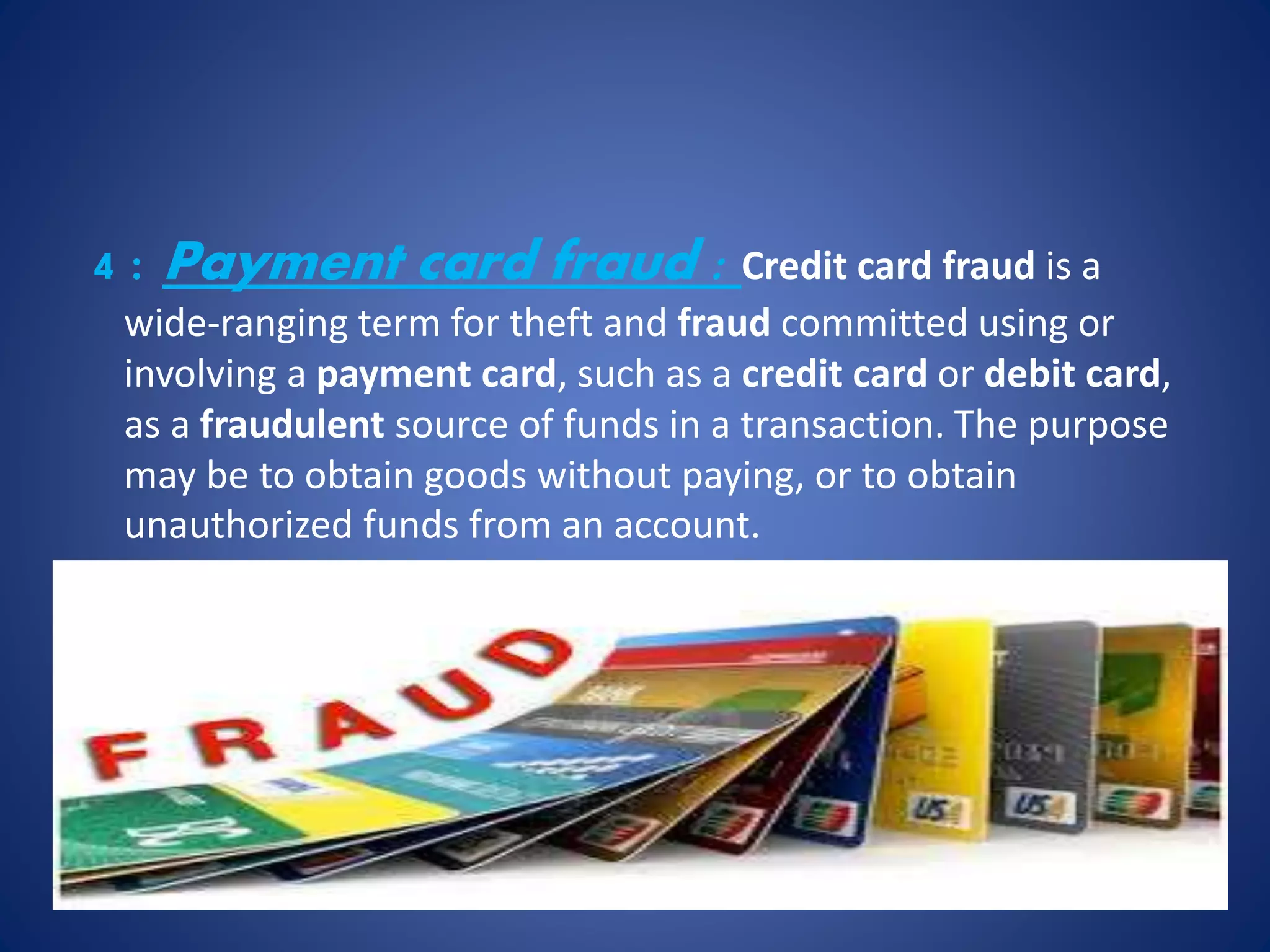
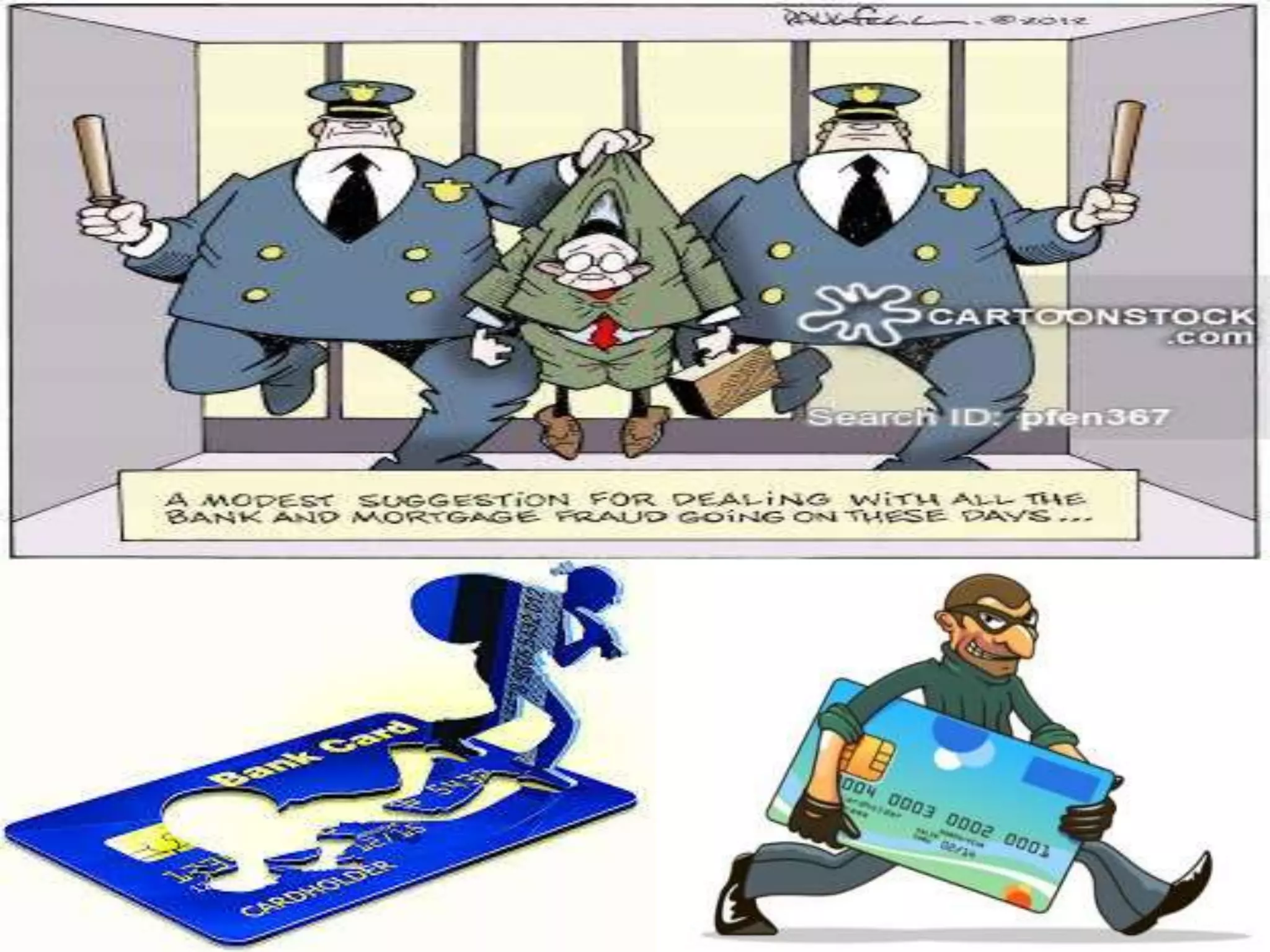
4 : Payment card fraud : Credit card fraud is a
wide-ranging term for theft and fraud committed using or
involving a payment card, such as a credit card or debit card,
as a fraudulent source of funds in a transaction. The purpose
may be to obtain goods without paying, or to obtain
unauthorized funds from an account.
5 : Forgery and altered cheques :
 Fraudsters have altered cheques to change the name (in order
to deposit cheques intended for payment to someone else) or
the amount on the face of cheques, simple altering can
change $100.00 into $100,000.00, although transactions of
this value are subject to investigation as a precaution to
prevent fraud as policy.
 Instead of tampering with a real cheque, fraudsters may
alternatively attempt to forge a depositor's signature on a
blank cheque or even print their own cheques drawn on
accounts owned by others, non-existent accounts, etc. They
would subsequently cash the fraudulent cheque through
another bank and withdraw the money before the banks
realize that the cheque was a fraud.
6 : Money laundering :
 Money laundering is the process by which large amounts
of illegally obtained money (from drug trafficking, terrorist
activity or other serious crimes) is given the appearance of
having originated from a legitimate source.
7 : Phishing and Internet fraud :
 Phishing, also known as Internet fraud, operates by
sending forged e-mail, impersonating an online bank,
auction or payment site; the e-mail directs the user to a
forged web site which is designed to look like the login to
the legitimate site but which claims that the user must
update personal info.
 The information thus stolen is then used in other frauds,
such as theft of identity or online auction fraud.
FAQs
1 : I have transactions on my account that I did not
authorize. What should I do?
Ans :
 File a police report in the city where the unauthorized transaction
occurred. Keep this information accessible, as it is used to process
unauthorized transactions.
 Contact the company or merchant where the unauthorized transactions
occurred. Keep detailed notes regarding your conversation including
how the transaction was processed, the name of the person you
contacted, if the transaction was processed on-site, via the internet or
phone, etc.
 If the unauthorized transaction happened on a debit card, ATM card
or credit card, use the phone numbers below to report the transactions.
If the unauthorized transactions happened in your checking or savings
account (using your routing number and account number), visit a City &
County Credit Union branch to complete an Affidavit of Unauthorized
Entry.
FAQs continue :
2 : What should I do if my debit card or ATM card is
stolen?
ATM - If your City & County Credit Union ATM card is lost or stolen,
contact us at (651) 225-2700 or (800) 223-2801 or stop by a
branch during regular business hours. A Member Service Consultant will
cancel your old card and order you another. The new card will take 7-10
business days to arrive.
3 :WHAT IF MY PHONE IS LOST OR STOLEN ?(IF YOU ARE
DOING ONLINE BANKING THROUGH MOBOLE )
 If your device is lost or stolen , no one can access your mobile
banking without knowing your password .to prevent
unauthorized access to your account , you can deactivate
your mobile banking simply log in to your online banking
from your computer , select the option tab , & deactivate your
mobile banking services .
How can we prevent fraud?
Below are tips to help you protect your identity and
data while online :
General Tips:
Review financial statements for any suspicious
(doubtful )activity.
Never give out financial information to unknown
sources.
Never give out the three or four digit number on
your credit card to anyone claiming to be from a
financial institution.
As a general rule, type the web site into the
browser rather than following links received in an
email.
Computer and Mobile Use Tips :
 Only download information or click on links from people and
companies you know and trust.
 Never email personal or financial information.
 Never return a call that asks you to divulge any financial
information.
 Do not access online banking from a public computer.
 Do not access online banking when on a public Wi-Fi network.
 If asked to login to an online banking site to verify information,
immediately call and report the suspicious email to us.
 When logging onto a website, look for indications of a secure
website, including a lock symbol, and address bar that turns
green, and "https" at the beginning of the site's web address.
How can I prevent identity theft?
Identity theft can happen to you at anytime, but the following tips
can help you decrease the likelihood of becoming a victim of
identity theft ::
 Before revealing personal information, find out how it will be
used and if it will be shared with others.
 Pay attention to your billing cycles. A missing credit card bill can
mean a thief has taken over your credit card account and
changed your address.
 Check your financial institution statement each month. If you
find transactions you did not authorize, contact CONCERNED
BANK immediately.
 Only carry the credit cards you need. Do not give out personal
information unless you have initiated contact and know to whom
you are speaking.
CONCLUSION:
• Bank frauds are done to make money by
cheating the banks . There are several
loopholes in banking system that has been
used by fraudster. The numbers of bank frauds
has been increasing year on year along with
that , RBI also engage in making the banking
system accurate and secured .
Bank frauds

Bank frauds

  • 1.
    Presented by :RUPALI NAYAK and SWETALINA MOHANTY UNDER GUIDANCE : K.K. ACHARYA
  • 2.
    What is bankfraud ?  FRAUD means the crime of getting money by deceiving people that is illegal or dishonest. Bank fraud can be defined as an unethical and/or criminal act by an individual or organization to illegally attempt to possess or receive money from a bank or financial institution. The reason of making fraud is to cheat the bank for financial purpose .
  • 3.
    Banks are anessential part of the Indian economy . While the primary responsibility for preventing frauds lies with bank themselves . Banks are dealing with public’s money and hence it is imperative that employees should exercise due care and diligence in handling the transactions in banks . The RBI has been advising banks from time to time about the major fraud prone areas and the safeguard necessary for prevention of frauds .
  • 6.
    Typesof fraud 1 :CHEQUE FRAUD :most common cases of this kind of fraud are through stolen cheques and forged cheques . The sooner you report the lost or stolen checkbook the better. The bank will usually reverse charges if you report the theft within 24 hours. ... Many banks will allow you to check pending transactions and you may be able to stop the transaction before it happens.
  • 7.
    2 : Accountingfraud : In order to hide serious financial problems, some businesses have been known to use fraudulent bookkeeping to overstate sales and income, inflate the worth of the company's assets, or state a profit when the company is operating at a loss. 3: Demand draft fraud : Demand draft (DD) fraud typically involves one or more corrupt bank employees. Firstly, such employees remove a few DD leaves or DD books from stock and write them like a regular DD. Since they are insiders, they know the coding and punching of a demand draft.  Such fraudulent demand drafts are usually drawn payable at a distant city without debiting an account. The draft is cashed at the payable branch. The fraud is discovered only when the bank's head office does the branch-wise reconciliation, which normally take six months, by which time the money is gone.
  • 8.
    4 : Paymentcard fraud : Credit card fraud is a wide-ranging term for theft and fraud committed using or involving a payment card, such as a credit card or debit card, as a fraudulent source of funds in a transaction. The purpose may be to obtain goods without paying, or to obtain unauthorized funds from an account.
  • 9.
    5 : Forgeryand altered cheques :  Fraudsters have altered cheques to change the name (in order to deposit cheques intended for payment to someone else) or the amount on the face of cheques, simple altering can change $100.00 into $100,000.00, although transactions of this value are subject to investigation as a precaution to prevent fraud as policy.  Instead of tampering with a real cheque, fraudsters may alternatively attempt to forge a depositor's signature on a blank cheque or even print their own cheques drawn on accounts owned by others, non-existent accounts, etc. They would subsequently cash the fraudulent cheque through another bank and withdraw the money before the banks realize that the cheque was a fraud.
  • 10.
    6 : Moneylaundering :  Money laundering is the process by which large amounts of illegally obtained money (from drug trafficking, terrorist activity or other serious crimes) is given the appearance of having originated from a legitimate source. 7 : Phishing and Internet fraud :  Phishing, also known as Internet fraud, operates by sending forged e-mail, impersonating an online bank, auction or payment site; the e-mail directs the user to a forged web site which is designed to look like the login to the legitimate site but which claims that the user must update personal info.  The information thus stolen is then used in other frauds, such as theft of identity or online auction fraud.
  • 12.
    FAQs 1 : Ihave transactions on my account that I did not authorize. What should I do? Ans :  File a police report in the city where the unauthorized transaction occurred. Keep this information accessible, as it is used to process unauthorized transactions.  Contact the company or merchant where the unauthorized transactions occurred. Keep detailed notes regarding your conversation including how the transaction was processed, the name of the person you contacted, if the transaction was processed on-site, via the internet or phone, etc.  If the unauthorized transaction happened on a debit card, ATM card or credit card, use the phone numbers below to report the transactions. If the unauthorized transactions happened in your checking or savings account (using your routing number and account number), visit a City & County Credit Union branch to complete an Affidavit of Unauthorized Entry.
  • 13.
    FAQs continue : 2: What should I do if my debit card or ATM card is stolen? ATM - If your City & County Credit Union ATM card is lost or stolen, contact us at (651) 225-2700 or (800) 223-2801 or stop by a branch during regular business hours. A Member Service Consultant will cancel your old card and order you another. The new card will take 7-10 business days to arrive. 3 :WHAT IF MY PHONE IS LOST OR STOLEN ?(IF YOU ARE DOING ONLINE BANKING THROUGH MOBOLE )  If your device is lost or stolen , no one can access your mobile banking without knowing your password .to prevent unauthorized access to your account , you can deactivate your mobile banking simply log in to your online banking from your computer , select the option tab , & deactivate your mobile banking services .
  • 14.
    How can weprevent fraud? Below are tips to help you protect your identity and data while online : General Tips: Review financial statements for any suspicious (doubtful )activity. Never give out financial information to unknown sources. Never give out the three or four digit number on your credit card to anyone claiming to be from a financial institution. As a general rule, type the web site into the browser rather than following links received in an email.
  • 15.
    Computer and MobileUse Tips :  Only download information or click on links from people and companies you know and trust.  Never email personal or financial information.  Never return a call that asks you to divulge any financial information.  Do not access online banking from a public computer.  Do not access online banking when on a public Wi-Fi network.  If asked to login to an online banking site to verify information, immediately call and report the suspicious email to us.  When logging onto a website, look for indications of a secure website, including a lock symbol, and address bar that turns green, and "https" at the beginning of the site's web address.
  • 16.
    How can Iprevent identity theft? Identity theft can happen to you at anytime, but the following tips can help you decrease the likelihood of becoming a victim of identity theft ::  Before revealing personal information, find out how it will be used and if it will be shared with others.  Pay attention to your billing cycles. A missing credit card bill can mean a thief has taken over your credit card account and changed your address.  Check your financial institution statement each month. If you find transactions you did not authorize, contact CONCERNED BANK immediately.  Only carry the credit cards you need. Do not give out personal information unless you have initiated contact and know to whom you are speaking.
  • 17.
    CONCLUSION: • Bank fraudsare done to make money by cheating the banks . There are several loopholes in banking system that has been used by fraudster. The numbers of bank frauds has been increasing year on year along with that , RBI also engage in making the banking system accurate and secured .