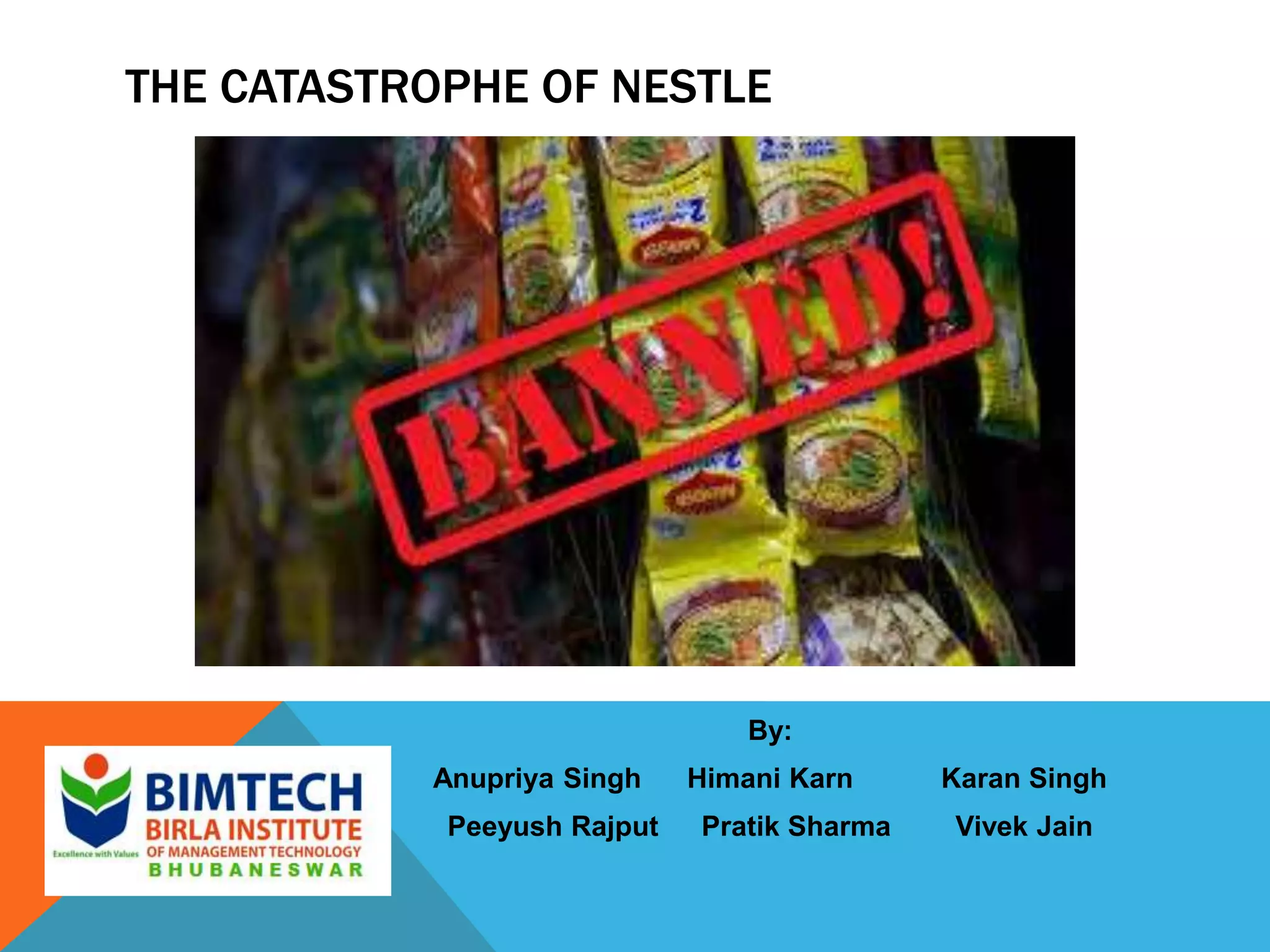
THE CATASTROPHE OF NESTLE
By:
Anupriya Singh Himani Karn Karan Singh
Peeyush Rajput Pratik Sharma Vivek Jain
ABOUT
• Traded in
• Swiss exchange (SIX) – NESN –
71
• European stock
exchange(EURONEXT) – NESTS
– 51
• OTC PINK – NSRGY – 74
• Bombay stock exchange –
500790 – 6100
• National stock exchange –
NESTLEIND - 6090
• Founded in 1866 by Henri Nestle
• Founder – Henri Nestle, Charles
Page, George Page
• Head quarters in Switzerland
• 3,39,000 employees
• Nestle owns 2000 brands
• Total equity 71.88 billion
• Total assets 133.45 billion
PRODUCTS OF NESTLE
 Cereals
 Noodles
 Yogurt
 Coffee
 Water
 Other drinks
 Ice cream
 Infant food
 Healthcare nutrition
 Seasoning
 Frozen food
 Baked good
 Pet care
ABOUT THE CASE
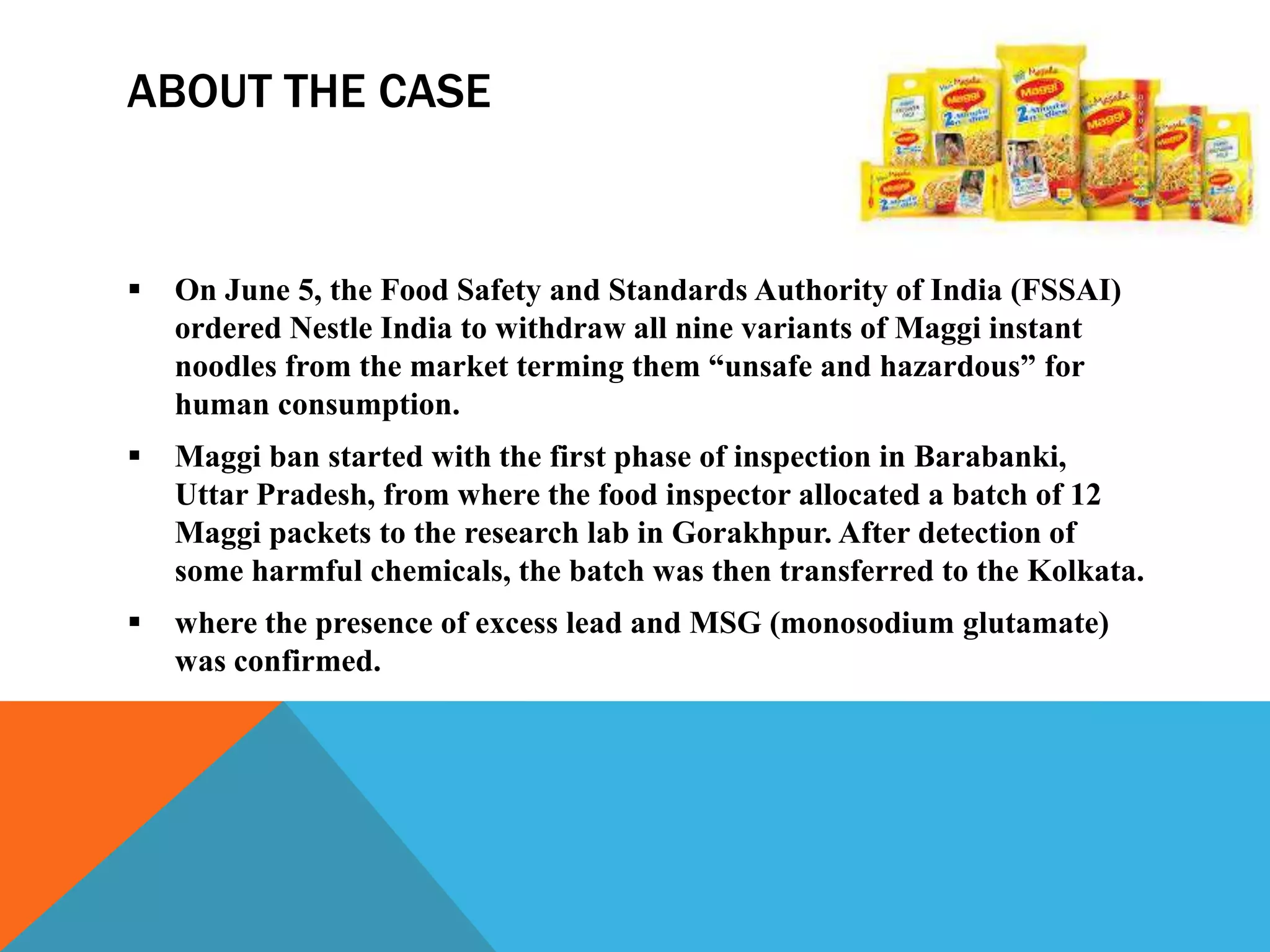
 On June 5, the Food Safety and Standards Authority of India (FSSAI)
ordered Nestle India to withdraw all nine variants of Maggi instant
noodles from the market terming them “unsafe and hazardous” for
human consumption.
 Maggi ban started with the first phase of inspection in Barabanki,
Uttar Pradesh, from where the food inspector allocated a batch of 12
Maggi packets to the research lab in Gorakhpur. After detection of
some harmful chemicals, the batch was then transferred to the Kolkata.
 where the presence of excess lead and MSG (monosodium glutamate)
was confirmed.
ABOUT THE CASE
 It was confirmed that 17.2 ppi of lead was contained in the Februrary 2014
manufactured batch of Maggi packets which was 8 times higher than the
permissible limit range of 0.01-2.50 ppi. Where in Delhi, the samples of Maggi
were detected with a lead level of 3.6.
• MSG increases the body MSG level by 20% which is harmful for humans
especially children.
• Nestle India has its own argument regarding the MSG content in Maggi. They
claim that the MSG found in Maggi is not added by them which they clearly
mention in the Maggi packets as “NO ADDED MSG“.
• It is also challenged by Nestle India that out of the 1000 samples inspected of the
12.5 crore Maggi packets, the found lead content on an average does not exceed
the prescribed level of lead content.
OBJECTIVE
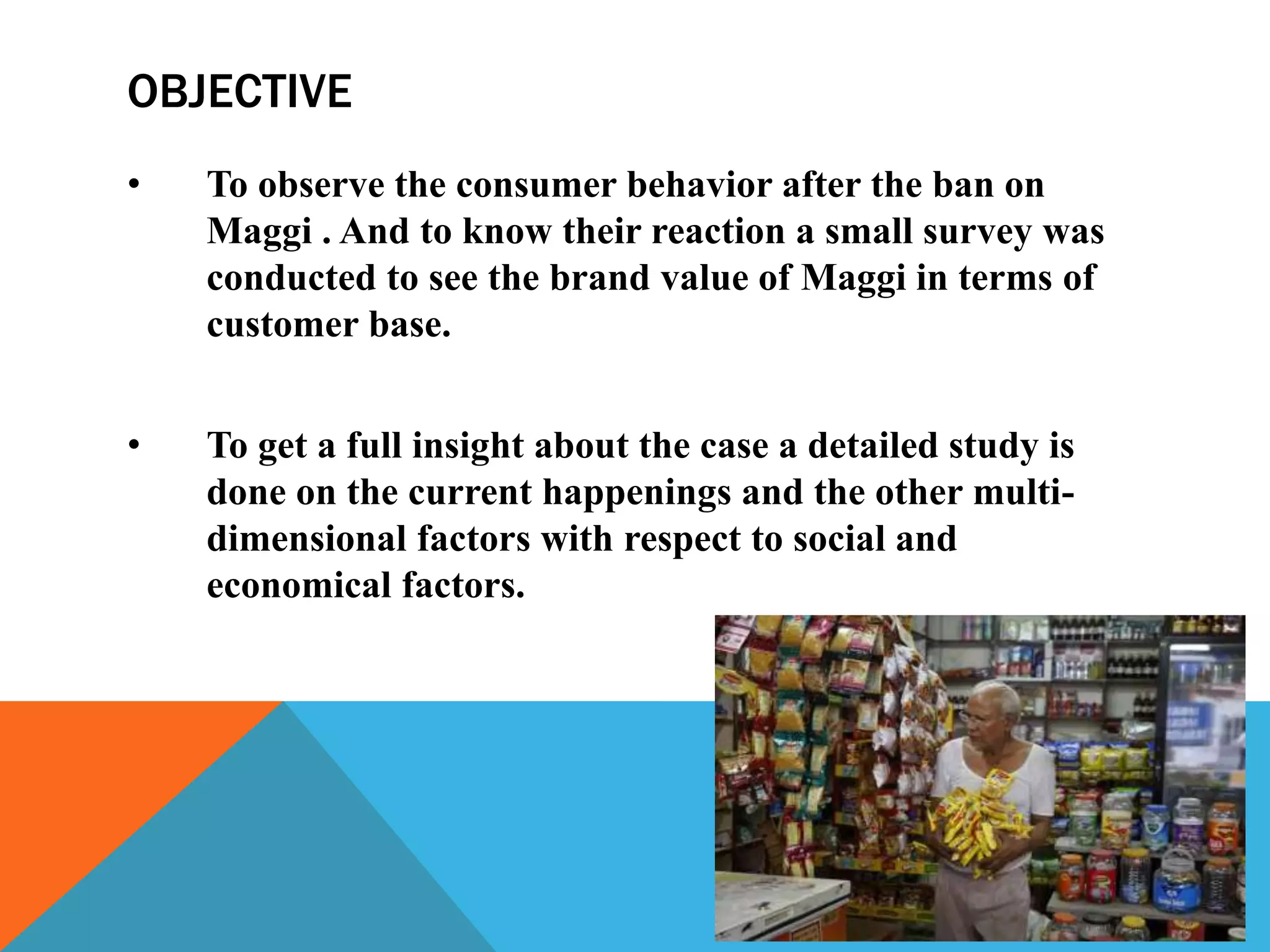
• To observe the consumer behavior after the ban on
Maggi . And to know their reaction a small survey was
conducted to see the brand value of Maggi in terms of
customer base.
• To get a full insight about the case a detailed study is
done on the current happenings and the other multi-
dimensional factors with respect to social and
economical factors.
DATA STUDY
Price
18%
Healthy
6%
Tasty
56%
Brand
name
12%
Others
8%
IMP. FACTOR TO CHOOSE
MAGGI
Most of the customers consume
Maggi because of its taste, so the
company should maintain the
previous and should also follow
strict safety measures by taking
consumers health into
consideration.
DATA STUDY
Maggi was so famous and
preferable by all of the consumers
so Almost everyone are aware of
the ban on Maggi, so while re-
launching Maggi the company
should introduce Maggi as “healthy
as well as tasty” .
Yes
100%
No
0%
AWARENESS ABOUT BAN
DATA STUDY
So Most of the consumers are
against the ban on Maggi noodles
and its other products, and because
of this It will be easier for the
Maggi to re-launce and retain its
brand value in market again.
36%
64%
PERCEPTION ABOUT BAN
Yes
No
DATA STUDY
Substitutes are not able to give
same level of satisfaction, so after
relaunch the demand for the Maggi
will be considerably higher.
36%
64%
SATISFACTION FROM
OTHERS
Yes
No
DATA STUDY
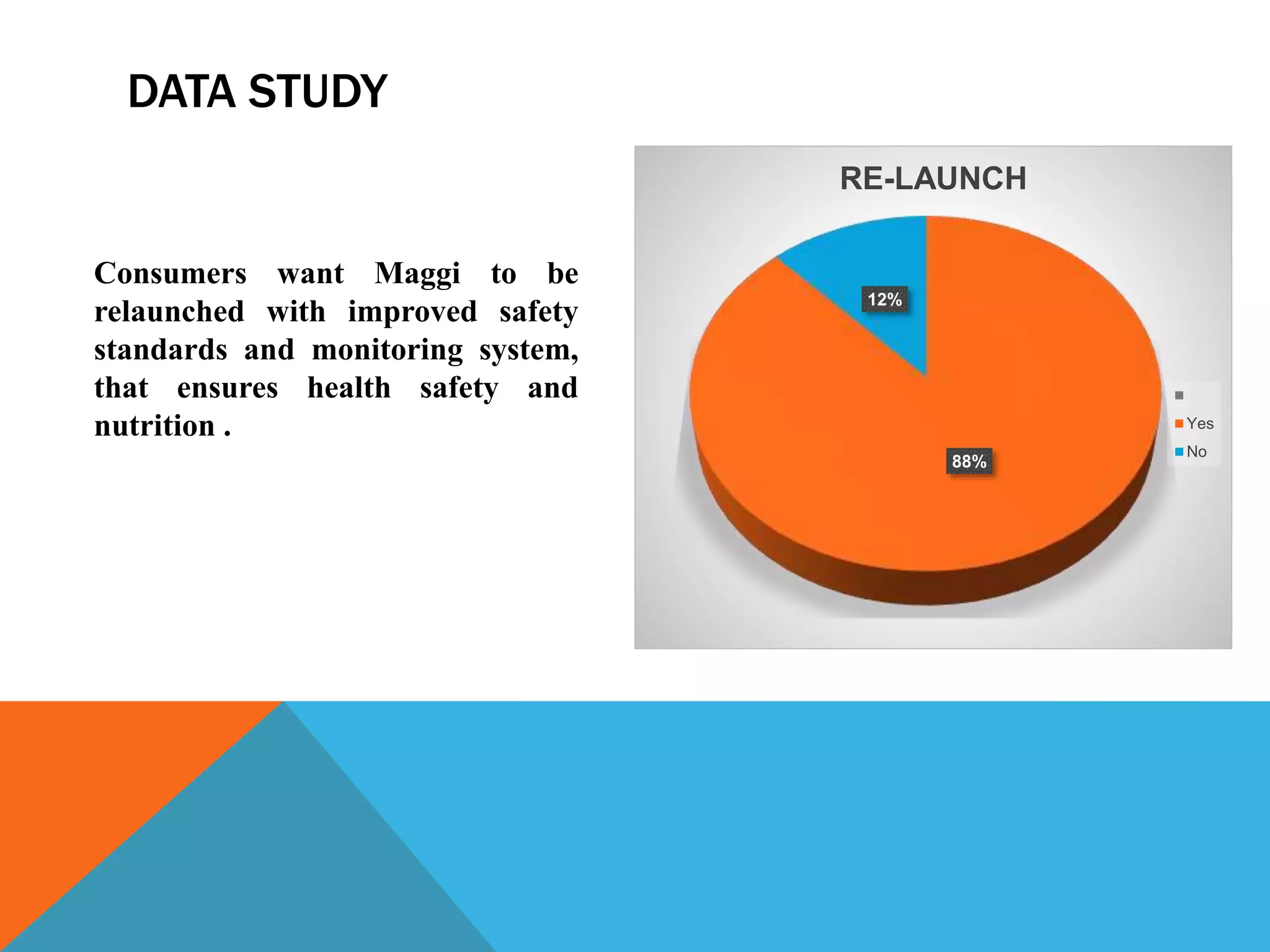
Consumers want Maggi to be
relaunched with improved safety
standards and monitoring system,
that ensures health safety and
nutrition .
88%
12%
RE-LAUNCH
Yes
No
DATA STUDY
Before the ban taste was a
important Factor to choose Maggi,
but after relaunch customer wants
Maggi to be more healthy &
nutritious.
12%
28%
60%
MOTIVATIONAL FACTOR
Less price
same taste as before
More healthy & nutritious
GENERAL OBSERVATIONS
 Nestle recalled it’s Maggi inventory, so that this issue doesn’t hamper the sales of
other Nestle products.
 Before recalling the entire stock they should have challenged the FSSAI results.
 Nestle was not sure about Maggi’s meeting standards, that’s why they took abrupt
decisions.
 Ban on Maggi incurred standalone loss of 64.40 crore rupees.
GENERAL OBSERVATIONS
 Nestle’s share went down by upto 17%.
 The recall exercise of Maggi noodles has cost Nestle Rs.320 crores and another
Rs.1270 crores in brand loss.
 Maggi is popular in Pakistan, Nepal, Bangladesh and Sri Lanka but they are yet to
act on this.
RECOMMENDATIONS
 The company should maintain the previous taste what they were providing and
should also follow strict safety measures by taking consumers health into
consideration.
 They can also associate their brand with some loyal personalities, so that people can
trust on it and go for that again as before.
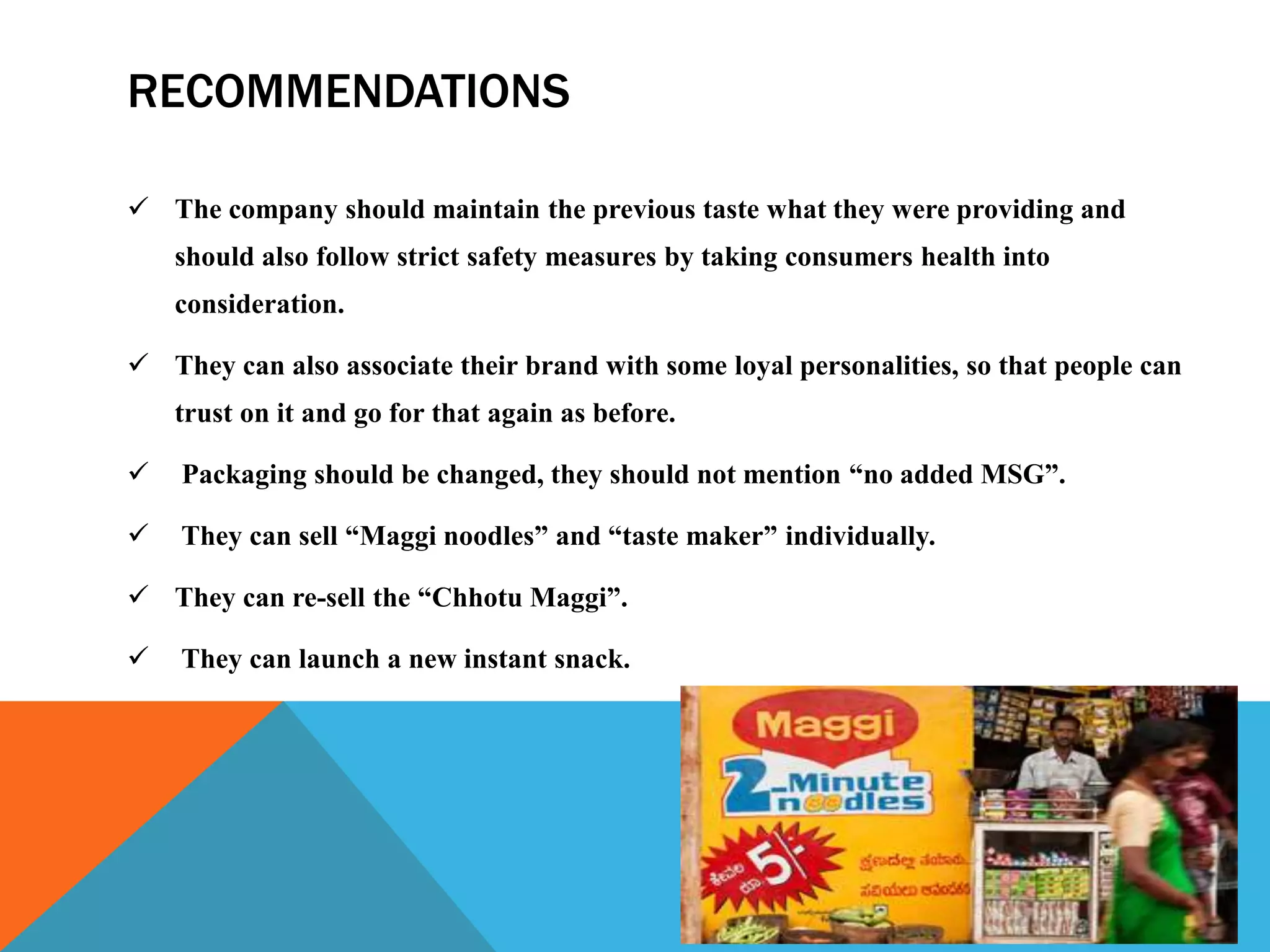
 Packaging should be changed, they should not mention “no added MSG”.
 They can sell “Maggi noodles” and “taste maker” individually.
 They can re-sell the “Chhotu Maggi”.
 They can launch a new instant snack.
Ban on Maggi

Ban on Maggi

  • 1.
    THE CATASTROPHE OFNESTLE By: Anupriya Singh Himani Karn Karan Singh Peeyush Rajput Pratik Sharma Vivek Jain
  • 2.
    ABOUT • Traded in •Swiss exchange (SIX) – NESN – 71 • European stock exchange(EURONEXT) – NESTS – 51 • OTC PINK – NSRGY – 74 • Bombay stock exchange – 500790 – 6100 • National stock exchange – NESTLEIND - 6090 • Founded in 1866 by Henri Nestle • Founder – Henri Nestle, Charles Page, George Page • Head quarters in Switzerland • 3,39,000 employees • Nestle owns 2000 brands • Total equity 71.88 billion • Total assets 133.45 billion
  • 3.
    PRODUCTS OF NESTLE Cereals  Noodles  Yogurt  Coffee  Water  Other drinks  Ice cream  Infant food  Healthcare nutrition  Seasoning  Frozen food  Baked good  Pet care
  • 4.
    ABOUT THE CASE On June 5, the Food Safety and Standards Authority of India (FSSAI) ordered Nestle India to withdraw all nine variants of Maggi instant noodles from the market terming them “unsafe and hazardous” for human consumption.  Maggi ban started with the first phase of inspection in Barabanki, Uttar Pradesh, from where the food inspector allocated a batch of 12 Maggi packets to the research lab in Gorakhpur. After detection of some harmful chemicals, the batch was then transferred to the Kolkata.  where the presence of excess lead and MSG (monosodium glutamate) was confirmed.
  • 5.
    ABOUT THE CASE It was confirmed that 17.2 ppi of lead was contained in the Februrary 2014 manufactured batch of Maggi packets which was 8 times higher than the permissible limit range of 0.01-2.50 ppi. Where in Delhi, the samples of Maggi were detected with a lead level of 3.6. • MSG increases the body MSG level by 20% which is harmful for humans especially children. • Nestle India has its own argument regarding the MSG content in Maggi. They claim that the MSG found in Maggi is not added by them which they clearly mention in the Maggi packets as “NO ADDED MSG“. • It is also challenged by Nestle India that out of the 1000 samples inspected of the 12.5 crore Maggi packets, the found lead content on an average does not exceed the prescribed level of lead content.
  • 6.
    OBJECTIVE • To observethe consumer behavior after the ban on Maggi . And to know their reaction a small survey was conducted to see the brand value of Maggi in terms of customer base. • To get a full insight about the case a detailed study is done on the current happenings and the other multi- dimensional factors with respect to social and economical factors.
  • 7.
    DATA STUDY Price 18% Healthy 6% Tasty 56% Brand name 12% Others 8% IMP. FACTORTO CHOOSE MAGGI Most of the customers consume Maggi because of its taste, so the company should maintain the previous and should also follow strict safety measures by taking consumers health into consideration.
  • 8.
    DATA STUDY Maggi wasso famous and preferable by all of the consumers so Almost everyone are aware of the ban on Maggi, so while re- launching Maggi the company should introduce Maggi as “healthy as well as tasty” . Yes 100% No 0% AWARENESS ABOUT BAN
  • 9.
    DATA STUDY So Mostof the consumers are against the ban on Maggi noodles and its other products, and because of this It will be easier for the Maggi to re-launce and retain its brand value in market again. 36% 64% PERCEPTION ABOUT BAN Yes No
  • 10.
    DATA STUDY Substitutes arenot able to give same level of satisfaction, so after relaunch the demand for the Maggi will be considerably higher. 36% 64% SATISFACTION FROM OTHERS Yes No
  • 11.
    DATA STUDY Consumers wantMaggi to be relaunched with improved safety standards and monitoring system, that ensures health safety and nutrition . 88% 12% RE-LAUNCH Yes No
  • 12.
    DATA STUDY Before theban taste was a important Factor to choose Maggi, but after relaunch customer wants Maggi to be more healthy & nutritious. 12% 28% 60% MOTIVATIONAL FACTOR Less price same taste as before More healthy & nutritious
  • 13.
    GENERAL OBSERVATIONS  Nestlerecalled it’s Maggi inventory, so that this issue doesn’t hamper the sales of other Nestle products.  Before recalling the entire stock they should have challenged the FSSAI results.  Nestle was not sure about Maggi’s meeting standards, that’s why they took abrupt decisions.  Ban on Maggi incurred standalone loss of 64.40 crore rupees.
  • 14.
    GENERAL OBSERVATIONS  Nestle’sshare went down by upto 17%.  The recall exercise of Maggi noodles has cost Nestle Rs.320 crores and another Rs.1270 crores in brand loss.  Maggi is popular in Pakistan, Nepal, Bangladesh and Sri Lanka but they are yet to act on this.
  • 15.
    RECOMMENDATIONS  The companyshould maintain the previous taste what they were providing and should also follow strict safety measures by taking consumers health into consideration.  They can also associate their brand with some loyal personalities, so that people can trust on it and go for that again as before.  Packaging should be changed, they should not mention “no added MSG”.  They can sell “Maggi noodles” and “taste maker” individually.  They can re-sell the “Chhotu Maggi”.  They can launch a new instant snack.