Balancing Equations
Just repeat:
ā€œI know I can, I know I can!ā€
Balancing equations
 Conservation




of Matter: During a chemical
reaction, atoms cannot be created or
destroyed!
Due to the conservation of matter, equations
MUST be balanced!
Thus, the total number of atoms in the
products must equal the total number of
atoms in the reactants

REMEMBER: The atoms are only being
rearranged during the reaction!
Coefficients vs. Subscripts
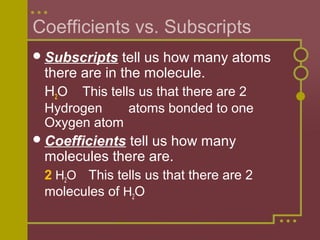
 Subscripts

tell us how many atoms
there are in the molecule.
H2O This tells us that there are 2
Hydrogen
atoms bonded to one
Oxygen atom

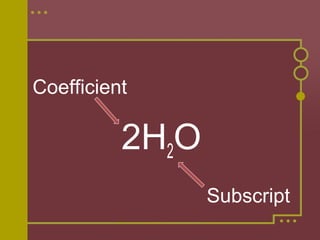
 Coefficients

tell us how many
molecules there are.
2 H2O This tells us that there are 2
molecules of H2O
Coefficient

2H2O
Subscript
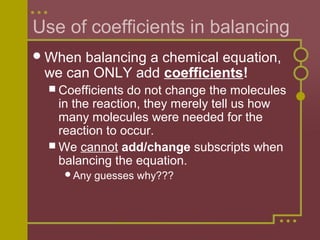
Use of coefficients in balancing
 When

balancing a chemical equation,
we can ONLY add coefficients!
 Coefficients

do not change the molecules
in the reaction, they merely tell us how
many molecules were needed for the
reaction to occur.
 We cannot add/change subscripts when
balancing the equation.
Any

guesses why???
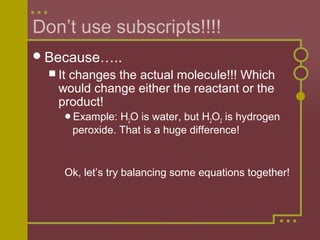
Don’t use subscripts!!!!
 Because…..
 It

changes the actual molecule!!! Which
would change either the reactant or the
product!
Example:

H2O is water, but H2O2 is hydrogen
peroxide. That is a huge difference!

Ok, let’s try balancing some equations together!
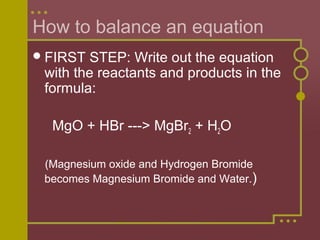
How to balance an equation
 FIRST

STEP: Write out the equation
with the reactants and products in the
formula:
MgO + HBr ---> MgBr2 + H2O
(Magnesium oxide and Hydrogen Bromide
becomes Magnesium Bromide and Water.)
How to balance an equation
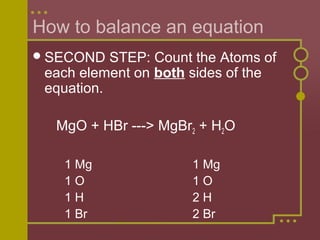
 SECOND

STEP: Count the Atoms of
each element on both sides of the
equation.
MgO + HBr ---> MgBr2 + H2O
1 Mg
1O
1H
1 Br

1 Mg
1O
2H
2 Br
How to balance an equation
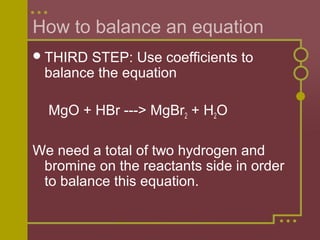
 THIRD

STEP: Use coefficients to
balance the equation
MgO + HBr ---> MgBr2 + H2O

We need a total of two hydrogen and
bromine on the reactants side in order
to balance this equation.
How to balance an equation
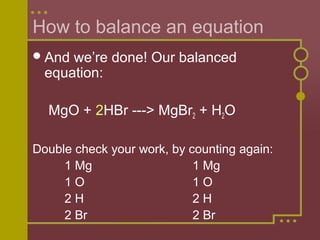
 And

we’re done! Our balanced
equation:
MgO + 2HBr ---> MgBr2 + H2O

Double check your work, by counting again:
1 Mg
1 Mg
1O
1O
2H
2H
2 Br
2 Br
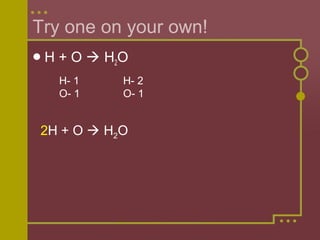
Try one on your own!
H

+ O  H 2O
H- 1
O- 1

H- 2
O- 1

2H + O  H2O
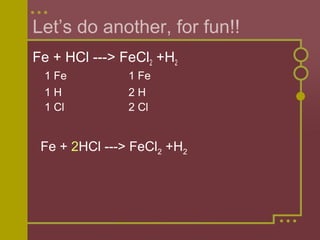
Let’s do another, for fun!!
Fe + HCl ---> FeCl2 +H2
1 Fe
1H
1 Cl

1 Fe
2H
2 Cl

Fe + 2HCl ---> FeCl2 +H2
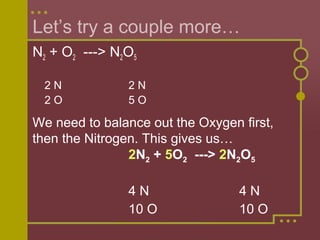
Let’s try a couple more…
N2 + O2 ---> N2O5
2N
2O

2N
5O

We need to balance out the Oxygen first,
then the Nitrogen. This gives us…
2N2 + 5O2 ---> 2N2O5
4N
10 O

4N
10 O
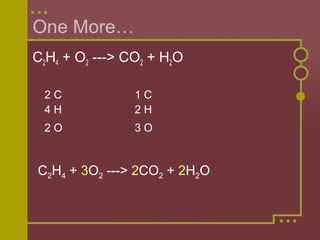
One More…
C2H4 + O2 ---> CO2 + H2O
2C
4H

1C
2H

2O

3O

C2H4 + 3O2 ---> 2CO2 + 2H2O

Balancing equations

  • 1.
    Balancing Equations Just repeat: ā€œIknow I can, I know I can!ā€
  • 2.
    Balancing equations  Conservation   ofMatter: During a chemical reaction, atoms cannot be created or destroyed! Due to the conservation of matter, equations MUST be balanced! Thus, the total number of atoms in the products must equal the total number of atoms in the reactants REMEMBER: The atoms are only being rearranged during the reaction!
  • 3.
    Coefficients vs. Subscripts Subscripts tell us how many atoms there are in the molecule. H2O This tells us that there are 2 Hydrogen atoms bonded to one Oxygen atom  Coefficients tell us how many molecules there are. 2 H2O This tells us that there are 2 molecules of H2O
  • 4.
  • 5.
    Use of coefficientsin balancing  When balancing a chemical equation, we can ONLY add coefficients!  Coefficients do not change the molecules in the reaction, they merely tell us how many molecules were needed for the reaction to occur.  We cannot add/change subscripts when balancing the equation. Any guesses why???
  • 6.
    Don’t use subscripts!!!! Because…..  It changes the actual molecule!!! Which would change either the reactant or the product! Example: H2O is water, but H2O2 is hydrogen peroxide. That is a huge difference! Ok, let’s try balancing some equations together!
  • 7.
    How to balancean equation  FIRST STEP: Write out the equation with the reactants and products in the formula: MgO + HBr ---> MgBr2 + H2O (Magnesium oxide and Hydrogen Bromide becomes Magnesium Bromide and Water.)
  • 8.
    How to balancean equation  SECOND STEP: Count the Atoms of each element on both sides of the equation. MgO + HBr ---> MgBr2 + H2O 1 Mg 1O 1H 1 Br 1 Mg 1O 2H 2 Br
  • 9.
    How to balancean equation  THIRD STEP: Use coefficients to balance the equation MgO + HBr ---> MgBr2 + H2O We need a total of two hydrogen and bromine on the reactants side in order to balance this equation.
  • 10.
    How to balancean equation  And we’re done! Our balanced equation: MgO + 2HBr ---> MgBr2 + H2O Double check your work, by counting again: 1 Mg 1 Mg 1O 1O 2H 2H 2 Br 2 Br
  • 11.
    Try one onyour own! H + O  H 2O H- 1 O- 1 H- 2 O- 1 2H + O  H2O
  • 12.
    Let’s do another,for fun!! Fe + HCl ---> FeCl2 +H2 1 Fe 1H 1 Cl 1 Fe 2H 2 Cl Fe + 2HCl ---> FeCl2 +H2
  • 13.
    Let’s try acouple more… N2 + O2 ---> N2O5 2N 2O 2N 5O We need to balance out the Oxygen first, then the Nitrogen. This gives us… 2N2 + 5O2 ---> 2N2O5 4N 10 O 4N 10 O
  • 14.
    One More… C2H4 +O2 ---> CO2 + H2O 2C 4H 1C 2H 2O 3O C2H4 + 3O2 ---> 2CO2 + 2H2O