BAEB601
               RESEARCH METHODOLOGY


                          CHAPTER 2
Research Types, Objectives, Problem
                         Statement


PREPARED BY:
Nur Suhaili Ramli

School of Marketing and
Entrepreneurship (SoME)
FACULTY OF BUSINESS AND MANAGEMENT
CHAPTER 2: PROBLEM STATEMENT. RESEARCH TYPES, OBJECTIVES

  Chapter Aims
                                                                                      TOPIC


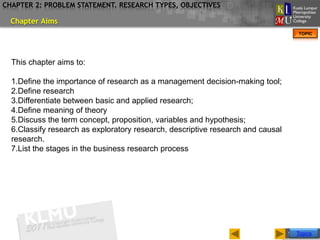
  This chapter aims to:

  1.Define the importance of research as a management decision-making tool;
  2.Define research
  3.Differentiate between basic and applied research;
  4.Define meaning of theory
  5.Discuss the term concept, proposition, variables and hypothesis;
  6.Classify research as exploratory research, descriptive research and causal
  research.
  7.List the stages in the business research process


                                                                                 Slide 2 of 17
                                                                                     Topics
CHAPTER 2: PROBLEM STATEMENT. RESEARCH TYPES, OBJECTIVES
Problem Statement
                                                                       TOPIC


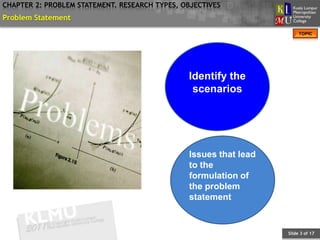
                                               Identify the
                                                scenarios


                                               Issues that lead
                                               to the
                                               formulation of
                                               the problem
                                               statement


                                                                  Slide 3 of 17
CHAPTER 2: PROBLEM STATEMENT. RESEARCH TYPES, OBJECTIVES
Process of Problem Definition
                                                                                   TOPIC


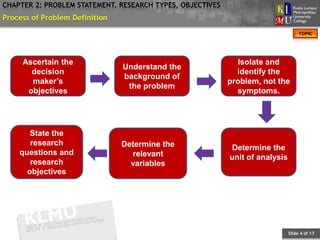
     Ascertain the                                           Isolate and
                                Understand the
       decision                                              identify the
                                background of
       maker’s                                             problem, not the
                                 the problem
      objectives                                             symptoms.


       State the
       research                 Determine the              Determine the
    questions and                 relevant                 unit of analysis
       research                   variables
      objectives


                                                                              Slide 4 of 17
CHAPTER 2: PROBLEM STATEMENT. RESEARCH TYPES, OBJECTIVES
Ascertain the decision maker’s objectives
                                                                          TOPIC


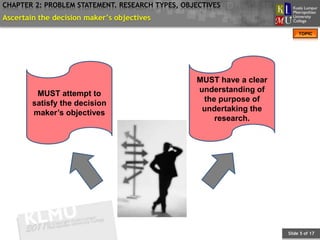
                                                 MUST have a clear
                                                 understanding of
         MUST attempt to
                                                  the purpose of
        satisfy the decision
                                                  undertaking the
        maker’s objectives
                                                     research.


                                                                     Slide 5 of 17
CHAPTER 2: PROBLEM STATEMENT. RESEARCH TYPES, OBJECTIVES
Understand the background of the problem
                                                                TOPIC


            The
        background
           of the
         problem is
            vital
                           A situation
                           analysis is
                            the logical
                           first step in
                             defining
         Analysis            problem
       involve the
         informal
       gathering of
       background
       information


                                                           Slide 6 of 17
CHAPTER 2: PROBLEM STATEMENT. RESEARCH TYPES, OBJECTIVES
Isolate and identify the problem, not the symptoms
                                                                          TOPIC


             Anticipating the many
                  influences and
                 dimensions of a
             problem is impossible
               for any researcher.


                                             Certain occurrences
                                             that appear to be the
                                             problem may only be
                                            symptoms of a deeper
                                                   problem.


                                                                     Slide 7 of 17
CHAPTER 2: PROBLEM STATEMENT. RESEARCH TYPES, OBJECTIVES
Determine the unit of analysis
                                                                            TOPIC


         MUST specify the unit
             of analysis


                             Will the individual
                          consumer be the source
                              of information?

                                                    Industries,
                                                   organization,
                                                  departments or
                                              individual may be the
                                               focus data collection
                                                   and analysis.


                                                                       Slide 8 of 17
CHAPTER 2: PROBLEM STATEMENT. RESEARCH TYPES, OBJECTIVES
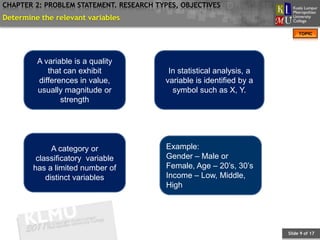
Determine the relevant variables
                                                                            TOPIC


         A variable is a quality
            that can exhibit              In statistical analysis, a
         differences in value,           variable is identified by a
         usually magnitude or              symbol such as X, Y.
                strength


              A category or               Example:
         classificatory variable          Gender – Male or
        has a limited number of           Female, Age – 20’s, 30’s
            distinct variables            Income – Low, Middle,
                                          High


                                                                       Slide 9 of 17
CHAPTER 2: PROBLEM STATEMENT. RESEARCH TYPES, OBJECTIVES
State the research questions and research objectives
                                                                                    TOPIC


   The research question is the researcher’s translation of the business problem
    into a specific need for inquiry.
   Clarity in Research Questions and Hypotheses
   Decision-Oriented research objective.


                                                                             Slide 10 of 17
CHAPTER 2: PROBLEM STATEMENT. RESEARCH TYPES, OBJECTIVES
Problem Statement : Activity
                                                                 TOPIC


    Evaluate the statement of the business problem
     in following situations:

    1. A farm implement manufacturer: Our objective
       is to learn the most effective form of
       capitalization so we can maximize profits.

    2. The producer of a television show: We have a
       problem; the program’s rating are low. We need
       to learn how to improve our rating.

                                                           Slide 11 of 17
CHAPTER 2: PROBLEM STATEMENT. RESEARCH TYPES, OBJECTIVES
Clarity in Research Questions and Hypotheses
                                                                            TOPIC


             Research question should be specific, clear, and
              accompanied by a well formulated hypothesis.


       Hypothesis is an unproven proposition or possible solution
       to a problem. In its simplest form, a hypothesis is a guess!


       Problem and Hypothesis are similar. Both state relationship.
       BUT Problems are interrogative, Hypotheses are declarative
                     and more specific to testing.


                                                                      Slide 12 of 17
CHAPTER 2: PROBLEM STATEMENT. RESEARCH TYPES, OBJECTIVES
Research Objective
                                                                   TOPIC


         Research objective is the researcher’s version of
                     the business problem.


        Research objective is derived from the problem
                          definition.

           Research objective explain the purpose of
           research in measureable terms as well as
          defining what standard the research should
                          accomplish.

          Research objective should be limited to a
         manageable number so that each one can be
                     addressed fully.


                                                             Slide 13 of 17
CHAPTER 2: PROBLEM STATEMENT. RESEARCH TYPES, OBJECTIVES
Types of Business Research
                                                                                    TOPIC


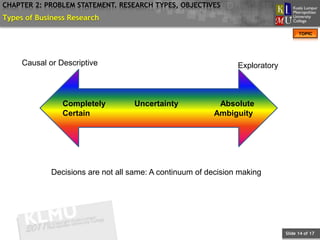
     Causal or Descriptive                                      Exploratory


                Completely         Uncertainty            Absolute
                Certain                                  Ambiguity


             Decisions are not all same: A continuum of decision making


                                                                              Slide 14 of 17
CHAPTER 2: PROBLEM STATEMENT. RESEARCH TYPES, OBJECTIVES
Types of Business Research
                                                                                   TOPIC


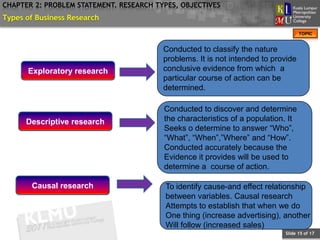
                                         Conducted to classify the nature
                                         problems. It is not intended to provide
      Exploratory research               conclusive evidence from which a
                                         particular course of action can be
                                         determined.

                                         Conducted to discover and determine
      Descriptive research               the characteristics of a population. It
                                         Seeks o determine to answer “Who”,
                                         “What”, “When”,”Where” and “How”.
                                         Conducted accurately because the
                                         Evidence it provides will be used to
                                         determine a course of action.

       Causal research                   To identify cause-and effect relationship
                                         between variables. Causal research
                                         Attempts to establish that when we do
                                         One thing (increase advertising), another
                                         Will follow (increased sales)
                                                                            Slide 15 of 17
CHAPTER 2: PROBLEM STATEMENT. RESEARCH TYPES, OBJECTIVES
Research Proposal
                                                                                   TOPIC


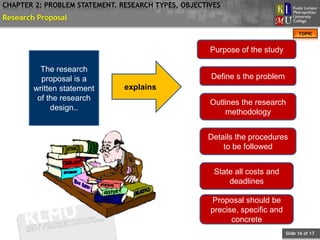
                                                     Purpose of the study

          The research
          proposal is a                              Define s the problem
        written statement      explains
         of the research
                                                     Outlines the research
             design..
                                                         methodology


                                                    Details the procedures
                                                        to be followed


                                                      State all costs and
                                                          deadlines

                                                     Proposal should be
                                                     precise, specific and
                                                           concrete
                                                                             Slide 16 of 17
CHAPTER 2: PROBLEM STATEMENT. RESEARCH TYPES, OBJECTIVES
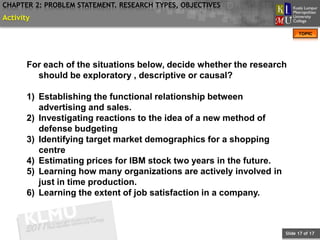
Activity
                                                                           TOPIC


       For each of the situations below, decide whether the research
         should be exploratory , descriptive or causal?

       1) Establishing the functional relationship between
          advertising and sales.
       2) Investigating reactions to the idea of a new method of
          defense budgeting
       3) Identifying target market demographics for a shopping
          centre
       4) Estimating prices for IBM stock two years in the future.
       5) Learning how many organizations are actively involved in
          just in time production.
       6) Learning the extent of job satisfaction in a company.


                                                                     Slide 17 of 17
CHAPTER 2: PROBLEM STATEMENT. RESEARCH TYPES, OBJECTIVES
Flowchart of the Research Process
                                                                 TOPIC


   Flowchart of the Research Process
      Refer to the diagram given


                                                           Slide 18 of 17

BAEB601 Chapter 2: Research Types, Objectives and Problem Statement

  • 1.
    BAEB601 RESEARCH METHODOLOGY CHAPTER 2 Research Types, Objectives, Problem Statement PREPARED BY: Nur Suhaili Ramli School of Marketing and Entrepreneurship (SoME) FACULTY OF BUSINESS AND MANAGEMENT
  • 2.
    CHAPTER 2: PROBLEMSTATEMENT. RESEARCH TYPES, OBJECTIVES Chapter Aims TOPIC This chapter aims to: 1.Define the importance of research as a management decision-making tool; 2.Define research 3.Differentiate between basic and applied research; 4.Define meaning of theory 5.Discuss the term concept, proposition, variables and hypothesis; 6.Classify research as exploratory research, descriptive research and causal research. 7.List the stages in the business research process Slide 2 of 17 Topics
  • 3.
    CHAPTER 2: PROBLEMSTATEMENT. RESEARCH TYPES, OBJECTIVES Problem Statement TOPIC Identify the scenarios Issues that lead to the formulation of the problem statement Slide 3 of 17
  • 4.
    CHAPTER 2: PROBLEMSTATEMENT. RESEARCH TYPES, OBJECTIVES Process of Problem Definition TOPIC Ascertain the Isolate and Understand the decision identify the background of maker’s problem, not the the problem objectives symptoms. State the research Determine the Determine the questions and relevant unit of analysis research variables objectives Slide 4 of 17
  • 5.
    CHAPTER 2: PROBLEMSTATEMENT. RESEARCH TYPES, OBJECTIVES Ascertain the decision maker’s objectives TOPIC MUST have a clear understanding of MUST attempt to the purpose of satisfy the decision undertaking the maker’s objectives research. Slide 5 of 17
  • 6.
    CHAPTER 2: PROBLEMSTATEMENT. RESEARCH TYPES, OBJECTIVES Understand the background of the problem TOPIC The background of the problem is vital A situation analysis is the logical first step in defining Analysis problem involve the informal gathering of background information Slide 6 of 17
  • 7.
    CHAPTER 2: PROBLEMSTATEMENT. RESEARCH TYPES, OBJECTIVES Isolate and identify the problem, not the symptoms TOPIC Anticipating the many influences and dimensions of a problem is impossible for any researcher. Certain occurrences that appear to be the problem may only be symptoms of a deeper problem. Slide 7 of 17
  • 8.
    CHAPTER 2: PROBLEMSTATEMENT. RESEARCH TYPES, OBJECTIVES Determine the unit of analysis TOPIC MUST specify the unit of analysis Will the individual consumer be the source of information? Industries, organization, departments or individual may be the focus data collection and analysis. Slide 8 of 17
  • 9.
    CHAPTER 2: PROBLEMSTATEMENT. RESEARCH TYPES, OBJECTIVES Determine the relevant variables TOPIC A variable is a quality that can exhibit In statistical analysis, a differences in value, variable is identified by a usually magnitude or symbol such as X, Y. strength A category or Example: classificatory variable Gender – Male or has a limited number of Female, Age – 20’s, 30’s distinct variables Income – Low, Middle, High Slide 9 of 17
  • 10.
    CHAPTER 2: PROBLEMSTATEMENT. RESEARCH TYPES, OBJECTIVES State the research questions and research objectives TOPIC  The research question is the researcher’s translation of the business problem into a specific need for inquiry.  Clarity in Research Questions and Hypotheses  Decision-Oriented research objective. Slide 10 of 17
  • 11.
    CHAPTER 2: PROBLEMSTATEMENT. RESEARCH TYPES, OBJECTIVES Problem Statement : Activity TOPIC Evaluate the statement of the business problem in following situations: 1. A farm implement manufacturer: Our objective is to learn the most effective form of capitalization so we can maximize profits. 2. The producer of a television show: We have a problem; the program’s rating are low. We need to learn how to improve our rating. Slide 11 of 17
  • 12.
    CHAPTER 2: PROBLEMSTATEMENT. RESEARCH TYPES, OBJECTIVES Clarity in Research Questions and Hypotheses TOPIC Research question should be specific, clear, and accompanied by a well formulated hypothesis. Hypothesis is an unproven proposition or possible solution to a problem. In its simplest form, a hypothesis is a guess! Problem and Hypothesis are similar. Both state relationship. BUT Problems are interrogative, Hypotheses are declarative and more specific to testing. Slide 12 of 17
  • 13.
    CHAPTER 2: PROBLEMSTATEMENT. RESEARCH TYPES, OBJECTIVES Research Objective TOPIC Research objective is the researcher’s version of the business problem. Research objective is derived from the problem definition. Research objective explain the purpose of research in measureable terms as well as defining what standard the research should accomplish. Research objective should be limited to a manageable number so that each one can be addressed fully. Slide 13 of 17
  • 14.
    CHAPTER 2: PROBLEMSTATEMENT. RESEARCH TYPES, OBJECTIVES Types of Business Research TOPIC Causal or Descriptive Exploratory Completely Uncertainty Absolute Certain Ambiguity Decisions are not all same: A continuum of decision making Slide 14 of 17
  • 15.
    CHAPTER 2: PROBLEMSTATEMENT. RESEARCH TYPES, OBJECTIVES Types of Business Research TOPIC Conducted to classify the nature problems. It is not intended to provide Exploratory research conclusive evidence from which a particular course of action can be determined. Conducted to discover and determine Descriptive research the characteristics of a population. It Seeks o determine to answer “Who”, “What”, “When”,”Where” and “How”. Conducted accurately because the Evidence it provides will be used to determine a course of action. Causal research To identify cause-and effect relationship between variables. Causal research Attempts to establish that when we do One thing (increase advertising), another Will follow (increased sales) Slide 15 of 17
  • 16.
    CHAPTER 2: PROBLEMSTATEMENT. RESEARCH TYPES, OBJECTIVES Research Proposal TOPIC Purpose of the study The research proposal is a Define s the problem written statement explains of the research Outlines the research design.. methodology Details the procedures to be followed State all costs and deadlines Proposal should be precise, specific and concrete Slide 16 of 17
  • 17.
    CHAPTER 2: PROBLEMSTATEMENT. RESEARCH TYPES, OBJECTIVES Activity TOPIC For each of the situations below, decide whether the research should be exploratory , descriptive or causal? 1) Establishing the functional relationship between advertising and sales. 2) Investigating reactions to the idea of a new method of defense budgeting 3) Identifying target market demographics for a shopping centre 4) Estimating prices for IBM stock two years in the future. 5) Learning how many organizations are actively involved in just in time production. 6) Learning the extent of job satisfaction in a company. Slide 17 of 17
  • 18.
    CHAPTER 2: PROBLEMSTATEMENT. RESEARCH TYPES, OBJECTIVES Flowchart of the Research Process TOPIC  Flowchart of the Research Process  Refer to the diagram given Slide 18 of 17