Prof. Neeraj Bhargava
Pooja Dixit
Department of Computer Science
School of Engineering & System Sciences
MDS, University Ajmer, Rajasthan, India
1
 When we project 3-D objects on a 2-D screen, we need to detect the
faces that are hidden on 2D.
 Back-Face detection, also known as Plane Equation method, is an object
space method in which objects and parts of objects are compared to find
out the visible surfaces.
 Let us consider a triangular surface that whose visibility needs to
decided. The idea is to check if the triangle will be facing away from the
viewer or not. If it does so, discard it for the current frame and move
onto the next one.
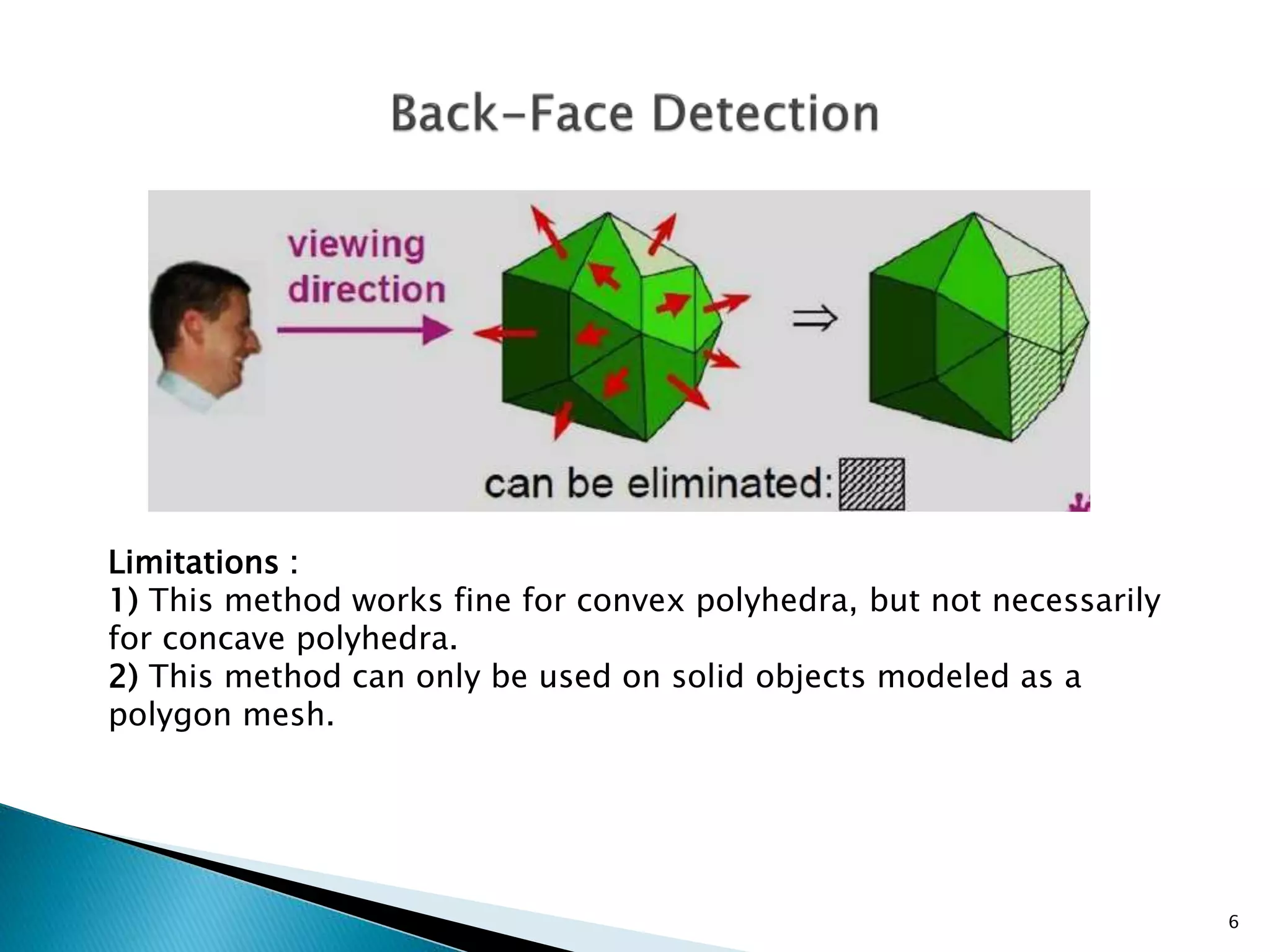
 Each surface has a normal vector. If this normal vector is pointing in the
direction of the center of projection, then it is a front face and can be
seen by the viewer. If this normal vector is pointing away from the center
of projection, then it is a back face and can not be seen by the viewer.
 A fast and simple object-space method for locating back faces
 A point (x,y,z) is “inside” a polygon surface with plane parameters A, B,
C, D if :
Ax + By + Cz + D < 0
 When an inside point is along the line of sight to the surface, the
polygon must be a back face and so cannot be seen.
2
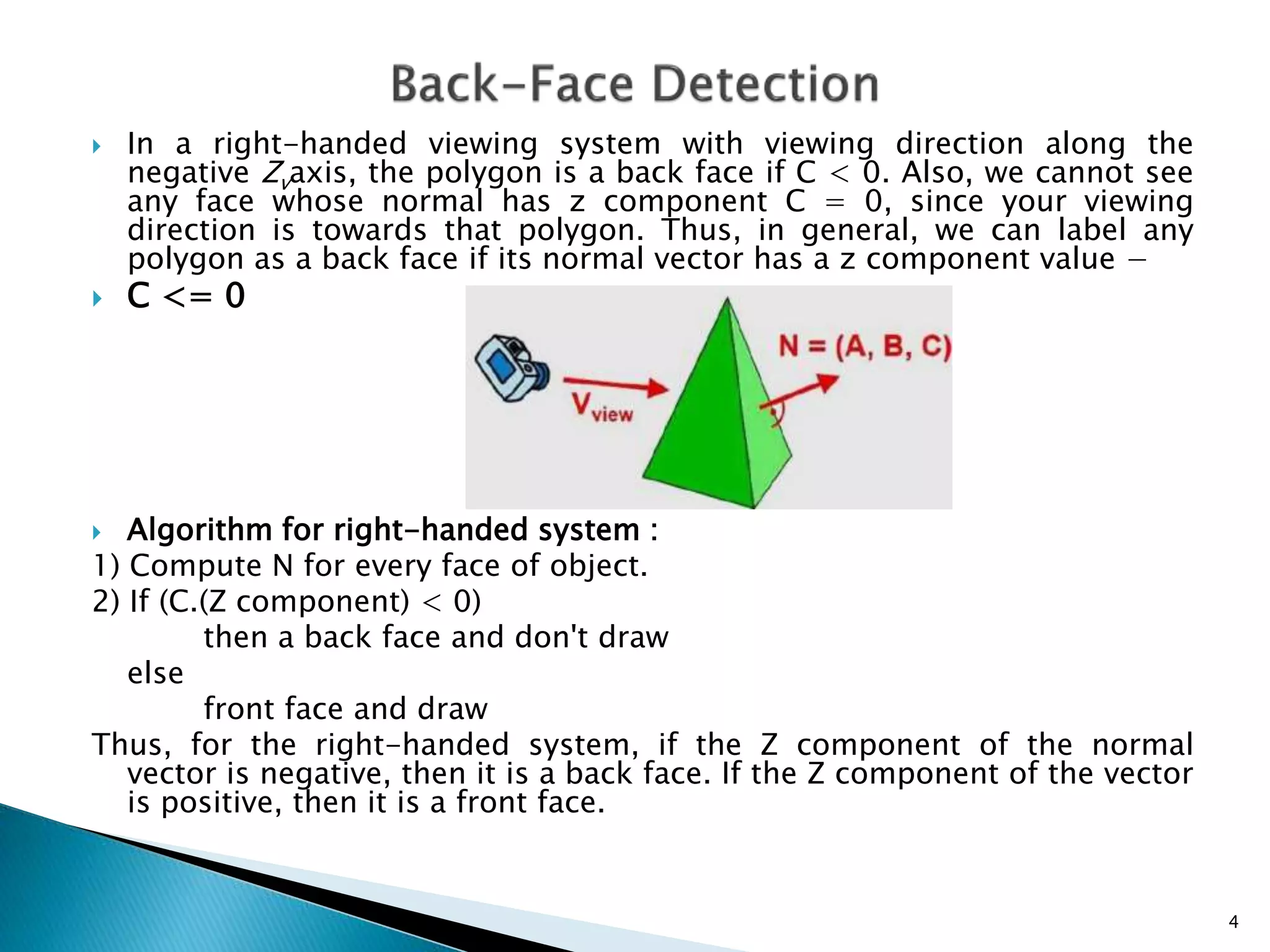
 The test is simplified by considering the normal vector N to
the polygon and the viewing vector V
 This is back face if
V · N > 0
 A polygon is a back face if Vview.N > 0. But it should be kept in mind
that after application of the viewing transformation, viewer is
looking down the negative Z-axis. Therefore, a polygon is back face
if :
 (0, 0, -1).N > 0 or if C < 0
3
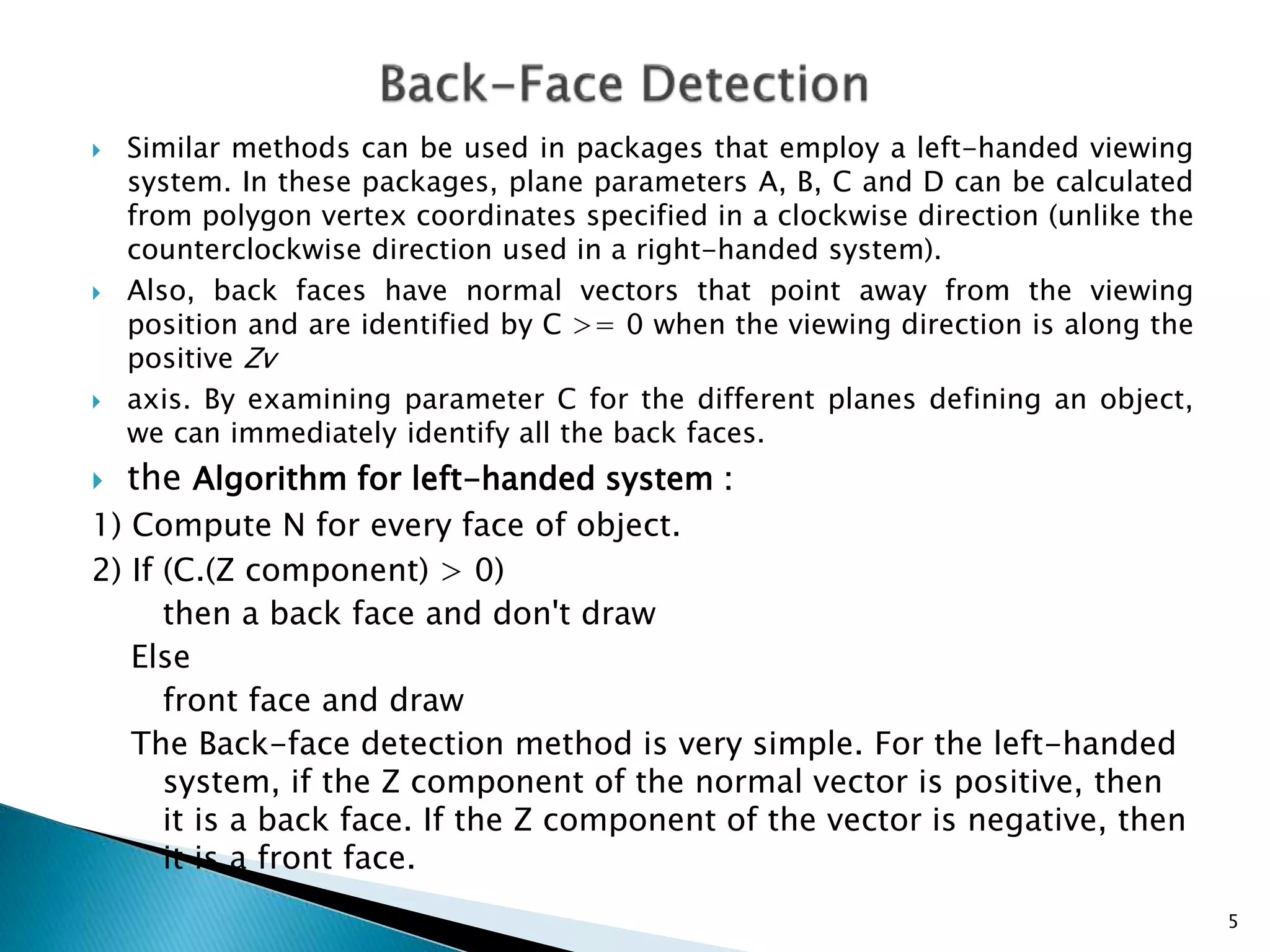
 In a right-handed viewing system with viewing direction along the
negative Zvaxis, the polygon is a back face if C < 0. Also, we cannot see
any face whose normal has z component C = 0, since your viewing
direction is towards that polygon. Thus, in general, we can label any
polygon as a back face if its normal vector has a z component value −
 C <= 0
 Algorithm for right-handed system :
1) Compute N for every face of object.
2) If (C.(Z component) < 0)
then a back face and don't draw
else
front face and draw
Thus, for the right-handed system, if the Z component of the normal
vector is negative, then it is a back face. If the Z component of the vector
is positive, then it is a front face.
4
 Similar methods can be used in packages that employ a left-handed viewing
system. In these packages, plane parameters A, B, C and D can be calculated
from polygon vertex coordinates specified in a clockwise direction (unlike the
counterclockwise direction used in a right-handed system).
 Also, back faces have normal vectors that point away from the viewing
position and are identified by C >= 0 when the viewing direction is along the
positive Zv
 axis. By examining parameter C for the different planes defining an object,
we can immediately identify all the back faces.
 the Algorithm for left-handed system :
1) Compute N for every face of object.
2) If (C.(Z component) > 0)
then a back face and don't draw
Else
front face and draw
The Back-face detection method is very simple. For the left-handed
system, if the Z component of the normal vector is positive, then
it is a back face. If the Z component of the vector is negative, then
it is a front face.
5
6
Limitations :
1) This method works fine for convex polyhedra, but not necessarily
for concave polyhedra.
2) This method can only be used on solid objects modeled as a
polygon mesh.

Back face detection

  • 1.
    Prof. Neeraj Bhargava PoojaDixit Department of Computer Science School of Engineering & System Sciences MDS, University Ajmer, Rajasthan, India 1
  • 2.
     When weproject 3-D objects on a 2-D screen, we need to detect the faces that are hidden on 2D.  Back-Face detection, also known as Plane Equation method, is an object space method in which objects and parts of objects are compared to find out the visible surfaces.  Let us consider a triangular surface that whose visibility needs to decided. The idea is to check if the triangle will be facing away from the viewer or not. If it does so, discard it for the current frame and move onto the next one.  Each surface has a normal vector. If this normal vector is pointing in the direction of the center of projection, then it is a front face and can be seen by the viewer. If this normal vector is pointing away from the center of projection, then it is a back face and can not be seen by the viewer.  A fast and simple object-space method for locating back faces  A point (x,y,z) is “inside” a polygon surface with plane parameters A, B, C, D if : Ax + By + Cz + D < 0  When an inside point is along the line of sight to the surface, the polygon must be a back face and so cannot be seen. 2
  • 3.
     The testis simplified by considering the normal vector N to the polygon and the viewing vector V  This is back face if V · N > 0  A polygon is a back face if Vview.N > 0. But it should be kept in mind that after application of the viewing transformation, viewer is looking down the negative Z-axis. Therefore, a polygon is back face if :  (0, 0, -1).N > 0 or if C < 0 3
  • 4.
     In aright-handed viewing system with viewing direction along the negative Zvaxis, the polygon is a back face if C < 0. Also, we cannot see any face whose normal has z component C = 0, since your viewing direction is towards that polygon. Thus, in general, we can label any polygon as a back face if its normal vector has a z component value −  C <= 0  Algorithm for right-handed system : 1) Compute N for every face of object. 2) If (C.(Z component) < 0) then a back face and don't draw else front face and draw Thus, for the right-handed system, if the Z component of the normal vector is negative, then it is a back face. If the Z component of the vector is positive, then it is a front face. 4
  • 5.
     Similar methodscan be used in packages that employ a left-handed viewing system. In these packages, plane parameters A, B, C and D can be calculated from polygon vertex coordinates specified in a clockwise direction (unlike the counterclockwise direction used in a right-handed system).  Also, back faces have normal vectors that point away from the viewing position and are identified by C >= 0 when the viewing direction is along the positive Zv  axis. By examining parameter C for the different planes defining an object, we can immediately identify all the back faces.  the Algorithm for left-handed system : 1) Compute N for every face of object. 2) If (C.(Z component) > 0) then a back face and don't draw Else front face and draw The Back-face detection method is very simple. For the left-handed system, if the Z component of the normal vector is positive, then it is a back face. If the Z component of the vector is negative, then it is a front face. 5
  • 6.
    6 Limitations : 1) Thismethod works fine for convex polyhedra, but not necessarily for concave polyhedra. 2) This method can only be used on solid objects modeled as a polygon mesh.