Should we abandon the t-test ?
     A statistical comparison of 8 differential gene expression tests


           Marine Jeanmougin, Master student INSA-Lyon
                 Mickaël Guedj1,3, Grégory Nuel2,3

                                        SMPGD’09


1. Ligue Nationale contre le Cancer – Cartes d’Identité des Tumeurs program (CIT)
2. Paris Descartes University – MAP5 laboratory
3. Statistics for Systems Biology working group
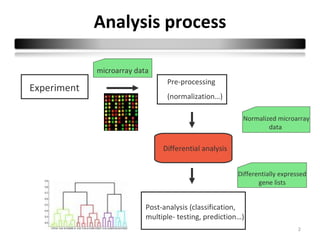
Analysis process

             microarray data
                                 Pre-processing
Experiment
                                 (normalization…)

                                                         Normalized microarray
                                                                 data


                                Differential analysis


                                                        Differentially expressed
                                                               gene lists


                           Post-analysis (classification,
                           multiple- testing, prediction…)
                                                                             2
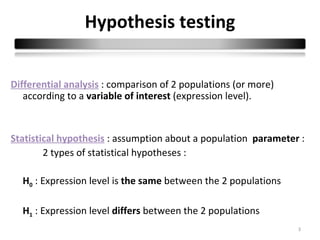
Hypothesis testing


Differential analysis : comparison of 2 populations (or more)
   according to a variable of interest (expression level).


Statistical hypothesis : assumption about a population parameter :
        2 types of statistical hypotheses :

  H0 : Expression level is the same between the 2 populations

  H1 : Expression level differs between the 2 populations
                                                                3
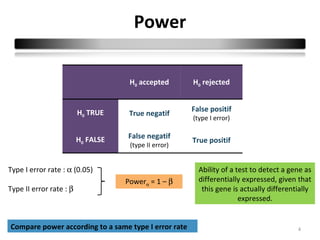
Power

                                     H0 accepted       H0 rejected


                         H0 TRUE                       False positif
                                     True negatif
                                                       (type I error)


                         H0 FALSE   False negatif
                                                       True positif
                                     (type II error)


Type I error rate : α (0.05)                             Ability of a test to detect a gene as
                                    Powerα = 1 – β       differentially expressed, given that
Type II error rate : β                                    this gene is actually differentially
                                                                       expressed.


Compare power according to a same type I error rate                                      4
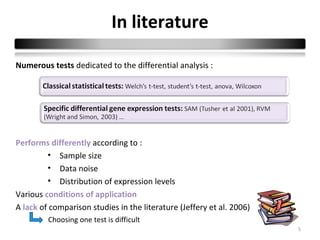
In literature

Numerous tests dedicated to the differential analysis :


Performs differently according to :
       • Sample size
       • Data noise
       • Distribution of expression levels
Various conditions of application
A lack of comparison studies in the literature (Jeffery et al. 2006)
         Choosing one test is difficult
                                                                       5
Variance modelling
                   An essential point: variance modelling
«…accurate estimation of variability is difficult. » (RVM, Wright and Simon, 2003)

« The importance of variance modelling is now widely known…» (SMVar, Jaffrézic et al, 2007)

« Many different sources of variability affect gene expression intensity measurements […]. Not at
all are well characterized or even identified» (VarMixt, Delmar et al, 2004)


 Many approaches :


                                                                                              6
Test description

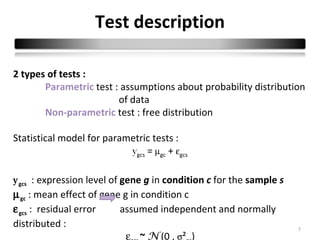
2 types of tests :
       Parametric test : assumptions about probability distribution
                        of data
       Non-parametric test : free distribution

Statistical model for parametric tests :
                           ygcs = µgc + εgcs

y gcs : expression level of gene g in condition c for the sample s
µ gc : mean effect of gene g in condition c
ε gcs : residual error      assumed independent and normally
distributed :                                                        7
                             ε ~ N (0 , σ² )
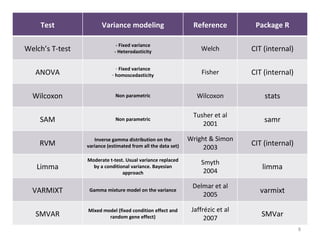
Test               Variance modeling                       Reference          Package R

                              - Fixed variance
Welch’s T-test               - Heterodasticity                    Welch          CIT (internal)

                              - Fixed variance
   ANOVA                    - homoscedasticity                     Fisher        CIT (internal)

  Wilcoxon                    Non parametric                     Wilcoxon            stats

                                                               Tusher et al
    SAM                       Non parametric
                                                                  2001
                                                                                     samr

                    Inverse gamma distribution on the         Wright & Simon
    RVM          variance (estimated from all the data set)        2003
                                                                                 CIT (internal)

                 Moderate t-test. Usual variance replaced
                                                                  Smyth
   Limma           by a conditional variance. Bayesian
                                                                   2004
                                                                                    limma
                                approach

                                                               Delmar et al
  VARMIXT         Gamma mixture model on the variance
                                                                  2005
                                                                                   varmixt

                 Mixed model (fixed condition effect and       Jaffrézic et al
   SMVAR                 random gene effect)                        2007
                                                                                    SMVar
                                                                                                  8
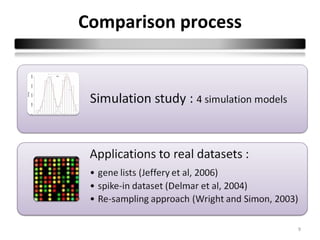
Comparison process


                     9
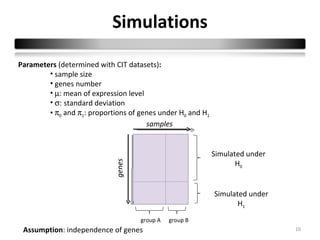
Simulations

Parameters (determined with CIT datasets):
        • sample size
        • genes number
        • µ: mean of expression level
        • σ: standard deviation
        • π0 and π1: proportions of genes under H0 and H1
                                      samples


                                                            Simulated under
                                                                   H0
                            genes


                                                            Simulated under
                                                                   H1

                                    group A   group B
 Assumption: independence of genes                                            10
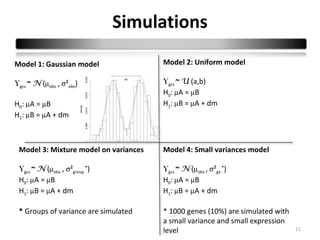
Simulations
Model 1: Gaussian model                Model 2: Uniform model

Ygcs ~ N (µobs , σ²obs)                Ygcs ~ U (a,b)
                                       H0: µA = µB
H0: µA = µB                            H1: µB = µA + dm
H1: µB = µA + dm


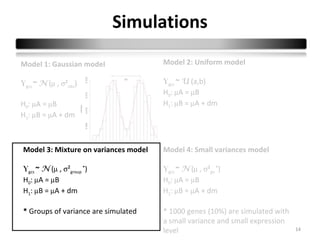
 Model 3: Mixture model on variances   Model 4: Small variances model

 Ygcs ~ N (µobs , σ²group *)           Ygcs ~ N (µobs , σ²gv *)
 H0: µA = µB                           H0: µA = µB
 H1: µB = µA + dm                      H1: µB = µA + dm

 * Groups of variance are simulated    * 1000 genes (10%) are simulated with
                                       a small variance and small expression
                                       level                                   11
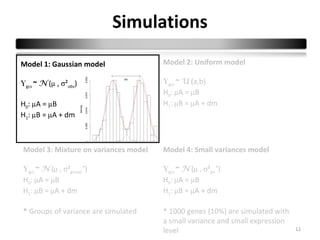
Simulations
Model 1: Gaussian model               Model 2: Uniform model

Ygcs ~ N (µ , σ²obs)                  Ygcs ~ U (a,b)
                                      H0: µA = µB
H0: µA = µB                           H1: µB = µA + dm
H1: µB = µA + dm


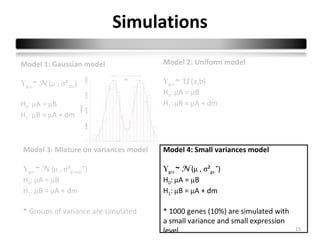
Model 3: Mixture on variances model   Model 4: Small variances model

Ygcs ~ N (µ , σ²group *)              Ygcs ~ N (µ , σ²gv *)
H0: µA = µB                           H0: µA = µB
H1: µB = µA + dm                      H1: µB = µA + dm

* Groups of variance are simulated    * 1000 genes (10%) are simulated with
                                      a small variance and small expression
                                      level                                   12
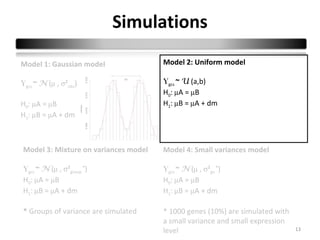
Simulations
Model 1: Gaussian model               Model 2: Uniform model

Ygcs ~ N (µ , σ²obs)                  Ygcs ~ U (a,b)
                                      H0: µA = µB
H0: µA = µB                           H1: µB = µA + dm
H1: µB = µA + dm


Model 3: Mixture on variances model   Model 4: Small variances model

Ygcs ~ N (µ , σ²group *)              Ygcs ~ N (µ , σ²gv *)
H0: µA = µB                           H0: µA = µB
H1: µB = µA + dm                      H1: µB = µA + dm

* Groups of variance are simulated    * 1000 genes (10%) are simulated with
                                      a small variance and small expression
                                      level                                   13
Simulations
Model 1: Gaussian model               Model 2: Uniform model

Ygcs ~ N (µ , σ²obs)                  Ygcs ~ U (a,b)
                                      H0: µA = µB
H0: µA = µB                           H1: µB = µA + dm
H1: µB = µA + dm


Model 3: Mixture on variances model   Model 4: Small variances model

Ygcs ~ N (µ , σ²group *)              Ygcs ~ N (µ , σ²gv *)
H0: µA = µB                           H0: µA = µB
H1: µB = µA + dm                      H1: µB = µA + dm

* Groups of variance are simulated    * 1000 genes (10%) are simulated with
                                      a small variance and small expression
                                      level                                   14
Simulations
Model 1: Gaussian model               Model 2: Uniform model

Ygcs ~ N (µ , σ²obs)                  Ygcs ~ U (a,b)
                                      H0: µA = µB
H0: µA = µB                           H1: µB = µA + dm
H1: µB = µA + dm


Model 3: Mixture on variances model   Model 4: Small variances model

Ygcs ~ N (µ , σ²group *)              Ygcs ~ N (µ , σ²gv *)
H0: µA = µB                           H0: µA = µB
H1: µB = µA + dm                      H1: µB = µA + dm

* Groups of variance are simulated    * 1000 genes (10%) are simulated with
                                      a small variance and small expression
                                      level                                   15
Simulations

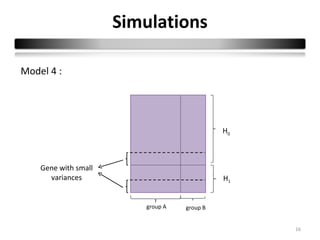
Model 4 :


                                             H0


    Gene with small
      variances                              H1


                         group A   group B


                                                  16
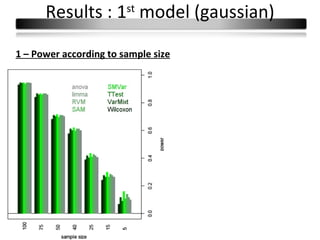
Results : 1 model (gaussian)
                        st


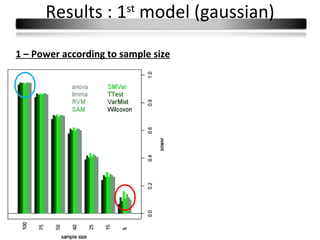
1 – Power according to sample size
Results : 1 model (gaussian)
                        st


1 – Power according to sample size
Results : 1 model (gaussian)
                        st

                                               Small sample   Large sample
                                      Tests       sizes           sizes
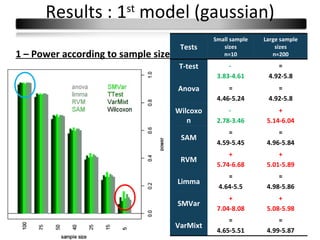
1 – Power according to sample size                n=10           n=200

                                      T-test        -             =
                                                3.83-4.61      4.92-5.8
                                     Anova          =             =
                                                4.46-5.24      4.92-5.8
                                     Wilcoxo        -              +
                                        n       2.78-3.46      5.14-6.04
                                                    =              =
                                      SAM
                                                4.59-5.45      4.96-5.84
                                                    +              +
                                      RVM
                                                5.74-6.68      5.01-5.89
                                                   =               =
                                     Limma
                                                4.64-5.5       4.98-5.86
                                                    +              +
                                     SMVar
                                                7.04-8.08      5.08-5.98
                                                    =              =
                                     VarMixt
                                                4.65-5.51      4.99-5.87
Results : 1 model (gaussian)
                        st


1 – Power according to sample size
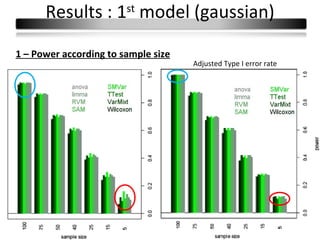
                                     Adjusted Type I error rate
Results : 1st model (gaussian)
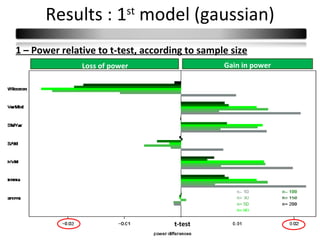
1 – Power relative to t-test, according to sample size
               Loss of power                    Gain in power


                                     t-test                     21
Results : 1st model (gaussian)
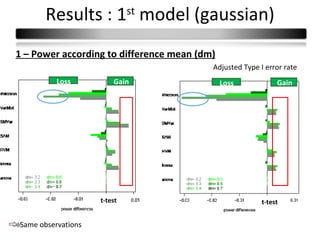
1 – Power according to difference mean (dm)
                                          Adjusted Type I error rate
          Loss          Gain                  Loss            Gain


                    t-test                               t-test


Same observations
Results : 1st model (gaussian)

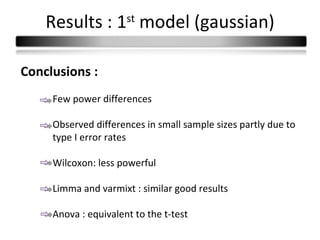
Conclusions :
     Few power differences

     Observed differences in small sample sizes partly due to
     type I error rates

     Wilcoxon: less powerful

     Limma and varmixt : similar good results

     Anova : equivalent to the t-test
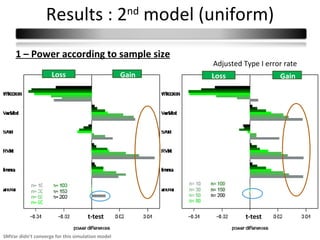
Results : 2nd model (uniform)
     1 – Power according to sample size
                                                         Adjusted Type I error rate
                     Loss                         Gain   Loss                Gain


                                    t-test                         t-test

SMVar didn’t converge for this simulation model
Results

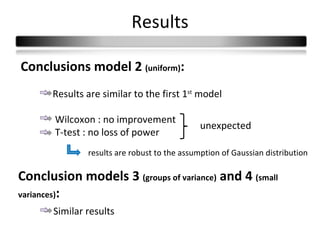
Conclusions model 2 (uniform):
       Results are similar to the first 1st model

       Wilcoxon : no improvement
                                              unexpected
       T-test : no loss of power
               results are robust to the assumption of Gaussian distribution

Conclusion models 3 (groups of variance) and 4 (small
variances):
       Similar results
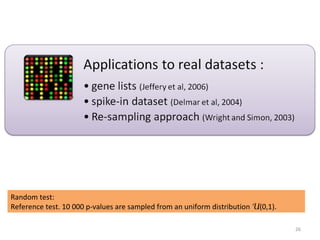
Random test:
Reference test. 10 000 p-values are sampled from an uniform distribution U(0,1).

                                                                                   26
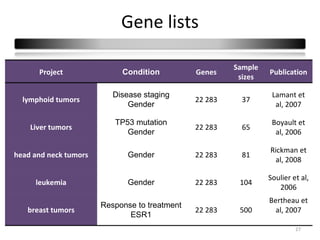
Gene lists

                                                        Sample
      Project               Condition          Genes             Publication
                                                         sizes

                          Disease staging                         Lamant et
  lymphoid tumors                              22 283     37
                              Gender                               al, 2007

                          TP53 mutation                           Boyault et
    Liver tumors                               22 283     65
                             Gender                                al, 2006

                                                                 Rickman et
head and neck tumors          Gender           22 283     81
                                                                  al, 2008

                                                                 Soulier et al,
     leukemia                 Gender           22 283    104
                                                                    2006
                                                                 Bertheau et
                       Response to treatment
   breast tumors                               22 283    500       al, 2007
                              ESR1
                                                                          27
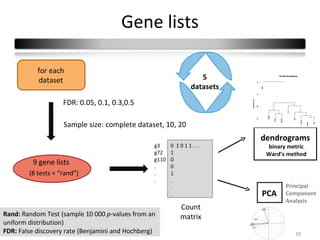
Gene lists

           for each
           dataset                                               5
                                                              datasets
                    FDR: 0.05, 0.1, 0.3,0.5

                    Sample size: complete dataset, 10, 20
                                                                         dendrograms
                                                 g3     0 1011...         binary metric
                                                 g72    1                 Ward’s method
                                                 g110   0
         9 gene lists                            .      0
        (8 tests + “rand”)                       .      1
                                                 .      .
                                                        .                       Principal
                                                        .                PCA    Component
                                                                                Analysis
                                                          Count
Rand: Random Test (sample 10 000 p-values from an         matrix
uniform distribution)
FDR: False discovery rate (Benjamini and Hochberg)                                 28
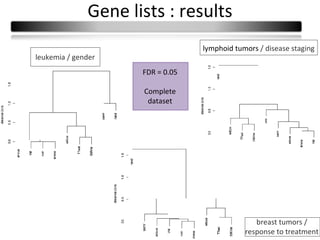
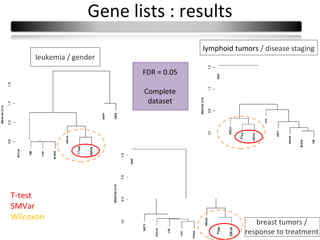
Gene lists : results
                                  lymphoid tumors / disease staging
leukemia / gender
                     FDR = 0.05

                     Complete
                      dataset


                                                 breast tumors /
                                              response to treatment
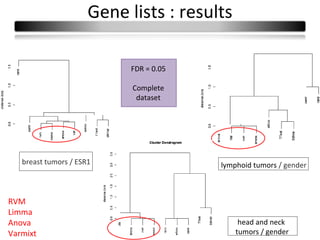
Gene lists : results
                                       lymphoid tumors / disease staging
     leukemia / gender
                          FDR = 0.05

                          Complete
                           dataset


T-test
SMVar
Wilcoxon
                                                      breast tumors /
                                                   response to treatment
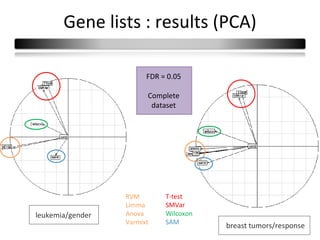
Gene lists : results

                           FDR = 0.05

                            Complete
                             dataset


   breast tumors / ESR1                 lymphoid tumors / gender


RVM
Limma
Anova                                         head and neck
Varmixt                                      tumors / gender
Gene lists : results (PCA)
                        FDR = 0.05

                        Complete
                         dataset


                  RVM        T-test
                  Limma      SMVar
leukemia/gender   Anova      Wilcoxon
                  Varmixt    SAM
                                        breast tumors/response
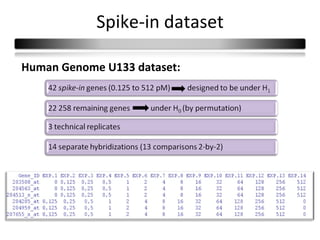
Spike-in dataset

Human Genome U133 dataset:
Spike-in dataset : results

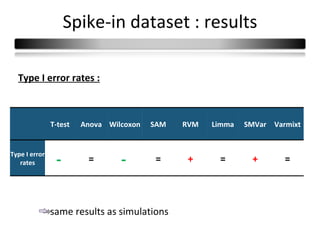
  Type I error rates :


               T-test   Anova Wilcoxon   SAM   RVM   Limma   SMVar Varmixt


Type I error
   rates        -        =       -       =      +     =       +       =


               same results as simulations
Spike-in dataset : results

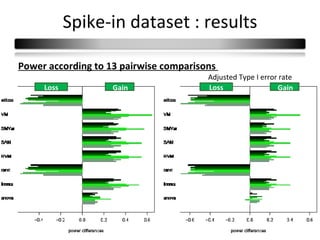
Power according to 13 pairwise comparisons
                                        Adjusted Type I error rate
     Loss           Gain                Loss                 Gain
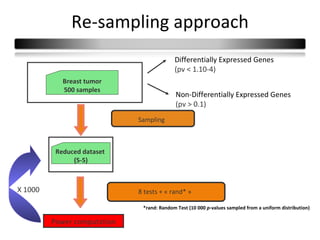
Re-sampling approach
                                           Differentially Expressed Genes
                                           (pv < 1.10-4)
            Breast tumor
            500 samples
                                            Non-Differentially Expressed Genes
                                            (pv > 0.1)
                             Sampling


          Reduced dataset
               (5-5)


X 1000                       8 tests + « rand* »

                              *rand: Random Test (10 000 p-values sampled from a uniform distribution)

         Power computation
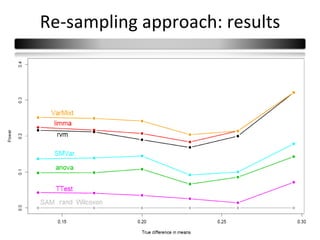
Re-sampling approach: results


                                37
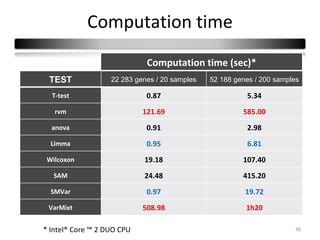
Computation time
                             Computation time (sec)*
 TEST              22 283 genes / 20 samples   52 188 genes / 200 samples

  T-test                     0.87                        5.34
   rvm                      121.69                      585.00
  anova                      0.91                        2.98
  Limma                      0.95                        6.81
 Wilcoxon                   19.18                       107.40
   SAM                      24.48                       415.20
  SMVar                      0.97                        19.72
 VarMixt                    508.98                       1h20

* Intel® Core ™ 2 DUO CPU                                              38
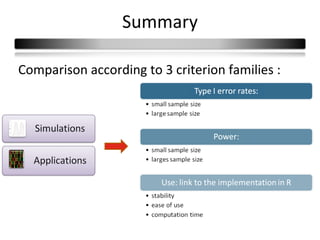
Summary

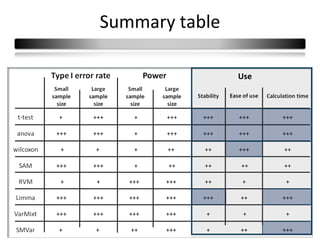
Comparison according to 3 criterion families :
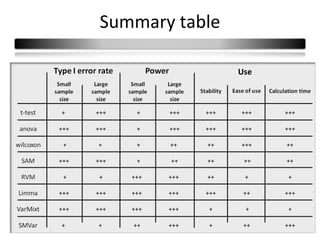
Summary table

                Use


                      40
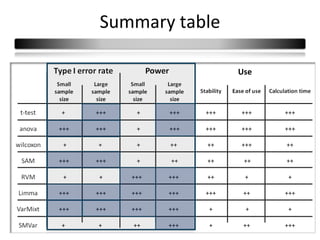
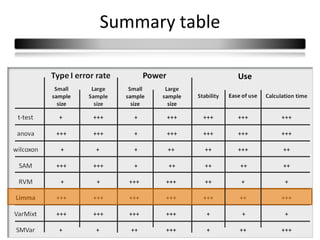
Summary table

                Use


                      41
Summary table

                Use


                       42
                      42
Summary table

                Use


                       43
                      43
Conclusions

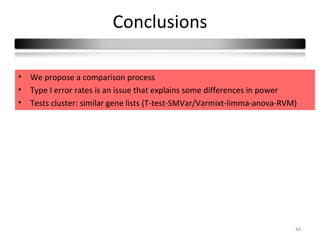
•   We propose a comparison process
•   Type I error rates is an issue that explains some differences in power
•   Tests cluster: similar gene lists (T-test-SMVar/Varmixt-limma-anova-RVM)


                                                                           44
Conclusions

•   We propose a comparison process
•   Type I error rates is an issue that explains some differences in power
•   Tests cluster: similar gene lists (T-test-SMVar/Varmixt-limma-anova-RVM)


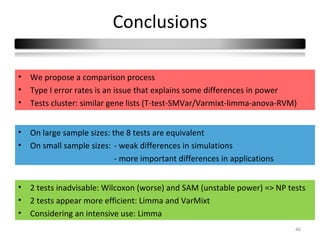
•   On large sample sizes: the 8 tests are equivalent
•   On small sample sizes: - weak differences in simulations
                            - more important differences in applications


                                                                           45
Conclusions

•   We propose a comparison process
•   Type I error rates is an issue that explains some differences in power
•   Tests cluster: similar gene lists (T-test-SMVar/Varmixt-limma-anova-RVM)


•   On large sample sizes: the 8 tests are equivalent
•   On small sample sizes: - weak differences in simulations
                            - more important differences in applications


•   2 tests inadvisable: Wilcoxon (worse) and SAM (unstable power) => NP tests
•   2 tests appear more efficient: Limma and VarMixt
•   Considering an intensive use: Limma
                                                                           46
Thanks

To the whole CIT’s team of the Ligue Nationale Contre le Cancer :

To M. Guedj, L. Marisa, AS. Valin, F. Petel, E. Thomas, R. Schiappa,
L. Vescovo, A. de Reynies, J. Metral and J. Godet

To G. Nuel, MAP5 laboratory, UMR 8145, Paris V University
and V. Dumeaux, Tromsø University et Paris V University

To the IRISA of Rennes

To the SMPGD’s team who enables me to introduce my work
Thank you for your attention !


Contact : marine.jeanmougin@gmail.com
                                               48

B4 jeanmougin

  • 1.
    Should we abandonthe t-test ? A statistical comparison of 8 differential gene expression tests Marine Jeanmougin, Master student INSA-Lyon Mickaël Guedj1,3, Grégory Nuel2,3 SMPGD’09 1. Ligue Nationale contre le Cancer – Cartes d’Identité des Tumeurs program (CIT) 2. Paris Descartes University – MAP5 laboratory 3. Statistics for Systems Biology working group
  • 2.
    Analysis process microarray data Pre-processing Experiment (normalization…) Normalized microarray data Differential analysis Differentially expressed gene lists Post-analysis (classification, multiple- testing, prediction…) 2
  • 3.
    Hypothesis testing Differential analysis: comparison of 2 populations (or more) according to a variable of interest (expression level). Statistical hypothesis : assumption about a population parameter : 2 types of statistical hypotheses : H0 : Expression level is the same between the 2 populations H1 : Expression level differs between the 2 populations 3
  • 4.
    Power H0 accepted H0 rejected H0 TRUE False positif True negatif (type I error) H0 FALSE False negatif True positif (type II error) Type I error rate : α (0.05) Ability of a test to detect a gene as Powerα = 1 – β differentially expressed, given that Type II error rate : β this gene is actually differentially expressed. Compare power according to a same type I error rate 4
  • 5.
    In literature Numerous testsdedicated to the differential analysis : Performs differently according to : • Sample size • Data noise • Distribution of expression levels Various conditions of application A lack of comparison studies in the literature (Jeffery et al. 2006) Choosing one test is difficult 5
  • 6.
    Variance modelling An essential point: variance modelling «…accurate estimation of variability is difficult. » (RVM, Wright and Simon, 2003) « The importance of variance modelling is now widely known…» (SMVar, Jaffrézic et al, 2007) « Many different sources of variability affect gene expression intensity measurements […]. Not at all are well characterized or even identified» (VarMixt, Delmar et al, 2004) Many approaches : 6
  • 7.
    Test description 2 typesof tests : Parametric test : assumptions about probability distribution of data Non-parametric test : free distribution Statistical model for parametric tests : ygcs = µgc + εgcs y gcs : expression level of gene g in condition c for the sample s µ gc : mean effect of gene g in condition c ε gcs : residual error assumed independent and normally distributed : 7 ε ~ N (0 , σ² )
  • 8.
    Test Variance modeling Reference Package R - Fixed variance Welch’s T-test - Heterodasticity Welch CIT (internal) - Fixed variance ANOVA - homoscedasticity Fisher CIT (internal) Wilcoxon Non parametric Wilcoxon stats Tusher et al SAM Non parametric 2001 samr Inverse gamma distribution on the Wright & Simon RVM variance (estimated from all the data set) 2003 CIT (internal) Moderate t-test. Usual variance replaced Smyth Limma by a conditional variance. Bayesian 2004 limma approach Delmar et al VARMIXT Gamma mixture model on the variance 2005 varmixt Mixed model (fixed condition effect and Jaffrézic et al SMVAR random gene effect) 2007 SMVar 8
  • 9.
  • 10.
    Simulations Parameters (determined withCIT datasets): • sample size • genes number • µ: mean of expression level • σ: standard deviation • π0 and π1: proportions of genes under H0 and H1 samples Simulated under H0 genes Simulated under H1 group A group B Assumption: independence of genes 10
  • 11.
    Simulations Model 1: Gaussianmodel Model 2: Uniform model Ygcs ~ N (µobs , σ²obs) Ygcs ~ U (a,b) H0: µA = µB H0: µA = µB H1: µB = µA + dm H1: µB = µA + dm Model 3: Mixture model on variances Model 4: Small variances model Ygcs ~ N (µobs , σ²group *) Ygcs ~ N (µobs , σ²gv *) H0: µA = µB H0: µA = µB H1: µB = µA + dm H1: µB = µA + dm * Groups of variance are simulated * 1000 genes (10%) are simulated with a small variance and small expression level 11
  • 12.
    Simulations Model 1: Gaussianmodel Model 2: Uniform model Ygcs ~ N (µ , σ²obs) Ygcs ~ U (a,b) H0: µA = µB H0: µA = µB H1: µB = µA + dm H1: µB = µA + dm Model 3: Mixture on variances model Model 4: Small variances model Ygcs ~ N (µ , σ²group *) Ygcs ~ N (µ , σ²gv *) H0: µA = µB H0: µA = µB H1: µB = µA + dm H1: µB = µA + dm * Groups of variance are simulated * 1000 genes (10%) are simulated with a small variance and small expression level 12
  • 13.
    Simulations Model 1: Gaussianmodel Model 2: Uniform model Ygcs ~ N (µ , σ²obs) Ygcs ~ U (a,b) H0: µA = µB H0: µA = µB H1: µB = µA + dm H1: µB = µA + dm Model 3: Mixture on variances model Model 4: Small variances model Ygcs ~ N (µ , σ²group *) Ygcs ~ N (µ , σ²gv *) H0: µA = µB H0: µA = µB H1: µB = µA + dm H1: µB = µA + dm * Groups of variance are simulated * 1000 genes (10%) are simulated with a small variance and small expression level 13
  • 14.
    Simulations Model 1: Gaussianmodel Model 2: Uniform model Ygcs ~ N (µ , σ²obs) Ygcs ~ U (a,b) H0: µA = µB H0: µA = µB H1: µB = µA + dm H1: µB = µA + dm Model 3: Mixture on variances model Model 4: Small variances model Ygcs ~ N (µ , σ²group *) Ygcs ~ N (µ , σ²gv *) H0: µA = µB H0: µA = µB H1: µB = µA + dm H1: µB = µA + dm * Groups of variance are simulated * 1000 genes (10%) are simulated with a small variance and small expression level 14
  • 15.
    Simulations Model 1: Gaussianmodel Model 2: Uniform model Ygcs ~ N (µ , σ²obs) Ygcs ~ U (a,b) H0: µA = µB H0: µA = µB H1: µB = µA + dm H1: µB = µA + dm Model 3: Mixture on variances model Model 4: Small variances model Ygcs ~ N (µ , σ²group *) Ygcs ~ N (µ , σ²gv *) H0: µA = µB H0: µA = µB H1: µB = µA + dm H1: µB = µA + dm * Groups of variance are simulated * 1000 genes (10%) are simulated with a small variance and small expression level 15
  • 16.
    Simulations Model 4 : H0 Gene with small variances H1 group A group B 16
  • 17.
    Results : 1model (gaussian) st 1 – Power according to sample size
  • 18.
    Results : 1model (gaussian) st 1 – Power according to sample size
  • 19.
    Results : 1model (gaussian) st Small sample Large sample Tests sizes sizes 1 – Power according to sample size n=10 n=200 T-test - = 3.83-4.61 4.92-5.8 Anova = = 4.46-5.24 4.92-5.8 Wilcoxo - + n 2.78-3.46 5.14-6.04 = = SAM 4.59-5.45 4.96-5.84 + + RVM 5.74-6.68 5.01-5.89 = = Limma 4.64-5.5 4.98-5.86 + + SMVar 7.04-8.08 5.08-5.98 = = VarMixt 4.65-5.51 4.99-5.87
  • 20.
    Results : 1model (gaussian) st 1 – Power according to sample size Adjusted Type I error rate
  • 21.
    Results : 1stmodel (gaussian) 1 – Power relative to t-test, according to sample size Loss of power Gain in power t-test 21
  • 22.
    Results : 1stmodel (gaussian) 1 – Power according to difference mean (dm) Adjusted Type I error rate Loss Gain Loss Gain t-test t-test Same observations
  • 23.
    Results : 1stmodel (gaussian) Conclusions : Few power differences Observed differences in small sample sizes partly due to type I error rates Wilcoxon: less powerful Limma and varmixt : similar good results Anova : equivalent to the t-test
  • 24.
    Results : 2ndmodel (uniform) 1 – Power according to sample size Adjusted Type I error rate Loss Gain Loss Gain t-test t-test SMVar didn’t converge for this simulation model
  • 25.
    Results Conclusions model 2(uniform): Results are similar to the first 1st model Wilcoxon : no improvement unexpected T-test : no loss of power results are robust to the assumption of Gaussian distribution Conclusion models 3 (groups of variance) and 4 (small variances): Similar results
  • 26.
    Random test: Reference test.10 000 p-values are sampled from an uniform distribution U(0,1). 26
  • 27.
    Gene lists Sample Project Condition Genes Publication sizes Disease staging Lamant et lymphoid tumors 22 283 37 Gender al, 2007 TP53 mutation Boyault et Liver tumors 22 283 65 Gender al, 2006 Rickman et head and neck tumors Gender 22 283 81 al, 2008 Soulier et al, leukemia Gender 22 283 104 2006 Bertheau et Response to treatment breast tumors 22 283 500 al, 2007 ESR1 27
  • 28.
    Gene lists for each dataset 5 datasets FDR: 0.05, 0.1, 0.3,0.5 Sample size: complete dataset, 10, 20 dendrograms g3 0 1011... binary metric g72 1 Ward’s method g110 0 9 gene lists . 0 (8 tests + “rand”) . 1 . . . Principal . PCA Component Analysis Count Rand: Random Test (sample 10 000 p-values from an matrix uniform distribution) FDR: False discovery rate (Benjamini and Hochberg) 28
  • 29.
    Gene lists :results lymphoid tumors / disease staging leukemia / gender FDR = 0.05 Complete dataset breast tumors / response to treatment
  • 30.
    Gene lists :results lymphoid tumors / disease staging leukemia / gender FDR = 0.05 Complete dataset T-test SMVar Wilcoxon breast tumors / response to treatment
  • 31.
    Gene lists :results FDR = 0.05 Complete dataset breast tumors / ESR1 lymphoid tumors / gender RVM Limma Anova head and neck Varmixt tumors / gender
  • 32.
    Gene lists :results (PCA) FDR = 0.05 Complete dataset RVM T-test Limma SMVar leukemia/gender Anova Wilcoxon Varmixt SAM breast tumors/response
  • 33.
  • 34.
    Spike-in dataset :results Type I error rates : T-test Anova Wilcoxon SAM RVM Limma SMVar Varmixt Type I error rates - = - = + = + = same results as simulations
  • 35.
    Spike-in dataset :results Power according to 13 pairwise comparisons Adjusted Type I error rate Loss Gain Loss Gain
  • 36.
    Re-sampling approach Differentially Expressed Genes (pv < 1.10-4) Breast tumor 500 samples Non-Differentially Expressed Genes (pv > 0.1) Sampling Reduced dataset (5-5) X 1000 8 tests + « rand* » *rand: Random Test (10 000 p-values sampled from a uniform distribution) Power computation
  • 37.
  • 38.
    Computation time Computation time (sec)* TEST 22 283 genes / 20 samples 52 188 genes / 200 samples T-test 0.87 5.34 rvm 121.69 585.00 anova 0.91 2.98 Limma 0.95 6.81 Wilcoxon 19.18 107.40 SAM 24.48 415.20 SMVar 0.97 19.72 VarMixt 508.98 1h20 * Intel® Core ™ 2 DUO CPU 38
  • 39.
    Summary Comparison according to3 criterion families :
  • 40.
  • 41.
  • 42.
    Summary table Use 42 42
  • 43.
    Summary table Use 43 43
  • 44.
    Conclusions • We propose a comparison process • Type I error rates is an issue that explains some differences in power • Tests cluster: similar gene lists (T-test-SMVar/Varmixt-limma-anova-RVM) 44
  • 45.
    Conclusions • We propose a comparison process • Type I error rates is an issue that explains some differences in power • Tests cluster: similar gene lists (T-test-SMVar/Varmixt-limma-anova-RVM) • On large sample sizes: the 8 tests are equivalent • On small sample sizes: - weak differences in simulations - more important differences in applications 45
  • 46.
    Conclusions • We propose a comparison process • Type I error rates is an issue that explains some differences in power • Tests cluster: similar gene lists (T-test-SMVar/Varmixt-limma-anova-RVM) • On large sample sizes: the 8 tests are equivalent • On small sample sizes: - weak differences in simulations - more important differences in applications • 2 tests inadvisable: Wilcoxon (worse) and SAM (unstable power) => NP tests • 2 tests appear more efficient: Limma and VarMixt • Considering an intensive use: Limma 46
  • 47.
    Thanks To the wholeCIT’s team of the Ligue Nationale Contre le Cancer : To M. Guedj, L. Marisa, AS. Valin, F. Petel, E. Thomas, R. Schiappa, L. Vescovo, A. de Reynies, J. Metral and J. Godet To G. Nuel, MAP5 laboratory, UMR 8145, Paris V University and V. Dumeaux, Tromsø University et Paris V University To the IRISA of Rennes To the SMPGD’s team who enables me to introduce my work
  • 48.
    Thank you foryour attention ! Contact : marine.jeanmougin@gmail.com 48