.
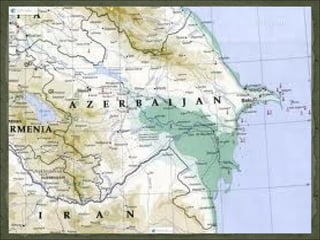
 Baku is the capital and largest city of Azerbaijan, as well as the largest city
  on the Caspian Sea and of theCaucasus region. It is located on the southern
  shore of the Absheron Peninsula, which projects into the Caspian Sea.The
  city consists of two principal parts: the downtown and the old Inner City
  (21.5 ha). Baku's urban population at the beginning of 2009 was estimated at
  just over two million people. Officially, about 25 percent of all inhabitants of
  the country live in the metropolitan city area of Baku.
 Baku is divided into eleven administrative districts and 48 townships.
  Among these are the townships on islands in the Baku Bay and the town
  of OilRocks built on stilts in the Caspian Sea, 60 km (37 mi) away from
  Baku. The Inner City of Baku along with the Shirvanshah's Palace
  and MaidenTower were inscribed as a UNESCO World Heritage Site in
  2000.


                    .
The Manat  is the currency of Azerbaijan. It is subdivided into 100 qəpik. The word manat is
borrowed from the Russian word "moneta” (coin) which is pronounced as "maneta". Manat was
also the designation of the Soviet rublle in both the Azerbaijani and Turkmen languages.
The Azerbaijani manat symbol,  , is currently not encoded in Unicode, and m or man. can be
used as a substitute for the manat symbol
 Tourism is a growing part of the economy of Azerbaijan. The country was a well-
  known tourist spot in the 1980s, yet, the Nagorno-Karabakh war during the 1990s
  crippled the tourist industry and negatively impacted the image of Azerbaijan as a
  tourist destination.
 It was not until 2000s (decade) that the tourism industry began to recover, and the
  country has since experienced a high rate of growth in the number of tourist visits
  and overnight stays. In the recent years, Azerbaijan has also become a more popular
  destination for religious, spa, and health care tourism.
  
 The Khojaly Massacre was the killing of hundreds of ethnic Azerbaijani
  civilians from the town of Khojaly on 25–26 February 1992 by the Armenian and, 
  partially, by CIS armed forces during the Nagorn-Karabakh war. According to the 
  Azerbaijani side, as well as Memorial Human Rights Center, Human Rights Watch and 
  other international observers,the massacre was committed by the 
  ethnic Armenian armed forces, reportedly with help of the Russian 366th Motor Rifle 
  Regiment, apparently not acting on orders from the command. The death toll provided 
  by Azerbaijani authorities is 613 civilians, including 106 women and 83 children. The 
  event became the largest massacre in the course of Nagorno-Karabakh conflict.
Azerbaijan
Azerbaijan

Azerbaijan

  • 2.
  • 5.
     Baku isthe capital and largest city of Azerbaijan, as well as the largest city on the Caspian Sea and of theCaucasus region. It is located on the southern shore of the Absheron Peninsula, which projects into the Caspian Sea.The city consists of two principal parts: the downtown and the old Inner City (21.5 ha). Baku's urban population at the beginning of 2009 was estimated at just over two million people. Officially, about 25 percent of all inhabitants of the country live in the metropolitan city area of Baku.  Baku is divided into eleven administrative districts and 48 townships. Among these are the townships on islands in the Baku Bay and the town of OilRocks built on stilts in the Caspian Sea, 60 km (37 mi) away from Baku. The Inner City of Baku along with the Shirvanshah's Palace and MaidenTower were inscribed as a UNESCO World Heritage Site in 2000.
  • 7.
    . The Manat  is the currency of Azerbaijan. It is subdivided into 100 qəpik. The word manat is borrowed from the Russian word "moneta” (coin) which is pronounced as "maneta". Manat was also the designation of the Soviet rublle in both the Azerbaijani and Turkmen languages. The Azerbaijani manat symbol,  , is currently not encoded in Unicode, and m or man. can be used as a substitute for the manat symbol
  • 10.
     Tourism isa growing part of the economy of Azerbaijan. The country was a well- known tourist spot in the 1980s, yet, the Nagorno-Karabakh war during the 1990s crippled the tourist industry and negatively impacted the image of Azerbaijan as a tourist destination.  It was not until 2000s (decade) that the tourism industry began to recover, and the country has since experienced a high rate of growth in the number of tourist visits and overnight stays. In the recent years, Azerbaijan has also become a more popular destination for religious, spa, and health care tourism.
  • 15.
        The KhojalyMassacre was the killing of hundreds of ethnic Azerbaijani   civilians from the town of Khojaly on 25–26 February 1992 by the Armenian and,  partially, by CIS armed forces during the Nagorn-Karabakh war. According to the  Azerbaijani side, as well as Memorial Human Rights Center, Human Rights Watch and  other international observers,the massacre was committed by the  ethnic Armenian armed forces, reportedly with help of the Russian 366th Motor Rifle  Regiment, apparently not acting on orders from the command. The death toll provided  by Azerbaijani authorities is 613 civilians, including 106 women and 83 children. The  event became the largest massacre in the course of Nagorno-Karabakh conflict.