AWS:
OVERVIEW OF
SECURITY
PROCESSES
   Stephen Schmidt
   Chief Information Security Officer
   steves@amazon.com
O VERVIEW


•   Certifications
•   SAS70 Type II
•   Physical Security
•   Backups
•   Amazon EC2 Security
•   Network Security
•   Amazon S3 Security
•   Amazon SimpleDB Security
•   Amazon SQS Security
•   Amazon CloudFront Security
•   Amazon Elastic MapReduce
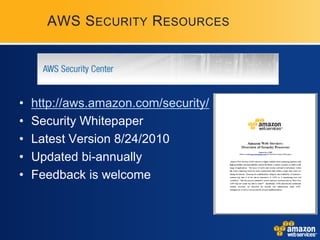
AWS S ECURITY R ESOURCES


•   http://aws.amazon.com/security/
•   Security Whitepaper
•   Latest Version 8/24/2010
•   Updated bi-annually
•   Feedback is welcome
AWS C ERTIFICATIONS

•   Shared Responsibility Model
•   Sarbanes-Oxley (SOX)
•   SAS70 Type II Audit
•   FISMA A&A
    – NIST Low Approvals to Operate
    – Actively pursuing NIST Moderate
    – FedRAMP
• Pursuing ISO 27001 Certification
• Customers have deployed various compliant
  applications such as HIPAA (healthcare)
SAS70 T YPE II


• Based on the Control Objectives for
  Information and related Technology
  (COBIT), which is a set of established best
  practices (transitioning to ISO 27001)

• Covers Access (Security), Change
  Management and Operations of
  Amazon EC2 and Amazon S3

• Audit conducted by an independent
  accounting firm (E&Y) on a recurring basis
SAS70 T YPE II – C ONTROL O BJECTIVES

•   Control Objective 1: Security Organization

•   Control Objective 2: Amazon Employee Lifecycle

•   Control Objective 3: Logical Security

•   Control Objective 4: Secure Data Handling

•   Control Objective 5: Physical Security

•   Control Objective 6: Environmental Safeguards

•   Control Objective 7: Change Management

•   Control Objective 8: Data Integrity, Availability and Redundancy

•   Control Objective 9: Incident Handling
PHYSICAL SECURITY


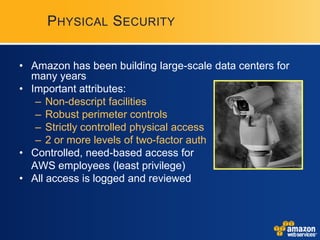
• Amazon has been building large-scale data centers for
  many years
• Important attributes:
   – Non-descript facilities
   – Robust perimeter controls
   – Strictly controlled physical access
   – 2 or more levels of two-factor auth
• Controlled, need-based access for
  AWS employees (least privilege)
• All access is logged and reviewed
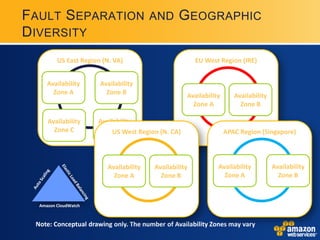
FAULT SEPARATION                        AND     G EOGRAPHIC
D IVERSITY
         US East Region (N. VA)                        EU West Region (IRE)


     Availability      Availability
       Zone A            Zone B                     Availability      Availability
                                                      Zone A            Zone B

     Availability     Availability
       Zone C           Zone D
                           US West Region (N. CA)                  APAC Region (Singapore)


                         Availability   Availability           Availability
                                                                vailability           Availability
                                                                                     Availability
                           Zone A         Zone B                 Zone A
                                                                  Zone A               Zone BB
                                                                                        Zone


  Amazon CloudWatch


 Note: Conceptual drawing only. The number of Availability Zones may vary
D ATA B ACKUPS


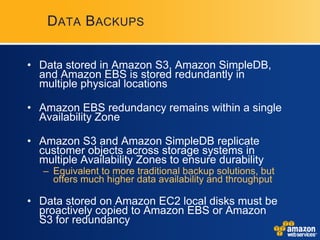
• Data stored in Amazon S3, Amazon SimpleDB,
  and Amazon EBS is stored redundantly in
  multiple physical locations

• Amazon EBS redundancy remains within a single
  Availability Zone

• Amazon S3 and Amazon SimpleDB replicate
  customer objects across storage systems in
  multiple Availability Zones to ensure durability
   – Equivalent to more traditional backup solutions, but
     offers much higher data availability and throughput

• Data stored on Amazon EC2 local disks must be
  proactively copied to Amazon EBS or Amazon
  S3 for redundancy
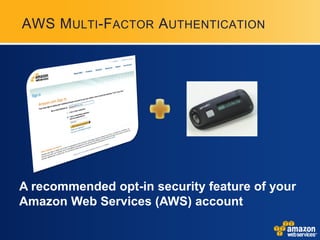
AWS M ULTI-FACTOR AUTHENTICATION


A recommended opt-in security feature of your
Amazon Web Services (AWS) account
AWS MFA B ENEFITS

• Helps prevent anyone with unauthorized
  knowledge of your e-mail address and password
  from impersonating you

• Requires a device in your physical possession to
  gain access to secure pages on the AWS Portal or
  to gain access to the AWS Management Console

• Adds an extra layer of protection to sensitive
  information, such as your AWS access identifiers

• Extends protection to your AWS resources such as
  Amazon EC2 instances and Amazon S3 data
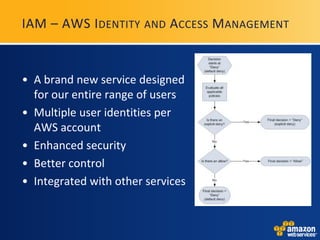
IAM – AWS I DENTITY AND ACCESS MANAGEMENT


• A brand new service designed
  for our entire range of users
• Multiple user identities per
  AWS account
• Enhanced security
• Better control
• Integrated with other services
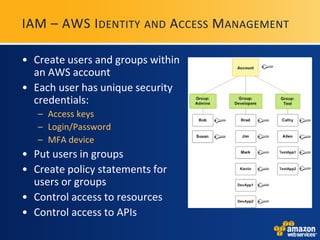
IAM – AWS I DENTITY AND ACCESS MANAGEMENT

• Create users and groups within
  an AWS account
• Each user has unique security
  credentials:
   – Access keys
   – Login/Password
   – MFA device
• Put users in groups
• Create policy statements for
  users or groups
• Control access to resources
• Control access to APIs
AMAZON EC2 S ECURITY

• Host operating system
   – Individual SSH keyed logins via bastion host for AWS admins
   – All accesses logged and audited

• Guest operating system
   – Customer controlled at root level
   – AWS admins cannot log in
   – Customer-generated keypairs

• Stateful firewall
   – Mandatory inbound firewall, default deny mode

• Signed API calls
   – Require X.509 certificate or customer’s secret AWS key
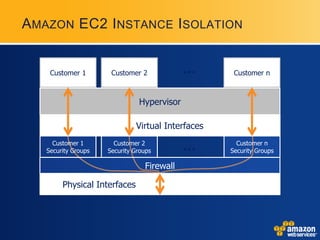
AMAZON EC2 I NSTANCE ISOLATION


    Customer 1        Customer 2            …       Customer n


                               Hypervisor

                              Virtual Interfaces
     Customer 1
   Security Groups
                       Customer 2
                     Security Groups        …        Customer n
                                                   Security Groups

                                 Firewall

        Physical Interfaces
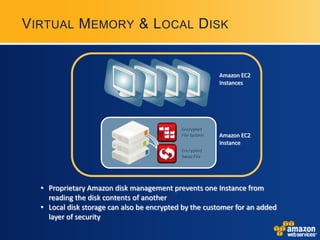
VIRTUAL MEMORY & LOCAL D ISK


                                                          Amazon EC2
                                                          Instances


                                            Encrypted
                                            File System   Amazon EC2
                                                          Instance
                                            Encrypted
                                            Swap File


  • Proprietary Amazon disk management prevents one Instance from
    reading the disk contents of another
  • Local disk storage can also be encrypted by the customer for an added
    layer of security
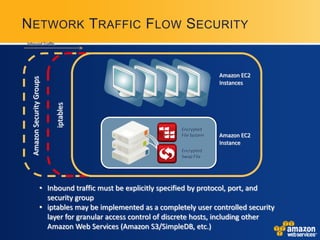
N ETWORK TRAFFIC FLOW SECURITY
Inbound Traffic


                                                                            Amazon EC2
  Amazon Security Groups


                                                                            Instances
                           iptables


                                                              Encrypted
                                                              File System   Amazon EC2
                                                                            Instance
                                                              Encrypted
                                                              Swap File


                    • Inbound traffic must be explicitly specified by protocol, port, and
                      security group
                    • iptables may be implemented as a completely user controlled security
                      layer for granular access control of discrete hosts, including other
                      Amazon Web Services (Amazon S3/SimpleDB, etc.)
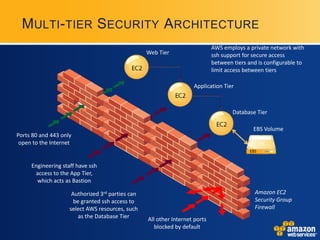
MULTI- TIER S ECURITY A RCHITECTURE
                                                                             AWS employs a private network with
                                                  Web Tier                   ssh support for secure access
                                                                             between tiers and is configurable to
                                                                             limit access between tiers

                                                                    Application Tier


                                                                                     Database Tier

                                                                                             EBS Volume
Ports 80 and 443 only
 open to the Internet


     Engineering staff have ssh
      access to the App Tier,
       which acts as Bastion

                     Authorized 3rd parties can                                              Amazon EC2
                      be granted ssh access to                                               Security Group
                    select AWS resources, such                                               Firewall
                        as the Database Tier      All other Internet ports
                                                     blocked by default
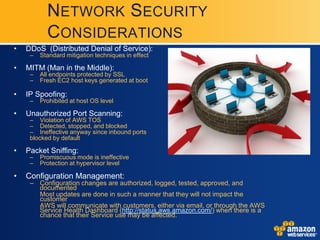
NETWORK SECURITY
           CONSIDERATIONS
•   DDoS (Distributed Denial of Service):
     –   Standard mitigation techniques in effect

•   MITM (Man in the Middle):
     –   All endpoints protected by SSL
     –   Fresh EC2 host keys generated at boot

•   IP Spoofing:
     –   Prohibited at host OS level

•   Unauthorized Port Scanning:
     – Violation of AWS TOS
     – Detected, stopped, and blocked
     – Ineffective anyway since inbound ports
     blocked by default

•   Packet Sniffing:
     –   Promiscuous mode is ineffective
     –   Protection at hypervisor level

•   Configuration Management:
     – Configuration changes are authorized, logged, tested, approved, and
       documented
       Most updates are done in such a manner that they will not impact the
       customer
       AWS will communicate with customers, either via email, or through the AWS
       Service Health Dashboard (http://status.aws.amazon.com/) when there is a
       chance that their Service use may be affected.
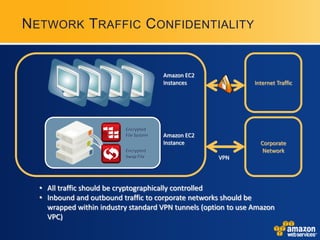
N ETWORK TRAFFIC C ONFIDENTIALITY


                                         Amazon EC2
                                         Instances              Internet Traffic


                           Encrypted
                           File System   Amazon EC2
                                         Instance                 Corporate
                           Encrypted                               Network
                           Swap File                  VPN


  • All traffic should be cryptographically controlled
  • Inbound and outbound traffic to corporate networks should be
    wrapped within industry standard VPN tunnels (option to use Amazon
    VPC)
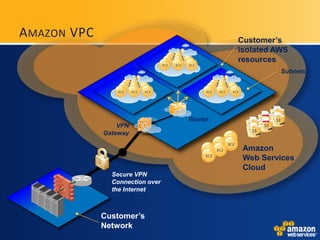
AMAZON VPC                                Customer’s
                                          isolated AWS
                                          resources
                                                    Subnets


                                 Router
                 VPN
             Gateway

                                           Amazon
                                           Web Services
                                           Cloud
               Secure VPN
               Connection over
               the Internet


             Customer’s
             Network
AMAZON VPC C APABILITIES

• Create an isolated environment within AWS
• Establish subnets to control who and what can
  access your resources
• Connect your isolated AWS resources and your IT
  infrastructure via a VPN connection
• Launch AWS resources within the isolated network
• Use your existing security and networking
  technologies to examine traffic to/from your
  isolated resources
• Extend your existing security and management
  policies within your IT infrastructure to your isolated
  AWS resources as if they were running within your
  infrastructure
VPC S UPPORTED D EVICES

• Any device that :
   – Establishes IKE Security Association using Pre-Shared Keys
   – Establishes IPsec Security Associations in Tunnel mode
   – Utilizes the AES 128-bit encryption function
   – Utilizes the SHA-1 hashing function
   – Utilizes Diffie-Hellman Perfect Forward Secrecy in “Group
     2” mode
   – Establishes Border Gateway Protocol (BGP) peerings
   – Binds tunnel to logical interface (route-based VPN)
   – Utilize IPsec Dead Peer Detection
AMAZON S3 S ECURITY

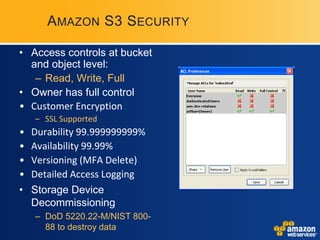
• Access controls at bucket
  and object level:
   – Read, Write, Full
• Owner has full control
• Customer Encryption
    – SSL Supported
•   Durability 99.999999999%
•   Availability 99.99%
•   Versioning (MFA Delete)
•   Detailed Access Logging
•   Storage Device
    Decommissioning
    – DoD 5220.22-M/NIST 800-
      88 to destroy data
YOUR   INPUT IS IMPORTANT …


• Thoughts/questions about our SAS70 Type II
  Audit?
• Other certifications, compliance requirements or
  audits to explore?
• What risk & compliance services should AWS
  consider offering natively?
• How can we further promote AWS security
  posture?
THANK YOU
aws.amazon.com
steves@amazon.com
© 2008-2009 Amazon.com, Inc., or its affiliates. This
presentation is provided for informational purposes only.
Amazon Web Services LLC is not responsible for any
damages related to the information in this presentation,
which is provided “as is” without warranty of any kind,
whether express, implied, or statutory. Nothing in this
presentation creates any warranties or representations
from Amazon Web Services LLC, its affiliates, suppliers,
or licensors. This presentation does not modify the
applicable terms and conditions governing your use of
Amazon Web Services technologies, including the
Amazon Web Services website. This presentation
represents Amazon Web Services' current product
offerings as of the date of issue of this document, which
are subject to change without notice.

This presentation is dated August 2010. Please visit
aws.amazon.com to ensure that you have the latest
version.

Aws security overview q3 2010 v2

  • 1.
    AWS: OVERVIEW OF SECURITY PROCESSES Stephen Schmidt Chief Information Security Officer steves@amazon.com
  • 2.
    O VERVIEW • Certifications • SAS70 Type II • Physical Security • Backups • Amazon EC2 Security • Network Security • Amazon S3 Security • Amazon SimpleDB Security • Amazon SQS Security • Amazon CloudFront Security • Amazon Elastic MapReduce
  • 3.
    AWS S ECURITYR ESOURCES • http://aws.amazon.com/security/ • Security Whitepaper • Latest Version 8/24/2010 • Updated bi-annually • Feedback is welcome
  • 4.
    AWS C ERTIFICATIONS • Shared Responsibility Model • Sarbanes-Oxley (SOX) • SAS70 Type II Audit • FISMA A&A – NIST Low Approvals to Operate – Actively pursuing NIST Moderate – FedRAMP • Pursuing ISO 27001 Certification • Customers have deployed various compliant applications such as HIPAA (healthcare)
  • 5.
    SAS70 T YPEII • Based on the Control Objectives for Information and related Technology (COBIT), which is a set of established best practices (transitioning to ISO 27001) • Covers Access (Security), Change Management and Operations of Amazon EC2 and Amazon S3 • Audit conducted by an independent accounting firm (E&Y) on a recurring basis
  • 6.
    SAS70 T YPEII – C ONTROL O BJECTIVES • Control Objective 1: Security Organization • Control Objective 2: Amazon Employee Lifecycle • Control Objective 3: Logical Security • Control Objective 4: Secure Data Handling • Control Objective 5: Physical Security • Control Objective 6: Environmental Safeguards • Control Objective 7: Change Management • Control Objective 8: Data Integrity, Availability and Redundancy • Control Objective 9: Incident Handling
  • 7.
    PHYSICAL SECURITY • Amazonhas been building large-scale data centers for many years • Important attributes: – Non-descript facilities – Robust perimeter controls – Strictly controlled physical access – 2 or more levels of two-factor auth • Controlled, need-based access for AWS employees (least privilege) • All access is logged and reviewed
  • 8.
    FAULT SEPARATION AND G EOGRAPHIC D IVERSITY US East Region (N. VA) EU West Region (IRE) Availability Availability Zone A Zone B Availability Availability Zone A Zone B Availability Availability Zone C Zone D US West Region (N. CA) APAC Region (Singapore) Availability Availability Availability vailability Availability Availability Zone A Zone B Zone A Zone A Zone BB Zone Amazon CloudWatch Note: Conceptual drawing only. The number of Availability Zones may vary
  • 9.
    D ATA BACKUPS • Data stored in Amazon S3, Amazon SimpleDB, and Amazon EBS is stored redundantly in multiple physical locations • Amazon EBS redundancy remains within a single Availability Zone • Amazon S3 and Amazon SimpleDB replicate customer objects across storage systems in multiple Availability Zones to ensure durability – Equivalent to more traditional backup solutions, but offers much higher data availability and throughput • Data stored on Amazon EC2 local disks must be proactively copied to Amazon EBS or Amazon S3 for redundancy
  • 10.
    AWS M ULTI-FACTORAUTHENTICATION A recommended opt-in security feature of your Amazon Web Services (AWS) account
  • 11.
    AWS MFA BENEFITS • Helps prevent anyone with unauthorized knowledge of your e-mail address and password from impersonating you • Requires a device in your physical possession to gain access to secure pages on the AWS Portal or to gain access to the AWS Management Console • Adds an extra layer of protection to sensitive information, such as your AWS access identifiers • Extends protection to your AWS resources such as Amazon EC2 instances and Amazon S3 data
  • 12.
    IAM – AWSI DENTITY AND ACCESS MANAGEMENT • A brand new service designed for our entire range of users • Multiple user identities per AWS account • Enhanced security • Better control • Integrated with other services
  • 13.
    IAM – AWSI DENTITY AND ACCESS MANAGEMENT • Create users and groups within an AWS account • Each user has unique security credentials: – Access keys – Login/Password – MFA device • Put users in groups • Create policy statements for users or groups • Control access to resources • Control access to APIs
  • 14.
    AMAZON EC2 SECURITY • Host operating system – Individual SSH keyed logins via bastion host for AWS admins – All accesses logged and audited • Guest operating system – Customer controlled at root level – AWS admins cannot log in – Customer-generated keypairs • Stateful firewall – Mandatory inbound firewall, default deny mode • Signed API calls – Require X.509 certificate or customer’s secret AWS key
  • 15.
    AMAZON EC2 INSTANCE ISOLATION Customer 1 Customer 2 … Customer n Hypervisor Virtual Interfaces Customer 1 Security Groups Customer 2 Security Groups … Customer n Security Groups Firewall Physical Interfaces
  • 16.
    VIRTUAL MEMORY &LOCAL D ISK Amazon EC2 Instances Encrypted File System Amazon EC2 Instance Encrypted Swap File • Proprietary Amazon disk management prevents one Instance from reading the disk contents of another • Local disk storage can also be encrypted by the customer for an added layer of security
  • 17.
    N ETWORK TRAFFICFLOW SECURITY Inbound Traffic Amazon EC2 Amazon Security Groups Instances iptables Encrypted File System Amazon EC2 Instance Encrypted Swap File • Inbound traffic must be explicitly specified by protocol, port, and security group • iptables may be implemented as a completely user controlled security layer for granular access control of discrete hosts, including other Amazon Web Services (Amazon S3/SimpleDB, etc.)
  • 18.
    MULTI- TIER SECURITY A RCHITECTURE AWS employs a private network with Web Tier ssh support for secure access between tiers and is configurable to limit access between tiers Application Tier Database Tier EBS Volume Ports 80 and 443 only open to the Internet Engineering staff have ssh access to the App Tier, which acts as Bastion Authorized 3rd parties can Amazon EC2 be granted ssh access to Security Group select AWS resources, such Firewall as the Database Tier All other Internet ports blocked by default
  • 19.
    NETWORK SECURITY CONSIDERATIONS • DDoS (Distributed Denial of Service): – Standard mitigation techniques in effect • MITM (Man in the Middle): – All endpoints protected by SSL – Fresh EC2 host keys generated at boot • IP Spoofing: – Prohibited at host OS level • Unauthorized Port Scanning: – Violation of AWS TOS – Detected, stopped, and blocked – Ineffective anyway since inbound ports blocked by default • Packet Sniffing: – Promiscuous mode is ineffective – Protection at hypervisor level • Configuration Management: – Configuration changes are authorized, logged, tested, approved, and documented Most updates are done in such a manner that they will not impact the customer AWS will communicate with customers, either via email, or through the AWS Service Health Dashboard (http://status.aws.amazon.com/) when there is a chance that their Service use may be affected.
  • 20.
    N ETWORK TRAFFICC ONFIDENTIALITY Amazon EC2 Instances Internet Traffic Encrypted File System Amazon EC2 Instance Corporate Encrypted Network Swap File VPN • All traffic should be cryptographically controlled • Inbound and outbound traffic to corporate networks should be wrapped within industry standard VPN tunnels (option to use Amazon VPC)
  • 21.
    AMAZON VPC Customer’s isolated AWS resources Subnets Router VPN Gateway Amazon Web Services Cloud Secure VPN Connection over the Internet Customer’s Network
  • 22.
    AMAZON VPC CAPABILITIES • Create an isolated environment within AWS • Establish subnets to control who and what can access your resources • Connect your isolated AWS resources and your IT infrastructure via a VPN connection • Launch AWS resources within the isolated network • Use your existing security and networking technologies to examine traffic to/from your isolated resources • Extend your existing security and management policies within your IT infrastructure to your isolated AWS resources as if they were running within your infrastructure
  • 23.
    VPC S UPPORTEDD EVICES • Any device that : – Establishes IKE Security Association using Pre-Shared Keys – Establishes IPsec Security Associations in Tunnel mode – Utilizes the AES 128-bit encryption function – Utilizes the SHA-1 hashing function – Utilizes Diffie-Hellman Perfect Forward Secrecy in “Group 2” mode – Establishes Border Gateway Protocol (BGP) peerings – Binds tunnel to logical interface (route-based VPN) – Utilize IPsec Dead Peer Detection
  • 24.
    AMAZON S3 SECURITY • Access controls at bucket and object level: – Read, Write, Full • Owner has full control • Customer Encryption – SSL Supported • Durability 99.999999999% • Availability 99.99% • Versioning (MFA Delete) • Detailed Access Logging • Storage Device Decommissioning – DoD 5220.22-M/NIST 800- 88 to destroy data
  • 25.
    YOUR INPUT IS IMPORTANT … • Thoughts/questions about our SAS70 Type II Audit? • Other certifications, compliance requirements or audits to explore? • What risk & compliance services should AWS consider offering natively? • How can we further promote AWS security posture?
  • 26.
  • 27.
    © 2008-2009 Amazon.com,Inc., or its affiliates. This presentation is provided for informational purposes only. Amazon Web Services LLC is not responsible for any damages related to the information in this presentation, which is provided “as is” without warranty of any kind, whether express, implied, or statutory. Nothing in this presentation creates any warranties or representations from Amazon Web Services LLC, its affiliates, suppliers, or licensors. This presentation does not modify the applicable terms and conditions governing your use of Amazon Web Services technologies, including the Amazon Web Services website. This presentation represents Amazon Web Services' current product offerings as of the date of issue of this document, which are subject to change without notice. This presentation is dated August 2010. Please visit aws.amazon.com to ensure that you have the latest version.