Regular Expression
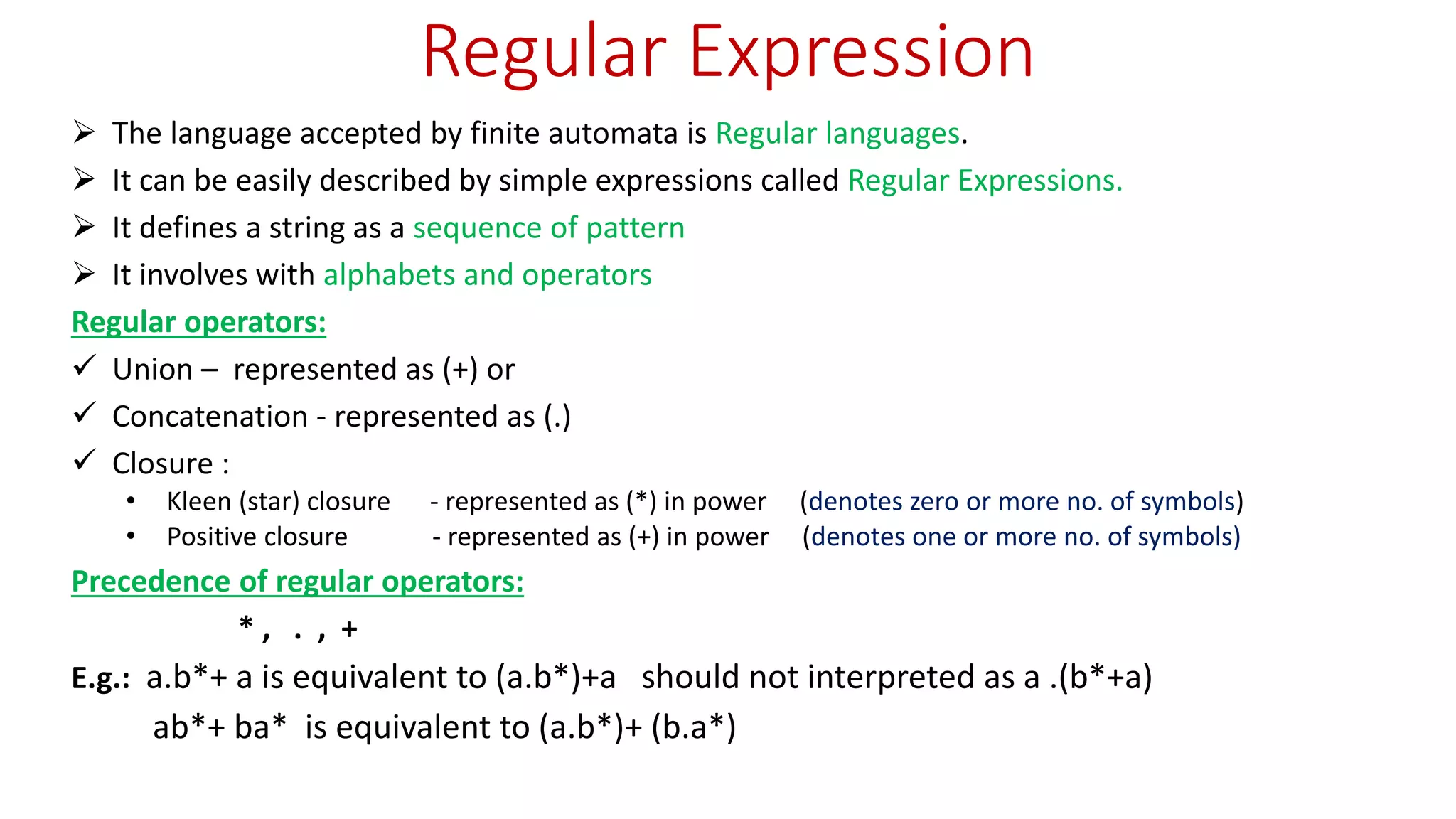
 The language accepted by finite automata is Regular languages.
 It can be easily described by simple expressions called Regular Expressions.
 It defines a string as a sequence of pattern
 It involves with alphabets and operators
Regular operators:
 Union – represented as (+) or
 Concatenation - represented as (.)
 Closure :
• Kleen (star) closure - represented as (*) in power (denotes zero or more no. of symbols)
• Positive closure - represented as (+) in power (denotes one or more no. of symbols)
Precedence of regular operators:
* , . , +
E.g.: a.b*+ a is equivalent to (a.b*)+a should not interpreted as a .(b*+a)
ab*+ ba* is equivalent to (a.b*)+ (b.a*)
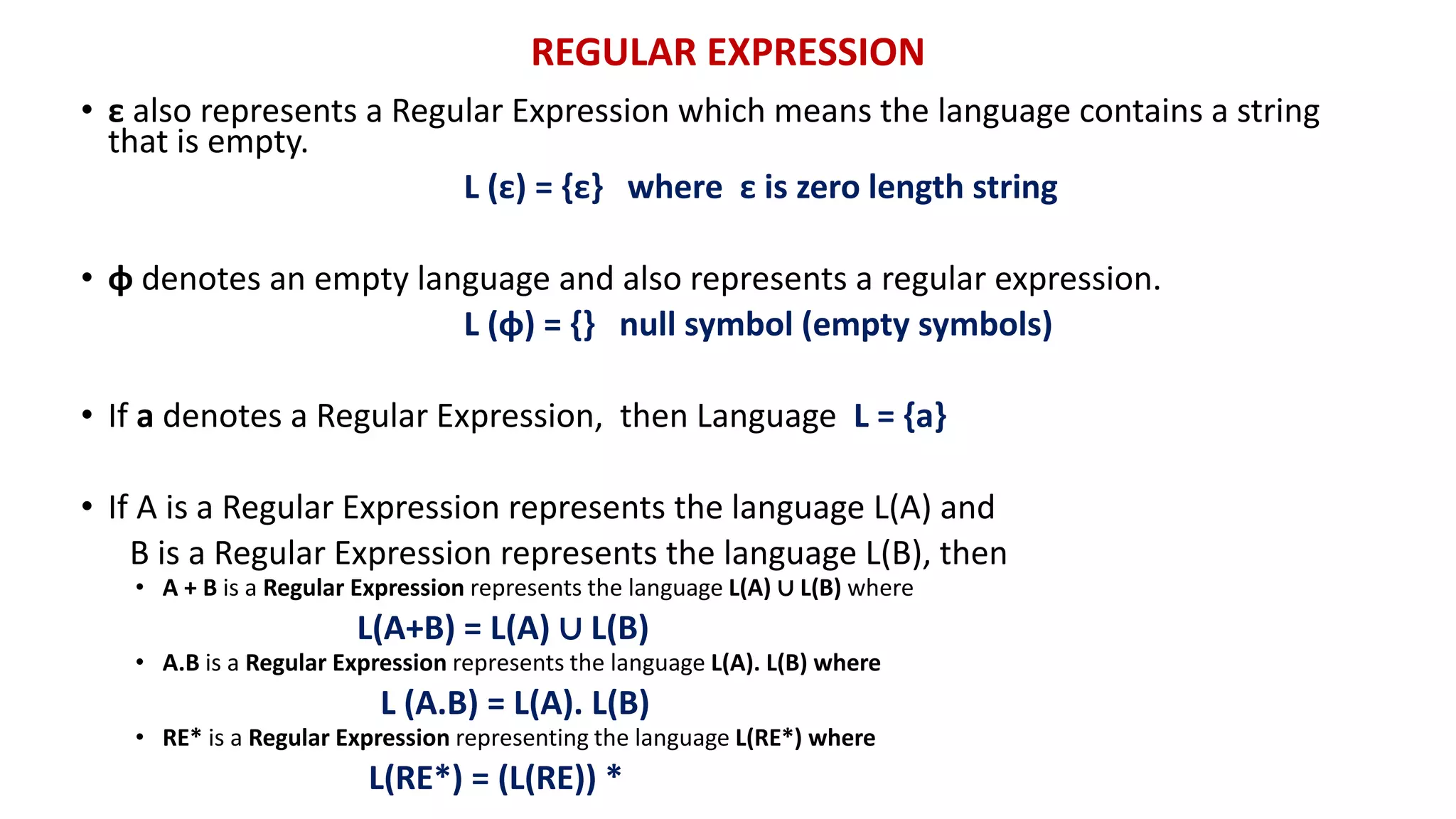
REGULAR EXPRESSION
• ε also represents a Regular Expression which means the language contains a string
that is empty.
L (ε) = {ε} where ε is zero length string
• φ denotes an empty language and also represents a regular expression.
L (φ) = {} null symbol (empty symbols)
• If a denotes a Regular Expression, then Language L = {a}
• If A is a Regular Expression represents the language L(A) and
B is a Regular Expression represents the language L(B), then
• A + B is a Regular Expression represents the language L(A) ∪ L(B) where
L(A+B) = L(A) ∪ L(B)
• A.B is a Regular Expression represents the language L(A). L(B) where
L (A.B) = L(A). L(B)
• RE* is a Regular Expression representing the language L(RE*) where
L(RE*) = (L(RE)) *
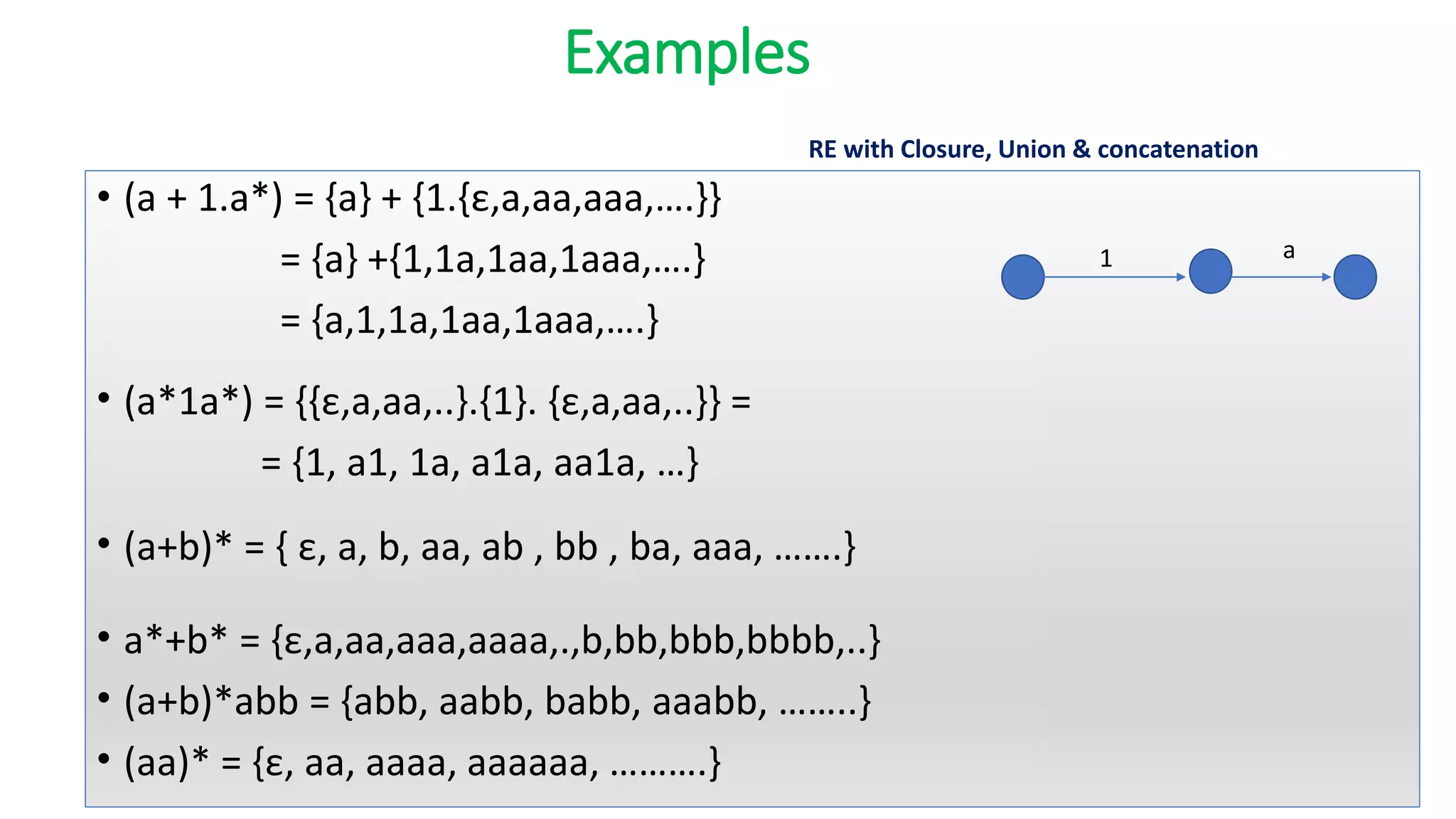
Examples
• (a + 1.a*) = {a} + {1.{ε,a,aa,aaa,….}}
= {a} +{1,1a,1aa,1aaa,….}
= {a,1,1a,1aa,1aaa,….}
• (a*1a*) = {{ε,a,aa,..}.{1}. {ε,a,aa,..}} =
= {1, a1, 1a, a1a, aa1a, …}
• (a+b)* = { ε, a, b, aa, ab , bb , ba, aaa, …….}
• a*+b* = {ε,a,aa,aaa,aaaa,.,b,bb,bbb,bbbb,..}
• (a+b)*abb = {abb, aabb, babb, aaabb, ……..}
• (aa)* = {ε, aa, aaaa, aaaaaa, ……….}
RE with Closure, Union & concatenation
1 a
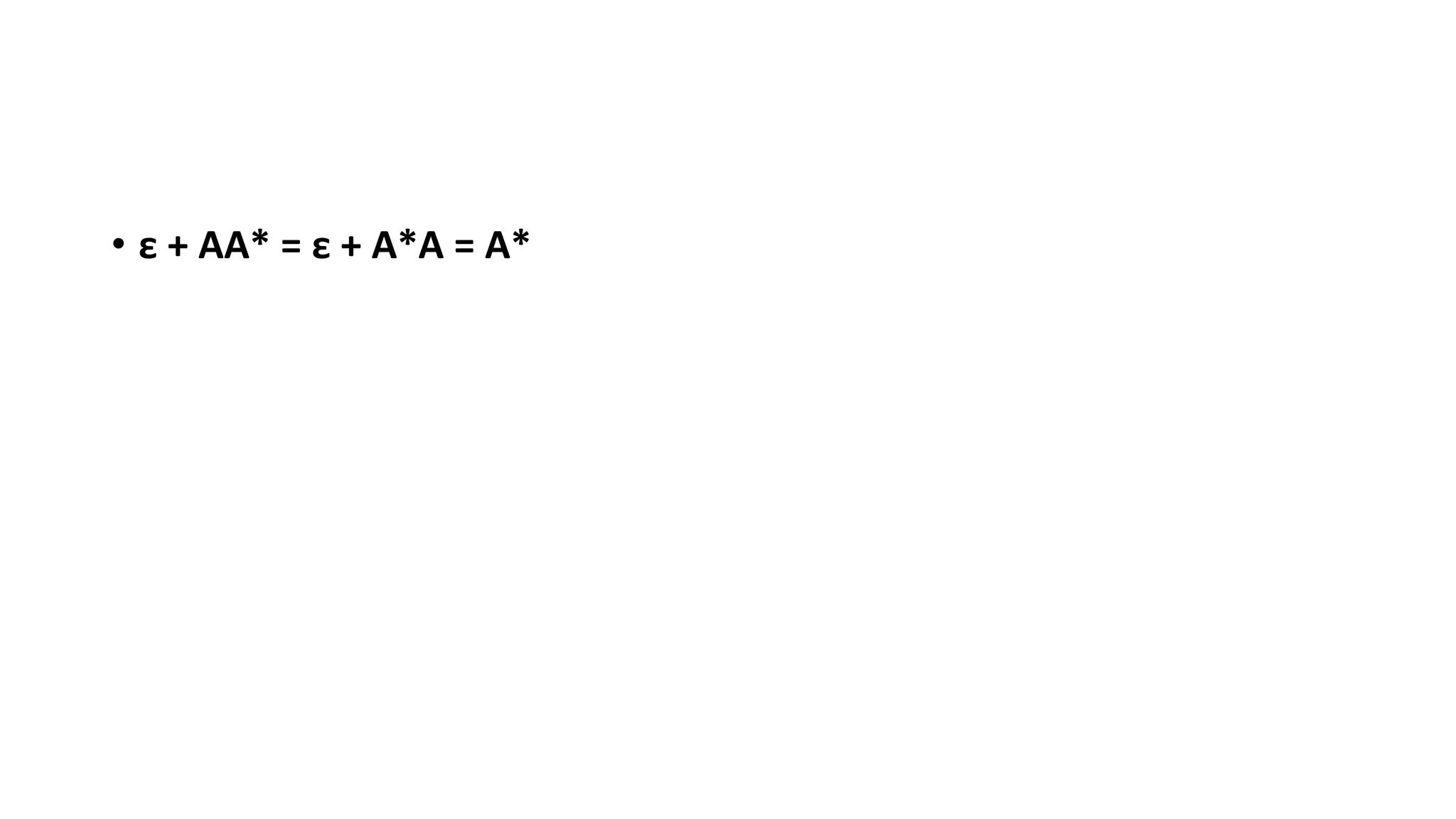
• ε + AA* = ε + A*A = A*
Exercises
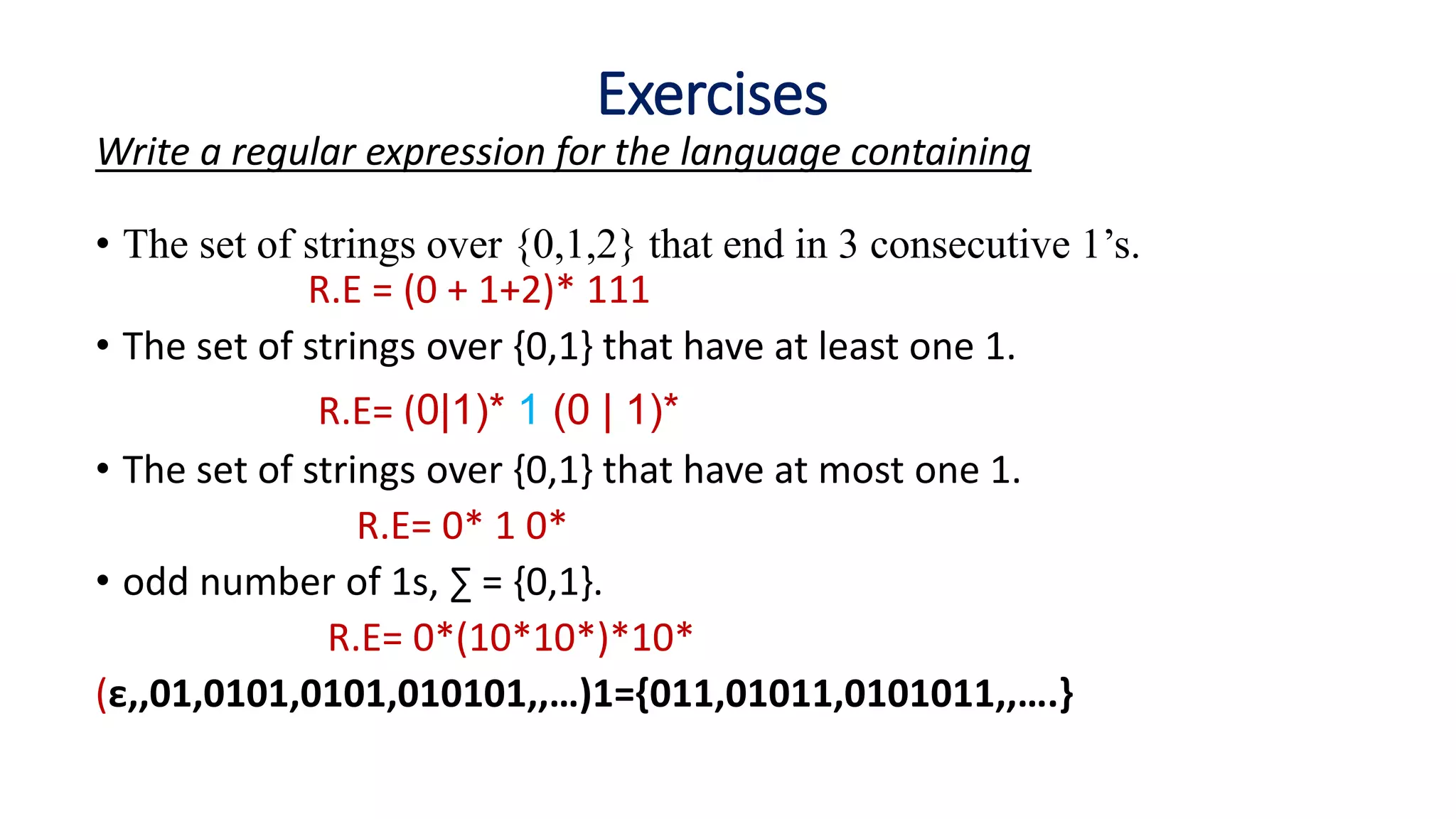
Write a regular expression for the language containing
• The set of strings over {0,1,2} that end in 3 consecutive 1’s.
R.E = (0 + 1+2)* 111
• The set of strings over {0,1} that have at least one 1.
R.E= (0|1)* 1 (0 | 1)*
• The set of strings over {0,1} that have at most one 1.
R.E= 0* 1 0*
• odd number of 1s, ∑ = {0,1}.
R.E= 0*(10*10*)*10*
(ε,,01,0101,0101,010101,,…)1={011,01011,0101011,,….}
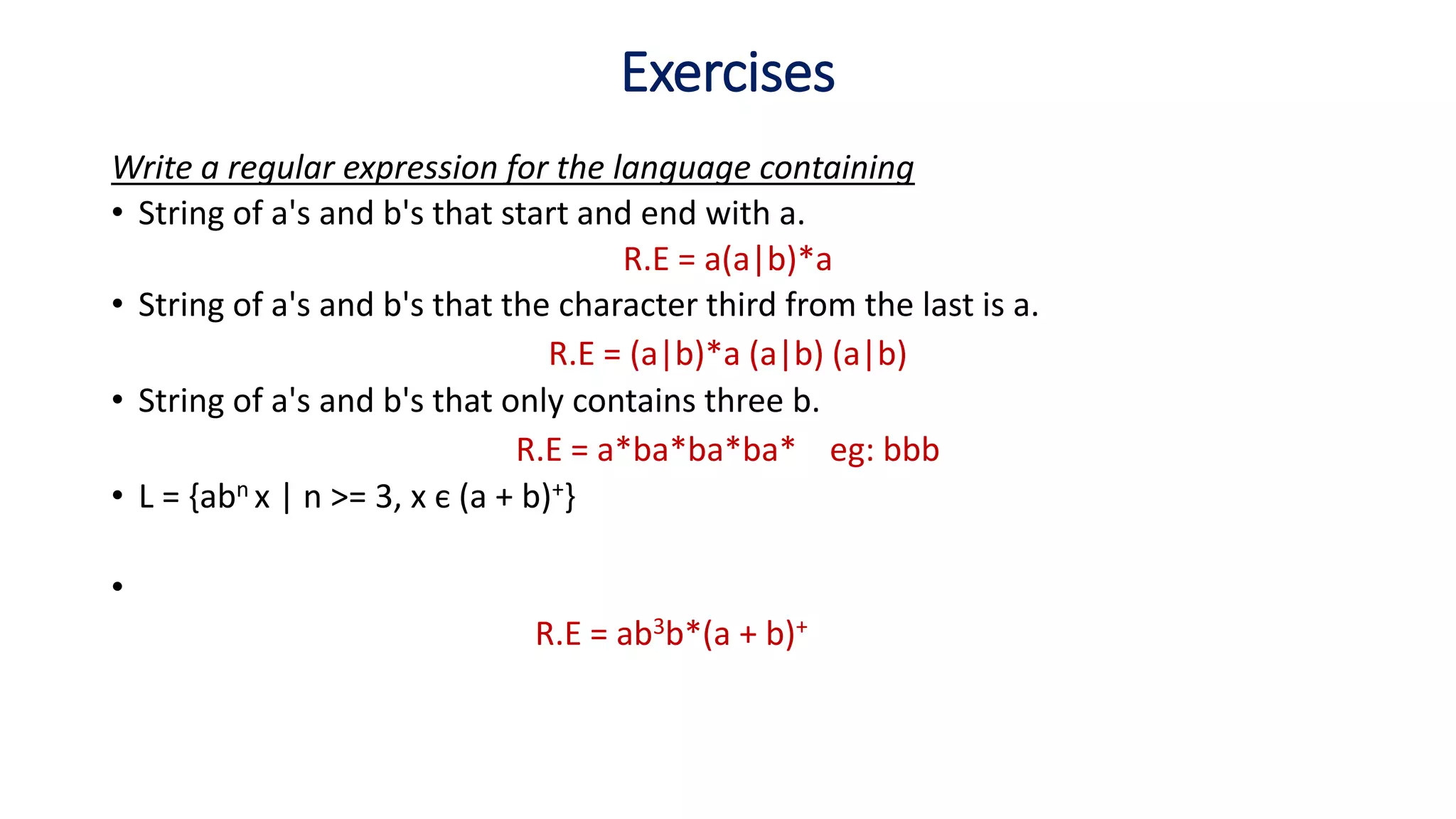
Write a regular expression for the language containing
• String of a's and b's that start and end with a.
R.E = a(a|b)*a
• String of a's and b's that the character third from the last is a.
R.E = (a|b)*a (a|b) (a|b)
• String of a's and b's that only contains three b.
R.E = a*ba*ba*ba* eg: bbb
• L = {abn x | n >= 3, x є (a + b)+}
•
R.E = ab3b*(a + b)+
Exercises
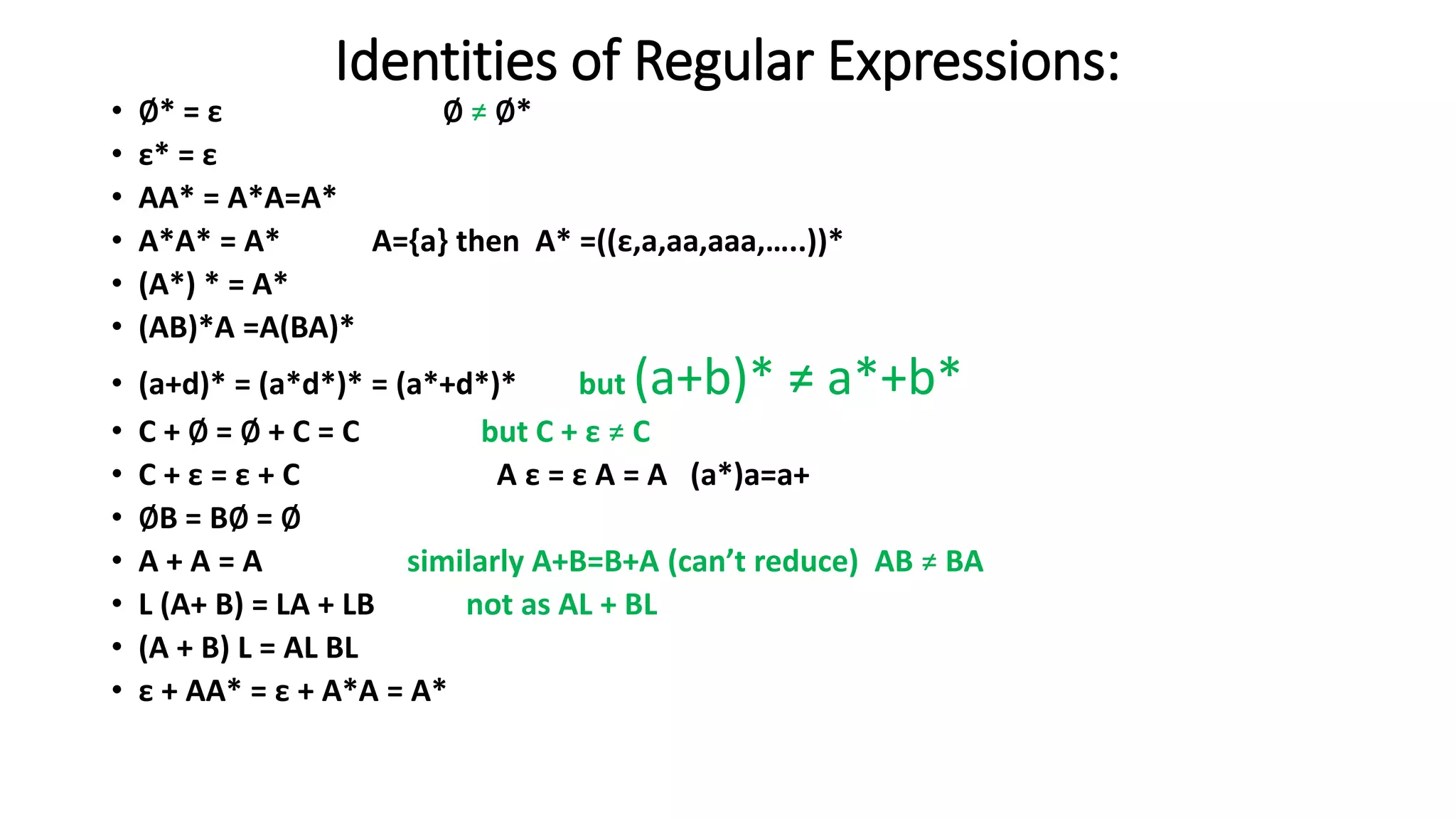
Identities of Regular Expressions:
• ∅* = ε ∅ ≠ ∅*
• ε* = ε
• AA* = A*A=A*
• A*A* = A* A={a} then A* =((ε,a,aa,aaa,…..))*
• (A*) * = A*
• (AB)*A =A(BA)*
• (a+d)* = (a*d*)* = (a*+d*)* but (a+b)* ≠ a*+b*
• C + ∅ = ∅ + C = C but C + ε ≠ C
• C + ε = ε + C A ε = ε A = A (a*)a=a+
• ∅B = B∅ = ∅
• A + A = A similarly A+B=B+A (can’t reduce) AB ≠ BA
• L (A+ B) = LA + LB not as AL + BL
• (A + B) L = AL BL
• ε + AA* = ε + A*A = A*
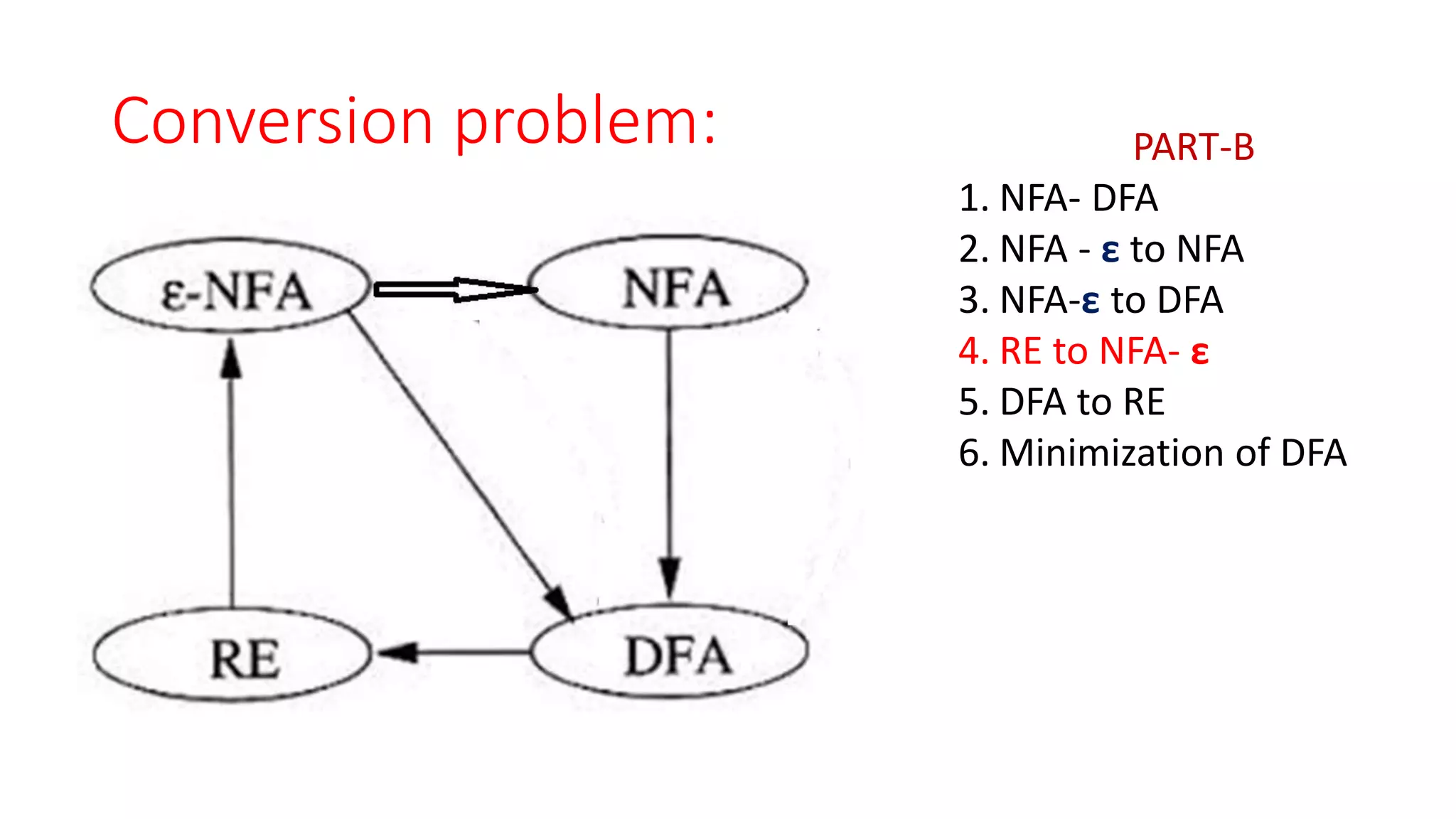
Conversion problem: PART-B
1. NFA- DFA
2. NFA - ε to NFA
3. NFA-ε to DFA
4. RE to NFA- ε
5. DFA to RE
6. Minimization of DFA
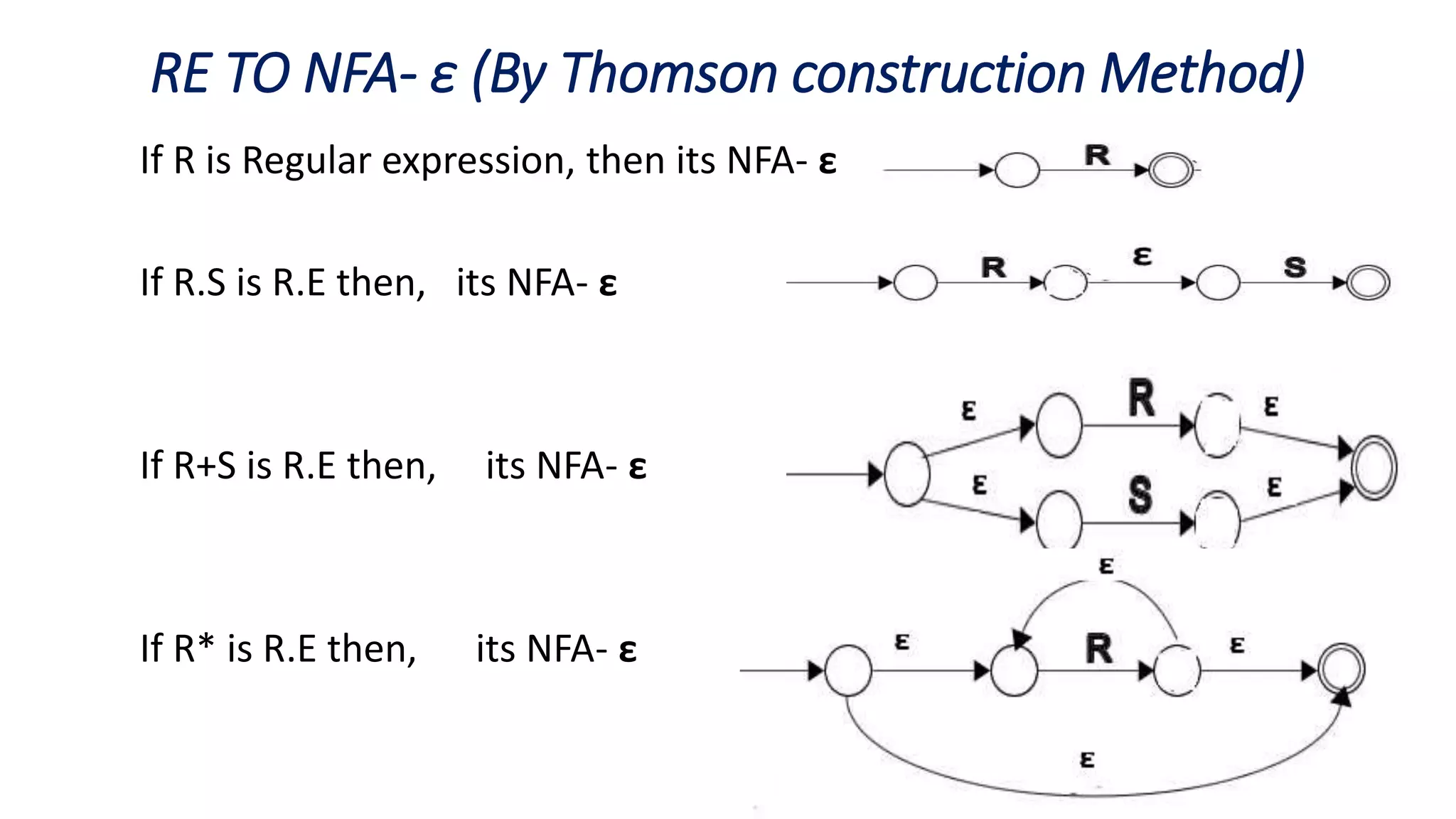
RE TO NFA- ε (By Thomson construction Method)
If R is Regular expression, then its NFA- ε
If R.S is R.E then, its NFA- ε
If R+S is R.E then, its NFA- ε
If R* is R.E then, its NFA- ε
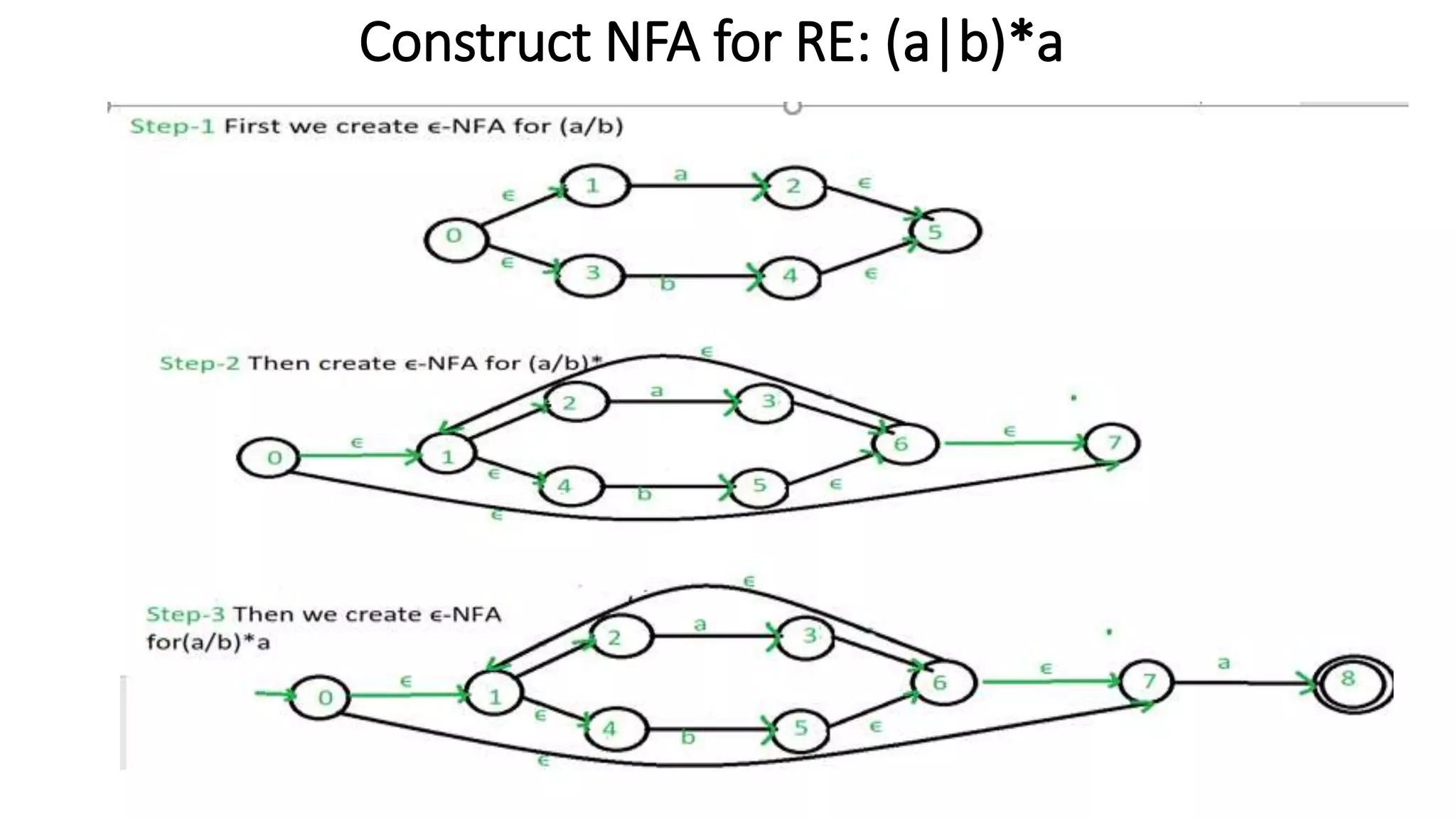
Construct NFA for RE: (a|b)*a
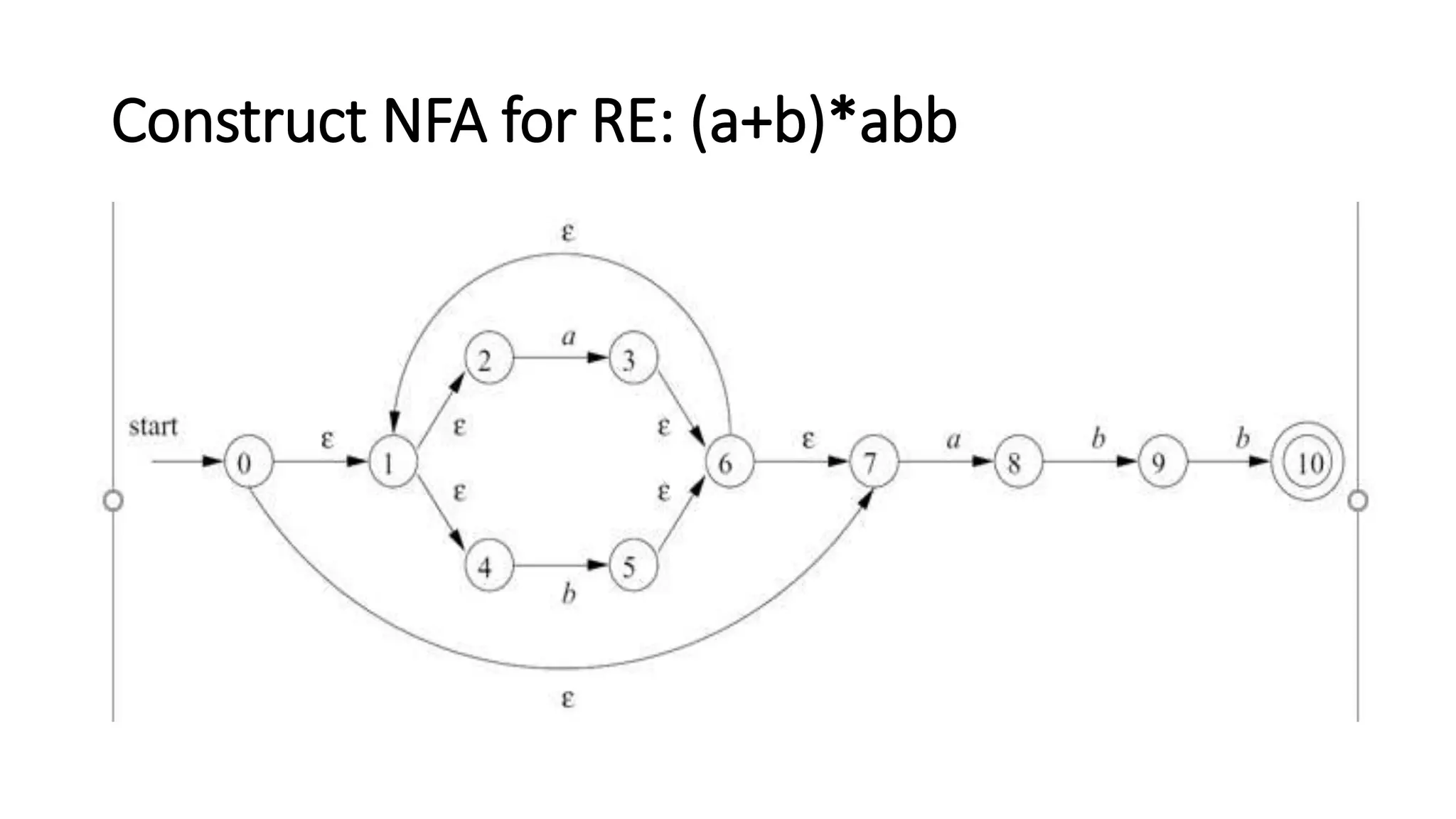
Construct NFA for RE: (a+b)*abb
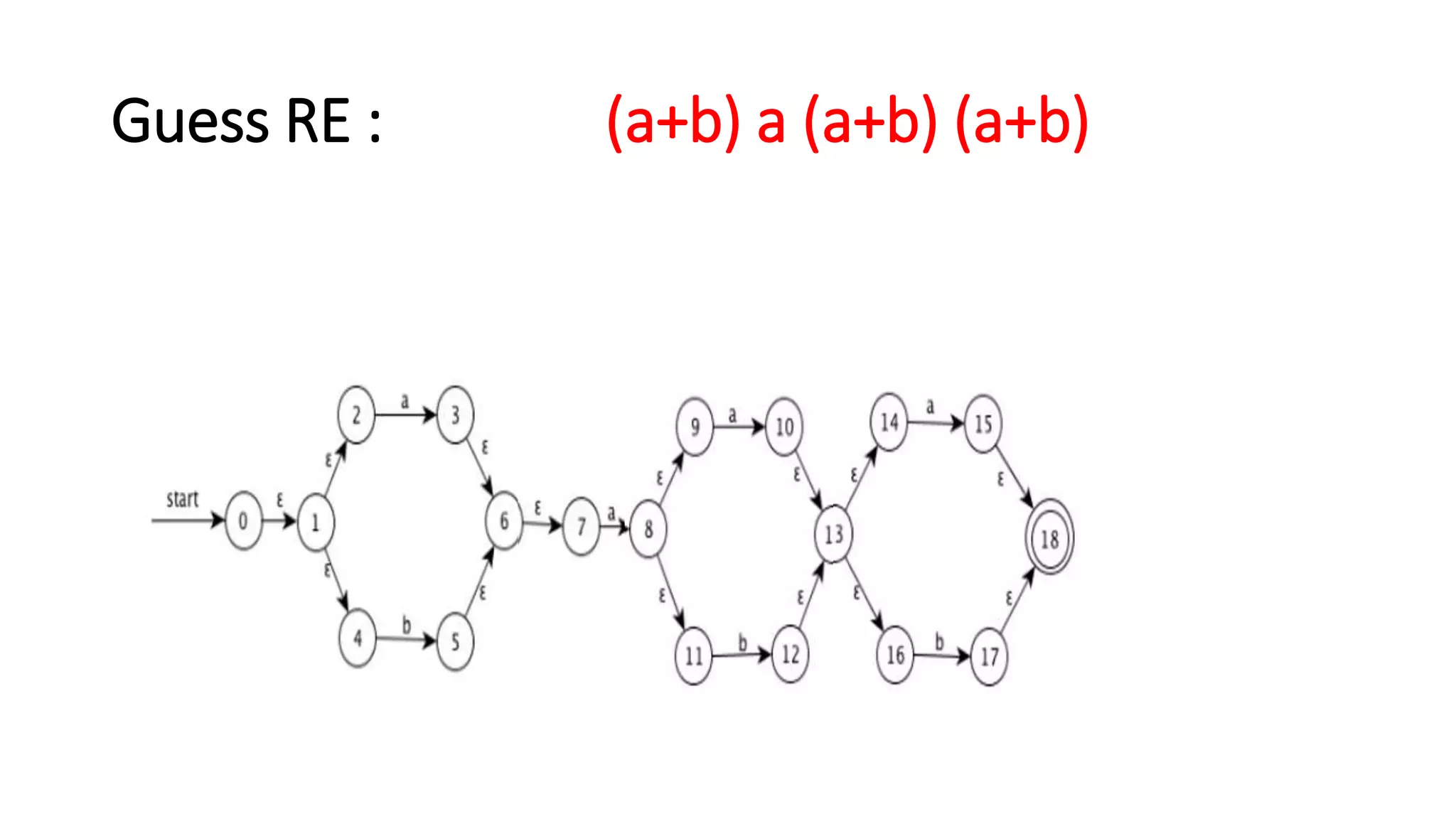
Guess RE : (a+b) a (a+b) (a+b)
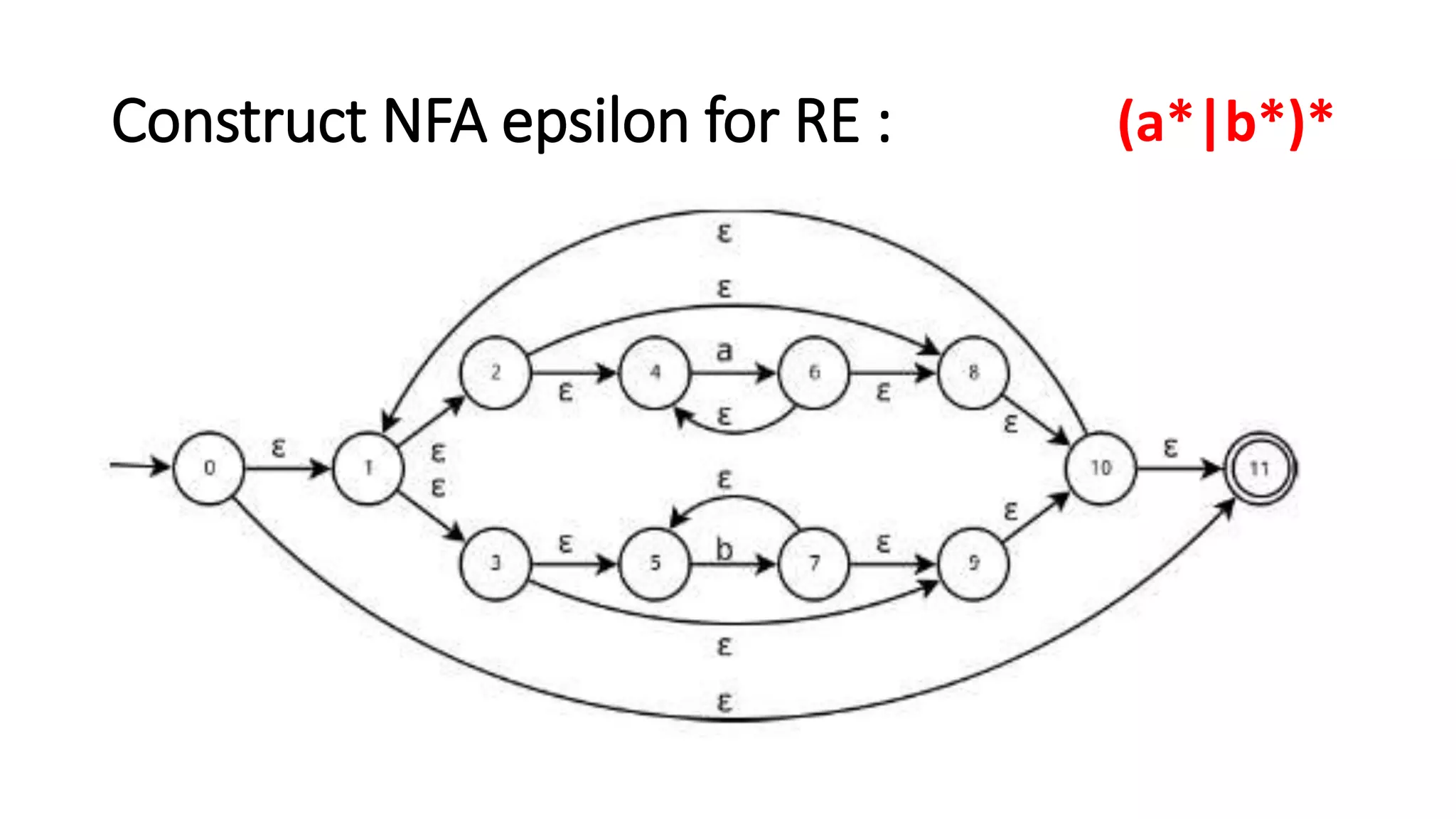
Construct NFA epsilon for RE : (a*|b*)*
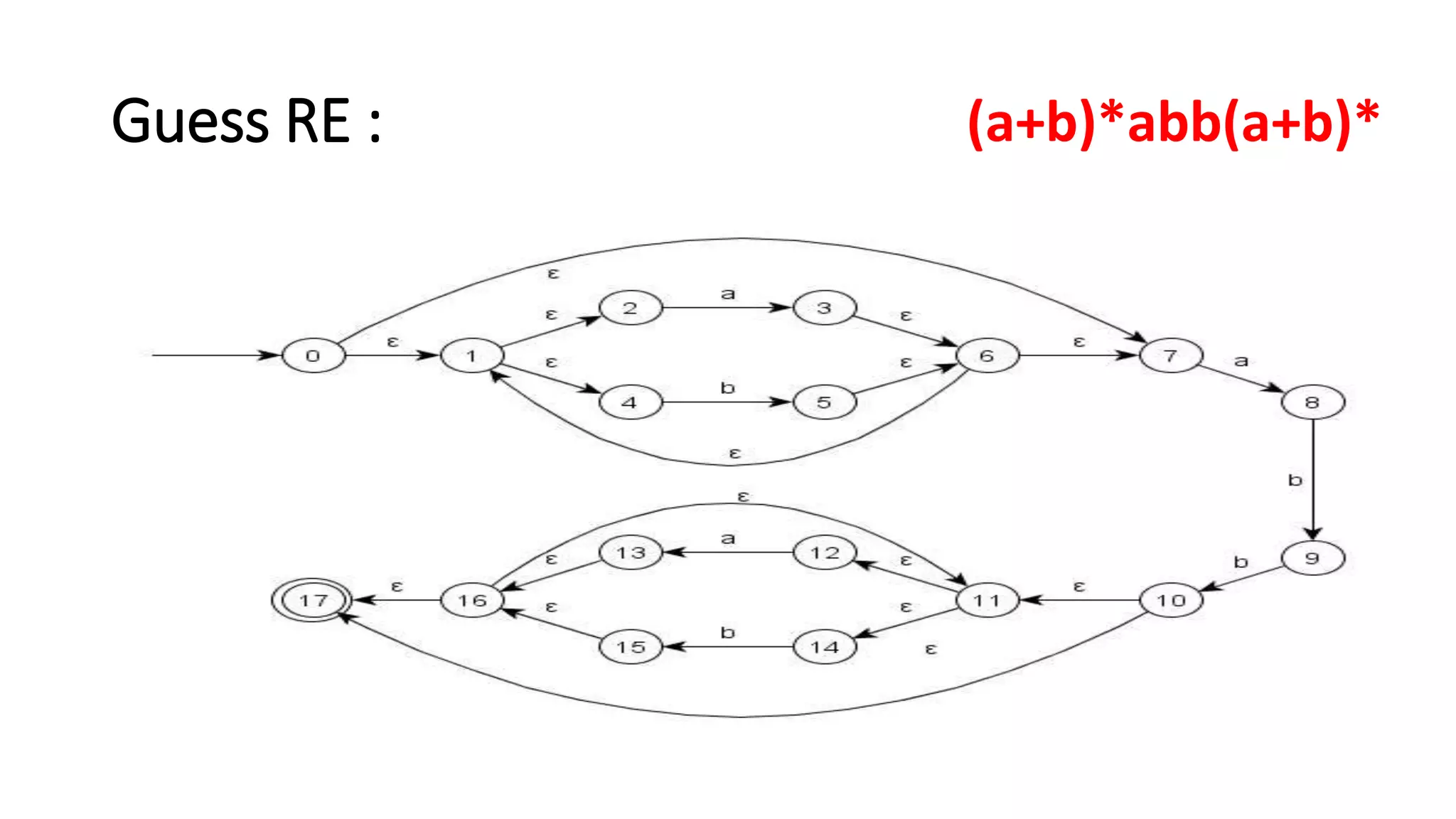
Guess RE : (a+b)*abb(a+b)*
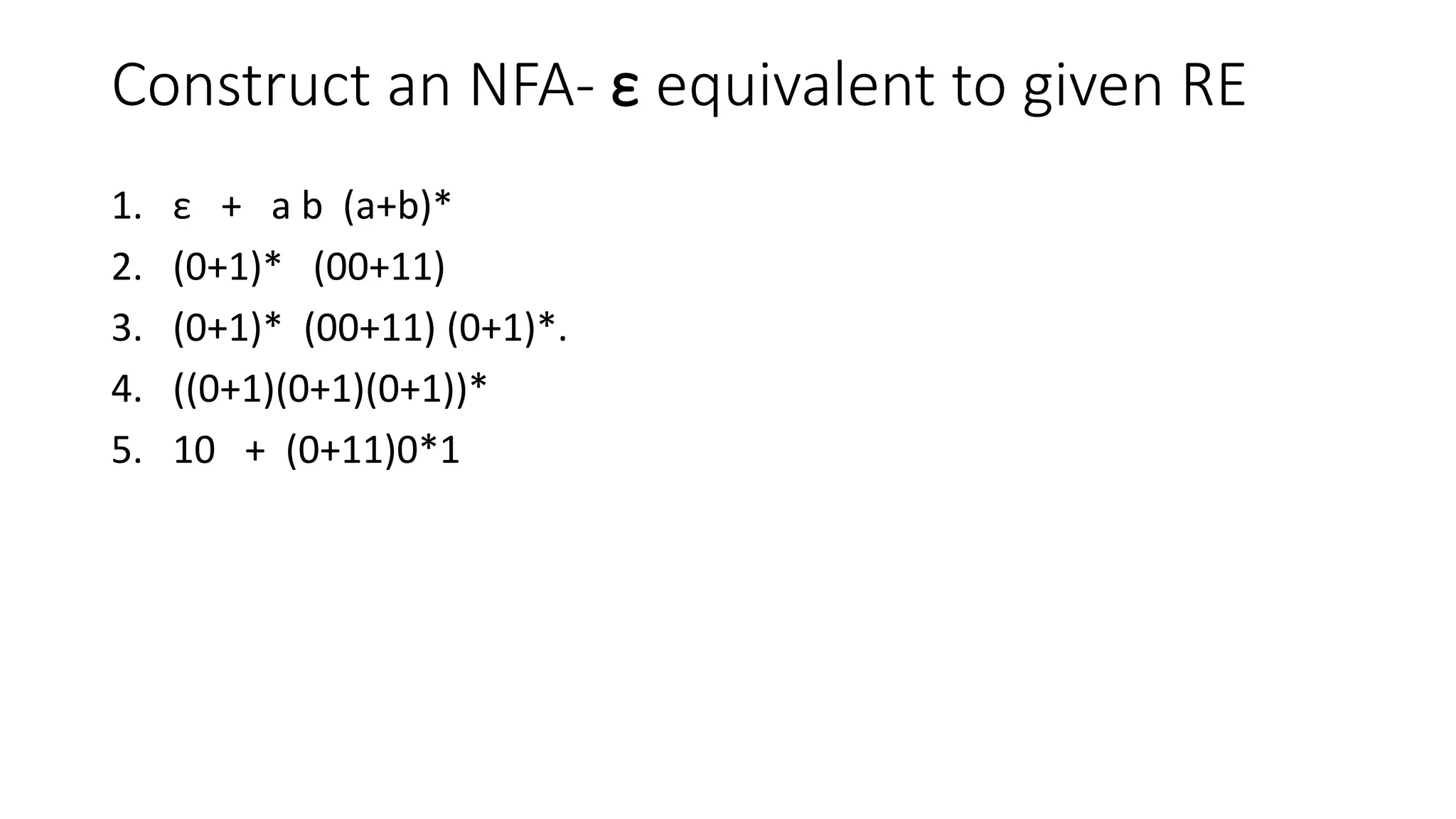
Construct an NFA- ε equivalent to given RE
1. ε + a b (a+b)*
2. (0+1)* (00+11)
3. (0+1)* (00+11) (0+1)*.
4. ((0+1)(0+1)(0+1))*
5. 10 + (0+11)0*1

Automata theory -RE to NFA-ε

  • 1.
    Regular Expression  Thelanguage accepted by finite automata is Regular languages.  It can be easily described by simple expressions called Regular Expressions.  It defines a string as a sequence of pattern  It involves with alphabets and operators Regular operators:  Union – represented as (+) or  Concatenation - represented as (.)  Closure : • Kleen (star) closure - represented as (*) in power (denotes zero or more no. of symbols) • Positive closure - represented as (+) in power (denotes one or more no. of symbols) Precedence of regular operators: * , . , + E.g.: a.b*+ a is equivalent to (a.b*)+a should not interpreted as a .(b*+a) ab*+ ba* is equivalent to (a.b*)+ (b.a*)
  • 2.
    REGULAR EXPRESSION • εalso represents a Regular Expression which means the language contains a string that is empty. L (ε) = {ε} where ε is zero length string • φ denotes an empty language and also represents a regular expression. L (φ) = {} null symbol (empty symbols) • If a denotes a Regular Expression, then Language L = {a} • If A is a Regular Expression represents the language L(A) and B is a Regular Expression represents the language L(B), then • A + B is a Regular Expression represents the language L(A) ∪ L(B) where L(A+B) = L(A) ∪ L(B) • A.B is a Regular Expression represents the language L(A). L(B) where L (A.B) = L(A). L(B) • RE* is a Regular Expression representing the language L(RE*) where L(RE*) = (L(RE)) *
  • 3.
    Examples • (a +1.a*) = {a} + {1.{ε,a,aa,aaa,….}} = {a} +{1,1a,1aa,1aaa,….} = {a,1,1a,1aa,1aaa,….} • (a*1a*) = {{ε,a,aa,..}.{1}. {ε,a,aa,..}} = = {1, a1, 1a, a1a, aa1a, …} • (a+b)* = { ε, a, b, aa, ab , bb , ba, aaa, …….} • a*+b* = {ε,a,aa,aaa,aaaa,.,b,bb,bbb,bbbb,..} • (a+b)*abb = {abb, aabb, babb, aaabb, ……..} • (aa)* = {ε, aa, aaaa, aaaaaa, ……….} RE with Closure, Union & concatenation 1 a
  • 4.
    • ε +AA* = ε + A*A = A*
  • 5.
    Exercises Write a regularexpression for the language containing • The set of strings over {0,1,2} that end in 3 consecutive 1’s. R.E = (0 + 1+2)* 111 • The set of strings over {0,1} that have at least one 1. R.E= (0|1)* 1 (0 | 1)* • The set of strings over {0,1} that have at most one 1. R.E= 0* 1 0* • odd number of 1s, ∑ = {0,1}. R.E= 0*(10*10*)*10* (ε,,01,0101,0101,010101,,…)1={011,01011,0101011,,….}
  • 6.
    Write a regularexpression for the language containing • String of a's and b's that start and end with a. R.E = a(a|b)*a • String of a's and b's that the character third from the last is a. R.E = (a|b)*a (a|b) (a|b) • String of a's and b's that only contains three b. R.E = a*ba*ba*ba* eg: bbb • L = {abn x | n >= 3, x є (a + b)+} • R.E = ab3b*(a + b)+ Exercises
  • 7.
    Identities of RegularExpressions: • ∅* = ε ∅ ≠ ∅* • ε* = ε • AA* = A*A=A* • A*A* = A* A={a} then A* =((ε,a,aa,aaa,…..))* • (A*) * = A* • (AB)*A =A(BA)* • (a+d)* = (a*d*)* = (a*+d*)* but (a+b)* ≠ a*+b* • C + ∅ = ∅ + C = C but C + ε ≠ C • C + ε = ε + C A ε = ε A = A (a*)a=a+ • ∅B = B∅ = ∅ • A + A = A similarly A+B=B+A (can’t reduce) AB ≠ BA • L (A+ B) = LA + LB not as AL + BL • (A + B) L = AL BL • ε + AA* = ε + A*A = A*
  • 8.
    Conversion problem: PART-B 1.NFA- DFA 2. NFA - ε to NFA 3. NFA-ε to DFA 4. RE to NFA- ε 5. DFA to RE 6. Minimization of DFA
  • 9.
    RE TO NFA-ε (By Thomson construction Method) If R is Regular expression, then its NFA- ε If R.S is R.E then, its NFA- ε If R+S is R.E then, its NFA- ε If R* is R.E then, its NFA- ε
  • 10.
    Construct NFA forRE: (a|b)*a
  • 11.
    Construct NFA forRE: (a+b)*abb
  • 12.
    Guess RE :(a+b) a (a+b) (a+b)
  • 13.
    Construct NFA epsilonfor RE : (a*|b*)*
  • 14.
    Guess RE :(a+b)*abb(a+b)*
  • 15.
    Construct an NFA-ε equivalent to given RE 1. ε + a b (a+b)* 2. (0+1)* (00+11) 3. (0+1)* (00+11) (0+1)*. 4. ((0+1)(0+1)(0+1))* 5. 10 + (0+11)0*1