Auto-encoding variational Bayes
Diederik P Kingma
1
Max Welling
2
Presented by : Mehdi Cherti (LAL/CNRS)
9th May 2015
Diederik P Kingma, Max Welling Auto-encoding variational Bayes
What is a generative model ?
A model of how the data X was generated
Typically, the purpose is to nd a model for : p(x) or p(x, y)
y can be a set of latent (hidden) variables or a set of output
variables, for discriminative problems
Diederik P Kingma, Max Welling Auto-encoding variational Bayes
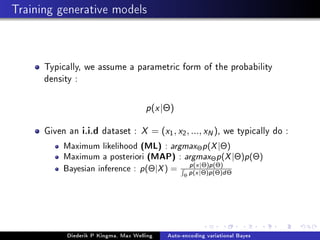
Training generative models
Typically, we assume a parametric form of the probability
density :
p(x|Θ)
Given an i.i.d dataset : X = (x1, x2, ..., xN), we typically do :
Maximum likelihood (ML) : argmaxΘp(X|Θ)
Maximum a posteriori (MAP) : argmaxΘp(X|Θ)p(Θ)
Bayesian inference : p(Θ|X) = p(x|Θ)p(Θ)´
Θ
p(x|Θ)p(Θ)dΘ
Diederik P Kingma, Max Welling Auto-encoding variational Bayes
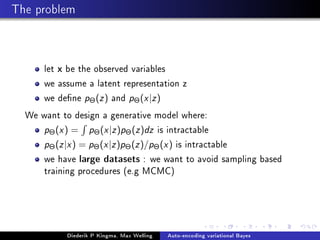
The problem
let x be the observed variables
we assume a latent representation z
we dene pΘ(z) and pΘ(x|z)
We want to design a generative model where:
pΘ(x) =
´
pΘ(x|z)pΘ(z)dz is intractable
pΘ(z|x) = pΘ(x|z)pΘ(z)/pΘ(x) is intractable
we have large datasets : we want to avoid sampling based
training procedures (e.g MCMC)
Diederik P Kingma, Max Welling Auto-encoding variational Bayes
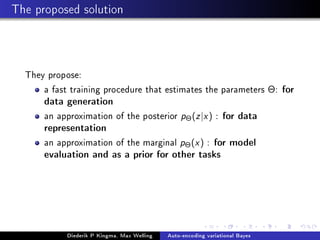
The proposed solution
They propose:
a fast training procedure that estimates the parameters Θ: for
data generation
an approximation of the posterior pΘ(z|x) : for data
representation
an approximation of the marginal pΘ(x) : for model
evaluation and as a prior for other tasks
Diederik P Kingma, Max Welling Auto-encoding variational Bayes
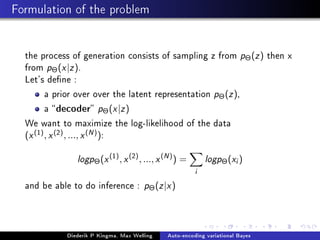
Formulation of the problem
the process of generation consists of sampling z from pΘ(z) then x
from pΘ(x|z).
Let's dene :
a prior over over the latent representation pΘ(z),
a decoder pΘ(x|z)
We want to maximize the log-likelihood of the data
(x(1), x(2), ..., x(N)):
logpΘ(x(1)
, x(2)
, ..., x(N)
) =
i
logpΘ(xi)
and be able to do inference : pΘ(z|x)
Diederik P Kingma, Max Welling Auto-encoding variational Bayes
The variational lower bound
We will learn an approximate of pΘ(z|x) : qΦ(z|x) by
maximizing a lower bound of the log-likelihood of the data
We can write :
logpΘ(x) = DKL(qΦ(z|x)||pΘ(z|x)) + L(Θ, φ, x) where:
L(Θ, Φ, x) = EqΦ(z|x)[logpΘ(x, z) − logqφ
(z|x)]
L(Θ, Φ, x)is called the variational lower bound, and the goal is
to maximize it w.r.t to all the parameters (Θ, Φ)
Diederik P Kingma, Max Welling Auto-encoding variational Bayes
Estimating the lower bound gradients
We need to compute
∂L(Θ,Φ,x)
∂Θ , ∂L(Θ,Φ,x)
∂φ to apply gradient
descent
For that, we use the reparametrisation trick : we sample
from a noise variable p( ) and apply a determenistic function
to it so that we obtain correct samples from qφ(z|x), meaning:
if ∼ p( ) we nd g so that if z = g(x, φ, ) then z ∼ qφ(z|x)
g can be the inverse CDF of qΦ(z|x) if is uniform
With the reparametrisation trick we can rewrite L:
L(Θ, Φ, x) = E ∼p( )[logpΘ(x, g(x, φ, )) − logqφ
(g(x, φ, )|x)]
We then estimate the gradients with Monte Carlo
Diederik P Kingma, Max Welling Auto-encoding variational Bayes
A connection with auto-encoders
Note that L can also be written in this form:
L(Θ, φ, x) = −DKL(qΦ(z|x)||pΘ(z)) + EqΦ(z|x)[logpΘ(x|z)]
We can interpret the rst term as a regularizer : it forces
qΦ(z|x) to not be too divergent from the prior pΘ(z)
We can interpret the (-second term) as the reconstruction
error
Diederik P Kingma, Max Welling Auto-encoding variational Bayes
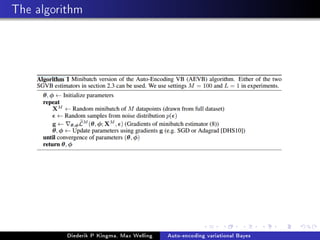
The algorithm
Diederik P Kingma, Max Welling Auto-encoding variational Bayes
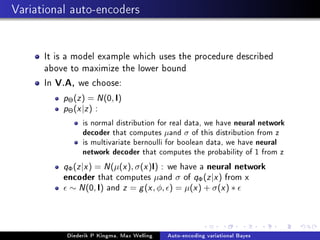
Variational auto-encoders
It is a model example which uses the procedure described
above to maximize the lower bound
In V.A, we choose:
pΘ(z) = N(0, I)
pΘ(x|z) :
is normal distribution for real data, we have neural network
decoder that computes µand σ of this distribution from z
is multivariate bernoulli for boolean data, we have neural
network decoder that computes the probability of 1 from z
qΦ(z|x) = N(µ(x), σ(x)I) : we have a neural network
encoder that computes µand σ of qΦ(z|x) from x
∼ N(0, I) and z = g(x, φ, ) = µ(x) + σ(x) ∗
Diederik P Kingma, Max Welling Auto-encoding variational Bayes
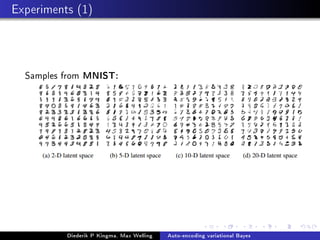
Experiments (1)
Samples from MNIST:
Diederik P Kingma, Max Welling Auto-encoding variational Bayes
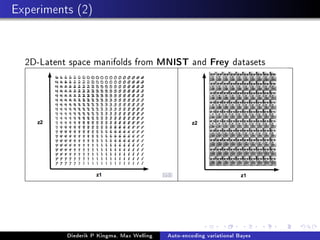
Experiments (2)
2D-Latent space manifolds from MNIST and Frey datasets
Diederik P Kingma, Max Welling Auto-encoding variational Bayes
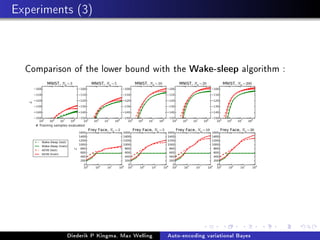
Experiments (3)
Comparison of the lower bound with the Wake-sleep algorithm :
Diederik P Kingma, Max Welling Auto-encoding variational Bayes
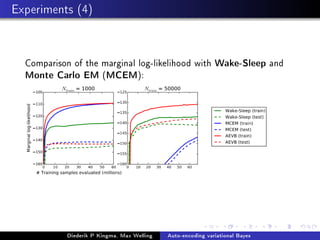
Experiments (4)
Comparison of the marginal log-likelihood with Wake-Sleep and
Monte Carlo EM (MCEM):
Diederik P Kingma, Max Welling Auto-encoding variational Bayes
Implementation : https://github.com/mehdidc/lasagnekit
Diederik P Kingma, Max Welling Auto-encoding variational Bayes

Auto encoding-variational-bayes

  • 1.
    Auto-encoding variational Bayes DiederikP Kingma 1 Max Welling 2 Presented by : Mehdi Cherti (LAL/CNRS) 9th May 2015 Diederik P Kingma, Max Welling Auto-encoding variational Bayes
  • 2.
    Diederik P Kingma,Max Welling Auto-encoding variational Bayes
  • 3.
    What is agenerative model ? A model of how the data X was generated Typically, the purpose is to nd a model for : p(x) or p(x, y) y can be a set of latent (hidden) variables or a set of output variables, for discriminative problems Diederik P Kingma, Max Welling Auto-encoding variational Bayes
  • 4.
    Training generative models Typically,we assume a parametric form of the probability density : p(x|Θ) Given an i.i.d dataset : X = (x1, x2, ..., xN), we typically do : Maximum likelihood (ML) : argmaxΘp(X|Θ) Maximum a posteriori (MAP) : argmaxΘp(X|Θ)p(Θ) Bayesian inference : p(Θ|X) = p(x|Θ)p(Θ)´ Θ p(x|Θ)p(Θ)dΘ Diederik P Kingma, Max Welling Auto-encoding variational Bayes
  • 5.
    The problem let xbe the observed variables we assume a latent representation z we dene pΘ(z) and pΘ(x|z) We want to design a generative model where: pΘ(x) = ´ pΘ(x|z)pΘ(z)dz is intractable pΘ(z|x) = pΘ(x|z)pΘ(z)/pΘ(x) is intractable we have large datasets : we want to avoid sampling based training procedures (e.g MCMC) Diederik P Kingma, Max Welling Auto-encoding variational Bayes
  • 6.
    The proposed solution Theypropose: a fast training procedure that estimates the parameters Θ: for data generation an approximation of the posterior pΘ(z|x) : for data representation an approximation of the marginal pΘ(x) : for model evaluation and as a prior for other tasks Diederik P Kingma, Max Welling Auto-encoding variational Bayes
  • 7.
    Formulation of theproblem the process of generation consists of sampling z from pΘ(z) then x from pΘ(x|z). Let's dene : a prior over over the latent representation pΘ(z), a decoder pΘ(x|z) We want to maximize the log-likelihood of the data (x(1), x(2), ..., x(N)): logpΘ(x(1) , x(2) , ..., x(N) ) = i logpΘ(xi) and be able to do inference : pΘ(z|x) Diederik P Kingma, Max Welling Auto-encoding variational Bayes
  • 8.
    The variational lowerbound We will learn an approximate of pΘ(z|x) : qΦ(z|x) by maximizing a lower bound of the log-likelihood of the data We can write : logpΘ(x) = DKL(qΦ(z|x)||pΘ(z|x)) + L(Θ, φ, x) where: L(Θ, Φ, x) = EqΦ(z|x)[logpΘ(x, z) − logqφ (z|x)] L(Θ, Φ, x)is called the variational lower bound, and the goal is to maximize it w.r.t to all the parameters (Θ, Φ) Diederik P Kingma, Max Welling Auto-encoding variational Bayes
  • 9.
    Estimating the lowerbound gradients We need to compute ∂L(Θ,Φ,x) ∂Θ , ∂L(Θ,Φ,x) ∂φ to apply gradient descent For that, we use the reparametrisation trick : we sample from a noise variable p( ) and apply a determenistic function to it so that we obtain correct samples from qφ(z|x), meaning: if ∼ p( ) we nd g so that if z = g(x, φ, ) then z ∼ qφ(z|x) g can be the inverse CDF of qΦ(z|x) if is uniform With the reparametrisation trick we can rewrite L: L(Θ, Φ, x) = E ∼p( )[logpΘ(x, g(x, φ, )) − logqφ (g(x, φ, )|x)] We then estimate the gradients with Monte Carlo Diederik P Kingma, Max Welling Auto-encoding variational Bayes
  • 10.
    A connection withauto-encoders Note that L can also be written in this form: L(Θ, φ, x) = −DKL(qΦ(z|x)||pΘ(z)) + EqΦ(z|x)[logpΘ(x|z)] We can interpret the rst term as a regularizer : it forces qΦ(z|x) to not be too divergent from the prior pΘ(z) We can interpret the (-second term) as the reconstruction error Diederik P Kingma, Max Welling Auto-encoding variational Bayes
  • 11.
    The algorithm Diederik PKingma, Max Welling Auto-encoding variational Bayes
  • 12.
    Variational auto-encoders It isa model example which uses the procedure described above to maximize the lower bound In V.A, we choose: pΘ(z) = N(0, I) pΘ(x|z) : is normal distribution for real data, we have neural network decoder that computes µand σ of this distribution from z is multivariate bernoulli for boolean data, we have neural network decoder that computes the probability of 1 from z qΦ(z|x) = N(µ(x), σ(x)I) : we have a neural network encoder that computes µand σ of qΦ(z|x) from x ∼ N(0, I) and z = g(x, φ, ) = µ(x) + σ(x) ∗ Diederik P Kingma, Max Welling Auto-encoding variational Bayes
  • 13.
    Experiments (1) Samples fromMNIST: Diederik P Kingma, Max Welling Auto-encoding variational Bayes
  • 14.
    Experiments (2) 2D-Latent spacemanifolds from MNIST and Frey datasets Diederik P Kingma, Max Welling Auto-encoding variational Bayes
  • 15.
    Experiments (3) Comparison ofthe lower bound with the Wake-sleep algorithm : Diederik P Kingma, Max Welling Auto-encoding variational Bayes
  • 16.
    Experiments (4) Comparison ofthe marginal log-likelihood with Wake-Sleep and Monte Carlo EM (MCEM): Diederik P Kingma, Max Welling Auto-encoding variational Bayes
  • 17.
    Implementation : https://github.com/mehdidc/lasagnekit DiederikP Kingma, Max Welling Auto-encoding variational Bayes