Industrial Training Presentation
Augmented Reality
Submitted by : Aman
Submitted to : Mr.Kuwar Mausam
Contents:
 Augmented Reality
 why Augmented Reality is Indroduce
 What is Augmented Reality
 Augmented Vs. Virtual Reality
 How does AR work?
 what is needed?
 Application of Augmented Reality
 current uses of AR
 Life Clipper
 AR Travel Guide
 Impact of Augmented Reality
 Future of AR
 Limitation of Augmented Reality
 Why continue Rerearch in AR?
 Conclusion
 Reference
Contents:
Augmented Reality
Augmented reality is an interactive experience that
enhances the real world with computer-generated
perceptual information. Using software, apps, and
hardware such as AR glasses, augmented reality
overlays digital content onto real-life
environments and objects.
Why Augmented reality is introduced
AR could create interactive and immersive learning
experiences for students, allowing them to visualize
and interact with concepts in a way that is
impossible with traditional methods. AR has also
been used to train employees in various industries,
such as healthcare, manufacturing and logistics.
What is Augmented Reality
Augmented reality (AR) is the integration of digital
information with the user's environment in Real
Time. Unlike virtual reality (VR), which creates a
totally artificial environment, AR users experience a
real-world environment with generated perceptual
information overlaid on top of it.
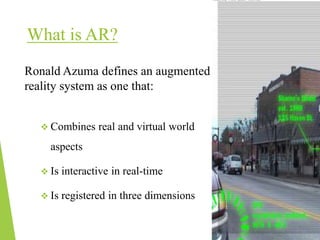
What is AR?
Ronald Azuma defines an augmented
reality system as one that:
 Combines real and virtual world
aspects
 Is interactive in real-time
 Is registered in three dimensions
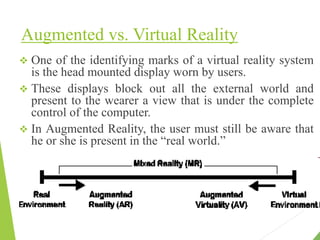
Augmented vs. Virtual Reality
 One of the identifying marks of a virtual reality system
is the head mounted display worn by users.
 These displays block out all the external world and
present to the wearer a view that is under the complete
control of the computer.
 In Augmented Reality, the user must still be aware that
he or she is present in the “real world.”
How does AR Work?
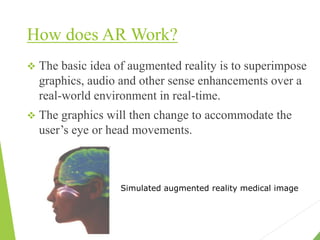
 The basic idea of augmented reality is to superimpose
graphics, audio and other sense enhancements over a
real-world environment in real-time.
 The graphics will then change to accommodate the
user’s eye or head movements.
Simulated augmented reality medical image
What is needed?
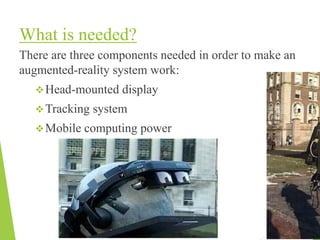
There are three components needed in order to make an
augmented-reality system work:
Head-mounted display
Tracking system
Mobile computing power
Application of Augmented Reality
 Military training
 Maintanance
 Surgery
 Entertainment
 Product Design
Current Uses of AR
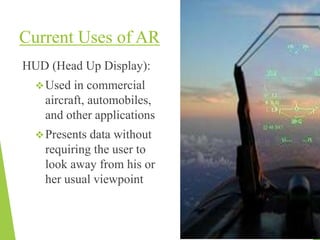
HUD (Head Up Display):
Used in commercial
aircraft, automobiles,
and other applications
Presents data without
requiring the user to
look away from his or
her usual viewpoint
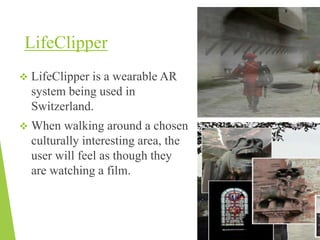
LifeClipper
 LifeClipper is a wearable AR
system being used in
Switzerland.
 When walking around a chosen
culturally interesting area, the
user will feel as though they
are watching a film.
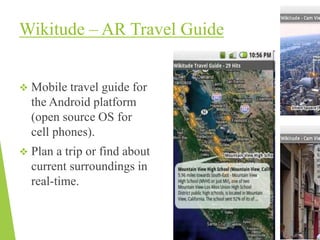
Wikitude – AR Travel Guide
 Mobile travel guide for
the Android platform
(open source OS for
cell phones).
 Plan a trip or find about
current surroundings in
real-time.
Impact of Augmented Reality
As AR blurs the lines between the real and virtual
worlds, it may impact real-life social interactions.
Excessive use of AR could lead to diminished face-
to-face communication skills, reduced empathy, and
isolation from physical surroundings.
Future of AR
Military:
The Office of Naval Research has sponsored AR resear
AR system could provide troops with vital information
about their surroundings.
Medical:
Superimpose an image from an MRI onto a patient’s
body.
This might allow surgeons to pinpoint a tumor to remov
Education:
Used in labs where students can learn more about the
experiments they are participating in.
Future of AR
Gaming:
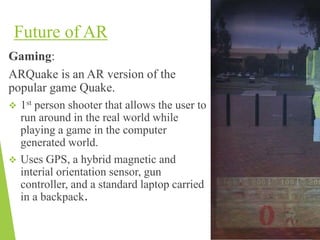
ARQuake is an AR version of the
popular game Quake.
 1st person shooter that allows the user to
run around in the real world while
playing a game in the computer
generated world.
 Uses GPS, a hybrid magnetic and
interial orientation sensor, gun
controller, and a standard laptop carried
in a backpack.
Limitations of augmented Reality
 Technical Limitations
These include limitations in tracking accuracy, device
battery life, field of view, and visual quality.
Advancements in hardware, such as improved sensors,
more powerful processors, and longer battery life, are
necessary to enhance the overall AR experience.
 Privacy and Security Concerns
 Content Creation and Accessibility
 Social and Ethical Implications
Why continue research in AR?
 AR systems will instantly recognize what someone is
looking at, and retrieve and display the data related to
that view.
 There are hundreds of potential applications for such a
technology, gaming and entertainment being the most
obvious ones.
 Any system that gives people instant information,
requiring no research on their part, is bound to be a
valuable to anyone in any field.
Conclusion:
 Big potential:Life simplifying service,Task enhancing
 High utility B2C, Retail and commerce,Path finding and
Navigation,Publishing,Game and Entertainment.
 High utility B2B :Medicine manufacturing, Repair and
Maintenance.
 Miniaturization of Device increasing opportunity
 Selective Semantic and personal Perception of the
environment.
 Augmented Reality is the future technology that will
revolutionize the world and allow companies to gain a
market advantage.
Reference:
 Cipresso, Pietro; Giglioli, Irene Alice Chicchi; Raya, iz; Riva,
Giuseppe (7 December 2011). "The Past, Present, and Future
Virtual and Augmented Reality Research: A Network and
Cluster Analysis of the Literature". Frontiers in Psychology. 9
2086. doi:10.3389/fpsyg.2018.02086. PMC 6232426. PMID 3
59681.
 ^ Wu, Hsin-Kai; Lee, Silvia Wen-Yu; Chang, Hsin-Yi; Liang,
Jyh-Chong (March 2013). "Current status, opportunities and
challenges of augmented reality in education...". Computers &
Education. 62: 41–
49. doi:10.1016/j.compedu.2012.10.024. S2CID 15218665.

Augmented reality and virtual reality technology

  • 1.
    Industrial Training Presentation AugmentedReality Submitted by : Aman Submitted to : Mr.Kuwar Mausam
  • 2.
    Contents:  Augmented Reality why Augmented Reality is Indroduce  What is Augmented Reality  Augmented Vs. Virtual Reality  How does AR work?  what is needed?  Application of Augmented Reality  current uses of AR
  • 3.
     Life Clipper AR Travel Guide  Impact of Augmented Reality  Future of AR  Limitation of Augmented Reality  Why continue Rerearch in AR?  Conclusion  Reference Contents:
  • 4.
    Augmented Reality Augmented realityis an interactive experience that enhances the real world with computer-generated perceptual information. Using software, apps, and hardware such as AR glasses, augmented reality overlays digital content onto real-life environments and objects.
  • 5.
    Why Augmented realityis introduced AR could create interactive and immersive learning experiences for students, allowing them to visualize and interact with concepts in a way that is impossible with traditional methods. AR has also been used to train employees in various industries, such as healthcare, manufacturing and logistics.
  • 6.
    What is AugmentedReality Augmented reality (AR) is the integration of digital information with the user's environment in Real Time. Unlike virtual reality (VR), which creates a totally artificial environment, AR users experience a real-world environment with generated perceptual information overlaid on top of it.
  • 7.
    What is AR? RonaldAzuma defines an augmented reality system as one that:  Combines real and virtual world aspects  Is interactive in real-time  Is registered in three dimensions
  • 8.
    Augmented vs. VirtualReality  One of the identifying marks of a virtual reality system is the head mounted display worn by users.  These displays block out all the external world and present to the wearer a view that is under the complete control of the computer.  In Augmented Reality, the user must still be aware that he or she is present in the “real world.”
  • 9.
    How does ARWork?  The basic idea of augmented reality is to superimpose graphics, audio and other sense enhancements over a real-world environment in real-time.  The graphics will then change to accommodate the user’s eye or head movements. Simulated augmented reality medical image
  • 10.
    What is needed? Thereare three components needed in order to make an augmented-reality system work: Head-mounted display Tracking system Mobile computing power
  • 11.
    Application of AugmentedReality  Military training  Maintanance  Surgery  Entertainment  Product Design
  • 12.
    Current Uses ofAR HUD (Head Up Display): Used in commercial aircraft, automobiles, and other applications Presents data without requiring the user to look away from his or her usual viewpoint
  • 13.
    LifeClipper  LifeClipper isa wearable AR system being used in Switzerland.  When walking around a chosen culturally interesting area, the user will feel as though they are watching a film.
  • 14.
    Wikitude – ARTravel Guide  Mobile travel guide for the Android platform (open source OS for cell phones).  Plan a trip or find about current surroundings in real-time.
  • 15.
    Impact of AugmentedReality As AR blurs the lines between the real and virtual worlds, it may impact real-life social interactions. Excessive use of AR could lead to diminished face- to-face communication skills, reduced empathy, and isolation from physical surroundings.
  • 16.
    Future of AR Military: TheOffice of Naval Research has sponsored AR resear AR system could provide troops with vital information about their surroundings. Medical: Superimpose an image from an MRI onto a patient’s body. This might allow surgeons to pinpoint a tumor to remov Education: Used in labs where students can learn more about the experiments they are participating in.
  • 17.
    Future of AR Gaming: ARQuakeis an AR version of the popular game Quake.  1st person shooter that allows the user to run around in the real world while playing a game in the computer generated world.  Uses GPS, a hybrid magnetic and interial orientation sensor, gun controller, and a standard laptop carried in a backpack.
  • 18.
    Limitations of augmentedReality  Technical Limitations These include limitations in tracking accuracy, device battery life, field of view, and visual quality. Advancements in hardware, such as improved sensors, more powerful processors, and longer battery life, are necessary to enhance the overall AR experience.  Privacy and Security Concerns  Content Creation and Accessibility  Social and Ethical Implications
  • 19.
    Why continue researchin AR?  AR systems will instantly recognize what someone is looking at, and retrieve and display the data related to that view.  There are hundreds of potential applications for such a technology, gaming and entertainment being the most obvious ones.  Any system that gives people instant information, requiring no research on their part, is bound to be a valuable to anyone in any field.
  • 20.
    Conclusion:  Big potential:Lifesimplifying service,Task enhancing  High utility B2C, Retail and commerce,Path finding and Navigation,Publishing,Game and Entertainment.  High utility B2B :Medicine manufacturing, Repair and Maintenance.  Miniaturization of Device increasing opportunity  Selective Semantic and personal Perception of the environment.  Augmented Reality is the future technology that will revolutionize the world and allow companies to gain a market advantage.
  • 21.
    Reference:  Cipresso, Pietro;Giglioli, Irene Alice Chicchi; Raya, iz; Riva, Giuseppe (7 December 2011). "The Past, Present, and Future Virtual and Augmented Reality Research: A Network and Cluster Analysis of the Literature". Frontiers in Psychology. 9 2086. doi:10.3389/fpsyg.2018.02086. PMC 6232426. PMID 3 59681.  ^ Wu, Hsin-Kai; Lee, Silvia Wen-Yu; Chang, Hsin-Yi; Liang, Jyh-Chong (March 2013). "Current status, opportunities and challenges of augmented reality in education...". Computers & Education. 62: 41– 49. doi:10.1016/j.compedu.2012.10.024. S2CID 15218665.