Augmented Collective Digital Twins
for Self-Organising Cyber-Physical Systems
Roberto Casadei1
, Andrea Placuzzi1
, Mirko Viroli1
, Danny Weyns2
1
ALMA MATER STUDIORUM–Università di Bologna, Cesena, Italy
2
Katholieke Universiteit Leuven, Belgium
September 27, 2021
Talk @
SISSY Workshop 2021
Outline
1 Background and Motivation
2 Contribution
3 Conclusion
Focus: cyber-physical collectives (CPC)
groups of situated agents
coordinating to perform some joint/collective task
[1] T. De Wolf et al., “Designing self-organising emergent systems based on information flows and feedback-loops,” in
First International Conference on Self-Adaptive and Self-Organizing Systems (SASO 2007), IEEE, 2007
R.Casadei Background and Motivation Contribution Conclusion References 1/13
Focus: cyber-physical collectives (CPC)
groups of situated agents
coordinating to perform some joint/collective task
∠ using mechanisms like e.g. self-organising information flows [1]
[1] T. De Wolf et al., “Designing self-organising emergent systems based on information flows and feedback-loops,” in
First International Conference on Self-Adaptive and Self-Organizing Systems (SASO 2007), IEEE, 2007
R.Casadei Background and Motivation Contribution Conclusion References 1/13
Aggregate Computing (AC) paradigm for CPCs [2]
Self-organisation-like programming model for the collective digital twin
interaction: continuous communication with neighbours
behaviour: continuous execution of async rounds of sense – compute – (inter)act
abstraction: computational fields
[2] M. Viroli et al., “From distributed coordination to field calculus and aggregate computing,” Journal of Logical and
Algebraic Methods in Programming, 2019
R.Casadei Background and Motivation Contribution Conclusion References 2/13
Aggregate Computing (AC) paradigm for CPCs [2]
Self-organisation-like programming model for the collective digital twin
interaction: continuous communication with neighbours
behaviour: continuous execution of async rounds of sense – compute – (inter)act
abstraction: computational fields
paradigm: functional — supporting compositionality
source destination
gradient distance
gradient
<=
+
dilate
width
37
10
[2] M. Viroli et al., “From distributed coordination to field calculus and aggregate computing,” Journal of Logical and
Algebraic Methods in Programming, 2019
R.Casadei Background and Motivation Contribution Conclusion References 2/13
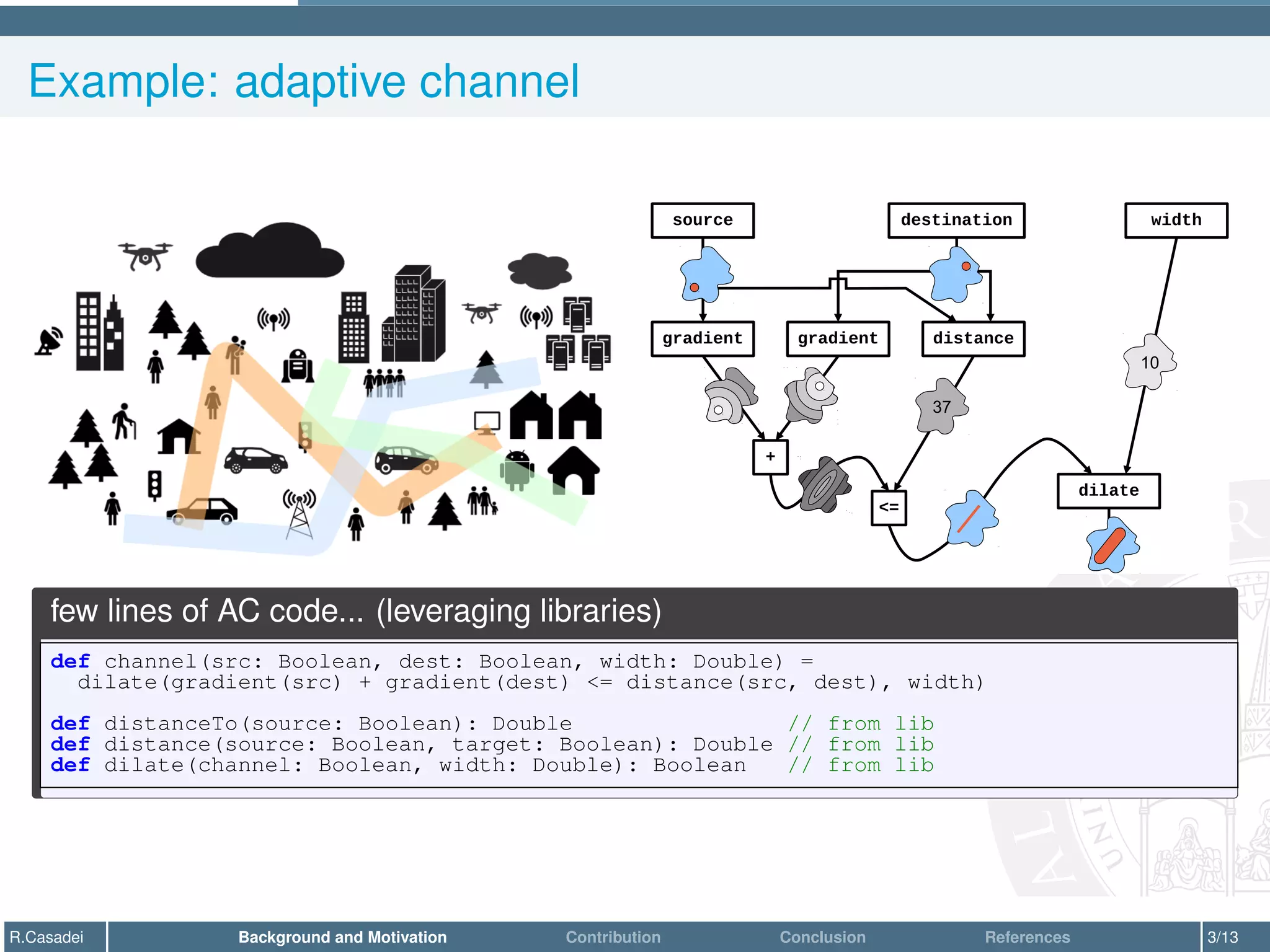
Example: adaptive channel
source destination
gradient distance
gradient
<=
+
dilate
width
37
10
few lines of AC code... (leveraging libraries)
def channel(src: Boolean, dest: Boolean, width: Double) =
dilate(gradient(src) + gradient(dest) <= distance(src, dest), width)
def distanceTo(source: Boolean): Double // from lib
def distance(source: Boolean, target: Boolean): Double // from lib
def dilate(channel: Boolean, width: Double): Boolean // from lib
R.Casadei Background and Motivation Contribution Conclusion References 3/13
Applications and Issues
Info flows/channels provide multi-hop connectivity in decentralised, dynamic networks [3]
- self-org patterns in mobile ad-hoc / instrastructureless / blackout contexts
[3] R. Casadei et al., “Engineering collective intelligence at the edge with aggregate processes,” Eng. Appl. Artif.
Intell., 2021
R.Casadei Background and Motivation Contribution Conclusion References 4/13
Applications and Issues
Info flows/channels provide multi-hop connectivity in decentralised, dynamic networks [3]
- self-org patterns in mobile ad-hoc / instrastructureless / blackout contexts
o Assumption: devices as approximation of space
Issues: sparseness and (logic) partitions (cf. overcrowded areas) in networks
, unreachability – physical or logical (cf. application-level constraints)
, long paths → performance/functional issues
[3] R. Casadei et al., “Engineering collective intelligence at the edge with aggregate processes,” Eng. Appl. Artif.
Intell., 2021
R.Casadei Background and Motivation Contribution Conclusion References 4/13
Outline
1 Background and Motivation
2 Contribution
3 Conclusion
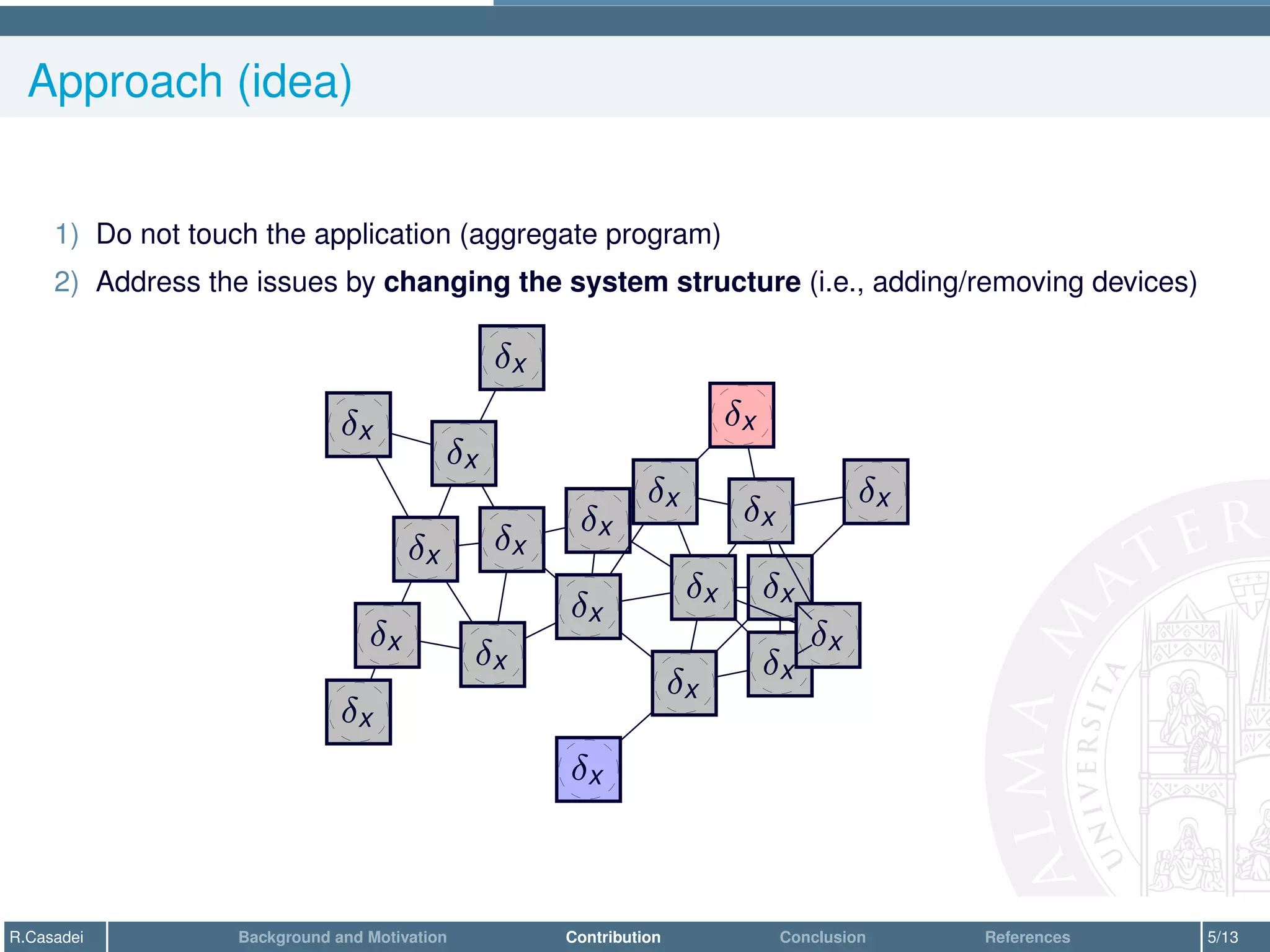
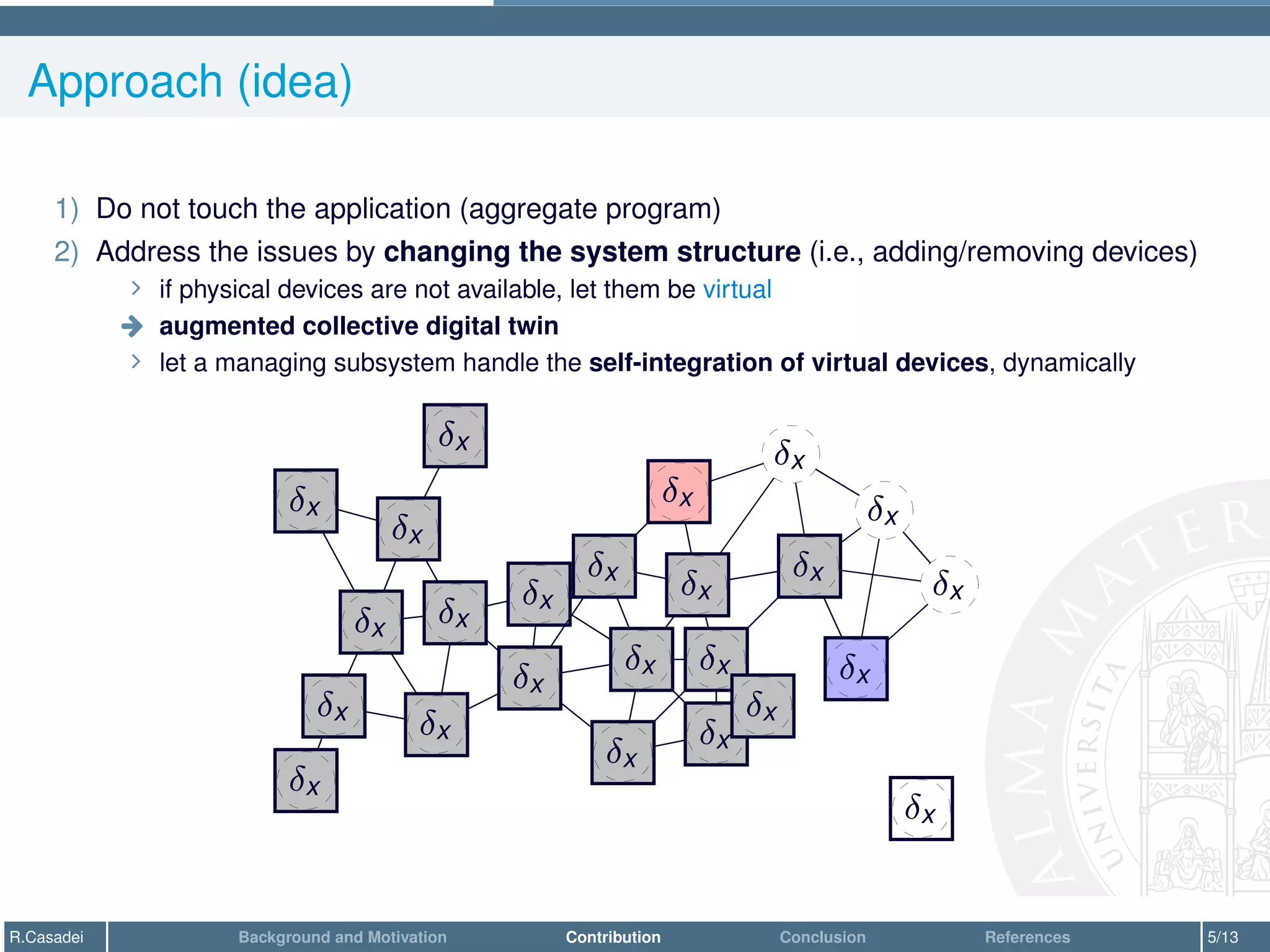
Approach (idea)
1) Do not touch the application (aggregate program)
2) Address the issues by changing the system structure (i.e., adding/removing devices)
δx
δx
δx
δx
δx
δx
δx
δx
δx
δx
δx
δx
δx
δx
δx
δx
δx
δx
δx
δx
R.Casadei Background and Motivation Contribution Conclusion References 5/13
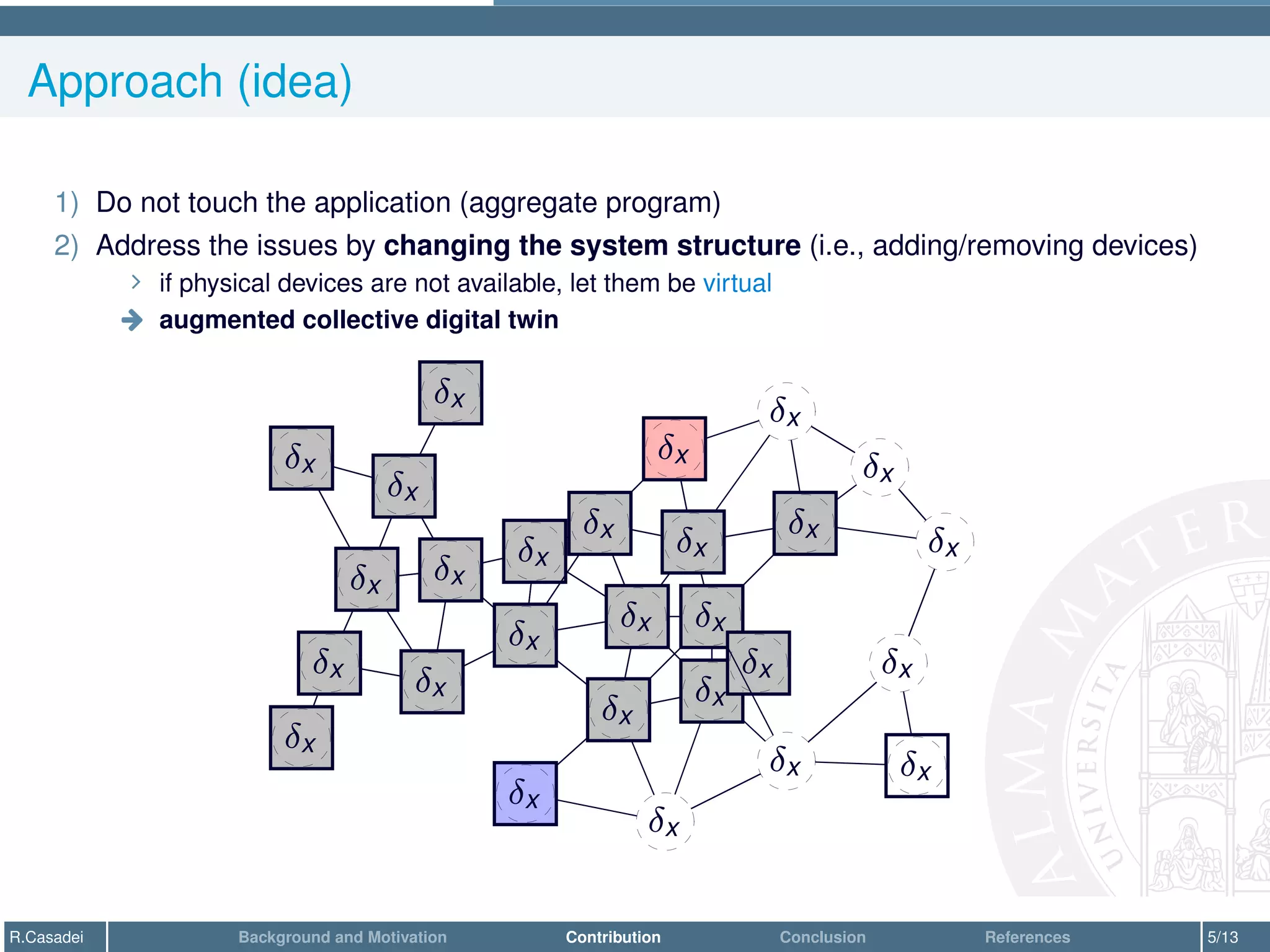
Approach (idea)
1) Do not touch the application (aggregate program)
2) Address the issues by changing the system structure (i.e., adding/removing devices)
∠ if physical devices are not available, let them be virtual
ú augmented collective digital twin
δx
δx
δx
δx
δx
δx
δx
δx
δx
δx
δx
δx
δx
δx
δx
δx
δx
δx
δx
δx
δx
δx
δx
δx
δx
δx
δx
R.Casadei Background and Motivation Contribution Conclusion References 5/13
Approach (idea)
1) Do not touch the application (aggregate program)
2) Address the issues by changing the system structure (i.e., adding/removing devices)
∠ if physical devices are not available, let them be virtual
ú augmented collective digital twin
∠ let a managing subsystem handle the self-integration of virtual devices, dynamically
δx
δx
δx
δx
δx
δx
δx
δx
δx
δx
δx
δx
δx
δx
δx
δx
δx
δx
δx
δx
δx
δx
δx
δx
R.Casadei Background and Motivation Contribution Conclusion References 5/13
PoC Implementation of the Approach (i)
we leverage the pulverisation model [8] (an architectural/deployment model for AC)
logical
de-
vice
β
behaviour
χ
communication
κ state
σ
sensors
α
actuators
neighbour
de-
vice
χ β
κ
σ α
Host (thin/application-level)
Host (thick/infrastructure-level)
Logical device
σ Device’s sensor set
α Device’s actuator set
χ Device’s communication interface
κ Device’s state
β Device’s behaviour
Host-to-host link
Logical, neighbouring link
Twin relationship
δ1
δ2
δ3
δ5
δ4
β1
α1
σ1
χ1
κ1
α2
χ2
σ2
β2
κ2
α3
σ3
χ3
β3
κ3
α4
σ4
χ4
β4
κ4
α5
σ5
χ5
β5
κ5
[8] R. Casadei et al., “Pulverization in cyber-physical systems: Engineering the self-organizing logic separated from
deployment,” Future Internet, no. 11, 2020
R.Casadei Background and Motivation Contribution Conclusion References 6/13
PoC Implementation of the Approach (i)
we leverage the pulverisation model [8] (an architectural/deployment model for AC)
logical
de-
vice
β
behaviour
χ
communication
κ state
σ
sensors
α
actuators
neighbour
de-
vice
χ β
κ
σ α
Host (thin/application-level)
Host (thick/infrastructure-level)
Logical device
σ Device’s sensor set
α Device’s actuator set
χ Device’s communication interface
κ Device’s state
β Device’s behaviour
Host-to-host link
Logical, neighbouring link
Twin relationship
δ1
δ2
δ3
δ5
δ4
β1
α1
σ1
χ1
κ1
α2
χ2
σ2
β2
κ2
α3
σ3
χ3
β3
κ3
α4
σ4
χ4
β4
κ4
α5
σ5
χ5
β5
κ5
need to virtualise one or more devices (identity, sensor values, neighbourhoods)
o this is the challenging part (especially on MANETs)
∠ roughly: build a global map, decide allocations, share virtual state, exploit eventual consistency
[8] R. Casadei et al., “Pulverization in cyber-physical systems: Engineering the self-organizing logic separated from
deployment,” Future Internet, no. 11, 2020
R.Casadei Background and Motivation Contribution Conclusion References 6/13
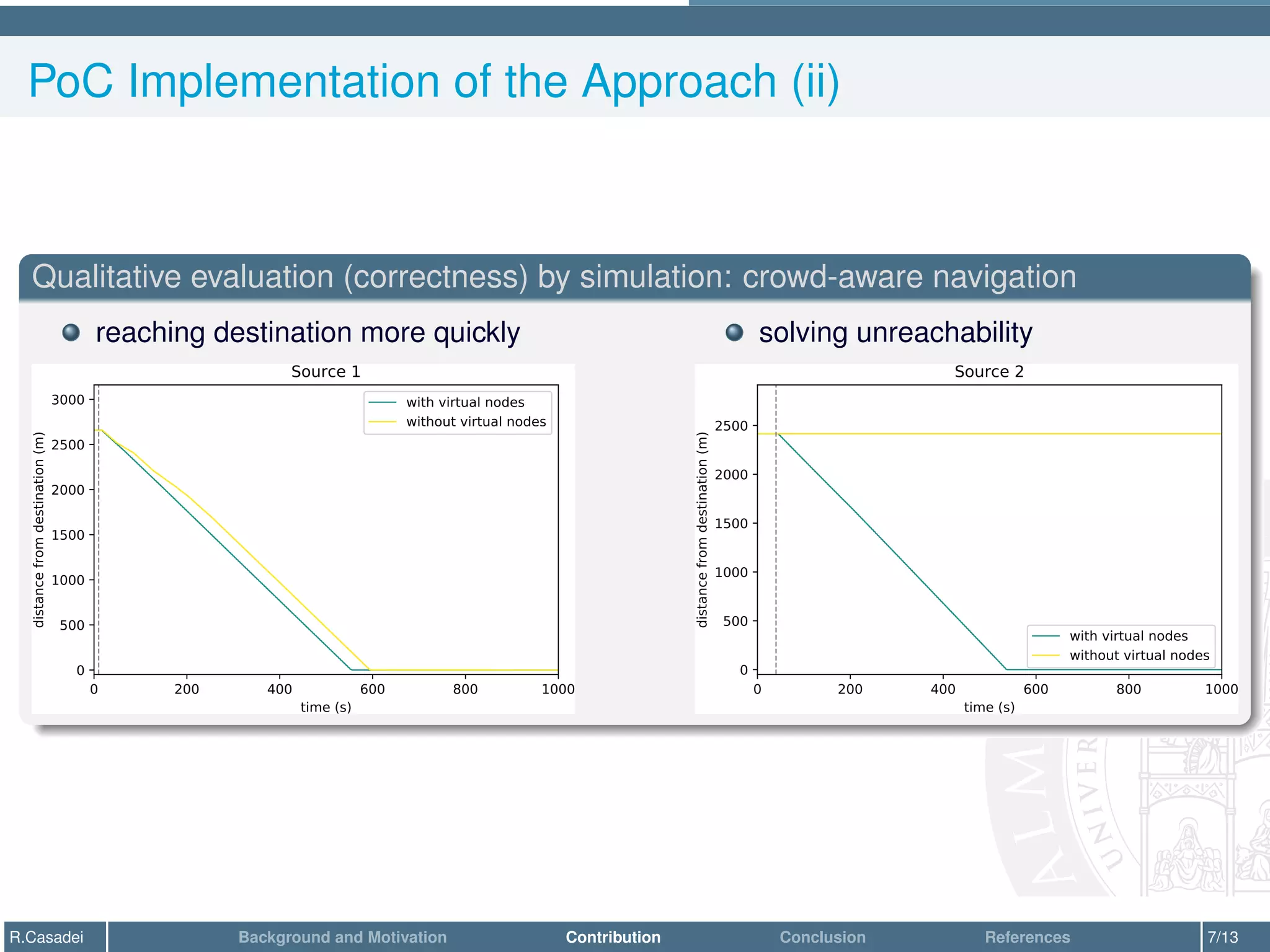
PoC Implementation of the Approach (ii)
Qualitative evaluation (correctness) by simulation: crowd-aware navigation
reaching destination more quickly
0 200 400 600 800 1000
time (s)
0
500
1000
1500
2000
2500
3000
distance
from
destination
(m)
Source 1
with virtual nodes
without virtual nodes
solving unreachability
0 200 400 600 800 1000
time (s)
0
500
1000
1500
2000
2500
distance
from
destination
(m)
Source 2
with virtual nodes
without virtual nodes
R.Casadei Background and Motivation Contribution Conclusion References 7/13
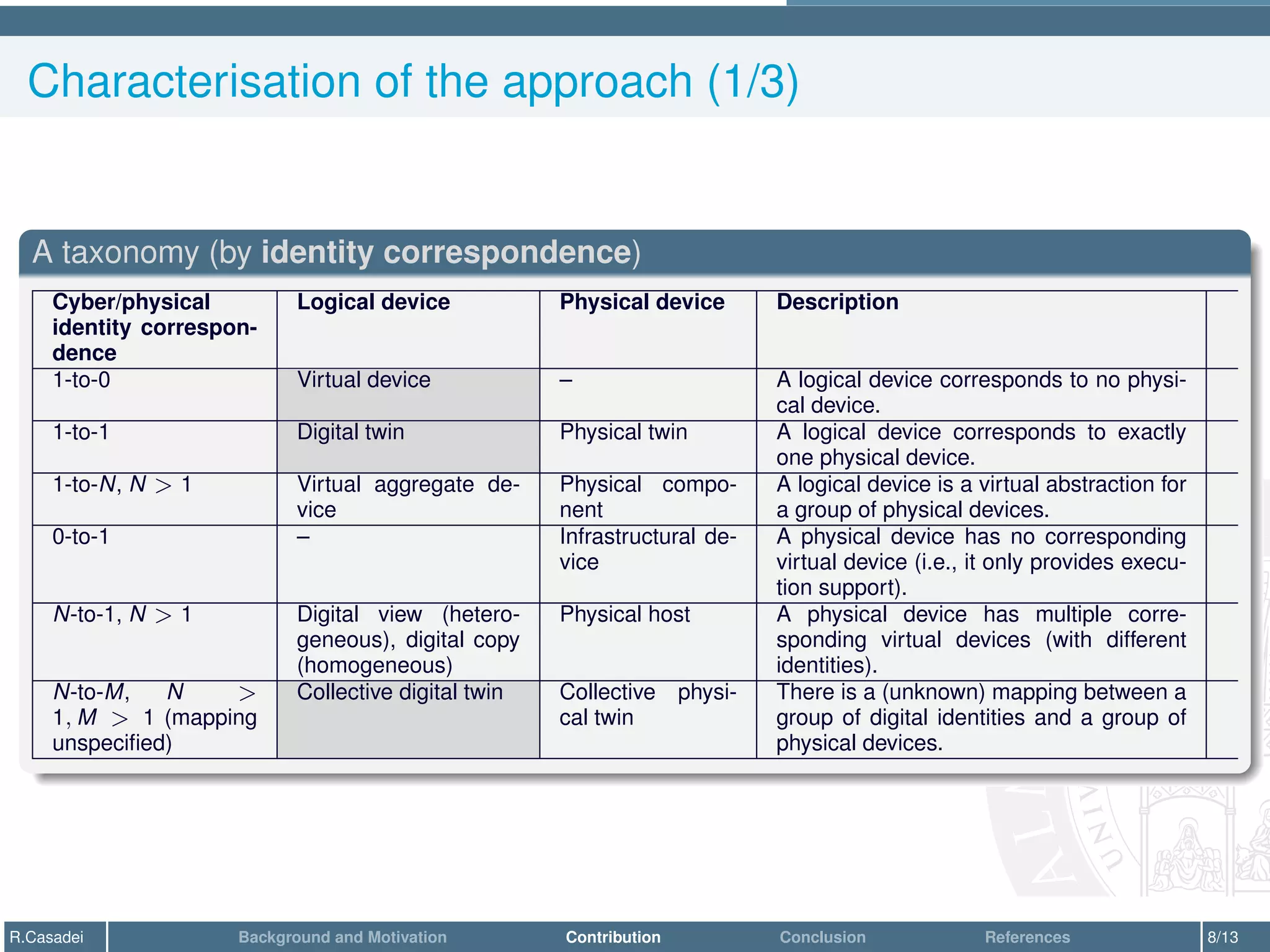
Characterisation of the approach (1/3)
A taxonomy (by identity correspondence)
Cyber/physical
identity correspon-
dence
Logical device Physical device Description
1-to-0 Virtual device – A logical device corresponds to no physi-
cal device.
1-to-1 Digital twin Physical twin A logical device corresponds to exactly
one physical device.
1-to-N, N > 1 Virtual aggregate de-
vice
Physical compo-
nent
A logical device is a virtual abstraction for
a group of physical devices.
0-to-1 – Infrastructural de-
vice
A physical device has no corresponding
virtual device (i.e., it only provides execu-
tion support).
N-to-1, N > 1 Digital view (hetero-
geneous), digital copy
(homogeneous)
Physical host A physical device has multiple corre-
sponding virtual devices (with different
identities).
N-to-M, N >
1, M > 1 (mapping
unspecified)
Collective digital twin Collective physi-
cal twin
There is a (unknown) mapping between a
group of digital identities and a group of
physical devices.
R.Casadei Background and Motivation Contribution Conclusion References 8/13
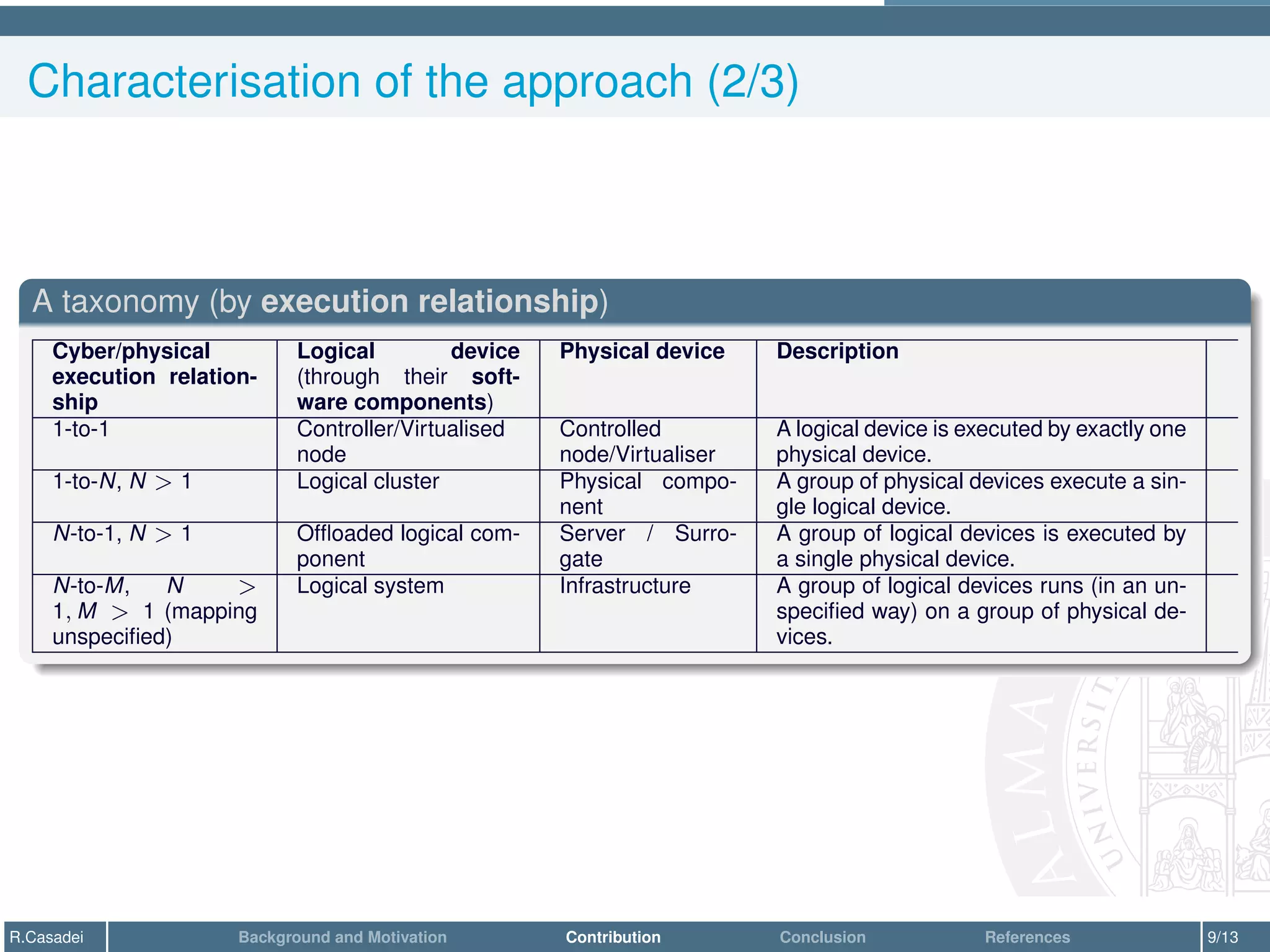
Characterisation of the approach (2/3)
A taxonomy (by execution relationship)
Cyber/physical
execution relation-
ship
Logical device
(through their soft-
ware components)
Physical device Description
1-to-1 Controller/Virtualised
node
Controlled
node/Virtualiser
A logical device is executed by exactly one
physical device.
1-to-N, N > 1 Logical cluster Physical compo-
nent
A group of physical devices execute a sin-
gle logical device.
N-to-1, N > 1 Offloaded logical com-
ponent
Server / Surro-
gate
A group of logical devices is executed by
a single physical device.
N-to-M, N >
1, M > 1 (mapping
unspecified)
Logical system Infrastructure A group of logical devices runs (in an un-
specified way) on a group of physical de-
vices.
R.Casadei Background and Motivation Contribution Conclusion References 9/13
Characterisation of the approach (3/3)
Virtual nodes in literature
Ref. Goals Techniques Applications Network
architecture
Kind of virtual node
[4] Predictability Collaborative emulation of
virtual nodes
WSN Ad-hoc Virtual aggregate de-
vice
[5] Improved
QoS
TDMA prioritisation WSN Clustered Digital copy
[6] Abstraction
and effi-
ciency
Optimal formation and
composition of resource-
constrained sensors
WSN Cloud-based
(Hierarchical)
Virtual aggregate de-
vice
[7] Improved
QoS
QoS-aware service composi-
tion
Cloud-based
IoT
Cloud-based
(Hierarchical)
Virtual aggregate de-
vice
R.Casadei Background and Motivation Contribution Conclusion References 10/13
Outline
1 Background and Motivation
2 Contribution
3 Conclusion
Wrap-up
Summary
a narrow, starting problem as inspiration: crowd-aware navigation / info flows in sparse
networks
­ a creative idea: self-integration of virtual devices to reify an augmented collective
digital twin
a proof-of-concept simulation through pulverised aggregate computing systems
R.Casadei Background and Motivation Contribution Conclusion References 11/13
Wrap-up
Summary
a narrow, starting problem as inspiration: crowd-aware navigation / info flows in sparse
networks
­ a creative idea: self-integration of virtual devices to reify an augmented collective
digital twin
a proof-of-concept simulation through pulverised aggregate computing systems
Side contributions
a literature review of approaches adopting virtual nodes
proposed taxonomy of cyber-physical systems: based on identity correspondence &
execution relationship
R.Casadei Background and Motivation Contribution Conclusion References 11/13
Wrap-up
Summary
a narrow, starting problem as inspiration: crowd-aware navigation / info flows in sparse
networks
­ a creative idea: self-integration of virtual devices to reify an augmented collective
digital twin
a proof-of-concept simulation through pulverised aggregate computing systems
Side contributions
a literature review of approaches adopting virtual nodes
proposed taxonomy of cyber-physical systems: based on identity correspondence &
execution relationship
Future work
devise effective strategies for self-integration of virtual nodes
consider generalisations of the idea and their potential, practical impact
R.Casadei Background and Motivation Contribution Conclusion References 11/13
Bibliography (1/2)
[1] T. De Wolf and T. Holvoet, “Designing self-organising emergent systems based on information flows
and feedback-loops,” in First International Conference on Self-Adaptive and Self-Organizing Systems
(SASO 2007), IEEE, 2007, pp. 295–298.
[2] M. Viroli, J. Beal, F. Damiani, G. Audrito, R. Casadei, and D. Pianini, “From distributed coordination to
field calculus and aggregate computing,” Journal of Logical and Algebraic Methods in Programming,
vol. 109, p. 100 486, 2019, ISSN: 2352-2208. DOI: 10.1016/j.jlamp.2019.100486.
[3] R. Casadei, M. Viroli, G. Audrito, D. Pianini, and F. Damiani, “Engineering collective intelligence at the
edge with aggregate processes,” Eng. Appl. Artif. Intell., vol. 97, p. 104 081, 2021.
[4] M. Brown, S. Gilbert, N. A. Lynch, C. C. Newport, T. Nolte, and M. Spindel, “The virtual node layer: A
programming abstraction for wireless sensor networks,” SIGBED Rev., vol. 4, no. 3, pp. 7–12, 2007.
DOI: 10.1145/1317103.1317105. [Online]. Available:
https://doi.org/10.1145/1317103.1317105.
[5] W. Almobaideen, M. Qatawneh, and O. AbuAlghanam, “Virtual node schedule for supporting qos in
wireless sensor network,” in 2019 IEEE Jordan International Joint Conference on Electrical
Engineering and Information Technology (JEEIT), IEEE, 2019, pp. 281–285.
[6] S. Chatterjee and S. Misra, “Optimal composition of a virtual sensor for efficient virtualization within
sensor-cloud,” in 2015 IEEE International Conference on Communications, ICC 2015, London,
United Kingdom, June 8-12, 2015, IEEE, 2015, pp. 448–453. DOI: 10.1109/ICC.2015.7248362.
[Online]. Available: https://doi.org/10.1109/ICC.2015.7248362.
R.Casadei Background and Motivation Contribution Conclusion References 12/13
Bibliography (2/2)
[7] M. E. Khansari, S. Sharifian, and S. A. Motamedi, “Virtual sensor as a service: A new multicriteria
qos-aware cloud service composition for iot applications,” J. Supercomput., vol. 74, no. 10,
pp. 5485–5512, 2018. DOI: 10.1007/s11227-018-2454-y. [Online]. Available:
https://doi.org/10.1007/s11227-018-2454-y.
[8] R. Casadei, D. Pianini, A. Placuzzi, M. Viroli, and D. Weyns, “Pulverization in cyber-physical systems:
Engineering the self-organizing logic separated from deployment,” Future Internet, vol. 12, no. 11,
p. 203, 2020.
R.Casadei Background and Motivation Contribution Conclusion References 13/13

Augmented Collective Digital Twins for Self-Organising Cyber-Physical Systems

  • 1.
    Augmented Collective DigitalTwins for Self-Organising Cyber-Physical Systems Roberto Casadei1 , Andrea Placuzzi1 , Mirko Viroli1 , Danny Weyns2 1 ALMA MATER STUDIORUM–Università di Bologna, Cesena, Italy 2 Katholieke Universiteit Leuven, Belgium September 27, 2021 Talk @ SISSY Workshop 2021
  • 2.
    Outline 1 Background andMotivation 2 Contribution 3 Conclusion
  • 3.
    Focus: cyber-physical collectives(CPC) groups of situated agents coordinating to perform some joint/collective task [1] T. De Wolf et al., “Designing self-organising emergent systems based on information flows and feedback-loops,” in First International Conference on Self-Adaptive and Self-Organizing Systems (SASO 2007), IEEE, 2007 R.Casadei Background and Motivation Contribution Conclusion References 1/13
  • 4.
    Focus: cyber-physical collectives(CPC) groups of situated agents coordinating to perform some joint/collective task ∠ using mechanisms like e.g. self-organising information flows [1] [1] T. De Wolf et al., “Designing self-organising emergent systems based on information flows and feedback-loops,” in First International Conference on Self-Adaptive and Self-Organizing Systems (SASO 2007), IEEE, 2007 R.Casadei Background and Motivation Contribution Conclusion References 1/13
  • 5.
    Aggregate Computing (AC)paradigm for CPCs [2] Self-organisation-like programming model for the collective digital twin interaction: continuous communication with neighbours behaviour: continuous execution of async rounds of sense – compute – (inter)act abstraction: computational fields [2] M. Viroli et al., “From distributed coordination to field calculus and aggregate computing,” Journal of Logical and Algebraic Methods in Programming, 2019 R.Casadei Background and Motivation Contribution Conclusion References 2/13
  • 6.
    Aggregate Computing (AC)paradigm for CPCs [2] Self-organisation-like programming model for the collective digital twin interaction: continuous communication with neighbours behaviour: continuous execution of async rounds of sense – compute – (inter)act abstraction: computational fields paradigm: functional — supporting compositionality source destination gradient distance gradient <= + dilate width 37 10 [2] M. Viroli et al., “From distributed coordination to field calculus and aggregate computing,” Journal of Logical and Algebraic Methods in Programming, 2019 R.Casadei Background and Motivation Contribution Conclusion References 2/13
  • 7.
    Example: adaptive channel sourcedestination gradient distance gradient <= + dilate width 37 10 few lines of AC code... (leveraging libraries) def channel(src: Boolean, dest: Boolean, width: Double) = dilate(gradient(src) + gradient(dest) <= distance(src, dest), width) def distanceTo(source: Boolean): Double // from lib def distance(source: Boolean, target: Boolean): Double // from lib def dilate(channel: Boolean, width: Double): Boolean // from lib R.Casadei Background and Motivation Contribution Conclusion References 3/13
  • 8.
    Applications and Issues Infoflows/channels provide multi-hop connectivity in decentralised, dynamic networks [3] - self-org patterns in mobile ad-hoc / instrastructureless / blackout contexts [3] R. Casadei et al., “Engineering collective intelligence at the edge with aggregate processes,” Eng. Appl. Artif. Intell., 2021 R.Casadei Background and Motivation Contribution Conclusion References 4/13
  • 9.
    Applications and Issues Infoflows/channels provide multi-hop connectivity in decentralised, dynamic networks [3] - self-org patterns in mobile ad-hoc / instrastructureless / blackout contexts o Assumption: devices as approximation of space Issues: sparseness and (logic) partitions (cf. overcrowded areas) in networks , unreachability – physical or logical (cf. application-level constraints) , long paths → performance/functional issues [3] R. Casadei et al., “Engineering collective intelligence at the edge with aggregate processes,” Eng. Appl. Artif. Intell., 2021 R.Casadei Background and Motivation Contribution Conclusion References 4/13
  • 10.
    Outline 1 Background andMotivation 2 Contribution 3 Conclusion
  • 11.
    Approach (idea) 1) Donot touch the application (aggregate program) 2) Address the issues by changing the system structure (i.e., adding/removing devices) δx δx δx δx δx δx δx δx δx δx δx δx δx δx δx δx δx δx δx δx R.Casadei Background and Motivation Contribution Conclusion References 5/13
  • 12.
    Approach (idea) 1) Donot touch the application (aggregate program) 2) Address the issues by changing the system structure (i.e., adding/removing devices) ∠ if physical devices are not available, let them be virtual ú augmented collective digital twin δx δx δx δx δx δx δx δx δx δx δx δx δx δx δx δx δx δx δx δx δx δx δx δx δx δx δx R.Casadei Background and Motivation Contribution Conclusion References 5/13
  • 13.
    Approach (idea) 1) Donot touch the application (aggregate program) 2) Address the issues by changing the system structure (i.e., adding/removing devices) ∠ if physical devices are not available, let them be virtual ú augmented collective digital twin ∠ let a managing subsystem handle the self-integration of virtual devices, dynamically δx δx δx δx δx δx δx δx δx δx δx δx δx δx δx δx δx δx δx δx δx δx δx δx R.Casadei Background and Motivation Contribution Conclusion References 5/13
  • 14.
    PoC Implementation ofthe Approach (i) we leverage the pulverisation model [8] (an architectural/deployment model for AC) logical de- vice β behaviour χ communication κ state σ sensors α actuators neighbour de- vice χ β κ σ α Host (thin/application-level) Host (thick/infrastructure-level) Logical device σ Device’s sensor set α Device’s actuator set χ Device’s communication interface κ Device’s state β Device’s behaviour Host-to-host link Logical, neighbouring link Twin relationship δ1 δ2 δ3 δ5 δ4 β1 α1 σ1 χ1 κ1 α2 χ2 σ2 β2 κ2 α3 σ3 χ3 β3 κ3 α4 σ4 χ4 β4 κ4 α5 σ5 χ5 β5 κ5 [8] R. Casadei et al., “Pulverization in cyber-physical systems: Engineering the self-organizing logic separated from deployment,” Future Internet, no. 11, 2020 R.Casadei Background and Motivation Contribution Conclusion References 6/13
  • 15.
    PoC Implementation ofthe Approach (i) we leverage the pulverisation model [8] (an architectural/deployment model for AC) logical de- vice β behaviour χ communication κ state σ sensors α actuators neighbour de- vice χ β κ σ α Host (thin/application-level) Host (thick/infrastructure-level) Logical device σ Device’s sensor set α Device’s actuator set χ Device’s communication interface κ Device’s state β Device’s behaviour Host-to-host link Logical, neighbouring link Twin relationship δ1 δ2 δ3 δ5 δ4 β1 α1 σ1 χ1 κ1 α2 χ2 σ2 β2 κ2 α3 σ3 χ3 β3 κ3 α4 σ4 χ4 β4 κ4 α5 σ5 χ5 β5 κ5 need to virtualise one or more devices (identity, sensor values, neighbourhoods) o this is the challenging part (especially on MANETs) ∠ roughly: build a global map, decide allocations, share virtual state, exploit eventual consistency [8] R. Casadei et al., “Pulverization in cyber-physical systems: Engineering the self-organizing logic separated from deployment,” Future Internet, no. 11, 2020 R.Casadei Background and Motivation Contribution Conclusion References 6/13
  • 16.
    PoC Implementation ofthe Approach (ii) Qualitative evaluation (correctness) by simulation: crowd-aware navigation reaching destination more quickly 0 200 400 600 800 1000 time (s) 0 500 1000 1500 2000 2500 3000 distance from destination (m) Source 1 with virtual nodes without virtual nodes solving unreachability 0 200 400 600 800 1000 time (s) 0 500 1000 1500 2000 2500 distance from destination (m) Source 2 with virtual nodes without virtual nodes R.Casadei Background and Motivation Contribution Conclusion References 7/13
  • 17.
    Characterisation of theapproach (1/3) A taxonomy (by identity correspondence) Cyber/physical identity correspon- dence Logical device Physical device Description 1-to-0 Virtual device – A logical device corresponds to no physi- cal device. 1-to-1 Digital twin Physical twin A logical device corresponds to exactly one physical device. 1-to-N, N > 1 Virtual aggregate de- vice Physical compo- nent A logical device is a virtual abstraction for a group of physical devices. 0-to-1 – Infrastructural de- vice A physical device has no corresponding virtual device (i.e., it only provides execu- tion support). N-to-1, N > 1 Digital view (hetero- geneous), digital copy (homogeneous) Physical host A physical device has multiple corre- sponding virtual devices (with different identities). N-to-M, N > 1, M > 1 (mapping unspecified) Collective digital twin Collective physi- cal twin There is a (unknown) mapping between a group of digital identities and a group of physical devices. R.Casadei Background and Motivation Contribution Conclusion References 8/13
  • 18.
    Characterisation of theapproach (2/3) A taxonomy (by execution relationship) Cyber/physical execution relation- ship Logical device (through their soft- ware components) Physical device Description 1-to-1 Controller/Virtualised node Controlled node/Virtualiser A logical device is executed by exactly one physical device. 1-to-N, N > 1 Logical cluster Physical compo- nent A group of physical devices execute a sin- gle logical device. N-to-1, N > 1 Offloaded logical com- ponent Server / Surro- gate A group of logical devices is executed by a single physical device. N-to-M, N > 1, M > 1 (mapping unspecified) Logical system Infrastructure A group of logical devices runs (in an un- specified way) on a group of physical de- vices. R.Casadei Background and Motivation Contribution Conclusion References 9/13
  • 19.
    Characterisation of theapproach (3/3) Virtual nodes in literature Ref. Goals Techniques Applications Network architecture Kind of virtual node [4] Predictability Collaborative emulation of virtual nodes WSN Ad-hoc Virtual aggregate de- vice [5] Improved QoS TDMA prioritisation WSN Clustered Digital copy [6] Abstraction and effi- ciency Optimal formation and composition of resource- constrained sensors WSN Cloud-based (Hierarchical) Virtual aggregate de- vice [7] Improved QoS QoS-aware service composi- tion Cloud-based IoT Cloud-based (Hierarchical) Virtual aggregate de- vice R.Casadei Background and Motivation Contribution Conclusion References 10/13
  • 20.
    Outline 1 Background andMotivation 2 Contribution 3 Conclusion
  • 21.
    Wrap-up Summary a narrow, startingproblem as inspiration: crowd-aware navigation / info flows in sparse networks ­ a creative idea: self-integration of virtual devices to reify an augmented collective digital twin a proof-of-concept simulation through pulverised aggregate computing systems R.Casadei Background and Motivation Contribution Conclusion References 11/13
  • 22.
    Wrap-up Summary a narrow, startingproblem as inspiration: crowd-aware navigation / info flows in sparse networks ­ a creative idea: self-integration of virtual devices to reify an augmented collective digital twin a proof-of-concept simulation through pulverised aggregate computing systems Side contributions a literature review of approaches adopting virtual nodes proposed taxonomy of cyber-physical systems: based on identity correspondence & execution relationship R.Casadei Background and Motivation Contribution Conclusion References 11/13
  • 23.
    Wrap-up Summary a narrow, startingproblem as inspiration: crowd-aware navigation / info flows in sparse networks ­ a creative idea: self-integration of virtual devices to reify an augmented collective digital twin a proof-of-concept simulation through pulverised aggregate computing systems Side contributions a literature review of approaches adopting virtual nodes proposed taxonomy of cyber-physical systems: based on identity correspondence & execution relationship Future work devise effective strategies for self-integration of virtual nodes consider generalisations of the idea and their potential, practical impact R.Casadei Background and Motivation Contribution Conclusion References 11/13
  • 24.
    Bibliography (1/2) [1] T.De Wolf and T. Holvoet, “Designing self-organising emergent systems based on information flows and feedback-loops,” in First International Conference on Self-Adaptive and Self-Organizing Systems (SASO 2007), IEEE, 2007, pp. 295–298. [2] M. Viroli, J. Beal, F. Damiani, G. Audrito, R. Casadei, and D. Pianini, “From distributed coordination to field calculus and aggregate computing,” Journal of Logical and Algebraic Methods in Programming, vol. 109, p. 100 486, 2019, ISSN: 2352-2208. DOI: 10.1016/j.jlamp.2019.100486. [3] R. Casadei, M. Viroli, G. Audrito, D. Pianini, and F. Damiani, “Engineering collective intelligence at the edge with aggregate processes,” Eng. Appl. Artif. Intell., vol. 97, p. 104 081, 2021. [4] M. Brown, S. Gilbert, N. A. Lynch, C. C. Newport, T. Nolte, and M. Spindel, “The virtual node layer: A programming abstraction for wireless sensor networks,” SIGBED Rev., vol. 4, no. 3, pp. 7–12, 2007. DOI: 10.1145/1317103.1317105. [Online]. Available: https://doi.org/10.1145/1317103.1317105. [5] W. Almobaideen, M. Qatawneh, and O. AbuAlghanam, “Virtual node schedule for supporting qos in wireless sensor network,” in 2019 IEEE Jordan International Joint Conference on Electrical Engineering and Information Technology (JEEIT), IEEE, 2019, pp. 281–285. [6] S. Chatterjee and S. Misra, “Optimal composition of a virtual sensor for efficient virtualization within sensor-cloud,” in 2015 IEEE International Conference on Communications, ICC 2015, London, United Kingdom, June 8-12, 2015, IEEE, 2015, pp. 448–453. DOI: 10.1109/ICC.2015.7248362. [Online]. Available: https://doi.org/10.1109/ICC.2015.7248362. R.Casadei Background and Motivation Contribution Conclusion References 12/13
  • 25.
    Bibliography (2/2) [7] M.E. Khansari, S. Sharifian, and S. A. Motamedi, “Virtual sensor as a service: A new multicriteria qos-aware cloud service composition for iot applications,” J. Supercomput., vol. 74, no. 10, pp. 5485–5512, 2018. DOI: 10.1007/s11227-018-2454-y. [Online]. Available: https://doi.org/10.1007/s11227-018-2454-y. [8] R. Casadei, D. Pianini, A. Placuzzi, M. Viroli, and D. Weyns, “Pulverization in cyber-physical systems: Engineering the self-organizing logic separated from deployment,” Future Internet, vol. 12, no. 11, p. 203, 2020. R.Casadei Background and Motivation Contribution Conclusion References 13/13