AUDITING EXAM REVISION NOTES
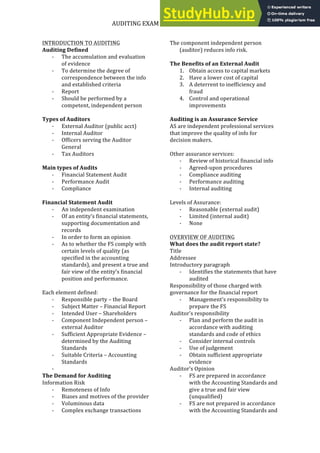
INTRODUCTION TO AUDITING
Auditing Defined
‐ The accumulation and evaluation
of evidence
‐ To determine the degree of
correspondence between the info
and established criteria
‐ Report
‐ Should be performed by a
competent, independent person
Types of Auditors
‐ External Auditor (public acct)
‐ Internal Auditor
‐ Officers serving the Auditor
General
‐ Tax Auditors
Main types of Audits
‐ Financial Statement Audit
‐ Performance Audit
‐ Compliance
Financial Statement Audit
‐ An independent examination
‐ Of an entity’s financial statements,
supporting documentation and
records
‐ In order to form an opinion
‐ As to whether the FS comply with
certain levels of quality (as
specified in the accounting
standards), and present a true and
fair view of the entity’s financial
position and performance.
Each element defined:
‐ Responsible party – the Board
‐ Subject Matter – Financial Report
‐ Intended User – Shareholders
‐ Component Independent person –
external Auditor
‐ Sufficient Appropriate Evidence –
determined by the Auditing
Standards
‐ Suitable Criteria – Accounting
Standards
‐
The Demand for Auditing
Information Risk
‐ Remoteness of Info
‐ Biases and motives of the provider
‐ Voluminous data
‐ Complex exchange transactions
The component independent person
(auditor) reduces info risk.
The Benefits of an External Audit
1. Obtain access to capital markets
2. Have a lower cost of capital
3. A deterrent to inefficiency and
fraud
4. Control and operational
improvements
Auditing is an Assurance Service
AS are independent professional services
that improve the quality of info for
decision makers.
Other assurance services:
‐ Review of historical financial info
‐ Agreed‐upon procedures
‐ Compliance auditing
‐ Performance auditing
‐ Internal auditing
Levels of Assurance:
‐ Reasonable (external audit)
‐ Limited (internal audit)
‐ None
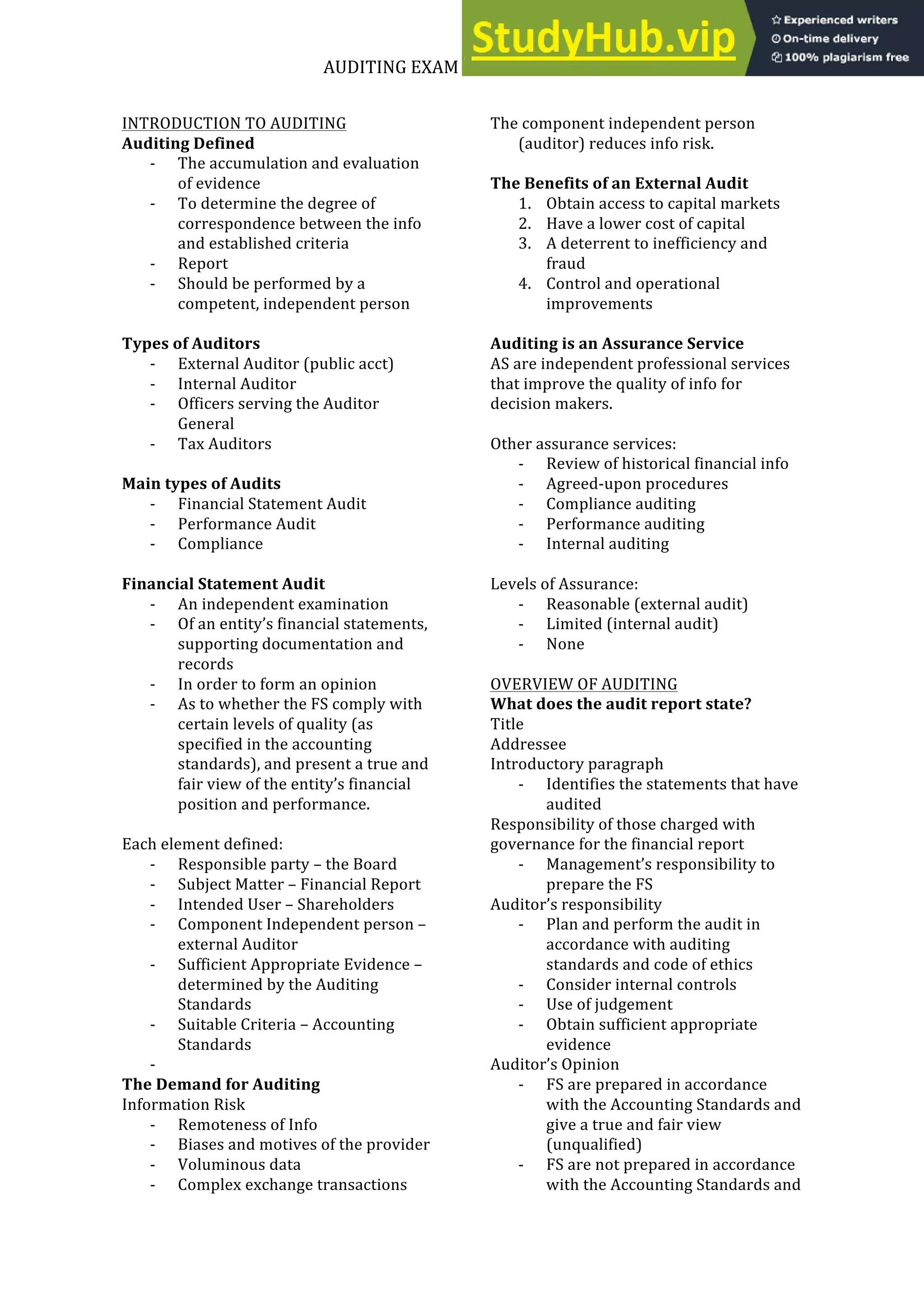
OVERVIEW OF AUDITING
What does the audit report state?
Title
Addressee
Introductory paragraph
‐ Identifies the statements that have
audited
Responsibility of those charged with
governance for the financial report
‐ Management’s responsibility to
prepare the FS
Auditor’s responsibility
‐ Plan and perform the audit in
accordance with auditing
standards and code of ethics
‐ Consider internal controls
‐ Use of judgement
‐ Obtain sufficient appropriate
evidence
Auditor’s Opinion
‐ FS are prepared in accordance
with the Accounting Standards and
give a true and fair view
(unqualified)
‐ FS are not prepared in accordance
with the Accounting Standards and
AUDITING EXAM REVISION NOTES
give a true and fair view (qualified
or adverse)
‐ No opinion provided because we
could not obtain sufficient
appropriate evidence (disclaimer
of opinion)
Other reporting responsibilities
Auditor’s signature and address
Date of Report
Independence Declaration
Majors steps in the Audit Process
1. Accept the client
2. Understand the entity and its
environment
3. Understand internal control
4. Assess the risks of material
misstatement
5. Develop responses to assessed
risks
6. Tests of controls
7. Substantive procedures
8. Completion and review
9. Reporting
Fundamental Principles
Ethics
‐ Integrity
‐ Objectivity
‐ Professional competence and due
care
‐ Confidentiality
‐ Professional behaviour
The objective of an audit
‐ Knowledge (ASA 315)
‐ Responsibility (ASA 200)
‐ Quality control (ASA 220)
‐ Rigour and scepticism (ASA 200)
‐ Professional judgement (ASA 200)
‐ Evidence (ASA 500)
‐ Documentation (ASA 230)
‐ Communication (ASA 260)
‐ Association (ASA 200)
‐ Reporting (ASA 700)
Auditor Independence
‐ The state of mind
‐ That permits the provision of an
opinion
‐ Without being affected by
influences that could compromise
professional judgement
‐ Allowing the individual to act with
integrity, and exercise objectivity
and professional scepticism
Professional Scepticism
‐ An attitude that includes a
questioning mind and critical
assessment of audit evidence
‐ The auditor should not assume
that management is either honest
or dishonest
‐ Require evidence!
Risk
Exposure to the chance of injury or loss
For a business:
‐ Risk associated with being in
business (business risk)
For an auditor:
‐ Risk associated with carrying out a
profession (engagement risk)
‐ Risks associated with each audit
(audit risk, inherent risk, control
risk and detection risk)
Business Risk Approach (Audit Risk
Approach)
‐ Comprehensive consideration of
the strategic or business risks
facing the auditee
‐ Systematic approach to planning
the audit, whereby the auditor
gains a thorough understanding of
the entity and its environment
‐ Evaluation of internal control from
a business perspective
‐ Need to consider the relevant risk
and materiality when planning an
audit programme.
Audit Quality
‐ Discharges professional
responsibilities in an appropriate
manner.
‐ Technically component manner
‐ Applies due professional care
‐ Applies code of ethics
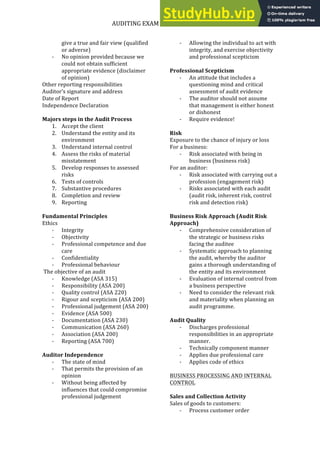
BUSINESS PROCESSING AND INTERNAL
CONTROL
Sales and Collection Activity
Sales of goods to customers:
‐ Process customer order
AUDITING EXAM REVISION NOTES
‐ Grant credit
‐ Ship goods
‐ Bill customers and record sales
Receiving Cash:
‐ Process and record cash receipts
‐ Process and record sales returns
and allowances
‐ Provide for bad and doubtful debts
‐ Write‐off uncollectible accounts
receivable
Internal Control
Policies and processes affected by the
entity to provide reasonable assurance of:
‐ Reliability of financial reporting
‐ Compliance with applicable laws
and regulations
‐ Effectiveness and efficiency of
operations
The Role of Internal Control:
‐ Provides checks and balances
within the accounting system
‐ To safeguard against both
deliberate and accidental error and
ensure that transactions are
processed completely & accurately.
Components of Internal Control:
‐ The control environment
‐ The entity’s risk assessment
processes
‐ Control activities
‐ Info and communication
‐ Monitoring of controls
Control Activities
‐ Segregation of duties – key
processing activities undertaken
by different personnel
‐ Authorisation – processing only
occurs with the sanction of
management
‐ Adequate documents and records –
Design and processing of
documents to ensure timely,
accurate and complete recording of
info
‐ Physical Controls – Restrictions on
access to assets and documents
‐ Independent checks on
performance – processing of info is
checked by someone who was not
involved in routine processing
‐ Information processing – Controls
within IT applications to ensure
accuracy, completeness &
authorisation of transactions.
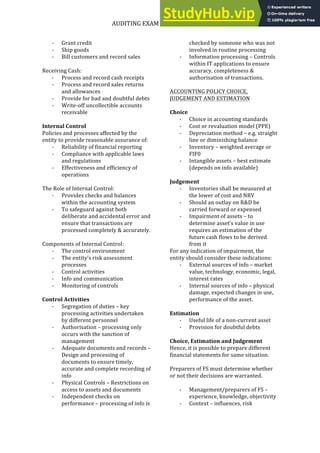
ACCOUNTING POLICY CHOICE,
JUDGEMENT AND ESTIMATION
Choice
‐ Choice in accounting standards
‐ Cost or revaluation model (PPE)
‐ Depreciation method – e.g. straight
line or diminishing balance
‐ Inventory – weighted average or
FIF0
‐ Intangible assets – best estimate
(depends on info available)
Judgement
‐ Inventories shall be measured at
the lower of cost and NRV
‐ Should an outlay on R&D be
carried forward or expensed
‐ Impairment of assets – to
determine asset’s value in use
requires an estimation of the
future cash flows to be derived
from it
For any indication of impairment, the
entity should consider these indications:
‐ External sources of info – market
value, technology, economic, legal,
interest rates
‐ Internal sources of info – physical
damage, expected changes in use,
performance of the asset.
Estimation
‐ Useful life of a non‐current asset
‐ Provision for doubtful debts
Choice, Estimation and Judgement
Hence, it is possible to prepare different
financial statements for same situation.
Preparers of FS must determine whether
or not their decisions are warranted.
‐ Management/preparers of FS –
experience, knowledge, objectivity
‐ Context – influences, risk

AUDITING EXAM REVISION NOTES

  • 1.
    AUDITING EXAM REVISIONNOTES INTRODUCTION TO AUDITING Auditing Defined ‐ The accumulation and evaluation of evidence ‐ To determine the degree of correspondence between the info and established criteria ‐ Report ‐ Should be performed by a competent, independent person Types of Auditors ‐ External Auditor (public acct) ‐ Internal Auditor ‐ Officers serving the Auditor General ‐ Tax Auditors Main types of Audits ‐ Financial Statement Audit ‐ Performance Audit ‐ Compliance Financial Statement Audit ‐ An independent examination ‐ Of an entity’s financial statements, supporting documentation and records ‐ In order to form an opinion ‐ As to whether the FS comply with certain levels of quality (as specified in the accounting standards), and present a true and fair view of the entity’s financial position and performance. Each element defined: ‐ Responsible party – the Board ‐ Subject Matter – Financial Report ‐ Intended User – Shareholders ‐ Component Independent person – external Auditor ‐ Sufficient Appropriate Evidence – determined by the Auditing Standards ‐ Suitable Criteria – Accounting Standards ‐ The Demand for Auditing Information Risk ‐ Remoteness of Info ‐ Biases and motives of the provider ‐ Voluminous data ‐ Complex exchange transactions The component independent person (auditor) reduces info risk. The Benefits of an External Audit 1. Obtain access to capital markets 2. Have a lower cost of capital 3. A deterrent to inefficiency and fraud 4. Control and operational improvements Auditing is an Assurance Service AS are independent professional services that improve the quality of info for decision makers. Other assurance services: ‐ Review of historical financial info ‐ Agreed‐upon procedures ‐ Compliance auditing ‐ Performance auditing ‐ Internal auditing Levels of Assurance: ‐ Reasonable (external audit) ‐ Limited (internal audit) ‐ None OVERVIEW OF AUDITING What does the audit report state? Title Addressee Introductory paragraph ‐ Identifies the statements that have audited Responsibility of those charged with governance for the financial report ‐ Management’s responsibility to prepare the FS Auditor’s responsibility ‐ Plan and perform the audit in accordance with auditing standards and code of ethics ‐ Consider internal controls ‐ Use of judgement ‐ Obtain sufficient appropriate evidence Auditor’s Opinion ‐ FS are prepared in accordance with the Accounting Standards and give a true and fair view (unqualified) ‐ FS are not prepared in accordance with the Accounting Standards and
  • 2.
    AUDITING EXAM REVISIONNOTES give a true and fair view (qualified or adverse) ‐ No opinion provided because we could not obtain sufficient appropriate evidence (disclaimer of opinion) Other reporting responsibilities Auditor’s signature and address Date of Report Independence Declaration Majors steps in the Audit Process 1. Accept the client 2. Understand the entity and its environment 3. Understand internal control 4. Assess the risks of material misstatement 5. Develop responses to assessed risks 6. Tests of controls 7. Substantive procedures 8. Completion and review 9. Reporting Fundamental Principles Ethics ‐ Integrity ‐ Objectivity ‐ Professional competence and due care ‐ Confidentiality ‐ Professional behaviour The objective of an audit ‐ Knowledge (ASA 315) ‐ Responsibility (ASA 200) ‐ Quality control (ASA 220) ‐ Rigour and scepticism (ASA 200) ‐ Professional judgement (ASA 200) ‐ Evidence (ASA 500) ‐ Documentation (ASA 230) ‐ Communication (ASA 260) ‐ Association (ASA 200) ‐ Reporting (ASA 700) Auditor Independence ‐ The state of mind ‐ That permits the provision of an opinion ‐ Without being affected by influences that could compromise professional judgement ‐ Allowing the individual to act with integrity, and exercise objectivity and professional scepticism Professional Scepticism ‐ An attitude that includes a questioning mind and critical assessment of audit evidence ‐ The auditor should not assume that management is either honest or dishonest ‐ Require evidence! Risk Exposure to the chance of injury or loss For a business: ‐ Risk associated with being in business (business risk) For an auditor: ‐ Risk associated with carrying out a profession (engagement risk) ‐ Risks associated with each audit (audit risk, inherent risk, control risk and detection risk) Business Risk Approach (Audit Risk Approach) ‐ Comprehensive consideration of the strategic or business risks facing the auditee ‐ Systematic approach to planning the audit, whereby the auditor gains a thorough understanding of the entity and its environment ‐ Evaluation of internal control from a business perspective ‐ Need to consider the relevant risk and materiality when planning an audit programme. Audit Quality ‐ Discharges professional responsibilities in an appropriate manner. ‐ Technically component manner ‐ Applies due professional care ‐ Applies code of ethics BUSINESS PROCESSING AND INTERNAL CONTROL Sales and Collection Activity Sales of goods to customers: ‐ Process customer order
  • 3.
    AUDITING EXAM REVISIONNOTES ‐ Grant credit ‐ Ship goods ‐ Bill customers and record sales Receiving Cash: ‐ Process and record cash receipts ‐ Process and record sales returns and allowances ‐ Provide for bad and doubtful debts ‐ Write‐off uncollectible accounts receivable Internal Control Policies and processes affected by the entity to provide reasonable assurance of: ‐ Reliability of financial reporting ‐ Compliance with applicable laws and regulations ‐ Effectiveness and efficiency of operations The Role of Internal Control: ‐ Provides checks and balances within the accounting system ‐ To safeguard against both deliberate and accidental error and ensure that transactions are processed completely & accurately. Components of Internal Control: ‐ The control environment ‐ The entity’s risk assessment processes ‐ Control activities ‐ Info and communication ‐ Monitoring of controls Control Activities ‐ Segregation of duties – key processing activities undertaken by different personnel ‐ Authorisation – processing only occurs with the sanction of management ‐ Adequate documents and records – Design and processing of documents to ensure timely, accurate and complete recording of info ‐ Physical Controls – Restrictions on access to assets and documents ‐ Independent checks on performance – processing of info is checked by someone who was not involved in routine processing ‐ Information processing – Controls within IT applications to ensure accuracy, completeness & authorisation of transactions. ACCOUNTING POLICY CHOICE, JUDGEMENT AND ESTIMATION Choice ‐ Choice in accounting standards ‐ Cost or revaluation model (PPE) ‐ Depreciation method – e.g. straight line or diminishing balance ‐ Inventory – weighted average or FIF0 ‐ Intangible assets – best estimate (depends on info available) Judgement ‐ Inventories shall be measured at the lower of cost and NRV ‐ Should an outlay on R&D be carried forward or expensed ‐ Impairment of assets – to determine asset’s value in use requires an estimation of the future cash flows to be derived from it For any indication of impairment, the entity should consider these indications: ‐ External sources of info – market value, technology, economic, legal, interest rates ‐ Internal sources of info – physical damage, expected changes in use, performance of the asset. Estimation ‐ Useful life of a non‐current asset ‐ Provision for doubtful debts Choice, Estimation and Judgement Hence, it is possible to prepare different financial statements for same situation. Preparers of FS must determine whether or not their decisions are warranted. ‐ Management/preparers of FS – experience, knowledge, objectivity ‐ Context – influences, risk