GMP & HACCP and
ISO 9001:2015 Audit
Why do we have to audit???
 Step 11, Principles 6 of HACCP
 ISO 9001:2015 Clause Requirements
 To ensure & maintain the effectiveness of QMS
implementation
 Evaluate the QMS effectiveness & search for
opportunities for improvement
 One of the tools for continuous improvement
Reference
ISO 19011:2011 Guidelines for auditing management system
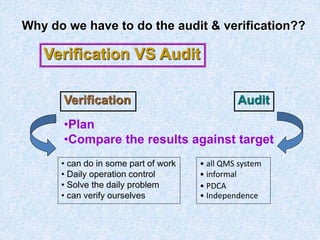
Why do we have to do the audit & verification??
Verification Audit
•Plan
•Compare the results against target
• can do in some part of work
• Daily operation control
• Solve the daily problem
• can verify ourselves
• all QMS system
• informal
• PDCA
• Independence
Verification VS Audit
What should be kept in mind during audit:
 Identification of recur non conformance
 How to deal “not accept the audit results” problem
 The necessary to issue “CAR”
 How to solve chronic problem with P-D-C-A cycle
Why we have to the audit ???
 Management control measures
 One of the tools for continuous improvement
 Help identify non conforming and make the corrective
action
 Ensure that the QMS is going on and complied with the
requirements
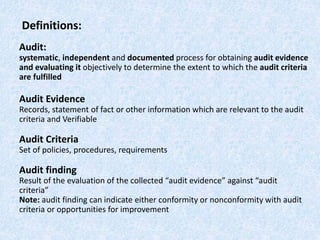
Definitions:
Audit:
systematic, independent and documented process for obtaining audit evidence
and evaluating it objectively to determine the extent to which the audit criteria
are fulfilled
Audit Evidence
Records, statement of fact or other information which are relevant to the audit
criteria and Verifiable
Audit Criteria
Set of policies, procedures, requirements
Audit finding
Result of the evaluation of the collected “audit evidence” against “audit
criteria”
Note: audit finding can indicate either conformity or nonconformity with audit
criteria or opportunities for improvement
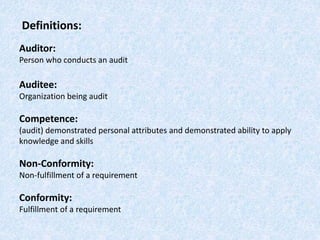
Definitions:
Auditor:
Person who conducts an audit
Auditee:
Organization being audit
Competence:
(audit) demonstrated personal attributes and demonstrated ability to apply
knowledge and skills
Non-Conformity:
Non-fulfillment of a requirement
Conformity:
Fulfillment of a requirement
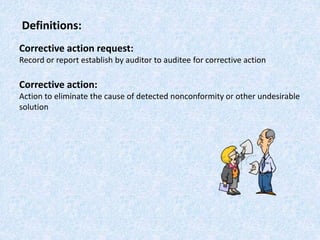
Definitions:
Corrective action request:
Record or report establish by auditor to auditee for corrective action
Corrective action:
Action to eliminate the cause of detected nonconformity or other undesirable
solution
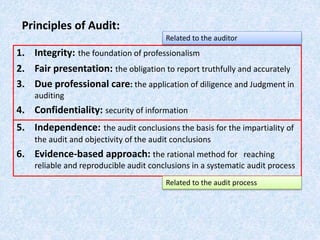
Principles of Audit:
1. Integrity: the foundation of professionalism
2. Fair presentation: the obligation to report truthfully and accurately
3. Due professional care: the application of diligence and Judgment in
auditing
4. Confidentiality: security of information
5. Independence: the audit conclusions the basis for the impartiality of
the audit and objectivity of the audit conclusions
6. Evidence-based approach: the rational method for reaching
reliable and reproducible audit conclusions in a systematic audit process
Related to the auditor
Related to the audit process
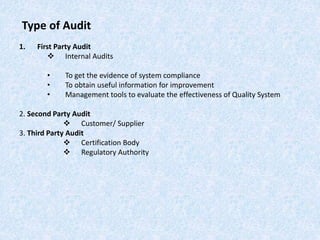
Type of Audit
1. First Party Audit
 Internal Audits
• To get the evidence of system compliance
• To obtain useful information for improvement
• Management tools to evaluate the effectiveness of Quality System
2. Second Party Audit
 Customer/ Supplier
3. Third Party Audit
 Certification Body
 Regulatory Authority
Audit Methods
2 type of audit methods
1. System audit
2. Compliance audit
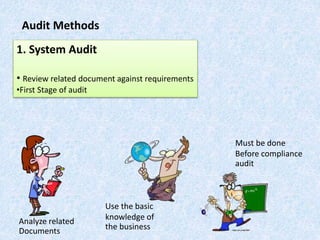
Audit Methods
1. System Audit
• Review related document against requirements
•First Stage of audit
Analyze related
Documents
Use the basic
knowledge of
the business
Must be done
Before compliance
audit
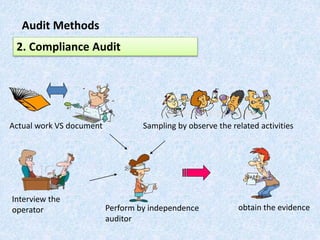
Audit Methods
2. Compliance Audit
Actual work VS document Sampling by observe the related activities
Interview the
operator obtain the evidencePerform by independence
auditor
Audit Program Management
Planning
Appoint the auditor
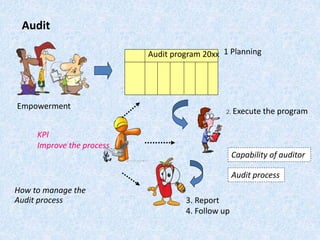
Audit
Empowerment
Audit program 20xx 1 Planning
2. Execute the program
3. Report
4. Follow up
KPI
Improve the process
Capability of auditor
Audit process
How to manage the
Audit process
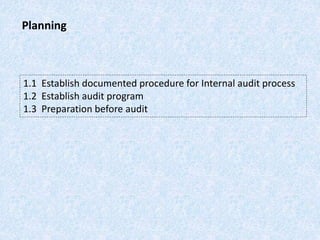
Planning
1.1 Establish documented procedure for Internal audit process
1.2 Establish audit program
1.3 Preparation before audit
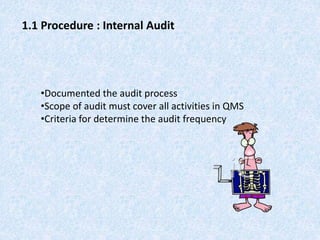
1.1 Procedure : Internal Audit
•Documented the audit process
•Scope of audit must cover all activities in QMS
•Criteria for determine the audit frequency
1.2 Establish audit program
Audit scope must cover all activities and area
Every area must be audit at least once a year
Frequency of audit depends on ; the important of
that area and previous audit result
Audit program must be approved by authorize persons
before use
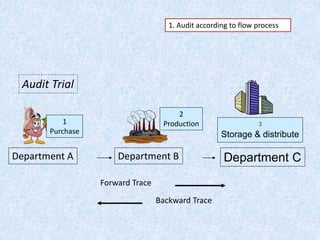
1. Audit according to flow process
Audit Trial
Department A Department B Department C
Forward Trace
Backward Trace
1
Purchase
2
Production 3
Storage & distribute
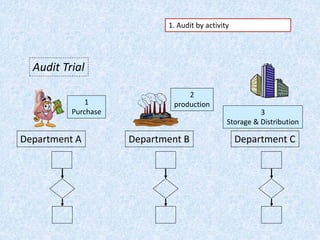
1. Audit by activity
Audit Trial
1
Purchase
2
production
3
Storage & Distribution
Department A Department B Department C
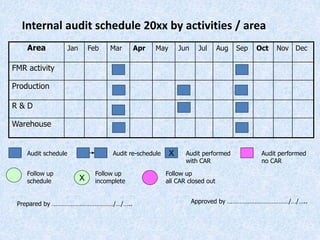
Internal audit schedule 20xx by activities / area
Area Jan Feb Mar Apr May Jun Jul Aug Sep Oct Nov Dec
FMR activity
Production
R & D
Warehouse
Audit schedule XAudit re-schedule Audit performed
with CAR
Audit performed
no CAR
Follow up
schedule
Follow up
incomplete
Follow up
all CAR closed outX
Prepared by ………………………………/…/….. Approved by ………………………………/…/…..
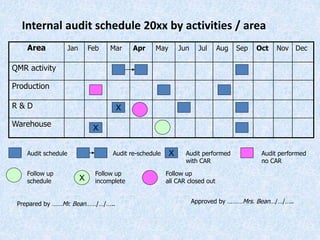
Internal audit schedule 20xx by activities / area
Area Jan Feb Mar Apr May Jun Jul Aug Sep Oct Nov Dec
QMR activity
Production
R & D
Warehouse
Audit schedule XAudit re-schedule Audit performed
with CAR
Audit performed
no CAR
Follow up
schedule
Follow up
incomplete
Follow up
all CAR closed outX
Prepared by ……Mr. Bean……/…/….. Approved by ………Mrs. Bean…/…/…..
X
X
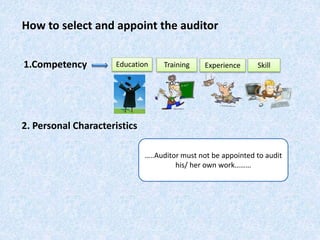
How to select and appoint the auditor
1.Competency Education Training Experience Skill
2. Personal Characteristics
…..Auditor must not be appointed to audit
his/ her own work………
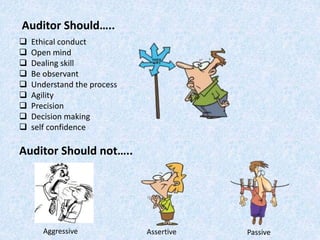
Auditor Should…..
 Ethical conduct
 Open mind
 Dealing skill
 Be observant
 Understand the process
 Agility
 Precision
 Decision making
 self confidence
Auditor Should not…..
Aggressive PassiveAssertive
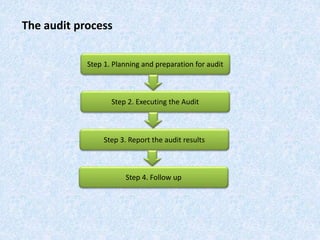
The audit process
Step 1. Planning and preparation for audit
Step 2. Executing the Audit
Step 3. Report the audit results
Step 4. Follow up
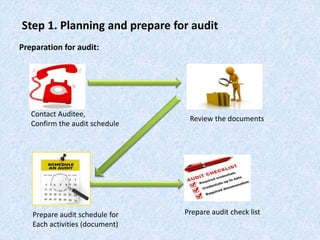
Step 1. Planning and prepare for audit
Preparation for audit:
Contact Auditee,
Confirm the audit schedule
Review the documents
Prepare audit schedule for
Each activities (document)
Prepare audit check list
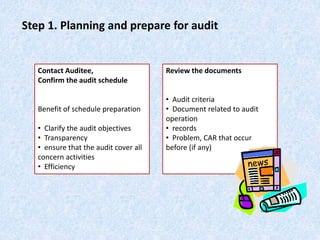
Contact Auditee,
Confirm the audit schedule
Benefit of schedule preparation
• Clarify the audit objectives
• Transparency
• ensure that the audit cover all
concern activities
• Efficiency
Review the documents
• Audit criteria
• Document related to audit
operation
• records
• Problem, CAR that occur
before (if any)
Step 1. Planning and prepare for audit
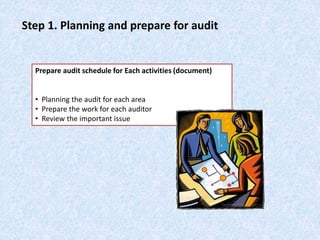
Prepare audit schedule for Each activities (document)
• Planning the audit for each area
• Prepare the work for each auditor
• Review the important issue
Step 1. Planning and prepare for audit
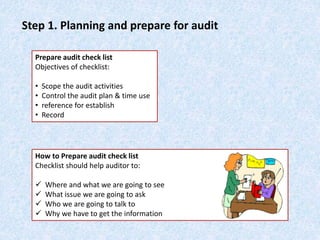
Prepare audit check list
Objectives of checklist:
• Scope the audit activities
• Control the audit plan & time use
• reference for establish
• Record
Step 1. Planning and prepare for audit
How to Prepare audit check list
Checklist should help auditor to:
 Where and what we are going to see
 What issue we are going to ask
 Who we are going to talk to
 Why we have to get the information
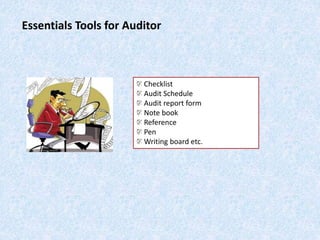
Checklist
Audit Schedule
Audit report form
Note book
Reference
Pen
Writing board etc.
Essentials Tools for Auditor
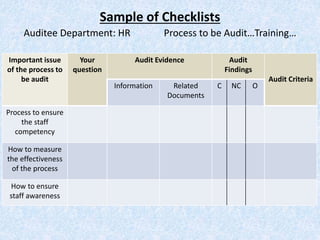
Sample of Checklists
Auditee Department: HR Process to be Audit…Training…
Important issue
of the process to
be audit
Your
question
Audit Evidence Audit
Findings
Audit Criteria
Information Related
Documents
C NC O
Process to ensure
the staff
competency
How to measure
the effectiveness
of the process
How to ensure
staff awareness
Workshop
Step 2. Executing The Audit
 Opening Meeting
 Audit
 Closing Meeting
Step 2. Executing The Audit
Opening Meeting
Objectives:
Meeting with responsible manager in that manager
Transparency
Describe audit process
Confirm Schedule
Answer Question….(if any)
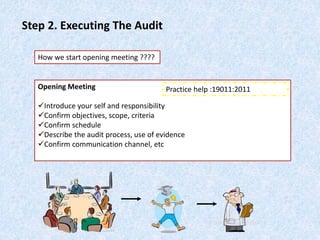
How we start opening meeting ????
Step 2. Executing The Audit
Opening Meeting
Introduce your self and responsibility
Confirm objectives, scope, criteria
Confirm schedule
Describe the audit process, use of evidence
Confirm communication channel, etc
Practice help :19011:2011
Audit
Step 2. Executing The Audit
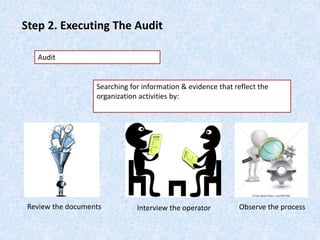
Searching for information & evidence that reflect the
organization activities by:
Review the documents Interview the operator Observe the process
Step 2. Executing The Audit
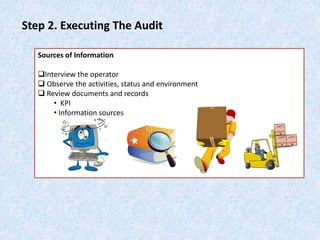
Sources of Information
Interview the operator
 Observe the activities, status and environment
 Review documents and records
• KPI
• Information sources
Step 2. Executing The Audit
Auditor responsibilities:
 Ask question
 Listen to the answer
 Observe the process
 Review the finding
 Make records
 Ask for corrective action (if any)….
Step 2. Executing The Audit
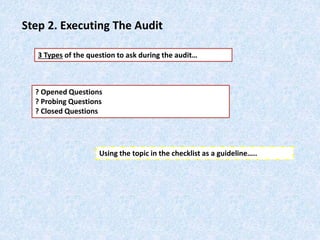
3 Types of the question to ask during the audit…
? Opened Questions
? Probing Questions
? Closed Questions
Using the topic in the checklist as a guideline…..
Step 2. Executing The Audit
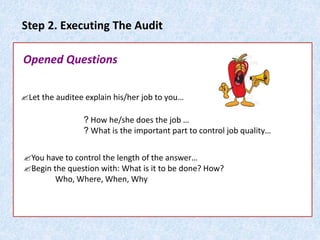
Let the auditee explain his/her job to you…
? How he/she does the job …
? What is the important part to control job quality…
You have to control the length of the answer…
Begin the question with: What is it to be done? How?
Who, Where, When, Why
Opened Questions
Step 2. Executing The Audit
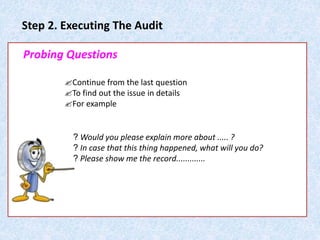
Continue from the last question
To find out the issue in details
For example
? Would you please explain more about ..... ?
? In case that this thing happened, what will you do?
? Please show me the record.............
Probing Questions
Step 2. Executing The Audit
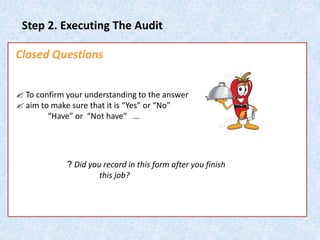
Closed Questions
 To confirm your understanding to the answer
 aim to make sure that it is “Yes” or “No”
“Have” or “Not have” …
? Did you record in this form after you finish
this job?
Step 2. Executing The Audit
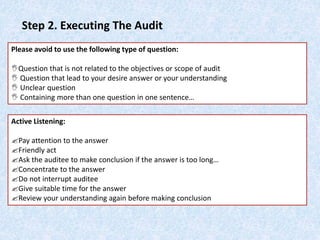
Please avoid to use the following type of question:
Question that is not related to the objectives or scope of audit
 Question that lead to your desire answer or your understanding
 Unclear question
 Containing more than one question in one sentence…
Active Listening:
Pay attention to the answer
Friendly act
Ask the auditee to make conclusion if the answer is too long…
Concentrate to the answer
Do not interrupt auditee
Give suitable time for the answer
Review your understanding again before making conclusion
Step 2. Executing The Audit
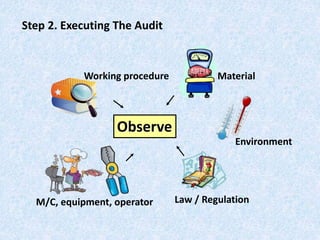
Observe
Working procedure
M/C, equipment, operator
Material
Environment
Law / Regulation
Step 2. Executing The Audit
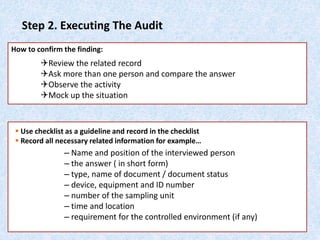
How to confirm the finding:
Review the related record
Ask more than one person and compare the answer
Observe the activity
Mock up the situation
 Use checklist as a guideline and record in the checklist
 Record all necessary related information for example…
– Name and position of the interviewed person
– the answer ( in short form)
– type, name of document / document status
– device, equipment and ID number
– number of the sampling unit
– time and location
– requirement for the controlled environment (if any)
Step 2. Executing The Audit
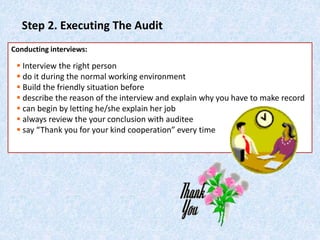
Conducting interviews:
 Interview the right person
 do it during the normal working environment
 Build the friendly situation before
 describe the reason of the interview and explain why you have to make record
 can begin by letting he/she explain her job
 always review the your conclusion with auditee
 say “Thank you for your kind cooperation” every time
Step 2. Executing The Audit
Conducting interviews:
 ask the right person
 use Checklists
 record
 be steady and calm
 search for the truth
 select related sample
 inform auditee immediately
when non conform was found
 humor
Be honesty
Tip…
Step 2. Executing The Audit
If non conform is found during the audit,
auditor has to inform the auditee immediately !!!
Auditors meeting after audit:
 Review the evidence and collect the idea
 Discuss the unclear issues
 Make the conclusion
 Prepare the information for writing the audit report
 Prepare to inform the audit result to auditees
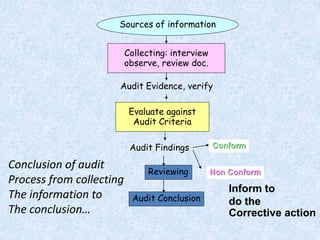
Sources of information
Collecting: interview
observe, review doc.
Audit Evidence, verify
Evaluate against
Audit Criteria
Audit Findings
Reviewing
Audit Conclusion
Conform
Non Conform
Conclusion of audit
Process from collecting
The information to
The conclusion…
Inform to
do the
Corrective action
Step 2. Executing The Audit
Audit conclusion:
 Compliance to the criteria in the audited area
 Effectiveness of the system, maintenance & improvement
 Competence of the reviewing system by management to ensure the maintenance
of the system (suitable, effective, continual improvement.
Audit Conclusion
Step 3. Report the audit result
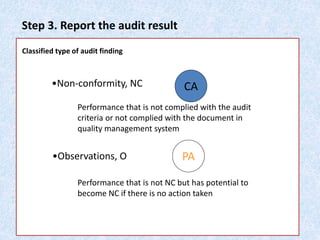
Classified type of audit finding
•Non-conformity, NC
Performance that is not complied with the audit
criteria or not complied with the document in
quality management system
•Observations, O
Performance that is not NC but has potential to
become NC if there is no action taken
CA
PA
Step 3. Report the audit result
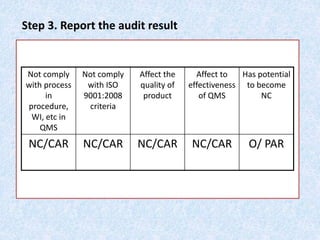
Not comply
with process
in
procedure,
WI, etc in
QMS
Not comply
with ISO
9001:2008
criteria
Affect the
quality of
product
Affect to
effectiveness
of QMS
Has potential
to become
NC
NC/CAR NC/CAR NC/CAR NC/CAR O/ PAR
Step 3. Report the audit result
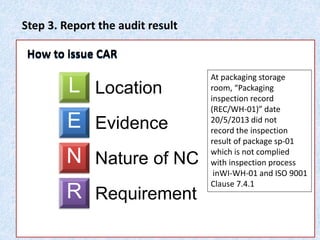
L
E
N
R
Location
Evidence
Nature of NC
Requirement
At packaging storage
room, “Packaging
inspection record
(REC/WH-01)” date
20/5/2013 did not
record the inspection
result of package sp-01
which is not complied
with inspection process
inWI-WH-01 and ISO 9001
Clause 7.4.1
How to issue CAR
Workshop
Step 3. Report the audit result
Corrective action request, CAR
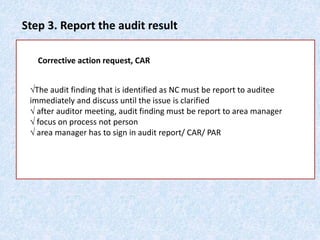
√The audit finding that is identified as NC must be report to auditee
immediately and discuss until the issue is clarified
√ after auditor meeting, audit finding must be report to area manager
√ focus on process not person
√ area manager has to sign in audit report/ CAR/ PAR
Step 3. Report the audit result
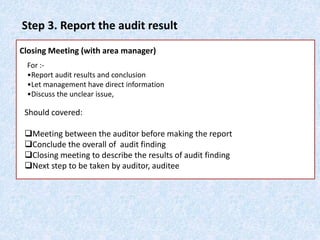
Closing Meeting (with area manager)
For :-
•Report audit results and conclusion
•Let management have direct information
•Discuss the unclear issue,
Should covered:
Meeting between the auditor before making the report
Conclude the overall of audit finding
Closing meeting to describe the results of audit finding
Next step to be taken by auditor, auditee
Step 3. Report the audit result
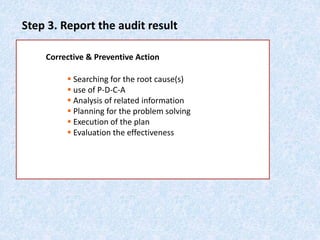
Corrective & Preventive Action
 Searching for the root cause(s)
 use of P-D-C-A
 Analysis of related information
 Planning for the problem solving
 Execution of the plan
 Evaluation the effectiveness
Step 3. Report the audit result
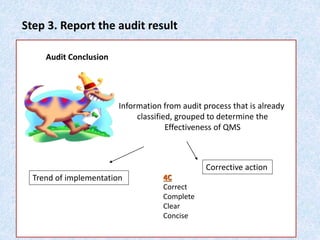
Information from audit process that is already
classified, grouped to determine the
Effectiveness of QMS
Trend of implementation
Corrective action
4C
Correct
Complete
Clear
Concise
Audit Conclusion
Step 3. Report the audit result
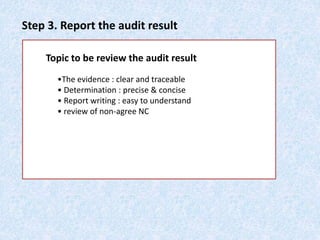
Topic to be review the audit result
•The evidence : clear and traceable
• Determination : precise & concise
• Report writing : easy to understand
• review of non-agree NC
Step 4. The Follow up
•Audited area must completed corrective action before the follow up
•The follow up activities are :
Review the corrective action activities
Review the results of the corrective action : records,documents
that is changed from the action taken
Step 4. The Follow up
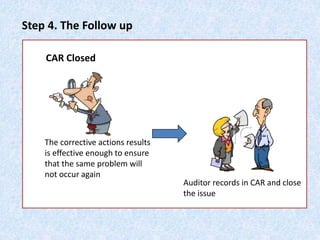
CAR Closed
The corrective actions results
is effective enough to ensure
that the same problem will
not occur again
Auditor records in CAR and close
the issue
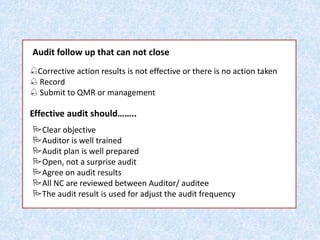
Corrective action results is not effective or there is no action taken
 Record
 Submit to QMR or management
Audit follow up that can not close
Effective audit should……..
Clear objective
Auditor is well trained
Audit plan is well prepared
Open, not a surprise audit
Agree on audit results
All NC are reviewed between Auditor/ auditee
The audit result is used for adjust the audit frequency
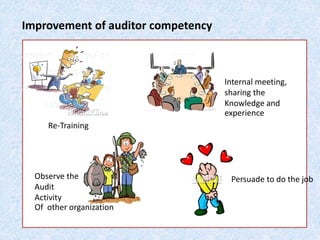
Improvement of auditor competency
Re-Training
Internal meeting,
sharing the
Knowledge and
experience
Observe the
Audit
Activity
Of other organization
Persuade to do the job
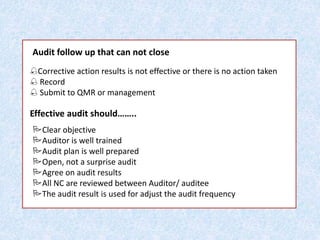
Corrective action results is not effective or there is no action taken
 Record
 Submit to QMR or management
Audit follow up that can not close
Effective audit should……..
Clear objective
Auditor is well trained
Audit plan is well prepared
Open, not a surprise audit
Agree on audit results
All NC are reviewed between Auditor/ auditee
The audit result is used for adjust the audit frequency
Audit Technique

Audit Technique

  • 1.
    GMP & HACCPand ISO 9001:2015 Audit
  • 2.
    Why do wehave to audit???  Step 11, Principles 6 of HACCP  ISO 9001:2015 Clause Requirements  To ensure & maintain the effectiveness of QMS implementation  Evaluate the QMS effectiveness & search for opportunities for improvement  One of the tools for continuous improvement Reference ISO 19011:2011 Guidelines for auditing management system
  • 3.
    Why do wehave to do the audit & verification?? Verification Audit •Plan •Compare the results against target • can do in some part of work • Daily operation control • Solve the daily problem • can verify ourselves • all QMS system • informal • PDCA • Independence Verification VS Audit
  • 7.
    What should bekept in mind during audit:  Identification of recur non conformance  How to deal “not accept the audit results” problem  The necessary to issue “CAR”  How to solve chronic problem with P-D-C-A cycle
  • 8.
    Why we haveto the audit ???  Management control measures  One of the tools for continuous improvement  Help identify non conforming and make the corrective action  Ensure that the QMS is going on and complied with the requirements
  • 9.
    Definitions: Audit: systematic, independent anddocumented process for obtaining audit evidence and evaluating it objectively to determine the extent to which the audit criteria are fulfilled Audit Evidence Records, statement of fact or other information which are relevant to the audit criteria and Verifiable Audit Criteria Set of policies, procedures, requirements Audit finding Result of the evaluation of the collected “audit evidence” against “audit criteria” Note: audit finding can indicate either conformity or nonconformity with audit criteria or opportunities for improvement
  • 10.
    Definitions: Auditor: Person who conductsan audit Auditee: Organization being audit Competence: (audit) demonstrated personal attributes and demonstrated ability to apply knowledge and skills Non-Conformity: Non-fulfillment of a requirement Conformity: Fulfillment of a requirement
  • 11.
    Definitions: Corrective action request: Recordor report establish by auditor to auditee for corrective action Corrective action: Action to eliminate the cause of detected nonconformity or other undesirable solution
  • 12.
    Principles of Audit: 1.Integrity: the foundation of professionalism 2. Fair presentation: the obligation to report truthfully and accurately 3. Due professional care: the application of diligence and Judgment in auditing 4. Confidentiality: security of information 5. Independence: the audit conclusions the basis for the impartiality of the audit and objectivity of the audit conclusions 6. Evidence-based approach: the rational method for reaching reliable and reproducible audit conclusions in a systematic audit process Related to the auditor Related to the audit process
  • 13.
    Type of Audit 1.First Party Audit  Internal Audits • To get the evidence of system compliance • To obtain useful information for improvement • Management tools to evaluate the effectiveness of Quality System 2. Second Party Audit  Customer/ Supplier 3. Third Party Audit  Certification Body  Regulatory Authority
  • 14.
    Audit Methods 2 typeof audit methods 1. System audit 2. Compliance audit
  • 15.
    Audit Methods 1. SystemAudit • Review related document against requirements •First Stage of audit Analyze related Documents Use the basic knowledge of the business Must be done Before compliance audit
  • 16.
    Audit Methods 2. ComplianceAudit Actual work VS document Sampling by observe the related activities Interview the operator obtain the evidencePerform by independence auditor
  • 17.
  • 18.
    Audit Empowerment Audit program 20xx1 Planning 2. Execute the program 3. Report 4. Follow up KPI Improve the process Capability of auditor Audit process How to manage the Audit process
  • 19.
    Planning 1.1 Establish documentedprocedure for Internal audit process 1.2 Establish audit program 1.3 Preparation before audit
  • 20.
    1.1 Procedure :Internal Audit •Documented the audit process •Scope of audit must cover all activities in QMS •Criteria for determine the audit frequency
  • 21.
    1.2 Establish auditprogram Audit scope must cover all activities and area Every area must be audit at least once a year Frequency of audit depends on ; the important of that area and previous audit result Audit program must be approved by authorize persons before use
  • 22.
    1. Audit accordingto flow process Audit Trial Department A Department B Department C Forward Trace Backward Trace 1 Purchase 2 Production 3 Storage & distribute
  • 23.
    1. Audit byactivity Audit Trial 1 Purchase 2 production 3 Storage & Distribution Department A Department B Department C
  • 24.
    Internal audit schedule20xx by activities / area Area Jan Feb Mar Apr May Jun Jul Aug Sep Oct Nov Dec FMR activity Production R & D Warehouse Audit schedule XAudit re-schedule Audit performed with CAR Audit performed no CAR Follow up schedule Follow up incomplete Follow up all CAR closed outX Prepared by ………………………………/…/….. Approved by ………………………………/…/…..
  • 25.
    Internal audit schedule20xx by activities / area Area Jan Feb Mar Apr May Jun Jul Aug Sep Oct Nov Dec QMR activity Production R & D Warehouse Audit schedule XAudit re-schedule Audit performed with CAR Audit performed no CAR Follow up schedule Follow up incomplete Follow up all CAR closed outX Prepared by ……Mr. Bean……/…/….. Approved by ………Mrs. Bean…/…/….. X X
  • 26.
    How to selectand appoint the auditor 1.Competency Education Training Experience Skill 2. Personal Characteristics …..Auditor must not be appointed to audit his/ her own work………
  • 27.
    Auditor Should…..  Ethicalconduct  Open mind  Dealing skill  Be observant  Understand the process  Agility  Precision  Decision making  self confidence Auditor Should not….. Aggressive PassiveAssertive
  • 28.
    The audit process Step1. Planning and preparation for audit Step 2. Executing the Audit Step 3. Report the audit results Step 4. Follow up
  • 29.
    Step 1. Planningand prepare for audit
  • 30.
    Step 1. Planningand prepare for audit Preparation for audit: Contact Auditee, Confirm the audit schedule Review the documents Prepare audit schedule for Each activities (document) Prepare audit check list
  • 31.
    Contact Auditee, Confirm theaudit schedule Benefit of schedule preparation • Clarify the audit objectives • Transparency • ensure that the audit cover all concern activities • Efficiency Review the documents • Audit criteria • Document related to audit operation • records • Problem, CAR that occur before (if any) Step 1. Planning and prepare for audit
  • 32.
    Prepare audit schedulefor Each activities (document) • Planning the audit for each area • Prepare the work for each auditor • Review the important issue Step 1. Planning and prepare for audit
  • 33.
    Prepare audit checklist Objectives of checklist: • Scope the audit activities • Control the audit plan & time use • reference for establish • Record Step 1. Planning and prepare for audit How to Prepare audit check list Checklist should help auditor to:  Where and what we are going to see  What issue we are going to ask  Who we are going to talk to  Why we have to get the information
  • 34.
    Checklist Audit Schedule Audit reportform Note book Reference Pen Writing board etc. Essentials Tools for Auditor
  • 35.
    Sample of Checklists AuditeeDepartment: HR Process to be Audit…Training… Important issue of the process to be audit Your question Audit Evidence Audit Findings Audit Criteria Information Related Documents C NC O Process to ensure the staff competency How to measure the effectiveness of the process How to ensure staff awareness
  • 36.
  • 37.
  • 38.
     Opening Meeting Audit  Closing Meeting Step 2. Executing The Audit Opening Meeting Objectives: Meeting with responsible manager in that manager Transparency Describe audit process Confirm Schedule Answer Question….(if any)
  • 39.
    How we startopening meeting ???? Step 2. Executing The Audit Opening Meeting Introduce your self and responsibility Confirm objectives, scope, criteria Confirm schedule Describe the audit process, use of evidence Confirm communication channel, etc Practice help :19011:2011
  • 40.
    Audit Step 2. ExecutingThe Audit Searching for information & evidence that reflect the organization activities by: Review the documents Interview the operator Observe the process
  • 41.
    Step 2. ExecutingThe Audit Sources of Information Interview the operator  Observe the activities, status and environment  Review documents and records • KPI • Information sources
  • 42.
    Step 2. ExecutingThe Audit Auditor responsibilities:  Ask question  Listen to the answer  Observe the process  Review the finding  Make records  Ask for corrective action (if any)….
  • 43.
    Step 2. ExecutingThe Audit 3 Types of the question to ask during the audit… ? Opened Questions ? Probing Questions ? Closed Questions Using the topic in the checklist as a guideline…..
  • 44.
    Step 2. ExecutingThe Audit Let the auditee explain his/her job to you… ? How he/she does the job … ? What is the important part to control job quality… You have to control the length of the answer… Begin the question with: What is it to be done? How? Who, Where, When, Why Opened Questions
  • 45.
    Step 2. ExecutingThe Audit Continue from the last question To find out the issue in details For example ? Would you please explain more about ..... ? ? In case that this thing happened, what will you do? ? Please show me the record............. Probing Questions
  • 46.
    Step 2. ExecutingThe Audit Closed Questions  To confirm your understanding to the answer  aim to make sure that it is “Yes” or “No” “Have” or “Not have” … ? Did you record in this form after you finish this job?
  • 47.
    Step 2. ExecutingThe Audit Please avoid to use the following type of question: Question that is not related to the objectives or scope of audit  Question that lead to your desire answer or your understanding  Unclear question  Containing more than one question in one sentence… Active Listening: Pay attention to the answer Friendly act Ask the auditee to make conclusion if the answer is too long… Concentrate to the answer Do not interrupt auditee Give suitable time for the answer Review your understanding again before making conclusion
  • 48.
    Step 2. ExecutingThe Audit Observe Working procedure M/C, equipment, operator Material Environment Law / Regulation
  • 49.
    Step 2. ExecutingThe Audit How to confirm the finding: Review the related record Ask more than one person and compare the answer Observe the activity Mock up the situation  Use checklist as a guideline and record in the checklist  Record all necessary related information for example… – Name and position of the interviewed person – the answer ( in short form) – type, name of document / document status – device, equipment and ID number – number of the sampling unit – time and location – requirement for the controlled environment (if any)
  • 50.
    Step 2. ExecutingThe Audit Conducting interviews:  Interview the right person  do it during the normal working environment  Build the friendly situation before  describe the reason of the interview and explain why you have to make record  can begin by letting he/she explain her job  always review the your conclusion with auditee  say “Thank you for your kind cooperation” every time
  • 51.
    Step 2. ExecutingThe Audit Conducting interviews:  ask the right person  use Checklists  record  be steady and calm  search for the truth  select related sample  inform auditee immediately when non conform was found  humor Be honesty Tip…
  • 52.
    Step 2. ExecutingThe Audit If non conform is found during the audit, auditor has to inform the auditee immediately !!! Auditors meeting after audit:  Review the evidence and collect the idea  Discuss the unclear issues  Make the conclusion  Prepare the information for writing the audit report  Prepare to inform the audit result to auditees
  • 53.
    Sources of information Collecting:interview observe, review doc. Audit Evidence, verify Evaluate against Audit Criteria Audit Findings Reviewing Audit Conclusion Conform Non Conform Conclusion of audit Process from collecting The information to The conclusion… Inform to do the Corrective action
  • 54.
    Step 2. ExecutingThe Audit Audit conclusion:  Compliance to the criteria in the audited area  Effectiveness of the system, maintenance & improvement  Competence of the reviewing system by management to ensure the maintenance of the system (suitable, effective, continual improvement. Audit Conclusion
  • 55.
    Step 3. Reportthe audit result
  • 56.
    Step 3. Reportthe audit result Classified type of audit finding •Non-conformity, NC Performance that is not complied with the audit criteria or not complied with the document in quality management system •Observations, O Performance that is not NC but has potential to become NC if there is no action taken CA PA
  • 57.
    Step 3. Reportthe audit result Not comply with process in procedure, WI, etc in QMS Not comply with ISO 9001:2008 criteria Affect the quality of product Affect to effectiveness of QMS Has potential to become NC NC/CAR NC/CAR NC/CAR NC/CAR O/ PAR
  • 58.
    Step 3. Reportthe audit result L E N R Location Evidence Nature of NC Requirement At packaging storage room, “Packaging inspection record (REC/WH-01)” date 20/5/2013 did not record the inspection result of package sp-01 which is not complied with inspection process inWI-WH-01 and ISO 9001 Clause 7.4.1 How to issue CAR
  • 59.
  • 60.
    Step 3. Reportthe audit result Corrective action request, CAR √The audit finding that is identified as NC must be report to auditee immediately and discuss until the issue is clarified √ after auditor meeting, audit finding must be report to area manager √ focus on process not person √ area manager has to sign in audit report/ CAR/ PAR
  • 61.
    Step 3. Reportthe audit result Closing Meeting (with area manager) For :- •Report audit results and conclusion •Let management have direct information •Discuss the unclear issue, Should covered: Meeting between the auditor before making the report Conclude the overall of audit finding Closing meeting to describe the results of audit finding Next step to be taken by auditor, auditee
  • 62.
    Step 3. Reportthe audit result Corrective & Preventive Action  Searching for the root cause(s)  use of P-D-C-A  Analysis of related information  Planning for the problem solving  Execution of the plan  Evaluation the effectiveness
  • 63.
    Step 3. Reportthe audit result Information from audit process that is already classified, grouped to determine the Effectiveness of QMS Trend of implementation Corrective action 4C Correct Complete Clear Concise Audit Conclusion
  • 64.
    Step 3. Reportthe audit result Topic to be review the audit result •The evidence : clear and traceable • Determination : precise & concise • Report writing : easy to understand • review of non-agree NC
  • 65.
    Step 4. TheFollow up
  • 66.
    Step 4. TheFollow up •Audited area must completed corrective action before the follow up •The follow up activities are : Review the corrective action activities Review the results of the corrective action : records,documents that is changed from the action taken
  • 67.
    Step 4. TheFollow up CAR Closed The corrective actions results is effective enough to ensure that the same problem will not occur again Auditor records in CAR and close the issue
  • 68.
    Corrective action resultsis not effective or there is no action taken  Record  Submit to QMR or management Audit follow up that can not close Effective audit should…….. Clear objective Auditor is well trained Audit plan is well prepared Open, not a surprise audit Agree on audit results All NC are reviewed between Auditor/ auditee The audit result is used for adjust the audit frequency
  • 69.
    Improvement of auditorcompetency Re-Training Internal meeting, sharing the Knowledge and experience Observe the Audit Activity Of other organization Persuade to do the job
  • 70.
    Corrective action resultsis not effective or there is no action taken  Record  Submit to QMR or management Audit follow up that can not close Effective audit should…….. Clear objective Auditor is well trained Audit plan is well prepared Open, not a surprise audit Agree on audit results All NC are reviewed between Auditor/ auditee The audit result is used for adjust the audit frequency