


Mrs. SAHELI C
Lecturer
IACN
Quality - a judgment of what constitutes good or
bad.
Audit - a systematic and critical examination
to examine or verify.
MEDICAL AUDIT -the systematic, critical analysis
of the quality of medical care, including the
procedures for diagnosis and treatment, the use of
resources, and the resulting outcome and quality of
life for the patient.
Nursing audit –
a) It is the assessment of the quality of nursing Care
b) Uses a record as an aid in evaluating the quality of
patient care.
 Nursing audit is defined as the evaluation of nursing care
in retrospect through analysis of nursing records. It is a
systematic format and written appraisal by nurses of the
quality of content and the process of nursing service from the
nursing records of the discharged patient.
According to Elison
"Nursing audit refers to assessment of the
quality of clinical nursing".
According to Goster Walfer
Nursing Audit is an exercise to find out whether
good nursing practices are followed.
The audit is a means by which nurses themselves can
define standards from their point of view and
describe the actual practice of nursing.
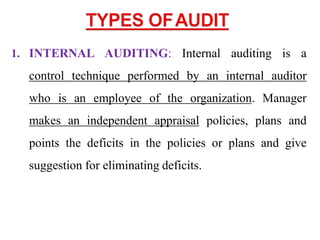
1. INTERNAL AUDITING: Internal auditing is a
control technique performed by an internal auditor
who is an employee of the organization. Manager
makes an independent appraisal policies, plans and
points the deficits in the policies or plans and give
suggestion for eliminating deficits.
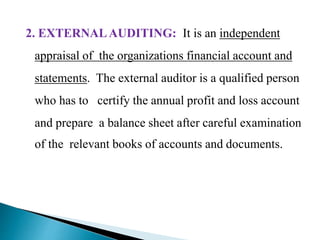
2. EXTERNALAUDITING: It is an independent
appraisal of the organizations financial account and
statements. The external auditor is a qualified person
who has to certify the annual profit and loss account
and prepare a balance sheet after careful examination
of the relevant books of accounts and documents.
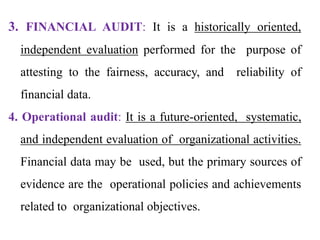
3. FINANCIAL AUDIT: It is a historically oriented,
independent evaluation performed for the purpose of
attesting to the fairness, accuracy, and reliability of
financial data.
4. Operational audit: It is a future-oriented, systematic,
and independent evaluation of organizational activities.
Financial data may be used, but the primary sources of
evidence are the operational policies and achievements
related to organizational objectives.
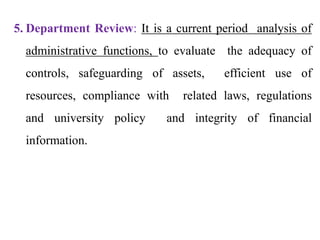
5. Department Review: It is a current period analysis of
administrative functions, to evaluate the adequacy of
controls, safeguarding of assets, efficient use of
resources, compliance with related laws, regulations
and university policy and integrity of financial
information.
6. Integrated Audit: It is a combination of an
operational audit, department review, and audit
application controls review. This type of review
allows for a very comprehensive examination of a
functional operation within the University.
7. Investigative Audit: It is an audit that takes place as a
result of a report of unusual or suspicious activity on
the part of an individual or a department. It is usually
focused on specific aspects of the work of a
department or individual.
8. Follow-up Audit: These are audits conducted
approximately six months after an internal or
external audit report has been issued. They are
designed to evaluate corrective action that has been
taken on the audit issues reported in the original
report. When these follow-up audits are done on
external auditors' reports, the results of the follow-
up may be reported to those external auditors.
* Before 1915- very little was known about the
concept.
* 1918- industrial concern introduced for the
beginning of medical audit.
* George Groword- introduced the term physician for
the first time medical audit.
* Ten years later Thomas R Pondon MD established a
method of medical audit based on procedures used
by financial account.
* He evaluated the medical care by reviewing the
medical records.
* Evaluating nursing care given
* Achieves deserved and feasible quality of nursing
care
* Verification: stimulant to better records
* Focuses on care provided and on care provider
* Contributes to research
* Review of the quality of nursing care ie, we try to
see how far the nurses have confirmed to the
norms and standards of nursing practice while
taking care of patients.
* It encourages followers to be actively involved in
the quality control process and better records.
* It clearly communicates standards of care to
subordinates.
* Facilitates more efficient use of health resources.
* Helps in designing response orientation and in-
service education programme.
There are three methods:
a. Retrospective review
b. The concurrent review
c. Peer review
 1. Retrospective review - this refers to an in-
depth assessment of the quality after the
patient has been discharged, have the patients
chart to the source of data.
2. The concurrent review - this refers to the
evaluations conducted on behalf of patients who
are still undergoing care.
 It includes assessing the patient at the bedside in
relation to pre-determined criteria, interviewing the
staff responsible for this care and reviewing the
patients record and care plan.
3. PEER REVIEW:
In nurse peer review nurses functioning in the same unit;
appraise the quality of care or practice performed by other
equally qualified nurses. The peer review is based on pre-
established standards or criteria. There are two types of peer
reviews.
a) Individual peer review: focuses on the performance of an
individual nurse
b) Nursing audit: focuses on evaluating nursing care through
the review of records.
There should be:
* Written standards of care against which to evaluate
nursing care.
* Evidence that actual practice was measured against
such standards, sharing a a percent conformance
rate.
* Examination and analysis of findings.
* Evidence of corrective action being taken.
* Evidence of effectiveness of corrective action.
* Appropriate reporting of the audit programme.
1. A group discussion to see how the group rates the
care provided to the patient and by using the
feedback of a patient who has been discharge.
These should be anonymous and should reflect a
total period of care not exceeding two weeks in
length
2. Each individual auditor should then undertake
same exercise as followed by a meeting of the
whole committee who compare and discuss its
finding and finally reach a components
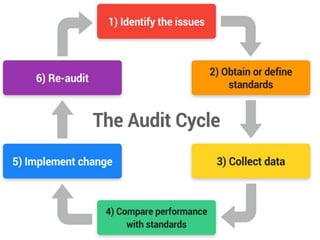
A) Set the key criteria (item): It should be
measurable against identifiable values, set
standard and in terms of desired patient outcome.
Methods to develop criteria are:
Define patient population
Identifya time frame work for measuring
outcomes of care.
 Identify commonly recurring problems
presented by the defined patient population.
 State patient outcomecriteria.
 State acceptable degree of goalachievement.
 Specify the source ofinformation.
 Identify commonly recurring problems presented
by the defined patient population.
 State patient outcomecriteria.
 State acceptable degree of goalachievement.
 Specify the source ofinformation.
B) Prepare Audit Protocol:
keeping in mind audit objectives, target
groups, methods of information gathering (by
asking, observing, checking records), criterion
are measuring, identifying the time framework
for measuring outcome of care, identify
commonly recurring nursing problems, state
acceptable of goal achievement.
C) DESIGNTHETYPEOFTOOL:
Quality assurance must be a priority.
Those responsible must implement a program
not only a tool not only a tool.
Roles and responsibilities must be delivered.
Nurses must be informed about the process
and the results of the program.
Data must be reliable.
Adequate orientation of data collectionis
essential.
Quality data should be analyzed and usedby
nursing personnel at all levels.
D) Plan and implement the tool:
What is to be evaluated? Who is going to collect
the information? How many sample in the target
group? Time period?
E) Recording/ Analysis, concluding:
Record the information, analyze the information,
make a summary, and compare with set standard,
conclusion.
F) USING RESULTS:
The result aid to modify nursing care plan and
nursing care process, including
 discharge planning,
 for selected patient outcome
 implementing a program for improving
documentation of nursing care through
improved charity policies, methodologies and
forms,
 focusing of nursing rounds
 team conferences.
Focusing supervisory attention upon areas of
weakness identified such as one particular nursing
unit or specific employees.
Designing responsive orientation and in-service
education programs.
Gaining administrative support for making
changes in resources, including personnel.

* Audit committee consist of members
including senior nurses as members to do
nursing audit.
* This committee should comprising of a
of five
in quality assurance
minimum
interested
clinically competent and able to
member who are
are
work
together in a group.
* It is recommended that each member should
review not more than 10 patients each month
and that the auditor should have the ability to
carry out an audit in about 15 minute.
* If there are less than 50 discharge per month,
all the records may be audited. If there are a
large number of records to be audited, an
auditor may select 10% of discharge.
* The impetus must come from the nursing staff
themselves, realizing the benefits to the
patients and themselves.
1. Can be used as a method of measured in all areas
of nursing
2. Scoring system is fairly simple
3. Results easily understood
4. Assess the work of all those involved in recording
care
5. May be useful tool as part of a quality assurance
programme in areas where accurate records of
care are kept
6)Enables the professional group to highlight
the deficiencies and how good they are in
giving care.
7) Better planning can be done.
8) Helps in reallocation of resources.
9) Administrators are also sure that patients are
getting quality care.
1) Appraises the outcomes of the nursing process,
so it is not so useful in areas where the nursing
process has not been implemented
2) Many of the components overlap making
analysis difficult
3) Is time consuming
4) Requires a team of trained auditors
5) Deals with a large amount of information.
6) Only evaluates record keeping. It only serves to
improve documentation not nursing care.
7) Medical legal importance.
8) The professionals feel that they will be used in
court of law as any document can be called for in
court of law.
Roles:
# Encourages followers to be actively involved in
the quality control process.
# Clearly communicates standards of care to
#
subordinates.
Encourages the setting of high standards to
maximize quality instead of setting minimum
safety standards.
# Implement quality control proactively instead
reactively.
# Uses control as a method of detraining why
goals were not met.
# Is positively active in communicating quality
control finding.
# Acts as a role model for followers in accepting
responsibility and accountability for nursing
action.

Functions:
# In conjunctions with other personnel in the
organization establishes clear cut, measurable
standards of care and determines the most
appropriate methods for measuring if those
standards have been met.
process, outcome and# Selects and uses
structure audits appropriately as quality
control tools.
# Assesses appropriate sources of information in
data gathering for quality control tools.
# Determines discrepancies between care provided
and unit standards and seeks further information
regarding why standards were not met.
# Uses quality control findings as a measure of
employee performance and rewards, coaches,
counsels or disciplines employees accordingly.
# Keeps abreast of current government and
licensing regulations that affect quality control.
Audit/ Nursing audit

Audit/ Nursing audit

  • 1.
  • 2.
    Quality - ajudgment of what constitutes good or bad. Audit - a systematic and critical examination to examine or verify.
  • 3.
    MEDICAL AUDIT -thesystematic, critical analysis of the quality of medical care, including the procedures for diagnosis and treatment, the use of resources, and the resulting outcome and quality of life for the patient.
  • 4.
    Nursing audit – a)It is the assessment of the quality of nursing Care b) Uses a record as an aid in evaluating the quality of patient care.  Nursing audit is defined as the evaluation of nursing care in retrospect through analysis of nursing records. It is a systematic format and written appraisal by nurses of the quality of content and the process of nursing service from the nursing records of the discharged patient.
  • 5.
    According to Elison "Nursingaudit refers to assessment of the quality of clinical nursing". According to Goster Walfer Nursing Audit is an exercise to find out whether good nursing practices are followed. The audit is a means by which nurses themselves can define standards from their point of view and describe the actual practice of nursing.
  • 6.
    1. INTERNAL AUDITING:Internal auditing is a control technique performed by an internal auditor who is an employee of the organization. Manager makes an independent appraisal policies, plans and points the deficits in the policies or plans and give suggestion for eliminating deficits.
  • 7.
    2. EXTERNALAUDITING: Itis an independent appraisal of the organizations financial account and statements. The external auditor is a qualified person who has to certify the annual profit and loss account and prepare a balance sheet after careful examination of the relevant books of accounts and documents.
  • 8.
    3. FINANCIAL AUDIT:It is a historically oriented, independent evaluation performed for the purpose of attesting to the fairness, accuracy, and reliability of financial data. 4. Operational audit: It is a future-oriented, systematic, and independent evaluation of organizational activities. Financial data may be used, but the primary sources of evidence are the operational policies and achievements related to organizational objectives.
  • 9.
    5. Department Review:It is a current period analysis of administrative functions, to evaluate the adequacy of controls, safeguarding of assets, efficient use of resources, compliance with related laws, regulations and university policy and integrity of financial information.
  • 10.
    6. Integrated Audit:It is a combination of an operational audit, department review, and audit application controls review. This type of review allows for a very comprehensive examination of a functional operation within the University.
  • 11.
    7. Investigative Audit:It is an audit that takes place as a result of a report of unusual or suspicious activity on the part of an individual or a department. It is usually focused on specific aspects of the work of a department or individual.
  • 12.
    8. Follow-up Audit:These are audits conducted approximately six months after an internal or external audit report has been issued. They are designed to evaluate corrective action that has been taken on the audit issues reported in the original report. When these follow-up audits are done on external auditors' reports, the results of the follow- up may be reported to those external auditors.
  • 13.
    * Before 1915-very little was known about the concept. * 1918- industrial concern introduced for the beginning of medical audit. * George Groword- introduced the term physician for the first time medical audit. * Ten years later Thomas R Pondon MD established a method of medical audit based on procedures used by financial account. * He evaluated the medical care by reviewing the medical records.
  • 14.
    * Evaluating nursingcare given * Achieves deserved and feasible quality of nursing care * Verification: stimulant to better records * Focuses on care provided and on care provider * Contributes to research * Review of the quality of nursing care ie, we try to see how far the nurses have confirmed to the norms and standards of nursing practice while taking care of patients.
  • 15.
    * It encouragesfollowers to be actively involved in the quality control process and better records. * It clearly communicates standards of care to subordinates. * Facilitates more efficient use of health resources. * Helps in designing response orientation and in- service education programme.
  • 16.
    There are threemethods: a. Retrospective review b. The concurrent review c. Peer review
  • 17.
     1. Retrospectivereview - this refers to an in- depth assessment of the quality after the patient has been discharged, have the patients chart to the source of data.
  • 18.
    2. The concurrentreview - this refers to the evaluations conducted on behalf of patients who are still undergoing care.  It includes assessing the patient at the bedside in relation to pre-determined criteria, interviewing the staff responsible for this care and reviewing the patients record and care plan.
  • 19.
    3. PEER REVIEW: Innurse peer review nurses functioning in the same unit; appraise the quality of care or practice performed by other equally qualified nurses. The peer review is based on pre- established standards or criteria. There are two types of peer reviews. a) Individual peer review: focuses on the performance of an individual nurse b) Nursing audit: focuses on evaluating nursing care through the review of records.
  • 20.
    There should be: *Written standards of care against which to evaluate nursing care. * Evidence that actual practice was measured against such standards, sharing a a percent conformance rate. * Examination and analysis of findings. * Evidence of corrective action being taken. * Evidence of effectiveness of corrective action. * Appropriate reporting of the audit programme.
  • 21.
    1. A groupdiscussion to see how the group rates the care provided to the patient and by using the feedback of a patient who has been discharge. These should be anonymous and should reflect a total period of care not exceeding two weeks in length
  • 22.
    2. Each individualauditor should then undertake same exercise as followed by a meeting of the whole committee who compare and discuss its finding and finally reach a components
  • 23.
    A) Set thekey criteria (item): It should be measurable against identifiable values, set standard and in terms of desired patient outcome. Methods to develop criteria are: Define patient population Identifya time frame work for measuring outcomes of care.  Identify commonly recurring problems presented by the defined patient population.
  • 24.
     State patientoutcomecriteria.  State acceptable degree of goalachievement.  Specify the source ofinformation.  Identify commonly recurring problems presented by the defined patient population.  State patient outcomecriteria.  State acceptable degree of goalachievement.  Specify the source ofinformation.
  • 25.
    B) Prepare AuditProtocol: keeping in mind audit objectives, target groups, methods of information gathering (by asking, observing, checking records), criterion are measuring, identifying the time framework for measuring outcome of care, identify commonly recurring nursing problems, state acceptable of goal achievement.
  • 26.
    C) DESIGNTHETYPEOFTOOL: Quality assurancemust be a priority. Those responsible must implement a program not only a tool not only a tool. Roles and responsibilities must be delivered. Nurses must be informed about the process and the results of the program.
  • 27.
    Data must bereliable. Adequate orientation of data collectionis essential. Quality data should be analyzed and usedby nursing personnel at all levels.
  • 28.
    D) Plan andimplement the tool: What is to be evaluated? Who is going to collect the information? How many sample in the target group? Time period? E) Recording/ Analysis, concluding: Record the information, analyze the information, make a summary, and compare with set standard, conclusion.
  • 29.
    F) USING RESULTS: Theresult aid to modify nursing care plan and nursing care process, including  discharge planning,  for selected patient outcome  implementing a program for improving documentation of nursing care through improved charity policies, methodologies and forms,  focusing of nursing rounds  team conferences.
  • 30.
    Focusing supervisory attentionupon areas of weakness identified such as one particular nursing unit or specific employees. Designing responsive orientation and in-service education programs. Gaining administrative support for making changes in resources, including personnel. 
  • 32.
    * Audit committeeconsist of members including senior nurses as members to do nursing audit. * This committee should comprising of a of five in quality assurance minimum interested clinically competent and able to member who are are work together in a group.
  • 33.
    * It isrecommended that each member should review not more than 10 patients each month and that the auditor should have the ability to carry out an audit in about 15 minute. * If there are less than 50 discharge per month, all the records may be audited. If there are a large number of records to be audited, an auditor may select 10% of discharge. * The impetus must come from the nursing staff themselves, realizing the benefits to the patients and themselves.
  • 34.
    1. Can beused as a method of measured in all areas of nursing 2. Scoring system is fairly simple 3. Results easily understood 4. Assess the work of all those involved in recording care 5. May be useful tool as part of a quality assurance programme in areas where accurate records of care are kept
  • 35.
    6)Enables the professionalgroup to highlight the deficiencies and how good they are in giving care. 7) Better planning can be done. 8) Helps in reallocation of resources. 9) Administrators are also sure that patients are getting quality care.
  • 36.
    1) Appraises theoutcomes of the nursing process, so it is not so useful in areas where the nursing process has not been implemented 2) Many of the components overlap making analysis difficult 3) Is time consuming 4) Requires a team of trained auditors
  • 37.
    5) Deals witha large amount of information. 6) Only evaluates record keeping. It only serves to improve documentation not nursing care. 7) Medical legal importance. 8) The professionals feel that they will be used in court of law as any document can be called for in court of law.
  • 38.
    Roles: # Encourages followersto be actively involved in the quality control process. # Clearly communicates standards of care to # subordinates. Encourages the setting of high standards to maximize quality instead of setting minimum safety standards. # Implement quality control proactively instead reactively.
  • 39.
    # Uses controlas a method of detraining why goals were not met. # Is positively active in communicating quality control finding. # Acts as a role model for followers in accepting responsibility and accountability for nursing action. 
  • 40.
    Functions: # In conjunctionswith other personnel in the organization establishes clear cut, measurable standards of care and determines the most appropriate methods for measuring if those standards have been met. process, outcome and# Selects and uses structure audits appropriately as quality control tools.
  • 41.
    # Assesses appropriatesources of information in data gathering for quality control tools. # Determines discrepancies between care provided and unit standards and seeks further information regarding why standards were not met. # Uses quality control findings as a measure of employee performance and rewards, coaches, counsels or disciplines employees accordingly. # Keeps abreast of current government and licensing regulations that affect quality control.