Audiomdmetadatascheme
Presenter: Ariel Hess
Introduction 2
● Definition and History
● Function
● Importance
● Elements
● Use
● Scheme Example
● BIBframe Initiative
● Summary
● References
Definitionandhistory 3
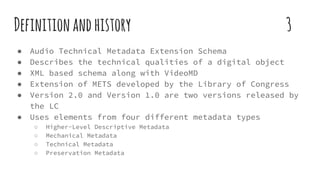
● Audio Technical Metadata Extension Schema
● Describes the technical qualities of a digital object
● XML based schema along with VideoMD
● Extension of METS developed by the Library of Congress
● Version 2.0 and Version 1.0 are two versions released by
the LC
● Uses elements from four different metadata types
○ Higher-Level Descriptive Metadata
○ Mechanical Metadata
○ Technical Metadata
○ Preservation Metadata
function/process 4
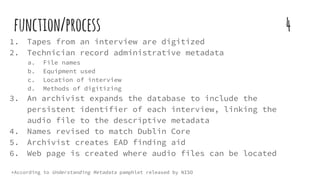
1. Tapes from an interview are digitized
2. Technician record administrative metadata
a. File names
b. Equipment used
c. Location of interview
d. Methods of digitizing
3. An archivist expands the database to include the
persistent identifier of each interview, linking the
audio file to the descriptive metadata
4. Names revised to match Dublin Core
5. Archivist creates EAD finding aid
6. Web page is created where audio files can be located
*According to Understanding Metadata pamphlet released by NISO
Importance 5
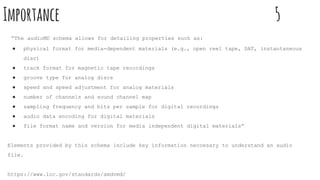
“The audioMD schema allows for detailing properties such as:
● physical format for media-dependent materials (e.g., open reel tape, DAT, instantaneous
disc)
● track format for magnetic tape recordings
● groove type for analog discs
● speed and speed adjustment for analog materials
● number of channels and sound channel map
● sampling frequency and bits per sample for digital recordings
● audio data encoding for digital materials
● file format name and version for media independent digital materials”
Elements provided by this schema include key information neccesary to understand an audio
file.
https://www.loc.gov/standards/amdvmd/
structure/elements 6
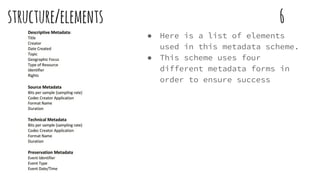
● Here is a list of elements
used in this metadata scheme.
● This scheme uses four
different metadata forms in
order to ensure success
Use 7
Schemeexample:LCVERSION1.0 8
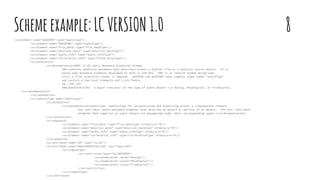
<xs:element name="AUDIOMD" type="audioType"/>
<xs:element name="AUDIOSRC" type="audioType"/>
<xs:element name="file_data" type="file_dataType"/>
<xs:element name="physical_data" type="physical_dataType"/>
<xs:element name="audio_info" type="audio_infoType"/>
<xs:element name="calibration_info" type="calibrationType"/>
<xs:annotation>
<xs:documentation>AMD: LC-AV Audio Metadata Extension Schema.
AMD contains technical metadata that describes either a digital file or a physical source object. It is
based upon metadata elements developed by both LC and AES. AMD is an interim schema being used
until a final extension schema is adopted. AUDIOMD and AUDIOSRC both complex types named "audioType"
and contain 4 top-level elements and 2 attributes,
ID: (XML ID)
ANALOGDIGITALFLAG: A major indicator of the type of audio object i.e Analog, PhysDigital, or FileDigital.
</xs:documentation>
</xs:annotation>
<xs:complexType name="audioType">
<xs:annotation>
<xs:documentation>audioType: complexType for encapsulating and organizing within a singleparent element
the individual audio metadata elements that describe an object or portion of an object. The four individual
elements that comprise an audio object are documented under their corresponding types.</xs:documentation>
</xs:annotation>
<xs:sequence>
<xs:element name="file_data" type="file_dataType" minOccurs="0"/>
<xs:element name="physical_data" type="physical_dataType" minOccurs="0"/>
<xs:element name="audio_info" type="audio_infoType" minOccurs="0"/>
<xs:element name="calibration_info" type="calibrationType" minOccurs="0"/>
</xs:sequence>
<xs:attribute name="ID" type="xs:ID"/>
<xs:attribute name="ANALOGDIGITALFLAG" use="required">
<xs:simpleType>
<xs:restriction base="xs:NMTOKEN">
<xs:enumeration value="Analog"/>
<xs:enumeration value="PhysDigital"/>
<xs:enumeration value="FileDigital"/>
</xs:restriction>
</xs:simpleType>
</xs:attribute>
Schemeexample:LCVersion2.0 9-->
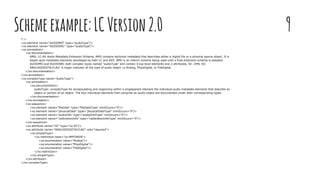
<xs:element name="AUDIOMD" type="audioType"/>
<xs:element name="AUDIOSRC" type="audioType"/>
<xs:annotation>
<xs:documentation>
AMD: LC-AV Audio Metadata Extension Schema. AMD contains technical metadata that describes either a digital file or a physical source object. It is
based upon metadata elements developed by both LC and AES. AMD is an interim schema being used until a final extension schema is adopted.
AUDIOMD and AUDIOSRC both complex types named "audioType" and contain 4 top-level elements and 2 attributes, ID: (XML ID)
ANALOGDIGITALFLAG: A major indicator of the type of audio object i.e Analog, PhysDigital, or FileDigital.
</xs:documentation>
</xs:annotation>
<xs:complexType name="audioType">
<xs:annotation>
<xs:documentation>
audioType: complexType for encapsulating and organizing within a singleparent element the individual audio metadata elements that describe an
object or portion of an object. The four individual elements that comprise an audio object are documented under their corresponding types.
</xs:documentation>
</xs:annotation>
<xs:sequence>
<xs:element name="fileData" type="fileDataType" minOccurs="0"/>
<xs:element name="physicalData" type="physicalDataType" minOccurs="0"/>
<xs:element name="audioInfo" type="audioInfoType" minOccurs="0"/>
<xs:element name="calibrationInfo" type="calibrationInfoType" minOccurs="0"/>
</xs:sequence>
<xs:attribute name="ID" type="xs:ID"/>
<xs:attribute name="ANALOGDIGITALFLAG" use="required">
<xs:simpleType>
<xs:restriction base="xs:NMTOKEN">
<xs:enumeration value="Analog"/>
<xs:enumeration value="PhysDigital"/>
<xs:enumeration value="FileDigital"/>
</xs:restriction>
</xs:simpleType>
</xs:attribute>
</xs:complexType>
LCMARCRECORD:AudioFile 10
000 02906cim a2200349 a 4500
001 5733291
005 20150505112010.0
007 st omndmannnue
008 941122s1973 dcunnn p eng
906 __ |a 7 |b cbc |c orignew |d 2 |e ncip |f 19 |g y-genmusic
955 __ |a qu45 2004-09-21 (rev.)
035 __ |9 (DLC) 94838932
010 __ |a 94838932
033 0_ |a 19740614 |b 3850
040 __ |a DLC |c DLC |d DLC
050 00 |a LWO 7368
100 1_ |a Jordan, June, |d 1936-2002.
240 10 |a Poems. |k Selections
245 10 |a June Jordan reading her poems with comment in the Recording Laboratory, June 14, 1974 |h [sound
recording].
260 __ |c 1974.
300 __ |a 1 sound tape reel (ca. 55 min.) : |b analog, 7 1/2 ips, 1 track, mono. ; |c 10 in.
306 __ |a 005500
500 __ |a Recorded for the Archive of Recorded Poetry and Literature.
510 4_ |a Literary recordings, rev., enl. ed., |c p. 124-125.
Bibframeinitiative 10
● Lead architect is Eric Miller partnered with the Library
of Congress
● Designed to bring possibilities to link library
bibliographic records from one ILS catalog with another
● Designed to be able to reach audience online
● Bi-Directional linking
○ “isVariantOf/hasVariant”
● Organizes information into three abstraction levels
○ Work
○ Instance
○ Item
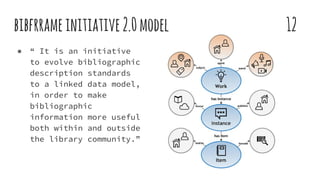
bibfrrameinitiative2.0model 12
● “ It is an initiative
to evolve bibliographic
description standards
to a linked data model,
in order to make
bibliographic
information more useful
both within and outside
the library community.”
Summary 13
● Library of Congress created an uses the AudioMD Metadata
Scheme for all audio files
● Functional with the help of an Archivist
● Necessary to understand information regarding an audio
file
● BIBframe Initiative created by the Library of Congress to
make cataloging faster and connect the user to the
information they need faster
References 14
Overview of the BIBFRAME 2.0 Model. Retrieved from https:
//www.loc.gov/bibframe/docs/bibframe2-model.html.
Adamich, T. v. (2012). Making and Managing Metadata.
Technicalities, 32(1), 11-15.
Riemer, J. j. (2014). The Prospects of BIBFRAME: If Data
Elements Replace Records as the Coinage of the Metadata
Realm. Technicalities, 34(3), 1-9.
Understanding metadata [Booklet]. (n.d.)Bethesda, MD:
National Information Standards Organization.
REFERENCES 15
LC Source on slide 10 Retrieved from https://catalog.loc.
gov/vwebv/staffView?
searchId=7424&recPointer=0&recCount=10&searchType=1&bibId=57
33291
About audioMD and videoMD. (n.d.) Retrieved from http://www.
loc.gov/standards/amdvmd/index.html
AudioMD Schema (n.d.) Retrieved from http://www.loc.
gov/rr/mopic/avprot/AMD_020409.xsd

Audio MD Metadata Scheme

  • 1.
  • 2.
    Introduction 2 ● Definitionand History ● Function ● Importance ● Elements ● Use ● Scheme Example ● BIBframe Initiative ● Summary ● References
  • 3.
    Definitionandhistory 3 ● AudioTechnical Metadata Extension Schema ● Describes the technical qualities of a digital object ● XML based schema along with VideoMD ● Extension of METS developed by the Library of Congress ● Version 2.0 and Version 1.0 are two versions released by the LC ● Uses elements from four different metadata types ○ Higher-Level Descriptive Metadata ○ Mechanical Metadata ○ Technical Metadata ○ Preservation Metadata
  • 4.
    function/process 4 1. Tapesfrom an interview are digitized 2. Technician record administrative metadata a. File names b. Equipment used c. Location of interview d. Methods of digitizing 3. An archivist expands the database to include the persistent identifier of each interview, linking the audio file to the descriptive metadata 4. Names revised to match Dublin Core 5. Archivist creates EAD finding aid 6. Web page is created where audio files can be located *According to Understanding Metadata pamphlet released by NISO
  • 5.
    Importance 5 “The audioMDschema allows for detailing properties such as: ● physical format for media-dependent materials (e.g., open reel tape, DAT, instantaneous disc) ● track format for magnetic tape recordings ● groove type for analog discs ● speed and speed adjustment for analog materials ● number of channels and sound channel map ● sampling frequency and bits per sample for digital recordings ● audio data encoding for digital materials ● file format name and version for media independent digital materials” Elements provided by this schema include key information neccesary to understand an audio file. https://www.loc.gov/standards/amdvmd/
  • 6.
    structure/elements 6 ● Hereis a list of elements used in this metadata scheme. ● This scheme uses four different metadata forms in order to ensure success
  • 7.
  • 8.
    Schemeexample:LCVERSION1.0 8 <xs:element name="AUDIOMD"type="audioType"/> <xs:element name="AUDIOSRC" type="audioType"/> <xs:element name="file_data" type="file_dataType"/> <xs:element name="physical_data" type="physical_dataType"/> <xs:element name="audio_info" type="audio_infoType"/> <xs:element name="calibration_info" type="calibrationType"/> <xs:annotation> <xs:documentation>AMD: LC-AV Audio Metadata Extension Schema. AMD contains technical metadata that describes either a digital file or a physical source object. It is based upon metadata elements developed by both LC and AES. AMD is an interim schema being used until a final extension schema is adopted. AUDIOMD and AUDIOSRC both complex types named "audioType" and contain 4 top-level elements and 2 attributes, ID: (XML ID) ANALOGDIGITALFLAG: A major indicator of the type of audio object i.e Analog, PhysDigital, or FileDigital. </xs:documentation> </xs:annotation> <xs:complexType name="audioType"> <xs:annotation> <xs:documentation>audioType: complexType for encapsulating and organizing within a singleparent element the individual audio metadata elements that describe an object or portion of an object. The four individual elements that comprise an audio object are documented under their corresponding types.</xs:documentation> </xs:annotation> <xs:sequence> <xs:element name="file_data" type="file_dataType" minOccurs="0"/> <xs:element name="physical_data" type="physical_dataType" minOccurs="0"/> <xs:element name="audio_info" type="audio_infoType" minOccurs="0"/> <xs:element name="calibration_info" type="calibrationType" minOccurs="0"/> </xs:sequence> <xs:attribute name="ID" type="xs:ID"/> <xs:attribute name="ANALOGDIGITALFLAG" use="required"> <xs:simpleType> <xs:restriction base="xs:NMTOKEN"> <xs:enumeration value="Analog"/> <xs:enumeration value="PhysDigital"/> <xs:enumeration value="FileDigital"/> </xs:restriction> </xs:simpleType> </xs:attribute>
  • 9.
    Schemeexample:LCVersion2.0 9--> <xs:element name="AUDIOMD"type="audioType"/> <xs:element name="AUDIOSRC" type="audioType"/> <xs:annotation> <xs:documentation> AMD: LC-AV Audio Metadata Extension Schema. AMD contains technical metadata that describes either a digital file or a physical source object. It is based upon metadata elements developed by both LC and AES. AMD is an interim schema being used until a final extension schema is adopted. AUDIOMD and AUDIOSRC both complex types named "audioType" and contain 4 top-level elements and 2 attributes, ID: (XML ID) ANALOGDIGITALFLAG: A major indicator of the type of audio object i.e Analog, PhysDigital, or FileDigital. </xs:documentation> </xs:annotation> <xs:complexType name="audioType"> <xs:annotation> <xs:documentation> audioType: complexType for encapsulating and organizing within a singleparent element the individual audio metadata elements that describe an object or portion of an object. The four individual elements that comprise an audio object are documented under their corresponding types. </xs:documentation> </xs:annotation> <xs:sequence> <xs:element name="fileData" type="fileDataType" minOccurs="0"/> <xs:element name="physicalData" type="physicalDataType" minOccurs="0"/> <xs:element name="audioInfo" type="audioInfoType" minOccurs="0"/> <xs:element name="calibrationInfo" type="calibrationInfoType" minOccurs="0"/> </xs:sequence> <xs:attribute name="ID" type="xs:ID"/> <xs:attribute name="ANALOGDIGITALFLAG" use="required"> <xs:simpleType> <xs:restriction base="xs:NMTOKEN"> <xs:enumeration value="Analog"/> <xs:enumeration value="PhysDigital"/> <xs:enumeration value="FileDigital"/> </xs:restriction> </xs:simpleType> </xs:attribute> </xs:complexType>
  • 10.
    LCMARCRECORD:AudioFile 10 000 02906cima2200349 a 4500 001 5733291 005 20150505112010.0 007 st omndmannnue 008 941122s1973 dcunnn p eng 906 __ |a 7 |b cbc |c orignew |d 2 |e ncip |f 19 |g y-genmusic 955 __ |a qu45 2004-09-21 (rev.) 035 __ |9 (DLC) 94838932 010 __ |a 94838932 033 0_ |a 19740614 |b 3850 040 __ |a DLC |c DLC |d DLC 050 00 |a LWO 7368 100 1_ |a Jordan, June, |d 1936-2002. 240 10 |a Poems. |k Selections 245 10 |a June Jordan reading her poems with comment in the Recording Laboratory, June 14, 1974 |h [sound recording]. 260 __ |c 1974. 300 __ |a 1 sound tape reel (ca. 55 min.) : |b analog, 7 1/2 ips, 1 track, mono. ; |c 10 in. 306 __ |a 005500 500 __ |a Recorded for the Archive of Recorded Poetry and Literature. 510 4_ |a Literary recordings, rev., enl. ed., |c p. 124-125.
  • 11.
    Bibframeinitiative 10 ● Leadarchitect is Eric Miller partnered with the Library of Congress ● Designed to bring possibilities to link library bibliographic records from one ILS catalog with another ● Designed to be able to reach audience online ● Bi-Directional linking ○ “isVariantOf/hasVariant” ● Organizes information into three abstraction levels ○ Work ○ Instance ○ Item
  • 12.
    bibfrrameinitiative2.0model 12 ● “It is an initiative to evolve bibliographic description standards to a linked data model, in order to make bibliographic information more useful both within and outside the library community.”
  • 13.
    Summary 13 ● Libraryof Congress created an uses the AudioMD Metadata Scheme for all audio files ● Functional with the help of an Archivist ● Necessary to understand information regarding an audio file ● BIBframe Initiative created by the Library of Congress to make cataloging faster and connect the user to the information they need faster
  • 14.
    References 14 Overview ofthe BIBFRAME 2.0 Model. Retrieved from https: //www.loc.gov/bibframe/docs/bibframe2-model.html. Adamich, T. v. (2012). Making and Managing Metadata. Technicalities, 32(1), 11-15. Riemer, J. j. (2014). The Prospects of BIBFRAME: If Data Elements Replace Records as the Coinage of the Metadata Realm. Technicalities, 34(3), 1-9. Understanding metadata [Booklet]. (n.d.)Bethesda, MD: National Information Standards Organization.
  • 15.
    REFERENCES 15 LC Sourceon slide 10 Retrieved from https://catalog.loc. gov/vwebv/staffView? searchId=7424&recPointer=0&recCount=10&searchType=1&bibId=57 33291 About audioMD and videoMD. (n.d.) Retrieved from http://www. loc.gov/standards/amdvmd/index.html AudioMD Schema (n.d.) Retrieved from http://www.loc. gov/rr/mopic/avprot/AMD_020409.xsd