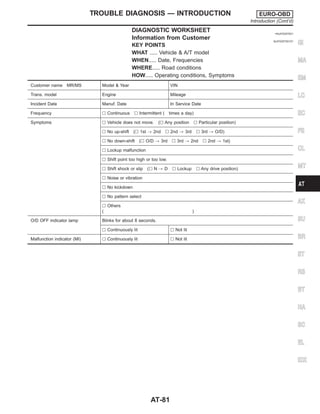
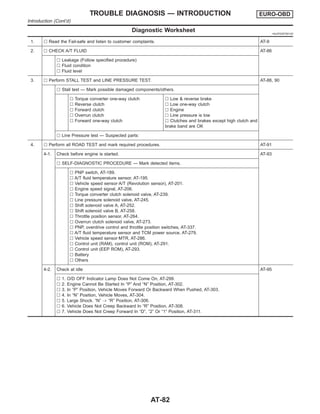
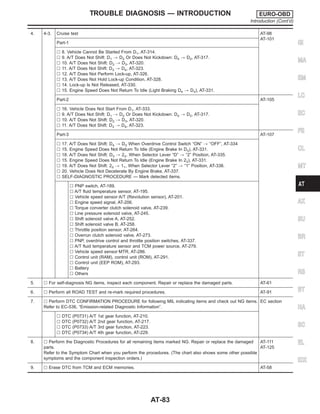
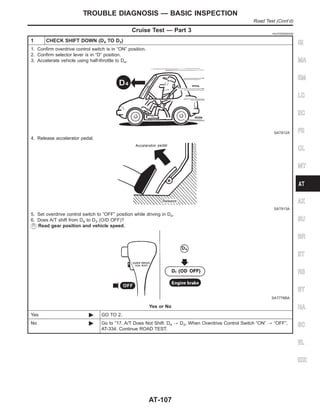
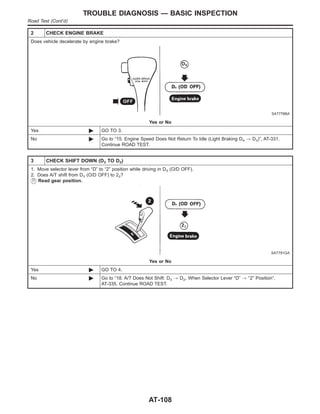
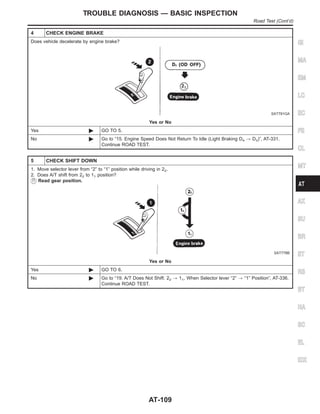
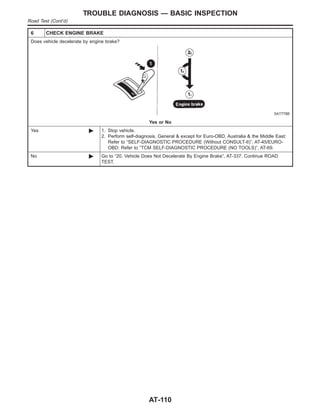
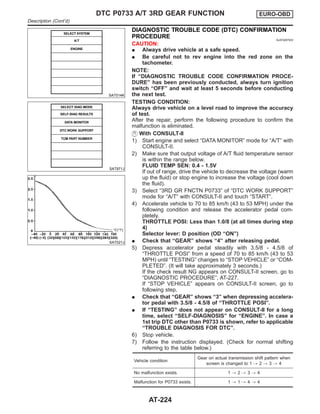
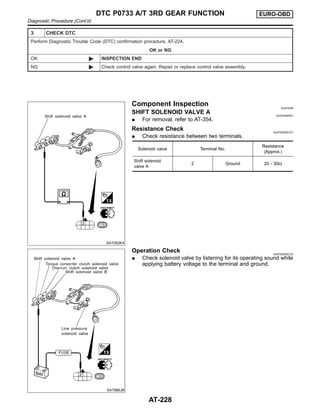
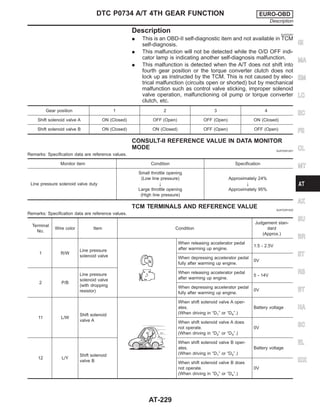
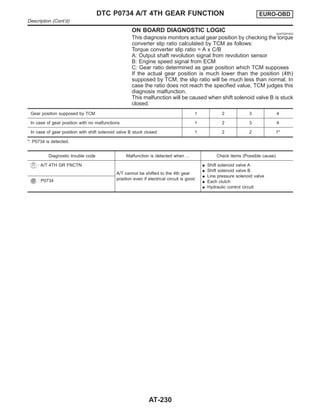
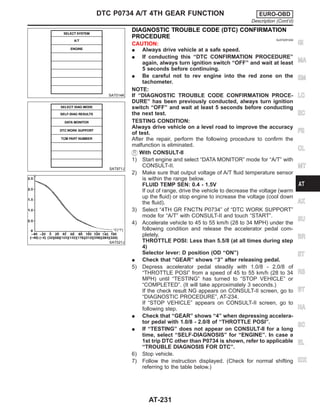
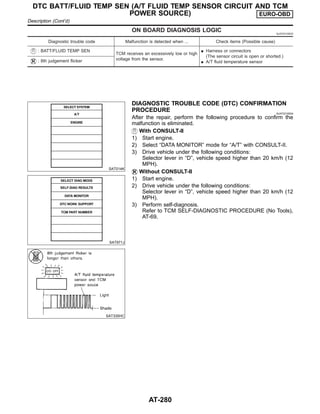
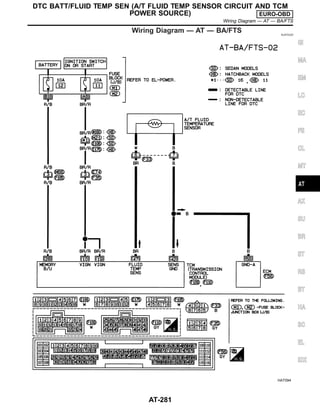
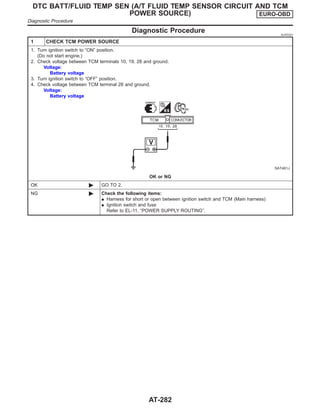
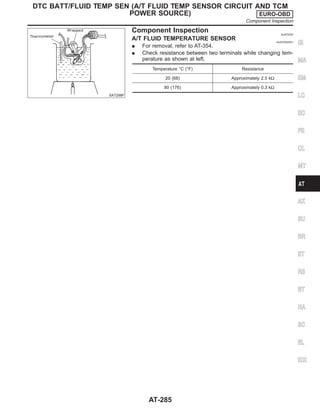
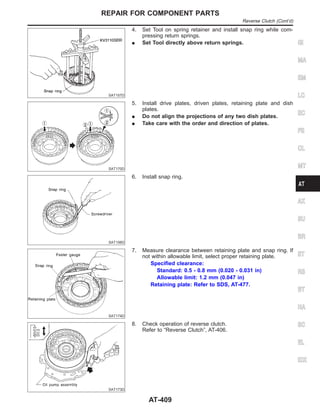
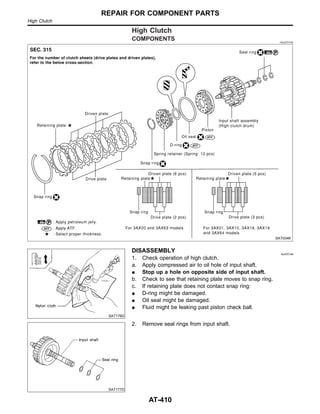
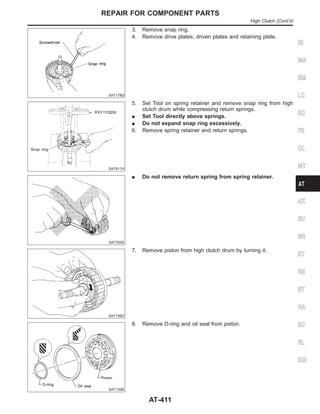
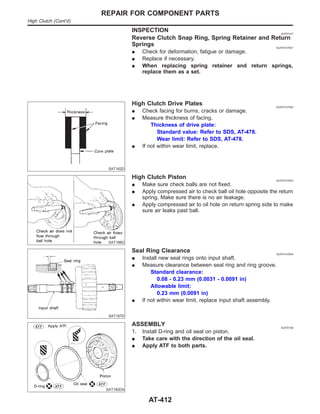
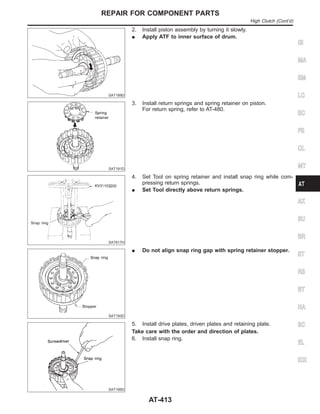
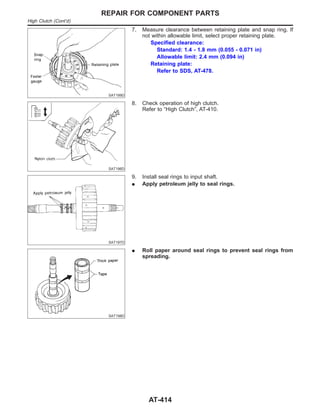
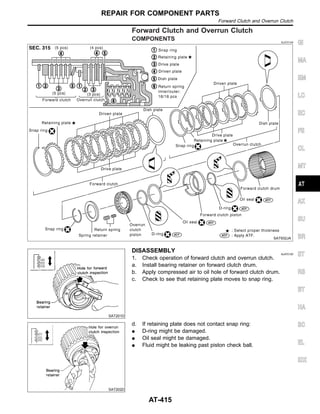
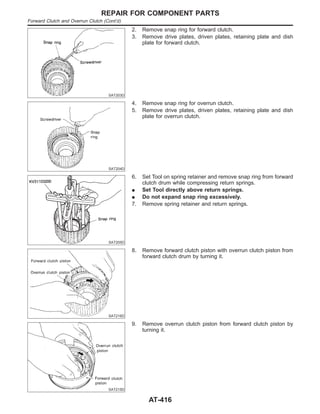
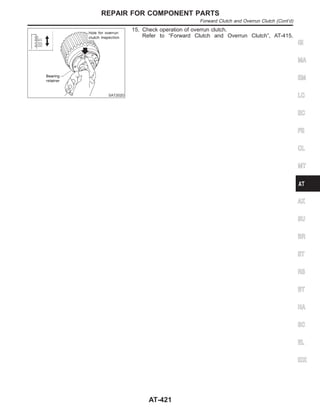
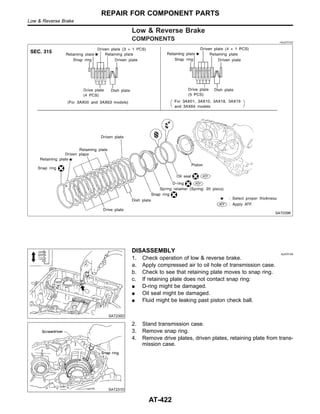
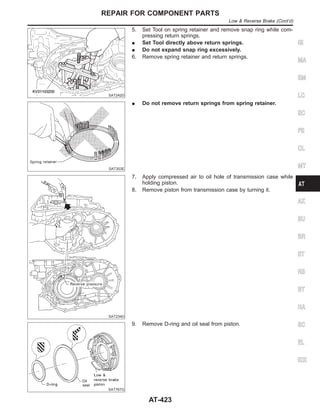
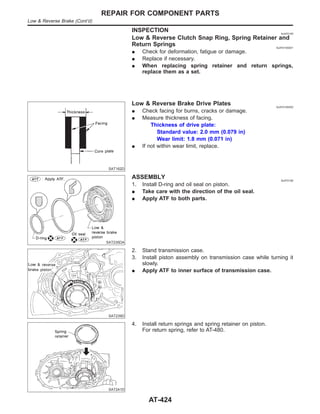
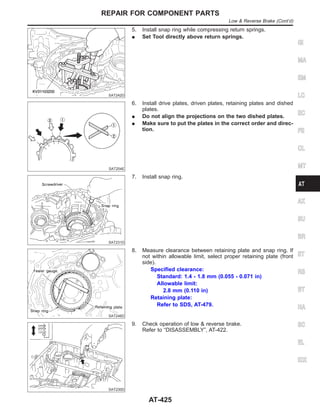
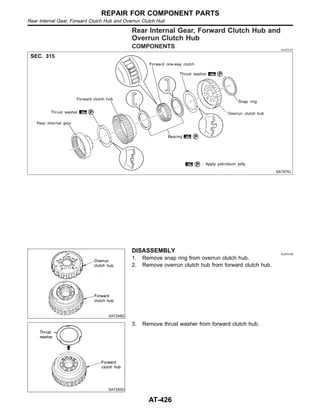
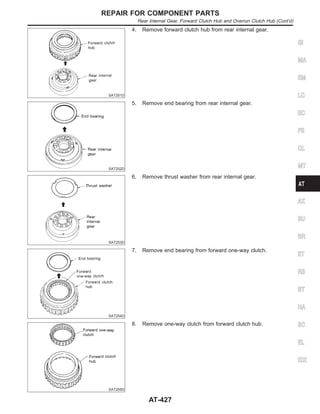
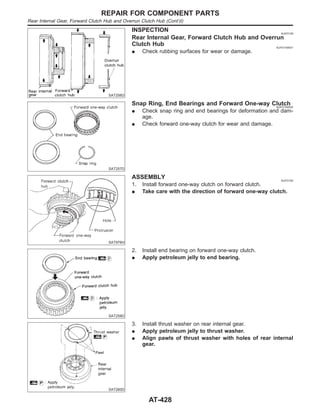
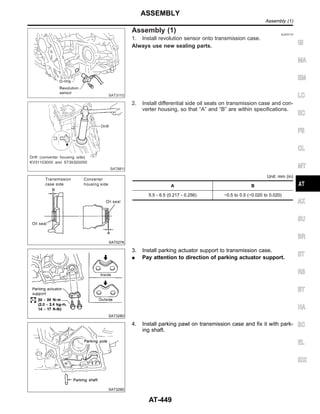
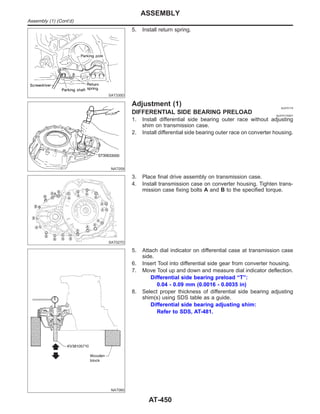
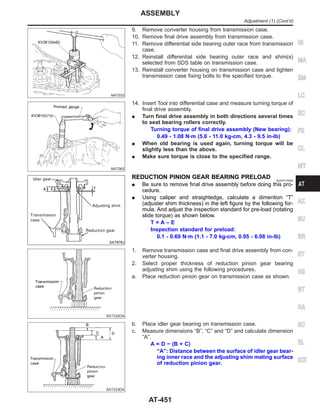
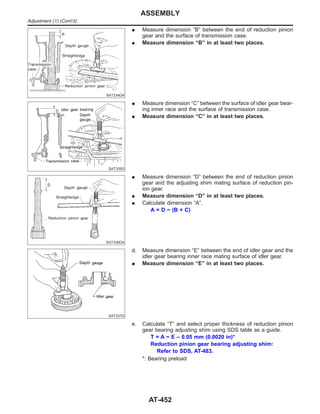
AUTOMATIC TRANSAXLE
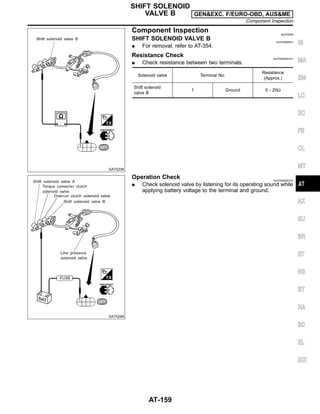
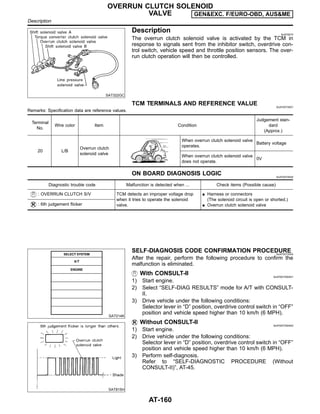
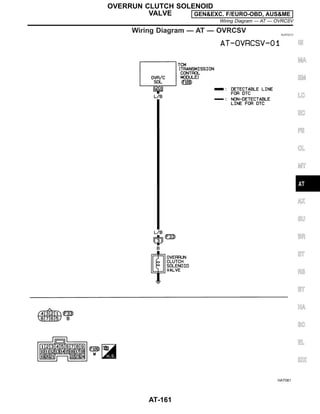
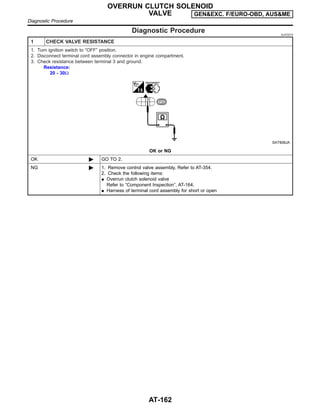
SECTION AT
CONTENTS
EURO-OBD
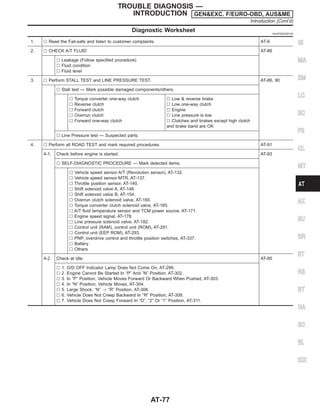
TROUBLE DIAGNOSIS - INDEX ....................................5
Alphabetical & P No. Index for DTC ...........................5
PRECAUTIONS ...............................................................7
Supplemental Restraint System (SRS) ″AIR
BAG″ and ″SEAT BELT PRE-TENSIONER″...............7
Precautions for On Board Diagnostic (EURO-
OBD) System of A/T and Engine - Euro-OBD -..........7
Precautions..................................................................7
Service Notice or Precautions.....................................9
Wiring Diagrams and Trouble Diagnosis...................10
PREPARATION .............................................................11
Special Service Tools ................................................11
Commercial Service Tools.........................................13
A/T FLUID......................................................................15
Checking A/T Fluid ....................................................15
Changing A/T Fluid....................................................15
OVERALL SYSTEM ......................................................16
A/T Electrical Parts Location .....................................16
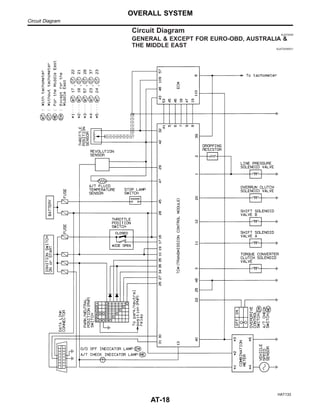
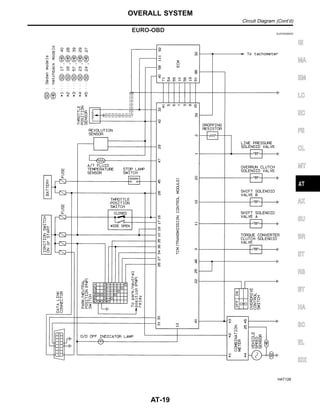
Circuit Diagram..........................................................18
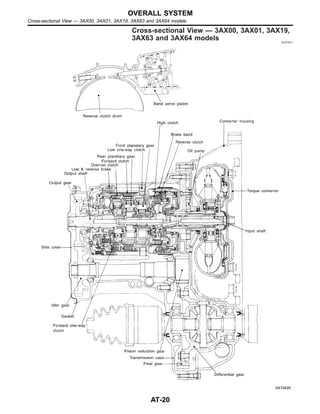
Cross-sectional View - 3AX00, 3AX01, 3AX19,
3AX63 and 3AX64 models ........................................20
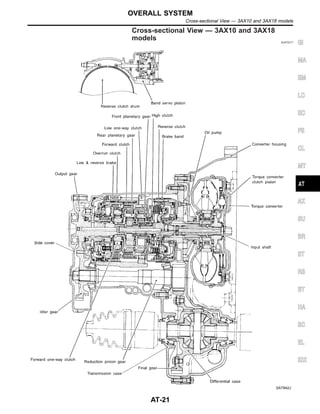
Cross-sectional View - 3AX10 and 3AX18
models .......................................................................21
Hydraulic Control Circuit............................................22
Shift Mechanism ........................................................23
Control System ..........................................................32
Control Mechanism....................................................33
Control Valve .............................................................38
GEN&EXC. F/EURO-OBD, AUS&ME
ON BOARD DIAGNOSTIC SYSTEM
DESCRIPTION...............................................................40
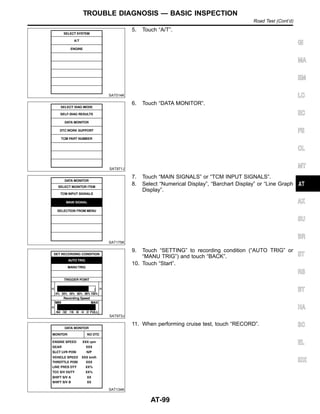
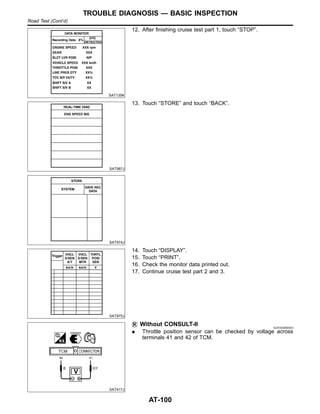
CONSULT-II...............................................................40
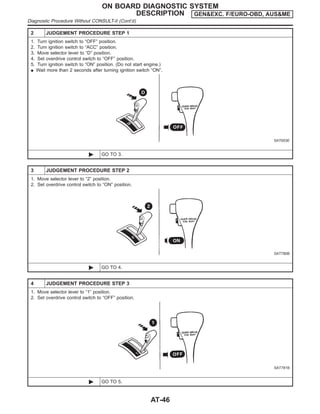
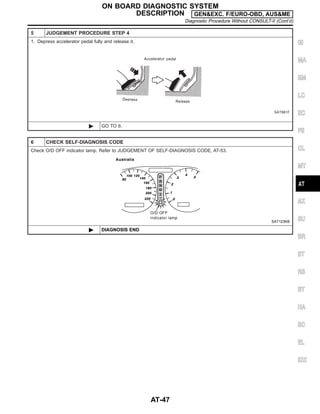
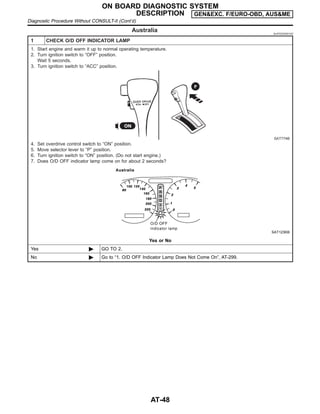
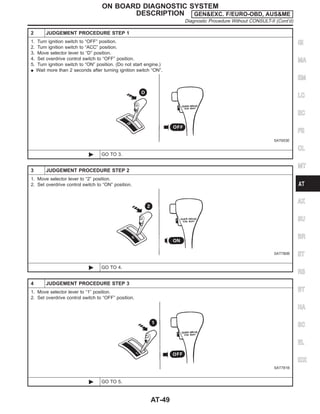
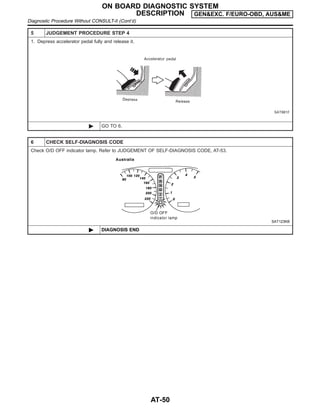
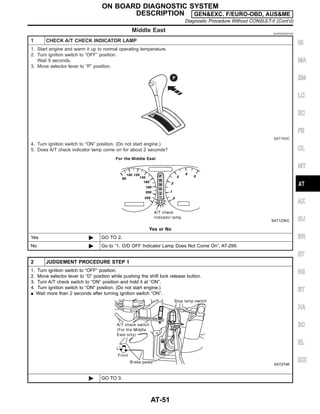
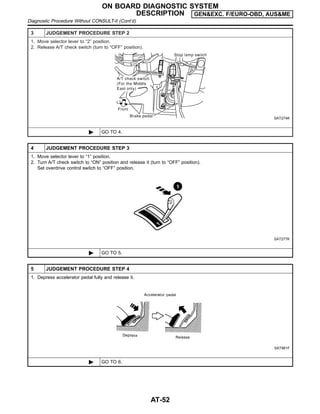
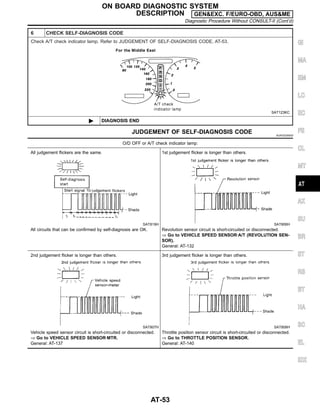
Diagnostic Procedure Without CONSULT-II..............45
EURO-OBD
ON BOARD DIAGNOSTIC SYSTEM
DESCRIPTION...............................................................56
Introduction ................................................................56
EURO-OBD Function for A/T System .......................56
One or Two Trip Detection Logic of EURO-OBD......56
EURO-OBD Diagnostic Trouble Code (DTC)............56
Malfunction Indicator (MI)..........................................60
CONSULT-II...............................................................60
Diagnostic Procedure Without CONSULT-II..............69
GEN&EXC. F/EURO-OBD, AUS&ME
TROUBLE DIAGNOSIS - INTRODUCTION..................75
Introduction ................................................................75
Work Flow..................................................................79
EURO-OBD
TROUBLE DIAGNOSIS - INTRODUCTION..................80
Introduction ................................................................80
Work Flow..................................................................84
TROUBLE DIAGNOSIS - BASIC INSPECTION...........86
A/T Fluid Check.........................................................86
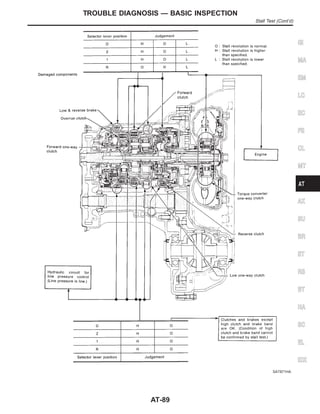
Stall Test ....................................................................86
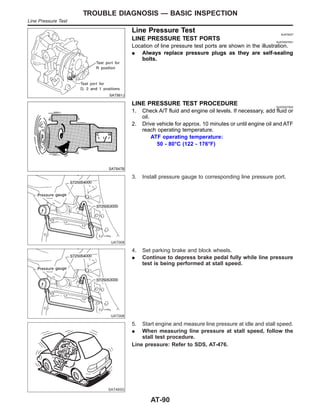
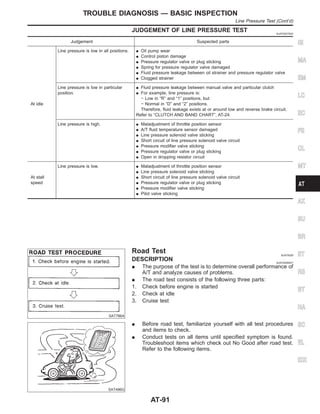
Line Pressure Test.....................................................90
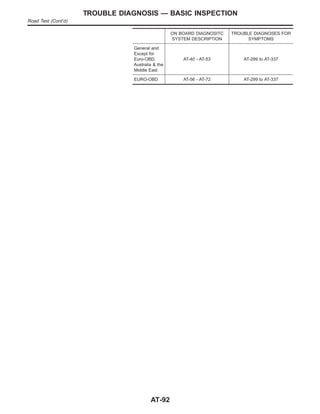
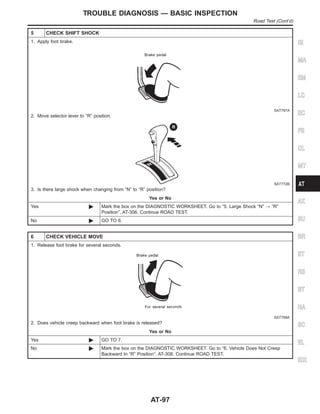
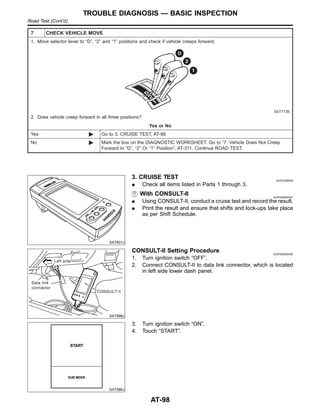
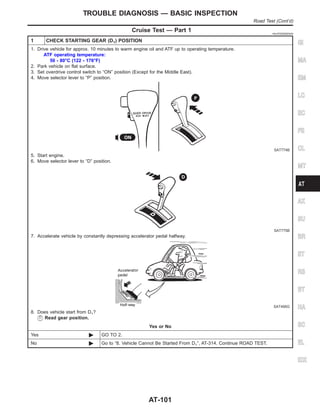
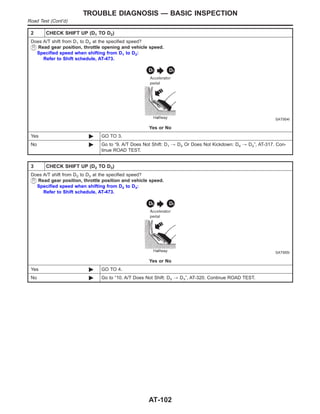
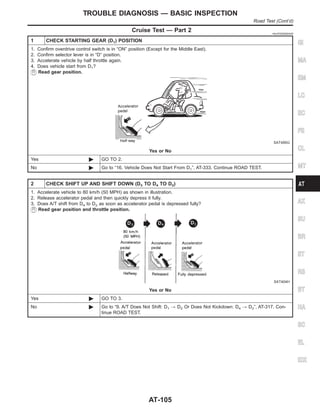
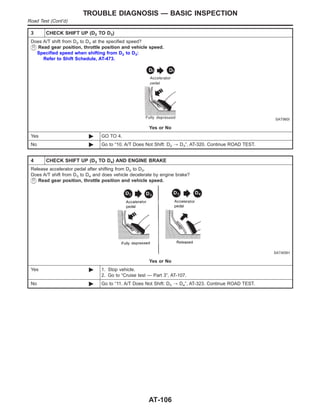
Road Test...................................................................91
TROUBLE DIAGNOSIS - GENERAL
DESCRIPTION............................................................. 111
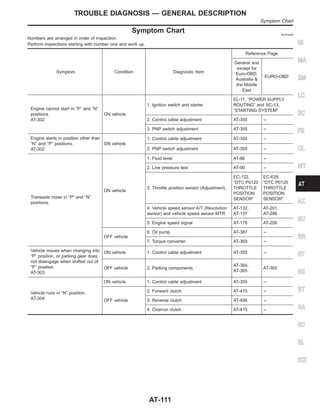
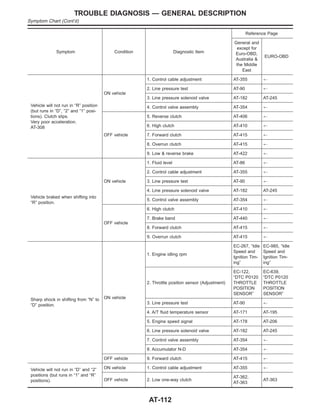
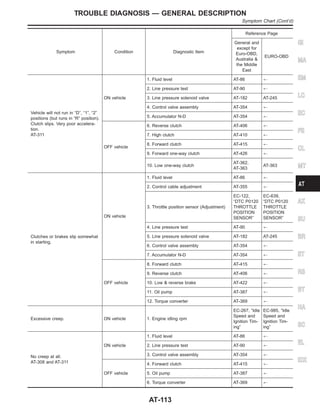
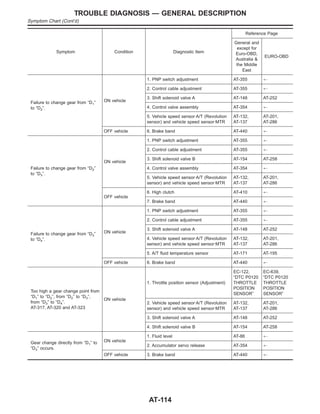
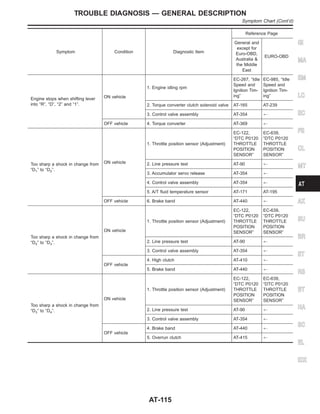
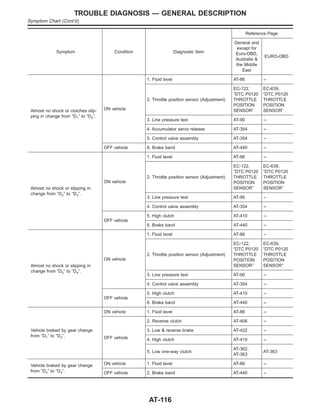
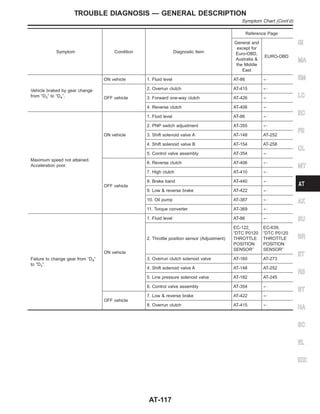
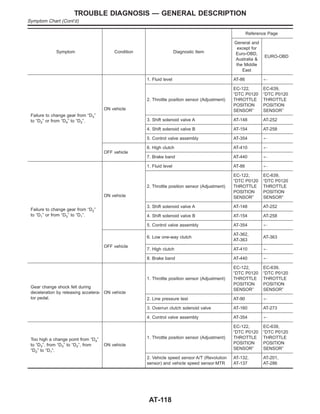
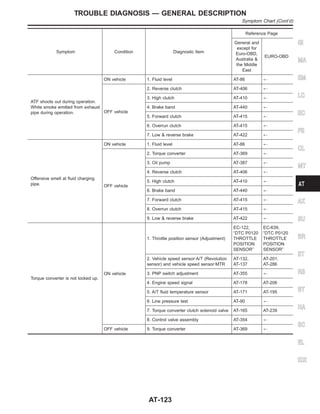
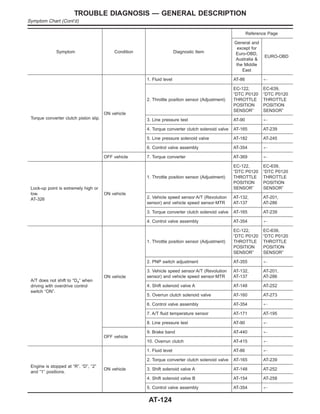
Symptom Chart........................................................ 111
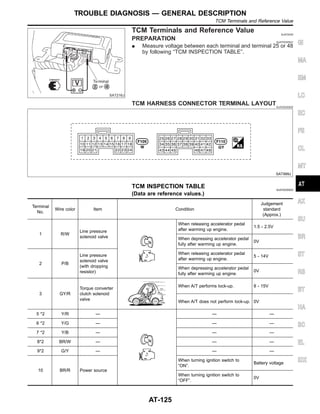
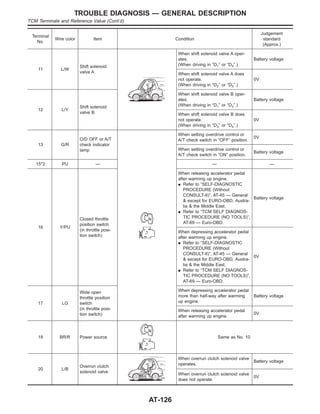
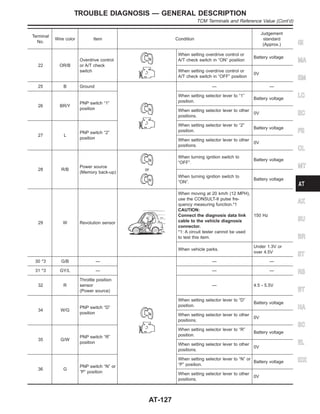
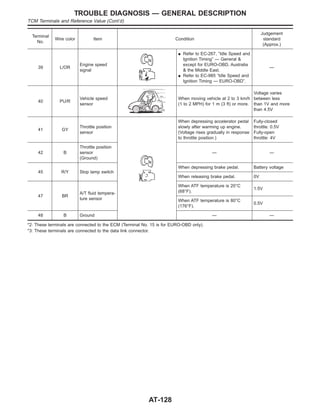
TCM Terminals and Reference Value......................125
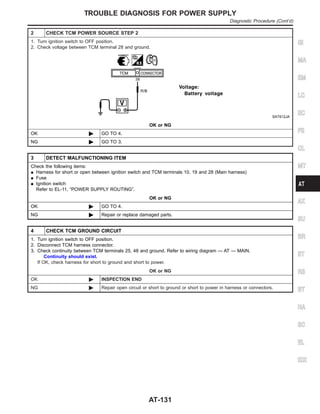
TROUBLE DIAGNOSIS FOR POWER SUPPLY........129
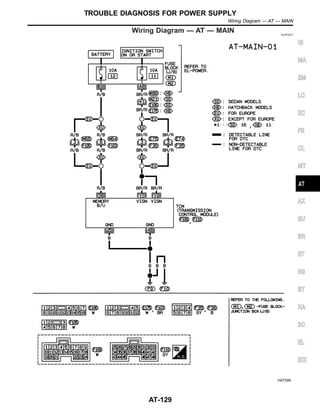
Wiring Diagram - AT - MAIN....................................129
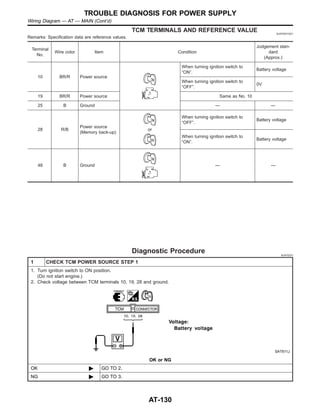
Diagnostic Procedure ..............................................130
GI
MA
EM
LC
EC
FE
CL
MT
AX
SU
BR
ST
RS
BT
HA
SC
EL
IDX
GEN&EXC. F/EURO-OBD, AUS&ME
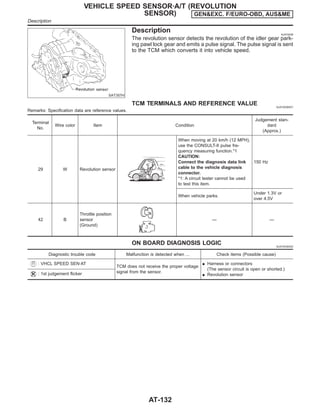
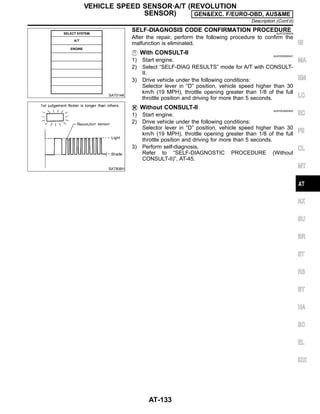
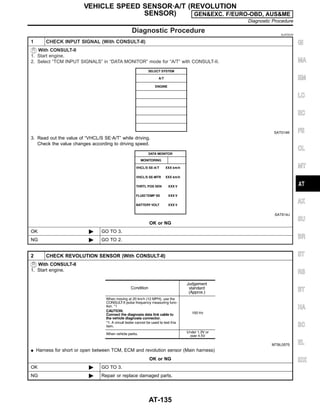
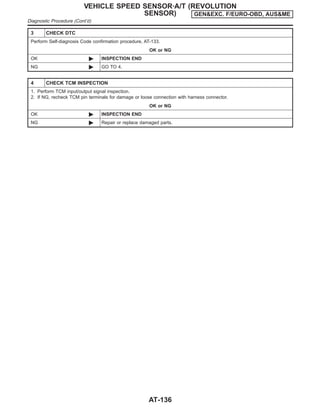
VEHICLE SPEED SENSOR.A/T (REVOLUTION
SENSOR) .....................................................................132
Description...............................................................132
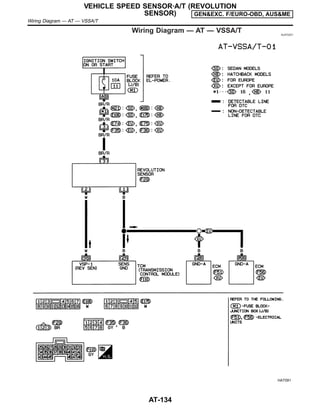
Wiring Diagram - AT - VSSA/T................................134
Diagnostic Procedure ..............................................135
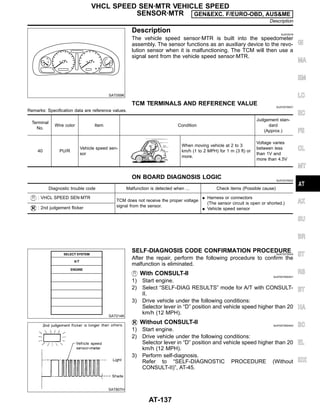
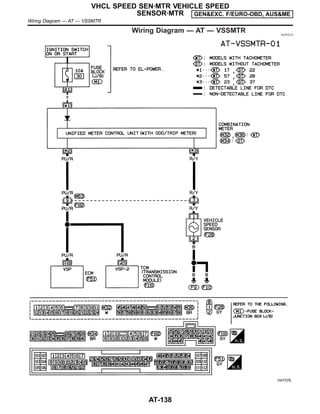
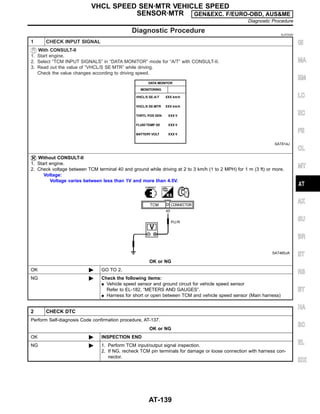
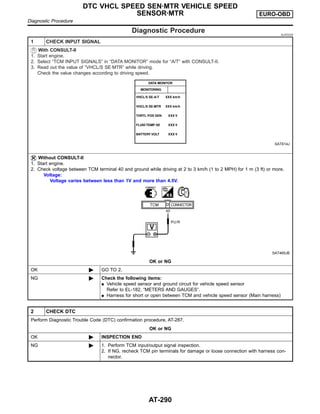
VHCL SPEED SEN.MTR VEHICLE SPEED
SENSOR·MTR..............................................................137
Description...............................................................137
Wiring Diagram - AT - VSSMTR..............................138
Diagnostic Procedure ..............................................139
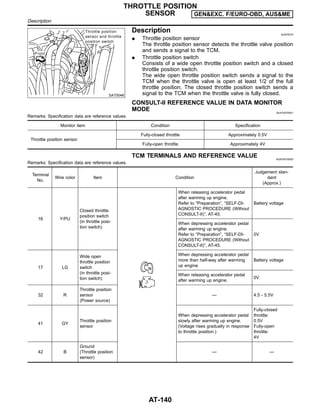
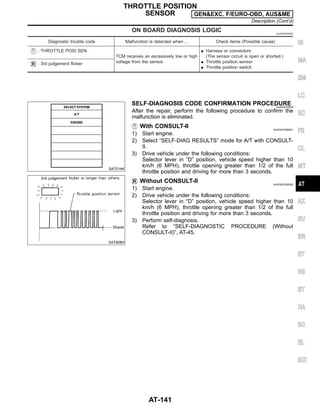
THROTTLE POSITION SENSOR................................140
Description...............................................................140
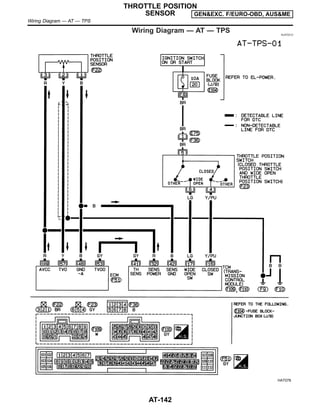
Wiring Diagram - AT - TPS......................................142
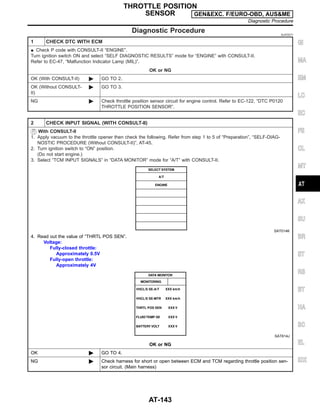
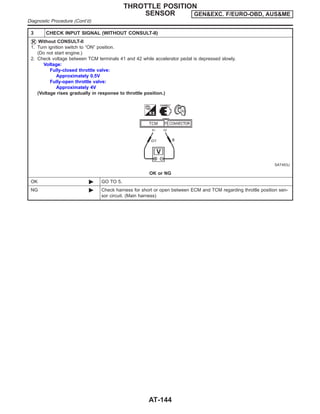
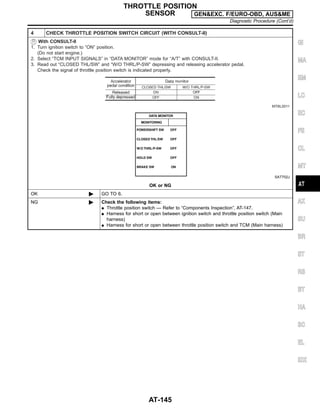
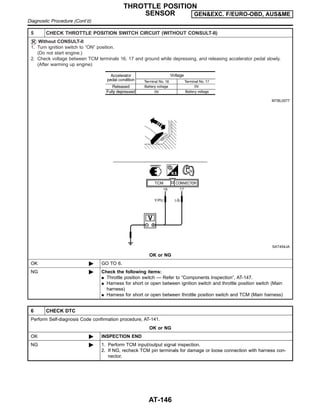
Diagnostic Procedure ..............................................143
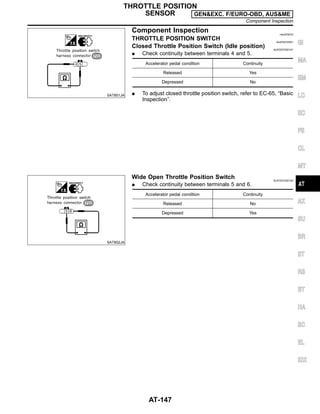
Component Inspection.............................................147
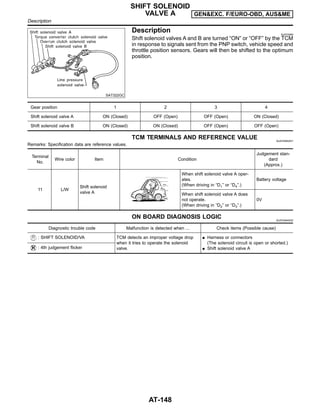
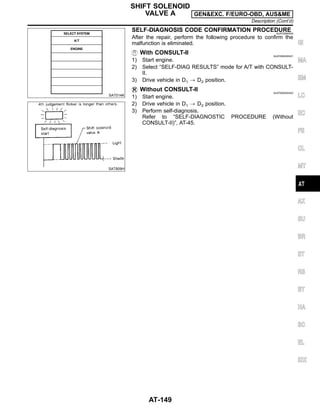
SHIFT SOLENOID VALVE A.......................................148
Description...............................................................148
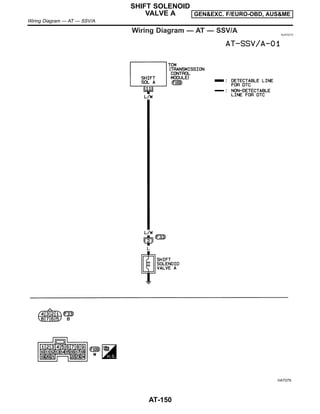
Wiring Diagram - AT - SSV/A ..................................150
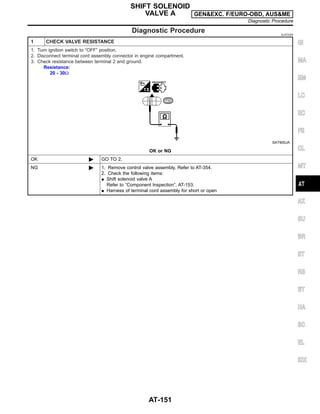
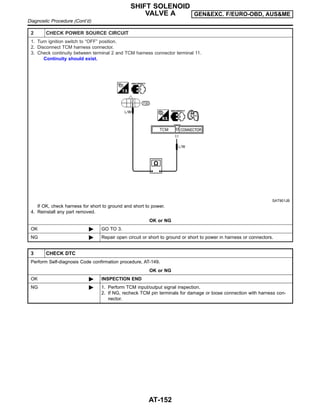
Diagnostic Procedure ..............................................151
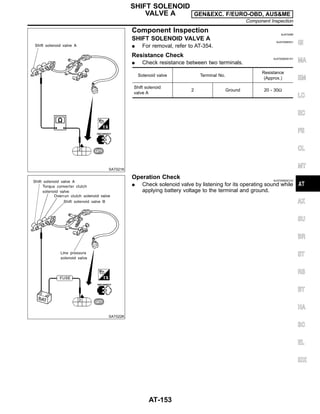
Component Inspection.............................................153
SHIFT SOLENOID VALVE B ......................................154
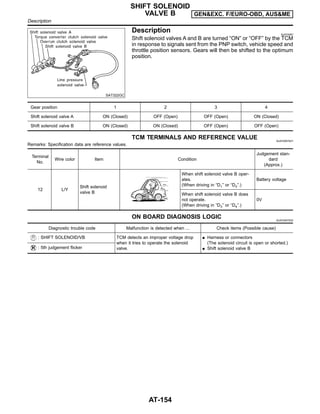
Description...............................................................154
Wiring Diagram - AT - SSV/B ..................................156
Diagnostic Procedure ..............................................157
Component Inspection.............................................159
OVERRUN CLUTCH SOLENOID VALVE...................160
Description...............................................................160
Wiring Diagram - AT - OVRCSV..............................161
Diagnostic Procedure ..............................................162
Component Inspection.............................................164
TORQUE CONVERTER CLUTCH SOLENOID
VALVE..........................................................................165
Description...............................................................165
Wiring Diagram - AT - TCV......................................167
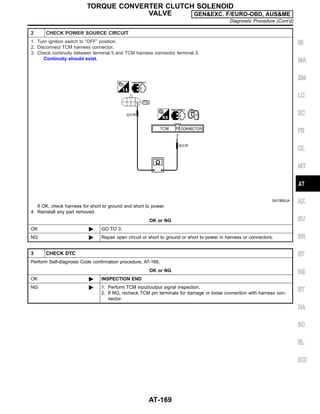
Diagnostic Procedure ..............................................168
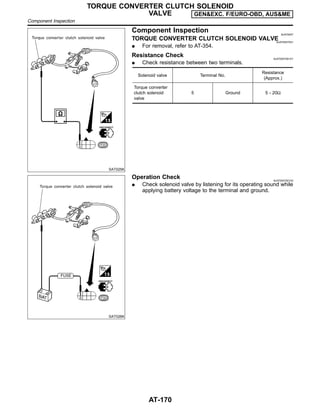
Component Inspection.............................................170
BATT/FLUID TEMP SEN (A/T FLUID TEMP
SENSOR CIRCUIT AND TCM POWER SOURCE)....171
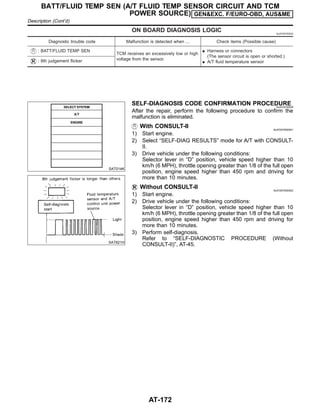
Description...............................................................171
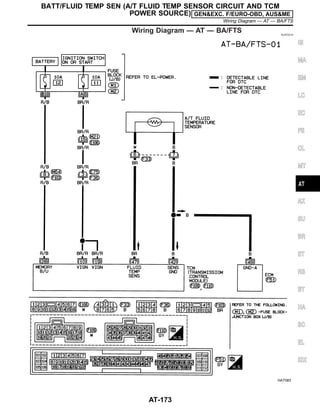
Wiring Diagram - AT - BA/FTS ................................173
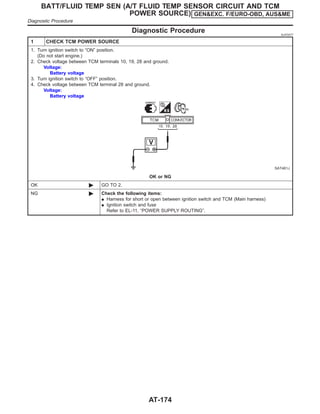
Diagnostic Procedure ..............................................174
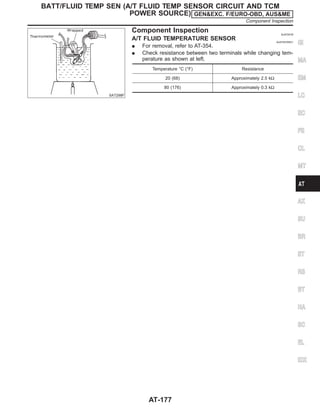
Component Inspection.............................................177
ENGINE SPEED SIGNAL............................................178
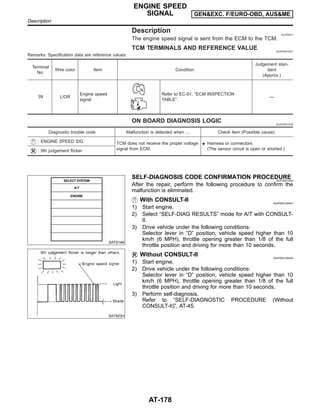
Description...............................................................178
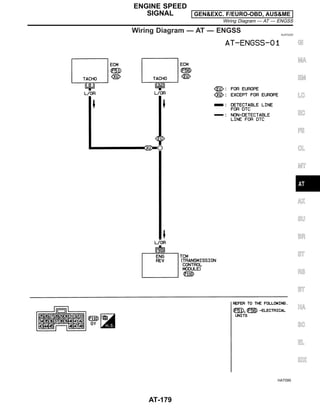
Wiring Diagram - AT - ENGSS ................................179
Diagnostic Procedure ..............................................180
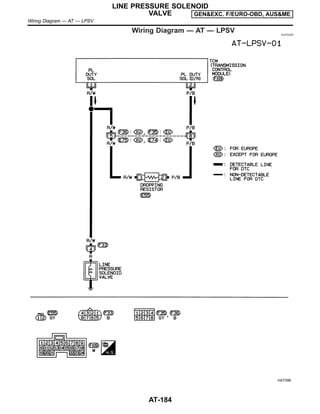
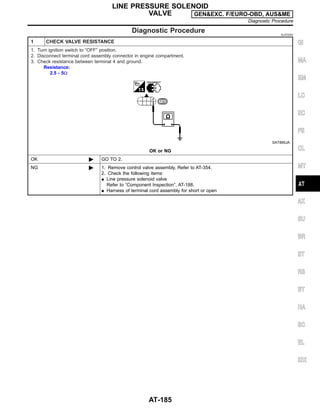
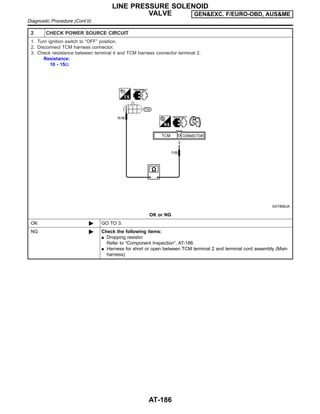
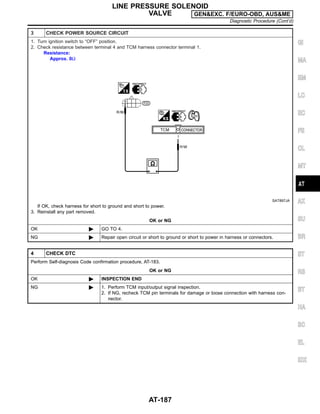
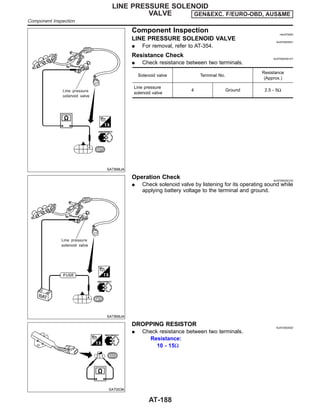
LINE PRESSURE SOLENOID VALVE .......................182
Description...............................................................182
Wiring Diagram - AT - LPSV....................................184
Diagnostic Procedure ..............................................185
Component Inspection.............................................188
EURO-OBD
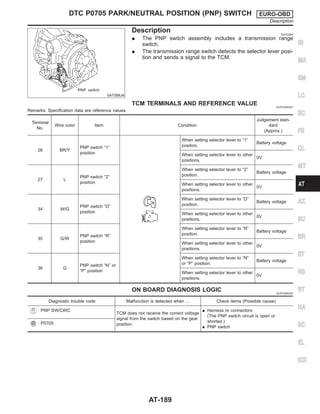
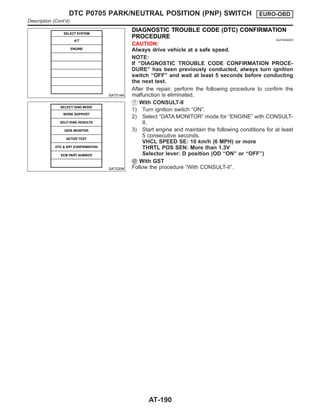
DTC P0705 PARK/NEUTRAL POSITION (PNP)
SWITCH .......................................................................189
Description...............................................................189
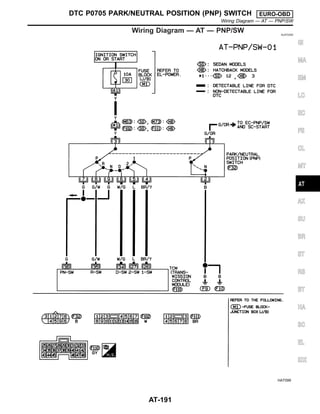
Wiring Diagram - AT - PNP/SW...............................191
Diagnostic Procedure ..............................................192
Component Inspection.............................................194
DTC P0710 A/T FLUID TEMPERATURE SENSOR
CIRCUIT.......................................................................195
Description...............................................................195
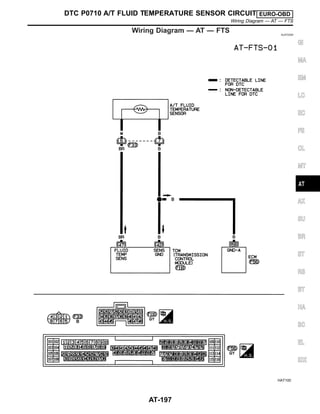
Wiring Diagram - AT - FTS......................................197
Diagnostic Procedure ..............................................198
Component Inspection.............................................200
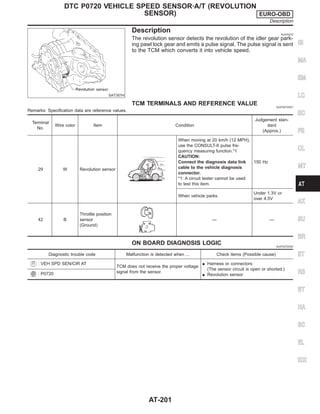
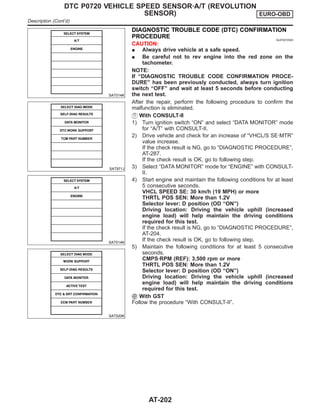
DTC P0720 VEHICLE SPEED SENSOR.A/T
(REVOLUTION SENSOR) ...........................................201
Description...............................................................201
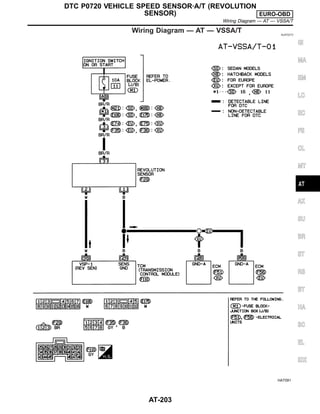
Wiring Diagram - AT - VSSA/T................................203
Diagnostic Procedure ..............................................204
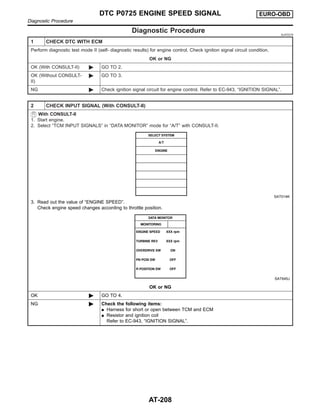
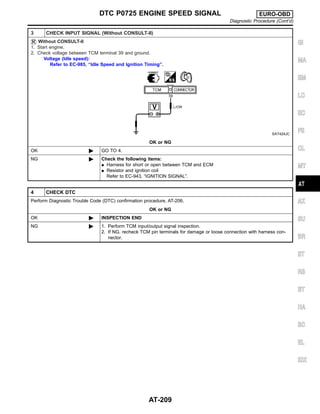
DTC P0725 ENGINE SPEED SIGNAL .......................206
Description...............................................................206
Wiring Diagram - AT - ENGSS ................................207
Diagnostic Procedure ..............................................208
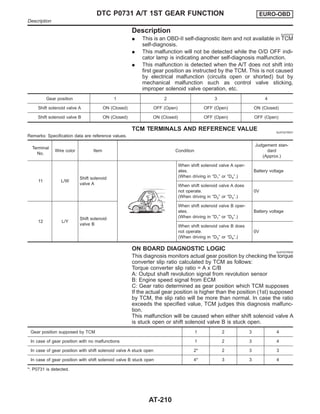
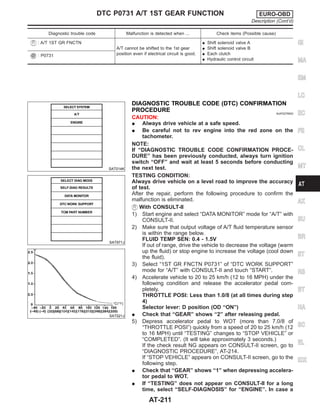
DTC P0731 A/T 1ST GEAR FUNCTION ....................210
Description...............................................................210
Wiring Diagram - AT - 1ST ......................................213
Diagnostic Procedure ..............................................214
Component Inspection.............................................215
DTC P0732 A/T 2ND GEAR FUNCTION....................217
Description...............................................................217
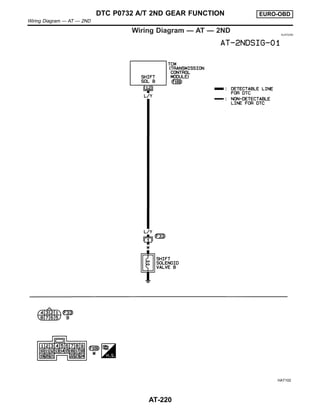
Wiring Diagram - AT - 2ND......................................220
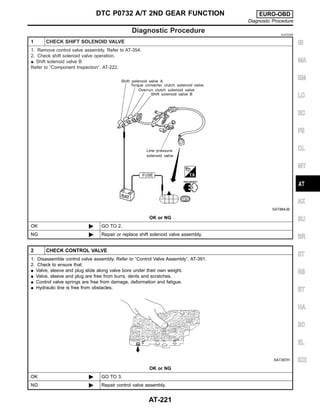
Diagnostic Procedure ..............................................221
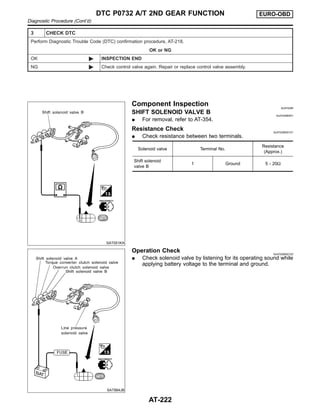
Component Inspection.............................................222
DTC P0733 A/T 3RD GEAR FUNCTION....................223
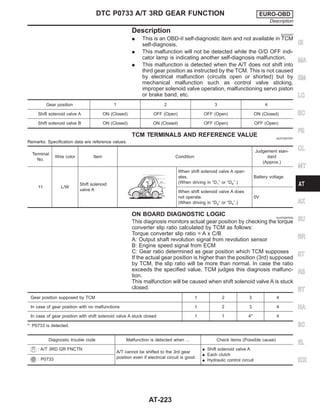
Description...............................................................223
Wiring Diagram - AT - 3RD......................................226
Diagnostic Procedure ..............................................227
Component Inspection.............................................228
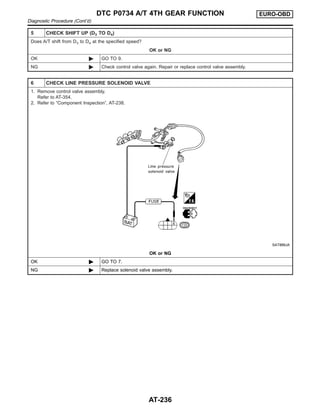
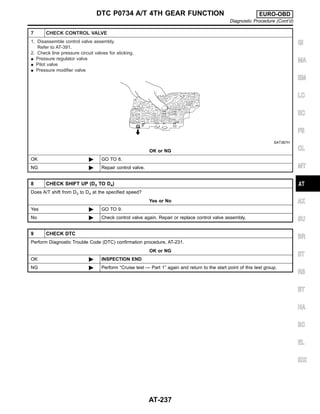
DTC P0734 A/T 4TH GEAR FUNCTION ....................229
Description...............................................................229
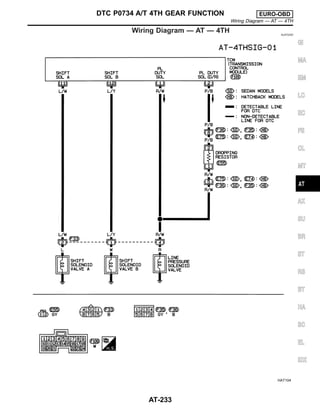
Wiring Diagram - AT - 4TH......................................233
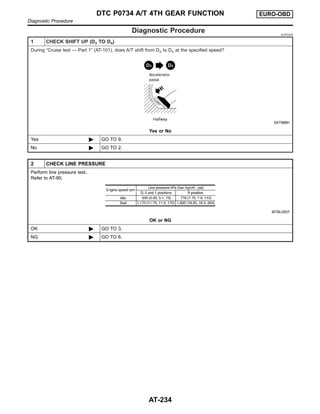
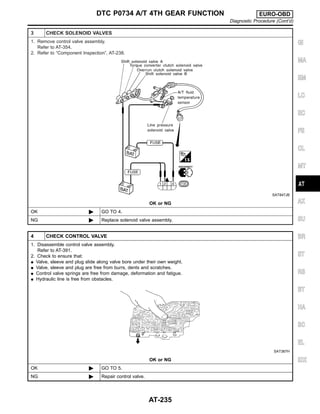
Diagnostic Procedure ..............................................234
Component Inspection.............................................238
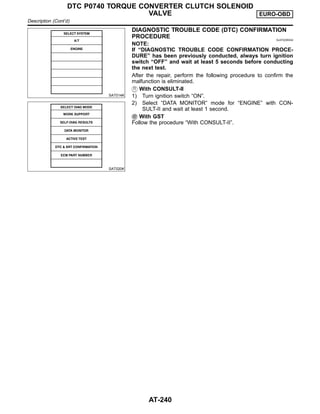
DTC P0740 TORQUE CONVERTER CLUTCH
SOLENOID VALVE).....................................................239
Description...............................................................239
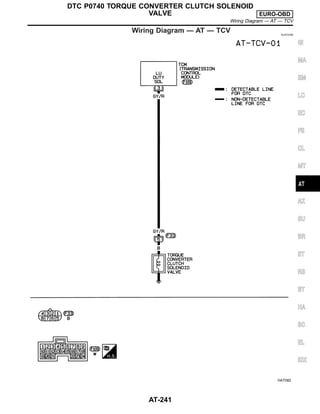
Wiring Diagram - AT - TCV......................................241
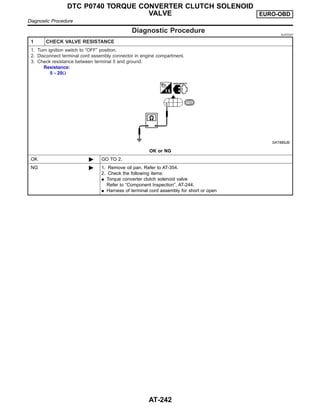
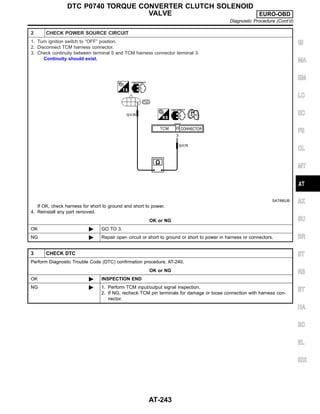
Diagnostic Procedure ..............................................242
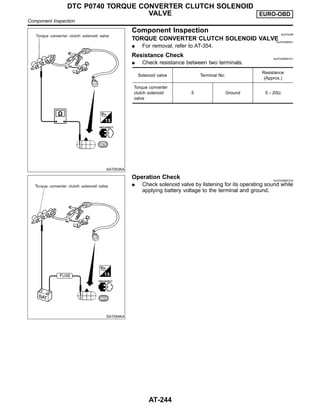
Component Inspection.............................................244
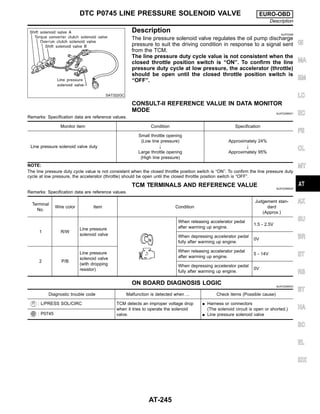
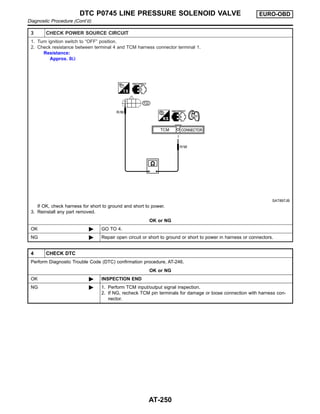
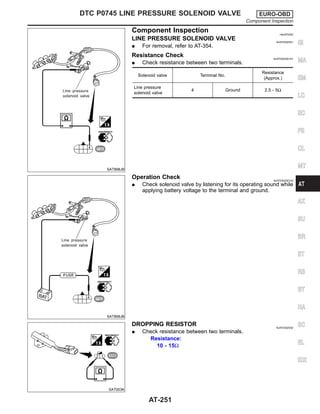
DTC P0745 LINE PRESSURE SOLENOID VALVE ...245
Description...............................................................245
Wiring Diagram - AT - LPSV....................................247
Diagnostic Procedure ..............................................248
CONTENTS (Cont’d)
AT-2
Component Inspection.............................................251
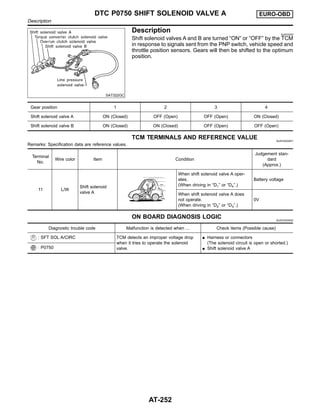
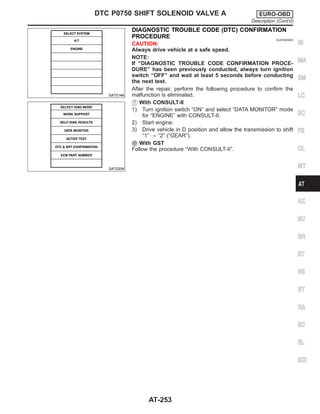
DTC P0750 SHIFT SOLENOID VALVE A ..................252
Description...............................................................252
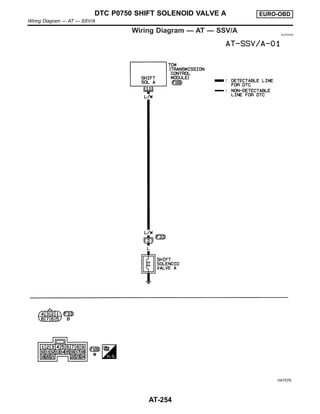
Wiring Diagram - AT - SSV/A ..................................254
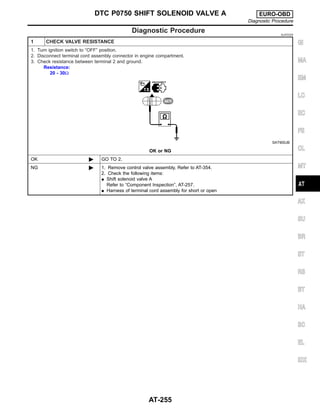
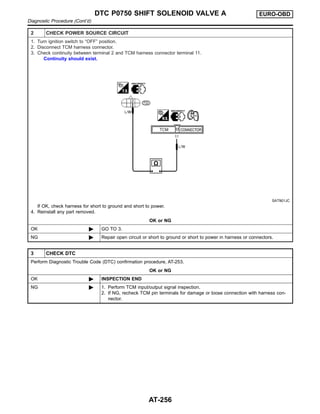
Diagnostic Procedure ..............................................255
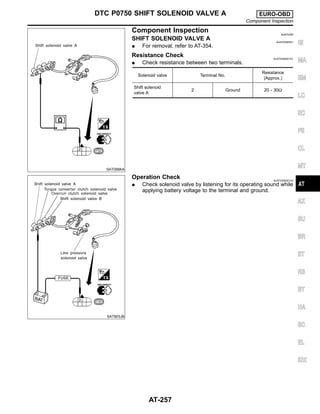
Component Inspection.............................................257
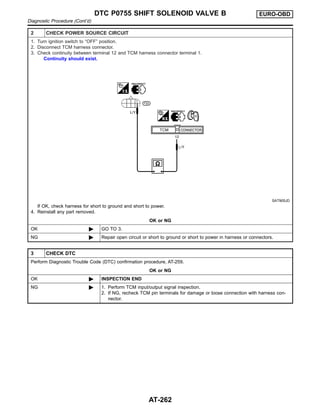
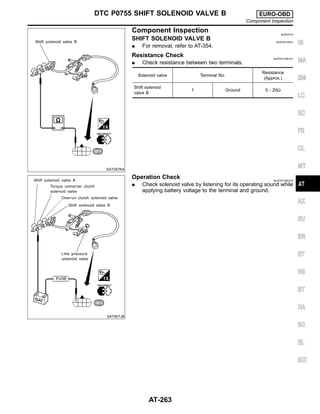
DTC P0755 SHIFT SOLENOID VALVE B ..................258
Description...............................................................258
Wiring Diagram - AT - SSV/B ..................................260
Diagnostic Procedure ..............................................261
Component Inspection.............................................263
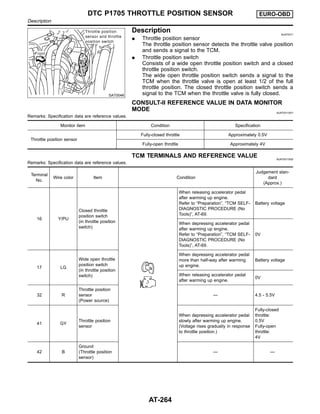
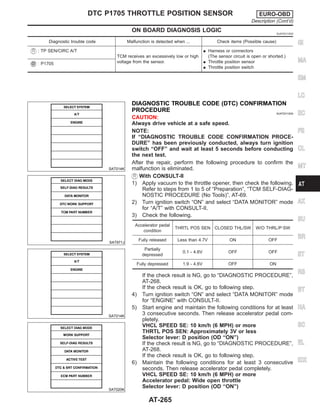
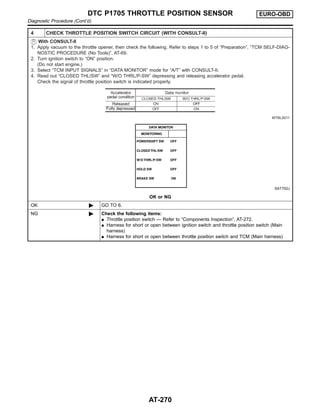
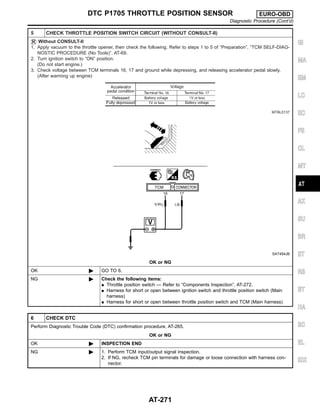
DTC P1705 THROTTLE POSITION SENSOR ...........264
Description...............................................................264
Wiring Diagram - AT - TPS......................................267
Diagnostic Procedure ..............................................268
Component Inspection.............................................272
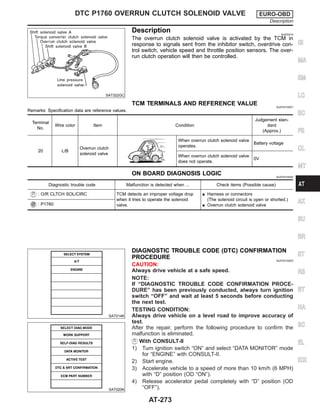
DTC P1760 OVERRUN CLUTCH SOLENOID
VALVE..........................................................................273
Description...............................................................273
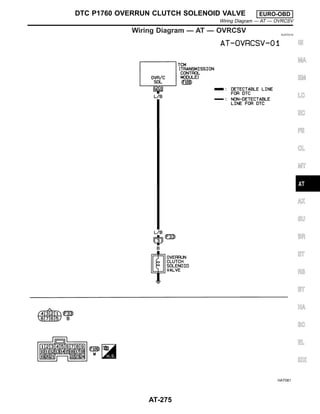
Wiring Diagram - AT - OVRCSV..............................275
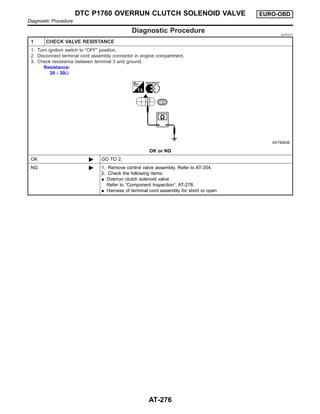
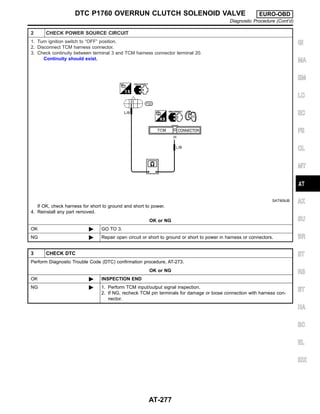
Diagnostic Procedure ..............................................276
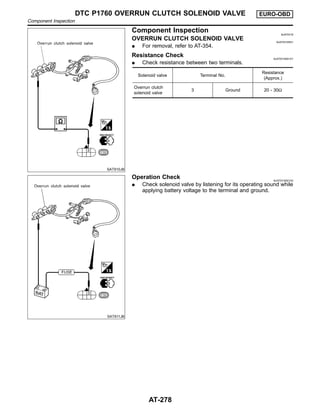
Component Inspection.............................................278
DTC BATT/FLUID TEMP SEN (A/T FLUID TEMP
SENSOR CIRCUIT AND TCM POWER SOURCE)....279
Description...............................................................279
Wiring Diagram - AT - BA/FTS ................................281
Diagnostic Procedure ..............................................282
Component Inspection.............................................285
DTC VHCL SPEED SEN.MTR VEHICLE SPEED
SENSOR·MTR..............................................................286
Description...............................................................286
Wiring Diagram - AT - VSSMTR..............................288
Diagnostic Procedure ..............................................290
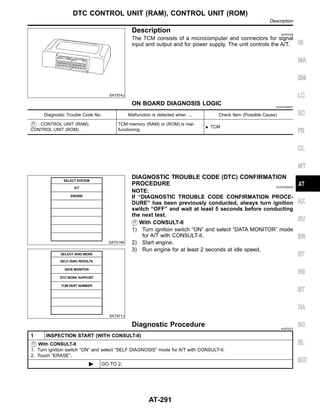
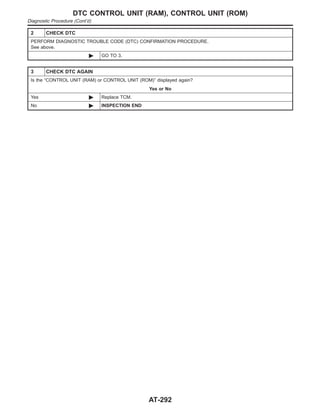
DTC CONTROL UNIT (RAM), CONTROL UNIT
(ROM)...........................................................................291
Description...............................................................291
Diagnostic Procedure ..............................................291
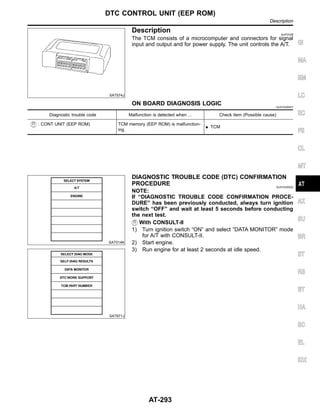
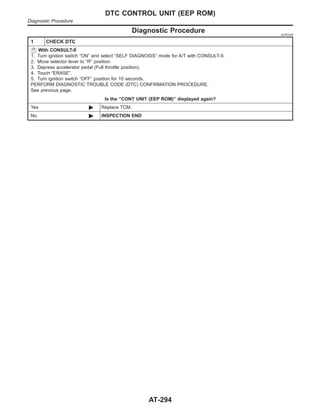
DTC CONTROL UNIT (EEP ROM) .............................293
Description...............................................................293
Diagnostic Procedure ..............................................294
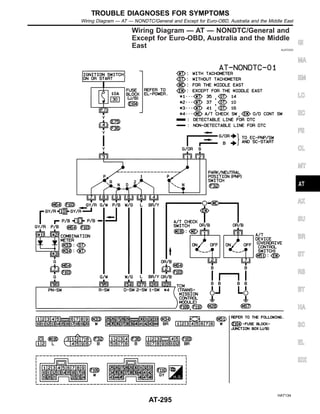
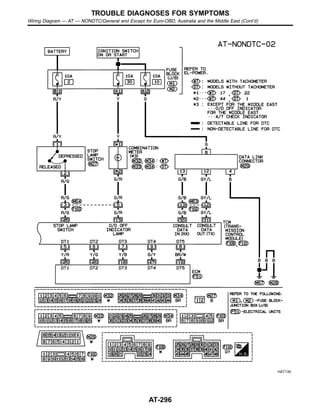
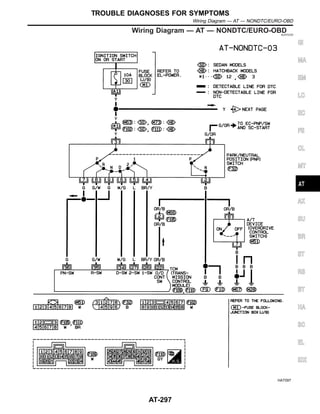
TROUBLE DIAGNOSES FOR SYMPTOMS...............295
Wiring Diagram - AT - NONDTC/General and
Except for Euro-OBD, Australia and the Middle
East..........................................................................295
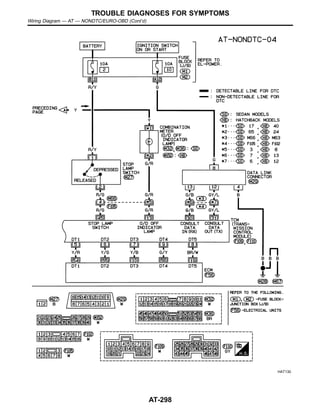
Wiring Diagram - AT - NONDTC/EURO-OBD.........297
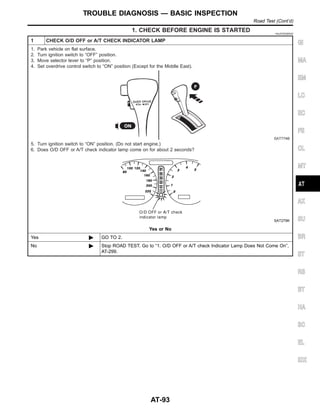
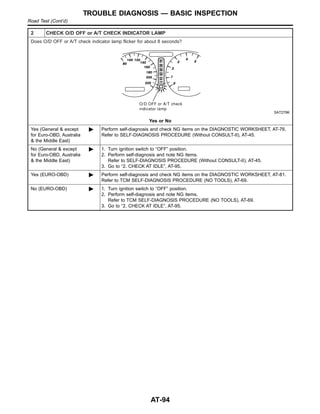
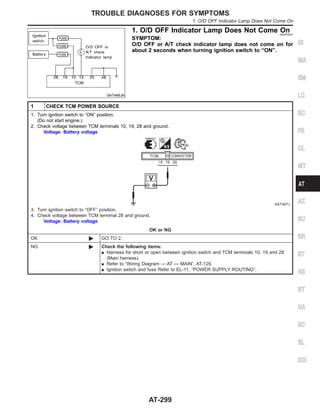
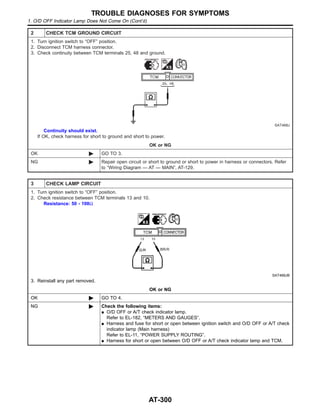
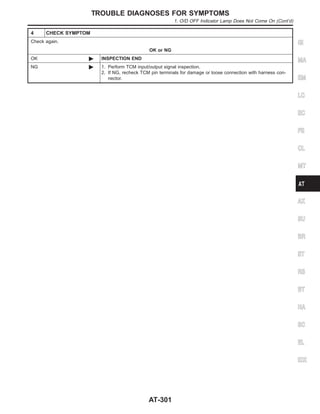
1. O/D OFF Indicator Lamp Does Not Come On....299
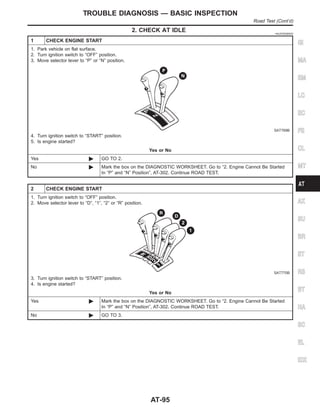
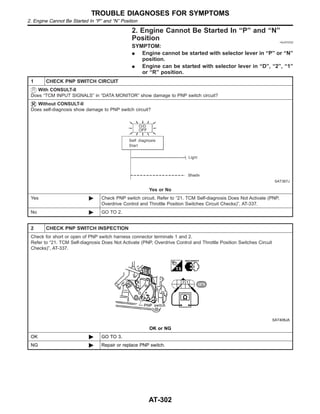
2. Engine Cannot Be Started In ″P″ and ″N″
Position ....................................................................302
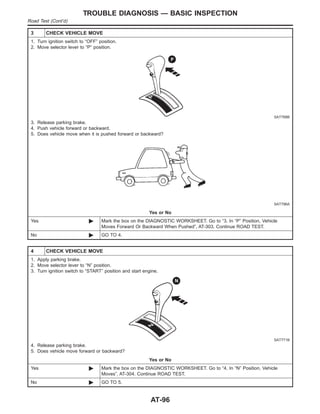
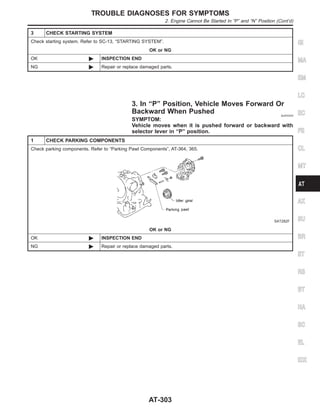
3. In ″P″ Position, Vehicle Moves Forward Or
Backward When Pushed .........................................303
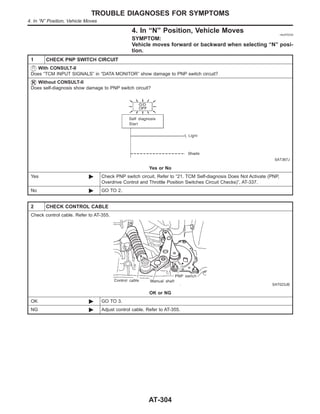
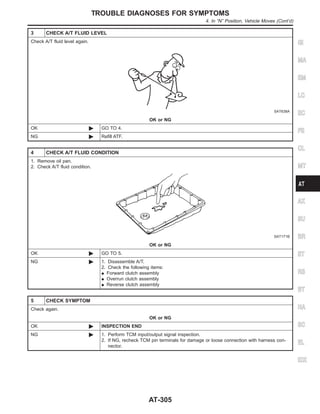
4. In ″N″ Position, Vehicle Moves ...........................304
5. Large Shock. ″N″ -> ″R″ Position .......................306
6. Vehicle Does Not Creep Backward In ″R″
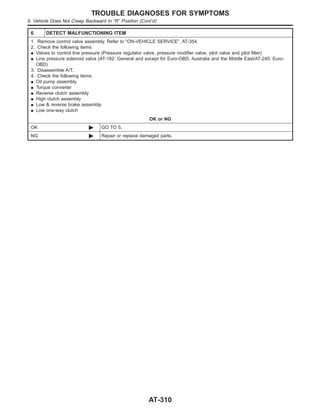
Position ....................................................................308
7. Vehicle Does Not Creep Forward In ″D″, ″2″
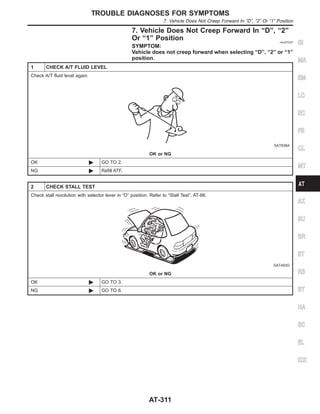
Or ″1″ Position.........................................................311
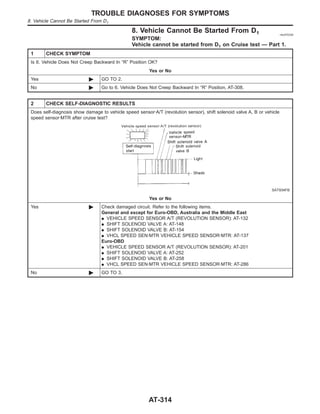
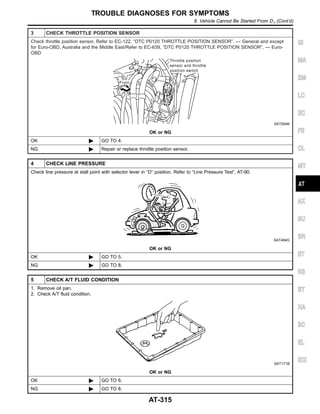
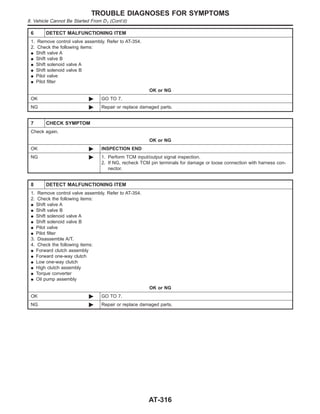
8. Vehicle Cannot Be Started From D1 ...................314
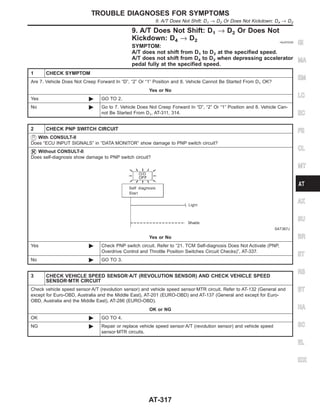
9. A/T Does Not Shift: D1 -> D2 Or Does Not
Kickdown: D4 -> D2..................................................317
10. A/T Does Not Shift: D2 -> D3.............................320
11. A/T Does Not Shift: D3 -> D4.............................323
12. A/T Does Not Perform Lock-up.........................326
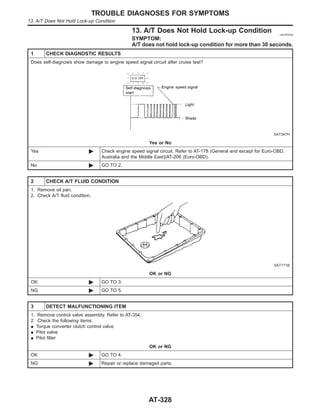
13. A/T Does Not Hold Lock-up Condition..............328
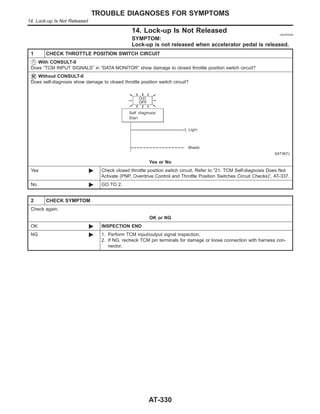
14. Lock-up Is Not Released...................................330
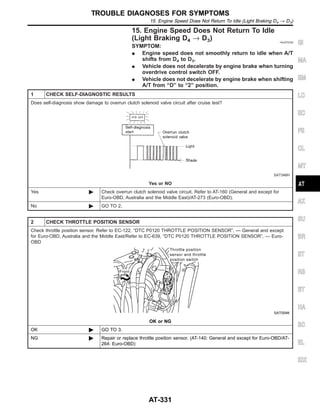
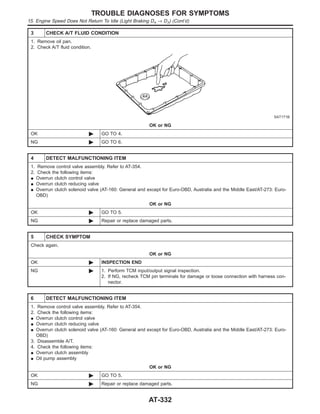
15. Engine Speed Does Not Return To Idle (Light
Braking D4 -> D3).....................................................331
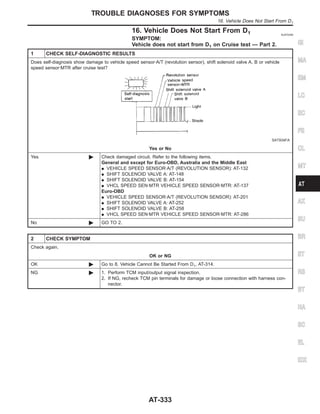
16. Vehicle Does Not Start From D1 .......................333
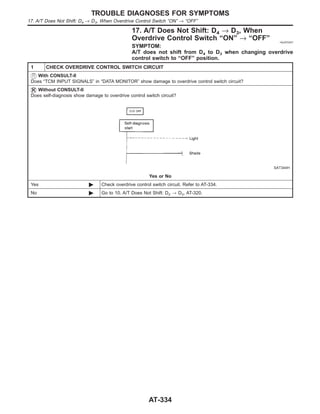
17. A/T Does Not Shift: D4 -> D3, When
Overdrive Control Switch ″ON″ -> ″OFF″ ...............334
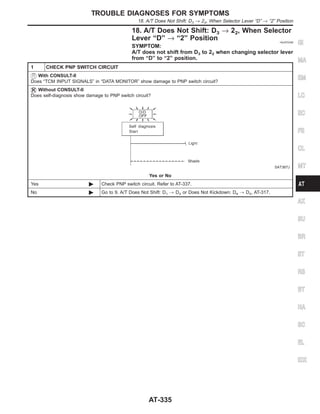
18. A/T Does Not Shift: D3 -> 22, When Selector
Lever ″D″ -> ″2″ Position.........................................335
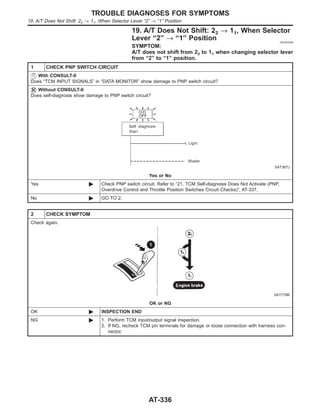
19. A/T Does Not Shift: 22 -> 11, When Selector
Lever ″2″ -> ″1″ Position .........................................336
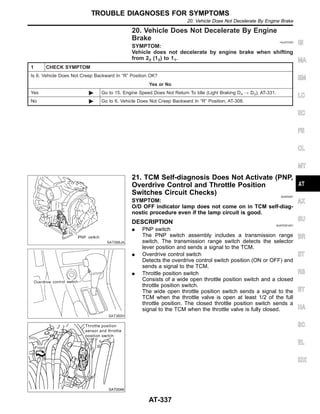
20. Vehicle Does Not Decelerate By Engine
Brake........................................................................337
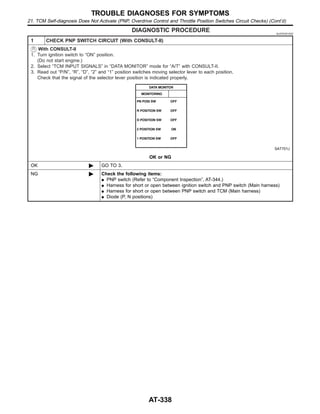
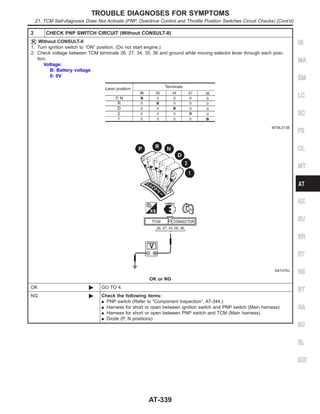
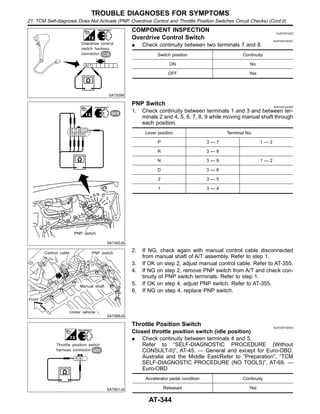
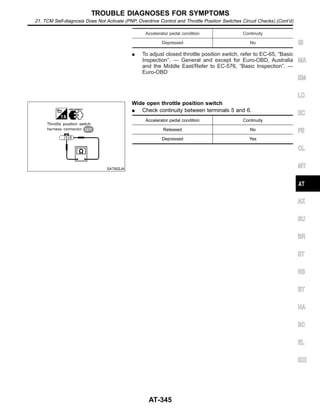
21. TCM Self-diagnosis Does Not Activate (PNP,
Overdrive Control and Throttle Position Switches
Circuit Checks) ........................................................337
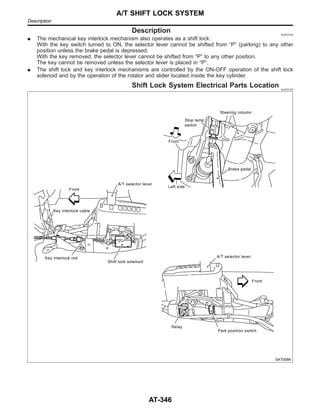
A/T SHIFT LOCK SYSTEM.........................................346
Description...............................................................346
Shift Lock System Electrical Parts Location............346
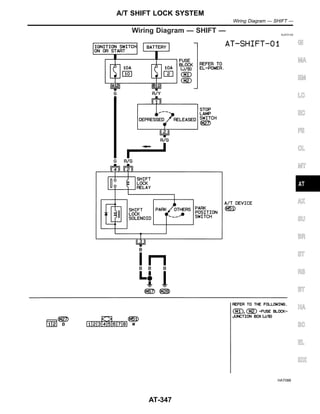
Wiring Diagram - SHIFT -........................................347
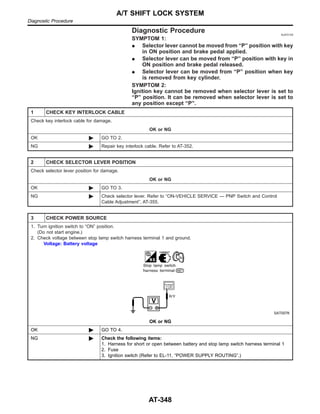
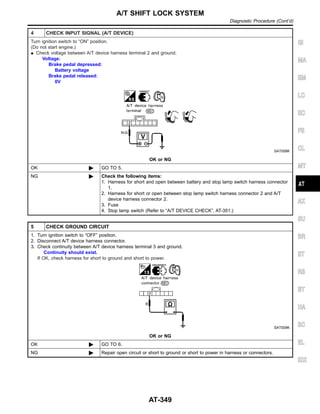
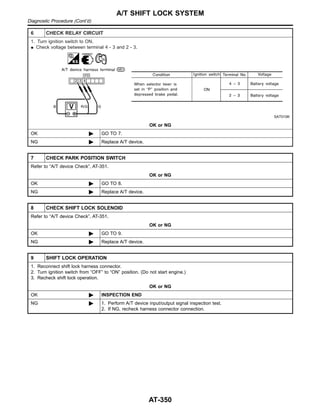
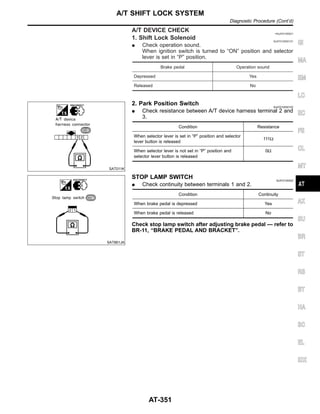
Diagnostic Procedure ..............................................348
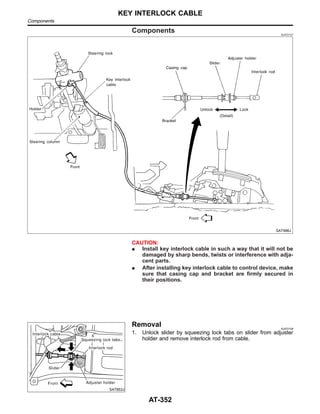
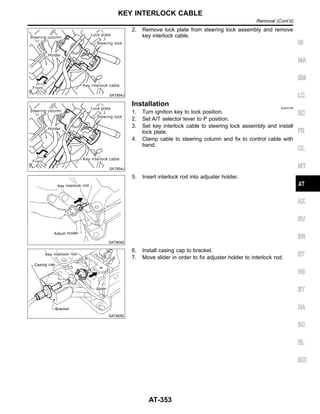
KEY INTERLOCK CABLE ..........................................352
Components.............................................................352
Removal...................................................................352
Installation................................................................353
ON-VEHICLE SERVICE ..............................................354
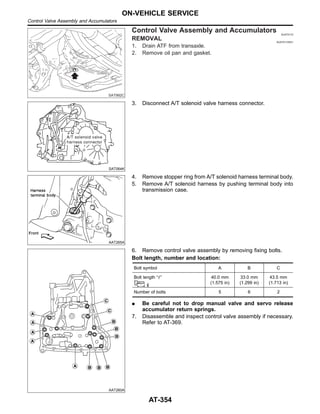
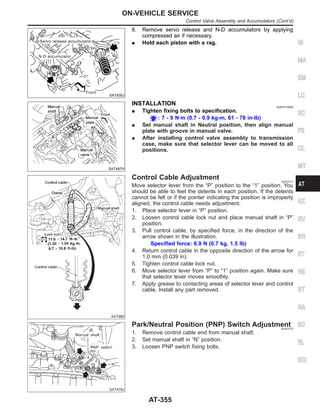
Control Valve Assembly and Accumulators.............354
Control Cable Adjustment........................................355
Park/Neutral Position (PNP) Switch Adjustment .....355
Differential Side Oil Seal Replacement...................356
Revolution Sensor Replacement.............................356
REMOVAL AND INSTALLATION...............................357
Removal...................................................................357
Installation................................................................358
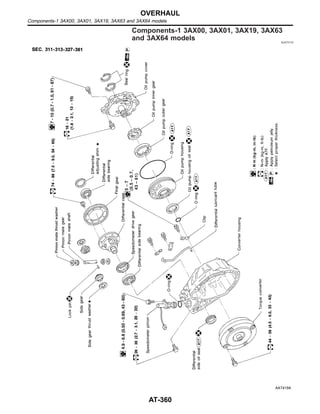
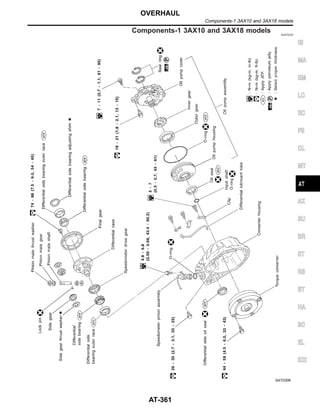
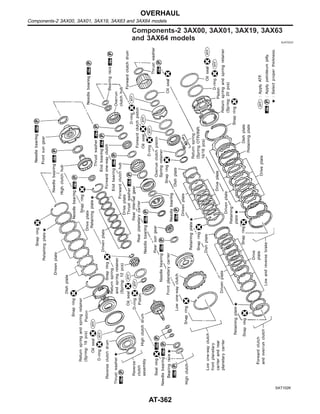
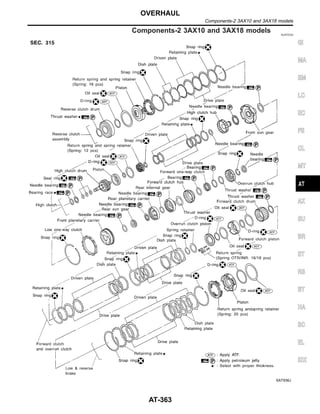
OVERHAUL .................................................................360
Components-1 3AX00, 3AX01, 3AX19, 3AX63
and 3AX64 models ..................................................360
Components-1 3AX10 and 3AX18 models .............361
Components-2 3AX00, 3AX01, 3AX19, 3AX63
and 3AX64 models ..................................................362
Components-2 3AX10 and 3AX18 models .............363
GI
MA
EM
LC
EC
FE
CL
MT
AX
SU
BR
ST
RS
BT
HA
SC
EL
IDX
CONTENTS (Cont’d)
AT-3
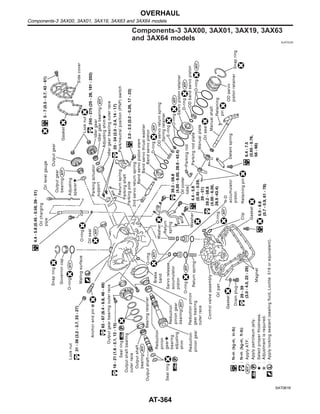
Components-3 3AX00, 3AX01, 3AX19, 3AX63
and 3AX64 models ..................................................364
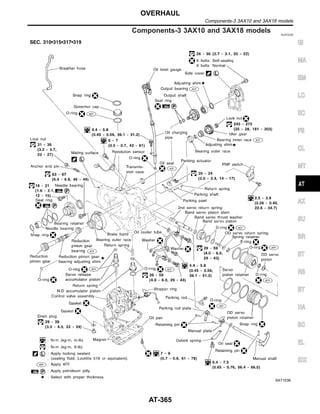
Components-3 3AX10 and 3AX18 models .............365
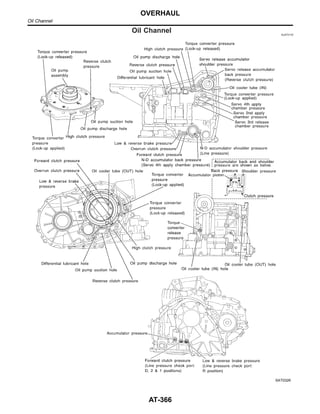
Oil Channel..............................................................366
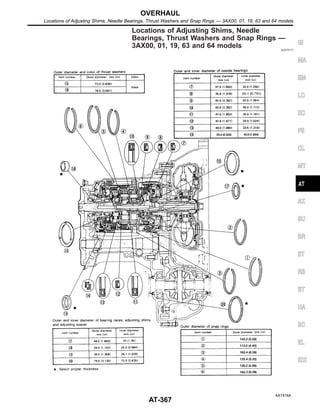
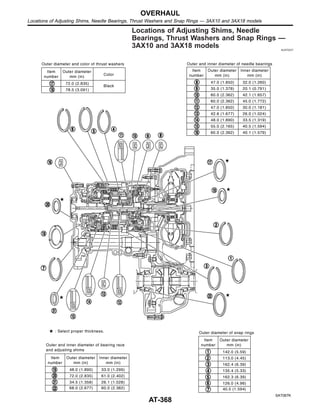
Locations of Adjusting Shims, Needle Bearings,
Thrust Washers and Snap Rings - 3AX00, 01,
19, 63 and 64 models..............................................367
Locations of Adjusting Shims, Needle Bearings,
Thrust Washers and Snap Rings - 3AX10 and
3AX18 models .........................................................368
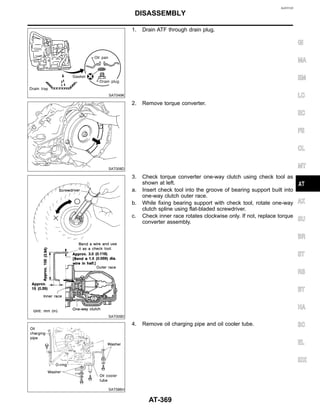
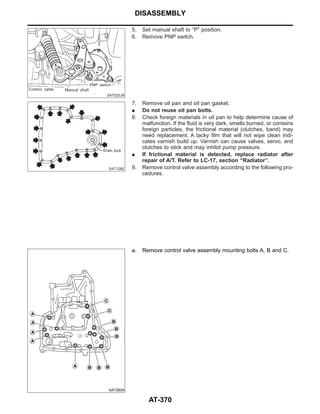
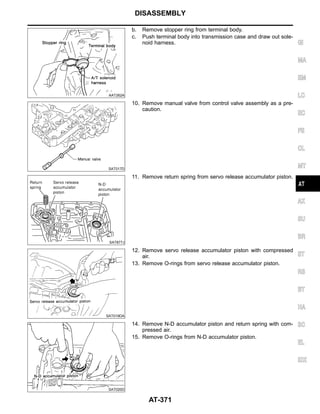
DISASSEMBLY............................................................369
REPAIR FOR COMPONENT PARTS .........................384
Manual Shaft............................................................384
Oil Pump..................................................................387
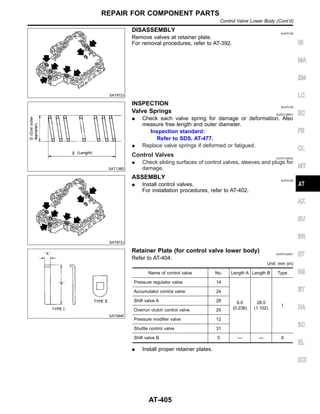
Control Valve Assembly...........................................391
Control Valve Upper Body.......................................400
Control Valve Lower Body.......................................404
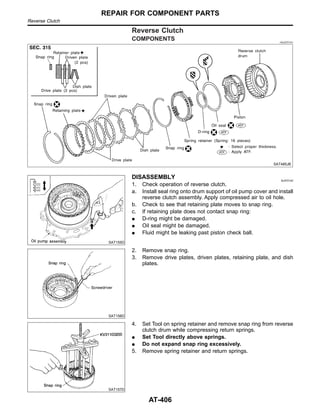
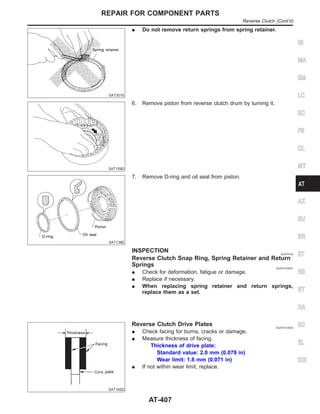
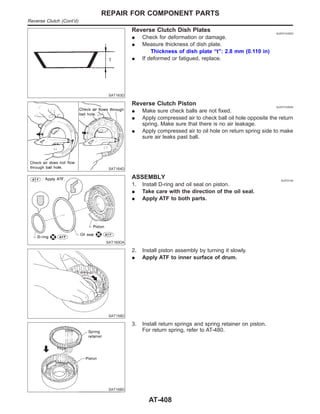
Reverse Clutch ........................................................406
High Clutch ..............................................................410
Forward Clutch and Overrun Clutch........................415
Low & Reverse Brake..............................................422
Rear Internal Gear, Forward Clutch Hub and
Overrun Clutch Hub.................................................426
O/Shaft, O/Gear, I/Gear, R/Pinion Gear and B/
Retainer - 3AX00, 01, 19, 63 and 64 models .........430
Output Shaft, Idler Gear, Reduction Pinion Gear
and Bearing Retainer - 3AX10 and 3AX18
models .....................................................................435
Band Servo Piston Assembly ..................................440
Final Drive................................................................445
ASSEMBLY..................................................................449
Assembly (1)............................................................449
Adjustment (1) .........................................................450
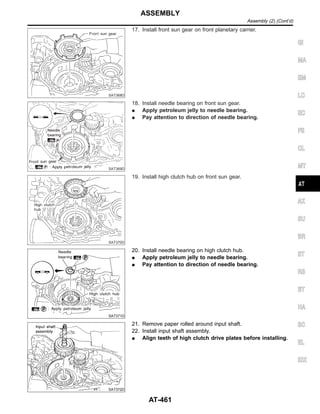
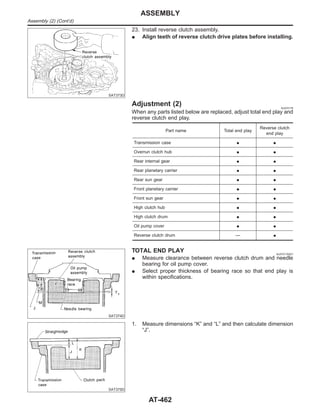
Assembly (2)............................................................458
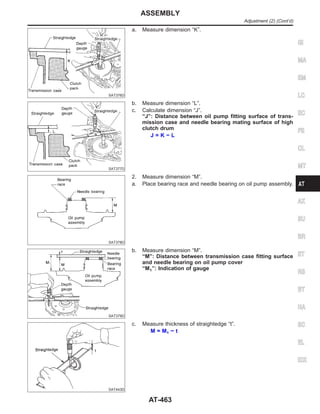
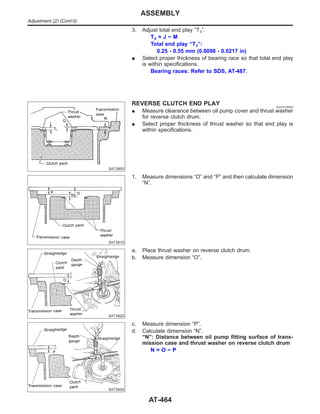
Adjustment (2) .........................................................462
Assembly (3)............................................................465
Assembly (4)............................................................468
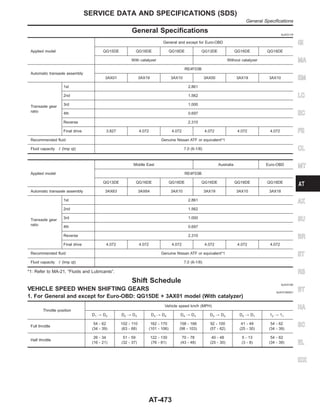
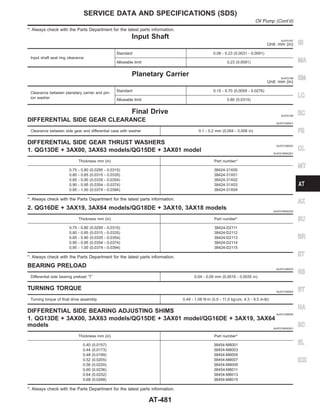
SERVICE DATA AND SPECIFICATIONS (SDS) .......473
General Specifications.............................................473
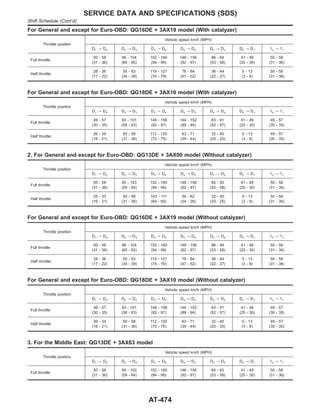
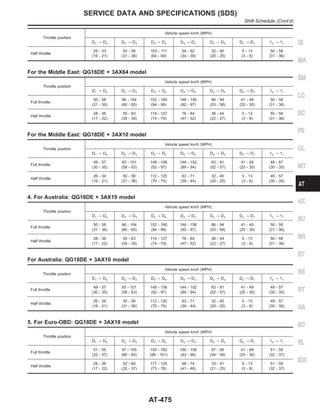
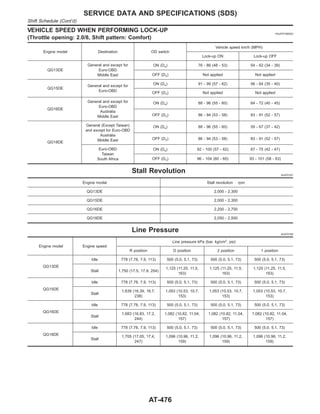
Shift Schedule..........................................................473
Stall Revolution........................................................476
Line Pressure...........................................................476
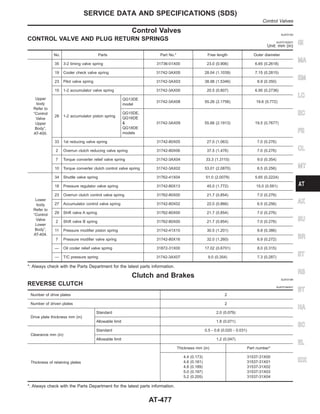
Control Valves..........................................................477
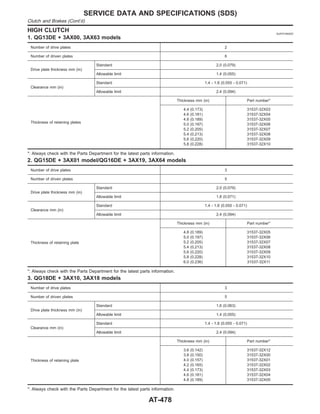
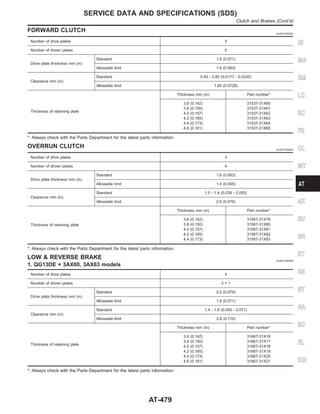
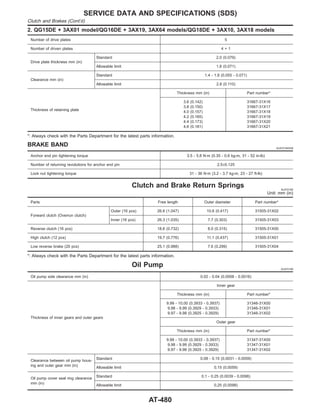
Clutch and Brakes ...................................................477
Clutch and Brake Return Springs............................480
Oil Pump..................................................................480
Input Shaft ...............................................................481
Planetary Carrier......................................................481
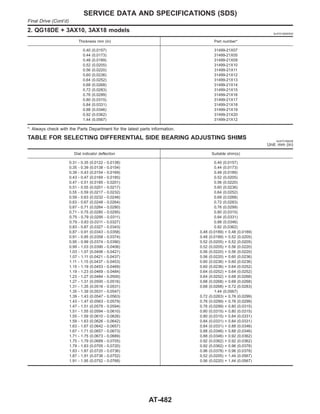
Final Drive................................................................481
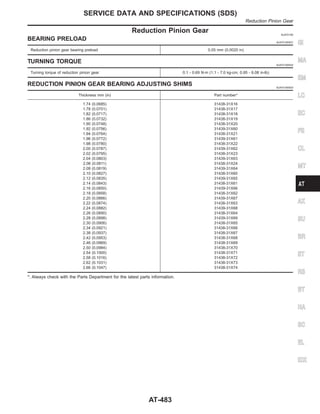
Reduction Pinion Gear ............................................483
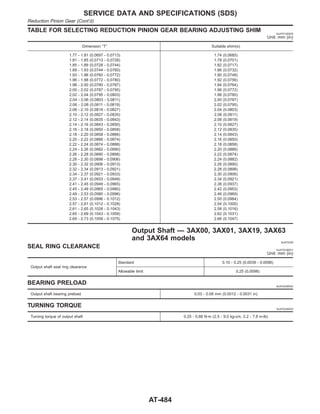
Output Shaft - 3AX00, 3AX01, 3AX19, 3AX63
and 3AX64 models ..................................................484
Output Shaft - 3AX10 and 3AX18 models ..............486
Bearing Retainer......................................................487
Total End Play..........................................................487
Reverse Clutch End Play ........................................487
Accumulator.............................................................487
Band Servo..............................................................488
Removal and Installation .........................................488
Shift Solenoid Valves...............................................488
Solenoid Valves .......................................................488
A/T Fluid Temperature Sensor.................................488
Revolution Sensor ...................................................488
Dropping Resistor....................................................488
CONTENTS (Cont’d)
AT-4
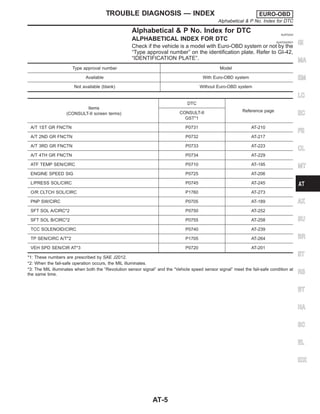
Alphabetical & P No. Index for DTC NJAT0243
ALPHABETICAL INDEX FOR DTC NJAT0243S01
Check if the vehicle is a model with Euro-OBD system or not by the
“Type approval number” on the identification plate. Refer to GI-42,
“IDENTIFICATION PLATE”.
Type approval number Model
Available With Euro-OBD system
Not available (blank) Without Euro-OBD system
Items
(CONSULT-II screen terms)
DTC
Reference page
CONSULT-II
GST*1
A/T 1ST GR FNCTN P0731 AT-210
A/T 2ND GR FNCTN P0732 AT-217
A/T 3RD GR FNCTN P0733 AT-223
A/T 4TH GR FNCTN P0734 AT-229
ATF TEMP SEN/CIRC P0710 AT-195
ENGINE SPEED SIG P0725 AT-206
L/PRESS SOL/CIRC P0745 AT-245
O/R CLTCH SOL/CIRC P1760 AT-273
PNP SW/CIRC P0705 AT-189
SFT SOL A/CIRC*2 P0750 AT-252
SFT SOL B/CIRC*2 P0755 AT-258
TCC SOLENOID/CIRC P0740 AT-239
TP SEN/CIRC A/T*2 P1705 AT-264
VEH SPD SEN/CIR AT*3 P0720 AT-201
*1: These numbers are prescribed by SAE J2012.
*2: When the fail-safe operation occurs, the MIL illuminates.
*3: The MIL illuminates when both the “Revolution sensor signal” and the “Vehicle speed sensor signal” meet the fail-safe condition at
the same time.
GI
MA
EM
LC
EC
FE
CL
MT
AX
SU
BR
ST
RS
BT
HA
SC
EL
IDX
TROUBLE DIAGNOSIS — INDEX EURO-OBD
Alphabetical & P No. Index for DTC
AT-5
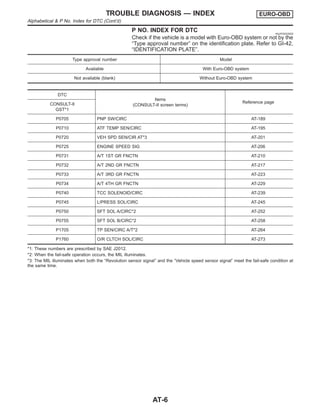
P NO. INDEX FOR DTC =NJAT0243S02
Check if the vehicle is a model with Euro-OBD system or not by the
“Type approval number” on the identification plate. Refer to GI-42,
“IDENTIFICATION PLATE”.
Type approval number Model
Available With Euro-OBD system
Not available (blank) Without Euro-OBD system
DTC
Items
(CONSULT-II screen terms)
Reference page
CONSULT-II
GST*1
P0705 PNP SW/CIRC AT-189
P0710 ATF TEMP SEN/CIRC AT-195
P0720 VEH SPD SEN/CIR AT*3 AT-201
P0725 ENGINE SPEED SIG AT-206
P0731 A/T 1ST GR FNCTN AT-210
P0732 A/T 2ND GR FNCTN AT-217
P0733 A/T 3RD GR FNCTN AT-223
P0734 A/T 4TH GR FNCTN AT-229
P0740 TCC SOLENOID/CIRC AT-239
P0745 L/PRESS SOL/CIRC AT-245
P0750 SFT SOL A/CIRC*2 AT-252
P0755 SFT SOL B/CIRC*2 AT-258
P1705 TP SEN/CIRC A/T*2 AT-264
P1760 O/R CLTCH SOL/CIRC AT-273
*1: These numbers are prescribed by SAE J2012.
*2: When the fail-safe operation occurs, the MIL illuminates.
*3: The MIL illuminates when both the “Revolution sensor signal” and the “Vehicle speed sensor signal” meet the fail-safe condition at
the same time.
TROUBLE DIAGNOSIS — INDEX EURO-OBD
Alphabetical & P No. Index for DTC (Cont’d)
AT-6
Supplemental Restraint System (SRS) “AIR
BAG” and “SEAT BELT PRE-TENSIONER” NJAT0249
The Supplemental Restraint System such as “AIR BAG” and “SEAT BELT PRE-TENSIONER” used along with
a seat belt, helps to reduce the risk or severity of injury to the driver and front passenger for certain types of
collision. The SRS system composition which is available to NISSAN MODEL N16 is as follows (The compo-
sition varies according to the destination and optional equipment.):
I For a frontal collision
The Supplemental Restraint System consists of driver air bag module (located in the center of the steer-
ing wheel), front passenger air bag module (located on the instrument panel on passenger side), front seat
belt pre-tensioners, a diagnosis sensor unit, warning lamp, wiring harness and spiral cable.
I For a side collision
The Supplemental Restraint System consists of front side air bag module (located in the outer side of front
seat), side air bag (satellite) sensor, diagnosis sensor unit (one of components of air bags for a frontal
collision), wiring harness, warning lamp (one of components of air bags for a frontal collision).
Information necessary to service the system safely is included in the RS section of this Service Manual.
WARNING:
I To avoid rendering the SRS inoperative, which could increase the risk of personal injury or death
in the event of a collision which would result in air bag inflation, all maintenance should be per-
formed by an authorized NISSAN dealer.
I Improper maintenance, including incorrect removal and installation of the SRS, can lead to per-
sonal injury caused by unintentional activation of the system. For removal of Spiral Cable and Air
Bag Module, see the RS section.
I Do not use electrical test equipment on any circuit related to the SRS unless instructed to in this
Service Manual. Spiral cable and wiring harnesses covered with yellow insulation tape either just
before the harness connectors or for the complete harness are related to the SRS.
Precautions for On Board Diagnostic (EURO-
OBD) System of A/T and Engine — Euro-OBD
— NJAT0245
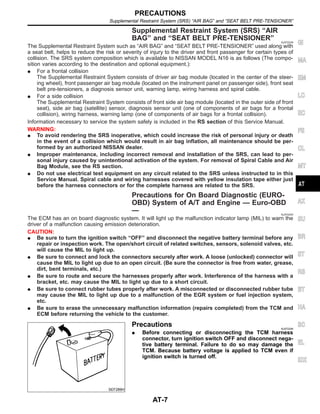
The ECM has an on board diagnostic system. It will light up the malfunction indicator lamp (MIL) to warn the
driver of a malfunction causing emission deterioration.
CAUTION:
I Be sure to turn the ignition switch “OFF” and disconnect the negative battery terminal before any
repair or inspection work. The open/short circuit of related switches, sensors, solenoid valves, etc.
will cause the MIL to light up.
I Be sure to connect and lock the connectors securely after work. A loose (unlocked) connector will
cause the MIL to light up due to an open circuit. (Be sure the connector is free from water, grease,
dirt, bent terminals, etc.)
I Be sure to route and secure the harnesses properly after work. Interference of the harness with a
bracket, etc. may cause the MIL to light up due to a short circuit.
I Be sure to connect rubber tubes properly after work. A misconnected or disconnected rubber tube
may cause the MIL to light up due to a malfunction of the EGR system or fuel injection system,
etc.
I Be sure to erase the unnecessary malfunction information (repairs completed) from the TCM and
ECM before returning the vehicle to the customer.
SEF289H
Precautions NJAT0246
I Before connecting or disconnecting the TCM harness
connector, turn ignition switch OFF and disconnect nega-
tive battery terminal. Failure to do so may damage the
TCM. Because battery voltage is applied to TCM even if
ignition switch is turned off.
GI
MA
EM
LC
EC
FE
CL
MT
AX
SU
BR
ST
RS
BT
HA
SC
EL
IDX
PRECAUTIONS
Supplemental Restraint System (SRS) “AIR BAG” and “SEAT BELT PRE-TENSIONER”
AT-7
AAT470A
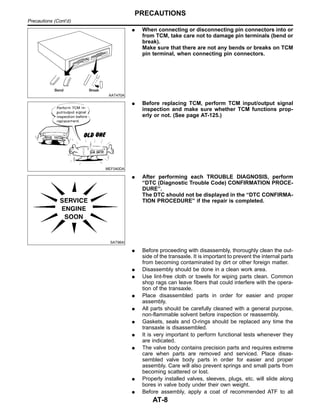
I When connecting or disconnecting pin connectors into or
from TCM, take care not to damage pin terminals (bend or
break).
Make sure that there are not any bends or breaks on TCM
pin terminal, when connecting pin connectors.
MEF040DA
I Before replacing TCM, perform TCM input/output signal
inspection and make sure whether TCM functions prop-
erly or not. (See page AT-125.)
SAT964I
I After performing each TROUBLE DIAGNOSIS, perform
“DTC (Diagnostic Trouble Code) CONFIRMATION PROCE-
DURE”.
The DTC should not be displayed in the “DTC CONFIRMA-
TION PROCEDURE” if the repair is completed.
I Before proceeding with disassembly, thoroughly clean the out-
side of the transaxle. It is important to prevent the internal parts
from becoming contaminated by dirt or other foreign matter.
I Disassembly should be done in a clean work area.
I Use lint-free cloth or towels for wiping parts clean. Common
shop rags can leave fibers that could interfere with the opera-
tion of the transaxle.
I Place disassembled parts in order for easier and proper
assembly.
I All parts should be carefully cleaned with a general purpose,
non-flammable solvent before inspection or reassembly.
I Gaskets, seals and O-rings should be replaced any time the
transaxle is disassembled.
I It is very important to perform functional tests whenever they
are indicated.
I The valve body contains precision parts and requires extreme
care when parts are removed and serviced. Place disas-
sembled valve body parts in order for easier and proper
assembly. Care will also prevent springs and small parts from
becoming scattered or lost.
I Properly installed valves, sleeves, plugs, etc. will slide along
bores in valve body under their own weight.
I Before assembly, apply a coat of recommended ATF to all
PRECAUTIONS
Precautions (Cont’d)
AT-8
parts. Apply petroleum jelly to protect O-rings and seals, or
hold bearings and washers in place during assembly. Do not
use grease.
I Extreme care should be taken to avoid damage to O-rings,
seals and gaskets when assembling.
I After overhaul, refill the transaxle with new ATF.
I When the A/T drain plug is removed, only some of the fluid is
drained. Old A/T fluid will remain in torque converter and ATF
cooling system.
Always follow the procedures under “Changing A/T Fluid” in the
AT section when changing A/T fluid. Refer to “Changing A/T
Fluid”, AT-15.
Service Notice or Precautions NJAT0247
FAIL-SAFE NJAT0247S01
The TCM has an electronic Fail-Safe (limp home mode). This allows the vehicle to be driven even if a major
electrical input/output device circuit is damaged.
Under Fail-Safe, the vehicle always runs in third gear, even with a shift lever position of “1”, “2” or “D”. The
customer may complain of sluggish or poor acceleration.
When the ignition key is turned “ON” following Fail-Safe operation, O/D OFF indicator lamp blinks for about
8 seconds. [For GENERAL AND EXCEPT FOR EURO-OBD, AUSTRALIA AND THE MIDDLE EAST; “SELF-
DIAGNOSTIC PROCEDURE (WITHOUT CONSULT-II)”, refer to AT-45 and for EURO-OBD; “TCM SELF-DI-
AGNOSTIC PROCEDURE (No Tools)”, refer to AT-69.]
The blinking of the O/D OFF or A/T check indicator lamp for about 8 seconds will appear only once and be
cleared. The customer may resume normal driving conditions.
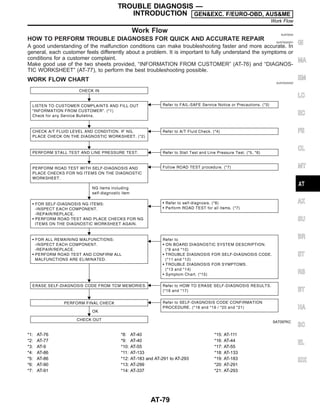
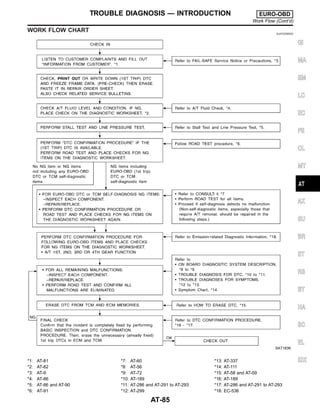
Always follow the “WORK FLOW” [Refer to AT-79 (General and except for Euro-OBD, Australia and the Middle
East), AT-84 (EURO-OBD).]
The SELF-DIAGNOSIS results will be as follows:
The first SELF-DIAGNOSIS will indicate damage to the vehicle speed sensor or the revolution sensor.
During the next SELF-DIAGNOSIS, performed after checking the sensor, no damages will be indicated.
TORQUE CONVERTER SERVICE NJAT0247S02
The torque converter should be replaced under any of the following conditions:
I External leaks in the hub weld area.
I Converter hub is scored or damaged.
I Converter pilot is broken, damaged or fits poorly into crankshaft.
I Steel particles are found after flushing the cooler and cooler lines.
I Pump is damaged or steel particles are found in the converter.
I Vehicle has TCC shudder and/or no TCC apply. Replace only after all hydraulic and electrical diagnoses
have been made. (Converter clutch material may be glazed.)
I Converter is contaminated with engine coolant containing antifreeze.
I Internal failure of stator roller clutch.
I Heavy clutch debris due to overheating (blue converter).
I Steel particles or clutch lining material found in fluid filter or on magnet when no internal parts in unit are
worn or damaged — indicates that lining material came from converter.
The torque converter should not be replaced if:
GI
MA
EM
LC
EC
FE
CL
MT
AX
SU
BR
ST
RS
BT
HA
SC
EL
IDX
PRECAUTIONS
Precautions (Cont’d)
AT-9
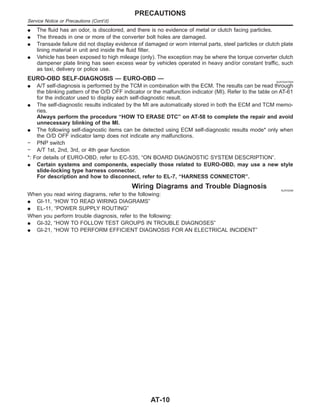
I The fluid has an odor, is discolored, and there is no evidence of metal or clutch facing particles.
I The threads in one or more of the converter bolt holes are damaged.
I Transaxle failure did not display evidence of damaged or worn internal parts, steel particles or clutch plate
lining material in unit and inside the fluid filter.
I Vehicle has been exposed to high mileage (only). The exception may be where the torque converter clutch
dampener plate lining has seen excess wear by vehicles operated in heavy and/or constant traffic, such
as taxi, delivery or police use.
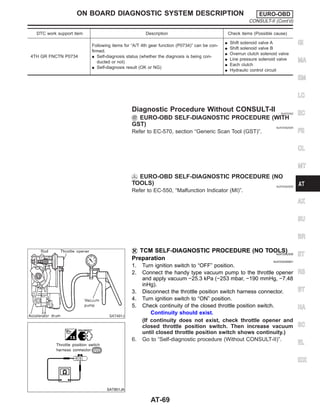
EURO-OBD SELF-DIAGNOSIS — EURO-OBD — NJAT0247S04
I A/T self-diagnosis is performed by the TCM in combination with the ECM. The results can be read through
the blinking pattern of the O/D OFF indicator or the malfunction indicator (MI). Refer to the table on AT-61
for the indicator used to display each self-diagnostic result.
I The self-diagnostic results indicated by the MI are automatically stored in both the ECM and TCM memo-
ries.
Always perform the procedure “HOW TO ERASE DTC” on AT-58 to complete the repair and avoid
unnecessary blinking of the MI.
I The following self-diagnostic items can be detected using ECM self-diagnostic results mode* only when
the O/D OFF indicator lamp does not indicate any malfunctions.
− PNP switch
− A/T 1st, 2nd, 3rd, or 4th gear function
*: For details of EURO-OBD, refer to EC-535, “ON BOARD DIAGNOSTIC SYSTEM DESCRIPTION”.
I Certain systems and components, especially those related to EURO-OBD, may use a new style
slide-locking type harness connector.
For description and how to disconnect, refer to EL-7, “HARNESS CONNECTOR”.
Wiring Diagrams and Trouble Diagnosis NJAT0248
When you read wiring diagrams, refer to the following:
I GI-11, “HOW TO READ WIRING DIAGRAMS”
I EL-11, “POWER SUPPLY ROUTING”
When you perform trouble diagnosis, refer to the following:
I GI-32, “HOW TO FOLLOW TEST GROUPS IN TROUBLE DIAGNOSES”
I GI-21, “HOW TO PERFORM EFFICIENT DIAGNOSIS FOR AN ELECTRICAL INCIDENT”
PRECAUTIONS
Service Notice or Precautions (Cont’d)
AT-10
Special Service Tools NJAT0006
Tool number
Tool name
Description
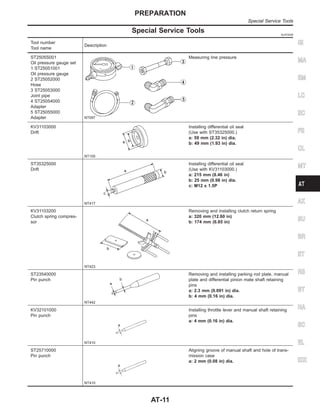
ST2505S001
Oil pressure gauge set
1 ST25051001
Oil pressure gauge
2 ST25052000
Hose
3 ST25053000
Joint pipe
4 ST25054000
Adapter
5 ST25055000
Adapter NT097
Measuring line pressure
KV31103000
Drift
NT105
Installing differential oil seal
(Use with ST35325000.)
a: 59 mm (2.32 in) dia.
b: 49 mm (1.93 in) dia.
ST35325000
Drift
NT417
Installing differential oil seal
(Use with KV31103000.)
a: 215 mm (8.46 in)
b: 25 mm (0.98 in) dia.
c: M12 x 1.5P
KV31103200
Clutch spring compres-
sor
NT423
Removing and installing clutch return spring
a: 320 mm (12.60 in)
b: 174 mm (6.85 in)
ST23540000
Pin punch
NT442
Removing and installing parking rod plate, manual
plate and differential pinion mate shaft retaining
pins
a: 2.3 mm (0.091 in) dia.
b: 4 mm (0.16 in) dia.
KV32101000
Pin punch
NT410
Installing throttle lever and manual shaft retaining
pins
a: 4 mm (0.16 in) dia.
ST25710000
Pin punch
NT410
Aligning groove of manual shaft and hole of trans-
mission case
a: 2 mm (0.08 in) dia.
GI
MA
EM
LC
EC
FE
CL
MT
AX
SU
BR
ST
RS
BT
HA
SC
EL
IDX
PREPARATION
Special Service Tools
AT-11
Tool number
Tool name
Description
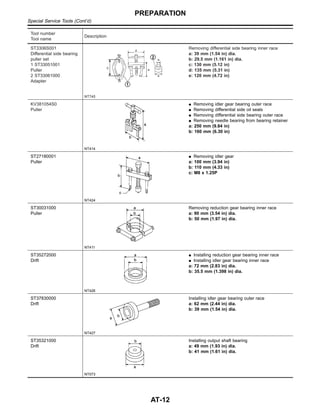
ST3306S001
Differential side bearing
puller set
1 ST33051001
Puller
2 ST33061000
Adapter
NT745
Removing differential side bearing inner race
a: 39 mm (1.54 in) dia.
b: 29.5 mm (1.161 in) dia.
c: 130 mm (5.12 in)
d: 135 mm (5.31 in)
e: 120 mm (4.72 in)
KV381054S0
Puller
NT414
I Removing idler gear bearing outer race
I Removing differential side oil seals
I Removing differential side bearing outer race
I Removing needle bearing from bearing retainer
a: 250 mm (9.84 in)
b: 160 mm (6.30 in)
ST27180001
Puller
NT424
I Removing idler gear
a: 100 mm (3.94 in)
b: 110 mm (4.33 in)
c: M8 x 1.25P
ST30031000
Puller
NT411
Removing reduction gear bearing inner race
a: 90 mm (3.54 in) dia.
b: 50 mm (1.97 in) dia.
ST35272000
Drift
NT426
I Installing reduction gear bearing inner race
I Installing idler gear bearing inner race
a: 72 mm (2.83 in) dia.
b: 35.5 mm (1.398 in) dia.
ST37830000
Drift
NT427
Installing idler gear bearing outer race
a: 62 mm (2.44 in) dia.
b: 39 mm (1.54 in) dia.
ST35321000
Drift
NT073
Installing output shaft bearing
a: 49 mm (1.93 in) dia.
b: 41 mm (1.61 in) dia.
PREPARATION
Special Service Tools (Cont’d)
AT-12
Tool number
Tool name
Description
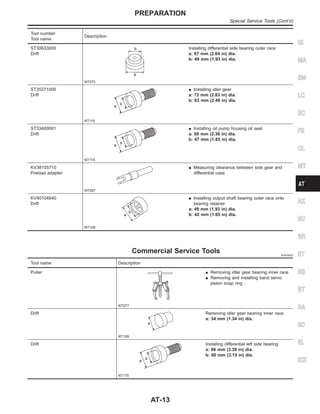
ST30633000
Drift
NT073
Installing differential side bearing outer race
a: 67 mm (2.64 in) dia.
b: 49 mm (1.93 in) dia.
ST35271000
Drift
NT115
I Installing idler gear
a: 72 mm (2.83 in) dia.
b: 63 mm (2.48 in) dia.
ST33400001
Drift
NT115
I Installing oil pump housing oil seal
a: 60 mm (2.36 in) dia.
b: 47 mm (1.85 in) dia.
KV38105710
Preload adapter
NT087
I Measuring clearance between side gear and
differential case
KV40104840
Drift
NT108
I Installing output shaft bearing outer race onto
bearing retainer
a: 49 mm (1.93 in) dia.
b: 42 mm (1.65 in) dia.
Commercial Service Tools NJAT0007
Tool name Description
Puller
NT077
I Removing idler gear bearing inner race
I Removing and installing band servo
piston snap ring
Drift
NT109
Removing idler gear bearing inner race
a: 34 mm (1.34 in) dia.
Drift
NT115
Installing differential left side bearing
a: 86 mm (3.39 in) dia.
b: 80 mm (3.15 in) dia.
GI
MA
EM
LC
EC
FE
CL
MT
AX
SU
BR
ST
RS
BT
HA
SC
EL
IDX
PREPARATION
Special Service Tools (Cont’d)
AT-13
Tool name Description
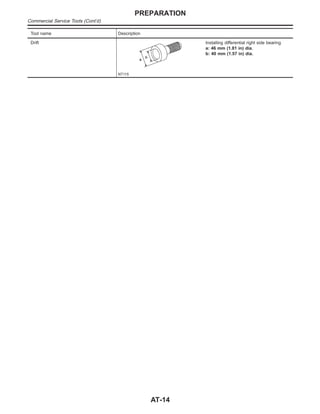
Drift
NT115
Installing differential right side bearing
a: 46 mm (1.81 in) dia.
b: 40 mm (1.57 in) dia.
PREPARATION
Commercial Service Tools (Cont’d)
AT-14
SMA827CA
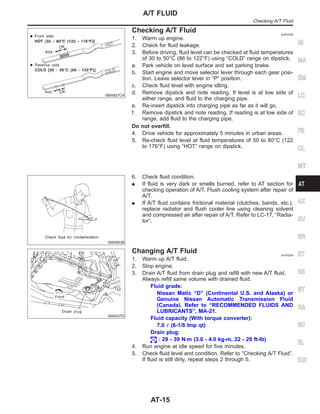
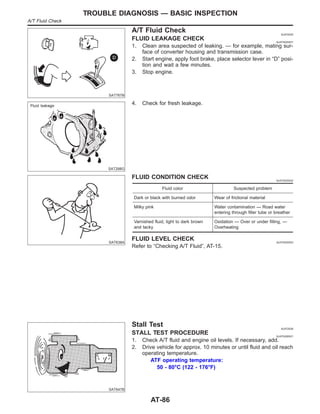
Checking A/T Fluid NJAT0228
1. Warm up engine.
2. Check for fluid leakage.
3. Before driving, fluid level can be checked at fluid temperatures
of 30 to 50°C (86 to 122°F) using “COLD” range on dipstick.
a. Park vehicle on level surface and set parking brake.
b. Start engine and move selector lever through each gear posi-
tion. Leave selector lever in “P” position.
c. Check fluid level with engine idling.
d. Remove dipstick and note reading. If level is at low side of
either range, and fluid to the charging pipe.
e. Re-insert dipstick into charging pipe as far as it will go.
f. Remove dipstick and note reading. If reading is at low side of
range, add fluid to the charging pipe.
Do not overfill.
4. Drive vehicle for approximately 5 minutes in urban areas.
5. Re-check fluid level at fluid temperatures of 50 to 80°C (122
to 176°F) using “HOT” range on dipstick.
SMA853B
6. Check fluid condition.
I If fluid is very dark or smells burned, refer to AT section for
checking operation of A/T. Flush cooling system after repair of
A/T.
I If A/T fluid contains frictional material (clutches, bands, etc.),
replace radiator and flush cooler line using cleaning solvent
and compressed air after repair of A/T. Refer to LC-17, “Radia-
tor”.
SMA027D
Changing A/T Fluid NJAT0229
1. Warm up A/T fluid.
2. Stop engine.
3. Drain A/T fluid from drain plug and refill with new A/T fluid.
Always refill same volume with drained fluid.
Fluid grade:
Nissan Matic “D” (Continental U.S. and Alaska) or
Genuine Nissan Automatic Transmission Fluid
(Canada). Refer to “RECOMMENDED FLUIDS AND
LUBRICANTS”, MA-21.
Fluid capacity (With torque converter):
7.0  (6-1/8 Imp qt)
Drain plug:
: 29 - 39 N·m (3.0 - 4.0 kg-m, 22 - 29 ft-lb)
4. Run engine at idle speed for five minutes.
5. Check fluid level and condition. Refer to “Checking A/T Fluid”.
If fluid is still dirty, repeat steps 2 through 5.
GI
MA
EM
LC
EC
FE
CL
MT
AX
SU
BR
ST
RS
BT
HA
SC
EL
IDX
A/T FLUID
Checking A/T Fluid
AT-15
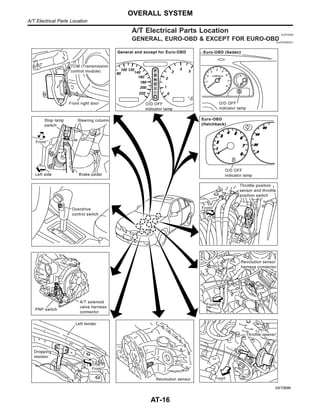
A/T Electrical Parts Location NJAT0008
GENERAL, EURO-OBD & EXCEPT FOR EURO-OBD
NJAT0008S01
SAT069K
OVERALL SYSTEM
A/T Electrical Parts Location
AT-16
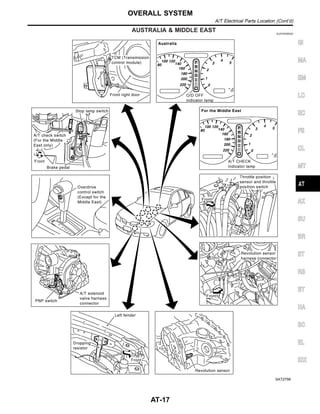
AUSTRALIA & MIDDLE EAST NJAT0008S02
SAT275K
GI
MA
EM
LC
EC
FE
CL
MT
AX
SU
BR
ST
RS
BT
HA
SC
EL
IDX
OVERALL SYSTEM
A/T Electrical Parts Location (Cont’d)
AT-17
Circuit Diagram NJAT0009
GENERAL & EXCEPT FOR EURO-OBD, AUSTRALIA &
THE MIDDLE EAST NJAT0009S01
HAT133
OVERALL SYSTEM
Circuit Diagram
AT-18
EURO-OBD NJAT0009S02
HAT128
GI
MA
EM
LC
EC
FE
CL
MT
AX
SU
BR
ST
RS
BT
HA
SC
EL
IDX
OVERALL SYSTEM
Circuit Diagram (Cont’d)
AT-19
Cross-sectional View — 3AX00, 3AX01, 3AX19,
3AX63 and 3AX64 models NJAT0011
SAT042K
OVERALL SYSTEM
Cross-sectional View — 3AX00, 3AX01, 3AX19, 3AX63 and 3AX64 models
AT-20
Cross-sectional View — 3AX10 and 3AX18
models NJAT0217
SAT842J
GI
MA
EM
LC
EC
FE
CL
MT
AX
SU
BR
ST
RS
BT
HA
SC
EL
IDX
OVERALL SYSTEM
Cross-sectional View — 3AX10 and 3AX18 models
AT-21
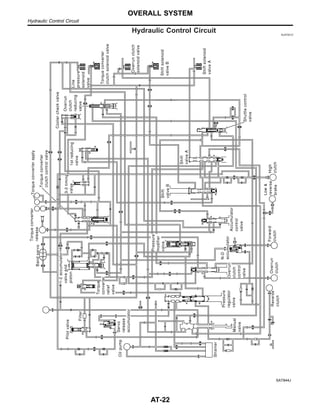
Hydraulic Control Circuit NJAT0012
SAT844J
OVERALL SYSTEM
Hydraulic Control Circuit
AT-22
Shift Mechanism NJAT0013
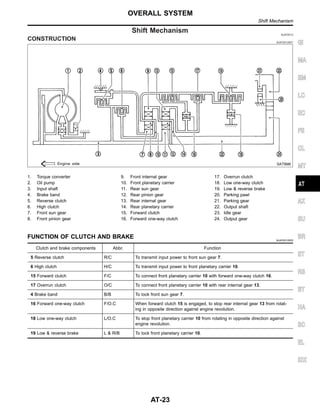
CONSTRUCTION NJAT0013S01
SAT998I
1. Torque converter
2. Oil pump
3. Input shaft
4. Brake band
5. Reverse clutch
6. High clutch
7. Front sun gear
8. Front pinion gear
9. Front internal gear
10. Front planetary carrier
11. Rear sun gear
12. Rear pinion gear
13. Rear internal gear
14. Rear planetary carrier
15. Forward clutch
16. Forward one-way clutch
17. Overrun clutch
18. Low one-way clutch
19. Low & reverse brake
20. Parking pawl
21. Parking gear
22. Output shaft
23. Idle gear
24. Output gear
FUNCTION OF CLUTCH AND BRAKE NJAT0013S03
Clutch and brake components Abbr. Function
5 Reverse clutch R/C To transmit input power to front sun gear 7.
6 High clutch H/C To transmit input power to front planetary carrier 10.
15 Forward clutch F/C To connect front planetary carrier 10 with forward one-way clutch 16.
17 Overrun clutch O/C To connect front planetary carrier 10 with rear internal gear 13.
4 Brake band B/B To lock front sun gear 7.
16 Forward one-way clutch F/O.C When forward clutch 15 is engaged, to stop rear internal gear 13 from rotat-
ing in opposite direction against engine revolution.
18 Low one-way clutch L/O.C To stop front planetary carrier 10 from rotating in opposite direction against
engine revolution.
19 Low & reverse brake L & R/B To lock front planetary carrier 10.
GI
MA
EM
LC
EC
FE
CL
MT
AX
SU
BR
ST
RS
BT
HA
SC
EL
IDX
OVERALL SYSTEM
Shift Mechanism
AT-23
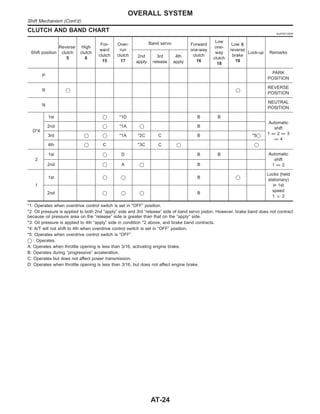
CLUTCH AND BAND CHART NJAT0013S04
Shift position
Reverse
clutch
5
High
clutch
6
For-
ward
clutch
15
Over-
run
clutch
17
Band servo Forward
one-way
clutch
16
Low
one-
way
clutch
18
Low &
reverse
brake
19
Lock-up Remarks
2nd
apply
3rd
release
4th
apply
P
PARK
POSITION
R q q
REVERSE
POSITION
N
NEUTRAL
POSITION
D*4
1st q *1D B B
Automatic
shift
1 k 2 k 3
k 4
2nd q *1A q B
3rd q q *1A *2C C B *5q
4th q C *3C C q q
2
1st q D B B Automatic
shift
1 k 2
2nd q A q B
1
1st q q B q
Locks (held
stationary)
in 1st
speed
1 g 2
2nd q q q B
*1: Operates when overdrive control switch is set in “OFF” position.
*2: Oil pressure is applied to both 2nd “apply” side and 3rd “release” side of band servo piston. However, brake band does not contract
because oil pressure area on the “release” side is greater than that on the “apply” side.
*3: Oil pressure is applied to 4th “apply” side in condition *2 above, and brake band contracts.
*4: A/T will not shift to 4th when overdrive control switch is set in “OFF” position.
*5: Operates when overdrive control switch is “OFF”.
q : Operates.
A: Operates when throttle opening is less than 3/16, activating engine brake.
B: Operates during “progressive” acceleration.
C: Operates but does not affect power transmission.
D: Operates when throttle opening is less than 3/16, but does not affect engine brake.
OVERALL SYSTEM
Shift Mechanism (Cont’d)
AT-24
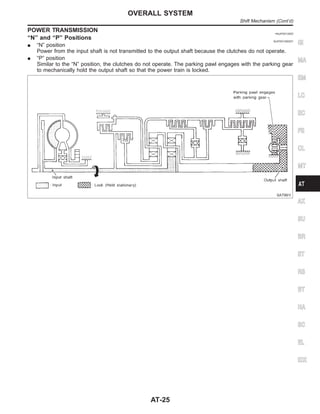
POWER TRANSMISSION =NJAT0013S02
“N” and “P” Positions NJAT0013S0201
I “N” position
Power from the input shaft is not transmitted to the output shaft because the clutches do not operate.
I “P” position
Similar to the “N” position, the clutches do not operate. The parking pawl engages with the parking gear
to mechanically hold the output shaft so that the power train is locked.
SAT991I
GI
MA
EM
LC
EC
FE
CL
MT
AX
SU
BR
ST
RS
BT
HA
SC
EL
IDX
OVERALL SYSTEM
Shift Mechanism (Cont’d)
AT-25
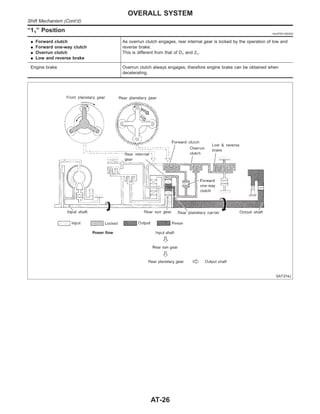
“11” Position =NJAT0013S0202
I Forward clutch
I Forward one-way clutch
I Overrun clutch
I Low and reverse brake
As overrun clutch engages, rear internal gear is locked by the operation of low and
reverse brake.
This is different from that of D1 and 21.
Engine brake Overrun clutch always engages, therefore engine brake can be obtained when
decelerating.
SAT374J
OVERALL SYSTEM
Shift Mechanism (Cont’d)
AT-26
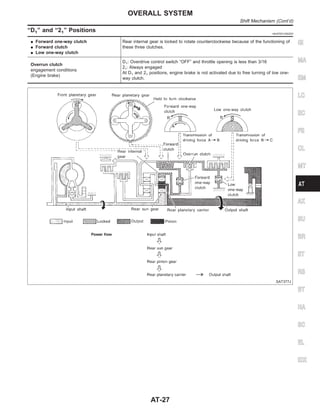
“D1” and “21” Positions =NJAT0013S0203
I Forward one-way clutch
I Forward clutch
I Low one-way clutch
Rear internal gear is locked to rotate counterclockwise because of the functioning of
these three clutches.
Overrun clutch
engagement conditions
(Engine brake)
D1: Overdrive control switch “OFF” and throttle opening is less than 3/16
21: Always engaged
At D1 and 21 positions, engine brake is not activated due to free turning of low one-
way clutch.
SAT377J
GI
MA
EM
LC
EC
FE
CL
MT
AX
SU
BR
ST
RS
BT
HA
SC
EL
IDX
OVERALL SYSTEM
Shift Mechanism (Cont’d)
AT-27
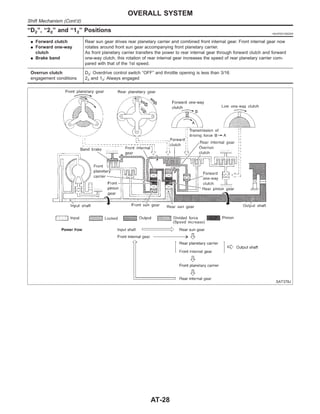
“D2”, “22” and “12” Positions =NJAT0013S0204
I Forward clutch
I Forward one-way
clutch
I Brake band
Rear sun gear drives rear planetary carrier and combined front internal gear. Front internal gear now
rotates around front sun gear accompanying front planetary carrier.
As front planetary carrier transfers the power to rear internal gear through forward clutch and forward
one-way clutch, this rotation of rear internal gear increases the speed of rear planetary carrier com-
pared with that of the 1st speed.
Overrun clutch
engagement conditions
D2: Overdrive control switch “OFF” and throttle opening is less than 3/16
22 and 12: Always engaged
SAT378J
OVERALL SYSTEM
Shift Mechanism (Cont’d)
AT-28
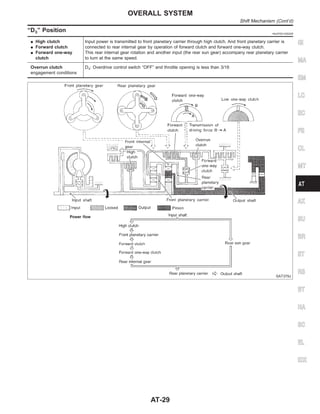
“D3” Position =NJAT0013S0205
I High clutch
I Forward clutch
I Forward one-way
clutch
Input power is transmitted to front planetary carrier through high clutch. And front planetary carrier is
connected to rear internal gear by operation of forward clutch and forward one-way clutch.
This rear internal gear rotation and another input (the rear sun gear) accompany rear planetary carrier
to turn at the same speed.
Overrun clutch
engagement conditions
D3: Overdrive control switch “OFF” and throttle opening is less than 3/16
SAT379J
GI
MA
EM
LC
EC
FE
CL
MT
AX
SU
BR
ST
RS
BT
HA
SC
EL
IDX
OVERALL SYSTEM
Shift Mechanism (Cont’d)
AT-29
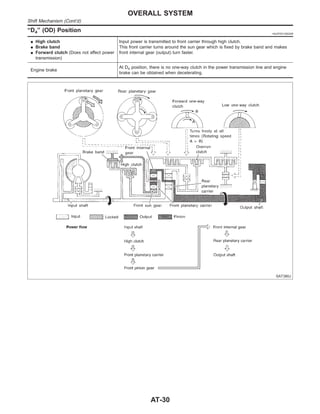
“D4” (OD) Position =NJAT0013S0206
I High clutch
I Brake band
I Forward clutch (Does not affect power
transmission)
Input power is transmitted to front carrier through high clutch.
This front carrier turns around the sun gear which is fixed by brake band and makes
front internal gear (output) turn faster.
Engine brake
At D4 position, there is no one-way clutch in the power transmission line and engine
brake can be obtained when decelerating.
SAT380J
OVERALL SYSTEM
Shift Mechanism (Cont’d)
AT-30
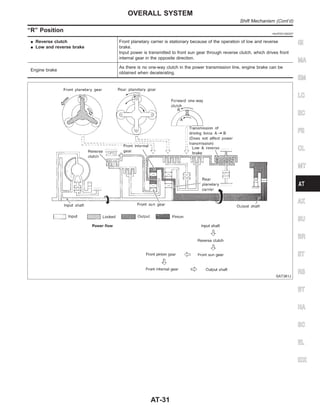
“R” Position =NJAT0013S0207
I Reverse clutch
I Low and reverse brake
Front planetary carrier is stationary because of the operation of low and reverse
brake.
Input power is transmitted to front sun gear through reverse clutch, which drives front
internal gear in the opposite direction.
Engine brake
As there is no one-way clutch in the power transmission line, engine brake can be
obtained when decelerating.
SAT381J
GI
MA
EM
LC
EC
FE
CL
MT
AX
SU
BR
ST
RS
BT
HA
SC
EL
IDX
OVERALL SYSTEM
Shift Mechanism (Cont’d)
AT-31
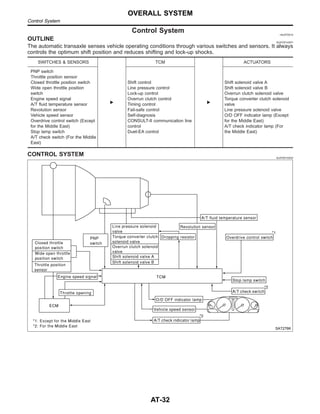
Control System =NJAT0014
OUTLINE NJAT0014S01
The automatic transaxle senses vehicle operating conditions through various switches and sensors. It always
controls the optimum shift position and reduces shifting and lock-up shocks.
SWITCHES & SENSORS
E
TCM
E
ACTUATORS
PNP switch
Throttle position sensor
Closed throttle position switch
Wide open throttle position
switch
Engine speed signal
A/T fluid temperature sensor
Revolution sensor
Vehicle speed sensor
Overdrive control switch (Except
for the Middle East)
Stop lamp switch
A/T check switch (For the Middle
East)
Shift control
Line pressure control
Lock-up control
Overrun clutch control
Timing control
Fail-safe control
Self-diagnosis
CONSULT-II communication line
control
Duet-EA control
Shift solenoid valve A
Shift solenoid valve B
Overrun clutch solenoid valve
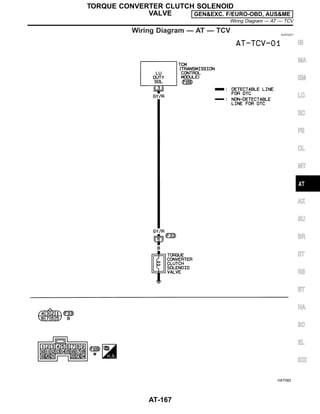
Torque converter clutch solenoid
valve
Line pressure solenoid valve
O/D OFF indicator lamp (Except
for the Middle East)
A/T check indicator lamp (For
the Middle East)
CONTROL SYSTEM NJAT0014S02
SAT276K
OVERALL SYSTEM
Control System
AT-32
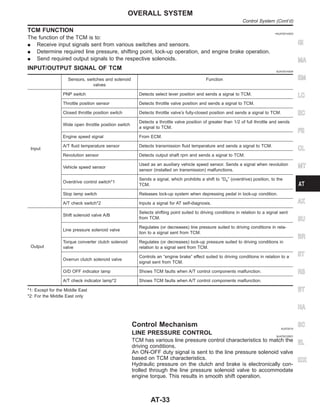
TCM FUNCTION =NJAT0014S03
The function of the TCM is to:
I Receive input signals sent from various switches and sensors.
I Determine required line pressure, shifting point, lock-up operation, and engine brake operation.
I Send required output signals to the respective solenoids.
INPUT/OUTPUT SIGNAL OF TCM NJAT0014S04
Sensors, switches and solenoid
valves
Function
Input
PNP switch Detects select lever position and sends a signal to TCM.
Throttle position sensor Detects throttle valve position and sends a signal to TCM.
Closed throttle position switch Detects throttle valve’s fully-closed position and sends a signal to TCM.
Wide open throttle position switch
Detects a throttle valve position of greater than 1/2 of full throttle and sends
a signal to TCM.
Engine speed signal From ECM.
A/T fluid temperature sensor Detects transmission fluid temperature and sends a signal to TCM.
Revolution sensor Detects output shaft rpm and sends a signal to TCM.
Vehicle speed sensor
Used as an auxiliary vehicle speed sensor. Sends a signal when revolution
sensor (installed on transmission) malfunctions.
Overdrive control switch*1
Sends a signal, which prohibits a shift to “D4” (overdrive) position, to the
TCM.
Stop lamp switch Releases lock-up system when depressing pedal in lock-up condition.
A/T check switch*2 Inputs a signal for AT self-diagnosis.
Output
Shift solenoid valve A/B
Selects shifting point suited to driving conditions in relation to a signal sent
from TCM.
Line pressure solenoid valve
Regulates (or decreases) line pressure suited to driving conditions in rela-
tion to a signal sent from TCM.
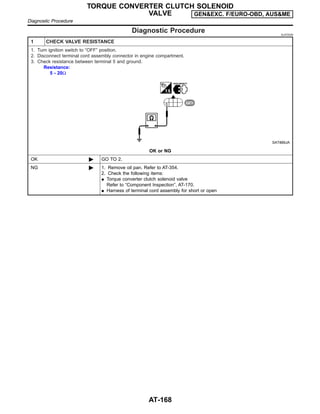
Torque converter clutch solenoid
valve
Regulates (or decreases) lock-up pressure suited to driving conditions in
relation to a signal sent from TCM.
Overrun clutch solenoid valve
Controls an “engine brake” effect suited to driving conditions in relation to a
signal sent from TCM.
O/D OFF indicator lamp Shows TCM faults when A/T control components malfunction.
A/T check indicator lamp*2 Shows TCM faults when A/T control components malfunction.
*1: Except for the Middle East
*2: For the Middle East only
Control Mechanism NJAT0015
LINE PRESSURE CONTROL NJAT0015S01
TCM has various line pressure control characteristics to match the
driving conditions.
An ON-OFF duty signal is sent to the line pressure solenoid valve
based on TCM characteristics.
Hydraulic pressure on the clutch and brake is electronically con-
trolled through the line pressure solenoid valve to accommodate
engine torque. This results in smooth shift operation.
GI
MA
EM
LC
EC
FE
CL
MT
AX
SU
BR
ST
RS
BT
HA
SC
EL
IDX
OVERALL SYSTEM
Control System (Cont’d)
AT-33
SAT003J
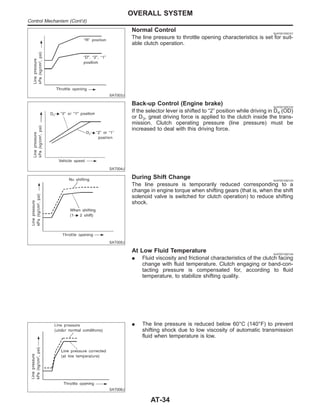
Normal Control NJAT0015S0101
The line pressure to throttle opening characteristics is set for suit-
able clutch operation.
SAT004J
Back-up Control (Engine brake) NJAT0015S0102
If the selector lever is shifted to “2” position while driving in D4 (OD)
or D3, great driving force is applied to the clutch inside the trans-
mission. Clutch operating pressure (line pressure) must be
increased to deal with this driving force.
SAT005J
During Shift Change NJAT0015S0103
The line pressure is temporarily reduced corresponding to a
change in engine torque when shifting gears (that is, when the shift
solenoid valve is switched for clutch operation) to reduce shifting
shock.
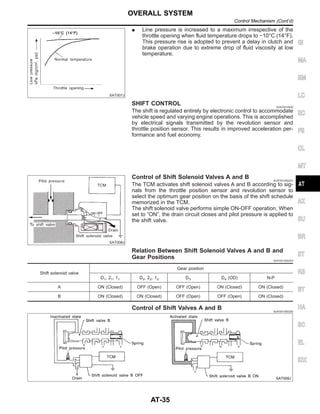
At Low Fluid Temperature NJAT0015S0104
I Fluid viscosity and frictional characteristics of the clutch facing
change with fluid temperature. Clutch engaging or band-con-
tacting pressure is compensated for, according to fluid
temperature, to stabilize shifting quality.
SAT006J
I The line pressure is reduced below 60°C (140°F) to prevent
shifting shock due to low viscosity of automatic transmission
fluid when temperature is low.
OVERALL SYSTEM
Control Mechanism (Cont’d)
AT-34
SAT007J
I Line pressure is increased to a maximum irrespective of the
throttle opening when fluid temperature drops to −10°C (14°F).
This pressure rise is adopted to prevent a delay in clutch and
brake operation due to extreme drop of fluid viscosity at low
temperature.
SHIFT CONTROL NJAT0015S02
The shift is regulated entirely by electronic control to accommodate
vehicle speed and varying engine operations. This is accomplished
by electrical signals transmitted by the revolution sensor and
throttle position sensor. This results in improved acceleration per-
formance and fuel economy.
SAT008J
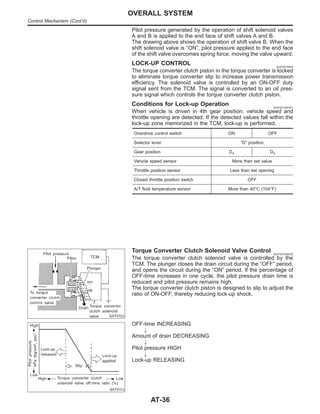
Control of Shift Solenoid Valves A and B NJAT0015S0201
The TCM activates shift solenoid valves A and B according to sig-
nals from the throttle position sensor and revolution sensor to
select the optimum gear position on the basis of the shift schedule
memorized in the TCM.
The shift solenoid valve performs simple ON-OFF operation. When
set to “ON”, the drain circuit closes and pilot pressure is applied to
the shift valve.
Relation Between Shift Solenoid Valves A and B and
Gear Positions NJAT0015S0203
Shift solenoid valve
Gear position
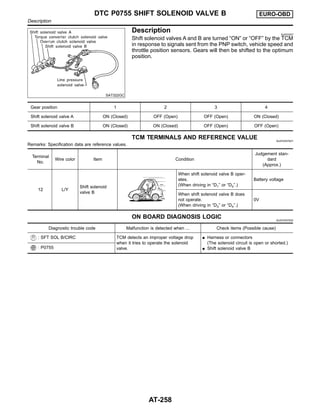
D1, 21, 11 D2, 22, 12 D3 D4 (OD) N-P
A ON (Closed) OFF (Open) OFF (Open) ON (Closed) ON (Closed)
B ON (Closed) ON (Closed) OFF (Open) OFF (Open) ON (Closed)
Control of Shift Valves A and B NJAT0015S0202
SAT009J
GI
MA
EM
LC
EC
FE
CL
MT
AX
SU
BR
ST
RS
BT
HA
SC
EL
IDX
OVERALL SYSTEM
Control Mechanism (Cont’d)
AT-35
Pilot pressure generated by the operation of shift solenoid valves
A and B is applied to the end face of shift valves A and B.
The drawing above shows the operation of shift valve B. When the
shift solenoid valve is “ON”, pilot pressure applied to the end face
of the shift valve overcomes spring force, moving the valve upward.
LOCK-UP CONTROL NJAT0015S03
The torque converter clutch piston in the torque converter is locked
to eliminate torque converter slip to increase power transmission
efficiency. The solenoid valve is controlled by an ON-OFF duty
signal sent from the TCM. The signal is converted to an oil pres-
sure signal which controls the torque converter clutch piston.
Conditions for Lock-up Operation NJAT0015S0301
When vehicle is driven in 4th gear position, vehicle speed and
throttle opening are detected. If the detected values fall within the
lock-up zone memorized in the TCM, lock-up is performed.
Overdrive control switch ON OFF
Selector lever “D” position
Gear position D4 D3
Vehicle speed sensor More than set value
Throttle position sensor Less than set opening
Closed throttle position switch OFF
A/T fluid temperature sensor More than 40°C (104°F)
SAT010J
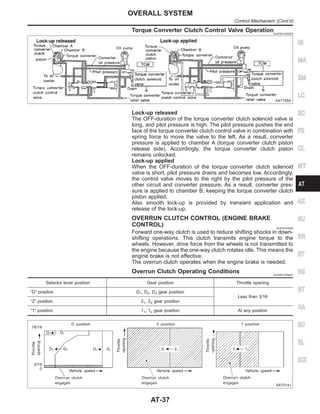
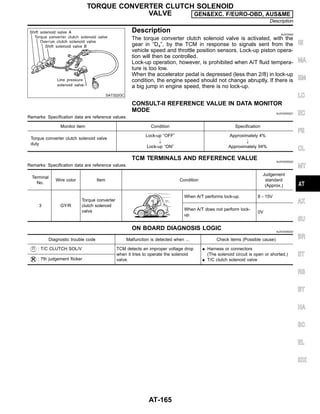
Torque Converter Clutch Solenoid Valve Control NJAT0015S0302
The torque converter clutch solenoid valve is controlled by the
TCM. The plunger closes the drain circuit during the “OFF” period,
and opens the circuit during the “ON” period. If the percentage of
OFF-time increases in one cycle, the pilot pressure drain time is
reduced and pilot pressure remains high.
The torque converter clutch piston is designed to slip to adjust the
ratio of ON-OFF, thereby reducing lock-up shock.
SAT011J
OFF-time INCREASING
"
Amount of drain DECREASING
"
Pilot pressure HIGH
"
Lock-up RELEASING
OVERALL SYSTEM
Control Mechanism (Cont’d)
AT-36
Torque Converter Clutch Control Valve OperationNJAT0015S0303
AAT155A
Lock-up released
The OFF-duration of the torque converter clutch solenoid valve is
long, and pilot pressure is high. The pilot pressure pushes the end
face of the torque converter clutch control valve in combination with
spring force to move the valve to the left. As a result, converter
pressure is applied to chamber A (torque converter clutch piston
release side). Accordingly, the torque converter clutch piston
remains unlocked.
Lock-up applied
When the OFF-duration of the torque converter clutch solenoid
valve is short, pilot pressure drains and becomes low. Accordingly,
the control valve moves to the right by the pilot pressure of the
other circuit and converter pressure. As a result, converter pres-
sure is applied to chamber B, keeping the torque converter clutch
piston applied.
Also smooth lock-up is provided by transient application and
release of the lock-up.
OVERRUN CLUTCH CONTROL (ENGINE BRAKE
CONTROL) NJAT0015S04
Forward one-way clutch is used to reduce shifting shocks in down-
shifting operations. This clutch transmits engine torque to the
wheels. However, drive force from the wheels is not transmitted to
the engine because the one-way clutch rotates idle. This means the
engine brake is not effective.
The overrun clutch operates when the engine brake is needed.
Overrun Clutch Operating Conditions NJAT0015S0401
Selector lever position Gear position Throttle opening
“D” position D1, D2, D3 gear position
Less than 3/16
“2” position 21, 22 gear position
“1” position 11, 12 gear position At any position
SAT014J
GI
MA
EM
LC
EC
FE
CL
MT
AX
SU
BR
ST
RS
BT
HA
SC
EL
IDX
OVERALL SYSTEM
Control Mechanism (Cont’d)
AT-37
SAT015J
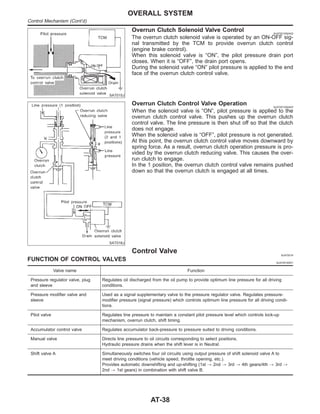
Overrun Clutch Solenoid Valve Control NJAT0015S0402
The overrun clutch solenoid valve is operated by an ON-OFF sig-
nal transmitted by the TCM to provide overrun clutch control
(engine brake control).
When this solenoid valve is “ON”, the pilot pressure drain port
closes. When it is “OFF”, the drain port opens.
During the solenoid valve “ON” pilot pressure is applied to the end
face of the overrun clutch control valve.
SAT016J
Overrun Clutch Control Valve Operation NJAT0015S0403
When the solenoid valve is “ON”, pilot pressure is applied to the
overrun clutch control valve. This pushes up the overrun clutch
control valve. The line pressure is then shut off so that the clutch
does not engage.
When the solenoid valve is “OFF”, pilot pressure is not generated.
At this point, the overrun clutch control valve moves downward by
spring force. As a result, overrun clutch operation pressure is pro-
vided by the overrun clutch reducing valve. This causes the over-
run clutch to engage.
In the 1 position, the overrun clutch control valve remains pushed
down so that the overrun clutch is engaged at all times.
Control Valve NJAT0016
FUNCTION OF CONTROL VALVES NJAT0016S01
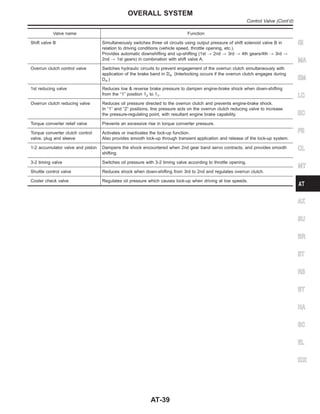
Valve name Function
Pressure regulator valve, plug
and sleeve
Regulates oil discharged from the oil pump to provide optimum line pressure for all driving
conditions.
Pressure modifier valve and
sleeve
Used as a signal supplementary valve to the pressure regulator valve. Regulates pressure-
modifier pressure (signal pressure) which controls optimum line pressure for all driving condi-
tions.
Pilot valve Regulates line pressure to maintain a constant pilot pressure level which controls lock-up
mechanism, overrun clutch, shift timing.
Accumulator control valve Regulates accumulator back-pressure to pressure suited to driving conditions.
Manual valve Directs line pressure to oil circuits corresponding to select positions.
Hydraulic pressure drains when the shift lever is in Neutral.
Shift valve A Simultaneously switches four oil circuits using output pressure of shift solenoid valve A to
meet driving conditions (vehicle speed, throttle opening, etc.).
Provides automatic downshifting and up-shifting (1st , 2nd , 3rd , 4th gears/4th , 3rd ,
2nd , 1st gears) in combination with shift valve B.
OVERALL SYSTEM
Control Mechanism (Cont’d)
AT-38
Valve name Function
Shift valve B Simultaneously switches three oil circuits using output pressure of shift solenoid valve B in
relation to driving conditions (vehicle speed, throttle opening, etc.).
Provides automatic downshifting and up-shifting (1st , 2nd , 3rd , 4th gears/4th , 3rd ,
2nd , 1st gears) in combination with shift valve A.
Overrun clutch control valve Switches hydraulic circuits to prevent engagement of the overrun clutch simultaneously with
application of the brake band in D4. (Interlocking occurs if the overrun clutch engages during
D4.)
1st reducing valve Reduces low & reverse brake pressure to dampen engine-brake shock when down-shifting
from the “1” position 12 to 11.
Overrun clutch reducing valve Reduces oil pressure directed to the overrun clutch and prevents engine-brake shock.
In “1” and “2” positions, line pressure acts on the overrun clutch reducing valve to increase
the pressure-regulating point, with resultant engine brake capability.
Torque converter relief valve Prevents an excessive rise in torque converter pressure.
Torque converter clutch control
valve, plug and sleeve
Activates or inactivates the lock-up function.
Also provides smooth lock-up through transient application and release of the lock-up system.
1-2 accumulator valve and piston Dampens the shock encountered when 2nd gear band servo contracts, and provides smooth
shifting.
3-2 timing valve Switches oil pressure with 3-2 timing valve according to throttle opening.
Shuttle control valve Reduces shock when down-shifting from 3rd to 2nd and regulates overrun clutch.
Cooler check valve Regulates oil pressure which causes lock-up when driving at low speeds.
GI
MA
EM
LC
EC
FE
CL
MT
AX
SU
BR
ST
RS
BT
HA
SC
EL
IDX
OVERALL SYSTEM
Control Valve (Cont’d)
AT-39
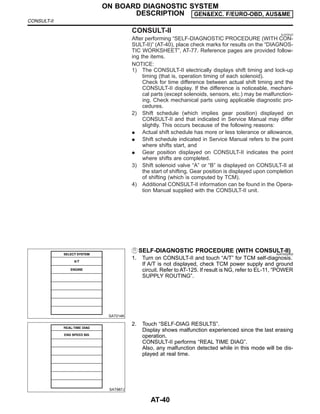
CONSULT-II NJAT0022
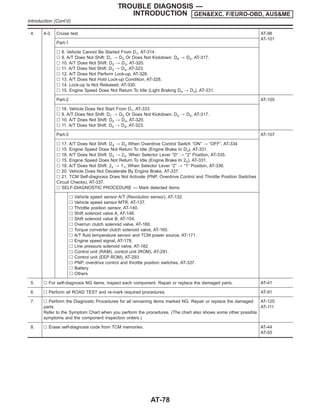
After performing “SELF-DIAGNOSTIC PROCEDURE (WITH CON-
SULT-II)” (AT-40), place check marks for results on the “DIAGNOS-
TIC WORKSHEET”, AT-77. Reference pages are provided follow-
ing the items.
NOTICE:
1) The CONSULT-II electrically displays shift timing and lock-up
timing (that is, operation timing of each solenoid).
Check for time difference between actual shift timing and the
CONSULT-II display. If the difference is noticeable, mechani-
cal parts (except solenoids, sensors, etc.) may be malfunction-
ing. Check mechanical parts using applicable diagnostic pro-
cedures.
2) Shift schedule (which implies gear position) displayed on
CONSULT-II and that indicated in Service Manual may differ
slightly. This occurs because of the following reasons:
I Actual shift schedule has more or less tolerance or allowance,
I Shift schedule indicated in Service Manual refers to the point
where shifts start, and
I Gear position displayed on CONSULT-II indicates the point
where shifts are completed.
3) Shift solenoid valve “A” or “B” is displayed on CONSULT-II at
the start of shifting. Gear position is displayed upon completion
of shifting (which is computed by TCM).
4) Additional CONSULT-II information can be found in the Opera-
tion Manual supplied with the CONSULT-II unit.
SAT014K
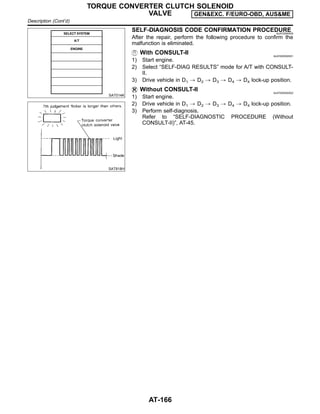
SELF-DIAGNOSTIC PROCEDURE (WITH CONSULT-II)
NJAT0022S02
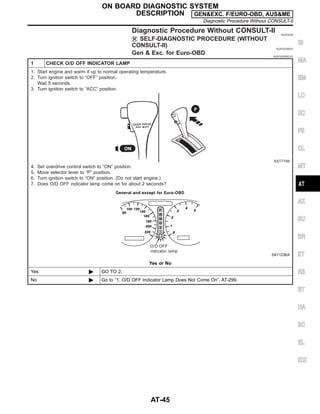
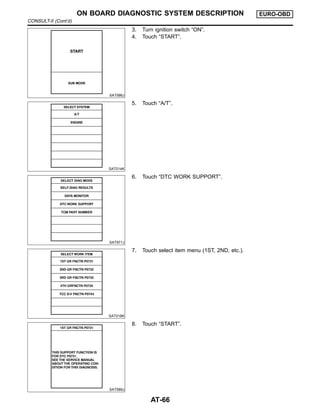
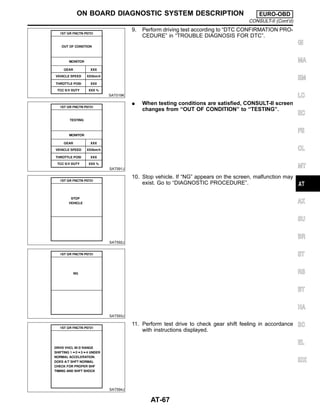
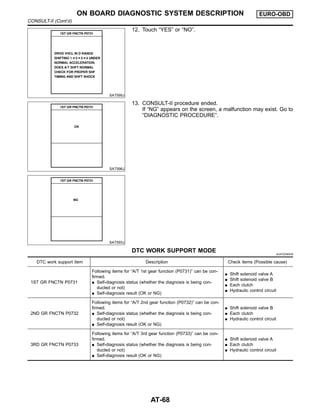
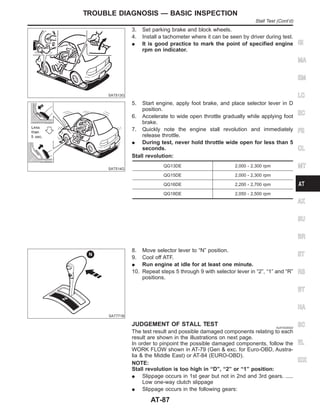
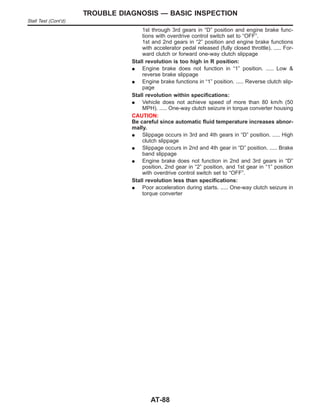
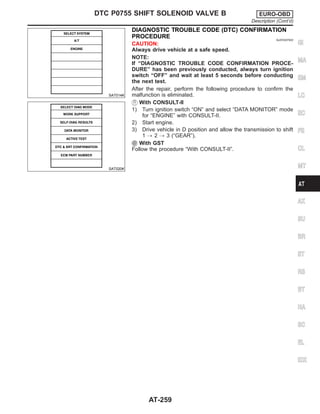
1. Turn on CONSULT-II and touch “A/T” for TCM self-diagnosis.
If A/T is not displayed, check TCM power supply and ground
circuit. Refer to AT-125. If result is NG, refer to EL-11, “POWER
SUPPLY ROUTING”.
SAT987J
2. Touch “SELF-DIAG RESULTS”.
Display shows malfunction experienced since the last erasing
operation.
CONSULT-II performs “REAL TIME DIAG”.
Also, any malfunction detected while in this mode will be dis-
played at real time.
ON BOARD DIAGNOSTIC SYSTEM
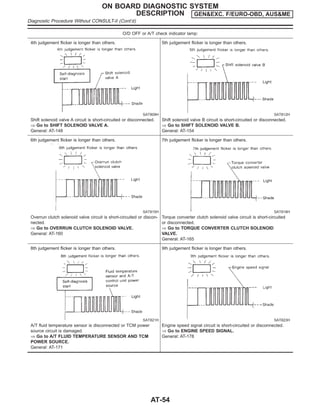
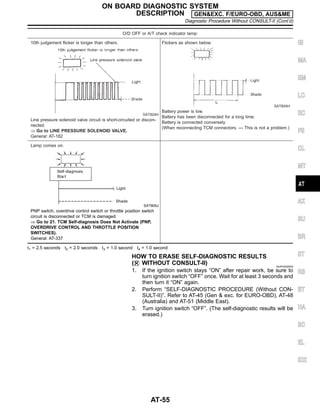
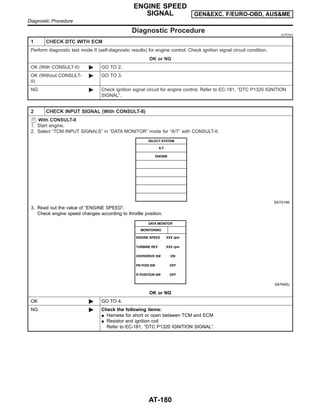
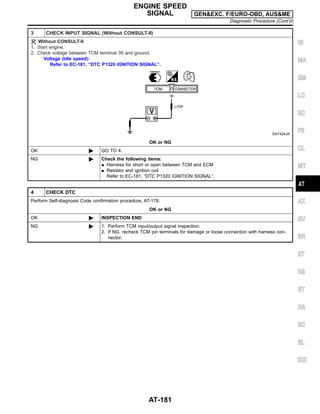
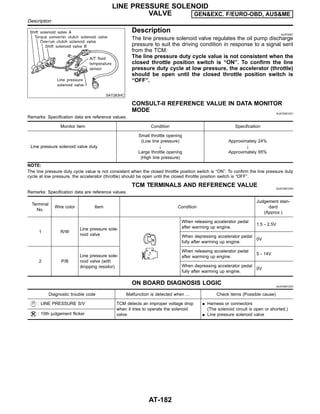
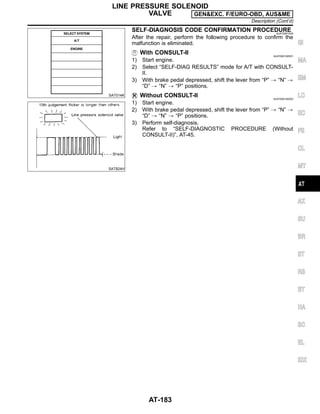
DESCRIPTION GEN&EXC. F/EURO-OBD, AUS&ME
CONSULT-II
AT-40
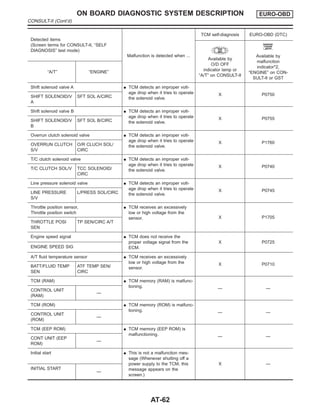
SELF-DIAGNOSTIC RESULT TEST MODE NJAT0022S03
Detected items
(Screen terms for CONSULT-II, “SELF-DIAG
RESULTS” test mode) Malfunction is detected when ... Remarks
Item Display
No failure
(NO SELF DIAGNOSTIC FAILURE INDICATED
FURTHER TESTING MAY BE REQUIRED**)
I No failure has been detected.
Initial start I This is not a malfunction message (Whenever shut-
ting off a power supply to the TCM, this message
appears on the screen.)
INITIAL START —
Revolution sensor VHCL SPEED
SEN·A/T
I TCM does not receive the proper voltage signal from
the sensor.
Vehicle speed sensor
(Meter)
VHCL SPEED
SEN·MTR
I TCM does not receive the proper voltage signal from
the sensor.
Throttle position sen-
sor
Throttle position switch
THROTTLE POSI
SEN
I TCM receives an excessively low or high voltage
from the sensor.
Shift solenoid valve A SHIFT SOLENOID/V A I TCM detects an improper voltage drop when it tries
to operate the solenoid valve.
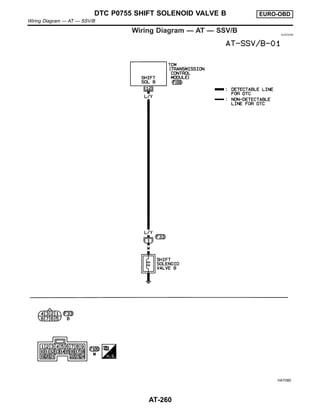
Shift solenoid valve B SHIFT SOLENOID/V B I TCM detects an improper voltage drop when it tries
to operate the solenoid valve.
Overrun clutch sole-
noid valve
OVERRUN CLUTCH
S/V
I TCM detects an improper voltage drop when it tries
to operate the solenoid valve.
T/C clutch solenoid
valve
T/C CLUTCH SOL/V I TCM detects an improper voltage drop when it tries
to operate the solenoid valve.
A/T fluid temperature
sensor
BATT/FLUID TEMP
SEN
I TCM receives an excessively low or high voltage
from the sensor.
To be displayed in
case of abnormality
and when no recording
is made.
Engine speed signal ENGINE SPEED SIG I TCM does not receive the proper voltage signal from
the ECM.
Line pressure solenoid
valve
LINE PRESSURE S/V I TCM detects an improper voltage drop when it tries
to operate the solenoid valve.
TCM (RAM) CONTROL UNIT
(RAM)
I TCM memory (RAM) is malfunctioning.
TCM (ROM) CONTROL UNIT
(ROM)
I TCM memory (ROM) is malfunctioning.
TCM (EEP ROM) CONT UNIT (EEP
ROM)
I TCM memory (EEP ROM) is malfunctioning.
DATA MONITOR MODE (A/T) NJAT0022S04
Item Display
Monitor item
Description Remarks
TCM input
signals
Main sig-
nals
Vehicle speed sensor 1
(A/T)
(Revolution sensor)
VHCL/S SE·A/T
[km/h] or [mph]
X —
I Vehicle speed computed
from signal of revolution
sensor is displayed.
When racing engine in “N”
or “P” position with vehicle
stationary, CONSULT-II
data may not indicate 0
km/h (0 mph).
GI
MA
EM
LC
EC
FE
CL
MT
AX
SU
BR
ST
RS
BT
HA
SC
EL
IDX
ON BOARD DIAGNOSTIC SYSTEM
DESCRIPTION GEN&EXC. F/EURO-OBD, AUS&ME
CONSULT-II (Cont’d)
AT-41
Item Display
Monitor item
Description Remarks
TCM input
signals
Main sig-
nals
Vehicle speed sensor 2
(Meter)
VHCL/S SE·MTR
[km/h] or [mph]
X —
I Vehicle speed computed
from signal of vehicle
speed sensor is dis-
played.
Vehicle speed display may
not be accurate under
approx. 10 km/h (6 mph).
It may not indicate 0 km/h
(0 mph) when vehicle is
stationary.
Throttle position sensor THRTL POS SEN
[V] X —
I Throttle position sensor
signal voltage is dis-
played.
A/T fluid temperature sen-
sor
FLUID TEMP SE
[V]
X —
I A/T fluid temperature
sensor signal voltage is
displayed.
I Signal voltage lowers as
fluid temperature rises.
Battery voltage BATTERY VOLT
[V]
X —
I Source voltage of TCM
is displayed.
Engine speed ENGINE SPEED
[rpm]
X X
I Engine speed, com-
puted from engine
speed signal, is dis-
played.
Engine speed display may
not be accurate under
approx. 800 rpm. It may
not indicate 0 rpm even
when engine is not run-
ning.
Overdrive control switch OVERDRIVE SW
[ON/OFF] X —
I ON/OFF state computed
from signal of overdrive
control SW is displayed.
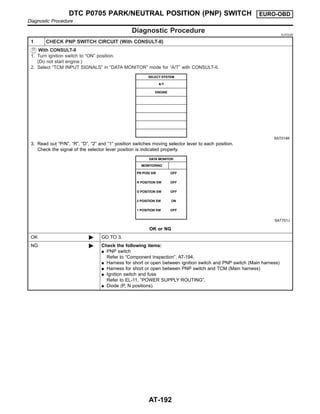
PN position switch PN POSI SW
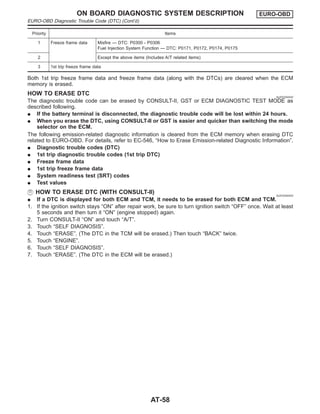
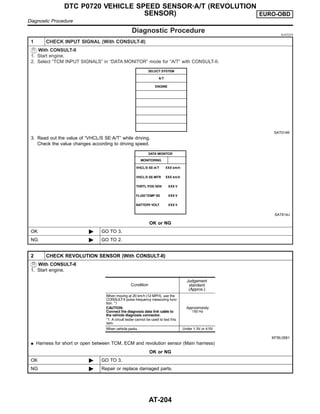
[ON/OFF] X —
I ON/OFF state computed
from signal of PN posi-
tion SW is displayed.
R position switch R POSITION SW
[ON/OFF] X —
I ON/OFF state computed
from signal of R position
SW is displayed.
D position switch D POSITION SW
[ON/OFF] X —
I ON/OFF state computed
from signal of D position
SW is displayed.
2 position switch 2 POSITION SW
[ON/OFF]
X —
I ON/OFF status, com-
puted from signal of 2
position SW, is dis-
played.
1 position switch 1 POSITION SW
[ON/OFF]
X —
I ON/OFF status, com-
puted from signal of 1
position SW, is dis-
played.
ASCD cruise signal ASCD-CRUISE
[ON/OFF]
X —
I Status of ASCD cruise
signal is displayed.
ON ... Cruising state
OFF ... Normal running
state
I This is displayed even
when no ASCD is
mounted.
ASCD OD cut signal ASCD-OD CUT
[ON/OFF]
X —
I Status of ASCD OD
release signal is dis-
played.
ON ... OD released
OFF ... OD not released
I This is displayed even
when no ASCD is
mounted.
ON BOARD DIAGNOSTIC SYSTEM
DESCRIPTION GEN&EXC. F/EURO-OBD, AUS&ME
CONSULT-II (Cont’d)
AT-42
Item Display
Monitor item
Description Remarks
TCM input
signals
Main sig-
nals
Kickdown switch KICKDOWN SW
[ON/OFF]
X —
I ON/OFF status, com-
puted from signal of
kickdown SW, is dis-
played.
I This is displayed even
when no kickdown
switch is equipped.
Closed throttle position
switch
CLOSED
THL/SW
[ON/OFF]
X —
I ON/OFF status, com-
puted from signal of
closed throttle position
SW, is displayed.
Wide open throttle position
switch
W/O THRL/P-SW
[ON/OFF]
X —
I ON/OFF status, com-
puted from signal of
wide open throttle posi-
tion SW, is displayed.
Gear position GEAR
— X
I Gear position data used
for computation by TCM,
is displayed.
Selector lever position SLCT LVR POSI
— X
I Selector lever position
data, used for computa-
tion by TCM, is dis-
played.
I A specific value used for
control is displayed if
fail-safe is activated due
to error.
Vehicle speed VEHICLE SPEED
[km/h] or [mph] — X
I Vehicle speed data,
used for computation by
TCM, is displayed.
Stop lamp switch BRAKE SW
[ON/OFF]
X —
I ON/OFF status are dis-
played.
ON: Brake pedal is
depressed.
OFF: Brake pedal is
released.
Throttle position THROTTLE POSI
[/8]
— X
I Throttle position data,
used for computation by
TCM, is displayed.
I A specific value used for
control is displayed if
fail-safe is activated due
to error.
Line pressure duty LINE PRES DTY
[%]
— X
I Control value of line
pressure solenoid valve,
computed by TCM from
each input signal, is dis-
played.
Torque converter clutch
solenoid valve duty
TCC S/V DUTY
[%]
— X
I Control value of torque
converter clutch sole-
noid valve, computed by
TCM from each input
signal, is displayed.
Shift solenoid valve A SHIFT S/V A
[ON/OFF]
— X
I Control value of shift
solenoid valve A, com-
puted by TCM from
each input signal, is dis-
played.
Control value of solenoid
is displayed even if sole-
noid circuit is discon-
nected.
The “OFF” signal is dis-
played if solenoid circuit is
shorted.
Shift solenoid valve B SHIFT S/V B
[ON/OFF]
— X
I Control value of shift
solenoid valve B, com-
puted by TCM from
each input signal, is dis-
played.
GI
MA
EM
LC
EC
FE
CL
MT
AX
SU
BR
ST
RS
BT
HA
SC
EL
IDX
ON BOARD DIAGNOSTIC SYSTEM
DESCRIPTION GEN&EXC. F/EURO-OBD, AUS&ME
CONSULT-II (Cont’d)
AT-43
Item Display
Monitor item
Description Remarks
TCM input
signals
Main sig-
nals
Overrun clutch solenoid
valve
OVERRUN/C S/V
[ON/OFF]
— X
I Control value of overrun
clutch solenoid valve
computed by TCM from
each input signal is dis-
played.
Self-diagnosis display
lamp
(O/D OFF indicator lamp)
SELF-D DP LMP
[ON/OFF] — X
I Control status of O/D
OFF indicator lamp is
displayed.
X: Applicable
—: Not applicable
SAT014K
HOW TO ERASE SELF-DIAGNOSTIC RESULTS
( WITH CONSULT-II) NJAT0022S08
1. If the ignition switch stays “ON” after repair work, be sure to
turn ignition switch “OFF” once. Wait for at least 3 seconds and
then turn it “ON” again.
2. Turn CONSULT-II “ON”, and touch “A/T”.
SAT971J
3. Touch “SELF-DIAG RESULTS”.
SAT970J
4. Touch “ERASE”. (The self-diagnostic results will be erased.)
ON BOARD DIAGNOSTIC SYSTEM
DESCRIPTION GEN&EXC. F/EURO-OBD, AUS&ME
CONSULT-II (Cont’d)
AT-44
Diagnostic Procedure Without CONSULT-II NJAT0230
SELF-DIAGNOSTIC PROCEDURE (WITHOUT
CONSULT-II) NJAT0230S01
Gen & Exc. for Euro-OBD NJAT0230S0101
1 CHECK O/D OFF INDICATOR LAMP
1. Start engine and warm it up to normal operating temperature.
2. Turn ignition switch to “OFF” position.
Wait 5 seconds.
3. Turn ignition switch to “ACC” position.
SAT774B
4. Set overdrive control switch to “ON” position.
5. Move selector lever to “P” position.
6. Turn ignition switch to “ON” position. (Do not start engine.)
7. Does O/D OFF indicator lamp come on for about 2 seconds?
SAT123KA
Yes or No
Yes © GO TO 2.
No © Go to “1. O/D OFF Indicator Lamp Does Not Come On”, AT-299.
GI
MA
EM
LC
EC
FE
CL
MT
AX
SU
BR
ST
RS
BT
HA
SC
EL
IDX
ON BOARD DIAGNOSTIC SYSTEM
DESCRIPTION GEN&EXC. F/EURO-OBD, AUS&ME
Diagnostic Procedure Without CONSULT-II
AT-45
2 JUDGEMENT PROCEDURE STEP 1
1. Turn ignition switch to “OFF” position.
2. Turn ignition switch to “ACC” position.
3. Move selector lever to “D” position.
4. Set overdrive control switch to “OFF” position.
5. Turn ignition switch to “ON” position. (Do not start engine.)
I Wait more than 2 seconds after turning ignition switch “ON”.
SAT653E
© GO TO 3.
3 JUDGEMENT PROCEDURE STEP 2
1. Move selector lever to “2” position.
2. Set overdrive control switch to “ON” position.
SAT780B
© GO TO 4.
4 JUDGEMENT PROCEDURE STEP 3
1. Move selector lever to “1” position.
2. Set overdrive control switch to “OFF” position.
SAT781B
© GO TO 5.
ON BOARD DIAGNOSTIC SYSTEM
DESCRIPTION GEN&EXC. F/EURO-OBD, AUS&ME
Diagnostic Procedure Without CONSULT-II (Cont’d)
AT-46
5 JUDGEMENT PROCEDURE STEP 4
1. Depress accelerator pedal fully and release it.
SAT981F
© GO TO 6.
6 CHECK SELF-DIAGNOSIS CODE
Check O/D OFF indicator lamp. Refer to JUDGEMENT OF SELF-DIAGNOSIS CODE, AT-53.
SAT123KB
© DIAGNOSIS END
GI
MA
EM
LC
EC
FE
CL
MT
AX
SU
BR
ST
RS
BT
HA
SC
EL
IDX
ON BOARD DIAGNOSTIC SYSTEM
DESCRIPTION GEN&EXC. F/EURO-OBD, AUS&ME
Diagnostic Procedure Without CONSULT-II (Cont’d)
AT-47
Australia NJAT0230S0102
1 CHECK O/D OFF INDICATOR LAMP
1. Start engine and warm it up to normal operating temperature.
2. Turn ignition switch to “OFF” position.
Wait 5 seconds.
3. Turn ignition switch to “ACC” position.
SAT774B
4. Set overdrive control switch to “ON” position.
5. Move selector lever to “P” position.
6. Turn ignition switch to “ON” position. (Do not start engine.)
7. Does O/D OFF indicator lamp come on for about 2 seconds?
SAT123KB
Yes or No
Yes © GO TO 2.
No © Go to “1. O/D OFF Indicator Lamp Does Not Come On”, AT-299.
ON BOARD DIAGNOSTIC SYSTEM
DESCRIPTION GEN&EXC. F/EURO-OBD, AUS&ME
Diagnostic Procedure Without CONSULT-II (Cont’d)
AT-48
2 JUDGEMENT PROCEDURE STEP 1
1. Turn ignition switch to “OFF” position.
2. Turn ignition switch to “ACC” position.
3. Move selector lever to “D” position.
4. Set overdrive control switch to “OFF” position.
5. Turn ignition switch to “ON” position. (Do not start engine.)
I Wait more than 2 seconds after turning ignition switch “ON”.
SAT653E
© GO TO 3.
3 JUDGEMENT PROCEDURE STEP 2
1. Move selector lever to “2” position.
2. Set overdrive control switch to “ON” position.
SAT780B
© GO TO 4.
4 JUDGEMENT PROCEDURE STEP 3
1. Move selector lever to “1” position.
2. Set overdrive control switch to “OFF” position.
SAT781B
© GO TO 5.
GI
MA
EM
LC
EC
FE
CL
MT
AX
SU
BR
ST
RS
BT
HA
SC
EL
IDX
ON BOARD DIAGNOSTIC SYSTEM
DESCRIPTION GEN&EXC. F/EURO-OBD, AUS&ME
Diagnostic Procedure Without CONSULT-II (Cont’d)
AT-49
5 JUDGEMENT PROCEDURE STEP 4
1. Depress accelerator pedal fully and release it.
SAT981F
© GO TO 6.
6 CHECK SELF-DIAGNOSIS CODE
Check O/D OFF indicator lamp. Refer to JUDGEMENT OF SELF-DIAGNOSIS CODE, AT-53.
SAT123KB
© DIAGNOSIS END
ON BOARD DIAGNOSTIC SYSTEM
DESCRIPTION GEN&EXC. F/EURO-OBD, AUS&ME
Diagnostic Procedure Without CONSULT-II (Cont’d)
AT-50
Middle East NJAT0230S0103
1 CHECK A/T CHECK INDICATOR LAMP
1. Start engine and warm it up to normal operating temperature.
2. Turn ignition switch to “OFF” position.
Wait 5 seconds.
3. Move selector lever to “P” position.
SAT163C
4. Turn ignition switch to “ON” position. (Do not start engine.)
5. Does A/T check indicator lamp come on for about 2 seconds?
SAT123KC
Yes or No
Yes © GO TO 2.
No © Go to “1. O/D OFF Indicator Lamp Does Not Come On”, AT-299.
2 JUDGEMENT PROCEDURE STEP 1
1. Turn ignition switch to “OFF” position.
2. Move selector lever to “D” position while pushing the shift lock release button.
3. Turn A/T check switch to “ON” position and hold it at “ON”.
4. Turn ignition switch to “ON” position. (Do not start engine.)
I Wait more than 2 seconds after turning ignition switch “ON”.
SAT274K
© GO TO 3.
GI
MA
EM
LC
EC
FE
CL
MT
AX
SU
BR
ST
RS
BT
HA
SC
EL
IDX
ON BOARD DIAGNOSTIC SYSTEM
DESCRIPTION GEN&EXC. F/EURO-OBD, AUS&ME
Diagnostic Procedure Without CONSULT-II (Cont’d)
AT-51
3 JUDGEMENT PROCEDURE STEP 2
1. Move selector lever to “2” position.
2. Release A/T check switch (turn to “OFF” position).
SAT274K
© GO TO 4.
4 JUDGEMENT PROCEDURE STEP 3
1. Move selector lever to “1” position.
2. Turn A/T check switch to “ON” position and release it (turn to “OFF” position).
Set overdrive control switch to “OFF” position.
SAT277K
© GO TO 5.
5 JUDGEMENT PROCEDURE STEP 4
1. Depress accelerator pedal fully and release it.
SAT981F
© GO TO 6.
ON BOARD DIAGNOSTIC SYSTEM
DESCRIPTION GEN&EXC. F/EURO-OBD, AUS&ME
Diagnostic Procedure Without CONSULT-II (Cont’d)
AT-52
6 CHECK SELF-DIAGNOSIS CODE
Check A/T check indicator lamp. Refer to JUDGEMENT OF SELF-DIAGNOSIS CODE, AT-53.
SAT123KC
© DIAGNOSIS END
JUDGEMENT OF SELF-DIAGNOSIS CODE NJAT0230S02
O/D OFF or A/T check indicator lamp:
All judgement flickers are the same.
SAT819H
All circuits that can be confirmed by self-diagnosis are OK.
1st judgement flicker is longer than others.
SAT806H
Revolution sensor circuit is short-circuited or disconnected.
⇒ Go to VEHICLE SPEED SENSOR·A/T (REVOLUTION SEN-
SOR).
General: AT-132
2nd judgement flicker is longer than others.
SAT807H
Vehicle speed sensor circuit is short-circuited or disconnected.
⇒ Go to VEHICLE SPEED SENSOR·MTR.
General: AT-137
3rd judgement flicker is longer than others.
SAT808H
Throttle position sensor circuit is short-circuited or disconnected.
⇒ Go to THROTTLE POSITION SENSOR.
General: AT-140
GI
MA
EM
LC
EC
FE
CL
MT
AX
SU
BR
ST
RS
BT
HA
SC
EL
IDX
ON BOARD DIAGNOSTIC SYSTEM
DESCRIPTION GEN&EXC. F/EURO-OBD, AUS&ME
Diagnostic Procedure Without CONSULT-II (Cont’d)
AT-53
O/D OFF or A/T check indicator lamp:
4th judgement flicker is longer than others.
SAT809H
Shift solenoid valve A circuit is short-circuited or disconnected.
⇒ Go to SHIFT SOLENOID VALVE A.
General: AT-148
5th judgement flicker is longer than others.
SAT812H
Shift solenoid valve B circuit is short-circuited or disconnected.
⇒ Go to SHIFT SOLENOID VALVE B.
General: AT-154
6th judgement flicker is longer than others.
SAT815H
Overrun clutch solenoid valve circuit is short-circuited or discon-
nected.
⇒ Go to OVERRUN CLUTCH SOLENOID VALVE.
General: AT-160
7th judgement flicker is longer than others.
SAT818H
Torque converter clutch solenoid valve circuit is short-circuited
or disconnected.
⇒ Go to TORQUE CONVERTER CLUTCH SOLENOID
VALVE.
General: AT-165
8th judgement flicker is longer than others.
SAT821H
A/T fluid temperature sensor is disconnected or TCM power
source circuit is damaged.
⇒ Go to A/T FLUID TEMPERATURE SENSOR AND TCM
POWER SOURCE.
General: AT-171
9th judgement flicker is longer than others.
SAT823H
Engine speed signal circuit is short-circuited or disconnected.
⇒ Go to ENGINE SPEED SIGNAL.
General: AT-178
ON BOARD DIAGNOSTIC SYSTEM
DESCRIPTION GEN&EXC. F/EURO-OBD, AUS&ME
Diagnostic Procedure Without CONSULT-II (Cont’d)
AT-54
O/D OFF or A/T check indicator lamp:
10th judgement flicker is longer than others.
SAT824H
Line pressure solenoid valve circuit is short-circuited or discon-
nected.
⇒ Go to LINE PRESSURE SOLENOID VALVE.
General: AT-182
Flickers as shown below.
SAT804H
Battery power is low.
Battery has been disconnected for a long time.
Battery is connected conversely.
(When reconnecting TCM connectors. — This is not a problem.)
Lamp comes on.
SAT809J
PNP switch, overdrive control switch or throttle position switch
circuit is disconnected or TCM is damaged.
⇒ Go to 21. TCM Self-diagnosis Does Not Activate (PNP,
OVERDRIVE CONTROL AND THROTTLE POSITION
SWITCHES).
General: AT-337
t1 = 2.5 seconds t2 = 2.0 seconds t3 = 1.0 second t4 = 1.0 second
HOW TO ERASE SELF-DIAGNOSTIC RESULTS
( WITHOUT CONSULT-II) NJAT0230S03
1. If the ignition switch stays “ON” after repair work, be sure to
turn ignition switch “OFF” once. Wait for at least 3 seconds and
then turn it “ON” again.
2. Perform “SELF-DIAGNOSTIC PROCEDURE (Without CON-
SULT-II)”. Refer to AT-45 (Gen & exc. for EURO-OBD), AT-48
(Australia) and AT-51 (Middle East).
3. Turn ignition switch “OFF”. (The self-diagnostic results will be
erased.)
GI
MA
EM
LC
EC
FE
CL
MT
AX
SU
BR
ST
RS
BT
HA
SC
EL
IDX
ON BOARD DIAGNOSTIC SYSTEM
DESCRIPTION GEN&EXC. F/EURO-OBD, AUS&ME
Diagnostic Procedure Without CONSULT-II (Cont’d)
AT-55
Introduction NJAT0251
The A/T system has two self-diagnostic systems.
The first is the emission-related on board diagnostic system (EURO-OBD) performed by the TCM in combi-
nation with the ECM. The malfunction is indicated by the MI (malfunction indicator) and is stored as a DTC in
the ECM memory but not the TCM memory.
The second is the TCM original self-diagnosis indicated by the O/D OFF indicator lamp. The malfunction is
stored in the TCM memory. The detected items are overlapped with EURO-OBD self-diagnostic items. For
detail, refer to AT-61.
EURO-OBD Function for A/T System NJAT0252
The ECM provides emission-related on board diagnostic (EURO-OBD) functions for the A/T system. One
function is to receive a signal from the TCM used with EURO-OBD-related parts of the A/T system. The sig-
nal is sent to the ECM when a malfunction occurs in the corresponding EURO-OBD-related part. The other
function is to indicate a diagnostic result by means of the MI (malfunction indicator) on the instrument panel.
Sensors, switches and solenoid valves are used as sensing elements.
The MI automatically illuminates in One or Two Trip Detection Logic when a malfunction is sensed in relation
to A/T system parts.
One or Two Trip Detection Logic of EURO-OBD
NJAT0253
ONE TRIP DETECTION LOGIC NJAT0253S01
If a malfunction is sensed during the first test drive, the MI will illuminate and the malfunction will be stored
in the ECM memory as a DTC. The TCM is not provided with such a memory function.
TWO TRIP DETECTION LOGIC NJAT0253S02
When a malfunction is sensed during the first test drive, it is stored in the ECM memory as a 1st trip DTC
(diagnostic trouble code) or 1st trip freeze frame data. At this point, the MI will not illuminate. — First Trip
If the same malfunction as that experienced during the first test drive is sensed during the second test drive,
the MI will illuminate. — Second Trip
A/T-related parts for which the MI illuminates during the first or second test drive are listed below.
Items
MI
One trip detection Two trip detection
Shift solenoid valve A — DTC: P0750 X
Shift solenoid valve B — DTC: P0755 X
Throttle position sensor or switch — DTC: P1705 X
Except above X
The “trip” in the “One or Two Trip Detection Logic” means a driving mode in which self-diagnosis is performed
during vehicle operation.
EURO-OBD Diagnostic Trouble Code (DTC) NJAT0254
HOW TO READ DTC AND 1ST TRIP DTC NJAT0254S01
DTC and 1st trip DTC can be read by the following methods.
( with CONSULT-II or GST) CONSULT-II or GST (Generic Scan Tool) Examples: P0705, P0710, P0720,
P0725, etc.
These DTCs are prescribed by SAE J2012.
(CONSULT-II also displays the malfunctioning component or system.)
I 1st trip DTC No. is the same as DTC No.
I Output of the diagnostic trouble code indicates that the indicated circuit has a malfunction.
However, in case of the Mode II and GST they do not indicate whether the malfunction is still
occurring or occurred in the past and returned to normal.
CONSULT-II can identify them as shown below. Therefore, using CONSULT-II (if available) is rec-
ommended.
A sample of CONSULT-II display for DTC is shown in the following page. DTC or 1st trip DTC of a malfunc-
tion is displayed in SELF DIAGNOSIS mode for “ENGINE” with CONSULT-II. Time data indicates how many
times the vehicle was driven after the last detection of a DTC.
ON BOARD DIAGNOSTIC SYSTEM DESCRIPTION EURO-OBD
Introduction
AT-56
SAT014K
If the DTC is being detected currently, the time data will be “0”.
SAT015K
If a 1st trip DTC is stored in the ECM, the time data will be “1t”.
SAT016K
Freeze Frame Data and 1st Trip Freeze Frame Data NJAT0254S0101
The ECM has a memory function, which stores the driving condition such as fuel system status, calculated
load value, engine coolant temperature, short term fuel trim, long term fuel trim, engine speed and vehicle
speed at the moment the ECM detects a malfunction.
Data which are stored in the ECM memory, along with the 1st trip DTC, are called 1st trip freeze frame data,
and the data, stored together with the DTC data, are called freeze frame data and displayed on CONSULT-II
or GST. The 1st trip freeze frame data can only be displayed on the CONSULT-II screen, not on the GST. For
detail, refer to EC-559, “CONSULT-II”.
Only one set of freeze frame data (either 1st trip freeze frame data of freeze frame data) can be stored in the
ECM. 1st trip freeze frame data is stored in the ECM memory along with the 1st trip DTC. There is no prior-
ity for 1st trip freeze frame data and it is updated each time a different 1st trip DTC is detected. However, once
freeze frame data (2nd trip detection/MI on) is stored in the ECM memory, 1st trip freeze frame data is no
longer stored. Remember, only one set of freeze frame data can be stored in the ECM.
The ECM has the following priorities to update the data.
GI
MA
EM
LC
EC
FE
CL
MT
AX
SU
BR
ST
RS
BT
HA
SC
EL
IDX
ON BOARD DIAGNOSTIC SYSTEM DESCRIPTION EURO-OBD
EURO-OBD Diagnostic Trouble Code (DTC) (Cont’d)
AT-57
Priority Items
1 Freeze frame data Misfire — DTC: P0300 - P0306
Fuel Injection System Function — DTC: P0171, P0172, P0174, P0175
2 Except the above items (Includes A/T related items)
3 1st trip freeze frame data
Both 1st trip freeze frame data and freeze frame data (along with the DTCs) are cleared when the ECM
memory is erased.
HOW TO ERASE DTC NJAT0254S02
The diagnostic trouble code can be erased by CONSULT-II, GST or ECM DIAGNOSTIC TEST MODE as
described following.
I If the battery terminal is disconnected, the diagnostic trouble code will be lost within 24 hours.
I When you erase the DTC, using CONSULT-II or GST is easier and quicker than switching the mode
selector on the ECM.
The following emission-related diagnostic information is cleared from the ECM memory when erasing DTC
related to EURO-OBD. For details, refer to EC-546, “How to Erase Emission-related Diagnostic Information”.
I Diagnostic trouble codes (DTC)
I 1st trip diagnostic trouble codes (1st trip DTC)
I Freeze frame data
I 1st trip freeze frame data
I System readiness test (SRT) codes
I Test values
HOW TO ERASE DTC (WITH CONSULT-II) NJAT0254S03
I If a DTC is displayed for both ECM and TCM, it needs to be erased for both ECM and TCM.
1. If the ignition switch stays “ON” after repair work, be sure to turn ignition switch “OFF” once. Wait at least
5 seconds and then turn it “ON” (engine stopped) again.
2. Turn CONSULT-II “ON” and touch “A/T”.
3. Touch “SELF DIAGNOSIS”.
4. Touch “ERASE”. (The DTC in the TCM will be erased.) Then touch “BACK” twice.
5. Touch “ENGINE”.
6. Touch “SELF DIAGNOSIS”.
7. Touch “ERASE”. (The DTC in the ECM will be erased.)
ON BOARD DIAGNOSTIC SYSTEM DESCRIPTION EURO-OBD
EURO-OBD Diagnostic Trouble Code (DTC) (Cont’d)
AT-58
SAT017K
HOW TO ERASE DTC (WITH GST) NJAT0254S04
1. If the ignition switch stays “ON” after repair work, be sure to turn ignition switch “OFF” once. Wait at least
5 seconds and then turn it “ON” (engine stopped) again.
2. Perform “EURO-OBD SELF-DIAGNOSTIC PROCEDURE (No Tools)”. Refer to AT-69. (The engine
warm-up step can be skipped when performing the diagnosis only to erase the DTC.)
3. Select Mode 4 with Generic Scan Tool (GST). For details, refer to EC-570, “Generic Scan Tool (GST)”.
HOW TO ERASE DTC (NO TOOLS) NJAT0254S05
1. If the ignition switch stays “ON” after repair work, be sure to turn ignition switch “OFF” once. Wait at least
5 seconds and then turn it “ON” (engine stopped) again.
2. Perform “TCM SELF-DIAGNOSTIC PROCEDURE (No Tools)”. Refer to AT-69. (The engine warm-up step
can be skipped when performing the diagnosis only to erase the DTC.)
GI
MA
EM
LC
EC
FE
CL
MT
AX
SU
BR
ST
RS
BT
HA
SC
EL
IDX
ON BOARD DIAGNOSTIC SYSTEM DESCRIPTION EURO-OBD
EURO-OBD Diagnostic Trouble Code (DTC) (Cont’d)
AT-59
SAT964I
Malfunction Indicator (MI) =NJAT0255
1. The malfunction indicator will light up when the ignition switch
is turned ON without the engine running. This is for checking
the lamp.
I If the malfunction indicator does not light up, refer to EL-221,
“Warning Lamps”.
(Or see MI & CONSULT-II in EC section. Refer to EC-550,
“Description”, “Malfunction Indicator (MI)” and EC-559, “CON-
SULT-II”.)
2. When the engine is started, the malfunction indicator should go
off.
If the lamp remains on, the on board diagnostic system has
detected an emission-related (EURO-OBD) malfunction. For
detail, refer to EC-535, “ON BOARD DIAGNOSTIC SYSTEM
DESCRIPTION”.
CONSULT-II NJAT0256
After performing “SELF-DIAGNOSTIC PROCEDURE (WITH CON-
SULT-II)” (AT-61), place check marks for results on the “DIAGNOS-
TIC WORKSHEET”, AT-82. Reference pages are provided follow-
ing the items.
NOTICE:
1) The CONSULT-II electrically displays shift timing and lock-up
timing (that is, operation timing of each solenoid).
Check for time difference between actual shift timing and the
CONSULT-II display. If the difference is noticeable, mechani-
cal parts (except solenoids, sensors, etc.) may be malfunction-
ing. Check mechanical parts using applicable diagnostic pro-
cedures.
2) Shift schedule (which implies gear position) displayed on
CONSULT-II and that indicated in Service Manual may differ
slightly. This occurs because of the following reasons:
I Actual shift schedule has more or less tolerance or allowance,
I Shift schedule indicated in Service Manual refers to the point
where shifts start, and
I Gear position displayed on CONSULT-II indicates the point
where shifts are completed.
3) Shift solenoid valve “A” or “B” is displayed on CONSULT-II at
the start of shifting. Gear position is displayed upon completion
of shifting (which is computed by TCM).
4) Additional CONSULT-II information can be found in the Opera-
tion Manual supplied with the CONSULT-II unit.
ON BOARD DIAGNOSTIC SYSTEM DESCRIPTION EURO-OBD
Malfunction Indicator (MI)
AT-60
SAT014K
SELF-DIAGNOSTIC PROCEDURE (WITH CONSULT-II)
NJAT0256S01
1. Turn on CONSULT-II and touch “ENGINE” for EURO-OBD
detected items or touch “A/T” for TCM self-diagnosis.
If A/T is not displayed, check TCM power supply and ground
circuit. Refer to AT-125. If result is NG, refer to EL-11,
“POWER SUPPLY ROUTING”.
SAT987J
2. Touch “SELF DIAGNOSIS”.
Display shows malfunction experienced since the last erasing
operation.
CONSULT-II performs “real time diagnosis”.
Also, any malfunction detected while in this mode will be dis-
played at real time.
SELF-DIAGNOSTIC RESULT TEST MODE NJAT0256S02
Detected items
(Screen terms for CONSULT-II, “SELF
DIAGNOSIS” test mode)
Malfunction is detected when ...
TCM self-diagnosis EURO-OBD (DTC)
Available by
O/D OFF
indicator lamp or
“A/T” on CONSULT-II
Available by
malfunction
indicator*2,
“ENGINE” on CON-
SULT-II or GST
“A/T” “ENGINE”
PNP switch circuit I TCM does not receive the cor-
rect voltage signal (based on
the gear position) from the
switch.
— P0705
— PNP SW/CIRC
Revolution sensor I TCM does not receive the
proper voltage signal from the
sensor.
X P0720
VHCL SPEED
SEN·A/T
VEH SPD SEN/CIR
AT
Vehicle speed sensor (Meter) I TCM does not receive the
proper voltage signal from the
sensor.
X —
VHCL SPEED
SEN·MTR
—
A/T 1st gear function I A/T cannot be shifted to the 1st
gear position even if electrical
circuit is good.
— P0731*1
— A/T 1ST GR FNCTN
A/T 2nd gear function I A/T cannot be shifted to the 2nd
gear position even if electrical
circuit is good.
— P0732*1
— A/T 2ND GR FNCTN
A/T 3rd gear function I A/T cannot be shifted to the 3rd
gear position even if electrical
circuit is good.
— P0733*1
— A/T 3RD GR FNCTN
A/T 4th gear function I A/T cannot be shifted to the 4th
gear position even if electrical
circuit is good.
— P0734*1
— A/T 4TH GR FNCTN
GI
MA
EM
LC
EC
FE
CL
MT
AX
SU
BR
ST
RS
BT
HA
SC
EL
IDX
ON BOARD DIAGNOSTIC SYSTEM DESCRIPTION EURO-OBD
CONSULT-II (Cont’d)
AT-61
Detected items
(Screen terms for CONSULT-II, “SELF
DIAGNOSIS” test mode)
Malfunction is detected when ...
TCM self-diagnosis EURO-OBD (DTC)
Available by
O/D OFF
indicator lamp or
“A/T” on CONSULT-II
Available by
malfunction
indicator*2,
“ENGINE” on CON-
SULT-II or GST
“A/T” “ENGINE”
Shift solenoid valve A I TCM detects an improper volt-
age drop when it tries to operate
the solenoid valve.
X P0750
SHIFT SOLENOID/V
A
SFT SOL A/CIRC
Shift solenoid valve B I TCM detects an improper volt-
age drop when it tries to operate
the solenoid valve.
X P0755
SHIFT SOLENOID/V
B
SFT SOL B/CIRC
Overrun clutch solenoid valve I TCM detects an improper volt-
age drop when it tries to operate
the solenoid valve.
X P1760
OVERRUN CLUTCH
S/V
O/R CLUCH SOL/
CIRC
T/C clutch solenoid valve I TCM detects an improper volt-
age drop when it tries to operate
the solenoid valve.
X P0740
T/C CLUTCH SOL/V TCC SOLENOID/
CIRC
Line pressure solenoid valve I TCM detects an improper volt-
age drop when it tries to operate
the solenoid valve.
X P0745
LINE PRESSURE
S/V
L/PRESS SOL/CIRC
Throttle position sensor,
Throttle position switch
I TCM receives an excessively
low or high voltage from the
sensor. X P1705
THROTTLE POSI
SEN
TP SEN/CIRC A/T
Engine speed signal I TCM does not receive the
proper voltage signal from the
ECM.
X P0725
ENGINE SPEED SIG
A/T fluid temperature sensor I TCM receives an excessively
low or high voltage from the
sensor.
X P0710
BATT/FLUID TEMP
SEN
ATF TEMP SEN/
CIRC
TCM (RAM) I TCM memory (RAM) is malfunc-
tioning. — —
CONTROL UNIT
(RAM)
—
TCM (ROM) I TCM memory (ROM) is malfunc-
tioning. — —
CONTROL UNIT
(ROM)
—
TCM (EEP ROM) I TCM memory (EEP ROM) is
malfunctioning. — —
CONT UNIT (EEP
ROM)
—
Initial start I This is not a malfunction mes-
sage (Whenever shutting off a
power supply to the TCM, this
message appears on the
screen.)
X —
INITIAL START
—
ON BOARD DIAGNOSTIC SYSTEM DESCRIPTION EURO-OBD
CONSULT-II (Cont’d)
AT-62
Detected items
(Screen terms for CONSULT-II, “SELF
DIAGNOSIS” test mode)
Malfunction is detected when ...
TCM self-diagnosis EURO-OBD (DTC)
Available by
O/D OFF
indicator lamp or
“A/T” on CONSULT-II
Available by
malfunction
indicator*2,
“ENGINE” on CON-
SULT-II or GST
“A/T” “ENGINE”
No failure
(NO SELF DIAGNOSTIC FAILURE INDI-
CATED FURTHER TESTING MAY BE
REQUIRED**)
I No failure has been detected.
X X
X: Applicable
—: Not applicable
*1: These malfunctions cannot be displayed by MI if another malfunction is assigned to MI.
*2: Refer to EC-550, “Malfunction Indicator (MI)”.
DATA MONITOR MODE (A/T) NJAT0256S03
Item Display
Monitor item
Description Remarks
TCM input
signals
Main sig-
nals
Vehicle speed sensor 1
(A/T)
(Revolution sensor)
VHCL/S SE·A/T
[km/h] or [mph]
X —
I Vehicle speed computed
from signal of revolution
sensor is displayed.
When racing engine in “N”
or “P” position with vehicle
stationary, CONSULT-II
data may not indicate 0
km/h (0 mph).
Vehicle speed sensor 2
(Meter)
VHCL/S SE·MTR
[km/h] or [mph]
X —
I Vehicle speed computed
from signal of vehicle
speed sensor is dis-
played.
Vehicle speed display may
not be accurate under
approx. 10 km/h (6 mph). It
may not indicate 0 km/h (0
mph) when vehicle is sta-
tionary.
Throttle position sensor THRTL POS
SEN
[V]
X —
I Throttle position sensor
signal voltage is dis-
played.
A/T fluid temperature sen-
sor
FLUID TEMP SE
[V]
X —
I A/T fluid temperature
sensor signal voltage is
displayed.
I Signal voltage lowers as
fluid temperature rises.
Battery voltage BATTERY VOLT
[V]
X —
I Source voltage of TCM
is displayed.
Engine speed ENGINE SPEED
[rpm]
X X
I Engine speed, computed
from engine speed
signal, is displayed.
Engine speed display may
not be accurate under
approx. 800 rpm. It may
not indicate 0 rpm even
when engine is not run-
ning.
Overdrive control switch OVERDRIVE SW
[ON/OFF] X —
I ON/OFF state computed
from signal of overdrive
control SW is displayed.
P/N position switch PN POSI SW
[ON/OFF] X —
I ON/OFF state computed
from signal of P/N posi-
tion SW is displayed.
GI
MA
EM
LC
EC
FE
CL
MT
AX
SU
BR
ST
RS
BT
HA
SC
EL
IDX
ON BOARD DIAGNOSTIC SYSTEM DESCRIPTION EURO-OBD
CONSULT-II (Cont’d)
AT-63
Item Display
Monitor item
Description Remarks
TCM input
signals
Main sig-
nals
R position switch R POSITION SW
[ON/OFF] X —
I ON/OFF state computed
from signal of R position
SW is displayed.
D position switch D POSITION SW
[ON/OFF] X —
I ON/OFF state computed
from signal of D position
SW is displayed.
2 position switch 2 POSITION SW
[ON/OFF]
X —
I ON/OFF status, com-
puted from signal of 2
position SW, is dis-
played.
1 position switch 1 POSITION SW
[ON/OFF]
X —
I ON/OFF status, com-
puted from signal of 1
position SW, is dis-
played.
ASCD cruise signal ASCD-CRUISE
[ON/OFF]
X —
I Status of ASCD cruise
signal is displayed.
ON ... Cruising state
OFF ... Normal running
state
I This is displayed even
when no ASCD is
mounted.
ASCD OD cut signal ASCD-OD CUT
[ON/OFF]
X —
I Status of ASCD OD
release signal is dis-
played.
ON ... OD released
OFF ... OD not released
I This is displayed even
when no ASCD is
mounted.
Kickdown switch KICKDOWN SW
[ON/OFF]
X —
I ON/OFF status, com-
puted from signal of
kickdown SW, is dis-
played.
I This is displayed even
when no kickdown
switch is equipped.
Closed throttle position
switch
CLOSED
THL/SW
[ON/OFF]
X —
I ON/OFF status, com-
puted from signal of
closed throttle position
SW, is displayed.
Wide open throttle position
switch
W/O THRL/P-SW
[ON/OFF]
X —
I ON/OFF status, com-
puted from signal of
wide open throttle posi-
tion SW, is displayed.
Gear position GEAR
— X
I Gear position data used
for computation by TCM,
is displayed.
Selector lever position SLCT LVR POSI
— X
I Selector lever position
data, used for computa-
tion by TCM, is dis-
played.
I A specific value used for
control is displayed if
fail-safe is activated due
to error.
Vehicle speed VEHICLE
SPEED
[km/h] or [mph]
— X
I Vehicle speed data,
used for computation by
TCM, is displayed.
Stop lamp switch BRAKE SW
[ON/OFF]
X —
I ON/OFF status are dis-
played.
ON: Brake pedal is
depressed.
OFF: Brake pedal is
released.
ON BOARD DIAGNOSTIC SYSTEM DESCRIPTION EURO-OBD
CONSULT-II (Cont’d)
AT-64
Item Display
Monitor item
Description Remarks
TCM input
signals
Main sig-
nals
Throttle position THROTTLE
POSI
[/8]
— X
I Throttle position data,
used for computation by
TCM, is displayed.
I A specific value used for
control is displayed if
fail-safe is activated due
to error.
Line pressure duty LINE PRES DTY
[%]
— X
I Control value of line
pressure solenoid valve,
computed by TCM from
each input signal, is dis-
played.
Torque converter clutch
solenoid valve duty
TCC S/V DUTY
[%]
— X
I Control value of torque
converter clutch solenoid
valve, computed by
TCM from each input
signal, is displayed.
Shift solenoid valve A SHIFT S/V A
[ON/OFF]
— X
I Control value of shift
solenoid valve A, com-
puted by TCM from
each input signal, is dis-
played.
Control value of solenoid is
displayed even if solenoid
circuit is disconnected.
The “OFF” signal is dis-
played if solenoid circuit is
shorted.
Shift solenoid valve B SHIFT S/V B
[ON/OFF]
— X
I Control value of shift
solenoid valve B, com-
puted by TCM from
each input signal, is dis-
played.
Overrun clutch solenoid
valve
OVERRUN/C S/V
[ON/OFF]
— X
I Control value of overrun
clutch solenoid valve
computed by TCM from
each input signal is dis-
played.
Self-diagnosis display lamp
(O/D OFF indicator lamp)
SELF-D DP LMP
[ON/OFF] — X
I Control status of O/D
OFF indicator lamp is
displayed.
X: Applicable
—: Not applicable
SAT998J
DTC WORK SUPPORT MODE WITH CONSULT-II NJAT0256S04
CONSULT-II Setting Procedure NJAT0256S0401
1. Turn ignition switch “OFF”.
2. Connect CONSULT-II to data link connector which is located
in left side lower dash panel.
GI
MA
EM
LC
EC
FE
CL
MT
AX
SU
BR
ST
RS
BT
HA
SC
EL
IDX
ON BOARD DIAGNOSTIC SYSTEM DESCRIPTION EURO-OBD
CONSULT-II (Cont’d)
AT-65
SAT586J
3. Turn ignition switch “ON”.
4. Touch “START”.
SAT014K
5. Touch “A/T”.
SAT971J
6. Touch “DTC WORK SUPPORT”.
SAT018K
7. Touch select item menu (1ST, 2ND, etc.).
SAT589J
8. Touch “START”.
ON BOARD DIAGNOSTIC SYSTEM DESCRIPTION EURO-OBD
CONSULT-II (Cont’d)
AT-66
SAT019K
9. Perform driving test according to “DTC CONFIRMATION PRO-
CEDURE” in “TROUBLE DIAGNOSIS FOR DTC”.
SAT591J
I When testing conditions are satisfied, CONSULT-II screen
changes from “OUT OF CONDITION” to “TESTING”.
SAT592J
SAT593J
10. Stop vehicle. If “NG” appears on the screen, malfunction may
exist. Go to “DIAGNOSTIC PROCEDURE”.
SAT594J
11. Perform test drive to check gear shift feeling in accordance
with instructions displayed.
GI
MA
EM
LC
EC
FE
CL
MT
AX
SU
BR
ST
RS
BT
HA
SC
EL
IDX
ON BOARD DIAGNOSTIC SYSTEM DESCRIPTION EURO-OBD
CONSULT-II (Cont’d)
AT-67
SAT595J
12. Touch “YES” or “NO”.
SAT596J
SAT593J
13. CONSULT-II procedure ended.
If “NG” appears on the screen, a malfunction may exist. Go to
“DIAGNOSTIC PROCEDURE”.
DTC WORK SUPPORT MODE NJAT0256S05
DTC work support item Description Check items (Possible cause)
1ST GR FNCTN P0731
Following items for “A/T 1st gear function (P0731)” can be con-
firmed.
I Self-diagnosis status (whether the diagnosis is being con-
ducted or not)
I Self-diagnosis result (OK or NG)
I Shift solenoid valve A
I Shift solenoid valve B
I Each clutch
I Hydraulic control circuit
2ND GR FNCTN P0732
Following items for “A/T 2nd gear function (P0732)” can be con-
firmed.
I Self-diagnosis status (whether the diagnosis is being con-
ducted or not)
I Self-diagnosis result (OK or NG)
I Shift solenoid valve B
I Each clutch
I Hydraulic control circuit
3RD GR FNCTN P0733
Following items for “A/T 3rd gear function (P0733)” can be con-
firmed.
I Self-diagnosis status (whether the diagnosis is being con-
ducted or not)
I Self-diagnosis result (OK or NG)
I Shift solenoid valve A
I Each clutch
I Hydraulic control circuit
ON BOARD DIAGNOSTIC SYSTEM DESCRIPTION EURO-OBD
CONSULT-II (Cont’d)
AT-68
DTC work support item Description Check items (Possible cause)
4TH GR FNCTN P0734
Following items for “A/T 4th gear function (P0734)” can be con-
firmed.
I Self-diagnosis status (whether the diagnosis is being con-
ducted or not)
I Self-diagnosis result (OK or NG)
I Shift solenoid valve A
I Shift solenoid valve B
I Overrun clutch solenoid valve
I Line pressure solenoid valve
I Each clutch
I Hydraulic control circuit
Diagnostic Procedure Without CONSULT-II NJAT0352
EURO-OBD SELF-DIAGNOSTIC PROCEDURE (WITH
GST) NJAT0352S04
Refer to EC-570, section “Generic Scan Tool (GST)”.
EURO-OBD SELF-DIAGNOSTIC PROCEDURE (NO
TOOLS) NJAT0352S05
Refer to EC-550, “Malfunction Indicator (MI)”.
SAT491J
SAT851JA
TCM SELF-DIAGNOSTIC PROCEDURE (NO TOOLS)
NJAT0352S06
Preparation NJAT0352S0601
1. Turn ignition switch to “OFF” position.
2. Connect the handy type vacuum pump to the throttle opener
and apply vacuum −25.3 kPa (−253 mbar, −190 mmHg, −7.48
inHg).
3. Disconnect the throttle position switch harness connector.
4. Turn ignition switch to “ON” position.
5. Check continuity of the closed throttle position switch.
Continuity should exist.
(If continuity does not exist, check throttle opener and
closed throttle position switch. Then increase vacuum
until closed throttle position switch shows continuity.)
6. Go to “Self-diagnostic procedure (Without CONSULT-II)”.
GI
MA
EM
LC
EC
FE
CL
MT
AX
SU
BR
ST
RS
BT
HA
SC
EL
IDX
ON BOARD DIAGNOSTIC SYSTEM DESCRIPTION EURO-OBD
CONSULT-II (Cont’d)
AT-69
1 CHECK O/D OFF INDICATOR LAMP
1. Start engine and warm it up to normal operating temperature.
2. Turn ignition switch to “OFF” position.
Wait 5 seconds.
3. Turn ignition switch to “ACC” position.
SAT774B
4. Set overdrive control switch to “ON” position.
5. Move selector lever to “P” position.
6. Turn ignition switch to “ON” position. (Do not start engine.)
7. Does O/D OFF indicator lamp come on for about 2 seconds?
SAT138K
Yes or No
Yes © GO TO 2.
No © Go to “1. O/D OFF Indicator Lamp Does Not Come On”, AT-299.
2 JUDGEMENT PROCEDURE STEP 1
1. Turn ignition switch to “OFF” position.
2. Turn ignition switch to “ACC” position.
3. Move selector lever to “D” position.
4. Set overdrive control switch to “OFF” position.
5. Turn ignition switch to “ON” position. (Do not start engine.)
I Wait more than 2 seconds after turning ignition switch “ON”.
SAT653E
© GO TO 3.
ON BOARD DIAGNOSTIC SYSTEM DESCRIPTION EURO-OBD
Diagnostic Procedure Without CONSULT-II (Cont’d)
AT-70
3 JUDGEMENT PROCEDURE STEP 2
1. Move selector lever to “2” position.
2. Set overdrive control switch to “ON” position.
SAT780B
© GO TO 4.
4 JUDGEMENT PROCEDURE STEP 3
1. Move selector lever to “1” position.
2. Set overdrive control switch to “OFF” position.
SAT781B
© GO TO 5.
5 JUDGEMENT PROCEDURE STEP 4
1. Depress accelerator pedal fully and release it.
SAT981F
© GO TO 6.
GI
MA
EM
LC
EC
FE
CL
MT
AX
SU
BR
ST
RS
BT
HA
SC
EL
IDX
ON BOARD DIAGNOSTIC SYSTEM DESCRIPTION EURO-OBD
Diagnostic Procedure Without CONSULT-II (Cont’d)
AT-71
6 CHECK SELF-DIAGNOSIS CODE
Check O/D OFF indicator lamp. Refer to JUDGEMENT OF SELF-DIAGNOSIS CODE, AT-72.
SAT138K
© DIAGNOSIS END
JUDGEMENT OF SELF-DIAGNOSIS CODE NJAT0352S02
O/D OFF indicator lamp:
All judgement flickers are the same.
SAT436F
All circuits that can be confirmed by self-diagnosis are OK.
1st judgement flicker is longer than others.
SAT437F
Revolution sensor circuit is short-circuited or disconnected.
⇒ Go to VEHICLE SPEED SENSOR·A/T (REVOLUTION SEN-
SOR).
EURO-OBD: AT-201
2nd judgement flicker is longer than others.
SAT439F
Vehicle speed sensor circuit is short-circuited or disconnected.
⇒ Go to VEHICLE SPEED SENSOR·MTR.
EURO-OBD: AT-286
3rd judgement flicker is longer than others.
SAT441F
Throttle position sensor circuit is short-circuited or disconnected.
⇒ Go to THROTTLE POSITION SENSOR.
EURO-OBD: AT-264
ON BOARD DIAGNOSTIC SYSTEM DESCRIPTION EURO-OBD
Diagnostic Procedure Without CONSULT-II (Cont’d)
AT-72
O/D OFF indicator lamp:
4th judgement flicker is longer than others.
SAT443F
Shift solenoid valve A circuit is short-circuited or disconnected.
⇒ Go to SHIFT SOLENOID VALVE A.
EURO-OBD: AT-252
5th judgement flicker is longer than others.
SAT445F
Shift solenoid valve B circuit is short-circuited or disconnected.
⇒ Go to SHIFT SOLENOID VALVE B.
EURO-OBD: AT-258
6th judgement flicker is longer than others.
SAT447F
Overrun clutch solenoid valve circuit is short-circuited or discon-
nected.
⇒ Go to OVERRUN CLUTCH SOLENOID VALVE.
EURO-OBD: AT-273
7th judgement flicker is longer than others.
SAT449F
Torque converter clutch solenoid valve circuit is short-circuited
or disconnected.
⇒ Go to TORQUE CONVERTER CLUTCH SOLENOID
VALVE.
EURO-OBD: AT-239
8th judgement flicker is longer than others.
SAT451F
A/T fluid temperature sensor is disconnected or TCM power
source circuit is damaged.
⇒ Go to A/T FLUID TEMPERATURE SENSOR AND TCM
POWER SOURCE.
EURO-OBD: AT-279
9th judgement flicker is longer than others.
SAT453F
Engine speed signal circuit is short-circuited or disconnected.
⇒ Go to ENGINE SPEED SIGNAL.
EURO-OBD: AT-206
GI
MA
EM
LC
EC
FE
CL
MT
AX
SU
BR
ST
RS
BT
HA
SC
EL
IDX
ON BOARD DIAGNOSTIC SYSTEM DESCRIPTION EURO-OBD
Diagnostic Procedure Without CONSULT-II (Cont’d)
AT-73
O/D OFF indicator lamp:
10th judgement flicker is longer than others.
SAT455F
Line pressure solenoid valve circuit is short-circuited or discon-
nected.
⇒ Go to LINE PRESSURE SOLENOID VALVE.
EURO-OBD: AT-245
Flickers as shown below.
SAT457F
Battery power is low.
Battery has been disconnected for a long time.
Battery is connected conversely.
(When reconnecting TCM connectors. — This is not a problem.)
Lamp comes on.
SAT367J
PNP switch, overdrive control switch or throttle position switch
circuit is disconnected or TCM is damaged.
⇒ Go to 21. TCM Self-diagnosis Does Not Activate (PNP,
OVERDRIVE CONTROL AND THROTTLE POSITION
SWITCHES).
EURO-OBD: AT-337
t1 = 2.5 seconds t2 = 2.0 seconds t3 = 1.0 second t4 = 1.0 second
ON BOARD DIAGNOSTIC SYSTEM DESCRIPTION EURO-OBD
Diagnostic Procedure Without CONSULT-II (Cont’d)
AT-74
SAT631IA
Introduction NJAT0023
SAT632I
SEF234G
The TCM receives a signal from the vehicle speed sensor, throttle
position sensor or PNP switch and provides shift control or lock-up
control via A/T solenoid valves.
Input and output signals must always be correct and stable in the
operation of the A/T system. The A/T system must be in good
operating condition and be free of valve seizure, solenoid valve
malfunction, etc.
It is much more difficult to diagnose a problem that occurs intermit-
tently rather than continuously. Most intermittent problems are
caused by poor electric connections or improper wiring. In this
case, careful checking of suspected circuits may help prevent the
replacement of good parts.
A visual check only, may not find the cause of the problems. A road
test with CONSULT-II or a circuit tester connected should be per-
formed. Follow the “Work Flow”. Refer to AT-79.
Before undertaking actual checks, take a few minutes to talk with
a customer who approaches with a driveability complaint. The cus-
tomer can supply good information about such problems, espe-
cially intermittent ones. Find out what symptoms are present and
under what conditions they occur. A “Diagnostic Worksheet” like the
example (AT-76) should be used.
Start your diagnosis by looking for “conventional” problems first.
This will help troubleshoot driveability problems on an electronically
controlled engine vehicle.
Also check related Service bulletins for information.
GI
MA
EM
LC
EC
FE
CL
MT
AX
SU
BR
ST
RS
BT
HA
SC
EL
IDX
TROUBLE DIAGNOSIS —
INTRODUCTION GEN&EXC. F/EURO-OBD, AUS&ME
Introduction
AT-75
DIAGNOSTIC WORKSHEET =NJAT0023S01
Information from Customer NJAT0023S0101
KEY POINTS
WHAT ..... Vehicle & A/T model
WHEN..... Date, Frequencies
WHERE..... Road conditions
HOW..... Operating conditions, Symptoms
Customer name MR/MS Model & Year VIN
Trans. model Engine Mileage
Incident Date Manuf. Date In Service Date
Frequency l Continuous l Intermittent ( times a day)
Symptoms l Vehicle does not move. (l Any position l Particular position)
l No up-shift (l 1st , 2nd l 2nd , 3rd l 3rd , O/D)
l No down-shift (l O/D , 3rd l 3rd , 2nd l 2nd , 1st)
l Lockup malfunction
l Shift point too high or too low.
l Shift shock or slip (l N , D l Lockup l Any drive position)
l Noise or vibration
l No kickdown
l No pattern select
l Others
( )
O/D OFF indicator lamp or A/T
check indicator lamp
Blinks for about 8 seconds.
l Continuously lit l Not lit
TROUBLE DIAGNOSIS —
INTRODUCTION GEN&EXC. F/EURO-OBD, AUS&ME
Introduction (Cont’d)
AT-76
Diagnostic Worksheet =NJAT0023S0102
1. l Read the Fail-safe and listen to customer complaints. AT-9
2. l CHECK A/T FLUID AT-86
l Leakage (Follow specified procedure)
l Fluid condition
l Fluid level
3. l Perform STALL TEST and LINE PRESSURE TEST. AT-86, 90
l Stall test — Mark possible damaged components/others.
l Torque converter one-way clutch
l Reverse clutch
l Forward clutch
l Overrun clutch
l Forward one-way clutch
l Low & reverse brake
l Low one-way clutch
l Engine
l Line pressure is low
l Clutches and brakes except high clutch
and brake band are OK
l Line Pressure test — Suspected parts:
4. l Perform all ROAD TEST and mark required procedures. AT-91
4-1. Check before engine is started. AT-93
l SELF-DIAGNOSTIC PROCEDURE — Mark detected items.
l Vehicle speed sensor·A/T (Revolution sensor), AT-132.
l Vehicle speed sensor·MTR, AT-137.
l Throttle position sensor, AT-140.
l Shift solenoid valve A, AT-148.
l Shift solenoid valve B, AT-154.
l Overrun clutch solenoid valve, AT-160.
l Torque converter clutch solenoid valve, AT-165.
l A/T fluid temperature sensor and TCM power source, AT-171.
l Engine speed signal, AT-178.
l Line pressure solenoid valve, AT-182.
l Control unit (RAM), control unit (ROM), AT-291.
l Control unit (EEP ROM), AT-293.
l PNP, overdrive control and throttle position switches, AT-337.
l Battery
l Others
4-2. Check at idle AT-95
l 1. O/D OFF Indicator Lamp Does Not Come On, AT-299.
l 2. Engine Cannot Be Started In “P” And “N” Position, AT-302.
l 3. In “P” Position, Vehicle Moves Forward Or Backward When Pushed, AT-303.
l 4. In “N” Position, Vehicle Moves, AT-304.
l 5. Large Shock. “N” , “R” Position, AT-306.
l 6. Vehicle Does Not Creep Backward In “R” Position, AT-308.
l 7. Vehicle Does Not Creep Forward In “D”, “2” Or “1” Position, AT-311.
GI
MA
EM
LC
EC
FE
CL
MT
AX
SU
BR
ST
RS
BT
HA
SC
EL
IDX
TROUBLE DIAGNOSIS —
INTRODUCTION GEN&EXC. F/EURO-OBD, AUS&ME
Introduction (Cont’d)
AT-77
4. 4-3. Cruise test AT-98
AT-101
Part-1
l 8. Vehicle Cannot Be Started From D1, AT-314.
l 9. A/T Does Not Shift: D1 , D2 Or Does Not Kickdown: D4 , D2, AT-317.
l 10. A/T Does Not Shift: D2 , D3, AT-320.
l 11. A/T Does Not Shift: D3 , D4, AT-323.
l 12. A/T Does Not Perform Lock-up, AT-326.
l 13. A/T Does Not Hold Lock-up Condition, AT-328.
l 14. Lock-up Is Not Released, AT-330.
l 15. Engine Speed Does Not Return To Idle (Light Braking D4 , D3), AT-331.
Part-2 AT-105
l 16. Vehicle Does Not Start From D1, AT-333.
l 9. A/T Does Not Shift: D1 , D2 Or Does Not Kickdown: D4 , D2, AT-317.
l 10. A/T Does Not Shift: D2 , D3, AT-320.
l 11. A/T Does Not Shift: D3 , D4, AT-323.
Part-3 AT-107
l 17. A/T Does Not Shift: D4 , D3 When Overdrive Control Switch “ON” , “OFF”, AT-334
l 15. Engine Speed Does Not Return To Idle (Engine Brake In D3), AT-331.
l 18. A/T Does Not Shift: D3 , 22, When Selector Lever “D” , “2” Position, AT-335.
l 15. Engine Speed Does Not Return To Idle (Engine Brake In 22), AT-331.
l 19. A/T Does Not Shift: 22 , 11, When Selector Lever “2” , “1” Position, AT-336.
l 20. Vehicle Does Not Decelerate By Engine Brake, AT-337.
l 21. TCM Self-diagnosis Does Not Activate (PNP, Overdrive Control and Throttle Position Switches
Circuit Checks), AT-337.
l SELF-DIAGNOSTIC PROCEDURE — Mark detected items.
l Vehicle speed sensor·A/T (Revolution sensor), AT-132.
l Vehicle speed sensor·MTR, AT-137.
l Throttle position sensor, AT-140.
l Shift solenoid valve A, AT-148.
l Shift solenoid valve B, AT-154.
l Overrun clutch solenoid valve, AT-160.
l Torque converter clutch solenoid valve, AT-165.
l A/T fluid temperature sensor and TCM power source, AT-171.
l Engine speed signal, AT-178.
l Line pressure solenoid valve, AT-182.
l Control unit (RAM), control unit (ROM), AT-291.
l Control unit (EEP ROM), AT-293.
l PNP, overdrive control and throttle position switches, AT-337.
l Battery
l Others
5. l For self-diagnosis NG items, inspect each component. Repair or replace the damaged parts. AT-41
6. l Perform all ROAD TEST and re-mark required procedures. AT-91
7. l Perform the Diagnostic Procedures for all remaining items marked NG. Repair or replace the damaged
parts.
Refer to the Symptom Chart when you perform the procedures. (The chart also shows some other possible
symptoms and the component inspection orders.)
AT-125
AT-111
8. l Erase self-diagnosis code from TCM memories. AT-44
AT-55
TROUBLE DIAGNOSIS —
INTRODUCTION GEN&EXC. F/EURO-OBD, AUS&ME
Introduction (Cont’d)
AT-78
Work Flow NJAT0024
HOW TO PERFORM TROUBLE DIAGNOSES FOR QUICK AND ACCURATE REPAIR NJAT0024S01
A good understanding of the malfunction conditions can make troubleshooting faster and more accurate. In
general, each customer feels differently about a problem. It is important to fully understand the symptoms or
conditions for a customer complaint.
Make good use of the two sheets provided, “INFORMATION FROM CUSTOMER” (AT-76) and “DIAGNOS-
TIC WORKSHEET” (AT-77), to perform the best troubleshooting possible.
WORK FLOW CHART NJAT0024S02
SAT097KC
*1: AT-76
*2: AT-77
*3: AT-9
*4: AT-86
*5: AT-86
*6: AT-90
*7: AT-91
*8: AT-40
*9: AT-40
*10: AT-55
*11: AT-133
*12: AT-183 and AT-291 to AT-293
*13: AT-299
*14: AT-337
*15: AT-111
*16: AT-44
*17: AT-55
*18: AT-133
*19: AT-183
*20: AT-291
*21: AT-293
GI
MA
EM
LC
EC
FE
CL
MT
AX
SU
BR
ST
RS
BT
HA
SC
EL
IDX
TROUBLE DIAGNOSIS —
INTRODUCTION GEN&EXC. F/EURO-OBD, AUS&ME
Work Flow
AT-79
SAT631IA
Introduction NJAT0257
SAT632I
SEF234G
The TCM receives a signal from the vehicle speed sensor, throttle
position sensor or PNP switch and provides shift control or lock-up
control via A/T solenoid valves.
The TCM also communicates with the ECM by means of a signal
sent from sensing elements used with the EURO-OBD related
parts of the A/T system for malfunction-diagnostic purposes. The
TCM is capable of diagnosing malfunctioning parts while the ECM
can store malfunctions in its memory.
Input and output signals must always be correct and stable in the
operation of the A/T system. The A/T system must be in good
operating condition and be free of valve seizure, solenoid valve
malfunction, etc.
It is much more difficult to diagnose a problem that occurs intermit-
tently rather than continuously. Most intermittent problems are
caused by poor electric connections or improper wiring. In this
case, careful checking of suspected circuits may help prevent the
replacement of good parts.
A visual check only, may not find the cause of the problems. A road
test with CONSULT-II (or GST) or a circuit tester connected should
be performed. Follow the “Work Flow”. Refer to AT-84.
Before undertaking actual checks, take a few minutes to talk with
a customer who approaches with a driveability complaint. The cus-
tomer can supply good information about such problems, espe-
cially intermittent ones. Find out what symptoms are present and
under what conditions they occur. A “Diagnostic Worksheet” like the
example (AT-81) should be used.
Start your diagnosis by looking for “conventional” problems first.
This will help troubleshoot driveability problems on an electronically
controlled engine vehicle.
Also check related Service bulletins for information.
TROUBLE DIAGNOSIS — INTRODUCTION EURO-OBD
Introduction
AT-80
DIAGNOSTIC WORKSHEET =NJAT0257S01
Information from Customer NJAT0257S0101
KEY POINTS
WHAT ..... Vehicle & A/T model
WHEN..... Date, Frequencies
WHERE..... Road conditions
HOW..... Operating conditions, Symptoms
Customer name MR/MS Model & Year VIN
Trans. model Engine Mileage
Incident Date Manuf. Date In Service Date
Frequency l Continuous l Intermittent ( times a day)
Symptoms l Vehicle does not move. (l Any position l Particular position)
l No up-shift (l 1st , 2nd l 2nd , 3rd l 3rd , O/D)
l No down-shift (l O/D , 3rd l 3rd , 2nd l 2nd , 1st)
l Lockup malfunction
l Shift point too high or too low.
l Shift shock or slip (l N , D l Lockup l Any drive position)
l Noise or vibration
l No kickdown
l No pattern select
l Others
( )
O/D OFF indicator lamp Blinks for about 8 seconds.
l Continuously lit l Not lit
Malfunction indicator (MI) l Continuously lit l Not lit
GI
MA
EM
LC
EC
FE
CL
MT
AX
SU
BR
ST
RS
BT
HA
SC
EL
IDX
TROUBLE DIAGNOSIS — INTRODUCTION EURO-OBD
Introduction (Cont’d)
AT-81
Diagnostic Worksheet =NJAT0257S0102
1. l Read the Fail-safe and listen to customer complaints. AT-9
2. l CHECK A/T FLUID AT-86
l Leakage (Follow specified procedure)
l Fluid condition
l Fluid level
3. l Perform STALL TEST and LINE PRESSURE TEST. AT-86, 90
l Stall test — Mark possible damaged components/others.
l Torque converter one-way clutch
l Reverse clutch
l Forward clutch
l Overrun clutch
l Forward one-way clutch
l Low & reverse brake
l Low one-way clutch
l Engine
l Line pressure is low
l Clutches and brakes except high clutch and
brake band are OK
l Line Pressure test — Suspected parts:
4. l Perform all ROAD TEST and mark required procedures. AT-91
4-1. Check before engine is started. AT-93
l SELF-DIAGNOSTIC PROCEDURE — Mark detected items.
l PNP switch, AT-189.
l A/T fluid temperature sensor, AT-195.
l Vehicle speed sensor·A/T (Revolution sensor), AT-201.
l Engine speed signal, AT-206.
l Torque converter clutch solenoid valve, AT-239.
l Line pressure solenoid valve, AT-245.
l Shift solenoid valve A, AT-252.
l Shift solenoid valve B, AT-258.
l Throttle position sensor, AT-264.
l Overrun clutch solenoid valve, AT-273.
l PNP, overdrive control and throttle position switches, AT-337.
l A/T fluid temperature sensor and TCM power source, AT-279.
l Vehicle speed sensor·MTR, AT-286.
l Control unit (RAM), control unit (ROM), AT-291.
l Control unit (EEP ROM), AT-293.
l Battery
l Others
4-2. Check at idle AT-95
l 1. O/D OFF Indicator Lamp Does Not Come On, AT-299.
l 2. Engine Cannot Be Started In “P” And “N” Position, AT-302.
l 3. In “P” Position, Vehicle Moves Forward Or Backward When Pushed, AT-303.
l 4. In “N” Position, Vehicle Moves, AT-304.
l 5. Large Shock. “N” , “R” Position, AT-306.
l 6. Vehicle Does Not Creep Backward In “R” Position, AT-308.
l 7. Vehicle Does Not Creep Forward In “D”, “2” Or “1” Position, AT-311.
TROUBLE DIAGNOSIS — INTRODUCTION EURO-OBD
Introduction (Cont’d)
AT-82
4. 4-3. Cruise test AT-98
AT-101
Part-1
l 8. Vehicle Cannot Be Started From D1, AT-314.
l 9. A/T Does Not Shift: D1 , D2 Or Does Not Kickdown: D4 , D2, AT-317.
l 10. A/T Does Not Shift: D2 , D3, AT-320.
l 11. A/T Does Not Shift: D3 , D4, AT-323.
l 12. A/T Does Not Perform Lock-up, AT-326.
l 13. A/T Does Not Hold Lock-up Condition, AT-328.
l 14. Lock-up Is Not Released, AT-330.
l 15. Engine Speed Does Not Return To Idle (Light Braking D4 , D3), AT-331.
Part-2 AT-105
l 16. Vehicle Does Not Start From D1, AT-333.
l 9. A/T Does Not Shift: D1 , D2 Or Does Not Kickdown: D4 , D2, AT-317.
l 10. A/T Does Not Shift: D2 , D3, AT-320.
l 11. A/T Does Not Shift: D3 , D4, AT-323.
Part-3 AT-107
l 17. A/T Does Not Shift: D4 , D3 When Overdrive Control Switch “ON” , “OFF”, AT-334
l 15. Engine Speed Does Not Return To Idle (Engine Brake In D3), AT-331.
l 18. A/T Does Not Shift: D3 , 22, When Selector Lever “D” , “2” Position, AT-335.
l 15. Engine Speed Does Not Return To Idle (Engine Brake In 22), AT-331.
l 19. A/T Does Not Shift: 22 , 11, When Selector Lever “2” , “1” Position, AT-336.
l 20. Vehicle Does Not Decelerate By Engine Brake, AT-337.
l SELF-DIAGNOSTIC PROCEDURE — Mark detected items.
l PNP switch, AT-189.
l A/T fluid temperature sensor, AT-195.
l Vehicle speed sensor·A/T (Revolution sensor), AT-201.
l Engine speed signal, AT-206.
l Torque converter clutch solenoid valve, AT-239.
l Line pressure solenoid valve, AT-245.
l Shift solenoid valve A, AT-252.
l Shift solenoid valve B, AT-258.
l Throttle position sensor, AT-264.
l Overrun clutch solenoid valve, AT-273.
l PNP, overdrive control and throttle position switches, AT-337.
l A/T fluid temperature sensor and TCM power source, AT-279.
l Vehicle speed sensor·MTR, AT-286.
l Control unit (RAM), control unit (ROM), AT-291.
l Control unit (EEP ROM), AT-293.
l Battery
l Others
5. l For self-diagnosis NG items, inspect each component. Repair or replace the damaged parts. AT-61
6. l Perform all ROAD TEST and re-mark required procedures. AT-91
7. l Perform DTC CONFIRMATION PROCEDURE for following MIL indicating items and check out NG items.
Refer to EC-536, “Emission-related Diagnostic Information”.
EC section
l DTC (P0731) A/T 1st gear function, AT-210.
l DTC (P0732) A/T 2nd gear function, AT-217.
l DTC (P0733) A/T 3rd gear function, AT-223.
l DTC (P0734) A/T 4th gear function, AT-229.
8. l Perform the Diagnostic Procedures for all remaining items marked NG. Repair or replace the damaged
parts.
Refer to the Symptom Chart when you perform the procedures. (The chart also shows some other possible
symptoms and the component inspection orders.)
AT-111
AT-125
9. l Erase DTC from TCM and ECM memories. AT-58
GI
MA
EM
LC
EC
FE
CL
MT
AX
SU
BR
ST
RS
BT
HA
SC
EL
IDX
TROUBLE DIAGNOSIS — INTRODUCTION EURO-OBD
Introduction (Cont’d)
AT-83
Work Flow NJAT0258
HOW TO PERFORM TROUBLE DIAGNOSES FOR QUICK AND ACCURATE REPAIR NJAT0258S01
A good understanding of the malfunction conditions can make troubleshooting faster and more accurate. In
general, each customer feels differently about a problem. It is important to fully understand the symptoms or
conditions for a customer complaint.
Make good use of the two sheets provided, “INFORMATION FROM CUSTOMER” (AT-81) and “DIAGNOS-
TIC WORKSHEET” (AT-82), to perform the best troubleshooting possible.
TROUBLE DIAGNOSIS — INTRODUCTION EURO-OBD
Work Flow
AT-84
WORK FLOW CHART NJAT0258S02
SAT183K
*1: AT-81
*2: AT-82
*3: AT-9
*4: AT-86
*5: AT-86 and AT-90
*6: AT-91
*7: AT-60
*8: AT-56
*9: AT-72
*10: AT-189
*11: AT-286 and AT-291 to AT-293
*12: AT-299
*13: AT-337
*14: AT-111
*15: AT-58 and AT-59
*16: AT-189
*17: AT-286 and AT-291 to AT-293
*18: EC-536
GI
MA
EM
LC
EC
FE
CL
MT
AX
SU
BR
ST
RS
BT
HA
SC
EL
IDX
TROUBLE DIAGNOSIS — INTRODUCTION EURO-OBD
Work Flow (Cont’d)
AT-85
SAT767B
A/T Fluid Check NJAT0025
FLUID LEAKAGE CHECK NJAT0025S01
1. Clean area suspected of leaking. — for example, mating sur-
face of converter housing and transmission case.
2. Start engine, apply foot brake, place selector lever in “D” posi-
tion and wait a few minutes.
3. Stop engine.
SAT288G
4. Check for fresh leakage.
SAT638A
FLUID CONDITION CHECK NJAT0025S02
Fluid color Suspected problem
Dark or black with burned odor Wear of frictional material
Milky pink Water contamination — Road water
entering through filler tube or breather
Varnished fluid, light to dark brown
and tacky
Oxidation — Over or under filling, —
Overheating
FLUID LEVEL CHECK NJAT0025S03
Refer to “Checking A/T Fluid”, AT-15.
SAT647B
Stall Test NJAT0026
STALL TEST PROCEDURE NJAT0026S01
1. Check A/T fluid and engine oil levels. If necessary, add.
2. Drive vehicle for approx. 10 minutes or until fluid and oil reach
operating temperature.
ATF operating temperature:
50 - 80°C (122 - 176°F)
TROUBLE DIAGNOSIS — BASIC INSPECTION
A/T Fluid Check
AT-86
SAT513G
3. Set parking brake and block wheels.
4. Install a tachometer where it can be seen by driver during test.
I It is good practice to mark the point of specified engine
rpm on indicator.
SAT514G
5. Start engine, apply foot brake, and place selector lever in D
position.
6. Accelerate to wide open throttle gradually while applying foot
brake.
7. Quickly note the engine stall revolution and immediately
release throttle.
I During test, never hold throttle wide open for less than 5
seconds.
Stall revolution:
QG13DE 2,000 - 2,300 rpm
QG15DE 2,000 - 2,300 rpm
QG16DE 2,200 - 2,700 rpm
QG18DE 2,050 - 2,500 rpm
SAT771B
8. Move selector lever to “N” position.
9. Cool off ATF.
I Run engine at idle for at least one minute.
10. Repeat steps 5 through 9 with selector lever in “2”, “1” and “R”
positions.
JUDGEMENT OF STALL TEST NJAT0026S02
The test result and possible damaged components relating to each
result are shown in the illustrations on next page.
In order to pinpoint the possible damaged components, follow the
WORK FLOW shown in AT-79 (Gen & exc. for Euro-OBD, Austra-
lia & the Middle East) or AT-84 (EURO-OBD).
NOTE:
Stall revolution is too high in “D”, “2” or “1” position:
I Slippage occurs in 1st gear but not in 2nd and 3rd gears. .....
Low one-way clutch slippage
I Slippage occurs in the following gears:
GI
MA
EM
LC
EC
FE
CL
MT
AX
SU
BR
ST
RS
BT
HA
SC
EL
IDX
TROUBLE DIAGNOSIS — BASIC INSPECTION
Stall Test (Cont’d)
AT-87
1st through 3rd gears in “D” position and engine brake func-
tions with overdrive control switch set to “OFF”.
1st and 2nd gears in “2” position and engine brake functions
with accelerator pedal released (fully closed throttle). ..... For-
ward clutch or forward one-way clutch slippage
Stall revolution is too high in R position:
I Engine brake does not function in “1” position. ..... Low &
reverse brake slippage
I Engine brake functions in “1” position. ..... Reverse clutch slip-
page
Stall revolution within specifications:
I Vehicle does not achieve speed of more than 80 km/h (50
MPH). ..... One-way clutch seizure in torque converter housing
CAUTION:
Be careful since automatic fluid temperature increases abnor-
mally.
I Slippage occurs in 3rd and 4th gears in “D” position. ..... High
clutch slippage
I Slippage occurs in 2nd and 4th gear in “D” position. ..... Brake
band slippage
I Engine brake does not function in 2nd and 3rd gears in “D”
position, 2nd gear in “2” position, and 1st gear in “1” position
with overdrive control switch set to “OFF”.
Stall revolution less than specifications:
I Poor acceleration during starts. ..... One-way clutch seizure in
torque converter
TROUBLE DIAGNOSIS — BASIC INSPECTION
Stall Test (Cont’d)
AT-88
SAT871HA
GI
MA
EM
LC
EC
FE
CL
MT
AX
SU
BR
ST
RS
BT
HA
SC
EL
IDX
TROUBLE DIAGNOSIS — BASIC INSPECTION
Stall Test (Cont’d)
AT-89
SAT561J
Line Pressure Test NJAT0027
LINE PRESSURE TEST PORTS NJAT0027S01
Location of line pressure test ports are shown in the illustration.
I Always replace pressure plugs as they are self-sealing
bolts.
SAT647B
LINE PRESSURE TEST PROCEDURE NJAT0027S02
1. Check A/T fluid and engine oil levels. If necessary, add fluid or
oil.
2. Drive vehicle for approx. 10 minutes or until engine oil and ATF
reach operating temperature.
ATF operating temperature:
50 - 80°C (122 - 176°F)
UAT008
3. Install pressure gauge to corresponding line pressure port.
UAT008
4. Set parking brake and block wheels.
I Continue to depress brake pedal fully while line pressure
test is being performed at stall speed.
SAT493G
5. Start engine and measure line pressure at idle and stall speed.
I When measuring line pressure at stall speed, follow the
stall test procedure.
Line pressure: Refer to SDS, AT-476.
TROUBLE DIAGNOSIS — BASIC INSPECTION
Line Pressure Test
AT-90
JUDGEMENT OF LINE PRESSURE TEST NJAT0027S03
Judgement Suspected parts
At idle
Line pressure is low in all positions. I Oil pump wear
I Control piston damage
I Pressure regulator valve or plug sticking
I Spring for pressure regulator valve damaged
I Fluid pressure leakage between oil strainer and pressure regulator valve
I Clogged strainer
Line pressure is low in particular
position.
I Fluid pressure leakage between manual valve and particular clutch
I For example, line pressure is:
− Low in “R” and “1” positions, but
− Normal in “D” and “2” positions.
Therefore, fluid leakage exists at or around low and reverse brake circuit.
Refer to “CLUTCH AND BAND CHART”, AT-24.
Line pressure is high. I Maladjustment of throttle position sensor
I A/T fluid temperature sensor damaged
I Line pressure solenoid valve sticking
I Short circuit of line pressure solenoid valve circuit
I Pressure modifier valve sticking
I Pressure regulator valve or plug sticking
I Open in dropping resistor circuit
At stall
speed
Line pressure is low. I Maladjustment of throttle position sensor
I Line pressure solenoid valve sticking
I Short circuit of line pressure solenoid valve circuit
I Pressure regulator valve or plug sticking
I Pressure modifier valve sticking
I Pilot valve sticking
SAT786A
Road Test NJAT0028
DESCRIPTION NJAT0028S01
I The purpose of the test is to determine overall performance of
A/T and analyze causes of problems.
I The road test consists of the following three parts:
1. Check before engine is started
2. Check at idle
3. Cruise test
SAT496G
I Before road test, familiarize yourself with all test procedures
and items to check.
I Conduct tests on all items until specified symptom is found.
Troubleshoot items which check out No Good after road test.
Refer to the following items.
GI
MA
EM
LC
EC
FE
CL
MT
AX
SU
BR
ST
RS
BT
HA
SC
EL
IDX
TROUBLE DIAGNOSIS — BASIC INSPECTION
Line Pressure Test (Cont’d)
AT-91
ON BOARD DIAGNOSITC
SYSTEM DESCRIPTION
TROUBLE DIAGNOSES FOR
SYMPTOMS
General and
Except for
Euro-OBD,
Australia & the
Middle East
AT-40 - AT-53 AT-299 to AT-337
EURO-OBD AT-56 - AT-72 AT-299 to AT-337
TROUBLE DIAGNOSIS — BASIC INSPECTION
Road Test (Cont’d)
AT-92
1. CHECK BEFORE ENGINE IS STARTED =NJAT0028S02
1 CHECK O/D OFF or A/T CHECK INDICATOR LAMP
1. Park vehicle on flat surface.
2. Turn ignition switch to “OFF” position.
3. Move selector lever to “P” position.
4. Set overdrive control switch to “ON” position (Except for the Middle East).
SAT774B
5. Turn ignition switch to “ON” position. (Do not start engine.)
6. Does O/D OFF or A/T check indicator lamp come on for about 2 seconds?
SAT279K
Yes or No
Yes © GO TO 2.
No © Stop ROAD TEST. Go to “1. O/D OFF or A/T check Indicator Lamp Does Not Come On”,
AT-299.
GI
MA
EM
LC
EC
FE
CL
MT
AX
SU
BR
ST
RS
BT
HA
SC
EL
IDX
TROUBLE DIAGNOSIS — BASIC INSPECTION
Road Test (Cont’d)
AT-93
2 CHECK O/D OFF or A/T CHECK INDICATOR LAMP
Does O/D OFF or A/T check indicator lamp flicker for about 8 seconds?
SAT279K
Yes or No
Yes (General & except
for Euro-OBD, Australia
& the Middle East)
© Perform self-diagnosis and check NG items on the DIAGNOSTIC WORKSHEET, AT-76.
Refer to SELF-DIAGNOSIS PROCEDURE (Without CONSULT-II), AT-45.
No (General & except
for Euro-OBD, Australia
& the Middle East)
© 1. Turn ignition switch to “OFF” position.
2. Perform self-diagnosis and note NG items.
Refer to SELF-DIAGNOSIS PROCEDURE (Without CONSULT-II), AT-45.
3. Go to “2. CHECK AT IDLE”, AT-95.
Yes (EURO-OBD) © Perform self-diagnosis and check NG items on the DIAGNOSTIC WORKSHEET, AT-81.
Refer to TCM SELF-DIAGNOSIS PROCEDURE (NO TOOLS), AT-69.
No (EURO-OBD) © 1. Turn ignition switch to “OFF” position.
2. Perform self-diagnosis and note NG items.
Refer to TCM SELF-DIAGNOSIS PROCEDURE (NO TOOLS), AT-69.
3. Go to “2. CHECK AT IDLE”, AT-95.
TROUBLE DIAGNOSIS — BASIC INSPECTION
Road Test (Cont’d)
AT-94
2. CHECK AT IDLE =NJAT0028S03
1 CHECK ENGINE START
1. Park vehicle on flat surface.
2. Turn ignition switch to “OFF” position.
3. Move selector lever to “P” or “N” position.
SAT769B
4. Turn ignition switch to “START” position.
5. Is engine started?
Yes or No
Yes © GO TO 2.
No © Mark the box on the DIAGNOSTIC WORKSHEET. Go to “2. Engine Cannot Be Started
In “P” and “N” Position”, AT-302. Continue ROAD TEST.
2 CHECK ENGINE START
1. Turn ignition switch to “OFF” position.
2. Move selector lever to “D”, “1”, “2” or “R” position.
SAT770B
3. Turn ignition switch to “START” position.
4. Is engine started?
Yes or No
Yes © Mark the box on the DIAGNOSTIC WORKSHEET. Go to “2. Engine Cannot Be Started
In “P” and “N” Position”, AT-302. Continue ROAD TEST.
No © GO TO 3.
GI
MA
EM
LC
EC
FE
CL
MT
AX
SU
BR
ST
RS
BT
HA
SC
EL
IDX
TROUBLE DIAGNOSIS — BASIC INSPECTION
Road Test (Cont’d)
AT-95
3 CHECK VEHICLE MOVE
1. Turn ignition switch to “OFF” position.
2. Move selector lever to “P” position.
SAT768B
3. Release parking brake.
4. Push vehicle forward or backward.
5. Does vehicle move when it is pushed forward or backward?
SAT796A
Yes or No
Yes © Mark the box on the DIAGNOSTIC WORKSHEET. Go to “3. In “P” Position, Vehicle
Moves Forward Or Backward When Pushed”, AT-303. Continue ROAD TEST.
No © GO TO 4.
4 CHECK VEHICLE MOVE
1. Apply parking brake.
2. Move selector lever to “N” position.
3. Turn ignition switch to “START” position and start engine.
SAT771B
4. Release parking brake.
5. Does vehicle move forward or backward?
Yes or No
Yes © Mark the box on the DIAGNOSTIC WORKSHEET. Go to “4. In “N” Position, Vehicle
Moves”, AT-304. Continue ROAD TEST.
No © GO TO 5.
TROUBLE DIAGNOSIS — BASIC INSPECTION
Road Test (Cont’d)
AT-96
5 CHECK SHIFT SHOCK
1. Apply foot brake.
SAT797A
2. Move selector lever to “R” position.
SAT772B
3. Is there large shock when changing from “N” to “R” position?
Yes or No
Yes © Mark the box on the DIAGNOSTIC WORKSHEET. Go to “5. Large Shock “N” , “R”
Position”, AT-306. Continue ROAD TEST.
No © GO TO 6.
6 CHECK VEHICLE MOVE
1. Release foot brake for several seconds.
SAT799A
2. Does vehicle creep backward when foot brake is released?
Yes or No
Yes © GO TO 7.
No © Mark the box on the DIAGNOSTIC WORKSHEET. Go to “6. Vehicle Does Not Creep
Backward In “R” Position”, AT-308. Continue ROAD TEST.
GI
MA
EM
LC
EC
FE
CL
MT
AX
SU
BR
ST
RS
BT
HA
SC
EL
IDX
TROUBLE DIAGNOSIS — BASIC INSPECTION
Road Test (Cont’d)
AT-97
7 CHECK VEHICLE MOVE
1. Move selector lever to “D”, “2” and “1” positions and check if vehicle creeps forward.
SAT773B
2. Does vehicle creep forward in all three positions?
Yes or No
Yes © Go to 3. CRUISE TEST, AT-98.
No © Mark the box on the DIAGNOSTIC WORKSHEET. Go to “7. Vehicle Does Not Creep
Forward In “D”, “2” Or “1” Position”, AT-311. Continue ROAD TEST.
SAT601J
3. CRUISE TEST NJAT0028S04
I Check all items listed in Parts 1 through 3.
With CONSULT-II NJAT0028S0401
I Using CONSULT-II, conduct a cruise test and record the result.
I Print the result and ensure that shifts and lock-ups take place
as per Shift Schedule.
SAT998J
CONSULT-II Setting Procedure NJAT0028S0402
1. Turn ignition switch “OFF”.
2. Connect CONSULT-II to data link connector, which is located
in left side lower dash panel.
SAT586J
3. Turn ignition switch “ON”.
4. Touch “START”.
TROUBLE DIAGNOSIS — BASIC INSPECTION
Road Test (Cont’d)
AT-98
SAT014K
5. Touch “A/T”.
SAT971J
6. Touch “DATA MONITOR”.
SAT175K
7. Touch “MAIN SIGNALS” or “TCM INPUT SIGNALS”.
8. Select “Numerical Display”, “Barchart Display” or “Line Graph
Display”.
SAT973J
9. Touch “SETTING” to recording condition (“AUTO TRIG” or
“MANU TRIG”) and touch “BACK”.
10. Touch “Start”.
SAT134K
11. When performing cruise test, touch “RECORD”.
GI
MA
EM
LC
EC
FE
CL
MT
AX
SU
BR
ST
RS
BT
HA
SC
EL
IDX
TROUBLE DIAGNOSIS — BASIC INSPECTION
Road Test (Cont’d)
AT-99
SAT135K
12. After finishing cruise test part 1, touch “STOP”.
SAT987J
SAT974J
13. Touch “STORE” and touch “BACK”.
SAT975J
14. Touch “DISPLAY”.
15. Touch “PRINT”.
16. Check the monitor data printed out.
17. Continue cruise test part 2 and 3.
SAT417J
Without CONSULT-II NJAT0028S0403
I Throttle position sensor can be checked by voltage across
terminals 41 and 42 of TCM.
TROUBLE DIAGNOSIS — BASIC INSPECTION
Road Test (Cont’d)
AT-100
Cruise Test — Part 1 =NJAT0028S0404
1 CHECK STARTING GEAR (D1) POSITION
1. Drive vehicle for approx. 10 minutes to warm engine oil and ATF up to operating temperature.
ATF operating temperature:
50 - 80°C (122 - 176°F)
2. Park vehicle on flat surface.
3. Set overdrive control switch to “ON” position (Except for the Middle East).
4. Move selector lever to “P” position.
SAT774B
5. Start engine.
6. Move selector lever to “D” position.
SAT775B
7. Accelerate vehicle by constantly depressing accelerator pedal halfway.
SAT495G
8. Does vehicle start from D1?
Read gear position.
Yes or No
Yes © GO TO 2.
No © Go to “8. Vehicle Cannot Be Started From D1”, AT-314. Continue ROAD TEST.
GI
MA
EM
LC
EC
FE
CL
MT
AX
SU
BR
ST
RS
BT
HA
SC
EL
IDX
TROUBLE DIAGNOSIS — BASIC INSPECTION
Road Test (Cont’d)
AT-101
2 CHECK SHIFT UP (D1 TO D2)
Does A/T shift from D1 to D2 at the specified speed?
Read gear position, throttle opening and vehicle speed.
Specified speed when shifting from D1 to D2:
Refer to Shift schedule, AT-473.
SAT954I
Yes or No
Yes © GO TO 3.
No © Go to “9. A/T Does Not Shift: D1 , D2 Or Does Not Kickdown: D4 , D2”, AT-317. Con-
tinue ROAD TEST.
3 CHECK SHIFT UP (D2 TO D3)
Does A/T shift from D2 to D3 at the specified speed?
Read gear position, throttle position and vehicle speed.
Specified speed when shifting from D2 to D3:
Refer to Shift schedule, AT-473.
SAT955I
Yes or No
Yes © GO TO 4.
No © Go to “10. A/T Does Not Shift: D2 , D3”, AT-320. Continue ROAD TEST.
TROUBLE DIAGNOSIS — BASIC INSPECTION
Road Test (Cont’d)
AT-102
4 CHECK SHIFT UP (D3 TO D4)
Does A/T shift from D3 to D4 at the specified speed?
Read gear position, throttle position and vehicle speed.
Specified speed when shifting from D3 to D4:
Refer to Shift schedule, AT-473.
SAT956I
Yes or No
Yes © GO TO 5.
No © Go to “11. A/T Does Not Shift: D3 , D4”, AT-323. Continue ROAD TEST.
5 CHECK LOCK-UP (D4 TO D4 L/U)
Does A/T perform lock-up at the specified speed?
Read vehicle speed, throttle position when lock-up duty becomes 94%.
Specified speed when lock-up occurs:
Refer to Shift schedule, AT-473.
SAT957I
Yes or No
Yes © GO TO 6.
No © Go to “12. A/T Does Not Perform Lock-up”, AT-326. Continue ROAD TEST.
6 CHECK HOLD LOCK-UP
Does A/T hold lock-up condition for more than 30 seconds?
Yes or No
Yes © GO TO 7.
No © Go to “13. A/T Does Not Hold Lock-up Condition”, AT-328.
GI
MA
EM
LC
EC
FE
CL
MT
AX
SU
BR
ST
RS
BT
HA
SC
EL
IDX
TROUBLE DIAGNOSIS — BASIC INSPECTION
Road Test (Cont’d)
AT-103
7 CHECK SHIFT DOWN (D4 L/U TO D4)
1. Release accelerator pedal.
2. Is lock-up released when accelerator pedal is released?
SAT958I
Yes or No
Yes © GO TO 8.
No © Go to “14. Lock-up Is Not Released”, AT-330. Continue ROAD TEST.
8 CHECK SHIFT DOWN (D4 TO D3)
1. Decelerate vehicle by applying foot brake lightly.
2. Does engine speed return to idle smoothly when A/T is shifted from D4 to D3?
Read gear position and engine speed.
SAT959I
Yes or No
Yes © 1. Stop vehicle.
2. Go to “Cruise test — Part 2”, AT-105.
No © Go to “15. Engine Speed Does Not Return To Idle (Light Braking D4 , D3)”, AT-331.
Continue ROAD TEST.
TROUBLE DIAGNOSIS — BASIC INSPECTION
Road Test (Cont’d)
AT-104
Cruise Test — Part 2 =NJAT0028S0405
1 CHECK STARTING GEAR (D1) POSITION
1. Confirm overdrive control switch is in “ON” position (Except for the Middle East).
2. Confirm selector lever is in “D” position.
3. Accelerate vehicle by half throttle again.
4. Does vehicle start from D1?
Read gear position.
SAT495G
Yes or No
Yes © GO TO 2.
No © Go to “16. Vehicle Does Not Start From D1”, AT-333. Continue ROAD TEST.
2 CHECK SHIFT UP AND SHIFT DOWN (D3 TO D4 TO D2)
1. Accelerate vehicle to 80 km/h (50 MPH) as shown in illustration.
2. Release accelerator pedal and then quickly depress it fully.
3. Does A/T shift from D4 to D2 as soon as accelerator pedal is depressed fully?
Read gear position and throttle position.
SAT404H
Yes or No
Yes © GO TO 3.
No © Go to “9. A/T Does Not Shift: D1 , D2 Or Does Not Kickdown: D4 , D2”, AT-317. Con-
tinue ROAD TEST.
GI
MA
EM
LC
EC
FE
CL
MT
AX
SU
BR
ST
RS
BT
HA
SC
EL
IDX
TROUBLE DIAGNOSIS — BASIC INSPECTION
Road Test (Cont’d)
AT-105
3 CHECK SHIFT UP (D2 TO D3)
Does A/T shift from D2 to D3 at the specified speed?
Read gear position, throttle position and vehicle speed.
Specified speed when shifting from D2 to D3:
Refer to Shift Schedule, AT-473.
SAT960I
Yes or No
Yes © GO TO 4.
No © Go to “10. A/T Does Not Shift: D2 , D3”, AT-320. Continue ROAD TEST.
4 CHECK SHIFT UP (D3 TO D4) AND ENGINE BRAKE
Release accelerator pedal after shifting from D2 to D3.
Does A/T shift from D3 to D4 and does vehicle decelerate by engine brake?
Read gear position, throttle position and vehicle speed.
SAT405H
Yes or No
Yes © 1. Stop vehicle.
2. Go to “Cruise test — Part 3”, AT-107.
No © Go to “11. A/T Does Not Shift: D3 , D4”, AT-323. Continue ROAD TEST.
TROUBLE DIAGNOSIS — BASIC INSPECTION
Road Test (Cont’d)
AT-106
Cruise Test — Part 3 =NJAT0028S0406
1 CHECK SHIFT DOWN (D4 TO D3)
1. Confirm overdrive control switch is in “ON” position.
2. Confirm selector lever is in “D” position.
3. Accelerate vehicle using half-throttle to D4.
SAT812A
4. Release accelerator pedal.
SAT813A
5. Set overdrive control switch to “OFF” position while driving in D4.
6. Does A/T shift from D4 to D3 (O/D OFF)?
Read gear position and vehicle speed.
SAT776BA
Yes or No
Yes © GO TO 2.
No © Go to “17. A/T Does Not Shift: D4 , D3, When Overdrive Control Switch “ON” , “OFF”,
AT-334. Continue ROAD TEST.
GI
MA
EM
LC
EC
FE
CL
MT
AX
SU
BR
ST
RS
BT
HA
SC
EL
IDX
TROUBLE DIAGNOSIS — BASIC INSPECTION
Road Test (Cont’d)
AT-107
2 CHECK ENGINE BRAKE
Does vehicle decelerate by engine brake?
SAT776BA
Yes or No
Yes © GO TO 3.
No © Go to “15. Engine Speed Does Not Return To Idle (Light Braking D4 , D3)”, AT-331.
Continue ROAD TEST.
3 CHECK SHIFT DOWN (D3 TO D2)
1. Move selector lever from “D” to “2” position while driving in D3 (O/D OFF).
2. Does A/T shift from D3 (O/D OFF) to 22?
Read gear position.
SAT791GA
Yes or No
Yes © GO TO 4.
No © Go to “18. A/T Does Not Shift: D3 , D2, When Selector Lever “D” , “2” Position”,
AT-335. Continue ROAD TEST.
TROUBLE DIAGNOSIS — BASIC INSPECTION
Road Test (Cont’d)
AT-108
4 CHECK ENGINE BRAKE
Does vehicle decelerate by engine brake?
SAT791GA
Yes or No
Yes © GO TO 5.
No © Go to “15. Engine Speed Does Not Return To Idle (Light Braking D4 , D3)”, AT-331.
Continue ROAD TEST.
5 CHECK SHIFT DOWN
1. Move selector lever from “2” to “1” position while driving in 22.
2. Does A/T shift from 22 to 11 position?
Read gear position.
SAT778B
Yes or No
Yes © GO TO 6.
No © Go to “19. A/T Does Not Shift: 22 , 11, When Selector lever “2” , “1” Position”, AT-336.
Continue ROAD TEST.
GI
MA
EM
LC
EC
FE
CL
MT
AX
SU
BR
ST
RS
BT
HA
SC
EL
IDX
TROUBLE DIAGNOSIS — BASIC INSPECTION
Road Test (Cont’d)
AT-109
6 CHECK ENGINE BRAKE
Does vehicle decelerate by engine brake?
SAT778B
Yes or No
Yes © 1. Stop vehicle.
2. Perform self-diagnosis. General & except for Euro-OBD, Australia & the Middle East:
Refer to “SELF-DIAGNOSTIC PROCEDURE (Without CONSULT-II)”, AT-45/EURO-
OBD: Refer to “TCM SELF-DIAGNOSTIC PROCEDURE (NO TOOLS)”, AT-69.
No © Go to “20. Vehicle Does Not Decelerate By Engine Brake”, AT-337. Continue ROAD
TEST.
TROUBLE DIAGNOSIS — BASIC INSPECTION
Road Test (Cont’d)
AT-110
Symptom Chart NJAT0029
Numbers are arranged in order of inspection.
Perform inspections starting with number one and work up.
Symptom Condition Diagnostic Item
Reference Page
General and
except for
Euro-OBD,
Australia &
the Middle
East
EURO-OBD
Engine cannot start in “P” and “N”
positions.
AT-302
ON vehicle
1. Ignition switch and starter
EL-11, “POWER SUPPLY
ROUTING” and SC-13,
“STARTING SYSTEM”
2. Control cable adjustment AT-355 +
3. PNP switch adjustment AT-355 +
Engine starts in position other than
“N” and “P” positions.
AT-302
ON vehicle
1. Control cable adjustment AT-355 +
2. PNP switch adjustment AT-355 +
Transaxle noise in “P” and “N”
positions.
ON vehicle
1. Fluid level AT-86 +
2. Line pressure test AT-90 +
3. Throttle position sensor (Adjustment)
EC-122,
“DTC P0120
THROTTLE
POSITION
SENSOR”
EC-639,
“DTC P0120
THROTTLE
POSITION
SENSOR”
4. Vehicle speed sensor·A/T (Revolution
sensor) and vehicle speed sensor·MTR
AT-132,
AT-137
AT-201,
AT-286
5. Engine speed signal AT-178 AT-206
OFF vehicle
6. Oil pump AT-387 +
7. Torque converter AT-369 +
Vehicle moves when changing into
“P” position, or parking gear does
not disengage when shifted out of
“P” position.
AT-303
ON vehicle 1. Control cable adjustment AT-355 +
OFF vehicle 2. Parking components
AT-364,
AT-365
AT-365
Vehicle runs in “N” position.
AT-304
ON vehicle 1. Control cable adjustment AT-355 +
OFF vehicle
2. Forward clutch AT-415 +
3. Reverse clutch AT-406 +
4. Overrun clutch AT-415 +
GI
MA
EM
LC
EC
FE
CL
MT
AX
SU
BR
ST
RS
BT
HA
SC
EL
IDX
TROUBLE DIAGNOSIS — GENERAL DESCRIPTION
Symptom Chart
AT-111
Symptom Condition Diagnostic Item
Reference Page
General and
except for
Euro-OBD,
Australia &
the Middle
East
EURO-OBD
Vehicle will not run in “R” position
(but runs in “D”, “2” and “1” posi-
tions). Clutch slips.
Very poor acceleration.
AT-308
ON vehicle
1. Control cable adjustment AT-355 +
2. Line pressure test AT-90 +
3. Line pressure solenoid valve AT-182 AT-245
4. Control valve assembly AT-354 +
OFF vehicle
5. Reverse clutch AT-406 +
6. High clutch AT-410 +
7. Forward clutch AT-415 +
8. Overrun clutch AT-415 +
9. Low & reverse brake AT-422 +
Vehicle braked when shifting into
“R” position.
ON vehicle
1. Fluid level AT-86 +
2. Control cable adjustment AT-355 +
3. Line pressure test AT-90 +
4. Line pressure solenoid valve AT-182 AT-245
5. Control valve assembly AT-354 +
OFF vehicle
6. High clutch AT-410 +
7. Brake band AT-440 +
8. Forward clutch AT-415 +
9. Overrun clutch AT-415 +
Sharp shock in shifting from “N” to
“D” position.
ON vehicle
1. Engine idling rpm
EC-267, “Idle
Speed and
Ignition Tim-
ing”
EC-985, “Idle
Speed and
Ignition Tim-
ing”
2. Throttle position sensor (Adjustment)
EC-122,
“DTC P0120
THROTTLE
POSITION
SENSOR”
EC-639,
“DTC P0120
THROTTLE
POSITION
SENSOR”
3. Line pressure test AT-90 +
4. A/T fluid temperature sensor AT-171 AT-195
5. Engine speed signal AT-178 AT-206
6. Line pressure solenoid valve AT-182 AT-245
7. Control valve assembly AT-354 +
8. Accumulator N-D AT-354 +
OFF vehicle 9. Forward clutch AT-415 +
Vehicle will not run in “D” and “2”
positions (but runs in “1” and “R”
positions).
ON vehicle 1. Control cable adjustment AT-355 +
OFF vehicle 2. Low one-way clutch
AT-362,
AT-363
AT-363
TROUBLE DIAGNOSIS — GENERAL DESCRIPTION
Symptom Chart (Cont’d)
AT-112
Symptom Condition Diagnostic Item
Reference Page
General and
except for
Euro-OBD,
Australia &
the Middle
East
EURO-OBD
Vehicle will not run in “D”, “1”, “2”
positions (but runs in “R” position).
Clutch slips. Very poor accelera-
tion.
AT-311
ON vehicle
1. Fluid level AT-86 +
2. Line pressure test AT-90 +
3. Line pressure solenoid valve AT-182 AT-245
4. Control valve assembly AT-354 +
5. Accumulator N-D AT-354 +
OFF vehicle
6. Reverse clutch AT-406 +
7. High clutch AT-410 +
8. Forward clutch AT-415 +
9. Forward one-way clutch AT-426 +
10. Low one-way clutch
AT-362,
AT-363
AT-363
Clutches or brakes slip somewhat
in starting.
ON vehicle
1. Fluid level AT-86 +
2. Control cable adjustment AT-355 +
3. Throttle position sensor (Adjustment)
EC-122,
“DTC P0120
THROTTLE
POSITION
SENSOR”
EC-639,
“DTC P0120
THROTTLE
POSITION
SENSOR”
4. Line pressure test AT-90 +
5. Line pressure solenoid valve AT-182 AT-245
6. Control valve assembly AT-354 +
7. Accumulator N-D AT-354 +
OFF vehicle
8. Forward clutch AT-415 +
9. Reverse clutch AT-406 +
10. Low & reverse brake AT-422 +
11. Oil pump AT-387 +
12. Torque converter AT-369 +
Excessive creep. ON vehicle 1. Engine idling rpm
EC-267, “Idle
Speed and
Ignition Tim-
ing”
EC-985, “Idle
Speed and
Ignition Tim-
ing”
No creep at all.
AT-308 and AT-311
ON vehicle
1. Fluid level AT-86 +
2. Line pressure test AT-90 +
3. Control valve assembly AT-354 +
OFF vehicle
4. Forward clutch AT-415 +
5. Oil pump AT-387 +
6. Torque converter AT-369 +
GI
MA
EM
LC
EC
FE
CL
MT
AX
SU
BR
ST
RS
BT
HA
SC
EL
IDX
TROUBLE DIAGNOSIS — GENERAL DESCRIPTION
Symptom Chart (Cont’d)
AT-113
Symptom Condition Diagnostic Item
Reference Page
General and
except for
Euro-OBD,
Australia &
the Middle
East
EURO-OBD
Failure to change gear from “D1”
to “D2”.
ON vehicle
1. PNP switch adjustment AT-355 +
2. Control cable adjustment AT-355 +
3. Shift solenoid valve A AT-148 AT-252
4. Control valve assembly AT-354 +
5. Vehicle speed sensor·A/T (Revolution
sensor) and vehicle speed sensor·MTR
AT-132,
AT-137
AT-201,
AT-286
OFF vehicle 6. Brake band AT-440 +
Failure to change gear from “D2”
to “D3”.
ON vehicle
1. PNP switch adjustment AT-355 +
2. Control cable adjustment AT-355 +
3. Shift solenoid valve B AT-154 AT-258
4. Control valve assembly AT-354 +
5. Vehicle speed sensor·A/T (Revolution
sensor) and vehicle speed sensor·MTR
AT-132,
AT-137
AT-201,
AT-286
OFF vehicle
6. High clutch AT-410 +
7. Brake band AT-440 +
Failure to change gear from “D3”
to “D4”.
ON vehicle
1. PNP switch adjustment AT-355 +
2. Control cable adjustment AT-355 +
3. Shift solenoid valve A AT-148 AT-252
4. Vehicle speed sensor·A/T (Revolution
sensor) and vehicle speed sensor·MTR
AT-132,
AT-137
AT-201,
AT-286
5. A/T fluid temperature sensor AT-171 AT-195
OFF vehicle 6. Brake band AT-440 +
Too high a gear change point from
“D1” to “D2”, from “D2” to “D3”,
from “D3” to “D4”.
AT-317, AT-320 and AT-323
ON vehicle
1. Throttle position sensor (Adjustment)
EC-122,
“DTC P0120
THROTTLE
POSITION
SENSOR”
EC-639,
“DTC P0120
THROTTLE
POSITION
SENSOR”
2. Vehicle speed sensor·A/T (Revolution
sensor) and vehicle speed sensor·MTR
AT-132,
AT-137
AT-201,
AT-286
3. Shift solenoid valve A AT-148 AT-252
4. Shift solenoid valve B AT-154 AT-258
Gear change directly from “D1” to
“D3” occurs.
ON vehicle
1. Fluid level AT-86 +
2. Accumulator servo release AT-354 +
OFF vehicle 3. Brake band AT-440 +
TROUBLE DIAGNOSIS — GENERAL DESCRIPTION
Symptom Chart (Cont’d)
AT-114
Symptom Condition Diagnostic Item
Reference Page
General and
except for
Euro-OBD,
Australia &
the Middle
East
EURO-OBD
Engine stops when shifting lever
into “R”, “D”, “2” and “1”.
ON vehicle
1. Engine idling rpm
EC-267, “Idle
Speed and
Ignition Tim-
ing”
EC-985, “Idle
Speed and
Ignition Tim-
ing”
2. Torque converter clutch solenoid valve AT-165 AT-239
3. Control valve assembly AT-354 +
OFF vehicle 4. Torque converter AT-369 +
Too sharp a shock in change from
“D1” to “D2”.
ON vehicle
1. Throttle position sensor (Adjustment)
EC-122,
“DTC P0120
THROTTLE
POSITION
SENSOR”
EC-639,
“DTC P0120
THROTTLE
POSITION
SENSOR”
2. Line pressure test AT-90 +
3. Accumulator servo release AT-354 +
4. Control valve assembly AT-354 +
5. A/T fluid temperature sensor AT-171 AT-195
OFF vehicle 6. Brake band AT-440 +
Too sharp a shock in change from
“D2” to “D3”.
ON vehicle
1. Throttle position sensor (Adjustment)
EC-122,
“DTC P0120
THROTTLE
POSITION
SENSOR”
EC-639,
“DTC P0120
THROTTLE
POSITION
SENSOR”
2. Line pressure test AT-90 +
3. Control valve assembly AT-354 +
OFF vehicle
4. High clutch AT-410 +
5. Brake band AT-440 +
Too sharp a shock in change from
“D3” to “D4”.
ON vehicle
1. Throttle position sensor (Adjustment)
EC-122,
“DTC P0120
THROTTLE
POSITION
SENSOR”
EC-639,
“DTC P0120
THROTTLE
POSITION
SENSOR”
2. Line pressure test AT-90 +
3. Control valve assembly AT-354 +
OFF vehicle
4. Brake band AT-440 +
5. Overrun clutch AT-415 +
GI
MA
EM
LC
EC
FE
CL
MT
AX
SU
BR
ST
RS
BT
HA
SC
EL
IDX
TROUBLE DIAGNOSIS — GENERAL DESCRIPTION
Symptom Chart (Cont’d)
AT-115
Symptom Condition Diagnostic Item
Reference Page
General and
except for
Euro-OBD,
Australia &
the Middle
East
EURO-OBD
Almost no shock or clutches slip-
ping in change from “D1” to “D2”.
ON vehicle
1. Fluid level AT-86 +
2. Throttle position sensor (Adjustment)
EC-122,
“DTC P0120
THROTTLE
POSITION
SENSOR”
EC-639,
“DTC P0120
THROTTLE
POSITION
SENSOR”
3. Line pressure test AT-90 +
4. Accumulator servo release AT-354 +
5. Control valve assembly AT-354 +
OFF vehicle 6. Brake band AT-440 +
Almost no shock or slipping in
change from “D2” to “D3”.
ON vehicle
1. Fluid level AT-86 +
2. Throttle position sensor (Adjustment)
EC-122,
“DTC P0120
THROTTLE
POSITION
SENSOR”
EC-639,
“DTC P0120
THROTTLE
POSITION
SENSOR”
3. Line pressure test AT-90 +
4. Control valve assembly AT-354 +
OFF vehicle
5. High clutch AT-410 +
6. Brake band AT-440 +
Almost no shock or slipping in
change from “D3” to “D4”.
ON vehicle
1. Fluid level AT-86 +
2. Throttle position sensor (Adjustment)
EC-122,
“DTC P0120
THROTTLE
POSITION
SENSOR”
EC-639,
“DTC P0120
THROTTLE
POSITION
SENSOR”
3. Line pressure test AT-90 +
4. Control valve assembly AT-354 +
OFF vehicle
5. High clutch AT-410 +
6. Brake band AT-440 +
Vehicle braked by gear change
from “D1” to “D2”.
ON vehicle 1. Fluid level AT-86 +
OFF vehicle
2. Reverse clutch AT-406 +
3. Low & reverse brake AT-422 +
4. High clutch AT-410 +
5. Low one-way clutch
AT-362,
AT-363
AT-363
Vehicle braked by gear change
from “D2” to “D3”.
ON vehicle 1. Fluid level AT-86 +
OFF vehicle 2. Brake band AT-440 +
TROUBLE DIAGNOSIS — GENERAL DESCRIPTION
Symptom Chart (Cont’d)
AT-116
Symptom Condition Diagnostic Item
Reference Page
General and
except for
Euro-OBD,
Australia &
the Middle
East
EURO-OBD
Vehicle braked by gear change
from “D3” to “D4”.
ON vehicle 1. Fluid level AT-86 +
OFF vehicle
2. Overrun clutch AT-415 +
3. Forward one-way clutch AT-426 +
4. Reverse clutch AT-406 +
Maximum speed not attained.
Acceleration poor.
ON vehicle
1. Fluid level AT-86 +
2. PNP switch adjustment AT-355 +
3. Shift solenoid valve A AT-148 AT-252
4. Shift solenoid valve B AT-154 AT-258
5. Control valve assembly AT-354 +
OFF vehicle
6. Reverse clutch AT-406 +
7. High clutch AT-410 +
8. Brake band AT-440 +
9. Low & reverse brake AT-422 +
10. Oil pump AT-387 +
11. Torque converter AT-369 +
Failure to change gear from “D4”
to “D3”.
ON vehicle
1. Fluid level AT-86 +
2. Throttle position sensor (Adjustment)
EC-122,
“DTC P0120
THROTTLE
POSITION
SENSOR”
EC-639,
“DTC P0120
THROTTLE
POSITION
SENSOR”
3. Overrun clutch solenoid valve AT-160 AT-273
4. Shift solenoid valve A AT-148 AT-252
5. Line pressure solenoid valve AT-182 AT-245
6. Control valve assembly AT-354 +
OFF vehicle
7. Low & reverse brake AT-422 +
8. Overrun clutch AT-415 +
GI
MA
EM
LC
EC
FE
CL
MT
AX
SU
BR
ST
RS
BT
HA
SC
EL
IDX
TROUBLE DIAGNOSIS — GENERAL DESCRIPTION
Symptom Chart (Cont’d)
AT-117
Symptom Condition Diagnostic Item
Reference Page
General and
except for
Euro-OBD,
Australia &
the Middle
East
EURO-OBD
Failure to change gear from “D3”
to “D2” or from “D4” to “D2”.
ON vehicle
1. Fluid level AT-86 +
2. Throttle position sensor (Adjustment)
EC-122,
“DTC P0120
THROTTLE
POSITION
SENSOR”
EC-639,
“DTC P0120
THROTTLE
POSITION
SENSOR”
3. Shift solenoid valve A AT-148 AT-252
4. Shift solenoid valve B AT-154 AT-258
5. Control valve assembly AT-354 +
OFF vehicle
6. High clutch AT-410 +
7. Brake band AT-440 +
Failure to change gear from “D2”
to “D1” or from “D3” to “D1”.
ON vehicle
1. Fluid level AT-86 +
2. Throttle position sensor (Adjustment)
EC-122,
“DTC P0120
THROTTLE
POSITION
SENSOR”
EC-639,
“DTC P0120
THROTTLE
POSITION
SENSOR”
3. Shift solenoid valve A AT-148 AT-252
4. Shift solenoid valve B AT-154 AT-258
5. Control valve assembly AT-354 +
OFF vehicle
6. Low one-way clutch
AT-362,
AT-363
AT-363
7. High clutch AT-410 +
8. Brake band AT-440 +
Gear change shock felt during
deceleration by releasing accelera-
tor pedal.
ON vehicle
1. Throttle position sensor (Adjustment)
EC-122,
“DTC P0120
THROTTLE
POSITION
SENSOR”
EC-639,
“DTC P0120
THROTTLE
POSITION
SENSOR”
2. Line pressure test AT-90 +
3. Overrun clutch solenoid valve AT-160 AT-273
4. Control valve assembly AT-354 +
Too high a change point from “D4”
to “D3”, from “D3” to “D2”, from
“D2” to “D1”.
ON vehicle
1. Throttle position sensor (Adjustment)
EC-122,
“DTC P0120
THROTTLE
POSITION
SENSOR”
EC-639,
“DTC P0120
THROTTLE
POSITION
SENSOR”
2. Vehicle speed sensor·A/T (Revolution
sensor) and vehicle speed sensor·MTR
AT-132,
AT-137
AT-201,
AT-286
TROUBLE DIAGNOSIS — GENERAL DESCRIPTION
Symptom Chart (Cont’d)
AT-118
Symptom Condition Diagnostic Item
Reference Page
General and
except for
Euro-OBD,
Australia &
the Middle
East
EURO-OBD
Kickdown does not operate when
depressing pedal in “D4” within
kickdown vehicle speed.
ON vehicle
1. Throttle position sensor (Adjustment)
EC-122,
“DTC P0120
THROTTLE
POSITION
SENSOR”
EC-639,
“DTC P0120
THROTTLE
POSITION
SENSOR”
2. Vehicle speed sensor·A/T (Revolution
sensor) and vehicle speed sensor·MTR
AT-132,
AT-137
AT-201,
AT-286
3. Shift solenoid valve A AT-148 AT-252
4. Shift solenoid valve B AT-154 AT-258
Kickdown operates or engine over-
runs when depressing pedal in
“D4” beyond kickdown vehicle
speed limit.
ON vehicle
1. Vehicle speed sensor·A/T (Revolution
sensor) and vehicle speed sensor·MTR
AT-132,
AT-137
AT-201,
AT-286
2. Throttle position sensor (Adjustment)
EC-122,
“DTC P0120
THROTTLE
POSITION
SENSOR”
EC-639,
“DTC P0120
THROTTLE
POSITION
SENSOR”
3. Shift solenoid valve A AT-148 AT-252
4. Shift solenoid valve B AT-154 AT-258
Races extremely fast or slips in
changing from “D4” to “D3” when
depressing pedal.
ON vehicle
1. Fluid level AT-86 +
2. Throttle position sensor (Adjustment)
EC-122,
“DTC P0120
THROTTLE
POSITION
SENSOR”
EC-639,
“DTC P0120
THROTTLE
POSITION
SENSOR”
3. Line pressure test AT-90 +
4. Line pressure solenoid valve AT-182 AT-245
5. Control valve assembly AT-354 +
OFF vehicle
6. High clutch AT-410 +
7. Forward clutch AT-415 +
Races extremely fast or slips in
changing from “D4” to “D2” when
depressing pedal.
ON vehicle
1. Fluid level AT-86 +
2. Throttle position sensor (Adjustment)
EC-122,
“DTC P0120
THROTTLE
POSITION
SENSOR”
EC-639,
“DTC P0120
THROTTLE
POSITION
SENSOR”
3. Line pressure test AT-90 +
4. Line pressure solenoid valve AT-182 AT-245
5. Shift solenoid valve A AT-148 AT-252
6. Control valve assembly AT-354 +
OFF vehicle
7. Brake band AT-440 +
8. Forward clutch AT-415 +
GI
MA
EM
LC
EC
FE
CL
MT
AX
SU
BR
ST
RS
BT
HA
SC
EL
IDX
TROUBLE DIAGNOSIS — GENERAL DESCRIPTION
Symptom Chart (Cont’d)
AT-119
Symptom Condition Diagnostic Item
Reference Page
General and
except for
Euro-OBD,
Australia &
the Middle
East
EURO-OBD
Races extremely fast or slips in
changing from “D3” to “D2” when
depressing pedal.
ON vehicle
1. Fluid level AT-86 +
2. Throttle position sensor (Adjustment)
EC-122,
“DTC P0120
THROTTLE
POSITION
SENSOR”
EC-639,
“DTC P0120
THROTTLE
POSITION
SENSOR”
3. Line pressure test AT-90 +
4. Line pressure solenoid valve AT-182 AT-245
5. Control valve assembly AT-354 +
6. A/T fluid temperature sensor AT-171 AT-195
OFF vehicle
7. Brake band AT-440 +
8. Forward clutch AT-415 +
9. High clutch AT-410 +
Races extremely fast or slips in
changing from “D4” or “D3” to “D1”
when depressing pedal.
ON vehicle
1. Fluid level AT-86 +
2. Throttle position sensor (Adjustment)
EC-122,
“DTC P0120
THROTTLE
POSITION
SENSOR”
EC-639,
“DTC P0120
THROTTLE
POSITION
SENSOR”
3. Line pressure test AT-90 +
4. Line pressure solenoid valve AT-182 AT-245
5. Control valve assembly AT-354 +
OFF vehicle
6. Forward clutch AT-415 +
7. Forward one-way clutch AT-426 +
8. Low one-way clutch
AT-362,
AT-363
AT-363
Vehicle will not run in any position.
ON vehicle
1. Fluid level AT-86 +
2. Control cable adjustment AT-355 +
3. Line pressure test AT-90 +
4. Line pressure solenoid valve AT-182 AT-245
OFF vehicle
5. Oil pump AT-387 +
6. High clutch AT-410 +
7. Brake band AT-440 +
8. Low & reverse brake AT-422 +
9. Torque converter AT-369 +
10. Parking components AT-449 +
Transmission noise in “D”, “2”, “1”
and “R” positions.
ON vehicle 1. Fluid level AT-86 +
OFF vehicle 2. Torque converter AT-369 +
TROUBLE DIAGNOSIS — GENERAL DESCRIPTION
Symptom Chart (Cont’d)
AT-120
Symptom Condition Diagnostic Item
Reference Page
General and
except for
Euro-OBD,
Australia &
the Middle
East
EURO-OBD
Failure to change from “D3” to “22”
when changing lever into “2” posi-
tion.
AT-331
ON vehicle
1. PNP switch adjustment AT-355 +
2. Throttle position sensor (Adjustment)
EC-122,
“DTC P0120
THROTTLE
POSITION
SENSOR”
EC-639,
“DTC P0120
THROTTLE
POSITION
SENSOR”
3. Overrun clutch solenoid valve AT-160 AT-273
4. Shift solenoid valve A AT-148 AT-252
5. Shift solenoid valve B AT-154 AT-258
6. Control valve assembly AT-354 +
7. Control cable adjustment AT-355 +
OFF vehicle
8. Brake band AT-440 +
9. Overrun clutch AT-415 +
Gear change from “22” to “23” in
“2” position.
ON vehicle 1. PNP switch adjustment AT-355 +
Engine brake does not operate in
“1” position.
AT-333
ON vehicle
1. PNP switch adjustment AT-355 +
2. Control cable adjustment AT-355 +
3. Throttle position sensor (Adjustment)
EC-122,
“DTC P0120
THROTTLE
POSITION
SENSOR”
EC-639,
“DTC P0120
THROTTLE
POSITION
SENSOR”
4. Vehicle speed sensor·A/T (Revolution
sensor) and vehicle speed sensor·MTR
AT-132,
AT-137
AT-201,
AT-286
5. Shift solenoid valve A AT-148 AT-252
6. Control valve assembly AT-354 +
7. Overrun clutch solenoid valve AT-160 AT-273
OFF vehicle
8. Overrun clutch AT-415 +
9. Low & reverse brake AT-422 +
Gear change from “11” to “12” in
“1” position.
ON vehicle
1. PNP switch adjustment AT-355 +
2. Control cable adjustment AT-355 +
GI
MA
EM
LC
EC
FE
CL
MT
AX
SU
BR
ST
RS
BT
HA
SC
EL
IDX
TROUBLE DIAGNOSIS — GENERAL DESCRIPTION
Symptom Chart (Cont’d)
AT-121
Symptom Condition Diagnostic Item
Reference Page
General and
except for
Euro-OBD,
Australia &
the Middle
East
EURO-OBD
Does not change from “12” to “11”
in “1” position.
ON vehicle
1. PNP switch adjustment AT-355 +
2. Vehicle speed sensor·A/T (Revolution
sensor) and vehicle speed sensor·MTR
AT-132,
AT-137
AT-201,
AT-286
3. Shift solenoid valve A AT-148 AT-252
4. Control valve assembly AT-354 +
5. Overrun clutch solenoid valve AT-160 AT-273
OFF vehicle
6. Overrun clutch AT-415 +
7. Low & reverse brake AT-422 +
Large shock changing from “12” to
“11” in “1” position.
ON vehicle 1. Control valve assembly AT-354 +
OFF vehicle 2. Low & reverse brake AT-422 +
Transmission overheats.
ON vehicle
1. Fluid level AT-86 +
2. Engine idling rpm
EC-267, “Idle
Speed and
Ignition Tim-
ing”
EC-985, “Idle
Speed and
Ignition Tim-
ing”
3. Throttle position sensor (Adjustment)
EC-122,
“DTC P0120
THROTTLE
POSITION
SENSOR”
EC-639,
“DTC P0120
THROTTLE
POSITION
SENSOR”
4. Line pressure test AT-90 +
5. Line pressure solenoid valve AT-182 AT-245
6. Control valve assembly AT-354 +
OFF vehicle
7. Oil pump AT-387 +
8. Reverse clutch AT-406 +
9. High clutch AT-410 +
10. Brake band AT-440 +
11. Forward clutch AT-415 +
12. Overrun clutch AT-415 +
13. Low & reverse brake AT-422 +
14. Torque converter AT-369 +
TROUBLE DIAGNOSIS — GENERAL DESCRIPTION
Symptom Chart (Cont’d)
AT-122
Symptom Condition Diagnostic Item
Reference Page
General and
except for
Euro-OBD,
Australia &
the Middle
East
EURO-OBD
ATF shoots out during operation.
White smoke emitted from exhaust
pipe during operation.
ON vehicle 1. Fluid level AT-86 +
OFF vehicle
2. Reverse clutch AT-406 +
3. High clutch AT-410 +
4. Brake band AT-440 +
5. Forward clutch AT-415 +
6. Overrun clutch AT-415 +
7. Low & reverse brake AT-422 +
Offensive smell at fluid charging
pipe.
ON vehicle 1. Fluid level AT-86 +
OFF vehicle
2. Torque converter AT-369 +
3. Oil pump AT-387 +
4. Reverse clutch AT-406 +
5. High clutch AT-410 +
6. Brake band AT-440 +
7. Forward clutch AT-415 +
8. Overrun clutch AT-415 +
9. Low & reverse brake AT-422 +
Torque converter is not locked up.
ON vehicle
1. Throttle position sensor (Adjustment)
EC-122,
“DTC P0120
THROTTLE
POSITION
SENSOR”
EC-639,
“DTC P0120
THROTTLE
POSITION
SENSOR”
2. Vehicle speed sensor·A/T (Revolution
sensor) and vehicle speed sensor·MTR
AT-132,
AT-137
AT-201,
AT-286
3. PNP switch adjustment AT-355 +
4. Engine speed signal AT-178 AT-206
5. A/T fluid temperature sensor AT-171 AT-195
6. Line pressure test AT-90 +
7. Torque converter clutch solenoid valve AT-165 AT-239
8. Control valve assembly AT-354 +
OFF vehicle 9. Torque converter AT-369 +
GI
MA
EM
LC
EC
FE
CL
MT
AX
SU
BR
ST
RS
BT
HA
SC
EL
IDX
TROUBLE DIAGNOSIS — GENERAL DESCRIPTION
Symptom Chart (Cont’d)
AT-123
Symptom Condition Diagnostic Item
Reference Page
General and
except for
Euro-OBD,
Australia &
the Middle
East
EURO-OBD
Torque converter clutch piston slip.
ON vehicle
1. Fluid level AT-86 +
2. Throttle position sensor (Adjustment)
EC-122,
“DTC P0120
THROTTLE
POSITION
SENSOR”
EC-639,
“DTC P0120
THROTTLE
POSITION
SENSOR”
3. Line pressure test AT-90 +
4. Torque converter clutch solenoid valve AT-165 AT-239
5. Line pressure solenoid valve AT-182 AT-245
6. Control valve assembly AT-354 +
OFF vehicle 7. Torque converter AT-369 +
Lock-up point is extremely high or
low.
AT-326
ON vehicle
1. Throttle position sensor (Adjustment)
EC-122,
“DTC P0120
THROTTLE
POSITION
SENSOR”
EC-639,
“DTC P0120
THROTTLE
POSITION
SENSOR”
2. Vehicle speed sensor·A/T (Revolution
sensor) and vehicle speed sensor·MTR
AT-132,
AT-137
AT-201,
AT-286
3. Torque converter clutch solenoid valve AT-165 AT-239
4. Control valve assembly AT-354 +
A/T does not shift to “D4” when
driving with overdrive control
switch “ON”.
ON vehicle
1. Throttle position sensor (Adjustment)
EC-122,
“DTC P0120
THROTTLE
POSITION
SENSOR”
EC-639,
“DTC P0120
THROTTLE
POSITION
SENSOR”
2. PNP switch adjustment AT-355 +
3. Vehicle speed sensor·A/T (Revolution
sensor) and vehicle speed sensor·MTR
AT-132,
AT-137
AT-201,
AT-286
4. Shift solenoid valve A AT-148 AT-252
5. Overrun clutch solenoid valve AT-160 AT-273
6. Control valve assembly AT-354 +
7. A/T fluid temperature sensor AT-171 AT-195
8. Line pressure test AT-90 +
OFF vehicle
9. Brake band AT-440 +
10. Overrun clutch AT-415 +
Engine is stopped at “R”, “D”, “2”
and “1” positions.
ON vehicle
1. Fluid level AT-86 +
2. Torque converter clutch solenoid valve AT-165 AT-239
3. Shift solenoid valve A AT-148 AT-252
4. Shift solenoid valve B AT-154 AT-258
5. Control valve assembly AT-354 +
TROUBLE DIAGNOSIS — GENERAL DESCRIPTION
Symptom Chart (Cont’d)
AT-124
SAT216J
TCM Terminals and Reference Value NJAT0030
PREPARATION NJAT0030S01
I Measure voltage between each terminal and terminal 25 or 48
by following “TCM INSPECTION TABLE”.
TCM HARNESS CONNECTOR TERMINAL LAYOUTNJAT0030S02
SAT999J
TCM INSPECTION TABLE NJAT0030S03
(Data are reference values.)
Terminal
No.
Wire color Item Condition
Judgement
standard
(Approx.)
1 R/W
Line pressure
solenoid valve
When releasing accelerator pedal
after warming up engine.
1.5 - 2.5V
When depressing accelerator pedal
fully after warming up engine.
0V
2 P/B
Line pressure
solenoid valve
(with dropping
resistor)
When releasing accelerator pedal
after warming up engine.
5 - 14V
When depressing accelerator pedal
fully after warming up engine.
0V
3 GY/R
Torque converter
clutch solenoid
valve
When A/T performs lock-up. 8 - 15V
When A/T does not perform lock-up. 0V
5 *2 Y/R — — —
6 *2 Y/G — — —
7 *2 Y/B — — —
8*2 BR/W — — —
9*2 G/Y — — —
10 BR/R Power source
When turning ignition switch to
“ON”.
Battery voltage
When turning ignition switch to
“OFF”.
0V
GI
MA
EM
LC
EC
FE
CL
MT
AX
SU
BR
ST
RS
BT
HA
SC
EL
IDX
TROUBLE DIAGNOSIS — GENERAL DESCRIPTION
TCM Terminals and Reference Value
AT-125
Terminal
No.
Wire color Item Condition
Judgement
standard
(Approx.)
11 L/W
Shift solenoid
valve A
When shift solenoid valve A oper-
ates.
(When driving in “D1” or “D4”.)
Battery voltage
When shift solenoid valve A does
not operate.
(When driving in “D2” or “D3”.)
0V
12 L/Y
Shift solenoid
valve B
When shift solenoid valve B oper-
ates.
(When driving in “D1” or “D2”.)
Battery voltage
When shift solenoid valve B does
not operate.
(When driving in “D3” or “D4”.)
0V
13 G/R
O/D OFF or A/T
check indicator
lamp
When setting overdrive control or
A/T check switch in “OFF” position.
0V
When setting overdrive control or
A/T check switch in “ON” position.
Battery voltage
15*2 PU — — —
16 Y/PU
Closed throttle
position switch
(in throttle posi-
tion switch)
When releasing accelerator pedal
after warming up engine.
I Refer to “SELF-DIAGNOSTIC
PROCEDURE (Without
CONSULT-II)”, AT-45 — General
& except for EURO-OBD, Austra-
lia & the Middle East.
I Refer to “TCM SELF DIAGNOS-
TIC PROCEDURE (NO TOOLS)”,
AT-69 — Euro-OBD.
Battery voltage
When depressing accelerator pedal
after warming up engine.
I Refer to “SELF-DIAGNOSTIC
PROCEDURE (Without
CONSULT-II)”, AT-45 — General
& except for EURO-OBD, Austra-
lia & the Middle East.
I Refer to “TCM SELF DIAGNOS-
TIC PROCEDURE (NO TOOLS)”,
AT-69 — Euro-OBD.
0V
17 LG
Wide open
throttle position
switch
(in throttle posi-
tion switch)
When depressing accelerator pedal
more than half-way after warming
up engine.
Battery voltage
When releasing accelerator pedal
after warming up engine.
0V
19 BR/R Power source Same as No. 10
20 L/B
Overrun clutch
solenoid valve
When overrun clutch solenoid valve
operates.
Battery voltage
When overrun clutch solenoid valve
does not operate.
0V
TROUBLE DIAGNOSIS — GENERAL DESCRIPTION
TCM Terminals and Reference Value (Cont’d)
AT-126
Terminal
No.
Wire color Item Condition
Judgement
standard
(Approx.)
22 OR/B
Overdrive control
or A/T check
switch
When setting overdrive control or
A/T check switch in “ON” position
Battery voltage
When setting overdrive control or
A/T check switch in “OFF” position
0V
25 B Ground — —
26 BR/Y
PNP switch “1”
position
When setting selector lever to “1”
position.
Battery voltage
When setting selector lever to other
positions.
0V
27 L
PNP switch “2”
position
When setting selector lever to “2”
position.
Battery voltage
When setting selector lever to other
positions.
0V
28 R/B
Power source
(Memory back-up)
or
When turning ignition switch to
“OFF”.
Battery voltage
When turning ignition switch to
“ON”.
Battery voltage
29 W Revolution sensor
When moving at 20 km/h (12 MPH),
use the CONSULT-II pulse fre-
quency measuring function.*1
CAUTION:
Connect the diagnosis data link
cable to the vehicle diagnosis
connector.
*1: A circuit tester cannot be used
to test this item.
150 Hz
When vehicle parks.
Under 1.3V or
over 4.5V
30 *3 G/B — — —
31 *3 GY/L — — —
32 R
Throttle position
sensor
(Power source)
— 4.5 - 5.5V
34 W/G
PNP switch “D”
position
When setting selector lever to “D”
position.
Battery voltage
When setting selector lever to other
positions.
0V
35 G/W
PNP switch “R”
position
When setting selector lever to “R”
position.
Battery voltage
When setting selector lever to other
positions.
0V
36 G
PNP switch “N” or
“P” position
When setting selector lever to “N” or
“P” position.
Battery voltage
When setting selector lever to other
positions.
0V
GI
MA
EM
LC
EC
FE
CL
MT
AX
SU
BR
ST
RS
BT
HA
SC
EL
IDX
TROUBLE DIAGNOSIS — GENERAL DESCRIPTION
TCM Terminals and Reference Value (Cont’d)
AT-127
Terminal
No.
Wire color Item Condition
Judgement
standard
(Approx.)
39 L/OR
Engine speed
signal
I Refer to EC-267, “Idle Speed and
Ignition Timing” — General &
except for EURO-OBD, Australia
& the Middle East.
I Refer to EC-985 “Idle Speed and
Ignition Timing — EURO-OBD”.
—
40 PU/R
Vehicle speed
sensor
When moving vehicle at 2 to 3 km/h
(1 to 2 MPH) for 1 m (3 ft) or more.
Voltage varies
between less
than 1V and more
than 4.5V
41 GY
Throttle position
sensor
When depressing accelerator pedal
slowly after warming up engine.
(Voltage rises gradually in response
to throttle position.)
Fully-closed
throttle: 0.5V
Fully-open
throttle: 4V
42 B
Throttle position
sensor
(Ground)
— —
45 R/Y Stop lamp switch
When depressing brake pedal. Battery voltage
When releasing brake pedal. 0V
47 BR
A/T fluid tempera-
ture sensor
When ATF temperature is 20°C
(68°F).
1.5V
When ATF temperature is 80°C
(176°F).
0.5V
48 B Ground — —
*2: These terminals are connected to the ECM (Terminal No. 15 is for EURO-OBD only).
*3: These terminals are connected to the data link connector.
TROUBLE DIAGNOSIS — GENERAL DESCRIPTION
TCM Terminals and Reference Value (Cont’d)
AT-128
Wiring Diagram — AT — MAIN NJAT0031
HAT090
GI
MA
EM
LC
EC
FE
CL
MT
AX
SU
BR
ST
RS
BT
HA
SC
EL
IDX
TROUBLE DIAGNOSIS FOR POWER SUPPLY
Wiring Diagram — AT — MAIN
AT-129
TCM TERMINALS AND REFERENCE VALUE NJAT0031S01
Remarks: Specification data are reference values.
Terminal
No.
Wire color Item Condition
Judgement stan-
dard
(Approx.)
10 BR/R Power source
When turning ignition switch to
“ON”.
Battery voltage
When turning ignition switch to
“OFF”.
0V
19 BR/R Power source Same as No. 10
25 B Ground — —
28 R/B
Power source
(Memory back-up)
or
When turning ignition switch to
“OFF”.
Battery voltage
When turning ignition switch to
“ON”.
Battery voltage
48 B Ground — —
Diagnostic Procedure NJAT0231
1 CHECK TCM POWER SOURCE STEP 1
1. Turn ignition switch to ON position.
(Do not start engine.)
2. Check voltage between TCM terminals 10, 19, 28 and ground.
SAT611J
OK or NG
OK © GO TO 2.
NG © GO TO 3.
TROUBLE DIAGNOSIS FOR POWER SUPPLY
Wiring Diagram — AT — MAIN (Cont’d)
AT-130
2 CHECK TCM POWER SOURCE STEP 2
1. Turn ignition switch to OFF position.
2. Check voltage between TCM terminal 28 and ground.
SAT612JA
OK or NG
OK © GO TO 4.
NG © GO TO 3.
3 DETECT MALFUNCTIONING ITEM
Check the following items:
I Harness for short or open between ignition switch and TCM terminals 10, 19 and 28 (Main harness)
I Fuse
I Ignition switch
Refer to EL-11, “POWER SUPPLY ROUTING”.
OK or NG
OK © GO TO 4.
NG © Repair or replace damaged parts.
4 CHECK TCM GROUND CIRCUIT
1. Turn ignition switch to OFF position.
2. Disconnect TCM harness connector.
3. Check continuity between TCM terminals 25, 48 and ground. Refer to wiring diagram — AT — MAIN.
Continuity should exist.
If OK, check harness for short to ground and short to power.
OK or NG
OK © INSPECTION END
NG © Repair open circuit or short to ground or short to power in harness or connectors.
GI
MA
EM
LC
EC
FE
CL
MT
AX
SU
BR
ST
RS
BT
HA
SC
EL
IDX
TROUBLE DIAGNOSIS FOR POWER SUPPLY
Diagnostic Procedure (Cont’d)
AT-131
SAT357H
Description NJAT0038
The revolution sensor detects the revolution of the idler gear park-
ing pawl lock gear and emits a pulse signal. The pulse signal is sent
to the TCM which converts it into vehicle speed.
TCM TERMINALS AND REFERENCE VALUE NJAT0038S01
Remarks: Specification data are reference values.
Terminal
No.
Wire color Item Condition
Judgement stan-
dard
(Approx.)
29 W Revolution sensor
When moving at 20 km/h (12 MPH),
use the CONSULT-II pulse fre-
quency measuring function.*1
CAUTION:
Connect the diagnosis data link
cable to the vehicle diagnosis
connector.
*1: A circuit tester cannot be used
to test this item.
150 Hz
When vehicle parks.
Under 1.3V or
over 4.5V
42 B
Throttle position
sensor
(Ground)
— —
ON BOARD DIAGNOSIS LOGIC NJAT0038S02
Diagnostic trouble code Malfunction is detected when ... Check items (Possible cause)
: VHCL SPEED SEN·AT
TCM does not receive the proper voltage
signal from the sensor.
I Harness or connectors
(The sensor circuit is open or shorted.)
I Revolution sensor
: 1st judgement flicker
VEHICLE SPEED SENSOR·A/T (REVOLUTION
SENSOR) GEN&EXC. F/EURO-OBD, AUS&ME
Description
AT-132
SAT014K
SAT806H
SELF-DIAGNOSIS CODE CONFIRMATION PROCEDURE
NJAT0038S04
After the repair, perform the following procedure to confirm the
malfunction is eliminated.
With CONSULT-II NJAT0038S0401
1) Start engine.
2) Select “SELF-DIAG RESULTS” mode for A/T with CONSULT-
II.
3) Drive vehicle under the following conditions:
Selector lever in “D” position, vehicle speed higher than 30
km/h (19 MPH), throttle opening greater than 1/8 of the full
throttle position and driving for more than 5 seconds.
Without CONSULT-II NJAT0038S0402
1) Start engine.
2) Drive vehicle under the following conditions:
Selector lever in “D” position, vehicle speed higher than 30
km/h (19 MPH), throttle opening greater than 1/8 of the full
throttle position and driving for more than 5 seconds.
3) Perform self-diagnosis.
Refer to “SELF-DIAGNOSTIC PROCEDURE (Without
CONSULT-II)”, AT-45.
GI
MA
EM
LC
EC
FE
CL
MT
AX
SU
BR
ST
RS
BT
HA
SC
EL
IDX
VEHICLE SPEED SENSOR·A/T (REVOLUTION
SENSOR) GEN&EXC. F/EURO-OBD, AUS&ME
Description (Cont’d)
AT-133
Wiring Diagram — AT — VSSA/T NJAT0201
HAT091
VEHICLE SPEED SENSOR·A/T (REVOLUTION
SENSOR) GEN&EXC. F/EURO-OBD, AUS&ME
Wiring Diagram — AT — VSSA/T
AT-134
Diagnostic Procedure NJAT0039
1 CHECK INPUT SIGNAL (With CONSULT-II)
With CONSULT-II
1. Start engine.
2. Select “TCM INPUT SIGNALS” in “DATA MONITOR” mode for “A/T” with CONSULT-II.
SAT014K
3. Read out the value of “VHCL/S SE·A/T” while driving.
Check the value changes according to driving speed.
SAT614J
OK or NG
OK © GO TO 3.
NG © GO TO 2.
2 CHECK REVOLUTION SENSOR (With CONSULT-II)
With CONSULT-II
1. Start engine.
MTBL0575
I Harness for short or open between TCM, ECM and revolution sensor (Main harness)
OK or NG
OK © GO TO 3.
NG © Repair or replace damaged parts.
GI
MA
EM
LC
EC
FE
CL
MT
AX
SU
BR
ST
RS
BT
HA
SC
EL
IDX
VEHICLE SPEED SENSOR·A/T (REVOLUTION
SENSOR) GEN&EXC. F/EURO-OBD, AUS&ME
Diagnostic Procedure
AT-135
3 CHECK DTC
Perform Self-diagnosis Code confirmation procedure, AT-133.
OK or NG
OK © INSPECTION END
NG © GO TO 4.
4 CHECK TCM INSPECTION
1. Perform TCM input/output signal inspection.
2. If NG, recheck TCM pin terminals for damage or loose connection with harness connector.
OK or NG
OK © INSPECTION END
NG © Repair or replace damaged parts.
VEHICLE SPEED SENSOR·A/T (REVOLUTION
SENSOR) GEN&EXC. F/EURO-OBD, AUS&ME
Diagnostic Procedure (Cont’d)
AT-136
SAT059K
Description NJAT0079
The vehicle speed sensor·MTR is built into the speedometer
assembly. The sensor functions as an auxiliary device to the revo-
lution sensor when it is malfunctioning. The TCM will then use a
signal sent from the vehicle speed sensor·MTR.
TCM TERMINALS AND REFERENCE VALUE NJAT0079S01
Remarks: Specification data are reference values.
Terminal
No.
Wire color Item Condition
Judgement stan-
dard
(Approx.)
40 PU/R
Vehicle speed sen-
sor
When moving vehicle at 2 to 3
km/h (1 to 2 MPH) for 1 m (3 ft) or
more.
Voltage varies
between less
than 1V and
more than 4.5V
ON BOARD DIAGNOSIS LOGIC NJAT0079S02
Diagnostic trouble code Malfunction is detected when ... Check items (Possible cause)
: VHCL SPEED SEN·MTR
TCM does not receive the proper voltage
signal from the sensor.
I Harness or connectors
(The sensor circuit is open or shorted.)
I Vehicle speed sensor
: 2nd judgement flicker
SAT014K
SAT807H
SELF-DIAGNOSIS CODE CONFIRMATION PROCEDURE
NJAT0079S04
After the repair, perform the following procedure to confirm the
malfunction is eliminated.
With CONSULT-II NJAT0079S0401
1) Start engine.
2) Select “SELF-DIAG RESULTS” mode for A/T with CONSULT-
II.
3) Drive vehicle under the following conditions:
Selector lever in “D” position and vehicle speed higher than 20
km/h (12 MPH).
Without CONSULT-II NJAT0079S0402
1) Start engine.
2) Drive vehicle under the following conditions:
Selector lever in “D” position and vehicle speed higher than 20
km/h (12 MPH).
3) Perform self-diagnosis.
Refer to “SELF-DIAGNOSTIC PROCEDURE (Without
CONSULT-II)”, AT-45.
GI
MA
EM
LC
EC
FE
CL
MT
AX
SU
BR
ST
RS
BT
HA
SC
EL
IDX
VHCL SPEED SEN·MTR VEHICLE SPEED
SENSOR·MTR GEN&EXC. F/EURO-OBD, AUS&ME
Description
AT-137
Wiring Diagram — AT — VSSMTR NJAT0215
HAT076
VHCL SPEED SEN·MTR VEHICLE SPEED
SENSOR·MTR GEN&EXC. F/EURO-OBD, AUS&ME
Wiring Diagram — AT — VSSMTR
AT-138
Diagnostic Procedure NJAT0080
1 CHECK INPUT SIGNAL
With CONSULT-II
1. Start engine.
2. Select “TCM INPUT SIGNALS” in “DATA MONITOR” mode for “A/T” with CONSULT-II.
3. Read out the value of “VHCL/S SE·MTR” while driving.
Check the value changes according to driving speed.
SAT614J
Without CONSULT-II
1. Start engine.
2. Check voltage between TCM terminal 40 and ground while driving at 2 to 3 km/h (1 to 2 MPH) for 1 m (3 ft) or more.
Voltage:
Voltage varies between less than 1V and more than 4.5V.
SAT465JA
OK or NG
OK © GO TO 2.
NG © Check the following items:
I Vehicle speed sensor and ground circuit for vehicle speed sensor
Refer to EL-182, “METERS AND GAUGES”.
I Harness for short or open between TCM and vehicle speed sensor (Main harness)
2 CHECK DTC
Perform Self-diagnosis Code confirmation procedure, AT-137.
OK or NG
OK © INSPECTION END
NG © 1. Perform TCM input/output signal inspection.
2. If NG, recheck TCM pin terminals for damage or loose connection with harness con-
nector.
GI
MA
EM
LC
EC
FE
CL
MT
AX
SU
BR
ST
RS
BT
HA
SC
EL
IDX
VHCL SPEED SEN·MTR VEHICLE SPEED
SENSOR·MTR GEN&EXC. F/EURO-OBD, AUS&ME
Diagnostic Procedure
AT-139
SAT004K
Description NJAT0070
I Throttle position sensor
The throttle position sensor detects the throttle valve position
and sends a signal to the TCM.
I Throttle position switch
Consists of a wide open throttle position switch and a closed
throttle position switch.
The wide open throttle position switch sends a signal to the
TCM when the throttle valve is open at least 1/2 of the full
throttle position. The closed throttle position switch sends a
signal to the TCM when the throttle valve is fully closed.
CONSULT-II REFERENCE VALUE IN DATA MONITOR
MODE NJAT0070S01
Remarks: Specification data are reference values.
Monitor item Condition Specification
Throttle position sensor
Fully-closed throttle Approximately 0.5V
Fully-open throttle Approximately 4V
TCM TERMINALS AND REFERENCE VALUE NJAT0070S02
Remarks: Specification data are reference values.
Terminal
No.
Wire color Item Condition
Judgement stan-
dard
(Approx.)
16 Y/PU
Closed throttle
position switch
(in throttle posi-
tion switch)
When releasing accelerator pedal
after warming up engine.
Refer to “Preparation”, “SELF-DI-
AGNOSTIC PROCEDURE (Without
CONSULT-II)”, AT-45.
Battery voltage
When depressing accelerator pedal
after warming up engine.
Refer to “Preparation”, “SELF-DI-
AGNOSTIC PROCEDURE (Without
CONSULT-II)”, AT-45.
0V
17 LG
Wide open
throttle position
switch
(in throttle posi-
tion switch)
When depressing accelerator pedal
more than half-way after warming
up engine.
Battery voltage
When releasing accelerator pedal
after warming up engine.
0V
32 R
Throttle position
sensor
(Power source)
— 4.5 - 5.5V
41 GY
Throttle position
sensor
When depressing accelerator pedal
slowly after warming up engine.
(Voltage rises gradually in response
to throttle position.)
Fully-closed
throttle:
0.5V
Fully-open
throttle:
4V
42 B
Ground
(Throttle position
sensor)
— —
THROTTLE POSITION
SENSOR GEN&EXC. F/EURO-OBD, AUS&ME
Description
AT-140
ON BOARD DIAGNOSIS LOGIC NJAT0070S03
Diagnostic trouble code Malfunction is detected when ... Check items (Possible cause)
: THROTTLE POSI SEN
TCM receives an excessively low or high
voltage from the sensor.
I Harness or connectors
(The sensor circuit is open or shorted.)
I Throttle position sensor
I Throttle position switch
: 3rd judgement flicker
SAT014K
SAT808H
SELF-DIAGNOSIS CODE CONFIRMATION PROCEDURE
NJAT0070S05
After the repair, perform the following procedure to confirm the
malfunction is eliminated.
With CONSULT-II NJAT0070S0501
1) Start engine.
2) Select “SELF-DIAG RESULTS” mode for A/T with CONSULT-
II.
3) Drive vehicle under the following conditions:
Selector lever in “D” position, vehicle speed higher than 10
km/h (6 MPH), throttle opening greater than 1/2 of the full
throttle position and driving for more than 3 seconds.
Without CONSULT-II NJAT0070S0502
1) Start engine.
2) Drive vehicle under the following conditions:
Selector lever in “D” position, vehicle speed higher than 10
km/h (6 MPH), throttle opening greater than 1/2 of the full
throttle position and driving for more than 3 seconds.
3) Perform self-diagnosis.
Refer to “SELF-DIAGNOSTIC PROCEDURE (Without
CONSULT-II)”, AT-45.
GI
MA
EM
LC
EC
FE
CL
MT
AX
SU
BR
ST
RS
BT
HA
SC
EL
IDX
THROTTLE POSITION
SENSOR GEN&EXC. F/EURO-OBD, AUS&ME
Description (Cont’d)
AT-141
Wiring Diagram — AT — TPS NJAT0212
HAT078
THROTTLE POSITION
SENSOR GEN&EXC. F/EURO-OBD, AUS&ME
Wiring Diagram — AT — TPS
AT-142
Diagnostic Procedure NJAT0071
1 CHECK DTC WITH ECM
I Check P code with CONSULT-II “ENGINE”.
Turn ignition switch ON and select “SELF DIAGNOSTIC RESULTS” mode for “ENGINE” with CONSULT-II.
Refer to EC-47, “Malfunction Indicator Lamp (MIL)”.
OK or NG
OK (With CONSULT-II) © GO TO 2.
OK (Without CONSULT-
II)
© GO TO 3.
NG © Check throttle position sensor circuit for engine control. Refer to EC-122, “DTC P0120
THROTTLE POSITION SENSOR”.
2 CHECK INPUT SIGNAL (WITH CONSULT-II)
With CONSULT-II
1. Apply vacuum to the throttle opener then check the following. Refer from step 1 to 5 of “Preparation”, “SELF-DIAG-
NOSTIC PROCEDURE (Without CONSULT-II)”, AT-45.
2. Turn ignition switch to “ON” position.
(Do not start engine.)
3. Select “TCM INPUT SIGNALS” in “DATA MONITOR” mode for “A/T” with CONSULT-II.
SAT014K
4. Read out the value of “THRTL POS SEN”.
Voltage:
Fully-closed throttle:
Approximately 0.5V
Fully-open throttle:
Approximately 4V
SAT614J
OK or NG
OK © GO TO 4.
NG © Check harness for short or open between ECM and TCM regarding throttle position sen-
sor circuit. (Main harness)
GI
MA
EM
LC
EC
FE
CL
MT
AX
SU
BR
ST
RS
BT
HA
SC
EL
IDX
THROTTLE POSITION
SENSOR GEN&EXC. F/EURO-OBD, AUS&ME
Diagnostic Procedure
AT-143
3 CHECK INPUT SIGNAL (WITHOUT CONSULT-II)
Without CONSULT-II
1. Turn ignition switch to “ON” position.
(Do not start engine.)
2. Check voltage between TCM terminals 41 and 42 while accelerator pedal is depressed slowly.
Voltage:
Fully-closed throttle valve:
Approximately 0.5V
Fully-open throttle valve:
Approximately 4V
(Voltage rises gradually in response to throttle position.)
SAT453J
OK or NG
OK © GO TO 5.
NG © Check harness for short or open between ECM and TCM regarding throttle position sen-
sor circuit. (Main harness)
THROTTLE POSITION
SENSOR GEN&EXC. F/EURO-OBD, AUS&ME
Diagnostic Procedure (Cont’d)
AT-144
4 CHECK THROTTLE POSITION SWITCH CIRCUIT (WITH CONSULT-II)
With CONSULT-II
1. Turn ignition switch to “ON” position.
(Do not start engine.)
2. Select “TCM INPUT SIGNALS” in “DATA MONITOR” mode for “A/T” with CONSULT-II.
3. Read out “CLOSED THL/SW” and “W/O THRL/P-SW” depressing and releasing accelerator pedal.
Check the signal of throttle position switch is indicated properly.
MTBL0011
SAT702J
OK or NG
OK © GO TO 6.
NG © Check the following items:
I Throttle position switch — Refer to “Components Inspection”, AT-147.
I Harness for short or open between ignition switch and throttle position switch (Main
harness)
I Harness for short or open between throttle position switch and TCM (Main harness)
GI
MA
EM
LC
EC
FE
CL
MT
AX
SU
BR
ST
RS
BT
HA
SC
EL
IDX
THROTTLE POSITION
SENSOR GEN&EXC. F/EURO-OBD, AUS&ME
Diagnostic Procedure (Cont’d)
AT-145
5 CHECK THROTTLE POSITION SWITCH CIRCUIT (WITHOUT CONSULT-II)
Without CONSULT-II
1. Turn ignition switch to “ON” position.
(Do not start engine.)
2. Check voltage between TCM terminals 16, 17 and ground while depressing, and releasing accelerator pedal slowly.
(After warming up engine)
MTBL0577
SAT454JA
OK or NG
OK © GO TO 6.
NG © Check the following items:
I Throttle position switch — Refer to “Components Inspection”, AT-147.
I Harness for short or open between ignition switch and throttle position switch (Main
harness)
I Harness for short or open between throttle position switch and TCM (Main harness)
6 CHECK DTC
Perform Self-diagnosis Code confirmation procedure, AT-141.
OK or NG
OK © INSPECTION END
NG © 1. Perform TCM input/output signal inspection.
2. If NG, recheck TCM pin terminals for damage or loose connection with harness con-
nector.
THROTTLE POSITION
SENSOR GEN&EXC. F/EURO-OBD, AUS&ME
Diagnostic Procedure (Cont’d)
AT-146
SAT851JA
Component Inspection =NJAT0072
THROTTLE POSITION SWITCH NJAT0072S01
Closed Throttle Position Switch (Idle position) NJAT0072S0101
I Check continuity between terminals 4 and 5.
Accelerator pedal condition Continuity
Released Yes
Depressed No
I To adjust closed throttle position switch, refer to EC-65, “Basic
Inspection”.
SAT852JA
Wide Open Throttle Position Switch NJAT0072S0102
I Check continuity between terminals 5 and 6.
Accelerator pedal condition Continuity
Released No
Depressed Yes
GI
MA
EM
LC
EC
FE
CL
MT
AX
SU
BR
ST
RS
BT
HA
SC
EL
IDX
THROTTLE POSITION
SENSOR GEN&EXC. F/EURO-OBD, AUS&ME
Component Inspection
AT-147
SAT322GC
Description NJAT0064
Shift solenoid valves A and B are turned “ON” or “OFF” by the TCM
in response to signals sent from the PNP switch, vehicle speed and
throttle position sensors. Gears will then be shifted to the optimum
position.
Gear position 1 2 3 4
Shift solenoid valve A ON (Closed) OFF (Open) OFF (Open) ON (Closed)
Shift solenoid valve B ON (Closed) ON (Closed) OFF (Open) OFF (Open)
TCM TERMINALS AND REFERENCE VALUE NJAT0064S01
Remarks: Specification data are reference values.
Terminal
No.
Wire color Item Condition
Judgement stan-
dard
(Approx.)
11 L/W
Shift solenoid
valve A
When shift solenoid valve A oper-
ates.
(When driving in “D1” or “D4”.)
Battery voltage
When shift solenoid valve A does
not operate.
(When driving in “D2” or “D3”.)
0V
ON BOARD DIAGNOSIS LOGIC NJAT0064S02
Diagnostic trouble code Malfunction is detected when ... Check items (Possible cause)
: SHIFT SOLENOID/VA TCM detects an improper voltage drop
when it tries to operate the solenoid
valve.
I Harness or connectors
(The solenoid circuit is open or shorted.)
I Shift solenoid valve A
: 4th judgement flicker
SHIFT SOLENOID
VALVE A GEN&EXC. F/EURO-OBD, AUS&ME
Description
AT-148
SAT014K
SAT809H
SELF-DIAGNOSIS CODE CONFIRMATION PROCEDURE
NJAT0064S04
After the repair, perform the following procedure to confirm the
malfunction is eliminated.
With CONSULT-II NJAT0064S0401
1) Start engine.
2) Select “SELF-DIAG RESULTS” mode for A/T with CONSULT-
II.
3) Drive vehicle in D1 , D2 position.
Without CONSULT-II NJAT0064S0402
1) Start engine.
2) Drive vehicle in D1 , D2 position.
3) Perform self-diagnosis.
Refer to “SELF-DIAGNOSTIC PROCEDURE (Without
CONSULT-II)”, AT-45.
GI
MA
EM
LC
EC
FE
CL
MT
AX
SU
BR
ST
RS
BT
HA
SC
EL
IDX
SHIFT SOLENOID
VALVE A GEN&EXC. F/EURO-OBD, AUS&ME
Description (Cont’d)
AT-149
Wiring Diagram — AT — SSV/A NJAT0210
HAT079
SHIFT SOLENOID
VALVE A GEN&EXC. F/EURO-OBD, AUS&ME
Wiring Diagram — AT — SSV/A
AT-150
Diagnostic Procedure NJAT0065
1 CHECK VALVE RESISTANCE
1. Turn ignition switch to “OFF” position.
2. Disconnect terminal cord assembly connector in engine compartment.
3. Check resistance between terminal 2 and ground.
Resistance:
20 - 30Ω
SAT900JA
OK or NG
OK © GO TO 2.
NG © 1. Remove control valve assembly. Refer to AT-354.
2. Check the following items:
I Shift solenoid valve A
Refer to “Component Inspection”, AT-153.
I Harness of terminal cord assembly for short or open
GI
MA
EM
LC
EC
FE
CL
MT
AX
SU
BR
ST
RS
BT
HA
SC
EL
IDX
SHIFT SOLENOID
VALVE A GEN&EXC. F/EURO-OBD, AUS&ME
Diagnostic Procedure
AT-151
2 CHECK POWER SOURCE CIRCUIT
1. Turn ignition switch to “OFF” position.
2. Disconnect TCM harness connector.
3. Check continuity between terminal 2 and TCM harness connector terminal 11.
Continuity should exist.
SAT901JB
If OK, check harness for short to ground and short to power.
4. Reinstall any part removed.
OK or NG
OK © GO TO 3.
NG © Repair open circuit or short to ground or short to power in harness or connectors.
3 CHECK DTC
Perform Self-diagnosis Code confirmation procedure, AT-149.
OK or NG
OK © INSPECTION END
NG © 1. Perform TCM input/output signal inspection.
2. If NG, recheck TCM pin terminals for damage or loose connection with harness con-
nector.
SHIFT SOLENOID
VALVE A GEN&EXC. F/EURO-OBD, AUS&ME
Diagnostic Procedure (Cont’d)
AT-152
SAT021K
Component Inspection NJAT0066
SHIFT SOLENOID VALVE A NJAT0066S01
I For removal, refer to AT-354.
Resistance Check NJAT0066S0101
I Check resistance between two terminals.
Solenoid valve Terminal No.
Resistance
(Approx.)
Shift solenoid
valve A
2 Ground 20 - 30Ω
SAT022K
Operation Check NJAT0066S0102
I Check solenoid valve by listening for its operating sound while
applying battery voltage to the terminal and ground.
GI
MA
EM
LC
EC
FE
CL
MT
AX
SU
BR
ST
RS
BT
HA
SC
EL
IDX
SHIFT SOLENOID
VALVE A GEN&EXC. F/EURO-OBD, AUS&ME
Component Inspection
AT-153
SAT322GC
Description NJAT0067
Shift solenoid valves A and B are turned “ON” or “OFF” by the TCM
in response to signals sent from the PNP switch, vehicle speed and
throttle position sensors. Gears will then be shifted to the optimum
position.
Gear position 1 2 3 4
Shift solenoid valve A ON (Closed) OFF (Open) OFF (Open) ON (Closed)
Shift solenoid valve B ON (Closed) ON (Closed) OFF (Open) OFF (Open)
TCM TERMINALS AND REFERENCE VALUE NJAT0067S01
Remarks: Specification data are reference values.
Terminal
No.
Wire color Item Condition
Judgement stan-
dard
(Approx.)
12 L/Y
Shift solenoid
valve B
When shift solenoid valve B oper-
ates.
(When driving in “D1” or “D2”.)
Battery voltage
When shift solenoid valve B does
not operate.
(When driving in “D3” or “D4”.)
0V
ON BOARD DIAGNOSIS LOGIC NJAT0067S02
Diagnostic trouble code Malfunction is detected when ... Check items (Possible cause)
: SHIFT SOLENOID/VB TCM detects an improper voltage drop
when it tries to operate the solenoid
valve.
I Harness or connectors
(The solenoid circuit is open or shorted.)
I Shift solenoid valve B
: 5th judgement flicker
SHIFT SOLENOID
VALVE B GEN&EXC. F/EURO-OBD, AUS&ME
Description
AT-154
SAT014K
SAT812H
SELF-DIAGNOSIS CODE CONFIRMATION PROCEDURE
NJAT0067S04
After the repair, perform the following procedure to confirm the
malfunction is eliminated.
With CONSULT-II NJAT0067S0401
1) Start engine.
2) Select “SELF-DIAG RESULTS” mode for A/T with CONSULT-
II.
3) Drive vehicle in D1 , D2 , D3 position.
Without CONSULT-II NJAT0067S0402
1) Start engine.
2) Drive vehicle in D1 , D2 , D3 position.
3) Perform self-diagnosis.
Refer to “SELF-DIAGNOSTIC PROCEDURE (Without
CONSULT-II)”, AT-45.
GI
MA
EM
LC
EC
FE
CL
MT
AX
SU
BR
ST
RS
BT
HA
SC
EL
IDX
SHIFT SOLENOID
VALVE B GEN&EXC. F/EURO-OBD, AUS&ME
Description (Cont’d)
AT-155
Wiring Diagram — AT — SSV/B NJAT0211
HAT080
SHIFT SOLENOID
VALVE B GEN&EXC. F/EURO-OBD, AUS&ME
Wiring Diagram — AT — SSV/B
AT-156
Diagnostic Procedure NJAT0068
1 CHECK VALVE RESISTANCE
1. Turn ignition switch to “OFF” position.
2. Disconnect terminal cord assembly connector in engine compartment.
3. Check resistance between terminal 1 and ground.
Resistance:
5 - 20Ω
SAT904JA
OK or NG
OK © GO TO 2.
NG © 1. Remove control valve assembly. Refer to AT-354.
2. Check the following items:
I Shift solenoid valve B
Refer to “Component Inspection”, AT-159.
I Harness of terminal cord assembly for short or open
GI
MA
EM
LC
EC
FE
CL
MT
AX
SU
BR
ST
RS
BT
HA
SC
EL
IDX
SHIFT SOLENOID
VALVE B GEN&EXC. F/EURO-OBD, AUS&ME
Diagnostic Procedure
AT-157
2 CHECK POWER SOURCE CIRCUIT
1. Turn ignition switch to “OFF” position.
2. Disconnect TCM harness connector.
3. Check continuity between terminal 12 and TCM harness connector terminal 1.
Continuity should exist.
SAT905JA
If OK, check harness for short to ground and short to power.
4. Reinstall any part removed.
OK or NG
OK © GO TO 3.
NG © Repair open circuit or short to ground or short to power in harness or connectors.
3 CHECK DTC
Perform Self-diagnosis Code confirmation procedure, AT-155.
OK or NG
OK © INSPECTION END
NG © 1. Perform TCM input/output signal inspection.
2. If NG, recheck TCM pin terminals for damage or loose connection with harness con-
nector.
SHIFT SOLENOID
VALVE B GEN&EXC. F/EURO-OBD, AUS&ME
Diagnostic Procedure (Cont’d)
AT-158
SAT023K
Component Inspection NJAT0069
SHIFT SOLENOID VALVE B NJAT0069S01
I For removal, refer to AT-354.
Resistance Check NJAT0069S0101
I Check resistance between two terminals.
Solenoid valve Terminal No.
Resistance
(Approx.)
Shift solenoid
valve B
1 Ground 5 - 20Ω
SAT024K
Operation Check NJAT0069S0102
I Check solenoid valve by listening for its operating sound while
applying battery voltage to the terminal and ground.
GI
MA
EM
LC
EC
FE
CL
MT
AX
SU
BR
ST
RS
BT
HA
SC
EL
IDX
SHIFT SOLENOID
VALVE B GEN&EXC. F/EURO-OBD, AUS&ME
Component Inspection
AT-159
SAT322GC
Description NJAT0073
The overrun clutch solenoid valve is activated by the TCM in
response to signals sent from the inhibitor switch, overdrive con-
trol switch, vehicle speed and throttle position sensors. The over-
run clutch operation will then be controlled.
TCM TERMINALS AND REFERENCE VALUE NJAT0073S01
Remarks: Specification data are reference values.
Terminal
No.
Wire color Item Condition
Judgement stan-
dard
(Approx.)
20 L/B
Overrun clutch
solenoid valve
When overrun clutch solenoid valve
operates.
Battery voltage
When overrun clutch solenoid valve
does not operate.
0V
ON BOARD DIAGNOSIS LOGIC NJAT0073S02
Diagnostic trouble code Malfunction is detected when ... Check items (Possible cause)
: OVERRUN CLUTCH S/V TCM detects an improper voltage drop
when it tries to operate the solenoid
valve.
I Harness or connectors
(The solenoid circuit is open or shorted.)
I Overrun clutch solenoid valve
: 6th judgement flicker
SAT014K
SAT815H
SELF-DIAGNOSIS CODE CONFIRMATION PROCEDURE
NJAT0073S04
After the repair, perform the following procedure to confirm the
malfunction is eliminated.
With CONSULT-II NJAT0073S0401
1) Start engine.
2) Select “SELF-DIAG RESULTS” mode for A/T with CONSULT-
II.
3) Drive vehicle under the following conditions:
Selector lever in “D” position, overdrive control switch in “OFF”
position and vehicle speed higher than 10 km/h (6 MPH).
Without CONSULT-II NJAT0073S0402
1) Start engine.
2) Drive vehicle under the following conditions:
Selector lever in “D” position, overdrive control switch in “OFF”
position and vehicle speed higher than 10 km/h (6 MPH).
3) Perform self-diagnosis.
Refer to “SELF-DIAGNOSTIC PROCEDURE (Without
CONSULT-II)”, AT-45.
OVERRUN CLUTCH SOLENOID
VALVE GEN&EXC. F/EURO-OBD, AUS&ME
Description
AT-160
Wiring Diagram — AT — OVRCSV NJAT0213
HAT081
GI
MA
EM
LC
EC
FE
CL
MT
AX
SU
BR
ST
RS
BT
HA
SC
EL
IDX
OVERRUN CLUTCH SOLENOID
VALVE GEN&EXC. F/EURO-OBD, AUS&ME
Wiring Diagram — AT — OVRCSV
AT-161
Diagnostic Procedure NJAT0074
1 CHECK VALVE RESISTANCE
1. Turn ignition switch to “OFF” position.
2. Disconnect terminal cord assembly connector in engine compartment.
3. Check resistance between terminal 3 and ground.
Resistance:
20 - 30Ω
SAT908JA
OK or NG
OK © GO TO 2.
NG © 1. Remove control valve assembly. Refer to AT-354.
2. Check the following items:
I Overrun clutch solenoid valve
Refer to “Component Inspection”, AT-164.
I Harness of terminal cord assembly for short or open
OVERRUN CLUTCH SOLENOID
VALVE GEN&EXC. F/EURO-OBD, AUS&ME
Diagnostic Procedure
AT-162
2 CHECK POWER SOURCE CIRCUIT
1. Turn ignition switch to “OFF” position.
2. Disconnect TCM harness connector.
3. Check continuity between terminal 3 and TCM harness connector terminal 20.
Continuity should exist.
SAT909JA
If OK, check harness for short to ground and short to power.
4. Reinstall any part removed.
OK or NG
OK © GO TO 3.
NG © Repair open circuit or short to ground or short to power in harness or connectors.
3 CHECK DTC
Perform Self-diagnosis Code confirmation procedure, AT-160.
OK or NG
OK © INSPECTION END
NG © 1. Perform TCM input/output signal inspection.
2. If NG, recheck TCM pin terminals for damage or loose connection with harness con-
nector.
GI
MA
EM
LC
EC
FE
CL
MT
AX
SU
BR
ST
RS
BT
HA
SC
EL
IDX
OVERRUN CLUTCH SOLENOID
VALVE GEN&EXC. F/EURO-OBD, AUS&ME
Diagnostic Procedure (Cont’d)
AT-163
SAT910JA
Component Inspection NJAT0075
OVERRUN CLUTCH SOLENOID VALVE NJAT0075S01
I For removal, refer to AT-354.
Resistance Check NJAT0075S0101
I Check resistance between two terminals.
Solenoid valve Terminal No.
Resistance
(Approx.)
Overrun clutch
solenoid valve
3 Ground 20 - 30Ω
SAT911JA
Operation Check NJAT0075S0102
I Check solenoid valve by listening for its operating sound while
applying battery voltage to the terminal and ground.
OVERRUN CLUTCH SOLENOID
VALVE GEN&EXC. F/EURO-OBD, AUS&ME
Component Inspection
AT-164
SAT322GC
Description NJAT0055
The torque converter clutch solenoid valve is activated, with the
gear in “D4”, by the TCM in response to signals sent from the
vehicle speed and throttle position sensors. Lock-up piston opera-
tion will then be controlled.
Lock-up operation, however, is prohibited when A/T fluid tempera-
ture is too low.
When the accelerator pedal is depressed (less than 2/8) in lock-up
condition, the engine speed should not change abruptly. If there is
a big jump in engine speed, there is no lock-up.
CONSULT-II REFERENCE VALUE IN DATA MONITOR
MODE NJAT0055S01
Remarks: Specification data are reference values.
Monitor item Condition Specification
Torque converter clutch solenoid valve
duty
Lock-up “OFF”
"
Lock-up “ON”
Approximately 4%
"
Approximately 94%
TCM TERMINALS AND REFERENCE VALUE NJAT0055S02
Remarks: Specification data are reference values.
Terminal
No.
Wire color Item Condition
Judgement
standard
(Approx.)
3 GY/R
Torque converter
clutch solenoid
valve
When A/T performs lock-up. 8 - 15V
When A/T does not perform lock-
up.
0V
ON BOARD DIAGNOSIS LOGIC NJAT0055S03
Diagnostic trouble code Malfunction is detected when ... Check items (Possible cause)
: T/C CLUTCH SOL/V TCM detects an improper voltage drop
when it tries to operate the solenoid
valve.
I Harness or connectors
(The solenoid circuit is open or shorted.)
I T/C clutch solenoid valve
: 7th judgement flicker
GI
MA
EM
LC
EC
FE
CL
MT
AX
SU
BR
ST
RS
BT
HA
SC
EL
IDX
TORQUE CONVERTER CLUTCH SOLENOID
VALVE GEN&EXC. F/EURO-OBD, AUS&ME
Description
AT-165
SAT014K
SAT818H
SELF-DIAGNOSIS CODE CONFIRMATION PROCEDURE
NJAT0055S05
After the repair, perform the following procedure to confirm the
malfunction is eliminated.
With CONSULT-II NJAT0055S0501
1) Start engine.
2) Select “SELF-DIAG RESULTS” mode for A/T with CONSULT-
II.
3) Drive vehicle in D1 , D2 , D3 , D4 , D4 lock-up position.
Without CONSULT-II NJAT0055S0502
1) Start engine.
2) Drive vehicle in D1 , D2 , D3 , D4 , D4 lock-up position.
3) Perform self-diagnosis.
Refer to “SELF-DIAGNOSTIC PROCEDURE (Without
CONSULT-II)”, AT-45.
TORQUE CONVERTER CLUTCH SOLENOID
VALVE GEN&EXC. F/EURO-OBD, AUS&ME
Description (Cont’d)
AT-166
Wiring Diagram — AT — TCV NJAT0207
HAT082
GI
MA
EM
LC
EC
FE
CL
MT
AX
SU
BR
ST
RS
BT
HA
SC
EL
IDX
TORQUE CONVERTER CLUTCH SOLENOID
VALVE GEN&EXC. F/EURO-OBD, AUS&ME
Wiring Diagram — AT — TCV
AT-167
Diagnostic Procedure NJAT0056
1 CHECK VALVE RESISTANCE
1. Turn ignition switch to “OFF” position.
2. Disconnect terminal cord assembly connector in engine compartment.
3. Check resistance between terminal 5 and ground.
Resistance:
5 - 20Ω
SAT889JA
OK or NG
OK © GO TO 2.
NG © 1. Remove oil pan. Refer to AT-354.
2. Check the following items:
I Torque converter clutch solenoid valve
Refer to “Component Inspection”, AT-170.
I Harness of terminal cord assembly for short or open
TORQUE CONVERTER CLUTCH SOLENOID
VALVE GEN&EXC. F/EURO-OBD, AUS&ME
Diagnostic Procedure
AT-168
2 CHECK POWER SOURCE CIRCUIT
1. Turn ignition switch to “OFF” position.
2. Disconnect TCM harness connector.
3. Check continuity between terminal 5 and TCM harness connector terminal 3.
Continuity should exist.
SAT890JA
If OK, check harness for short to ground and short to power.
4. Reinstall any part removed.
OK or NG
OK © GO TO 3.
NG © Repair open circuit or short to ground or short to power in harness or connectors.
3 CHECK DTC
Perform Self-diagnosis Code confirmation procedure, AT-166.
OK or NG
OK © INSPECTION END
NG © 1. Perform TCM input/output signal inspection.
2. If NG, recheck TCM pin terminals for damage or loose connection with harness con-
nector.
GI
MA
EM
LC
EC
FE
CL
MT
AX
SU
BR
ST
RS
BT
HA
SC
EL
IDX
TORQUE CONVERTER CLUTCH SOLENOID
VALVE GEN&EXC. F/EURO-OBD, AUS&ME
Diagnostic Procedure (Cont’d)
AT-169
SAT025K
Component Inspection NJAT0057
TORQUE CONVERTER CLUTCH SOLENOID VALVE
NJAT0057S01
I For removal, refer to AT-354.
Resistance Check NJAT0057S0101
I Check resistance between two terminals.
Solenoid valve Terminal No.
Resistance
(Approx.)
Torque converter
clutch solenoid
valve
5 Ground 5 - 20Ω
SAT026K
Operation Check NJAT0057S0102
I Check solenoid valve by listening for its operating sound while
applying battery voltage to the terminal and ground.
TORQUE CONVERTER CLUTCH SOLENOID
VALVE GEN&EXC. F/EURO-OBD, AUS&ME
Component Inspection
AT-170
SAT283HC
SAT021J
Description NJAT0076
The A/T fluid temperature sensor detects the A/T fluid temperature
and sends a signal to the TCM.
CONSULT-II REFERENCE VALUE IN DATA MONITOR
MODE NJAT0076S01
Remarks: Specification data are reference values.
Monitor item Condition Specification (Approximately)
A/T fluid temperature sensor
Cold [20°C (68°F)]
"
Hot [80°C (176°F)]
1.5V
"
0.5V
2.5 kΩ
"
0.3 kΩ
TCM TERMINALS AND REFERENCE VALUE NJAT0076S02
Remarks: Specification data are reference values.
Terminal
No.
Wire color Item Condition
Judgement
standard
(Approx.)
10 BR/R Power source
When turning ignition switch to
“ON”.
Battery voltage
When turning ignition switch to
“OFF”.
0V
19 BR/R Power source Same as No. 10
28 R/B
Power source
(Memory back-up)
or
When turning ignition switch to
“OFF”.
Battery voltage
When turning ignition switch to
“ON”.
Battery voltage
42 B
Ground
(A/T fluid tempera-
ture sensor)
— —
47 BR
A/T fluid tempera-
ture sensor
When ATF temperature is 20°C
(68°F).
1.5V
When ATF temperature is 80°C
(176°F).
0.5V
GI
MA
EM
LC
EC
FE
CL
MT
AX
SU
BR
ST
RS
BT
HA
SC
EL
IDX
BATT/FLUID TEMP SEN (A/T FLUID TEMP SENSOR CIRCUIT AND TCM
POWER SOURCE) GEN&EXC. F/EURO-OBD, AUS&ME
Description
AT-171
ON BOARD DIAGNOSIS LOGIC NJAT0076S03
Diagnostic trouble code Malfunction is detected when ... Check items (Possible cause)
: BATT/FLUID TEMP SEN
TCM receives an excessively low or high
voltage from the sensor.
I Harness or connectors
(The sensor circuit is open or shorted.)
I A/T fluid temperature sensor
: 8th judgement flicker
SAT014K
SAT821H
SELF-DIAGNOSIS CODE CONFIRMATION PROCEDURE
NJAT0076S05
After the repair, perform the following procedure to confirm the
malfunction is eliminated.
With CONSULT-II NJAT0076S0501
1) Start engine.
2) Select “SELF-DIAG RESULTS” mode for A/T with CONSULT-
II.
3) Drive vehicle under the following conditions:
Selector lever in “D” position, vehicle speed higher than 10
km/h (6 MPH), throttle opening greater than 1/8 of the full open
position, engine speed higher than 450 rpm and driving for
more than 10 minutes.
Without CONSULT-II NJAT0076S0502
1) Start engine.
2) Drive vehicle under the following conditions:
Selector lever in “D” position, vehicle speed higher than 10
km/h (6 MPH), throttle opening greater than 1/8 of the full open
position, engine speed higher than 450 rpm and driving for
more than 10 minutes.
3) Perform self-diagnosis.
Refer to “SELF-DIAGNOSTIC PROCEDURE (Without
CONSULT-II)”, AT-45.
BATT/FLUID TEMP SEN (A/T FLUID TEMP SENSOR CIRCUIT AND TCM
POWER SOURCE) GEN&EXC. F/EURO-OBD, AUS&ME
Description (Cont’d)
AT-172
Wiring Diagram — AT — BA/FTS NJAT0214
HAT083
GI
MA
EM
LC
EC
FE
CL
MT
AX
SU
BR
ST
RS
BT
HA
SC
EL
IDX
BATT/FLUID TEMP SEN (A/T FLUID TEMP SENSOR CIRCUIT AND TCM
POWER SOURCE) GEN&EXC. F/EURO-OBD, AUS&ME
Wiring Diagram — AT — BA/FTS
AT-173
Diagnostic Procedure NJAT0077
1 CHECK TCM POWER SOURCE
1. Turn ignition switch to “ON” position.
(Do not start engine.)
2. Check voltage between TCM terminals 10, 19, 28 and ground.
Voltage:
Battery voltage
3. Turn ignition switch to “OFF” position.
4. Check voltage between TCM terminal 28 and ground.
Voltage:
Battery voltage
SAT461J
OK or NG
OK © GO TO 2.
NG © Check the following items:
I Harness for short or open between ignition switch and TCM (Main harness)
I Ignition switch and fuse
Refer to EL-11, “POWER SUPPLY ROUTING”.
BATT/FLUID TEMP SEN (A/T FLUID TEMP SENSOR CIRCUIT AND TCM
POWER SOURCE) GEN&EXC. F/EURO-OBD, AUS&ME
Diagnostic Procedure
AT-174
2 CHECK A/T FLUID TEMPERATURE SENSOR WITH TERMINAL CORD ASSEMBLY
1. Turn ignition switch to “OFF” position.
2. Disconnect terminal cord assembly connector in engine compartment.
3. Check resistance between terminals 6 and 7 when A/T is cold.
Resistance:
Cold [20°C (68°F)]
Approximately 2.5 kΩ
SAT912JA
4. Reinstall any part removed.
OK or NG
OK (With CONSULT-II) © GO TO 3.
OK (Without CONSULT-
II)
© GO TO 4.
NG © 1. Remove oil pan.
2. Check the following items:
I A/T fluid temperature sensor
Refer to “Component Inspection”, AT-177.
I Harness of terminal cord assembly for short or open
3 CHECK INPUT SIGNAL OF A/T FLUID TEMPERATURE SENSOR (WITH CONSULT-II)
With CONSULT-II
1. Start engine.
2. Select “TCM INPUT SIGNALS” in “DATA MONITOR” mode for “A/T” with CONSULT-II.
3. Read out the value of “FLUID TEMP SE”.
Voltage:
Cold [20°C (68°F)] → Hot [80°C (176°F)]:
Approximately 1.5V → 0.5V
SAT614J
OK or NG
OK © GO TO 5.
NG © Check the following item:
I Harness for short or open between TCM, ECM and terminal cord assembly (Main har-
ness)
I Ground circuit for ECM
Refer to EC-102, “TROUBLE DIAGNOSIS FOR POWER SUPPLY”.
GI
MA
EM
LC
EC
FE
CL
MT
AX
SU
BR
ST
RS
BT
HA
SC
EL
IDX
BATT/FLUID TEMP SEN (A/T FLUID TEMP SENSOR CIRCUIT AND TCM
POWER SOURCE) GEN&EXC. F/EURO-OBD, AUS&ME
Diagnostic Procedure (Cont’d)
AT-175
4 CHECK INPUT SIGNAL OF A/T FLUID TEMPERATURE SENSOR (WITHOUT CONSULT-II)
Without CONSULT-II
1. Start engine.
2. Check voltage between TCM terminal 47 and ground while warming up A/T.
Voltage:
Cold [20°C (68°F)] → Hot [80°C (176°F)]:
Approximately 1.5V → 0.5V
SAT463J
3. Turn ignition switch to “OFF” position.
4. Disconnect TCM harness connector.
5. Check resistance between terminal 42 and ground.
Continuity should exist.
SAT464J
OK or NG
OK © GO TO 5.
NG © Check the following item:
I Harness for short or open between TCM, ECM and terminal cord assembly (Main har-
ness)
I Ground circuit for ECM
Refer to EC-102, “TROUBLE DIAGNOSIS FOR POWER SUPPLY”.
5 CHECK DTC
Perform Self-diagnosis Code confirmation procedure, AT-172.
OK or NG
OK © INSPECTION END
NG © 1. Perform TCM input/output signal inspection.
2. If NG, recheck TCM pin terminals for damage or loose connection with harness con-
nector.
BATT/FLUID TEMP SEN (A/T FLUID TEMP SENSOR CIRCUIT AND TCM
POWER SOURCE) GEN&EXC. F/EURO-OBD, AUS&ME
Diagnostic Procedure (Cont’d)
AT-176
SAT298F
Component Inspection NJAT0078
A/T FLUID TEMPERATURE SENSOR NJAT0078S01
I For removal, refer to AT-354.
I Check resistance between two terminals while changing tem-
perature as shown at left.
Temperature °C (°F) Resistance
20 (68) Approximately 2.5 kΩ
80 (176) Approximately 0.3 kΩ
GI
MA
EM
LC
EC
FE
CL
MT
AX
SU
BR
ST
RS
BT
HA
SC
EL
IDX
BATT/FLUID TEMP SEN (A/T FLUID TEMP SENSOR CIRCUIT AND TCM
POWER SOURCE) GEN&EXC. F/EURO-OBD, AUS&ME
Component Inspection
AT-177
Description NJAT0041
The engine speed signal is sent from the ECM to the TCM.
TCM TERMINALS AND REFERENCE VALUE NJAT0041S01
Remarks: Specification data are reference values.
Terminal
No.
Wire color Item Condition
Judgement stan-
dard
(Approx.)
39 L/OR
Engine speed
signal
Refer to EC-91, “ECM INSPECTION
TABLE”.
—
ON BOARD DIAGNOSIS LOGIC NJAT0041S02
Diagnostic trouble code Malfunction is detected when ... Check item (Possible cause)
: ENGINE SPEED SIG TCM does not receive the proper voltage
signal from ECM.
I Harness or connectors
(The sensor circuit is open or shorted.)
: 9th judgement flicker
SAT014K
SAT823H
SELF-DIAGNOSIS CODE CONFIRMATION PROCEDURE
NJAT0041S04
After the repair, perform the following procedure to confirm the
malfunction is eliminated.
With CONSULT-II NJAT0041S0401
1) Start engine.
2) Select “SELF-DIAG RESULTS” mode for A/T with CONSULT-
II.
3) Drive vehicle under the following conditions:
Selector lever in “D” position, vehicle speed higher than 10
km/h (6 MPH), throttle opening greater than 1/8 of the full
throttle position and driving for more than 10 seconds.
Without CONSULT-II NJAT0041S0402
1) Start engine.
2) Drive vehicle under the following conditions:
Selector lever in “D” position, vehicle speed higher than 10
km/h (6 MPH), throttle opening greater than 1/8 of the full
throttle position and driving for more than 10 seconds.
3) Perform self-diagnosis.
Refer to “SELF-DIAGNOSTIC PROCEDURE (Without
CONSULT-II)”, AT-45.
ENGINE SPEED
SIGNAL GEN&EXC. F/EURO-OBD, AUS&ME
Description
AT-178
Wiring Diagram — AT — ENGSS NJAT0202
HAT095
GI
MA
EM
LC
EC
FE
CL
MT
AX
SU
BR
ST
RS
BT
HA
SC
EL
IDX
ENGINE SPEED
SIGNAL GEN&EXC. F/EURO-OBD, AUS&ME
Wiring Diagram — AT — ENGSS
AT-179
Diagnostic Procedure NJAT0042
1 CHECK DTC WITH ECM
Perform diagnostic test mode II (self-diagnostic results) for engine control. Check ignition signal circuit condition.
OK or NG
OK (With CONSULT-II) © GO TO 2.
OK (Without CONSULT-
II)
© GO TO 3.
NG © Check ignition signal circuit for engine control. Refer to EC-181, “DTC P1320 IGNITION
SIGNAL”.
2 CHECK INPUT SIGNAL (With CONSULT-II)
With CONSULT-II
1. Start engine.
2. Select “TCM INPUT SIGNALS” in “DATA MONITOR” mode for “A/T” with CONSULT-II.
SAT014K
3. Read out the value of “ENGINE SPEED”.
Check engine speed changes according to throttle position.
SAT645J
OK or NG
OK © GO TO 4.
NG © Check the following items:
I Harness for short or open between TCM and ECM
I Resistor and ignition coil
Refer to EC-181, “DTC P1320 IGNITION SIGNAL”.
ENGINE SPEED
SIGNAL GEN&EXC. F/EURO-OBD, AUS&ME
Diagnostic Procedure
AT-180
3 CHECK INPUT SIGNAL (Without CONSULT-II)
Without CONSULT-II
1. Start engine.
2. Check voltage between TCM terminal 39 and ground.
Voltage (Idle speed):
Refer to EC-181, “DTC P1320 IGNITION SIGNAL”.
SAT424JA
OK or NG
OK © GO TO 4.
NG © Check the following items:
I Harness for short or open between TCM and ECM
I Resistor and ignition coil
Refer to EC-181, “DTC P1320 IGNITION SIGNAL”.
4 CHECK DTC
Perform Self-diagnosis Code confirmation procedure, AT-178.
OK or NG
OK © INSPECTION END
NG © 1. Perform TCM input/output signal inspection.
2. If NG, recheck TCM pin terminals for damage or loose connection with harness con-
nector.
GI
MA
EM
LC
EC
FE
CL
MT
AX
SU
BR
ST
RS
BT
HA
SC
EL
IDX
ENGINE SPEED
SIGNAL GEN&EXC. F/EURO-OBD, AUS&ME
Diagnostic Procedure (Cont’d)
AT-181
SAT283HC
Description NJAT0061
The line pressure solenoid valve regulates the oil pump discharge
pressure to suit the driving condition in response to a signal sent
from the TCM.
The line pressure duty cycle value is not consistent when the
closed throttle position switch is “ON”. To confirm the line
pressure duty cycle at low pressure, the accelerator (throttle)
should be open until the closed throttle position switch is
“OFF”.
CONSULT-II REFERENCE VALUE IN DATA MONITOR
MODE NJAT0061S01
Remarks: Specification data are reference values.
Monitor item Condition Specification
Line pressure solenoid valve duty
Small throttle opening
(Low line pressure)
"
Large throttle opening
(High line pressure)
Approximately 24%
"
Approximately 95%
NOTE:
The line pressure duty cycle value is not consistent when the closed throttle position switch is “ON”. To confirm the line pressure duty
cycle at low pressure, the accelerator (throttle) should be open until the closed throttle position switch is “OFF”.
TCM TERMINALS AND REFERENCE VALUE NJAT0061S02
Remarks: Specification data are reference values.
Terminal
No.
Wire color Item Condition
Judgement stan-
dard
(Approx.)
1 R/W
Line pressure sole-
noid valve
When releasing accelerator pedal
after warming up engine.
1.5 - 2.5V
When depressing accelerator pedal
fully after warming up engine.
0V
2 P/B
Line pressure sole-
noid valve (with
dropping resistor)
When releasing accelerator pedal
after warming up engine.
5 - 14V
When depressing accelerator pedal
fully after warming up engine.
0V
ON BOARD DIAGNOSIS LOGIC NJAT0061S03
Diagnostic trouble code Malfunction is detected when ... Check items (Possible cause)
: LINE PRESSURE S/V TCM detects an improper voltage drop
when it tries to operate the solenoid
valve.
I Harness or connectors
(The solenoid circuit is open or shorted.)
I Line pressure solenoid valve
: 10th judgement flicker
LINE PRESSURE SOLENOID
VALVE GEN&EXC. F/EURO-OBD, AUS&ME
Description
AT-182
SAT014K
SAT824H
SELF-DIAGNOSIS CODE CONFIRMATION PROCEDURE
NJAT0061S05
After the repair, perform the following procedure to confirm the
malfunction is eliminated.
With CONSULT-II NJAT0061S0501
1) Start engine.
2) Select “SELF-DIAG RESULTS” mode for A/T with CONSULT-
II.
3) With brake pedal depressed, shift the lever from “P” , “N” ,
“D” , “N” , “P” positions.
Without CONSULT-II NJAT0061S0502
1) Start engine.
2) With brake pedal depressed, shift the lever from “P” , “N” ,
“D” , “N” , “P” positions.
3) Perform self-diagnosis.
Refer to “SELF-DIAGNOSTIC PROCEDURE (Without
CONSULT-II)”, AT-45.
GI
MA
EM
LC
EC
FE
CL
MT
AX
SU
BR
ST
RS
BT
HA
SC
EL
IDX
LINE PRESSURE SOLENOID
VALVE GEN&EXC. F/EURO-OBD, AUS&ME
Description (Cont’d)
AT-183
Wiring Diagram — AT — LPSV NJAT0209
HAT096
LINE PRESSURE SOLENOID
VALVE GEN&EXC. F/EURO-OBD, AUS&ME
Wiring Diagram — AT — LPSV
AT-184
Diagnostic Procedure NJAT0062
1 CHECK VALVE RESISTANCE
1. Turn ignition switch to “OFF” position.
2. Disconnect terminal cord assembly connector in engine compartment.
3. Check resistance between terminal 4 and ground.
Resistance:
2.5 - 5Ω
SAT895JA
OK or NG
OK © GO TO 2.
NG © 1. Remove control valve assembly. Refer to AT-354.
2. Check the following items:
I Line pressure solenoid valve
Refer to “Component Inspection”, AT-188.
I Harness of terminal cord assembly for short or open
GI
MA
EM
LC
EC
FE
CL
MT
AX
SU
BR
ST
RS
BT
HA
SC
EL
IDX
LINE PRESSURE SOLENOID
VALVE GEN&EXC. F/EURO-OBD, AUS&ME
Diagnostic Procedure
AT-185
2 CHECK POWER SOURCE CIRCUIT
1. Turn ignition switch to “OFF” position.
2. Disconnect TCM harness connector.
3. Check resistance between terminal 4 and TCM harness connector terminal 2.
Resistance:
10 - 15Ω
SAT896JA
OK or NG
OK © GO TO 3.
NG © Check the following items:
I Dropping resistor
Refer to “Component Inspection”, AT-188.
I Harness for short or open between TCM terminal 2 and terminal cord assembly (Main
harness)
LINE PRESSURE SOLENOID
VALVE GEN&EXC. F/EURO-OBD, AUS&ME
Diagnostic Procedure (Cont’d)
AT-186
3 CHECK POWER SOURCE CIRCUIT
1. Turn ignition switch to “OFF” position.
2. Check resistance between terminal 4 and TCM harness connector terminal 1.
Resistance:
Approx. 0Ω
SAT897JA
If OK, check harness for short to ground and short to power.
3. Reinstall any part removed.
OK or NG
OK © GO TO 4.
NG © Repair open circuit or short to ground or short to power in harness or connectors.
4 CHECK DTC
Perform Self-diagnosis Code confirmation procedure, AT-183.
OK or NG
OK © INSPECTION END
NG © 1. Perform TCM input/output signal inspection.
2. If NG, recheck TCM pin terminals for damage or loose connection with harness con-
nector.
GI
MA
EM
LC
EC
FE
CL
MT
AX
SU
BR
ST
RS
BT
HA
SC
EL
IDX
LINE PRESSURE SOLENOID
VALVE GEN&EXC. F/EURO-OBD, AUS&ME
Diagnostic Procedure (Cont’d)
AT-187
SAT898JA
Component Inspection =NJAT0063
LINE PRESSURE SOLENOID VALVE NJAT0063S01
I For removal, refer to AT-354.
Resistance Check NJAT0063S0101
I Check resistance between two terminals.
Solenoid valve Terminal No.
Resistance
(Approx.)
Line pressure
solenoid valve
4 Ground 2.5 - 5Ω
SAT899JA
Operation Check NJAT0063S0102
I Check solenoid valve by listening for its operating sound while
applying battery voltage to the terminal and ground.
SAT003K
DROPPING RESISTOR NJAT0063S02
I Check resistance between two terminals.
Resistance:
10 - 15Ω
LINE PRESSURE SOLENOID
VALVE GEN&EXC. F/EURO-OBD, AUS&ME
Component Inspection
AT-188
SAT088JA
Description NJAT0264
I The PNP switch assembly includes a transmission range
switch.
I The transmission range switch detects the selector lever posi-
tion and sends a signal to the TCM.
TCM TERMINALS AND REFERENCE VALUE NJAT0264S01
Remarks: Specification data are reference values.
Terminal
No.
Wire color Item Condition
Judgement stan-
dard
(Approx.)
26 BR/Y
PNP switch “1”
position
When setting selector lever to “1”
position.
Battery voltage
When setting selector lever to other
positions.
0V
27 L
PNP switch “2”
position
When setting selector lever to “2”
position.
Battery voltage
When setting selector lever to other
positions.
0V
34 W/G
PNP switch “D”
position
When setting selector lever to “D”
position.
Battery voltage
When setting selector lever to other
positions.
0V
35 G/W
PNP switch “R”
position
When setting selector lever to “R”
position.
Battery voltage
When setting selector lever to other
positions.
0V
36 G
PNP switch “N” or
“P” position
When setting selector lever to “N”
or “P” position.
Battery voltage
When setting selector lever to other
positions.
0V
ON BOARD DIAGNOSIS LOGIC NJAT0264S02
Diagnostic trouble code Malfunction is detected when ... Check items (Possible cause)
: PNP SW/CIRC
TCM does not receive the correct voltage
signal from the switch based on the gear
position.
I Harness or connectors
(The PNP switch circuit is open or
shorted.)
I PNP switch
: P0705
GI
MA
EM
LC
EC
FE
CL
MT
AX
SU
BR
ST
RS
BT
HA
SC
EL
IDX
DTC P0705 PARK/NEUTRAL POSITION (PNP) SWITCH EURO-OBD
Description
AT-189
SAT014K
SAT020K
DIAGNOSTIC TROUBLE CODE (DTC) CONFIRMATION
PROCEDURE NJAT0264S03
CAUTION:
Always drive vehicle at a safe speed.
NOTE:
If “DIAGNOSTIC TROUBLE CODE CONFIRMATION PROCE-
DURE” has been previously conducted, always turn ignition
switch “OFF” and wait at least 5 seconds before conducting
the next test.
After the repair, perform the following procedure to confirm the
malfunction is eliminated.
With CONSULT-II
1) Turn ignition switch “ON”.
2) Select “DATA MONITOR” mode for “ENGINE” with CONSULT-
II.
3) Start engine and maintain the following conditions for at least
5 consecutive seconds.
VHCL SPEED SE: 10 km/h (6 MPH) or more
THRTL POS SEN: More than 1.3V
Selector lever: D position (OD “ON” or “OFF”)
With GST
Follow the procedure “With CONSULT-II”.
DTC P0705 PARK/NEUTRAL POSITION (PNP) SWITCH EURO-OBD
Description (Cont’d)
AT-190
Wiring Diagram — AT — PNP/SW NJAT0265
HAT099
GI
MA
EM
LC
EC
FE
CL
MT
AX
SU
BR
ST
RS
BT
HA
SC
EL
IDX
DTC P0705 PARK/NEUTRAL POSITION (PNP) SWITCH EURO-OBD
Wiring Diagram — AT — PNP/SW
AT-191
Diagnostic Procedure NJAT0266
1 CHECK PNP SWITCH CIRCUIT (With CONSULT-II)
With CONSULT-II
1. Turn ignition switch to “ON” position.
(Do not start engine.)
2. Select “TCM INPUT SIGNALS” in “DATA MONITOR” mode for “A/T” with CONSULT-II.
SAT014K
3. Read out “P/N”, “R”, “D”, “2” and “1” position switches moving selector lever to each position.
Check the signal of the selector lever position is indicated properly.
SAT701J
OK or NG
OK © GO TO 3.
NG © Check the following items:
I PNP switch
Refer to “Component Inspection”, AT-194.
I Harness for short or open between ignition switch and PNP switch (Main harness)
I Harness for short or open between PNP switch and TCM (Main harness)
I Ignition switch and fuse
Refer to EL-11, “POWER SUPPLY ROUTING”.
I Diode (P, N positions)
DTC P0705 PARK/NEUTRAL POSITION (PNP) SWITCH EURO-OBD
Diagnostic Procedure
AT-192
2 CHECK PNP SWITCH CIRCUIT (Without CONSULT-II)
Without CONSULT-II
1. Turn ignition switch to “ON” position.
(Do not start engine.)
2. Check voltage between TCM terminals 26, 27, 34, 35, 36 and ground while moving selector lever through each posi-
tion.
Voltage:
B: Battery voltage
0: 0V
MTBL0136
SAT425J
OK or NG
OK © GO TO 3.
NG © Check the following items:
I PNP switch
Refer to “Component Inspection”, AT-194.
I Harness for short or open between ignition switch and PNP switch (Main harness)
I Harness for short or open between PNP switch and TCM (Main harness)
I Ignition switch and fuse
Refer to EL-11, “POWER SUPPLY ROUTING”.
I Diode (P, N positions)
GI
MA
EM
LC
EC
FE
CL
MT
AX
SU
BR
ST
RS
BT
HA
SC
EL
IDX
DTC P0705 PARK/NEUTRAL POSITION (PNP) SWITCH EURO-OBD
Diagnostic Procedure (Cont’d)
AT-193
3 CHECK DTC
Perform Diagnostic Trouble Code (DTC) confirmation procedure, AT-190.
OK or NG
OK © INSPECTION END
NG © 1. Perform TCM input/output signal inspection.
2. If NG, recheck TCM pin terminals for damage or loose connection with harness con-
nector.
SAT402JB
Component Inspection NJAT0267
PARK/NEUTRAL POSITION SWITCH NJAT0267S01
1. Check continuity between terminals 1 and 3 and between ter-
minals 2 and 4, 5, 6, 7, 8, 9 while moving manual shaft through
each position.
Lever position Terminal No.
P 3 — 7 1 — 2
R 3 — 8
N 3 — 9 1 — 2
D 3 — 6
2 3 — 5
1 3 — 4
SAT089JA
2. If NG, check again with control cable disconnected from
manual shaft of A/T assembly. Refer to step 1.
3. If OK on step 2, adjust control cable. Refer to Refer to “TCM
SELF-DIAGNOSITIC PROCEDURE (NO TOOLS)”, AT-69.
4. If NG on step 2, remove PNP switch from A/T and check con-
tinuity of PNP switch terminals. Refer to step 1.
5. If OK on step 4, adjust PNP switch. Refer to AT-355.
6. If NG on step 4, replace PNP switch.
DTC P0705 PARK/NEUTRAL POSITION (PNP) SWITCH EURO-OBD
Diagnostic Procedure (Cont’d)
AT-194
SAT322GC
SAT021J
Description NJAT0268
The A/T fluid temperature sensor detects the A/T fluid temperature
and sends a signal to the TCM.
CONSULT-II REFERENCE VALUE IN DATA MONITOR
MODE NJAT0268S01
Remarks: Specification data are reference values.
Monitor item Condition Specification (Approximately)
A/T fluid temperature sensor
Cold [20°C (68°F)]
"
Hot [80°C (176°F)]
1.5V
"
0.5V
2.5 kΩ
"
0.3 kΩ
TCM TERMINALS AND REFERENCE VALUE NJAT0268S02
Remarks: Specification data are reference values.
Terminal
No.
Wire color Item Condition
Judgement stan-
dard
(Approx.)
42 B
Throttle position
sensor
(Ground)
— —
47 BR
A/T fluid tempera-
ture sensor
When ATF temperature is 20°C
(68°F).
1.5V
When ATF temperature is 80°C
(176°F).
0.5V
ON BOARD DIAGNOSIS LOGIC NJAT0268S03
Diagnostic trouble code Malfunction is detected when ... Check items (Possible cause)
: ATF TEMP SEN/CIRC
TCM receives an excessively low or high
voltage from the sensor.
I Harness or connectors
(The sensor circuit is open or shorted.)
I A/T fluid temperature sensor
: P0710
GI
MA
EM
LC
EC
FE
CL
MT
AX
SU
BR
ST
RS
BT
HA
SC
EL
IDX
DTC P0710 A/T FLUID TEMPERATURE SENSOR CIRCUIT EURO-OBD
Description
AT-195
SAT014K
SAT020K
DIAGNOSTIC TROUBLE CODE (DTC) CONFIRMATION
PROCEDURE NJAT0268S04
CAUTION:
Always drive vehicle at a safe speed.
NOTE:
If “DIAGNOSTIC TROUBLE CODE CONFIRMATION PROCE-
DURE” has been previously conducted, always turn ignition
switch “OFF” and wait at least 5 seconds before conducting
the next test.
After the repair, perform the following procedure to confirm the
malfunction is eliminated.
With CONSULT-II
1) Turn ignition switch “ON” and select “DATA MONITOR” mode
for “ENGINE” with CONSULT-II.
2) Start engine and maintain the following conditions for at least
10 minutes (Total). (It is not necessary to maintain continu-
ously.)
CMPS·RPM (REF): 450 rpm or more
VHCL SPEED SE: 10 km/h (6 MPH) or more
THRTL POS SEN: More than 1.2V
Selector lever: D position (OD “ON”)
With GST
Follow the procedure “With CONSULT-II”.
DTC P0710 A/T FLUID TEMPERATURE SENSOR CIRCUIT EURO-OBD
Description (Cont’d)
AT-196
Wiring Diagram — AT — FTS NJAT0269
HAT100
GI
MA
EM
LC
EC
FE
CL
MT
AX
SU
BR
ST
RS
BT
HA
SC
EL
IDX
DTC P0710 A/T FLUID TEMPERATURE SENSOR CIRCUIT EURO-OBD
Wiring Diagram — AT — FTS
AT-197
Diagnostic Procedure NJAT0270
1 INSPECTION START
Do you have CONSULT-II?
Yes or No
Yes © GO TO 2.
No © GO TO 3.
2 CHECK INPUT SIGNAL OF A/T FLUID TEMPERATURE SENSOR (With CONSULT-II)
With CONSULT-II
1. Start engine.
2. Select “TCM INPUT SIGNALS” in “DATA MONITOR” mode for “A/T” with CONSULT-II.
SAT014K
3. Read out the value of “FLUID TEMP SE”.
Voltage:
Cold [20°C (68°F)] → Hot [80°C (176°F)]:
Approximately 1.5V → 0.5V
SAT614J
OK or NG
OK © GO TO 4.
NG © GO TO 5.
DTC P0710 A/T FLUID TEMPERATURE SENSOR CIRCUIT EURO-OBD
Diagnostic Procedure
AT-198
3 CHECK INPUT SIGNAL OF A/T FLUID TEMPERATURE SENSOR (Without CONSULT-II)
Without CONSULT-II
1. Start engine.
2. Check voltage between TCM terminal 47 and ground while warming up A/T.
Voltage:
Cold [20°C (68°F)] → Hot [80°C (176°F)]:
Approximately 1.5V → 0.5V
SAT937J
3. Turn ignition switch to “OFF” position.
4. Disconnect TCM harness connector.
5. Check continuity between terminal 42 and ground.
Continuity should exist.
SAT421J
If OK, check harness for short to ground and short to power.
OK or NG
OK © GO TO 4.
NG © GO TO 5.
4 CHECK DTC
Perform Diagnostic Trouble Code (DTC) confirmation procedure, AT-196.
OK or NG
OK © INSPECTION END
NG © 1. Perform TCM input/output signal inspection.
2. If NG, recheck TCM pin terminals for damage or loose connection with harness con-
nector.
GI
MA
EM
LC
EC
FE
CL
MT
AX
SU
BR
ST
RS
BT
HA
SC
EL
IDX
DTC P0710 A/T FLUID TEMPERATURE SENSOR CIRCUIT EURO-OBD
Diagnostic Procedure (Cont’d)
AT-199
5 CHECK A/T FLUID TEMPERATURE SENSOR WITH TERMINAL CORD ASSEMBLY
1. Turn ignition switch to “OFF” position.
2. Disconnect terminal cord assembly connector in engine compartment.
3. Check resistance between terminals 6 and 7 when A/T is cold.
Resistance:
Cold [20°C (68°F)]
Approximately 2.5 kΩ
SAT880JA
4. Reinstall any part removed.
OK or NG
OK (With CONSULT-II) © GO TO 2.
OK (Without CONSULT-
II)
© GO TO 3.
NG © 1. Remove oil pan.
2. Check the following items:
I A/T fluid temperature sensor
Refer to “Component Inspection”, AT-200.
I Harness of terminal cord assembly for short or open
SAT298F
Component Inspection NJAT0271
A/T FLUID TEMPERATURE SENSOR NJAT0271S01
I For removal, refer to AT-354.
I Check resistance between two terminals while changing tem-
perature as shown at left.
Temperature °C (°F) Resistance
20 (68) Approximately 2.5 kΩ
80 (176) Approximately 0.3 kΩ
DTC P0710 A/T FLUID TEMPERATURE SENSOR CIRCUIT EURO-OBD
Diagnostic Procedure (Cont’d)
AT-200
SAT357H
Description NJAT0272
The revolution sensor detects the revolution of the idler gear park-
ing pawl lock gear and emits a pulse signal. The pulse signal is sent
to the TCM which converts it into vehicle speed.
TCM TERMINALS AND REFERENCE VALUE NJAT0272S01
Remarks: Specification data are reference values.
Terminal
No.
Wire color Item Condition
Judgement stan-
dard
(Approx.)
29 W Revolution sensor
When moving at 20 km/h (12 MPH),
use the CONSULT-II pulse fre-
quency measuring function.*1
CAUTION:
Connect the diagnosis data link
cable to the vehicle diagnosis
connector.
*1: A circuit tester cannot be used
to test this item.
150 Hz
When vehicle parks.
Under 1.3V or
over 4.5V
42 B
Throttle position
sensor
(Ground)
— —
ON BOARD DIAGNOSIS LOGIC NJAT0272S02
Diagnostic trouble code Malfunction is detected when ... Check items (Possible cause)
: VEH SPD SEN/CIR AT
TCM does not receive the proper voltage
signal from the sensor.
I Harness or connectors
(The sensor circuit is open or shorted.)
I Revolution sensor
: P0720
GI
MA
EM
LC
EC
FE
CL
MT
AX
SU
BR
ST
RS
BT
HA
SC
EL
IDX
DTC P0720 VEHICLE SPEED SENSOR·A/T (REVOLUTION
SENSOR) EURO-OBD
Description
AT-201
SAT014K
SAT971J
SAT014K
SAT020K
DIAGNOSTIC TROUBLE CODE (DTC) CONFIRMATION
PROCEDURE NJAT0272S03
CAUTION:
I Always drive vehicle at a safe speed.
I Be careful not to rev engine into the red zone on the
tachometer.
NOTE:
If “DIAGNOSTIC TROUBLE CODE CONFIRMATION PROCE-
DURE” has been previously conducted, always turn ignition
switch “OFF” and wait at least 5 seconds before conducting
the next test.
After the repair, perform the following procedure to confirm the
malfunction is eliminated.
With CONSULT-II
1) Turn ignition switch “ON” and select “DATA MONITOR” mode
for “A/T” with CONSULT-II.
2) Drive vehicle and check for an increase of “VHCL/S SE·MTR”
value increase.
If the check result is NG, go to “DIAGNOSTIC PROCEDURE”,
AT-287.
If the check result is OK, go to following step.
3) Select “DATA MONITOR” mode for “ENGINE” with CONSULT-
II.
4) Start engine and maintain the following conditions for at least
5 consecutive seconds.
VHCL SPEED SE: 30 km/h (19 MPH) or more
THRTL POS SEN: More than 1.2V
Selector lever: D position (OD “ON”)
Driving location: Driving the vehicle uphill (increased
engine load) will help maintain the driving conditions
required for this test.
If the check result is NG, go to “DIAGNOSTIC PROCEDURE”,
AT-204.
If the check result is OK, go to following step.
5) Maintain the following conditions for at least 5 consecutive
seconds.
CMPS·RPM (REF): 3,500 rpm or more
THRTL POS SEN: More than 1.2V
Selector lever: D position (OD “ON”)
Driving location: Driving the vehicle uphill (increased
engine load) will help maintain the driving conditions
required for this test.
With GST
Follow the procedure “With CONSULT-II”.
DTC P0720 VEHICLE SPEED SENSOR·A/T (REVOLUTION
SENSOR) EURO-OBD
Description (Cont’d)
AT-202
Wiring Diagram — AT — VSSA/T NJAT0273
HAT091
GI
MA
EM
LC
EC
FE
CL
MT
AX
SU
BR
ST
RS
BT
HA
SC
EL
IDX
DTC P0720 VEHICLE SPEED SENSOR·A/T (REVOLUTION
SENSOR) EURO-OBD
Wiring Diagram — AT — VSSA/T
AT-203
Diagnostic Procedure NJAT0274
1 CHECK INPUT SIGNAL (With CONSULT-II)
With CONSULT-II
1. Start engine.
2. Select “TCM INPUT SIGNALS” in “DATA MONITOR” mode for “A/T” with CONSULT-II.
SAT014K
3. Read out the value of “VHCL/S SE·A/T” while driving.
Check the value changes according to driving speed.
SAT614J
OK or NG
OK © GO TO 3.
NG © GO TO 2.
2 CHECK REVOLUTION SENSOR (With CONSULT-II)
With CONSULT-II
1. Start engine.
MTBL0581
I Harness for short or open between TCM, ECM and revolution sensor (Main harness)
OK or NG
OK © GO TO 3.
NG © Repair or replace damaged parts.
DTC P0720 VEHICLE SPEED SENSOR·A/T (REVOLUTION
SENSOR) EURO-OBD
Diagnostic Procedure
AT-204
3 CHECK DTC
Perform Diagnostic Trouble Code (DTC) confirmation procedure, AT-202.
OK or NG
OK © INSPECTION END
NG © GO TO 4.
4 CHECK TCM INSPECTION
1. Perform TCM input/output signal inspection.
2. If NG, recheck TCM pin terminals for damage or loose connection with harness connector.
OK or NG
OK © INSPECTION END
NG © Repair or replace damaged parts.
GI
MA
EM
LC
EC
FE
CL
MT
AX
SU
BR
ST
RS
BT
HA
SC
EL
IDX
DTC P0720 VEHICLE SPEED SENSOR·A/T (REVOLUTION
SENSOR) EURO-OBD
Diagnostic Procedure (Cont’d)
AT-205
Description NJAT0276
The engine speed signal is sent from the ECM to the TCM.
TCM TERMINALS AND REFERENCE VALUE NJAT0276S01
Remarks: Specification data are reference values.
Terminal
No.
Wire color Item Condition
Judgement stan-
dard
(Approx.)
39 L/OR
Engine speed
signal
Refer to EC-603, “ECM INSPECTION
TABLE”.
—
ON BOARD DIAGNOSIS LOGIC NJAT0276S02
Diagnostic trouble code Malfunction is detected when ... Check item (Possible cause)
: ENGINE SPEED SIG TCM does not receive the proper voltage
signal from ECM.
I Harness or connectors
(The sensor circuit is open or shorted.)
: P0725
SAT014K
SAT020K
DIAGNOSTIC TROUBLE CODE (DTC) CONFIRMATION
PROCEDURE NJAT0276S03
CAUTION:
Always drive vehicle at a safe speed.
NOTE:
If “DIAGNOSTIC TROUBLE CODE CONFIRMATION PROCE-
DURE” has been previously conducted, always turn ignition
switch “OFF” and wait at least 5 seconds before conducting
the next test.
After the repair, perform the following procedure to confirm the
malfunction is eliminated.
With CONSULT-II
1) Turn ignition switch “ON” and select “DATA MONITOR” mode
for “ENGINE” with CONSULT-II.
2) Start engine and maintain the following conditions for at least
10 consecutive seconds.
VHCL SPEED SE: 10 km/h (6 MPH) or more
THRTL POS SEN: More than 1.2V
Selector lever: D position (OD “ON”)
With GST
Follow the procedure “With CONSULT-II”.
DTC P0725 ENGINE SPEED SIGNAL EURO-OBD
Description
AT-206
Wiring Diagram — AT — ENGSS NJAT0277
HAT095
GI
MA
EM
LC
EC
FE
CL
MT
AX
SU
BR
ST
RS
BT
HA
SC
EL
IDX
DTC P0725 ENGINE SPEED SIGNAL EURO-OBD
Wiring Diagram — AT — ENGSS
AT-207
Diagnostic Procedure NJAT0278
1 CHECK DTC WITH ECM
Perform diagnostic test mode II (self- diagnostic results) for engine control. Check ignition signal circuit condition.
OK or NG
OK (With CONSULT-II) © GO TO 2.
OK (Without CONSULT-
II)
© GO TO 3.
NG © Check ignition signal circuit for engine control. Refer to EC-943, “IGNITION SIGNAL”.
2 CHECK INPUT SIGNAL (With CONSULT-II)
With CONSULT-II
1. Start engine.
2. Select “TCM INPUT SIGNALS” in “DATA MONITOR” mode for “A/T” with CONSULT-II.
SAT014K
3. Read out the value of “ENGINE SPEED”.
Check engine speed changes according to throttle position.
SAT645J
OK or NG
OK © GO TO 4.
NG © Check the following items:
I Harness for short or open between TCM and ECM
I Resistor and ignition coil
Refer to EC-943, “IGNITION SIGNAL”.
DTC P0725 ENGINE SPEED SIGNAL EURO-OBD
Diagnostic Procedure
AT-208
3 CHECK INPUT SIGNAL (Without CONSULT-II)
Without CONSULT-II
1. Start engine.
2. Check voltage between TCM terminal 39 and ground.
Voltage (Idle speed):
Refer to EC-985, “Idle Speed and Ignition Timing”.
SAT424JC
OK or NG
OK © GO TO 4.
NG © Check the following items:
I Harness for short or open between TCM and ECM
I Resistor and ignition coil
Refer to EC-943, “IGNITION SIGNAL”.
4 CHECK DTC
Perform Diagnostic Trouble Code (DTC) confirmation procedure, AT-206.
OK or NG
OK © INSPECTION END
NG © 1. Perform TCM input/output signal inspection.
2. If NG, recheck TCM pin terminals for damage or loose connection with harness con-
nector.
GI
MA
EM
LC
EC
FE
CL
MT
AX
SU
BR
ST
RS
BT
HA
SC
EL
IDX
DTC P0725 ENGINE SPEED SIGNAL EURO-OBD
Diagnostic Procedure (Cont’d)
AT-209
Description NJAT0279
I This is an OBD-II self-diagnostic item and not available in TCM
self-diagnosis.
I This malfunction will not be detected while the O/D OFF indi-
cator lamp is indicating another self-diagnosis malfunction.
I This malfunction is detected when the A/T does not shift into
first gear position as instructed by the TCM. This is not caused
by electrical malfunction (circuits open or shorted) but by
mechanical malfunction such as control valve sticking,
improper solenoid valve operation, etc.
Gear position 1 2 3 4
Shift solenoid valve A ON (Closed) OFF (Open) OFF (Open) ON (Closed)
Shift solenoid valve B ON (Closed) ON (Closed) OFF (Open) OFF (Open)
TCM TERMINALS AND REFERENCE VALUE NJAT0279S01
Remarks: Specification data are reference values.
Terminal
No.
Wire color Item Condition
Judgement stan-
dard
(Approx.)
11 L/W
Shift solenoid
valve A
When shift solenoid valve A oper-
ates.
(When driving in “D1” or “D4”.)
Battery voltage
When shift solenoid valve A does
not operate.
(When driving in “D2” or “D3”.)
0V
12 L/Y
Shift solenoid
valve B
When shift solenoid valve B oper-
ates.
(When driving in “D1” or “D2”.)
Battery voltage
When shift solenoid valve B does
not operate.
(When driving in “D3” or “D4”.)
0V
ON BOARD DIAGNOSTIC LOGIC NJAT0279S02
This diagnosis monitors actual gear position by checking the torque
converter slip ratio calculated by TCM as follows:
Torque converter slip ratio = A x C/B
A: Output shaft revolution signal from revolution sensor
B: Engine speed signal from ECM
C: Gear ratio determined as gear position which TCM supposes
If the actual gear position is higher than the position (1st) supposed
by TCM, the slip ratio will be more than normal. In case the ratio
exceeds the specified value, TCM judges this diagnosis malfunc-
tion.
This malfunction will be caused when either shift solenoid valve A
is stuck open or shift solenoid valve B is stuck open.
Gear position supposed by TCM 1 2 3 4
In case of gear position with no malfunctions 1 2 3 4
In case of gear position with shift solenoid valve A stuck open 2* 2 3 3
In case of gear position with shift solenoid valve B stuck open 4* 3 3 4
*: P0731 is detected.
DTC P0731 A/T 1ST GEAR FUNCTION EURO-OBD
Description
AT-210
Diagnostic trouble code Malfunction is detected when ... Check items (Possible cause)
: A/T 1ST GR FNCTN
A/T cannot be shifted to the 1st gear
position even if electrical circuit is good.
I Shift solenoid valve A
I Shift solenoid valve B
I Each clutch
I Hydraulic control circuit
: P0731
SAT014K
SAT971J
SAT021J
DIAGNOSTIC TROUBLE CODE (DTC) CONFIRMATION
PROCEDURE NJAT0279S03
CAUTION:
I Always drive vehicle at a safe speed.
I Be careful not to rev engine into the red zone on the
tachometer.
NOTE:
If “DIAGNOSTIC TROUBLE CODE CONFIRMATION PROCE-
DURE” has been previously conducted, always turn ignition
switch “OFF” and wait at least 5 seconds before conducting
the next test.
TESTING CONDITION:
Always drive vehicle on a level road to improve the accuracy
of test.
After the repair, perform the following procedure to confirm the
malfunction is eliminated.
With CONSULT-II
1) Start engine and select “DATA MONITOR” mode for “A/T” with
CONSULT-II.
2) Make sure that output voltage of A/T fluid temperature sensor
is within the range below.
FLUID TEMP SEN: 0.4 - 1.5V
If out of range, drive the vehicle to decrease the voltage (warm
up the fluid) or stop engine to increase the voltage (cool down
the fluid).
3) Select “1ST GR FNCTN P0731” of “DTC WORK SUPPORT”
mode for “A/T” with CONSULT-II and touch “START”.
4) Accelerate vehicle to 20 to 25 km/h (12 to 16 MPH) under the
following condition and release the accelerator pedal com-
pletely.
THROTTLE POSI: Less than 1.0/8 (at all times during step
4)
Selector lever: D position (OD “ON”)
I Check that “GEAR” shows “2” after releasing pedal.
5) Depress accelerator pedal to WOT (more than 7.0/8 of
“THROTTLE POSI”) quickly from a speed of 20 to 25 km/h (12
to 16 MPH) until “TESTING” changes to “STOP VEHICLE” or
“COMPLETED”. (It will take approximately 3 seconds.)
If the check result NG appears on CONSULT-II screen, go to
“DIAGNOSTIC PROCEDURE”, AT-214.
If “STOP VEHICLE” appears on CONSULT-II screen, go to the
following step.
I Check that “GEAR” shows “1” when depressing accelera-
tor pedal to WOT.
I If “TESTING” does not appear on CONSULT-II for a long
time, select “SELF-DIAGNOSIS” for “ENGINE”. In case a
GI
MA
EM
LC
EC
FE
CL
MT
AX
SU
BR
ST
RS
BT
HA
SC
EL
IDX
DTC P0731 A/T 1ST GEAR FUNCTION EURO-OBD
Description (Cont’d)
AT-211
1st trip DTC other than P0731 is shown, refer to applicable
“TROUBLE DIAGNOSIS FOR DTC”.
6) Stop vehicle.
7) Follow the instruction displayed. (Check for normal shifting
referring to the table below.)
Vehicle condition
Gear on actual transmission shift pattern when
screen is changed to 1 , 2 , 3 , 4
No malfunction exists 1 , 2 , 3 , 4
Malfunction for P0731
exists.
2 , 2 , 3 , 3
4 , 3 , 3 , 4
8) Make sure that “OK” is displayed. (If “NG” is displayed, refer
to “DIAGNOSTIC PROCEDURE”.)
Refer to “DIAGNOSTIC PROCEDURE”, AT-214.
Refer to shift schedule, AT-473.
With GST
Follow the procedure “With CONSULT-II”.
DTC P0731 A/T 1ST GEAR FUNCTION EURO-OBD
Description (Cont’d)
AT-212
Wiring Diagram — AT — 1ST NJAT0280
HAT101
GI
MA
EM
LC
EC
FE
CL
MT
AX
SU
BR
ST
RS
BT
HA
SC
EL
IDX
DTC P0731 A/T 1ST GEAR FUNCTION EURO-OBD
Wiring Diagram — AT — 1ST
AT-213
Diagnostic Procedure NJAT0281
1 CHECK SHIFT SOLENOID VALVE
1. Remove control valve assembly. Refer to AT-354.
2. Check shift solenoid valve operation.
I Shift solenoid valve A
I Shift solenoid valve B
Refer to “Component Inspection”, AT-215.
SAT881JB
OK or NG
OK © GO TO 2.
NG © Repair or replace shift solenoid valve assembly.
DTC P0731 A/T 1ST GEAR FUNCTION EURO-OBD
Diagnostic Procedure
AT-214
2 CHECK CONTROL VALVE
1. Disassemble control valve assembly. Refer to “Control Valve Assembly”, AT-391.
2. Check to ensure that:
I Valve, sleeve and plug slide along valve bore under their own weight.
I Valve, sleeve and plug are free from burrs, dents and scratches.
I Control valve springs are free from damage, deformation and fatigue.
I Hydraulic line is free from obstacles.
SAT367H
OK or NG
OK © GO TO 3.
NG © Repair control valve assembly.
3 CHECK DTC
Perform Diagnostic Trouble Code (DTC) confirmation procedure, AT-211.
OK or NG
OK © INSPECTION END
NG © Check control valve again. Repair or replace control valve assembly.
SAT050KA
Component Inspection NJAT0282
SHIFT SOLENOID VALVE A AND B NJAT0282S01
I For removal, refer to AT-354.
Resistance Check NJAT0282S0101
I Check resistance between two terminals.
Solenoid valve Terminal No.
Resistance
(Approx.)
Shift solenoid
valve A
2
Ground
20 - 30Ω
Shift solenoid
valve B
1 5 - 20Ω
GI
MA
EM
LC
EC
FE
CL
MT
AX
SU
BR
ST
RS
BT
HA
SC
EL
IDX
DTC P0731 A/T 1ST GEAR FUNCTION EURO-OBD
Diagnostic Procedure (Cont’d)
AT-215
SAT883JB
Operation Check NJAT0282S0102
I Check solenoid valve by listening for its operating sound while
applying battery voltage to the terminal and ground.
DTC P0731 A/T 1ST GEAR FUNCTION EURO-OBD
Component Inspection (Cont’d)
AT-216
Description NJAT0283
I This is an OBD-II self-diagnostic item and not available in TCM
self-diagnosis.
I This malfunction will not be detected while the O/D OFF indi-
cator lamp is indicating another self-diagnosis malfunction.
I This malfunction is detected when the A/T does not shift into
second gear position as instructed by the TCM. This is not
caused by electrical malfunction (circuits open or shorted) but
by mechanical malfunction such as control valve sticking,
improper solenoid valve operation, etc.
Gear position 1 2 3 4
Shift solenoid valve A ON (Closed) OFF (Open) OFF (Open) ON (Closed)
Shift solenoid valve B ON (Closed) ON (Closed) OFF (Open) OFF (Open)
TCM TERMINALS AND REFERENCE VALUE NJAT0283S01
Remarks: Specification data are reference values.
Terminal
No.
Wire color Item Condition
Judgement stan-
dard
(Approx.)
12 L/Y
Shift solenoid
valve B
When shift solenoid valve B oper-
ates.
(When driving in “D1” or “D2”.)
Battery voltage
When shift solenoid valve B does
not operate.
(When driving in “D3” or “D4”.)
0V
ON BOARD DIAGNOSTIC LOGIC NJAT0283S02
This diagnosis monitors actual gear position by checking the torque
converter slip ratio calculated by TCM as follows:
Torque converter slip ratio = A x C/B
A: Output shaft revolution signal from revolution sensor
B: Engine speed signal from ECM
C: Gear ratio determined as gear position which TCM supposes
If the actual gear position is higher than the position (2nd) sup-
posed by TCM, the slip ratio will be more than normal. In case the
ratio exceeds the specified value, TCM judges this diagnosis mal-
function.
This malfunction will be caused when shift solenoid valve B is stuck
open.
Gear position supposed by TCM 1 2 3 4
In case of gear position with no malfunctions 1 2 3 4
In case of gear position with shift solenoid valve B stuck open 4 3* 3 4
*: P0732 is detected.
Diagnostic trouble code Malfunction is detected when ... Check items (Possible cause)
: A/T 2ND GR FNCTN
A/T cannot be shifted to the 2nd gear
position even if electrical circuit is good.
I Shift solenoid valve B
I Each clutch
I Hydraulic control circuit
: P0732
GI
MA
EM
LC
EC
FE
CL
MT
AX
SU
BR
ST
RS
BT
HA
SC
EL
IDX
DTC P0732 A/T 2ND GEAR FUNCTION EURO-OBD
Description
AT-217
SAT014K
SAT971J
SAT021J
DIAGNOSTIC TROUBLE CODE (DTC) CONFIRMATION
PROCEDURE NJAT0283S03
CAUTION:
I Always drive vehicle at a safe speed.
I Be careful not to rev engine into the red zone on the
tachometer.
NOTE:
If “DIAGNOSTIC TROUBLE CODE CONFIRMATION PROCE-
DURE” has been previously conducted, always turn ignition
switch “OFF” and wait at least 5 seconds before conducting
the next test.
TESTING CONDITION:
Always drive vehicle on a level road to improve the accuracy
of test.
After the repair, perform the following procedure to confirm the
malfunction is eliminated.
With CONSULT-II
1) Start engine and select “DATA MONITOR” mode for “A/T” with
CONSULT-II.
2) Make sure that output voltage of A/T fluid temperature sensor
is within the range below.
FLUID TEMP SEN: 0.4 - 1.5V
If out of range, drive the vehicle to decrease the voltage (warm
up the fluid) or stop engine to increase the voltage (cool down
the fluid).
3) Select “2ND GR FNCTN P0732” of “DTC WORK SUPPORT”
mode for “A/T” with CONSULT-II and touch “START”.
4) Accelerate vehicle to 50 to 55 km/h (31 to 34 MPH) under the
following condition and release the accelerator pedal com-
pletely.
THROTTLE POSI: Less than 1.0/8 (at all times during step
4)
Selector lever: D position (OD “ON”)
I Check that “GEAR” shows “3” or “4” after releasing pedal.
5) Depress accelerator pedal to WOT (more than 7.0/8 of
“THROTTLE POSI”) quickly from a speed of 50 to 55 km/h (31
to 34 MPH) until “TESTING” changes to “STOP VEHICLE” or
“COMPLETED”. (It will take approximately 3 seconds.)
If the check result NG appears on CONSULT-II screen, go to
“DIAGNOSTIC PROCEDURE”, AT-221.
If “STOP VEHICLE” appears on CONSULT-II screen, go to
following step.
I Check that “GEAR” shows “2” when depressing accelera-
tor pedal to WOT.
I If “TESTING” does not appear on CONSULT-II for a long
time, select “SELF-DIAGNOSIS” for “ENGINE”. In case a
1st trip DTC other than P0732 is shown, refer to applicable
“TROUBLE DIAGNOSIS FOR DTC”.
6) Stop vehicle.
7) Follow the instruction displayed. (Check for normal shifting
referring to the table below.)
Vehicle condition
Gear on actual transmission shift pattern when
screen is changed to 1 , 2 , 3 , 4
No malfunction exists 1 , 2 , 3 , 4
Malfunction for P0732
exists.
4 , 3 , 3 , 4
DTC P0732 A/T 2ND GEAR FUNCTION EURO-OBD
Description (Cont’d)
AT-218
8) Make sure that “OK” is displayed. (If “NG” is displayed, refer
to “DIAGNOSTIC PROCEDURE”.)
Refer to “DIAGNOSTIC PROCEDURE”, AT-221.
Refer to shift schedule, AT-473.
With GST
Follow the procedure “With CONSULT-II”.
GI
MA
EM
LC
EC
FE
CL
MT
AX
SU
BR
ST
RS
BT
HA
SC
EL
IDX
DTC P0732 A/T 2ND GEAR FUNCTION EURO-OBD
Description (Cont’d)
AT-219
Wiring Diagram — AT — 2ND NJAT0284
HAT102
DTC P0732 A/T 2ND GEAR FUNCTION EURO-OBD
Wiring Diagram — AT — 2ND
AT-220
Diagnostic Procedure NJAT0285
1 CHECK SHIFT SOLENOID VALVE
1. Remove control valve assembly. Refer to AT-354.
2. Check shift solenoid valve operation.
I Shift solenoid valve B
Refer to “Component Inspection”, AT-222.
SAT884JB
OK or NG
OK © GO TO 2.
NG © Repair or replace shift solenoid valve assembly.
2 CHECK CONTROL VALVE
1. Disassemble control valve assembly. Refer to “Control Valve Assembly”, AT-391.
2. Check to ensure that:
I Valve, sleeve and plug slide along valve bore under their own weight.
I Valve, sleeve and plug are free from burrs, dents and scratches.
I Control valve springs are free from damage, deformation and fatigue.
I Hydraulic line is free from obstacles.
SAT367H
OK or NG
OK © GO TO 3.
NG © Repair control valve assembly.
GI
MA
EM
LC
EC
FE
CL
MT
AX
SU
BR
ST
RS
BT
HA
SC
EL
IDX
DTC P0732 A/T 2ND GEAR FUNCTION EURO-OBD
Diagnostic Procedure
AT-221
3 CHECK DTC
Perform Diagnostic Trouble Code (DTC) confirmation procedure, AT-218.
OK or NG
OK © INSPECTION END
NG © Check control valve again. Repair or replace control valve assembly.
SAT051KA
Component Inspection NJAT0286
SHIFT SOLENOID VALVE B NJAT0286S01
I For removal, refer to AT-354.
Resistance Check NJAT0286S0101
I Check resistance between two terminals.
Solenoid valve Terminal No.
Resistance
(Approx.)
Shift solenoid
valve B
1 Ground 5 - 20Ω
SAT884JB
Operation Check NJAT0286S0102
I Check solenoid valve by listening for its operating sound while
applying battery voltage to the terminal and ground.
DTC P0732 A/T 2ND GEAR FUNCTION EURO-OBD
Diagnostic Procedure (Cont’d)
AT-222
Description NJAT0287
I This is an OBD-II self-diagnostic item and not available in TCM
self-diagnosis.
I This malfunction will not be detected while the O/D OFF indi-
cator lamp is indicating another self-diagnosis malfunction.
I This malfunction is detected when the A/T does not shift into
third gear position as instructed by the TCM. This is not caused
by electrical malfunction (circuits open or shorted) but by
mechanical malfunction such as control valve sticking,
improper solenoid valve operation, malfunctioning servo piston
or brake band, etc.
Gear position 1 2 3 4
Shift solenoid valve A ON (Closed) OFF (Open) OFF (Open) ON (Closed)
Shift solenoid valve B ON (Closed) ON (Closed) OFF (Open) OFF (Open)
TCM TERMINALS AND REFERENCE VALUE NJAT0287S01
Remarks: Specification data are reference values.
Terminal
No.
Wire color Item Condition
Judgement stan-
dard
(Approx.)
11 L/W
Shift solenoid
valve A
When shift solenoid valve A oper-
ates.
(When driving in “D1” or “D4”.)
Battery voltage
When shift solenoid valve A does
not operate.
(When driving in “D2” or “D3”.)
0V
ON BOARD DIAGNOSTIC LOGIC NJAT0287S02
This diagnosis monitors actual gear position by checking the torque
converter slip ratio calculated by TCM as follows:
Torque converter slip ratio = A x C/B
A: Output shaft revolution signal from revolution sensor
B: Engine speed signal from ECM
C: Gear ratio determined as gear position which TCM supposes
If the actual gear position is higher than the position (3rd) supposed
by TCM, the slip ratio will be more than normal. In case the ratio
exceeds the specified value, TCM judges this diagnosis malfunc-
tion.
This malfunction will be caused when shift solenoid valve A is stuck
closed.
Gear position supposed by TCM 1 2 3 4
In case of gear position with no malfunctions 1 2 3 4
In case of gear position with shift solenoid valve A stuck closed 1 1 4* 4
*: P0733 is detected.
Diagnostic trouble code Malfunction is detected when ... Check items (Possible cause)
: A/T 3RD GR FNCTN
A/T cannot be shifted to the 3rd gear
position even if electrical circuit is good.
I Shift solenoid valve A
I Each clutch
I Hydraulic control circuit
: P0733
GI
MA
EM
LC
EC
FE
CL
MT
AX
SU
BR
ST
RS
BT
HA
SC
EL
IDX
DTC P0733 A/T 3RD GEAR FUNCTION EURO-OBD
Description
AT-223
SAT014K
SAT971J
SAT021J
DIAGNOSTIC TROUBLE CODE (DTC) CONFIRMATION
PROCEDURE NJAT0287S03
CAUTION:
I Always drive vehicle at a safe speed.
I Be careful not to rev engine into the red zone on the
tachometer.
NOTE:
If “DIAGNOSTIC TROUBLE CODE CONFIRMATION PROCE-
DURE” has been previously conducted, always turn ignition
switch “OFF” and wait at least 5 seconds before conducting
the next test.
TESTING CONDITION:
Always drive vehicle on a level road to improve the accuracy
of test.
After the repair, perform the following procedure to confirm the
malfunction is eliminated.
With CONSULT-II
1) Start engine and select “DATA MONITOR” mode for “A/T” with
CONSULT-II.
2) Make sure that output voltage of A/T fluid temperature sensor
is within the range below.
FLUID TEMP SEN: 0.4 - 1.5V
If out of range, drive the vehicle to decrease the voltage (warm
up the fluid) or stop engine to increase the voltage (cool down
the fluid).
3) Select “3RD GR FNCTN P0733” of “DTC WORK SUPPORT”
mode for “A/T” with CONSULT-II and touch “START”.
4) Accelerate vehicle to 70 to 85 km/h (43 to 53 MPH) under the
following condition and release the accelerator pedal com-
pletely.
THROTTLE POSI: Less than 1.0/8 (at all times during step
4)
Selector lever: D position (OD “ON”)
I Check that “GEAR” shows “4” after releasing pedal.
5) Depress accelerator pedal steadily with 3.5/8 - 4.5/8 of
“THROTTLE POSI” from a speed of 70 to 85 km/h (43 to 53
MPH) until “TESTING” changes to “STOP VEHICLE” or “COM-
PLETED”. (It will take approximately 3 seconds.)
If the check result NG appears on CONSULT-II screen, go to
“DIAGNOSTIC PROCEDURE”, AT-227.
If “STOP VEHICLE” appears on CONSULT-II screen, go to
following step.
I Check that “GEAR” shows “3” when depressing accelera-
tor pedal with 3.5/8 - 4.5/8 of “THROTTLE POSI”.
I If “TESTING” does not appear on CONSULT-II for a long
time, select “SELF-DIAGNOSIS” for “ENGINE”. In case a
1st trip DTC other than P0733 is shown, refer to applicable
“TROUBLE DIAGNOSIS FOR DTC”.
6) Stop vehicle.
7) Follow the instruction displayed. (Check for normal shifting
referring to the table below.)
Vehicle condition
Gear on actual transmission shift pattern when
screen is changed to 1 , 2 , 3 , 4
No malfunction exists. 1 , 2 , 3 , 4
Malfunction for P0733 exists. 1 , 1 , 4 , 4
DTC P0733 A/T 3RD GEAR FUNCTION EURO-OBD
Description (Cont’d)
AT-224
8) Make sure that “OK” is displayed. (If “NG” is displayed, refer
to “DIAGNOSTIC PROCEDURE”.)
Refer to “DIAGNOSTIC PROCEDURE”, AT-227.
Refer to shift schedule, AT-473.
With GST
Follow the procedure “With CONSULT-II”.
GI
MA
EM
LC
EC
FE
CL
MT
AX
SU
BR
ST
RS
BT
HA
SC
EL
IDX
DTC P0733 A/T 3RD GEAR FUNCTION EURO-OBD
Description (Cont’d)
AT-225
Wiring Diagram — AT — 3RD NJAT0288
HAT103
DTC P0733 A/T 3RD GEAR FUNCTION EURO-OBD
Wiring Diagram — AT — 3RD
AT-226
Diagnostic Procedure NJAT0289
1 CHECK SHIFT SOLENOID VALVE
1. Remove control valve assembly. Refer to AT-354.
2. Check shift solenoid valve operation.
I Shift solenoid valve A
Refer to “Component Inspection” below.
SAT886JA
OK or NG
OK © GO TO 2.
NG © Repair or replace shift solenoid valve assembly.
2 CHECK CONTROL VALVE
1. Disassemble control valve assembly. Refer to “Control Valve Assembly”, AT-391.
2. Check to ensure that:
I Valve, sleeve and plug slide along valve bore under their own weight.
I Valve, sleeve and plug are free from burrs, dents and scratches.
I Control valve springs are free from damage, deformation and fatigue.
I Hydraulic line is free from obstacles.
SAT367H
OK or NG
OK © GO TO 3.
NG © Repair control valve assembly.
GI
MA
EM
LC
EC
FE
CL
MT
AX
SU
BR
ST
RS
BT
HA
SC
EL
IDX
DTC P0733 A/T 3RD GEAR FUNCTION EURO-OBD
Diagnostic Procedure
AT-227
3 CHECK DTC
Perform Diagnostic Trouble Code (DTC) confirmation procedure, AT-224.
OK or NG
OK © INSPECTION END
NG © Check control valve again. Repair or replace control valve assembly.
SAT052KA
Component Inspection NJAT0290
SHIFT SOLENOID VALVE A NJAT0290S01
I For removal, refer to AT-354.
Resistance Check NJAT0290S0101
I Check resistance between two terminals.
Solenoid valve Terminal No.
Resistance
(Approx.)
Shift solenoid
valve A
2 Ground 20 - 30Ω
SAT886JB
Operation Check NJAT0290S0102
I Check solenoid valve by listening for its operating sound while
applying battery voltage to the terminal and ground.
DTC P0733 A/T 3RD GEAR FUNCTION EURO-OBD
Diagnostic Procedure (Cont’d)
AT-228
Description NJAT0291
I This is an OBD-II self-diagnostic item and not available in TCM
self-diagnosis.
I This malfunction will not be detected while the O/D OFF indi-
cator lamp is indicating another self-diagnosis malfunction.
I This malfunction is detected when the A/T does not shift into
fourth gear position or the torque converter clutch does not
lock up as instructed by the TCM. This is not caused by elec-
trical malfunction (circuits open or shorted) but by mechanical
malfunction such as control valve sticking, improper solenoid
valve operation, malfunctioning oil pump or torque converter
clutch, etc.
Gear position 1 2 3 4
Shift solenoid valve A ON (Closed) OFF (Open) OFF (Open) ON (Closed)
Shift solenoid valve B ON (Closed) ON (Closed) OFF (Open) OFF (Open)
CONSULT-II REFERENCE VALUE IN DATA MONITOR
MODE NJAT0291S01
Remarks: Specification data are reference values.
Monitor item Condition Specification
Line pressure solenoid valve duty
Small throttle opening
(Low line pressure)
"
Large throttle opening
(High line pressure)
Approximately 24%
"
Approximately 95%
TCM TERMINALS AND REFERENCE VALUE NJAT0291S02
Remarks: Specification data are reference values.
Terminal
No.
Wire color Item Condition
Judgement stan-
dard
(Approx.)
1 R/W
Line pressure
solenoid valve
When releasing accelerator pedal
after warming up engine.
1.5 - 2.5V
When depressing accelerator pedal
fully after warming up engine.
0V
2 P/B
Line pressure
solenoid valve
(with dropping
resistor)
When releasing accelerator pedal
after warming up engine.
5 - 14V
When depressing accelerator pedal
fully after warming up engine.
0V
11 L/W
Shift solenoid
valve A
When shift solenoid valve A oper-
ates.
(When driving in “D1” or “D4”.)
Battery voltage
When shift solenoid valve A does
not operate.
(When driving in “D2” or “D3”.)
0V
12 L/Y
Shift solenoid
valve B
When shift solenoid valve B oper-
ates.
(When driving in “D1” or “D2”.)
Battery voltage
When shift solenoid valve B does
not operate.
(When driving in “D3” or “D4”.)
0V
GI
MA
EM
LC
EC
FE
CL
MT
AX
SU
BR
ST
RS
BT
HA
SC
EL
IDX
DTC P0734 A/T 4TH GEAR FUNCTION EURO-OBD
Description
AT-229
ON BOARD DIAGNOSTIC LOGIC NJAT0291S03
This diagnosis monitors actual gear position by checking the torque
converter slip ratio calculated by TCM as follows:
Torque converter slip ratio = A x C/B
A: Output shaft revolution signal from revolution sensor
B: Engine speed signal from ECM
C: Gear ratio determined as gear position which TCM supposes
If the actual gear position is much lower than the position (4th)
supposed by TCM, the slip ratio will be much less than normal. In
case the ratio does not reach the specified value, TCM judges this
diagnosis malfunction.
This malfunction will be caused when shift solenoid valve B is stuck
closed.
Gear position supposed by TCM 1 2 3 4
In case of gear position with no malfunctions 1 2 3 4
In case of gear position with shift solenoid valve B stuck closed 1 2 2 1*
*: P0734 is detected.
Diagnostic trouble code Malfunction is detected when ... Check items (Possible cause)
: A/T 4TH GR FNCTN
A/T cannot be shifted to the 4th gear
position even if electrical circuit is good.
I Shift solenoid valve A
I Shift solenoid valve B
I Line pressure solenoid valve
I Each clutch
I Hydraulic control circuit
: P0734
DTC P0734 A/T 4TH GEAR FUNCTION EURO-OBD
Description (Cont’d)
AT-230
SAT014K
SAT971J
SAT021J
DIAGNOSTIC TROUBLE CODE (DTC) CONFIRMATION
PROCEDURE NJAT0291S04
CAUTION:
I Always drive vehicle at a safe speed.
I If conducting this “DTC CONFIRMATION PROCEDURE”
again, always turn ignition switch “OFF” and wait at least
5 seconds before continuing.
I Be careful not to rev engine into the red zone on the
tachometer.
NOTE:
If “DIAGNOSTIC TROUBLE CODE CONFIRMATION PROCE-
DURE” has been previously conducted, always turn ignition
switch “OFF” and wait at least 5 seconds before conducting
the next test.
TESTING CONDITION:
Always drive vehicle on a level road to improve the accuracy
of test.
After the repair, perform the following procedure to confirm the
malfunction is eliminated.
With CONSULT-II
1) Start engine and select “DATA MONITOR” mode for “A/T” with
CONSULT-II.
2) Make sure that output voltage of A/T fluid temperature sensor
is within the range below.
FLUID TEMP SEN: 0.4 - 1.5V
If out of range, drive the vehicle to decrease the voltage (warm
up the fluid) or stop engine to increase the voltage (cool down
the fluid).
3) Select “4TH GR FNCTN P0734” of “DTC WORK SUPPORT”
mode for “A/T” with CONSULT-II and touch “START”.
4) Accelerate vehicle to 45 to 55 km/h (28 to 34 MPH) under the
following condition and release the accelerator pedal com-
pletely.
THROTTLE POSI: Less than 5.5/8 (at all times during step
4)
Selector lever: D position (OD “ON”)
I Check that “GEAR” shows “3” after releasing pedal.
5) Depress accelerator pedal steadily with 1.0/8 - 2.0/8 of
“THROTTLE POSI” from a speed of 45 to 55 km/h (28 to 34
MPH) until “TESTING” has turned to “STOP VEHICLE” or
“COMPLETED”. (It will take approximately 3 seconds.)
If the check result NG appears on CONSULT-II screen, go to
“DIAGNOSTIC PROCEDURE”, AT-234.
If “STOP VEHICLE” appears on CONSULT-II screen, go to
following step.
I Check that “GEAR” shows “4” when depressing accelera-
tor pedal with 1.0/8 - 2.0/8 of “THROTTLE POSI”.
I If “TESTING” does not appear on CONSULT-II for a long
time, select “SELF-DIAGNOSIS” for “ENGINE”. In case a
1st trip DTC other than P0734 is shown, refer to applicable
“TROUBLE DIAGNOSIS FOR DTC”.
6) Stop vehicle.
7) Follow the instruction displayed. (Check for normal shifting
referring to the table below.)
GI
MA
EM
LC
EC
FE
CL
MT
AX
SU
BR
ST
RS
BT
HA
SC
EL
IDX
DTC P0734 A/T 4TH GEAR FUNCTION EURO-OBD
Description (Cont’d)
AT-231
Vehicle condition
Gear on actual transmission shift pattern when
screen is changed to 1 , 2 , 3 , 4
No malfunction exists 1 , 2 , 3 , 4
Malfunction for P0734 exists. 1 , 2 , 2 , 1
8) Make sure that “OK” is displayed. (If “NG” is displayed, refer
to “DIAGNOSTIC PROCEDURE”.)
Refer to “DIAGNOSTIC PROCEDURE”, AT-234.
Refer to shift schedule, AT-473.
With GST
Follow the procedure “With CONSULT-II”.
DTC P0734 A/T 4TH GEAR FUNCTION EURO-OBD
Description (Cont’d)
AT-232
Wiring Diagram — AT — 4TH NJAT0292
HAT104
GI
MA
EM
LC
EC
FE
CL
MT
AX
SU
BR
ST
RS
BT
HA
SC
EL
IDX
DTC P0734 A/T 4TH GEAR FUNCTION EURO-OBD
Wiring Diagram — AT — 4TH
AT-233
Diagnostic Procedure NJAT0293
1 CHECK SHIFT UP (D3 TO D4)
During “Cruise test — Part 1” (AT-101), does A/T shift from D3 to D4 at the specified speed?
SAT988H
Yes or No
Yes © GO TO 9.
No © GO TO 2.
2 CHECK LINE PRESSURE
Perform line pressure test.
Refer to AT-90.
MTBL0507
OK or NG
OK © GO TO 3.
NG © GO TO 6.
DTC P0734 A/T 4TH GEAR FUNCTION EURO-OBD
Diagnostic Procedure
AT-234
3 CHECK SOLENOID VALVES
1. Remove control valve assembly.
Refer to AT-354.
2. Refer to “Component Inspection”, AT-238.
SAT847JB
OK or NG
OK © GO TO 4.
NG © Replace solenoid valve assembly.
4 CHECK CONTROL VALVE
1. Disassemble control valve assembly.
Refer to AT-391.
2. Check to ensure that:
I Valve, sleeve and plug slide along valve bore under their own weight.
I Valve, sleeve and plug are free from burrs, dents and scratches.
I Control valve springs are free from damage, deformation and fatigue.
I Hydraulic line is free from obstacles.
SAT367H
OK or NG
OK © GO TO 5.
NG © Repair control valve.
GI
MA
EM
LC
EC
FE
CL
MT
AX
SU
BR
ST
RS
BT
HA
SC
EL
IDX
DTC P0734 A/T 4TH GEAR FUNCTION EURO-OBD
Diagnostic Procedure (Cont’d)
AT-235
5 CHECK SHIFT UP (D3 TO D4)
Does A/T shift from D3 to D4 at the specified speed?
OK or NG
OK © GO TO 9.
NG © Check control valve again. Repair or replace control valve assembly.
6 CHECK LINE PRESSURE SOLENOID VALVE
1. Remove control valve assembly.
Refer to AT-354.
2. Refer to “Component Inspection”, AT-238.
SAT888JA
OK or NG
OK © GO TO 7.
NG © Replace solenoid valve assembly.
DTC P0734 A/T 4TH GEAR FUNCTION EURO-OBD
Diagnostic Procedure (Cont’d)
AT-236
7 CHECK CONTROL VALVE
1. Disassemble control valve assembly.
Refer to AT-391.
2. Check line pressure circuit valves for sticking.
I Pressure regulator valve
I Pilot valve
I Pressure modifier valve
SAT367H
OK or NG
OK © GO TO 8.
NG © Repair control valve.
8 CHECK SHIFT UP (D3 TO D4)
Does A/T shift from D3 to D4 at the specified speed?
Yes or No
Yes © GO TO 9.
No © Check control valve again. Repair or replace control valve assembly.
9 CHECK DTC
Perform Diagnostic Trouble Code (DTC) confirmation procedure, AT-231.
OK or NG
OK © INSPECTION END
NG © Perform “Cruise test — Part 1” again and return to the start point of this test group.
GI
MA
EM
LC
EC
FE
CL
MT
AX
SU
BR
ST
RS
BT
HA
SC
EL
IDX
DTC P0734 A/T 4TH GEAR FUNCTION EURO-OBD
Diagnostic Procedure (Cont’d)
AT-237
SAT848JB
Component Inspection =NJAT0294
SOLENOID VALVES NJAT0294S01
I For removal, refer to AT-354.
Resistance Check NJAT0294S0101
I Check resistance between two terminals.
Solenoid valve Terminal No.
Resistance
(Approx.)
Shift solenoid
valve A
2
Ground
20 - 30Ω
Shift solenoid
valve B
1 5 - 20Ω
Line pressure
solenoid valve
4 2.5 - 5Ω
SAT847JB
Operation Check NJAT0294S0102
I Check solenoid valve by listening for its operating sound while
applying battery voltage to the terminal and ground.
DTC P0734 A/T 4TH GEAR FUNCTION EURO-OBD
Component Inspection
AT-238
SAT322GC
Description NJAT0295
The torque converter clutch solenoid valve is activated, with the
gear in “D4”, by the TCM in response to signals sent from the
vehicle speed and throttle position sensors. Lock-up piston opera-
tion will then be controlled.
Lock-up operation, however, is prohibited when A/T fluid tempera-
ture is too low.
When the accelerator pedal is depressed (less than 2/8) in lock-up
condition, the engine speed should not change abruptly. If there is
a big jump in engine speed, there is no lock-up.
CONSULT-II REFERENCE VALUE IN DATA MONITOR
MODE NJAT0295S01
Remarks: Specification data are reference values.
Monitor item Condition Specification
Torque converter clutch solenoid valve
duty
Lock-up “OFF”
"
Lock-up “ON”
Approximately 4%
"
Approximately 94%
TCM TERMINALS AND REFERENCE VALUE NJAT0295S02
Remarks: Specification data are reference values.
Terminal
No.
Wire color Item Condition
Judgement
standard
(Approx.)
3 GY/R
Torque converter
clutch solenoid
valve
When A/T performs lock-up. 8 - 15V
When A/T does not perform lock-
up.
0V
ON BOARD DIAGNOSIS LOGIC NJAT0295S03
Diagnostic trouble code Malfunction is detected when ... Check items (Possible cause)
: TCC SOLENOID/CIRC TCM detects an improper voltage drop
when it tries to operate the solenoid
valve.
I Harness or connectors
(The solenoid circuit is open or shorted.)
I T/C clutch solenoid valve
: P0740
GI
MA
EM
LC
EC
FE
CL
MT
AX
SU
BR
ST
RS
BT
HA
SC
EL
IDX
DTC P0740 TORQUE CONVERTER CLUTCH SOLENOID
VALVE EURO-OBD
Description
AT-239
SAT014K
SAT020K
DIAGNOSTIC TROUBLE CODE (DTC) CONFIRMATION
PROCEDURE NJAT0295S04
NOTE:
If “DIAGNOSTIC TROUBLE CODE CONFIRMATION PROCE-
DURE” has been previously conducted, always turn ignition
switch “OFF” and wait at least 5 seconds before conducting
the next test.
After the repair, perform the following procedure to confirm the
malfunction is eliminated.
With CONSULT-II
1) Turn ignition switch “ON”.
2) Select “DATA MONITOR” mode for “ENGINE” with CON-
SULT-II and wait at least 1 second.
With GST
Follow the procedure “With CONSULT-II”.
DTC P0740 TORQUE CONVERTER CLUTCH SOLENOID
VALVE EURO-OBD
Description (Cont’d)
AT-240
Wiring Diagram — AT — TCV NJAT0296
HAT082
GI
MA
EM
LC
EC
FE
CL
MT
AX
SU
BR
ST
RS
BT
HA
SC
EL
IDX
DTC P0740 TORQUE CONVERTER CLUTCH SOLENOID
VALVE EURO-OBD
Wiring Diagram — AT — TCV
AT-241
Diagnostic Procedure NJAT0297
1 CHECK VALVE RESISTANCE
1. Turn ignition switch to “OFF” position.
2. Disconnect terminal cord assembly connector in engine compartment.
3. Check resistance between terminal 5 and ground.
Resistance:
5 - 20Ω
SAT889JB
OK or NG
OK © GO TO 2.
NG © 1. Remove oil pan. Refer to AT-354.
2. Check the following items:
I Torque converter clutch solenoid valve
Refer to “Component Inspection”, AT-244.
I Harness of terminal cord assembly for short or open
DTC P0740 TORQUE CONVERTER CLUTCH SOLENOID
VALVE EURO-OBD
Diagnostic Procedure
AT-242
2 CHECK POWER SOURCE CIRCUIT
1. Turn ignition switch to “OFF” position.
2. Disconnect TCM harness connector.
3. Check continuity between terminal 5 and TCM harness connector terminal 3.
Continuity should exist.
SAT890JB
If OK, check harness for short to ground and short to power.
4. Reinstall any part removed.
OK or NG
OK © GO TO 3.
NG © Repair open circuit or short to ground or short to power in harness or connectors.
3 CHECK DTC
Perform Diagnostic Trouble Code (DTC) confirmation procedure, AT-240.
OK or NG
OK © INSPECTION END
NG © 1. Perform TCM input/output signal inspection.
2. If NG, recheck TCM pin terminals for damage or loose connection with harness con-
nector.
GI
MA
EM
LC
EC
FE
CL
MT
AX
SU
BR
ST
RS
BT
HA
SC
EL
IDX
DTC P0740 TORQUE CONVERTER CLUTCH SOLENOID
VALVE EURO-OBD
Diagnostic Procedure (Cont’d)
AT-243
SAT053KA
Component Inspection NJAT0298
TORQUE CONVERTER CLUTCH SOLENOID VALVE
NJAT0298S01
I For removal, refer to AT-354.
Resistance Check NJAT0298S0101
I Check resistance between two terminals.
Solenoid valve Terminal No.
Resistance
(Approx.)
Torque converter
clutch solenoid
valve
5 Ground 5 - 20Ω
SAT054KA
Operation Check NJAT0298S0102
I Check solenoid valve by listening for its operating sound while
applying battery voltage to the terminal and ground.
DTC P0740 TORQUE CONVERTER CLUTCH SOLENOID
VALVE EURO-OBD
Component Inspection
AT-244
SAT322GC
Description NJAT0299
The line pressure solenoid valve regulates the oil pump discharge
pressure to suit the driving condition in response to a signal sent
from the TCM.
The line pressure duty cycle value is not consistent when the
closed throttle position switch is “ON”. To confirm the line
pressure duty cycle at low pressure, the accelerator (throttle)
should be open until the closed throttle position switch is
“OFF”.
CONSULT-II REFERENCE VALUE IN DATA MONITOR
MODE NJAT0299S01
Remarks: Specification data are reference values.
Monitor item Condition Specification
Line pressure solenoid valve duty
Small throttle opening
(Low line pressure)
"
Large throttle opening
(High line pressure)
Approximately 24%
"
Approximately 95%
NOTE:
The line pressure duty cycle value is not consistent when the closed throttle position switch is “ON”. To confirm the line pressure duty
cycle at low pressure, the accelerator (throttle) should be open until the closed throttle position switch is “OFF”.
TCM TERMINALS AND REFERENCE VALUE NJAT0299S02
Remarks: Specification data are reference values.
Terminal
No.
Wire color Item Condition
Judgement stan-
dard
(Approx.)
1 R/W
Line pressure
solenoid valve
When releasing accelerator pedal
after warming up engine.
1.5 - 2.5V
When depressing accelerator pedal
fully after warming up engine.
0V
2 P/B
Line pressure
solenoid valve
(with dropping
resistor)
When releasing accelerator pedal
after warming up engine.
5 - 14V
When depressing accelerator pedal
fully after warming up engine.
0V
ON BOARD DIAGNOSIS LOGIC NJAT0299S03
Diagnostic trouble code Malfunction is detected when ... Check items (Possible cause)
: L/PRESS SOL/CIRC TCM detects an improper voltage drop
when it tries to operate the solenoid
valve.
I Harness or connectors
(The solenoid circuit is open or shorted.)
I Line pressure solenoid valve
: P0745
GI
MA
EM
LC
EC
FE
CL
MT
AX
SU
BR
ST
RS
BT
HA
SC
EL
IDX
DTC P0745 LINE PRESSURE SOLENOID VALVE EURO-OBD
Description
AT-245
SAT014K
SAT020K
DIAGNOSTIC TROUBLE CODE (DTC) CONFIRMATION
PROCEDURE NJAT0299S04
NOTE:
If “DIAGNOSTIC TROUBLE CODE CONFIRMATION PROCE-
DURE” has been previously conducted, always turn ignition
switch “OFF” and wait at least 5 seconds before conducting
the next test.
After the repair, perform the following procedure to confirm the
malfunction is eliminated.
With CONSULT-II
1) Turn ignition switch “ON” and select “DATA MONITOR” mode
for “ENGINE” with CONSULT-II.
2) Depress accelerator pedal completely and wait at least 1 sec-
ond.
With GST
Follow the procedure “With CONSULT-II”.
DTC P0745 LINE PRESSURE SOLENOID VALVE EURO-OBD
Description (Cont’d)
AT-246
Wiring Diagram — AT — LPSV NJAT0300
HAT096
GI
MA
EM
LC
EC
FE
CL
MT
AX
SU
BR
ST
RS
BT
HA
SC
EL
IDX
DTC P0745 LINE PRESSURE SOLENOID VALVE EURO-OBD
Wiring Diagram — AT — LPSV
AT-247
Diagnostic Procedure NJAT0301
1 CHECK VALVE RESISTANCE
1. Turn ignition switch to “OFF” position.
2. Disconnect terminal cord assembly connector in engine compartment.
3. Check resistance between terminal 4 and ground.
Resistance:
2.5 - 5Ω
SAT895JB
OK or NG
OK © GO TO 2.
NG © 1. Remove control valve assembly. Refer to AT-354.
2. Check the following items:
I Line pressure solenoid valve
Refer to “Component Inspection”, AT-251.
I Harness of terminal cord assembly for short or open
DTC P0745 LINE PRESSURE SOLENOID VALVE EURO-OBD
Diagnostic Procedure
AT-248
2 CHECK POWER SOURCE CIRCUIT
1. Turn ignition switch to “OFF” position.
2. Disconnect TCM harness connector.
3. Check resistance between terminal 4 and TCM harness connector terminal 2.
Resistance:
10 - 15Ω
SAT896JB
OK or NG
OK © GO TO 3.
NG © Check the following items:
I Dropping resistor
Refer to “Component Inspection”, AT-251.
I Harness for short or open between TCM terminal 2 and terminal cord assembly (Main
harness)
GI
MA
EM
LC
EC
FE
CL
MT
AX
SU
BR
ST
RS
BT
HA
SC
EL
IDX
DTC P0745 LINE PRESSURE SOLENOID VALVE EURO-OBD
Diagnostic Procedure (Cont’d)
AT-249
3 CHECK POWER SOURCE CIRCUIT
1. Turn ignition switch to “OFF” position.
2. Check resistance between terminal 4 and TCM harness connector terminal 1.
Resistance:
Approx. 0Ω
SAT897JB
If OK, check harness for short to ground and short to power.
3. Reinstall any part removed.
OK or NG
OK © GO TO 4.
NG © Repair open circuit or short to ground or short to power in harness or connectors.
4 CHECK DTC
Perform Diagnostic Trouble Code (DTC) confirmation procedure, AT-246.
OK or NG
OK © INSPECTION END
NG © 1. Perform TCM input/output signal inspection.
2. If NG, recheck TCM pin terminals for damage or loose connection with harness con-
nector.
DTC P0745 LINE PRESSURE SOLENOID VALVE EURO-OBD
Diagnostic Procedure (Cont’d)
AT-250
SAT898JB
Component Inspection =NJAT0302
LINE PRESSURE SOLENOID VALVE NJAT0302S01
I For removal, refer to AT-354.
Resistance Check NJAT0302S0101
I Check resistance between two terminals.
Solenoid valve Terminal No.
Resistance
(Approx.)
Line pressure
solenoid valve
4 Ground 2.5 - 5Ω
SAT899JB
Operation Check NJAT0302S0102
I Check solenoid valve by listening for its operating sound while
applying battery voltage to the terminal and ground.
SAT003K
DROPPING RESISTOR NJAT0302S02
I Check resistance between two terminals.
Resistance:
10 - 15Ω
GI
MA
EM
LC
EC
FE
CL
MT
AX
SU
BR
ST
RS
BT
HA
SC
EL
IDX
DTC P0745 LINE PRESSURE SOLENOID VALVE EURO-OBD
Component Inspection
AT-251
SAT322GC
Description NJAT0303
Shift solenoid valves A and B are turned “ON” or “OFF” by the TCM
in response to signals sent from the PNP switch, vehicle speed and
throttle position sensors. Gears will then be shifted to the optimum
position.
Gear position 1 2 3 4
Shift solenoid valve A ON (Closed) OFF (Open) OFF (Open) ON (Closed)
Shift solenoid valve B ON (Closed) ON (Closed) OFF (Open) OFF (Open)
TCM TERMINALS AND REFERENCE VALUE NJAT0303S01
Remarks: Specification data are reference values.
Terminal
No.
Wire color Item Condition
Judgement stan-
dard
(Approx.)
11 L/W
Shift solenoid
valve A
When shift solenoid valve A oper-
ates.
(When driving in “D1” or “D4”.)
Battery voltage
When shift solenoid valve A does
not operate.
(When driving in “D2” or “D3”.)
0V
ON BOARD DIAGNOSIS LOGIC NJAT0303S02
Diagnostic trouble code Malfunction is detected when ... Check items (Possible cause)
: SFT SOL A/CIRC TCM detects an improper voltage drop
when it tries to operate the solenoid
valve.
I Harness or connectors
(The solenoid circuit is open or shorted.)
I Shift solenoid valve A
: P0750
DTC P0750 SHIFT SOLENOID VALVE A EURO-OBD
Description
AT-252
SAT014K
SAT020K
DIAGNOSTIC TROUBLE CODE (DTC) CONFIRMATION
PROCEDURE NJAT0303S03
CAUTION:
Always drive vehicle at a safe speed.
NOTE:
If “DIAGNOSTIC TROUBLE CODE CONFIRMATION PROCE-
DURE” has been previously conducted, always turn ignition
switch “OFF” and wait at least 5 seconds before conducting
the next test.
After the repair, perform the following procedure to confirm the
malfunction is eliminated.
With CONSULT-II
1) Turn ignition switch “ON” and select “DATA MONITOR” mode
for “ENGINE” with CONSULT-II.
2) Start engine.
3) Drive vehicle in D position and allow the transmission to shift
“1” , “2” (“GEAR”).
With GST
Follow the procedure “With CONSULT-II”.
GI
MA
EM
LC
EC
FE
CL
MT
AX
SU
BR
ST
RS
BT
HA
SC
EL
IDX
DTC P0750 SHIFT SOLENOID VALVE A EURO-OBD
Description (Cont’d)
AT-253
Wiring Diagram — AT — SSV/A NJAT0304
HAT079
DTC P0750 SHIFT SOLENOID VALVE A EURO-OBD
Wiring Diagram — AT — SSV/A
AT-254
Diagnostic Procedure NJAT0305
1 CHECK VALVE RESISTANCE
1. Turn ignition switch to “OFF” position.
2. Disconnect terminal cord assembly connector in engine compartment.
3. Check resistance between terminal 2 and ground.
Resistance:
20 - 30Ω
SAT900JB
OK or NG
OK © GO TO 2.
NG © 1. Remove control valve assembly. Refer to AT-354.
2. Check the following items:
I Shift solenoid valve A
Refer to “Component Inspection”, AT-257.
I Harness of terminal cord assembly for short or open
GI
MA
EM
LC
EC
FE
CL
MT
AX
SU
BR
ST
RS
BT
HA
SC
EL
IDX
DTC P0750 SHIFT SOLENOID VALVE A EURO-OBD
Diagnostic Procedure
AT-255
2 CHECK POWER SOURCE CIRCUIT
1. Turn ignition switch to “OFF” position.
2. Disconnect TCM harness connector.
3. Check continuity between terminal 2 and TCM harness connector terminal 11.
Continuity should exist.
SAT901JC
If OK, check harness for short to ground and short to power.
4. Reinstall any part removed.
OK or NG
OK © GO TO 3.
NG © Repair open circuit or short to ground or short to power in harness or connectors.
3 CHECK DTC
Perform Diagnostic Trouble Code (DTC) confirmation procedure, AT-253.
OK or NG
OK © INSPECTION END
NG © 1. Perform TCM input/output signal inspection.
2. If NG, recheck TCM pin terminals for damage or loose connection with harness con-
nector.
DTC P0750 SHIFT SOLENOID VALVE A EURO-OBD
Diagnostic Procedure (Cont’d)
AT-256
SAT056KA
Component Inspection NJAT0306
SHIFT SOLENOID VALVE A NJAT0306S01
I For removal, refer to AT-354.
Resistance Check NJAT0306S0101
I Check resistance between two terminals.
Solenoid valve Terminal No.
Resistance
(Approx.)
Shift solenoid
valve A
2 Ground 20 - 30Ω
SAT903JB
Operation Check NJAT0306S0102
I Check solenoid valve by listening for its operating sound while
applying battery voltage to the terminal and ground.
GI
MA
EM
LC
EC
FE
CL
MT
AX
SU
BR
ST
RS
BT
HA
SC
EL
IDX
DTC P0750 SHIFT SOLENOID VALVE A EURO-OBD
Component Inspection
AT-257
SAT322GC
Description NJAT0307
Shift solenoid valves A and B are turned “ON” or “OFF” by the TCM
in response to signals sent from the PNP switch, vehicle speed and
throttle position sensors. Gears will then be shifted to the optimum
position.
Gear position 1 2 3 4
Shift solenoid valve A ON (Closed) OFF (Open) OFF (Open) ON (Closed)
Shift solenoid valve B ON (Closed) ON (Closed) OFF (Open) OFF (Open)
TCM TERMINALS AND REFERENCE VALUE NJAT0307S01
Remarks: Specification data are reference values.
Terminal
No.
Wire color Item Condition
Judgement stan-
dard
(Approx.)
12 L/Y
Shift solenoid
valve B
When shift solenoid valve B oper-
ates.
(When driving in “D1” or “D2”.)
Battery voltage
When shift solenoid valve B does
not operate.
(When driving in “D3” or “D4”.)
0V
ON BOARD DIAGNOSIS LOGIC NJAT0307S02
Diagnostic trouble code Malfunction is detected when ... Check items (Possible cause)
: SFT SOL B/CIRC TCM detects an improper voltage drop
when it tries to operate the solenoid
valve.
I Harness or connectors
(The solenoid circuit is open or shorted.)
I Shift solenoid valve B
: P0755
DTC P0755 SHIFT SOLENOID VALVE B EURO-OBD
Description
AT-258
SAT014K
SAT020K
DIAGNOSTIC TROUBLE CODE (DTC) CONFIRMATION
PROCEDURE NJAT0307S03
CAUTION:
Always drive vehicle at a safe speed.
NOTE:
If “DIAGNOSTIC TROUBLE CODE CONFIRMATION PROCE-
DURE” has been previously conducted, always turn ignition
switch “OFF” and wait at least 5 seconds before conducting
the next test.
After the repair, perform the following procedure to confirm the
malfunction is eliminated.
With CONSULT-II
1) Turn ignition switch “ON” and select “DATA MONITOR” mode
for “ENGINE” with CONSULT-II.
2) Start engine.
3) Drive vehicle in D position and allow the transmission to shift
1 , 2 , 3 (“GEAR”).
With GST
Follow the procedure “With CONSULT-II”.
GI
MA
EM
LC
EC
FE
CL
MT
AX
SU
BR
ST
RS
BT
HA
SC
EL
IDX
DTC P0755 SHIFT SOLENOID VALVE B EURO-OBD
Description (Cont’d)
AT-259
Wiring Diagram — AT — SSV/B NJAT0308
HAT080
DTC P0755 SHIFT SOLENOID VALVE B EURO-OBD
Wiring Diagram — AT — SSV/B
AT-260
Diagnostic Procedure NJAT0309
1 CHECK VALVE RESISTANCE
1. Turn ignition switch to “OFF” position.
2. Disconnect terminal cord assembly connector in engine compartment.
3. Check resistance between terminal 1 and ground.
Resistance:
5 - 20Ω
SAT904JB
OK or NG
OK © GO TO 2.
NG © 1. Remove control valve assembly. Refer to AT-354.
2. Check the following items:
I Shift solenoid valve B
Refer to “Component Inspection”, AT-263.
I Harness of terminal cord assembly for short or open
GI
MA
EM
LC
EC
FE
CL
MT
AX
SU
BR
ST
RS
BT
HA
SC
EL
IDX
DTC P0755 SHIFT SOLENOID VALVE B EURO-OBD
Diagnostic Procedure
AT-261
2 CHECK POWER SOURCE CIRCUIT
1. Turn ignition switch to “OFF” position.
2. Disconnect TCM harness connector.
3. Check continuity between terminal 12 and TCM harness connector terminal 1.
Continuity should exist.
SAT905JD
If OK, check harness for short to ground and short to power.
4. Reinstall any part removed.
OK or NG
OK © GO TO 3.
NG © Repair open circuit or short to ground or short to power in harness or connectors.
3 CHECK DTC
Perform Diagnostic Trouble Code (DTC) confirmation procedure, AT-259.
OK or NG
OK © INSPECTION END
NG © 1. Perform TCM input/output signal inspection.
2. If NG, recheck TCM pin terminals for damage or loose connection with harness con-
nector.
DTC P0755 SHIFT SOLENOID VALVE B EURO-OBD
Diagnostic Procedure (Cont’d)
AT-262
SAT057KA
Component Inspection NJAT0310
SHIFT SOLENOID VALVE B NJAT0310S01
I For removal, refer to AT-354.
Resistance Check NJAT0310S0101
I Check resistance between two terminals.
Solenoid valve Terminal No.
Resistance
(Approx.)
Shift solenoid
valve B
1 Ground 5 - 20Ω
SAT907JB
Operation Check NJAT0310S0102
I Check solenoid valve by listening for its operating sound while
applying battery voltage to the terminal and ground.
GI
MA
EM
LC
EC
FE
CL
MT
AX
SU
BR
ST
RS
BT
HA
SC
EL
IDX
DTC P0755 SHIFT SOLENOID VALVE B EURO-OBD
Component Inspection
AT-263
SAT004K
Description NJAT0311
I Throttle position sensor
The throttle position sensor detects the throttle valve position
and sends a signal to the TCM.
I Throttle position switch
Consists of a wide open throttle position switch and a closed
throttle position switch.
The wide open throttle position switch sends a signal to the
TCM when the throttle valve is open at least 1/2 of the full
throttle position. The closed throttle position switch sends a
signal to the TCM when the throttle valve is fully closed.
CONSULT-II REFERENCE VALUE IN DATA MONITOR
MODE NJAT0311S01
Remarks: Specification data are reference values.
Monitor item Condition Specification
Throttle position sensor
Fully-closed throttle Approximately 0.5V
Fully-open throttle Approximately 4V
TCM TERMINALS AND REFERENCE VALUE NJAT0311S02
Remarks: Specification data are reference values.
Terminal
No.
Wire color Item Condition
Judgement stan-
dard
(Approx.)
16 Y/PU
Closed throttle
position switch
(in throttle position
switch)
When releasing accelerator pedal
after warming up engine.
Refer to “Preparation”, “TCM SELF-
DIAGNOSTIC PROCEDURE (No
Tools)”, AT-69.
Battery voltage
When depressing accelerator pedal
after warming up engine.
Refer to “Preparation”, “TCM SELF-
DIAGNOSTIC PROCEDURE (No
Tools)”, AT-69.
0V
17 LG
Wide open throttle
position switch
(in throttle position
switch)
When depressing accelerator pedal
more than half-way after warming
up engine.
Battery voltage
When releasing accelerator pedal
after warming up engine.
0V
32 R
Throttle position
sensor
(Power source)
— 4.5 - 5.5V
41 GY
Throttle position
sensor
When depressing accelerator pedal
slowly after warming up engine.
(Voltage rises gradually in response
to throttle position.)
Fully-closed
throttle:
0.5V
Fully-open
throttle:
4V
42 B
Ground
(Throttle position
sensor)
— —
DTC P1705 THROTTLE POSITION SENSOR EURO-OBD
Description
AT-264
ON BOARD DIAGNOSIS LOGIC NJAT0311S03
Diagnostic trouble code Malfunction is detected when ... Check items (Possible cause)
: TP SEN/CIRC A/T
TCM receives an excessively low or high
voltage from the sensor.
I Harness or connectors
(The sensor circuit is open or shorted.)
I Throttle position sensor
I Throttle position switch
: P1705
SAT014K
SAT971J
SAT014K
SAT020K
DIAGNOSTIC TROUBLE CODE (DTC) CONFIRMATION
PROCEDURE NJAT0311S04
CAUTION:
Always drive vehicle at a safe speed.
NOTE:
If “DIAGNOSTIC TROUBLE CODE CONFIRMATION PROCE-
DURE” has been previously conducted, always turn ignition
switch “OFF” and wait at least 5 seconds before conducting
the next test.
After the repair, perform the following procedure to confirm the
malfunction is eliminated.
With CONSULT-II
1) Apply vacuum to the throttle opener, then check the following.
Refer to steps from 1 to 5 of “Preparation”, “TCM SELF-DIAG-
NOSTIC PROCEDURE (No Tools)”, AT-69.
2) Turn ignition switch “ON” and select “DATA MONITOR” mode
for “A/T” with CONSULT-II.
3) Check the following.
Accelerator pedal
condition
THRTL POS SEN CLOSED THL/SW W/O THRL/P·SW
Fully released Less than 4.7V ON OFF
Partially
depressed
0.1 - 4.6V OFF OFF
Fully depressed 1.9 - 4.6V OFF ON
If the check result is NG, go to “DIAGNOSTIC PROCEDURE”,
AT-268.
If the check result is OK, go to following step.
4) Turn ignition switch “ON” and select “DATA MONITOR” mode
for “ENGINE” with CONSULT-II.
5) Start engine and maintain the following conditions for at least
3 consecutive seconds. Then release accelerator pedal com-
pletely.
VHCL SPEED SE: 10 km/h (6 MPH) or more
THRTL POS SEN: Approximately 3V or less
Selector lever: D position (OD “ON”)
If the check result is NG, go to “DIAGNOSTIC PROCEDURE”,
AT-268.
If the check result is OK, go to following step.
6) Maintain the following conditions for at least 3 consecutive
seconds. Then release accelerator pedal completely.
VHCL SPEED SE: 10 km/h (6 MPH) or more
Accelerator pedal: Wide open throttle
Selector lever: D position (OD “ON”)
GI
MA
EM
LC
EC
FE
CL
MT
AX
SU
BR
ST
RS
BT
HA
SC
EL
IDX
DTC P1705 THROTTLE POSITION SENSOR EURO-OBD
Description (Cont’d)
AT-265
With GST
Follow the procedure “With CONSULT-II”.
DTC P1705 THROTTLE POSITION SENSOR EURO-OBD
Description (Cont’d)
AT-266
Wiring Diagram — AT — TPS NJAT0312
HAT093
GI
MA
EM
LC
EC
FE
CL
MT
AX
SU
BR
ST
RS
BT
HA
SC
EL
IDX
DTC P1705 THROTTLE POSITION SENSOR EURO-OBD
Wiring Diagram — AT — TPS
AT-267
Diagnostic Procedure NJAT0313
1 CHECK DTC WITH ECM
Perform diagnostic test mode II (self-diagnostic results) for engine control.
Refer to EC-550, “Malfunction Indicator Lamp (MIL)”.
OK or NG
OK (With CONSULT-II) © GO TO 2.
OK (Without CONSULT-
II)
© GO TO 3.
NG © Check throttle position sensor circuit for engine control. Refer to EC-639, “DTC P0120
THROTTLE POSITION SENSOR”.
2 CHECK INPUT SIGNAL (WITH CONSULT-II)
With CONSULT-II
1. Apply vacuum to the throttle opener then check the following. Refer from step 1 to 5 of “Preparation”, “TCM SELF-DI-
AGNOSTIC PROCEDURE (No Tools)”, AT-69.
2. Turn ignition switch to “ON” position.
(Do not start engine.)
3. Select “TCM INPUT SIGNALS” in “DATA MONITOR” mode for “A/T” with CONSULT-II.
SAT014K
4. Read out the value of “THRTL POS SEN”.
Voltage:
Fully-closed throttle:
Approximately 0.5V
Fully-open throttle:
Approximately 4V
SAT614J
OK or NG
OK © GO TO 4.
NG © Check harness for short or open between ECM and TCM regarding throttle position sen-
sor circuit. (Main harness)
DTC P1705 THROTTLE POSITION SENSOR EURO-OBD
Diagnostic Procedure
AT-268
3 CHECK INPUT SIGNAL (WITHOUT CONSULT-II)
Without CONSULT-II
1. Apply vacuum to the throttle opener then check the following. Refer to steps 1 to 5 of “Preparation”, “TCM SELF-DIAG-
NOSTIC PROCEDURE (No Tools)”, AT-69.
2. Turn ignition switch to “ON” position.
(Do not start engine.)
3. Check voltage between TCM terminals 41 and 42 while accelerator pedal is depressed slowly.
Voltage:
Fully-closed throttle valve:
Approximately 0.5V
Fully-open throttle valve:
Approximately 4V
(Voltage rises gradually in response to throttle position)
SAT453J
OK or NG
OK © GO TO 5.
NG © Check harness for short or open between ECM and TCM regarding throttle position sen-
sor circuit. (Main harness)
GI
MA
EM
LC
EC
FE
CL
MT
AX
SU
BR
ST
RS
BT
HA
SC
EL
IDX
DTC P1705 THROTTLE POSITION SENSOR EURO-OBD
Diagnostic Procedure (Cont’d)
AT-269
4 CHECK THROTTLE POSITION SWITCH CIRCUIT (WITH CONSULT-II)
With CONSULT-II
1. Apply vacuum to the throttle opener, then check the following. Refer to steps 1 to 5 of “Preparation”, “TCM SELF-DIAG-
NOSTIC PROCEDURE (No Tools)”, AT-69.
2. Turn ignition switch to “ON” position.
(Do not start engine.)
3. Select “TCM INPUT SIGNALS” in “DATA MONITOR” mode for “A/T” with CONSULT-II.
4. Read out “CLOSED THL/SW” and “W/O THRL/P-SW” depressing and releasing accelerator pedal.
Check the signal of throttle position switch is indicated properly.
MTBL0011
SAT702J
OK or NG
OK © GO TO 6.
NG © Check the following items:
I Throttle position switch — Refer to “Components Inspection”, AT-272.
I Harness for short or open between ignition switch and throttle position switch (Main
harness)
I Harness for short or open between throttle position switch and TCM (Main harness)
DTC P1705 THROTTLE POSITION SENSOR EURO-OBD
Diagnostic Procedure (Cont’d)
AT-270
5 CHECK THROTTLE POSITION SWITCH CIRCUIT (WITHOUT CONSULT-II)
Without CONSULT-II
1. Apply vacuum to the throttle opener, then check the following. Refer to steps 1 to 5 of “Preparation”, “TCM SELF-DIAG-
NOSTIC PROCEDURE (No Tools)”, AT-69.
2. Turn ignition switch to “ON” position.
(Do not start engine.)
3. Check voltage between TCM terminals 16, 17 and ground while depressing, and releasing accelerator pedal slowly.
(After warming up engine)
MTBL0137
SAT454JB
OK or NG
OK © GO TO 6.
NG © Check the following items:
I Throttle position switch — Refer to “Components Inspection”, AT-272.
I Harness for short or open between ignition switch and throttle position switch (Main
harness)
I Harness for short or open between throttle position switch and TCM (Main harness)
6 CHECK DTC
Perform Diagnostic Trouble Code (DTC) confirmation procedure, AT-265.
OK or NG
OK © INSPECTION END
NG © 1. Perform TCM input/output signal inspection.
2. If NG, recheck TCM pin terminals for damage or loose connection with harness con-
nector.
GI
MA
EM
LC
EC
FE
CL
MT
AX
SU
BR
ST
RS
BT
HA
SC
EL
IDX
DTC P1705 THROTTLE POSITION SENSOR EURO-OBD
Diagnostic Procedure (Cont’d)
AT-271
SAT851JA
Component Inspection =NJAT0314
THROTTLE POSITION SWITCH NJAT0314S01
Closed Throttle Position Switch (Idle position) NJAT0314S0101
I Check continuity between terminals 4 and 5.
[Refer to “Preparation”, “TCM SELF-DIAGNOSTIC PROCE-
DURE (No Tools)”, AT-69.]
Accelerator pedal condition Continuity
Released Yes
Depressed No
I To adjust closed throttle position switch, refer to EC-803, “DTC
P0510 CLOSED THROTTLE POSITION SWITCH”.
SAT852JA
Wide Open Throttle Position Switch NJAT0314S0102
I Check continuity between terminals 5 and 6.
Accelerator pedal condition Continuity
Released No
Depressed Yes
DTC P1705 THROTTLE POSITION SENSOR EURO-OBD
Component Inspection
AT-272
SAT322GC
Description NJAT0315
The overrun clutch solenoid valve is activated by the TCM in
response to signals sent from the inhibitor switch, overdrive con-
trol switch, vehicle speed and throttle position sensors. The over-
run clutch operation will then be controlled.
TCM TERMINALS AND REFERENCE VALUE NJAT0315S01
Remarks: Specification data are reference values.
Terminal
No.
Wire color Item Condition
Judgement stan-
dard
(Approx.)
20 L/B
Overrun clutch
solenoid valve
When overrun clutch solenoid valve
operates.
Battery voltage
When overrun clutch solenoid valve
does not operate.
0V
ON BOARD DIAGNOSIS LOGIC NJAT0315S02
Diagnostic trouble code Malfunction is detected when ... Check items (Possible cause)
: O/R CLTCH SOL/CIRC TCM detects an improper voltage drop
when it tries to operate the solenoid
valve.
I Harness or connectors
(The solenoid circuit is open or shorted.)
I Overrun clutch solenoid valve
: P1760
SAT014K
SAT020K
DIAGNOSTIC TROUBLE CODE (DTC) CONFIRMATION
PROCEDURE NJAT0315S03
CAUTION:
Always drive vehicle at a safe speed.
NOTE:
If “DIAGNOSTIC TROUBLE CODE CONFIRMATION PROCE-
DURE” has been previously conducted, always turn ignition
switch “OFF” and wait at least 5 seconds before conducting
the next test.
TESTING CONDITION:
Always drive vehicle on a level road to improve accuracy of
test.
After the repair, perform the following procedure to confirm the
malfunction is eliminated.
With CONSULT-II
1) Turn ignition switch “ON” and select “DATA MONITOR” mode
for “ENGINE” with CONSULT-II.
2) Start engine.
3) Accelerate vehicle to a speed of more than 10 km/h (6 MPH)
with “D” position (OD “ON”).
4) Release accelerator pedal completely with “D” position (OD
“OFF”).
GI
MA
EM
LC
EC
FE
CL
MT
AX
SU
BR
ST
RS
BT
HA
SC
EL
IDX
DTC P1760 OVERRUN CLUTCH SOLENOID VALVE EURO-OBD
Description
AT-273
With GST
Follow the procedure “With CONSULT-II”.
DTC P1760 OVERRUN CLUTCH SOLENOID VALVE EURO-OBD
Description (Cont’d)
AT-274
Wiring Diagram — AT — OVRCSV NJAT0316
HAT081
GI
MA
EM
LC
EC
FE
CL
MT
AX
SU
BR
ST
RS
BT
HA
SC
EL
IDX
DTC P1760 OVERRUN CLUTCH SOLENOID VALVE EURO-OBD
Wiring Diagram — AT — OVRCSV
AT-275
Diagnostic Procedure NJAT0317
1 CHECK VALVE RESISTANCE
1. Turn ignition switch to “OFF” position.
2. Disconnect terminal cord assembly connector in engine compartment.
3. Check resistance between terminal 3 and ground.
Resistance:
20 - 30Ω
SAT908JB
OK or NG
OK © GO TO 2.
NG © 1. Remove control valve assembly. Refer to AT-354.
2. Check the following items:
I Overrun clutch solenoid valve
Refer to “Component Inspection”, AT-278.
I Harness of terminal cord assembly for short or open
DTC P1760 OVERRUN CLUTCH SOLENOID VALVE EURO-OBD
Diagnostic Procedure
AT-276
2 CHECK POWER SOURCE CIRCUIT
1. Turn ignition switch to “OFF” position.
2. Disconnect TCM harness connector.
3. Check continuity between terminal 3 and TCM harness connector terminal 20.
Continuity should exist.
SAT909JB
If OK, check harness for short to ground and short to power.
4. Reinstall any part removed.
OK or NG
OK © GO TO 3.
NG © Repair open circuit or short to ground or short to power in harness or connectors.
3 CHECK DTC
Perform Diagnostic Trouble Code (DTC) confirmation procedure, AT-273.
OK or NG
OK © INSPECTION END
NG © 1. Perform TCM input/output signal inspection.
2. If NG, recheck TCM pin terminals for damage or loose connection with harness con-
nector.
GI
MA
EM
LC
EC
FE
CL
MT
AX
SU
BR
ST
RS
BT
HA
SC
EL
IDX
DTC P1760 OVERRUN CLUTCH SOLENOID VALVE EURO-OBD
Diagnostic Procedure (Cont’d)
AT-277
SAT910JB
Component Inspection NJAT0318
OVERRUN CLUTCH SOLENOID VALVE NJAT0318S01
I For removal, refer to AT-354.
Resistance Check NJAT0318S0101
I Check resistance between two terminals.
Solenoid valve Terminal No.
Resistance
(Approx.)
Overrun clutch
solenoid valve
3 Ground 20 - 30Ω
SAT911JB
Operation Check NJAT0318S0102
I Check solenoid valve by listening for its operating sound while
applying battery voltage to the terminal and ground.
DTC P1760 OVERRUN CLUTCH SOLENOID VALVE EURO-OBD
Component Inspection
AT-278
SAT322GC
SAT021J
Description NJAT0319
The A/T fluid temperature sensor detects the A/T fluid temperature
and sends a signal to the TCM.
CONSULT-II REFERENCE VALUE IN DATA MONITOR
MODE NJAT0319S01
Remarks: Specification data are reference values.
Monitor item Condition Specification (Approximately)
A/T fluid temperature sensor
Cold [20°C (68°F)]
"
Hot [80°C (176°F)]
1.5V
"
0.5V
2.5 kΩ
"
0.3 kΩ
TCM TERMINALS AND REFERENCE VALUE NJAT0319S02
Remarks: Specification data are reference values.
Terminal
No.
Wire color Item Condition
Judgement stan-
dard
(Approx.)
10 BR/R Power source
When turning ignition switch to
“ON”.
Battery voltage
When turning ignition switch to
“OFF”.
0V
19 BR/R Power source Same as No. 10
28 R/B
Power source
(Memory back-up)
or
When turning ignition switch to
“OFF”.
Battery voltage
When turning ignition switch to
“ON”.
Battery voltage
42 B
Ground
(A/T fluid tem-
perature sensor)
— —
47 BR
A/T fluid tempera-
ture sensor
When ATF temperature is 20°C
(68°F).
1.5V
When ATF temperature is 80°C
(176°F).
0.5V
GI
MA
EM
LC
EC
FE
CL
MT
AX
SU
BR
ST
RS
BT
HA
SC
EL
IDX
DTC BATT/FLUID TEMP SEN (A/T FLUID TEMP SENSOR CIRCUIT AND TCM
POWER SOURCE) EURO-OBD
Description
AT-279
ON BOARD DIAGNOSIS LOGIC NJAT0319S03
Diagnostic trouble code Malfunction is detected when ... Check items (Possible cause)
: BATT/FLUID TEMP SEN
TCM receives an excessively low or high
voltage from the sensor.
I Harness or connectors
(The sensor circuit is open or shorted.)
I A/T fluid temperature sensor
: 8th judgement flicker
SAT014K
SAT971J
SAT335HC
DIAGNOSTIC TROUBLE CODE (DTC) CONFIRMATION
PROCEDURE NJAT0319S04
After the repair, perform the following procedure to confirm the
malfunction is eliminated.
With CONSULT-II
1) Start engine.
2) Select “DATA MONITOR” mode for “A/T” with CONSULT-II.
3) Drive vehicle under the following conditions:
Selector lever in “D”, vehicle speed higher than 20 km/h (12
MPH).
Without CONSULT-II
1) Start engine.
2) Drive vehicle under the following conditions:
Selector lever in “D”, vehicle speed higher than 20 km/h (12
MPH).
3) Perform self-diagnosis.
Refer to TCM SELF-DIAGNOSTIC PROCEDURE (No Tools),
AT-69.
DTC BATT/FLUID TEMP SEN (A/T FLUID TEMP SENSOR CIRCUIT AND TCM
POWER SOURCE) EURO-OBD
Description (Cont’d)
AT-280
Wiring Diagram — AT — BA/FTS NJAT0320
HAT094
GI
MA
EM
LC
EC
FE
CL
MT
AX
SU
BR
ST
RS
BT
HA
SC
EL
IDX
DTC BATT/FLUID TEMP SEN (A/T FLUID TEMP SENSOR CIRCUIT AND TCM
POWER SOURCE) EURO-OBD
Wiring Diagram — AT — BA/FTS
AT-281
Diagnostic Procedure NJAT0321
1 CHECK TCM POWER SOURCE
1. Turn ignition switch to “ON” position.
(Do not start engine.)
2. Check voltage between TCM terminals 10, 19, 28 and ground.
Voltage:
Battery voltage
3. Turn ignition switch to “OFF” position.
4. Check voltage between TCM terminal 28 and ground.
Voltage:
Battery voltage
SAT461J
OK or NG
OK © GO TO 2.
NG © Check the following items:
I Harness for short or open between ignition switch and TCM (Main harness)
I Ignition switch and fuse
Refer to EL-11, “POWER SUPPLY ROUTING”.
DTC BATT/FLUID TEMP SEN (A/T FLUID TEMP SENSOR CIRCUIT AND TCM
POWER SOURCE) EURO-OBD
Diagnostic Procedure
AT-282
2 CHECK A/T FLUID TEMPERATURE SENSOR WITH TERMINAL CORD ASSEMBLY
1. Turn ignition switch to “OFF” position.
2. Disconnect terminal cord assembly connector in engine compartment.
3. Check resistance between terminals 6 and 7 when A/T is cold.
Resistance:
Cold [20°C (68°F)]
Approximately 2.5 kΩ
SAT912JB
4. Reinstall any part removed.
OK or NG
OK (With CONSULT-II) © GO TO 3.
OK (Without CONSULT-
II)
© GO TO 4.
NG © 1. Remove oil pan.
2. Check the following items:
I A/T fluid temperature sensor
Refer to “Component Inspection”, AT-285.
I Harness of terminal cord assembly for short or open
3 CHECK INPUT SIGNAL OF A/T FLUID TEMPERATURE SENSOR (WITH CONSULT-II)
With CONSULT-II
1. Start engine.
2. Select “TCM INPUT SIGNALS” in “DATA MONITOR” mode for “A/T” with CONSULT-II.
3. Read out the value of “FLUID TEMP SE”.
Voltage:
Cold [20°C (68°F)] → Hot [80°C (176°F)]:
Approximately 1.5V → 0.5V
SAT614J
OK or NG
OK © GO TO 5.
NG © Check the following item:
I Harness for short or open between TCM, ECM and terminal cord assembly (Main har-
ness)
I Ground circuit for ECM
Refer to EC-615, “TROUBLE DIAGNOSIS FOR POWER SUPPLY”.
GI
MA
EM
LC
EC
FE
CL
MT
AX
SU
BR
ST
RS
BT
HA
SC
EL
IDX
DTC BATT/FLUID TEMP SEN (A/T FLUID TEMP SENSOR CIRCUIT AND TCM
POWER SOURCE) EURO-OBD
Diagnostic Procedure (Cont’d)
AT-283
4 CHECK INPUT SIGNAL OF A/T FLUID TEMPERATURE SENSOR (WITHOUT CONSULT-II)
Without CONSULT-II
1. Start engine.
2. Check voltage between TCM terminal 47 and ground while warming up A/T.
Voltage:
Cold [20°C (68°F)] → Hot [80°C (176°F)]:
Approximately 1.5V → 0.5V
SAT463J
3. Turn ignition switch to “OFF” position.
4. Disconnect TCM harness connector.
5. Check resistance between terminal 42 and ground.
Continuity should exist.
SAT464J
OK or NG
OK © GO TO 5.
NG © Check the following item:
I Harness for short or open between TCM, ECM and terminal cord assembly (Main har-
ness)
I Ground circuit for ECM
Refer to EC-615, “TROUBLE DIAGNOSIS FOR POWER SUPPLY”.
5 CHECK DTC
Perform Diagnostic Trouble Code (DTC) confirmation procedure, AT-280.
OK or NG
OK © INSPECTION END
NG © 1. Perform TCM input/output signal inspection.
2. If NG, recheck TCM pin terminals for damage or loose connection with harness con-
nector.
DTC BATT/FLUID TEMP SEN (A/T FLUID TEMP SENSOR CIRCUIT AND TCM
POWER SOURCE) EURO-OBD
Diagnostic Procedure (Cont’d)
AT-284
SAT298F
Component Inspection NJAT0322
A/T FLUID TEMPERATURE SENSOR NJAT0322S01
I For removal, refer to AT-354.
I Check resistance between two terminals while changing tem-
perature as shown at left.
Temperature °C (°F) Resistance
20 (68) Approximately 2.5 kΩ
80 (176) Approximately 0.3 kΩ
GI
MA
EM
LC
EC
FE
CL
MT
AX
SU
BR
ST
RS
BT
HA
SC
EL
IDX
DTC BATT/FLUID TEMP SEN (A/T FLUID TEMP SENSOR CIRCUIT AND TCM
POWER SOURCE) EURO-OBD
Component Inspection
AT-285
SAT070K
Description NJAT0323
The vehicle speed sensor·MTR is built into the speedometer
assembly. The sensor functions as an auxiliary device to the revo-
lution sensor when it is malfunctioning. The TCM will then use a
signal sent from the vehicle speed sensor·MTR.
TCM TERMINALS AND REFERENCE VALUE NJAT0323S01
Remarks: Specification data are reference values.
Terminal
No.
Wire color Item Condition
Judgement stan-
dard
(Approx.)
40 PU/R
Vehicle speed
sensor
When moving vehicle at 2 to 3 km/h
(1 to 2 MPH) for 1 m (3 ft) or more.
Voltage varies
between less
than 1V and more
than 4.5V
ON BOARD DIAGNOSIS LOGIC NJAT0323S02
Diagnostic trouble code Malfunction is detected when ... Check items (Possible cause)
: VHCL SPEED SEN·MTR
TCM does not receive the proper voltage
signal from the sensor.
I Harness or connectors
(The sensor circuit is open or shorted.)
I Vehicle speed sensor
: 2nd judgement flicker
DTC VHCL SPEED SEN·MTR VEHICLE SPEED
SENSOR·MTR EURO-OBD
Description
AT-286
SAT014K
SAT971J
SAT329HA
DIAGNOSTIC TROUBLE CODE (DTC) CONFIRMATION
PROCEDURE NJAT0323S03
CAUTION:
I Always drive vehicle at a safe speed.
I If conducting this “DTC CONFIRMATION PROCEDURE”
again, always turn ignition switch “OFF” and wait at least
5 seconds before continuing.
After the repair, perform the following procedure to confirm the
malfunction is eliminated.
With CONSULT-II
1) Turn ignition switch “ON” and select “DATA MONITOR” mode
for “A/T” with CONSULT-II.
2) Start engine and accelerate vehicle from 0 to 25 km/h (0 to 16
MPH).
Without CONSULT-II
1) Start engine.
2) Drive vehicle under the following conditions:
Selector lever in “D” and vehicle speed higher than 25 km/h (16
MPH).
3) Perform self-diagnosis.
Refer to TCM SELF-DIAGNOSTIC PROCEDURE (No Tools),
AT-69.
GI
MA
EM
LC
EC
FE
CL
MT
AX
SU
BR
ST
RS
BT
HA
SC
EL
IDX
DTC VHCL SPEED SEN·MTR VEHICLE SPEED
SENSOR·MTR EURO-OBD
Description (Cont’d)
AT-287
Wiring Diagram — AT — VSSMTR NJAT0324
HAT129
DTC VHCL SPEED SEN·MTR VEHICLE SPEED
SENSOR·MTR EURO-OBD
Wiring Diagram — AT — VSSMTR
AT-288
HAT105
GI
MA
EM
LC
EC
FE
CL
MT
AX
SU
BR
ST
RS
BT
HA
SC
EL
IDX
DTC VHCL SPEED SEN·MTR VEHICLE SPEED
SENSOR·MTR EURO-OBD
Wiring Diagram — AT — VSSMTR (Cont’d)
AT-289
Diagnostic Procedure NJAT0325
1 CHECK INPUT SIGNAL
With CONSULT-II
1. Start engine.
2. Select “TCM INPUT SIGNALS” in “DATA MONITOR” mode for “A/T” with CONSULT-II.
3. Read out the value of “VHCL/S SE·MTR” while driving.
Check the value changes according to driving speed.
SAT614J
Without CONSULT-II
1. Start engine.
2. Check voltage between TCM terminal 40 and ground while driving at 2 to 3 km/h (1 to 2 MPH) for 1 m (3 ft) or more.
Voltage:
Voltage varies between less than 1V and more than 4.5V.
SAT465JB
OK or NG
OK © GO TO 2.
NG © Check the following items:
I Vehicle speed sensor and ground circuit for vehicle speed sensor
Refer to EL-182, “METERS AND GAUGES”.
I Harness for short or open between TCM and vehicle speed sensor (Main harness)
2 CHECK DTC
Perform Diagnostic Trouble Code (DTC) confirmation procedure, AT-287.
OK or NG
OK © INSPECTION END
NG © 1. Perform TCM input/output signal inspection.
2. If NG, recheck TCM pin terminals for damage or loose connection with harness con-
nector.
DTC VHCL SPEED SEN·MTR VEHICLE SPEED
SENSOR·MTR EURO-OBD
Diagnostic Procedure
AT-290
SAT574J
Description NJAT0326
The TCM consists of a microcomputer and connectors for signal
input and output and for power supply. The unit controls the A/T.
ON BOARD DIAGNOSIS LOGIC NJAT0326S01
Diagnostic Trouble Code No. Malfunction is detected when .... Check Item (Possible Cause)
: CONTROL UNIT (RAM),
CONTROL UNIT (ROM)
TCM memory (RAM) or (ROM) is mal-
functioning.
I TCM
SAT014K
SAT971J
DIAGNOSTIC TROUBLE CODE (DTC) CONFIRMATION
PROCEDURE NJAT0326S02
NOTE:
If “DIAGNOSTIC TROUBLE CODE CONFIRMATION PROCE-
DURE” has been previously conducted, always turn ignition
switch “OFF” and wait at least 5 seconds before conducting
the next test.
With CONSULT-II
1) Turn ignition switch “ON” and select “DATA MONITOR” mode
for A/T with CONSULT-II.
2) Start engine.
3) Run engine for at least 2 seconds at idle speed.
Diagnostic Procedure NJAT0327
1 INSPECTION START (WITH CONSULT-II)
With CONSULT-II
1. Turn ignition switch “ON” and select “SELF DIAGNOSIS” mode for A/T with CONSULT-II.
2. Touch “ERASE”.
© GO TO 2.
GI
MA
EM
LC
EC
FE
CL
MT
AX
SU
BR
ST
RS
BT
HA
SC
EL
IDX
DTC CONTROL UNIT (RAM), CONTROL UNIT (ROM)
Description
AT-291
2 CHECK DTC
PERFORM DIAGNOSTIC TROUBLE CODE (DTC) CONFIRMATION PROCEDURE.
See above.
© GO TO 3.
3 CHECK DTC AGAIN
Is the “CONTROL UNIT (RAM) or CONTROL UNIT (ROM)” displayed again?
Yes or No
Yes © Replace TCM.
No © INSPECTION END
DTC CONTROL UNIT (RAM), CONTROL UNIT (ROM)
Diagnostic Procedure (Cont’d)
AT-292
SAT574J
Description NJAT0328
The TCM consists of a microcomputer and connectors for signal
input and output and for power supply. The unit controls the A/T.
ON BOARD DIAGNOSIS LOGIC NJAT0328S01
Diagnostic trouble code Malfunction is detected when ... Check item (Possible cause)
: CONT UNIT (EEP ROM) TCM memory (EEP ROM) is malfunction-
ing.
I TCM
SAT014K
SAT971J
DIAGNOSTIC TROUBLE CODE (DTC) CONFIRMATION
PROCEDURE NJAT0328S02
NOTE:
If “DIAGNOSTIC TROUBLE CODE CONFIRMATION PROCE-
DURE” has been previously conducted, always turn ignition
switch “OFF” and wait at least 5 seconds before conducting
the next test.
With CONSULT-II
1) Turn ignition switch “ON” and select “DATA MONITOR” mode
for A/T with CONSULT-II.
2) Start engine.
3) Run engine for at least 2 seconds at idle speed.
GI
MA
EM
LC
EC
FE
CL
MT
AX
SU
BR
ST
RS
BT
HA
SC
EL
IDX
DTC CONTROL UNIT (EEP ROM)
Description
AT-293
Diagnostic Procedure NJAT0329
1 CHECK DTC
With CONSULT-II
1. Turn ignition switch “ON” and select “SELF DIAGNOSIS” mode for A/T with CONSULT-II.
2. Move selector lever to “R” position.
3. Depress accelerator pedal (Full throttle position).
4. Touch “ERASE”.
5. Turn ignition switch “OFF” position for 10 seconds.
PERFORM DIAGNOSTIC TROUBLE CODE (DTC) CONFIRMATION PROCEDURE.
See previous page.
Is the “CONT UNIT (EEP ROM)” displayed again?
Yes © Replace TCM.
No © INSPECTION END
DTC CONTROL UNIT (EEP ROM)
Diagnostic Procedure
AT-294
Wiring Diagram — AT — NONDTC/General and
Except for Euro-OBD, Australia and the Middle
East NJAT0353
HAT134
GI
MA
EM
LC
EC
FE
CL
MT
AX
SU
BR
ST
RS
BT
HA
SC
EL
IDX
TROUBLE DIAGNOSES FOR SYMPTOMS
Wiring Diagram — AT — NONDTC/General and Except for Euro-OBD, Australia and the Middle East
AT-295
HAT135
TROUBLE DIAGNOSES FOR SYMPTOMS
Wiring Diagram — AT — NONDTC/General and Except for Euro-OBD, Australia and the Middle East (Cont’d)
AT-296
Wiring Diagram — AT — NONDTC/EURO-OBD
NJAT0330
HAT097
GI
MA
EM
LC
EC
FE
CL
MT
AX
SU
BR
ST
RS
BT
HA
SC
EL
IDX
TROUBLE DIAGNOSES FOR SYMPTOMS
Wiring Diagram — AT — NONDTC/EURO-OBD
AT-297
HAT130
TROUBLE DIAGNOSES FOR SYMPTOMS
Wiring Diagram — AT — NONDTC/EURO-OBD (Cont’d)
AT-298
SAT466JA
1. O/D OFF Indicator Lamp Does Not Come On
=NJAT0331
SYMPTOM:
O/D OFF or A/T check indicator lamp does not come on for
about 2 seconds when turning ignition switch to “ON”.
1 CHECK TCM POWER SOURCE
1. Turn ignition switch to “ON” position.
(Do not start engine.)
2. Check voltage between TCM terminals 10, 19, 28 and ground.
Voltage: Battery voltage
SAT467J
3. Turn ignition switch to “OFF” position.
4. Check voltage between TCM terminal 28 and ground.
Voltage: Battery voltage
OK or NG
OK © GO TO 2.
NG © Check the following items:
I Harness for short or open between ignition switch and TCM terminals 10, 19 and 28
(Main harness).
I Refer to “Wiring Diagram — AT — MAIN”, AT-129.
I Ignition switch and fuse Refer to EL-11, “POWER SUPPLY ROUTING”.
GI
MA
EM
LC
EC
FE
CL
MT
AX
SU
BR
ST
RS
BT
HA
SC
EL
IDX
TROUBLE DIAGNOSES FOR SYMPTOMS
1. O/D OFF Indicator Lamp Does Not Come On
AT-299
2 CHECK TCM GROUND CIRCUIT
1. Turn ignition switch to “OFF” position.
2. Disconnect TCM harness connector.
3. Check continuity between TCM terminals 25, 48 and ground.
SAT468J
Continuity should exist.
If OK, check harness for short to ground and short to power.
OK or NG
OK © GO TO 3.
NG © Repair open circuit or short to ground or short to power in harness or connectors. Refer
to “Wiring Diagram — AT — MAIN”, AT-129.
3 CHECK LAMP CIRCUIT
1. Turn ignition switch to “OFF” position.
2. Check resistance between TCM terminals 13 and 10.
Resistance: 50 - 100Ω
SAT469JB
3. Reinstall any part removed.
OK or NG
OK © GO TO 4.
NG © Check the following items:
I O/D OFF or A/T check indicator lamp.
Refer to EL-182, “METERS AND GAUGES”.
I Harness and fuse for short or open between ignition switch and O/D OFF or A/T check
indicator lamp (Main harness)
Refer to EL-11, “POWER SUPPLY ROUTING”.
I Harness for short or open between O/D OFF or A/T check indicator lamp and TCM.
TROUBLE DIAGNOSES FOR SYMPTOMS
1. O/D OFF Indicator Lamp Does Not Come On (Cont’d)
AT-300
4 CHECK SYMPTOM
Check again.
OK or NG
OK © INSPECTION END
NG © 1. Perform TCM input/output signal inspection.
2. If NG, recheck TCM pin terminals for damage or loose connection with harness con-
nector.
GI
MA
EM
LC
EC
FE
CL
MT
AX
SU
BR
ST
RS
BT
HA
SC
EL
IDX
TROUBLE DIAGNOSES FOR SYMPTOMS
1. O/D OFF Indicator Lamp Does Not Come On (Cont’d)
AT-301
2. Engine Cannot Be Started In “P” and “N”
Position =NJAT0332
SYMPTOM:
I Engine cannot be started with selector lever in “P” or “N”
position.
I Engine can be started with selector lever in “D”, “2”, “1”
or “R” position.
1 CHECK PNP SWITCH CIRCUIT
With CONSULT-II
Does “TCM INPUT SIGNALS” in “DATA MONITOR” show damage to PNP switch circuit?
Without CONSULT-II
Does self-diagnosis show damage to PNP switch circuit?
SAT367J
Yes or No
Yes © Check PNP switch circuit. Refer to “21. TCM Self-diagnosis Does Not Activate (PNP,
Overdrive Control and Throttle Position Switches Circuit Checks)”, AT-337.
No © GO TO 2.
2 CHECK PNP SWITCH INSPECTION
Check for short or open of PNP switch harness connector terminals 1 and 2.
Refer to “21. TCM Self-diagnosis Does Not Activate (PNP, Overdrive Control and Throttle Position Switches Circuit
Checks)”, AT-337.
SAT408JA
OK or NG
OK © GO TO 3.
NG © Repair or replace PNP switch.
TROUBLE DIAGNOSES FOR SYMPTOMS
2. Engine Cannot Be Started In “P” and “N” Position
AT-302
3 CHECK STARTING SYSTEM
Check starting system. Refer to SC-13, “STARTING SYSTEM”.
OK or NG
OK © INSPECTION END
NG © Repair or replace damaged parts.
3. In “P” Position, Vehicle Moves Forward Or
Backward When Pushed NJAT0333
SYMPTOM:
Vehicle moves when it is pushed forward or backward with
selector lever in “P” position.
1 CHECK PARKING COMPONENTS
Check parking components. Refer to “Parking Pawl Components”, AT-364, 365.
SAT282F
OK or NG
OK © INSPECTION END
NG © Repair or replace damaged parts.
GI
MA
EM
LC
EC
FE
CL
MT
AX
SU
BR
ST
RS
BT
HA
SC
EL
IDX
TROUBLE DIAGNOSES FOR SYMPTOMS
2. Engine Cannot Be Started In “P” and “N” Position (Cont’d)
AT-303
4. In “N” Position, Vehicle Moves =NJAT0334
SYMPTOM:
Vehicle moves forward or backward when selecting “N” posi-
tion.
1 CHECK PNP SWITCH CIRCUIT
With CONSULT-II
Does “TCM INPUT SIGNALS” in “DATA MONITOR” show damage to PNP switch circuit?
Without CONSULT-II
Does self-diagnosis show damage to PNP switch circuit?
SAT367J
Yes or No
Yes © Check PNP switch circuit. Refer to “21. TCM Self-diagnosis Does Not Activate (PNP,
Overdrive Control and Throttle Position Switches Circuit Checks)”, AT-337.
No © GO TO 2.
2 CHECK CONTROL CABLE
Check control cable. Refer to AT-355.
SAT023JB
OK or NG
OK © GO TO 3.
NG © Adjust control cable. Refer to AT-355.
TROUBLE DIAGNOSES FOR SYMPTOMS
4. In “N” Position, Vehicle Moves
AT-304
3 CHECK A/T FLUID LEVEL
Check A/T fluid level again.
SAT638A
OK or NG
OK © GO TO 4.
NG © Refill ATF.
4 CHECK A/T FLUID CONDITION
1. Remove oil pan.
2. Check A/T fluid condition.
SAT171B
OK or NG
OK © GO TO 5.
NG © 1. Disassemble A/T.
2. Check the following items:
I Forward clutch assembly
I Overrun clutch assembly
I Reverse clutch assembly
5 CHECK SYMPTOM
Check again.
OK or NG
OK © INSPECTION END
NG © 1. Perform TCM input/output signal inspection.
2. If NG, recheck TCM pin terminals for damage or loose connection with harness con-
nector.
GI
MA
EM
LC
EC
FE
CL
MT
AX
SU
BR
ST
RS
BT
HA
SC
EL
IDX
TROUBLE DIAGNOSES FOR SYMPTOMS
4. In “N” Position, Vehicle Moves (Cont’d)
AT-305
5. Large Shock. “N” → “R” Position =NJAT0335
SYMPTOM:
There is large shock when changing from “N” to “R” position.
1 CHECK SELF-DIAGNOSTIC RESULTS
Does self-diagnosis show damage to A/T fluid temperature sensor, line pressure solenoid valve or throttle position sensor
circuit?
SAT345HA
Yes or No
Yes © Check damaged circuit. Refer to the following items.
General and except for Euro-OBD, Australia and the Middle East
I LINE PRESSURE SOLENOID VALVE: AT-182
I THROTTLE POSITION SENSOR: AT-140
I BATT/FLUID TEMP SEN (A/T FLUID TEMP SENSOR CIRCUIT AND TCM POWER
SOURCE: AT-171
Euro-OBD
I LINE PRESSURE SOLENOID VALVE: AT-245
I THROTTLE POSITION SENSOR: AT-264
I BATT/FLUID TEMP SEN (A/T FLUID TEMP SENSOR CIRCUIT AND TCM POWER
SOURCE: AT-279
No © GO TO 2.
2 CHECK THROTTLE POSITION SENSOR
Check throttle position sensor. Refer to EC-122, “DTC P0120 THROTTLE POSITION SENSOR”. — General and except
for Euro-OBD, Australia and the Middle East/EC-639, “DTC P0120 THROTTLE POSITION SENSOR”. — Euro-OBD
SAT004K
OK or NG
OK © GO TO 3.
NG © Repair or replace throttle position sensor.
TROUBLE DIAGNOSES FOR SYMPTOMS
5. Large Shock. “N” → “R” Position
AT-306
3 CHECK LINE PRESSURE
Check line pressure at idle with selector lever in “D” position. Refer to “Line Pressure Test”, AT-90.
SAT494G
OK or NG
OK © GO TO 4.
NG © 1. Remove control valve assembly. Refer to AT-354.
2. Check the following items:
I Valves to control line pressure (Pressure regulator valve, pressure modifier valve, pilot
valve and pilot filter)
I Line pressure solenoid valve
4 CHECK SYMPTOM
Check again.
OK or NG
OK © INSPECTION END
NG © 1. Perform TCM input/output signal inspection.
2. If NG, recheck TCM pin terminals for damage or loose connection with harness con-
nector.
GI
MA
EM
LC
EC
FE
CL
MT
AX
SU
BR
ST
RS
BT
HA
SC
EL
IDX
TROUBLE DIAGNOSES FOR SYMPTOMS
5. Large Shock. “N” → “R” Position (Cont’d)
AT-307
6. Vehicle Does Not Creep Backward In “R”
Position =NJAT0336
SYMPTOM:
Vehicle does not creep backward when selecting “R” position.
1 CHECK A/T FLUID LEVEL
Check A/T fluid level again.
SAT638A
OK or NG
OK © GO TO 2.
NG © Refill ATF.
2 CHECK STALL TEST
Check stall revolution with selector lever in “1” and “R” positions.
Refer to “STALL TEST”, AT-86.
SAT493G
OK or NG
OK © GO TO 3.
OK in “1” position, NG in
“R” position
© 1. Remove control valve assembly. Refer to “ON-VEHICLE SERVICE”, AT-354.
2. Check the following items:
I Valves to control line pressure (Pressure regulator valve, pressure modifier valve, pilot
valve and pilot filter)
I Line pressure solenoid valve (AT-182: General and except for Euro-OBD, Australia and
the Middle East/AT-245: Euro-OBD)
3. Disassemble A/T.
4. Check the following items:
I Oil pump assembly
I Torque converter
I Reverse clutch assembly
I High clutch assembly
I Low & reverse brake assembly
I Low one-way clutch
NG in both “1” and “R”
positions
© GO TO 6.
TROUBLE DIAGNOSES FOR SYMPTOMS
6. Vehicle Does Not Creep Backward In “R” Position
AT-308
3 CHECK LINE PRESSURE
Check line pressure at idle with selector lever in “R” position. Refer to “Line Pressure Test”, AT-90.
SAT494G
OK or NG
OK © GO TO 4.
NG © 1. Remove control valve assembly. Refer to “ON-VEHICLE SERVICE”, AT-354.
2. Check the following items:
I Valves to control line pressure (Pressure regulator valve, pressure modifier valve, pilot
valve and pilot filter)
I Line pressure solenoid valve (AT-182: General and except for Euro-OBD, Australia and
the Middle East/AT-245: Euro-OBD)
3. Disassemble A/T.
4. Check the following item:
I Oil pump assembly
4 CHECK A/T FLUID CONDITION
1. Remove oil pan.
2. Check A/T fluid condition.
SAT171B
OK or NG
OK © GO TO 5.
NG © GO TO 6.
5 CHECK SYMPTOM
Check again.
OK or NG
OK © INSPECTION END
NG © 1. Perform TCM input/output signal inspection.
2. If NG, recheck TCM pin terminals for damage or loose connection with harness con-
nector.
GI
MA
EM
LC
EC
FE
CL
MT
AX
SU
BR
ST
RS
BT
HA
SC
EL
IDX
TROUBLE DIAGNOSES FOR SYMPTOMS
6. Vehicle Does Not Creep Backward In “R” Position (Cont’d)
AT-309
6 DETECT MALFUNCTIONING ITEM
1. Remove control valve assembly. Refer to “ON-VEHICLE SERVICE”, AT-354.
2. Check the following items:
I Valves to control line pressure (Pressure regulator valve, pressure modifier valve, pilot valve and pilot filter)
I Line pressure solenoid valve (AT-182: General and except for Euro-OBD, Australia and the Middle East/AT-245: Euro-
OBD)
3. Disassemble A/T.
4. Check the following items:
I Oil pump assembly
I Torque converter
I Reverse clutch assembly
I High clutch assembly
I Low & reverse brake assembly
I Low one-way clutch
OK or NG
OK © GO TO 5.
NG © Repair or replace damaged parts.
TROUBLE DIAGNOSES FOR SYMPTOMS
6. Vehicle Does Not Creep Backward In “R” Position (Cont’d)
AT-310
7. Vehicle Does Not Creep Forward In “D”, “2”
Or “1” Position =NJAT0337
SYMPTOM:
Vehicle does not creep forward when selecting “D”, “2” or “1”
position.
1 CHECK A/T FLUID LEVEL
Check A/T fluid level again.
SAT638A
OK or NG
OK © GO TO 2.
NG © Refill ATF.
2 CHECK STALL TEST
Check stall revolution with selector lever in “D” position. Refer to “Stall Test”, AT-86.
SAT493G
OK or NG
OK © GO TO 3.
NG © GO TO 6.
GI
MA
EM
LC
EC
FE
CL
MT
AX
SU
BR
ST
RS
BT
HA
SC
EL
IDX
TROUBLE DIAGNOSES FOR SYMPTOMS
7. Vehicle Does Not Creep Forward In “D”, “2” Or “1” Position
AT-311
3 CHECK LINE PRESSURE
Check line pressure at idle with selector lever in “D” position. Refer to “Line Pressure Test ”, AT-90.
SAT494G
OK or NG
OK © GO TO 4.
NG © 1. Remove control valve assembly. Refer to AT-354.
2. Check the following items:
I Valves to control line pressure (Pressure regulator valve, pressure modifier valve, pilot
valve and pilot filter)
I Line pressure solenoid valve (AT-182: General and except for Euro-OBD, Australia and
the Middle East/AT-245: Euro-OBD)
3. Disassemble A/T.
4. Check the following item:
I Oil pump assembly
4 CHECK A/T FLUID CONDITION
1. Remove oil pan.
2. Check A/T fluid condition.
SAT171B
OK or NG
OK © GO TO 5.
NG © GO TO 6.
5 CHECK SYMPTOM
Check again.
OK or NG
OK © INSPECTION END
NG © 1. Perform TCM input/output signal inspection.
2. If NG, recheck TCM pin terminals for damage or loose connection with harness con-
nector.
TROUBLE DIAGNOSES FOR SYMPTOMS
7. Vehicle Does Not Creep Forward In “D”, “2” Or “1” Position (Cont’d)
AT-312
6 DETECT MALFUNCTIONING ITEM
1. Remove control valve assembly. Refer to AT-354.
2. Check the following items:
I Valves to control line pressure (Pressure regulator valve, pressure modifier valve, pilot valve and pilot filter)
I Line pressure solenoid valve (AT-182: General and except for Euro-OBD, Australia and the Middle East/AT-245: Euro-
OBD)
3. Disassemble A/T.
4. Check the following items:
I Oil pump assembly
I Forward clutch assembly
I Forward one-way clutch
I Low one-way clutch
I Low & reverse brake assembly
I Torque converter
OK or NG
OK © GO TO 5.
NG © Repair or replace damaged parts.
GI
MA
EM
LC
EC
FE
CL
MT
AX
SU
BR
ST
RS
BT
HA
SC
EL
IDX
TROUBLE DIAGNOSES FOR SYMPTOMS
7. Vehicle Does Not Creep Forward In “D”, “2” Or “1” Position (Cont’d)
AT-313
8. Vehicle Cannot Be Started From D1 =NJAT0338
SYMPTOM:
Vehicle cannot be started from D1 on Cruise test — Part 1.
1 CHECK SYMPTOM
Is 6. Vehicle Does Not Creep Backward In “R” Position OK?
Yes or No
Yes © GO TO 2.
No © Go to 6. Vehicle Does Not Creep Backward In “R” Position, AT-308.
2 CHECK SELF-DIAGNOSTIC RESULTS
Does self-diagnosis show damage to vehicle speed sensor·A/T (revolution sensor), shift solenoid valve A, B or vehicle
speed sensor·MTR after cruise test?
SAT934FB
Yes or No
Yes © Check damaged circuit. Refer to the following items.
General and except for Euro-OBD, Australia and the Middle East
I VEHICLE SPEED SENSOR A/T (REVOLUTION SENSOR): AT-132
I SHIFT SOLENOID VALVE A: AT-148
I SHIFT SOLENOID VALVE B: AT-154
I VHCL SPEED SEN·MTR VEHICLE SPEED SENSOR·MTR: AT-137
Euro-OBD
I VEHICLE SPEED SENSOR A/T (REVOLUTION SENSOR): AT-201
I SHIFT SOLENOID VALVE A: AT-252
I SHIFT SOLENOID VALVE B: AT-258
I VHCL SPEED SEN·MTR VEHICLE SPEED SENSOR·MTR: AT-286
No © GO TO 3.
TROUBLE DIAGNOSES FOR SYMPTOMS
8. Vehicle Cannot Be Started From D1
AT-314
3 CHECK THROTTLE POSITION SENSOR
Check throttle position sensor. Refer to EC-122, “DTC P0120 THROTTLE POSITION SENSOR”. — General and except
for Euro-OBD, Australia and the Middle East/Refer to EC-639, “DTC P0120 THROTTLE POSITION SENSOR”. — Euro-
OBD
SAT004K
OK or NG
OK © GO TO 4.
NG © Repair or replace throttle position sensor.
4 CHECK LINE PRESSURE
Check line pressure at stall point with selector lever in “D” position. Refer to “Line Pressure Test”, AT-90.
SAT494G
OK or NG
OK © GO TO 5.
NG © GO TO 8.
5 CHECK A/T FLUID CONDITION
1. Remove oil pan.
2. Check A/T fluid condition.
SAT171B
OK or NG
OK © GO TO 6.
NG © GO TO 8.
GI
MA
EM
LC
EC
FE
CL
MT
AX
SU
BR
ST
RS
BT
HA
SC
EL
IDX
TROUBLE DIAGNOSES FOR SYMPTOMS
8. Vehicle Cannot Be Started From D1 (Cont’d)
AT-315
6 DETECT MALFUNCTIONING ITEM
1. Remove control valve assembly. Refer to AT-354.
2. Check the following items:
I Shift valve A
I Shift valve B
I Shift solenoid valve A
I Shift solenoid valve B
I Pilot valve
I Pilot filter
OK or NG
OK © GO TO 7.
NG © Repair or replace damaged parts.
7 CHECK SYMPTOM
Check again.
OK or NG
OK © INSPECTION END
NG © 1. Perform TCM input/output signal inspection.
2. If NG, recheck TCM pin terminals for damage or loose connection with harness con-
nector.
8 DETECT MALFUNCTIONING ITEM
1. Remove control valve assembly. Refer to AT-354.
2. Check the following items:
I Shift valve A
I Shift valve B
I Shift solenoid valve A
I Shift solenoid valve B
I Pilot valve
I Pilot filter
3. Disassemble A/T.
4. Check the following items:
I Forward clutch assembly
I Forward one-way clutch
I Low one-way clutch
I High clutch assembly
I Torque converter
I Oil pump assembly
OK or NG
OK © GO TO 7.
NG © Repair or replace damaged parts.
TROUBLE DIAGNOSES FOR SYMPTOMS
8. Vehicle Cannot Be Started From D1 (Cont’d)
AT-316
9. A/T Does Not Shift: D1 → D2 Or Does Not
Kickdown: D4 → D2 =NJAT0339
SYMPTOM:
A/T does not shift from D1 to D2 at the specified speed.
A/T does not shift from D4 to D2 when depressing accelerator
pedal fully at the specified speed.
1 CHECK SYMPTOM
Are 7. Vehicle Does Not Creep Forward In “D”, “2” Or “1” Position and 8. Vehicle Cannot Be Started From D1 OK?
Yes or No
Yes © GO TO 2.
No © Go to 7. Vehicle Does Not Creep Forward In “D”, “2” Or “1” Position and 8. Vehicle Can-
not Be Started From D1, AT-311, 314.
2 CHECK PNP SWITCH CIRCUIT
With CONSULT-II
Does “ECU INPUT SIGNALS” in “DATA MONITOR” show damage to PNP switch circuit?
Without CONSULT-II
Does self-diagnosis show damage to PNP switch circuit?
SAT367J
Yes or No
Yes © Check PNP switch circuit. Refer to “21. TCM Self-diagnosis Does Not Activate (PNP,
Overdrive Control and Throttle Position Switches Circuit Checks)”, AT-337.
No © GO TO 3.
3 CHECK VEHICLE SPEED SENSOR·A/T (REVOLUTION SENSOR) AND CHECK VEHICLE SPEED
SENSOR·MTR CIRCUIT
Check vehicle speed sensor·A/T (revolution sensor) and vehicle speed sensor·MTR circuit. Refer to AT-132 (General and
except for Euro-OBD, Australia and the Middle East), AT-201 (EURO-OBD) and AT-137 (General and except for Euro-
OBD, Australia and the Middle East), AT-286 (EURO-OBD).
OK or NG
OK © GO TO 4.
NG © Repair or replace vehicle speed sensor·A/T (revolution sensor) and vehicle speed
sensor·MTR circuits.
GI
MA
EM
LC
EC
FE
CL
MT
AX
SU
BR
ST
RS
BT
HA
SC
EL
IDX
TROUBLE DIAGNOSES FOR SYMPTOMS
9. A/T Does Not Shift: D1 → D2 Or Does Not Kickdown: D4 → D2
AT-317
4 CHECK THROTTLE POSITION SENSOR
Check throttle position sensor. Refer to EC-122, “DTC P0120 THROTTLE POSITION SENSOR”. — General and except
for Euro-OBD, Australia and the Middle East/Refer to EC-639, “DTC P0120 THROTTLE POSITION SENSOR”. — Euro-
OBD
SAT004K
OK or NG
OK © GO TO 5.
NG © Repair or replace throttle position sensor.
5 CHECK A/T FLUID CONIDITION
1. Remove oil pan.
2. Check A/T fluid condition.
SAT171B
OK or NG
OK © GO TO 6.
NG © GO TO 8.
6 DETECT MALFUNCTIONING ITEM
1. Remove control valve. Refer to AT-354.
2. Check the following items:
I Shift valve A
I Shift solenoid valve A (AT-148: General and except for Euro-OBD, Australia and the Middle East/AT-252: Euro-OBD)
I Pilot valve
I Pilot filter
OK or NG
OK © GO TO 7.
NG © Repair or replace damaged parts.
TROUBLE DIAGNOSES FOR SYMPTOMS
9. A/T Does Not Shift: D1 → D2 Or Does Not Kickdown: D4 → D2 (Cont’d)
AT-318
7 CHECK SYMPTOM
Check again.
OK or NG
OK © INSPECTION END
NG © 1. Perform TCM input/output signal inspection.
2. If NG, recheck TCM pin terminals for damage or loose connection with harness con-
nector.
8 DETECT MALFUNCTIONING ITEM
1. Remove control valve. Refer to AT-354.
2. Check the following items:
I Shift valve A
I Shift solenoid valve A (AT-148: General and except for Euro-OBD, Australia and the Middle East/AT-252: Euro-OBD)
I Pilot valve
I Pilot filter
3. Disassemble A/T.
4. Check the following items:
I Servo piston assembly
I Brake band
I Oil pump assembly
OK or NG
OK © GO TO 7.
NG © Repair or replace damaged parts.
GI
MA
EM
LC
EC
FE
CL
MT
AX
SU
BR
ST
RS
BT
HA
SC
EL
IDX
TROUBLE DIAGNOSES FOR SYMPTOMS
9. A/T Does Not Shift: D1 → D2 Or Does Not Kickdown: D4 → D2 (Cont’d)
AT-319
10. A/T Does Not Shift: D2 → D3 =NJAT0340
SYMPTOM:
A/T does not shift from D2 to D3 at the specified speed.
1 CHECK SYMPTOM
Are 7. Vehicle Does Not Creep Forward In “D”, “2” Or “1” Position and 8. Vehicle Cannot Be Started From D1 OK?
Yes or No
Yes © GO TO 2.
No © Go to 7. Vehicle Does Not Creep Forward In “D”, “2” Or “1” Position and 8. Vehicle Can-
not Be Started From D1, AT-311, 314.
2 CHECK PNP SWITCH CIRCUIT
With CONSULT-II
Does “TCM INPUT SIGNALS” in “DATA MONITOR” show damage to PNP switch circuit?
Without CONSULT-II
Does self-diagnosis show damage to PNP switch circuit?
SAT367J
Yes or No
Yes © Check PNP switch circuit. Refer to “21. TCM Self-diagnosis Does Not Activate (PNP,
Overdrive Control and Throttle Position Switches Circuit Checks)”, AT-337.
No © GO TO 3.
3 CHECK THROTTLE POSITION SENSOR
Check throttle position sensor. Refer to EC-122, “DTC P0120 THROTTLE POSITION SENSOR”. — General and except
for Euro-OBD, Australia and the Middle East/Refer to EC-639, “DTC P0120 THROTTLE POSITION SENSOR”. — Euro-
OBD
SAT004K
OK or NG
OK © GO TO 4.
NG © Repair or replace throttle position sensor.
TROUBLE DIAGNOSES FOR SYMPTOMS
10. A/T Does Not Shift: D2 → D3
AT-320
4 CHECK A/T FLUID CONDITION
1. Remove oil pan.
2. Check A/T fluid condition.
SAT171B
OK or NG
OK © GO TO 5.
NG © GO TO 7.
5 DETECT MALFUNCTIONING ITEM
1. Remove control valve assembly. Refer to AT-354.
2. Check the following items:
I Shift valve B
I Shift solenoid valve B (AT-154: General and except for Euro-OBD, Australia and the Middle East/AT-258: Euro-OBD)
I Pilot valve
I Pilot filter
OK or NG
OK © GO TO 6.
NG © Repair or replace damaged parts.
6 CHECK SYMPTOM
Check again.
OK or NG
OK © INSPECTION END
NG © 1. Perform TCM input/output signal inspection.
2. If NG, recheck TCM pin terminals for damage or loose connection with harness con-
nector.
GI
MA
EM
LC
EC
FE
CL
MT
AX
SU
BR
ST
RS
BT
HA
SC
EL
IDX
TROUBLE DIAGNOSES FOR SYMPTOMS
10. A/T Does Not Shift: D2 → D3 (Cont’d)
AT-321
7 DETECT MALFUNCTIONING ITEM
1. Remove control valve assembly. Refer to AT-354.
2. Check the following items:
I Shift valve B
I Shift solenoid valve B (AT-154: General and except for Euro-OBD, Australia and Middle East/AT-258: Euro-OBD)
I Pilot valve
I Pilot filter
3. Disassemble A/T.
4. Check the following items:
I Servo piston assembly
I High clutch assembly
I Oil pump assembly
OK or NG
OK © GO TO 6.
NG © Repair or replace damaged parts.
TROUBLE DIAGNOSES FOR SYMPTOMS
10. A/T Does Not Shift: D2 → D3 (Cont’d)
AT-322
11. A/T Does Not Shift: D3 → D4 =NJAT0341
SYMPTOM:
I A/T does not shift from D3 to D4 at the specified speed.
I A/T must be warm before D3 to D4 shift will occur.
1 CHECK SYMPTOM
Are 7. Vehicle Does Not Creep Forward In “D”, “2” Or “1” Position and 8. Vehicle Cannot Be Started From D1 OK?
Yes or No
Yes © GO TO 2.
No © Go to 7. Vehicle Does Not Creep Forward In “D”, “2” Or “1” Position and 8. Vehicle Can-
not Be Started From D1, AT-311, 314.
2 CHECK SELF-DIAGNOSTIC RESULTS
With CONSULT-II
Does self-diagnosis, after cruise test, show damage to any of the following circuits?
I PNP switch
I Overdrive control switch
I A/T fluid temperature sensor
I Vehicle speed sensor·A/T (revolution sensor)
I Shift solenoid valve A or B
I Vehicle speed sensor·MTR
SAT363HC
Yes or No
Yes © Check damaged circuit. Refer to the following items.
General and except for Euro-OBD, Australia and the Middle East
I VEHICLE SPEED SENSOR·A/T (REVOLUTION SENSOR): AT-132
I SHIFT SOLENOID VALVE A: AT-148
I SHIFT SOLENOID VALVE B: AT-154
I BATT/FLUID TEMP SEN (A/T FLUID TEMP SENSOR CIRCUIT AND TCM POWER
SOURCE): AT-171
I VHCL SPEED SEN·MTR VEHICLE SPEED SENSOR·MTR: AT-137
I 21. TCM Self-diagnosis Does Not Activate (PNP, Overdrive Control and Throttle Posi-
tion Switches Circuit Checks): AT-337
Euro-OBD
I VEHICLE SPEED SENSOR·A/T (REVOLUTION SENSOR): AT-201
I SHIFT SOLENOID VALVE A: AT-252
I SHIFT SOLENOID VALVE B: AT-258
I BATT/FLUID TEMP SEN (A/T FLUID TEMP SENSOR CIRCUIT AND TCM POWER
SOURCE): AT-279
I VHCL SPEED SEN·MTR VEHICLE SPEED SENSOR·MTR: AT-286
I 21. TCM Self-diagnosis Does Not Activate (PNP, Overdrive Control and Throttle Posi-
tion Switches Circuit Checks): AT-337
No © GO TO 3.
GI
MA
EM
LC
EC
FE
CL
MT
AX
SU
BR
ST
RS
BT
HA
SC
EL
IDX
TROUBLE DIAGNOSES FOR SYMPTOMS
11. A/T Does Not Shift: D3 → D4
AT-323
3 CHECK THROTTLE POSITION SENSOR
Check throttle position sensor. Refer to EC-122, “DTC P0120 THROTTLE POSITION SENSOR”. — General and except
for Euro-OBD, Australia and the Middle East/Refer to EC-639, “DTC P0120 THROTTLE POSITION SENSOR”. — Euro-
OBD
SAT004K
OK or NG
OK © GO TO 4.
NG © Repair or replace throttle position sensor.
4 CHECK A/T FLUID CONDITION
1. Remove oil pan.
2. Check A/T fluid condition.
SAT171B
OK or NG
OK © GO TO 5.
NG © GO TO 7.
5 DETECT MALFUNCTIONING ITEM
1. Remove control valve assembly. Refer to AT-354.
2. Check the following items:
I Shift valve B
I Overrun clutch control valve
I Shift solenoid valve B
I Pilot valve
I Pilot filter
OK or NG
OK © GO TO 6.
NG © Repair or replace damaged parts.
TROUBLE DIAGNOSES FOR SYMPTOMS
11. A/T Does Not Shift: D3 → D4 (Cont’d)
AT-324
6 CHECK SYMPTOM
Check again.
OK or NG
OK © INSPECTION END
NG © 1. Perform TCM input/output signal inspection.
2. If NG, recheck TCM pin terminals for damage or loose connection with harness con-
nector.
7 DETECT MALFUNCTIONING ITEM
1. Remove control valve assembly. Refer to AT-354.
2. Check the following items:
I Shift valve B
I Overrun clutch control valve
I Shift solenoid valve B
I Pilot valve
I Pilot filter
3. Disassemble A/T.
4. Check the following items:
I Servo piston assembly
I Brake band
I Torque converter
I Oil pump assembly
OK or NG
OK © GO TO 6.
NG © Repair or replace damaged parts.
GI
MA
EM
LC
EC
FE
CL
MT
AX
SU
BR
ST
RS
BT
HA
SC
EL
IDX
TROUBLE DIAGNOSES FOR SYMPTOMS
11. A/T Does Not Shift: D3 → D4 (Cont’d)
AT-325
12. A/T Does Not Perform Lock-up =NJAT0342
SYMPTOM:
A/T does not perform lock-up at the specified speed.
1 CHECK SELF-DIAGNOSTIC RESULTS
Does self-diagnosis show damage to torque converter clutch solenoid valve circuit after cruise test?
SAT346H
Yes or No
Yes © Check torque converter clutch solenoid valve circuit. Refer to AT-165 (General and
except for Euro-OBD, Australia and the Middle East)/AT-239 (Euro-OBD).
No © GO TO 2.
2 CHECK THROTTLE POSITION SENSOR
Check throttle position sensor. Refer to EC-122, “DTC P0120 THROTTLE POSITION SENSOR”. — General and except
for Euro-OBD, Australia and the Middle East/Refer to EC-639, “DTC P0120 THROTTLE POSITION SENSOR”. — Euro-
OBD
SAT004K
OK or NG
OK © GO TO 3.
NG © Repair or replace throttle position sensor.
3 DETECT MALFUNCTIONING ITEM
1. Remove control valve. Refer to AT-354.
2. Check following items:
I Torque converter clutch control valve
I Torque converter relief valve
I Torque converter clutch solenoid valve
I Pilot valve
I Pilot filter
OK or NG
OK © GO TO 4.
NG © Repair or replace damaged parts.
TROUBLE DIAGNOSES FOR SYMPTOMS
12. A/T Does Not Perform Lock-up
AT-326
4 CHECK SYMPTOM
Check again.
OK or NG
OK © INSPECTION END
NG © 1. Perform TCM input/output signal inspection.
2. If NG, recheck TCM pin terminals for damage or loose connection with harness con-
nector.
GI
MA
EM
LC
EC
FE
CL
MT
AX
SU
BR
ST
RS
BT
HA
SC
EL
IDX
TROUBLE DIAGNOSES FOR SYMPTOMS
12. A/T Does Not Perform Lock-up (Cont’d)
AT-327
13. A/T Does Not Hold Lock-up Condition =NJAT0343
SYMPTOM:
A/T does not hold lock-up condition for more than 30 seconds.
1 CHECK DIAGNOSTIC RESULTS
Does self-diagnosis show damage to engine speed signal circuit after cruise test?
SAT347H
Yes or No
Yes © Check engine speed signal circuit. Refer to AT-178 (General and except for Euro-OBD,
Australia and the Middle East)/AT-206 (Euro-OBD).
No © GO TO 2.
2 CHECK A/T FLUID CONDITION
1. Remove oil pan.
2. Check A/T fluid condition.
SAT171B
OK or NG
OK © GO TO 3.
NG © GO TO 5.
3 DETECT MALFUNCTIONING ITEM
1. Remove control valve assembly. Refer to AT-354.
2. Check the following items:
I Torque converter clutch control valve
I Pilot valve
I Pilot filter
OK or NG
OK © GO TO 4.
NG © Repair or replace damaged parts.
TROUBLE DIAGNOSES FOR SYMPTOMS
13. A/T Does Not Hold Lock-up Condition
AT-328
4 CHECK SYMPTOM
Check again.
OK or NG
OK © INSPECTION END
NG © 1. Perform TCM input/output signal inspection.
2. If NG, recheck TCM pin terminals for damage or loose connection with harness con-
nector.
5 DETECT MALFUNCTIONING ITEM
1. Remove control valve assembly. Refer to AT-354.
2. Check the following items:
I Torque converter clutch control valve
I Pilot valve
I Pilot filter
3. Disassemble A/T.
4. Check torque converter and oil pump assembly.
OK or NG
OK © GO TO 4.
NG © Repair or replace damaged parts.
GI
MA
EM
LC
EC
FE
CL
MT
AX
SU
BR
ST
RS
BT
HA
SC
EL
IDX
TROUBLE DIAGNOSES FOR SYMPTOMS
13. A/T Does Not Hold Lock-up Condition (Cont’d)
AT-329
14. Lock-up Is Not Released =NJAT0344
SYMPTOM:
Lock-up is not released when accelerator pedal is released.
1 CHECK THROTTLE POSITION SWITCH CIRCUIT
With CONSULT-II
Does “TCM INPUT SIGNALS” in “DATA MONITOR” show damage to closed throttle position switch circuit?
Without CONSULT-II
Does self-diagnosis show damage to closed throttle position switch circuit?
SAT367J
Yes or No
Yes © Check closed throttle position switch circuit. Refer to “21. TCM Self-diagnosis Does Not
Activate (PNP, Overdrive Control and Throttle Position Switches Circuit Checks)”, AT-337.
No © GO TO 2.
2 CHECK SYMPTOM
Check again.
OK or NG
OK © INSPECTION END
NG © 1. Perform TCM input/output signal inspection.
2. If NG, recheck TCM pin terminals for damage or loose connection with harness con-
nector.
TROUBLE DIAGNOSES FOR SYMPTOMS
14. Lock-up Is Not Released
AT-330
15. Engine Speed Does Not Return To Idle
(Light Braking D4 → D3) =NJAT0345
SYMPTOM:
I Engine speed does not smoothly return to idle when A/T
shifts from D4 to D3.
I Vehicle does not decelerate by engine brake when turning
overdrive control switch OFF.
I Vehicle does not decelerate by engine brake when shifting
A/T from “D” to “2” position.
1 CHECK SELF-DIAGNOSTIC RESULTS
Does self-diagnosis show damage to overrun clutch solenoid valve circuit after cruise test?
SAT348H
Yes or NO
Yes © Check overrun clutch solenoid valve circuit. Refer to AT-160 (General and except for
Euro-OBD, Australia and the Middle East)/AT-273 (Euro-OBD).
No © GO TO 2.
2 CHECK THROTTLE POSITION SENSOR
Check throttle position sensor. Refer to EC-122, “DTC P0120 THROTTLE POSITION SENSOR”. — General and except
for Euro-OBD, Australia and the Middle East/Refer to EC-639, “DTC P0120 THROTTLE POSITION SENSOR”. — Euro-
OBD
SAT004K
OK or NG
OK © GO TO 3.
NG © Repair or replace throttle position sensor. (AT-140: General and except for Euro-OBD/AT-
264: Euro-OBD)
GI
MA
EM
LC
EC
FE
CL
MT
AX
SU
BR
ST
RS
BT
HA
SC
EL
IDX
TROUBLE DIAGNOSES FOR SYMPTOMS
15. Engine Speed Does Not Return To Idle (Light Braking D4 → D3)
AT-331
3 CHECK A/T FLUID CONDITION
1. Remove oil pan.
2. Check A/T fluid condition.
SAT171B
OK or NG
OK © GO TO 4.
NG © GO TO 6.
4 DETECT MALFUNCTIONING ITEM
1. Remove control valve assembly. Refer to AT-354.
2. Check the following items:
I Overrun clutch control valve
I Overrun clutch reducing valve
I Overrun clutch solenoid valve (AT-160: General and except for Euro-OBD, Australia and the Middle East/AT-273: Euro-
OBD)
OK or NG
OK © GO TO 5.
NG © Repair or replace damaged parts.
5 CHECK SYMPTOM
Check again.
OK or NG
OK © INSPECTION END
NG © 1. Perform TCM input/output signal inspection.
2. If NG, recheck TCM pin terminals for damage or loose connection with harness con-
nector.
6 DETECT MALFUNCTIONING ITEM
1. Remove control valve assembly. Refer to AT-354.
2. Check the following items:
I Overrun clutch control valve
I Overrun clutch reducing valve
I Overrun clutch solenoid valve (AT-160: General and except for Euro-OBD, Australia and the Middle East/AT-273: Euro-
OBD)
3. Disassemble A/T.
4. Check the following items:
I Overrun clutch assembly
I Oil pump assembly
OK or NG
OK © GO TO 5.
NG © Repair or replace damaged parts.
TROUBLE DIAGNOSES FOR SYMPTOMS
15. Engine Speed Does Not Return To Idle (Light Braking D4 → D3) (Cont’d)
AT-332
16. Vehicle Does Not Start From D1 NJAT0346
SYMPTOM:
Vehicle does not start from D1 on Cruise test — Part 2.
1 CHECK SELF-DIAGNOSTIC RESULTS
Does self-diagnosis show damage to vehicle speed sensor·A/T (revolution sensor), shift solenoid valve A, B or vehicle
speed sensor·MTR after cruise test?
SAT934FA
Yes or No
Yes © Check damaged circuit. Refer to the following items.
General and except for Euro-OBD, Australia and the Middle East
I VEHICLE SPEED SENSOR·A/T (REVOLUTION SENSOR): AT-132
I SHIFT SOLENOID VALVE A: AT-148
I SHIFT SOLENOID VALVE B: AT-154
I VHCL SPEED SEN·MTR VEHICLE SPEED SENSOR·MTR: AT-137
Euro-OBD
I VEHICLE SPEED SENSOR·A/T (REVOLUTION SENSOR): AT-201
I SHIFT SOLENOID VALVE A: AT-252
I SHIFT SOLENOID VALVE B: AT-258
I VHCL SPEED SEN·MTR VEHICLE SPEED SENSOR·MTR: AT-286
No © GO TO 2.
2 CHECK SYMPTOM
Check again.
OK or NG
OK © Go to 8. Vehicle Cannot Be Started From D1, AT-314.
NG © 1. Perform TCM input/output signal inspection.
2. If NG, recheck TCM pin terminals for damage or loose connection with harness con-
nector.
GI
MA
EM
LC
EC
FE
CL
MT
AX
SU
BR
ST
RS
BT
HA
SC
EL
IDX
TROUBLE DIAGNOSES FOR SYMPTOMS
16. Vehicle Does Not Start From D1
AT-333
17. A/T Does Not Shift: D4 → D3, When
Overdrive Control Switch “ON” → “OFF” =NJAT0347
SYMPTOM:
A/T does not shift from D4 to D3 when changing overdrive
control switch to “OFF” position.
1 CHECK OVERDRIVE CONTROL SWITCH CIRCUIT
With CONSULT-II
Does “TCM INPUT SIGNALS” in “DATA MONITOR” show damage to overdrive control switch circuit?
Without CONSULT-II
Does self-diagnosis show damage to overdrive control switch circuit?
SAT344H
Yes or No
Yes © Check overdrive control switch circuit. Refer to AT-334.
No © Go to 10. A/T Does Not Shift: D2 , D3, AT-320.
TROUBLE DIAGNOSES FOR SYMPTOMS
17. A/T Does Not Shift: D4 → D3, When Overdrive Control Switch “ON” → “OFF”
AT-334
18. A/T Does Not Shift: D3 → 22, When Selector
Lever “D” → “2” Position =NJAT0348
SYMPTOM:
A/T does not shift from D3 to 22 when changing selector lever
from “D” to “2” position.
1 CHECK PNP SWITCH CIRCUIT
With CONSULT-II
Does “TCM INPUT SIGNALS” in “DATA MONITOR” show damage to PNP switch circuit?
Without CONSULT-II
Does self-diagnosis show damage to PNP switch circuit?
SAT367J
Yes or No
Yes © Check PNP switch circuit. Refer to AT-337.
No © Go to 9. A/T Does Not Shift: D1 , D2 or Does Not Kickdown: D4 , D2, AT-317.
GI
MA
EM
LC
EC
FE
CL
MT
AX
SU
BR
ST
RS
BT
HA
SC
EL
IDX
TROUBLE DIAGNOSES FOR SYMPTOMS
18. A/T Does Not Shift: D3 → 22, When Selector Lever “D” → “2” Position
AT-335
19. A/T Does Not Shift: 22 → 11, When Selector
Lever “2” → “1” Position =NJAT0349
SYMPTOM:
A/T does not shift from 22 to 11 when changing selector lever
from “2” to “1” position.
1 CHECK PNP SWITCH CIRCUIT
With CONSULT-II
Does “TCM INPUT SIGNALS” in “DATA MONITOR” show damage to PNP switch circuit?
Without CONSULT-II
Does self-diagnosis show damage to PNP switch circuit?
SAT367J
Yes or No
Yes © Check PNP switch circuit. Refer to “21. TCM Self-diagnosis Does Not Activate (PNP,
Overdrive Control and Throttle Position Switches Circuit Checks)”, AT-337.
No © GO TO 2.
2 CHECK SYMPTOM
Check again.
SAT778B
OK or NG
OK © INSPECTION END
NG © 1. Perform TCM input/output signal inspection.
2. If NG, recheck TCM pin terminals for damage or loose connection with harness con-
nector.
TROUBLE DIAGNOSES FOR SYMPTOMS
19. A/T Does Not Shift: 22 → 11, When Selector Lever “2” → “1” Position
AT-336
20. Vehicle Does Not Decelerate By Engine
Brake =NJAT0350
SYMPTOM:
Vehicle does not decelerate by engine brake when shifting
from 22 (12) to 11.
1 CHECK SYMPTOM
Is 6. Vehicle Does Not Creep Backward In “R” Position OK?
Yes or No
Yes © Go to 15. Engine Speed Does Not Return To Idle (Light Braking D4 , D3), AT-331.
No © Go to 6. Vehicle Does Not Creep Backward In “R” Position, AT-308.
SAT088JA
SAT360H
SAT004K
21. TCM Self-diagnosis Does Not Activate (PNP,
Overdrive Control and Throttle Position
Switches Circuit Checks) NJAT0351
SYMPTOM:
O/D OFF indicator lamp does not come on in TCM self-diag-
nostic procedure even if the lamp circuit is good.
DESCRIPTION NJAT0351S01
I PNP switch
The PNP switch assembly includes a transmission range
switch. The transmission range switch detects the selector
lever position and sends a signal to the TCM.
I Overdrive control switch
Detects the overdrive control switch position (ON or OFF) and
sends a signal to the TCM.
I Throttle position switch
Consists of a wide open throttle position switch and a closed
throttle position switch.
The wide open throttle position switch sends a signal to the
TCM when the throttle valve is open at least 1/2 of the full
throttle position. The closed throttle position switch sends a
signal to the TCM when the throttle valve is fully closed.
GI
MA
EM
LC
EC
FE
CL
MT
AX
SU
BR
ST
RS
BT
HA
SC
EL
IDX
TROUBLE DIAGNOSES FOR SYMPTOMS
20. Vehicle Does Not Decelerate By Engine Brake
AT-337
DIAGNOSTIC PROCEDURE NJAT0351S02
1 CHECK PNP SWITCH CIRCUIT (With CONSULT-II)
With CONSULT-II
1. Turn ignition switch to “ON” position.
(Do not start engine.)
2. Select “TCM INPUT SIGNALS” in “DATA MONITOR” mode for “A/T” with CONSULT-II.
3. Read out “P/N”, “R”, “D”, “2” and “1” position switches moving selector lever to each position.
Check that the signal of the selector lever position is indicated properly.
SAT701J
OK or NG
OK © GO TO 3.
NG © Check the following items:
I PNP switch (Refer to “Component Inspection”, AT-344.)
I Harness for short or open between ignition switch and PNP switch (Main harness)
I Harness for short or open between PNP switch and TCM (Main harness)
I Diode (P, N positions)
TROUBLE DIAGNOSES FOR SYMPTOMS
21. TCM Self-diagnosis Does Not Activate (PNP, Overdrive Control and Throttle Position Switches Circuit Checks) (Cont’d)
AT-338
2 CHECK PNP SWITCH CIRCUIT (Without CONSULT-II)
Without CONSULT-II
1. Turn ignition switch to “ON” position. (Do not start engine.)
2. Check voltage between TCM terminals 26, 27, 34, 35, 36 and ground while moving selector lever through each posi-
tion.
Voltage:
B: Battery voltage
0: 0V
MTBL0138
SAT470J
OK or NG
OK © GO TO 4.
NG © Check the following items:
I PNP switch (Refer to “Component Inspection”, AT-344.)
I Harness for short or open between ignition switch and PNP switch (Main harness)
I Harness for short or open between PNP switch and TCM (Main harness)
I Diode (P, N positions)
GI
MA
EM
LC
EC
FE
CL
MT
AX
SU
BR
ST
RS
BT
HA
SC
EL
IDX
TROUBLE DIAGNOSES FOR SYMPTOMS
21. TCM Self-diagnosis Does Not Activate (PNP, Overdrive Control and Throttle Position Switches Circuit Checks) (Cont’d)
AT-339
3 CHECK OVERDRIVE CONTROL SWITCH CIRCUIT (With CONSULT-II)
With CONSULT-II
1. Turn ignition switch to “ON” position.
(Do not start engine.)
2. Select “TCM INPUT SIGNALS” in “DATA MONITOR” mode for “A/T” with CONSULT-II.
3. Read out “OVERDRIVE SWITCH”.
Check the signal of the overdrive control switch is indicated properly.
(Overdrive control switch “ON” displayed on CONSULT-II means overdrive “OFF”.)
SAT645J
OK or NG
OK © GO TO 5.
NG © Check the following items:
I Overdrive control switch (Refer to “Component Inspection”, AT-344.)
I Harness for short or open between TCM and overdrive control switch (Main harness)
I Harness of ground circuit for overdrive control switch (Main harness) for short or open
TROUBLE DIAGNOSES FOR SYMPTOMS
21. TCM Self-diagnosis Does Not Activate (PNP, Overdrive Control and Throttle Position Switches Circuit Checks) (Cont’d)
AT-340
4 CHECK OVERDRIVE CONTROL SWITCH CIRCUIT (Without CONSULT-II)
Without CONSULT-II
1. Turn ignition switch to “ON” position.
(Do not start engine.)
2. Check voltage between TCM terminal 22 and ground when overdrive control switch is “ON” and “OFF”.
Voltage:
Switch position “ON”:
Battery voltage
Switch position “OFF”:
1V or less
SAT048K
OK or NG
OK © GO TO 6.
NG © Check the following items:
I Overdrive control switch (Refer to “Component Inspection”, AT-344.)
I Harness for short or open between TCM and overdrive control switch (Main harness)
I Harness of ground circuit for overdrive control switch (Main harness) for short or open
GI
MA
EM
LC
EC
FE
CL
MT
AX
SU
BR
ST
RS
BT
HA
SC
EL
IDX
TROUBLE DIAGNOSES FOR SYMPTOMS
21. TCM Self-diagnosis Does Not Activate (PNP, Overdrive Control and Throttle Position Switches Circuit Checks) (Cont’d)
AT-341
5 CHECK THROTTLE POSITION SWITCH CIRCUIT (With CONSULT-II)
With CONSULT-II
1. Refer to “SELF-DIAGNOSTIC PROCEDURE (Without CONSULT-II)”, AT-45. — General and except for Euro-OBD, Aus-
tralia and the Middle East/Refer to steps from 1 to 5 of “Preparation”, “TCM SELF-DIAGNOSTIC PROCEDURE (NO
TOOLS)”, AT-69 — Euro-OBD
2. Turn ignition switch to “ON” position.
(Do not start engine.)
3. Select “TCM INPUT SIGNALS” in “DATA MONITOR” mode for “A/T” with CONSULT-II.
4. Read out “CLOSED THL/SW” and “W/O THRL/P-SW” depressing and releasing accelerator pedal.
Check the signal of throttle position switch is indicated properly.
MTBL0011
SAT702J
OK or NG
OK © GO TO 7.
NG © Check the following items:
I Throttle position switch — Refer to “Component Inspection”, AT-344.
I Harness for short or open between ignition switch and throttle position switch (Main
harness)
I Harness for short or open between throttle position switch and TCM (Main harness)
TROUBLE DIAGNOSES FOR SYMPTOMS
21. TCM Self-diagnosis Does Not Activate (PNP, Overdrive Control and Throttle Position Switches Circuit Checks) (Cont’d)
AT-342
6 CHECK THROTTLE POSITION SWITCH CIRCUIT (Without CONSULT-II)
Without CONSULT-II
1. Refer to “SELF-DIAGNOSTIC PROCEDURE (Without CONSULT-II)”, AT-45. — General and except for Euro-OBD, Aus-
tralia and the Middle East/Refer to steps from 1 to 5 of “Preparation”, “TCM SELF-DIAGNOSTIC PROCEDURE (NO
TOOLS)”, AT-69 — Euro-OBD
2. Turn ignition switch to “ON” position.
(Do not start engine.)
3. Check voltage between TCM terminals 16, 17 and ground while depressing, and releasing accelerator pedal slowly.
(After warming up engine)
MTBL0577
SAT454JA
OK or NG
OK © GO TO 7.
NG © Check the following items:
I Throttle position switch — Refer to “Component Inspection”, AT-344.
I Harness for short or open between ignition switch and throttle position switch (Main
harness)
I Harness for short or open between throttle position switch and TCM (Main harness)
7 CHECK DTC
Perform “DIAGNOSTIC PROCEDURE”, AT-338.
OK or NG
OK © INSPECTION END
NG © I Perform TCM input/output signal inspection.
I If NG, recheck TCM pin terminals for damage or loose connection with harness con-
nector.
GI
MA
EM
LC
EC
FE
CL
MT
AX
SU
BR
ST
RS
BT
HA
SC
EL
IDX
TROUBLE DIAGNOSES FOR SYMPTOMS
21. TCM Self-diagnosis Does Not Activate (PNP, Overdrive Control and Throttle Position Switches Circuit Checks) (Cont’d)
AT-343
SAT005K
COMPONENT INSPECTION NJAT0351S03
Overdrive Control Switch NJAT0351S0301
I Check continuity between two terminals 7 and 8.
Switch position Continuity
ON No
OFF Yes
SAT402JA
PNP Switch NJAT0351S0302
1. Check continuity between terminals 1 and 3 and between ter-
minals 2 and 4, 5, 6, 7, 8, 9 while moving manual shaft through
each position.
Lever position Terminal No.
P 3 — 7 1 — 2
R 3 — 8
N 3 — 9 1 — 2
D 3 — 6
2 3 — 5
1 3 — 4
SAT089JA
2. If NG, check again with manual control cable disconnected
from manual shaft of A/T assembly. Refer to step 1.
3. If OK on step 2, adjust manual control cable. Refer to AT-355.
4. If NG on step 2, remove PNP switch from A/T and check con-
tinuity of PNP switch terminals. Refer to step 1.
5. If OK on step 4, adjust PNP switch. Refer to AT-355.
6. If NG on step 4, replace PNP switch.
SAT851JA
Throttle Position Switch NJAT0351S0303
Closed throttle position switch (idle position)
I Check continuity between terminals 4 and 5.
Refer to “SELF-DIAGNOSTIC PROCEDURE (Without
CONSULT-II)”, AT-45. — General and except for Euro-OBD,
Australia and the Middle East/Refer to “Preparation”, “TCM
SELF-DIAGNOSTIC PROCEDURE (NO TOOLS)”, AT-69. —
Euro-OBD
Accelerator pedal condition Continuity
Released Yes
TROUBLE DIAGNOSES FOR SYMPTOMS
21. TCM Self-diagnosis Does Not Activate (PNP, Overdrive Control and Throttle Position Switches Circuit Checks) (Cont’d)
AT-344
Accelerator pedal condition Continuity
Depressed No
I To adjust closed throttle position switch, refer to EC-65, “Basic
Inspection”. — General and except for Euro-OBD, Australia
and the Middle East/Refer to EC-576, “Basic Inspection”. —
Euro-OBD
SAT852JA
Wide open throttle position switch
I Check continuity between terminals 5 and 6.
Accelerator pedal condition Continuity
Released No
Depressed Yes
GI
MA
EM
LC
EC
FE
CL
MT
AX
SU
BR
ST
RS
BT
HA
SC
EL
IDX
TROUBLE DIAGNOSES FOR SYMPTOMS
21. TCM Self-diagnosis Does Not Activate (PNP, Overdrive Control and Throttle Position Switches Circuit Checks) (Cont’d)
AT-345
Description NJAT0102
I The mechanical key interlock mechanism also operates as a shift lock:
With the key switch turned to ON, the selector lever cannot be shifted from “P” (parking) to any other
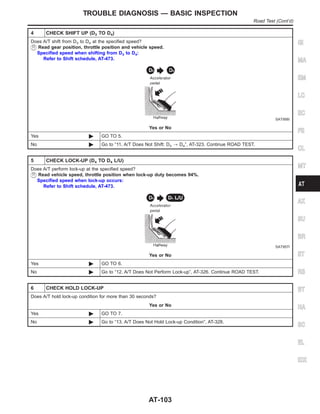
position unless the brake pedal is depressed.
With the key removed, the selector lever cannot be shifted from “P” to any other position.
The key cannot be removed unless the selector lever is placed in “P”.
I The shift lock and key interlock mechanisms are controlled by the ON-OFF operation of the shift lock
solenoid and by the operation of the rotator and slider located inside the key cylinder.
Shift Lock System Electrical Parts Location NJAT0103
SAT006K
A/T SHIFT LOCK SYSTEM
Description
AT-346
Wiring Diagram — SHIFT — NJAT0104
HAT088
GI
MA
EM
LC
EC
FE
CL
MT
AX
SU
BR
ST
RS
BT
HA
SC
EL
IDX
A/T SHIFT LOCK SYSTEM
Wiring Diagram — SHIFT —
AT-347
Diagnostic Procedure NJAT0105
SYMPTOM 1:
I Selector lever cannot be moved from “P” position with key
in ON position and brake pedal applied.
I Selector lever can be moved from “P” position with key in
ON position and brake pedal released.
I Selector lever can be moved from “P” position when key
is removed from key cylinder.
SYMPTOM 2:
Ignition key cannot be removed when selector lever is set to
“P” position. It can be removed when selector lever is set to
any position except “P”.
1 CHECK KEY INTERLOCK CABLE
Check key interlock cable for damage.
OK or NG
OK © GO TO 2.
NG © Repair key interlock cable. Refer to AT-352.
2 CHECK SELECTOR LEVER POSITION
Check selector lever position for damage.
OK or NG
OK © GO TO 3.
NG © Check selector lever. Refer to “ON-VEHICLE SERVICE — PNP Switch and Control
Cable Adjustment”, AT-355.
3 CHECK POWER SOURCE
1. Turn ignition switch to “ON” position.
(Do not start engine.)
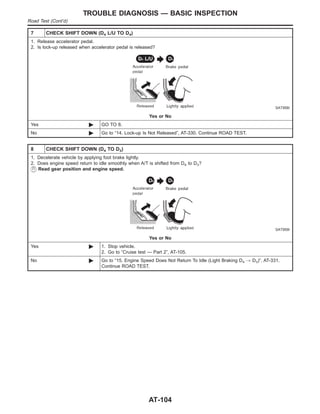
2. Check voltage between stop lamp switch harness terminal 1 and ground.
Voltage: Battery voltage
SAT007K
OK or NG
OK © GO TO 4.
NG © Check the following items:
1. Harness for short or open between battery and stop lamp switch harness terminal 1
2. Fuse
3. Ignition switch (Refer to EL-11, “POWER SUPPLY ROUTING”.)
A/T SHIFT LOCK SYSTEM
Diagnostic Procedure
AT-348
4 CHECK INPUT SIGNAL (A/T DEVICE)
Turn ignition switch to “ON” position.
(Do not start engine.)
I Check voltage between A/T device harness terminal 2 and ground.
Voltage:
Brake pedal depressed:
Battery voltage
Brake pedal released:
0V
SAT008K
OK or NG
OK © GO TO 5.
NG © Check the following items:
1. Harness for short and open between battery and stop lamp switch harness connector
1.
2. Harness for short or open between stop lamp switch harness connector 2 and A/T
device harness connector 2.
3. Fuse
4. Stop lamp switch (Refer to “A/T DEVICE CHECK”, AT-351.)
5 CHECK GROUND CIRCUIT
1. Turn ignition switch to “OFF” position.
2. Disconnect A/T device harness connector.
3. Check continuity between A/T device harness terminal 3 and ground.
Continuity should exist.
If OK, check harness for short to ground and short to power.
SAT009K
OK or NG
OK © GO TO 6.
NG © Repair open circuit or short to ground or short to power in harness or connectors.
GI
MA
EM
LC
EC
FE
CL
MT
AX
SU
BR
ST
RS
BT
HA
SC
EL
IDX
A/T SHIFT LOCK SYSTEM
Diagnostic Procedure (Cont’d)
AT-349
6 CHECK RELAY CIRCUIT
1. Turn ignition switch to ON.
I Check voltage between terminal 4 - 3 and 2 - 3.
SAT010K
OK or NG
OK © GO TO 7.
NG © Replace A/T device.
7 CHECK PARK POSITION SWITCH
Refer to “A/T device Check”, AT-351.
OK or NG
OK © GO TO 8.
NG © Replace A/T device.
8 CHECK SHIFT LOCK SOLENOID
Refer to “A/T device Check”, AT-351.
OK or NG
OK © GO TO 9.
NG © Replace A/T device.
9 SHIFT LOCK OPERATION
1. Reconnect shift lock harness connector.
2. Turn ignition switch from “OFF” to “ON” position. (Do not start engine.)
3. Recheck shift lock operation.
OK or NG
OK © INSPECTION END
NG © 1. Perform A/T device input/output signal inspection test.
2. If NG, recheck harness connector connection.
A/T SHIFT LOCK SYSTEM
Diagnostic Procedure (Cont’d)
AT-350
A/T DEVICE CHECK =NJAT0105S01
1. Shift Lock Solenoid NJAT0105S0101
I Check operation sound.
When ignition switch is turned to “ON” position and selector
lever is set in “P” position.
Brake pedal Operation sound
Depressed Yes
Released No
SAT011K
2. Park Position Switch NJAT0105S0102
I Check resistance between A/T device harness terminal 2 and
3.
Condition Resistance
When selector lever is set in “P” position and selector
lever button is released
111Ω
When selector lever is not set in “P” position and
selector lever button is released
0Ω
SAT861JA
STOP LAMP SWITCH NJAT0105S02
I Check continuity between terminals 1 and 2.
Condition Continuity
When brake pedal is depressed Yes
When brake pedal is released No
Check stop lamp switch after adjusting brake pedal — refer to
BR-11, “BRAKE PEDAL AND BRACKET”.
GI
MA
EM
LC
EC
FE
CL
MT
AX
SU
BR
ST
RS
BT
HA
SC
EL
IDX
A/T SHIFT LOCK SYSTEM
Diagnostic Procedure (Cont’d)
AT-351
Components NJAT0107
SAT996J
CAUTION:
I Install key interlock cable in such a way that it will not be
damaged by sharp bends, twists or interference with adja-
cent parts.
I After installing key interlock cable to control device, make
sure that casing cap and bracket are firmly secured in
their positions.
SAT853J
Removal NJAT0108
1. Unlock slider by squeezing lock tabs on slider from adjuster
holder and remove interlock rod from cable.
KEY INTERLOCK CABLE
Components
AT-352
SAT854J
2. Remove lock plate from steering lock assembly and remove
key interlock cable.
SAT854J
Installation NJAT0109
1. Turn ignition key to lock position.
2. Set A/T selector lever to P position.
3. Set key interlock cable to steering lock assembly and install
lock plate.
4. Clamp cable to steering column and fix to control cable with
band.
SAT804E
5. Insert interlock rod into adjuster holder.
SAT805E
6. Install casing cap to bracket.
7. Move slider in order to fix adjuster holder to interlock rod.
GI
MA
EM
LC
EC
FE
CL
MT
AX
SU
BR
ST
RS
BT
HA
SC
EL
IDX
KEY INTERLOCK CABLE
Removal (Cont’d)
AT-353
SAT992C
Control Valve Assembly and Accumulators NJAT0110
REMOVAL NJAT0110S01
1. Drain ATF from transaxle.
2. Remove oil pan and gasket.
SAT064K
3. Disconnect A/T solenoid valve harness connector.
AAT265A
4. Remove stopper ring from A/T solenoid harness terminal body.
5. Remove A/T solenoid harness by pushing terminal body into
transmission case.
AAT260A
6. Remove control valve assembly by removing fixing bolts.
Bolt length, number and location:
Bolt symbol A B C
Bolt length “” 40.0 mm
(1.575 in)
33.0 mm
(1.299 in)
43.5 mm
(1.713 in)
Number of bolts 5 6 2
I Be careful not to drop manual valve and servo release
accumulator return springs.
7. Disassemble and inspect control valve assembly if necessary.
Refer to AT-369.
ON-VEHICLE SERVICE
Control Valve Assembly and Accumulators
AT-354
SAT935J
8. Remove servo release and N-D accumulators by applying
compressed air if necessary.
I Hold each piston with a rag.
SAT497H
INSTALLATION NJAT0110S02
I Tighten fixing bolts to specification.
: 7 - 9 N·m (0.7 - 0.9 kg-m, 61 - 78 in-lb)
I Set manual shaft in Neutral position, then align manual
plate with groove in manual valve.
I After installing control valve assembly to transmission
case, make sure that selector lever can be moved to all
positions.
AAT980
Control Cable Adjustment NJAT0111
Move selector lever from the “P” position to the “1” position. You
should be able to feel the detents in each position. If the detents
cannot be felt or if the pointer indicating the position is improperly
aligned, the control cable needs adjustment.
1. Place selector lever in “P” position.
2. Loosen control cable lock nut and place manual shaft in “P”
position.
3. Pull control cable, by specified force, in the direction of the
arrow shown in the illustration.
Specified force: 6.9 N (0.7 kg, 1.5 lb)
4. Return control cable in the opposite direction of the arrow for
1.0 mm (0.039 in).
5. Tighten control cable lock nut.
6. Move selector lever from “P” to “1” position again. Make sure
that selector lever moves smoothly.
7. Apply grease to contacting areas of selector lever and control
cable. Install any part removed.
SAT479J
Park/Neutral Position (PNP) Switch Adjustment
NJAT0112
1. Remove control cable end from manual shaft.
2. Set manual shaft in “N” position.
3. Loosen PNP switch fixing bolts.
GI
MA
EM
LC
EC
FE
CL
MT
AX
SU
BR
ST
RS
BT
HA
SC
EL
IDX
ON-VEHICLE SERVICE
Control Valve Assembly and Accumulators (Cont’d)
AT-355
SAT480J
4. Use a 4 mm (0.157 in) pin for this adjustment.
a. Insert the pin straight into the manual shaft adjustment hole.
b. Rotate PNP switch until the pin can also be inserted straight
into hole in PNP switch.
5. Tighten PNP switch fixing bolts.
6. Remove pin from adjustment hole after adjusting PNP switch.
7. Reinstall any part removed.
8. Adjust control cable. Refer to “Control Cable Adjustment”,
AT-355.
9. Check continuity of PNP switch. Refer to AT-337.
SAT905DB
Differential Side Oil Seal Replacement NJAT0113
1. Remove drive shaft assemblies. Refer to AX-10, “Drive Shaft”.
2. Remove oil seals.
XAT002
3. Install oil seals.
I Apply ATF to oil seal surface before installing.
SAT027K
I Install oil seals so that dimensions “A” and “B” are within
specifications.
Unit: mm (in)
A B
5.5 - 6.5 (0.217 - 0.256) −0.5 to 0.5 (−0.020 to 0.020)
4. Reinstall any part removed.
SAT303G
Revolution Sensor Replacement NJAT0114
1. Disconnect revolution sensor harness connector.
2. Remove harness bracket from A/T.
3. Remove revolution sensor from A/T.
4. Reinstall any part removed.
Always use new sealing parts.
ON-VEHICLE SERVICE
Park/Neutral Position (PNP) Switch Adjustment (Cont’d)
AT-356
SAT065K
Removal NJAT0115
CAUTION:
Before separating transaxle from engine, remove the crank-
shaft position sensor (Euro-OBD) from transaxle. Be careful
not to damage sensor.
1. Remove battery and bracket.
2. Remove air duct between throttle body and air cleaner.
3. Disconnect A/T solenoid valve harness connector, PNP switch
harness connector and revolution sensor harness connector.
4. Remove crankshaft position sensor (Euro-OBD) from tran-
saxle.
SAT304G
5. Drain ATF from transaxle.
6. Disconnect control cable from transaxle.
7. Disconnect oil cooler hoses.
8. Remove drive shafts. Refer to AX-10, “Drive Shaft”.
9. Remove the intake manifold support bracket. Refer to EM-11,
“OUTER COMPONENT PARTS”.
10. Remove starter motor from transaxle.
Tighten bolts to specified torque.
: 41 - 52 N·m (4.2 - 5.3 kg-m, 30 - 38 ft-lb)
11. Remove upper bolts fixing transaxle to engine.
12. Support transaxle with a jack.
SAT028K
13. Remove center member.
I Tighten center member fixing bolts to specified torque, Refer
to EM-53, “REMOVAL AND INSTALLATION”.
GI
MA
EM
LC
EC
FE
CL
MT
AX
SU
BR
ST
RS
BT
HA
SC
EL
IDX
REMOVAL AND INSTALLATION
Removal
AT-357
AAT259A
14. Remove rear plate cover.
15. Remove torque converter bolts.
Rotate crankshaft to gain access to securing bolts.
16. Remove rear transaxle to engine bracket. Refer to EM-53,
“REMOVAL AND INSTALLATION”.
17. Support engine with a jack.
18. Remove rear transaxle mount. Refer to EM-53, “REMOVAL
AND INSTALLATION”.
19. Remove lower bolts fixing transaxle to engine.
20. Lower transaxle while supporting it with a jack.
SAT977H
Installation NJAT0116
1. Check drive plate runout.
CAUTION:
Do not allow any magnetic materials to contact the ring gear
teeth.
Maximum allowable runout:
RefertoEM-64,“FLYWHEEL/DRIVEPLATERUNOUT”.
I If this runout is out of allowance, replace drive plate with ring
gear.
SAT573D
2. When connecting torque converter to transaxle, measure dis-
tance “A” to be certain that they are correctly assembled.
Distance “A”:
15.9 mm (0.626 in) or more
AAT266A
3. Install torque converter to drive plate.
I With converter installed, rotate crankshaft several turns to
check that transaxle rotates freely without binding.
SAT029K
4. Tighten belts fixing transaxle.
Bolt No.
Tightening torque
N·m (kg-m, ft-lb)
Bolt length “ ”
mm (in)
1 30 - 40 (3.1 - 4.1, 23 - 29) 50 (1.97)
2*1 16 - 20 (1.6 - 2.1, 12 - 15) 25 (0.98)
3 31 - 40 (3.1 - 4.1, 23 - 29) 30 (1.18)
4*2 30 - 40 (3.1 - 4.1, 23 - 29) 16 (0.63)
5*2 16 - 20 (1.6 - 2.1, 12 - 15) 20 (0.79)
REMOVAL AND INSTALLATION
Removal (Cont’d)
AT-358
SAT058K
*1: With gusset to A/T
*2: With gusset to cylinder block
SAT638A
5. Reinstall any part removed.
6. Adjust control cable. Refer to AT-355.
7. Check continuity of PNP switch. Refer to AT-337.
8. Refill transaxle with ATF and check fluid level.
9. Move selector lever through all positions to be sure that tran-
saxle operates correctly. With parking brake applied, idle
engine. Move selector lever through “N” to “D”, to “2”, to “1” and
“R” positions. A slight shock should be felt through the hand
gripping the selector each time the transaxle is shifted.
10. Perform road test. Refer to AT-91.
GI
MA
EM
LC
EC
FE
CL
MT
AX
SU
BR
ST
RS
BT
HA
SC
EL
IDX
REMOVAL AND INSTALLATION
Installation (Cont’d)
AT-359
Components-1 3AX00, 3AX01, 3AX19, 3AX63
and 3AX64 models NJAT0119
AAT419A
OVERHAUL
Components-1 3AX00, 3AX01, 3AX19, 3AX63 and 3AX64 models
AT-360
Components-1 3AX10 and 3AX18 models NJAT0232
SAT030K
GI
MA
EM
LC
EC
FE
CL
MT
AX
SU
BR
ST
RS
BT
HA
SC
EL
IDX
OVERHAUL
Components-1 3AX10 and 3AX18 models
AT-361
Components-2 3AX00, 3AX01, 3AX19, 3AX63
and 3AX64 models NJAT0233
SAT102K
OVERHAUL
Components-2 3AX00, 3AX01, 3AX19, 3AX63 and 3AX64 models
AT-362
Components-2 3AX10 and 3AX18 models NJAT0234
SAT936J
GI
MA
EM
LC
EC
FE
CL
MT
AX
SU
BR
ST
RS
BT
HA
SC
EL
IDX
OVERHAUL
Components-2 3AX10 and 3AX18 models
AT-363
Components-3 3AX00, 3AX01, 3AX19, 3AX63
and 3AX64 models NJAT0235
SAT061K
OVERHAUL
Components-3 3AX00, 3AX01, 3AX19, 3AX63 and 3AX64 models
AT-364
Components-3 3AX10 and 3AX18 models NJAT0236
SAT103K
GI
MA
EM
LC
EC
FE
CL
MT
AX
SU
BR
ST
RS
BT
HA
SC
EL
IDX
OVERHAUL
Components-3 3AX10 and 3AX18 models
AT-365
Oil Channel NJAT0118
SAT032K
OVERHAUL
Oil Channel
AT-366
Locations of Adjusting Shims, Needle
Bearings, Thrust Washers and Snap Rings —
3AX00, 01, 19, 63 and 64 models NJAT0117
AAT416A
GI
MA
EM
LC
EC
FE
CL
MT
AX
SU
BR
ST
RS
BT
HA
SC
EL
IDX
OVERHAUL
Locations of Adjusting Shims, Needle Bearings, Thrust Washers and Snap Rings — 3AX00, 01, 19, 63 and 64 models
AT-367
Locations of Adjusting Shims, Needle
Bearings, Thrust Washers and Snap Rings —
3AX10 and 3AX18 models NJAT0237
SAT067K
OVERHAUL
Locations of Adjusting Shims, Needle Bearings, Thrust Washers and Snap Rings — 3AX10 and 3AX18 models
AT-368
NJAT0120
SAT049K
1. Drain ATF through drain plug.
SAT008D
2. Remove torque converter.
SAT009D
3. Check torque converter one-way clutch using check tool as
shown at left.
a. Insert check tool into the groove of bearing support built into
one-way clutch outer race.
b. While fixing bearing support with check tool, rotate one-way
clutch spline using flat-bladed screwdriver.
c. Check inner race rotates clockwise only. If not, replace torque
converter assembly.
SAT586H
4. Remove oil charging pipe and oil cooler tube.
GI
MA
EM
LC
EC
FE
CL
MT
AX
SU
BR
ST
RS
BT
HA
SC
EL
IDX
DISASSEMBLY
AT-369
SAT023JB
5. Set manual shaft to “P” position.
6. Remove PNP switch.
SAT128E
7. Remove oil pan and oil pan gasket.
I Do not reuse oil pan bolts.
8. Check foreign materials in oil pan to help determine cause of
malfunction. If the fluid is very dark, smells burned, or contains
foreign particles, the frictional material (clutches, band) may
need replacement. A tacky film that will not wipe clean indi-
cates varnish build up. Varnish can cause valves, servo, and
clutches to stick and may inhibit pump pressure.
I If frictional material is detected, replace radiator after
repair of A/T. Refer to LC-17, section “Radiator”.
9. Remove control valve assembly according to the following pro-
cedures.
AAT260A
a. Remove control valve assembly mounting bolts A, B and C.
DISASSEMBLY
AT-370
AAT262A
b. Remove stopper ring from terminal body.
c. Push terminal body into transmission case and draw out sole-
noid harness.
SAT017D
10. Remove manual valve from control valve assembly as a pre-
caution.
SAT877J
11. Remove return spring from servo release accumulator piston.
SAT019DA
12. Remove servo release accumulator piston with compressed
air.
13. Remove O-rings from servo release accumulator piston.
SAT020D
14. Remove N-D accumulator piston and return spring with com-
pressed air.
15. Remove O-rings from N-D accumulator piston.
GI
MA
EM
LC
EC
FE
CL
MT
AX
SU
BR
ST
RS
BT
HA
SC
EL
IDX
DISASSEMBLY
AT-371
SAT023DA
16. Check accumulator pistons and contact surface of transmis-
sion case for damage.
17. Check accumulator return springs for damage and free length.
Return springs:
Refer to SDS, AT-487.
SAT129E
18. Remove lip seals from band servo oil port.
SAT027D
19. Remove converter housing according to the following proce-
dures.
a. Remove converter housing mounting bolts A and B.
SAT028D
b. Remove converter housing.
SAT131E
c. Remove O-ring from differential oil port.
DISASSEMBLY
AT-372
SAT030D
20. Remove final drive assembly from transmission case.
NAT033
21. Remove differential side bearing outer race from transmission
case.
SAT132E
22. Remove differential side bearing adjusting shim from transmis-
sion case.
SAT840DB
23. Remove differential side bearing outer race from converter
housing.
SAT133E
24. Remove oil seal from converter housing using a screwdriver.
I Be careful not to damage case.
GI
MA
EM
LC
EC
FE
CL
MT
AX
SU
BR
ST
RS
BT
HA
SC
EL
IDX
DISASSEMBLY
AT-373
SAT072D
25. Remove side oil seal from transmission case using a screw-
driver.
SAT134EA
26. Remove oil tube from converter housing.
SAT127E
27. Remove oil pump according to the following procedures.
a. Remove O-ring from input shaft.
SAT035D
b. Remove oil pump assembly from transmission case.
SAT036D
c. Remove thrust washer and bearing race from oil pump assem-
bly.
DISASSEMBLY
AT-374
SAT037DA
28. Remove brake band according to the following procedures.
a. Loosen lock nut, then back off anchor end pin.
I Do not reuse anchor end pin.
SAT038D
b. Remove brake band from transmission case.
SAT039D
I To prevent brake linings from cracking or peeling, do not
stretch the flexible band unnecessarily. When removing
the brake band, always secure it with a clip as shown in
the figure at left.
Leave the clip in position after removing the brake band.
SAT040D
c. Check brake band facing for damage, cracks, wear or burns.
SAT041D
29. Remove input shaft assembly (high clutch) and reverse clutch
according to the following procedures.
a. Remove input shaft assembly (high clutch) with reverse clutch.
GI
MA
EM
LC
EC
FE
CL
MT
AX
SU
BR
ST
RS
BT
HA
SC
EL
IDX
DISASSEMBLY
AT-375
SAT042D
b. Remove input shaft assembly (high clutch) from reverse
clutch.
SAT043D
c. Remove needle bearing from high clutch drum.
d. Check input shaft assembly and needle bearing for damage or
wear.
SAT044D
30. Remove high clutch hub and needle bearing from transmission
case.
31. Check high clutch hub and needle bearing for damage or wear.
SAT579D
32. Remove front sun gear and needle bearings from transmission
case.
33. Check front sun gear and needle bearings for damage or wear.
SAT046D
34. Remove front planetary carrier assembly and low one-way
clutch according to the following procedures.
a. Remove snap ring using a screwdriver.
DISASSEMBLY
AT-376
SAT047D
b. Remove front planetary carrier with low one-way clutch.
SAT048D
c. Check that low one-way clutch rotates in the direction of the
arrow and locks in the opposite direction.
d. Remove low one-way clutch from front planetary carrier by
rotating it in the direction of unlock.
SAT049D
e. Remove needle bearing from front planetary carrier.
SAT050D
f. Check front planetary carrier, low one-way clutch and needle
bearing for damage or wear.
g. Check clearance between pinion washer and planetary carrier
using feeler gauge.
Standard clearance:
0.15 - 0.70 mm (0.0059 - 0.0276 in)
Allowable limit:
0.80 mm (0.0315 in)
Replace front planetary carrier if the clearance exceeds allow-
able limit.
SAT051D
35. Remove rear planetary carrier assembly and rear sun gear
according to the following procedures.
a. Remove rear planetary carrier assembly from transmission
case.
GI
MA
EM
LC
EC
FE
CL
MT
AX
SU
BR
ST
RS
BT
HA
SC
EL
IDX
DISASSEMBLY
AT-377
SAT052D
b. Remove rear sun gear from rear planetary carrier.
SAT053D
c. Remove needle bearings from rear planetary carrier assembly.
SAT054D
d. Check rear planetary carrier, rear sun gear and needle bear-
ings for damage or wear.
e. Check clearance between pinion washer and rear planetary
carrier using feeler gauge.
Standard clearance:
0.15 - 0.70 mm (0.0059 - 0.0276 in)
Allowable limit:
0.80 mm (0.0315 in)
Replace rear planetary carrier if the clearance exceeds allow-
able limit.
SAT055D
36. Remove rear internal gear from transmission case.
SAT056D
37. Remove needle bearing from rear internal gear.
I Check needle bearing for damage or wear.
DISASSEMBLY
AT-378
SAT272E
38. Remove forward clutch assembly from transmission case.
AAT215A
39. Remove thrust washer from transmission case.
SAT702D
3AX00, 3AX01, 3AX19, 3AX63 and 3AX64 models
40. Remove side cover.
I Do not reuse side cover bolts.
SAT703D
41. Remove output shaft, output gear and reduction gear accord-
ing to the following procedures.
a. Set manual lever to “P” position to fix idler gear and output
gear.
b. Unlock both idler gear and output gear lock nuts using a pin
punch.
SAT704D
c. Remove idler gear and output gear lock nuts.
I Do not reuse idler gear and output gear lock nuts.
GI
MA
EM
LC
EC
FE
CL
MT
AX
SU
BR
ST
RS
BT
HA
SC
EL
IDX
DISASSEMBLY
AT-379
SAT705D
d. Remove idler gear and output gear using a puller.
SAT706DB
e. Remove reduction pinion gear and output shaft from transmis-
sion case.
f. Remove reduction pinion bearing adjusting shim from reduc-
tion pinion gear.
g. Remove adjusting spacer from output shaft.
SAT059D
3AX10 and 3AX18 models
42. Remove output shaft assembly according to the following pro-
cedures.
a. Remove side cover bolts.
SAT434D
b. Remove side cover by lightly tapping it with a soft hammer.
I Be careful not to drop output shaft assembly. It might
come out when removing side cover.
SAT440D
c. Remove adjusting shim.
DISASSEMBLY
AT-380
SAT439D
d. Remove output shaft assembly.
SAT435D
I If output shaft assembly came off with side cover, tap cover
with a soft hammer to separate.
SAT453D
e. Remove needle bearing.
SAT060D
43. Disassemble reduction pinion gear according to the following
procedures.
a. Set manual shaft to position “P” to fix idler gear.
b. Unlock idler gear lock nut using a pin punch.
SAT061D
c. Remove idler gear lock nut.
I Do not reuse idler gear lock nut.
GI
MA
EM
LC
EC
FE
CL
MT
AX
SU
BR
ST
RS
BT
HA
SC
EL
IDX
DISASSEMBLY
AT-381
SAT841DA
d. Remove idler gear with puller.
SAT062K
e. Remove reduction pinion gear.
f. Remove reduction pinion gear bearing adjusting shim from
reduction pinion gear.
SAT064D
44. Remove return spring from parking shaft using a screwdriver.
SAT065D
45. Draw out parking shaft and remove parking pole from trans-
mission case.
46. Check parking pole and shaft for damage or wear.
SAT066D
47. Remove parking actuator support from transmission case.
I Check parking actuator support for damage or wear.
DISASSEMBLY
AT-382
SAT311G
48. Remove revolution sensor from transmission case.
GI
MA
EM
LC
EC
FE
CL
MT
AX
SU
BR
ST
RS
BT
HA
SC
EL
IDX
DISASSEMBLY
AT-383
Manual Shaft
COMPONENTS NJAT0121
SAT481J
SAT313G
REMOVAL NJAT0122
1. Remove detent spring from transmission case.
SAT076D
2. Drive out manual plate retaining pin.
SAT077D
3. Drive and pull out parking rod plate retaining pin.
4. Remove parking rod plate from manual shaft.
5. Draw out parking rod from transmission case.
REPAIR FOR COMPONENT PARTS
Manual Shaft
AT-384
SAT049F
6. Pull out manual shaft retaining pin.
7. Remove manual shaft and manual plate from transmission
case.
SAT080D
8. Remove manual shaft oil seal.
INSPECTION NJAT0123
I Check component parts for wear or damage. Replace if nec-
essary.
SAT081D
INSTALLATION NJAT0124
1. Install manual shaft oil seal.
I Apply ATF to outer surface of oil seal.
SAT610H
2. Install manual shaft and manual plate.
GI
MA
EM
LC
EC
FE
CL
MT
AX
SU
BR
ST
RS
BT
HA
SC
EL
IDX
REPAIR FOR COMPONENT PARTS
Manual Shaft (Cont’d)
AT-385
SAT074E
3. Align groove of manual shaft and hole of transmission case.
4. Install manual shaft retaining pin.
SAT078D
5. Install parking rod to parking rod plate.
6. Set parking rod assembly onto manual shaft.
SAT087D
7. Drive in manual plate retaining pin and parking rod plate retain-
ing pin.
SAT313G
8. Install detent spring.
REPAIR FOR COMPONENT PARTS
Manual Shaft (Cont’d)
AT-386
Oil Pump
COMPONENTS NJAT0125
SAT931J
SAT699H
DISASSEMBLY NJAT0126
1. Remove seal rings.
SAT091D
2. Loosen bolts in numerical order and remove oil pump cover.
SAT092D
3. Remove inner and outer gear from oil pump housing.
GI
MA
EM
LC
EC
FE
CL
MT
AX
SU
BR
ST
RS
BT
HA
SC
EL
IDX
REPAIR FOR COMPONENT PARTS
Oil Pump
AT-387
SAT093D
4. Remove O-ring from oil pump housing.
SAT094D
5. Remove oil pump housing oil seal.
INSPECTION NJAT0127
Oil Pump Housing, Oil Pump Cover, Inner Gear and
Outer Gear NJAT0127S01
I Check for wear or damage.
SAT095D
Side Clearances NJAT0127S02
I Measure side clearance of inner and outer gears in at least
four places around each outside edge. Maximum measured
values should be within specified range.
Standard clearance:
0.02 - 0.04 mm (0.0008 - 0.0016 in)
I If clearance is less than standard, select inner and outer gear
as a set so that clearance is within specifications.
Inner and outer gear:
Refer to SDS, AT-480.
I If clearance is more than standard, replace whole oil pump
assembly except oil pump cover.
REPAIR FOR COMPONENT PARTS
Oil Pump (Cont’d)
AT-388
SAT096D
I Measure clearance between outer gear and oil pump housing.
Standard clearance:
0.08 - 0.15 mm (0.0031 - 0.0059 in)
Allowable limit:
0.15 mm (0.0059 in)
I If not within allowable limit, replace whole oil pump assembly
except oil pump cover.
SAT097D
Side Ring Clearance NJAT0127S03
I Install new seal rings onto oil pump cover.
I Measure clearance between seal ring and ring groove.
Standard clearance:
0.1 - 0.25 mm (0.0039 - 0.0098 in)
Allowable limit:
0.25 mm (0.0098 in)
I If not within allowable limit, replace oil pump cover assembly.
SAT098D
ASSEMBLY NJAT0128
1. Install oil seal on oil pump housing.
SAT093D
2. Install O-ring on oil pump housing.
I Apply ATF to O-ring.
SAT092D
3. Install inner and outer gears on oil pump housing.
I Take care with the direction of the inner gear.
GI
MA
EM
LC
EC
FE
CL
MT
AX
SU
BR
ST
RS
BT
HA
SC
EL
IDX
REPAIR FOR COMPONENT PARTS
Oil Pump (Cont’d)
AT-389
SAT101D
4. Install oil pump cover on oil pump housing.
a. Wrap masking tape around splines of oil pump cover assem-
bly to protect seal. Position oil pump cover assembly on oil
pump housing assembly, then remove masking tape.
b. Tighten bolts in numerical order.
SAT699H
5. Install new seal rings carefully after packing ring groove with
petroleum jelly.
I Do not spread gap of seal ring excessively while install-
ing. It may deform the ring.
REPAIR FOR COMPONENT PARTS
Oil Pump (Cont’d)
AT-390
Control Valve Assembly
COMPONENTS =NJAT0129
SAT033K
1. Solenoid valve assembly
2. O-ring
3. Clip
4. Terminal body
5. Control valve lower body
6. Oil strainer
7. Support plate
8. Lower inter separating gasket
9. Separating plate
10. Lower separating gasket
11. Steel ball
12. Control valve inter body
13. Pilot filter
14. Upper inter separating gasket
15. Separating plate
16. Upper separating gasket
17. Steel ball
18. Control valve upper body
19. Check ball
20. Oil cooler relief valve spring
21. O-ring
22. T/C pressure holding spring
23. Check ball
GI
MA
EM
LC
EC
FE
CL
MT
AX
SU
BR
ST
RS
BT
HA
SC
EL
IDX
REPAIR FOR COMPONENT PARTS
Control Valve Assembly
AT-391
DISASSEMBLY =NJAT0130
I Disassemble upper, inter and lower bodies.
Bolt length, number and location:
Bolt symbol A B C D E F G
Bolt length “” 13.5 mm
(0.531 in)
58.0 mm
(2.283 in)
40.0 mm
(1.575 in)
66.0 mm
(2.598 in)
33.0 mm
(1.299 in)
78.0 mm
(3.071 in)
18.0 mm
(0.709 in)
Number of bolts 6 3 6 11 2 2 1
F: Reamer bolt with nut
SAT869J
SAT083F
1. Remove bolts A, D and F, and remove oil strainer from control
valve assembly.
SAT316GA
2. Remove solenoid valve assembly and line pressure solenoid
valve from control valve assembly.
I Be careful not to lose the line pressure solenoid valve
spring.
REPAIR FOR COMPONENT PARTS
Control Valve Assembly (Cont’d)
AT-392
SAT317G
3. Remove O-rings from solenoid valves and terminal body.
SAT064F
4. Place upper body facedown, and remove bolts B, C and F.
SAT432D
5. Remove lower body from inter body.
SAT109D
6. Turn over lower body, and accumulator support plates.
SAT873J
7. Remove bolts E, separating plate and separating gaskets from
lower body.
8. Remove check balls, oil cooler relief valve springs and T/C
pressure holding spring from lower body.
I Be careful not to lose steel balls and relief valve springs.
GI
MA
EM
LC
EC
FE
CL
MT
AX
SU
BR
ST
RS
BT
HA
SC
EL
IDX
REPAIR FOR COMPONENT PARTS
Control Valve Assembly (Cont’d)
AT-393
SAT065F
9. Remove inter body from upper body.
10. Remove pilot filter, separating plate and gaskets from upper
body.
SAT870J
11. Check to see that steel balls are properly positioned in inter
body and then remove them.
I Be careful not to lose steel balls.
SAT871J
12. Check to see that steel balls are properly positioned in upper
body and then remove them.
I Be careful not to lose steel balls.
SAT872J
INSPECTION NJAT0131
Lower and Upper Bodies NJAT0131S01
I Check to see that retainer plates are properly positioned in
lower body.
SAT321G
I Check to see that retainer plates are properly positioned in
upper body.
REPAIR FOR COMPONENT PARTS
Control Valve Assembly (Cont’d)
AT-394
SAT115D
Oil Strainer NJAT0131S02
I Check wire netting of oil strainer for damage.
SAT322GC
Shift Solenoid Valves A and B, Line Pressure Solenoid
Valve, Torque Converter Clutch Solenoid Valve and
Overrun Clutch Solenoid Valve NJAT0131S03
I Refer to “Resistance Check” of each solenoid valve.
Valves
Except for Euro-
OBD
Euro-OBD
Shift solenoid valve A AT-153 AT-257
Shift solenoid vavle B AT-159 AT-263
Line pressure solenoid valve AT-188 AT-251
Torque converter clutch solenoid valve AT-170 AT-244
Overrun clutch solenoid valve AT-164 AT-278
SAT138D
Oil Cooler Relief Valve Spring NJAT0131S04
I Check springs for damage or deformation.
I Measure free length and outer diameter.
Inspection standard:
Unit: mm (in)
Part No.  D
31872 31X00 17.0 (0.669) 8.0 (0.315)
SAT871J
ASSEMBLY NJAT0132
1. Install upper, inter and lower body.
a. Place oil circuit of upper body face up. Install steel balls in their
proper positions.
GI
MA
EM
LC
EC
FE
CL
MT
AX
SU
BR
ST
RS
BT
HA
SC
EL
IDX
REPAIR FOR COMPONENT PARTS
Control Valve Assembly (Cont’d)
AT-395
SAT072F
b. Install upper separating gasket, upper inter separating gasket
and upper separating plate in order shown in illustration.
I Always use new gaskets.
SAT073F
c. Install reamer bolts F from bottom of upper body. Using reamer
bolts as guides, install separating plate and gaskets as a seat.
SAT074F
d. Install pilot filter.
SAT870J
e. Place inter body as shown in the illustration. Install steel balls
in their proper positions.
SAT076F
f. Install inter body on upper body using reamer bolts F as
guides.
I Be careful not to dislocate or drop steel balls.
REPAIR FOR COMPONENT PARTS
Control Valve Assembly (Cont’d)
AT-396
SAT873J
g. Install check balls, oil cooler relief valve springs and T/C pres-
sure holding spring in their proper positions in lower body.
SAT077F
h. Install lower separating gasket, inner separating gasket and
lower separating plate in order shown in the illustration.
SAT078F
i. Install bolts E from bottom of lower body. Using bolt E as
guides, install separating plate and gaskets as a set.
j. Install support plates on lower body.
AAT536
k. Install lower body on inter body using reamer bolts F as guides
and tighten reamer bolts F slightly.
SAT317G
2. Install O-rings to solenoid valves and terminal body.
I Apply ATF to O-rings.
GI
MA
EM
LC
EC
FE
CL
MT
AX
SU
BR
ST
RS
BT
HA
SC
EL
IDX
REPAIR FOR COMPONENT PARTS
Control Valve Assembly (Cont’d)
AT-397
3. Install and tighten bolts.
Bolt length, number and location:
Bolt symbol A B C D E F G
Bolt length “” 13.5 mm
(0.531 in)
58.0 mm
(2.283 in)
44.0 mm
(1.732 in)
66.0 mm
(2.598 in)
33.0 mm
(1.299 in)
78.0 mm
(3.071 in)
18.0 mm
(0.709 in)
Number of bolts 6 3 6 11 2 2 1
F: Reamer bolt with nut
SAT869J
SAT081F
a. Install and tighten bolts B to specified torque.
: 7 - 9 N·m (0.7 - 0.9 kg-m, 61 - 78 in-lb)
SAT316GA
b. Install solenoid valve assembly and line pressure solenoid
valve to lower body.
REPAIR FOR COMPONENT PARTS
Control Valve Assembly (Cont’d)
AT-398
SAT323G
c. Remove reamer bolts F and set oil strainer on control valve
assembly.
d. Reinstall reamer bolts F from lower body side.
SAT083F
e. Tighten bolts A, C, D and F to specified torque.
: 7 - 9 N·m (0.7 - 0.9 kg-m, 61 - 78 in-lb)
SAT084FA
f. Tighten bolts E to specified torque.
: 3.4 - 4.4 N·m (0.35 - 0.45 kg-m, 30.4 - 39.1 in-lb)
GI
MA
EM
LC
EC
FE
CL
MT
AX
SU
BR
ST
RS
BT
HA
SC
EL
IDX
REPAIR FOR COMPONENT PARTS
Control Valve Assembly (Cont’d)
AT-399
Control Valve Upper Body
COMPONENTS =NJAT0133
Numbers preceding valve springs correspond with those shown in SDS table on page AT-477.
SAT012K
1. Control valve upper body
2. Overrun clutch reducing valve
spring
3. Overrun clutch reducing valve
4. Plug
5. Retainer plate
6. Torque converter relief valve
7. Torque converter relief valve
spring
8. Retainer plate
9. Torque converter clutch control
valve
10. Torque converter clutch control
valve spring
11. Plug
12. Sleeve
13. Retainer plate
14. 1-2 accumulator valve
15. 1-2 accumulator valve spring
16. Plug
17. Retainer plate
18. Cooler check valve
19. Cooler check valve spring
20. Plug
21. Retainer plate
22. Retainer plate
23. Pilot valve spring
24. Pilot valve
25. Retainer plate
26. Plug
27. 1-2 accumulator piston
28. 1-2 accumulator piston spring
29. 1-2 accumulator retainer plate
30. Retainer plate
31. Plug
32. 1st reducing valve
33. 1st reducing valve spring
34. Retainer plate
35. 3-2 timing valve spring
36. 3-2 timing valve
REPAIR FOR COMPONENT PARTS
Control Valve Upper Body
AT-400
SAT321G
DISASSEMBLY NJAT0134
1. Remove valves at retainer plates.
I Do not use a magnetic “hand”.
SAT135D
a. Use a screwdriver to remove retainer plates.
SAT136D
b. Remove retainer plates while holding spring, plugs or sleeves.
I Remove plugs slowly to prevent internal parts from jump-
ing out.
SAT137D
c. Place mating surface of valve body face down, and remove
internal parts.
I If a valve is hard to remove, place valve body face down
and lightly tap it with a soft hammer.
I Be careful not to drop or damage valves and sleeves.
SAT138D
INSPECTION NJAT0135
Valve Spring NJAT0135S01
I Measure free length and outer diameter of each valve spring.
Also check for damage or deformation.
Inspection standard:
Refer to SDS, AT-477.
I Replace valve springs if deformed or fatigued.
Control Valves NJAT0135S02
I Check sliding surfaces of valves, sleeves and plugs.
GI
MA
EM
LC
EC
FE
CL
MT
AX
SU
BR
ST
RS
BT
HA
SC
EL
IDX
REPAIR FOR COMPONENT PARTS
Control Valve Upper Body (Cont’d)
AT-401
SAT139D
ASSEMBLY NJAT0136
I Lay control valve body down when installing valves. Do
not stand the control valve body upright.
SAT140DA
1. Lubricate the control valve body and all valves with ATF. Install
control valves by sliding them carefully into their bores.
I Be careful not to scratch or damage valve body.
SAT141D
I Wrap a small screwdriver with vinyl tape and use it to insert the
valves into their proper positions.
SAT142DA
1-2 Accumulator Valve NJAT0136S01
I Install 1-2 accumulator valve. Align 1-2 accumulator retainer
plate from opposite side of control valve body.
I Install return spring, 1-2 accumulator piston and plug.
SAT143D
1. Install retainer plates.
I Install retainer plate while pushing plug or return spring.
REPAIR FOR COMPONENT PARTS
Control Valve Upper Body (Cont’d)
AT-402
SAT086F
Retainer Plate (for control valve upper body) NJAT0136S02
Refer to AT-400.
Unit: mm (in)
Name of valve and piston No. Length A Length B
Pilot valve 22
6.0 (0.236)
21.5 (0.846)
1-2 accumulator valve 17
40.5 (1.59)
1-2 accumulator piston 25
1st reducing valve 30 21.5 (0.846)
Overrun clutch reducing valve 5 24.0 (0.945)
Torque converter relief valve 8 21.5 (0.846)
Torque converter clutch control valve 13 28.0 (1.102)
3-2 timing valve 34 21.5 (0.846)
Cooler check valve 21 24.0 (0.945)
I Install proper retainer plates.
GI
MA
EM
LC
EC
FE
CL
MT
AX
SU
BR
ST
RS
BT
HA
SC
EL
IDX
REPAIR FOR COMPONENT PARTS
Control Valve Upper Body (Cont’d)
AT-403
Control Valve Lower Body
COMPONENTS =NJAT0137
Numbers preceding valve springs correspond with those shown in SDS table on page AT-477.
SAT013K
1. Control valve lower body
2. Shift valve B spring
3. Shift valve B
4. Plug
5. Retainer plate
6. Pressure modifier valve
7. Pressure modifier valve spring
8. Parallel pin
9. Sleeve
10. Piston
11. Pressure modifier piston spring
12. Retainer plate
13. Manual valve
14. Retainer plate
15. Sleeve
16. Plug
17. Spring seat
18. Pressure regulator valve spring
19. Pressure regulator valve
20. Retainer plate
21. Plug
22. Overrun clutch control valve
23. Overrun clutch control valve spring
24. Retainer plate
25. Plug
26. Accumulator control valve
27. Accumulator control valve spring
28. Retainer plate
29. Shift valve A spring
30. Shift valve A
31. Retainer plate
32. Plug
33. Plug
34. Shuttle valve spring
35. Shuttle control valve
REPAIR FOR COMPONENT PARTS
Control Valve Lower Body
AT-404
SAT872J
DISASSEMBLY NJAT0138
Remove valves at retainer plate.
For removal procedures, refer to AT-392.
SAT138D
INSPECTION NJAT0139
Valve Springs NJAT0139S01
I Check each valve spring for damage or deformation. Also
measure free length and outer diameter.
Inspection standard:
Refer to SDS, AT-477.
I Replace valve springs if deformed or fatigued.
Control Valves NJAT0139S02
I Check sliding surfaces of control valves, sleeves and plugs for
damage.
SAT872J
ASSEMBLY NJAT0140
I Install control valves.
For installation procedures, refer to AT-402.
SAT089F
Retainer Plate (for control valve lower body) NJAT0140S01
Refer to AT-404.
Unit: mm (in)
Name of control valve No. Length A Length B Type
Pressure regulator valve 14
6.0
(0.236)
28.0
(1.102)
I
Accumulator control valve 24
Shift valve A 28
Overrun clutch control valve 20
Pressure modifier valve 12
Shuttle control valve 31
Shift valve B 5 — — II
I Install proper retainer plates.
GI
MA
EM
LC
EC
FE
CL
MT
AX
SU
BR
ST
RS
BT
HA
SC
EL
IDX
REPAIR FOR COMPONENT PARTS
Control Valve Lower Body (Cont’d)
AT-405
Reverse Clutch
COMPONENTS =NJAT0141
SAT485JB
SAT155D
DISASSEMBLY NJAT0142
1. Check operation of reverse clutch.
a. Install seal ring onto drum support of oil pump cover and install
reverse clutch assembly. Apply compressed air to oil hole.
b. Check to see that retaining plate moves to snap ring.
c. If retaining plate does not contact snap ring:
I D-ring might be damaged.
I Oil seal might be damaged.
I Fluid might be leaking past piston check ball.
SAT156D
2. Remove snap ring.
3. Remove drive plates, driven plates, retaining plate, and dish
plates.
SAT157D
4. Set Tool on spring retainer and remove snap ring from reverse
clutch drum while compressing return springs.
I Set Tool directly above springs.
I Do not expand snap ring excessively.
5. Remove spring retainer and return springs.
REPAIR FOR COMPONENT PARTS
Reverse Clutch
AT-406
SAT301E
I Do not remove return springs from spring retainer.
SAT159D
6. Remove piston from reverse clutch drum by turning it.
SAT138E
7. Remove D-ring and oil seal from piston.
INSPECTION NJAT0143
Reverse Clutch Snap Ring, Spring Retainer and Return
Springs NJAT0143S01
I Check for deformation, fatigue or damage.
I Replace if necessary.
I When replacing spring retainer and return springs,
replace them as a set.
SAT162D
Reverse Clutch Drive Plates NJAT0143S02
I Check facing for burns, cracks or damage.
I Measure thickness of facing.
Thickness of drive plate:
Standard value: 2.0 mm (0.079 in)
Wear limit: 1.8 mm (0.071 in)
I If not within wear limit, replace.
GI
MA
EM
LC
EC
FE
CL
MT
AX
SU
BR
ST
RS
BT
HA
SC
EL
IDX
REPAIR FOR COMPONENT PARTS
Reverse Clutch (Cont’d)
AT-407
SAT163D
Reverse Clutch Dish Plates NJAT0143S03
I Check for deformation or damage.
I Measure thickness of dish plate.
Thickness of dish plate “t”: 2.8 mm (0.110 in)
I If deformed or fatigued, replace.
SAT164D
Reverse Clutch Piston NJAT0143S04
I Make sure check balls are not fixed.
I Apply compressed air to check ball oil hole opposite the return
spring. Make sure that there is no air leakage.
I Apply compressed air to oil hole on return spring side to make
sure air leaks past ball.
SAT160DA
ASSEMBLY NJAT0144
1. Install D-ring and oil seal on piston.
I Take care with the direction of the oil seal.
I Apply ATF to both parts.
SAT159D
2. Install piston assembly by turning it slowly.
I Apply ATF to inner surface of drum.
SAT168D
3. Install return springs and spring retainer on piston.
For return spring, refer to AT-480.
REPAIR FOR COMPONENT PARTS
Reverse Clutch (Cont’d)
AT-408
SAT157D
4. Set Tool on spring retainer and install snap ring while com-
pressing return springs.
I Set Tool directly above return springs.
SAT170D
5. Install drive plates, driven plates, retaining plate and dish
plates.
I Do not align the projections of any two dish plates.
I Take care with the order and direction of plates.
SAT156D
6. Install snap ring.
SAT174D
7. Measure clearance between retaining plate and snap ring. If
not within allowable limit, select proper retaining plate.
Specified clearance:
Standard: 0.5 - 0.8 mm (0.020 - 0.031 in)
Allowable limit: 1.2 mm (0.047 in)
Retaining plate: Refer to SDS, AT-477.
SAT173D
8. Check operation of reverse clutch.
Refer to “Reverse Clutch”, AT-406.
GI
MA
EM
LC
EC
FE
CL
MT
AX
SU
BR
ST
RS
BT
HA
SC
EL
IDX
REPAIR FOR COMPONENT PARTS
Reverse Clutch (Cont’d)
AT-409
High Clutch
COMPONENTS =NJAT0145
SAT034K
SAT176D
DISASSEMBLY NJAT0146
1. Check operation of high clutch.
a. Apply compressed air to oil hole of input shaft.
I Stop up a hole on opposite side of input shaft.
b. Check to see that retaining plate moves to snap ring.
c. If retaining plate does not contact snap ring:
I D-ring might be damaged.
I Oil seal might be damaged.
I Fluid might be leaking past piston check ball.
SAT177D
2. Remove seal rings from input shaft.
REPAIR FOR COMPONENT PARTS
High Clutch
AT-410
SAT178D
3. Remove snap ring.
4. Remove drive plates, driven plates and retaining plate.
SAT617H
5. Set Tool on spring retainer and remove snap ring from high
clutch drum while compressing return springs.
I Set Tool directly above springs.
I Do not expand snap ring excessively.
6. Remove spring retainer and return springs.
SAT302E
I Do not remove return spring from spring retainer.
SAT189D
7. Remove piston from high clutch drum by turning it.
SAT139E
8. Remove D-ring and oil seal from piston.
GI
MA
EM
LC
EC
FE
CL
MT
AX
SU
BR
ST
RS
BT
HA
SC
EL
IDX
REPAIR FOR COMPONENT PARTS
High Clutch (Cont’d)
AT-411
INSPECTION NJAT0147
Reverse Clutch Snap Ring, Spring Retainer and Return
Springs NJAT0147S01
I Check for deformation, fatigue or damage.
I Replace if necessary.
I When replacing spring retainer and return springs,
replace them as a set.
SAT162D
High Clutch Drive Plates NJAT0147S02
I Check facing for burns, cracks or damage.
I Measure thickness of facing.
Thickness of drive plate:
Standard value: Refer to SDS, AT-478.
Wear limit: Refer to SDS, AT-478.
I If not within wear limit, replace.
SAT186D
High Clutch Piston NJAT0147S03
I Make sure check balls are not fixed.
I Apply compressed air to check ball oil hole opposite the return
spring. Make sure there is no air leakage.
I Apply compressed air to oil hole on return spring side to make
sure air leaks past ball.
SAT187D
Seal Ring Clearance NJAT0147S04
I Install new seal rings onto input shaft.
I Measure clearance between seal ring and ring groove.
Standard clearance:
0.08 - 0.23 mm (0.0031 - 0.0091 in)
Allowable limit:
0.23 mm (0.0091 in)
I If not within wear limit, replace input shaft assembly.
SAT182DA
ASSEMBLY NJAT0148
1. Install D-ring and oil seal on piston.
I Take care with the direction of the oil seal.
I Apply ATF to both parts.
REPAIR FOR COMPONENT PARTS
High Clutch (Cont’d)
AT-412
SAT189D
2. Install piston assembly by turning it slowly.
I Apply ATF to inner surface of drum.
SAT191D
3. Install return springs and spring retainer on piston.
For return spring, refer to AT-480.
SAT617H
4. Set Tool on spring retainer and install snap ring while com-
pressing return springs.
I Set Tool directly above return springs.
SAT193D
I Do not align snap ring gap with spring retainer stopper.
SAT195D
5. Install drive plates, driven plates and retaining plate.
Take care with the order and direction of plates.
6. Install snap ring.
GI
MA
EM
LC
EC
FE
CL
MT
AX
SU
BR
ST
RS
BT
HA
SC
EL
IDX
REPAIR FOR COMPONENT PARTS
High Clutch (Cont’d)
AT-413
SAT199D
7. Measure clearance between retaining plate and snap ring. If
not within allowable limit, select proper retaining plate.
Specified clearance:
Standard: 1.4 - 1.8 mm (0.055 - 0.071 in)
Allowable limit: 2.4 mm (0.094 in)
Retaining plate:
Refer to SDS, AT-478.
SAT196D
8. Check operation of high clutch.
Refer to “High Clutch”, AT-410.
SAT197D
9. Install seal rings to input shaft.
I Apply petroleum jelly to seal rings.
SAT198D
I Roll paper around seal rings to prevent seal rings from
spreading.
REPAIR FOR COMPONENT PARTS
High Clutch (Cont’d)
AT-414
Forward Clutch and Overrun Clutch
COMPONENTS NJAT0149
SAT932JA
SAT201D
DISASSEMBLY NJAT0150
1. Check operation of forward clutch and overrun clutch.
a. Install bearing retainer on forward clutch drum.
b. Apply compressed air to oil hole of forward clutch drum.
c. Check to see that retaining plate moves to snap ring.
SAT202D
d. If retaining plate does not contact snap ring:
I D-ring might be damaged.
I Oil seal might be damaged.
I Fluid might be leaking past piston check ball.
GI
MA
EM
LC
EC
FE
CL
MT
AX
SU
BR
ST
RS
BT
HA
SC
EL
IDX
REPAIR FOR COMPONENT PARTS
Forward Clutch and Overrun Clutch
AT-415
SAT203D
2. Remove snap ring for forward clutch.
3. Remove drive plates, driven plates, retaining plate and dish
plate for forward clutch.
SAT204D
4. Remove snap ring for overrun clutch.
5. Remove drive plates, driven plates, retaining plate and dish
plate for overrun clutch.
SAT205D
6. Set Tool on spring retainer and remove snap ring from forward
clutch drum while compressing return springs.
I Set Tool directly above return springs.
I Do not expand snap ring excessively.
7. Remove spring retainer and return springs.
SAT216D
8. Remove forward clutch piston with overrun clutch piston from
forward clutch drum by turning it.
SAT215D
9. Remove overrun clutch piston from forward clutch piston by
turning it.
REPAIR FOR COMPONENT PARTS
Forward Clutch and Overrun Clutch (Cont’d)
AT-416
SAT140E
10. Remove D-rings and oil seals from forward clutch piston and
overrun clutch piston.
INSPECTION NJAT0151
Snap Rings and Spring Retainer NJAT0151S01
I Check for deformation, fatigue or damage.
SAT138D
Forward Clutch and Overrun Clutch Return Springs
NJAT0151S02
I Check for deformation or damage.
I Measure free length and outer diameter.
Inspection standard:
Refer to SDS, AT-480.
I Replace if deformed or fatigued.
SAT162D
Forward Clutch and Overrun Clutch Drive Plates NJAT0151S03
I Check facing for burns, cracks or damage.
I Measure thickness of facing.
Thickness of drive plate:
Forward clutch
Standard value: 1.8 mm (0.071 in)
Wear limit: 1.6 mm (0.063 in)
Overrun clutch
Standard value: 1.6 mm (0.063 in)
Wear limit: 1.4 mm (0.055 in)
I If not within wear limit, replace.
GI
MA
EM
LC
EC
FE
CL
MT
AX
SU
BR
ST
RS
BT
HA
SC
EL
IDX
REPAIR FOR COMPONENT PARTS
Forward Clutch and Overrun Clutch (Cont’d)
AT-417
SAT163D
Forward Clutch and Overrun Clutch Dish Plates NJAT0151S04
I Check for deformation or damage.
I Measure thickness of dish plate.
Thickness of dish plate “t”:
Forward clutch: 2.5 mm (0.098 in)
Overrun clutch: 2.15 mm (0.0846 in)
I If deformed or fatigued, replace.
SAT213D
Forward Clutch Drum NJAT0151S05
I Make sure check balls are not fixed.
I Apply compressed air to check ball oil hole from outside of
forward clutch drum. Make sure air leaks past ball.
I Apply compressed air to oil hole from inside of forward clutch
drum. Make sure there is no air leakage.
SAT212D
Overrun Clutch Piston NJAT0151S06
I Make sure check balls are not fixed.
I Apply compressed air to check ball oil hole opposite the return
spring. Make sure there is no air leakage.
I Apply compressed air to oil hole on return spring side. Make
sure air leaks past ball.
SAT208DA
ASSEMBLY NJAT0152
1. Install D-rings and oil seals on forward clutch piston and over-
run clutch piston.
I Take care with direction of oil seal.
I Apply ATF to both parts.
SAT215D
2. Install overrun clutch piston assembly on forward clutch piston
while turning it slowly.
I Apply ATF to inner surface of forward clutch piston.
REPAIR FOR COMPONENT PARTS
Forward Clutch and Overrun Clutch (Cont’d)
AT-418
SAT216D
3. Install forward clutch piston assembly on forward clutch drum
while turning it slowly.
I Apply ATF to inner surface of drum.
SAT217D
4. Align notch in forward clutch piston with groove in forward
clutch drum.
SAT218D
5. Install return spring on piston.
6. Install spring retainer on return springs.
For return spring, refer to AT-480.
SAT205D
7. Set Tool on spring retainer and install snap ring while com-
pressing return springs.
I Set Tool directly above return springs.
SAT220D
I Do not align snap ring gap with spring retainer stopper.
GI
MA
EM
LC
EC
FE
CL
MT
AX
SU
BR
ST
RS
BT
HA
SC
EL
IDX
REPAIR FOR COMPONENT PARTS
Forward Clutch and Overrun Clutch (Cont’d)
AT-419
SAT204D
8. Install drive plates, driven plates, retaining plate and dish plate
for overrun clutch.
9. Install snap ring for overrun clutch.
SAT227D
10. Measure clearance between overrun clutch retaining plate and
snap ring.
If not within allowable limit, select proper retaining plate.
Specified clearance:
Standard: 1.0 - 1.4 mm (0.039 - 0.055 in)
Allowable limit: 2.0 mm (0.079 in)
Overrun clutch retaining plate:
Refer to SDS, AT-479.
SAT203D
11. Install drive plates, driven plates, retaining plate and dish plate
for forward clutch.
Take care with the order and direction of plates.
12. Install snap ring for forward clutch.
SAT228D
13. Measure clearance between forward clutch retaining plate and
snap ring.
If not within allowable limit, select proper retaining plate.
Specified clearance:
Standard: 0.45 - 0.85 mm (0.0177 - 0.0335 in)
Allowable limit: 1.85 mm (0.0728 in)
Forward clutch retaining plate:
Refer to SDS, AT-479.
SAT201D
14. Check operation of forward clutch.
Refer to “Forward Clutch and Overrun Clutch”, AT-415.
REPAIR FOR COMPONENT PARTS
Forward Clutch and Overrun Clutch (Cont’d)
AT-420
SAT202D
15. Check operation of overrun clutch.
Refer to “Forward Clutch and Overrun Clutch”, AT-415.
GI
MA
EM
LC
EC
FE
CL
MT
AX
SU
BR
ST
RS
BT
HA
SC
EL
IDX
REPAIR FOR COMPONENT PARTS
Forward Clutch and Overrun Clutch (Cont’d)
AT-421
Low & Reverse Brake
COMPONENTS =NJAT0153
SAT039K
SAT230D
DISASSEMBLY NJAT0154
1. Check operation of low & reverse brake.
a. Apply compressed air to oil hole of transmission case.
b. Check to see that retaining plate moves to snap ring.
c. If retaining plate does not contact snap ring:
I D-ring might be damaged.
I Oil seal might be damaged.
I Fluid might be leaking past piston check ball.
SAT231D
2. Stand transmission case.
3. Remove snap ring.
4. Remove drive plates, driven plates, retaining plate from trans-
mission case.
REPAIR FOR COMPONENT PARTS
Low & Reverse Brake
AT-422
SAT242D
5. Set Tool on spring retainer and remove snap ring while com-
pressing return springs.
I Set Tool directly above return springs.
I Do not expand snap ring excessively.
6. Remove spring retainer and return springs.
SAT303E
I Do not remove return springs from spring retainer.
SAT234D
7. Apply compressed air to oil hole of transmission case while
holding piston.
8. Remove piston from transmission case by turning it.
SAT767G
9. Remove D-ring and oil seal from piston.
GI
MA
EM
LC
EC
FE
CL
MT
AX
SU
BR
ST
RS
BT
HA
SC
EL
IDX
REPAIR FOR COMPONENT PARTS
Low & Reverse Brake (Cont’d)
AT-423
INSPECTION NJAT0155
Low & Reverse Clutch Snap Ring, Spring Retainer and
Return Springs NJAT0155S01
I Check for deformation, fatigue or damage.
I Replace if necessary.
I When replacing spring retainer and return springs,
replace them as a set.
SAT162D
Low & Reverse Brake Drive Plates NJAT0155S02
I Check facing for burns, cracks or damage.
I Measure thickness of facing.
Thickness of drive plate:
Standard value: 2.0 mm (0.079 in)
Wear limit: 1.8 mm (0.071 in)
I If not within wear limit, replace.
SAT235DA
ASSEMBLY NJAT0156
1. Install D-ring and oil seal on piston.
I Take care with the direction of the oil seal.
I Apply ATF to both parts.
SAT239D
2. Stand transmission case.
3. Install piston assembly on transmission case while turning it
slowly.
I Apply ATF to inner surface of transmission case.
SAT241D
4. Install return springs and spring retainer on piston.
For return spring, refer to AT-480.
REPAIR FOR COMPONENT PARTS
Low & Reverse Brake (Cont’d)
AT-424
SAT242D
5. Install snap ring while compressing return springs.
I Set Tool directly above return springs.
SAT254E
6. Install drive plates, driven plates, retaining plates and dished
plates.
I Do not align the projections on the two dished plates.
I Make sure to put the plates in the correct order and direc-
tion.
SAT231D
7. Install snap ring.
SAT246D
8. Measure clearance between retaining plate and snap ring. If
not within allowable limit, select proper retaining plate (front
side).
Specified clearance:
Standard: 1.4 - 1.8 mm (0.055 - 0.071 in)
Allowable limit:
2.8 mm (0.110 in)
Retaining plate:
Refer to SDS, AT-479.
SAT230D
9. Check operation of low & reverse brake.
Refer to “DISASSEMBLY”, AT-422.
GI
MA
EM
LC
EC
FE
CL
MT
AX
SU
BR
ST
RS
BT
HA
SC
EL
IDX
REPAIR FOR COMPONENT PARTS
Low & Reverse Brake (Cont’d)
AT-425
Rear Internal Gear, Forward Clutch Hub and
Overrun Clutch Hub
COMPONENTS NJAT0157
SAT875J
SAT249D
DISASSEMBLY NJAT0158
1. Remove snap ring from overrun clutch hub.
2. Remove overrun clutch hub from forward clutch hub.
SAT250D
3. Remove thrust washer from forward clutch hub.
REPAIR FOR COMPONENT PARTS
Rear Internal Gear, Forward Clutch Hub and Overrun Clutch Hub
AT-426
SAT251D
4. Remove forward clutch hub from rear internal gear.
SAT252D
5. Remove end bearing from rear internal gear.
SAT253D
6. Remove thrust washer from rear internal gear.
SAT254D
7. Remove end bearing from forward one-way clutch.
SAT255D
8. Remove one-way clutch from forward clutch hub.
GI
MA
EM
LC
EC
FE
CL
MT
AX
SU
BR
ST
RS
BT
HA
SC
EL
IDX
REPAIR FOR COMPONENT PARTS
Rear Internal Gear, Forward Clutch Hub and Overrun Clutch Hub (Cont’d)
AT-427
SAT256D
INSPECTION NJAT0159
Rear Internal Gear, Forward Clutch Hub and Overrun
Clutch Hub NJAT0159S01
I Check rubbing surfaces for wear or damage.
SAT257D
Snap Ring, End Bearings and Forward One-way Clutch
NJAT0159S02
I Check snap ring and end bearings for deformation and dam-
age.
I Check forward one-way clutch for wear and damage.
SAT976H
ASSEMBLY NJAT0160
1. Install forward one-way clutch on forward clutch.
I Take care with the direction of forward one-way clutch.
SAT259D
2. Install end bearing on forward one-way clutch.
I Apply petroleum jelly to end bearing.
SAT260D
3. Install thrust washer on rear internal gear.
I Apply petroleum jelly to thrust washer.
I Align pawls of thrust washer with holes of rear internal
gear.
REPAIR FOR COMPONENT PARTS
Rear Internal Gear, Forward Clutch Hub and Overrun Clutch Hub (Cont’d)
AT-428
SAT261D
4. Install end bearing on rear internal gear.
I Apply petroleum jelly to end bearing.
SAT713H
5. Install forward clutch hub on rear internal gear.
I Check operation of forward one-way clutch.
Hold rear internal gear and turn forward clutch hub. Check
forward clutch hub for correct locking and unlocking
directions.
I If not as shown in illustration, check installation direction
of forward one-way clutch.
SAT263D
6. Install thrust washer and overrun clutch hub.
I Apply petroleum jelly to thrust washer.
I Align pawls of thrust washer with holes of overrun clutch
hub.
SAT264D
7. Install overrun clutch hub on rear internal gear.
I Align projections of rear internal gear with holes of over-
run clutch hub.
SAT248D
8. Install snap ring to groove of rear internal gear.
GI
MA
EM
LC
EC
FE
CL
MT
AX
SU
BR
ST
RS
BT
HA
SC
EL
IDX
REPAIR FOR COMPONENT PARTS
Rear Internal Gear, Forward Clutch Hub and Overrun Clutch Hub (Cont’d)
AT-429
O/Shaft, O/Gear, I/Gear, R/Pinion Gear and B/
Retainer — 3AX00, 01, 19, 63 and 64 models
COMPONENTS NJAT0239
SAT104K
SAT666D
DISASSEMBLY NJAT0240
1. Remove seal rings from output shaft and bearing retainer.
REPAIR FOR COMPONENT PARTS
O/Shaft, O/Gear, I/Gear, R/Pinion Gear and B/Retainer — 3AX00, 01, 19, 63 and 64 models
AT-430
SAT592G
2. Press out output shaft bearing inner race.
SAT168K
3. Remove output shaft bearing outer race from bearing retainer.
SAT669D
4. Remove output gear bearing inner race.
SAT169K
5. Remove output gear bearing outer race from bearing retainer.
SAT648D
6. Remove idler gear bearing inner race.
GI
MA
EM
LC
EC
FE
CL
MT
AX
SU
BR
ST
RS
BT
HA
SC
EL
IDX
REPAIR FOR COMPONENT PARTS
O/Shaft, O/Gear, I/Gear, R/Pinion Gear and B/Retainer — 3AX00, 01, 19, 63 and 64 models (Cont’d)
AT-431
NAT047
7. Remove idler gear bearing outer race from transmission case.
NAT048
8. Press out reduction pinion gear bearing from reduction pinion
gear.
SAT651D
9. Remove reduction pinion gear bearing outer race from trans-
mission case.
SPD715
INSPECTION NJAT0241
Output Shaft, Output Gear, Idler Gear and Reduction
Pinion Gear NJAT0241S01
I Check shafts for cracks, wear or bending.
I Check gears for wear, chips and cracks.
Bearings NJAT0241S02
I Make sure bearings roll freely and are free from noise, cracks,
pitting or wear.
I When replacing taper roller bearing, replace inner and
outer race as a set.
SAT671D
Seal Ring Clearance NJAT0241S03
I Install new seal rings to output shaft.
I Measure clearance between seal ring and ring groove of out-
put shaft.
Standard clearance:
0.10 - 0.25 mm (0.0039 - 0.0098 in)
Wear limit:
0.25 mm (0.0098 in)
I If not within wear limit, replace output shaft.
I Install new seal rings to bearing retainer.
REPAIR FOR COMPONENT PARTS
O/Shaft, O/Gear, I/Gear, R/Pinion Gear and B/Retainer — 3AX00, 01, 19, 63 and 64 models (Cont’d)
AT-432
I Measure clearance between seal ring and ring groove of bear-
ing retainer.
Standard clearance:
0.10 - 0.25 mm (0.0039 - 0.0098 in)
Wear limit:
0.25 mm (0.0098 in)
I If not within wear limit, replace bearing retainer.
NAT049
ASSEMBLY NJAT0242
1. Press reduction pinion gear bearing on reduction pinion gear.
SAT654D
2. Install reduction pinion gear bearing outer race on transmis-
sion case.
SAT655D
3. Press idler gear bearing inner race on idler gear.
NAT051
4. Install idler gear bearing outer race on transmission case.
GI
MA
EM
LC
EC
FE
CL
MT
AX
SU
BR
ST
RS
BT
HA
SC
EL
IDX
REPAIR FOR COMPONENT PARTS
O/Shaft, O/Gear, I/Gear, R/Pinion Gear and B/Retainer — 3AX00, 01, 19, 63 and 64 models (Cont’d)
AT-433
SAT655D
5. Press output gear bearing inner race on output gear.
SAT934DA
6. Install output gear bearing outer race on bearing retainer.
SAT592G
7. Press output shaft bearing inner race on output shaft.
SAT937DA
8. Install output shaft bearing outer race on bearing retainer.
SAT676D
9. Install new seal rings onto output shaft and bearing retainer.
I Apply petroleum jelly to seal rings.
REPAIR FOR COMPONENT PARTS
O/Shaft, O/Gear, I/Gear, R/Pinion Gear and B/Retainer — 3AX00, 01, 19, 63 and 64 models (Cont’d)
AT-434
SAT677D
10. Roll paper around seal rings to prevent seal rings from
spreading.
Output Shaft, Idler Gear, Reduction Pinion Gear
and Bearing Retainer — 3AX10 and 3AX18
models
COMPONENTS NJAT0161
SAT105K
GI
MA
EM
LC
EC
FE
CL
MT
AX
SU
BR
ST
RS
BT
HA
SC
EL
IDX
REPAIR FOR COMPONENT PARTS
O/Shaft, O/Gear, I/Gear, R/Pinion Gear and B/Retainer — 3AX00, 01, 19, 63 and 64 models (Cont’d)
AT-435
SAT644D
DISASSEMBLY NJAT0162
1. Remove seal rings from output shaft and bearing retainer.
SAT645D
2. Remove output shaft bearing with screwdrivers.
I Always replace bearing with a new one when removed.
I Do not damage output shaft.
SAT646D
3. Remove snap ring from bearing retainer.
NAT046
4. Remove needle bearing from bearing retainer.
SAT648D
5. Remove idler gear bearing inner race from idler gear.
REPAIR FOR COMPONENT PARTS
Output Shaft, Idler Gear, Reduction Pinion Gear and Bearing Retainer — 3AX10 and 3AX18 models (Cont’d)
AT-436
NAT047
6. Remove idler gear bearing outer race from transmission case.
NAT048
7. Press out reduction pinion gear bearing from reduction pinion
gear.
SAT651D
8. Remove reduction pinion gear bearing outer race from trans-
mission case.
INSPECTION NJAT0163
Output Shaft, Idler Gear and Reduction Pinion Gear
NJAT0163S01
I Check shafts for cracks, wear or bending.
I Check gears for wear, chips and cracks.
SPD715
Bearing NJAT0163S02
I Make sure bearings roll freely and are free from noise, cracks,
pitting or wear.
I When replacing taper roller bearing, replace outer and
inner race as a set.
GI
MA
EM
LC
EC
FE
CL
MT
AX
SU
BR
ST
RS
BT
HA
SC
EL
IDX
REPAIR FOR COMPONENT PARTS
Output Shaft, Idler Gear, Reduction Pinion Gear and Bearing Retainer — 3AX10 and 3AX18 models (Cont’d)
AT-437
SAT652D
Seal Ring Clearance NJAT0163S03
I Install new seal rings to output shaft.
I Measure clearance between seal ring and ring groove of out-
put shaft.
Standard clearance:
0.10 - 0.25 mm (0.0039 - 0.0098 in)
Allowable limit:
0.25 mm (0.0098 in)
I If not within allowable limit, replace output shaft.
I Install new seal rings to bearing retainer.
I Measure clearance between seal ring and ring groove of bear-
ing retainer.
Standard clearance:
0.10 - 0.25 mm (0.0039 - 0.0098 in)
Allowable limit:
0.25 mm (0.0098 in)
I If not within allowable limit, replace bearing retainer.
NAT049
ASSEMBLY NJAT0164
1. Press reduction pinion gear bearing on reduction pinion gear.
SAT654D
2. Install reduction pinion gear bearing outer race on transmis-
sion case.
SAT655D
3. Press idler gear bearing inner race on idler gear.
REPAIR FOR COMPONENT PARTS
Output Shaft, Idler Gear, Reduction Pinion Gear and Bearing Retainer — 3AX10 and 3AX18 models (Cont’d)
AT-438
NAT051
4. Install idler gear bearing outer race on transmission case.
NAT052
5. Press output shaft bearing on output shaft.
SAT658D
6. Press needle bearing on bearing retainer.
SAT659D
7. Install snap ring to bearing retainer.
SAT660D
8. After packing ring grooves with petroleum jelly, carefully install
new seal rings on output shaft and bearing retainer.
GI
MA
EM
LC
EC
FE
CL
MT
AX
SU
BR
ST
RS
BT
HA
SC
EL
IDX
REPAIR FOR COMPONENT PARTS
Output Shaft, Idler Gear, Reduction Pinion Gear and Bearing Retainer — 3AX10 and 3AX18 models (Cont’d)
AT-439
SAT661D
I Roll paper around seal rings to prevent seal rings from
spreading.
Band Servo Piston Assembly
COMPONENTS NJAT0165
SAT098K
SAT288D
DISASSEMBLY NJAT0166
1. Remove band servo piston snap ring.
SAT289D
2. Apply compressed air to oil hole in transmission case to
remove OD servo piston retainer and band servo piston
assembly.
I Hold band servo piston assembly with a rag or nylon
waste.
REPAIR FOR COMPONENT PARTS
Output Shaft, Idler Gear, Reduction Pinion Gear and Bearing Retainer — 3AX10 and 3AX18 models (Cont’d)
AT-440
SAT290DB
3. Apply compressed air to oil hole in OD servo piston retainer to
remove OD servo piston from retainer.
I Hold OD servo piston while applying compressed air.
SAT593GB
4. Remove D-ring from OD servo piston.
SAT292DA
5. Remove O-rings from OD servo piston retainer.
SAT293D
6. Remove band servo piston assembly from servo piston
retainer by pushing it forward.
SAT294D
7. Place piston stem end on a wooden block. While pushing
servo piston spring retainer down, remove E-ring.
GI
MA
EM
LC
EC
FE
CL
MT
AX
SU
BR
ST
RS
BT
HA
SC
EL
IDX
REPAIR FOR COMPONENT PARTS
Band Servo Piston Assembly (Cont’d)
AT-441
SAT295DA
8. Remove OD servo return spring, band servo thrust washer and
band servo piston stem from band servo piston.
SAT296DA
9. Remove O-rings from servo piston retainer.
SAT594GA
10. Remove D-rings from band servo piston.
SAT298DA
INSPECTION NJAT0167
Pistons, Retainers and Piston Stem NJAT0167S01
I Check frictional surfaces for abnormal wear or damage.
SAT138D
Return Springs NJAT0167S02
I Check for deformation or damage.
I Measure free length and outer diameter.
Band servo inspection standard:
Refer to SDS, AT-488.
REPAIR FOR COMPONENT PARTS
Band Servo Piston Assembly (Cont’d)
AT-442
SAT595GA
ASSEMBLY NJAT0168
1. Install D-rings to servo piston retainer.
I Apply ATF to O-rings.
I Pay attention to position of each O-ring.
SAT295DA
2. Install band servo piston stem, band servo thrust washer, OD
servo return spring and spring retainer to band servo piston.
SAT301D
3. Place piston stem end on a wooden block. While pushing
servo piston spring retainer down, install E-ring.
SAT296DA
4. Install O-rings to servo piston retainer.
I Apply ATF to O-rings.
I Pay attention to the positions of the O-rings.
SAT303D
5. Install band servo piston assembly to servo piston retainer by
pushing it inward.
GI
MA
EM
LC
EC
FE
CL
MT
AX
SU
BR
ST
RS
BT
HA
SC
EL
IDX
REPAIR FOR COMPONENT PARTS
Band Servo Piston Assembly (Cont’d)
AT-443
SAT596GB
6. Install D-ring to OD servo piston.
I Apply ATF to D-ring.
SAT292DA
7. Install O-rings to OD servo piston retainer.
I Apply ATF to O-rings.
I Pay attention to the positions of the O-rings.
SAT306DA
8. Install OD servo piston to OD servo piston retainer.
SAT307DA
9. Install band servo piston assembly and 2nd servo return spring
to transmission case.
I Apply ATF to O-ring of band servo piston and transmis-
sion case.
AAT692
10. Install OD servo piston assembly to transmission case.
I Apply ATF to O-ring of band servo piston and transmis-
sion case.
REPAIR FOR COMPONENT PARTS
Band Servo Piston Assembly (Cont’d)
AT-444
SAT288D
11. Install band servo piston snap ring to transmission case.
Final Drive
COMPONENTS-1 3AX00, 3AX01, 3AX19, 3AX63 AND
3AX64 MODELS NJAT0354
SAT680DA
COMPONENTS-2 3AX10 AND 3AX18 MODELS NJAT0169
SAT040K
GI
MA
EM
LC
EC
FE
CL
MT
AX
SU
BR
ST
RS
BT
HA
SC
EL
IDX
REPAIR FOR COMPONENT PARTS
Band Servo Piston Assembly (Cont’d)
AT-445
SAT311D
DISASSEMBLY NJAT0170
1. Remove final gear.
SAT099K
2. Press out differential side bearings.
SAT313D
3. Remove speedometer drive gear.
SAT970H
4. Drive out pinion mate shaft lock pin.
SAT316D
5. Draw out pinion mate shaft from differential case.
6. Remove pinion mate gears and side gears.
REPAIR FOR COMPONENT PARTS
Final Drive (Cont’d)
AT-446
SAT041K
INSPECTION NJAT0171
Gear, Washer, Shaft and Case NJAT0171S01
I Check mating surfaces of differential case, side gears, pinion
and mate gears.
I Check washers for wear.
SPD715
Bearings NJAT0171S03
I Make sure bearings roll freely and are free from noise, cracks,
pitting or wear.
I When replacing taper roller bearing, replace outer and
inner race as a set.
SAT318D
ASSEMBLY NJAT0172
1. Install side gear and thrust washers in differential case.
2. Install pinion mate gears and thrust washers in differential case
while rotating them.
I When inserting, be careful not to damage pinion mate gear
washers.
I Apply ATF to any parts.
NAT056
3. Measure clearance between side gear and differential case
with washers using the following procedure.
a. Set Tool and dial indicator on side gear.
b. Move side gear up and down to measure dial indicator deflec-
tion. Always measure indicator deflection on both side gears.
Clearance between side gear and differential case with
washers:
0.1 - 0.2 mm (0.004 - 0.008 in)
SMT616
c. If not within specification adjust clearance by changing thick-
ness of side gear thrust washers.
Side gear thrust washer:
Refer to SDS, AT-481.
GI
MA
EM
LC
EC
FE
CL
MT
AX
SU
BR
ST
RS
BT
HA
SC
EL
IDX
REPAIR FOR COMPONENT PARTS
Final Drive (Cont’d)
AT-447
SAT970H
4. Install lock pin.
I Make sure that lock pin is flush with case.
SAT313D
5. Install speedometer drive gear on differential case.
I Align the projection of speedometer drive gear with the
groove of differential case.
SAT326D
6. Install final gear and tighten fixing bolts in numerical order.
SMT700B
7. Press on differential side bearings.
REPAIR FOR COMPONENT PARTS
Final Drive (Cont’d)
AT-448
SAT311G
Assembly (1) NJAT0173
1. Install revolution sensor onto transmission case.
Always use new sealing parts.
SAT881I
2. Install differential side oil seals on transmission case and con-
verter housing, so that “A” and “B” are within specifications.
SAT027K
Unit: mm (in)
A B
5.5 - 6.5 (0.217 - 0.256) −0.5 to 0.5 (−0.020 to 0.020)
SAT328D
3. Install parking actuator support to transmission case.
I Pay attention to direction of parking actuator support.
SAT329D
4. Install parking pawl on transmission case and fix it with park-
ing shaft.
GI
MA
EM
LC
EC
FE
CL
MT
AX
SU
BR
ST
RS
BT
HA
SC
EL
IDX
ASSEMBLY
Assembly (1)
AT-449
SAT330D
5. Install return spring.
NAT059
Adjustment (1) NJAT0174
DIFFERENTIAL SIDE BEARING PRELOAD NJAT0174S01
1. Install differential side bearing outer race without adjusting
shim on transmission case.
2. Install differential side bearing outer race on converter housing.
SAT027D
3. Place final drive assembly on transmission case.
4. Install transmission case on converter housing. Tighten trans-
mission case fixing bolts A and B to the specified torque.
NAT060
5. Attach dial indicator on differential case at transmission case
side.
6. Insert Tool into differential side gear from converter housing.
7. Move Tool up and down and measure dial indicator deflection.
Differential side bearing preload “T”:
0.04 - 0.09 mm (0.0016 - 0.0035 in)
8. Select proper thickness of differential side bearing adjusting
shim(s) using SDS table as a guide.
Differential side bearing adjusting shim:
Refer to SDS, AT-481.
ASSEMBLY
Assembly (1) (Cont’d)
AT-450
NAT033
9. Remove converter housing from transmission case.
10. Remove final drive assembly from transmission case.
11. Remove differential side bearing outer race from transmission
case.
12. Reinstall differential side bearing outer race and shim(s)
selected from SDS table on transmission case.
13. Reinstall converter housing on transmission case and tighten
transmission case fixing bolts to the specified torque.
NAT062
14. Insert Tool into differential case and measure turning torque of
final drive assembly.
I Turn final drive assembly in both directions several times
to seat bearing rollers correctly.
Turning torque of final drive assembly (New bearing):
0.49 - 1.08 N·m (5.0 - 11.0 kg-cm, 4.3 - 9.5 in-lb)
I When old bearing is used again, turning torque will be
slightly less than the above.
I Make sure torque is close to the specified range.
SAT876J
REDUCTION PINION GEAR BEARING PRELOAD NJAT0174S02
I Be sure to remove final drive assembly before doing this pro-
cedure.
I Using caliper and straightedge, calculate a dimention “T”
(adjuster shim thickness) in the left figure by the following for-
mula. And adjust the inspection standard for pre-load (rotating
slide torque) as shown below.
T = A – E
Inspection standard for preload:
0.1 - 0.69 N·m (1.1 - 7.0 kg-cm, 0.95 - 6.08 in-lb)
SAT332DA
1. Remove transmission case and final drive assembly from con-
verter housing.
2. Select proper thickness of reduction pinion gear bearing
adjusting shim using the following procedures.
a. Place reduction pinion gear on transmission case as shown.
SAT333DA
b. Place idler gear bearing on transmission case.
c. Measure dimensions “B”, “C” and “D” and calculate dimension
“A”.
A = D − (B + C)
“A”: Distance between the surface of idler gear bear-
ing inner race and the adjusting shim mating surface
of reduction pinion gear.
GI
MA
EM
LC
EC
FE
CL
MT
AX
SU
BR
ST
RS
BT
HA
SC
EL
IDX
ASSEMBLY
Adjustment (1) (Cont’d)
AT-451
SAT334DA
I Measure dimension “B” between the end of reduction pinion
gear and the surface of transmission case.
I Measure dimension “B” in at least two places.
SAT335D
I Measure dimension “C” between the surface of idler gear bear-
ing inner race and the surface of transmission case.
I Measure dimension “C” in at least two places.
SAT336DA
I Measure dimension “D” between the end of reduction pinion
gear and the adjusting shim mating surface of reduction pin-
ion gear.
I Measure dimension “D” in at least two places.
I Calculate dimension “A”.
A = D − (B + C)
SAT337D
d. Measure dimension “E” between the end of idler gear and the
idler gear bearing inner race mating surface of idler gear.
I Measure dimension “E” in at least two places.
e. Calculate “T” and select proper thickness of reduction pinion
gear bearing adjusting shim using SDS table as a guide.
T = A − E – 0.05 mm (0.0020 in)*
Reduction pinion gear bearing adjusting shim:
Refer to SDS, AT-483.
*: Bearing preload
ASSEMBLY
Adjustment (1) (Cont’d)
AT-452
SAT338DA
3. Install reduction pinion gear and reduction pinion gear bearing
adjusting shim selected in step 2-e on transmission case.
4. Press idler gear bearing inner race on idler gear.
5. Press idler gear on reduction pinion gear.
I Press idler gear so that idler gear can be locked by park-
ing pawl.
SAT339D
6. Tighten idler gear lock nut to the specified torque.
I Lock idler gear with parking pawl when tightening lock
nut.
SAT340DC
7. Measure turning torque of reduction pinion gear.
I When measuring turning torque, turn reduction pinion
gear in both directions several times to seat bearing roll-
ers correctly.
Turning torque of reduction pinion gear:
0.1 - 0.69 N·m (1.1 - 7.0 kg-cm, 0.95 - 6.08 in-lb)
SAT682D
OUTPUT SHAFT BEARING PRELOAD — 3AX00, 3AX01,
3AX19, 3AX63 AND 3AX64 MODELS NJAT0174S04
1. Select proper thickness of output shaft bearing adjusting
spacer using the following procedures.
a. Remove paper rolled around output shaft.
b. Place bearing retainer on output shaft.
SAT683D
c. Place output gear bearing inner race on bearing retainer.
d. Measure dimensions “G” and “H” and calculate dimension “F”.
“F”: Distance between the surface of output gear bearing
inner race and adjusting shim mating surface of output
shaft.
F = H – G
GI
MA
EM
LC
EC
FE
CL
MT
AX
SU
BR
ST
RS
BT
HA
SC
EL
IDX
ASSEMBLY
Adjustment (1) (Cont’d)
AT-453
SAT684D
I Measure dimension “G” between end of output shaft and sur-
face of output gear bearing inner race.
I Measure dimension “G” in at least two places.
SAT685D
I Measure dimension “H” between end of output shaft and
adjusting spacer mating surface of output shaft.
I Measure dimension “H” in at least two places.
I Calculate dimension “F”.
F = H – G
SAT686D
e. Measure dimension “I” between end of output gear (adjusting
spacer mating surface) and bearing inner race fitting surface.
I Measure dimension “I” in at least two places.
f. Calculate dimension “T2”.
“T2”: Distance between adjusting spacer mating surface
of output gear and output shaft
T2 = F – I
g. Select proper thickness of output shaft bearing adjusting
spacer using SDS table as a guide.
Output shaft bearing adjusting spacer:
Refer to SDS, AT-485.
SAT687D
2. Install bearing retainer on transmission case.
ASSEMBLY
Adjustment (1) (Cont’d)
AT-454
SAT688D
3. Place output shaft on bearing retainer.
4. Place output shaft bearing adjusting spacer selected in step
1-g on output shaft.
5. Press output gear bearing inner race on output gear.
6. Press output gear on output shaft.
SAT689D
7. Tighten output gear lock nut to specified torque.
SAT690D
8. Remove idler gear to measure output shaft bearing preload.
SAT691D
9. Measure output shaft bearing preload.
I When measuring bearing preload, turn output shaft in
both directions several times to seat bearing rollers cor-
rectly.
Output shaft bearing preload:
0.25 - 0.88 N·m (2.5 - 9.0 kg-cm, 2.2 - 7.8 in-lb)
I If not within specified range, readjust bearing preload.
SAT692D
10. Install idler gear and tighten lock nut to specified torque.
11. After properly adjusting bearing preload, clinch idler gear and
output gear lock nuts as shown.
GI
MA
EM
LC
EC
FE
CL
MT
AX
SU
BR
ST
RS
BT
HA
SC
EL
IDX
ASSEMBLY
Adjustment (1) (Cont’d)
AT-455
SAT224E
12. Install new gasket and side cover on transmission case.
I Always replace side cover bolts when removed.
I Refer to “Overhaul”, AT-364.
SAT341D
OUTPUT SHAFT END PLAY — 3AX10 AND 3AX18
MODELS NJAT0174S03
I Measure clearance between side cover and the end of the
output shaft bearing.
I Select proper thickness of adjusting shim so that clearance is
within specifications.
SAT347D
1. Install bearing retainer for output shaft.
SAT438D
2. Install output shaft thrust needle bearing on bearing retainer.
SAT439D
3. Install output shaft on transmission case.
ASSEMBLY
Adjustment (1) (Cont’d)
AT-456
SAT874DA
4. Measure dimensions “1” and “2” at side cover and then cal-
culate dimension “A”.
I Measure dimension “1” and “2” in at least two places
“A”: Distance between transmission case fitting surface
and adjusting shim mating surface
A = 1 − 2
2: Height of gauge
SAT875DA
5. Measure dimensions “2” and “3” and then calculate dimen-
sion “B”.
Measure “2” and “3” in at least two places.
“B”: Distance between the end of output shaft bearing
outer race and the side cover fitting surface of transmis-
sion case
B = 2 − 3
2: Height of gauge
SAT440D
6. Select proper thickness of adjusting shim so that output shaft
end play (clearance between side cover and output shaft bear-
ing) is within specifications.
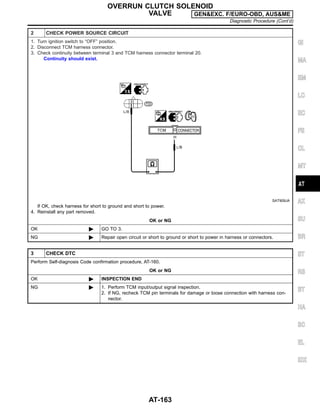
Output shaft end play (A − B):
0 - 0.5 mm (0 - 0.020 in)
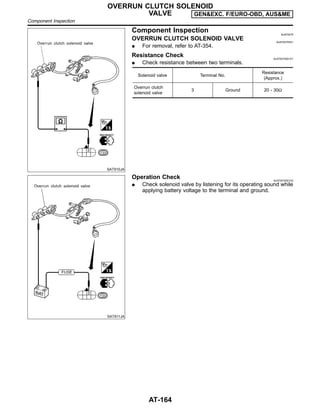
Output shaft end play adjusting shim:
Refer to SDS, AT-486.
7. Install adjusting shim on output shaft bearing.
SAT441D
8. Apply locking sealant to transmission case as shown in illus-
tration.
SAT442D
9. Install side cover on transmission case.
I Apply locking sealant to the mating surface of transmis-
sion case.
GI
MA
EM
LC
EC
FE
CL
MT
AX
SU
BR
ST
RS
BT
HA
SC
EL
IDX
ASSEMBLY
Adjustment (1) (Cont’d)
AT-457
SAT124E
10. Tighten side cover fixing bolts to specified torque.
I Do not mix bolts A and B.
I Always replace bolts A as they are self-sealing bolts.
I Refer to “Overhaul”, AT-365.
SAT354D
Assembly (2) NJAT0175
1. Remove paper rolled around bearing retainer.
2. Install thrust washer on bearing retainer.
I Apply petroleum jelly to thrust washer.
SAT355D
3. Install forward clutch assembly.
I Align teeth of low & reverse brake drive plates before
installing.
I Make sure that bearing retainer seal rings are not spread.
SAT356D
4. Install thrust needle bearing on bearing retainer.
I Apply petroleum jelly to thrust bearing.
I Pay attention to direction of thrust needle bearing.
SAT357D
5. Install thrust needle bearing on rear internal gear.
I Apply petroleum jelly to thrust needle bearing.
I Pay attention to direction of thrust needle bearing.
ASSEMBLY
Adjustment (1) (Cont’d)
AT-458
SAT358D
6. Hold forward clutch hub and turn overrun clutch hub.
Check overrun clutch hub for directions of lock and unlock.
I If not as shown in illustration, check installed direction of for-
ward one-way clutch.
SAT359D
7. Install rear internal gear assembly.
I Align teeth of forward clutch and overrun clutch drive
plate.
SAT360D
8. Install needle bearing on rear planetary carrier.
I Apply petroleum jelly to needle bearing.
I Pay attention to direction of needle bearing.
SAT052D
9. Install rear sun gear on rear planetary carrier.
I Pay attention to direction of rear sun gear.
SAT362D
10. Install rear planetary carrier on transmission case.
GI
MA
EM
LC
EC
FE
CL
MT
AX
SU
BR
ST
RS
BT
HA
SC
EL
IDX
ASSEMBLY
Assembly (2) (Cont’d)
AT-459
SAT363D
11. Install thrust needle bearing on front planetary carrier.
I Apply petroleum jelly to thrust needle bearing.
I Pay attention to direction of thrust needle bearing.
SAT048D
12. Install low one-way clutch to front planetary carrier by turning
it in the direction of the arrow as shown.
13. While holding front planetary carrier, turn low one-way clutch.
Check low one-way clutch for correct directions of lock and
unlock.
SAT047D
14. Install front planetary carrier assembly on transmission case.
SAT046D
15. Install snap ring with screwdriver.
I Forward clutch and bearings must be correctly installed
for snap ring to fit groove of transmission case.
SAT367D
16. Install needle bearing on front sun gear.
I Apply petroleum jelly to needle bearing.
I Pay attention to direction of needle bearing.
ASSEMBLY
Assembly (2) (Cont’d)
AT-460
SAT368D
17. Install front sun gear on front planetary carrier.
SAT369D
18. Install needle bearing on front sun gear.
I Apply petroleum jelly to needle bearing.
I Pay attention to direction of needle bearing.
SAT370D
19. Install high clutch hub on front sun gear.
SAT371D
20. Install needle bearing on high clutch hub.
I Apply petroleum jelly to needle bearing.
I Pay attention to direction of needle bearing.
SAT372D
21. Remove paper rolled around input shaft.
22. Install input shaft assembly.
I Align teeth of high clutch drive plates before installing.
GI
MA
EM
LC
EC
FE
CL
MT
AX
SU
BR
ST
RS
BT
HA
SC
EL
IDX
ASSEMBLY
Assembly (2) (Cont’d)
AT-461
SAT373D
23. Install reverse clutch assembly.
I Align teeth of reverse clutch drive plates before installing.
Adjustment (2) NJAT0176
When any parts listed below are replaced, adjust total end play and
reverse clutch end play.
Part name Total end play
Reverse clutch
end play
Transmission case I I
Overrun clutch hub I I
Rear internal gear I I
Rear planetary carrier I I
Rear sun gear I I
Front planetary carrier I I
Front sun gear I I
High clutch hub I I
High clutch drum I I
Oil pump cover I I
Reverse clutch drum — I
SAT374D
TOTAL END PLAY NJAT0176S01
I Measure clearance between reverse clutch drum and needle
bearing for oil pump cover.
I Select proper thickness of bearing race so that end play is
within specifications.
SAT375D
1. Measure dimensions “K” and “L” and then calculate dimension
“J”.
ASSEMBLY
Assembly (2) (Cont’d)
AT-462
SAT376D
a. Measure dimension “K”.
SAT377D
b. Measure dimension “L”.
c. Calculate dimension “J”.
“J”: Distance between oil pump fitting surface of trans-
mission case and needle bearing mating surface of high
clutch drum
J = K − L
SAT378D
2. Measure dimension “M”.
a. Place bearing race and needle bearing on oil pump assembly.
SAT379D
b. Measure dimension “M”.
“M”: Distance between transmission case fitting surface
and needle bearing on oil pump cover
“M1”: Indication of gauge
SAT443D
c. Measure thickness of straightedge “t”.
M = M1 − t
GI
MA
EM
LC
EC
FE
CL
MT
AX
SU
BR
ST
RS
BT
HA
SC
EL
IDX
ASSEMBLY
Adjustment (2) (Cont’d)
AT-463
3. Adjust total end play “T3”.
T3 = J − M
Total end play “T3”:
0.25 - 0.55 mm (0.0098 - 0.0217 in)
I Select proper thickness of bearing race so that total end play
is within specifications.
Bearing races: Refer to SDS, AT-487.
SAT380D
REVERSE CLUTCH END PLAY NJAT0176S02
I Measure clearance between oil pump cover and thrust washer
for reverse clutch drum.
I Select proper thickness of thrust washer so that end play is
within specifications.
SAT381D
1. Measure dimensions “O” and “P” and then calculate dimension
“N”.
SAT382D
a. Place thrust washer on reverse clutch drum.
b. Measure dimension “O”.
SAT383D
c. Measure dimension “P”.
d. Calculate dimension “N”.
“N”: Distance between oil pump fitting surface of trans-
mission case and thrust washer on reverse clutch drum
N = O − P
ASSEMBLY
Adjustment (2) (Cont’d)
AT-464
SAT384D
2. Measure dimensions “R” and “S” and then calculate dimension
“Q”.
SAT385D
a. Measure dimension “R”.
SAT386D
b. Measure dimension “S”.
c. Calculate dimension “Q”.
“Q”: Distance between transmission case fitting surface
and thrust washer mating surface
Q = R − S
3. Adjust reverse clutch end play “T4”.
T4 = N − Q
Reverse clutch end play:
0.65 - 1.00 mm (0.0256 - 0.0394 in)
I Select proper thickness of thrust washer so that reverse clutch
end play is within specifications.
Thrust washer: Refer to SDS, AT-487.
SAT387D
Assembly (3) NJAT0177
1. Remove reverse clutch assembly and install needle bearing on
high clutch assembly.
I Pay attention to direction of needle bearing.
2. Install reverse clutch assembly.
GI
MA
EM
LC
EC
FE
CL
MT
AX
SU
BR
ST
RS
BT
HA
SC
EL
IDX
ASSEMBLY
Adjustment (2) (Cont’d)
AT-465
SAT038D
3. Install anchor end pin and lock nut on transmission case.
4. Place brake band on outside of reverse clutch drum. Tighten
anchor end pin just enough so that brake band is evenly fitted
on reverse clutch drum.
SAT389D
5. Place bearing race selected in total end play adjustment step
on oil pump cover.
I Apply petroleum jelly to bearing race.
SAT390D
6. Place thrust washer selected in reverse clutch end play step
on reverse clutch drum.
I Apply petroleum jelly to thrust washer.
SAT391D
7. Install oil pump assembly on transmission case.
SAT392D
8. Tighten oil pump fixing bolts to specified torque.
ASSEMBLY
Assembly (3) (Cont’d)
AT-466
SAT034D
9. Install O-ring to input shaft.
I Apply ATF to O-ring.
SAT394D
10. Adjust brake band.
a. Tighten anchor end pin to specified torque.
Anchor end pin:
: 3.9 - 5.9 N·m (0.4 - 0.6 kg-m, 35 - 52 in-lb)
SAT395D
b. Back off anchor end pin two and a half turns.
SAT396D
c. While holding anchor end pin, tighten lock nut.
SAT397D
11. Apply compressed air to oil holes of transmission case and
check operation of brake band.
GI
MA
EM
LC
EC
FE
CL
MT
AX
SU
BR
ST
RS
BT
HA
SC
EL
IDX
ASSEMBLY
Assembly (3) (Cont’d)
AT-467
SAT030D
Assembly (4) NJAT0178
1. Install final drive assembly on transmission case.
SAT033DA
2. Install oil tube on converter housing.
SAT405D
3. Install O-ring on differential oil port of transmission case.
4. Install converter housing on transmission case.
I Apply locking sealant to mating surface of converter
housing.
Bolt Length mm (in)
A 32.8 (1.291)
B 40 (1.57)
SAT406DA
5. Install accumulator piston.
a. Check contact surface of accumulator piston for damage.
ASSEMBLY
Assembly (4)
AT-468
SAT407DA
b. Install O-rings on accumulator piston.
I Apply ATF to O-rings.
Accumulator piston O-rings:
Refer to SDS, AT-487.
SAT878J
c. Install accumulator pistons and return springs on transmission
case.
I Apply ATF to inner surface of transmission case.
Return springs:
Refer to SDS, AT-487.
SAT021D
SAT022D
6. Install lip seals for band servo oil holes on transmission case.
I Apply petroleum jelly to lip seals.
SAT017D
7. Install control valve assembly.
a. Insert manual valve into control valve assembly.
I Apply ATF to manual valve.
GI
MA
EM
LC
EC
FE
CL
MT
AX
SU
BR
ST
RS
BT
HA
SC
EL
IDX
ASSEMBLY
Assembly (4) (Cont’d)
AT-469
AAT261A
b. Pass solenoid harness through transmission case and install
terminal body on transmission case by pushing it.
c. Install stopper ring to terminal body.
AAT260A
d. Tighten bolts A, B and C.
: 7 - 9 N·m (0.7 - 0.9 kg-m, 61 - 78 in-lb)
Bolt length, number and location
Bolt symbol A B C
Bolt length “” 40.0 mm
(1.575 in)
33.0 mm
(1.299 in)
43.5 mm
(1.713 in)
Number of bolts 5 6 2
SAT418D
8. Install oil pan.
a. Attach magnet to oil pan.
SAT128E
b. Install new oil pan gasket on transmission case.
c. Install oil pan on transmission case.
I Always replace oil pan bolts as they are self-sealing bolts.
I Tighten the four bolts in a criss-cross pattern to prevent
dislocation of gasket.
d. Tighten drain plug to specified torque.
ASSEMBLY
Assembly (4) (Cont’d)
AT-470
SAT023JB
9. Install PNP switch.
a. Set manual shaft in “P” position.
b. Temporarily install PNP switch on manual shaft.
c. Move selector lever to “N” position.
SAT426DB
d. Use a 4 mm (0.157 in) pin for this adjustment.
1) Insert the pin straight into the manual shaft adjustment hole.
2) Rotate PNP switch until the pin can also be inserted straight
into hole in PNP switch.
e. Tighten PNP switch fixing bolts.
f. Remove pin from adjustment hole after adjusting PNP switch.
SAT586H
10. Install oil charging pipe and oil cooler tube to transmission
case.
SAT428DA
11. Install torque converter.
a. Pour ATF into torque converter.
I Approximately 1 liter (7/8 Imp qt) of fluid is required for a
new torque converter.
I When reusing old torque converter, add the same amount
of fluid as was drained.
SAT429D
b. Install torque converter while aligning notches of torque con-
verter with notches of oil pump.
GI
MA
EM
LC
EC
FE
CL
MT
AX
SU
BR
ST
RS
BT
HA
SC
EL
IDX
ASSEMBLY
Assembly (4) (Cont’d)
AT-471
SAT430D
c. Measure distance “A” to check that torque converter is in
proper position.
Distance “A”:
15.9 mm (0.626 in) or more
ASSEMBLY
Assembly (4) (Cont’d)
AT-472
General Specifications NJAT0179
Applied model
General and except for Euro-OBD
QG15DE QG16DE QG18DE QG13DE QG16DE QG18DE
With catalyzer Without catalyzer
Automatic transaxle assembly
RE4F03B
3AX01 3AX19 3AX10 3AX00 3AX19 3AX10
Transaxle gear
ratio
1st 2.861
2nd 1.562
3rd 1.000
4th 0.697
Reverse 2.310
Final drive 3.827 4.072 4.072 4.072 4.072 4.072
Recommended fluid Genuine Nissan ATF or equivalent*1
Fluid capacity  (Imp qt) 7.0 (6-1/8)
Applied model
Middle East Australia Euro-OBD
RE4F03B
QG13DE QG16DE QG18DE QG16DE QG18DE QG18DE
Automatic transaxle assembly 3AX63 3AX64 3AX10 3AX19 3AX10 3AX18
Transaxle gear
ratio
1st 2.861
2nd 1.562
3rd 1.000
4th 0.697
Reverse 2.310
Final drive 4.072 4.072 4.072 4.072 4.072 4.072
Recommended fluid Genuine Nissan ATF or equivalent*1
Fluid capacity  (Imp qt) 7.0 (6-1/8)
*1: Refer to MA-21, “Fluids and Lubricants”.
Shift Schedule NJAT0180
VEHICLE SPEED WHEN SHIFTING GEARS NJAT0180S01
1. For General and except for Euro-OBD: QG15DE + 3AX01 model (With catalyzer)
Throttle position
Vehicle speed km/h (MPH)
D1 , D2 D2 , D3 D3 , D4 D4 , D3 D3 , D2 D2 , D1 12 , 11
Full throttle
54 - 62
(34 - 39)
102 - 110
(63 - 68)
162 - 170
(101 - 106)
158 - 166
(98 - 103)
92 - 100
(57 - 62)
41 - 49
(25 - 30)
54 - 62
(34 - 39)
Half throttle
26 - 34
(16 - 21)
51 - 59
(32 - 37)
122 - 130
(76 - 81)
70 - 78
(43 - 48)
40 - 48
(25 - 30)
5 - 13
(3 - 8)
54 - 62
(34 - 39)
GI
MA
EM
LC
EC
FE
CL
MT
AX
SU
BR
ST
RS
BT
HA
SC
EL
IDX
SERVICE DATA AND SPECIFICATIONS (SDS)
General Specifications
AT-473
For General and except for Euro-OBD: QG16DE + 3AX19 model (With catalyzer)
Throttle position
Vehicle speed km/h (MPH)
D1 , D2 D2 , D3 D3 , D4 D4 , D3 D3 , D2 D2 , D1 12 , 11
Full throttle
50 - 58
(31 - 36)
96 - 104
(60 - 65)
152 - 160
(94 - 99)
148 - 156
(92 - 97)
86 - 94
(53 - 58)
41 - 49
(25 - 30)
50 - 58
(31 - 36)
Half throttle
28 - 36
(17 - 22)
55 - 63
(34 - 39)
119 - 127
(74 - 79)
76 - 84
(47 - 52)
36 - 44
(22 - 27)
5 - 13
(3 - 8)
50 - 58
(31 - 36)
For General and except for Euro-OBD: QG18DE + 3AX10 model (With catalyzer)
Throttle position
Vehicle speed km/h (MPH)
D1 , D2 D2 , D3 D3 , D4 D4 , D3 D3 , D2 D2 , D1 12 , 11
Full throttle
49 - 57
(30 - 35)
93 - 101
(58 - 63)
148 - 156
(92 - 97)
144 - 152
(89 - 94)
83 - 91
(52 - 57)
41 - 49
(25 - 30)
49 - 57
(30 - 35)
Half throttle
26 - 34
(16 - 21)
50 - 58
(31 - 36)
112 - 120
(70 - 75)
63 - 71
(39 - 44)
32 - 40
(20 - 25)
5 - 13
(3 - 8)
49 - 57
(30 - 35)
2. For General and except for Euro-OBD: QG13DE + 3AX00 model (Without catalyzer)
Throttle position
Vehicle speed km/h (MPH)
D1 , D2 D2 , D3 D3 , D4 D4 , D3 D3 , D2 D2 , D1 12 , 11
Full throttle
50 - 58
(31 - 36)
95 - 103
(59 - 64)
152 - 160
(94 - 99)
148 - 156
(92 - 97)
85 - 93
(53 - 58)
41 - 49
(25 - 30)
50 - 58
(31 - 36)
Half throttle
25 - 33
(16 - 21)
50 - 58
(31 - 36)
103 - 111
(64 - 69)
54 - 62
(34 - 39)
32 - 40
(20 - 25)
5 - 13
(3 - 8)
50 - 58
(31 - 36)
For General and except for Euro-OBD: QG16DE + 3AX19 model (Without catalyzer)
Throttle position
Vehicle speed km/h (MPH)
D1 , D2 D2 , D3 D3 , D4 D4 , D3 D3 , D2 D2 , D1 12 , 11
Full throttle
50 - 58
(31 - 36)
96 - 104
(60 - 65)
152 - 160
(94 - 99)
148 - 156
(92 - 97)
86 - 94
(53 - 58)
41 - 49
(25 - 30)
50 - 58
(31 - 36)
Half throttle
28 - 36
(17 - 22)
55 - 63
(34 - 39)
119 - 127
(74 - 79)
76 - 84
(47 - 52)
36 - 44
(22 - 27)
5 - 13
(3 - 8)
50 - 58
(31 - 36)
For General and except for Euro-OBD: QG18DE + 3AX10 model (Without catalyzer)
Throttle position
Vehicle speed km/h (MPH)
D1 , D2 D2 , D3 D3 , D4 D4 , D3 D3 , D2 D2 , D1 12 , 11
Full throttle
49 - 57
(30 - 35)
93 - 101
(58 - 63)
148 - 156
(92 - 97)
144 - 152
(89 - 94)
83 - 91
(52 - 57)
41 - 49
(25 - 30)
49 - 57
(30 - 35)
Half throttle
26 - 34
(16 - 21)
50 - 58
(31 - 36)
112 - 120
(70 - 75)
63 - 71
(39 - 44)
32 - 40
(20 - 25)
5 - 13
(3 - 8)
49 - 57
(30 - 35)
3. For the Middle East: QG13DE + 3AX63 model
Throttle position
Vehicle speed km/h (MPH)
D1 , D2 D2 , D3 D3 , D4 D4 , D3 D3 , D2 D2 , D1 12 , 11
Full throttle
50 - 58
(31 - 36)
95 - 103
(59 - 64)
152 - 160
(94 - 99)
148 - 156
(92 - 97)
85 - 93
(53 - 58)
41 - 49
(25 - 30)
50 - 58
(31 - 36)
SERVICE DATA AND SPECIFICATIONS (SDS)
Shift Schedule (Cont’d)
AT-474
Throttle position
Vehicle speed km/h (MPH)
D1 , D2 D2 , D3 D3 , D4 D4 , D3 D3 , D2 D2 , D1 12 , 11
Half throttle
25 - 33
(16 - 21)
50 - 58
(31 - 36)
103 - 111
(64 - 69)
54 - 62
(34 - 39)
32 - 40
(20 - 25)
5 - 13
(3 - 8)
50 - 58
(31 - 36)
For the Middle East: QG16DE + 3AX64 model
Throttle position
Vehicle speed km/h (MPH)
D1 , D2 D2 , D3 D3 , D4 D4 , D3 D3 , D2 D2 , D1 12 , 11
Full throttle
50 - 58
(31 - 36)
96 - 104
(60 - 65)
152 - 160
(94 - 99)
148 - 156
(92 - 97)
86 - 94
(53 - 58)
41 - 49
(25 - 30)
50 - 58
(31 - 36)
Half throttle
28 - 36
(17 - 22)
55 - 63
(34 - 39)
119 - 127
(74 - 79)
76 - 84
(47 - 52)
36 - 44
(22 - 27)
5 - 13
(3 - 8)
50 - 58
(31 - 36)
For the Middle East: QG18DE + 3AX10 model
Throttle position
Vehicle speed km/h (MPH)
D1 , D2 D2 , D3 D3 , D4 D4 , D3 D3 , D2 D2 , D1 12 , 11
Full throttle
49 - 57
(30 - 35)
93 - 101
(58 - 63)
148 - 156
(92 - 97)
144 - 152
(89 - 94)
83 - 91
(52 - 57)
41 - 49
(25 - 30)
49 - 57
(30 - 35)
Half throttle
26 - 34
(16 - 21)
50 - 58
(31 - 36)
112 - 120
(70 - 75)
63 - 71
(39 - 44)
32 - 40
(20 - 25)
5 - 13
(3 - 8)
49 - 57
(30 - 35)
4. For Australia: QG16DE + 3AX19 model
Throttle position
Vehicle speed km/h (MPH)
D1 , D2 D2 , D3 D3 , D4 D4 , D3 D3 , D2 D2 , D1 12 , 11
Full throttle
50 - 58
(31 - 36)
96 - 104
(60 - 65)
152 - 160
(94 - 99)
148 - 156
(92 - 97)
86 - 94
(53 - 58)
41 - 49
(25 - 30)
50 - 58
(31 - 36)
Half throttle
28 - 36
(17 - 22)
55 - 63
(34 - 39)
119 - 127
(74 - 79)
76 - 84
(47 - 52)
36 - 44
(22 - 27)
5 - 13
(3 - 8)
50 - 58
(31 - 36)
For Australia: QG18DE + 3AX10 model
Throttle position
Vehicle speed km/h (MPH)
D1 , D2 D2 , D3 D3 , D4 D4 , D3 D3 , D2 D2 , D1 12 , 11
Full throttle
49 - 57
(30 - 35)
93 - 101
(58 - 63)
148 - 156
(92 - 97)
144 - 152
(89 - 94)
83 - 91
(52 - 57)
41 - 49
(25 - 30)
49 - 57
(30 - 35)
Half throttle
26 - 34
(16 - 21)
50 - 58
(31 - 36)
112 - 120
(70 - 75)
63 - 71
(39 - 44)
32 - 40
(20 - 25)
5 - 13
(3 - 8)
49 - 57
(30 - 35)
5. For Euro-OBD: QG18DE + 3AX18 model
Throttle position
Vehicle speed km/h (MPH)
D1 , D2 D2 , D3 D3 , D4 D4 , D3 D3 , D2 D2 , D1 12 , 11
Full throttle
51 - 59
(32 - 37)
97 - 105
(60 - 65)
154 - 162
(96 - 101)
150 - 158
(93 - 98)
87 - 95
(54 - 59)
41 - 49
(25 - 30)
51 - 59
(32 - 37)
Half throttle
28 - 36
(17 - 22)
52 - 60
(32 - 37)
117 - 125
(73 - 78)
66 - 74
(41 - 46)
33 - 41
(21 - 25)
5 - 13
(3 - 8)
51 - 59
(32 - 37)
GI
MA
EM
LC
EC
FE
CL
MT
AX
SU
BR
ST
RS
BT
HA
SC
EL
IDX
SERVICE DATA AND SPECIFICATIONS (SDS)
Shift Schedule (Cont’d)
AT-475
VEHICLE SPEED WHEN PERFORMING LOCK-UP =NJAT0180S02
(Throttle opening: 2.0/8, Shift pattern: Comfort)
Engine model Destination OD switch
Vehicle speed km/h (MPH)
Lock-up ON Lock-up OFF
QG13DE
General and except for
Euro-OBD
Middle East
ON (D4) 76 - 86 (48 - 53) 54 - 62 (34 - 39)
OFF (D3) Not applied Not applied
QG15DE
General and except for
Euro-OBD
ON (D4) 91 - 99 (57 - 62) 56 - 64 (35 - 40)
OFF (D3) Not applied Not applied
QG16DE
General and except for
Euro-OBD
Australia
Middle East
ON (D4) 88 - 96 (55 - 60) 64 - 72 (40 - 45)
OFF (D3) 86 - 94 (53 - 58) 83 - 91 (52 - 57)
QG18DE
General (Except Taiwan)
and except for Euro-OBD
Australia
Middle East
ON (D4) 88 - 96 (55 - 60) 59 - 67 (37 - 42)
OFF (D3) 86 - 94 (53 - 58) 83 - 91 (52 - 57)
Euro-OBD
Taiwan
South Africa
ON (D4) 92 - 100 (57 - 62) 67 - 75 (42 - 47)
OFF (D3) 96 - 104 (60 - 65) 93 - 101 (58 - 63)
Stall Revolution NJAT0181
Engine model Stall revolution rpm
QG13DE 2,000 - 2,300
QG15DE 2,000 - 2,300
QG16DE 2,200 - 2,700
QG18DE 2,050 - 2,500
Line Pressure NJAT0182
Engine model Engine speed
Line pressure kPa (bar, kg/cm2
, psi)
R position D position 2 position 1 position
QG13DE
Idle 778 (7.78, 7.9, 113) 500 (5.0, 5.1, 73) 500 (5.0, 5.1, 73) 500 (5.0, 5.1, 73)
Stall 1,750 (17.5, 17.9, 254)
1,125 (11.25, 11.5,
163)
1,125 (11.25, 11.5,
163)
1,125 (11.25, 11.5,
163)
QG15DE
Idle 778 (7.78, 7.9, 113) 500 (5.0, 5.1, 73) 500 (5.0, 5.1, 73) 500 (5.0, 5.1, 73)
Stall
1,639 (16.39, 16.7,
238)
1,053 (10.53, 10.7,
153)
1,053 (10.53, 10.7,
153)
1,053 (10.53, 10.7,
153)
QG16DE
Idle 778 (7.78, 7.9, 113) 500 (5.0, 5.1, 73) 500 (5.0, 5.1, 73) 500 (5.0, 5.1, 73)
Stall
1,683 (16.83, 17.2,
244)
1,082 (10.82, 11.04,
157)
1,082 (10.82, 11.04,
157)
1,082 (10.82, 11.04,
157)
QG18DE
Idle 778 (7.78, 7.9, 113) 500 (5.0, 5.1, 73) 500 (5.0, 5.1, 73) 500 (5.0, 5.1, 73)
Stall
1,705 (17.05, 17.4,
247)
1,096 (10.96, 11.2,
159)
1,096 (10.96, 11.2,
159)
1,096 (10.96, 11.2,
159)
SERVICE DATA AND SPECIFICATIONS (SDS)
Shift Schedule (Cont’d)
AT-476
Control Valves NJAT0183
CONTROL VALVE AND PLUG RETURN SPRINGS NJAT0183S01
Unit: mm (in)
No. Parts Part No.* Free length Outer diameter
Upper
body
Refer to
“Control
Valve
Upper
Body”,
AT-400.
35 3-2 timing valve spring 31736-01X00 23.0 (0.906) 6.65 (0.2618)
19 Cooler check valve spring 31742-3AX05 28.04 (1.1039) 7.15 (0.2815)
23 Pilot valve spring 31742-3AX03 38.98 (1.5346) 8.9 (0.350)
15 1-2 accumulator valve spring 31742-3AX00 20.5 (0.807) 6.95 (0.2736)
28 1-2 accumulator piston spring
QG13DE
model
31742-3AX08 55.26 (2.1756) 19.6 (0.772)
QG15DE,
QG16DE
&
QG18DE
models
31742-3AX09 55.66 (2.1913) 19.5 (0.7677)
33 1st reducing valve spring 31742-80X05 27.0 (1.063) 7.0 (0.276)
2 Overrun clutch reducing valve spring 31742-80X06 37.5 (1.476) 7.0 (0.276)
7 Torque converter relief valve spring 31742-3AX04 33.3 (1.3110) 9.0 (0.354)
10 Torque converter clutch control valve spring 31742-3AX02 53.01 (2.0870) 6.5 (0.256)
Lower
body
Refer to
“Control
Valve
Lower
Body”,
AT-404.
34 Shuttle valve spring 31762-41X04 51.0 (2.0079) 5.65 (0.2224)
18 Pressure regulator valve spring 31742-80X13 45.0 (1.772) 15.0 (0.591)
23 Overrun clutch control valve spring 31762-80X00 21.7 (0.854) 7.0 (0.276)
27 Accumulator control valve spring 31742-80X02 22.0 (0.866) 6.5 (0.256)
29 Shift valve A spring 31762-80X00 21.7 (0.854) 7.0 (0.276)
2 Shift valve B spring 31762-80X00 21.7 (0.854) 7.0 (0.276)
11 Pressure modifier piston spring 31742-41X15 30.5 (1.201) 9.8 (0.386)
7 Pressure modifier valve spring 31742-80X16 32.0 (1.260) 6.9 (0.272)
— Oil cooler relief valve spring 31872-31X00 17.02 (0.6701) 8.0 (0.315)
— T/C pressure spring 31742-3AX07 9.0 (0.354) 7.3 (0.287)
*: Always check with the Parts Department for the latest parts information.
Clutch and Brakes NJAT0184
REVERSE CLUTCH NJAT0184S01
Number of drive plates 2
Number of driven plates 2
Drive plate thickness mm (in)
Standard 2.0 (0.079)
Allowable limit 1.8 (0.071)
Clearance mm (in)
Standard 0.5 - 0.8 (0.020 - 0.031)
Allowable limit 1.2 (0.047)
Thickness of retaining plates
Thickness mm (in) Part number*
4.4 (0.173)
4.6 (0.181)
4.8 (0.189)
5.0 (0.197)
5.2 (0.205)
31537-31X00
31537-31X01
31537-31X02
31537-31X03
31537-31X04
*: Always check with the Parts Department for the latest parts information.
GI
MA
EM
LC
EC
FE
CL
MT
AX
SU
BR
ST
RS
BT
HA
SC
EL
IDX
SERVICE DATA AND SPECIFICATIONS (SDS)
Control Valves
AT-477
HIGH CLUTCH NJAT0184S02
1. QG13DE + 3AX00, 3AX63 models
Number of drive plates 2
Number of driven plates 6
Drive plate thickness mm (in)
Standard 2.0 (0.079)
Allowable limit 1.4 (0.055)
Clearance mm (in)
Standard 1.4 - 1.8 (0.055 - 0.071)
Allowable limit 2.4 (0.094)
Thickness of retaining plates
Thickness mm (in) Part number*
4.4 (0.173)
4.6 (0.181)
4.8 (0.189)
5.0 (0.197)
5.2 (0.205)
5.4 (0.213)
5.6 (0.220)
5.8 (0.228)
31537-32X03
31537-32X04
31537-32X05
31537-32X06
31537-32X07
31537-32X08
31537-32X09
31537-32X10
*: Always check with the Parts Department for the latest parts information.
2. QG15DE + 3AX01 model/QG16DE + 3AX19, 3AX64 models
Number of drive plates 3
Number of driven plates 5
Drive plate thickness mm (in)
Standard 2.0 (0.079)
Allowable limit 1.8 (0.071)
Clearance mm (in)
Standard 1.4 - 1.8 (0.055 - 0.071)
Allowable limit 2.4 (0.094)
Thickness of retaining plate
Thickness mm (in) Part number*
4.8 (0.189)
5.0 (0.197)
5.2 (0.205)
5.4 (0.213)
5.6 (0.220)
5.8 (0.228)
6.0 (0.236)
31537-32X05
31537-32X06
31537-32X07
31537-32X08
31537-32X09
31537-32X10
31537-32X11
*: Always check with the Parts Department for the latest parts information.
3. QG18DE + 3AX10, 3AX18 models
Number of drive plates 3
Number of driven plates 5
Drive plate thickness mm (in)
Standard 1.6 (0.063)
Allowable limit 1.4 (0.055)
Clearance mm (in)
Standard 1.4 - 1.8 (0.055 - 0.071)
Allowable limit 2.4 (0.094)
Thickness of retaining plate
Thickness mm (in) Part number*
3.6 (0.142)
3.8 (0.150)
4.0 (0.157)
4.2 (0.165)
4.4 (0.173)
4.6 (0.181)
4.8 (0.189)
31537-32X12
31537-32X00
31537-32X01
31537-32X02
31537-32X03
31537-32X04
31537-32X05
*: Always check with the Parts Department for the latest parts information.
SERVICE DATA AND SPECIFICATIONS (SDS)
Clutch and Brakes (Cont’d)
AT-478
FORWARD CLUTCH NJAT0184S03
Number of drive plates 5
Number of driven plates 5
Drive plate thickness mm (in)
Standard 1.8 (0.071)
Allowable limit 1.6 (0.063)
Clearance mm (in)
Standard 0.45 - 0.85 (0.0177 - 0.0335)
Allowable limit 1.85 (0.0728)
Thickness of retaining plate
Thickness mm (in) Part number*
3.6 (0.142)
3.8 (0.150)
4.0 (0.157)
4.2 (0.165)
4.4 (0.173)
4.6 (0.181)
31537-31X60
31537-31X61
31537-31X62
31537-31X63
31537-31X64
31537-31X65
*: Always check with the Parts Department for the latest parts information.
OVERRUN CLUTCH NJAT0184S04
Number of drive plates 3
Number of driven plates 4
Drive plate thickness mm (in)
Standard 1.6 (0.063)
Allowable limit 1.4 (0.055)
Clearance mm (in)
Standard 1.0 - 1.4 (0.039 - 0.055)
Allowable limit 2.0 (0.079)
Thickness of retaining plate
Thickness mm (in) Part number*
3.6 (0.142)
3.8 (0.150)
4.0 (0.157)
4.2 (0.165)
4.4 (0.173)
31567-31X79
31567-31X80
31567-31X81
31567-31X82
31567-31X83
*: Always check with the Parts Department for the latest parts information.
LOW & REVERSE BRAKE NJAT0184S05
1. QG13DE + 3AX00, 3AX63 models
Number of drive plates 4
Number of driven plates 3 + 1
Drive plate thickness mm (in)
Standard 2.0 (0.079)
Allowable limit 1.8 (0.071)
Clearance mm (in)
Standard 1.4 - 1.8 (0.055 - 0.071)
Allowable limit 2.8 (0.110)
Thickness of retaining plate
Thickness mm (in) Part number*
3.6 (0.142)
3.8 (0.150)
4.0 (0.157)
4.2 (0.165)
4.4 (0.173)
4.6 (0.181)
31667-31X16
31667-31X17
31667-31X18
31667-31X19
31667-31X20
31667-31X21
*: Always check with the Parts Department for the latest parts information.
GI
MA
EM
LC
EC
FE
CL
MT
AX
SU
BR
ST
RS
BT
HA
SC
EL
IDX
SERVICE DATA AND SPECIFICATIONS (SDS)
Clutch and Brakes (Cont’d)
AT-479
2. QG15DE + 3AX01 model/QG16DE + 3AX19, 3AX64 models/QG18DE + 3AX10, 3AX18 models
Number of drive plates 5
Number of driven plates 4 + 1
Drive plate thickness mm (in)
Standard 2.0 (0.079)
Allowable limit 1.8 (0.071)
Clearance mm (in)
Standard 1.4 - 1.8 (0.055 - 0.071)
Allowable limit 2.8 (0.110)
Thickness of retaining plate
Thickness mm (in) Part number*
3.6 (0.142)
3.8 (0.150)
4.0 (0.157)
4.2 (0.165)
4.4 (0.173)
4.6 (0.181)
31667-31X16
31667-31X17
31667-31X18
31667-31X19
31667-31X20
31667-31X21
*: Always check with the Parts Department for the latest parts information.
BRAKE BAND NJAT0184S06
Anchor end pin tightening torque 3.5 - 5.8 N·m (0.35 - 0.6 kg-m, 31 - 52 in-lb)
Number of returning revolutions for anchor end pin 2.5±0.125
Lock nut tightening torque 31 - 36 N·m (3.2 - 3.7 kg-m, 23 - 27 ft-lb)
Clutch and Brake Return Springs NJAT0185
Unit: mm (in)
Parts Free length Outer diameter Part number*
Forward clutch (Overrun clutch)
Outer (16 pcs) 26.6 (1.047) 10.6 (0.417) 31505-31X02
Inner (16 pcs) 26.3 (1.035) 7.7 (0.303) 31505-31X03
Reverse clutch (16 pcs) 18.6 (0.732) 8.0 (0.315) 31505-31X00
High clutch (12 pcs) 19.7 (0.776) 11.1 (0.437) 31505-31X01
Low reverse brake (20 pcs) 25.1 (0.988) 7.6 (0.299) 31505-31X04
*: Always check with the Parts Department for the latest parts information.
Oil Pump NJAT0186
Oil pump side clearance mm (in) 0.02 - 0.04 (0.0008 - 0.0016)
Thickness of inner gears and outer gears
Inner gear
Thickness mm (in) Part number*
9.99 - 10.00 (0.3933 - 0.3937)
9.98 - 9.99 (0.3929 - 0.3933)
9.97 - 9.98 (0.3925 - 0.3929)
31346-31X00
31346-31X01
31346-31X02
Outer gear
Thickness mm (in) Part number*
9.99 - 10.00 (0.3933 - 0.3937)
9.98 - 9.99 (0.3929 - 0.3933)
9.97 - 9.98 (0.3925 - 0.3929)
31347-31X00
31347-31X01
31347-31X02
Clearance between oil pump hous-
ing and outer gear mm (in)
Standard 0.08 - 0.15 (0.0031 - 0.0059)
Allowable limit 0.15 (0.0059)
Oil pump cover seal ring clearance
mm (in)
Standard 0.1 - 0.25 (0.0039 - 0.0098)
Allowable limit 0.25 (0.0098)
SERVICE DATA AND SPECIFICATIONS (SDS)
Clutch and Brakes (Cont’d)
AT-480
*: Always check with the Parts Department for the latest parts information.
Input Shaft NJAT0187
Unit: mm (in)
Input shaft seal ring clearance
Standard 0.08 - 0.23 (0.0031 - 0.0091)
Allowable limit 0.23 (0.0091)
Planetary Carrier NJAT0188
Unit: mm (in)
Clearance between planetary carrier and pin-
ion washer
Standard 0.15 - 0.70 (0.0059 - 0.0276)
Allowable limit 0.80 (0.0315)
Final Drive NJAT0189
DIFFERENTIAL SIDE GEAR CLEARANCE NJAT0189S01
Clearance between side gear and differential case with washer 0.1 - 0.2 mm (0.004 - 0.008 in)
DIFFERENTIAL SIDE GEAR THRUST WASHERS NJAT0189S02
1. QG13DE + 3AX00, 3AX63 models/QG15DE + 3AX01 model NJAT0189S0201
Thickness mm (in) Part number*
0.75 - 0.80 (0.0295 - 0.0315)
0.80 - 0.85 (0.0315 - 0.0335)
0.85 - 0.90 (0.0335 - 0.0354)
0.90 - 0.95 (0.0354 - 0.0374)
0.95 - 1.00 (0.0374 - 0.0394)
38424-31X00
38424-31X01
38424-31X02
38424-31X03
38424-31X04
*: Always check with the Parts Department for the latest parts information.
2. QG16DE + 3AX19, 3AX64 models/QG18DE + 3AX10, 3AX18 models NJAT0189S0202
Thickness mm (in) Part number*
0.75 - 0.80 (0.0295 - 0.0315)
0.80 - 0.85 (0.0315 - 0.0335)
0.85 - 0.90 (0.0335 - 0.0354)
0.90 - 0.95 (0.0354 - 0.0374)
0.95 - 1.00 (0.0374 - 0.0394)
38424-D2111
38424-D2112
38424-D2113
38424-D2114
38424-D2115
*: Always check with the Parts Department for the latest parts information.
BEARING PRELOAD NJAT0189S03
Differential side bearing preload “T” 0.04 - 0.09 mm (0.0016 - 0.0035 in)
TURNING TORQUE NJAT0189S04
Turning torque of final drive assembly 0.49 - 1.08 N·m (5.0 - 11.0 kg-cm, 4.3 - 9.5 in-lb)
DIFFERENTIAL SIDE BEARING ADJUSTING SHIMS NJAT0189S05
1. QG13DE + 3AX00, 3AX63 models/QG15DE + 3AX01 model/QG16DE + 3AX19, 3AX64
models NJAT0189S0501
Thickness mm (in) Part number*
0.40 (0.0157)
0.44 (0.0173)
0.48 (0.0189)
0.52 (0.0205)
0.56 (0.0220)
0.60 (0.0236)
0.64 (0.0252)
0.68 (0.0268)
38454-M8001
38454-M8003
38454-M8005
38454-M8007
38454-M8009
38454-M8011
38454-M8013
38454-M8015
*: Always check with the Parts Department for the latest parts information.
GI
MA
EM
LC
EC
FE
CL
MT
AX
SU
BR
ST
RS
BT
HA
SC
EL
IDX
SERVICE DATA AND SPECIFICATIONS (SDS)
Oil Pump (Cont’d)
AT-481
2. QG18DE + 3AX10, 3AX18 models NJAT0189S0502
Thickness mm (in) Part number*
0.40 (0.0157)
0.44 (0.0173)
0.48 (0.0189)
0.52 (0.0205)
0.56 (0.0220)
0.60 (0.0236)
0.64 (0.0252)
0.68 (0.0268)
0.72 (0.0283)
0.76 (0.0299)
0.80 (0.0315)
0.84 (0.0331)
0.88 (0.0346)
0.92 (0.0362)
1.44 (0.0567)
31499-21X07
31499-21X05
31499-21X09
31499-21X10
31499-21X11
31499-21X12
31499-21X13
31499-21X14
31499-21X15
31499-21X16
31499-21X17
31499-21X18
31499-21X19
31499-21X20
31499-21X12
*: Always check with the Parts Department for the latest parts information.
TABLE FOR SELECTING DIFFERENTIAL SIDE BEARING ADJUSTING SHIMS NJAT0189S06
Unit: mm (in)
Dial indicator deflection Suitable shim(s)
0.31 - 0.35 (0.0122 - 0.0138)
0.35 - 0.39 (0.0138 - 0.0154)
0.39 - 0.43 (0.0154 - 0.0169)
0.43 - 0.47 (0.0169 - 0.0185)
0.47 - 0.51 (0.0185 - 0.0201)
0.51 - 0.55 (0.0201 - 0.0217)
0.55 - 0.59 (0.0217 - 0.0232)
0.59 - 0.63 (0.0232 - 0.0248)
0.63 - 0.67 (0.0248 - 0.0264)
0.67 - 0.71 (0.0264 - 0.0280)
0.71 - 0.75 (0.0280 - 0.0295)
0.75 - 0.79 (0.0295 - 0.0311)
0.79 - 0.83 (0.0311 - 0.0327)
0.83 - 0.87 (0.0327 - 0.0343)
0.87 - 0.91 (0.0343 - 0.0358)
0.91 - 0.95 (0.0358 - 0.0374)
0.95 - 0.99 (0.0374 - 0.0390)
0.99 - 1.03 (0.0390 - 0.0406)
1.03 - 1.07 (0.0406 - 0.0421)
1.07 - 1.11 (0.0421 - 0.0437)
1.11 - 1.15 (0.0437 - 0.0453)
1.15 - 1.19 (0.0453 - 0.0469)
1.19 - 1.23 (0.0469 - 0.0484)
1.23 - 1.27 (0.0484 - 0.0500)
1.27 - 1.31 (0.0500 - 0.0516)
1.31 - 1.35 (0.0516 - 0.0531)
1.35 - 1.39 (0.0531 - 0.0547)
1.39 - 1.43 (0.0547 - 0.0563)
1.43 - 1.47 (0.0563 - 0.0579)
1.47 - 1.51 (0.0579 - 0.0594)
1.51 - 1.55 (0.0594 - 0.0610)
1.55 - 1.59 (0.0610 - 0.0626)
1.59 - 1.63 (0.0626 - 0.0642)
1.63 - 1.67 (0.0642 - 0.0657)
1.67 - 1.71 (0.0657 - 0.0673)
1.71 - 1.75 (0.0673 - 0.0689)
1.75 - 1.79 (0.0689 - 0.0705)
1.79 - 1.83 (0.0705 - 0.0720)
1.83 - 1.87 (0.0720 - 0.0736)
1.87 - 1.91 (0.0736 - 0.0752)
1.91 - 1.95 (0.0752 - 0.0768)
0.40 (0.0157)
0.44 (0.0173)
0.48 (0.0189)
0.52 (0.0205)
0.56 (0.0220)
0.60 (0.0236)
0.64 (0.0252)
0.68 (0.0268)
0.72 (0.0283)
0.76 (0.0299)
0.80 (0.0315)
0.84 (0.0331)
0.88 (0.0346)
0.92 (0.0362)
0.48 (0.0189) + 0.48 (0.0189)
0.48 (0.0189) + 0.52 (0.0205)
0.52 (0.0205) + 0.52 (0.0205)
0.52 (0.0205) + 0.56 (0.0220)
0.56 (0.0220) + 0.56 (0.0220)
0.56 (0.0220) + 0.60 (0.0236)
0.60 (0.0236) + 0.60 (0.0236)
0.60 (0.0236) + 0.64 (0.0252)
0.64 (0.0252) + 0.64 (0.0252)
0.64 (0.0252) + 0.68 (0.0268)
0.68 (0.0268) + 0.68 (0.0268)
0.68 (0.0268) + 0.72 (0.0283)
1.44 (0.0567)
0.72 (0.0283) + 0.76 (0.0299)
0.76 (0.0299) + 0.76 (0.0299)
0.76 (0.0299) + 0.80 (0.0315)
0.80 (0.0315) + 0.80 (0.0315)
0.80 (0.0315) + 0.84 (0.0331)
0.84 (0.0331) + 0.84 (0.0331)
0.84 (0.0331) + 0.88 (0.0346)
0.88 (0.0346) + 0.88 (0.0346)
0.88 (0.0346) + 0.92 (0.0362)
0.92 (0.0362) + 0.92 (0.0362)
0.92 (0.0362) + 0.96 (0.0378)
0.96 (0.0378) + 0.96 (0.0378)
0.52 (0.0205) + 1.44 (0.0567)
0.56 (0.0220) + 1.44 (0.0567)
SERVICE DATA AND SPECIFICATIONS (SDS)
Final Drive (Cont’d)
AT-482
Reduction Pinion Gear NJAT0190
BEARING PRELOAD NJAT0190S01
Reduction pinion gear bearing preload 0.05 mm (0.0020 in)
TURNING TORQUE NJAT0190S02
Turning torque of reduction pinion gear 0.1 - 0.69 N·m (1.1 - 7.0 kg-cm, 0.95 - 6.08 in-lb)
REDUCTION PINION GEAR BEARING ADJUSTING SHIMS NJAT0190S03
Thickness mm (in) Part number*
1.74 (0.0685)
1.78 (0.0701)
1.82 (0.0717)
1.86 (0.0732)
1.90 (0.0748)
1.92 (0.0756)
1.94 (0.0764)
1.96 (0.0772)
1.98 (0.0780)
2.00 (0.0787)
2.02 (0.0795)
2.04 (0.0803)
2.06 (0.0811)
2.08 (0.0819)
2.10 (0.0827)
2.12 (0.0835)
2.14 (0.0843)
2.16 (0.0850)
2.18 (0.0858)
2.20 (0.0866)
2.22 (0.0874)
2.24 (0.0882)
2.26 (0.0890)
2.28 (0.0898)
2.30 (0.0906)
2.34 (0.0921)
2.38 (0.0937)
2.42 (0.0953)
2.46 (0.0969)
2.50 (0.0984)
2.54 (0.1000)
2.58 (0.1016)
2.62 (0.1031)
2.66 (0.1047)
31438-31X16
31438-31X17
31438-31X18
31438-31X19
31438-31X20
31439-31X60
31438-31X21
31439-31X61
31438-31X22
31439-31X62
31438-31X23
31439-31X63
31438-31X24
31439-31X64
31438-31X60
31439-31X65
31438-31X61
31439-31X66
31438-31X62
31439-31X67
31438-31X63
31439-31X68
31438-31X64
31439-31X69
31438-31X65
31438-31X66
31438-31X67
31438-31X68
31438-31X69
31438-31X70
31438-31X71
31438-31X72
31438-31X73
31438-31X74
*: Always check with the Parts Department for the latest parts information.
GI
MA
EM
LC
EC
FE
CL
MT
AX
SU
BR
ST
RS
BT
HA
SC
EL
IDX
SERVICE DATA AND SPECIFICATIONS (SDS)
Reduction Pinion Gear
AT-483
TABLE FOR SELECTING REDUCTION PINION GEAR BEARING ADJUSTING SHIM NJAT0190S04
Unit: mm (in)
Dimension “T” Suitable shim(s)
1.77 - 1.81 (0.0697 - 0.0713)
1.81 - 1.85 (0.0713 - 0.0728)
1.85 - 1.89 (0.0728 - 0.0744)
1.89 - 1.93 (0.0744 - 0.0760)
1.93 - 1.96 (0.0760 - 0.0772)
1.96 - 1.98 (0.0772 - 0.0780)
1.98 - 2.00 (0.0780 - 0.0787)
2.00 - 2.02 (0.0787 - 0.0795)
2.02 - 2.04 (0.0795 - 0.0803)
2.04 - 2.06 (0.0803 - 0.0811)
2.06 - 2.08 (0.0811 - 0.0819)
2.08 - 2.10 (0.0819 - 0.0827)
2.10 - 2.12 (0.0827 - 0.0835)
2.12 - 2.14 (0.0835 - 0.0843)
2.14 - 2.16 (0.0843 - 0.0850)
2.16 - 2.18 (0.0850 - 0.0858)
2.18 - 2.20 (0.0858 - 0.0866)
2.20 - 2.22 (0.0866 - 0.0874)
2.22 - 2.24 (0.0874 - 0.0888)
2.24 - 2.26 (0.0882 - 0.0890)
2.26 - 2.28 (0.0890 - 0.0898)
2.28 - 2.30 (0.0898 - 0.0906)
2.30 - 2.32 (0.0906 - 0.0913)
2.32 - 2.34 (0.0913 - 0.0921)
2.34 - 2.37 (0.0921 - 0.0933)
2.37 - 2.41 (0.0933 - 0.0949)
2.41 - 2.45 (0.0949 - 0.0965)
2.45 - 2.49 (0.0965 - 0.0980)
2.49 - 2.53 (0.0980 - 0.0996)
2.53 - 2.57 (0.0996 - 0.1012)
2.57 - 2.61 (0.1012 - 0.1028)
2.61 - 2.65 (0.1028 - 0.1043)
2.65 - 2.69 (0.1043 - 0.1059)
2.69 - 2.73 (0.1059 - 0.1075)
1.74 (0.0685)
1.78 (0.0701)
1.82 (0.0717)
1.86 (0.0732)
1.90 (0.0748)
1.92 (0.0756)
1.94 (0.0764)
1.96 (0.0772)
1.98 (0.0780)
2.00 (0.0787)
2.02 (0.0795)
2.04 (0.0803)
2.06 (0.0811)
2.08 (0.0819)
2.10 (0.0827)
2.12 (0.0835)
2.14 (0.0843)
2.16 (0.0850)
2.18 (0.0858)
2.20 (0.0866)
2.22 (0.0874)
2.24 (0.0882)
2.26 (0.0890)
2.28 (0.0898)
2.30 (0.0906)
2.34 (0.0921)
2.38 (0.0937)
2.42 (0.0953)
2.46 (0.0969)
2.50 (0.0984)
2.54 (0.1000)
2.58 (0.1016)
2.62 (0.1031)
2.66 (0.1047)
Output Shaft — 3AX00, 3AX01, 3AX19, 3AX63
and 3AX64 models NJAT0238
SEAL RING CLEARANCE NJAT0238S01
Unit: mm (in)
Output shaft seal ring clearance
Standard 0.10 - 0.25 (0.0039 - 0.0098)
Allowable limit 0.25 (0.0098)
BEARING PRELOAD NJAT0238S02
Output shaft bearing preload 0.03 - 0.08 mm (0.0012 - 0.0031 in)
TURNING TORQUE NJAT0238S03
Turning torque of output shaft 0.25 - 0.88 N·m (2.5 - 9.0 kg-cm, 2.2 - 7.8 in-lb)
SERVICE DATA AND SPECIFICATIONS (SDS)
Reduction Pinion Gear (Cont’d)
AT-484
OUTPUT SHAFT BEARING ADJUSTING SPACERS NJAT0238S04
Thickness mm (in) Part number*
6.26 (0.2465)
6.30 (0.2480)
6.34 (0.2496)
6.38 (0.2512)
6.42 (0.2528)
6.46 (0.2543)
6.50 (0.2559)
6.54 (0.2575)
6.58 (0.2591)
6.62 (0.2606)
6.64 (0.2614)
6.66 (0.2622)
6.68 (0.2630)
6.70 (0.2638)
6.72 (0.2646)
6.74 (0.2654)
6.76 (0.2661)
6.78 (0.2669)
6.80 (0.2677)
6.82 (0.2685)
6.84 (0.2693)
6.86 (0.2701)
6.88 (0.2709)
6.90 (0.2717)
6.92 (0.2724)
6.94 (0.2732)
6.96 (0.2740)
6.98 (0.2748)
7.00 (0.2756)
7.02 (0.2764)
7.06 (0.2780)
7.10 (0.2795)
7.14 (0.2811)
7.18 (0.2827)
7.22 (0.2843)
31437-31X16
31437-31X17
31437-31X18
31437-31X19
31437-31X20
31437-31X21
31437-31X22
31437-31X23
31437-31X24
31437-31X60
31437-31X78
31437-31X61
31437-31X79
31437-31X62
31437-31X80
31437-31X63
31437-31X81
31437-31X64
31437-31X82
31437-31X65
31437-31X83
31437-31X66
31437-31X84
31437-31X67
31437-31X46
31437-31X68
31437-31X47
31437-31X69
31437-31X48
31437-31X70
31437-31X71
31437-31X72
31437-31X73
31437-31X74
31437-31X75
*: Always check with the Parts Department for the latest parts information.
GI
MA
EM
LC
EC
FE
CL
MT
AX
SU
BR
ST
RS
BT
HA
SC
EL
IDX
SERVICE DATA AND SPECIFICATIONS (SDS)
Output Shaft — 3AX00, 3AX01, 3AX19, 3AX63 and 3AX64 models (Cont’d)
AT-485
TABLE FOR SELECTING OUTPUT SHAFT BEARING ADJUSTING SPACER NJAT0238S05
Unit: mm (in)
Dimension “T” Suitable spacer
6.29 - 6.33 (0.2476 - 0.2492)
6.33 - 6.37 (0.2492 - 0.2508)
6.37 - 6.41 (0.2508 - 0.2524)
6.41 - 6.45 (0.2524 - 0.2539)
6.45 - 6.49 (0.2539 - 0.2555)
6.49 - 6.53 (0.2555 - 0.2571)
6.53 - 6.57 (0.2571 - 0.2587)
6.57 - 6.61 (0.2587 - 0.2602)
6.61 - 6.65 (0.2602 - 0.2618)
6.65 - 6.68 (0.2618 - 0.2630)
6.68 - 6.70 (0.2630 - 0.2638)
6.70 - 6.72 (0.2638 - 0.2646)
6.72 - 6.74 (0.2646 - 0.2654)
6.74 - 6.76 (0.2654 - 0.2661)
6.76 - 6.78 (0.2661 - 0.2669)
6.78 - 6.80 (0.2669 - 0.2677)
6.80 - 6.82 (0.2677 - 0.2685)
6.82 - 6.84 (0.2685 - 0.2693)
6.84 - 6.86 (0.2693 - 0.2701)
6.86 - 6.88 (0.2701 - 0.2709)
6.88 - 6.90 (0.2709 - 0.2717)
6.90 - 6.92 (0.2717 - 0.2724)
6.92 - 6.94 (0.2724 - 0.2732)
6.94 - 6.96 (0.2732 - 0.2740)
6.96 - 6.98 (0.2740 - 0.2748)
6.98 - 7.00 (0.2748 - 0.2756)
7.00 - 7.02 (0.2756 - 0.2764)
7.02 - 7.04 (0.2764 - 0.2772)
7.04 - 7.06 (0.2772 - 0.2780)
7.06 - 7.09 (0.2780 - 0.2791)
7.09 - 7.13 (0.2791 - 0.2807)
7.13 - 7.17 (0.2807 - 0.2823)
7.17 - 7.21 (0.2823 - 0.2839)
7.21 - 7.25 (0.2839 - 0.2854)
7.25 - 7.29 (0.2854 - 0.2870)
6.26 (0.2465)
6.30 (0.2480)
6.34 (0.2496)
6.38 (0.2512)
6.42 (0.2528)
6.46 (0.2543)
6.50 (0.2559)
6.54 (0.2575)
6.58 (0.2591)
6.62 (0.2606)
6.64 (0.2614)
6.66 (0.2622)
6.68 (0.2630)
6.70 (0.2638)
6.72 (0.2646)
6.74 (0.2654)
6.76 (0.2661)
6.78 (0.2669)
6.80 (0.2677)
6.82 (0.2685)
6.84 (0.2693)
6.86 (0.2701)
6.88 (0.2707)
6.90 (0.2717)
6.92 (0.2724)
6.94 (0.2732)
6.96 (0.2790)
6.98 (0.2748)
7.00 (0.2756)
7.02 (0.2764)
7.06 (0.2780)
7.10 (0.2795)
7.14 (0.2811)
7.18 (0.2827)
7.22 (0.2843)
Output Shaft — 3AX10 and 3AX18 models NJAT0191
SEAL RING CLEARANCE NJAT0191S01
Unit: mm (in)
Output shaft seal ring clearance
Standard 0.10 - 0.25 (0.0039 - 0.0098)
Allowable limit 0.25 (0.0098)
END PLAY NJAT0191S02
Output shaft end play 0 - 0.5 mm (0 - 0.020 in)
OUTPUT SHAFT END PLAY ADJUSTING SHIMS NJAT0191S03
Thickness mm (in) Part number*
0.56 (0.0220)
0.96 (0.0378)
1.36 (0.0535)
31438-31X46
31438-31X47
31438-31X48
*: Always check with the Parts Department for the latest parts information.
SERVICE DATA AND SPECIFICATIONS (SDS)
Output Shaft — 3AX00, 3AX01, 3AX19, 3AX63 and 3AX64 models (Cont’d)
AT-486
Bearing Retainer =NJAT0192
SEAL RING CLEARANCE NJAT0192S01
Unit: mm (in)
Bearing retainer seal ring clearance
Standard 0.10 - 0.25 (0.0039 - 0.0098)
Allowable limit 0.25 (0.0098)
Total End Play NJAT0193
Total end play “T3” 0.25 - 0.55 mm (0.0098 - 0.0217 in)
BEARING RACE FOR ADJUSTING TOTAL END PLAY NJAT0193S01
Thickness mm (in) Part number*
0.6 (0.024)
0.8 (0.031)
1.0 (0.039)
1.2 (0.047)
1.4 (0.055)
1.6 (0.063)
1.8 (0.071)
2.0 (0.079)
31435-31X01
31435-31X02
31435-31X03
31435-31X04
31435-31X05
31435-31X06
31435-31X07
31435-31X08
*: Always check with the Parts Department for the latest parts information.
Reverse Clutch End Play NJAT0194
Reverse clutch end play “T4” 0.65 - 1.00 mm (0.0256 - 0.0394 in)
THRUST WASHERS FOR ADJUSTING REVERSE CLUTCH END PLAY NJAT0194S01
Thickness mm (in) Part number*
0.65 (0.0256)
0.80 (0.0315)
0.95 (0.0374)
1.10 (0.0433)
1.25 (0.0492)
1.40 (0.0551)
31508-31X10
31508-31X11
31508-31X12
31508-31X13
31508-31X14
31508-31X15
*: Always check with the Parts Department for the latest parts information.
Accumulator NJAT0195
O-RING NJAT0195S01
Unit: mm (in)
Accumulator Diameter (Small) Part number* Diameter (Large) Part number*
Servo release accumulator 26.9 (1.059) 31526-41X03 44.2 (1.740) 31526-41X02
N-D accumulator 34.6 (1.362) 31526-31X08 39.4 (1.551) 31672-21X00
*: Always check with the Parts Department for the latest parts information.
RETURN SPRING NJAT0195S02
Unit: mm (in)
Accumulator Free length Outer diameter Part number*
Servo release accumulator spring
QG18DE + 3AX10, 3AX18 models 52.5 (2.067) 20.1 (0.791) 31605-80X00
Except QG18DE + 3AX10, 3AX18 mod-
els
52.5 (2.067) 20.4 (0.803) 31605-80X03
N-D accumulator spring 45.0 (1.772) 27.6 (1.087) 31605-33X01
*: Always check with the Parts Department for the latest parts information.
GI
MA
EM
LC
EC
FE
CL
MT
AX
SU
BR
ST
RS
BT
HA
SC
EL
IDX
SERVICE DATA AND SPECIFICATIONS (SDS)
Bearing Retainer
AT-487
Band Servo NJAT0196
RETURN SPRING NJAT0196S01
Unit: mm (in)
Return spring Free length Outer diameter Part number*
2nd servo return spring 32.5 (1.280) 25.9 (1.020) 31605-31X20
OD servo return spring 38.52 (1.5165) 22.0 (0.866) 31605-31X21
*: Always check with the Parts Department for the latest parts information.
Removal and Installation NJAT0197
Unit: mm (in)
Distance between end of converter housing and torque converter 15.9 (0.626) or more
Shift Solenoid Valves NJAT0223
Gear Solenoid A Solenoid B
1st ON ON
2nd OFF ON
3rd OFF OFF
4th ON OFF
Solenoid Valves NJAT0224
Solenoid valve Resistance (Approx.) Terminal number
Shift solenoid A 20 - 30Ω 2
Shift solenoid B 5 - 20Ω 1
Ovr. clutch sol. 20 - 30Ω 3
Line pres. sol. 2.5 - 5Ω 4
T/conv. clutch sol. 5 - 20Ω 5
A/T Fluid Temperature Sensor NJAT0225
Monitor item Temperature Specificaiton (Approximately)
A/T fluid temperature sensor
Cold [20°C (68°F)]
"
Hot [80°C (176°F)]
1.5V
"
0.5V
2.5 kΩ
"
0.3 kΩ
Revolution Sensor NJAT0226
Condition Judgement standard
When moving at 20 km/h (12 MPH), use the CONSULT-II pulse frequency measuring
function.*1
CAUTION:
Connect the diagnosis data link cable to the vehicle diagnosis connector.
*1: A circuit tester cannot be used to test this item.
Approximately 150 Hz
When vehicle parks. Under 1.3V or over 4.5V
Dropping Resistor NJAT0227
Resistance 10 - 15Ω
SERVICE DATA AND SPECIFICATIONS (SDS)
Band Servo
AT-488

at.pdf

  • 1.
    AUTOMATIC TRANSAXLE SECTION AT CONTENTS EURO-OBD TROUBLEDIAGNOSIS - INDEX ....................................5 Alphabetical & P No. Index for DTC ...........................5 PRECAUTIONS ...............................................................7 Supplemental Restraint System (SRS) ″AIR BAG″ and ″SEAT BELT PRE-TENSIONER″...............7 Precautions for On Board Diagnostic (EURO- OBD) System of A/T and Engine - Euro-OBD -..........7 Precautions..................................................................7 Service Notice or Precautions.....................................9 Wiring Diagrams and Trouble Diagnosis...................10 PREPARATION .............................................................11 Special Service Tools ................................................11 Commercial Service Tools.........................................13 A/T FLUID......................................................................15 Checking A/T Fluid ....................................................15 Changing A/T Fluid....................................................15 OVERALL SYSTEM ......................................................16 A/T Electrical Parts Location .....................................16 Circuit Diagram..........................................................18 Cross-sectional View - 3AX00, 3AX01, 3AX19, 3AX63 and 3AX64 models ........................................20 Cross-sectional View - 3AX10 and 3AX18 models .......................................................................21 Hydraulic Control Circuit............................................22 Shift Mechanism ........................................................23 Control System ..........................................................32 Control Mechanism....................................................33 Control Valve .............................................................38 GEN&EXC. F/EURO-OBD, AUS&ME ON BOARD DIAGNOSTIC SYSTEM DESCRIPTION...............................................................40 CONSULT-II...............................................................40 Diagnostic Procedure Without CONSULT-II..............45 EURO-OBD ON BOARD DIAGNOSTIC SYSTEM DESCRIPTION...............................................................56 Introduction ................................................................56 EURO-OBD Function for A/T System .......................56 One or Two Trip Detection Logic of EURO-OBD......56 EURO-OBD Diagnostic Trouble Code (DTC)............56 Malfunction Indicator (MI)..........................................60 CONSULT-II...............................................................60 Diagnostic Procedure Without CONSULT-II..............69 GEN&EXC. F/EURO-OBD, AUS&ME TROUBLE DIAGNOSIS - INTRODUCTION..................75 Introduction ................................................................75 Work Flow..................................................................79 EURO-OBD TROUBLE DIAGNOSIS - INTRODUCTION..................80 Introduction ................................................................80 Work Flow..................................................................84 TROUBLE DIAGNOSIS - BASIC INSPECTION...........86 A/T Fluid Check.........................................................86 Stall Test ....................................................................86 Line Pressure Test.....................................................90 Road Test...................................................................91 TROUBLE DIAGNOSIS - GENERAL DESCRIPTION............................................................. 111 Symptom Chart........................................................ 111 TCM Terminals and Reference Value......................125 TROUBLE DIAGNOSIS FOR POWER SUPPLY........129 Wiring Diagram - AT - MAIN....................................129 Diagnostic Procedure ..............................................130 GI MA EM LC EC FE CL MT AX SU BR ST RS BT HA SC EL IDX
  • 2.
    GEN&EXC. F/EURO-OBD, AUS&ME VEHICLESPEED SENSOR.A/T (REVOLUTION SENSOR) .....................................................................132 Description...............................................................132 Wiring Diagram - AT - VSSA/T................................134 Diagnostic Procedure ..............................................135 VHCL SPEED SEN.MTR VEHICLE SPEED SENSOR·MTR..............................................................137 Description...............................................................137 Wiring Diagram - AT - VSSMTR..............................138 Diagnostic Procedure ..............................................139 THROTTLE POSITION SENSOR................................140 Description...............................................................140 Wiring Diagram - AT - TPS......................................142 Diagnostic Procedure ..............................................143 Component Inspection.............................................147 SHIFT SOLENOID VALVE A.......................................148 Description...............................................................148 Wiring Diagram - AT - SSV/A ..................................150 Diagnostic Procedure ..............................................151 Component Inspection.............................................153 SHIFT SOLENOID VALVE B ......................................154 Description...............................................................154 Wiring Diagram - AT - SSV/B ..................................156 Diagnostic Procedure ..............................................157 Component Inspection.............................................159 OVERRUN CLUTCH SOLENOID VALVE...................160 Description...............................................................160 Wiring Diagram - AT - OVRCSV..............................161 Diagnostic Procedure ..............................................162 Component Inspection.............................................164 TORQUE CONVERTER CLUTCH SOLENOID VALVE..........................................................................165 Description...............................................................165 Wiring Diagram - AT - TCV......................................167 Diagnostic Procedure ..............................................168 Component Inspection.............................................170 BATT/FLUID TEMP SEN (A/T FLUID TEMP SENSOR CIRCUIT AND TCM POWER SOURCE)....171 Description...............................................................171 Wiring Diagram - AT - BA/FTS ................................173 Diagnostic Procedure ..............................................174 Component Inspection.............................................177 ENGINE SPEED SIGNAL............................................178 Description...............................................................178 Wiring Diagram - AT - ENGSS ................................179 Diagnostic Procedure ..............................................180 LINE PRESSURE SOLENOID VALVE .......................182 Description...............................................................182 Wiring Diagram - AT - LPSV....................................184 Diagnostic Procedure ..............................................185 Component Inspection.............................................188 EURO-OBD DTC P0705 PARK/NEUTRAL POSITION (PNP) SWITCH .......................................................................189 Description...............................................................189 Wiring Diagram - AT - PNP/SW...............................191 Diagnostic Procedure ..............................................192 Component Inspection.............................................194 DTC P0710 A/T FLUID TEMPERATURE SENSOR CIRCUIT.......................................................................195 Description...............................................................195 Wiring Diagram - AT - FTS......................................197 Diagnostic Procedure ..............................................198 Component Inspection.............................................200 DTC P0720 VEHICLE SPEED SENSOR.A/T (REVOLUTION SENSOR) ...........................................201 Description...............................................................201 Wiring Diagram - AT - VSSA/T................................203 Diagnostic Procedure ..............................................204 DTC P0725 ENGINE SPEED SIGNAL .......................206 Description...............................................................206 Wiring Diagram - AT - ENGSS ................................207 Diagnostic Procedure ..............................................208 DTC P0731 A/T 1ST GEAR FUNCTION ....................210 Description...............................................................210 Wiring Diagram - AT - 1ST ......................................213 Diagnostic Procedure ..............................................214 Component Inspection.............................................215 DTC P0732 A/T 2ND GEAR FUNCTION....................217 Description...............................................................217 Wiring Diagram - AT - 2ND......................................220 Diagnostic Procedure ..............................................221 Component Inspection.............................................222 DTC P0733 A/T 3RD GEAR FUNCTION....................223 Description...............................................................223 Wiring Diagram - AT - 3RD......................................226 Diagnostic Procedure ..............................................227 Component Inspection.............................................228 DTC P0734 A/T 4TH GEAR FUNCTION ....................229 Description...............................................................229 Wiring Diagram - AT - 4TH......................................233 Diagnostic Procedure ..............................................234 Component Inspection.............................................238 DTC P0740 TORQUE CONVERTER CLUTCH SOLENOID VALVE).....................................................239 Description...............................................................239 Wiring Diagram - AT - TCV......................................241 Diagnostic Procedure ..............................................242 Component Inspection.............................................244 DTC P0745 LINE PRESSURE SOLENOID VALVE ...245 Description...............................................................245 Wiring Diagram - AT - LPSV....................................247 Diagnostic Procedure ..............................................248 CONTENTS (Cont’d) AT-2
  • 3.
    Component Inspection.............................................251 DTC P0750SHIFT SOLENOID VALVE A ..................252 Description...............................................................252 Wiring Diagram - AT - SSV/A ..................................254 Diagnostic Procedure ..............................................255 Component Inspection.............................................257 DTC P0755 SHIFT SOLENOID VALVE B ..................258 Description...............................................................258 Wiring Diagram - AT - SSV/B ..................................260 Diagnostic Procedure ..............................................261 Component Inspection.............................................263 DTC P1705 THROTTLE POSITION SENSOR ...........264 Description...............................................................264 Wiring Diagram - AT - TPS......................................267 Diagnostic Procedure ..............................................268 Component Inspection.............................................272 DTC P1760 OVERRUN CLUTCH SOLENOID VALVE..........................................................................273 Description...............................................................273 Wiring Diagram - AT - OVRCSV..............................275 Diagnostic Procedure ..............................................276 Component Inspection.............................................278 DTC BATT/FLUID TEMP SEN (A/T FLUID TEMP SENSOR CIRCUIT AND TCM POWER SOURCE)....279 Description...............................................................279 Wiring Diagram - AT - BA/FTS ................................281 Diagnostic Procedure ..............................................282 Component Inspection.............................................285 DTC VHCL SPEED SEN.MTR VEHICLE SPEED SENSOR·MTR..............................................................286 Description...............................................................286 Wiring Diagram - AT - VSSMTR..............................288 Diagnostic Procedure ..............................................290 DTC CONTROL UNIT (RAM), CONTROL UNIT (ROM)...........................................................................291 Description...............................................................291 Diagnostic Procedure ..............................................291 DTC CONTROL UNIT (EEP ROM) .............................293 Description...............................................................293 Diagnostic Procedure ..............................................294 TROUBLE DIAGNOSES FOR SYMPTOMS...............295 Wiring Diagram - AT - NONDTC/General and Except for Euro-OBD, Australia and the Middle East..........................................................................295 Wiring Diagram - AT - NONDTC/EURO-OBD.........297 1. O/D OFF Indicator Lamp Does Not Come On....299 2. Engine Cannot Be Started In ″P″ and ″N″ Position ....................................................................302 3. In ″P″ Position, Vehicle Moves Forward Or Backward When Pushed .........................................303 4. In ″N″ Position, Vehicle Moves ...........................304 5. Large Shock. ″N″ -> ″R″ Position .......................306 6. Vehicle Does Not Creep Backward In ″R″ Position ....................................................................308 7. Vehicle Does Not Creep Forward In ″D″, ″2″ Or ″1″ Position.........................................................311 8. Vehicle Cannot Be Started From D1 ...................314 9. A/T Does Not Shift: D1 -> D2 Or Does Not Kickdown: D4 -> D2..................................................317 10. A/T Does Not Shift: D2 -> D3.............................320 11. A/T Does Not Shift: D3 -> D4.............................323 12. A/T Does Not Perform Lock-up.........................326 13. A/T Does Not Hold Lock-up Condition..............328 14. Lock-up Is Not Released...................................330 15. Engine Speed Does Not Return To Idle (Light Braking D4 -> D3).....................................................331 16. Vehicle Does Not Start From D1 .......................333 17. A/T Does Not Shift: D4 -> D3, When Overdrive Control Switch ″ON″ -> ″OFF″ ...............334 18. A/T Does Not Shift: D3 -> 22, When Selector Lever ″D″ -> ″2″ Position.........................................335 19. A/T Does Not Shift: 22 -> 11, When Selector Lever ″2″ -> ″1″ Position .........................................336 20. Vehicle Does Not Decelerate By Engine Brake........................................................................337 21. TCM Self-diagnosis Does Not Activate (PNP, Overdrive Control and Throttle Position Switches Circuit Checks) ........................................................337 A/T SHIFT LOCK SYSTEM.........................................346 Description...............................................................346 Shift Lock System Electrical Parts Location............346 Wiring Diagram - SHIFT -........................................347 Diagnostic Procedure ..............................................348 KEY INTERLOCK CABLE ..........................................352 Components.............................................................352 Removal...................................................................352 Installation................................................................353 ON-VEHICLE SERVICE ..............................................354 Control Valve Assembly and Accumulators.............354 Control Cable Adjustment........................................355 Park/Neutral Position (PNP) Switch Adjustment .....355 Differential Side Oil Seal Replacement...................356 Revolution Sensor Replacement.............................356 REMOVAL AND INSTALLATION...............................357 Removal...................................................................357 Installation................................................................358 OVERHAUL .................................................................360 Components-1 3AX00, 3AX01, 3AX19, 3AX63 and 3AX64 models ..................................................360 Components-1 3AX10 and 3AX18 models .............361 Components-2 3AX00, 3AX01, 3AX19, 3AX63 and 3AX64 models ..................................................362 Components-2 3AX10 and 3AX18 models .............363 GI MA EM LC EC FE CL MT AX SU BR ST RS BT HA SC EL IDX CONTENTS (Cont’d) AT-3
  • 4.
    Components-3 3AX00, 3AX01,3AX19, 3AX63 and 3AX64 models ..................................................364 Components-3 3AX10 and 3AX18 models .............365 Oil Channel..............................................................366 Locations of Adjusting Shims, Needle Bearings, Thrust Washers and Snap Rings - 3AX00, 01, 19, 63 and 64 models..............................................367 Locations of Adjusting Shims, Needle Bearings, Thrust Washers and Snap Rings - 3AX10 and 3AX18 models .........................................................368 DISASSEMBLY............................................................369 REPAIR FOR COMPONENT PARTS .........................384 Manual Shaft............................................................384 Oil Pump..................................................................387 Control Valve Assembly...........................................391 Control Valve Upper Body.......................................400 Control Valve Lower Body.......................................404 Reverse Clutch ........................................................406 High Clutch ..............................................................410 Forward Clutch and Overrun Clutch........................415 Low & Reverse Brake..............................................422 Rear Internal Gear, Forward Clutch Hub and Overrun Clutch Hub.................................................426 O/Shaft, O/Gear, I/Gear, R/Pinion Gear and B/ Retainer - 3AX00, 01, 19, 63 and 64 models .........430 Output Shaft, Idler Gear, Reduction Pinion Gear and Bearing Retainer - 3AX10 and 3AX18 models .....................................................................435 Band Servo Piston Assembly ..................................440 Final Drive................................................................445 ASSEMBLY..................................................................449 Assembly (1)............................................................449 Adjustment (1) .........................................................450 Assembly (2)............................................................458 Adjustment (2) .........................................................462 Assembly (3)............................................................465 Assembly (4)............................................................468 SERVICE DATA AND SPECIFICATIONS (SDS) .......473 General Specifications.............................................473 Shift Schedule..........................................................473 Stall Revolution........................................................476 Line Pressure...........................................................476 Control Valves..........................................................477 Clutch and Brakes ...................................................477 Clutch and Brake Return Springs............................480 Oil Pump..................................................................480 Input Shaft ...............................................................481 Planetary Carrier......................................................481 Final Drive................................................................481 Reduction Pinion Gear ............................................483 Output Shaft - 3AX00, 3AX01, 3AX19, 3AX63 and 3AX64 models ..................................................484 Output Shaft - 3AX10 and 3AX18 models ..............486 Bearing Retainer......................................................487 Total End Play..........................................................487 Reverse Clutch End Play ........................................487 Accumulator.............................................................487 Band Servo..............................................................488 Removal and Installation .........................................488 Shift Solenoid Valves...............................................488 Solenoid Valves .......................................................488 A/T Fluid Temperature Sensor.................................488 Revolution Sensor ...................................................488 Dropping Resistor....................................................488 CONTENTS (Cont’d) AT-4
  • 5.
    Alphabetical & PNo. Index for DTC NJAT0243 ALPHABETICAL INDEX FOR DTC NJAT0243S01 Check if the vehicle is a model with Euro-OBD system or not by the “Type approval number” on the identification plate. Refer to GI-42, “IDENTIFICATION PLATE”. Type approval number Model Available With Euro-OBD system Not available (blank) Without Euro-OBD system Items (CONSULT-II screen terms) DTC Reference page CONSULT-II GST*1 A/T 1ST GR FNCTN P0731 AT-210 A/T 2ND GR FNCTN P0732 AT-217 A/T 3RD GR FNCTN P0733 AT-223 A/T 4TH GR FNCTN P0734 AT-229 ATF TEMP SEN/CIRC P0710 AT-195 ENGINE SPEED SIG P0725 AT-206 L/PRESS SOL/CIRC P0745 AT-245 O/R CLTCH SOL/CIRC P1760 AT-273 PNP SW/CIRC P0705 AT-189 SFT SOL A/CIRC*2 P0750 AT-252 SFT SOL B/CIRC*2 P0755 AT-258 TCC SOLENOID/CIRC P0740 AT-239 TP SEN/CIRC A/T*2 P1705 AT-264 VEH SPD SEN/CIR AT*3 P0720 AT-201 *1: These numbers are prescribed by SAE J2012. *2: When the fail-safe operation occurs, the MIL illuminates. *3: The MIL illuminates when both the “Revolution sensor signal” and the “Vehicle speed sensor signal” meet the fail-safe condition at the same time. GI MA EM LC EC FE CL MT AX SU BR ST RS BT HA SC EL IDX TROUBLE DIAGNOSIS — INDEX EURO-OBD Alphabetical & P No. Index for DTC AT-5
  • 6.
    P NO. INDEXFOR DTC =NJAT0243S02 Check if the vehicle is a model with Euro-OBD system or not by the “Type approval number” on the identification plate. Refer to GI-42, “IDENTIFICATION PLATE”. Type approval number Model Available With Euro-OBD system Not available (blank) Without Euro-OBD system DTC Items (CONSULT-II screen terms) Reference page CONSULT-II GST*1 P0705 PNP SW/CIRC AT-189 P0710 ATF TEMP SEN/CIRC AT-195 P0720 VEH SPD SEN/CIR AT*3 AT-201 P0725 ENGINE SPEED SIG AT-206 P0731 A/T 1ST GR FNCTN AT-210 P0732 A/T 2ND GR FNCTN AT-217 P0733 A/T 3RD GR FNCTN AT-223 P0734 A/T 4TH GR FNCTN AT-229 P0740 TCC SOLENOID/CIRC AT-239 P0745 L/PRESS SOL/CIRC AT-245 P0750 SFT SOL A/CIRC*2 AT-252 P0755 SFT SOL B/CIRC*2 AT-258 P1705 TP SEN/CIRC A/T*2 AT-264 P1760 O/R CLTCH SOL/CIRC AT-273 *1: These numbers are prescribed by SAE J2012. *2: When the fail-safe operation occurs, the MIL illuminates. *3: The MIL illuminates when both the “Revolution sensor signal” and the “Vehicle speed sensor signal” meet the fail-safe condition at the same time. TROUBLE DIAGNOSIS — INDEX EURO-OBD Alphabetical & P No. Index for DTC (Cont’d) AT-6
  • 7.
    Supplemental Restraint System(SRS) “AIR BAG” and “SEAT BELT PRE-TENSIONER” NJAT0249 The Supplemental Restraint System such as “AIR BAG” and “SEAT BELT PRE-TENSIONER” used along with a seat belt, helps to reduce the risk or severity of injury to the driver and front passenger for certain types of collision. The SRS system composition which is available to NISSAN MODEL N16 is as follows (The compo- sition varies according to the destination and optional equipment.): I For a frontal collision The Supplemental Restraint System consists of driver air bag module (located in the center of the steer- ing wheel), front passenger air bag module (located on the instrument panel on passenger side), front seat belt pre-tensioners, a diagnosis sensor unit, warning lamp, wiring harness and spiral cable. I For a side collision The Supplemental Restraint System consists of front side air bag module (located in the outer side of front seat), side air bag (satellite) sensor, diagnosis sensor unit (one of components of air bags for a frontal collision), wiring harness, warning lamp (one of components of air bags for a frontal collision). Information necessary to service the system safely is included in the RS section of this Service Manual. WARNING: I To avoid rendering the SRS inoperative, which could increase the risk of personal injury or death in the event of a collision which would result in air bag inflation, all maintenance should be per- formed by an authorized NISSAN dealer. I Improper maintenance, including incorrect removal and installation of the SRS, can lead to per- sonal injury caused by unintentional activation of the system. For removal of Spiral Cable and Air Bag Module, see the RS section. I Do not use electrical test equipment on any circuit related to the SRS unless instructed to in this Service Manual. Spiral cable and wiring harnesses covered with yellow insulation tape either just before the harness connectors or for the complete harness are related to the SRS. Precautions for On Board Diagnostic (EURO- OBD) System of A/T and Engine — Euro-OBD — NJAT0245 The ECM has an on board diagnostic system. It will light up the malfunction indicator lamp (MIL) to warn the driver of a malfunction causing emission deterioration. CAUTION: I Be sure to turn the ignition switch “OFF” and disconnect the negative battery terminal before any repair or inspection work. The open/short circuit of related switches, sensors, solenoid valves, etc. will cause the MIL to light up. I Be sure to connect and lock the connectors securely after work. A loose (unlocked) connector will cause the MIL to light up due to an open circuit. (Be sure the connector is free from water, grease, dirt, bent terminals, etc.) I Be sure to route and secure the harnesses properly after work. Interference of the harness with a bracket, etc. may cause the MIL to light up due to a short circuit. I Be sure to connect rubber tubes properly after work. A misconnected or disconnected rubber tube may cause the MIL to light up due to a malfunction of the EGR system or fuel injection system, etc. I Be sure to erase the unnecessary malfunction information (repairs completed) from the TCM and ECM before returning the vehicle to the customer. SEF289H Precautions NJAT0246 I Before connecting or disconnecting the TCM harness connector, turn ignition switch OFF and disconnect nega- tive battery terminal. Failure to do so may damage the TCM. Because battery voltage is applied to TCM even if ignition switch is turned off. GI MA EM LC EC FE CL MT AX SU BR ST RS BT HA SC EL IDX PRECAUTIONS Supplemental Restraint System (SRS) “AIR BAG” and “SEAT BELT PRE-TENSIONER” AT-7
  • 8.
    AAT470A I When connectingor disconnecting pin connectors into or from TCM, take care not to damage pin terminals (bend or break). Make sure that there are not any bends or breaks on TCM pin terminal, when connecting pin connectors. MEF040DA I Before replacing TCM, perform TCM input/output signal inspection and make sure whether TCM functions prop- erly or not. (See page AT-125.) SAT964I I After performing each TROUBLE DIAGNOSIS, perform “DTC (Diagnostic Trouble Code) CONFIRMATION PROCE- DURE”. The DTC should not be displayed in the “DTC CONFIRMA- TION PROCEDURE” if the repair is completed. I Before proceeding with disassembly, thoroughly clean the out- side of the transaxle. It is important to prevent the internal parts from becoming contaminated by dirt or other foreign matter. I Disassembly should be done in a clean work area. I Use lint-free cloth or towels for wiping parts clean. Common shop rags can leave fibers that could interfere with the opera- tion of the transaxle. I Place disassembled parts in order for easier and proper assembly. I All parts should be carefully cleaned with a general purpose, non-flammable solvent before inspection or reassembly. I Gaskets, seals and O-rings should be replaced any time the transaxle is disassembled. I It is very important to perform functional tests whenever they are indicated. I The valve body contains precision parts and requires extreme care when parts are removed and serviced. Place disas- sembled valve body parts in order for easier and proper assembly. Care will also prevent springs and small parts from becoming scattered or lost. I Properly installed valves, sleeves, plugs, etc. will slide along bores in valve body under their own weight. I Before assembly, apply a coat of recommended ATF to all PRECAUTIONS Precautions (Cont’d) AT-8
  • 9.
    parts. Apply petroleumjelly to protect O-rings and seals, or hold bearings and washers in place during assembly. Do not use grease. I Extreme care should be taken to avoid damage to O-rings, seals and gaskets when assembling. I After overhaul, refill the transaxle with new ATF. I When the A/T drain plug is removed, only some of the fluid is drained. Old A/T fluid will remain in torque converter and ATF cooling system. Always follow the procedures under “Changing A/T Fluid” in the AT section when changing A/T fluid. Refer to “Changing A/T Fluid”, AT-15. Service Notice or Precautions NJAT0247 FAIL-SAFE NJAT0247S01 The TCM has an electronic Fail-Safe (limp home mode). This allows the vehicle to be driven even if a major electrical input/output device circuit is damaged. Under Fail-Safe, the vehicle always runs in third gear, even with a shift lever position of “1”, “2” or “D”. The customer may complain of sluggish or poor acceleration. When the ignition key is turned “ON” following Fail-Safe operation, O/D OFF indicator lamp blinks for about 8 seconds. [For GENERAL AND EXCEPT FOR EURO-OBD, AUSTRALIA AND THE MIDDLE EAST; “SELF- DIAGNOSTIC PROCEDURE (WITHOUT CONSULT-II)”, refer to AT-45 and for EURO-OBD; “TCM SELF-DI- AGNOSTIC PROCEDURE (No Tools)”, refer to AT-69.] The blinking of the O/D OFF or A/T check indicator lamp for about 8 seconds will appear only once and be cleared. The customer may resume normal driving conditions. Always follow the “WORK FLOW” [Refer to AT-79 (General and except for Euro-OBD, Australia and the Middle East), AT-84 (EURO-OBD).] The SELF-DIAGNOSIS results will be as follows: The first SELF-DIAGNOSIS will indicate damage to the vehicle speed sensor or the revolution sensor. During the next SELF-DIAGNOSIS, performed after checking the sensor, no damages will be indicated. TORQUE CONVERTER SERVICE NJAT0247S02 The torque converter should be replaced under any of the following conditions: I External leaks in the hub weld area. I Converter hub is scored or damaged. I Converter pilot is broken, damaged or fits poorly into crankshaft. I Steel particles are found after flushing the cooler and cooler lines. I Pump is damaged or steel particles are found in the converter. I Vehicle has TCC shudder and/or no TCC apply. Replace only after all hydraulic and electrical diagnoses have been made. (Converter clutch material may be glazed.) I Converter is contaminated with engine coolant containing antifreeze. I Internal failure of stator roller clutch. I Heavy clutch debris due to overheating (blue converter). I Steel particles or clutch lining material found in fluid filter or on magnet when no internal parts in unit are worn or damaged — indicates that lining material came from converter. The torque converter should not be replaced if: GI MA EM LC EC FE CL MT AX SU BR ST RS BT HA SC EL IDX PRECAUTIONS Precautions (Cont’d) AT-9
  • 10.
    I The fluidhas an odor, is discolored, and there is no evidence of metal or clutch facing particles. I The threads in one or more of the converter bolt holes are damaged. I Transaxle failure did not display evidence of damaged or worn internal parts, steel particles or clutch plate lining material in unit and inside the fluid filter. I Vehicle has been exposed to high mileage (only). The exception may be where the torque converter clutch dampener plate lining has seen excess wear by vehicles operated in heavy and/or constant traffic, such as taxi, delivery or police use. EURO-OBD SELF-DIAGNOSIS — EURO-OBD — NJAT0247S04 I A/T self-diagnosis is performed by the TCM in combination with the ECM. The results can be read through the blinking pattern of the O/D OFF indicator or the malfunction indicator (MI). Refer to the table on AT-61 for the indicator used to display each self-diagnostic result. I The self-diagnostic results indicated by the MI are automatically stored in both the ECM and TCM memo- ries. Always perform the procedure “HOW TO ERASE DTC” on AT-58 to complete the repair and avoid unnecessary blinking of the MI. I The following self-diagnostic items can be detected using ECM self-diagnostic results mode* only when the O/D OFF indicator lamp does not indicate any malfunctions. − PNP switch − A/T 1st, 2nd, 3rd, or 4th gear function *: For details of EURO-OBD, refer to EC-535, “ON BOARD DIAGNOSTIC SYSTEM DESCRIPTION”. I Certain systems and components, especially those related to EURO-OBD, may use a new style slide-locking type harness connector. For description and how to disconnect, refer to EL-7, “HARNESS CONNECTOR”. Wiring Diagrams and Trouble Diagnosis NJAT0248 When you read wiring diagrams, refer to the following: I GI-11, “HOW TO READ WIRING DIAGRAMS” I EL-11, “POWER SUPPLY ROUTING” When you perform trouble diagnosis, refer to the following: I GI-32, “HOW TO FOLLOW TEST GROUPS IN TROUBLE DIAGNOSES” I GI-21, “HOW TO PERFORM EFFICIENT DIAGNOSIS FOR AN ELECTRICAL INCIDENT” PRECAUTIONS Service Notice or Precautions (Cont’d) AT-10
  • 11.
    Special Service ToolsNJAT0006 Tool number Tool name Description ST2505S001 Oil pressure gauge set 1 ST25051001 Oil pressure gauge 2 ST25052000 Hose 3 ST25053000 Joint pipe 4 ST25054000 Adapter 5 ST25055000 Adapter NT097 Measuring line pressure KV31103000 Drift NT105 Installing differential oil seal (Use with ST35325000.) a: 59 mm (2.32 in) dia. b: 49 mm (1.93 in) dia. ST35325000 Drift NT417 Installing differential oil seal (Use with KV31103000.) a: 215 mm (8.46 in) b: 25 mm (0.98 in) dia. c: M12 x 1.5P KV31103200 Clutch spring compres- sor NT423 Removing and installing clutch return spring a: 320 mm (12.60 in) b: 174 mm (6.85 in) ST23540000 Pin punch NT442 Removing and installing parking rod plate, manual plate and differential pinion mate shaft retaining pins a: 2.3 mm (0.091 in) dia. b: 4 mm (0.16 in) dia. KV32101000 Pin punch NT410 Installing throttle lever and manual shaft retaining pins a: 4 mm (0.16 in) dia. ST25710000 Pin punch NT410 Aligning groove of manual shaft and hole of trans- mission case a: 2 mm (0.08 in) dia. GI MA EM LC EC FE CL MT AX SU BR ST RS BT HA SC EL IDX PREPARATION Special Service Tools AT-11
  • 12.
    Tool number Tool name Description ST3306S001 Differentialside bearing puller set 1 ST33051001 Puller 2 ST33061000 Adapter NT745 Removing differential side bearing inner race a: 39 mm (1.54 in) dia. b: 29.5 mm (1.161 in) dia. c: 130 mm (5.12 in) d: 135 mm (5.31 in) e: 120 mm (4.72 in) KV381054S0 Puller NT414 I Removing idler gear bearing outer race I Removing differential side oil seals I Removing differential side bearing outer race I Removing needle bearing from bearing retainer a: 250 mm (9.84 in) b: 160 mm (6.30 in) ST27180001 Puller NT424 I Removing idler gear a: 100 mm (3.94 in) b: 110 mm (4.33 in) c: M8 x 1.25P ST30031000 Puller NT411 Removing reduction gear bearing inner race a: 90 mm (3.54 in) dia. b: 50 mm (1.97 in) dia. ST35272000 Drift NT426 I Installing reduction gear bearing inner race I Installing idler gear bearing inner race a: 72 mm (2.83 in) dia. b: 35.5 mm (1.398 in) dia. ST37830000 Drift NT427 Installing idler gear bearing outer race a: 62 mm (2.44 in) dia. b: 39 mm (1.54 in) dia. ST35321000 Drift NT073 Installing output shaft bearing a: 49 mm (1.93 in) dia. b: 41 mm (1.61 in) dia. PREPARATION Special Service Tools (Cont’d) AT-12
  • 13.
    Tool number Tool name Description ST30633000 Drift NT073 Installingdifferential side bearing outer race a: 67 mm (2.64 in) dia. b: 49 mm (1.93 in) dia. ST35271000 Drift NT115 I Installing idler gear a: 72 mm (2.83 in) dia. b: 63 mm (2.48 in) dia. ST33400001 Drift NT115 I Installing oil pump housing oil seal a: 60 mm (2.36 in) dia. b: 47 mm (1.85 in) dia. KV38105710 Preload adapter NT087 I Measuring clearance between side gear and differential case KV40104840 Drift NT108 I Installing output shaft bearing outer race onto bearing retainer a: 49 mm (1.93 in) dia. b: 42 mm (1.65 in) dia. Commercial Service Tools NJAT0007 Tool name Description Puller NT077 I Removing idler gear bearing inner race I Removing and installing band servo piston snap ring Drift NT109 Removing idler gear bearing inner race a: 34 mm (1.34 in) dia. Drift NT115 Installing differential left side bearing a: 86 mm (3.39 in) dia. b: 80 mm (3.15 in) dia. GI MA EM LC EC FE CL MT AX SU BR ST RS BT HA SC EL IDX PREPARATION Special Service Tools (Cont’d) AT-13
  • 14.
    Tool name Description Drift NT115 Installingdifferential right side bearing a: 46 mm (1.81 in) dia. b: 40 mm (1.57 in) dia. PREPARATION Commercial Service Tools (Cont’d) AT-14
  • 15.
    SMA827CA Checking A/T FluidNJAT0228 1. Warm up engine. 2. Check for fluid leakage. 3. Before driving, fluid level can be checked at fluid temperatures of 30 to 50°C (86 to 122°F) using “COLD” range on dipstick. a. Park vehicle on level surface and set parking brake. b. Start engine and move selector lever through each gear posi- tion. Leave selector lever in “P” position. c. Check fluid level with engine idling. d. Remove dipstick and note reading. If level is at low side of either range, and fluid to the charging pipe. e. Re-insert dipstick into charging pipe as far as it will go. f. Remove dipstick and note reading. If reading is at low side of range, add fluid to the charging pipe. Do not overfill. 4. Drive vehicle for approximately 5 minutes in urban areas. 5. Re-check fluid level at fluid temperatures of 50 to 80°C (122 to 176°F) using “HOT” range on dipstick. SMA853B 6. Check fluid condition. I If fluid is very dark or smells burned, refer to AT section for checking operation of A/T. Flush cooling system after repair of A/T. I If A/T fluid contains frictional material (clutches, bands, etc.), replace radiator and flush cooler line using cleaning solvent and compressed air after repair of A/T. Refer to LC-17, “Radia- tor”. SMA027D Changing A/T Fluid NJAT0229 1. Warm up A/T fluid. 2. Stop engine. 3. Drain A/T fluid from drain plug and refill with new A/T fluid. Always refill same volume with drained fluid. Fluid grade: Nissan Matic “D” (Continental U.S. and Alaska) or Genuine Nissan Automatic Transmission Fluid (Canada). Refer to “RECOMMENDED FLUIDS AND LUBRICANTS”, MA-21. Fluid capacity (With torque converter): 7.0  (6-1/8 Imp qt) Drain plug: : 29 - 39 N·m (3.0 - 4.0 kg-m, 22 - 29 ft-lb) 4. Run engine at idle speed for five minutes. 5. Check fluid level and condition. Refer to “Checking A/T Fluid”. If fluid is still dirty, repeat steps 2 through 5. GI MA EM LC EC FE CL MT AX SU BR ST RS BT HA SC EL IDX A/T FLUID Checking A/T Fluid AT-15
  • 16.
    A/T Electrical PartsLocation NJAT0008 GENERAL, EURO-OBD & EXCEPT FOR EURO-OBD NJAT0008S01 SAT069K OVERALL SYSTEM A/T Electrical Parts Location AT-16
  • 17.
    AUSTRALIA & MIDDLEEAST NJAT0008S02 SAT275K GI MA EM LC EC FE CL MT AX SU BR ST RS BT HA SC EL IDX OVERALL SYSTEM A/T Electrical Parts Location (Cont’d) AT-17
  • 18.
    Circuit Diagram NJAT0009 GENERAL& EXCEPT FOR EURO-OBD, AUSTRALIA & THE MIDDLE EAST NJAT0009S01 HAT133 OVERALL SYSTEM Circuit Diagram AT-18
  • 19.
  • 20.
    Cross-sectional View —3AX00, 3AX01, 3AX19, 3AX63 and 3AX64 models NJAT0011 SAT042K OVERALL SYSTEM Cross-sectional View — 3AX00, 3AX01, 3AX19, 3AX63 and 3AX64 models AT-20
  • 21.
    Cross-sectional View —3AX10 and 3AX18 models NJAT0217 SAT842J GI MA EM LC EC FE CL MT AX SU BR ST RS BT HA SC EL IDX OVERALL SYSTEM Cross-sectional View — 3AX10 and 3AX18 models AT-21
  • 22.
    Hydraulic Control CircuitNJAT0012 SAT844J OVERALL SYSTEM Hydraulic Control Circuit AT-22
  • 23.
    Shift Mechanism NJAT0013 CONSTRUCTIONNJAT0013S01 SAT998I 1. Torque converter 2. Oil pump 3. Input shaft 4. Brake band 5. Reverse clutch 6. High clutch 7. Front sun gear 8. Front pinion gear 9. Front internal gear 10. Front planetary carrier 11. Rear sun gear 12. Rear pinion gear 13. Rear internal gear 14. Rear planetary carrier 15. Forward clutch 16. Forward one-way clutch 17. Overrun clutch 18. Low one-way clutch 19. Low & reverse brake 20. Parking pawl 21. Parking gear 22. Output shaft 23. Idle gear 24. Output gear FUNCTION OF CLUTCH AND BRAKE NJAT0013S03 Clutch and brake components Abbr. Function 5 Reverse clutch R/C To transmit input power to front sun gear 7. 6 High clutch H/C To transmit input power to front planetary carrier 10. 15 Forward clutch F/C To connect front planetary carrier 10 with forward one-way clutch 16. 17 Overrun clutch O/C To connect front planetary carrier 10 with rear internal gear 13. 4 Brake band B/B To lock front sun gear 7. 16 Forward one-way clutch F/O.C When forward clutch 15 is engaged, to stop rear internal gear 13 from rotat- ing in opposite direction against engine revolution. 18 Low one-way clutch L/O.C To stop front planetary carrier 10 from rotating in opposite direction against engine revolution. 19 Low & reverse brake L & R/B To lock front planetary carrier 10. GI MA EM LC EC FE CL MT AX SU BR ST RS BT HA SC EL IDX OVERALL SYSTEM Shift Mechanism AT-23
  • 24.
    CLUTCH AND BANDCHART NJAT0013S04 Shift position Reverse clutch 5 High clutch 6 For- ward clutch 15 Over- run clutch 17 Band servo Forward one-way clutch 16 Low one- way clutch 18 Low & reverse brake 19 Lock-up Remarks 2nd apply 3rd release 4th apply P PARK POSITION R q q REVERSE POSITION N NEUTRAL POSITION D*4 1st q *1D B B Automatic shift 1 k 2 k 3 k 4 2nd q *1A q B 3rd q q *1A *2C C B *5q 4th q C *3C C q q 2 1st q D B B Automatic shift 1 k 2 2nd q A q B 1 1st q q B q Locks (held stationary) in 1st speed 1 g 2 2nd q q q B *1: Operates when overdrive control switch is set in “OFF” position. *2: Oil pressure is applied to both 2nd “apply” side and 3rd “release” side of band servo piston. However, brake band does not contract because oil pressure area on the “release” side is greater than that on the “apply” side. *3: Oil pressure is applied to 4th “apply” side in condition *2 above, and brake band contracts. *4: A/T will not shift to 4th when overdrive control switch is set in “OFF” position. *5: Operates when overdrive control switch is “OFF”. q : Operates. A: Operates when throttle opening is less than 3/16, activating engine brake. B: Operates during “progressive” acceleration. C: Operates but does not affect power transmission. D: Operates when throttle opening is less than 3/16, but does not affect engine brake. OVERALL SYSTEM Shift Mechanism (Cont’d) AT-24
  • 25.
    POWER TRANSMISSION =NJAT0013S02 “N”and “P” Positions NJAT0013S0201 I “N” position Power from the input shaft is not transmitted to the output shaft because the clutches do not operate. I “P” position Similar to the “N” position, the clutches do not operate. The parking pawl engages with the parking gear to mechanically hold the output shaft so that the power train is locked. SAT991I GI MA EM LC EC FE CL MT AX SU BR ST RS BT HA SC EL IDX OVERALL SYSTEM Shift Mechanism (Cont’d) AT-25
  • 26.
    “11” Position =NJAT0013S0202 IForward clutch I Forward one-way clutch I Overrun clutch I Low and reverse brake As overrun clutch engages, rear internal gear is locked by the operation of low and reverse brake. This is different from that of D1 and 21. Engine brake Overrun clutch always engages, therefore engine brake can be obtained when decelerating. SAT374J OVERALL SYSTEM Shift Mechanism (Cont’d) AT-26
  • 27.
    “D1” and “21”Positions =NJAT0013S0203 I Forward one-way clutch I Forward clutch I Low one-way clutch Rear internal gear is locked to rotate counterclockwise because of the functioning of these three clutches. Overrun clutch engagement conditions (Engine brake) D1: Overdrive control switch “OFF” and throttle opening is less than 3/16 21: Always engaged At D1 and 21 positions, engine brake is not activated due to free turning of low one- way clutch. SAT377J GI MA EM LC EC FE CL MT AX SU BR ST RS BT HA SC EL IDX OVERALL SYSTEM Shift Mechanism (Cont’d) AT-27
  • 28.
    “D2”, “22” and“12” Positions =NJAT0013S0204 I Forward clutch I Forward one-way clutch I Brake band Rear sun gear drives rear planetary carrier and combined front internal gear. Front internal gear now rotates around front sun gear accompanying front planetary carrier. As front planetary carrier transfers the power to rear internal gear through forward clutch and forward one-way clutch, this rotation of rear internal gear increases the speed of rear planetary carrier com- pared with that of the 1st speed. Overrun clutch engagement conditions D2: Overdrive control switch “OFF” and throttle opening is less than 3/16 22 and 12: Always engaged SAT378J OVERALL SYSTEM Shift Mechanism (Cont’d) AT-28
  • 29.
    “D3” Position =NJAT0013S0205 IHigh clutch I Forward clutch I Forward one-way clutch Input power is transmitted to front planetary carrier through high clutch. And front planetary carrier is connected to rear internal gear by operation of forward clutch and forward one-way clutch. This rear internal gear rotation and another input (the rear sun gear) accompany rear planetary carrier to turn at the same speed. Overrun clutch engagement conditions D3: Overdrive control switch “OFF” and throttle opening is less than 3/16 SAT379J GI MA EM LC EC FE CL MT AX SU BR ST RS BT HA SC EL IDX OVERALL SYSTEM Shift Mechanism (Cont’d) AT-29
  • 30.
    “D4” (OD) Position=NJAT0013S0206 I High clutch I Brake band I Forward clutch (Does not affect power transmission) Input power is transmitted to front carrier through high clutch. This front carrier turns around the sun gear which is fixed by brake band and makes front internal gear (output) turn faster. Engine brake At D4 position, there is no one-way clutch in the power transmission line and engine brake can be obtained when decelerating. SAT380J OVERALL SYSTEM Shift Mechanism (Cont’d) AT-30
  • 31.
    “R” Position =NJAT0013S0207 IReverse clutch I Low and reverse brake Front planetary carrier is stationary because of the operation of low and reverse brake. Input power is transmitted to front sun gear through reverse clutch, which drives front internal gear in the opposite direction. Engine brake As there is no one-way clutch in the power transmission line, engine brake can be obtained when decelerating. SAT381J GI MA EM LC EC FE CL MT AX SU BR ST RS BT HA SC EL IDX OVERALL SYSTEM Shift Mechanism (Cont’d) AT-31
  • 32.
    Control System =NJAT0014 OUTLINENJAT0014S01 The automatic transaxle senses vehicle operating conditions through various switches and sensors. It always controls the optimum shift position and reduces shifting and lock-up shocks. SWITCHES & SENSORS E TCM E ACTUATORS PNP switch Throttle position sensor Closed throttle position switch Wide open throttle position switch Engine speed signal A/T fluid temperature sensor Revolution sensor Vehicle speed sensor Overdrive control switch (Except for the Middle East) Stop lamp switch A/T check switch (For the Middle East) Shift control Line pressure control Lock-up control Overrun clutch control Timing control Fail-safe control Self-diagnosis CONSULT-II communication line control Duet-EA control Shift solenoid valve A Shift solenoid valve B Overrun clutch solenoid valve Torque converter clutch solenoid valve Line pressure solenoid valve O/D OFF indicator lamp (Except for the Middle East) A/T check indicator lamp (For the Middle East) CONTROL SYSTEM NJAT0014S02 SAT276K OVERALL SYSTEM Control System AT-32
  • 33.
    TCM FUNCTION =NJAT0014S03 Thefunction of the TCM is to: I Receive input signals sent from various switches and sensors. I Determine required line pressure, shifting point, lock-up operation, and engine brake operation. I Send required output signals to the respective solenoids. INPUT/OUTPUT SIGNAL OF TCM NJAT0014S04 Sensors, switches and solenoid valves Function Input PNP switch Detects select lever position and sends a signal to TCM. Throttle position sensor Detects throttle valve position and sends a signal to TCM. Closed throttle position switch Detects throttle valve’s fully-closed position and sends a signal to TCM. Wide open throttle position switch Detects a throttle valve position of greater than 1/2 of full throttle and sends a signal to TCM. Engine speed signal From ECM. A/T fluid temperature sensor Detects transmission fluid temperature and sends a signal to TCM. Revolution sensor Detects output shaft rpm and sends a signal to TCM. Vehicle speed sensor Used as an auxiliary vehicle speed sensor. Sends a signal when revolution sensor (installed on transmission) malfunctions. Overdrive control switch*1 Sends a signal, which prohibits a shift to “D4” (overdrive) position, to the TCM. Stop lamp switch Releases lock-up system when depressing pedal in lock-up condition. A/T check switch*2 Inputs a signal for AT self-diagnosis. Output Shift solenoid valve A/B Selects shifting point suited to driving conditions in relation to a signal sent from TCM. Line pressure solenoid valve Regulates (or decreases) line pressure suited to driving conditions in rela- tion to a signal sent from TCM. Torque converter clutch solenoid valve Regulates (or decreases) lock-up pressure suited to driving conditions in relation to a signal sent from TCM. Overrun clutch solenoid valve Controls an “engine brake” effect suited to driving conditions in relation to a signal sent from TCM. O/D OFF indicator lamp Shows TCM faults when A/T control components malfunction. A/T check indicator lamp*2 Shows TCM faults when A/T control components malfunction. *1: Except for the Middle East *2: For the Middle East only Control Mechanism NJAT0015 LINE PRESSURE CONTROL NJAT0015S01 TCM has various line pressure control characteristics to match the driving conditions. An ON-OFF duty signal is sent to the line pressure solenoid valve based on TCM characteristics. Hydraulic pressure on the clutch and brake is electronically con- trolled through the line pressure solenoid valve to accommodate engine torque. This results in smooth shift operation. GI MA EM LC EC FE CL MT AX SU BR ST RS BT HA SC EL IDX OVERALL SYSTEM Control System (Cont’d) AT-33
  • 34.
    SAT003J Normal Control NJAT0015S0101 Theline pressure to throttle opening characteristics is set for suit- able clutch operation. SAT004J Back-up Control (Engine brake) NJAT0015S0102 If the selector lever is shifted to “2” position while driving in D4 (OD) or D3, great driving force is applied to the clutch inside the trans- mission. Clutch operating pressure (line pressure) must be increased to deal with this driving force. SAT005J During Shift Change NJAT0015S0103 The line pressure is temporarily reduced corresponding to a change in engine torque when shifting gears (that is, when the shift solenoid valve is switched for clutch operation) to reduce shifting shock. At Low Fluid Temperature NJAT0015S0104 I Fluid viscosity and frictional characteristics of the clutch facing change with fluid temperature. Clutch engaging or band-con- tacting pressure is compensated for, according to fluid temperature, to stabilize shifting quality. SAT006J I The line pressure is reduced below 60°C (140°F) to prevent shifting shock due to low viscosity of automatic transmission fluid when temperature is low. OVERALL SYSTEM Control Mechanism (Cont’d) AT-34
  • 35.
    SAT007J I Line pressureis increased to a maximum irrespective of the throttle opening when fluid temperature drops to −10°C (14°F). This pressure rise is adopted to prevent a delay in clutch and brake operation due to extreme drop of fluid viscosity at low temperature. SHIFT CONTROL NJAT0015S02 The shift is regulated entirely by electronic control to accommodate vehicle speed and varying engine operations. This is accomplished by electrical signals transmitted by the revolution sensor and throttle position sensor. This results in improved acceleration per- formance and fuel economy. SAT008J Control of Shift Solenoid Valves A and B NJAT0015S0201 The TCM activates shift solenoid valves A and B according to sig- nals from the throttle position sensor and revolution sensor to select the optimum gear position on the basis of the shift schedule memorized in the TCM. The shift solenoid valve performs simple ON-OFF operation. When set to “ON”, the drain circuit closes and pilot pressure is applied to the shift valve. Relation Between Shift Solenoid Valves A and B and Gear Positions NJAT0015S0203 Shift solenoid valve Gear position D1, 21, 11 D2, 22, 12 D3 D4 (OD) N-P A ON (Closed) OFF (Open) OFF (Open) ON (Closed) ON (Closed) B ON (Closed) ON (Closed) OFF (Open) OFF (Open) ON (Closed) Control of Shift Valves A and B NJAT0015S0202 SAT009J GI MA EM LC EC FE CL MT AX SU BR ST RS BT HA SC EL IDX OVERALL SYSTEM Control Mechanism (Cont’d) AT-35
  • 36.
    Pilot pressure generatedby the operation of shift solenoid valves A and B is applied to the end face of shift valves A and B. The drawing above shows the operation of shift valve B. When the shift solenoid valve is “ON”, pilot pressure applied to the end face of the shift valve overcomes spring force, moving the valve upward. LOCK-UP CONTROL NJAT0015S03 The torque converter clutch piston in the torque converter is locked to eliminate torque converter slip to increase power transmission efficiency. The solenoid valve is controlled by an ON-OFF duty signal sent from the TCM. The signal is converted to an oil pres- sure signal which controls the torque converter clutch piston. Conditions for Lock-up Operation NJAT0015S0301 When vehicle is driven in 4th gear position, vehicle speed and throttle opening are detected. If the detected values fall within the lock-up zone memorized in the TCM, lock-up is performed. Overdrive control switch ON OFF Selector lever “D” position Gear position D4 D3 Vehicle speed sensor More than set value Throttle position sensor Less than set opening Closed throttle position switch OFF A/T fluid temperature sensor More than 40°C (104°F) SAT010J Torque Converter Clutch Solenoid Valve Control NJAT0015S0302 The torque converter clutch solenoid valve is controlled by the TCM. The plunger closes the drain circuit during the “OFF” period, and opens the circuit during the “ON” period. If the percentage of OFF-time increases in one cycle, the pilot pressure drain time is reduced and pilot pressure remains high. The torque converter clutch piston is designed to slip to adjust the ratio of ON-OFF, thereby reducing lock-up shock. SAT011J OFF-time INCREASING " Amount of drain DECREASING " Pilot pressure HIGH " Lock-up RELEASING OVERALL SYSTEM Control Mechanism (Cont’d) AT-36
  • 37.
    Torque Converter ClutchControl Valve OperationNJAT0015S0303 AAT155A Lock-up released The OFF-duration of the torque converter clutch solenoid valve is long, and pilot pressure is high. The pilot pressure pushes the end face of the torque converter clutch control valve in combination with spring force to move the valve to the left. As a result, converter pressure is applied to chamber A (torque converter clutch piston release side). Accordingly, the torque converter clutch piston remains unlocked. Lock-up applied When the OFF-duration of the torque converter clutch solenoid valve is short, pilot pressure drains and becomes low. Accordingly, the control valve moves to the right by the pilot pressure of the other circuit and converter pressure. As a result, converter pres- sure is applied to chamber B, keeping the torque converter clutch piston applied. Also smooth lock-up is provided by transient application and release of the lock-up. OVERRUN CLUTCH CONTROL (ENGINE BRAKE CONTROL) NJAT0015S04 Forward one-way clutch is used to reduce shifting shocks in down- shifting operations. This clutch transmits engine torque to the wheels. However, drive force from the wheels is not transmitted to the engine because the one-way clutch rotates idle. This means the engine brake is not effective. The overrun clutch operates when the engine brake is needed. Overrun Clutch Operating Conditions NJAT0015S0401 Selector lever position Gear position Throttle opening “D” position D1, D2, D3 gear position Less than 3/16 “2” position 21, 22 gear position “1” position 11, 12 gear position At any position SAT014J GI MA EM LC EC FE CL MT AX SU BR ST RS BT HA SC EL IDX OVERALL SYSTEM Control Mechanism (Cont’d) AT-37
  • 38.
    SAT015J Overrun Clutch SolenoidValve Control NJAT0015S0402 The overrun clutch solenoid valve is operated by an ON-OFF sig- nal transmitted by the TCM to provide overrun clutch control (engine brake control). When this solenoid valve is “ON”, the pilot pressure drain port closes. When it is “OFF”, the drain port opens. During the solenoid valve “ON” pilot pressure is applied to the end face of the overrun clutch control valve. SAT016J Overrun Clutch Control Valve Operation NJAT0015S0403 When the solenoid valve is “ON”, pilot pressure is applied to the overrun clutch control valve. This pushes up the overrun clutch control valve. The line pressure is then shut off so that the clutch does not engage. When the solenoid valve is “OFF”, pilot pressure is not generated. At this point, the overrun clutch control valve moves downward by spring force. As a result, overrun clutch operation pressure is pro- vided by the overrun clutch reducing valve. This causes the over- run clutch to engage. In the 1 position, the overrun clutch control valve remains pushed down so that the overrun clutch is engaged at all times. Control Valve NJAT0016 FUNCTION OF CONTROL VALVES NJAT0016S01 Valve name Function Pressure regulator valve, plug and sleeve Regulates oil discharged from the oil pump to provide optimum line pressure for all driving conditions. Pressure modifier valve and sleeve Used as a signal supplementary valve to the pressure regulator valve. Regulates pressure- modifier pressure (signal pressure) which controls optimum line pressure for all driving condi- tions. Pilot valve Regulates line pressure to maintain a constant pilot pressure level which controls lock-up mechanism, overrun clutch, shift timing. Accumulator control valve Regulates accumulator back-pressure to pressure suited to driving conditions. Manual valve Directs line pressure to oil circuits corresponding to select positions. Hydraulic pressure drains when the shift lever is in Neutral. Shift valve A Simultaneously switches four oil circuits using output pressure of shift solenoid valve A to meet driving conditions (vehicle speed, throttle opening, etc.). Provides automatic downshifting and up-shifting (1st , 2nd , 3rd , 4th gears/4th , 3rd , 2nd , 1st gears) in combination with shift valve B. OVERALL SYSTEM Control Mechanism (Cont’d) AT-38
  • 39.
    Valve name Function Shiftvalve B Simultaneously switches three oil circuits using output pressure of shift solenoid valve B in relation to driving conditions (vehicle speed, throttle opening, etc.). Provides automatic downshifting and up-shifting (1st , 2nd , 3rd , 4th gears/4th , 3rd , 2nd , 1st gears) in combination with shift valve A. Overrun clutch control valve Switches hydraulic circuits to prevent engagement of the overrun clutch simultaneously with application of the brake band in D4. (Interlocking occurs if the overrun clutch engages during D4.) 1st reducing valve Reduces low & reverse brake pressure to dampen engine-brake shock when down-shifting from the “1” position 12 to 11. Overrun clutch reducing valve Reduces oil pressure directed to the overrun clutch and prevents engine-brake shock. In “1” and “2” positions, line pressure acts on the overrun clutch reducing valve to increase the pressure-regulating point, with resultant engine brake capability. Torque converter relief valve Prevents an excessive rise in torque converter pressure. Torque converter clutch control valve, plug and sleeve Activates or inactivates the lock-up function. Also provides smooth lock-up through transient application and release of the lock-up system. 1-2 accumulator valve and piston Dampens the shock encountered when 2nd gear band servo contracts, and provides smooth shifting. 3-2 timing valve Switches oil pressure with 3-2 timing valve according to throttle opening. Shuttle control valve Reduces shock when down-shifting from 3rd to 2nd and regulates overrun clutch. Cooler check valve Regulates oil pressure which causes lock-up when driving at low speeds. GI MA EM LC EC FE CL MT AX SU BR ST RS BT HA SC EL IDX OVERALL SYSTEM Control Valve (Cont’d) AT-39
  • 40.
    CONSULT-II NJAT0022 After performing“SELF-DIAGNOSTIC PROCEDURE (WITH CON- SULT-II)” (AT-40), place check marks for results on the “DIAGNOS- TIC WORKSHEET”, AT-77. Reference pages are provided follow- ing the items. NOTICE: 1) The CONSULT-II electrically displays shift timing and lock-up timing (that is, operation timing of each solenoid). Check for time difference between actual shift timing and the CONSULT-II display. If the difference is noticeable, mechani- cal parts (except solenoids, sensors, etc.) may be malfunction- ing. Check mechanical parts using applicable diagnostic pro- cedures. 2) Shift schedule (which implies gear position) displayed on CONSULT-II and that indicated in Service Manual may differ slightly. This occurs because of the following reasons: I Actual shift schedule has more or less tolerance or allowance, I Shift schedule indicated in Service Manual refers to the point where shifts start, and I Gear position displayed on CONSULT-II indicates the point where shifts are completed. 3) Shift solenoid valve “A” or “B” is displayed on CONSULT-II at the start of shifting. Gear position is displayed upon completion of shifting (which is computed by TCM). 4) Additional CONSULT-II information can be found in the Opera- tion Manual supplied with the CONSULT-II unit. SAT014K SELF-DIAGNOSTIC PROCEDURE (WITH CONSULT-II) NJAT0022S02 1. Turn on CONSULT-II and touch “A/T” for TCM self-diagnosis. If A/T is not displayed, check TCM power supply and ground circuit. Refer to AT-125. If result is NG, refer to EL-11, “POWER SUPPLY ROUTING”. SAT987J 2. Touch “SELF-DIAG RESULTS”. Display shows malfunction experienced since the last erasing operation. CONSULT-II performs “REAL TIME DIAG”. Also, any malfunction detected while in this mode will be dis- played at real time. ON BOARD DIAGNOSTIC SYSTEM DESCRIPTION GEN&EXC. F/EURO-OBD, AUS&ME CONSULT-II AT-40
  • 41.
    SELF-DIAGNOSTIC RESULT TESTMODE NJAT0022S03 Detected items (Screen terms for CONSULT-II, “SELF-DIAG RESULTS” test mode) Malfunction is detected when ... Remarks Item Display No failure (NO SELF DIAGNOSTIC FAILURE INDICATED FURTHER TESTING MAY BE REQUIRED**) I No failure has been detected. Initial start I This is not a malfunction message (Whenever shut- ting off a power supply to the TCM, this message appears on the screen.) INITIAL START — Revolution sensor VHCL SPEED SEN·A/T I TCM does not receive the proper voltage signal from the sensor. Vehicle speed sensor (Meter) VHCL SPEED SEN·MTR I TCM does not receive the proper voltage signal from the sensor. Throttle position sen- sor Throttle position switch THROTTLE POSI SEN I TCM receives an excessively low or high voltage from the sensor. Shift solenoid valve A SHIFT SOLENOID/V A I TCM detects an improper voltage drop when it tries to operate the solenoid valve. Shift solenoid valve B SHIFT SOLENOID/V B I TCM detects an improper voltage drop when it tries to operate the solenoid valve. Overrun clutch sole- noid valve OVERRUN CLUTCH S/V I TCM detects an improper voltage drop when it tries to operate the solenoid valve. T/C clutch solenoid valve T/C CLUTCH SOL/V I TCM detects an improper voltage drop when it tries to operate the solenoid valve. A/T fluid temperature sensor BATT/FLUID TEMP SEN I TCM receives an excessively low or high voltage from the sensor. To be displayed in case of abnormality and when no recording is made. Engine speed signal ENGINE SPEED SIG I TCM does not receive the proper voltage signal from the ECM. Line pressure solenoid valve LINE PRESSURE S/V I TCM detects an improper voltage drop when it tries to operate the solenoid valve. TCM (RAM) CONTROL UNIT (RAM) I TCM memory (RAM) is malfunctioning. TCM (ROM) CONTROL UNIT (ROM) I TCM memory (ROM) is malfunctioning. TCM (EEP ROM) CONT UNIT (EEP ROM) I TCM memory (EEP ROM) is malfunctioning. DATA MONITOR MODE (A/T) NJAT0022S04 Item Display Monitor item Description Remarks TCM input signals Main sig- nals Vehicle speed sensor 1 (A/T) (Revolution sensor) VHCL/S SE·A/T [km/h] or [mph] X — I Vehicle speed computed from signal of revolution sensor is displayed. When racing engine in “N” or “P” position with vehicle stationary, CONSULT-II data may not indicate 0 km/h (0 mph). GI MA EM LC EC FE CL MT AX SU BR ST RS BT HA SC EL IDX ON BOARD DIAGNOSTIC SYSTEM DESCRIPTION GEN&EXC. F/EURO-OBD, AUS&ME CONSULT-II (Cont’d) AT-41
  • 42.
    Item Display Monitor item DescriptionRemarks TCM input signals Main sig- nals Vehicle speed sensor 2 (Meter) VHCL/S SE·MTR [km/h] or [mph] X — I Vehicle speed computed from signal of vehicle speed sensor is dis- played. Vehicle speed display may not be accurate under approx. 10 km/h (6 mph). It may not indicate 0 km/h (0 mph) when vehicle is stationary. Throttle position sensor THRTL POS SEN [V] X — I Throttle position sensor signal voltage is dis- played. A/T fluid temperature sen- sor FLUID TEMP SE [V] X — I A/T fluid temperature sensor signal voltage is displayed. I Signal voltage lowers as fluid temperature rises. Battery voltage BATTERY VOLT [V] X — I Source voltage of TCM is displayed. Engine speed ENGINE SPEED [rpm] X X I Engine speed, com- puted from engine speed signal, is dis- played. Engine speed display may not be accurate under approx. 800 rpm. It may not indicate 0 rpm even when engine is not run- ning. Overdrive control switch OVERDRIVE SW [ON/OFF] X — I ON/OFF state computed from signal of overdrive control SW is displayed. PN position switch PN POSI SW [ON/OFF] X — I ON/OFF state computed from signal of PN posi- tion SW is displayed. R position switch R POSITION SW [ON/OFF] X — I ON/OFF state computed from signal of R position SW is displayed. D position switch D POSITION SW [ON/OFF] X — I ON/OFF state computed from signal of D position SW is displayed. 2 position switch 2 POSITION SW [ON/OFF] X — I ON/OFF status, com- puted from signal of 2 position SW, is dis- played. 1 position switch 1 POSITION SW [ON/OFF] X — I ON/OFF status, com- puted from signal of 1 position SW, is dis- played. ASCD cruise signal ASCD-CRUISE [ON/OFF] X — I Status of ASCD cruise signal is displayed. ON ... Cruising state OFF ... Normal running state I This is displayed even when no ASCD is mounted. ASCD OD cut signal ASCD-OD CUT [ON/OFF] X — I Status of ASCD OD release signal is dis- played. ON ... OD released OFF ... OD not released I This is displayed even when no ASCD is mounted. ON BOARD DIAGNOSTIC SYSTEM DESCRIPTION GEN&EXC. F/EURO-OBD, AUS&ME CONSULT-II (Cont’d) AT-42
  • 43.
    Item Display Monitor item DescriptionRemarks TCM input signals Main sig- nals Kickdown switch KICKDOWN SW [ON/OFF] X — I ON/OFF status, com- puted from signal of kickdown SW, is dis- played. I This is displayed even when no kickdown switch is equipped. Closed throttle position switch CLOSED THL/SW [ON/OFF] X — I ON/OFF status, com- puted from signal of closed throttle position SW, is displayed. Wide open throttle position switch W/O THRL/P-SW [ON/OFF] X — I ON/OFF status, com- puted from signal of wide open throttle posi- tion SW, is displayed. Gear position GEAR — X I Gear position data used for computation by TCM, is displayed. Selector lever position SLCT LVR POSI — X I Selector lever position data, used for computa- tion by TCM, is dis- played. I A specific value used for control is displayed if fail-safe is activated due to error. Vehicle speed VEHICLE SPEED [km/h] or [mph] — X I Vehicle speed data, used for computation by TCM, is displayed. Stop lamp switch BRAKE SW [ON/OFF] X — I ON/OFF status are dis- played. ON: Brake pedal is depressed. OFF: Brake pedal is released. Throttle position THROTTLE POSI [/8] — X I Throttle position data, used for computation by TCM, is displayed. I A specific value used for control is displayed if fail-safe is activated due to error. Line pressure duty LINE PRES DTY [%] — X I Control value of line pressure solenoid valve, computed by TCM from each input signal, is dis- played. Torque converter clutch solenoid valve duty TCC S/V DUTY [%] — X I Control value of torque converter clutch sole- noid valve, computed by TCM from each input signal, is displayed. Shift solenoid valve A SHIFT S/V A [ON/OFF] — X I Control value of shift solenoid valve A, com- puted by TCM from each input signal, is dis- played. Control value of solenoid is displayed even if sole- noid circuit is discon- nected. The “OFF” signal is dis- played if solenoid circuit is shorted. Shift solenoid valve B SHIFT S/V B [ON/OFF] — X I Control value of shift solenoid valve B, com- puted by TCM from each input signal, is dis- played. GI MA EM LC EC FE CL MT AX SU BR ST RS BT HA SC EL IDX ON BOARD DIAGNOSTIC SYSTEM DESCRIPTION GEN&EXC. F/EURO-OBD, AUS&ME CONSULT-II (Cont’d) AT-43
  • 44.
    Item Display Monitor item DescriptionRemarks TCM input signals Main sig- nals Overrun clutch solenoid valve OVERRUN/C S/V [ON/OFF] — X I Control value of overrun clutch solenoid valve computed by TCM from each input signal is dis- played. Self-diagnosis display lamp (O/D OFF indicator lamp) SELF-D DP LMP [ON/OFF] — X I Control status of O/D OFF indicator lamp is displayed. X: Applicable —: Not applicable SAT014K HOW TO ERASE SELF-DIAGNOSTIC RESULTS ( WITH CONSULT-II) NJAT0022S08 1. If the ignition switch stays “ON” after repair work, be sure to turn ignition switch “OFF” once. Wait for at least 3 seconds and then turn it “ON” again. 2. Turn CONSULT-II “ON”, and touch “A/T”. SAT971J 3. Touch “SELF-DIAG RESULTS”. SAT970J 4. Touch “ERASE”. (The self-diagnostic results will be erased.) ON BOARD DIAGNOSTIC SYSTEM DESCRIPTION GEN&EXC. F/EURO-OBD, AUS&ME CONSULT-II (Cont’d) AT-44
  • 45.
    Diagnostic Procedure WithoutCONSULT-II NJAT0230 SELF-DIAGNOSTIC PROCEDURE (WITHOUT CONSULT-II) NJAT0230S01 Gen & Exc. for Euro-OBD NJAT0230S0101 1 CHECK O/D OFF INDICATOR LAMP 1. Start engine and warm it up to normal operating temperature. 2. Turn ignition switch to “OFF” position. Wait 5 seconds. 3. Turn ignition switch to “ACC” position. SAT774B 4. Set overdrive control switch to “ON” position. 5. Move selector lever to “P” position. 6. Turn ignition switch to “ON” position. (Do not start engine.) 7. Does O/D OFF indicator lamp come on for about 2 seconds? SAT123KA Yes or No Yes © GO TO 2. No © Go to “1. O/D OFF Indicator Lamp Does Not Come On”, AT-299. GI MA EM LC EC FE CL MT AX SU BR ST RS BT HA SC EL IDX ON BOARD DIAGNOSTIC SYSTEM DESCRIPTION GEN&EXC. F/EURO-OBD, AUS&ME Diagnostic Procedure Without CONSULT-II AT-45
  • 46.
    2 JUDGEMENT PROCEDURESTEP 1 1. Turn ignition switch to “OFF” position. 2. Turn ignition switch to “ACC” position. 3. Move selector lever to “D” position. 4. Set overdrive control switch to “OFF” position. 5. Turn ignition switch to “ON” position. (Do not start engine.) I Wait more than 2 seconds after turning ignition switch “ON”. SAT653E © GO TO 3. 3 JUDGEMENT PROCEDURE STEP 2 1. Move selector lever to “2” position. 2. Set overdrive control switch to “ON” position. SAT780B © GO TO 4. 4 JUDGEMENT PROCEDURE STEP 3 1. Move selector lever to “1” position. 2. Set overdrive control switch to “OFF” position. SAT781B © GO TO 5. ON BOARD DIAGNOSTIC SYSTEM DESCRIPTION GEN&EXC. F/EURO-OBD, AUS&ME Diagnostic Procedure Without CONSULT-II (Cont’d) AT-46
  • 47.
    5 JUDGEMENT PROCEDURESTEP 4 1. Depress accelerator pedal fully and release it. SAT981F © GO TO 6. 6 CHECK SELF-DIAGNOSIS CODE Check O/D OFF indicator lamp. Refer to JUDGEMENT OF SELF-DIAGNOSIS CODE, AT-53. SAT123KB © DIAGNOSIS END GI MA EM LC EC FE CL MT AX SU BR ST RS BT HA SC EL IDX ON BOARD DIAGNOSTIC SYSTEM DESCRIPTION GEN&EXC. F/EURO-OBD, AUS&ME Diagnostic Procedure Without CONSULT-II (Cont’d) AT-47
  • 48.
    Australia NJAT0230S0102 1 CHECKO/D OFF INDICATOR LAMP 1. Start engine and warm it up to normal operating temperature. 2. Turn ignition switch to “OFF” position. Wait 5 seconds. 3. Turn ignition switch to “ACC” position. SAT774B 4. Set overdrive control switch to “ON” position. 5. Move selector lever to “P” position. 6. Turn ignition switch to “ON” position. (Do not start engine.) 7. Does O/D OFF indicator lamp come on for about 2 seconds? SAT123KB Yes or No Yes © GO TO 2. No © Go to “1. O/D OFF Indicator Lamp Does Not Come On”, AT-299. ON BOARD DIAGNOSTIC SYSTEM DESCRIPTION GEN&EXC. F/EURO-OBD, AUS&ME Diagnostic Procedure Without CONSULT-II (Cont’d) AT-48
  • 49.
    2 JUDGEMENT PROCEDURESTEP 1 1. Turn ignition switch to “OFF” position. 2. Turn ignition switch to “ACC” position. 3. Move selector lever to “D” position. 4. Set overdrive control switch to “OFF” position. 5. Turn ignition switch to “ON” position. (Do not start engine.) I Wait more than 2 seconds after turning ignition switch “ON”. SAT653E © GO TO 3. 3 JUDGEMENT PROCEDURE STEP 2 1. Move selector lever to “2” position. 2. Set overdrive control switch to “ON” position. SAT780B © GO TO 4. 4 JUDGEMENT PROCEDURE STEP 3 1. Move selector lever to “1” position. 2. Set overdrive control switch to “OFF” position. SAT781B © GO TO 5. GI MA EM LC EC FE CL MT AX SU BR ST RS BT HA SC EL IDX ON BOARD DIAGNOSTIC SYSTEM DESCRIPTION GEN&EXC. F/EURO-OBD, AUS&ME Diagnostic Procedure Without CONSULT-II (Cont’d) AT-49
  • 50.
    5 JUDGEMENT PROCEDURESTEP 4 1. Depress accelerator pedal fully and release it. SAT981F © GO TO 6. 6 CHECK SELF-DIAGNOSIS CODE Check O/D OFF indicator lamp. Refer to JUDGEMENT OF SELF-DIAGNOSIS CODE, AT-53. SAT123KB © DIAGNOSIS END ON BOARD DIAGNOSTIC SYSTEM DESCRIPTION GEN&EXC. F/EURO-OBD, AUS&ME Diagnostic Procedure Without CONSULT-II (Cont’d) AT-50
  • 51.
    Middle East NJAT0230S0103 1CHECK A/T CHECK INDICATOR LAMP 1. Start engine and warm it up to normal operating temperature. 2. Turn ignition switch to “OFF” position. Wait 5 seconds. 3. Move selector lever to “P” position. SAT163C 4. Turn ignition switch to “ON” position. (Do not start engine.) 5. Does A/T check indicator lamp come on for about 2 seconds? SAT123KC Yes or No Yes © GO TO 2. No © Go to “1. O/D OFF Indicator Lamp Does Not Come On”, AT-299. 2 JUDGEMENT PROCEDURE STEP 1 1. Turn ignition switch to “OFF” position. 2. Move selector lever to “D” position while pushing the shift lock release button. 3. Turn A/T check switch to “ON” position and hold it at “ON”. 4. Turn ignition switch to “ON” position. (Do not start engine.) I Wait more than 2 seconds after turning ignition switch “ON”. SAT274K © GO TO 3. GI MA EM LC EC FE CL MT AX SU BR ST RS BT HA SC EL IDX ON BOARD DIAGNOSTIC SYSTEM DESCRIPTION GEN&EXC. F/EURO-OBD, AUS&ME Diagnostic Procedure Without CONSULT-II (Cont’d) AT-51
  • 52.
    3 JUDGEMENT PROCEDURESTEP 2 1. Move selector lever to “2” position. 2. Release A/T check switch (turn to “OFF” position). SAT274K © GO TO 4. 4 JUDGEMENT PROCEDURE STEP 3 1. Move selector lever to “1” position. 2. Turn A/T check switch to “ON” position and release it (turn to “OFF” position). Set overdrive control switch to “OFF” position. SAT277K © GO TO 5. 5 JUDGEMENT PROCEDURE STEP 4 1. Depress accelerator pedal fully and release it. SAT981F © GO TO 6. ON BOARD DIAGNOSTIC SYSTEM DESCRIPTION GEN&EXC. F/EURO-OBD, AUS&ME Diagnostic Procedure Without CONSULT-II (Cont’d) AT-52
  • 53.
    6 CHECK SELF-DIAGNOSISCODE Check A/T check indicator lamp. Refer to JUDGEMENT OF SELF-DIAGNOSIS CODE, AT-53. SAT123KC © DIAGNOSIS END JUDGEMENT OF SELF-DIAGNOSIS CODE NJAT0230S02 O/D OFF or A/T check indicator lamp: All judgement flickers are the same. SAT819H All circuits that can be confirmed by self-diagnosis are OK. 1st judgement flicker is longer than others. SAT806H Revolution sensor circuit is short-circuited or disconnected. ⇒ Go to VEHICLE SPEED SENSOR·A/T (REVOLUTION SEN- SOR). General: AT-132 2nd judgement flicker is longer than others. SAT807H Vehicle speed sensor circuit is short-circuited or disconnected. ⇒ Go to VEHICLE SPEED SENSOR·MTR. General: AT-137 3rd judgement flicker is longer than others. SAT808H Throttle position sensor circuit is short-circuited or disconnected. ⇒ Go to THROTTLE POSITION SENSOR. General: AT-140 GI MA EM LC EC FE CL MT AX SU BR ST RS BT HA SC EL IDX ON BOARD DIAGNOSTIC SYSTEM DESCRIPTION GEN&EXC. F/EURO-OBD, AUS&ME Diagnostic Procedure Without CONSULT-II (Cont’d) AT-53
  • 54.
    O/D OFF orA/T check indicator lamp: 4th judgement flicker is longer than others. SAT809H Shift solenoid valve A circuit is short-circuited or disconnected. ⇒ Go to SHIFT SOLENOID VALVE A. General: AT-148 5th judgement flicker is longer than others. SAT812H Shift solenoid valve B circuit is short-circuited or disconnected. ⇒ Go to SHIFT SOLENOID VALVE B. General: AT-154 6th judgement flicker is longer than others. SAT815H Overrun clutch solenoid valve circuit is short-circuited or discon- nected. ⇒ Go to OVERRUN CLUTCH SOLENOID VALVE. General: AT-160 7th judgement flicker is longer than others. SAT818H Torque converter clutch solenoid valve circuit is short-circuited or disconnected. ⇒ Go to TORQUE CONVERTER CLUTCH SOLENOID VALVE. General: AT-165 8th judgement flicker is longer than others. SAT821H A/T fluid temperature sensor is disconnected or TCM power source circuit is damaged. ⇒ Go to A/T FLUID TEMPERATURE SENSOR AND TCM POWER SOURCE. General: AT-171 9th judgement flicker is longer than others. SAT823H Engine speed signal circuit is short-circuited or disconnected. ⇒ Go to ENGINE SPEED SIGNAL. General: AT-178 ON BOARD DIAGNOSTIC SYSTEM DESCRIPTION GEN&EXC. F/EURO-OBD, AUS&ME Diagnostic Procedure Without CONSULT-II (Cont’d) AT-54
  • 55.
    O/D OFF orA/T check indicator lamp: 10th judgement flicker is longer than others. SAT824H Line pressure solenoid valve circuit is short-circuited or discon- nected. ⇒ Go to LINE PRESSURE SOLENOID VALVE. General: AT-182 Flickers as shown below. SAT804H Battery power is low. Battery has been disconnected for a long time. Battery is connected conversely. (When reconnecting TCM connectors. — This is not a problem.) Lamp comes on. SAT809J PNP switch, overdrive control switch or throttle position switch circuit is disconnected or TCM is damaged. ⇒ Go to 21. TCM Self-diagnosis Does Not Activate (PNP, OVERDRIVE CONTROL AND THROTTLE POSITION SWITCHES). General: AT-337 t1 = 2.5 seconds t2 = 2.0 seconds t3 = 1.0 second t4 = 1.0 second HOW TO ERASE SELF-DIAGNOSTIC RESULTS ( WITHOUT CONSULT-II) NJAT0230S03 1. If the ignition switch stays “ON” after repair work, be sure to turn ignition switch “OFF” once. Wait for at least 3 seconds and then turn it “ON” again. 2. Perform “SELF-DIAGNOSTIC PROCEDURE (Without CON- SULT-II)”. Refer to AT-45 (Gen & exc. for EURO-OBD), AT-48 (Australia) and AT-51 (Middle East). 3. Turn ignition switch “OFF”. (The self-diagnostic results will be erased.) GI MA EM LC EC FE CL MT AX SU BR ST RS BT HA SC EL IDX ON BOARD DIAGNOSTIC SYSTEM DESCRIPTION GEN&EXC. F/EURO-OBD, AUS&ME Diagnostic Procedure Without CONSULT-II (Cont’d) AT-55
  • 56.
    Introduction NJAT0251 The A/Tsystem has two self-diagnostic systems. The first is the emission-related on board diagnostic system (EURO-OBD) performed by the TCM in combi- nation with the ECM. The malfunction is indicated by the MI (malfunction indicator) and is stored as a DTC in the ECM memory but not the TCM memory. The second is the TCM original self-diagnosis indicated by the O/D OFF indicator lamp. The malfunction is stored in the TCM memory. The detected items are overlapped with EURO-OBD self-diagnostic items. For detail, refer to AT-61. EURO-OBD Function for A/T System NJAT0252 The ECM provides emission-related on board diagnostic (EURO-OBD) functions for the A/T system. One function is to receive a signal from the TCM used with EURO-OBD-related parts of the A/T system. The sig- nal is sent to the ECM when a malfunction occurs in the corresponding EURO-OBD-related part. The other function is to indicate a diagnostic result by means of the MI (malfunction indicator) on the instrument panel. Sensors, switches and solenoid valves are used as sensing elements. The MI automatically illuminates in One or Two Trip Detection Logic when a malfunction is sensed in relation to A/T system parts. One or Two Trip Detection Logic of EURO-OBD NJAT0253 ONE TRIP DETECTION LOGIC NJAT0253S01 If a malfunction is sensed during the first test drive, the MI will illuminate and the malfunction will be stored in the ECM memory as a DTC. The TCM is not provided with such a memory function. TWO TRIP DETECTION LOGIC NJAT0253S02 When a malfunction is sensed during the first test drive, it is stored in the ECM memory as a 1st trip DTC (diagnostic trouble code) or 1st trip freeze frame data. At this point, the MI will not illuminate. — First Trip If the same malfunction as that experienced during the first test drive is sensed during the second test drive, the MI will illuminate. — Second Trip A/T-related parts for which the MI illuminates during the first or second test drive are listed below. Items MI One trip detection Two trip detection Shift solenoid valve A — DTC: P0750 X Shift solenoid valve B — DTC: P0755 X Throttle position sensor or switch — DTC: P1705 X Except above X The “trip” in the “One or Two Trip Detection Logic” means a driving mode in which self-diagnosis is performed during vehicle operation. EURO-OBD Diagnostic Trouble Code (DTC) NJAT0254 HOW TO READ DTC AND 1ST TRIP DTC NJAT0254S01 DTC and 1st trip DTC can be read by the following methods. ( with CONSULT-II or GST) CONSULT-II or GST (Generic Scan Tool) Examples: P0705, P0710, P0720, P0725, etc. These DTCs are prescribed by SAE J2012. (CONSULT-II also displays the malfunctioning component or system.) I 1st trip DTC No. is the same as DTC No. I Output of the diagnostic trouble code indicates that the indicated circuit has a malfunction. However, in case of the Mode II and GST they do not indicate whether the malfunction is still occurring or occurred in the past and returned to normal. CONSULT-II can identify them as shown below. Therefore, using CONSULT-II (if available) is rec- ommended. A sample of CONSULT-II display for DTC is shown in the following page. DTC or 1st trip DTC of a malfunc- tion is displayed in SELF DIAGNOSIS mode for “ENGINE” with CONSULT-II. Time data indicates how many times the vehicle was driven after the last detection of a DTC. ON BOARD DIAGNOSTIC SYSTEM DESCRIPTION EURO-OBD Introduction AT-56
  • 57.
    SAT014K If the DTCis being detected currently, the time data will be “0”. SAT015K If a 1st trip DTC is stored in the ECM, the time data will be “1t”. SAT016K Freeze Frame Data and 1st Trip Freeze Frame Data NJAT0254S0101 The ECM has a memory function, which stores the driving condition such as fuel system status, calculated load value, engine coolant temperature, short term fuel trim, long term fuel trim, engine speed and vehicle speed at the moment the ECM detects a malfunction. Data which are stored in the ECM memory, along with the 1st trip DTC, are called 1st trip freeze frame data, and the data, stored together with the DTC data, are called freeze frame data and displayed on CONSULT-II or GST. The 1st trip freeze frame data can only be displayed on the CONSULT-II screen, not on the GST. For detail, refer to EC-559, “CONSULT-II”. Only one set of freeze frame data (either 1st trip freeze frame data of freeze frame data) can be stored in the ECM. 1st trip freeze frame data is stored in the ECM memory along with the 1st trip DTC. There is no prior- ity for 1st trip freeze frame data and it is updated each time a different 1st trip DTC is detected. However, once freeze frame data (2nd trip detection/MI on) is stored in the ECM memory, 1st trip freeze frame data is no longer stored. Remember, only one set of freeze frame data can be stored in the ECM. The ECM has the following priorities to update the data. GI MA EM LC EC FE CL MT AX SU BR ST RS BT HA SC EL IDX ON BOARD DIAGNOSTIC SYSTEM DESCRIPTION EURO-OBD EURO-OBD Diagnostic Trouble Code (DTC) (Cont’d) AT-57
  • 58.
    Priority Items 1 Freezeframe data Misfire — DTC: P0300 - P0306 Fuel Injection System Function — DTC: P0171, P0172, P0174, P0175 2 Except the above items (Includes A/T related items) 3 1st trip freeze frame data Both 1st trip freeze frame data and freeze frame data (along with the DTCs) are cleared when the ECM memory is erased. HOW TO ERASE DTC NJAT0254S02 The diagnostic trouble code can be erased by CONSULT-II, GST or ECM DIAGNOSTIC TEST MODE as described following. I If the battery terminal is disconnected, the diagnostic trouble code will be lost within 24 hours. I When you erase the DTC, using CONSULT-II or GST is easier and quicker than switching the mode selector on the ECM. The following emission-related diagnostic information is cleared from the ECM memory when erasing DTC related to EURO-OBD. For details, refer to EC-546, “How to Erase Emission-related Diagnostic Information”. I Diagnostic trouble codes (DTC) I 1st trip diagnostic trouble codes (1st trip DTC) I Freeze frame data I 1st trip freeze frame data I System readiness test (SRT) codes I Test values HOW TO ERASE DTC (WITH CONSULT-II) NJAT0254S03 I If a DTC is displayed for both ECM and TCM, it needs to be erased for both ECM and TCM. 1. If the ignition switch stays “ON” after repair work, be sure to turn ignition switch “OFF” once. Wait at least 5 seconds and then turn it “ON” (engine stopped) again. 2. Turn CONSULT-II “ON” and touch “A/T”. 3. Touch “SELF DIAGNOSIS”. 4. Touch “ERASE”. (The DTC in the TCM will be erased.) Then touch “BACK” twice. 5. Touch “ENGINE”. 6. Touch “SELF DIAGNOSIS”. 7. Touch “ERASE”. (The DTC in the ECM will be erased.) ON BOARD DIAGNOSTIC SYSTEM DESCRIPTION EURO-OBD EURO-OBD Diagnostic Trouble Code (DTC) (Cont’d) AT-58
  • 59.
    SAT017K HOW TO ERASEDTC (WITH GST) NJAT0254S04 1. If the ignition switch stays “ON” after repair work, be sure to turn ignition switch “OFF” once. Wait at least 5 seconds and then turn it “ON” (engine stopped) again. 2. Perform “EURO-OBD SELF-DIAGNOSTIC PROCEDURE (No Tools)”. Refer to AT-69. (The engine warm-up step can be skipped when performing the diagnosis only to erase the DTC.) 3. Select Mode 4 with Generic Scan Tool (GST). For details, refer to EC-570, “Generic Scan Tool (GST)”. HOW TO ERASE DTC (NO TOOLS) NJAT0254S05 1. If the ignition switch stays “ON” after repair work, be sure to turn ignition switch “OFF” once. Wait at least 5 seconds and then turn it “ON” (engine stopped) again. 2. Perform “TCM SELF-DIAGNOSTIC PROCEDURE (No Tools)”. Refer to AT-69. (The engine warm-up step can be skipped when performing the diagnosis only to erase the DTC.) GI MA EM LC EC FE CL MT AX SU BR ST RS BT HA SC EL IDX ON BOARD DIAGNOSTIC SYSTEM DESCRIPTION EURO-OBD EURO-OBD Diagnostic Trouble Code (DTC) (Cont’d) AT-59
  • 60.
    SAT964I Malfunction Indicator (MI)=NJAT0255 1. The malfunction indicator will light up when the ignition switch is turned ON without the engine running. This is for checking the lamp. I If the malfunction indicator does not light up, refer to EL-221, “Warning Lamps”. (Or see MI & CONSULT-II in EC section. Refer to EC-550, “Description”, “Malfunction Indicator (MI)” and EC-559, “CON- SULT-II”.) 2. When the engine is started, the malfunction indicator should go off. If the lamp remains on, the on board diagnostic system has detected an emission-related (EURO-OBD) malfunction. For detail, refer to EC-535, “ON BOARD DIAGNOSTIC SYSTEM DESCRIPTION”. CONSULT-II NJAT0256 After performing “SELF-DIAGNOSTIC PROCEDURE (WITH CON- SULT-II)” (AT-61), place check marks for results on the “DIAGNOS- TIC WORKSHEET”, AT-82. Reference pages are provided follow- ing the items. NOTICE: 1) The CONSULT-II electrically displays shift timing and lock-up timing (that is, operation timing of each solenoid). Check for time difference between actual shift timing and the CONSULT-II display. If the difference is noticeable, mechani- cal parts (except solenoids, sensors, etc.) may be malfunction- ing. Check mechanical parts using applicable diagnostic pro- cedures. 2) Shift schedule (which implies gear position) displayed on CONSULT-II and that indicated in Service Manual may differ slightly. This occurs because of the following reasons: I Actual shift schedule has more or less tolerance or allowance, I Shift schedule indicated in Service Manual refers to the point where shifts start, and I Gear position displayed on CONSULT-II indicates the point where shifts are completed. 3) Shift solenoid valve “A” or “B” is displayed on CONSULT-II at the start of shifting. Gear position is displayed upon completion of shifting (which is computed by TCM). 4) Additional CONSULT-II information can be found in the Opera- tion Manual supplied with the CONSULT-II unit. ON BOARD DIAGNOSTIC SYSTEM DESCRIPTION EURO-OBD Malfunction Indicator (MI) AT-60
  • 61.
    SAT014K SELF-DIAGNOSTIC PROCEDURE (WITHCONSULT-II) NJAT0256S01 1. Turn on CONSULT-II and touch “ENGINE” for EURO-OBD detected items or touch “A/T” for TCM self-diagnosis. If A/T is not displayed, check TCM power supply and ground circuit. Refer to AT-125. If result is NG, refer to EL-11, “POWER SUPPLY ROUTING”. SAT987J 2. Touch “SELF DIAGNOSIS”. Display shows malfunction experienced since the last erasing operation. CONSULT-II performs “real time diagnosis”. Also, any malfunction detected while in this mode will be dis- played at real time. SELF-DIAGNOSTIC RESULT TEST MODE NJAT0256S02 Detected items (Screen terms for CONSULT-II, “SELF DIAGNOSIS” test mode) Malfunction is detected when ... TCM self-diagnosis EURO-OBD (DTC) Available by O/D OFF indicator lamp or “A/T” on CONSULT-II Available by malfunction indicator*2, “ENGINE” on CON- SULT-II or GST “A/T” “ENGINE” PNP switch circuit I TCM does not receive the cor- rect voltage signal (based on the gear position) from the switch. — P0705 — PNP SW/CIRC Revolution sensor I TCM does not receive the proper voltage signal from the sensor. X P0720 VHCL SPEED SEN·A/T VEH SPD SEN/CIR AT Vehicle speed sensor (Meter) I TCM does not receive the proper voltage signal from the sensor. X — VHCL SPEED SEN·MTR — A/T 1st gear function I A/T cannot be shifted to the 1st gear position even if electrical circuit is good. — P0731*1 — A/T 1ST GR FNCTN A/T 2nd gear function I A/T cannot be shifted to the 2nd gear position even if electrical circuit is good. — P0732*1 — A/T 2ND GR FNCTN A/T 3rd gear function I A/T cannot be shifted to the 3rd gear position even if electrical circuit is good. — P0733*1 — A/T 3RD GR FNCTN A/T 4th gear function I A/T cannot be shifted to the 4th gear position even if electrical circuit is good. — P0734*1 — A/T 4TH GR FNCTN GI MA EM LC EC FE CL MT AX SU BR ST RS BT HA SC EL IDX ON BOARD DIAGNOSTIC SYSTEM DESCRIPTION EURO-OBD CONSULT-II (Cont’d) AT-61
  • 62.
    Detected items (Screen termsfor CONSULT-II, “SELF DIAGNOSIS” test mode) Malfunction is detected when ... TCM self-diagnosis EURO-OBD (DTC) Available by O/D OFF indicator lamp or “A/T” on CONSULT-II Available by malfunction indicator*2, “ENGINE” on CON- SULT-II or GST “A/T” “ENGINE” Shift solenoid valve A I TCM detects an improper volt- age drop when it tries to operate the solenoid valve. X P0750 SHIFT SOLENOID/V A SFT SOL A/CIRC Shift solenoid valve B I TCM detects an improper volt- age drop when it tries to operate the solenoid valve. X P0755 SHIFT SOLENOID/V B SFT SOL B/CIRC Overrun clutch solenoid valve I TCM detects an improper volt- age drop when it tries to operate the solenoid valve. X P1760 OVERRUN CLUTCH S/V O/R CLUCH SOL/ CIRC T/C clutch solenoid valve I TCM detects an improper volt- age drop when it tries to operate the solenoid valve. X P0740 T/C CLUTCH SOL/V TCC SOLENOID/ CIRC Line pressure solenoid valve I TCM detects an improper volt- age drop when it tries to operate the solenoid valve. X P0745 LINE PRESSURE S/V L/PRESS SOL/CIRC Throttle position sensor, Throttle position switch I TCM receives an excessively low or high voltage from the sensor. X P1705 THROTTLE POSI SEN TP SEN/CIRC A/T Engine speed signal I TCM does not receive the proper voltage signal from the ECM. X P0725 ENGINE SPEED SIG A/T fluid temperature sensor I TCM receives an excessively low or high voltage from the sensor. X P0710 BATT/FLUID TEMP SEN ATF TEMP SEN/ CIRC TCM (RAM) I TCM memory (RAM) is malfunc- tioning. — — CONTROL UNIT (RAM) — TCM (ROM) I TCM memory (ROM) is malfunc- tioning. — — CONTROL UNIT (ROM) — TCM (EEP ROM) I TCM memory (EEP ROM) is malfunctioning. — — CONT UNIT (EEP ROM) — Initial start I This is not a malfunction mes- sage (Whenever shutting off a power supply to the TCM, this message appears on the screen.) X — INITIAL START — ON BOARD DIAGNOSTIC SYSTEM DESCRIPTION EURO-OBD CONSULT-II (Cont’d) AT-62
  • 63.
    Detected items (Screen termsfor CONSULT-II, “SELF DIAGNOSIS” test mode) Malfunction is detected when ... TCM self-diagnosis EURO-OBD (DTC) Available by O/D OFF indicator lamp or “A/T” on CONSULT-II Available by malfunction indicator*2, “ENGINE” on CON- SULT-II or GST “A/T” “ENGINE” No failure (NO SELF DIAGNOSTIC FAILURE INDI- CATED FURTHER TESTING MAY BE REQUIRED**) I No failure has been detected. X X X: Applicable —: Not applicable *1: These malfunctions cannot be displayed by MI if another malfunction is assigned to MI. *2: Refer to EC-550, “Malfunction Indicator (MI)”. DATA MONITOR MODE (A/T) NJAT0256S03 Item Display Monitor item Description Remarks TCM input signals Main sig- nals Vehicle speed sensor 1 (A/T) (Revolution sensor) VHCL/S SE·A/T [km/h] or [mph] X — I Vehicle speed computed from signal of revolution sensor is displayed. When racing engine in “N” or “P” position with vehicle stationary, CONSULT-II data may not indicate 0 km/h (0 mph). Vehicle speed sensor 2 (Meter) VHCL/S SE·MTR [km/h] or [mph] X — I Vehicle speed computed from signal of vehicle speed sensor is dis- played. Vehicle speed display may not be accurate under approx. 10 km/h (6 mph). It may not indicate 0 km/h (0 mph) when vehicle is sta- tionary. Throttle position sensor THRTL POS SEN [V] X — I Throttle position sensor signal voltage is dis- played. A/T fluid temperature sen- sor FLUID TEMP SE [V] X — I A/T fluid temperature sensor signal voltage is displayed. I Signal voltage lowers as fluid temperature rises. Battery voltage BATTERY VOLT [V] X — I Source voltage of TCM is displayed. Engine speed ENGINE SPEED [rpm] X X I Engine speed, computed from engine speed signal, is displayed. Engine speed display may not be accurate under approx. 800 rpm. It may not indicate 0 rpm even when engine is not run- ning. Overdrive control switch OVERDRIVE SW [ON/OFF] X — I ON/OFF state computed from signal of overdrive control SW is displayed. P/N position switch PN POSI SW [ON/OFF] X — I ON/OFF state computed from signal of P/N posi- tion SW is displayed. GI MA EM LC EC FE CL MT AX SU BR ST RS BT HA SC EL IDX ON BOARD DIAGNOSTIC SYSTEM DESCRIPTION EURO-OBD CONSULT-II (Cont’d) AT-63
  • 64.
    Item Display Monitor item DescriptionRemarks TCM input signals Main sig- nals R position switch R POSITION SW [ON/OFF] X — I ON/OFF state computed from signal of R position SW is displayed. D position switch D POSITION SW [ON/OFF] X — I ON/OFF state computed from signal of D position SW is displayed. 2 position switch 2 POSITION SW [ON/OFF] X — I ON/OFF status, com- puted from signal of 2 position SW, is dis- played. 1 position switch 1 POSITION SW [ON/OFF] X — I ON/OFF status, com- puted from signal of 1 position SW, is dis- played. ASCD cruise signal ASCD-CRUISE [ON/OFF] X — I Status of ASCD cruise signal is displayed. ON ... Cruising state OFF ... Normal running state I This is displayed even when no ASCD is mounted. ASCD OD cut signal ASCD-OD CUT [ON/OFF] X — I Status of ASCD OD release signal is dis- played. ON ... OD released OFF ... OD not released I This is displayed even when no ASCD is mounted. Kickdown switch KICKDOWN SW [ON/OFF] X — I ON/OFF status, com- puted from signal of kickdown SW, is dis- played. I This is displayed even when no kickdown switch is equipped. Closed throttle position switch CLOSED THL/SW [ON/OFF] X — I ON/OFF status, com- puted from signal of closed throttle position SW, is displayed. Wide open throttle position switch W/O THRL/P-SW [ON/OFF] X — I ON/OFF status, com- puted from signal of wide open throttle posi- tion SW, is displayed. Gear position GEAR — X I Gear position data used for computation by TCM, is displayed. Selector lever position SLCT LVR POSI — X I Selector lever position data, used for computa- tion by TCM, is dis- played. I A specific value used for control is displayed if fail-safe is activated due to error. Vehicle speed VEHICLE SPEED [km/h] or [mph] — X I Vehicle speed data, used for computation by TCM, is displayed. Stop lamp switch BRAKE SW [ON/OFF] X — I ON/OFF status are dis- played. ON: Brake pedal is depressed. OFF: Brake pedal is released. ON BOARD DIAGNOSTIC SYSTEM DESCRIPTION EURO-OBD CONSULT-II (Cont’d) AT-64
  • 65.
    Item Display Monitor item DescriptionRemarks TCM input signals Main sig- nals Throttle position THROTTLE POSI [/8] — X I Throttle position data, used for computation by TCM, is displayed. I A specific value used for control is displayed if fail-safe is activated due to error. Line pressure duty LINE PRES DTY [%] — X I Control value of line pressure solenoid valve, computed by TCM from each input signal, is dis- played. Torque converter clutch solenoid valve duty TCC S/V DUTY [%] — X I Control value of torque converter clutch solenoid valve, computed by TCM from each input signal, is displayed. Shift solenoid valve A SHIFT S/V A [ON/OFF] — X I Control value of shift solenoid valve A, com- puted by TCM from each input signal, is dis- played. Control value of solenoid is displayed even if solenoid circuit is disconnected. The “OFF” signal is dis- played if solenoid circuit is shorted. Shift solenoid valve B SHIFT S/V B [ON/OFF] — X I Control value of shift solenoid valve B, com- puted by TCM from each input signal, is dis- played. Overrun clutch solenoid valve OVERRUN/C S/V [ON/OFF] — X I Control value of overrun clutch solenoid valve computed by TCM from each input signal is dis- played. Self-diagnosis display lamp (O/D OFF indicator lamp) SELF-D DP LMP [ON/OFF] — X I Control status of O/D OFF indicator lamp is displayed. X: Applicable —: Not applicable SAT998J DTC WORK SUPPORT MODE WITH CONSULT-II NJAT0256S04 CONSULT-II Setting Procedure NJAT0256S0401 1. Turn ignition switch “OFF”. 2. Connect CONSULT-II to data link connector which is located in left side lower dash panel. GI MA EM LC EC FE CL MT AX SU BR ST RS BT HA SC EL IDX ON BOARD DIAGNOSTIC SYSTEM DESCRIPTION EURO-OBD CONSULT-II (Cont’d) AT-65
  • 66.
    SAT586J 3. Turn ignitionswitch “ON”. 4. Touch “START”. SAT014K 5. Touch “A/T”. SAT971J 6. Touch “DTC WORK SUPPORT”. SAT018K 7. Touch select item menu (1ST, 2ND, etc.). SAT589J 8. Touch “START”. ON BOARD DIAGNOSTIC SYSTEM DESCRIPTION EURO-OBD CONSULT-II (Cont’d) AT-66
  • 67.
    SAT019K 9. Perform drivingtest according to “DTC CONFIRMATION PRO- CEDURE” in “TROUBLE DIAGNOSIS FOR DTC”. SAT591J I When testing conditions are satisfied, CONSULT-II screen changes from “OUT OF CONDITION” to “TESTING”. SAT592J SAT593J 10. Stop vehicle. If “NG” appears on the screen, malfunction may exist. Go to “DIAGNOSTIC PROCEDURE”. SAT594J 11. Perform test drive to check gear shift feeling in accordance with instructions displayed. GI MA EM LC EC FE CL MT AX SU BR ST RS BT HA SC EL IDX ON BOARD DIAGNOSTIC SYSTEM DESCRIPTION EURO-OBD CONSULT-II (Cont’d) AT-67
  • 68.
    SAT595J 12. Touch “YES”or “NO”. SAT596J SAT593J 13. CONSULT-II procedure ended. If “NG” appears on the screen, a malfunction may exist. Go to “DIAGNOSTIC PROCEDURE”. DTC WORK SUPPORT MODE NJAT0256S05 DTC work support item Description Check items (Possible cause) 1ST GR FNCTN P0731 Following items for “A/T 1st gear function (P0731)” can be con- firmed. I Self-diagnosis status (whether the diagnosis is being con- ducted or not) I Self-diagnosis result (OK or NG) I Shift solenoid valve A I Shift solenoid valve B I Each clutch I Hydraulic control circuit 2ND GR FNCTN P0732 Following items for “A/T 2nd gear function (P0732)” can be con- firmed. I Self-diagnosis status (whether the diagnosis is being con- ducted or not) I Self-diagnosis result (OK or NG) I Shift solenoid valve B I Each clutch I Hydraulic control circuit 3RD GR FNCTN P0733 Following items for “A/T 3rd gear function (P0733)” can be con- firmed. I Self-diagnosis status (whether the diagnosis is being con- ducted or not) I Self-diagnosis result (OK or NG) I Shift solenoid valve A I Each clutch I Hydraulic control circuit ON BOARD DIAGNOSTIC SYSTEM DESCRIPTION EURO-OBD CONSULT-II (Cont’d) AT-68
  • 69.
    DTC work supportitem Description Check items (Possible cause) 4TH GR FNCTN P0734 Following items for “A/T 4th gear function (P0734)” can be con- firmed. I Self-diagnosis status (whether the diagnosis is being con- ducted or not) I Self-diagnosis result (OK or NG) I Shift solenoid valve A I Shift solenoid valve B I Overrun clutch solenoid valve I Line pressure solenoid valve I Each clutch I Hydraulic control circuit Diagnostic Procedure Without CONSULT-II NJAT0352 EURO-OBD SELF-DIAGNOSTIC PROCEDURE (WITH GST) NJAT0352S04 Refer to EC-570, section “Generic Scan Tool (GST)”. EURO-OBD SELF-DIAGNOSTIC PROCEDURE (NO TOOLS) NJAT0352S05 Refer to EC-550, “Malfunction Indicator (MI)”. SAT491J SAT851JA TCM SELF-DIAGNOSTIC PROCEDURE (NO TOOLS) NJAT0352S06 Preparation NJAT0352S0601 1. Turn ignition switch to “OFF” position. 2. Connect the handy type vacuum pump to the throttle opener and apply vacuum −25.3 kPa (−253 mbar, −190 mmHg, −7.48 inHg). 3. Disconnect the throttle position switch harness connector. 4. Turn ignition switch to “ON” position. 5. Check continuity of the closed throttle position switch. Continuity should exist. (If continuity does not exist, check throttle opener and closed throttle position switch. Then increase vacuum until closed throttle position switch shows continuity.) 6. Go to “Self-diagnostic procedure (Without CONSULT-II)”. GI MA EM LC EC FE CL MT AX SU BR ST RS BT HA SC EL IDX ON BOARD DIAGNOSTIC SYSTEM DESCRIPTION EURO-OBD CONSULT-II (Cont’d) AT-69
  • 70.
    1 CHECK O/DOFF INDICATOR LAMP 1. Start engine and warm it up to normal operating temperature. 2. Turn ignition switch to “OFF” position. Wait 5 seconds. 3. Turn ignition switch to “ACC” position. SAT774B 4. Set overdrive control switch to “ON” position. 5. Move selector lever to “P” position. 6. Turn ignition switch to “ON” position. (Do not start engine.) 7. Does O/D OFF indicator lamp come on for about 2 seconds? SAT138K Yes or No Yes © GO TO 2. No © Go to “1. O/D OFF Indicator Lamp Does Not Come On”, AT-299. 2 JUDGEMENT PROCEDURE STEP 1 1. Turn ignition switch to “OFF” position. 2. Turn ignition switch to “ACC” position. 3. Move selector lever to “D” position. 4. Set overdrive control switch to “OFF” position. 5. Turn ignition switch to “ON” position. (Do not start engine.) I Wait more than 2 seconds after turning ignition switch “ON”. SAT653E © GO TO 3. ON BOARD DIAGNOSTIC SYSTEM DESCRIPTION EURO-OBD Diagnostic Procedure Without CONSULT-II (Cont’d) AT-70
  • 71.
    3 JUDGEMENT PROCEDURESTEP 2 1. Move selector lever to “2” position. 2. Set overdrive control switch to “ON” position. SAT780B © GO TO 4. 4 JUDGEMENT PROCEDURE STEP 3 1. Move selector lever to “1” position. 2. Set overdrive control switch to “OFF” position. SAT781B © GO TO 5. 5 JUDGEMENT PROCEDURE STEP 4 1. Depress accelerator pedal fully and release it. SAT981F © GO TO 6. GI MA EM LC EC FE CL MT AX SU BR ST RS BT HA SC EL IDX ON BOARD DIAGNOSTIC SYSTEM DESCRIPTION EURO-OBD Diagnostic Procedure Without CONSULT-II (Cont’d) AT-71
  • 72.
    6 CHECK SELF-DIAGNOSISCODE Check O/D OFF indicator lamp. Refer to JUDGEMENT OF SELF-DIAGNOSIS CODE, AT-72. SAT138K © DIAGNOSIS END JUDGEMENT OF SELF-DIAGNOSIS CODE NJAT0352S02 O/D OFF indicator lamp: All judgement flickers are the same. SAT436F All circuits that can be confirmed by self-diagnosis are OK. 1st judgement flicker is longer than others. SAT437F Revolution sensor circuit is short-circuited or disconnected. ⇒ Go to VEHICLE SPEED SENSOR·A/T (REVOLUTION SEN- SOR). EURO-OBD: AT-201 2nd judgement flicker is longer than others. SAT439F Vehicle speed sensor circuit is short-circuited or disconnected. ⇒ Go to VEHICLE SPEED SENSOR·MTR. EURO-OBD: AT-286 3rd judgement flicker is longer than others. SAT441F Throttle position sensor circuit is short-circuited or disconnected. ⇒ Go to THROTTLE POSITION SENSOR. EURO-OBD: AT-264 ON BOARD DIAGNOSTIC SYSTEM DESCRIPTION EURO-OBD Diagnostic Procedure Without CONSULT-II (Cont’d) AT-72
  • 73.
    O/D OFF indicatorlamp: 4th judgement flicker is longer than others. SAT443F Shift solenoid valve A circuit is short-circuited or disconnected. ⇒ Go to SHIFT SOLENOID VALVE A. EURO-OBD: AT-252 5th judgement flicker is longer than others. SAT445F Shift solenoid valve B circuit is short-circuited or disconnected. ⇒ Go to SHIFT SOLENOID VALVE B. EURO-OBD: AT-258 6th judgement flicker is longer than others. SAT447F Overrun clutch solenoid valve circuit is short-circuited or discon- nected. ⇒ Go to OVERRUN CLUTCH SOLENOID VALVE. EURO-OBD: AT-273 7th judgement flicker is longer than others. SAT449F Torque converter clutch solenoid valve circuit is short-circuited or disconnected. ⇒ Go to TORQUE CONVERTER CLUTCH SOLENOID VALVE. EURO-OBD: AT-239 8th judgement flicker is longer than others. SAT451F A/T fluid temperature sensor is disconnected or TCM power source circuit is damaged. ⇒ Go to A/T FLUID TEMPERATURE SENSOR AND TCM POWER SOURCE. EURO-OBD: AT-279 9th judgement flicker is longer than others. SAT453F Engine speed signal circuit is short-circuited or disconnected. ⇒ Go to ENGINE SPEED SIGNAL. EURO-OBD: AT-206 GI MA EM LC EC FE CL MT AX SU BR ST RS BT HA SC EL IDX ON BOARD DIAGNOSTIC SYSTEM DESCRIPTION EURO-OBD Diagnostic Procedure Without CONSULT-II (Cont’d) AT-73
  • 74.
    O/D OFF indicatorlamp: 10th judgement flicker is longer than others. SAT455F Line pressure solenoid valve circuit is short-circuited or discon- nected. ⇒ Go to LINE PRESSURE SOLENOID VALVE. EURO-OBD: AT-245 Flickers as shown below. SAT457F Battery power is low. Battery has been disconnected for a long time. Battery is connected conversely. (When reconnecting TCM connectors. — This is not a problem.) Lamp comes on. SAT367J PNP switch, overdrive control switch or throttle position switch circuit is disconnected or TCM is damaged. ⇒ Go to 21. TCM Self-diagnosis Does Not Activate (PNP, OVERDRIVE CONTROL AND THROTTLE POSITION SWITCHES). EURO-OBD: AT-337 t1 = 2.5 seconds t2 = 2.0 seconds t3 = 1.0 second t4 = 1.0 second ON BOARD DIAGNOSTIC SYSTEM DESCRIPTION EURO-OBD Diagnostic Procedure Without CONSULT-II (Cont’d) AT-74
  • 75.
    SAT631IA Introduction NJAT0023 SAT632I SEF234G The TCMreceives a signal from the vehicle speed sensor, throttle position sensor or PNP switch and provides shift control or lock-up control via A/T solenoid valves. Input and output signals must always be correct and stable in the operation of the A/T system. The A/T system must be in good operating condition and be free of valve seizure, solenoid valve malfunction, etc. It is much more difficult to diagnose a problem that occurs intermit- tently rather than continuously. Most intermittent problems are caused by poor electric connections or improper wiring. In this case, careful checking of suspected circuits may help prevent the replacement of good parts. A visual check only, may not find the cause of the problems. A road test with CONSULT-II or a circuit tester connected should be per- formed. Follow the “Work Flow”. Refer to AT-79. Before undertaking actual checks, take a few minutes to talk with a customer who approaches with a driveability complaint. The cus- tomer can supply good information about such problems, espe- cially intermittent ones. Find out what symptoms are present and under what conditions they occur. A “Diagnostic Worksheet” like the example (AT-76) should be used. Start your diagnosis by looking for “conventional” problems first. This will help troubleshoot driveability problems on an electronically controlled engine vehicle. Also check related Service bulletins for information. GI MA EM LC EC FE CL MT AX SU BR ST RS BT HA SC EL IDX TROUBLE DIAGNOSIS — INTRODUCTION GEN&EXC. F/EURO-OBD, AUS&ME Introduction AT-75
  • 76.
    DIAGNOSTIC WORKSHEET =NJAT0023S01 Informationfrom Customer NJAT0023S0101 KEY POINTS WHAT ..... Vehicle & A/T model WHEN..... Date, Frequencies WHERE..... Road conditions HOW..... Operating conditions, Symptoms Customer name MR/MS Model & Year VIN Trans. model Engine Mileage Incident Date Manuf. Date In Service Date Frequency l Continuous l Intermittent ( times a day) Symptoms l Vehicle does not move. (l Any position l Particular position) l No up-shift (l 1st , 2nd l 2nd , 3rd l 3rd , O/D) l No down-shift (l O/D , 3rd l 3rd , 2nd l 2nd , 1st) l Lockup malfunction l Shift point too high or too low. l Shift shock or slip (l N , D l Lockup l Any drive position) l Noise or vibration l No kickdown l No pattern select l Others ( ) O/D OFF indicator lamp or A/T check indicator lamp Blinks for about 8 seconds. l Continuously lit l Not lit TROUBLE DIAGNOSIS — INTRODUCTION GEN&EXC. F/EURO-OBD, AUS&ME Introduction (Cont’d) AT-76
  • 77.
    Diagnostic Worksheet =NJAT0023S0102 1.l Read the Fail-safe and listen to customer complaints. AT-9 2. l CHECK A/T FLUID AT-86 l Leakage (Follow specified procedure) l Fluid condition l Fluid level 3. l Perform STALL TEST and LINE PRESSURE TEST. AT-86, 90 l Stall test — Mark possible damaged components/others. l Torque converter one-way clutch l Reverse clutch l Forward clutch l Overrun clutch l Forward one-way clutch l Low & reverse brake l Low one-way clutch l Engine l Line pressure is low l Clutches and brakes except high clutch and brake band are OK l Line Pressure test — Suspected parts: 4. l Perform all ROAD TEST and mark required procedures. AT-91 4-1. Check before engine is started. AT-93 l SELF-DIAGNOSTIC PROCEDURE — Mark detected items. l Vehicle speed sensor·A/T (Revolution sensor), AT-132. l Vehicle speed sensor·MTR, AT-137. l Throttle position sensor, AT-140. l Shift solenoid valve A, AT-148. l Shift solenoid valve B, AT-154. l Overrun clutch solenoid valve, AT-160. l Torque converter clutch solenoid valve, AT-165. l A/T fluid temperature sensor and TCM power source, AT-171. l Engine speed signal, AT-178. l Line pressure solenoid valve, AT-182. l Control unit (RAM), control unit (ROM), AT-291. l Control unit (EEP ROM), AT-293. l PNP, overdrive control and throttle position switches, AT-337. l Battery l Others 4-2. Check at idle AT-95 l 1. O/D OFF Indicator Lamp Does Not Come On, AT-299. l 2. Engine Cannot Be Started In “P” And “N” Position, AT-302. l 3. In “P” Position, Vehicle Moves Forward Or Backward When Pushed, AT-303. l 4. In “N” Position, Vehicle Moves, AT-304. l 5. Large Shock. “N” , “R” Position, AT-306. l 6. Vehicle Does Not Creep Backward In “R” Position, AT-308. l 7. Vehicle Does Not Creep Forward In “D”, “2” Or “1” Position, AT-311. GI MA EM LC EC FE CL MT AX SU BR ST RS BT HA SC EL IDX TROUBLE DIAGNOSIS — INTRODUCTION GEN&EXC. F/EURO-OBD, AUS&ME Introduction (Cont’d) AT-77
  • 78.
    4. 4-3. Cruisetest AT-98 AT-101 Part-1 l 8. Vehicle Cannot Be Started From D1, AT-314. l 9. A/T Does Not Shift: D1 , D2 Or Does Not Kickdown: D4 , D2, AT-317. l 10. A/T Does Not Shift: D2 , D3, AT-320. l 11. A/T Does Not Shift: D3 , D4, AT-323. l 12. A/T Does Not Perform Lock-up, AT-326. l 13. A/T Does Not Hold Lock-up Condition, AT-328. l 14. Lock-up Is Not Released, AT-330. l 15. Engine Speed Does Not Return To Idle (Light Braking D4 , D3), AT-331. Part-2 AT-105 l 16. Vehicle Does Not Start From D1, AT-333. l 9. A/T Does Not Shift: D1 , D2 Or Does Not Kickdown: D4 , D2, AT-317. l 10. A/T Does Not Shift: D2 , D3, AT-320. l 11. A/T Does Not Shift: D3 , D4, AT-323. Part-3 AT-107 l 17. A/T Does Not Shift: D4 , D3 When Overdrive Control Switch “ON” , “OFF”, AT-334 l 15. Engine Speed Does Not Return To Idle (Engine Brake In D3), AT-331. l 18. A/T Does Not Shift: D3 , 22, When Selector Lever “D” , “2” Position, AT-335. l 15. Engine Speed Does Not Return To Idle (Engine Brake In 22), AT-331. l 19. A/T Does Not Shift: 22 , 11, When Selector Lever “2” , “1” Position, AT-336. l 20. Vehicle Does Not Decelerate By Engine Brake, AT-337. l 21. TCM Self-diagnosis Does Not Activate (PNP, Overdrive Control and Throttle Position Switches Circuit Checks), AT-337. l SELF-DIAGNOSTIC PROCEDURE — Mark detected items. l Vehicle speed sensor·A/T (Revolution sensor), AT-132. l Vehicle speed sensor·MTR, AT-137. l Throttle position sensor, AT-140. l Shift solenoid valve A, AT-148. l Shift solenoid valve B, AT-154. l Overrun clutch solenoid valve, AT-160. l Torque converter clutch solenoid valve, AT-165. l A/T fluid temperature sensor and TCM power source, AT-171. l Engine speed signal, AT-178. l Line pressure solenoid valve, AT-182. l Control unit (RAM), control unit (ROM), AT-291. l Control unit (EEP ROM), AT-293. l PNP, overdrive control and throttle position switches, AT-337. l Battery l Others 5. l For self-diagnosis NG items, inspect each component. Repair or replace the damaged parts. AT-41 6. l Perform all ROAD TEST and re-mark required procedures. AT-91 7. l Perform the Diagnostic Procedures for all remaining items marked NG. Repair or replace the damaged parts. Refer to the Symptom Chart when you perform the procedures. (The chart also shows some other possible symptoms and the component inspection orders.) AT-125 AT-111 8. l Erase self-diagnosis code from TCM memories. AT-44 AT-55 TROUBLE DIAGNOSIS — INTRODUCTION GEN&EXC. F/EURO-OBD, AUS&ME Introduction (Cont’d) AT-78
  • 79.
    Work Flow NJAT0024 HOWTO PERFORM TROUBLE DIAGNOSES FOR QUICK AND ACCURATE REPAIR NJAT0024S01 A good understanding of the malfunction conditions can make troubleshooting faster and more accurate. In general, each customer feels differently about a problem. It is important to fully understand the symptoms or conditions for a customer complaint. Make good use of the two sheets provided, “INFORMATION FROM CUSTOMER” (AT-76) and “DIAGNOS- TIC WORKSHEET” (AT-77), to perform the best troubleshooting possible. WORK FLOW CHART NJAT0024S02 SAT097KC *1: AT-76 *2: AT-77 *3: AT-9 *4: AT-86 *5: AT-86 *6: AT-90 *7: AT-91 *8: AT-40 *9: AT-40 *10: AT-55 *11: AT-133 *12: AT-183 and AT-291 to AT-293 *13: AT-299 *14: AT-337 *15: AT-111 *16: AT-44 *17: AT-55 *18: AT-133 *19: AT-183 *20: AT-291 *21: AT-293 GI MA EM LC EC FE CL MT AX SU BR ST RS BT HA SC EL IDX TROUBLE DIAGNOSIS — INTRODUCTION GEN&EXC. F/EURO-OBD, AUS&ME Work Flow AT-79
  • 80.
    SAT631IA Introduction NJAT0257 SAT632I SEF234G The TCMreceives a signal from the vehicle speed sensor, throttle position sensor or PNP switch and provides shift control or lock-up control via A/T solenoid valves. The TCM also communicates with the ECM by means of a signal sent from sensing elements used with the EURO-OBD related parts of the A/T system for malfunction-diagnostic purposes. The TCM is capable of diagnosing malfunctioning parts while the ECM can store malfunctions in its memory. Input and output signals must always be correct and stable in the operation of the A/T system. The A/T system must be in good operating condition and be free of valve seizure, solenoid valve malfunction, etc. It is much more difficult to diagnose a problem that occurs intermit- tently rather than continuously. Most intermittent problems are caused by poor electric connections or improper wiring. In this case, careful checking of suspected circuits may help prevent the replacement of good parts. A visual check only, may not find the cause of the problems. A road test with CONSULT-II (or GST) or a circuit tester connected should be performed. Follow the “Work Flow”. Refer to AT-84. Before undertaking actual checks, take a few minutes to talk with a customer who approaches with a driveability complaint. The cus- tomer can supply good information about such problems, espe- cially intermittent ones. Find out what symptoms are present and under what conditions they occur. A “Diagnostic Worksheet” like the example (AT-81) should be used. Start your diagnosis by looking for “conventional” problems first. This will help troubleshoot driveability problems on an electronically controlled engine vehicle. Also check related Service bulletins for information. TROUBLE DIAGNOSIS — INTRODUCTION EURO-OBD Introduction AT-80
  • 81.
    DIAGNOSTIC WORKSHEET =NJAT0257S01 Informationfrom Customer NJAT0257S0101 KEY POINTS WHAT ..... Vehicle & A/T model WHEN..... Date, Frequencies WHERE..... Road conditions HOW..... Operating conditions, Symptoms Customer name MR/MS Model & Year VIN Trans. model Engine Mileage Incident Date Manuf. Date In Service Date Frequency l Continuous l Intermittent ( times a day) Symptoms l Vehicle does not move. (l Any position l Particular position) l No up-shift (l 1st , 2nd l 2nd , 3rd l 3rd , O/D) l No down-shift (l O/D , 3rd l 3rd , 2nd l 2nd , 1st) l Lockup malfunction l Shift point too high or too low. l Shift shock or slip (l N , D l Lockup l Any drive position) l Noise or vibration l No kickdown l No pattern select l Others ( ) O/D OFF indicator lamp Blinks for about 8 seconds. l Continuously lit l Not lit Malfunction indicator (MI) l Continuously lit l Not lit GI MA EM LC EC FE CL MT AX SU BR ST RS BT HA SC EL IDX TROUBLE DIAGNOSIS — INTRODUCTION EURO-OBD Introduction (Cont’d) AT-81
  • 82.
    Diagnostic Worksheet =NJAT0257S0102 1.l Read the Fail-safe and listen to customer complaints. AT-9 2. l CHECK A/T FLUID AT-86 l Leakage (Follow specified procedure) l Fluid condition l Fluid level 3. l Perform STALL TEST and LINE PRESSURE TEST. AT-86, 90 l Stall test — Mark possible damaged components/others. l Torque converter one-way clutch l Reverse clutch l Forward clutch l Overrun clutch l Forward one-way clutch l Low & reverse brake l Low one-way clutch l Engine l Line pressure is low l Clutches and brakes except high clutch and brake band are OK l Line Pressure test — Suspected parts: 4. l Perform all ROAD TEST and mark required procedures. AT-91 4-1. Check before engine is started. AT-93 l SELF-DIAGNOSTIC PROCEDURE — Mark detected items. l PNP switch, AT-189. l A/T fluid temperature sensor, AT-195. l Vehicle speed sensor·A/T (Revolution sensor), AT-201. l Engine speed signal, AT-206. l Torque converter clutch solenoid valve, AT-239. l Line pressure solenoid valve, AT-245. l Shift solenoid valve A, AT-252. l Shift solenoid valve B, AT-258. l Throttle position sensor, AT-264. l Overrun clutch solenoid valve, AT-273. l PNP, overdrive control and throttle position switches, AT-337. l A/T fluid temperature sensor and TCM power source, AT-279. l Vehicle speed sensor·MTR, AT-286. l Control unit (RAM), control unit (ROM), AT-291. l Control unit (EEP ROM), AT-293. l Battery l Others 4-2. Check at idle AT-95 l 1. O/D OFF Indicator Lamp Does Not Come On, AT-299. l 2. Engine Cannot Be Started In “P” And “N” Position, AT-302. l 3. In “P” Position, Vehicle Moves Forward Or Backward When Pushed, AT-303. l 4. In “N” Position, Vehicle Moves, AT-304. l 5. Large Shock. “N” , “R” Position, AT-306. l 6. Vehicle Does Not Creep Backward In “R” Position, AT-308. l 7. Vehicle Does Not Creep Forward In “D”, “2” Or “1” Position, AT-311. TROUBLE DIAGNOSIS — INTRODUCTION EURO-OBD Introduction (Cont’d) AT-82
  • 83.
    4. 4-3. Cruisetest AT-98 AT-101 Part-1 l 8. Vehicle Cannot Be Started From D1, AT-314. l 9. A/T Does Not Shift: D1 , D2 Or Does Not Kickdown: D4 , D2, AT-317. l 10. A/T Does Not Shift: D2 , D3, AT-320. l 11. A/T Does Not Shift: D3 , D4, AT-323. l 12. A/T Does Not Perform Lock-up, AT-326. l 13. A/T Does Not Hold Lock-up Condition, AT-328. l 14. Lock-up Is Not Released, AT-330. l 15. Engine Speed Does Not Return To Idle (Light Braking D4 , D3), AT-331. Part-2 AT-105 l 16. Vehicle Does Not Start From D1, AT-333. l 9. A/T Does Not Shift: D1 , D2 Or Does Not Kickdown: D4 , D2, AT-317. l 10. A/T Does Not Shift: D2 , D3, AT-320. l 11. A/T Does Not Shift: D3 , D4, AT-323. Part-3 AT-107 l 17. A/T Does Not Shift: D4 , D3 When Overdrive Control Switch “ON” , “OFF”, AT-334 l 15. Engine Speed Does Not Return To Idle (Engine Brake In D3), AT-331. l 18. A/T Does Not Shift: D3 , 22, When Selector Lever “D” , “2” Position, AT-335. l 15. Engine Speed Does Not Return To Idle (Engine Brake In 22), AT-331. l 19. A/T Does Not Shift: 22 , 11, When Selector Lever “2” , “1” Position, AT-336. l 20. Vehicle Does Not Decelerate By Engine Brake, AT-337. l SELF-DIAGNOSTIC PROCEDURE — Mark detected items. l PNP switch, AT-189. l A/T fluid temperature sensor, AT-195. l Vehicle speed sensor·A/T (Revolution sensor), AT-201. l Engine speed signal, AT-206. l Torque converter clutch solenoid valve, AT-239. l Line pressure solenoid valve, AT-245. l Shift solenoid valve A, AT-252. l Shift solenoid valve B, AT-258. l Throttle position sensor, AT-264. l Overrun clutch solenoid valve, AT-273. l PNP, overdrive control and throttle position switches, AT-337. l A/T fluid temperature sensor and TCM power source, AT-279. l Vehicle speed sensor·MTR, AT-286. l Control unit (RAM), control unit (ROM), AT-291. l Control unit (EEP ROM), AT-293. l Battery l Others 5. l For self-diagnosis NG items, inspect each component. Repair or replace the damaged parts. AT-61 6. l Perform all ROAD TEST and re-mark required procedures. AT-91 7. l Perform DTC CONFIRMATION PROCEDURE for following MIL indicating items and check out NG items. Refer to EC-536, “Emission-related Diagnostic Information”. EC section l DTC (P0731) A/T 1st gear function, AT-210. l DTC (P0732) A/T 2nd gear function, AT-217. l DTC (P0733) A/T 3rd gear function, AT-223. l DTC (P0734) A/T 4th gear function, AT-229. 8. l Perform the Diagnostic Procedures for all remaining items marked NG. Repair or replace the damaged parts. Refer to the Symptom Chart when you perform the procedures. (The chart also shows some other possible symptoms and the component inspection orders.) AT-111 AT-125 9. l Erase DTC from TCM and ECM memories. AT-58 GI MA EM LC EC FE CL MT AX SU BR ST RS BT HA SC EL IDX TROUBLE DIAGNOSIS — INTRODUCTION EURO-OBD Introduction (Cont’d) AT-83
  • 84.
    Work Flow NJAT0258 HOWTO PERFORM TROUBLE DIAGNOSES FOR QUICK AND ACCURATE REPAIR NJAT0258S01 A good understanding of the malfunction conditions can make troubleshooting faster and more accurate. In general, each customer feels differently about a problem. It is important to fully understand the symptoms or conditions for a customer complaint. Make good use of the two sheets provided, “INFORMATION FROM CUSTOMER” (AT-81) and “DIAGNOS- TIC WORKSHEET” (AT-82), to perform the best troubleshooting possible. TROUBLE DIAGNOSIS — INTRODUCTION EURO-OBD Work Flow AT-84
  • 85.
    WORK FLOW CHARTNJAT0258S02 SAT183K *1: AT-81 *2: AT-82 *3: AT-9 *4: AT-86 *5: AT-86 and AT-90 *6: AT-91 *7: AT-60 *8: AT-56 *9: AT-72 *10: AT-189 *11: AT-286 and AT-291 to AT-293 *12: AT-299 *13: AT-337 *14: AT-111 *15: AT-58 and AT-59 *16: AT-189 *17: AT-286 and AT-291 to AT-293 *18: EC-536 GI MA EM LC EC FE CL MT AX SU BR ST RS BT HA SC EL IDX TROUBLE DIAGNOSIS — INTRODUCTION EURO-OBD Work Flow (Cont’d) AT-85
  • 86.
    SAT767B A/T Fluid CheckNJAT0025 FLUID LEAKAGE CHECK NJAT0025S01 1. Clean area suspected of leaking. — for example, mating sur- face of converter housing and transmission case. 2. Start engine, apply foot brake, place selector lever in “D” posi- tion and wait a few minutes. 3. Stop engine. SAT288G 4. Check for fresh leakage. SAT638A FLUID CONDITION CHECK NJAT0025S02 Fluid color Suspected problem Dark or black with burned odor Wear of frictional material Milky pink Water contamination — Road water entering through filler tube or breather Varnished fluid, light to dark brown and tacky Oxidation — Over or under filling, — Overheating FLUID LEVEL CHECK NJAT0025S03 Refer to “Checking A/T Fluid”, AT-15. SAT647B Stall Test NJAT0026 STALL TEST PROCEDURE NJAT0026S01 1. Check A/T fluid and engine oil levels. If necessary, add. 2. Drive vehicle for approx. 10 minutes or until fluid and oil reach operating temperature. ATF operating temperature: 50 - 80°C (122 - 176°F) TROUBLE DIAGNOSIS — BASIC INSPECTION A/T Fluid Check AT-86
  • 87.
    SAT513G 3. Set parkingbrake and block wheels. 4. Install a tachometer where it can be seen by driver during test. I It is good practice to mark the point of specified engine rpm on indicator. SAT514G 5. Start engine, apply foot brake, and place selector lever in D position. 6. Accelerate to wide open throttle gradually while applying foot brake. 7. Quickly note the engine stall revolution and immediately release throttle. I During test, never hold throttle wide open for less than 5 seconds. Stall revolution: QG13DE 2,000 - 2,300 rpm QG15DE 2,000 - 2,300 rpm QG16DE 2,200 - 2,700 rpm QG18DE 2,050 - 2,500 rpm SAT771B 8. Move selector lever to “N” position. 9. Cool off ATF. I Run engine at idle for at least one minute. 10. Repeat steps 5 through 9 with selector lever in “2”, “1” and “R” positions. JUDGEMENT OF STALL TEST NJAT0026S02 The test result and possible damaged components relating to each result are shown in the illustrations on next page. In order to pinpoint the possible damaged components, follow the WORK FLOW shown in AT-79 (Gen & exc. for Euro-OBD, Austra- lia & the Middle East) or AT-84 (EURO-OBD). NOTE: Stall revolution is too high in “D”, “2” or “1” position: I Slippage occurs in 1st gear but not in 2nd and 3rd gears. ..... Low one-way clutch slippage I Slippage occurs in the following gears: GI MA EM LC EC FE CL MT AX SU BR ST RS BT HA SC EL IDX TROUBLE DIAGNOSIS — BASIC INSPECTION Stall Test (Cont’d) AT-87
  • 88.
    1st through 3rdgears in “D” position and engine brake func- tions with overdrive control switch set to “OFF”. 1st and 2nd gears in “2” position and engine brake functions with accelerator pedal released (fully closed throttle). ..... For- ward clutch or forward one-way clutch slippage Stall revolution is too high in R position: I Engine brake does not function in “1” position. ..... Low & reverse brake slippage I Engine brake functions in “1” position. ..... Reverse clutch slip- page Stall revolution within specifications: I Vehicle does not achieve speed of more than 80 km/h (50 MPH). ..... One-way clutch seizure in torque converter housing CAUTION: Be careful since automatic fluid temperature increases abnor- mally. I Slippage occurs in 3rd and 4th gears in “D” position. ..... High clutch slippage I Slippage occurs in 2nd and 4th gear in “D” position. ..... Brake band slippage I Engine brake does not function in 2nd and 3rd gears in “D” position, 2nd gear in “2” position, and 1st gear in “1” position with overdrive control switch set to “OFF”. Stall revolution less than specifications: I Poor acceleration during starts. ..... One-way clutch seizure in torque converter TROUBLE DIAGNOSIS — BASIC INSPECTION Stall Test (Cont’d) AT-88
  • 89.
  • 90.
    SAT561J Line Pressure TestNJAT0027 LINE PRESSURE TEST PORTS NJAT0027S01 Location of line pressure test ports are shown in the illustration. I Always replace pressure plugs as they are self-sealing bolts. SAT647B LINE PRESSURE TEST PROCEDURE NJAT0027S02 1. Check A/T fluid and engine oil levels. If necessary, add fluid or oil. 2. Drive vehicle for approx. 10 minutes or until engine oil and ATF reach operating temperature. ATF operating temperature: 50 - 80°C (122 - 176°F) UAT008 3. Install pressure gauge to corresponding line pressure port. UAT008 4. Set parking brake and block wheels. I Continue to depress brake pedal fully while line pressure test is being performed at stall speed. SAT493G 5. Start engine and measure line pressure at idle and stall speed. I When measuring line pressure at stall speed, follow the stall test procedure. Line pressure: Refer to SDS, AT-476. TROUBLE DIAGNOSIS — BASIC INSPECTION Line Pressure Test AT-90
  • 91.
    JUDGEMENT OF LINEPRESSURE TEST NJAT0027S03 Judgement Suspected parts At idle Line pressure is low in all positions. I Oil pump wear I Control piston damage I Pressure regulator valve or plug sticking I Spring for pressure regulator valve damaged I Fluid pressure leakage between oil strainer and pressure regulator valve I Clogged strainer Line pressure is low in particular position. I Fluid pressure leakage between manual valve and particular clutch I For example, line pressure is: − Low in “R” and “1” positions, but − Normal in “D” and “2” positions. Therefore, fluid leakage exists at or around low and reverse brake circuit. Refer to “CLUTCH AND BAND CHART”, AT-24. Line pressure is high. I Maladjustment of throttle position sensor I A/T fluid temperature sensor damaged I Line pressure solenoid valve sticking I Short circuit of line pressure solenoid valve circuit I Pressure modifier valve sticking I Pressure regulator valve or plug sticking I Open in dropping resistor circuit At stall speed Line pressure is low. I Maladjustment of throttle position sensor I Line pressure solenoid valve sticking I Short circuit of line pressure solenoid valve circuit I Pressure regulator valve or plug sticking I Pressure modifier valve sticking I Pilot valve sticking SAT786A Road Test NJAT0028 DESCRIPTION NJAT0028S01 I The purpose of the test is to determine overall performance of A/T and analyze causes of problems. I The road test consists of the following three parts: 1. Check before engine is started 2. Check at idle 3. Cruise test SAT496G I Before road test, familiarize yourself with all test procedures and items to check. I Conduct tests on all items until specified symptom is found. Troubleshoot items which check out No Good after road test. Refer to the following items. GI MA EM LC EC FE CL MT AX SU BR ST RS BT HA SC EL IDX TROUBLE DIAGNOSIS — BASIC INSPECTION Line Pressure Test (Cont’d) AT-91
  • 92.
    ON BOARD DIAGNOSITC SYSTEMDESCRIPTION TROUBLE DIAGNOSES FOR SYMPTOMS General and Except for Euro-OBD, Australia & the Middle East AT-40 - AT-53 AT-299 to AT-337 EURO-OBD AT-56 - AT-72 AT-299 to AT-337 TROUBLE DIAGNOSIS — BASIC INSPECTION Road Test (Cont’d) AT-92
  • 93.
    1. CHECK BEFOREENGINE IS STARTED =NJAT0028S02 1 CHECK O/D OFF or A/T CHECK INDICATOR LAMP 1. Park vehicle on flat surface. 2. Turn ignition switch to “OFF” position. 3. Move selector lever to “P” position. 4. Set overdrive control switch to “ON” position (Except for the Middle East). SAT774B 5. Turn ignition switch to “ON” position. (Do not start engine.) 6. Does O/D OFF or A/T check indicator lamp come on for about 2 seconds? SAT279K Yes or No Yes © GO TO 2. No © Stop ROAD TEST. Go to “1. O/D OFF or A/T check Indicator Lamp Does Not Come On”, AT-299. GI MA EM LC EC FE CL MT AX SU BR ST RS BT HA SC EL IDX TROUBLE DIAGNOSIS — BASIC INSPECTION Road Test (Cont’d) AT-93
  • 94.
    2 CHECK O/DOFF or A/T CHECK INDICATOR LAMP Does O/D OFF or A/T check indicator lamp flicker for about 8 seconds? SAT279K Yes or No Yes (General & except for Euro-OBD, Australia & the Middle East) © Perform self-diagnosis and check NG items on the DIAGNOSTIC WORKSHEET, AT-76. Refer to SELF-DIAGNOSIS PROCEDURE (Without CONSULT-II), AT-45. No (General & except for Euro-OBD, Australia & the Middle East) © 1. Turn ignition switch to “OFF” position. 2. Perform self-diagnosis and note NG items. Refer to SELF-DIAGNOSIS PROCEDURE (Without CONSULT-II), AT-45. 3. Go to “2. CHECK AT IDLE”, AT-95. Yes (EURO-OBD) © Perform self-diagnosis and check NG items on the DIAGNOSTIC WORKSHEET, AT-81. Refer to TCM SELF-DIAGNOSIS PROCEDURE (NO TOOLS), AT-69. No (EURO-OBD) © 1. Turn ignition switch to “OFF” position. 2. Perform self-diagnosis and note NG items. Refer to TCM SELF-DIAGNOSIS PROCEDURE (NO TOOLS), AT-69. 3. Go to “2. CHECK AT IDLE”, AT-95. TROUBLE DIAGNOSIS — BASIC INSPECTION Road Test (Cont’d) AT-94
  • 95.
    2. CHECK ATIDLE =NJAT0028S03 1 CHECK ENGINE START 1. Park vehicle on flat surface. 2. Turn ignition switch to “OFF” position. 3. Move selector lever to “P” or “N” position. SAT769B 4. Turn ignition switch to “START” position. 5. Is engine started? Yes or No Yes © GO TO 2. No © Mark the box on the DIAGNOSTIC WORKSHEET. Go to “2. Engine Cannot Be Started In “P” and “N” Position”, AT-302. Continue ROAD TEST. 2 CHECK ENGINE START 1. Turn ignition switch to “OFF” position. 2. Move selector lever to “D”, “1”, “2” or “R” position. SAT770B 3. Turn ignition switch to “START” position. 4. Is engine started? Yes or No Yes © Mark the box on the DIAGNOSTIC WORKSHEET. Go to “2. Engine Cannot Be Started In “P” and “N” Position”, AT-302. Continue ROAD TEST. No © GO TO 3. GI MA EM LC EC FE CL MT AX SU BR ST RS BT HA SC EL IDX TROUBLE DIAGNOSIS — BASIC INSPECTION Road Test (Cont’d) AT-95
  • 96.
    3 CHECK VEHICLEMOVE 1. Turn ignition switch to “OFF” position. 2. Move selector lever to “P” position. SAT768B 3. Release parking brake. 4. Push vehicle forward or backward. 5. Does vehicle move when it is pushed forward or backward? SAT796A Yes or No Yes © Mark the box on the DIAGNOSTIC WORKSHEET. Go to “3. In “P” Position, Vehicle Moves Forward Or Backward When Pushed”, AT-303. Continue ROAD TEST. No © GO TO 4. 4 CHECK VEHICLE MOVE 1. Apply parking brake. 2. Move selector lever to “N” position. 3. Turn ignition switch to “START” position and start engine. SAT771B 4. Release parking brake. 5. Does vehicle move forward or backward? Yes or No Yes © Mark the box on the DIAGNOSTIC WORKSHEET. Go to “4. In “N” Position, Vehicle Moves”, AT-304. Continue ROAD TEST. No © GO TO 5. TROUBLE DIAGNOSIS — BASIC INSPECTION Road Test (Cont’d) AT-96
  • 97.
    5 CHECK SHIFTSHOCK 1. Apply foot brake. SAT797A 2. Move selector lever to “R” position. SAT772B 3. Is there large shock when changing from “N” to “R” position? Yes or No Yes © Mark the box on the DIAGNOSTIC WORKSHEET. Go to “5. Large Shock “N” , “R” Position”, AT-306. Continue ROAD TEST. No © GO TO 6. 6 CHECK VEHICLE MOVE 1. Release foot brake for several seconds. SAT799A 2. Does vehicle creep backward when foot brake is released? Yes or No Yes © GO TO 7. No © Mark the box on the DIAGNOSTIC WORKSHEET. Go to “6. Vehicle Does Not Creep Backward In “R” Position”, AT-308. Continue ROAD TEST. GI MA EM LC EC FE CL MT AX SU BR ST RS BT HA SC EL IDX TROUBLE DIAGNOSIS — BASIC INSPECTION Road Test (Cont’d) AT-97
  • 98.
    7 CHECK VEHICLEMOVE 1. Move selector lever to “D”, “2” and “1” positions and check if vehicle creeps forward. SAT773B 2. Does vehicle creep forward in all three positions? Yes or No Yes © Go to 3. CRUISE TEST, AT-98. No © Mark the box on the DIAGNOSTIC WORKSHEET. Go to “7. Vehicle Does Not Creep Forward In “D”, “2” Or “1” Position”, AT-311. Continue ROAD TEST. SAT601J 3. CRUISE TEST NJAT0028S04 I Check all items listed in Parts 1 through 3. With CONSULT-II NJAT0028S0401 I Using CONSULT-II, conduct a cruise test and record the result. I Print the result and ensure that shifts and lock-ups take place as per Shift Schedule. SAT998J CONSULT-II Setting Procedure NJAT0028S0402 1. Turn ignition switch “OFF”. 2. Connect CONSULT-II to data link connector, which is located in left side lower dash panel. SAT586J 3. Turn ignition switch “ON”. 4. Touch “START”. TROUBLE DIAGNOSIS — BASIC INSPECTION Road Test (Cont’d) AT-98
  • 99.
    SAT014K 5. Touch “A/T”. SAT971J 6.Touch “DATA MONITOR”. SAT175K 7. Touch “MAIN SIGNALS” or “TCM INPUT SIGNALS”. 8. Select “Numerical Display”, “Barchart Display” or “Line Graph Display”. SAT973J 9. Touch “SETTING” to recording condition (“AUTO TRIG” or “MANU TRIG”) and touch “BACK”. 10. Touch “Start”. SAT134K 11. When performing cruise test, touch “RECORD”. GI MA EM LC EC FE CL MT AX SU BR ST RS BT HA SC EL IDX TROUBLE DIAGNOSIS — BASIC INSPECTION Road Test (Cont’d) AT-99
  • 100.
    SAT135K 12. After finishingcruise test part 1, touch “STOP”. SAT987J SAT974J 13. Touch “STORE” and touch “BACK”. SAT975J 14. Touch “DISPLAY”. 15. Touch “PRINT”. 16. Check the monitor data printed out. 17. Continue cruise test part 2 and 3. SAT417J Without CONSULT-II NJAT0028S0403 I Throttle position sensor can be checked by voltage across terminals 41 and 42 of TCM. TROUBLE DIAGNOSIS — BASIC INSPECTION Road Test (Cont’d) AT-100
  • 101.
    Cruise Test —Part 1 =NJAT0028S0404 1 CHECK STARTING GEAR (D1) POSITION 1. Drive vehicle for approx. 10 minutes to warm engine oil and ATF up to operating temperature. ATF operating temperature: 50 - 80°C (122 - 176°F) 2. Park vehicle on flat surface. 3. Set overdrive control switch to “ON” position (Except for the Middle East). 4. Move selector lever to “P” position. SAT774B 5. Start engine. 6. Move selector lever to “D” position. SAT775B 7. Accelerate vehicle by constantly depressing accelerator pedal halfway. SAT495G 8. Does vehicle start from D1? Read gear position. Yes or No Yes © GO TO 2. No © Go to “8. Vehicle Cannot Be Started From D1”, AT-314. Continue ROAD TEST. GI MA EM LC EC FE CL MT AX SU BR ST RS BT HA SC EL IDX TROUBLE DIAGNOSIS — BASIC INSPECTION Road Test (Cont’d) AT-101
  • 102.
    2 CHECK SHIFTUP (D1 TO D2) Does A/T shift from D1 to D2 at the specified speed? Read gear position, throttle opening and vehicle speed. Specified speed when shifting from D1 to D2: Refer to Shift schedule, AT-473. SAT954I Yes or No Yes © GO TO 3. No © Go to “9. A/T Does Not Shift: D1 , D2 Or Does Not Kickdown: D4 , D2”, AT-317. Con- tinue ROAD TEST. 3 CHECK SHIFT UP (D2 TO D3) Does A/T shift from D2 to D3 at the specified speed? Read gear position, throttle position and vehicle speed. Specified speed when shifting from D2 to D3: Refer to Shift schedule, AT-473. SAT955I Yes or No Yes © GO TO 4. No © Go to “10. A/T Does Not Shift: D2 , D3”, AT-320. Continue ROAD TEST. TROUBLE DIAGNOSIS — BASIC INSPECTION Road Test (Cont’d) AT-102
  • 103.
    4 CHECK SHIFTUP (D3 TO D4) Does A/T shift from D3 to D4 at the specified speed? Read gear position, throttle position and vehicle speed. Specified speed when shifting from D3 to D4: Refer to Shift schedule, AT-473. SAT956I Yes or No Yes © GO TO 5. No © Go to “11. A/T Does Not Shift: D3 , D4”, AT-323. Continue ROAD TEST. 5 CHECK LOCK-UP (D4 TO D4 L/U) Does A/T perform lock-up at the specified speed? Read vehicle speed, throttle position when lock-up duty becomes 94%. Specified speed when lock-up occurs: Refer to Shift schedule, AT-473. SAT957I Yes or No Yes © GO TO 6. No © Go to “12. A/T Does Not Perform Lock-up”, AT-326. Continue ROAD TEST. 6 CHECK HOLD LOCK-UP Does A/T hold lock-up condition for more than 30 seconds? Yes or No Yes © GO TO 7. No © Go to “13. A/T Does Not Hold Lock-up Condition”, AT-328. GI MA EM LC EC FE CL MT AX SU BR ST RS BT HA SC EL IDX TROUBLE DIAGNOSIS — BASIC INSPECTION Road Test (Cont’d) AT-103
  • 104.
    7 CHECK SHIFTDOWN (D4 L/U TO D4) 1. Release accelerator pedal. 2. Is lock-up released when accelerator pedal is released? SAT958I Yes or No Yes © GO TO 8. No © Go to “14. Lock-up Is Not Released”, AT-330. Continue ROAD TEST. 8 CHECK SHIFT DOWN (D4 TO D3) 1. Decelerate vehicle by applying foot brake lightly. 2. Does engine speed return to idle smoothly when A/T is shifted from D4 to D3? Read gear position and engine speed. SAT959I Yes or No Yes © 1. Stop vehicle. 2. Go to “Cruise test — Part 2”, AT-105. No © Go to “15. Engine Speed Does Not Return To Idle (Light Braking D4 , D3)”, AT-331. Continue ROAD TEST. TROUBLE DIAGNOSIS — BASIC INSPECTION Road Test (Cont’d) AT-104
  • 105.
    Cruise Test —Part 2 =NJAT0028S0405 1 CHECK STARTING GEAR (D1) POSITION 1. Confirm overdrive control switch is in “ON” position (Except for the Middle East). 2. Confirm selector lever is in “D” position. 3. Accelerate vehicle by half throttle again. 4. Does vehicle start from D1? Read gear position. SAT495G Yes or No Yes © GO TO 2. No © Go to “16. Vehicle Does Not Start From D1”, AT-333. Continue ROAD TEST. 2 CHECK SHIFT UP AND SHIFT DOWN (D3 TO D4 TO D2) 1. Accelerate vehicle to 80 km/h (50 MPH) as shown in illustration. 2. Release accelerator pedal and then quickly depress it fully. 3. Does A/T shift from D4 to D2 as soon as accelerator pedal is depressed fully? Read gear position and throttle position. SAT404H Yes or No Yes © GO TO 3. No © Go to “9. A/T Does Not Shift: D1 , D2 Or Does Not Kickdown: D4 , D2”, AT-317. Con- tinue ROAD TEST. GI MA EM LC EC FE CL MT AX SU BR ST RS BT HA SC EL IDX TROUBLE DIAGNOSIS — BASIC INSPECTION Road Test (Cont’d) AT-105
  • 106.
    3 CHECK SHIFTUP (D2 TO D3) Does A/T shift from D2 to D3 at the specified speed? Read gear position, throttle position and vehicle speed. Specified speed when shifting from D2 to D3: Refer to Shift Schedule, AT-473. SAT960I Yes or No Yes © GO TO 4. No © Go to “10. A/T Does Not Shift: D2 , D3”, AT-320. Continue ROAD TEST. 4 CHECK SHIFT UP (D3 TO D4) AND ENGINE BRAKE Release accelerator pedal after shifting from D2 to D3. Does A/T shift from D3 to D4 and does vehicle decelerate by engine brake? Read gear position, throttle position and vehicle speed. SAT405H Yes or No Yes © 1. Stop vehicle. 2. Go to “Cruise test — Part 3”, AT-107. No © Go to “11. A/T Does Not Shift: D3 , D4”, AT-323. Continue ROAD TEST. TROUBLE DIAGNOSIS — BASIC INSPECTION Road Test (Cont’d) AT-106
  • 107.
    Cruise Test —Part 3 =NJAT0028S0406 1 CHECK SHIFT DOWN (D4 TO D3) 1. Confirm overdrive control switch is in “ON” position. 2. Confirm selector lever is in “D” position. 3. Accelerate vehicle using half-throttle to D4. SAT812A 4. Release accelerator pedal. SAT813A 5. Set overdrive control switch to “OFF” position while driving in D4. 6. Does A/T shift from D4 to D3 (O/D OFF)? Read gear position and vehicle speed. SAT776BA Yes or No Yes © GO TO 2. No © Go to “17. A/T Does Not Shift: D4 , D3, When Overdrive Control Switch “ON” , “OFF”, AT-334. Continue ROAD TEST. GI MA EM LC EC FE CL MT AX SU BR ST RS BT HA SC EL IDX TROUBLE DIAGNOSIS — BASIC INSPECTION Road Test (Cont’d) AT-107
  • 108.
    2 CHECK ENGINEBRAKE Does vehicle decelerate by engine brake? SAT776BA Yes or No Yes © GO TO 3. No © Go to “15. Engine Speed Does Not Return To Idle (Light Braking D4 , D3)”, AT-331. Continue ROAD TEST. 3 CHECK SHIFT DOWN (D3 TO D2) 1. Move selector lever from “D” to “2” position while driving in D3 (O/D OFF). 2. Does A/T shift from D3 (O/D OFF) to 22? Read gear position. SAT791GA Yes or No Yes © GO TO 4. No © Go to “18. A/T Does Not Shift: D3 , D2, When Selector Lever “D” , “2” Position”, AT-335. Continue ROAD TEST. TROUBLE DIAGNOSIS — BASIC INSPECTION Road Test (Cont’d) AT-108
  • 109.
    4 CHECK ENGINEBRAKE Does vehicle decelerate by engine brake? SAT791GA Yes or No Yes © GO TO 5. No © Go to “15. Engine Speed Does Not Return To Idle (Light Braking D4 , D3)”, AT-331. Continue ROAD TEST. 5 CHECK SHIFT DOWN 1. Move selector lever from “2” to “1” position while driving in 22. 2. Does A/T shift from 22 to 11 position? Read gear position. SAT778B Yes or No Yes © GO TO 6. No © Go to “19. A/T Does Not Shift: 22 , 11, When Selector lever “2” , “1” Position”, AT-336. Continue ROAD TEST. GI MA EM LC EC FE CL MT AX SU BR ST RS BT HA SC EL IDX TROUBLE DIAGNOSIS — BASIC INSPECTION Road Test (Cont’d) AT-109
  • 110.
    6 CHECK ENGINEBRAKE Does vehicle decelerate by engine brake? SAT778B Yes or No Yes © 1. Stop vehicle. 2. Perform self-diagnosis. General & except for Euro-OBD, Australia & the Middle East: Refer to “SELF-DIAGNOSTIC PROCEDURE (Without CONSULT-II)”, AT-45/EURO- OBD: Refer to “TCM SELF-DIAGNOSTIC PROCEDURE (NO TOOLS)”, AT-69. No © Go to “20. Vehicle Does Not Decelerate By Engine Brake”, AT-337. Continue ROAD TEST. TROUBLE DIAGNOSIS — BASIC INSPECTION Road Test (Cont’d) AT-110
  • 111.
    Symptom Chart NJAT0029 Numbersare arranged in order of inspection. Perform inspections starting with number one and work up. Symptom Condition Diagnostic Item Reference Page General and except for Euro-OBD, Australia & the Middle East EURO-OBD Engine cannot start in “P” and “N” positions. AT-302 ON vehicle 1. Ignition switch and starter EL-11, “POWER SUPPLY ROUTING” and SC-13, “STARTING SYSTEM” 2. Control cable adjustment AT-355 + 3. PNP switch adjustment AT-355 + Engine starts in position other than “N” and “P” positions. AT-302 ON vehicle 1. Control cable adjustment AT-355 + 2. PNP switch adjustment AT-355 + Transaxle noise in “P” and “N” positions. ON vehicle 1. Fluid level AT-86 + 2. Line pressure test AT-90 + 3. Throttle position sensor (Adjustment) EC-122, “DTC P0120 THROTTLE POSITION SENSOR” EC-639, “DTC P0120 THROTTLE POSITION SENSOR” 4. Vehicle speed sensor·A/T (Revolution sensor) and vehicle speed sensor·MTR AT-132, AT-137 AT-201, AT-286 5. Engine speed signal AT-178 AT-206 OFF vehicle 6. Oil pump AT-387 + 7. Torque converter AT-369 + Vehicle moves when changing into “P” position, or parking gear does not disengage when shifted out of “P” position. AT-303 ON vehicle 1. Control cable adjustment AT-355 + OFF vehicle 2. Parking components AT-364, AT-365 AT-365 Vehicle runs in “N” position. AT-304 ON vehicle 1. Control cable adjustment AT-355 + OFF vehicle 2. Forward clutch AT-415 + 3. Reverse clutch AT-406 + 4. Overrun clutch AT-415 + GI MA EM LC EC FE CL MT AX SU BR ST RS BT HA SC EL IDX TROUBLE DIAGNOSIS — GENERAL DESCRIPTION Symptom Chart AT-111
  • 112.
    Symptom Condition DiagnosticItem Reference Page General and except for Euro-OBD, Australia & the Middle East EURO-OBD Vehicle will not run in “R” position (but runs in “D”, “2” and “1” posi- tions). Clutch slips. Very poor acceleration. AT-308 ON vehicle 1. Control cable adjustment AT-355 + 2. Line pressure test AT-90 + 3. Line pressure solenoid valve AT-182 AT-245 4. Control valve assembly AT-354 + OFF vehicle 5. Reverse clutch AT-406 + 6. High clutch AT-410 + 7. Forward clutch AT-415 + 8. Overrun clutch AT-415 + 9. Low & reverse brake AT-422 + Vehicle braked when shifting into “R” position. ON vehicle 1. Fluid level AT-86 + 2. Control cable adjustment AT-355 + 3. Line pressure test AT-90 + 4. Line pressure solenoid valve AT-182 AT-245 5. Control valve assembly AT-354 + OFF vehicle 6. High clutch AT-410 + 7. Brake band AT-440 + 8. Forward clutch AT-415 + 9. Overrun clutch AT-415 + Sharp shock in shifting from “N” to “D” position. ON vehicle 1. Engine idling rpm EC-267, “Idle Speed and Ignition Tim- ing” EC-985, “Idle Speed and Ignition Tim- ing” 2. Throttle position sensor (Adjustment) EC-122, “DTC P0120 THROTTLE POSITION SENSOR” EC-639, “DTC P0120 THROTTLE POSITION SENSOR” 3. Line pressure test AT-90 + 4. A/T fluid temperature sensor AT-171 AT-195 5. Engine speed signal AT-178 AT-206 6. Line pressure solenoid valve AT-182 AT-245 7. Control valve assembly AT-354 + 8. Accumulator N-D AT-354 + OFF vehicle 9. Forward clutch AT-415 + Vehicle will not run in “D” and “2” positions (but runs in “1” and “R” positions). ON vehicle 1. Control cable adjustment AT-355 + OFF vehicle 2. Low one-way clutch AT-362, AT-363 AT-363 TROUBLE DIAGNOSIS — GENERAL DESCRIPTION Symptom Chart (Cont’d) AT-112
  • 113.
    Symptom Condition DiagnosticItem Reference Page General and except for Euro-OBD, Australia & the Middle East EURO-OBD Vehicle will not run in “D”, “1”, “2” positions (but runs in “R” position). Clutch slips. Very poor accelera- tion. AT-311 ON vehicle 1. Fluid level AT-86 + 2. Line pressure test AT-90 + 3. Line pressure solenoid valve AT-182 AT-245 4. Control valve assembly AT-354 + 5. Accumulator N-D AT-354 + OFF vehicle 6. Reverse clutch AT-406 + 7. High clutch AT-410 + 8. Forward clutch AT-415 + 9. Forward one-way clutch AT-426 + 10. Low one-way clutch AT-362, AT-363 AT-363 Clutches or brakes slip somewhat in starting. ON vehicle 1. Fluid level AT-86 + 2. Control cable adjustment AT-355 + 3. Throttle position sensor (Adjustment) EC-122, “DTC P0120 THROTTLE POSITION SENSOR” EC-639, “DTC P0120 THROTTLE POSITION SENSOR” 4. Line pressure test AT-90 + 5. Line pressure solenoid valve AT-182 AT-245 6. Control valve assembly AT-354 + 7. Accumulator N-D AT-354 + OFF vehicle 8. Forward clutch AT-415 + 9. Reverse clutch AT-406 + 10. Low & reverse brake AT-422 + 11. Oil pump AT-387 + 12. Torque converter AT-369 + Excessive creep. ON vehicle 1. Engine idling rpm EC-267, “Idle Speed and Ignition Tim- ing” EC-985, “Idle Speed and Ignition Tim- ing” No creep at all. AT-308 and AT-311 ON vehicle 1. Fluid level AT-86 + 2. Line pressure test AT-90 + 3. Control valve assembly AT-354 + OFF vehicle 4. Forward clutch AT-415 + 5. Oil pump AT-387 + 6. Torque converter AT-369 + GI MA EM LC EC FE CL MT AX SU BR ST RS BT HA SC EL IDX TROUBLE DIAGNOSIS — GENERAL DESCRIPTION Symptom Chart (Cont’d) AT-113
  • 114.
    Symptom Condition DiagnosticItem Reference Page General and except for Euro-OBD, Australia & the Middle East EURO-OBD Failure to change gear from “D1” to “D2”. ON vehicle 1. PNP switch adjustment AT-355 + 2. Control cable adjustment AT-355 + 3. Shift solenoid valve A AT-148 AT-252 4. Control valve assembly AT-354 + 5. Vehicle speed sensor·A/T (Revolution sensor) and vehicle speed sensor·MTR AT-132, AT-137 AT-201, AT-286 OFF vehicle 6. Brake band AT-440 + Failure to change gear from “D2” to “D3”. ON vehicle 1. PNP switch adjustment AT-355 + 2. Control cable adjustment AT-355 + 3. Shift solenoid valve B AT-154 AT-258 4. Control valve assembly AT-354 + 5. Vehicle speed sensor·A/T (Revolution sensor) and vehicle speed sensor·MTR AT-132, AT-137 AT-201, AT-286 OFF vehicle 6. High clutch AT-410 + 7. Brake band AT-440 + Failure to change gear from “D3” to “D4”. ON vehicle 1. PNP switch adjustment AT-355 + 2. Control cable adjustment AT-355 + 3. Shift solenoid valve A AT-148 AT-252 4. Vehicle speed sensor·A/T (Revolution sensor) and vehicle speed sensor·MTR AT-132, AT-137 AT-201, AT-286 5. A/T fluid temperature sensor AT-171 AT-195 OFF vehicle 6. Brake band AT-440 + Too high a gear change point from “D1” to “D2”, from “D2” to “D3”, from “D3” to “D4”. AT-317, AT-320 and AT-323 ON vehicle 1. Throttle position sensor (Adjustment) EC-122, “DTC P0120 THROTTLE POSITION SENSOR” EC-639, “DTC P0120 THROTTLE POSITION SENSOR” 2. Vehicle speed sensor·A/T (Revolution sensor) and vehicle speed sensor·MTR AT-132, AT-137 AT-201, AT-286 3. Shift solenoid valve A AT-148 AT-252 4. Shift solenoid valve B AT-154 AT-258 Gear change directly from “D1” to “D3” occurs. ON vehicle 1. Fluid level AT-86 + 2. Accumulator servo release AT-354 + OFF vehicle 3. Brake band AT-440 + TROUBLE DIAGNOSIS — GENERAL DESCRIPTION Symptom Chart (Cont’d) AT-114
  • 115.
    Symptom Condition DiagnosticItem Reference Page General and except for Euro-OBD, Australia & the Middle East EURO-OBD Engine stops when shifting lever into “R”, “D”, “2” and “1”. ON vehicle 1. Engine idling rpm EC-267, “Idle Speed and Ignition Tim- ing” EC-985, “Idle Speed and Ignition Tim- ing” 2. Torque converter clutch solenoid valve AT-165 AT-239 3. Control valve assembly AT-354 + OFF vehicle 4. Torque converter AT-369 + Too sharp a shock in change from “D1” to “D2”. ON vehicle 1. Throttle position sensor (Adjustment) EC-122, “DTC P0120 THROTTLE POSITION SENSOR” EC-639, “DTC P0120 THROTTLE POSITION SENSOR” 2. Line pressure test AT-90 + 3. Accumulator servo release AT-354 + 4. Control valve assembly AT-354 + 5. A/T fluid temperature sensor AT-171 AT-195 OFF vehicle 6. Brake band AT-440 + Too sharp a shock in change from “D2” to “D3”. ON vehicle 1. Throttle position sensor (Adjustment) EC-122, “DTC P0120 THROTTLE POSITION SENSOR” EC-639, “DTC P0120 THROTTLE POSITION SENSOR” 2. Line pressure test AT-90 + 3. Control valve assembly AT-354 + OFF vehicle 4. High clutch AT-410 + 5. Brake band AT-440 + Too sharp a shock in change from “D3” to “D4”. ON vehicle 1. Throttle position sensor (Adjustment) EC-122, “DTC P0120 THROTTLE POSITION SENSOR” EC-639, “DTC P0120 THROTTLE POSITION SENSOR” 2. Line pressure test AT-90 + 3. Control valve assembly AT-354 + OFF vehicle 4. Brake band AT-440 + 5. Overrun clutch AT-415 + GI MA EM LC EC FE CL MT AX SU BR ST RS BT HA SC EL IDX TROUBLE DIAGNOSIS — GENERAL DESCRIPTION Symptom Chart (Cont’d) AT-115
  • 116.
    Symptom Condition DiagnosticItem Reference Page General and except for Euro-OBD, Australia & the Middle East EURO-OBD Almost no shock or clutches slip- ping in change from “D1” to “D2”. ON vehicle 1. Fluid level AT-86 + 2. Throttle position sensor (Adjustment) EC-122, “DTC P0120 THROTTLE POSITION SENSOR” EC-639, “DTC P0120 THROTTLE POSITION SENSOR” 3. Line pressure test AT-90 + 4. Accumulator servo release AT-354 + 5. Control valve assembly AT-354 + OFF vehicle 6. Brake band AT-440 + Almost no shock or slipping in change from “D2” to “D3”. ON vehicle 1. Fluid level AT-86 + 2. Throttle position sensor (Adjustment) EC-122, “DTC P0120 THROTTLE POSITION SENSOR” EC-639, “DTC P0120 THROTTLE POSITION SENSOR” 3. Line pressure test AT-90 + 4. Control valve assembly AT-354 + OFF vehicle 5. High clutch AT-410 + 6. Brake band AT-440 + Almost no shock or slipping in change from “D3” to “D4”. ON vehicle 1. Fluid level AT-86 + 2. Throttle position sensor (Adjustment) EC-122, “DTC P0120 THROTTLE POSITION SENSOR” EC-639, “DTC P0120 THROTTLE POSITION SENSOR” 3. Line pressure test AT-90 + 4. Control valve assembly AT-354 + OFF vehicle 5. High clutch AT-410 + 6. Brake band AT-440 + Vehicle braked by gear change from “D1” to “D2”. ON vehicle 1. Fluid level AT-86 + OFF vehicle 2. Reverse clutch AT-406 + 3. Low & reverse brake AT-422 + 4. High clutch AT-410 + 5. Low one-way clutch AT-362, AT-363 AT-363 Vehicle braked by gear change from “D2” to “D3”. ON vehicle 1. Fluid level AT-86 + OFF vehicle 2. Brake band AT-440 + TROUBLE DIAGNOSIS — GENERAL DESCRIPTION Symptom Chart (Cont’d) AT-116
  • 117.
    Symptom Condition DiagnosticItem Reference Page General and except for Euro-OBD, Australia & the Middle East EURO-OBD Vehicle braked by gear change from “D3” to “D4”. ON vehicle 1. Fluid level AT-86 + OFF vehicle 2. Overrun clutch AT-415 + 3. Forward one-way clutch AT-426 + 4. Reverse clutch AT-406 + Maximum speed not attained. Acceleration poor. ON vehicle 1. Fluid level AT-86 + 2. PNP switch adjustment AT-355 + 3. Shift solenoid valve A AT-148 AT-252 4. Shift solenoid valve B AT-154 AT-258 5. Control valve assembly AT-354 + OFF vehicle 6. Reverse clutch AT-406 + 7. High clutch AT-410 + 8. Brake band AT-440 + 9. Low & reverse brake AT-422 + 10. Oil pump AT-387 + 11. Torque converter AT-369 + Failure to change gear from “D4” to “D3”. ON vehicle 1. Fluid level AT-86 + 2. Throttle position sensor (Adjustment) EC-122, “DTC P0120 THROTTLE POSITION SENSOR” EC-639, “DTC P0120 THROTTLE POSITION SENSOR” 3. Overrun clutch solenoid valve AT-160 AT-273 4. Shift solenoid valve A AT-148 AT-252 5. Line pressure solenoid valve AT-182 AT-245 6. Control valve assembly AT-354 + OFF vehicle 7. Low & reverse brake AT-422 + 8. Overrun clutch AT-415 + GI MA EM LC EC FE CL MT AX SU BR ST RS BT HA SC EL IDX TROUBLE DIAGNOSIS — GENERAL DESCRIPTION Symptom Chart (Cont’d) AT-117
  • 118.
    Symptom Condition DiagnosticItem Reference Page General and except for Euro-OBD, Australia & the Middle East EURO-OBD Failure to change gear from “D3” to “D2” or from “D4” to “D2”. ON vehicle 1. Fluid level AT-86 + 2. Throttle position sensor (Adjustment) EC-122, “DTC P0120 THROTTLE POSITION SENSOR” EC-639, “DTC P0120 THROTTLE POSITION SENSOR” 3. Shift solenoid valve A AT-148 AT-252 4. Shift solenoid valve B AT-154 AT-258 5. Control valve assembly AT-354 + OFF vehicle 6. High clutch AT-410 + 7. Brake band AT-440 + Failure to change gear from “D2” to “D1” or from “D3” to “D1”. ON vehicle 1. Fluid level AT-86 + 2. Throttle position sensor (Adjustment) EC-122, “DTC P0120 THROTTLE POSITION SENSOR” EC-639, “DTC P0120 THROTTLE POSITION SENSOR” 3. Shift solenoid valve A AT-148 AT-252 4. Shift solenoid valve B AT-154 AT-258 5. Control valve assembly AT-354 + OFF vehicle 6. Low one-way clutch AT-362, AT-363 AT-363 7. High clutch AT-410 + 8. Brake band AT-440 + Gear change shock felt during deceleration by releasing accelera- tor pedal. ON vehicle 1. Throttle position sensor (Adjustment) EC-122, “DTC P0120 THROTTLE POSITION SENSOR” EC-639, “DTC P0120 THROTTLE POSITION SENSOR” 2. Line pressure test AT-90 + 3. Overrun clutch solenoid valve AT-160 AT-273 4. Control valve assembly AT-354 + Too high a change point from “D4” to “D3”, from “D3” to “D2”, from “D2” to “D1”. ON vehicle 1. Throttle position sensor (Adjustment) EC-122, “DTC P0120 THROTTLE POSITION SENSOR” EC-639, “DTC P0120 THROTTLE POSITION SENSOR” 2. Vehicle speed sensor·A/T (Revolution sensor) and vehicle speed sensor·MTR AT-132, AT-137 AT-201, AT-286 TROUBLE DIAGNOSIS — GENERAL DESCRIPTION Symptom Chart (Cont’d) AT-118
  • 119.
    Symptom Condition DiagnosticItem Reference Page General and except for Euro-OBD, Australia & the Middle East EURO-OBD Kickdown does not operate when depressing pedal in “D4” within kickdown vehicle speed. ON vehicle 1. Throttle position sensor (Adjustment) EC-122, “DTC P0120 THROTTLE POSITION SENSOR” EC-639, “DTC P0120 THROTTLE POSITION SENSOR” 2. Vehicle speed sensor·A/T (Revolution sensor) and vehicle speed sensor·MTR AT-132, AT-137 AT-201, AT-286 3. Shift solenoid valve A AT-148 AT-252 4. Shift solenoid valve B AT-154 AT-258 Kickdown operates or engine over- runs when depressing pedal in “D4” beyond kickdown vehicle speed limit. ON vehicle 1. Vehicle speed sensor·A/T (Revolution sensor) and vehicle speed sensor·MTR AT-132, AT-137 AT-201, AT-286 2. Throttle position sensor (Adjustment) EC-122, “DTC P0120 THROTTLE POSITION SENSOR” EC-639, “DTC P0120 THROTTLE POSITION SENSOR” 3. Shift solenoid valve A AT-148 AT-252 4. Shift solenoid valve B AT-154 AT-258 Races extremely fast or slips in changing from “D4” to “D3” when depressing pedal. ON vehicle 1. Fluid level AT-86 + 2. Throttle position sensor (Adjustment) EC-122, “DTC P0120 THROTTLE POSITION SENSOR” EC-639, “DTC P0120 THROTTLE POSITION SENSOR” 3. Line pressure test AT-90 + 4. Line pressure solenoid valve AT-182 AT-245 5. Control valve assembly AT-354 + OFF vehicle 6. High clutch AT-410 + 7. Forward clutch AT-415 + Races extremely fast or slips in changing from “D4” to “D2” when depressing pedal. ON vehicle 1. Fluid level AT-86 + 2. Throttle position sensor (Adjustment) EC-122, “DTC P0120 THROTTLE POSITION SENSOR” EC-639, “DTC P0120 THROTTLE POSITION SENSOR” 3. Line pressure test AT-90 + 4. Line pressure solenoid valve AT-182 AT-245 5. Shift solenoid valve A AT-148 AT-252 6. Control valve assembly AT-354 + OFF vehicle 7. Brake band AT-440 + 8. Forward clutch AT-415 + GI MA EM LC EC FE CL MT AX SU BR ST RS BT HA SC EL IDX TROUBLE DIAGNOSIS — GENERAL DESCRIPTION Symptom Chart (Cont’d) AT-119
  • 120.
    Symptom Condition DiagnosticItem Reference Page General and except for Euro-OBD, Australia & the Middle East EURO-OBD Races extremely fast or slips in changing from “D3” to “D2” when depressing pedal. ON vehicle 1. Fluid level AT-86 + 2. Throttle position sensor (Adjustment) EC-122, “DTC P0120 THROTTLE POSITION SENSOR” EC-639, “DTC P0120 THROTTLE POSITION SENSOR” 3. Line pressure test AT-90 + 4. Line pressure solenoid valve AT-182 AT-245 5. Control valve assembly AT-354 + 6. A/T fluid temperature sensor AT-171 AT-195 OFF vehicle 7. Brake band AT-440 + 8. Forward clutch AT-415 + 9. High clutch AT-410 + Races extremely fast or slips in changing from “D4” or “D3” to “D1” when depressing pedal. ON vehicle 1. Fluid level AT-86 + 2. Throttle position sensor (Adjustment) EC-122, “DTC P0120 THROTTLE POSITION SENSOR” EC-639, “DTC P0120 THROTTLE POSITION SENSOR” 3. Line pressure test AT-90 + 4. Line pressure solenoid valve AT-182 AT-245 5. Control valve assembly AT-354 + OFF vehicle 6. Forward clutch AT-415 + 7. Forward one-way clutch AT-426 + 8. Low one-way clutch AT-362, AT-363 AT-363 Vehicle will not run in any position. ON vehicle 1. Fluid level AT-86 + 2. Control cable adjustment AT-355 + 3. Line pressure test AT-90 + 4. Line pressure solenoid valve AT-182 AT-245 OFF vehicle 5. Oil pump AT-387 + 6. High clutch AT-410 + 7. Brake band AT-440 + 8. Low & reverse brake AT-422 + 9. Torque converter AT-369 + 10. Parking components AT-449 + Transmission noise in “D”, “2”, “1” and “R” positions. ON vehicle 1. Fluid level AT-86 + OFF vehicle 2. Torque converter AT-369 + TROUBLE DIAGNOSIS — GENERAL DESCRIPTION Symptom Chart (Cont’d) AT-120
  • 121.
    Symptom Condition DiagnosticItem Reference Page General and except for Euro-OBD, Australia & the Middle East EURO-OBD Failure to change from “D3” to “22” when changing lever into “2” posi- tion. AT-331 ON vehicle 1. PNP switch adjustment AT-355 + 2. Throttle position sensor (Adjustment) EC-122, “DTC P0120 THROTTLE POSITION SENSOR” EC-639, “DTC P0120 THROTTLE POSITION SENSOR” 3. Overrun clutch solenoid valve AT-160 AT-273 4. Shift solenoid valve A AT-148 AT-252 5. Shift solenoid valve B AT-154 AT-258 6. Control valve assembly AT-354 + 7. Control cable adjustment AT-355 + OFF vehicle 8. Brake band AT-440 + 9. Overrun clutch AT-415 + Gear change from “22” to “23” in “2” position. ON vehicle 1. PNP switch adjustment AT-355 + Engine brake does not operate in “1” position. AT-333 ON vehicle 1. PNP switch adjustment AT-355 + 2. Control cable adjustment AT-355 + 3. Throttle position sensor (Adjustment) EC-122, “DTC P0120 THROTTLE POSITION SENSOR” EC-639, “DTC P0120 THROTTLE POSITION SENSOR” 4. Vehicle speed sensor·A/T (Revolution sensor) and vehicle speed sensor·MTR AT-132, AT-137 AT-201, AT-286 5. Shift solenoid valve A AT-148 AT-252 6. Control valve assembly AT-354 + 7. Overrun clutch solenoid valve AT-160 AT-273 OFF vehicle 8. Overrun clutch AT-415 + 9. Low & reverse brake AT-422 + Gear change from “11” to “12” in “1” position. ON vehicle 1. PNP switch adjustment AT-355 + 2. Control cable adjustment AT-355 + GI MA EM LC EC FE CL MT AX SU BR ST RS BT HA SC EL IDX TROUBLE DIAGNOSIS — GENERAL DESCRIPTION Symptom Chart (Cont’d) AT-121
  • 122.
    Symptom Condition DiagnosticItem Reference Page General and except for Euro-OBD, Australia & the Middle East EURO-OBD Does not change from “12” to “11” in “1” position. ON vehicle 1. PNP switch adjustment AT-355 + 2. Vehicle speed sensor·A/T (Revolution sensor) and vehicle speed sensor·MTR AT-132, AT-137 AT-201, AT-286 3. Shift solenoid valve A AT-148 AT-252 4. Control valve assembly AT-354 + 5. Overrun clutch solenoid valve AT-160 AT-273 OFF vehicle 6. Overrun clutch AT-415 + 7. Low & reverse brake AT-422 + Large shock changing from “12” to “11” in “1” position. ON vehicle 1. Control valve assembly AT-354 + OFF vehicle 2. Low & reverse brake AT-422 + Transmission overheats. ON vehicle 1. Fluid level AT-86 + 2. Engine idling rpm EC-267, “Idle Speed and Ignition Tim- ing” EC-985, “Idle Speed and Ignition Tim- ing” 3. Throttle position sensor (Adjustment) EC-122, “DTC P0120 THROTTLE POSITION SENSOR” EC-639, “DTC P0120 THROTTLE POSITION SENSOR” 4. Line pressure test AT-90 + 5. Line pressure solenoid valve AT-182 AT-245 6. Control valve assembly AT-354 + OFF vehicle 7. Oil pump AT-387 + 8. Reverse clutch AT-406 + 9. High clutch AT-410 + 10. Brake band AT-440 + 11. Forward clutch AT-415 + 12. Overrun clutch AT-415 + 13. Low & reverse brake AT-422 + 14. Torque converter AT-369 + TROUBLE DIAGNOSIS — GENERAL DESCRIPTION Symptom Chart (Cont’d) AT-122
  • 123.
    Symptom Condition DiagnosticItem Reference Page General and except for Euro-OBD, Australia & the Middle East EURO-OBD ATF shoots out during operation. White smoke emitted from exhaust pipe during operation. ON vehicle 1. Fluid level AT-86 + OFF vehicle 2. Reverse clutch AT-406 + 3. High clutch AT-410 + 4. Brake band AT-440 + 5. Forward clutch AT-415 + 6. Overrun clutch AT-415 + 7. Low & reverse brake AT-422 + Offensive smell at fluid charging pipe. ON vehicle 1. Fluid level AT-86 + OFF vehicle 2. Torque converter AT-369 + 3. Oil pump AT-387 + 4. Reverse clutch AT-406 + 5. High clutch AT-410 + 6. Brake band AT-440 + 7. Forward clutch AT-415 + 8. Overrun clutch AT-415 + 9. Low & reverse brake AT-422 + Torque converter is not locked up. ON vehicle 1. Throttle position sensor (Adjustment) EC-122, “DTC P0120 THROTTLE POSITION SENSOR” EC-639, “DTC P0120 THROTTLE POSITION SENSOR” 2. Vehicle speed sensor·A/T (Revolution sensor) and vehicle speed sensor·MTR AT-132, AT-137 AT-201, AT-286 3. PNP switch adjustment AT-355 + 4. Engine speed signal AT-178 AT-206 5. A/T fluid temperature sensor AT-171 AT-195 6. Line pressure test AT-90 + 7. Torque converter clutch solenoid valve AT-165 AT-239 8. Control valve assembly AT-354 + OFF vehicle 9. Torque converter AT-369 + GI MA EM LC EC FE CL MT AX SU BR ST RS BT HA SC EL IDX TROUBLE DIAGNOSIS — GENERAL DESCRIPTION Symptom Chart (Cont’d) AT-123
  • 124.
    Symptom Condition DiagnosticItem Reference Page General and except for Euro-OBD, Australia & the Middle East EURO-OBD Torque converter clutch piston slip. ON vehicle 1. Fluid level AT-86 + 2. Throttle position sensor (Adjustment) EC-122, “DTC P0120 THROTTLE POSITION SENSOR” EC-639, “DTC P0120 THROTTLE POSITION SENSOR” 3. Line pressure test AT-90 + 4. Torque converter clutch solenoid valve AT-165 AT-239 5. Line pressure solenoid valve AT-182 AT-245 6. Control valve assembly AT-354 + OFF vehicle 7. Torque converter AT-369 + Lock-up point is extremely high or low. AT-326 ON vehicle 1. Throttle position sensor (Adjustment) EC-122, “DTC P0120 THROTTLE POSITION SENSOR” EC-639, “DTC P0120 THROTTLE POSITION SENSOR” 2. Vehicle speed sensor·A/T (Revolution sensor) and vehicle speed sensor·MTR AT-132, AT-137 AT-201, AT-286 3. Torque converter clutch solenoid valve AT-165 AT-239 4. Control valve assembly AT-354 + A/T does not shift to “D4” when driving with overdrive control switch “ON”. ON vehicle 1. Throttle position sensor (Adjustment) EC-122, “DTC P0120 THROTTLE POSITION SENSOR” EC-639, “DTC P0120 THROTTLE POSITION SENSOR” 2. PNP switch adjustment AT-355 + 3. Vehicle speed sensor·A/T (Revolution sensor) and vehicle speed sensor·MTR AT-132, AT-137 AT-201, AT-286 4. Shift solenoid valve A AT-148 AT-252 5. Overrun clutch solenoid valve AT-160 AT-273 6. Control valve assembly AT-354 + 7. A/T fluid temperature sensor AT-171 AT-195 8. Line pressure test AT-90 + OFF vehicle 9. Brake band AT-440 + 10. Overrun clutch AT-415 + Engine is stopped at “R”, “D”, “2” and “1” positions. ON vehicle 1. Fluid level AT-86 + 2. Torque converter clutch solenoid valve AT-165 AT-239 3. Shift solenoid valve A AT-148 AT-252 4. Shift solenoid valve B AT-154 AT-258 5. Control valve assembly AT-354 + TROUBLE DIAGNOSIS — GENERAL DESCRIPTION Symptom Chart (Cont’d) AT-124
  • 125.
    SAT216J TCM Terminals andReference Value NJAT0030 PREPARATION NJAT0030S01 I Measure voltage between each terminal and terminal 25 or 48 by following “TCM INSPECTION TABLE”. TCM HARNESS CONNECTOR TERMINAL LAYOUTNJAT0030S02 SAT999J TCM INSPECTION TABLE NJAT0030S03 (Data are reference values.) Terminal No. Wire color Item Condition Judgement standard (Approx.) 1 R/W Line pressure solenoid valve When releasing accelerator pedal after warming up engine. 1.5 - 2.5V When depressing accelerator pedal fully after warming up engine. 0V 2 P/B Line pressure solenoid valve (with dropping resistor) When releasing accelerator pedal after warming up engine. 5 - 14V When depressing accelerator pedal fully after warming up engine. 0V 3 GY/R Torque converter clutch solenoid valve When A/T performs lock-up. 8 - 15V When A/T does not perform lock-up. 0V 5 *2 Y/R — — — 6 *2 Y/G — — — 7 *2 Y/B — — — 8*2 BR/W — — — 9*2 G/Y — — — 10 BR/R Power source When turning ignition switch to “ON”. Battery voltage When turning ignition switch to “OFF”. 0V GI MA EM LC EC FE CL MT AX SU BR ST RS BT HA SC EL IDX TROUBLE DIAGNOSIS — GENERAL DESCRIPTION TCM Terminals and Reference Value AT-125
  • 126.
    Terminal No. Wire color ItemCondition Judgement standard (Approx.) 11 L/W Shift solenoid valve A When shift solenoid valve A oper- ates. (When driving in “D1” or “D4”.) Battery voltage When shift solenoid valve A does not operate. (When driving in “D2” or “D3”.) 0V 12 L/Y Shift solenoid valve B When shift solenoid valve B oper- ates. (When driving in “D1” or “D2”.) Battery voltage When shift solenoid valve B does not operate. (When driving in “D3” or “D4”.) 0V 13 G/R O/D OFF or A/T check indicator lamp When setting overdrive control or A/T check switch in “OFF” position. 0V When setting overdrive control or A/T check switch in “ON” position. Battery voltage 15*2 PU — — — 16 Y/PU Closed throttle position switch (in throttle posi- tion switch) When releasing accelerator pedal after warming up engine. I Refer to “SELF-DIAGNOSTIC PROCEDURE (Without CONSULT-II)”, AT-45 — General & except for EURO-OBD, Austra- lia & the Middle East. I Refer to “TCM SELF DIAGNOS- TIC PROCEDURE (NO TOOLS)”, AT-69 — Euro-OBD. Battery voltage When depressing accelerator pedal after warming up engine. I Refer to “SELF-DIAGNOSTIC PROCEDURE (Without CONSULT-II)”, AT-45 — General & except for EURO-OBD, Austra- lia & the Middle East. I Refer to “TCM SELF DIAGNOS- TIC PROCEDURE (NO TOOLS)”, AT-69 — Euro-OBD. 0V 17 LG Wide open throttle position switch (in throttle posi- tion switch) When depressing accelerator pedal more than half-way after warming up engine. Battery voltage When releasing accelerator pedal after warming up engine. 0V 19 BR/R Power source Same as No. 10 20 L/B Overrun clutch solenoid valve When overrun clutch solenoid valve operates. Battery voltage When overrun clutch solenoid valve does not operate. 0V TROUBLE DIAGNOSIS — GENERAL DESCRIPTION TCM Terminals and Reference Value (Cont’d) AT-126
  • 127.
    Terminal No. Wire color ItemCondition Judgement standard (Approx.) 22 OR/B Overdrive control or A/T check switch When setting overdrive control or A/T check switch in “ON” position Battery voltage When setting overdrive control or A/T check switch in “OFF” position 0V 25 B Ground — — 26 BR/Y PNP switch “1” position When setting selector lever to “1” position. Battery voltage When setting selector lever to other positions. 0V 27 L PNP switch “2” position When setting selector lever to “2” position. Battery voltage When setting selector lever to other positions. 0V 28 R/B Power source (Memory back-up) or When turning ignition switch to “OFF”. Battery voltage When turning ignition switch to “ON”. Battery voltage 29 W Revolution sensor When moving at 20 km/h (12 MPH), use the CONSULT-II pulse fre- quency measuring function.*1 CAUTION: Connect the diagnosis data link cable to the vehicle diagnosis connector. *1: A circuit tester cannot be used to test this item. 150 Hz When vehicle parks. Under 1.3V or over 4.5V 30 *3 G/B — — — 31 *3 GY/L — — — 32 R Throttle position sensor (Power source) — 4.5 - 5.5V 34 W/G PNP switch “D” position When setting selector lever to “D” position. Battery voltage When setting selector lever to other positions. 0V 35 G/W PNP switch “R” position When setting selector lever to “R” position. Battery voltage When setting selector lever to other positions. 0V 36 G PNP switch “N” or “P” position When setting selector lever to “N” or “P” position. Battery voltage When setting selector lever to other positions. 0V GI MA EM LC EC FE CL MT AX SU BR ST RS BT HA SC EL IDX TROUBLE DIAGNOSIS — GENERAL DESCRIPTION TCM Terminals and Reference Value (Cont’d) AT-127
  • 128.
    Terminal No. Wire color ItemCondition Judgement standard (Approx.) 39 L/OR Engine speed signal I Refer to EC-267, “Idle Speed and Ignition Timing” — General & except for EURO-OBD, Australia & the Middle East. I Refer to EC-985 “Idle Speed and Ignition Timing — EURO-OBD”. — 40 PU/R Vehicle speed sensor When moving vehicle at 2 to 3 km/h (1 to 2 MPH) for 1 m (3 ft) or more. Voltage varies between less than 1V and more than 4.5V 41 GY Throttle position sensor When depressing accelerator pedal slowly after warming up engine. (Voltage rises gradually in response to throttle position.) Fully-closed throttle: 0.5V Fully-open throttle: 4V 42 B Throttle position sensor (Ground) — — 45 R/Y Stop lamp switch When depressing brake pedal. Battery voltage When releasing brake pedal. 0V 47 BR A/T fluid tempera- ture sensor When ATF temperature is 20°C (68°F). 1.5V When ATF temperature is 80°C (176°F). 0.5V 48 B Ground — — *2: These terminals are connected to the ECM (Terminal No. 15 is for EURO-OBD only). *3: These terminals are connected to the data link connector. TROUBLE DIAGNOSIS — GENERAL DESCRIPTION TCM Terminals and Reference Value (Cont’d) AT-128
  • 129.
    Wiring Diagram —AT — MAIN NJAT0031 HAT090 GI MA EM LC EC FE CL MT AX SU BR ST RS BT HA SC EL IDX TROUBLE DIAGNOSIS FOR POWER SUPPLY Wiring Diagram — AT — MAIN AT-129
  • 130.
    TCM TERMINALS ANDREFERENCE VALUE NJAT0031S01 Remarks: Specification data are reference values. Terminal No. Wire color Item Condition Judgement stan- dard (Approx.) 10 BR/R Power source When turning ignition switch to “ON”. Battery voltage When turning ignition switch to “OFF”. 0V 19 BR/R Power source Same as No. 10 25 B Ground — — 28 R/B Power source (Memory back-up) or When turning ignition switch to “OFF”. Battery voltage When turning ignition switch to “ON”. Battery voltage 48 B Ground — — Diagnostic Procedure NJAT0231 1 CHECK TCM POWER SOURCE STEP 1 1. Turn ignition switch to ON position. (Do not start engine.) 2. Check voltage between TCM terminals 10, 19, 28 and ground. SAT611J OK or NG OK © GO TO 2. NG © GO TO 3. TROUBLE DIAGNOSIS FOR POWER SUPPLY Wiring Diagram — AT — MAIN (Cont’d) AT-130
  • 131.
    2 CHECK TCMPOWER SOURCE STEP 2 1. Turn ignition switch to OFF position. 2. Check voltage between TCM terminal 28 and ground. SAT612JA OK or NG OK © GO TO 4. NG © GO TO 3. 3 DETECT MALFUNCTIONING ITEM Check the following items: I Harness for short or open between ignition switch and TCM terminals 10, 19 and 28 (Main harness) I Fuse I Ignition switch Refer to EL-11, “POWER SUPPLY ROUTING”. OK or NG OK © GO TO 4. NG © Repair or replace damaged parts. 4 CHECK TCM GROUND CIRCUIT 1. Turn ignition switch to OFF position. 2. Disconnect TCM harness connector. 3. Check continuity between TCM terminals 25, 48 and ground. Refer to wiring diagram — AT — MAIN. Continuity should exist. If OK, check harness for short to ground and short to power. OK or NG OK © INSPECTION END NG © Repair open circuit or short to ground or short to power in harness or connectors. GI MA EM LC EC FE CL MT AX SU BR ST RS BT HA SC EL IDX TROUBLE DIAGNOSIS FOR POWER SUPPLY Diagnostic Procedure (Cont’d) AT-131
  • 132.
    SAT357H Description NJAT0038 The revolutionsensor detects the revolution of the idler gear park- ing pawl lock gear and emits a pulse signal. The pulse signal is sent to the TCM which converts it into vehicle speed. TCM TERMINALS AND REFERENCE VALUE NJAT0038S01 Remarks: Specification data are reference values. Terminal No. Wire color Item Condition Judgement stan- dard (Approx.) 29 W Revolution sensor When moving at 20 km/h (12 MPH), use the CONSULT-II pulse fre- quency measuring function.*1 CAUTION: Connect the diagnosis data link cable to the vehicle diagnosis connector. *1: A circuit tester cannot be used to test this item. 150 Hz When vehicle parks. Under 1.3V or over 4.5V 42 B Throttle position sensor (Ground) — — ON BOARD DIAGNOSIS LOGIC NJAT0038S02 Diagnostic trouble code Malfunction is detected when ... Check items (Possible cause) : VHCL SPEED SEN·AT TCM does not receive the proper voltage signal from the sensor. I Harness or connectors (The sensor circuit is open or shorted.) I Revolution sensor : 1st judgement flicker VEHICLE SPEED SENSOR·A/T (REVOLUTION SENSOR) GEN&EXC. F/EURO-OBD, AUS&ME Description AT-132
  • 133.
    SAT014K SAT806H SELF-DIAGNOSIS CODE CONFIRMATIONPROCEDURE NJAT0038S04 After the repair, perform the following procedure to confirm the malfunction is eliminated. With CONSULT-II NJAT0038S0401 1) Start engine. 2) Select “SELF-DIAG RESULTS” mode for A/T with CONSULT- II. 3) Drive vehicle under the following conditions: Selector lever in “D” position, vehicle speed higher than 30 km/h (19 MPH), throttle opening greater than 1/8 of the full throttle position and driving for more than 5 seconds. Without CONSULT-II NJAT0038S0402 1) Start engine. 2) Drive vehicle under the following conditions: Selector lever in “D” position, vehicle speed higher than 30 km/h (19 MPH), throttle opening greater than 1/8 of the full throttle position and driving for more than 5 seconds. 3) Perform self-diagnosis. Refer to “SELF-DIAGNOSTIC PROCEDURE (Without CONSULT-II)”, AT-45. GI MA EM LC EC FE CL MT AX SU BR ST RS BT HA SC EL IDX VEHICLE SPEED SENSOR·A/T (REVOLUTION SENSOR) GEN&EXC. F/EURO-OBD, AUS&ME Description (Cont’d) AT-133
  • 134.
    Wiring Diagram —AT — VSSA/T NJAT0201 HAT091 VEHICLE SPEED SENSOR·A/T (REVOLUTION SENSOR) GEN&EXC. F/EURO-OBD, AUS&ME Wiring Diagram — AT — VSSA/T AT-134
  • 135.
    Diagnostic Procedure NJAT0039 1CHECK INPUT SIGNAL (With CONSULT-II) With CONSULT-II 1. Start engine. 2. Select “TCM INPUT SIGNALS” in “DATA MONITOR” mode for “A/T” with CONSULT-II. SAT014K 3. Read out the value of “VHCL/S SE·A/T” while driving. Check the value changes according to driving speed. SAT614J OK or NG OK © GO TO 3. NG © GO TO 2. 2 CHECK REVOLUTION SENSOR (With CONSULT-II) With CONSULT-II 1. Start engine. MTBL0575 I Harness for short or open between TCM, ECM and revolution sensor (Main harness) OK or NG OK © GO TO 3. NG © Repair or replace damaged parts. GI MA EM LC EC FE CL MT AX SU BR ST RS BT HA SC EL IDX VEHICLE SPEED SENSOR·A/T (REVOLUTION SENSOR) GEN&EXC. F/EURO-OBD, AUS&ME Diagnostic Procedure AT-135
  • 136.
    3 CHECK DTC PerformSelf-diagnosis Code confirmation procedure, AT-133. OK or NG OK © INSPECTION END NG © GO TO 4. 4 CHECK TCM INSPECTION 1. Perform TCM input/output signal inspection. 2. If NG, recheck TCM pin terminals for damage or loose connection with harness connector. OK or NG OK © INSPECTION END NG © Repair or replace damaged parts. VEHICLE SPEED SENSOR·A/T (REVOLUTION SENSOR) GEN&EXC. F/EURO-OBD, AUS&ME Diagnostic Procedure (Cont’d) AT-136
  • 137.
    SAT059K Description NJAT0079 The vehiclespeed sensor·MTR is built into the speedometer assembly. The sensor functions as an auxiliary device to the revo- lution sensor when it is malfunctioning. The TCM will then use a signal sent from the vehicle speed sensor·MTR. TCM TERMINALS AND REFERENCE VALUE NJAT0079S01 Remarks: Specification data are reference values. Terminal No. Wire color Item Condition Judgement stan- dard (Approx.) 40 PU/R Vehicle speed sen- sor When moving vehicle at 2 to 3 km/h (1 to 2 MPH) for 1 m (3 ft) or more. Voltage varies between less than 1V and more than 4.5V ON BOARD DIAGNOSIS LOGIC NJAT0079S02 Diagnostic trouble code Malfunction is detected when ... Check items (Possible cause) : VHCL SPEED SEN·MTR TCM does not receive the proper voltage signal from the sensor. I Harness or connectors (The sensor circuit is open or shorted.) I Vehicle speed sensor : 2nd judgement flicker SAT014K SAT807H SELF-DIAGNOSIS CODE CONFIRMATION PROCEDURE NJAT0079S04 After the repair, perform the following procedure to confirm the malfunction is eliminated. With CONSULT-II NJAT0079S0401 1) Start engine. 2) Select “SELF-DIAG RESULTS” mode for A/T with CONSULT- II. 3) Drive vehicle under the following conditions: Selector lever in “D” position and vehicle speed higher than 20 km/h (12 MPH). Without CONSULT-II NJAT0079S0402 1) Start engine. 2) Drive vehicle under the following conditions: Selector lever in “D” position and vehicle speed higher than 20 km/h (12 MPH). 3) Perform self-diagnosis. Refer to “SELF-DIAGNOSTIC PROCEDURE (Without CONSULT-II)”, AT-45. GI MA EM LC EC FE CL MT AX SU BR ST RS BT HA SC EL IDX VHCL SPEED SEN·MTR VEHICLE SPEED SENSOR·MTR GEN&EXC. F/EURO-OBD, AUS&ME Description AT-137
  • 138.
    Wiring Diagram —AT — VSSMTR NJAT0215 HAT076 VHCL SPEED SEN·MTR VEHICLE SPEED SENSOR·MTR GEN&EXC. F/EURO-OBD, AUS&ME Wiring Diagram — AT — VSSMTR AT-138
  • 139.
    Diagnostic Procedure NJAT0080 1CHECK INPUT SIGNAL With CONSULT-II 1. Start engine. 2. Select “TCM INPUT SIGNALS” in “DATA MONITOR” mode for “A/T” with CONSULT-II. 3. Read out the value of “VHCL/S SE·MTR” while driving. Check the value changes according to driving speed. SAT614J Without CONSULT-II 1. Start engine. 2. Check voltage between TCM terminal 40 and ground while driving at 2 to 3 km/h (1 to 2 MPH) for 1 m (3 ft) or more. Voltage: Voltage varies between less than 1V and more than 4.5V. SAT465JA OK or NG OK © GO TO 2. NG © Check the following items: I Vehicle speed sensor and ground circuit for vehicle speed sensor Refer to EL-182, “METERS AND GAUGES”. I Harness for short or open between TCM and vehicle speed sensor (Main harness) 2 CHECK DTC Perform Self-diagnosis Code confirmation procedure, AT-137. OK or NG OK © INSPECTION END NG © 1. Perform TCM input/output signal inspection. 2. If NG, recheck TCM pin terminals for damage or loose connection with harness con- nector. GI MA EM LC EC FE CL MT AX SU BR ST RS BT HA SC EL IDX VHCL SPEED SEN·MTR VEHICLE SPEED SENSOR·MTR GEN&EXC. F/EURO-OBD, AUS&ME Diagnostic Procedure AT-139
  • 140.
    SAT004K Description NJAT0070 I Throttleposition sensor The throttle position sensor detects the throttle valve position and sends a signal to the TCM. I Throttle position switch Consists of a wide open throttle position switch and a closed throttle position switch. The wide open throttle position switch sends a signal to the TCM when the throttle valve is open at least 1/2 of the full throttle position. The closed throttle position switch sends a signal to the TCM when the throttle valve is fully closed. CONSULT-II REFERENCE VALUE IN DATA MONITOR MODE NJAT0070S01 Remarks: Specification data are reference values. Monitor item Condition Specification Throttle position sensor Fully-closed throttle Approximately 0.5V Fully-open throttle Approximately 4V TCM TERMINALS AND REFERENCE VALUE NJAT0070S02 Remarks: Specification data are reference values. Terminal No. Wire color Item Condition Judgement stan- dard (Approx.) 16 Y/PU Closed throttle position switch (in throttle posi- tion switch) When releasing accelerator pedal after warming up engine. Refer to “Preparation”, “SELF-DI- AGNOSTIC PROCEDURE (Without CONSULT-II)”, AT-45. Battery voltage When depressing accelerator pedal after warming up engine. Refer to “Preparation”, “SELF-DI- AGNOSTIC PROCEDURE (Without CONSULT-II)”, AT-45. 0V 17 LG Wide open throttle position switch (in throttle posi- tion switch) When depressing accelerator pedal more than half-way after warming up engine. Battery voltage When releasing accelerator pedal after warming up engine. 0V 32 R Throttle position sensor (Power source) — 4.5 - 5.5V 41 GY Throttle position sensor When depressing accelerator pedal slowly after warming up engine. (Voltage rises gradually in response to throttle position.) Fully-closed throttle: 0.5V Fully-open throttle: 4V 42 B Ground (Throttle position sensor) — — THROTTLE POSITION SENSOR GEN&EXC. F/EURO-OBD, AUS&ME Description AT-140
  • 141.
    ON BOARD DIAGNOSISLOGIC NJAT0070S03 Diagnostic trouble code Malfunction is detected when ... Check items (Possible cause) : THROTTLE POSI SEN TCM receives an excessively low or high voltage from the sensor. I Harness or connectors (The sensor circuit is open or shorted.) I Throttle position sensor I Throttle position switch : 3rd judgement flicker SAT014K SAT808H SELF-DIAGNOSIS CODE CONFIRMATION PROCEDURE NJAT0070S05 After the repair, perform the following procedure to confirm the malfunction is eliminated. With CONSULT-II NJAT0070S0501 1) Start engine. 2) Select “SELF-DIAG RESULTS” mode for A/T with CONSULT- II. 3) Drive vehicle under the following conditions: Selector lever in “D” position, vehicle speed higher than 10 km/h (6 MPH), throttle opening greater than 1/2 of the full throttle position and driving for more than 3 seconds. Without CONSULT-II NJAT0070S0502 1) Start engine. 2) Drive vehicle under the following conditions: Selector lever in “D” position, vehicle speed higher than 10 km/h (6 MPH), throttle opening greater than 1/2 of the full throttle position and driving for more than 3 seconds. 3) Perform self-diagnosis. Refer to “SELF-DIAGNOSTIC PROCEDURE (Without CONSULT-II)”, AT-45. GI MA EM LC EC FE CL MT AX SU BR ST RS BT HA SC EL IDX THROTTLE POSITION SENSOR GEN&EXC. F/EURO-OBD, AUS&ME Description (Cont’d) AT-141
  • 142.
    Wiring Diagram —AT — TPS NJAT0212 HAT078 THROTTLE POSITION SENSOR GEN&EXC. F/EURO-OBD, AUS&ME Wiring Diagram — AT — TPS AT-142
  • 143.
    Diagnostic Procedure NJAT0071 1CHECK DTC WITH ECM I Check P code with CONSULT-II “ENGINE”. Turn ignition switch ON and select “SELF DIAGNOSTIC RESULTS” mode for “ENGINE” with CONSULT-II. Refer to EC-47, “Malfunction Indicator Lamp (MIL)”. OK or NG OK (With CONSULT-II) © GO TO 2. OK (Without CONSULT- II) © GO TO 3. NG © Check throttle position sensor circuit for engine control. Refer to EC-122, “DTC P0120 THROTTLE POSITION SENSOR”. 2 CHECK INPUT SIGNAL (WITH CONSULT-II) With CONSULT-II 1. Apply vacuum to the throttle opener then check the following. Refer from step 1 to 5 of “Preparation”, “SELF-DIAG- NOSTIC PROCEDURE (Without CONSULT-II)”, AT-45. 2. Turn ignition switch to “ON” position. (Do not start engine.) 3. Select “TCM INPUT SIGNALS” in “DATA MONITOR” mode for “A/T” with CONSULT-II. SAT014K 4. Read out the value of “THRTL POS SEN”. Voltage: Fully-closed throttle: Approximately 0.5V Fully-open throttle: Approximately 4V SAT614J OK or NG OK © GO TO 4. NG © Check harness for short or open between ECM and TCM regarding throttle position sen- sor circuit. (Main harness) GI MA EM LC EC FE CL MT AX SU BR ST RS BT HA SC EL IDX THROTTLE POSITION SENSOR GEN&EXC. F/EURO-OBD, AUS&ME Diagnostic Procedure AT-143
  • 144.
    3 CHECK INPUTSIGNAL (WITHOUT CONSULT-II) Without CONSULT-II 1. Turn ignition switch to “ON” position. (Do not start engine.) 2. Check voltage between TCM terminals 41 and 42 while accelerator pedal is depressed slowly. Voltage: Fully-closed throttle valve: Approximately 0.5V Fully-open throttle valve: Approximately 4V (Voltage rises gradually in response to throttle position.) SAT453J OK or NG OK © GO TO 5. NG © Check harness for short or open between ECM and TCM regarding throttle position sen- sor circuit. (Main harness) THROTTLE POSITION SENSOR GEN&EXC. F/EURO-OBD, AUS&ME Diagnostic Procedure (Cont’d) AT-144
  • 145.
    4 CHECK THROTTLEPOSITION SWITCH CIRCUIT (WITH CONSULT-II) With CONSULT-II 1. Turn ignition switch to “ON” position. (Do not start engine.) 2. Select “TCM INPUT SIGNALS” in “DATA MONITOR” mode for “A/T” with CONSULT-II. 3. Read out “CLOSED THL/SW” and “W/O THRL/P-SW” depressing and releasing accelerator pedal. Check the signal of throttle position switch is indicated properly. MTBL0011 SAT702J OK or NG OK © GO TO 6. NG © Check the following items: I Throttle position switch — Refer to “Components Inspection”, AT-147. I Harness for short or open between ignition switch and throttle position switch (Main harness) I Harness for short or open between throttle position switch and TCM (Main harness) GI MA EM LC EC FE CL MT AX SU BR ST RS BT HA SC EL IDX THROTTLE POSITION SENSOR GEN&EXC. F/EURO-OBD, AUS&ME Diagnostic Procedure (Cont’d) AT-145
  • 146.
    5 CHECK THROTTLEPOSITION SWITCH CIRCUIT (WITHOUT CONSULT-II) Without CONSULT-II 1. Turn ignition switch to “ON” position. (Do not start engine.) 2. Check voltage between TCM terminals 16, 17 and ground while depressing, and releasing accelerator pedal slowly. (After warming up engine) MTBL0577 SAT454JA OK or NG OK © GO TO 6. NG © Check the following items: I Throttle position switch — Refer to “Components Inspection”, AT-147. I Harness for short or open between ignition switch and throttle position switch (Main harness) I Harness for short or open between throttle position switch and TCM (Main harness) 6 CHECK DTC Perform Self-diagnosis Code confirmation procedure, AT-141. OK or NG OK © INSPECTION END NG © 1. Perform TCM input/output signal inspection. 2. If NG, recheck TCM pin terminals for damage or loose connection with harness con- nector. THROTTLE POSITION SENSOR GEN&EXC. F/EURO-OBD, AUS&ME Diagnostic Procedure (Cont’d) AT-146
  • 147.
    SAT851JA Component Inspection =NJAT0072 THROTTLEPOSITION SWITCH NJAT0072S01 Closed Throttle Position Switch (Idle position) NJAT0072S0101 I Check continuity between terminals 4 and 5. Accelerator pedal condition Continuity Released Yes Depressed No I To adjust closed throttle position switch, refer to EC-65, “Basic Inspection”. SAT852JA Wide Open Throttle Position Switch NJAT0072S0102 I Check continuity between terminals 5 and 6. Accelerator pedal condition Continuity Released No Depressed Yes GI MA EM LC EC FE CL MT AX SU BR ST RS BT HA SC EL IDX THROTTLE POSITION SENSOR GEN&EXC. F/EURO-OBD, AUS&ME Component Inspection AT-147
  • 148.
    SAT322GC Description NJAT0064 Shift solenoidvalves A and B are turned “ON” or “OFF” by the TCM in response to signals sent from the PNP switch, vehicle speed and throttle position sensors. Gears will then be shifted to the optimum position. Gear position 1 2 3 4 Shift solenoid valve A ON (Closed) OFF (Open) OFF (Open) ON (Closed) Shift solenoid valve B ON (Closed) ON (Closed) OFF (Open) OFF (Open) TCM TERMINALS AND REFERENCE VALUE NJAT0064S01 Remarks: Specification data are reference values. Terminal No. Wire color Item Condition Judgement stan- dard (Approx.) 11 L/W Shift solenoid valve A When shift solenoid valve A oper- ates. (When driving in “D1” or “D4”.) Battery voltage When shift solenoid valve A does not operate. (When driving in “D2” or “D3”.) 0V ON BOARD DIAGNOSIS LOGIC NJAT0064S02 Diagnostic trouble code Malfunction is detected when ... Check items (Possible cause) : SHIFT SOLENOID/VA TCM detects an improper voltage drop when it tries to operate the solenoid valve. I Harness or connectors (The solenoid circuit is open or shorted.) I Shift solenoid valve A : 4th judgement flicker SHIFT SOLENOID VALVE A GEN&EXC. F/EURO-OBD, AUS&ME Description AT-148
  • 149.
    SAT014K SAT809H SELF-DIAGNOSIS CODE CONFIRMATIONPROCEDURE NJAT0064S04 After the repair, perform the following procedure to confirm the malfunction is eliminated. With CONSULT-II NJAT0064S0401 1) Start engine. 2) Select “SELF-DIAG RESULTS” mode for A/T with CONSULT- II. 3) Drive vehicle in D1 , D2 position. Without CONSULT-II NJAT0064S0402 1) Start engine. 2) Drive vehicle in D1 , D2 position. 3) Perform self-diagnosis. Refer to “SELF-DIAGNOSTIC PROCEDURE (Without CONSULT-II)”, AT-45. GI MA EM LC EC FE CL MT AX SU BR ST RS BT HA SC EL IDX SHIFT SOLENOID VALVE A GEN&EXC. F/EURO-OBD, AUS&ME Description (Cont’d) AT-149
  • 150.
    Wiring Diagram —AT — SSV/A NJAT0210 HAT079 SHIFT SOLENOID VALVE A GEN&EXC. F/EURO-OBD, AUS&ME Wiring Diagram — AT — SSV/A AT-150
  • 151.
    Diagnostic Procedure NJAT0065 1CHECK VALVE RESISTANCE 1. Turn ignition switch to “OFF” position. 2. Disconnect terminal cord assembly connector in engine compartment. 3. Check resistance between terminal 2 and ground. Resistance: 20 - 30Ω SAT900JA OK or NG OK © GO TO 2. NG © 1. Remove control valve assembly. Refer to AT-354. 2. Check the following items: I Shift solenoid valve A Refer to “Component Inspection”, AT-153. I Harness of terminal cord assembly for short or open GI MA EM LC EC FE CL MT AX SU BR ST RS BT HA SC EL IDX SHIFT SOLENOID VALVE A GEN&EXC. F/EURO-OBD, AUS&ME Diagnostic Procedure AT-151
  • 152.
    2 CHECK POWERSOURCE CIRCUIT 1. Turn ignition switch to “OFF” position. 2. Disconnect TCM harness connector. 3. Check continuity between terminal 2 and TCM harness connector terminal 11. Continuity should exist. SAT901JB If OK, check harness for short to ground and short to power. 4. Reinstall any part removed. OK or NG OK © GO TO 3. NG © Repair open circuit or short to ground or short to power in harness or connectors. 3 CHECK DTC Perform Self-diagnosis Code confirmation procedure, AT-149. OK or NG OK © INSPECTION END NG © 1. Perform TCM input/output signal inspection. 2. If NG, recheck TCM pin terminals for damage or loose connection with harness con- nector. SHIFT SOLENOID VALVE A GEN&EXC. F/EURO-OBD, AUS&ME Diagnostic Procedure (Cont’d) AT-152
  • 153.
    SAT021K Component Inspection NJAT0066 SHIFTSOLENOID VALVE A NJAT0066S01 I For removal, refer to AT-354. Resistance Check NJAT0066S0101 I Check resistance between two terminals. Solenoid valve Terminal No. Resistance (Approx.) Shift solenoid valve A 2 Ground 20 - 30Ω SAT022K Operation Check NJAT0066S0102 I Check solenoid valve by listening for its operating sound while applying battery voltage to the terminal and ground. GI MA EM LC EC FE CL MT AX SU BR ST RS BT HA SC EL IDX SHIFT SOLENOID VALVE A GEN&EXC. F/EURO-OBD, AUS&ME Component Inspection AT-153
  • 154.
    SAT322GC Description NJAT0067 Shift solenoidvalves A and B are turned “ON” or “OFF” by the TCM in response to signals sent from the PNP switch, vehicle speed and throttle position sensors. Gears will then be shifted to the optimum position. Gear position 1 2 3 4 Shift solenoid valve A ON (Closed) OFF (Open) OFF (Open) ON (Closed) Shift solenoid valve B ON (Closed) ON (Closed) OFF (Open) OFF (Open) TCM TERMINALS AND REFERENCE VALUE NJAT0067S01 Remarks: Specification data are reference values. Terminal No. Wire color Item Condition Judgement stan- dard (Approx.) 12 L/Y Shift solenoid valve B When shift solenoid valve B oper- ates. (When driving in “D1” or “D2”.) Battery voltage When shift solenoid valve B does not operate. (When driving in “D3” or “D4”.) 0V ON BOARD DIAGNOSIS LOGIC NJAT0067S02 Diagnostic trouble code Malfunction is detected when ... Check items (Possible cause) : SHIFT SOLENOID/VB TCM detects an improper voltage drop when it tries to operate the solenoid valve. I Harness or connectors (The solenoid circuit is open or shorted.) I Shift solenoid valve B : 5th judgement flicker SHIFT SOLENOID VALVE B GEN&EXC. F/EURO-OBD, AUS&ME Description AT-154
  • 155.
    SAT014K SAT812H SELF-DIAGNOSIS CODE CONFIRMATIONPROCEDURE NJAT0067S04 After the repair, perform the following procedure to confirm the malfunction is eliminated. With CONSULT-II NJAT0067S0401 1) Start engine. 2) Select “SELF-DIAG RESULTS” mode for A/T with CONSULT- II. 3) Drive vehicle in D1 , D2 , D3 position. Without CONSULT-II NJAT0067S0402 1) Start engine. 2) Drive vehicle in D1 , D2 , D3 position. 3) Perform self-diagnosis. Refer to “SELF-DIAGNOSTIC PROCEDURE (Without CONSULT-II)”, AT-45. GI MA EM LC EC FE CL MT AX SU BR ST RS BT HA SC EL IDX SHIFT SOLENOID VALVE B GEN&EXC. F/EURO-OBD, AUS&ME Description (Cont’d) AT-155
  • 156.
    Wiring Diagram —AT — SSV/B NJAT0211 HAT080 SHIFT SOLENOID VALVE B GEN&EXC. F/EURO-OBD, AUS&ME Wiring Diagram — AT — SSV/B AT-156
  • 157.
    Diagnostic Procedure NJAT0068 1CHECK VALVE RESISTANCE 1. Turn ignition switch to “OFF” position. 2. Disconnect terminal cord assembly connector in engine compartment. 3. Check resistance between terminal 1 and ground. Resistance: 5 - 20Ω SAT904JA OK or NG OK © GO TO 2. NG © 1. Remove control valve assembly. Refer to AT-354. 2. Check the following items: I Shift solenoid valve B Refer to “Component Inspection”, AT-159. I Harness of terminal cord assembly for short or open GI MA EM LC EC FE CL MT AX SU BR ST RS BT HA SC EL IDX SHIFT SOLENOID VALVE B GEN&EXC. F/EURO-OBD, AUS&ME Diagnostic Procedure AT-157
  • 158.
    2 CHECK POWERSOURCE CIRCUIT 1. Turn ignition switch to “OFF” position. 2. Disconnect TCM harness connector. 3. Check continuity between terminal 12 and TCM harness connector terminal 1. Continuity should exist. SAT905JA If OK, check harness for short to ground and short to power. 4. Reinstall any part removed. OK or NG OK © GO TO 3. NG © Repair open circuit or short to ground or short to power in harness or connectors. 3 CHECK DTC Perform Self-diagnosis Code confirmation procedure, AT-155. OK or NG OK © INSPECTION END NG © 1. Perform TCM input/output signal inspection. 2. If NG, recheck TCM pin terminals for damage or loose connection with harness con- nector. SHIFT SOLENOID VALVE B GEN&EXC. F/EURO-OBD, AUS&ME Diagnostic Procedure (Cont’d) AT-158
  • 159.
    SAT023K Component Inspection NJAT0069 SHIFTSOLENOID VALVE B NJAT0069S01 I For removal, refer to AT-354. Resistance Check NJAT0069S0101 I Check resistance between two terminals. Solenoid valve Terminal No. Resistance (Approx.) Shift solenoid valve B 1 Ground 5 - 20Ω SAT024K Operation Check NJAT0069S0102 I Check solenoid valve by listening for its operating sound while applying battery voltage to the terminal and ground. GI MA EM LC EC FE CL MT AX SU BR ST RS BT HA SC EL IDX SHIFT SOLENOID VALVE B GEN&EXC. F/EURO-OBD, AUS&ME Component Inspection AT-159
  • 160.
    SAT322GC Description NJAT0073 The overrunclutch solenoid valve is activated by the TCM in response to signals sent from the inhibitor switch, overdrive con- trol switch, vehicle speed and throttle position sensors. The over- run clutch operation will then be controlled. TCM TERMINALS AND REFERENCE VALUE NJAT0073S01 Remarks: Specification data are reference values. Terminal No. Wire color Item Condition Judgement stan- dard (Approx.) 20 L/B Overrun clutch solenoid valve When overrun clutch solenoid valve operates. Battery voltage When overrun clutch solenoid valve does not operate. 0V ON BOARD DIAGNOSIS LOGIC NJAT0073S02 Diagnostic trouble code Malfunction is detected when ... Check items (Possible cause) : OVERRUN CLUTCH S/V TCM detects an improper voltage drop when it tries to operate the solenoid valve. I Harness or connectors (The solenoid circuit is open or shorted.) I Overrun clutch solenoid valve : 6th judgement flicker SAT014K SAT815H SELF-DIAGNOSIS CODE CONFIRMATION PROCEDURE NJAT0073S04 After the repair, perform the following procedure to confirm the malfunction is eliminated. With CONSULT-II NJAT0073S0401 1) Start engine. 2) Select “SELF-DIAG RESULTS” mode for A/T with CONSULT- II. 3) Drive vehicle under the following conditions: Selector lever in “D” position, overdrive control switch in “OFF” position and vehicle speed higher than 10 km/h (6 MPH). Without CONSULT-II NJAT0073S0402 1) Start engine. 2) Drive vehicle under the following conditions: Selector lever in “D” position, overdrive control switch in “OFF” position and vehicle speed higher than 10 km/h (6 MPH). 3) Perform self-diagnosis. Refer to “SELF-DIAGNOSTIC PROCEDURE (Without CONSULT-II)”, AT-45. OVERRUN CLUTCH SOLENOID VALVE GEN&EXC. F/EURO-OBD, AUS&ME Description AT-160
  • 161.
    Wiring Diagram —AT — OVRCSV NJAT0213 HAT081 GI MA EM LC EC FE CL MT AX SU BR ST RS BT HA SC EL IDX OVERRUN CLUTCH SOLENOID VALVE GEN&EXC. F/EURO-OBD, AUS&ME Wiring Diagram — AT — OVRCSV AT-161
  • 162.
    Diagnostic Procedure NJAT0074 1CHECK VALVE RESISTANCE 1. Turn ignition switch to “OFF” position. 2. Disconnect terminal cord assembly connector in engine compartment. 3. Check resistance between terminal 3 and ground. Resistance: 20 - 30Ω SAT908JA OK or NG OK © GO TO 2. NG © 1. Remove control valve assembly. Refer to AT-354. 2. Check the following items: I Overrun clutch solenoid valve Refer to “Component Inspection”, AT-164. I Harness of terminal cord assembly for short or open OVERRUN CLUTCH SOLENOID VALVE GEN&EXC. F/EURO-OBD, AUS&ME Diagnostic Procedure AT-162
  • 163.
    2 CHECK POWERSOURCE CIRCUIT 1. Turn ignition switch to “OFF” position. 2. Disconnect TCM harness connector. 3. Check continuity between terminal 3 and TCM harness connector terminal 20. Continuity should exist. SAT909JA If OK, check harness for short to ground and short to power. 4. Reinstall any part removed. OK or NG OK © GO TO 3. NG © Repair open circuit or short to ground or short to power in harness or connectors. 3 CHECK DTC Perform Self-diagnosis Code confirmation procedure, AT-160. OK or NG OK © INSPECTION END NG © 1. Perform TCM input/output signal inspection. 2. If NG, recheck TCM pin terminals for damage or loose connection with harness con- nector. GI MA EM LC EC FE CL MT AX SU BR ST RS BT HA SC EL IDX OVERRUN CLUTCH SOLENOID VALVE GEN&EXC. F/EURO-OBD, AUS&ME Diagnostic Procedure (Cont’d) AT-163
  • 164.
    SAT910JA Component Inspection NJAT0075 OVERRUNCLUTCH SOLENOID VALVE NJAT0075S01 I For removal, refer to AT-354. Resistance Check NJAT0075S0101 I Check resistance between two terminals. Solenoid valve Terminal No. Resistance (Approx.) Overrun clutch solenoid valve 3 Ground 20 - 30Ω SAT911JA Operation Check NJAT0075S0102 I Check solenoid valve by listening for its operating sound while applying battery voltage to the terminal and ground. OVERRUN CLUTCH SOLENOID VALVE GEN&EXC. F/EURO-OBD, AUS&ME Component Inspection AT-164
  • 165.
    SAT322GC Description NJAT0055 The torqueconverter clutch solenoid valve is activated, with the gear in “D4”, by the TCM in response to signals sent from the vehicle speed and throttle position sensors. Lock-up piston opera- tion will then be controlled. Lock-up operation, however, is prohibited when A/T fluid tempera- ture is too low. When the accelerator pedal is depressed (less than 2/8) in lock-up condition, the engine speed should not change abruptly. If there is a big jump in engine speed, there is no lock-up. CONSULT-II REFERENCE VALUE IN DATA MONITOR MODE NJAT0055S01 Remarks: Specification data are reference values. Monitor item Condition Specification Torque converter clutch solenoid valve duty Lock-up “OFF” " Lock-up “ON” Approximately 4% " Approximately 94% TCM TERMINALS AND REFERENCE VALUE NJAT0055S02 Remarks: Specification data are reference values. Terminal No. Wire color Item Condition Judgement standard (Approx.) 3 GY/R Torque converter clutch solenoid valve When A/T performs lock-up. 8 - 15V When A/T does not perform lock- up. 0V ON BOARD DIAGNOSIS LOGIC NJAT0055S03 Diagnostic trouble code Malfunction is detected when ... Check items (Possible cause) : T/C CLUTCH SOL/V TCM detects an improper voltage drop when it tries to operate the solenoid valve. I Harness or connectors (The solenoid circuit is open or shorted.) I T/C clutch solenoid valve : 7th judgement flicker GI MA EM LC EC FE CL MT AX SU BR ST RS BT HA SC EL IDX TORQUE CONVERTER CLUTCH SOLENOID VALVE GEN&EXC. F/EURO-OBD, AUS&ME Description AT-165
  • 166.
    SAT014K SAT818H SELF-DIAGNOSIS CODE CONFIRMATIONPROCEDURE NJAT0055S05 After the repair, perform the following procedure to confirm the malfunction is eliminated. With CONSULT-II NJAT0055S0501 1) Start engine. 2) Select “SELF-DIAG RESULTS” mode for A/T with CONSULT- II. 3) Drive vehicle in D1 , D2 , D3 , D4 , D4 lock-up position. Without CONSULT-II NJAT0055S0502 1) Start engine. 2) Drive vehicle in D1 , D2 , D3 , D4 , D4 lock-up position. 3) Perform self-diagnosis. Refer to “SELF-DIAGNOSTIC PROCEDURE (Without CONSULT-II)”, AT-45. TORQUE CONVERTER CLUTCH SOLENOID VALVE GEN&EXC. F/EURO-OBD, AUS&ME Description (Cont’d) AT-166
  • 167.
    Wiring Diagram —AT — TCV NJAT0207 HAT082 GI MA EM LC EC FE CL MT AX SU BR ST RS BT HA SC EL IDX TORQUE CONVERTER CLUTCH SOLENOID VALVE GEN&EXC. F/EURO-OBD, AUS&ME Wiring Diagram — AT — TCV AT-167
  • 168.
    Diagnostic Procedure NJAT0056 1CHECK VALVE RESISTANCE 1. Turn ignition switch to “OFF” position. 2. Disconnect terminal cord assembly connector in engine compartment. 3. Check resistance between terminal 5 and ground. Resistance: 5 - 20Ω SAT889JA OK or NG OK © GO TO 2. NG © 1. Remove oil pan. Refer to AT-354. 2. Check the following items: I Torque converter clutch solenoid valve Refer to “Component Inspection”, AT-170. I Harness of terminal cord assembly for short or open TORQUE CONVERTER CLUTCH SOLENOID VALVE GEN&EXC. F/EURO-OBD, AUS&ME Diagnostic Procedure AT-168
  • 169.
    2 CHECK POWERSOURCE CIRCUIT 1. Turn ignition switch to “OFF” position. 2. Disconnect TCM harness connector. 3. Check continuity between terminal 5 and TCM harness connector terminal 3. Continuity should exist. SAT890JA If OK, check harness for short to ground and short to power. 4. Reinstall any part removed. OK or NG OK © GO TO 3. NG © Repair open circuit or short to ground or short to power in harness or connectors. 3 CHECK DTC Perform Self-diagnosis Code confirmation procedure, AT-166. OK or NG OK © INSPECTION END NG © 1. Perform TCM input/output signal inspection. 2. If NG, recheck TCM pin terminals for damage or loose connection with harness con- nector. GI MA EM LC EC FE CL MT AX SU BR ST RS BT HA SC EL IDX TORQUE CONVERTER CLUTCH SOLENOID VALVE GEN&EXC. F/EURO-OBD, AUS&ME Diagnostic Procedure (Cont’d) AT-169
  • 170.
    SAT025K Component Inspection NJAT0057 TORQUECONVERTER CLUTCH SOLENOID VALVE NJAT0057S01 I For removal, refer to AT-354. Resistance Check NJAT0057S0101 I Check resistance between two terminals. Solenoid valve Terminal No. Resistance (Approx.) Torque converter clutch solenoid valve 5 Ground 5 - 20Ω SAT026K Operation Check NJAT0057S0102 I Check solenoid valve by listening for its operating sound while applying battery voltage to the terminal and ground. TORQUE CONVERTER CLUTCH SOLENOID VALVE GEN&EXC. F/EURO-OBD, AUS&ME Component Inspection AT-170
  • 171.
    SAT283HC SAT021J Description NJAT0076 The A/Tfluid temperature sensor detects the A/T fluid temperature and sends a signal to the TCM. CONSULT-II REFERENCE VALUE IN DATA MONITOR MODE NJAT0076S01 Remarks: Specification data are reference values. Monitor item Condition Specification (Approximately) A/T fluid temperature sensor Cold [20°C (68°F)] " Hot [80°C (176°F)] 1.5V " 0.5V 2.5 kΩ " 0.3 kΩ TCM TERMINALS AND REFERENCE VALUE NJAT0076S02 Remarks: Specification data are reference values. Terminal No. Wire color Item Condition Judgement standard (Approx.) 10 BR/R Power source When turning ignition switch to “ON”. Battery voltage When turning ignition switch to “OFF”. 0V 19 BR/R Power source Same as No. 10 28 R/B Power source (Memory back-up) or When turning ignition switch to “OFF”. Battery voltage When turning ignition switch to “ON”. Battery voltage 42 B Ground (A/T fluid tempera- ture sensor) — — 47 BR A/T fluid tempera- ture sensor When ATF temperature is 20°C (68°F). 1.5V When ATF temperature is 80°C (176°F). 0.5V GI MA EM LC EC FE CL MT AX SU BR ST RS BT HA SC EL IDX BATT/FLUID TEMP SEN (A/T FLUID TEMP SENSOR CIRCUIT AND TCM POWER SOURCE) GEN&EXC. F/EURO-OBD, AUS&ME Description AT-171
  • 172.
    ON BOARD DIAGNOSISLOGIC NJAT0076S03 Diagnostic trouble code Malfunction is detected when ... Check items (Possible cause) : BATT/FLUID TEMP SEN TCM receives an excessively low or high voltage from the sensor. I Harness or connectors (The sensor circuit is open or shorted.) I A/T fluid temperature sensor : 8th judgement flicker SAT014K SAT821H SELF-DIAGNOSIS CODE CONFIRMATION PROCEDURE NJAT0076S05 After the repair, perform the following procedure to confirm the malfunction is eliminated. With CONSULT-II NJAT0076S0501 1) Start engine. 2) Select “SELF-DIAG RESULTS” mode for A/T with CONSULT- II. 3) Drive vehicle under the following conditions: Selector lever in “D” position, vehicle speed higher than 10 km/h (6 MPH), throttle opening greater than 1/8 of the full open position, engine speed higher than 450 rpm and driving for more than 10 minutes. Without CONSULT-II NJAT0076S0502 1) Start engine. 2) Drive vehicle under the following conditions: Selector lever in “D” position, vehicle speed higher than 10 km/h (6 MPH), throttle opening greater than 1/8 of the full open position, engine speed higher than 450 rpm and driving for more than 10 minutes. 3) Perform self-diagnosis. Refer to “SELF-DIAGNOSTIC PROCEDURE (Without CONSULT-II)”, AT-45. BATT/FLUID TEMP SEN (A/T FLUID TEMP SENSOR CIRCUIT AND TCM POWER SOURCE) GEN&EXC. F/EURO-OBD, AUS&ME Description (Cont’d) AT-172
  • 173.
    Wiring Diagram —AT — BA/FTS NJAT0214 HAT083 GI MA EM LC EC FE CL MT AX SU BR ST RS BT HA SC EL IDX BATT/FLUID TEMP SEN (A/T FLUID TEMP SENSOR CIRCUIT AND TCM POWER SOURCE) GEN&EXC. F/EURO-OBD, AUS&ME Wiring Diagram — AT — BA/FTS AT-173
  • 174.
    Diagnostic Procedure NJAT0077 1CHECK TCM POWER SOURCE 1. Turn ignition switch to “ON” position. (Do not start engine.) 2. Check voltage between TCM terminals 10, 19, 28 and ground. Voltage: Battery voltage 3. Turn ignition switch to “OFF” position. 4. Check voltage between TCM terminal 28 and ground. Voltage: Battery voltage SAT461J OK or NG OK © GO TO 2. NG © Check the following items: I Harness for short or open between ignition switch and TCM (Main harness) I Ignition switch and fuse Refer to EL-11, “POWER SUPPLY ROUTING”. BATT/FLUID TEMP SEN (A/T FLUID TEMP SENSOR CIRCUIT AND TCM POWER SOURCE) GEN&EXC. F/EURO-OBD, AUS&ME Diagnostic Procedure AT-174
  • 175.
    2 CHECK A/TFLUID TEMPERATURE SENSOR WITH TERMINAL CORD ASSEMBLY 1. Turn ignition switch to “OFF” position. 2. Disconnect terminal cord assembly connector in engine compartment. 3. Check resistance between terminals 6 and 7 when A/T is cold. Resistance: Cold [20°C (68°F)] Approximately 2.5 kΩ SAT912JA 4. Reinstall any part removed. OK or NG OK (With CONSULT-II) © GO TO 3. OK (Without CONSULT- II) © GO TO 4. NG © 1. Remove oil pan. 2. Check the following items: I A/T fluid temperature sensor Refer to “Component Inspection”, AT-177. I Harness of terminal cord assembly for short or open 3 CHECK INPUT SIGNAL OF A/T FLUID TEMPERATURE SENSOR (WITH CONSULT-II) With CONSULT-II 1. Start engine. 2. Select “TCM INPUT SIGNALS” in “DATA MONITOR” mode for “A/T” with CONSULT-II. 3. Read out the value of “FLUID TEMP SE”. Voltage: Cold [20°C (68°F)] → Hot [80°C (176°F)]: Approximately 1.5V → 0.5V SAT614J OK or NG OK © GO TO 5. NG © Check the following item: I Harness for short or open between TCM, ECM and terminal cord assembly (Main har- ness) I Ground circuit for ECM Refer to EC-102, “TROUBLE DIAGNOSIS FOR POWER SUPPLY”. GI MA EM LC EC FE CL MT AX SU BR ST RS BT HA SC EL IDX BATT/FLUID TEMP SEN (A/T FLUID TEMP SENSOR CIRCUIT AND TCM POWER SOURCE) GEN&EXC. F/EURO-OBD, AUS&ME Diagnostic Procedure (Cont’d) AT-175
  • 176.
    4 CHECK INPUTSIGNAL OF A/T FLUID TEMPERATURE SENSOR (WITHOUT CONSULT-II) Without CONSULT-II 1. Start engine. 2. Check voltage between TCM terminal 47 and ground while warming up A/T. Voltage: Cold [20°C (68°F)] → Hot [80°C (176°F)]: Approximately 1.5V → 0.5V SAT463J 3. Turn ignition switch to “OFF” position. 4. Disconnect TCM harness connector. 5. Check resistance between terminal 42 and ground. Continuity should exist. SAT464J OK or NG OK © GO TO 5. NG © Check the following item: I Harness for short or open between TCM, ECM and terminal cord assembly (Main har- ness) I Ground circuit for ECM Refer to EC-102, “TROUBLE DIAGNOSIS FOR POWER SUPPLY”. 5 CHECK DTC Perform Self-diagnosis Code confirmation procedure, AT-172. OK or NG OK © INSPECTION END NG © 1. Perform TCM input/output signal inspection. 2. If NG, recheck TCM pin terminals for damage or loose connection with harness con- nector. BATT/FLUID TEMP SEN (A/T FLUID TEMP SENSOR CIRCUIT AND TCM POWER SOURCE) GEN&EXC. F/EURO-OBD, AUS&ME Diagnostic Procedure (Cont’d) AT-176
  • 177.
    SAT298F Component Inspection NJAT0078 A/TFLUID TEMPERATURE SENSOR NJAT0078S01 I For removal, refer to AT-354. I Check resistance between two terminals while changing tem- perature as shown at left. Temperature °C (°F) Resistance 20 (68) Approximately 2.5 kΩ 80 (176) Approximately 0.3 kΩ GI MA EM LC EC FE CL MT AX SU BR ST RS BT HA SC EL IDX BATT/FLUID TEMP SEN (A/T FLUID TEMP SENSOR CIRCUIT AND TCM POWER SOURCE) GEN&EXC. F/EURO-OBD, AUS&ME Component Inspection AT-177
  • 178.
    Description NJAT0041 The enginespeed signal is sent from the ECM to the TCM. TCM TERMINALS AND REFERENCE VALUE NJAT0041S01 Remarks: Specification data are reference values. Terminal No. Wire color Item Condition Judgement stan- dard (Approx.) 39 L/OR Engine speed signal Refer to EC-91, “ECM INSPECTION TABLE”. — ON BOARD DIAGNOSIS LOGIC NJAT0041S02 Diagnostic trouble code Malfunction is detected when ... Check item (Possible cause) : ENGINE SPEED SIG TCM does not receive the proper voltage signal from ECM. I Harness or connectors (The sensor circuit is open or shorted.) : 9th judgement flicker SAT014K SAT823H SELF-DIAGNOSIS CODE CONFIRMATION PROCEDURE NJAT0041S04 After the repair, perform the following procedure to confirm the malfunction is eliminated. With CONSULT-II NJAT0041S0401 1) Start engine. 2) Select “SELF-DIAG RESULTS” mode for A/T with CONSULT- II. 3) Drive vehicle under the following conditions: Selector lever in “D” position, vehicle speed higher than 10 km/h (6 MPH), throttle opening greater than 1/8 of the full throttle position and driving for more than 10 seconds. Without CONSULT-II NJAT0041S0402 1) Start engine. 2) Drive vehicle under the following conditions: Selector lever in “D” position, vehicle speed higher than 10 km/h (6 MPH), throttle opening greater than 1/8 of the full throttle position and driving for more than 10 seconds. 3) Perform self-diagnosis. Refer to “SELF-DIAGNOSTIC PROCEDURE (Without CONSULT-II)”, AT-45. ENGINE SPEED SIGNAL GEN&EXC. F/EURO-OBD, AUS&ME Description AT-178
  • 179.
    Wiring Diagram —AT — ENGSS NJAT0202 HAT095 GI MA EM LC EC FE CL MT AX SU BR ST RS BT HA SC EL IDX ENGINE SPEED SIGNAL GEN&EXC. F/EURO-OBD, AUS&ME Wiring Diagram — AT — ENGSS AT-179
  • 180.
    Diagnostic Procedure NJAT0042 1CHECK DTC WITH ECM Perform diagnostic test mode II (self-diagnostic results) for engine control. Check ignition signal circuit condition. OK or NG OK (With CONSULT-II) © GO TO 2. OK (Without CONSULT- II) © GO TO 3. NG © Check ignition signal circuit for engine control. Refer to EC-181, “DTC P1320 IGNITION SIGNAL”. 2 CHECK INPUT SIGNAL (With CONSULT-II) With CONSULT-II 1. Start engine. 2. Select “TCM INPUT SIGNALS” in “DATA MONITOR” mode for “A/T” with CONSULT-II. SAT014K 3. Read out the value of “ENGINE SPEED”. Check engine speed changes according to throttle position. SAT645J OK or NG OK © GO TO 4. NG © Check the following items: I Harness for short or open between TCM and ECM I Resistor and ignition coil Refer to EC-181, “DTC P1320 IGNITION SIGNAL”. ENGINE SPEED SIGNAL GEN&EXC. F/EURO-OBD, AUS&ME Diagnostic Procedure AT-180
  • 181.
    3 CHECK INPUTSIGNAL (Without CONSULT-II) Without CONSULT-II 1. Start engine. 2. Check voltage between TCM terminal 39 and ground. Voltage (Idle speed): Refer to EC-181, “DTC P1320 IGNITION SIGNAL”. SAT424JA OK or NG OK © GO TO 4. NG © Check the following items: I Harness for short or open between TCM and ECM I Resistor and ignition coil Refer to EC-181, “DTC P1320 IGNITION SIGNAL”. 4 CHECK DTC Perform Self-diagnosis Code confirmation procedure, AT-178. OK or NG OK © INSPECTION END NG © 1. Perform TCM input/output signal inspection. 2. If NG, recheck TCM pin terminals for damage or loose connection with harness con- nector. GI MA EM LC EC FE CL MT AX SU BR ST RS BT HA SC EL IDX ENGINE SPEED SIGNAL GEN&EXC. F/EURO-OBD, AUS&ME Diagnostic Procedure (Cont’d) AT-181
  • 182.
    SAT283HC Description NJAT0061 The linepressure solenoid valve regulates the oil pump discharge pressure to suit the driving condition in response to a signal sent from the TCM. The line pressure duty cycle value is not consistent when the closed throttle position switch is “ON”. To confirm the line pressure duty cycle at low pressure, the accelerator (throttle) should be open until the closed throttle position switch is “OFF”. CONSULT-II REFERENCE VALUE IN DATA MONITOR MODE NJAT0061S01 Remarks: Specification data are reference values. Monitor item Condition Specification Line pressure solenoid valve duty Small throttle opening (Low line pressure) " Large throttle opening (High line pressure) Approximately 24% " Approximately 95% NOTE: The line pressure duty cycle value is not consistent when the closed throttle position switch is “ON”. To confirm the line pressure duty cycle at low pressure, the accelerator (throttle) should be open until the closed throttle position switch is “OFF”. TCM TERMINALS AND REFERENCE VALUE NJAT0061S02 Remarks: Specification data are reference values. Terminal No. Wire color Item Condition Judgement stan- dard (Approx.) 1 R/W Line pressure sole- noid valve When releasing accelerator pedal after warming up engine. 1.5 - 2.5V When depressing accelerator pedal fully after warming up engine. 0V 2 P/B Line pressure sole- noid valve (with dropping resistor) When releasing accelerator pedal after warming up engine. 5 - 14V When depressing accelerator pedal fully after warming up engine. 0V ON BOARD DIAGNOSIS LOGIC NJAT0061S03 Diagnostic trouble code Malfunction is detected when ... Check items (Possible cause) : LINE PRESSURE S/V TCM detects an improper voltage drop when it tries to operate the solenoid valve. I Harness or connectors (The solenoid circuit is open or shorted.) I Line pressure solenoid valve : 10th judgement flicker LINE PRESSURE SOLENOID VALVE GEN&EXC. F/EURO-OBD, AUS&ME Description AT-182
  • 183.
    SAT014K SAT824H SELF-DIAGNOSIS CODE CONFIRMATIONPROCEDURE NJAT0061S05 After the repair, perform the following procedure to confirm the malfunction is eliminated. With CONSULT-II NJAT0061S0501 1) Start engine. 2) Select “SELF-DIAG RESULTS” mode for A/T with CONSULT- II. 3) With brake pedal depressed, shift the lever from “P” , “N” , “D” , “N” , “P” positions. Without CONSULT-II NJAT0061S0502 1) Start engine. 2) With brake pedal depressed, shift the lever from “P” , “N” , “D” , “N” , “P” positions. 3) Perform self-diagnosis. Refer to “SELF-DIAGNOSTIC PROCEDURE (Without CONSULT-II)”, AT-45. GI MA EM LC EC FE CL MT AX SU BR ST RS BT HA SC EL IDX LINE PRESSURE SOLENOID VALVE GEN&EXC. F/EURO-OBD, AUS&ME Description (Cont’d) AT-183
  • 184.
    Wiring Diagram —AT — LPSV NJAT0209 HAT096 LINE PRESSURE SOLENOID VALVE GEN&EXC. F/EURO-OBD, AUS&ME Wiring Diagram — AT — LPSV AT-184
  • 185.
    Diagnostic Procedure NJAT0062 1CHECK VALVE RESISTANCE 1. Turn ignition switch to “OFF” position. 2. Disconnect terminal cord assembly connector in engine compartment. 3. Check resistance between terminal 4 and ground. Resistance: 2.5 - 5Ω SAT895JA OK or NG OK © GO TO 2. NG © 1. Remove control valve assembly. Refer to AT-354. 2. Check the following items: I Line pressure solenoid valve Refer to “Component Inspection”, AT-188. I Harness of terminal cord assembly for short or open GI MA EM LC EC FE CL MT AX SU BR ST RS BT HA SC EL IDX LINE PRESSURE SOLENOID VALVE GEN&EXC. F/EURO-OBD, AUS&ME Diagnostic Procedure AT-185
  • 186.
    2 CHECK POWERSOURCE CIRCUIT 1. Turn ignition switch to “OFF” position. 2. Disconnect TCM harness connector. 3. Check resistance between terminal 4 and TCM harness connector terminal 2. Resistance: 10 - 15Ω SAT896JA OK or NG OK © GO TO 3. NG © Check the following items: I Dropping resistor Refer to “Component Inspection”, AT-188. I Harness for short or open between TCM terminal 2 and terminal cord assembly (Main harness) LINE PRESSURE SOLENOID VALVE GEN&EXC. F/EURO-OBD, AUS&ME Diagnostic Procedure (Cont’d) AT-186
  • 187.
    3 CHECK POWERSOURCE CIRCUIT 1. Turn ignition switch to “OFF” position. 2. Check resistance between terminal 4 and TCM harness connector terminal 1. Resistance: Approx. 0Ω SAT897JA If OK, check harness for short to ground and short to power. 3. Reinstall any part removed. OK or NG OK © GO TO 4. NG © Repair open circuit or short to ground or short to power in harness or connectors. 4 CHECK DTC Perform Self-diagnosis Code confirmation procedure, AT-183. OK or NG OK © INSPECTION END NG © 1. Perform TCM input/output signal inspection. 2. If NG, recheck TCM pin terminals for damage or loose connection with harness con- nector. GI MA EM LC EC FE CL MT AX SU BR ST RS BT HA SC EL IDX LINE PRESSURE SOLENOID VALVE GEN&EXC. F/EURO-OBD, AUS&ME Diagnostic Procedure (Cont’d) AT-187
  • 188.
    SAT898JA Component Inspection =NJAT0063 LINEPRESSURE SOLENOID VALVE NJAT0063S01 I For removal, refer to AT-354. Resistance Check NJAT0063S0101 I Check resistance between two terminals. Solenoid valve Terminal No. Resistance (Approx.) Line pressure solenoid valve 4 Ground 2.5 - 5Ω SAT899JA Operation Check NJAT0063S0102 I Check solenoid valve by listening for its operating sound while applying battery voltage to the terminal and ground. SAT003K DROPPING RESISTOR NJAT0063S02 I Check resistance between two terminals. Resistance: 10 - 15Ω LINE PRESSURE SOLENOID VALVE GEN&EXC. F/EURO-OBD, AUS&ME Component Inspection AT-188
  • 189.
    SAT088JA Description NJAT0264 I ThePNP switch assembly includes a transmission range switch. I The transmission range switch detects the selector lever posi- tion and sends a signal to the TCM. TCM TERMINALS AND REFERENCE VALUE NJAT0264S01 Remarks: Specification data are reference values. Terminal No. Wire color Item Condition Judgement stan- dard (Approx.) 26 BR/Y PNP switch “1” position When setting selector lever to “1” position. Battery voltage When setting selector lever to other positions. 0V 27 L PNP switch “2” position When setting selector lever to “2” position. Battery voltage When setting selector lever to other positions. 0V 34 W/G PNP switch “D” position When setting selector lever to “D” position. Battery voltage When setting selector lever to other positions. 0V 35 G/W PNP switch “R” position When setting selector lever to “R” position. Battery voltage When setting selector lever to other positions. 0V 36 G PNP switch “N” or “P” position When setting selector lever to “N” or “P” position. Battery voltage When setting selector lever to other positions. 0V ON BOARD DIAGNOSIS LOGIC NJAT0264S02 Diagnostic trouble code Malfunction is detected when ... Check items (Possible cause) : PNP SW/CIRC TCM does not receive the correct voltage signal from the switch based on the gear position. I Harness or connectors (The PNP switch circuit is open or shorted.) I PNP switch : P0705 GI MA EM LC EC FE CL MT AX SU BR ST RS BT HA SC EL IDX DTC P0705 PARK/NEUTRAL POSITION (PNP) SWITCH EURO-OBD Description AT-189
  • 190.
    SAT014K SAT020K DIAGNOSTIC TROUBLE CODE(DTC) CONFIRMATION PROCEDURE NJAT0264S03 CAUTION: Always drive vehicle at a safe speed. NOTE: If “DIAGNOSTIC TROUBLE CODE CONFIRMATION PROCE- DURE” has been previously conducted, always turn ignition switch “OFF” and wait at least 5 seconds before conducting the next test. After the repair, perform the following procedure to confirm the malfunction is eliminated. With CONSULT-II 1) Turn ignition switch “ON”. 2) Select “DATA MONITOR” mode for “ENGINE” with CONSULT- II. 3) Start engine and maintain the following conditions for at least 5 consecutive seconds. VHCL SPEED SE: 10 km/h (6 MPH) or more THRTL POS SEN: More than 1.3V Selector lever: D position (OD “ON” or “OFF”) With GST Follow the procedure “With CONSULT-II”. DTC P0705 PARK/NEUTRAL POSITION (PNP) SWITCH EURO-OBD Description (Cont’d) AT-190
  • 191.
    Wiring Diagram —AT — PNP/SW NJAT0265 HAT099 GI MA EM LC EC FE CL MT AX SU BR ST RS BT HA SC EL IDX DTC P0705 PARK/NEUTRAL POSITION (PNP) SWITCH EURO-OBD Wiring Diagram — AT — PNP/SW AT-191
  • 192.
    Diagnostic Procedure NJAT0266 1CHECK PNP SWITCH CIRCUIT (With CONSULT-II) With CONSULT-II 1. Turn ignition switch to “ON” position. (Do not start engine.) 2. Select “TCM INPUT SIGNALS” in “DATA MONITOR” mode for “A/T” with CONSULT-II. SAT014K 3. Read out “P/N”, “R”, “D”, “2” and “1” position switches moving selector lever to each position. Check the signal of the selector lever position is indicated properly. SAT701J OK or NG OK © GO TO 3. NG © Check the following items: I PNP switch Refer to “Component Inspection”, AT-194. I Harness for short or open between ignition switch and PNP switch (Main harness) I Harness for short or open between PNP switch and TCM (Main harness) I Ignition switch and fuse Refer to EL-11, “POWER SUPPLY ROUTING”. I Diode (P, N positions) DTC P0705 PARK/NEUTRAL POSITION (PNP) SWITCH EURO-OBD Diagnostic Procedure AT-192
  • 193.
    2 CHECK PNPSWITCH CIRCUIT (Without CONSULT-II) Without CONSULT-II 1. Turn ignition switch to “ON” position. (Do not start engine.) 2. Check voltage between TCM terminals 26, 27, 34, 35, 36 and ground while moving selector lever through each posi- tion. Voltage: B: Battery voltage 0: 0V MTBL0136 SAT425J OK or NG OK © GO TO 3. NG © Check the following items: I PNP switch Refer to “Component Inspection”, AT-194. I Harness for short or open between ignition switch and PNP switch (Main harness) I Harness for short or open between PNP switch and TCM (Main harness) I Ignition switch and fuse Refer to EL-11, “POWER SUPPLY ROUTING”. I Diode (P, N positions) GI MA EM LC EC FE CL MT AX SU BR ST RS BT HA SC EL IDX DTC P0705 PARK/NEUTRAL POSITION (PNP) SWITCH EURO-OBD Diagnostic Procedure (Cont’d) AT-193
  • 194.
    3 CHECK DTC PerformDiagnostic Trouble Code (DTC) confirmation procedure, AT-190. OK or NG OK © INSPECTION END NG © 1. Perform TCM input/output signal inspection. 2. If NG, recheck TCM pin terminals for damage or loose connection with harness con- nector. SAT402JB Component Inspection NJAT0267 PARK/NEUTRAL POSITION SWITCH NJAT0267S01 1. Check continuity between terminals 1 and 3 and between ter- minals 2 and 4, 5, 6, 7, 8, 9 while moving manual shaft through each position. Lever position Terminal No. P 3 — 7 1 — 2 R 3 — 8 N 3 — 9 1 — 2 D 3 — 6 2 3 — 5 1 3 — 4 SAT089JA 2. If NG, check again with control cable disconnected from manual shaft of A/T assembly. Refer to step 1. 3. If OK on step 2, adjust control cable. Refer to Refer to “TCM SELF-DIAGNOSITIC PROCEDURE (NO TOOLS)”, AT-69. 4. If NG on step 2, remove PNP switch from A/T and check con- tinuity of PNP switch terminals. Refer to step 1. 5. If OK on step 4, adjust PNP switch. Refer to AT-355. 6. If NG on step 4, replace PNP switch. DTC P0705 PARK/NEUTRAL POSITION (PNP) SWITCH EURO-OBD Diagnostic Procedure (Cont’d) AT-194
  • 195.
    SAT322GC SAT021J Description NJAT0268 The A/Tfluid temperature sensor detects the A/T fluid temperature and sends a signal to the TCM. CONSULT-II REFERENCE VALUE IN DATA MONITOR MODE NJAT0268S01 Remarks: Specification data are reference values. Monitor item Condition Specification (Approximately) A/T fluid temperature sensor Cold [20°C (68°F)] " Hot [80°C (176°F)] 1.5V " 0.5V 2.5 kΩ " 0.3 kΩ TCM TERMINALS AND REFERENCE VALUE NJAT0268S02 Remarks: Specification data are reference values. Terminal No. Wire color Item Condition Judgement stan- dard (Approx.) 42 B Throttle position sensor (Ground) — — 47 BR A/T fluid tempera- ture sensor When ATF temperature is 20°C (68°F). 1.5V When ATF temperature is 80°C (176°F). 0.5V ON BOARD DIAGNOSIS LOGIC NJAT0268S03 Diagnostic trouble code Malfunction is detected when ... Check items (Possible cause) : ATF TEMP SEN/CIRC TCM receives an excessively low or high voltage from the sensor. I Harness or connectors (The sensor circuit is open or shorted.) I A/T fluid temperature sensor : P0710 GI MA EM LC EC FE CL MT AX SU BR ST RS BT HA SC EL IDX DTC P0710 A/T FLUID TEMPERATURE SENSOR CIRCUIT EURO-OBD Description AT-195
  • 196.
    SAT014K SAT020K DIAGNOSTIC TROUBLE CODE(DTC) CONFIRMATION PROCEDURE NJAT0268S04 CAUTION: Always drive vehicle at a safe speed. NOTE: If “DIAGNOSTIC TROUBLE CODE CONFIRMATION PROCE- DURE” has been previously conducted, always turn ignition switch “OFF” and wait at least 5 seconds before conducting the next test. After the repair, perform the following procedure to confirm the malfunction is eliminated. With CONSULT-II 1) Turn ignition switch “ON” and select “DATA MONITOR” mode for “ENGINE” with CONSULT-II. 2) Start engine and maintain the following conditions for at least 10 minutes (Total). (It is not necessary to maintain continu- ously.) CMPS·RPM (REF): 450 rpm or more VHCL SPEED SE: 10 km/h (6 MPH) or more THRTL POS SEN: More than 1.2V Selector lever: D position (OD “ON”) With GST Follow the procedure “With CONSULT-II”. DTC P0710 A/T FLUID TEMPERATURE SENSOR CIRCUIT EURO-OBD Description (Cont’d) AT-196
  • 197.
    Wiring Diagram —AT — FTS NJAT0269 HAT100 GI MA EM LC EC FE CL MT AX SU BR ST RS BT HA SC EL IDX DTC P0710 A/T FLUID TEMPERATURE SENSOR CIRCUIT EURO-OBD Wiring Diagram — AT — FTS AT-197
  • 198.
    Diagnostic Procedure NJAT0270 1INSPECTION START Do you have CONSULT-II? Yes or No Yes © GO TO 2. No © GO TO 3. 2 CHECK INPUT SIGNAL OF A/T FLUID TEMPERATURE SENSOR (With CONSULT-II) With CONSULT-II 1. Start engine. 2. Select “TCM INPUT SIGNALS” in “DATA MONITOR” mode for “A/T” with CONSULT-II. SAT014K 3. Read out the value of “FLUID TEMP SE”. Voltage: Cold [20°C (68°F)] → Hot [80°C (176°F)]: Approximately 1.5V → 0.5V SAT614J OK or NG OK © GO TO 4. NG © GO TO 5. DTC P0710 A/T FLUID TEMPERATURE SENSOR CIRCUIT EURO-OBD Diagnostic Procedure AT-198
  • 199.
    3 CHECK INPUTSIGNAL OF A/T FLUID TEMPERATURE SENSOR (Without CONSULT-II) Without CONSULT-II 1. Start engine. 2. Check voltage between TCM terminal 47 and ground while warming up A/T. Voltage: Cold [20°C (68°F)] → Hot [80°C (176°F)]: Approximately 1.5V → 0.5V SAT937J 3. Turn ignition switch to “OFF” position. 4. Disconnect TCM harness connector. 5. Check continuity between terminal 42 and ground. Continuity should exist. SAT421J If OK, check harness for short to ground and short to power. OK or NG OK © GO TO 4. NG © GO TO 5. 4 CHECK DTC Perform Diagnostic Trouble Code (DTC) confirmation procedure, AT-196. OK or NG OK © INSPECTION END NG © 1. Perform TCM input/output signal inspection. 2. If NG, recheck TCM pin terminals for damage or loose connection with harness con- nector. GI MA EM LC EC FE CL MT AX SU BR ST RS BT HA SC EL IDX DTC P0710 A/T FLUID TEMPERATURE SENSOR CIRCUIT EURO-OBD Diagnostic Procedure (Cont’d) AT-199
  • 200.
    5 CHECK A/TFLUID TEMPERATURE SENSOR WITH TERMINAL CORD ASSEMBLY 1. Turn ignition switch to “OFF” position. 2. Disconnect terminal cord assembly connector in engine compartment. 3. Check resistance between terminals 6 and 7 when A/T is cold. Resistance: Cold [20°C (68°F)] Approximately 2.5 kΩ SAT880JA 4. Reinstall any part removed. OK or NG OK (With CONSULT-II) © GO TO 2. OK (Without CONSULT- II) © GO TO 3. NG © 1. Remove oil pan. 2. Check the following items: I A/T fluid temperature sensor Refer to “Component Inspection”, AT-200. I Harness of terminal cord assembly for short or open SAT298F Component Inspection NJAT0271 A/T FLUID TEMPERATURE SENSOR NJAT0271S01 I For removal, refer to AT-354. I Check resistance between two terminals while changing tem- perature as shown at left. Temperature °C (°F) Resistance 20 (68) Approximately 2.5 kΩ 80 (176) Approximately 0.3 kΩ DTC P0710 A/T FLUID TEMPERATURE SENSOR CIRCUIT EURO-OBD Diagnostic Procedure (Cont’d) AT-200
  • 201.
    SAT357H Description NJAT0272 The revolutionsensor detects the revolution of the idler gear park- ing pawl lock gear and emits a pulse signal. The pulse signal is sent to the TCM which converts it into vehicle speed. TCM TERMINALS AND REFERENCE VALUE NJAT0272S01 Remarks: Specification data are reference values. Terminal No. Wire color Item Condition Judgement stan- dard (Approx.) 29 W Revolution sensor When moving at 20 km/h (12 MPH), use the CONSULT-II pulse fre- quency measuring function.*1 CAUTION: Connect the diagnosis data link cable to the vehicle diagnosis connector. *1: A circuit tester cannot be used to test this item. 150 Hz When vehicle parks. Under 1.3V or over 4.5V 42 B Throttle position sensor (Ground) — — ON BOARD DIAGNOSIS LOGIC NJAT0272S02 Diagnostic trouble code Malfunction is detected when ... Check items (Possible cause) : VEH SPD SEN/CIR AT TCM does not receive the proper voltage signal from the sensor. I Harness or connectors (The sensor circuit is open or shorted.) I Revolution sensor : P0720 GI MA EM LC EC FE CL MT AX SU BR ST RS BT HA SC EL IDX DTC P0720 VEHICLE SPEED SENSOR·A/T (REVOLUTION SENSOR) EURO-OBD Description AT-201
  • 202.
    SAT014K SAT971J SAT014K SAT020K DIAGNOSTIC TROUBLE CODE(DTC) CONFIRMATION PROCEDURE NJAT0272S03 CAUTION: I Always drive vehicle at a safe speed. I Be careful not to rev engine into the red zone on the tachometer. NOTE: If “DIAGNOSTIC TROUBLE CODE CONFIRMATION PROCE- DURE” has been previously conducted, always turn ignition switch “OFF” and wait at least 5 seconds before conducting the next test. After the repair, perform the following procedure to confirm the malfunction is eliminated. With CONSULT-II 1) Turn ignition switch “ON” and select “DATA MONITOR” mode for “A/T” with CONSULT-II. 2) Drive vehicle and check for an increase of “VHCL/S SE·MTR” value increase. If the check result is NG, go to “DIAGNOSTIC PROCEDURE”, AT-287. If the check result is OK, go to following step. 3) Select “DATA MONITOR” mode for “ENGINE” with CONSULT- II. 4) Start engine and maintain the following conditions for at least 5 consecutive seconds. VHCL SPEED SE: 30 km/h (19 MPH) or more THRTL POS SEN: More than 1.2V Selector lever: D position (OD “ON”) Driving location: Driving the vehicle uphill (increased engine load) will help maintain the driving conditions required for this test. If the check result is NG, go to “DIAGNOSTIC PROCEDURE”, AT-204. If the check result is OK, go to following step. 5) Maintain the following conditions for at least 5 consecutive seconds. CMPS·RPM (REF): 3,500 rpm or more THRTL POS SEN: More than 1.2V Selector lever: D position (OD “ON”) Driving location: Driving the vehicle uphill (increased engine load) will help maintain the driving conditions required for this test. With GST Follow the procedure “With CONSULT-II”. DTC P0720 VEHICLE SPEED SENSOR·A/T (REVOLUTION SENSOR) EURO-OBD Description (Cont’d) AT-202
  • 203.
    Wiring Diagram —AT — VSSA/T NJAT0273 HAT091 GI MA EM LC EC FE CL MT AX SU BR ST RS BT HA SC EL IDX DTC P0720 VEHICLE SPEED SENSOR·A/T (REVOLUTION SENSOR) EURO-OBD Wiring Diagram — AT — VSSA/T AT-203
  • 204.
    Diagnostic Procedure NJAT0274 1CHECK INPUT SIGNAL (With CONSULT-II) With CONSULT-II 1. Start engine. 2. Select “TCM INPUT SIGNALS” in “DATA MONITOR” mode for “A/T” with CONSULT-II. SAT014K 3. Read out the value of “VHCL/S SE·A/T” while driving. Check the value changes according to driving speed. SAT614J OK or NG OK © GO TO 3. NG © GO TO 2. 2 CHECK REVOLUTION SENSOR (With CONSULT-II) With CONSULT-II 1. Start engine. MTBL0581 I Harness for short or open between TCM, ECM and revolution sensor (Main harness) OK or NG OK © GO TO 3. NG © Repair or replace damaged parts. DTC P0720 VEHICLE SPEED SENSOR·A/T (REVOLUTION SENSOR) EURO-OBD Diagnostic Procedure AT-204
  • 205.
    3 CHECK DTC PerformDiagnostic Trouble Code (DTC) confirmation procedure, AT-202. OK or NG OK © INSPECTION END NG © GO TO 4. 4 CHECK TCM INSPECTION 1. Perform TCM input/output signal inspection. 2. If NG, recheck TCM pin terminals for damage or loose connection with harness connector. OK or NG OK © INSPECTION END NG © Repair or replace damaged parts. GI MA EM LC EC FE CL MT AX SU BR ST RS BT HA SC EL IDX DTC P0720 VEHICLE SPEED SENSOR·A/T (REVOLUTION SENSOR) EURO-OBD Diagnostic Procedure (Cont’d) AT-205
  • 206.
    Description NJAT0276 The enginespeed signal is sent from the ECM to the TCM. TCM TERMINALS AND REFERENCE VALUE NJAT0276S01 Remarks: Specification data are reference values. Terminal No. Wire color Item Condition Judgement stan- dard (Approx.) 39 L/OR Engine speed signal Refer to EC-603, “ECM INSPECTION TABLE”. — ON BOARD DIAGNOSIS LOGIC NJAT0276S02 Diagnostic trouble code Malfunction is detected when ... Check item (Possible cause) : ENGINE SPEED SIG TCM does not receive the proper voltage signal from ECM. I Harness or connectors (The sensor circuit is open or shorted.) : P0725 SAT014K SAT020K DIAGNOSTIC TROUBLE CODE (DTC) CONFIRMATION PROCEDURE NJAT0276S03 CAUTION: Always drive vehicle at a safe speed. NOTE: If “DIAGNOSTIC TROUBLE CODE CONFIRMATION PROCE- DURE” has been previously conducted, always turn ignition switch “OFF” and wait at least 5 seconds before conducting the next test. After the repair, perform the following procedure to confirm the malfunction is eliminated. With CONSULT-II 1) Turn ignition switch “ON” and select “DATA MONITOR” mode for “ENGINE” with CONSULT-II. 2) Start engine and maintain the following conditions for at least 10 consecutive seconds. VHCL SPEED SE: 10 km/h (6 MPH) or more THRTL POS SEN: More than 1.2V Selector lever: D position (OD “ON”) With GST Follow the procedure “With CONSULT-II”. DTC P0725 ENGINE SPEED SIGNAL EURO-OBD Description AT-206
  • 207.
    Wiring Diagram —AT — ENGSS NJAT0277 HAT095 GI MA EM LC EC FE CL MT AX SU BR ST RS BT HA SC EL IDX DTC P0725 ENGINE SPEED SIGNAL EURO-OBD Wiring Diagram — AT — ENGSS AT-207
  • 208.
    Diagnostic Procedure NJAT0278 1CHECK DTC WITH ECM Perform diagnostic test mode II (self- diagnostic results) for engine control. Check ignition signal circuit condition. OK or NG OK (With CONSULT-II) © GO TO 2. OK (Without CONSULT- II) © GO TO 3. NG © Check ignition signal circuit for engine control. Refer to EC-943, “IGNITION SIGNAL”. 2 CHECK INPUT SIGNAL (With CONSULT-II) With CONSULT-II 1. Start engine. 2. Select “TCM INPUT SIGNALS” in “DATA MONITOR” mode for “A/T” with CONSULT-II. SAT014K 3. Read out the value of “ENGINE SPEED”. Check engine speed changes according to throttle position. SAT645J OK or NG OK © GO TO 4. NG © Check the following items: I Harness for short or open between TCM and ECM I Resistor and ignition coil Refer to EC-943, “IGNITION SIGNAL”. DTC P0725 ENGINE SPEED SIGNAL EURO-OBD Diagnostic Procedure AT-208
  • 209.
    3 CHECK INPUTSIGNAL (Without CONSULT-II) Without CONSULT-II 1. Start engine. 2. Check voltage between TCM terminal 39 and ground. Voltage (Idle speed): Refer to EC-985, “Idle Speed and Ignition Timing”. SAT424JC OK or NG OK © GO TO 4. NG © Check the following items: I Harness for short or open between TCM and ECM I Resistor and ignition coil Refer to EC-943, “IGNITION SIGNAL”. 4 CHECK DTC Perform Diagnostic Trouble Code (DTC) confirmation procedure, AT-206. OK or NG OK © INSPECTION END NG © 1. Perform TCM input/output signal inspection. 2. If NG, recheck TCM pin terminals for damage or loose connection with harness con- nector. GI MA EM LC EC FE CL MT AX SU BR ST RS BT HA SC EL IDX DTC P0725 ENGINE SPEED SIGNAL EURO-OBD Diagnostic Procedure (Cont’d) AT-209
  • 210.
    Description NJAT0279 I Thisis an OBD-II self-diagnostic item and not available in TCM self-diagnosis. I This malfunction will not be detected while the O/D OFF indi- cator lamp is indicating another self-diagnosis malfunction. I This malfunction is detected when the A/T does not shift into first gear position as instructed by the TCM. This is not caused by electrical malfunction (circuits open or shorted) but by mechanical malfunction such as control valve sticking, improper solenoid valve operation, etc. Gear position 1 2 3 4 Shift solenoid valve A ON (Closed) OFF (Open) OFF (Open) ON (Closed) Shift solenoid valve B ON (Closed) ON (Closed) OFF (Open) OFF (Open) TCM TERMINALS AND REFERENCE VALUE NJAT0279S01 Remarks: Specification data are reference values. Terminal No. Wire color Item Condition Judgement stan- dard (Approx.) 11 L/W Shift solenoid valve A When shift solenoid valve A oper- ates. (When driving in “D1” or “D4”.) Battery voltage When shift solenoid valve A does not operate. (When driving in “D2” or “D3”.) 0V 12 L/Y Shift solenoid valve B When shift solenoid valve B oper- ates. (When driving in “D1” or “D2”.) Battery voltage When shift solenoid valve B does not operate. (When driving in “D3” or “D4”.) 0V ON BOARD DIAGNOSTIC LOGIC NJAT0279S02 This diagnosis monitors actual gear position by checking the torque converter slip ratio calculated by TCM as follows: Torque converter slip ratio = A x C/B A: Output shaft revolution signal from revolution sensor B: Engine speed signal from ECM C: Gear ratio determined as gear position which TCM supposes If the actual gear position is higher than the position (1st) supposed by TCM, the slip ratio will be more than normal. In case the ratio exceeds the specified value, TCM judges this diagnosis malfunc- tion. This malfunction will be caused when either shift solenoid valve A is stuck open or shift solenoid valve B is stuck open. Gear position supposed by TCM 1 2 3 4 In case of gear position with no malfunctions 1 2 3 4 In case of gear position with shift solenoid valve A stuck open 2* 2 3 3 In case of gear position with shift solenoid valve B stuck open 4* 3 3 4 *: P0731 is detected. DTC P0731 A/T 1ST GEAR FUNCTION EURO-OBD Description AT-210
  • 211.
    Diagnostic trouble codeMalfunction is detected when ... Check items (Possible cause) : A/T 1ST GR FNCTN A/T cannot be shifted to the 1st gear position even if electrical circuit is good. I Shift solenoid valve A I Shift solenoid valve B I Each clutch I Hydraulic control circuit : P0731 SAT014K SAT971J SAT021J DIAGNOSTIC TROUBLE CODE (DTC) CONFIRMATION PROCEDURE NJAT0279S03 CAUTION: I Always drive vehicle at a safe speed. I Be careful not to rev engine into the red zone on the tachometer. NOTE: If “DIAGNOSTIC TROUBLE CODE CONFIRMATION PROCE- DURE” has been previously conducted, always turn ignition switch “OFF” and wait at least 5 seconds before conducting the next test. TESTING CONDITION: Always drive vehicle on a level road to improve the accuracy of test. After the repair, perform the following procedure to confirm the malfunction is eliminated. With CONSULT-II 1) Start engine and select “DATA MONITOR” mode for “A/T” with CONSULT-II. 2) Make sure that output voltage of A/T fluid temperature sensor is within the range below. FLUID TEMP SEN: 0.4 - 1.5V If out of range, drive the vehicle to decrease the voltage (warm up the fluid) or stop engine to increase the voltage (cool down the fluid). 3) Select “1ST GR FNCTN P0731” of “DTC WORK SUPPORT” mode for “A/T” with CONSULT-II and touch “START”. 4) Accelerate vehicle to 20 to 25 km/h (12 to 16 MPH) under the following condition and release the accelerator pedal com- pletely. THROTTLE POSI: Less than 1.0/8 (at all times during step 4) Selector lever: D position (OD “ON”) I Check that “GEAR” shows “2” after releasing pedal. 5) Depress accelerator pedal to WOT (more than 7.0/8 of “THROTTLE POSI”) quickly from a speed of 20 to 25 km/h (12 to 16 MPH) until “TESTING” changes to “STOP VEHICLE” or “COMPLETED”. (It will take approximately 3 seconds.) If the check result NG appears on CONSULT-II screen, go to “DIAGNOSTIC PROCEDURE”, AT-214. If “STOP VEHICLE” appears on CONSULT-II screen, go to the following step. I Check that “GEAR” shows “1” when depressing accelera- tor pedal to WOT. I If “TESTING” does not appear on CONSULT-II for a long time, select “SELF-DIAGNOSIS” for “ENGINE”. In case a GI MA EM LC EC FE CL MT AX SU BR ST RS BT HA SC EL IDX DTC P0731 A/T 1ST GEAR FUNCTION EURO-OBD Description (Cont’d) AT-211
  • 212.
    1st trip DTCother than P0731 is shown, refer to applicable “TROUBLE DIAGNOSIS FOR DTC”. 6) Stop vehicle. 7) Follow the instruction displayed. (Check for normal shifting referring to the table below.) Vehicle condition Gear on actual transmission shift pattern when screen is changed to 1 , 2 , 3 , 4 No malfunction exists 1 , 2 , 3 , 4 Malfunction for P0731 exists. 2 , 2 , 3 , 3 4 , 3 , 3 , 4 8) Make sure that “OK” is displayed. (If “NG” is displayed, refer to “DIAGNOSTIC PROCEDURE”.) Refer to “DIAGNOSTIC PROCEDURE”, AT-214. Refer to shift schedule, AT-473. With GST Follow the procedure “With CONSULT-II”. DTC P0731 A/T 1ST GEAR FUNCTION EURO-OBD Description (Cont’d) AT-212
  • 213.
    Wiring Diagram —AT — 1ST NJAT0280 HAT101 GI MA EM LC EC FE CL MT AX SU BR ST RS BT HA SC EL IDX DTC P0731 A/T 1ST GEAR FUNCTION EURO-OBD Wiring Diagram — AT — 1ST AT-213
  • 214.
    Diagnostic Procedure NJAT0281 1CHECK SHIFT SOLENOID VALVE 1. Remove control valve assembly. Refer to AT-354. 2. Check shift solenoid valve operation. I Shift solenoid valve A I Shift solenoid valve B Refer to “Component Inspection”, AT-215. SAT881JB OK or NG OK © GO TO 2. NG © Repair or replace shift solenoid valve assembly. DTC P0731 A/T 1ST GEAR FUNCTION EURO-OBD Diagnostic Procedure AT-214
  • 215.
    2 CHECK CONTROLVALVE 1. Disassemble control valve assembly. Refer to “Control Valve Assembly”, AT-391. 2. Check to ensure that: I Valve, sleeve and plug slide along valve bore under their own weight. I Valve, sleeve and plug are free from burrs, dents and scratches. I Control valve springs are free from damage, deformation and fatigue. I Hydraulic line is free from obstacles. SAT367H OK or NG OK © GO TO 3. NG © Repair control valve assembly. 3 CHECK DTC Perform Diagnostic Trouble Code (DTC) confirmation procedure, AT-211. OK or NG OK © INSPECTION END NG © Check control valve again. Repair or replace control valve assembly. SAT050KA Component Inspection NJAT0282 SHIFT SOLENOID VALVE A AND B NJAT0282S01 I For removal, refer to AT-354. Resistance Check NJAT0282S0101 I Check resistance between two terminals. Solenoid valve Terminal No. Resistance (Approx.) Shift solenoid valve A 2 Ground 20 - 30Ω Shift solenoid valve B 1 5 - 20Ω GI MA EM LC EC FE CL MT AX SU BR ST RS BT HA SC EL IDX DTC P0731 A/T 1ST GEAR FUNCTION EURO-OBD Diagnostic Procedure (Cont’d) AT-215
  • 216.
    SAT883JB Operation Check NJAT0282S0102 ICheck solenoid valve by listening for its operating sound while applying battery voltage to the terminal and ground. DTC P0731 A/T 1ST GEAR FUNCTION EURO-OBD Component Inspection (Cont’d) AT-216
  • 217.
    Description NJAT0283 I Thisis an OBD-II self-diagnostic item and not available in TCM self-diagnosis. I This malfunction will not be detected while the O/D OFF indi- cator lamp is indicating another self-diagnosis malfunction. I This malfunction is detected when the A/T does not shift into second gear position as instructed by the TCM. This is not caused by electrical malfunction (circuits open or shorted) but by mechanical malfunction such as control valve sticking, improper solenoid valve operation, etc. Gear position 1 2 3 4 Shift solenoid valve A ON (Closed) OFF (Open) OFF (Open) ON (Closed) Shift solenoid valve B ON (Closed) ON (Closed) OFF (Open) OFF (Open) TCM TERMINALS AND REFERENCE VALUE NJAT0283S01 Remarks: Specification data are reference values. Terminal No. Wire color Item Condition Judgement stan- dard (Approx.) 12 L/Y Shift solenoid valve B When shift solenoid valve B oper- ates. (When driving in “D1” or “D2”.) Battery voltage When shift solenoid valve B does not operate. (When driving in “D3” or “D4”.) 0V ON BOARD DIAGNOSTIC LOGIC NJAT0283S02 This diagnosis monitors actual gear position by checking the torque converter slip ratio calculated by TCM as follows: Torque converter slip ratio = A x C/B A: Output shaft revolution signal from revolution sensor B: Engine speed signal from ECM C: Gear ratio determined as gear position which TCM supposes If the actual gear position is higher than the position (2nd) sup- posed by TCM, the slip ratio will be more than normal. In case the ratio exceeds the specified value, TCM judges this diagnosis mal- function. This malfunction will be caused when shift solenoid valve B is stuck open. Gear position supposed by TCM 1 2 3 4 In case of gear position with no malfunctions 1 2 3 4 In case of gear position with shift solenoid valve B stuck open 4 3* 3 4 *: P0732 is detected. Diagnostic trouble code Malfunction is detected when ... Check items (Possible cause) : A/T 2ND GR FNCTN A/T cannot be shifted to the 2nd gear position even if electrical circuit is good. I Shift solenoid valve B I Each clutch I Hydraulic control circuit : P0732 GI MA EM LC EC FE CL MT AX SU BR ST RS BT HA SC EL IDX DTC P0732 A/T 2ND GEAR FUNCTION EURO-OBD Description AT-217
  • 218.
    SAT014K SAT971J SAT021J DIAGNOSTIC TROUBLE CODE(DTC) CONFIRMATION PROCEDURE NJAT0283S03 CAUTION: I Always drive vehicle at a safe speed. I Be careful not to rev engine into the red zone on the tachometer. NOTE: If “DIAGNOSTIC TROUBLE CODE CONFIRMATION PROCE- DURE” has been previously conducted, always turn ignition switch “OFF” and wait at least 5 seconds before conducting the next test. TESTING CONDITION: Always drive vehicle on a level road to improve the accuracy of test. After the repair, perform the following procedure to confirm the malfunction is eliminated. With CONSULT-II 1) Start engine and select “DATA MONITOR” mode for “A/T” with CONSULT-II. 2) Make sure that output voltage of A/T fluid temperature sensor is within the range below. FLUID TEMP SEN: 0.4 - 1.5V If out of range, drive the vehicle to decrease the voltage (warm up the fluid) or stop engine to increase the voltage (cool down the fluid). 3) Select “2ND GR FNCTN P0732” of “DTC WORK SUPPORT” mode for “A/T” with CONSULT-II and touch “START”. 4) Accelerate vehicle to 50 to 55 km/h (31 to 34 MPH) under the following condition and release the accelerator pedal com- pletely. THROTTLE POSI: Less than 1.0/8 (at all times during step 4) Selector lever: D position (OD “ON”) I Check that “GEAR” shows “3” or “4” after releasing pedal. 5) Depress accelerator pedal to WOT (more than 7.0/8 of “THROTTLE POSI”) quickly from a speed of 50 to 55 km/h (31 to 34 MPH) until “TESTING” changes to “STOP VEHICLE” or “COMPLETED”. (It will take approximately 3 seconds.) If the check result NG appears on CONSULT-II screen, go to “DIAGNOSTIC PROCEDURE”, AT-221. If “STOP VEHICLE” appears on CONSULT-II screen, go to following step. I Check that “GEAR” shows “2” when depressing accelera- tor pedal to WOT. I If “TESTING” does not appear on CONSULT-II for a long time, select “SELF-DIAGNOSIS” for “ENGINE”. In case a 1st trip DTC other than P0732 is shown, refer to applicable “TROUBLE DIAGNOSIS FOR DTC”. 6) Stop vehicle. 7) Follow the instruction displayed. (Check for normal shifting referring to the table below.) Vehicle condition Gear on actual transmission shift pattern when screen is changed to 1 , 2 , 3 , 4 No malfunction exists 1 , 2 , 3 , 4 Malfunction for P0732 exists. 4 , 3 , 3 , 4 DTC P0732 A/T 2ND GEAR FUNCTION EURO-OBD Description (Cont’d) AT-218
  • 219.
    8) Make surethat “OK” is displayed. (If “NG” is displayed, refer to “DIAGNOSTIC PROCEDURE”.) Refer to “DIAGNOSTIC PROCEDURE”, AT-221. Refer to shift schedule, AT-473. With GST Follow the procedure “With CONSULT-II”. GI MA EM LC EC FE CL MT AX SU BR ST RS BT HA SC EL IDX DTC P0732 A/T 2ND GEAR FUNCTION EURO-OBD Description (Cont’d) AT-219
  • 220.
    Wiring Diagram —AT — 2ND NJAT0284 HAT102 DTC P0732 A/T 2ND GEAR FUNCTION EURO-OBD Wiring Diagram — AT — 2ND AT-220
  • 221.
    Diagnostic Procedure NJAT0285 1CHECK SHIFT SOLENOID VALVE 1. Remove control valve assembly. Refer to AT-354. 2. Check shift solenoid valve operation. I Shift solenoid valve B Refer to “Component Inspection”, AT-222. SAT884JB OK or NG OK © GO TO 2. NG © Repair or replace shift solenoid valve assembly. 2 CHECK CONTROL VALVE 1. Disassemble control valve assembly. Refer to “Control Valve Assembly”, AT-391. 2. Check to ensure that: I Valve, sleeve and plug slide along valve bore under their own weight. I Valve, sleeve and plug are free from burrs, dents and scratches. I Control valve springs are free from damage, deformation and fatigue. I Hydraulic line is free from obstacles. SAT367H OK or NG OK © GO TO 3. NG © Repair control valve assembly. GI MA EM LC EC FE CL MT AX SU BR ST RS BT HA SC EL IDX DTC P0732 A/T 2ND GEAR FUNCTION EURO-OBD Diagnostic Procedure AT-221
  • 222.
    3 CHECK DTC PerformDiagnostic Trouble Code (DTC) confirmation procedure, AT-218. OK or NG OK © INSPECTION END NG © Check control valve again. Repair or replace control valve assembly. SAT051KA Component Inspection NJAT0286 SHIFT SOLENOID VALVE B NJAT0286S01 I For removal, refer to AT-354. Resistance Check NJAT0286S0101 I Check resistance between two terminals. Solenoid valve Terminal No. Resistance (Approx.) Shift solenoid valve B 1 Ground 5 - 20Ω SAT884JB Operation Check NJAT0286S0102 I Check solenoid valve by listening for its operating sound while applying battery voltage to the terminal and ground. DTC P0732 A/T 2ND GEAR FUNCTION EURO-OBD Diagnostic Procedure (Cont’d) AT-222
  • 223.
    Description NJAT0287 I Thisis an OBD-II self-diagnostic item and not available in TCM self-diagnosis. I This malfunction will not be detected while the O/D OFF indi- cator lamp is indicating another self-diagnosis malfunction. I This malfunction is detected when the A/T does not shift into third gear position as instructed by the TCM. This is not caused by electrical malfunction (circuits open or shorted) but by mechanical malfunction such as control valve sticking, improper solenoid valve operation, malfunctioning servo piston or brake band, etc. Gear position 1 2 3 4 Shift solenoid valve A ON (Closed) OFF (Open) OFF (Open) ON (Closed) Shift solenoid valve B ON (Closed) ON (Closed) OFF (Open) OFF (Open) TCM TERMINALS AND REFERENCE VALUE NJAT0287S01 Remarks: Specification data are reference values. Terminal No. Wire color Item Condition Judgement stan- dard (Approx.) 11 L/W Shift solenoid valve A When shift solenoid valve A oper- ates. (When driving in “D1” or “D4”.) Battery voltage When shift solenoid valve A does not operate. (When driving in “D2” or “D3”.) 0V ON BOARD DIAGNOSTIC LOGIC NJAT0287S02 This diagnosis monitors actual gear position by checking the torque converter slip ratio calculated by TCM as follows: Torque converter slip ratio = A x C/B A: Output shaft revolution signal from revolution sensor B: Engine speed signal from ECM C: Gear ratio determined as gear position which TCM supposes If the actual gear position is higher than the position (3rd) supposed by TCM, the slip ratio will be more than normal. In case the ratio exceeds the specified value, TCM judges this diagnosis malfunc- tion. This malfunction will be caused when shift solenoid valve A is stuck closed. Gear position supposed by TCM 1 2 3 4 In case of gear position with no malfunctions 1 2 3 4 In case of gear position with shift solenoid valve A stuck closed 1 1 4* 4 *: P0733 is detected. Diagnostic trouble code Malfunction is detected when ... Check items (Possible cause) : A/T 3RD GR FNCTN A/T cannot be shifted to the 3rd gear position even if electrical circuit is good. I Shift solenoid valve A I Each clutch I Hydraulic control circuit : P0733 GI MA EM LC EC FE CL MT AX SU BR ST RS BT HA SC EL IDX DTC P0733 A/T 3RD GEAR FUNCTION EURO-OBD Description AT-223
  • 224.
    SAT014K SAT971J SAT021J DIAGNOSTIC TROUBLE CODE(DTC) CONFIRMATION PROCEDURE NJAT0287S03 CAUTION: I Always drive vehicle at a safe speed. I Be careful not to rev engine into the red zone on the tachometer. NOTE: If “DIAGNOSTIC TROUBLE CODE CONFIRMATION PROCE- DURE” has been previously conducted, always turn ignition switch “OFF” and wait at least 5 seconds before conducting the next test. TESTING CONDITION: Always drive vehicle on a level road to improve the accuracy of test. After the repair, perform the following procedure to confirm the malfunction is eliminated. With CONSULT-II 1) Start engine and select “DATA MONITOR” mode for “A/T” with CONSULT-II. 2) Make sure that output voltage of A/T fluid temperature sensor is within the range below. FLUID TEMP SEN: 0.4 - 1.5V If out of range, drive the vehicle to decrease the voltage (warm up the fluid) or stop engine to increase the voltage (cool down the fluid). 3) Select “3RD GR FNCTN P0733” of “DTC WORK SUPPORT” mode for “A/T” with CONSULT-II and touch “START”. 4) Accelerate vehicle to 70 to 85 km/h (43 to 53 MPH) under the following condition and release the accelerator pedal com- pletely. THROTTLE POSI: Less than 1.0/8 (at all times during step 4) Selector lever: D position (OD “ON”) I Check that “GEAR” shows “4” after releasing pedal. 5) Depress accelerator pedal steadily with 3.5/8 - 4.5/8 of “THROTTLE POSI” from a speed of 70 to 85 km/h (43 to 53 MPH) until “TESTING” changes to “STOP VEHICLE” or “COM- PLETED”. (It will take approximately 3 seconds.) If the check result NG appears on CONSULT-II screen, go to “DIAGNOSTIC PROCEDURE”, AT-227. If “STOP VEHICLE” appears on CONSULT-II screen, go to following step. I Check that “GEAR” shows “3” when depressing accelera- tor pedal with 3.5/8 - 4.5/8 of “THROTTLE POSI”. I If “TESTING” does not appear on CONSULT-II for a long time, select “SELF-DIAGNOSIS” for “ENGINE”. In case a 1st trip DTC other than P0733 is shown, refer to applicable “TROUBLE DIAGNOSIS FOR DTC”. 6) Stop vehicle. 7) Follow the instruction displayed. (Check for normal shifting referring to the table below.) Vehicle condition Gear on actual transmission shift pattern when screen is changed to 1 , 2 , 3 , 4 No malfunction exists. 1 , 2 , 3 , 4 Malfunction for P0733 exists. 1 , 1 , 4 , 4 DTC P0733 A/T 3RD GEAR FUNCTION EURO-OBD Description (Cont’d) AT-224
  • 225.
    8) Make surethat “OK” is displayed. (If “NG” is displayed, refer to “DIAGNOSTIC PROCEDURE”.) Refer to “DIAGNOSTIC PROCEDURE”, AT-227. Refer to shift schedule, AT-473. With GST Follow the procedure “With CONSULT-II”. GI MA EM LC EC FE CL MT AX SU BR ST RS BT HA SC EL IDX DTC P0733 A/T 3RD GEAR FUNCTION EURO-OBD Description (Cont’d) AT-225
  • 226.
    Wiring Diagram —AT — 3RD NJAT0288 HAT103 DTC P0733 A/T 3RD GEAR FUNCTION EURO-OBD Wiring Diagram — AT — 3RD AT-226
  • 227.
    Diagnostic Procedure NJAT0289 1CHECK SHIFT SOLENOID VALVE 1. Remove control valve assembly. Refer to AT-354. 2. Check shift solenoid valve operation. I Shift solenoid valve A Refer to “Component Inspection” below. SAT886JA OK or NG OK © GO TO 2. NG © Repair or replace shift solenoid valve assembly. 2 CHECK CONTROL VALVE 1. Disassemble control valve assembly. Refer to “Control Valve Assembly”, AT-391. 2. Check to ensure that: I Valve, sleeve and plug slide along valve bore under their own weight. I Valve, sleeve and plug are free from burrs, dents and scratches. I Control valve springs are free from damage, deformation and fatigue. I Hydraulic line is free from obstacles. SAT367H OK or NG OK © GO TO 3. NG © Repair control valve assembly. GI MA EM LC EC FE CL MT AX SU BR ST RS BT HA SC EL IDX DTC P0733 A/T 3RD GEAR FUNCTION EURO-OBD Diagnostic Procedure AT-227
  • 228.
    3 CHECK DTC PerformDiagnostic Trouble Code (DTC) confirmation procedure, AT-224. OK or NG OK © INSPECTION END NG © Check control valve again. Repair or replace control valve assembly. SAT052KA Component Inspection NJAT0290 SHIFT SOLENOID VALVE A NJAT0290S01 I For removal, refer to AT-354. Resistance Check NJAT0290S0101 I Check resistance between two terminals. Solenoid valve Terminal No. Resistance (Approx.) Shift solenoid valve A 2 Ground 20 - 30Ω SAT886JB Operation Check NJAT0290S0102 I Check solenoid valve by listening for its operating sound while applying battery voltage to the terminal and ground. DTC P0733 A/T 3RD GEAR FUNCTION EURO-OBD Diagnostic Procedure (Cont’d) AT-228
  • 229.
    Description NJAT0291 I Thisis an OBD-II self-diagnostic item and not available in TCM self-diagnosis. I This malfunction will not be detected while the O/D OFF indi- cator lamp is indicating another self-diagnosis malfunction. I This malfunction is detected when the A/T does not shift into fourth gear position or the torque converter clutch does not lock up as instructed by the TCM. This is not caused by elec- trical malfunction (circuits open or shorted) but by mechanical malfunction such as control valve sticking, improper solenoid valve operation, malfunctioning oil pump or torque converter clutch, etc. Gear position 1 2 3 4 Shift solenoid valve A ON (Closed) OFF (Open) OFF (Open) ON (Closed) Shift solenoid valve B ON (Closed) ON (Closed) OFF (Open) OFF (Open) CONSULT-II REFERENCE VALUE IN DATA MONITOR MODE NJAT0291S01 Remarks: Specification data are reference values. Monitor item Condition Specification Line pressure solenoid valve duty Small throttle opening (Low line pressure) " Large throttle opening (High line pressure) Approximately 24% " Approximately 95% TCM TERMINALS AND REFERENCE VALUE NJAT0291S02 Remarks: Specification data are reference values. Terminal No. Wire color Item Condition Judgement stan- dard (Approx.) 1 R/W Line pressure solenoid valve When releasing accelerator pedal after warming up engine. 1.5 - 2.5V When depressing accelerator pedal fully after warming up engine. 0V 2 P/B Line pressure solenoid valve (with dropping resistor) When releasing accelerator pedal after warming up engine. 5 - 14V When depressing accelerator pedal fully after warming up engine. 0V 11 L/W Shift solenoid valve A When shift solenoid valve A oper- ates. (When driving in “D1” or “D4”.) Battery voltage When shift solenoid valve A does not operate. (When driving in “D2” or “D3”.) 0V 12 L/Y Shift solenoid valve B When shift solenoid valve B oper- ates. (When driving in “D1” or “D2”.) Battery voltage When shift solenoid valve B does not operate. (When driving in “D3” or “D4”.) 0V GI MA EM LC EC FE CL MT AX SU BR ST RS BT HA SC EL IDX DTC P0734 A/T 4TH GEAR FUNCTION EURO-OBD Description AT-229
  • 230.
    ON BOARD DIAGNOSTICLOGIC NJAT0291S03 This diagnosis monitors actual gear position by checking the torque converter slip ratio calculated by TCM as follows: Torque converter slip ratio = A x C/B A: Output shaft revolution signal from revolution sensor B: Engine speed signal from ECM C: Gear ratio determined as gear position which TCM supposes If the actual gear position is much lower than the position (4th) supposed by TCM, the slip ratio will be much less than normal. In case the ratio does not reach the specified value, TCM judges this diagnosis malfunction. This malfunction will be caused when shift solenoid valve B is stuck closed. Gear position supposed by TCM 1 2 3 4 In case of gear position with no malfunctions 1 2 3 4 In case of gear position with shift solenoid valve B stuck closed 1 2 2 1* *: P0734 is detected. Diagnostic trouble code Malfunction is detected when ... Check items (Possible cause) : A/T 4TH GR FNCTN A/T cannot be shifted to the 4th gear position even if electrical circuit is good. I Shift solenoid valve A I Shift solenoid valve B I Line pressure solenoid valve I Each clutch I Hydraulic control circuit : P0734 DTC P0734 A/T 4TH GEAR FUNCTION EURO-OBD Description (Cont’d) AT-230
  • 231.
    SAT014K SAT971J SAT021J DIAGNOSTIC TROUBLE CODE(DTC) CONFIRMATION PROCEDURE NJAT0291S04 CAUTION: I Always drive vehicle at a safe speed. I If conducting this “DTC CONFIRMATION PROCEDURE” again, always turn ignition switch “OFF” and wait at least 5 seconds before continuing. I Be careful not to rev engine into the red zone on the tachometer. NOTE: If “DIAGNOSTIC TROUBLE CODE CONFIRMATION PROCE- DURE” has been previously conducted, always turn ignition switch “OFF” and wait at least 5 seconds before conducting the next test. TESTING CONDITION: Always drive vehicle on a level road to improve the accuracy of test. After the repair, perform the following procedure to confirm the malfunction is eliminated. With CONSULT-II 1) Start engine and select “DATA MONITOR” mode for “A/T” with CONSULT-II. 2) Make sure that output voltage of A/T fluid temperature sensor is within the range below. FLUID TEMP SEN: 0.4 - 1.5V If out of range, drive the vehicle to decrease the voltage (warm up the fluid) or stop engine to increase the voltage (cool down the fluid). 3) Select “4TH GR FNCTN P0734” of “DTC WORK SUPPORT” mode for “A/T” with CONSULT-II and touch “START”. 4) Accelerate vehicle to 45 to 55 km/h (28 to 34 MPH) under the following condition and release the accelerator pedal com- pletely. THROTTLE POSI: Less than 5.5/8 (at all times during step 4) Selector lever: D position (OD “ON”) I Check that “GEAR” shows “3” after releasing pedal. 5) Depress accelerator pedal steadily with 1.0/8 - 2.0/8 of “THROTTLE POSI” from a speed of 45 to 55 km/h (28 to 34 MPH) until “TESTING” has turned to “STOP VEHICLE” or “COMPLETED”. (It will take approximately 3 seconds.) If the check result NG appears on CONSULT-II screen, go to “DIAGNOSTIC PROCEDURE”, AT-234. If “STOP VEHICLE” appears on CONSULT-II screen, go to following step. I Check that “GEAR” shows “4” when depressing accelera- tor pedal with 1.0/8 - 2.0/8 of “THROTTLE POSI”. I If “TESTING” does not appear on CONSULT-II for a long time, select “SELF-DIAGNOSIS” for “ENGINE”. In case a 1st trip DTC other than P0734 is shown, refer to applicable “TROUBLE DIAGNOSIS FOR DTC”. 6) Stop vehicle. 7) Follow the instruction displayed. (Check for normal shifting referring to the table below.) GI MA EM LC EC FE CL MT AX SU BR ST RS BT HA SC EL IDX DTC P0734 A/T 4TH GEAR FUNCTION EURO-OBD Description (Cont’d) AT-231
  • 232.
    Vehicle condition Gear onactual transmission shift pattern when screen is changed to 1 , 2 , 3 , 4 No malfunction exists 1 , 2 , 3 , 4 Malfunction for P0734 exists. 1 , 2 , 2 , 1 8) Make sure that “OK” is displayed. (If “NG” is displayed, refer to “DIAGNOSTIC PROCEDURE”.) Refer to “DIAGNOSTIC PROCEDURE”, AT-234. Refer to shift schedule, AT-473. With GST Follow the procedure “With CONSULT-II”. DTC P0734 A/T 4TH GEAR FUNCTION EURO-OBD Description (Cont’d) AT-232
  • 233.
    Wiring Diagram —AT — 4TH NJAT0292 HAT104 GI MA EM LC EC FE CL MT AX SU BR ST RS BT HA SC EL IDX DTC P0734 A/T 4TH GEAR FUNCTION EURO-OBD Wiring Diagram — AT — 4TH AT-233
  • 234.
    Diagnostic Procedure NJAT0293 1CHECK SHIFT UP (D3 TO D4) During “Cruise test — Part 1” (AT-101), does A/T shift from D3 to D4 at the specified speed? SAT988H Yes or No Yes © GO TO 9. No © GO TO 2. 2 CHECK LINE PRESSURE Perform line pressure test. Refer to AT-90. MTBL0507 OK or NG OK © GO TO 3. NG © GO TO 6. DTC P0734 A/T 4TH GEAR FUNCTION EURO-OBD Diagnostic Procedure AT-234
  • 235.
    3 CHECK SOLENOIDVALVES 1. Remove control valve assembly. Refer to AT-354. 2. Refer to “Component Inspection”, AT-238. SAT847JB OK or NG OK © GO TO 4. NG © Replace solenoid valve assembly. 4 CHECK CONTROL VALVE 1. Disassemble control valve assembly. Refer to AT-391. 2. Check to ensure that: I Valve, sleeve and plug slide along valve bore under their own weight. I Valve, sleeve and plug are free from burrs, dents and scratches. I Control valve springs are free from damage, deformation and fatigue. I Hydraulic line is free from obstacles. SAT367H OK or NG OK © GO TO 5. NG © Repair control valve. GI MA EM LC EC FE CL MT AX SU BR ST RS BT HA SC EL IDX DTC P0734 A/T 4TH GEAR FUNCTION EURO-OBD Diagnostic Procedure (Cont’d) AT-235
  • 236.
    5 CHECK SHIFTUP (D3 TO D4) Does A/T shift from D3 to D4 at the specified speed? OK or NG OK © GO TO 9. NG © Check control valve again. Repair or replace control valve assembly. 6 CHECK LINE PRESSURE SOLENOID VALVE 1. Remove control valve assembly. Refer to AT-354. 2. Refer to “Component Inspection”, AT-238. SAT888JA OK or NG OK © GO TO 7. NG © Replace solenoid valve assembly. DTC P0734 A/T 4TH GEAR FUNCTION EURO-OBD Diagnostic Procedure (Cont’d) AT-236
  • 237.
    7 CHECK CONTROLVALVE 1. Disassemble control valve assembly. Refer to AT-391. 2. Check line pressure circuit valves for sticking. I Pressure regulator valve I Pilot valve I Pressure modifier valve SAT367H OK or NG OK © GO TO 8. NG © Repair control valve. 8 CHECK SHIFT UP (D3 TO D4) Does A/T shift from D3 to D4 at the specified speed? Yes or No Yes © GO TO 9. No © Check control valve again. Repair or replace control valve assembly. 9 CHECK DTC Perform Diagnostic Trouble Code (DTC) confirmation procedure, AT-231. OK or NG OK © INSPECTION END NG © Perform “Cruise test — Part 1” again and return to the start point of this test group. GI MA EM LC EC FE CL MT AX SU BR ST RS BT HA SC EL IDX DTC P0734 A/T 4TH GEAR FUNCTION EURO-OBD Diagnostic Procedure (Cont’d) AT-237
  • 238.
    SAT848JB Component Inspection =NJAT0294 SOLENOIDVALVES NJAT0294S01 I For removal, refer to AT-354. Resistance Check NJAT0294S0101 I Check resistance between two terminals. Solenoid valve Terminal No. Resistance (Approx.) Shift solenoid valve A 2 Ground 20 - 30Ω Shift solenoid valve B 1 5 - 20Ω Line pressure solenoid valve 4 2.5 - 5Ω SAT847JB Operation Check NJAT0294S0102 I Check solenoid valve by listening for its operating sound while applying battery voltage to the terminal and ground. DTC P0734 A/T 4TH GEAR FUNCTION EURO-OBD Component Inspection AT-238
  • 239.
    SAT322GC Description NJAT0295 The torqueconverter clutch solenoid valve is activated, with the gear in “D4”, by the TCM in response to signals sent from the vehicle speed and throttle position sensors. Lock-up piston opera- tion will then be controlled. Lock-up operation, however, is prohibited when A/T fluid tempera- ture is too low. When the accelerator pedal is depressed (less than 2/8) in lock-up condition, the engine speed should not change abruptly. If there is a big jump in engine speed, there is no lock-up. CONSULT-II REFERENCE VALUE IN DATA MONITOR MODE NJAT0295S01 Remarks: Specification data are reference values. Monitor item Condition Specification Torque converter clutch solenoid valve duty Lock-up “OFF” " Lock-up “ON” Approximately 4% " Approximately 94% TCM TERMINALS AND REFERENCE VALUE NJAT0295S02 Remarks: Specification data are reference values. Terminal No. Wire color Item Condition Judgement standard (Approx.) 3 GY/R Torque converter clutch solenoid valve When A/T performs lock-up. 8 - 15V When A/T does not perform lock- up. 0V ON BOARD DIAGNOSIS LOGIC NJAT0295S03 Diagnostic trouble code Malfunction is detected when ... Check items (Possible cause) : TCC SOLENOID/CIRC TCM detects an improper voltage drop when it tries to operate the solenoid valve. I Harness or connectors (The solenoid circuit is open or shorted.) I T/C clutch solenoid valve : P0740 GI MA EM LC EC FE CL MT AX SU BR ST RS BT HA SC EL IDX DTC P0740 TORQUE CONVERTER CLUTCH SOLENOID VALVE EURO-OBD Description AT-239
  • 240.
    SAT014K SAT020K DIAGNOSTIC TROUBLE CODE(DTC) CONFIRMATION PROCEDURE NJAT0295S04 NOTE: If “DIAGNOSTIC TROUBLE CODE CONFIRMATION PROCE- DURE” has been previously conducted, always turn ignition switch “OFF” and wait at least 5 seconds before conducting the next test. After the repair, perform the following procedure to confirm the malfunction is eliminated. With CONSULT-II 1) Turn ignition switch “ON”. 2) Select “DATA MONITOR” mode for “ENGINE” with CON- SULT-II and wait at least 1 second. With GST Follow the procedure “With CONSULT-II”. DTC P0740 TORQUE CONVERTER CLUTCH SOLENOID VALVE EURO-OBD Description (Cont’d) AT-240
  • 241.
    Wiring Diagram —AT — TCV NJAT0296 HAT082 GI MA EM LC EC FE CL MT AX SU BR ST RS BT HA SC EL IDX DTC P0740 TORQUE CONVERTER CLUTCH SOLENOID VALVE EURO-OBD Wiring Diagram — AT — TCV AT-241
  • 242.
    Diagnostic Procedure NJAT0297 1CHECK VALVE RESISTANCE 1. Turn ignition switch to “OFF” position. 2. Disconnect terminal cord assembly connector in engine compartment. 3. Check resistance between terminal 5 and ground. Resistance: 5 - 20Ω SAT889JB OK or NG OK © GO TO 2. NG © 1. Remove oil pan. Refer to AT-354. 2. Check the following items: I Torque converter clutch solenoid valve Refer to “Component Inspection”, AT-244. I Harness of terminal cord assembly for short or open DTC P0740 TORQUE CONVERTER CLUTCH SOLENOID VALVE EURO-OBD Diagnostic Procedure AT-242
  • 243.
    2 CHECK POWERSOURCE CIRCUIT 1. Turn ignition switch to “OFF” position. 2. Disconnect TCM harness connector. 3. Check continuity between terminal 5 and TCM harness connector terminal 3. Continuity should exist. SAT890JB If OK, check harness for short to ground and short to power. 4. Reinstall any part removed. OK or NG OK © GO TO 3. NG © Repair open circuit or short to ground or short to power in harness or connectors. 3 CHECK DTC Perform Diagnostic Trouble Code (DTC) confirmation procedure, AT-240. OK or NG OK © INSPECTION END NG © 1. Perform TCM input/output signal inspection. 2. If NG, recheck TCM pin terminals for damage or loose connection with harness con- nector. GI MA EM LC EC FE CL MT AX SU BR ST RS BT HA SC EL IDX DTC P0740 TORQUE CONVERTER CLUTCH SOLENOID VALVE EURO-OBD Diagnostic Procedure (Cont’d) AT-243
  • 244.
    SAT053KA Component Inspection NJAT0298 TORQUECONVERTER CLUTCH SOLENOID VALVE NJAT0298S01 I For removal, refer to AT-354. Resistance Check NJAT0298S0101 I Check resistance between two terminals. Solenoid valve Terminal No. Resistance (Approx.) Torque converter clutch solenoid valve 5 Ground 5 - 20Ω SAT054KA Operation Check NJAT0298S0102 I Check solenoid valve by listening for its operating sound while applying battery voltage to the terminal and ground. DTC P0740 TORQUE CONVERTER CLUTCH SOLENOID VALVE EURO-OBD Component Inspection AT-244
  • 245.
    SAT322GC Description NJAT0299 The linepressure solenoid valve regulates the oil pump discharge pressure to suit the driving condition in response to a signal sent from the TCM. The line pressure duty cycle value is not consistent when the closed throttle position switch is “ON”. To confirm the line pressure duty cycle at low pressure, the accelerator (throttle) should be open until the closed throttle position switch is “OFF”. CONSULT-II REFERENCE VALUE IN DATA MONITOR MODE NJAT0299S01 Remarks: Specification data are reference values. Monitor item Condition Specification Line pressure solenoid valve duty Small throttle opening (Low line pressure) " Large throttle opening (High line pressure) Approximately 24% " Approximately 95% NOTE: The line pressure duty cycle value is not consistent when the closed throttle position switch is “ON”. To confirm the line pressure duty cycle at low pressure, the accelerator (throttle) should be open until the closed throttle position switch is “OFF”. TCM TERMINALS AND REFERENCE VALUE NJAT0299S02 Remarks: Specification data are reference values. Terminal No. Wire color Item Condition Judgement stan- dard (Approx.) 1 R/W Line pressure solenoid valve When releasing accelerator pedal after warming up engine. 1.5 - 2.5V When depressing accelerator pedal fully after warming up engine. 0V 2 P/B Line pressure solenoid valve (with dropping resistor) When releasing accelerator pedal after warming up engine. 5 - 14V When depressing accelerator pedal fully after warming up engine. 0V ON BOARD DIAGNOSIS LOGIC NJAT0299S03 Diagnostic trouble code Malfunction is detected when ... Check items (Possible cause) : L/PRESS SOL/CIRC TCM detects an improper voltage drop when it tries to operate the solenoid valve. I Harness or connectors (The solenoid circuit is open or shorted.) I Line pressure solenoid valve : P0745 GI MA EM LC EC FE CL MT AX SU BR ST RS BT HA SC EL IDX DTC P0745 LINE PRESSURE SOLENOID VALVE EURO-OBD Description AT-245
  • 246.
    SAT014K SAT020K DIAGNOSTIC TROUBLE CODE(DTC) CONFIRMATION PROCEDURE NJAT0299S04 NOTE: If “DIAGNOSTIC TROUBLE CODE CONFIRMATION PROCE- DURE” has been previously conducted, always turn ignition switch “OFF” and wait at least 5 seconds before conducting the next test. After the repair, perform the following procedure to confirm the malfunction is eliminated. With CONSULT-II 1) Turn ignition switch “ON” and select “DATA MONITOR” mode for “ENGINE” with CONSULT-II. 2) Depress accelerator pedal completely and wait at least 1 sec- ond. With GST Follow the procedure “With CONSULT-II”. DTC P0745 LINE PRESSURE SOLENOID VALVE EURO-OBD Description (Cont’d) AT-246
  • 247.
    Wiring Diagram —AT — LPSV NJAT0300 HAT096 GI MA EM LC EC FE CL MT AX SU BR ST RS BT HA SC EL IDX DTC P0745 LINE PRESSURE SOLENOID VALVE EURO-OBD Wiring Diagram — AT — LPSV AT-247
  • 248.
    Diagnostic Procedure NJAT0301 1CHECK VALVE RESISTANCE 1. Turn ignition switch to “OFF” position. 2. Disconnect terminal cord assembly connector in engine compartment. 3. Check resistance between terminal 4 and ground. Resistance: 2.5 - 5Ω SAT895JB OK or NG OK © GO TO 2. NG © 1. Remove control valve assembly. Refer to AT-354. 2. Check the following items: I Line pressure solenoid valve Refer to “Component Inspection”, AT-251. I Harness of terminal cord assembly for short or open DTC P0745 LINE PRESSURE SOLENOID VALVE EURO-OBD Diagnostic Procedure AT-248
  • 249.
    2 CHECK POWERSOURCE CIRCUIT 1. Turn ignition switch to “OFF” position. 2. Disconnect TCM harness connector. 3. Check resistance between terminal 4 and TCM harness connector terminal 2. Resistance: 10 - 15Ω SAT896JB OK or NG OK © GO TO 3. NG © Check the following items: I Dropping resistor Refer to “Component Inspection”, AT-251. I Harness for short or open between TCM terminal 2 and terminal cord assembly (Main harness) GI MA EM LC EC FE CL MT AX SU BR ST RS BT HA SC EL IDX DTC P0745 LINE PRESSURE SOLENOID VALVE EURO-OBD Diagnostic Procedure (Cont’d) AT-249
  • 250.
    3 CHECK POWERSOURCE CIRCUIT 1. Turn ignition switch to “OFF” position. 2. Check resistance between terminal 4 and TCM harness connector terminal 1. Resistance: Approx. 0Ω SAT897JB If OK, check harness for short to ground and short to power. 3. Reinstall any part removed. OK or NG OK © GO TO 4. NG © Repair open circuit or short to ground or short to power in harness or connectors. 4 CHECK DTC Perform Diagnostic Trouble Code (DTC) confirmation procedure, AT-246. OK or NG OK © INSPECTION END NG © 1. Perform TCM input/output signal inspection. 2. If NG, recheck TCM pin terminals for damage or loose connection with harness con- nector. DTC P0745 LINE PRESSURE SOLENOID VALVE EURO-OBD Diagnostic Procedure (Cont’d) AT-250
  • 251.
    SAT898JB Component Inspection =NJAT0302 LINEPRESSURE SOLENOID VALVE NJAT0302S01 I For removal, refer to AT-354. Resistance Check NJAT0302S0101 I Check resistance between two terminals. Solenoid valve Terminal No. Resistance (Approx.) Line pressure solenoid valve 4 Ground 2.5 - 5Ω SAT899JB Operation Check NJAT0302S0102 I Check solenoid valve by listening for its operating sound while applying battery voltage to the terminal and ground. SAT003K DROPPING RESISTOR NJAT0302S02 I Check resistance between two terminals. Resistance: 10 - 15Ω GI MA EM LC EC FE CL MT AX SU BR ST RS BT HA SC EL IDX DTC P0745 LINE PRESSURE SOLENOID VALVE EURO-OBD Component Inspection AT-251
  • 252.
    SAT322GC Description NJAT0303 Shift solenoidvalves A and B are turned “ON” or “OFF” by the TCM in response to signals sent from the PNP switch, vehicle speed and throttle position sensors. Gears will then be shifted to the optimum position. Gear position 1 2 3 4 Shift solenoid valve A ON (Closed) OFF (Open) OFF (Open) ON (Closed) Shift solenoid valve B ON (Closed) ON (Closed) OFF (Open) OFF (Open) TCM TERMINALS AND REFERENCE VALUE NJAT0303S01 Remarks: Specification data are reference values. Terminal No. Wire color Item Condition Judgement stan- dard (Approx.) 11 L/W Shift solenoid valve A When shift solenoid valve A oper- ates. (When driving in “D1” or “D4”.) Battery voltage When shift solenoid valve A does not operate. (When driving in “D2” or “D3”.) 0V ON BOARD DIAGNOSIS LOGIC NJAT0303S02 Diagnostic trouble code Malfunction is detected when ... Check items (Possible cause) : SFT SOL A/CIRC TCM detects an improper voltage drop when it tries to operate the solenoid valve. I Harness or connectors (The solenoid circuit is open or shorted.) I Shift solenoid valve A : P0750 DTC P0750 SHIFT SOLENOID VALVE A EURO-OBD Description AT-252
  • 253.
    SAT014K SAT020K DIAGNOSTIC TROUBLE CODE(DTC) CONFIRMATION PROCEDURE NJAT0303S03 CAUTION: Always drive vehicle at a safe speed. NOTE: If “DIAGNOSTIC TROUBLE CODE CONFIRMATION PROCE- DURE” has been previously conducted, always turn ignition switch “OFF” and wait at least 5 seconds before conducting the next test. After the repair, perform the following procedure to confirm the malfunction is eliminated. With CONSULT-II 1) Turn ignition switch “ON” and select “DATA MONITOR” mode for “ENGINE” with CONSULT-II. 2) Start engine. 3) Drive vehicle in D position and allow the transmission to shift “1” , “2” (“GEAR”). With GST Follow the procedure “With CONSULT-II”. GI MA EM LC EC FE CL MT AX SU BR ST RS BT HA SC EL IDX DTC P0750 SHIFT SOLENOID VALVE A EURO-OBD Description (Cont’d) AT-253
  • 254.
    Wiring Diagram —AT — SSV/A NJAT0304 HAT079 DTC P0750 SHIFT SOLENOID VALVE A EURO-OBD Wiring Diagram — AT — SSV/A AT-254
  • 255.
    Diagnostic Procedure NJAT0305 1CHECK VALVE RESISTANCE 1. Turn ignition switch to “OFF” position. 2. Disconnect terminal cord assembly connector in engine compartment. 3. Check resistance between terminal 2 and ground. Resistance: 20 - 30Ω SAT900JB OK or NG OK © GO TO 2. NG © 1. Remove control valve assembly. Refer to AT-354. 2. Check the following items: I Shift solenoid valve A Refer to “Component Inspection”, AT-257. I Harness of terminal cord assembly for short or open GI MA EM LC EC FE CL MT AX SU BR ST RS BT HA SC EL IDX DTC P0750 SHIFT SOLENOID VALVE A EURO-OBD Diagnostic Procedure AT-255
  • 256.
    2 CHECK POWERSOURCE CIRCUIT 1. Turn ignition switch to “OFF” position. 2. Disconnect TCM harness connector. 3. Check continuity between terminal 2 and TCM harness connector terminal 11. Continuity should exist. SAT901JC If OK, check harness for short to ground and short to power. 4. Reinstall any part removed. OK or NG OK © GO TO 3. NG © Repair open circuit or short to ground or short to power in harness or connectors. 3 CHECK DTC Perform Diagnostic Trouble Code (DTC) confirmation procedure, AT-253. OK or NG OK © INSPECTION END NG © 1. Perform TCM input/output signal inspection. 2. If NG, recheck TCM pin terminals for damage or loose connection with harness con- nector. DTC P0750 SHIFT SOLENOID VALVE A EURO-OBD Diagnostic Procedure (Cont’d) AT-256
  • 257.
    SAT056KA Component Inspection NJAT0306 SHIFTSOLENOID VALVE A NJAT0306S01 I For removal, refer to AT-354. Resistance Check NJAT0306S0101 I Check resistance between two terminals. Solenoid valve Terminal No. Resistance (Approx.) Shift solenoid valve A 2 Ground 20 - 30Ω SAT903JB Operation Check NJAT0306S0102 I Check solenoid valve by listening for its operating sound while applying battery voltage to the terminal and ground. GI MA EM LC EC FE CL MT AX SU BR ST RS BT HA SC EL IDX DTC P0750 SHIFT SOLENOID VALVE A EURO-OBD Component Inspection AT-257
  • 258.
    SAT322GC Description NJAT0307 Shift solenoidvalves A and B are turned “ON” or “OFF” by the TCM in response to signals sent from the PNP switch, vehicle speed and throttle position sensors. Gears will then be shifted to the optimum position. Gear position 1 2 3 4 Shift solenoid valve A ON (Closed) OFF (Open) OFF (Open) ON (Closed) Shift solenoid valve B ON (Closed) ON (Closed) OFF (Open) OFF (Open) TCM TERMINALS AND REFERENCE VALUE NJAT0307S01 Remarks: Specification data are reference values. Terminal No. Wire color Item Condition Judgement stan- dard (Approx.) 12 L/Y Shift solenoid valve B When shift solenoid valve B oper- ates. (When driving in “D1” or “D2”.) Battery voltage When shift solenoid valve B does not operate. (When driving in “D3” or “D4”.) 0V ON BOARD DIAGNOSIS LOGIC NJAT0307S02 Diagnostic trouble code Malfunction is detected when ... Check items (Possible cause) : SFT SOL B/CIRC TCM detects an improper voltage drop when it tries to operate the solenoid valve. I Harness or connectors (The solenoid circuit is open or shorted.) I Shift solenoid valve B : P0755 DTC P0755 SHIFT SOLENOID VALVE B EURO-OBD Description AT-258
  • 259.
    SAT014K SAT020K DIAGNOSTIC TROUBLE CODE(DTC) CONFIRMATION PROCEDURE NJAT0307S03 CAUTION: Always drive vehicle at a safe speed. NOTE: If “DIAGNOSTIC TROUBLE CODE CONFIRMATION PROCE- DURE” has been previously conducted, always turn ignition switch “OFF” and wait at least 5 seconds before conducting the next test. After the repair, perform the following procedure to confirm the malfunction is eliminated. With CONSULT-II 1) Turn ignition switch “ON” and select “DATA MONITOR” mode for “ENGINE” with CONSULT-II. 2) Start engine. 3) Drive vehicle in D position and allow the transmission to shift 1 , 2 , 3 (“GEAR”). With GST Follow the procedure “With CONSULT-II”. GI MA EM LC EC FE CL MT AX SU BR ST RS BT HA SC EL IDX DTC P0755 SHIFT SOLENOID VALVE B EURO-OBD Description (Cont’d) AT-259
  • 260.
    Wiring Diagram —AT — SSV/B NJAT0308 HAT080 DTC P0755 SHIFT SOLENOID VALVE B EURO-OBD Wiring Diagram — AT — SSV/B AT-260
  • 261.
    Diagnostic Procedure NJAT0309 1CHECK VALVE RESISTANCE 1. Turn ignition switch to “OFF” position. 2. Disconnect terminal cord assembly connector in engine compartment. 3. Check resistance between terminal 1 and ground. Resistance: 5 - 20Ω SAT904JB OK or NG OK © GO TO 2. NG © 1. Remove control valve assembly. Refer to AT-354. 2. Check the following items: I Shift solenoid valve B Refer to “Component Inspection”, AT-263. I Harness of terminal cord assembly for short or open GI MA EM LC EC FE CL MT AX SU BR ST RS BT HA SC EL IDX DTC P0755 SHIFT SOLENOID VALVE B EURO-OBD Diagnostic Procedure AT-261
  • 262.
    2 CHECK POWERSOURCE CIRCUIT 1. Turn ignition switch to “OFF” position. 2. Disconnect TCM harness connector. 3. Check continuity between terminal 12 and TCM harness connector terminal 1. Continuity should exist. SAT905JD If OK, check harness for short to ground and short to power. 4. Reinstall any part removed. OK or NG OK © GO TO 3. NG © Repair open circuit or short to ground or short to power in harness or connectors. 3 CHECK DTC Perform Diagnostic Trouble Code (DTC) confirmation procedure, AT-259. OK or NG OK © INSPECTION END NG © 1. Perform TCM input/output signal inspection. 2. If NG, recheck TCM pin terminals for damage or loose connection with harness con- nector. DTC P0755 SHIFT SOLENOID VALVE B EURO-OBD Diagnostic Procedure (Cont’d) AT-262
  • 263.
    SAT057KA Component Inspection NJAT0310 SHIFTSOLENOID VALVE B NJAT0310S01 I For removal, refer to AT-354. Resistance Check NJAT0310S0101 I Check resistance between two terminals. Solenoid valve Terminal No. Resistance (Approx.) Shift solenoid valve B 1 Ground 5 - 20Ω SAT907JB Operation Check NJAT0310S0102 I Check solenoid valve by listening for its operating sound while applying battery voltage to the terminal and ground. GI MA EM LC EC FE CL MT AX SU BR ST RS BT HA SC EL IDX DTC P0755 SHIFT SOLENOID VALVE B EURO-OBD Component Inspection AT-263
  • 264.
    SAT004K Description NJAT0311 I Throttleposition sensor The throttle position sensor detects the throttle valve position and sends a signal to the TCM. I Throttle position switch Consists of a wide open throttle position switch and a closed throttle position switch. The wide open throttle position switch sends a signal to the TCM when the throttle valve is open at least 1/2 of the full throttle position. The closed throttle position switch sends a signal to the TCM when the throttle valve is fully closed. CONSULT-II REFERENCE VALUE IN DATA MONITOR MODE NJAT0311S01 Remarks: Specification data are reference values. Monitor item Condition Specification Throttle position sensor Fully-closed throttle Approximately 0.5V Fully-open throttle Approximately 4V TCM TERMINALS AND REFERENCE VALUE NJAT0311S02 Remarks: Specification data are reference values. Terminal No. Wire color Item Condition Judgement stan- dard (Approx.) 16 Y/PU Closed throttle position switch (in throttle position switch) When releasing accelerator pedal after warming up engine. Refer to “Preparation”, “TCM SELF- DIAGNOSTIC PROCEDURE (No Tools)”, AT-69. Battery voltage When depressing accelerator pedal after warming up engine. Refer to “Preparation”, “TCM SELF- DIAGNOSTIC PROCEDURE (No Tools)”, AT-69. 0V 17 LG Wide open throttle position switch (in throttle position switch) When depressing accelerator pedal more than half-way after warming up engine. Battery voltage When releasing accelerator pedal after warming up engine. 0V 32 R Throttle position sensor (Power source) — 4.5 - 5.5V 41 GY Throttle position sensor When depressing accelerator pedal slowly after warming up engine. (Voltage rises gradually in response to throttle position.) Fully-closed throttle: 0.5V Fully-open throttle: 4V 42 B Ground (Throttle position sensor) — — DTC P1705 THROTTLE POSITION SENSOR EURO-OBD Description AT-264
  • 265.
    ON BOARD DIAGNOSISLOGIC NJAT0311S03 Diagnostic trouble code Malfunction is detected when ... Check items (Possible cause) : TP SEN/CIRC A/T TCM receives an excessively low or high voltage from the sensor. I Harness or connectors (The sensor circuit is open or shorted.) I Throttle position sensor I Throttle position switch : P1705 SAT014K SAT971J SAT014K SAT020K DIAGNOSTIC TROUBLE CODE (DTC) CONFIRMATION PROCEDURE NJAT0311S04 CAUTION: Always drive vehicle at a safe speed. NOTE: If “DIAGNOSTIC TROUBLE CODE CONFIRMATION PROCE- DURE” has been previously conducted, always turn ignition switch “OFF” and wait at least 5 seconds before conducting the next test. After the repair, perform the following procedure to confirm the malfunction is eliminated. With CONSULT-II 1) Apply vacuum to the throttle opener, then check the following. Refer to steps from 1 to 5 of “Preparation”, “TCM SELF-DIAG- NOSTIC PROCEDURE (No Tools)”, AT-69. 2) Turn ignition switch “ON” and select “DATA MONITOR” mode for “A/T” with CONSULT-II. 3) Check the following. Accelerator pedal condition THRTL POS SEN CLOSED THL/SW W/O THRL/P·SW Fully released Less than 4.7V ON OFF Partially depressed 0.1 - 4.6V OFF OFF Fully depressed 1.9 - 4.6V OFF ON If the check result is NG, go to “DIAGNOSTIC PROCEDURE”, AT-268. If the check result is OK, go to following step. 4) Turn ignition switch “ON” and select “DATA MONITOR” mode for “ENGINE” with CONSULT-II. 5) Start engine and maintain the following conditions for at least 3 consecutive seconds. Then release accelerator pedal com- pletely. VHCL SPEED SE: 10 km/h (6 MPH) or more THRTL POS SEN: Approximately 3V or less Selector lever: D position (OD “ON”) If the check result is NG, go to “DIAGNOSTIC PROCEDURE”, AT-268. If the check result is OK, go to following step. 6) Maintain the following conditions for at least 3 consecutive seconds. Then release accelerator pedal completely. VHCL SPEED SE: 10 km/h (6 MPH) or more Accelerator pedal: Wide open throttle Selector lever: D position (OD “ON”) GI MA EM LC EC FE CL MT AX SU BR ST RS BT HA SC EL IDX DTC P1705 THROTTLE POSITION SENSOR EURO-OBD Description (Cont’d) AT-265
  • 266.
    With GST Follow theprocedure “With CONSULT-II”. DTC P1705 THROTTLE POSITION SENSOR EURO-OBD Description (Cont’d) AT-266
  • 267.
    Wiring Diagram —AT — TPS NJAT0312 HAT093 GI MA EM LC EC FE CL MT AX SU BR ST RS BT HA SC EL IDX DTC P1705 THROTTLE POSITION SENSOR EURO-OBD Wiring Diagram — AT — TPS AT-267
  • 268.
    Diagnostic Procedure NJAT0313 1CHECK DTC WITH ECM Perform diagnostic test mode II (self-diagnostic results) for engine control. Refer to EC-550, “Malfunction Indicator Lamp (MIL)”. OK or NG OK (With CONSULT-II) © GO TO 2. OK (Without CONSULT- II) © GO TO 3. NG © Check throttle position sensor circuit for engine control. Refer to EC-639, “DTC P0120 THROTTLE POSITION SENSOR”. 2 CHECK INPUT SIGNAL (WITH CONSULT-II) With CONSULT-II 1. Apply vacuum to the throttle opener then check the following. Refer from step 1 to 5 of “Preparation”, “TCM SELF-DI- AGNOSTIC PROCEDURE (No Tools)”, AT-69. 2. Turn ignition switch to “ON” position. (Do not start engine.) 3. Select “TCM INPUT SIGNALS” in “DATA MONITOR” mode for “A/T” with CONSULT-II. SAT014K 4. Read out the value of “THRTL POS SEN”. Voltage: Fully-closed throttle: Approximately 0.5V Fully-open throttle: Approximately 4V SAT614J OK or NG OK © GO TO 4. NG © Check harness for short or open between ECM and TCM regarding throttle position sen- sor circuit. (Main harness) DTC P1705 THROTTLE POSITION SENSOR EURO-OBD Diagnostic Procedure AT-268
  • 269.
    3 CHECK INPUTSIGNAL (WITHOUT CONSULT-II) Without CONSULT-II 1. Apply vacuum to the throttle opener then check the following. Refer to steps 1 to 5 of “Preparation”, “TCM SELF-DIAG- NOSTIC PROCEDURE (No Tools)”, AT-69. 2. Turn ignition switch to “ON” position. (Do not start engine.) 3. Check voltage between TCM terminals 41 and 42 while accelerator pedal is depressed slowly. Voltage: Fully-closed throttle valve: Approximately 0.5V Fully-open throttle valve: Approximately 4V (Voltage rises gradually in response to throttle position) SAT453J OK or NG OK © GO TO 5. NG © Check harness for short or open between ECM and TCM regarding throttle position sen- sor circuit. (Main harness) GI MA EM LC EC FE CL MT AX SU BR ST RS BT HA SC EL IDX DTC P1705 THROTTLE POSITION SENSOR EURO-OBD Diagnostic Procedure (Cont’d) AT-269
  • 270.
    4 CHECK THROTTLEPOSITION SWITCH CIRCUIT (WITH CONSULT-II) With CONSULT-II 1. Apply vacuum to the throttle opener, then check the following. Refer to steps 1 to 5 of “Preparation”, “TCM SELF-DIAG- NOSTIC PROCEDURE (No Tools)”, AT-69. 2. Turn ignition switch to “ON” position. (Do not start engine.) 3. Select “TCM INPUT SIGNALS” in “DATA MONITOR” mode for “A/T” with CONSULT-II. 4. Read out “CLOSED THL/SW” and “W/O THRL/P-SW” depressing and releasing accelerator pedal. Check the signal of throttle position switch is indicated properly. MTBL0011 SAT702J OK or NG OK © GO TO 6. NG © Check the following items: I Throttle position switch — Refer to “Components Inspection”, AT-272. I Harness for short or open between ignition switch and throttle position switch (Main harness) I Harness for short or open between throttle position switch and TCM (Main harness) DTC P1705 THROTTLE POSITION SENSOR EURO-OBD Diagnostic Procedure (Cont’d) AT-270
  • 271.
    5 CHECK THROTTLEPOSITION SWITCH CIRCUIT (WITHOUT CONSULT-II) Without CONSULT-II 1. Apply vacuum to the throttle opener, then check the following. Refer to steps 1 to 5 of “Preparation”, “TCM SELF-DIAG- NOSTIC PROCEDURE (No Tools)”, AT-69. 2. Turn ignition switch to “ON” position. (Do not start engine.) 3. Check voltage between TCM terminals 16, 17 and ground while depressing, and releasing accelerator pedal slowly. (After warming up engine) MTBL0137 SAT454JB OK or NG OK © GO TO 6. NG © Check the following items: I Throttle position switch — Refer to “Components Inspection”, AT-272. I Harness for short or open between ignition switch and throttle position switch (Main harness) I Harness for short or open between throttle position switch and TCM (Main harness) 6 CHECK DTC Perform Diagnostic Trouble Code (DTC) confirmation procedure, AT-265. OK or NG OK © INSPECTION END NG © 1. Perform TCM input/output signal inspection. 2. If NG, recheck TCM pin terminals for damage or loose connection with harness con- nector. GI MA EM LC EC FE CL MT AX SU BR ST RS BT HA SC EL IDX DTC P1705 THROTTLE POSITION SENSOR EURO-OBD Diagnostic Procedure (Cont’d) AT-271
  • 272.
    SAT851JA Component Inspection =NJAT0314 THROTTLEPOSITION SWITCH NJAT0314S01 Closed Throttle Position Switch (Idle position) NJAT0314S0101 I Check continuity between terminals 4 and 5. [Refer to “Preparation”, “TCM SELF-DIAGNOSTIC PROCE- DURE (No Tools)”, AT-69.] Accelerator pedal condition Continuity Released Yes Depressed No I To adjust closed throttle position switch, refer to EC-803, “DTC P0510 CLOSED THROTTLE POSITION SWITCH”. SAT852JA Wide Open Throttle Position Switch NJAT0314S0102 I Check continuity between terminals 5 and 6. Accelerator pedal condition Continuity Released No Depressed Yes DTC P1705 THROTTLE POSITION SENSOR EURO-OBD Component Inspection AT-272
  • 273.
    SAT322GC Description NJAT0315 The overrunclutch solenoid valve is activated by the TCM in response to signals sent from the inhibitor switch, overdrive con- trol switch, vehicle speed and throttle position sensors. The over- run clutch operation will then be controlled. TCM TERMINALS AND REFERENCE VALUE NJAT0315S01 Remarks: Specification data are reference values. Terminal No. Wire color Item Condition Judgement stan- dard (Approx.) 20 L/B Overrun clutch solenoid valve When overrun clutch solenoid valve operates. Battery voltage When overrun clutch solenoid valve does not operate. 0V ON BOARD DIAGNOSIS LOGIC NJAT0315S02 Diagnostic trouble code Malfunction is detected when ... Check items (Possible cause) : O/R CLTCH SOL/CIRC TCM detects an improper voltage drop when it tries to operate the solenoid valve. I Harness or connectors (The solenoid circuit is open or shorted.) I Overrun clutch solenoid valve : P1760 SAT014K SAT020K DIAGNOSTIC TROUBLE CODE (DTC) CONFIRMATION PROCEDURE NJAT0315S03 CAUTION: Always drive vehicle at a safe speed. NOTE: If “DIAGNOSTIC TROUBLE CODE CONFIRMATION PROCE- DURE” has been previously conducted, always turn ignition switch “OFF” and wait at least 5 seconds before conducting the next test. TESTING CONDITION: Always drive vehicle on a level road to improve accuracy of test. After the repair, perform the following procedure to confirm the malfunction is eliminated. With CONSULT-II 1) Turn ignition switch “ON” and select “DATA MONITOR” mode for “ENGINE” with CONSULT-II. 2) Start engine. 3) Accelerate vehicle to a speed of more than 10 km/h (6 MPH) with “D” position (OD “ON”). 4) Release accelerator pedal completely with “D” position (OD “OFF”). GI MA EM LC EC FE CL MT AX SU BR ST RS BT HA SC EL IDX DTC P1760 OVERRUN CLUTCH SOLENOID VALVE EURO-OBD Description AT-273
  • 274.
    With GST Follow theprocedure “With CONSULT-II”. DTC P1760 OVERRUN CLUTCH SOLENOID VALVE EURO-OBD Description (Cont’d) AT-274
  • 275.
    Wiring Diagram —AT — OVRCSV NJAT0316 HAT081 GI MA EM LC EC FE CL MT AX SU BR ST RS BT HA SC EL IDX DTC P1760 OVERRUN CLUTCH SOLENOID VALVE EURO-OBD Wiring Diagram — AT — OVRCSV AT-275
  • 276.
    Diagnostic Procedure NJAT0317 1CHECK VALVE RESISTANCE 1. Turn ignition switch to “OFF” position. 2. Disconnect terminal cord assembly connector in engine compartment. 3. Check resistance between terminal 3 and ground. Resistance: 20 - 30Ω SAT908JB OK or NG OK © GO TO 2. NG © 1. Remove control valve assembly. Refer to AT-354. 2. Check the following items: I Overrun clutch solenoid valve Refer to “Component Inspection”, AT-278. I Harness of terminal cord assembly for short or open DTC P1760 OVERRUN CLUTCH SOLENOID VALVE EURO-OBD Diagnostic Procedure AT-276
  • 277.
    2 CHECK POWERSOURCE CIRCUIT 1. Turn ignition switch to “OFF” position. 2. Disconnect TCM harness connector. 3. Check continuity between terminal 3 and TCM harness connector terminal 20. Continuity should exist. SAT909JB If OK, check harness for short to ground and short to power. 4. Reinstall any part removed. OK or NG OK © GO TO 3. NG © Repair open circuit or short to ground or short to power in harness or connectors. 3 CHECK DTC Perform Diagnostic Trouble Code (DTC) confirmation procedure, AT-273. OK or NG OK © INSPECTION END NG © 1. Perform TCM input/output signal inspection. 2. If NG, recheck TCM pin terminals for damage or loose connection with harness con- nector. GI MA EM LC EC FE CL MT AX SU BR ST RS BT HA SC EL IDX DTC P1760 OVERRUN CLUTCH SOLENOID VALVE EURO-OBD Diagnostic Procedure (Cont’d) AT-277
  • 278.
    SAT910JB Component Inspection NJAT0318 OVERRUNCLUTCH SOLENOID VALVE NJAT0318S01 I For removal, refer to AT-354. Resistance Check NJAT0318S0101 I Check resistance between two terminals. Solenoid valve Terminal No. Resistance (Approx.) Overrun clutch solenoid valve 3 Ground 20 - 30Ω SAT911JB Operation Check NJAT0318S0102 I Check solenoid valve by listening for its operating sound while applying battery voltage to the terminal and ground. DTC P1760 OVERRUN CLUTCH SOLENOID VALVE EURO-OBD Component Inspection AT-278
  • 279.
    SAT322GC SAT021J Description NJAT0319 The A/Tfluid temperature sensor detects the A/T fluid temperature and sends a signal to the TCM. CONSULT-II REFERENCE VALUE IN DATA MONITOR MODE NJAT0319S01 Remarks: Specification data are reference values. Monitor item Condition Specification (Approximately) A/T fluid temperature sensor Cold [20°C (68°F)] " Hot [80°C (176°F)] 1.5V " 0.5V 2.5 kΩ " 0.3 kΩ TCM TERMINALS AND REFERENCE VALUE NJAT0319S02 Remarks: Specification data are reference values. Terminal No. Wire color Item Condition Judgement stan- dard (Approx.) 10 BR/R Power source When turning ignition switch to “ON”. Battery voltage When turning ignition switch to “OFF”. 0V 19 BR/R Power source Same as No. 10 28 R/B Power source (Memory back-up) or When turning ignition switch to “OFF”. Battery voltage When turning ignition switch to “ON”. Battery voltage 42 B Ground (A/T fluid tem- perature sensor) — — 47 BR A/T fluid tempera- ture sensor When ATF temperature is 20°C (68°F). 1.5V When ATF temperature is 80°C (176°F). 0.5V GI MA EM LC EC FE CL MT AX SU BR ST RS BT HA SC EL IDX DTC BATT/FLUID TEMP SEN (A/T FLUID TEMP SENSOR CIRCUIT AND TCM POWER SOURCE) EURO-OBD Description AT-279
  • 280.
    ON BOARD DIAGNOSISLOGIC NJAT0319S03 Diagnostic trouble code Malfunction is detected when ... Check items (Possible cause) : BATT/FLUID TEMP SEN TCM receives an excessively low or high voltage from the sensor. I Harness or connectors (The sensor circuit is open or shorted.) I A/T fluid temperature sensor : 8th judgement flicker SAT014K SAT971J SAT335HC DIAGNOSTIC TROUBLE CODE (DTC) CONFIRMATION PROCEDURE NJAT0319S04 After the repair, perform the following procedure to confirm the malfunction is eliminated. With CONSULT-II 1) Start engine. 2) Select “DATA MONITOR” mode for “A/T” with CONSULT-II. 3) Drive vehicle under the following conditions: Selector lever in “D”, vehicle speed higher than 20 km/h (12 MPH). Without CONSULT-II 1) Start engine. 2) Drive vehicle under the following conditions: Selector lever in “D”, vehicle speed higher than 20 km/h (12 MPH). 3) Perform self-diagnosis. Refer to TCM SELF-DIAGNOSTIC PROCEDURE (No Tools), AT-69. DTC BATT/FLUID TEMP SEN (A/T FLUID TEMP SENSOR CIRCUIT AND TCM POWER SOURCE) EURO-OBD Description (Cont’d) AT-280
  • 281.
    Wiring Diagram —AT — BA/FTS NJAT0320 HAT094 GI MA EM LC EC FE CL MT AX SU BR ST RS BT HA SC EL IDX DTC BATT/FLUID TEMP SEN (A/T FLUID TEMP SENSOR CIRCUIT AND TCM POWER SOURCE) EURO-OBD Wiring Diagram — AT — BA/FTS AT-281
  • 282.
    Diagnostic Procedure NJAT0321 1CHECK TCM POWER SOURCE 1. Turn ignition switch to “ON” position. (Do not start engine.) 2. Check voltage between TCM terminals 10, 19, 28 and ground. Voltage: Battery voltage 3. Turn ignition switch to “OFF” position. 4. Check voltage between TCM terminal 28 and ground. Voltage: Battery voltage SAT461J OK or NG OK © GO TO 2. NG © Check the following items: I Harness for short or open between ignition switch and TCM (Main harness) I Ignition switch and fuse Refer to EL-11, “POWER SUPPLY ROUTING”. DTC BATT/FLUID TEMP SEN (A/T FLUID TEMP SENSOR CIRCUIT AND TCM POWER SOURCE) EURO-OBD Diagnostic Procedure AT-282
  • 283.
    2 CHECK A/TFLUID TEMPERATURE SENSOR WITH TERMINAL CORD ASSEMBLY 1. Turn ignition switch to “OFF” position. 2. Disconnect terminal cord assembly connector in engine compartment. 3. Check resistance between terminals 6 and 7 when A/T is cold. Resistance: Cold [20°C (68°F)] Approximately 2.5 kΩ SAT912JB 4. Reinstall any part removed. OK or NG OK (With CONSULT-II) © GO TO 3. OK (Without CONSULT- II) © GO TO 4. NG © 1. Remove oil pan. 2. Check the following items: I A/T fluid temperature sensor Refer to “Component Inspection”, AT-285. I Harness of terminal cord assembly for short or open 3 CHECK INPUT SIGNAL OF A/T FLUID TEMPERATURE SENSOR (WITH CONSULT-II) With CONSULT-II 1. Start engine. 2. Select “TCM INPUT SIGNALS” in “DATA MONITOR” mode for “A/T” with CONSULT-II. 3. Read out the value of “FLUID TEMP SE”. Voltage: Cold [20°C (68°F)] → Hot [80°C (176°F)]: Approximately 1.5V → 0.5V SAT614J OK or NG OK © GO TO 5. NG © Check the following item: I Harness for short or open between TCM, ECM and terminal cord assembly (Main har- ness) I Ground circuit for ECM Refer to EC-615, “TROUBLE DIAGNOSIS FOR POWER SUPPLY”. GI MA EM LC EC FE CL MT AX SU BR ST RS BT HA SC EL IDX DTC BATT/FLUID TEMP SEN (A/T FLUID TEMP SENSOR CIRCUIT AND TCM POWER SOURCE) EURO-OBD Diagnostic Procedure (Cont’d) AT-283
  • 284.
    4 CHECK INPUTSIGNAL OF A/T FLUID TEMPERATURE SENSOR (WITHOUT CONSULT-II) Without CONSULT-II 1. Start engine. 2. Check voltage between TCM terminal 47 and ground while warming up A/T. Voltage: Cold [20°C (68°F)] → Hot [80°C (176°F)]: Approximately 1.5V → 0.5V SAT463J 3. Turn ignition switch to “OFF” position. 4. Disconnect TCM harness connector. 5. Check resistance between terminal 42 and ground. Continuity should exist. SAT464J OK or NG OK © GO TO 5. NG © Check the following item: I Harness for short or open between TCM, ECM and terminal cord assembly (Main har- ness) I Ground circuit for ECM Refer to EC-615, “TROUBLE DIAGNOSIS FOR POWER SUPPLY”. 5 CHECK DTC Perform Diagnostic Trouble Code (DTC) confirmation procedure, AT-280. OK or NG OK © INSPECTION END NG © 1. Perform TCM input/output signal inspection. 2. If NG, recheck TCM pin terminals for damage or loose connection with harness con- nector. DTC BATT/FLUID TEMP SEN (A/T FLUID TEMP SENSOR CIRCUIT AND TCM POWER SOURCE) EURO-OBD Diagnostic Procedure (Cont’d) AT-284
  • 285.
    SAT298F Component Inspection NJAT0322 A/TFLUID TEMPERATURE SENSOR NJAT0322S01 I For removal, refer to AT-354. I Check resistance between two terminals while changing tem- perature as shown at left. Temperature °C (°F) Resistance 20 (68) Approximately 2.5 kΩ 80 (176) Approximately 0.3 kΩ GI MA EM LC EC FE CL MT AX SU BR ST RS BT HA SC EL IDX DTC BATT/FLUID TEMP SEN (A/T FLUID TEMP SENSOR CIRCUIT AND TCM POWER SOURCE) EURO-OBD Component Inspection AT-285
  • 286.
    SAT070K Description NJAT0323 The vehiclespeed sensor·MTR is built into the speedometer assembly. The sensor functions as an auxiliary device to the revo- lution sensor when it is malfunctioning. The TCM will then use a signal sent from the vehicle speed sensor·MTR. TCM TERMINALS AND REFERENCE VALUE NJAT0323S01 Remarks: Specification data are reference values. Terminal No. Wire color Item Condition Judgement stan- dard (Approx.) 40 PU/R Vehicle speed sensor When moving vehicle at 2 to 3 km/h (1 to 2 MPH) for 1 m (3 ft) or more. Voltage varies between less than 1V and more than 4.5V ON BOARD DIAGNOSIS LOGIC NJAT0323S02 Diagnostic trouble code Malfunction is detected when ... Check items (Possible cause) : VHCL SPEED SEN·MTR TCM does not receive the proper voltage signal from the sensor. I Harness or connectors (The sensor circuit is open or shorted.) I Vehicle speed sensor : 2nd judgement flicker DTC VHCL SPEED SEN·MTR VEHICLE SPEED SENSOR·MTR EURO-OBD Description AT-286
  • 287.
    SAT014K SAT971J SAT329HA DIAGNOSTIC TROUBLE CODE(DTC) CONFIRMATION PROCEDURE NJAT0323S03 CAUTION: I Always drive vehicle at a safe speed. I If conducting this “DTC CONFIRMATION PROCEDURE” again, always turn ignition switch “OFF” and wait at least 5 seconds before continuing. After the repair, perform the following procedure to confirm the malfunction is eliminated. With CONSULT-II 1) Turn ignition switch “ON” and select “DATA MONITOR” mode for “A/T” with CONSULT-II. 2) Start engine and accelerate vehicle from 0 to 25 km/h (0 to 16 MPH). Without CONSULT-II 1) Start engine. 2) Drive vehicle under the following conditions: Selector lever in “D” and vehicle speed higher than 25 km/h (16 MPH). 3) Perform self-diagnosis. Refer to TCM SELF-DIAGNOSTIC PROCEDURE (No Tools), AT-69. GI MA EM LC EC FE CL MT AX SU BR ST RS BT HA SC EL IDX DTC VHCL SPEED SEN·MTR VEHICLE SPEED SENSOR·MTR EURO-OBD Description (Cont’d) AT-287
  • 288.
    Wiring Diagram —AT — VSSMTR NJAT0324 HAT129 DTC VHCL SPEED SEN·MTR VEHICLE SPEED SENSOR·MTR EURO-OBD Wiring Diagram — AT — VSSMTR AT-288
  • 289.
    HAT105 GI MA EM LC EC FE CL MT AX SU BR ST RS BT HA SC EL IDX DTC VHCL SPEEDSEN·MTR VEHICLE SPEED SENSOR·MTR EURO-OBD Wiring Diagram — AT — VSSMTR (Cont’d) AT-289
  • 290.
    Diagnostic Procedure NJAT0325 1CHECK INPUT SIGNAL With CONSULT-II 1. Start engine. 2. Select “TCM INPUT SIGNALS” in “DATA MONITOR” mode for “A/T” with CONSULT-II. 3. Read out the value of “VHCL/S SE·MTR” while driving. Check the value changes according to driving speed. SAT614J Without CONSULT-II 1. Start engine. 2. Check voltage between TCM terminal 40 and ground while driving at 2 to 3 km/h (1 to 2 MPH) for 1 m (3 ft) or more. Voltage: Voltage varies between less than 1V and more than 4.5V. SAT465JB OK or NG OK © GO TO 2. NG © Check the following items: I Vehicle speed sensor and ground circuit for vehicle speed sensor Refer to EL-182, “METERS AND GAUGES”. I Harness for short or open between TCM and vehicle speed sensor (Main harness) 2 CHECK DTC Perform Diagnostic Trouble Code (DTC) confirmation procedure, AT-287. OK or NG OK © INSPECTION END NG © 1. Perform TCM input/output signal inspection. 2. If NG, recheck TCM pin terminals for damage or loose connection with harness con- nector. DTC VHCL SPEED SEN·MTR VEHICLE SPEED SENSOR·MTR EURO-OBD Diagnostic Procedure AT-290
  • 291.
    SAT574J Description NJAT0326 The TCMconsists of a microcomputer and connectors for signal input and output and for power supply. The unit controls the A/T. ON BOARD DIAGNOSIS LOGIC NJAT0326S01 Diagnostic Trouble Code No. Malfunction is detected when .... Check Item (Possible Cause) : CONTROL UNIT (RAM), CONTROL UNIT (ROM) TCM memory (RAM) or (ROM) is mal- functioning. I TCM SAT014K SAT971J DIAGNOSTIC TROUBLE CODE (DTC) CONFIRMATION PROCEDURE NJAT0326S02 NOTE: If “DIAGNOSTIC TROUBLE CODE CONFIRMATION PROCE- DURE” has been previously conducted, always turn ignition switch “OFF” and wait at least 5 seconds before conducting the next test. With CONSULT-II 1) Turn ignition switch “ON” and select “DATA MONITOR” mode for A/T with CONSULT-II. 2) Start engine. 3) Run engine for at least 2 seconds at idle speed. Diagnostic Procedure NJAT0327 1 INSPECTION START (WITH CONSULT-II) With CONSULT-II 1. Turn ignition switch “ON” and select “SELF DIAGNOSIS” mode for A/T with CONSULT-II. 2. Touch “ERASE”. © GO TO 2. GI MA EM LC EC FE CL MT AX SU BR ST RS BT HA SC EL IDX DTC CONTROL UNIT (RAM), CONTROL UNIT (ROM) Description AT-291
  • 292.
    2 CHECK DTC PERFORMDIAGNOSTIC TROUBLE CODE (DTC) CONFIRMATION PROCEDURE. See above. © GO TO 3. 3 CHECK DTC AGAIN Is the “CONTROL UNIT (RAM) or CONTROL UNIT (ROM)” displayed again? Yes or No Yes © Replace TCM. No © INSPECTION END DTC CONTROL UNIT (RAM), CONTROL UNIT (ROM) Diagnostic Procedure (Cont’d) AT-292
  • 293.
    SAT574J Description NJAT0328 The TCMconsists of a microcomputer and connectors for signal input and output and for power supply. The unit controls the A/T. ON BOARD DIAGNOSIS LOGIC NJAT0328S01 Diagnostic trouble code Malfunction is detected when ... Check item (Possible cause) : CONT UNIT (EEP ROM) TCM memory (EEP ROM) is malfunction- ing. I TCM SAT014K SAT971J DIAGNOSTIC TROUBLE CODE (DTC) CONFIRMATION PROCEDURE NJAT0328S02 NOTE: If “DIAGNOSTIC TROUBLE CODE CONFIRMATION PROCE- DURE” has been previously conducted, always turn ignition switch “OFF” and wait at least 5 seconds before conducting the next test. With CONSULT-II 1) Turn ignition switch “ON” and select “DATA MONITOR” mode for A/T with CONSULT-II. 2) Start engine. 3) Run engine for at least 2 seconds at idle speed. GI MA EM LC EC FE CL MT AX SU BR ST RS BT HA SC EL IDX DTC CONTROL UNIT (EEP ROM) Description AT-293
  • 294.
    Diagnostic Procedure NJAT0329 1CHECK DTC With CONSULT-II 1. Turn ignition switch “ON” and select “SELF DIAGNOSIS” mode for A/T with CONSULT-II. 2. Move selector lever to “R” position. 3. Depress accelerator pedal (Full throttle position). 4. Touch “ERASE”. 5. Turn ignition switch “OFF” position for 10 seconds. PERFORM DIAGNOSTIC TROUBLE CODE (DTC) CONFIRMATION PROCEDURE. See previous page. Is the “CONT UNIT (EEP ROM)” displayed again? Yes © Replace TCM. No © INSPECTION END DTC CONTROL UNIT (EEP ROM) Diagnostic Procedure AT-294
  • 295.
    Wiring Diagram —AT — NONDTC/General and Except for Euro-OBD, Australia and the Middle East NJAT0353 HAT134 GI MA EM LC EC FE CL MT AX SU BR ST RS BT HA SC EL IDX TROUBLE DIAGNOSES FOR SYMPTOMS Wiring Diagram — AT — NONDTC/General and Except for Euro-OBD, Australia and the Middle East AT-295
  • 296.
    HAT135 TROUBLE DIAGNOSES FORSYMPTOMS Wiring Diagram — AT — NONDTC/General and Except for Euro-OBD, Australia and the Middle East (Cont’d) AT-296
  • 297.
    Wiring Diagram —AT — NONDTC/EURO-OBD NJAT0330 HAT097 GI MA EM LC EC FE CL MT AX SU BR ST RS BT HA SC EL IDX TROUBLE DIAGNOSES FOR SYMPTOMS Wiring Diagram — AT — NONDTC/EURO-OBD AT-297
  • 298.
    HAT130 TROUBLE DIAGNOSES FORSYMPTOMS Wiring Diagram — AT — NONDTC/EURO-OBD (Cont’d) AT-298
  • 299.
    SAT466JA 1. O/D OFFIndicator Lamp Does Not Come On =NJAT0331 SYMPTOM: O/D OFF or A/T check indicator lamp does not come on for about 2 seconds when turning ignition switch to “ON”. 1 CHECK TCM POWER SOURCE 1. Turn ignition switch to “ON” position. (Do not start engine.) 2. Check voltage between TCM terminals 10, 19, 28 and ground. Voltage: Battery voltage SAT467J 3. Turn ignition switch to “OFF” position. 4. Check voltage between TCM terminal 28 and ground. Voltage: Battery voltage OK or NG OK © GO TO 2. NG © Check the following items: I Harness for short or open between ignition switch and TCM terminals 10, 19 and 28 (Main harness). I Refer to “Wiring Diagram — AT — MAIN”, AT-129. I Ignition switch and fuse Refer to EL-11, “POWER SUPPLY ROUTING”. GI MA EM LC EC FE CL MT AX SU BR ST RS BT HA SC EL IDX TROUBLE DIAGNOSES FOR SYMPTOMS 1. O/D OFF Indicator Lamp Does Not Come On AT-299
  • 300.
    2 CHECK TCMGROUND CIRCUIT 1. Turn ignition switch to “OFF” position. 2. Disconnect TCM harness connector. 3. Check continuity between TCM terminals 25, 48 and ground. SAT468J Continuity should exist. If OK, check harness for short to ground and short to power. OK or NG OK © GO TO 3. NG © Repair open circuit or short to ground or short to power in harness or connectors. Refer to “Wiring Diagram — AT — MAIN”, AT-129. 3 CHECK LAMP CIRCUIT 1. Turn ignition switch to “OFF” position. 2. Check resistance between TCM terminals 13 and 10. Resistance: 50 - 100Ω SAT469JB 3. Reinstall any part removed. OK or NG OK © GO TO 4. NG © Check the following items: I O/D OFF or A/T check indicator lamp. Refer to EL-182, “METERS AND GAUGES”. I Harness and fuse for short or open between ignition switch and O/D OFF or A/T check indicator lamp (Main harness) Refer to EL-11, “POWER SUPPLY ROUTING”. I Harness for short or open between O/D OFF or A/T check indicator lamp and TCM. TROUBLE DIAGNOSES FOR SYMPTOMS 1. O/D OFF Indicator Lamp Does Not Come On (Cont’d) AT-300
  • 301.
    4 CHECK SYMPTOM Checkagain. OK or NG OK © INSPECTION END NG © 1. Perform TCM input/output signal inspection. 2. If NG, recheck TCM pin terminals for damage or loose connection with harness con- nector. GI MA EM LC EC FE CL MT AX SU BR ST RS BT HA SC EL IDX TROUBLE DIAGNOSES FOR SYMPTOMS 1. O/D OFF Indicator Lamp Does Not Come On (Cont’d) AT-301
  • 302.
    2. Engine CannotBe Started In “P” and “N” Position =NJAT0332 SYMPTOM: I Engine cannot be started with selector lever in “P” or “N” position. I Engine can be started with selector lever in “D”, “2”, “1” or “R” position. 1 CHECK PNP SWITCH CIRCUIT With CONSULT-II Does “TCM INPUT SIGNALS” in “DATA MONITOR” show damage to PNP switch circuit? Without CONSULT-II Does self-diagnosis show damage to PNP switch circuit? SAT367J Yes or No Yes © Check PNP switch circuit. Refer to “21. TCM Self-diagnosis Does Not Activate (PNP, Overdrive Control and Throttle Position Switches Circuit Checks)”, AT-337. No © GO TO 2. 2 CHECK PNP SWITCH INSPECTION Check for short or open of PNP switch harness connector terminals 1 and 2. Refer to “21. TCM Self-diagnosis Does Not Activate (PNP, Overdrive Control and Throttle Position Switches Circuit Checks)”, AT-337. SAT408JA OK or NG OK © GO TO 3. NG © Repair or replace PNP switch. TROUBLE DIAGNOSES FOR SYMPTOMS 2. Engine Cannot Be Started In “P” and “N” Position AT-302
  • 303.
    3 CHECK STARTINGSYSTEM Check starting system. Refer to SC-13, “STARTING SYSTEM”. OK or NG OK © INSPECTION END NG © Repair or replace damaged parts. 3. In “P” Position, Vehicle Moves Forward Or Backward When Pushed NJAT0333 SYMPTOM: Vehicle moves when it is pushed forward or backward with selector lever in “P” position. 1 CHECK PARKING COMPONENTS Check parking components. Refer to “Parking Pawl Components”, AT-364, 365. SAT282F OK or NG OK © INSPECTION END NG © Repair or replace damaged parts. GI MA EM LC EC FE CL MT AX SU BR ST RS BT HA SC EL IDX TROUBLE DIAGNOSES FOR SYMPTOMS 2. Engine Cannot Be Started In “P” and “N” Position (Cont’d) AT-303
  • 304.
    4. In “N”Position, Vehicle Moves =NJAT0334 SYMPTOM: Vehicle moves forward or backward when selecting “N” posi- tion. 1 CHECK PNP SWITCH CIRCUIT With CONSULT-II Does “TCM INPUT SIGNALS” in “DATA MONITOR” show damage to PNP switch circuit? Without CONSULT-II Does self-diagnosis show damage to PNP switch circuit? SAT367J Yes or No Yes © Check PNP switch circuit. Refer to “21. TCM Self-diagnosis Does Not Activate (PNP, Overdrive Control and Throttle Position Switches Circuit Checks)”, AT-337. No © GO TO 2. 2 CHECK CONTROL CABLE Check control cable. Refer to AT-355. SAT023JB OK or NG OK © GO TO 3. NG © Adjust control cable. Refer to AT-355. TROUBLE DIAGNOSES FOR SYMPTOMS 4. In “N” Position, Vehicle Moves AT-304
  • 305.
    3 CHECK A/TFLUID LEVEL Check A/T fluid level again. SAT638A OK or NG OK © GO TO 4. NG © Refill ATF. 4 CHECK A/T FLUID CONDITION 1. Remove oil pan. 2. Check A/T fluid condition. SAT171B OK or NG OK © GO TO 5. NG © 1. Disassemble A/T. 2. Check the following items: I Forward clutch assembly I Overrun clutch assembly I Reverse clutch assembly 5 CHECK SYMPTOM Check again. OK or NG OK © INSPECTION END NG © 1. Perform TCM input/output signal inspection. 2. If NG, recheck TCM pin terminals for damage or loose connection with harness con- nector. GI MA EM LC EC FE CL MT AX SU BR ST RS BT HA SC EL IDX TROUBLE DIAGNOSES FOR SYMPTOMS 4. In “N” Position, Vehicle Moves (Cont’d) AT-305
  • 306.
    5. Large Shock.“N” → “R” Position =NJAT0335 SYMPTOM: There is large shock when changing from “N” to “R” position. 1 CHECK SELF-DIAGNOSTIC RESULTS Does self-diagnosis show damage to A/T fluid temperature sensor, line pressure solenoid valve or throttle position sensor circuit? SAT345HA Yes or No Yes © Check damaged circuit. Refer to the following items. General and except for Euro-OBD, Australia and the Middle East I LINE PRESSURE SOLENOID VALVE: AT-182 I THROTTLE POSITION SENSOR: AT-140 I BATT/FLUID TEMP SEN (A/T FLUID TEMP SENSOR CIRCUIT AND TCM POWER SOURCE: AT-171 Euro-OBD I LINE PRESSURE SOLENOID VALVE: AT-245 I THROTTLE POSITION SENSOR: AT-264 I BATT/FLUID TEMP SEN (A/T FLUID TEMP SENSOR CIRCUIT AND TCM POWER SOURCE: AT-279 No © GO TO 2. 2 CHECK THROTTLE POSITION SENSOR Check throttle position sensor. Refer to EC-122, “DTC P0120 THROTTLE POSITION SENSOR”. — General and except for Euro-OBD, Australia and the Middle East/EC-639, “DTC P0120 THROTTLE POSITION SENSOR”. — Euro-OBD SAT004K OK or NG OK © GO TO 3. NG © Repair or replace throttle position sensor. TROUBLE DIAGNOSES FOR SYMPTOMS 5. Large Shock. “N” → “R” Position AT-306
  • 307.
    3 CHECK LINEPRESSURE Check line pressure at idle with selector lever in “D” position. Refer to “Line Pressure Test”, AT-90. SAT494G OK or NG OK © GO TO 4. NG © 1. Remove control valve assembly. Refer to AT-354. 2. Check the following items: I Valves to control line pressure (Pressure regulator valve, pressure modifier valve, pilot valve and pilot filter) I Line pressure solenoid valve 4 CHECK SYMPTOM Check again. OK or NG OK © INSPECTION END NG © 1. Perform TCM input/output signal inspection. 2. If NG, recheck TCM pin terminals for damage or loose connection with harness con- nector. GI MA EM LC EC FE CL MT AX SU BR ST RS BT HA SC EL IDX TROUBLE DIAGNOSES FOR SYMPTOMS 5. Large Shock. “N” → “R” Position (Cont’d) AT-307
  • 308.
    6. Vehicle DoesNot Creep Backward In “R” Position =NJAT0336 SYMPTOM: Vehicle does not creep backward when selecting “R” position. 1 CHECK A/T FLUID LEVEL Check A/T fluid level again. SAT638A OK or NG OK © GO TO 2. NG © Refill ATF. 2 CHECK STALL TEST Check stall revolution with selector lever in “1” and “R” positions. Refer to “STALL TEST”, AT-86. SAT493G OK or NG OK © GO TO 3. OK in “1” position, NG in “R” position © 1. Remove control valve assembly. Refer to “ON-VEHICLE SERVICE”, AT-354. 2. Check the following items: I Valves to control line pressure (Pressure regulator valve, pressure modifier valve, pilot valve and pilot filter) I Line pressure solenoid valve (AT-182: General and except for Euro-OBD, Australia and the Middle East/AT-245: Euro-OBD) 3. Disassemble A/T. 4. Check the following items: I Oil pump assembly I Torque converter I Reverse clutch assembly I High clutch assembly I Low & reverse brake assembly I Low one-way clutch NG in both “1” and “R” positions © GO TO 6. TROUBLE DIAGNOSES FOR SYMPTOMS 6. Vehicle Does Not Creep Backward In “R” Position AT-308
  • 309.
    3 CHECK LINEPRESSURE Check line pressure at idle with selector lever in “R” position. Refer to “Line Pressure Test”, AT-90. SAT494G OK or NG OK © GO TO 4. NG © 1. Remove control valve assembly. Refer to “ON-VEHICLE SERVICE”, AT-354. 2. Check the following items: I Valves to control line pressure (Pressure regulator valve, pressure modifier valve, pilot valve and pilot filter) I Line pressure solenoid valve (AT-182: General and except for Euro-OBD, Australia and the Middle East/AT-245: Euro-OBD) 3. Disassemble A/T. 4. Check the following item: I Oil pump assembly 4 CHECK A/T FLUID CONDITION 1. Remove oil pan. 2. Check A/T fluid condition. SAT171B OK or NG OK © GO TO 5. NG © GO TO 6. 5 CHECK SYMPTOM Check again. OK or NG OK © INSPECTION END NG © 1. Perform TCM input/output signal inspection. 2. If NG, recheck TCM pin terminals for damage or loose connection with harness con- nector. GI MA EM LC EC FE CL MT AX SU BR ST RS BT HA SC EL IDX TROUBLE DIAGNOSES FOR SYMPTOMS 6. Vehicle Does Not Creep Backward In “R” Position (Cont’d) AT-309
  • 310.
    6 DETECT MALFUNCTIONINGITEM 1. Remove control valve assembly. Refer to “ON-VEHICLE SERVICE”, AT-354. 2. Check the following items: I Valves to control line pressure (Pressure regulator valve, pressure modifier valve, pilot valve and pilot filter) I Line pressure solenoid valve (AT-182: General and except for Euro-OBD, Australia and the Middle East/AT-245: Euro- OBD) 3. Disassemble A/T. 4. Check the following items: I Oil pump assembly I Torque converter I Reverse clutch assembly I High clutch assembly I Low & reverse brake assembly I Low one-way clutch OK or NG OK © GO TO 5. NG © Repair or replace damaged parts. TROUBLE DIAGNOSES FOR SYMPTOMS 6. Vehicle Does Not Creep Backward In “R” Position (Cont’d) AT-310
  • 311.
    7. Vehicle DoesNot Creep Forward In “D”, “2” Or “1” Position =NJAT0337 SYMPTOM: Vehicle does not creep forward when selecting “D”, “2” or “1” position. 1 CHECK A/T FLUID LEVEL Check A/T fluid level again. SAT638A OK or NG OK © GO TO 2. NG © Refill ATF. 2 CHECK STALL TEST Check stall revolution with selector lever in “D” position. Refer to “Stall Test”, AT-86. SAT493G OK or NG OK © GO TO 3. NG © GO TO 6. GI MA EM LC EC FE CL MT AX SU BR ST RS BT HA SC EL IDX TROUBLE DIAGNOSES FOR SYMPTOMS 7. Vehicle Does Not Creep Forward In “D”, “2” Or “1” Position AT-311
  • 312.
    3 CHECK LINEPRESSURE Check line pressure at idle with selector lever in “D” position. Refer to “Line Pressure Test ”, AT-90. SAT494G OK or NG OK © GO TO 4. NG © 1. Remove control valve assembly. Refer to AT-354. 2. Check the following items: I Valves to control line pressure (Pressure regulator valve, pressure modifier valve, pilot valve and pilot filter) I Line pressure solenoid valve (AT-182: General and except for Euro-OBD, Australia and the Middle East/AT-245: Euro-OBD) 3. Disassemble A/T. 4. Check the following item: I Oil pump assembly 4 CHECK A/T FLUID CONDITION 1. Remove oil pan. 2. Check A/T fluid condition. SAT171B OK or NG OK © GO TO 5. NG © GO TO 6. 5 CHECK SYMPTOM Check again. OK or NG OK © INSPECTION END NG © 1. Perform TCM input/output signal inspection. 2. If NG, recheck TCM pin terminals for damage or loose connection with harness con- nector. TROUBLE DIAGNOSES FOR SYMPTOMS 7. Vehicle Does Not Creep Forward In “D”, “2” Or “1” Position (Cont’d) AT-312
  • 313.
    6 DETECT MALFUNCTIONINGITEM 1. Remove control valve assembly. Refer to AT-354. 2. Check the following items: I Valves to control line pressure (Pressure regulator valve, pressure modifier valve, pilot valve and pilot filter) I Line pressure solenoid valve (AT-182: General and except for Euro-OBD, Australia and the Middle East/AT-245: Euro- OBD) 3. Disassemble A/T. 4. Check the following items: I Oil pump assembly I Forward clutch assembly I Forward one-way clutch I Low one-way clutch I Low & reverse brake assembly I Torque converter OK or NG OK © GO TO 5. NG © Repair or replace damaged parts. GI MA EM LC EC FE CL MT AX SU BR ST RS BT HA SC EL IDX TROUBLE DIAGNOSES FOR SYMPTOMS 7. Vehicle Does Not Creep Forward In “D”, “2” Or “1” Position (Cont’d) AT-313
  • 314.
    8. Vehicle CannotBe Started From D1 =NJAT0338 SYMPTOM: Vehicle cannot be started from D1 on Cruise test — Part 1. 1 CHECK SYMPTOM Is 6. Vehicle Does Not Creep Backward In “R” Position OK? Yes or No Yes © GO TO 2. No © Go to 6. Vehicle Does Not Creep Backward In “R” Position, AT-308. 2 CHECK SELF-DIAGNOSTIC RESULTS Does self-diagnosis show damage to vehicle speed sensor·A/T (revolution sensor), shift solenoid valve A, B or vehicle speed sensor·MTR after cruise test? SAT934FB Yes or No Yes © Check damaged circuit. Refer to the following items. General and except for Euro-OBD, Australia and the Middle East I VEHICLE SPEED SENSOR A/T (REVOLUTION SENSOR): AT-132 I SHIFT SOLENOID VALVE A: AT-148 I SHIFT SOLENOID VALVE B: AT-154 I VHCL SPEED SEN·MTR VEHICLE SPEED SENSOR·MTR: AT-137 Euro-OBD I VEHICLE SPEED SENSOR A/T (REVOLUTION SENSOR): AT-201 I SHIFT SOLENOID VALVE A: AT-252 I SHIFT SOLENOID VALVE B: AT-258 I VHCL SPEED SEN·MTR VEHICLE SPEED SENSOR·MTR: AT-286 No © GO TO 3. TROUBLE DIAGNOSES FOR SYMPTOMS 8. Vehicle Cannot Be Started From D1 AT-314
  • 315.
    3 CHECK THROTTLEPOSITION SENSOR Check throttle position sensor. Refer to EC-122, “DTC P0120 THROTTLE POSITION SENSOR”. — General and except for Euro-OBD, Australia and the Middle East/Refer to EC-639, “DTC P0120 THROTTLE POSITION SENSOR”. — Euro- OBD SAT004K OK or NG OK © GO TO 4. NG © Repair or replace throttle position sensor. 4 CHECK LINE PRESSURE Check line pressure at stall point with selector lever in “D” position. Refer to “Line Pressure Test”, AT-90. SAT494G OK or NG OK © GO TO 5. NG © GO TO 8. 5 CHECK A/T FLUID CONDITION 1. Remove oil pan. 2. Check A/T fluid condition. SAT171B OK or NG OK © GO TO 6. NG © GO TO 8. GI MA EM LC EC FE CL MT AX SU BR ST RS BT HA SC EL IDX TROUBLE DIAGNOSES FOR SYMPTOMS 8. Vehicle Cannot Be Started From D1 (Cont’d) AT-315
  • 316.
    6 DETECT MALFUNCTIONINGITEM 1. Remove control valve assembly. Refer to AT-354. 2. Check the following items: I Shift valve A I Shift valve B I Shift solenoid valve A I Shift solenoid valve B I Pilot valve I Pilot filter OK or NG OK © GO TO 7. NG © Repair or replace damaged parts. 7 CHECK SYMPTOM Check again. OK or NG OK © INSPECTION END NG © 1. Perform TCM input/output signal inspection. 2. If NG, recheck TCM pin terminals for damage or loose connection with harness con- nector. 8 DETECT MALFUNCTIONING ITEM 1. Remove control valve assembly. Refer to AT-354. 2. Check the following items: I Shift valve A I Shift valve B I Shift solenoid valve A I Shift solenoid valve B I Pilot valve I Pilot filter 3. Disassemble A/T. 4. Check the following items: I Forward clutch assembly I Forward one-way clutch I Low one-way clutch I High clutch assembly I Torque converter I Oil pump assembly OK or NG OK © GO TO 7. NG © Repair or replace damaged parts. TROUBLE DIAGNOSES FOR SYMPTOMS 8. Vehicle Cannot Be Started From D1 (Cont’d) AT-316
  • 317.
    9. A/T DoesNot Shift: D1 → D2 Or Does Not Kickdown: D4 → D2 =NJAT0339 SYMPTOM: A/T does not shift from D1 to D2 at the specified speed. A/T does not shift from D4 to D2 when depressing accelerator pedal fully at the specified speed. 1 CHECK SYMPTOM Are 7. Vehicle Does Not Creep Forward In “D”, “2” Or “1” Position and 8. Vehicle Cannot Be Started From D1 OK? Yes or No Yes © GO TO 2. No © Go to 7. Vehicle Does Not Creep Forward In “D”, “2” Or “1” Position and 8. Vehicle Can- not Be Started From D1, AT-311, 314. 2 CHECK PNP SWITCH CIRCUIT With CONSULT-II Does “ECU INPUT SIGNALS” in “DATA MONITOR” show damage to PNP switch circuit? Without CONSULT-II Does self-diagnosis show damage to PNP switch circuit? SAT367J Yes or No Yes © Check PNP switch circuit. Refer to “21. TCM Self-diagnosis Does Not Activate (PNP, Overdrive Control and Throttle Position Switches Circuit Checks)”, AT-337. No © GO TO 3. 3 CHECK VEHICLE SPEED SENSOR·A/T (REVOLUTION SENSOR) AND CHECK VEHICLE SPEED SENSOR·MTR CIRCUIT Check vehicle speed sensor·A/T (revolution sensor) and vehicle speed sensor·MTR circuit. Refer to AT-132 (General and except for Euro-OBD, Australia and the Middle East), AT-201 (EURO-OBD) and AT-137 (General and except for Euro- OBD, Australia and the Middle East), AT-286 (EURO-OBD). OK or NG OK © GO TO 4. NG © Repair or replace vehicle speed sensor·A/T (revolution sensor) and vehicle speed sensor·MTR circuits. GI MA EM LC EC FE CL MT AX SU BR ST RS BT HA SC EL IDX TROUBLE DIAGNOSES FOR SYMPTOMS 9. A/T Does Not Shift: D1 → D2 Or Does Not Kickdown: D4 → D2 AT-317
  • 318.
    4 CHECK THROTTLEPOSITION SENSOR Check throttle position sensor. Refer to EC-122, “DTC P0120 THROTTLE POSITION SENSOR”. — General and except for Euro-OBD, Australia and the Middle East/Refer to EC-639, “DTC P0120 THROTTLE POSITION SENSOR”. — Euro- OBD SAT004K OK or NG OK © GO TO 5. NG © Repair or replace throttle position sensor. 5 CHECK A/T FLUID CONIDITION 1. Remove oil pan. 2. Check A/T fluid condition. SAT171B OK or NG OK © GO TO 6. NG © GO TO 8. 6 DETECT MALFUNCTIONING ITEM 1. Remove control valve. Refer to AT-354. 2. Check the following items: I Shift valve A I Shift solenoid valve A (AT-148: General and except for Euro-OBD, Australia and the Middle East/AT-252: Euro-OBD) I Pilot valve I Pilot filter OK or NG OK © GO TO 7. NG © Repair or replace damaged parts. TROUBLE DIAGNOSES FOR SYMPTOMS 9. A/T Does Not Shift: D1 → D2 Or Does Not Kickdown: D4 → D2 (Cont’d) AT-318
  • 319.
    7 CHECK SYMPTOM Checkagain. OK or NG OK © INSPECTION END NG © 1. Perform TCM input/output signal inspection. 2. If NG, recheck TCM pin terminals for damage or loose connection with harness con- nector. 8 DETECT MALFUNCTIONING ITEM 1. Remove control valve. Refer to AT-354. 2. Check the following items: I Shift valve A I Shift solenoid valve A (AT-148: General and except for Euro-OBD, Australia and the Middle East/AT-252: Euro-OBD) I Pilot valve I Pilot filter 3. Disassemble A/T. 4. Check the following items: I Servo piston assembly I Brake band I Oil pump assembly OK or NG OK © GO TO 7. NG © Repair or replace damaged parts. GI MA EM LC EC FE CL MT AX SU BR ST RS BT HA SC EL IDX TROUBLE DIAGNOSES FOR SYMPTOMS 9. A/T Does Not Shift: D1 → D2 Or Does Not Kickdown: D4 → D2 (Cont’d) AT-319
  • 320.
    10. A/T DoesNot Shift: D2 → D3 =NJAT0340 SYMPTOM: A/T does not shift from D2 to D3 at the specified speed. 1 CHECK SYMPTOM Are 7. Vehicle Does Not Creep Forward In “D”, “2” Or “1” Position and 8. Vehicle Cannot Be Started From D1 OK? Yes or No Yes © GO TO 2. No © Go to 7. Vehicle Does Not Creep Forward In “D”, “2” Or “1” Position and 8. Vehicle Can- not Be Started From D1, AT-311, 314. 2 CHECK PNP SWITCH CIRCUIT With CONSULT-II Does “TCM INPUT SIGNALS” in “DATA MONITOR” show damage to PNP switch circuit? Without CONSULT-II Does self-diagnosis show damage to PNP switch circuit? SAT367J Yes or No Yes © Check PNP switch circuit. Refer to “21. TCM Self-diagnosis Does Not Activate (PNP, Overdrive Control and Throttle Position Switches Circuit Checks)”, AT-337. No © GO TO 3. 3 CHECK THROTTLE POSITION SENSOR Check throttle position sensor. Refer to EC-122, “DTC P0120 THROTTLE POSITION SENSOR”. — General and except for Euro-OBD, Australia and the Middle East/Refer to EC-639, “DTC P0120 THROTTLE POSITION SENSOR”. — Euro- OBD SAT004K OK or NG OK © GO TO 4. NG © Repair or replace throttle position sensor. TROUBLE DIAGNOSES FOR SYMPTOMS 10. A/T Does Not Shift: D2 → D3 AT-320
  • 321.
    4 CHECK A/TFLUID CONDITION 1. Remove oil pan. 2. Check A/T fluid condition. SAT171B OK or NG OK © GO TO 5. NG © GO TO 7. 5 DETECT MALFUNCTIONING ITEM 1. Remove control valve assembly. Refer to AT-354. 2. Check the following items: I Shift valve B I Shift solenoid valve B (AT-154: General and except for Euro-OBD, Australia and the Middle East/AT-258: Euro-OBD) I Pilot valve I Pilot filter OK or NG OK © GO TO 6. NG © Repair or replace damaged parts. 6 CHECK SYMPTOM Check again. OK or NG OK © INSPECTION END NG © 1. Perform TCM input/output signal inspection. 2. If NG, recheck TCM pin terminals for damage or loose connection with harness con- nector. GI MA EM LC EC FE CL MT AX SU BR ST RS BT HA SC EL IDX TROUBLE DIAGNOSES FOR SYMPTOMS 10. A/T Does Not Shift: D2 → D3 (Cont’d) AT-321
  • 322.
    7 DETECT MALFUNCTIONINGITEM 1. Remove control valve assembly. Refer to AT-354. 2. Check the following items: I Shift valve B I Shift solenoid valve B (AT-154: General and except for Euro-OBD, Australia and Middle East/AT-258: Euro-OBD) I Pilot valve I Pilot filter 3. Disassemble A/T. 4. Check the following items: I Servo piston assembly I High clutch assembly I Oil pump assembly OK or NG OK © GO TO 6. NG © Repair or replace damaged parts. TROUBLE DIAGNOSES FOR SYMPTOMS 10. A/T Does Not Shift: D2 → D3 (Cont’d) AT-322
  • 323.
    11. A/T DoesNot Shift: D3 → D4 =NJAT0341 SYMPTOM: I A/T does not shift from D3 to D4 at the specified speed. I A/T must be warm before D3 to D4 shift will occur. 1 CHECK SYMPTOM Are 7. Vehicle Does Not Creep Forward In “D”, “2” Or “1” Position and 8. Vehicle Cannot Be Started From D1 OK? Yes or No Yes © GO TO 2. No © Go to 7. Vehicle Does Not Creep Forward In “D”, “2” Or “1” Position and 8. Vehicle Can- not Be Started From D1, AT-311, 314. 2 CHECK SELF-DIAGNOSTIC RESULTS With CONSULT-II Does self-diagnosis, after cruise test, show damage to any of the following circuits? I PNP switch I Overdrive control switch I A/T fluid temperature sensor I Vehicle speed sensor·A/T (revolution sensor) I Shift solenoid valve A or B I Vehicle speed sensor·MTR SAT363HC Yes or No Yes © Check damaged circuit. Refer to the following items. General and except for Euro-OBD, Australia and the Middle East I VEHICLE SPEED SENSOR·A/T (REVOLUTION SENSOR): AT-132 I SHIFT SOLENOID VALVE A: AT-148 I SHIFT SOLENOID VALVE B: AT-154 I BATT/FLUID TEMP SEN (A/T FLUID TEMP SENSOR CIRCUIT AND TCM POWER SOURCE): AT-171 I VHCL SPEED SEN·MTR VEHICLE SPEED SENSOR·MTR: AT-137 I 21. TCM Self-diagnosis Does Not Activate (PNP, Overdrive Control and Throttle Posi- tion Switches Circuit Checks): AT-337 Euro-OBD I VEHICLE SPEED SENSOR·A/T (REVOLUTION SENSOR): AT-201 I SHIFT SOLENOID VALVE A: AT-252 I SHIFT SOLENOID VALVE B: AT-258 I BATT/FLUID TEMP SEN (A/T FLUID TEMP SENSOR CIRCUIT AND TCM POWER SOURCE): AT-279 I VHCL SPEED SEN·MTR VEHICLE SPEED SENSOR·MTR: AT-286 I 21. TCM Self-diagnosis Does Not Activate (PNP, Overdrive Control and Throttle Posi- tion Switches Circuit Checks): AT-337 No © GO TO 3. GI MA EM LC EC FE CL MT AX SU BR ST RS BT HA SC EL IDX TROUBLE DIAGNOSES FOR SYMPTOMS 11. A/T Does Not Shift: D3 → D4 AT-323
  • 324.
    3 CHECK THROTTLEPOSITION SENSOR Check throttle position sensor. Refer to EC-122, “DTC P0120 THROTTLE POSITION SENSOR”. — General and except for Euro-OBD, Australia and the Middle East/Refer to EC-639, “DTC P0120 THROTTLE POSITION SENSOR”. — Euro- OBD SAT004K OK or NG OK © GO TO 4. NG © Repair or replace throttle position sensor. 4 CHECK A/T FLUID CONDITION 1. Remove oil pan. 2. Check A/T fluid condition. SAT171B OK or NG OK © GO TO 5. NG © GO TO 7. 5 DETECT MALFUNCTIONING ITEM 1. Remove control valve assembly. Refer to AT-354. 2. Check the following items: I Shift valve B I Overrun clutch control valve I Shift solenoid valve B I Pilot valve I Pilot filter OK or NG OK © GO TO 6. NG © Repair or replace damaged parts. TROUBLE DIAGNOSES FOR SYMPTOMS 11. A/T Does Not Shift: D3 → D4 (Cont’d) AT-324
  • 325.
    6 CHECK SYMPTOM Checkagain. OK or NG OK © INSPECTION END NG © 1. Perform TCM input/output signal inspection. 2. If NG, recheck TCM pin terminals for damage or loose connection with harness con- nector. 7 DETECT MALFUNCTIONING ITEM 1. Remove control valve assembly. Refer to AT-354. 2. Check the following items: I Shift valve B I Overrun clutch control valve I Shift solenoid valve B I Pilot valve I Pilot filter 3. Disassemble A/T. 4. Check the following items: I Servo piston assembly I Brake band I Torque converter I Oil pump assembly OK or NG OK © GO TO 6. NG © Repair or replace damaged parts. GI MA EM LC EC FE CL MT AX SU BR ST RS BT HA SC EL IDX TROUBLE DIAGNOSES FOR SYMPTOMS 11. A/T Does Not Shift: D3 → D4 (Cont’d) AT-325
  • 326.
    12. A/T DoesNot Perform Lock-up =NJAT0342 SYMPTOM: A/T does not perform lock-up at the specified speed. 1 CHECK SELF-DIAGNOSTIC RESULTS Does self-diagnosis show damage to torque converter clutch solenoid valve circuit after cruise test? SAT346H Yes or No Yes © Check torque converter clutch solenoid valve circuit. Refer to AT-165 (General and except for Euro-OBD, Australia and the Middle East)/AT-239 (Euro-OBD). No © GO TO 2. 2 CHECK THROTTLE POSITION SENSOR Check throttle position sensor. Refer to EC-122, “DTC P0120 THROTTLE POSITION SENSOR”. — General and except for Euro-OBD, Australia and the Middle East/Refer to EC-639, “DTC P0120 THROTTLE POSITION SENSOR”. — Euro- OBD SAT004K OK or NG OK © GO TO 3. NG © Repair or replace throttle position sensor. 3 DETECT MALFUNCTIONING ITEM 1. Remove control valve. Refer to AT-354. 2. Check following items: I Torque converter clutch control valve I Torque converter relief valve I Torque converter clutch solenoid valve I Pilot valve I Pilot filter OK or NG OK © GO TO 4. NG © Repair or replace damaged parts. TROUBLE DIAGNOSES FOR SYMPTOMS 12. A/T Does Not Perform Lock-up AT-326
  • 327.
    4 CHECK SYMPTOM Checkagain. OK or NG OK © INSPECTION END NG © 1. Perform TCM input/output signal inspection. 2. If NG, recheck TCM pin terminals for damage or loose connection with harness con- nector. GI MA EM LC EC FE CL MT AX SU BR ST RS BT HA SC EL IDX TROUBLE DIAGNOSES FOR SYMPTOMS 12. A/T Does Not Perform Lock-up (Cont’d) AT-327
  • 328.
    13. A/T DoesNot Hold Lock-up Condition =NJAT0343 SYMPTOM: A/T does not hold lock-up condition for more than 30 seconds. 1 CHECK DIAGNOSTIC RESULTS Does self-diagnosis show damage to engine speed signal circuit after cruise test? SAT347H Yes or No Yes © Check engine speed signal circuit. Refer to AT-178 (General and except for Euro-OBD, Australia and the Middle East)/AT-206 (Euro-OBD). No © GO TO 2. 2 CHECK A/T FLUID CONDITION 1. Remove oil pan. 2. Check A/T fluid condition. SAT171B OK or NG OK © GO TO 3. NG © GO TO 5. 3 DETECT MALFUNCTIONING ITEM 1. Remove control valve assembly. Refer to AT-354. 2. Check the following items: I Torque converter clutch control valve I Pilot valve I Pilot filter OK or NG OK © GO TO 4. NG © Repair or replace damaged parts. TROUBLE DIAGNOSES FOR SYMPTOMS 13. A/T Does Not Hold Lock-up Condition AT-328
  • 329.
    4 CHECK SYMPTOM Checkagain. OK or NG OK © INSPECTION END NG © 1. Perform TCM input/output signal inspection. 2. If NG, recheck TCM pin terminals for damage or loose connection with harness con- nector. 5 DETECT MALFUNCTIONING ITEM 1. Remove control valve assembly. Refer to AT-354. 2. Check the following items: I Torque converter clutch control valve I Pilot valve I Pilot filter 3. Disassemble A/T. 4. Check torque converter and oil pump assembly. OK or NG OK © GO TO 4. NG © Repair or replace damaged parts. GI MA EM LC EC FE CL MT AX SU BR ST RS BT HA SC EL IDX TROUBLE DIAGNOSES FOR SYMPTOMS 13. A/T Does Not Hold Lock-up Condition (Cont’d) AT-329
  • 330.
    14. Lock-up IsNot Released =NJAT0344 SYMPTOM: Lock-up is not released when accelerator pedal is released. 1 CHECK THROTTLE POSITION SWITCH CIRCUIT With CONSULT-II Does “TCM INPUT SIGNALS” in “DATA MONITOR” show damage to closed throttle position switch circuit? Without CONSULT-II Does self-diagnosis show damage to closed throttle position switch circuit? SAT367J Yes or No Yes © Check closed throttle position switch circuit. Refer to “21. TCM Self-diagnosis Does Not Activate (PNP, Overdrive Control and Throttle Position Switches Circuit Checks)”, AT-337. No © GO TO 2. 2 CHECK SYMPTOM Check again. OK or NG OK © INSPECTION END NG © 1. Perform TCM input/output signal inspection. 2. If NG, recheck TCM pin terminals for damage or loose connection with harness con- nector. TROUBLE DIAGNOSES FOR SYMPTOMS 14. Lock-up Is Not Released AT-330
  • 331.
    15. Engine SpeedDoes Not Return To Idle (Light Braking D4 → D3) =NJAT0345 SYMPTOM: I Engine speed does not smoothly return to idle when A/T shifts from D4 to D3. I Vehicle does not decelerate by engine brake when turning overdrive control switch OFF. I Vehicle does not decelerate by engine brake when shifting A/T from “D” to “2” position. 1 CHECK SELF-DIAGNOSTIC RESULTS Does self-diagnosis show damage to overrun clutch solenoid valve circuit after cruise test? SAT348H Yes or NO Yes © Check overrun clutch solenoid valve circuit. Refer to AT-160 (General and except for Euro-OBD, Australia and the Middle East)/AT-273 (Euro-OBD). No © GO TO 2. 2 CHECK THROTTLE POSITION SENSOR Check throttle position sensor. Refer to EC-122, “DTC P0120 THROTTLE POSITION SENSOR”. — General and except for Euro-OBD, Australia and the Middle East/Refer to EC-639, “DTC P0120 THROTTLE POSITION SENSOR”. — Euro- OBD SAT004K OK or NG OK © GO TO 3. NG © Repair or replace throttle position sensor. (AT-140: General and except for Euro-OBD/AT- 264: Euro-OBD) GI MA EM LC EC FE CL MT AX SU BR ST RS BT HA SC EL IDX TROUBLE DIAGNOSES FOR SYMPTOMS 15. Engine Speed Does Not Return To Idle (Light Braking D4 → D3) AT-331
  • 332.
    3 CHECK A/TFLUID CONDITION 1. Remove oil pan. 2. Check A/T fluid condition. SAT171B OK or NG OK © GO TO 4. NG © GO TO 6. 4 DETECT MALFUNCTIONING ITEM 1. Remove control valve assembly. Refer to AT-354. 2. Check the following items: I Overrun clutch control valve I Overrun clutch reducing valve I Overrun clutch solenoid valve (AT-160: General and except for Euro-OBD, Australia and the Middle East/AT-273: Euro- OBD) OK or NG OK © GO TO 5. NG © Repair or replace damaged parts. 5 CHECK SYMPTOM Check again. OK or NG OK © INSPECTION END NG © 1. Perform TCM input/output signal inspection. 2. If NG, recheck TCM pin terminals for damage or loose connection with harness con- nector. 6 DETECT MALFUNCTIONING ITEM 1. Remove control valve assembly. Refer to AT-354. 2. Check the following items: I Overrun clutch control valve I Overrun clutch reducing valve I Overrun clutch solenoid valve (AT-160: General and except for Euro-OBD, Australia and the Middle East/AT-273: Euro- OBD) 3. Disassemble A/T. 4. Check the following items: I Overrun clutch assembly I Oil pump assembly OK or NG OK © GO TO 5. NG © Repair or replace damaged parts. TROUBLE DIAGNOSES FOR SYMPTOMS 15. Engine Speed Does Not Return To Idle (Light Braking D4 → D3) (Cont’d) AT-332
  • 333.
    16. Vehicle DoesNot Start From D1 NJAT0346 SYMPTOM: Vehicle does not start from D1 on Cruise test — Part 2. 1 CHECK SELF-DIAGNOSTIC RESULTS Does self-diagnosis show damage to vehicle speed sensor·A/T (revolution sensor), shift solenoid valve A, B or vehicle speed sensor·MTR after cruise test? SAT934FA Yes or No Yes © Check damaged circuit. Refer to the following items. General and except for Euro-OBD, Australia and the Middle East I VEHICLE SPEED SENSOR·A/T (REVOLUTION SENSOR): AT-132 I SHIFT SOLENOID VALVE A: AT-148 I SHIFT SOLENOID VALVE B: AT-154 I VHCL SPEED SEN·MTR VEHICLE SPEED SENSOR·MTR: AT-137 Euro-OBD I VEHICLE SPEED SENSOR·A/T (REVOLUTION SENSOR): AT-201 I SHIFT SOLENOID VALVE A: AT-252 I SHIFT SOLENOID VALVE B: AT-258 I VHCL SPEED SEN·MTR VEHICLE SPEED SENSOR·MTR: AT-286 No © GO TO 2. 2 CHECK SYMPTOM Check again. OK or NG OK © Go to 8. Vehicle Cannot Be Started From D1, AT-314. NG © 1. Perform TCM input/output signal inspection. 2. If NG, recheck TCM pin terminals for damage or loose connection with harness con- nector. GI MA EM LC EC FE CL MT AX SU BR ST RS BT HA SC EL IDX TROUBLE DIAGNOSES FOR SYMPTOMS 16. Vehicle Does Not Start From D1 AT-333
  • 334.
    17. A/T DoesNot Shift: D4 → D3, When Overdrive Control Switch “ON” → “OFF” =NJAT0347 SYMPTOM: A/T does not shift from D4 to D3 when changing overdrive control switch to “OFF” position. 1 CHECK OVERDRIVE CONTROL SWITCH CIRCUIT With CONSULT-II Does “TCM INPUT SIGNALS” in “DATA MONITOR” show damage to overdrive control switch circuit? Without CONSULT-II Does self-diagnosis show damage to overdrive control switch circuit? SAT344H Yes or No Yes © Check overdrive control switch circuit. Refer to AT-334. No © Go to 10. A/T Does Not Shift: D2 , D3, AT-320. TROUBLE DIAGNOSES FOR SYMPTOMS 17. A/T Does Not Shift: D4 → D3, When Overdrive Control Switch “ON” → “OFF” AT-334
  • 335.
    18. A/T DoesNot Shift: D3 → 22, When Selector Lever “D” → “2” Position =NJAT0348 SYMPTOM: A/T does not shift from D3 to 22 when changing selector lever from “D” to “2” position. 1 CHECK PNP SWITCH CIRCUIT With CONSULT-II Does “TCM INPUT SIGNALS” in “DATA MONITOR” show damage to PNP switch circuit? Without CONSULT-II Does self-diagnosis show damage to PNP switch circuit? SAT367J Yes or No Yes © Check PNP switch circuit. Refer to AT-337. No © Go to 9. A/T Does Not Shift: D1 , D2 or Does Not Kickdown: D4 , D2, AT-317. GI MA EM LC EC FE CL MT AX SU BR ST RS BT HA SC EL IDX TROUBLE DIAGNOSES FOR SYMPTOMS 18. A/T Does Not Shift: D3 → 22, When Selector Lever “D” → “2” Position AT-335
  • 336.
    19. A/T DoesNot Shift: 22 → 11, When Selector Lever “2” → “1” Position =NJAT0349 SYMPTOM: A/T does not shift from 22 to 11 when changing selector lever from “2” to “1” position. 1 CHECK PNP SWITCH CIRCUIT With CONSULT-II Does “TCM INPUT SIGNALS” in “DATA MONITOR” show damage to PNP switch circuit? Without CONSULT-II Does self-diagnosis show damage to PNP switch circuit? SAT367J Yes or No Yes © Check PNP switch circuit. Refer to “21. TCM Self-diagnosis Does Not Activate (PNP, Overdrive Control and Throttle Position Switches Circuit Checks)”, AT-337. No © GO TO 2. 2 CHECK SYMPTOM Check again. SAT778B OK or NG OK © INSPECTION END NG © 1. Perform TCM input/output signal inspection. 2. If NG, recheck TCM pin terminals for damage or loose connection with harness con- nector. TROUBLE DIAGNOSES FOR SYMPTOMS 19. A/T Does Not Shift: 22 → 11, When Selector Lever “2” → “1” Position AT-336
  • 337.
    20. Vehicle DoesNot Decelerate By Engine Brake =NJAT0350 SYMPTOM: Vehicle does not decelerate by engine brake when shifting from 22 (12) to 11. 1 CHECK SYMPTOM Is 6. Vehicle Does Not Creep Backward In “R” Position OK? Yes or No Yes © Go to 15. Engine Speed Does Not Return To Idle (Light Braking D4 , D3), AT-331. No © Go to 6. Vehicle Does Not Creep Backward In “R” Position, AT-308. SAT088JA SAT360H SAT004K 21. TCM Self-diagnosis Does Not Activate (PNP, Overdrive Control and Throttle Position Switches Circuit Checks) NJAT0351 SYMPTOM: O/D OFF indicator lamp does not come on in TCM self-diag- nostic procedure even if the lamp circuit is good. DESCRIPTION NJAT0351S01 I PNP switch The PNP switch assembly includes a transmission range switch. The transmission range switch detects the selector lever position and sends a signal to the TCM. I Overdrive control switch Detects the overdrive control switch position (ON or OFF) and sends a signal to the TCM. I Throttle position switch Consists of a wide open throttle position switch and a closed throttle position switch. The wide open throttle position switch sends a signal to the TCM when the throttle valve is open at least 1/2 of the full throttle position. The closed throttle position switch sends a signal to the TCM when the throttle valve is fully closed. GI MA EM LC EC FE CL MT AX SU BR ST RS BT HA SC EL IDX TROUBLE DIAGNOSES FOR SYMPTOMS 20. Vehicle Does Not Decelerate By Engine Brake AT-337
  • 338.
    DIAGNOSTIC PROCEDURE NJAT0351S02 1CHECK PNP SWITCH CIRCUIT (With CONSULT-II) With CONSULT-II 1. Turn ignition switch to “ON” position. (Do not start engine.) 2. Select “TCM INPUT SIGNALS” in “DATA MONITOR” mode for “A/T” with CONSULT-II. 3. Read out “P/N”, “R”, “D”, “2” and “1” position switches moving selector lever to each position. Check that the signal of the selector lever position is indicated properly. SAT701J OK or NG OK © GO TO 3. NG © Check the following items: I PNP switch (Refer to “Component Inspection”, AT-344.) I Harness for short or open between ignition switch and PNP switch (Main harness) I Harness for short or open between PNP switch and TCM (Main harness) I Diode (P, N positions) TROUBLE DIAGNOSES FOR SYMPTOMS 21. TCM Self-diagnosis Does Not Activate (PNP, Overdrive Control and Throttle Position Switches Circuit Checks) (Cont’d) AT-338
  • 339.
    2 CHECK PNPSWITCH CIRCUIT (Without CONSULT-II) Without CONSULT-II 1. Turn ignition switch to “ON” position. (Do not start engine.) 2. Check voltage between TCM terminals 26, 27, 34, 35, 36 and ground while moving selector lever through each posi- tion. Voltage: B: Battery voltage 0: 0V MTBL0138 SAT470J OK or NG OK © GO TO 4. NG © Check the following items: I PNP switch (Refer to “Component Inspection”, AT-344.) I Harness for short or open between ignition switch and PNP switch (Main harness) I Harness for short or open between PNP switch and TCM (Main harness) I Diode (P, N positions) GI MA EM LC EC FE CL MT AX SU BR ST RS BT HA SC EL IDX TROUBLE DIAGNOSES FOR SYMPTOMS 21. TCM Self-diagnosis Does Not Activate (PNP, Overdrive Control and Throttle Position Switches Circuit Checks) (Cont’d) AT-339
  • 340.
    3 CHECK OVERDRIVECONTROL SWITCH CIRCUIT (With CONSULT-II) With CONSULT-II 1. Turn ignition switch to “ON” position. (Do not start engine.) 2. Select “TCM INPUT SIGNALS” in “DATA MONITOR” mode for “A/T” with CONSULT-II. 3. Read out “OVERDRIVE SWITCH”. Check the signal of the overdrive control switch is indicated properly. (Overdrive control switch “ON” displayed on CONSULT-II means overdrive “OFF”.) SAT645J OK or NG OK © GO TO 5. NG © Check the following items: I Overdrive control switch (Refer to “Component Inspection”, AT-344.) I Harness for short or open between TCM and overdrive control switch (Main harness) I Harness of ground circuit for overdrive control switch (Main harness) for short or open TROUBLE DIAGNOSES FOR SYMPTOMS 21. TCM Self-diagnosis Does Not Activate (PNP, Overdrive Control and Throttle Position Switches Circuit Checks) (Cont’d) AT-340
  • 341.
    4 CHECK OVERDRIVECONTROL SWITCH CIRCUIT (Without CONSULT-II) Without CONSULT-II 1. Turn ignition switch to “ON” position. (Do not start engine.) 2. Check voltage between TCM terminal 22 and ground when overdrive control switch is “ON” and “OFF”. Voltage: Switch position “ON”: Battery voltage Switch position “OFF”: 1V or less SAT048K OK or NG OK © GO TO 6. NG © Check the following items: I Overdrive control switch (Refer to “Component Inspection”, AT-344.) I Harness for short or open between TCM and overdrive control switch (Main harness) I Harness of ground circuit for overdrive control switch (Main harness) for short or open GI MA EM LC EC FE CL MT AX SU BR ST RS BT HA SC EL IDX TROUBLE DIAGNOSES FOR SYMPTOMS 21. TCM Self-diagnosis Does Not Activate (PNP, Overdrive Control and Throttle Position Switches Circuit Checks) (Cont’d) AT-341
  • 342.
    5 CHECK THROTTLEPOSITION SWITCH CIRCUIT (With CONSULT-II) With CONSULT-II 1. Refer to “SELF-DIAGNOSTIC PROCEDURE (Without CONSULT-II)”, AT-45. — General and except for Euro-OBD, Aus- tralia and the Middle East/Refer to steps from 1 to 5 of “Preparation”, “TCM SELF-DIAGNOSTIC PROCEDURE (NO TOOLS)”, AT-69 — Euro-OBD 2. Turn ignition switch to “ON” position. (Do not start engine.) 3. Select “TCM INPUT SIGNALS” in “DATA MONITOR” mode for “A/T” with CONSULT-II. 4. Read out “CLOSED THL/SW” and “W/O THRL/P-SW” depressing and releasing accelerator pedal. Check the signal of throttle position switch is indicated properly. MTBL0011 SAT702J OK or NG OK © GO TO 7. NG © Check the following items: I Throttle position switch — Refer to “Component Inspection”, AT-344. I Harness for short or open between ignition switch and throttle position switch (Main harness) I Harness for short or open between throttle position switch and TCM (Main harness) TROUBLE DIAGNOSES FOR SYMPTOMS 21. TCM Self-diagnosis Does Not Activate (PNP, Overdrive Control and Throttle Position Switches Circuit Checks) (Cont’d) AT-342
  • 343.
    6 CHECK THROTTLEPOSITION SWITCH CIRCUIT (Without CONSULT-II) Without CONSULT-II 1. Refer to “SELF-DIAGNOSTIC PROCEDURE (Without CONSULT-II)”, AT-45. — General and except for Euro-OBD, Aus- tralia and the Middle East/Refer to steps from 1 to 5 of “Preparation”, “TCM SELF-DIAGNOSTIC PROCEDURE (NO TOOLS)”, AT-69 — Euro-OBD 2. Turn ignition switch to “ON” position. (Do not start engine.) 3. Check voltage between TCM terminals 16, 17 and ground while depressing, and releasing accelerator pedal slowly. (After warming up engine) MTBL0577 SAT454JA OK or NG OK © GO TO 7. NG © Check the following items: I Throttle position switch — Refer to “Component Inspection”, AT-344. I Harness for short or open between ignition switch and throttle position switch (Main harness) I Harness for short or open between throttle position switch and TCM (Main harness) 7 CHECK DTC Perform “DIAGNOSTIC PROCEDURE”, AT-338. OK or NG OK © INSPECTION END NG © I Perform TCM input/output signal inspection. I If NG, recheck TCM pin terminals for damage or loose connection with harness con- nector. GI MA EM LC EC FE CL MT AX SU BR ST RS BT HA SC EL IDX TROUBLE DIAGNOSES FOR SYMPTOMS 21. TCM Self-diagnosis Does Not Activate (PNP, Overdrive Control and Throttle Position Switches Circuit Checks) (Cont’d) AT-343
  • 344.
    SAT005K COMPONENT INSPECTION NJAT0351S03 OverdriveControl Switch NJAT0351S0301 I Check continuity between two terminals 7 and 8. Switch position Continuity ON No OFF Yes SAT402JA PNP Switch NJAT0351S0302 1. Check continuity between terminals 1 and 3 and between ter- minals 2 and 4, 5, 6, 7, 8, 9 while moving manual shaft through each position. Lever position Terminal No. P 3 — 7 1 — 2 R 3 — 8 N 3 — 9 1 — 2 D 3 — 6 2 3 — 5 1 3 — 4 SAT089JA 2. If NG, check again with manual control cable disconnected from manual shaft of A/T assembly. Refer to step 1. 3. If OK on step 2, adjust manual control cable. Refer to AT-355. 4. If NG on step 2, remove PNP switch from A/T and check con- tinuity of PNP switch terminals. Refer to step 1. 5. If OK on step 4, adjust PNP switch. Refer to AT-355. 6. If NG on step 4, replace PNP switch. SAT851JA Throttle Position Switch NJAT0351S0303 Closed throttle position switch (idle position) I Check continuity between terminals 4 and 5. Refer to “SELF-DIAGNOSTIC PROCEDURE (Without CONSULT-II)”, AT-45. — General and except for Euro-OBD, Australia and the Middle East/Refer to “Preparation”, “TCM SELF-DIAGNOSTIC PROCEDURE (NO TOOLS)”, AT-69. — Euro-OBD Accelerator pedal condition Continuity Released Yes TROUBLE DIAGNOSES FOR SYMPTOMS 21. TCM Self-diagnosis Does Not Activate (PNP, Overdrive Control and Throttle Position Switches Circuit Checks) (Cont’d) AT-344
  • 345.
    Accelerator pedal conditionContinuity Depressed No I To adjust closed throttle position switch, refer to EC-65, “Basic Inspection”. — General and except for Euro-OBD, Australia and the Middle East/Refer to EC-576, “Basic Inspection”. — Euro-OBD SAT852JA Wide open throttle position switch I Check continuity between terminals 5 and 6. Accelerator pedal condition Continuity Released No Depressed Yes GI MA EM LC EC FE CL MT AX SU BR ST RS BT HA SC EL IDX TROUBLE DIAGNOSES FOR SYMPTOMS 21. TCM Self-diagnosis Does Not Activate (PNP, Overdrive Control and Throttle Position Switches Circuit Checks) (Cont’d) AT-345
  • 346.
    Description NJAT0102 I Themechanical key interlock mechanism also operates as a shift lock: With the key switch turned to ON, the selector lever cannot be shifted from “P” (parking) to any other position unless the brake pedal is depressed. With the key removed, the selector lever cannot be shifted from “P” to any other position. The key cannot be removed unless the selector lever is placed in “P”. I The shift lock and key interlock mechanisms are controlled by the ON-OFF operation of the shift lock solenoid and by the operation of the rotator and slider located inside the key cylinder. Shift Lock System Electrical Parts Location NJAT0103 SAT006K A/T SHIFT LOCK SYSTEM Description AT-346
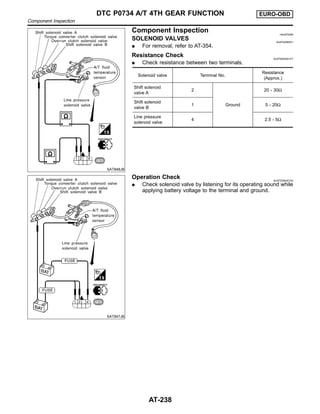
  • 347.
    Wiring Diagram —SHIFT — NJAT0104 HAT088 GI MA EM LC EC FE CL MT AX SU BR ST RS BT HA SC EL IDX A/T SHIFT LOCK SYSTEM Wiring Diagram — SHIFT — AT-347
  • 348.
    Diagnostic Procedure NJAT0105 SYMPTOM1: I Selector lever cannot be moved from “P” position with key in ON position and brake pedal applied. I Selector lever can be moved from “P” position with key in ON position and brake pedal released. I Selector lever can be moved from “P” position when key is removed from key cylinder. SYMPTOM 2: Ignition key cannot be removed when selector lever is set to “P” position. It can be removed when selector lever is set to any position except “P”. 1 CHECK KEY INTERLOCK CABLE Check key interlock cable for damage. OK or NG OK © GO TO 2. NG © Repair key interlock cable. Refer to AT-352. 2 CHECK SELECTOR LEVER POSITION Check selector lever position for damage. OK or NG OK © GO TO 3. NG © Check selector lever. Refer to “ON-VEHICLE SERVICE — PNP Switch and Control Cable Adjustment”, AT-355. 3 CHECK POWER SOURCE 1. Turn ignition switch to “ON” position. (Do not start engine.) 2. Check voltage between stop lamp switch harness terminal 1 and ground. Voltage: Battery voltage SAT007K OK or NG OK © GO TO 4. NG © Check the following items: 1. Harness for short or open between battery and stop lamp switch harness terminal 1 2. Fuse 3. Ignition switch (Refer to EL-11, “POWER SUPPLY ROUTING”.) A/T SHIFT LOCK SYSTEM Diagnostic Procedure AT-348
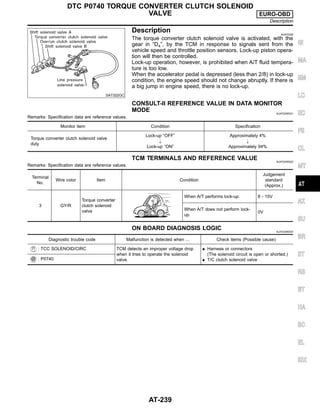
  • 349.
    4 CHECK INPUTSIGNAL (A/T DEVICE) Turn ignition switch to “ON” position. (Do not start engine.) I Check voltage between A/T device harness terminal 2 and ground. Voltage: Brake pedal depressed: Battery voltage Brake pedal released: 0V SAT008K OK or NG OK © GO TO 5. NG © Check the following items: 1. Harness for short and open between battery and stop lamp switch harness connector 1. 2. Harness for short or open between stop lamp switch harness connector 2 and A/T device harness connector 2. 3. Fuse 4. Stop lamp switch (Refer to “A/T DEVICE CHECK”, AT-351.) 5 CHECK GROUND CIRCUIT 1. Turn ignition switch to “OFF” position. 2. Disconnect A/T device harness connector. 3. Check continuity between A/T device harness terminal 3 and ground. Continuity should exist. If OK, check harness for short to ground and short to power. SAT009K OK or NG OK © GO TO 6. NG © Repair open circuit or short to ground or short to power in harness or connectors. GI MA EM LC EC FE CL MT AX SU BR ST RS BT HA SC EL IDX A/T SHIFT LOCK SYSTEM Diagnostic Procedure (Cont’d) AT-349
  • 350.
    6 CHECK RELAYCIRCUIT 1. Turn ignition switch to ON. I Check voltage between terminal 4 - 3 and 2 - 3. SAT010K OK or NG OK © GO TO 7. NG © Replace A/T device. 7 CHECK PARK POSITION SWITCH Refer to “A/T device Check”, AT-351. OK or NG OK © GO TO 8. NG © Replace A/T device. 8 CHECK SHIFT LOCK SOLENOID Refer to “A/T device Check”, AT-351. OK or NG OK © GO TO 9. NG © Replace A/T device. 9 SHIFT LOCK OPERATION 1. Reconnect shift lock harness connector. 2. Turn ignition switch from “OFF” to “ON” position. (Do not start engine.) 3. Recheck shift lock operation. OK or NG OK © INSPECTION END NG © 1. Perform A/T device input/output signal inspection test. 2. If NG, recheck harness connector connection. A/T SHIFT LOCK SYSTEM Diagnostic Procedure (Cont’d) AT-350
  • 351.
    A/T DEVICE CHECK=NJAT0105S01 1. Shift Lock Solenoid NJAT0105S0101 I Check operation sound. When ignition switch is turned to “ON” position and selector lever is set in “P” position. Brake pedal Operation sound Depressed Yes Released No SAT011K 2. Park Position Switch NJAT0105S0102 I Check resistance between A/T device harness terminal 2 and 3. Condition Resistance When selector lever is set in “P” position and selector lever button is released 111Ω When selector lever is not set in “P” position and selector lever button is released 0Ω SAT861JA STOP LAMP SWITCH NJAT0105S02 I Check continuity between terminals 1 and 2. Condition Continuity When brake pedal is depressed Yes When brake pedal is released No Check stop lamp switch after adjusting brake pedal — refer to BR-11, “BRAKE PEDAL AND BRACKET”. GI MA EM LC EC FE CL MT AX SU BR ST RS BT HA SC EL IDX A/T SHIFT LOCK SYSTEM Diagnostic Procedure (Cont’d) AT-351
  • 352.
    Components NJAT0107 SAT996J CAUTION: I Installkey interlock cable in such a way that it will not be damaged by sharp bends, twists or interference with adja- cent parts. I After installing key interlock cable to control device, make sure that casing cap and bracket are firmly secured in their positions. SAT853J Removal NJAT0108 1. Unlock slider by squeezing lock tabs on slider from adjuster holder and remove interlock rod from cable. KEY INTERLOCK CABLE Components AT-352
  • 353.
    SAT854J 2. Remove lockplate from steering lock assembly and remove key interlock cable. SAT854J Installation NJAT0109 1. Turn ignition key to lock position. 2. Set A/T selector lever to P position. 3. Set key interlock cable to steering lock assembly and install lock plate. 4. Clamp cable to steering column and fix to control cable with band. SAT804E 5. Insert interlock rod into adjuster holder. SAT805E 6. Install casing cap to bracket. 7. Move slider in order to fix adjuster holder to interlock rod. GI MA EM LC EC FE CL MT AX SU BR ST RS BT HA SC EL IDX KEY INTERLOCK CABLE Removal (Cont’d) AT-353
  • 354.
    SAT992C Control Valve Assemblyand Accumulators NJAT0110 REMOVAL NJAT0110S01 1. Drain ATF from transaxle. 2. Remove oil pan and gasket. SAT064K 3. Disconnect A/T solenoid valve harness connector. AAT265A 4. Remove stopper ring from A/T solenoid harness terminal body. 5. Remove A/T solenoid harness by pushing terminal body into transmission case. AAT260A 6. Remove control valve assembly by removing fixing bolts. Bolt length, number and location: Bolt symbol A B C Bolt length “” 40.0 mm (1.575 in) 33.0 mm (1.299 in) 43.5 mm (1.713 in) Number of bolts 5 6 2 I Be careful not to drop manual valve and servo release accumulator return springs. 7. Disassemble and inspect control valve assembly if necessary. Refer to AT-369. ON-VEHICLE SERVICE Control Valve Assembly and Accumulators AT-354
  • 355.
    SAT935J 8. Remove servorelease and N-D accumulators by applying compressed air if necessary. I Hold each piston with a rag. SAT497H INSTALLATION NJAT0110S02 I Tighten fixing bolts to specification. : 7 - 9 N·m (0.7 - 0.9 kg-m, 61 - 78 in-lb) I Set manual shaft in Neutral position, then align manual plate with groove in manual valve. I After installing control valve assembly to transmission case, make sure that selector lever can be moved to all positions. AAT980 Control Cable Adjustment NJAT0111 Move selector lever from the “P” position to the “1” position. You should be able to feel the detents in each position. If the detents cannot be felt or if the pointer indicating the position is improperly aligned, the control cable needs adjustment. 1. Place selector lever in “P” position. 2. Loosen control cable lock nut and place manual shaft in “P” position. 3. Pull control cable, by specified force, in the direction of the arrow shown in the illustration. Specified force: 6.9 N (0.7 kg, 1.5 lb) 4. Return control cable in the opposite direction of the arrow for 1.0 mm (0.039 in). 5. Tighten control cable lock nut. 6. Move selector lever from “P” to “1” position again. Make sure that selector lever moves smoothly. 7. Apply grease to contacting areas of selector lever and control cable. Install any part removed. SAT479J Park/Neutral Position (PNP) Switch Adjustment NJAT0112 1. Remove control cable end from manual shaft. 2. Set manual shaft in “N” position. 3. Loosen PNP switch fixing bolts. GI MA EM LC EC FE CL MT AX SU BR ST RS BT HA SC EL IDX ON-VEHICLE SERVICE Control Valve Assembly and Accumulators (Cont’d) AT-355
  • 356.
    SAT480J 4. Use a4 mm (0.157 in) pin for this adjustment. a. Insert the pin straight into the manual shaft adjustment hole. b. Rotate PNP switch until the pin can also be inserted straight into hole in PNP switch. 5. Tighten PNP switch fixing bolts. 6. Remove pin from adjustment hole after adjusting PNP switch. 7. Reinstall any part removed. 8. Adjust control cable. Refer to “Control Cable Adjustment”, AT-355. 9. Check continuity of PNP switch. Refer to AT-337. SAT905DB Differential Side Oil Seal Replacement NJAT0113 1. Remove drive shaft assemblies. Refer to AX-10, “Drive Shaft”. 2. Remove oil seals. XAT002 3. Install oil seals. I Apply ATF to oil seal surface before installing. SAT027K I Install oil seals so that dimensions “A” and “B” are within specifications. Unit: mm (in) A B 5.5 - 6.5 (0.217 - 0.256) −0.5 to 0.5 (−0.020 to 0.020) 4. Reinstall any part removed. SAT303G Revolution Sensor Replacement NJAT0114 1. Disconnect revolution sensor harness connector. 2. Remove harness bracket from A/T. 3. Remove revolution sensor from A/T. 4. Reinstall any part removed. Always use new sealing parts. ON-VEHICLE SERVICE Park/Neutral Position (PNP) Switch Adjustment (Cont’d) AT-356
  • 357.
    SAT065K Removal NJAT0115 CAUTION: Before separatingtransaxle from engine, remove the crank- shaft position sensor (Euro-OBD) from transaxle. Be careful not to damage sensor. 1. Remove battery and bracket. 2. Remove air duct between throttle body and air cleaner. 3. Disconnect A/T solenoid valve harness connector, PNP switch harness connector and revolution sensor harness connector. 4. Remove crankshaft position sensor (Euro-OBD) from tran- saxle. SAT304G 5. Drain ATF from transaxle. 6. Disconnect control cable from transaxle. 7. Disconnect oil cooler hoses. 8. Remove drive shafts. Refer to AX-10, “Drive Shaft”. 9. Remove the intake manifold support bracket. Refer to EM-11, “OUTER COMPONENT PARTS”. 10. Remove starter motor from transaxle. Tighten bolts to specified torque. : 41 - 52 N·m (4.2 - 5.3 kg-m, 30 - 38 ft-lb) 11. Remove upper bolts fixing transaxle to engine. 12. Support transaxle with a jack. SAT028K 13. Remove center member. I Tighten center member fixing bolts to specified torque, Refer to EM-53, “REMOVAL AND INSTALLATION”. GI MA EM LC EC FE CL MT AX SU BR ST RS BT HA SC EL IDX REMOVAL AND INSTALLATION Removal AT-357
  • 358.
    AAT259A 14. Remove rearplate cover. 15. Remove torque converter bolts. Rotate crankshaft to gain access to securing bolts. 16. Remove rear transaxle to engine bracket. Refer to EM-53, “REMOVAL AND INSTALLATION”. 17. Support engine with a jack. 18. Remove rear transaxle mount. Refer to EM-53, “REMOVAL AND INSTALLATION”. 19. Remove lower bolts fixing transaxle to engine. 20. Lower transaxle while supporting it with a jack. SAT977H Installation NJAT0116 1. Check drive plate runout. CAUTION: Do not allow any magnetic materials to contact the ring gear teeth. Maximum allowable runout: RefertoEM-64,“FLYWHEEL/DRIVEPLATERUNOUT”. I If this runout is out of allowance, replace drive plate with ring gear. SAT573D 2. When connecting torque converter to transaxle, measure dis- tance “A” to be certain that they are correctly assembled. Distance “A”: 15.9 mm (0.626 in) or more AAT266A 3. Install torque converter to drive plate. I With converter installed, rotate crankshaft several turns to check that transaxle rotates freely without binding. SAT029K 4. Tighten belts fixing transaxle. Bolt No. Tightening torque N·m (kg-m, ft-lb) Bolt length “ ” mm (in) 1 30 - 40 (3.1 - 4.1, 23 - 29) 50 (1.97) 2*1 16 - 20 (1.6 - 2.1, 12 - 15) 25 (0.98) 3 31 - 40 (3.1 - 4.1, 23 - 29) 30 (1.18) 4*2 30 - 40 (3.1 - 4.1, 23 - 29) 16 (0.63) 5*2 16 - 20 (1.6 - 2.1, 12 - 15) 20 (0.79) REMOVAL AND INSTALLATION Removal (Cont’d) AT-358
  • 359.
    SAT058K *1: With gussetto A/T *2: With gusset to cylinder block SAT638A 5. Reinstall any part removed. 6. Adjust control cable. Refer to AT-355. 7. Check continuity of PNP switch. Refer to AT-337. 8. Refill transaxle with ATF and check fluid level. 9. Move selector lever through all positions to be sure that tran- saxle operates correctly. With parking brake applied, idle engine. Move selector lever through “N” to “D”, to “2”, to “1” and “R” positions. A slight shock should be felt through the hand gripping the selector each time the transaxle is shifted. 10. Perform road test. Refer to AT-91. GI MA EM LC EC FE CL MT AX SU BR ST RS BT HA SC EL IDX REMOVAL AND INSTALLATION Installation (Cont’d) AT-359
  • 360.
    Components-1 3AX00, 3AX01,3AX19, 3AX63 and 3AX64 models NJAT0119 AAT419A OVERHAUL Components-1 3AX00, 3AX01, 3AX19, 3AX63 and 3AX64 models AT-360
  • 361.
    Components-1 3AX10 and3AX18 models NJAT0232 SAT030K GI MA EM LC EC FE CL MT AX SU BR ST RS BT HA SC EL IDX OVERHAUL Components-1 3AX10 and 3AX18 models AT-361
  • 362.
    Components-2 3AX00, 3AX01,3AX19, 3AX63 and 3AX64 models NJAT0233 SAT102K OVERHAUL Components-2 3AX00, 3AX01, 3AX19, 3AX63 and 3AX64 models AT-362
  • 363.
    Components-2 3AX10 and3AX18 models NJAT0234 SAT936J GI MA EM LC EC FE CL MT AX SU BR ST RS BT HA SC EL IDX OVERHAUL Components-2 3AX10 and 3AX18 models AT-363
  • 364.
    Components-3 3AX00, 3AX01,3AX19, 3AX63 and 3AX64 models NJAT0235 SAT061K OVERHAUL Components-3 3AX00, 3AX01, 3AX19, 3AX63 and 3AX64 models AT-364
  • 365.
    Components-3 3AX10 and3AX18 models NJAT0236 SAT103K GI MA EM LC EC FE CL MT AX SU BR ST RS BT HA SC EL IDX OVERHAUL Components-3 3AX10 and 3AX18 models AT-365
  • 366.
  • 367.
    Locations of AdjustingShims, Needle Bearings, Thrust Washers and Snap Rings — 3AX00, 01, 19, 63 and 64 models NJAT0117 AAT416A GI MA EM LC EC FE CL MT AX SU BR ST RS BT HA SC EL IDX OVERHAUL Locations of Adjusting Shims, Needle Bearings, Thrust Washers and Snap Rings — 3AX00, 01, 19, 63 and 64 models AT-367
  • 368.
    Locations of AdjustingShims, Needle Bearings, Thrust Washers and Snap Rings — 3AX10 and 3AX18 models NJAT0237 SAT067K OVERHAUL Locations of Adjusting Shims, Needle Bearings, Thrust Washers and Snap Rings — 3AX10 and 3AX18 models AT-368
  • 369.
    NJAT0120 SAT049K 1. Drain ATFthrough drain plug. SAT008D 2. Remove torque converter. SAT009D 3. Check torque converter one-way clutch using check tool as shown at left. a. Insert check tool into the groove of bearing support built into one-way clutch outer race. b. While fixing bearing support with check tool, rotate one-way clutch spline using flat-bladed screwdriver. c. Check inner race rotates clockwise only. If not, replace torque converter assembly. SAT586H 4. Remove oil charging pipe and oil cooler tube. GI MA EM LC EC FE CL MT AX SU BR ST RS BT HA SC EL IDX DISASSEMBLY AT-369
  • 370.
    SAT023JB 5. Set manualshaft to “P” position. 6. Remove PNP switch. SAT128E 7. Remove oil pan and oil pan gasket. I Do not reuse oil pan bolts. 8. Check foreign materials in oil pan to help determine cause of malfunction. If the fluid is very dark, smells burned, or contains foreign particles, the frictional material (clutches, band) may need replacement. A tacky film that will not wipe clean indi- cates varnish build up. Varnish can cause valves, servo, and clutches to stick and may inhibit pump pressure. I If frictional material is detected, replace radiator after repair of A/T. Refer to LC-17, section “Radiator”. 9. Remove control valve assembly according to the following pro- cedures. AAT260A a. Remove control valve assembly mounting bolts A, B and C. DISASSEMBLY AT-370
  • 371.
    AAT262A b. Remove stopperring from terminal body. c. Push terminal body into transmission case and draw out sole- noid harness. SAT017D 10. Remove manual valve from control valve assembly as a pre- caution. SAT877J 11. Remove return spring from servo release accumulator piston. SAT019DA 12. Remove servo release accumulator piston with compressed air. 13. Remove O-rings from servo release accumulator piston. SAT020D 14. Remove N-D accumulator piston and return spring with com- pressed air. 15. Remove O-rings from N-D accumulator piston. GI MA EM LC EC FE CL MT AX SU BR ST RS BT HA SC EL IDX DISASSEMBLY AT-371
  • 372.
    SAT023DA 16. Check accumulatorpistons and contact surface of transmis- sion case for damage. 17. Check accumulator return springs for damage and free length. Return springs: Refer to SDS, AT-487. SAT129E 18. Remove lip seals from band servo oil port. SAT027D 19. Remove converter housing according to the following proce- dures. a. Remove converter housing mounting bolts A and B. SAT028D b. Remove converter housing. SAT131E c. Remove O-ring from differential oil port. DISASSEMBLY AT-372
  • 373.
    SAT030D 20. Remove finaldrive assembly from transmission case. NAT033 21. Remove differential side bearing outer race from transmission case. SAT132E 22. Remove differential side bearing adjusting shim from transmis- sion case. SAT840DB 23. Remove differential side bearing outer race from converter housing. SAT133E 24. Remove oil seal from converter housing using a screwdriver. I Be careful not to damage case. GI MA EM LC EC FE CL MT AX SU BR ST RS BT HA SC EL IDX DISASSEMBLY AT-373
  • 374.
    SAT072D 25. Remove sideoil seal from transmission case using a screw- driver. SAT134EA 26. Remove oil tube from converter housing. SAT127E 27. Remove oil pump according to the following procedures. a. Remove O-ring from input shaft. SAT035D b. Remove oil pump assembly from transmission case. SAT036D c. Remove thrust washer and bearing race from oil pump assem- bly. DISASSEMBLY AT-374
  • 375.
    SAT037DA 28. Remove brakeband according to the following procedures. a. Loosen lock nut, then back off anchor end pin. I Do not reuse anchor end pin. SAT038D b. Remove brake band from transmission case. SAT039D I To prevent brake linings from cracking or peeling, do not stretch the flexible band unnecessarily. When removing the brake band, always secure it with a clip as shown in the figure at left. Leave the clip in position after removing the brake band. SAT040D c. Check brake band facing for damage, cracks, wear or burns. SAT041D 29. Remove input shaft assembly (high clutch) and reverse clutch according to the following procedures. a. Remove input shaft assembly (high clutch) with reverse clutch. GI MA EM LC EC FE CL MT AX SU BR ST RS BT HA SC EL IDX DISASSEMBLY AT-375
  • 376.
    SAT042D b. Remove inputshaft assembly (high clutch) from reverse clutch. SAT043D c. Remove needle bearing from high clutch drum. d. Check input shaft assembly and needle bearing for damage or wear. SAT044D 30. Remove high clutch hub and needle bearing from transmission case. 31. Check high clutch hub and needle bearing for damage or wear. SAT579D 32. Remove front sun gear and needle bearings from transmission case. 33. Check front sun gear and needle bearings for damage or wear. SAT046D 34. Remove front planetary carrier assembly and low one-way clutch according to the following procedures. a. Remove snap ring using a screwdriver. DISASSEMBLY AT-376
  • 377.
    SAT047D b. Remove frontplanetary carrier with low one-way clutch. SAT048D c. Check that low one-way clutch rotates in the direction of the arrow and locks in the opposite direction. d. Remove low one-way clutch from front planetary carrier by rotating it in the direction of unlock. SAT049D e. Remove needle bearing from front planetary carrier. SAT050D f. Check front planetary carrier, low one-way clutch and needle bearing for damage or wear. g. Check clearance between pinion washer and planetary carrier using feeler gauge. Standard clearance: 0.15 - 0.70 mm (0.0059 - 0.0276 in) Allowable limit: 0.80 mm (0.0315 in) Replace front planetary carrier if the clearance exceeds allow- able limit. SAT051D 35. Remove rear planetary carrier assembly and rear sun gear according to the following procedures. a. Remove rear planetary carrier assembly from transmission case. GI MA EM LC EC FE CL MT AX SU BR ST RS BT HA SC EL IDX DISASSEMBLY AT-377
  • 378.
    SAT052D b. Remove rearsun gear from rear planetary carrier. SAT053D c. Remove needle bearings from rear planetary carrier assembly. SAT054D d. Check rear planetary carrier, rear sun gear and needle bear- ings for damage or wear. e. Check clearance between pinion washer and rear planetary carrier using feeler gauge. Standard clearance: 0.15 - 0.70 mm (0.0059 - 0.0276 in) Allowable limit: 0.80 mm (0.0315 in) Replace rear planetary carrier if the clearance exceeds allow- able limit. SAT055D 36. Remove rear internal gear from transmission case. SAT056D 37. Remove needle bearing from rear internal gear. I Check needle bearing for damage or wear. DISASSEMBLY AT-378
  • 379.
    SAT272E 38. Remove forwardclutch assembly from transmission case. AAT215A 39. Remove thrust washer from transmission case. SAT702D 3AX00, 3AX01, 3AX19, 3AX63 and 3AX64 models 40. Remove side cover. I Do not reuse side cover bolts. SAT703D 41. Remove output shaft, output gear and reduction gear accord- ing to the following procedures. a. Set manual lever to “P” position to fix idler gear and output gear. b. Unlock both idler gear and output gear lock nuts using a pin punch. SAT704D c. Remove idler gear and output gear lock nuts. I Do not reuse idler gear and output gear lock nuts. GI MA EM LC EC FE CL MT AX SU BR ST RS BT HA SC EL IDX DISASSEMBLY AT-379
  • 380.
    SAT705D d. Remove idlergear and output gear using a puller. SAT706DB e. Remove reduction pinion gear and output shaft from transmis- sion case. f. Remove reduction pinion bearing adjusting shim from reduc- tion pinion gear. g. Remove adjusting spacer from output shaft. SAT059D 3AX10 and 3AX18 models 42. Remove output shaft assembly according to the following pro- cedures. a. Remove side cover bolts. SAT434D b. Remove side cover by lightly tapping it with a soft hammer. I Be careful not to drop output shaft assembly. It might come out when removing side cover. SAT440D c. Remove adjusting shim. DISASSEMBLY AT-380
  • 381.
    SAT439D d. Remove outputshaft assembly. SAT435D I If output shaft assembly came off with side cover, tap cover with a soft hammer to separate. SAT453D e. Remove needle bearing. SAT060D 43. Disassemble reduction pinion gear according to the following procedures. a. Set manual shaft to position “P” to fix idler gear. b. Unlock idler gear lock nut using a pin punch. SAT061D c. Remove idler gear lock nut. I Do not reuse idler gear lock nut. GI MA EM LC EC FE CL MT AX SU BR ST RS BT HA SC EL IDX DISASSEMBLY AT-381
  • 382.
    SAT841DA d. Remove idlergear with puller. SAT062K e. Remove reduction pinion gear. f. Remove reduction pinion gear bearing adjusting shim from reduction pinion gear. SAT064D 44. Remove return spring from parking shaft using a screwdriver. SAT065D 45. Draw out parking shaft and remove parking pole from trans- mission case. 46. Check parking pole and shaft for damage or wear. SAT066D 47. Remove parking actuator support from transmission case. I Check parking actuator support for damage or wear. DISASSEMBLY AT-382
  • 383.
    SAT311G 48. Remove revolutionsensor from transmission case. GI MA EM LC EC FE CL MT AX SU BR ST RS BT HA SC EL IDX DISASSEMBLY AT-383
  • 384.
    Manual Shaft COMPONENTS NJAT0121 SAT481J SAT313G REMOVALNJAT0122 1. Remove detent spring from transmission case. SAT076D 2. Drive out manual plate retaining pin. SAT077D 3. Drive and pull out parking rod plate retaining pin. 4. Remove parking rod plate from manual shaft. 5. Draw out parking rod from transmission case. REPAIR FOR COMPONENT PARTS Manual Shaft AT-384
  • 385.
    SAT049F 6. Pull outmanual shaft retaining pin. 7. Remove manual shaft and manual plate from transmission case. SAT080D 8. Remove manual shaft oil seal. INSPECTION NJAT0123 I Check component parts for wear or damage. Replace if nec- essary. SAT081D INSTALLATION NJAT0124 1. Install manual shaft oil seal. I Apply ATF to outer surface of oil seal. SAT610H 2. Install manual shaft and manual plate. GI MA EM LC EC FE CL MT AX SU BR ST RS BT HA SC EL IDX REPAIR FOR COMPONENT PARTS Manual Shaft (Cont’d) AT-385
  • 386.
    SAT074E 3. Align grooveof manual shaft and hole of transmission case. 4. Install manual shaft retaining pin. SAT078D 5. Install parking rod to parking rod plate. 6. Set parking rod assembly onto manual shaft. SAT087D 7. Drive in manual plate retaining pin and parking rod plate retain- ing pin. SAT313G 8. Install detent spring. REPAIR FOR COMPONENT PARTS Manual Shaft (Cont’d) AT-386
  • 387.
    Oil Pump COMPONENTS NJAT0125 SAT931J SAT699H DISASSEMBLYNJAT0126 1. Remove seal rings. SAT091D 2. Loosen bolts in numerical order and remove oil pump cover. SAT092D 3. Remove inner and outer gear from oil pump housing. GI MA EM LC EC FE CL MT AX SU BR ST RS BT HA SC EL IDX REPAIR FOR COMPONENT PARTS Oil Pump AT-387
  • 388.
    SAT093D 4. Remove O-ringfrom oil pump housing. SAT094D 5. Remove oil pump housing oil seal. INSPECTION NJAT0127 Oil Pump Housing, Oil Pump Cover, Inner Gear and Outer Gear NJAT0127S01 I Check for wear or damage. SAT095D Side Clearances NJAT0127S02 I Measure side clearance of inner and outer gears in at least four places around each outside edge. Maximum measured values should be within specified range. Standard clearance: 0.02 - 0.04 mm (0.0008 - 0.0016 in) I If clearance is less than standard, select inner and outer gear as a set so that clearance is within specifications. Inner and outer gear: Refer to SDS, AT-480. I If clearance is more than standard, replace whole oil pump assembly except oil pump cover. REPAIR FOR COMPONENT PARTS Oil Pump (Cont’d) AT-388
  • 389.
    SAT096D I Measure clearancebetween outer gear and oil pump housing. Standard clearance: 0.08 - 0.15 mm (0.0031 - 0.0059 in) Allowable limit: 0.15 mm (0.0059 in) I If not within allowable limit, replace whole oil pump assembly except oil pump cover. SAT097D Side Ring Clearance NJAT0127S03 I Install new seal rings onto oil pump cover. I Measure clearance between seal ring and ring groove. Standard clearance: 0.1 - 0.25 mm (0.0039 - 0.0098 in) Allowable limit: 0.25 mm (0.0098 in) I If not within allowable limit, replace oil pump cover assembly. SAT098D ASSEMBLY NJAT0128 1. Install oil seal on oil pump housing. SAT093D 2. Install O-ring on oil pump housing. I Apply ATF to O-ring. SAT092D 3. Install inner and outer gears on oil pump housing. I Take care with the direction of the inner gear. GI MA EM LC EC FE CL MT AX SU BR ST RS BT HA SC EL IDX REPAIR FOR COMPONENT PARTS Oil Pump (Cont’d) AT-389
  • 390.
    SAT101D 4. Install oilpump cover on oil pump housing. a. Wrap masking tape around splines of oil pump cover assem- bly to protect seal. Position oil pump cover assembly on oil pump housing assembly, then remove masking tape. b. Tighten bolts in numerical order. SAT699H 5. Install new seal rings carefully after packing ring groove with petroleum jelly. I Do not spread gap of seal ring excessively while install- ing. It may deform the ring. REPAIR FOR COMPONENT PARTS Oil Pump (Cont’d) AT-390
  • 391.
    Control Valve Assembly COMPONENTS=NJAT0129 SAT033K 1. Solenoid valve assembly 2. O-ring 3. Clip 4. Terminal body 5. Control valve lower body 6. Oil strainer 7. Support plate 8. Lower inter separating gasket 9. Separating plate 10. Lower separating gasket 11. Steel ball 12. Control valve inter body 13. Pilot filter 14. Upper inter separating gasket 15. Separating plate 16. Upper separating gasket 17. Steel ball 18. Control valve upper body 19. Check ball 20. Oil cooler relief valve spring 21. O-ring 22. T/C pressure holding spring 23. Check ball GI MA EM LC EC FE CL MT AX SU BR ST RS BT HA SC EL IDX REPAIR FOR COMPONENT PARTS Control Valve Assembly AT-391
  • 392.
    DISASSEMBLY =NJAT0130 I Disassembleupper, inter and lower bodies. Bolt length, number and location: Bolt symbol A B C D E F G Bolt length “” 13.5 mm (0.531 in) 58.0 mm (2.283 in) 40.0 mm (1.575 in) 66.0 mm (2.598 in) 33.0 mm (1.299 in) 78.0 mm (3.071 in) 18.0 mm (0.709 in) Number of bolts 6 3 6 11 2 2 1 F: Reamer bolt with nut SAT869J SAT083F 1. Remove bolts A, D and F, and remove oil strainer from control valve assembly. SAT316GA 2. Remove solenoid valve assembly and line pressure solenoid valve from control valve assembly. I Be careful not to lose the line pressure solenoid valve spring. REPAIR FOR COMPONENT PARTS Control Valve Assembly (Cont’d) AT-392
  • 393.
    SAT317G 3. Remove O-ringsfrom solenoid valves and terminal body. SAT064F 4. Place upper body facedown, and remove bolts B, C and F. SAT432D 5. Remove lower body from inter body. SAT109D 6. Turn over lower body, and accumulator support plates. SAT873J 7. Remove bolts E, separating plate and separating gaskets from lower body. 8. Remove check balls, oil cooler relief valve springs and T/C pressure holding spring from lower body. I Be careful not to lose steel balls and relief valve springs. GI MA EM LC EC FE CL MT AX SU BR ST RS BT HA SC EL IDX REPAIR FOR COMPONENT PARTS Control Valve Assembly (Cont’d) AT-393
  • 394.
    SAT065F 9. Remove interbody from upper body. 10. Remove pilot filter, separating plate and gaskets from upper body. SAT870J 11. Check to see that steel balls are properly positioned in inter body and then remove them. I Be careful not to lose steel balls. SAT871J 12. Check to see that steel balls are properly positioned in upper body and then remove them. I Be careful not to lose steel balls. SAT872J INSPECTION NJAT0131 Lower and Upper Bodies NJAT0131S01 I Check to see that retainer plates are properly positioned in lower body. SAT321G I Check to see that retainer plates are properly positioned in upper body. REPAIR FOR COMPONENT PARTS Control Valve Assembly (Cont’d) AT-394
  • 395.
    SAT115D Oil Strainer NJAT0131S02 ICheck wire netting of oil strainer for damage. SAT322GC Shift Solenoid Valves A and B, Line Pressure Solenoid Valve, Torque Converter Clutch Solenoid Valve and Overrun Clutch Solenoid Valve NJAT0131S03 I Refer to “Resistance Check” of each solenoid valve. Valves Except for Euro- OBD Euro-OBD Shift solenoid valve A AT-153 AT-257 Shift solenoid vavle B AT-159 AT-263 Line pressure solenoid valve AT-188 AT-251 Torque converter clutch solenoid valve AT-170 AT-244 Overrun clutch solenoid valve AT-164 AT-278 SAT138D Oil Cooler Relief Valve Spring NJAT0131S04 I Check springs for damage or deformation. I Measure free length and outer diameter. Inspection standard: Unit: mm (in) Part No.  D 31872 31X00 17.0 (0.669) 8.0 (0.315) SAT871J ASSEMBLY NJAT0132 1. Install upper, inter and lower body. a. Place oil circuit of upper body face up. Install steel balls in their proper positions. GI MA EM LC EC FE CL MT AX SU BR ST RS BT HA SC EL IDX REPAIR FOR COMPONENT PARTS Control Valve Assembly (Cont’d) AT-395
  • 396.
    SAT072F b. Install upperseparating gasket, upper inter separating gasket and upper separating plate in order shown in illustration. I Always use new gaskets. SAT073F c. Install reamer bolts F from bottom of upper body. Using reamer bolts as guides, install separating plate and gaskets as a seat. SAT074F d. Install pilot filter. SAT870J e. Place inter body as shown in the illustration. Install steel balls in their proper positions. SAT076F f. Install inter body on upper body using reamer bolts F as guides. I Be careful not to dislocate or drop steel balls. REPAIR FOR COMPONENT PARTS Control Valve Assembly (Cont’d) AT-396
  • 397.
    SAT873J g. Install checkballs, oil cooler relief valve springs and T/C pres- sure holding spring in their proper positions in lower body. SAT077F h. Install lower separating gasket, inner separating gasket and lower separating plate in order shown in the illustration. SAT078F i. Install bolts E from bottom of lower body. Using bolt E as guides, install separating plate and gaskets as a set. j. Install support plates on lower body. AAT536 k. Install lower body on inter body using reamer bolts F as guides and tighten reamer bolts F slightly. SAT317G 2. Install O-rings to solenoid valves and terminal body. I Apply ATF to O-rings. GI MA EM LC EC FE CL MT AX SU BR ST RS BT HA SC EL IDX REPAIR FOR COMPONENT PARTS Control Valve Assembly (Cont’d) AT-397
  • 398.
    3. Install andtighten bolts. Bolt length, number and location: Bolt symbol A B C D E F G Bolt length “” 13.5 mm (0.531 in) 58.0 mm (2.283 in) 44.0 mm (1.732 in) 66.0 mm (2.598 in) 33.0 mm (1.299 in) 78.0 mm (3.071 in) 18.0 mm (0.709 in) Number of bolts 6 3 6 11 2 2 1 F: Reamer bolt with nut SAT869J SAT081F a. Install and tighten bolts B to specified torque. : 7 - 9 N·m (0.7 - 0.9 kg-m, 61 - 78 in-lb) SAT316GA b. Install solenoid valve assembly and line pressure solenoid valve to lower body. REPAIR FOR COMPONENT PARTS Control Valve Assembly (Cont’d) AT-398
  • 399.
    SAT323G c. Remove reamerbolts F and set oil strainer on control valve assembly. d. Reinstall reamer bolts F from lower body side. SAT083F e. Tighten bolts A, C, D and F to specified torque. : 7 - 9 N·m (0.7 - 0.9 kg-m, 61 - 78 in-lb) SAT084FA f. Tighten bolts E to specified torque. : 3.4 - 4.4 N·m (0.35 - 0.45 kg-m, 30.4 - 39.1 in-lb) GI MA EM LC EC FE CL MT AX SU BR ST RS BT HA SC EL IDX REPAIR FOR COMPONENT PARTS Control Valve Assembly (Cont’d) AT-399
  • 400.
    Control Valve UpperBody COMPONENTS =NJAT0133 Numbers preceding valve springs correspond with those shown in SDS table on page AT-477. SAT012K 1. Control valve upper body 2. Overrun clutch reducing valve spring 3. Overrun clutch reducing valve 4. Plug 5. Retainer plate 6. Torque converter relief valve 7. Torque converter relief valve spring 8. Retainer plate 9. Torque converter clutch control valve 10. Torque converter clutch control valve spring 11. Plug 12. Sleeve 13. Retainer plate 14. 1-2 accumulator valve 15. 1-2 accumulator valve spring 16. Plug 17. Retainer plate 18. Cooler check valve 19. Cooler check valve spring 20. Plug 21. Retainer plate 22. Retainer plate 23. Pilot valve spring 24. Pilot valve 25. Retainer plate 26. Plug 27. 1-2 accumulator piston 28. 1-2 accumulator piston spring 29. 1-2 accumulator retainer plate 30. Retainer plate 31. Plug 32. 1st reducing valve 33. 1st reducing valve spring 34. Retainer plate 35. 3-2 timing valve spring 36. 3-2 timing valve REPAIR FOR COMPONENT PARTS Control Valve Upper Body AT-400
  • 401.
    SAT321G DISASSEMBLY NJAT0134 1. Removevalves at retainer plates. I Do not use a magnetic “hand”. SAT135D a. Use a screwdriver to remove retainer plates. SAT136D b. Remove retainer plates while holding spring, plugs or sleeves. I Remove plugs slowly to prevent internal parts from jump- ing out. SAT137D c. Place mating surface of valve body face down, and remove internal parts. I If a valve is hard to remove, place valve body face down and lightly tap it with a soft hammer. I Be careful not to drop or damage valves and sleeves. SAT138D INSPECTION NJAT0135 Valve Spring NJAT0135S01 I Measure free length and outer diameter of each valve spring. Also check for damage or deformation. Inspection standard: Refer to SDS, AT-477. I Replace valve springs if deformed or fatigued. Control Valves NJAT0135S02 I Check sliding surfaces of valves, sleeves and plugs. GI MA EM LC EC FE CL MT AX SU BR ST RS BT HA SC EL IDX REPAIR FOR COMPONENT PARTS Control Valve Upper Body (Cont’d) AT-401
  • 402.
    SAT139D ASSEMBLY NJAT0136 I Laycontrol valve body down when installing valves. Do not stand the control valve body upright. SAT140DA 1. Lubricate the control valve body and all valves with ATF. Install control valves by sliding them carefully into their bores. I Be careful not to scratch or damage valve body. SAT141D I Wrap a small screwdriver with vinyl tape and use it to insert the valves into their proper positions. SAT142DA 1-2 Accumulator Valve NJAT0136S01 I Install 1-2 accumulator valve. Align 1-2 accumulator retainer plate from opposite side of control valve body. I Install return spring, 1-2 accumulator piston and plug. SAT143D 1. Install retainer plates. I Install retainer plate while pushing plug or return spring. REPAIR FOR COMPONENT PARTS Control Valve Upper Body (Cont’d) AT-402
  • 403.
    SAT086F Retainer Plate (forcontrol valve upper body) NJAT0136S02 Refer to AT-400. Unit: mm (in) Name of valve and piston No. Length A Length B Pilot valve 22 6.0 (0.236) 21.5 (0.846) 1-2 accumulator valve 17 40.5 (1.59) 1-2 accumulator piston 25 1st reducing valve 30 21.5 (0.846) Overrun clutch reducing valve 5 24.0 (0.945) Torque converter relief valve 8 21.5 (0.846) Torque converter clutch control valve 13 28.0 (1.102) 3-2 timing valve 34 21.5 (0.846) Cooler check valve 21 24.0 (0.945) I Install proper retainer plates. GI MA EM LC EC FE CL MT AX SU BR ST RS BT HA SC EL IDX REPAIR FOR COMPONENT PARTS Control Valve Upper Body (Cont’d) AT-403
  • 404.
    Control Valve LowerBody COMPONENTS =NJAT0137 Numbers preceding valve springs correspond with those shown in SDS table on page AT-477. SAT013K 1. Control valve lower body 2. Shift valve B spring 3. Shift valve B 4. Plug 5. Retainer plate 6. Pressure modifier valve 7. Pressure modifier valve spring 8. Parallel pin 9. Sleeve 10. Piston 11. Pressure modifier piston spring 12. Retainer plate 13. Manual valve 14. Retainer plate 15. Sleeve 16. Plug 17. Spring seat 18. Pressure regulator valve spring 19. Pressure regulator valve 20. Retainer plate 21. Plug 22. Overrun clutch control valve 23. Overrun clutch control valve spring 24. Retainer plate 25. Plug 26. Accumulator control valve 27. Accumulator control valve spring 28. Retainer plate 29. Shift valve A spring 30. Shift valve A 31. Retainer plate 32. Plug 33. Plug 34. Shuttle valve spring 35. Shuttle control valve REPAIR FOR COMPONENT PARTS Control Valve Lower Body AT-404
  • 405.
    SAT872J DISASSEMBLY NJAT0138 Remove valvesat retainer plate. For removal procedures, refer to AT-392. SAT138D INSPECTION NJAT0139 Valve Springs NJAT0139S01 I Check each valve spring for damage or deformation. Also measure free length and outer diameter. Inspection standard: Refer to SDS, AT-477. I Replace valve springs if deformed or fatigued. Control Valves NJAT0139S02 I Check sliding surfaces of control valves, sleeves and plugs for damage. SAT872J ASSEMBLY NJAT0140 I Install control valves. For installation procedures, refer to AT-402. SAT089F Retainer Plate (for control valve lower body) NJAT0140S01 Refer to AT-404. Unit: mm (in) Name of control valve No. Length A Length B Type Pressure regulator valve 14 6.0 (0.236) 28.0 (1.102) I Accumulator control valve 24 Shift valve A 28 Overrun clutch control valve 20 Pressure modifier valve 12 Shuttle control valve 31 Shift valve B 5 — — II I Install proper retainer plates. GI MA EM LC EC FE CL MT AX SU BR ST RS BT HA SC EL IDX REPAIR FOR COMPONENT PARTS Control Valve Lower Body (Cont’d) AT-405
  • 406.
    Reverse Clutch COMPONENTS =NJAT0141 SAT485JB SAT155D DISASSEMBLYNJAT0142 1. Check operation of reverse clutch. a. Install seal ring onto drum support of oil pump cover and install reverse clutch assembly. Apply compressed air to oil hole. b. Check to see that retaining plate moves to snap ring. c. If retaining plate does not contact snap ring: I D-ring might be damaged. I Oil seal might be damaged. I Fluid might be leaking past piston check ball. SAT156D 2. Remove snap ring. 3. Remove drive plates, driven plates, retaining plate, and dish plates. SAT157D 4. Set Tool on spring retainer and remove snap ring from reverse clutch drum while compressing return springs. I Set Tool directly above springs. I Do not expand snap ring excessively. 5. Remove spring retainer and return springs. REPAIR FOR COMPONENT PARTS Reverse Clutch AT-406
  • 407.
    SAT301E I Do notremove return springs from spring retainer. SAT159D 6. Remove piston from reverse clutch drum by turning it. SAT138E 7. Remove D-ring and oil seal from piston. INSPECTION NJAT0143 Reverse Clutch Snap Ring, Spring Retainer and Return Springs NJAT0143S01 I Check for deformation, fatigue or damage. I Replace if necessary. I When replacing spring retainer and return springs, replace them as a set. SAT162D Reverse Clutch Drive Plates NJAT0143S02 I Check facing for burns, cracks or damage. I Measure thickness of facing. Thickness of drive plate: Standard value: 2.0 mm (0.079 in) Wear limit: 1.8 mm (0.071 in) I If not within wear limit, replace. GI MA EM LC EC FE CL MT AX SU BR ST RS BT HA SC EL IDX REPAIR FOR COMPONENT PARTS Reverse Clutch (Cont’d) AT-407
  • 408.
    SAT163D Reverse Clutch DishPlates NJAT0143S03 I Check for deformation or damage. I Measure thickness of dish plate. Thickness of dish plate “t”: 2.8 mm (0.110 in) I If deformed or fatigued, replace. SAT164D Reverse Clutch Piston NJAT0143S04 I Make sure check balls are not fixed. I Apply compressed air to check ball oil hole opposite the return spring. Make sure that there is no air leakage. I Apply compressed air to oil hole on return spring side to make sure air leaks past ball. SAT160DA ASSEMBLY NJAT0144 1. Install D-ring and oil seal on piston. I Take care with the direction of the oil seal. I Apply ATF to both parts. SAT159D 2. Install piston assembly by turning it slowly. I Apply ATF to inner surface of drum. SAT168D 3. Install return springs and spring retainer on piston. For return spring, refer to AT-480. REPAIR FOR COMPONENT PARTS Reverse Clutch (Cont’d) AT-408
  • 409.
    SAT157D 4. Set Toolon spring retainer and install snap ring while com- pressing return springs. I Set Tool directly above return springs. SAT170D 5. Install drive plates, driven plates, retaining plate and dish plates. I Do not align the projections of any two dish plates. I Take care with the order and direction of plates. SAT156D 6. Install snap ring. SAT174D 7. Measure clearance between retaining plate and snap ring. If not within allowable limit, select proper retaining plate. Specified clearance: Standard: 0.5 - 0.8 mm (0.020 - 0.031 in) Allowable limit: 1.2 mm (0.047 in) Retaining plate: Refer to SDS, AT-477. SAT173D 8. Check operation of reverse clutch. Refer to “Reverse Clutch”, AT-406. GI MA EM LC EC FE CL MT AX SU BR ST RS BT HA SC EL IDX REPAIR FOR COMPONENT PARTS Reverse Clutch (Cont’d) AT-409
  • 410.
    High Clutch COMPONENTS =NJAT0145 SAT034K SAT176D DISASSEMBLYNJAT0146 1. Check operation of high clutch. a. Apply compressed air to oil hole of input shaft. I Stop up a hole on opposite side of input shaft. b. Check to see that retaining plate moves to snap ring. c. If retaining plate does not contact snap ring: I D-ring might be damaged. I Oil seal might be damaged. I Fluid might be leaking past piston check ball. SAT177D 2. Remove seal rings from input shaft. REPAIR FOR COMPONENT PARTS High Clutch AT-410
  • 411.
    SAT178D 3. Remove snapring. 4. Remove drive plates, driven plates and retaining plate. SAT617H 5. Set Tool on spring retainer and remove snap ring from high clutch drum while compressing return springs. I Set Tool directly above springs. I Do not expand snap ring excessively. 6. Remove spring retainer and return springs. SAT302E I Do not remove return spring from spring retainer. SAT189D 7. Remove piston from high clutch drum by turning it. SAT139E 8. Remove D-ring and oil seal from piston. GI MA EM LC EC FE CL MT AX SU BR ST RS BT HA SC EL IDX REPAIR FOR COMPONENT PARTS High Clutch (Cont’d) AT-411
  • 412.
    INSPECTION NJAT0147 Reverse ClutchSnap Ring, Spring Retainer and Return Springs NJAT0147S01 I Check for deformation, fatigue or damage. I Replace if necessary. I When replacing spring retainer and return springs, replace them as a set. SAT162D High Clutch Drive Plates NJAT0147S02 I Check facing for burns, cracks or damage. I Measure thickness of facing. Thickness of drive plate: Standard value: Refer to SDS, AT-478. Wear limit: Refer to SDS, AT-478. I If not within wear limit, replace. SAT186D High Clutch Piston NJAT0147S03 I Make sure check balls are not fixed. I Apply compressed air to check ball oil hole opposite the return spring. Make sure there is no air leakage. I Apply compressed air to oil hole on return spring side to make sure air leaks past ball. SAT187D Seal Ring Clearance NJAT0147S04 I Install new seal rings onto input shaft. I Measure clearance between seal ring and ring groove. Standard clearance: 0.08 - 0.23 mm (0.0031 - 0.0091 in) Allowable limit: 0.23 mm (0.0091 in) I If not within wear limit, replace input shaft assembly. SAT182DA ASSEMBLY NJAT0148 1. Install D-ring and oil seal on piston. I Take care with the direction of the oil seal. I Apply ATF to both parts. REPAIR FOR COMPONENT PARTS High Clutch (Cont’d) AT-412
  • 413.
    SAT189D 2. Install pistonassembly by turning it slowly. I Apply ATF to inner surface of drum. SAT191D 3. Install return springs and spring retainer on piston. For return spring, refer to AT-480. SAT617H 4. Set Tool on spring retainer and install snap ring while com- pressing return springs. I Set Tool directly above return springs. SAT193D I Do not align snap ring gap with spring retainer stopper. SAT195D 5. Install drive plates, driven plates and retaining plate. Take care with the order and direction of plates. 6. Install snap ring. GI MA EM LC EC FE CL MT AX SU BR ST RS BT HA SC EL IDX REPAIR FOR COMPONENT PARTS High Clutch (Cont’d) AT-413
  • 414.
    SAT199D 7. Measure clearancebetween retaining plate and snap ring. If not within allowable limit, select proper retaining plate. Specified clearance: Standard: 1.4 - 1.8 mm (0.055 - 0.071 in) Allowable limit: 2.4 mm (0.094 in) Retaining plate: Refer to SDS, AT-478. SAT196D 8. Check operation of high clutch. Refer to “High Clutch”, AT-410. SAT197D 9. Install seal rings to input shaft. I Apply petroleum jelly to seal rings. SAT198D I Roll paper around seal rings to prevent seal rings from spreading. REPAIR FOR COMPONENT PARTS High Clutch (Cont’d) AT-414
  • 415.
    Forward Clutch andOverrun Clutch COMPONENTS NJAT0149 SAT932JA SAT201D DISASSEMBLY NJAT0150 1. Check operation of forward clutch and overrun clutch. a. Install bearing retainer on forward clutch drum. b. Apply compressed air to oil hole of forward clutch drum. c. Check to see that retaining plate moves to snap ring. SAT202D d. If retaining plate does not contact snap ring: I D-ring might be damaged. I Oil seal might be damaged. I Fluid might be leaking past piston check ball. GI MA EM LC EC FE CL MT AX SU BR ST RS BT HA SC EL IDX REPAIR FOR COMPONENT PARTS Forward Clutch and Overrun Clutch AT-415
  • 416.
    SAT203D 2. Remove snapring for forward clutch. 3. Remove drive plates, driven plates, retaining plate and dish plate for forward clutch. SAT204D 4. Remove snap ring for overrun clutch. 5. Remove drive plates, driven plates, retaining plate and dish plate for overrun clutch. SAT205D 6. Set Tool on spring retainer and remove snap ring from forward clutch drum while compressing return springs. I Set Tool directly above return springs. I Do not expand snap ring excessively. 7. Remove spring retainer and return springs. SAT216D 8. Remove forward clutch piston with overrun clutch piston from forward clutch drum by turning it. SAT215D 9. Remove overrun clutch piston from forward clutch piston by turning it. REPAIR FOR COMPONENT PARTS Forward Clutch and Overrun Clutch (Cont’d) AT-416
  • 417.
    SAT140E 10. Remove D-ringsand oil seals from forward clutch piston and overrun clutch piston. INSPECTION NJAT0151 Snap Rings and Spring Retainer NJAT0151S01 I Check for deformation, fatigue or damage. SAT138D Forward Clutch and Overrun Clutch Return Springs NJAT0151S02 I Check for deformation or damage. I Measure free length and outer diameter. Inspection standard: Refer to SDS, AT-480. I Replace if deformed or fatigued. SAT162D Forward Clutch and Overrun Clutch Drive Plates NJAT0151S03 I Check facing for burns, cracks or damage. I Measure thickness of facing. Thickness of drive plate: Forward clutch Standard value: 1.8 mm (0.071 in) Wear limit: 1.6 mm (0.063 in) Overrun clutch Standard value: 1.6 mm (0.063 in) Wear limit: 1.4 mm (0.055 in) I If not within wear limit, replace. GI MA EM LC EC FE CL MT AX SU BR ST RS BT HA SC EL IDX REPAIR FOR COMPONENT PARTS Forward Clutch and Overrun Clutch (Cont’d) AT-417
  • 418.
    SAT163D Forward Clutch andOverrun Clutch Dish Plates NJAT0151S04 I Check for deformation or damage. I Measure thickness of dish plate. Thickness of dish plate “t”: Forward clutch: 2.5 mm (0.098 in) Overrun clutch: 2.15 mm (0.0846 in) I If deformed or fatigued, replace. SAT213D Forward Clutch Drum NJAT0151S05 I Make sure check balls are not fixed. I Apply compressed air to check ball oil hole from outside of forward clutch drum. Make sure air leaks past ball. I Apply compressed air to oil hole from inside of forward clutch drum. Make sure there is no air leakage. SAT212D Overrun Clutch Piston NJAT0151S06 I Make sure check balls are not fixed. I Apply compressed air to check ball oil hole opposite the return spring. Make sure there is no air leakage. I Apply compressed air to oil hole on return spring side. Make sure air leaks past ball. SAT208DA ASSEMBLY NJAT0152 1. Install D-rings and oil seals on forward clutch piston and over- run clutch piston. I Take care with direction of oil seal. I Apply ATF to both parts. SAT215D 2. Install overrun clutch piston assembly on forward clutch piston while turning it slowly. I Apply ATF to inner surface of forward clutch piston. REPAIR FOR COMPONENT PARTS Forward Clutch and Overrun Clutch (Cont’d) AT-418
  • 419.
    SAT216D 3. Install forwardclutch piston assembly on forward clutch drum while turning it slowly. I Apply ATF to inner surface of drum. SAT217D 4. Align notch in forward clutch piston with groove in forward clutch drum. SAT218D 5. Install return spring on piston. 6. Install spring retainer on return springs. For return spring, refer to AT-480. SAT205D 7. Set Tool on spring retainer and install snap ring while com- pressing return springs. I Set Tool directly above return springs. SAT220D I Do not align snap ring gap with spring retainer stopper. GI MA EM LC EC FE CL MT AX SU BR ST RS BT HA SC EL IDX REPAIR FOR COMPONENT PARTS Forward Clutch and Overrun Clutch (Cont’d) AT-419
  • 420.
    SAT204D 8. Install driveplates, driven plates, retaining plate and dish plate for overrun clutch. 9. Install snap ring for overrun clutch. SAT227D 10. Measure clearance between overrun clutch retaining plate and snap ring. If not within allowable limit, select proper retaining plate. Specified clearance: Standard: 1.0 - 1.4 mm (0.039 - 0.055 in) Allowable limit: 2.0 mm (0.079 in) Overrun clutch retaining plate: Refer to SDS, AT-479. SAT203D 11. Install drive plates, driven plates, retaining plate and dish plate for forward clutch. Take care with the order and direction of plates. 12. Install snap ring for forward clutch. SAT228D 13. Measure clearance between forward clutch retaining plate and snap ring. If not within allowable limit, select proper retaining plate. Specified clearance: Standard: 0.45 - 0.85 mm (0.0177 - 0.0335 in) Allowable limit: 1.85 mm (0.0728 in) Forward clutch retaining plate: Refer to SDS, AT-479. SAT201D 14. Check operation of forward clutch. Refer to “Forward Clutch and Overrun Clutch”, AT-415. REPAIR FOR COMPONENT PARTS Forward Clutch and Overrun Clutch (Cont’d) AT-420
  • 421.
    SAT202D 15. Check operationof overrun clutch. Refer to “Forward Clutch and Overrun Clutch”, AT-415. GI MA EM LC EC FE CL MT AX SU BR ST RS BT HA SC EL IDX REPAIR FOR COMPONENT PARTS Forward Clutch and Overrun Clutch (Cont’d) AT-421
  • 422.
    Low & ReverseBrake COMPONENTS =NJAT0153 SAT039K SAT230D DISASSEMBLY NJAT0154 1. Check operation of low & reverse brake. a. Apply compressed air to oil hole of transmission case. b. Check to see that retaining plate moves to snap ring. c. If retaining plate does not contact snap ring: I D-ring might be damaged. I Oil seal might be damaged. I Fluid might be leaking past piston check ball. SAT231D 2. Stand transmission case. 3. Remove snap ring. 4. Remove drive plates, driven plates, retaining plate from trans- mission case. REPAIR FOR COMPONENT PARTS Low & Reverse Brake AT-422
  • 423.
    SAT242D 5. Set Toolon spring retainer and remove snap ring while com- pressing return springs. I Set Tool directly above return springs. I Do not expand snap ring excessively. 6. Remove spring retainer and return springs. SAT303E I Do not remove return springs from spring retainer. SAT234D 7. Apply compressed air to oil hole of transmission case while holding piston. 8. Remove piston from transmission case by turning it. SAT767G 9. Remove D-ring and oil seal from piston. GI MA EM LC EC FE CL MT AX SU BR ST RS BT HA SC EL IDX REPAIR FOR COMPONENT PARTS Low & Reverse Brake (Cont’d) AT-423
  • 424.
    INSPECTION NJAT0155 Low &Reverse Clutch Snap Ring, Spring Retainer and Return Springs NJAT0155S01 I Check for deformation, fatigue or damage. I Replace if necessary. I When replacing spring retainer and return springs, replace them as a set. SAT162D Low & Reverse Brake Drive Plates NJAT0155S02 I Check facing for burns, cracks or damage. I Measure thickness of facing. Thickness of drive plate: Standard value: 2.0 mm (0.079 in) Wear limit: 1.8 mm (0.071 in) I If not within wear limit, replace. SAT235DA ASSEMBLY NJAT0156 1. Install D-ring and oil seal on piston. I Take care with the direction of the oil seal. I Apply ATF to both parts. SAT239D 2. Stand transmission case. 3. Install piston assembly on transmission case while turning it slowly. I Apply ATF to inner surface of transmission case. SAT241D 4. Install return springs and spring retainer on piston. For return spring, refer to AT-480. REPAIR FOR COMPONENT PARTS Low & Reverse Brake (Cont’d) AT-424
  • 425.
    SAT242D 5. Install snapring while compressing return springs. I Set Tool directly above return springs. SAT254E 6. Install drive plates, driven plates, retaining plates and dished plates. I Do not align the projections on the two dished plates. I Make sure to put the plates in the correct order and direc- tion. SAT231D 7. Install snap ring. SAT246D 8. Measure clearance between retaining plate and snap ring. If not within allowable limit, select proper retaining plate (front side). Specified clearance: Standard: 1.4 - 1.8 mm (0.055 - 0.071 in) Allowable limit: 2.8 mm (0.110 in) Retaining plate: Refer to SDS, AT-479. SAT230D 9. Check operation of low & reverse brake. Refer to “DISASSEMBLY”, AT-422. GI MA EM LC EC FE CL MT AX SU BR ST RS BT HA SC EL IDX REPAIR FOR COMPONENT PARTS Low & Reverse Brake (Cont’d) AT-425
  • 426.
    Rear Internal Gear,Forward Clutch Hub and Overrun Clutch Hub COMPONENTS NJAT0157 SAT875J SAT249D DISASSEMBLY NJAT0158 1. Remove snap ring from overrun clutch hub. 2. Remove overrun clutch hub from forward clutch hub. SAT250D 3. Remove thrust washer from forward clutch hub. REPAIR FOR COMPONENT PARTS Rear Internal Gear, Forward Clutch Hub and Overrun Clutch Hub AT-426
  • 427.
    SAT251D 4. Remove forwardclutch hub from rear internal gear. SAT252D 5. Remove end bearing from rear internal gear. SAT253D 6. Remove thrust washer from rear internal gear. SAT254D 7. Remove end bearing from forward one-way clutch. SAT255D 8. Remove one-way clutch from forward clutch hub. GI MA EM LC EC FE CL MT AX SU BR ST RS BT HA SC EL IDX REPAIR FOR COMPONENT PARTS Rear Internal Gear, Forward Clutch Hub and Overrun Clutch Hub (Cont’d) AT-427
  • 428.
    SAT256D INSPECTION NJAT0159 Rear InternalGear, Forward Clutch Hub and Overrun Clutch Hub NJAT0159S01 I Check rubbing surfaces for wear or damage. SAT257D Snap Ring, End Bearings and Forward One-way Clutch NJAT0159S02 I Check snap ring and end bearings for deformation and dam- age. I Check forward one-way clutch for wear and damage. SAT976H ASSEMBLY NJAT0160 1. Install forward one-way clutch on forward clutch. I Take care with the direction of forward one-way clutch. SAT259D 2. Install end bearing on forward one-way clutch. I Apply petroleum jelly to end bearing. SAT260D 3. Install thrust washer on rear internal gear. I Apply petroleum jelly to thrust washer. I Align pawls of thrust washer with holes of rear internal gear. REPAIR FOR COMPONENT PARTS Rear Internal Gear, Forward Clutch Hub and Overrun Clutch Hub (Cont’d) AT-428
  • 429.
    SAT261D 4. Install endbearing on rear internal gear. I Apply petroleum jelly to end bearing. SAT713H 5. Install forward clutch hub on rear internal gear. I Check operation of forward one-way clutch. Hold rear internal gear and turn forward clutch hub. Check forward clutch hub for correct locking and unlocking directions. I If not as shown in illustration, check installation direction of forward one-way clutch. SAT263D 6. Install thrust washer and overrun clutch hub. I Apply petroleum jelly to thrust washer. I Align pawls of thrust washer with holes of overrun clutch hub. SAT264D 7. Install overrun clutch hub on rear internal gear. I Align projections of rear internal gear with holes of over- run clutch hub. SAT248D 8. Install snap ring to groove of rear internal gear. GI MA EM LC EC FE CL MT AX SU BR ST RS BT HA SC EL IDX REPAIR FOR COMPONENT PARTS Rear Internal Gear, Forward Clutch Hub and Overrun Clutch Hub (Cont’d) AT-429
  • 430.
    O/Shaft, O/Gear, I/Gear,R/Pinion Gear and B/ Retainer — 3AX00, 01, 19, 63 and 64 models COMPONENTS NJAT0239 SAT104K SAT666D DISASSEMBLY NJAT0240 1. Remove seal rings from output shaft and bearing retainer. REPAIR FOR COMPONENT PARTS O/Shaft, O/Gear, I/Gear, R/Pinion Gear and B/Retainer — 3AX00, 01, 19, 63 and 64 models AT-430
  • 431.
    SAT592G 2. Press outoutput shaft bearing inner race. SAT168K 3. Remove output shaft bearing outer race from bearing retainer. SAT669D 4. Remove output gear bearing inner race. SAT169K 5. Remove output gear bearing outer race from bearing retainer. SAT648D 6. Remove idler gear bearing inner race. GI MA EM LC EC FE CL MT AX SU BR ST RS BT HA SC EL IDX REPAIR FOR COMPONENT PARTS O/Shaft, O/Gear, I/Gear, R/Pinion Gear and B/Retainer — 3AX00, 01, 19, 63 and 64 models (Cont’d) AT-431
  • 432.
    NAT047 7. Remove idlergear bearing outer race from transmission case. NAT048 8. Press out reduction pinion gear bearing from reduction pinion gear. SAT651D 9. Remove reduction pinion gear bearing outer race from trans- mission case. SPD715 INSPECTION NJAT0241 Output Shaft, Output Gear, Idler Gear and Reduction Pinion Gear NJAT0241S01 I Check shafts for cracks, wear or bending. I Check gears for wear, chips and cracks. Bearings NJAT0241S02 I Make sure bearings roll freely and are free from noise, cracks, pitting or wear. I When replacing taper roller bearing, replace inner and outer race as a set. SAT671D Seal Ring Clearance NJAT0241S03 I Install new seal rings to output shaft. I Measure clearance between seal ring and ring groove of out- put shaft. Standard clearance: 0.10 - 0.25 mm (0.0039 - 0.0098 in) Wear limit: 0.25 mm (0.0098 in) I If not within wear limit, replace output shaft. I Install new seal rings to bearing retainer. REPAIR FOR COMPONENT PARTS O/Shaft, O/Gear, I/Gear, R/Pinion Gear and B/Retainer — 3AX00, 01, 19, 63 and 64 models (Cont’d) AT-432
  • 433.
    I Measure clearancebetween seal ring and ring groove of bear- ing retainer. Standard clearance: 0.10 - 0.25 mm (0.0039 - 0.0098 in) Wear limit: 0.25 mm (0.0098 in) I If not within wear limit, replace bearing retainer. NAT049 ASSEMBLY NJAT0242 1. Press reduction pinion gear bearing on reduction pinion gear. SAT654D 2. Install reduction pinion gear bearing outer race on transmis- sion case. SAT655D 3. Press idler gear bearing inner race on idler gear. NAT051 4. Install idler gear bearing outer race on transmission case. GI MA EM LC EC FE CL MT AX SU BR ST RS BT HA SC EL IDX REPAIR FOR COMPONENT PARTS O/Shaft, O/Gear, I/Gear, R/Pinion Gear and B/Retainer — 3AX00, 01, 19, 63 and 64 models (Cont’d) AT-433
  • 434.
    SAT655D 5. Press outputgear bearing inner race on output gear. SAT934DA 6. Install output gear bearing outer race on bearing retainer. SAT592G 7. Press output shaft bearing inner race on output shaft. SAT937DA 8. Install output shaft bearing outer race on bearing retainer. SAT676D 9. Install new seal rings onto output shaft and bearing retainer. I Apply petroleum jelly to seal rings. REPAIR FOR COMPONENT PARTS O/Shaft, O/Gear, I/Gear, R/Pinion Gear and B/Retainer — 3AX00, 01, 19, 63 and 64 models (Cont’d) AT-434
  • 435.
    SAT677D 10. Roll paperaround seal rings to prevent seal rings from spreading. Output Shaft, Idler Gear, Reduction Pinion Gear and Bearing Retainer — 3AX10 and 3AX18 models COMPONENTS NJAT0161 SAT105K GI MA EM LC EC FE CL MT AX SU BR ST RS BT HA SC EL IDX REPAIR FOR COMPONENT PARTS O/Shaft, O/Gear, I/Gear, R/Pinion Gear and B/Retainer — 3AX00, 01, 19, 63 and 64 models (Cont’d) AT-435
  • 436.
    SAT644D DISASSEMBLY NJAT0162 1. Removeseal rings from output shaft and bearing retainer. SAT645D 2. Remove output shaft bearing with screwdrivers. I Always replace bearing with a new one when removed. I Do not damage output shaft. SAT646D 3. Remove snap ring from bearing retainer. NAT046 4. Remove needle bearing from bearing retainer. SAT648D 5. Remove idler gear bearing inner race from idler gear. REPAIR FOR COMPONENT PARTS Output Shaft, Idler Gear, Reduction Pinion Gear and Bearing Retainer — 3AX10 and 3AX18 models (Cont’d) AT-436
  • 437.
    NAT047 6. Remove idlergear bearing outer race from transmission case. NAT048 7. Press out reduction pinion gear bearing from reduction pinion gear. SAT651D 8. Remove reduction pinion gear bearing outer race from trans- mission case. INSPECTION NJAT0163 Output Shaft, Idler Gear and Reduction Pinion Gear NJAT0163S01 I Check shafts for cracks, wear or bending. I Check gears for wear, chips and cracks. SPD715 Bearing NJAT0163S02 I Make sure bearings roll freely and are free from noise, cracks, pitting or wear. I When replacing taper roller bearing, replace outer and inner race as a set. GI MA EM LC EC FE CL MT AX SU BR ST RS BT HA SC EL IDX REPAIR FOR COMPONENT PARTS Output Shaft, Idler Gear, Reduction Pinion Gear and Bearing Retainer — 3AX10 and 3AX18 models (Cont’d) AT-437
  • 438.
    SAT652D Seal Ring ClearanceNJAT0163S03 I Install new seal rings to output shaft. I Measure clearance between seal ring and ring groove of out- put shaft. Standard clearance: 0.10 - 0.25 mm (0.0039 - 0.0098 in) Allowable limit: 0.25 mm (0.0098 in) I If not within allowable limit, replace output shaft. I Install new seal rings to bearing retainer. I Measure clearance between seal ring and ring groove of bear- ing retainer. Standard clearance: 0.10 - 0.25 mm (0.0039 - 0.0098 in) Allowable limit: 0.25 mm (0.0098 in) I If not within allowable limit, replace bearing retainer. NAT049 ASSEMBLY NJAT0164 1. Press reduction pinion gear bearing on reduction pinion gear. SAT654D 2. Install reduction pinion gear bearing outer race on transmis- sion case. SAT655D 3. Press idler gear bearing inner race on idler gear. REPAIR FOR COMPONENT PARTS Output Shaft, Idler Gear, Reduction Pinion Gear and Bearing Retainer — 3AX10 and 3AX18 models (Cont’d) AT-438
  • 439.
    NAT051 4. Install idlergear bearing outer race on transmission case. NAT052 5. Press output shaft bearing on output shaft. SAT658D 6. Press needle bearing on bearing retainer. SAT659D 7. Install snap ring to bearing retainer. SAT660D 8. After packing ring grooves with petroleum jelly, carefully install new seal rings on output shaft and bearing retainer. GI MA EM LC EC FE CL MT AX SU BR ST RS BT HA SC EL IDX REPAIR FOR COMPONENT PARTS Output Shaft, Idler Gear, Reduction Pinion Gear and Bearing Retainer — 3AX10 and 3AX18 models (Cont’d) AT-439
  • 440.
    SAT661D I Roll paperaround seal rings to prevent seal rings from spreading. Band Servo Piston Assembly COMPONENTS NJAT0165 SAT098K SAT288D DISASSEMBLY NJAT0166 1. Remove band servo piston snap ring. SAT289D 2. Apply compressed air to oil hole in transmission case to remove OD servo piston retainer and band servo piston assembly. I Hold band servo piston assembly with a rag or nylon waste. REPAIR FOR COMPONENT PARTS Output Shaft, Idler Gear, Reduction Pinion Gear and Bearing Retainer — 3AX10 and 3AX18 models (Cont’d) AT-440
  • 441.
    SAT290DB 3. Apply compressedair to oil hole in OD servo piston retainer to remove OD servo piston from retainer. I Hold OD servo piston while applying compressed air. SAT593GB 4. Remove D-ring from OD servo piston. SAT292DA 5. Remove O-rings from OD servo piston retainer. SAT293D 6. Remove band servo piston assembly from servo piston retainer by pushing it forward. SAT294D 7. Place piston stem end on a wooden block. While pushing servo piston spring retainer down, remove E-ring. GI MA EM LC EC FE CL MT AX SU BR ST RS BT HA SC EL IDX REPAIR FOR COMPONENT PARTS Band Servo Piston Assembly (Cont’d) AT-441
  • 442.
    SAT295DA 8. Remove ODservo return spring, band servo thrust washer and band servo piston stem from band servo piston. SAT296DA 9. Remove O-rings from servo piston retainer. SAT594GA 10. Remove D-rings from band servo piston. SAT298DA INSPECTION NJAT0167 Pistons, Retainers and Piston Stem NJAT0167S01 I Check frictional surfaces for abnormal wear or damage. SAT138D Return Springs NJAT0167S02 I Check for deformation or damage. I Measure free length and outer diameter. Band servo inspection standard: Refer to SDS, AT-488. REPAIR FOR COMPONENT PARTS Band Servo Piston Assembly (Cont’d) AT-442
  • 443.
    SAT595GA ASSEMBLY NJAT0168 1. InstallD-rings to servo piston retainer. I Apply ATF to O-rings. I Pay attention to position of each O-ring. SAT295DA 2. Install band servo piston stem, band servo thrust washer, OD servo return spring and spring retainer to band servo piston. SAT301D 3. Place piston stem end on a wooden block. While pushing servo piston spring retainer down, install E-ring. SAT296DA 4. Install O-rings to servo piston retainer. I Apply ATF to O-rings. I Pay attention to the positions of the O-rings. SAT303D 5. Install band servo piston assembly to servo piston retainer by pushing it inward. GI MA EM LC EC FE CL MT AX SU BR ST RS BT HA SC EL IDX REPAIR FOR COMPONENT PARTS Band Servo Piston Assembly (Cont’d) AT-443
  • 444.
    SAT596GB 6. Install D-ringto OD servo piston. I Apply ATF to D-ring. SAT292DA 7. Install O-rings to OD servo piston retainer. I Apply ATF to O-rings. I Pay attention to the positions of the O-rings. SAT306DA 8. Install OD servo piston to OD servo piston retainer. SAT307DA 9. Install band servo piston assembly and 2nd servo return spring to transmission case. I Apply ATF to O-ring of band servo piston and transmis- sion case. AAT692 10. Install OD servo piston assembly to transmission case. I Apply ATF to O-ring of band servo piston and transmis- sion case. REPAIR FOR COMPONENT PARTS Band Servo Piston Assembly (Cont’d) AT-444
  • 445.
    SAT288D 11. Install bandservo piston snap ring to transmission case. Final Drive COMPONENTS-1 3AX00, 3AX01, 3AX19, 3AX63 AND 3AX64 MODELS NJAT0354 SAT680DA COMPONENTS-2 3AX10 AND 3AX18 MODELS NJAT0169 SAT040K GI MA EM LC EC FE CL MT AX SU BR ST RS BT HA SC EL IDX REPAIR FOR COMPONENT PARTS Band Servo Piston Assembly (Cont’d) AT-445
  • 446.
    SAT311D DISASSEMBLY NJAT0170 1. Removefinal gear. SAT099K 2. Press out differential side bearings. SAT313D 3. Remove speedometer drive gear. SAT970H 4. Drive out pinion mate shaft lock pin. SAT316D 5. Draw out pinion mate shaft from differential case. 6. Remove pinion mate gears and side gears. REPAIR FOR COMPONENT PARTS Final Drive (Cont’d) AT-446
  • 447.
    SAT041K INSPECTION NJAT0171 Gear, Washer,Shaft and Case NJAT0171S01 I Check mating surfaces of differential case, side gears, pinion and mate gears. I Check washers for wear. SPD715 Bearings NJAT0171S03 I Make sure bearings roll freely and are free from noise, cracks, pitting or wear. I When replacing taper roller bearing, replace outer and inner race as a set. SAT318D ASSEMBLY NJAT0172 1. Install side gear and thrust washers in differential case. 2. Install pinion mate gears and thrust washers in differential case while rotating them. I When inserting, be careful not to damage pinion mate gear washers. I Apply ATF to any parts. NAT056 3. Measure clearance between side gear and differential case with washers using the following procedure. a. Set Tool and dial indicator on side gear. b. Move side gear up and down to measure dial indicator deflec- tion. Always measure indicator deflection on both side gears. Clearance between side gear and differential case with washers: 0.1 - 0.2 mm (0.004 - 0.008 in) SMT616 c. If not within specification adjust clearance by changing thick- ness of side gear thrust washers. Side gear thrust washer: Refer to SDS, AT-481. GI MA EM LC EC FE CL MT AX SU BR ST RS BT HA SC EL IDX REPAIR FOR COMPONENT PARTS Final Drive (Cont’d) AT-447
  • 448.
    SAT970H 4. Install lockpin. I Make sure that lock pin is flush with case. SAT313D 5. Install speedometer drive gear on differential case. I Align the projection of speedometer drive gear with the groove of differential case. SAT326D 6. Install final gear and tighten fixing bolts in numerical order. SMT700B 7. Press on differential side bearings. REPAIR FOR COMPONENT PARTS Final Drive (Cont’d) AT-448
  • 449.
    SAT311G Assembly (1) NJAT0173 1.Install revolution sensor onto transmission case. Always use new sealing parts. SAT881I 2. Install differential side oil seals on transmission case and con- verter housing, so that “A” and “B” are within specifications. SAT027K Unit: mm (in) A B 5.5 - 6.5 (0.217 - 0.256) −0.5 to 0.5 (−0.020 to 0.020) SAT328D 3. Install parking actuator support to transmission case. I Pay attention to direction of parking actuator support. SAT329D 4. Install parking pawl on transmission case and fix it with park- ing shaft. GI MA EM LC EC FE CL MT AX SU BR ST RS BT HA SC EL IDX ASSEMBLY Assembly (1) AT-449
  • 450.
    SAT330D 5. Install returnspring. NAT059 Adjustment (1) NJAT0174 DIFFERENTIAL SIDE BEARING PRELOAD NJAT0174S01 1. Install differential side bearing outer race without adjusting shim on transmission case. 2. Install differential side bearing outer race on converter housing. SAT027D 3. Place final drive assembly on transmission case. 4. Install transmission case on converter housing. Tighten trans- mission case fixing bolts A and B to the specified torque. NAT060 5. Attach dial indicator on differential case at transmission case side. 6. Insert Tool into differential side gear from converter housing. 7. Move Tool up and down and measure dial indicator deflection. Differential side bearing preload “T”: 0.04 - 0.09 mm (0.0016 - 0.0035 in) 8. Select proper thickness of differential side bearing adjusting shim(s) using SDS table as a guide. Differential side bearing adjusting shim: Refer to SDS, AT-481. ASSEMBLY Assembly (1) (Cont’d) AT-450
  • 451.
    NAT033 9. Remove converterhousing from transmission case. 10. Remove final drive assembly from transmission case. 11. Remove differential side bearing outer race from transmission case. 12. Reinstall differential side bearing outer race and shim(s) selected from SDS table on transmission case. 13. Reinstall converter housing on transmission case and tighten transmission case fixing bolts to the specified torque. NAT062 14. Insert Tool into differential case and measure turning torque of final drive assembly. I Turn final drive assembly in both directions several times to seat bearing rollers correctly. Turning torque of final drive assembly (New bearing): 0.49 - 1.08 N·m (5.0 - 11.0 kg-cm, 4.3 - 9.5 in-lb) I When old bearing is used again, turning torque will be slightly less than the above. I Make sure torque is close to the specified range. SAT876J REDUCTION PINION GEAR BEARING PRELOAD NJAT0174S02 I Be sure to remove final drive assembly before doing this pro- cedure. I Using caliper and straightedge, calculate a dimention “T” (adjuster shim thickness) in the left figure by the following for- mula. And adjust the inspection standard for pre-load (rotating slide torque) as shown below. T = A – E Inspection standard for preload: 0.1 - 0.69 N·m (1.1 - 7.0 kg-cm, 0.95 - 6.08 in-lb) SAT332DA 1. Remove transmission case and final drive assembly from con- verter housing. 2. Select proper thickness of reduction pinion gear bearing adjusting shim using the following procedures. a. Place reduction pinion gear on transmission case as shown. SAT333DA b. Place idler gear bearing on transmission case. c. Measure dimensions “B”, “C” and “D” and calculate dimension “A”. A = D − (B + C) “A”: Distance between the surface of idler gear bear- ing inner race and the adjusting shim mating surface of reduction pinion gear. GI MA EM LC EC FE CL MT AX SU BR ST RS BT HA SC EL IDX ASSEMBLY Adjustment (1) (Cont’d) AT-451
  • 452.
    SAT334DA I Measure dimension“B” between the end of reduction pinion gear and the surface of transmission case. I Measure dimension “B” in at least two places. SAT335D I Measure dimension “C” between the surface of idler gear bear- ing inner race and the surface of transmission case. I Measure dimension “C” in at least two places. SAT336DA I Measure dimension “D” between the end of reduction pinion gear and the adjusting shim mating surface of reduction pin- ion gear. I Measure dimension “D” in at least two places. I Calculate dimension “A”. A = D − (B + C) SAT337D d. Measure dimension “E” between the end of idler gear and the idler gear bearing inner race mating surface of idler gear. I Measure dimension “E” in at least two places. e. Calculate “T” and select proper thickness of reduction pinion gear bearing adjusting shim using SDS table as a guide. T = A − E – 0.05 mm (0.0020 in)* Reduction pinion gear bearing adjusting shim: Refer to SDS, AT-483. *: Bearing preload ASSEMBLY Adjustment (1) (Cont’d) AT-452
  • 453.
    SAT338DA 3. Install reductionpinion gear and reduction pinion gear bearing adjusting shim selected in step 2-e on transmission case. 4. Press idler gear bearing inner race on idler gear. 5. Press idler gear on reduction pinion gear. I Press idler gear so that idler gear can be locked by park- ing pawl. SAT339D 6. Tighten idler gear lock nut to the specified torque. I Lock idler gear with parking pawl when tightening lock nut. SAT340DC 7. Measure turning torque of reduction pinion gear. I When measuring turning torque, turn reduction pinion gear in both directions several times to seat bearing roll- ers correctly. Turning torque of reduction pinion gear: 0.1 - 0.69 N·m (1.1 - 7.0 kg-cm, 0.95 - 6.08 in-lb) SAT682D OUTPUT SHAFT BEARING PRELOAD — 3AX00, 3AX01, 3AX19, 3AX63 AND 3AX64 MODELS NJAT0174S04 1. Select proper thickness of output shaft bearing adjusting spacer using the following procedures. a. Remove paper rolled around output shaft. b. Place bearing retainer on output shaft. SAT683D c. Place output gear bearing inner race on bearing retainer. d. Measure dimensions “G” and “H” and calculate dimension “F”. “F”: Distance between the surface of output gear bearing inner race and adjusting shim mating surface of output shaft. F = H – G GI MA EM LC EC FE CL MT AX SU BR ST RS BT HA SC EL IDX ASSEMBLY Adjustment (1) (Cont’d) AT-453
  • 454.
    SAT684D I Measure dimension“G” between end of output shaft and sur- face of output gear bearing inner race. I Measure dimension “G” in at least two places. SAT685D I Measure dimension “H” between end of output shaft and adjusting spacer mating surface of output shaft. I Measure dimension “H” in at least two places. I Calculate dimension “F”. F = H – G SAT686D e. Measure dimension “I” between end of output gear (adjusting spacer mating surface) and bearing inner race fitting surface. I Measure dimension “I” in at least two places. f. Calculate dimension “T2”. “T2”: Distance between adjusting spacer mating surface of output gear and output shaft T2 = F – I g. Select proper thickness of output shaft bearing adjusting spacer using SDS table as a guide. Output shaft bearing adjusting spacer: Refer to SDS, AT-485. SAT687D 2. Install bearing retainer on transmission case. ASSEMBLY Adjustment (1) (Cont’d) AT-454
  • 455.
    SAT688D 3. Place outputshaft on bearing retainer. 4. Place output shaft bearing adjusting spacer selected in step 1-g on output shaft. 5. Press output gear bearing inner race on output gear. 6. Press output gear on output shaft. SAT689D 7. Tighten output gear lock nut to specified torque. SAT690D 8. Remove idler gear to measure output shaft bearing preload. SAT691D 9. Measure output shaft bearing preload. I When measuring bearing preload, turn output shaft in both directions several times to seat bearing rollers cor- rectly. Output shaft bearing preload: 0.25 - 0.88 N·m (2.5 - 9.0 kg-cm, 2.2 - 7.8 in-lb) I If not within specified range, readjust bearing preload. SAT692D 10. Install idler gear and tighten lock nut to specified torque. 11. After properly adjusting bearing preload, clinch idler gear and output gear lock nuts as shown. GI MA EM LC EC FE CL MT AX SU BR ST RS BT HA SC EL IDX ASSEMBLY Adjustment (1) (Cont’d) AT-455
  • 456.
    SAT224E 12. Install newgasket and side cover on transmission case. I Always replace side cover bolts when removed. I Refer to “Overhaul”, AT-364. SAT341D OUTPUT SHAFT END PLAY — 3AX10 AND 3AX18 MODELS NJAT0174S03 I Measure clearance between side cover and the end of the output shaft bearing. I Select proper thickness of adjusting shim so that clearance is within specifications. SAT347D 1. Install bearing retainer for output shaft. SAT438D 2. Install output shaft thrust needle bearing on bearing retainer. SAT439D 3. Install output shaft on transmission case. ASSEMBLY Adjustment (1) (Cont’d) AT-456
  • 457.
    SAT874DA 4. Measure dimensions“1” and “2” at side cover and then cal- culate dimension “A”. I Measure dimension “1” and “2” in at least two places “A”: Distance between transmission case fitting surface and adjusting shim mating surface A = 1 − 2 2: Height of gauge SAT875DA 5. Measure dimensions “2” and “3” and then calculate dimen- sion “B”. Measure “2” and “3” in at least two places. “B”: Distance between the end of output shaft bearing outer race and the side cover fitting surface of transmis- sion case B = 2 − 3 2: Height of gauge SAT440D 6. Select proper thickness of adjusting shim so that output shaft end play (clearance between side cover and output shaft bear- ing) is within specifications. Output shaft end play (A − B): 0 - 0.5 mm (0 - 0.020 in) Output shaft end play adjusting shim: Refer to SDS, AT-486. 7. Install adjusting shim on output shaft bearing. SAT441D 8. Apply locking sealant to transmission case as shown in illus- tration. SAT442D 9. Install side cover on transmission case. I Apply locking sealant to the mating surface of transmis- sion case. GI MA EM LC EC FE CL MT AX SU BR ST RS BT HA SC EL IDX ASSEMBLY Adjustment (1) (Cont’d) AT-457
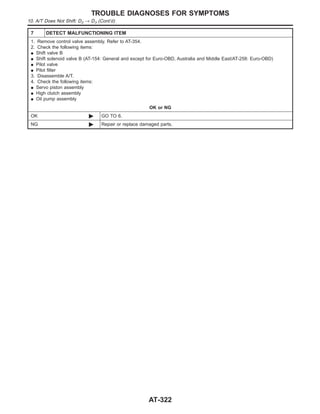
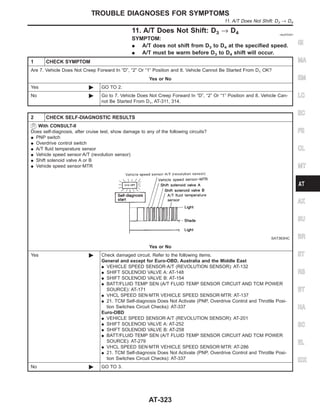
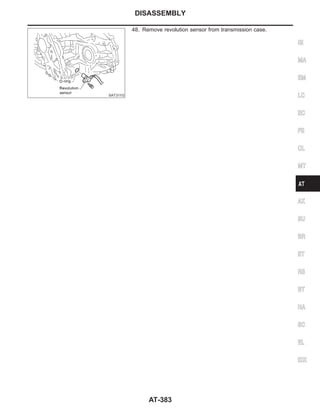
  • 458.
    SAT124E 10. Tighten sidecover fixing bolts to specified torque. I Do not mix bolts A and B. I Always replace bolts A as they are self-sealing bolts. I Refer to “Overhaul”, AT-365. SAT354D Assembly (2) NJAT0175 1. Remove paper rolled around bearing retainer. 2. Install thrust washer on bearing retainer. I Apply petroleum jelly to thrust washer. SAT355D 3. Install forward clutch assembly. I Align teeth of low & reverse brake drive plates before installing. I Make sure that bearing retainer seal rings are not spread. SAT356D 4. Install thrust needle bearing on bearing retainer. I Apply petroleum jelly to thrust bearing. I Pay attention to direction of thrust needle bearing. SAT357D 5. Install thrust needle bearing on rear internal gear. I Apply petroleum jelly to thrust needle bearing. I Pay attention to direction of thrust needle bearing. ASSEMBLY Adjustment (1) (Cont’d) AT-458
  • 459.
    SAT358D 6. Hold forwardclutch hub and turn overrun clutch hub. Check overrun clutch hub for directions of lock and unlock. I If not as shown in illustration, check installed direction of for- ward one-way clutch. SAT359D 7. Install rear internal gear assembly. I Align teeth of forward clutch and overrun clutch drive plate. SAT360D 8. Install needle bearing on rear planetary carrier. I Apply petroleum jelly to needle bearing. I Pay attention to direction of needle bearing. SAT052D 9. Install rear sun gear on rear planetary carrier. I Pay attention to direction of rear sun gear. SAT362D 10. Install rear planetary carrier on transmission case. GI MA EM LC EC FE CL MT AX SU BR ST RS BT HA SC EL IDX ASSEMBLY Assembly (2) (Cont’d) AT-459
  • 460.
    SAT363D 11. Install thrustneedle bearing on front planetary carrier. I Apply petroleum jelly to thrust needle bearing. I Pay attention to direction of thrust needle bearing. SAT048D 12. Install low one-way clutch to front planetary carrier by turning it in the direction of the arrow as shown. 13. While holding front planetary carrier, turn low one-way clutch. Check low one-way clutch for correct directions of lock and unlock. SAT047D 14. Install front planetary carrier assembly on transmission case. SAT046D 15. Install snap ring with screwdriver. I Forward clutch and bearings must be correctly installed for snap ring to fit groove of transmission case. SAT367D 16. Install needle bearing on front sun gear. I Apply petroleum jelly to needle bearing. I Pay attention to direction of needle bearing. ASSEMBLY Assembly (2) (Cont’d) AT-460
  • 461.
    SAT368D 17. Install frontsun gear on front planetary carrier. SAT369D 18. Install needle bearing on front sun gear. I Apply petroleum jelly to needle bearing. I Pay attention to direction of needle bearing. SAT370D 19. Install high clutch hub on front sun gear. SAT371D 20. Install needle bearing on high clutch hub. I Apply petroleum jelly to needle bearing. I Pay attention to direction of needle bearing. SAT372D 21. Remove paper rolled around input shaft. 22. Install input shaft assembly. I Align teeth of high clutch drive plates before installing. GI MA EM LC EC FE CL MT AX SU BR ST RS BT HA SC EL IDX ASSEMBLY Assembly (2) (Cont’d) AT-461
  • 462.
    SAT373D 23. Install reverseclutch assembly. I Align teeth of reverse clutch drive plates before installing. Adjustment (2) NJAT0176 When any parts listed below are replaced, adjust total end play and reverse clutch end play. Part name Total end play Reverse clutch end play Transmission case I I Overrun clutch hub I I Rear internal gear I I Rear planetary carrier I I Rear sun gear I I Front planetary carrier I I Front sun gear I I High clutch hub I I High clutch drum I I Oil pump cover I I Reverse clutch drum — I SAT374D TOTAL END PLAY NJAT0176S01 I Measure clearance between reverse clutch drum and needle bearing for oil pump cover. I Select proper thickness of bearing race so that end play is within specifications. SAT375D 1. Measure dimensions “K” and “L” and then calculate dimension “J”. ASSEMBLY Assembly (2) (Cont’d) AT-462
  • 463.
    SAT376D a. Measure dimension“K”. SAT377D b. Measure dimension “L”. c. Calculate dimension “J”. “J”: Distance between oil pump fitting surface of trans- mission case and needle bearing mating surface of high clutch drum J = K − L SAT378D 2. Measure dimension “M”. a. Place bearing race and needle bearing on oil pump assembly. SAT379D b. Measure dimension “M”. “M”: Distance between transmission case fitting surface and needle bearing on oil pump cover “M1”: Indication of gauge SAT443D c. Measure thickness of straightedge “t”. M = M1 − t GI MA EM LC EC FE CL MT AX SU BR ST RS BT HA SC EL IDX ASSEMBLY Adjustment (2) (Cont’d) AT-463
  • 464.
    3. Adjust totalend play “T3”. T3 = J − M Total end play “T3”: 0.25 - 0.55 mm (0.0098 - 0.0217 in) I Select proper thickness of bearing race so that total end play is within specifications. Bearing races: Refer to SDS, AT-487. SAT380D REVERSE CLUTCH END PLAY NJAT0176S02 I Measure clearance between oil pump cover and thrust washer for reverse clutch drum. I Select proper thickness of thrust washer so that end play is within specifications. SAT381D 1. Measure dimensions “O” and “P” and then calculate dimension “N”. SAT382D a. Place thrust washer on reverse clutch drum. b. Measure dimension “O”. SAT383D c. Measure dimension “P”. d. Calculate dimension “N”. “N”: Distance between oil pump fitting surface of trans- mission case and thrust washer on reverse clutch drum N = O − P ASSEMBLY Adjustment (2) (Cont’d) AT-464
  • 465.
    SAT384D 2. Measure dimensions“R” and “S” and then calculate dimension “Q”. SAT385D a. Measure dimension “R”. SAT386D b. Measure dimension “S”. c. Calculate dimension “Q”. “Q”: Distance between transmission case fitting surface and thrust washer mating surface Q = R − S 3. Adjust reverse clutch end play “T4”. T4 = N − Q Reverse clutch end play: 0.65 - 1.00 mm (0.0256 - 0.0394 in) I Select proper thickness of thrust washer so that reverse clutch end play is within specifications. Thrust washer: Refer to SDS, AT-487. SAT387D Assembly (3) NJAT0177 1. Remove reverse clutch assembly and install needle bearing on high clutch assembly. I Pay attention to direction of needle bearing. 2. Install reverse clutch assembly. GI MA EM LC EC FE CL MT AX SU BR ST RS BT HA SC EL IDX ASSEMBLY Adjustment (2) (Cont’d) AT-465
  • 466.
    SAT038D 3. Install anchorend pin and lock nut on transmission case. 4. Place brake band on outside of reverse clutch drum. Tighten anchor end pin just enough so that brake band is evenly fitted on reverse clutch drum. SAT389D 5. Place bearing race selected in total end play adjustment step on oil pump cover. I Apply petroleum jelly to bearing race. SAT390D 6. Place thrust washer selected in reverse clutch end play step on reverse clutch drum. I Apply petroleum jelly to thrust washer. SAT391D 7. Install oil pump assembly on transmission case. SAT392D 8. Tighten oil pump fixing bolts to specified torque. ASSEMBLY Assembly (3) (Cont’d) AT-466
  • 467.
    SAT034D 9. Install O-ringto input shaft. I Apply ATF to O-ring. SAT394D 10. Adjust brake band. a. Tighten anchor end pin to specified torque. Anchor end pin: : 3.9 - 5.9 N·m (0.4 - 0.6 kg-m, 35 - 52 in-lb) SAT395D b. Back off anchor end pin two and a half turns. SAT396D c. While holding anchor end pin, tighten lock nut. SAT397D 11. Apply compressed air to oil holes of transmission case and check operation of brake band. GI MA EM LC EC FE CL MT AX SU BR ST RS BT HA SC EL IDX ASSEMBLY Assembly (3) (Cont’d) AT-467
  • 468.
    SAT030D Assembly (4) NJAT0178 1.Install final drive assembly on transmission case. SAT033DA 2. Install oil tube on converter housing. SAT405D 3. Install O-ring on differential oil port of transmission case. 4. Install converter housing on transmission case. I Apply locking sealant to mating surface of converter housing. Bolt Length mm (in) A 32.8 (1.291) B 40 (1.57) SAT406DA 5. Install accumulator piston. a. Check contact surface of accumulator piston for damage. ASSEMBLY Assembly (4) AT-468
  • 469.
    SAT407DA b. Install O-ringson accumulator piston. I Apply ATF to O-rings. Accumulator piston O-rings: Refer to SDS, AT-487. SAT878J c. Install accumulator pistons and return springs on transmission case. I Apply ATF to inner surface of transmission case. Return springs: Refer to SDS, AT-487. SAT021D SAT022D 6. Install lip seals for band servo oil holes on transmission case. I Apply petroleum jelly to lip seals. SAT017D 7. Install control valve assembly. a. Insert manual valve into control valve assembly. I Apply ATF to manual valve. GI MA EM LC EC FE CL MT AX SU BR ST RS BT HA SC EL IDX ASSEMBLY Assembly (4) (Cont’d) AT-469
  • 470.
    AAT261A b. Pass solenoidharness through transmission case and install terminal body on transmission case by pushing it. c. Install stopper ring to terminal body. AAT260A d. Tighten bolts A, B and C. : 7 - 9 N·m (0.7 - 0.9 kg-m, 61 - 78 in-lb) Bolt length, number and location Bolt symbol A B C Bolt length “” 40.0 mm (1.575 in) 33.0 mm (1.299 in) 43.5 mm (1.713 in) Number of bolts 5 6 2 SAT418D 8. Install oil pan. a. Attach magnet to oil pan. SAT128E b. Install new oil pan gasket on transmission case. c. Install oil pan on transmission case. I Always replace oil pan bolts as they are self-sealing bolts. I Tighten the four bolts in a criss-cross pattern to prevent dislocation of gasket. d. Tighten drain plug to specified torque. ASSEMBLY Assembly (4) (Cont’d) AT-470
  • 471.
    SAT023JB 9. Install PNPswitch. a. Set manual shaft in “P” position. b. Temporarily install PNP switch on manual shaft. c. Move selector lever to “N” position. SAT426DB d. Use a 4 mm (0.157 in) pin for this adjustment. 1) Insert the pin straight into the manual shaft adjustment hole. 2) Rotate PNP switch until the pin can also be inserted straight into hole in PNP switch. e. Tighten PNP switch fixing bolts. f. Remove pin from adjustment hole after adjusting PNP switch. SAT586H 10. Install oil charging pipe and oil cooler tube to transmission case. SAT428DA 11. Install torque converter. a. Pour ATF into torque converter. I Approximately 1 liter (7/8 Imp qt) of fluid is required for a new torque converter. I When reusing old torque converter, add the same amount of fluid as was drained. SAT429D b. Install torque converter while aligning notches of torque con- verter with notches of oil pump. GI MA EM LC EC FE CL MT AX SU BR ST RS BT HA SC EL IDX ASSEMBLY Assembly (4) (Cont’d) AT-471
  • 472.
    SAT430D c. Measure distance“A” to check that torque converter is in proper position. Distance “A”: 15.9 mm (0.626 in) or more ASSEMBLY Assembly (4) (Cont’d) AT-472
  • 473.
    General Specifications NJAT0179 Appliedmodel General and except for Euro-OBD QG15DE QG16DE QG18DE QG13DE QG16DE QG18DE With catalyzer Without catalyzer Automatic transaxle assembly RE4F03B 3AX01 3AX19 3AX10 3AX00 3AX19 3AX10 Transaxle gear ratio 1st 2.861 2nd 1.562 3rd 1.000 4th 0.697 Reverse 2.310 Final drive 3.827 4.072 4.072 4.072 4.072 4.072 Recommended fluid Genuine Nissan ATF or equivalent*1 Fluid capacity  (Imp qt) 7.0 (6-1/8) Applied model Middle East Australia Euro-OBD RE4F03B QG13DE QG16DE QG18DE QG16DE QG18DE QG18DE Automatic transaxle assembly 3AX63 3AX64 3AX10 3AX19 3AX10 3AX18 Transaxle gear ratio 1st 2.861 2nd 1.562 3rd 1.000 4th 0.697 Reverse 2.310 Final drive 4.072 4.072 4.072 4.072 4.072 4.072 Recommended fluid Genuine Nissan ATF or equivalent*1 Fluid capacity  (Imp qt) 7.0 (6-1/8) *1: Refer to MA-21, “Fluids and Lubricants”. Shift Schedule NJAT0180 VEHICLE SPEED WHEN SHIFTING GEARS NJAT0180S01 1. For General and except for Euro-OBD: QG15DE + 3AX01 model (With catalyzer) Throttle position Vehicle speed km/h (MPH) D1 , D2 D2 , D3 D3 , D4 D4 , D3 D3 , D2 D2 , D1 12 , 11 Full throttle 54 - 62 (34 - 39) 102 - 110 (63 - 68) 162 - 170 (101 - 106) 158 - 166 (98 - 103) 92 - 100 (57 - 62) 41 - 49 (25 - 30) 54 - 62 (34 - 39) Half throttle 26 - 34 (16 - 21) 51 - 59 (32 - 37) 122 - 130 (76 - 81) 70 - 78 (43 - 48) 40 - 48 (25 - 30) 5 - 13 (3 - 8) 54 - 62 (34 - 39) GI MA EM LC EC FE CL MT AX SU BR ST RS BT HA SC EL IDX SERVICE DATA AND SPECIFICATIONS (SDS) General Specifications AT-473
  • 474.
    For General andexcept for Euro-OBD: QG16DE + 3AX19 model (With catalyzer) Throttle position Vehicle speed km/h (MPH) D1 , D2 D2 , D3 D3 , D4 D4 , D3 D3 , D2 D2 , D1 12 , 11 Full throttle 50 - 58 (31 - 36) 96 - 104 (60 - 65) 152 - 160 (94 - 99) 148 - 156 (92 - 97) 86 - 94 (53 - 58) 41 - 49 (25 - 30) 50 - 58 (31 - 36) Half throttle 28 - 36 (17 - 22) 55 - 63 (34 - 39) 119 - 127 (74 - 79) 76 - 84 (47 - 52) 36 - 44 (22 - 27) 5 - 13 (3 - 8) 50 - 58 (31 - 36) For General and except for Euro-OBD: QG18DE + 3AX10 model (With catalyzer) Throttle position Vehicle speed km/h (MPH) D1 , D2 D2 , D3 D3 , D4 D4 , D3 D3 , D2 D2 , D1 12 , 11 Full throttle 49 - 57 (30 - 35) 93 - 101 (58 - 63) 148 - 156 (92 - 97) 144 - 152 (89 - 94) 83 - 91 (52 - 57) 41 - 49 (25 - 30) 49 - 57 (30 - 35) Half throttle 26 - 34 (16 - 21) 50 - 58 (31 - 36) 112 - 120 (70 - 75) 63 - 71 (39 - 44) 32 - 40 (20 - 25) 5 - 13 (3 - 8) 49 - 57 (30 - 35) 2. For General and except for Euro-OBD: QG13DE + 3AX00 model (Without catalyzer) Throttle position Vehicle speed km/h (MPH) D1 , D2 D2 , D3 D3 , D4 D4 , D3 D3 , D2 D2 , D1 12 , 11 Full throttle 50 - 58 (31 - 36) 95 - 103 (59 - 64) 152 - 160 (94 - 99) 148 - 156 (92 - 97) 85 - 93 (53 - 58) 41 - 49 (25 - 30) 50 - 58 (31 - 36) Half throttle 25 - 33 (16 - 21) 50 - 58 (31 - 36) 103 - 111 (64 - 69) 54 - 62 (34 - 39) 32 - 40 (20 - 25) 5 - 13 (3 - 8) 50 - 58 (31 - 36) For General and except for Euro-OBD: QG16DE + 3AX19 model (Without catalyzer) Throttle position Vehicle speed km/h (MPH) D1 , D2 D2 , D3 D3 , D4 D4 , D3 D3 , D2 D2 , D1 12 , 11 Full throttle 50 - 58 (31 - 36) 96 - 104 (60 - 65) 152 - 160 (94 - 99) 148 - 156 (92 - 97) 86 - 94 (53 - 58) 41 - 49 (25 - 30) 50 - 58 (31 - 36) Half throttle 28 - 36 (17 - 22) 55 - 63 (34 - 39) 119 - 127 (74 - 79) 76 - 84 (47 - 52) 36 - 44 (22 - 27) 5 - 13 (3 - 8) 50 - 58 (31 - 36) For General and except for Euro-OBD: QG18DE + 3AX10 model (Without catalyzer) Throttle position Vehicle speed km/h (MPH) D1 , D2 D2 , D3 D3 , D4 D4 , D3 D3 , D2 D2 , D1 12 , 11 Full throttle 49 - 57 (30 - 35) 93 - 101 (58 - 63) 148 - 156 (92 - 97) 144 - 152 (89 - 94) 83 - 91 (52 - 57) 41 - 49 (25 - 30) 49 - 57 (30 - 35) Half throttle 26 - 34 (16 - 21) 50 - 58 (31 - 36) 112 - 120 (70 - 75) 63 - 71 (39 - 44) 32 - 40 (20 - 25) 5 - 13 (3 - 8) 49 - 57 (30 - 35) 3. For the Middle East: QG13DE + 3AX63 model Throttle position Vehicle speed km/h (MPH) D1 , D2 D2 , D3 D3 , D4 D4 , D3 D3 , D2 D2 , D1 12 , 11 Full throttle 50 - 58 (31 - 36) 95 - 103 (59 - 64) 152 - 160 (94 - 99) 148 - 156 (92 - 97) 85 - 93 (53 - 58) 41 - 49 (25 - 30) 50 - 58 (31 - 36) SERVICE DATA AND SPECIFICATIONS (SDS) Shift Schedule (Cont’d) AT-474
  • 475.
    Throttle position Vehicle speedkm/h (MPH) D1 , D2 D2 , D3 D3 , D4 D4 , D3 D3 , D2 D2 , D1 12 , 11 Half throttle 25 - 33 (16 - 21) 50 - 58 (31 - 36) 103 - 111 (64 - 69) 54 - 62 (34 - 39) 32 - 40 (20 - 25) 5 - 13 (3 - 8) 50 - 58 (31 - 36) For the Middle East: QG16DE + 3AX64 model Throttle position Vehicle speed km/h (MPH) D1 , D2 D2 , D3 D3 , D4 D4 , D3 D3 , D2 D2 , D1 12 , 11 Full throttle 50 - 58 (31 - 36) 96 - 104 (60 - 65) 152 - 160 (94 - 99) 148 - 156 (92 - 97) 86 - 94 (53 - 58) 41 - 49 (25 - 30) 50 - 58 (31 - 36) Half throttle 28 - 36 (17 - 22) 55 - 63 (34 - 39) 119 - 127 (74 - 79) 76 - 84 (47 - 52) 36 - 44 (22 - 27) 5 - 13 (3 - 8) 50 - 58 (31 - 36) For the Middle East: QG18DE + 3AX10 model Throttle position Vehicle speed km/h (MPH) D1 , D2 D2 , D3 D3 , D4 D4 , D3 D3 , D2 D2 , D1 12 , 11 Full throttle 49 - 57 (30 - 35) 93 - 101 (58 - 63) 148 - 156 (92 - 97) 144 - 152 (89 - 94) 83 - 91 (52 - 57) 41 - 49 (25 - 30) 49 - 57 (30 - 35) Half throttle 26 - 34 (16 - 21) 50 - 58 (31 - 36) 112 - 120 (70 - 75) 63 - 71 (39 - 44) 32 - 40 (20 - 25) 5 - 13 (3 - 8) 49 - 57 (30 - 35) 4. For Australia: QG16DE + 3AX19 model Throttle position Vehicle speed km/h (MPH) D1 , D2 D2 , D3 D3 , D4 D4 , D3 D3 , D2 D2 , D1 12 , 11 Full throttle 50 - 58 (31 - 36) 96 - 104 (60 - 65) 152 - 160 (94 - 99) 148 - 156 (92 - 97) 86 - 94 (53 - 58) 41 - 49 (25 - 30) 50 - 58 (31 - 36) Half throttle 28 - 36 (17 - 22) 55 - 63 (34 - 39) 119 - 127 (74 - 79) 76 - 84 (47 - 52) 36 - 44 (22 - 27) 5 - 13 (3 - 8) 50 - 58 (31 - 36) For Australia: QG18DE + 3AX10 model Throttle position Vehicle speed km/h (MPH) D1 , D2 D2 , D3 D3 , D4 D4 , D3 D3 , D2 D2 , D1 12 , 11 Full throttle 49 - 57 (30 - 35) 93 - 101 (58 - 63) 148 - 156 (92 - 97) 144 - 152 (89 - 94) 83 - 91 (52 - 57) 41 - 49 (25 - 30) 49 - 57 (30 - 35) Half throttle 26 - 34 (16 - 21) 50 - 58 (31 - 36) 112 - 120 (70 - 75) 63 - 71 (39 - 44) 32 - 40 (20 - 25) 5 - 13 (3 - 8) 49 - 57 (30 - 35) 5. For Euro-OBD: QG18DE + 3AX18 model Throttle position Vehicle speed km/h (MPH) D1 , D2 D2 , D3 D3 , D4 D4 , D3 D3 , D2 D2 , D1 12 , 11 Full throttle 51 - 59 (32 - 37) 97 - 105 (60 - 65) 154 - 162 (96 - 101) 150 - 158 (93 - 98) 87 - 95 (54 - 59) 41 - 49 (25 - 30) 51 - 59 (32 - 37) Half throttle 28 - 36 (17 - 22) 52 - 60 (32 - 37) 117 - 125 (73 - 78) 66 - 74 (41 - 46) 33 - 41 (21 - 25) 5 - 13 (3 - 8) 51 - 59 (32 - 37) GI MA EM LC EC FE CL MT AX SU BR ST RS BT HA SC EL IDX SERVICE DATA AND SPECIFICATIONS (SDS) Shift Schedule (Cont’d) AT-475
  • 476.
    VEHICLE SPEED WHENPERFORMING LOCK-UP =NJAT0180S02 (Throttle opening: 2.0/8, Shift pattern: Comfort) Engine model Destination OD switch Vehicle speed km/h (MPH) Lock-up ON Lock-up OFF QG13DE General and except for Euro-OBD Middle East ON (D4) 76 - 86 (48 - 53) 54 - 62 (34 - 39) OFF (D3) Not applied Not applied QG15DE General and except for Euro-OBD ON (D4) 91 - 99 (57 - 62) 56 - 64 (35 - 40) OFF (D3) Not applied Not applied QG16DE General and except for Euro-OBD Australia Middle East ON (D4) 88 - 96 (55 - 60) 64 - 72 (40 - 45) OFF (D3) 86 - 94 (53 - 58) 83 - 91 (52 - 57) QG18DE General (Except Taiwan) and except for Euro-OBD Australia Middle East ON (D4) 88 - 96 (55 - 60) 59 - 67 (37 - 42) OFF (D3) 86 - 94 (53 - 58) 83 - 91 (52 - 57) Euro-OBD Taiwan South Africa ON (D4) 92 - 100 (57 - 62) 67 - 75 (42 - 47) OFF (D3) 96 - 104 (60 - 65) 93 - 101 (58 - 63) Stall Revolution NJAT0181 Engine model Stall revolution rpm QG13DE 2,000 - 2,300 QG15DE 2,000 - 2,300 QG16DE 2,200 - 2,700 QG18DE 2,050 - 2,500 Line Pressure NJAT0182 Engine model Engine speed Line pressure kPa (bar, kg/cm2 , psi) R position D position 2 position 1 position QG13DE Idle 778 (7.78, 7.9, 113) 500 (5.0, 5.1, 73) 500 (5.0, 5.1, 73) 500 (5.0, 5.1, 73) Stall 1,750 (17.5, 17.9, 254) 1,125 (11.25, 11.5, 163) 1,125 (11.25, 11.5, 163) 1,125 (11.25, 11.5, 163) QG15DE Idle 778 (7.78, 7.9, 113) 500 (5.0, 5.1, 73) 500 (5.0, 5.1, 73) 500 (5.0, 5.1, 73) Stall 1,639 (16.39, 16.7, 238) 1,053 (10.53, 10.7, 153) 1,053 (10.53, 10.7, 153) 1,053 (10.53, 10.7, 153) QG16DE Idle 778 (7.78, 7.9, 113) 500 (5.0, 5.1, 73) 500 (5.0, 5.1, 73) 500 (5.0, 5.1, 73) Stall 1,683 (16.83, 17.2, 244) 1,082 (10.82, 11.04, 157) 1,082 (10.82, 11.04, 157) 1,082 (10.82, 11.04, 157) QG18DE Idle 778 (7.78, 7.9, 113) 500 (5.0, 5.1, 73) 500 (5.0, 5.1, 73) 500 (5.0, 5.1, 73) Stall 1,705 (17.05, 17.4, 247) 1,096 (10.96, 11.2, 159) 1,096 (10.96, 11.2, 159) 1,096 (10.96, 11.2, 159) SERVICE DATA AND SPECIFICATIONS (SDS) Shift Schedule (Cont’d) AT-476
  • 477.
    Control Valves NJAT0183 CONTROLVALVE AND PLUG RETURN SPRINGS NJAT0183S01 Unit: mm (in) No. Parts Part No.* Free length Outer diameter Upper body Refer to “Control Valve Upper Body”, AT-400. 35 3-2 timing valve spring 31736-01X00 23.0 (0.906) 6.65 (0.2618) 19 Cooler check valve spring 31742-3AX05 28.04 (1.1039) 7.15 (0.2815) 23 Pilot valve spring 31742-3AX03 38.98 (1.5346) 8.9 (0.350) 15 1-2 accumulator valve spring 31742-3AX00 20.5 (0.807) 6.95 (0.2736) 28 1-2 accumulator piston spring QG13DE model 31742-3AX08 55.26 (2.1756) 19.6 (0.772) QG15DE, QG16DE & QG18DE models 31742-3AX09 55.66 (2.1913) 19.5 (0.7677) 33 1st reducing valve spring 31742-80X05 27.0 (1.063) 7.0 (0.276) 2 Overrun clutch reducing valve spring 31742-80X06 37.5 (1.476) 7.0 (0.276) 7 Torque converter relief valve spring 31742-3AX04 33.3 (1.3110) 9.0 (0.354) 10 Torque converter clutch control valve spring 31742-3AX02 53.01 (2.0870) 6.5 (0.256) Lower body Refer to “Control Valve Lower Body”, AT-404. 34 Shuttle valve spring 31762-41X04 51.0 (2.0079) 5.65 (0.2224) 18 Pressure regulator valve spring 31742-80X13 45.0 (1.772) 15.0 (0.591) 23 Overrun clutch control valve spring 31762-80X00 21.7 (0.854) 7.0 (0.276) 27 Accumulator control valve spring 31742-80X02 22.0 (0.866) 6.5 (0.256) 29 Shift valve A spring 31762-80X00 21.7 (0.854) 7.0 (0.276) 2 Shift valve B spring 31762-80X00 21.7 (0.854) 7.0 (0.276) 11 Pressure modifier piston spring 31742-41X15 30.5 (1.201) 9.8 (0.386) 7 Pressure modifier valve spring 31742-80X16 32.0 (1.260) 6.9 (0.272) — Oil cooler relief valve spring 31872-31X00 17.02 (0.6701) 8.0 (0.315) — T/C pressure spring 31742-3AX07 9.0 (0.354) 7.3 (0.287) *: Always check with the Parts Department for the latest parts information. Clutch and Brakes NJAT0184 REVERSE CLUTCH NJAT0184S01 Number of drive plates 2 Number of driven plates 2 Drive plate thickness mm (in) Standard 2.0 (0.079) Allowable limit 1.8 (0.071) Clearance mm (in) Standard 0.5 - 0.8 (0.020 - 0.031) Allowable limit 1.2 (0.047) Thickness of retaining plates Thickness mm (in) Part number* 4.4 (0.173) 4.6 (0.181) 4.8 (0.189) 5.0 (0.197) 5.2 (0.205) 31537-31X00 31537-31X01 31537-31X02 31537-31X03 31537-31X04 *: Always check with the Parts Department for the latest parts information. GI MA EM LC EC FE CL MT AX SU BR ST RS BT HA SC EL IDX SERVICE DATA AND SPECIFICATIONS (SDS) Control Valves AT-477
  • 478.
    HIGH CLUTCH NJAT0184S02 1.QG13DE + 3AX00, 3AX63 models Number of drive plates 2 Number of driven plates 6 Drive plate thickness mm (in) Standard 2.0 (0.079) Allowable limit 1.4 (0.055) Clearance mm (in) Standard 1.4 - 1.8 (0.055 - 0.071) Allowable limit 2.4 (0.094) Thickness of retaining plates Thickness mm (in) Part number* 4.4 (0.173) 4.6 (0.181) 4.8 (0.189) 5.0 (0.197) 5.2 (0.205) 5.4 (0.213) 5.6 (0.220) 5.8 (0.228) 31537-32X03 31537-32X04 31537-32X05 31537-32X06 31537-32X07 31537-32X08 31537-32X09 31537-32X10 *: Always check with the Parts Department for the latest parts information. 2. QG15DE + 3AX01 model/QG16DE + 3AX19, 3AX64 models Number of drive plates 3 Number of driven plates 5 Drive plate thickness mm (in) Standard 2.0 (0.079) Allowable limit 1.8 (0.071) Clearance mm (in) Standard 1.4 - 1.8 (0.055 - 0.071) Allowable limit 2.4 (0.094) Thickness of retaining plate Thickness mm (in) Part number* 4.8 (0.189) 5.0 (0.197) 5.2 (0.205) 5.4 (0.213) 5.6 (0.220) 5.8 (0.228) 6.0 (0.236) 31537-32X05 31537-32X06 31537-32X07 31537-32X08 31537-32X09 31537-32X10 31537-32X11 *: Always check with the Parts Department for the latest parts information. 3. QG18DE + 3AX10, 3AX18 models Number of drive plates 3 Number of driven plates 5 Drive plate thickness mm (in) Standard 1.6 (0.063) Allowable limit 1.4 (0.055) Clearance mm (in) Standard 1.4 - 1.8 (0.055 - 0.071) Allowable limit 2.4 (0.094) Thickness of retaining plate Thickness mm (in) Part number* 3.6 (0.142) 3.8 (0.150) 4.0 (0.157) 4.2 (0.165) 4.4 (0.173) 4.6 (0.181) 4.8 (0.189) 31537-32X12 31537-32X00 31537-32X01 31537-32X02 31537-32X03 31537-32X04 31537-32X05 *: Always check with the Parts Department for the latest parts information. SERVICE DATA AND SPECIFICATIONS (SDS) Clutch and Brakes (Cont’d) AT-478
  • 479.
    FORWARD CLUTCH NJAT0184S03 Numberof drive plates 5 Number of driven plates 5 Drive plate thickness mm (in) Standard 1.8 (0.071) Allowable limit 1.6 (0.063) Clearance mm (in) Standard 0.45 - 0.85 (0.0177 - 0.0335) Allowable limit 1.85 (0.0728) Thickness of retaining plate Thickness mm (in) Part number* 3.6 (0.142) 3.8 (0.150) 4.0 (0.157) 4.2 (0.165) 4.4 (0.173) 4.6 (0.181) 31537-31X60 31537-31X61 31537-31X62 31537-31X63 31537-31X64 31537-31X65 *: Always check with the Parts Department for the latest parts information. OVERRUN CLUTCH NJAT0184S04 Number of drive plates 3 Number of driven plates 4 Drive plate thickness mm (in) Standard 1.6 (0.063) Allowable limit 1.4 (0.055) Clearance mm (in) Standard 1.0 - 1.4 (0.039 - 0.055) Allowable limit 2.0 (0.079) Thickness of retaining plate Thickness mm (in) Part number* 3.6 (0.142) 3.8 (0.150) 4.0 (0.157) 4.2 (0.165) 4.4 (0.173) 31567-31X79 31567-31X80 31567-31X81 31567-31X82 31567-31X83 *: Always check with the Parts Department for the latest parts information. LOW & REVERSE BRAKE NJAT0184S05 1. QG13DE + 3AX00, 3AX63 models Number of drive plates 4 Number of driven plates 3 + 1 Drive plate thickness mm (in) Standard 2.0 (0.079) Allowable limit 1.8 (0.071) Clearance mm (in) Standard 1.4 - 1.8 (0.055 - 0.071) Allowable limit 2.8 (0.110) Thickness of retaining plate Thickness mm (in) Part number* 3.6 (0.142) 3.8 (0.150) 4.0 (0.157) 4.2 (0.165) 4.4 (0.173) 4.6 (0.181) 31667-31X16 31667-31X17 31667-31X18 31667-31X19 31667-31X20 31667-31X21 *: Always check with the Parts Department for the latest parts information. GI MA EM LC EC FE CL MT AX SU BR ST RS BT HA SC EL IDX SERVICE DATA AND SPECIFICATIONS (SDS) Clutch and Brakes (Cont’d) AT-479
  • 480.
    2. QG15DE +3AX01 model/QG16DE + 3AX19, 3AX64 models/QG18DE + 3AX10, 3AX18 models Number of drive plates 5 Number of driven plates 4 + 1 Drive plate thickness mm (in) Standard 2.0 (0.079) Allowable limit 1.8 (0.071) Clearance mm (in) Standard 1.4 - 1.8 (0.055 - 0.071) Allowable limit 2.8 (0.110) Thickness of retaining plate Thickness mm (in) Part number* 3.6 (0.142) 3.8 (0.150) 4.0 (0.157) 4.2 (0.165) 4.4 (0.173) 4.6 (0.181) 31667-31X16 31667-31X17 31667-31X18 31667-31X19 31667-31X20 31667-31X21 *: Always check with the Parts Department for the latest parts information. BRAKE BAND NJAT0184S06 Anchor end pin tightening torque 3.5 - 5.8 N·m (0.35 - 0.6 kg-m, 31 - 52 in-lb) Number of returning revolutions for anchor end pin 2.5±0.125 Lock nut tightening torque 31 - 36 N·m (3.2 - 3.7 kg-m, 23 - 27 ft-lb) Clutch and Brake Return Springs NJAT0185 Unit: mm (in) Parts Free length Outer diameter Part number* Forward clutch (Overrun clutch) Outer (16 pcs) 26.6 (1.047) 10.6 (0.417) 31505-31X02 Inner (16 pcs) 26.3 (1.035) 7.7 (0.303) 31505-31X03 Reverse clutch (16 pcs) 18.6 (0.732) 8.0 (0.315) 31505-31X00 High clutch (12 pcs) 19.7 (0.776) 11.1 (0.437) 31505-31X01 Low reverse brake (20 pcs) 25.1 (0.988) 7.6 (0.299) 31505-31X04 *: Always check with the Parts Department for the latest parts information. Oil Pump NJAT0186 Oil pump side clearance mm (in) 0.02 - 0.04 (0.0008 - 0.0016) Thickness of inner gears and outer gears Inner gear Thickness mm (in) Part number* 9.99 - 10.00 (0.3933 - 0.3937) 9.98 - 9.99 (0.3929 - 0.3933) 9.97 - 9.98 (0.3925 - 0.3929) 31346-31X00 31346-31X01 31346-31X02 Outer gear Thickness mm (in) Part number* 9.99 - 10.00 (0.3933 - 0.3937) 9.98 - 9.99 (0.3929 - 0.3933) 9.97 - 9.98 (0.3925 - 0.3929) 31347-31X00 31347-31X01 31347-31X02 Clearance between oil pump hous- ing and outer gear mm (in) Standard 0.08 - 0.15 (0.0031 - 0.0059) Allowable limit 0.15 (0.0059) Oil pump cover seal ring clearance mm (in) Standard 0.1 - 0.25 (0.0039 - 0.0098) Allowable limit 0.25 (0.0098) SERVICE DATA AND SPECIFICATIONS (SDS) Clutch and Brakes (Cont’d) AT-480
  • 481.
    *: Always checkwith the Parts Department for the latest parts information. Input Shaft NJAT0187 Unit: mm (in) Input shaft seal ring clearance Standard 0.08 - 0.23 (0.0031 - 0.0091) Allowable limit 0.23 (0.0091) Planetary Carrier NJAT0188 Unit: mm (in) Clearance between planetary carrier and pin- ion washer Standard 0.15 - 0.70 (0.0059 - 0.0276) Allowable limit 0.80 (0.0315) Final Drive NJAT0189 DIFFERENTIAL SIDE GEAR CLEARANCE NJAT0189S01 Clearance between side gear and differential case with washer 0.1 - 0.2 mm (0.004 - 0.008 in) DIFFERENTIAL SIDE GEAR THRUST WASHERS NJAT0189S02 1. QG13DE + 3AX00, 3AX63 models/QG15DE + 3AX01 model NJAT0189S0201 Thickness mm (in) Part number* 0.75 - 0.80 (0.0295 - 0.0315) 0.80 - 0.85 (0.0315 - 0.0335) 0.85 - 0.90 (0.0335 - 0.0354) 0.90 - 0.95 (0.0354 - 0.0374) 0.95 - 1.00 (0.0374 - 0.0394) 38424-31X00 38424-31X01 38424-31X02 38424-31X03 38424-31X04 *: Always check with the Parts Department for the latest parts information. 2. QG16DE + 3AX19, 3AX64 models/QG18DE + 3AX10, 3AX18 models NJAT0189S0202 Thickness mm (in) Part number* 0.75 - 0.80 (0.0295 - 0.0315) 0.80 - 0.85 (0.0315 - 0.0335) 0.85 - 0.90 (0.0335 - 0.0354) 0.90 - 0.95 (0.0354 - 0.0374) 0.95 - 1.00 (0.0374 - 0.0394) 38424-D2111 38424-D2112 38424-D2113 38424-D2114 38424-D2115 *: Always check with the Parts Department for the latest parts information. BEARING PRELOAD NJAT0189S03 Differential side bearing preload “T” 0.04 - 0.09 mm (0.0016 - 0.0035 in) TURNING TORQUE NJAT0189S04 Turning torque of final drive assembly 0.49 - 1.08 N·m (5.0 - 11.0 kg-cm, 4.3 - 9.5 in-lb) DIFFERENTIAL SIDE BEARING ADJUSTING SHIMS NJAT0189S05 1. QG13DE + 3AX00, 3AX63 models/QG15DE + 3AX01 model/QG16DE + 3AX19, 3AX64 models NJAT0189S0501 Thickness mm (in) Part number* 0.40 (0.0157) 0.44 (0.0173) 0.48 (0.0189) 0.52 (0.0205) 0.56 (0.0220) 0.60 (0.0236) 0.64 (0.0252) 0.68 (0.0268) 38454-M8001 38454-M8003 38454-M8005 38454-M8007 38454-M8009 38454-M8011 38454-M8013 38454-M8015 *: Always check with the Parts Department for the latest parts information. GI MA EM LC EC FE CL MT AX SU BR ST RS BT HA SC EL IDX SERVICE DATA AND SPECIFICATIONS (SDS) Oil Pump (Cont’d) AT-481
  • 482.
    2. QG18DE +3AX10, 3AX18 models NJAT0189S0502 Thickness mm (in) Part number* 0.40 (0.0157) 0.44 (0.0173) 0.48 (0.0189) 0.52 (0.0205) 0.56 (0.0220) 0.60 (0.0236) 0.64 (0.0252) 0.68 (0.0268) 0.72 (0.0283) 0.76 (0.0299) 0.80 (0.0315) 0.84 (0.0331) 0.88 (0.0346) 0.92 (0.0362) 1.44 (0.0567) 31499-21X07 31499-21X05 31499-21X09 31499-21X10 31499-21X11 31499-21X12 31499-21X13 31499-21X14 31499-21X15 31499-21X16 31499-21X17 31499-21X18 31499-21X19 31499-21X20 31499-21X12 *: Always check with the Parts Department for the latest parts information. TABLE FOR SELECTING DIFFERENTIAL SIDE BEARING ADJUSTING SHIMS NJAT0189S06 Unit: mm (in) Dial indicator deflection Suitable shim(s) 0.31 - 0.35 (0.0122 - 0.0138) 0.35 - 0.39 (0.0138 - 0.0154) 0.39 - 0.43 (0.0154 - 0.0169) 0.43 - 0.47 (0.0169 - 0.0185) 0.47 - 0.51 (0.0185 - 0.0201) 0.51 - 0.55 (0.0201 - 0.0217) 0.55 - 0.59 (0.0217 - 0.0232) 0.59 - 0.63 (0.0232 - 0.0248) 0.63 - 0.67 (0.0248 - 0.0264) 0.67 - 0.71 (0.0264 - 0.0280) 0.71 - 0.75 (0.0280 - 0.0295) 0.75 - 0.79 (0.0295 - 0.0311) 0.79 - 0.83 (0.0311 - 0.0327) 0.83 - 0.87 (0.0327 - 0.0343) 0.87 - 0.91 (0.0343 - 0.0358) 0.91 - 0.95 (0.0358 - 0.0374) 0.95 - 0.99 (0.0374 - 0.0390) 0.99 - 1.03 (0.0390 - 0.0406) 1.03 - 1.07 (0.0406 - 0.0421) 1.07 - 1.11 (0.0421 - 0.0437) 1.11 - 1.15 (0.0437 - 0.0453) 1.15 - 1.19 (0.0453 - 0.0469) 1.19 - 1.23 (0.0469 - 0.0484) 1.23 - 1.27 (0.0484 - 0.0500) 1.27 - 1.31 (0.0500 - 0.0516) 1.31 - 1.35 (0.0516 - 0.0531) 1.35 - 1.39 (0.0531 - 0.0547) 1.39 - 1.43 (0.0547 - 0.0563) 1.43 - 1.47 (0.0563 - 0.0579) 1.47 - 1.51 (0.0579 - 0.0594) 1.51 - 1.55 (0.0594 - 0.0610) 1.55 - 1.59 (0.0610 - 0.0626) 1.59 - 1.63 (0.0626 - 0.0642) 1.63 - 1.67 (0.0642 - 0.0657) 1.67 - 1.71 (0.0657 - 0.0673) 1.71 - 1.75 (0.0673 - 0.0689) 1.75 - 1.79 (0.0689 - 0.0705) 1.79 - 1.83 (0.0705 - 0.0720) 1.83 - 1.87 (0.0720 - 0.0736) 1.87 - 1.91 (0.0736 - 0.0752) 1.91 - 1.95 (0.0752 - 0.0768) 0.40 (0.0157) 0.44 (0.0173) 0.48 (0.0189) 0.52 (0.0205) 0.56 (0.0220) 0.60 (0.0236) 0.64 (0.0252) 0.68 (0.0268) 0.72 (0.0283) 0.76 (0.0299) 0.80 (0.0315) 0.84 (0.0331) 0.88 (0.0346) 0.92 (0.0362) 0.48 (0.0189) + 0.48 (0.0189) 0.48 (0.0189) + 0.52 (0.0205) 0.52 (0.0205) + 0.52 (0.0205) 0.52 (0.0205) + 0.56 (0.0220) 0.56 (0.0220) + 0.56 (0.0220) 0.56 (0.0220) + 0.60 (0.0236) 0.60 (0.0236) + 0.60 (0.0236) 0.60 (0.0236) + 0.64 (0.0252) 0.64 (0.0252) + 0.64 (0.0252) 0.64 (0.0252) + 0.68 (0.0268) 0.68 (0.0268) + 0.68 (0.0268) 0.68 (0.0268) + 0.72 (0.0283) 1.44 (0.0567) 0.72 (0.0283) + 0.76 (0.0299) 0.76 (0.0299) + 0.76 (0.0299) 0.76 (0.0299) + 0.80 (0.0315) 0.80 (0.0315) + 0.80 (0.0315) 0.80 (0.0315) + 0.84 (0.0331) 0.84 (0.0331) + 0.84 (0.0331) 0.84 (0.0331) + 0.88 (0.0346) 0.88 (0.0346) + 0.88 (0.0346) 0.88 (0.0346) + 0.92 (0.0362) 0.92 (0.0362) + 0.92 (0.0362) 0.92 (0.0362) + 0.96 (0.0378) 0.96 (0.0378) + 0.96 (0.0378) 0.52 (0.0205) + 1.44 (0.0567) 0.56 (0.0220) + 1.44 (0.0567) SERVICE DATA AND SPECIFICATIONS (SDS) Final Drive (Cont’d) AT-482
  • 483.
    Reduction Pinion GearNJAT0190 BEARING PRELOAD NJAT0190S01 Reduction pinion gear bearing preload 0.05 mm (0.0020 in) TURNING TORQUE NJAT0190S02 Turning torque of reduction pinion gear 0.1 - 0.69 N·m (1.1 - 7.0 kg-cm, 0.95 - 6.08 in-lb) REDUCTION PINION GEAR BEARING ADJUSTING SHIMS NJAT0190S03 Thickness mm (in) Part number* 1.74 (0.0685) 1.78 (0.0701) 1.82 (0.0717) 1.86 (0.0732) 1.90 (0.0748) 1.92 (0.0756) 1.94 (0.0764) 1.96 (0.0772) 1.98 (0.0780) 2.00 (0.0787) 2.02 (0.0795) 2.04 (0.0803) 2.06 (0.0811) 2.08 (0.0819) 2.10 (0.0827) 2.12 (0.0835) 2.14 (0.0843) 2.16 (0.0850) 2.18 (0.0858) 2.20 (0.0866) 2.22 (0.0874) 2.24 (0.0882) 2.26 (0.0890) 2.28 (0.0898) 2.30 (0.0906) 2.34 (0.0921) 2.38 (0.0937) 2.42 (0.0953) 2.46 (0.0969) 2.50 (0.0984) 2.54 (0.1000) 2.58 (0.1016) 2.62 (0.1031) 2.66 (0.1047) 31438-31X16 31438-31X17 31438-31X18 31438-31X19 31438-31X20 31439-31X60 31438-31X21 31439-31X61 31438-31X22 31439-31X62 31438-31X23 31439-31X63 31438-31X24 31439-31X64 31438-31X60 31439-31X65 31438-31X61 31439-31X66 31438-31X62 31439-31X67 31438-31X63 31439-31X68 31438-31X64 31439-31X69 31438-31X65 31438-31X66 31438-31X67 31438-31X68 31438-31X69 31438-31X70 31438-31X71 31438-31X72 31438-31X73 31438-31X74 *: Always check with the Parts Department for the latest parts information. GI MA EM LC EC FE CL MT AX SU BR ST RS BT HA SC EL IDX SERVICE DATA AND SPECIFICATIONS (SDS) Reduction Pinion Gear AT-483
  • 484.
    TABLE FOR SELECTINGREDUCTION PINION GEAR BEARING ADJUSTING SHIM NJAT0190S04 Unit: mm (in) Dimension “T” Suitable shim(s) 1.77 - 1.81 (0.0697 - 0.0713) 1.81 - 1.85 (0.0713 - 0.0728) 1.85 - 1.89 (0.0728 - 0.0744) 1.89 - 1.93 (0.0744 - 0.0760) 1.93 - 1.96 (0.0760 - 0.0772) 1.96 - 1.98 (0.0772 - 0.0780) 1.98 - 2.00 (0.0780 - 0.0787) 2.00 - 2.02 (0.0787 - 0.0795) 2.02 - 2.04 (0.0795 - 0.0803) 2.04 - 2.06 (0.0803 - 0.0811) 2.06 - 2.08 (0.0811 - 0.0819) 2.08 - 2.10 (0.0819 - 0.0827) 2.10 - 2.12 (0.0827 - 0.0835) 2.12 - 2.14 (0.0835 - 0.0843) 2.14 - 2.16 (0.0843 - 0.0850) 2.16 - 2.18 (0.0850 - 0.0858) 2.18 - 2.20 (0.0858 - 0.0866) 2.20 - 2.22 (0.0866 - 0.0874) 2.22 - 2.24 (0.0874 - 0.0888) 2.24 - 2.26 (0.0882 - 0.0890) 2.26 - 2.28 (0.0890 - 0.0898) 2.28 - 2.30 (0.0898 - 0.0906) 2.30 - 2.32 (0.0906 - 0.0913) 2.32 - 2.34 (0.0913 - 0.0921) 2.34 - 2.37 (0.0921 - 0.0933) 2.37 - 2.41 (0.0933 - 0.0949) 2.41 - 2.45 (0.0949 - 0.0965) 2.45 - 2.49 (0.0965 - 0.0980) 2.49 - 2.53 (0.0980 - 0.0996) 2.53 - 2.57 (0.0996 - 0.1012) 2.57 - 2.61 (0.1012 - 0.1028) 2.61 - 2.65 (0.1028 - 0.1043) 2.65 - 2.69 (0.1043 - 0.1059) 2.69 - 2.73 (0.1059 - 0.1075) 1.74 (0.0685) 1.78 (0.0701) 1.82 (0.0717) 1.86 (0.0732) 1.90 (0.0748) 1.92 (0.0756) 1.94 (0.0764) 1.96 (0.0772) 1.98 (0.0780) 2.00 (0.0787) 2.02 (0.0795) 2.04 (0.0803) 2.06 (0.0811) 2.08 (0.0819) 2.10 (0.0827) 2.12 (0.0835) 2.14 (0.0843) 2.16 (0.0850) 2.18 (0.0858) 2.20 (0.0866) 2.22 (0.0874) 2.24 (0.0882) 2.26 (0.0890) 2.28 (0.0898) 2.30 (0.0906) 2.34 (0.0921) 2.38 (0.0937) 2.42 (0.0953) 2.46 (0.0969) 2.50 (0.0984) 2.54 (0.1000) 2.58 (0.1016) 2.62 (0.1031) 2.66 (0.1047) Output Shaft — 3AX00, 3AX01, 3AX19, 3AX63 and 3AX64 models NJAT0238 SEAL RING CLEARANCE NJAT0238S01 Unit: mm (in) Output shaft seal ring clearance Standard 0.10 - 0.25 (0.0039 - 0.0098) Allowable limit 0.25 (0.0098) BEARING PRELOAD NJAT0238S02 Output shaft bearing preload 0.03 - 0.08 mm (0.0012 - 0.0031 in) TURNING TORQUE NJAT0238S03 Turning torque of output shaft 0.25 - 0.88 N·m (2.5 - 9.0 kg-cm, 2.2 - 7.8 in-lb) SERVICE DATA AND SPECIFICATIONS (SDS) Reduction Pinion Gear (Cont’d) AT-484
  • 485.
    OUTPUT SHAFT BEARINGADJUSTING SPACERS NJAT0238S04 Thickness mm (in) Part number* 6.26 (0.2465) 6.30 (0.2480) 6.34 (0.2496) 6.38 (0.2512) 6.42 (0.2528) 6.46 (0.2543) 6.50 (0.2559) 6.54 (0.2575) 6.58 (0.2591) 6.62 (0.2606) 6.64 (0.2614) 6.66 (0.2622) 6.68 (0.2630) 6.70 (0.2638) 6.72 (0.2646) 6.74 (0.2654) 6.76 (0.2661) 6.78 (0.2669) 6.80 (0.2677) 6.82 (0.2685) 6.84 (0.2693) 6.86 (0.2701) 6.88 (0.2709) 6.90 (0.2717) 6.92 (0.2724) 6.94 (0.2732) 6.96 (0.2740) 6.98 (0.2748) 7.00 (0.2756) 7.02 (0.2764) 7.06 (0.2780) 7.10 (0.2795) 7.14 (0.2811) 7.18 (0.2827) 7.22 (0.2843) 31437-31X16 31437-31X17 31437-31X18 31437-31X19 31437-31X20 31437-31X21 31437-31X22 31437-31X23 31437-31X24 31437-31X60 31437-31X78 31437-31X61 31437-31X79 31437-31X62 31437-31X80 31437-31X63 31437-31X81 31437-31X64 31437-31X82 31437-31X65 31437-31X83 31437-31X66 31437-31X84 31437-31X67 31437-31X46 31437-31X68 31437-31X47 31437-31X69 31437-31X48 31437-31X70 31437-31X71 31437-31X72 31437-31X73 31437-31X74 31437-31X75 *: Always check with the Parts Department for the latest parts information. GI MA EM LC EC FE CL MT AX SU BR ST RS BT HA SC EL IDX SERVICE DATA AND SPECIFICATIONS (SDS) Output Shaft — 3AX00, 3AX01, 3AX19, 3AX63 and 3AX64 models (Cont’d) AT-485
  • 486.
    TABLE FOR SELECTINGOUTPUT SHAFT BEARING ADJUSTING SPACER NJAT0238S05 Unit: mm (in) Dimension “T” Suitable spacer 6.29 - 6.33 (0.2476 - 0.2492) 6.33 - 6.37 (0.2492 - 0.2508) 6.37 - 6.41 (0.2508 - 0.2524) 6.41 - 6.45 (0.2524 - 0.2539) 6.45 - 6.49 (0.2539 - 0.2555) 6.49 - 6.53 (0.2555 - 0.2571) 6.53 - 6.57 (0.2571 - 0.2587) 6.57 - 6.61 (0.2587 - 0.2602) 6.61 - 6.65 (0.2602 - 0.2618) 6.65 - 6.68 (0.2618 - 0.2630) 6.68 - 6.70 (0.2630 - 0.2638) 6.70 - 6.72 (0.2638 - 0.2646) 6.72 - 6.74 (0.2646 - 0.2654) 6.74 - 6.76 (0.2654 - 0.2661) 6.76 - 6.78 (0.2661 - 0.2669) 6.78 - 6.80 (0.2669 - 0.2677) 6.80 - 6.82 (0.2677 - 0.2685) 6.82 - 6.84 (0.2685 - 0.2693) 6.84 - 6.86 (0.2693 - 0.2701) 6.86 - 6.88 (0.2701 - 0.2709) 6.88 - 6.90 (0.2709 - 0.2717) 6.90 - 6.92 (0.2717 - 0.2724) 6.92 - 6.94 (0.2724 - 0.2732) 6.94 - 6.96 (0.2732 - 0.2740) 6.96 - 6.98 (0.2740 - 0.2748) 6.98 - 7.00 (0.2748 - 0.2756) 7.00 - 7.02 (0.2756 - 0.2764) 7.02 - 7.04 (0.2764 - 0.2772) 7.04 - 7.06 (0.2772 - 0.2780) 7.06 - 7.09 (0.2780 - 0.2791) 7.09 - 7.13 (0.2791 - 0.2807) 7.13 - 7.17 (0.2807 - 0.2823) 7.17 - 7.21 (0.2823 - 0.2839) 7.21 - 7.25 (0.2839 - 0.2854) 7.25 - 7.29 (0.2854 - 0.2870) 6.26 (0.2465) 6.30 (0.2480) 6.34 (0.2496) 6.38 (0.2512) 6.42 (0.2528) 6.46 (0.2543) 6.50 (0.2559) 6.54 (0.2575) 6.58 (0.2591) 6.62 (0.2606) 6.64 (0.2614) 6.66 (0.2622) 6.68 (0.2630) 6.70 (0.2638) 6.72 (0.2646) 6.74 (0.2654) 6.76 (0.2661) 6.78 (0.2669) 6.80 (0.2677) 6.82 (0.2685) 6.84 (0.2693) 6.86 (0.2701) 6.88 (0.2707) 6.90 (0.2717) 6.92 (0.2724) 6.94 (0.2732) 6.96 (0.2790) 6.98 (0.2748) 7.00 (0.2756) 7.02 (0.2764) 7.06 (0.2780) 7.10 (0.2795) 7.14 (0.2811) 7.18 (0.2827) 7.22 (0.2843) Output Shaft — 3AX10 and 3AX18 models NJAT0191 SEAL RING CLEARANCE NJAT0191S01 Unit: mm (in) Output shaft seal ring clearance Standard 0.10 - 0.25 (0.0039 - 0.0098) Allowable limit 0.25 (0.0098) END PLAY NJAT0191S02 Output shaft end play 0 - 0.5 mm (0 - 0.020 in) OUTPUT SHAFT END PLAY ADJUSTING SHIMS NJAT0191S03 Thickness mm (in) Part number* 0.56 (0.0220) 0.96 (0.0378) 1.36 (0.0535) 31438-31X46 31438-31X47 31438-31X48 *: Always check with the Parts Department for the latest parts information. SERVICE DATA AND SPECIFICATIONS (SDS) Output Shaft — 3AX00, 3AX01, 3AX19, 3AX63 and 3AX64 models (Cont’d) AT-486
  • 487.
    Bearing Retainer =NJAT0192 SEALRING CLEARANCE NJAT0192S01 Unit: mm (in) Bearing retainer seal ring clearance Standard 0.10 - 0.25 (0.0039 - 0.0098) Allowable limit 0.25 (0.0098) Total End Play NJAT0193 Total end play “T3” 0.25 - 0.55 mm (0.0098 - 0.0217 in) BEARING RACE FOR ADJUSTING TOTAL END PLAY NJAT0193S01 Thickness mm (in) Part number* 0.6 (0.024) 0.8 (0.031) 1.0 (0.039) 1.2 (0.047) 1.4 (0.055) 1.6 (0.063) 1.8 (0.071) 2.0 (0.079) 31435-31X01 31435-31X02 31435-31X03 31435-31X04 31435-31X05 31435-31X06 31435-31X07 31435-31X08 *: Always check with the Parts Department for the latest parts information. Reverse Clutch End Play NJAT0194 Reverse clutch end play “T4” 0.65 - 1.00 mm (0.0256 - 0.0394 in) THRUST WASHERS FOR ADJUSTING REVERSE CLUTCH END PLAY NJAT0194S01 Thickness mm (in) Part number* 0.65 (0.0256) 0.80 (0.0315) 0.95 (0.0374) 1.10 (0.0433) 1.25 (0.0492) 1.40 (0.0551) 31508-31X10 31508-31X11 31508-31X12 31508-31X13 31508-31X14 31508-31X15 *: Always check with the Parts Department for the latest parts information. Accumulator NJAT0195 O-RING NJAT0195S01 Unit: mm (in) Accumulator Diameter (Small) Part number* Diameter (Large) Part number* Servo release accumulator 26.9 (1.059) 31526-41X03 44.2 (1.740) 31526-41X02 N-D accumulator 34.6 (1.362) 31526-31X08 39.4 (1.551) 31672-21X00 *: Always check with the Parts Department for the latest parts information. RETURN SPRING NJAT0195S02 Unit: mm (in) Accumulator Free length Outer diameter Part number* Servo release accumulator spring QG18DE + 3AX10, 3AX18 models 52.5 (2.067) 20.1 (0.791) 31605-80X00 Except QG18DE + 3AX10, 3AX18 mod- els 52.5 (2.067) 20.4 (0.803) 31605-80X03 N-D accumulator spring 45.0 (1.772) 27.6 (1.087) 31605-33X01 *: Always check with the Parts Department for the latest parts information. GI MA EM LC EC FE CL MT AX SU BR ST RS BT HA SC EL IDX SERVICE DATA AND SPECIFICATIONS (SDS) Bearing Retainer AT-487
  • 488.
    Band Servo NJAT0196 RETURNSPRING NJAT0196S01 Unit: mm (in) Return spring Free length Outer diameter Part number* 2nd servo return spring 32.5 (1.280) 25.9 (1.020) 31605-31X20 OD servo return spring 38.52 (1.5165) 22.0 (0.866) 31605-31X21 *: Always check with the Parts Department for the latest parts information. Removal and Installation NJAT0197 Unit: mm (in) Distance between end of converter housing and torque converter 15.9 (0.626) or more Shift Solenoid Valves NJAT0223 Gear Solenoid A Solenoid B 1st ON ON 2nd OFF ON 3rd OFF OFF 4th ON OFF Solenoid Valves NJAT0224 Solenoid valve Resistance (Approx.) Terminal number Shift solenoid A 20 - 30Ω 2 Shift solenoid B 5 - 20Ω 1 Ovr. clutch sol. 20 - 30Ω 3 Line pres. sol. 2.5 - 5Ω 4 T/conv. clutch sol. 5 - 20Ω 5 A/T Fluid Temperature Sensor NJAT0225 Monitor item Temperature Specificaiton (Approximately) A/T fluid temperature sensor Cold [20°C (68°F)] " Hot [80°C (176°F)] 1.5V " 0.5V 2.5 kΩ " 0.3 kΩ Revolution Sensor NJAT0226 Condition Judgement standard When moving at 20 km/h (12 MPH), use the CONSULT-II pulse frequency measuring function.*1 CAUTION: Connect the diagnosis data link cable to the vehicle diagnosis connector. *1: A circuit tester cannot be used to test this item. Approximately 150 Hz When vehicle parks. Under 1.3V or over 4.5V Dropping Resistor NJAT0227 Resistance 10 - 15Ω SERVICE DATA AND SPECIFICATIONS (SDS) Band Servo AT-488