
Atomic Structure
History of Atomic Theory
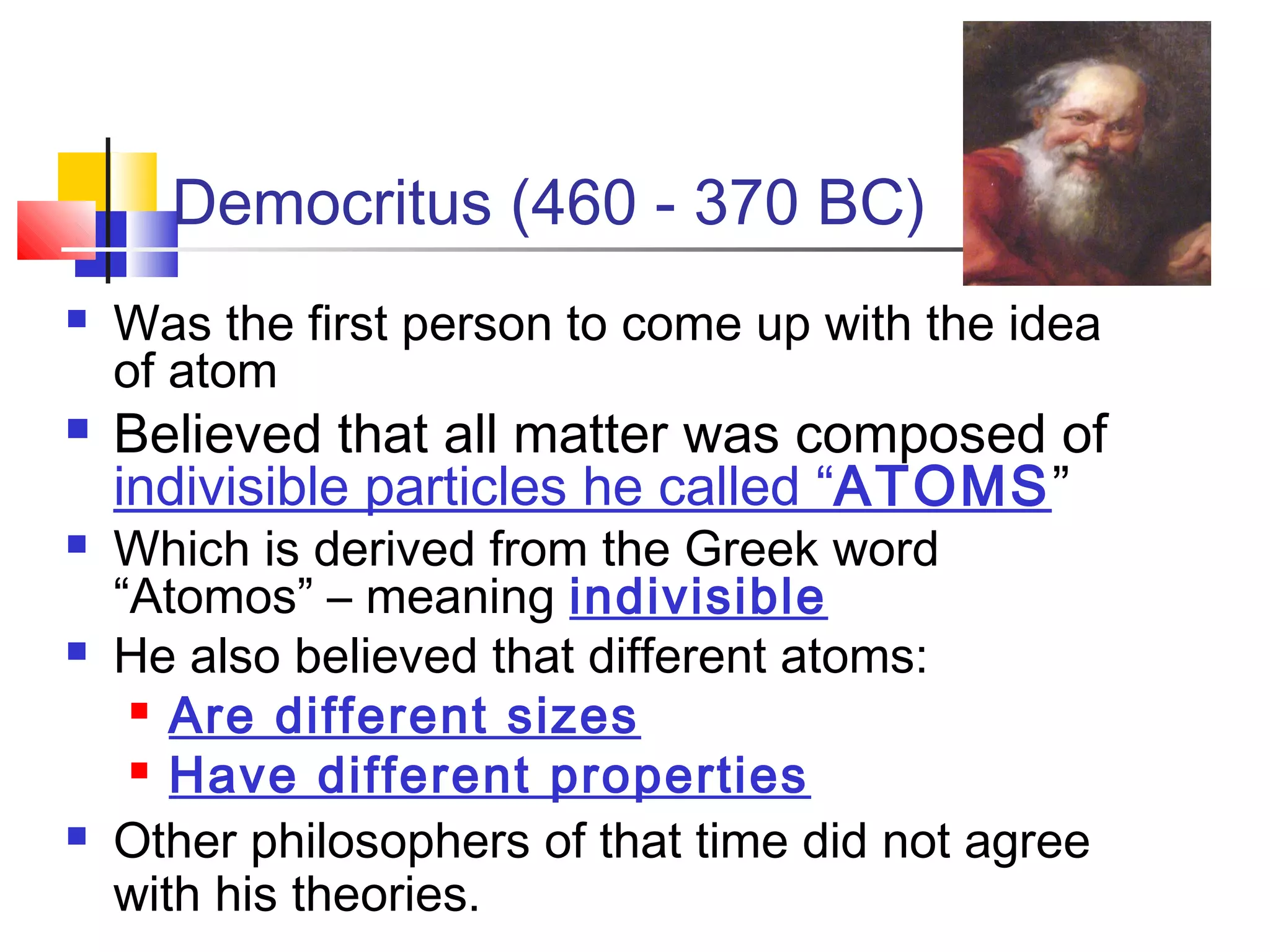
Democritus (460 - 370 BC)
 Was the first person to come up with the idea
of atom
 Believed that all matter was composed of
indivisible particles he called “ATOMS”
 Which is derived from the Greek word
“Atomos” – meaning indivisible
 He also believed that different atoms:
 Are different sizes
 Have different properties
 Other philosophers of that time did not agree
with his theories.
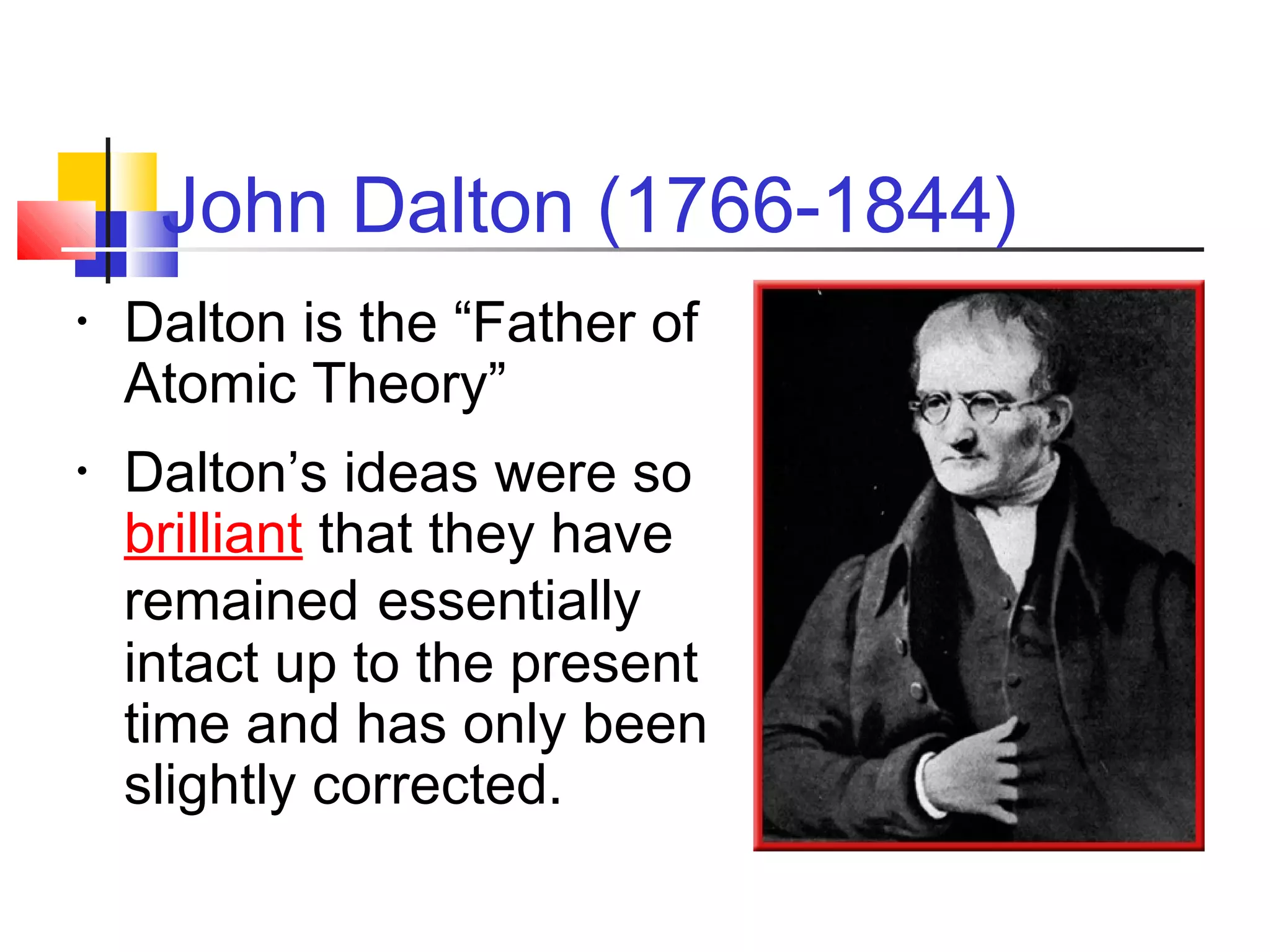
John Dalton (1766-1844)
• Dalton is the “Father of
Atomic Theory”
• Dalton’s ideas were so
brilliant that they have
remained essentially
intact up to the present
time and has only been
slightly corrected.
Dalton’s Atomic Theory (1803)
aka: 5 Postulates
 
1. All matter is composed of extremely
small particles called atoms. (I agree with
Democritus!)
2. All atoms of a given element are
identical, having the same:
- size
- mass
- chemical properties.
3. All atoms of different elements are
different.
4. Atoms cannot be created, divided
into smaller particles, or destroyed.
**In a chemical reaction, atoms of different elements are
separated, joined or rearranged. They are
never changed into the atoms of another element.
We will learn more later**
5. Atoms combine in definite whole
number ratios to make compounds
(you can’t have a ½ of a Carbon bonding with
Oxygen; it’s a whole atom or no atom)
Dalton’s Atomic Theory (1803)
aka: 5 Postulates
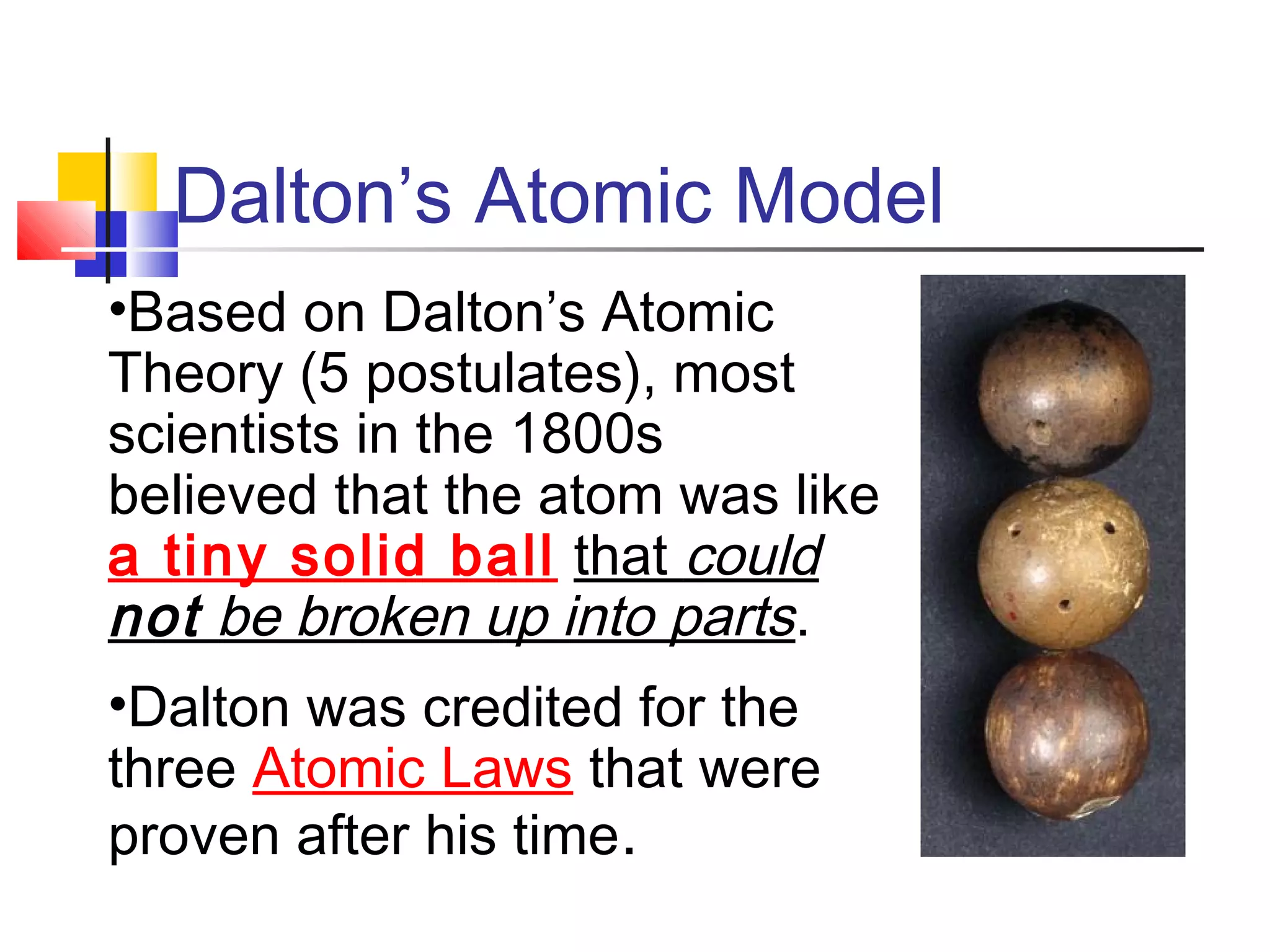
Dalton’s Atomic Model
•Based on Dalton’s Atomic
Theory (5 postulates), most
scientists in the 1800s
believed that the atom was like
a tiny solid ball that could
not be broken up into parts.
•Dalton was credited for the
three Atomic Laws that were
proven after his time.
Dalton’s Atomic Laws
1. Law of Conservation of
Mass
Matter cannot be created or
destroyed in any physical or
chemical process, just transferred.
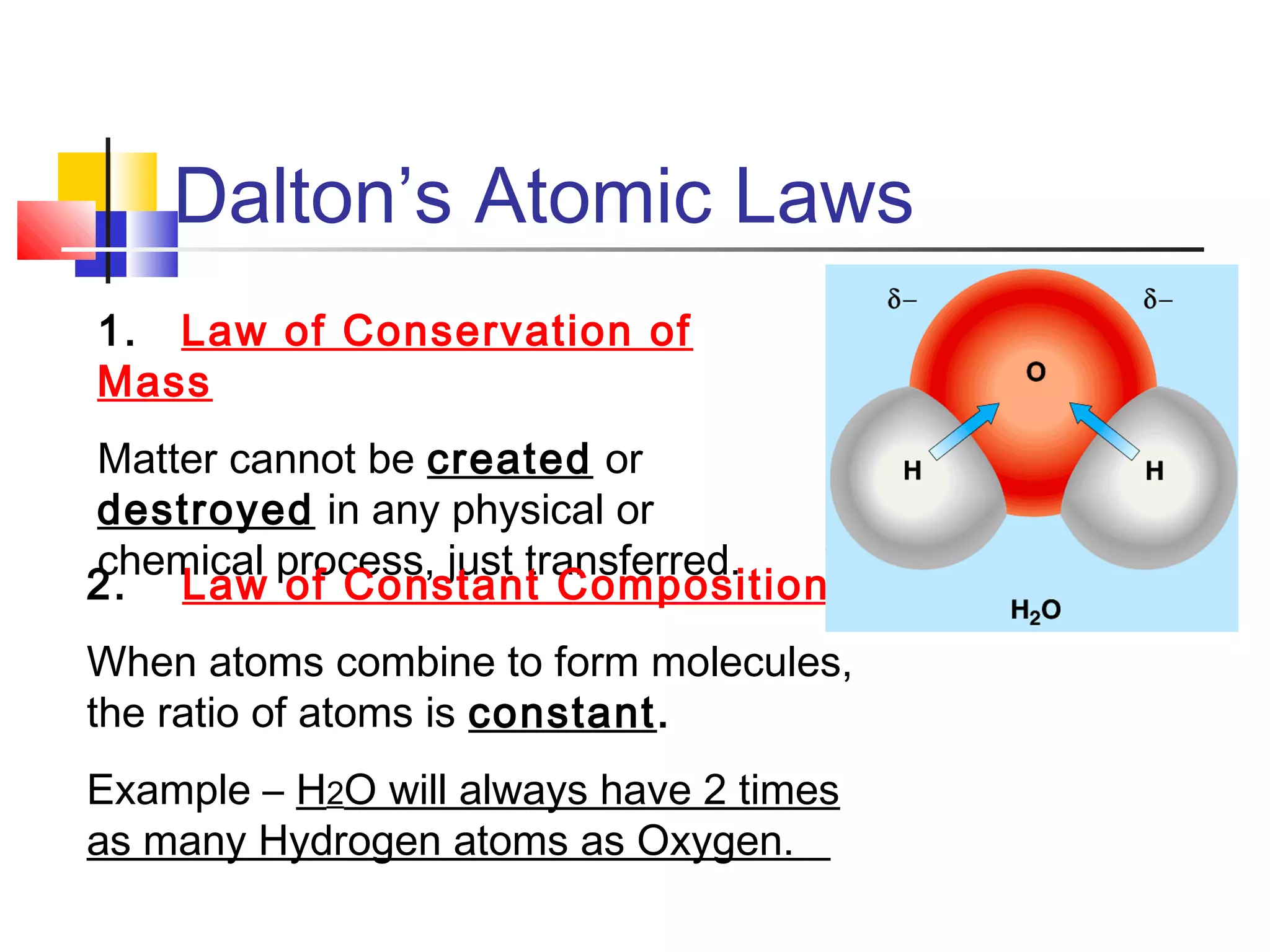
2. Law of Constant Composition
When atoms combine to form molecules,
the ratio of atoms is constant.
Example – H2O will always have 2 times
as many Hydrogen atoms as Oxygen.
Dalton’s Atomic Laws
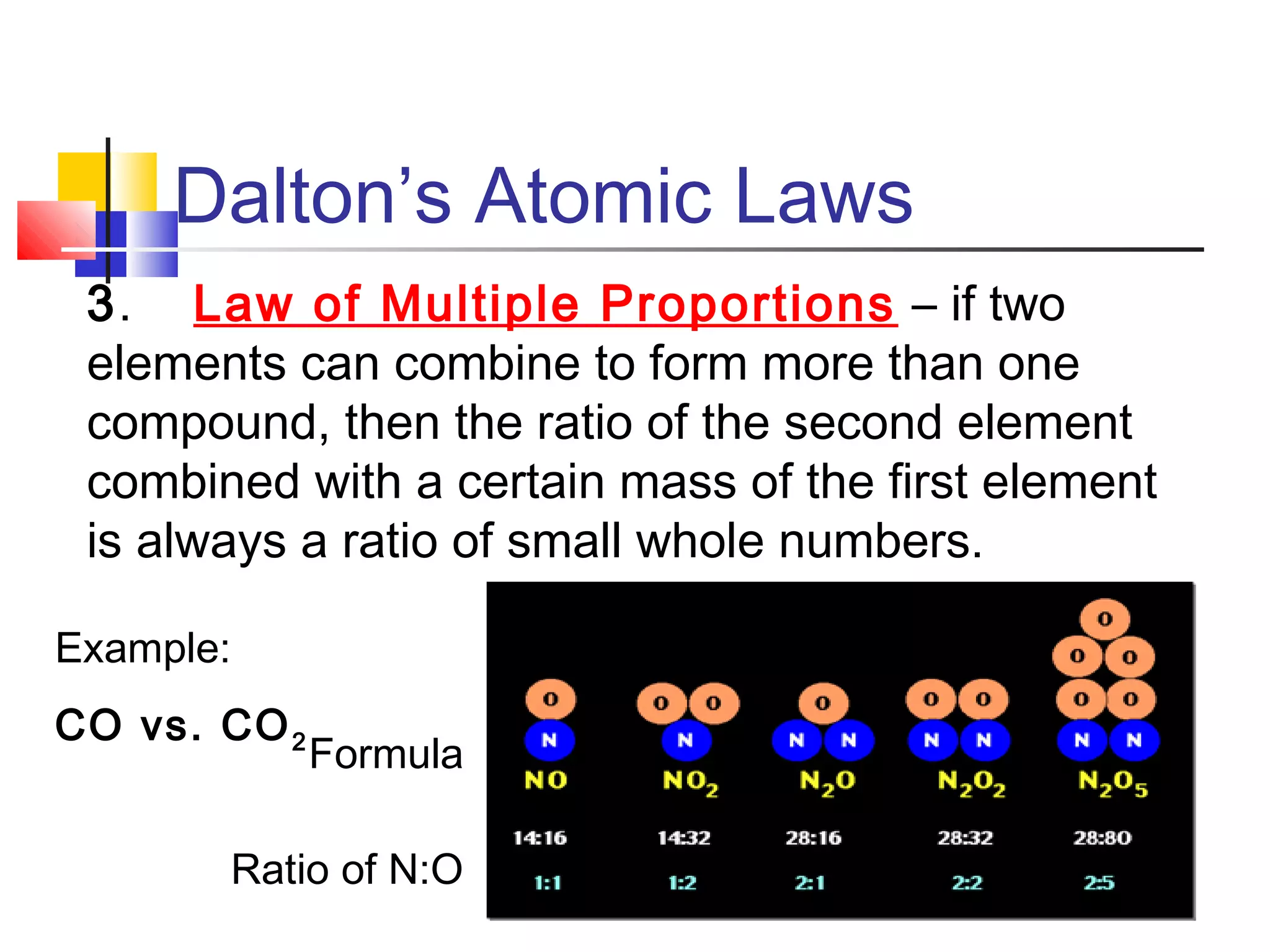
3.     Law of Multiple Proportions – if two
elements can combine to form more than one
compound, then the ratio of the second element
combined with a certain mass of the first element
is always a ratio of small whole numbers.
Formula
Ratio of N:O
Example:
CO vs. CO2
•When a chemical reaction occurs, mass 
is neither created nor destroyed but only 
changed. 
The Law of Conservation of
Mass
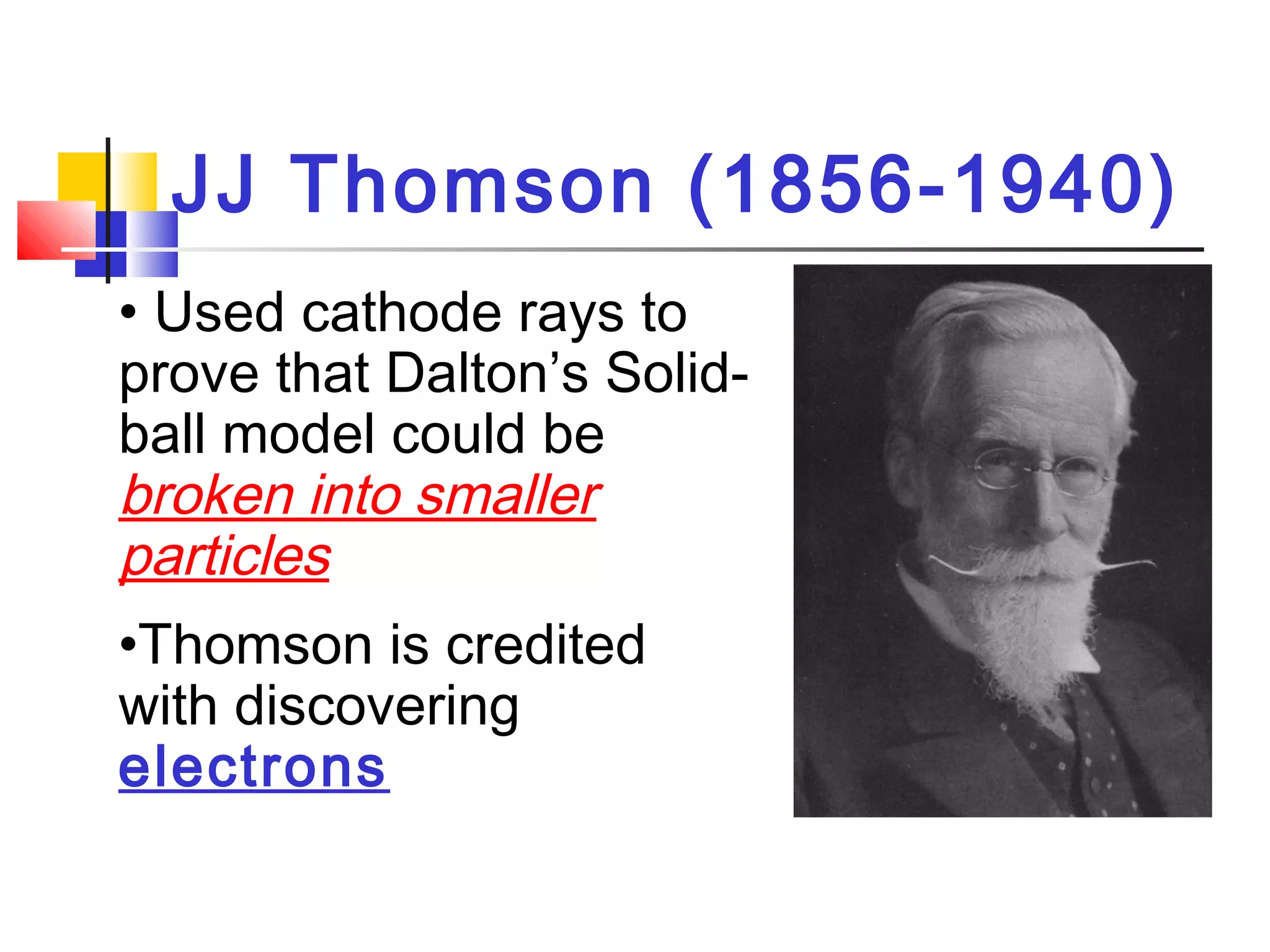
JJ Thomson (1856-1940)
• Used cathode rays to
prove that Dalton’s Solid-
ball model could be
broken into smaller
particles
•Thomson is credited
with discovering
electrons
Cathode Ray Tubes
• Cathode rays had been used for
some time before Thompson’s
experiments.
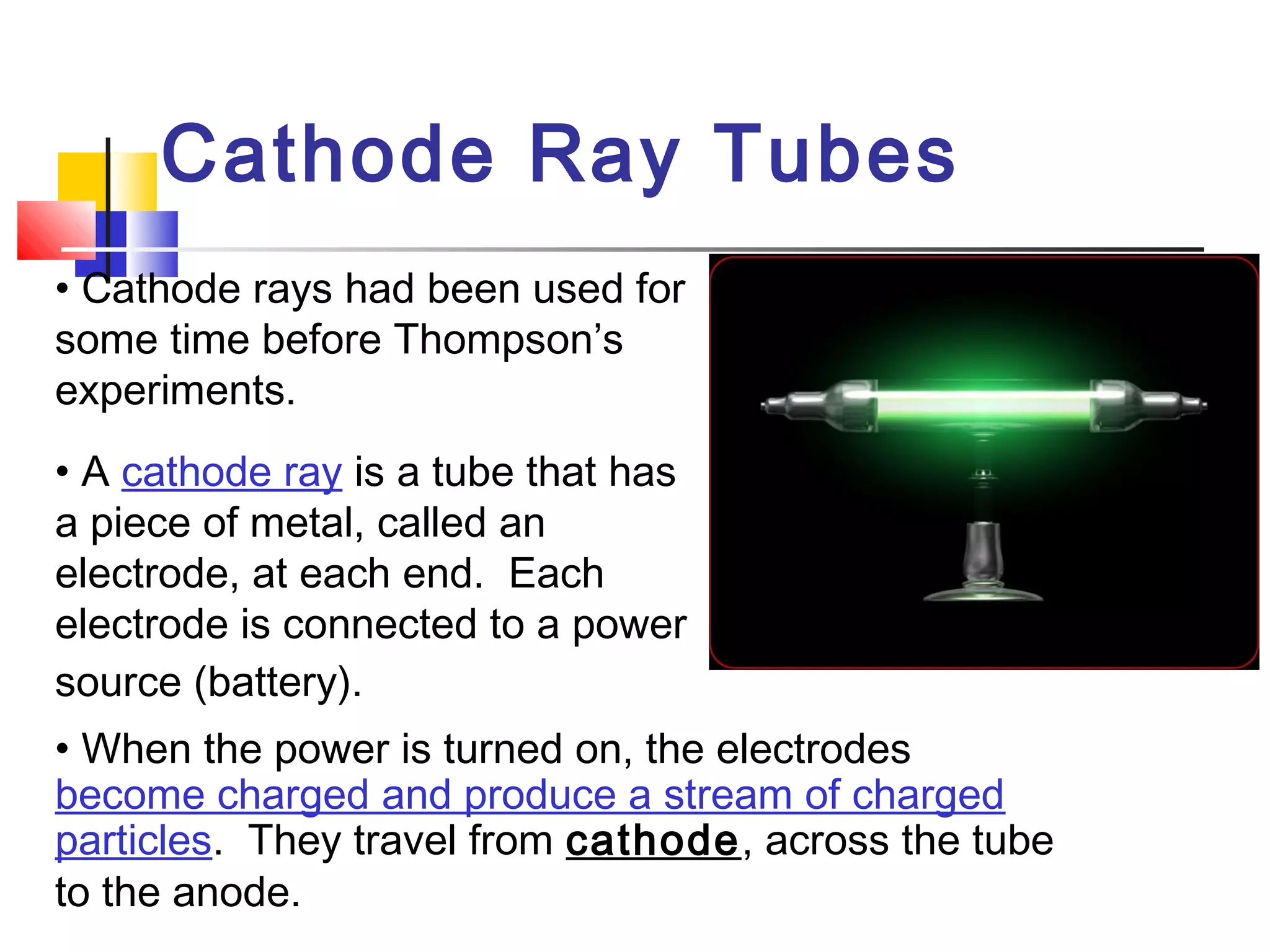
• A cathode ray is a tube that has
a piece of metal, called an
electrode, at each end. Each
electrode is connected to a power
source (battery).
• When the power is turned on, the electrodes
become charged and produce a stream of charged
particles. They travel from cathode, across the tube
to the anode.  
Cathode Ray Tubes
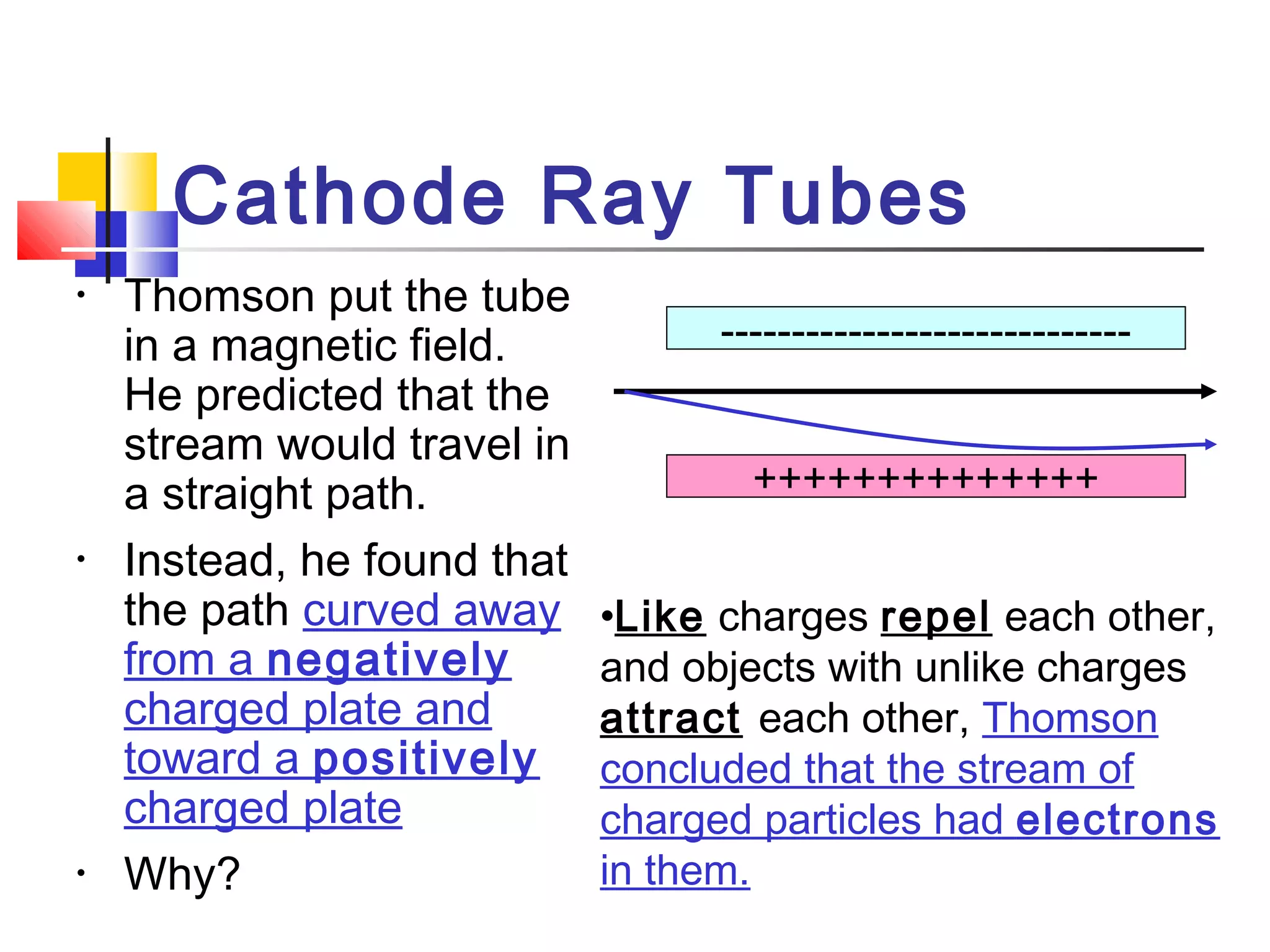
• Thomson put the tube
in a magnetic field.
He predicted that the
stream would travel in
a straight path.
• Instead, he found that
the path curved away
from a negatively
charged plate and
toward a positively
charged plate
• Why?
•Like charges repel each other,
and objects with unlike charges
attract each other, Thomson
concluded that the stream of
charged particles had electrons
in them.
++++++++++++++
-----------------------------
Cathode Ray Tube Experiment
Video Clip
Cathode Ray Tube Experiment
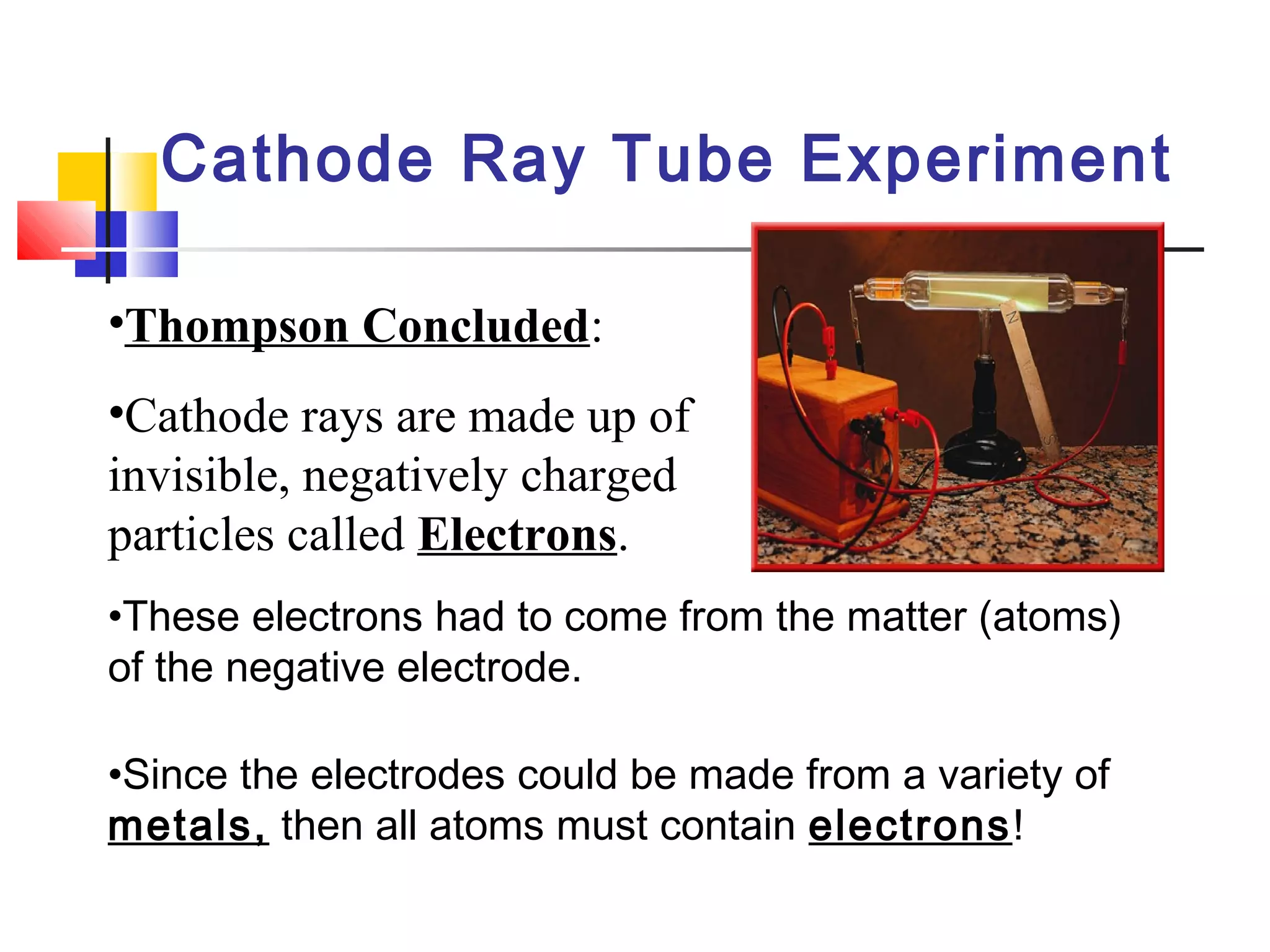
•Thompson Concluded:
•Cathode rays are made up of 
invisible, negatively charged 
particles called Electrons.
•These electrons had to come from the matter (atoms)
of the negative electrode.
•Since the electrodes could be made from a variety of
metals, then all atoms must contain electrons!
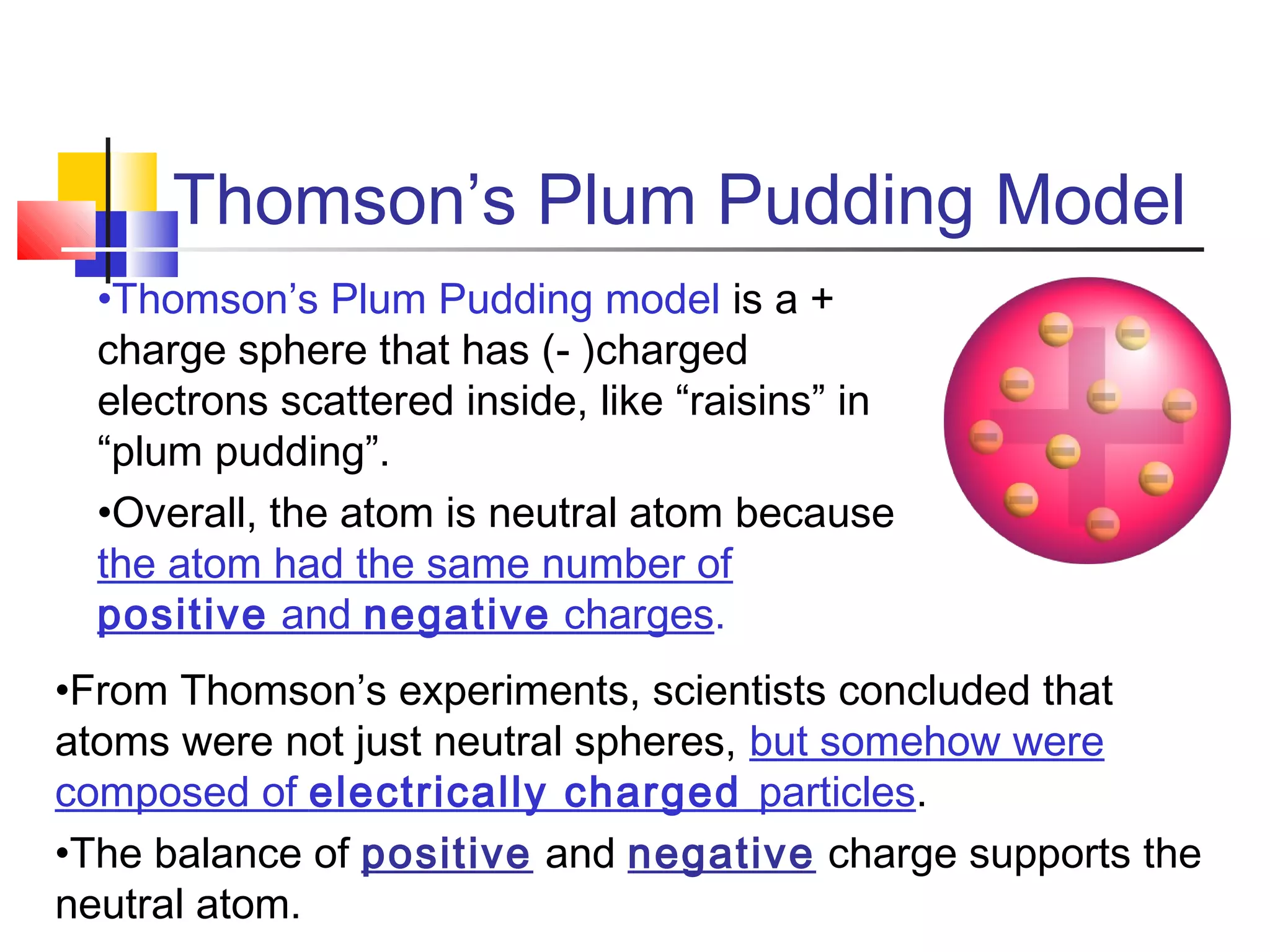
Thomson’s Plum Pudding Model
•Thomson’s Plum Pudding model is a +
charge sphere that has (- )charged
electrons scattered inside, like “raisins” in
“plum pudding”.
•Overall, the atom is neutral atom because
the atom had the same number of
positive and negative charges.
•From Thomson’s experiments, scientists concluded that
atoms were not just neutral spheres, but somehow were
composed of electrically charged particles.
•The balance of positive and negative charge supports the
neutral atom.
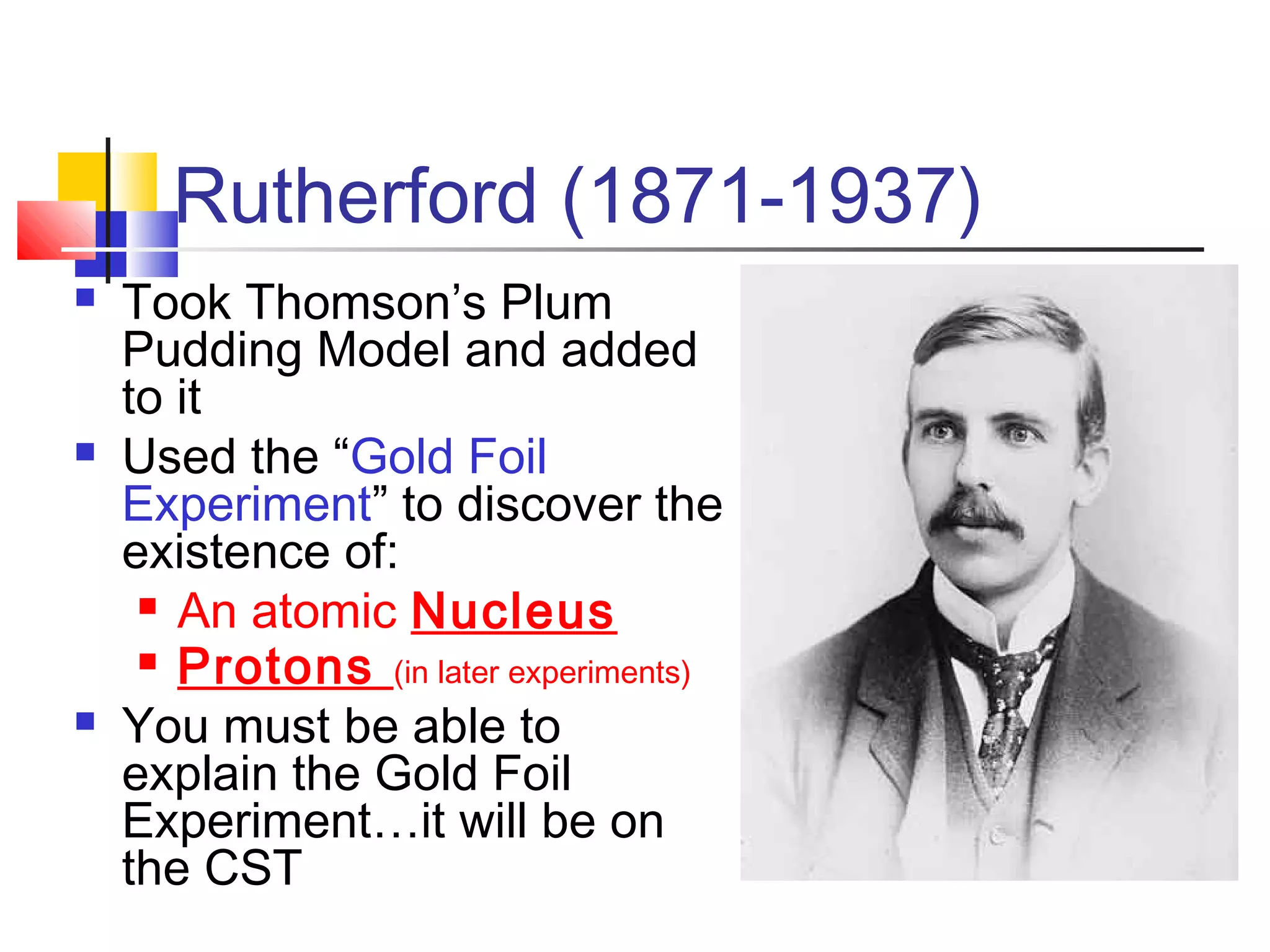
Rutherford (1871-1937)
 Took Thomson’s Plum
Pudding Model and added
to it
 Used the “Gold Foil
Experiment” to discover the
existence of:
 An atomic Nucleus
 Protons (in later experiments)
 You must be able to
explain the Gold Foil
Experiment…it will be on
the CST
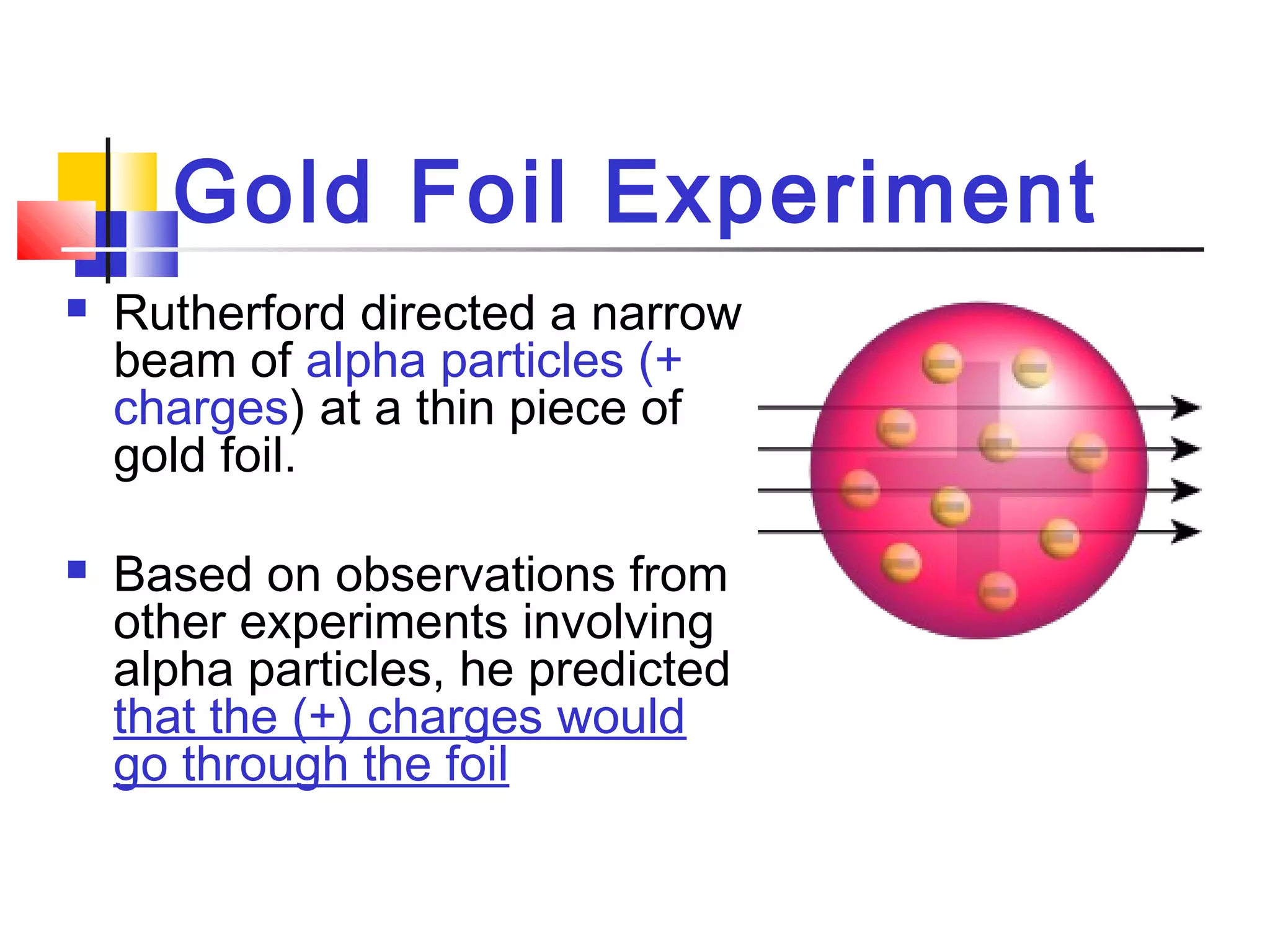
Gold Foil Experiment
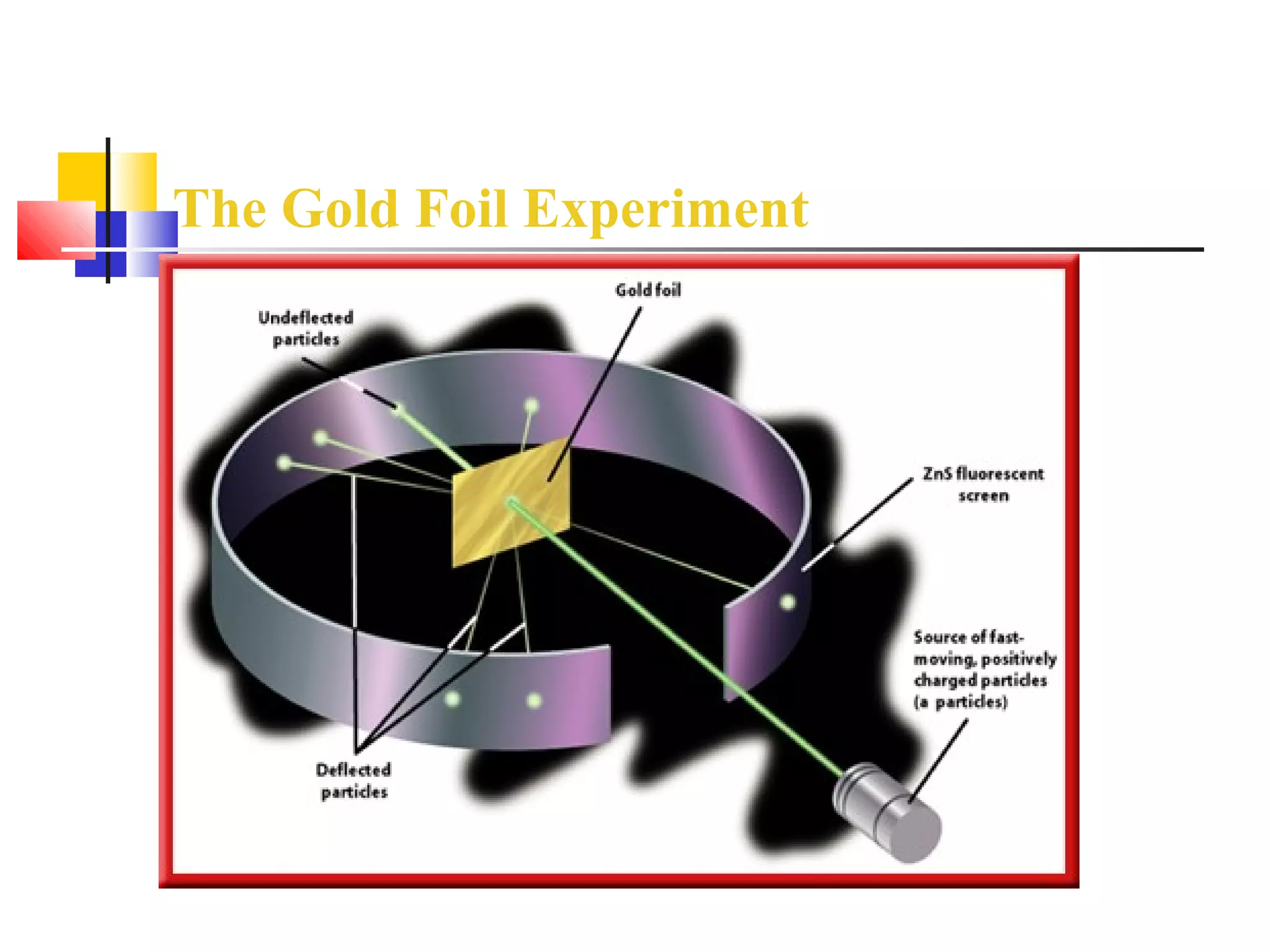
 Rutherford directed a narrow
beam of alpha particles (+
charges) at a thin piece of
gold foil.
 Based on observations from
other experiments involving
alpha particles, he predicted
that the (+) charges would
go through the foil
Results from Gold Foil Experiment
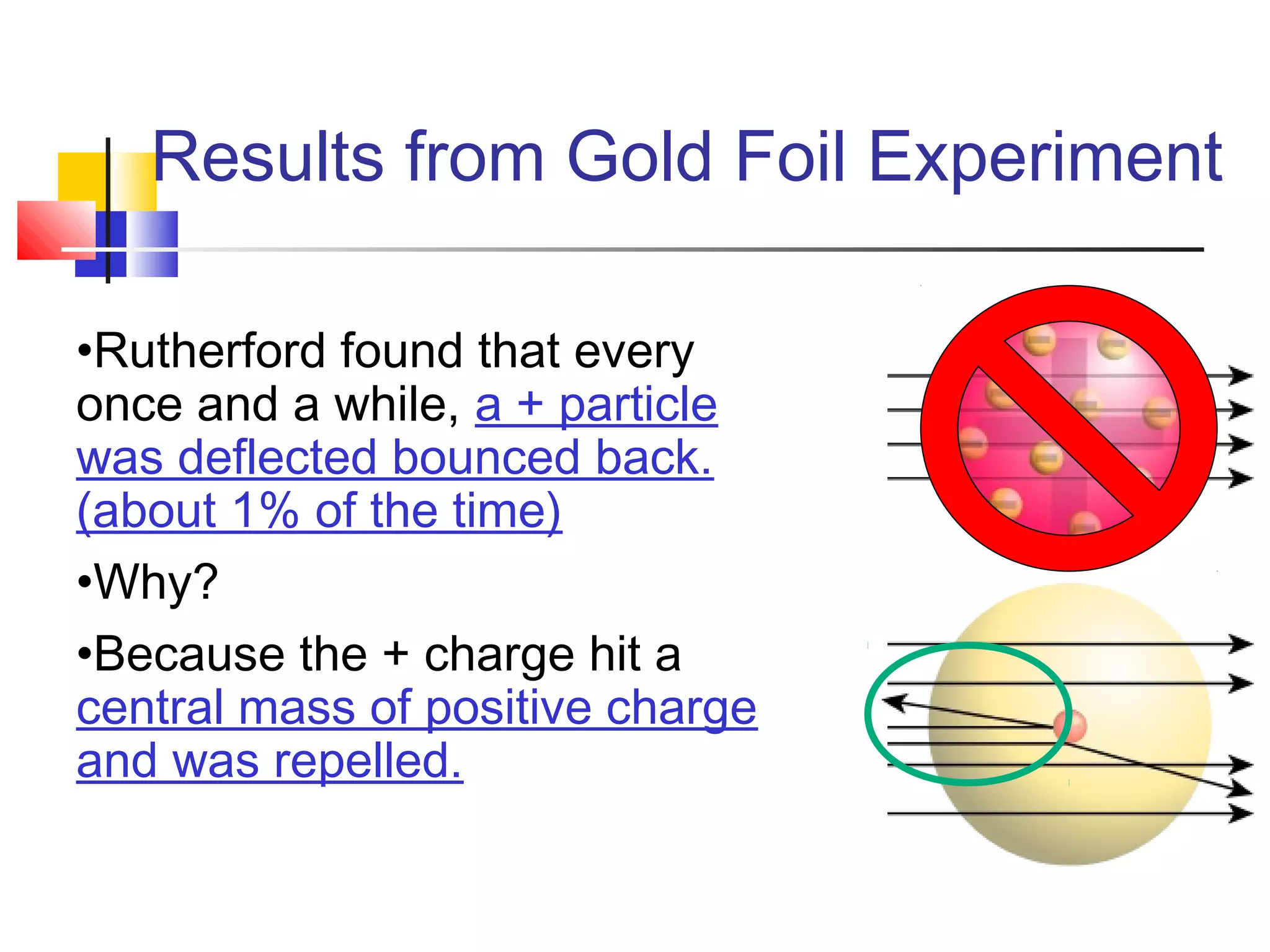
•Rutherford found that every
once and a while, a + particle
was deflected bounced back.
(about 1% of the time)
•Why?
•Because the + charge hit a
central mass of positive charge
and was repelled.
The Gold Foil Experiment
The Nuclear Model of the Atom
•To explain the results of the experiment,
Rutherford’s team proposed a new model of
the atom.
Conclusions from Rutherford’s
Gold Foil Experiment (memorize this!)
• The atom contains a positively charged
“nucleus”
•This nucleus contains almost all of the mass of
the atom, but occupies a very small volume of
the atom.
•The negatively charged electrons occupied
most of the volume of the atom.
• The atom is mostly empty space.
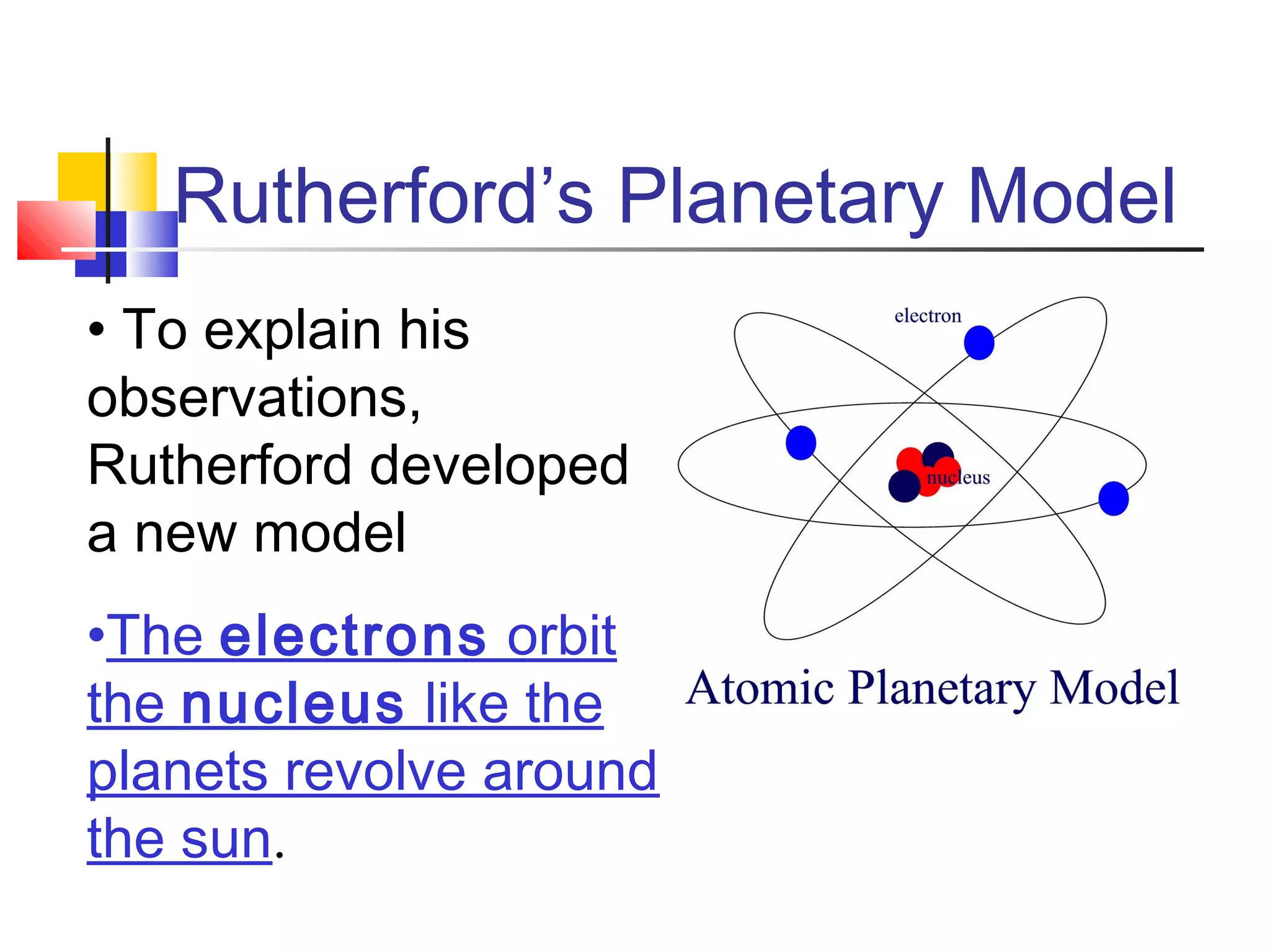
Rutherford’s Planetary Model
• To explain his
observations,
Rutherford developed
a new model
•The electrons orbit
the nucleus like the
planets revolve around
the sun.
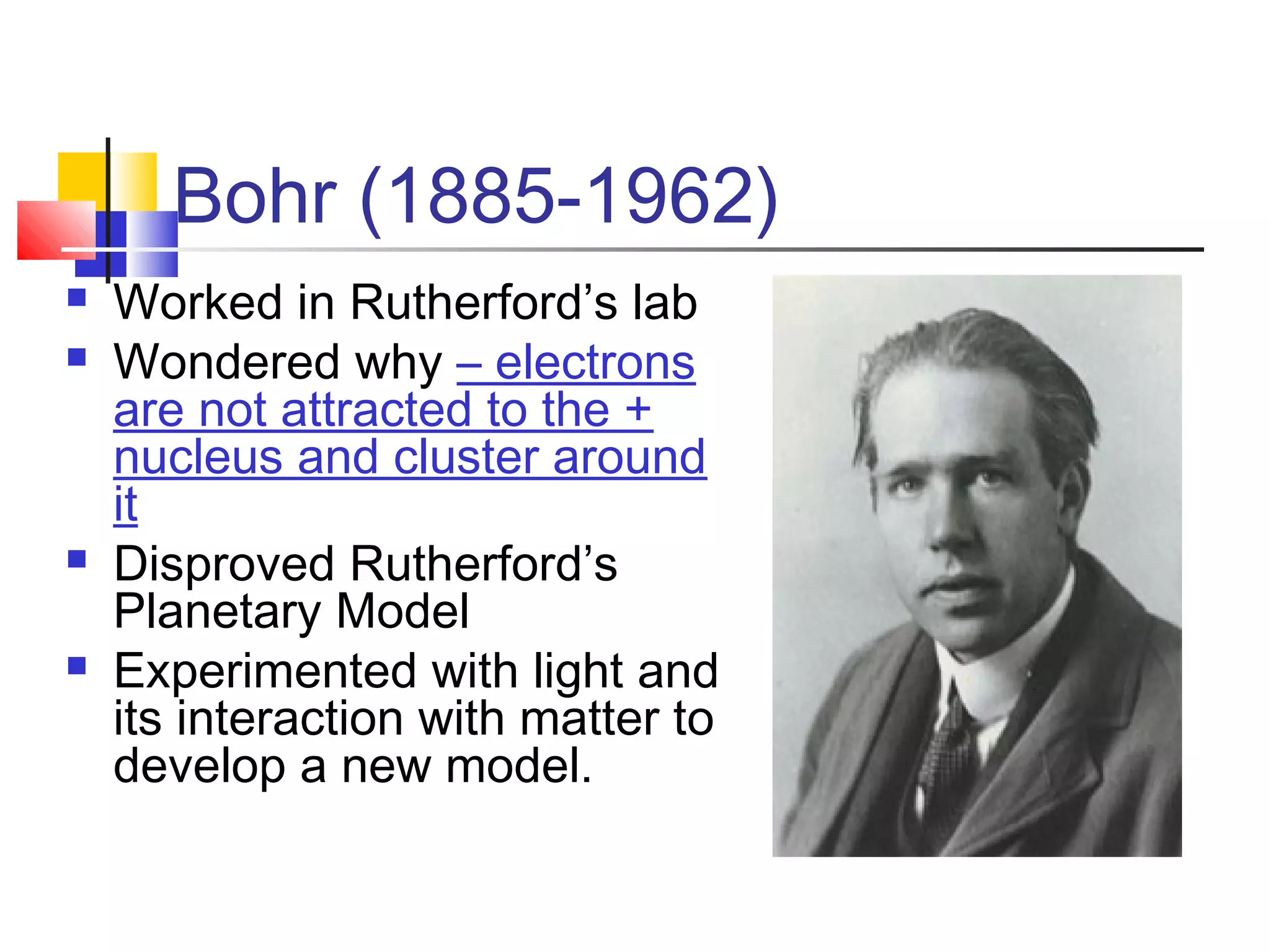
Bohr (1885-1962)
 Worked in Rutherford’s lab
 Wondered why – electrons
are not attracted to the +
nucleus and cluster around
it
 Disproved Rutherford’s
Planetary Model
 Experimented with light and
its interaction with matter to
develop a new model.
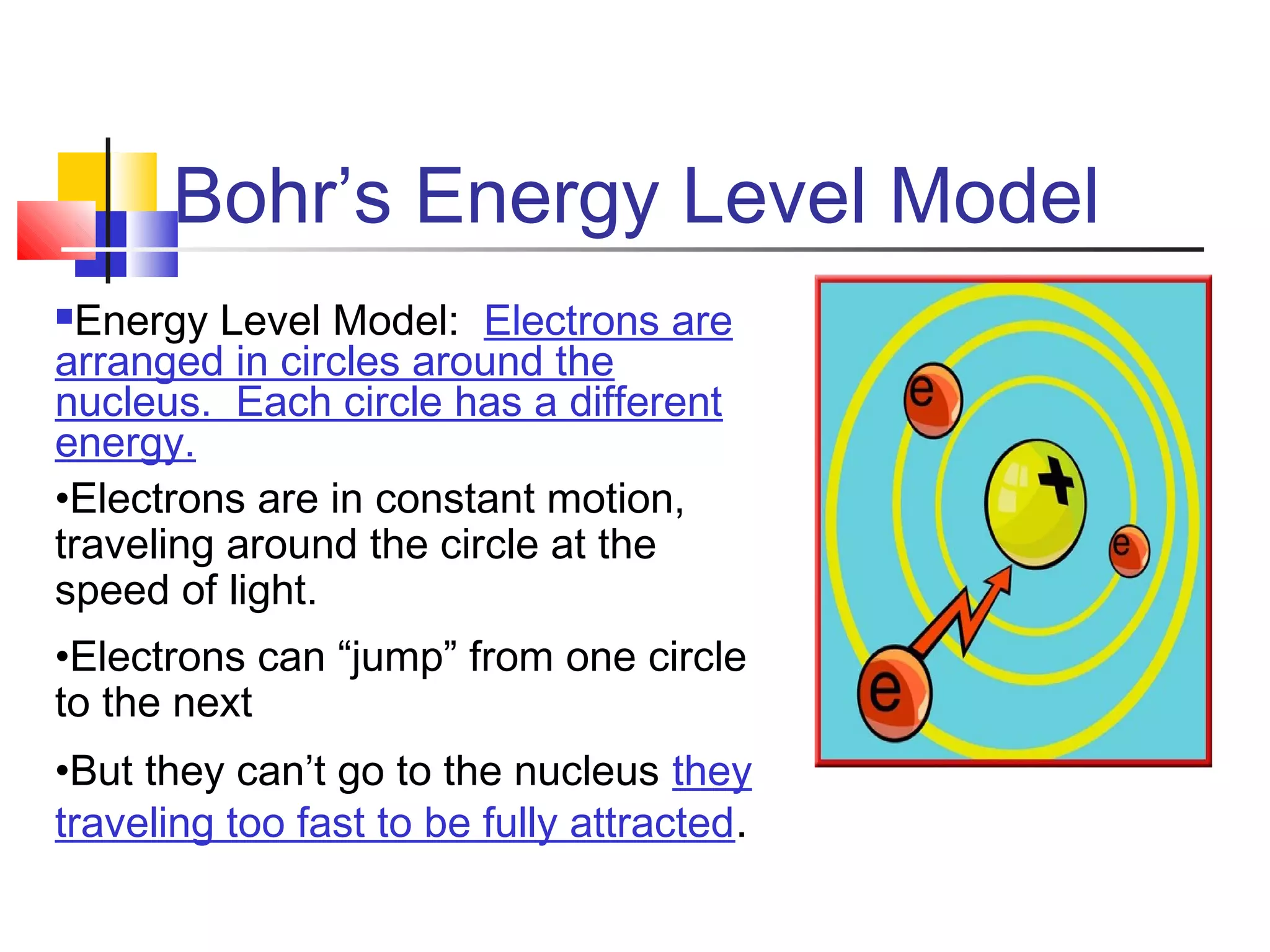
Bohr’s Energy Level Model
Energy Level Model: Electrons are
arranged in circles around the
nucleus. Each circle has a different
energy.
•Electrons are in constant motion,
traveling around the circle at the
speed of light.
•Electrons can “jump” from one circle
to the next
•But they can’t go to the nucleus they
traveling too fast to be fully attracted.
Bohr’s Energy Level Model
•  He proposed the following:
4. The electrons must absorb or emit a fixed
amount of energy to travel between these
energy levels
3. The electrons orbit the nucleus at fixed
energy levels.
2. Electrons can only be certain distances from
the nucleus.
1. Protons and neutrons are in the nucleus
Review
Who is the father of atomic theory?
Dalton
What was the first model of the atom?
Dalton’s Tiny Ball Model
What are Dalton’s 3 Laws?
Law of Conservation of Mass, Law of
Constant Composition, Law of Multiple
Porportion
Review
How were Thomson’s and Dalton’s model
different?
Dalton’s model was 1 sphere that cannot
be divided, Thomson had the plum pudding
where electrons are randomly spread
throughout a positively charged sphere.
What did Thomson find out?
Atoms have electrons, they have a - charge
Review
What were Rutherford’s conclusions from the
Gold Foil Experiment?
 Atom has a positively charged nucleus
 electrons are outside,
 atoms are mostly empty
 Nucleus contains most of the mass.

Atomic structure history_dem_to_bohr

  • 1.
  • 2.
    Democritus (460 -370 BC)  Was the first person to come up with the idea of atom  Believed that all matter was composed of indivisible particles he called “ATOMS”  Which is derived from the Greek word “Atomos” – meaning indivisible  He also believed that different atoms:  Are different sizes  Have different properties  Other philosophers of that time did not agree with his theories.
  • 3.
    John Dalton (1766-1844) •Dalton is the “Father of Atomic Theory” • Dalton’s ideas were so brilliant that they have remained essentially intact up to the present time and has only been slightly corrected.
  • 4.
    Dalton’s Atomic Theory(1803) aka: 5 Postulates   1. All matter is composed of extremely small particles called atoms. (I agree with Democritus!) 2. All atoms of a given element are identical, having the same: - size - mass - chemical properties. 3. All atoms of different elements are different.
  • 5.
    4. Atoms cannotbe created, divided into smaller particles, or destroyed. **In a chemical reaction, atoms of different elements are separated, joined or rearranged. They are never changed into the atoms of another element. We will learn more later** 5. Atoms combine in definite whole number ratios to make compounds (you can’t have a ½ of a Carbon bonding with Oxygen; it’s a whole atom or no atom) Dalton’s Atomic Theory (1803) aka: 5 Postulates
  • 6.
    Dalton’s Atomic Model •Basedon Dalton’s Atomic Theory (5 postulates), most scientists in the 1800s believed that the atom was like a tiny solid ball that could not be broken up into parts. •Dalton was credited for the three Atomic Laws that were proven after his time.
  • 7.
    Dalton’s Atomic Laws 1.Law of Conservation of Mass Matter cannot be created or destroyed in any physical or chemical process, just transferred. 2. Law of Constant Composition When atoms combine to form molecules, the ratio of atoms is constant. Example – H2O will always have 2 times as many Hydrogen atoms as Oxygen.
  • 8.
    Dalton’s Atomic Laws 3.     Lawof Multiple Proportions – if two elements can combine to form more than one compound, then the ratio of the second element combined with a certain mass of the first element is always a ratio of small whole numbers. Formula Ratio of N:O Example: CO vs. CO2
  • 9.
  • 10.
    JJ Thomson (1856-1940) •Used cathode rays to prove that Dalton’s Solid- ball model could be broken into smaller particles •Thomson is credited with discovering electrons
  • 11.
    Cathode Ray Tubes •Cathode rays had been used for some time before Thompson’s experiments. • A cathode ray is a tube that has a piece of metal, called an electrode, at each end. Each electrode is connected to a power source (battery). • When the power is turned on, the electrodes become charged and produce a stream of charged particles. They travel from cathode, across the tube to the anode.  
  • 12.
    Cathode Ray Tubes •Thomson put the tube in a magnetic field. He predicted that the stream would travel in a straight path. • Instead, he found that the path curved away from a negatively charged plate and toward a positively charged plate • Why? •Like charges repel each other, and objects with unlike charges attract each other, Thomson concluded that the stream of charged particles had electrons in them. ++++++++++++++ -----------------------------
  • 13.
    Cathode Ray TubeExperiment Video Clip
  • 14.
    Cathode Ray TubeExperiment •Thompson Concluded: •Cathode rays are made up of  invisible, negatively charged  particles called Electrons. •These electrons had to come from the matter (atoms) of the negative electrode. •Since the electrodes could be made from a variety of metals, then all atoms must contain electrons!
  • 15.
    Thomson’s Plum PuddingModel •Thomson’s Plum Pudding model is a + charge sphere that has (- )charged electrons scattered inside, like “raisins” in “plum pudding”. •Overall, the atom is neutral atom because the atom had the same number of positive and negative charges. •From Thomson’s experiments, scientists concluded that atoms were not just neutral spheres, but somehow were composed of electrically charged particles. •The balance of positive and negative charge supports the neutral atom.
  • 16.
    Rutherford (1871-1937)  TookThomson’s Plum Pudding Model and added to it  Used the “Gold Foil Experiment” to discover the existence of:  An atomic Nucleus  Protons (in later experiments)  You must be able to explain the Gold Foil Experiment…it will be on the CST
  • 17.
    Gold Foil Experiment Rutherford directed a narrow beam of alpha particles (+ charges) at a thin piece of gold foil.  Based on observations from other experiments involving alpha particles, he predicted that the (+) charges would go through the foil
  • 18.
    Results from GoldFoil Experiment •Rutherford found that every once and a while, a + particle was deflected bounced back. (about 1% of the time) •Why? •Because the + charge hit a central mass of positive charge and was repelled.
  • 19.
    The Gold FoilExperiment
  • 20.
    The Nuclear Modelof the Atom •To explain the results of the experiment, Rutherford’s team proposed a new model of the atom.
  • 21.
    Conclusions from Rutherford’s GoldFoil Experiment (memorize this!) • The atom contains a positively charged “nucleus” •This nucleus contains almost all of the mass of the atom, but occupies a very small volume of the atom. •The negatively charged electrons occupied most of the volume of the atom. • The atom is mostly empty space.
  • 22.
    Rutherford’s Planetary Model •To explain his observations, Rutherford developed a new model •The electrons orbit the nucleus like the planets revolve around the sun.
  • 23.
    Bohr (1885-1962)  Workedin Rutherford’s lab  Wondered why – electrons are not attracted to the + nucleus and cluster around it  Disproved Rutherford’s Planetary Model  Experimented with light and its interaction with matter to develop a new model.
  • 24.
    Bohr’s Energy LevelModel Energy Level Model: Electrons are arranged in circles around the nucleus. Each circle has a different energy. •Electrons are in constant motion, traveling around the circle at the speed of light. •Electrons can “jump” from one circle to the next •But they can’t go to the nucleus they traveling too fast to be fully attracted.
  • 25.
    Bohr’s Energy LevelModel •  He proposed the following: 4. The electrons must absorb or emit a fixed amount of energy to travel between these energy levels 3. The electrons orbit the nucleus at fixed energy levels. 2. Electrons can only be certain distances from the nucleus. 1. Protons and neutrons are in the nucleus
  • 26.
    Review Who is thefather of atomic theory? Dalton What was the first model of the atom? Dalton’s Tiny Ball Model What are Dalton’s 3 Laws? Law of Conservation of Mass, Law of Constant Composition, Law of Multiple Porportion
  • 27.
    Review How were Thomson’sand Dalton’s model different? Dalton’s model was 1 sphere that cannot be divided, Thomson had the plum pudding where electrons are randomly spread throughout a positively charged sphere. What did Thomson find out? Atoms have electrons, they have a - charge
  • 28.
    Review What were Rutherford’sconclusions from the Gold Foil Experiment?  Atom has a positively charged nucleus  electrons are outside,  atoms are mostly empty  Nucleus contains most of the mass.