CLIL Physics/English Daniela Aprile Liceo Linguistico “G. Verga” ModicaCLIL Physics/English Daniela Aprile Liceo Linguistico “G. Verga” Modica
Atomic Spectra and
Models of the Atom
LEARNING OBJECTIVE
• To know the relationship between atomic
spectra and the electronic structure of
atoms.
• To understand how scientific models
develop.
CLIL Physics/English Daniela Aprile Liceo Linguistico “G. Verga” ModicaCLIL Physics/English Daniela Aprile Liceo Linguistico “G. Verga” Modica
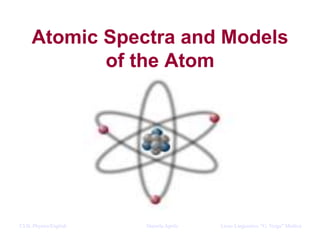
Atomic Spectra and Models
of the Atom
CLIL Physics/English Daniela Aprile Liceo Linguistico “G. Verga” ModicaCLIL Physics/English Daniela Aprile Liceo Linguistico “G. Verga” Modica
Do you know…
• … what is an atom?
• … what are atoms made of?
• … how/when were the atom components
discovered?
• …what is the light spectrum?
CLIL Physics/English Daniela Aprile Liceo Linguistico “G. Verga” ModicaCLIL Physics/English Daniela Aprile Liceo Linguistico “G. Verga” Modica
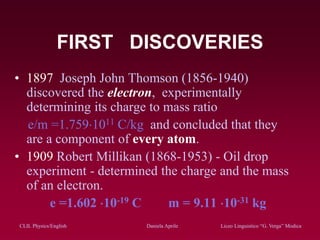
FIRST DISCOVERIES
• 1897 Joseph John Thomson (1856-1940)
discovered the electron, experimentally
determining its charge to mass ratio
e/m =1.7591011 C/kg and concluded that they
are a component of every atom.
• 1909 Robert Millikan (1868-1953) - Oil drop
experiment - determined the charge and the mass
of an electron.
e =1.602 10-19 C m = 9.11 10-31 kg
CLIL Physics/English Daniela Aprile Liceo Linguistico “G. Verga” Modica
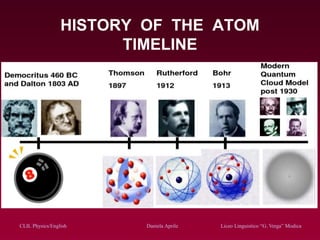
HISTORY OF THE ATOM
TIMELINE
CLIL Physics/English Daniela Aprile Liceo Linguistico “G. Verga” Modica
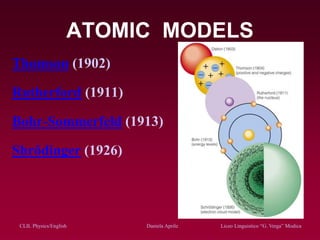
ATOMIC MODELS
Thomson (1902)
Rutherford (1911)
Bohr-Sommerfeld (1913)
Shrödinger (1926)
CLIL Physics/English Daniela Aprile Liceo Linguistico “G. Verga” Modica
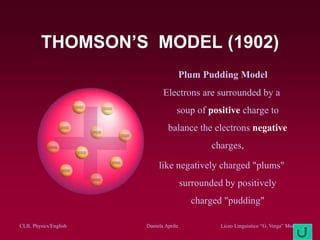
THOMSON’S MODEL (1902)
Plum Pudding Model
Electrons are surrounded by a
soup of positive charge to
balance the electrons negative
charges,
like negatively charged "plums"
surrounded by positively
charged "pudding"
CLIL Physics/English Daniela Aprile Liceo Linguistico “G. Verga” Modica
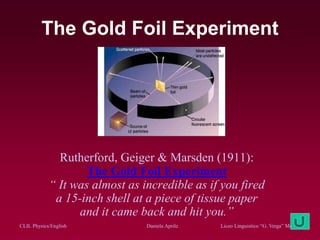
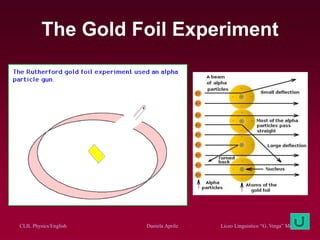
The Gold Foil Experiment
Rutherford, Geiger & Marsden (1911):
The Gold Foil Experiment
“ It was almost as incredible as if you fired
a 15-inch shell at a piece of tissue paper
and it came back and hit you.”
CLIL Physics/English Daniela Aprile Liceo Linguistico “G. Verga” Modica
The Gold Foil Experiment
CLIL Physics/English Daniela Aprile Liceo Linguistico “G. Verga” Modica
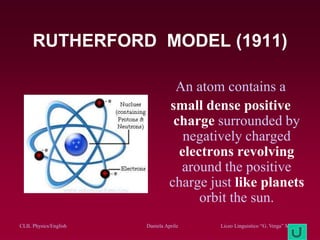
RUTHERFORD MODEL (1911)
An atom contains a
small dense positive
charge surrounded by
negatively charged
electrons revolving
around the positive
charge just like planets
orbit the sun.
CLIL Physics/English Daniela Aprile Liceo Linguistico “G. Verga” ModicaCLIL Physics/English Daniela Aprile Liceo Linguistico “G. Verga” Modica
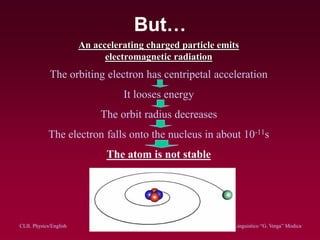
But…
An accelerating charged particle emits
electromagnetic radiation
The orbiting electron has centripetal acceleration
It looses energy
The orbit radius decreases
The electron falls onto the nucleus in about 10-11s
The atom is not stable
CLIL Physics/English Daniela Aprile Liceo Linguistico “G. Verga” Modica
What do you know so far?
• Who discovered the electron?
• What is the plum-pudding model?
• Why was the Rutherford’s “gold foil”
experiment outcome surprising?
• What is new in Rutherford’s model?
• Why wasn’t it a suitable model?
CLIL Physics/English Daniela Aprile Liceo Linguistico “G. Verga” ModicaCLIL Physics/English Daniela Aprile Liceo Linguistico “G. Verga” Modica
FROM CLASSICAL TO QUANTUM
PHYSICS
When you try to apply the classical mechanics
(Newton’s) laws to microscopic objects –
such as atoms and the e.m. waves they emit –
you come to contradictions with experience.
Therefore the fundamental dynamics’ and
electromagnetism’ laws have to be changed
so that the new laws correctly describe
microscopic phenomena, but reduce to
classical laws when applied to macroscopic
objects.
“Correspondence Principle” – Niels Bohr
CLIL Physics/English Daniela Aprile Liceo Linguistico “G. Verga” Modica
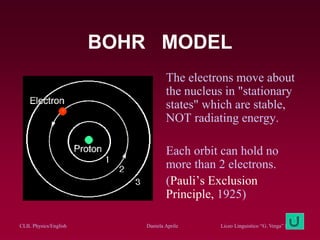
BOHR MODEL
The electrons move about
the nucleus in "stationary
states" which are stable,
NOT radiating energy.
Each orbit can hold no
more than 2 electrons.
(Pauli’s Exclusion
Principle, 1925)
CLIL Physics/English Daniela Aprile Liceo Linguistico “G. Verga” ModicaCLIL Physics/English Daniela Aprile Liceo Linguistico “G. Verga” Modica
ELECTRONIC TRANSITIONS
An electron is able to
absorb or emit energy
in order to “jump” from one to the other
orbit.
But what is it exchanging energy with?
CLIL Physics/English Daniela Aprile Liceo Linguistico “G. Verga” Modica
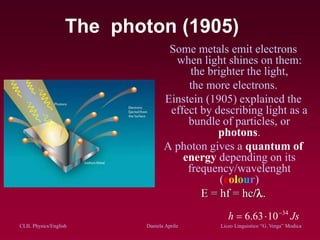
The photon (1905)
Some metals emit electrons
when light shines on them:
the brighter the light,
the more electrons.
Einstein (1905) explained the
effect by describing light as a
bundle of particles, or
photons.
A photon gives a quantum of
energy depending on its
frequency/wavelenght
(colour)
E = hf = hc/.
Jsh 34
1063.6 

CLIL Physics/English Daniela Aprile Liceo Linguistico “G. Verga” Modica
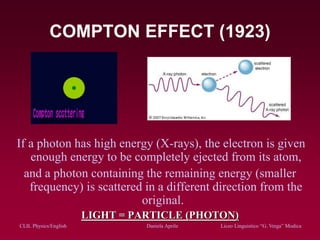
COMPTON EFFECT (1923)
If a photon has high energy (X-rays), the electron is given
enough energy to be completely ejected from its atom,
and a photon containing the remaining energy (smaller
frequency) is scattered in a different direction from the
original.
LIGHT = PARTICLE (PHOTON)
CLIL Physics/English Daniela Aprile Liceo Linguistico “G. Verga” Modica
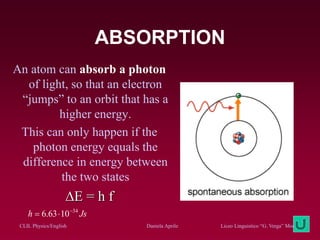
ABSORPTION
An atom can absorb a photon
of light, so that an electron
“jumps” to an orbit that has a
higher energy.
This can only happen if the
photon energy equals the
difference in energy between
the two states
DE = h f
Jsh 34
1063.6 

CLIL Physics/English Daniela Aprile Liceo Linguistico “G. Verga” Modica
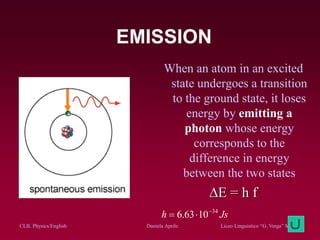
EMISSION
When an atom in an excited
state undergoes a transition
to the ground state, it loses
energy by emitting a
photon whose energy
corresponds to the
difference in energy
between the two states
DE = h f
Jsh 34
1063.6 

CLIL Physics/English Daniela Aprile Liceo Linguistico “G. Verga” Modica
What do you know so far?
• What is new in Bohr’s model?
• What is the light made of?
• How can an atom absorb/emit energy?
• How much energy can the atom
absorb/emit?
CLIL Physics/English Daniela Aprile Liceo Linguistico “G. Verga” Modica
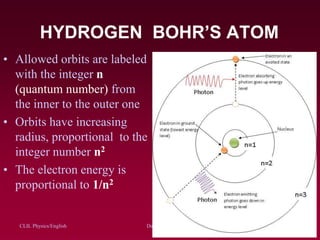
HYDROGEN BOHR’S ATOM
• Allowed orbits are labeled
with the integer n
(quantum number) from
the inner to the outer one
• Orbits have increasing
radius, proportional to the
integer number n2
• The electron energy is
proportional to 1/n2
CLIL Physics/English Daniela Aprile Liceo Linguistico “G. Verga” Modica
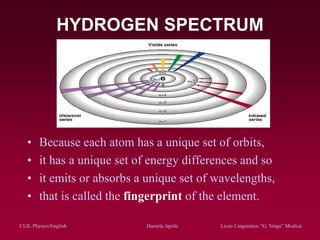
HYDROGEN SPECTRUM
• Because each atom has a unique set of orbits,
• it has a unique set of energy differences and so
• it emits or absorbs a unique set of wavelengths,
• that is called the fingerprint of the element.
CLIL Physics/English Daniela Aprile Liceo Linguistico “G. Verga” Modica
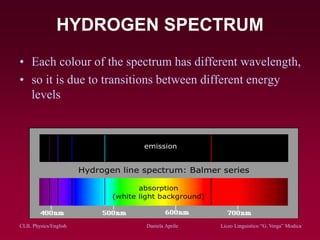
HYDROGEN SPECTRUM
• Each colour of the spectrum has different wavelength,
• so it is due to transitions between different energy
levels
CLIL Physics/English Daniela Aprile Liceo Linguistico “G. Verga” Modica
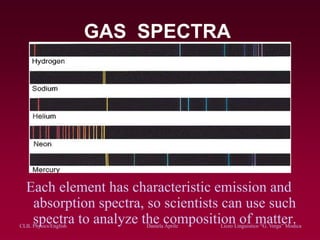
GAS SPECTRA
Each element has characteristic emission and
absorption spectra, so scientists can use such
spectra to analyze the composition of matter.
CLIL Physics/English Daniela Aprile Liceo Linguistico “G. Verga” ModicaCLIL Physics/English Daniela Aprile Liceo Linguistico “G. Verga” Modica
ACTIVITY
• Play the game!
Site link:
http://spiff.rit.edu/classes/phys301/lectures/spec_lines/Atoms_Nav.swf
• Read “how to”
• Do the exercises
CLIL Physics/English Daniela Aprile Liceo Linguistico “G. Verga” Modica
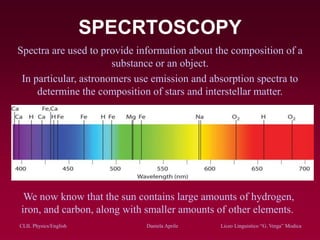
SPECRTOSCOPY
Spectra are used to provide information about the composition of a
substance or an object.
In particular, astronomers use emission and absorption spectra to
determine the composition of stars and interstellar matter.
We now know that the sun contains large amounts of hydrogen,
iron, and carbon, along with smaller amounts of other elements.
CLIL Physics/English Daniela Aprile Liceo Linguistico “G. Verga” ModicaCLIL Physics/English Daniela Aprile Liceo Linguistico “G. Verga” Modica
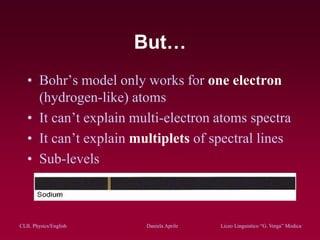
But…
• Bohr’s model only works for one electron
(hydrogen-like) atoms
• It can’t explain multi-electron atoms spectra
• It can’t explain multiplets of spectral lines
• Sub-levels
CLIL Physics/English Daniela Aprile Liceo Linguistico “G. Verga” ModicaCLIL Physics/English Daniela Aprile Liceo Linguistico “G. Verga” Modica
Next lesson… over Bohr
• De Broglie's matter waves (wave–particle
duality)
• Schrödinger wave function
• Quantum numbers
• Heisenberg's Uncertainty Principle (1927)
• Probability wave
• Orbital, shell, sub-shell
• Electronic configuration
• Aufbau

Atomic spectra&models

  • 1.
    CLIL Physics/English DanielaAprile Liceo Linguistico “G. Verga” ModicaCLIL Physics/English Daniela Aprile Liceo Linguistico “G. Verga” Modica Atomic Spectra and Models of the Atom LEARNING OBJECTIVE • To know the relationship between atomic spectra and the electronic structure of atoms. • To understand how scientific models develop.
  • 2.
    CLIL Physics/English DanielaAprile Liceo Linguistico “G. Verga” ModicaCLIL Physics/English Daniela Aprile Liceo Linguistico “G. Verga” Modica Atomic Spectra and Models of the Atom
  • 3.
    CLIL Physics/English DanielaAprile Liceo Linguistico “G. Verga” ModicaCLIL Physics/English Daniela Aprile Liceo Linguistico “G. Verga” Modica Do you know… • … what is an atom? • … what are atoms made of? • … how/when were the atom components discovered? • …what is the light spectrum?
  • 4.
    CLIL Physics/English DanielaAprile Liceo Linguistico “G. Verga” ModicaCLIL Physics/English Daniela Aprile Liceo Linguistico “G. Verga” Modica FIRST DISCOVERIES • 1897 Joseph John Thomson (1856-1940) discovered the electron, experimentally determining its charge to mass ratio e/m =1.7591011 C/kg and concluded that they are a component of every atom. • 1909 Robert Millikan (1868-1953) - Oil drop experiment - determined the charge and the mass of an electron. e =1.602 10-19 C m = 9.11 10-31 kg
  • 5.
    CLIL Physics/English DanielaAprile Liceo Linguistico “G. Verga” Modica HISTORY OF THE ATOM TIMELINE
  • 6.
    CLIL Physics/English DanielaAprile Liceo Linguistico “G. Verga” Modica ATOMIC MODELS Thomson (1902) Rutherford (1911) Bohr-Sommerfeld (1913) Shrödinger (1926)
  • 7.
    CLIL Physics/English DanielaAprile Liceo Linguistico “G. Verga” Modica THOMSON’S MODEL (1902) Plum Pudding Model Electrons are surrounded by a soup of positive charge to balance the electrons negative charges, like negatively charged "plums" surrounded by positively charged "pudding"
  • 8.
    CLIL Physics/English DanielaAprile Liceo Linguistico “G. Verga” Modica The Gold Foil Experiment Rutherford, Geiger & Marsden (1911): The Gold Foil Experiment “ It was almost as incredible as if you fired a 15-inch shell at a piece of tissue paper and it came back and hit you.”
  • 9.
    CLIL Physics/English DanielaAprile Liceo Linguistico “G. Verga” Modica The Gold Foil Experiment
  • 10.
    CLIL Physics/English DanielaAprile Liceo Linguistico “G. Verga” Modica RUTHERFORD MODEL (1911) An atom contains a small dense positive charge surrounded by negatively charged electrons revolving around the positive charge just like planets orbit the sun.
  • 11.
    CLIL Physics/English DanielaAprile Liceo Linguistico “G. Verga” ModicaCLIL Physics/English Daniela Aprile Liceo Linguistico “G. Verga” Modica But… An accelerating charged particle emits electromagnetic radiation The orbiting electron has centripetal acceleration It looses energy The orbit radius decreases The electron falls onto the nucleus in about 10-11s The atom is not stable
  • 12.
    CLIL Physics/English DanielaAprile Liceo Linguistico “G. Verga” Modica What do you know so far? • Who discovered the electron? • What is the plum-pudding model? • Why was the Rutherford’s “gold foil” experiment outcome surprising? • What is new in Rutherford’s model? • Why wasn’t it a suitable model?
  • 13.
    CLIL Physics/English DanielaAprile Liceo Linguistico “G. Verga” ModicaCLIL Physics/English Daniela Aprile Liceo Linguistico “G. Verga” Modica FROM CLASSICAL TO QUANTUM PHYSICS When you try to apply the classical mechanics (Newton’s) laws to microscopic objects – such as atoms and the e.m. waves they emit – you come to contradictions with experience. Therefore the fundamental dynamics’ and electromagnetism’ laws have to be changed so that the new laws correctly describe microscopic phenomena, but reduce to classical laws when applied to macroscopic objects. “Correspondence Principle” – Niels Bohr
  • 14.
    CLIL Physics/English DanielaAprile Liceo Linguistico “G. Verga” Modica BOHR MODEL The electrons move about the nucleus in "stationary states" which are stable, NOT radiating energy. Each orbit can hold no more than 2 electrons. (Pauli’s Exclusion Principle, 1925)
  • 15.
    CLIL Physics/English DanielaAprile Liceo Linguistico “G. Verga” ModicaCLIL Physics/English Daniela Aprile Liceo Linguistico “G. Verga” Modica ELECTRONIC TRANSITIONS An electron is able to absorb or emit energy in order to “jump” from one to the other orbit. But what is it exchanging energy with?
  • 16.
    CLIL Physics/English DanielaAprile Liceo Linguistico “G. Verga” Modica The photon (1905) Some metals emit electrons when light shines on them: the brighter the light, the more electrons. Einstein (1905) explained the effect by describing light as a bundle of particles, or photons. A photon gives a quantum of energy depending on its frequency/wavelenght (colour) E = hf = hc/. Jsh 34 1063.6  
  • 17.
    CLIL Physics/English DanielaAprile Liceo Linguistico “G. Verga” Modica COMPTON EFFECT (1923) If a photon has high energy (X-rays), the electron is given enough energy to be completely ejected from its atom, and a photon containing the remaining energy (smaller frequency) is scattered in a different direction from the original. LIGHT = PARTICLE (PHOTON)
  • 18.
    CLIL Physics/English DanielaAprile Liceo Linguistico “G. Verga” Modica ABSORPTION An atom can absorb a photon of light, so that an electron “jumps” to an orbit that has a higher energy. This can only happen if the photon energy equals the difference in energy between the two states DE = h f Jsh 34 1063.6  
  • 19.
    CLIL Physics/English DanielaAprile Liceo Linguistico “G. Verga” Modica EMISSION When an atom in an excited state undergoes a transition to the ground state, it loses energy by emitting a photon whose energy corresponds to the difference in energy between the two states DE = h f Jsh 34 1063.6  
  • 20.
    CLIL Physics/English DanielaAprile Liceo Linguistico “G. Verga” Modica What do you know so far? • What is new in Bohr’s model? • What is the light made of? • How can an atom absorb/emit energy? • How much energy can the atom absorb/emit?
  • 21.
    CLIL Physics/English DanielaAprile Liceo Linguistico “G. Verga” Modica HYDROGEN BOHR’S ATOM • Allowed orbits are labeled with the integer n (quantum number) from the inner to the outer one • Orbits have increasing radius, proportional to the integer number n2 • The electron energy is proportional to 1/n2
  • 22.
    CLIL Physics/English DanielaAprile Liceo Linguistico “G. Verga” Modica HYDROGEN SPECTRUM • Because each atom has a unique set of orbits, • it has a unique set of energy differences and so • it emits or absorbs a unique set of wavelengths, • that is called the fingerprint of the element.
  • 23.
    CLIL Physics/English DanielaAprile Liceo Linguistico “G. Verga” Modica HYDROGEN SPECTRUM • Each colour of the spectrum has different wavelength, • so it is due to transitions between different energy levels
  • 24.
    CLIL Physics/English DanielaAprile Liceo Linguistico “G. Verga” Modica GAS SPECTRA Each element has characteristic emission and absorption spectra, so scientists can use such spectra to analyze the composition of matter.
  • 25.
    CLIL Physics/English DanielaAprile Liceo Linguistico “G. Verga” ModicaCLIL Physics/English Daniela Aprile Liceo Linguistico “G. Verga” Modica ACTIVITY • Play the game! Site link: http://spiff.rit.edu/classes/phys301/lectures/spec_lines/Atoms_Nav.swf • Read “how to” • Do the exercises
  • 26.
    CLIL Physics/English DanielaAprile Liceo Linguistico “G. Verga” Modica SPECRTOSCOPY Spectra are used to provide information about the composition of a substance or an object. In particular, astronomers use emission and absorption spectra to determine the composition of stars and interstellar matter. We now know that the sun contains large amounts of hydrogen, iron, and carbon, along with smaller amounts of other elements.
  • 27.
    CLIL Physics/English DanielaAprile Liceo Linguistico “G. Verga” ModicaCLIL Physics/English Daniela Aprile Liceo Linguistico “G. Verga” Modica But… • Bohr’s model only works for one electron (hydrogen-like) atoms • It can’t explain multi-electron atoms spectra • It can’t explain multiplets of spectral lines • Sub-levels
  • 28.
    CLIL Physics/English DanielaAprile Liceo Linguistico “G. Verga” ModicaCLIL Physics/English Daniela Aprile Liceo Linguistico “G. Verga” Modica Next lesson… over Bohr • De Broglie's matter waves (wave–particle duality) • Schrödinger wave function • Quantum numbers • Heisenberg's Uncertainty Principle (1927) • Probability wave • Orbital, shell, sub-shell • Electronic configuration • Aufbau