ATOMIC MODELS
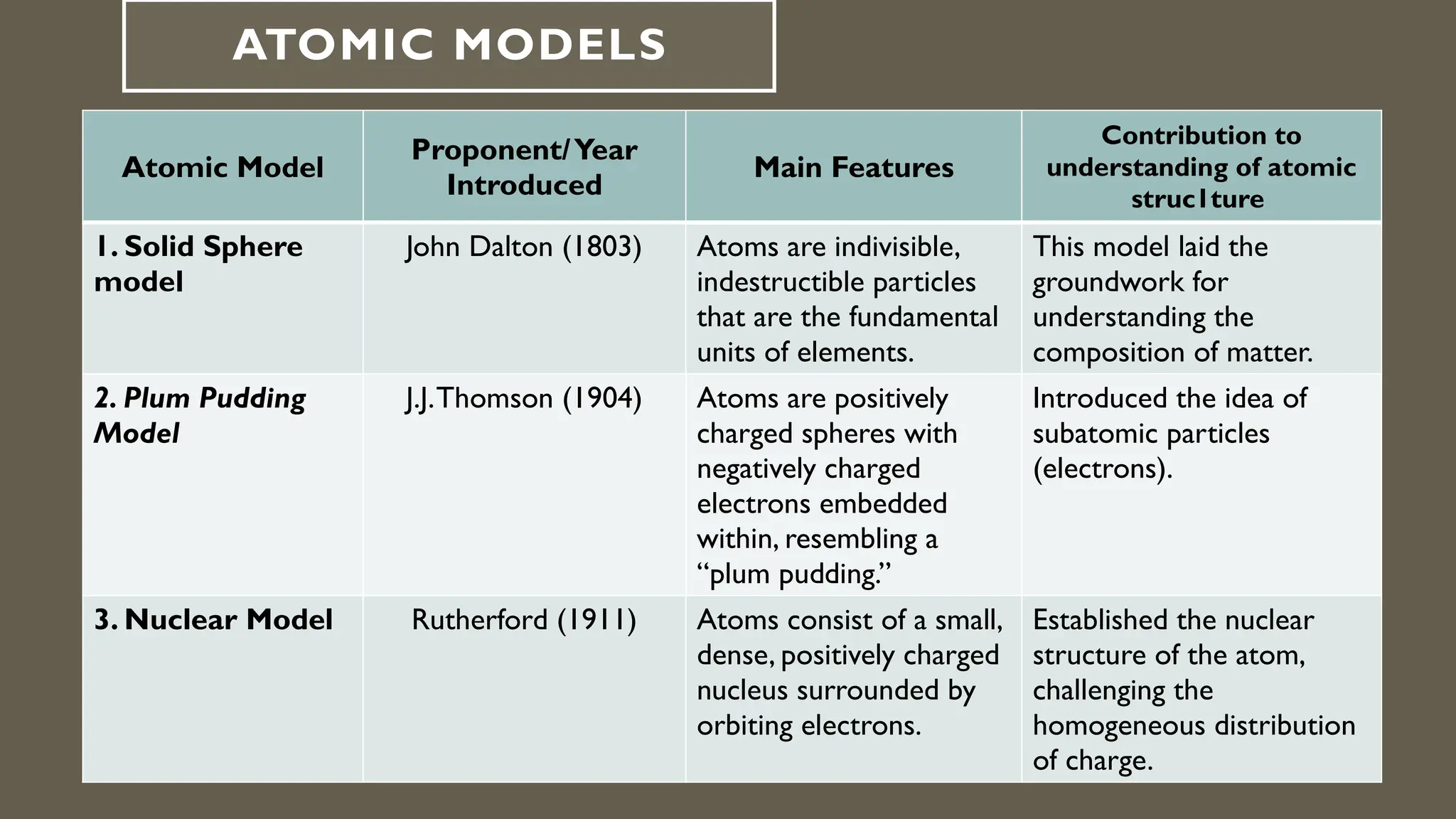
Atomic Model
Proponent/Year
Introduced
Main Features
Contribution to
understanding of atomic
struc1ture
1. Solid Sphere
model
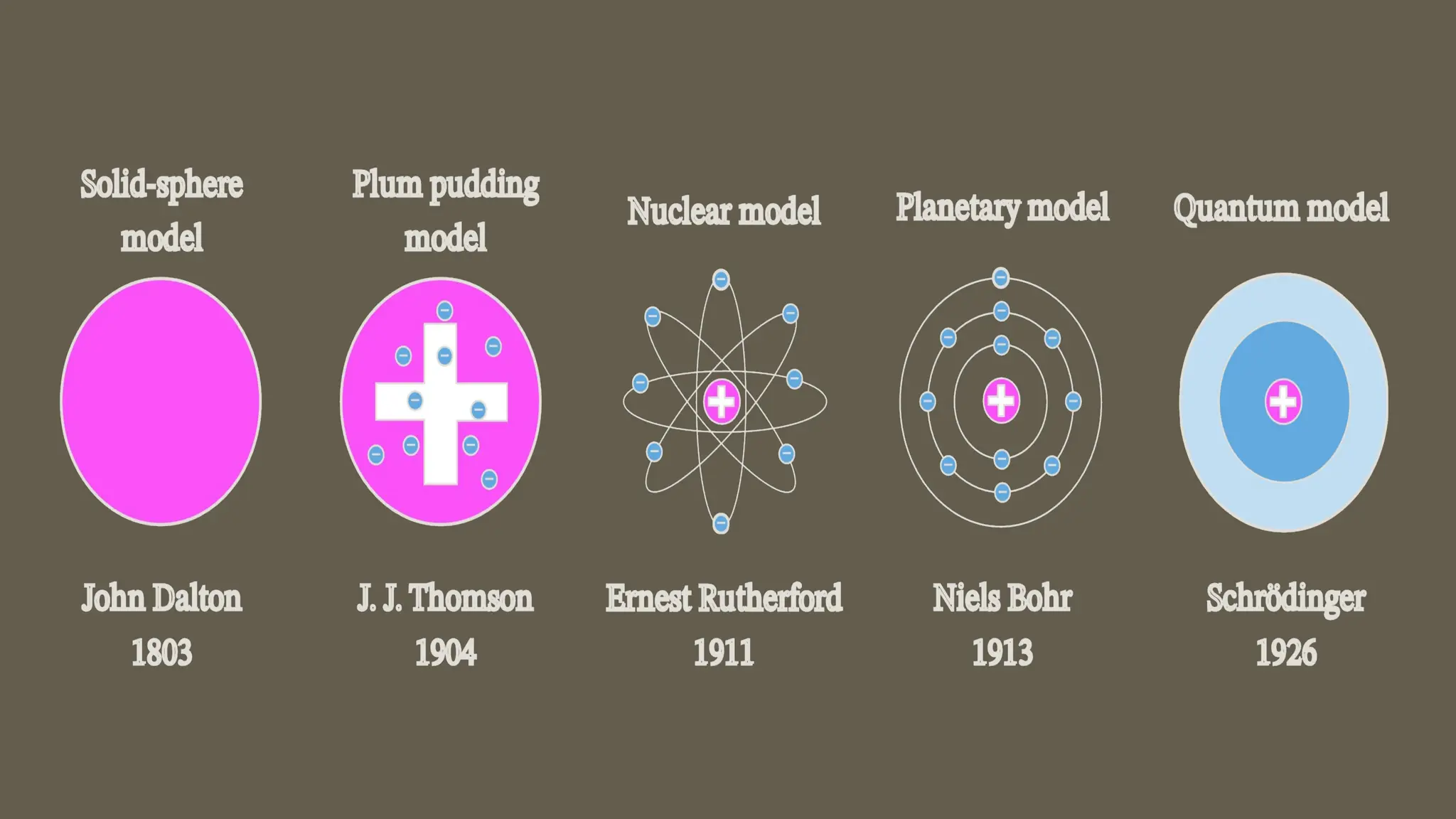
John Dalton (1803) Atoms are indivisible,
indestructible particles
that are the fundamental
units of elements.
This model laid the
groundwork for
understanding the
composition of matter.
2. Plum Pudding
Model
J.J.Thomson (1904) Atoms are positively
charged spheres with
negatively charged
electrons embedded
within, resembling a
“plum pudding.”
Introduced the idea of
subatomic particles
(electrons).
3. Nuclear Model Rutherford (1911) Atoms consist of a small,
dense, positively charged
nucleus surrounded by
orbiting electrons.
Established the nuclear
structure of the atom,
challenging the
homogeneous distribution
of charge.
ATOMIC MODELS
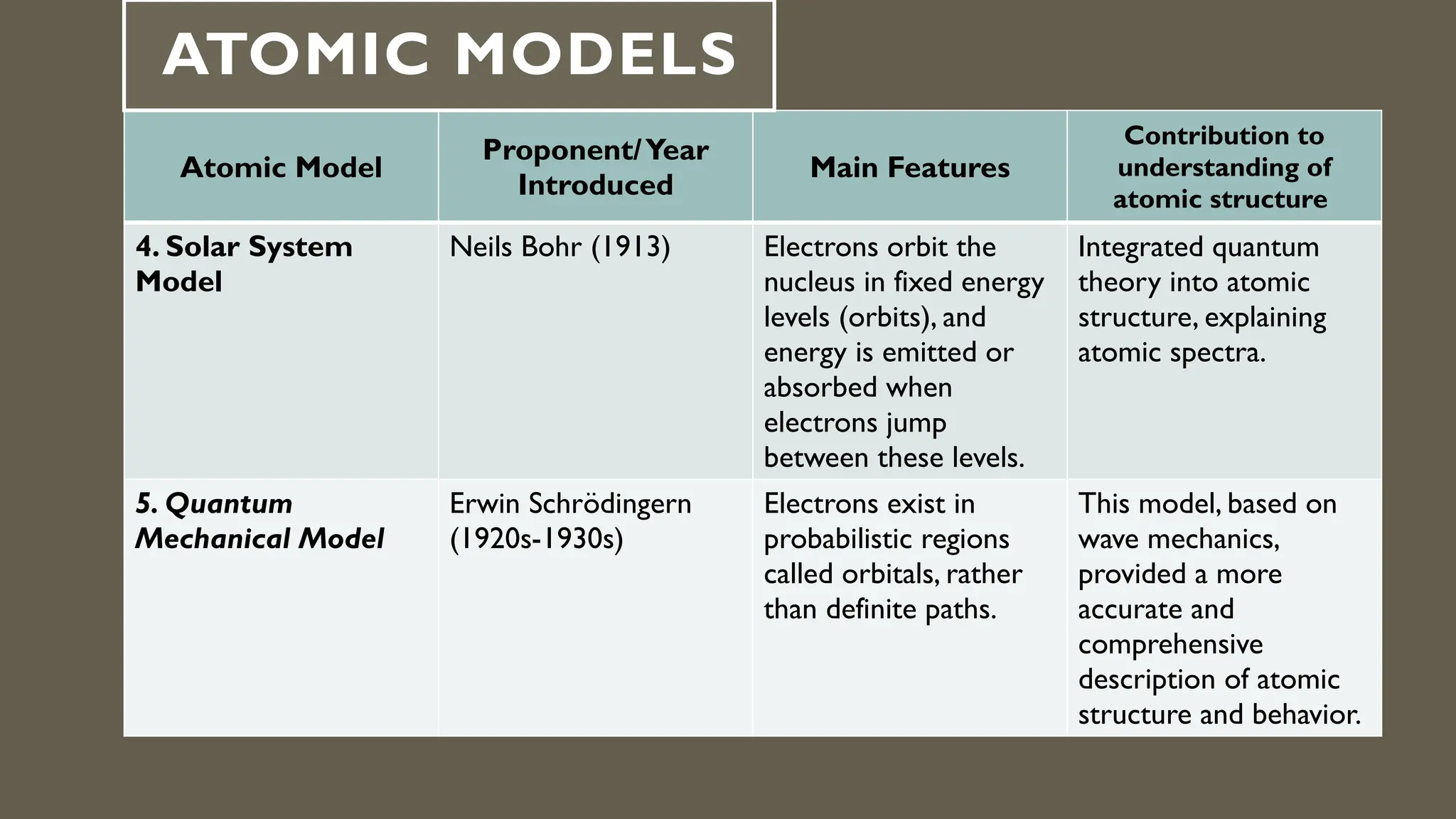
Atomic Model
Proponent/Year
Introduced
Main Features
Contribution to
understanding of
atomic structure
4. Solar System
Model
Neils Bohr (1913) Electrons orbit the
nucleus in fixed energy
levels (orbits), and
energy is emitted or
absorbed when
electrons jump
between these levels.
Integrated quantum
theory into atomic
structure, explaining
atomic spectra.
5. Quantum
Mechanical Model
Erwin Schrödingern
(1920s-1930s)
Electrons exist in
probabilistic regions
called orbitals, rather
than definite paths.
This model, based on
wave mechanics,
provided a more
accurate and
comprehensive
description of atomic
structure and behavior.
ATOMIC MODELS
ATOM
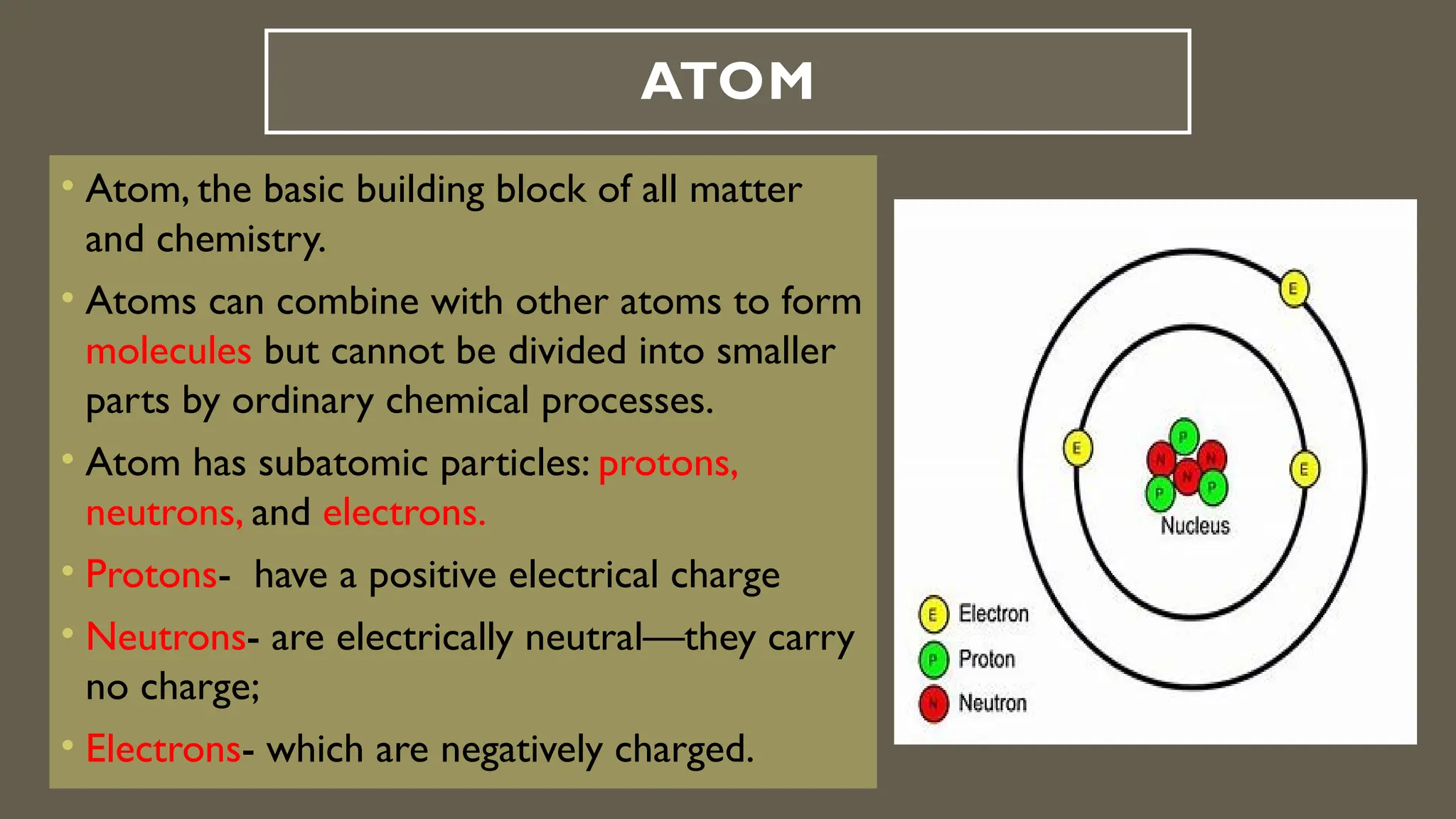
• Atom, the basic building block of all matter
and chemistry.
• Atoms can combine with other atoms to form
molecules but cannot be divided into smaller
parts by ordinary chemical processes.
• Atom has subatomic particles: protons,
neutrons, and electrons.
• Protons- have a positive electrical charge
• Neutrons- are electrically neutral—they carry
no charge;
• Electrons- which are negatively charged.
PARTICLE MODEL OF MATTER
a theory/ model that explains how the
particles that make up a substance are
arranged, and how they move and
interact with each other
PARTICLE MODEL OF MATTER
KEY CONCEPT
• All matter is made up of tiny particles called atoms or molecules.
• Atoms are the fundamental building blocks of elements, while
molecules consist of two or more atoms chemically bonded together.
• Particles are constantly in motion:
▪ In solids, particles vibrate in place.
▪ In liquids and gases, particles move from one location to other.
• In solids, particles are closely packed with minimal space between
them.
• In liquids and gases, particles have more space between them.
• As temperature increases, particle motion speeds up.
• Higher kinetic energy leads to faster vibrations and movement of

ATOMIC MODELS grade 7 matatag curriculum week1.pptx

  • 1.
  • 2.
    Atomic Model Proponent/Year Introduced Main Features Contributionto understanding of atomic struc1ture 1. Solid Sphere model John Dalton (1803) Atoms are indivisible, indestructible particles that are the fundamental units of elements. This model laid the groundwork for understanding the composition of matter. 2. Plum Pudding Model J.J.Thomson (1904) Atoms are positively charged spheres with negatively charged electrons embedded within, resembling a “plum pudding.” Introduced the idea of subatomic particles (electrons). 3. Nuclear Model Rutherford (1911) Atoms consist of a small, dense, positively charged nucleus surrounded by orbiting electrons. Established the nuclear structure of the atom, challenging the homogeneous distribution of charge. ATOMIC MODELS
  • 3.
    Atomic Model Proponent/Year Introduced Main Features Contributionto understanding of atomic structure 4. Solar System Model Neils Bohr (1913) Electrons orbit the nucleus in fixed energy levels (orbits), and energy is emitted or absorbed when electrons jump between these levels. Integrated quantum theory into atomic structure, explaining atomic spectra. 5. Quantum Mechanical Model Erwin Schrödingern (1920s-1930s) Electrons exist in probabilistic regions called orbitals, rather than definite paths. This model, based on wave mechanics, provided a more accurate and comprehensive description of atomic structure and behavior. ATOMIC MODELS
  • 5.
    ATOM • Atom, thebasic building block of all matter and chemistry. • Atoms can combine with other atoms to form molecules but cannot be divided into smaller parts by ordinary chemical processes. • Atom has subatomic particles: protons, neutrons, and electrons. • Protons- have a positive electrical charge • Neutrons- are electrically neutral—they carry no charge; • Electrons- which are negatively charged.
  • 6.
  • 7.
    PARTICLE MODEL OFMATTER a theory/ model that explains how the particles that make up a substance are arranged, and how they move and interact with each other
  • 8.
  • 11.
    KEY CONCEPT • Allmatter is made up of tiny particles called atoms or molecules. • Atoms are the fundamental building blocks of elements, while molecules consist of two or more atoms chemically bonded together. • Particles are constantly in motion: ▪ In solids, particles vibrate in place. ▪ In liquids and gases, particles move from one location to other. • In solids, particles are closely packed with minimal space between them. • In liquids and gases, particles have more space between them. • As temperature increases, particle motion speeds up. • Higher kinetic energy leads to faster vibrations and movement of