Law 6 - The Assistant Referee Signals  and  Mechanics
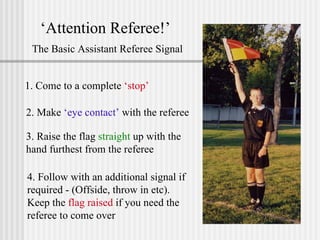
‘ Attention Referee!’   The Basic Assistant Referee Signal 1. Come to a complete  ‘stop’ 2. Make  ‘eye contact’  with the referee 3. Raise the flag  straight  up with the  hand furthest from the referee 4. Follow with an additional signal if required - (Offside, throw in etc). Keep the  flag raised  if you need the referee to come over
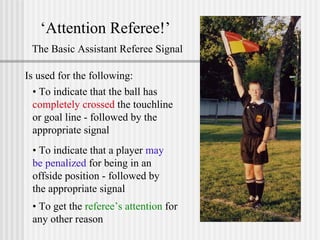
Is used for the following: •  To indicate that the ball has  completely crossed  the touchline or goal line - followed by the appropriate signal •  To indicate that a player  may be penalized  for being in an offside position - followed by the appropriate signal •  To get the  referee’s attention  for any other reason ‘ Attention Referee!’   The Basic Assistant Referee Signal
‘ Throw In’   Showing the ‘direction’ 1. Come to a complete ‘ stop’ 2. Make ‘ eye contact’  with the referee 3. Hold the flag at 45˚ in the  direction  that the team to take the throw is playing 4. Hold the signal for a  ‘count’ of  three  to allow everyone, including the referee, to see your signal
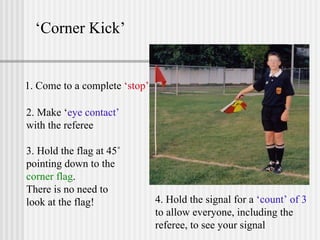
‘ Corner Kick’ 1. Come to a complete  ‘stop’ 2. Make ‘ eye contact’   with the referee 3. Hold the flag at 45˚  pointing down to the  corner flag .  There is no need to  look at the flag! 4. Hold the signal for a  ‘count’ of 3  to allow everyone, including the referee, to see your signal
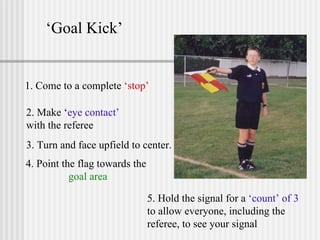
‘ Goal Kick’ 1. Come to a complete  ‘stop’ 2. Make ‘ eye contact’   with the referee 3. Turn and face upfield to center. 5. Hold the signal for a  ‘count’ of 3  to allow everyone, including the referee, to see your signal 4. Point the flag towards the    goal area
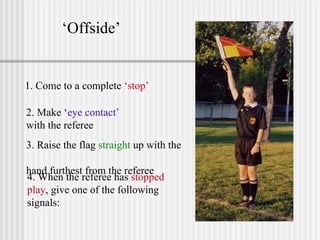
‘ Offside’ 1. Come to a complete  ‘stop’ 2. Make ‘ eye contact’   with the referee 3. Raise the flag  straight  up with the  hand furthest from the referee 4. When the referee has  stopped play , give one of the following signals:
‘ Offside’   Near side of the field 1. Lower the flag to  45˚ pointing down  in front of you 2. Hold the signal until the referee  acknowledges  your signal 3.  Hold your position  to help with the location of the restart
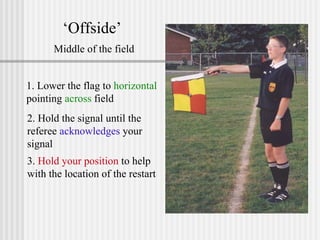
‘ Offside’   Middle of the field 1. Lower the flag to  horizontal pointing  across  field 2. Hold the signal until the referee  acknowledges  your signal 3.  Hold your position  to help with the location of the restart
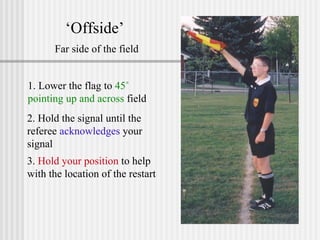
‘ Offside’   Far side of the field 1. Lower the flag to  45˚ pointing up and across  field 2. Hold the signal until the referee  acknowledges  your signal 3.  Hold your position  to help with the location of the restart
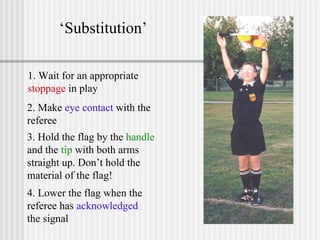
‘ Substitution’ 1. Wait for an appropriate stoppage  in play 2. Make  eye contact  with the referee 3. Hold the flag by the  handle  and the  tip  with both arms straight up. Don’t hold the  material of the flag! 4. Lower the flag when the referee has  acknowledged  the signal
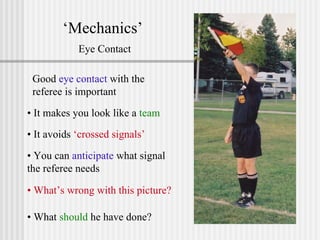
‘ Mechanics’   Eye Contact Good  eye contact  with the referee is important •  It makes you look like a  team •  It avoids  ‘crossed signals’ •  You can  anticipate  what signal the referee needs •  What’s wrong with this picture? •  What  should  he have done?
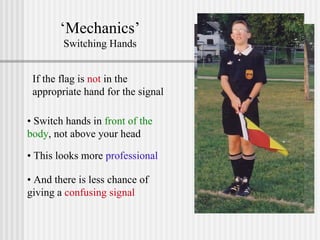
‘ Mechanics’ Switching Hands If the flag is  not  in the appropriate hand for the signal •  Switch hands in  front of the body , not above your head •  This looks more  professional •  And there is less chance of giving a  confusing signal
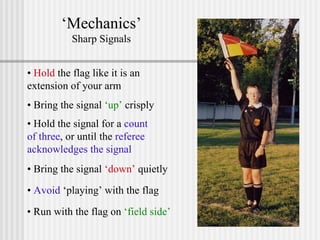
‘ Mechanics’ Sharp Signals •  Hold  the flag like it is an extension of your arm •  Bring the signal  ‘up’  crisply •  Hold the signal for a  count  of three , or until the  referee acknowledges the signal •  Bring the signal  ‘down’  quietly •  Avoid  ‘playing’ with the flag •  Run with the flag on  ‘field side’
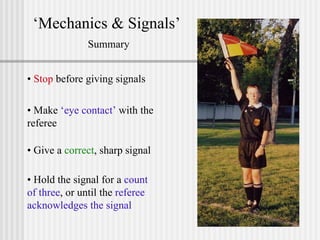
‘ Mechanics & Signals’   Summary •  Stop  before giving signals •  Make  ‘eye contact’  with the  referee •  Give a  correct , sharp signal •  Hold the signal for a  count  of three , or until the  referee acknowledges the signal

Assistantrefereeflagsignals

  • 1.
    Law 6 -The Assistant Referee Signals and Mechanics
  • 2.
    ‘ Attention Referee!’ The Basic Assistant Referee Signal 1. Come to a complete ‘stop’ 2. Make ‘eye contact’ with the referee 3. Raise the flag straight up with the hand furthest from the referee 4. Follow with an additional signal if required - (Offside, throw in etc). Keep the flag raised if you need the referee to come over
  • 3.
    Is used forthe following: • To indicate that the ball has completely crossed the touchline or goal line - followed by the appropriate signal • To indicate that a player may be penalized for being in an offside position - followed by the appropriate signal • To get the referee’s attention for any other reason ‘ Attention Referee!’ The Basic Assistant Referee Signal
  • 4.
    ‘ Throw In’ Showing the ‘direction’ 1. Come to a complete ‘ stop’ 2. Make ‘ eye contact’ with the referee 3. Hold the flag at 45˚ in the direction that the team to take the throw is playing 4. Hold the signal for a ‘count’ of three to allow everyone, including the referee, to see your signal
  • 5.
    ‘ Corner Kick’1. Come to a complete ‘stop’ 2. Make ‘ eye contact’ with the referee 3. Hold the flag at 45˚ pointing down to the corner flag . There is no need to look at the flag! 4. Hold the signal for a ‘count’ of 3 to allow everyone, including the referee, to see your signal
  • 6.
    ‘ Goal Kick’1. Come to a complete ‘stop’ 2. Make ‘ eye contact’ with the referee 3. Turn and face upfield to center. 5. Hold the signal for a ‘count’ of 3 to allow everyone, including the referee, to see your signal 4. Point the flag towards the goal area
  • 7.
    ‘ Offside’ 1.Come to a complete ‘stop’ 2. Make ‘ eye contact’ with the referee 3. Raise the flag straight up with the hand furthest from the referee 4. When the referee has stopped play , give one of the following signals:
  • 8.
    ‘ Offside’ Near side of the field 1. Lower the flag to 45˚ pointing down in front of you 2. Hold the signal until the referee acknowledges your signal 3. Hold your position to help with the location of the restart
  • 9.
    ‘ Offside’ Middle of the field 1. Lower the flag to horizontal pointing across field 2. Hold the signal until the referee acknowledges your signal 3. Hold your position to help with the location of the restart
  • 10.
    ‘ Offside’ Far side of the field 1. Lower the flag to 45˚ pointing up and across field 2. Hold the signal until the referee acknowledges your signal 3. Hold your position to help with the location of the restart
  • 11.
    ‘ Substitution’ 1.Wait for an appropriate stoppage in play 2. Make eye contact with the referee 3. Hold the flag by the handle and the tip with both arms straight up. Don’t hold the material of the flag! 4. Lower the flag when the referee has acknowledged the signal
  • 12.
    ‘ Mechanics’ Eye Contact Good eye contact with the referee is important • It makes you look like a team • It avoids ‘crossed signals’ • You can anticipate what signal the referee needs • What’s wrong with this picture? • What should he have done?
  • 13.
    ‘ Mechanics’ SwitchingHands If the flag is not in the appropriate hand for the signal • Switch hands in front of the body , not above your head • This looks more professional • And there is less chance of giving a confusing signal
  • 14.
    ‘ Mechanics’ SharpSignals • Hold the flag like it is an extension of your arm • Bring the signal ‘up’ crisply • Hold the signal for a count of three , or until the referee acknowledges the signal • Bring the signal ‘down’ quietly • Avoid ‘playing’ with the flag • Run with the flag on ‘field side’
  • 15.
    ‘ Mechanics &Signals’ Summary • Stop before giving signals • Make ‘eye contact’ with the referee • Give a correct , sharp signal • Hold the signal for a count of three , or until the referee acknowledges the signal