A Presentation about
Morocco’s Capital City
Rabat
By Youssef Oukassi, ID: 55493
International Relations Business Trade and Marketing, S1
Information Technology, Module 4.
Overview:
 Where is Rabat located?
 Customs and Food culture.
 What is the city population throughout History?
 What are the significant Historical events that occurred in the city?
 Where are touristic locations and Interesting Monuments?
 Rabat’s Industrial activity.
 How to get to Rabat City from Dąbrowa Górnicza.
 Interesting Monuments, Objects and Places..
 Natural views and landscapes of the city.
 Graphics Sources.
Rabat is located along
the Atlantic coast in the
northwestern part of
Morocco. It lies on the
southern shore of the
Bouregreg River and
faces the Atlantic Ocean.
The city is positioned at approximately 34.0209° N latitude and 6.8416° W
longitude. It enjoys a Mediterranean climate with mild, wet winters and warm, dry
summers.
https://www.airpano.com/gallery.php?gallery=250&photo=8678
Rabat City Popular Foods and Beverages
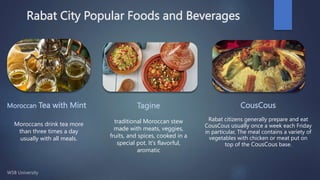
Moroccan Tea with Mint
Moroccans drink tea more
than three times a day
usually with all meals.
Tagine
traditional Moroccan stew
made with meats, veggies,
fruits, and spices, cooked in a
special pot. It's flavorful,
aromatic
CousCous
Rabat citizens generally prepare and eat
CousCous usually once a week each Friday
in particular, The meal contains a variety of
vegetables with chicken or meat put on
top of the CousCous base.
Total Population in Millions of Rabat City:
The City Population stands
approximately at 1.9 Million
residents as of current year 2024.
With an extrapolation of an
increase to 2.1 Million by the year
2027, This figure encompasses a
mix of diverse backgrounds and
occupations.
Significant Historical Events that Occured in the City of Rabat:
Rabat was founded in the 12th century by
the Almohad Caliphate as a strategic military
outpost called "Ribatu Al-Fath." Positioned
along the Bou Regreg River and the Atlantic
coast, it boasted defensive walls and key
monuments like the incomplete Hassan
Tower. Evolving from a fortress to a thriving
city, Rabat eventually became Morocco's
administrative capital, preserving its historical
significance amid modern advancements.
Foundation and Establishment of Rabat:
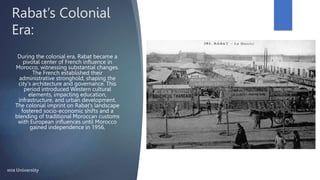
Rabat’s Colonial
Era:
During the colonial era, Rabat became a
pivotal center of French influence in
Morocco, witnessing substantial changes.
The French established their
administrative stronghold, shaping the
city's architecture and governance. This
period introduced Western cultural
elements, impacting education,
infrastructure, and urban development.
The colonial imprint on Rabat's landscape
fostered socio-economic shifts and a
blending of traditional Moroccan customs
with European influences until Morocco
gained independence in 1956.
the Independence and
Capital Status of
Rabat:
Following Morocco's independence from French and
Spanish protectorates in 1956, Rabat gained prominence
as the nation's administrative capital, replacing Fez. The
shift to Rabat as the political center symbolized a new era
of self-governance and national identity. The city
underwent rapid development, witnessing the
construction of governmental institutions, embassies, and
infrastructure to support its role as the capital. Rabat's
elevation to the capital city solidified its status as the hub
of Morocco's political, administrative, and diplomatic
activities, contributing significantly to the country's
modernization and growth.
Significant Historical Events that Occured in the City of Rabat:
This historic fortified area offers
stunning views of the Bou Regreg
River and houses picturesque
white-and-blue houses, a 12th-
century fortress, and lush gardens.
Kasbah of the Udayas:
Hassan Tower (Tour Hassan):
The Hassan Tower, or Tour Hassan, is an iconic
landmark in Rabat. Originally intended as the
minaret for the world's largest mosque during
the reign of Sultan Yacoub al-Mansour in the
12th century, it stands as a testament to
Moroccan architecture and history. The tower
itself, though unfinished, showcases intricate
designs and craftsmanship. Visitors can explore
the site, witnessing the grandeur of the tower's
massive red sandstone pillars and the adjacent
Mausoleum of Mohammed V, where the tombs
of the king and his sons reside. The site
provides a glimpse into Morocco's rich past,
blending architectural beauty with historical
significance, making it a must-visit for tourists
exploring Rabat.
Chellah:
Chellah, situated in Rabat, is a historic site that once
was a thriving Roman settlement known as "Sala
Colonia." It later transformed into a necropolis during
the Marinid dynasty. Today, visitors can explore the
remnants of ancient Roman architecture, including
columns, baths, and the forum, amidst beautiful
gardens and scenic views. The site also houses
medieval ruins and a collection of storks nesting in the
ancient walls, creating a unique juxtaposition of history
and nature. Chellah's serene atmosphere, combined
with its archaeological significance, draws tourists
seeking a glimpse into Morocco's rich past and the
blend of various historical periods within the same
location.
WSB University
Mohammed V Museum:
The Mohammed V Museum in Rabat is a cultural gem,
offering a fascinating journey through Morocco's
history, art, and heritage. Named after King
Mohammed V, it showcases diverse exhibits spanning
different periods and aspects of Moroccan culture.
Visitors can explore a rich collection of artifacts,
traditional costumes, historical documents, artworks,
and archaeological treasures. The museum's exhibits
highlight Morocco's past, including its dynasties,
traditions, craftsmanship, and the country's role in
regional and global history. This site serves as a
valuable resource for tourists seeking a deeper
understanding of Morocco's cultural evolution and
historical significance.
WSB University
Rabat’s major Industrial sectors:
The textile industry is a significant
sector, encompassing the production of
fabrics, clothing, and textiles for both
local and export markets. The textiles
sector in Rabat is a key player in the
city's industrial landscape. It involves
the production of various textile
products, including fabrics, garments,
and other textile goods. Rabat's textile
industry caters to both local demands
and international markets, contributing
significantly to the region's economy
and employment opportunities.
1-Textiles:
2-Food Processing:
Food processing sector in Morocco,
including Rabat, is a significant part of
the country's industrial landscape. It
involves the transformation of raw
agricultural products into processed
food items for local consumption and
export. This sector covers various
activities, such as canning, packaging,
preserving, and refining agricultural
produce into finished food products.
3- Construction Materials
The construction materials sector in
Rabat involves the manufacturing and
production of various materials essential
for building and infrastructure
development. This sector encompasses
the production of ceramics, tiles, cement,
bricks, and other construction-related
materials. Rabat's construction materials
industry plays a crucial role in meeting
the demands of the city's urbanization
and infrastructure development.
How to get to Rabat City
from Dąbrowa Górnicza :
1- There are multiple airports that are close
to Dąbrowa Górnicza,
2- What’s Recommended is to fly to Rabat
city from Krakow(KRK) Airport because There
are flights that go to Morocco Regularly.
3- The major flight company that go to
Morocco from this airport is Ryanair which I
personally took to arrive to Poland from
Morocco.
How to get to Rabat City from
Dąbrowa Górnicza :
 4- Rabat-Sale Airport is the biggest in the city and
operate dozens of flights weekly.
 5- The most optimal way to arrive to Rabat from
Dabrowa Gornicza is to fly from Krakow Airport to
Rabat-Sale Airport.
More Information:
Click on the button to visit Rabat City official Website: Click!
Click
me
We can see Rabat City weather Forecast by clicking on the
Sun Icon:
Rabat City on Google Maps:
Click me
again.
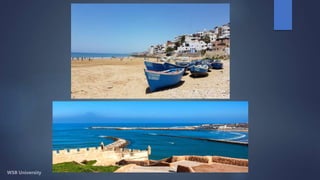
Rabat City pictures and Landscapes:
Graphical Images sources:
Slide 3: Image : https://www.mappr.co/capital-cities/morocco/
Slide 4: Image : https://www.airpano.com/gallery.php?gallery=250&photo=8678
Slide 5:
Moroccan Tea Image: https://www.americastestkitchen.com/recipes/15572-moroccan-mint-tea
Slide 6: Rabat’s Population Chart Source: https://www.statista.com/statistics/1323354/total-population-of-
rabat-morocco/
Slide 7: Image Source: https://www.alamy.com/moschee-und-stadt-von-rabat-marokko-mosque-and-city-of-rabat-
morocco-image239679754.html
Moroccan Tagine Image: https://www.fesfoodtours.com/foodies/moroccan-cuisine/
Moroccan CousCous Image: https://www.thespruceeats.com/moroccan-couscous-with-seven-vegetables-
2394671
Slide 8: Colonial Era Image: https://www.tandfonline.com/doi/full/10.1080/02665433.2022.2130964
Slide 9: Indépendance period Image: https://www.flickr.com/photos/allhails/3236219815
Slide 10: Kasbah of Udayas : https://www.atlasobscura.com/places/kasbah-of-the-udayas
Slide 12: Chellah Picture: https://www.istockphoto.com/fr/photo/chellah-%C3%A0-rabat-gm611071696-105064599
Slide 11: Tour Hassan: https://stock.adobe.com/search?k=%22tour+hassan%22
Slide 14: Moroccan Textile Industry: https://www.barcelo.com/pinandtravel/en/moroccan-crafts/
Slide 13: Mohammad V Museum: https://momaa.org/directory/mohamed-vi-museum-of-modern-and-
contemporary-art/
Slide 15: Food Processing Industry: https://newsbeezer.com/morroco/industry-of-the-morocco-magazine-10/
Slide 16: Construction Material Industry: https://www.elrabatmarble.com/
Slide 17: Krakow Airport: https://www.escape2poland.co.uk/poland-guide/krakow-airport
Slide 18: Rabat Sale Airport: https://www.pinterest.com/pin/aroport-international-rabatsal-rba--
934989572616270857/
Slide 20: Kasbah of Udayah: https://www.desertmoroccoadventure.com/things-to-do/kasbah-of-the-udayas/
Kasbah of Udayah Image 2: https://www.arganiatravel.com/blog/andalusian-gardens-rabat/
Slide 21: https://www.kimkim.com/sc/morocco-5-day-tours
https://www.moroccoprivatetours.net/destination/rabat/
Slide 22: https://www.dreamstime.com/taghazout-morocco-small-fishing-boats-beautiful-beach-village-taghazout-
popular-surfing-spot-tourist-destination-small-image224833204
Thank you!

Assignment Module 4^J Information Technology S1.pptx

  • 1.
    A Presentation about Morocco’sCapital City Rabat By Youssef Oukassi, ID: 55493 International Relations Business Trade and Marketing, S1 Information Technology, Module 4.
  • 2.
    Overview:  Where isRabat located?  Customs and Food culture.  What is the city population throughout History?  What are the significant Historical events that occurred in the city?  Where are touristic locations and Interesting Monuments?  Rabat’s Industrial activity.  How to get to Rabat City from Dąbrowa Górnicza.  Interesting Monuments, Objects and Places..  Natural views and landscapes of the city.  Graphics Sources.
  • 3.
    Rabat is locatedalong the Atlantic coast in the northwestern part of Morocco. It lies on the southern shore of the Bouregreg River and faces the Atlantic Ocean.
  • 4.
    The city ispositioned at approximately 34.0209° N latitude and 6.8416° W longitude. It enjoys a Mediterranean climate with mild, wet winters and warm, dry summers. https://www.airpano.com/gallery.php?gallery=250&photo=8678
  • 5.
    Rabat City PopularFoods and Beverages Moroccan Tea with Mint Moroccans drink tea more than three times a day usually with all meals. Tagine traditional Moroccan stew made with meats, veggies, fruits, and spices, cooked in a special pot. It's flavorful, aromatic CousCous Rabat citizens generally prepare and eat CousCous usually once a week each Friday in particular, The meal contains a variety of vegetables with chicken or meat put on top of the CousCous base.
  • 6.
    Total Population inMillions of Rabat City: The City Population stands approximately at 1.9 Million residents as of current year 2024. With an extrapolation of an increase to 2.1 Million by the year 2027, This figure encompasses a mix of diverse backgrounds and occupations.
  • 7.
    Significant Historical Eventsthat Occured in the City of Rabat: Rabat was founded in the 12th century by the Almohad Caliphate as a strategic military outpost called "Ribatu Al-Fath." Positioned along the Bou Regreg River and the Atlantic coast, it boasted defensive walls and key monuments like the incomplete Hassan Tower. Evolving from a fortress to a thriving city, Rabat eventually became Morocco's administrative capital, preserving its historical significance amid modern advancements. Foundation and Establishment of Rabat:
  • 8.
    Rabat’s Colonial Era: During thecolonial era, Rabat became a pivotal center of French influence in Morocco, witnessing substantial changes. The French established their administrative stronghold, shaping the city's architecture and governance. This period introduced Western cultural elements, impacting education, infrastructure, and urban development. The colonial imprint on Rabat's landscape fostered socio-economic shifts and a blending of traditional Moroccan customs with European influences until Morocco gained independence in 1956.
  • 9.
    the Independence and CapitalStatus of Rabat: Following Morocco's independence from French and Spanish protectorates in 1956, Rabat gained prominence as the nation's administrative capital, replacing Fez. The shift to Rabat as the political center symbolized a new era of self-governance and national identity. The city underwent rapid development, witnessing the construction of governmental institutions, embassies, and infrastructure to support its role as the capital. Rabat's elevation to the capital city solidified its status as the hub of Morocco's political, administrative, and diplomatic activities, contributing significantly to the country's modernization and growth.
  • 10.
    Significant Historical Eventsthat Occured in the City of Rabat: This historic fortified area offers stunning views of the Bou Regreg River and houses picturesque white-and-blue houses, a 12th- century fortress, and lush gardens. Kasbah of the Udayas:
  • 11.
    Hassan Tower (TourHassan): The Hassan Tower, or Tour Hassan, is an iconic landmark in Rabat. Originally intended as the minaret for the world's largest mosque during the reign of Sultan Yacoub al-Mansour in the 12th century, it stands as a testament to Moroccan architecture and history. The tower itself, though unfinished, showcases intricate designs and craftsmanship. Visitors can explore the site, witnessing the grandeur of the tower's massive red sandstone pillars and the adjacent Mausoleum of Mohammed V, where the tombs of the king and his sons reside. The site provides a glimpse into Morocco's rich past, blending architectural beauty with historical significance, making it a must-visit for tourists exploring Rabat.
  • 12.
    Chellah: Chellah, situated inRabat, is a historic site that once was a thriving Roman settlement known as "Sala Colonia." It later transformed into a necropolis during the Marinid dynasty. Today, visitors can explore the remnants of ancient Roman architecture, including columns, baths, and the forum, amidst beautiful gardens and scenic views. The site also houses medieval ruins and a collection of storks nesting in the ancient walls, creating a unique juxtaposition of history and nature. Chellah's serene atmosphere, combined with its archaeological significance, draws tourists seeking a glimpse into Morocco's rich past and the blend of various historical periods within the same location. WSB University
  • 13.
    Mohammed V Museum: TheMohammed V Museum in Rabat is a cultural gem, offering a fascinating journey through Morocco's history, art, and heritage. Named after King Mohammed V, it showcases diverse exhibits spanning different periods and aspects of Moroccan culture. Visitors can explore a rich collection of artifacts, traditional costumes, historical documents, artworks, and archaeological treasures. The museum's exhibits highlight Morocco's past, including its dynasties, traditions, craftsmanship, and the country's role in regional and global history. This site serves as a valuable resource for tourists seeking a deeper understanding of Morocco's cultural evolution and historical significance. WSB University
  • 14.
    Rabat’s major Industrialsectors: The textile industry is a significant sector, encompassing the production of fabrics, clothing, and textiles for both local and export markets. The textiles sector in Rabat is a key player in the city's industrial landscape. It involves the production of various textile products, including fabrics, garments, and other textile goods. Rabat's textile industry caters to both local demands and international markets, contributing significantly to the region's economy and employment opportunities. 1-Textiles:
  • 15.
    2-Food Processing: Food processingsector in Morocco, including Rabat, is a significant part of the country's industrial landscape. It involves the transformation of raw agricultural products into processed food items for local consumption and export. This sector covers various activities, such as canning, packaging, preserving, and refining agricultural produce into finished food products.
  • 16.
    3- Construction Materials Theconstruction materials sector in Rabat involves the manufacturing and production of various materials essential for building and infrastructure development. This sector encompasses the production of ceramics, tiles, cement, bricks, and other construction-related materials. Rabat's construction materials industry plays a crucial role in meeting the demands of the city's urbanization and infrastructure development.
  • 17.
    How to getto Rabat City from Dąbrowa Górnicza : 1- There are multiple airports that are close to Dąbrowa Górnicza, 2- What’s Recommended is to fly to Rabat city from Krakow(KRK) Airport because There are flights that go to Morocco Regularly. 3- The major flight company that go to Morocco from this airport is Ryanair which I personally took to arrive to Poland from Morocco.
  • 18.
    How to getto Rabat City from Dąbrowa Górnicza :  4- Rabat-Sale Airport is the biggest in the city and operate dozens of flights weekly.  5- The most optimal way to arrive to Rabat from Dabrowa Gornicza is to fly from Krakow Airport to Rabat-Sale Airport.
  • 19.
    More Information: Click onthe button to visit Rabat City official Website: Click! Click me We can see Rabat City weather Forecast by clicking on the Sun Icon: Rabat City on Google Maps: Click me again.
  • 20.
    Rabat City picturesand Landscapes:
  • 23.
    Graphical Images sources: Slide3: Image : https://www.mappr.co/capital-cities/morocco/ Slide 4: Image : https://www.airpano.com/gallery.php?gallery=250&photo=8678 Slide 5: Moroccan Tea Image: https://www.americastestkitchen.com/recipes/15572-moroccan-mint-tea Slide 6: Rabat’s Population Chart Source: https://www.statista.com/statistics/1323354/total-population-of- rabat-morocco/ Slide 7: Image Source: https://www.alamy.com/moschee-und-stadt-von-rabat-marokko-mosque-and-city-of-rabat- morocco-image239679754.html Moroccan Tagine Image: https://www.fesfoodtours.com/foodies/moroccan-cuisine/ Moroccan CousCous Image: https://www.thespruceeats.com/moroccan-couscous-with-seven-vegetables- 2394671 Slide 8: Colonial Era Image: https://www.tandfonline.com/doi/full/10.1080/02665433.2022.2130964 Slide 9: Indépendance period Image: https://www.flickr.com/photos/allhails/3236219815
  • 24.
    Slide 10: Kasbahof Udayas : https://www.atlasobscura.com/places/kasbah-of-the-udayas Slide 12: Chellah Picture: https://www.istockphoto.com/fr/photo/chellah-%C3%A0-rabat-gm611071696-105064599 Slide 11: Tour Hassan: https://stock.adobe.com/search?k=%22tour+hassan%22 Slide 14: Moroccan Textile Industry: https://www.barcelo.com/pinandtravel/en/moroccan-crafts/ Slide 13: Mohammad V Museum: https://momaa.org/directory/mohamed-vi-museum-of-modern-and- contemporary-art/ Slide 15: Food Processing Industry: https://newsbeezer.com/morroco/industry-of-the-morocco-magazine-10/ Slide 16: Construction Material Industry: https://www.elrabatmarble.com/ Slide 17: Krakow Airport: https://www.escape2poland.co.uk/poland-guide/krakow-airport Slide 18: Rabat Sale Airport: https://www.pinterest.com/pin/aroport-international-rabatsal-rba-- 934989572616270857/
  • 25.
    Slide 20: Kasbahof Udayah: https://www.desertmoroccoadventure.com/things-to-do/kasbah-of-the-udayas/ Kasbah of Udayah Image 2: https://www.arganiatravel.com/blog/andalusian-gardens-rabat/ Slide 21: https://www.kimkim.com/sc/morocco-5-day-tours https://www.moroccoprivatetours.net/destination/rabat/ Slide 22: https://www.dreamstime.com/taghazout-morocco-small-fishing-boats-beautiful-beach-village-taghazout- popular-surfing-spot-tourist-destination-small-image224833204 Thank you!