A GIS-based model for Assessment of
Pedestrian Accessibility and Prioritization
of Future Improvements
Mengyuan Xu
Washington State University
Doctor of Design Candidate
Image:www.123rf.com
Page  2
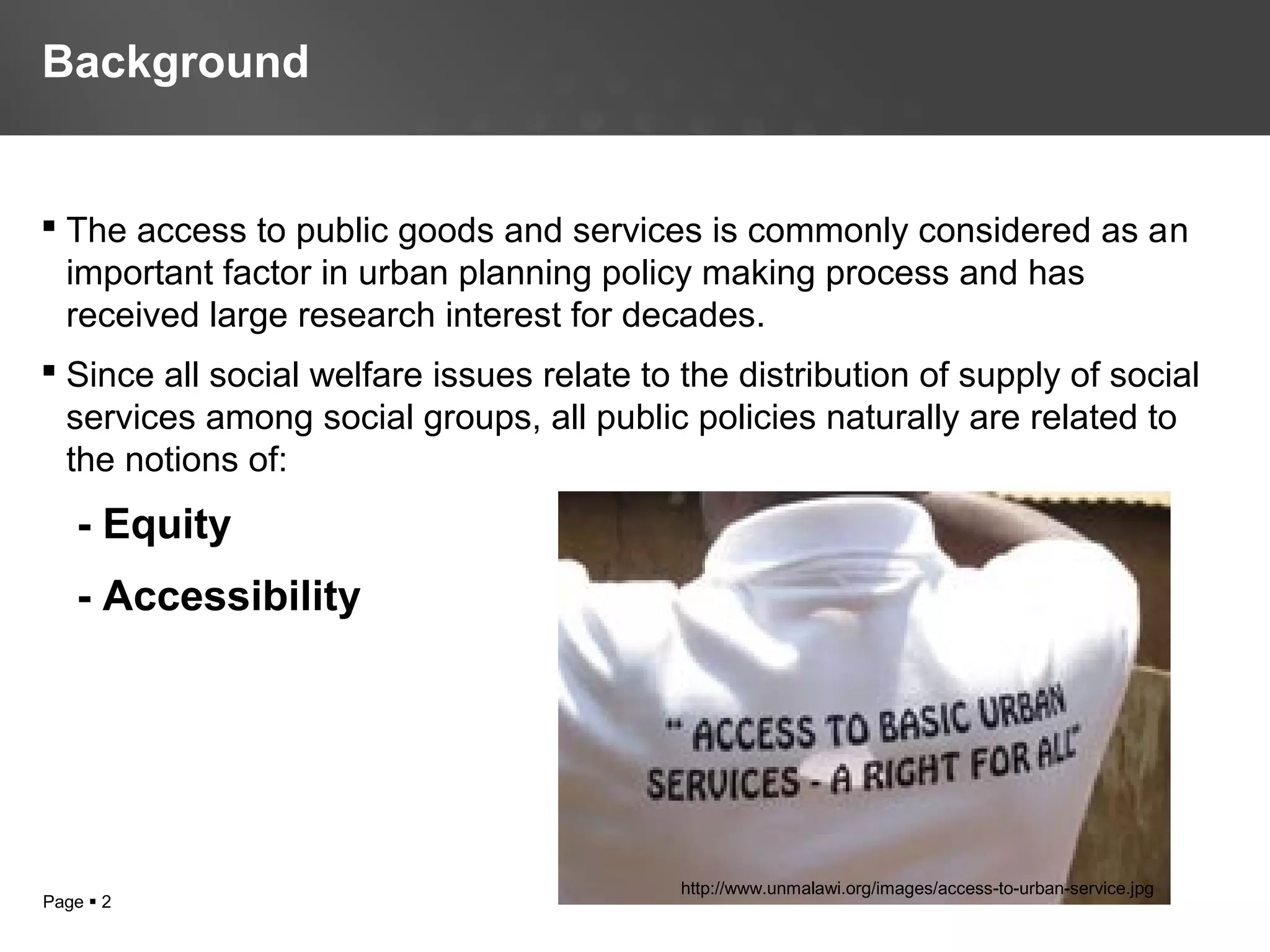
 The access to public goods and services is commonly considered as an
important factor in urban planning policy making process and has
received large research interest for decades.
 Since all social welfare issues relate to the distribution of supply of social
services among social groups, all public policies naturally are related to
the notions of:
- Equity
- Accessibility
Background
http://www.unmalawi.org/images/access-to-urban-service.jpg
Page  3
Equity
 Lack of consensus on a consistent understanding in planning literature
 Two principles of equity
– Horizontal Equity
“In which everyone receives the same public benefit, regardless of
socioeconomic status, willingness or ability to pay, or other criteria” (Talen
1998)
– Vertical Equity
“Equity in the distribution of public resources need to response to the need of
groups” (Crompton and Wicks1988)
Background – Key Concepts
Page  4
Definition of Equity in my research:
“Individuals and groups that differ in need and ability are treated
differently in order to be provided with equal opportunities to
resources.”
Definition of Inequity:
“Differences in access to resources among subgroups of citizens”.
Background – Key Concepts
Page  5
Accessibility
 Widely considered as a significant goal in urban planning
 Defintion
– “…reflects the possibilities for activities, such as working or shopping, available
to residents of a neighborhood, a city, or a metropolitan area.” (Handy & Clifton
2001)
– “An individual’s ability to reach desired goods, services, activities and
destinations” (Litman 2002)
 Three-fold framework
– Social-demographic data
– Geographic data of urban services
– Travel options
Background – Key Concepts
Page  6
Measures of Transportation Accessibility
– Block length (mean)
– Block size (mean area)
– Block density
– Intersection density
– Link-Node Ratio (LNR)
– Pedestrian Route Directness (PRD)
– Service area calculation
– Walking distance to activities
Background – Key Concepts
Page  7
Life Need Service Facilities
 “A system of physical facilities/services that support the essential
needs of individuals, families and communities and thus enhance
the overall quality of life”
– Daily Food Provider: Groceries and convenience stores
– Social Gathering: Libraries, community centers, and churches
– Recreational facilities
– Healthcare and social assistance: hospitals, and clinics;
Background – Key Concepts
Page  8
Life Service Deserts:
“Areas with relatively poor access to life need services”
 Suburban sprawl since the 1940s
– Automobile-oriented transportation planning
– Separation of land uses
– Commercial service providers moved out of inner cities to new
developed suburbs
 16.1 percent of households in Spokane City do not own a private car.
 Mobility disadvantaged groups may be highly reliant on access to
pedestrian networks with ADA facilities
Measuring accessibility and service deserts based on pedestrian
networks has received great interest.
Background – Key Concepts
Page  9
Prioritization
 In the context of limited resources and budgets, it is vital to identity the
importance of each missing link in the network in order to decide its
priority when planning network improvements.
 Efficiency and Equity are considered as critical factors to improve the
performance of urban environment in previous literatures (Litman 2002;
Talen 2011).
Background
Page  10
Propose a GIS-based accessibility assessment model that:
 Identifies the inequities in spatial access to life needs services facilities in
my study area, or say, life need service deserts for all citizens and/or
targeted groups;
 Evaluates how the level of accessibility would be affected by proposed
interventions by predicting and describing the potential consequences;
 Implements methods to prioritize potential infrastructure improvements.
Research Goals
Page  11
 The majority of existing research favors motorized accessibility and
relatively little attention has been paid to pedestrian accessibility (Litman
2002).
 Recent accessibility research focusing on the pedestrian environment, it
has tended to use street networks for connectivity analysis of the built
environment, instead of true pedestrian networks (Chin et al. 2008).
 Previous measures tend to separate the individual socio-economic and
socio-demographic status from its geographical context (Weber & Kwan
2003)
Gaps in Existing Researches
Page  12
 We are at the digital threshold of the computer-aided design tools
evolution to next stage, which would be simulation tools.
 Representational tools
– Describing “what it is”
– Their functions are limited in drafting and documenting.
 Simulation tools
– Predicting “what can be”
– A true design decision supporting tool helping designers evaluate different
future scenarios and find the optimal one
Concept of GeoDesign
Page  13
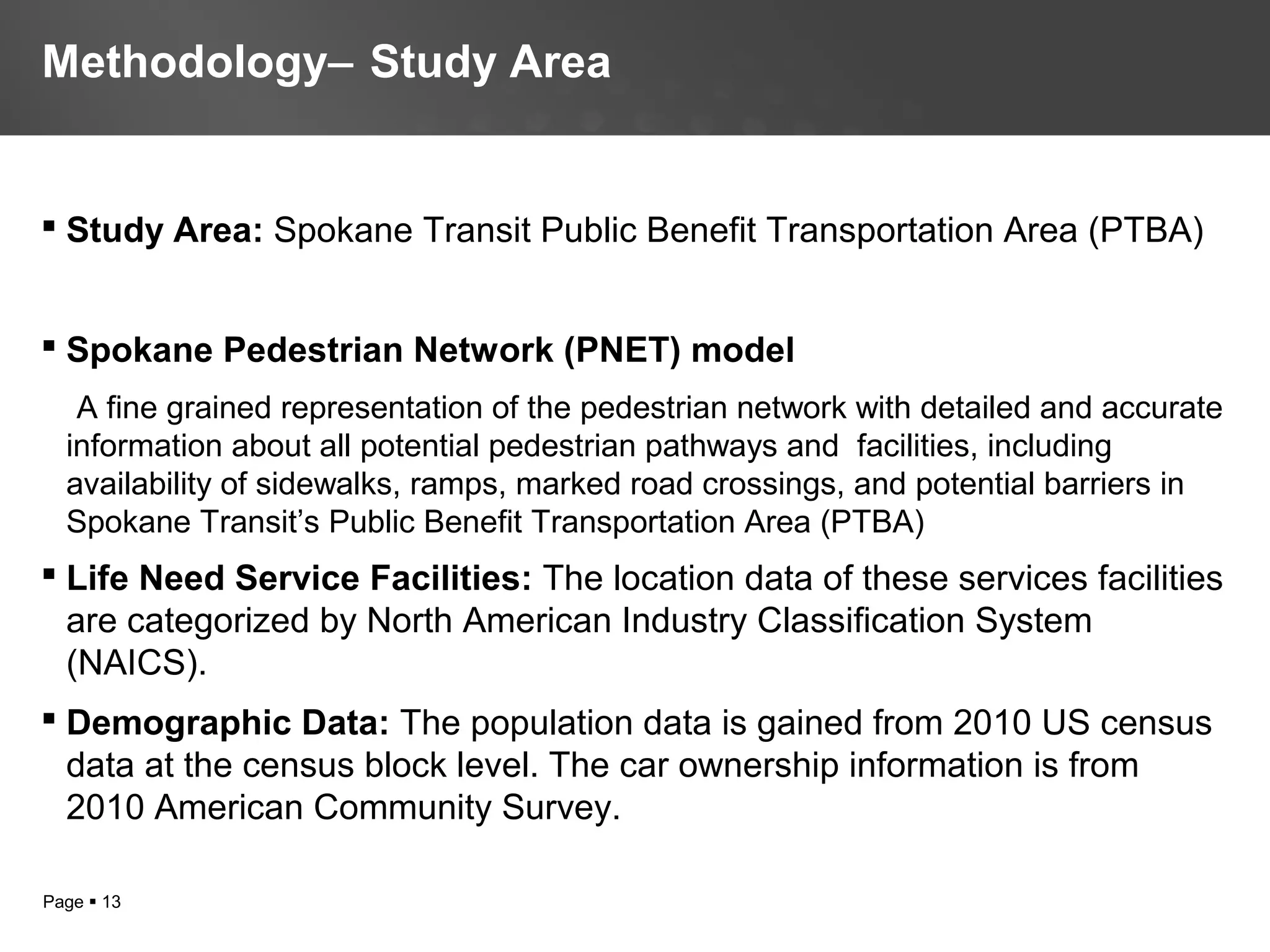
 Study Area: Spokane Transit Public Benefit Transportation Area (PTBA)
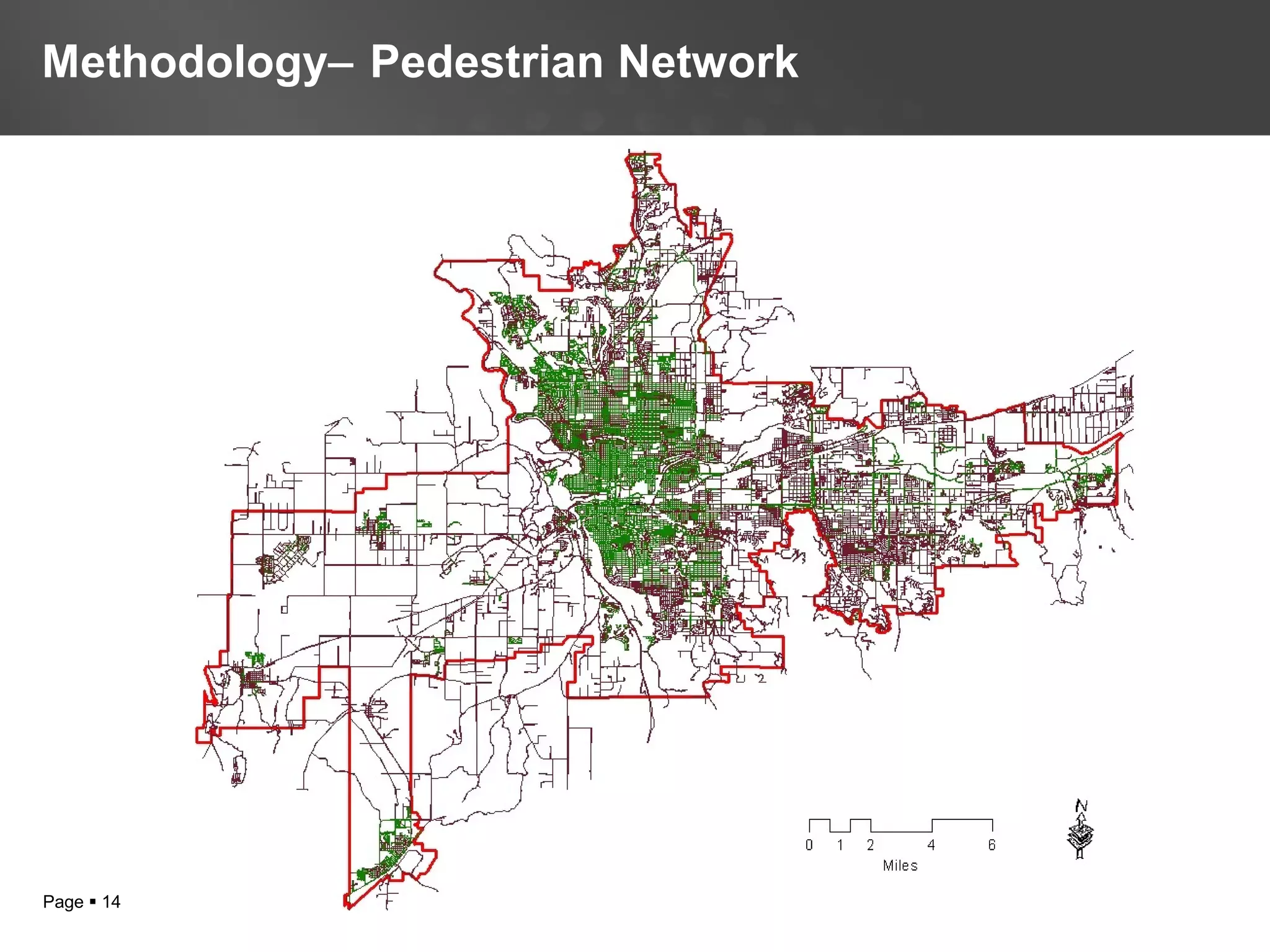
 Spokane Pedestrian Network (PNET) model
A fine grained representation of the pedestrian network with detailed and accurate
information about all potential pedestrian pathways and facilities, including
availability of sidewalks, ramps, marked road crossings, and potential barriers in
Spokane Transit’s Public Benefit Transportation Area (PTBA)
 Life Need Service Facilities: The location data of these services facilities
are categorized by North American Industry Classification System
(NAICS).
 Demographic Data: The population data is gained from 2010 US census
data at the census block level. The car ownership information is from
2010 American Community Survey.
Methodology− Study Area
Page  14
Methodology− Pedestrian Network
Page  15
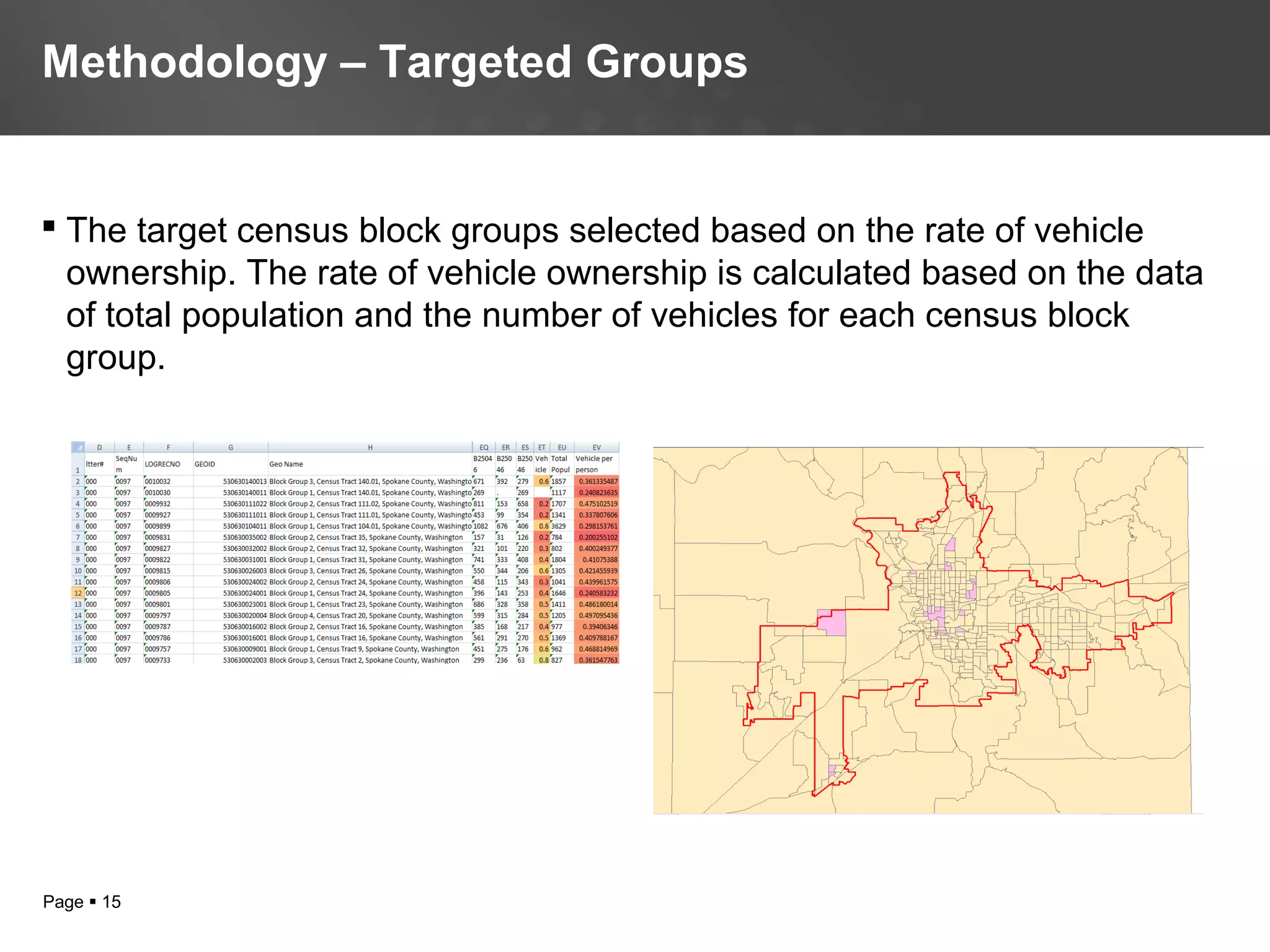
 The target census block groups selected based on the rate of vehicle
ownership. The rate of vehicle ownership is calculated based on the data
of total population and the number of vehicles for each census block
group.
Methodology – Targeted Groups
Page  16
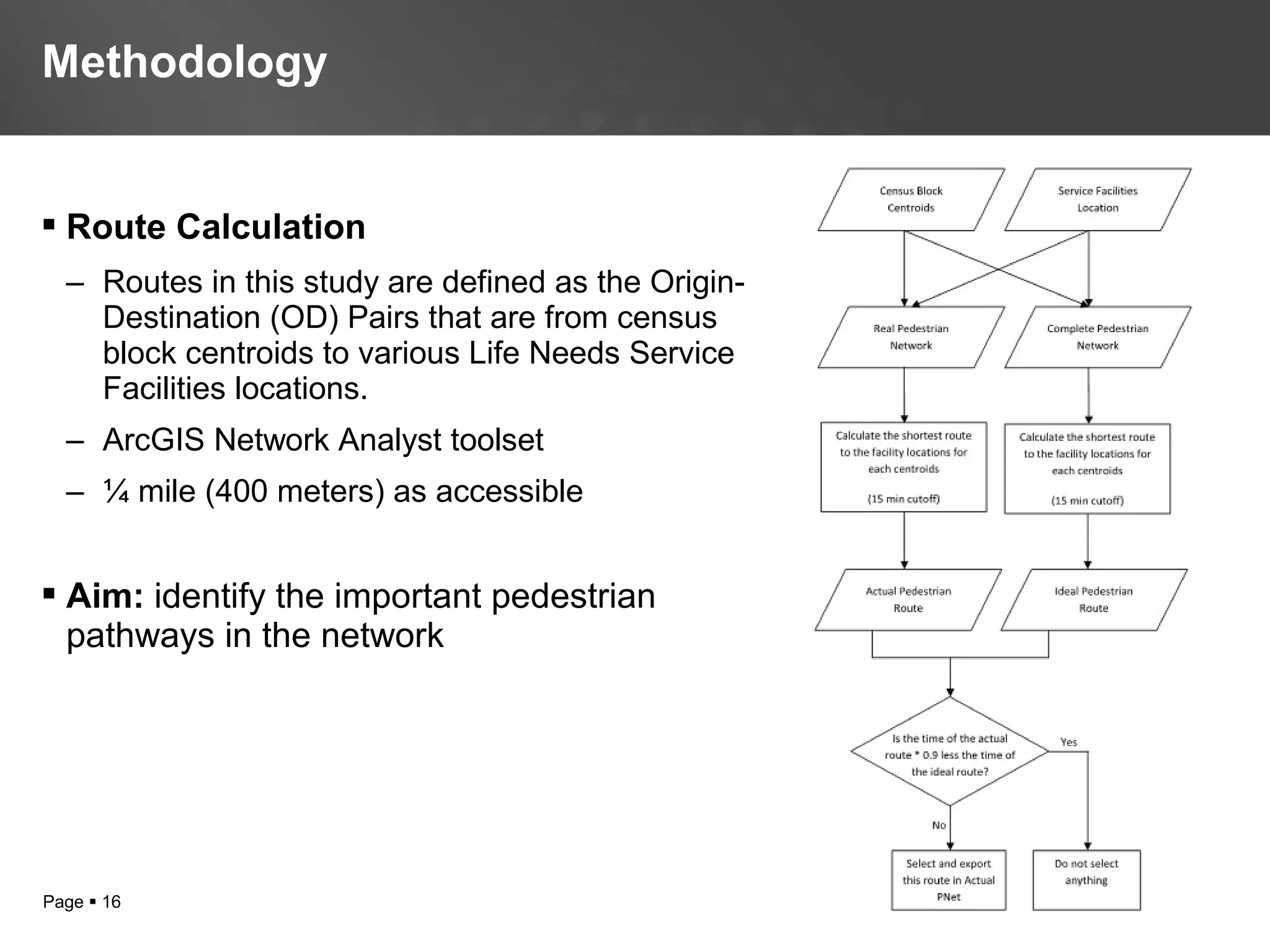
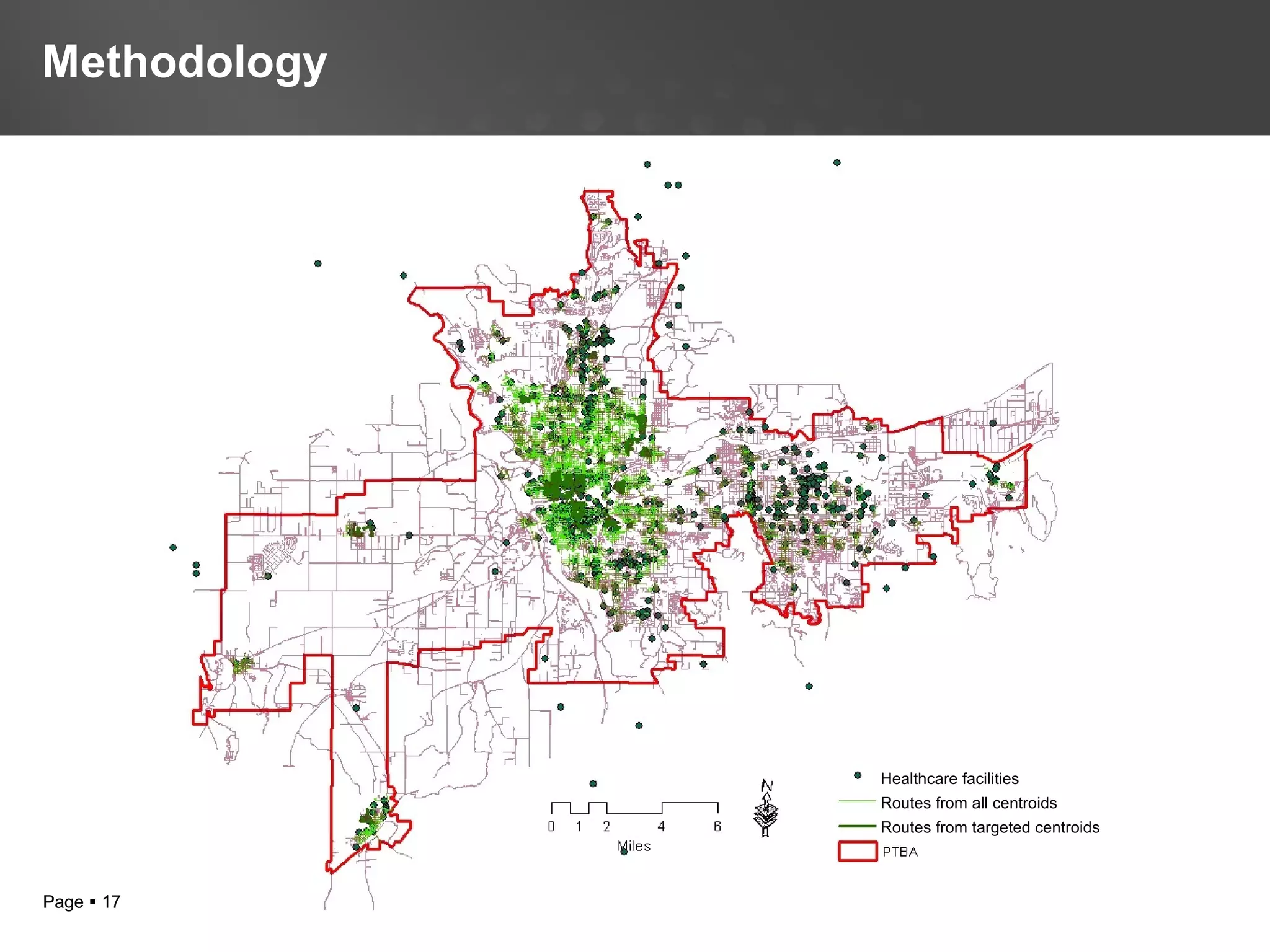
 Route Calculation
– Routes in this study are defined as the Origin-
Destination (OD) Pairs that are from census
block centroids to various Life Needs Service
Facilities locations.
– ArcGIS Network Analyst toolset
– ¼ mile (400 meters) as accessible
 Aim: identify the important pedestrian
pathways in the network
Methodology
Page  17
Methodology
Healthcare facilities
Routes from all centroids
Routes from targeted centroids
Page  18
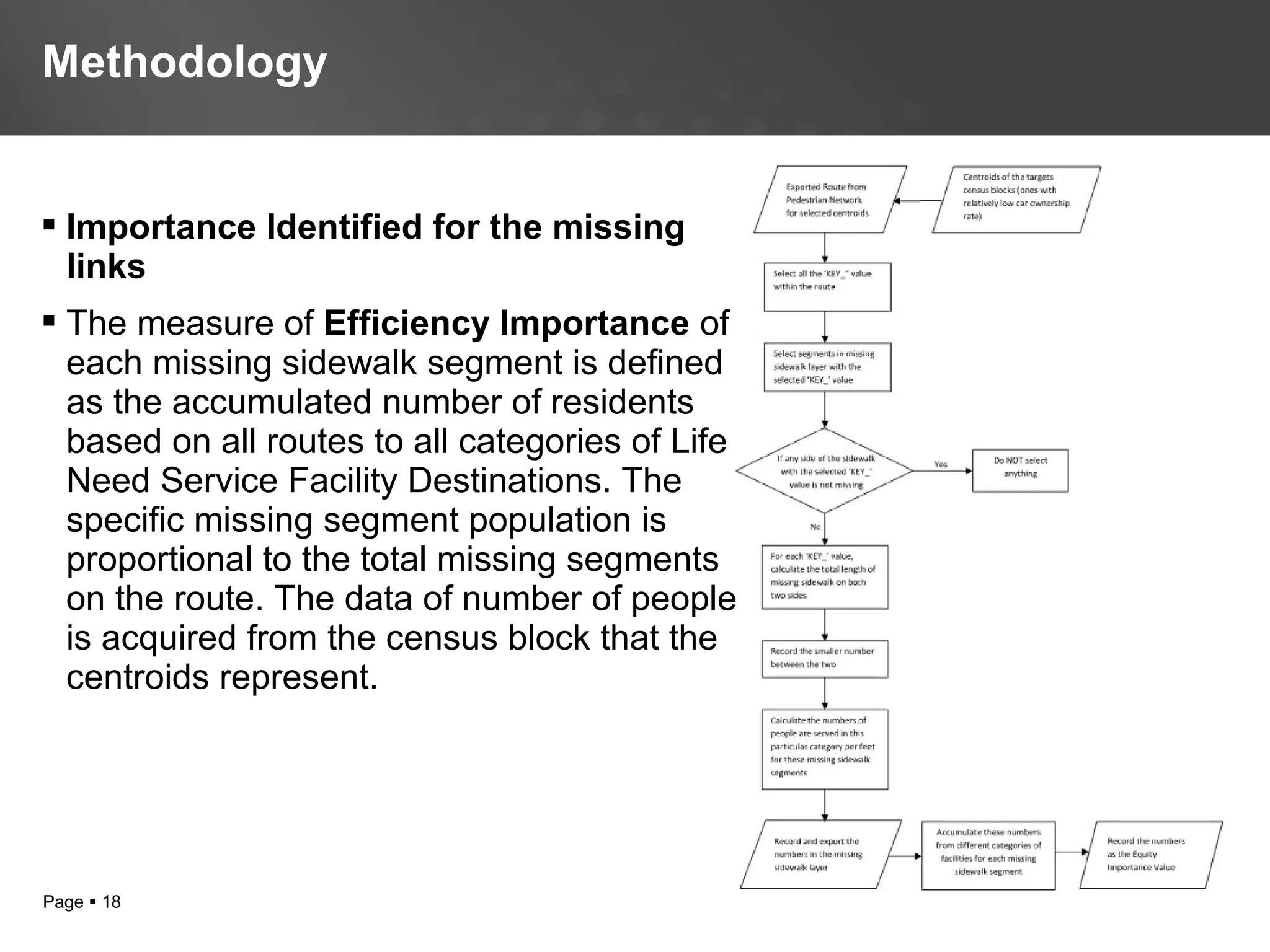
 Importance Identified for the missing
links
 The measure of Efficiency Importance of
each missing sidewalk segment is defined
as the accumulated number of residents
based on all routes to all categories of Life
Need Service Facility Destinations. The
specific missing segment population is
proportional to the total missing segments
on the route. The data of number of people
is acquired from the census block that the
centroids represent.
Methodology
Page  19
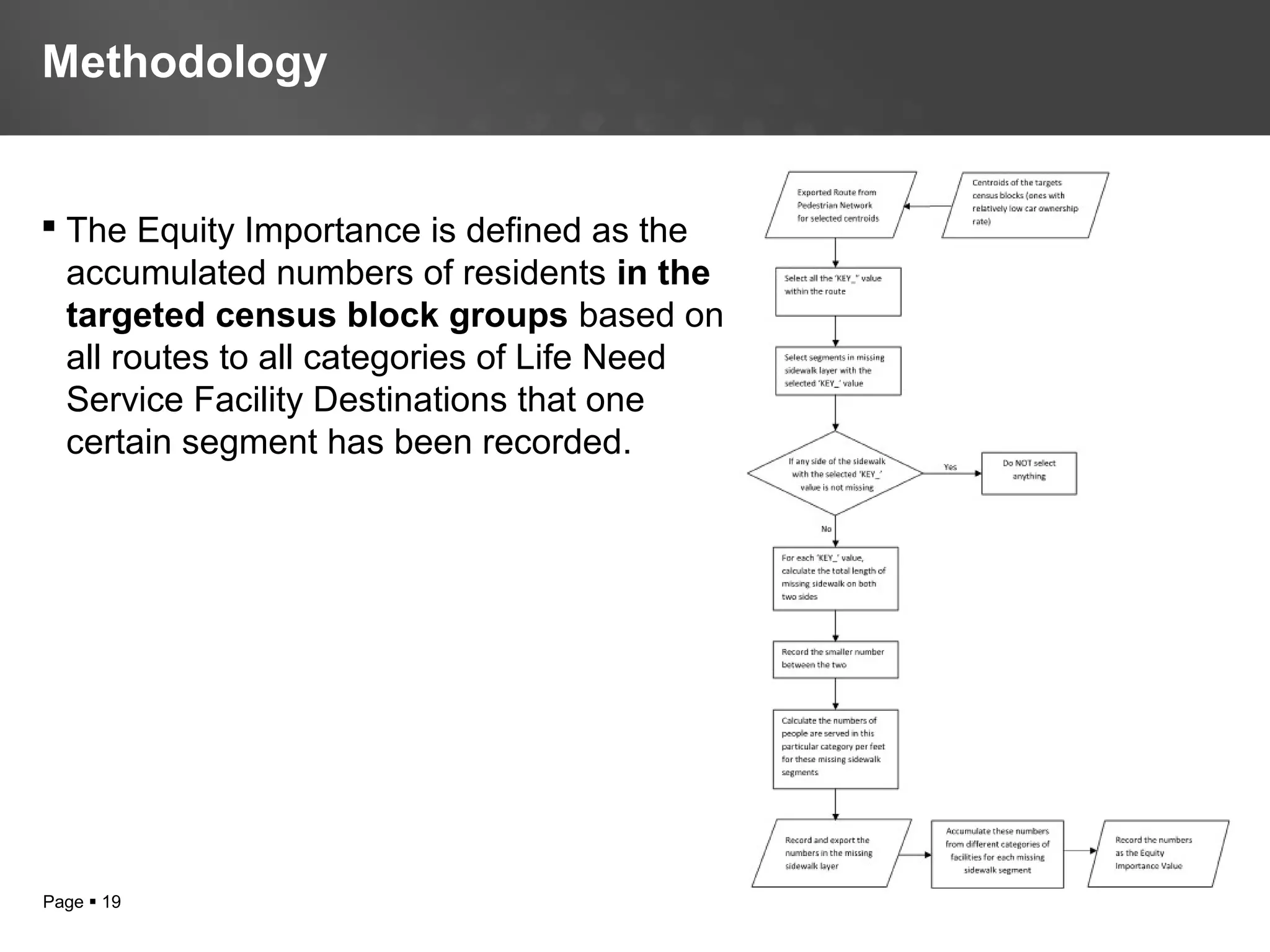
 The Equity Importance is defined as the
accumulated numbers of residents in the
targeted census block groups based on
all routes to all categories of Life Need
Service Facility Destinations that one
certain segment has been recorded.
Methodology
Page  20
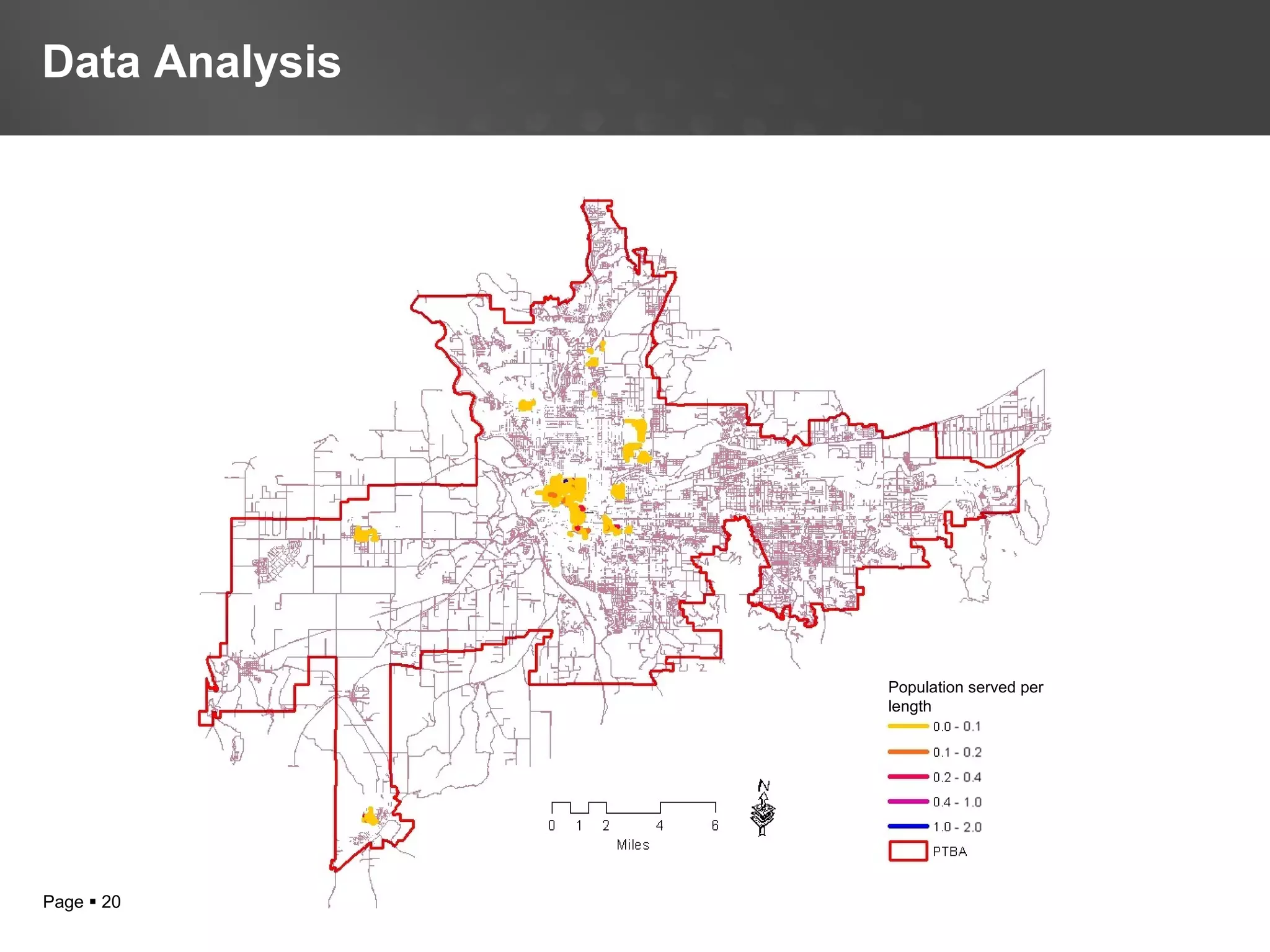
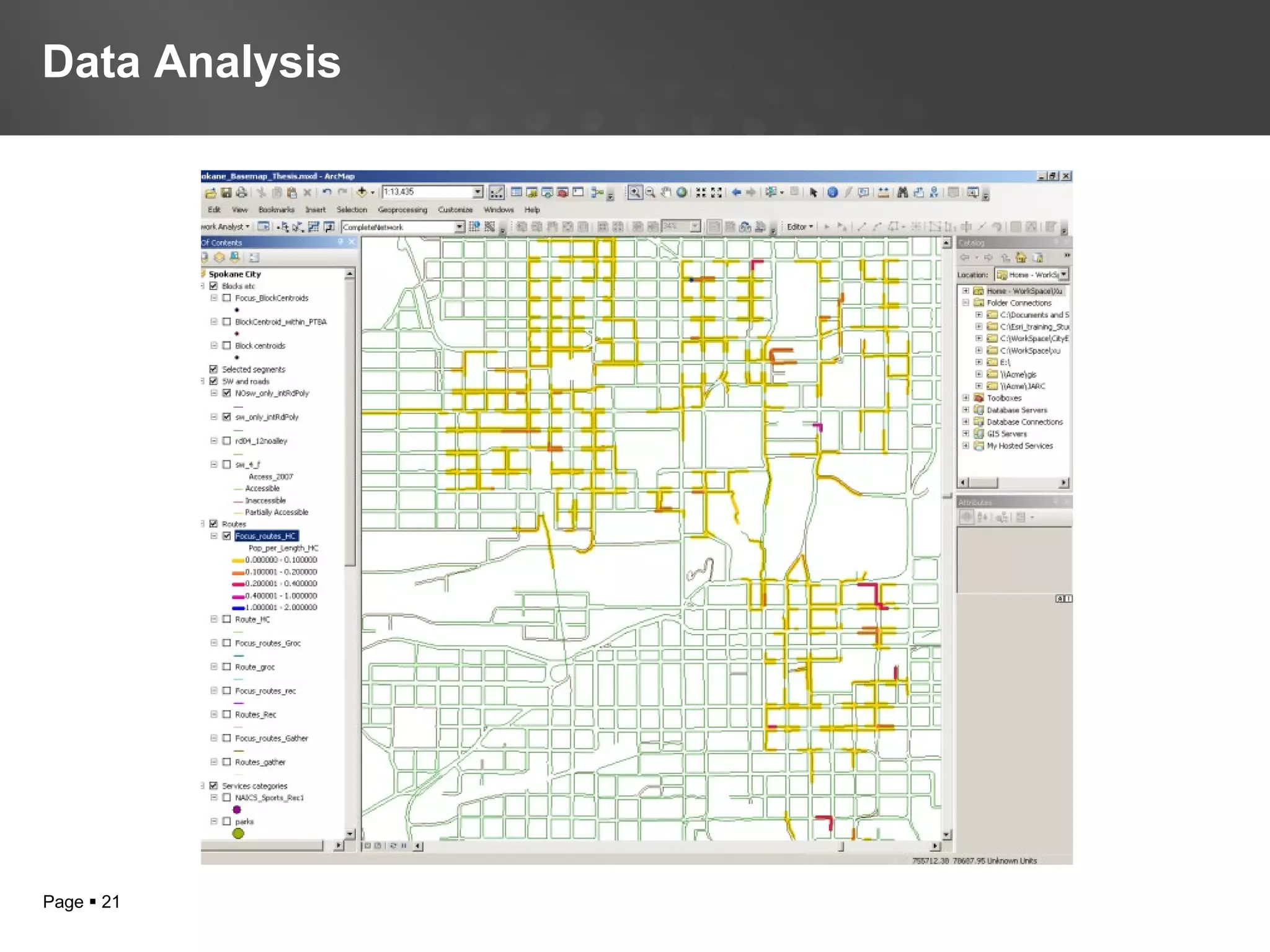
Data Analysis
Population served per
length
Page  21
Data Analysis
Page  22
Data Analysis
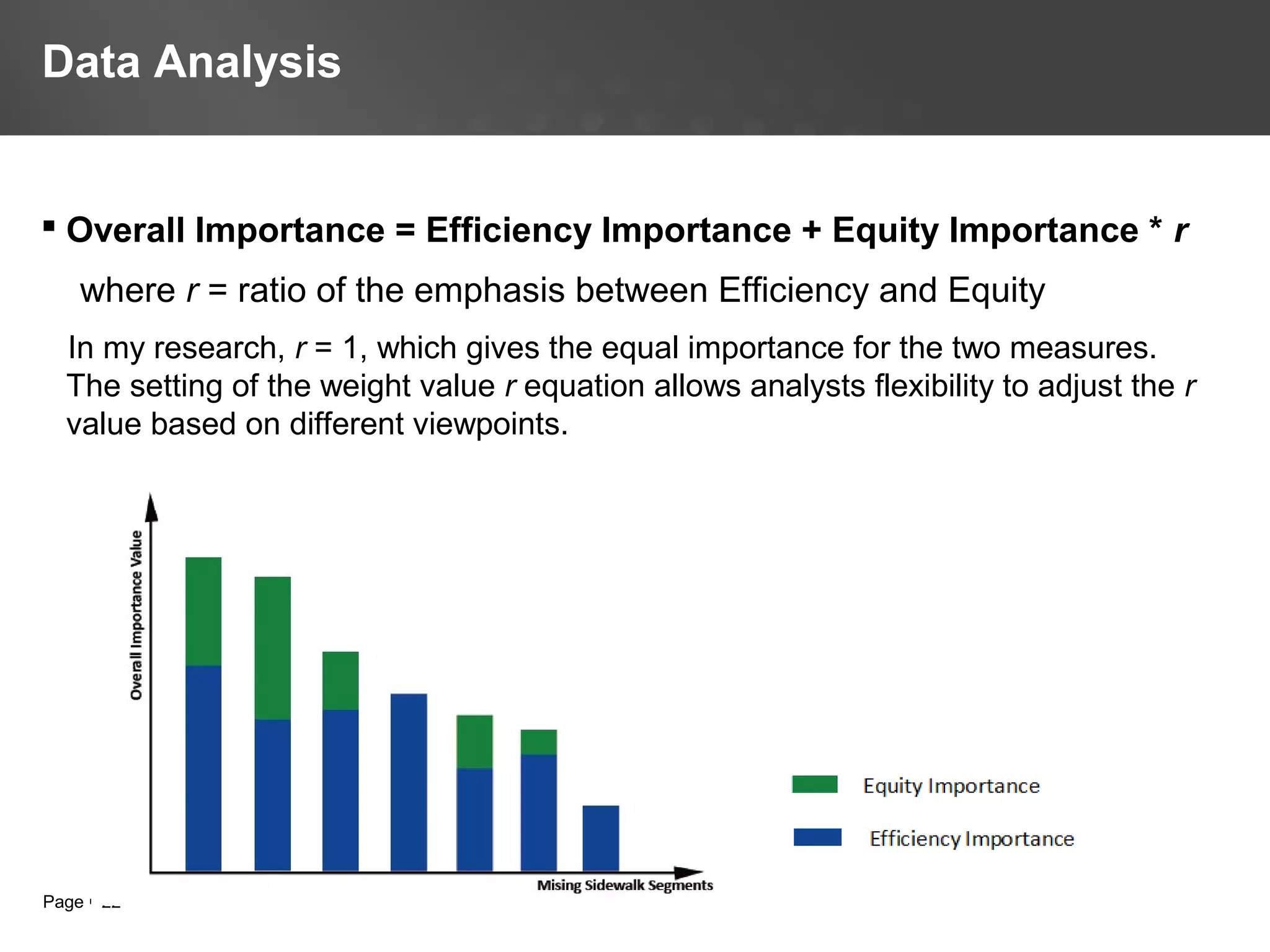
 Overall Importance = Efficiency Importance + Equity Importance * r
where r = ratio of the emphasis between Efficiency and Equity
In my research, r = 1, which gives the equal importance for the two measures.
The setting of the weight value r equation allows analysts flexibility to adjust the r
value based on different viewpoints.
References:
Chin, G.K.W., Van Niel, K.P., Giles-Corti, B., & Knuiman, M. (2008). Accessibility and connectivity
in physical activity studies: The impact of missing pedestrian data. American Journal of
Preventive Medicine, 46(1), 41-45.
Crompton, J.L. & Wicks B.E. (1988). Implementing a preferred equity model for the delivery of
leisure services in the US context. Leisure Study, 7(3), 287-304.
Handy, S. L., & Clifton, K. J. (2001). Evaluating neighborhood accessibility : possibilities and
practicalities. Journal of Transportation and Statistics, 4(2), 67-78.
Litman, T. (2002). Evaluating Transportation Equity. World Transport Policy & Practice, 8(2), 50-65.
Talen , E. (1998). Visualizing Fairness: Equity Maps for Planners. Journal of the American Planning
Association, 64(1), 22-38
Talen, E. (2011). Geovisualization of Spatial Equity. In Handbook of GIS and Society Research,
Nyerges, T., Couclelis, H., & McMaster, R., 458-479. Sage Publications.
Weber, J., & Kwan, M. (2003). Evaluating the Effects of Geographic Contexts on Individual
Accessibility: A Multilevel Approach. Urban Geography, 24(8), pp. 647–671.
.
Thank you
Mengyuan Xu
mengyuan03@gmail.com

Assessment of pedestrian accessibility and prioritization of future improvements

  • 1.
    A GIS-based modelfor Assessment of Pedestrian Accessibility and Prioritization of Future Improvements Mengyuan Xu Washington State University Doctor of Design Candidate Image:www.123rf.com
  • 2.
    Page  2 The access to public goods and services is commonly considered as an important factor in urban planning policy making process and has received large research interest for decades.  Since all social welfare issues relate to the distribution of supply of social services among social groups, all public policies naturally are related to the notions of: - Equity - Accessibility Background http://www.unmalawi.org/images/access-to-urban-service.jpg
  • 3.
    Page  3 Equity Lack of consensus on a consistent understanding in planning literature  Two principles of equity – Horizontal Equity “In which everyone receives the same public benefit, regardless of socioeconomic status, willingness or ability to pay, or other criteria” (Talen 1998) – Vertical Equity “Equity in the distribution of public resources need to response to the need of groups” (Crompton and Wicks1988) Background – Key Concepts
  • 4.
    Page  4 Definitionof Equity in my research: “Individuals and groups that differ in need and ability are treated differently in order to be provided with equal opportunities to resources.” Definition of Inequity: “Differences in access to resources among subgroups of citizens”. Background – Key Concepts
  • 5.
    Page  5 Accessibility Widely considered as a significant goal in urban planning  Defintion – “…reflects the possibilities for activities, such as working or shopping, available to residents of a neighborhood, a city, or a metropolitan area.” (Handy & Clifton 2001) – “An individual’s ability to reach desired goods, services, activities and destinations” (Litman 2002)  Three-fold framework – Social-demographic data – Geographic data of urban services – Travel options Background – Key Concepts
  • 6.
    Page  6 Measuresof Transportation Accessibility – Block length (mean) – Block size (mean area) – Block density – Intersection density – Link-Node Ratio (LNR) – Pedestrian Route Directness (PRD) – Service area calculation – Walking distance to activities Background – Key Concepts
  • 7.
    Page  7 LifeNeed Service Facilities  “A system of physical facilities/services that support the essential needs of individuals, families and communities and thus enhance the overall quality of life” – Daily Food Provider: Groceries and convenience stores – Social Gathering: Libraries, community centers, and churches – Recreational facilities – Healthcare and social assistance: hospitals, and clinics; Background – Key Concepts
  • 8.
    Page  8 LifeService Deserts: “Areas with relatively poor access to life need services”  Suburban sprawl since the 1940s – Automobile-oriented transportation planning – Separation of land uses – Commercial service providers moved out of inner cities to new developed suburbs  16.1 percent of households in Spokane City do not own a private car.  Mobility disadvantaged groups may be highly reliant on access to pedestrian networks with ADA facilities Measuring accessibility and service deserts based on pedestrian networks has received great interest. Background – Key Concepts
  • 9.
    Page  9 Prioritization In the context of limited resources and budgets, it is vital to identity the importance of each missing link in the network in order to decide its priority when planning network improvements.  Efficiency and Equity are considered as critical factors to improve the performance of urban environment in previous literatures (Litman 2002; Talen 2011). Background
  • 10.
    Page  10 Proposea GIS-based accessibility assessment model that:  Identifies the inequities in spatial access to life needs services facilities in my study area, or say, life need service deserts for all citizens and/or targeted groups;  Evaluates how the level of accessibility would be affected by proposed interventions by predicting and describing the potential consequences;  Implements methods to prioritize potential infrastructure improvements. Research Goals
  • 11.
    Page  11 The majority of existing research favors motorized accessibility and relatively little attention has been paid to pedestrian accessibility (Litman 2002).  Recent accessibility research focusing on the pedestrian environment, it has tended to use street networks for connectivity analysis of the built environment, instead of true pedestrian networks (Chin et al. 2008).  Previous measures tend to separate the individual socio-economic and socio-demographic status from its geographical context (Weber & Kwan 2003) Gaps in Existing Researches
  • 12.
    Page  12 We are at the digital threshold of the computer-aided design tools evolution to next stage, which would be simulation tools.  Representational tools – Describing “what it is” – Their functions are limited in drafting and documenting.  Simulation tools – Predicting “what can be” – A true design decision supporting tool helping designers evaluate different future scenarios and find the optimal one Concept of GeoDesign
  • 13.
    Page  13 Study Area: Spokane Transit Public Benefit Transportation Area (PTBA)  Spokane Pedestrian Network (PNET) model A fine grained representation of the pedestrian network with detailed and accurate information about all potential pedestrian pathways and facilities, including availability of sidewalks, ramps, marked road crossings, and potential barriers in Spokane Transit’s Public Benefit Transportation Area (PTBA)  Life Need Service Facilities: The location data of these services facilities are categorized by North American Industry Classification System (NAICS).  Demographic Data: The population data is gained from 2010 US census data at the census block level. The car ownership information is from 2010 American Community Survey. Methodology− Study Area
  • 14.
    Page  14 Methodology−Pedestrian Network
  • 15.
    Page  15 The target census block groups selected based on the rate of vehicle ownership. The rate of vehicle ownership is calculated based on the data of total population and the number of vehicles for each census block group. Methodology – Targeted Groups
  • 16.
    Page  16 Route Calculation – Routes in this study are defined as the Origin- Destination (OD) Pairs that are from census block centroids to various Life Needs Service Facilities locations. – ArcGIS Network Analyst toolset – ¼ mile (400 meters) as accessible  Aim: identify the important pedestrian pathways in the network Methodology
  • 17.
    Page  17 Methodology Healthcarefacilities Routes from all centroids Routes from targeted centroids
  • 18.
    Page  18 Importance Identified for the missing links  The measure of Efficiency Importance of each missing sidewalk segment is defined as the accumulated number of residents based on all routes to all categories of Life Need Service Facility Destinations. The specific missing segment population is proportional to the total missing segments on the route. The data of number of people is acquired from the census block that the centroids represent. Methodology
  • 19.
    Page  19 The Equity Importance is defined as the accumulated numbers of residents in the targeted census block groups based on all routes to all categories of Life Need Service Facility Destinations that one certain segment has been recorded. Methodology
  • 20.
    Page  20 DataAnalysis Population served per length
  • 21.
  • 22.
    Page  22 DataAnalysis  Overall Importance = Efficiency Importance + Equity Importance * r where r = ratio of the emphasis between Efficiency and Equity In my research, r = 1, which gives the equal importance for the two measures. The setting of the weight value r equation allows analysts flexibility to adjust the r value based on different viewpoints.
  • 23.
    References: Chin, G.K.W., VanNiel, K.P., Giles-Corti, B., & Knuiman, M. (2008). Accessibility and connectivity in physical activity studies: The impact of missing pedestrian data. American Journal of Preventive Medicine, 46(1), 41-45. Crompton, J.L. & Wicks B.E. (1988). Implementing a preferred equity model for the delivery of leisure services in the US context. Leisure Study, 7(3), 287-304. Handy, S. L., & Clifton, K. J. (2001). Evaluating neighborhood accessibility : possibilities and practicalities. Journal of Transportation and Statistics, 4(2), 67-78. Litman, T. (2002). Evaluating Transportation Equity. World Transport Policy & Practice, 8(2), 50-65. Talen , E. (1998). Visualizing Fairness: Equity Maps for Planners. Journal of the American Planning Association, 64(1), 22-38 Talen, E. (2011). Geovisualization of Spatial Equity. In Handbook of GIS and Society Research, Nyerges, T., Couclelis, H., & McMaster, R., 458-479. Sage Publications. Weber, J., & Kwan, M. (2003). Evaluating the Effects of Geographic Contexts on Individual Accessibility: A Multilevel Approach. Urban Geography, 24(8), pp. 647–671. . Thank you Mengyuan Xu mengyuan03@gmail.com