ASSESSMENT OF LEARNING
It is not enough to have a good
mind. The main thing is to use it
well. (Descartes)
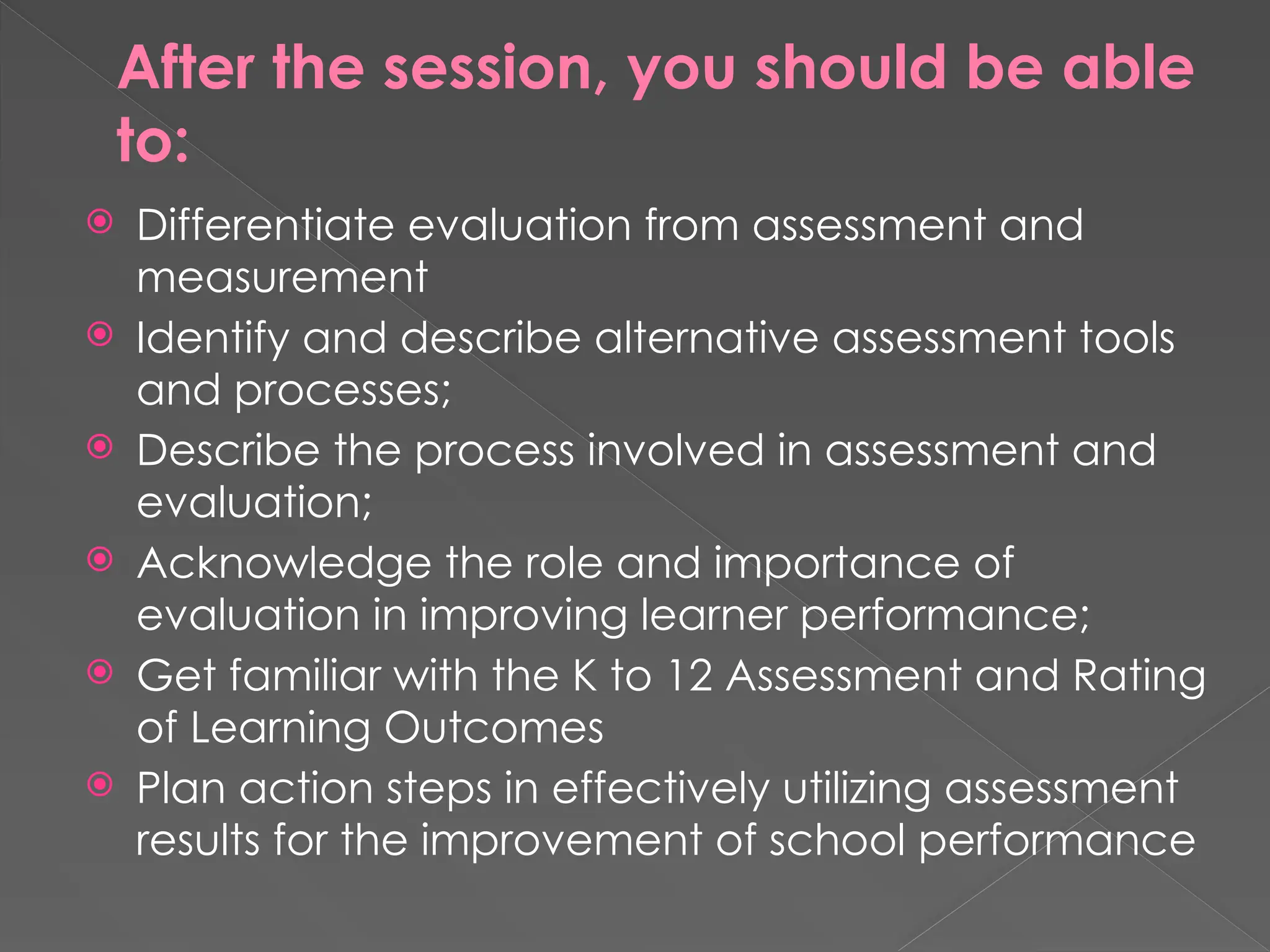
After the session, you should be able
to:
 Differentiate evaluation from assessment and
measurement
 Identify and describe alternative assessment tools
and processes;
 Describe the process involved in assessment and
evaluation;
 Acknowledge the role and importance of
evaluation in improving learner performance;
 Get familiar with the K to 12 Assessment and Rating
of Learning Outcomes
 Plan action steps in effectively utilizing assessment
results for the improvement of school performance
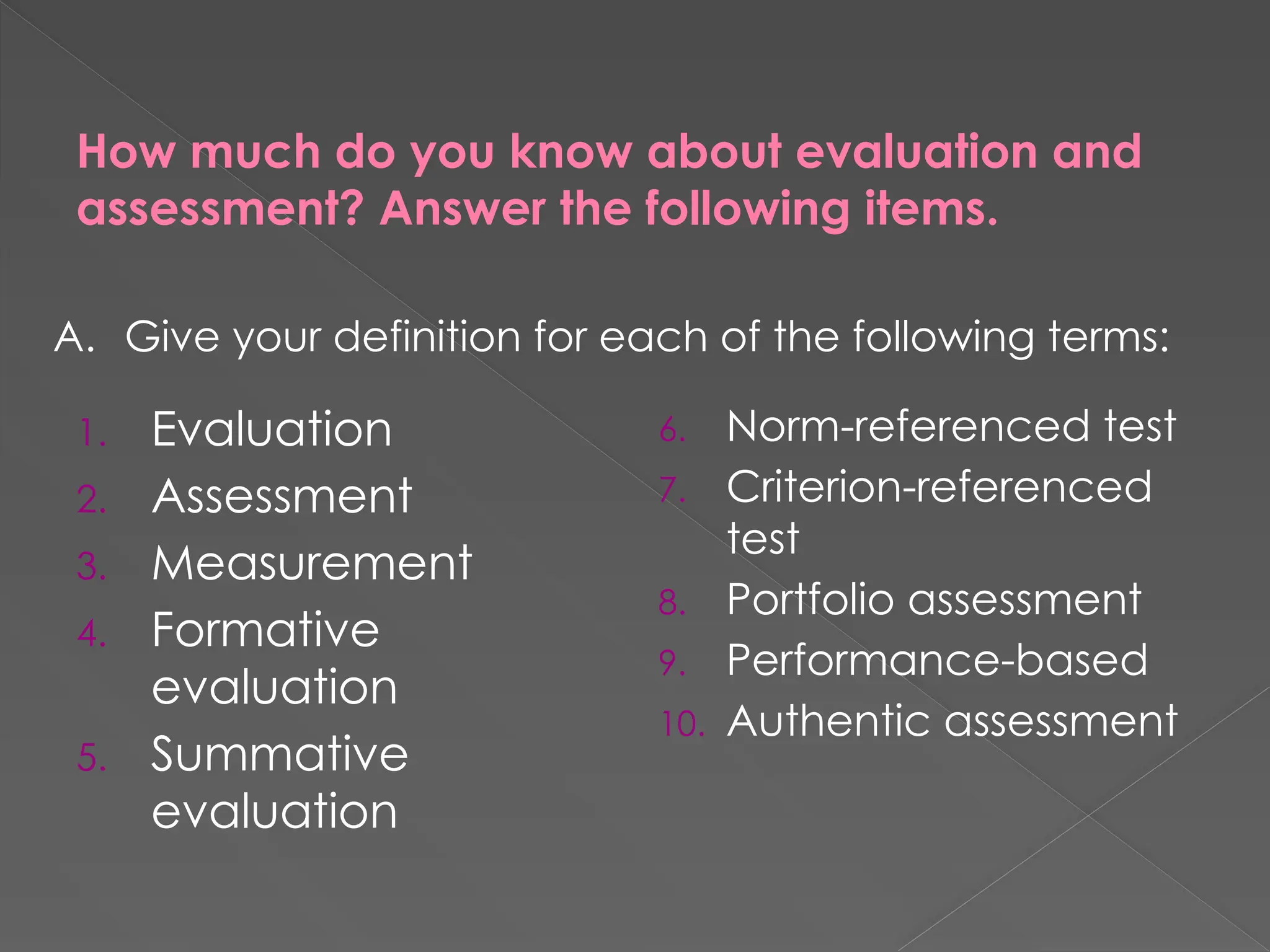
How much do you know about evaluation and
assessment? Answer the following items.
1. Evaluation
2. Assessment
3. Measurement
4. Formative
evaluation
5. Summative
evaluation
6. Norm-referenced test
7. Criterion-referenced
test
8. Portfolio assessment
9. Performance-based
10. Authentic assessment
A. Give your definition for each of the following terms:
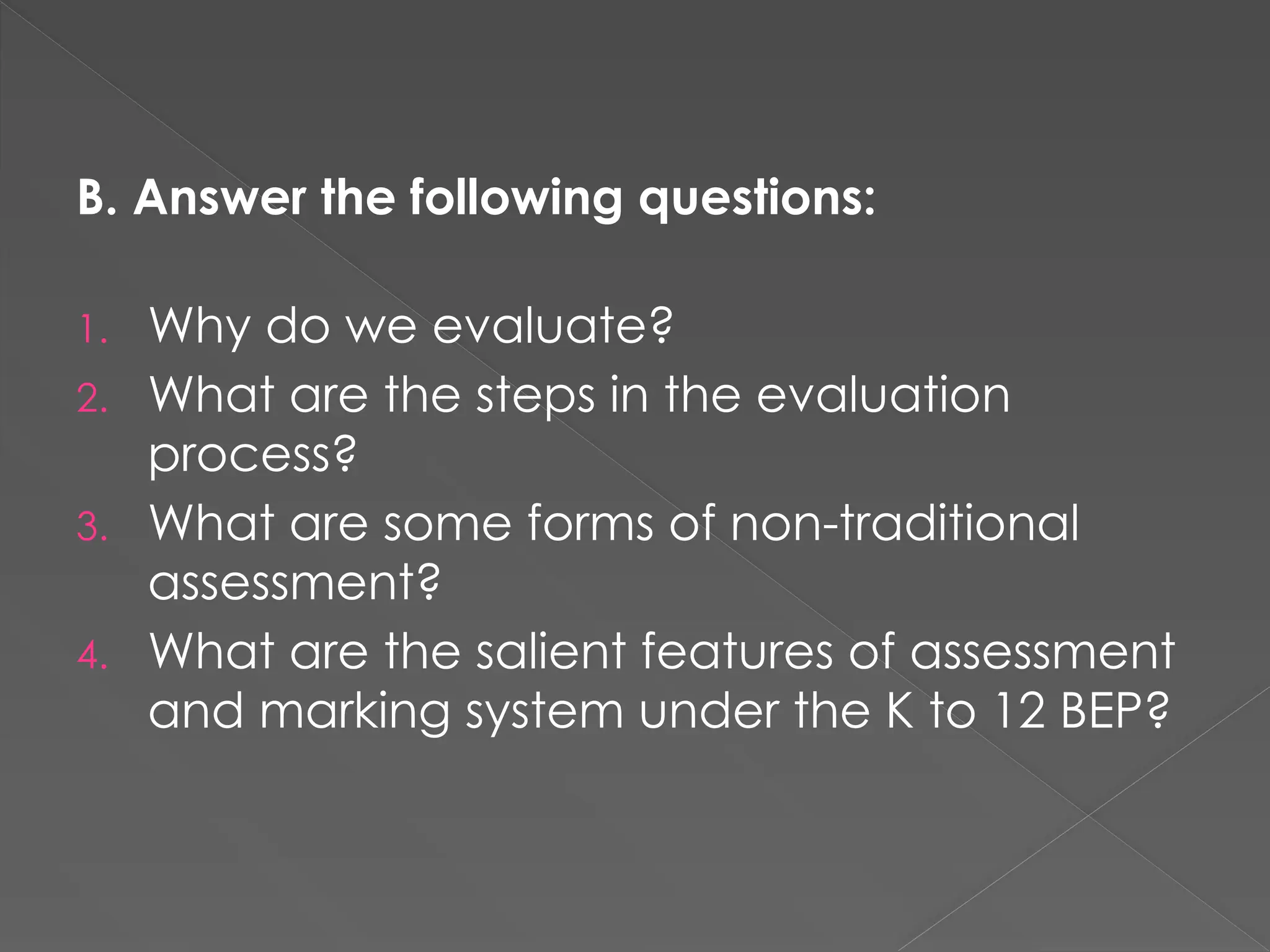
B. Answer the following questions:
1. Why do we evaluate?
2. What are the steps in the evaluation
process?
3. What are some forms of non-traditional
assessment?
4. What are the salient features of assessment
and marking system under the K to 12 BEP?
EVALUATION
 Evaluation is the weighing of assessment
information against some standard (such
as a curriculum learning objective).
 Main purposes:
› to facilitate student learning
› to improve instruction
› to report progress to students and parents
› to make decisions related to promotion
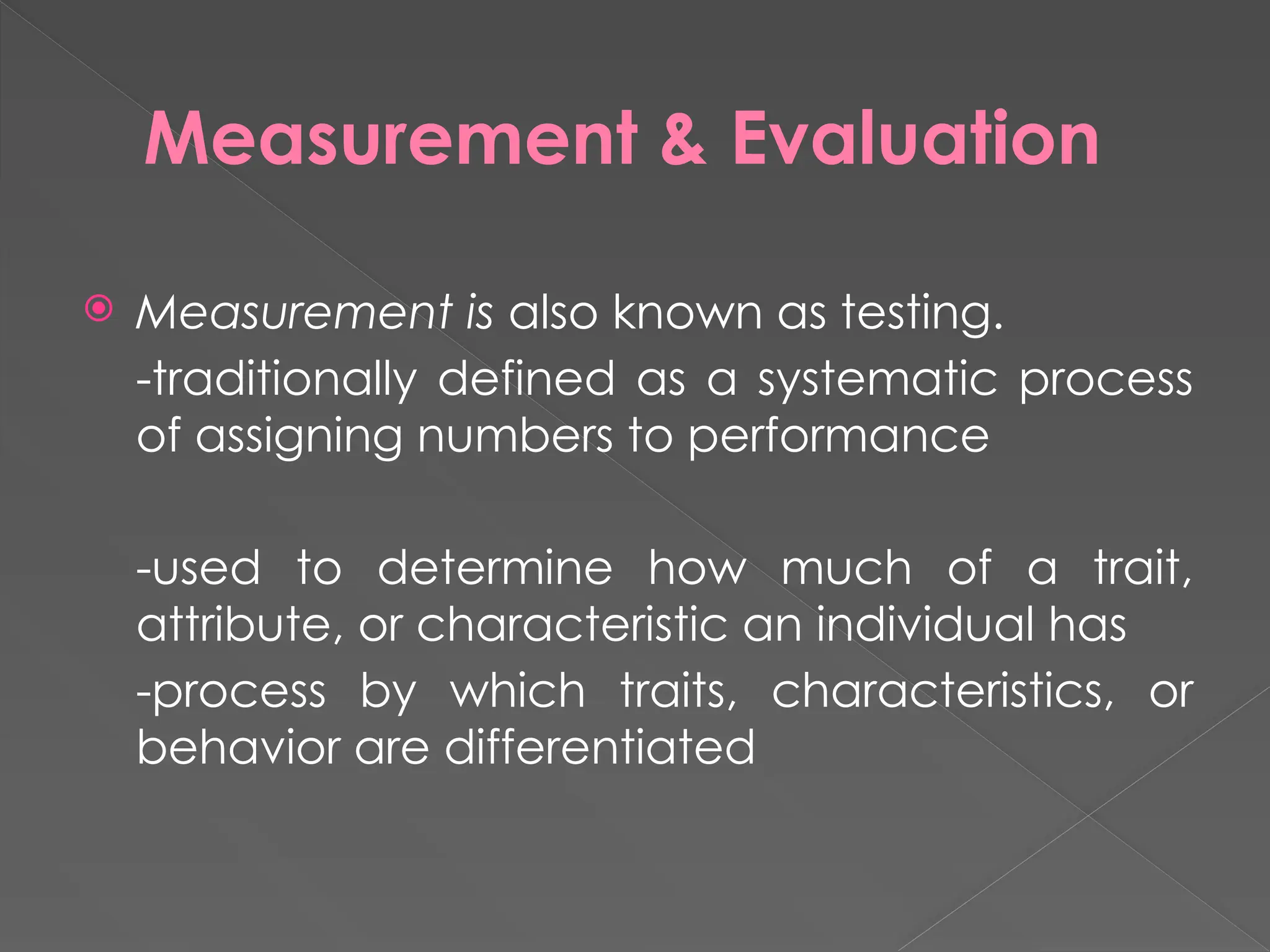
Measurement & Evaluation
 Measurement is also known as testing.
-traditionally defined as a systematic process
of assigning numbers to performance
-used to determine how much of a trait,
attribute, or characteristic an individual has
-process by which traits, characteristics, or
behavior are differentiated
 Evaluation involves an interpretation of what
has been gathered through measurement,
wherein value judgments are made about
performance.
- making of judgment on quality – how good
the behavior or performance is.
- consider asking yourself the following
questions:
o How will I interpret the results?
o What performance standards and criteria
will I use?
 To illustrate clearly the difference between
the two terms, we could say that while
measurement consists of the administration
and scoring of test, evaluation is a
judgment about what the different test
scores mean.
ASSESSMENT
 the collection, evaluation, and use of
information to help teachers make better
decisions
 more than testing or measurement
 comprises of four essential components
which are: (1) purpose; (2) measurement;
(3) evaluation; and (4) use.
Assessment can be described as
follows:
 A method of measuring and evaluating the nature of the learner,
what he/she learns and how.
 The collection, interpretation and use of information to help
teachers make better decisions to improve the teaching-learning
process.
 A mechanism for providing teachers with data for improving their
teaching methods and for guiding and motivating students to be
actively involved in their learning.
 Give essential information about what the students are learning
and about the extent to which the teachers are meeting their
goals.
MAJOR TYPES or KINDS
of ASSESSMENT
Formative Assessment
Summative Assessment
Diagnostic Assessment
DIAGNOSTIC ASSESSMENT
 occurs at the beginning of the school
year or before a unit of instruction;
 main purposes are:
a) to identify students who lack prerequisite
knowledge, understanding, or skills for
arrangement of remedial classes or sessions;
b) to identify talented/gifted/advanced
learners to ensure they are being sufficiently
challenged; and
c) to identify students interests.
FORMATIVE ASSESSMENT
 an ongoing classroom process that keeps students and
educators informed of students’ progress towards program
learning objectives.
 Its purpose is to provide corrective actions as instruction
occurs to enhance student learning.
 It may include:
 informal observation
 questioning
 student responses to questions
 homework
 worksheet
 teacher feedback to the student
 It is integrated with instruction on a daily basis
SUMMATIVE ASSESSMENT
 happens at the end of a unit of study to summarize
student progress
 its purpose is to determine what has been learned over a
period of time
 to report progress relative to curricular objectives to
students, parents, educators and other stakeholders
 aims at documenting student performance after
instruction is completed.
 This may be accomplished through:
 giving of term paper, chapter or unit test,
achievement test, final exam, research project
Decide whether each of the following situations is
an example of formative or summative evaluation.
1. Melissa must obtain 70% in her Spelling test
to be able to receive a passing grade for
the rating period.
2. Each week, learners in Mrs. Parcon’s class
write a narrative essay. The learners record
the percentage of words spelled correctly
on their essay on a chart in their portfolios.
3. Based on his scores in a Reading Test, Ray’s
teacher decides to place him in average
reading group.
EVALUATION APPROACHES
NORM-REFERENCED TESTS
CRITERION-REFERENCED TESTS
NORM-REFERENCED
APPROACHES
 Compare performance to a well defined
norming or reference group to determine
relative strengths and weaknesses of students
CRITERION-REFERENCED
APPROACHES
 Compare student performance to an
established standards rather than to other
students; designed to provide a valid measure
of skills and knowledge in specific areas.
Identify each of the functions listed below as
characteristics of norm-referenced or criterion-
referenced test.
1. Determine whether a student is the top 10% or
bottom 10% of the group.
2. Must have predetermined standards
3. Clearly demonstrates skills at a predetermined
level
4. Compares student’s performance to standards
5. Compares students performance to other
classmates.
6. Shows competition among students
7. Clearly defines student standing within the group
Are you familiar with the
terms?
Alternative assessment
Authentic assessment
Performance assessment
NEW ASSESSMENT METHODS
ALTERNATIVE ASSESSMENT
 Applies to and all assessments that differ from the
multiple-choice, timed, and one-shot approaches
that characterized many classroom assessment
 Includes authentic assessment, performance-
based assessment, portfolio, exhibitions,
demonstrations, journals and other form of
assessment
 Require the active construction of meaning rather
than the passive regurgitation of isolated facts.
 AUTHENTIC ASSESSMENT conveys the idea
that assessments should engage the
students in applying knowledge and skills in
the same way they are used in the real
world or outside of schools
 PERFORMANCE ASSESSMENT refers to a
variety of tasks and situations which
students are given opportunities to
demonstrate their understanding and to
apply knowledge, skills and habits in a
variety of context
 PORTFOLIO
› A collection of information by and about a
learner to give a broader view of his or her
achievement
› Contains sample of a learner’s work in one or
more areas
› May also contain narrative descriptions, grades or
other evaluations by teachers and others, official
records, learner’s academic achievement, non-
academic achievement or both
› A profile differs from a portfolio in not including
samples of a learner’s work.
 PERFORMANCE TASK
- a task, problem or question that
requires learners to construct responses
and may also require them to devise or
revise strategies, organize data, identify
patterns, formulate models and
generalization, evaluate partial and
tentative solutions, and justify their
answers.
 DEMONSTRATION OR EXHIBITION OF
MASTERY
- often formal, more or less public
performance of learner competence and
skill that provides an opportunity for a
summative or final assessment
Authentic assessment makes use of
rubric to measure learners’ work.
 RUBRIC is a scoring guide to evaluate learners’
performance based on the sum of a full range of
criteria rather than a single numerical score.
 It is a working guide for learners and teachers,
usually handed out before the assignment begins
in order to get learners to think about the criteria
on which their work will be judged.
 It can be analytic or holistic.
 It can be created in a variety of forms and levels
of complexity.
SUMMARY
Some of the main points presented:
1. Evaluation involves the use of
measurement to obtain samples of a
student’s knowledge and to compare
those samples to an established set of
standards, or expectations, for what is
acceptable. The results of this comparison
can then be used for decision-making.
 Assessment is defined as the
collection, evaluation, and use of
information for better instructional and
planning decisions to improve student
learning.
3. Reforms in assessment practices resulted to
recent trends in assessment such as:
- Congruence of assessment and
instructional goals;
- Shift from paper-pencil to authentic skills
- Use of portfolio and rubics; and
- Shift from single attribute to
multidimensional assessment.
4. It is important to note that emphasis on
authentic assessment does not imply that
teachers should abandon conventional testing.
The significant thing to remember is that there
are advantages and disadvantages of both
traditional and alternative assessment and that
it is more crucial to match the type of
assessment with the purpose.
5. Remember, begin with purpose, and, with the
knowledge of assessment options, select and
implement the ones that will provide best
information on the extent of the attainment of
the learning targets.
Direction: Identify the concept being
defined/described in each item.
1. The process of delineating, obtaining and providing
useful information for judging decision alternative.
2. The collection, interpretation, and use of
information to help teachers make better decision
to improve the teaching learning process.
3. Type of assessment used to measure the extent to
which the pupils have learned a particular
objective or skill.
4. An evaluation approach wherein individual’s
performance is compared to an established
criteria or set of standards.
5. An assessment method that engages the
students in applying knowledge and skills in
the same way they are used in the real world
outside the school.
6. A purposeful collection of a student’s work
that exhibits his/her learning effort or
achievements in one or more areas.
7. A scoring guide used to evaluate a student’s
performance based on the sum of a range of
criteria rather than a single numerical score.
8. It means directly observing or testing behavior or
characteristics of an individual and assigning a
numerical score or a rating to represent the
degree to which the trait is possessed or
demonstrated by an individual.
9. Type of assessment given at the end of the
learning unit or at the end of the rating period.
10. An evaluation approach concerned with how
one student performs in relation to others.
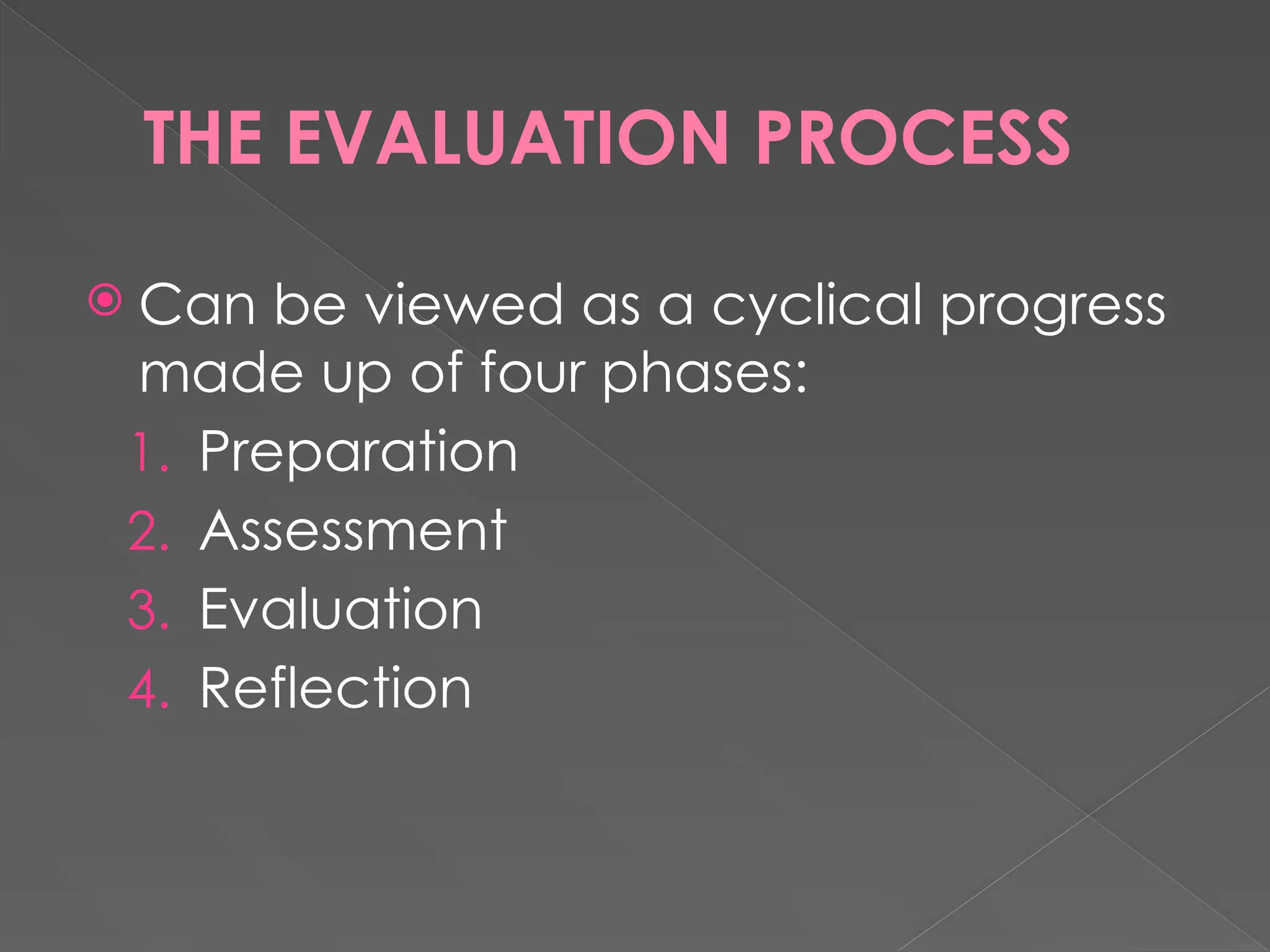
THE EVALUATION PROCESS
 Can be viewed as a cyclical progress
made up of four phases:
1. Preparation
2. Assessment
3. Evaluation
4. Reflection
1. PREPARATION PHASE
 Decisions are made to identify
- what is evaluated
- the type of evaluation to be used (i.e.,
formative, summative, or diagnostic)
- the criteria against which student learning
outcomes will be judged
- the most appropriate assessment techniques
with which to gather information on student
progress.
2. ASSESSMENT PHASE
 The teacher identifies information-gathering
strategies/techniques
 Constructs or selects instruments
 Administers them to the students
 Collects and organizes the information on
the student learning progress.
3. EVALUATION PHASE
 The teacher interprets the assessment
information
 Makes the judgment about the student
progress
 Based on the judgment or evaluation,
teachers make decisions about student
learning programs and report on
progress to students, parents, and
appropriate school personnel.
4. REFLECTION PHASE
 The teacher is given the opportunity to
consider the extent to which the previous
phases in the evaluation process have
been successful.
 The teacher evaluates the utility and
appropriateness of assessment techniques
used.
SPECIFIC ACTIVITIES UNDERTAKEN IN THE
DIFFERENT PHASES OF EVALUATION
PROCESS
Preparation phase
Instructional objectives:
 Serve as guides for both teaching and
learning, communicate the intent of the
instruction to others
 Provide guidelines for evaluating pupil learning
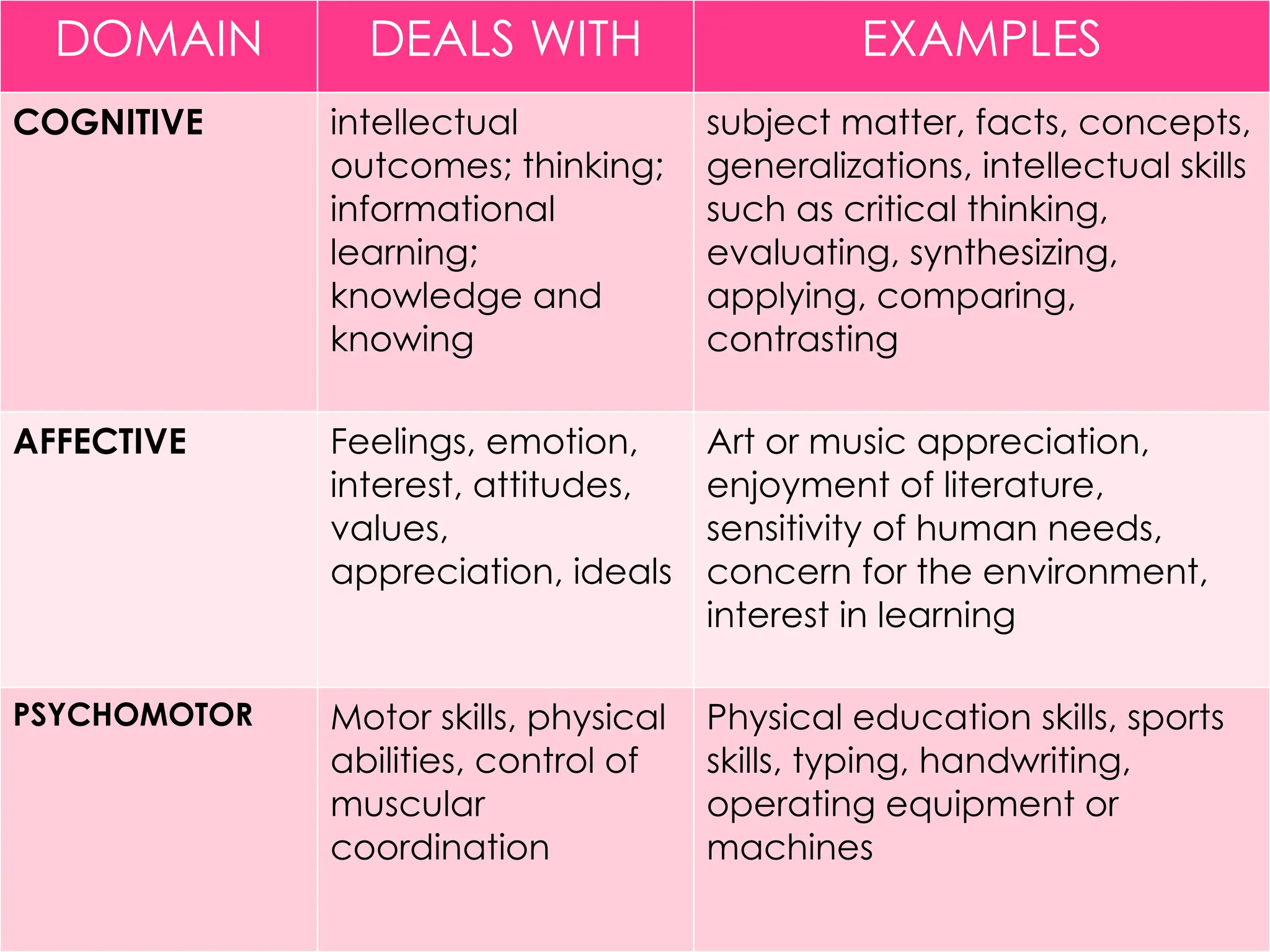
A taxonomy is a classification scheme. The
taxonomies are divided into cognitive,
affective and psychomotor domains.
DOMAIN DEALS WITH EXAMPLES
COGNITIVE intellectual
outcomes; thinking;
informational
learning;
knowledge and
knowing
subject matter, facts, concepts,
generalizations, intellectual skills
such as critical thinking,
evaluating, synthesizing,
applying, comparing,
contrasting
AFFECTIVE Feelings, emotion,
interest, attitudes,
values,
appreciation, ideals
Art or music appreciation,
enjoyment of literature,
sensitivity of human needs,
concern for the environment,
interest in learning
PSYCHOMOTOR Motor skills, physical
abilities, control of
muscular
coordination
Physical education skills, sports
skills, typing, handwriting,
operating equipment or
machines
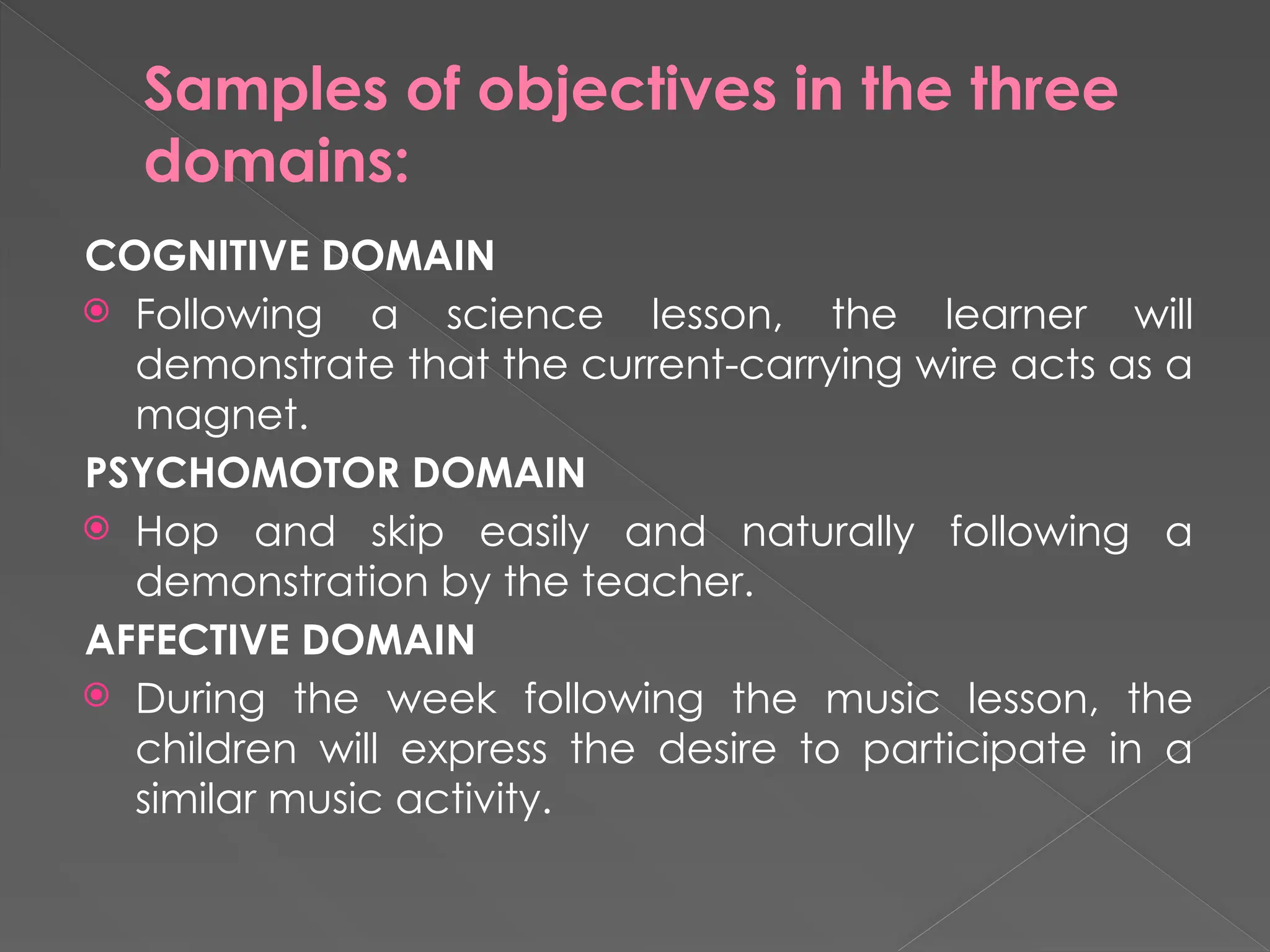
Samples of objectives in the three
domains:
COGNITIVE DOMAIN
 Following a science lesson, the learner will
demonstrate that the current-carrying wire acts as a
magnet.
PSYCHOMOTOR DOMAIN
 Hop and skip easily and naturally following a
demonstration by the teacher.
AFFECTIVE DOMAIN
 During the week following the music lesson, the
children will express the desire to participate in a
similar music activity.
POINTS TO REMEMBER IN
FORMULATING OBJECTIVES
1. A good instruction objectives states clearly
what the learners are supposed to learn.
2. As the teacher writes effective objectives,
they should try to think how they would
evaluate whether or not they have been
achieved.
3. Psychomotor objectives should be stated in
a way that clearly focuses on the learner’s
ability to do something.
ASSESSMENT PHASE
INFORMAL ASSESSMENT TECHNIQUES:
 Group discussion
 Observation
 Checklist
 Conferences
 Anecdotal records
 Work samples
 Diaries and logs
 Teacher-made tests
SAMPLES OF ASSESSMENT
TECHNIQUES
 PRODUCT CHECKLIST
 RATING SCALE
 ANECDOTAL RECORDS
 QUESTIONNAIRES
FORMAL ASSESSMENT
TECHNIQUES
 Multiple-choice items
 Alternate-response test items
 Completion items
 Matching test items
 Essay test items
 Performance tests
EVALUATION PHASE
 DATA GATHERING, ANALYZING AND INTERPRETING
(USING SOME STATISTICAL ANALYSIS/
PROCEDURES)
 RELATED TERMS:
1. Raw score – actual number of items a learner has
answered correctly.
2. Frequency – a count of items or of learners who took
the test.
3. Percentage - the number of items or learners per
hundred.
4. Frequency distribution – the number of learners who
obtain different scores.
MEASURES OF CENTRAL
TENDENCY
MEAN – this is the arithmetic average,
calculated by adding all the scores in the
distribution and dividing that sum by the
number of scores.
MEDIAN – midpoint of the distribution; it is the
value of the score that has 50% of the
scores below it and 50% above it.
MODE – this is the score that occurs most
frequently.
After the test has been scored and
checked, the results must be
analyzed and interpreted. Both
processes are done together, for
analysis is worthless without
interpretation, and interpretation
is impossible without analysis.
(Stanley and Hopkins)
REPORTING GRADES
REPORT CARDS are the traditional way
of informing parents about their
children's achievement in school. They
are issued usually on a quarterly basis.
They contain both grades and
checklist items with the traits or values
being emphasized in the school.
REFLECTION PHASE
UTILIZING ASSESSMENT RESULTS
 When assessment of one’s learners is almost over
(that means the test have been given and
scored, and the grades are ready) the final
aspect of the evaluation process is
commencing; that means, results have to be
effectively utilized.
 Results of formative assessment should make the
teachers be interested in the description of the
learning tasks his learners can and cannot do
 Score in the criterion-referenced tests tell
which specific knowledge and skills each
learner was able to comprehend or
perform.
 Results of the summative test should give
information to the teachers of the
learners performance in relation to the
entire class.
COMMUNICATING RESULTS TO PARENTS
 Periodic parent-teacher conferences are
believed to be the most ideal way of
maintaining communication between the
school and the home.
 Reporting students’ portfolios through the
exhibitions of learners’ work, such as
displays and demonstrations of what they
have learned and accomplished
 DepEd Order No. 73, s. 2012
Guidelines in the Assessment and
Marking of Learning Outcomes under the
K to 12 Basic Education Program
REMEMBER
In order that people may be happy in
their work, these three things are needed:
they must be fit for it;
they must not do too much of it; and
they must have a sense of success in
it.
- John Ruskin

ASSESSMENT OF LEARNING k to 12 basic education

  • 1.
  • 2.
    It is notenough to have a good mind. The main thing is to use it well. (Descartes)
  • 3.
    After the session,you should be able to:  Differentiate evaluation from assessment and measurement  Identify and describe alternative assessment tools and processes;  Describe the process involved in assessment and evaluation;  Acknowledge the role and importance of evaluation in improving learner performance;  Get familiar with the K to 12 Assessment and Rating of Learning Outcomes  Plan action steps in effectively utilizing assessment results for the improvement of school performance
  • 4.
    How much doyou know about evaluation and assessment? Answer the following items. 1. Evaluation 2. Assessment 3. Measurement 4. Formative evaluation 5. Summative evaluation 6. Norm-referenced test 7. Criterion-referenced test 8. Portfolio assessment 9. Performance-based 10. Authentic assessment A. Give your definition for each of the following terms:
  • 5.
    B. Answer thefollowing questions: 1. Why do we evaluate? 2. What are the steps in the evaluation process? 3. What are some forms of non-traditional assessment? 4. What are the salient features of assessment and marking system under the K to 12 BEP?
  • 6.
    EVALUATION  Evaluation isthe weighing of assessment information against some standard (such as a curriculum learning objective).  Main purposes: › to facilitate student learning › to improve instruction › to report progress to students and parents › to make decisions related to promotion
  • 7.
    Measurement & Evaluation Measurement is also known as testing. -traditionally defined as a systematic process of assigning numbers to performance -used to determine how much of a trait, attribute, or characteristic an individual has -process by which traits, characteristics, or behavior are differentiated
  • 8.
     Evaluation involvesan interpretation of what has been gathered through measurement, wherein value judgments are made about performance. - making of judgment on quality – how good the behavior or performance is. - consider asking yourself the following questions: o How will I interpret the results? o What performance standards and criteria will I use?
  • 9.
     To illustrateclearly the difference between the two terms, we could say that while measurement consists of the administration and scoring of test, evaluation is a judgment about what the different test scores mean.
  • 10.
    ASSESSMENT  the collection,evaluation, and use of information to help teachers make better decisions  more than testing or measurement  comprises of four essential components which are: (1) purpose; (2) measurement; (3) evaluation; and (4) use.
  • 11.
    Assessment can bedescribed as follows:  A method of measuring and evaluating the nature of the learner, what he/she learns and how.  The collection, interpretation and use of information to help teachers make better decisions to improve the teaching-learning process.  A mechanism for providing teachers with data for improving their teaching methods and for guiding and motivating students to be actively involved in their learning.  Give essential information about what the students are learning and about the extent to which the teachers are meeting their goals.
  • 12.
    MAJOR TYPES orKINDS of ASSESSMENT Formative Assessment Summative Assessment Diagnostic Assessment
  • 13.
    DIAGNOSTIC ASSESSMENT  occursat the beginning of the school year or before a unit of instruction;  main purposes are: a) to identify students who lack prerequisite knowledge, understanding, or skills for arrangement of remedial classes or sessions; b) to identify talented/gifted/advanced learners to ensure they are being sufficiently challenged; and c) to identify students interests.
  • 14.
    FORMATIVE ASSESSMENT  anongoing classroom process that keeps students and educators informed of students’ progress towards program learning objectives.  Its purpose is to provide corrective actions as instruction occurs to enhance student learning.  It may include:  informal observation  questioning  student responses to questions  homework  worksheet  teacher feedback to the student  It is integrated with instruction on a daily basis
  • 15.
    SUMMATIVE ASSESSMENT  happensat the end of a unit of study to summarize student progress  its purpose is to determine what has been learned over a period of time  to report progress relative to curricular objectives to students, parents, educators and other stakeholders  aims at documenting student performance after instruction is completed.  This may be accomplished through:  giving of term paper, chapter or unit test, achievement test, final exam, research project
  • 16.
    Decide whether eachof the following situations is an example of formative or summative evaluation. 1. Melissa must obtain 70% in her Spelling test to be able to receive a passing grade for the rating period. 2. Each week, learners in Mrs. Parcon’s class write a narrative essay. The learners record the percentage of words spelled correctly on their essay on a chart in their portfolios. 3. Based on his scores in a Reading Test, Ray’s teacher decides to place him in average reading group.
  • 17.
  • 18.
    NORM-REFERENCED APPROACHES  Compare performanceto a well defined norming or reference group to determine relative strengths and weaknesses of students CRITERION-REFERENCED APPROACHES  Compare student performance to an established standards rather than to other students; designed to provide a valid measure of skills and knowledge in specific areas.
  • 19.
    Identify each ofthe functions listed below as characteristics of norm-referenced or criterion- referenced test. 1. Determine whether a student is the top 10% or bottom 10% of the group. 2. Must have predetermined standards 3. Clearly demonstrates skills at a predetermined level 4. Compares student’s performance to standards 5. Compares students performance to other classmates. 6. Shows competition among students 7. Clearly defines student standing within the group
  • 20.
    Are you familiarwith the terms? Alternative assessment Authentic assessment Performance assessment
  • 21.
    NEW ASSESSMENT METHODS ALTERNATIVEASSESSMENT  Applies to and all assessments that differ from the multiple-choice, timed, and one-shot approaches that characterized many classroom assessment  Includes authentic assessment, performance- based assessment, portfolio, exhibitions, demonstrations, journals and other form of assessment  Require the active construction of meaning rather than the passive regurgitation of isolated facts.
  • 22.
     AUTHENTIC ASSESSMENTconveys the idea that assessments should engage the students in applying knowledge and skills in the same way they are used in the real world or outside of schools  PERFORMANCE ASSESSMENT refers to a variety of tasks and situations which students are given opportunities to demonstrate their understanding and to apply knowledge, skills and habits in a variety of context
  • 23.
     PORTFOLIO › Acollection of information by and about a learner to give a broader view of his or her achievement › Contains sample of a learner’s work in one or more areas › May also contain narrative descriptions, grades or other evaluations by teachers and others, official records, learner’s academic achievement, non- academic achievement or both › A profile differs from a portfolio in not including samples of a learner’s work.
  • 24.
     PERFORMANCE TASK -a task, problem or question that requires learners to construct responses and may also require them to devise or revise strategies, organize data, identify patterns, formulate models and generalization, evaluate partial and tentative solutions, and justify their answers.
  • 25.
     DEMONSTRATION OREXHIBITION OF MASTERY - often formal, more or less public performance of learner competence and skill that provides an opportunity for a summative or final assessment
  • 26.
    Authentic assessment makesuse of rubric to measure learners’ work.  RUBRIC is a scoring guide to evaluate learners’ performance based on the sum of a full range of criteria rather than a single numerical score.  It is a working guide for learners and teachers, usually handed out before the assignment begins in order to get learners to think about the criteria on which their work will be judged.  It can be analytic or holistic.  It can be created in a variety of forms and levels of complexity.
  • 27.
    SUMMARY Some of themain points presented: 1. Evaluation involves the use of measurement to obtain samples of a student’s knowledge and to compare those samples to an established set of standards, or expectations, for what is acceptable. The results of this comparison can then be used for decision-making.
  • 28.
     Assessment isdefined as the collection, evaluation, and use of information for better instructional and planning decisions to improve student learning.
  • 29.
    3. Reforms inassessment practices resulted to recent trends in assessment such as: - Congruence of assessment and instructional goals; - Shift from paper-pencil to authentic skills - Use of portfolio and rubics; and - Shift from single attribute to multidimensional assessment.
  • 30.
    4. It isimportant to note that emphasis on authentic assessment does not imply that teachers should abandon conventional testing. The significant thing to remember is that there are advantages and disadvantages of both traditional and alternative assessment and that it is more crucial to match the type of assessment with the purpose. 5. Remember, begin with purpose, and, with the knowledge of assessment options, select and implement the ones that will provide best information on the extent of the attainment of the learning targets.
  • 31.
    Direction: Identify theconcept being defined/described in each item. 1. The process of delineating, obtaining and providing useful information for judging decision alternative. 2. The collection, interpretation, and use of information to help teachers make better decision to improve the teaching learning process. 3. Type of assessment used to measure the extent to which the pupils have learned a particular objective or skill. 4. An evaluation approach wherein individual’s performance is compared to an established criteria or set of standards.
  • 32.
    5. An assessmentmethod that engages the students in applying knowledge and skills in the same way they are used in the real world outside the school. 6. A purposeful collection of a student’s work that exhibits his/her learning effort or achievements in one or more areas. 7. A scoring guide used to evaluate a student’s performance based on the sum of a range of criteria rather than a single numerical score.
  • 33.
    8. It meansdirectly observing or testing behavior or characteristics of an individual and assigning a numerical score or a rating to represent the degree to which the trait is possessed or demonstrated by an individual. 9. Type of assessment given at the end of the learning unit or at the end of the rating period. 10. An evaluation approach concerned with how one student performs in relation to others.
  • 34.
    THE EVALUATION PROCESS Can be viewed as a cyclical progress made up of four phases: 1. Preparation 2. Assessment 3. Evaluation 4. Reflection
  • 35.
    1. PREPARATION PHASE Decisions are made to identify - what is evaluated - the type of evaluation to be used (i.e., formative, summative, or diagnostic) - the criteria against which student learning outcomes will be judged - the most appropriate assessment techniques with which to gather information on student progress.
  • 36.
    2. ASSESSMENT PHASE The teacher identifies information-gathering strategies/techniques  Constructs or selects instruments  Administers them to the students  Collects and organizes the information on the student learning progress.
  • 37.
    3. EVALUATION PHASE The teacher interprets the assessment information  Makes the judgment about the student progress  Based on the judgment or evaluation, teachers make decisions about student learning programs and report on progress to students, parents, and appropriate school personnel.
  • 38.
    4. REFLECTION PHASE The teacher is given the opportunity to consider the extent to which the previous phases in the evaluation process have been successful.  The teacher evaluates the utility and appropriateness of assessment techniques used.
  • 39.
    SPECIFIC ACTIVITIES UNDERTAKENIN THE DIFFERENT PHASES OF EVALUATION PROCESS Preparation phase Instructional objectives:  Serve as guides for both teaching and learning, communicate the intent of the instruction to others  Provide guidelines for evaluating pupil learning A taxonomy is a classification scheme. The taxonomies are divided into cognitive, affective and psychomotor domains.
  • 40.
    DOMAIN DEALS WITHEXAMPLES COGNITIVE intellectual outcomes; thinking; informational learning; knowledge and knowing subject matter, facts, concepts, generalizations, intellectual skills such as critical thinking, evaluating, synthesizing, applying, comparing, contrasting AFFECTIVE Feelings, emotion, interest, attitudes, values, appreciation, ideals Art or music appreciation, enjoyment of literature, sensitivity of human needs, concern for the environment, interest in learning PSYCHOMOTOR Motor skills, physical abilities, control of muscular coordination Physical education skills, sports skills, typing, handwriting, operating equipment or machines
  • 41.
    Samples of objectivesin the three domains: COGNITIVE DOMAIN  Following a science lesson, the learner will demonstrate that the current-carrying wire acts as a magnet. PSYCHOMOTOR DOMAIN  Hop and skip easily and naturally following a demonstration by the teacher. AFFECTIVE DOMAIN  During the week following the music lesson, the children will express the desire to participate in a similar music activity.
  • 42.
    POINTS TO REMEMBERIN FORMULATING OBJECTIVES 1. A good instruction objectives states clearly what the learners are supposed to learn. 2. As the teacher writes effective objectives, they should try to think how they would evaluate whether or not they have been achieved. 3. Psychomotor objectives should be stated in a way that clearly focuses on the learner’s ability to do something.
  • 43.
    ASSESSMENT PHASE INFORMAL ASSESSMENTTECHNIQUES:  Group discussion  Observation  Checklist  Conferences  Anecdotal records  Work samples  Diaries and logs  Teacher-made tests
  • 44.
    SAMPLES OF ASSESSMENT TECHNIQUES PRODUCT CHECKLIST  RATING SCALE  ANECDOTAL RECORDS  QUESTIONNAIRES
  • 45.
    FORMAL ASSESSMENT TECHNIQUES  Multiple-choiceitems  Alternate-response test items  Completion items  Matching test items  Essay test items  Performance tests
  • 46.
    EVALUATION PHASE  DATAGATHERING, ANALYZING AND INTERPRETING (USING SOME STATISTICAL ANALYSIS/ PROCEDURES)  RELATED TERMS: 1. Raw score – actual number of items a learner has answered correctly. 2. Frequency – a count of items or of learners who took the test. 3. Percentage - the number of items or learners per hundred. 4. Frequency distribution – the number of learners who obtain different scores.
  • 47.
    MEASURES OF CENTRAL TENDENCY MEAN– this is the arithmetic average, calculated by adding all the scores in the distribution and dividing that sum by the number of scores. MEDIAN – midpoint of the distribution; it is the value of the score that has 50% of the scores below it and 50% above it. MODE – this is the score that occurs most frequently.
  • 48.
    After the testhas been scored and checked, the results must be analyzed and interpreted. Both processes are done together, for analysis is worthless without interpretation, and interpretation is impossible without analysis. (Stanley and Hopkins)
  • 49.
    REPORTING GRADES REPORT CARDSare the traditional way of informing parents about their children's achievement in school. They are issued usually on a quarterly basis. They contain both grades and checklist items with the traits or values being emphasized in the school.
  • 50.
    REFLECTION PHASE UTILIZING ASSESSMENTRESULTS  When assessment of one’s learners is almost over (that means the test have been given and scored, and the grades are ready) the final aspect of the evaluation process is commencing; that means, results have to be effectively utilized.  Results of formative assessment should make the teachers be interested in the description of the learning tasks his learners can and cannot do
  • 51.
     Score inthe criterion-referenced tests tell which specific knowledge and skills each learner was able to comprehend or perform.  Results of the summative test should give information to the teachers of the learners performance in relation to the entire class.
  • 52.
    COMMUNICATING RESULTS TOPARENTS  Periodic parent-teacher conferences are believed to be the most ideal way of maintaining communication between the school and the home.  Reporting students’ portfolios through the exhibitions of learners’ work, such as displays and demonstrations of what they have learned and accomplished
  • 53.
     DepEd OrderNo. 73, s. 2012 Guidelines in the Assessment and Marking of Learning Outcomes under the K to 12 Basic Education Program
  • 54.
    REMEMBER In order thatpeople may be happy in their work, these three things are needed: they must be fit for it; they must not do too much of it; and they must have a sense of success in it. - John Ruskin