DIRECTIONS:
Multiple
Choice
Read and understand the
questions and write the best
answer.
Question 1
How is sedimentary rocks
primarily formed?
a) Cooling of magma
b) Compression of sediments
c) Melting of other rocks
d) Crystallization of minerals
Question 2
What type of rock is formed from
heat and pressure applied to
other rocks?
a) Igneous
b) Sedimentary
c) Metamorphic
d) Magma
Question 3
Rocks that form from the
solidification of magma or
lava are called:
a) Sedimentary rocks
b) Metamorphic rocks
c) Igneous rocks
d) Fossilized rocks
Question 4
Limestone, which is often formed
from accumulated marine
organisms, is classified as:
a) Igneous
b) Sedimentary
c) Metamorphic
d) Volcanic
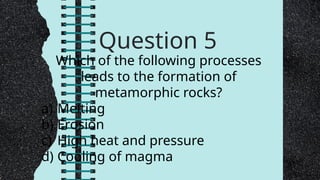
Question 5
Which of the following processes
leads to the formation of
metamorphic rocks?
a) Melting
b) Erosion
c) High heat and pressure
d) Cooling of magma
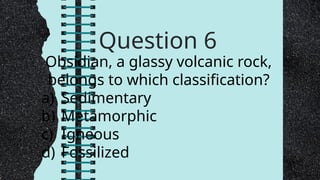
Question 6
Obsidian, a glassy volcanic rock,
belongs to which classification?
a) Sedimentary
b) Metamorphic
c) Igneous
d) Fossilized
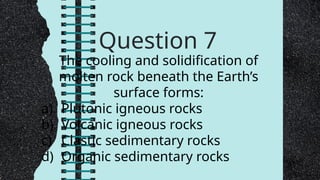
Question 7
The cooling and solidification of
molten rock beneath the Earth’s
surface forms:
a) Plutonic igneous rocks
b) Volcanic igneous rocks
c) Clastic sedimentary rocks
d) Organic sedimentary rocks
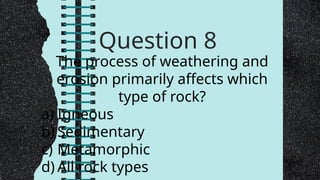
Question 8
The process of weathering and
erosion primarily affects which
type of rock?
a) Igneous
b) Sedimentary
c) Metamorphic
d) All rock types
Question 9
What is the primary characteristic of
igneous rocks?
a) They are formed by sediment
deposition.
b) They are formed under intense heat
and pressure.
c) They crystallize from molten material.
d) They contain fossils.
Question 10
Which of the following processes is the
starting point for the formation of
sedimentary rocks in the rock cycle?
a) Crystallization of magma
b) Weathering and erosion
c) Melting of rocks
d) Metamorphism
Question 11
Which process best explains the transition
from sedimentary rock to metamorphic rock?
a) The rock is melted and then cooled
rapidly.
b) The rock undergoes high heat and
pressure without melting.
c) The rock is weathered into smaller
particles.
d) The rock cools from molten magma.
Question 12
Which of the following best describes how
magma is produced in the rock cycle?
a) It forms from the cooling of igneous rocks.
b) It forms when rocks are subjected to intense
heat deep beneath Earth’s surface.
c) It forms from the cementation of sediments.
d) It forms when rocks undergo erosion.
Question 13
In the rock cycle, how does heat and
pressure affect igneous and sedimentary
rocks?
a) They cause the rocks to melt and become
magma.
b) They cause the rocks to undergo erosion and
become sediments.
c) They transform the rocks into metamorphic
rocks.
d) They cool the rocks to form new igneous rocks.
Question 14
Which part of the rock cycle
directly contributes to the
formation of soil?
a) Erosion of sedimentary rocks
b) Cooling of igneous rocks
c) Compaction of sediments
d) Metamorphism of rocks.
Question 15
What is the primary reason why
sedimentary rocks are often layered?
a) They are formed by multiple layers of molten
materials.
b) They form through deposition of sediments
over long periods.
c) They are subject to constant pressure
changes.
d) They are melted and re-solidified in layers.


ASSESSMENT-1-1-Rocks and its types .pptx

  • 1.
    DIRECTIONS: Multiple Choice Read and understandthe questions and write the best answer.
  • 2.
    Question 1 How issedimentary rocks primarily formed? a) Cooling of magma b) Compression of sediments c) Melting of other rocks d) Crystallization of minerals
  • 3.
    Question 2 What typeof rock is formed from heat and pressure applied to other rocks? a) Igneous b) Sedimentary c) Metamorphic d) Magma
  • 4.
    Question 3 Rocks thatform from the solidification of magma or lava are called: a) Sedimentary rocks b) Metamorphic rocks c) Igneous rocks d) Fossilized rocks
  • 5.
    Question 4 Limestone, whichis often formed from accumulated marine organisms, is classified as: a) Igneous b) Sedimentary c) Metamorphic d) Volcanic
  • 6.
    Question 5 Which ofthe following processes leads to the formation of metamorphic rocks? a) Melting b) Erosion c) High heat and pressure d) Cooling of magma
  • 7.
    Question 6 Obsidian, aglassy volcanic rock, belongs to which classification? a) Sedimentary b) Metamorphic c) Igneous d) Fossilized
  • 8.
    Question 7 The coolingand solidification of molten rock beneath the Earth’s surface forms: a) Plutonic igneous rocks b) Volcanic igneous rocks c) Clastic sedimentary rocks d) Organic sedimentary rocks
  • 9.
    Question 8 The processof weathering and erosion primarily affects which type of rock? a) Igneous b) Sedimentary c) Metamorphic d) All rock types
  • 10.
    Question 9 What isthe primary characteristic of igneous rocks? a) They are formed by sediment deposition. b) They are formed under intense heat and pressure. c) They crystallize from molten material. d) They contain fossils.
  • 11.
    Question 10 Which ofthe following processes is the starting point for the formation of sedimentary rocks in the rock cycle? a) Crystallization of magma b) Weathering and erosion c) Melting of rocks d) Metamorphism
  • 12.
    Question 11 Which processbest explains the transition from sedimentary rock to metamorphic rock? a) The rock is melted and then cooled rapidly. b) The rock undergoes high heat and pressure without melting. c) The rock is weathered into smaller particles. d) The rock cools from molten magma.
  • 13.
    Question 12 Which ofthe following best describes how magma is produced in the rock cycle? a) It forms from the cooling of igneous rocks. b) It forms when rocks are subjected to intense heat deep beneath Earth’s surface. c) It forms from the cementation of sediments. d) It forms when rocks undergo erosion.
  • 14.
    Question 13 In therock cycle, how does heat and pressure affect igneous and sedimentary rocks? a) They cause the rocks to melt and become magma. b) They cause the rocks to undergo erosion and become sediments. c) They transform the rocks into metamorphic rocks. d) They cool the rocks to form new igneous rocks.
  • 15.
    Question 14 Which partof the rock cycle directly contributes to the formation of soil? a) Erosion of sedimentary rocks b) Cooling of igneous rocks c) Compaction of sediments d) Metamorphism of rocks.
  • 16.
    Question 15 What isthe primary reason why sedimentary rocks are often layered? a) They are formed by multiple layers of molten materials. b) They form through deposition of sediments over long periods. c) They are subject to constant pressure changes. d) They are melted and re-solidified in layers.