Content outline
• Profession
• Accountability
 Meaning,
 Definition,
 Characteristics,
 Line of accountability,
 Framework & pillar of accountability
• Professional accountability:
 concept,
 definition,
 regulation in profession,
 elements of professional accountability,
 Principles of professional accountability.
• Professional accountability in Nursing
• Ways to promote professional accountability
Content outline
Profession
A profession is an occupation
with ethical components that
is devoted to human and
social welfare. The service and
knowledge by a profession are
based on specialized skills.
MEANING :
• Accountability involves assuring only the responsibility that are
within one's scope of practice and not assuming responsibility for
activities in which competencies has not been achieved
• Accountability involves admitting mistakes rather than blaming
others and evaluating the outcomes of one's own actions
Definitions
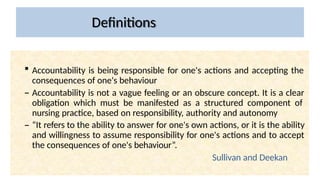
 Accountability is being responsible for one's actions and accepting the
consequences of one's behaviour
– Accountability is not a vague feeling or an obscure concept. It is a clear
obligation which must be manifested as a structured component of
nursing practice, based on responsibility, authority and autonomy
– “It refers to the ability to answer for one's own actions, or it is the ability
and willingness to assume responsibility for one's actions and to accept
the consequences of one's behaviour”.
Sullivan and Deekan
Definition Cont…
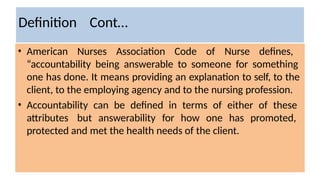
• American Nurses Association Code of Nurse defines,
“accountability being answerable to someone for something
one has done. It means providing an explanation to self, to the
client, to the employing agency and to the nursing profession.
• Accountability can be defined in terms of either of these
attributes but answerability for how one has promoted,
protected and met the health needs of the client.
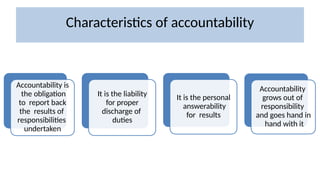
Characteristics of accountability
Accountability is
the obligation
to report back
the results of
responsibilities
undertaken
It is the liability
for proper
discharge of
duties
It is the personal
answerability
for results
Accountability
grows out of
responsibility
and goes hand in
hand with it
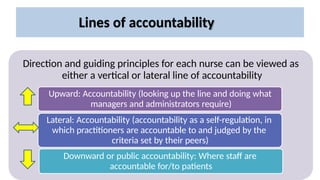
Lines of accountability
Direction and guiding principles for each nurse can be viewed as
either a vertical or lateral line of accountability
Upward: Accountability (looking up the line and doing what
managers and administrators require)
Lateral: Accountability (accountability as a self-regulation, in
which practitioners are accountable to and judged by the
criteria set by their peers)
Downward or public accountability: Where staff are
accountable for/to patients
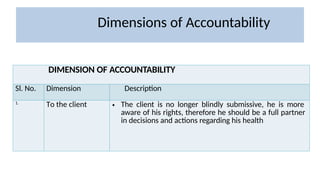
Dimensions of Accountability
DIMENSION OF ACCOUNTABILITY
Sl. No. Dimension Description
1.
To the client • The client is no longer blindly submissive, he is more
aware of his rights, therefore he should be a full partner
in decisions and actions regarding his health
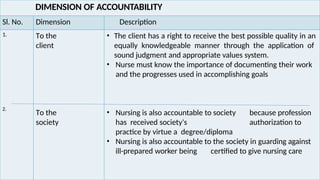
DIMENSION OF ACCOUNTABILITY
Sl. No. Dimension Description
1.
2.
To the
client
To the
society
• The client has a right to receive the best possible quality in an
equally knowledgeable manner through the application of
sound judgment and appropriate values system.
• Nurse must know the importance of documenting their work
and the progresses used in accomplishing goals
• Nursing is also accountable to society because profession
has received society's authorization to
practice by virtue a degree/diploma
• Nursing is also accountable to the society in guarding against
ill-prepared worker being certified to give nursing care
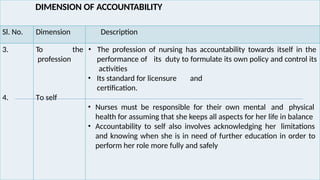
DIMENSION OF ACCOUNTABILITY
Sl. No. Dimension Description
3.
4. To self
To the • The profession of nursing has accountability towards itself in the
profession performance of its duty to formulate its own policy and control its
activities
• Its standard for licensure and
certification.
• Nurses must be responsible for their own mental and physical
health for assuming that she keeps all aspects for her life in balance
• Accountability to self also involves acknowledging her limitations
and knowing when she is in need of further education in order to
perform her role more fully and safely
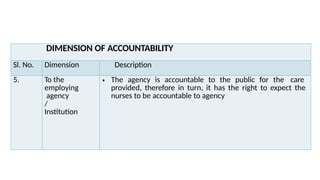
DIMENSION OF ACCOUNTABILITY
Sl. No. Dimension Description
5. To the
employing
agency
/
Institution
• The agency is accountable to the public for the care
provided, therefore in turn, it has the right to expect the
nurses to be accountable to agency
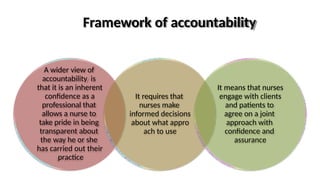
Framework of accountability
A wider view of
accountability is
that it is an inherent
confidence as a
professional that
allows a nurse to
take pride in being
transparent about
the way he or she
has carried out their
practice
It requires that
nurses make
informed decisions
about what appro
ach to use
It means that nurses
engage with clients
and patients to
agree on a joint
approach with
confidence and
assurance
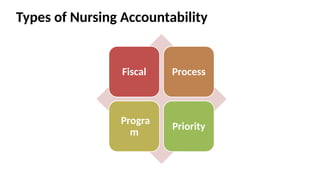
Types of Nursing Accountability
Fiscal Process
Progra
m
Priority
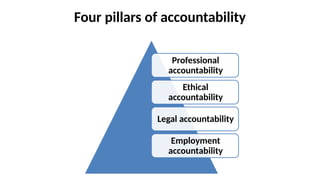
Four pillars of accountability
Professional
accountability
Ethical
accountability
Legal accountability
Employment
accountability
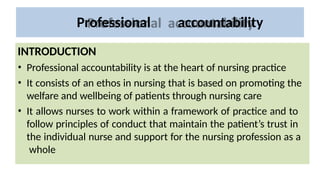
Professional accountability
INTRODUCTION
• Professional accountability is at the heart of nursing practice
• It consists of an ethos in nursing that is based on promoting the
welfare and wellbeing of patients through nursing care
• It allows nurses to work within a framework of practice and to
follow principles of conduct that maintain the patient’s trust in
the individual nurse and support for the nursing profession as a
whole
Professional Accountability cont…
• It drives to demonstrate professional accountability led to the
creation of a body which is responsible for setting the
standards of conduct and practice for nurses i.e the regulatory
body for nurses and midwives
• Manifesting accountability in nursing practice provides the
opportunity to evaluate nursing contribution within health care
and is a means of clarifying the significance of nursing to
society
Development of Nursing as an Accountable
Profession
• Susan McGann traces the development of nursing as an
accountable profession in 1919
• Achieving professional status was a struggle for nurses
• With the passing of the Nurses’ Registration Acts, in 1919, nurses
in Britain achieved the status of an accountable profession
Concept of professional accountability
• The concepts have two major attributes :
- Answerability
- Responsibility
• The modern concept of professional accountability, applied
to nursing, assumes that the nurse is a member of a
profession
• It depends on individual nurses being aware of their
membership of a profession and accepting that status, with
the rights and responsibilities that go with it
Concept of professional accountability
Cont…
• With the passing of the Nurses Registration Act, in 1919,
nurses in Britain achieved the status of an accountable
profession, which meant that registered nurses were legally
accountable for their work and can be struck off the register
for unprofessional behaviour (Tilley and Watson 2004).
Regulatory bodies : INTERNATIONAL AGENCIES
International agencies
international council
of nurses (ICN)
American nurses
association (ANA)
Canadian nurses
association (CNA)
Australian nurses and
midwives association
British nurses
association
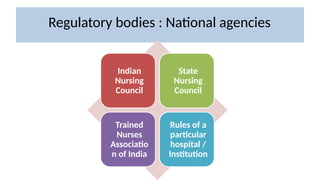
Regulatory bodies : National agencies
Indian
Nursing
Council
State
Nursing
Council
Trained
Nurses
Associatio
n of India
Rules of a
particular
hospital /
Institution
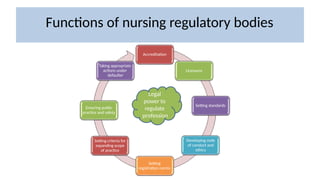
Functions of nursing regulatory bodies
Accreditation
Licensure
Setting standards
Developing code
of conduct and
ethics
Setting
registration norms
Setting criteria for
expanding scope
of practice
Ensuring public
practice and safety
Taking appropriate
actions under
defaulter
Legal
power to
regulate
profession
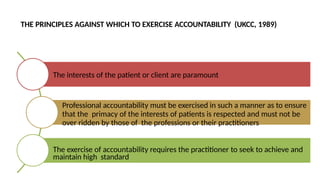
THE PRINCIPLES AGAINST WHICH TO EXERCISE ACCOUNTABILITY (UKCC, 1989)
The interests of the patient or client are paramount
Professional accountability must be exercised in such a manner as to ensure
that the primacy of the interests of patients is respected and must not be
over ridden by those of the professions or their practitioners
The exercise of accountability requires the practitioner to seek to achieve and
maintain high standard
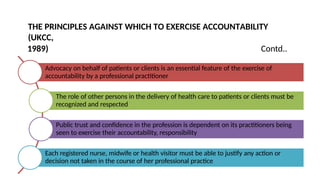
THE PRINCIPLES AGAINST WHICH TO EXERCISE ACCOUNTABILITY
(UKCC,
1989) Contd..
Advocacy on behalf of patients or clients is an essential feature of the exercise of
accountability by a professional practitioner
The role of other persons in the delivery of health care to patients or clients must be
recognized and respected
Public trust and confidence in the profession is dependent on its practitioners being
seen to exercise their accountability, responsibility
Each registered nurse, midwife or health visitor must be able to justify any action or
decision not taken in the course of her professional practice
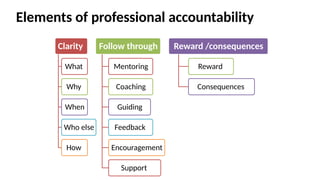
Elements of professional accountability
Clarity
What
Why
When
Who else
How
Follow through
Mentoring
Coaching
Guiding
Feedback
Encouragement
Support
Reward /consequences
Reward
Consequences
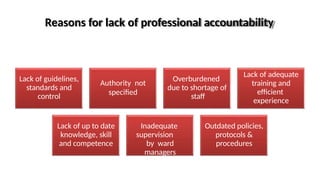
Reasons for lack of professional accountability
Lack of guidelines,
standards and
control
Authority not
specified
Overburdened
due to shortage of
staff
Lack of adequate
training and
efficient
experience
Lack of up to date
knowledge, skill
and competence
Inadequate
supervision
by ward
managers
Outdated policies,
protocols &
procedures
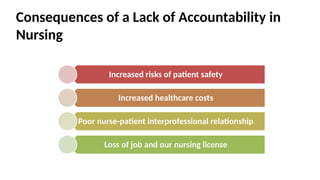
Consequences of a Lack of Accountability in
Nursing
Increased risks of patient safety
Increased healthcare costs
Poor nurse-patient interprofessional relationship
Loss of job and our nursing license
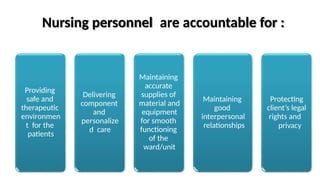
Nursing personnel are accountable for :
Providing
safe and
therapeutic
environmen
t for the
patients
Delivering
component
and
personalize
d care
Maintaining
accurate
supplies of
material and
equipment
for smooth
functioning
of the
ward/unit
Maintaining
good
interpersonal
relationships
Protecting
client’s legal
rights and
privacy
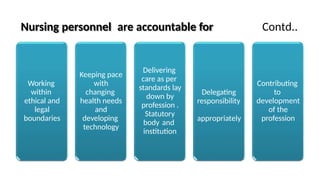
Nursing personnel are accountable for Contd..
Working
within
ethical and
legal
boundaries
Keeping pace
with
changing
health needs
and
developing
technology
Delivering
care as per
standards lay
down by
profession .
Statutory
body and
institution
Delegating
responsibility
appropriately
Contributing
to
development
of the
profession
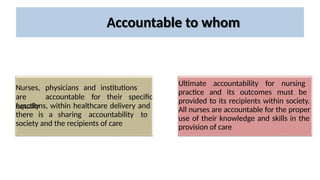
Accountable to whom
Nurses, physicians and institutions
are
equally
accountable for their specific
functions, within healthcare delivery and
there is a sharing accountability to
society and the recipients of care
Ultimate accountability for nursing
practice and its outcomes must be
provided to its recipients within society.
All nurses are accountable for the proper
use of their knowledge and skills in the
provision of care
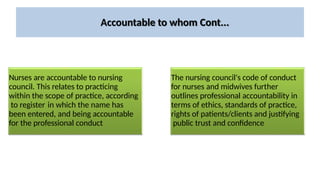
Accountable to whom Cont...
Nurses are accountable to nursing
council. This relates to practicing
within the scope of practice, according
to register in which the name has
been entered, and being accountable
for the professional conduct
The nursing council's code of conduct
for nurses and midwives further
outlines professional accountability in
terms of ethics, standards of practice,
rights of patients/clients and justifying
public trust and confidence
Accountable to whom Contd..
Professional actions are
explainable to the clients and the
employer
Healthcare institutions also play a
role in accountability by
monitoring individual and
institutional compliance with
national standards
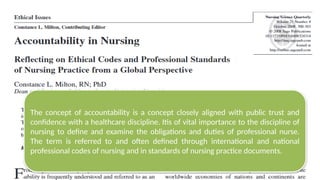
The concept of accountability is a concept closely aligned with public trust and
confidence with a healthcare discipline. Itis of vital importance to the discipline of
nursing to define and examine the obligations and duties of professional nurse.
The term is referred to and often defined through international and national
professional codes of nursing and in standards of nursing practice documents.
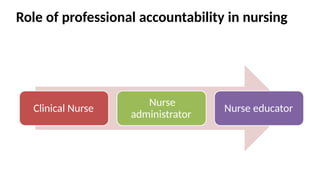
Role of professional accountability in nursing
Clinical Nurse
Nurse
administrator
Nurse educator
Role of professional accountability in nursing
• The registered nurse is accountable to the public for competent,
safe and ethical practice. It helps:
1. Each registered nurse: Practices in accordance with:
o The Registered Nurses Act, Regulation and by-laws
o The standards for nursing practice
o The code of ethics for registered nurses
o Other relevant acts and legislation
Role of professional accountability in nursing
Contd…
2. Makes nurses responsible for own actions and decisions at all
the times
3. Recognizes and reports errors and takes all necessary action to
prevent and minimize harm arising from an adverse event
4. Takes action in situations where client safety and well-being is
potentially or actually compromised
5. Exercises reasonable judgment in practice
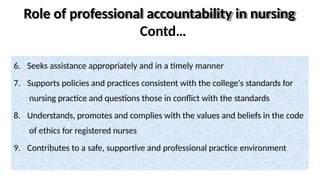
Role of professional accountability in nursing
Contd…
6. Seeks assistance appropriately and in a timely manner
7. Supports policies and practices consistent with the college's standards for
nursing practice and questions those in conflict with the standards
8. Understands, promotes and complies with the values and beliefs in the code
of ethics for registered nurses
9. Contributes to a safe, supportive and professional practice environment
For Nurse Administrator
Promotes a practice environment that supports professional accountability.
Promotes a quality practice environment that supports nurse's ability to
provide safe, effective and ethical nursing practice.
For Nurse Educator
 Promotes a learning environment that supports professional accountability.
 Provides appropriate supervision of learners that supports their ability to
provide safe, effective and ethical nursing practice.
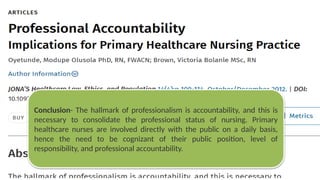
Conclusion- The hallmark of professionalism is accountability, and this is
necessary to consolidate the professional status of nursing. Primary
healthcare nurses are involved directly with the public on a daily basis,
hence the need to be cognizant of their public position, level of
responsibility, and professional accountability.
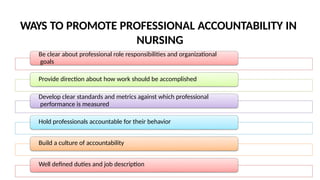
WAYS TO PROMOTE PROFESSIONAL ACCOUNTABILITY IN
NURSING
Be clear about professional role responsibilities and organizational
goals
Provide direction about how work should be accomplished
Develop clear standards and metrics against which professional
performance is measured
Hold professionals accountable for their behavior
Build a culture of accountability
Well defined duties and job description
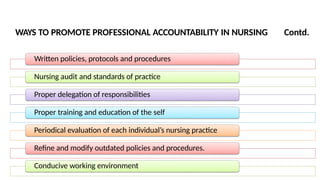
WAYS TO PROMOTE PROFESSIONAL ACCOUNTABILITY IN NURSING Contd.
Written policies, protocols and procedures
Nursing audit and standards of practice
Proper delegation of responsibilities
Proper training and education of the self
Periodical evaluation of each individual’s nursing practice
Refine and modify outdated policies and procedures.
Conducive working environment
CONCLUSION
• The person or position accountable for a task is responsible for
insuring that it is completed on-time and in a manner which meets all
expectations for it
• Accountability must never be used as a device for placing blame or
designating a scapegoat
• Developing accountability does not mean relinquishing accountability
on management's part
• However, as the group matures, members expect to be held more
accountable for their own results
References
• Clement I. Textbook on professional trends and adjustments in nursing. 1st
edition. Jaypee Brothers Medical Publishers ; New Delhi : 2016. Pp 116-17
• Basavanthapa B T. Nursing administration. 3rd edition . Jaypee
Brothers Medical Publishers; New Delhi: 2014 . pp 88-89
• Rawat HC. Brar NK. Textbook of Advanced Nursing Practice. 1st edition.
Jaypee Brothers Medical Publishers. New Delhi.2014 . pp 13-16
• Krautscheid LC. Defining professional nursing accountability: a literature
review. Journal of Professional Nursing. 2014 Jan 1;30(1):43-7
• Transitions to Professional Nursing Practice. Authored by: Jamie
Murphy. Provided by: SUNY Delhi. Located at:
https://courses.lumenlearning.com/suny-delhi-professionalnursing.
References
• Basvanthapa BT. Nursing administration. 2nd edition .Jaypee Brothers
Medical Publishers: New Delhi;2014. pp 664-74.
• Basvanthapa BT. Nursing education, 1st edition 2003, Jaypee Brothers Medical
Publishers, New Delhi, p 77-9.
• Chitty KK. Professional Nursing. Elsevier, 4th edition, p 31, 63, 197, 579.
• Loretta EH. Teaching and learning in school of nursing, 3rd edition 2005,
Konark Publishers. p 187-90.
• Perry P. Fundamentals of Nursing, Elsevier, 7th edition, p 3-4.
• Suzanne SC, Brenda BG. Medical Surgical Nursing, Lippioncott. Jaypee Brothers
Medical Publishers, New Delhi, 10th edition, 2004; Volume-1, p 125-41.
• Www.Currentnursing.Com
• Www.Indiannursing.Com
assertiveness.power point presentations in management

assertiveness.power point presentations in management

  • 2.
    Content outline • Profession •Accountability  Meaning,  Definition,  Characteristics,  Line of accountability,  Framework & pillar of accountability
  • 3.
    • Professional accountability: concept,  definition,  regulation in profession,  elements of professional accountability,  Principles of professional accountability. • Professional accountability in Nursing • Ways to promote professional accountability Content outline
  • 4.
    Profession A profession isan occupation with ethical components that is devoted to human and social welfare. The service and knowledge by a profession are based on specialized skills.
  • 5.
    MEANING : • Accountabilityinvolves assuring only the responsibility that are within one's scope of practice and not assuming responsibility for activities in which competencies has not been achieved • Accountability involves admitting mistakes rather than blaming others and evaluating the outcomes of one's own actions
  • 6.
    Definitions  Accountability isbeing responsible for one's actions and accepting the consequences of one's behaviour – Accountability is not a vague feeling or an obscure concept. It is a clear obligation which must be manifested as a structured component of nursing practice, based on responsibility, authority and autonomy – “It refers to the ability to answer for one's own actions, or it is the ability and willingness to assume responsibility for one's actions and to accept the consequences of one's behaviour”. Sullivan and Deekan
  • 7.
    Definition Cont… • AmericanNurses Association Code of Nurse defines, “accountability being answerable to someone for something one has done. It means providing an explanation to self, to the client, to the employing agency and to the nursing profession. • Accountability can be defined in terms of either of these attributes but answerability for how one has promoted, protected and met the health needs of the client.
  • 8.
    Characteristics of accountability Accountabilityis the obligation to report back the results of responsibilities undertaken It is the liability for proper discharge of duties It is the personal answerability for results Accountability grows out of responsibility and goes hand in hand with it
  • 9.
    Lines of accountability Directionand guiding principles for each nurse can be viewed as either a vertical or lateral line of accountability Upward: Accountability (looking up the line and doing what managers and administrators require) Lateral: Accountability (accountability as a self-regulation, in which practitioners are accountable to and judged by the criteria set by their peers) Downward or public accountability: Where staff are accountable for/to patients
  • 10.
    Dimensions of Accountability DIMENSIONOF ACCOUNTABILITY Sl. No. Dimension Description 1. To the client • The client is no longer blindly submissive, he is more aware of his rights, therefore he should be a full partner in decisions and actions regarding his health
  • 11.
    DIMENSION OF ACCOUNTABILITY Sl.No. Dimension Description 1. 2. To the client To the society • The client has a right to receive the best possible quality in an equally knowledgeable manner through the application of sound judgment and appropriate values system. • Nurse must know the importance of documenting their work and the progresses used in accomplishing goals • Nursing is also accountable to society because profession has received society's authorization to practice by virtue a degree/diploma • Nursing is also accountable to the society in guarding against ill-prepared worker being certified to give nursing care
  • 12.
    DIMENSION OF ACCOUNTABILITY Sl.No. Dimension Description 3. 4. To self To the • The profession of nursing has accountability towards itself in the profession performance of its duty to formulate its own policy and control its activities • Its standard for licensure and certification. • Nurses must be responsible for their own mental and physical health for assuming that she keeps all aspects for her life in balance • Accountability to self also involves acknowledging her limitations and knowing when she is in need of further education in order to perform her role more fully and safely
  • 13.
    DIMENSION OF ACCOUNTABILITY Sl.No. Dimension Description 5. To the employing agency / Institution • The agency is accountable to the public for the care provided, therefore in turn, it has the right to expect the nurses to be accountable to agency
  • 14.
    Framework of accountability Awider view of accountability is that it is an inherent confidence as a professional that allows a nurse to take pride in being transparent about the way he or she has carried out their practice It requires that nurses make informed decisions about what appro ach to use It means that nurses engage with clients and patients to agree on a joint approach with confidence and assurance
  • 15.
    Types of NursingAccountability Fiscal Process Progra m Priority
  • 16.
    Four pillars ofaccountability Professional accountability Ethical accountability Legal accountability Employment accountability
  • 17.
    Professional accountability INTRODUCTION • Professionalaccountability is at the heart of nursing practice • It consists of an ethos in nursing that is based on promoting the welfare and wellbeing of patients through nursing care • It allows nurses to work within a framework of practice and to follow principles of conduct that maintain the patient’s trust in the individual nurse and support for the nursing profession as a whole
  • 18.
    Professional Accountability cont… •It drives to demonstrate professional accountability led to the creation of a body which is responsible for setting the standards of conduct and practice for nurses i.e the regulatory body for nurses and midwives • Manifesting accountability in nursing practice provides the opportunity to evaluate nursing contribution within health care and is a means of clarifying the significance of nursing to society
  • 19.
    Development of Nursingas an Accountable Profession • Susan McGann traces the development of nursing as an accountable profession in 1919 • Achieving professional status was a struggle for nurses • With the passing of the Nurses’ Registration Acts, in 1919, nurses in Britain achieved the status of an accountable profession
  • 20.
    Concept of professionalaccountability • The concepts have two major attributes : - Answerability - Responsibility • The modern concept of professional accountability, applied to nursing, assumes that the nurse is a member of a profession • It depends on individual nurses being aware of their membership of a profession and accepting that status, with the rights and responsibilities that go with it
  • 21.
    Concept of professionalaccountability Cont… • With the passing of the Nurses Registration Act, in 1919, nurses in Britain achieved the status of an accountable profession, which meant that registered nurses were legally accountable for their work and can be struck off the register for unprofessional behaviour (Tilley and Watson 2004).
  • 22.
    Regulatory bodies :INTERNATIONAL AGENCIES International agencies international council of nurses (ICN) American nurses association (ANA) Canadian nurses association (CNA) Australian nurses and midwives association British nurses association
  • 23.
    Regulatory bodies :National agencies Indian Nursing Council State Nursing Council Trained Nurses Associatio n of India Rules of a particular hospital / Institution
  • 24.
    Functions of nursingregulatory bodies Accreditation Licensure Setting standards Developing code of conduct and ethics Setting registration norms Setting criteria for expanding scope of practice Ensuring public practice and safety Taking appropriate actions under defaulter Legal power to regulate profession
  • 25.
    THE PRINCIPLES AGAINSTWHICH TO EXERCISE ACCOUNTABILITY (UKCC, 1989) The interests of the patient or client are paramount Professional accountability must be exercised in such a manner as to ensure that the primacy of the interests of patients is respected and must not be over ridden by those of the professions or their practitioners The exercise of accountability requires the practitioner to seek to achieve and maintain high standard
  • 26.
    THE PRINCIPLES AGAINSTWHICH TO EXERCISE ACCOUNTABILITY (UKCC, 1989) Contd.. Advocacy on behalf of patients or clients is an essential feature of the exercise of accountability by a professional practitioner The role of other persons in the delivery of health care to patients or clients must be recognized and respected Public trust and confidence in the profession is dependent on its practitioners being seen to exercise their accountability, responsibility Each registered nurse, midwife or health visitor must be able to justify any action or decision not taken in the course of her professional practice
  • 27.
    Elements of professionalaccountability Clarity What Why When Who else How Follow through Mentoring Coaching Guiding Feedback Encouragement Support Reward /consequences Reward Consequences
  • 28.
    Reasons for lackof professional accountability Lack of guidelines, standards and control Authority not specified Overburdened due to shortage of staff Lack of adequate training and efficient experience Lack of up to date knowledge, skill and competence Inadequate supervision by ward managers Outdated policies, protocols & procedures
  • 29.
    Consequences of aLack of Accountability in Nursing Increased risks of patient safety Increased healthcare costs Poor nurse-patient interprofessional relationship Loss of job and our nursing license
  • 30.
    Nursing personnel areaccountable for : Providing safe and therapeutic environmen t for the patients Delivering component and personalize d care Maintaining accurate supplies of material and equipment for smooth functioning of the ward/unit Maintaining good interpersonal relationships Protecting client’s legal rights and privacy
  • 31.
    Nursing personnel areaccountable for Contd.. Working within ethical and legal boundaries Keeping pace with changing health needs and developing technology Delivering care as per standards lay down by profession . Statutory body and institution Delegating responsibility appropriately Contributing to development of the profession
  • 32.
    Accountable to whom Nurses,physicians and institutions are equally accountable for their specific functions, within healthcare delivery and there is a sharing accountability to society and the recipients of care Ultimate accountability for nursing practice and its outcomes must be provided to its recipients within society. All nurses are accountable for the proper use of their knowledge and skills in the provision of care
  • 33.
    Accountable to whomCont... Nurses are accountable to nursing council. This relates to practicing within the scope of practice, according to register in which the name has been entered, and being accountable for the professional conduct The nursing council's code of conduct for nurses and midwives further outlines professional accountability in terms of ethics, standards of practice, rights of patients/clients and justifying public trust and confidence
  • 34.
    Accountable to whomContd.. Professional actions are explainable to the clients and the employer Healthcare institutions also play a role in accountability by monitoring individual and institutional compliance with national standards
  • 35.
    The concept ofaccountability is a concept closely aligned with public trust and confidence with a healthcare discipline. Itis of vital importance to the discipline of nursing to define and examine the obligations and duties of professional nurse. The term is referred to and often defined through international and national professional codes of nursing and in standards of nursing practice documents.
  • 36.
    Role of professionalaccountability in nursing Clinical Nurse Nurse administrator Nurse educator
  • 37.
    Role of professionalaccountability in nursing • The registered nurse is accountable to the public for competent, safe and ethical practice. It helps: 1. Each registered nurse: Practices in accordance with: o The Registered Nurses Act, Regulation and by-laws o The standards for nursing practice o The code of ethics for registered nurses o Other relevant acts and legislation
  • 38.
    Role of professionalaccountability in nursing Contd… 2. Makes nurses responsible for own actions and decisions at all the times 3. Recognizes and reports errors and takes all necessary action to prevent and minimize harm arising from an adverse event 4. Takes action in situations where client safety and well-being is potentially or actually compromised 5. Exercises reasonable judgment in practice
  • 39.
    Role of professionalaccountability in nursing Contd… 6. Seeks assistance appropriately and in a timely manner 7. Supports policies and practices consistent with the college's standards for nursing practice and questions those in conflict with the standards 8. Understands, promotes and complies with the values and beliefs in the code of ethics for registered nurses 9. Contributes to a safe, supportive and professional practice environment
  • 40.
    For Nurse Administrator Promotesa practice environment that supports professional accountability. Promotes a quality practice environment that supports nurse's ability to provide safe, effective and ethical nursing practice.
  • 41.
    For Nurse Educator Promotes a learning environment that supports professional accountability.  Provides appropriate supervision of learners that supports their ability to provide safe, effective and ethical nursing practice.
  • 42.
    Conclusion- The hallmarkof professionalism is accountability, and this is necessary to consolidate the professional status of nursing. Primary healthcare nurses are involved directly with the public on a daily basis, hence the need to be cognizant of their public position, level of responsibility, and professional accountability.
  • 44.
    WAYS TO PROMOTEPROFESSIONAL ACCOUNTABILITY IN NURSING Be clear about professional role responsibilities and organizational goals Provide direction about how work should be accomplished Develop clear standards and metrics against which professional performance is measured Hold professionals accountable for their behavior Build a culture of accountability Well defined duties and job description
  • 45.
    WAYS TO PROMOTEPROFESSIONAL ACCOUNTABILITY IN NURSING Contd. Written policies, protocols and procedures Nursing audit and standards of practice Proper delegation of responsibilities Proper training and education of the self Periodical evaluation of each individual’s nursing practice Refine and modify outdated policies and procedures. Conducive working environment
  • 46.
    CONCLUSION • The personor position accountable for a task is responsible for insuring that it is completed on-time and in a manner which meets all expectations for it • Accountability must never be used as a device for placing blame or designating a scapegoat • Developing accountability does not mean relinquishing accountability on management's part • However, as the group matures, members expect to be held more accountable for their own results
  • 47.
    References • Clement I.Textbook on professional trends and adjustments in nursing. 1st edition. Jaypee Brothers Medical Publishers ; New Delhi : 2016. Pp 116-17 • Basavanthapa B T. Nursing administration. 3rd edition . Jaypee Brothers Medical Publishers; New Delhi: 2014 . pp 88-89 • Rawat HC. Brar NK. Textbook of Advanced Nursing Practice. 1st edition. Jaypee Brothers Medical Publishers. New Delhi.2014 . pp 13-16 • Krautscheid LC. Defining professional nursing accountability: a literature review. Journal of Professional Nursing. 2014 Jan 1;30(1):43-7 • Transitions to Professional Nursing Practice. Authored by: Jamie Murphy. Provided by: SUNY Delhi. Located at: https://courses.lumenlearning.com/suny-delhi-professionalnursing.
  • 48.
    References • Basvanthapa BT.Nursing administration. 2nd edition .Jaypee Brothers Medical Publishers: New Delhi;2014. pp 664-74. • Basvanthapa BT. Nursing education, 1st edition 2003, Jaypee Brothers Medical Publishers, New Delhi, p 77-9. • Chitty KK. Professional Nursing. Elsevier, 4th edition, p 31, 63, 197, 579. • Loretta EH. Teaching and learning in school of nursing, 3rd edition 2005, Konark Publishers. p 187-90. • Perry P. Fundamentals of Nursing, Elsevier, 7th edition, p 3-4. • Suzanne SC, Brenda BG. Medical Surgical Nursing, Lippioncott. Jaypee Brothers Medical Publishers, New Delhi, 10th edition, 2004; Volume-1, p 125-41. • Www.Currentnursing.Com • Www.Indiannursing.Com