Chris Gunn (Msc, BA, PGCE, Dip Man,
Dip CEdG, MCMI)
GR354
cngunn@uclan.ac.uk
“Standing up for yourself without demonstrating anger.
Assertive people look for solutions that suit both parties,
respecting the rights of both.”
Cottrell (2010, p.147)

“… assertiveness means pursuing your goals and the goals
of other people in the situation. It means getting a positive
result in unclear or difficult situations … .”
Pedler, Burgoyne and Boydell (2007, p.131)
Being -
 aggressive and dictatorial

 passive and non-confrontational, taken
  advantage of/ exploited
 manipulative, indirect or devious

 selfish
   Based on the assumption that everyone has basic
    human rights which should be respected. It
    emphasises the basic rights that we all have and the
    responsibilities which go with having these rights.

Eg I have the right to express my thoughts and
  opinions, even though they may differ from those of
  others; I have the right to say ‘No’ without feeling
  guilty.

Townend, A. (1991) Self-Development for Managers: Developing Assertiveness.
Routledge, London. pp.7-8
   develop your self-confidence;
   obtain what you need/want, are entitled to;
   not perceived as a ‘soft touch’;
   not to feel sorry for yourself or ‘bottle up’
    emotions because you are a push over;
   better able to negotiate and compromise with
    others.
   Respecting your own and others’ rights and needs

   Being clear and straightforward with other people

   Taking more control of your own life

   Taking responsibility for changing what you do not like
Assertiveness
   Classes

Ps don’t be
afraid to
knock…
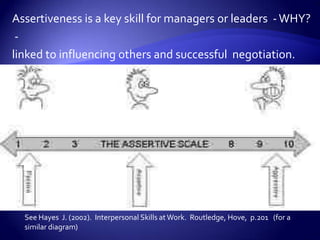
Assertiveness is a key skill for managers or leaders - WHY?
 -
linked to influencing others and successful negotiation.


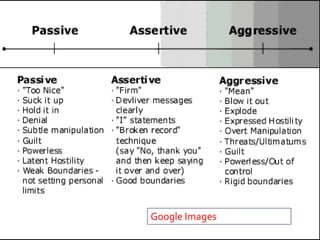
  See Hayes J. (2002). Interpersonal Skills at Work. Routledge, Hove, p.201 (for a
  similar diagram)
Google Images
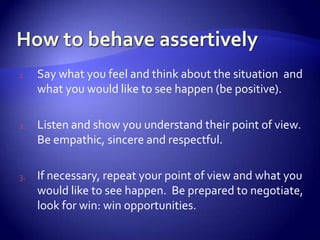
1.   Say what you feel and think about the situation and
     what you would like to see happen (be positive).

2.   Listen and show you understand their point of view.
     Be empathic, sincere and respectful.

3.   If necessary, repeat your point of view and what you
     would like to see happen. Be prepared to negotiate,
     look for win: win opportunities.
   http://www.youtube.com/watch?v=uWW7YfXvRr
    Y&feature=related (3 step)

   http://www.youtube.com/watch?v=Ymm86c6DA
    F4 (different scenarios)
   Content skills – what you say
   Non-verbal skills – how you say it
   Social interaction skills – how you interact/react

Hayes, J. (2002) Interpersonal Skills at Work.
  Routledge, Hove.
Effective assertion messages are:

1.   brief and direct statements;

2.   respectful – they express our concerns or
     position without blaming or attacking others;

3.   appropriate responses - Bolton (1986) model:
     “When you…. “; “I feel …”; “Because… “
The potency/ impact of an assertive response can
be influenced by paralinguistic characteristics such
as volume, firmness of delivery and inflection, and
non-verbal behaviours such as facial expression,
eye contact, gestures and posture.
                                    (Ibid., p.207)
http://www.youtube.com/watch?v=gNMlm2hXmtQ
1.   Escalation

2.   Persistence
     http://www.youtube.com/watch?v=x_mEtwgOiJ4&feature=related


3.   Managing Defensive Reactions
   You have a colleague who regularly asks you to
    cover for her while she leaves work early to pick
    up her son. On average this happens twice a
    week.
   However, there was one occasion when you
    asked her to return the favour and she refused.
   She is now expecting you to do this as a matter
    of course and you now feel it is time to say
    something.
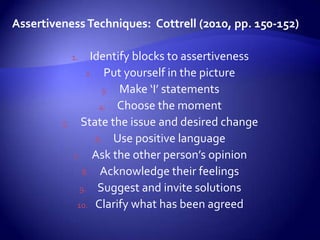
Assertiveness Techniques: Cottrell (2010, pp. 150-152)

              1.   Identify blocks to assertiveness
                  2. Put yourself in the picture
                      3. Make ‘I’ statements
                     4. Choose the moment
         5.     State the issue and desired change
                    6. Use positive language
              7. Ask the other person’s opinion
                 8. Acknowledge their feelings
                9. Suggest and invite solutions
               10. Clarify what has been agreed
   Cottrell, S. (2010). Skills for Success. Palgrave, Basingstoke.
   Hayes, J. (2002). Interpersonal Skills at Work. Routledge,
    Hove.
   Santora, J.C. (2007). Assertiveness and Effective Leadership:
    Is there a tipping point? Academy of Management
    Perspectives. August: pp.84-86
   Townend, A. (1991) Self-Development for Managers:
    Developing Assertiveness. Routledge, London.

Assertiveness

  • 1.
    Chris Gunn (Msc,BA, PGCE, Dip Man, Dip CEdG, MCMI) GR354 cngunn@uclan.ac.uk
  • 2.
    “Standing up foryourself without demonstrating anger. Assertive people look for solutions that suit both parties, respecting the rights of both.” Cottrell (2010, p.147) “… assertiveness means pursuing your goals and the goals of other people in the situation. It means getting a positive result in unclear or difficult situations … .” Pedler, Burgoyne and Boydell (2007, p.131)
  • 3.
    Being -  aggressiveand dictatorial  passive and non-confrontational, taken advantage of/ exploited  manipulative, indirect or devious  selfish
  • 4.
    Based on the assumption that everyone has basic human rights which should be respected. It emphasises the basic rights that we all have and the responsibilities which go with having these rights. Eg I have the right to express my thoughts and opinions, even though they may differ from those of others; I have the right to say ‘No’ without feeling guilty. Townend, A. (1991) Self-Development for Managers: Developing Assertiveness. Routledge, London. pp.7-8
  • 5.
    develop your self-confidence;  obtain what you need/want, are entitled to;  not perceived as a ‘soft touch’;  not to feel sorry for yourself or ‘bottle up’ emotions because you are a push over;  better able to negotiate and compromise with others.
  • 6.
    Respecting your own and others’ rights and needs  Being clear and straightforward with other people  Taking more control of your own life  Taking responsibility for changing what you do not like
  • 7.
    Assertiveness Classes Ps don’t be afraid to knock…
  • 8.
    Assertiveness is akey skill for managers or leaders - WHY? - linked to influencing others and successful negotiation. See Hayes J. (2002). Interpersonal Skills at Work. Routledge, Hove, p.201 (for a similar diagram)
  • 9.
  • 11.
    1. Say what you feel and think about the situation and what you would like to see happen (be positive). 2. Listen and show you understand their point of view. Be empathic, sincere and respectful. 3. If necessary, repeat your point of view and what you would like to see happen. Be prepared to negotiate, look for win: win opportunities.
  • 12.
    http://www.youtube.com/watch?v=uWW7YfXvRr Y&feature=related (3 step)  http://www.youtube.com/watch?v=Ymm86c6DA F4 (different scenarios)
  • 13.
    Content skills – what you say  Non-verbal skills – how you say it  Social interaction skills – how you interact/react Hayes, J. (2002) Interpersonal Skills at Work. Routledge, Hove.
  • 14.
    Effective assertion messagesare: 1. brief and direct statements; 2. respectful – they express our concerns or position without blaming or attacking others; 3. appropriate responses - Bolton (1986) model: “When you…. “; “I feel …”; “Because… “
  • 15.
    The potency/ impactof an assertive response can be influenced by paralinguistic characteristics such as volume, firmness of delivery and inflection, and non-verbal behaviours such as facial expression, eye contact, gestures and posture. (Ibid., p.207) http://www.youtube.com/watch?v=gNMlm2hXmtQ
  • 16.
    1. Escalation 2. Persistence http://www.youtube.com/watch?v=x_mEtwgOiJ4&feature=related 3. Managing Defensive Reactions
  • 17.
    You have a colleague who regularly asks you to cover for her while she leaves work early to pick up her son. On average this happens twice a week.  However, there was one occasion when you asked her to return the favour and she refused.  She is now expecting you to do this as a matter of course and you now feel it is time to say something.
  • 18.
    Assertiveness Techniques: Cottrell(2010, pp. 150-152) 1. Identify blocks to assertiveness 2. Put yourself in the picture 3. Make ‘I’ statements 4. Choose the moment 5. State the issue and desired change 6. Use positive language 7. Ask the other person’s opinion 8. Acknowledge their feelings 9. Suggest and invite solutions 10. Clarify what has been agreed
  • 19.
    Cottrell, S. (2010). Skills for Success. Palgrave, Basingstoke.  Hayes, J. (2002). Interpersonal Skills at Work. Routledge, Hove.  Santora, J.C. (2007). Assertiveness and Effective Leadership: Is there a tipping point? Academy of Management Perspectives. August: pp.84-86  Townend, A. (1991) Self-Development for Managers: Developing Assertiveness. Routledge, London.

Editor's Notes

  • #2 RegisterThen need to review Emotional Intelligence and make sure you have looked through the stuff and tried some of the exercises – Also review teamwork and ask which of Belbin’s team roles – is it accurate? What does it say about you?
  • #3 Try assertiveness quiz – word handoutTownend, A. (1991) Self-Development for Managers: Developing Assertiveness. Routledge, London.Assertiveness – linked to developing self-confidence (SC).Once you have developed confidence in yourself you have an inner resource of positive feelings and thoughts about yourself and others upon which you can draw.Those who lack in SC fall prey to negative thoughts and feelings about themselves – which in turn can facilitate non-assertive behaviour.A lack of SC can cause passive and aggressive behaviours. Ass = is about SC which means having a positive attitude towards yourself and others. It means being honest with yourself and others; and it is about respecting yourself and others. When you are SC and your behaviour is assertive you are open to others and their views even though they may be different from your own. You are able to express yourself clearly and to communicate with others effectively.Some managers confuse assertiveness with aggression and coercing others into doing what they need/want them to do. This is linked to an autocratic and dictatorial management style ie not involving others in decision-making ie telling and controlling rather than delegating, selling, coaching, etc.Managers who behave assertively rather than aggressively are usually respected by peers and staff rather than feared. However, the opposite – being too passive can also cause problems for managers.
  • #4 There is a difference between being selfish and being assertive – while being assertive is about stating your views, preferences, feelings, etc and standing up for yourself it is also about respecting others and their views – and recognising that there may be differences and accepting this.
  • #5 Assertiveness can draw upon the theory of TA – Transactional Analysis - which is based on the premise that once we are aware of our attitudes and behaviour we can change them to more positive and affirmative attitudes and behaviour. In particular the Life Positions – the four underlying Life Positions correspond with the four kinds of behaviour:Townend (1991, p.7)I’m not OK – You’re OK = Passive behaviourI’m not OK – You’re not OK = Manipulative behaviourI’m OK – You’re not OK = Aggressive behaviourI’m OK – You’re OK = Assertive behaviour
  • #6 Have to be careful not to be manipulative, selfish…
  • #7 Also is about not being harassed, bullied or coerced into doing something you feel is wrong, inapprop, immoral, etc and not doing this to othersWin:Win as opposed to win/lose or lose/win
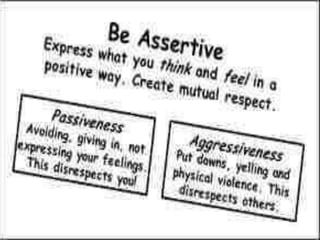
  • #9 Non-Assertive Behaviour/ Passive Behaviour - Allows others to infringe your rights.Assertive Behaviour - Asserts his/her basic rights and takes respon for them whilst recognising and respecting the other person’s basic rights.Aggressive Behaviour - This person asserts his/her rights at the expense of the other person’s – she/he does not have respect that the other person has rights.
  • #11 Try assertiveness questionnaire – M McCarthy
  • #12 Hayes (2002, p.204)One reason some people do not assert themselves, and therefore find it difficult to influence others is because they have a strong need for approval and acceptance, and fear that if they stand up for their rights others may reject them. Consequently, they are reluctant to refuse requests, express unpopular opinions or request behaviour changes. Assertive behaviour is not without risks. Some conflict may occur if you are challenging established norms or ways of behaving but this in turn may result in you becoming more influential. However, these risks can be minimised if the people who want to stand up for their rights and influence others have a well-developed set of asserting skills.
  • #13 Can look at these in own time if interested.Poss just look at one in class – in pm group where there is more time.Have a look at:http://www.centreforconfidence.co.uk/projects.php?p=cGlkPTU5
  • #14 See hayes & cottrell books
  • #15 Rambling, non-specific, ambiguous responses are much less effective because they are open to misinterpretation and a chance that other issues may intervene and undermine the impact of the message.Respectful messages are more effective because the non-judgmental statements they contain are less likely to elicit a defensive reaction. People are more likely to see this input as one that offers a different perspective on the reasonableness of their request or on the consequences of their behaviour than an attack. These inputs could encourage them to re-evaluate their behaviour and approach to us and may motivate them to modify their relationship/approach with us. Asserting our rights w/out paying attention to the rights of others increases chance of conflict and damage to relationships.Many people in conflict situations feel under pressure and cannot think what to say – as a result they either say little and take ‘flight’ or become aggressive and ‘fight’ . Anticipating the need to assert and preparing appropriate assertion messages can help us overcome these problems. Bolton – offers a simple formula for constructing assertive messages where you are seeking to change the behaviour of another. He suggests that assertive responses should include a non-blaming description of the behaviour that is being confronted, a disclosure of your feelings and a clarification of the tangible effect the other’s behaviour has on you.When you (a non-evaluative description of the other’s behaviour)I feel (disclosure of your feelings)Because (clarification of effect)Sometimes other people are unaware of how their behaviour makes you feel – you can do this in an honest, sincere and respectful way.However, be prepared for blunt responses eg I don’t care…. Also Bolton warns of overstating/understating feelings – ie lacks sincerity which could be detected or doesn’t make it clear the exact impact it has.Clarifying effect – Bolton argues that if we convince others that their attitudes/behaviours have concrete tangible effects the probability of change will be greater. EgsWhen you arrive late for a meetingI feel frustratedBecause my time and that of others is wasted while we wait for you.When you make last minute changes to…I feel very annoyedBecause I have to work late and do not see my children before they go to bed.
  • #16 Rakos (1997) found volume associated with being assertive – not too loud = aggression. Also found inflection – medium levels of inflection are associated with greater impact. Inflection can be used to direct the listener’s attention to important parts of the assertive communication.Firmness of delivery – also associated with assertion – absence of firmness can detract from the impact of an assertion.Eye contact also important – but not staring.Also smooth, non-fidgety body movements and non-defensive or non-aggressive stances and body disposition also helps.Also think about orientation – ie are upright and face others squarely. Stooped, hunched, shrugging and squirming movements undermine assertiveness attempts.
  • #17 Escalation – Rimms and Masters (1987) suggest that the initial assertion should be what they refer to as ‘the minimal effective response’ ie not going overboard in your response – if you do could infringe their rights. IE Be reasonable If not effective/ has desired result then gradually escalate the intensity of the assertion messages issued – can do this verbally and non-verballyEg No thanks, not interested. I said I wasn’t interested. Thanks and good day. Sorry, perhaps you didn’t hear, I am NOT Interested! EtcWe can also be more explicit about the nature of the change we are seeking to achieve. Assertion messages that do not back others into a corner or attempt to impose a solution maybe more effective because they are less likely to provoke a defensive response and counter attack.My food is cold. If no response – My food is cold, I cannot eat it. If no response – My food is cold, I cannot eat it. Please bring me another.2. PersistenceIt is sometimes necessary to reassert ie repeat yourself several times before recipients respond as desired. Their defensiveness can get in the way of them hearing/understanding the message. If you fail to persist you may fail to get what you want.3. Managing Defensive ReactionsWe can minimise DRs by reflectively listening to other people’s responses. Reflecting their responses and feelings with respect is effective often because it gives them confidence that their views have been recognised and understood.NB Shifting between asserting and reflecting is not easy skill – after asserting most people forget to listen…
  • #19 Eg fear of other’s responses, fear of failure, not wanting to hurt others feelings, I want a quiet life, unaware of differences between passive, aggression and assertiveness, manipulation, etc, not part of my culture, I get what I want so will carry on as I amLook at the big picture – consider the interests of the other parties and poss consequences of your actions – are you being reasonable, appropriate, etc. I statements – I want, I need, I am responsible for… as opposed to Everyone needs a break, We all need a rest… when it is you that does.When is the best time? Try to make an agreed mutually convenient time to put your views across, make sure you have their full attention.State the issue in a succinct, non-evaluative, non-judgmental, calm manner. Describe behaviours, not the person. Say, I would prefer you to acknowledge me and say hello, rather than: “You are very rude. You make me feel angry and ignored.”When making I statements – use positive language = avoid use of not, no, can’t, and words like try, maybe, sort of… BE CLEAR! Eg I am entitled to my overtime payments.Ask the other person for their views, if they see it the same way? Show you have a genuine interest in hearing their views.Check you know what they think/feel. LISTEN carefully.Being assertive means looking for a solution that suits both sides as far as possible. Make constructive suggestions for a way forward. Negotiate and seek advantages for both parties. Check you both agree the details of the solution ie what has been agreed. Keep copies if poss.Being assertive takes time, effort and practice. PLENARY QUESTIONS: What is assertiveness?How can it help you?Why relevant to management?What skills does it involve?What theory based upon?How assertive are you?