
Assembly Language Programming:
1. Introduction
Prepared by:
Md. Jahidul Islam (Lecturer, Dept. of CSE, UIU.)
Special Thanks to:
Muhammad Tasnim Mohiuddin (Lecturer, Dept. of CSE, UIU.)
April 2015.
Department of Computer Science & Engineering (CSE), United International University (UIU).
Programming Languages
1) Machine Language
2) Assembly Language (Low Level Language)
3) High Level Languages
April 2015.
Department of Computer Science & Engineering (CSE), United International University (UIU).
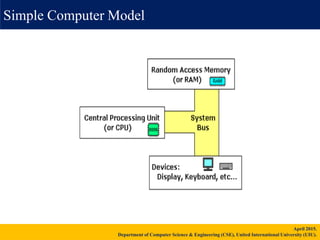
Simple Computer Model
April 2015.
Department of Computer Science & Engineering (CSE), United International University (UIU).
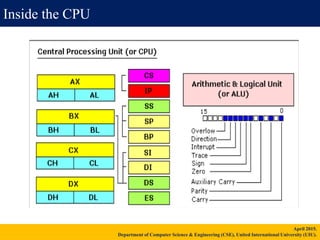
Inside the CPU
April 2015.
Department of Computer Science & Engineering (CSE), United International University (UIU).
CPU Registers
• General purpose registers
• Segment registers
• Instruction Pointer
• Flags register
• Special purpose registers
oDebug registers
oMachine Control registers
April 2015.
Department of Computer Science & Engineering (CSE), United International University (UIU).
6
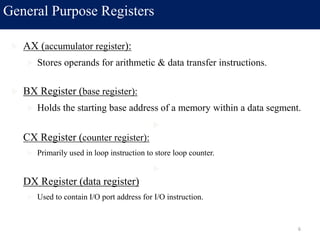
 AX (accumulator register):
 Stores operands for arithmetic & data transfer instructions.
 BX Register (base register):
 Holds the starting base address of a memory within a data segment.

CX Register (counter register):
 Primarily used in loop instruction to store loop counter.

DX Register (data register)
 Used to contain I/O port address for I/O instruction.
General Purpose Registers
7
General Purpose Registers (contd.)
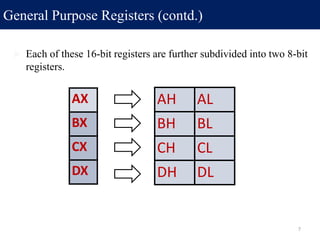
 Each of these 16-bit registers are further subdivided into two 8-bit
registers.
AH AL
BH BL
CH CL
DH DL
AX
BX
CX
DX
8
Memory Segmentation
 Data Segment
 contains variable definitions
 declared by .DATA
 Stack segment
 used to store the stack
 declared by .STACK size
 default stack size is 1KB.
 Code segment
 contains program’s instructions
 declared by .CODE
Extra segment

DS
CS
SS
ES
64 KB
64 KB
64 KB
8086 Memory
64 KB
Flag Register
9
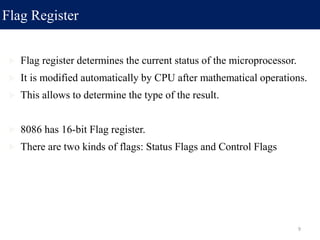
 Flag register determines the current status of the microprocessor.
 It is modified automatically by CPU after mathematical operations.
 This allows to determine the type of the result.
 8086 has 16-bit Flag register.
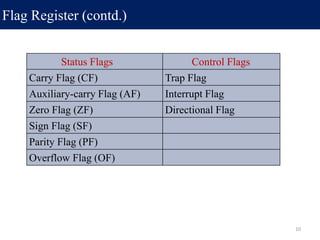
 There are two kinds of flags: Status Flags and Control Flags
Flag Register (contd.)
10
Status Flags Control Flags
Carry Flag (CF) Trap Flag
Auxiliary-carry Flag (AF) Interrupt Flag
Zero Flag (ZF) Directional Flag
Sign Flag (SF)
Parity Flag (PF)
Overflow Flag (OF)
Flag Register (contd.)
11
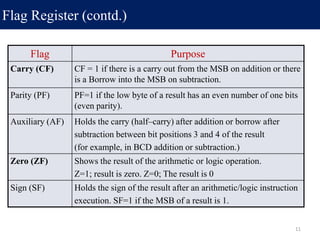
Flag Purpose
Carry (CF) CF = 1 if there is a carry out from the MSB on addition or there
is a Borrow into the MSB on subtraction.
Parity (PF) PF=1 if the low byte of a result has an even number of one bits
(even parity).
Auxiliary (AF) Holds the carry (half–carry) after addition or borrow after
subtraction between bit positions 3 and 4 of the result
(for example, in BCD addition or subtraction.)
Zero (ZF) Shows the result of the arithmetic or logic operation.
Z=1; result is zero. Z=0; The result is 0
Sign (SF) Holds the sign of the result after an arithmetic/logic instruction
execution. SF=1 if the MSB of a result is 1.
Flag Register (contd.)
12
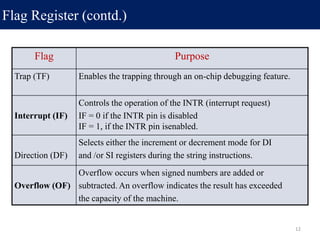
Flag Purpose
Trap (TF) Enables the trapping through an on-chip debugging feature.
Interrupt (IF)
Controls the operation of the INTR (interrupt request)
IF = 0 if the INTR pin is disabled
IF = 1, if the INTR pin isenabled.
Direction (DF)
Selects either the increment or decrement mode for DI
and /or SI registers during the string instructions.
Overflow (OF)
Overflow occurs when signed numbers are added or
subtracted. An overflow indicates the result has exceeded
the capacity of the machine.
13
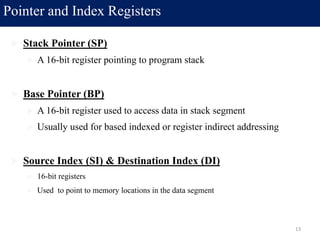
 Stack Pointer (SP)
 A 16-bit register pointing to program stack
 Base Pointer (BP)
 A 16-bit register used to access data in stack segment
 Usually used for based indexed or register indirect addressing
 Source Index (SI) & Destination Index (DI)
 16-bit registers
 Used to point to memory locations in the data segment
Pointer and Index Registers
Any Questions?
Thank You
April ,2015.
Department of Computer Science & Engineering (CSE), United International University (UIU).

Assembly language programming intro

  • 1.
    Assembly Language Programming: 1.Introduction Prepared by: Md. Jahidul Islam (Lecturer, Dept. of CSE, UIU.) Special Thanks to: Muhammad Tasnim Mohiuddin (Lecturer, Dept. of CSE, UIU.) April 2015. Department of Computer Science & Engineering (CSE), United International University (UIU).
  • 2.
    Programming Languages 1) MachineLanguage 2) Assembly Language (Low Level Language) 3) High Level Languages April 2015. Department of Computer Science & Engineering (CSE), United International University (UIU).
  • 3.
    Simple Computer Model April2015. Department of Computer Science & Engineering (CSE), United International University (UIU).
  • 4.
    Inside the CPU April2015. Department of Computer Science & Engineering (CSE), United International University (UIU).
  • 5.
    CPU Registers • Generalpurpose registers • Segment registers • Instruction Pointer • Flags register • Special purpose registers oDebug registers oMachine Control registers April 2015. Department of Computer Science & Engineering (CSE), United International University (UIU).
  • 6.
    6  AX (accumulatorregister):  Stores operands for arithmetic & data transfer instructions.  BX Register (base register):  Holds the starting base address of a memory within a data segment.  CX Register (counter register):  Primarily used in loop instruction to store loop counter.  DX Register (data register)  Used to contain I/O port address for I/O instruction. General Purpose Registers
  • 7.
    7 General Purpose Registers(contd.)  Each of these 16-bit registers are further subdivided into two 8-bit registers. AH AL BH BL CH CL DH DL AX BX CX DX
  • 8.
    8 Memory Segmentation  DataSegment  contains variable definitions  declared by .DATA  Stack segment  used to store the stack  declared by .STACK size  default stack size is 1KB.  Code segment  contains program’s instructions  declared by .CODE Extra segment  DS CS SS ES 64 KB 64 KB 64 KB 8086 Memory 64 KB
  • 9.
    Flag Register 9  Flagregister determines the current status of the microprocessor.  It is modified automatically by CPU after mathematical operations.  This allows to determine the type of the result.  8086 has 16-bit Flag register.  There are two kinds of flags: Status Flags and Control Flags
  • 10.
    Flag Register (contd.) 10 StatusFlags Control Flags Carry Flag (CF) Trap Flag Auxiliary-carry Flag (AF) Interrupt Flag Zero Flag (ZF) Directional Flag Sign Flag (SF) Parity Flag (PF) Overflow Flag (OF)
  • 11.
    Flag Register (contd.) 11 FlagPurpose Carry (CF) CF = 1 if there is a carry out from the MSB on addition or there is a Borrow into the MSB on subtraction. Parity (PF) PF=1 if the low byte of a result has an even number of one bits (even parity). Auxiliary (AF) Holds the carry (half–carry) after addition or borrow after subtraction between bit positions 3 and 4 of the result (for example, in BCD addition or subtraction.) Zero (ZF) Shows the result of the arithmetic or logic operation. Z=1; result is zero. Z=0; The result is 0 Sign (SF) Holds the sign of the result after an arithmetic/logic instruction execution. SF=1 if the MSB of a result is 1.
  • 12.
    Flag Register (contd.) 12 FlagPurpose Trap (TF) Enables the trapping through an on-chip debugging feature. Interrupt (IF) Controls the operation of the INTR (interrupt request) IF = 0 if the INTR pin is disabled IF = 1, if the INTR pin isenabled. Direction (DF) Selects either the increment or decrement mode for DI and /or SI registers during the string instructions. Overflow (OF) Overflow occurs when signed numbers are added or subtracted. An overflow indicates the result has exceeded the capacity of the machine.
  • 13.
    13  Stack Pointer(SP)  A 16-bit register pointing to program stack  Base Pointer (BP)  A 16-bit register used to access data in stack segment  Usually used for based indexed or register indirect addressing  Source Index (SI) & Destination Index (DI)  16-bit registers  Used to point to memory locations in the data segment Pointer and Index Registers
  • 14.
    Any Questions? Thank You April,2015. Department of Computer Science & Engineering (CSE), United International University (UIU).