CONTENTS:
• DEFINITION
• RECOGNITION AND INITIAL MEASUREMENT OF INTANGIBLE ASSETS
• INITIAL AND SUBSEQUENT EXPENDITURE
• AMORTIZATION PERIOD
• RETIREMENTS AND DISPOSALS
• RELATED EXAMPLES
• SIGNIFICANT DIFFERENCES IN IND AS 38 AND AS 26
DEFINITION:
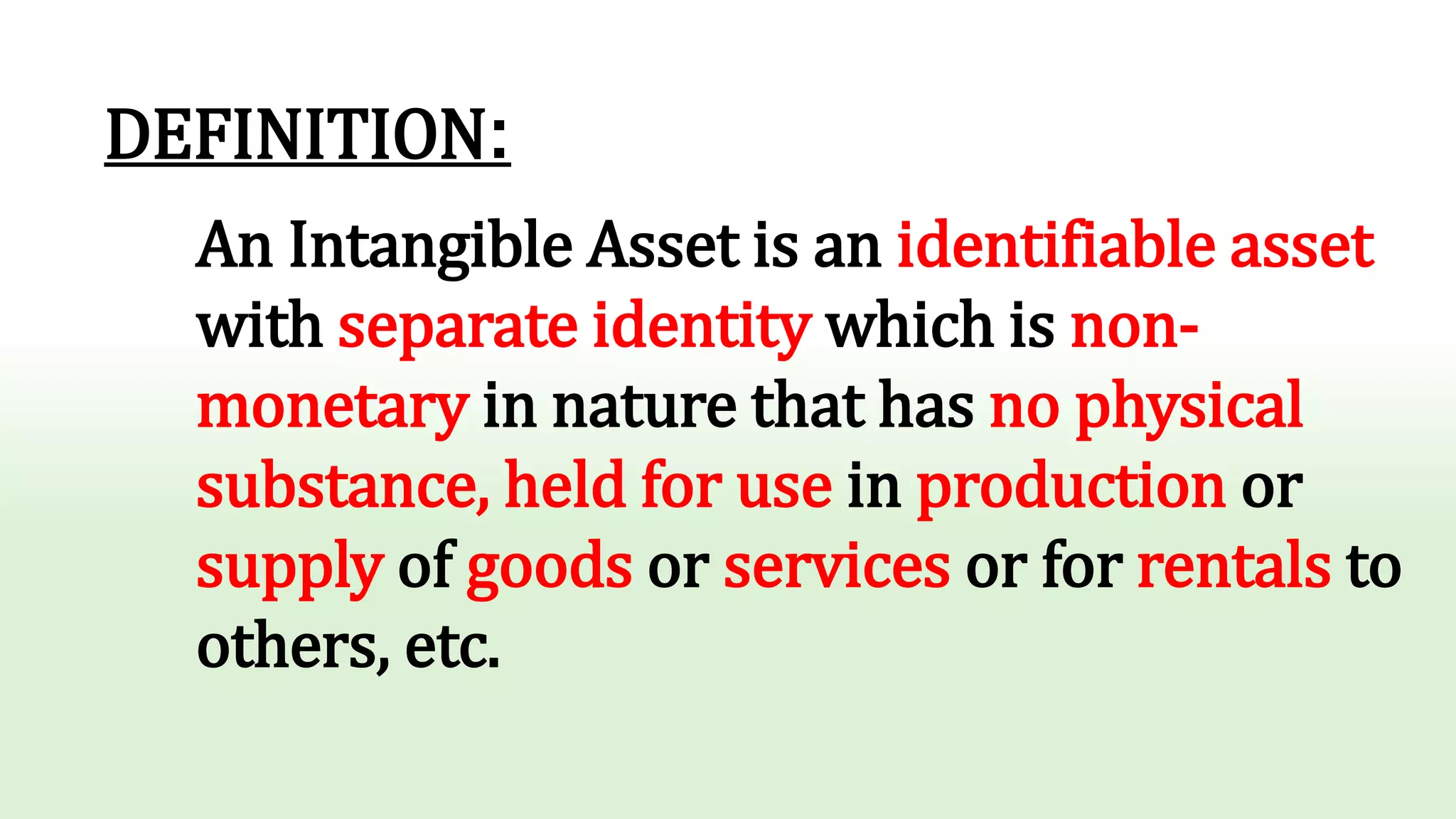
An Intangible Asset is an identifiable asset
with separate identity which is non-
monetary in nature that has no physical
substance, held for use in production or
supply of goods or services or for rentals to
others, etc.
RECOGNITION AND INITIAL MEASUREMENT OF
INTANGIBLE ASSETS
RECOGNITION CRITERIA:
• Future economic benefit should be expected to flow
to the enterprise
• Cost of the asset can be measured reliably.
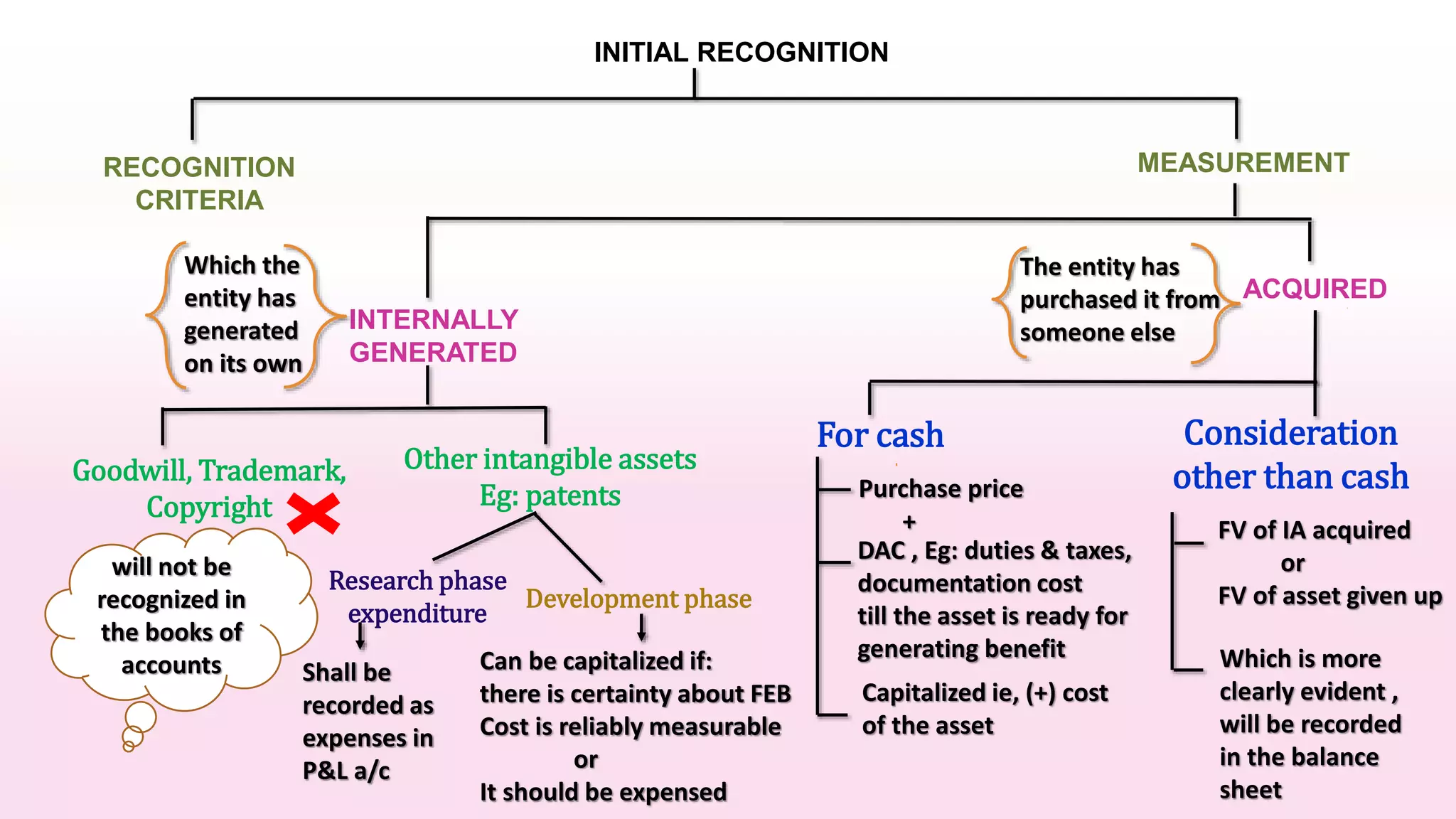
INITIAL RECOGNITION
RECOGNITION
CRITERIA
MEASUREMENT
INTERNALLY
GENERATED
ACQUIRED
Goodwill, Trademark,
Copyright
Other intangible assets
Eg: patents
For cash Consideration
other than cash
will not be
recognized in
the books of
accounts
Which the
entity has
generated
on its own
The entity has
purchased it from
someone else
Research phase
expenditure
Development phase
Purchase price
+
DAC , Eg: duties & taxes,
documentation cost
till the asset is ready for
generating benefit
Capitalized ie, (+) cost
of the asset
Shall be
recorded as
expenses in
P&L a/c
Can be capitalized if:
there is certainty about FEB
Cost is reliably measurable
or
It should be expensed
FV of IA acquired
or
FV of asset given up
Which is more
clearly evident ,
will be recorded
in the balance
sheet
INITIAL AND SUBSEQUENT EXPENDITURE
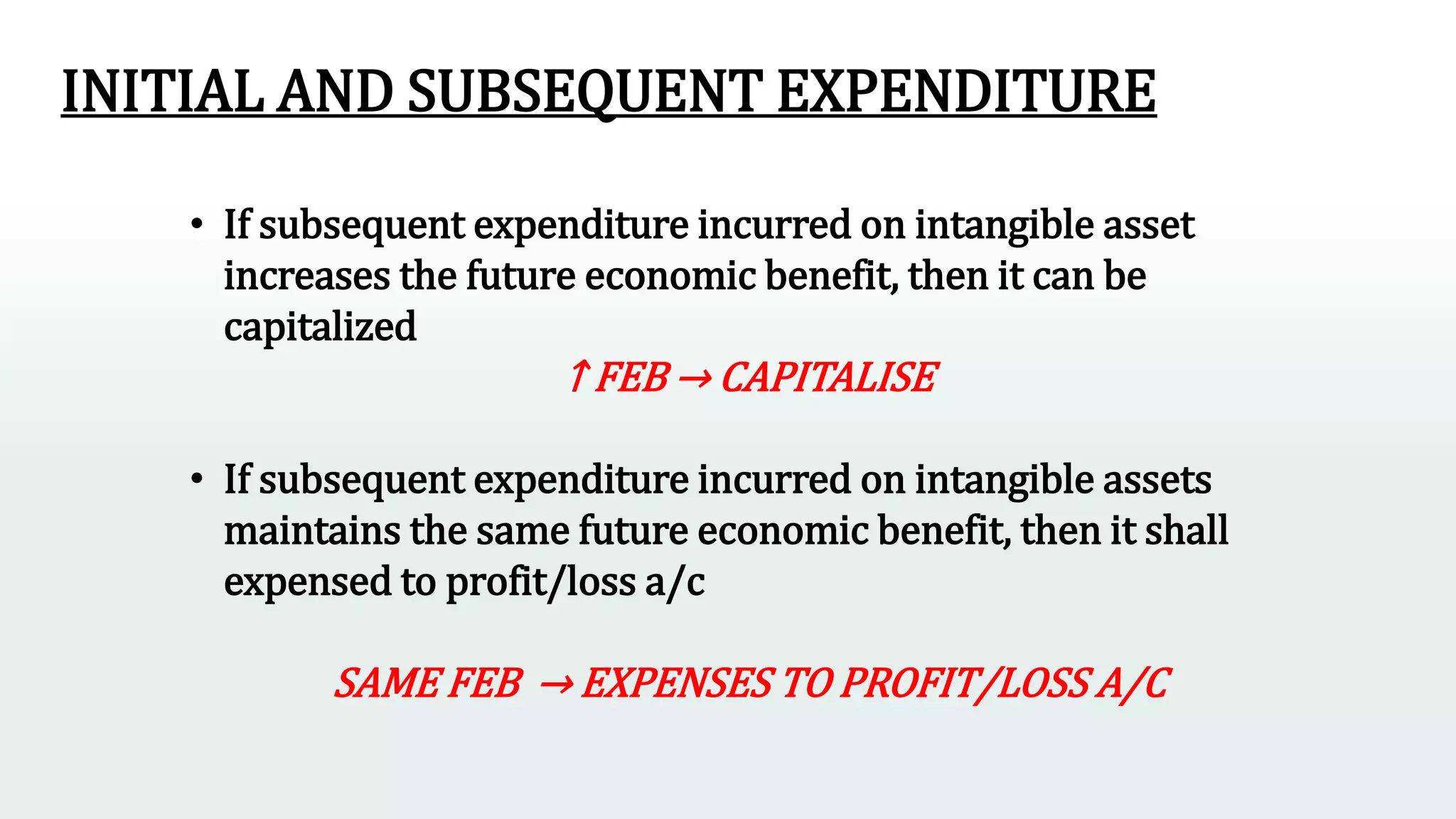
• If subsequent expenditure incurred on intangible asset
increases the future economic benefit, then it can be
capitalized
↑ FEB → CAPITALISE
• If subsequent expenditure incurred on intangible assets
maintains the same future economic benefit, then it shall
expensed to profit/loss a/c
SAME FEB → EXPENSES TO PROFIT/LOSS A/C
AMORTIZATION PERIOD
Amortization should start when the asset
is available for use. The depreciable
amount of an intangible asset should be
allocated on the basis of useful life. This
AS adopts a presumption that the useful
life of intangible assets does not exceed
ten years. In some cases, it would be
longer than ten years
RETIREMENTS AND DISPOSALS
An intangible asset should be derecognized
on disposal or when no future economic
benefits are expected from its use, any gain
and loss (difference between the net
disposal proceeds and the carrying amount
of the asset) arising should be recognized as
income or expenses in statement of P & L.
RELATED EXAMPLE
An enterprise incurred costs to develop and produce a
software during 2017-18 as follows:-
Amount()
Completion of detailed programme and design 45,000
Coding and testing 30,000
Other coding costs 40,000
Testing costs 10,000
Product masters for training materials 15,000
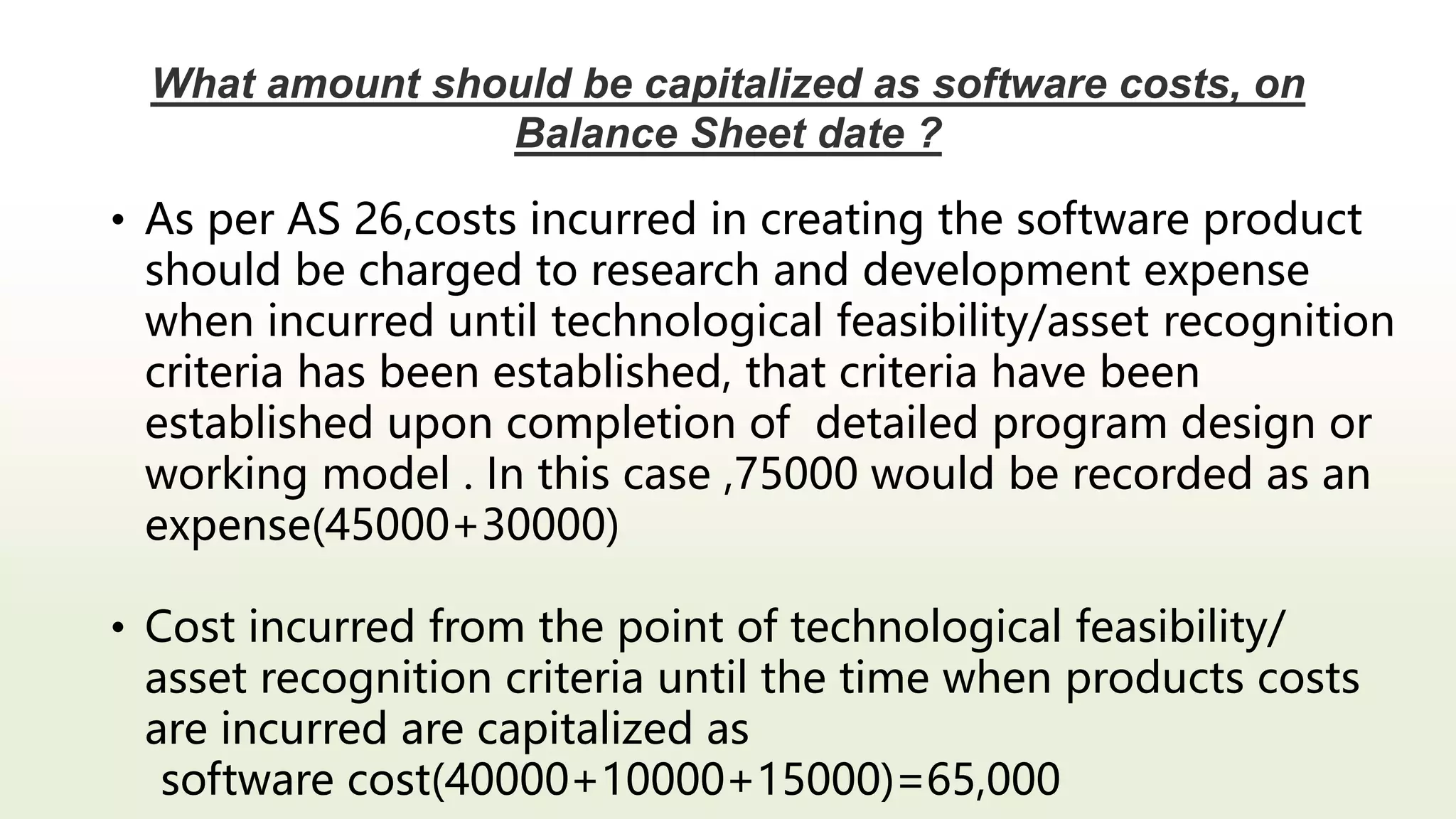
What amount should be capitalized as software costs, on
Balance Sheet date ?
• As per AS 26,costs incurred in creating the software product
should be charged to research and development expense
when incurred until technological feasibility/asset recognition
criteria has been established, that criteria have been
established upon completion of detailed program design or
working model . In this case ,75000 would be recorded as an
expense(45000+30000)
• Cost incurred from the point of technological feasibility/
asset recognition criteria until the time when products costs
are incurred are capitalized as
software cost(40000+10000+15000)=65,000
SIGNIFICANT DIFFERENCES IN IND AS-38 AND AS-26
BASIS IND AS 38 AS 26
Definition The requirement of definition given by
AS 26 has been removed from the
definition
AS 26 defines an intangible asset as an
identifiable non-monetary asset
without physical substance held for
use in the production or supply of
goods or services, for rental to others,
or for administrative purposes
Separately
Acquired
Intangible
Assets
In this case, the criterion of probable
inflow of expected future economic
benefits is always considered satisfied,
even if there is any uncertainty
There is no such provision in AS 26
Revenue Based
Amortization
Method
Ind AS 38 allows use of revenue based
method of amortization of intangible
asset, in a limited way
AS 26 does not specifically deal that
BASIS IND AS 38 AS 26
Intangible assets acquired in
Business Combination
Ind AS 38 deals in detail in
respect of intangible assets
acquired in a business
combination
AS 26 refers only to intangible
assets acquired in an
amalgamation in the
nature of purchase
Subsequent Expenditure on in
Process Project
Ind AS 38 gives guidance for
the treatment of such
expenditure
AS 26 is silent regarding the
treatment of subsequent
expenditure
Intangible Assets Acquired in
Exchange
Ind AS 38 requires that if an
intangible asset is acquired in
exchange of a non-monetary
asset, it should be recognized
at the fair value of the asset
Principles of AS 10 to be
followed which require Fair
market value at the time of
consideration
Intangible Assets acquired
Free of Charge or for a
Nominal Consideration by
way of Government Grant
In that case an entity
should, record both the grant
and the intangible asset at fair
value
As per AS 26, intangible assets
is recognized at
nominal value or at
acquisition cost
BASIS IND AS 38 AS 26
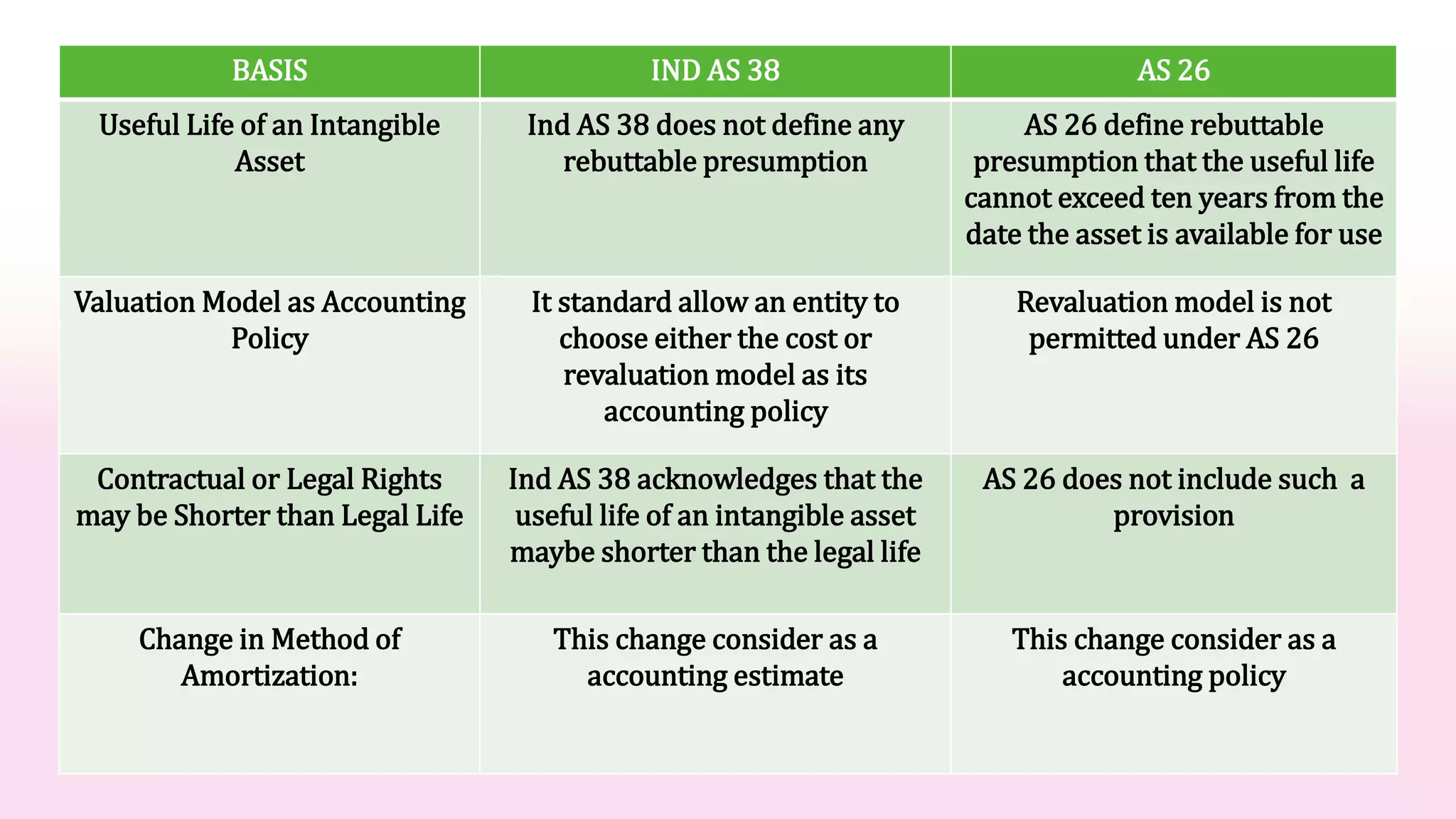
Useful Life of an Intangible
Asset
Ind AS 38 does not define any
rebuttable presumption
AS 26 define rebuttable
presumption that the useful life
cannot exceed ten years from the
date the asset is available for use
Valuation Model as Accounting
Policy
It standard allow an entity to
choose either the cost or
revaluation model as its
accounting policy
Revaluation model is not
permitted under AS 26
Contractual or Legal Rights
may be Shorter than Legal Life
Ind AS 38 acknowledges that the
useful life of an intangible asset
maybe shorter than the legal life
AS 26 does not include such a
provision
Change in Method of
Amortization:
This change consider as a
accounting estimate
This change consider as a
accounting policy
AS-26 intangible assets.pptx

AS-26 intangible assets.pptx

  • 2.
    CONTENTS: • DEFINITION • RECOGNITIONAND INITIAL MEASUREMENT OF INTANGIBLE ASSETS • INITIAL AND SUBSEQUENT EXPENDITURE • AMORTIZATION PERIOD • RETIREMENTS AND DISPOSALS • RELATED EXAMPLES • SIGNIFICANT DIFFERENCES IN IND AS 38 AND AS 26
  • 3.
    DEFINITION: An Intangible Assetis an identifiable asset with separate identity which is non- monetary in nature that has no physical substance, held for use in production or supply of goods or services or for rentals to others, etc.
  • 4.
    RECOGNITION AND INITIALMEASUREMENT OF INTANGIBLE ASSETS RECOGNITION CRITERIA: • Future economic benefit should be expected to flow to the enterprise • Cost of the asset can be measured reliably.
  • 5.
    INITIAL RECOGNITION RECOGNITION CRITERIA MEASUREMENT INTERNALLY GENERATED ACQUIRED Goodwill, Trademark, Copyright Otherintangible assets Eg: patents For cash Consideration other than cash will not be recognized in the books of accounts Which the entity has generated on its own The entity has purchased it from someone else Research phase expenditure Development phase Purchase price + DAC , Eg: duties & taxes, documentation cost till the asset is ready for generating benefit Capitalized ie, (+) cost of the asset Shall be recorded as expenses in P&L a/c Can be capitalized if: there is certainty about FEB Cost is reliably measurable or It should be expensed FV of IA acquired or FV of asset given up Which is more clearly evident , will be recorded in the balance sheet
  • 6.
    INITIAL AND SUBSEQUENTEXPENDITURE • If subsequent expenditure incurred on intangible asset increases the future economic benefit, then it can be capitalized ↑ FEB → CAPITALISE • If subsequent expenditure incurred on intangible assets maintains the same future economic benefit, then it shall expensed to profit/loss a/c SAME FEB → EXPENSES TO PROFIT/LOSS A/C
  • 7.
    AMORTIZATION PERIOD Amortization shouldstart when the asset is available for use. The depreciable amount of an intangible asset should be allocated on the basis of useful life. This AS adopts a presumption that the useful life of intangible assets does not exceed ten years. In some cases, it would be longer than ten years
  • 8.
    RETIREMENTS AND DISPOSALS Anintangible asset should be derecognized on disposal or when no future economic benefits are expected from its use, any gain and loss (difference between the net disposal proceeds and the carrying amount of the asset) arising should be recognized as income or expenses in statement of P & L.
  • 9.
    RELATED EXAMPLE An enterpriseincurred costs to develop and produce a software during 2017-18 as follows:- Amount() Completion of detailed programme and design 45,000 Coding and testing 30,000 Other coding costs 40,000 Testing costs 10,000 Product masters for training materials 15,000
  • 10.
    What amount shouldbe capitalized as software costs, on Balance Sheet date ? • As per AS 26,costs incurred in creating the software product should be charged to research and development expense when incurred until technological feasibility/asset recognition criteria has been established, that criteria have been established upon completion of detailed program design or working model . In this case ,75000 would be recorded as an expense(45000+30000) • Cost incurred from the point of technological feasibility/ asset recognition criteria until the time when products costs are incurred are capitalized as software cost(40000+10000+15000)=65,000
  • 11.
    SIGNIFICANT DIFFERENCES ININD AS-38 AND AS-26 BASIS IND AS 38 AS 26 Definition The requirement of definition given by AS 26 has been removed from the definition AS 26 defines an intangible asset as an identifiable non-monetary asset without physical substance held for use in the production or supply of goods or services, for rental to others, or for administrative purposes Separately Acquired Intangible Assets In this case, the criterion of probable inflow of expected future economic benefits is always considered satisfied, even if there is any uncertainty There is no such provision in AS 26 Revenue Based Amortization Method Ind AS 38 allows use of revenue based method of amortization of intangible asset, in a limited way AS 26 does not specifically deal that
  • 12.
    BASIS IND AS38 AS 26 Intangible assets acquired in Business Combination Ind AS 38 deals in detail in respect of intangible assets acquired in a business combination AS 26 refers only to intangible assets acquired in an amalgamation in the nature of purchase Subsequent Expenditure on in Process Project Ind AS 38 gives guidance for the treatment of such expenditure AS 26 is silent regarding the treatment of subsequent expenditure Intangible Assets Acquired in Exchange Ind AS 38 requires that if an intangible asset is acquired in exchange of a non-monetary asset, it should be recognized at the fair value of the asset Principles of AS 10 to be followed which require Fair market value at the time of consideration Intangible Assets acquired Free of Charge or for a Nominal Consideration by way of Government Grant In that case an entity should, record both the grant and the intangible asset at fair value As per AS 26, intangible assets is recognized at nominal value or at acquisition cost
  • 13.
    BASIS IND AS38 AS 26 Useful Life of an Intangible Asset Ind AS 38 does not define any rebuttable presumption AS 26 define rebuttable presumption that the useful life cannot exceed ten years from the date the asset is available for use Valuation Model as Accounting Policy It standard allow an entity to choose either the cost or revaluation model as its accounting policy Revaluation model is not permitted under AS 26 Contractual or Legal Rights may be Shorter than Legal Life Ind AS 38 acknowledges that the useful life of an intangible asset maybe shorter than the legal life AS 26 does not include such a provision Change in Method of Amortization: This change consider as a accounting estimate This change consider as a accounting policy