IETM is supported by:
The European Commission support for the production of this publication does not constitute an
endorsement of the contents which reflects the views only of the authors, and the Commission
cannot be held responsi­ble for any use which may be made of the information contained therein.
March 2020
ISBN:9782930897448
IETM PUBLICATION
www.ietm.org
IETM PUBLICATION
In Rural Areas
ARTS
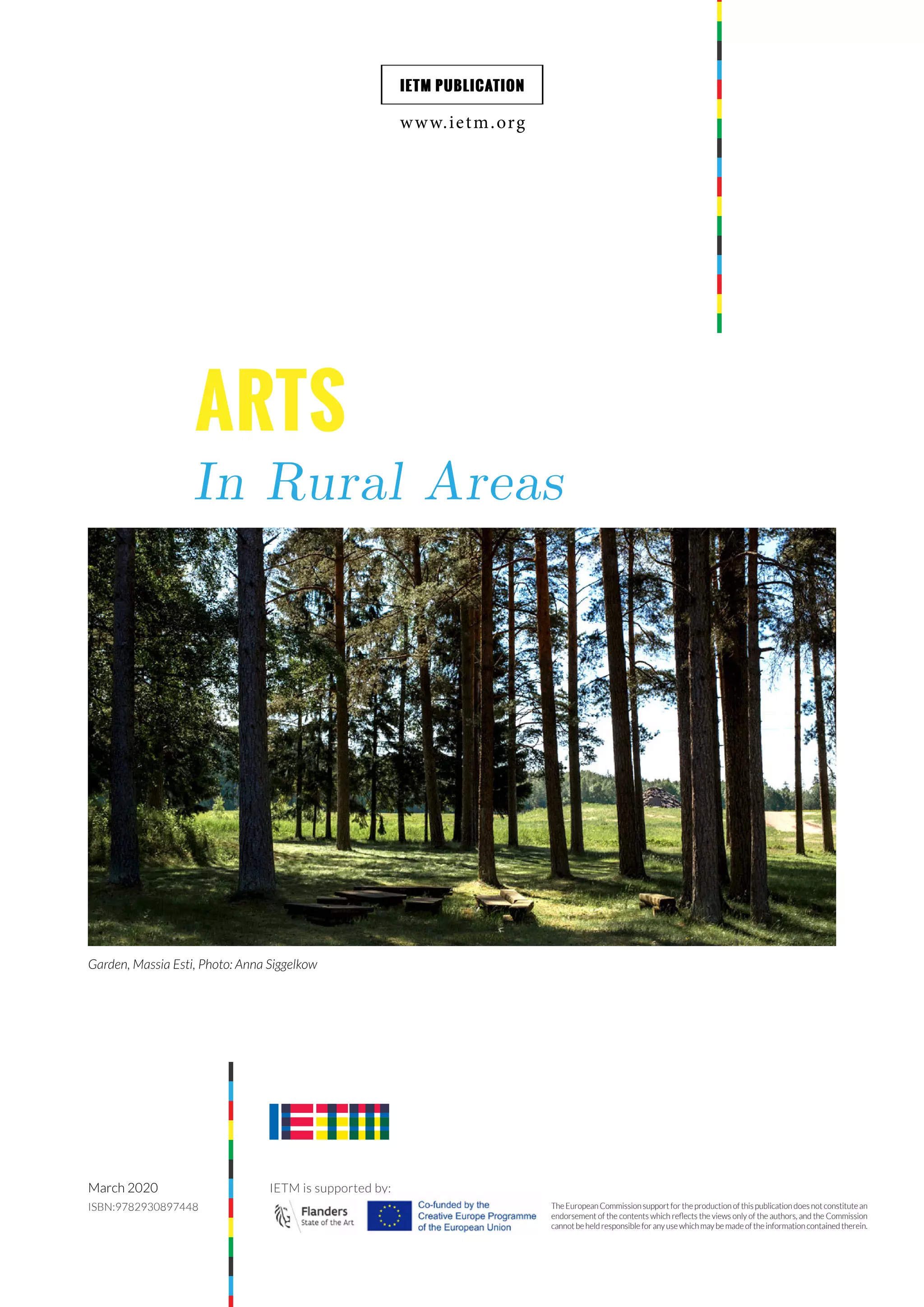
Garden, Massia Esti, Photo: Anna Siggelkow
www.ietm.org
IETM PUBLICATION
2
ARTS IN RURAL AREAS
Arts in Rural Areas
IETM Publication
by Fernando García-Dory, Piotr Michałowski, Laura H Drane
Beyond the Urban – policy paper by CAE, ENCC, IETM, THE
Published by IETM - International network for contemporary performing arts,
Brussels March 2020
Editing and general coordination: Vassilka Shishkova, Elena Polivtseva, Ása Richardsdóttir (IETM)
Layout: Milton Pereira on a template by JosWorld
This publication is distributed free of charge and follows the Creative Commons agreement
Attribution-NonCommercial-NoDerivatives (CC BY-NC-ND). You are free to reuse and share
this publication or parts of it as long as you mention the original source.
This publication should be mentioned as follows:
F. García-Dory, P. Michałowski, L. H Drane, ‘Arts in Rural Areas’, IETM, March 2020..
Link: https://www.ietm.org/en/publications
For further information please contact ietm@ietm.org
The publishers have made every effort to secure permission to reproduce pictures protected
by copyright. Any omission brought to their attention will be solved in future editions of this
publications.
www.ietm.org
IETM PUBLICATION
FERNANDO GARCÍA-DORY
Fernando García-Dory is an artist and researcher whose work engages specifically with the
relationship between culture and nature as manifested in multiple contexts, from landscapes
and the rural, to desires and expectations in relation to identity. Interested in the harmonic
complexity of biological forms and processes, he addresses connections and cooperation,
from microorganisms to social systems, and from traditional art languages to collaborative
agroecological projects and actions. Fernando has studied Fine Arts and Rural Sociology, and
is now preparing his PhD in Agroecology. He has developed projects and shown his work
at Tensta Konsthall, Van Abbemuseum, the Museo Nacional Centro de Arte Reina Sofía,
SFMOMA, dOCUMENTA 12, and biennales in Gwangju, Istanbul and Athens. Since 2010
he has been developing a project called INLAND, a collaborative agency and platform for
collective agricultural, social and cultural production.
PIOTR MICHAŁOWSKI
Piotr Michałowski is an expert on territorial development and networking, a cultural
researcher, and an author and speaker on arts and culture. A field worker in urban and rural
communities, Piotr has 22 years of experience in the NGO and public sectors. Currently, he is
working in the Cultural Division of the Municipality of Wrocław on projects, programming and
strategies for the ECoC 2016 legacy. He is also Secretary and Board Member of the European
Network of Cultural Centres – ENCC in Brussels and coordinator of the ENCC International
Working Group on Territorial Development, gathering cultural network operators, experts,
animators and policymakers from 20 European countries. He co-creates policy papers and
European campaigns such as ‘Beyond the Urban 2020’ and #nonurbanculture.
LAURA H DRANE
Laura H Drane is an independent creative producer, facilitator and consultant with extensive
experience in the arts, cultural and other sectors over the last twenty years. Her work ranges
from science festivals and community arts projects, to touring dance productions to 13th
century castles, to major outreach projects for government departments.
Since 2002, her practice has brought her to both cities and small settlements across the UK,
keeping her deeply concerned about genuine public engagement – people being put at risk of
change by an encounter based on a two-way exchange.
Laura H Drane is a company producer for award-winning artist collective Light, Ladd
& Emberton, and currently part-time interim Senior Producer for Cirque Bijou with
responsibility for the UK’s professional circus company of disabled and non-disabled people,
Extraordinary Bodies. She is also an Arts Associate (external adviser) to the Arts Council of
Wales.
About the Authors
www.ietm.org
IETM PUBLICATION
ARTS IN RURAL AREAS
3
Table of Contents
www.ietm.org
IETM PUBLICATION
ARTS IN RURAL AREAS
4
Foreword		
Beyond The Urban
Policy Paper By CAE, ENCC, IETM, and TEH
1. The Rural as a Space for Co-creation and Reconnection with
Nature and the Land by Fernando García Dory
Defining The Rural Today		
Art In Rural Areas Today		
Some Limitations		
Challenges And Solutions		
1. Social Aspects Of Arts In Rural Areas by Piotr Michałowsk
The Rural Situation Now: Migration, Demographic Changes
And Transnational Connections
Policy Measures Targeting The Social And Political Issues of
Rural Areas
Input From International Arts And Culture Networks
Art In Rural Areas – An (Un)expected Agent Of Change
Art In Rural Areas Needs Our Support
1. Living Cultures by Laura H Drane
Living Cultures In Rural Areas		
Common Challenges For Living Arts In Rural Areas		
Solutions And Policy Changes That Work		
1. Appendix A - Case Studies
IDD 10 - Between The Seas
IDD 27 - Punctum’s Public Cooling House
IDD 22 - The Countryside Of The Future
IDD 61 - Meetings
IDD 64 - Art Of Empowerment
IDD 78 - Latitude 50, Centre For Street Arts And Circus
IDD 85 - The Journey
IDD 102 - Play! Mobile
IDD 105 - Earthwise Residency Centre
IDD 125 - Mondego Art Valley
IDD 133 - Filmmaking Workshops For Indigenous Filmmakers
IDD 140 - Bækkelund International Residency Center
IDD 141 - Who Killed Szomna Grancsa?
IDD 145 - The Freezer Centre
IDD 146 - Amore Festival Moru
05		
06
07
11
12		
14		
17
18		
19
20
21
22
23
28
30
31
35
36		
38
39
41
43
44
46
47
48
50
52
53
55
56
59
60
62
www.ietm.org
IETM PUBLICATION
5
ARTS IN RURAL AREAS
Foreword
In times of the obsession with profit and growth, natural and social
resources are exploited in all corners of the world. Yet, the urge
to radically rethink the system sneaked into various levels. Many
creative and forward-looking professionals are actively searching
for new spaces of opportunity, to shape and test new modes of
economic production and responsible social fabric. Rural areas
have become relevant places for experimentation - smaller in size,
providing more time and space, with less hierarchical governance
structures.
Contemporary performing arts in a rural context are an integral
part of that exercise of imagining a different future. Moreover,
contemporary art in rural areas have been nurturing and shaping
local narratives for ages. However, contemporary artistic practices
have gone almost unnoticed in many funding schemes - both
cultural programmes and rural development funds, which tend to
focus on economic assets of only a few sectors.
In the past few years, IETM has organised a sequence of sessions
and one entire meeting on the subject of art in rural areas. Some of
the brightest art professionals engaging with rurality have created
an AREA (art in rural areas) focus group within our network
and continued their exchange during IETM events and beyond.
Through the dialogue within that group and with other members
experienced and interested in the topic, we have discovered a
fascinating, vibrant and powerful world of contemporary arts in
rural areas.
Today, more than ever, we want to turn the global attention to that
hugely important world.
When creating this publication, we realised it is urgent to find
unconventional approaches to the arts in rural areas. We need
to identify innovative solutions to support the rural arts in their
endeavour of working transversally with other sectors. We have
to seize the momentum and potential of rural arts to help reinvent
the system. Today, when our planet needs it the most.
We hope the present publication sets a strong and fertile ground
for reflecting on those ambitions. Please get in touch with us
(ietm@ietm.org) or write us on our forum (www.ietm.org/forums)
if you wish to further the debate.
We are very grateful to the three authors for their insightful and
sincere contributions. We also heartily thank our members and
other art professionals who shared their practices, stories, views
and experiences with us - through the ongoing exchange during
IETM meetings and via the open call we announced in July - August
2019. Some of the cases collected through the call are presented
in the annexes.
The publication “Arts in Rural Areas” is part of a collaborative
trajectory, which embraces three other European cultural
networks - Culture Action Europe, European Network of Cultural
Centres, and Trans Europe Halles. The policy paper “Beyond the
urban”, which you can read below, is the product of our joint work.
It is still in progress and subject to comments and suggestions
for improvement. We will present it at the event, taking place in
Brussels on March 16th 2020, where artists, cultural professionals
and policy-makers will give us their view. You will find the final
version of “Beyond the urban” in the next edition of the current
publication.
So, stay tuned: www.ietm.org
BEYOND THE URBAN
Contemporary arts and culture
in non-urban areas as keys
to a sustainable and cohesive Europe
Brussels, March 2020
Authored by
www.ietm.org
IETM PUBLICATION
www.ietm.org
IETM PUBLICATION
Policy Paper
This policy paper is written by Culture Action Europe, European
Network of Cultural Centres, IETM (International network
for contemporary performing arts) and Trans Europe Halles,
representing together more than 5,000 organisations and individual
professionals.
Culture Action Europe (CAE) is the major European network of
cultural networks, organisations, artists, activists, academics and
policymakers. CAE is the first port of call for informed opinion and
debate about arts and cultural policy in the EU. As the only intersectoral
network, it brings together all practices in culture, from the performing
arts to literature, the visual arts, design and cross-arts initiatives, to
community centres and activist groups. CAE believes in the value and
values of culture and its contribution to the development of sustainable
and inclusive societies. www.cultureactioneurope.org
The European Network of Cultural Centres (ENCC) was founded in
1994 to promote dialogue and cooperation between social-oriented
cultural centres in Europe. In the 2000s it became a “network of
networks”, before gradually opening membership to individual cultural
centres in direct interaction with communities and citizens. It also
includes other cultural organisations and professionals as associate
members. Today, the ENCC reaches about 5000 cultural organisations
in over 20 countries, with quite diverse structures, practices and
audiences, who align on values of cultural equality, intercultural
diversity and sustainability. www.encc.eu
IETM, International network for contemporary performing arts,
is one of the oldest and largest cultural networks, which represents
the voice of over 500 performing arts organisations and institutions,
including theatres and arts centres, festivals, performing companies,
curators and programmers, producers, art councils and associations
from about 50 countries. IETM advocates for the value of the arts
and culture in a changing world and empowers performing arts
professionals through access to international connections, knowledge
and a dynamic forum for exchange. www.ietm.org
Trans Europe Halles (TEH) is one of the oldest and most dynamic
cultural networks in Europe. Based in Sweden, it has been at the
forefront of repurposing abandoned buildings for arts, culture and
activism since 1983 and currently counts 129 members in 37 different
countries across Europe. www.teh.net
www.ietm.org
IETM PUBLICATION
8
ARTS IN RURAL AREAS
8
ARTS IN RURAL AREAS
RATIONALE
When it comes to culture in non-urban and peripheral areas in
policy discourse, the focus is often given to only a few cultural
sectors while being limited mostly to their economic impacts
and the preservation value of tangible heritage, landscapes and
monuments. Such an approach risks overlooking a vast, vibrant and
complex world of non-urban contemporary art and socio-cultural
practices.
At this point, when populist and anti-European sentiments are
rising across the EU (including non-urban areas), it is a high
time to support the sectors which inspire innovative and
sustainable ways of organising communities and practicing
democracy. Moreover, given the degrading condition of natural
resources and ecosystems, we feel the urgency to acknowledge
at all policy levels that we are operating in the new reality of
Climate Emergency that is demanding change across all sectors.
Contemporary arts and culture have a unique potential to
trigger a creative process of rethinking economic paradigms and
testing new models, reconnect people to nature and foster new
imagination for the system’s change.
Therefore, this policy paper aims to put forward a comprehensive
approach to: 2
1. integrating culture in all policies dealing with non-urban
and peripheral areas, including the EU regional and
cohesion policies;
2. making the EU cultural action more suited for non-urban
challenges and aspirations.
The objectives are to:
1. ensure the recognition at various policy levels (global, EU,
national, regional, local) of the importance of culture and
the arts in non-urban and peripheral areas;
2. shape the direction of action through identifying the most
timely issues which need to be addressed and researched;
3. put forward key solutions on how to support culture and
the arts in non-urban and peripheral areas, at different
policy levels.
ARGUMENTSFORRECOGNITION
We believe that non-urban areas should be in focus today, more
than ever, because:
a. The unity of the EU is unprecedentedly hindered by a wave of
populism and euroscepticism. Those attitudes are prospering
in various parts of Europe, but their scale and strength in
non-urban contexts are not sufficiently acknowledged and
addressed.
b. At the same time, many innovative solidarity mechanisms
are already taking place in rural areas, along with innovative
social practices to increase civic engagement.
c. Non-urbanareasareatthefrontlineofarapidtransformation:
climate effects of the current intensive production modes,
migration, demographic changes, political turbulences, and
more.
d. The EU’s overall focus on building a sustainable future3 can
only be realised through a radical rethinking of the current
models of economic production and prevailing ways of
organising social life. Non-urban areas host a large number
of sustainable practices of responsible use of natural and
cultural resources , plus the rural might become a laboratory
for experimentation, due to smaller scales, more time and
space, and less hierarchical governance structures.
Weareconvincedthatcontemporarycultureandartinnon-urban
environments must be appreciated and supported, because:
e. Culture and the arts foster social cohesion and inclusion as
well as active citizen participation, and this is particularly
relevant in socially and politically isolated areas.
f. Access to culture and the arts is an essential element of well-
being, health, empowerment, happiness, self-identification
and ultimately of reinvigorating or conceiving new narratives
for individuals and societies. Those are vitally needed in
peripheral environments, struggling with feelings of isolation,
neglectedness and exclusion.
1 | Non-urban areas are understood in this paper as rural, remote and mountainous areas (these
constitute 80% of the EU territory, and are home to 57% of its population), including islands; small
towns and villages; ‘invisible cities’ of less than 50 000 inhabitants (that no one hears about if they do
notliveinthem,eventhough20to40%(dependingonthecountry)oftheEUpopulationliveinthem.);
peripheral and suburban areas that lack infrastructure and access to culture and other necessities.
2 | in its inclusive definition which embraces intangible heritage and contemporary art
3 | of which the European Green Deal is the most ambitious and comprehensive example
4 | IETM publication on Art in Rural Areas
www.ietm.org
IETM PUBLICATION
9
ARTS IN RURAL AREAS
g. Culture and the arts function in a transversal and equal way,
and thus have the potential to catalyse collaboration and
networking, and create links among various organisations
and consolidation of scattered communities. This is vital
for building and maintaining connections in remote and
depopulating areas with scarce physical infrastructure, such
as schools, transport, medical and social services, which are
getting increasingly digitised or centralised, which causes a
lack of informal live contacts between people.
h. Contemporary artists and cultural professionals, in
collaboration with multidisciplinary teams, can help realising
the potential of rurality to be a laboratory for conceiving an
innovative vision on how global societies, whether urban
or rural, central or peripheral, can reinvent current modes
of economic, social and political functioning and ensure a
sustainable future for our planet.
ISSUESATSTAKE
We call on the EU institutions, member states and regional and
local authorities to address the following challenges which
prevent culture and the arts in non-urban areas from fully realising
their potential:
a. Gaps in perception: a narrow definition of “culture” (material
heritage and tourism) prevailing in current policy discourses,
which neglects contemporary arts, social innovation and
“living” cultural practices; a distorted image of rurality and
peripheries, either romanticised or associated with decline;
b. Over-instrumentalization of art and culture in non-urban
contexts: perceiving it solely as a potential solution to local
challenges (thus expecting funded projects to be related
to farming, tackle isolation, etc.). This vision is partial and
detrimental as it disregards the real power of the arts and
inevitably discourages both artists and audiences in the long
run ;
c. Shortage of financial support and investment within and
towardsnon-urbanareasandanoveralllackoflocalresources
(for example, low incomes preventing from accessing cultural
services and a lack of infrastructure for rehearsals, and
presenting art and culture);
d. Lack of acknowledgement by funders, policy-makers and
evaluators of the specifics of producing culture and art in non-
urban areas: need of longer time for research, more efforts
and dedication, in order to realise sustainable practices, build
strong connections with audiences and achieve positive
outcomes and impacts (which rarely mean high numbers of
tickets sold);
e. Insufficient mobility opportunities: EU and most of the
national mobility funding schemes are not adjusted to the
needs and challenges of rural and peripheral contexts;
f. Scattered networks and weak connectedness: lack of
hard and soft infrastructure: transport, digital services,
possibilities for live networking and face-to-face meetings
among peers living in different towns / villages;
g. Scarcity of access to quality arts and cultural education,
which results in limited or no exercise of cultural rights and
access to high-level cultural professions by non-urban and
peripheral population, especially its least advantaged parts;
h. Poor territorial and landscape planning: lack of strategic
vision, insufficient tools for local diagnosis and evaluation;
use of non-urban areas for the purposes unwanted by cities
(such as waste storages, prisons, energy production, among
others), as well as creating mono-spaces (spaces devoted only
to one type of production, solely commercial or residential
zones, etc.)
i. Effects of global non-sustainable economic paradigms:
environmental and social impacts of tourism, intensive
agriculture, massive and low-cost production, and other side-
effects of favouring growth and profits over sustainability.
SOLUTIONS
We call on the EU, national, regional and local policy-makers to
create and augment investment in culture and the arts in non-
urban environments. This should be done through including
culture and the arts in all funding instruments tackling non-urban
and peripheral areas, as well as through integrating rurality and
non-urban contexts in all cultural programmes and funds.
Those investments should be guided by the following principles:
a. Expand focus from built heritage to intangible heritage
and living, forward-thinking contemporary art and cultural
practices;
b. Respecttheautonomyoflocalcommunities,fostermotivation
and self-empowerment through building awareness of
existing values and active involvement of local communities
in all stages;Stimulate participation, inclusion and equality as
guiding values of cultural and artistic work.
5 | IETM Publication on Art in Rural Areas Publication date March 16th 2020
www.ietm.org
IETM PUBLICATION
10
ARTS IN RURAL AREAS
c. Respecttheautonomyoflocalcommunities,fostermotivation
and self-empowerment through building awareness of
existing values and active involvement of local communities
in all stages;
d. Stimulate participation, inclusion and equality as guiding
values of cultural and artistic work.
Moreover, particular attention should be paid to:
1. Mobility:
a. Integrate non-urban needs and challenges in cultural
mobility funding schemes (for example, more explicit
support for slow travel, reimbursement of traveling
time as working hours); implement effective ways of
disseminating mobility funding calls among potential
applicants beyond cities;
b. Invest in low-carbon transport solutions and
digitisation of non-urban and peripheral areas, taking
into consideration the needs of cultural and artistic
production.
2. Networks
a. Encourage long-term connections, collaboration and
networking among cultural operators in non-urban
contexts, by organising exchanges and peer-to-peer
learning and investing in permanent networks;
b. Design networks of local policy-makers to exchange
best practices of culture-led local development;
3. Capacity-building:
a. Provide direct, small-scale and easily manageable
grants for individual artists, collectives and companies;
b. Expand and improve training for artists and cultural
producers who want to engage with rural contexts to
do so with an informed position, using methodologies
and analytic tools from other disciplines ;
c. Provide knowledge to policy-makers and rural
development agencies on how culture can be
integrated in local policies;
d. Improve access to quality arts and culture education
on school and university levels and in lifelong learning
schemes.
4. Transversal work
a. Support cross-sectoral alliances (arts, science, social
sectors) that address transversal issues and challenges
(agriculture, natural resources, relationship to the
landscape, etc) and serve as “change laboratories”;
give visibility to such multidisciplinary projects to
inspire other sectors;
b. Encourage dialogue among various policy fields to
reflect on, complement and support the transversal
work happening on the ground.
5. Framing further discourse and debate
a. Frame new questions about culture, arts and cultural
heritage in non-urban areas as a practice and to seek
answers grounded in qualitative evidence rather than
in reigning orthodoxies;
b. Work with local actors and stakeholders to identify
particular spaces and practices that are ripe and ready
for reinterpretation; and
c. Radically re-frame heritage in terms of people’s
actual practices and re-imagine it through the lens of
contemporary arts and living culture.
We invite policy-makers, artists, cultural operators, and
representatives of other sectors engaging with culture and the
arts to collectively reflect on how those solutions can be translated
into concrete measures and what should be the next steps. In this
framework, we call on the European Parliament to conduct a
study on the situation and value of the contemporary arts and
culture in non-urban areas.
6 | IETM Publication on Art in Rural Areas
www.ietm.org
IETM PUBLICATION
1
THE RURAL AS A SPACE FOR CO-CREATION
AND RECONNECTION WITH THE LAND
by Fernando García Dory
It is a cold clear morning in the Cabrach, one of the most remote
places in rural Scotland. 30 artists from all around Europe walk
through the fields and fences of a vast private state which the
landowner plans to turn into a massive windmill park. Guided by a
local resident, they are headed for a landscape drawing workshop
which forms part of a collective exercise, a critical tool, for land
acknowledgement, uncovering embodied relations with the
territory, and claiming access to common resources in a context
of privatisation. The whole workshop becomes a performance and
speculation about what kinds of development locals would like
to see in the area, taking into account the recently passed Land
Reform Act...
This happening was part of the European cultural cooperation
project Frontiers in Retreat – just one of numerous art projects
across the continent that aim to rethink rural sites.
www.ietm.org
IETM PUBLICATION
12
ARTS IN RURAL AREAS
12
ARTS IN RURAL AREAS
DEFININGTHERURALTODAY
Rurality is a multidimensional concept, yet this chapter will try
to focus on its ‘spatial’ and ‘material’ aspects, namely: land and
landscape, nature, biodiversity, agriculture, farming.
The countryside of Europe is a universe
of different realities
A forested area in northern Finland, the vineyards of Irpinia in
the hinterland of Naples, apple fields and trekking paths in former
sheep tracks in Bolzano, the Dutch dairy farms and competitive
horticulture, the high moorlands of the Cabrach in Scotland, and
the last cheesemakers and shepherds of the Spanish mountain
range. What do all these places have in common?
In recent decades, rural areas have been undergoing huge
transformations all around the world, but in the European region
one can clearly see how industrial farming, and our modern way of
life in general, have influenced and completely remodelled every
kind of rural area.
The European countryside is composed of a constellation of
topographies and types of climate, and over the millennia specific
cultures have evolved to fit them. The French term terroir is used
to characterise the specific collection of environmental factors
that affect a certain agricultural crop, such as the context of its
unique environment, the soil composition, the farming practices,
and so on. The concept of terroir is similar to a traditional farmer’s
understanding of the rural environment. Yet nowadays, in Europe
and other so-called ‘advanced economies’, much more important
than the local specificities of the environment, and more influential
upon concrete agricultural practices than the terroir, are the
economic and political conditions that govern the countryside.
Economic and political factors affecting the rural
Sociologists, economists and anthropologists have different
views on how to define criteria for ‘the rural’, but they agree on
the growing difficulty of establishing a subject for their studies
that is separate from ‘the urban’. Ways of living and supply,
consumption patterns, and so on are homogeneously represented
within a rural-urban – ‘rurban’ – landscape that features increasing
suburbanisation.
Rurality is an aggregate of assemblages of markets, policies
and global systems. These factors define which areas will be
competitive, and, in many cases, which will be built-up and
industrialised.
Looking at their models of production, we can clearly distinguish
two extremes within the countryside paradigm.
On the one hand, we have the areas and farms that are oriented
towards well organised market structures – agri-business clusters
that make a certain product highly competitive within big, often
international markets. These forms of industrial farming – the
‘factory farms’ – are becoming mechanised and robotised to such
an extent that they barely need manpower to be operated1
. On
the other hand, there are areas which, due to their geographical
conditions or history, are more oriented towards diversification
and traditional forms of what is called High Nature Value (HNV)
farming. These smaller farms can hardly compete with the results
from intensive agriculture, therefore they often seek survival by
developing other economic activities, such as agritourism, or by
joining networks and projects to foster their sustainability.
But keeping Europe’s agriculture healthy and sustainable is
still a challenge. A total of 40% of Europe’s land is cultivated by
around 3.5% of the population2
. Still, predominantly rural regions
represent 80% or more of the territory in Ireland, Finland, Estonia,
Portugal and Austria3
. According to the organisation European
Coordination Via Campesina, a farm closes down every 25 minutes
in Europe.
Some time ago, the Common Agricultural Policy realised that it
had to take action to avoid this catastrophic effect, which had been
brought about in part by its own commitments to promoting low
cost food production and industrialising the farming sector. In
the 1990s, the LEADER initiative and Pillars II and III appeared,
and new strategies were put in place to offer possible forms
of sustainable rural development to ‘unfavourable’ or non-
competitive areas.
1 | See Meanwhile in the Countryside (IETM, 2017).
2 | See Landscapes in transition. An account of 25 years of land cover change in Europe (EEA, 2017).
3 | See Rural areas and the primary sector in the EU (European Union, 2018).
www.ietm.org
IETM PUBLICATION
13
ARTS IN RURAL AREAS
Some major challenges affecting rural areas today
Almost 30 years after these corrective measures were established,
we can roughly divide the main challenges for today’s rural regions
into several categories.
Areas that are highly competitive can become agro-industrial
conglomerates, offering few or precarious jobs, causing
environmental problems (concentrations of animal waste or
plastic, high carbon footprint due to the intercontinental transport
of raw and processed products, chemicals, etc.), exacerbating
issues with food safety and animal welfare – and, as a result of all
this, causing rural cultural identity to vanish. This type of farming
requires significant investment and capital expenditure, thus
putting a lot of stress on farmers. As a result, it becomes easier
for such operations to be handled by companies and land-based
divisions of large actors in the food chain, as in the example of
Cargill in the UK, for instance.
While the above described areas of intensive farming have poor
biodiversity, the areas associated with traditional or HNV forms of
farming often face difficulties posed by unfavourable policies and
progressivedepopulation.Therearenoeffectiveincentivesinplace
to maintain certain agroecological practices that are commercially
uncompetitive; as such, we risk losing them. Landscapes formed
over centuries and cultural heritage sites are at risk – as is our
food sovereignty. Wild nature is endangered. Unfarmed or ‘wild’
areas are scarce in Europe because of the long history of peasant
cultures using the land. Natural reserves were created when the
most sustainable forms of farming were practised, and nowadays
they sometimes feel apart from or even contradict with the local
population’s needs, thus creating a tension between preserving
nature and keeping nearby rural settlements economically viable.
New forms of understanding and co-custodianship have to be
defined.
In general, when sustainability is at stake, a greater emphasis
should be placed on innovation in sustainable forms of farming,
as well as on the liveability of rural environments to encourage
primary sector activities. How to deal with the lack of services,
participation and governance, fulfilment and cultural creativity?
How to make agroecological products economically feasible? It
should be taken into account that cities and peri-urban areas
are no longer the opposite of rural. Therefore experiments with
forms of rurban production should be undertaken. The inertia
of the ‘urban’ approach to rural areas, which homogenises and
subordinates them to leisure needs, has to be overcome. Cities
need to be informed of and sensitive to all the biodiverse cultural
landscapes of the rural.
Rural populations (now elderly and discounted) have evolved
within those ecosystems under a condition of mutual influence.
Richard Norgaard has used the concept of ‘co-evolution’ to
emphasise how human activities modify an ecosystem and how
the responses of the ecosystem provide reasons for the next
individual action or social organisation. Over time, co-evolution
between nature and society has led to increased complexity in
socio-environmental relations, sophisticated social organisations,
and cultural forms that range from an agreement to manage some
commons to culinary traditions to material heritage.
Possibilities for positive change
Usually, small-scale farming exists in remote rural areas that are
balanced on a thin line. On the one side is abandonment, and
the decay of a former social, economic and agro-environmental
richness. On the other, the promise of revival by building upon
existing resources with innovative methods.
Somehow, the rural becomes a ‘space of possibility’, a place where
many different interests could eventually collide, or be in synergy.
For example, young people who don’t find satisfying opportunities
in cities might look to the rural as a space of experimentation.
There have been enough anecdotal examples to call it a trend in
the US or Japan, for instance.
Rurality might trigger changes towards more sustainable
patterns of consumption and behaviour: slow living, reconnecting
with nature, responsible consumption and production, close
connections and spontaneous communication, a revival of
craftsmanship as opposed to unified mass production, and so
on. Yet for all these needed changes to occur rurality has to be
appreciated, rediscovered, looked at with a fresh eye…
www.ietm.org
IETM PUBLICATION
14
ARTS IN RURAL AREAS
integrated rural policies like the Endogenous Rural Development
processes (ERD).
There is yet another reason for artists to be interested in
rurality. The rural area is increasingly becoming a contested
zone where the most pressing issues of our time are playing
out: environmental sustainability, global economics versus local
economies, issues of food production and genetic modification,
and cultural commodification. In the process of adaptation to a
shifting global order, vast transformations are taking place in the
biophysical, social and cultural realms – a situation which offers a
lot of possibilities for artistic exploration and critical rethinking.
What kind of art are we talking about when we
talk about contemporary art in rural areas?
Ultimately, this transition is not only affecting the way the rural is
perceived, but also how art is produced – where and by whom –
and how it is distributed and disseminated.
There is a growing crisis of meaning in the art world – a fact
that younger generations of cultural producers, who exist in
increasingly precarious conditions and have unclear futures, are
very well aware of. Pascal Gielen, Belgian sociologist of the culture
of post-Fordism times, has called them the “murmuring multitude”.
What they’ve recognised is that art, in its current form, is both an
agent and a subject of globalisation.
The proliferation of biennales, art fairs, symposiums and events
capitalises on the way arts signify ‘high’ culture, making art itself
almost a status symbol.
As Luc Boltanski and Ève Chiapello explained so well in The
New Spirit of Capitalism, there was once, mainly in the 1960s, a
legitimate demand from the ‘creative class’ for higher freedom and
flexibility, and this led to a culture of fierce competition, continuous
availability, and self-exploitation. Now, new technologies of
communication demand the promotion of the self at every
opportunity. The pathology of ‘communicative capitalism’, as
defined by various thinkers such as Bifo, Lazzarato and others, is
just an expression of the disconnection between every person and
their environment, and from one another.
The hegemonic discourse of ‘progress’ associated with
metropolitan growth is fuelled by and fuels an art system that looks
predominantly towards the city as its main source of inspiration,
intervention and circulation. This is based on an ignorance of, or
ARTINRURALAREASTODAY
Can art provide a valid, as well as critical,
contribution to rural life?
Art offers a unique set of tools to analyse current perceptions
and representations of rural life, and to think about how these
influence the construction of identity.
Art can provide a perspective on rural life that highlights the
threats and opportunities that exist in the European countryside,
and that stem from our contemporary culture. Rural life seems to
be seen as that last, silenced but persistent ‘otherness’, regarded
sometimes with apprehension and detachment, sometimes with
bucolic idealism.
In any case, in these uncertain times of radical transformation
this collection of knowledge, memories and relationships must
be studied with the due care and attention it deserves. As one of
the most prominent figures of contemporary thinking and artistic
production, John Berger, pointed out in his trilogy about the
dispossession and dislocation of peasant communities during the
Industrial Revolution in 19th century Europe:
“And yet to dismiss the peasant experience as belonging to
the past and irrelevant to modern life; to imagine that the
thousands of years of peasant culture leave no inheritance for
the future, simply because it has almost never taken the form
of enduring objects; to continue to maintain, as it has been for
centuries, that it is something marginal to civilization; all this is
to deny the value of too much history and too many lives. You
can’t cross out a part of history like the one that draws a line
on a settled account.”4
In these uncertain times, a reunion between the city and the
countryside may be the key to society’s transition towards a more
sustainable future.
But art does not simply open a space for re-cognising and
re-thinking how rural communities perceive themselves, their
contexts and histories so that they can create a vision for the
future. It can also trigger a process of creative questioning and an
exploration of potential, based on both inherited and new inputs –
and it can communicate what those processes of innovation might
give form to.
Artists can join multidisciplinary teams for rural development, or
bring their own multidisciplinary sets of tools. In doing so, they can
catalyseactivelocalparticipation,contributetorethinkingtherural
paradigm, and influence the development and implementation of
4 | John Berger, Into Their Labours trilogy.
www.ietm.org
IETM PUBLICATION
15
ARTS IN RURAL AREAS
homage to heritage. Rurality offers a lively space of exchange and
creativity that is an equal match to urban cities, and this fact should
be reflected in the way art is being done in rural areas today.
If we focus on art that has impacts on rural sustainability or
endorses a reconnection with nature, this task goes beyond the
notion of ‘offering’ urban art to the rural by programming music
or cinema festivals, or by touring traditional exhibitions to rural
settlements or placing them ‘in the wild’. It also goes beyond
the oft-repeated model of ‘Art and Nature’ sculpture parks and
the obsolete remnants of Land Art and Earthworks, genres
that flourished from the 1970s through to the 1990s. What
seems pertinent in the current context is offering an account of
meaningful experiences, rather than a list of heritage sites and
cultural and environmental amenities suitable for ecotourism.
The perfect Garden of Eden, fenced
In this moment of uncertain continuity for those rural cultures
that have guaranteed viable agroecosystems in Europe since the
Neolithic period, we face the rise of another possibility for land
use, the so-called rewilding.
A substantial number of civil society organisations and individuals
consider that since the countryside is being progressively
depopulated it offers a chance to recreate a sort of primeval
condition. They imagine wild herbivores and reintroduced
predators roaming the land, thus creating a sort of landscaped
natural reserve for the amusement of urban populations. The risk
of this view lies in the negation of the identity of our landscapes,
a man-made substrate of cultural and social forms that dates far
back in time.
Rewilding depends on the simulation – the spectacle – of
an ‘undisturbed nature’. It relies on a dialectic between two
landscapes: the landscape of production (cultivation farms and
agroecosystems) and the landscape of consumption (public
entertainment and natural parks for recreation). But when we
acceptthatframing,wecompromisethepossibilityofreconnecting
young people with, for instance, the land as a means of living. This,
in turn, restricts the possibility of giving rise to sustainable farming,
or of achieving ‘food autonomy’, a crucial concept of the worldwide
movement La Via Campesina. This social movement of small
farmers and indigenous peoples’ organisations calls for change
in the current agricultural and food system, and in recent years
its interventions have been gaining traction within international
policies. As a grassroots movement, La Via Campesina relies on
self-organisation, critical rethinking, and the search for sustainable
solutions in farming – and this often goes hand in hand with art
and creativity as powerful triggers of change and empowerment
for local communities.
even disdain for, other types of surroundings, including the rural.
But the rural is actually a low-density urban realm in which nature
breathes a bit more through the interstices. Leaning towards these
interstices gives us the possibility to experience another way of
living, a way that has been embodied by indigenous and peasant
cultures, and that has become almost extinct in the course of the
rapid industrialisation of post-war Europe. It is a culture that has
to be reconsidered or reinvented, now more than ever.
What feels needed is a new narrative, a cosmology, on how we can
define development and well-being, dissociating it from the drive
for increased productivity or the sole pursuit of economic growth,
and perhaps connecting it instead with the indigenous notion of
‘the good life’.
This form of harmony is proposed by the arts in different forms and
languages. Working beyond traditional media, it takes inspiration
from what the avant-gardes of the 20th century made possible,
and resonates with changes at the level of governance, economic
organisation, education, and local politics.
The rural can also be a key reservoir of knowledge and practices
for the cultural impulse as our societies transition to sustainability,
and as we recover territorial balance and local economies.
It is important to start by setting criteria, and by making an
inventory of the different initiatives that, in this current context
of economic and environmental crisis, are rethinking urbanism,
landscapes, land use, and territorial planning. To be more precise,
it is also necessary to place at the centre of the research the notion
of marginal space – the ‘Third Landscape’ of French horticulturalist
Gilles Clément – and an expanded notion of public arts in the rural.
While some art projects in Europe’s rural areas act mostly as
amenities and opportunities for local populations to access urban
culture, others are taking the rural as content, not just as staging
ground. There is a great need for such projects of exchange,
examination and reflection – projects that draw lines of connection
between current critical discourses, that move between theory
and practice, and that root themselves in different rural realities.
It would be beyond the scope of this text to make a detailed list of
such works, but here are just two worth mentioning: Grizedale
Arts, in Cumbria, northern England, and Casa delle Agriculture, in
Castiglione, southern Italy.
So, if we have in mind ‘rural art’ that has the ability to make an
impact, trigger change, move and excite audiences, we will be
talking about art that goes beyond most of the prevailing notions of
how art is done in the countryside. The role of creativity and arts,
as well as the artist’s role, have to be examined and reconsidered.
We simply cannot think anymore of art in rural areas as a lovely
postcard, a pastoral landscape of an inert scenery, or a nostalgic
www.ietm.org
IETM PUBLICATION
16
ARTS IN RURAL AREAS
Reconnecting people with land
It is an urgent necessity to rethink our current model of
development so that we can encourage higher numbers of people
to tend agroecosystems that produce goods, in a sustainable
and decentralised way, at the same time as they restore soil
fertility, biodiversity and numerous other aspects of a healthy
rural ecosystem. In many cases, an effective approach has been
to encourage cultural interventions in rural areas, looking at
questions of farming and building local economies while working
on participation and community empowerment.
An example in this line is the Village Halls project in
Llansteffan, Wales, which brought three local graduate
artists together for a series of development days in the
village, allowing participants to consider the environment,
history and community of the area while developing work
that explored various aspects of Llansteffan. The project
reached out to the Llansteffan History Society and
members of the local community organised village tours,
meetings and activities for the participants. The project
culminated in an exhibition in the village hall, which
included performances, video, live writing, animation,
sound and photography, as well as a sketch walk.
This approach of creating work that has relevance to the
community is a subversion of the typical kind of touring exhibition
that transports art from an urban context to a rural one. Here are
some other examples of how making art with the local community
brings in new audiences and raises relevant topics.
Project:
Notte Verde
Organisation:
Casa delle Agriculture
Location:
Castiglione, Italy
In Castiglione, Italy, the
Casa delle Agriculture
project connected the
local community with a
visiting artist. Together
they developed a number
of different actions, from
establishing a plant nursery, to cultivating various ancient
varieties of wheat. Notte Verde, one of their ongoing
initiatives, is a festival started to promote sustainable
farming in response to the dangerous decay of soils
after many years of using chemical pesticides. The latest
edition gathered more than 20 000 people, who enjoyed
local products or attended experts’ presentations. Now
the project is rebuilding a community mill for the village,
thus securing jobs for young people to stay. Through their
association, Casa delle Agriculture, the project team also
work with North African migrants and involve them in
developing new economic activities that can potentially
lead to a sustainable common future.
INLAND is a ‘glocal’
(global-local) project
that examines the role of
territories, geopolitics,
culture and identity in the
contemporary relationship
between city and
countryside. Its aim is to
encourage contemporary
art practice that operates
in relation to the rural,
and to explore how that
approach might modify the
way art happens and circulates.
The project focuses on the economics of art and land, on
the idea of ‘organised utopia’, and on the ways we interact
with the biosphere. INLAND is envisioned as a para-
institution of “polyvalent specialist mobile units working
in emergency contexts” that always operates “in relation
to an ‘official’ institution, that is, a state, a company, or
an art institution”. This provides an entry point to think
about the “growth of social formations, from a social
movement to a state to a multinational chain”.
Project:
INLAND
Organisation:
INLAND, an arts collective,
dedicated to agricultural,
social and cultural
production,
and a collaborative
agency
Location:
Rural areas of Europe
Photo: Casa delle Agriculture
www.ietm.org
IETM PUBLICATION
17
ARTS IN RURAL AREAS
When it launched, the project kicked off a three-year
programme (2010-2013), aiming to support rural life,
which consisted of an international conference, an
artistic strand that saw 22 artists in residence in the
same number of villages across Spain, and a programme
of exhibitions and presentations. This was followed by a
period of reflection and evaluation (2013-2015), pursued
by study groups in the Netherlands and Spain, and a
series of publications. The methodology of the project
was extended to different countries, aiming to question
harmful EU policies regarding culture and the rural.
Currently,INLANDfunctionsasagroupofopenspacesfor
land-based collaborations, economies, and communities
of practice, as well as a substrate for post-contemporary
forms of art and culture. Appearing in different forms in
different countries, whilst dispersing individual agency
within the collective, INLAND Europa publishes books,
produces shows, and makes cheese. It also advises the
European Union Commission as a consultant on the
use of art for rural development policies, facilitates
the movements of shepherds, and is promoting access
to land in different locations for collective artistic and
agricultural production. Alongside all this, it develops
different training projects, such as an annual Shepherds
School through which applicants can learn the theory and
practice of this form of life, working together with veteran
shepherds.
SOMELIMITATIONS
In order not to take art as a panacea in rural development, we have
to examine its limitations as well as its possibilities in community
contexts.
The main limitations are perhaps related with the specialised
language and the very particular evolution of contemporary art.
Given that art has, for most of the last century, usually developed
its value within the art domain itself, it can sometimes have
difficultly connecting to, and having currency within, everyday
concerns.
So this apparent dichotomy demands very talented artists that can
both navigate the local rural context and find their way in the world
of global contemporary art, in order to have an impact on both.
On the other hand, local authorities and rural development
agencies – even if they might have an intuition for the need to
support cultural projects in rural areas – don’t have a well-informed
understanding of how art and culture could operate. As a result,
they can end up funding or supporting certain more traditional
forms, or even end up with rather kitschy manifestations of art.
They also tend to put significant pressure on the output of cultural
projects, limiting research and avoiding open questions in order to
prioritise results.
There are other difficulties, such as the need for clearer support to
cultural projects in terms of funding opportunities and visibility. In
comparison with the vibrant life of the city, rural cultural processes
are quieter and grow little by little, by dint of attention and
dedication. Unfortunately, the prevailing cultural system is often
more interested in the opposite approach.
We also need to expand and improve training for artists and
cultural producers so that they can engage with rural contexts from
an informed position, using methodologies and analytic tools from
other disciplines, such as sociology, Participatory Action Research,
community development, and even ecological economics.
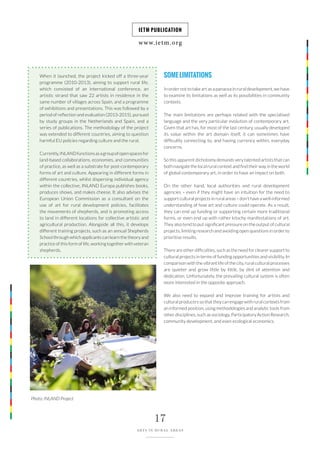
Photo: INLAND Project
www.ietm.org
IETM PUBLICATION
18
ARTS IN RURAL AREAS
CHALLENGESANDSOLUTIONS
When approaching a rural context in Europe, we will mostly find
challenges related to a dismantled sociocultural tissue, a lack of
self-esteem and identity, and an atomisation of social life. Fewer,
older people, often commuting; or youth that have to travel every
daytobiggertowns.Thefeelingofbeingperipheral,alackofspaces
for communality or collective creative expression. And maybe
even economic deprivation or the lack of essential services… it’s
as if a whole economic sector, in this case farming, were being
restructured but with no clear substitute – just as we saw with
coal mining and other traditional industries. Industrialisation of
agricultural and food systems will involve less and less agency for
farmers, growing automation, and dependency on markets and
other actors in the food chain.
There is also the challenge of rising conservative views, containing
a rejection of all that liberal globalisation has brought to rural areas
in place of its promised wealth. Migrant communities risk being
treated with aversion, and fractures in the social tissue might make
the work of artists with progressive views more and more difficult.
In the end, artists are always at risk of being the outsider, not
considered part of the community but as just another ‘enlightened
expert’ come to tell the locals what to do…
In order to work with these challenges we need to start by looking
at the frame in which our intervention will operate. And that
involves rethinking the questions.
For example, if we were approaching a rural site that evidently had
a problem with a lack of services, would we boost the supply of
services through contractors, to bridge the gap between rural and
city residents, or would we look at ways to generate an empowered
and resilient community to co-produce their own services?
And if all these specialised cultural producers are given the
opportunity to influence the development of rural areas, what
space is left for those who still live on and even from the land
to have their say? In what way can we include participatory and
inclusive methodologies that challenge the inherited, top-down
approach of the technocracies and expert bodies?
Artworks and art projects have to be useful and meaningful in the
local context, but they must also contain a quality and relevance
– a currency – in contemporary art discourses. They must
remain capable of coping with the established, and increasingly
meaningless, art institutions and channels – and be ready to
replace them.
It is not only the rural voice that has to be at the centre of this
approach but the farming sector in particular – and not as object or
theme but as subject and co-author. It is in the direct management
of natural resources, agro-biodiversity, and rural landscapes that
the whole narrative of another Europe of regions and countryside
has to be built.
It is also where an important reservoir of knowledge, symbolisms
and transcendent body and inter-species operations can inspire an
art that would bind us back to ourselves and the environment. A
viewpoint that encompasses the perspective of an Agroecological
Agrarian Reform in Europe should guide the assessment of existing
potentials, and allow for a form of rural development in which
cultural and agricultural policies go hand in hand with a careful
attention to participation.
This would form part of an important and necessary change to
the values in our societies as they transition to sustainability – a
point that has already been stressed by the European Sustainable
Development Strategy of 2007, and by the targets of Europe 2020.
www.ietm.org
IETM PUBLICATION
SOCIAL ASPECTS OF ARTS IN RURAL AREAS
Piotr Michałowski
The roots of the word ‘culture’ lie in Cicero’s colere, the Latin
for ‘to tend or to cultivate’. This framing of culture connects us
to an archetypal image of man’s special relationship with the
land, and probably it was observation of agricultural work, with
its discipled care and inspiring laws of nature, that led Cicero
to make his comparison and to coin the phrase cultura animi,
meaning ‘cultivation of the soul’5
. Indeed, cultivation requires some
experience, some awareness, but also cooperation. Just as bread
sometimes does not rise, one can have all the right ingredients and
yet, in some circumstances, fall short of the desired outcome.
In this respect, rural areas have an amazing way of encouraging
experimentation, whether agricultural or artistic. Similar to the
‘trial’ field, where one can try to establish various, sometimes
foreign plant species, in the social sphere inspiration can come from
many different places. Of course, it is seldom easy: though it may be
2
invisible on the surface, the ground keeps a memory of its decades
of cultivation with certain plants, and may simply not accept new
seedlings. This can happen in the sphere of social experiments
as well, when we do not pay attention to the heritage of a place,
its invisible divisions and traditions. With any social or artistic
intervention in a local community (or a local ‘ecosphere’, a local
culture), it is an important and difficult task to propose solutions for
social self-organisation that will positively affect the development
of social capital, strengthen interpersonal ties, and stimulate
new forms of self-realisation. A careful and effective artist will,
therefore, get to know the local context. Any new solution should
be in symbiosis with it, bringing positive change and building upon
existing structures, rather than acting as a cultural revolution or
sudden break from tradition. So, any artistic intervention in a place
should both build community awareness and grow the sensitivity
of the artist for the local culture and context.
		
5 | “So all cultivated minds do not bear fruit. To continue the figure: as a field, though fertile, cannot yield a harvest without cultivation, no more can the mind without learning; thus each is feeble without the
other. But philosophy is the culture of the soul. It draws out vices by the root, prepares the mind to receive seed, and commits to it, and, so to speak, sows in it what, when grown, may bear the most abundant
fruit.” Quote from Cicero’s Tusculan Disputations, translated by Andrew P. Peabody (Boston: Little, Brown and Company, 1886), p. 96. Available here.
www.ietm.org
IETM PUBLICATION
20
ARTS IN RURAL AREAS
THE RURAL SITUATION NOW: MIGRATION,
DEMOGRAPHIC CHANGES AND TRANSNATIONAL
CONNECTIONS
“Seasonal workers from Eastern Europe work in the fields
of Western Europe, Indian farmers go to Italy to work in the
dairies. That is how new people get in the countryside and
these people are usually very welcome because they are the
workforce of modern agriculture. These people also bring
their own cultures to the countryside.” 6
— Henk Keiser
Today, we seem to have made a significant departure from the
kinds of ‘cultivation’ that Cicero experienced in his time, and rural
areas have begun to lose their agricultural identity. These drastic
changes started at the beginning of the 20th century, intensified
significantly in the years after World War II, and escalated even
further after the 2008 financial crisis and the huge migration
waves in the 2010s. They brought numerous challenges to rural
areas and to the way we think of the ‘rural’, and yet they also
opened new possibilities for a better future.
Migration trends – whether driven by economic, social or political
forces – constitute the largest strain posed on rural areas. On
the one hand, technological progress facilitates cultivation and
reduces the number of people required to handle agricultural
processes – which means fewer and fewer working age people in
rural areas. When a workforce is needed, more often than not it
is sourced from outside, whether with seasonal workers or long-
term moving migrants (as demonstrated in a recent EU survey).
On the other hand, across Europe there is a symmetrical trend
towards migration: younger generations going from rural areas
towards cities; then in the other direction, adult urban residents in
their sixties and beyond moving towards rural areas. The general
motivations are completely different, yet quite predictable: cities
give obvious opportunities for work and development, while the
countryside grants peace from the urban bustle. While we have
been long accustomed to the phenomenon of ‘global cities’, the
recent 21st century trend of people moving towards rural areas
is giving rise to a kind of ‘globalisation’ of the villages, as people
from different regions, as well as people of different nationalities,
move to a certain rural area they have never been connected to
before – and bring their own cultures with them.
6 | Henk Keiser, Director of Rural Forum Denmark, speech at IETM Plenary meeting in Brussels, 2017.
Despite the ‘repopulation’ experienced in recent years, the ‘drain’
of young people away from rural areas will have irreversible and
unpredictable effects: continuity is broken when a generation of
potential promoters for local development disappear.
The abandonment of our connection with the land disturbs an
established paradigm for understanding rural areas. For this
reason, a frequent mistake of a specific ‘city-centrism’ is to try to
implement urban culture in rural areas – when of course culture is
absolutely already present in rural areas, and there’s no particular
need to import the urban kind.
All the above-mentioned processes are exacerbated by ageing
populations, experiences of marginalisation, a sense of detachment
/ not belonging, the feeling of not being heard, the rise of populism
and right wing propaganda, and so on. There are no easy answers
to these challenges.
And yet there are many advantages to rural living, starting with
the opportunity to (re)connect with nature and access open
space – benefits difficult to find in crowded cities that struggle
against serious air pollution. Social life in small settlements, with
its spontaneous and close connections with friends, neighbours
and fellow villagers, is also often perceived as higher quality
than big city social life with all its opportunities for culture and
entertainment.Inaddition,theprospectsforlocalself-organisation
around common values, communal projects, initiatives, and so
on are sometimes better in small communities than in urban
settlements where any citizen initiatives have to be formalised and
regulated in order to comply with the complicated organisation of
urban communal living.
The described trends are so common throughout Europe that
we should look for instruments and solutions that will not only
provide ad hoc support for a given locality but address challenges
on the wider European level. A possible solution is to strengthen
cooperationandexchangeforeffectiveactionsbetweenruralareas,
engaging residents in creating ‘symbiotic’ initiatives that strive for
social development, self-organisation and local entrepreneurship.
Hence, we should look for answers within the existing EU support
networks and tools in order to find improvements in the areas of
culture and heritage, the social and creative economy, rural and
business sector cooperation, and so on.
www.ietm.org
IETM PUBLICATION
21
ARTS IN RURAL AREAS
POLICY MEASURES TARGETING THE SOCIAL AND
POLITICALISSUESOFRURALAREAS
Through insightful conversations with various stakeholders from
non-urban areas – held at participatory working meetings on
the topics of art, culture and cultural participation in rural areas
– European networks like ENCC, IETM and CAE have identified
several issues that call for action. Further on in this chapter there is
detailed information on those reports, with recommendations. For
now, some of the proposals include: a wider promotion, in terms
of geographical distribution, of participatory processes through
culture in Europe; promotion of more inclusive approaches among
citizens and professionals of different sectors; and developing
systemic programmes, solutions and tools to empower regional
leaders and improve the competences of local policymakers.
There are several schemes and cooperation/support programmes
currently active, and it’s worth mentioning here their scope of
work and priorities.
LEADER is an EU mechanism that provides effective professional
support for rural communities. It aims to keep citizens in their
place of residence, or at least to reduce overall migration. As a
local development method, it has been used for 20 years to engage
local actors in the design and delivery of strategies, in decision-
making, and in resource allocation for the development of their
rural areas. It is implemented by around 2600 Local Action Groups
(LAGs), covering over 54% of the rural population in the EU, and
bringing together public, private and civil society stakeholders in
a particular area.
The necessity of providing inspiration for creativity and
entrepreneurship is often completely neglected by formal
education. Actions to develop support programmes and EU
committees, like the European Economic and Social Committee,
try to fill this gap. Still, there is significant room for improvement
in this area, especially with respect to Committee visibility in the
EU Member States. The aim is to build consensus between these
groups so that EESC opinions truly reflect the economic and social
interests of EU citizens.
The European Network for Rural Development (ENRD),
another potential actor in the field, was established in 2008 by
the European Commission, Directorate-General for Agriculture
and Rural Development (DG AGRI). The ENRD is governed by
the formal structures of its Assembly and Steering Group, which
bring together a range of rural development stakeholder groups to
provide strategic direction, guidance and coordination.
Additionally, National Rural Networks (NRNs) operate in each
EU Member State to support and enhance rural development
objectives as defined in the Rural Development Programmes
(RDPs). NRNs enable and facilitate exchange and learning
between all the partners involved in Rural Development policy
implementation: public authorities, economic and social partners,
and the relevant bodies representing civil society.
With the above mechanisms working on international and national
levels, grassroots cooperation networks can be created, with a
varietyofstakeholders,tofocusontheaccumulationofknowledge,
as well as on fostering competences and supporting participatory
processes in order to create local development strategies.
One of the fundamental advantages of networking is that
it counteracts isolation. The opportunity to join with other
communities to face situations and share known solutions, or to
co-create spaces of inspiration and synergy, is an indisputable
benefit. However, the number of rural communities carrying out
major networking activities or applying for funding for partnership
development and local capacity building remains rather small.
Among many possible barriers, we can point to a lack of faith
in Cicero’s colere: a disbelief that such ‘cultivation’ can be a
success, and an unwillingness to invest the time and resources
in preparing the ground for the potential growth of local and
international cooperation. In addition, networking requires long-
term investment and engagement, while many communities might
be focused on achieving short-term benefits and solutions. But
there are many more opportunities on the EU level for getting
inspiration and encouragement, or for exchanging ideas.
One example is the European Week of Regions and Cities,
an annual four-day event, created in 2003 by the European
Committee of the Regions, during which cities and regions
showcase their capacity to create growth and jobs, to implement
European Union cohesion policies, and to prove the importance
of the local and regional levels in good European governance. The
event has become a European networking platform for experts
in regional and local development, enabling the exchange of
good practices in economic development and social inclusion,
cross-border cooperation, public-private partnerships, regional
innovation, and community-led local development.
www.ietm.org
IETM PUBLICATION
22
ARTS IN RURAL AREAS
INPUT FROM INTERNATIONAL ARTS AND CULTURE
NETWORKS
In recent years there has been increasing discussion within
European arts and culture networks on the resilience, participation
and empowerment of rural areas in the context of the arts Several
parallel processes of consultation and stakeholder interaction
have been initiated. The IETM network began a series of working
sessions at plenary and satellite meetings (such as IETM Brussels
2017,IETMPorto2018,SatelliteWales2018,IETMMunich2018,
and IETM Hull 2019), and produced several pivotal reports7
that
have reflected upon some important aspects of the conversation.
Among other things, they have worked to define the rural, to map
performing arts in rural areas, and to share inspiring outcomes of
performing arts projects and practices sited in rural areas.
This very publication is yet another IETM endeavour to promote
performing arts in rural areas. Accompanied by a collection of
examples and practices from all over the globe, it aims to outline
the major challenges and solutions that will need to be considered
on the way to renewing policy and fostering the production of a
more impactful art in rural areas.
In 2019, the network Culture Action Europe (CAE) launched
an advocacy campaign focused on arts and culture in rural and
peripheral areas. Its main focal points are social cohesion, living
culture, and sustainability. The advocacy itself aims to achieve
recognition at the EU policy level for arts in rural areas, and to
establish transversal solutions, across various policy fields, to
support culture and the arts in rural and peripheral areas. The
annual Beyond the Obvious (BtO) conference meetings are part
of the development process for such policy change endeavours. In
2019, the Culture Crops BtO meeting was dedicated particularly
to shaping policy recommendations for non-urban territories.
Meanwhile, the European Network of Cultural Centres (ENCC)
haskeptitsfocusonaccessibility,innovation,inclusion,cooperation
and education. For this purpose, the ENCC network devised a
crowdsourced manifesto, Culture for Shared, Smart, Innovative
Territories. The preparation of the manifesto was initiated during
ECoC Wrocław 2016 in the region of Lower Silesia, Poland. By
the end of 2019, around 200 stakeholders from 22 European
countries had taken part in the process. ENCC also launched a
Working Group on Territorial Development, which operates as
a working lab for professional stakeholders, actively supporting
policy initiatives, sharing expertise and insights, and providing
content to international conferences on non-urban territories.
IETM, CAE and ENCC have decided to collect all the knowledge
and recommendations gathered by these various initiatives into a
single manifesto for arts and territorial development. The launch of
the common document has been scheduled for March 2020, with a
working meeting with MEPs planned in the run-up to publication.
In 2020, Voices of Culture are also initiating a broad dialogue on
the role of culture in non-urban areas of the European Union, and
on what the EU can do to promote culture in peri-urban spaces,
the suburbs and the periphery.
All these activities are of great importance not only for the arts
and culture sector. Giving local leaders the opportunity to share
their experience and recommendations, which will be included in
policy proposals at the EU and Member States level, is an example
of good governance. It fosters active participation in bottom-up
decision-making and counteracts the usual isolation that the
periphery experiences from the process of policymaking. The kinds
of inclusive and participatory models for shaping policy initiated by
the above-mentioned networks should be supported as a priority.
7 | List of IETM publications and reports here.
www.ietm.org
IETM PUBLICATION
23
ARTS IN RURAL AREAS
Sometimes Asmita
Shrish , freelance artist
and filmmaker, and the
team behind the ‘Film-
making Workshops for
Indigenous Film-makers
in Nepal, 2019’ project
had to trek for four
days in order to reach
their next destination,
climbing from 6am
to 5pm in quite harsh conditions and at altitudes of
up to 4500 metres. Being an indigenous film-maker
herself, Asmita’s main mission was to use audio/visual
storytelling to encourage communication and self-
expression, increasing awareness of local voices from
Nepal’s remote rural areas. “When storytelling gets
connected with indigenous cultural practices, it becomes
personalised and meaningful. Community members feel
validated and hence, more engaged to link with their own
selves,” says Asmita. Traditions do not exist on their own:
they have to be communicated, contested, challenged,
processed, constructed and (re)invented. All the project’s
storytelling workshops aimed at creating an inclusive
environment for participants by encouraging them to
discuss favourite films, important local stories, folk tales,
and contemporary stories revolving around indigenous
communities. Sharing their stories with each other gave
the participants the opportunity to explore elements of
their own identities. Asmita’s own film of the project is in
post-production and will explore issues around gender
minorities, endangered cultural heritage, the position and
struggles of women in a patriarchal world, war, and sexual
violence. More details on the project: Annex A. IETM Art
in rural areas case study database, ID 133.
ARTINRURALAREAS–AN(UN)EXPECTED
AGENTOFCHANGE
But how do the arts make a difference where it matters for local
communities in rural areas anyway? Is art not about aesthetic
pursuits, celebrating cultural heritage, providing entertainment
and pleasurable leisure time, rather than empowering local
communities and tackling issues like migration, depopulation or
an ageing demographic?
“Imagination can be a very dangerous weapon.” I still recall these
words of the artist and researcher Igor Stokfiszewski, spoken at
a panel session on political systems and culture at the Forum for
theFutureofCulturemeetinginWarsawin2017.Hewasreferring
to the practice of populist and far right governments suppressing
artists for fear of their ability to influence communities and inspire
them to action.
Art possesses a strong political power. Art can make a difference.
And at times art becomes an act of bravery. It triggers genuine
creativity, innovation, and sustainable development. And these
are crucial qualities when trying to describe a ‘strategically well-
governed’ local community. An absence of those qualities is among
the causes of numerous damaging social trends and patterns,
such as depopulation, disintegration, passiveness, frustration, or
extremist political choices.
Contemporary artistic creation, and especially participatory art
projects, can prove useful in one very practical respect. Despite
some obvious similarities, each local community lives in a specific
sociocultural, economic and ecological context. Therefore
any issues within a community call for tailor-made solutions.
Inclusive participatory art projects can bring up uncomfortable
questions, but they can also gather a community in a safe space
for experimentation, triggering creativity and dialogue. They can
give people a voice, and thus empower them to find and uphold the
solutions that best fit their local context.
The next example, from Colombia, demonstrates that art in
peripheral territories can be an act of bravery, challenging
structures of power which for centuries have held a dominant
position.
Art and social empowerment in rural areas
Within Europe there are many insightful examples of local
communities being positively affected by artistic projects. Yet
to demonstrate the impact art has on social empowerment, we
can take a step beyond the continent, and be inspired by projects
implemented in regions with far harsher conditions for civil rights,
or far greater levels of democratic infringement than we bear
in Europe. There are numerous interesting examples in IETM’s
collection of case studies, which looks at how art projects have a
positive effect on communities. Taking a brief tour through these
now, we will be traveling through continents – starting with Asia,
and continuing through South America before arriving back on
European ground.
The first example takes us to Nepal, and to an altitude of more than
4000 metres above sea level, to shed light on an artistic endeavour
undertaken within these challenging physical conditions. It is a
project that demonstrates how, thanks to modern technology, arts
in isolated areas can make local voices heard worldwide.
Project:
Film-making Workshops for
Indigenous Film-makers in
Nepal, 2019
Organisation:
Asmita Shrish,
Freelance Artist/Film-maker
Location:
Nepal
www.ietm.org
IETM PUBLICATION
24
ARTS IN RURAL AREAS
Marcelo Miranda and Jully
Acuña Suárez, leaders of
the Art of empowerment
project in Sibundoy,
a municipality in the
Putumayo district of the
Republic of Colombia,
describe the region as
neglected by the central
government, strongly
influenced by the Church,
and suffering from
censorship and brutal acts
of police violence towards the indigenous inhabitants.
In the context of this precarious situation, Miranda
and Suárez began an artistic project based on research
into the cultural heritage of the indigenous Sibundoy
Camëntsá people. The project, the Art of empowerment,
aimed to “represent the community in its contemporary
context,challengecolonialpreceptsinartandmainstream
archaeological and museum practices, and spark a missing
and much needed intercultural dialogue”. In practice, the
project’s artistic and research team collaborates with the
local community to critically address cultural policy, the
local government-managed museum, and this museum’s
practice of displaying human remains. It co-curates
new exhibitions based on the Camëntsá people’s own
interpretation of history, material culture, archaeological
and sacred sites, territory, and development. The project
has been developed in collaboration with local NGOs
and indigenous leaders. The overall research project on
cultural heritage is funded by the British Museum and the
Gerda Henkel Foundation. It is supported by the British
Museum’s Santo Domingo Centre of Excellence for Latin
American Research, where the results will be exhibited.
Despite this broad institutional support, the project
would never have succeeded without local collaboration
and engagement. What drives it is the willingness of local
people to participate in artistic activities, and to help raise
awareness among governments about the issues tackled
in the project. With their support, it can gradually raise
awareness of the ways arts and culture can provide both
a platform to speak and a foundation to search for better
opportunities in life. More details about the project:
Annex A. Case study IDD 64
Who Killed Szomna
Grancsa? (2017-2019) is a
theatre performance that
tells the story of a young
Roma girl from a remote
village who believes in the
importance of education
and does everything she
can to keep going to school.
Living in a patriarchal Roma community which denies girls
the right to education, or even to choose for themselves,
she encounters a lot of difficulties. The play was based on
a true story from contemporary Romania, from a distant
village where Roma and Hungarian people, both outsiders
in Romanian society, share quite harsh living conditions.
So, what is so particular in this case? First of all, Giuvlipen,
the group behind the project, is the first independent
Roma feminist theatre company in Romania – a country
that has one of the largest Romani communities in Europe.
Furthermore, this community is notorious for depriving
women and girls of their basic human rights. Putting on
stage the issues of school drop-out, depression, suicide,
rural poverty and isolation faced by Roma teenagers from
the countryside, and then performing the piece for Roma
audiences, has taken a big step towards giving Roma
girls and women a voice in their everyday lives. Having
a professional collaborative project with both Roma
and non-Roma artists (actors, director, stage designer,
musicians) and showing it on city stages and at theatre
festivals is still an innovative practice in Romania. It sends
a clear message that contemporary Roma arts are by no
means inferior to the majority culture, and that Roma
people should be acknowledged as an equal and integral
part of society. More on this project, with photos and
links to videos – Annex A. Case Study IDD 141
Project:
Art of empowerment, part
of the Bëngbe Benacheng
research
Organisation:
Jully Acuña Suárez &
Marcelo Marques Miranda
(Faculty of Archaeology,
Leiden University);
Location:
Sibundoy, Colombia
Project:
Who Killed Szomna Grancsa?,
theatre performance
Organisation:
Giuvlipen, Roma theatre
company
Location:
Romania
Another inspiring example, this time a European one, on how
contemporary art can empower, and give a voice to, socially and
territorially peripheral communities.
www.ietm.org
IETM PUBLICATION
25
ARTS IN RURAL AREAS
Art and bridging the generation gap in rural areas
As we have already touched on, the ageing of rural populations
and the migration of the young to cities has placed a huge strain
on policies or initiatives hoping to revive rural areas. The gap
between the younger and older generations is even wider now,
at a time of rapidly changing technology. Young and old simply
speak in different languages. How can this be overcome? Should
we teach older people the language of the young? Perhaps train
younger people in the codes of previous generations? Or should
we try to make a new common language, with common codes and
shared memories? Not surprisingly, in considering these questions
contemporary art projects have proved successful in opening up
space for intergenerational meetings and shared experiences.
Here’s an example from
the remote rural areas of
the community of Oleśnica
(12 000 inhabitants) in
the south-western part
of Poland. In 2013, the
small village of Boguszyce
turned its assembly hall
into a local storytelling
museum, with collections
of items and cooking
recipes. To gather the stories that lay hidden in rural work
tools, old radios and sewing machines, the community
recorded autobiographical video portraits, involving
young people as makers and producers.
With an understanding of the positive role of art in social
inclusion, and responding to the needs of the community,
the venue became a hub for diverse artistic projects,
with local people becoming the creators of local and
international initiatives. In 2016, the intergenerational
theatrical group Moments was created under the
international project Bridging Generations (funded
by the EU programme Europe for Citizens). Non-
professional actors from the ages of 7 to 77 were led
by a professional director and choreographer in a mime
performance, also called Moments, related to the painful
history of WWII, and using several precious symbolic
mementos gathered in the local museum’s Chamber of
Memories. This performing arts project was based on
three aims: initiation of a collaborative project between
professional artists and the local community; attribution
of ‘symbolic capital’ to the community’s treasured tokens
Project:
Moments, part of Bridging
Generations project; colourful
bus stops
Organisation:
The community of Oleśnica
Location:
Poland
of remembrance within the Chamber of Memories; and
fostering capacity and social energy to give local people
a voice and tell their story to the world.
Having a taste for making art together as a way of
bringing life to their village, in 2013 the community of
Oleśnica joined the Swiss Contribution grant programme
– a scheme that allowed them to foster local grassroots
projects in the visual arts. One such project, created by
artists and local leaders, involved local inhabitants in the
artistic regeneration of a village’s bus stop. Following
a technical refurbishment, the local community came
together to participate in designing a mural that featured
motifs inspired by local culture and heritage. Then, with
the support of a professional artist (also living in the
village), locals of all ages were involved in the painting.
The intergenerational aspect was very important for the
success and recognition of the process, also instilling
among participants a sense of taking responsibility
for the public space and its aesthetics. The community
succeeded in creating a snowball effect, and as of 2019
their initiative has inspired another 18 villages to create
their own unique and colourful bus stops.
Jan Żarecki, mayor of the village of Ostrowina (in
Oleśnica County) gave an interview on Polish TV in
2015: “Three generations helped us. We only gave a short
notice and people came to support this project. It is much
cleaner, much nicer now... People slowly start to behave
differently, I mean better. Also this project gave us a good
promotion – for our village lost somewhere in the woods.”
Today, the Colourful Bus Stops project has contributed to
a sense of belonging and territorial integration across the
area of Oleśnica.8
8 | ColourfulBusStopsandthetheatricalgroupMoments,asartprojectsformingpartoftheBridging
Generations initiative, were named as one of 12 best practices in ‘Innovative Audience Development’
inthereportofEconomiaCreativa,publishedinMarch2018,andrecognisedbytheOECDLEEDForum
on Partnerships and Local Development.
www.ietm.org
IETM PUBLICATION
26
ARTS IN RURAL AREAS
Folklore, tourism and heritage – a needed shift
Contemporary art projects in rural areas should go beyond
obvious forms – such as simple presentations of folklore or
handcrafts – and align themselves to trajectories of creativity
and transformation. Such an approach allows traditions to stay
‘alive’ in the sense of being embedded in an ongoing, everyday
‘performance’ or practice. Hopefully, it can also help counteract
the all too easy slide into the kinds of decorative entertainment
typified by historical re-enactments, historic/folklore amusement
parks, traditional craft festivals, and the like, because preserving
a tradition doesn’t mean freezing it in time. Rather, it’s about a
continuous process of redefinition, questioning and rephrasing.
As Asmita Shrish, one of the respondents to IETM’s survey on arts
in rural areas remarked: “…traditions do not exist by themselves,
they have to be communicated, contested, challenged, processed,
constructed, and (re)invented for our purpose(s)”.
We can also reference the cultural studies theory of Prof. Stanisław
Pietraszko, who founded the cultural studies programme at the
University of Wrocław, Poland in 1972. His theory derives from
the Neo-Kantianism of the Baden School and places values ​​at the
centre of its definition of culture, stating that “culture is a way of
life by values”9
. This inclusive theory opens the door to a broader
understanding of the processes at work in any community, and
also guards against the simplistic justification that ‘culture’ equals
‘art’, which in the case of rural communities quite often leads to a
reduction of ‘culture’ to ‘folkloric art’.
Let’s have a look at an example of ‘folklore’ meeting ‘contemporary
art’ – and in a project that rethinks both, rather than just
decoratively attaching a lovely patch of the past to the realities
of the present day.
Initiated in 2011, The
Journey is an ongoing
dance-music project that
connects local, traditional
dance with contemporary
dance practices. Bringing
together amateur dancers
from rural communities
and professional
contemporary dance
practitioners, it involves
a period of creative
residency and culminates
in a public performance. Participants learn from one
another as they draw connections between contemporary
and traditional dance and music.
50 people, aged 4 to 80, embarked on this journey only
having prior experience of traditional dance. Not one
person among them had ever seen a contemporary
dance performance. But once they overcame their fear
of experimenting, and once they felt that their ‘culture’
was respected within the process, they plunged into
the project with obvious pleasure. A participant in the
project told Filipa Francisco, its lead choreographer: “…
we are learning your steps and you are learning ours.
But yours are connected to our imagination”. For her
part, Filipa frames the major outcomes of the project in
terms of empowerment: “Working with these groups is
also giving voice and visibility to them, to the margins.
To put these groups in nice theatres, on a professional
stage, with microphones is a way of saying: yes you do,
you deserve it! Creating together is a way of saying your
voice is important. Opening a space for improvisation is
a way of saying your imagination is important. Working
with contemporary dance is a way of saying tradition can
live in the present.” More about this project in Annex A.
Case study IDD 85.
Project:
The Journey,
a dance-music project
connecting traditional
and contemporary dance
(2011-2020 and beyond)
Organisation:
Materias Diversos
from Lisbon, Portugal
Location:
Portugal, and internationally
Folklore and tradition are the parts of culture typically used to
attract tourism. The audiences are out there, ready to target, and
so a whole industry and economy has developed around them.
Unfortunately, quite often these forms have been simplified to fit
a stylised and standardised image of ‘tradition’, one that can be
conveniently marketed to mildly interested tourists who are ready
to spend an hour or so ‘getting to know the local culture’.
9 | Reference from Stanisław Pietraszko, Studia o kulturze (Wrocław: 1992).
www.ietm.org
IETM PUBLICATION
27
ARTS IN RURAL AREAS
In terms of ‘experiencing the local culture’, the tourist industry
regards the tourists or visitors as ‘the customers’ and the
locals merely as a ‘resource’ to make the customers happy. This
widespread and simplistic approach has already caused a series of
problems for areas with very high levels of tourism. It poses even
greater threats to the balance of rural communities, where the
positive outcomes of tourism (most of them economic) must be an
added value to an integrated, well organised community. Yet local
authorities usually find it rather difficult to prioritise community
and social development over tourism. Where tourism has a very
visible impact through its economic contribution, investing in
social development is a long-term process that can often exceed
the political mandates of governing bodies.
Quite often this lack of a long-term vision, or this absence of
boldness and creativity when it comes to developing the touristic
offer of rural areas, leads to a uniform convergence on simple
festivals and celebrations when there are multitudes of heritage
sites, natural phenomena, local legends and stories that are worth
sharing with visitors. Artists have proven themselves resourceful
explorers of all these unique peculiarities of place.
For instance, Association Zona, an arts company from
Croatia, organises aMORE – festival moru (‘aMORE
– festival for the Sea’), an interdisciplinary festival that
mixes arts, culture, science and ecology in order to raise
awareness of the threat to maritime ecosystems. The
festival is oriented towards the need for promoting
natural preservation in the region of the Istrian peninsula,
which suffers from over-tourism. Although not aimed at
‘visitors’, it attracts a lot of interest from tourists, as well
as the local citizens who care for the maritime life in their
region. More about this project in Annex A. Case study
IDD 146.
Between the Seas, a Mediterranean residency and festival in
Monemvasia (Southern Greece), is another example from the
region that prioritises locals over tourists – and thereby wins both.
(See Appendix A. Case Study IDD 10 for further details.)
Art in rural areas as an ongoing resource for positive
social change
Visitingartistscanbringafresh,outsider’seyetolocalcommunities
in rural areas, and yet the strongest impacts come from artists
who actually stay in a community. Building trust, instigating
positive change, empowering communities, and achieving project
sustainability all require that artists maintain their intervention
for a longer period of time than the typical residency programme.
Therefore rural residency schemes usually offer opportunities
for extended stays so that the artists can get to know the life of
the local community and establish connections there. Making
numerous visits to a community over a longer period of time is
another approach that many artists adopt, especially if transport
links allow it. Still, it feels that some of the most convincing stories
and most inspiring examples of positive change can be found in
projects where artists actually live in a community…
In 2006, a group of young
artists from Wrocław,
Poland began spending
their summer months
running a travelling
puppet theatre (initially
across the region of Lower
Silesia, later all around
the country), inviting local
inhabitants of all ages to join workshops and to perform
in an evening show given in the central square of each
village. The group was called Academy of Imagination,
and the project – Travelling Fairy Tales. Each day, the
theatre would travel to another village, recalling the
ancient tradition of the Commedia dell’arte. The artists
(city-based) were impressed by the lack of ‘snobbism’
among their rural audiences – by their openness and
curiosity. At the same time, the project left them feeling
a lack of continuity: just after initiating the artistic and
creative process, and just as a conversation was starting,
everything was interrupted to move on to the next site.
And that’s why some of the artists from the group decided
to establish themselves more permanently by moving into
the rural communities they’d visited. Their idea was to
provide sustainable solutions and art workshops on a
daily basis, in cooperation with local culture centres or
supported by project-based funding.
Project:
Travelling Fairy Tales
Organisation:
Academy of Imagination
Association
Location:
Poland
www.ietm.org
IETM PUBLICATION
28
ARTS IN RURAL AREAS
That is a serious commitment to make, with many positive
effects both for the artists and the communities they live in. Such
longitudinal projects provide sufficient space for experiments
with various artistic approaches, as well as genuine community
involvement and participation. Art projects of this kind can
introduce non-urban citizens to new or previously unknown ways
ofbringingtheircommunitiestogether,whichusuallyinspiresthem
to continue organising gatherings or to plan new artistic activities.
Art opens the door to emotional and aesthetic experiences that
can awaken the social potential of local communities.
Here’s another longitudinal project aimed at (re)building the sense
of communality in rural areas.
Initiated in 2016, the
project A Vila do Mañá
has evolved to act as an
educational and outreach
project. Using art and
play as tools, its goal is
to make children aware
of all the ways that the
commons manifests in
public life – from tangible
and intangible heritage, to
architecture, urbanism and landscapes. The objective, as
Sandra González Álvarez explains, is to awaken a new,
urban perspective on space. The children who participate
discover and nurture a new way of looking at things –
one that they can carry forward and that will eventually
influence them as the citizens of tomorrow.
The project implements a series of workshops, held in,
and financially supported by, the town halls of various
settlements in the region of Galicia. Each workshop is
different because the organisers believe that each place
has its own identity. “The impact of the A Vila do Mañá
project has gone beyond the young participants, inspiring
all citizens. The realisation of interventions in different
public places involves the whole society, provoking an
intergenerational dialogue that enriches the experience,”
says Sandra González Álvarez. [Annex B. IDD 81]
Project:
A Vila do Mañá (‘The Town
of Tomorrow’), the region of
Galicia, Spain
Organisation:
PØSTarquitectos and Sandra
González Álvarez
Location:
Spain
ARTINRURALAREASNEEDSOURSUPPORT
Creative organisations situated in remote, sparsely populated
areas are often isolated and economically fragile, yet it is well
recorded that they can boost local economies, improve quality of
life, and encourage more active civil communities through their
cultural provision and through realising the potential of locally
based cultural and artistic projects.
Supporting the arts and including them in the strategies,
developmental policies, and everyday proceedings of local
authorities is a necessity, and is strongly recommended for
achieving the goals of coherent territorial development. As a
board member of ENCC network and a cultural practitioner of the
public, private and NGO sector with 20 years of experience, I truly
support bottom-up solutions. The extensive database of projects
collected by IETM, which feeds this publication with its numerous
examples and case studies, offers plenty of best practices to follow,
challenges to tackle, and inspiring solutions to implement. See
Appendix A and Appendix B for case studies and list of collected
projects.
Emerging from this body of experiences, some commonly repeated
points and recommendations include the importance of continuing
art education, the transformative effects of empowerment
programmes, the need to foster skills for self-organisation, and
the central place of creative thinking, innovation, accessibility,
inclusion and social cohesion.
The need for advocacy and recognition for art in
rural areas
Efficient strategies for the endorsement, advocacy and recognition
of arts and culture in rural areas have to be implemented on local,
regional and international levels – possibly by emphasising their
transversality, impact and importance on the European scale.
The personal need for culture and the arts is one that has to be
instilled, regardless of whether we’re speaking about the urban
or the rural. In the non-urban areas there are fewer opportunities
and the focus on them should therefore be stronger. Artistic
interventions in rural areas can act as a trigger for change and
personal development, with the arts providing a path to discover
previously unknown values and aesthetics. Without systemic
cultural education we will find ourselves lacking structural growth
in participation, understanding, and dedication to culture and the
arts in rural areas. There is a definite need for an art education
beyond formal processes. Village halls or centres for culture are
the perfect fit for this purpose, being intergenerational hubs –
what Ray Oldenburg calls ‘third places’.
www.ietm.org
IETM PUBLICATION
29
ARTS IN RURAL AREAS
National authorities and the general population have to become
aware of the barriers that underrepresented (remote and rural/
peri-urban) populations experience: depopulation and ageing,
a lack of appropriate infrastructure for social development and
economic growth, and a similar lack of transport infrastructure,
civil services, and so on. Art and culture can be seen as another
way of creating awareness of this inequality, and perhaps even of
triggering measures to alleviate it.
The need for local community empowerment
programmes
Turning rural inhabitants back into active citizens and building
empowered communities is crucial to successfully and sustainably
resolving local challenges and the problems of life in rural areas.
This process can be initiated, if not by the community itself,
then through the involvement of external ‘facilitators’ and the
implementation of community development programmes, with
all the risks that brings of having outsiders parachuted into the
local community. Delicate as this relationship may be, artists have
already proven themselves ingenious mediators and facilitators
of positive change.
Starting this process is crucial. Once underway, local communities
can enter into dialogue with local authorities and influence the
political agenda in ways that are desired by and important for the
whole community. Being united gives communities the (social)
power to set the right priorities.
The need for developing new skills
A strong recommendation is to invest in the acquisition of new
competences that will foster creative work and the involvement
of rural communities. Artists, cultural workers, local government
bodies, community leaders, social workers, ordinary citizens
– everyone can benefit from developing such skills. This can be
achieved through engaging in capacity building projects and
initiatives, through projects that provide hands-on learning, and
through meetings, the sharing of best practices, and networking.
Networking as the most versatile tool
Networking offers a multitude of opportunities to learn first-
hand about diverse solutions and possible drawbacks. It offers
opportunities to cooperate and collaborate. In the case of
developing rural areas, bringing together stakeholders and experts
from diverse fields such as the arts, sustainable agriculture, the
academic sector, social welfare, local development, cultural
heritage, ecology, and so on has fuelled numerous exciting
collaborations that can be discovered in the IETM case study
database. Joining forces and engaging in self-organisation proved
to be the ultimate solution to most challenges that art projects in
rural areas have to overcome. And what better way to find partners
than through communication and networking!
Another pressing need is to empower local and international
networks of stakeholders, from diverse fields, to organise in situ
research projects that can supply quantitative and qualitative data.
This in turn can grant better leverage when approaching public
bodies or policymakers.
All these recommendations are shared by the Working Group on
Territorial Development, coordinated since 2016 by the European
Network of Cultural Centres – ENCC. Similar recommendations
were formed by the IETM working group on rural development,
the Rural Forum Denmark, and the CAE advocacy group, all of
whom are experienced in fostering arts in rural areas.
Finally, one last example of how art brings positive change to rural
life. This one comes from rural Central and West Jutland, Lemvig
Municipality, Denmark.
MEETINGS is a four-year
video and performance
project, with two festivals
to showcase the artworks
created within the project.
From 2016-19, ET4U,
the non-profit artist-
run association behind
the project, invited
international artists for
residences in Central and West Jutland, Denmark. They
created new video and performance works dealing with,
taking place in, and produced through meetings with
the local community. In this way, the works provide new
artistic reflections on the area as seen from the outside.
The project reached new audiences in rural areas of
Jutland, mostly due to the close connection between the
makers and their audiences. Taking into account their 20
years of experience making and presenting art in rural
areas, ET4U knew that organising meetings, and opening
up a ‘safe ground’ for debate and conversation within
the community’s own everyday, public spaces, was the
key to encouraging participation on the way to interest
and engagement. The hope was that this would lead to
new creative ideas for a better life in the rural area. With
this in mind, it was reassuring to hear the words of a local
farmer: “I was brought up to think that art is something
that hangs on the wall. But art is different, and when you
see something like this it gets you thinking in different
ways – and I think that’s fantastic!” [More about this
project in: Appendix A, Case study IDD 61]
Project:
MEETINGS
Organisation:
ET4U (a non-profit artist-
run association), Facebook,
Instagram
Location:
Denmark, Lemvig Municipality
3
LIVING CULTURES
Laura H Drane
www.ietm.org
IETM PUBLICATION
Some personal notes: I am Laura H Drane, a Wales-based creative
producer and a passionate advocate for creating arts in public
spaces, especially in rural areas.
Though I have spent many years in cities – Edinburgh, Cardiff,
Manchester – my own life has strong elements of rurality. I used
to live ‘on the tops’ in West Yorkshire, and spent a large part of
my teens in Somerset on the fringes of a large village of about
4000 inhabitants. In terms of the arc of my career, I started out
in 1999 when I began working as an outdoor touring producer
(mainly Shakespeare to country houses and stately homes) before
freelancing as a creative producer, consultant and facilitator.
All of that has entailed everything from producing a science
festival across a large, mainly rural county in northern England,
to facilitating network meetings and away days for rurally based
clients as varied as music education providers and professional
dance companies. Looking back, I can see that much of my work
has been built around what I call genuine public engagement, which
means starting with mutuality, putting work where people already
are, and being open to the potential risk of change for all involved,
principles I think stand me in good stead to write about such topics
now.
During 2017 and 2018, I spent more time thinking about and
experiencing the realities of living cultures – in terms of the arts and
rural contexts – than at almost any other point in my career to date
as a creative producer. This was as a result of the performance work
we were making in our collective Light, Ladd & Emberton, and as a
result of facilitating the IETM Satellite in north Wales, on the theme
of arts and rurality, curated by Karine Decorne of Migrations. The
Satellite was both a joy and a challenge – to prepare for, to remain
attentive to, and to consolidate in many sessions over several days,
in the name of exploring further, digging deeply and reflecting back.
Meeting over 50 participants from around the world, with so
many inspiring projects to share, has further embedded for me
the realisation that creating contemporary arts in rural areas is a
genuine global trend.
www.ietm.org
IETM PUBLICATION
31
ARTS IN RURAL AREAS
LIVINGCULTURESINRURALAREAS
It is high time to relinquish the simplistic idea that ‘rural culture’
is about folklore, traditions, pastoral landscapes, and cultural
heritage sites, all of which can be conveniently packaged into
tourist products and offered to mildly interested visitors along
with the local cheese. People who live in rural areas do not stroll
around in folklore costumes, and in the evenings they don’t gather
around the fireplace to sing folk songs or tell ancient fairy tales.
Instead, they share their own living and breathing contemporary
culture, which is undoubtedly partially global, but to the greatest
extent influenced by their current locality: their current socio-
economic and demographic dynamics, their most pressing topics,
their relations to urban areas, central government and other
rural settlements, their memories of the past and thoughts for
the future.
This, of course, is quite an ambitious scope to grasp in this
publication. So instead, what would we mean when we talk of living
cultures, of the arts and its relationship to rurality? Here follow a
few key frames for this:
• Living cultures in terms of valuing contemporary art
creation in rural communities – especially contributing to
a critical understanding of contemporary challenges and
policy. By this I mean art that is in and of a place that informs
and is informed by it.
• Living cultures and their relationship to touring, when
bringing professional guest artists to rural communities.
This can be about both connection and reach. It is especially
challenging to and for those touring in rural areas (where
oftenthereisanincreasedlevelofintimacywithanaudience,
who are sometimes more open or more demanding, whilst
doing repeated shows and longer residencies or runs, all of
which drives a certain self-sufficiency for the touring artist
or company).
• Living cultures related to audience development – be that
the increase in audiences in numerical terms over time, or
the development of the audience members themselves, this
reach and connection is essential if we are serious about
arts for all everywhere. It’s about fully recognising that
rural areas are at least as varied as urban ones (wealthy
and in need, underemployed and busy, lacking resources
and fantastically wealthy, remote and well connected – it’s
not all farming, folklore and festivities).
I’d like to offer a few relevant, and hopefully illuminating, examples
from my own practice.
Since our collaboration on the IETM Satellite on rural arts,
Karine Decorne and I have also worked with Natural Resources
Wales, the national body which looks after much of the natural
infrastructure of Wales, be that flood defences, coastline or
Sites of Special Scientific Interest, around their potential to fully
embrace the arts. This will involve ongoing organisational and
sectoral development if we are all to collaborate and truly make
the most of the opportunity. In performance terms, Light, Ladd
& Emberton’s first physical work – Caitlin, about the poet Dylan
Thomas’ wife – has toured many rural (and urban) settings since
2014, including village halls and community spaces across the
country. It is a show framed by the device of audiences coming
to hear a testimony at an Alcoholics Anonymous meeting, sitting
with the performers in a circle of chairs. The best spaces for the
work are those that feel as if they could indeed host an AA meeting,
and often we find that the show’s presentation in smaller, more
intimate settings, like country schools and church halls, generates
even more of an emotional response from the audiences. But the
challenges – appropriate spaces to present, our travel times from
place to place (remote is where you are not), the price of show
tickets, the lack of public transport links, and more – are real, and
all of them have implications for bringing that work into more rural
settings, despite the rewards.
We have also researched and then presented a major new piece
in development in the small town of Harlech, Gwynedd, North
Wales. Harlech is a small town that has an autumn/winter/spring
population of 1447 people, which quadruples over the six-week
high-summer season as tourists arrive for holidays and day trips.
In this work, we undertook deep research into local people, current
and long gone, plus the narratives, myths, geological facts and
more of the area. We presented all of these collided and woven
together, primarily back to those who have inspired and informed
them – the locals – to offer a new narrative of that place. Most
town residents were curious as to our process of weaving all these
differing elements for presentation, some were beneficiaries of
our local spending (as holiday home owners, or shop owners/
workers, be that cafe, post office, pub or fish ‘n’ chip shop), and
Tweet by @EmmieKell:
“Some things you might experience if you work in a rural area:
*people who do your job in a city are better
*the ‘centre’ is where innovation lies
*it’s your responsibility to get to the centre to engage with
their practice (reverse does not apply)”
www.ietm.org
IETM PUBLICATION
32
ARTS IN RURAL AREAS
everyone we met was encouraging when they knew we were
asking for their stories and input. Undoubtedly it helped that a
few of us are Welsh speakers and learners in what is one of the
strongest parts of Wales for the indigenous language.
Lastly, it was whilst we were resident and researching that piece
that we began our next commission – a show about the last Welsh
prince of Wales, the rebel leader Owain Glyndŵr. With funds from
the tourism authority, Visit Wales, we were engaged to make a
show that boosted the night-time economy of four towns in North
Wales, all of which had castles and which together formed a
UNESCO World Heritage Site. In this work, we reinterpreted and
reanimated spaces that some locals saw as only for paying tourists,
and not as spaces for them (especially as they are associated with
imperial/colonial pasts). We also stayed locally to make the work,
spending into the local economy and making connections as we
did so, and employed local performing artists within the cast to
support their practice and contribute to sustainable careers. Disgo
Distaw Owain Glyndŵr Silent Disco went on to be nominated for a
national Tourism Business Innovation Award. It has since revisited
the area, and is due to go there again in the future. The positive
impacts for the communities combine things like recognition for
their heritage settings and contemporary lives – and bringing
those stories to a much wider audience – with other tourism
innovations in experiences, marketing and infrastructure (such as
accommodation and attractions).
In conclusion, my own practice has convinced me there are
multiple benefits to be gained from having a living culture in rural
areas. The economic returns of local spending, attracting tourism,
and reflecting and transmitting living languages are perhaps the
easiest to grasp. Yet there is much more.
We as artist-creatives gain more diverse audiences and wider
reach for our works, and of course we gather stories, imagery, deep
connections, resonances (to place, myth, heritage) when making
and presenting. As Susanne Danig from BIRCA art residency puts
it: “It is not about communities learning from artists, it is about us
learning from them!”
Bækkelund International
Residency Centre for
Artists – BIRCA is located
in rural countryside on the
remote Danish island of
Bornholm. The centre has
two big spaces and living
areas to accommodate
research processes for
resident performing
artists. International
collaborations, contemporary dance, new circus, all
kinds of experimental work – that’s the artistic scope of
BIRCA. As Susanne Danig, the founder of the residency
programme explains, the site was established in 2017
with the idea to “give artists the chance to lean into the
quietness and serenity of this place to connect more
strongly with their own creativity”. Initially, the focus
was on bringing professional artists, both Danish and
international, to the residency. In the last two years,
however, BIRCA started seeking collaborations with
local artists and art organisations on the island. BIRCA
also invited local cultural workers and artists, along
with experts from the Danish and Nordic performing
arts scene, into its advisory board. Resident artists
at BIRCA hold open-door events, attend rehearsals,
and give workshops. Susanne makes sure that local art
professionals and ‘ordinary’ people are invited and feel
welcome at the centre. Apart from its artistic programme
for the local community, BIRCA hosts workshops
on artistic entrepreneurship, gives performing arts
workshops, engages with the local circus company and
other artistic makers, hosts a festival, and collaborates
with the local Bornholms Teater.
When it comes to engaging local communities with
BIRCA’s activities, Susanne underlines that it should by no
means be a forced exchange: “Now, in the third year of our
residency programme, we can start opening up towards
the local communities. It takes time, it takes building
relationshipssothatwearenotregardedas‘somestrange
artists doing stuff in that farm by the forest’. … And what
we want to do in BIRCA is not about opening new working
positions but about opening new perspectives of thinking:
both for the local community and the artists. We are not
here to ‘teach the local community something new’, we
are here to learn from them and exchange ideas.”
More about BIRCA and the ways it builds local
partnerships – Annex A, IDD 140
Project:
Bækkelund International
Residency Center for Artists
– BIRCA
Organisation:
Danig Performing Arts Service
Location:
Klemensker, Bornholm,
Denmark
www.ietm.org
IETM PUBLICATION
33
ARTS IN RURAL AREAS
My experience shows that working in rural areas gradually
influences your artistic practice and thematic scope. We are
proudly from Wales, and it is a largely rural country. As a collective
of performance makers from and of and in this place, we seek to
embody untold and under-told stories which are personal and
universal (and which, if delivered verbally, are always bilingual
in Welsh/English). Performing for and with publics, we inhabit
spaces like castles, village halls, theatres and beaches. The
local communities for their part benefit from the range of work
presented, the spaces temporarily transformed, the local economy
enhanced, but more so, from having their stories and culture
mirrored back to themselves.
Fellow art professionals at IETM sessions on arts in rural areas
have shared similar observations from their experience of making
art outside big cities. Often, people from rural communities feel
unrepresented in the themes and the aesthetics of what has been
celebrated as ‘high’, global, critically acclaimed art. Therefore, they
have been genuinely excited to see their life and their stories set
on stage, a fact that Henk Keizer, at the IETM session ‘Artistic
creation outside the urban areas’, brought memorably to life when
speaking about the company New Heroes’ performance We, Pig
Country, which toured rural Belgium and the Netherlands with
huge success: “People were literary crying. People who have
always thought that theatre is not for them now have attended
a show celebrating them, their life, and their problems. They said:
finally, somebody hears us and tells our story! And they were
exhilarated!”
More than 15 years ago, François Matarasso, a rural arts
practitioner, researcher, and propagator of cultural democracy
and participatory art practices, noted in his report for the
National Rural Touring Forum 2004 that rural touring in particular
is a powerful agent for the revival of rural areas. Matarasso
distinguishes several artistic and community development impacts
art touring has on rural areas.
The access to high quality professional productions should be seen
as a part of mainstream arts provision, giving to rural audiences
diversity of choice: “Part of the artistic value of rural touring is
in extending the range of work available to people living in rural
areas, and especially in adding to the amateur and commercial
work which is most common.” He also refers to performances
at rural facilities as a “unique experience” due to the intimacy of
the space, the opportunity for audiences and performers to meet
each other informally, and the simple fact that the members of the
audience know each other well – which is rarely the case in cities.
The research in 2004 found evidence of the positive impacts of
art touring on community cohesion and development, summarised
by Matarasso as bringing people together, further developing the
sense of community, encouraging community initiatives, and, as
a result, making rural settlements livelier and more viable: “The
importance of rural touring in community development is that,
rather than simply giving people access to a service, it involves
them directly in all aspects of its delivery, where they live… Rural
touring has often been the first step in local arts and community
development initiatives, valuable because it is accessible, yet
demanding.”
Recent commentary, like Art Council England’s ‘Taking arts and
culture to the heart of rural communities: AIR in G’ or PEW’s
‘Can the Arts Help Save Rural America?’ also demonstrates that
rural touring enriches the cultural offer in rural communities
by providing contemporary professional artistic productions,
thus opening new perspectives for artistic experiences for local
audiences, bringing new audiences, and boosting the chances of
people choosing to come and live in these places.
We have to keep in mind that touring is just one of the many ways
living culture is created in rural areas!
In an attempt to grasp the broad picture of arts in rural areas, in
July and August 2019, IETM issued an open call to collect examples
from around the world. More than 140 cases from Europe, Asia,
Africa, Australia, and North and South America were collected.
They demonstrated both the large variety of types of rurality
around the world and the multitude of artistic projects that are
currently developed in rural areas.
Setting artistic residencies in rural areas seems to be a trend, if
we look at the case studies collection. Some of them, like BIRCA
residency from Denmark, are featured here. What are the main
reasons for opening an artistic residency outside multicultural
urban hubs? First of all, acquiring land and buildings is considerably
cheaper in increasingly depopulated rural areas. So, having
comfortable living quarters for the resident artists as well as
spacious production venues, along with venues to present the
artistic production, is actually a more achievable task in rural
rather than urban settlements. This gives artists the opportunity to
meet with audiences, spend quality time together, work on large-
scale projects, and engage in collaborative and participatory art
pieces. Judging from the artists’ statements, no less important for
them is to go to rural areas with the opportunity to shift the focus
of their artistic practices, to slow down, to reconnect with nature
and other ways of life like farming – a trend which is demonstrated
in this publication in ‘Chapter A: Sustainability’.
Touring art projects, with the perceivable impacts on art and on
rural communities which have been outlined above, constitute
more than one third of the case study collection, featuring
artistic tours from Belgium, UK, Norway, Ireland, Greece, Iceland,
Denmark, the Netherlands, United States, Germany, France,
India, Czech republic, Serbia, Latvia, Finland, Sweden, Russia,
www.ietm.org
IETM PUBLICATION
34
ARTS IN RURAL AREAS
Montenegro, Bulgaria, Greece, Spain, Iran, Italy, Luxembourg,
Australia, Armenia...
Evidently, the most challenging but also the most rewarding way of
getting to know the local community is to create art together with
them. These projects are developed by artists who permanently
live in rural settlements and who are an integrated part of the local
community.
Despite the variety of approaches to making living arts in rural
areas, certain patterns can be drawn to help identify common
challenges, solutions and methods that should inform any policy
changes aimed at facilitating the creation of contemporary arts
in rural areas.
The case study of The
Freezer (a hostel, theatre
and culture centre)
follows the story of Kári
Viðarsson, a professional
actor and dramaturg who
works and lives in the
fishing village of Rif, a
small settlement of 130
inhabitants located two hours away from Reykjavik, in
the municipality of Snæfellsbær, Iceland. Since 2010,
the centre has evolved as a multifunctional company,
combining professional theatre, outreach programmes in
the local community, artist residencies, regular live music,
and a few festivals with a hostel. How does Kári manage
to keep the interest of locals? “In a small community, when
people don’t like the show, it just won’t have a life. You
have to work hard and present art of a high standard,”
Kári explains. An example of an artistically inspiring work
that became loved by the local community, as well as art
critics in the city, is Hero, Kári’s first performance at The
Freezer and one that is still on stage.
The Freezer collaborates with artists based in Iceland and
from all over the world. Musicians often contact Kári with
a request to hold a concert at The Freezer, especially now
that it’s technically fully equipped. Sometimes the locals
ask for a certain band to appear as well.
As for the artistic residency, Kári aims to keep it as free-
flowing as possible. Typically, artists stay for a month,
although there have been residences of a week at one
extreme and four months at the other. Without making it
a requirement, Kári tends to select artistic projects that
deal with the local surroundings or that interact with the
local community and research their stories.
Project:
The Freezer Centre,
Rif, Snæfellbær, Iceland
Organisation:
The Freezer
Location:
Iceland
Besides being ambitious in his artistic pursuits, Kári has
another advantage on his side: he is deeply rooted in
the local community and maintains an ongoing informal
conversation with the locals on matters concerning
the centre. In fact, the centre stemmed from his desire
to keep the community together and make it livelier.
The relationship between them is reciprocal. “The local
inhabitants attend our events in great numbers as
this community understands that, without them, The
Freezer would not exist… This gives locals a big sense of
ownership over the work we do and this pride translates
into us usually getting a lot of people from all over to see
our work and our runs being longer than most of the other
independent theatre in Iceland,” says Kári.
More about The Freezer and its exciting activities, as well
as its successful collaborations with local organisations
and the municipality – in Annex A, case study IDD 145.
Photo: Freezer Center
www.ietm.org
IETM PUBLICATION
35
ARTS IN RURAL AREAS
COMMONCHALLENGESFORLIVINGARTSINRURAL
AREAS
The above-mentioned IETM Arts in rural areas survey, collecting
over 140 cases of arts in rurality, asked contributors to share their
perceptions of the particular challenges and impediments they
meet when working in rural areas.
Scarce funding is only one of the challenges cited by art
practitioners but the most commonly cited nonetheless. We
would note both the diminishing of arts funding overall, as well
as the disparity of funding levels with urban areas. There can
also be a scarcity of other viable sources from which to fundraise
(e.g. businesses, wealthier patrons). To give broader context
to this, and focusing on the UK momentarily, there has been an
acknowledgement of this fact by Arts Council England. They have
undertaken a rural evidence and data review finding that “less than
3% (£40.1m) of Arts Council England’s total funding for revenue
funded organisations (NPOs in receipt of £1.6bn) goes to rural
areas … despite 18% of the English population living in these parts
of the country. But levels of rural arts participation and attendance
were found to be higher than in urban areas.”10
But why would artists touring or creating art in rural areas need
more funds if they (kind of) tend to make more ‘intimate’, small-
scale works for fewer audiences? The answers are in the specifics
of rurality itself and they lead into the broader issues that artists
and art organisations meet when creating, touring, and developing
audiencesinruralareas.Onemajorchallengecanbethatruralareas
have relatively low levels of cultural participation, low levels of
cultural infrastructure, or both, which further exacerbates other
challenges. Many art practitioners regularly cite the relative lack
of infrastructure, be that civic or arts-related (e.g. the cost and
infrequency of public transport, or lack of dedicated rehearsal or
creation spaces). Within that frame, some also question whether it
is harder to attract and retain talent, or indeed whether there are
times it is appealing as a form of retreat for those not from those
places. Influential urban theorist Richard Florida of CityLab states:
“Ultimately, Wojan and company’s analysis finds a strong statistical
association between the arts, innovation, and economic dynamism
in rural areas [of the USA]. And this leads them to conclude that
the arts are a direct force in rural innovation, not just an indirect
factor that helps to attract and retain talent.”
There can be tensions with regard to ‘incomers’ – whether
arriving as an invited guest of the community or a trusted partner,
or whether ‘bringing culture to the masses’ more in the vein of a
crusader or invader. The latter is of course especially troubling as
every place has cultures already, and a strong mentality of ‘they
need what we have’ may well be toxic to true relationship building.
As with many arts practices, we must also be mindful of the risks of
colonisation or appropriation, especially in relation to othering,
minority language(s) and cultures which are not our own.
Too often, we also hear those involved in arts and rurality –
whether publics, artists or stakeholders – warn of the over-
instrumentalisation of art in these contexts, where it is seen
as a potential solution to perceived problems or becomes overly
issues-based (e.g. making pieces only in relation to farming, relative
isolation, etc.). Art might give grounds for critical and aesthetic
reflection, for innovation, yet downgrading it to a mere instrument
for solving social tension or attracting outside funds (through
festivals, for example) means diminishing its power; and that will
inevitably be a drawback for both artists and audiences in the long
run.
Local, resident audiences have their own pressing routines of
daily life, which are characteristic of rural settings: the seasonal
demands of farming, or of having to travel longer distances to
get to work. Artists have to abide by these specifics of rural life.
Depending on the demographics, many of the rural communities
might be perceived as ‘hard to reach audiences’ that are stuck
in their place, whether older and having been there most or all
of their lives, or younger and having been born there without an
obvious route to leave. Of course we add into this mix that some
rural areas are overly attractive to tourist audiences – be they
day visitors or those on longer trips (in-country or from abroad)
– and the balancing of all these different types of peoples within
a community can be a strain. In short, there is a need to manage
expectations on both sides – both for the artist / arts organisation
and the publics / host communities.
Rural or even small city living can offer the opportunity to
create culture rather than consume it.
Karen Rosenkranz
10 | JonathanKnott,‘FiveYearsLeftForRuralArts?’,ArtsProfessional,5September2019.
www.ietm.org
IETM PUBLICATION
36
ARTS IN RURAL AREAS
SOLUTIONSANDPOLICYCHANGESTHATWORK
Acknowledging these challenges, we are most interested in the
solutions artists and organisations have found in their practices
to overcome these and other problems in order to build vibrant
and meaningful relationships around their artworks.
The most obvious of these issues should not be overlooked or
understated: there is a huge difference for those who live and
work as artists in their local rural community; in other words,
where they make their practice as resident of, not in residence
with, a community. As is clearly seen from the case study of Kári
and The Freezer in Iceland, local people need some time to get
accustomed to artists in their community, but once they do, and
if the artistic work is relevant and meaningful for them, they
will come to see events regularly and take part in any artistic
endeavours eagerly. Furthermore, the local government body will
recognise the significance of such a fruitful art practice and will be
open to collaborations.
There is a key importance too in bringing local and regional
perspectives and voices to national and international stages and
narratives, ensuring voices are heard from regions across the
country and beyond, internationally. The already mentioned
performance We, Pig Country, developed for the province of West
Flanders, has been shown on major stages in Amsterdam, Brussels
and other cities.
One active solution is also about starting with people wherever
they are, as leaders, participants and co-creators. The UK-based
and globally active Fun Palaces, or a scheme like Creative Civic
Change where local people are active agents of change, as
providers of solutions, and as active co-creators, are convincing
examples of the positive outcomes of giving local people agency
over artistic and production processes.
Two further solutions we are exploring here in Wales are the
potential impact of located producers, i.e. producers being based
locally/regionally, and producers at the junction of venues, artists/
organisations and publics. Similarly, the long-established rural
touring network Night Out / Noson Allan) addresses economies of
scale, arts access in rural areas, and more. In all of these examples,
we see that collaboration with the local community on the project
is about them having real agency, not about us bringing know-how
from outside.
“It is extremely important for us to work together with locals
and not to take something away from them that is selfishly
transformed by the artists.”
[Pro Progressione Hungary, Budapest IDD 102]
There may also be wins if there are longer leads for planning and
research, and if there is time to live in and get to know the
local community, build conversations and trust, access alternative
networks, and move towards more sustainable practices,
outcomes and impacts. One thing we found especially effective in
this area was to ask questions and listen more than we talked, and
to find other things to do together that supported our integration,
like going to the darts competition in the caravan park, attending
a history society talk, meeting the head teacher at an open day –
living the local life.
On many occasions, solutions for hard to overcome challenges, like
the lack of rehearsal or performing venues, insufficient funding, or
logistical difficulties are found through partnerships with key local
stakeholders, ambassadors or volunteers.
As the respondent to the IETM survey from Hungary-based
companyProProgressioneexplained,findingalocalcontactperson
to take care of the logistics proved to be a fair solution: “Our local
contacts helped us in finding participants, accommodation, etc. and
to make all the necessary steps before the tour has started. They
will also be present in the location during our stay in order to help
us – which is building their capacities as well, hopefully having the
effect of them taking the initiative to set up their own projects in
the future.” (See Annex A, Case Study ID 102)
This leads us to wonder about what policy changes might be
beneficial for art in rural areas.
No doubt, there has to be better funding, not just to have parity
with that of urban areas (relative to population density) but so
that there might be further additional resources for rural areas
based on the many challenges and potential solutions outlined
above. At both funding and policy levels it is urgent and important
that there are acknowledgements for the specifics of making art
in rural areas: it takes time, effort and dedication; and long-term
sustainability is needed for positive outcomes to flourish.
There are of course other areas of consideration too. One might
be an improved understanding of the needs and conditions for arts
in rural areas, gained through an open dialogue with practitioners.
There must also be practical policies for younger people, especially
concerning education, skills and employment, their access needs,
and more.
www.ietm.org
IETM PUBLICATION
37
ARTS IN RURAL AREAS
Also there are key policy considerations in each of these specific
areas where arts and rural issues may intersect with other policies
and local or national governmental departments, including and not
limited to:
• Arts and health, including cross-sectoral initiatives like
dance sessions for older people to help with physical
stability, increase physical independence, and reduce
likelihood of falls.
• Local and circular economies, keeping investment largely in
the places where it is made.
• Transport, including the potential of a performance ticket
that covers the cost of public transport to attend, and
timetables (arrival and departure times) lining up well with
the timing of the event.
• Tourism, including how to sustainably attract people to
a locality that may have limited local infrastructure (like
roads, hotels, etc.) without damaging the local population
or environment.
Many of these issues can be addressed through open dialogue with
practitioners and though the usual methods of effecting policy
change: peer-reviewed academic research and impact studies,
documentation and archives, specialist networks ranging from the
local to the international, conferences and sharings, digital access
and distribution, advocacy and campaigning, etc.
For anyone wanting to dig more deeply, the magazine
ArtsProfessional did a whole issue (311) on art in rural areas,
examining the realities, the pros and cons, and more, through
articles on rural funding, audience research, cultural diversity,
creation, production and touring, with pieces by the National
Rural Touring Forum, Clod Ensemble, The Audience Agency, and
University of Lincoln, among others.
www.ietm.org
IETM PUBLICATION
38
ARTS IN RURAL AREAS
4
APPENDIX A
Case Studies
www.ietm.org
IETM PUBLICATION
39
ARTS IN RURAL AREAS
BETWEENTHESEAS:MEDITERRANEANRESIDENCY
INMONEMVASIA(GREECE)
Between The Seas,
Monemvasia, Greece
Even A Week-long Residency Can Make
4A Difference At A Small Town
IDD 10
Since 2017, Between the Seas artistic residency takes place every
September in the heritage castle town of Monemvasia, in Southern
Greece. It is a small town in the Southern tip of the Peloponnese
with no more than 100 inhabitants in the winter. This number rises
in the summer months thanks to tourism, albeit Monemvasia is not
a widely known touristic site but a tiny town secluded in a very
rural, agricultural region. This specific location and landscape of
the castletown were among the reasons to choose the place for a
residency that nurtures contemporary artistic creation.
Every year approximately 3 artists or groups in the field of
performing arts (dance, theatre, music) are selected from across
the Mediterranean region to develop a new project or deepen their
work on an existing project. Each artist is offered accommodation
and studio space for one week. At the end of the residency artists
share their work with the local community in one of the open air
spaces inside the castle. In the course of the residency some artists
are invited to offer workshops for the local community. This is the
first and only international, cross-cultural event happening in the
region and it has so far been received enthusiastically by the local
community.
Why? How can a short one-week residency get the
attention and the involvement of the local people?
First of all, it is the specifics of the place: the town is so small
that locals and artists get to know each other within a couple
of days. Then, the team of Between the Seas (BTS) start the
information campaign about the coming residency, performance,
workshops and public performances/discussions several weeks
ahead, through flyers, social media, press and word of mouth.
Local businesses, interested residents, the partnership with
Kimothoi, the local educational community-based centre help in
disseminating the information and building up interest.
A crucial part of the targeted approach of BTS to engage the local
people have been the workshops in modern dance and in circus
and juggling with local participants between the ages of 12-30.
Both of them were met with enthusiasm and the participants
expressed desire for more such opportunities. And here’s what
the BTS team testifies:
www.ietm.org
IETM PUBLICATION
40
ARTS IN RURAL AREAS
Why ‘participation’ is not a panacea?
‘Participation’ and ‘co-creation’ have become buzz-words in
audience development in the recent years and funders kind of
expect that from any art project that would be undertaken in
‘hard to reach’ groups, as rural communities are often defined. At
the same time, many artists sincerely embrace these practices as
an open and democratic way to make art nowadays. But are they
applicable in any context? Rather not, argues Aktina Stathaki from
the BTS team: “My observation has been that while local people
are very eager to participate as audiences, it is harder to engage
them as participants or co-creators. The reasons may be practical
(ie time of the year, language barriers) but also cultural - for the
local community sharing personal material is not something they
are used to or, presumably, interested in.”
Therefore, visiting artists should not assume that the local people
would openly and easily provide personal material for artistic
creation or become co-creators as that might go against their daily
ethos and culture. “It seems to me that local communities feel they
gain so much by meeting cultures, languages, artists and art forms
they have not encountered before.”, Aktina shares.
“What we observed was that the workshops nurtured a
closer relationship between participants and artists and a
greater understanding on the part of the participants for
the work of the artists and for art forms that they might
not be familiar with. Similarly the artists’ feedback was that
they found their time with the students very meaningful
and rewarding.”
Why do the citizens of Monemvasia gradually
develop an interest in modern dance or any
contemporary performing arts practices?
The typical artistic offer in the region is amateur theater, local
artists,folkloricspectacles,largescaleconcertswith“brandnames”
from Athens. In recent years, though, young, independent artists
in the performing and visual arts visiting or living in Monemvasia
are making systematic efforts to present contemporary work on
the amateur or the professional level and offer professional level
educational programs in dance and theatre for young people and
adults. The residency breaks new grounds because it brings and
presents emerging and mid-career international artists recognised
in their own countries and internationally, who offer world-class
performances, techniques and teaching methods - for instance
choreographers Rachel Erdos, Ravid Abarbanel, Paula Quintana
or musician composer Andreas Arnold.
So, many of the local audience members share that they had
never seen anything similar before and yet that they loved the
experience. The BTS team has observed that as they get exposed
to more performances, audiences get more emboldened to ask
questions and engage in discussion with the artists. Many of the
spectators return from week to week and from year to year, stating
that they have been looking for the events to happen again next
year. Why do they like it? Perhaps, it is a combination of the novelty
of the offer, the aspiring artistic quality of the productions, the
satisfaction of knowing that international artists come to your
small town, the opportunity to meet the resident artists informally,
to get to know them better… may be all this builds for the growing
taste in such kind of art.
Yet, developing an understanding and fondness into any artform
needs time and deliberate efforts. The BTS team share they would
gladly make the residencies longer, but for now, they cannot afford
that financially. The residency takes place only in September and
for the rest of the year, the Kimothoi centre offers educational
programs for children, youth and adults and stages performances
with students. And there are the local artists who continue to
develop their contemporary performing art pieces for the local
audiences.
Photo: Between The Seas
www.ietm.org
IETM PUBLICATION
41
ARTS IN RURAL AREAS
Started in 2018, The Public Cooling House is an ongoing project of
the Australian live arts company Punctum. It has been developed
in partnership with the Regional Centre of Culture - Victoria,
Creative Victoria, Regional Arts Victoria, Mount Alexander Shire
Council.
The project combines devising a simple structure without any
use of nails, designed in Australian and Arab ancient evaporative
cooling techniques. The cooling house is placed in public space,
accompanied by a program of live performances and talks from
a broad cross section of professionals including farmers, medical
practitioners, research horticulturists, and architects. It opens
perspectives to the region’s water future in a context of climate
change.
As Jude Anderson, the artistic director of Punctum, who
presented the project for the IETM Art in rural areas survey
explained, wherever the public cooling house has been set up, it
drew audiences and participants of all ages and all walks of life,
farmers, climate scientists, designers, performers, engineers,
musicians, school groups, architects. It appeared that the design
and performance practice of the project resonated deeply with
people from a wide spread of cultural backgrounds. As such it has
been programmed in a variety of contexts - from singular events
in rural areas to international festivals. It also opens the way for
conversations from design and bio-mimicry to future climate
scenarios, while the contemporary performance programme
communicates on an emotional and aesthetic level with the
audiences and the participants.
The project has received professional acclaim, being featured
in the 2019 Prague Quadrennial of Performance Design among
others, and has secured local and state government grants, as well
as philanthropic donations, but what Punctum cherish the most is
the warm response from the numerous visitors and participants;
and the hope of a risen awareness for the most cherished resource
on our planet: our water.
Artistic residency at Massia reimagines
the future of urban and rural living
IDD 27
PUNCTUM’SPUBLICCOOLINGHOUSE
Punctum
Victoria, Australia
Other Project Links
— Video
— Booklet
www.ietm.org
IETM PUBLICATION
42
ARTS IN RURAL AREAS
A seasoned independent performing arts creator herself, with
working experience across four continents: Australia, Europe,
North and South America, Jude briefly summarised the most
pending challenges for performing arts in non-urban Australia.
• In Australia in particular, the distance between towns and
cities makes touring very expensive and entailing complex
logistics - which means creating more work in situ.
- A still current colonialist model of programming and touring is
orientated to support cultural institutions in rural and regional
areas with the presentation of works devised by metropolitan
companies – rather than supporting them in creation of their own
works.
• Audiences and participants from rural areas seem less
confident in their articulation of cultural experiences. They
also tend to be more ‘time poor’ than is generally assumed.
• The rise of Airbnb might lower costs for touring in big cities
but in rural towns it means accommodation for artists and
production teams is increasingly expensive.
Each of these challenges calls for creative solutions and artists
working in rural / remote Australia have established what works
best for them. Paying extra attention and taking extra effort in
project design and project management is a must if one has to
cater for increased costs, transport and supplier logistics in these
regions. In order to secure at least the chance of attendance,
artists have to take into account local seasonal occupations and
calendar of events when they prepare their programmes and
events. In terms of local audiences, the provision of post event
refreshments and a space for discussions/ conversations and
debates helps a lot for building trust and a sense of ownership
of the event. Engaging locally based ‘arts ambassadors’, supplying
them with material that enables them to have conversations with
others long before the event takes place raises the chances for
local community involvement and building a genuine interest in
the work. Certain clever moves can be handy when tackling logistic
issues, for instance, find local accommodation champions and
provide them with free entry to the events along with paying for
accommodating the artists.
If artists want to achieve better conditions for working in rural and
remote areas, they have to be active on a policy level as well, Jude
believes. “Attend as many policy forums on touring to advocate
for a touring model that takes into account the benefits that arise
from supporting a more complex, regionally based contemporary
arts ecology,” she says.
Jude was kind to share her vision how policy makers can better
support art in rural areas, in four points:
1. Support a complex view of creating, producing and touring
in regional, rural and remote settings locally, nationally and
internationally.
2. Give support for an enriched cultural ecology that enables
supply and demand streams to be developed across regions
nationally and internationally.
3. Support artists practicing in regional, rural and remote
settings to ensure their work is created within a level
playing field.
4. Support presenters, programmers and commissioners
who seek to meet with and experience the work of artists
practicing regionally.”
Nailed it.
Photo: Punctum
Photo: Punctum
www.ietm.org
IETM PUBLICATION
43
ARTS IN RURAL AREAS
MASSIAresidencyislocatedinanoldschoolinMassiaru,avillagein
Häädemeeste Parish, Pärnu County in southwestern Estonia. The
location is about 180 km from Tallinn, and about 140 km from Riga
(Latvia). It takes full advantage of the place and its surroundings.
Trips to the nearby coastline and the natural reserve are part of
the programme for resident artists, along with the medicinal herb
garden and the spacious building, once the village school, now
offering commodities to up to 30 resident artists at a time. It is
open for individuals or groups from any field – artists, activists,
researchers, practitioners, scientists etc. – who research and
determine their own modes of work and knowledge production.
MASSIA is a self-governed autonomous space for artistic
experiment and risk. “MASSIA tries to stress the notions of self-
organisation and autonomy in an hospitable and easily accessible
building in order to survive prosperously in the absence of
“There are no nails” – a cooling house as
a common space to contemplate our future
IDD 22
THECOUNTRYSIDEOFTHEFUTURE-MASSIA(EST)
Massia/ Sébastien Hendrickx
Pärnu County, Estonia
authority and surveillance.”, states the explanation at the residency
website. The building has almost no staff, there is no application
procedure, everyone is welcome to stay and work at the residency
under the condition they will keep and leave the premises the way
they have found them: “give the building, this instrument back to
itself that it can be used by others and stay in this mode of constant
becoming”.
One of the projects at this autonomous residency is dedicated to
rethinking the countryside of the future. In the autumn of 2019
an eight days working programme kickstarted a research into
and imagining a possible future countryside, an exploration of
aesthetics on the borders between nature, culture and the wild,
innovations and eroding traditions.
The Countryside of the Future was a collaboration between
MASSIA and Extinction Rebellion Belgium and involved experts
from XR Eesti (EST), Tartu University (EST) and FoAM Brussels
(BE). Interested thinkers, artists, activists, writers from Estonia
and abroad were invited to join (train travels being encouraged
instead of flying by plane).
Here are the starting points and the topics of the research and
experiment programme, introduced by Sébastien Hendrickx, one
of its curators:
“Futurity is a category under pressure, especially in times
of climate change. Only seldom has it been brought in
relation to the countryside. The modern locus of the
future was the city, which further stimulated a political
divide between urban and rural citizens still persistent
today - also in Estonia, if we look at the recent elections.
Worldwide urbanisation generated depopulated areas:
how to re-think them? A specific ideology of progress has
led to an erosion of traditional practices and knowledge -
cultures we could be in need of again quite soon in the new
climate regime. On an EU level, agriculture’s interests are
often pitted against the environment’s.
How to think of them together, on the crossroads of nature, culture
and wilderness? And what could art have to do with all of this?
Could we imagine a terrestrial aesthetics, not enclosed within the
local,noruncriticallyimmersedintheglobal?Earthly,experimental,
queer, open, hospitable, risky, messy, strange?”
Other Project Links
— Video
— Instagram
www.ietm.org
IETM PUBLICATION
44
ARTS IN RURAL AREAS
MEETINGS is a four-year video and performance project taking
place in rural Central and West Jutland, Denmark, 2016-19. It
provides the framework for entirely new networks and meetings.
It encourages encounters between international contemporary
artists and the localities of Central and Western Jutland and the
people living there, through the creation of a number of new video
and performance works that take the everyday lives of local people
as their starting points.
Within the project activities, ET4U invited international artists
for residences who created new video and performance works
dealing with, taking place in, and produced in the meeting with
the local area. The works are new artistic reflections on the area
seen from the outside. MEETINGS creates art related to where we
live, and the works are shown in untraditional places and locations
in Central and West Jutland such as barns, stables, abandoned
houses etc.
The aims of ET4U are to show high quality international
contemporary visual arts in West Jutland, to be a forum for debate
and to create networks among artists. So, the primary audience
for MEETINGS are the citizens living in Central and West Jutland,
along with Danish and international artists, and any visitors of the
region as well.
MEETINGS featured two festivals, in September 2017, and
in September, 2019, which presented the new video and
performance works produced for the project. Both were well
visited, also because the resident artists grew close relations with
the local community. The 2017 festival edition received a prize for
artistic quality by the Danish Arts Foundation.
The project would not be possible without the broad support
it received. MEETINGS was funded by the Cultural Agreement
for Central and Western Jutland 2015-19 (Ministry of Culture
Denmark), Lemvig Municipality, Central Denmark Region,
European Capital of Culture Aarhus 2017, The Obel Family
Foundation, The Danish Arts Foundation, 3F’s Media and Culture
Fund, and private sponsors. Yet the greatest contribution for the
project’s success should be credited to the keen response from all
the local partners, communities, organisations, institutions, local
businesses, and individuals involved on all levels of the MEETINGS
project.
MEETINGS
ET4U (a non-profit artist-run association)
Denmark, Lemvig Municipality
Art opens debate and conversation
for a better living
IDD 61
Other project Links
— Facebook
— Instagram
— Video
— Catalogue of MEETINGS 2017
www.ietm.org
IETM PUBLICATION
45
ARTS IN RURAL AREAS
Resident artists arrived for a week of initial visits – to get
introduced to the area, the people and the local topics. A public
meeting was organised at which the artists have presented
themselves and their practice and where people from the local
communityhavepresentedthemselvesandintroducedtodifferent
aspects of the local area. Often ideas for the artists’ projects have
started developing already out of these meetings, and the artists
as well as people from the area have started looking forward to the
residencies. During the residencies the artists were accepted as
the ‘new neighbours’ in the local community and could further the
processes that started at the initial meeting. The artists were ‘the
experts’ when it comes to the art work, and the people in the local
community were ‘the experts’ when it comes to the area, and both
parts were necessary for creating the new art works. Later on, at
the MEETINGS festival editions, the local people opened up their
communal and private properties to host the video presentations
and the performance works.
ET4U are positive about the obvious impacts of these encounters:
“Personal meetings and collaborations between the artists and the
local communities created a better understanding and patience
with the other part, and it’s a unique access to the art works for
new audiences who are not familiar with contemporary arts.” And
when speaking of contemporary art in rural areas, ET4U, with
their 20 years of experience, are someone whose expertise is
worth taking into account. Their work in rural areas where access
to contemporary art is usually scarce, has proved that artists have
to change their practice of art presentation from exhibitions in a
gallery spaces to initiating participatory art projects in the public
space, in collaboration with the local communities. “We want to
share with our neighbours the experience of contemporary arts
and go behind the prejudices of it. And we want to share with
our artist colleagues the experience of life in a rural area and also
go behind the prejudices of that. The actual personal meeting
between real people and the collaborations between urban based
artists and rural based communities are the essential points as
we see it.”
Art that opens debate and conversation definitely has a place in
the rurality as it stimulates new creative ideas for a better life.
And here is what a local farmer round table evaluation: “I was
brought up to think that art is something that hangs on the wall.
But art is different, and when you see something like this it gets you
thinking in different ways – and I think that’s fantastic!”
Photo: Meetings
www.ietm.org
IETM PUBLICATION
46
ARTS IN RURAL AREAS
Marcelo Miranda and Jully Acuña Suárez, leaders of the Art of
empowerment project at Sibundoy, a municipality in the Putumayo
district of the Republic of Colombia, described the region as being
neglected by the central government, strongly influenced by
the Church, suffering from censorship and brutal acts of police
violence towards the indigenous inhabitants. In such a precarious
situation, in 2017, the Art of empowerment project based on
research of the cultural heritage of the indigenous Sibundoy
Camëntsá people, started its development. As its initiators,
researchers Jully Acuña Suárez and Marcelo Marques Miranda,
have stated, the project intents to “represent the community in its
contemporary context and challenge colonial precepts in art and
mainstream archaeological and museum practices and sparkle a
missing and much needed intercultural dialogue”.
ARTOFEMPOWERMENT,PARTOFTHEBËNGBE
BENACHENGRESEARCHPROJECT
Jully Acuña Suárez & Marcelo Marques Miranda
(Faculty of Archaeology, Leiden University)
Sibundoy, Colombia
Art as a platform to raise your voice
IDD 64
By using participatory art practices, the project aims at challenging
those colonial perceptions of indigenous art as primitive and
exotic craftsmanship which is exhibited in museums as trophies,
decontextualized and desacralised. More specifically, the
artistic and research team of the project collaborates with the
local community to critically address cultural policy, the local
government-managed museum, the way it displays human remains,
and to co-curate new exhibitions based on the Camëntsá’s people
own interpretation of history, material culture, archaeological
and sacred sites, territory, development. They also intend to
challenge local concepts of art and tradition and sparkle a debate
on colonisation and indigenous identity as many do not accept
contemporary art as “indigenous art” because it escapes the
art canons imposed by the Catholic church during colonisation.
Thus, art is confused with “tradition” and lays the foundation for
the Camëntsá people to self-identify with an exotic, primitive and
allochronic existence fashioned by the West.
Themainartisticgoaloftheprojectistocreateahugeparticipatory
artwork that will cover the main square of Sibundoy, a sacred
place for the Camëntsá people. “The artwork will be made out
of textiles by several indigenous artists and will represent the
ancestral knowledge of the Camëntsá people. Hopefully, this
will raise awareness on the historic and contemporary issues the
Camëntsás have been facing and lay the foundations for a debate
on (neo)colonialism, (neo)extractivism, and human and collective
rights.”, IETM survey respondent explained.
The target audiences of the project are local indigenous people
and settlers, but also on a broader national and international level,
academics, artists and the general public.
The project is developed in collaboration with local NGO’s and
indigenous leaders. The overall research project on cultural
heritage is funded by the British Museum and the Gerda Henkel
Foundation. It is supported by the British Museum’s Santo
Domingo Centre of Excellence for Latin American Research,
where the results will be exhibited. Despite the broad institutional
support the project will never succeed without local collaboration
and support. The willingness of the local people to participate in
the artistic activities and raise awareness among governments
about the issues tackled in the project will gradually power their
understanding that arts and culture can provide a platform to
speak and to search for better life opportunities.
Photo - The copyright belongs to Jully, me and Colectivo Ayentš, a
collective of 12 Camëntsá researchers and artists.
www.ietm.org
IETM PUBLICATION
47
ARTS IN RURAL AREAS
Installed in a rural area and enriched by its numerous partnerships,
for the past 15 years of its existence, Latitude 50 represents a
space of permanent creativity, imagination and exchange. A village,
a town square, artist digs, a stage decor workshop, rehearsal halls,
a restaurant, and the serenity of the rural life... this is the landscape
of Latitude 50.
As a centre of circus and street arts, each year Latitude 50 hosts
a dozen of performances, co-organises the free street art festival,
Les Unes Fois d’un Soir in Huy, and provides residency space to
art companies developing their new creation. Every season about
LATITUDE50,CENTREFORSTREETARTS
ANDCIRCUS
Latitude 50
Marchin, Belgium
You have to make ambitious art if you
work in such a small community!
IDD 78
Other project Links
— Facebook
— Flickr
— Instagram
— Youtube
150 artists arrive at the centre to work on their own shows. In
partnership with SACD, SSA, La Chaufferie- Acte1, it offers the
“Ecriture en Campagne” grant to support artists in their artistic
creation. This allows each season three to five companies
to develop their performances at the residency. Latitude 50
assists them in every aspect of creation: rehearsal venues and
accommodation for the artists, company management, production
management, communication, audience development and so on.
Latitude 50 also gives the opportunity for meetings and exchange
between the companies and the local people through work in
progress presentations. There is a dedicated team member who
takes care to maintain communication with the local community.
Whenever possible, the companies at the residency present
their work in progress and hold workshops. Some of the venues
at the Latitude 50 premises are available for rent to the citizens
of Marchin. Since 2018, the premises of Latitude 50 are open at
lunchtime five days a week.
Latitude 50 is in contact with the local schools and in result, many
children learn circus techniques as a hobby.
Since 2018, Latitude 50 has been recognised as the scenic centre
of the Wallonia-Brussels Federation, which gives recognition to
both its activities for the public and those serving professionals
of the circus and street art sector.
Latitude 50 attracts various kinds of audiences: local people
with cultural sensibility, connoisseurs from all over Belgium and
art professionals. Over the years, Latitude 50 has gained bigger
and bigger audiences, around 35000 each year. The audience of
the festival Les Unes Fois d’Un Soir is, by the nature of the event,
much more diverse: people who are not especially fond of art but
visit the festival because they perceive it as a nice family activity,
and, of course also the audiences of Latitude 50, connoisseurs and
professionals.
In a near future, Latitude 50 plans a new solid building especially
designed to host circus creation and events.
www.ietm.org
IETM PUBLICATION
48
ARTS IN RURAL AREAS
Initiated in 2011, The Journey is an ongoing dance-music
project that connects local traditional dance with contemporary
dance practices. Bringing together amateur dancers from rural
communities and professional contemporary dance practitioners.
It involves a period of creative residency and culminates in a
public performance. Participants learn from one another as they
draw connections between contemporary and traditional dance
and music.
50 people, aged 4 to 80, embarked on this journey only having
prior experience in traditional dance. Not one person among them
had ever seen a contemporary dance performance.
“It was very difficult with the first group”, Filipa Francisco, the
lead choreographer in the project and respondent to the IETM
Art in rural areas survey, recalled. People were anxious that the
artists could be disrespectful to their dances, wanting to change
them. They had difficulties with the floor work, with certain dance
choreographies (in fandango for instance it is not usual to have
two women dancing together). In touching and looking in the
eyes, in relaxing. “We had difficulties in communicating. But by
constantly speaking and listening, we established an atmosphere
of mutual respect.” Filipa recollected.
Seven years of experience have taught both artists and
participants to communicate, but the idea of improvising,
creating together, not knowing what is the final result is still a
frightening place for the groups when they enter this project.
Once participants overcame their fear of experimenting and
as they felt their ‘culture’ was respected, they plunged into the
project with obvious pleasure. A participant told Filipa that “…we
are learning your steps and you are learning ours. But yours are
connected to our imagination”.
For her part, Filipa frames the major outcomes of the project in
terms of empowerment: “Working with these groups is also giving
voice and visibility to them, to the margins. To put these groups in
nice theatres, on a professional stage, with microphones is a way
of saying: yes you do, you deserve it! Creating together is a way of
saying your voice is important. Opening a space for improvisation
is a way of saying your imagination is important. Working with
contemporary dance is a way of saying tradition can live in the
present”.
THEJOURNEY,ADANCE-MUSICPROJECT
CONNECTINGTRADITIONALANDCONTEMPORARY
DANCE(2011-2020ANDBEYOND)
Materias Diversos
Portugal, and internationally
A dance connected with the imagination
IDD 85
Other project Links
— Video
— Video
— Pictures
www.ietm.org
IETM PUBLICATION
49
ARTS IN RURAL AREAS
Some surprising and important outcomes of the project are that:
• Having in mind the precarious working conditions for arts in
rural areas, the project is still running;
• The groups who took part in the project, invited the artists in
return twice to their own Traditional Dance Festival;
• Some participants still do the warm up they have learnt from
the classes in the project;
• Some learned about how to look each other while dancing
and use that;
• They speak about the project with the artists and to each
other;
• They go to see each other performances;
• The idea of making a documentary film has been circulation
for some time;
• The participants learned new ways how to work with young
people;
• Some have discovered a new talent (an 80 years old
participant, improvising for the first time, happy to realise
that is never late to learn and try new things);
• Some participants started dancing more, even in their homes
or doing their farming chores;
• Both artists and participants realised that dance is about
hard work, respect and affection – and become a new
affectionate caring community.
www.ietm.org
IETM PUBLICATION
50
ARTS IN RURAL AREAS
“Play! MOBILE (2018-2019) is an international Creative Europe
collaboration project between organisations from Serbia,
Romania, France and Hungary led by Pro Progressione (HU). The
four partners were driven by the common belief that community
art practice, the creation of modifiable site-specific installations
and the development of a participatory game as a platform for
interaction between artist-artefact and the public offers a nuanced
and inclusive way for capacity building and development of new
audiences.
The project encouraged cultural participation by touring the
micro regions of Europe. The project’s international team of
multidisciplinary artists visited 12 settlements in the four partner
countries where devised, together with local communities, stories
and narratives that were meaningful and important in the life of
the locals. This added an important layer to the creative structure
offered by the artists and turned the installations and the theatre
adventure game into a unique and site-specific participation-based
art piece on each site.
Byturningpublicspacesofthevisitedsettlementsintoplaygrounds
for contemporary art, the project team aimed to create an
alternative way of cultural consumption, a methodology to present
contemporary artworks without the necessity of having all the
satisfactory infrastructure. Furthermore, the project proved that
the usage of public spaces both as space of rehearsal, promotion,
creation and performance space contributes to the transparency
of the process for the audience and helps building trust; for a
trusted relationship is the foundation for involvement of local
participants in the artistic creation that demolishes the visible
and invisible walls between art and viewer, artist and audience.
Wherever the artistic team went, they engaged with people
who are usually not accustomed to reception of contemporary
art - especially not of something that specifically needs their
contribution - and through involvement in a participatory game,
turned them into keen audiences.
PLAY!MOBILE
Collaboration led by Pro Progressione and
partners MAGMA (RO), Kulturanova (RS),
di mini teatro (FR), Meet Lab (HU)
Serbia, Romania, France and Hungary
Work together with the locals, do not take
their story away from them
IDD 102
Other project Links
— Video
www.ietm.org
IETM PUBLICATION
51
ARTS IN RURAL AREAS
“We believe that art should be accessible to everyone regardless
of gender, economic status, age or geographical position.
Contemporary art should be available and created not only in
the existing cultural hubs, but also on the micro-regions. Play!
MOBILE wishes to offer a solution for this phenomenon by making
contemporary art available anywhere to anyone.”, the team behind
Play! MOBILE states.
Contemplating on the ‘bottlenecks’ this international collaborative
project s had to undergo, the team outlined as a major challenge
reaching people beyond access. Distance - both geographical
and that of lifestyle and cultural consumption patterns – was the
primary issue they had to tackle when working in rural areas. The
team members have observed that in rural areas people often tend
to have strict and deeply anchored ideas, which are not easy to
shift, on what ‘art’ and ‘theatre’ have to be and it is even harder with
their initial approach to interactive and contemporary creation as
something distant, abstract and mostly unnecessary.
Finding an engaged local contact way before arrival solved most
of the issues with logistics. Local contacts at the settlements
helped in finding participants, accommodation, etc. and to make
all the necessary steps before the implementation of the tour has
started. They assisted the creative team during their stay - which
contributed to building their capacities as well, hopefully having
the effect of them taking the initiative to set up their own projects
in the future.
As for overcoming cultural differences and bas, it was the artists
who were responsible to ‘go the extra mile’: “An important detail
is what we mediate to the locals, how we put our intentions into
words and what is our attitude. It is extremely important for us to
work together with the locals and not to take something away from
them that is selfishly transformed by the artists. “
It is typical for the fast pace of large-scale collaborative projects
to quickly outline the main impediments that need improvement,
both in project design and in working environment. The team
behind Play! MOBILE outlined several recommendations
regarding needed policy changes to foster the development of
such artistic projects in the countryside. Cultural organisations
and independent artists should have more opportunities (calls,
network of villages, organisations and artists, etc.) to create or
take part in cultural programmes. It would be helpful to activate
artists to look for unseen possibilities in the micro regions by
promoting such actions and raising awareness on the dynamism
of interdisciplinary art projects in civic communities. It is important
to make these calls and opportunities are not exclusive and are
formulated and disseminated in a way that makes them accessible
for the civils and cultural operators of small, rural, and detached
settlements as well.
Photo: Play! MOBILE
Photo: Play! MOBILE
Photo: Play! MOBILE
www.ietm.org
IETM PUBLICATION
52
ARTS IN RURAL AREAS
EARTHWISERESIDENCYCENTRE
Secret Hotel
A small village near Mols Hills national park,
Denmark
Taking interdisciplinarity in the core of
the artistic practice
IDD 105
Christine Fentz and the participatory performing arts company
Secret Hotel have been facilitating residency activities at
Christine’s farm and home since 2014. The residency is open for
artists working on ‘green’ topics, turning the focus on any – not
just human - inhabitants of the planet, on landscape, land, territory,
climate issues, etc. Secret Hotel encourages interdisciplinary work,
therefore scientists working in these spheres are welcome at the
residency too.
Splitting its activities between Aarhus, the residency village, and
international networking and collaborations, the Secret Hotel
company develops participatory projects exploring the pressing
topics of climate change, sustainability and the future of our planet,
which take inspiration from the rural artistic residency.
For instance, in 2018 the residency hosted the first edition of
the international symposium EARTHBOUND – The Multispecies
Paradigm Shift to delve into any topics concerning the planet’s
wellbeing. The three-day interdisciplinary programme was
developedincollaborationwithSchoolofCommunication&Culture
– Aarhus University, Aarhus Performing Arts Platform, Institute of
Meals Ebeltoft, and AURA – Aarhus University Research on the
Anthropocene and gathered together performing artists, visual
artists, biologists, anthropologists, landscape historians, human
geographers, philosophers, researchers of science & technology
and all other citizens with an interest in this essential topics. As
presented in the announcement, the programme consisted of
“various performances and work-in-progress, talks and debates,
video, sound art, a live concert, morning yoga, two horses, lectures
on busses, workshops and locally produced vegetarian/vegan food
three times a day”. The symposium broadened the horizons both
for artists and scientists, and everyone involved by showcasing
how the sensitivity of the art can be used for conceptualising the
future of the planet and by demonstrating how science can build
narratives and transcend in aesthetic gestures.
Next edition of EARTHBOUND is expected in autumn 2020.
An example of the interdisciplinary participatory work created
by Secret Hotel is Walking Lecture on Ants. Next, Secret Hotel
developed Banquet for Bees, in collaboration with the Hungary-
based Pro Progressione whose work in rural settlements has been
featured in this case study collection (IDD 102).
Speaking of the challenges experienced in the development of
artistic projects in rural areas, even companies in well-developed
states as Denmark suffer from funding shortage when it
comes to art in rural areas. In order to achieve well-functioning
interdisciplinarityoftheprojects,onehastokeeptheframesflexible
and open for changes, believes Christine, founder and director of
Secret Hotel. Unfortunately, current funding programmes rarely
allow such flexibility. Sometimes artistic projects created by/ with
“non-professionals” are not eligible for funding, which definitely
hinders joint interdisciplinary and participatory art projects.
Therefore, art funding for rural areas has to be flexible,
interdisciplinary, and participative itself…
Other project Links
— Earthbound
— Trailer for “Vandringsforelæsning om myrer”
www.ietm.org
IETM PUBLICATION
53
ARTS IN RURAL AREAS
MONDEGOARTVALLEY-RURALCREATIVEHUB-
RURALARTWEEKS
Association Dominio vale do Mondego
Faia, Guarda, Portugal, near Serra da Estrela
Nature Park
Art transforming the valley: positive
change starts with the small steps
IDD 125
The ecological domaine Vale do Mondego, situated in a remote
valley, surrounded by small villages with an aging population - in
a very rural area of central Portugal - functions as a cultural and
agrotourist destination since 2008. An important activity of the
Association has been the initiation of site-specific artistic projects.
The small-scale international art festival, with the participation
of numerous artists and locals, has established the domaine as a
dynamic centre of art, agriculture and nature. People seem to visit
the place for three reasons: to take part in workshops - felting, art,
music, yoga, nature exploration, poetry; to spend a few days or a
whole holiday at an organic farm, sometimes joining in particular
farming activities as herding sheep or harvesting, sharing home
cooked dinners; and to participate in guided walks in the Serra.
And quite a few visitors go there especially for the annual summer
art festival. Besides tourists and art lovers, the domaine has
hosted groups of students on a natural leadership programme,
an international course on beekeeping, and an international
conference on Nature 2000, among others.
In the last few years the Association seeks to extend its activities
in collaboration with cultural organisations, art institutions, and
international independent artists by developing art projects at
remote locations in the area, counting on the participation of the
local community and focusing on the natural environment…
To achieve this, the Association has to change from an inward-
oriented organisation doing site-specific works to an outgoing
professional initiator, who is sharing knowledge and expertise,
working on location, with local communities and resident artists,
within an extraordinary nature, promoting remote natural
and cultural heritage, building new cross-border relations and
attracting alternative tourists. It has to become a rural creative
hub…
Historically, art and art centres are situated in the cities, within
the urban context: there you find the national museums, the
grand theatres as well as the alternative stages, the avant-garde
galleries and the famous concert halls. The last decade witnesses
the growth of large scale festivals and international blockbuster
exhibitions as an important tool for city marketing. And the last
urban trend is the evolution of FabLabs, Impact Hubs and Creative
Spaces for digital nomads, creatives, designers, architects and
multidisciplinary artists. The city is the place to be, for art, artists
and art lovers.
Other project Links
— Estival Webite
— Facebook
— Catharina Sligting video
— Estival 2018 video
— Projections and aria’s in Dominio Vale de Mondego, Angel
Festival 2010
www.ietm.org
IETM PUBLICATION
54
ARTS IN RURAL AREAS
Then why setting up a rural creative hub? - The rurality needs
art, artists and art lovers too - in order to reverse the trend of
high unemployment, abandoned farms, decreasing populations
and dilapidating traditional buildings, we need to re-discover
the rural territory countryside again, to revalue its qualities, to
renegotiate its relevance. Artists and creatives give new meaning
and significance to old traditions, redefining spaces, intervening
in everyday life.
So, to accomplish this vision for a positive change through arts and
creativity, Association Dominio Vale do Mondego has undertaken
a series of coordinated activities. It has established an artistic
residency, workshops, rural art festival, rural weeks… These
activities allow for the three main target groups – artists, locals,
visitors/tourists/ participants – to interact with each other.
Catharina Sligting, the artistic director of the Association, shared
a detailed description of these groups, namely artists, participants,
and local citizens, through the IETM Art in rural areas survey.
Artists comprise of national and international professionals of
various disciplines (location theatre, site-specific performances
& public interventions, street dance & contemporary circus,
land art, community art). They are invited for residencies at the
domaine, from 2 weeks to 2 months duration, where they can
work on location, in nature, on the farm, in the community. Artists
can engage in cooperation, collaboration and co-creation on an
international level. Artistic groups and individuals benefit from
having a space for experimenting, rehearsals, training, exchanging
and sharing knowledge, experiences on location and within the
community of the domaine and of the villages nearby, interaction
with schools and regional institutions.
Participants in the artistic activities usually become amateurs/
semi-professionals who want to improve their skills/knowledge,
but also, diverse audience groups: young families, older couples
and singles, students, people from different nationalities, culture
lovers, nature lovers, and those who want an active and authentic
experience; i.e. visitors, interested in sustainability, aware of the
issues of climate change, open-minded to other cultures, eager to
interchange urban scenes for rural ones.
Locals, obviously, are the people from the communities nearby,
who are invited and welcome at the festival, the workshops and
any activities going on in the domaine. Local music groups are
being invited, regular cultural activities for the primary school are
organised. In some art workshops, local people are co-creators of
the works of art. “The genuine interest of foreign visitors in the life
and work of local people enhance their awareness of the beauty
of their living conditions, the uniqueness of their own cultural
identity, their pride in their traditions.”, Catharina stated.
Speaking of outcomes, Catharina underlined that albeit having
artists and participatory projects in the picturesque valley of rural
Portugal may seem incredibly romantic, it is a matter of survival.
“We do understand better than anyone that it is a matter
of survival to come up with alternative activities that
motivate the local people to stay, invest and engage with
their communities, and on the other hand, to stimulate
visitors to come to stay a while, spend time and money
and engage with the locals. Remote and rural locations are
dying out because of their perceived unattractiveness to
youngsters and the lack of economic subsistence. And
the result in the whole of Europe (and worldwide) is the
negligence and extensive exploitation of agricultural land
with devastating consequences for the nature; along with a
permanent loss of cultural heritage and the disintegration
of communal life. Reaching out, inspiring with real
experiences, transferrable actions, acknowledgment
of the peculiar and particular situations: this process is
what is social innovation in rural areas is about. If a small
Association like us can make this happen in a remote valley
in Portugal, then we have a possibility, an opportunity to
implement a successful model all over Europe´s remote
rural areas.”
Mondego Art Valley’s six guiding principles:
• Small is beautiful (from Schumacher): the scale of its
localities, the vulnerability of the natural environment and
the wish to maintain its authentic character determine the
size of the activities and the scope of the Rural Creative Hub.
• Genius Loci: The uniqueness of Place is the starting point of
any artistic intervention or process. It becomes an integral
part of its articulation.
• Site-specific: created on location, whether on the farm, in the
valley, in the village or high on the mountain ridge.
• Co-creation: The Rural Creative Hub functions as a place
for encounter, among (international) artists, artists and the
regional institutions, with the local communities.
• All the world is a stage: the valley, the landscape, the animals,
the inhabitants form part of the artistic environment…
• Leave a trace: we explicitly request the participating artists of
the Rural Creative Hub to leave their mark, in whatever way,
to build up a collection.
www.ietm.org
IETM PUBLICATION
55
ARTS IN RURAL AREAS
FILMMAKINGWORKSHOPSFORINDIGENOUS
FILMMAKERSINNEPAL,2019
Asmita Shrish Freelance Artist/Filmmaker
with the support of Nepal Magar Filmmaking
Association, Tanahu Cultural Association,
Sinchi Foundation
Nepal
Go where the people are if you want to
make art together
IDD 133
Asmita Shrish, freelance artist and filmmaker, is the initiator of
“Filmmaking Workshops for Indigenous Filmmakers in Nepal,
2019”, a demanding project made possible in cooperation with
Nepal Magar Filmmaking Association and funded by the British
Council.
Most of the indigenous people in the scope of the project live
in remote and rural areas and make a living out of subsistence
farming. Indigenous communities are not well represented in
politics and the government of modern Nepal, their voice is not
being heard. Being an indigenous filmmaker, Asmita Shrish’s
main mission was to increase the awareness for the local voices
by encouraging communication and self-expression through
audio/visual storytelling. “When storytelling gets connected
with indigenous cultural practices, it becomes personalised and
meaningful. Community members feel validated and hence, more
engaged to link with their own selves”, Asmita believes.
The workshop was devised to engage young indigenous filmmakers
into telling their own stories. For instance, a two days’ workshop
took place in a small village in Tahanu, densely populated by Magar
ethnic group who are known to be the indigenous people of Nepal.
It consisted of two parts, Practical art of Filmmaking and Discourse
on Storytelling as an empowerment. In the end, the facilitators and
the participants made a film together.
Six films exploring themes like gender minority issues, issues of
women in a patriarchal world and their struggles, war and sexual
violence, endangered cultural heritage were created as a result of
the project workshops.
Traditions do not exist by themselves, they have to be
communicated, contested, challenged, processed, constructed,
and re/invented. All the storytelling workshops of the project
were aimed at creating an inclusive environment for participants
by discussing their favourite films, some important local stories,
folk stories and contemporary stories revolving around Indigenous
communities. “Our goal was to create a safe and welcoming space
for participants to share their stories and have the opportunity to
explore elements of their own identities.”, Asmita explains.
Although the target participants of the workshops were from the
population of 125 caste and ethnic groups, comprising Nepal,
the short documentaries produced in result are open to wider
audiences, and through modern digital technologies, to the global
audience.
As for the challenges experienced, Asmita shares: “They cannot
be described in few words… One was transport. Sometimes I had
to trek 4 days non-stop in quite harsh conditions, from 6 am to 5
pm up to the altitude of 4500 meters. It is physically exhausting
up to the point that you cannot even think sometimes. Then, there
were communication and connection issues. Of course, there was
the inconvenience of lack of sanitation and lack of water as you go
up. There was no electricity so if I was to film I had to rely on my
batteries. Some villages however do have solar power where we
could charge our gadgets”.
Obviously, artists have to be prepared physically and mentally
for such challenges when the artistic pursuit leads them to Nepal
Himalayas…
www.ietm.org
IETM PUBLICATION
56
ARTS IN RURAL AREAS
BÆKKELUNDINTERNATIONALRESIDENCYCENTER
FORARTISTS/BIRCA
Danig Performing Arts Service
Klemensker, Bornholm, Denmark
Art opens new perspectives of thinking, it
is not a mere tool for solving local issues
Bækkelund International Residency Center for Artists/BIRCA
is placed in the rural countryside of the remote Danish island
Bornholm. The center has two big spaces and living areas to
accommodate research processes for resident performing artists.
International collaborations, contemporary dance, new circus,
all work experimental – that is the artistic scope of BIRCA. As
Susanne Danig, the founder of the residency shares, the place was
established in 2017 with the idea to “give artists the possibility of
leaning into the quietness and serenity of this place to connect
more strongly with their own creativity”.
The island of Bornholm is an interesting place by itself. Situated in
the Baltic Sea, the island is a home to about 40 000 inhabitants, but
during the summer season, it attracts more than 600 000 tourists.
Its main towns are located along the coastline, with museums,
music venues, a medieval fortress, restaurants, cafes and such.
The island’s main town, Rønne, hosts the oldest still functioning
theatre in Denmark, the Bornholms Teater. In Nexø, another town
on Bornholm, are the workshops and the campus of the School of
Glass and Ceramics, part of KADK, The Royal Danish academy of
fine arts, architecture, design and conservation.
That, as well as the relatively low prices of ex-farming estates has
contributed to the growing number of artists who come to live and
work on the island.
The challenge to bring experimental pieces to
‘unaccustomed audiences’
The region where BIRCA is located though, the inner part of the
island, seems isolated from these invigorating cultural offers. It
is a farming region and with the industrialisation of agricultural
techniques, it becomes increasingly depopulated. The four villages
near BIRCA (about 500 – 700 inhabitants each) have joined efforts
to find ways to make their settlements more attractive for people
to come and live there. For now, they envisage some sports and
recreational facilities and Susanne from BIRCA is searching for
ways to bring arts and culture in their agenda as well. Having in
mind the advanced experimental nature of the works presented
at BIRCA, that would hardly be the first choice of the local people
to attend to. “It is difficult to put the focus of artistic development
and at the same time, reach out to local audiences. Different tools
have to be developed for this and artists have to be interested in
engaging with the local population”, admits Susanne. Yet she has
a strategy to overcome these difficulties and to make BIRCA an
integral part of the cultural life of the island.
IDD 140
www.ietm.org
IETM PUBLICATION
57
ARTS IN RURAL AREAS
Have a plan, allow time for relationships to develop,
seek collaboration
“When we opened up in 2017, our focus was on bringing
international artists, as well as Danish performing arts
professionals, to come and work at our centre”, Susanne recalls. It
was crucial to put BIRCA on the world map of artistic residencies
that foster advanced art and experimental practices in performing
arts. Therefore, BIRCA entered into international networks
and collaborative projects, like the IETM network or the Island
Connect project, where they collaborate with CINE at Mallorca,
Spain, Domino in Croatia, the Irish Aerial Creation Centre in
Limerick, Ireland, Entropia in Greece.
In 2018 and 2019, while continuing its international programme,
BIRCA actively seeks collaboration with the local artists and art
organisations on the island of Bornholm. BIRCA invited local
cultural workers and artists along with experts in Danish and
Nordic performing arts scene in its advisory board. Resident
artists at BIRCA hold open-door events, attended rehearsals
and workshops. Susanne makes sure that local art professionals
and ‘ordinary’ people are invited and feel welcome at the centre.
“Everybody, artists and audiences alike, enjoy the feedback
sessions we organise after the open-door events and the
performances. It is always inspiring to look at a piece from another
person’s point of view, especially if that is an artist from another art
field or a non-professional.” Apart from the artistic offer towards
the local artistic community, BIRCA hosts workshops on artistic
entrepreneurship, performing arts workshops, engages with the
local circus group and with other artistic makers.
A stream of activities is directed towards introducing and opening
up BIRCA’s artistic offer to the ‘general audience’ of the local
communities.
In summer 2019 BIRCA hosted a Contact Zones festival in the
nearby city of Gudhjem. It was a street art festival, which attracted
the local press attention and was attended by numerous visitors;
and BIRCA took the opportunity to introduce new formats like
one-to-one and immersive performances, and new topics, like
the topic of refugees and what it is to be a stranger. Some of the
pieces presented were created by artists from the island. The
festival received a lot of positive comments. People were sharing
that they did not expect and were not prepared to see what they
did but nonetheless, they enjoyed the experience.
Another fruitful collaboration that BIRCA has achieved during
these three years of its existence is with the local Bornholms
Teater. The theatre features a text-based, more classical type
of repertoire and has already built a substantial audience. As its
artisticdirectorJensSvaneBoutrupstatedmanytimes,Bornholms
Teater is making theatre for the locals, not for the tourists. Yet
when BIRCA opened, he expressed his interest in finding ways
to interact. “He sees the potential of our new circus and dance
programme to attract new audiences to the theatre, while we see
an opportunity to achieve more visibility in the local community”,
Susanne explains their mutual interest. In 2019, Meaninglessness,
an experimental piece created at BIRCA by a resident artist from
Australia, will be presented on stage at Bornholms Teater.
Live in the community, be open to new ideas, think
in long-term perspective
Speaking about engaging the local communities with BIRCA’s
activities, Susanne deliberately notes that it should by no
means be a forced interchange: “Now, in the third year of our
residency programme, we can start opening up towards the local
communities. It takes time, it takes building relationships so that
we are not regarded as ‘some strange artists doing stuff in that
farm by the forest’. Gradually, I spend more time here at BIRCA,
shop locally, get involved in the local life. There has to be good
communication to build trust and to awaken genuine curiosity
for our work so that people actually come and see it. And one
has to select carefully which pieces and formats to begin this
conversation with…”
Photo: Danig Performing Arts Service
www.ietm.org
IETM PUBLICATION
58
ARTS IN RURAL AREAS
Engaging with the local community should not be forced on
the resident artists either. “Of course, BIRCA welcomes artists
who are interested into interacting with nature and the serene
environment of the place or who would like to work on projects,
which take their topics from the local community, but that is not
an obligatory requirement – as our focus as an artistic residency
is put on fostering the exploration of the artists’ creativity and
artistic expression and not on local community development.”
Susanne sustains BIRCA on her own, with support from Creative
Europe and the Danish Arts Foundation for specific projects. She
is a bit reluctant to seek funding from rural development funds
for instance, because they don’t recognise art as a contribution
and an element of development, but insist on defining how many
new working places for the locals a certain project would open
instead. “And what we want to do in BIRCA is not about opening
new working positions but about opening new perspectives of
thinking: both for the local community and the artists. We are not
here to ‘teach the local community something new’, we are here
to learn from them and exchange ideas.”
The residency programme will surely benefit from having artists
for longer stays, especially for artistic projects that would delve
in the local stories and surrounding and would engage the
local people more actively. More time is also necessary for the
community at the four villages near BIRCA, and the citizens on
the island on the whole, to build trust towards the ‘newcomers’, to
grow an interest and build a habit to eagerly explore new artistic
formats and new topics.
Gradually, over time running, people might feel their views are
being broadened by the new experiences the art here at BIRCA has
offered. Artists might notice their artistic practices have changed
due to the work in the specific surroundings at BIRCA. Maybe
some young people might decide it is worth staying or spending
more time on the island, once they see it is not a culturally isolated
place anymore – as Susanne has witnessed on several occasions by
now, when youngsters visit the international artists performances
by BIRCA. But all this takes time and patience to develop. And joint
forces to sustain it.
Photo: Danig Performing Arts Service
www.ietm.org
IETM PUBLICATION
59
ARTS IN RURAL AREAS
THEATREPERFORMANCE
Giuvlipen
Romania
Who Killed Szomna Grancsa?
IDD 141
The show “Who killed Szomna Grancsa?” (2017-2019) is a theatre
performance that tells the story of a young Roma girl from a
remote village who believes in the importance of education and
does everything she can to stay at school. She lives in a patriarchal
Roma community which denies girls the right to education or even
choose for themselves, so she encounters a lot of difficulties.
The play follows the true story of a 17-year-old Roma girl from
Harghita, who is found hanged in the shed of her parents’ house.
Throughout the play the audience is presented with the versions
of several characters. The parents, the teacher, the prosecutor,
friends and neighbours, a sensationalist journalist or the village
priest, all try to decipher the tragic story, giving an explanation
about the girl’s death. Their statements seem all true, but they
still contradict each other. Everyone pleads “innocent”, although
everyone lives with the feeling of guilt.
What can a young student do if her family does not support
her? How can she fight prejudices in school every day? What
is our responsibility for the youngsters and in providing equal
opportunities for everyone when starting their lives and be able
to study? The play critically explores several important themes
which lay in the responsibility of the whole society: racism, poverty,
depression and suicide among adolescents, closeness of traditional
Roma communities, superficiality and sensationalism of the press…
The play was performed in Bucharest and with the support of
Roma Party Association, National Centre for Roma Culture,
FRIDA Feminist Fund, National Cultural Fund, also toured the
country, targeting rural areas and Roma communities.
So, what is so particular in this case? First of all, Giuvlipen, the
group behind the project, is the first independent Roma feminist
theatre company in Romania – a country that has one of the largest
Romani communities in Europe. Furthermore, this community is
notorious for depriving women and girls of their basic human
rights. Putting on stage the issues of school drop-out, depression,
suicide, rural poverty and isolation faced by Roma teenagers from
thecountryside,andthenperformingthepieceforRomaaudiences
kas taken a big step towards giving Roma girls and women a voice
in their everyday lives. Then, there is the added value of creating
critical contemporary Roma art, which is so different from the
stylised traditional Roma folklore or from the entertainment pop
folk pieces Roma people are known for in the region. Having a
professional collaborative project with both Roma and non-Roma
artists (actors, director, stage designer, musicians) and showing it
on city stages and at theatre festivals is still an innovative practice
in Romania. It sends a clear message that contemporary Roma arts
are by no means inferior to the majority culture, and that Roma
people should be acknowledged as an equal and integral part of
society.
Other project Links
— Official Trailer
www.ietm.org
IETM PUBLICATION
60
ARTS IN RURAL AREAS
THEFREEZERCENTRE
The Freezer
Rif, Snæfellbær, Iceland
You have to make ambitious art if you
work in such a small community
It seems that since 2010, when Kári Viðarsson opened the
Freezer: “hostel – theatre – culture centre” in a closed down
fishing factory in Rif, a small village of 130 inhabitants 2 hours
away from Reykjavik, it manages to keep the interest of the locals
alive. How? Is that a result of a targeted strategy to answer all
the community’s needs and please their tastes or is it the pure
luck of having the most art-loving audience, concentrated on the
Snaefellsnes peninsula of West Iceland? Actually, neither is valid.
“In a small community, when people don’t like the show, it just
won’t have a life. You have to work hard and present art of a high
standard”, Kári, actor, writer, producer, and founder of The Freezer
explained. Through the years so far he has been solely responsible
for the artistic choices and the programme at the centre, which has
evolved into a multi-functional company, combining professional
theatre, outreach programmes for the local community (funded
by a 4-year contract with the municipality), artists residency, live
music and a few festivals, and a social hostel.
An example of such an artistically aspiring work that became loved
by the local community, as well as the art critics in the city, and
is still on stage, is Hero, Kári’s first performance at the Freezer.
Back when he developed the piece, one man shows were all over
theatres in Iceland but Kári and his director, Víkingur Kristjánsson,
wanted to present something unseen: a true roller-coaster of
characters and costumes that depicted the 700-years old story
of the first settler at the peninsula and his family of humans, trolls
and vultures. Audiences from all over the area, as well as from
Reykjavik, came to see the show.
Besides being ambitious in his artistic pursuits, Kári has another
advantage on his side: he is deeply rooted in the local community
and maintains an ongoing informal conversation with the locals on
any matters concerning the centre. In fact, the centre stemmed
out from his desire to keep the community together: “The Freezer
came alive because I feared that culture and togetherness (sense
of community) would soon disappear from my hometown if
nothing would be done.”
Indeed, Kári has been doing a lot. During the summer season
there are several events each night. Yearly, it is more than 500
different events, from professional theatre to concerts, cinema,
music, graffiti festivals, talks, quizzes, karaoke nights, parties -
with audiences ranging from 2 to over 300 people and more from
the village of Rif, the near-by town of Snæfellsbær, the whole
Other project Links
— Facebook
— Video
— Video
IDD 145
www.ietm.org
IETM PUBLICATION
61
ARTS IN RURAL AREAS
peninsula and beyond. That interest has grown during the years. In
the beginning the Freezer was the strange place with the strange
art happening there but through an open dialogue, in informal
meetings with the artists, through taking part in certain artistic
projects,thelocalcommunitygrewaninterestandfondnessforthe
centre. “The local inhabitants attend our events in great numbers
as this community understands that without them, The Freezer
would not exist… This gives locals a big sense of ownership over the
work we do and this pride translates into us usually getting a lot of
people from all over to see our work and our runs being longer that
most of the other independent theatre in Iceland.”, Kári explained.
The Freezer collaborates with artists based in Iceland and from
all over the world. It is the musicians who contact Kári with a
request to make a concert at the Freezer, especially now when it
is professionally equipped. Sometimes, the locals would ask for a
certain band to appear as well.
As for the artistic residency, Kári aims to keep it as free-flow as
possible. Typically, artists stay for a month, although there have
been residences of a week and of four months. Without setting it
as a mandatory requirement, Kári would select artistic projects,
dealing with the local surroundings or researching the stories of
and interacting with the local community. For instance, a theatre
company from South Africa made a series of workshops with the
kindergarten children and social meetings with the elderly about
South African and Icelandic music, the outcome of which were
several concerts with a take on one or the other.
Over the past ten years, Kári has established a working routine
for engaging the local community in various artistic endeavours.
He simply talks with people or posts a message online or calls the
local school that the centre would wish to invite some elderly
persons, or teenagers, or the local choir to take part in an artistic
project – and they pop by. Yet, that ease of involvement took years
of building trust and cultivating curiosity and excitement towards
participation in all kind of art projects that happen at The Freezer.
As Kári puts it: “Local people already know that coming to our place
gives them an opportunity for adventure, to experience something
new, that is out of the ordinary day-to-day life in a small town.”
Bringing excitement, liveliness and high-standard professional
art to the small town is already a lot, yet, it is not the only way
The Freezer contributes to the well-being of the local community.
Currently, the centre is involved in a four-year contract with the
municipality, which envisages several projects like involving work
with the elderly people, workshops with the kindergarten, a music
festival, a theatre show and more. The municipal funding is part of
the overall sustainability mix of The Freezer which includes funding
from West Iceland Culture and The Icelandic theatre association,
as well as the centre’s own contribution thought ticket sales and
from the income that the hostel generates. The centre implements
a community outreach project, funded by local companies which
pay for a year pass for the young under 16 years and the elderly
in town, providing them with the chance to attend every event at
The Freezer for free.
Speaking about the future of the place, Kári is confident that
many new exciting art projects are to come, now that the centre
is well-established and well-known, winning multiple awards for
their work, including Eyrarrósin, a national award for outstanding
cultural projects in rural Iceland in 2015. If for some reason Kári
decides to move out of town and close the place, he knows it will
be greatly missed by the local community. But he is not going
anywhere because he believes, like his fellow citizens at the
Snaefellsnes peninsula, that “this area is alive and it´s worth living
here”.
Photo:
Photo:
www.ietm.org
IETM PUBLICATION
62
ARTS IN RURAL AREAS
AMOREFESTIVALMORU
(AMOREFESTIVALFORTHESEA)
Association Zona
Istrian peninsula, Croatia
aMORE festival
IDD 146
Since 2017, aMORE festival moru (aMORE festival for the Sea)
takes place yearly at various locations on the Istrian peninsula and
other areas in Croatia. The festival team believes this is the first
festival dedicated entirely to the sea where art, culture, science,
new technologies, innovations, stories and legends intertwine.
aMORE wishes to draw attention to the environmental, social,
economic and cultural importance of marine ecosystems and the
causes of their deterioration, with a view to their preservation
and restoration. It offers an interdisciplinary mix of arts, culture,
science, and ecology and gives its audiences the opportunity to
become participants in various science workshops or art projects.
For instance, the 2019 festival edition initiated the Hydrophones
workshop where anyone can build a simple DIY hydrophone devise
for non-invasive exploration of the vibrations of the underwater
world – “a starting point to rethink our understanding of life in the
world’s oceans and the human impact on the marine environment”.
‘Noise Aquarium’, the solo exhibition of Victoria Vesna in the
premises of the Historical and Maritime Museum of Istria further
delved into the theme how noise pollution affects plankton, the
primary base of marine life – presenting the 3D art project Victoria
has been developing since 2016.
The festival aims to attract above all young people and children,
because the future of the sea depends on their awareness of it
amazing biodiversity and how fragile it is, yet it offers plenty of
events of interest for the numerous tourists and the local citizens
as well.
The interdisciplinary programme has drawn the attention of
arts and science professionals, educators, local authorities. As a
result, the festival has been supported by numerous organisations
like The Istrian Region (Department of Culture, Department of
Tourism), the Istrian Cultural Agency (IKA - ACI), The City of Poreč,
the Poreč city tourist board, the Tar-Vabriga city tourist board, the
Open University Poreč, the Museum of the Poreč territory, the
City Library of Poreč, the Local action group for fishing “Istarski
švoj”, the organisation “La Revolution Albatros”,the association
Batana - Rovinj, the Historical and Maritime Museum of Pula, The
Pula Aquarium, the Center for Invasive species Poreč, Zeus Faber
Diving Centre Lanterna-Poreč, the athletic club Maximus Poreč,
the Caffe bar Lapidarium Poreč, Bura Brewery Poreč, Deklić
Wines, the Touristic School “Anton Štifanić” Poreč, the Austrian
Cultural Forum…
Organising a festival dedicated to the sea in a highly touristic area,
with all the partner support, might seem a winning decision, but
still, certain challenges transpire. Tourist audiences kind of expect
to be entertained the way this is done in any touristic attraction
while aMORE festival aims to break this stereotype. It persists
in creating and offering varied content of interest for different
groups of people, with different backgrounds, different levels of
awareness of the scientific matters presented. Double checked
scientific-based facts, the intertwining of educational, cultural and
fun events, ambitious and critical art projects – this actually turned
out to be the recipe for success, as everybody in the audience and
the participants seems to find ‘their thing’ in the festival offer.
Other project Links
— aMORE 2019
— Facebook
— Instagram

Arts in Rural Areas

  • 1.
    IETM is supportedby: The European Commission support for the production of this publication does not constitute an endorsement of the contents which reflects the views only of the authors, and the Commission cannot be held responsi­ble for any use which may be made of the information contained therein. March 2020 ISBN:9782930897448 IETM PUBLICATION www.ietm.org IETM PUBLICATION In Rural Areas ARTS Garden, Massia Esti, Photo: Anna Siggelkow
  • 2.
    www.ietm.org IETM PUBLICATION 2 ARTS INRURAL AREAS Arts in Rural Areas IETM Publication by Fernando García-Dory, Piotr Michałowski, Laura H Drane Beyond the Urban – policy paper by CAE, ENCC, IETM, THE Published by IETM - International network for contemporary performing arts, Brussels March 2020 Editing and general coordination: Vassilka Shishkova, Elena Polivtseva, Ása Richardsdóttir (IETM) Layout: Milton Pereira on a template by JosWorld This publication is distributed free of charge and follows the Creative Commons agreement Attribution-NonCommercial-NoDerivatives (CC BY-NC-ND). You are free to reuse and share this publication or parts of it as long as you mention the original source. This publication should be mentioned as follows: F. García-Dory, P. Michałowski, L. H Drane, ‘Arts in Rural Areas’, IETM, March 2020.. Link: https://www.ietm.org/en/publications For further information please contact ietm@ietm.org The publishers have made every effort to secure permission to reproduce pictures protected by copyright. Any omission brought to their attention will be solved in future editions of this publications. www.ietm.org IETM PUBLICATION
  • 3.
    FERNANDO GARCÍA-DORY Fernando García-Doryis an artist and researcher whose work engages specifically with the relationship between culture and nature as manifested in multiple contexts, from landscapes and the rural, to desires and expectations in relation to identity. Interested in the harmonic complexity of biological forms and processes, he addresses connections and cooperation, from microorganisms to social systems, and from traditional art languages to collaborative agroecological projects and actions. Fernando has studied Fine Arts and Rural Sociology, and is now preparing his PhD in Agroecology. He has developed projects and shown his work at Tensta Konsthall, Van Abbemuseum, the Museo Nacional Centro de Arte Reina Sofía, SFMOMA, dOCUMENTA 12, and biennales in Gwangju, Istanbul and Athens. Since 2010 he has been developing a project called INLAND, a collaborative agency and platform for collective agricultural, social and cultural production. PIOTR MICHAŁOWSKI Piotr Michałowski is an expert on territorial development and networking, a cultural researcher, and an author and speaker on arts and culture. A field worker in urban and rural communities, Piotr has 22 years of experience in the NGO and public sectors. Currently, he is working in the Cultural Division of the Municipality of Wrocław on projects, programming and strategies for the ECoC 2016 legacy. He is also Secretary and Board Member of the European Network of Cultural Centres – ENCC in Brussels and coordinator of the ENCC International Working Group on Territorial Development, gathering cultural network operators, experts, animators and policymakers from 20 European countries. He co-creates policy papers and European campaigns such as ‘Beyond the Urban 2020’ and #nonurbanculture. LAURA H DRANE Laura H Drane is an independent creative producer, facilitator and consultant with extensive experience in the arts, cultural and other sectors over the last twenty years. Her work ranges from science festivals and community arts projects, to touring dance productions to 13th century castles, to major outreach projects for government departments. Since 2002, her practice has brought her to both cities and small settlements across the UK, keeping her deeply concerned about genuine public engagement – people being put at risk of change by an encounter based on a two-way exchange. Laura H Drane is a company producer for award-winning artist collective Light, Ladd & Emberton, and currently part-time interim Senior Producer for Cirque Bijou with responsibility for the UK’s professional circus company of disabled and non-disabled people, Extraordinary Bodies. She is also an Arts Associate (external adviser) to the Arts Council of Wales. About the Authors www.ietm.org IETM PUBLICATION ARTS IN RURAL AREAS 3
  • 4.
    Table of Contents www.ietm.org IETMPUBLICATION ARTS IN RURAL AREAS 4 Foreword Beyond The Urban Policy Paper By CAE, ENCC, IETM, and TEH 1. The Rural as a Space for Co-creation and Reconnection with Nature and the Land by Fernando García Dory Defining The Rural Today Art In Rural Areas Today Some Limitations Challenges And Solutions 1. Social Aspects Of Arts In Rural Areas by Piotr Michałowsk The Rural Situation Now: Migration, Demographic Changes And Transnational Connections Policy Measures Targeting The Social And Political Issues of Rural Areas Input From International Arts And Culture Networks Art In Rural Areas – An (Un)expected Agent Of Change Art In Rural Areas Needs Our Support 1. Living Cultures by Laura H Drane Living Cultures In Rural Areas Common Challenges For Living Arts In Rural Areas Solutions And Policy Changes That Work 1. Appendix A - Case Studies IDD 10 - Between The Seas IDD 27 - Punctum’s Public Cooling House IDD 22 - The Countryside Of The Future IDD 61 - Meetings IDD 64 - Art Of Empowerment IDD 78 - Latitude 50, Centre For Street Arts And Circus IDD 85 - The Journey IDD 102 - Play! Mobile IDD 105 - Earthwise Residency Centre IDD 125 - Mondego Art Valley IDD 133 - Filmmaking Workshops For Indigenous Filmmakers IDD 140 - Bækkelund International Residency Center IDD 141 - Who Killed Szomna Grancsa? IDD 145 - The Freezer Centre IDD 146 - Amore Festival Moru 05 06 07 11 12 14 17 18 19 20 21 22 23 28 30 31 35 36 38 39 41 43 44 46 47 48 50 52 53 55 56 59 60 62
  • 5.
    www.ietm.org IETM PUBLICATION 5 ARTS INRURAL AREAS Foreword In times of the obsession with profit and growth, natural and social resources are exploited in all corners of the world. Yet, the urge to radically rethink the system sneaked into various levels. Many creative and forward-looking professionals are actively searching for new spaces of opportunity, to shape and test new modes of economic production and responsible social fabric. Rural areas have become relevant places for experimentation - smaller in size, providing more time and space, with less hierarchical governance structures. Contemporary performing arts in a rural context are an integral part of that exercise of imagining a different future. Moreover, contemporary art in rural areas have been nurturing and shaping local narratives for ages. However, contemporary artistic practices have gone almost unnoticed in many funding schemes - both cultural programmes and rural development funds, which tend to focus on economic assets of only a few sectors. In the past few years, IETM has organised a sequence of sessions and one entire meeting on the subject of art in rural areas. Some of the brightest art professionals engaging with rurality have created an AREA (art in rural areas) focus group within our network and continued their exchange during IETM events and beyond. Through the dialogue within that group and with other members experienced and interested in the topic, we have discovered a fascinating, vibrant and powerful world of contemporary arts in rural areas. Today, more than ever, we want to turn the global attention to that hugely important world. When creating this publication, we realised it is urgent to find unconventional approaches to the arts in rural areas. We need to identify innovative solutions to support the rural arts in their endeavour of working transversally with other sectors. We have to seize the momentum and potential of rural arts to help reinvent the system. Today, when our planet needs it the most. We hope the present publication sets a strong and fertile ground for reflecting on those ambitions. Please get in touch with us (ietm@ietm.org) or write us on our forum (www.ietm.org/forums) if you wish to further the debate. We are very grateful to the three authors for their insightful and sincere contributions. We also heartily thank our members and other art professionals who shared their practices, stories, views and experiences with us - through the ongoing exchange during IETM meetings and via the open call we announced in July - August 2019. Some of the cases collected through the call are presented in the annexes. The publication “Arts in Rural Areas” is part of a collaborative trajectory, which embraces three other European cultural networks - Culture Action Europe, European Network of Cultural Centres, and Trans Europe Halles. The policy paper “Beyond the urban”, which you can read below, is the product of our joint work. It is still in progress and subject to comments and suggestions for improvement. We will present it at the event, taking place in Brussels on March 16th 2020, where artists, cultural professionals and policy-makers will give us their view. You will find the final version of “Beyond the urban” in the next edition of the current publication. So, stay tuned: www.ietm.org
  • 6.
    BEYOND THE URBAN Contemporaryarts and culture in non-urban areas as keys to a sustainable and cohesive Europe Brussels, March 2020 Authored by www.ietm.org IETM PUBLICATION
  • 7.
    www.ietm.org IETM PUBLICATION Policy Paper Thispolicy paper is written by Culture Action Europe, European Network of Cultural Centres, IETM (International network for contemporary performing arts) and Trans Europe Halles, representing together more than 5,000 organisations and individual professionals. Culture Action Europe (CAE) is the major European network of cultural networks, organisations, artists, activists, academics and policymakers. CAE is the first port of call for informed opinion and debate about arts and cultural policy in the EU. As the only intersectoral network, it brings together all practices in culture, from the performing arts to literature, the visual arts, design and cross-arts initiatives, to community centres and activist groups. CAE believes in the value and values of culture and its contribution to the development of sustainable and inclusive societies. www.cultureactioneurope.org The European Network of Cultural Centres (ENCC) was founded in 1994 to promote dialogue and cooperation between social-oriented cultural centres in Europe. In the 2000s it became a “network of networks”, before gradually opening membership to individual cultural centres in direct interaction with communities and citizens. It also includes other cultural organisations and professionals as associate members. Today, the ENCC reaches about 5000 cultural organisations in over 20 countries, with quite diverse structures, practices and audiences, who align on values of cultural equality, intercultural diversity and sustainability. www.encc.eu IETM, International network for contemporary performing arts, is one of the oldest and largest cultural networks, which represents the voice of over 500 performing arts organisations and institutions, including theatres and arts centres, festivals, performing companies, curators and programmers, producers, art councils and associations from about 50 countries. IETM advocates for the value of the arts and culture in a changing world and empowers performing arts professionals through access to international connections, knowledge and a dynamic forum for exchange. www.ietm.org Trans Europe Halles (TEH) is one of the oldest and most dynamic cultural networks in Europe. Based in Sweden, it has been at the forefront of repurposing abandoned buildings for arts, culture and activism since 1983 and currently counts 129 members in 37 different countries across Europe. www.teh.net
  • 8.
    www.ietm.org IETM PUBLICATION 8 ARTS INRURAL AREAS 8 ARTS IN RURAL AREAS RATIONALE When it comes to culture in non-urban and peripheral areas in policy discourse, the focus is often given to only a few cultural sectors while being limited mostly to their economic impacts and the preservation value of tangible heritage, landscapes and monuments. Such an approach risks overlooking a vast, vibrant and complex world of non-urban contemporary art and socio-cultural practices. At this point, when populist and anti-European sentiments are rising across the EU (including non-urban areas), it is a high time to support the sectors which inspire innovative and sustainable ways of organising communities and practicing democracy. Moreover, given the degrading condition of natural resources and ecosystems, we feel the urgency to acknowledge at all policy levels that we are operating in the new reality of Climate Emergency that is demanding change across all sectors. Contemporary arts and culture have a unique potential to trigger a creative process of rethinking economic paradigms and testing new models, reconnect people to nature and foster new imagination for the system’s change. Therefore, this policy paper aims to put forward a comprehensive approach to: 2 1. integrating culture in all policies dealing with non-urban and peripheral areas, including the EU regional and cohesion policies; 2. making the EU cultural action more suited for non-urban challenges and aspirations. The objectives are to: 1. ensure the recognition at various policy levels (global, EU, national, regional, local) of the importance of culture and the arts in non-urban and peripheral areas; 2. shape the direction of action through identifying the most timely issues which need to be addressed and researched; 3. put forward key solutions on how to support culture and the arts in non-urban and peripheral areas, at different policy levels. ARGUMENTSFORRECOGNITION We believe that non-urban areas should be in focus today, more than ever, because: a. The unity of the EU is unprecedentedly hindered by a wave of populism and euroscepticism. Those attitudes are prospering in various parts of Europe, but their scale and strength in non-urban contexts are not sufficiently acknowledged and addressed. b. At the same time, many innovative solidarity mechanisms are already taking place in rural areas, along with innovative social practices to increase civic engagement. c. Non-urbanareasareatthefrontlineofarapidtransformation: climate effects of the current intensive production modes, migration, demographic changes, political turbulences, and more. d. The EU’s overall focus on building a sustainable future3 can only be realised through a radical rethinking of the current models of economic production and prevailing ways of organising social life. Non-urban areas host a large number of sustainable practices of responsible use of natural and cultural resources , plus the rural might become a laboratory for experimentation, due to smaller scales, more time and space, and less hierarchical governance structures. Weareconvincedthatcontemporarycultureandartinnon-urban environments must be appreciated and supported, because: e. Culture and the arts foster social cohesion and inclusion as well as active citizen participation, and this is particularly relevant in socially and politically isolated areas. f. Access to culture and the arts is an essential element of well- being, health, empowerment, happiness, self-identification and ultimately of reinvigorating or conceiving new narratives for individuals and societies. Those are vitally needed in peripheral environments, struggling with feelings of isolation, neglectedness and exclusion. 1 | Non-urban areas are understood in this paper as rural, remote and mountainous areas (these constitute 80% of the EU territory, and are home to 57% of its population), including islands; small towns and villages; ‘invisible cities’ of less than 50 000 inhabitants (that no one hears about if they do notliveinthem,eventhough20to40%(dependingonthecountry)oftheEUpopulationliveinthem.); peripheral and suburban areas that lack infrastructure and access to culture and other necessities. 2 | in its inclusive definition which embraces intangible heritage and contemporary art 3 | of which the European Green Deal is the most ambitious and comprehensive example 4 | IETM publication on Art in Rural Areas
  • 9.
    www.ietm.org IETM PUBLICATION 9 ARTS INRURAL AREAS g. Culture and the arts function in a transversal and equal way, and thus have the potential to catalyse collaboration and networking, and create links among various organisations and consolidation of scattered communities. This is vital for building and maintaining connections in remote and depopulating areas with scarce physical infrastructure, such as schools, transport, medical and social services, which are getting increasingly digitised or centralised, which causes a lack of informal live contacts between people. h. Contemporary artists and cultural professionals, in collaboration with multidisciplinary teams, can help realising the potential of rurality to be a laboratory for conceiving an innovative vision on how global societies, whether urban or rural, central or peripheral, can reinvent current modes of economic, social and political functioning and ensure a sustainable future for our planet. ISSUESATSTAKE We call on the EU institutions, member states and regional and local authorities to address the following challenges which prevent culture and the arts in non-urban areas from fully realising their potential: a. Gaps in perception: a narrow definition of “culture” (material heritage and tourism) prevailing in current policy discourses, which neglects contemporary arts, social innovation and “living” cultural practices; a distorted image of rurality and peripheries, either romanticised or associated with decline; b. Over-instrumentalization of art and culture in non-urban contexts: perceiving it solely as a potential solution to local challenges (thus expecting funded projects to be related to farming, tackle isolation, etc.). This vision is partial and detrimental as it disregards the real power of the arts and inevitably discourages both artists and audiences in the long run ; c. Shortage of financial support and investment within and towardsnon-urbanareasandanoveralllackoflocalresources (for example, low incomes preventing from accessing cultural services and a lack of infrastructure for rehearsals, and presenting art and culture); d. Lack of acknowledgement by funders, policy-makers and evaluators of the specifics of producing culture and art in non- urban areas: need of longer time for research, more efforts and dedication, in order to realise sustainable practices, build strong connections with audiences and achieve positive outcomes and impacts (which rarely mean high numbers of tickets sold); e. Insufficient mobility opportunities: EU and most of the national mobility funding schemes are not adjusted to the needs and challenges of rural and peripheral contexts; f. Scattered networks and weak connectedness: lack of hard and soft infrastructure: transport, digital services, possibilities for live networking and face-to-face meetings among peers living in different towns / villages; g. Scarcity of access to quality arts and cultural education, which results in limited or no exercise of cultural rights and access to high-level cultural professions by non-urban and peripheral population, especially its least advantaged parts; h. Poor territorial and landscape planning: lack of strategic vision, insufficient tools for local diagnosis and evaluation; use of non-urban areas for the purposes unwanted by cities (such as waste storages, prisons, energy production, among others), as well as creating mono-spaces (spaces devoted only to one type of production, solely commercial or residential zones, etc.) i. Effects of global non-sustainable economic paradigms: environmental and social impacts of tourism, intensive agriculture, massive and low-cost production, and other side- effects of favouring growth and profits over sustainability. SOLUTIONS We call on the EU, national, regional and local policy-makers to create and augment investment in culture and the arts in non- urban environments. This should be done through including culture and the arts in all funding instruments tackling non-urban and peripheral areas, as well as through integrating rurality and non-urban contexts in all cultural programmes and funds. Those investments should be guided by the following principles: a. Expand focus from built heritage to intangible heritage and living, forward-thinking contemporary art and cultural practices; b. Respecttheautonomyoflocalcommunities,fostermotivation and self-empowerment through building awareness of existing values and active involvement of local communities in all stages;Stimulate participation, inclusion and equality as guiding values of cultural and artistic work. 5 | IETM Publication on Art in Rural Areas Publication date March 16th 2020
  • 10.
    www.ietm.org IETM PUBLICATION 10 ARTS INRURAL AREAS c. Respecttheautonomyoflocalcommunities,fostermotivation and self-empowerment through building awareness of existing values and active involvement of local communities in all stages; d. Stimulate participation, inclusion and equality as guiding values of cultural and artistic work. Moreover, particular attention should be paid to: 1. Mobility: a. Integrate non-urban needs and challenges in cultural mobility funding schemes (for example, more explicit support for slow travel, reimbursement of traveling time as working hours); implement effective ways of disseminating mobility funding calls among potential applicants beyond cities; b. Invest in low-carbon transport solutions and digitisation of non-urban and peripheral areas, taking into consideration the needs of cultural and artistic production. 2. Networks a. Encourage long-term connections, collaboration and networking among cultural operators in non-urban contexts, by organising exchanges and peer-to-peer learning and investing in permanent networks; b. Design networks of local policy-makers to exchange best practices of culture-led local development; 3. Capacity-building: a. Provide direct, small-scale and easily manageable grants for individual artists, collectives and companies; b. Expand and improve training for artists and cultural producers who want to engage with rural contexts to do so with an informed position, using methodologies and analytic tools from other disciplines ; c. Provide knowledge to policy-makers and rural development agencies on how culture can be integrated in local policies; d. Improve access to quality arts and culture education on school and university levels and in lifelong learning schemes. 4. Transversal work a. Support cross-sectoral alliances (arts, science, social sectors) that address transversal issues and challenges (agriculture, natural resources, relationship to the landscape, etc) and serve as “change laboratories”; give visibility to such multidisciplinary projects to inspire other sectors; b. Encourage dialogue among various policy fields to reflect on, complement and support the transversal work happening on the ground. 5. Framing further discourse and debate a. Frame new questions about culture, arts and cultural heritage in non-urban areas as a practice and to seek answers grounded in qualitative evidence rather than in reigning orthodoxies; b. Work with local actors and stakeholders to identify particular spaces and practices that are ripe and ready for reinterpretation; and c. Radically re-frame heritage in terms of people’s actual practices and re-imagine it through the lens of contemporary arts and living culture. We invite policy-makers, artists, cultural operators, and representatives of other sectors engaging with culture and the arts to collectively reflect on how those solutions can be translated into concrete measures and what should be the next steps. In this framework, we call on the European Parliament to conduct a study on the situation and value of the contemporary arts and culture in non-urban areas. 6 | IETM Publication on Art in Rural Areas
  • 11.
    www.ietm.org IETM PUBLICATION 1 THE RURALAS A SPACE FOR CO-CREATION AND RECONNECTION WITH THE LAND by Fernando García Dory It is a cold clear morning in the Cabrach, one of the most remote places in rural Scotland. 30 artists from all around Europe walk through the fields and fences of a vast private state which the landowner plans to turn into a massive windmill park. Guided by a local resident, they are headed for a landscape drawing workshop which forms part of a collective exercise, a critical tool, for land acknowledgement, uncovering embodied relations with the territory, and claiming access to common resources in a context of privatisation. The whole workshop becomes a performance and speculation about what kinds of development locals would like to see in the area, taking into account the recently passed Land Reform Act... This happening was part of the European cultural cooperation project Frontiers in Retreat – just one of numerous art projects across the continent that aim to rethink rural sites.
  • 12.
    www.ietm.org IETM PUBLICATION 12 ARTS INRURAL AREAS 12 ARTS IN RURAL AREAS DEFININGTHERURALTODAY Rurality is a multidimensional concept, yet this chapter will try to focus on its ‘spatial’ and ‘material’ aspects, namely: land and landscape, nature, biodiversity, agriculture, farming. The countryside of Europe is a universe of different realities A forested area in northern Finland, the vineyards of Irpinia in the hinterland of Naples, apple fields and trekking paths in former sheep tracks in Bolzano, the Dutch dairy farms and competitive horticulture, the high moorlands of the Cabrach in Scotland, and the last cheesemakers and shepherds of the Spanish mountain range. What do all these places have in common? In recent decades, rural areas have been undergoing huge transformations all around the world, but in the European region one can clearly see how industrial farming, and our modern way of life in general, have influenced and completely remodelled every kind of rural area. The European countryside is composed of a constellation of topographies and types of climate, and over the millennia specific cultures have evolved to fit them. The French term terroir is used to characterise the specific collection of environmental factors that affect a certain agricultural crop, such as the context of its unique environment, the soil composition, the farming practices, and so on. The concept of terroir is similar to a traditional farmer’s understanding of the rural environment. Yet nowadays, in Europe and other so-called ‘advanced economies’, much more important than the local specificities of the environment, and more influential upon concrete agricultural practices than the terroir, are the economic and political conditions that govern the countryside. Economic and political factors affecting the rural Sociologists, economists and anthropologists have different views on how to define criteria for ‘the rural’, but they agree on the growing difficulty of establishing a subject for their studies that is separate from ‘the urban’. Ways of living and supply, consumption patterns, and so on are homogeneously represented within a rural-urban – ‘rurban’ – landscape that features increasing suburbanisation. Rurality is an aggregate of assemblages of markets, policies and global systems. These factors define which areas will be competitive, and, in many cases, which will be built-up and industrialised. Looking at their models of production, we can clearly distinguish two extremes within the countryside paradigm. On the one hand, we have the areas and farms that are oriented towards well organised market structures – agri-business clusters that make a certain product highly competitive within big, often international markets. These forms of industrial farming – the ‘factory farms’ – are becoming mechanised and robotised to such an extent that they barely need manpower to be operated1 . On the other hand, there are areas which, due to their geographical conditions or history, are more oriented towards diversification and traditional forms of what is called High Nature Value (HNV) farming. These smaller farms can hardly compete with the results from intensive agriculture, therefore they often seek survival by developing other economic activities, such as agritourism, or by joining networks and projects to foster their sustainability. But keeping Europe’s agriculture healthy and sustainable is still a challenge. A total of 40% of Europe’s land is cultivated by around 3.5% of the population2 . Still, predominantly rural regions represent 80% or more of the territory in Ireland, Finland, Estonia, Portugal and Austria3 . According to the organisation European Coordination Via Campesina, a farm closes down every 25 minutes in Europe. Some time ago, the Common Agricultural Policy realised that it had to take action to avoid this catastrophic effect, which had been brought about in part by its own commitments to promoting low cost food production and industrialising the farming sector. In the 1990s, the LEADER initiative and Pillars II and III appeared, and new strategies were put in place to offer possible forms of sustainable rural development to ‘unfavourable’ or non- competitive areas. 1 | See Meanwhile in the Countryside (IETM, 2017). 2 | See Landscapes in transition. An account of 25 years of land cover change in Europe (EEA, 2017). 3 | See Rural areas and the primary sector in the EU (European Union, 2018).
  • 13.
    www.ietm.org IETM PUBLICATION 13 ARTS INRURAL AREAS Some major challenges affecting rural areas today Almost 30 years after these corrective measures were established, we can roughly divide the main challenges for today’s rural regions into several categories. Areas that are highly competitive can become agro-industrial conglomerates, offering few or precarious jobs, causing environmental problems (concentrations of animal waste or plastic, high carbon footprint due to the intercontinental transport of raw and processed products, chemicals, etc.), exacerbating issues with food safety and animal welfare – and, as a result of all this, causing rural cultural identity to vanish. This type of farming requires significant investment and capital expenditure, thus putting a lot of stress on farmers. As a result, it becomes easier for such operations to be handled by companies and land-based divisions of large actors in the food chain, as in the example of Cargill in the UK, for instance. While the above described areas of intensive farming have poor biodiversity, the areas associated with traditional or HNV forms of farming often face difficulties posed by unfavourable policies and progressivedepopulation.Therearenoeffectiveincentivesinplace to maintain certain agroecological practices that are commercially uncompetitive; as such, we risk losing them. Landscapes formed over centuries and cultural heritage sites are at risk – as is our food sovereignty. Wild nature is endangered. Unfarmed or ‘wild’ areas are scarce in Europe because of the long history of peasant cultures using the land. Natural reserves were created when the most sustainable forms of farming were practised, and nowadays they sometimes feel apart from or even contradict with the local population’s needs, thus creating a tension between preserving nature and keeping nearby rural settlements economically viable. New forms of understanding and co-custodianship have to be defined. In general, when sustainability is at stake, a greater emphasis should be placed on innovation in sustainable forms of farming, as well as on the liveability of rural environments to encourage primary sector activities. How to deal with the lack of services, participation and governance, fulfilment and cultural creativity? How to make agroecological products economically feasible? It should be taken into account that cities and peri-urban areas are no longer the opposite of rural. Therefore experiments with forms of rurban production should be undertaken. The inertia of the ‘urban’ approach to rural areas, which homogenises and subordinates them to leisure needs, has to be overcome. Cities need to be informed of and sensitive to all the biodiverse cultural landscapes of the rural. Rural populations (now elderly and discounted) have evolved within those ecosystems under a condition of mutual influence. Richard Norgaard has used the concept of ‘co-evolution’ to emphasise how human activities modify an ecosystem and how the responses of the ecosystem provide reasons for the next individual action or social organisation. Over time, co-evolution between nature and society has led to increased complexity in socio-environmental relations, sophisticated social organisations, and cultural forms that range from an agreement to manage some commons to culinary traditions to material heritage. Possibilities for positive change Usually, small-scale farming exists in remote rural areas that are balanced on a thin line. On the one side is abandonment, and the decay of a former social, economic and agro-environmental richness. On the other, the promise of revival by building upon existing resources with innovative methods. Somehow, the rural becomes a ‘space of possibility’, a place where many different interests could eventually collide, or be in synergy. For example, young people who don’t find satisfying opportunities in cities might look to the rural as a space of experimentation. There have been enough anecdotal examples to call it a trend in the US or Japan, for instance. Rurality might trigger changes towards more sustainable patterns of consumption and behaviour: slow living, reconnecting with nature, responsible consumption and production, close connections and spontaneous communication, a revival of craftsmanship as opposed to unified mass production, and so on. Yet for all these needed changes to occur rurality has to be appreciated, rediscovered, looked at with a fresh eye…
  • 14.
    www.ietm.org IETM PUBLICATION 14 ARTS INRURAL AREAS integrated rural policies like the Endogenous Rural Development processes (ERD). There is yet another reason for artists to be interested in rurality. The rural area is increasingly becoming a contested zone where the most pressing issues of our time are playing out: environmental sustainability, global economics versus local economies, issues of food production and genetic modification, and cultural commodification. In the process of adaptation to a shifting global order, vast transformations are taking place in the biophysical, social and cultural realms – a situation which offers a lot of possibilities for artistic exploration and critical rethinking. What kind of art are we talking about when we talk about contemporary art in rural areas? Ultimately, this transition is not only affecting the way the rural is perceived, but also how art is produced – where and by whom – and how it is distributed and disseminated. There is a growing crisis of meaning in the art world – a fact that younger generations of cultural producers, who exist in increasingly precarious conditions and have unclear futures, are very well aware of. Pascal Gielen, Belgian sociologist of the culture of post-Fordism times, has called them the “murmuring multitude”. What they’ve recognised is that art, in its current form, is both an agent and a subject of globalisation. The proliferation of biennales, art fairs, symposiums and events capitalises on the way arts signify ‘high’ culture, making art itself almost a status symbol. As Luc Boltanski and Ève Chiapello explained so well in The New Spirit of Capitalism, there was once, mainly in the 1960s, a legitimate demand from the ‘creative class’ for higher freedom and flexibility, and this led to a culture of fierce competition, continuous availability, and self-exploitation. Now, new technologies of communication demand the promotion of the self at every opportunity. The pathology of ‘communicative capitalism’, as defined by various thinkers such as Bifo, Lazzarato and others, is just an expression of the disconnection between every person and their environment, and from one another. The hegemonic discourse of ‘progress’ associated with metropolitan growth is fuelled by and fuels an art system that looks predominantly towards the city as its main source of inspiration, intervention and circulation. This is based on an ignorance of, or ARTINRURALAREASTODAY Can art provide a valid, as well as critical, contribution to rural life? Art offers a unique set of tools to analyse current perceptions and representations of rural life, and to think about how these influence the construction of identity. Art can provide a perspective on rural life that highlights the threats and opportunities that exist in the European countryside, and that stem from our contemporary culture. Rural life seems to be seen as that last, silenced but persistent ‘otherness’, regarded sometimes with apprehension and detachment, sometimes with bucolic idealism. In any case, in these uncertain times of radical transformation this collection of knowledge, memories and relationships must be studied with the due care and attention it deserves. As one of the most prominent figures of contemporary thinking and artistic production, John Berger, pointed out in his trilogy about the dispossession and dislocation of peasant communities during the Industrial Revolution in 19th century Europe: “And yet to dismiss the peasant experience as belonging to the past and irrelevant to modern life; to imagine that the thousands of years of peasant culture leave no inheritance for the future, simply because it has almost never taken the form of enduring objects; to continue to maintain, as it has been for centuries, that it is something marginal to civilization; all this is to deny the value of too much history and too many lives. You can’t cross out a part of history like the one that draws a line on a settled account.”4 In these uncertain times, a reunion between the city and the countryside may be the key to society’s transition towards a more sustainable future. But art does not simply open a space for re-cognising and re-thinking how rural communities perceive themselves, their contexts and histories so that they can create a vision for the future. It can also trigger a process of creative questioning and an exploration of potential, based on both inherited and new inputs – and it can communicate what those processes of innovation might give form to. Artists can join multidisciplinary teams for rural development, or bring their own multidisciplinary sets of tools. In doing so, they can catalyseactivelocalparticipation,contributetorethinkingtherural paradigm, and influence the development and implementation of 4 | John Berger, Into Their Labours trilogy.
  • 15.
    www.ietm.org IETM PUBLICATION 15 ARTS INRURAL AREAS homage to heritage. Rurality offers a lively space of exchange and creativity that is an equal match to urban cities, and this fact should be reflected in the way art is being done in rural areas today. If we focus on art that has impacts on rural sustainability or endorses a reconnection with nature, this task goes beyond the notion of ‘offering’ urban art to the rural by programming music or cinema festivals, or by touring traditional exhibitions to rural settlements or placing them ‘in the wild’. It also goes beyond the oft-repeated model of ‘Art and Nature’ sculpture parks and the obsolete remnants of Land Art and Earthworks, genres that flourished from the 1970s through to the 1990s. What seems pertinent in the current context is offering an account of meaningful experiences, rather than a list of heritage sites and cultural and environmental amenities suitable for ecotourism. The perfect Garden of Eden, fenced In this moment of uncertain continuity for those rural cultures that have guaranteed viable agroecosystems in Europe since the Neolithic period, we face the rise of another possibility for land use, the so-called rewilding. A substantial number of civil society organisations and individuals consider that since the countryside is being progressively depopulated it offers a chance to recreate a sort of primeval condition. They imagine wild herbivores and reintroduced predators roaming the land, thus creating a sort of landscaped natural reserve for the amusement of urban populations. The risk of this view lies in the negation of the identity of our landscapes, a man-made substrate of cultural and social forms that dates far back in time. Rewilding depends on the simulation – the spectacle – of an ‘undisturbed nature’. It relies on a dialectic between two landscapes: the landscape of production (cultivation farms and agroecosystems) and the landscape of consumption (public entertainment and natural parks for recreation). But when we acceptthatframing,wecompromisethepossibilityofreconnecting young people with, for instance, the land as a means of living. This, in turn, restricts the possibility of giving rise to sustainable farming, or of achieving ‘food autonomy’, a crucial concept of the worldwide movement La Via Campesina. This social movement of small farmers and indigenous peoples’ organisations calls for change in the current agricultural and food system, and in recent years its interventions have been gaining traction within international policies. As a grassroots movement, La Via Campesina relies on self-organisation, critical rethinking, and the search for sustainable solutions in farming – and this often goes hand in hand with art and creativity as powerful triggers of change and empowerment for local communities. even disdain for, other types of surroundings, including the rural. But the rural is actually a low-density urban realm in which nature breathes a bit more through the interstices. Leaning towards these interstices gives us the possibility to experience another way of living, a way that has been embodied by indigenous and peasant cultures, and that has become almost extinct in the course of the rapid industrialisation of post-war Europe. It is a culture that has to be reconsidered or reinvented, now more than ever. What feels needed is a new narrative, a cosmology, on how we can define development and well-being, dissociating it from the drive for increased productivity or the sole pursuit of economic growth, and perhaps connecting it instead with the indigenous notion of ‘the good life’. This form of harmony is proposed by the arts in different forms and languages. Working beyond traditional media, it takes inspiration from what the avant-gardes of the 20th century made possible, and resonates with changes at the level of governance, economic organisation, education, and local politics. The rural can also be a key reservoir of knowledge and practices for the cultural impulse as our societies transition to sustainability, and as we recover territorial balance and local economies. It is important to start by setting criteria, and by making an inventory of the different initiatives that, in this current context of economic and environmental crisis, are rethinking urbanism, landscapes, land use, and territorial planning. To be more precise, it is also necessary to place at the centre of the research the notion of marginal space – the ‘Third Landscape’ of French horticulturalist Gilles Clément – and an expanded notion of public arts in the rural. While some art projects in Europe’s rural areas act mostly as amenities and opportunities for local populations to access urban culture, others are taking the rural as content, not just as staging ground. There is a great need for such projects of exchange, examination and reflection – projects that draw lines of connection between current critical discourses, that move between theory and practice, and that root themselves in different rural realities. It would be beyond the scope of this text to make a detailed list of such works, but here are just two worth mentioning: Grizedale Arts, in Cumbria, northern England, and Casa delle Agriculture, in Castiglione, southern Italy. So, if we have in mind ‘rural art’ that has the ability to make an impact, trigger change, move and excite audiences, we will be talking about art that goes beyond most of the prevailing notions of how art is done in the countryside. The role of creativity and arts, as well as the artist’s role, have to be examined and reconsidered. We simply cannot think anymore of art in rural areas as a lovely postcard, a pastoral landscape of an inert scenery, or a nostalgic
  • 16.
    www.ietm.org IETM PUBLICATION 16 ARTS INRURAL AREAS Reconnecting people with land It is an urgent necessity to rethink our current model of development so that we can encourage higher numbers of people to tend agroecosystems that produce goods, in a sustainable and decentralised way, at the same time as they restore soil fertility, biodiversity and numerous other aspects of a healthy rural ecosystem. In many cases, an effective approach has been to encourage cultural interventions in rural areas, looking at questions of farming and building local economies while working on participation and community empowerment. An example in this line is the Village Halls project in Llansteffan, Wales, which brought three local graduate artists together for a series of development days in the village, allowing participants to consider the environment, history and community of the area while developing work that explored various aspects of Llansteffan. The project reached out to the Llansteffan History Society and members of the local community organised village tours, meetings and activities for the participants. The project culminated in an exhibition in the village hall, which included performances, video, live writing, animation, sound and photography, as well as a sketch walk. This approach of creating work that has relevance to the community is a subversion of the typical kind of touring exhibition that transports art from an urban context to a rural one. Here are some other examples of how making art with the local community brings in new audiences and raises relevant topics. Project: Notte Verde Organisation: Casa delle Agriculture Location: Castiglione, Italy In Castiglione, Italy, the Casa delle Agriculture project connected the local community with a visiting artist. Together they developed a number of different actions, from establishing a plant nursery, to cultivating various ancient varieties of wheat. Notte Verde, one of their ongoing initiatives, is a festival started to promote sustainable farming in response to the dangerous decay of soils after many years of using chemical pesticides. The latest edition gathered more than 20 000 people, who enjoyed local products or attended experts’ presentations. Now the project is rebuilding a community mill for the village, thus securing jobs for young people to stay. Through their association, Casa delle Agriculture, the project team also work with North African migrants and involve them in developing new economic activities that can potentially lead to a sustainable common future. INLAND is a ‘glocal’ (global-local) project that examines the role of territories, geopolitics, culture and identity in the contemporary relationship between city and countryside. Its aim is to encourage contemporary art practice that operates in relation to the rural, and to explore how that approach might modify the way art happens and circulates. The project focuses on the economics of art and land, on the idea of ‘organised utopia’, and on the ways we interact with the biosphere. INLAND is envisioned as a para- institution of “polyvalent specialist mobile units working in emergency contexts” that always operates “in relation to an ‘official’ institution, that is, a state, a company, or an art institution”. This provides an entry point to think about the “growth of social formations, from a social movement to a state to a multinational chain”. Project: INLAND Organisation: INLAND, an arts collective, dedicated to agricultural, social and cultural production, and a collaborative agency Location: Rural areas of Europe Photo: Casa delle Agriculture
  • 17.
    www.ietm.org IETM PUBLICATION 17 ARTS INRURAL AREAS When it launched, the project kicked off a three-year programme (2010-2013), aiming to support rural life, which consisted of an international conference, an artistic strand that saw 22 artists in residence in the same number of villages across Spain, and a programme of exhibitions and presentations. This was followed by a period of reflection and evaluation (2013-2015), pursued by study groups in the Netherlands and Spain, and a series of publications. The methodology of the project was extended to different countries, aiming to question harmful EU policies regarding culture and the rural. Currently,INLANDfunctionsasagroupofopenspacesfor land-based collaborations, economies, and communities of practice, as well as a substrate for post-contemporary forms of art and culture. Appearing in different forms in different countries, whilst dispersing individual agency within the collective, INLAND Europa publishes books, produces shows, and makes cheese. It also advises the European Union Commission as a consultant on the use of art for rural development policies, facilitates the movements of shepherds, and is promoting access to land in different locations for collective artistic and agricultural production. Alongside all this, it develops different training projects, such as an annual Shepherds School through which applicants can learn the theory and practice of this form of life, working together with veteran shepherds. SOMELIMITATIONS In order not to take art as a panacea in rural development, we have to examine its limitations as well as its possibilities in community contexts. The main limitations are perhaps related with the specialised language and the very particular evolution of contemporary art. Given that art has, for most of the last century, usually developed its value within the art domain itself, it can sometimes have difficultly connecting to, and having currency within, everyday concerns. So this apparent dichotomy demands very talented artists that can both navigate the local rural context and find their way in the world of global contemporary art, in order to have an impact on both. On the other hand, local authorities and rural development agencies – even if they might have an intuition for the need to support cultural projects in rural areas – don’t have a well-informed understanding of how art and culture could operate. As a result, they can end up funding or supporting certain more traditional forms, or even end up with rather kitschy manifestations of art. They also tend to put significant pressure on the output of cultural projects, limiting research and avoiding open questions in order to prioritise results. There are other difficulties, such as the need for clearer support to cultural projects in terms of funding opportunities and visibility. In comparison with the vibrant life of the city, rural cultural processes are quieter and grow little by little, by dint of attention and dedication. Unfortunately, the prevailing cultural system is often more interested in the opposite approach. We also need to expand and improve training for artists and cultural producers so that they can engage with rural contexts from an informed position, using methodologies and analytic tools from other disciplines, such as sociology, Participatory Action Research, community development, and even ecological economics. Photo: INLAND Project
  • 18.
    www.ietm.org IETM PUBLICATION 18 ARTS INRURAL AREAS CHALLENGESANDSOLUTIONS When approaching a rural context in Europe, we will mostly find challenges related to a dismantled sociocultural tissue, a lack of self-esteem and identity, and an atomisation of social life. Fewer, older people, often commuting; or youth that have to travel every daytobiggertowns.Thefeelingofbeingperipheral,alackofspaces for communality or collective creative expression. And maybe even economic deprivation or the lack of essential services… it’s as if a whole economic sector, in this case farming, were being restructured but with no clear substitute – just as we saw with coal mining and other traditional industries. Industrialisation of agricultural and food systems will involve less and less agency for farmers, growing automation, and dependency on markets and other actors in the food chain. There is also the challenge of rising conservative views, containing a rejection of all that liberal globalisation has brought to rural areas in place of its promised wealth. Migrant communities risk being treated with aversion, and fractures in the social tissue might make the work of artists with progressive views more and more difficult. In the end, artists are always at risk of being the outsider, not considered part of the community but as just another ‘enlightened expert’ come to tell the locals what to do… In order to work with these challenges we need to start by looking at the frame in which our intervention will operate. And that involves rethinking the questions. For example, if we were approaching a rural site that evidently had a problem with a lack of services, would we boost the supply of services through contractors, to bridge the gap between rural and city residents, or would we look at ways to generate an empowered and resilient community to co-produce their own services? And if all these specialised cultural producers are given the opportunity to influence the development of rural areas, what space is left for those who still live on and even from the land to have their say? In what way can we include participatory and inclusive methodologies that challenge the inherited, top-down approach of the technocracies and expert bodies? Artworks and art projects have to be useful and meaningful in the local context, but they must also contain a quality and relevance – a currency – in contemporary art discourses. They must remain capable of coping with the established, and increasingly meaningless, art institutions and channels – and be ready to replace them. It is not only the rural voice that has to be at the centre of this approach but the farming sector in particular – and not as object or theme but as subject and co-author. It is in the direct management of natural resources, agro-biodiversity, and rural landscapes that the whole narrative of another Europe of regions and countryside has to be built. It is also where an important reservoir of knowledge, symbolisms and transcendent body and inter-species operations can inspire an art that would bind us back to ourselves and the environment. A viewpoint that encompasses the perspective of an Agroecological Agrarian Reform in Europe should guide the assessment of existing potentials, and allow for a form of rural development in which cultural and agricultural policies go hand in hand with a careful attention to participation. This would form part of an important and necessary change to the values in our societies as they transition to sustainability – a point that has already been stressed by the European Sustainable Development Strategy of 2007, and by the targets of Europe 2020.
  • 19.
    www.ietm.org IETM PUBLICATION SOCIAL ASPECTSOF ARTS IN RURAL AREAS Piotr Michałowski The roots of the word ‘culture’ lie in Cicero’s colere, the Latin for ‘to tend or to cultivate’. This framing of culture connects us to an archetypal image of man’s special relationship with the land, and probably it was observation of agricultural work, with its discipled care and inspiring laws of nature, that led Cicero to make his comparison and to coin the phrase cultura animi, meaning ‘cultivation of the soul’5 . Indeed, cultivation requires some experience, some awareness, but also cooperation. Just as bread sometimes does not rise, one can have all the right ingredients and yet, in some circumstances, fall short of the desired outcome. In this respect, rural areas have an amazing way of encouraging experimentation, whether agricultural or artistic. Similar to the ‘trial’ field, where one can try to establish various, sometimes foreign plant species, in the social sphere inspiration can come from many different places. Of course, it is seldom easy: though it may be 2 invisible on the surface, the ground keeps a memory of its decades of cultivation with certain plants, and may simply not accept new seedlings. This can happen in the sphere of social experiments as well, when we do not pay attention to the heritage of a place, its invisible divisions and traditions. With any social or artistic intervention in a local community (or a local ‘ecosphere’, a local culture), it is an important and difficult task to propose solutions for social self-organisation that will positively affect the development of social capital, strengthen interpersonal ties, and stimulate new forms of self-realisation. A careful and effective artist will, therefore, get to know the local context. Any new solution should be in symbiosis with it, bringing positive change and building upon existing structures, rather than acting as a cultural revolution or sudden break from tradition. So, any artistic intervention in a place should both build community awareness and grow the sensitivity of the artist for the local culture and context. 5 | “So all cultivated minds do not bear fruit. To continue the figure: as a field, though fertile, cannot yield a harvest without cultivation, no more can the mind without learning; thus each is feeble without the other. But philosophy is the culture of the soul. It draws out vices by the root, prepares the mind to receive seed, and commits to it, and, so to speak, sows in it what, when grown, may bear the most abundant fruit.” Quote from Cicero’s Tusculan Disputations, translated by Andrew P. Peabody (Boston: Little, Brown and Company, 1886), p. 96. Available here.
  • 20.
    www.ietm.org IETM PUBLICATION 20 ARTS INRURAL AREAS THE RURAL SITUATION NOW: MIGRATION, DEMOGRAPHIC CHANGES AND TRANSNATIONAL CONNECTIONS “Seasonal workers from Eastern Europe work in the fields of Western Europe, Indian farmers go to Italy to work in the dairies. That is how new people get in the countryside and these people are usually very welcome because they are the workforce of modern agriculture. These people also bring their own cultures to the countryside.” 6 — Henk Keiser Today, we seem to have made a significant departure from the kinds of ‘cultivation’ that Cicero experienced in his time, and rural areas have begun to lose their agricultural identity. These drastic changes started at the beginning of the 20th century, intensified significantly in the years after World War II, and escalated even further after the 2008 financial crisis and the huge migration waves in the 2010s. They brought numerous challenges to rural areas and to the way we think of the ‘rural’, and yet they also opened new possibilities for a better future. Migration trends – whether driven by economic, social or political forces – constitute the largest strain posed on rural areas. On the one hand, technological progress facilitates cultivation and reduces the number of people required to handle agricultural processes – which means fewer and fewer working age people in rural areas. When a workforce is needed, more often than not it is sourced from outside, whether with seasonal workers or long- term moving migrants (as demonstrated in a recent EU survey). On the other hand, across Europe there is a symmetrical trend towards migration: younger generations going from rural areas towards cities; then in the other direction, adult urban residents in their sixties and beyond moving towards rural areas. The general motivations are completely different, yet quite predictable: cities give obvious opportunities for work and development, while the countryside grants peace from the urban bustle. While we have been long accustomed to the phenomenon of ‘global cities’, the recent 21st century trend of people moving towards rural areas is giving rise to a kind of ‘globalisation’ of the villages, as people from different regions, as well as people of different nationalities, move to a certain rural area they have never been connected to before – and bring their own cultures with them. 6 | Henk Keiser, Director of Rural Forum Denmark, speech at IETM Plenary meeting in Brussels, 2017. Despite the ‘repopulation’ experienced in recent years, the ‘drain’ of young people away from rural areas will have irreversible and unpredictable effects: continuity is broken when a generation of potential promoters for local development disappear. The abandonment of our connection with the land disturbs an established paradigm for understanding rural areas. For this reason, a frequent mistake of a specific ‘city-centrism’ is to try to implement urban culture in rural areas – when of course culture is absolutely already present in rural areas, and there’s no particular need to import the urban kind. All the above-mentioned processes are exacerbated by ageing populations, experiences of marginalisation, a sense of detachment / not belonging, the feeling of not being heard, the rise of populism and right wing propaganda, and so on. There are no easy answers to these challenges. And yet there are many advantages to rural living, starting with the opportunity to (re)connect with nature and access open space – benefits difficult to find in crowded cities that struggle against serious air pollution. Social life in small settlements, with its spontaneous and close connections with friends, neighbours and fellow villagers, is also often perceived as higher quality than big city social life with all its opportunities for culture and entertainment.Inaddition,theprospectsforlocalself-organisation around common values, communal projects, initiatives, and so on are sometimes better in small communities than in urban settlements where any citizen initiatives have to be formalised and regulated in order to comply with the complicated organisation of urban communal living. The described trends are so common throughout Europe that we should look for instruments and solutions that will not only provide ad hoc support for a given locality but address challenges on the wider European level. A possible solution is to strengthen cooperationandexchangeforeffectiveactionsbetweenruralareas, engaging residents in creating ‘symbiotic’ initiatives that strive for social development, self-organisation and local entrepreneurship. Hence, we should look for answers within the existing EU support networks and tools in order to find improvements in the areas of culture and heritage, the social and creative economy, rural and business sector cooperation, and so on.
  • 21.
    www.ietm.org IETM PUBLICATION 21 ARTS INRURAL AREAS POLICY MEASURES TARGETING THE SOCIAL AND POLITICALISSUESOFRURALAREAS Through insightful conversations with various stakeholders from non-urban areas – held at participatory working meetings on the topics of art, culture and cultural participation in rural areas – European networks like ENCC, IETM and CAE have identified several issues that call for action. Further on in this chapter there is detailed information on those reports, with recommendations. For now, some of the proposals include: a wider promotion, in terms of geographical distribution, of participatory processes through culture in Europe; promotion of more inclusive approaches among citizens and professionals of different sectors; and developing systemic programmes, solutions and tools to empower regional leaders and improve the competences of local policymakers. There are several schemes and cooperation/support programmes currently active, and it’s worth mentioning here their scope of work and priorities. LEADER is an EU mechanism that provides effective professional support for rural communities. It aims to keep citizens in their place of residence, or at least to reduce overall migration. As a local development method, it has been used for 20 years to engage local actors in the design and delivery of strategies, in decision- making, and in resource allocation for the development of their rural areas. It is implemented by around 2600 Local Action Groups (LAGs), covering over 54% of the rural population in the EU, and bringing together public, private and civil society stakeholders in a particular area. The necessity of providing inspiration for creativity and entrepreneurship is often completely neglected by formal education. Actions to develop support programmes and EU committees, like the European Economic and Social Committee, try to fill this gap. Still, there is significant room for improvement in this area, especially with respect to Committee visibility in the EU Member States. The aim is to build consensus between these groups so that EESC opinions truly reflect the economic and social interests of EU citizens. The European Network for Rural Development (ENRD), another potential actor in the field, was established in 2008 by the European Commission, Directorate-General for Agriculture and Rural Development (DG AGRI). The ENRD is governed by the formal structures of its Assembly and Steering Group, which bring together a range of rural development stakeholder groups to provide strategic direction, guidance and coordination. Additionally, National Rural Networks (NRNs) operate in each EU Member State to support and enhance rural development objectives as defined in the Rural Development Programmes (RDPs). NRNs enable and facilitate exchange and learning between all the partners involved in Rural Development policy implementation: public authorities, economic and social partners, and the relevant bodies representing civil society. With the above mechanisms working on international and national levels, grassroots cooperation networks can be created, with a varietyofstakeholders,tofocusontheaccumulationofknowledge, as well as on fostering competences and supporting participatory processes in order to create local development strategies. One of the fundamental advantages of networking is that it counteracts isolation. The opportunity to join with other communities to face situations and share known solutions, or to co-create spaces of inspiration and synergy, is an indisputable benefit. However, the number of rural communities carrying out major networking activities or applying for funding for partnership development and local capacity building remains rather small. Among many possible barriers, we can point to a lack of faith in Cicero’s colere: a disbelief that such ‘cultivation’ can be a success, and an unwillingness to invest the time and resources in preparing the ground for the potential growth of local and international cooperation. In addition, networking requires long- term investment and engagement, while many communities might be focused on achieving short-term benefits and solutions. But there are many more opportunities on the EU level for getting inspiration and encouragement, or for exchanging ideas. One example is the European Week of Regions and Cities, an annual four-day event, created in 2003 by the European Committee of the Regions, during which cities and regions showcase their capacity to create growth and jobs, to implement European Union cohesion policies, and to prove the importance of the local and regional levels in good European governance. The event has become a European networking platform for experts in regional and local development, enabling the exchange of good practices in economic development and social inclusion, cross-border cooperation, public-private partnerships, regional innovation, and community-led local development.
  • 22.
    www.ietm.org IETM PUBLICATION 22 ARTS INRURAL AREAS INPUT FROM INTERNATIONAL ARTS AND CULTURE NETWORKS In recent years there has been increasing discussion within European arts and culture networks on the resilience, participation and empowerment of rural areas in the context of the arts Several parallel processes of consultation and stakeholder interaction have been initiated. The IETM network began a series of working sessions at plenary and satellite meetings (such as IETM Brussels 2017,IETMPorto2018,SatelliteWales2018,IETMMunich2018, and IETM Hull 2019), and produced several pivotal reports7 that have reflected upon some important aspects of the conversation. Among other things, they have worked to define the rural, to map performing arts in rural areas, and to share inspiring outcomes of performing arts projects and practices sited in rural areas. This very publication is yet another IETM endeavour to promote performing arts in rural areas. Accompanied by a collection of examples and practices from all over the globe, it aims to outline the major challenges and solutions that will need to be considered on the way to renewing policy and fostering the production of a more impactful art in rural areas. In 2019, the network Culture Action Europe (CAE) launched an advocacy campaign focused on arts and culture in rural and peripheral areas. Its main focal points are social cohesion, living culture, and sustainability. The advocacy itself aims to achieve recognition at the EU policy level for arts in rural areas, and to establish transversal solutions, across various policy fields, to support culture and the arts in rural and peripheral areas. The annual Beyond the Obvious (BtO) conference meetings are part of the development process for such policy change endeavours. In 2019, the Culture Crops BtO meeting was dedicated particularly to shaping policy recommendations for non-urban territories. Meanwhile, the European Network of Cultural Centres (ENCC) haskeptitsfocusonaccessibility,innovation,inclusion,cooperation and education. For this purpose, the ENCC network devised a crowdsourced manifesto, Culture for Shared, Smart, Innovative Territories. The preparation of the manifesto was initiated during ECoC Wrocław 2016 in the region of Lower Silesia, Poland. By the end of 2019, around 200 stakeholders from 22 European countries had taken part in the process. ENCC also launched a Working Group on Territorial Development, which operates as a working lab for professional stakeholders, actively supporting policy initiatives, sharing expertise and insights, and providing content to international conferences on non-urban territories. IETM, CAE and ENCC have decided to collect all the knowledge and recommendations gathered by these various initiatives into a single manifesto for arts and territorial development. The launch of the common document has been scheduled for March 2020, with a working meeting with MEPs planned in the run-up to publication. In 2020, Voices of Culture are also initiating a broad dialogue on the role of culture in non-urban areas of the European Union, and on what the EU can do to promote culture in peri-urban spaces, the suburbs and the periphery. All these activities are of great importance not only for the arts and culture sector. Giving local leaders the opportunity to share their experience and recommendations, which will be included in policy proposals at the EU and Member States level, is an example of good governance. It fosters active participation in bottom-up decision-making and counteracts the usual isolation that the periphery experiences from the process of policymaking. The kinds of inclusive and participatory models for shaping policy initiated by the above-mentioned networks should be supported as a priority. 7 | List of IETM publications and reports here.
  • 23.
    www.ietm.org IETM PUBLICATION 23 ARTS INRURAL AREAS Sometimes Asmita Shrish , freelance artist and filmmaker, and the team behind the ‘Film- making Workshops for Indigenous Film-makers in Nepal, 2019’ project had to trek for four days in order to reach their next destination, climbing from 6am to 5pm in quite harsh conditions and at altitudes of up to 4500 metres. Being an indigenous film-maker herself, Asmita’s main mission was to use audio/visual storytelling to encourage communication and self- expression, increasing awareness of local voices from Nepal’s remote rural areas. “When storytelling gets connected with indigenous cultural practices, it becomes personalised and meaningful. Community members feel validated and hence, more engaged to link with their own selves,” says Asmita. Traditions do not exist on their own: they have to be communicated, contested, challenged, processed, constructed and (re)invented. All the project’s storytelling workshops aimed at creating an inclusive environment for participants by encouraging them to discuss favourite films, important local stories, folk tales, and contemporary stories revolving around indigenous communities. Sharing their stories with each other gave the participants the opportunity to explore elements of their own identities. Asmita’s own film of the project is in post-production and will explore issues around gender minorities, endangered cultural heritage, the position and struggles of women in a patriarchal world, war, and sexual violence. More details on the project: Annex A. IETM Art in rural areas case study database, ID 133. ARTINRURALAREAS–AN(UN)EXPECTED AGENTOFCHANGE But how do the arts make a difference where it matters for local communities in rural areas anyway? Is art not about aesthetic pursuits, celebrating cultural heritage, providing entertainment and pleasurable leisure time, rather than empowering local communities and tackling issues like migration, depopulation or an ageing demographic? “Imagination can be a very dangerous weapon.” I still recall these words of the artist and researcher Igor Stokfiszewski, spoken at a panel session on political systems and culture at the Forum for theFutureofCulturemeetinginWarsawin2017.Hewasreferring to the practice of populist and far right governments suppressing artists for fear of their ability to influence communities and inspire them to action. Art possesses a strong political power. Art can make a difference. And at times art becomes an act of bravery. It triggers genuine creativity, innovation, and sustainable development. And these are crucial qualities when trying to describe a ‘strategically well- governed’ local community. An absence of those qualities is among the causes of numerous damaging social trends and patterns, such as depopulation, disintegration, passiveness, frustration, or extremist political choices. Contemporary artistic creation, and especially participatory art projects, can prove useful in one very practical respect. Despite some obvious similarities, each local community lives in a specific sociocultural, economic and ecological context. Therefore any issues within a community call for tailor-made solutions. Inclusive participatory art projects can bring up uncomfortable questions, but they can also gather a community in a safe space for experimentation, triggering creativity and dialogue. They can give people a voice, and thus empower them to find and uphold the solutions that best fit their local context. The next example, from Colombia, demonstrates that art in peripheral territories can be an act of bravery, challenging structures of power which for centuries have held a dominant position. Art and social empowerment in rural areas Within Europe there are many insightful examples of local communities being positively affected by artistic projects. Yet to demonstrate the impact art has on social empowerment, we can take a step beyond the continent, and be inspired by projects implemented in regions with far harsher conditions for civil rights, or far greater levels of democratic infringement than we bear in Europe. There are numerous interesting examples in IETM’s collection of case studies, which looks at how art projects have a positive effect on communities. Taking a brief tour through these now, we will be traveling through continents – starting with Asia, and continuing through South America before arriving back on European ground. The first example takes us to Nepal, and to an altitude of more than 4000 metres above sea level, to shed light on an artistic endeavour undertaken within these challenging physical conditions. It is a project that demonstrates how, thanks to modern technology, arts in isolated areas can make local voices heard worldwide. Project: Film-making Workshops for Indigenous Film-makers in Nepal, 2019 Organisation: Asmita Shrish, Freelance Artist/Film-maker Location: Nepal
  • 24.
    www.ietm.org IETM PUBLICATION 24 ARTS INRURAL AREAS Marcelo Miranda and Jully Acuña Suárez, leaders of the Art of empowerment project in Sibundoy, a municipality in the Putumayo district of the Republic of Colombia, describe the region as neglected by the central government, strongly influenced by the Church, and suffering from censorship and brutal acts of police violence towards the indigenous inhabitants. In the context of this precarious situation, Miranda and Suárez began an artistic project based on research into the cultural heritage of the indigenous Sibundoy Camëntsá people. The project, the Art of empowerment, aimed to “represent the community in its contemporary context,challengecolonialpreceptsinartandmainstream archaeological and museum practices, and spark a missing and much needed intercultural dialogue”. In practice, the project’s artistic and research team collaborates with the local community to critically address cultural policy, the local government-managed museum, and this museum’s practice of displaying human remains. It co-curates new exhibitions based on the Camëntsá people’s own interpretation of history, material culture, archaeological and sacred sites, territory, and development. The project has been developed in collaboration with local NGOs and indigenous leaders. The overall research project on cultural heritage is funded by the British Museum and the Gerda Henkel Foundation. It is supported by the British Museum’s Santo Domingo Centre of Excellence for Latin American Research, where the results will be exhibited. Despite this broad institutional support, the project would never have succeeded without local collaboration and engagement. What drives it is the willingness of local people to participate in artistic activities, and to help raise awareness among governments about the issues tackled in the project. With their support, it can gradually raise awareness of the ways arts and culture can provide both a platform to speak and a foundation to search for better opportunities in life. More details about the project: Annex A. Case study IDD 64 Who Killed Szomna Grancsa? (2017-2019) is a theatre performance that tells the story of a young Roma girl from a remote village who believes in the importance of education and does everything she can to keep going to school. Living in a patriarchal Roma community which denies girls the right to education, or even to choose for themselves, she encounters a lot of difficulties. The play was based on a true story from contemporary Romania, from a distant village where Roma and Hungarian people, both outsiders in Romanian society, share quite harsh living conditions. So, what is so particular in this case? First of all, Giuvlipen, the group behind the project, is the first independent Roma feminist theatre company in Romania – a country that has one of the largest Romani communities in Europe. Furthermore, this community is notorious for depriving women and girls of their basic human rights. Putting on stage the issues of school drop-out, depression, suicide, rural poverty and isolation faced by Roma teenagers from the countryside, and then performing the piece for Roma audiences, has taken a big step towards giving Roma girls and women a voice in their everyday lives. Having a professional collaborative project with both Roma and non-Roma artists (actors, director, stage designer, musicians) and showing it on city stages and at theatre festivals is still an innovative practice in Romania. It sends a clear message that contemporary Roma arts are by no means inferior to the majority culture, and that Roma people should be acknowledged as an equal and integral part of society. More on this project, with photos and links to videos – Annex A. Case Study IDD 141 Project: Art of empowerment, part of the Bëngbe Benacheng research Organisation: Jully Acuña Suárez & Marcelo Marques Miranda (Faculty of Archaeology, Leiden University); Location: Sibundoy, Colombia Project: Who Killed Szomna Grancsa?, theatre performance Organisation: Giuvlipen, Roma theatre company Location: Romania Another inspiring example, this time a European one, on how contemporary art can empower, and give a voice to, socially and territorially peripheral communities.
  • 25.
    www.ietm.org IETM PUBLICATION 25 ARTS INRURAL AREAS Art and bridging the generation gap in rural areas As we have already touched on, the ageing of rural populations and the migration of the young to cities has placed a huge strain on policies or initiatives hoping to revive rural areas. The gap between the younger and older generations is even wider now, at a time of rapidly changing technology. Young and old simply speak in different languages. How can this be overcome? Should we teach older people the language of the young? Perhaps train younger people in the codes of previous generations? Or should we try to make a new common language, with common codes and shared memories? Not surprisingly, in considering these questions contemporary art projects have proved successful in opening up space for intergenerational meetings and shared experiences. Here’s an example from the remote rural areas of the community of Oleśnica (12 000 inhabitants) in the south-western part of Poland. In 2013, the small village of Boguszyce turned its assembly hall into a local storytelling museum, with collections of items and cooking recipes. To gather the stories that lay hidden in rural work tools, old radios and sewing machines, the community recorded autobiographical video portraits, involving young people as makers and producers. With an understanding of the positive role of art in social inclusion, and responding to the needs of the community, the venue became a hub for diverse artistic projects, with local people becoming the creators of local and international initiatives. In 2016, the intergenerational theatrical group Moments was created under the international project Bridging Generations (funded by the EU programme Europe for Citizens). Non- professional actors from the ages of 7 to 77 were led by a professional director and choreographer in a mime performance, also called Moments, related to the painful history of WWII, and using several precious symbolic mementos gathered in the local museum’s Chamber of Memories. This performing arts project was based on three aims: initiation of a collaborative project between professional artists and the local community; attribution of ‘symbolic capital’ to the community’s treasured tokens Project: Moments, part of Bridging Generations project; colourful bus stops Organisation: The community of Oleśnica Location: Poland of remembrance within the Chamber of Memories; and fostering capacity and social energy to give local people a voice and tell their story to the world. Having a taste for making art together as a way of bringing life to their village, in 2013 the community of Oleśnica joined the Swiss Contribution grant programme – a scheme that allowed them to foster local grassroots projects in the visual arts. One such project, created by artists and local leaders, involved local inhabitants in the artistic regeneration of a village’s bus stop. Following a technical refurbishment, the local community came together to participate in designing a mural that featured motifs inspired by local culture and heritage. Then, with the support of a professional artist (also living in the village), locals of all ages were involved in the painting. The intergenerational aspect was very important for the success and recognition of the process, also instilling among participants a sense of taking responsibility for the public space and its aesthetics. The community succeeded in creating a snowball effect, and as of 2019 their initiative has inspired another 18 villages to create their own unique and colourful bus stops. Jan Żarecki, mayor of the village of Ostrowina (in Oleśnica County) gave an interview on Polish TV in 2015: “Three generations helped us. We only gave a short notice and people came to support this project. It is much cleaner, much nicer now... People slowly start to behave differently, I mean better. Also this project gave us a good promotion – for our village lost somewhere in the woods.” Today, the Colourful Bus Stops project has contributed to a sense of belonging and territorial integration across the area of Oleśnica.8 8 | ColourfulBusStopsandthetheatricalgroupMoments,asartprojectsformingpartoftheBridging Generations initiative, were named as one of 12 best practices in ‘Innovative Audience Development’ inthereportofEconomiaCreativa,publishedinMarch2018,andrecognisedbytheOECDLEEDForum on Partnerships and Local Development.
  • 26.
    www.ietm.org IETM PUBLICATION 26 ARTS INRURAL AREAS Folklore, tourism and heritage – a needed shift Contemporary art projects in rural areas should go beyond obvious forms – such as simple presentations of folklore or handcrafts – and align themselves to trajectories of creativity and transformation. Such an approach allows traditions to stay ‘alive’ in the sense of being embedded in an ongoing, everyday ‘performance’ or practice. Hopefully, it can also help counteract the all too easy slide into the kinds of decorative entertainment typified by historical re-enactments, historic/folklore amusement parks, traditional craft festivals, and the like, because preserving a tradition doesn’t mean freezing it in time. Rather, it’s about a continuous process of redefinition, questioning and rephrasing. As Asmita Shrish, one of the respondents to IETM’s survey on arts in rural areas remarked: “…traditions do not exist by themselves, they have to be communicated, contested, challenged, processed, constructed, and (re)invented for our purpose(s)”. We can also reference the cultural studies theory of Prof. Stanisław Pietraszko, who founded the cultural studies programme at the University of Wrocław, Poland in 1972. His theory derives from the Neo-Kantianism of the Baden School and places values ​​at the centre of its definition of culture, stating that “culture is a way of life by values”9 . This inclusive theory opens the door to a broader understanding of the processes at work in any community, and also guards against the simplistic justification that ‘culture’ equals ‘art’, which in the case of rural communities quite often leads to a reduction of ‘culture’ to ‘folkloric art’. Let’s have a look at an example of ‘folklore’ meeting ‘contemporary art’ – and in a project that rethinks both, rather than just decoratively attaching a lovely patch of the past to the realities of the present day. Initiated in 2011, The Journey is an ongoing dance-music project that connects local, traditional dance with contemporary dance practices. Bringing together amateur dancers from rural communities and professional contemporary dance practitioners, it involves a period of creative residency and culminates in a public performance. Participants learn from one another as they draw connections between contemporary and traditional dance and music. 50 people, aged 4 to 80, embarked on this journey only having prior experience of traditional dance. Not one person among them had ever seen a contemporary dance performance. But once they overcame their fear of experimenting, and once they felt that their ‘culture’ was respected within the process, they plunged into the project with obvious pleasure. A participant in the project told Filipa Francisco, its lead choreographer: “… we are learning your steps and you are learning ours. But yours are connected to our imagination”. For her part, Filipa frames the major outcomes of the project in terms of empowerment: “Working with these groups is also giving voice and visibility to them, to the margins. To put these groups in nice theatres, on a professional stage, with microphones is a way of saying: yes you do, you deserve it! Creating together is a way of saying your voice is important. Opening a space for improvisation is a way of saying your imagination is important. Working with contemporary dance is a way of saying tradition can live in the present.” More about this project in Annex A. Case study IDD 85. Project: The Journey, a dance-music project connecting traditional and contemporary dance (2011-2020 and beyond) Organisation: Materias Diversos from Lisbon, Portugal Location: Portugal, and internationally Folklore and tradition are the parts of culture typically used to attract tourism. The audiences are out there, ready to target, and so a whole industry and economy has developed around them. Unfortunately, quite often these forms have been simplified to fit a stylised and standardised image of ‘tradition’, one that can be conveniently marketed to mildly interested tourists who are ready to spend an hour or so ‘getting to know the local culture’. 9 | Reference from Stanisław Pietraszko, Studia o kulturze (Wrocław: 1992).
  • 27.
    www.ietm.org IETM PUBLICATION 27 ARTS INRURAL AREAS In terms of ‘experiencing the local culture’, the tourist industry regards the tourists or visitors as ‘the customers’ and the locals merely as a ‘resource’ to make the customers happy. This widespread and simplistic approach has already caused a series of problems for areas with very high levels of tourism. It poses even greater threats to the balance of rural communities, where the positive outcomes of tourism (most of them economic) must be an added value to an integrated, well organised community. Yet local authorities usually find it rather difficult to prioritise community and social development over tourism. Where tourism has a very visible impact through its economic contribution, investing in social development is a long-term process that can often exceed the political mandates of governing bodies. Quite often this lack of a long-term vision, or this absence of boldness and creativity when it comes to developing the touristic offer of rural areas, leads to a uniform convergence on simple festivals and celebrations when there are multitudes of heritage sites, natural phenomena, local legends and stories that are worth sharing with visitors. Artists have proven themselves resourceful explorers of all these unique peculiarities of place. For instance, Association Zona, an arts company from Croatia, organises aMORE – festival moru (‘aMORE – festival for the Sea’), an interdisciplinary festival that mixes arts, culture, science and ecology in order to raise awareness of the threat to maritime ecosystems. The festival is oriented towards the need for promoting natural preservation in the region of the Istrian peninsula, which suffers from over-tourism. Although not aimed at ‘visitors’, it attracts a lot of interest from tourists, as well as the local citizens who care for the maritime life in their region. More about this project in Annex A. Case study IDD 146. Between the Seas, a Mediterranean residency and festival in Monemvasia (Southern Greece), is another example from the region that prioritises locals over tourists – and thereby wins both. (See Appendix A. Case Study IDD 10 for further details.) Art in rural areas as an ongoing resource for positive social change Visitingartistscanbringafresh,outsider’seyetolocalcommunities in rural areas, and yet the strongest impacts come from artists who actually stay in a community. Building trust, instigating positive change, empowering communities, and achieving project sustainability all require that artists maintain their intervention for a longer period of time than the typical residency programme. Therefore rural residency schemes usually offer opportunities for extended stays so that the artists can get to know the life of the local community and establish connections there. Making numerous visits to a community over a longer period of time is another approach that many artists adopt, especially if transport links allow it. Still, it feels that some of the most convincing stories and most inspiring examples of positive change can be found in projects where artists actually live in a community… In 2006, a group of young artists from Wrocław, Poland began spending their summer months running a travelling puppet theatre (initially across the region of Lower Silesia, later all around the country), inviting local inhabitants of all ages to join workshops and to perform in an evening show given in the central square of each village. The group was called Academy of Imagination, and the project – Travelling Fairy Tales. Each day, the theatre would travel to another village, recalling the ancient tradition of the Commedia dell’arte. The artists (city-based) were impressed by the lack of ‘snobbism’ among their rural audiences – by their openness and curiosity. At the same time, the project left them feeling a lack of continuity: just after initiating the artistic and creative process, and just as a conversation was starting, everything was interrupted to move on to the next site. And that’s why some of the artists from the group decided to establish themselves more permanently by moving into the rural communities they’d visited. Their idea was to provide sustainable solutions and art workshops on a daily basis, in cooperation with local culture centres or supported by project-based funding. Project: Travelling Fairy Tales Organisation: Academy of Imagination Association Location: Poland
  • 28.
    www.ietm.org IETM PUBLICATION 28 ARTS INRURAL AREAS That is a serious commitment to make, with many positive effects both for the artists and the communities they live in. Such longitudinal projects provide sufficient space for experiments with various artistic approaches, as well as genuine community involvement and participation. Art projects of this kind can introduce non-urban citizens to new or previously unknown ways ofbringingtheircommunitiestogether,whichusuallyinspiresthem to continue organising gatherings or to plan new artistic activities. Art opens the door to emotional and aesthetic experiences that can awaken the social potential of local communities. Here’s another longitudinal project aimed at (re)building the sense of communality in rural areas. Initiated in 2016, the project A Vila do Mañá has evolved to act as an educational and outreach project. Using art and play as tools, its goal is to make children aware of all the ways that the commons manifests in public life – from tangible and intangible heritage, to architecture, urbanism and landscapes. The objective, as Sandra González Álvarez explains, is to awaken a new, urban perspective on space. The children who participate discover and nurture a new way of looking at things – one that they can carry forward and that will eventually influence them as the citizens of tomorrow. The project implements a series of workshops, held in, and financially supported by, the town halls of various settlements in the region of Galicia. Each workshop is different because the organisers believe that each place has its own identity. “The impact of the A Vila do Mañá project has gone beyond the young participants, inspiring all citizens. The realisation of interventions in different public places involves the whole society, provoking an intergenerational dialogue that enriches the experience,” says Sandra González Álvarez. [Annex B. IDD 81] Project: A Vila do Mañá (‘The Town of Tomorrow’), the region of Galicia, Spain Organisation: PØSTarquitectos and Sandra González Álvarez Location: Spain ARTINRURALAREASNEEDSOURSUPPORT Creative organisations situated in remote, sparsely populated areas are often isolated and economically fragile, yet it is well recorded that they can boost local economies, improve quality of life, and encourage more active civil communities through their cultural provision and through realising the potential of locally based cultural and artistic projects. Supporting the arts and including them in the strategies, developmental policies, and everyday proceedings of local authorities is a necessity, and is strongly recommended for achieving the goals of coherent territorial development. As a board member of ENCC network and a cultural practitioner of the public, private and NGO sector with 20 years of experience, I truly support bottom-up solutions. The extensive database of projects collected by IETM, which feeds this publication with its numerous examples and case studies, offers plenty of best practices to follow, challenges to tackle, and inspiring solutions to implement. See Appendix A and Appendix B for case studies and list of collected projects. Emerging from this body of experiences, some commonly repeated points and recommendations include the importance of continuing art education, the transformative effects of empowerment programmes, the need to foster skills for self-organisation, and the central place of creative thinking, innovation, accessibility, inclusion and social cohesion. The need for advocacy and recognition for art in rural areas Efficient strategies for the endorsement, advocacy and recognition of arts and culture in rural areas have to be implemented on local, regional and international levels – possibly by emphasising their transversality, impact and importance on the European scale. The personal need for culture and the arts is one that has to be instilled, regardless of whether we’re speaking about the urban or the rural. In the non-urban areas there are fewer opportunities and the focus on them should therefore be stronger. Artistic interventions in rural areas can act as a trigger for change and personal development, with the arts providing a path to discover previously unknown values and aesthetics. Without systemic cultural education we will find ourselves lacking structural growth in participation, understanding, and dedication to culture and the arts in rural areas. There is a definite need for an art education beyond formal processes. Village halls or centres for culture are the perfect fit for this purpose, being intergenerational hubs – what Ray Oldenburg calls ‘third places’.
  • 29.
    www.ietm.org IETM PUBLICATION 29 ARTS INRURAL AREAS National authorities and the general population have to become aware of the barriers that underrepresented (remote and rural/ peri-urban) populations experience: depopulation and ageing, a lack of appropriate infrastructure for social development and economic growth, and a similar lack of transport infrastructure, civil services, and so on. Art and culture can be seen as another way of creating awareness of this inequality, and perhaps even of triggering measures to alleviate it. The need for local community empowerment programmes Turning rural inhabitants back into active citizens and building empowered communities is crucial to successfully and sustainably resolving local challenges and the problems of life in rural areas. This process can be initiated, if not by the community itself, then through the involvement of external ‘facilitators’ and the implementation of community development programmes, with all the risks that brings of having outsiders parachuted into the local community. Delicate as this relationship may be, artists have already proven themselves ingenious mediators and facilitators of positive change. Starting this process is crucial. Once underway, local communities can enter into dialogue with local authorities and influence the political agenda in ways that are desired by and important for the whole community. Being united gives communities the (social) power to set the right priorities. The need for developing new skills A strong recommendation is to invest in the acquisition of new competences that will foster creative work and the involvement of rural communities. Artists, cultural workers, local government bodies, community leaders, social workers, ordinary citizens – everyone can benefit from developing such skills. This can be achieved through engaging in capacity building projects and initiatives, through projects that provide hands-on learning, and through meetings, the sharing of best practices, and networking. Networking as the most versatile tool Networking offers a multitude of opportunities to learn first- hand about diverse solutions and possible drawbacks. It offers opportunities to cooperate and collaborate. In the case of developing rural areas, bringing together stakeholders and experts from diverse fields such as the arts, sustainable agriculture, the academic sector, social welfare, local development, cultural heritage, ecology, and so on has fuelled numerous exciting collaborations that can be discovered in the IETM case study database. Joining forces and engaging in self-organisation proved to be the ultimate solution to most challenges that art projects in rural areas have to overcome. And what better way to find partners than through communication and networking! Another pressing need is to empower local and international networks of stakeholders, from diverse fields, to organise in situ research projects that can supply quantitative and qualitative data. This in turn can grant better leverage when approaching public bodies or policymakers. All these recommendations are shared by the Working Group on Territorial Development, coordinated since 2016 by the European Network of Cultural Centres – ENCC. Similar recommendations were formed by the IETM working group on rural development, the Rural Forum Denmark, and the CAE advocacy group, all of whom are experienced in fostering arts in rural areas. Finally, one last example of how art brings positive change to rural life. This one comes from rural Central and West Jutland, Lemvig Municipality, Denmark. MEETINGS is a four-year video and performance project, with two festivals to showcase the artworks created within the project. From 2016-19, ET4U, the non-profit artist- run association behind the project, invited international artists for residences in Central and West Jutland, Denmark. They created new video and performance works dealing with, taking place in, and produced through meetings with the local community. In this way, the works provide new artistic reflections on the area as seen from the outside. The project reached new audiences in rural areas of Jutland, mostly due to the close connection between the makers and their audiences. Taking into account their 20 years of experience making and presenting art in rural areas, ET4U knew that organising meetings, and opening up a ‘safe ground’ for debate and conversation within the community’s own everyday, public spaces, was the key to encouraging participation on the way to interest and engagement. The hope was that this would lead to new creative ideas for a better life in the rural area. With this in mind, it was reassuring to hear the words of a local farmer: “I was brought up to think that art is something that hangs on the wall. But art is different, and when you see something like this it gets you thinking in different ways – and I think that’s fantastic!” [More about this project in: Appendix A, Case study IDD 61] Project: MEETINGS Organisation: ET4U (a non-profit artist- run association), Facebook, Instagram Location: Denmark, Lemvig Municipality
  • 30.
    3 LIVING CULTURES Laura HDrane www.ietm.org IETM PUBLICATION Some personal notes: I am Laura H Drane, a Wales-based creative producer and a passionate advocate for creating arts in public spaces, especially in rural areas. Though I have spent many years in cities – Edinburgh, Cardiff, Manchester – my own life has strong elements of rurality. I used to live ‘on the tops’ in West Yorkshire, and spent a large part of my teens in Somerset on the fringes of a large village of about 4000 inhabitants. In terms of the arc of my career, I started out in 1999 when I began working as an outdoor touring producer (mainly Shakespeare to country houses and stately homes) before freelancing as a creative producer, consultant and facilitator. All of that has entailed everything from producing a science festival across a large, mainly rural county in northern England, to facilitating network meetings and away days for rurally based clients as varied as music education providers and professional dance companies. Looking back, I can see that much of my work has been built around what I call genuine public engagement, which means starting with mutuality, putting work where people already are, and being open to the potential risk of change for all involved, principles I think stand me in good stead to write about such topics now. During 2017 and 2018, I spent more time thinking about and experiencing the realities of living cultures – in terms of the arts and rural contexts – than at almost any other point in my career to date as a creative producer. This was as a result of the performance work we were making in our collective Light, Ladd & Emberton, and as a result of facilitating the IETM Satellite in north Wales, on the theme of arts and rurality, curated by Karine Decorne of Migrations. The Satellite was both a joy and a challenge – to prepare for, to remain attentive to, and to consolidate in many sessions over several days, in the name of exploring further, digging deeply and reflecting back. Meeting over 50 participants from around the world, with so many inspiring projects to share, has further embedded for me the realisation that creating contemporary arts in rural areas is a genuine global trend.
  • 31.
    www.ietm.org IETM PUBLICATION 31 ARTS INRURAL AREAS LIVINGCULTURESINRURALAREAS It is high time to relinquish the simplistic idea that ‘rural culture’ is about folklore, traditions, pastoral landscapes, and cultural heritage sites, all of which can be conveniently packaged into tourist products and offered to mildly interested visitors along with the local cheese. People who live in rural areas do not stroll around in folklore costumes, and in the evenings they don’t gather around the fireplace to sing folk songs or tell ancient fairy tales. Instead, they share their own living and breathing contemporary culture, which is undoubtedly partially global, but to the greatest extent influenced by their current locality: their current socio- economic and demographic dynamics, their most pressing topics, their relations to urban areas, central government and other rural settlements, their memories of the past and thoughts for the future. This, of course, is quite an ambitious scope to grasp in this publication. So instead, what would we mean when we talk of living cultures, of the arts and its relationship to rurality? Here follow a few key frames for this: • Living cultures in terms of valuing contemporary art creation in rural communities – especially contributing to a critical understanding of contemporary challenges and policy. By this I mean art that is in and of a place that informs and is informed by it. • Living cultures and their relationship to touring, when bringing professional guest artists to rural communities. This can be about both connection and reach. It is especially challenging to and for those touring in rural areas (where oftenthereisanincreasedlevelofintimacywithanaudience, who are sometimes more open or more demanding, whilst doing repeated shows and longer residencies or runs, all of which drives a certain self-sufficiency for the touring artist or company). • Living cultures related to audience development – be that the increase in audiences in numerical terms over time, or the development of the audience members themselves, this reach and connection is essential if we are serious about arts for all everywhere. It’s about fully recognising that rural areas are at least as varied as urban ones (wealthy and in need, underemployed and busy, lacking resources and fantastically wealthy, remote and well connected – it’s not all farming, folklore and festivities). I’d like to offer a few relevant, and hopefully illuminating, examples from my own practice. Since our collaboration on the IETM Satellite on rural arts, Karine Decorne and I have also worked with Natural Resources Wales, the national body which looks after much of the natural infrastructure of Wales, be that flood defences, coastline or Sites of Special Scientific Interest, around their potential to fully embrace the arts. This will involve ongoing organisational and sectoral development if we are all to collaborate and truly make the most of the opportunity. In performance terms, Light, Ladd & Emberton’s first physical work – Caitlin, about the poet Dylan Thomas’ wife – has toured many rural (and urban) settings since 2014, including village halls and community spaces across the country. It is a show framed by the device of audiences coming to hear a testimony at an Alcoholics Anonymous meeting, sitting with the performers in a circle of chairs. The best spaces for the work are those that feel as if they could indeed host an AA meeting, and often we find that the show’s presentation in smaller, more intimate settings, like country schools and church halls, generates even more of an emotional response from the audiences. But the challenges – appropriate spaces to present, our travel times from place to place (remote is where you are not), the price of show tickets, the lack of public transport links, and more – are real, and all of them have implications for bringing that work into more rural settings, despite the rewards. We have also researched and then presented a major new piece in development in the small town of Harlech, Gwynedd, North Wales. Harlech is a small town that has an autumn/winter/spring population of 1447 people, which quadruples over the six-week high-summer season as tourists arrive for holidays and day trips. In this work, we undertook deep research into local people, current and long gone, plus the narratives, myths, geological facts and more of the area. We presented all of these collided and woven together, primarily back to those who have inspired and informed them – the locals – to offer a new narrative of that place. Most town residents were curious as to our process of weaving all these differing elements for presentation, some were beneficiaries of our local spending (as holiday home owners, or shop owners/ workers, be that cafe, post office, pub or fish ‘n’ chip shop), and Tweet by @EmmieKell: “Some things you might experience if you work in a rural area: *people who do your job in a city are better *the ‘centre’ is where innovation lies *it’s your responsibility to get to the centre to engage with their practice (reverse does not apply)”
  • 32.
    www.ietm.org IETM PUBLICATION 32 ARTS INRURAL AREAS everyone we met was encouraging when they knew we were asking for their stories and input. Undoubtedly it helped that a few of us are Welsh speakers and learners in what is one of the strongest parts of Wales for the indigenous language. Lastly, it was whilst we were resident and researching that piece that we began our next commission – a show about the last Welsh prince of Wales, the rebel leader Owain Glyndŵr. With funds from the tourism authority, Visit Wales, we were engaged to make a show that boosted the night-time economy of four towns in North Wales, all of which had castles and which together formed a UNESCO World Heritage Site. In this work, we reinterpreted and reanimated spaces that some locals saw as only for paying tourists, and not as spaces for them (especially as they are associated with imperial/colonial pasts). We also stayed locally to make the work, spending into the local economy and making connections as we did so, and employed local performing artists within the cast to support their practice and contribute to sustainable careers. Disgo Distaw Owain Glyndŵr Silent Disco went on to be nominated for a national Tourism Business Innovation Award. It has since revisited the area, and is due to go there again in the future. The positive impacts for the communities combine things like recognition for their heritage settings and contemporary lives – and bringing those stories to a much wider audience – with other tourism innovations in experiences, marketing and infrastructure (such as accommodation and attractions). In conclusion, my own practice has convinced me there are multiple benefits to be gained from having a living culture in rural areas. The economic returns of local spending, attracting tourism, and reflecting and transmitting living languages are perhaps the easiest to grasp. Yet there is much more. We as artist-creatives gain more diverse audiences and wider reach for our works, and of course we gather stories, imagery, deep connections, resonances (to place, myth, heritage) when making and presenting. As Susanne Danig from BIRCA art residency puts it: “It is not about communities learning from artists, it is about us learning from them!” Bækkelund International Residency Centre for Artists – BIRCA is located in rural countryside on the remote Danish island of Bornholm. The centre has two big spaces and living areas to accommodate research processes for resident performing artists. International collaborations, contemporary dance, new circus, all kinds of experimental work – that’s the artistic scope of BIRCA. As Susanne Danig, the founder of the residency programme explains, the site was established in 2017 with the idea to “give artists the chance to lean into the quietness and serenity of this place to connect more strongly with their own creativity”. Initially, the focus was on bringing professional artists, both Danish and international, to the residency. In the last two years, however, BIRCA started seeking collaborations with local artists and art organisations on the island. BIRCA also invited local cultural workers and artists, along with experts from the Danish and Nordic performing arts scene, into its advisory board. Resident artists at BIRCA hold open-door events, attend rehearsals, and give workshops. Susanne makes sure that local art professionals and ‘ordinary’ people are invited and feel welcome at the centre. Apart from its artistic programme for the local community, BIRCA hosts workshops on artistic entrepreneurship, gives performing arts workshops, engages with the local circus company and other artistic makers, hosts a festival, and collaborates with the local Bornholms Teater. When it comes to engaging local communities with BIRCA’s activities, Susanne underlines that it should by no means be a forced exchange: “Now, in the third year of our residency programme, we can start opening up towards the local communities. It takes time, it takes building relationshipssothatwearenotregardedas‘somestrange artists doing stuff in that farm by the forest’. … And what we want to do in BIRCA is not about opening new working positions but about opening new perspectives of thinking: both for the local community and the artists. We are not here to ‘teach the local community something new’, we are here to learn from them and exchange ideas.” More about BIRCA and the ways it builds local partnerships – Annex A, IDD 140 Project: Bækkelund International Residency Center for Artists – BIRCA Organisation: Danig Performing Arts Service Location: Klemensker, Bornholm, Denmark
  • 33.
    www.ietm.org IETM PUBLICATION 33 ARTS INRURAL AREAS My experience shows that working in rural areas gradually influences your artistic practice and thematic scope. We are proudly from Wales, and it is a largely rural country. As a collective of performance makers from and of and in this place, we seek to embody untold and under-told stories which are personal and universal (and which, if delivered verbally, are always bilingual in Welsh/English). Performing for and with publics, we inhabit spaces like castles, village halls, theatres and beaches. The local communities for their part benefit from the range of work presented, the spaces temporarily transformed, the local economy enhanced, but more so, from having their stories and culture mirrored back to themselves. Fellow art professionals at IETM sessions on arts in rural areas have shared similar observations from their experience of making art outside big cities. Often, people from rural communities feel unrepresented in the themes and the aesthetics of what has been celebrated as ‘high’, global, critically acclaimed art. Therefore, they have been genuinely excited to see their life and their stories set on stage, a fact that Henk Keizer, at the IETM session ‘Artistic creation outside the urban areas’, brought memorably to life when speaking about the company New Heroes’ performance We, Pig Country, which toured rural Belgium and the Netherlands with huge success: “People were literary crying. People who have always thought that theatre is not for them now have attended a show celebrating them, their life, and their problems. They said: finally, somebody hears us and tells our story! And they were exhilarated!” More than 15 years ago, François Matarasso, a rural arts practitioner, researcher, and propagator of cultural democracy and participatory art practices, noted in his report for the National Rural Touring Forum 2004 that rural touring in particular is a powerful agent for the revival of rural areas. Matarasso distinguishes several artistic and community development impacts art touring has on rural areas. The access to high quality professional productions should be seen as a part of mainstream arts provision, giving to rural audiences diversity of choice: “Part of the artistic value of rural touring is in extending the range of work available to people living in rural areas, and especially in adding to the amateur and commercial work which is most common.” He also refers to performances at rural facilities as a “unique experience” due to the intimacy of the space, the opportunity for audiences and performers to meet each other informally, and the simple fact that the members of the audience know each other well – which is rarely the case in cities. The research in 2004 found evidence of the positive impacts of art touring on community cohesion and development, summarised by Matarasso as bringing people together, further developing the sense of community, encouraging community initiatives, and, as a result, making rural settlements livelier and more viable: “The importance of rural touring in community development is that, rather than simply giving people access to a service, it involves them directly in all aspects of its delivery, where they live… Rural touring has often been the first step in local arts and community development initiatives, valuable because it is accessible, yet demanding.” Recent commentary, like Art Council England’s ‘Taking arts and culture to the heart of rural communities: AIR in G’ or PEW’s ‘Can the Arts Help Save Rural America?’ also demonstrates that rural touring enriches the cultural offer in rural communities by providing contemporary professional artistic productions, thus opening new perspectives for artistic experiences for local audiences, bringing new audiences, and boosting the chances of people choosing to come and live in these places. We have to keep in mind that touring is just one of the many ways living culture is created in rural areas! In an attempt to grasp the broad picture of arts in rural areas, in July and August 2019, IETM issued an open call to collect examples from around the world. More than 140 cases from Europe, Asia, Africa, Australia, and North and South America were collected. They demonstrated both the large variety of types of rurality around the world and the multitude of artistic projects that are currently developed in rural areas. Setting artistic residencies in rural areas seems to be a trend, if we look at the case studies collection. Some of them, like BIRCA residency from Denmark, are featured here. What are the main reasons for opening an artistic residency outside multicultural urban hubs? First of all, acquiring land and buildings is considerably cheaper in increasingly depopulated rural areas. So, having comfortable living quarters for the resident artists as well as spacious production venues, along with venues to present the artistic production, is actually a more achievable task in rural rather than urban settlements. This gives artists the opportunity to meet with audiences, spend quality time together, work on large- scale projects, and engage in collaborative and participatory art pieces. Judging from the artists’ statements, no less important for them is to go to rural areas with the opportunity to shift the focus of their artistic practices, to slow down, to reconnect with nature and other ways of life like farming – a trend which is demonstrated in this publication in ‘Chapter A: Sustainability’. Touring art projects, with the perceivable impacts on art and on rural communities which have been outlined above, constitute more than one third of the case study collection, featuring artistic tours from Belgium, UK, Norway, Ireland, Greece, Iceland, Denmark, the Netherlands, United States, Germany, France, India, Czech republic, Serbia, Latvia, Finland, Sweden, Russia,
  • 34.
    www.ietm.org IETM PUBLICATION 34 ARTS INRURAL AREAS Montenegro, Bulgaria, Greece, Spain, Iran, Italy, Luxembourg, Australia, Armenia... Evidently, the most challenging but also the most rewarding way of getting to know the local community is to create art together with them. These projects are developed by artists who permanently live in rural settlements and who are an integrated part of the local community. Despite the variety of approaches to making living arts in rural areas, certain patterns can be drawn to help identify common challenges, solutions and methods that should inform any policy changes aimed at facilitating the creation of contemporary arts in rural areas. The case study of The Freezer (a hostel, theatre and culture centre) follows the story of Kári Viðarsson, a professional actor and dramaturg who works and lives in the fishing village of Rif, a small settlement of 130 inhabitants located two hours away from Reykjavik, in the municipality of Snæfellsbær, Iceland. Since 2010, the centre has evolved as a multifunctional company, combining professional theatre, outreach programmes in the local community, artist residencies, regular live music, and a few festivals with a hostel. How does Kári manage to keep the interest of locals? “In a small community, when people don’t like the show, it just won’t have a life. You have to work hard and present art of a high standard,” Kári explains. An example of an artistically inspiring work that became loved by the local community, as well as art critics in the city, is Hero, Kári’s first performance at The Freezer and one that is still on stage. The Freezer collaborates with artists based in Iceland and from all over the world. Musicians often contact Kári with a request to hold a concert at The Freezer, especially now that it’s technically fully equipped. Sometimes the locals ask for a certain band to appear as well. As for the artistic residency, Kári aims to keep it as free- flowing as possible. Typically, artists stay for a month, although there have been residences of a week at one extreme and four months at the other. Without making it a requirement, Kári tends to select artistic projects that deal with the local surroundings or that interact with the local community and research their stories. Project: The Freezer Centre, Rif, Snæfellbær, Iceland Organisation: The Freezer Location: Iceland Besides being ambitious in his artistic pursuits, Kári has another advantage on his side: he is deeply rooted in the local community and maintains an ongoing informal conversation with the locals on matters concerning the centre. In fact, the centre stemmed from his desire to keep the community together and make it livelier. The relationship between them is reciprocal. “The local inhabitants attend our events in great numbers as this community understands that, without them, The Freezer would not exist… This gives locals a big sense of ownership over the work we do and this pride translates into us usually getting a lot of people from all over to see our work and our runs being longer than most of the other independent theatre in Iceland,” says Kári. More about The Freezer and its exciting activities, as well as its successful collaborations with local organisations and the municipality – in Annex A, case study IDD 145. Photo: Freezer Center
  • 35.
    www.ietm.org IETM PUBLICATION 35 ARTS INRURAL AREAS COMMONCHALLENGESFORLIVINGARTSINRURAL AREAS The above-mentioned IETM Arts in rural areas survey, collecting over 140 cases of arts in rurality, asked contributors to share their perceptions of the particular challenges and impediments they meet when working in rural areas. Scarce funding is only one of the challenges cited by art practitioners but the most commonly cited nonetheless. We would note both the diminishing of arts funding overall, as well as the disparity of funding levels with urban areas. There can also be a scarcity of other viable sources from which to fundraise (e.g. businesses, wealthier patrons). To give broader context to this, and focusing on the UK momentarily, there has been an acknowledgement of this fact by Arts Council England. They have undertaken a rural evidence and data review finding that “less than 3% (£40.1m) of Arts Council England’s total funding for revenue funded organisations (NPOs in receipt of £1.6bn) goes to rural areas … despite 18% of the English population living in these parts of the country. But levels of rural arts participation and attendance were found to be higher than in urban areas.”10 But why would artists touring or creating art in rural areas need more funds if they (kind of) tend to make more ‘intimate’, small- scale works for fewer audiences? The answers are in the specifics of rurality itself and they lead into the broader issues that artists and art organisations meet when creating, touring, and developing audiencesinruralareas.Onemajorchallengecanbethatruralareas have relatively low levels of cultural participation, low levels of cultural infrastructure, or both, which further exacerbates other challenges. Many art practitioners regularly cite the relative lack of infrastructure, be that civic or arts-related (e.g. the cost and infrequency of public transport, or lack of dedicated rehearsal or creation spaces). Within that frame, some also question whether it is harder to attract and retain talent, or indeed whether there are times it is appealing as a form of retreat for those not from those places. Influential urban theorist Richard Florida of CityLab states: “Ultimately, Wojan and company’s analysis finds a strong statistical association between the arts, innovation, and economic dynamism in rural areas [of the USA]. And this leads them to conclude that the arts are a direct force in rural innovation, not just an indirect factor that helps to attract and retain talent.” There can be tensions with regard to ‘incomers’ – whether arriving as an invited guest of the community or a trusted partner, or whether ‘bringing culture to the masses’ more in the vein of a crusader or invader. The latter is of course especially troubling as every place has cultures already, and a strong mentality of ‘they need what we have’ may well be toxic to true relationship building. As with many arts practices, we must also be mindful of the risks of colonisation or appropriation, especially in relation to othering, minority language(s) and cultures which are not our own. Too often, we also hear those involved in arts and rurality – whether publics, artists or stakeholders – warn of the over- instrumentalisation of art in these contexts, where it is seen as a potential solution to perceived problems or becomes overly issues-based (e.g. making pieces only in relation to farming, relative isolation, etc.). Art might give grounds for critical and aesthetic reflection, for innovation, yet downgrading it to a mere instrument for solving social tension or attracting outside funds (through festivals, for example) means diminishing its power; and that will inevitably be a drawback for both artists and audiences in the long run. Local, resident audiences have their own pressing routines of daily life, which are characteristic of rural settings: the seasonal demands of farming, or of having to travel longer distances to get to work. Artists have to abide by these specifics of rural life. Depending on the demographics, many of the rural communities might be perceived as ‘hard to reach audiences’ that are stuck in their place, whether older and having been there most or all of their lives, or younger and having been born there without an obvious route to leave. Of course we add into this mix that some rural areas are overly attractive to tourist audiences – be they day visitors or those on longer trips (in-country or from abroad) – and the balancing of all these different types of peoples within a community can be a strain. In short, there is a need to manage expectations on both sides – both for the artist / arts organisation and the publics / host communities. Rural or even small city living can offer the opportunity to create culture rather than consume it. Karen Rosenkranz 10 | JonathanKnott,‘FiveYearsLeftForRuralArts?’,ArtsProfessional,5September2019.
  • 36.
    www.ietm.org IETM PUBLICATION 36 ARTS INRURAL AREAS SOLUTIONSANDPOLICYCHANGESTHATWORK Acknowledging these challenges, we are most interested in the solutions artists and organisations have found in their practices to overcome these and other problems in order to build vibrant and meaningful relationships around their artworks. The most obvious of these issues should not be overlooked or understated: there is a huge difference for those who live and work as artists in their local rural community; in other words, where they make their practice as resident of, not in residence with, a community. As is clearly seen from the case study of Kári and The Freezer in Iceland, local people need some time to get accustomed to artists in their community, but once they do, and if the artistic work is relevant and meaningful for them, they will come to see events regularly and take part in any artistic endeavours eagerly. Furthermore, the local government body will recognise the significance of such a fruitful art practice and will be open to collaborations. There is a key importance too in bringing local and regional perspectives and voices to national and international stages and narratives, ensuring voices are heard from regions across the country and beyond, internationally. The already mentioned performance We, Pig Country, developed for the province of West Flanders, has been shown on major stages in Amsterdam, Brussels and other cities. One active solution is also about starting with people wherever they are, as leaders, participants and co-creators. The UK-based and globally active Fun Palaces, or a scheme like Creative Civic Change where local people are active agents of change, as providers of solutions, and as active co-creators, are convincing examples of the positive outcomes of giving local people agency over artistic and production processes. Two further solutions we are exploring here in Wales are the potential impact of located producers, i.e. producers being based locally/regionally, and producers at the junction of venues, artists/ organisations and publics. Similarly, the long-established rural touring network Night Out / Noson Allan) addresses economies of scale, arts access in rural areas, and more. In all of these examples, we see that collaboration with the local community on the project is about them having real agency, not about us bringing know-how from outside. “It is extremely important for us to work together with locals and not to take something away from them that is selfishly transformed by the artists.” [Pro Progressione Hungary, Budapest IDD 102] There may also be wins if there are longer leads for planning and research, and if there is time to live in and get to know the local community, build conversations and trust, access alternative networks, and move towards more sustainable practices, outcomes and impacts. One thing we found especially effective in this area was to ask questions and listen more than we talked, and to find other things to do together that supported our integration, like going to the darts competition in the caravan park, attending a history society talk, meeting the head teacher at an open day – living the local life. On many occasions, solutions for hard to overcome challenges, like the lack of rehearsal or performing venues, insufficient funding, or logistical difficulties are found through partnerships with key local stakeholders, ambassadors or volunteers. As the respondent to the IETM survey from Hungary-based companyProProgressioneexplained,findingalocalcontactperson to take care of the logistics proved to be a fair solution: “Our local contacts helped us in finding participants, accommodation, etc. and to make all the necessary steps before the tour has started. They will also be present in the location during our stay in order to help us – which is building their capacities as well, hopefully having the effect of them taking the initiative to set up their own projects in the future.” (See Annex A, Case Study ID 102) This leads us to wonder about what policy changes might be beneficial for art in rural areas. No doubt, there has to be better funding, not just to have parity with that of urban areas (relative to population density) but so that there might be further additional resources for rural areas based on the many challenges and potential solutions outlined above. At both funding and policy levels it is urgent and important that there are acknowledgements for the specifics of making art in rural areas: it takes time, effort and dedication; and long-term sustainability is needed for positive outcomes to flourish. There are of course other areas of consideration too. One might be an improved understanding of the needs and conditions for arts in rural areas, gained through an open dialogue with practitioners. There must also be practical policies for younger people, especially concerning education, skills and employment, their access needs, and more.
  • 37.
    www.ietm.org IETM PUBLICATION 37 ARTS INRURAL AREAS Also there are key policy considerations in each of these specific areas where arts and rural issues may intersect with other policies and local or national governmental departments, including and not limited to: • Arts and health, including cross-sectoral initiatives like dance sessions for older people to help with physical stability, increase physical independence, and reduce likelihood of falls. • Local and circular economies, keeping investment largely in the places where it is made. • Transport, including the potential of a performance ticket that covers the cost of public transport to attend, and timetables (arrival and departure times) lining up well with the timing of the event. • Tourism, including how to sustainably attract people to a locality that may have limited local infrastructure (like roads, hotels, etc.) without damaging the local population or environment. Many of these issues can be addressed through open dialogue with practitioners and though the usual methods of effecting policy change: peer-reviewed academic research and impact studies, documentation and archives, specialist networks ranging from the local to the international, conferences and sharings, digital access and distribution, advocacy and campaigning, etc. For anyone wanting to dig more deeply, the magazine ArtsProfessional did a whole issue (311) on art in rural areas, examining the realities, the pros and cons, and more, through articles on rural funding, audience research, cultural diversity, creation, production and touring, with pieces by the National Rural Touring Forum, Clod Ensemble, The Audience Agency, and University of Lincoln, among others.
  • 38.
    www.ietm.org IETM PUBLICATION 38 ARTS INRURAL AREAS 4 APPENDIX A Case Studies
  • 39.
    www.ietm.org IETM PUBLICATION 39 ARTS INRURAL AREAS BETWEENTHESEAS:MEDITERRANEANRESIDENCY INMONEMVASIA(GREECE) Between The Seas, Monemvasia, Greece Even A Week-long Residency Can Make 4A Difference At A Small Town IDD 10 Since 2017, Between the Seas artistic residency takes place every September in the heritage castle town of Monemvasia, in Southern Greece. It is a small town in the Southern tip of the Peloponnese with no more than 100 inhabitants in the winter. This number rises in the summer months thanks to tourism, albeit Monemvasia is not a widely known touristic site but a tiny town secluded in a very rural, agricultural region. This specific location and landscape of the castletown were among the reasons to choose the place for a residency that nurtures contemporary artistic creation. Every year approximately 3 artists or groups in the field of performing arts (dance, theatre, music) are selected from across the Mediterranean region to develop a new project or deepen their work on an existing project. Each artist is offered accommodation and studio space for one week. At the end of the residency artists share their work with the local community in one of the open air spaces inside the castle. In the course of the residency some artists are invited to offer workshops for the local community. This is the first and only international, cross-cultural event happening in the region and it has so far been received enthusiastically by the local community. Why? How can a short one-week residency get the attention and the involvement of the local people? First of all, it is the specifics of the place: the town is so small that locals and artists get to know each other within a couple of days. Then, the team of Between the Seas (BTS) start the information campaign about the coming residency, performance, workshops and public performances/discussions several weeks ahead, through flyers, social media, press and word of mouth. Local businesses, interested residents, the partnership with Kimothoi, the local educational community-based centre help in disseminating the information and building up interest. A crucial part of the targeted approach of BTS to engage the local people have been the workshops in modern dance and in circus and juggling with local participants between the ages of 12-30. Both of them were met with enthusiasm and the participants expressed desire for more such opportunities. And here’s what the BTS team testifies:
  • 40.
    www.ietm.org IETM PUBLICATION 40 ARTS INRURAL AREAS Why ‘participation’ is not a panacea? ‘Participation’ and ‘co-creation’ have become buzz-words in audience development in the recent years and funders kind of expect that from any art project that would be undertaken in ‘hard to reach’ groups, as rural communities are often defined. At the same time, many artists sincerely embrace these practices as an open and democratic way to make art nowadays. But are they applicable in any context? Rather not, argues Aktina Stathaki from the BTS team: “My observation has been that while local people are very eager to participate as audiences, it is harder to engage them as participants or co-creators. The reasons may be practical (ie time of the year, language barriers) but also cultural - for the local community sharing personal material is not something they are used to or, presumably, interested in.” Therefore, visiting artists should not assume that the local people would openly and easily provide personal material for artistic creation or become co-creators as that might go against their daily ethos and culture. “It seems to me that local communities feel they gain so much by meeting cultures, languages, artists and art forms they have not encountered before.”, Aktina shares. “What we observed was that the workshops nurtured a closer relationship between participants and artists and a greater understanding on the part of the participants for the work of the artists and for art forms that they might not be familiar with. Similarly the artists’ feedback was that they found their time with the students very meaningful and rewarding.” Why do the citizens of Monemvasia gradually develop an interest in modern dance or any contemporary performing arts practices? The typical artistic offer in the region is amateur theater, local artists,folkloricspectacles,largescaleconcertswith“brandnames” from Athens. In recent years, though, young, independent artists in the performing and visual arts visiting or living in Monemvasia are making systematic efforts to present contemporary work on the amateur or the professional level and offer professional level educational programs in dance and theatre for young people and adults. The residency breaks new grounds because it brings and presents emerging and mid-career international artists recognised in their own countries and internationally, who offer world-class performances, techniques and teaching methods - for instance choreographers Rachel Erdos, Ravid Abarbanel, Paula Quintana or musician composer Andreas Arnold. So, many of the local audience members share that they had never seen anything similar before and yet that they loved the experience. The BTS team has observed that as they get exposed to more performances, audiences get more emboldened to ask questions and engage in discussion with the artists. Many of the spectators return from week to week and from year to year, stating that they have been looking for the events to happen again next year. Why do they like it? Perhaps, it is a combination of the novelty of the offer, the aspiring artistic quality of the productions, the satisfaction of knowing that international artists come to your small town, the opportunity to meet the resident artists informally, to get to know them better… may be all this builds for the growing taste in such kind of art. Yet, developing an understanding and fondness into any artform needs time and deliberate efforts. The BTS team share they would gladly make the residencies longer, but for now, they cannot afford that financially. The residency takes place only in September and for the rest of the year, the Kimothoi centre offers educational programs for children, youth and adults and stages performances with students. And there are the local artists who continue to develop their contemporary performing art pieces for the local audiences. Photo: Between The Seas
  • 41.
    www.ietm.org IETM PUBLICATION 41 ARTS INRURAL AREAS Started in 2018, The Public Cooling House is an ongoing project of the Australian live arts company Punctum. It has been developed in partnership with the Regional Centre of Culture - Victoria, Creative Victoria, Regional Arts Victoria, Mount Alexander Shire Council. The project combines devising a simple structure without any use of nails, designed in Australian and Arab ancient evaporative cooling techniques. The cooling house is placed in public space, accompanied by a program of live performances and talks from a broad cross section of professionals including farmers, medical practitioners, research horticulturists, and architects. It opens perspectives to the region’s water future in a context of climate change. As Jude Anderson, the artistic director of Punctum, who presented the project for the IETM Art in rural areas survey explained, wherever the public cooling house has been set up, it drew audiences and participants of all ages and all walks of life, farmers, climate scientists, designers, performers, engineers, musicians, school groups, architects. It appeared that the design and performance practice of the project resonated deeply with people from a wide spread of cultural backgrounds. As such it has been programmed in a variety of contexts - from singular events in rural areas to international festivals. It also opens the way for conversations from design and bio-mimicry to future climate scenarios, while the contemporary performance programme communicates on an emotional and aesthetic level with the audiences and the participants. The project has received professional acclaim, being featured in the 2019 Prague Quadrennial of Performance Design among others, and has secured local and state government grants, as well as philanthropic donations, but what Punctum cherish the most is the warm response from the numerous visitors and participants; and the hope of a risen awareness for the most cherished resource on our planet: our water. Artistic residency at Massia reimagines the future of urban and rural living IDD 27 PUNCTUM’SPUBLICCOOLINGHOUSE Punctum Victoria, Australia Other Project Links — Video — Booklet
  • 42.
    www.ietm.org IETM PUBLICATION 42 ARTS INRURAL AREAS A seasoned independent performing arts creator herself, with working experience across four continents: Australia, Europe, North and South America, Jude briefly summarised the most pending challenges for performing arts in non-urban Australia. • In Australia in particular, the distance between towns and cities makes touring very expensive and entailing complex logistics - which means creating more work in situ. - A still current colonialist model of programming and touring is orientated to support cultural institutions in rural and regional areas with the presentation of works devised by metropolitan companies – rather than supporting them in creation of their own works. • Audiences and participants from rural areas seem less confident in their articulation of cultural experiences. They also tend to be more ‘time poor’ than is generally assumed. • The rise of Airbnb might lower costs for touring in big cities but in rural towns it means accommodation for artists and production teams is increasingly expensive. Each of these challenges calls for creative solutions and artists working in rural / remote Australia have established what works best for them. Paying extra attention and taking extra effort in project design and project management is a must if one has to cater for increased costs, transport and supplier logistics in these regions. In order to secure at least the chance of attendance, artists have to take into account local seasonal occupations and calendar of events when they prepare their programmes and events. In terms of local audiences, the provision of post event refreshments and a space for discussions/ conversations and debates helps a lot for building trust and a sense of ownership of the event. Engaging locally based ‘arts ambassadors’, supplying them with material that enables them to have conversations with others long before the event takes place raises the chances for local community involvement and building a genuine interest in the work. Certain clever moves can be handy when tackling logistic issues, for instance, find local accommodation champions and provide them with free entry to the events along with paying for accommodating the artists. If artists want to achieve better conditions for working in rural and remote areas, they have to be active on a policy level as well, Jude believes. “Attend as many policy forums on touring to advocate for a touring model that takes into account the benefits that arise from supporting a more complex, regionally based contemporary arts ecology,” she says. Jude was kind to share her vision how policy makers can better support art in rural areas, in four points: 1. Support a complex view of creating, producing and touring in regional, rural and remote settings locally, nationally and internationally. 2. Give support for an enriched cultural ecology that enables supply and demand streams to be developed across regions nationally and internationally. 3. Support artists practicing in regional, rural and remote settings to ensure their work is created within a level playing field. 4. Support presenters, programmers and commissioners who seek to meet with and experience the work of artists practicing regionally.” Nailed it. Photo: Punctum Photo: Punctum
  • 43.
    www.ietm.org IETM PUBLICATION 43 ARTS INRURAL AREAS MASSIAresidencyislocatedinanoldschoolinMassiaru,avillagein Häädemeeste Parish, Pärnu County in southwestern Estonia. The location is about 180 km from Tallinn, and about 140 km from Riga (Latvia). It takes full advantage of the place and its surroundings. Trips to the nearby coastline and the natural reserve are part of the programme for resident artists, along with the medicinal herb garden and the spacious building, once the village school, now offering commodities to up to 30 resident artists at a time. It is open for individuals or groups from any field – artists, activists, researchers, practitioners, scientists etc. – who research and determine their own modes of work and knowledge production. MASSIA is a self-governed autonomous space for artistic experiment and risk. “MASSIA tries to stress the notions of self- organisation and autonomy in an hospitable and easily accessible building in order to survive prosperously in the absence of “There are no nails” – a cooling house as a common space to contemplate our future IDD 22 THECOUNTRYSIDEOFTHEFUTURE-MASSIA(EST) Massia/ Sébastien Hendrickx Pärnu County, Estonia authority and surveillance.”, states the explanation at the residency website. The building has almost no staff, there is no application procedure, everyone is welcome to stay and work at the residency under the condition they will keep and leave the premises the way they have found them: “give the building, this instrument back to itself that it can be used by others and stay in this mode of constant becoming”. One of the projects at this autonomous residency is dedicated to rethinking the countryside of the future. In the autumn of 2019 an eight days working programme kickstarted a research into and imagining a possible future countryside, an exploration of aesthetics on the borders between nature, culture and the wild, innovations and eroding traditions. The Countryside of the Future was a collaboration between MASSIA and Extinction Rebellion Belgium and involved experts from XR Eesti (EST), Tartu University (EST) and FoAM Brussels (BE). Interested thinkers, artists, activists, writers from Estonia and abroad were invited to join (train travels being encouraged instead of flying by plane). Here are the starting points and the topics of the research and experiment programme, introduced by Sébastien Hendrickx, one of its curators: “Futurity is a category under pressure, especially in times of climate change. Only seldom has it been brought in relation to the countryside. The modern locus of the future was the city, which further stimulated a political divide between urban and rural citizens still persistent today - also in Estonia, if we look at the recent elections. Worldwide urbanisation generated depopulated areas: how to re-think them? A specific ideology of progress has led to an erosion of traditional practices and knowledge - cultures we could be in need of again quite soon in the new climate regime. On an EU level, agriculture’s interests are often pitted against the environment’s. How to think of them together, on the crossroads of nature, culture and wilderness? And what could art have to do with all of this? Could we imagine a terrestrial aesthetics, not enclosed within the local,noruncriticallyimmersedintheglobal?Earthly,experimental, queer, open, hospitable, risky, messy, strange?” Other Project Links — Video — Instagram
  • 44.
    www.ietm.org IETM PUBLICATION 44 ARTS INRURAL AREAS MEETINGS is a four-year video and performance project taking place in rural Central and West Jutland, Denmark, 2016-19. It provides the framework for entirely new networks and meetings. It encourages encounters between international contemporary artists and the localities of Central and Western Jutland and the people living there, through the creation of a number of new video and performance works that take the everyday lives of local people as their starting points. Within the project activities, ET4U invited international artists for residences who created new video and performance works dealing with, taking place in, and produced in the meeting with the local area. The works are new artistic reflections on the area seen from the outside. MEETINGS creates art related to where we live, and the works are shown in untraditional places and locations in Central and West Jutland such as barns, stables, abandoned houses etc. The aims of ET4U are to show high quality international contemporary visual arts in West Jutland, to be a forum for debate and to create networks among artists. So, the primary audience for MEETINGS are the citizens living in Central and West Jutland, along with Danish and international artists, and any visitors of the region as well. MEETINGS featured two festivals, in September 2017, and in September, 2019, which presented the new video and performance works produced for the project. Both were well visited, also because the resident artists grew close relations with the local community. The 2017 festival edition received a prize for artistic quality by the Danish Arts Foundation. The project would not be possible without the broad support it received. MEETINGS was funded by the Cultural Agreement for Central and Western Jutland 2015-19 (Ministry of Culture Denmark), Lemvig Municipality, Central Denmark Region, European Capital of Culture Aarhus 2017, The Obel Family Foundation, The Danish Arts Foundation, 3F’s Media and Culture Fund, and private sponsors. Yet the greatest contribution for the project’s success should be credited to the keen response from all the local partners, communities, organisations, institutions, local businesses, and individuals involved on all levels of the MEETINGS project. MEETINGS ET4U (a non-profit artist-run association) Denmark, Lemvig Municipality Art opens debate and conversation for a better living IDD 61 Other project Links — Facebook — Instagram — Video — Catalogue of MEETINGS 2017
  • 45.
    www.ietm.org IETM PUBLICATION 45 ARTS INRURAL AREAS Resident artists arrived for a week of initial visits – to get introduced to the area, the people and the local topics. A public meeting was organised at which the artists have presented themselves and their practice and where people from the local communityhavepresentedthemselvesandintroducedtodifferent aspects of the local area. Often ideas for the artists’ projects have started developing already out of these meetings, and the artists as well as people from the area have started looking forward to the residencies. During the residencies the artists were accepted as the ‘new neighbours’ in the local community and could further the processes that started at the initial meeting. The artists were ‘the experts’ when it comes to the art work, and the people in the local community were ‘the experts’ when it comes to the area, and both parts were necessary for creating the new art works. Later on, at the MEETINGS festival editions, the local people opened up their communal and private properties to host the video presentations and the performance works. ET4U are positive about the obvious impacts of these encounters: “Personal meetings and collaborations between the artists and the local communities created a better understanding and patience with the other part, and it’s a unique access to the art works for new audiences who are not familiar with contemporary arts.” And when speaking of contemporary art in rural areas, ET4U, with their 20 years of experience, are someone whose expertise is worth taking into account. Their work in rural areas where access to contemporary art is usually scarce, has proved that artists have to change their practice of art presentation from exhibitions in a gallery spaces to initiating participatory art projects in the public space, in collaboration with the local communities. “We want to share with our neighbours the experience of contemporary arts and go behind the prejudices of it. And we want to share with our artist colleagues the experience of life in a rural area and also go behind the prejudices of that. The actual personal meeting between real people and the collaborations between urban based artists and rural based communities are the essential points as we see it.” Art that opens debate and conversation definitely has a place in the rurality as it stimulates new creative ideas for a better life. And here is what a local farmer round table evaluation: “I was brought up to think that art is something that hangs on the wall. But art is different, and when you see something like this it gets you thinking in different ways – and I think that’s fantastic!” Photo: Meetings
  • 46.
    www.ietm.org IETM PUBLICATION 46 ARTS INRURAL AREAS Marcelo Miranda and Jully Acuña Suárez, leaders of the Art of empowerment project at Sibundoy, a municipality in the Putumayo district of the Republic of Colombia, described the region as being neglected by the central government, strongly influenced by the Church, suffering from censorship and brutal acts of police violence towards the indigenous inhabitants. In such a precarious situation, in 2017, the Art of empowerment project based on research of the cultural heritage of the indigenous Sibundoy Camëntsá people, started its development. As its initiators, researchers Jully Acuña Suárez and Marcelo Marques Miranda, have stated, the project intents to “represent the community in its contemporary context and challenge colonial precepts in art and mainstream archaeological and museum practices and sparkle a missing and much needed intercultural dialogue”. ARTOFEMPOWERMENT,PARTOFTHEBËNGBE BENACHENGRESEARCHPROJECT Jully Acuña Suárez & Marcelo Marques Miranda (Faculty of Archaeology, Leiden University) Sibundoy, Colombia Art as a platform to raise your voice IDD 64 By using participatory art practices, the project aims at challenging those colonial perceptions of indigenous art as primitive and exotic craftsmanship which is exhibited in museums as trophies, decontextualized and desacralised. More specifically, the artistic and research team of the project collaborates with the local community to critically address cultural policy, the local government-managed museum, the way it displays human remains, and to co-curate new exhibitions based on the Camëntsá’s people own interpretation of history, material culture, archaeological and sacred sites, territory, development. They also intend to challenge local concepts of art and tradition and sparkle a debate on colonisation and indigenous identity as many do not accept contemporary art as “indigenous art” because it escapes the art canons imposed by the Catholic church during colonisation. Thus, art is confused with “tradition” and lays the foundation for the Camëntsá people to self-identify with an exotic, primitive and allochronic existence fashioned by the West. Themainartisticgoaloftheprojectistocreateahugeparticipatory artwork that will cover the main square of Sibundoy, a sacred place for the Camëntsá people. “The artwork will be made out of textiles by several indigenous artists and will represent the ancestral knowledge of the Camëntsá people. Hopefully, this will raise awareness on the historic and contemporary issues the Camëntsás have been facing and lay the foundations for a debate on (neo)colonialism, (neo)extractivism, and human and collective rights.”, IETM survey respondent explained. The target audiences of the project are local indigenous people and settlers, but also on a broader national and international level, academics, artists and the general public. The project is developed in collaboration with local NGO’s and indigenous leaders. The overall research project on cultural heritage is funded by the British Museum and the Gerda Henkel Foundation. It is supported by the British Museum’s Santo Domingo Centre of Excellence for Latin American Research, where the results will be exhibited. Despite the broad institutional support the project will never succeed without local collaboration and support. The willingness of the local people to participate in the artistic activities and raise awareness among governments about the issues tackled in the project will gradually power their understanding that arts and culture can provide a platform to speak and to search for better life opportunities. Photo - The copyright belongs to Jully, me and Colectivo Ayentš, a collective of 12 Camëntsá researchers and artists.
  • 47.
    www.ietm.org IETM PUBLICATION 47 ARTS INRURAL AREAS Installed in a rural area and enriched by its numerous partnerships, for the past 15 years of its existence, Latitude 50 represents a space of permanent creativity, imagination and exchange. A village, a town square, artist digs, a stage decor workshop, rehearsal halls, a restaurant, and the serenity of the rural life... this is the landscape of Latitude 50. As a centre of circus and street arts, each year Latitude 50 hosts a dozen of performances, co-organises the free street art festival, Les Unes Fois d’un Soir in Huy, and provides residency space to art companies developing their new creation. Every season about LATITUDE50,CENTREFORSTREETARTS ANDCIRCUS Latitude 50 Marchin, Belgium You have to make ambitious art if you work in such a small community! IDD 78 Other project Links — Facebook — Flickr — Instagram — Youtube 150 artists arrive at the centre to work on their own shows. In partnership with SACD, SSA, La Chaufferie- Acte1, it offers the “Ecriture en Campagne” grant to support artists in their artistic creation. This allows each season three to five companies to develop their performances at the residency. Latitude 50 assists them in every aspect of creation: rehearsal venues and accommodation for the artists, company management, production management, communication, audience development and so on. Latitude 50 also gives the opportunity for meetings and exchange between the companies and the local people through work in progress presentations. There is a dedicated team member who takes care to maintain communication with the local community. Whenever possible, the companies at the residency present their work in progress and hold workshops. Some of the venues at the Latitude 50 premises are available for rent to the citizens of Marchin. Since 2018, the premises of Latitude 50 are open at lunchtime five days a week. Latitude 50 is in contact with the local schools and in result, many children learn circus techniques as a hobby. Since 2018, Latitude 50 has been recognised as the scenic centre of the Wallonia-Brussels Federation, which gives recognition to both its activities for the public and those serving professionals of the circus and street art sector. Latitude 50 attracts various kinds of audiences: local people with cultural sensibility, connoisseurs from all over Belgium and art professionals. Over the years, Latitude 50 has gained bigger and bigger audiences, around 35000 each year. The audience of the festival Les Unes Fois d’Un Soir is, by the nature of the event, much more diverse: people who are not especially fond of art but visit the festival because they perceive it as a nice family activity, and, of course also the audiences of Latitude 50, connoisseurs and professionals. In a near future, Latitude 50 plans a new solid building especially designed to host circus creation and events.
  • 48.
    www.ietm.org IETM PUBLICATION 48 ARTS INRURAL AREAS Initiated in 2011, The Journey is an ongoing dance-music project that connects local traditional dance with contemporary dance practices. Bringing together amateur dancers from rural communities and professional contemporary dance practitioners. It involves a period of creative residency and culminates in a public performance. Participants learn from one another as they draw connections between contemporary and traditional dance and music. 50 people, aged 4 to 80, embarked on this journey only having prior experience in traditional dance. Not one person among them had ever seen a contemporary dance performance. “It was very difficult with the first group”, Filipa Francisco, the lead choreographer in the project and respondent to the IETM Art in rural areas survey, recalled. People were anxious that the artists could be disrespectful to their dances, wanting to change them. They had difficulties with the floor work, with certain dance choreographies (in fandango for instance it is not usual to have two women dancing together). In touching and looking in the eyes, in relaxing. “We had difficulties in communicating. But by constantly speaking and listening, we established an atmosphere of mutual respect.” Filipa recollected. Seven years of experience have taught both artists and participants to communicate, but the idea of improvising, creating together, not knowing what is the final result is still a frightening place for the groups when they enter this project. Once participants overcame their fear of experimenting and as they felt their ‘culture’ was respected, they plunged into the project with obvious pleasure. A participant told Filipa that “…we are learning your steps and you are learning ours. But yours are connected to our imagination”. For her part, Filipa frames the major outcomes of the project in terms of empowerment: “Working with these groups is also giving voice and visibility to them, to the margins. To put these groups in nice theatres, on a professional stage, with microphones is a way of saying: yes you do, you deserve it! Creating together is a way of saying your voice is important. Opening a space for improvisation is a way of saying your imagination is important. Working with contemporary dance is a way of saying tradition can live in the present”. THEJOURNEY,ADANCE-MUSICPROJECT CONNECTINGTRADITIONALANDCONTEMPORARY DANCE(2011-2020ANDBEYOND) Materias Diversos Portugal, and internationally A dance connected with the imagination IDD 85 Other project Links — Video — Video — Pictures
  • 49.
    www.ietm.org IETM PUBLICATION 49 ARTS INRURAL AREAS Some surprising and important outcomes of the project are that: • Having in mind the precarious working conditions for arts in rural areas, the project is still running; • The groups who took part in the project, invited the artists in return twice to their own Traditional Dance Festival; • Some participants still do the warm up they have learnt from the classes in the project; • Some learned about how to look each other while dancing and use that; • They speak about the project with the artists and to each other; • They go to see each other performances; • The idea of making a documentary film has been circulation for some time; • The participants learned new ways how to work with young people; • Some have discovered a new talent (an 80 years old participant, improvising for the first time, happy to realise that is never late to learn and try new things); • Some participants started dancing more, even in their homes or doing their farming chores; • Both artists and participants realised that dance is about hard work, respect and affection – and become a new affectionate caring community.
  • 50.
    www.ietm.org IETM PUBLICATION 50 ARTS INRURAL AREAS “Play! MOBILE (2018-2019) is an international Creative Europe collaboration project between organisations from Serbia, Romania, France and Hungary led by Pro Progressione (HU). The four partners were driven by the common belief that community art practice, the creation of modifiable site-specific installations and the development of a participatory game as a platform for interaction between artist-artefact and the public offers a nuanced and inclusive way for capacity building and development of new audiences. The project encouraged cultural participation by touring the micro regions of Europe. The project’s international team of multidisciplinary artists visited 12 settlements in the four partner countries where devised, together with local communities, stories and narratives that were meaningful and important in the life of the locals. This added an important layer to the creative structure offered by the artists and turned the installations and the theatre adventure game into a unique and site-specific participation-based art piece on each site. Byturningpublicspacesofthevisitedsettlementsintoplaygrounds for contemporary art, the project team aimed to create an alternative way of cultural consumption, a methodology to present contemporary artworks without the necessity of having all the satisfactory infrastructure. Furthermore, the project proved that the usage of public spaces both as space of rehearsal, promotion, creation and performance space contributes to the transparency of the process for the audience and helps building trust; for a trusted relationship is the foundation for involvement of local participants in the artistic creation that demolishes the visible and invisible walls between art and viewer, artist and audience. Wherever the artistic team went, they engaged with people who are usually not accustomed to reception of contemporary art - especially not of something that specifically needs their contribution - and through involvement in a participatory game, turned them into keen audiences. PLAY!MOBILE Collaboration led by Pro Progressione and partners MAGMA (RO), Kulturanova (RS), di mini teatro (FR), Meet Lab (HU) Serbia, Romania, France and Hungary Work together with the locals, do not take their story away from them IDD 102 Other project Links — Video
  • 51.
    www.ietm.org IETM PUBLICATION 51 ARTS INRURAL AREAS “We believe that art should be accessible to everyone regardless of gender, economic status, age or geographical position. Contemporary art should be available and created not only in the existing cultural hubs, but also on the micro-regions. Play! MOBILE wishes to offer a solution for this phenomenon by making contemporary art available anywhere to anyone.”, the team behind Play! MOBILE states. Contemplating on the ‘bottlenecks’ this international collaborative project s had to undergo, the team outlined as a major challenge reaching people beyond access. Distance - both geographical and that of lifestyle and cultural consumption patterns – was the primary issue they had to tackle when working in rural areas. The team members have observed that in rural areas people often tend to have strict and deeply anchored ideas, which are not easy to shift, on what ‘art’ and ‘theatre’ have to be and it is even harder with their initial approach to interactive and contemporary creation as something distant, abstract and mostly unnecessary. Finding an engaged local contact way before arrival solved most of the issues with logistics. Local contacts at the settlements helped in finding participants, accommodation, etc. and to make all the necessary steps before the implementation of the tour has started. They assisted the creative team during their stay - which contributed to building their capacities as well, hopefully having the effect of them taking the initiative to set up their own projects in the future. As for overcoming cultural differences and bas, it was the artists who were responsible to ‘go the extra mile’: “An important detail is what we mediate to the locals, how we put our intentions into words and what is our attitude. It is extremely important for us to work together with the locals and not to take something away from them that is selfishly transformed by the artists. “ It is typical for the fast pace of large-scale collaborative projects to quickly outline the main impediments that need improvement, both in project design and in working environment. The team behind Play! MOBILE outlined several recommendations regarding needed policy changes to foster the development of such artistic projects in the countryside. Cultural organisations and independent artists should have more opportunities (calls, network of villages, organisations and artists, etc.) to create or take part in cultural programmes. It would be helpful to activate artists to look for unseen possibilities in the micro regions by promoting such actions and raising awareness on the dynamism of interdisciplinary art projects in civic communities. It is important to make these calls and opportunities are not exclusive and are formulated and disseminated in a way that makes them accessible for the civils and cultural operators of small, rural, and detached settlements as well. Photo: Play! MOBILE Photo: Play! MOBILE Photo: Play! MOBILE
  • 52.
    www.ietm.org IETM PUBLICATION 52 ARTS INRURAL AREAS EARTHWISERESIDENCYCENTRE Secret Hotel A small village near Mols Hills national park, Denmark Taking interdisciplinarity in the core of the artistic practice IDD 105 Christine Fentz and the participatory performing arts company Secret Hotel have been facilitating residency activities at Christine’s farm and home since 2014. The residency is open for artists working on ‘green’ topics, turning the focus on any – not just human - inhabitants of the planet, on landscape, land, territory, climate issues, etc. Secret Hotel encourages interdisciplinary work, therefore scientists working in these spheres are welcome at the residency too. Splitting its activities between Aarhus, the residency village, and international networking and collaborations, the Secret Hotel company develops participatory projects exploring the pressing topics of climate change, sustainability and the future of our planet, which take inspiration from the rural artistic residency. For instance, in 2018 the residency hosted the first edition of the international symposium EARTHBOUND – The Multispecies Paradigm Shift to delve into any topics concerning the planet’s wellbeing. The three-day interdisciplinary programme was developedincollaborationwithSchoolofCommunication&Culture – Aarhus University, Aarhus Performing Arts Platform, Institute of Meals Ebeltoft, and AURA – Aarhus University Research on the Anthropocene and gathered together performing artists, visual artists, biologists, anthropologists, landscape historians, human geographers, philosophers, researchers of science & technology and all other citizens with an interest in this essential topics. As presented in the announcement, the programme consisted of “various performances and work-in-progress, talks and debates, video, sound art, a live concert, morning yoga, two horses, lectures on busses, workshops and locally produced vegetarian/vegan food three times a day”. The symposium broadened the horizons both for artists and scientists, and everyone involved by showcasing how the sensitivity of the art can be used for conceptualising the future of the planet and by demonstrating how science can build narratives and transcend in aesthetic gestures. Next edition of EARTHBOUND is expected in autumn 2020. An example of the interdisciplinary participatory work created by Secret Hotel is Walking Lecture on Ants. Next, Secret Hotel developed Banquet for Bees, in collaboration with the Hungary- based Pro Progressione whose work in rural settlements has been featured in this case study collection (IDD 102). Speaking of the challenges experienced in the development of artistic projects in rural areas, even companies in well-developed states as Denmark suffer from funding shortage when it comes to art in rural areas. In order to achieve well-functioning interdisciplinarityoftheprojects,onehastokeeptheframesflexible and open for changes, believes Christine, founder and director of Secret Hotel. Unfortunately, current funding programmes rarely allow such flexibility. Sometimes artistic projects created by/ with “non-professionals” are not eligible for funding, which definitely hinders joint interdisciplinary and participatory art projects. Therefore, art funding for rural areas has to be flexible, interdisciplinary, and participative itself… Other project Links — Earthbound — Trailer for “Vandringsforelæsning om myrer”
  • 53.
    www.ietm.org IETM PUBLICATION 53 ARTS INRURAL AREAS MONDEGOARTVALLEY-RURALCREATIVEHUB- RURALARTWEEKS Association Dominio vale do Mondego Faia, Guarda, Portugal, near Serra da Estrela Nature Park Art transforming the valley: positive change starts with the small steps IDD 125 The ecological domaine Vale do Mondego, situated in a remote valley, surrounded by small villages with an aging population - in a very rural area of central Portugal - functions as a cultural and agrotourist destination since 2008. An important activity of the Association has been the initiation of site-specific artistic projects. The small-scale international art festival, with the participation of numerous artists and locals, has established the domaine as a dynamic centre of art, agriculture and nature. People seem to visit the place for three reasons: to take part in workshops - felting, art, music, yoga, nature exploration, poetry; to spend a few days or a whole holiday at an organic farm, sometimes joining in particular farming activities as herding sheep or harvesting, sharing home cooked dinners; and to participate in guided walks in the Serra. And quite a few visitors go there especially for the annual summer art festival. Besides tourists and art lovers, the domaine has hosted groups of students on a natural leadership programme, an international course on beekeeping, and an international conference on Nature 2000, among others. In the last few years the Association seeks to extend its activities in collaboration with cultural organisations, art institutions, and international independent artists by developing art projects at remote locations in the area, counting on the participation of the local community and focusing on the natural environment… To achieve this, the Association has to change from an inward- oriented organisation doing site-specific works to an outgoing professional initiator, who is sharing knowledge and expertise, working on location, with local communities and resident artists, within an extraordinary nature, promoting remote natural and cultural heritage, building new cross-border relations and attracting alternative tourists. It has to become a rural creative hub… Historically, art and art centres are situated in the cities, within the urban context: there you find the national museums, the grand theatres as well as the alternative stages, the avant-garde galleries and the famous concert halls. The last decade witnesses the growth of large scale festivals and international blockbuster exhibitions as an important tool for city marketing. And the last urban trend is the evolution of FabLabs, Impact Hubs and Creative Spaces for digital nomads, creatives, designers, architects and multidisciplinary artists. The city is the place to be, for art, artists and art lovers. Other project Links — Estival Webite — Facebook — Catharina Sligting video — Estival 2018 video — Estival 2018 video — Projections and aria’s in Dominio Vale de Mondego, Angel Festival 2010
  • 54.
    www.ietm.org IETM PUBLICATION 54 ARTS INRURAL AREAS Then why setting up a rural creative hub? - The rurality needs art, artists and art lovers too - in order to reverse the trend of high unemployment, abandoned farms, decreasing populations and dilapidating traditional buildings, we need to re-discover the rural territory countryside again, to revalue its qualities, to renegotiate its relevance. Artists and creatives give new meaning and significance to old traditions, redefining spaces, intervening in everyday life. So, to accomplish this vision for a positive change through arts and creativity, Association Dominio Vale do Mondego has undertaken a series of coordinated activities. It has established an artistic residency, workshops, rural art festival, rural weeks… These activities allow for the three main target groups – artists, locals, visitors/tourists/ participants – to interact with each other. Catharina Sligting, the artistic director of the Association, shared a detailed description of these groups, namely artists, participants, and local citizens, through the IETM Art in rural areas survey. Artists comprise of national and international professionals of various disciplines (location theatre, site-specific performances & public interventions, street dance & contemporary circus, land art, community art). They are invited for residencies at the domaine, from 2 weeks to 2 months duration, where they can work on location, in nature, on the farm, in the community. Artists can engage in cooperation, collaboration and co-creation on an international level. Artistic groups and individuals benefit from having a space for experimenting, rehearsals, training, exchanging and sharing knowledge, experiences on location and within the community of the domaine and of the villages nearby, interaction with schools and regional institutions. Participants in the artistic activities usually become amateurs/ semi-professionals who want to improve their skills/knowledge, but also, diverse audience groups: young families, older couples and singles, students, people from different nationalities, culture lovers, nature lovers, and those who want an active and authentic experience; i.e. visitors, interested in sustainability, aware of the issues of climate change, open-minded to other cultures, eager to interchange urban scenes for rural ones. Locals, obviously, are the people from the communities nearby, who are invited and welcome at the festival, the workshops and any activities going on in the domaine. Local music groups are being invited, regular cultural activities for the primary school are organised. In some art workshops, local people are co-creators of the works of art. “The genuine interest of foreign visitors in the life and work of local people enhance their awareness of the beauty of their living conditions, the uniqueness of their own cultural identity, their pride in their traditions.”, Catharina stated. Speaking of outcomes, Catharina underlined that albeit having artists and participatory projects in the picturesque valley of rural Portugal may seem incredibly romantic, it is a matter of survival. “We do understand better than anyone that it is a matter of survival to come up with alternative activities that motivate the local people to stay, invest and engage with their communities, and on the other hand, to stimulate visitors to come to stay a while, spend time and money and engage with the locals. Remote and rural locations are dying out because of their perceived unattractiveness to youngsters and the lack of economic subsistence. And the result in the whole of Europe (and worldwide) is the negligence and extensive exploitation of agricultural land with devastating consequences for the nature; along with a permanent loss of cultural heritage and the disintegration of communal life. Reaching out, inspiring with real experiences, transferrable actions, acknowledgment of the peculiar and particular situations: this process is what is social innovation in rural areas is about. If a small Association like us can make this happen in a remote valley in Portugal, then we have a possibility, an opportunity to implement a successful model all over Europe´s remote rural areas.” Mondego Art Valley’s six guiding principles: • Small is beautiful (from Schumacher): the scale of its localities, the vulnerability of the natural environment and the wish to maintain its authentic character determine the size of the activities and the scope of the Rural Creative Hub. • Genius Loci: The uniqueness of Place is the starting point of any artistic intervention or process. It becomes an integral part of its articulation. • Site-specific: created on location, whether on the farm, in the valley, in the village or high on the mountain ridge. • Co-creation: The Rural Creative Hub functions as a place for encounter, among (international) artists, artists and the regional institutions, with the local communities. • All the world is a stage: the valley, the landscape, the animals, the inhabitants form part of the artistic environment… • Leave a trace: we explicitly request the participating artists of the Rural Creative Hub to leave their mark, in whatever way, to build up a collection.
  • 55.
    www.ietm.org IETM PUBLICATION 55 ARTS INRURAL AREAS FILMMAKINGWORKSHOPSFORINDIGENOUS FILMMAKERSINNEPAL,2019 Asmita Shrish Freelance Artist/Filmmaker with the support of Nepal Magar Filmmaking Association, Tanahu Cultural Association, Sinchi Foundation Nepal Go where the people are if you want to make art together IDD 133 Asmita Shrish, freelance artist and filmmaker, is the initiator of “Filmmaking Workshops for Indigenous Filmmakers in Nepal, 2019”, a demanding project made possible in cooperation with Nepal Magar Filmmaking Association and funded by the British Council. Most of the indigenous people in the scope of the project live in remote and rural areas and make a living out of subsistence farming. Indigenous communities are not well represented in politics and the government of modern Nepal, their voice is not being heard. Being an indigenous filmmaker, Asmita Shrish’s main mission was to increase the awareness for the local voices by encouraging communication and self-expression through audio/visual storytelling. “When storytelling gets connected with indigenous cultural practices, it becomes personalised and meaningful. Community members feel validated and hence, more engaged to link with their own selves”, Asmita believes. The workshop was devised to engage young indigenous filmmakers into telling their own stories. For instance, a two days’ workshop took place in a small village in Tahanu, densely populated by Magar ethnic group who are known to be the indigenous people of Nepal. It consisted of two parts, Practical art of Filmmaking and Discourse on Storytelling as an empowerment. In the end, the facilitators and the participants made a film together. Six films exploring themes like gender minority issues, issues of women in a patriarchal world and their struggles, war and sexual violence, endangered cultural heritage were created as a result of the project workshops. Traditions do not exist by themselves, they have to be communicated, contested, challenged, processed, constructed, and re/invented. All the storytelling workshops of the project were aimed at creating an inclusive environment for participants by discussing their favourite films, some important local stories, folk stories and contemporary stories revolving around Indigenous communities. “Our goal was to create a safe and welcoming space for participants to share their stories and have the opportunity to explore elements of their own identities.”, Asmita explains. Although the target participants of the workshops were from the population of 125 caste and ethnic groups, comprising Nepal, the short documentaries produced in result are open to wider audiences, and through modern digital technologies, to the global audience. As for the challenges experienced, Asmita shares: “They cannot be described in few words… One was transport. Sometimes I had to trek 4 days non-stop in quite harsh conditions, from 6 am to 5 pm up to the altitude of 4500 meters. It is physically exhausting up to the point that you cannot even think sometimes. Then, there were communication and connection issues. Of course, there was the inconvenience of lack of sanitation and lack of water as you go up. There was no electricity so if I was to film I had to rely on my batteries. Some villages however do have solar power where we could charge our gadgets”. Obviously, artists have to be prepared physically and mentally for such challenges when the artistic pursuit leads them to Nepal Himalayas…
  • 56.
    www.ietm.org IETM PUBLICATION 56 ARTS INRURAL AREAS BÆKKELUNDINTERNATIONALRESIDENCYCENTER FORARTISTS/BIRCA Danig Performing Arts Service Klemensker, Bornholm, Denmark Art opens new perspectives of thinking, it is not a mere tool for solving local issues Bækkelund International Residency Center for Artists/BIRCA is placed in the rural countryside of the remote Danish island Bornholm. The center has two big spaces and living areas to accommodate research processes for resident performing artists. International collaborations, contemporary dance, new circus, all work experimental – that is the artistic scope of BIRCA. As Susanne Danig, the founder of the residency shares, the place was established in 2017 with the idea to “give artists the possibility of leaning into the quietness and serenity of this place to connect more strongly with their own creativity”. The island of Bornholm is an interesting place by itself. Situated in the Baltic Sea, the island is a home to about 40 000 inhabitants, but during the summer season, it attracts more than 600 000 tourists. Its main towns are located along the coastline, with museums, music venues, a medieval fortress, restaurants, cafes and such. The island’s main town, Rønne, hosts the oldest still functioning theatre in Denmark, the Bornholms Teater. In Nexø, another town on Bornholm, are the workshops and the campus of the School of Glass and Ceramics, part of KADK, The Royal Danish academy of fine arts, architecture, design and conservation. That, as well as the relatively low prices of ex-farming estates has contributed to the growing number of artists who come to live and work on the island. The challenge to bring experimental pieces to ‘unaccustomed audiences’ The region where BIRCA is located though, the inner part of the island, seems isolated from these invigorating cultural offers. It is a farming region and with the industrialisation of agricultural techniques, it becomes increasingly depopulated. The four villages near BIRCA (about 500 – 700 inhabitants each) have joined efforts to find ways to make their settlements more attractive for people to come and live there. For now, they envisage some sports and recreational facilities and Susanne from BIRCA is searching for ways to bring arts and culture in their agenda as well. Having in mind the advanced experimental nature of the works presented at BIRCA, that would hardly be the first choice of the local people to attend to. “It is difficult to put the focus of artistic development and at the same time, reach out to local audiences. Different tools have to be developed for this and artists have to be interested in engaging with the local population”, admits Susanne. Yet she has a strategy to overcome these difficulties and to make BIRCA an integral part of the cultural life of the island. IDD 140
  • 57.
    www.ietm.org IETM PUBLICATION 57 ARTS INRURAL AREAS Have a plan, allow time for relationships to develop, seek collaboration “When we opened up in 2017, our focus was on bringing international artists, as well as Danish performing arts professionals, to come and work at our centre”, Susanne recalls. It was crucial to put BIRCA on the world map of artistic residencies that foster advanced art and experimental practices in performing arts. Therefore, BIRCA entered into international networks and collaborative projects, like the IETM network or the Island Connect project, where they collaborate with CINE at Mallorca, Spain, Domino in Croatia, the Irish Aerial Creation Centre in Limerick, Ireland, Entropia in Greece. In 2018 and 2019, while continuing its international programme, BIRCA actively seeks collaboration with the local artists and art organisations on the island of Bornholm. BIRCA invited local cultural workers and artists along with experts in Danish and Nordic performing arts scene in its advisory board. Resident artists at BIRCA hold open-door events, attended rehearsals and workshops. Susanne makes sure that local art professionals and ‘ordinary’ people are invited and feel welcome at the centre. “Everybody, artists and audiences alike, enjoy the feedback sessions we organise after the open-door events and the performances. It is always inspiring to look at a piece from another person’s point of view, especially if that is an artist from another art field or a non-professional.” Apart from the artistic offer towards the local artistic community, BIRCA hosts workshops on artistic entrepreneurship, performing arts workshops, engages with the local circus group and with other artistic makers. A stream of activities is directed towards introducing and opening up BIRCA’s artistic offer to the ‘general audience’ of the local communities. In summer 2019 BIRCA hosted a Contact Zones festival in the nearby city of Gudhjem. It was a street art festival, which attracted the local press attention and was attended by numerous visitors; and BIRCA took the opportunity to introduce new formats like one-to-one and immersive performances, and new topics, like the topic of refugees and what it is to be a stranger. Some of the pieces presented were created by artists from the island. The festival received a lot of positive comments. People were sharing that they did not expect and were not prepared to see what they did but nonetheless, they enjoyed the experience. Another fruitful collaboration that BIRCA has achieved during these three years of its existence is with the local Bornholms Teater. The theatre features a text-based, more classical type of repertoire and has already built a substantial audience. As its artisticdirectorJensSvaneBoutrupstatedmanytimes,Bornholms Teater is making theatre for the locals, not for the tourists. Yet when BIRCA opened, he expressed his interest in finding ways to interact. “He sees the potential of our new circus and dance programme to attract new audiences to the theatre, while we see an opportunity to achieve more visibility in the local community”, Susanne explains their mutual interest. In 2019, Meaninglessness, an experimental piece created at BIRCA by a resident artist from Australia, will be presented on stage at Bornholms Teater. Live in the community, be open to new ideas, think in long-term perspective Speaking about engaging the local communities with BIRCA’s activities, Susanne deliberately notes that it should by no means be a forced interchange: “Now, in the third year of our residency programme, we can start opening up towards the local communities. It takes time, it takes building relationships so that we are not regarded as ‘some strange artists doing stuff in that farm by the forest’. Gradually, I spend more time here at BIRCA, shop locally, get involved in the local life. There has to be good communication to build trust and to awaken genuine curiosity for our work so that people actually come and see it. And one has to select carefully which pieces and formats to begin this conversation with…” Photo: Danig Performing Arts Service
  • 58.
    www.ietm.org IETM PUBLICATION 58 ARTS INRURAL AREAS Engaging with the local community should not be forced on the resident artists either. “Of course, BIRCA welcomes artists who are interested into interacting with nature and the serene environment of the place or who would like to work on projects, which take their topics from the local community, but that is not an obligatory requirement – as our focus as an artistic residency is put on fostering the exploration of the artists’ creativity and artistic expression and not on local community development.” Susanne sustains BIRCA on her own, with support from Creative Europe and the Danish Arts Foundation for specific projects. She is a bit reluctant to seek funding from rural development funds for instance, because they don’t recognise art as a contribution and an element of development, but insist on defining how many new working places for the locals a certain project would open instead. “And what we want to do in BIRCA is not about opening new working positions but about opening new perspectives of thinking: both for the local community and the artists. We are not here to ‘teach the local community something new’, we are here to learn from them and exchange ideas.” The residency programme will surely benefit from having artists for longer stays, especially for artistic projects that would delve in the local stories and surrounding and would engage the local people more actively. More time is also necessary for the community at the four villages near BIRCA, and the citizens on the island on the whole, to build trust towards the ‘newcomers’, to grow an interest and build a habit to eagerly explore new artistic formats and new topics. Gradually, over time running, people might feel their views are being broadened by the new experiences the art here at BIRCA has offered. Artists might notice their artistic practices have changed due to the work in the specific surroundings at BIRCA. Maybe some young people might decide it is worth staying or spending more time on the island, once they see it is not a culturally isolated place anymore – as Susanne has witnessed on several occasions by now, when youngsters visit the international artists performances by BIRCA. But all this takes time and patience to develop. And joint forces to sustain it. Photo: Danig Performing Arts Service Photo: Danig Performing Arts Service Photo: Danig Performing Arts Service
  • 59.
    www.ietm.org IETM PUBLICATION 59 ARTS INRURAL AREAS THEATREPERFORMANCE Giuvlipen Romania Who Killed Szomna Grancsa? IDD 141 The show “Who killed Szomna Grancsa?” (2017-2019) is a theatre performance that tells the story of a young Roma girl from a remote village who believes in the importance of education and does everything she can to stay at school. She lives in a patriarchal Roma community which denies girls the right to education or even choose for themselves, so she encounters a lot of difficulties. The play follows the true story of a 17-year-old Roma girl from Harghita, who is found hanged in the shed of her parents’ house. Throughout the play the audience is presented with the versions of several characters. The parents, the teacher, the prosecutor, friends and neighbours, a sensationalist journalist or the village priest, all try to decipher the tragic story, giving an explanation about the girl’s death. Their statements seem all true, but they still contradict each other. Everyone pleads “innocent”, although everyone lives with the feeling of guilt. What can a young student do if her family does not support her? How can she fight prejudices in school every day? What is our responsibility for the youngsters and in providing equal opportunities for everyone when starting their lives and be able to study? The play critically explores several important themes which lay in the responsibility of the whole society: racism, poverty, depression and suicide among adolescents, closeness of traditional Roma communities, superficiality and sensationalism of the press… The play was performed in Bucharest and with the support of Roma Party Association, National Centre for Roma Culture, FRIDA Feminist Fund, National Cultural Fund, also toured the country, targeting rural areas and Roma communities. So, what is so particular in this case? First of all, Giuvlipen, the group behind the project, is the first independent Roma feminist theatre company in Romania – a country that has one of the largest Romani communities in Europe. Furthermore, this community is notorious for depriving women and girls of their basic human rights. Putting on stage the issues of school drop-out, depression, suicide, rural poverty and isolation faced by Roma teenagers from thecountryside,andthenperformingthepieceforRomaaudiences kas taken a big step towards giving Roma girls and women a voice in their everyday lives. Then, there is the added value of creating critical contemporary Roma art, which is so different from the stylised traditional Roma folklore or from the entertainment pop folk pieces Roma people are known for in the region. Having a professional collaborative project with both Roma and non-Roma artists (actors, director, stage designer, musicians) and showing it on city stages and at theatre festivals is still an innovative practice in Romania. It sends a clear message that contemporary Roma arts are by no means inferior to the majority culture, and that Roma people should be acknowledged as an equal and integral part of society. Other project Links — Official Trailer
  • 60.
    www.ietm.org IETM PUBLICATION 60 ARTS INRURAL AREAS THEFREEZERCENTRE The Freezer Rif, Snæfellbær, Iceland You have to make ambitious art if you work in such a small community It seems that since 2010, when Kári Viðarsson opened the Freezer: “hostel – theatre – culture centre” in a closed down fishing factory in Rif, a small village of 130 inhabitants 2 hours away from Reykjavik, it manages to keep the interest of the locals alive. How? Is that a result of a targeted strategy to answer all the community’s needs and please their tastes or is it the pure luck of having the most art-loving audience, concentrated on the Snaefellsnes peninsula of West Iceland? Actually, neither is valid. “In a small community, when people don’t like the show, it just won’t have a life. You have to work hard and present art of a high standard”, Kári, actor, writer, producer, and founder of The Freezer explained. Through the years so far he has been solely responsible for the artistic choices and the programme at the centre, which has evolved into a multi-functional company, combining professional theatre, outreach programmes for the local community (funded by a 4-year contract with the municipality), artists residency, live music and a few festivals, and a social hostel. An example of such an artistically aspiring work that became loved by the local community, as well as the art critics in the city, and is still on stage, is Hero, Kári’s first performance at the Freezer. Back when he developed the piece, one man shows were all over theatres in Iceland but Kári and his director, Víkingur Kristjánsson, wanted to present something unseen: a true roller-coaster of characters and costumes that depicted the 700-years old story of the first settler at the peninsula and his family of humans, trolls and vultures. Audiences from all over the area, as well as from Reykjavik, came to see the show. Besides being ambitious in his artistic pursuits, Kári has another advantage on his side: he is deeply rooted in the local community and maintains an ongoing informal conversation with the locals on any matters concerning the centre. In fact, the centre stemmed out from his desire to keep the community together: “The Freezer came alive because I feared that culture and togetherness (sense of community) would soon disappear from my hometown if nothing would be done.” Indeed, Kári has been doing a lot. During the summer season there are several events each night. Yearly, it is more than 500 different events, from professional theatre to concerts, cinema, music, graffiti festivals, talks, quizzes, karaoke nights, parties - with audiences ranging from 2 to over 300 people and more from the village of Rif, the near-by town of Snæfellsbær, the whole Other project Links — Facebook — Video — Video IDD 145
  • 61.
    www.ietm.org IETM PUBLICATION 61 ARTS INRURAL AREAS peninsula and beyond. That interest has grown during the years. In the beginning the Freezer was the strange place with the strange art happening there but through an open dialogue, in informal meetings with the artists, through taking part in certain artistic projects,thelocalcommunitygrewaninterestandfondnessforthe centre. “The local inhabitants attend our events in great numbers as this community understands that without them, The Freezer would not exist… This gives locals a big sense of ownership over the work we do and this pride translates into us usually getting a lot of people from all over to see our work and our runs being longer that most of the other independent theatre in Iceland.”, Kári explained. The Freezer collaborates with artists based in Iceland and from all over the world. It is the musicians who contact Kári with a request to make a concert at the Freezer, especially now when it is professionally equipped. Sometimes, the locals would ask for a certain band to appear as well. As for the artistic residency, Kári aims to keep it as free-flow as possible. Typically, artists stay for a month, although there have been residences of a week and of four months. Without setting it as a mandatory requirement, Kári would select artistic projects, dealing with the local surroundings or researching the stories of and interacting with the local community. For instance, a theatre company from South Africa made a series of workshops with the kindergarten children and social meetings with the elderly about South African and Icelandic music, the outcome of which were several concerts with a take on one or the other. Over the past ten years, Kári has established a working routine for engaging the local community in various artistic endeavours. He simply talks with people or posts a message online or calls the local school that the centre would wish to invite some elderly persons, or teenagers, or the local choir to take part in an artistic project – and they pop by. Yet, that ease of involvement took years of building trust and cultivating curiosity and excitement towards participation in all kind of art projects that happen at The Freezer. As Kári puts it: “Local people already know that coming to our place gives them an opportunity for adventure, to experience something new, that is out of the ordinary day-to-day life in a small town.” Bringing excitement, liveliness and high-standard professional art to the small town is already a lot, yet, it is not the only way The Freezer contributes to the well-being of the local community. Currently, the centre is involved in a four-year contract with the municipality, which envisages several projects like involving work with the elderly people, workshops with the kindergarten, a music festival, a theatre show and more. The municipal funding is part of the overall sustainability mix of The Freezer which includes funding from West Iceland Culture and The Icelandic theatre association, as well as the centre’s own contribution thought ticket sales and from the income that the hostel generates. The centre implements a community outreach project, funded by local companies which pay for a year pass for the young under 16 years and the elderly in town, providing them with the chance to attend every event at The Freezer for free. Speaking about the future of the place, Kári is confident that many new exciting art projects are to come, now that the centre is well-established and well-known, winning multiple awards for their work, including Eyrarrósin, a national award for outstanding cultural projects in rural Iceland in 2015. If for some reason Kári decides to move out of town and close the place, he knows it will be greatly missed by the local community. But he is not going anywhere because he believes, like his fellow citizens at the Snaefellsnes peninsula, that “this area is alive and it´s worth living here”. Photo: Photo:
  • 62.
    www.ietm.org IETM PUBLICATION 62 ARTS INRURAL AREAS AMOREFESTIVALMORU (AMOREFESTIVALFORTHESEA) Association Zona Istrian peninsula, Croatia aMORE festival IDD 146 Since 2017, aMORE festival moru (aMORE festival for the Sea) takes place yearly at various locations on the Istrian peninsula and other areas in Croatia. The festival team believes this is the first festival dedicated entirely to the sea where art, culture, science, new technologies, innovations, stories and legends intertwine. aMORE wishes to draw attention to the environmental, social, economic and cultural importance of marine ecosystems and the causes of their deterioration, with a view to their preservation and restoration. It offers an interdisciplinary mix of arts, culture, science, and ecology and gives its audiences the opportunity to become participants in various science workshops or art projects. For instance, the 2019 festival edition initiated the Hydrophones workshop where anyone can build a simple DIY hydrophone devise for non-invasive exploration of the vibrations of the underwater world – “a starting point to rethink our understanding of life in the world’s oceans and the human impact on the marine environment”. ‘Noise Aquarium’, the solo exhibition of Victoria Vesna in the premises of the Historical and Maritime Museum of Istria further delved into the theme how noise pollution affects plankton, the primary base of marine life – presenting the 3D art project Victoria has been developing since 2016. The festival aims to attract above all young people and children, because the future of the sea depends on their awareness of it amazing biodiversity and how fragile it is, yet it offers plenty of events of interest for the numerous tourists and the local citizens as well. The interdisciplinary programme has drawn the attention of arts and science professionals, educators, local authorities. As a result, the festival has been supported by numerous organisations like The Istrian Region (Department of Culture, Department of Tourism), the Istrian Cultural Agency (IKA - ACI), The City of Poreč, the Poreč city tourist board, the Tar-Vabriga city tourist board, the Open University Poreč, the Museum of the Poreč territory, the City Library of Poreč, the Local action group for fishing “Istarski švoj”, the organisation “La Revolution Albatros”,the association Batana - Rovinj, the Historical and Maritime Museum of Pula, The Pula Aquarium, the Center for Invasive species Poreč, Zeus Faber Diving Centre Lanterna-Poreč, the athletic club Maximus Poreč, the Caffe bar Lapidarium Poreč, Bura Brewery Poreč, Deklić Wines, the Touristic School “Anton Štifanić” Poreč, the Austrian Cultural Forum… Organising a festival dedicated to the sea in a highly touristic area, with all the partner support, might seem a winning decision, but still, certain challenges transpire. Tourist audiences kind of expect to be entertained the way this is done in any touristic attraction while aMORE festival aims to break this stereotype. It persists in creating and offering varied content of interest for different groups of people, with different backgrounds, different levels of awareness of the scientific matters presented. Double checked scientific-based facts, the intertwining of educational, cultural and fun events, ambitious and critical art projects – this actually turned out to be the recipe for success, as everybody in the audience and the participants seems to find ‘their thing’ in the festival offer. Other project Links — aMORE 2019 — Facebook — Instagram