At the endof the lesson, 70% of the
students are expected to:
Identify the Sculptures From The Early Age
(A9EL-Ia-2)
7.
PRE-HISTORIC SCULPTURES
• Materialsused in sculptures vary according to region and
locality. Archeologists believed that their sculpture is a result of
natural erosion and not of human artistry. Frequently carving may
have mythological or religious significance.
8.
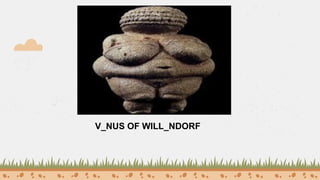
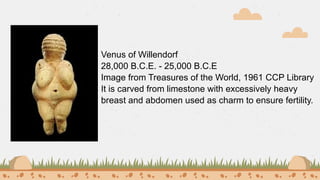
Venus of Willendorf
28,000Β.C.E. - 25,000 B.C.E
Image from Treasures of the World, 1961 CCP Library
It is carved from limestone with excessively heavy
breast and abdomen used as charm to ensure fertility.
9.
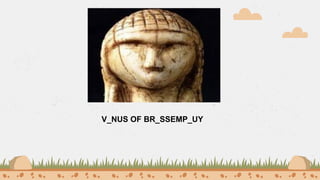
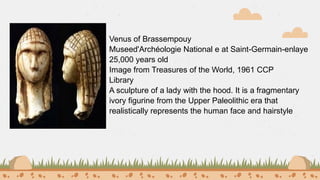
Venus of Brassempouy
Museed'ArchéologieNational e at Saint-Germain-enlaye
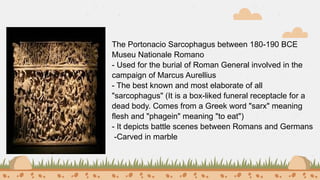
25,000 years old
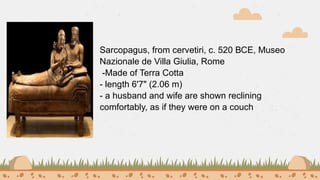
Image from Treasures of the World, 1961 CCP
Library
A sculpture of a lady with the hood. It is a fragmentary
ivory figurine from the Upper Paleolithic era that
realistically represents the human face and hairstyle
10.
SCULPTURES FROM THEEGYPTIAN ERA
• Symbolic elements were widely used such as forms,
hieroglyphics, relative size, location, materials, color, actions and
gestures. Their tombs required the most extensive used of
sculpture.
• The most common materials used for sculptures are wood, ivory
and stones.
11.
CHARACTERISTICS OF THESCULPTURES:
1. Symbolisms were heavily used to represent the gods. They were
represented as composite creature with animal heads on human bodies
2. Relief compositions were arranged in horizontal lines to record an event or
represent an action.
3. Most of the time the gods were shown larger than humans, the kings larger
than their followers, the dead larger than the living.
4. Empty space were filled with figures or hieroglyphics
5. 5. All individual components were all brought to the plane of representation
and laid out like writing.
12.
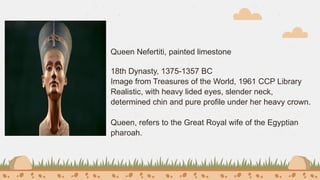
Queen Nefertiti, paintedlimestone
18th Dynasty, 1375-1357 BC
Image from Treasures of the World, 1961 CCP Library
Realistic, with heavy lided eyes, slender neck,
determined chin and pure profile under her heavy crown.
Queen, refers to the Great Royal wife of the Egyptian
pharoah.
13.
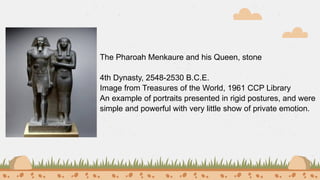
The Pharoah Menkaureand his Queen, stone
4th Dynasty, 2548-2530 B.C.E.
Image from Treasures of the World, 1961 CCP Library
An example of portraits presented in rigid postures, and were
simple and powerful with very little show of private emotion.
Greek Sculptures
Early Greeksculptures were tense and stiff, their bodies were
hidden within enfolding robes. After three centuries of
experiments, Greek sculptures had finally evolved and showed
all the points of human anatomy and proportion.
16.
One of themost popular styles of the greek sculptures
was the Hellenistic style. Hellenistic denotes a
preference in sculpture for more elaborated patterns,
mannered arrangement of figures and groups, and an
emphasis on the representation of movement for
dramatic effects.
17.
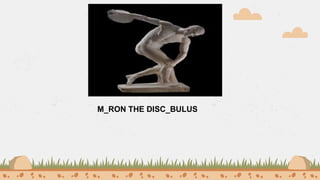
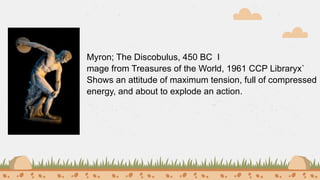
Myron; The Discobulus,450 BC I
mage from Treasures of the World, 1961 CCP Libraryx`
Shows an attitude of maximum tension, full of compressed
energy, and about to explode an action.
18.
ROMAN SCULPTURES
• MostRoman sculptures are made of monumental
terra-cotta. They did not attempt to compete with the
free standing Greek works of history or mythology but
rather they produced reliefs in the Great Roman
triumphal columns with continuous narrative reliefs
around.
19.
The Portonacio Sarcophagusbetween 180-190 BCE
Museu Nationale Romano
- Used for the burial of Roman General involved in the
campaign of Marcus Aurellius
- The best known and most elaborate of all
"sarcophagus" (It is a box-liked funeral receptacle for a
dead body. Comes from a Greek word "sarx" meaning
flesh and "phagein" meaning "to eat")
- It depicts battle scenes between Romans and Germans
-Carved in marble
20.
Sarcopagus, from cervetiri,c. 520 ВСЕ, Museo
Nazionale de Villa Giulia, Rome
-Made of Terra Cotta
- length 6'7" (2.06 m)
- a husband and wife are shown reclining
comfortably, as if they were on a couch
21.
1. How didthe artistic style of sculptures evolve from
the Early Age to Classical Antiquity?
2. What role did sculptures play in Early Age societies,
and how were they used?
23.
1.Why do weneed to give importance to the
Sculpture from the early age?
2. How do you describe their works?
24.
In a ¼sheet of paper, identify the
Sculpture from the early age. Write the
letter of the correct answer.
25.
1. What wasthe purpose of fertility figurines like the Venus
figurines in prehistoric societies?
A) To represent gods and deities
B) To serve as religious idols
C) To enhance fertility and ensure survival
D) To commemorate historical events
26.
2. The shiftfrom abstract to more lifelike human forms in
sculpture is most notably seen during which period?
A) Renaissance
B) Classical period of Ancient Greece
C) Middle Ages
D) Baroque period
27.
3. In whichcivilization were sculptures often created to ensure a
successful afterlife for pharaohs?
A) Ancient Greece
B) Ancient Rome
C) Ancient Egypt
D) Mesopotamia
28.
4. Which ofthe following is a famous example of a
prehistoric sculpture?
A) The Venus of Willendorf
B) The Discus Thrower
C) The Statue of Zeus at Olympia
D) Michelangelo’s David
29.
5. What wasthe primary material used to create
sculptures during the Stone Age?
A) Bronze
B) Marble
C) Bone and stone
D) Clay