AIRiskand
ControlsMatrix
ExecutiveSummary
The era of AI is well and truly here – with huge implications for businesses across
all sectors.
These are systems that can both interpret natural language and also learn to fnd
the right answers without them having been programmed.
This innovation comes with a heightened level of risk. Businesses urgently need to
recognise this new risk profle and rethink their approach to the risks and controls
relating to this technology in a structured way.
This is essential for two main reasons:
1
AI will allow systems and businesses to become much more complex (to the point
that it exceeds the capacity of the human mind to comprehend).The nature of
this increased complexity is also self-perpetuating and although it might appear as
simplifcation, it could well introduce ‘technical debt’. Embedding controls in a system
to mitigate technical debt after its implementation is typically far more costly than
designing in the right controls at the start. Opportunities to build risk and control
consideration by design will inevitably diminish over time and hence now is an optimal
time to consider taking a positive and dynamic approach to building in control.
2
The use of such advanced technologies will become material for many organisations,
possibly sooner than anyone expects. When the time arrives it will not be possible
to get the right controls in place overnight and have the capability to manage the
risks effectively, or to provide assurance. Hence it is key for governance, risk and
compliance practices and capabilities to develop alongside the evolution of the usage
of such technologies.
The information contained herein is of a general nature and is not intended to address the circumstances of any particular individual or entity. Although we endeavour to provide accurate and timely information, there can be no guarantee that
such information is accurate as of the date it is received or that it will continue to be accurate in the future. No one should act on such information without appropriate professional advice after a thorough examination of the particular situation.
© 2018 KPMG LLP
, a UK limited liability partnership and a member frm of the KPMG network of independent member frms affliated with KPMG International Cooperative (“KPMG International”), a Swiss entity. All rights reserved.
The KPMG name and logo are registered trademarks or trademarks of KPMG International.
RiskandControlframework
The risk and control framework is designed to help those tasked with the safe delivery of AI.We have developed this framework specifc to AI as
a guide for professionals to use when confronted with the increasing use of AI in organisations across different levels of maturity. However, the
guide might also be helpful for AI practitioners.
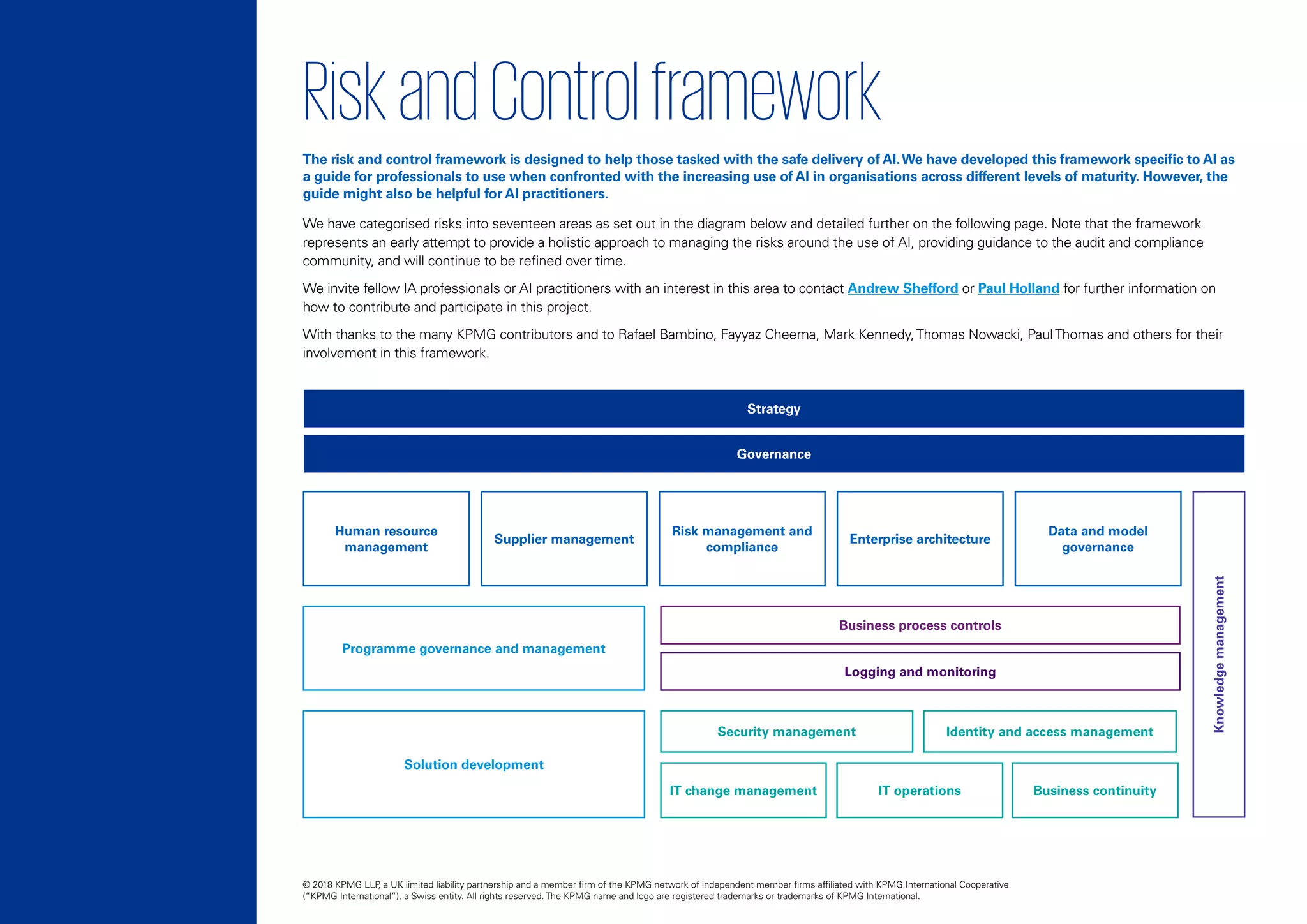
We have categorised risks into seventeen areas as set out in the diagram below and detailed further on the following page. Note that the framework
represents an early attempt to provide a holistic approach to managing the risks around the use of AI, providing guidance to the audit and compliance
community, and will continue to be refned over time.
We invite fellow IA professionals or AI practitioners with an interest in this area to contact Andrew Shefford or Paul Holland for further information on
how to contribute and participate in this project.
With thanks to the many KPMG contributors and to Rafael Bambino, Fayyaz Cheema, Mark Kennedy,Thomas Nowacki, PaulThomas and others for their
involvement in this framework.
Strategy
Governance
Human resource
management
Supplier management
Risk management and
compliance
Enterprise architecture
Data and model
governance
ement
e
manag
wledg
Kno
Programme governance and management
Business process controls
Logging and monitoring
Solution development
Security management Identity and access management
IT change management IT operations Business continuity
© 2018 KPMG LLP
, a UK limited liability partnership and a member frm of the KPMG network of independent member frms affliated with KPMG International Cooperative
(“KPMG International”), a Swiss entity. All rights reserved. The KPMG name and logo are registered trademarks or trademarks of KPMG International.
© 2018 KPMG LLP
, a UK limited liability partnership and a member firm of the KPMG network of independent member firms affiliated with KPMG International Cooperative
(“KPMG International”), a Swiss entity. All rights reserved. The KPMG name and logo are registered trademarks or trademarks of KPMG International.
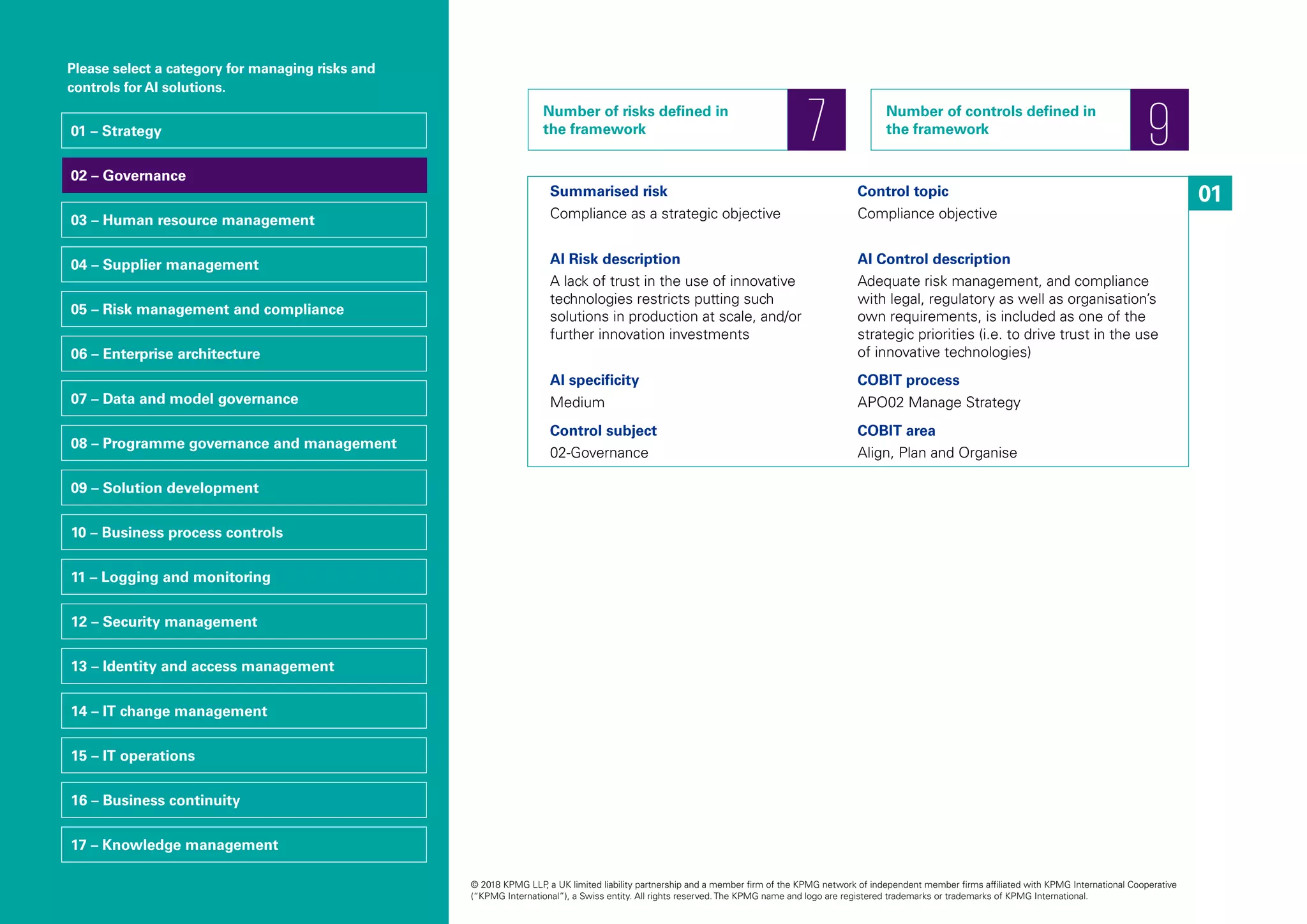
Please select a category for managing risks and
controls for AI solutions.
01 – Strategy
02 – Governance
03 – Human resource management
04 – Supplier management
05 – Risk management and compliance
06 – Enterprise architecture
07 – Data and model governance
08 – Programme governance and management
09 – Solution development
10 – Business process controls
11 – Logging and monitoring
12 – Security management
13 – Identity and access management
14 – IT change management
15 – IT operations
16 – Business continuity
17 – Knowledge management
© 2018 KPMG LLP
, a UK limited liability partnership and a member firm of the KPMG network of independent member firms affiliated with KPMG International Cooperative
(“KPMG International”), a Swiss entity. All rights reserved. The KPMG name and logo are registered trademarks or trademarks of KPMG International.
02 – Governance
03 – Human resource management
04 – Supplier management
05 – Risk management and compliance
06 – Enterprise architecture
07 – Data and model governance
08 – Programme governance and management
09 – Solution development
10 – Business process controls
11 – Logging and monitoring
12 – Security management
13 – Identity and access management
14 – IT change management
15 – IT operations
16 – Business continuity
17 – Knowledge management
Please select a category for managing risks and
controls for AI solutions.
01 – Strategy
01
Number of risks defned in
the framework 1 Number of controls defned in
the framework 2
Summarised risk
Lack of strategy
AI Risk description
Without a clear strategy toward the
investment, development or application
of Artifcial Intelligence (AI), it can
become ineffcient, expose the entity
to signifcant risk around inappropriate
use of AI
AI specifcity
High
Control subject
01-Strategy
Control topic
Strategy
AI Control description
The Enterprise has developed and maintains
a strategy regarding the development and
use of AI, providing direction to applying AI to
deliver business value as well as to how that
value is to be achieved in terms of Governance,
Process, People and Technology.
COBIT process
APO02 Manage Strategy
COBIT area
Align, Plan and Organise
© 2018 KPMG LLP
, a UK limited liability partnership and a member firm of the KPMG network of independent member firms affiliated with KPMG International Cooperative
(“KPMG International”), a Swiss entity. All rights reserved. The KPMG name and logo are registered trademarks or trademarks of KPMG International.
01 – Strategy
02 – Governance
03 – Human resource management
04 – Supplier management
05 – Risk management and compliance
06 – Enterprise architecture
07 – Data and model governance
08 – Programme governance and management
09 – Solution development
10 – Business process controls
11 – Logging and monitoring
12 – Security management
13 – Identity and access management
14 – IT change management
15 – IT operations
16 – Business continuity
02
Summarised risk
Lack of strategic alignment
AI Risk description
AI programmes (as well as the individual
instances of AI) need to be aligned with
and support the organisation’s strategy,
and be in line with the organisation’s
risk appetite.
AI specifcity
High
Control subject
01-Strategy
Control topic
Review of the application of
automation
AI Control description
AI solutions are regularly reviewed against
the organisation’s strategy and risk appetite to
validate ongoing adherence and alignment.
This includes a regular review of what is
being automated, and of the AI solutions
and their learning algorithms, to ensure that
the solutions still operate in line with the
organisation’s strategy.
COBIT process
MEA01 Monitor, Evaluate and Assess
Performance and Conformance
COBIT area
Monitor, Evaluate and Assess
17 – Knowledge management
Please select a category for managing risks and
controls for AI solutions.
© 2018 KPMG LLP
, a UK limited liability partnership and a member firm of the KPMG network of independent member firms affiliated with KPMG International Cooperative
(“KPMG International”), a Swiss entity. All rights reserved. The KPMG name and logo are registered trademarks or trademarks of KPMG International.
01 – Strategy
03 – Human resource management
04 – Supplier management
05 – Risk management and compliance
06 – Enterprise architecture
07 – Data and model governance
08 – Programme governance and management
09 – Solution development
10 – Business process controls
11 – Logging and monitoring
12 – Security management
13 – Identity and access management
14 – IT change management
15 – IT operations
16 – Business continuity
17 – Knowledge management
02 – Governance
01
Number of risks defned in
the framework 7 Number of controls defned in
the framework
9
Summarised risk
Compliance as a strategic objective
AI Risk description
A lack of trust in the use of innovative
technologies restricts putting such
solutions in production at scale, and/or
further innovation investments
AI specifcity
Medium
Control subject
02-Governance
Control topic
Compliance objective
AI Control description
Adequate risk management, and compliance
with legal, regulatory as well as organisation’s
own requirements, is included as one of the
strategic priorities (i.e. to drive trust in the use
of innovative technologies)
COBIT process
APO02 Manage Strategy
COBIT area
Align, Plan and Organise
Please select a category for managing risks and
controls for AI solutions.
© 2018 KPMG LLP
, a UK limited liability partnership and a member firm of the KPMG network of independent member firms affiliated with KPMG International Cooperative
(“KPMG International”), a Swiss entity. All rights reserved. The KPMG name and logo are registered trademarks or trademarks of KPMG International.
01 – Strategy
02 – Governance
02
03 – Human resource management
04 – Supplier management
05 – Risk management and compliance
06 – Enterprise architecture
07 – Data and model governance
08 – Programme governance and management
09 – Solution development
10 – Business process controls
11 – Logging and monitoring
12 – Security management
13 – Identity and access management
14 – IT change management
15 – IT operations
16 – Business continuity
Summarised risk
Misalignment to the
organisation’s cultural and ethical
values
AI Risk description
Decisions made by the AI
solution are not aligned to
the organisation’s cultural and
ethical values, or cause bad or
incorrect decisions by a human
employee / AI solution, resulting
in the organisation being held
accountable.
Poor quality or incomplete
data made available to the AI
solution will impact the quality
of the decision taken in terms
of compliance with corporate
values.
Without periodic reviews of the
AI logic and the data used by the
AI solution, it could deviate from
the organisation’s corporate
values.
AI specifcity
High
Control subject
02-Governance
17 – Knowledge management
Control topic
Values
AI Control description
Where applicable, ethical rules and corporate values
are coded into the algorithms, and controls are in
place to review the output (e.g. thresholds; list of
acceptable outcomes; list of unacceptable outcomes).
Changes to the ethical value code go through robust
change management process. The controls should
match the velocity and breadth of the process being
controlled
During the design phase, a multidisciplinary team
brainstorms about the potential ways the AI solution
or its outcomes could be misused, e.g. if its
outcomes, the AI solution or the company itself falls in
to the ‘wrong hands’.
Data is reviewed to ensure it is complete, accurate
and free from bias.
Logic is reviewed and tested to verify that it remains
valid, with specifc testing to ensure there are no un-
intended biases.
COBIT process
MEA02 Monitor, Evaluate and Assess the System of
Internal Control
COBIT area
Monitor, Evaluate and Assess
Please select a category for managing risks and
controls for AI solutions.
© 2018 KPMG LLP
, a UK limited liability partnership and a member firm of the KPMG network of independent member firms affiliated with KPMG International Cooperative
(“KPMG International”), a Swiss entity. All rights reserved. The KPMG name and logo are registered trademarks or trademarks of KPMG International.
01 – Strategy
02 – Governance
03
03 – Human resource management
04 – Supplier management
05 – Risk management and compliance
06 – Enterprise architecture
07 – Data and model governance
08 – Programme governance and management
09 – Solution development
10 – Business process controls
11 – Logging and monitoring
12 – Security management
13 – Identity and access management
14 – IT change management
15 – IT operations
16 – Business continuity
Summarised risk
Lack of a common language
AI Risk description
Without a common language used
for types of AI, there is a risk that
the various parties involved in
AI governance, implementation
and management will have
misunderstandings, resulting in
ineffective decision making and risk
management.
AI specifcity
High
Control subject
02-Governance
Control topic
Common language and defnitions
AI Control description
Defnitions of different types of AI should be
documented and shared to provide a common
language across an organisation, e.g. through
a glossary.
COBIT process
EDM01 Ensure Governance Framework Setting
and Maintenance
COBIT area
Evaluate, Direct and Monitor
17 – Knowledge management
Please select a category for managing risks and
controls for AI solutions.
© 2018 KPMG LLP
, a UK limited liability partnership and a member firm of the KPMG network of independent member firms affiliated with KPMG International Cooperative
(“KPMG International”), a Swiss entity. All rights reserved. The KPMG name and logo are registered trademarks or trademarks of KPMG International.
01 – Strategy
02 – Governance
04
03 – Human resource management
04 – Supplier management
05 – Risk management and compliance
06 – Enterprise architecture
07 – Data and model governance
08 – Programme governance and management
09 – Solution development
10 – Business process controls
11 – Logging and monitoring
12 – Security management
13 – Identity and access management
14 – IT change management
15 – IT operations
16 – Business continuity
Summarised risk
An unclear, hyped expectation or
overconfdence in automation capability
is not aligned with system maturity
resulting in ineffective outcomes
AI Risk description
Unclear or hyped expectation and
overconfdence in AI capability not
aligned with system maturity resulting
in ineffective outcomes.
AI specifcity
High
Control subject
02-Governance
Control topic
Managing expectations
AI Control description
The limitations of AI technologies, human
elements in AI, as well as the AI state of
maturity should be made clear and transparent
by the sponsoring organisation or team to
avoid hyped expectation and overconfdence in
the implementation effort.
COBIT process
EDM05 Ensure Stakeholder Transparency
COBIT area
Evaluate, Direct and Monitor
17 – Knowledge management
Please select a category for managing risks and
controls for AI solutions.
03 – Human resource management
04 – Supplier management
05 – Risk management and compliance
06 – Enterprise architecture
07 – Data and model governance
08 – Programme governance and management
09 – Solution development
10 – Business process controls
11 – Logging and monitoring
12 – Security management
13 – Identity and access management
14 – IT change management
15 – IT operations
16 – Business continuity
01 – Strategy
02 – Governance
17 – Knowledge management
© 2018 KPMG LLP
, a UK limited liability partnership and a member firm of the KPMG network of independent member firms affiliated with KPMG International Cooperative
(“KPMG International”), a Swiss entity. All rights reserved. The KPMG name and logo are registered trademarks or trademarks of KPMG International.
05
Summarised risk
An unclear, hyped expectation or
overconfdence in automation capability
is not aligned with system maturity
resulting in ineffective outcomes
AI Risk description
Unclear or hyped expectation and
overconfdence in AI capability not
aligned with system maturity resulting
in ineffective outcomes.
AI specifcity
High
Control subject
02-Governance
Control topic
Controlled evolutionary change
AI Control description
There is a process in place for continual
nurturing AI by humans, as it matures
through specifc stages, mastering new and
specifc capabilities that meet well-defned
requirements.
COBIT process
BAI05 Manage Organisational Change
Enablement
COBIT area
Build, Acquire and Implement
Please select a category for managing risks and
controls for AI solutions.
© 2018 KPMG LLP
, a UK limited liability partnership and a member firm of the KPMG network of independent member firms affiliated with KPMG International Cooperative
(“KPMG International”), a Swiss entity. All rights reserved. The KPMG name and logo are registered trademarks or trademarks of KPMG International.
01 – Strategy
02 – Governance
06
03 – Human resource management
04 – Supplier management
05 – Risk management and compliance
06 – Enterprise architecture
07 – Data and model governance
08 – Programme governance and management
09 – Solution development
10 – Business process controls
11 – Logging and monitoring
12 – Security management
13 – Identity and access management
14 – IT change management
15 – IT operations
16 – Business continuity
Summarised risk
Weakening enterprise governance
mechanisms
AI Risk description
The use of AI technologies negatively
impact existing enterprise governance
mechanisms (i.e. the enterprise’s level
of control over data processing is
weakened)
AI specifcity
High
Control subject
02-Governance
Control topic
Enterprise governance framework for
automation
AI Control description
An enterprise governance framework for
the use of AI is established and provides
consistent governance over the overall
programme of AI/ Bot developments - and
ensures consistent quality. The program
governance bodies should include
representation from relevant business
function, IT, Ethics, Data, Human Resources,
Risk and other impacted divisions.
The enterprise governance framework is
aligned with the entity’s strategy and risk
appetite - and covers the use of ‘base level’
automation (i.e. replicate human data entry
and processing) as well as decision making
(i.e. use of technology, incl. machine learning,
to suggest or make decisions previously made
by human operators).
The governance body oversees that existing
policies are reviewed and where necessary
amended for AI considerations. Alternatively,
an enterprise-wide AI policy should be in place.
COBIT process
EDM01 Ensure Governance Framework Setting
and Maintenance
COBIT area
Evaluate, Direct and Monitor
17 – Knowledge management
Please select a category for managing risks and
controls for AI solutions.
© 2018 KPMG LLP
, a UK limited liability partnership and a member firm of the KPMG network of independent member firms affiliated with KPMG International Cooperative
(“KPMG International”), a Swiss entity. All rights reserved. The KPMG name and logo are registered trademarks or trademarks of KPMG International.
01 – Strategy
02 – Governance
07
03 – Human resource management
04 – Supplier management
05 – Risk management and compliance
06 – Enterprise architecture
07 – Data and model governance
08 – Programme governance and management
09 – Solution development
10 – Business process controls
11 – Logging and monitoring
12 – Security management
13 – Identity and access management
14 – IT change management
15 – IT operations
16 – Business continuity
17 – Knowledge management
Summarised risk
Lack of a clearly defned
ownership or operating
model
AI Risk description
AI programme’s or
solution’s ownership
and management roles
and responsibilities are
unclear, increasing the
risk of unauthorised
or inappropriate
developments, access,
change, and/or incidents
Without a clearly
defned operating
model, governance
structure, accountability
and responsibility,
there is a risk that the
AI solution will not
be successful, i.e.
designed, implemented,
maintained or
supported, leading to
undesired business
outcomes end to end.
AI specifcity
Medium
Control subject
02-Governance
Control topic
Ownership or operating model
AI Control description
Clear organisational structure covering all elements of the
AI lifecycle and control framework, as well as clear roles,
responsibilities, accountabilities (e.g. a RACI) - including
between business, IT and the AI CoE - with consideration to
skills required, segregation of duties, authorities etc. This is to
lead to appropriate controls matching the entity’s risk appetite.
The AI solution’s human owner needs to be clearly defned.
As the accountable party, the owner needs to have in place
appropriate monitoring and supervision controls to prevent
or override AI decisions. This applies to Enterprise wide
Governance but also to a specifc AI solution.
Roles and responsibilities are defned in organisational charts
and job descriptions. Representatives from the AI CoE or
governing body, AI developers, data scientists, business
process owners, technical AI owners, application owners,
operations, Service Desk, and security teams required for an
effective AI environment are identifed and integrated with
relevant management processes.
The Operating model and governance mechanism and policies
and procedures are clearly defned - at the enterprise level.
This should be part of - or aligned to - existing technology
management frameworks as applicable.
COBIT process
EDM01 Ensure Governance Framework Setting and
Maintenance
COBIT area
Evaluate, Direct and Monitor
Please select a category for managing risks and
controls for AI solutions.
© 2018 KPMG LLP
, a UK limited liability partnership and a member firm of the KPMG network of independent member firms affiliated with KPMG International Cooperative
(“KPMG International”), a Swiss entity. All rights reserved. The KPMG name and logo are registered trademarks or trademarks of KPMG International.
03 – Human resource management
04 – Supplier management
05 – Risk management and compliance
06 – Enterprise architecture
07 – Data and model governance
08 – Programme governance and management
09 – Solution development
10 – Business process controls
11 – Logging and monitoring
12 – Security management
13 – Identity and access management
14 – IT change management
15 – IT operations
16 – Business continuity
01 – Strategy
02 – Governance
08
17 – Knowledge management
Summarised risk
Non-compliance with internal or
external requirements
AI Risk description
Non-compliance with internal or
external requirements in terms of risk
management, internal control and
compliance could lead to ineffective
solutions, or regulatory or market
repercussions
AI specifcity
High
Control subject
02-Governance
Control topic
Compliance monitoring
AI Control description
Compliance of the AI solution with the
organisation’s regulatory, governance,
security and business continuity standards is
reviewed on a periodic basis. This also allows
the organisation to demonstrate compliance
to others (management, Audit Committee,
auditors, regulators, etc.).
COBIT process
MEA01 Monitor, Evaluate and Assess
Performance and Conformance
COBIT area
Monitor, Evaluate and Assess
Please select a category for managing risks and
controls for AI solutions.
© 2018 KPMG LLP
, a UK limited liability partnership and a member firm of the KPMG network of independent member firms affiliated with KPMG International Cooperative
(“KPMG International”), a Swiss entity. All rights reserved. The KPMG name and logo are registered trademarks or trademarks of KPMG International.
01 – Strategy
02 – Governance
09
03 – Human resource management
04 – Supplier management
05 – Risk management and compliance
06 – Enterprise architecture
07 – Data and model governance
08 – Programme governance and management
09 – Solution development
10 – Business process controls
11 – Logging and monitoring
12 – Security management
13 – Identity and access management
14 – IT change management
15 – IT operations
16 – Business continuity
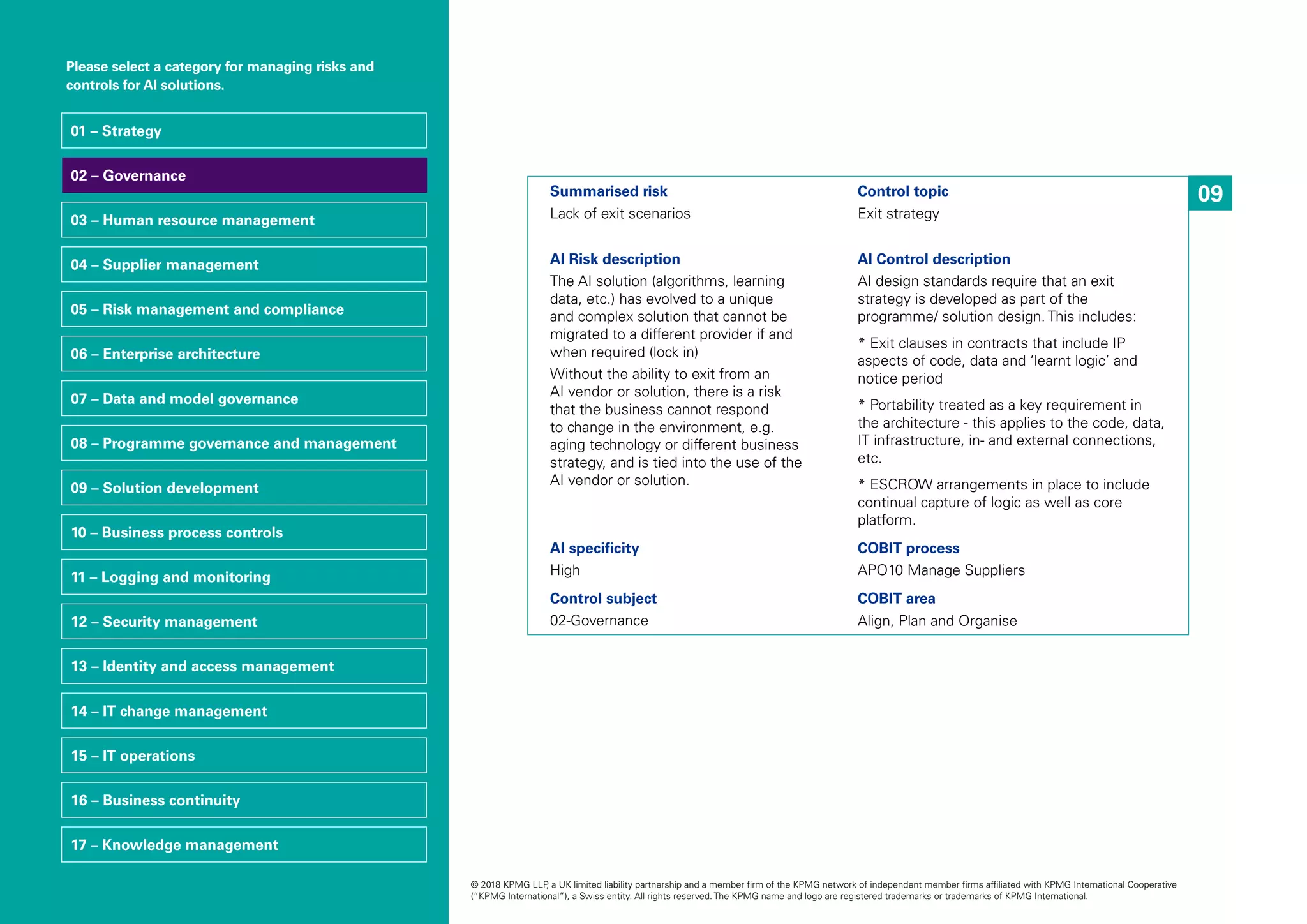
Summarised risk
Lack of exit scenarios
AI Risk description
The AI solution (algorithms, learning
data, etc.) has evolved to a unique
and complex solution that cannot be
migrated to a different provider if and
when required (lock in)
Without the ability to exit from an
AI vendor or solution, there is a risk
that the business cannot respond
to change in the environment, e.g.
aging technology or different business
strategy, and is tied into the use of the
AI vendor or solution.
AI specifcity
High
Control subject
02-Governance
Control topic
Exit strategy
AI Control description
AI design standards require that an exit
strategy is developed as part of the
programme/ solution design. This includes:
* Exit clauses in contracts that include IP
aspects of code, data and ‘learnt logic’ and
notice period
* Portability treated as a key requirement in
the architecture - this applies to the code, data,
IT infrastructure, in- and external connections,
etc.
* ESCROW arrangements in place to include
continual capture of logic as well as core
platform.
COBIT process
APO10 Manage Suppliers
COBIT area
Align, Plan and Organise
17 – Knowledge management
Please select a category for managing risks and
controls for AI solutions.
© 2018 KPMG LLP
, a UK limited liability partnership and a member firm of the KPMG network of independent member firms affiliated with KPMG International Cooperative
(“KPMG International”), a Swiss entity. All rights reserved. The KPMG name and logo are registered trademarks or trademarks of KPMG International.
01 – Strategy
02 – Governance
Number of risks defned in
the framework 4 Number of controls defned in
the framework
3
03 – Human resource management
01
04 – Supplier management
05 – Risk management and compliance
06 – Enterprise architecture
07 – Data and model governance
08 – Programme governance and management
09 – Solution development
10 – Business process controls
11 – Logging and monitoring
12 – Security management
13 – Identity and access management
14 – IT change management
15 – IT operations
16 – Business continuity
17 – Knowledge management
Summarised risk
Organisational and people impact of
the automation strategy insuffciently
addressed
AI Risk description
Unclear resourcing requirements
(capacity and capability) in the AI
strategy leads to excess/ shortage
of staffng, over/under utilised
vendor resources and lack of skilled
resources required for designing,
building, operating and maintaining AI
systems. An undefned organisational
roadmap for AI implementation leads
to ineffective resource utilisation,
decentralised approaches, redundancy
or shortages in people and skills.
AI specifcity
High
Control subject
03-Human resource management
Control topic
Human resource requirements
AI Control description
Requirements for human resources defned
(e.g. recruitment, role profles, training,
retention strategy, third-parties involvement)
are aligned with the AI strategy and roadmap.
Operational teams are scaled and trained
according to the required level of capability and
capacity.
COBIT process
EDM04 Ensure Resource Optimisation
COBIT area
Evaluate, Direct and Monitor
Please select a category for managing risks and
controls for AI solutions.
© 2018 KPMG LLP
, a UK limited liability partnership and a member firm of the KPMG network of independent member firms affiliated with KPMG International Cooperative
(“KPMG International”), a Swiss entity. All rights reserved. The KPMG name and logo are registered trademarks or trademarks of KPMG International.
01 – Strategy
02 – Governance
03 – Human resource management
02
04 – Supplier management
05 – Risk management and compliance
06 – Enterprise architecture
07 – Data and model governance
08 – Programme governance and management
09 – Solution development
10 – Business process controls
11 – Logging and monitoring
12 – Security management
13 – Identity and access management
14 – IT change management
15 – IT operations
16 – Business continuity
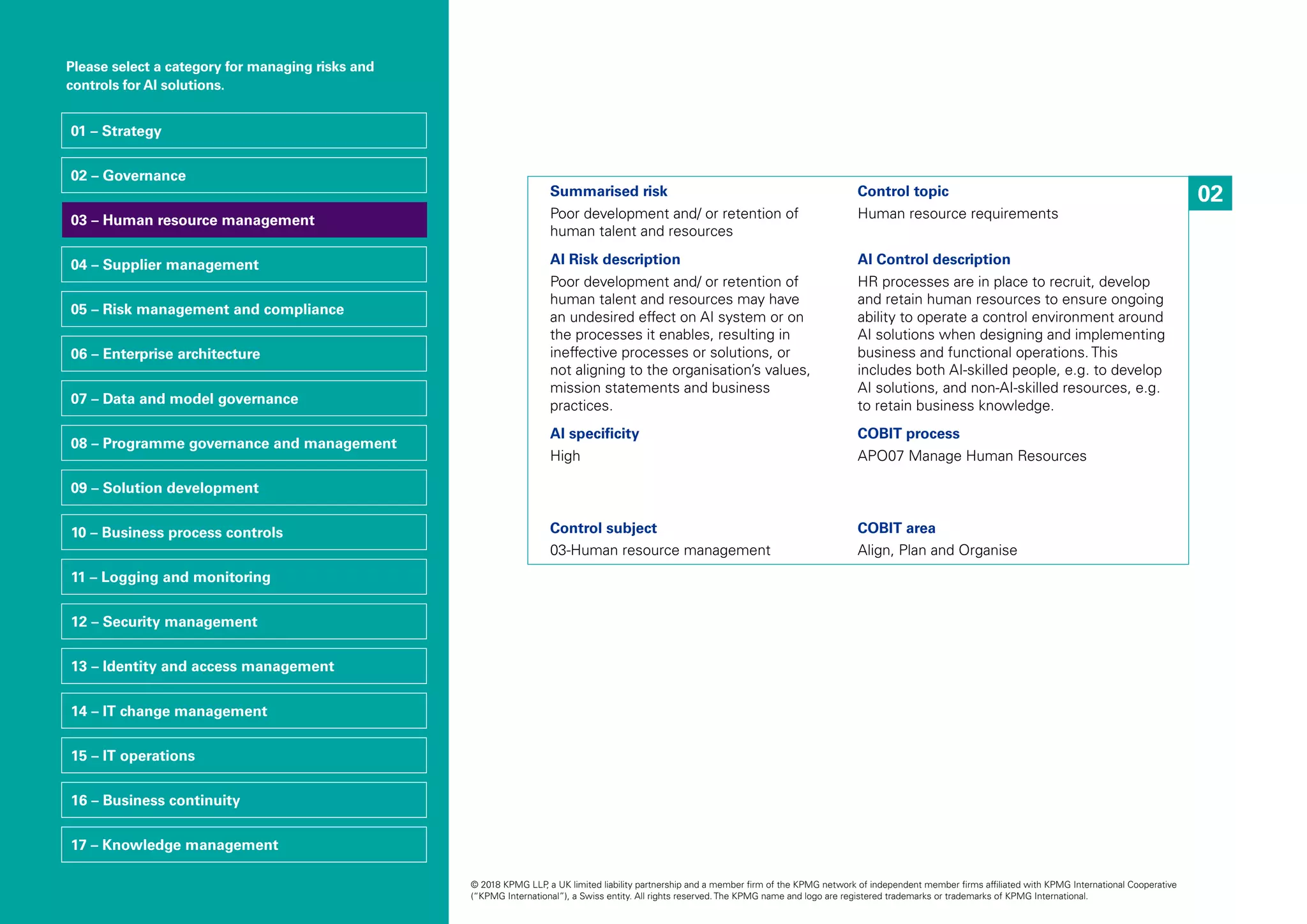
Summarised risk
Poor development and/ or retention of
human talent and resources
AI Risk description
Poor development and/ or retention of
human talent and resources may have
an undesired effect on AI system or on
the processes it enables, resulting in
ineffective processes or solutions, or
not aligning to the organisation’s values,
mission statements and business
practices.
AI specifcity
High
Control subject
03-Human resource management
Control topic
Human resource requirements
AI Control description
HR processes are in place to recruit, develop
and retain human resources to ensure ongoing
ability to operate a control environment around
AI solutions when designing and implementing
business and functional operations. This
includes both AI-skilled people, e.g. to develop
AI solutions, and non-AI-skilled resources, e.g.
to retain business knowledge.
COBIT process
APO07 Manage Human Resources
COBIT area
Align, Plan and Organise
17 – Knowledge management
Please select a category for managing risks and
controls for AI solutions.
© 2018 KPMG LLP
, a UK limited liability partnership and a member firm of the KPMG network of independent member firms affiliated with KPMG International Cooperative
(“KPMG International”), a Swiss entity. All rights reserved. The KPMG name and logo are registered trademarks or trademarks of KPMG International.
01 – Strategy
02 – Governance
04 – Supplier management
05 – Risk management and compliance
06 – Enterprise architecture
07 – Data and model governance
08 – Programme governance and management
09 – Solution development
10 – Business process controls
11 – Logging and monitoring
12 – Security management
13 – Identity and access management
14 – IT change management
15 – IT operations
16 – Business continuity
17 – Knowledge management
03 – Human resource management
03
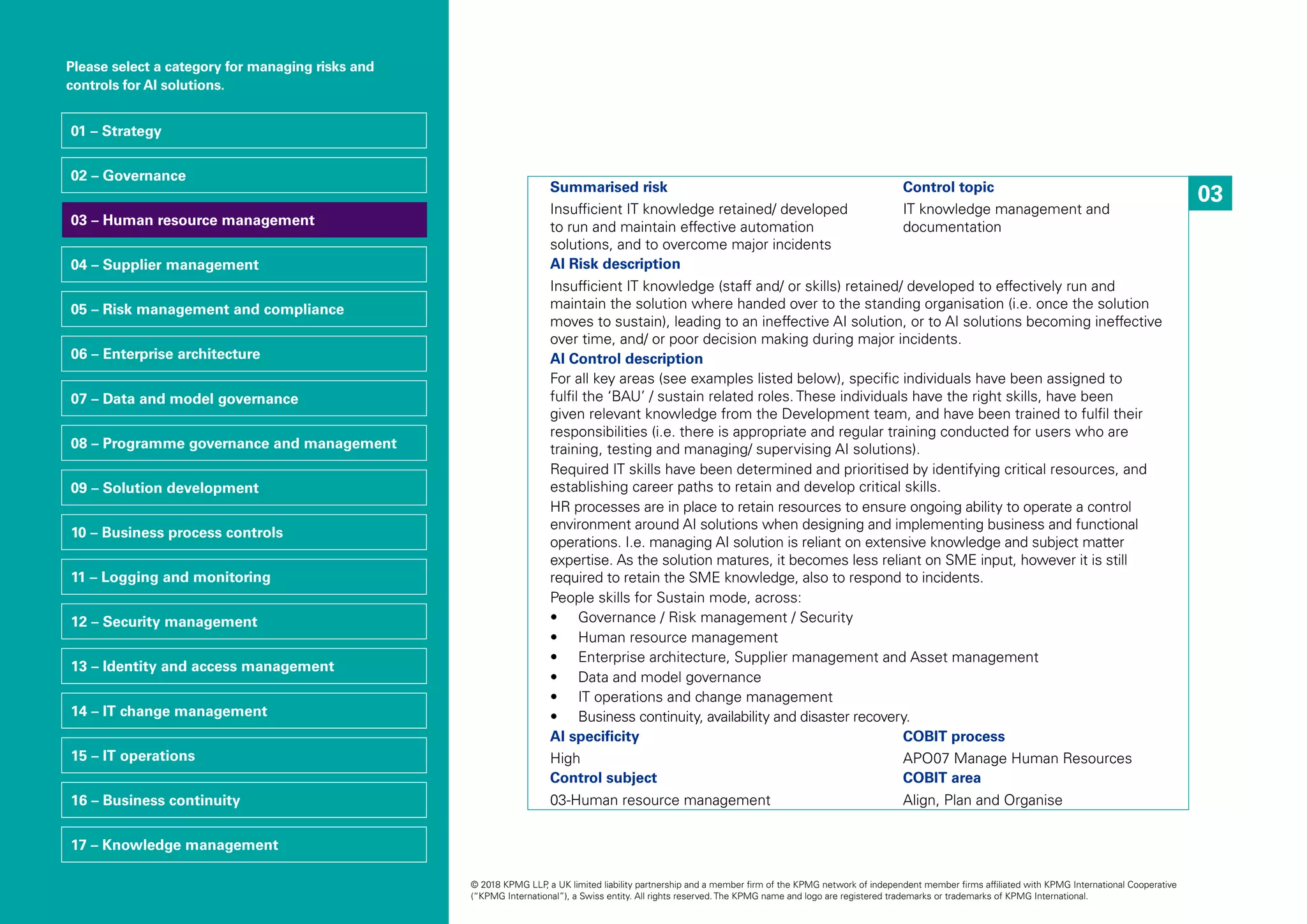
Summarised risk
Insuffcient IT knowledge retained/ developed
to run and maintain effective automation
solutions, and to overcome major incidents
AI Risk description
Insuffcient IT knowledge (staff and/ or skills) retained/ developed to effectively run and
maintain the solution where handed over to the standing organisation (i.e. once the solution
moves to sustain), leading to an ineffective AI solution, or to AI solutions becoming ineffective
over time, and/ or poor decision making during major incidents.
AI Control description
For all key areas (see examples listed below), specifc individuals have been assigned to
fulfl the ‘BAU’ / sustain related roles. These individuals have the right skills, have been
given relevant knowledge from the Development team, and have been trained to fulfl their
responsibilities (i.e. there is appropriate and regular training conducted for users who are
training, testing and managing/ supervising AI solutions).
Required IT skills have been determined and prioritised by identifying critical resources, and
establishing career paths to retain and develop critical skills.
HR processes are in place to retain resources to ensure ongoing ability to operate a control
environment around AI solutions when designing and implementing business and functional
operations. I.e. managing AI solution is reliant on extensive knowledge and subject matter
expertise. As the solution matures, it becomes less reliant on SME input, however it is still
required to retain the SME knowledge, also to respond to incidents.
People skills for Sustain mode, across:
• Governance / Risk management / Security
• Human resource management
• Enterprise architecture, Supplier management and Asset management
• Data and model governance
• IT operations and change management
• Business continuity, availability and disaster recovery.
AI specifcity
High
Control subject
03-Human resource management
Control topic
IT knowledge management and
documentation
COBIT process
APO07 Manage Human Resources
COBIT area
Align, Plan and Organise
Please select a category for managing risks and
controls for AI solutions.
© 2018 KPMG LLP
, a UK limited liability partnership and a member firm of the KPMG network of independent member firms affiliated with KPMG International Cooperative
(“KPMG International”), a Swiss entity. All rights reserved. The KPMG name and logo are registered trademarks or trademarks of KPMG International.
01 – Strategy
02 – Governance
03 – Human resource management
04 – Supplier management
05 – Risk management and compliance
06 – Enterprise architecture
07 – Data and model governance
08 – Programme governance and management
09 – Solution development
10 – Business process controls
11 – Logging and monitoring
12 – Security management
13 – Identity and access management
14 – IT change management
15 – IT operations
16 – Business continuity
17 – Knowledge management
01
Number of risks defned in
the framework 4 Number of controls defned in
the framework 4
Summarised risk
3rd party controls
AI Risk description
Entity’s risk exposure or performance
are negatively impacted by 3rd parties
that operate a lower level of control
maturity and / or security standards
AI specifcity
Low
Control subject
04-Supplier management
Control topic
3rd party controls
AI Control description
3rd parties are subject to at least the same
level of control, either by applying the actual
same controls (e.g. 3rd party users are
managed just as own staff are), or through the
right to audit, or through external assurance
reports (e.g. ISAE3000 or 3402) that provide
assurance on all relevant controls, or through
other appropriate means. This includes 3rd
parties being integrated with the wider
governance and risk management approach.
E.g. AI processes performed by vendors are
included in the organisation’s DR and BCP
testing cycles, subject to the same security
controls, etc.
COBIT process
APO10 Manage Suppliers
Align, Plan and Organise
COBIT area
Please select a category for managing risks and
controls for AI solutions.
© 2018 KPMG LLP
, a UK limited liability partnership and a member firm of the KPMG network of independent member firms affiliated with KPMG International Cooperative
(“KPMG International”), a Swiss entity. All rights reserved. The KPMG name and logo are registered trademarks or trademarks of KPMG International.
01 – Strategy
02 – Governance
03 – Human resource management
02
04 – Supplier management
05 – Risk management and compliance
06 – Enterprise architecture
07 – Data and model governance
08 – Programme governance and management
09 – Solution development
10 – Business process controls
11 – Logging and monitoring
12 – Security management
13 – Identity and access management
14 – IT change management
15 – IT operations
16 – Business continuity
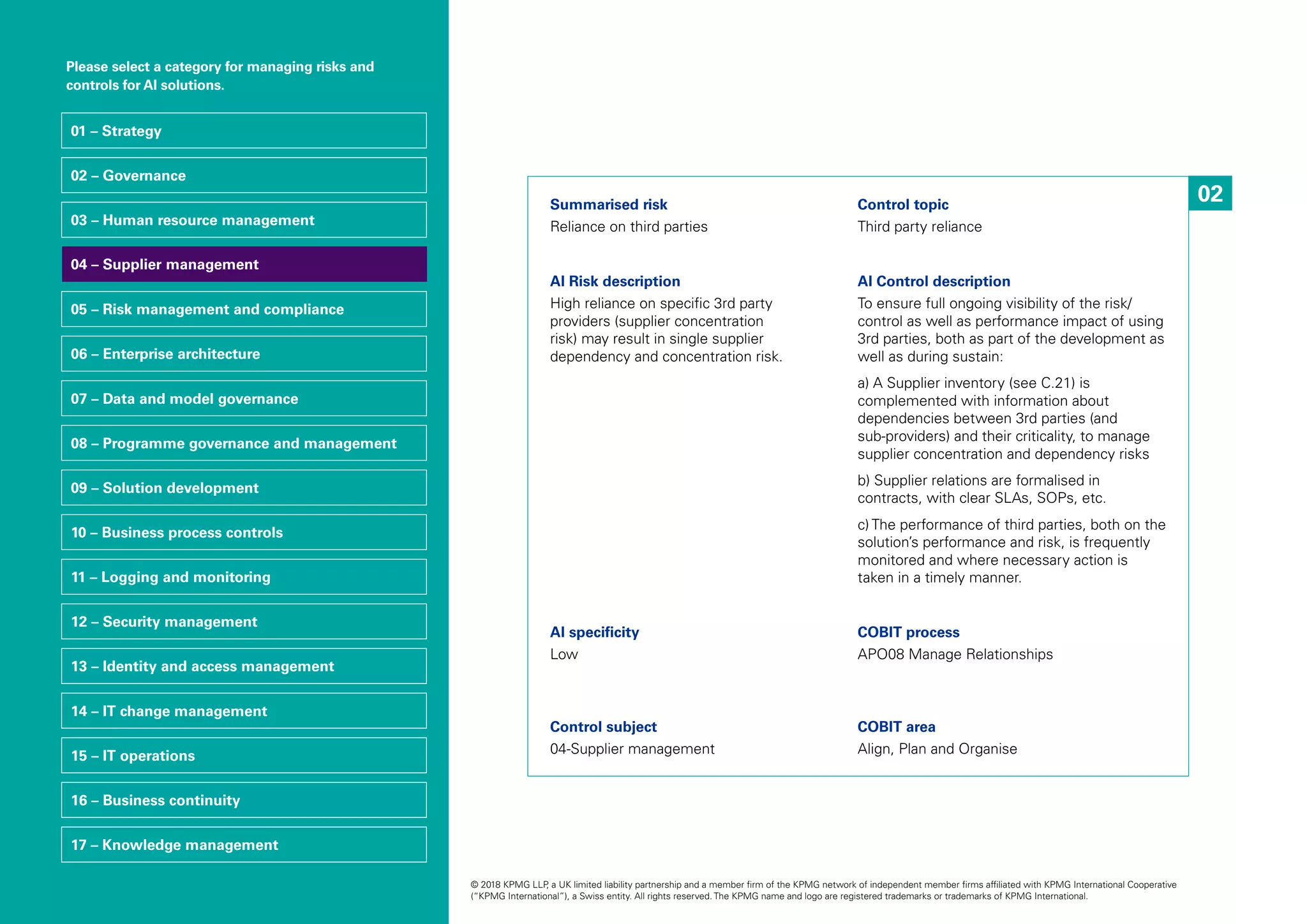
Summarised risk
Reliance on third parties
AI Risk description
High reliance on specifc 3rd party
providers (supplier concentration
risk) may result in single supplier
dependency and concentration risk.
AI specifcity
Low
Control subject
04-Supplier management
Control topic
Third party reliance
AI Control description
To ensure full ongoing visibility of the risk/
control as well as performance impact of using
3rd parties, both as part of the development as
well as during sustain:
a) A Supplier inventory (see C.21) is
complemented with information about
dependencies between 3rd parties (and
sub-providers) and their criticality, to manage
supplier concentration and dependency risks
b) Supplier relations are formalised in
contracts, with clear SLAs, SOPs, etc.
c) The performance of third parties, both on the
solution’s performance and risk, is frequently
monitored and where necessary action is
taken in a timely manner.
COBIT process
APO08 Manage Relationships
COBIT area
Align, Plan and Organise
17 – Knowledge management
Please select a category for managing risks and
controls for AI solutions.
© 2018 KPMG LLP
, a UK limited liability partnership and a member firm of the KPMG network of independent member firms affiliated with KPMG International Cooperative
(“KPMG International”), a Swiss entity. All rights reserved. The KPMG name and logo are registered trademarks or trademarks of KPMG International.
01 – Strategy
02 – Governance
03 – Human resource management
03
04 – Supplier management
05 – Risk management and compliance
06 – Enterprise architecture
07 – Data and model governance
08 – Programme governance and management
09 – Solution development
10 – Business process controls
11 – Logging and monitoring
12 – Security management
13 – Identity and access management
14 – IT change management
15 – IT operations
16 – Business continuity
Summarised risk
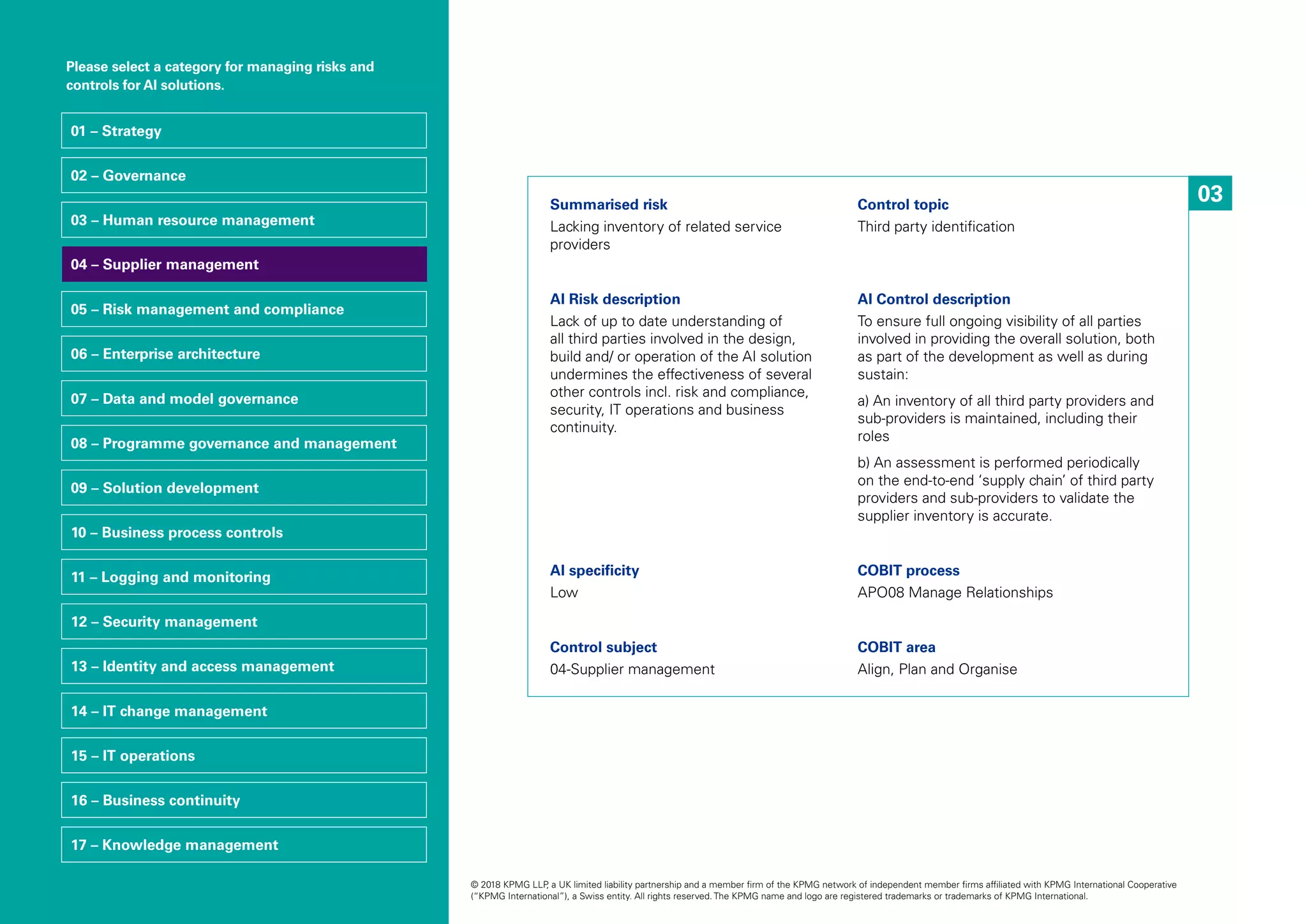
Lacking inventory of related service
providers
AI Risk description
Lack of up to date understanding of
all third parties involved in the design,
build and/ or operation of the AI solution
undermines the effectiveness of several
other controls incl. risk and compliance,
security, IT operations and business
continuity.
AI specifcity
Low
Control subject
04-Supplier management
Control topic
Third party identifcation
AI Control description
To ensure full ongoing visibility of all parties
involved in providing the overall solution, both
as part of the development as well as during
sustain:
a) An inventory of all third party providers and
sub-providers is maintained, including their
roles
b) An assessment is performed periodically
on the end-to-end ‘supply chain’ of third party
providers and sub-providers to validate the
supplier inventory is accurate.
COBIT process
APO08 Manage Relationships
COBIT area
Align, Plan and Organise
17 – Knowledge management
Please select a category for managing risks and
controls for AI solutions.
© 2018 KPMG LLP
, a UK limited liability partnership and a member firm of the KPMG network of independent member firms affiliated with KPMG International Cooperative
(“KPMG International”), a Swiss entity. All rights reserved. The KPMG name and logo are registered trademarks or trademarks of KPMG International.
01 – Strategy
02 – Governance
03 – Human resource management
04
04 – Supplier management
05 – Risk management and compliance
06 – Enterprise architecture
07 – Data and model governance
08 – Programme governance and management
09 – Solution development
10 – Business process controls
11 – Logging and monitoring
12 – Security management
13 – Identity and access management
14 – IT change management
15 – IT operations
16 – Business continuity
Summarised risk
Black box solution risks
AI Risk description
The logic within the AI solution is not
fully understood, impacting the ability
to recover services when issues
occur, impacting business operations
and resulting in fnancial loss (i.e. the
risks around ‘a black box solution’) or
reputational damage.
AI specifcity
Medium
Control subject
04-Supplier management
Control topic
Contracts
AI Control description
For third party solutions or parts thereof, the
contract includes clauses for ownership of IP
(i.e. ownership of data, code, models and of
‘learning’); escrow agreements to have access
to the code if need be, right to audit and clear
supplier/customer roles and responsibilities
See also C.85 for a repository of relevant IP
.
COBIT process
APO10 Manage Suppliers
COBIT area
Align, Plan and Organise
17 – Knowledge management
Please select a category for managing risks and
controls for AI solutions.
© 2018 KPMG LLP
, a UK limited liability partnership and a member firm of the KPMG network of independent member firms affiliated with KPMG International Cooperative
(“KPMG International”), a Swiss entity. All rights reserved. The KPMG name and logo are registered trademarks or trademarks of KPMG International.
01 – Strategy
02 – Governance
03 – Human resource management
04 – Supplier management
01
05 – Risk management and compliance
06 – Enterprise architecture
07 – Data and model governance
08 – Programme governance and management
09 – Solution development
10 – Business process controls
11 – Logging and monitoring
12 – Security management
13 – Identity and access management
14 – IT change management
15 – IT operations
16 – Business continuity
17 – Knowledge management
Number of risks defned in
the framework 2 Number of controls defned in
the framework
3
Summarised risk
Non-compliance with internal or
external requirements
AI Risk description
Non-compliance with internal or
external requirements in terms of risk
management, internal control and
compliance could lead to ineffective
solutions, or regulatory or market
repercussions
AI specifcity
Medium
Control subject
05-Risk management and compliance
Control topic
Risk management and compliance
within the governance framework
AI Control description
Risk management and compliance is
appropriately covered by the AI governance
model and risk, compliance and security
representatives are part of the governance and
management mechanism where appropriate.
Risk acceptance and oversight processes are
in place.
Note: This control applies to the overall
governance level (e.g. at programme level)
and see control C.32 for the risks and internal
control framework for a specifc AI solution.
COBIT process
EDM03 Ensure Risk Optimisation
COBIT area
Evaluate, Direct and Monitor
Please select a category for managing risks and
controls for AI solutions.
© 2018 KPMG LLP
, a UK limited liability partnership and a member firm of the KPMG network of independent member firms affiliated with KPMG International Cooperative
(“KPMG International”), a Swiss entity. All rights reserved. The KPMG name and logo are registered trademarks or trademarks of KPMG International.
01 – Strategy
02 – Governance
03 – Human resource management
04 – Supplier management
02
05 – Risk management and compliance
06 – Enterprise architecture
07 – Data and model governance
08 – Programme governance and management
09 – Solution development
10 – Business process controls
11 – Logging and monitoring
12 – Security management
13 – Identity and access management
14 – IT change management
15 – IT operations
16 – Business continuity
Summarised risk
Non-compliance with internal or
external requirements
AI Risk description
Non-compliance with internal or
external requirements in terms of risk
management, internal control and
compliance could lead to ineffective
solutions, or regulatory or market
repercussions
AI specifcity
Low
Control subject
05-Risk management and compliance
Control topic
Internal or external requirements
AI Control description
Internal and external requirements in terms
of risk management, internal control and
compliance are identifed, their relevance is
assessed through risk and impact analysis, and
relevant requirements are incorporated in the
both the programme and the sustain model.
This can include requirements for Sarbanes
Oxley compliance, industry-specifc regulation,
relevant ISO certifcations, etc.
COBIT process
MEA03 Monitor, Evaluate and Assess
Compliance With External Requirements
COBIT area
Monitor, Evaluate and Assess
17 – Knowledge management
Please select a category for managing risks and
controls for AI solutions.
© 2018 KPMG LLP
, a UK limited liability partnership and a member firm of the KPMG network of independent member firms affiliated with KPMG International Cooperative
(“KPMG International”), a Swiss entity. All rights reserved. The KPMG name and logo are registered trademarks or trademarks of KPMG International.
01 – Strategy
02 – Governance
03 – Human resource management
04 – Supplier management
03
05 – Risk management and compliance
06 – Enterprise architecture
07 – Data and model governance
08 – Programme governance and management
09 – Solution development
10 – Business process controls
11 – Logging and monitoring
12 – Security management
13 – Identity and access management
14 – IT change management
15 – IT operations
16 – Business continuity
17 – Knowledge management
Summarised risk
Non-compliance with internal or
external requirements
AI Risk description
Non-compliance with internal or
external requirements in terms of risk
management, internal control and
compliance could lead to ineffective
solutions, or regulatory or market
repercussions
AI specifcity
Low
Control subject
05-Risk management and compliance
Control topic
Data protection and privacy
AI Control description
Specifcally for data captured, processed
and/or created through/by the AI solution,
requirements for protecting the confdentiality,
integrity and availability of data are assessed,
evaluated and compliance thereof is
monitored.
This includes data privacy, for which the
European General Data Protection Regulation
(GDPR) requirements are embedded within
existing risk management methodologies and
policies.
Data fows are mapped and privacy
considerations identifed, and include
requirements for the secure storage and timely
disposal of privacy related data.
Privacy related data inventories are maintained
and compliance with privacy requirements is
monitored.
Privacy notices and consent forms/tracking are
issued and managed.
COBIT process
APO12 Manage Risk
COBIT area
Align, Plan and Organise
Please select a category for managing risks and
controls for AI solutions.
© 2018 KPMG LLP
, a UK limited liability partnership and a member firm of the KPMG network of independent member firms affiliated with KPMG International Cooperative
(“KPMG International”), a Swiss entity. All rights reserved. The KPMG name and logo are registered trademarks or trademarks of KPMG International.
01 – Strategy
02 – Governance
03 – Human resource management
04 – Supplier management
05 – Risk management and compliance
01
06 – Enterprise architecture
07 – Data and model governance
08 – Programme governance and management
09 – Solution development
10 – Business process controls
11 – Logging and monitoring
12 – Security management
13 – Identity and access management
14 – IT change management
15 – IT operations
16 – Business continuity
17 – Knowledge management
Number of risks defned in
the framework 6 Number of controls defned in
the framework
6
Summarised risk
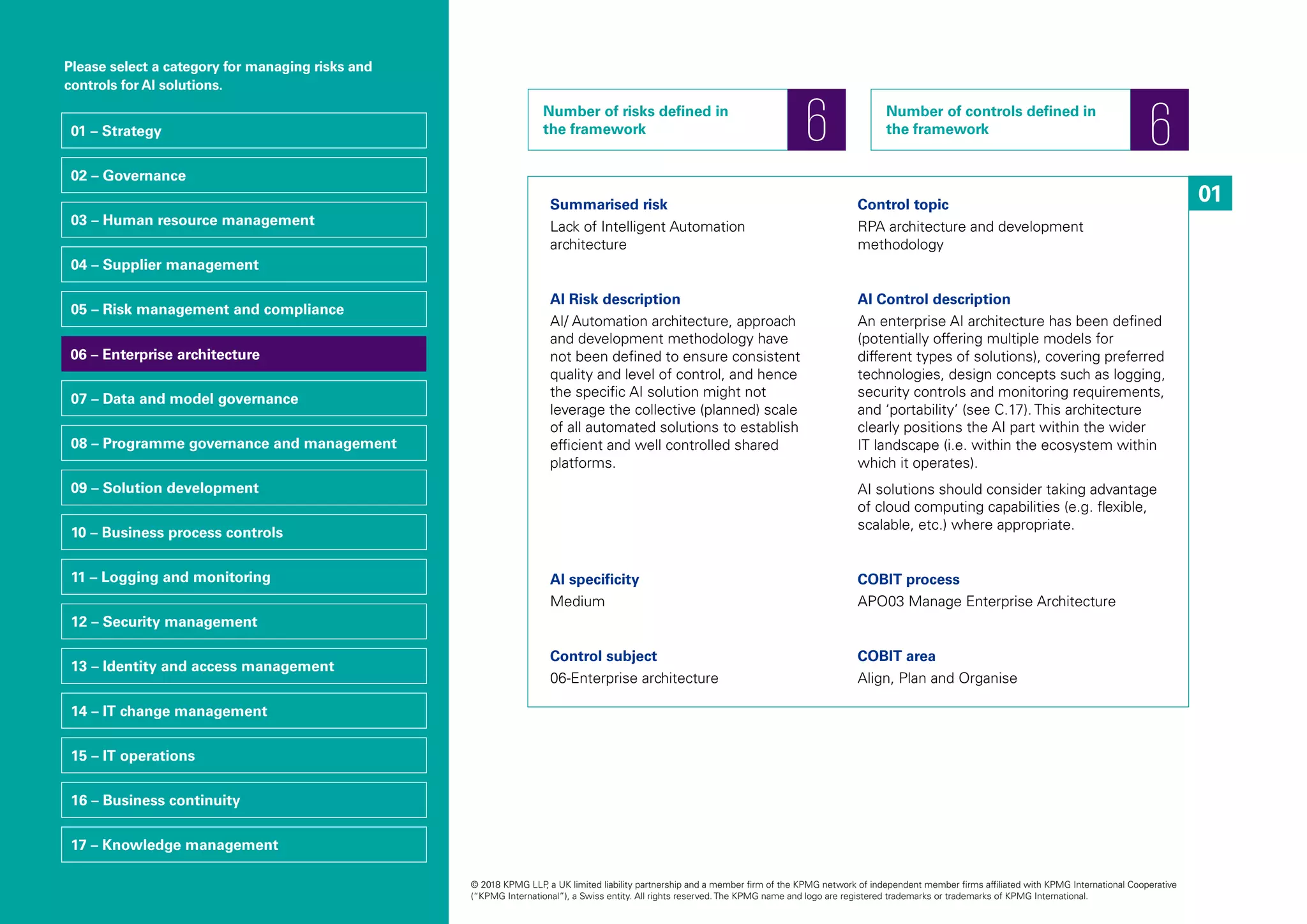
Lack of Intelligent Automation
architecture
AI Risk description
AI/ Automation architecture, approach
and development methodology have
not been defned to ensure consistent
quality and level of control, and hence
the specifc AI solution might not
leverage the collective (planned) scale
of all automated solutions to establish
effcient and well controlled shared
platforms.
AI specifcity
Medium
Control subject
06-Enterprise architecture
Control topic
RPA architecture and development
methodology
AI Control description
An enterprise AI architecture has been defned
(potentially offering multiple models for
different types of solutions), covering preferred
technologies, design concepts such as logging,
security controls and monitoring requirements,
and ‘portability’ (see C.17). This architecture
clearly positions the AI part within the wider
IT landscape (i.e. within the ecosystem within
which it operates).
AI solutions should consider taking advantage
of cloud computing capabilities (e.g. fexible,
scalable, etc.) where appropriate.
COBIT process
APO03 Manage Enterprise Architecture
COBIT area
Align, Plan and Organise
Please select a category for managing risks and
controls for AI solutions.
© 2018 KPMG LLP
, a UK limited liability partnership and a member firm of the KPMG network of independent member firms affiliated with KPMG International Cooperative
(“KPMG International”), a Swiss entity. All rights reserved. The KPMG name and logo are registered trademarks or trademarks of KPMG International.
01 – Strategy
02 – Governance
03 – Human resource management
04 – Supplier management
05 – Risk management and compliance
02
06 – Enterprise architecture
07 – Data and model governance
08 – Programme governance and management
09 – Solution development
10 – Business process controls
11 – Logging and monitoring
12 – Security management
13 – Identity and access management
14 – IT change management
15 – IT operations
16 – Business continuity
Summarised risk
Explainability not embedded in the
design
AI Risk description
AI solutions lack the functionality to
explain how they came to certain
outcomes/ decisions/ advice - and
are too complex for even their human
designers to fully comprehend. As
a result it may not be possible to
evidence effective end-to-end controls
or that risks are effectively managed.
AI specifcity
High
Control subject
06-Enterprise architecture
Control topic
Explainability by design
AI Control description
W’Explainability’ is integrated into the AI
solution’s requirements and hence included
as one of the functional requirements of the
overall solution and covered by other control
areas such as design, build, test, etc.
‘Explainability’ is implemented in such a way
that it ensures that it captures data that have
led the solution to decide/ advise what it
did, which it can generate on request, e.g.
to a human SME to be able to challenge
the AI solution (e.g. when the AI suggested
an unusual medical procedure), or to meet
external requirements (e.g. to allow the
company to explain to a human consumer
why their loan request has been denied). Such
requirements include capturing any instances
on human users ‘overriding’ the solutions
‘advise’.
COBIT process
BAI02 Manage Requirements Defnition
COBIT area
Build, Acquire and Implement
17 – Knowledge management
Please select a category for managing risks and
controls for AI solutions.
© 2018 KPMG LLP
, a UK limited liability partnership and a member firm of the KPMG network of independent member firms affiliated with KPMG International Cooperative
(“KPMG International”), a Swiss entity. All rights reserved. The KPMG name and logo are registered trademarks or trademarks of KPMG International.
01 – Strategy
02 – Governance
03 – Human resource management
04 – Supplier management
05 – Risk management and compliance
03
06 – Enterprise architecture
07 – Data and model governance
08 – Programme governance and management
09 – Solution development
10 – Business process controls
11 – Logging and monitoring
12 – Security management
13 – Identity and access management
14 – IT change management
15 – IT operations
16 – Business continuity
Summarised risk
Security by design’ not implemented
AI Risk description
Security by design’ principles have not
been embedded in the AI/ automation
architecture, approach and development
methodology to ensure appropriate and
sustainable level of security.
AI specifcity
Low
Control subject
06-Enterprise architecture
Control topic
Security by design policies, standards
and methodology
AI Control description
A development methodology and policies and
standards are in place to ensure ‘security by
design’, i.e. that the AI solution, middleware
and other relevant technology components
- across the IT stack (network, OS, database
and application level) - as well as (permanent
and temporary) data storage, are securely
confgured in line with enterprise security
policies and standards. Security setup of the
virtual environments (e.g. hypervisor access) is
aligned with the corporate security standards
and practices.
This control includes ‘privacy by design’
considerations as required under the European
General Data Protection Regulation (GDPR),
see C.14.
COBIT process
APO13 Manage Security
COBIT area
Align, Plan and Organise
17 – Knowledge management
Please select a category for managing risks and
controls for AI solutions.
© 2018 KPMG LLP
, a UK limited liability partnership and a member firm of the KPMG network of independent member firms affiliated with KPMG International Cooperative
(“KPMG International”), a Swiss entity. All rights reserved. The KPMG name and logo are registered trademarks or trademarks of KPMG International.
01 – Strategy
02 – Governance
03 – Human resource management
04 – Supplier management
05 – Risk management and compliance
04
06 – Enterprise architecture
07 – Data and model governance
08 – Programme governance and management
09 – Solution development
10 – Business process controls
11 – Logging and monitoring
12 – Security management
13 – Identity and access management
14 – IT change management
15 – IT operations
16 – Business continuity
Summarised risk
Software licence noncompliance
AI Risk description
Software licence requirements are not
met across the AI environment and/or
the connecting systems, which could
have operational, fnancial or legal
impacts.
AI specifcity
Low
Control subject
06-Enterprise architecture
Control topic
Software licences and management
AI Control description
Appropriate software licences have been
obtained for all components of the AI solution
and a mechanism is in place to renew these in
a timely manner.
Potential licensing impact of the AI solutions
accessing core systems has been determined
and where appropriate additional licences have
been obtained.
COBIT process
BAI09 Manage Assets
COBIT area
Build, Acquire and Implement
17 – Knowledge management
Please select a category for managing risks and
controls for AI solutions.
© 2018 KPMG LLP
, a UK limited liability partnership and a member firm of the KPMG network of independent member firms affiliated with KPMG International Cooperative
(“KPMG International”), a Swiss entity. All rights reserved. The KPMG name and logo are registered trademarks or trademarks of KPMG International.
01 – Strategy
02 – Governance
03 – Human resource management
04 – Supplier management
05 – Risk management and compliance
05
06 – Enterprise architecture
07 – Data and model governance
08 – Programme governance and management
09 – Solution development
10 – Business process controls
11 – Logging and monitoring
12 – Security management
13 – Identity and access management
14 – IT change management
15 – IT operations
16 – Business continuity
Summarised risk
Lack of architectural segregation
AI Risk description
Lack of architectural segregation,
especially in a cloud / multi-tenant
model, can lead to security and/
or solution and data integrity risks,
which could result in fnancial loss or
reputational damage.
AI specifcity
Medium
Control subject
06-Enterprise architecture
Control topic
Architectural segregation
AI Control description
An IT architecture principle is in place that
helps ensure that AI’s solution components
and its data are segregated from other IT
infrastructure/ cloud components, to protect
AI integrity and outcomes. Robust controls
should especially be in place to ensure logical
segmentation of AI solutions in a multi-tenant
cloud model.
COBIT process
APO03 Manage Enterprise Architecture
COBIT area
Align, Plan and Organise
17 – Knowledge management
Please select a category for managing risks and
controls for AI solutions.
© 2018 KPMG LLP
, a UK limited liability partnership and a member firm of the KPMG network of independent member firms affiliated with KPMG International Cooperative
(“KPMG International”), a Swiss entity. All rights reserved. The KPMG name and logo are registered trademarks or trademarks of KPMG International.
01 – Strategy
02 – Governance
03 – Human resource management
04 – Supplier management
05 – Risk management and compliance
06
06 – Enterprise architecture
07 – Data and model governance
08 – Programme governance and management
09 – Solution development
10 – Business process controls
11 – Logging and monitoring
12 – Security management
13 – Identity and access management
14 – IT change management
15 – IT operations
16 – Business continuity
Summarised risk
Insuffcient availability of automation
solution
AI Risk description
AI solutions are insuffciently available,
e.g. due to technical issues, impacting
business operations and resulting in
fnancial loss.
AI specifcity
Medium
Control subject
06-Enterprise architecture
Control topic
High availability while retaining
decision integrity
AI Control description
An IT architecture principle is in place that
helps ensure that AI solutions are ‘resilient-
by-design’, i.e. meet high availability
requirements. However, it should prevent the
‘split brain effect’ (i.e. more than one instance
of an AI solution running in parallel (hot-hot),
both using the same data, potentially learning
differently).
This means that the architecture has no single
points of failure, i.e. all components and
connection in the solution are (multi)redundant
to ensure a truly high availability solution. This
is to include external data connections and
ideally also alternative data sources for such
connections.
COBIT process
BAI04 Manage Availability and Capacity
COBIT area
Build, Acquire and Implement
17 – Knowledge management
Please select a category for managing risks and
controls for AI solutions.
© 2018 KPMG LLP
, a UK limited liability partnership and a member firm of the KPMG network of independent member firms affiliated with KPMG International Cooperative
(“KPMG International”), a Swiss entity. All rights reserved. The KPMG name and logo are registered trademarks or trademarks of KPMG International.
01 – Strategy
02 – Governance
03 – Human resource management
04 – Supplier management
05 – Risk management and compliance
06 – Enterprise architecture
08 – Programme governance and management
09 – Solution development
10 – Business process controls
11 – Logging and monitoring
12 – Security management
13 – Identity and access management
14 – IT change management
15 – IT operations
16 – Business continuity
17 – Knowledge management
07 – Data and model governance
01
Number of risks defned in
the framework 7 Number of controls defned in
the framework 10
Summarised risk
Unclear data governance roles and
responsibilities
AI Risk description
Unclear roles and responsibility within
the data governance processes,
resulting in regulatory, fnancial,
resilience and reputational impact.
AI specifcity
Medium
Control subject
07-Data and model governance
Control topic
Data ownership
AI Control description
Roles to manage data and its ownership are
defned (data owner, data steward, learning
owner, algorithm owner, etc.)
See also C.11 and C.42.
COBIT process
APO03 Manage Enterprise Architecture
COBIT area
Align, Plan and Organise
Please select a category for managing risks and
controls for AI solutions.
© 2018 KPMG LLP
, a UK limited liability partnership and a member firm of the KPMG network of independent member firms affiliated with KPMG International Cooperative
(“KPMG International”), a Swiss entity. All rights reserved. The KPMG name and logo are registered trademarks or trademarks of KPMG International.
01 – Strategy
02 – Governance
03 – Human resource management
04 – Supplier management
05 – Risk management and compliance
06 – Enterprise architecture
02
07 – Data and model governance
08 – Programme governance and management
09 – Solution development
10 – Business process controls
11 – Logging and monitoring
12 – Security management
13 – Identity and access management
14 – IT change management
15 – IT operations
16 – Business continuity
Summarised risk
Data corruption due to unintended
interaction with other systems
AI Risk description
Interaction between the AI solution and
other entities, data sources or (cloud
based) systems results in the corruption
of data input or output, impacting
business operations and resulting in
fnancial loss or reputational damage.
(see also to R.42).
AI specifcity
Medium
Control subject
07-Data and model governance
Control topic
Data contamination
AI Control description
Identify and monitor data transfer between
AI systems of entities to detect indications of
compromised appropriateness (ideally through
automation).
Where such a compromise is detected, take
appropriate action.
Where the AI systems are in an IaaS or a PaaS
environment ensure that the service provider
has appropriate controls in operation and that
compromises are reported promptly and fully.
See also C.51.
COBIT process
BAI10 Manage Confguration
COBIT area
Build, Acquire and Implement
17 – Knowledge management
Please select a category for managing risks and
controls for AI solutions.
© 2018 KPMG LLP
, a UK limited liability partnership and a member firm of the KPMG network of independent member firms affiliated with KPMG International Cooperative
(“KPMG International”), a Swiss entity. All rights reserved. The KPMG name and logo are registered trademarks or trademarks of KPMG International.
01 – Strategy
02 – Governance
03 – Human resource management
04 – Supplier management
05 – Risk management and compliance
06 – Enterprise architecture
03
07 – Data and model governance
08 – Programme governance and management
09 – Solution development
10 – Business process controls
11 – Logging and monitoring
12 – Security management
13 – Identity and access management
14 – IT change management
15 – IT operations
16 – Business continuity
Summarised risk
Data corruption due to unintended
interaction with other systems
AI Risk description
Interaction between the AI solution and
other entities, data sources or (cloud
based) systems results in the corruption
of data input or output, impacting
business operations and resulting in
fnancial loss or reputational damage.
(seel also R.41).
AI specifcity
Medium
Control subject
07-Data and model governance
Control topic
Data source approval
AI Control description
All (changes to) data sources - internally
or externally - which interacts with the AI
solution, are monitored and documented and
changes require human approval in advance,
which includes a risk assessment and an
assessment to validate data quality.
COBIT process
BAI09 Manage Assets
COBIT area
Build, Acquire and Implement
17 – Knowledge management
Please select a category for managing risks and
controls for AI solutions.
© 2018 KPMG LLP
, a UK limited liability partnership and a member firm of the KPMG network of independent member firms affiliated with KPMG International Cooperative
(“KPMG International”), a Swiss entity. All rights reserved. The KPMG name and logo are registered trademarks or trademarks of KPMG International.
01 – Strategy
02 – Governance
03 – Human resource management
04 – Supplier management
05 – Risk management and compliance
06 – Enterprise architecture
04
07 – Data and model governance
08 – Programme governance and management
09 – Solution development
10 – Business process controls
11 – Logging and monitoring
12 – Security management
13 – Identity and access management
14 – IT change management
15 – IT operations
16 – Business continuity
Summarised risk
Poor data quality
AI Risk description
Inadequate data governance controls,
over either learning or production data,
leading to an ineffective AI solution or
incorrect/ unreliable output.
AI specifcity
Medium
Control subject
07-Data and model governance
Control topic
Data governance
AI Control description
Data governance policies, standards and
processes are in place to ensure that high
quality data exists throughout the complete
lifecycle covering all relevant quality aspects
(i.e. availability, usability, integrity and security).
Relevant parts of the ‘learning data’ are ‘held
back’ to be used during testing and quality
control and (different) parts are retained for
future verifcation and/or audit purposes.
COBIT process
BAI09 Manage Assets
COBIT area
Build, Acquire and Implement
17 – Knowledge management
Please select a category for managing risks and
controls for AI solutions.
© 2018 KPMG LLP
, a UK limited liability partnership and a member firm of the KPMG network of independent member firms affiliated with KPMG International Cooperative
(“KPMG International”), a Swiss entity. All rights reserved. The KPMG name and logo are registered trademarks or trademarks of KPMG International.
01 – Strategy
02 – Governance
03 – Human resource management
04 – Supplier management
05 – Risk management and compliance
06 – Enterprise architecture
05
07 – Data and model governance
08 – Programme governance and management
09 – Solution development
10 – Business process controls
11 – Logging and monitoring
12 – Security management
13 – Identity and access management
14 – IT change management
15 – IT operations
16 – Business continuity
Summarised risk
Poor hypothesis quality
AI Risk description
Inadequate governance controls around
hypotheses leading to an ineffective AI
solution or incorrect/ unreliable output.
AI specifcity
High
Control subject
07-Data and model governance
Control topic
Hypothesis governance
AI Control description
Hypothesis governance policies, standards
and processes are in place to ensure that
hypothesis remain relevant and appropriate
throughout the complete lifecycle covering
all relevant quality aspects (i.e. availability,
usability, integrity and security).
COBIT process
BAI09 Manage Assets
COBIT area
Build, Acquire and Implement
17 – Knowledge management
Please select a category for managing risks and
controls for AI solutions.
© 2018 KPMG LLP
, a UK limited liability partnership and a member firm of the KPMG network of independent member firms affiliated with KPMG International Cooperative
(“KPMG International”), a Swiss entity. All rights reserved. The KPMG name and logo are registered trademarks or trademarks of KPMG International.
01 – Strategy
02 – Governance
03 – Human resource management
04 – Supplier management
05 – Risk management and compliance
06 – Enterprise architecture
06
07 – Data and model governance
08 – Programme governance and management
09 – Solution development
10 – Business process controls
11 – Logging and monitoring
12 – Security management
13 – Identity and access management
14 – IT change management
15 – IT operations
16 – Business continuity
Summarised risk
Poor algorithms quality
AI Risk description
Inadequate governance controls around
algorithms leading to an ineffective AI
solution or incorrect/ unreliable output.
AI specifcity
High
Control subject
07-Data and model governance
Control topic
Algorithms governance
AI Control description
Algorithms governance policies, standards
and processes are in place to ensure that
algorithms remain relevant and appropriate
throughout the complete lifecycle covering
all relevant quality aspects (i.e. availability,
usability, integrity and security).
COBIT process
BAI09 Manage Assets
COBIT area
Build, Acquire and Implement
17 – Knowledge management
Please select a category for managing risks and
controls for AI solutions.
© 2018 KPMG LLP
, a UK limited liability partnership and a member firm of the KPMG network of independent member firms affiliated with KPMG International Cooperative
(“KPMG International”), a Swiss entity. All rights reserved. The KPMG name and logo are registered trademarks or trademarks of KPMG International.
01 – Strategy
02 – Governance
03 – Human resource management
04 – Supplier management
05 – Risk management and compliance
06 – Enterprise architecture
07
07 – Data and model governance
08 – Programme governance and management
09 – Solution development
10 – Business process controls
11 – Logging and monitoring
12 – Security management
13 – Identity and access management
14 – IT change management
15 – IT operations
16 – Business continuity
Summarised risk
Incorrect results
AI Risk description
The results from the AI solution are
incorrect or otherwise inappropriate,
e.g. due to the model not accurately
refecting the true underlying
quantitative parameters, or because
the logic makes inaccurate decisions
or uses fawed assumptions, leading to
incorrect results.
AI specifcity
Low
Control subject
07-Data and model governance
Control topic
GDPR
AI Control description
Controls are in place to maintain the ability to
ensure completeness whilst adhering to GDPR
and other privacy regulations, and to ensure
privileged information is correctly used.
See also C.14.
COBIT process
BAI03 Manage Solutions Identifcation and
Build
COBIT area
Build, Acquire and Implement
17 – Knowledge management
Please select a category for managing risks and
controls for AI solutions.
© 2018 KPMG LLP
, a UK limited liability partnership and a member firm of the KPMG network of independent member firms affiliated with KPMG International Cooperative
(“KPMG International”), a Swiss entity. All rights reserved. The KPMG name and logo are registered trademarks or trademarks of KPMG International.
01 – Strategy
02 – Governance
03 – Human resource management
04 – Supplier management
05 – Risk management and compliance
06 – Enterprise architecture
08
07 – Data and model governance
08 – Programme governance and management
09 – Solution development
10 – Business process controls
11 – Logging and monitoring
12 – Security management
13 – Identity and access management
14 – IT change management
15 – IT operations
16 – Business continuity
Summarised risk
Incorrect results
AI Risk description
The results from the AI solution are
incorrect or otherwise inappropriate,
e.g. due to the model not accurately
refecting the true underlying
quantitative parameters, or because
the logic makes inaccurate decisions
or uses fawed assumptions, leading to
incorrect results
AI specifcity
High
Control subject
07-Data and model governance
Control topic
Data quality monitoring
AI Control description
Controls are in place for monitoring data
quality for solutions that are evolving over
time (i.e. ‘data drift’, data changing in outcome
over time, so training data may not provide
the right indicators). Consider data volume in
consideration of learning/ outcome quality.
COBIT process
DSS01 Manage Operations
COBIT area
Deliver, Service and Support
17 – Knowledge management
Please select a category for managing risks and
controls for AI solutions.
© 2018 KPMG LLP
, a UK limited liability partnership and a member firm of the KPMG network of independent member firms affiliated with KPMG International Cooperative
(“KPMG International”), a Swiss entity. All rights reserved. The KPMG name and logo are registered trademarks or trademarks of KPMG International.
01 – Strategy
02 – Governance
03 – Human resource management
04 – Supplier management
05 – Risk management and compliance
06 – Enterprise architecture
09
07 – Data and model governance
08 – Programme governance and management
09 – Solution development
10 – Business process controls
11 – Logging and monitoring
12 – Security management
13 – Identity and access management
14 – IT change management
15 – IT operations
16 – Business continuity
Summarised risk
Incomplete populations or inaccurate
data used
AI Risk description
Incomplete populations or inaccurate
data is used by the AI solution,
resulting in a poor / incorrect outcomes/
decisions.
AI specifcity
Medium
Control subject
07-Data and model governance
Control topic
Completeness of data
AI Control description
Controls are in place around the completeness
and accuracy of the data sets used by the AI
solution, e.g. to support the decision making
process, and can be demonstrated and proven.
COBIT process
BAI03 Manage Solutions Identifcation and
Build
COBIT area
Build, Acquire and Implement
17 – Knowledge management
Please select a category for managing risks and
controls for AI solutions.
© 2018 KPMG LLP
, a UK limited liability partnership and a member firm of the KPMG network of independent member firms affiliated with KPMG International Cooperative
(“KPMG International”), a Swiss entity. All rights reserved. The KPMG name and logo are registered trademarks or trademarks of KPMG International.
10
07 – Data and model governance
08 – Programme governance and management
09 – Solution development
10 – Business process controls
11 – Logging and monitoring
12 – Security management
13 – Identity and access management
14 – IT change management
15 – IT operations
16 – Business continuity
01 – Strategy
02 – Governance
03 – Human resource management
04 – Supplier management
05 – Risk management and compliance
06 – Enterprise architecture
Summarised risk
Incomplete populations or inaccurate
data used
AI Risk description
Incomplete populations or inaccurate
data is used by the AI solution,
resulting in a poor / incorrect outcomes/
decisions.
AI specifcity
High
Control subject
07-Data and model governance
Control topic
Completeness of data
AI Control description
Controls are in place to have reasonable
assurance that suffcient data (e.g. covering
a time period or suffcient variations in the
population) was provided to enable the model
to generate accurate results.
COBIT process
BAI03 Manage Solutions Identifcation and
Build
COBIT area
Build, Acquire and Implement
17 – Knowledge management
Please select a category for managing risks and
controls for AI solutions.
© 2018 KPMG LLP
, a UK limited liability partnership and a member firm of the KPMG network of independent member firms affiliated with KPMG International Cooperative
(“KPMG International”), a Swiss entity. All rights reserved. The KPMG name and logo are registered trademarks or trademarks of KPMG International.
01 – Strategy
02 – Governance
03 – Human resource management
04 – Supplier management
05 – Risk management and compliance
06 – Enterprise architecture
07 – Data and model governance
01
Number of risks defned in
the framework 3 Number of controls defned in
the framework 4
Summarised risk
Lack of strategic alignment
AI Risk description
AI programmes (as well as the individual
instances of AI) need to be aligned with
and support the organisation’s strategy,
and be in line with the organisation’s
risk appetite.
AI specifcity
Medium
Control subject
08-Programme governance and
management
Control topic
Business case
AI Control description
The overall AI objectives and business
case is aligned to the organisation’s overall
strategy. Principles for determining activities
that are/ are not suitable for AI must be
defned. Additionally, some activities may be
conditionally approved for AI, subject to having
appropriate measures to mitigate the risks of
migrating activities to AI. The determination
of activities being suitable or not for AI will be
driven by regulatory, cultural, commercial or
other considerations, and should be aligned to
the entity’s strategy.
COBIT process
APO02 Manage Strategy
COBIT area
Align, Plan and Organise
08 – Programme governance and management
09 – Solution development
10 – Business process controls
11 – Logging and monitoring
12 – Security management
13 – Identity and access management
14 – IT change management
15 – IT operations
16 – Business continuity
17 – Knowledge management
Please select a category for managing risks and
controls for AI solutions.
© 2018 KPMG LLP
, a UK limited liability partnership and a member firm of the KPMG network of independent member firms affiliated with KPMG International Cooperative
(“KPMG International”), a Swiss entity. All rights reserved. The KPMG name and logo are registered trademarks or trademarks of KPMG International.
01 – Strategy
02 – Governance
03 – Human resource management
04 – Supplier management
05 – Risk management and compliance
06 – Enterprise architecture
07 – Data and model governance
02
08 – Programme governance and management
09 – Solution development
10 – Business process controls
11 – Logging and monitoring
12 – Security management
13 – Identity and access management
14 – IT change management
15 – IT operations
16 – Business continuity
Summarised risk
Poor programme management
methodology
AI Risk description
No appropriate programme
management methodology is in place
to manage the development of the AI
solution to ensure it meets strategic
and business requirements.
AI specifcity
Medium
Control subject
08-Programme governance and
management
Control topic
Programme management
AI Control description
An appropriate programme management
methodology is in place to manage the
development of the AI solution to a successful
outcome (i.e. it meets strategic and business
requirements). This includes clear stage gate
approvals, User Acceptance Testing (UAT),
and issue and risk management, irrespective
of whether a waterfall or agile development
methodology is used.
COBIT process
BAI01 Manage Programmes and Projects
COBIT area
Build, Acquire and Implement
17 – Knowledge management
Please select a category for managing risks and
controls for AI solutions.
© 2018 KPMG LLP
, a UK limited liability partnership and a member firm of the KPMG network of independent member firms affiliated with KPMG International Cooperative
(“KPMG International”), a Swiss entity. All rights reserved. The KPMG name and logo are registered trademarks or trademarks of KPMG International.
01 – Strategy
02 – Governance
03 – Human resource management
04 – Supplier management
05 – Risk management and compliance
06 – Enterprise architecture
07 – Data and model governance
03
08 – Programme governance and management
09 – Solution development
10 – Business process controls
11 – Logging and monitoring
12 – Security management
13 – Identity and access management
14 – IT change management
15 – IT operations
16 – Business continuity
Summarised risk
Poor benefts management
AI Risk description
Benefts management has not been
implemented leading to lack of
transparency on return on investment
and realisation of strategic and business
requirements.
AI specifcity
Low
Control subject
08-Programme governance and
management
Control topic
Benefts management
AI Control description
The realisation of estimated ‘benefts’ is
systematically managed and measured during
the solutions life time (e.g. at short, medium
and long term after go-live).
Mechanisms have been designed and
implemented to measure/ articulate:
1) the total cost of ownership including trends
over time
2) the realisation of expected benefts (e.g.
quantitatively such as speed and accuracy
of processes, FTE savings, etc. - as well as
qualitatively (e.g. confdence in quality of
decision making).
The realised benefts are leveraged to drive
appetite and trust in innovative technologies,
and possibly used to fund further investments.
COBIT process
EDM02 Ensure Benefts Delivery
COBIT area
Evaluate, Direct and Monitor
17 – Knowledge management
Please select a category for managing risks and
controls for AI solutions.
© 2018 KPMG LLP
, a UK limited liability partnership and a member firm of the KPMG network of independent member firms affiliated with KPMG International Cooperative
(“KPMG International”), a Swiss entity. All rights reserved. The KPMG name and logo are registered trademarks or trademarks of KPMG International.
01 – Strategy
02 – Governance
03 – Human resource management
04 – Supplier management
05 – Risk management and compliance
06 – Enterprise architecture
07 – Data and model governance
04
08 – Programme governance and management
09 – Solution development
10 – Business process controls
11 – Logging and monitoring
12 – Security management
13 – Identity and access management
14 – IT change management
15 – IT operations
16 – Business continuity
Summarised risk
Lack of independent programme
assurance (IPA)
AI Risk description
Lack of independent assurance over
the programme’s ability to achieve a
successful outcome leaves some of the
programme’s risk undetected.
AI specifcity
Low
Control subject
08-Programme governance and
management
Control topic
Programme assurance
AI Control description
The programme has engaged an independent
function or service provider to provide
assurance to the Programme Sponsor,
Executive Management and/or other
stakeholders such as the Audit Committee,
for the duration of the programme over the
manner in which the programme has been
set-up and managed to deliver a successful
outcome (i.e. meets the requirements in
terms quality, costs, benefts, internal control,
compliance, etc.).
COBIT process
EDM02 Ensure Benefts Delivery
COBIT area
Evaluate, Direct and Monitor
17 – Knowledge management
Please select a category for managing risks and
controls for AI solutions.
© 2018 KPMG LLP
, a UK limited liability partnership and a member firm of the KPMG network of independent member firms affiliated with KPMG International Cooperative
(“KPMG International”), a Swiss entity. All rights reserved. The KPMG name and logo are registered trademarks or trademarks of KPMG International.
01 – Strategy
02 – Governance
03 – Human resource management
04 – Supplier management
05 – Risk management and compliance
06 – Enterprise architecture
07 – Data and model governance
08 – Programme governance and management
10 – Business process controls
11 – Logging and monitoring
12 – Security management
13 – Identity and access management
14 – IT change management
15 – IT operations
16 – Business continuity
17 – Knowledge management
09 – Solution development
01
Number of risks defned in
the framework 10 Number of controls defned in
the framework 16
Summarised risk
Lack of business case
AI Risk description
AI programmes without a valid business
case might not deliver ultimate value
to the entity, might jeopardise the
programmes continuation, or might
impact stakeholder’s perceptions and
expectations about the value AI could
add to the organisation.
AI specifcity
Low
Control subject
09-Solution development
Control topic
Business case
AI Control description
A clear business case for the AI solution is
in place and formally approved by relevant
stakeholders - and being kept up to date to
refect any changes in expected total cost of
ownership and/or benefts.
Individual AI solutions are assessed in
the context of the organisation’s strategy.
The expected benefts of the AI solution
should be clearly articulated and tracked
during the course of the program and post-
implementation. Benefts may be hard (e.g.
reduction in headcount) or soft (e.g. deeper
understanding of a client resulting in a better
interaction). Accounting policies should be
leveraged, and if required enhanced, to
correctly capturing the costs and the value of
AI-initiatives.
COBIT process
BAI01 Manage Programmes and Projects
COBIT area
Build, Acquire and Implement
Please select a category for managing risks and
controls for AI solutions.
© 2018 KPMG LLP
, a UK limited liability partnership and a member firm of the KPMG network of independent member firms affiliated with KPMG International Cooperative
(“KPMG International”), a Swiss entity. All rights reserved. The KPMG name and logo are registered trademarks or trademarks of KPMG International.
01 – Strategy
02 – Governance
03 – Human resource management
04 – Supplier management
05 – Risk management and compliance
06 – Enterprise architecture
07 – Data and model governance
08 – Programme governance and management
02
09 – Solution development
10 – Business process controls
11 – Logging and monitoring
12 – Security management
13 – Identity and access management
14 – IT change management
15 – IT operations
16 – Business continuity
Summarised risk
Poor design and
development
methodology
AI Risk
description
AI design and
development
methodology are
not consistently
set-up to ensure
a successful
delivery of an
AI automation
programme.
AI specifcity
High
Control subject
09-Solution
development
Control topic
Development standards
AI Control description
An AI development standard is in place, is integrated with
the broader development standards and is followed for all AI
developments.
The standard includes defned stage gates, stage entry and exit
criteria and go/no go decisions.
Examples include:
• Entanglement: Prevent machine learning systems to mix signals
together, as that entangles them and makes it diffcult to isolate
improvements.
• Unintended use: Prevent AI’s consumers to be ‘undeclared’, i.e.
unknowingly using the output of a given AI solution or model as an
input to another system which may cause interdependencies to be
poorly understood and may cause hidden feedback loops.
• Unstable data dependencies: Monitor input signals to ensure
continued appropriate usage, as they can change over time,
possibly unknowingly e.g. when the ownership of the input signal
is separate from the ownership of the model that consumes it.
• Technical debt: Prevent AI systems from becoming too complex
for humans to comprehend.
COBIT process
APO11 Manage Quality
COBIT area
Align, Plan and Organise
17 – Knowledge management
Please select a category for managing risks and
controls for AI solutions.
© 2018 KPMG LLP
, a UK limited liability partnership and a member firm of the KPMG network of independent member firms affiliated with KPMG International Cooperative
(“KPMG International”), a Swiss entity. All rights reserved. The KPMG name and logo are registered trademarks or trademarks of KPMG International.
01 – Strategy
02 – Governance
03 – Human resource management
04 – Supplier management
05 – Risk management and compliance
06 – Enterprise architecture
07 – Data and model governance
08 – Programme governance and management
03
09 – Solution development
10 – Business process controls
11 – Logging and monitoring
12 – Security management
13 – Identity and access management
14 – IT change management
15 – IT operations
16 – Business continuity
Summarised risk
Poor knowledge of As-Is processes
AI Risk description
Lack of understanding of current As-Is
processes, including internal controls,
reduces the ability to design effective
automation solutions in an effcient
manner.
AI specifcity
Low
Control subject
09-Solution development
Control topic
As-is business process documentation
during Design
AI Control description
During the Design phase(s), ‘pre-automation’
process narratives and/or fowcharts are
available including process variations and
possible exceptions. The impact of automation
on current processes and internal controls
has been assessed, e.g. through the help
of process mining software that visualises
actual processes based on the organisation’s
transactional data.
COBIT process
BAI02 Manage Requirements Defnition
COBIT area
Build, Acquire and Implement
17 – Knowledge management
Please select a category for managing risks and
controls for AI solutions.
© 2018 KPMG LLP
, a UK limited liability partnership and a member firm of the KPMG network of independent member firms affiliated with KPMG International Cooperative
(“KPMG International”), a Swiss entity. All rights reserved. The KPMG name and logo are registered trademarks or trademarks of KPMG International.
01 – Strategy
02 – Governance
03 – Human resource management
04 – Supplier management
05 – Risk management and compliance
06 – Enterprise architecture
07 – Data and model governance
08 – Programme governance and management
04
09 – Solution development
10 – Business process controls
11 – Logging and monitoring
12 – Security management
13 – Identity and access management
14 – IT change management
15 – IT operations
16 – Business continuity
Summarised risk
Poor knowledge of To-Be processes
AI Risk description
To-Be process model fowcharts and
user stories (including IT general and
business process controls) are not
complete or accurate, or have not been
approved, and reduces the ability to
design effective automation solutions in
an effcient manner.
AI specifcity
Medium
Control subject
09-Solution development
Control topic
To-be process documentation / user
stories during Design
AI Control description
Documentation of user stories and end-to-
end process fows, including the parts that
are to be automated by AI, is available, kept
up to date, with evidence of appropriate
consideration of business input, and approved
by the programme sponsor.
Internal controls (including fnancial and
operational controls) are documented and
linked within the design documentation, and
are designed to ensure a consistent effective
operation of the AI solution as well as to
detect potential exceptions.
COBIT process
BAI02 Manage Requirements Defnition
COBIT area
Build, Acquire and Implement
17 – Knowledge management
Please select a category for managing risks and
controls for AI solutions.
© 2018 KPMG LLP
, a UK limited liability partnership and a member firm of the KPMG network of independent member firms affiliated with KPMG International Cooperative
(“KPMG International”), a Swiss entity. All rights reserved. The KPMG name and logo are registered trademarks or trademarks of KPMG International.
01 – Strategy
02 – Governance
03 – Human resource management
04 – Supplier management
05 – Risk management and compliance
06 – Enterprise architecture
07 – Data and model governance
08 – Programme governance and management
05
09 – Solution development
10 – Business process controls
11 – Logging and monitoring
12 – Security management
13 – Identity and access management
14 – IT change management
15 – IT operations
16 – Business continuity
Summarised risk
Risks and controls not been defned
AI Risk description
Risks and controls have not been
explicitly defned for the solution, or
controls have not been optimised,
causing either an ineffective or
ineffcient internal controls environment.
AI specifcity
Low
Control subject
09-Solution development
Control topic
Risks and controls framework
AI Control description
Risks and controls overviews have been
established for all key areas, including the
solution, self learning capabilities, interfaces,
management processes, KPIs, etc.
Completeness of risks has been ensured
through a structured risk assessment process
with involvement of all stakeholders.
Controls are in place to effectively and
effciently address the identifed risk in a
sustainable manner.
An assessment of the post-deployment
process, incorporating the AI solution, is
completed to validate that the solution will
operate in compliance with the organisation’s
policies and procedures, and any applicable
regulations.
COBIT process
APO12 Manage Risk
COBIT area
Align, Plan and Organise
17 – Knowledge management
Please select a category for managing risks and
controls for AI solutions.
© 2018 KPMG LLP
, a UK limited liability partnership and a member firm of the KPMG network of independent member firms affiliated with KPMG International Cooperative
(“KPMG International”), a Swiss entity. All rights reserved. The KPMG name and logo are registered trademarks or trademarks of KPMG International.
01 – Strategy
02 – Governance
03 – Human resource management
04 – Supplier management
05 – Risk management and compliance
06 – Enterprise architecture
07 – Data and model governance
08 – Programme governance and management
06
09 – Solution development
Summarised risk
Not all controls are implemented
AI Risk description
The developed solution does not include
all designed processes and internal
controls requirements and as a result
does not offer an effective automation
solution.
AI specifcity
Low
Control subject
09-Solution development
Control topic
Implement controls
AI Control description
The development process has been set-up to
ensure that processes and internal controls
are developed in line with the design, i.e. are
either confgured or hard-coded within the AI
solution.
COBIT process
DSS06 Manage Business Process Controls
COBIT area
Deliver, Service and Support
10 – Business process controls
11 – Logging and monitoring
12 – Security management
13 – Identity and access management
14 – IT change management
15 – IT operations
16 – Business continuity
17 – Knowledge management
Please select a category for managing risks and
controls for AI solutions.
© 2018 KPMG LLP
, a UK limited liability partnership and a member firm of the KPMG network of independent member firms affiliated with KPMG International Cooperative
(“KPMG International”), a Swiss entity. All rights reserved. The KPMG name and logo are registered trademarks or trademarks of KPMG International.
01 – Strategy
02 – Governance
03 – Human resource management
04 – Supplier management
05 – Risk management and compliance
06 – Enterprise architecture
07 – Data and model governance
08 – Programme governance and management
07
09 – Solution development
10 – Business process controls
11 – Logging and monitoring
12 – Security management
13 – Identity and access management
14 – IT change management
15 – IT operations
16 – Business continuity
Summarised risk
Activities performed by the Bot cannot
be traced back to a specifc solution or
account
AI Risk description
The design does not ensure that
activities performed by - or through - a
Bot / an AI solution can be traced back
to a specifc Bot or user account, which
limits the effectiveness of the logging
and monitoring activities.
AI specifcity
Low
Control subject
09-Solution development
Control topic
Bot identifcation
AI Control description
The AI solution’s activities can be traced back
to a unique Bot (e.g. through static IP address).
An end-to-end audit trail is in place to
log activities.
COBIT process
APO13 Manage Security
COBIT area
Align, Plan and Organise
17 – Knowledge management
Please select a category for managing risks and
controls for AI solutions.
© 2018 KPMG LLP
, a UK limited liability partnership and a member firm of the KPMG network of independent member firms affiliated with KPMG International Cooperative
(“KPMG International”), a Swiss entity. All rights reserved. The KPMG name and logo are registered trademarks or trademarks of KPMG International.
01 – Strategy
02 – Governance
03 – Human resource management
04 – Supplier management
05 – Risk management and compliance
06 – Enterprise architecture
07 – Data and model governance
08 – Programme governance and management
08
09 – Solution development
10 – Business process controls
11 – Logging and monitoring
12 – Security management
13 – Identity and access management
14 – IT change management
15 – IT operations
16 – Business continuity
Summarised risk
Inappropriate relationships between
variables/ hypotheses
AI Risk description
The relationship between variables /
events, or between hypotheses, are
incorrectly defned resulting in incorrect
results, e.g. mistaking correlation for
causality.
AI specifcity
High
Control subject
09-Solution development
Control topic
Relationship models
AI Control description
Quality controls exist to help ensure the
appropriate relationships between variables /
events and hypotheses are defned, including
interdependencies and distinguishing
correlation and causality (e.g. through Bayesian
statistics, Hybrid Monte Carlo methods, or
causal models such as Granger non-linear
causality, Neyman–Rubin, Pearl and/or
Granger).
COBIT process
BAI02 Manage Requirements Defnition
COBIT area
Build, Acquire and Implement
17 – Knowledge management
Please select a category for managing risks and
controls for AI solutions.
© 2018 KPMG LLP
, a UK limited liability partnership and a member firm of the KPMG network of independent member firms affiliated with KPMG International Cooperative
(“KPMG International”), a Swiss entity. All rights reserved. The KPMG name and logo are registered trademarks or trademarks of KPMG International.
01 – Strategy
02 – Governance
03 – Human resource management
04 – Supplier management
05 – Risk management and compliance
06 – Enterprise architecture
07 – Data and model governance
08 – Programme governance and management
09
09 – Solution development
10 – Business process controls
11 – Logging and monitoring
12 – Security management
13 – Identity and access management
14 – IT change management
15 – IT operations
16 – Business continuity
Summarised risk
Insuffcient testing of the automation
solution
AI Risk description
Insuffcient testing of the automation
solution, resulting in a solution that
does not meet business requirements
and strategic objectives.
AI specifcity
Medium
Control subject
09-Solution development
Control topic
Develop and test environments
AI Control description
Separate environments (e.g. virtual servers
matrix) are available and are consistent,
and used for development, QA/ test and
production, to allow for testing being
performed with a due diligence in the
environment identical to production (Note: AI
has a dynamic element that will make this only
partially effective).
COBIT process
BAI04 Manage Availability and Capacity
COBIT area
Build, Acquire and Implement
17 – Knowledge management
Please select a category for managing risks and
controls for AI solutions.
© 2018 KPMG LLP
, a UK limited liability partnership and a member firm of the KPMG network of independent member firms affiliated with KPMG International Cooperative
(“KPMG International”), a Swiss entity. All rights reserved. The KPMG name and logo are registered trademarks or trademarks of KPMG International.
10
09 – Solution development
01 – Strategy
02 – Governance
03 – Human resource management
04 – Supplier management
05 – Risk management and compliance
06 – Enterprise architecture
07 – Data and model governance
08 – Programme governance and management
Summarised risk
Insuffcient testing of the automation
solution
AI Risk description
Insuffcient testing of the automation
solution, resulting in a solution that
does not meet business requirements
and strategic objectives.
AI specifcity
Low
Control subject
09-Solution development
Control topic
Test approach
AI Control description
Testing and Production/Go-live strategy and
approach are defned and followed, including
data migration between environments and
contingency planning.
COBIT process
BAI07 Manage Change Acceptance and
Transitioning
COBIT area
Build, Acquire and Implement
10 – Business process controls
11 – Logging and monitoring
12 – Security management
13 – Identity and access management
14 – IT change management
15 – IT operations
16 – Business continuity
17 – Knowledge management
Please select a category for managing risks and
controls for AI solutions.
© 2018 KPMG LLP
, a UK limited liability partnership and a member firm of the KPMG network of independent member firms affiliated with KPMG International Cooperative
(“KPMG International”), a Swiss entity. All rights reserved. The KPMG name and logo are registered trademarks or trademarks of KPMG International.
11
09 – Solution development
10 – Business process controls
11 – Logging and monitoring
12 – Security management
13 – Identity and access management
14 – IT change management
15 – IT operations
16 – Business continuity
01 – Strategy
02 – Governance
03 – Human resource management
04 – Supplier management
05 – Risk management and compliance
06 – Enterprise architecture
07 – Data and model governance
08 – Programme governance and management
Summarised risk
Insuffcient testing of the automation
solution
AI Risk description
Insuffcient testing of the automation
solution, resulting in a solution that
does not meet business requirements
and strategic objectives.
AI specifcity
Low
Control subject
09-Solution development
Control topic
Test approvals
AI Control description
Appropriate User Acceptance Testing (UAT)
for the solution is performed with appropriate
consideration of business input for design,
execute and approve testing, and signed off
prior to be accepted. Documentation of test
cases and approvals for each AI solution is
retained.
COBIT process
APO11 Manage Quality
COBIT area
Align, Plan and Organise
17 – Knowledge management
Please select a category for managing risks and
controls for AI solutions.
© 2018 KPMG LLP
, a UK limited liability partnership and a member firm of the KPMG network of independent member firms affiliated with KPMG International Cooperative
(“KPMG International”), a Swiss entity. All rights reserved. The KPMG name and logo are registered trademarks or trademarks of KPMG International.
01 – Strategy
02 – Governance
03 – Human resource management
04 – Supplier management
05 – Risk management and compliance
06 – Enterprise architecture
07 – Data and model governance
08 – Programme governance and management
12
09 – Solution development
10 – Business process controls
11 – Logging and monitoring
12 – Security management
13 – Identity and access management
14 – IT change management
15 – IT operations
16 – Business continuity
Summarised risk
Incorrect results
AI Risk description
The results from the AI solution are
incorrect or otherwise inappropriate,
e.g. due to the model not accurately
refecting the true underlying
quantitative parameters, or because
the logic makes inaccurate decisions
or uses fawed assumptions, leading to
incorrect results.
AI specifcity
High
Control subject
09-Solution development
Control topic
Next best action
AI Control description
The code is designed to ensure that the
algorithms determine ‘the next best alternative
action’ when an initially preferred option is not
available (e.g. “blocked roads”).
COBIT process
BAI03 Manage Solutions Identifcation and
Build
COBIT area
Build, Acquire and Implement
17 – Knowledge management
Please select a category for managing risks and
controls for AI solutions.
© 2018 KPMG LLP
, a UK limited liability partnership and a member firm of the KPMG network of independent member firms affiliated with KPMG International Cooperative
(“KPMG International”), a Swiss entity. All rights reserved. The KPMG name and logo are registered trademarks or trademarks of KPMG International.
01 – Strategy
02 – Governance
03 – Human resource management
04 – Supplier management
05 – Risk management and compliance
06 – Enterprise architecture
07 – Data and model governance
08 – Programme governance and management
13
09 – Solution development
10 – Business process controls
11 – Logging and monitoring
12 – Security management
13 – Identity and access management
14 – IT change management
15 – IT operations
16 – Business continuity
Summarised risk
Incorrect results
AI Risk description
The results from the AI solution are
incorrect or otherwise inappropriate,
e.g. due to the model not accurately
refecting the true underlying
quantitative parameters, or because
the logic makes inaccurate decisions
or uses fawed assumptions, leading to
incorrect results.
AI specifcity
High
Control subject
09-Solution development
Control topic
Unbiased
AI Control description
Controls are in place to consider sensitivities
when dealing with different ethical/ political/
ethnic/ race/ gender/ cultural etc. groups.
COBIT process
BAI03 Manage Solutions Identifcation and
Build
COBIT area
Build, Acquire and Implement
17 – Knowledge management
Please select a category for managing risks and
controls for AI solutions.
© 2018 KPMG LLP
, a UK limited liability partnership and a member firm of the KPMG network of independent member firms affiliated with KPMG International Cooperative
(“KPMG International”), a Swiss entity. All rights reserved. The KPMG name and logo are registered trademarks or trademarks of KPMG International.
01 – Strategy
02 – Governance
03 – Human resource management
04 – Supplier management
05 – Risk management and compliance
06 – Enterprise architecture
07 – Data and model governance
08 – Programme governance and management
14
09 – Solution development
10 – Business process controls
11 – Logging and monitoring
12 – Security management
13 – Identity and access management
14 – IT change management
15 – IT operations
16 – Business continuity
Summarised risk
Incorrect results
AI Risk description
The results from the AI solution are
incorrect or otherwise inappropriate,
e.g. due to the model not accurately
refecting the true underlying
quantitative parameters, or because
the logic makes inaccurate decisions
or uses fawed assumptions, leading to
incorrect results.
AI specifcity
High
Control subject
09-Solution development
Control topic
Sensitivities
AI Control description
Learning data is reviewed for data bias and
validated through testing.
COBIT process
BAI03 Manage Solutions Identifcation and
Build
COBIT area
Build, Acquire and Implement
17 – Knowledge management
Please select a category for managing risks and
controls for AI solutions.
© 2018 KPMG LLP
, a UK limited liability partnership and a member firm of the KPMG network of independent member firms affiliated with KPMG International Cooperative
(“KPMG International”), a Swiss entity. All rights reserved. The KPMG name and logo are registered trademarks or trademarks of KPMG International.
01 – Strategy
02 – Governance
03 – Human resource management
04 – Supplier management
05 – Risk management and compliance
06 – Enterprise architecture
07 – Data and model governance
08 – Programme governance and management
15
09 – Solution development
10 – Business process controls
11 – Logging and monitoring
12 – Security management
13 – Identity and access management
14 – IT change management
15 – IT operations
16 – Business continuity
Summarised risk
Incorrect results
AI Risk description
The results from the AI solution are
incorrect or otherwise inappropriate,
e.g. due to the model not accurately
refecting the true underlying
quantitative parameters, or because
the logic makes inaccurate decisions
or uses fawed assumptions, leading to
incorrect results.
AI specifcity
Medium
Control subject
09-Solution development
Control topic
Timely sync of data
AI Control description
Controls are in place to ensure that when data
is sourced/ used, the time scale of the data
from the source is aligned with the time scale
the AI system is using.
COBIT process
BAI03 Manage Solutions Identifcation and
Build
COBIT area
Build, Acquire and Implement
17 – Knowledge management
Please select a category for managing risks and
controls for AI solutions.
© 2018 KPMG LLP
, a UK limited liability partnership and a member firm of the KPMG network of independent member firms affiliated with KPMG International Cooperative
(“KPMG International”), a Swiss entity. All rights reserved. The KPMG name and logo are registered trademarks or trademarks of KPMG International.
01 – Strategy
02 – Governance
03 – Human resource management
04 – Supplier management
05 – Risk management and compliance
06 – Enterprise architecture
07 – Data and model governance
08 – Programme governance and management
16
09 – Solution development
10 – Business process controls
11 – Logging and monitoring
12 – Security management
13 – Identity and access management
14 – IT change management
15 – IT operations
16 – Business continuity
Summarised risk
Incorrect results
AI Risk description
The results from the AI solution are
incorrect or otherwise inappropriate,
e.g. due to the model not accurately
refecting the true underlying
quantitative parameters, or because
the logic makes inaccurate decisions
or uses fawed assumptions, leading to
incorrect results.
AI specifcity
Medium
Control subject
09-Solution development
Control topic
Duplicate data processing
AI Control description
Controls are in place to prevent the AI solution
from processing the same data more than
once, including fle and data validation checks.
COBIT process
BAI03 Manage Solutions Identifcation and
Build
COBIT area
Build, Acquire and Implement
17 – Knowledge management
Please select a category for managing risks and
controls for AI solutions.
© 2018 KPMG LLP
, a UK limited liability partnership and a member firm of the KPMG network of independent member firms affiliated with KPMG International Cooperative
(“KPMG International”), a Swiss entity. All rights reserved. The KPMG name and logo are registered trademarks or trademarks of KPMG International.
Number of risks defned in the framework
01 – Strategy
To be determined for each solution
Number of controls defned in the framework
To be determined for each solution
02 – Governance
03 – Human resource management
04 – Supplier management
05 – Risk management and compliance
06 – Enterprise architecture
07 – Data and model governance
08 – Programme governance and management
09 – Solution development
10 – Business process controls
11 – Logging and monitoring
12 – Security management
13 – Identity and access management
14 – IT change management
15 – IT operations
16 – Business continuity
17 – Knowledge management
Please select a category for managing risks and
controls for AI solutions.
© 2018 KPMG LLP
, a UK limited liability partnership and a member firm of the KPMG network of independent member firms affiliated with KPMG International Cooperative
(“KPMG International”), a Swiss entity. All rights reserved. The KPMG name and logo are registered trademarks or trademarks of KPMG International.
01 – Strategy
02 – Governance
03 – Human resource management
04 – Supplier management
05 – Risk management and compliance
06 – Enterprise architecture
07 – Data and model governance
08 – Programme governance and management
09 – Solution development
10 – Business process controls
12 – Security management
13 – Identity and access management
14 – IT change management
15 – IT operations
16 – Business continuity
17 – Knowledge management
11 – Logging and monitoring
01
Number of risks defned in
the framework 2 Number of controls defned in
the framework 3
Summarised risk
Lack of monitoring of the outcomes of
automation solutions
AI Risk description
Without adequate monitoring of the
outcomes of the solution, it could:
a. not behave as intended when
designed and implemented (outcomes
monitoring against original business
requirements / ethics requirements /
corporate values etc.)
b. have bad responses or decision times
AI specifcity
High
Control subject
10-Logging and monitoring
Control topic
Monitoring of outcomes
AI Control description
Through use of Data Analytics / MI on the
audit trails, management regularly reviews
the solution outcomes (e.g. reports that
have been designed and built to measure
the performance of the AI solution) against
the business requirements from ethical to
functional. Controls work at the same pace as
the activities that are monitored (decision and
operational velocity)
See C.80 for Operational monitoring and C.15
and C.33 for risk monitoring.
COBIT process
MEA01 Monitor, Evaluate and Assess
Performance and Conformance
COBIT area
Monitor, Evaluate and Assess
Please select a category for managing risks and
controls for AI solutions.
© 2018 KPMG LLP
, a UK limited liability partnership and a member firm of the KPMG network of independent member firms affiliated with KPMG International Cooperative
(“KPMG International”), a Swiss entity. All rights reserved. The KPMG name and logo are registered trademarks or trademarks of KPMG International.
01 – Strategy
02 – Governance
03 – Human resource management
04 – Supplier management
05 – Risk management and compliance
06 – Enterprise architecture
07 – Data and model governance
08 – Programme governance and management
09 – Solution development
10 – Business process controls
02
11 – Logging and monitoring
12 – Security management
13 – Identity and access management
14 – IT change management
15 – IT operations
16 – Business continuity
17 – Knowledge management
Summarised risk
Inadequate monitoring impacts overall
effectiveness
AI Risk description
Auditability or monitoring requirements
for AI operations are not implemented,
impacting the ability to monitor
continued effectiveness of operations,
as well as the analysis of / timely
response to potential incidents.
AI specifcity
High
Control subject
10-Logging and monitoring
Control topic
Operational monitoring
AI Control description
An overall real-time monitoring/ alerting
framework/ mechanism is in place to detect
any anomalies in the end-to-end operation of
the AI processes, controls, systems and/or
data.
Sensors and detailed logging is enabled
to capture and review each AI solution’s
transactions/ activities.
Both KPIs (Key Performance Indicators) and
KRIs (Key Risk Indicators) have been defned
to form the basis for effective monitoring and
include the operation of business process
controls.
Operational events have been defned to
trigger alerts which are followed-up on where
relevant.
Detailed logs are maintained to obtain last
execution status in case the AI solution fails.
See also C.19 around overall management
review of performance and C.12/ C.33 re
monitoring risk.
COBIT process
MEA01 Monitor, Evaluate and Assess
Performance and Conformance
COBIT area
Monitor, Evaluate and Assess
Please select a category for managing risks and
controls for AI solutions.
© 2018 KPMG LLP
, a UK limited liability partnership and a member firm of the KPMG network of independent member firms affiliated with KPMG International Cooperative
(“KPMG International”), a Swiss entity. All rights reserved. The KPMG name and logo are registered trademarks or trademarks of KPMG International.
01 – Strategy
02 – Governance
03 – Human resource management
04 – Supplier management
05 – Risk management and compliance
06 – Enterprise architecture
07 – Data and model governance
08 – Programme governance and management
09 – Solution development
10 – Business process controls
03
11 – Logging and monitoring
12 – Security management
13 – Identity and access management
14 – IT change management
15 – IT operations
16 – Business continuity
Summarised risk
Inadequate monitoring impacts overall
effectiveness
AI Risk description
Auditability or monitoring requirements
for AI operations are not implemented,
impacting the ability to monitor
continued effectiveness of operations,
as well as the analysis of / timely
response to potential incidents.
AI specifcity
Medium
Control subject
10-Logging and monitoring
Control topic
Operational monitoring
AI Control description
Automated stop/loss controls should be
considered in the technical design of the
AI solution so that unintended behaviour is
stopped or paused in a timely manner.
An override process is in place for exceptions
(whether this requires escalation / emergency
‘stop button’ / automated stop and hold until
released after human interaction etc.)
Exceptions are assessed for risk and
performance against risk appetite and business
impact/ criticality, and take inter-dependencies
in to consideration.
Where appropriate, automated checks exist to
help manage exceptions.
COBIT process
MEA01 Monitor, Evaluate and Assess
Performance and Conformance
COBIT area
Monitor, Evaluate and Assess
17 – Knowledge management
Please select a category for managing risks and
controls for AI solutions.
© 2018 KPMG LLP
, a UK limited liability partnership and a member firm of the KPMG network of independent member firms affiliated with KPMG International Cooperative
(“KPMG International”), a Swiss entity. All rights reserved. The KPMG name and logo are registered trademarks or trademarks of KPMG International.
01 – Strategy
02 – Governance
03 – Human resource management
04 – Supplier management
05 – Risk management and compliance
06 – Enterprise architecture
07 – Data and model governance
08 – Programme governance and management
09 – Solution development
10 – Business process controls
11 – Logging and monitoring
01
12 – Security management
13 – Identity and access management
14 – IT change management
15 – IT operations
16 – Business continuity
17 – Knowledge management
Number of risks defned in
the framework 5 Number of controls defned in
the framework
6
Summarised risk
Inconsistent security management
AI Risk description
Security over the AI environment or
related systems is not controlled with
consistently quality, increasing the
risk of unauthorised changes, system
availability, data loss and other incidents
AI specifcity
Low
Control subject
11-Security management
Control topic
Security management
AI Control description
The AI environment follows a consistent
security management approach with clear
procedures and work instructions. This
approach is integrated with the ‘regular’
security management approach to ensure a
consistent approach across the AI and related
environments. This applies to code, algorithms,
confguration, IT infrastructure, applications,
data structures and data classifcation and
related management processes. Security
management is aligned to good practice
standards (e.g. ISO 27001).
COBIT process
APO13 Manage Security
COBIT area
Align, Plan and Organise
Please select a category for managing risks and
controls for AI solutions.
© 2018 KPMG LLP
, a UK limited liability partnership and a member firm of the KPMG network of independent member firms affiliated with KPMG International Cooperative
(“KPMG International”), a Swiss entity. All rights reserved. The KPMG name and logo are registered trademarks or trademarks of KPMG International.
01 – Strategy
02 – Governance
03 – Human resource management
04 – Supplier management
05 – Risk management and compliance
06 – Enterprise architecture
07 – Data and model governance
08 – Programme governance and management
09 – Solution development
10 – Business process controls
11 – Logging and monitoring
02
12 – Security management
13 – Identity and access management
14 – IT change management
15 – IT operations
16 – Business continuity
Summarised risk
Inconsistent security management
AI Risk description
Security over the AI environment or
related systems is not controlled with
consistently quality, increasing the
risk of unauthorised changes, system
availability, data loss and other incidents
AI specifcity
High
Control subject
11-Security management
Control topic
Auditability
AI Control description
Data and algorithms used for generating
AI results/ decisions, including data used
for system learning, are stored securely,
can be retrieved in a timely manner and in
accordance with regulations (e.g. data privacy)
so provenance of decisions can be provided
and hence AI outcomes can be independently
validated. This include access controls, controls
to prevent data from being overwritten or
simplifed (loss of context), controls around log
generated data.
This could be achieved through applying the
‘vault principle’, i.e. an automated solution
that securely stores any decision made by
the solution, as well as the data the decision
was based on, and the latest version of the
algorithm. See also C.23 and C.80.
COBIT process
APO13 Manage Security
COBIT area
Align, Plan and Organise
17 – Knowledge management
Please select a category for managing risks and
controls for AI solutions.
© 2018 KPMG LLP
, a UK limited liability partnership and a member firm of the KPMG network of independent member firms affiliated with KPMG International Cooperative
(“KPMG International”), a Swiss entity. All rights reserved. The KPMG name and logo are registered trademarks or trademarks of KPMG International.
01 – Strategy
02 – Governance
03 – Human resource management
04 – Supplier management
05 – Risk management and compliance
06 – Enterprise architecture
07 – Data and model governance
08 – Programme governance and management
09 – Solution development
10 – Business process controls
11 – Logging and monitoring
03
12 – Security management
13 – Identity and access management
14 – IT change management
15 – IT operations
16 – Business continuity
Summarised risk
Insuffcient protection against malware
AI Risk description
Malware or new vulnerabilities might
not be detected and expose the AI
environment to security risks, leading
to operational, fnancial or reputational
losses.
AI specifcity
Low
Control subject
11-Security management
Control topic
Vulnerability and malware
management
AI Control description
Malware protection is in place and availability
of new patches is continuously monitored,
and where applicable an impact assessment is
performed before the patch gets implemented
in a timely manner.
Specifcally for self-learning components,
besides system and data protection, ‘malware
controls’ are also to include protection of the
‘learning’, i.e. protect against mailicious attacks
to attempt to infuence the learning capabilities
in an inappropriate manner.
Also see Control C.24 for the server hardening
control.
COBIT process
APO13 Manage Security
COBIT area
Align, Plan and Organise
17 – Knowledge management
Please select a category for managing risks and
controls for AI solutions.
© 2018 KPMG LLP
, a UK limited liability partnership and a member firm of the KPMG network of independent member firms affiliated with KPMG International Cooperative
(“KPMG International”), a Swiss entity. All rights reserved. The KPMG name and logo are registered trademarks or trademarks of KPMG International.
01 – Strategy
02 – Governance
03 – Human resource management
04 – Supplier management
05 – Risk management and compliance
06 – Enterprise architecture
07 – Data and model governance
08 – Programme governance and management
09 – Solution development
10 – Business process controls
11 – Logging and monitoring
04
Summarised risk
Insecure data
AI Risk description
Data used for learning and automated
processing is inappropriately changed,
leading to operational, fnancial or
reputational losses.
AI specifcity
Medium
Control subject
11-Security management
Control topic
Security management
AI Control description
AI’s input datasets are confgured securely
against human or machine intervention. Where
relevant, completeness and accuracy checks
are automatically performed on the data input.
COBIT process
APO11 Manage Quality
COBIT area
Align, Plan and Organise
12 – Security management
13 – Identity and access management
14 – IT change management
15 – IT operations
16 – Business continuity
17 – Knowledge management
Please select a category for managing risks and
controls for AI solutions.
© 2018 KPMG LLP
, a UK limited liability partnership and a member firm of the KPMG network of independent member firms affiliated with KPMG International Cooperative
(“KPMG International”), a Swiss entity. All rights reserved. The KPMG name and logo are registered trademarks or trademarks of KPMG International.
01 – Strategy
02 – Governance
03 – Human resource management
04 – Supplier management
05 – Risk management and compliance
06 – Enterprise architecture
07 – Data and model governance
08 – Programme governance and management
09 – Solution development
10 – Business process controls
11 – Logging and monitoring
05
Summarised risk
Insecure temporary data
AI Risk description
Creation and usage of insecure
temporary fles leaves AI solution,
or related systems vulnerable to
unauthorised data manipulation or loss.
AI specifcity
Low
Control subject
11-Security management
Control topic
Security management
AI Control description
Code and data storage as well as network
communications to/ from/ within the AI
solution are adequately encrypted.
COBIT process
APO13 Manage Security
COBIT area
Align, Plan and Organise
12 – Security management
13 – Identity and access management
14 – IT change management
15 – IT operations
16 – Business continuity
17 – Knowledge management
Please select a category for managing risks and
controls for AI solutions.
© 2018 KPMG LLP
, a UK limited liability partnership and a member firm of the KPMG network of independent member firms affiliated with KPMG International Cooperative
(“KPMG International”), a Swiss entity. All rights reserved. The KPMG name and logo are registered trademarks or trademarks of KPMG International.
01 – Strategy
02 – Governance
03 – Human resource management
04 – Supplier management
05 – Risk management and compliance
06 – Enterprise architecture
07 – Data and model governance
08 – Programme governance and management
09 – Solution development
10 – Business process controls
11 – Logging and monitoring
06
Summarised risk
Security testing
AI Risk description
Security weaknesses might not
be detected and expose the AI
environment to security risks, leading
to operational, fnancial or reputational
losses.
AI specifcity
Low
Control subject
11-Security management
Control topic
Security management
AI Control description
Penetration tests or ‘Red-team’ reviews are
performed to assess the AI environment’s
exposure to vulnerabilities.
Periodic security testing is performed to
ensure security controls, sensors, and
monitoring is operational.
COBIT process
DSS05 Manage Security Services
COBIT area
Deliver, Service and Support
12 – Security management
13 – Identity and access management
14 – IT change management
15 – IT operations
16 – Business continuity
17 – Knowledge management
Please select a category for managing risks and
controls for AI solutions.
© 2018 KPMG LLP
, a UK limited liability partnership and a member firm of the KPMG network of independent member firms affiliated with KPMG International Cooperative
(“KPMG International”), a Swiss entity. All rights reserved. The KPMG name and logo are registered trademarks or trademarks of KPMG International.
01 – Strategy
02 – Governance
03 – Human resource management
04 – Supplier management
05 – Risk management and compliance
06 – Enterprise architecture
07 – Data and model governance
08 – Programme governance and management
09 – Solution development
10 – Business process controls
11 – Logging and monitoring
12 – Security management
01
13 – Identity and access management
14 – IT change management
15 – IT operations
16 – Business continuity
17 – Knowledge management
Number of risks defned in
the framework 7 Number of controls defned in
the framework
12
Summarised risk
Unique accounts
AI Risk description
Lack of ownership and accountability
for access to the AI solution - and/or for
the Bots’ access to connecting systems
- increases the risk of inappropriate
access, leading to operational, fnancial
or reputational losses.
AI specifcity
Low
Control subject
12-Identity & access management
Control topic
Access accountability for Bot accounts
AI Control description
All accounts used by AI/ Bots are unique, and
have been assigned to a human with ultimate
responsibility for these.
For each Bot, usage of its account is tracked in
between applications and services, to ensure
that for each activity it is clear which Bot
triggered an interface or web-service.
In case shared or system accounts are
required, compensating controls are in place
where appropriate..
COBIT process
APO13 Manage Security
COBIT area
Align, Plan and Organise
Please select a category for managing risks and
controls for AI solutions.
© 2018 KPMG LLP
, a UK limited liability partnership and a member firm of the KPMG network of independent member firms affiliated with KPMG International Cooperative
(“KPMG International”), a Swiss entity. All rights reserved. The KPMG name and logo are registered trademarks or trademarks of KPMG International.
01 – Strategy
02 – Governance
03 – Human resource management
04 – Supplier management
05 – Risk management and compliance
06 – Enterprise architecture
07 – Data and model governance
08 – Programme governance and management
09 – Solution development
10 – Business process controls
11 – Logging and monitoring
12 – Security management
02
Summarised risk
Unique accounts
AI Risk description
Lack of ownership and accountability
for access to the AI solution - and/or for
the Bots’ access to connecting systems
- increases the risk of inappropriate
access, leading to operational, fnancial
or reputational losses.
AI specifcity
Low
Control subject
12-Identity & access management
Control topic
Access accountability for human
accounts
AI Control description
Wherever possible human accounts to access
the AI environment are personal and unique,
and the individuals have ultimate responsibility
for these.
In case shared or system accounts are
required, compensating controls are in place
where appropriate.
Access to system logic and algorithms
are appropriately restricted to authorised
individuals.
COBIT process
APO13 Manage Security
COBIT area
Align, Plan and Organise
13 – Identity and access management
14 – IT change management
15 – IT operations
16 – Business continuity
17 – Knowledge management
Please select a category for managing risks and
controls for AI solutions.
© 2018 KPMG LLP
, a UK limited liability partnership and a member firm of the KPMG network of independent member firms affiliated with KPMG International Cooperative
(“KPMG International”), a Swiss entity. All rights reserved. The KPMG name and logo are registered trademarks or trademarks of KPMG International.
01 – Strategy
02 – Governance
03 – Human resource management
04 – Supplier management
05 – Risk management and compliance
06 – Enterprise architecture
07 – Data and model governance
08 – Programme governance and management
09 – Solution development
10 – Business process controls
11 – Logging and monitoring
12 – Security management
03
Summarised risk
Inappropriate access to the solution
AI Risk description
Access to, or through, the Bot and/
or relevant systems and data is
inappropriate and/or unauthorised,
leading to operational, fnancial or
reputational losses.
AI specifcity
Low
Control subject
12-Identity & access management
Control topic
‘Bot’s access authorisation
AI Control description
The Bot’s access rights to relevant systems
are set-up and assigned on a ‘need to have’
basis. Bot access is constrained to applications
and data required for specifc, intended
transactions only.
COBIT process
APO13 Manage Security
COBIT area
Align, Plan and Organise
13 – Identity and access management
14 – IT change management
15 – IT operations
16 – Business continuity
17 – Knowledge management
Please select a category for managing risks and
controls for AI solutions.
© 2018 KPMG LLP
, a UK limited liability partnership and a member firm of the KPMG network of independent member firms affiliated with KPMG International Cooperative
(“KPMG International”), a Swiss entity. All rights reserved. The KPMG name and logo are registered trademarks or trademarks of KPMG International.
01 – Strategy
02 – Governance
03 – Human resource management
04 – Supplier management
05 – Risk management and compliance
06 – Enterprise architecture
07 – Data and model governance
08 – Programme governance and management
09 – Solution development
10 – Business process controls
11 – Logging and monitoring
12 – Security management
04
Summarised risk
Inappropriate access to the solution
AI Risk description
Access to, or through, the Bot and/
or relevant systems and data is
inappropriate and/or unauthorised,
leading to operational, fnancial or
reputational losses.
AI specifcity
Low
Control subject
12-Identity & access management
Control topic
User access authorisation
AI Control description
User access to the Bot’s IT environment (e.g.
the AI solution itself, additional (permanent
or temporary) data storage facilities, log fles,
and other relevant components) is set-up and
assigned on a ‘need to have’ basis.
COBIT process
APO13 Manage Security
COBIT area
Align, Plan and Organise
13 – Identity and access management
14 – IT change management
15 – IT operations
16 – Business continuity
17 – Knowledge management
Please select a category for managing risks and
controls for AI solutions.
© 2018 KPMG LLP
, a UK limited liability partnership and a member firm of the KPMG network of independent member firms affiliated with KPMG International Cooperative
(“KPMG International”), a Swiss entity. All rights reserved. The KPMG name and logo are registered trademarks or trademarks of KPMG International.
01 – Strategy
02 – Governance
03 – Human resource management
04 – Supplier management
05 – Risk management and compliance
06 – Enterprise architecture
07 – Data and model governance
08 – Programme governance and management
09 – Solution development
10 – Business process controls
11 – Logging and monitoring
12 – Security management
05
Summarised risk
Unique accounts
AI Risk description
Access to, or through, the Bot and/
or relevant systems and data is
inappropriate and/or unauthorised,
leading to operational, fnancial or
reputational losses.
AI specifcity
Low
Control subject
12-Identity & access management
Control topic
Account provisioning procedures (user
and Bot)
AI Control description
Access provisioning procedures are in place for
the creation of (human) user and Bot accounts
and assigning user privileges to new or
existing accounts. Formal approval is required
by appropriate business representatives for the
establishment of users and granting of access
rights, both the human and robotic accounts.
COBIT process
APO01 Manage the IT Management
Framework
COBIT area
Align, Plan and Organise
13 – Identity and access management
14 – IT change management
15 – IT operations
16 – Business continuity
17 – Knowledge management
Please select a category for managing risks and
controls for AI solutions.
© 2018 KPMG LLP
, a UK limited liability partnership and a member firm of the KPMG network of independent member firms affiliated with KPMG International Cooperative
(“KPMG International”), a Swiss entity. All rights reserved. The KPMG name and logo are registered trademarks or trademarks of KPMG International.
01 – Strategy
02 – Governance
03 – Human resource management
04 – Supplier management
05 – Risk management and compliance
06 – Enterprise architecture
07 – Data and model governance
08 – Programme governance and management
09 – Solution development
10 – Business process controls
11 – Logging and monitoring
12 – Security management
06
Summarised risk
Inappropriate access to the solution
AI Risk description
Access to, or through, the Bot and/
or relevant systems and data is
inappropriate and/or unauthorised,
leading to operational, fnancial or
reputational losses.
AI specifcity
Low
Control subject
12-Identity & access management
Control topic
Access revocation procedures (user
and Bot)
AI Control description
User provisioning procedures are in place for
the timely deletion or locking of user accounts
and their privileges when an employee leaves
or when the employee or the Bot no longer
needs this access due to a change in role or
decommissioning.
COBIT process
APO01 Manage the IT Management
Framework
COBIT area
Align, Plan and Organise
13 – Identity and access management
14 – IT change management
15 – IT operations
16 – Business continuity
17 – Knowledge management
Please select a category for managing risks and
controls for AI solutions.
© 2018 KPMG LLP
, a UK limited liability partnership and a member firm of the KPMG network of independent member firms affiliated with KPMG International Cooperative
(“KPMG International”), a Swiss entity. All rights reserved. The KPMG name and logo are registered trademarks or trademarks of KPMG International.
01 – Strategy
02 – Governance
03 – Human resource management
04 – Supplier management
05 – Risk management and compliance
06 – Enterprise architecture
07 – Data and model governance
08 – Programme governance and management
09 – Solution development
10 – Business process controls
11 – Logging and monitoring
12 – Security management
13 – Identity and access management
14 – IT change management
15 – IT operations
16 – Business continuity
17 – Knowledge management
07
Summarised risk
Inappropriate access not detected
AI Risk description
Weaknesses in access authorisations
and/or revocations are not detected in
time, leading to operational, fnancial or
reputational losses.
AI specifcity
Low
Control subject
12-Identity & access management
Control topic
‘Bot’s accounts and access rights
reviews
AI Control description
The Bot’s access accounts and their system
privileges are reviewed periodically. The
reviews are formalised and documented,
including appropriate sign-off.
Any exceptions detected by the reviews are
acted upon in a timely manner.
Exceptions are investigated to determine
whether the account has been used
inappropriately (e.g. used after the Bot’s
access was no longer required) and whether
this access exposed any particular risk (e.g. if
any signifcant access rights were used).
COBIT process
MEA02 Monitor, Evaluate and Assess the
System of Internal Control
COBIT area
Monitor, Evaluate and Assess
Please select a category for managing risks and
controls for AI solutions.
© 2018 KPMG LLP
, a UK limited liability partnership and a member firm of the KPMG network of independent member firms affiliated with KPMG International Cooperative
(“KPMG International”), a Swiss entity. All rights reserved. The KPMG name and logo are registered trademarks or trademarks of KPMG International.
01 – Strategy
02 – Governance
03 – Human resource management
04 – Supplier management
05 – Risk management and compliance
06 – Enterprise architecture
07 – Data and model governance
08 – Programme governance and management
09 – Solution development
10 – Business process controls
11 – Logging and monitoring
12 – Security management
08
13 – Identity and access management
14 – IT change management
15 – IT operations
16 – Business continuity
Summarised risk
Inappropriate access not detected
AI Risk description
Weaknesses in access authorisations
and/or revocations are not detected in
time, leading to operational, fnancial or
reputational losses.
AI specifcity
Low
Control subject
12-Identity & access management
Control topic
User accounts and access rights
reviews
AI Control description
User accounts and system privileges that
have access to the Bot’s IT environment (e.g.
the AI solution itself, additional (permanent
or temporary) data storage facilities, log fles,
and other relevant components) are reviewed
periodically. The reviews are formal and
documented, including appropriate sign-off.
Any exceptions detected by the reviews are
acted upon in a timely manner.
Exceptions are investigated to determine
whether the account has been used
inappropriately (e.g. used after the user’s
access was no longer required) and whether
this access exposed any particular risk (e.g. if
any signifcant access rights were used).
COBIT process
MEA02 Monitor, Evaluate and Assess the
System of Internal Control
COBIT area
Monitor, Evaluate and Assess
17 – Knowledge management
Please select a category for managing risks and
controls for AI solutions.
© 2018 KPMG LLP
, a UK limited liability partnership and a member firm of the KPMG network of independent member firms affiliated with KPMG International Cooperative
(“KPMG International”), a Swiss entity. All rights reserved. The KPMG name and logo are registered trademarks or trademarks of KPMG International.
01 – Strategy
02 – Governance
03 – Human resource management
04 – Supplier management
05 – Risk management and compliance
06 – Enterprise architecture
07 – Data and model governance
08 – Programme governance and management
09 – Solution development
10 – Business process controls
11 – Logging and monitoring
12 – Security management
09
13 – Identity and access management
14 – IT change management
15 – IT operations
16 – Business continuity
Summarised risk
Inappropriate powerful access
AI Risk description
Privileged access rights are
insuffciently protected to prevent
unauthorised access to the system or
its data, leading to operational, fnancial
or reputational losses.
AI specifcity
Low
Control subject
12-Identity & access management
Control topic
Privileged access (super user access)
AI Control description
Access to powerful user accounts (such
as those which can be used to perform
user access administration, change system
confguration or can directly access interfaces
or data), are restricted to a defned set of
system administration personnel for each of
the IT components and across the IT stack
(network, OS, database, application).
Access to these powerful accounts is
subject to additional security, e.g. through a
secure network, data encryption, stronger
authentication controls such as 2-factor
authentication or through additional means
such as privileged access management
tooling.
COBIT process
APO13 Manage Security
COBIT area
Align, Plan and Organise
17 – Knowledge management
Please select a category for managing risks and
controls for AI solutions.
© 2018 KPMG LLP
, a UK limited liability partnership and a member firm of the KPMG network of independent member firms affiliated with KPMG International Cooperative
(“KPMG International”), a Swiss entity. All rights reserved. The KPMG name and logo are registered trademarks or trademarks of KPMG International.
01 – Strategy
02 – Governance
03 – Human resource management
04 – Supplier management
05 – Risk management and compliance
06 – Enterprise architecture
07 – Data and model governance
08 – Programme governance and management
09 – Solution development
10 – Business process controls
11 – Logging and monitoring
12 – Security management
10
13 – Identity and access management
14 – IT change management
15 – IT operations
16 – Business continuity
Summarised risk
Segregation of duties conficts
AI Risk description
Assigned access rights violate
segregation of duty requirements,
leading to operational, fnancial or
reputational losses.
AI specifcity
Low
Control subject
12-Identity & access management
Control topic
IT Segregation of Duties
AI Control description
Access rights have been assigned to
ensure compliance with the following SoD
requirements:
* no single human can create user accounts
and assign access privileges to these accounts
without approval by another operator.
* no single human can make changes to the
AI solution or its data directly in production,
or make those change in a development
environment which that operator would
then be able to migrate to the production
environment - without the approval by another
operator.
* no single human can raise and approve the
same change request.
COBIT process
APO13 Manage Security
COBIT area
Align, Plan and Organise
17 – Knowledge management
Please select a category for managing risks and
controls for AI solutions.
© 2018 KPMG LLP
, a UK limited liability partnership and a member firm of the KPMG network of independent member firms affiliated with KPMG International Cooperative
(“KPMG International”), a Swiss entity. All rights reserved. The KPMG name and logo are registered trademarks or trademarks of KPMG International.
01 – Strategy
02 – Governance
03 – Human resource management
04 – Supplier management
05 – Risk management and compliance
06 – Enterprise architecture
07 – Data and model governance
08 – Programme governance and management
09 – Solution development
10 – Business process controls
11 – Logging and monitoring
12 – Security management
11
13 – Identity and access management
14 – IT change management
15 – IT operations
16 – Business continuity
Summarised risk
Poor authentication
AI Risk description
Account authentication mechanisms
are insuffcient to prevent unauthorised
access to systems or data, leading to
operational, fnancial or reputational
losses.
AI specifcity
Low
Control subject
12-Identity & access management
Control topic
Authentication, e.g. password controls
AI Control description
Effective authentication controls are in place,
e.g. through the use of password controls
or biometrics, in line with the IT security
policy for systems in scope across the IT
stack (network, OS, database, applications
and utilities). These controls apply to all user
accounts, including admin accounts and
automation authentication, and cover elements
such as (encrypted storage, and passwords
are to be changed upon frst usage, password
length/ complexity and with a min and max
lifetime).
In case certain accounts (e.g. system accounts
or Bot accounts) do not have passwords
controls in place, or are required to use hard
coded passwords, compensating controls
exist to mitigate the risk that unauthorised
individuals can use the relating accounts to
access to data or systems.
COBIT process
APO13 Manage Security
COBIT area
Align, Plan and Organise
17 – Knowledge management
Please select a category for managing risks and
controls for AI solutions.
© 2018 KPMG LLP
, a UK limited liability partnership and a member firm of the KPMG network of independent member firms affiliated with KPMG International Cooperative
(“KPMG International”), a Swiss entity. All rights reserved. The KPMG name and logo are registered trademarks or trademarks of KPMG International.
01 – Strategy
02 – Governance
03 – Human resource management
04 – Supplier management
05 – Risk management and compliance
06 – Enterprise architecture
07 – Data and model governance
08 – Programme governance and management
09 – Solution development
10 – Business process controls
11 – Logging and monitoring
12 – Security management
12
Summarised risk
Inappropriate access by 3rd parties
AI Risk description
Inappropriate access by 3rd parties,
leading to operational, fnancial or
reputational losses.
AI specifcity
Low
Control subject
12-Identity & access management
Control topic
3rd party access
AI Control description
Access by 3rd party users, and user access
to 3rd party data or data processing facilities
is subject to the same level of controls as
‘regular’ users, data, and data processing
facilities.
See also C.05.
COBIT process
APO13 Manage Security
COBIT area
Align, Plan and Organise
13 – Identity and access management
14 – IT change management
15 – IT operations
16 – Business continuity
17 – Knowledge management
Please select a category for managing risks and
controls for AI solutions.
© 2018 KPMG LLP
, a UK limited liability partnership and a member firm of the KPMG network of independent member firms affiliated with KPMG International Cooperative
(“KPMG International”), a Swiss entity. All rights reserved. The KPMG name and logo are registered trademarks or trademarks of KPMG International.
01 – Strategy
02 – Governance
03 – Human resource management
04 – Supplier management
05 – Risk management and compliance
06 – Enterprise architecture
07 – Data and model governance
08 – Programme governance and management
09 – Solution development
10 – Business process controls
11 – Logging and monitoring
12 – Security management
13 – Identity and access management
01
14 – IT change management
15 – IT operations
16 – Business continuity
17 – Knowledge management
Number of risks defned in
the framework 4 Number of controls defned in
the framework
7
Summarised risk
Inappropriate changes to the solution
AI Risk description
Changes to the AI environment or
related systems and data are not
controlled with consistent quality,
increasing the risk of unauthorised
changes and incidents, which in turn
leads to loss of reliability/ quality of the
solution, and to operational, fnancial or
reputational losses.
AI specifcity
Low
Control subject
13-IT change management
Control topic
IT Change Management
AI Control description
For as far as is feasible (i.e. acknowledging the
limitations of change control in a self learning
environment), the AI environment follows a
consistent change management approach
with clear procedures and work instructions
around changes to IT infrastructure, AI
models and algorithms, data, etc. This
approach is integrated with the ‘regular’
change management approach to ensure a
consistent approach across the AI and related
environments. Change management is aligned
to good practice standards (e.g. ITIL).
Versioning is in place for for business
processes, code, Bot confguration,
applications, data structures and data
classifcation.
See also for:
• segregate environments: C.51
• recording changes/ take snapshots: C.56/
C.87
• risk of black box: R.40
• regular testing/ monitoring: C.19 and C.81
• quality control: C.36.
COBIT process
BAI06 Manage Changes
COBIT area
Build, Acquire and Implement
Please select a category for managing risks and
controls for AI solutions.
© 2018 KPMG LLP
, a UK limited liability partnership and a member firm of the KPMG network of independent member firms affiliated with KPMG International Cooperative
(“KPMG International”), a Swiss entity. All rights reserved. The KPMG name and logo are registered trademarks or trademarks of KPMG International.
01 – Strategy
02 – Governance
03 – Human resource management
04 – Supplier management
05 – Risk management and compliance
06 – Enterprise architecture
07 – Data and model governance
08 – Programme governance and management
09 – Solution development
10 – Business process controls
11 – Logging and monitoring
12 – Security management
13 – Identity and access management
02
Summarised risk
Inappropriate changes to the solution
AI Risk description
Changes to the AI environment or
related systems and data are not
controlled with consistent quality,
increasing the risk of unauthorised
changes and incidents, which in turn
leads to loss of reliability/ quality of the
solution, and to operational, fnancial or
reputational losses.
AI specifcity
Low
Control subject
13-IT change management
Control topic
IT Change Management
AI Control description
Data governance inventories, including data
classifcation inventory, data asset fagging,
and data fow maps, are maintained as part of
the change management process.
COBIT process
BAI02 Manage Requirements Defnition
COBIT area
Build, Acquire and Implement
14 – IT change management
15 – IT operations
16 – Business continuity
17 – Knowledge management
Please select a category for managing risks and
controls for AI solutions.
© 2018 KPMG LLP
, a UK limited liability partnership and a member firm of the KPMG network of independent member firms affiliated with KPMG International Cooperative
(“KPMG International”), a Swiss entity. All rights reserved. The KPMG name and logo are registered trademarks or trademarks of KPMG International.
01 – Strategy
02 – Governance
03 – Human resource management
04 – Supplier management
05 – Risk management and compliance
06 – Enterprise architecture
07 – Data and model governance
08 – Programme governance and management
09 – Solution development
10 – Business process controls
11 – Logging and monitoring
12 – Security management
13 – Identity and access management
03
14 – IT change management
15 – IT operations
16 – Business continuity
Summarised risk
Inappropriate changes to the solution
AI Risk description
Changes to the AI environment or
related systems and data are not
controlled with consistent quality,
increasing the risk of unauthorised
changes and incidents, which in turn
leads to loss of reliability/ quality of the
solution, and to operational, fnancial or
reputational losses.
AI specifcity
Low
Control subject
13-IT change management
Control topic
IT Change Management
AI Control description
The organisation has an established procedure
that limits production changes to appropriate
change management personnel.
Production is locked for direct changes and
should only be unlocked for a requested period
of time. Direct changes require approval from
appropriate personnel prior to unlocking of
production. If direct changes cannot inherently
be prevented, then direct changes to
production should be monitored on an ongoing
basis.
Changes caused by the dynamic nature of
machine learning are covered by additonal
measures, such as loggoing and review of
any modifcations and/or periodic comparison
of the solutions at different time stamps to
identify any changes made.
COBIT process
BAI07 Manage Change Acceptance and
Transitioning
COBIT area
Build, Acquire and Implement
17 – Knowledge management
Please select a category for managing risks and
controls for AI solutions.
© 2018 KPMG LLP
, a UK limited liability partnership and a member firm of the KPMG network of independent member firms affiliated with KPMG International Cooperative
(“KPMG International”), a Swiss entity. All rights reserved. The KPMG name and logo are registered trademarks or trademarks of KPMG International.
01 – Strategy
02 – Governance
03 – Human resource management
04 – Supplier management
05 – Risk management and compliance
06 – Enterprise architecture
07 – Data and model governance
08 – Programme governance and management
09 – Solution development
10 – Business process controls
11 – Logging and monitoring
12 – Security management
13 – Identity and access management
04
14 – IT change management
15 – IT operations
16 – Business continuity
17 – Knowledge management
Summarised risk
Changes made by the solution impact
other IT services
AI Risk description
The AI solution makes decisions or
amends how it operates which may
impact other processes, systems or
services impacting operational integrity
of the solution and the organisation.
AI specifcity
High
Control subject
13-IT change management
Control topic
IT Change Management
AI Control description
The impact of changes to AI processing and
outputs on other IT services are assessed
and monitored. Design standards are in place
which include ‘black-list’ behaviours - those
that may not be adjusted by AI, and human
oversight exists in Operations. ‘Staggered
learning’ is used to introduce a new/ changed
model/ approach for a limited scope frst, and
when necessary, it is possible to set the AI
solution to stop learning (temporarily).
COBIT process
BAI06 Manage Changes
COBIT area
Build, Acquire and Implement
Please select a category for managing risks and
controls for AI solutions.
© 2018 KPMG LLP
, a UK limited liability partnership and a member firm of the KPMG network of independent member firms affiliated with KPMG International Cooperative
(“KPMG International”), a Swiss entity. All rights reserved. The KPMG name and logo are registered trademarks or trademarks of KPMG International.
01 – Strategy
02 – Governance
03 – Human resource management
04 – Supplier management
05 – Risk management and compliance
06 – Enterprise architecture
07 – Data and model governance
08 – Programme governance and management
09 – Solution development
10 – Business process controls
11 – Logging and monitoring
12 – Security management
13 – Identity and access management
05
Summarised risk
Inappropriate changes to the
automation solution do not get detected
AI Risk description
Either through deliberate or eroneous
changes, or changes made by the AI
solution itself, the overall effectiveness
of the solutions is compromised
without it being detected by the
business, leading to operational,
fnancial or reputational losses.
AI specifcity
Medium
Control subject
13-IT change management
Control topic
Testing
AI Control description
Automated testing packs (test cases/ scripts
+ test data) are in place, e.g. for when major
changes are introduced such as new data
source to the AI solution or machine learning
upgrade. Adequate, automated (wherever
possible) testing of all new Bots and changes
to Bots is in place, including testing of
controls, using predefned test scripts, to
help ensure that the AI solution remains
valid. Design tests take place in parallel with
changes and establish production readiness
thresholds.
COBIT process
BAI07 Manage Change Acceptance and
Transitioning
COBIT area
Build, Acquire and Implement
14 – IT change management
15 – IT operations
16 – Business continuity
17 – Knowledge management
Please select a category for managing risks and
controls for AI solutions.
© 2018 KPMG LLP
, a UK limited liability partnership and a member firm of the KPMG network of independent member firms affiliated with KPMG International Cooperative
(“KPMG International”), a Swiss entity. All rights reserved. The KPMG name and logo are registered trademarks or trademarks of KPMG International.
01 – Strategy
02 – Governance
03 – Human resource management
04 – Supplier management
05 – Risk management and compliance
06 – Enterprise architecture
07 – Data and model governance
08 – Programme governance and management
09 – Solution development
10 – Business process controls
11 – Logging and monitoring
12 – Security management
13 – Identity and access management
06
Summarised risk
Inappropriate changes to the
automation solution do not get detected
AI Risk description
Either through deliberate or eroneous
changes, or changes made by the AI
solution itself, the overall effectiveness
of the solutions is compromised
without it being detected by the
business, leading to operational,
fnancial or reputational losses.
AI specifcity
High
Control subject
13-IT change management
Control topic
Ongoing testing
AI Control description
Continual testing of the end-to-end AI solution
is in place, by Business and IT, using a variety
of dynamic and evolving testing methodologies
to refect the constant learning nature of AI
based on business objectives and specifc
functional requirements.
COBIT process
BAI07 Manage Change Acceptance and
Transitioning
COBIT area
Build, Acquire and Implement
14 – IT change management
15 – IT operations
16 – Business continuity
17 – Knowledge management
Please select a category for managing risks and
controls for AI solutions.
© 2018 KPMG LLP
, a UK limited liability partnership and a member firm of the KPMG network of independent member firms affiliated with KPMG International Cooperative
(“KPMG International”), a Swiss entity. All rights reserved. The KPMG name and logo are registered trademarks or trademarks of KPMG International.
01 – Strategy
02 – Governance
03 – Human resource management
04 – Supplier management
05 – Risk management and compliance
06 – Enterprise architecture
07 – Data and model governance
08 – Programme governance and management
09 – Solution development
10 – Business process controls
11 – Logging and monitoring
12 – Security management
13 – Identity and access management
07
Summarised risk
Insuffcient testing of changes to the
automation solution
AI Risk description
Insuffcient testing of the AI solution
leads to non-detection of incidents or
quality or integrity issues.
AI specifcity
Low
Control subject
13-IT change management
Control topic
Test approvals
AI Control description
UAT for changes is performed with appropriate
consideration of business input for design,
execute and approve testing, and signed
off prior to be accepted. Documentation of
test cases and approvals for each AI solution
(or component thereof) is retained. Where
possible, automation is applied to help ensure
an effcient and high quality UAT process.
COBIT process
BAI07 Manage Change Acceptance and
Transitioning
COBIT area
Build, Acquire and Implement
14 – IT change management
15 – IT operations
16 – Business continuity
17 – Knowledge management
Please select a category for managing risks and
controls for AI solutions.
© 2018 KPMG LLP
, a UK limited liability partnership and a member firm of the KPMG network of independent member firms affiliated with KPMG International Cooperative
(“KPMG International”), a Swiss entity. All rights reserved. The KPMG name and logo are registered trademarks or trademarks of KPMG International.
01 – Strategy
02 – Governance
03 – Human resource management
04 – Supplier management
05 – Risk management and compliance
06 – Enterprise architecture
07 – Data and model governance
08 – Programme governance and management
09 – Solution development
10 – Business process controls
11 – Logging and monitoring
12 – Security management
13 – Identity and access management
14 – IT change management
16 – Business continuity
17 – Knowledge management
15 – IT operations
01
Number of risks defned in
the framework 7 Number of controls defned in
the framework
8
Summarised risk
Lacking inventory of all intelligent
automation solutions
AI Risk description
Without a complete and detailed
inventory of all AI or other similar
solutions (e.g. RPA), including
dependencies between solutions, an
entity is not able to ensure AI is being
applied in line with the strategy and its
risk appetite. 
AI specifcity
Low
Control subject
14-IT operations
Control topic
Inventory of intelligent automation
solutions
AI Control description
An inventory of all AI platforms, solutions and
use cases exists, is complete and kept up to
date. The specifc owner of each AI solution is
captured in the inventory.
COBIT process
APO05 Manage Portfolio
COBIT area
Align, Plan and Organise
Please select a category for managing risks and
controls for AI solutions.
© 2018 KPMG LLP
, a UK limited liability partnership and a member firm of the KPMG network of independent member firms affiliated with KPMG International Cooperative
(“KPMG International”), a Swiss entity. All rights reserved. The KPMG name and logo are registered trademarks or trademarks of KPMG International.
01 – Strategy
02 – Governance
03 – Human resource management
04 – Supplier management
05 – Risk management and compliance
06 – Enterprise architecture
07 – Data and model governance
08 – Programme governance and management
09 – Solution development
10 – Business process controls
11 – Logging and monitoring
12 – Security management
13 – Identity and access management
14 – IT change management
02
Summarised risk
Lacking control over the use of IT
system resources
AI Risk description
The AI solution makes decisions about
the system resources it requires, such
as processing time, capacity, processes
with other systems etc., that may
impact the cost and effcacy of the
overall system. E.g. the AI solution
may require an increasing amount of
a fnite processing window that could
crowd out other processes, or require
a larger window to interface with
another system that may impact on
how the other system runs, or requires
an additional service such as a new
databases to be set up, which may not
be licensed or effcient.
AI specifcity
Medium
Control subject
14-IT operations
Control topic
Management of IT consumption
AI Control description
Controls are in place to monitor IT resource
demands, more closely than other systems
because AI systems might be more likely to be
more unpredictable/ dynamic.
COBIT process
BAI04 Manage Availability and Capacity
COBIT area
Build, Acquire and Implement
15 – IT operations
16 – Business continuity
17 – Knowledge management
Please select a category for managing risks and
controls for AI solutions.
© 2018 KPMG LLP
, a UK limited liability partnership and a member firm of the KPMG network of independent member firms affiliated with KPMG International Cooperative
(“KPMG International”), a Swiss entity. All rights reserved. The KPMG name and logo are registered trademarks or trademarks of KPMG International.
01 – Strategy
02 – Governance
03 – Human resource management
04 – Supplier management
05 – Risk management and compliance
06 – Enterprise architecture
07 – Data and model governance
08 – Programme governance and management
09 – Solution development
10 – Business process controls
11 – Logging and monitoring
12 – Security management
13 – Identity and access management
14 – IT change management
03
15 – IT operations
Summarised risk
Errors in the solution’s operation remain
undetected
AI Risk description
Errors in the AI’s operation remain
undetected or are detected late, or are
not acted upon appropriately, increasing
the risk of unauthorised changes,
system availability, data loss and other
incidents.
Traditional incident detection systems
may not be designed to identify
AI-generated incidents such as
misalignment with culture or minor
errors in processing; and by extension
problems may not be identifed
and managed because of a lack of
identifcation or logging of incidents.
This may result in outages or non-
availability of systems or data, or
information security breaches.
AI specifcity
Medium
Control subject
14-IT operations
Control topic
Incident management
AI Control description
The AI environment follows a consistent
incident management approach with clear
procedures and work instructions that are
to ensure timely resolution of incidents with
appropriate escalation where required. This
approach is integrated with the ‘regular’
incident management approach to ensure a
consistent approach across the AI and related
environments. Incident management is aligned
to good practice standards (e.g. ITIL).
COBIT process
DSS02 Manage Service Requests and
Incidents
COBIT area
Deliver, Service and Support
16 – Business continuity
17 – Knowledge management
Please select a category for managing risks and
controls for AI solutions.
© 2018 KPMG LLP
, a UK limited liability partnership and a member firm of the KPMG network of independent member firms affiliated with KPMG International Cooperative
(“KPMG International”), a Swiss entity. All rights reserved. The KPMG name and logo are registered trademarks or trademarks of KPMG International.
01 – Strategy
02 – Governance
03 – Human resource management
04 – Supplier management
05 – Risk management and compliance
06 – Enterprise architecture
07 – Data and model governance
08 – Programme governance and management
09 – Solution development
10 – Business process controls
11 – Logging and monitoring
12 – Security management
13 – Identity and access management
14 – IT change management
15 – IT operations
16 – Business continuity
17 – Knowledge management
04
Summarised risk
Errors in the solution’s operation remain
undetected
AI Risk description
Errors in the AI’s operation remain
undetected or are detected late, or are
not acted upon appropriately, increasing
the risk of unauthorised changes,
system availability, data loss and other
incidents.
Traditional incident detection systems
may not be designed to identify
AI-generated incidents such as
misalignment with culture or minor
errors in processing; and by extension
problems may not be identifed
and managed because of a lack of
identifcation or logging of incidents.
This may result in outages or non-
availability of systems or data, or
information security breaches
AI specifcity
Medium
Control subject
14-IT operations
Control topic
Error resolution
AI Control description
Processing exceptions, and error resolution
(from operations or maintenance activities),
is performed on a timely basis by appropriate
personnel (exception management guidelines
and approach). This includes issue and
performance monitoring (application, system
and network).
COBIT process
DSS01 Manage Operations
COBIT area
Deliver, Service and Support
Please select a category for managing risks and
controls for AI solutions.
© 2018 KPMG LLP
, a UK limited liability partnership and a member firm of the KPMG network of independent member firms affiliated with KPMG International Cooperative
(“KPMG International”), a Swiss entity. All rights reserved. The KPMG name and logo are registered trademarks or trademarks of KPMG International.
01 – Strategy
02 – Governance
03 – Human resource management
04 – Supplier management
05 – Risk management and compliance
06 – Enterprise architecture
07 – Data and model governance
08 – Programme governance and management
09 – Solution development
10 – Business process controls
11 – Logging and monitoring
12 – Security management
13 – Identity and access management
14 – IT change management
05
15 – IT operations
Summarised risk
Errors in the solution’s operation remain
undetected
AI Risk description
Errors in the AI’s operation remain
undetected or are detected late, or are
not acted upon appropriately, increasing
the risk of unauthorised changes,
system availability, data loss and other
incidents.
Traditional incident detection systems
may not be designed to identify
AI-generated incidents such as
misalignment with culture or minor
errors in processing; and by extension
problems may not be identifed
and managed because of a lack of
identifcation or logging of incidents.
This may result in outages or non-
availability of systems or data, or
information security breaches.
AI specifcity
Medium
Control subject
14-IT operations
Control topic
Job monitoring
AI Control description
Appropriate job monitoring processes are
followed to monitor system jobs and interfaces
to ensure completeness and timeliness of
system and data processing, and to identify
any interruptions in a timely manner.
COBIT process
DSS01 Manage Operations
COBIT area
Deliver, Service and Support
16 – Business continuity
17 – Knowledge management
Please select a category for managing risks and
controls for AI solutions.
© 2018 KPMG LLP
, a UK limited liability partnership and a member firm of the KPMG network of independent member firms affiliated with KPMG International Cooperative
(“KPMG International”), a Swiss entity. All rights reserved. The KPMG name and logo are registered trademarks or trademarks of KPMG International.
01 – Strategy
02 – Governance
03 – Human resource management
04 – Supplier management
05 – Risk management and compliance
06 – Enterprise architecture
07 – Data and model governance
08 – Programme governance and management
09 – Solution development
10 – Business process controls
11 – Logging and monitoring
12 – Security management
13 – Identity and access management
14 – IT change management
06
Summarised risk
IP not accessible or protected
AI Risk description
The AI solution’s IP/ code is not
accessible (e.g. held by a third party) or
not adequately protected from IP loss/
theft, and impacts the ability to maintain
effective automation solutions in an
effcient manner, or otherwise impact
the AI business case.
AI specifcity
Low
Control subject
14-IT operations
Control topic
IP protection
AI Control description
A repository of relevant IP (i.e. data, code,
models and ‘learning data’) is set-up and
accessible in-house, secured, and protected
with regular back-ups using the son, father,
grand-father principle.
See also C.49.
In interaction with parties outside the
organisation, the risk of IP loss is considered
and adequate mitigating measures are taken
(e.g. use of encryption to prevent the code
from being read.
COBIT process
DSS01 Manage Operations
COBIT area
Deliver, Service and Support
15 – IT operations
16 – Business continuity
17 – Knowledge management
Please select a category for managing risks and
controls for AI solutions.
© 2018 KPMG LLP
, a UK limited liability partnership and a member firm of the KPMG network of independent member firms affiliated with KPMG International Cooperative
(“KPMG International”), a Swiss entity. All rights reserved. The KPMG name and logo are registered trademarks or trademarks of KPMG International.
01 – Strategy
02 – Governance
03 – Human resource management
04 – Supplier management
05 – Risk management and compliance
06 – Enterprise architecture
07 – Data and model governance
08 – Programme governance and management
09 – Solution development
10 – Business process controls
11 – Logging and monitoring
12 – Security management
13 – Identity and access management
14 – IT change management
07
Summarised risk
Lack of knowledge of all related IT
components
AI Risk description
Lack of up to date understanding of the
IT and data components of the overall
AI environment and their relationships
undermines the effectiveness of several
other controls incl. security, software
licences, IT operations and business
continuity.
AI specifcity
Low
Control subject
14-IT operations
Control topic
Asset and Confguration management
AI Control description
A confguration management database
(‘CMDB’, i.e. a database with all the
Confguration Items (‘Cis’)) is established
and maintained to ensure a complete
understanding of all the IT and data
components and their relationships. This
repository feeds in to other processes such
as Risk and Security Management and IT
Operations, and is updated as part of the
Change management processes.
COBIT process
BAI10 Manage Confguration
COBIT area
Build, Acquire and Implement
15 – IT operations
16 – Business continuity
17 – Knowledge management
Please select a category for managing risks and
controls for AI solutions.
© 2018 KPMG LLP
, a UK limited liability partnership and a member firm of the KPMG network of independent member firms affiliated with KPMG International Cooperative
(“KPMG International”), a Swiss entity. All rights reserved. The KPMG name and logo are registered trademarks or trademarks of KPMG International.
01 – Strategy
02 – Governance
03 – Human resource management
04 – Supplier management
05 – Risk management and compliance
06 – Enterprise architecture
07 – Data and model governance
08 – Programme governance and management
09 – Solution development
10 – Business process controls
11 – Logging and monitoring
12 – Security management
13 – Identity and access management
14 – IT change management
08
Summarised risk
Insuffcient capacity or availability
AI Risk description
The AI solution is not able to meet
the evolving demand, impacting the
organisation’s ability to maintain the
solution suffciently available and
effective to adequately support relevant
business processes.
AI specifcity
Medium
Control subject
14-IT operations
Control topic
Availability and capacity management,
and the scalability of the solution
AI Control description
For the IT infrastructure as well as the AI
solution, adequate availability and capacity
management processes are in place and
scalability has been embedded in the design of
the solution.
See also C.55.
COBIT process
BAI04 Manage Availability and Capacity
COBIT area
Build, Acquire and Implement
15 – IT operations
16 – Business continuity
17 – Knowledge management
Please select a category for managing risks and
controls for AI solutions.
© 2018 KPMG LLP
, a UK limited liability partnership and a member firm of the KPMG network of independent member firms affiliated with KPMG International Cooperative
(“KPMG International”), a Swiss entity. All rights reserved. The KPMG name and logo are registered trademarks or trademarks of KPMG International.
01
01 – Strategy
02 – Governance
03 – Human resource management
04 – Supplier management
05 – Risk management and compliance
06 – Enterprise architecture
07 – Data and model governance
08 – Programme governance and management
09 – Solution development
10 – Business process controls
11 – Logging and monitoring
12 – Security management
13 – Identity and access management
14 – IT change management
15 – IT operations
Number of risks defned in
the framework 6 Number of controls defned in
the framework 8
Control topic
BCP fall-back environment
AI Control description
Fall back/ alternative processing possibilities
have been explored, risk and impact
assessment have been made, and where
feasible such alternative processing
opportunities have been put in place to cover
one or more of the three risks listed (i.e. AI
has a dynamic element that will make this only
partially effective).
COBIT process
DSS04 Manage Continuity
COBIT area
Deliver, Service and Support
Summarised risk
Insuffcient fall back facilities
AI Risk description
No fall back or alternative processing
facility is available for a fully functioning
AI solution (consisting of hardware,
software, process data and learning
data and encompassing solutions
required for the effective functioning of
the solution). This includes:
* an IT infrastructure risk (i.e. not having
core processing facilities available
in time, including all the required
interfaces, access to data etc.),
* a solution/ functional risk (i.e. not
having an alternative AI solution in
place in time that provides the same
functionality, learnings, access to same
data, etc.)
* a business/ operational risk (i.e. not
being able to manually - or otherwise
- operate relevant business processes
without an effective AI solution in
place).
AI specifcity
Medium
Control subject
15-Business continuity
16 – Business continuity
17 – Knowledge management
Please select a category for managing risks and
controls for AI solutions.
© 2018 KPMG LLP
, a UK limited liability partnership and a member firm of the KPMG network of independent member firms affiliated with KPMG International Cooperative
(“KPMG International”), a Swiss entity. All rights reserved. The KPMG name and logo are registered trademarks or trademarks of KPMG International.
01 – Strategy
02 – Governance
03 – Human resource management
04 – Supplier management
05 – Risk management and compliance
06 – Enterprise architecture
07 – Data and model governance
08 – Programme governance and management
09 – Solution development
10 – Business process controls
11 – Logging and monitoring
12 – Security management
13 – Identity and access management
14 – IT change management
15 – IT operations
02
Summarised risk
Lack of Business continuity
arrangements, and testing thereof
AI Risk description
Business continuity plans are not in
place to provide the required structure
to limit the impact of a major incident,
and/or such plans/ facilities are not
operating as required at the time these
are needed
AI specifcity
Low
Control subject
15-Business continuity
Control topic
BCP
AI Control description
The AI environment follows a consistent
business continuity management approach
with clear procedures and work instructions.
This approach is integrated with the ‘regular’
business continuity management approach to
ensure a consistent approach across AI and
related environments. Business continuity
management is aligned to good practice
standards (e.g. ISO 22301).
Effective Business continuity plans have been
developed, approved and are being maintained
adequately.
COBIT process
DSS04 Manage Continuity
COBIT area
Deliver, Service and Support
16 – Business continuity
17 – Knowledge management
Please select a category for managing risks and
controls for AI solutions.
© 2018 KPMG LLP
, a UK limited liability partnership and a member firm of the KPMG network of independent member firms affiliated with KPMG International Cooperative
(“KPMG International”), a Swiss entity. All rights reserved. The KPMG name and logo are registered trademarks or trademarks of KPMG International.
01 – Strategy
02 – Governance
03 – Human resource management
04 – Supplier management
05 – Risk management and compliance
06 – Enterprise architecture
07 – Data and model governance
08 – Programme governance and management
09 – Solution development
10 – Business process controls
11 – Logging and monitoring
12 – Security management
13 – Identity and access management
14 – IT change management
15 – IT operations
03
Summarised risk
Lack of Business continuity
arrangements, and testing thereof
AI Risk description
Business continuity plans are not in
place to provide the required structure
to limit the impact of a major incident,
and/or such plans/ facilities are not
operating as required at the time these
are needed.
AI specifcity
Low
Control subject
15-Business continuity
Control topic
BCP testing
AI Control description
Regular BCP simulations, incl. testing of
alternative facilities, are performed to ensure
plans and facilities are effective, and that
staff are well trained to operate under such
conditions (i.e. to ensure people, process and
technology are ready when needed).
COBIT process
DSS04 Manage Continuity
COBIT area
Deliver, Service and Support
16 – Business continuity
17 – Knowledge management
Please select a category for managing risks and
controls for AI solutions.
© 2018 KPMG LLP
, a UK limited liability partnership and a member firm of the KPMG network of independent member firms affiliated with KPMG International Cooperative
(“KPMG International”), a Swiss entity. All rights reserved. The KPMG name and logo are registered trademarks or trademarks of KPMG International.
01 – Strategy
02 – Governance
03 – Human resource management
04 – Supplier management
05 – Risk management and compliance
06 – Enterprise architecture
07 – Data and model governance
08 – Programme governance and management
09 – Solution development
10 – Business process controls
11 – Logging and monitoring
12 – Security management
13 – Identity and access management
14 – IT change management
15 – IT operations
04
Summarised risk
Black box solution risks
AI Risk description
The logic within the AI solution is not
fully understood - or is not accessible
to the organisation - impacting the
ability to recover services when issues
occur, impacting business operations
and resulting in fnancial loss (i.e. the
risks around ‘a black box solution’) or
reputational damage.
AI specifcity
Medium
Control subject
15-Business continuity
Control topic
Warranty
AI Control description
Formal advanced support and ‘warranty’
arrangements have been made with the
AI vendor, also during the post go-live/
stabilisation phase, to maintain a suffciently
available and effective solution to adequately
support relevant business processes. Clear
and tangible service levels and monitoring
thereof is in place.
COBIT process
APO09 Manage Service Agreements
COBIT area
Align, Plan and Organise
16 – Business continuity
17 – Knowledge management
Please select a category for managing risks and
controls for AI solutions.
© 2018 KPMG LLP
, a UK limited liability partnership and a member firm of the KPMG network of independent member firms affiliated with KPMG International Cooperative
(“KPMG International”), a Swiss entity. All rights reserved. The KPMG name and logo are registered trademarks or trademarks of KPMG International.
01 – Strategy
02 – Governance
03 – Human resource management
04 – Supplier management
05 – Risk management and compliance
06 – Enterprise architecture
07 – Data and model governance
08 – Programme governance and management
09 – Solution development
10 – Business process controls
11 – Logging and monitoring
12 – Security management
13 – Identity and access management
14 – IT change management
15 – IT operations
05
Summarised risk
Insuffcient capabilities, incl. human
capacity
AI Risk description
Insuffcient capabilities, incl. human
capacity. to overcome a major incident,
impacting business operations and
resulting in fnancial loss or reputational
damage.
AI specifcity
Medium
Control subject
15-Business continuity
Control topic
Human resource requirements
AI Control description
Roles and responsibilities related to operating
the AI solution, as well as capacity and skills
(see C.40 and C.42) take business continuity
requirements in to consideration (i.e. capacity
and capabilities are appropriate to overcome
major incidents).
COBIT process
APO07 Manage Human Resources
COBIT area
Align, Plan and Organise
16 – Business continuity
17 – Knowledge management
Please select a category for managing risks and
controls for AI solutions.
© 2018 KPMG LLP
, a UK limited liability partnership and a member firm of the KPMG network of independent member firms affiliated with KPMG International Cooperative
(“KPMG International”), a Swiss entity. All rights reserved. The KPMG name and logo are registered trademarks or trademarks of KPMG International.
01 – Strategy
02 – Governance
03 – Human resource management
04 – Supplier management
05 – Risk management and compliance
06 – Enterprise architecture
07 – Data and model governance
08 – Programme governance and management
09 – Solution development
10 – Business process controls
11 – Logging and monitoring
12 – Security management
13 – Identity and access management
14 – IT change management
15 – IT operations
06
Summarised risk
Unclear BCP roles and responsibilities
AI Risk description
Unclear roles and responsibility within
the BCP process limit the organisation’s
ability to overcome a major incident,
impacting business operations and
resulting in regulatory, fnancial,
resilience and reputational impact.
AI specifcity
Low
Control subject
15-Business continuity
Control topic
BCP roles and responsibilities
AI Control description
Roles and responsibilities within the end
to end BCP process - including 3rd party
suppliers - are clearly defned and relevant staff
are well trained in these.
See also C.42.
COBIT process
Deliver, Service and Support
COBIT area
Deliver, Service and Support
16 – Business continuity
17 – Knowledge management
Please select a category for managing risks and
controls for AI solutions.
© 2018 KPMG LLP
, a UK limited liability partnership and a member firm of the KPMG network of independent member firms affiliated with KPMG International Cooperative
(“KPMG International”), a Swiss entity. All rights reserved. The KPMG name and logo are registered trademarks or trademarks of KPMG International.
01 – Strategy
02 – Governance
03 – Human resource management
04 – Supplier management
05 – Risk management and compliance
06 – Enterprise architecture
07 – Data and model governance
08 – Programme governance and management
09 – Solution development
10 – Business process controls
11 – Logging and monitoring
12 – Security management
13 – Identity and access management
14 – IT change management
15 – IT operations
07
Summarised risk
Inability to recover after an incident
AI Risk description
Inability to accurately identify and
recover from the last known good AI
and machine learning state, e.g. due
to inherent black box nature, to help
overcome an incident at time of crisis.
AI specifcity
High
Control subject
15-Business continuity
Control topic
Roll-back and adapt
AI Control description
In case the AI solution becomes ineffective
(i.e. a major incident occurs or the solution
has inappropriately evolved/ learned), a roll-
back mechanism is in place (see C.56) and/or
processes, algorithms and cleansed data are
available to get the solution to be implemented
and (re)trained quickly to refect new/ changed
requirements
COBIT process
BAI02 Manage Requirements Defnition
COBIT area
Build, Acquire and Implement
16 – Business continuity
17 – Knowledge management
Please select a category for managing risks and
controls for AI solutions.
© 2018 KPMG LLP
, a UK limited liability partnership and a member firm of the KPMG network of independent member firms affiliated with KPMG International Cooperative
(“KPMG International”), a Swiss entity. All rights reserved. The KPMG name and logo are registered trademarks or trademarks of KPMG International.
01 – Strategy
02 – Governance
03 – Human resource management
04 – Supplier management
05 – Risk management and compliance
06 – Enterprise architecture
07 – Data and model governance
08 – Programme governance and management
09 – Solution development
10 – Business process controls
11 – Logging and monitoring
12 – Security management
13 – Identity and access management
14 – IT change management
15 – IT operations
08
Summarised risk
Automation services cannot be restored
completely and accurately
AI Risk description
AI services cannot be restored
completely and accurately, impacting
business operations and resulting in
fnancial loss.
AI specifcity
High
Control subject
15-Business continuity
Control topic
Backups
AI Control description
Appropriate backup of the AI solution -
including frequent snapshots of relevant
parts (incl. learning) - for grandfather/father/
son recording is in place, including the
ability to roll back (see also C.54). Fail-safe
appetite needs to be considered to prevent
and detect unexpected failure (‘black-swan
effect’), potentially within the machine learning
capability.
If needed, the ‘vault principle’ should be
applied, i.e. an automated solution that
securely stores any decision made by the
solution, as well as the data the decision
was based on, and the latest version of the
algorithm(s) and code.
COBIT process
DSS04 Manage Continuity
COBIT area
Deliver, Service and Support
16 – Business continuity
17 – Knowledge management
Please select a category for managing risks and
controls for AI solutions.
© 2018 KPMG LLP
, a UK limited liability partnership and a member firm of the KPMG network of independent member firms affiliated with KPMG International Cooperative
(“KPMG International”), a Swiss entity. All rights reserved. The KPMG name and logo are registered trademarks or trademarks of KPMG International.
01
Number of risks defned in
the framework 3 Number of controls defned in
the framework
01 – Strategy
02 – Governance
03 – Human resource management
04 – Supplier management
05 – Risk management and compliance
06 – Enterprise architecture
07 – Data and model governance
08 – Programme governance and management
09 – Solution development
10 – Business process controls
11 – Logging and monitoring
12 – Security management
13 – Identity and access management
14 – IT change management
15 – IT operations
16 – Business continuity
4
Summarised risk
Wrong decisions are made unknowingly
AI Risk description
Without a strategy for managing
knowledge related to decisions to
be made - or supported - by the AI
solution (business knowledge / AI
solution knowledge – data / technology
/ algorithm etc.) there is a risk that the
entity (unknowingly) may make the
‘wrong’ decisions.
AI specifcity
High
Control subject
16-Knowledge management
17 – Knowledge management
Control topic
Knowledge retention
AI Control description
Throughout solution design and development,
suffcient documentation and MI structures
(e.g. decision making intelligence) is built in to
enable the required knowledge to be retained
and maintained that supports decision making.
COBIT process
BAI08 Manage Knowledge
COBIT area
Build, Acquire and Implement
Please select a category for managing risks and
controls for AI solutions.
© 2018 KPMG LLP
, a UK limited liability partnership and a member firm of the KPMG network of independent member firms affiliated with KPMG International Cooperative
(“KPMG International”), a Swiss entity. All rights reserved. The KPMG name and logo are registered trademarks or trademarks of KPMG International.
01 – Strategy
02 – Governance
03 – Human resource management
04 – Supplier management
05 – Risk management and compliance
06 – Enterprise architecture
07 – Data and model governance
08 – Programme governance and management
09 – Solution development
10 – Business process controls
11 – Logging and monitoring
12 – Security management
13 – Identity and access management
14 – IT change management
15 – IT operations
16 – Business continuity
02
Summarised risk
Insuffcient IT knowledge retained/
developed to run and maintain effective
automation solutions, and to overcome
major incidents
AI Risk description
Insuffcient IT knowledge (staff and/
or skills) retained/ developed to
effectively run and maintain the solution
once handed over to the standing
organisation (i.e. once the solution
moves to sustain), leading to an
ineffective AI solution, or to AI solutions
becoming ineffective over time, and/
or poor decision making during major
incidents.
AI specifcity
High
Control subject
16-Knowledge management
Control topic
IT knowledge management and
documentation
AI Control description
Solution and IT management processes, incl.
process, technology and data requirements,
are well documented and maintained for
the end to end process for each AI solution.
Documentation is kept up to date through
automated logging and reporting of changes
(e.g. through an audit trail of changes to
decision logic).
COBIT process
BAI08 Manage Knowledge
COBIT area
Build, Acquire and Implement
17 – Knowledge management
Please select a category for managing risks and
controls for AI solutions.
© 2018 KPMG LLP
, a UK limited liability partnership and a member firm of the KPMG network of independent member firms affiliated with KPMG International Cooperative
(“KPMG International”), a Swiss entity. All rights reserved. The KPMG name and logo are registered trademarks or trademarks of KPMG International.
01 – Strategy
02 – Governance
03 – Human resource management
04 – Supplier management
05 – Risk management and compliance
06 – Enterprise architecture
07 – Data and model governance
08 – Programme governance and management
09 – Solution development
10 – Business process controls
11 – Logging and monitoring
12 – Security management
13 – Identity and access management
14 – IT change management
15 – IT operations
16 – Business continuity
03
Summarised risk
Insuffcient IT knowledge retained/
developed to develop/ train new
effective automation solutions
AI Risk description
Insuffcient IT knowledge (staff and/ or
skills) retained/ developed to effectively
design and build effective AI solution(s).
AI specifcity
High
Control subject
16-Knowledge management
Control topic
IT knowledge management and
documentation
AI Control description
Development methodology, architectural
standards and other technical and data related
documentation is available to suffciently
skilled resources to support the development
of new solutions, or new parts of existing
solutions. In case external vendors are/
were used to develop solutions, adequate
knowledge transfer has been designed and
executed to retain relevant knowledge within
the organisation.
COBIT process
BAI08 Manage Knowledge
COBIT area
Build, Acquire and Implement
17 – Knowledge management
Please select a category for managing risks and
controls for AI solutions.
© 2018 KPMG LLP
, a UK limited liability partnership and a member firm of the KPMG network of independent member firms affiliated with KPMG International Cooperative
(“KPMG International”), a Swiss entity. All rights reserved. The KPMG name and logo are registered trademarks or trademarks of KPMG International.
01 – Strategy
02 – Governance
03 – Human resource management
04 – Supplier management
05 – Risk management and compliance
06 – Enterprise architecture
07 – Data and model governance
08 – Programme governance and management
09 – Solution development
10 – Business process controls
11 – Logging and monitoring
12 – Security management
13 – Identity and access management
14 – IT change management
15 – IT operations
16 – Business continuity
04
Summarised risk
Insuffcient business knowledge
retained/ developed to develop/ train
new effective automation solutions
AI Risk description
Insuffcient business knowledge
retained/ developed to develop/ train
new effective AI solutions. Subject
matter expertise, thought leadership
and traditional business knowledge
if not retained may prevent the
organisation from developing new AI
capabilities effectively.
AI specifcity
High
Control subject
16-Knowledge management
Control topic
Business knowledge management
and Documentation
AI Control description
Functional and business processes are well
documented and maintained for the end to
end process for each AI solution.
Detailed process narratives and/or fowcharts
(incl. data fows) are available, incorporating
all use cases and process variations, as well
possible exceptions. Current internal controls
have been documented as an integrated part
of the overall process documentation.
COBIT process
BAI08 Manage Knowledge
COBIT area
Build, Acquire and Implement
17 – Knowledge management
Please select a category for managing risks and
controls for AI solutions.
www.kpmg.com/uk
© 2018 KPMG LLP
, a UK limited liability partnership, and a member frm of the KPMG network of independent member frms affliated with KPMG International Cooperative, a Swiss entity. All rights reserved.
The KPMG name and logo are registered trademarks or trademarks of KPMG International
Create Graphics I CRT102763 I September 2018

artificial-intelligence-risk-and-controls-matrix.pdf

  • 1.
  • 2.
    ExecutiveSummary The era ofAI is well and truly here – with huge implications for businesses across all sectors. These are systems that can both interpret natural language and also learn to fnd the right answers without them having been programmed. This innovation comes with a heightened level of risk. Businesses urgently need to recognise this new risk profle and rethink their approach to the risks and controls relating to this technology in a structured way. This is essential for two main reasons: 1 AI will allow systems and businesses to become much more complex (to the point that it exceeds the capacity of the human mind to comprehend).The nature of this increased complexity is also self-perpetuating and although it might appear as simplifcation, it could well introduce ‘technical debt’. Embedding controls in a system to mitigate technical debt after its implementation is typically far more costly than designing in the right controls at the start. Opportunities to build risk and control consideration by design will inevitably diminish over time and hence now is an optimal time to consider taking a positive and dynamic approach to building in control. 2 The use of such advanced technologies will become material for many organisations, possibly sooner than anyone expects. When the time arrives it will not be possible to get the right controls in place overnight and have the capability to manage the risks effectively, or to provide assurance. Hence it is key for governance, risk and compliance practices and capabilities to develop alongside the evolution of the usage of such technologies. The information contained herein is of a general nature and is not intended to address the circumstances of any particular individual or entity. Although we endeavour to provide accurate and timely information, there can be no guarantee that such information is accurate as of the date it is received or that it will continue to be accurate in the future. No one should act on such information without appropriate professional advice after a thorough examination of the particular situation. © 2018 KPMG LLP , a UK limited liability partnership and a member frm of the KPMG network of independent member frms affliated with KPMG International Cooperative (“KPMG International”), a Swiss entity. All rights reserved. The KPMG name and logo are registered trademarks or trademarks of KPMG International.
  • 3.
    RiskandControlframework The risk andcontrol framework is designed to help those tasked with the safe delivery of AI.We have developed this framework specifc to AI as a guide for professionals to use when confronted with the increasing use of AI in organisations across different levels of maturity. However, the guide might also be helpful for AI practitioners. We have categorised risks into seventeen areas as set out in the diagram below and detailed further on the following page. Note that the framework represents an early attempt to provide a holistic approach to managing the risks around the use of AI, providing guidance to the audit and compliance community, and will continue to be refned over time. We invite fellow IA professionals or AI practitioners with an interest in this area to contact Andrew Shefford or Paul Holland for further information on how to contribute and participate in this project. With thanks to the many KPMG contributors and to Rafael Bambino, Fayyaz Cheema, Mark Kennedy,Thomas Nowacki, PaulThomas and others for their involvement in this framework. Strategy Governance Human resource management Supplier management Risk management and compliance Enterprise architecture Data and model governance ement e manag wledg Kno Programme governance and management Business process controls Logging and monitoring Solution development Security management Identity and access management IT change management IT operations Business continuity © 2018 KPMG LLP , a UK limited liability partnership and a member frm of the KPMG network of independent member frms affliated with KPMG International Cooperative (“KPMG International”), a Swiss entity. All rights reserved. The KPMG name and logo are registered trademarks or trademarks of KPMG International.
  • 4.
    © 2018 KPMGLLP , a UK limited liability partnership and a member firm of the KPMG network of independent member firms affiliated with KPMG International Cooperative (“KPMG International”), a Swiss entity. All rights reserved. The KPMG name and logo are registered trademarks or trademarks of KPMG International. Please select a category for managing risks and controls for AI solutions. 01 – Strategy 02 – Governance 03 – Human resource management 04 – Supplier management 05 – Risk management and compliance 06 – Enterprise architecture 07 – Data and model governance 08 – Programme governance and management 09 – Solution development 10 – Business process controls 11 – Logging and monitoring 12 – Security management 13 – Identity and access management 14 – IT change management 15 – IT operations 16 – Business continuity 17 – Knowledge management
  • 5.
    © 2018 KPMGLLP , a UK limited liability partnership and a member firm of the KPMG network of independent member firms affiliated with KPMG International Cooperative (“KPMG International”), a Swiss entity. All rights reserved. The KPMG name and logo are registered trademarks or trademarks of KPMG International. 02 – Governance 03 – Human resource management 04 – Supplier management 05 – Risk management and compliance 06 – Enterprise architecture 07 – Data and model governance 08 – Programme governance and management 09 – Solution development 10 – Business process controls 11 – Logging and monitoring 12 – Security management 13 – Identity and access management 14 – IT change management 15 – IT operations 16 – Business continuity 17 – Knowledge management Please select a category for managing risks and controls for AI solutions. 01 – Strategy 01 Number of risks defned in the framework 1 Number of controls defned in the framework 2 Summarised risk Lack of strategy AI Risk description Without a clear strategy toward the investment, development or application of Artifcial Intelligence (AI), it can become ineffcient, expose the entity to signifcant risk around inappropriate use of AI AI specifcity High Control subject 01-Strategy Control topic Strategy AI Control description The Enterprise has developed and maintains a strategy regarding the development and use of AI, providing direction to applying AI to deliver business value as well as to how that value is to be achieved in terms of Governance, Process, People and Technology. COBIT process APO02 Manage Strategy COBIT area Align, Plan and Organise
  • 6.
    © 2018 KPMGLLP , a UK limited liability partnership and a member firm of the KPMG network of independent member firms affiliated with KPMG International Cooperative (“KPMG International”), a Swiss entity. All rights reserved. The KPMG name and logo are registered trademarks or trademarks of KPMG International. 01 – Strategy 02 – Governance 03 – Human resource management 04 – Supplier management 05 – Risk management and compliance 06 – Enterprise architecture 07 – Data and model governance 08 – Programme governance and management 09 – Solution development 10 – Business process controls 11 – Logging and monitoring 12 – Security management 13 – Identity and access management 14 – IT change management 15 – IT operations 16 – Business continuity 02 Summarised risk Lack of strategic alignment AI Risk description AI programmes (as well as the individual instances of AI) need to be aligned with and support the organisation’s strategy, and be in line with the organisation’s risk appetite. AI specifcity High Control subject 01-Strategy Control topic Review of the application of automation AI Control description AI solutions are regularly reviewed against the organisation’s strategy and risk appetite to validate ongoing adherence and alignment. This includes a regular review of what is being automated, and of the AI solutions and their learning algorithms, to ensure that the solutions still operate in line with the organisation’s strategy. COBIT process MEA01 Monitor, Evaluate and Assess Performance and Conformance COBIT area Monitor, Evaluate and Assess 17 – Knowledge management Please select a category for managing risks and controls for AI solutions.
  • 7.
    © 2018 KPMGLLP , a UK limited liability partnership and a member firm of the KPMG network of independent member firms affiliated with KPMG International Cooperative (“KPMG International”), a Swiss entity. All rights reserved. The KPMG name and logo are registered trademarks or trademarks of KPMG International. 01 – Strategy 03 – Human resource management 04 – Supplier management 05 – Risk management and compliance 06 – Enterprise architecture 07 – Data and model governance 08 – Programme governance and management 09 – Solution development 10 – Business process controls 11 – Logging and monitoring 12 – Security management 13 – Identity and access management 14 – IT change management 15 – IT operations 16 – Business continuity 17 – Knowledge management 02 – Governance 01 Number of risks defned in the framework 7 Number of controls defned in the framework 9 Summarised risk Compliance as a strategic objective AI Risk description A lack of trust in the use of innovative technologies restricts putting such solutions in production at scale, and/or further innovation investments AI specifcity Medium Control subject 02-Governance Control topic Compliance objective AI Control description Adequate risk management, and compliance with legal, regulatory as well as organisation’s own requirements, is included as one of the strategic priorities (i.e. to drive trust in the use of innovative technologies) COBIT process APO02 Manage Strategy COBIT area Align, Plan and Organise Please select a category for managing risks and controls for AI solutions.
  • 8.
    © 2018 KPMGLLP , a UK limited liability partnership and a member firm of the KPMG network of independent member firms affiliated with KPMG International Cooperative (“KPMG International”), a Swiss entity. All rights reserved. The KPMG name and logo are registered trademarks or trademarks of KPMG International. 01 – Strategy 02 – Governance 02 03 – Human resource management 04 – Supplier management 05 – Risk management and compliance 06 – Enterprise architecture 07 – Data and model governance 08 – Programme governance and management 09 – Solution development 10 – Business process controls 11 – Logging and monitoring 12 – Security management 13 – Identity and access management 14 – IT change management 15 – IT operations 16 – Business continuity Summarised risk Misalignment to the organisation’s cultural and ethical values AI Risk description Decisions made by the AI solution are not aligned to the organisation’s cultural and ethical values, or cause bad or incorrect decisions by a human employee / AI solution, resulting in the organisation being held accountable. Poor quality or incomplete data made available to the AI solution will impact the quality of the decision taken in terms of compliance with corporate values. Without periodic reviews of the AI logic and the data used by the AI solution, it could deviate from the organisation’s corporate values. AI specifcity High Control subject 02-Governance 17 – Knowledge management Control topic Values AI Control description Where applicable, ethical rules and corporate values are coded into the algorithms, and controls are in place to review the output (e.g. thresholds; list of acceptable outcomes; list of unacceptable outcomes). Changes to the ethical value code go through robust change management process. The controls should match the velocity and breadth of the process being controlled During the design phase, a multidisciplinary team brainstorms about the potential ways the AI solution or its outcomes could be misused, e.g. if its outcomes, the AI solution or the company itself falls in to the ‘wrong hands’. Data is reviewed to ensure it is complete, accurate and free from bias. Logic is reviewed and tested to verify that it remains valid, with specifc testing to ensure there are no un- intended biases. COBIT process MEA02 Monitor, Evaluate and Assess the System of Internal Control COBIT area Monitor, Evaluate and Assess Please select a category for managing risks and controls for AI solutions.
  • 9.
    © 2018 KPMGLLP , a UK limited liability partnership and a member firm of the KPMG network of independent member firms affiliated with KPMG International Cooperative (“KPMG International”), a Swiss entity. All rights reserved. The KPMG name and logo are registered trademarks or trademarks of KPMG International. 01 – Strategy 02 – Governance 03 03 – Human resource management 04 – Supplier management 05 – Risk management and compliance 06 – Enterprise architecture 07 – Data and model governance 08 – Programme governance and management 09 – Solution development 10 – Business process controls 11 – Logging and monitoring 12 – Security management 13 – Identity and access management 14 – IT change management 15 – IT operations 16 – Business continuity Summarised risk Lack of a common language AI Risk description Without a common language used for types of AI, there is a risk that the various parties involved in AI governance, implementation and management will have misunderstandings, resulting in ineffective decision making and risk management. AI specifcity High Control subject 02-Governance Control topic Common language and defnitions AI Control description Defnitions of different types of AI should be documented and shared to provide a common language across an organisation, e.g. through a glossary. COBIT process EDM01 Ensure Governance Framework Setting and Maintenance COBIT area Evaluate, Direct and Monitor 17 – Knowledge management Please select a category for managing risks and controls for AI solutions.
  • 10.
    © 2018 KPMGLLP , a UK limited liability partnership and a member firm of the KPMG network of independent member firms affiliated with KPMG International Cooperative (“KPMG International”), a Swiss entity. All rights reserved. The KPMG name and logo are registered trademarks or trademarks of KPMG International. 01 – Strategy 02 – Governance 04 03 – Human resource management 04 – Supplier management 05 – Risk management and compliance 06 – Enterprise architecture 07 – Data and model governance 08 – Programme governance and management 09 – Solution development 10 – Business process controls 11 – Logging and monitoring 12 – Security management 13 – Identity and access management 14 – IT change management 15 – IT operations 16 – Business continuity Summarised risk An unclear, hyped expectation or overconfdence in automation capability is not aligned with system maturity resulting in ineffective outcomes AI Risk description Unclear or hyped expectation and overconfdence in AI capability not aligned with system maturity resulting in ineffective outcomes. AI specifcity High Control subject 02-Governance Control topic Managing expectations AI Control description The limitations of AI technologies, human elements in AI, as well as the AI state of maturity should be made clear and transparent by the sponsoring organisation or team to avoid hyped expectation and overconfdence in the implementation effort. COBIT process EDM05 Ensure Stakeholder Transparency COBIT area Evaluate, Direct and Monitor 17 – Knowledge management Please select a category for managing risks and controls for AI solutions.
  • 11.
    03 – Humanresource management 04 – Supplier management 05 – Risk management and compliance 06 – Enterprise architecture 07 – Data and model governance 08 – Programme governance and management 09 – Solution development 10 – Business process controls 11 – Logging and monitoring 12 – Security management 13 – Identity and access management 14 – IT change management 15 – IT operations 16 – Business continuity 01 – Strategy 02 – Governance 17 – Knowledge management © 2018 KPMG LLP , a UK limited liability partnership and a member firm of the KPMG network of independent member firms affiliated with KPMG International Cooperative (“KPMG International”), a Swiss entity. All rights reserved. The KPMG name and logo are registered trademarks or trademarks of KPMG International. 05 Summarised risk An unclear, hyped expectation or overconfdence in automation capability is not aligned with system maturity resulting in ineffective outcomes AI Risk description Unclear or hyped expectation and overconfdence in AI capability not aligned with system maturity resulting in ineffective outcomes. AI specifcity High Control subject 02-Governance Control topic Controlled evolutionary change AI Control description There is a process in place for continual nurturing AI by humans, as it matures through specifc stages, mastering new and specifc capabilities that meet well-defned requirements. COBIT process BAI05 Manage Organisational Change Enablement COBIT area Build, Acquire and Implement Please select a category for managing risks and controls for AI solutions.
  • 12.
    © 2018 KPMGLLP , a UK limited liability partnership and a member firm of the KPMG network of independent member firms affiliated with KPMG International Cooperative (“KPMG International”), a Swiss entity. All rights reserved. The KPMG name and logo are registered trademarks or trademarks of KPMG International. 01 – Strategy 02 – Governance 06 03 – Human resource management 04 – Supplier management 05 – Risk management and compliance 06 – Enterprise architecture 07 – Data and model governance 08 – Programme governance and management 09 – Solution development 10 – Business process controls 11 – Logging and monitoring 12 – Security management 13 – Identity and access management 14 – IT change management 15 – IT operations 16 – Business continuity Summarised risk Weakening enterprise governance mechanisms AI Risk description The use of AI technologies negatively impact existing enterprise governance mechanisms (i.e. the enterprise’s level of control over data processing is weakened) AI specifcity High Control subject 02-Governance Control topic Enterprise governance framework for automation AI Control description An enterprise governance framework for the use of AI is established and provides consistent governance over the overall programme of AI/ Bot developments - and ensures consistent quality. The program governance bodies should include representation from relevant business function, IT, Ethics, Data, Human Resources, Risk and other impacted divisions. The enterprise governance framework is aligned with the entity’s strategy and risk appetite - and covers the use of ‘base level’ automation (i.e. replicate human data entry and processing) as well as decision making (i.e. use of technology, incl. machine learning, to suggest or make decisions previously made by human operators). The governance body oversees that existing policies are reviewed and where necessary amended for AI considerations. Alternatively, an enterprise-wide AI policy should be in place. COBIT process EDM01 Ensure Governance Framework Setting and Maintenance COBIT area Evaluate, Direct and Monitor 17 – Knowledge management Please select a category for managing risks and controls for AI solutions.
  • 13.
    © 2018 KPMGLLP , a UK limited liability partnership and a member firm of the KPMG network of independent member firms affiliated with KPMG International Cooperative (“KPMG International”), a Swiss entity. All rights reserved. The KPMG name and logo are registered trademarks or trademarks of KPMG International. 01 – Strategy 02 – Governance 07 03 – Human resource management 04 – Supplier management 05 – Risk management and compliance 06 – Enterprise architecture 07 – Data and model governance 08 – Programme governance and management 09 – Solution development 10 – Business process controls 11 – Logging and monitoring 12 – Security management 13 – Identity and access management 14 – IT change management 15 – IT operations 16 – Business continuity 17 – Knowledge management Summarised risk Lack of a clearly defned ownership or operating model AI Risk description AI programme’s or solution’s ownership and management roles and responsibilities are unclear, increasing the risk of unauthorised or inappropriate developments, access, change, and/or incidents Without a clearly defned operating model, governance structure, accountability and responsibility, there is a risk that the AI solution will not be successful, i.e. designed, implemented, maintained or supported, leading to undesired business outcomes end to end. AI specifcity Medium Control subject 02-Governance Control topic Ownership or operating model AI Control description Clear organisational structure covering all elements of the AI lifecycle and control framework, as well as clear roles, responsibilities, accountabilities (e.g. a RACI) - including between business, IT and the AI CoE - with consideration to skills required, segregation of duties, authorities etc. This is to lead to appropriate controls matching the entity’s risk appetite. The AI solution’s human owner needs to be clearly defned. As the accountable party, the owner needs to have in place appropriate monitoring and supervision controls to prevent or override AI decisions. This applies to Enterprise wide Governance but also to a specifc AI solution. Roles and responsibilities are defned in organisational charts and job descriptions. Representatives from the AI CoE or governing body, AI developers, data scientists, business process owners, technical AI owners, application owners, operations, Service Desk, and security teams required for an effective AI environment are identifed and integrated with relevant management processes. The Operating model and governance mechanism and policies and procedures are clearly defned - at the enterprise level. This should be part of - or aligned to - existing technology management frameworks as applicable. COBIT process EDM01 Ensure Governance Framework Setting and Maintenance COBIT area Evaluate, Direct and Monitor Please select a category for managing risks and controls for AI solutions.
  • 14.
    © 2018 KPMGLLP , a UK limited liability partnership and a member firm of the KPMG network of independent member firms affiliated with KPMG International Cooperative (“KPMG International”), a Swiss entity. All rights reserved. The KPMG name and logo are registered trademarks or trademarks of KPMG International. 03 – Human resource management 04 – Supplier management 05 – Risk management and compliance 06 – Enterprise architecture 07 – Data and model governance 08 – Programme governance and management 09 – Solution development 10 – Business process controls 11 – Logging and monitoring 12 – Security management 13 – Identity and access management 14 – IT change management 15 – IT operations 16 – Business continuity 01 – Strategy 02 – Governance 08 17 – Knowledge management Summarised risk Non-compliance with internal or external requirements AI Risk description Non-compliance with internal or external requirements in terms of risk management, internal control and compliance could lead to ineffective solutions, or regulatory or market repercussions AI specifcity High Control subject 02-Governance Control topic Compliance monitoring AI Control description Compliance of the AI solution with the organisation’s regulatory, governance, security and business continuity standards is reviewed on a periodic basis. This also allows the organisation to demonstrate compliance to others (management, Audit Committee, auditors, regulators, etc.). COBIT process MEA01 Monitor, Evaluate and Assess Performance and Conformance COBIT area Monitor, Evaluate and Assess Please select a category for managing risks and controls for AI solutions.
  • 15.
    © 2018 KPMGLLP , a UK limited liability partnership and a member firm of the KPMG network of independent member firms affiliated with KPMG International Cooperative (“KPMG International”), a Swiss entity. All rights reserved. The KPMG name and logo are registered trademarks or trademarks of KPMG International. 01 – Strategy 02 – Governance 09 03 – Human resource management 04 – Supplier management 05 – Risk management and compliance 06 – Enterprise architecture 07 – Data and model governance 08 – Programme governance and management 09 – Solution development 10 – Business process controls 11 – Logging and monitoring 12 – Security management 13 – Identity and access management 14 – IT change management 15 – IT operations 16 – Business continuity Summarised risk Lack of exit scenarios AI Risk description The AI solution (algorithms, learning data, etc.) has evolved to a unique and complex solution that cannot be migrated to a different provider if and when required (lock in) Without the ability to exit from an AI vendor or solution, there is a risk that the business cannot respond to change in the environment, e.g. aging technology or different business strategy, and is tied into the use of the AI vendor or solution. AI specifcity High Control subject 02-Governance Control topic Exit strategy AI Control description AI design standards require that an exit strategy is developed as part of the programme/ solution design. This includes: * Exit clauses in contracts that include IP aspects of code, data and ‘learnt logic’ and notice period * Portability treated as a key requirement in the architecture - this applies to the code, data, IT infrastructure, in- and external connections, etc. * ESCROW arrangements in place to include continual capture of logic as well as core platform. COBIT process APO10 Manage Suppliers COBIT area Align, Plan and Organise 17 – Knowledge management Please select a category for managing risks and controls for AI solutions.
  • 16.
    © 2018 KPMGLLP , a UK limited liability partnership and a member firm of the KPMG network of independent member firms affiliated with KPMG International Cooperative (“KPMG International”), a Swiss entity. All rights reserved. The KPMG name and logo are registered trademarks or trademarks of KPMG International. 01 – Strategy 02 – Governance Number of risks defned in the framework 4 Number of controls defned in the framework 3 03 – Human resource management 01 04 – Supplier management 05 – Risk management and compliance 06 – Enterprise architecture 07 – Data and model governance 08 – Programme governance and management 09 – Solution development 10 – Business process controls 11 – Logging and monitoring 12 – Security management 13 – Identity and access management 14 – IT change management 15 – IT operations 16 – Business continuity 17 – Knowledge management Summarised risk Organisational and people impact of the automation strategy insuffciently addressed AI Risk description Unclear resourcing requirements (capacity and capability) in the AI strategy leads to excess/ shortage of staffng, over/under utilised vendor resources and lack of skilled resources required for designing, building, operating and maintaining AI systems. An undefned organisational roadmap for AI implementation leads to ineffective resource utilisation, decentralised approaches, redundancy or shortages in people and skills. AI specifcity High Control subject 03-Human resource management Control topic Human resource requirements AI Control description Requirements for human resources defned (e.g. recruitment, role profles, training, retention strategy, third-parties involvement) are aligned with the AI strategy and roadmap. Operational teams are scaled and trained according to the required level of capability and capacity. COBIT process EDM04 Ensure Resource Optimisation COBIT area Evaluate, Direct and Monitor Please select a category for managing risks and controls for AI solutions.
  • 17.
    © 2018 KPMGLLP , a UK limited liability partnership and a member firm of the KPMG network of independent member firms affiliated with KPMG International Cooperative (“KPMG International”), a Swiss entity. All rights reserved. The KPMG name and logo are registered trademarks or trademarks of KPMG International. 01 – Strategy 02 – Governance 03 – Human resource management 02 04 – Supplier management 05 – Risk management and compliance 06 – Enterprise architecture 07 – Data and model governance 08 – Programme governance and management 09 – Solution development 10 – Business process controls 11 – Logging and monitoring 12 – Security management 13 – Identity and access management 14 – IT change management 15 – IT operations 16 – Business continuity Summarised risk Poor development and/ or retention of human talent and resources AI Risk description Poor development and/ or retention of human talent and resources may have an undesired effect on AI system or on the processes it enables, resulting in ineffective processes or solutions, or not aligning to the organisation’s values, mission statements and business practices. AI specifcity High Control subject 03-Human resource management Control topic Human resource requirements AI Control description HR processes are in place to recruit, develop and retain human resources to ensure ongoing ability to operate a control environment around AI solutions when designing and implementing business and functional operations. This includes both AI-skilled people, e.g. to develop AI solutions, and non-AI-skilled resources, e.g. to retain business knowledge. COBIT process APO07 Manage Human Resources COBIT area Align, Plan and Organise 17 – Knowledge management Please select a category for managing risks and controls for AI solutions.
  • 18.
    © 2018 KPMGLLP , a UK limited liability partnership and a member firm of the KPMG network of independent member firms affiliated with KPMG International Cooperative (“KPMG International”), a Swiss entity. All rights reserved. The KPMG name and logo are registered trademarks or trademarks of KPMG International. 01 – Strategy 02 – Governance 04 – Supplier management 05 – Risk management and compliance 06 – Enterprise architecture 07 – Data and model governance 08 – Programme governance and management 09 – Solution development 10 – Business process controls 11 – Logging and monitoring 12 – Security management 13 – Identity and access management 14 – IT change management 15 – IT operations 16 – Business continuity 17 – Knowledge management 03 – Human resource management 03 Summarised risk Insuffcient IT knowledge retained/ developed to run and maintain effective automation solutions, and to overcome major incidents AI Risk description Insuffcient IT knowledge (staff and/ or skills) retained/ developed to effectively run and maintain the solution where handed over to the standing organisation (i.e. once the solution moves to sustain), leading to an ineffective AI solution, or to AI solutions becoming ineffective over time, and/ or poor decision making during major incidents. AI Control description For all key areas (see examples listed below), specifc individuals have been assigned to fulfl the ‘BAU’ / sustain related roles. These individuals have the right skills, have been given relevant knowledge from the Development team, and have been trained to fulfl their responsibilities (i.e. there is appropriate and regular training conducted for users who are training, testing and managing/ supervising AI solutions). Required IT skills have been determined and prioritised by identifying critical resources, and establishing career paths to retain and develop critical skills. HR processes are in place to retain resources to ensure ongoing ability to operate a control environment around AI solutions when designing and implementing business and functional operations. I.e. managing AI solution is reliant on extensive knowledge and subject matter expertise. As the solution matures, it becomes less reliant on SME input, however it is still required to retain the SME knowledge, also to respond to incidents. People skills for Sustain mode, across: • Governance / Risk management / Security • Human resource management • Enterprise architecture, Supplier management and Asset management • Data and model governance • IT operations and change management • Business continuity, availability and disaster recovery. AI specifcity High Control subject 03-Human resource management Control topic IT knowledge management and documentation COBIT process APO07 Manage Human Resources COBIT area Align, Plan and Organise Please select a category for managing risks and controls for AI solutions.
  • 19.
    © 2018 KPMGLLP , a UK limited liability partnership and a member firm of the KPMG network of independent member firms affiliated with KPMG International Cooperative (“KPMG International”), a Swiss entity. All rights reserved. The KPMG name and logo are registered trademarks or trademarks of KPMG International. 01 – Strategy 02 – Governance 03 – Human resource management 04 – Supplier management 05 – Risk management and compliance 06 – Enterprise architecture 07 – Data and model governance 08 – Programme governance and management 09 – Solution development 10 – Business process controls 11 – Logging and monitoring 12 – Security management 13 – Identity and access management 14 – IT change management 15 – IT operations 16 – Business continuity 17 – Knowledge management 01 Number of risks defned in the framework 4 Number of controls defned in the framework 4 Summarised risk 3rd party controls AI Risk description Entity’s risk exposure or performance are negatively impacted by 3rd parties that operate a lower level of control maturity and / or security standards AI specifcity Low Control subject 04-Supplier management Control topic 3rd party controls AI Control description 3rd parties are subject to at least the same level of control, either by applying the actual same controls (e.g. 3rd party users are managed just as own staff are), or through the right to audit, or through external assurance reports (e.g. ISAE3000 or 3402) that provide assurance on all relevant controls, or through other appropriate means. This includes 3rd parties being integrated with the wider governance and risk management approach. E.g. AI processes performed by vendors are included in the organisation’s DR and BCP testing cycles, subject to the same security controls, etc. COBIT process APO10 Manage Suppliers Align, Plan and Organise COBIT area Please select a category for managing risks and controls for AI solutions.
  • 20.
    © 2018 KPMGLLP , a UK limited liability partnership and a member firm of the KPMG network of independent member firms affiliated with KPMG International Cooperative (“KPMG International”), a Swiss entity. All rights reserved. The KPMG name and logo are registered trademarks or trademarks of KPMG International. 01 – Strategy 02 – Governance 03 – Human resource management 02 04 – Supplier management 05 – Risk management and compliance 06 – Enterprise architecture 07 – Data and model governance 08 – Programme governance and management 09 – Solution development 10 – Business process controls 11 – Logging and monitoring 12 – Security management 13 – Identity and access management 14 – IT change management 15 – IT operations 16 – Business continuity Summarised risk Reliance on third parties AI Risk description High reliance on specifc 3rd party providers (supplier concentration risk) may result in single supplier dependency and concentration risk. AI specifcity Low Control subject 04-Supplier management Control topic Third party reliance AI Control description To ensure full ongoing visibility of the risk/ control as well as performance impact of using 3rd parties, both as part of the development as well as during sustain: a) A Supplier inventory (see C.21) is complemented with information about dependencies between 3rd parties (and sub-providers) and their criticality, to manage supplier concentration and dependency risks b) Supplier relations are formalised in contracts, with clear SLAs, SOPs, etc. c) The performance of third parties, both on the solution’s performance and risk, is frequently monitored and where necessary action is taken in a timely manner. COBIT process APO08 Manage Relationships COBIT area Align, Plan and Organise 17 – Knowledge management Please select a category for managing risks and controls for AI solutions.
  • 21.
    © 2018 KPMGLLP , a UK limited liability partnership and a member firm of the KPMG network of independent member firms affiliated with KPMG International Cooperative (“KPMG International”), a Swiss entity. All rights reserved. The KPMG name and logo are registered trademarks or trademarks of KPMG International. 01 – Strategy 02 – Governance 03 – Human resource management 03 04 – Supplier management 05 – Risk management and compliance 06 – Enterprise architecture 07 – Data and model governance 08 – Programme governance and management 09 – Solution development 10 – Business process controls 11 – Logging and monitoring 12 – Security management 13 – Identity and access management 14 – IT change management 15 – IT operations 16 – Business continuity Summarised risk Lacking inventory of related service providers AI Risk description Lack of up to date understanding of all third parties involved in the design, build and/ or operation of the AI solution undermines the effectiveness of several other controls incl. risk and compliance, security, IT operations and business continuity. AI specifcity Low Control subject 04-Supplier management Control topic Third party identifcation AI Control description To ensure full ongoing visibility of all parties involved in providing the overall solution, both as part of the development as well as during sustain: a) An inventory of all third party providers and sub-providers is maintained, including their roles b) An assessment is performed periodically on the end-to-end ‘supply chain’ of third party providers and sub-providers to validate the supplier inventory is accurate. COBIT process APO08 Manage Relationships COBIT area Align, Plan and Organise 17 – Knowledge management Please select a category for managing risks and controls for AI solutions.
  • 22.
    © 2018 KPMGLLP , a UK limited liability partnership and a member firm of the KPMG network of independent member firms affiliated with KPMG International Cooperative (“KPMG International”), a Swiss entity. All rights reserved. The KPMG name and logo are registered trademarks or trademarks of KPMG International. 01 – Strategy 02 – Governance 03 – Human resource management 04 04 – Supplier management 05 – Risk management and compliance 06 – Enterprise architecture 07 – Data and model governance 08 – Programme governance and management 09 – Solution development 10 – Business process controls 11 – Logging and monitoring 12 – Security management 13 – Identity and access management 14 – IT change management 15 – IT operations 16 – Business continuity Summarised risk Black box solution risks AI Risk description The logic within the AI solution is not fully understood, impacting the ability to recover services when issues occur, impacting business operations and resulting in fnancial loss (i.e. the risks around ‘a black box solution’) or reputational damage. AI specifcity Medium Control subject 04-Supplier management Control topic Contracts AI Control description For third party solutions or parts thereof, the contract includes clauses for ownership of IP (i.e. ownership of data, code, models and of ‘learning’); escrow agreements to have access to the code if need be, right to audit and clear supplier/customer roles and responsibilities See also C.85 for a repository of relevant IP . COBIT process APO10 Manage Suppliers COBIT area Align, Plan and Organise 17 – Knowledge management Please select a category for managing risks and controls for AI solutions.
  • 23.
    © 2018 KPMGLLP , a UK limited liability partnership and a member firm of the KPMG network of independent member firms affiliated with KPMG International Cooperative (“KPMG International”), a Swiss entity. All rights reserved. The KPMG name and logo are registered trademarks or trademarks of KPMG International. 01 – Strategy 02 – Governance 03 – Human resource management 04 – Supplier management 01 05 – Risk management and compliance 06 – Enterprise architecture 07 – Data and model governance 08 – Programme governance and management 09 – Solution development 10 – Business process controls 11 – Logging and monitoring 12 – Security management 13 – Identity and access management 14 – IT change management 15 – IT operations 16 – Business continuity 17 – Knowledge management Number of risks defned in the framework 2 Number of controls defned in the framework 3 Summarised risk Non-compliance with internal or external requirements AI Risk description Non-compliance with internal or external requirements in terms of risk management, internal control and compliance could lead to ineffective solutions, or regulatory or market repercussions AI specifcity Medium Control subject 05-Risk management and compliance Control topic Risk management and compliance within the governance framework AI Control description Risk management and compliance is appropriately covered by the AI governance model and risk, compliance and security representatives are part of the governance and management mechanism where appropriate. Risk acceptance and oversight processes are in place. Note: This control applies to the overall governance level (e.g. at programme level) and see control C.32 for the risks and internal control framework for a specifc AI solution. COBIT process EDM03 Ensure Risk Optimisation COBIT area Evaluate, Direct and Monitor Please select a category for managing risks and controls for AI solutions.
  • 24.
    © 2018 KPMGLLP , a UK limited liability partnership and a member firm of the KPMG network of independent member firms affiliated with KPMG International Cooperative (“KPMG International”), a Swiss entity. All rights reserved. The KPMG name and logo are registered trademarks or trademarks of KPMG International. 01 – Strategy 02 – Governance 03 – Human resource management 04 – Supplier management 02 05 – Risk management and compliance 06 – Enterprise architecture 07 – Data and model governance 08 – Programme governance and management 09 – Solution development 10 – Business process controls 11 – Logging and monitoring 12 – Security management 13 – Identity and access management 14 – IT change management 15 – IT operations 16 – Business continuity Summarised risk Non-compliance with internal or external requirements AI Risk description Non-compliance with internal or external requirements in terms of risk management, internal control and compliance could lead to ineffective solutions, or regulatory or market repercussions AI specifcity Low Control subject 05-Risk management and compliance Control topic Internal or external requirements AI Control description Internal and external requirements in terms of risk management, internal control and compliance are identifed, their relevance is assessed through risk and impact analysis, and relevant requirements are incorporated in the both the programme and the sustain model. This can include requirements for Sarbanes Oxley compliance, industry-specifc regulation, relevant ISO certifcations, etc. COBIT process MEA03 Monitor, Evaluate and Assess Compliance With External Requirements COBIT area Monitor, Evaluate and Assess 17 – Knowledge management Please select a category for managing risks and controls for AI solutions.
  • 25.
    © 2018 KPMGLLP , a UK limited liability partnership and a member firm of the KPMG network of independent member firms affiliated with KPMG International Cooperative (“KPMG International”), a Swiss entity. All rights reserved. The KPMG name and logo are registered trademarks or trademarks of KPMG International. 01 – Strategy 02 – Governance 03 – Human resource management 04 – Supplier management 03 05 – Risk management and compliance 06 – Enterprise architecture 07 – Data and model governance 08 – Programme governance and management 09 – Solution development 10 – Business process controls 11 – Logging and monitoring 12 – Security management 13 – Identity and access management 14 – IT change management 15 – IT operations 16 – Business continuity 17 – Knowledge management Summarised risk Non-compliance with internal or external requirements AI Risk description Non-compliance with internal or external requirements in terms of risk management, internal control and compliance could lead to ineffective solutions, or regulatory or market repercussions AI specifcity Low Control subject 05-Risk management and compliance Control topic Data protection and privacy AI Control description Specifcally for data captured, processed and/or created through/by the AI solution, requirements for protecting the confdentiality, integrity and availability of data are assessed, evaluated and compliance thereof is monitored. This includes data privacy, for which the European General Data Protection Regulation (GDPR) requirements are embedded within existing risk management methodologies and policies. Data fows are mapped and privacy considerations identifed, and include requirements for the secure storage and timely disposal of privacy related data. Privacy related data inventories are maintained and compliance with privacy requirements is monitored. Privacy notices and consent forms/tracking are issued and managed. COBIT process APO12 Manage Risk COBIT area Align, Plan and Organise Please select a category for managing risks and controls for AI solutions.
  • 26.
    © 2018 KPMGLLP , a UK limited liability partnership and a member firm of the KPMG network of independent member firms affiliated with KPMG International Cooperative (“KPMG International”), a Swiss entity. All rights reserved. The KPMG name and logo are registered trademarks or trademarks of KPMG International. 01 – Strategy 02 – Governance 03 – Human resource management 04 – Supplier management 05 – Risk management and compliance 01 06 – Enterprise architecture 07 – Data and model governance 08 – Programme governance and management 09 – Solution development 10 – Business process controls 11 – Logging and monitoring 12 – Security management 13 – Identity and access management 14 – IT change management 15 – IT operations 16 – Business continuity 17 – Knowledge management Number of risks defned in the framework 6 Number of controls defned in the framework 6 Summarised risk Lack of Intelligent Automation architecture AI Risk description AI/ Automation architecture, approach and development methodology have not been defned to ensure consistent quality and level of control, and hence the specifc AI solution might not leverage the collective (planned) scale of all automated solutions to establish effcient and well controlled shared platforms. AI specifcity Medium Control subject 06-Enterprise architecture Control topic RPA architecture and development methodology AI Control description An enterprise AI architecture has been defned (potentially offering multiple models for different types of solutions), covering preferred technologies, design concepts such as logging, security controls and monitoring requirements, and ‘portability’ (see C.17). This architecture clearly positions the AI part within the wider IT landscape (i.e. within the ecosystem within which it operates). AI solutions should consider taking advantage of cloud computing capabilities (e.g. fexible, scalable, etc.) where appropriate. COBIT process APO03 Manage Enterprise Architecture COBIT area Align, Plan and Organise Please select a category for managing risks and controls for AI solutions.
  • 27.
    © 2018 KPMGLLP , a UK limited liability partnership and a member firm of the KPMG network of independent member firms affiliated with KPMG International Cooperative (“KPMG International”), a Swiss entity. All rights reserved. The KPMG name and logo are registered trademarks or trademarks of KPMG International. 01 – Strategy 02 – Governance 03 – Human resource management 04 – Supplier management 05 – Risk management and compliance 02 06 – Enterprise architecture 07 – Data and model governance 08 – Programme governance and management 09 – Solution development 10 – Business process controls 11 – Logging and monitoring 12 – Security management 13 – Identity and access management 14 – IT change management 15 – IT operations 16 – Business continuity Summarised risk Explainability not embedded in the design AI Risk description AI solutions lack the functionality to explain how they came to certain outcomes/ decisions/ advice - and are too complex for even their human designers to fully comprehend. As a result it may not be possible to evidence effective end-to-end controls or that risks are effectively managed. AI specifcity High Control subject 06-Enterprise architecture Control topic Explainability by design AI Control description W’Explainability’ is integrated into the AI solution’s requirements and hence included as one of the functional requirements of the overall solution and covered by other control areas such as design, build, test, etc. ‘Explainability’ is implemented in such a way that it ensures that it captures data that have led the solution to decide/ advise what it did, which it can generate on request, e.g. to a human SME to be able to challenge the AI solution (e.g. when the AI suggested an unusual medical procedure), or to meet external requirements (e.g. to allow the company to explain to a human consumer why their loan request has been denied). Such requirements include capturing any instances on human users ‘overriding’ the solutions ‘advise’. COBIT process BAI02 Manage Requirements Defnition COBIT area Build, Acquire and Implement 17 – Knowledge management Please select a category for managing risks and controls for AI solutions.
  • 28.
    © 2018 KPMGLLP , a UK limited liability partnership and a member firm of the KPMG network of independent member firms affiliated with KPMG International Cooperative (“KPMG International”), a Swiss entity. All rights reserved. The KPMG name and logo are registered trademarks or trademarks of KPMG International. 01 – Strategy 02 – Governance 03 – Human resource management 04 – Supplier management 05 – Risk management and compliance 03 06 – Enterprise architecture 07 – Data and model governance 08 – Programme governance and management 09 – Solution development 10 – Business process controls 11 – Logging and monitoring 12 – Security management 13 – Identity and access management 14 – IT change management 15 – IT operations 16 – Business continuity Summarised risk Security by design’ not implemented AI Risk description Security by design’ principles have not been embedded in the AI/ automation architecture, approach and development methodology to ensure appropriate and sustainable level of security. AI specifcity Low Control subject 06-Enterprise architecture Control topic Security by design policies, standards and methodology AI Control description A development methodology and policies and standards are in place to ensure ‘security by design’, i.e. that the AI solution, middleware and other relevant technology components - across the IT stack (network, OS, database and application level) - as well as (permanent and temporary) data storage, are securely confgured in line with enterprise security policies and standards. Security setup of the virtual environments (e.g. hypervisor access) is aligned with the corporate security standards and practices. This control includes ‘privacy by design’ considerations as required under the European General Data Protection Regulation (GDPR), see C.14. COBIT process APO13 Manage Security COBIT area Align, Plan and Organise 17 – Knowledge management Please select a category for managing risks and controls for AI solutions.
  • 29.
    © 2018 KPMGLLP , a UK limited liability partnership and a member firm of the KPMG network of independent member firms affiliated with KPMG International Cooperative (“KPMG International”), a Swiss entity. All rights reserved. The KPMG name and logo are registered trademarks or trademarks of KPMG International. 01 – Strategy 02 – Governance 03 – Human resource management 04 – Supplier management 05 – Risk management and compliance 04 06 – Enterprise architecture 07 – Data and model governance 08 – Programme governance and management 09 – Solution development 10 – Business process controls 11 – Logging and monitoring 12 – Security management 13 – Identity and access management 14 – IT change management 15 – IT operations 16 – Business continuity Summarised risk Software licence noncompliance AI Risk description Software licence requirements are not met across the AI environment and/or the connecting systems, which could have operational, fnancial or legal impacts. AI specifcity Low Control subject 06-Enterprise architecture Control topic Software licences and management AI Control description Appropriate software licences have been obtained for all components of the AI solution and a mechanism is in place to renew these in a timely manner. Potential licensing impact of the AI solutions accessing core systems has been determined and where appropriate additional licences have been obtained. COBIT process BAI09 Manage Assets COBIT area Build, Acquire and Implement 17 – Knowledge management Please select a category for managing risks and controls for AI solutions.
  • 30.
    © 2018 KPMGLLP , a UK limited liability partnership and a member firm of the KPMG network of independent member firms affiliated with KPMG International Cooperative (“KPMG International”), a Swiss entity. All rights reserved. The KPMG name and logo are registered trademarks or trademarks of KPMG International. 01 – Strategy 02 – Governance 03 – Human resource management 04 – Supplier management 05 – Risk management and compliance 05 06 – Enterprise architecture 07 – Data and model governance 08 – Programme governance and management 09 – Solution development 10 – Business process controls 11 – Logging and monitoring 12 – Security management 13 – Identity and access management 14 – IT change management 15 – IT operations 16 – Business continuity Summarised risk Lack of architectural segregation AI Risk description Lack of architectural segregation, especially in a cloud / multi-tenant model, can lead to security and/ or solution and data integrity risks, which could result in fnancial loss or reputational damage. AI specifcity Medium Control subject 06-Enterprise architecture Control topic Architectural segregation AI Control description An IT architecture principle is in place that helps ensure that AI’s solution components and its data are segregated from other IT infrastructure/ cloud components, to protect AI integrity and outcomes. Robust controls should especially be in place to ensure logical segmentation of AI solutions in a multi-tenant cloud model. COBIT process APO03 Manage Enterprise Architecture COBIT area Align, Plan and Organise 17 – Knowledge management Please select a category for managing risks and controls for AI solutions.
  • 31.
    © 2018 KPMGLLP , a UK limited liability partnership and a member firm of the KPMG network of independent member firms affiliated with KPMG International Cooperative (“KPMG International”), a Swiss entity. All rights reserved. The KPMG name and logo are registered trademarks or trademarks of KPMG International. 01 – Strategy 02 – Governance 03 – Human resource management 04 – Supplier management 05 – Risk management and compliance 06 06 – Enterprise architecture 07 – Data and model governance 08 – Programme governance and management 09 – Solution development 10 – Business process controls 11 – Logging and monitoring 12 – Security management 13 – Identity and access management 14 – IT change management 15 – IT operations 16 – Business continuity Summarised risk Insuffcient availability of automation solution AI Risk description AI solutions are insuffciently available, e.g. due to technical issues, impacting business operations and resulting in fnancial loss. AI specifcity Medium Control subject 06-Enterprise architecture Control topic High availability while retaining decision integrity AI Control description An IT architecture principle is in place that helps ensure that AI solutions are ‘resilient- by-design’, i.e. meet high availability requirements. However, it should prevent the ‘split brain effect’ (i.e. more than one instance of an AI solution running in parallel (hot-hot), both using the same data, potentially learning differently). This means that the architecture has no single points of failure, i.e. all components and connection in the solution are (multi)redundant to ensure a truly high availability solution. This is to include external data connections and ideally also alternative data sources for such connections. COBIT process BAI04 Manage Availability and Capacity COBIT area Build, Acquire and Implement 17 – Knowledge management Please select a category for managing risks and controls for AI solutions.
  • 32.
    © 2018 KPMGLLP , a UK limited liability partnership and a member firm of the KPMG network of independent member firms affiliated with KPMG International Cooperative (“KPMG International”), a Swiss entity. All rights reserved. The KPMG name and logo are registered trademarks or trademarks of KPMG International. 01 – Strategy 02 – Governance 03 – Human resource management 04 – Supplier management 05 – Risk management and compliance 06 – Enterprise architecture 08 – Programme governance and management 09 – Solution development 10 – Business process controls 11 – Logging and monitoring 12 – Security management 13 – Identity and access management 14 – IT change management 15 – IT operations 16 – Business continuity 17 – Knowledge management 07 – Data and model governance 01 Number of risks defned in the framework 7 Number of controls defned in the framework 10 Summarised risk Unclear data governance roles and responsibilities AI Risk description Unclear roles and responsibility within the data governance processes, resulting in regulatory, fnancial, resilience and reputational impact. AI specifcity Medium Control subject 07-Data and model governance Control topic Data ownership AI Control description Roles to manage data and its ownership are defned (data owner, data steward, learning owner, algorithm owner, etc.) See also C.11 and C.42. COBIT process APO03 Manage Enterprise Architecture COBIT area Align, Plan and Organise Please select a category for managing risks and controls for AI solutions.
  • 33.
    © 2018 KPMGLLP , a UK limited liability partnership and a member firm of the KPMG network of independent member firms affiliated with KPMG International Cooperative (“KPMG International”), a Swiss entity. All rights reserved. The KPMG name and logo are registered trademarks or trademarks of KPMG International. 01 – Strategy 02 – Governance 03 – Human resource management 04 – Supplier management 05 – Risk management and compliance 06 – Enterprise architecture 02 07 – Data and model governance 08 – Programme governance and management 09 – Solution development 10 – Business process controls 11 – Logging and monitoring 12 – Security management 13 – Identity and access management 14 – IT change management 15 – IT operations 16 – Business continuity Summarised risk Data corruption due to unintended interaction with other systems AI Risk description Interaction between the AI solution and other entities, data sources or (cloud based) systems results in the corruption of data input or output, impacting business operations and resulting in fnancial loss or reputational damage. (see also to R.42). AI specifcity Medium Control subject 07-Data and model governance Control topic Data contamination AI Control description Identify and monitor data transfer between AI systems of entities to detect indications of compromised appropriateness (ideally through automation). Where such a compromise is detected, take appropriate action. Where the AI systems are in an IaaS or a PaaS environment ensure that the service provider has appropriate controls in operation and that compromises are reported promptly and fully. See also C.51. COBIT process BAI10 Manage Confguration COBIT area Build, Acquire and Implement 17 – Knowledge management Please select a category for managing risks and controls for AI solutions.
  • 34.
    © 2018 KPMGLLP , a UK limited liability partnership and a member firm of the KPMG network of independent member firms affiliated with KPMG International Cooperative (“KPMG International”), a Swiss entity. All rights reserved. The KPMG name and logo are registered trademarks or trademarks of KPMG International. 01 – Strategy 02 – Governance 03 – Human resource management 04 – Supplier management 05 – Risk management and compliance 06 – Enterprise architecture 03 07 – Data and model governance 08 – Programme governance and management 09 – Solution development 10 – Business process controls 11 – Logging and monitoring 12 – Security management 13 – Identity and access management 14 – IT change management 15 – IT operations 16 – Business continuity Summarised risk Data corruption due to unintended interaction with other systems AI Risk description Interaction between the AI solution and other entities, data sources or (cloud based) systems results in the corruption of data input or output, impacting business operations and resulting in fnancial loss or reputational damage. (seel also R.41). AI specifcity Medium Control subject 07-Data and model governance Control topic Data source approval AI Control description All (changes to) data sources - internally or externally - which interacts with the AI solution, are monitored and documented and changes require human approval in advance, which includes a risk assessment and an assessment to validate data quality. COBIT process BAI09 Manage Assets COBIT area Build, Acquire and Implement 17 – Knowledge management Please select a category for managing risks and controls for AI solutions.
  • 35.
    © 2018 KPMGLLP , a UK limited liability partnership and a member firm of the KPMG network of independent member firms affiliated with KPMG International Cooperative (“KPMG International”), a Swiss entity. All rights reserved. The KPMG name and logo are registered trademarks or trademarks of KPMG International. 01 – Strategy 02 – Governance 03 – Human resource management 04 – Supplier management 05 – Risk management and compliance 06 – Enterprise architecture 04 07 – Data and model governance 08 – Programme governance and management 09 – Solution development 10 – Business process controls 11 – Logging and monitoring 12 – Security management 13 – Identity and access management 14 – IT change management 15 – IT operations 16 – Business continuity Summarised risk Poor data quality AI Risk description Inadequate data governance controls, over either learning or production data, leading to an ineffective AI solution or incorrect/ unreliable output. AI specifcity Medium Control subject 07-Data and model governance Control topic Data governance AI Control description Data governance policies, standards and processes are in place to ensure that high quality data exists throughout the complete lifecycle covering all relevant quality aspects (i.e. availability, usability, integrity and security). Relevant parts of the ‘learning data’ are ‘held back’ to be used during testing and quality control and (different) parts are retained for future verifcation and/or audit purposes. COBIT process BAI09 Manage Assets COBIT area Build, Acquire and Implement 17 – Knowledge management Please select a category for managing risks and controls for AI solutions.
  • 36.
    © 2018 KPMGLLP , a UK limited liability partnership and a member firm of the KPMG network of independent member firms affiliated with KPMG International Cooperative (“KPMG International”), a Swiss entity. All rights reserved. The KPMG name and logo are registered trademarks or trademarks of KPMG International. 01 – Strategy 02 – Governance 03 – Human resource management 04 – Supplier management 05 – Risk management and compliance 06 – Enterprise architecture 05 07 – Data and model governance 08 – Programme governance and management 09 – Solution development 10 – Business process controls 11 – Logging and monitoring 12 – Security management 13 – Identity and access management 14 – IT change management 15 – IT operations 16 – Business continuity Summarised risk Poor hypothesis quality AI Risk description Inadequate governance controls around hypotheses leading to an ineffective AI solution or incorrect/ unreliable output. AI specifcity High Control subject 07-Data and model governance Control topic Hypothesis governance AI Control description Hypothesis governance policies, standards and processes are in place to ensure that hypothesis remain relevant and appropriate throughout the complete lifecycle covering all relevant quality aspects (i.e. availability, usability, integrity and security). COBIT process BAI09 Manage Assets COBIT area Build, Acquire and Implement 17 – Knowledge management Please select a category for managing risks and controls for AI solutions.
  • 37.
    © 2018 KPMGLLP , a UK limited liability partnership and a member firm of the KPMG network of independent member firms affiliated with KPMG International Cooperative (“KPMG International”), a Swiss entity. All rights reserved. The KPMG name and logo are registered trademarks or trademarks of KPMG International. 01 – Strategy 02 – Governance 03 – Human resource management 04 – Supplier management 05 – Risk management and compliance 06 – Enterprise architecture 06 07 – Data and model governance 08 – Programme governance and management 09 – Solution development 10 – Business process controls 11 – Logging and monitoring 12 – Security management 13 – Identity and access management 14 – IT change management 15 – IT operations 16 – Business continuity Summarised risk Poor algorithms quality AI Risk description Inadequate governance controls around algorithms leading to an ineffective AI solution or incorrect/ unreliable output. AI specifcity High Control subject 07-Data and model governance Control topic Algorithms governance AI Control description Algorithms governance policies, standards and processes are in place to ensure that algorithms remain relevant and appropriate throughout the complete lifecycle covering all relevant quality aspects (i.e. availability, usability, integrity and security). COBIT process BAI09 Manage Assets COBIT area Build, Acquire and Implement 17 – Knowledge management Please select a category for managing risks and controls for AI solutions.
  • 38.
    © 2018 KPMGLLP , a UK limited liability partnership and a member firm of the KPMG network of independent member firms affiliated with KPMG International Cooperative (“KPMG International”), a Swiss entity. All rights reserved. The KPMG name and logo are registered trademarks or trademarks of KPMG International. 01 – Strategy 02 – Governance 03 – Human resource management 04 – Supplier management 05 – Risk management and compliance 06 – Enterprise architecture 07 07 – Data and model governance 08 – Programme governance and management 09 – Solution development 10 – Business process controls 11 – Logging and monitoring 12 – Security management 13 – Identity and access management 14 – IT change management 15 – IT operations 16 – Business continuity Summarised risk Incorrect results AI Risk description The results from the AI solution are incorrect or otherwise inappropriate, e.g. due to the model not accurately refecting the true underlying quantitative parameters, or because the logic makes inaccurate decisions or uses fawed assumptions, leading to incorrect results. AI specifcity Low Control subject 07-Data and model governance Control topic GDPR AI Control description Controls are in place to maintain the ability to ensure completeness whilst adhering to GDPR and other privacy regulations, and to ensure privileged information is correctly used. See also C.14. COBIT process BAI03 Manage Solutions Identifcation and Build COBIT area Build, Acquire and Implement 17 – Knowledge management Please select a category for managing risks and controls for AI solutions.
  • 39.
    © 2018 KPMGLLP , a UK limited liability partnership and a member firm of the KPMG network of independent member firms affiliated with KPMG International Cooperative (“KPMG International”), a Swiss entity. All rights reserved. The KPMG name and logo are registered trademarks or trademarks of KPMG International. 01 – Strategy 02 – Governance 03 – Human resource management 04 – Supplier management 05 – Risk management and compliance 06 – Enterprise architecture 08 07 – Data and model governance 08 – Programme governance and management 09 – Solution development 10 – Business process controls 11 – Logging and monitoring 12 – Security management 13 – Identity and access management 14 – IT change management 15 – IT operations 16 – Business continuity Summarised risk Incorrect results AI Risk description The results from the AI solution are incorrect or otherwise inappropriate, e.g. due to the model not accurately refecting the true underlying quantitative parameters, or because the logic makes inaccurate decisions or uses fawed assumptions, leading to incorrect results AI specifcity High Control subject 07-Data and model governance Control topic Data quality monitoring AI Control description Controls are in place for monitoring data quality for solutions that are evolving over time (i.e. ‘data drift’, data changing in outcome over time, so training data may not provide the right indicators). Consider data volume in consideration of learning/ outcome quality. COBIT process DSS01 Manage Operations COBIT area Deliver, Service and Support 17 – Knowledge management Please select a category for managing risks and controls for AI solutions.
  • 40.
    © 2018 KPMGLLP , a UK limited liability partnership and a member firm of the KPMG network of independent member firms affiliated with KPMG International Cooperative (“KPMG International”), a Swiss entity. All rights reserved. The KPMG name and logo are registered trademarks or trademarks of KPMG International. 01 – Strategy 02 – Governance 03 – Human resource management 04 – Supplier management 05 – Risk management and compliance 06 – Enterprise architecture 09 07 – Data and model governance 08 – Programme governance and management 09 – Solution development 10 – Business process controls 11 – Logging and monitoring 12 – Security management 13 – Identity and access management 14 – IT change management 15 – IT operations 16 – Business continuity Summarised risk Incomplete populations or inaccurate data used AI Risk description Incomplete populations or inaccurate data is used by the AI solution, resulting in a poor / incorrect outcomes/ decisions. AI specifcity Medium Control subject 07-Data and model governance Control topic Completeness of data AI Control description Controls are in place around the completeness and accuracy of the data sets used by the AI solution, e.g. to support the decision making process, and can be demonstrated and proven. COBIT process BAI03 Manage Solutions Identifcation and Build COBIT area Build, Acquire and Implement 17 – Knowledge management Please select a category for managing risks and controls for AI solutions.
  • 41.
    © 2018 KPMGLLP , a UK limited liability partnership and a member firm of the KPMG network of independent member firms affiliated with KPMG International Cooperative (“KPMG International”), a Swiss entity. All rights reserved. The KPMG name and logo are registered trademarks or trademarks of KPMG International. 10 07 – Data and model governance 08 – Programme governance and management 09 – Solution development 10 – Business process controls 11 – Logging and monitoring 12 – Security management 13 – Identity and access management 14 – IT change management 15 – IT operations 16 – Business continuity 01 – Strategy 02 – Governance 03 – Human resource management 04 – Supplier management 05 – Risk management and compliance 06 – Enterprise architecture Summarised risk Incomplete populations or inaccurate data used AI Risk description Incomplete populations or inaccurate data is used by the AI solution, resulting in a poor / incorrect outcomes/ decisions. AI specifcity High Control subject 07-Data and model governance Control topic Completeness of data AI Control description Controls are in place to have reasonable assurance that suffcient data (e.g. covering a time period or suffcient variations in the population) was provided to enable the model to generate accurate results. COBIT process BAI03 Manage Solutions Identifcation and Build COBIT area Build, Acquire and Implement 17 – Knowledge management Please select a category for managing risks and controls for AI solutions.
  • 42.
    © 2018 KPMGLLP , a UK limited liability partnership and a member firm of the KPMG network of independent member firms affiliated with KPMG International Cooperative (“KPMG International”), a Swiss entity. All rights reserved. The KPMG name and logo are registered trademarks or trademarks of KPMG International. 01 – Strategy 02 – Governance 03 – Human resource management 04 – Supplier management 05 – Risk management and compliance 06 – Enterprise architecture 07 – Data and model governance 01 Number of risks defned in the framework 3 Number of controls defned in the framework 4 Summarised risk Lack of strategic alignment AI Risk description AI programmes (as well as the individual instances of AI) need to be aligned with and support the organisation’s strategy, and be in line with the organisation’s risk appetite. AI specifcity Medium Control subject 08-Programme governance and management Control topic Business case AI Control description The overall AI objectives and business case is aligned to the organisation’s overall strategy. Principles for determining activities that are/ are not suitable for AI must be defned. Additionally, some activities may be conditionally approved for AI, subject to having appropriate measures to mitigate the risks of migrating activities to AI. The determination of activities being suitable or not for AI will be driven by regulatory, cultural, commercial or other considerations, and should be aligned to the entity’s strategy. COBIT process APO02 Manage Strategy COBIT area Align, Plan and Organise 08 – Programme governance and management 09 – Solution development 10 – Business process controls 11 – Logging and monitoring 12 – Security management 13 – Identity and access management 14 – IT change management 15 – IT operations 16 – Business continuity 17 – Knowledge management Please select a category for managing risks and controls for AI solutions.
  • 43.
    © 2018 KPMGLLP , a UK limited liability partnership and a member firm of the KPMG network of independent member firms affiliated with KPMG International Cooperative (“KPMG International”), a Swiss entity. All rights reserved. The KPMG name and logo are registered trademarks or trademarks of KPMG International. 01 – Strategy 02 – Governance 03 – Human resource management 04 – Supplier management 05 – Risk management and compliance 06 – Enterprise architecture 07 – Data and model governance 02 08 – Programme governance and management 09 – Solution development 10 – Business process controls 11 – Logging and monitoring 12 – Security management 13 – Identity and access management 14 – IT change management 15 – IT operations 16 – Business continuity Summarised risk Poor programme management methodology AI Risk description No appropriate programme management methodology is in place to manage the development of the AI solution to ensure it meets strategic and business requirements. AI specifcity Medium Control subject 08-Programme governance and management Control topic Programme management AI Control description An appropriate programme management methodology is in place to manage the development of the AI solution to a successful outcome (i.e. it meets strategic and business requirements). This includes clear stage gate approvals, User Acceptance Testing (UAT), and issue and risk management, irrespective of whether a waterfall or agile development methodology is used. COBIT process BAI01 Manage Programmes and Projects COBIT area Build, Acquire and Implement 17 – Knowledge management Please select a category for managing risks and controls for AI solutions.
  • 44.
    © 2018 KPMGLLP , a UK limited liability partnership and a member firm of the KPMG network of independent member firms affiliated with KPMG International Cooperative (“KPMG International”), a Swiss entity. All rights reserved. The KPMG name and logo are registered trademarks or trademarks of KPMG International. 01 – Strategy 02 – Governance 03 – Human resource management 04 – Supplier management 05 – Risk management and compliance 06 – Enterprise architecture 07 – Data and model governance 03 08 – Programme governance and management 09 – Solution development 10 – Business process controls 11 – Logging and monitoring 12 – Security management 13 – Identity and access management 14 – IT change management 15 – IT operations 16 – Business continuity Summarised risk Poor benefts management AI Risk description Benefts management has not been implemented leading to lack of transparency on return on investment and realisation of strategic and business requirements. AI specifcity Low Control subject 08-Programme governance and management Control topic Benefts management AI Control description The realisation of estimated ‘benefts’ is systematically managed and measured during the solutions life time (e.g. at short, medium and long term after go-live). Mechanisms have been designed and implemented to measure/ articulate: 1) the total cost of ownership including trends over time 2) the realisation of expected benefts (e.g. quantitatively such as speed and accuracy of processes, FTE savings, etc. - as well as qualitatively (e.g. confdence in quality of decision making). The realised benefts are leveraged to drive appetite and trust in innovative technologies, and possibly used to fund further investments. COBIT process EDM02 Ensure Benefts Delivery COBIT area Evaluate, Direct and Monitor 17 – Knowledge management Please select a category for managing risks and controls for AI solutions.
  • 45.
    © 2018 KPMGLLP , a UK limited liability partnership and a member firm of the KPMG network of independent member firms affiliated with KPMG International Cooperative (“KPMG International”), a Swiss entity. All rights reserved. The KPMG name and logo are registered trademarks or trademarks of KPMG International. 01 – Strategy 02 – Governance 03 – Human resource management 04 – Supplier management 05 – Risk management and compliance 06 – Enterprise architecture 07 – Data and model governance 04 08 – Programme governance and management 08 – Programme governance and management 09 – Solution development 10 – Business process controls 11 – Logging and monitoring 12 – Security management 13 – Identity and access management 14 – IT change management 15 – IT operations 16 – Business continuity Summarised risk Lack of independent programme assurance (IPA) AI Risk description Lack of independent assurance over the programme’s ability to achieve a successful outcome leaves some of the programme’s risk undetected. AI specifcity Low Control subject 08-Programme governance and management Control topic Programme assurance AI Control description The programme has engaged an independent function or service provider to provide assurance to the Programme Sponsor, Executive Management and/or other stakeholders such as the Audit Committee, for the duration of the programme over the manner in which the programme has been set-up and managed to deliver a successful outcome (i.e. meets the requirements in terms quality, costs, benefts, internal control, compliance, etc.). COBIT process EDM02 Ensure Benefts Delivery COBIT area Evaluate, Direct and Monitor 17 – Knowledge management Please select a category for managing risks and controls for AI solutions.
  • 46.
    © 2018 KPMGLLP , a UK limited liability partnership and a member firm of the KPMG network of independent member firms affiliated with KPMG International Cooperative (“KPMG International”), a Swiss entity. All rights reserved. The KPMG name and logo are registered trademarks or trademarks of KPMG International. 01 – Strategy 02 – Governance 03 – Human resource management 04 – Supplier management 05 – Risk management and compliance 06 – Enterprise architecture 07 – Data and model governance 08 – Programme governance and management 10 – Business process controls 11 – Logging and monitoring 12 – Security management 13 – Identity and access management 14 – IT change management 15 – IT operations 16 – Business continuity 17 – Knowledge management 09 – Solution development 01 Number of risks defned in the framework 10 Number of controls defned in the framework 16 Summarised risk Lack of business case AI Risk description AI programmes without a valid business case might not deliver ultimate value to the entity, might jeopardise the programmes continuation, or might impact stakeholder’s perceptions and expectations about the value AI could add to the organisation. AI specifcity Low Control subject 09-Solution development Control topic Business case AI Control description A clear business case for the AI solution is in place and formally approved by relevant stakeholders - and being kept up to date to refect any changes in expected total cost of ownership and/or benefts. Individual AI solutions are assessed in the context of the organisation’s strategy. The expected benefts of the AI solution should be clearly articulated and tracked during the course of the program and post- implementation. Benefts may be hard (e.g. reduction in headcount) or soft (e.g. deeper understanding of a client resulting in a better interaction). Accounting policies should be leveraged, and if required enhanced, to correctly capturing the costs and the value of AI-initiatives. COBIT process BAI01 Manage Programmes and Projects COBIT area Build, Acquire and Implement Please select a category for managing risks and controls for AI solutions.
  • 47.
    © 2018 KPMGLLP , a UK limited liability partnership and a member firm of the KPMG network of independent member firms affiliated with KPMG International Cooperative (“KPMG International”), a Swiss entity. All rights reserved. The KPMG name and logo are registered trademarks or trademarks of KPMG International. 01 – Strategy 02 – Governance 03 – Human resource management 04 – Supplier management 05 – Risk management and compliance 06 – Enterprise architecture 07 – Data and model governance 08 – Programme governance and management 02 09 – Solution development 10 – Business process controls 11 – Logging and monitoring 12 – Security management 13 – Identity and access management 14 – IT change management 15 – IT operations 16 – Business continuity Summarised risk Poor design and development methodology AI Risk description AI design and development methodology are not consistently set-up to ensure a successful delivery of an AI automation programme. AI specifcity High Control subject 09-Solution development Control topic Development standards AI Control description An AI development standard is in place, is integrated with the broader development standards and is followed for all AI developments. The standard includes defned stage gates, stage entry and exit criteria and go/no go decisions. Examples include: • Entanglement: Prevent machine learning systems to mix signals together, as that entangles them and makes it diffcult to isolate improvements. • Unintended use: Prevent AI’s consumers to be ‘undeclared’, i.e. unknowingly using the output of a given AI solution or model as an input to another system which may cause interdependencies to be poorly understood and may cause hidden feedback loops. • Unstable data dependencies: Monitor input signals to ensure continued appropriate usage, as they can change over time, possibly unknowingly e.g. when the ownership of the input signal is separate from the ownership of the model that consumes it. • Technical debt: Prevent AI systems from becoming too complex for humans to comprehend. COBIT process APO11 Manage Quality COBIT area Align, Plan and Organise 17 – Knowledge management Please select a category for managing risks and controls for AI solutions.
  • 48.
    © 2018 KPMGLLP , a UK limited liability partnership and a member firm of the KPMG network of independent member firms affiliated with KPMG International Cooperative (“KPMG International”), a Swiss entity. All rights reserved. The KPMG name and logo are registered trademarks or trademarks of KPMG International. 01 – Strategy 02 – Governance 03 – Human resource management 04 – Supplier management 05 – Risk management and compliance 06 – Enterprise architecture 07 – Data and model governance 08 – Programme governance and management 03 09 – Solution development 10 – Business process controls 11 – Logging and monitoring 12 – Security management 13 – Identity and access management 14 – IT change management 15 – IT operations 16 – Business continuity Summarised risk Poor knowledge of As-Is processes AI Risk description Lack of understanding of current As-Is processes, including internal controls, reduces the ability to design effective automation solutions in an effcient manner. AI specifcity Low Control subject 09-Solution development Control topic As-is business process documentation during Design AI Control description During the Design phase(s), ‘pre-automation’ process narratives and/or fowcharts are available including process variations and possible exceptions. The impact of automation on current processes and internal controls has been assessed, e.g. through the help of process mining software that visualises actual processes based on the organisation’s transactional data. COBIT process BAI02 Manage Requirements Defnition COBIT area Build, Acquire and Implement 17 – Knowledge management Please select a category for managing risks and controls for AI solutions.
  • 49.
    © 2018 KPMGLLP , a UK limited liability partnership and a member firm of the KPMG network of independent member firms affiliated with KPMG International Cooperative (“KPMG International”), a Swiss entity. All rights reserved. The KPMG name and logo are registered trademarks or trademarks of KPMG International. 01 – Strategy 02 – Governance 03 – Human resource management 04 – Supplier management 05 – Risk management and compliance 06 – Enterprise architecture 07 – Data and model governance 08 – Programme governance and management 04 09 – Solution development 10 – Business process controls 11 – Logging and monitoring 12 – Security management 13 – Identity and access management 14 – IT change management 15 – IT operations 16 – Business continuity Summarised risk Poor knowledge of To-Be processes AI Risk description To-Be process model fowcharts and user stories (including IT general and business process controls) are not complete or accurate, or have not been approved, and reduces the ability to design effective automation solutions in an effcient manner. AI specifcity Medium Control subject 09-Solution development Control topic To-be process documentation / user stories during Design AI Control description Documentation of user stories and end-to- end process fows, including the parts that are to be automated by AI, is available, kept up to date, with evidence of appropriate consideration of business input, and approved by the programme sponsor. Internal controls (including fnancial and operational controls) are documented and linked within the design documentation, and are designed to ensure a consistent effective operation of the AI solution as well as to detect potential exceptions. COBIT process BAI02 Manage Requirements Defnition COBIT area Build, Acquire and Implement 17 – Knowledge management Please select a category for managing risks and controls for AI solutions.
  • 50.
    © 2018 KPMGLLP , a UK limited liability partnership and a member firm of the KPMG network of independent member firms affiliated with KPMG International Cooperative (“KPMG International”), a Swiss entity. All rights reserved. The KPMG name and logo are registered trademarks or trademarks of KPMG International. 01 – Strategy 02 – Governance 03 – Human resource management 04 – Supplier management 05 – Risk management and compliance 06 – Enterprise architecture 07 – Data and model governance 08 – Programme governance and management 05 09 – Solution development 10 – Business process controls 11 – Logging and monitoring 12 – Security management 13 – Identity and access management 14 – IT change management 15 – IT operations 16 – Business continuity Summarised risk Risks and controls not been defned AI Risk description Risks and controls have not been explicitly defned for the solution, or controls have not been optimised, causing either an ineffective or ineffcient internal controls environment. AI specifcity Low Control subject 09-Solution development Control topic Risks and controls framework AI Control description Risks and controls overviews have been established for all key areas, including the solution, self learning capabilities, interfaces, management processes, KPIs, etc. Completeness of risks has been ensured through a structured risk assessment process with involvement of all stakeholders. Controls are in place to effectively and effciently address the identifed risk in a sustainable manner. An assessment of the post-deployment process, incorporating the AI solution, is completed to validate that the solution will operate in compliance with the organisation’s policies and procedures, and any applicable regulations. COBIT process APO12 Manage Risk COBIT area Align, Plan and Organise 17 – Knowledge management Please select a category for managing risks and controls for AI solutions.
  • 51.
    © 2018 KPMGLLP , a UK limited liability partnership and a member firm of the KPMG network of independent member firms affiliated with KPMG International Cooperative (“KPMG International”), a Swiss entity. All rights reserved. The KPMG name and logo are registered trademarks or trademarks of KPMG International. 01 – Strategy 02 – Governance 03 – Human resource management 04 – Supplier management 05 – Risk management and compliance 06 – Enterprise architecture 07 – Data and model governance 08 – Programme governance and management 06 09 – Solution development Summarised risk Not all controls are implemented AI Risk description The developed solution does not include all designed processes and internal controls requirements and as a result does not offer an effective automation solution. AI specifcity Low Control subject 09-Solution development Control topic Implement controls AI Control description The development process has been set-up to ensure that processes and internal controls are developed in line with the design, i.e. are either confgured or hard-coded within the AI solution. COBIT process DSS06 Manage Business Process Controls COBIT area Deliver, Service and Support 10 – Business process controls 11 – Logging and monitoring 12 – Security management 13 – Identity and access management 14 – IT change management 15 – IT operations 16 – Business continuity 17 – Knowledge management Please select a category for managing risks and controls for AI solutions.
  • 52.
    © 2018 KPMGLLP , a UK limited liability partnership and a member firm of the KPMG network of independent member firms affiliated with KPMG International Cooperative (“KPMG International”), a Swiss entity. All rights reserved. The KPMG name and logo are registered trademarks or trademarks of KPMG International. 01 – Strategy 02 – Governance 03 – Human resource management 04 – Supplier management 05 – Risk management and compliance 06 – Enterprise architecture 07 – Data and model governance 08 – Programme governance and management 07 09 – Solution development 10 – Business process controls 11 – Logging and monitoring 12 – Security management 13 – Identity and access management 14 – IT change management 15 – IT operations 16 – Business continuity Summarised risk Activities performed by the Bot cannot be traced back to a specifc solution or account AI Risk description The design does not ensure that activities performed by - or through - a Bot / an AI solution can be traced back to a specifc Bot or user account, which limits the effectiveness of the logging and monitoring activities. AI specifcity Low Control subject 09-Solution development Control topic Bot identifcation AI Control description The AI solution’s activities can be traced back to a unique Bot (e.g. through static IP address). An end-to-end audit trail is in place to log activities. COBIT process APO13 Manage Security COBIT area Align, Plan and Organise 17 – Knowledge management Please select a category for managing risks and controls for AI solutions.
  • 53.
    © 2018 KPMGLLP , a UK limited liability partnership and a member firm of the KPMG network of independent member firms affiliated with KPMG International Cooperative (“KPMG International”), a Swiss entity. All rights reserved. The KPMG name and logo are registered trademarks or trademarks of KPMG International. 01 – Strategy 02 – Governance 03 – Human resource management 04 – Supplier management 05 – Risk management and compliance 06 – Enterprise architecture 07 – Data and model governance 08 – Programme governance and management 08 09 – Solution development 10 – Business process controls 11 – Logging and monitoring 12 – Security management 13 – Identity and access management 14 – IT change management 15 – IT operations 16 – Business continuity Summarised risk Inappropriate relationships between variables/ hypotheses AI Risk description The relationship between variables / events, or between hypotheses, are incorrectly defned resulting in incorrect results, e.g. mistaking correlation for causality. AI specifcity High Control subject 09-Solution development Control topic Relationship models AI Control description Quality controls exist to help ensure the appropriate relationships between variables / events and hypotheses are defned, including interdependencies and distinguishing correlation and causality (e.g. through Bayesian statistics, Hybrid Monte Carlo methods, or causal models such as Granger non-linear causality, Neyman–Rubin, Pearl and/or Granger). COBIT process BAI02 Manage Requirements Defnition COBIT area Build, Acquire and Implement 17 – Knowledge management Please select a category for managing risks and controls for AI solutions.
  • 54.
    © 2018 KPMGLLP , a UK limited liability partnership and a member firm of the KPMG network of independent member firms affiliated with KPMG International Cooperative (“KPMG International”), a Swiss entity. All rights reserved. The KPMG name and logo are registered trademarks or trademarks of KPMG International. 01 – Strategy 02 – Governance 03 – Human resource management 04 – Supplier management 05 – Risk management and compliance 06 – Enterprise architecture 07 – Data and model governance 08 – Programme governance and management 09 09 – Solution development 10 – Business process controls 11 – Logging and monitoring 12 – Security management 13 – Identity and access management 14 – IT change management 15 – IT operations 16 – Business continuity Summarised risk Insuffcient testing of the automation solution AI Risk description Insuffcient testing of the automation solution, resulting in a solution that does not meet business requirements and strategic objectives. AI specifcity Medium Control subject 09-Solution development Control topic Develop and test environments AI Control description Separate environments (e.g. virtual servers matrix) are available and are consistent, and used for development, QA/ test and production, to allow for testing being performed with a due diligence in the environment identical to production (Note: AI has a dynamic element that will make this only partially effective). COBIT process BAI04 Manage Availability and Capacity COBIT area Build, Acquire and Implement 17 – Knowledge management Please select a category for managing risks and controls for AI solutions.
  • 55.
    © 2018 KPMGLLP , a UK limited liability partnership and a member firm of the KPMG network of independent member firms affiliated with KPMG International Cooperative (“KPMG International”), a Swiss entity. All rights reserved. The KPMG name and logo are registered trademarks or trademarks of KPMG International. 10 09 – Solution development 01 – Strategy 02 – Governance 03 – Human resource management 04 – Supplier management 05 – Risk management and compliance 06 – Enterprise architecture 07 – Data and model governance 08 – Programme governance and management Summarised risk Insuffcient testing of the automation solution AI Risk description Insuffcient testing of the automation solution, resulting in a solution that does not meet business requirements and strategic objectives. AI specifcity Low Control subject 09-Solution development Control topic Test approach AI Control description Testing and Production/Go-live strategy and approach are defned and followed, including data migration between environments and contingency planning. COBIT process BAI07 Manage Change Acceptance and Transitioning COBIT area Build, Acquire and Implement 10 – Business process controls 11 – Logging and monitoring 12 – Security management 13 – Identity and access management 14 – IT change management 15 – IT operations 16 – Business continuity 17 – Knowledge management Please select a category for managing risks and controls for AI solutions.
  • 56.
    © 2018 KPMGLLP , a UK limited liability partnership and a member firm of the KPMG network of independent member firms affiliated with KPMG International Cooperative (“KPMG International”), a Swiss entity. All rights reserved. The KPMG name and logo are registered trademarks or trademarks of KPMG International. 11 09 – Solution development 10 – Business process controls 11 – Logging and monitoring 12 – Security management 13 – Identity and access management 14 – IT change management 15 – IT operations 16 – Business continuity 01 – Strategy 02 – Governance 03 – Human resource management 04 – Supplier management 05 – Risk management and compliance 06 – Enterprise architecture 07 – Data and model governance 08 – Programme governance and management Summarised risk Insuffcient testing of the automation solution AI Risk description Insuffcient testing of the automation solution, resulting in a solution that does not meet business requirements and strategic objectives. AI specifcity Low Control subject 09-Solution development Control topic Test approvals AI Control description Appropriate User Acceptance Testing (UAT) for the solution is performed with appropriate consideration of business input for design, execute and approve testing, and signed off prior to be accepted. Documentation of test cases and approvals for each AI solution is retained. COBIT process APO11 Manage Quality COBIT area Align, Plan and Organise 17 – Knowledge management Please select a category for managing risks and controls for AI solutions.
  • 57.
    © 2018 KPMGLLP , a UK limited liability partnership and a member firm of the KPMG network of independent member firms affiliated with KPMG International Cooperative (“KPMG International”), a Swiss entity. All rights reserved. The KPMG name and logo are registered trademarks or trademarks of KPMG International. 01 – Strategy 02 – Governance 03 – Human resource management 04 – Supplier management 05 – Risk management and compliance 06 – Enterprise architecture 07 – Data and model governance 08 – Programme governance and management 12 09 – Solution development 10 – Business process controls 11 – Logging and monitoring 12 – Security management 13 – Identity and access management 14 – IT change management 15 – IT operations 16 – Business continuity Summarised risk Incorrect results AI Risk description The results from the AI solution are incorrect or otherwise inappropriate, e.g. due to the model not accurately refecting the true underlying quantitative parameters, or because the logic makes inaccurate decisions or uses fawed assumptions, leading to incorrect results. AI specifcity High Control subject 09-Solution development Control topic Next best action AI Control description The code is designed to ensure that the algorithms determine ‘the next best alternative action’ when an initially preferred option is not available (e.g. “blocked roads”). COBIT process BAI03 Manage Solutions Identifcation and Build COBIT area Build, Acquire and Implement 17 – Knowledge management Please select a category for managing risks and controls for AI solutions.
  • 58.
    © 2018 KPMGLLP , a UK limited liability partnership and a member firm of the KPMG network of independent member firms affiliated with KPMG International Cooperative (“KPMG International”), a Swiss entity. All rights reserved. The KPMG name and logo are registered trademarks or trademarks of KPMG International. 01 – Strategy 02 – Governance 03 – Human resource management 04 – Supplier management 05 – Risk management and compliance 06 – Enterprise architecture 07 – Data and model governance 08 – Programme governance and management 13 09 – Solution development 10 – Business process controls 11 – Logging and monitoring 12 – Security management 13 – Identity and access management 14 – IT change management 15 – IT operations 16 – Business continuity Summarised risk Incorrect results AI Risk description The results from the AI solution are incorrect or otherwise inappropriate, e.g. due to the model not accurately refecting the true underlying quantitative parameters, or because the logic makes inaccurate decisions or uses fawed assumptions, leading to incorrect results. AI specifcity High Control subject 09-Solution development Control topic Unbiased AI Control description Controls are in place to consider sensitivities when dealing with different ethical/ political/ ethnic/ race/ gender/ cultural etc. groups. COBIT process BAI03 Manage Solutions Identifcation and Build COBIT area Build, Acquire and Implement 17 – Knowledge management Please select a category for managing risks and controls for AI solutions.
  • 59.
    © 2018 KPMGLLP , a UK limited liability partnership and a member firm of the KPMG network of independent member firms affiliated with KPMG International Cooperative (“KPMG International”), a Swiss entity. All rights reserved. The KPMG name and logo are registered trademarks or trademarks of KPMG International. 01 – Strategy 02 – Governance 03 – Human resource management 04 – Supplier management 05 – Risk management and compliance 06 – Enterprise architecture 07 – Data and model governance 08 – Programme governance and management 14 09 – Solution development 10 – Business process controls 11 – Logging and monitoring 12 – Security management 13 – Identity and access management 14 – IT change management 15 – IT operations 16 – Business continuity Summarised risk Incorrect results AI Risk description The results from the AI solution are incorrect or otherwise inappropriate, e.g. due to the model not accurately refecting the true underlying quantitative parameters, or because the logic makes inaccurate decisions or uses fawed assumptions, leading to incorrect results. AI specifcity High Control subject 09-Solution development Control topic Sensitivities AI Control description Learning data is reviewed for data bias and validated through testing. COBIT process BAI03 Manage Solutions Identifcation and Build COBIT area Build, Acquire and Implement 17 – Knowledge management Please select a category for managing risks and controls for AI solutions.
  • 60.
    © 2018 KPMGLLP , a UK limited liability partnership and a member firm of the KPMG network of independent member firms affiliated with KPMG International Cooperative (“KPMG International”), a Swiss entity. All rights reserved. The KPMG name and logo are registered trademarks or trademarks of KPMG International. 01 – Strategy 02 – Governance 03 – Human resource management 04 – Supplier management 05 – Risk management and compliance 06 – Enterprise architecture 07 – Data and model governance 08 – Programme governance and management 15 09 – Solution development 10 – Business process controls 11 – Logging and monitoring 12 – Security management 13 – Identity and access management 14 – IT change management 15 – IT operations 16 – Business continuity Summarised risk Incorrect results AI Risk description The results from the AI solution are incorrect or otherwise inappropriate, e.g. due to the model not accurately refecting the true underlying quantitative parameters, or because the logic makes inaccurate decisions or uses fawed assumptions, leading to incorrect results. AI specifcity Medium Control subject 09-Solution development Control topic Timely sync of data AI Control description Controls are in place to ensure that when data is sourced/ used, the time scale of the data from the source is aligned with the time scale the AI system is using. COBIT process BAI03 Manage Solutions Identifcation and Build COBIT area Build, Acquire and Implement 17 – Knowledge management Please select a category for managing risks and controls for AI solutions.
  • 61.
    © 2018 KPMGLLP , a UK limited liability partnership and a member firm of the KPMG network of independent member firms affiliated with KPMG International Cooperative (“KPMG International”), a Swiss entity. All rights reserved. The KPMG name and logo are registered trademarks or trademarks of KPMG International. 01 – Strategy 02 – Governance 03 – Human resource management 04 – Supplier management 05 – Risk management and compliance 06 – Enterprise architecture 07 – Data and model governance 08 – Programme governance and management 16 09 – Solution development 10 – Business process controls 11 – Logging and monitoring 12 – Security management 13 – Identity and access management 14 – IT change management 15 – IT operations 16 – Business continuity Summarised risk Incorrect results AI Risk description The results from the AI solution are incorrect or otherwise inappropriate, e.g. due to the model not accurately refecting the true underlying quantitative parameters, or because the logic makes inaccurate decisions or uses fawed assumptions, leading to incorrect results. AI specifcity Medium Control subject 09-Solution development Control topic Duplicate data processing AI Control description Controls are in place to prevent the AI solution from processing the same data more than once, including fle and data validation checks. COBIT process BAI03 Manage Solutions Identifcation and Build COBIT area Build, Acquire and Implement 17 – Knowledge management Please select a category for managing risks and controls for AI solutions.
  • 62.
    © 2018 KPMGLLP , a UK limited liability partnership and a member firm of the KPMG network of independent member firms affiliated with KPMG International Cooperative (“KPMG International”), a Swiss entity. All rights reserved. The KPMG name and logo are registered trademarks or trademarks of KPMG International. Number of risks defned in the framework 01 – Strategy To be determined for each solution Number of controls defned in the framework To be determined for each solution 02 – Governance 03 – Human resource management 04 – Supplier management 05 – Risk management and compliance 06 – Enterprise architecture 07 – Data and model governance 08 – Programme governance and management 09 – Solution development 10 – Business process controls 11 – Logging and monitoring 12 – Security management 13 – Identity and access management 14 – IT change management 15 – IT operations 16 – Business continuity 17 – Knowledge management Please select a category for managing risks and controls for AI solutions.
  • 63.
    © 2018 KPMGLLP , a UK limited liability partnership and a member firm of the KPMG network of independent member firms affiliated with KPMG International Cooperative (“KPMG International”), a Swiss entity. All rights reserved. The KPMG name and logo are registered trademarks or trademarks of KPMG International. 01 – Strategy 02 – Governance 03 – Human resource management 04 – Supplier management 05 – Risk management and compliance 06 – Enterprise architecture 07 – Data and model governance 08 – Programme governance and management 09 – Solution development 10 – Business process controls 12 – Security management 13 – Identity and access management 14 – IT change management 15 – IT operations 16 – Business continuity 17 – Knowledge management 11 – Logging and monitoring 01 Number of risks defned in the framework 2 Number of controls defned in the framework 3 Summarised risk Lack of monitoring of the outcomes of automation solutions AI Risk description Without adequate monitoring of the outcomes of the solution, it could: a. not behave as intended when designed and implemented (outcomes monitoring against original business requirements / ethics requirements / corporate values etc.) b. have bad responses or decision times AI specifcity High Control subject 10-Logging and monitoring Control topic Monitoring of outcomes AI Control description Through use of Data Analytics / MI on the audit trails, management regularly reviews the solution outcomes (e.g. reports that have been designed and built to measure the performance of the AI solution) against the business requirements from ethical to functional. Controls work at the same pace as the activities that are monitored (decision and operational velocity) See C.80 for Operational monitoring and C.15 and C.33 for risk monitoring. COBIT process MEA01 Monitor, Evaluate and Assess Performance and Conformance COBIT area Monitor, Evaluate and Assess Please select a category for managing risks and controls for AI solutions.
  • 64.
    © 2018 KPMGLLP , a UK limited liability partnership and a member firm of the KPMG network of independent member firms affiliated with KPMG International Cooperative (“KPMG International”), a Swiss entity. All rights reserved. The KPMG name and logo are registered trademarks or trademarks of KPMG International. 01 – Strategy 02 – Governance 03 – Human resource management 04 – Supplier management 05 – Risk management and compliance 06 – Enterprise architecture 07 – Data and model governance 08 – Programme governance and management 09 – Solution development 10 – Business process controls 02 11 – Logging and monitoring 12 – Security management 13 – Identity and access management 14 – IT change management 15 – IT operations 16 – Business continuity 17 – Knowledge management Summarised risk Inadequate monitoring impacts overall effectiveness AI Risk description Auditability or monitoring requirements for AI operations are not implemented, impacting the ability to monitor continued effectiveness of operations, as well as the analysis of / timely response to potential incidents. AI specifcity High Control subject 10-Logging and monitoring Control topic Operational monitoring AI Control description An overall real-time monitoring/ alerting framework/ mechanism is in place to detect any anomalies in the end-to-end operation of the AI processes, controls, systems and/or data. Sensors and detailed logging is enabled to capture and review each AI solution’s transactions/ activities. Both KPIs (Key Performance Indicators) and KRIs (Key Risk Indicators) have been defned to form the basis for effective monitoring and include the operation of business process controls. Operational events have been defned to trigger alerts which are followed-up on where relevant. Detailed logs are maintained to obtain last execution status in case the AI solution fails. See also C.19 around overall management review of performance and C.12/ C.33 re monitoring risk. COBIT process MEA01 Monitor, Evaluate and Assess Performance and Conformance COBIT area Monitor, Evaluate and Assess Please select a category for managing risks and controls for AI solutions.
  • 65.
    © 2018 KPMGLLP , a UK limited liability partnership and a member firm of the KPMG network of independent member firms affiliated with KPMG International Cooperative (“KPMG International”), a Swiss entity. All rights reserved. The KPMG name and logo are registered trademarks or trademarks of KPMG International. 01 – Strategy 02 – Governance 03 – Human resource management 04 – Supplier management 05 – Risk management and compliance 06 – Enterprise architecture 07 – Data and model governance 08 – Programme governance and management 09 – Solution development 10 – Business process controls 03 11 – Logging and monitoring 12 – Security management 13 – Identity and access management 14 – IT change management 15 – IT operations 16 – Business continuity Summarised risk Inadequate monitoring impacts overall effectiveness AI Risk description Auditability or monitoring requirements for AI operations are not implemented, impacting the ability to monitor continued effectiveness of operations, as well as the analysis of / timely response to potential incidents. AI specifcity Medium Control subject 10-Logging and monitoring Control topic Operational monitoring AI Control description Automated stop/loss controls should be considered in the technical design of the AI solution so that unintended behaviour is stopped or paused in a timely manner. An override process is in place for exceptions (whether this requires escalation / emergency ‘stop button’ / automated stop and hold until released after human interaction etc.) Exceptions are assessed for risk and performance against risk appetite and business impact/ criticality, and take inter-dependencies in to consideration. Where appropriate, automated checks exist to help manage exceptions. COBIT process MEA01 Monitor, Evaluate and Assess Performance and Conformance COBIT area Monitor, Evaluate and Assess 17 – Knowledge management Please select a category for managing risks and controls for AI solutions.
  • 66.
    © 2018 KPMGLLP , a UK limited liability partnership and a member firm of the KPMG network of independent member firms affiliated with KPMG International Cooperative (“KPMG International”), a Swiss entity. All rights reserved. The KPMG name and logo are registered trademarks or trademarks of KPMG International. 01 – Strategy 02 – Governance 03 – Human resource management 04 – Supplier management 05 – Risk management and compliance 06 – Enterprise architecture 07 – Data and model governance 08 – Programme governance and management 09 – Solution development 10 – Business process controls 11 – Logging and monitoring 01 12 – Security management 13 – Identity and access management 14 – IT change management 15 – IT operations 16 – Business continuity 17 – Knowledge management Number of risks defned in the framework 5 Number of controls defned in the framework 6 Summarised risk Inconsistent security management AI Risk description Security over the AI environment or related systems is not controlled with consistently quality, increasing the risk of unauthorised changes, system availability, data loss and other incidents AI specifcity Low Control subject 11-Security management Control topic Security management AI Control description The AI environment follows a consistent security management approach with clear procedures and work instructions. This approach is integrated with the ‘regular’ security management approach to ensure a consistent approach across the AI and related environments. This applies to code, algorithms, confguration, IT infrastructure, applications, data structures and data classifcation and related management processes. Security management is aligned to good practice standards (e.g. ISO 27001). COBIT process APO13 Manage Security COBIT area Align, Plan and Organise Please select a category for managing risks and controls for AI solutions.
  • 67.
    © 2018 KPMGLLP , a UK limited liability partnership and a member firm of the KPMG network of independent member firms affiliated with KPMG International Cooperative (“KPMG International”), a Swiss entity. All rights reserved. The KPMG name and logo are registered trademarks or trademarks of KPMG International. 01 – Strategy 02 – Governance 03 – Human resource management 04 – Supplier management 05 – Risk management and compliance 06 – Enterprise architecture 07 – Data and model governance 08 – Programme governance and management 09 – Solution development 10 – Business process controls 11 – Logging and monitoring 02 12 – Security management 13 – Identity and access management 14 – IT change management 15 – IT operations 16 – Business continuity Summarised risk Inconsistent security management AI Risk description Security over the AI environment or related systems is not controlled with consistently quality, increasing the risk of unauthorised changes, system availability, data loss and other incidents AI specifcity High Control subject 11-Security management Control topic Auditability AI Control description Data and algorithms used for generating AI results/ decisions, including data used for system learning, are stored securely, can be retrieved in a timely manner and in accordance with regulations (e.g. data privacy) so provenance of decisions can be provided and hence AI outcomes can be independently validated. This include access controls, controls to prevent data from being overwritten or simplifed (loss of context), controls around log generated data. This could be achieved through applying the ‘vault principle’, i.e. an automated solution that securely stores any decision made by the solution, as well as the data the decision was based on, and the latest version of the algorithm. See also C.23 and C.80. COBIT process APO13 Manage Security COBIT area Align, Plan and Organise 17 – Knowledge management Please select a category for managing risks and controls for AI solutions.
  • 68.
    © 2018 KPMGLLP , a UK limited liability partnership and a member firm of the KPMG network of independent member firms affiliated with KPMG International Cooperative (“KPMG International”), a Swiss entity. All rights reserved. The KPMG name and logo are registered trademarks or trademarks of KPMG International. 01 – Strategy 02 – Governance 03 – Human resource management 04 – Supplier management 05 – Risk management and compliance 06 – Enterprise architecture 07 – Data and model governance 08 – Programme governance and management 09 – Solution development 10 – Business process controls 11 – Logging and monitoring 03 12 – Security management 13 – Identity and access management 14 – IT change management 15 – IT operations 16 – Business continuity Summarised risk Insuffcient protection against malware AI Risk description Malware or new vulnerabilities might not be detected and expose the AI environment to security risks, leading to operational, fnancial or reputational losses. AI specifcity Low Control subject 11-Security management Control topic Vulnerability and malware management AI Control description Malware protection is in place and availability of new patches is continuously monitored, and where applicable an impact assessment is performed before the patch gets implemented in a timely manner. Specifcally for self-learning components, besides system and data protection, ‘malware controls’ are also to include protection of the ‘learning’, i.e. protect against mailicious attacks to attempt to infuence the learning capabilities in an inappropriate manner. Also see Control C.24 for the server hardening control. COBIT process APO13 Manage Security COBIT area Align, Plan and Organise 17 – Knowledge management Please select a category for managing risks and controls for AI solutions.
  • 69.
    © 2018 KPMGLLP , a UK limited liability partnership and a member firm of the KPMG network of independent member firms affiliated with KPMG International Cooperative (“KPMG International”), a Swiss entity. All rights reserved. The KPMG name and logo are registered trademarks or trademarks of KPMG International. 01 – Strategy 02 – Governance 03 – Human resource management 04 – Supplier management 05 – Risk management and compliance 06 – Enterprise architecture 07 – Data and model governance 08 – Programme governance and management 09 – Solution development 10 – Business process controls 11 – Logging and monitoring 04 Summarised risk Insecure data AI Risk description Data used for learning and automated processing is inappropriately changed, leading to operational, fnancial or reputational losses. AI specifcity Medium Control subject 11-Security management Control topic Security management AI Control description AI’s input datasets are confgured securely against human or machine intervention. Where relevant, completeness and accuracy checks are automatically performed on the data input. COBIT process APO11 Manage Quality COBIT area Align, Plan and Organise 12 – Security management 13 – Identity and access management 14 – IT change management 15 – IT operations 16 – Business continuity 17 – Knowledge management Please select a category for managing risks and controls for AI solutions.
  • 70.
    © 2018 KPMGLLP , a UK limited liability partnership and a member firm of the KPMG network of independent member firms affiliated with KPMG International Cooperative (“KPMG International”), a Swiss entity. All rights reserved. The KPMG name and logo are registered trademarks or trademarks of KPMG International. 01 – Strategy 02 – Governance 03 – Human resource management 04 – Supplier management 05 – Risk management and compliance 06 – Enterprise architecture 07 – Data and model governance 08 – Programme governance and management 09 – Solution development 10 – Business process controls 11 – Logging and monitoring 05 Summarised risk Insecure temporary data AI Risk description Creation and usage of insecure temporary fles leaves AI solution, or related systems vulnerable to unauthorised data manipulation or loss. AI specifcity Low Control subject 11-Security management Control topic Security management AI Control description Code and data storage as well as network communications to/ from/ within the AI solution are adequately encrypted. COBIT process APO13 Manage Security COBIT area Align, Plan and Organise 12 – Security management 13 – Identity and access management 14 – IT change management 15 – IT operations 16 – Business continuity 17 – Knowledge management Please select a category for managing risks and controls for AI solutions.
  • 71.
    © 2018 KPMGLLP , a UK limited liability partnership and a member firm of the KPMG network of independent member firms affiliated with KPMG International Cooperative (“KPMG International”), a Swiss entity. All rights reserved. The KPMG name and logo are registered trademarks or trademarks of KPMG International. 01 – Strategy 02 – Governance 03 – Human resource management 04 – Supplier management 05 – Risk management and compliance 06 – Enterprise architecture 07 – Data and model governance 08 – Programme governance and management 09 – Solution development 10 – Business process controls 11 – Logging and monitoring 06 Summarised risk Security testing AI Risk description Security weaknesses might not be detected and expose the AI environment to security risks, leading to operational, fnancial or reputational losses. AI specifcity Low Control subject 11-Security management Control topic Security management AI Control description Penetration tests or ‘Red-team’ reviews are performed to assess the AI environment’s exposure to vulnerabilities. Periodic security testing is performed to ensure security controls, sensors, and monitoring is operational. COBIT process DSS05 Manage Security Services COBIT area Deliver, Service and Support 12 – Security management 13 – Identity and access management 14 – IT change management 15 – IT operations 16 – Business continuity 17 – Knowledge management Please select a category for managing risks and controls for AI solutions.
  • 72.
    © 2018 KPMGLLP , a UK limited liability partnership and a member firm of the KPMG network of independent member firms affiliated with KPMG International Cooperative (“KPMG International”), a Swiss entity. All rights reserved. The KPMG name and logo are registered trademarks or trademarks of KPMG International. 01 – Strategy 02 – Governance 03 – Human resource management 04 – Supplier management 05 – Risk management and compliance 06 – Enterprise architecture 07 – Data and model governance 08 – Programme governance and management 09 – Solution development 10 – Business process controls 11 – Logging and monitoring 12 – Security management 01 13 – Identity and access management 14 – IT change management 15 – IT operations 16 – Business continuity 17 – Knowledge management Number of risks defned in the framework 7 Number of controls defned in the framework 12 Summarised risk Unique accounts AI Risk description Lack of ownership and accountability for access to the AI solution - and/or for the Bots’ access to connecting systems - increases the risk of inappropriate access, leading to operational, fnancial or reputational losses. AI specifcity Low Control subject 12-Identity & access management Control topic Access accountability for Bot accounts AI Control description All accounts used by AI/ Bots are unique, and have been assigned to a human with ultimate responsibility for these. For each Bot, usage of its account is tracked in between applications and services, to ensure that for each activity it is clear which Bot triggered an interface or web-service. In case shared or system accounts are required, compensating controls are in place where appropriate.. COBIT process APO13 Manage Security COBIT area Align, Plan and Organise Please select a category for managing risks and controls for AI solutions.
  • 73.
    © 2018 KPMGLLP , a UK limited liability partnership and a member firm of the KPMG network of independent member firms affiliated with KPMG International Cooperative (“KPMG International”), a Swiss entity. All rights reserved. The KPMG name and logo are registered trademarks or trademarks of KPMG International. 01 – Strategy 02 – Governance 03 – Human resource management 04 – Supplier management 05 – Risk management and compliance 06 – Enterprise architecture 07 – Data and model governance 08 – Programme governance and management 09 – Solution development 10 – Business process controls 11 – Logging and monitoring 12 – Security management 02 Summarised risk Unique accounts AI Risk description Lack of ownership and accountability for access to the AI solution - and/or for the Bots’ access to connecting systems - increases the risk of inappropriate access, leading to operational, fnancial or reputational losses. AI specifcity Low Control subject 12-Identity & access management Control topic Access accountability for human accounts AI Control description Wherever possible human accounts to access the AI environment are personal and unique, and the individuals have ultimate responsibility for these. In case shared or system accounts are required, compensating controls are in place where appropriate. Access to system logic and algorithms are appropriately restricted to authorised individuals. COBIT process APO13 Manage Security COBIT area Align, Plan and Organise 13 – Identity and access management 14 – IT change management 15 – IT operations 16 – Business continuity 17 – Knowledge management Please select a category for managing risks and controls for AI solutions.
  • 74.
    © 2018 KPMGLLP , a UK limited liability partnership and a member firm of the KPMG network of independent member firms affiliated with KPMG International Cooperative (“KPMG International”), a Swiss entity. All rights reserved. The KPMG name and logo are registered trademarks or trademarks of KPMG International. 01 – Strategy 02 – Governance 03 – Human resource management 04 – Supplier management 05 – Risk management and compliance 06 – Enterprise architecture 07 – Data and model governance 08 – Programme governance and management 09 – Solution development 10 – Business process controls 11 – Logging and monitoring 12 – Security management 03 Summarised risk Inappropriate access to the solution AI Risk description Access to, or through, the Bot and/ or relevant systems and data is inappropriate and/or unauthorised, leading to operational, fnancial or reputational losses. AI specifcity Low Control subject 12-Identity & access management Control topic ‘Bot’s access authorisation AI Control description The Bot’s access rights to relevant systems are set-up and assigned on a ‘need to have’ basis. Bot access is constrained to applications and data required for specifc, intended transactions only. COBIT process APO13 Manage Security COBIT area Align, Plan and Organise 13 – Identity and access management 14 – IT change management 15 – IT operations 16 – Business continuity 17 – Knowledge management Please select a category for managing risks and controls for AI solutions.
  • 75.
    © 2018 KPMGLLP , a UK limited liability partnership and a member firm of the KPMG network of independent member firms affiliated with KPMG International Cooperative (“KPMG International”), a Swiss entity. All rights reserved. The KPMG name and logo are registered trademarks or trademarks of KPMG International. 01 – Strategy 02 – Governance 03 – Human resource management 04 – Supplier management 05 – Risk management and compliance 06 – Enterprise architecture 07 – Data and model governance 08 – Programme governance and management 09 – Solution development 10 – Business process controls 11 – Logging and monitoring 12 – Security management 04 Summarised risk Inappropriate access to the solution AI Risk description Access to, or through, the Bot and/ or relevant systems and data is inappropriate and/or unauthorised, leading to operational, fnancial or reputational losses. AI specifcity Low Control subject 12-Identity & access management Control topic User access authorisation AI Control description User access to the Bot’s IT environment (e.g. the AI solution itself, additional (permanent or temporary) data storage facilities, log fles, and other relevant components) is set-up and assigned on a ‘need to have’ basis. COBIT process APO13 Manage Security COBIT area Align, Plan and Organise 13 – Identity and access management 14 – IT change management 15 – IT operations 16 – Business continuity 17 – Knowledge management Please select a category for managing risks and controls for AI solutions.
  • 76.
    © 2018 KPMGLLP , a UK limited liability partnership and a member firm of the KPMG network of independent member firms affiliated with KPMG International Cooperative (“KPMG International”), a Swiss entity. All rights reserved. The KPMG name and logo are registered trademarks or trademarks of KPMG International. 01 – Strategy 02 – Governance 03 – Human resource management 04 – Supplier management 05 – Risk management and compliance 06 – Enterprise architecture 07 – Data and model governance 08 – Programme governance and management 09 – Solution development 10 – Business process controls 11 – Logging and monitoring 12 – Security management 05 Summarised risk Unique accounts AI Risk description Access to, or through, the Bot and/ or relevant systems and data is inappropriate and/or unauthorised, leading to operational, fnancial or reputational losses. AI specifcity Low Control subject 12-Identity & access management Control topic Account provisioning procedures (user and Bot) AI Control description Access provisioning procedures are in place for the creation of (human) user and Bot accounts and assigning user privileges to new or existing accounts. Formal approval is required by appropriate business representatives for the establishment of users and granting of access rights, both the human and robotic accounts. COBIT process APO01 Manage the IT Management Framework COBIT area Align, Plan and Organise 13 – Identity and access management 14 – IT change management 15 – IT operations 16 – Business continuity 17 – Knowledge management Please select a category for managing risks and controls for AI solutions.
  • 77.
    © 2018 KPMGLLP , a UK limited liability partnership and a member firm of the KPMG network of independent member firms affiliated with KPMG International Cooperative (“KPMG International”), a Swiss entity. All rights reserved. The KPMG name and logo are registered trademarks or trademarks of KPMG International. 01 – Strategy 02 – Governance 03 – Human resource management 04 – Supplier management 05 – Risk management and compliance 06 – Enterprise architecture 07 – Data and model governance 08 – Programme governance and management 09 – Solution development 10 – Business process controls 11 – Logging and monitoring 12 – Security management 06 Summarised risk Inappropriate access to the solution AI Risk description Access to, or through, the Bot and/ or relevant systems and data is inappropriate and/or unauthorised, leading to operational, fnancial or reputational losses. AI specifcity Low Control subject 12-Identity & access management Control topic Access revocation procedures (user and Bot) AI Control description User provisioning procedures are in place for the timely deletion or locking of user accounts and their privileges when an employee leaves or when the employee or the Bot no longer needs this access due to a change in role or decommissioning. COBIT process APO01 Manage the IT Management Framework COBIT area Align, Plan and Organise 13 – Identity and access management 14 – IT change management 15 – IT operations 16 – Business continuity 17 – Knowledge management Please select a category for managing risks and controls for AI solutions.
  • 78.
    © 2018 KPMGLLP , a UK limited liability partnership and a member firm of the KPMG network of independent member firms affiliated with KPMG International Cooperative (“KPMG International”), a Swiss entity. All rights reserved. The KPMG name and logo are registered trademarks or trademarks of KPMG International. 01 – Strategy 02 – Governance 03 – Human resource management 04 – Supplier management 05 – Risk management and compliance 06 – Enterprise architecture 07 – Data and model governance 08 – Programme governance and management 09 – Solution development 10 – Business process controls 11 – Logging and monitoring 12 – Security management 13 – Identity and access management 14 – IT change management 15 – IT operations 16 – Business continuity 17 – Knowledge management 07 Summarised risk Inappropriate access not detected AI Risk description Weaknesses in access authorisations and/or revocations are not detected in time, leading to operational, fnancial or reputational losses. AI specifcity Low Control subject 12-Identity & access management Control topic ‘Bot’s accounts and access rights reviews AI Control description The Bot’s access accounts and their system privileges are reviewed periodically. The reviews are formalised and documented, including appropriate sign-off. Any exceptions detected by the reviews are acted upon in a timely manner. Exceptions are investigated to determine whether the account has been used inappropriately (e.g. used after the Bot’s access was no longer required) and whether this access exposed any particular risk (e.g. if any signifcant access rights were used). COBIT process MEA02 Monitor, Evaluate and Assess the System of Internal Control COBIT area Monitor, Evaluate and Assess Please select a category for managing risks and controls for AI solutions.
  • 79.
    © 2018 KPMGLLP , a UK limited liability partnership and a member firm of the KPMG network of independent member firms affiliated with KPMG International Cooperative (“KPMG International”), a Swiss entity. All rights reserved. The KPMG name and logo are registered trademarks or trademarks of KPMG International. 01 – Strategy 02 – Governance 03 – Human resource management 04 – Supplier management 05 – Risk management and compliance 06 – Enterprise architecture 07 – Data and model governance 08 – Programme governance and management 09 – Solution development 10 – Business process controls 11 – Logging and monitoring 12 – Security management 08 13 – Identity and access management 14 – IT change management 15 – IT operations 16 – Business continuity Summarised risk Inappropriate access not detected AI Risk description Weaknesses in access authorisations and/or revocations are not detected in time, leading to operational, fnancial or reputational losses. AI specifcity Low Control subject 12-Identity & access management Control topic User accounts and access rights reviews AI Control description User accounts and system privileges that have access to the Bot’s IT environment (e.g. the AI solution itself, additional (permanent or temporary) data storage facilities, log fles, and other relevant components) are reviewed periodically. The reviews are formal and documented, including appropriate sign-off. Any exceptions detected by the reviews are acted upon in a timely manner. Exceptions are investigated to determine whether the account has been used inappropriately (e.g. used after the user’s access was no longer required) and whether this access exposed any particular risk (e.g. if any signifcant access rights were used). COBIT process MEA02 Monitor, Evaluate and Assess the System of Internal Control COBIT area Monitor, Evaluate and Assess 17 – Knowledge management Please select a category for managing risks and controls for AI solutions.
  • 80.
    © 2018 KPMGLLP , a UK limited liability partnership and a member firm of the KPMG network of independent member firms affiliated with KPMG International Cooperative (“KPMG International”), a Swiss entity. All rights reserved. The KPMG name and logo are registered trademarks or trademarks of KPMG International. 01 – Strategy 02 – Governance 03 – Human resource management 04 – Supplier management 05 – Risk management and compliance 06 – Enterprise architecture 07 – Data and model governance 08 – Programme governance and management 09 – Solution development 10 – Business process controls 11 – Logging and monitoring 12 – Security management 09 13 – Identity and access management 14 – IT change management 15 – IT operations 16 – Business continuity Summarised risk Inappropriate powerful access AI Risk description Privileged access rights are insuffciently protected to prevent unauthorised access to the system or its data, leading to operational, fnancial or reputational losses. AI specifcity Low Control subject 12-Identity & access management Control topic Privileged access (super user access) AI Control description Access to powerful user accounts (such as those which can be used to perform user access administration, change system confguration or can directly access interfaces or data), are restricted to a defned set of system administration personnel for each of the IT components and across the IT stack (network, OS, database, application). Access to these powerful accounts is subject to additional security, e.g. through a secure network, data encryption, stronger authentication controls such as 2-factor authentication or through additional means such as privileged access management tooling. COBIT process APO13 Manage Security COBIT area Align, Plan and Organise 17 – Knowledge management Please select a category for managing risks and controls for AI solutions.
  • 81.
    © 2018 KPMGLLP , a UK limited liability partnership and a member firm of the KPMG network of independent member firms affiliated with KPMG International Cooperative (“KPMG International”), a Swiss entity. All rights reserved. The KPMG name and logo are registered trademarks or trademarks of KPMG International. 01 – Strategy 02 – Governance 03 – Human resource management 04 – Supplier management 05 – Risk management and compliance 06 – Enterprise architecture 07 – Data and model governance 08 – Programme governance and management 09 – Solution development 10 – Business process controls 11 – Logging and monitoring 12 – Security management 10 13 – Identity and access management 14 – IT change management 15 – IT operations 16 – Business continuity Summarised risk Segregation of duties conficts AI Risk description Assigned access rights violate segregation of duty requirements, leading to operational, fnancial or reputational losses. AI specifcity Low Control subject 12-Identity & access management Control topic IT Segregation of Duties AI Control description Access rights have been assigned to ensure compliance with the following SoD requirements: * no single human can create user accounts and assign access privileges to these accounts without approval by another operator. * no single human can make changes to the AI solution or its data directly in production, or make those change in a development environment which that operator would then be able to migrate to the production environment - without the approval by another operator. * no single human can raise and approve the same change request. COBIT process APO13 Manage Security COBIT area Align, Plan and Organise 17 – Knowledge management Please select a category for managing risks and controls for AI solutions.
  • 82.
    © 2018 KPMGLLP , a UK limited liability partnership and a member firm of the KPMG network of independent member firms affiliated with KPMG International Cooperative (“KPMG International”), a Swiss entity. All rights reserved. The KPMG name and logo are registered trademarks or trademarks of KPMG International. 01 – Strategy 02 – Governance 03 – Human resource management 04 – Supplier management 05 – Risk management and compliance 06 – Enterprise architecture 07 – Data and model governance 08 – Programme governance and management 09 – Solution development 10 – Business process controls 11 – Logging and monitoring 12 – Security management 11 13 – Identity and access management 14 – IT change management 15 – IT operations 16 – Business continuity Summarised risk Poor authentication AI Risk description Account authentication mechanisms are insuffcient to prevent unauthorised access to systems or data, leading to operational, fnancial or reputational losses. AI specifcity Low Control subject 12-Identity & access management Control topic Authentication, e.g. password controls AI Control description Effective authentication controls are in place, e.g. through the use of password controls or biometrics, in line with the IT security policy for systems in scope across the IT stack (network, OS, database, applications and utilities). These controls apply to all user accounts, including admin accounts and automation authentication, and cover elements such as (encrypted storage, and passwords are to be changed upon frst usage, password length/ complexity and with a min and max lifetime). In case certain accounts (e.g. system accounts or Bot accounts) do not have passwords controls in place, or are required to use hard coded passwords, compensating controls exist to mitigate the risk that unauthorised individuals can use the relating accounts to access to data or systems. COBIT process APO13 Manage Security COBIT area Align, Plan and Organise 17 – Knowledge management Please select a category for managing risks and controls for AI solutions.
  • 83.
    © 2018 KPMGLLP , a UK limited liability partnership and a member firm of the KPMG network of independent member firms affiliated with KPMG International Cooperative (“KPMG International”), a Swiss entity. All rights reserved. The KPMG name and logo are registered trademarks or trademarks of KPMG International. 01 – Strategy 02 – Governance 03 – Human resource management 04 – Supplier management 05 – Risk management and compliance 06 – Enterprise architecture 07 – Data and model governance 08 – Programme governance and management 09 – Solution development 10 – Business process controls 11 – Logging and monitoring 12 – Security management 12 Summarised risk Inappropriate access by 3rd parties AI Risk description Inappropriate access by 3rd parties, leading to operational, fnancial or reputational losses. AI specifcity Low Control subject 12-Identity & access management Control topic 3rd party access AI Control description Access by 3rd party users, and user access to 3rd party data or data processing facilities is subject to the same level of controls as ‘regular’ users, data, and data processing facilities. See also C.05. COBIT process APO13 Manage Security COBIT area Align, Plan and Organise 13 – Identity and access management 14 – IT change management 15 – IT operations 16 – Business continuity 17 – Knowledge management Please select a category for managing risks and controls for AI solutions.
  • 84.
    © 2018 KPMGLLP , a UK limited liability partnership and a member firm of the KPMG network of independent member firms affiliated with KPMG International Cooperative (“KPMG International”), a Swiss entity. All rights reserved. The KPMG name and logo are registered trademarks or trademarks of KPMG International. 01 – Strategy 02 – Governance 03 – Human resource management 04 – Supplier management 05 – Risk management and compliance 06 – Enterprise architecture 07 – Data and model governance 08 – Programme governance and management 09 – Solution development 10 – Business process controls 11 – Logging and monitoring 12 – Security management 13 – Identity and access management 01 14 – IT change management 15 – IT operations 16 – Business continuity 17 – Knowledge management Number of risks defned in the framework 4 Number of controls defned in the framework 7 Summarised risk Inappropriate changes to the solution AI Risk description Changes to the AI environment or related systems and data are not controlled with consistent quality, increasing the risk of unauthorised changes and incidents, which in turn leads to loss of reliability/ quality of the solution, and to operational, fnancial or reputational losses. AI specifcity Low Control subject 13-IT change management Control topic IT Change Management AI Control description For as far as is feasible (i.e. acknowledging the limitations of change control in a self learning environment), the AI environment follows a consistent change management approach with clear procedures and work instructions around changes to IT infrastructure, AI models and algorithms, data, etc. This approach is integrated with the ‘regular’ change management approach to ensure a consistent approach across the AI and related environments. Change management is aligned to good practice standards (e.g. ITIL). Versioning is in place for for business processes, code, Bot confguration, applications, data structures and data classifcation. See also for: • segregate environments: C.51 • recording changes/ take snapshots: C.56/ C.87 • risk of black box: R.40 • regular testing/ monitoring: C.19 and C.81 • quality control: C.36. COBIT process BAI06 Manage Changes COBIT area Build, Acquire and Implement Please select a category for managing risks and controls for AI solutions.
  • 85.
    © 2018 KPMGLLP , a UK limited liability partnership and a member firm of the KPMG network of independent member firms affiliated with KPMG International Cooperative (“KPMG International”), a Swiss entity. All rights reserved. The KPMG name and logo are registered trademarks or trademarks of KPMG International. 01 – Strategy 02 – Governance 03 – Human resource management 04 – Supplier management 05 – Risk management and compliance 06 – Enterprise architecture 07 – Data and model governance 08 – Programme governance and management 09 – Solution development 10 – Business process controls 11 – Logging and monitoring 12 – Security management 13 – Identity and access management 02 Summarised risk Inappropriate changes to the solution AI Risk description Changes to the AI environment or related systems and data are not controlled with consistent quality, increasing the risk of unauthorised changes and incidents, which in turn leads to loss of reliability/ quality of the solution, and to operational, fnancial or reputational losses. AI specifcity Low Control subject 13-IT change management Control topic IT Change Management AI Control description Data governance inventories, including data classifcation inventory, data asset fagging, and data fow maps, are maintained as part of the change management process. COBIT process BAI02 Manage Requirements Defnition COBIT area Build, Acquire and Implement 14 – IT change management 15 – IT operations 16 – Business continuity 17 – Knowledge management Please select a category for managing risks and controls for AI solutions.
  • 86.
    © 2018 KPMGLLP , a UK limited liability partnership and a member firm of the KPMG network of independent member firms affiliated with KPMG International Cooperative (“KPMG International”), a Swiss entity. All rights reserved. The KPMG name and logo are registered trademarks or trademarks of KPMG International. 01 – Strategy 02 – Governance 03 – Human resource management 04 – Supplier management 05 – Risk management and compliance 06 – Enterprise architecture 07 – Data and model governance 08 – Programme governance and management 09 – Solution development 10 – Business process controls 11 – Logging and monitoring 12 – Security management 13 – Identity and access management 03 14 – IT change management 15 – IT operations 16 – Business continuity Summarised risk Inappropriate changes to the solution AI Risk description Changes to the AI environment or related systems and data are not controlled with consistent quality, increasing the risk of unauthorised changes and incidents, which in turn leads to loss of reliability/ quality of the solution, and to operational, fnancial or reputational losses. AI specifcity Low Control subject 13-IT change management Control topic IT Change Management AI Control description The organisation has an established procedure that limits production changes to appropriate change management personnel. Production is locked for direct changes and should only be unlocked for a requested period of time. Direct changes require approval from appropriate personnel prior to unlocking of production. If direct changes cannot inherently be prevented, then direct changes to production should be monitored on an ongoing basis. Changes caused by the dynamic nature of machine learning are covered by additonal measures, such as loggoing and review of any modifcations and/or periodic comparison of the solutions at different time stamps to identify any changes made. COBIT process BAI07 Manage Change Acceptance and Transitioning COBIT area Build, Acquire and Implement 17 – Knowledge management Please select a category for managing risks and controls for AI solutions.
  • 87.
    © 2018 KPMGLLP , a UK limited liability partnership and a member firm of the KPMG network of independent member firms affiliated with KPMG International Cooperative (“KPMG International”), a Swiss entity. All rights reserved. The KPMG name and logo are registered trademarks or trademarks of KPMG International. 01 – Strategy 02 – Governance 03 – Human resource management 04 – Supplier management 05 – Risk management and compliance 06 – Enterprise architecture 07 – Data and model governance 08 – Programme governance and management 09 – Solution development 10 – Business process controls 11 – Logging and monitoring 12 – Security management 13 – Identity and access management 04 14 – IT change management 15 – IT operations 16 – Business continuity 17 – Knowledge management Summarised risk Changes made by the solution impact other IT services AI Risk description The AI solution makes decisions or amends how it operates which may impact other processes, systems or services impacting operational integrity of the solution and the organisation. AI specifcity High Control subject 13-IT change management Control topic IT Change Management AI Control description The impact of changes to AI processing and outputs on other IT services are assessed and monitored. Design standards are in place which include ‘black-list’ behaviours - those that may not be adjusted by AI, and human oversight exists in Operations. ‘Staggered learning’ is used to introduce a new/ changed model/ approach for a limited scope frst, and when necessary, it is possible to set the AI solution to stop learning (temporarily). COBIT process BAI06 Manage Changes COBIT area Build, Acquire and Implement Please select a category for managing risks and controls for AI solutions.
  • 88.
    © 2018 KPMGLLP , a UK limited liability partnership and a member firm of the KPMG network of independent member firms affiliated with KPMG International Cooperative (“KPMG International”), a Swiss entity. All rights reserved. The KPMG name and logo are registered trademarks or trademarks of KPMG International. 01 – Strategy 02 – Governance 03 – Human resource management 04 – Supplier management 05 – Risk management and compliance 06 – Enterprise architecture 07 – Data and model governance 08 – Programme governance and management 09 – Solution development 10 – Business process controls 11 – Logging and monitoring 12 – Security management 13 – Identity and access management 05 Summarised risk Inappropriate changes to the automation solution do not get detected AI Risk description Either through deliberate or eroneous changes, or changes made by the AI solution itself, the overall effectiveness of the solutions is compromised without it being detected by the business, leading to operational, fnancial or reputational losses. AI specifcity Medium Control subject 13-IT change management Control topic Testing AI Control description Automated testing packs (test cases/ scripts + test data) are in place, e.g. for when major changes are introduced such as new data source to the AI solution or machine learning upgrade. Adequate, automated (wherever possible) testing of all new Bots and changes to Bots is in place, including testing of controls, using predefned test scripts, to help ensure that the AI solution remains valid. Design tests take place in parallel with changes and establish production readiness thresholds. COBIT process BAI07 Manage Change Acceptance and Transitioning COBIT area Build, Acquire and Implement 14 – IT change management 15 – IT operations 16 – Business continuity 17 – Knowledge management Please select a category for managing risks and controls for AI solutions.
  • 89.
    © 2018 KPMGLLP , a UK limited liability partnership and a member firm of the KPMG network of independent member firms affiliated with KPMG International Cooperative (“KPMG International”), a Swiss entity. All rights reserved. The KPMG name and logo are registered trademarks or trademarks of KPMG International. 01 – Strategy 02 – Governance 03 – Human resource management 04 – Supplier management 05 – Risk management and compliance 06 – Enterprise architecture 07 – Data and model governance 08 – Programme governance and management 09 – Solution development 10 – Business process controls 11 – Logging and monitoring 12 – Security management 13 – Identity and access management 06 Summarised risk Inappropriate changes to the automation solution do not get detected AI Risk description Either through deliberate or eroneous changes, or changes made by the AI solution itself, the overall effectiveness of the solutions is compromised without it being detected by the business, leading to operational, fnancial or reputational losses. AI specifcity High Control subject 13-IT change management Control topic Ongoing testing AI Control description Continual testing of the end-to-end AI solution is in place, by Business and IT, using a variety of dynamic and evolving testing methodologies to refect the constant learning nature of AI based on business objectives and specifc functional requirements. COBIT process BAI07 Manage Change Acceptance and Transitioning COBIT area Build, Acquire and Implement 14 – IT change management 15 – IT operations 16 – Business continuity 17 – Knowledge management Please select a category for managing risks and controls for AI solutions.
  • 90.
    © 2018 KPMGLLP , a UK limited liability partnership and a member firm of the KPMG network of independent member firms affiliated with KPMG International Cooperative (“KPMG International”), a Swiss entity. All rights reserved. The KPMG name and logo are registered trademarks or trademarks of KPMG International. 01 – Strategy 02 – Governance 03 – Human resource management 04 – Supplier management 05 – Risk management and compliance 06 – Enterprise architecture 07 – Data and model governance 08 – Programme governance and management 09 – Solution development 10 – Business process controls 11 – Logging and monitoring 12 – Security management 13 – Identity and access management 07 Summarised risk Insuffcient testing of changes to the automation solution AI Risk description Insuffcient testing of the AI solution leads to non-detection of incidents or quality or integrity issues. AI specifcity Low Control subject 13-IT change management Control topic Test approvals AI Control description UAT for changes is performed with appropriate consideration of business input for design, execute and approve testing, and signed off prior to be accepted. Documentation of test cases and approvals for each AI solution (or component thereof) is retained. Where possible, automation is applied to help ensure an effcient and high quality UAT process. COBIT process BAI07 Manage Change Acceptance and Transitioning COBIT area Build, Acquire and Implement 14 – IT change management 15 – IT operations 16 – Business continuity 17 – Knowledge management Please select a category for managing risks and controls for AI solutions.
  • 91.
    © 2018 KPMGLLP , a UK limited liability partnership and a member firm of the KPMG network of independent member firms affiliated with KPMG International Cooperative (“KPMG International”), a Swiss entity. All rights reserved. The KPMG name and logo are registered trademarks or trademarks of KPMG International. 01 – Strategy 02 – Governance 03 – Human resource management 04 – Supplier management 05 – Risk management and compliance 06 – Enterprise architecture 07 – Data and model governance 08 – Programme governance and management 09 – Solution development 10 – Business process controls 11 – Logging and monitoring 12 – Security management 13 – Identity and access management 14 – IT change management 16 – Business continuity 17 – Knowledge management 15 – IT operations 01 Number of risks defned in the framework 7 Number of controls defned in the framework 8 Summarised risk Lacking inventory of all intelligent automation solutions AI Risk description Without a complete and detailed inventory of all AI or other similar solutions (e.g. RPA), including dependencies between solutions, an entity is not able to ensure AI is being applied in line with the strategy and its risk appetite.  AI specifcity Low Control subject 14-IT operations Control topic Inventory of intelligent automation solutions AI Control description An inventory of all AI platforms, solutions and use cases exists, is complete and kept up to date. The specifc owner of each AI solution is captured in the inventory. COBIT process APO05 Manage Portfolio COBIT area Align, Plan and Organise Please select a category for managing risks and controls for AI solutions.
  • 92.
    © 2018 KPMGLLP , a UK limited liability partnership and a member firm of the KPMG network of independent member firms affiliated with KPMG International Cooperative (“KPMG International”), a Swiss entity. All rights reserved. The KPMG name and logo are registered trademarks or trademarks of KPMG International. 01 – Strategy 02 – Governance 03 – Human resource management 04 – Supplier management 05 – Risk management and compliance 06 – Enterprise architecture 07 – Data and model governance 08 – Programme governance and management 09 – Solution development 10 – Business process controls 11 – Logging and monitoring 12 – Security management 13 – Identity and access management 14 – IT change management 02 Summarised risk Lacking control over the use of IT system resources AI Risk description The AI solution makes decisions about the system resources it requires, such as processing time, capacity, processes with other systems etc., that may impact the cost and effcacy of the overall system. E.g. the AI solution may require an increasing amount of a fnite processing window that could crowd out other processes, or require a larger window to interface with another system that may impact on how the other system runs, or requires an additional service such as a new databases to be set up, which may not be licensed or effcient. AI specifcity Medium Control subject 14-IT operations Control topic Management of IT consumption AI Control description Controls are in place to monitor IT resource demands, more closely than other systems because AI systems might be more likely to be more unpredictable/ dynamic. COBIT process BAI04 Manage Availability and Capacity COBIT area Build, Acquire and Implement 15 – IT operations 16 – Business continuity 17 – Knowledge management Please select a category for managing risks and controls for AI solutions.
  • 93.
    © 2018 KPMGLLP , a UK limited liability partnership and a member firm of the KPMG network of independent member firms affiliated with KPMG International Cooperative (“KPMG International”), a Swiss entity. All rights reserved. The KPMG name and logo are registered trademarks or trademarks of KPMG International. 01 – Strategy 02 – Governance 03 – Human resource management 04 – Supplier management 05 – Risk management and compliance 06 – Enterprise architecture 07 – Data and model governance 08 – Programme governance and management 09 – Solution development 10 – Business process controls 11 – Logging and monitoring 12 – Security management 13 – Identity and access management 14 – IT change management 03 15 – IT operations Summarised risk Errors in the solution’s operation remain undetected AI Risk description Errors in the AI’s operation remain undetected or are detected late, or are not acted upon appropriately, increasing the risk of unauthorised changes, system availability, data loss and other incidents. Traditional incident detection systems may not be designed to identify AI-generated incidents such as misalignment with culture or minor errors in processing; and by extension problems may not be identifed and managed because of a lack of identifcation or logging of incidents. This may result in outages or non- availability of systems or data, or information security breaches. AI specifcity Medium Control subject 14-IT operations Control topic Incident management AI Control description The AI environment follows a consistent incident management approach with clear procedures and work instructions that are to ensure timely resolution of incidents with appropriate escalation where required. This approach is integrated with the ‘regular’ incident management approach to ensure a consistent approach across the AI and related environments. Incident management is aligned to good practice standards (e.g. ITIL). COBIT process DSS02 Manage Service Requests and Incidents COBIT area Deliver, Service and Support 16 – Business continuity 17 – Knowledge management Please select a category for managing risks and controls for AI solutions.
  • 94.
    © 2018 KPMGLLP , a UK limited liability partnership and a member firm of the KPMG network of independent member firms affiliated with KPMG International Cooperative (“KPMG International”), a Swiss entity. All rights reserved. The KPMG name and logo are registered trademarks or trademarks of KPMG International. 01 – Strategy 02 – Governance 03 – Human resource management 04 – Supplier management 05 – Risk management and compliance 06 – Enterprise architecture 07 – Data and model governance 08 – Programme governance and management 09 – Solution development 10 – Business process controls 11 – Logging and monitoring 12 – Security management 13 – Identity and access management 14 – IT change management 15 – IT operations 16 – Business continuity 17 – Knowledge management 04 Summarised risk Errors in the solution’s operation remain undetected AI Risk description Errors in the AI’s operation remain undetected or are detected late, or are not acted upon appropriately, increasing the risk of unauthorised changes, system availability, data loss and other incidents. Traditional incident detection systems may not be designed to identify AI-generated incidents such as misalignment with culture or minor errors in processing; and by extension problems may not be identifed and managed because of a lack of identifcation or logging of incidents. This may result in outages or non- availability of systems or data, or information security breaches AI specifcity Medium Control subject 14-IT operations Control topic Error resolution AI Control description Processing exceptions, and error resolution (from operations or maintenance activities), is performed on a timely basis by appropriate personnel (exception management guidelines and approach). This includes issue and performance monitoring (application, system and network). COBIT process DSS01 Manage Operations COBIT area Deliver, Service and Support Please select a category for managing risks and controls for AI solutions.
  • 95.
    © 2018 KPMGLLP , a UK limited liability partnership and a member firm of the KPMG network of independent member firms affiliated with KPMG International Cooperative (“KPMG International”), a Swiss entity. All rights reserved. The KPMG name and logo are registered trademarks or trademarks of KPMG International. 01 – Strategy 02 – Governance 03 – Human resource management 04 – Supplier management 05 – Risk management and compliance 06 – Enterprise architecture 07 – Data and model governance 08 – Programme governance and management 09 – Solution development 10 – Business process controls 11 – Logging and monitoring 12 – Security management 13 – Identity and access management 14 – IT change management 05 15 – IT operations Summarised risk Errors in the solution’s operation remain undetected AI Risk description Errors in the AI’s operation remain undetected or are detected late, or are not acted upon appropriately, increasing the risk of unauthorised changes, system availability, data loss and other incidents. Traditional incident detection systems may not be designed to identify AI-generated incidents such as misalignment with culture or minor errors in processing; and by extension problems may not be identifed and managed because of a lack of identifcation or logging of incidents. This may result in outages or non- availability of systems or data, or information security breaches. AI specifcity Medium Control subject 14-IT operations Control topic Job monitoring AI Control description Appropriate job monitoring processes are followed to monitor system jobs and interfaces to ensure completeness and timeliness of system and data processing, and to identify any interruptions in a timely manner. COBIT process DSS01 Manage Operations COBIT area Deliver, Service and Support 16 – Business continuity 17 – Knowledge management Please select a category for managing risks and controls for AI solutions.
  • 96.
    © 2018 KPMGLLP , a UK limited liability partnership and a member firm of the KPMG network of independent member firms affiliated with KPMG International Cooperative (“KPMG International”), a Swiss entity. All rights reserved. The KPMG name and logo are registered trademarks or trademarks of KPMG International. 01 – Strategy 02 – Governance 03 – Human resource management 04 – Supplier management 05 – Risk management and compliance 06 – Enterprise architecture 07 – Data and model governance 08 – Programme governance and management 09 – Solution development 10 – Business process controls 11 – Logging and monitoring 12 – Security management 13 – Identity and access management 14 – IT change management 06 Summarised risk IP not accessible or protected AI Risk description The AI solution’s IP/ code is not accessible (e.g. held by a third party) or not adequately protected from IP loss/ theft, and impacts the ability to maintain effective automation solutions in an effcient manner, or otherwise impact the AI business case. AI specifcity Low Control subject 14-IT operations Control topic IP protection AI Control description A repository of relevant IP (i.e. data, code, models and ‘learning data’) is set-up and accessible in-house, secured, and protected with regular back-ups using the son, father, grand-father principle. See also C.49. In interaction with parties outside the organisation, the risk of IP loss is considered and adequate mitigating measures are taken (e.g. use of encryption to prevent the code from being read. COBIT process DSS01 Manage Operations COBIT area Deliver, Service and Support 15 – IT operations 16 – Business continuity 17 – Knowledge management Please select a category for managing risks and controls for AI solutions.
  • 97.
    © 2018 KPMGLLP , a UK limited liability partnership and a member firm of the KPMG network of independent member firms affiliated with KPMG International Cooperative (“KPMG International”), a Swiss entity. All rights reserved. The KPMG name and logo are registered trademarks or trademarks of KPMG International. 01 – Strategy 02 – Governance 03 – Human resource management 04 – Supplier management 05 – Risk management and compliance 06 – Enterprise architecture 07 – Data and model governance 08 – Programme governance and management 09 – Solution development 10 – Business process controls 11 – Logging and monitoring 12 – Security management 13 – Identity and access management 14 – IT change management 07 Summarised risk Lack of knowledge of all related IT components AI Risk description Lack of up to date understanding of the IT and data components of the overall AI environment and their relationships undermines the effectiveness of several other controls incl. security, software licences, IT operations and business continuity. AI specifcity Low Control subject 14-IT operations Control topic Asset and Confguration management AI Control description A confguration management database (‘CMDB’, i.e. a database with all the Confguration Items (‘Cis’)) is established and maintained to ensure a complete understanding of all the IT and data components and their relationships. This repository feeds in to other processes such as Risk and Security Management and IT Operations, and is updated as part of the Change management processes. COBIT process BAI10 Manage Confguration COBIT area Build, Acquire and Implement 15 – IT operations 16 – Business continuity 17 – Knowledge management Please select a category for managing risks and controls for AI solutions.
  • 98.
    © 2018 KPMGLLP , a UK limited liability partnership and a member firm of the KPMG network of independent member firms affiliated with KPMG International Cooperative (“KPMG International”), a Swiss entity. All rights reserved. The KPMG name and logo are registered trademarks or trademarks of KPMG International. 01 – Strategy 02 – Governance 03 – Human resource management 04 – Supplier management 05 – Risk management and compliance 06 – Enterprise architecture 07 – Data and model governance 08 – Programme governance and management 09 – Solution development 10 – Business process controls 11 – Logging and monitoring 12 – Security management 13 – Identity and access management 14 – IT change management 08 Summarised risk Insuffcient capacity or availability AI Risk description The AI solution is not able to meet the evolving demand, impacting the organisation’s ability to maintain the solution suffciently available and effective to adequately support relevant business processes. AI specifcity Medium Control subject 14-IT operations Control topic Availability and capacity management, and the scalability of the solution AI Control description For the IT infrastructure as well as the AI solution, adequate availability and capacity management processes are in place and scalability has been embedded in the design of the solution. See also C.55. COBIT process BAI04 Manage Availability and Capacity COBIT area Build, Acquire and Implement 15 – IT operations 16 – Business continuity 17 – Knowledge management Please select a category for managing risks and controls for AI solutions.
  • 99.
    © 2018 KPMGLLP , a UK limited liability partnership and a member firm of the KPMG network of independent member firms affiliated with KPMG International Cooperative (“KPMG International”), a Swiss entity. All rights reserved. The KPMG name and logo are registered trademarks or trademarks of KPMG International. 01 01 – Strategy 02 – Governance 03 – Human resource management 04 – Supplier management 05 – Risk management and compliance 06 – Enterprise architecture 07 – Data and model governance 08 – Programme governance and management 09 – Solution development 10 – Business process controls 11 – Logging and monitoring 12 – Security management 13 – Identity and access management 14 – IT change management 15 – IT operations Number of risks defned in the framework 6 Number of controls defned in the framework 8 Control topic BCP fall-back environment AI Control description Fall back/ alternative processing possibilities have been explored, risk and impact assessment have been made, and where feasible such alternative processing opportunities have been put in place to cover one or more of the three risks listed (i.e. AI has a dynamic element that will make this only partially effective). COBIT process DSS04 Manage Continuity COBIT area Deliver, Service and Support Summarised risk Insuffcient fall back facilities AI Risk description No fall back or alternative processing facility is available for a fully functioning AI solution (consisting of hardware, software, process data and learning data and encompassing solutions required for the effective functioning of the solution). This includes: * an IT infrastructure risk (i.e. not having core processing facilities available in time, including all the required interfaces, access to data etc.), * a solution/ functional risk (i.e. not having an alternative AI solution in place in time that provides the same functionality, learnings, access to same data, etc.) * a business/ operational risk (i.e. not being able to manually - or otherwise - operate relevant business processes without an effective AI solution in place). AI specifcity Medium Control subject 15-Business continuity 16 – Business continuity 17 – Knowledge management Please select a category for managing risks and controls for AI solutions.
  • 100.
    © 2018 KPMGLLP , a UK limited liability partnership and a member firm of the KPMG network of independent member firms affiliated with KPMG International Cooperative (“KPMG International”), a Swiss entity. All rights reserved. The KPMG name and logo are registered trademarks or trademarks of KPMG International. 01 – Strategy 02 – Governance 03 – Human resource management 04 – Supplier management 05 – Risk management and compliance 06 – Enterprise architecture 07 – Data and model governance 08 – Programme governance and management 09 – Solution development 10 – Business process controls 11 – Logging and monitoring 12 – Security management 13 – Identity and access management 14 – IT change management 15 – IT operations 02 Summarised risk Lack of Business continuity arrangements, and testing thereof AI Risk description Business continuity plans are not in place to provide the required structure to limit the impact of a major incident, and/or such plans/ facilities are not operating as required at the time these are needed AI specifcity Low Control subject 15-Business continuity Control topic BCP AI Control description The AI environment follows a consistent business continuity management approach with clear procedures and work instructions. This approach is integrated with the ‘regular’ business continuity management approach to ensure a consistent approach across AI and related environments. Business continuity management is aligned to good practice standards (e.g. ISO 22301). Effective Business continuity plans have been developed, approved and are being maintained adequately. COBIT process DSS04 Manage Continuity COBIT area Deliver, Service and Support 16 – Business continuity 17 – Knowledge management Please select a category for managing risks and controls for AI solutions.
  • 101.
    © 2018 KPMGLLP , a UK limited liability partnership and a member firm of the KPMG network of independent member firms affiliated with KPMG International Cooperative (“KPMG International”), a Swiss entity. All rights reserved. The KPMG name and logo are registered trademarks or trademarks of KPMG International. 01 – Strategy 02 – Governance 03 – Human resource management 04 – Supplier management 05 – Risk management and compliance 06 – Enterprise architecture 07 – Data and model governance 08 – Programme governance and management 09 – Solution development 10 – Business process controls 11 – Logging and monitoring 12 – Security management 13 – Identity and access management 14 – IT change management 15 – IT operations 03 Summarised risk Lack of Business continuity arrangements, and testing thereof AI Risk description Business continuity plans are not in place to provide the required structure to limit the impact of a major incident, and/or such plans/ facilities are not operating as required at the time these are needed. AI specifcity Low Control subject 15-Business continuity Control topic BCP testing AI Control description Regular BCP simulations, incl. testing of alternative facilities, are performed to ensure plans and facilities are effective, and that staff are well trained to operate under such conditions (i.e. to ensure people, process and technology are ready when needed). COBIT process DSS04 Manage Continuity COBIT area Deliver, Service and Support 16 – Business continuity 17 – Knowledge management Please select a category for managing risks and controls for AI solutions.
  • 102.
    © 2018 KPMGLLP , a UK limited liability partnership and a member firm of the KPMG network of independent member firms affiliated with KPMG International Cooperative (“KPMG International”), a Swiss entity. All rights reserved. The KPMG name and logo are registered trademarks or trademarks of KPMG International. 01 – Strategy 02 – Governance 03 – Human resource management 04 – Supplier management 05 – Risk management and compliance 06 – Enterprise architecture 07 – Data and model governance 08 – Programme governance and management 09 – Solution development 10 – Business process controls 11 – Logging and monitoring 12 – Security management 13 – Identity and access management 14 – IT change management 15 – IT operations 04 Summarised risk Black box solution risks AI Risk description The logic within the AI solution is not fully understood - or is not accessible to the organisation - impacting the ability to recover services when issues occur, impacting business operations and resulting in fnancial loss (i.e. the risks around ‘a black box solution’) or reputational damage. AI specifcity Medium Control subject 15-Business continuity Control topic Warranty AI Control description Formal advanced support and ‘warranty’ arrangements have been made with the AI vendor, also during the post go-live/ stabilisation phase, to maintain a suffciently available and effective solution to adequately support relevant business processes. Clear and tangible service levels and monitoring thereof is in place. COBIT process APO09 Manage Service Agreements COBIT area Align, Plan and Organise 16 – Business continuity 17 – Knowledge management Please select a category for managing risks and controls for AI solutions.
  • 103.
    © 2018 KPMGLLP , a UK limited liability partnership and a member firm of the KPMG network of independent member firms affiliated with KPMG International Cooperative (“KPMG International”), a Swiss entity. All rights reserved. The KPMG name and logo are registered trademarks or trademarks of KPMG International. 01 – Strategy 02 – Governance 03 – Human resource management 04 – Supplier management 05 – Risk management and compliance 06 – Enterprise architecture 07 – Data and model governance 08 – Programme governance and management 09 – Solution development 10 – Business process controls 11 – Logging and monitoring 12 – Security management 13 – Identity and access management 14 – IT change management 15 – IT operations 05 Summarised risk Insuffcient capabilities, incl. human capacity AI Risk description Insuffcient capabilities, incl. human capacity. to overcome a major incident, impacting business operations and resulting in fnancial loss or reputational damage. AI specifcity Medium Control subject 15-Business continuity Control topic Human resource requirements AI Control description Roles and responsibilities related to operating the AI solution, as well as capacity and skills (see C.40 and C.42) take business continuity requirements in to consideration (i.e. capacity and capabilities are appropriate to overcome major incidents). COBIT process APO07 Manage Human Resources COBIT area Align, Plan and Organise 16 – Business continuity 17 – Knowledge management Please select a category for managing risks and controls for AI solutions.
  • 104.
    © 2018 KPMGLLP , a UK limited liability partnership and a member firm of the KPMG network of independent member firms affiliated with KPMG International Cooperative (“KPMG International”), a Swiss entity. All rights reserved. The KPMG name and logo are registered trademarks or trademarks of KPMG International. 01 – Strategy 02 – Governance 03 – Human resource management 04 – Supplier management 05 – Risk management and compliance 06 – Enterprise architecture 07 – Data and model governance 08 – Programme governance and management 09 – Solution development 10 – Business process controls 11 – Logging and monitoring 12 – Security management 13 – Identity and access management 14 – IT change management 15 – IT operations 06 Summarised risk Unclear BCP roles and responsibilities AI Risk description Unclear roles and responsibility within the BCP process limit the organisation’s ability to overcome a major incident, impacting business operations and resulting in regulatory, fnancial, resilience and reputational impact. AI specifcity Low Control subject 15-Business continuity Control topic BCP roles and responsibilities AI Control description Roles and responsibilities within the end to end BCP process - including 3rd party suppliers - are clearly defned and relevant staff are well trained in these. See also C.42. COBIT process Deliver, Service and Support COBIT area Deliver, Service and Support 16 – Business continuity 17 – Knowledge management Please select a category for managing risks and controls for AI solutions.
  • 105.
    © 2018 KPMGLLP , a UK limited liability partnership and a member firm of the KPMG network of independent member firms affiliated with KPMG International Cooperative (“KPMG International”), a Swiss entity. All rights reserved. The KPMG name and logo are registered trademarks or trademarks of KPMG International. 01 – Strategy 02 – Governance 03 – Human resource management 04 – Supplier management 05 – Risk management and compliance 06 – Enterprise architecture 07 – Data and model governance 08 – Programme governance and management 09 – Solution development 10 – Business process controls 11 – Logging and monitoring 12 – Security management 13 – Identity and access management 14 – IT change management 15 – IT operations 07 Summarised risk Inability to recover after an incident AI Risk description Inability to accurately identify and recover from the last known good AI and machine learning state, e.g. due to inherent black box nature, to help overcome an incident at time of crisis. AI specifcity High Control subject 15-Business continuity Control topic Roll-back and adapt AI Control description In case the AI solution becomes ineffective (i.e. a major incident occurs or the solution has inappropriately evolved/ learned), a roll- back mechanism is in place (see C.56) and/or processes, algorithms and cleansed data are available to get the solution to be implemented and (re)trained quickly to refect new/ changed requirements COBIT process BAI02 Manage Requirements Defnition COBIT area Build, Acquire and Implement 16 – Business continuity 17 – Knowledge management Please select a category for managing risks and controls for AI solutions.
  • 106.
    © 2018 KPMGLLP , a UK limited liability partnership and a member firm of the KPMG network of independent member firms affiliated with KPMG International Cooperative (“KPMG International”), a Swiss entity. All rights reserved. The KPMG name and logo are registered trademarks or trademarks of KPMG International. 01 – Strategy 02 – Governance 03 – Human resource management 04 – Supplier management 05 – Risk management and compliance 06 – Enterprise architecture 07 – Data and model governance 08 – Programme governance and management 09 – Solution development 10 – Business process controls 11 – Logging and monitoring 12 – Security management 13 – Identity and access management 14 – IT change management 15 – IT operations 08 Summarised risk Automation services cannot be restored completely and accurately AI Risk description AI services cannot be restored completely and accurately, impacting business operations and resulting in fnancial loss. AI specifcity High Control subject 15-Business continuity Control topic Backups AI Control description Appropriate backup of the AI solution - including frequent snapshots of relevant parts (incl. learning) - for grandfather/father/ son recording is in place, including the ability to roll back (see also C.54). Fail-safe appetite needs to be considered to prevent and detect unexpected failure (‘black-swan effect’), potentially within the machine learning capability. If needed, the ‘vault principle’ should be applied, i.e. an automated solution that securely stores any decision made by the solution, as well as the data the decision was based on, and the latest version of the algorithm(s) and code. COBIT process DSS04 Manage Continuity COBIT area Deliver, Service and Support 16 – Business continuity 17 – Knowledge management Please select a category for managing risks and controls for AI solutions.
  • 107.
    © 2018 KPMGLLP , a UK limited liability partnership and a member firm of the KPMG network of independent member firms affiliated with KPMG International Cooperative (“KPMG International”), a Swiss entity. All rights reserved. The KPMG name and logo are registered trademarks or trademarks of KPMG International. 01 Number of risks defned in the framework 3 Number of controls defned in the framework 01 – Strategy 02 – Governance 03 – Human resource management 04 – Supplier management 05 – Risk management and compliance 06 – Enterprise architecture 07 – Data and model governance 08 – Programme governance and management 09 – Solution development 10 – Business process controls 11 – Logging and monitoring 12 – Security management 13 – Identity and access management 14 – IT change management 15 – IT operations 16 – Business continuity 4 Summarised risk Wrong decisions are made unknowingly AI Risk description Without a strategy for managing knowledge related to decisions to be made - or supported - by the AI solution (business knowledge / AI solution knowledge – data / technology / algorithm etc.) there is a risk that the entity (unknowingly) may make the ‘wrong’ decisions. AI specifcity High Control subject 16-Knowledge management 17 – Knowledge management Control topic Knowledge retention AI Control description Throughout solution design and development, suffcient documentation and MI structures (e.g. decision making intelligence) is built in to enable the required knowledge to be retained and maintained that supports decision making. COBIT process BAI08 Manage Knowledge COBIT area Build, Acquire and Implement Please select a category for managing risks and controls for AI solutions.
  • 108.
    © 2018 KPMGLLP , a UK limited liability partnership and a member firm of the KPMG network of independent member firms affiliated with KPMG International Cooperative (“KPMG International”), a Swiss entity. All rights reserved. The KPMG name and logo are registered trademarks or trademarks of KPMG International. 01 – Strategy 02 – Governance 03 – Human resource management 04 – Supplier management 05 – Risk management and compliance 06 – Enterprise architecture 07 – Data and model governance 08 – Programme governance and management 09 – Solution development 10 – Business process controls 11 – Logging and monitoring 12 – Security management 13 – Identity and access management 14 – IT change management 15 – IT operations 16 – Business continuity 02 Summarised risk Insuffcient IT knowledge retained/ developed to run and maintain effective automation solutions, and to overcome major incidents AI Risk description Insuffcient IT knowledge (staff and/ or skills) retained/ developed to effectively run and maintain the solution once handed over to the standing organisation (i.e. once the solution moves to sustain), leading to an ineffective AI solution, or to AI solutions becoming ineffective over time, and/ or poor decision making during major incidents. AI specifcity High Control subject 16-Knowledge management Control topic IT knowledge management and documentation AI Control description Solution and IT management processes, incl. process, technology and data requirements, are well documented and maintained for the end to end process for each AI solution. Documentation is kept up to date through automated logging and reporting of changes (e.g. through an audit trail of changes to decision logic). COBIT process BAI08 Manage Knowledge COBIT area Build, Acquire and Implement 17 – Knowledge management Please select a category for managing risks and controls for AI solutions.
  • 109.
    © 2018 KPMGLLP , a UK limited liability partnership and a member firm of the KPMG network of independent member firms affiliated with KPMG International Cooperative (“KPMG International”), a Swiss entity. All rights reserved. The KPMG name and logo are registered trademarks or trademarks of KPMG International. 01 – Strategy 02 – Governance 03 – Human resource management 04 – Supplier management 05 – Risk management and compliance 06 – Enterprise architecture 07 – Data and model governance 08 – Programme governance and management 09 – Solution development 10 – Business process controls 11 – Logging and monitoring 12 – Security management 13 – Identity and access management 14 – IT change management 15 – IT operations 16 – Business continuity 03 Summarised risk Insuffcient IT knowledge retained/ developed to develop/ train new effective automation solutions AI Risk description Insuffcient IT knowledge (staff and/ or skills) retained/ developed to effectively design and build effective AI solution(s). AI specifcity High Control subject 16-Knowledge management Control topic IT knowledge management and documentation AI Control description Development methodology, architectural standards and other technical and data related documentation is available to suffciently skilled resources to support the development of new solutions, or new parts of existing solutions. In case external vendors are/ were used to develop solutions, adequate knowledge transfer has been designed and executed to retain relevant knowledge within the organisation. COBIT process BAI08 Manage Knowledge COBIT area Build, Acquire and Implement 17 – Knowledge management Please select a category for managing risks and controls for AI solutions.
  • 110.
    © 2018 KPMGLLP , a UK limited liability partnership and a member firm of the KPMG network of independent member firms affiliated with KPMG International Cooperative (“KPMG International”), a Swiss entity. All rights reserved. The KPMG name and logo are registered trademarks or trademarks of KPMG International. 01 – Strategy 02 – Governance 03 – Human resource management 04 – Supplier management 05 – Risk management and compliance 06 – Enterprise architecture 07 – Data and model governance 08 – Programme governance and management 09 – Solution development 10 – Business process controls 11 – Logging and monitoring 12 – Security management 13 – Identity and access management 14 – IT change management 15 – IT operations 16 – Business continuity 04 Summarised risk Insuffcient business knowledge retained/ developed to develop/ train new effective automation solutions AI Risk description Insuffcient business knowledge retained/ developed to develop/ train new effective AI solutions. Subject matter expertise, thought leadership and traditional business knowledge if not retained may prevent the organisation from developing new AI capabilities effectively. AI specifcity High Control subject 16-Knowledge management Control topic Business knowledge management and Documentation AI Control description Functional and business processes are well documented and maintained for the end to end process for each AI solution. Detailed process narratives and/or fowcharts (incl. data fows) are available, incorporating all use cases and process variations, as well possible exceptions. Current internal controls have been documented as an integrated part of the overall process documentation. COBIT process BAI08 Manage Knowledge COBIT area Build, Acquire and Implement 17 – Knowledge management Please select a category for managing risks and controls for AI solutions.
  • 111.
    www.kpmg.com/uk © 2018 KPMGLLP , a UK limited liability partnership, and a member frm of the KPMG network of independent member frms affliated with KPMG International Cooperative, a Swiss entity. All rights reserved. The KPMG name and logo are registered trademarks or trademarks of KPMG International Create Graphics I CRT102763 I September 2018