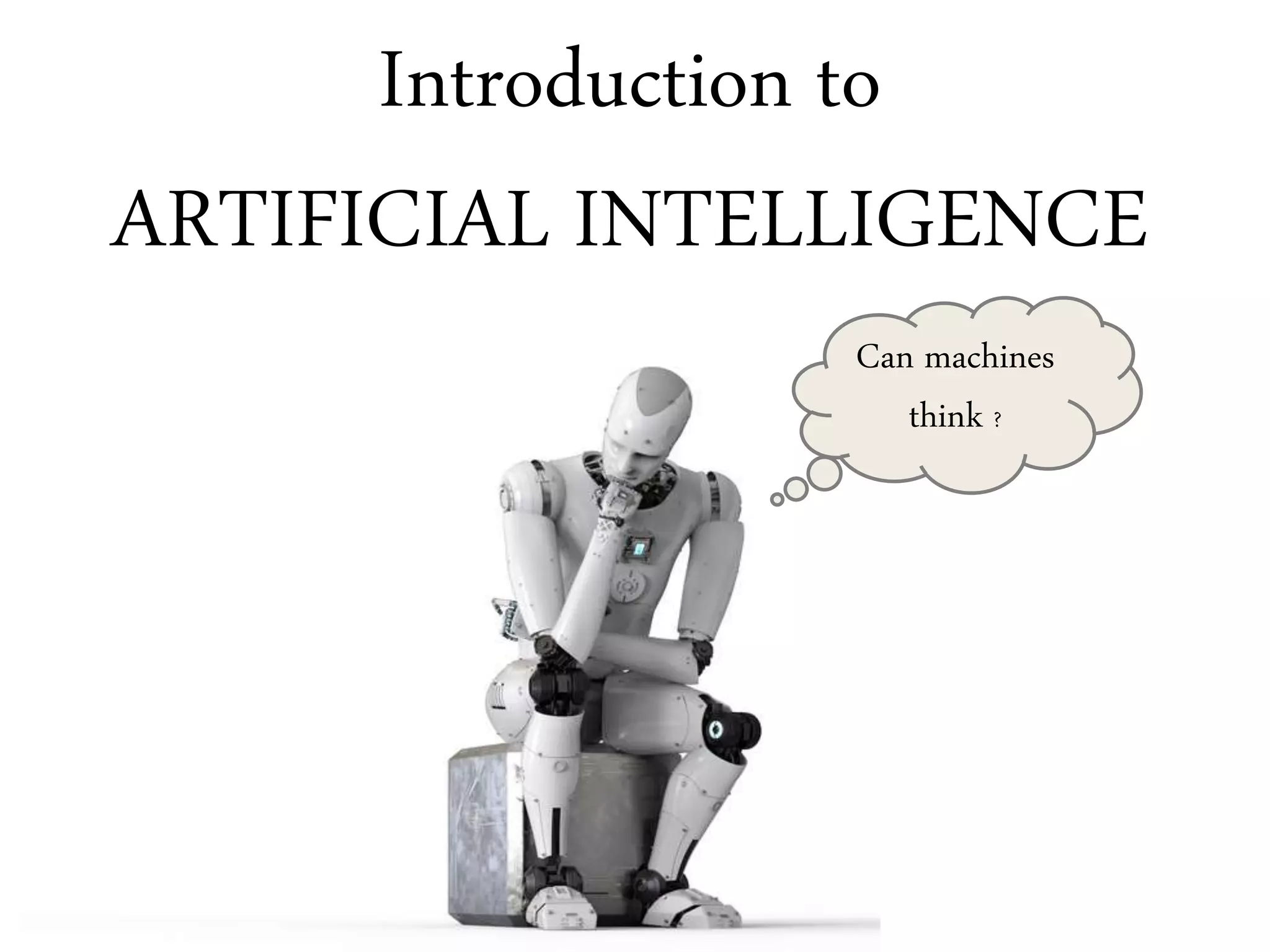
Introduction to
ARTIFICIAL INTELLIGENCE
Can machines
think ?
About Intelligence:
• 1 Intelligence is the ability to learn from experience and to adapt to,
shape, and select environments.
• 2 We call ourselves Homo sapiens - man the wise - because our
intelligence is so important to us, which gives a special place for us
among life forms.
• For thousands of years, we have tried to understand how we think;
that is, how a mere handful of matter can perceive, understand,
predict, and manipulate a world far larger and more complicated
than itself.
Intro to AI 2
1 https://www.ncbi.nlm.nih.gov/pmc/articles/PMC3341646
2 Artificial Intelligence: A Modern Approach by peter Norvig
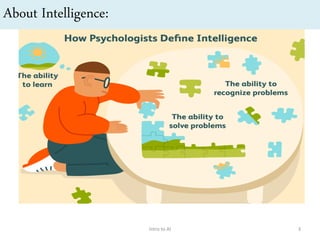
About Intelligence:
Intro to AI 3
What is Artificial Intelligence ?
• When we try to understand artificial intelligence….we come with
questions such as,
* What is intelligence?
* How can one measure intelligence?
* How does the brain work?
• But, we have to come with question about the intelligent machine
that behaves like a person , showing intelligent behaviour .
• AI is one of the newest fields in science and engineering.
Intro to AI 4
What is Artificial Intelligence ?
• In 1955, John McCarthy, one of the pioneers of AI, was the first to
define the term artificial intelligence, roughly as follows:
“ The goal of AI is to develop machines that behave as though
they were intelligent.”
• In the Encyclopedia Britannica , “ AI is the ability of digital
computers or computer controlled robots to solve problems that
are normally associated with the higher intellectual processing
capabilities of humans . . .
• By Elaine Rich, Artificial Intelligence is the study of how to make
computers do things at which, at the moment, people are better.
Intro to AI 5
What is Artificial Intelligence ?
• A particular strength of human intelligence is adaptivity. We are
capable of adjusting to various environmental conditions and
change our behavior accordingly through learning.
• Several definitions were proposed based on thought processes &
reasoning and behaviour. For e.g.:
 “[The automation of] activities that we associate with human
thinking, activities such as decision-making, problem solving,
learning . . .” (Bellman, 1978)
 The art of creating machines that perform functions that require
intelligence when performed by people.” (Kurzweil,1990)
Intro to AI 6
About Braitenberg vehicles:
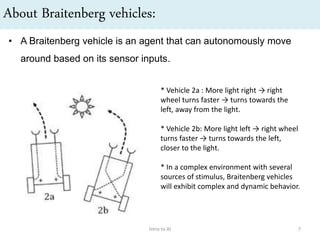
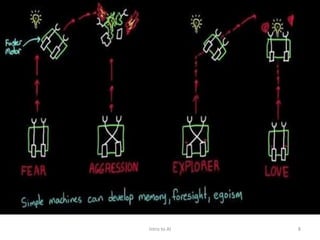
• A Braitenberg vehicle is an agent that can autonomously move
around based on its sensor inputs.
Intro to AI 7
* Vehicle 2a : More light right → right
wheel turns faster → turns towards the
left, away from the light.
* Vehicle 2b: More light left → right wheel
turns faster → turns towards the left,
closer to the light.
* In a complex environment with several
sources of stimulus, Braitenberg vehicles
will exhibit complex and dynamic behavior.
Intro to AI 8
Brain Science & Problem Solving :
• With research of intelligent systems we can try to understand how
human brain works and then imitate / simulate it on computer.
• While trying to find a optimal solution for a problem, the approach
of solving problem is secondary and first and foremost is the
optimal intelligent solution to the problem.
• AI doesn’t employ a fixed method.
• AI also offers a broad palette of effective solutions for widely
varying applications.
Intro to AI 9
Intro to AI 10
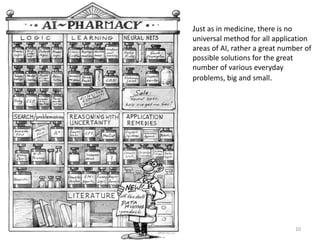
Just as in medicine, there is no
universal method for all application
areas of AI, rather a great number of
possible solutions for the great
number of various everyday
problems, big and small.
Brain Science & Problem Solving :
• Cognitive science is devoted to research into human thinking at a
somewhat higher level.
• Similarly to brain science, this field furnishes practical AI with many
important ideas. On the other hand, algorithms and
implementations lead to further important conclusions about how
human reasoning functions.
• The term "artificial intelligence" is often used to describe machines
(or computers) that mimic "cognitive" functions that humans
associate with the human mind, such as "learning" and "problem
solving“.
Intro to AI 11
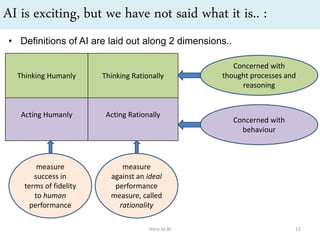
AI is exciting, but we have not said what it is.. :
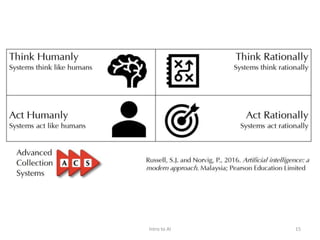
• Definitions of AI are laid out along 2 dimensions..
Intro to AI 12
Thinking Humanly Thinking Rationally
Acting Humanly Acting Rationally
Concerned with
thought processes and
reasoning
Concerned with
behaviour
measure
against an ideal
performance
measure, called
rationality
measure
success in
terms of fidelity
to human
performance
Four approaches for AI:
• A human-centered approach must be in part an empirical science,
involving observations and hypotheses about human behavior.
• A rationalist approach involves a combination of mathematics and
engineering.
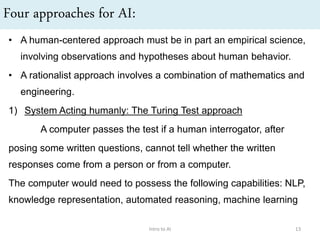
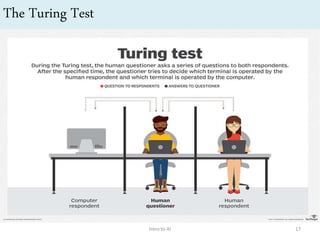
1) System Acting humanly: The Turing Test approach
A computer passes the test if a human interrogator, after
posing some written questions, cannot tell whether the written
responses come from a person or from a computer.
The computer would need to possess the following capabilities: NLP,
knowledge representation, automated reasoning, machine learning
Intro to AI 13
Four approaches for AI:
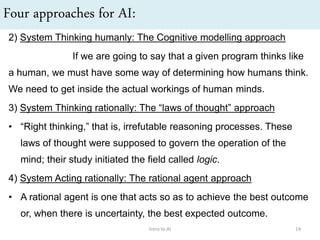
2) System Thinking humanly: The Cognitive modelling approach
If we are going to say that a given program thinks like
a human, we must have some way of determining how humans think.
We need to get inside the actual workings of human minds.
3) System Thinking rationally: The “laws of thought” approach
• “Right thinking,” that is, irrefutable reasoning processes. These
laws of thought were supposed to govern the operation of the
mind; their study initiated the field called logic.
4) System Acting rationally: The rational agent approach
• A rational agent is one that acts so as to achieve the best outcome
or, when there is uncertainty, the best expected outcome.
Intro to AI 14
Intro to AI 15
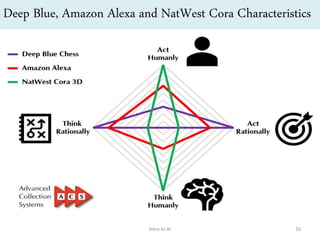
Deep Blue, Amazon Alexa and NatWest Cora Characteristics
Intro to AI 16
The Turing Test
Intro to AI 17
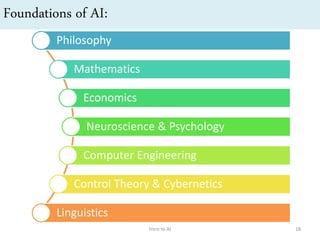
Foundations of AI:
Intro to AI 18
Philosophy
Mathematics
Economics
Neuroscience & Psychology
Computer Engineering
Control Theory & Cybernetics
Linguistics
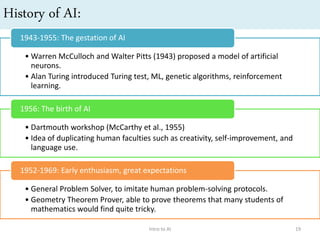
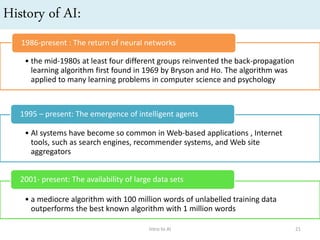
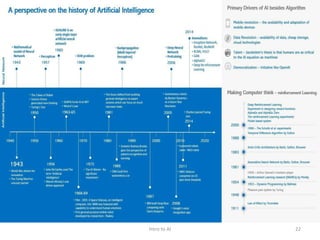
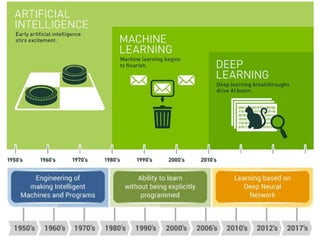
History of AI:
Intro to AI 19
• Warren McCulloch and Walter Pitts (1943) proposed a model of artificial
neurons.
• Alan Turing introduced Turing test, ML, genetic algorithms, reinforcement
learning.
1943-1955: The gestation of AI
• Dartmouth workshop (McCarthy et al., 1955)
• Idea of duplicating human faculties such as creativity, self-improvement, and
language use.
1956: The birth of AI
• General Problem Solver, to imitate human problem-solving protocols.
• Geometry Theorem Prover, able to prove theorems that many students of
mathematics would find quite tricky.
1952-1969: Early enthusiasm, great expectations
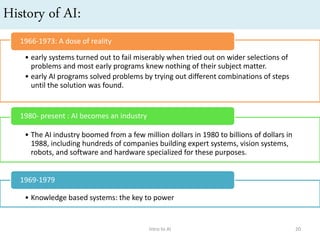
History of AI:
Intro to AI 20
• Knowledge based systems: the key to power
1969-1979
• The AI industry boomed from a few million dollars in 1980 to billions of dollars in
1988, including hundreds of companies building expert systems, vision systems,
robots, and software and hardware specialized for these purposes.
1980- present : AI becomes an industry
• early systems turned out to fail miserably when tried out on wider selections of
problems and most early programs knew nothing of their subject matter.
• early AI programs solved problems by trying out different combinations of steps
until the solution was found.
1966-1973: A dose of reality
History of AI:
Intro to AI 21
• AI systems have become so common in Web-based applications , Internet
tools, such as search engines, recommender systems, and Web site
aggregators
1995 – present: The emergence of intelligent agents
• a mediocre algorithm with 100 million words of unlabelled training data
outperforms the best known algorithm with 1 million words
2001- present: The availability of large data sets
• the mid-1980s at least four different groups reinvented the back-propagation
learning algorithm first found in 1969 by Bryson and Ho. The algorithm was
applied to many learning problems in computer science and psychology
1986-present : The return of neural networks
Intro to AI 22
Intro to AI 23
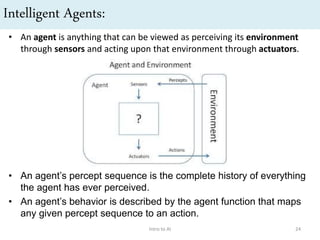
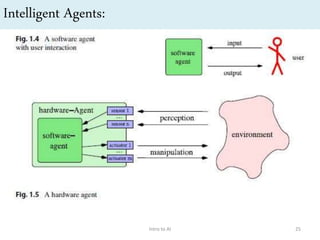
Intelligent Agents:
• An agent is anything that can be viewed as perceiving its environment
through sensors and acting upon that environment through actuators.
• An agent’s percept sequence is the complete history of everything
the agent has ever perceived.
• An agent’s behavior is described by the agent function that maps
any given percept sequence to an action.
Intro to AI 24
Intelligent Agents:
Intro to AI 25
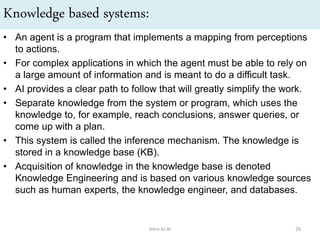
Knowledge based systems:
• An agent is a program that implements a mapping from perceptions
to actions.
• For complex applications in which the agent must be able to rely on
a large amount of information and is meant to do a difficult task.
• AI provides a clear path to follow that will greatly simplify the work.
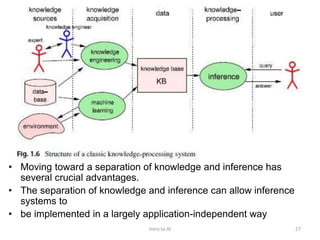
• Separate knowledge from the system or program, which uses the
knowledge to, for example, reach conclusions, answer queries, or
come up with a plan.
• This system is called the inference mechanism. The knowledge is
stored in a knowledge base (KB).
• Acquisition of knowledge in the knowledge base is denoted
Knowledge Engineering and is based on various knowledge sources
such as human experts, the knowledge engineer, and databases.
Intro to AI 26
• Moving toward a separation of knowledge and inference has
several crucial advantages.
• The separation of knowledge and inference can allow inference
systems to
• be implemented in a largely application-independent way
Intro to AI 27
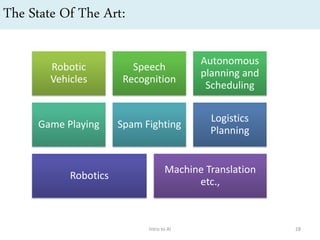
The State Of The Art:
Intro to AI 28
Robotic
Vehicles
Speech
Recognition
Autonomous
planning and
Scheduling
Game Playing Spam Fighting
Logistics
Planning
Robotics
Machine Translation
etc.,
Intro to AI 29
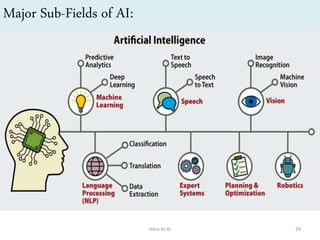
Major Sub-Fields of AI:
References:
1. Introduction to Artificial Intelligence-Wolfgang Ertel, Springer
2. Artificial Intelligence, A Modern Approach- Stuart Russell and Peter
Norvig
3. Google Images
4. Wikipedia
Intro to AI 30

Artificial intelligence introduction

  • 1.
  • 2.
    About Intelligence: • 1Intelligence is the ability to learn from experience and to adapt to, shape, and select environments. • 2 We call ourselves Homo sapiens - man the wise - because our intelligence is so important to us, which gives a special place for us among life forms. • For thousands of years, we have tried to understand how we think; that is, how a mere handful of matter can perceive, understand, predict, and manipulate a world far larger and more complicated than itself. Intro to AI 2 1 https://www.ncbi.nlm.nih.gov/pmc/articles/PMC3341646 2 Artificial Intelligence: A Modern Approach by peter Norvig
  • 3.
  • 4.
    What is ArtificialIntelligence ? • When we try to understand artificial intelligence….we come with questions such as, * What is intelligence? * How can one measure intelligence? * How does the brain work? • But, we have to come with question about the intelligent machine that behaves like a person , showing intelligent behaviour . • AI is one of the newest fields in science and engineering. Intro to AI 4
  • 5.
    What is ArtificialIntelligence ? • In 1955, John McCarthy, one of the pioneers of AI, was the first to define the term artificial intelligence, roughly as follows: “ The goal of AI is to develop machines that behave as though they were intelligent.” • In the Encyclopedia Britannica , “ AI is the ability of digital computers or computer controlled robots to solve problems that are normally associated with the higher intellectual processing capabilities of humans . . . • By Elaine Rich, Artificial Intelligence is the study of how to make computers do things at which, at the moment, people are better. Intro to AI 5
  • 6.
    What is ArtificialIntelligence ? • A particular strength of human intelligence is adaptivity. We are capable of adjusting to various environmental conditions and change our behavior accordingly through learning. • Several definitions were proposed based on thought processes & reasoning and behaviour. For e.g.:  “[The automation of] activities that we associate with human thinking, activities such as decision-making, problem solving, learning . . .” (Bellman, 1978)  The art of creating machines that perform functions that require intelligence when performed by people.” (Kurzweil,1990) Intro to AI 6
  • 7.
    About Braitenberg vehicles: •A Braitenberg vehicle is an agent that can autonomously move around based on its sensor inputs. Intro to AI 7 * Vehicle 2a : More light right → right wheel turns faster → turns towards the left, away from the light. * Vehicle 2b: More light left → right wheel turns faster → turns towards the left, closer to the light. * In a complex environment with several sources of stimulus, Braitenberg vehicles will exhibit complex and dynamic behavior.
  • 8.
  • 9.
    Brain Science &Problem Solving : • With research of intelligent systems we can try to understand how human brain works and then imitate / simulate it on computer. • While trying to find a optimal solution for a problem, the approach of solving problem is secondary and first and foremost is the optimal intelligent solution to the problem. • AI doesn’t employ a fixed method. • AI also offers a broad palette of effective solutions for widely varying applications. Intro to AI 9
  • 10.
    Intro to AI10 Just as in medicine, there is no universal method for all application areas of AI, rather a great number of possible solutions for the great number of various everyday problems, big and small.
  • 11.
    Brain Science &Problem Solving : • Cognitive science is devoted to research into human thinking at a somewhat higher level. • Similarly to brain science, this field furnishes practical AI with many important ideas. On the other hand, algorithms and implementations lead to further important conclusions about how human reasoning functions. • The term "artificial intelligence" is often used to describe machines (or computers) that mimic "cognitive" functions that humans associate with the human mind, such as "learning" and "problem solving“. Intro to AI 11
  • 12.
    AI is exciting,but we have not said what it is.. : • Definitions of AI are laid out along 2 dimensions.. Intro to AI 12 Thinking Humanly Thinking Rationally Acting Humanly Acting Rationally Concerned with thought processes and reasoning Concerned with behaviour measure against an ideal performance measure, called rationality measure success in terms of fidelity to human performance
  • 13.
    Four approaches forAI: • A human-centered approach must be in part an empirical science, involving observations and hypotheses about human behavior. • A rationalist approach involves a combination of mathematics and engineering. 1) System Acting humanly: The Turing Test approach A computer passes the test if a human interrogator, after posing some written questions, cannot tell whether the written responses come from a person or from a computer. The computer would need to possess the following capabilities: NLP, knowledge representation, automated reasoning, machine learning Intro to AI 13
  • 14.
    Four approaches forAI: 2) System Thinking humanly: The Cognitive modelling approach If we are going to say that a given program thinks like a human, we must have some way of determining how humans think. We need to get inside the actual workings of human minds. 3) System Thinking rationally: The “laws of thought” approach • “Right thinking,” that is, irrefutable reasoning processes. These laws of thought were supposed to govern the operation of the mind; their study initiated the field called logic. 4) System Acting rationally: The rational agent approach • A rational agent is one that acts so as to achieve the best outcome or, when there is uncertainty, the best expected outcome. Intro to AI 14
  • 15.
  • 16.
    Deep Blue, AmazonAlexa and NatWest Cora Characteristics Intro to AI 16
  • 17.
  • 18.
    Foundations of AI: Introto AI 18 Philosophy Mathematics Economics Neuroscience & Psychology Computer Engineering Control Theory & Cybernetics Linguistics
  • 19.
    History of AI: Introto AI 19 • Warren McCulloch and Walter Pitts (1943) proposed a model of artificial neurons. • Alan Turing introduced Turing test, ML, genetic algorithms, reinforcement learning. 1943-1955: The gestation of AI • Dartmouth workshop (McCarthy et al., 1955) • Idea of duplicating human faculties such as creativity, self-improvement, and language use. 1956: The birth of AI • General Problem Solver, to imitate human problem-solving protocols. • Geometry Theorem Prover, able to prove theorems that many students of mathematics would find quite tricky. 1952-1969: Early enthusiasm, great expectations
  • 20.
    History of AI: Introto AI 20 • Knowledge based systems: the key to power 1969-1979 • The AI industry boomed from a few million dollars in 1980 to billions of dollars in 1988, including hundreds of companies building expert systems, vision systems, robots, and software and hardware specialized for these purposes. 1980- present : AI becomes an industry • early systems turned out to fail miserably when tried out on wider selections of problems and most early programs knew nothing of their subject matter. • early AI programs solved problems by trying out different combinations of steps until the solution was found. 1966-1973: A dose of reality
  • 21.
    History of AI: Introto AI 21 • AI systems have become so common in Web-based applications , Internet tools, such as search engines, recommender systems, and Web site aggregators 1995 – present: The emergence of intelligent agents • a mediocre algorithm with 100 million words of unlabelled training data outperforms the best known algorithm with 1 million words 2001- present: The availability of large data sets • the mid-1980s at least four different groups reinvented the back-propagation learning algorithm first found in 1969 by Bryson and Ho. The algorithm was applied to many learning problems in computer science and psychology 1986-present : The return of neural networks
  • 22.
  • 23.
  • 24.
    Intelligent Agents: • Anagent is anything that can be viewed as perceiving its environment through sensors and acting upon that environment through actuators. • An agent’s percept sequence is the complete history of everything the agent has ever perceived. • An agent’s behavior is described by the agent function that maps any given percept sequence to an action. Intro to AI 24
  • 25.
  • 26.
    Knowledge based systems: •An agent is a program that implements a mapping from perceptions to actions. • For complex applications in which the agent must be able to rely on a large amount of information and is meant to do a difficult task. • AI provides a clear path to follow that will greatly simplify the work. • Separate knowledge from the system or program, which uses the knowledge to, for example, reach conclusions, answer queries, or come up with a plan. • This system is called the inference mechanism. The knowledge is stored in a knowledge base (KB). • Acquisition of knowledge in the knowledge base is denoted Knowledge Engineering and is based on various knowledge sources such as human experts, the knowledge engineer, and databases. Intro to AI 26
  • 27.
    • Moving towarda separation of knowledge and inference has several crucial advantages. • The separation of knowledge and inference can allow inference systems to • be implemented in a largely application-independent way Intro to AI 27
  • 28.
    The State OfThe Art: Intro to AI 28 Robotic Vehicles Speech Recognition Autonomous planning and Scheduling Game Playing Spam Fighting Logistics Planning Robotics Machine Translation etc.,
  • 29.
    Intro to AI29 Major Sub-Fields of AI:
  • 30.
    References: 1. Introduction toArtificial Intelligence-Wolfgang Ertel, Springer 2. Artificial Intelligence, A Modern Approach- Stuart Russell and Peter Norvig 3. Google Images 4. Wikipedia Intro to AI 30