Artificial Intelligence in
ICT
Transforming Communication and Information Systems
Presented by:
Name : Kaushal Rathi
Roll No. : 23BIT232
Department of ICT
. Course : Communication Skills
What is Artificial Intelligence?
AI is the design of systems that can learn, reason, perceive,
and act. Its core goals include:
• Learning from data
• Reasoning and problem-solving
• Perception (vision, speech)
• Natural language understanding
Branches: Machine Learning, Deep Learning, Natural Language Processing, Computer Vision.
Overview of Information & Communication
Technology (ICT)
1
Hardware
Servers, routers, endpoints, sensors — the physical backbone.
2
Software
Operating systems, middleware, applications, and AI models.
3
Networking
Wired and wireless infrastructure, protocols, and SDN.
4
Data &
Communication
Data streams, storage, messaging, and real-time communication systems.
How AI Integrates with ICT
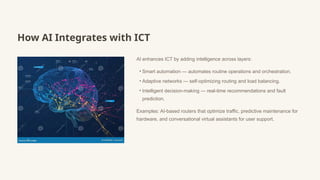
AI enhances ICT by adding intelligence across layers:
• Smart automation — automates routine operations and orchestration.
• Adaptive networks — self-optimizing routing and load balancing.
• Intelligent decision-making — real-time recommendations and fault
prediction.
Examples: AI-based routers that optimize traffic, predictive maintenance for
hardware, and conversational virtual assistants for user support.
Key Applications of AI in ICT
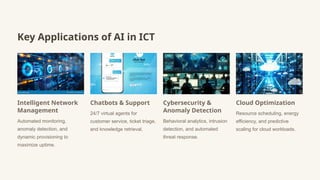
Intelligent Network
Management
Automated monitoring,
anomaly detection, and
dynamic provisioning to
maximize uptime.
Chatbots & Support
24/7 virtual agents for
customer service, ticket triage,
and knowledge retrieval.
Cybersecurity &
Anomaly Detection
Behavioral analytics, intrusion
detection, and automated
threat response.
Cloud Optimization
Resource scheduling, energy
efficiency, and predictive
scaling for cloud workloads.
AI in Communication Systems
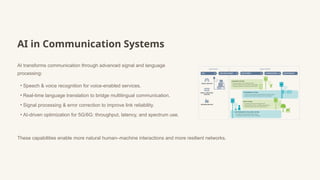
AI transforms communication through advanced signal and language
processing:
• Speech & voice recognition for voice-enabled services.
• Real-time language translation to bridge multilingual communication.
• Signal processing & error correction to improve link reliability.
• AI-driven optimization for 5G/6G: throughput, latency, and spectrum use.
These capabilities enable more natural human–machine interactions and more resilient networks.
AI for Data Management &
Analytics
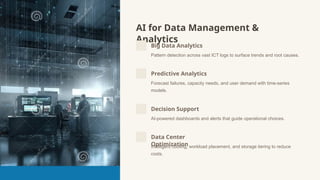
Big Data Analytics
Pattern detection across vast ICT logs to surface trends and root causes.
Predictive Analytics
Forecast failures, capacity needs, and user demand with time-series
models.
Decision Support
AI-powered dashboards and alerts that guide operational choices.
Data Center
Optimization
Intelligent cooling, workload placement, and storage tiering to reduce
costs.
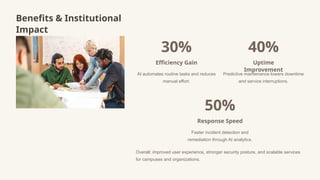
Benefits & Institutional
Impact
30%
Efficiency Gain
AI automates routine tasks and reduces
manual effort.
40%
Uptime
Improvement
Predictive maintenance lowers downtime
and service interruptions.
50%
Response Speed
Faster incident detection and
remediation through AI analytics.
Overall: improved user experience, stronger security posture, and scalable services
for campuses and organizations.
Challenges & Ethical Considerations
Data Privacy
Ensure lawful data collection, consent, and secure storage for sensitive ICT logs.
Algorithmic Bias
Bias in training data can produce unfair outcomes—regular audits are required.
Job Displacement
Automation shifts roles; plan reskilling and human-centered process design.
Transparency & Accountability
Explainable AI, clear responsibility lines, and governance frameworks are essential.
Future Trends & Conclusion
Emerging directions: 6G and beyond, Edge AI, Quantum-assisted machine learning, and deeper IoT integration.
Adopt
Start small with pilot projects that
show measurable value.
Govern
Implement policies for privacy,
fairness, and model governance.
Educate
Build skills across faculty and
students to manage AI-enabled ICT.
"AI is not just a technology upgrade—it's a change in how ICT systems think, adapt, and serve society."
Questions for reflection: How will your department responsibly adopt AI? What skills should students prioritize?

Artificial-Intelligence-in-ICT BY 23BIT232

  • 1.
    Artificial Intelligence in ICT TransformingCommunication and Information Systems Presented by: Name : Kaushal Rathi Roll No. : 23BIT232 Department of ICT . Course : Communication Skills
  • 2.
    What is ArtificialIntelligence? AI is the design of systems that can learn, reason, perceive, and act. Its core goals include: • Learning from data • Reasoning and problem-solving • Perception (vision, speech) • Natural language understanding Branches: Machine Learning, Deep Learning, Natural Language Processing, Computer Vision.
  • 3.
    Overview of Information& Communication Technology (ICT) 1 Hardware Servers, routers, endpoints, sensors — the physical backbone. 2 Software Operating systems, middleware, applications, and AI models. 3 Networking Wired and wireless infrastructure, protocols, and SDN. 4 Data & Communication Data streams, storage, messaging, and real-time communication systems.
  • 4.
    How AI Integrateswith ICT AI enhances ICT by adding intelligence across layers: • Smart automation — automates routine operations and orchestration. • Adaptive networks — self-optimizing routing and load balancing. • Intelligent decision-making — real-time recommendations and fault prediction. Examples: AI-based routers that optimize traffic, predictive maintenance for hardware, and conversational virtual assistants for user support.
  • 5.
    Key Applications ofAI in ICT Intelligent Network Management Automated monitoring, anomaly detection, and dynamic provisioning to maximize uptime. Chatbots & Support 24/7 virtual agents for customer service, ticket triage, and knowledge retrieval. Cybersecurity & Anomaly Detection Behavioral analytics, intrusion detection, and automated threat response. Cloud Optimization Resource scheduling, energy efficiency, and predictive scaling for cloud workloads.
  • 6.
    AI in CommunicationSystems AI transforms communication through advanced signal and language processing: • Speech & voice recognition for voice-enabled services. • Real-time language translation to bridge multilingual communication. • Signal processing & error correction to improve link reliability. • AI-driven optimization for 5G/6G: throughput, latency, and spectrum use. These capabilities enable more natural human–machine interactions and more resilient networks.
  • 7.
    AI for DataManagement & Analytics Big Data Analytics Pattern detection across vast ICT logs to surface trends and root causes. Predictive Analytics Forecast failures, capacity needs, and user demand with time-series models. Decision Support AI-powered dashboards and alerts that guide operational choices. Data Center Optimization Intelligent cooling, workload placement, and storage tiering to reduce costs.
  • 8.
    Benefits & Institutional Impact 30% EfficiencyGain AI automates routine tasks and reduces manual effort. 40% Uptime Improvement Predictive maintenance lowers downtime and service interruptions. 50% Response Speed Faster incident detection and remediation through AI analytics. Overall: improved user experience, stronger security posture, and scalable services for campuses and organizations.
  • 9.
    Challenges & EthicalConsiderations Data Privacy Ensure lawful data collection, consent, and secure storage for sensitive ICT logs. Algorithmic Bias Bias in training data can produce unfair outcomes—regular audits are required. Job Displacement Automation shifts roles; plan reskilling and human-centered process design. Transparency & Accountability Explainable AI, clear responsibility lines, and governance frameworks are essential.
  • 10.
    Future Trends &Conclusion Emerging directions: 6G and beyond, Edge AI, Quantum-assisted machine learning, and deeper IoT integration. Adopt Start small with pilot projects that show measurable value. Govern Implement policies for privacy, fairness, and model governance. Educate Build skills across faculty and students to manage AI-enabled ICT. "AI is not just a technology upgrade—it's a change in how ICT systems think, adapt, and serve society." Questions for reflection: How will your department responsibly adopt AI? What skills should students prioritize?