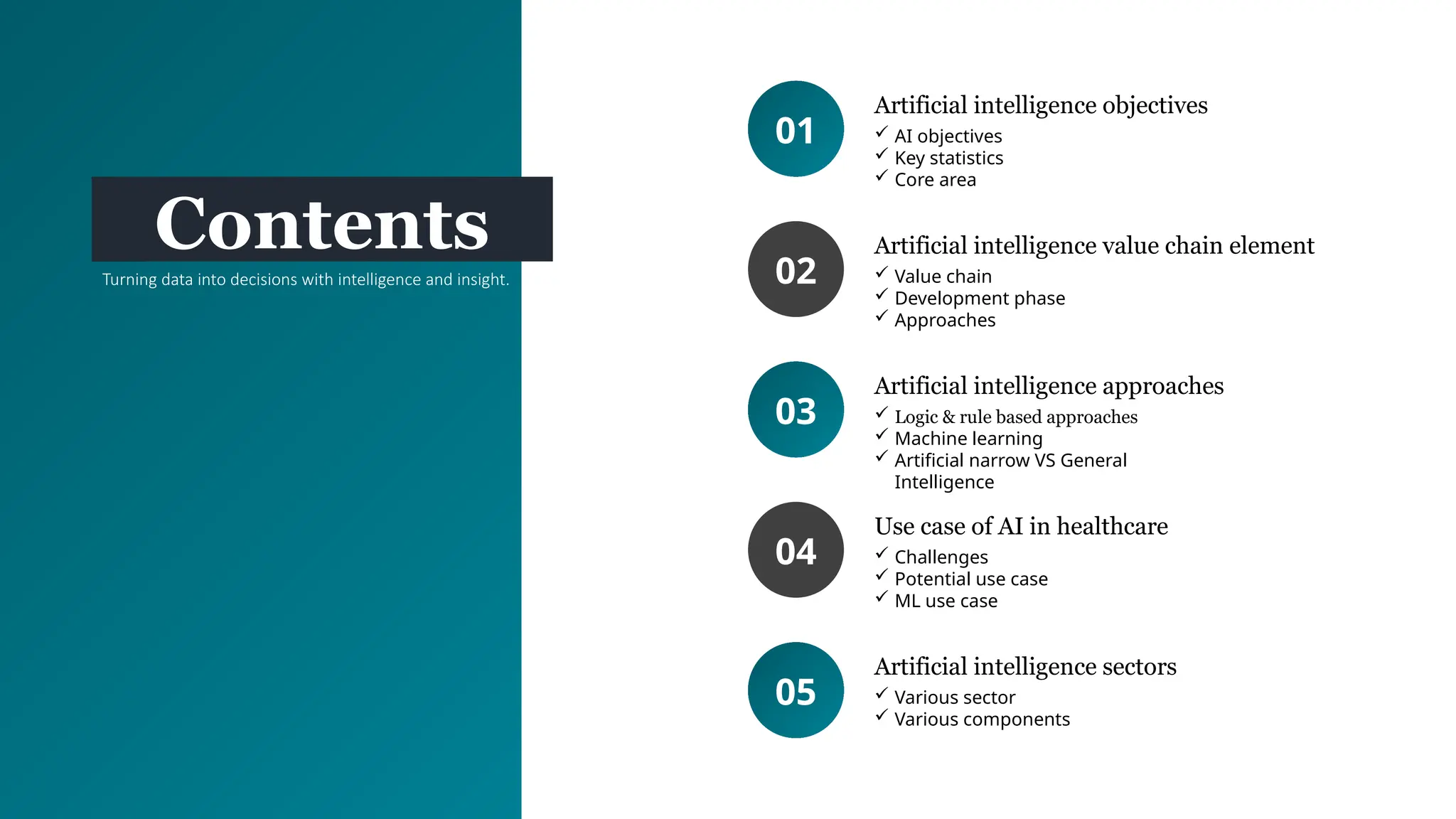
Contents
01 AIobjectives
Key statistics
Core area
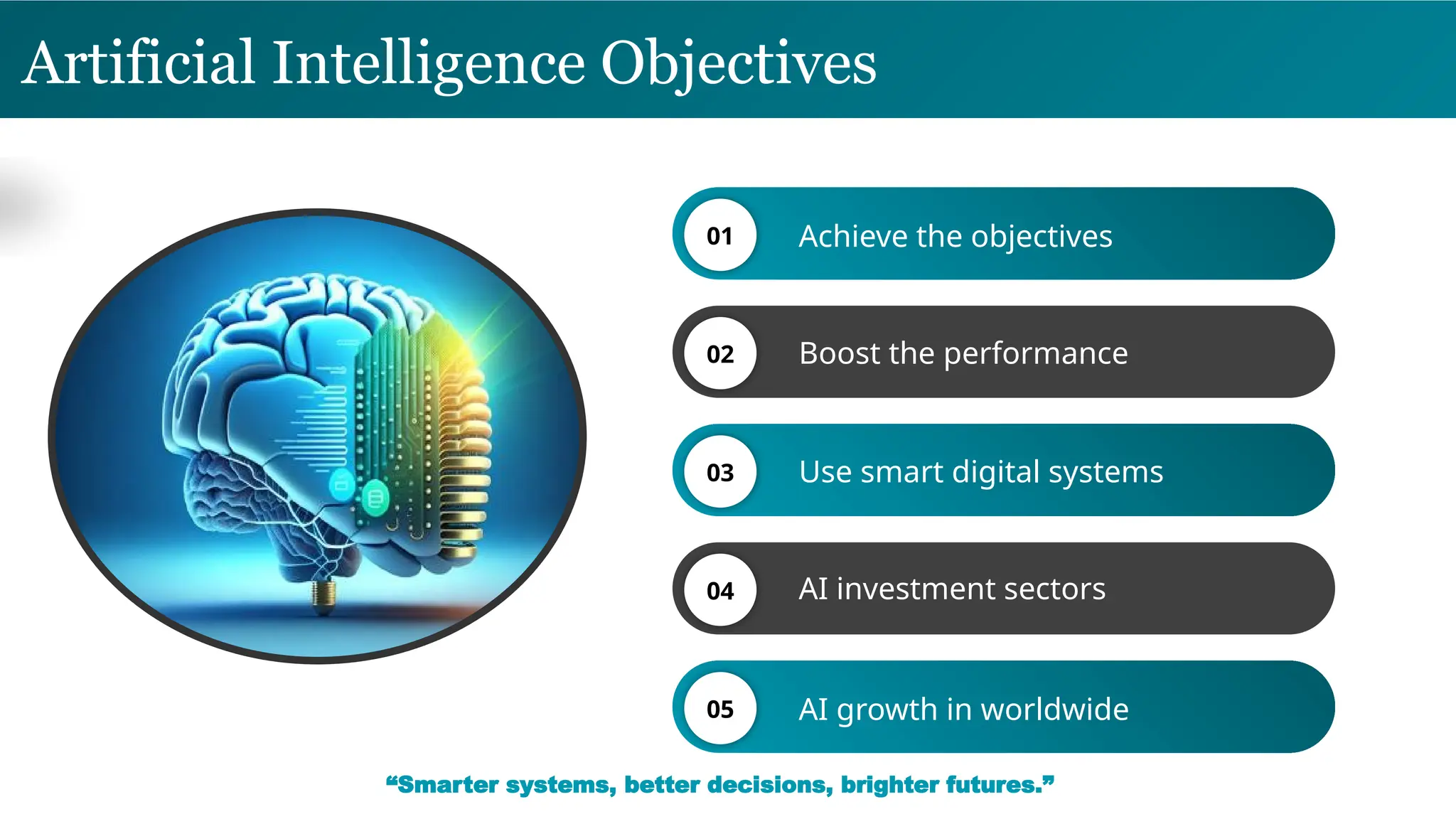
Artificial intelligence objectives
02 Value chain
Development phase
Approaches
Artificial intelligence value chain element
03 Logic & rule based approaches
Machine learning
Artificial narrow VS General
Intelligence
Artificial intelligence approaches
04 Challenges
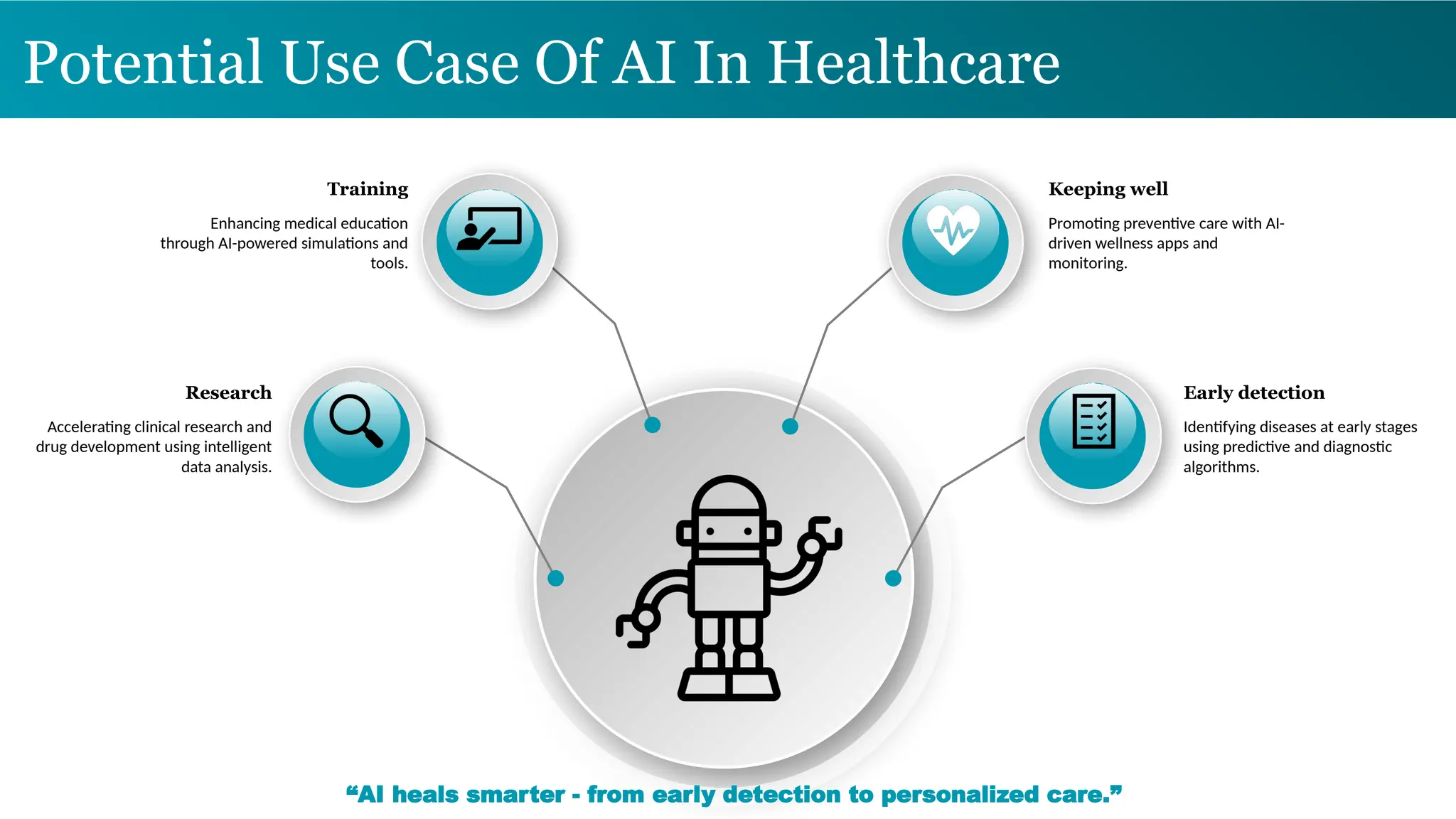
Potential use case
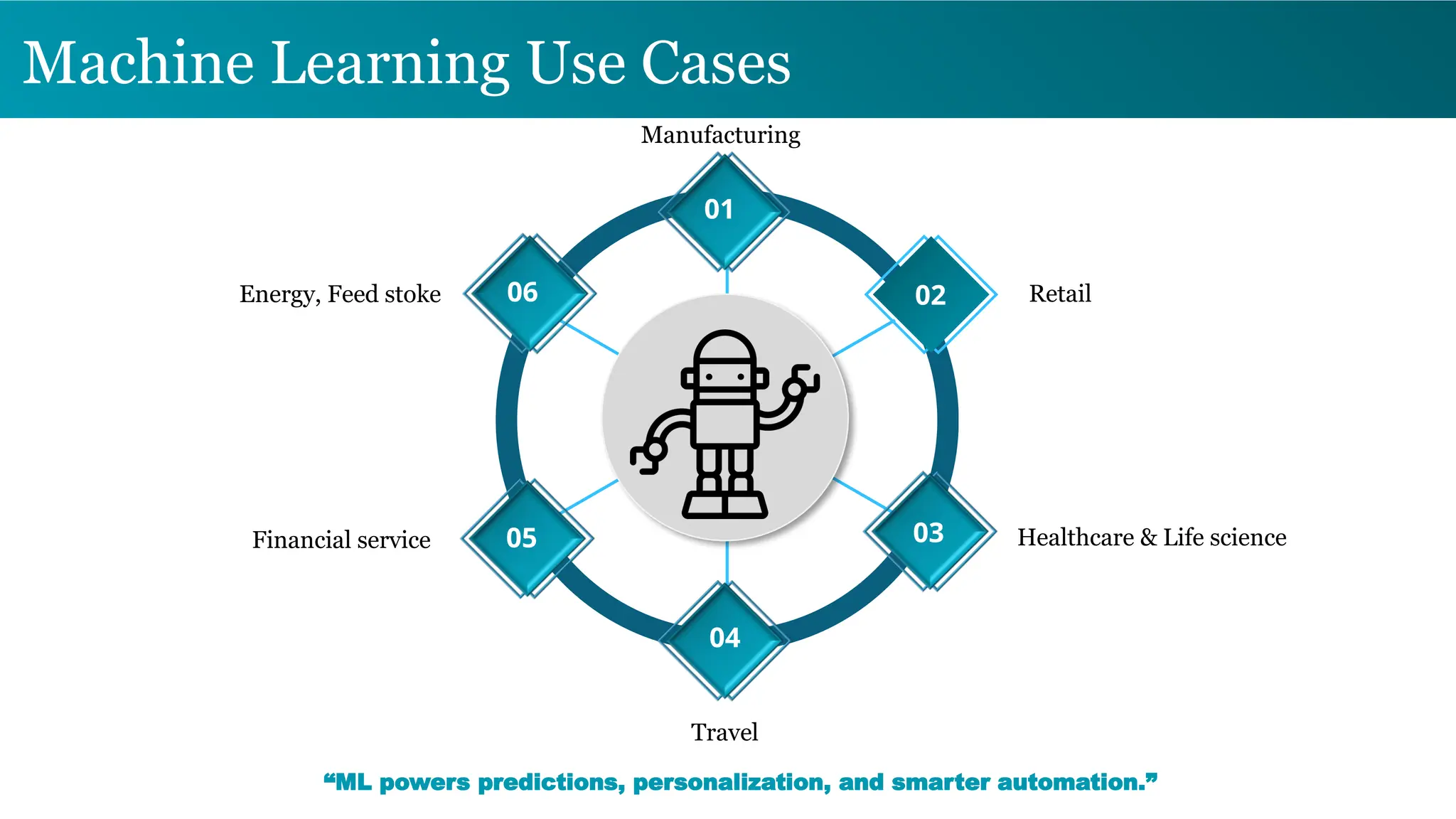
ML use case
Use case of AI in healthcare
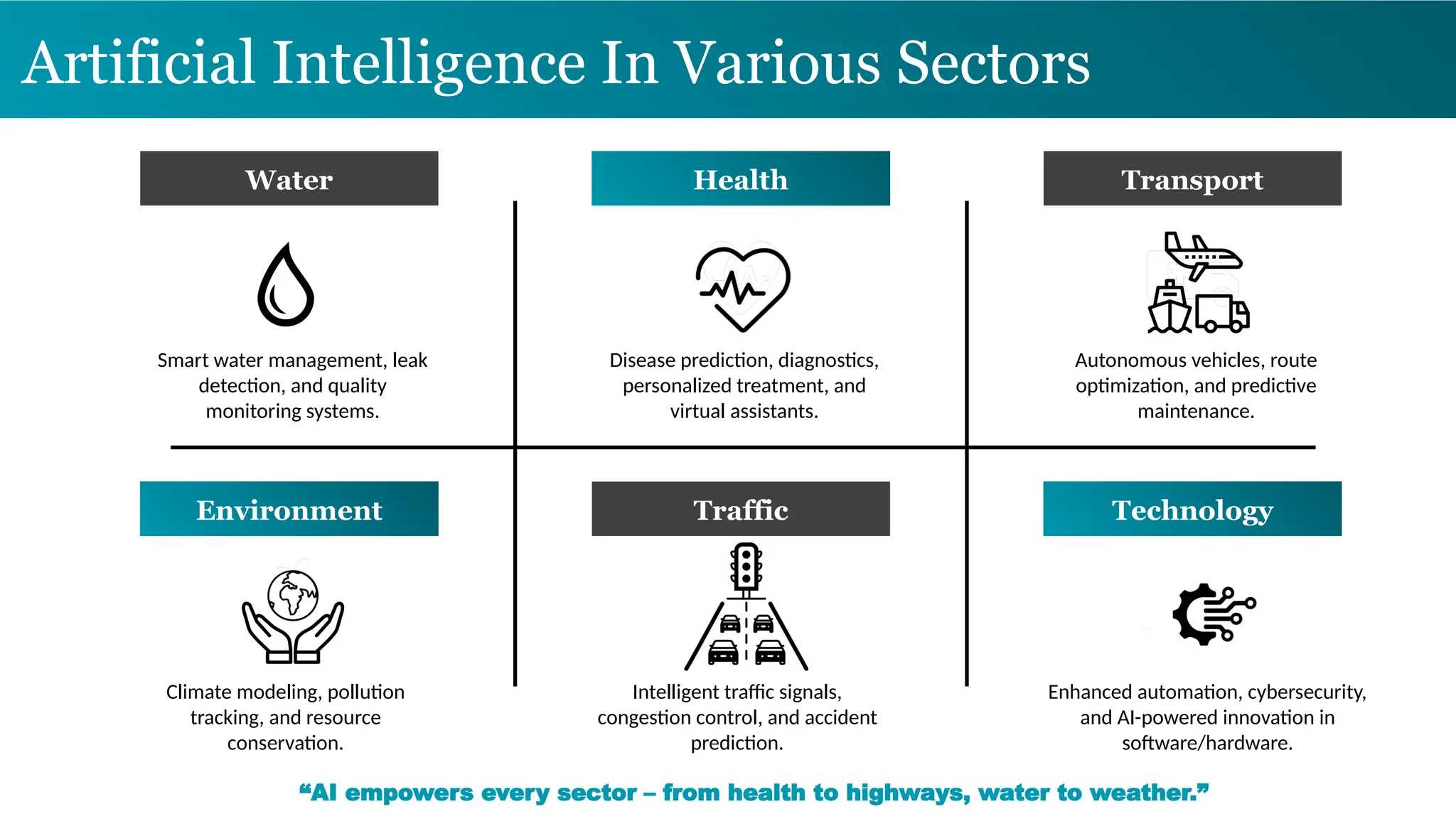
05 Various sector
Various components
Artificial intelligence sectors
Turning data into decisions with intelligence and insight.
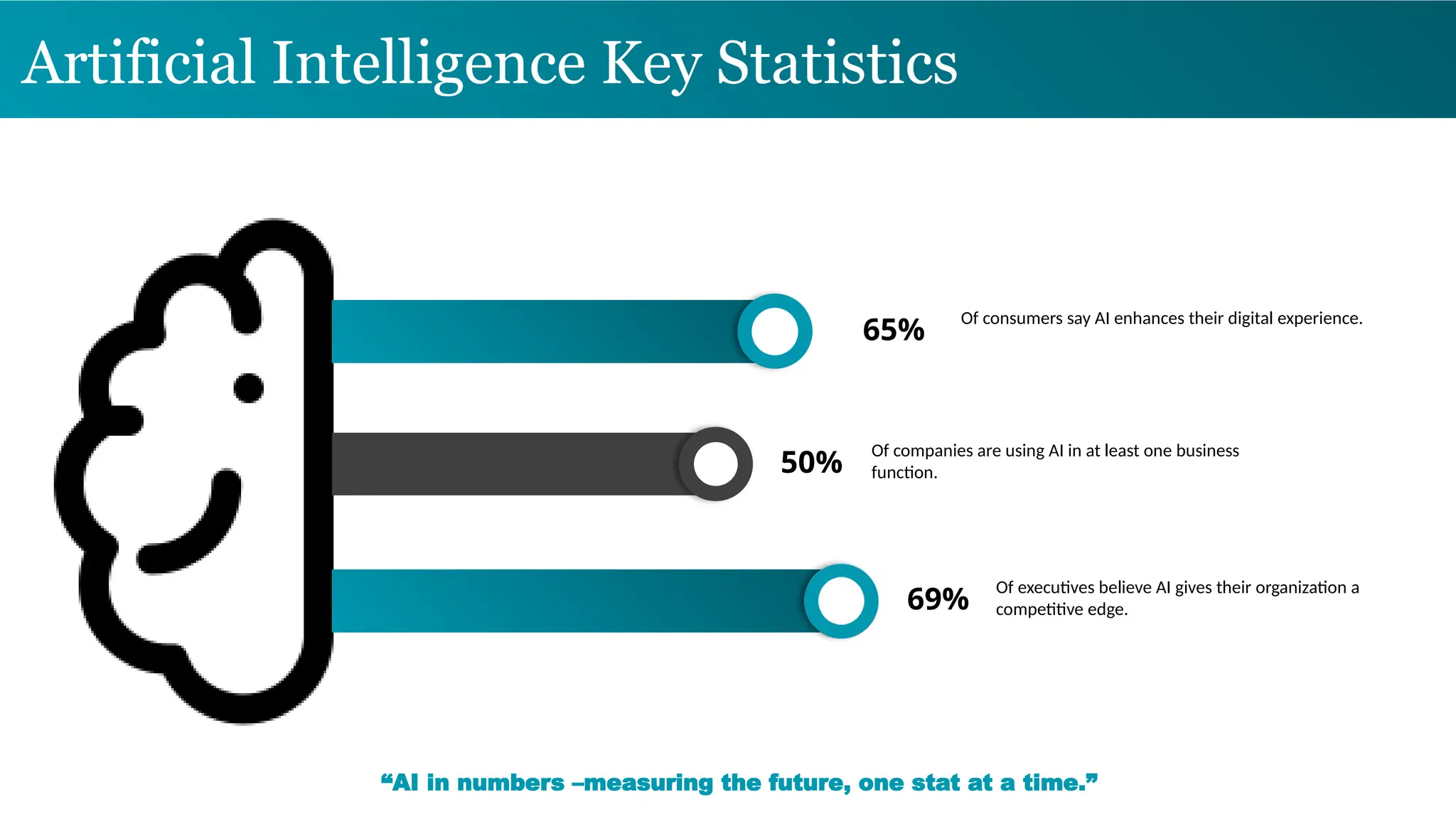
Artificial Intelligence KeyStatistics
65%
50%
69%
Of consumers say AI enhances their digital experience.
Of companies are using AI in at least one business
function.
Of executives believe AI gives their organization a
competitive edge.
“AI in numbers –measuring the future, one stat at a time.”
6.
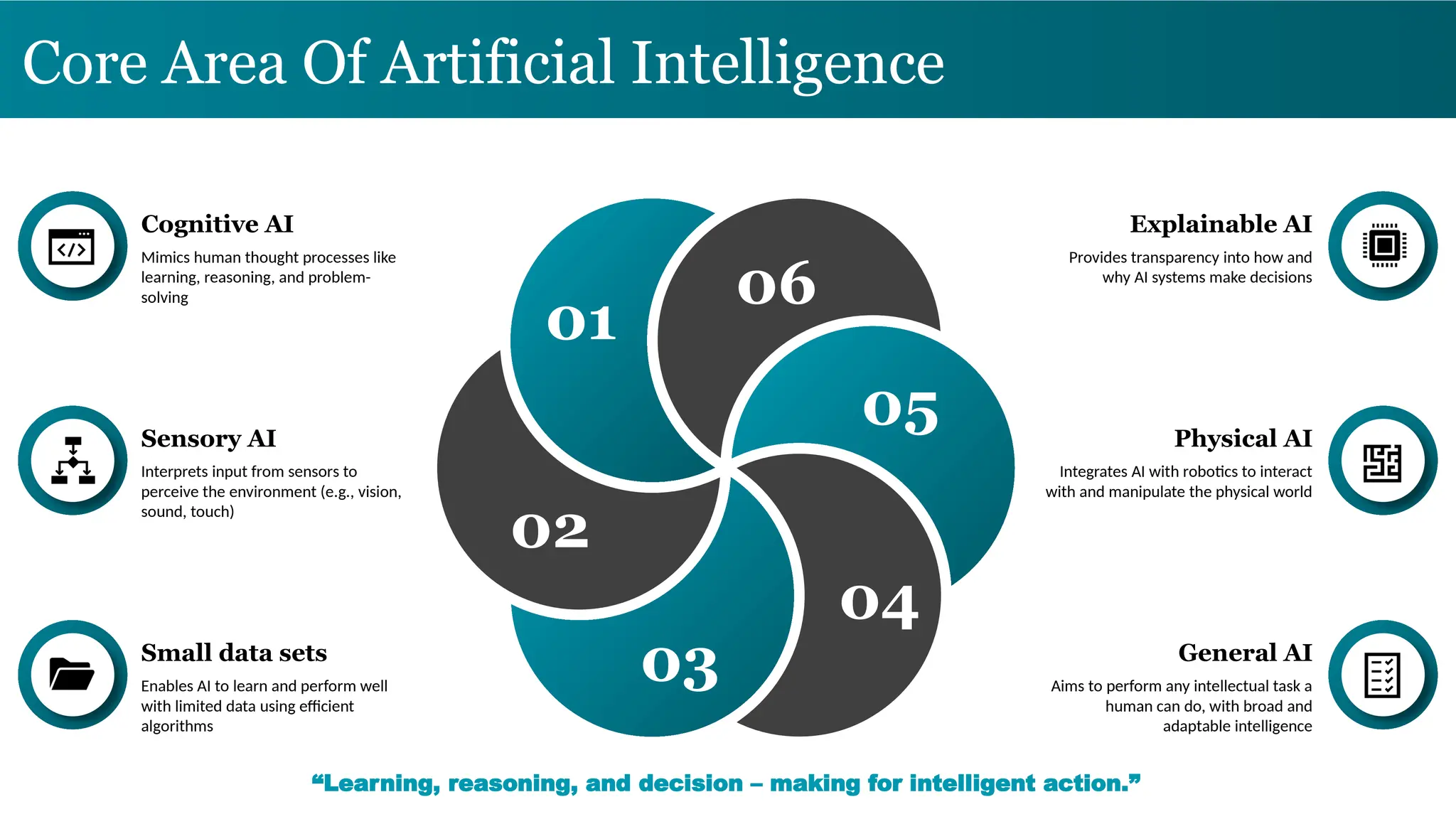
Core Area OfArtificial Intelligence
01
02
03
04
05
06
Mimics human thought processes like
learning, reasoning, and problem-
solving
Cognitive AI
Interprets input from sensors to
perceive the environment (e.g., vision,
sound, touch)
Sensory AI
Enables AI to learn and perform well
with limited data using efficient
algorithms
Small data sets
Provides transparency into how and
why AI systems make decisions
Explainable AI
Integrates AI with robotics to interact
with and manipulate the physical world
Physical AI
Aims to perform any intellectual task a
human can do, with broad and
adaptable intelligence
General AI
“Learning, reasoning, and decision – making for intelligent action.”
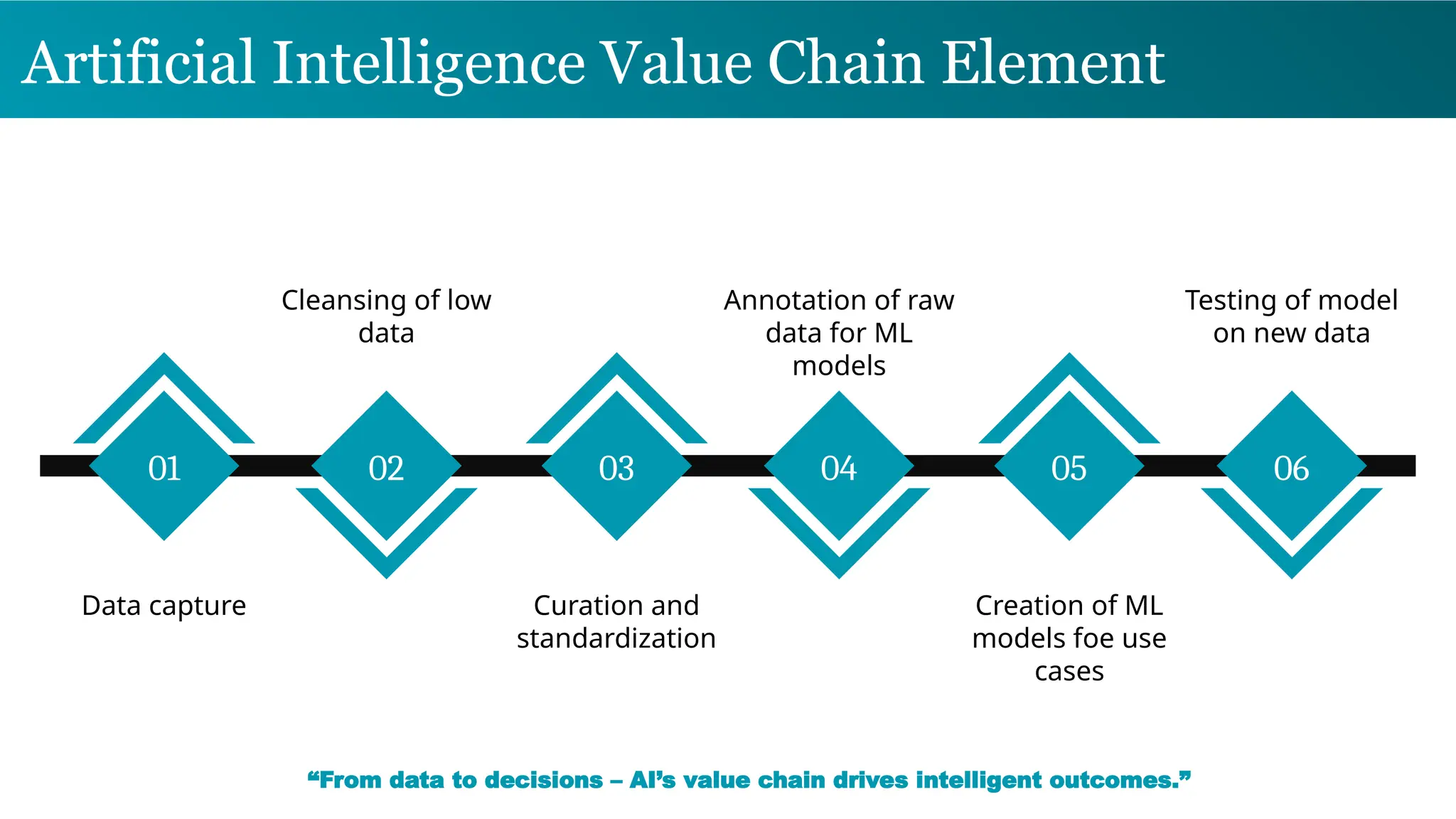
Artificial Intelligence ValueChain Element
Data capture Curation and
standardization
Creation of ML
models foe use
cases
Cleansing of low
data
Annotation of raw
data for ML
models
Testing of model
on new data
01 02 03 04 05 06
“From data to decisions – AI’s value chain drives intelligent outcomes.”
9.
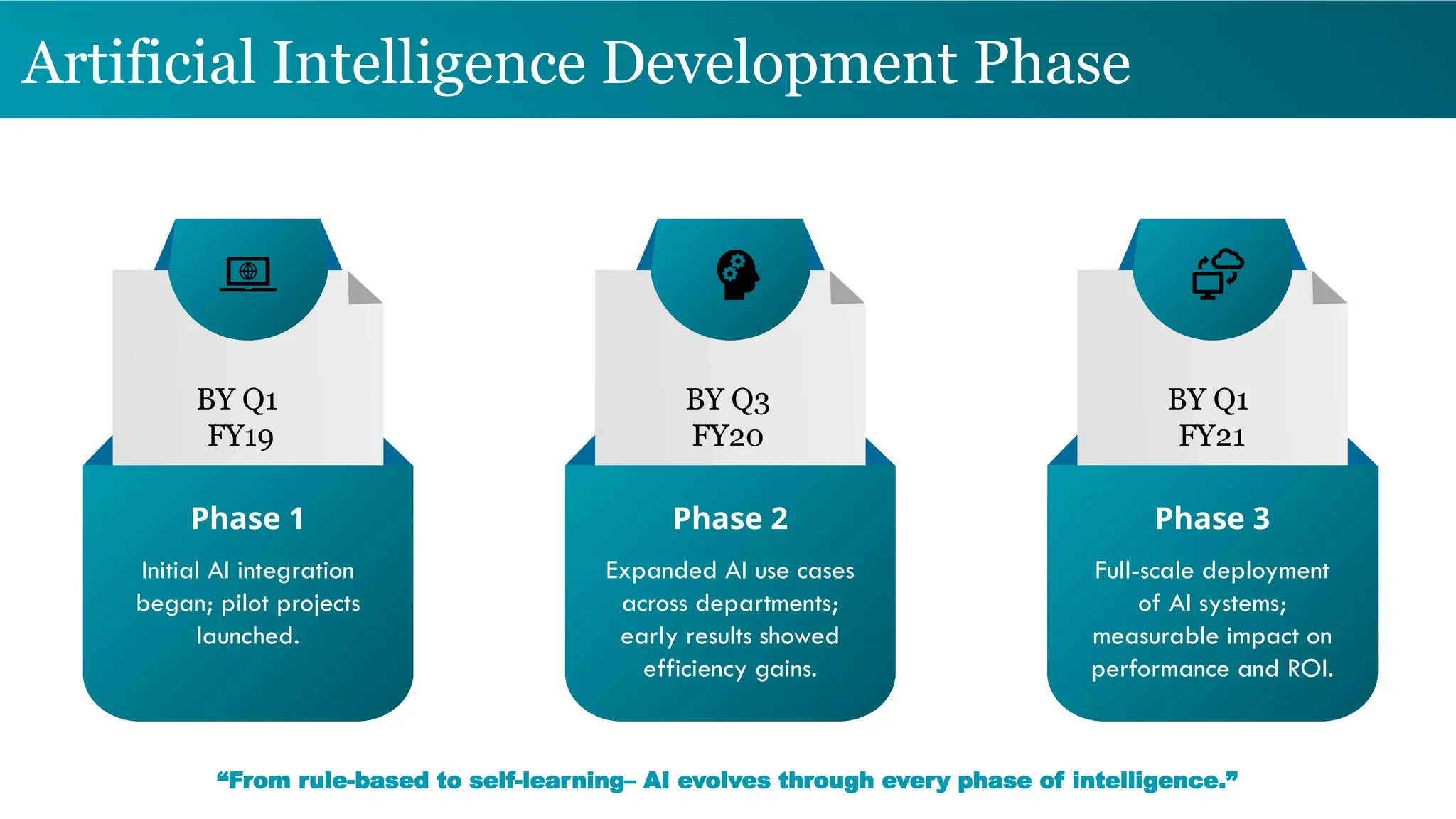
Artificial Intelligence DevelopmentPhase
Initial AI integration
began; pilot projects
launched.
BY Q1
FY19
Expanded AI use cases
across departments;
early results showed
efficiency gains.
Full-scale deployment
of AI systems;
measurable impact on
performance and ROI.
BY Q3
FY20
BY Q1
FY21
Phase 1 Phase 2 Phase 3
“From rule-based to self-learning– AI evolves through every phase of intelligence.”
10.
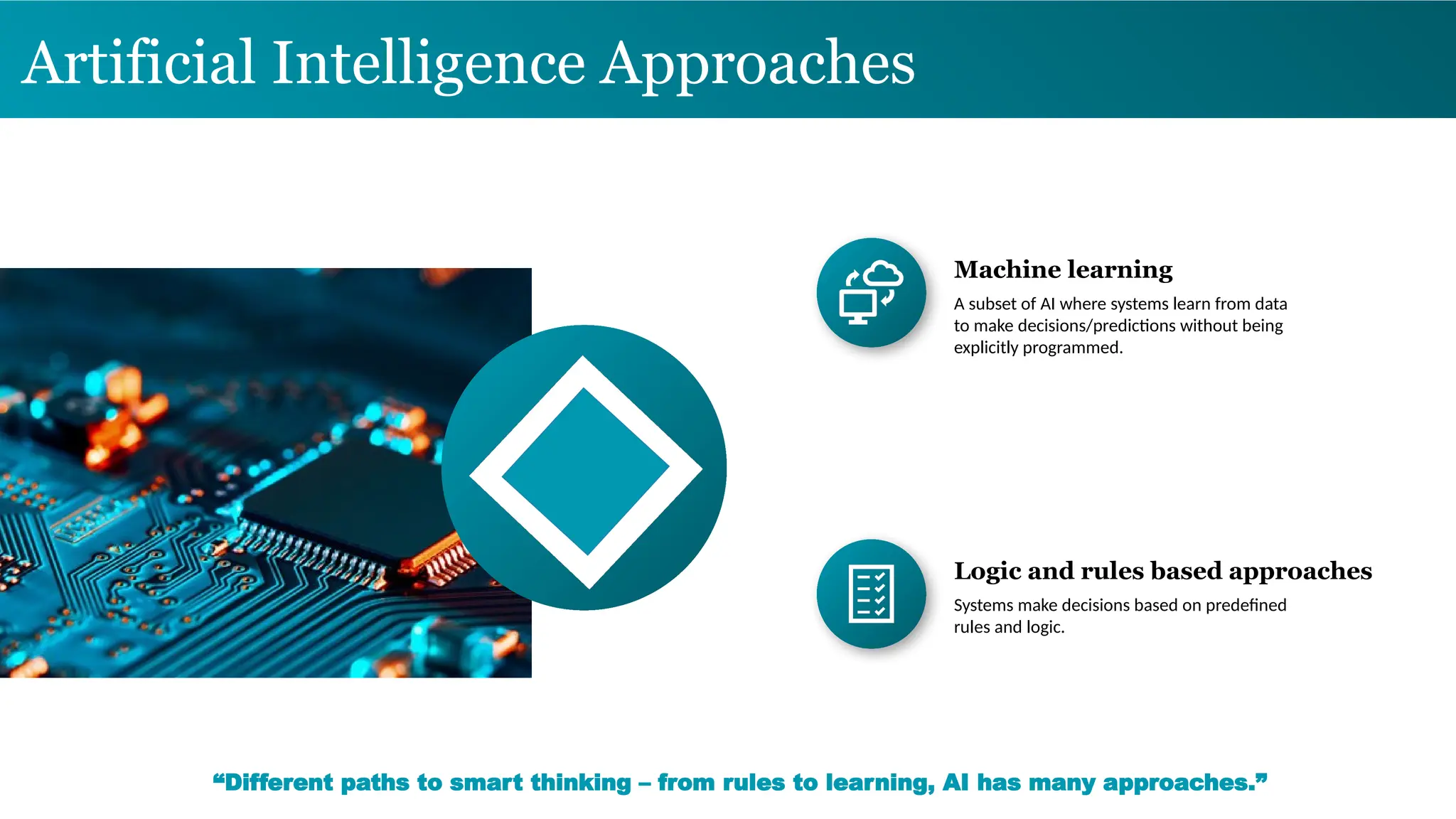
Artificial Intelligence Approaches
Systemsmake decisions based on predefined
rules and logic.
Logic and rules based approaches
A subset of AI where systems learn from data
to make decisions/predictions without being
explicitly programmed.
Machine learning
“Different paths to smart thinking – from rules to learning, AI has many approaches.”
11.
03
Session Three
Logic &rule based approaches
Machine Learning
Artificial narrow VS General intelligence
Artificial intelligence approaches
12.
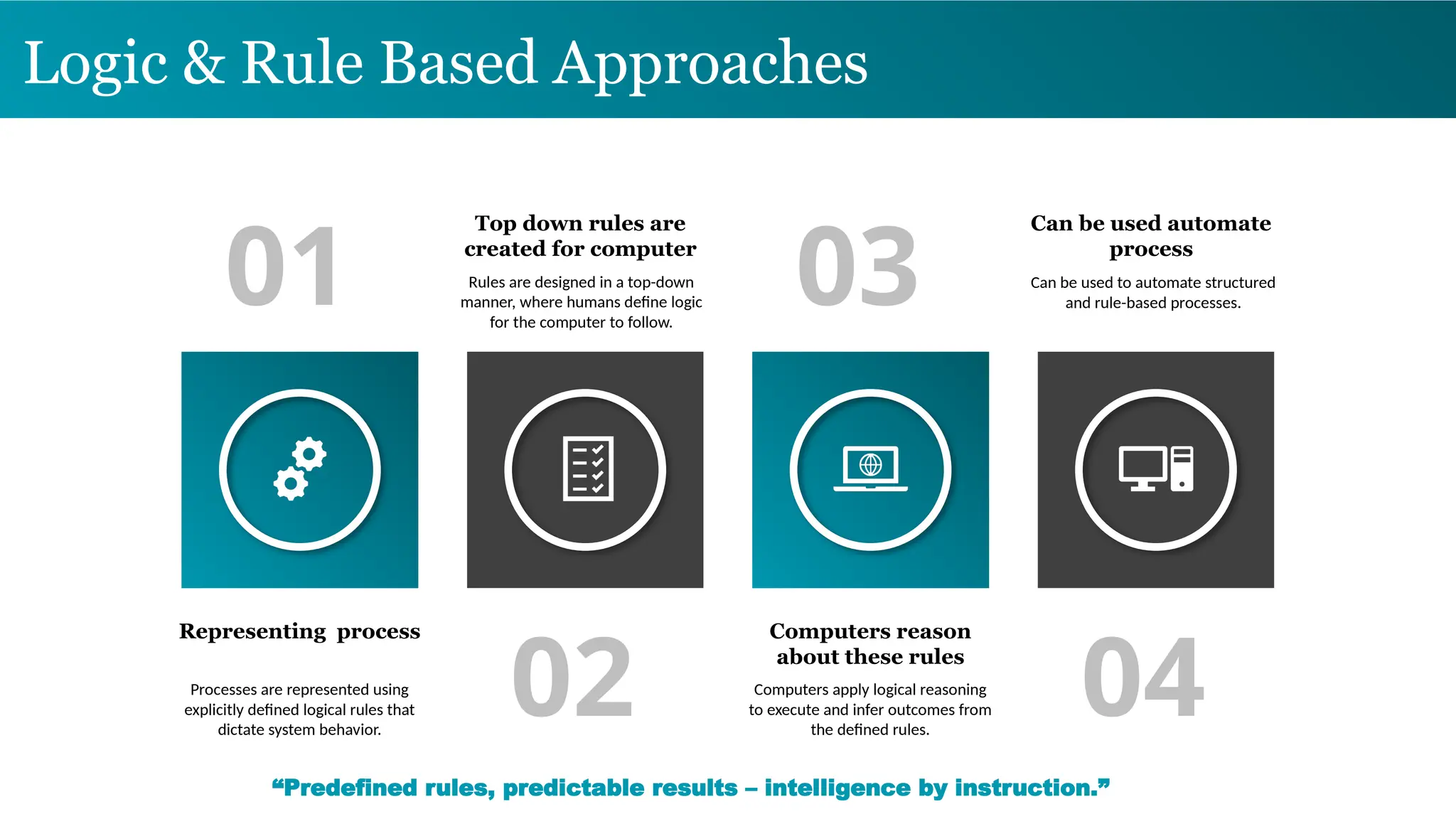
Logic & RuleBased Approaches
01
02 04
03
Processes are represented using
explicitly defined logical rules that
dictate system behavior.
Representing process
Computers apply logical reasoning
to execute and infer outcomes from
the defined rules.
Computers reason
about these rules
Rules are designed in a top-down
manner, where humans define logic
for the computer to follow.
Top down rules are
created for computer
Can be used to automate structured
and rule-based processes.
Can be used automate
process
“Predefined rules, predictable results – intelligence by instruction.”
13.
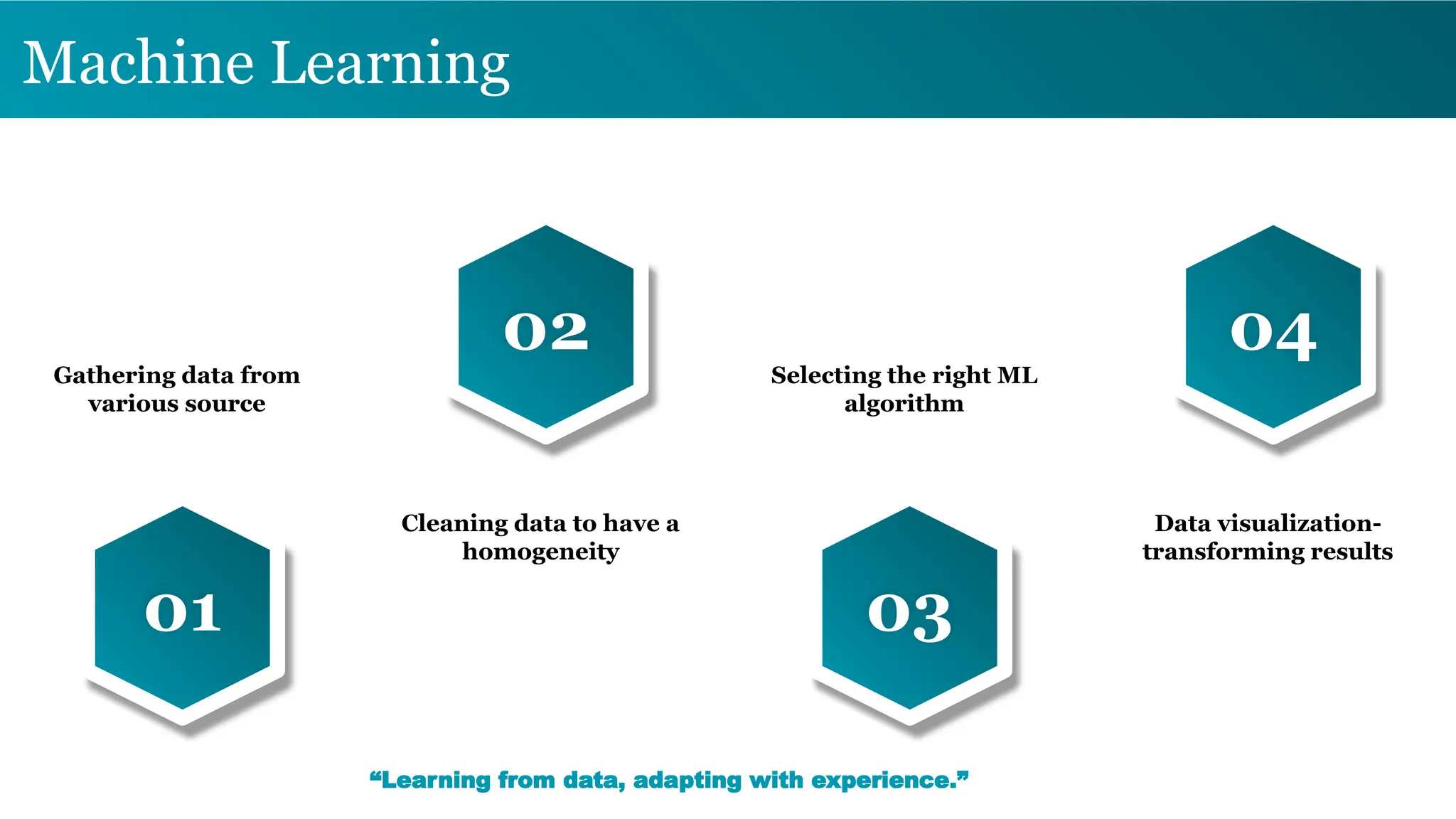
Machine Learning
01
Gathering datafrom
various source
02
Cleaning data to have a
homogeneity
03
Selecting the right ML
algorithm
04
Data visualization-
transforming results
“Learning from data, adapting with experience.”
14.
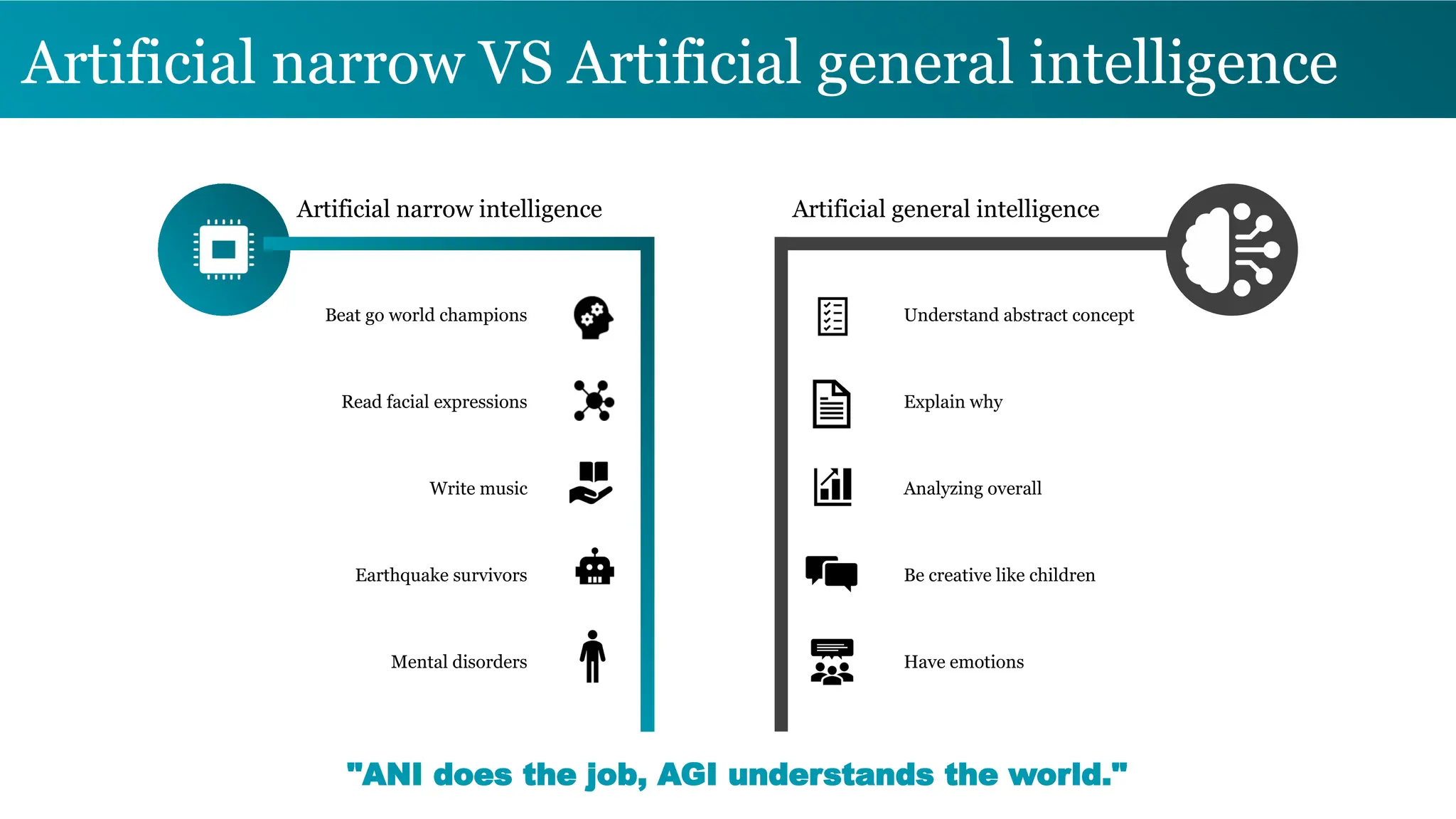
Artificial narrow VSArtificial general intelligence
Beat go world champions
Read facial expressions
Write music
Earthquake survivors
Mental disorders
Understand abstract concept
Explain why
Analyzing overall
Be creative like children
Have emotions
"ANI does the job, AGI understands the world."
Artificial narrow intelligence Artificial general intelligence
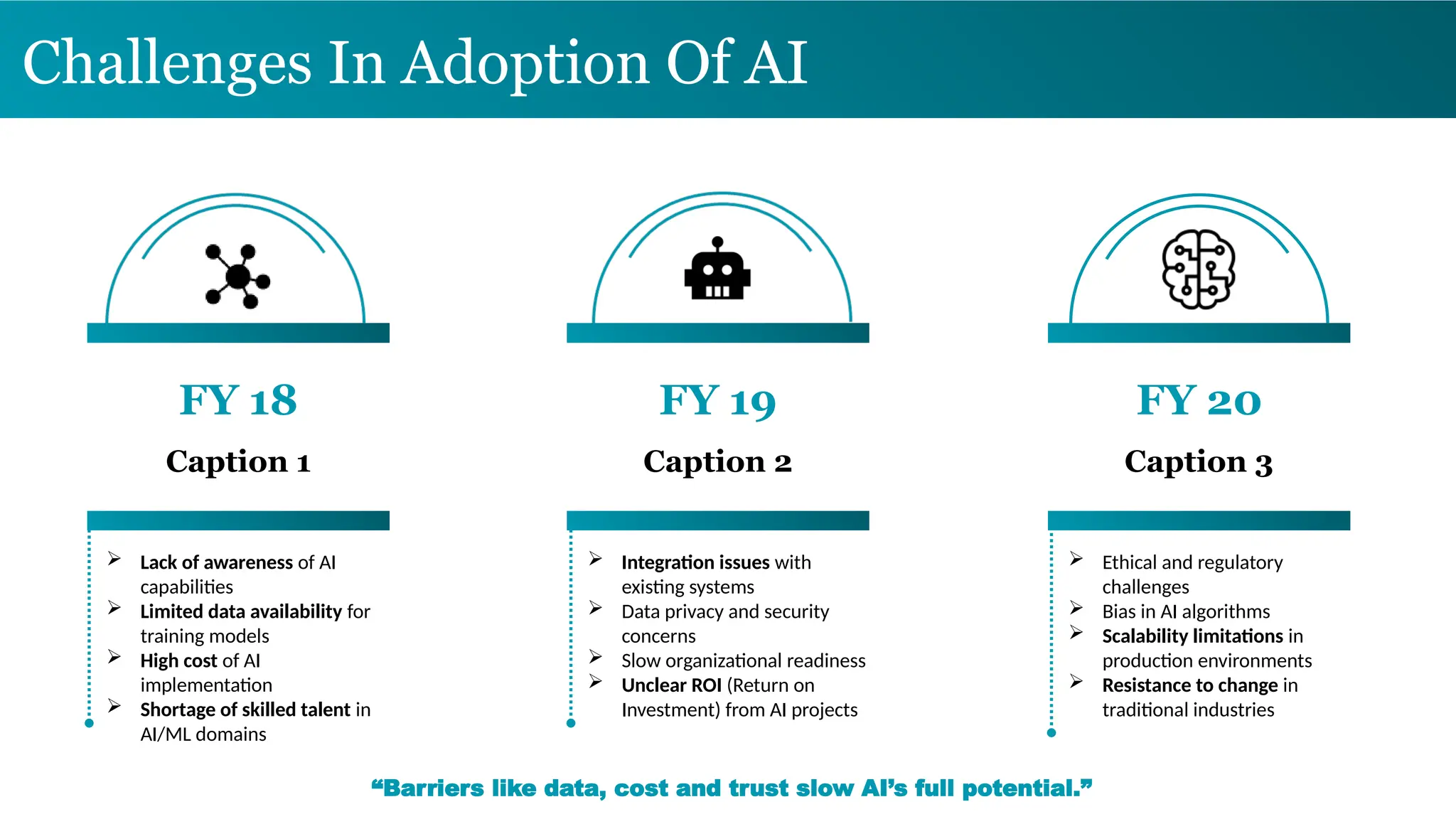
Challenges In AdoptionOf AI
FY 18
Caption 1
Lack of awareness of AI
capabilities
Limited data availability for
training models
High cost of AI
implementation
Shortage of skilled talent in
AI/ML domains
FY 19
Caption 2
Integration issues with
existing systems
Data privacy and security
concerns
Slow organizational readiness
Unclear ROI (Return on
Investment) from AI projects
FY 20
Caption 3
Ethical and regulatory
challenges
Bias in AI algorithms
Scalability limitations in
production environments
Resistance to change in
traditional industries
“Barriers like data, cost and trust slow AI’s full potential.”
17.
Potential Use CaseOf AI In Healthcare
Enhancing medical education
through AI-powered simulations and
tools.
Training
Accelerating clinical research and
drug development using intelligent
data analysis.
Research
Promoting preventive care with AI-
driven wellness apps and
monitoring.
Keeping well
Identifying diseases at early stages
using predictive and diagnostic
algorithms.
Early detection
“AI heals smarter - from early detection to personalized care.”
18.
Machine Learning UseCases
02
Manufacturing
Retail
Healthcare & Life science
Energy, Feed stoke
Financial service
Travel
01
05 03
06
04
“ML powers predictions, personalization, and smarter automation.”
Artificial Intelligence InVarious Sectors
Water
Smart water management, leak
detection, and quality
monitoring systems.
Health
Disease prediction, diagnostics,
personalized treatment, and
virtual assistants.
Transport
Autonomous vehicles, route
optimization, and predictive
maintenance.
Environment
Climate modeling, pollution
tracking, and resource
conservation.
Traffic
Intelligent traffic signals,
congestion control, and accident
prediction.
Technology
Enhanced automation, cybersecurity,
and AI-powered innovation in
software/hardware.
“AI empowers every sector – from health to highways, water to weather.”
21.
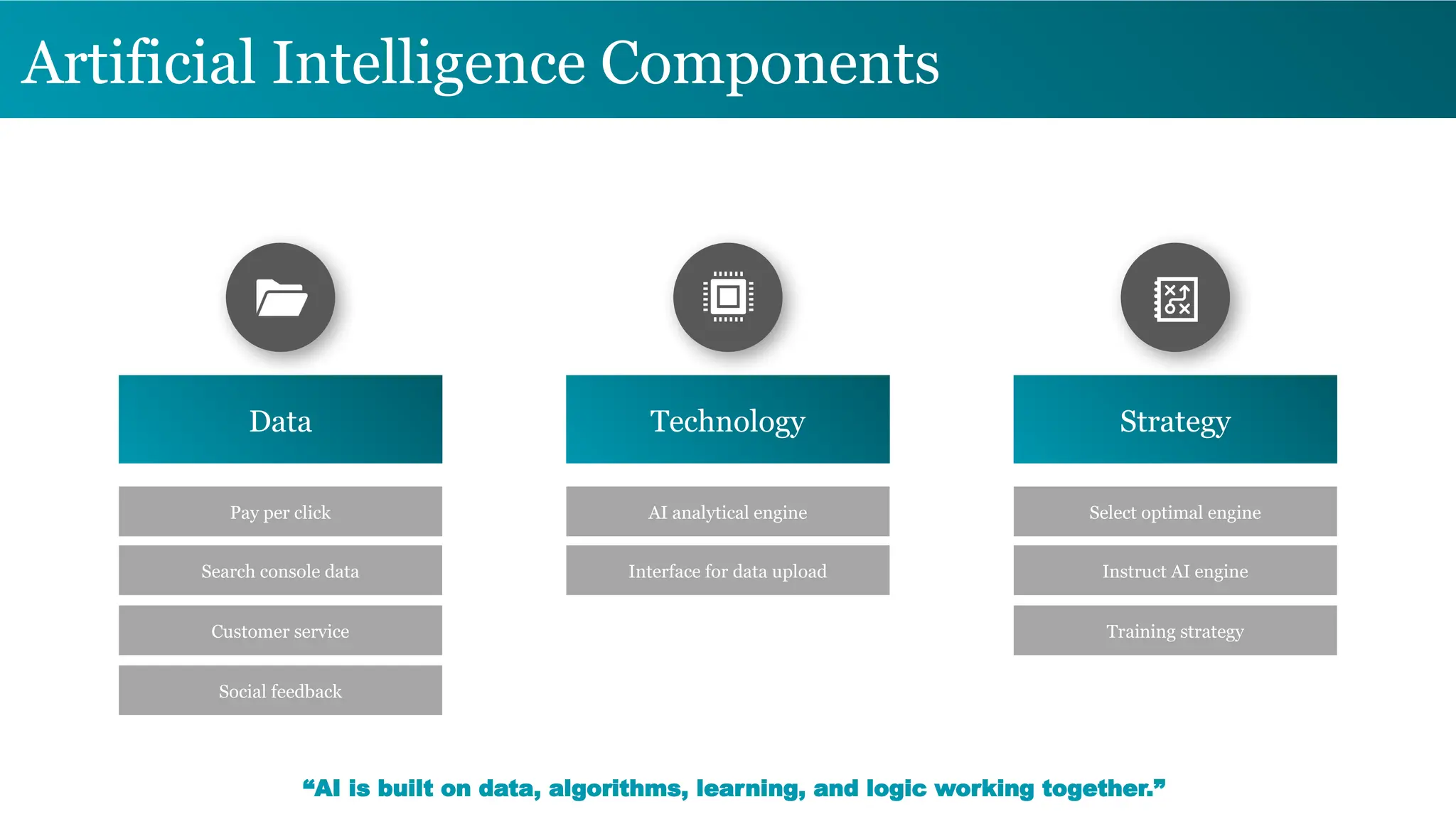
Artificial Intelligence Components
DataTechnology Strategy
Pay per click AI analytical engine Select optimal engine
Search console data Interface for data upload Instruct AI engine
Customer service Training strategy
Social feedback
“AI is built on data, algorithms, learning, and logic working together.”
22.
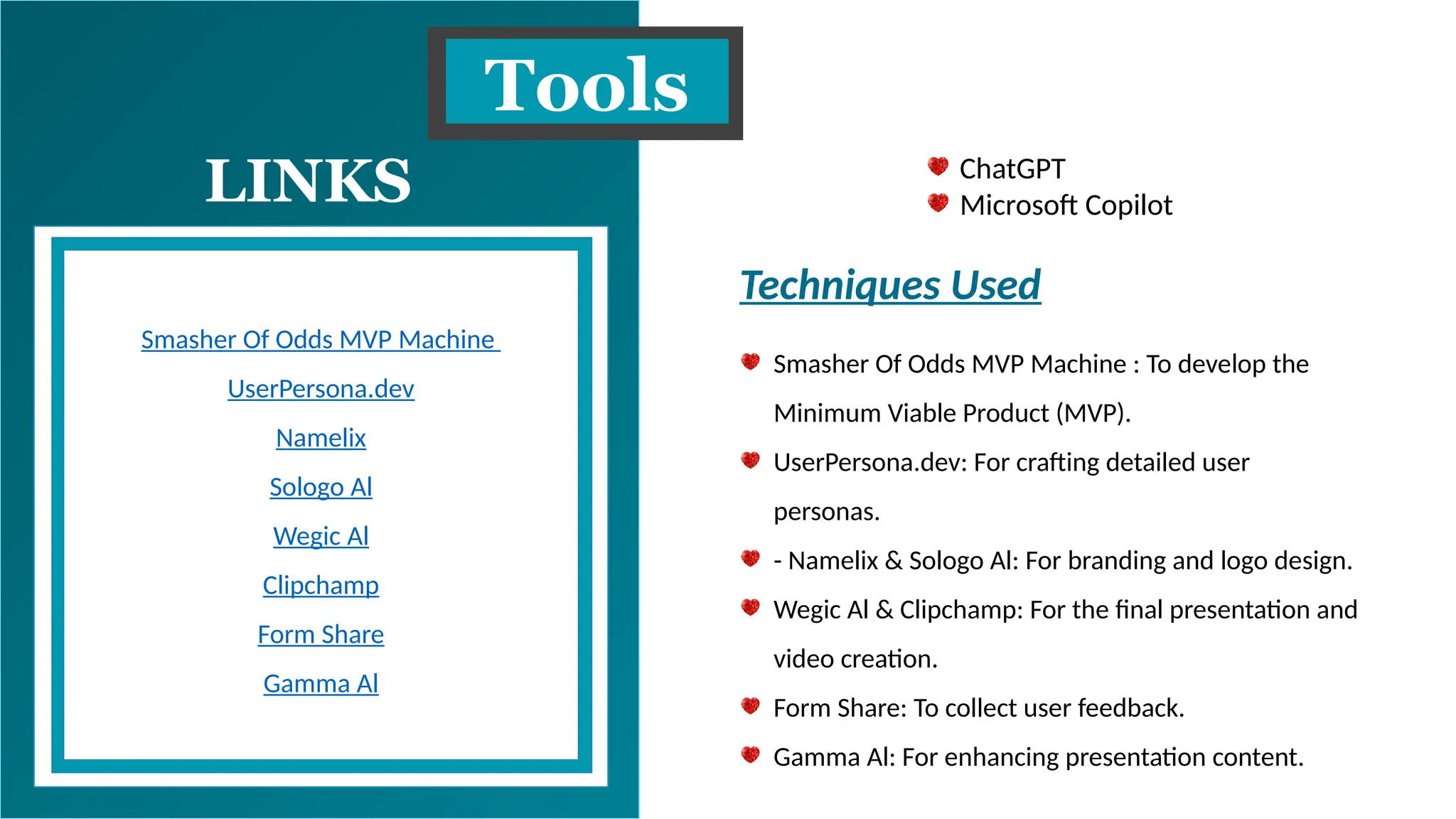
Tools
Techniques Used
ChatGPT
Microsoft Copilot
SmasherOf Odds MVP Machine : To develop the
Minimum Viable Product (MVP).
UserPersona.dev: For crafting detailed user
personas.
- Namelix & Sologo Al: For branding and logo design.
Wegic Al & Clipchamp: For the final presentation and
video creation.
Form Share: To collect user feedback.
Gamma Al: For enhancing presentation content.
LINKS
Smasher Of Odds MVP Machine
UserPersona.dev
Namelix
Sologo Al
Wegic Al
Clipchamp
Form Share
Gamma Al



![Topaz Studio 2 v2.3.2 with Crack Free Download [Latest]](https://cdn.slidesharecdn.com/ss_thumbnails/artificialintelligence1-250520101154-6afeaf5d-thumbnail.jpg?width=640&height=640&fit=bounds)
![AnthemScore 2.3.1 (x64) with Crack [Latest Version]](https://cdn.slidesharecdn.com/ss_thumbnails/artificialintelligence1-250520102049-94e1e6cb-thumbnail.jpg?width=640&height=640&fit=bounds)
![Adobe Media Encoder 2025 Crack v22.0.0.107 Full Version [Latest]](https://cdn.slidesharecdn.com/ss_thumbnails/artificialintelligence1-250526160709-6bd51e86-thumbnail.jpg?width=640&height=640&fit=bounds)
![MindGenius 2022 Crack Full Version Download [Latest]](https://cdn.slidesharecdn.com/ss_thumbnails/artificialintelligence1-250522034506-e6e75532-thumbnail.jpg?width=640&height=640&fit=bounds)
![Mailbird Pro 2.9.61 Crack + License Key Download 2025 [Latest]](https://cdn.slidesharecdn.com/ss_thumbnails/artificialintelligence1-250521090455-79fa8534-thumbnail.jpg?width=640&height=640&fit=bounds)
![NetBalancer Crack 10.6.1.3129 + Activation Code Download [2022]](https://cdn.slidesharecdn.com/ss_thumbnails/artificialintelligence1-250520102943-e0d8e3c5-thumbnail.jpg?width=640&height=640&fit=bounds)
![Adobe Premiere Pro 2022 Full Version Free Download [Latest]](https://cdn.slidesharecdn.com/ss_thumbnails/artificialintelligence1-250521091926-bc0fc220-thumbnail.jpg?width=640&height=640&fit=bounds)
![Edraw Max 10.0.4 Crack with License Key Download [Latest]](https://cdn.slidesharecdn.com/ss_thumbnails/artificialintelligence2-250521092315-2e97628b-thumbnail.jpg?width=640&height=640&fit=bounds)
![Burp Suite Professional 2022.1.1 Crack + License Key [Latest]](https://cdn.slidesharecdn.com/ss_thumbnails/artificialintelligence2-250521162242-8a1d1e9b-thumbnail.jpg?width=640&height=640&fit=bounds)
![Adobe Animate CC 2025 Crack v22.0.2.168 Free Download [Full]](https://cdn.slidesharecdn.com/ss_thumbnails/artificialintelligence1-250520103726-832d5f70-thumbnail.jpg?width=640&height=640&fit=bounds)
![Razer Surround Pro 2.0.29.20 Full Crack + Keygen [Latest]](https://cdn.slidesharecdn.com/ss_thumbnails/artificialintelligence2-250521162705-49ebbc5b-thumbnail.jpg?width=640&height=640&fit=bounds)
![Cubase Pro 12.0.0 Crack Full Version Free Download [Latest]](https://cdn.slidesharecdn.com/ss_thumbnails/artificialintelligence1-250521162029-b63c781e-thumbnail.jpg?width=640&height=640&fit=bounds)


