INTRODUCTION TO ARTIFICIAL
INTELLIGENCE
05/01/2025
Alka Singh AI Unit 1
Here is a list of eight examples of artificial intelligence that
you're likely to come across on a daily basis.
•Maps and Navigation. AI has drastically improved traveling.
•Facial Detection and Recognition.
•Text Editors or Autocorrect.
•Search and Recommendation Algorithms.
•Chatbots.
•Digital Assistants.
•Social Media.
•E-Payments.
Applications
• Introduce knowledge of historical perspective of AI and its
foundations
• Familiarization with principles of AI toward problem solving,
inference, perception, knowledge representation, and learning.
• Introduce the concepts of Searching strategies used in Artificial
Intelligence.
• List the objectives and functions of modern Artificial Intelligence.
• Categorize an AI problem based on its characteristics and its
constraints.
• Learn different logic formalisms and decision taking in planning
problems.
• Introduce the concepts of AI agents for problem solving.
Alka Singh AI Unit 1
Course Objectives
Program Outcomes
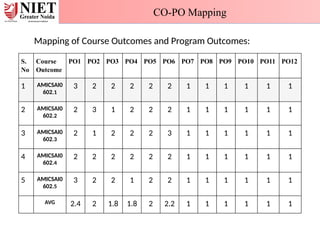
Mapping of Course Outcomes and Program Outcomes:
S.
No
Course
Outcome
PO1 PO2 PO3 PO4 PO5 PO6 PO7 PO8 PO9 PO10 PO11 PO12
1 AMICSAI0
602.1
3 2 2 2 2 2 1 1 1 1 1 1
2 AMICSAI0
602.2
2 3 1 2 2 2 1 1 1 1 1 1
3 AMICSAI0
602.3
2 1 2 2 2 3 1 1 1 1 1 1
4 AMICSAI0
602.4
2 2 2 2 2 2 1 1 1 1 1 1
5 AMICSAI0
602.5
3 2 2 1 2 2 1 1 1 1 1 1
AVG 2.4 2 1.8 1.8 2 2.2 1 1 1 1 1 1
CO-PO Mapping
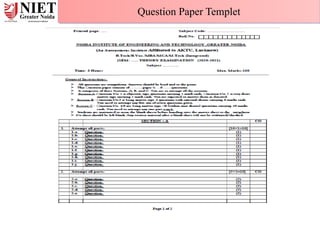
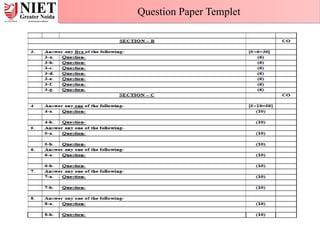
Question Paper Templet
• Introduce knowledge of historical perspective of AI and its
foundations
• Familiarization with principles of AI toward problem solving,
inference, perception, knowledge representation, and learning.
• Introduce the concepts of Searching strategies used in Artificial
Intelligence.
• List the objectives and functions of modern Artificial Intelligence.
• Categorize an AI problem based on its characteristics and its
constraints.
• Learn different logic formalisms and decision taking in planning
problems.
• Introduce the concepts of AI agents for problem solving.
Alka Singh AI Unit 1
Course Objectives
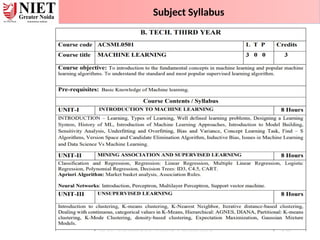
Subject Syllabus
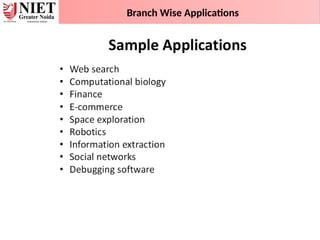
Branch Wise Applications
• To introduce students to the basic concepts of Machine Learning.
• To develop skills of implementing machine learning for solving
practical problems.
• To gain experience of doing independent study and research related
to Machine Learning
Course Objective
1. Engineering knowledge:
2. Problem analysis:
3. Design/development of solutions:
4. Conduct investigations of complex problems:
5. Modern tool usage:
6. The engineer and society:
7. Environment and sustainability:
8. Ethics:
9. Individual and team work:
10. Communication:
11. Project management and finance:
12. Life-long learning
Program Outcome
• PEO1-Engage in successful professional practices in the area of
Artificial Intelligence and pursue higher education and research.
• PEO2-Demonstrate effective leadership and communicate as an
individual and as a team in the workspace and society.
• PEO3-Pursue life-long learning in developing AI-based innovative
solutions for the betterment of society.
Program Educational Objectives
Prerequisites:
• Statistics.
• Linear Algebra.
• Calculus.
• Probability.
• Programming Languages.
Prerequisite
Brief Introduction to Subject
https://www.youtube.com/watch?v
=ukzFI9rgwfU&pp=ygUgaW50cm9kdWN0aW9uIHRvIG1hY2hpbmUgbGVhc
m5pbmc%3D
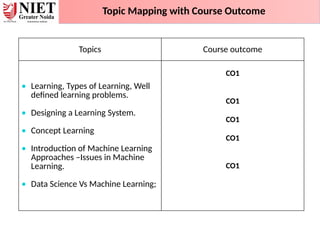
Topic Mapping with Course Outcome
Topics Course outcome
 Learning, Types of Learning, Well
defined learning problems.
 Designing a Learning System.
 Concept Learning
 Introduction of Machine Learning
Approaches –Issues in Machine
Learning.
 Data Science Vs Machine Learning;
CO1
CO1
CO1
CO1
CO1
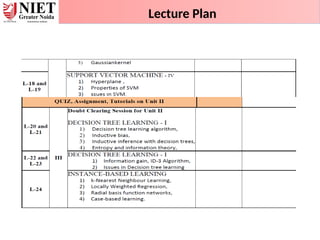
Lecture Plan
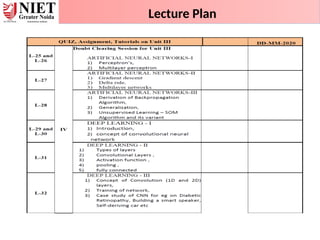
Lecture Plan
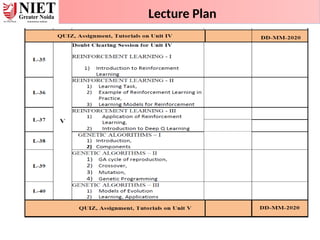
Lecture Plan
Lecture Plan
Lecture Plan
 INTRODUCTION – Learning,
 Types of Learning,
 Well defined learning problems,
 Designing a Learning System,
 History of ML,
 Introduction of Machine Learning Approaches,
 Introduction to Model Building,
 Sensitivity Analysis,
 Underfitting and Overfitting,
 Bias and Variance,
 Concept Learning Task,
 Issues in Machine Learning and Data Science Vs Machine Learning.
Unit 1 Content:
The objective of the Unit 1:
1. To understand the basics of machine learning.
2. A clear concept of Learning and learning systems.
3. Brief History of ML.
4. Use of various approaches of Machine learning.
5. understand the difference between Data Science and Machine
learning.
Unit Objective
Student will be able to understand
 Learning
 Types of Learning,
 Well defined learning problems,
 Designing a Learning System
Topic Objective
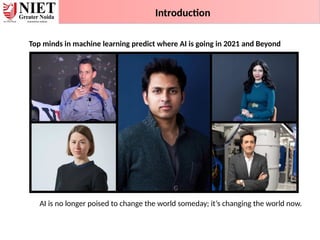
Top minds in machine learning predict where AI is going in 2021 and Beyond
Introduction
AI is no longer poised to change the world someday; it’s changing the world now.
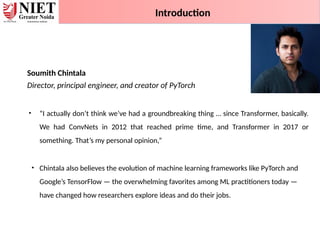
Soumith Chintala
Director, principal engineer, and creator of PyTorch
• Depending on how you gauge it, PyTorch is the most popular machine
learning framework in the world today.
• A derivative of the Torch open source framework introduced in 2002,
PyTorch became available in 2015 and is growing steadily in extensions
and libraries.
Introduction
Soumith Chintala
Director, principal engineer, and creator of PyTorch
• “I actually don’t think we’ve had a groundbreaking thing … since Transformer, basically.
We had ConvNets in 2012 that reached prime time, and Transformer in 2017 or
something. That’s my personal opinion,”
• Chintala also believes the evolution of machine learning frameworks like PyTorch and
Google’s TensorFlow — the overwhelming favorites among ML practitioners today —
have changed how researchers explore ideas and do their jobs.
Introduction
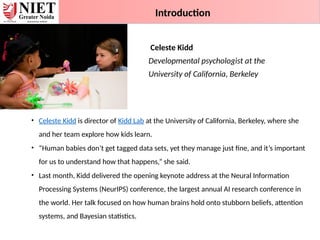
• Celeste Kidd
• Developmental psychologist at the
• University of California, Berkeley
• Celeste Kidd is director of Kidd Lab at the University of California, Berkeley, where she
and her team explore how kids learn.
• “Human babies don’t get tagged data sets, yet they manage just fine, and it’s important
for us to understand how that happens,” she said.
• Last month, Kidd delivered the opening keynote address at the Neural Information
Processing Systems (NeurIPS) conference, the largest annual AI research conference in
the world. Her talk focused on how human brains hold onto stubborn beliefs, attention
systems, and Bayesian statistics.
Introduction
• Jeff Dean
• Google AI chief
• Dean has led Google AI for nearly two years now, but he’s been at Google for two decades and is
the architect of many of the company’s early search and distributed network algorithms and an
early member of Google Brain.
• Dean spoke with VentureBeat last month at NeurIPS, where he delivered talks on machine learning
for ASIC semiconductor design and ways the AI community can address climate change, which he
said is the most important issue of our time. In his talk about climate change, Dean discussed the
idea that AI can strive to become a zero-carbon industry and that AI can be used to help change
human behavior.
Introduction
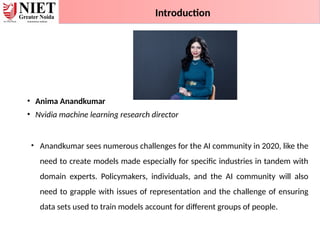
• Anima Anandkumar
• Nvidia machine learning research director
• Anandkumar sees numerous challenges for the AI community in 2020, like the
need to create models made especially for specific industries in tandem with
domain experts. Policymakers, individuals, and the AI community will also
need to grapple with issues of representation and the challenge of ensuring
data sets used to train models account for different groups of people.
Introduction
• Dario Gil
• IBM Research director
• Gil heads a group of researchers actively advising the White House and enterprises
around the world. He believes major leaps forward in 2019 include progress
around generative models and the increasing quality with which plausible
language can be generated.
Introduction
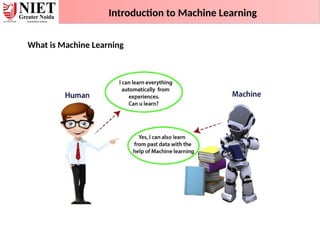
What is Machine Learning
Introduction to Machine Learning
How does Machine Learning work:
• A machine learning system builds prediction models, learns from previous
data, and predicts the output of new data whenever it receives it.
• The amount of data helps to build a better model that accurately predicts
the output, which in turn affects the accuracy of the predicted output.
• The Machine Learning algorithm's operation is depicted in the following
block diagram:
Introduction to Machine Learning
Features of Machine Learning:
Machine learning uses data to detect various patterns in a given dataset.
•It can learn from past data and improve automatically.
•It is a data-driven technology.
•Machine learning is much similar to data mining as it also deals with the
huge amount of the data.
Introduction to Machine Learning
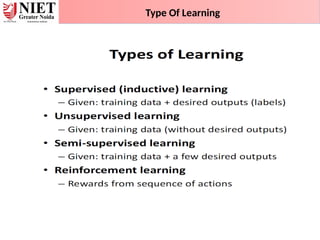
Type Of Learning
Type Of Learning
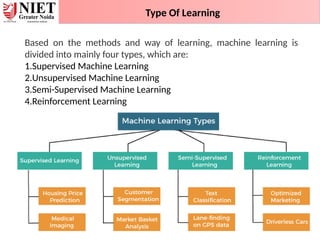
Based on the methods and way of learning, machine learning is
divided into mainly four types, which are:
1.Supervised Machine Learning
2.Unsupervised Machine Learning
3.Semi-Supervised Machine Learning
4.Reinforcement Learning
Type Of Learning
Supervised Learning:
• Supervised machine learning is a type of machine learning where
the algorithm is trained on labeled data, meaning that the data is
already categorized or classified.
• The goal of the algorithm is to learn from the labeled data and
make predictions on new, unseen data.
• In supervised learning, the algorithm is trained to map inputs to
outputs based on the labeled data.
• The algorithm learns to identify patterns and relationships
between the inputs and outputs, and uses this knowledge to
make predictions on new data.
Type Of Learning
Categories of Supervised Machine Learning
Supervised machine learning can be classified into two types of
problems, which are given below:
•Classification
•Regression
Type Of Learning (Supervised Learning)
a)Classification:
• Classification algorithms are used to solve the classification
problems in which the output variable is categorical, such as
"Yes" or No, Male or Female, Red or Blue, etc.
• The classification algorithms predict the categories present in
the dataset.
• Some real-world examples of classification algorithms
are Spam Detection, Email filtering, etc.
Some popular classification algorithms are given below:
• Random Forest Algorithm
• Decision Tree Algorithm
• Logistic Regression Algorithm
• Support Vector Machine Algorithm
Type Of Learning (Supervised Learning)
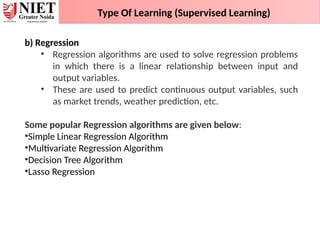
b) Regression
• Regression algorithms are used to solve regression problems
in which there is a linear relationship between input and
output variables.
• These are used to predict continuous output variables, such
as market trends, weather prediction, etc.
Some popular Regression algorithms are given below:
•Simple Linear Regression Algorithm
•Multivariate Regression Algorithm
•Decision Tree Algorithm
•Lasso Regression
Type Of Learning (Supervised Learning)
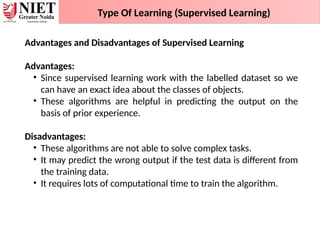
Advantages and Disadvantages of Supervised Learning
Advantages:
• Since supervised learning work with the labelled dataset so we
can have an exact idea about the classes of objects.
• These algorithms are helpful in predicting the output on the
basis of prior experience.
Disadvantages:
• These algorithms are not able to solve complex tasks.
• It may predict the wrong output if the test data is different from
the training data.
• It requires lots of computational time to train the algorithm.
Type Of Learning (Supervised Learning)
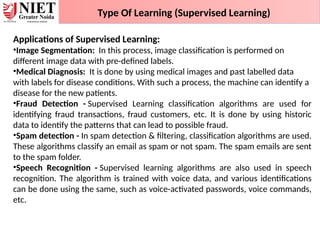
Applications of Supervised Learning:
•Image Segmentation: In this process, image classification is performed on
different image data with pre-defined labels.
•Medical Diagnosis: It is done by using medical images and past labelled data
with labels for disease conditions. With such a process, the machine can identify a
disease for the new patients.
•Fraud Detection - Supervised Learning classification algorithms are used for
identifying fraud transactions, fraud customers, etc. It is done by using historic
data to identify the patterns that can lead to possible fraud.
•Spam detection - In spam detection & filtering, classification algorithms are used.
These algorithms classify an email as spam or not spam. The spam emails are sent
to the spam folder.
•Speech Recognition - Supervised learning algorithms are also used in speech
recognition. The algorithm is trained with voice data, and various identifications
can be done using the same, such as voice-activated passwords, voice commands,
etc.
Type Of Learning (Unsupervised Learning)
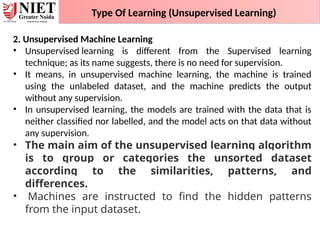
2. Unsupervised Machine Learning
• Unsupervised learning is different from the Supervised learning
technique; as its name suggests, there is no need for supervision.
• It means, in unsupervised machine learning, the machine is trained
using the unlabeled dataset, and the machine predicts the output
without any supervision.
• In unsupervised learning, the models are trained with the data that is
neither classified nor labelled, and the model acts on that data without
any supervision.
• The main aim of the unsupervised learning algorithm
is to group or categories the unsorted dataset
according to the similarities, patterns, and
differences.
• Machines are instructed to find the hidden patterns
from the input dataset.
Type Of Learning (Unsupervised Learning)
Categories of Unsupervised Machine Learning
Unsupervised Learning can be further classified into two types, which are
given below:
•Clustering
•Association
Type Of Learning (Unsupervised Learning)
1) Clustering
• The clustering technique is used when we want to find the inherent
groups from the data.
• It is a way to group the objects into a cluster such that the objects
with the most similarities remain in one group and have fewer or no
similarities with the objects of other groups.
• An example of the clustering algorithm is grouping the customers by
their purchasing behaviour.
Some of the popular clustering algorithms are given below:
• K-Means Clustering algorithm
• Mean-shift algorithm
• DBSCAN Algorithm
• Principal Component Analysis
• Independent Component Analysis
Type Of Learning (Unsupervised Learning)
2) Association:
• Association rule learning is an unsupervised learning technique,
which finds interesting relations among variables within a large
dataset.
• The main aim of this learning algorithm is to find the dependency of
one data item on another data item and map those variables
accordingly so that it can generate maximum profit.
• This algorithm is mainly applied in Market Basket analysis, Web
usage mining, continuous production, etc.
Some popular algorithms of Association rule learning are Apriori
Algorithm, Eclat, FP-growth algorithm.
Type Of Learning (Unsupervised Learning)
Advantages and Disadvantages of Unsupervised Learning Algorithm
Advantages:
• These algorithms can be used for complicated tasks compared to the
supervised ones because these algorithms work on the unlabeled
dataset.
• Unsupervised algorithms are preferable for various tasks as getting the
unlabeled dataset is easier as compared to the labelled dataset.
Disadvantages:
• The output of an unsupervised algorithm can be less accurate as the
dataset is not labelled, and algorithms are not trained with the exact
output in prior.
• Working with Unsupervised learning is more difficult as it works with
the unlabelled dataset that does not map with the output.
Type Of Learning (Unsupervised Learning)
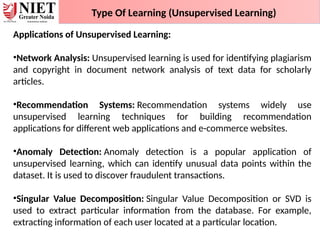
Applications of Unsupervised Learning:
•Network Analysis: Unsupervised learning is used for identifying plagiarism
and copyright in document network analysis of text data for scholarly
articles.
•Recommendation Systems: Recommendation systems widely use
unsupervised learning techniques for building recommendation
applications for different web applications and e-commerce websites.
•Anomaly Detection: Anomaly detection is a popular application of
unsupervised learning, which can identify unusual data points within the
dataset. It is used to discover fraudulent transactions.
•Singular Value Decomposition: Singular Value Decomposition or SVD is
used to extract particular information from the database. For example,
extracting information of each user located at a particular location.
Type Of Learning (Semi-supervised Learning)
Semi-Supervised Learning
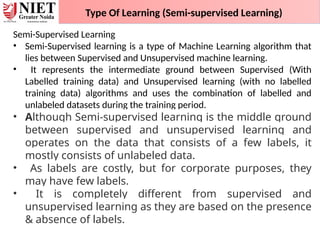
• Semi-Supervised learning is a type of Machine Learning algorithm that
lies between Supervised and Unsupervised machine learning.
• It represents the intermediate ground between Supervised (With
Labelled training data) and Unsupervised learning (with no labelled
training data) algorithms and uses the combination of labelled and
unlabeled datasets during the training period.
• Although Semi-supervised learning is the middle ground
between supervised and unsupervised learning and
operates on the data that consists of a few labels, it
mostly consists of unlabeled data.
• As labels are costly, but for corporate purposes, they
may have few labels.
• It is completely different from supervised and
unsupervised learning as they are based on the presence
& absence of labels.
Type Of Learning (Semi-supervised Learning)
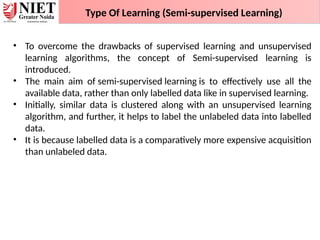
• To overcome the drawbacks of supervised learning and unsupervised
learning algorithms, the concept of Semi-supervised learning is
introduced.
• The main aim of semi-supervised learning is to effectively use all the
available data, rather than only labelled data like in supervised learning.
• Initially, similar data is clustered along with an unsupervised learning
algorithm, and further, it helps to label the unlabeled data into labelled
data.
• It is because labelled data is a comparatively more expensive acquisition
than unlabeled data.
Type Of Learning (Semi-supervised Learning)
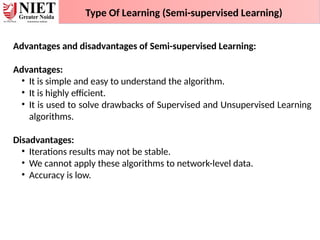
Advantages and disadvantages of Semi-supervised Learning:
Advantages:
• It is simple and easy to understand the algorithm.
• It is highly efficient.
• It is used to solve drawbacks of Supervised and Unsupervised Learning
algorithms.
Disadvantages:
• Iterations results may not be stable.
• We cannot apply these algorithms to network-level data.
• Accuracy is low.
Type Of Learning (Reinforcement Learning)
4. Reinforcement Learning:
• Reinforcement learning works on a feedback-based process, in which an
AI agent (A software component) automatically explore its surrounding
by hitting & trail, taking action, learning from experiences, and
improving its performance.
• Agent gets rewarded for each good action and get punished for each
bad action; hence the goal of reinforcement learning agent is to
maximize the rewards.
• In reinforcement learning, there is no labelled data like supervised
learning, and agents learn from their experiences only.
Type Of Learning (Reinforcement Learning)
• The reinforcement learning process is similar to a human being; for
example, a child learns various things by experiences in his day-to-day
life.
• An example of reinforcement learning is to play a game, where the
Game is the environment, moves of an agent at each step define states,
and the goal of the agent is to get a high score. Agent receives feedback
in terms of punishment and rewards.
• Due to its way of working, reinforcement learning is employed in
different fields such as Game theory, Operation Research, Information
theory, multi-agent systems.
• A reinforcement learning problem can be formalized using Markov
Decision Process(MDP).
• In MDP, the agent constantly interacts with the environment and
performs actions; at each action, the environment responds and
generates a new state.
Type Of Learning (Reinforcement Learning)
Categories of Reinforcement Learning:
Reinforcement learning is categorized mainly into two types of
methods/algorithms:
•Positive Reinforcement Learning: Positive reinforcement learning
specifies increasing the tendency that the required behaviour would occur
again by adding something. It enhances the strength of the behaviour of
the agent and positively impacts it.
•Negative Reinforcement Learning: Negative reinforcement learning works
exactly opposite to the positive RL. It increases the tendency that the
specific behaviour would occur again by avoiding the negative condition.
Type Of Learning (Reinforcement Learning)
Real-world Use cases of Reinforcement Learning
•Video Games: RL algorithms are much popular in gaming applications. It is used
to gain super-human performance. Some popular games that use RL algorithms
are AlphaGO and AlphaGO Zero.
•Resource Management: The "Resource Management with Deep Reinforcement
Learning" paper showed that how to use RL in computer to automatically learn
and schedule resources to wait for different jobs in order to minimize average job
slowdown.
•Robotics: RL is widely being used in Robotics applications. Robots are used in the
industrial and manufacturing area, and these robots are made more powerful with
reinforcement learning. There are different industries that have their vision of
building intelligent robots using AI and Machine learning technology.
•Text Mining Text-mining, one of the great applications of NLP, is now being
implemented with the help of Reinforcement Learning by Salesforce company.
Type Of Learning (Reinforcement Learning)
Advantages and Disadvantages of Reinforcement Learning:
Advantages
• It helps in solving complex real-world problems which are difficult to be
solved by general techniques.
• The learning model of RL is similar to the learning of human beings;
hence most accurate results can be found.
• Helps in achieving long term results.
Disadvantage
• RL algorithms are not preferred for simple problems.
• RL algorithms require huge data and computations.
• Too much reinforcement learning can lead to an overload of states
which can weaken the results.
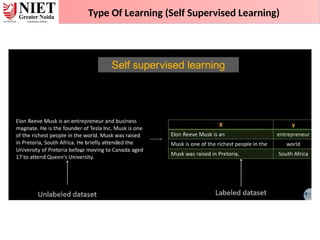
• Self-supervised learning is a machine learning process where
the model trains itself to learn one part of the input from
another part of the input. It is also known as predictive or
pretext learning.
• In this process, the unsupervised problem is transformed into a
supervised problem by auto-generating the labels. To make use
of the huge quantity of unlabeled data, it is crucial to set the
right learning objectives to get supervision from the data itself.
• The process of the self-supervised learning method is to
identify any hidden part of the input from any unhidden part of
the input.
Type Of Learning (Self Supervised Learning)
Example: Teaching a Model to Understand Images
Let’s say we want to train a model to recognize objects in images
without manually labeling them.
🔹 Step 1: Create a Pretext Task
• A pretext task is like a puzzle that forces the model to learn
useful patterns.
• ✅ Example Task: Jigsaw Puzzle with Images
• We take an image of a cat .
🐱
• We cut it into pieces and shuffle the parts.
• The model is trained to rearrange the pieces correctly.
• By solving this puzzle, the model learns the shapes, colors,
and structure of objects, even though we never explicitly told
it, “This is a cat.”
Type Of Learning (Self Supervised Learning)
Example: Learning Language (Like GPT or BERT)
✅ Example Task: Guess the Missing Word
• Given the sentence:
"The cat is sitting on the ___."
• The model must guess the missing word (e.g., "mat").
• It learns language structure, grammar, and meaning without
labels.
• After training, the model can understand and generate text just
like humans!
Type Of Learning (Self Supervised Learning)
Self Supervised Learning came into existence because of the
following issues persistent in other learning procedures:
• High cost: Labeled data is required by most learning methods.
The cost of good quality labelled data is very high in terms of
time and money.
• Lengthy lifecycle: The data preparation lifecycle is a lengthy
process in developing ML models. It requires cleaning, filtering,
annotating, reviewing, and restructuring according to the training
framework.
• Generic AI: The self-supervised learning framework is one step
closer to embedding human cognition in machines.
Type Of Learning (Self Supervised Learning)
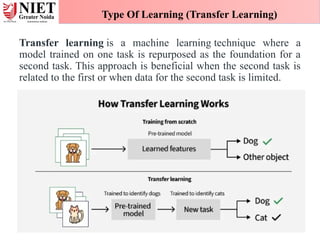
Transfer learning is a machine learning technique where a
model trained on one task is repurposed as the foundation for a
second task. This approach is beneficial when the second task is
related to the first or when data for the second task is limited.
Type Of Learning (Transfer Learning)
Why is Transfer Learning Important?
1.Limited Data: Acquiring extensive labeled data is often challenging
and costly. Transfer learning enables us to use pre-trained models,
reducing the dependency on large datasets.
2.Enhanced Performance: Starting with a pre-trained model, which
has already learned from substantial data, allows for faster and more
accurate results on new tasks—ideal for applications needing high
accuracy and efficiency.
3.Time and Cost Efficiency: Transfer learning shortens training time
and conserves resources by utilizing existing models, eliminating the
need for training from scratch.
4.Adaptability: Models trained on one task can be fine-tuned for
related tasks, making transfer learning versatile for various
applications, from image recognition to natural language processing.
Type Of Learning (Transfer Learning)
How Does Transfer Learning Work?
Transfer learning involves a structured process to leverage
existing knowledge from a pre-trained model for new tasks:
1.Pre-trained Model: Start with a model already trained on a
large dataset for a specific task. This pre-trained model has
learned general features and patterns that are relevant across
related tasks.
2.Base Model: This pre-trained model, known as the base model,
includes layers that have processed data to learn hierarchical
representations, capturing low-level to complex features.
3.Transfer Layers: Identify layers within the base model that
hold generic information applicable to both the original and
new tasks. These layers, often near the top of the network,
capture broad, reusable features.
Type Of Learning (Transfer Learning)
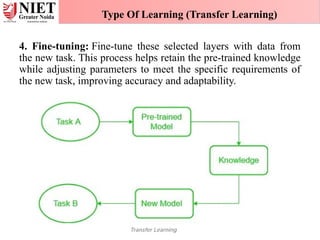
4. Fine-tuning: Fine-tune these selected layers with data from
the new task. This process helps retain the pre-trained knowledge
while adjusting parameters to meet the specific requirements of
the new task, improving accuracy and adaptability.
Type Of Learning (Transfer Learning)
Well Defined Learning Problems
Well Posed Learning Problem –
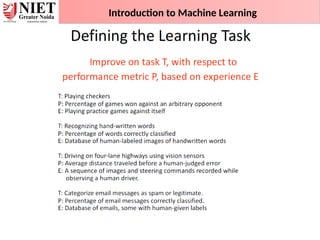
A computer program is said to learn from experience E in context to some
task T and some performance measure P, if its performance on T, as was
measured by P, upgrades with experience E.
Any problem can be segregated as well-posed learning problem if it has
three traits –
•Task
•Performance Measure
•Experience
Certain examples that efficiently defines the well-posed learning problem
are –
1. To better filter emails as spam or not
•Task – Classifying emails as spam or not
•Performance Measure – The fraction of emails accurately classified as
spam or not spam
•Experience – Observing you label emails as spam or not spam
Well Defined Learning Problems
2. A checkers learning problem
•Task – Playing checkers game
•Performance Measure – percent of games won against opposer
•Experience – playing implementation games against itself
3. Handwriting Recognition Problem
•Task – Acknowledging handwritten words within portrayal
•Performance Measure – percent of words accurately classified
•Experience – a directory of handwritten words with given classifications
4. A Robot Driving Problem
•Task – driving on public four-lane highways using sight scanners
•Performance Measure – average distance progressed before a fallacy
•Experience – order of images and steering instructions noted down while
observing a human driver
5. Fruit Prediction Problem
•Task – forecasting different fruits for recognition
•Performance Measure – able to predict maximum variety of fruits
•Experience – training machine with the largest datasets of fruits images
Designing a Learning System
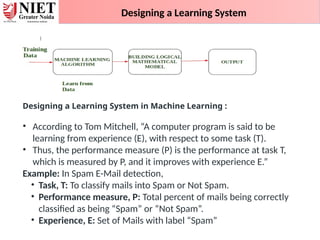
Designing a Learning System in Machine Learning :
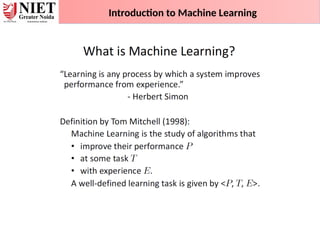
• According to Tom Mitchell, “A computer program is said to be
learning from experience (E), with respect to some task (T).
• Thus, the performance measure (P) is the performance at task T,
which is measured by P, and it improves with experience E.”
Example: In Spam E-Mail detection,
• Task, T: To classify mails into Spam or Not Spam.
• Performance measure, P: Total percent of mails being correctly
classified as being “Spam” or “Not Spam”.
• Experience, E: Set of Mails with label “Spam”
Designing a Learning System
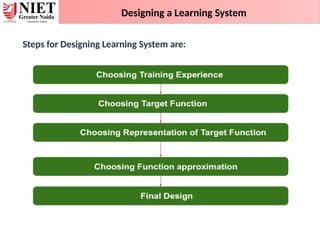
Steps for Designing Learning System are:
Designing a Learning System
Step 1) Choosing the Training Experience: The very important and
first task is to choose the training data or training experience which
will be fed to the Machine Learning Algorithm. It is important to note
that the data or experience that we fed to the algorithm must have a
significant impact on the Success or Failure of the Model. So Training
data or experience should be chosen wisely.
Step 2- Choosing target function: The next important step is choosing
the target function. It means according to the knowledge fed to the
algorithm the machine learning will choose NextMove function which
will describe what type of legal moves should be taken. For example :
While playing chess with the opponent, when opponent will play then
the machine learning algorithm will decide what be the number of
possible legal moves taken in order to get success.
Designing a Learning System
Step 3- Choosing Representation for Target function: When the
machine algorithm will know all the possible legal moves the next step
is to choose the optimized move using any representation i.e. using
linear Equations, Hierarchical Graph Representation, Tabular form etc.
The NextMove function will move the Target move like out of these
move which will provide more success rate. For Example : while playing
chess machine have 4 possible moves, so the machine will choose that
optimized move which will provide success to it.
Step 4- Choosing Function Approximation Algorithm: An optimized
move cannot be chosen just with the training data. The training data
had to go through with set of example and through these examples the
training data will approximates which steps are chosen and after that
machine will provide feedback on it. For Example : When a training data
of Playing chess is fed to algorithm so at that time it is not machine
algorithm will fail or get success and again from that failure or success it
will measure while next move what step should be chosen and what is
its success rate.
Designing a Learning System
Step 5- Final Design: The final design is created at last when system
goes from number of examples , failures and success , correct and
incorrect decision and what will be the next step etc. Example:
DeepBlue is an intelligent computer which is ML-based won chess
game against the chess expert Garry Kasparov, and it became the first
computer which had beaten a human chess expert.
History of Machine Learning (CO1)
• The early history of Machine Learning (Pre-1940):
• 1834: In 1834, Charles Babbage, the father of the computer, conceived a device that
could be programmed with punch cards. However, the machine was never built, but
all modern computers rely on its logical structure.
• 1936: In 1936, Alan Turing gave a theory that how a machine can determine and
execute a set of instructions.
• The era of stored program computers:
• 1940: In 1940, the first manually operated computer, "ENIAC" was invented, which
was the first electronic general-purpose computer. After that stored program
computer such as EDSAC in 1949 and EDVAC in 1951 were invented.
• 1943: In 1943, a human neural network was modeled with an electrical circuit. In
1950, the scientists started applying their idea to work and analyzed how human
neurons might work.
History of Machine Learning (CO1)
• Computer machinery and intelligence:
• 1950: In 1950, Alan Turing published a seminal paper, "Computer
Machinery and Intelligence," on the topic of artificial intelligence. In his
paper, he asked, "Can machines think?"
• Machine intelligence in Games:
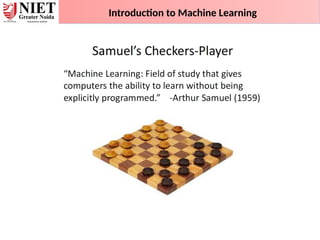
• 1952: Arthur Samuel, who was the pioneer of machine learning, created a
program that helped an IBM computer to play a checkers game. It
performed better more it played.
• 1959: In 1959, the term "Machine Learning" was first coined by Arthur
Samuel.
• The first "AI" winter:
• The duration of 1974 to 1980 was the tough time for AI and ML
researchers, and this duration was called as AI winter.
• In this duration, failure of machine translation occurred, and people had
reduced their interest from AI, which led to reduced funding by the
government to the researches.
History of Machine Learning (CO1)
• Machine Learning from theory to reality
• 1959: In 1959, the first neural network was applied to a real-
world problem to remove echoes over phone lines using an
adaptive filter.
• 1985: In 1985, Terry Sejnowski and Charles Rosenberg invented
a neural network NETtalk, which was able to teach itself how
to correctly pronounce 20,000 words in one week.
• 1997: The IBM's Deep blue intelligent computer won the chess
game against the chess expert Garry Kasparov, and it became
the first computer which had beaten a human chess expert.
History of Machine Learning (CO1)
• Machine Learning at 21st
century
• 2006: In the year 2006, computer scientist Geoffrey Hinton has given a new name to
neural net research as "deep learning," and nowadays, it has become one of the
most trending technologies.
• 2012: In 2012, Google created a deep neural network which learned to recognize
the image of humans and cats in YouTube videos.
• 2014: In 2014, the Chabot "Eugen Goostman" cleared the Turing Test. It was the
first Chabot who convinced the 33% of human judges that it was not a machine.
• 2014: DeepFace was a deep neural network created by Facebook, and they claimed
that it could recognize a person with the same precision as a human can do.
• 2016: AlphaGo beat the world's number second player Lee sedol at Go game. In
2017 it beat the number one player of this game Ke Jie.
• 2017: In 2017, the Alphabet's Jigsaw team built an intelligent system that was able
to learn the online trolling. It used to read millions of comments of different
websites to learn to stop online trolling.
History of Machine Learning (CO1)
• Machine Learning at present:
• Now machine learning has got a great advancement in its research, and it is
present everywhere around us, such as self-driving cars, Amazon Alexa,
Catboats, recommender system, and many more. It includes Supervised,
unsupervised, and reinforcement learning with clustering, classification,
decision tree, SVM algorithms, etc.
• Modern machine learning models can be used for making various
predictions, including weather prediction, disease prediction, stock
market analysis, etc.
History of Machine Learning (CO1)
A Neural Network
• A neural network is a processing device, either an algorithm or an actual
hardware, whose design was inspired by the design and functioning of
animal brains and components thereof.
• The neural networks have ability to learn by example, which makes them
very flexible and powerful.
• These networks are also well suited for real-time systems because of their
fast response and computational times which are because of their parallel
architecture.
Introduction of Machine Learning Approaches
Artificial Neural Network: Definition:
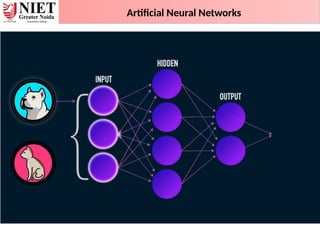
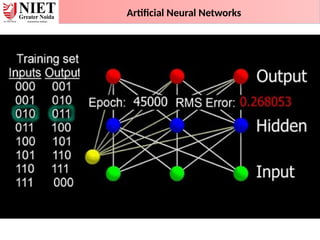
• An artificial neural network (ANN) may be defined as an information
processing model that is inspired by the way biological nervous systems,
such as the brain, process information.
• This model tries to replicate only the most basic functions of the brain.
• The key element of ANN is the novel structure of its information processing
system.
• An ANN is composed of a large number of highly interconnected processing
elements (neurons) working in unison to solve specific problems.
• Artificial neural networks, like people, learn by example.
Introduction of Machine Learning Approaches
Advantages of Neural Networks:
• Adaptive learning: An ANN is endowed with the ability to learn how to do
tasks based on the data given for training or initial experience.
• Self-organization: An ANN can create its own organization or
representation of the information it receives during learning time.
• Real-time operation: ANN computations may be carried out in parallel.
Special hardware devices are being designed and manufactured to rake
advantage of this capability of ANNs.
• Fault tolerance via redundant information coding: Partial destruction of a
neural network leads to the corresponding degradation of performance.
However, some network capabilities may be retrained even after major
network damage.
Introduction of Machine Learning Approaches
Application Scope of Neural Networks:
• Air traffic control.
• Animal behavior, predator/prey relationships and population cycles.
• Appraisal and valuation of property, buildings, automobiles, machinery, etc.
• Betting on horse races, stock markets, sporting events, etc.
• Criminal sentencing could be predicted using a large sample of crime details
as input and the resulting sentence as output.
• Complex physical and chemical processes that may involve the interaction
of numerous (possibly unknown) mathematical formulas could be modeled
heuristically using a neural network.
• Echo patterns from sonar, radar, seismic and magnetic instruments could be
used to predict their targets.
Introduction of Machine Learning Approaches
• An artificial neural network (ANN) is an efficient information processing
system which resembles in characteristics with a biological neural network.
• ANNs possess large number of highly interconnected processing elements
called nodes or units or neuron, which usually operate in parallel and are
configured in regular architectures.
• Each neuron is connected with the other by a connection link.
• Each connection link is associated with weights which contain information
about input signals.
• This information is used by the neuron to solve a particular problem.
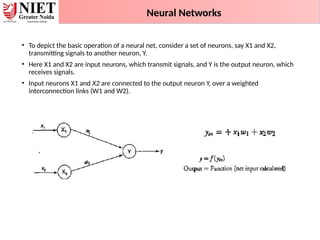
Neural Networks
• To depict the basic operation of a neural net, consider a set of neurons, say X1 and X2,
transmitting signals to another neuron, Y.
• Here X1 and X2 are input neurons, which transmit signals, and Y is the output neuron, which
receives signals.
• Input neurons X1 and X2 are connected to the output neuron Y, over a weighted
interconnection links (W1 and W2).
Activation Function
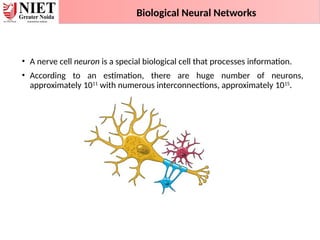
Neural Networks
• A nerve cell neuron is a special biological cell that processes information.
• According to an estimation, there are huge number of neurons,
approximately 1011
with numerous interconnections, approximately 1015
.
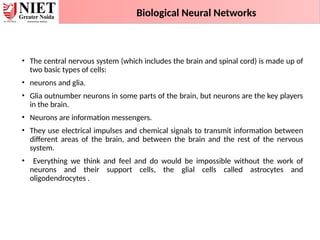
Biological Neural Networks
• The central nervous system (which includes the brain and spinal cord) is made up of
two basic types of cells:
• neurons and glia.
• Glia outnumber neurons in some parts of the brain, but neurons are the key players
in the brain.
• Neurons are information messengers.
• They use electrical impulses and chemical signals to transmit information between
different areas of the brain, and between the brain and the rest of the nervous
system.
• Everything we think and feel and do would be impossible without the work of
neurons and their support cells, the glial cells called astrocytes and
oligodendrocytes .
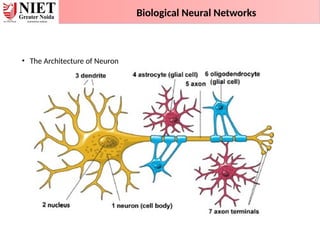
Biological Neural Networks
• The Architecture of Neuron
Biological Neural Networks
• Neurons have three basic parts: a cell body and two extensions
called an axon and a dendrite.
• Within the cell body is a nucleus, which controls the cell’s
activities and contains the cell’s genetic material.
• The axon looks like a long tail and transmits messages from the
cell.
• Dendrites look like the branches of a tree and receive
messages for the cell.
• Neurons communicate with each other by sending chemicals,
called neurotransmitters, across a tiny space, called a synapse,
between the axons and dendrites of adjacent neurons.
Biological Neural Networks
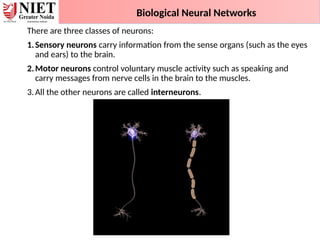
There are three classes of neurons:
1.Sensory neurons carry information from the sense organs (such as the eyes
and ears) to the brain.
2.Motor neurons control voluntary muscle activity such as speaking and
carry messages from nerve cells in the brain to the muscles.
3.All the other neurons are called interneurons.
Biological Neural Networks
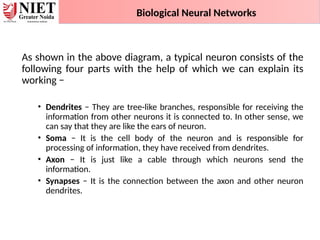
As shown in the above diagram, a typical neuron consists of the
following four parts with the help of which we can explain its
working −
• Dendrites − They are tree-like branches, responsible for receiving the
information from other neurons it is connected to. In other sense, we
can say that they are like the ears of neuron.
• Soma − It is the cell body of the neuron and is responsible for
processing of information, they have received from dendrites.
• Axon − It is just like a cable through which neurons send the
information.
• Synapses − It is the connection between the axon and other neuron
dendrites.
Biological Neural Networks
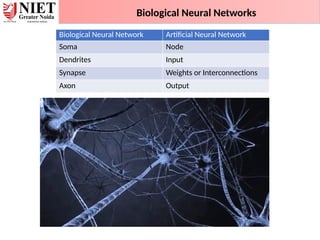
Biological Neural Network Artificial Neural Network
Soma Node
Dendrites Input
Synapse Weights or Interconnections
Axon Output
Biological Neural Networks
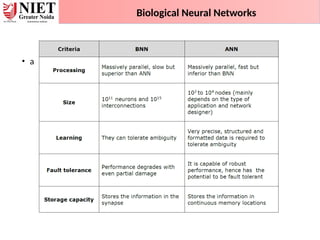
• a
Biological Neural Networks
Artificial Neural Networks
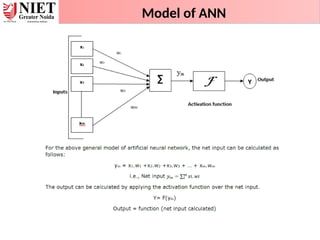
Model of ANN
Characteristics of ANN:
• It is a neutrally implemented mathematical model.
• There exists a large number of highly interconnected processing elements called
neurons in an ANN.
• The interconnections with their weighted linkages hold the informative
knowledge.
• The input signals arrive at the processing elements through connections and
connecting weights.
• The processing elements of the ANN have the ability to learn, recall and
generalize from the given data by suitable assignment or adjustment of weights.
• The computational power can be demonstrated only by the collective behavior of
neurons, and it should be noted that no single neuron carries specific
information.
Model of ANN
Underfitting and Overfitting
Underfitting
• Underfitting occurs when a machine learning model is too simple to
capture the underlying pattern of the data.
• It means the model has poor performance on both the training data
and the test data.
Characteristics:
• High bias.
• Low variance.
• High training error.
• High validation/test erro
• e training data and the test data.
Underfitting and Overfitting
Causes Of Underfitting
• The model is too simple (e.g., a linear model for non-linear data).
• Insufficient training (not enough epochs for neural networks).
• Incorrect features or lack of feature engineering.
Example: Using a linear regression model to fit data that has a quadratic
relationship.
Solution:
• Increase model complexity (e.g., use a more complex model or add more
features).
• Improve feature engineering.
• Reduce regularization (if applied too strongly).
Underfitting and Overfitting
Overfitting
Definition:
• Overfitting occurs when a machine learning model is too complex
and captures the noise along with the underlying pattern in the data.
• It means the model performs very well on the training data but
poorly on the test data.
Characteristics:
• Low bias.
• High variance.
• Low training error.
• High validation/test error.
Underfitting and Overfitting
Causes Of Overfitting:
• The model is too complex (e.g., too many parameters, too deep
neural network).
• Training for too many epochs.
• Too few training examples relative to the model complexity.
Example: Using a high-degree polynomial regression model to fit data
that has a linear relationship.
Solution:
• Reduce model complexity (e.g., use fewer parameters or simpler
model).
• Increase the amount of training data.
• Use regularization techniques (e.g., L1 or L2 regularization).
• Apply cross-validation to tune model parameters.
Underfitting and Overfitting
• Underfitting: Increase model complexity.
• Overfitting: Reduce model complexity and use regularization
techniques.
• Goal: Achieve a balance between bias and variance to ensure the
model generalizes well to unseen data.
1️
1️
⃣ Features (Inputs) 📊
Definition: Features are the input variables
(independent variables) used to make predictions.
Example:
• If predicting house prices 🏡:
• Features = Number of bedrooms, square footage, location,
etc.
• If classifying emails as spam 📧:
• Features = Number of links, presence of certain words, etc.
👉 Think of features as ingredients in a recipe—each
one contributes to the final outcome!
Basic Machine Learning Concepts & Terminology
Labels (Outputs) 🎯
2️
⃣
Definition: The actual target (dependent variable) we
want to predict.
Example:
• For house price prediction:
• Label = Actual price of the house ($500,000)
• For spam classification:
• Label = "Spam" or "Not Spam"
👉 If features are ingredients, the label is the dish we
want to cook!
Basic Machine Learning Concepts & Terminology
Training Data
3️⃣ 🏋️
Definition: The dataset used to train the model. It contains both
features and labels so the model can learn patterns.
• Example:
If training a model to recognize cats vs. dogs:
• Images of cats & dogs (features) + Their correct labels
("cat" or "dog")
👉 Think of it like practicing before an exam! 📚
Basic Machine Learning Concepts & Terminology
Loss Function ❌
5️⃣
Definition: A function that measures how far off the model’s
prediction is from the actual label. The goal is to minimize this
error.
• Example:
• Suppose the model predicts a house price of $480,000, but the
actual price is $500,000.
• The loss function calculates the error (e.g., mean squared
error).
👉 The lower the loss, the better the model!
Basic Machine Learning Concepts & Terminology
Optimization Algorithm ⚡
6️ 6 ️
6
️
6
️
6
️
6
️
6
️
6
️
6
️
6
️
6
️
6
️
6
️
6
️
6️
Definition: A method that updates the model to reduce the loss
and improve accuracy.
• ✅ Popular Optimization Algorithms:
• Gradient Descent: Adjusts weights to minimize loss.
• Adam Optimizer: A faster and smarter version of gradient
descent.
👉 Think of optimization like adjusting your study methods to
improve exam scores!
Example: Gradient Descent, SGD, ADAM, Momentum
Basic Machine Learning Concepts & Terminology
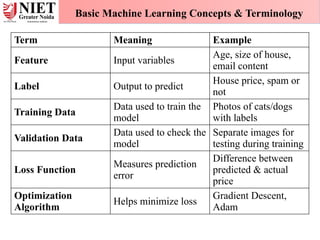
Term Meaning Example
Feature Input variables
Age, size of house,
email content
Label Output to predict
House price, spam or
not
Training Data
Data used to train the
model
Photos of cats/dogs
with labels
Validation Data
Data used to check the
model
Separate images for
testing during training
Loss Function
Measures prediction
error
Difference between
predicted & actual
price
Optimization
Algorithm
Helps minimize loss
Gradient Descent,
Adam
Basic Machine Learning Concepts & Terminology
Bias And Variance
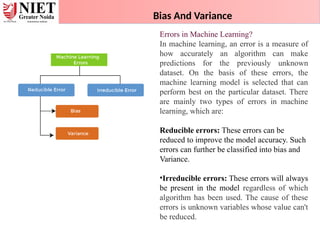
Errors in Machine Learning?
In machine learning, an error is a measure of
how accurately an algorithm can make
predictions for the previously unknown
dataset. On the basis of these errors, the
machine learning model is selected that can
perform best on the particular dataset. There
are mainly two types of errors in machine
learning, which are:
Reducible errors: These errors can be
reduced to improve the model accuracy. Such
errors can further be classified into bias and
Variance.
•Irreducible errors: These errors will always
be present in the model regardless of which
algorithm has been used. The cause of these
errors is unknown variables whose value can't
be reduced.
Bias And Variance
• Bias refers to the error introduced by approximating a real-world
problem, which may be complex, by a much simpler model.
• In machine learning, bias is an error due to overly simplistic
assumptions in the learning algorithm.
Low Bias: A low bias model will make fewer assumptions about the
form of the target function.
High Bias: A model with a high bias makes more assumptions, and the
model becomes unable to capture the important features of our
dataset. A high bias model also cannot perform well on new data.
Bias And Variance
Characteristics of High Bias:
• High bias models tend to be too simple.
• They fail to capture the complexity of the underlying data.
• Result in high training error and high validation/test error, leading to
underfitting.
Bias And Variance
Ways to reduce High Bias:
• High bias mainly occurs due to a much simple model. Below
are some ways to reduce the high bias:
• Increase the input features as the model is underfitted.
• Decrease the regularization term.
• Use more complex models, such as including some polynomial
features.
Bias And Variance
• The variance would specify the amount of variation in the
prediction if the different training data was used.
• In simple words, variance tells that how much a random
variable is different from its expected value.
• Variance errors are either of low variance or high
variance.
• Low variance means there is a small variation in the prediction of
the target function with changes in the training data set.
• ,High variance shows a large variation in the prediction of the target
function with changes in the training dataset.
Bias And Variance
Ways to Reduce High Variance:
• Reduce the input features or number of parameters as a model is
overfitted.
• Do not use a much complex model.
• Increase the training data.
• Increase the Regularization term.
Bias And Variance
Different Combinations of Bias-Variance
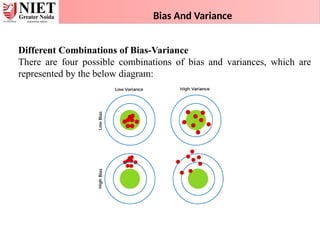
There are four possible combinations of bias and variances, which are
represented by the below diagram:
Bias And Variance
1.Low-Bias, Low-Variance: The combination of low bias and low
variance shows an ideal machine learning model. However, it is not
possible practically.
2.Low-Bias, High-Variance: With low bias and high variance, model
predictions are inconsistent and accurate on average. This case occurs
when the model learns with a large number of parameters and hence
leads to an overfitting
3.High-Bias, Low-Variance: With High bias and low variance,
predictions are consistent but inaccurate on average. This case occurs
when a model does not learn well with the training dataset or uses few
numbers of the parameter. It leads to underfitting problems in the
model.
4.High-Bias, High-Variance: With high bias and high variance,
predictions are inconsistent and also inaccurate on average.
Bias And Variance
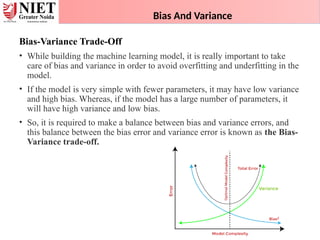
Bias-Variance Trade-Off
• While building the machine learning model, it is really important to take
care of bias and variance in order to avoid overfitting and underfitting in the
model.
• If the model is very simple with fewer parameters, it may have low variance
and high bias. Whereas, if the model has a large number of parameters, it
will have high variance and low bias.
• So, it is required to make a balance between bias and variance errors, and
this balance between the bias error and variance error is known as the Bias-
Variance trade-off.
Bias And Variance
For an accurate prediction of the model, algorithms need a low variance
and low bias. But this is not possible because bias and variance are
related to each other:
• If we decrease the variance, it will increase the bias.
• If we decrease the bias, it will increase the variance.
Inductive Bias
• Inductive bias can be defined as the set of assumptions or biases
that a learning algorithm employs to make predictions on unseen
data based on its training data.
• These assumptions are inherent in the algorithm’s design and serve
as a foundation for learning and generalization.
• The inductive bias of an algorithm influences how it selects a
hypothesis (a possible explanation or model) from the hypothesis
space (the set of all possible hypotheses) that best fits the training
data.
• It helps the algorithm navigate the trade-off between fitting the
training data perfectly (overfitting) and generalizing well to unseen
data (underfitting).
Issues in Machine Learning
Although machine learning is being used in every industry and helps
organizations make more informed and data-driven choices that are more
effective than classical methodologies, it still has so many problems that
cannot be ignored.
Here are some common issues in Machine Learning that professionals face to
inculcate ML skills and create an application from scratch.
1. Inadequate Training Data: The major issue that comes while using
machine learning algorithms is the lack of quality as well as quantity of
data. Data quality can be affected by some factors as follows:
• Noisy Data- It is responsible for an inaccurate prediction that affects the
decision as well as accuracy in classification tasks.
• Incorrect data- It is also responsible for faulty programming and results
obtained in machine learning models. Hence, incorrect data may affect the
accuracy of the results also.
• Generalizing of output data- Sometimes, it is also found that generalizing
output data becomes complex, which results in comparatively poor future
actions.
Issues in Machine Learning
2. Poor quality of data: Noisy data, incomplete data, inaccurate data,
and unclean data lead to less accuracy in classification and low-quality
results. Data quality can also be considered as a major common
problem while processing machine learning algorithms.
3. Overfitting & Underfitting : Models perform well on training data but
poorly on new data(Overfittng). Models are too simple and fail to capture
underlying patterns(underfitting).
Methods to reduce overfitting:
• Increase training data in a dataset.
• Reduce model complexity by simplifying the model by selecting one
with fewer parameters
• Ridge Regularization and Lasso Regularization
• Early stopping during the training phase
• Reduce the noise
• Reduce the number of attributes in training data.
• Constraining the model.
Issues in Machine Learning
Methods to reduce Underfitting:
• Increase model complexity
• Remove noise from the data
• Trained on increased and better features
• Reduce the constraints
• Increase the number of epochs to get better results.
4. Bias-Variance Tradeoff: Balancing model complexity and generalization.
Methods to remove Data Bias:
• Research more for customer segmentation.
• Be aware of your general use cases and potential outliers.
• Combine inputs from multiple sources to ensure data diversity.
• Include bias testing in the development process.
• Analyze data regularly and keep tracking errors to resolve them easily.
• Review the collected and annotated data.
• Use multi-pass annotation such as sentiment analysis, content
moderation, and intent recognition
Issues in Machine Learning
5. Feature Engineering: Selecting and transforming relevant features.
6. Hyperparameter Tuning: Finding optimal model parameters.
7. Model Interpretability: Understanding model decisions and explanations.
8. Class Imbalance: Dealing with unequal class distributions.
9. Adversarial Attacks: Protecting models from intentional data manipulation.
10. Ethics and Fairness: Ensuring models are unbiased and ethical.
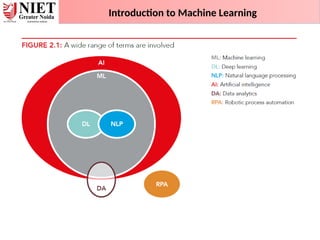
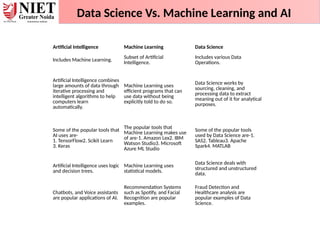
Data Science Vs. Machine Learning and AI
Artificial Intelligence Machine Learning Data Science
Includes Machine Learning.
Subset of Artificial
Intelligence.
Includes various Data
Operations.
Artificial Intelligence combines
large amounts of data through
iterative processing and
intelligent algorithms to help
computers learn
automatically.
Machine Learning uses
efficient programs that can
use data without being
explicitly told to do so.
Data Science works by
sourcing, cleaning, and
processing data to extract
meaning out of it for analytical
purposes.
Some of the popular tools that
AI uses are-
1. TensorFlow2. Scikit Learn
3. Keras
The popular tools that
Machine Learning makes use
of are-1. Amazon Lex2. IBM
Watson Studio3. Microsoft
Azure ML Studio
Some of the popular tools
used by Data Science are-1.
SAS2. Tableau3. Apache
Spark4. MATLAB
Artificial Intelligence uses logic
and decision trees.
Machine Learning uses
statistical models.
Data Science deals with
structured and unstructured
data.
Chatbots, and Voice assistants
are popular applications of AI.
Recommendation Systems
such as Spotify, and Facial
Recognition are popular
examples.
Fraud Detection and
Healthcare analysis are
popular examples of Data
Science.
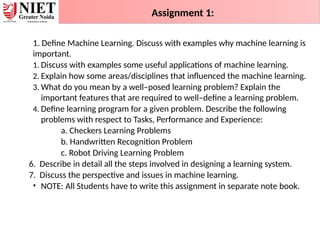
1. Define Machine Learning. Discuss with examples why machine learning is
important.
1. Discuss with examples some useful applications of machine learning.
2. Explain how some areas/disciplines that influenced the machine learning.
3. What do you mean by a well–posed learning problem? Explain the
important features that are required to well–define a learning problem.
4. Define learning program for a given problem. Describe the following
problems with respect to Tasks, Performance and Experience:
a. Checkers Learning Problems
b. Handwritten Recognition Problem
c. Robot Driving Learning Problem
6. Describe in detail all the steps involved in designing a learning system.
7. Discuss the perspective and issues in machine learning.
• NOTE: All Students have to write this assignment in separate note book.
Assignment 1:
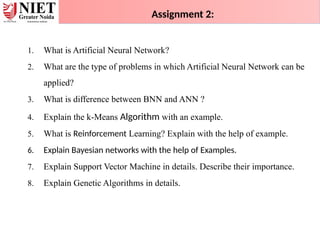
1. What is Artificial Neural Network?
2. What are the type of problems in which Artificial Neural Network can be
applied?
3. What is difference between BNN and ANN ?
4. Explain the k-Means Algorithm with an example.
5. What is Reinforcement Learning? Explain with the help of example.
6. Explain Bayesian networks with the help of Examples.
7. Explain Support Vector Machine in details. Describe their importance.
8. Explain Genetic Algorithms in details.
Assignment 2:
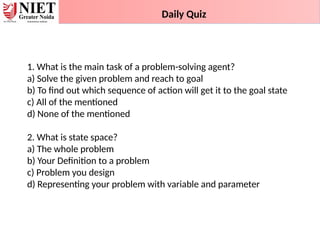
1. What is the main task of a problem-solving agent?
a) Solve the given problem and reach to goal
b) To find out which sequence of action will get it to the goal state
c) All of the mentioned
d) None of the mentioned
2. What is state space?
a) The whole problem
b) Your Definition to a problem
c) Problem you design
d) Representing your problem with variable and parameter
Daily Quiz
3. The problem-solving agent with several immediate options of
unknown value can decide what to do by just examining different
possible sequences of actions that lead to states of known value,
and then choosing the best sequence. This process of looking for
such a sequence is called Search.
a) True
b) False
4. A search algorithm takes _________ as an input and returns
________ as an output.
a) Input, output
b) Problem, solution
c) Solution, problem
d) Parameters, sequence of actions
Daily Quiz
5. A problem in a search space is defined by one of these state.
a) Initial state
b) Last state
c) Intermediate state
d) All of the mentioned
6. The Set of actions for a problem in a state space is formulated
by a ___________
a) Intermediate states
b) Initial state
c) Successor function, which takes current action and returns next
immediate state
d) None of the mentioned
Daily Quiz
1. A solution to a problem is a ……………from the initial state to a
goal state. Solution quality is measured by the path cost function,
and an optimal solution has the highest path cost among all
solutions.
a) Path
b) Road
2. The process of removing detail from a given state
representation is called ______
a) Extraction
b) Abstraction
c) Information Retrieval
d) Mining of data
Glossary Questions
3. A problem solving approach works well for ______________
a) 8-Puzzle problem
b) 8-queen problem
c) Finding a optimal path from a given source to a destination
d) Mars Hover (Robot Navigation)
4. The _______ is a touring problem in which each city must be
visited exactly once. The aim is to find the shortest tour.
a) Finding shortest path between a source and a destination
b) Travelling Salesman problem
c) Map coloring problem
d) Depth first search traversal on a given map represented as a
graph
Glossary Questions
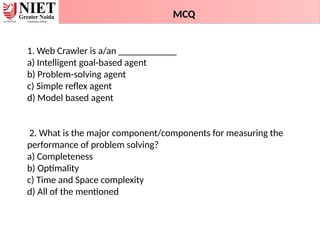
1. Web Crawler is a/an ____________
a) Intelligent goal-based agent
b) Problem-solving agent
c) Simple reflex agent
d) Model based agent
2. What is the major component/components for measuring the
performance of problem solving?
a) Completeness
b) Optimality
c) Time and Space complexity
d) All of the mentioned
MCQ
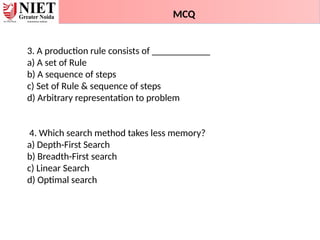
3. A production rule consists of ____________
a) A set of Rule
b) A sequence of steps
c) Set of Rule & sequence of steps
d) Arbitrary representation to problem
4. Which search method takes less memory?
a) Depth-First Search
b) Breadth-First search
c) Linear Search
d) Optimal search
MCQ
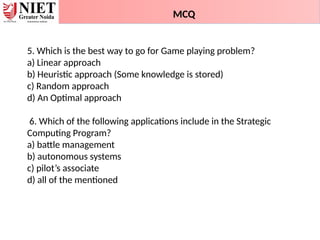
5. Which is the best way to go for Game playing problem?
a) Linear approach
b) Heuristic approach (Some knowledge is stored)
c) Random approach
d) An Optimal approach
6. Which of the following applications include in the Strategic
Computing Program?
a) battle management
b) autonomous systems
c) pilot’s associate
d) all of the mentioned
MCQ
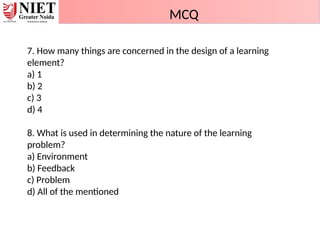
7. How many things are concerned in the design of a learning
element?
a) 1
b) 2
c) 3
d) 4
8. What is used in determining the nature of the learning
problem?
a) Environment
b) Feedback
c) Problem
d) All of the mentioned
MCQ
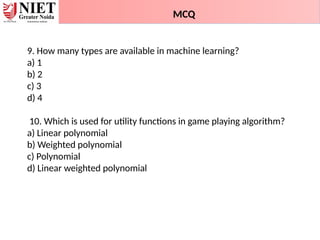
9. How many types are available in machine learning?
a) 1
b) 2
c) 3
d) 4
10. Which is used for utility functions in game playing algorithm?
a) Linear polynomial
b) Weighted polynomial
c) Polynomial
d) Linear weighted polynomial
MCQ
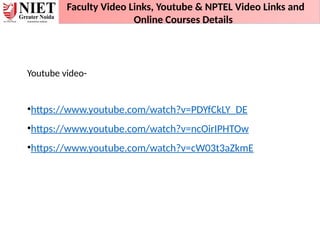
Faculty Video Links, Youtube & NPTEL Video Links and
Online Courses Details
Youtube video-
•https://www.youtube.com/watch?v=PDYfCkLY_DE
•https://www.youtube.com/watch?v=ncOirIPHTOw
•https://www.youtube.com/watch?v=cW03t3aZkmE
•Describe Machine Learning with suitable examples.[CO1]
•Brief the well defined learning problems. [CO1]
•Define the process of Designing a Learning System? [CO1]
•Explain different perspective and Issues in Machine Learning. [CO1]
•Define hypotheses. [CO1]
•Analyze THE CONCEPT LEARNING TASK - General-to-specific
ordering of hypotheses? [CO1]
•Illustrate Find-S algorithm. [CO1]
•Describe List-Then-Eliminate algorithm. [CO1]
•Define Candidate elimination algorithm with example. [CO1]
•Briefly explain Inductive bias. [CO1]
Weekly Assignment
Assignment 1
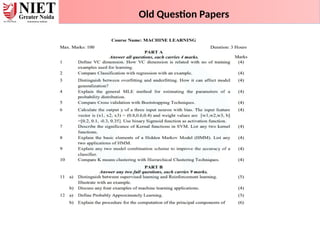
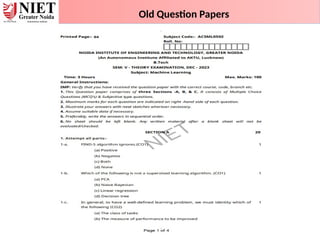
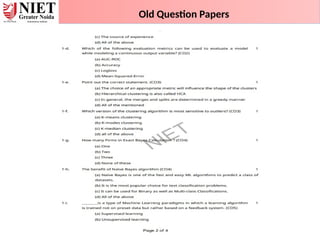
Old Question Papers
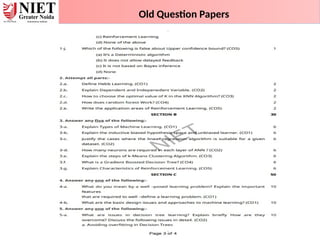
Old Question Papers
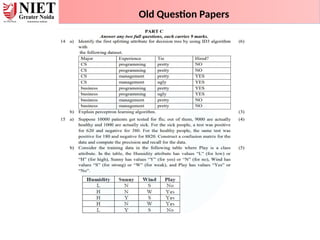
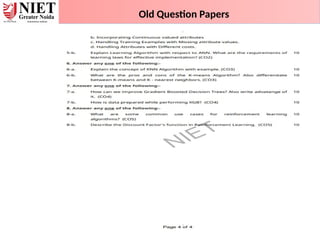
Old Question Papers
Old Question Papers
Old Question Papers
Old Question Papers
•Illustrate Find-S algorithm. [CO1]
•Describe List-Then-Eliminate algorithm. [CO1]
•Define Candidate elimination algorithm with example. [CO1]
•Briefly explain Inductive bias. [CO1]
•Describe Machine Learning with suitable examples.[CO1]
•Brief the well defined learning problems. [CO1]
•Define the process of Designing a Learning System? [CO1]
•Explain different perspective and Issues in Machine Learning. [CO1]
•Define hypotheses. [CO1]
•Analyze THE CONCEPT LEARNING TASK - General-to-specific
ordering of hypotheses? [CO1]
Expected Questions for University Exam
References
Text books:
1. Tom M. Mitchell, ―Machine Learning, McGraw-Hill Education
(India) Private Limited, 2013.
2. Ethem Alpaydin, ―Introduction to Machine Learning (Adaptive
Computation and Machine Learning), The MIT Press 2004.
3. Stephen Marsland, ―Machine Learning: An Algorithmic
Perspective, CRC Press, 2009.
4. Bishop, C., Pattern Recognition and Machine Learning. Berlin:
Springer-Verlag.
Recap of Unit
• Concept learning can be seen as a problem of searching through
a large predefined space of potential hypotheses.
• The general-to-specific partial ordering of hypotheses provides a
useful structure for organizing the search through the hypothesis
space.
• The FIND-S algorithm utilizes this general-to-specific ordering,
performing a specific-to-general search through the
hypothesis space along one branch of the partial ordering, to
find the most specific hypothesis consistent with the training
examples.

Artificial Intelligence (AI) basics.pptx

  • 1.
  • 2.
    Alka Singh AIUnit 1 Here is a list of eight examples of artificial intelligence that you're likely to come across on a daily basis. •Maps and Navigation. AI has drastically improved traveling. •Facial Detection and Recognition. •Text Editors or Autocorrect. •Search and Recommendation Algorithms. •Chatbots. •Digital Assistants. •Social Media. •E-Payments. Applications
  • 3.
    • Introduce knowledgeof historical perspective of AI and its foundations • Familiarization with principles of AI toward problem solving, inference, perception, knowledge representation, and learning. • Introduce the concepts of Searching strategies used in Artificial Intelligence. • List the objectives and functions of modern Artificial Intelligence. • Categorize an AI problem based on its characteristics and its constraints. • Learn different logic formalisms and decision taking in planning problems. • Introduce the concepts of AI agents for problem solving. Alka Singh AI Unit 1 Course Objectives
  • 4.
  • 5.
    Mapping of CourseOutcomes and Program Outcomes: S. No Course Outcome PO1 PO2 PO3 PO4 PO5 PO6 PO7 PO8 PO9 PO10 PO11 PO12 1 AMICSAI0 602.1 3 2 2 2 2 2 1 1 1 1 1 1 2 AMICSAI0 602.2 2 3 1 2 2 2 1 1 1 1 1 1 3 AMICSAI0 602.3 2 1 2 2 2 3 1 1 1 1 1 1 4 AMICSAI0 602.4 2 2 2 2 2 2 1 1 1 1 1 1 5 AMICSAI0 602.5 3 2 2 1 2 2 1 1 1 1 1 1 AVG 2.4 2 1.8 1.8 2 2.2 1 1 1 1 1 1 CO-PO Mapping
  • 6.
  • 7.
  • 8.
    • Introduce knowledgeof historical perspective of AI and its foundations • Familiarization with principles of AI toward problem solving, inference, perception, knowledge representation, and learning. • Introduce the concepts of Searching strategies used in Artificial Intelligence. • List the objectives and functions of modern Artificial Intelligence. • Categorize an AI problem based on its characteristics and its constraints. • Learn different logic formalisms and decision taking in planning problems. • Introduce the concepts of AI agents for problem solving. Alka Singh AI Unit 1 Course Objectives
  • 9.
  • 10.
  • 11.
    • To introducestudents to the basic concepts of Machine Learning. • To develop skills of implementing machine learning for solving practical problems. • To gain experience of doing independent study and research related to Machine Learning Course Objective
  • 12.
    1. Engineering knowledge: 2.Problem analysis: 3. Design/development of solutions: 4. Conduct investigations of complex problems: 5. Modern tool usage: 6. The engineer and society: 7. Environment and sustainability: 8. Ethics: 9. Individual and team work: 10. Communication: 11. Project management and finance: 12. Life-long learning Program Outcome
  • 13.
    • PEO1-Engage insuccessful professional practices in the area of Artificial Intelligence and pursue higher education and research. • PEO2-Demonstrate effective leadership and communicate as an individual and as a team in the workspace and society. • PEO3-Pursue life-long learning in developing AI-based innovative solutions for the betterment of society. Program Educational Objectives
  • 14.
    Prerequisites: • Statistics. • LinearAlgebra. • Calculus. • Probability. • Programming Languages. Prerequisite
  • 15.
    Brief Introduction toSubject https://www.youtube.com/watch?v =ukzFI9rgwfU&pp=ygUgaW50cm9kdWN0aW9uIHRvIG1hY2hpbmUgbGVhc m5pbmc%3D
  • 16.
    Topic Mapping withCourse Outcome Topics Course outcome  Learning, Types of Learning, Well defined learning problems.  Designing a Learning System.  Concept Learning  Introduction of Machine Learning Approaches –Issues in Machine Learning.  Data Science Vs Machine Learning; CO1 CO1 CO1 CO1 CO1
  • 17.
  • 18.
  • 19.
  • 20.
  • 21.
  • 22.
     INTRODUCTION –Learning,  Types of Learning,  Well defined learning problems,  Designing a Learning System,  History of ML,  Introduction of Machine Learning Approaches,  Introduction to Model Building,  Sensitivity Analysis,  Underfitting and Overfitting,  Bias and Variance,  Concept Learning Task,  Issues in Machine Learning and Data Science Vs Machine Learning. Unit 1 Content:
  • 23.
    The objective ofthe Unit 1: 1. To understand the basics of machine learning. 2. A clear concept of Learning and learning systems. 3. Brief History of ML. 4. Use of various approaches of Machine learning. 5. understand the difference between Data Science and Machine learning. Unit Objective
  • 24.
    Student will beable to understand  Learning  Types of Learning,  Well defined learning problems,  Designing a Learning System Topic Objective
  • 25.
    Top minds inmachine learning predict where AI is going in 2021 and Beyond Introduction AI is no longer poised to change the world someday; it’s changing the world now.
  • 26.
    Soumith Chintala Director, principalengineer, and creator of PyTorch • Depending on how you gauge it, PyTorch is the most popular machine learning framework in the world today. • A derivative of the Torch open source framework introduced in 2002, PyTorch became available in 2015 and is growing steadily in extensions and libraries. Introduction
  • 27.
    Soumith Chintala Director, principalengineer, and creator of PyTorch • “I actually don’t think we’ve had a groundbreaking thing … since Transformer, basically. We had ConvNets in 2012 that reached prime time, and Transformer in 2017 or something. That’s my personal opinion,” • Chintala also believes the evolution of machine learning frameworks like PyTorch and Google’s TensorFlow — the overwhelming favorites among ML practitioners today — have changed how researchers explore ideas and do their jobs. Introduction
  • 28.
    • Celeste Kidd •Developmental psychologist at the • University of California, Berkeley • Celeste Kidd is director of Kidd Lab at the University of California, Berkeley, where she and her team explore how kids learn. • “Human babies don’t get tagged data sets, yet they manage just fine, and it’s important for us to understand how that happens,” she said. • Last month, Kidd delivered the opening keynote address at the Neural Information Processing Systems (NeurIPS) conference, the largest annual AI research conference in the world. Her talk focused on how human brains hold onto stubborn beliefs, attention systems, and Bayesian statistics. Introduction
  • 29.
    • Jeff Dean •Google AI chief • Dean has led Google AI for nearly two years now, but he’s been at Google for two decades and is the architect of many of the company’s early search and distributed network algorithms and an early member of Google Brain. • Dean spoke with VentureBeat last month at NeurIPS, where he delivered talks on machine learning for ASIC semiconductor design and ways the AI community can address climate change, which he said is the most important issue of our time. In his talk about climate change, Dean discussed the idea that AI can strive to become a zero-carbon industry and that AI can be used to help change human behavior. Introduction
  • 30.
    • Anima Anandkumar •Nvidia machine learning research director • Anandkumar sees numerous challenges for the AI community in 2020, like the need to create models made especially for specific industries in tandem with domain experts. Policymakers, individuals, and the AI community will also need to grapple with issues of representation and the challenge of ensuring data sets used to train models account for different groups of people. Introduction
  • 31.
    • Dario Gil •IBM Research director • Gil heads a group of researchers actively advising the White House and enterprises around the world. He believes major leaps forward in 2019 include progress around generative models and the increasing quality with which plausible language can be generated. Introduction
  • 32.
    What is MachineLearning Introduction to Machine Learning
  • 33.
  • 34.
  • 35.
  • 36.
  • 37.
    Introduction to MachineLearning How does Machine Learning work: • A machine learning system builds prediction models, learns from previous data, and predicts the output of new data whenever it receives it. • The amount of data helps to build a better model that accurately predicts the output, which in turn affects the accuracy of the predicted output. • The Machine Learning algorithm's operation is depicted in the following block diagram:
  • 38.
    Introduction to MachineLearning Features of Machine Learning: Machine learning uses data to detect various patterns in a given dataset. •It can learn from past data and improve automatically. •It is a data-driven technology. •Machine learning is much similar to data mining as it also deals with the huge amount of the data.
  • 39.
  • 40.
  • 41.
  • 42.
  • 43.
  • 44.
  • 45.
  • 46.
  • 47.
  • 48.
    Type Of Learning Basedon the methods and way of learning, machine learning is divided into mainly four types, which are: 1.Supervised Machine Learning 2.Unsupervised Machine Learning 3.Semi-Supervised Machine Learning 4.Reinforcement Learning
  • 49.
    Type Of Learning SupervisedLearning: • Supervised machine learning is a type of machine learning where the algorithm is trained on labeled data, meaning that the data is already categorized or classified. • The goal of the algorithm is to learn from the labeled data and make predictions on new, unseen data. • In supervised learning, the algorithm is trained to map inputs to outputs based on the labeled data. • The algorithm learns to identify patterns and relationships between the inputs and outputs, and uses this knowledge to make predictions on new data.
  • 50.
    Type Of Learning Categoriesof Supervised Machine Learning Supervised machine learning can be classified into two types of problems, which are given below: •Classification •Regression
  • 51.
    Type Of Learning(Supervised Learning) a)Classification: • Classification algorithms are used to solve the classification problems in which the output variable is categorical, such as "Yes" or No, Male or Female, Red or Blue, etc. • The classification algorithms predict the categories present in the dataset. • Some real-world examples of classification algorithms are Spam Detection, Email filtering, etc. Some popular classification algorithms are given below: • Random Forest Algorithm • Decision Tree Algorithm • Logistic Regression Algorithm • Support Vector Machine Algorithm
  • 52.
    Type Of Learning(Supervised Learning) b) Regression • Regression algorithms are used to solve regression problems in which there is a linear relationship between input and output variables. • These are used to predict continuous output variables, such as market trends, weather prediction, etc. Some popular Regression algorithms are given below: •Simple Linear Regression Algorithm •Multivariate Regression Algorithm •Decision Tree Algorithm •Lasso Regression
  • 53.
    Type Of Learning(Supervised Learning) Advantages and Disadvantages of Supervised Learning Advantages: • Since supervised learning work with the labelled dataset so we can have an exact idea about the classes of objects. • These algorithms are helpful in predicting the output on the basis of prior experience. Disadvantages: • These algorithms are not able to solve complex tasks. • It may predict the wrong output if the test data is different from the training data. • It requires lots of computational time to train the algorithm.
  • 54.
    Type Of Learning(Supervised Learning) Applications of Supervised Learning: •Image Segmentation: In this process, image classification is performed on different image data with pre-defined labels. •Medical Diagnosis: It is done by using medical images and past labelled data with labels for disease conditions. With such a process, the machine can identify a disease for the new patients. •Fraud Detection - Supervised Learning classification algorithms are used for identifying fraud transactions, fraud customers, etc. It is done by using historic data to identify the patterns that can lead to possible fraud. •Spam detection - In spam detection & filtering, classification algorithms are used. These algorithms classify an email as spam or not spam. The spam emails are sent to the spam folder. •Speech Recognition - Supervised learning algorithms are also used in speech recognition. The algorithm is trained with voice data, and various identifications can be done using the same, such as voice-activated passwords, voice commands, etc.
  • 55.
    Type Of Learning(Unsupervised Learning) 2. Unsupervised Machine Learning • Unsupervised learning is different from the Supervised learning technique; as its name suggests, there is no need for supervision. • It means, in unsupervised machine learning, the machine is trained using the unlabeled dataset, and the machine predicts the output without any supervision. • In unsupervised learning, the models are trained with the data that is neither classified nor labelled, and the model acts on that data without any supervision. • The main aim of the unsupervised learning algorithm is to group or categories the unsorted dataset according to the similarities, patterns, and differences. • Machines are instructed to find the hidden patterns from the input dataset.
  • 56.
    Type Of Learning(Unsupervised Learning) Categories of Unsupervised Machine Learning Unsupervised Learning can be further classified into two types, which are given below: •Clustering •Association
  • 57.
    Type Of Learning(Unsupervised Learning) 1) Clustering • The clustering technique is used when we want to find the inherent groups from the data. • It is a way to group the objects into a cluster such that the objects with the most similarities remain in one group and have fewer or no similarities with the objects of other groups. • An example of the clustering algorithm is grouping the customers by their purchasing behaviour. Some of the popular clustering algorithms are given below: • K-Means Clustering algorithm • Mean-shift algorithm • DBSCAN Algorithm • Principal Component Analysis • Independent Component Analysis
  • 58.
    Type Of Learning(Unsupervised Learning) 2) Association: • Association rule learning is an unsupervised learning technique, which finds interesting relations among variables within a large dataset. • The main aim of this learning algorithm is to find the dependency of one data item on another data item and map those variables accordingly so that it can generate maximum profit. • This algorithm is mainly applied in Market Basket analysis, Web usage mining, continuous production, etc. Some popular algorithms of Association rule learning are Apriori Algorithm, Eclat, FP-growth algorithm.
  • 59.
    Type Of Learning(Unsupervised Learning) Advantages and Disadvantages of Unsupervised Learning Algorithm Advantages: • These algorithms can be used for complicated tasks compared to the supervised ones because these algorithms work on the unlabeled dataset. • Unsupervised algorithms are preferable for various tasks as getting the unlabeled dataset is easier as compared to the labelled dataset. Disadvantages: • The output of an unsupervised algorithm can be less accurate as the dataset is not labelled, and algorithms are not trained with the exact output in prior. • Working with Unsupervised learning is more difficult as it works with the unlabelled dataset that does not map with the output.
  • 60.
    Type Of Learning(Unsupervised Learning) Applications of Unsupervised Learning: •Network Analysis: Unsupervised learning is used for identifying plagiarism and copyright in document network analysis of text data for scholarly articles. •Recommendation Systems: Recommendation systems widely use unsupervised learning techniques for building recommendation applications for different web applications and e-commerce websites. •Anomaly Detection: Anomaly detection is a popular application of unsupervised learning, which can identify unusual data points within the dataset. It is used to discover fraudulent transactions. •Singular Value Decomposition: Singular Value Decomposition or SVD is used to extract particular information from the database. For example, extracting information of each user located at a particular location.
  • 61.
    Type Of Learning(Semi-supervised Learning) Semi-Supervised Learning • Semi-Supervised learning is a type of Machine Learning algorithm that lies between Supervised and Unsupervised machine learning. • It represents the intermediate ground between Supervised (With Labelled training data) and Unsupervised learning (with no labelled training data) algorithms and uses the combination of labelled and unlabeled datasets during the training period. • Although Semi-supervised learning is the middle ground between supervised and unsupervised learning and operates on the data that consists of a few labels, it mostly consists of unlabeled data. • As labels are costly, but for corporate purposes, they may have few labels. • It is completely different from supervised and unsupervised learning as they are based on the presence & absence of labels.
  • 62.
    Type Of Learning(Semi-supervised Learning) • To overcome the drawbacks of supervised learning and unsupervised learning algorithms, the concept of Semi-supervised learning is introduced. • The main aim of semi-supervised learning is to effectively use all the available data, rather than only labelled data like in supervised learning. • Initially, similar data is clustered along with an unsupervised learning algorithm, and further, it helps to label the unlabeled data into labelled data. • It is because labelled data is a comparatively more expensive acquisition than unlabeled data.
  • 63.
    Type Of Learning(Semi-supervised Learning) Advantages and disadvantages of Semi-supervised Learning: Advantages: • It is simple and easy to understand the algorithm. • It is highly efficient. • It is used to solve drawbacks of Supervised and Unsupervised Learning algorithms. Disadvantages: • Iterations results may not be stable. • We cannot apply these algorithms to network-level data. • Accuracy is low.
  • 64.
    Type Of Learning(Reinforcement Learning) 4. Reinforcement Learning: • Reinforcement learning works on a feedback-based process, in which an AI agent (A software component) automatically explore its surrounding by hitting & trail, taking action, learning from experiences, and improving its performance. • Agent gets rewarded for each good action and get punished for each bad action; hence the goal of reinforcement learning agent is to maximize the rewards. • In reinforcement learning, there is no labelled data like supervised learning, and agents learn from their experiences only.
  • 65.
    Type Of Learning(Reinforcement Learning) • The reinforcement learning process is similar to a human being; for example, a child learns various things by experiences in his day-to-day life. • An example of reinforcement learning is to play a game, where the Game is the environment, moves of an agent at each step define states, and the goal of the agent is to get a high score. Agent receives feedback in terms of punishment and rewards. • Due to its way of working, reinforcement learning is employed in different fields such as Game theory, Operation Research, Information theory, multi-agent systems. • A reinforcement learning problem can be formalized using Markov Decision Process(MDP). • In MDP, the agent constantly interacts with the environment and performs actions; at each action, the environment responds and generates a new state.
  • 66.
    Type Of Learning(Reinforcement Learning) Categories of Reinforcement Learning: Reinforcement learning is categorized mainly into two types of methods/algorithms: •Positive Reinforcement Learning: Positive reinforcement learning specifies increasing the tendency that the required behaviour would occur again by adding something. It enhances the strength of the behaviour of the agent and positively impacts it. •Negative Reinforcement Learning: Negative reinforcement learning works exactly opposite to the positive RL. It increases the tendency that the specific behaviour would occur again by avoiding the negative condition.
  • 67.
    Type Of Learning(Reinforcement Learning) Real-world Use cases of Reinforcement Learning •Video Games: RL algorithms are much popular in gaming applications. It is used to gain super-human performance. Some popular games that use RL algorithms are AlphaGO and AlphaGO Zero. •Resource Management: The "Resource Management with Deep Reinforcement Learning" paper showed that how to use RL in computer to automatically learn and schedule resources to wait for different jobs in order to minimize average job slowdown. •Robotics: RL is widely being used in Robotics applications. Robots are used in the industrial and manufacturing area, and these robots are made more powerful with reinforcement learning. There are different industries that have their vision of building intelligent robots using AI and Machine learning technology. •Text Mining Text-mining, one of the great applications of NLP, is now being implemented with the help of Reinforcement Learning by Salesforce company.
  • 68.
    Type Of Learning(Reinforcement Learning) Advantages and Disadvantages of Reinforcement Learning: Advantages • It helps in solving complex real-world problems which are difficult to be solved by general techniques. • The learning model of RL is similar to the learning of human beings; hence most accurate results can be found. • Helps in achieving long term results. Disadvantage • RL algorithms are not preferred for simple problems. • RL algorithms require huge data and computations. • Too much reinforcement learning can lead to an overload of states which can weaken the results.
  • 69.
    • Self-supervised learningis a machine learning process where the model trains itself to learn one part of the input from another part of the input. It is also known as predictive or pretext learning. • In this process, the unsupervised problem is transformed into a supervised problem by auto-generating the labels. To make use of the huge quantity of unlabeled data, it is crucial to set the right learning objectives to get supervision from the data itself. • The process of the self-supervised learning method is to identify any hidden part of the input from any unhidden part of the input. Type Of Learning (Self Supervised Learning)
  • 70.
    Type Of Learning(Self Supervised Learning)
  • 71.
    Example: Teaching aModel to Understand Images Let’s say we want to train a model to recognize objects in images without manually labeling them. 🔹 Step 1: Create a Pretext Task • A pretext task is like a puzzle that forces the model to learn useful patterns. • ✅ Example Task: Jigsaw Puzzle with Images • We take an image of a cat . 🐱 • We cut it into pieces and shuffle the parts. • The model is trained to rearrange the pieces correctly. • By solving this puzzle, the model learns the shapes, colors, and structure of objects, even though we never explicitly told it, “This is a cat.” Type Of Learning (Self Supervised Learning)
  • 72.
    Example: Learning Language(Like GPT or BERT) ✅ Example Task: Guess the Missing Word • Given the sentence: "The cat is sitting on the ___." • The model must guess the missing word (e.g., "mat"). • It learns language structure, grammar, and meaning without labels. • After training, the model can understand and generate text just like humans! Type Of Learning (Self Supervised Learning)
  • 73.
    Self Supervised Learningcame into existence because of the following issues persistent in other learning procedures: • High cost: Labeled data is required by most learning methods. The cost of good quality labelled data is very high in terms of time and money. • Lengthy lifecycle: The data preparation lifecycle is a lengthy process in developing ML models. It requires cleaning, filtering, annotating, reviewing, and restructuring according to the training framework. • Generic AI: The self-supervised learning framework is one step closer to embedding human cognition in machines. Type Of Learning (Self Supervised Learning)
  • 74.
    Transfer learning isa machine learning technique where a model trained on one task is repurposed as the foundation for a second task. This approach is beneficial when the second task is related to the first or when data for the second task is limited. Type Of Learning (Transfer Learning)
  • 75.
    Why is TransferLearning Important? 1.Limited Data: Acquiring extensive labeled data is often challenging and costly. Transfer learning enables us to use pre-trained models, reducing the dependency on large datasets. 2.Enhanced Performance: Starting with a pre-trained model, which has already learned from substantial data, allows for faster and more accurate results on new tasks—ideal for applications needing high accuracy and efficiency. 3.Time and Cost Efficiency: Transfer learning shortens training time and conserves resources by utilizing existing models, eliminating the need for training from scratch. 4.Adaptability: Models trained on one task can be fine-tuned for related tasks, making transfer learning versatile for various applications, from image recognition to natural language processing. Type Of Learning (Transfer Learning)
  • 76.
    How Does TransferLearning Work? Transfer learning involves a structured process to leverage existing knowledge from a pre-trained model for new tasks: 1.Pre-trained Model: Start with a model already trained on a large dataset for a specific task. This pre-trained model has learned general features and patterns that are relevant across related tasks. 2.Base Model: This pre-trained model, known as the base model, includes layers that have processed data to learn hierarchical representations, capturing low-level to complex features. 3.Transfer Layers: Identify layers within the base model that hold generic information applicable to both the original and new tasks. These layers, often near the top of the network, capture broad, reusable features. Type Of Learning (Transfer Learning)
  • 77.
    4. Fine-tuning: Fine-tunethese selected layers with data from the new task. This process helps retain the pre-trained knowledge while adjusting parameters to meet the specific requirements of the new task, improving accuracy and adaptability. Type Of Learning (Transfer Learning)
  • 78.
    Well Defined LearningProblems Well Posed Learning Problem – A computer program is said to learn from experience E in context to some task T and some performance measure P, if its performance on T, as was measured by P, upgrades with experience E. Any problem can be segregated as well-posed learning problem if it has three traits – •Task •Performance Measure •Experience Certain examples that efficiently defines the well-posed learning problem are – 1. To better filter emails as spam or not •Task – Classifying emails as spam or not •Performance Measure – The fraction of emails accurately classified as spam or not spam •Experience – Observing you label emails as spam or not spam
  • 79.
    Well Defined LearningProblems 2. A checkers learning problem •Task – Playing checkers game •Performance Measure – percent of games won against opposer •Experience – playing implementation games against itself 3. Handwriting Recognition Problem •Task – Acknowledging handwritten words within portrayal •Performance Measure – percent of words accurately classified •Experience – a directory of handwritten words with given classifications 4. A Robot Driving Problem •Task – driving on public four-lane highways using sight scanners •Performance Measure – average distance progressed before a fallacy •Experience – order of images and steering instructions noted down while observing a human driver 5. Fruit Prediction Problem •Task – forecasting different fruits for recognition •Performance Measure – able to predict maximum variety of fruits •Experience – training machine with the largest datasets of fruits images
  • 80.
    Designing a LearningSystem Designing a Learning System in Machine Learning : • According to Tom Mitchell, “A computer program is said to be learning from experience (E), with respect to some task (T). • Thus, the performance measure (P) is the performance at task T, which is measured by P, and it improves with experience E.” Example: In Spam E-Mail detection, • Task, T: To classify mails into Spam or Not Spam. • Performance measure, P: Total percent of mails being correctly classified as being “Spam” or “Not Spam”. • Experience, E: Set of Mails with label “Spam”
  • 81.
    Designing a LearningSystem Steps for Designing Learning System are:
  • 82.
    Designing a LearningSystem Step 1) Choosing the Training Experience: The very important and first task is to choose the training data or training experience which will be fed to the Machine Learning Algorithm. It is important to note that the data or experience that we fed to the algorithm must have a significant impact on the Success or Failure of the Model. So Training data or experience should be chosen wisely. Step 2- Choosing target function: The next important step is choosing the target function. It means according to the knowledge fed to the algorithm the machine learning will choose NextMove function which will describe what type of legal moves should be taken. For example : While playing chess with the opponent, when opponent will play then the machine learning algorithm will decide what be the number of possible legal moves taken in order to get success.
  • 83.
    Designing a LearningSystem Step 3- Choosing Representation for Target function: When the machine algorithm will know all the possible legal moves the next step is to choose the optimized move using any representation i.e. using linear Equations, Hierarchical Graph Representation, Tabular form etc. The NextMove function will move the Target move like out of these move which will provide more success rate. For Example : while playing chess machine have 4 possible moves, so the machine will choose that optimized move which will provide success to it. Step 4- Choosing Function Approximation Algorithm: An optimized move cannot be chosen just with the training data. The training data had to go through with set of example and through these examples the training data will approximates which steps are chosen and after that machine will provide feedback on it. For Example : When a training data of Playing chess is fed to algorithm so at that time it is not machine algorithm will fail or get success and again from that failure or success it will measure while next move what step should be chosen and what is its success rate.
  • 84.
    Designing a LearningSystem Step 5- Final Design: The final design is created at last when system goes from number of examples , failures and success , correct and incorrect decision and what will be the next step etc. Example: DeepBlue is an intelligent computer which is ML-based won chess game against the chess expert Garry Kasparov, and it became the first computer which had beaten a human chess expert.
  • 85.
    History of MachineLearning (CO1)
  • 86.
    • The earlyhistory of Machine Learning (Pre-1940): • 1834: In 1834, Charles Babbage, the father of the computer, conceived a device that could be programmed with punch cards. However, the machine was never built, but all modern computers rely on its logical structure. • 1936: In 1936, Alan Turing gave a theory that how a machine can determine and execute a set of instructions. • The era of stored program computers: • 1940: In 1940, the first manually operated computer, "ENIAC" was invented, which was the first electronic general-purpose computer. After that stored program computer such as EDSAC in 1949 and EDVAC in 1951 were invented. • 1943: In 1943, a human neural network was modeled with an electrical circuit. In 1950, the scientists started applying their idea to work and analyzed how human neurons might work. History of Machine Learning (CO1)
  • 87.
    • Computer machineryand intelligence: • 1950: In 1950, Alan Turing published a seminal paper, "Computer Machinery and Intelligence," on the topic of artificial intelligence. In his paper, he asked, "Can machines think?" • Machine intelligence in Games: • 1952: Arthur Samuel, who was the pioneer of machine learning, created a program that helped an IBM computer to play a checkers game. It performed better more it played. • 1959: In 1959, the term "Machine Learning" was first coined by Arthur Samuel. • The first "AI" winter: • The duration of 1974 to 1980 was the tough time for AI and ML researchers, and this duration was called as AI winter. • In this duration, failure of machine translation occurred, and people had reduced their interest from AI, which led to reduced funding by the government to the researches. History of Machine Learning (CO1)
  • 88.
    • Machine Learningfrom theory to reality • 1959: In 1959, the first neural network was applied to a real- world problem to remove echoes over phone lines using an adaptive filter. • 1985: In 1985, Terry Sejnowski and Charles Rosenberg invented a neural network NETtalk, which was able to teach itself how to correctly pronounce 20,000 words in one week. • 1997: The IBM's Deep blue intelligent computer won the chess game against the chess expert Garry Kasparov, and it became the first computer which had beaten a human chess expert. History of Machine Learning (CO1)
  • 89.
    • Machine Learningat 21st century • 2006: In the year 2006, computer scientist Geoffrey Hinton has given a new name to neural net research as "deep learning," and nowadays, it has become one of the most trending technologies. • 2012: In 2012, Google created a deep neural network which learned to recognize the image of humans and cats in YouTube videos. • 2014: In 2014, the Chabot "Eugen Goostman" cleared the Turing Test. It was the first Chabot who convinced the 33% of human judges that it was not a machine. • 2014: DeepFace was a deep neural network created by Facebook, and they claimed that it could recognize a person with the same precision as a human can do. • 2016: AlphaGo beat the world's number second player Lee sedol at Go game. In 2017 it beat the number one player of this game Ke Jie. • 2017: In 2017, the Alphabet's Jigsaw team built an intelligent system that was able to learn the online trolling. It used to read millions of comments of different websites to learn to stop online trolling. History of Machine Learning (CO1)
  • 90.
    • Machine Learningat present: • Now machine learning has got a great advancement in its research, and it is present everywhere around us, such as self-driving cars, Amazon Alexa, Catboats, recommender system, and many more. It includes Supervised, unsupervised, and reinforcement learning with clustering, classification, decision tree, SVM algorithms, etc. • Modern machine learning models can be used for making various predictions, including weather prediction, disease prediction, stock market analysis, etc. History of Machine Learning (CO1)
  • 91.
    A Neural Network •A neural network is a processing device, either an algorithm or an actual hardware, whose design was inspired by the design and functioning of animal brains and components thereof. • The neural networks have ability to learn by example, which makes them very flexible and powerful. • These networks are also well suited for real-time systems because of their fast response and computational times which are because of their parallel architecture. Introduction of Machine Learning Approaches
  • 92.
    Artificial Neural Network:Definition: • An artificial neural network (ANN) may be defined as an information processing model that is inspired by the way biological nervous systems, such as the brain, process information. • This model tries to replicate only the most basic functions of the brain. • The key element of ANN is the novel structure of its information processing system. • An ANN is composed of a large number of highly interconnected processing elements (neurons) working in unison to solve specific problems. • Artificial neural networks, like people, learn by example. Introduction of Machine Learning Approaches
  • 93.
    Advantages of NeuralNetworks: • Adaptive learning: An ANN is endowed with the ability to learn how to do tasks based on the data given for training or initial experience. • Self-organization: An ANN can create its own organization or representation of the information it receives during learning time. • Real-time operation: ANN computations may be carried out in parallel. Special hardware devices are being designed and manufactured to rake advantage of this capability of ANNs. • Fault tolerance via redundant information coding: Partial destruction of a neural network leads to the corresponding degradation of performance. However, some network capabilities may be retrained even after major network damage. Introduction of Machine Learning Approaches
  • 94.
    Introduction of MachineLearning Approaches
  • 95.
    Application Scope ofNeural Networks: • Air traffic control. • Animal behavior, predator/prey relationships and population cycles. • Appraisal and valuation of property, buildings, automobiles, machinery, etc. • Betting on horse races, stock markets, sporting events, etc. • Criminal sentencing could be predicted using a large sample of crime details as input and the resulting sentence as output. • Complex physical and chemical processes that may involve the interaction of numerous (possibly unknown) mathematical formulas could be modeled heuristically using a neural network. • Echo patterns from sonar, radar, seismic and magnetic instruments could be used to predict their targets. Introduction of Machine Learning Approaches
  • 96.
    • An artificialneural network (ANN) is an efficient information processing system which resembles in characteristics with a biological neural network. • ANNs possess large number of highly interconnected processing elements called nodes or units or neuron, which usually operate in parallel and are configured in regular architectures. • Each neuron is connected with the other by a connection link. • Each connection link is associated with weights which contain information about input signals. • This information is used by the neuron to solve a particular problem. Neural Networks
  • 97.
    • To depictthe basic operation of a neural net, consider a set of neurons, say X1 and X2, transmitting signals to another neuron, Y. • Here X1 and X2 are input neurons, which transmit signals, and Y is the output neuron, which receives signals. • Input neurons X1 and X2 are connected to the output neuron Y, over a weighted interconnection links (W1 and W2). Activation Function Neural Networks
  • 98.
    • A nervecell neuron is a special biological cell that processes information. • According to an estimation, there are huge number of neurons, approximately 1011 with numerous interconnections, approximately 1015 . Biological Neural Networks
  • 99.
    • The centralnervous system (which includes the brain and spinal cord) is made up of two basic types of cells: • neurons and glia. • Glia outnumber neurons in some parts of the brain, but neurons are the key players in the brain. • Neurons are information messengers. • They use electrical impulses and chemical signals to transmit information between different areas of the brain, and between the brain and the rest of the nervous system. • Everything we think and feel and do would be impossible without the work of neurons and their support cells, the glial cells called astrocytes and oligodendrocytes . Biological Neural Networks
  • 100.
    • The Architectureof Neuron Biological Neural Networks
  • 101.
    • Neurons havethree basic parts: a cell body and two extensions called an axon and a dendrite. • Within the cell body is a nucleus, which controls the cell’s activities and contains the cell’s genetic material. • The axon looks like a long tail and transmits messages from the cell. • Dendrites look like the branches of a tree and receive messages for the cell. • Neurons communicate with each other by sending chemicals, called neurotransmitters, across a tiny space, called a synapse, between the axons and dendrites of adjacent neurons. Biological Neural Networks
  • 102.
    There are threeclasses of neurons: 1.Sensory neurons carry information from the sense organs (such as the eyes and ears) to the brain. 2.Motor neurons control voluntary muscle activity such as speaking and carry messages from nerve cells in the brain to the muscles. 3.All the other neurons are called interneurons. Biological Neural Networks
  • 103.
    As shown inthe above diagram, a typical neuron consists of the following four parts with the help of which we can explain its working − • Dendrites − They are tree-like branches, responsible for receiving the information from other neurons it is connected to. In other sense, we can say that they are like the ears of neuron. • Soma − It is the cell body of the neuron and is responsible for processing of information, they have received from dendrites. • Axon − It is just like a cable through which neurons send the information. • Synapses − It is the connection between the axon and other neuron dendrites. Biological Neural Networks
  • 104.
  • 105.
    Biological Neural NetworkArtificial Neural Network Soma Node Dendrites Input Synapse Weights or Interconnections Axon Output Biological Neural Networks
  • 106.
  • 107.
  • 108.
  • 109.
  • 110.
    Characteristics of ANN: •It is a neutrally implemented mathematical model. • There exists a large number of highly interconnected processing elements called neurons in an ANN. • The interconnections with their weighted linkages hold the informative knowledge. • The input signals arrive at the processing elements through connections and connecting weights. • The processing elements of the ANN have the ability to learn, recall and generalize from the given data by suitable assignment or adjustment of weights. • The computational power can be demonstrated only by the collective behavior of neurons, and it should be noted that no single neuron carries specific information. Model of ANN
  • 111.
    Underfitting and Overfitting Underfitting •Underfitting occurs when a machine learning model is too simple to capture the underlying pattern of the data. • It means the model has poor performance on both the training data and the test data. Characteristics: • High bias. • Low variance. • High training error. • High validation/test erro • e training data and the test data.
  • 112.
    Underfitting and Overfitting CausesOf Underfitting • The model is too simple (e.g., a linear model for non-linear data). • Insufficient training (not enough epochs for neural networks). • Incorrect features or lack of feature engineering. Example: Using a linear regression model to fit data that has a quadratic relationship. Solution: • Increase model complexity (e.g., use a more complex model or add more features). • Improve feature engineering. • Reduce regularization (if applied too strongly).
  • 113.
    Underfitting and Overfitting Overfitting Definition: •Overfitting occurs when a machine learning model is too complex and captures the noise along with the underlying pattern in the data. • It means the model performs very well on the training data but poorly on the test data. Characteristics: • Low bias. • High variance. • Low training error. • High validation/test error.
  • 114.
    Underfitting and Overfitting CausesOf Overfitting: • The model is too complex (e.g., too many parameters, too deep neural network). • Training for too many epochs. • Too few training examples relative to the model complexity. Example: Using a high-degree polynomial regression model to fit data that has a linear relationship. Solution: • Reduce model complexity (e.g., use fewer parameters or simpler model). • Increase the amount of training data. • Use regularization techniques (e.g., L1 or L2 regularization). • Apply cross-validation to tune model parameters.
  • 115.
    Underfitting and Overfitting •Underfitting: Increase model complexity. • Overfitting: Reduce model complexity and use regularization techniques. • Goal: Achieve a balance between bias and variance to ensure the model generalizes well to unseen data.
  • 116.
    1️ 1️ ⃣ Features (Inputs)📊 Definition: Features are the input variables (independent variables) used to make predictions. Example: • If predicting house prices 🏡: • Features = Number of bedrooms, square footage, location, etc. • If classifying emails as spam 📧: • Features = Number of links, presence of certain words, etc. 👉 Think of features as ingredients in a recipe—each one contributes to the final outcome! Basic Machine Learning Concepts & Terminology
  • 117.
    Labels (Outputs) 🎯 2️ ⃣ Definition:The actual target (dependent variable) we want to predict. Example: • For house price prediction: • Label = Actual price of the house ($500,000) • For spam classification: • Label = "Spam" or "Not Spam" 👉 If features are ingredients, the label is the dish we want to cook! Basic Machine Learning Concepts & Terminology
  • 118.
    Training Data 3️⃣ 🏋️ Definition:The dataset used to train the model. It contains both features and labels so the model can learn patterns. • Example: If training a model to recognize cats vs. dogs: • Images of cats & dogs (features) + Their correct labels ("cat" or "dog") 👉 Think of it like practicing before an exam! 📚 Basic Machine Learning Concepts & Terminology
  • 119.
    Loss Function ❌ 5️⃣ Definition:A function that measures how far off the model’s prediction is from the actual label. The goal is to minimize this error. • Example: • Suppose the model predicts a house price of $480,000, but the actual price is $500,000. • The loss function calculates the error (e.g., mean squared error). 👉 The lower the loss, the better the model! Basic Machine Learning Concepts & Terminology
  • 120.
    Optimization Algorithm ⚡ 6️6 ️ 6 ️ 6 ️ 6 ️ 6 ️ 6 ️ 6 ️ 6 ️ 6 ️ 6 ️ 6 ️ 6 ️ 6 ️ 6️ Definition: A method that updates the model to reduce the loss and improve accuracy. • ✅ Popular Optimization Algorithms: • Gradient Descent: Adjusts weights to minimize loss. • Adam Optimizer: A faster and smarter version of gradient descent. 👉 Think of optimization like adjusting your study methods to improve exam scores! Example: Gradient Descent, SGD, ADAM, Momentum Basic Machine Learning Concepts & Terminology
  • 121.
    Term Meaning Example FeatureInput variables Age, size of house, email content Label Output to predict House price, spam or not Training Data Data used to train the model Photos of cats/dogs with labels Validation Data Data used to check the model Separate images for testing during training Loss Function Measures prediction error Difference between predicted & actual price Optimization Algorithm Helps minimize loss Gradient Descent, Adam Basic Machine Learning Concepts & Terminology
  • 122.
    Bias And Variance Errorsin Machine Learning? In machine learning, an error is a measure of how accurately an algorithm can make predictions for the previously unknown dataset. On the basis of these errors, the machine learning model is selected that can perform best on the particular dataset. There are mainly two types of errors in machine learning, which are: Reducible errors: These errors can be reduced to improve the model accuracy. Such errors can further be classified into bias and Variance. •Irreducible errors: These errors will always be present in the model regardless of which algorithm has been used. The cause of these errors is unknown variables whose value can't be reduced.
  • 123.
    Bias And Variance •Bias refers to the error introduced by approximating a real-world problem, which may be complex, by a much simpler model. • In machine learning, bias is an error due to overly simplistic assumptions in the learning algorithm. Low Bias: A low bias model will make fewer assumptions about the form of the target function. High Bias: A model with a high bias makes more assumptions, and the model becomes unable to capture the important features of our dataset. A high bias model also cannot perform well on new data.
  • 124.
    Bias And Variance Characteristicsof High Bias: • High bias models tend to be too simple. • They fail to capture the complexity of the underlying data. • Result in high training error and high validation/test error, leading to underfitting.
  • 125.
    Bias And Variance Waysto reduce High Bias: • High bias mainly occurs due to a much simple model. Below are some ways to reduce the high bias: • Increase the input features as the model is underfitted. • Decrease the regularization term. • Use more complex models, such as including some polynomial features.
  • 126.
    Bias And Variance •The variance would specify the amount of variation in the prediction if the different training data was used. • In simple words, variance tells that how much a random variable is different from its expected value. • Variance errors are either of low variance or high variance. • Low variance means there is a small variation in the prediction of the target function with changes in the training data set. • ,High variance shows a large variation in the prediction of the target function with changes in the training dataset.
  • 127.
    Bias And Variance Waysto Reduce High Variance: • Reduce the input features or number of parameters as a model is overfitted. • Do not use a much complex model. • Increase the training data. • Increase the Regularization term.
  • 128.
    Bias And Variance DifferentCombinations of Bias-Variance There are four possible combinations of bias and variances, which are represented by the below diagram:
  • 129.
    Bias And Variance 1.Low-Bias,Low-Variance: The combination of low bias and low variance shows an ideal machine learning model. However, it is not possible practically. 2.Low-Bias, High-Variance: With low bias and high variance, model predictions are inconsistent and accurate on average. This case occurs when the model learns with a large number of parameters and hence leads to an overfitting 3.High-Bias, Low-Variance: With High bias and low variance, predictions are consistent but inaccurate on average. This case occurs when a model does not learn well with the training dataset or uses few numbers of the parameter. It leads to underfitting problems in the model. 4.High-Bias, High-Variance: With high bias and high variance, predictions are inconsistent and also inaccurate on average.
  • 130.
    Bias And Variance Bias-VarianceTrade-Off • While building the machine learning model, it is really important to take care of bias and variance in order to avoid overfitting and underfitting in the model. • If the model is very simple with fewer parameters, it may have low variance and high bias. Whereas, if the model has a large number of parameters, it will have high variance and low bias. • So, it is required to make a balance between bias and variance errors, and this balance between the bias error and variance error is known as the Bias- Variance trade-off.
  • 131.
    Bias And Variance Foran accurate prediction of the model, algorithms need a low variance and low bias. But this is not possible because bias and variance are related to each other: • If we decrease the variance, it will increase the bias. • If we decrease the bias, it will increase the variance.
  • 132.
    Inductive Bias • Inductivebias can be defined as the set of assumptions or biases that a learning algorithm employs to make predictions on unseen data based on its training data. • These assumptions are inherent in the algorithm’s design and serve as a foundation for learning and generalization. • The inductive bias of an algorithm influences how it selects a hypothesis (a possible explanation or model) from the hypothesis space (the set of all possible hypotheses) that best fits the training data. • It helps the algorithm navigate the trade-off between fitting the training data perfectly (overfitting) and generalizing well to unseen data (underfitting).
  • 133.
    Issues in MachineLearning Although machine learning is being used in every industry and helps organizations make more informed and data-driven choices that are more effective than classical methodologies, it still has so many problems that cannot be ignored. Here are some common issues in Machine Learning that professionals face to inculcate ML skills and create an application from scratch. 1. Inadequate Training Data: The major issue that comes while using machine learning algorithms is the lack of quality as well as quantity of data. Data quality can be affected by some factors as follows: • Noisy Data- It is responsible for an inaccurate prediction that affects the decision as well as accuracy in classification tasks. • Incorrect data- It is also responsible for faulty programming and results obtained in machine learning models. Hence, incorrect data may affect the accuracy of the results also. • Generalizing of output data- Sometimes, it is also found that generalizing output data becomes complex, which results in comparatively poor future actions.
  • 134.
    Issues in MachineLearning 2. Poor quality of data: Noisy data, incomplete data, inaccurate data, and unclean data lead to less accuracy in classification and low-quality results. Data quality can also be considered as a major common problem while processing machine learning algorithms. 3. Overfitting & Underfitting : Models perform well on training data but poorly on new data(Overfittng). Models are too simple and fail to capture underlying patterns(underfitting). Methods to reduce overfitting: • Increase training data in a dataset. • Reduce model complexity by simplifying the model by selecting one with fewer parameters • Ridge Regularization and Lasso Regularization • Early stopping during the training phase • Reduce the noise • Reduce the number of attributes in training data. • Constraining the model.
  • 135.
    Issues in MachineLearning Methods to reduce Underfitting: • Increase model complexity • Remove noise from the data • Trained on increased and better features • Reduce the constraints • Increase the number of epochs to get better results. 4. Bias-Variance Tradeoff: Balancing model complexity and generalization. Methods to remove Data Bias: • Research more for customer segmentation. • Be aware of your general use cases and potential outliers. • Combine inputs from multiple sources to ensure data diversity. • Include bias testing in the development process. • Analyze data regularly and keep tracking errors to resolve them easily. • Review the collected and annotated data. • Use multi-pass annotation such as sentiment analysis, content moderation, and intent recognition
  • 136.
    Issues in MachineLearning 5. Feature Engineering: Selecting and transforming relevant features. 6. Hyperparameter Tuning: Finding optimal model parameters. 7. Model Interpretability: Understanding model decisions and explanations. 8. Class Imbalance: Dealing with unequal class distributions. 9. Adversarial Attacks: Protecting models from intentional data manipulation. 10. Ethics and Fairness: Ensuring models are unbiased and ethical.
  • 137.
    Data Science Vs.Machine Learning and AI Artificial Intelligence Machine Learning Data Science Includes Machine Learning. Subset of Artificial Intelligence. Includes various Data Operations. Artificial Intelligence combines large amounts of data through iterative processing and intelligent algorithms to help computers learn automatically. Machine Learning uses efficient programs that can use data without being explicitly told to do so. Data Science works by sourcing, cleaning, and processing data to extract meaning out of it for analytical purposes. Some of the popular tools that AI uses are- 1. TensorFlow2. Scikit Learn 3. Keras The popular tools that Machine Learning makes use of are-1. Amazon Lex2. IBM Watson Studio3. Microsoft Azure ML Studio Some of the popular tools used by Data Science are-1. SAS2. Tableau3. Apache Spark4. MATLAB Artificial Intelligence uses logic and decision trees. Machine Learning uses statistical models. Data Science deals with structured and unstructured data. Chatbots, and Voice assistants are popular applications of AI. Recommendation Systems such as Spotify, and Facial Recognition are popular examples. Fraud Detection and Healthcare analysis are popular examples of Data Science.
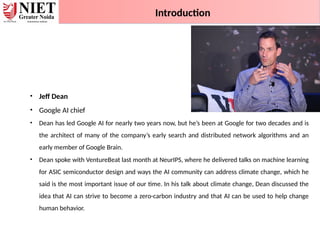
  • 138.
    1. Define MachineLearning. Discuss with examples why machine learning is important. 1. Discuss with examples some useful applications of machine learning. 2. Explain how some areas/disciplines that influenced the machine learning. 3. What do you mean by a well–posed learning problem? Explain the important features that are required to well–define a learning problem. 4. Define learning program for a given problem. Describe the following problems with respect to Tasks, Performance and Experience: a. Checkers Learning Problems b. Handwritten Recognition Problem c. Robot Driving Learning Problem 6. Describe in detail all the steps involved in designing a learning system. 7. Discuss the perspective and issues in machine learning. • NOTE: All Students have to write this assignment in separate note book. Assignment 1:
  • 139.
    1. What isArtificial Neural Network? 2. What are the type of problems in which Artificial Neural Network can be applied? 3. What is difference between BNN and ANN ? 4. Explain the k-Means Algorithm with an example. 5. What is Reinforcement Learning? Explain with the help of example. 6. Explain Bayesian networks with the help of Examples. 7. Explain Support Vector Machine in details. Describe their importance. 8. Explain Genetic Algorithms in details. Assignment 2:
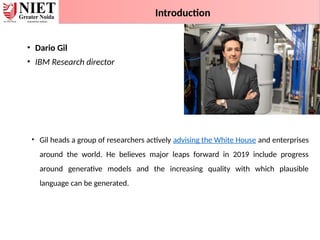
  • 140.
    1. What isthe main task of a problem-solving agent? a) Solve the given problem and reach to goal b) To find out which sequence of action will get it to the goal state c) All of the mentioned d) None of the mentioned 2. What is state space? a) The whole problem b) Your Definition to a problem c) Problem you design d) Representing your problem with variable and parameter Daily Quiz
  • 141.
    3. The problem-solvingagent with several immediate options of unknown value can decide what to do by just examining different possible sequences of actions that lead to states of known value, and then choosing the best sequence. This process of looking for such a sequence is called Search. a) True b) False 4. A search algorithm takes _________ as an input and returns ________ as an output. a) Input, output b) Problem, solution c) Solution, problem d) Parameters, sequence of actions Daily Quiz
  • 142.
    5. A problemin a search space is defined by one of these state. a) Initial state b) Last state c) Intermediate state d) All of the mentioned 6. The Set of actions for a problem in a state space is formulated by a ___________ a) Intermediate states b) Initial state c) Successor function, which takes current action and returns next immediate state d) None of the mentioned Daily Quiz
  • 143.
    1. A solutionto a problem is a ……………from the initial state to a goal state. Solution quality is measured by the path cost function, and an optimal solution has the highest path cost among all solutions. a) Path b) Road 2. The process of removing detail from a given state representation is called ______ a) Extraction b) Abstraction c) Information Retrieval d) Mining of data Glossary Questions
  • 144.
    3. A problemsolving approach works well for ______________ a) 8-Puzzle problem b) 8-queen problem c) Finding a optimal path from a given source to a destination d) Mars Hover (Robot Navigation) 4. The _______ is a touring problem in which each city must be visited exactly once. The aim is to find the shortest tour. a) Finding shortest path between a source and a destination b) Travelling Salesman problem c) Map coloring problem d) Depth first search traversal on a given map represented as a graph Glossary Questions
  • 145.
    1. Web Crawleris a/an ____________ a) Intelligent goal-based agent b) Problem-solving agent c) Simple reflex agent d) Model based agent 2. What is the major component/components for measuring the performance of problem solving? a) Completeness b) Optimality c) Time and Space complexity d) All of the mentioned MCQ
  • 146.
    3. A productionrule consists of ____________ a) A set of Rule b) A sequence of steps c) Set of Rule & sequence of steps d) Arbitrary representation to problem 4. Which search method takes less memory? a) Depth-First Search b) Breadth-First search c) Linear Search d) Optimal search MCQ
  • 147.
    5. Which isthe best way to go for Game playing problem? a) Linear approach b) Heuristic approach (Some knowledge is stored) c) Random approach d) An Optimal approach 6. Which of the following applications include in the Strategic Computing Program? a) battle management b) autonomous systems c) pilot’s associate d) all of the mentioned MCQ
  • 148.
    7. How manythings are concerned in the design of a learning element? a) 1 b) 2 c) 3 d) 4 8. What is used in determining the nature of the learning problem? a) Environment b) Feedback c) Problem d) All of the mentioned MCQ
  • 149.
    9. How manytypes are available in machine learning? a) 1 b) 2 c) 3 d) 4 10. Which is used for utility functions in game playing algorithm? a) Linear polynomial b) Weighted polynomial c) Polynomial d) Linear weighted polynomial MCQ
  • 150.
    Faculty Video Links,Youtube & NPTEL Video Links and Online Courses Details Youtube video- •https://www.youtube.com/watch?v=PDYfCkLY_DE •https://www.youtube.com/watch?v=ncOirIPHTOw •https://www.youtube.com/watch?v=cW03t3aZkmE
  • 151.
    •Describe Machine Learningwith suitable examples.[CO1] •Brief the well defined learning problems. [CO1] •Define the process of Designing a Learning System? [CO1] •Explain different perspective and Issues in Machine Learning. [CO1] •Define hypotheses. [CO1] •Analyze THE CONCEPT LEARNING TASK - General-to-specific ordering of hypotheses? [CO1] •Illustrate Find-S algorithm. [CO1] •Describe List-Then-Eliminate algorithm. [CO1] •Define Candidate elimination algorithm with example. [CO1] •Briefly explain Inductive bias. [CO1] Weekly Assignment Assignment 1
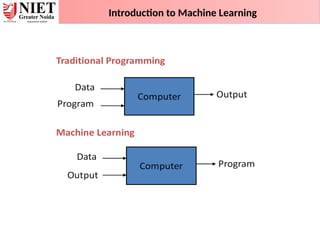
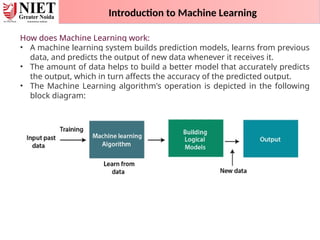
  • 152.
  • 153.
  • 154.
  • 155.
  • 156.
  • 157.
  • 158.
    •Illustrate Find-S algorithm.[CO1] •Describe List-Then-Eliminate algorithm. [CO1] •Define Candidate elimination algorithm with example. [CO1] •Briefly explain Inductive bias. [CO1] •Describe Machine Learning with suitable examples.[CO1] •Brief the well defined learning problems. [CO1] •Define the process of Designing a Learning System? [CO1] •Explain different perspective and Issues in Machine Learning. [CO1] •Define hypotheses. [CO1] •Analyze THE CONCEPT LEARNING TASK - General-to-specific ordering of hypotheses? [CO1] Expected Questions for University Exam
  • 159.
    References Text books: 1. TomM. Mitchell, ―Machine Learning, McGraw-Hill Education (India) Private Limited, 2013. 2. Ethem Alpaydin, ―Introduction to Machine Learning (Adaptive Computation and Machine Learning), The MIT Press 2004. 3. Stephen Marsland, ―Machine Learning: An Algorithmic Perspective, CRC Press, 2009. 4. Bishop, C., Pattern Recognition and Machine Learning. Berlin: Springer-Verlag.
  • 160.
    Recap of Unit •Concept learning can be seen as a problem of searching through a large predefined space of potential hypotheses. • The general-to-specific partial ordering of hypotheses provides a useful structure for organizing the search through the hypothesis space. • The FIND-S algorithm utilizes this general-to-specific ordering, performing a specific-to-general search through the hypothesis space along one branch of the partial ordering, to find the most specific hypothesis consistent with the training examples.