IMAGE COMPRESSION AND
DECOMPRESSION USING ANN
Guided by
Mr.Mahantesh Paramashetti

By
Anusha.G
Parveen.A.G
Pallavi.S.Yadav
Christeena.S
CONTENTS
•
•
•
•
•
•
•
•
•
•

Introduction
Biologically Inspired Neuron
Artificial Neural Networks
Back Propagation Algorithm
Compression Techniques
Implementations
Advantages
Disadvantages
Applications
Conclusion
INTRODUCTION
 Uncompressed

multimedia data requires
considerable storage capacity and transmission
bandwidth.
Apart from the existing technology like JPEG
and MPEG standards, new technology such as
neural networks are used for image
compression.
Natural images are captured using image
sensors and stored in memory banks. Large
storage space is required.
eg: A color image of size 256x256 requires a
storage space of 1.5 Mega bits.
 Storage cost for 1 GB is approximately Rs.
200.
With the available bandwidth of 64kbps and
54mbps transmitting a three hour movie
requires in uncompressed format takes 2917
years and 19 days respectively.
Transmission of huge image data is time
consuming.
Artificial neural networks has been chosen for
image compression due to their massively parallel
and distributed architecture.
The idea behind this Training commands is the
Back propagation algorithm.
The focus of this project is to implement the
Neural Architecture Digitally.
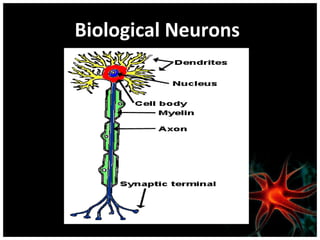
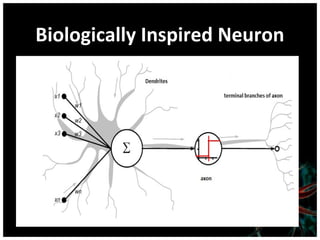
Biological Neurons
The Analogy to the Brain
 Neurons are basic signaling units of the nervous
system of a living being in which each neuron is
a discrete cell whose several processes are
from its cell body.
 The basic element of human brain has abilities
to remember, think and apply previous
experiences to our every action.
 Neural networks process information in a
similar way the human brain does.
Biologically Inspired Neuron
Artificial Neural Networks
 Artificial Neural Networks are used to process
the information the way biological systems
process analog signals like image and sound.
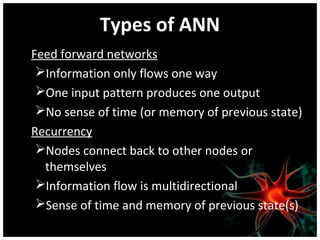
Types of ANN
Feed forward networks
Information only flows one way
One input pattern produces one output
No sense of time (or memory of previous state)
Recurrency
Nodes connect back to other nodes or
themselves
Information flow is multidirectional
Sense of time and memory of previous state(s)
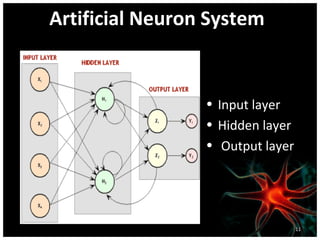
Artificial Neuron System

• Input layer
• Hidden layer
• Output layer

11
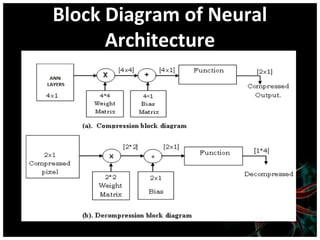
Block Diagram of Neural
Architecture
Back propagation algorithm
 Information about errors is filtered back
through the system and it is used to adjust the
connections between the layers, thus
improving performance.
 The Feed-Forward Neural Network architecture
is capable of approximating most problems
with high accuracy and generalization ability.
 The Back propagation algorithm is used to
update weights and bias of the neural
networks.
 Weight and bias elements of the neuron
decides the functionality of the network.
 Value of these weight and bias elements are
calculated during training phase.
COMPRESSION
 Image compression refers to the task of
reducing the amount of data required to store
or transmit an image.
 The compressed image is then subjected to
further digital processing such as error control
coding, encryption or multiplexing with other
data sources, before being used to modulate
the analog signal that is actually transmitted
through the channel or stored in a storage
medium.
COMPRESSION TECHNIQUES
•
•
•
•

JPEG
Wavelet
GIF
M-JPEG
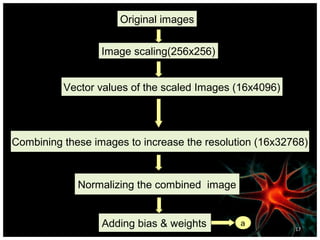
Original images
Image scaling(256x256)
Vector values of the scaled Images (16x4096)

Combining these images to increase the resolution (16x32768)

Normalizing the combined image

Adding bias & weights
Bukarica Leto, bleto@rcub.bg.ac.rs

a

17
a

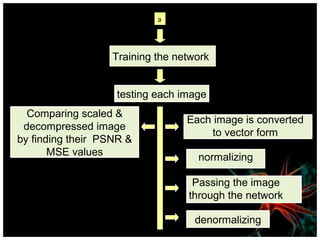
Training the network
testing each image
Comparing scaled &
decompressed image
by finding their PSNR &
MSE values

Each image is converted
to vector form
normalizing
Passing the image
through the network
denormalizing
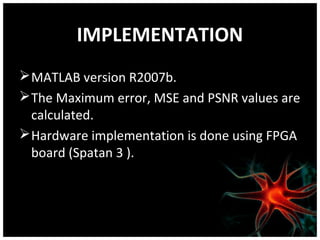
IMPLEMENTATION
 MATLAB version R2007b.
 The Maximum error, MSE and PSNR values are
calculated.
 Hardware implementation is done using FPGA
board (Spatan 3 ).
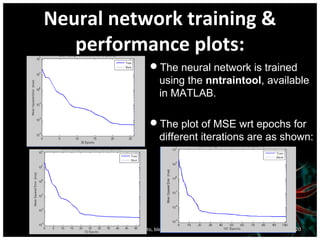
Neural network training &
performance plots:
The neural network is trained

using the nntraintool, available
in MATLAB.
The plot of MSE wrt epochs for

different iterations are as shown:

Bukarica Leto, bleto@rcub.bg.ac.rs

20
Advantages
• A neural network can perform tasks that a linear
program cannot.
• When an element of the neural network fails, it
can continue without any problem by their
parallel nature.
• A neural network learns and does not need to
be reprogrammed.
• It works even in the presence of noise with good
quality output.
Disadvantages
 The neural network needs training to operate.
 The architecture of a neural network is
different from the architecture of
microprocessors therefore needs to be
emulated.
 Requires high processing time for large neural
networks.
 As the number of neurons increases the
network becomes complex.
Applications
 Pattern Matching
 Pattern Recognition
 Optimization
 Vector Quantization
 Data Clustering
CONCLUSION
• Chipscope Pro Analyzer can easily implement
the design on FPGA kit.
• The analysis showed that comparision
between input and output values was proved
to be similar.
• Using Chipscope Pro Analyzer smaller
architectures can be easily built.
THANK YOU

artificial neural network

  • 1.
    IMAGE COMPRESSION AND DECOMPRESSIONUSING ANN Guided by Mr.Mahantesh Paramashetti By Anusha.G Parveen.A.G Pallavi.S.Yadav Christeena.S
  • 2.
    CONTENTS • • • • • • • • • • Introduction Biologically Inspired Neuron ArtificialNeural Networks Back Propagation Algorithm Compression Techniques Implementations Advantages Disadvantages Applications Conclusion
  • 3.
    INTRODUCTION  Uncompressed multimedia datarequires considerable storage capacity and transmission bandwidth. Apart from the existing technology like JPEG and MPEG standards, new technology such as neural networks are used for image compression. Natural images are captured using image sensors and stored in memory banks. Large storage space is required.
  • 4.
    eg: A colorimage of size 256x256 requires a storage space of 1.5 Mega bits.  Storage cost for 1 GB is approximately Rs. 200. With the available bandwidth of 64kbps and 54mbps transmitting a three hour movie requires in uncompressed format takes 2917 years and 19 days respectively. Transmission of huge image data is time consuming.
  • 5.
    Artificial neural networkshas been chosen for image compression due to their massively parallel and distributed architecture. The idea behind this Training commands is the Back propagation algorithm. The focus of this project is to implement the Neural Architecture Digitally.
  • 6.
  • 7.
    The Analogy tothe Brain  Neurons are basic signaling units of the nervous system of a living being in which each neuron is a discrete cell whose several processes are from its cell body.  The basic element of human brain has abilities to remember, think and apply previous experiences to our every action.  Neural networks process information in a similar way the human brain does.
  • 8.
  • 9.
    Artificial Neural Networks Artificial Neural Networks are used to process the information the way biological systems process analog signals like image and sound.
  • 10.
    Types of ANN Feedforward networks Information only flows one way One input pattern produces one output No sense of time (or memory of previous state) Recurrency Nodes connect back to other nodes or themselves Information flow is multidirectional Sense of time and memory of previous state(s)
  • 11.
    Artificial Neuron System •Input layer • Hidden layer • Output layer 11
  • 12.
    Block Diagram ofNeural Architecture
  • 13.
    Back propagation algorithm Information about errors is filtered back through the system and it is used to adjust the connections between the layers, thus improving performance.  The Feed-Forward Neural Network architecture is capable of approximating most problems with high accuracy and generalization ability.
  • 14.
     The Backpropagation algorithm is used to update weights and bias of the neural networks.  Weight and bias elements of the neuron decides the functionality of the network.  Value of these weight and bias elements are calculated during training phase.
  • 15.
    COMPRESSION  Image compressionrefers to the task of reducing the amount of data required to store or transmit an image.  The compressed image is then subjected to further digital processing such as error control coding, encryption or multiplexing with other data sources, before being used to modulate the analog signal that is actually transmitted through the channel or stored in a storage medium.
  • 16.
  • 17.
    Original images Image scaling(256x256) Vectorvalues of the scaled Images (16x4096) Combining these images to increase the resolution (16x32768) Normalizing the combined image Adding bias & weights Bukarica Leto, bleto@rcub.bg.ac.rs a 17
  • 18.
    a Training the network testingeach image Comparing scaled & decompressed image by finding their PSNR & MSE values Each image is converted to vector form normalizing Passing the image through the network denormalizing
  • 19.
    IMPLEMENTATION  MATLAB versionR2007b.  The Maximum error, MSE and PSNR values are calculated.  Hardware implementation is done using FPGA board (Spatan 3 ).
  • 20.
    Neural network training& performance plots: The neural network is trained using the nntraintool, available in MATLAB. The plot of MSE wrt epochs for different iterations are as shown: Bukarica Leto, bleto@rcub.bg.ac.rs 20
  • 21.
    Advantages • A neuralnetwork can perform tasks that a linear program cannot. • When an element of the neural network fails, it can continue without any problem by their parallel nature. • A neural network learns and does not need to be reprogrammed. • It works even in the presence of noise with good quality output.
  • 22.
    Disadvantages  The neuralnetwork needs training to operate.  The architecture of a neural network is different from the architecture of microprocessors therefore needs to be emulated.  Requires high processing time for large neural networks.  As the number of neurons increases the network becomes complex.
  • 23.
    Applications  Pattern Matching Pattern Recognition  Optimization  Vector Quantization  Data Clustering
  • 24.
    CONCLUSION • Chipscope ProAnalyzer can easily implement the design on FPGA kit. • The analysis showed that comparision between input and output values was proved to be similar. • Using Chipscope Pro Analyzer smaller architectures can be easily built.
  • 25.