Disclaimer
Disclaimer
All workshops and workshop materials, etc.
are the sole property of PEGS and cannot
be published, copied, or disseminated
without prior written approval from PEGS
and are for student and faculty use only.
1
ESL Grammar: The Basics on Articles and
Prepositions (
Prepositions (In, On, At
In, On, At).
).
Julie Hunsberger
PEGS workshop
March 22nd
, 2012
Why articles and prepositions?
 At one time English had a complex system of noun endings.
Over time those noun endings were lost, and articles and
prepositions took their place. Prepositions and articles caused
rigid word order in English.
 While many languages do not have articles (e.g. Chinese,
Russian), many Western European languages, like English, do.
It is important that ESL learners learn to use them properly.
 All languages have prepositions. However, English has a rather
large amount. The nuances found between their usage makes
them difficult to learn (if you are not a native English speaker).
 According to the Merriam-Webster dictionary online,
grammatical articles are:
◦ “Any of a small set of words or affixes (as a, an, and the) used
with nouns to limit or give definiteness to the application.”
◦ In other words, articles are words that occur before nouns to
describe or determine the noun (e.g. specific/non specific).
 The singular indefinite article is a or an.
 The plural indefinite article is some.
 The definite article is the.
What are articles?
What are articles?
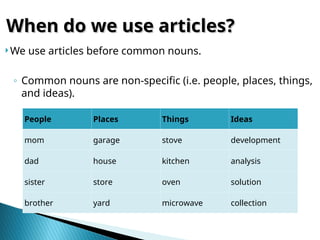
 We use articles before common nouns.
◦ Common nouns are non-specific (i.e. people, places, things,
and ideas).
When do we use articles?
People Places Things Ideas
mom garage stove development
dad house kitchen analysis
sister store oven solution
brother yard microwave collection
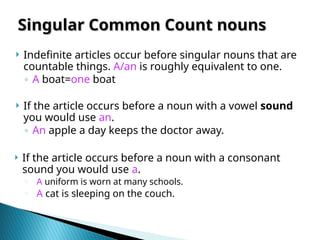
 Indefinite articles occur before singular nouns that are
countable things. A/an is roughly equivalent to one.
◦ A boat=one boat
 If the article occurs before a noun with a vowel sound
you would use an.
◦ An apple a day keeps the doctor away.
 If the article occurs before a noun with a consonant
sound you would use a.
o A uniform is worn at many schools.
o A cat is sleeping on the couch.
Singular Common Count nouns
Common Count Nouns
Common Count Nouns
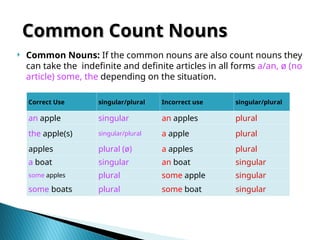
 Common Nouns: If the common nouns are also count nouns they
can take the indefinite and definite articles in all forms a/an, ø (no
article) some, the depending on the situation.
Correct Use singular/plural Incorrect use singular/plural
an apple singular an apples plural
the apple(s) singular/plural a apple plural
apples plural (ø) a apples plural
a boat singular an boat singular
some apples plural some apple singular
some boats plural some boat singular
When do we use articles?
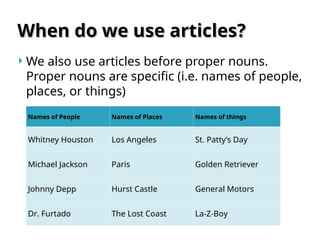
 We also use articles before proper nouns.
Proper nouns are specific (i.e. names of people,
places, or things)
Names of People Names of Places Names of things
Whitney Houston Los Angeles St. Patty’s Day
Michael Jackson Paris Golden Retriever
Johnny Depp Hurst Castle General Motors
Dr. Furtado The Lost Coast La-Z-Boy
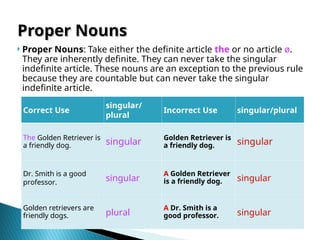
 Proper Nouns: Take either the definite article the or no article ø.
They are inherently definite. They can never take the singular
indefinite article. These nouns are an exception to the previous rule
because they are countable but can never take the singular
indefinite article.
Proper Nouns
Proper Nouns
Correct Use
singular/
plural
Incorrect Use singular/plural
The Golden Retriever is
a friendly dog. singular Golden Retriever is
a friendly dog. singular
Dr. Smith is a good
professor. singular
A Golden Retriever
is a friendly dog. singular
Golden retrievers are
friendly dogs. plural
A Dr. Smith is a
good professor. singular
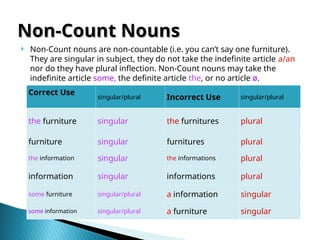
 Non-Count nouns are non-countable (i.e. you can’t say one furniture).
They are singular in subject, they do not take the indefinite article a/an
nor do they have plural inflection. Non-Count nouns may take the
indefinite article some, the definite article the, or no article ø.
Non-Count Nouns
Non-Count Nouns
Correct Use
singular/plural Incorrect Use singular/plural
the furniture singular the furnitures plural
furniture singular furnitures plural
the information singular the informations plural
information singular informations plural
some furniture singular/plural a information singular
some information singular/plural a furniture singular
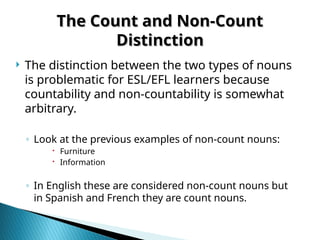
 The distinction between the two types of nouns
is problematic for ESL/EFL learners because
countability and non-countability is somewhat
arbitrary.
◦ Look at the previous examples of non-count nouns:
 Furniture
 Information
◦ In English these are considered non-count nouns but
in Spanish and French they are count nouns.
The Count and Non-Count
Distinction
Distinction
Non-Count and Count Nouns
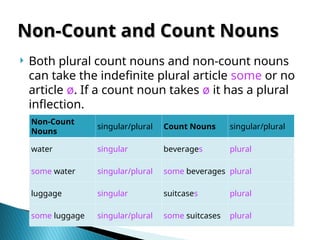
 Both plural count nouns and non-count nouns
can take the indefinite plural article some or no
article ø. If a count noun takes ø it has a plural
inflection.
Non-Count
Nouns
singular/plural Count Nouns singular/plural
water singular beverages plural
some water singular/plural some beverages plural
luggage singular suitcases plural
some luggage singular/plural some suitcases plural
The Meanings of the Indefinite
Article a/an
Article a/an
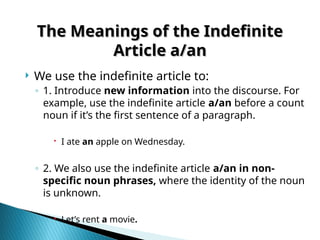
 We use the indefinite article to:
◦ 1. Introduce new information into the discourse. For
example, use the indefinite article a/an before a count
noun if it’s the first sentence of a paragraph.
 I ate an apple on Wednesday.
◦ 2. We also use the indefinite article a/an in non-
specific noun phrases, where the identity of the noun
is unknown.
 Let’s rent a movie.
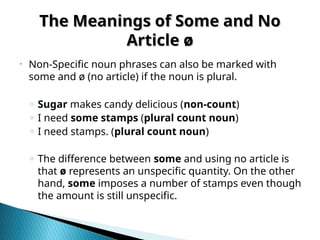
The Meanings of Some and No
Article ø
Article ø
‣ Non-Specific noun phrases can also be marked with
some and ø (no article) if the noun is plural.
o Sugar makes candy delicious (non-count)
o I need some stamps (plural count noun)
o I need stamps. (plural count noun)
o The difference between some and using no article is
that ø represents an unspecific quantity. On the other
hand, some imposes a number of stamps even though
the amount is still unspecific.
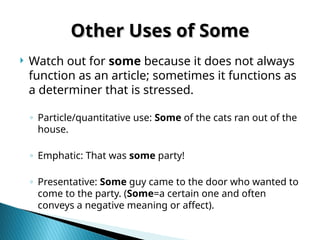
Other Uses of Some
Other Uses of Some
 Watch out for some because it does not always
function as an article; sometimes it functions as
a determiner that is stressed.
◦ Particle/quantitative use: Some of the cats ran out of the
house.
◦ Emphatic: That was some party!
◦ Presentative: Some guy came to the door who wanted to
come to the party. (Some=a certain one and often
conveys a negative meaning or affect).
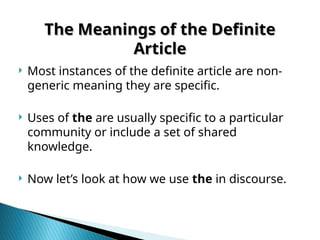
The Meanings of the Definite
Article
Article
 Most instances of the definite article are non-
generic meaning they are specific.
 Uses of the are usually specific to a particular
community or include a set of shared
knowledge.
 Now let’s look at how we use the in discourse.
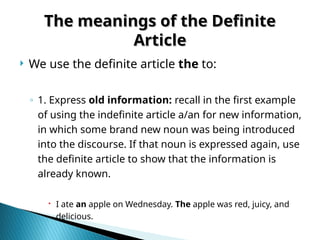
The meanings of the Definite
Article
Article
 We use the definite article the to:
◦ 1. Express old information: recall in the first example
of using the indefinite article a/an for new information,
in which some brand new noun was being introduced
into the discourse. If that noun is expressed again, use
the definite article to show that the information is
already known.
 I ate an apple on Wednesday. The apple was red, juicy, and
delicious.
The meanings of the Definite
Article
Article
 We also use the definite article when:
◦ 2. The general community understands the noun as
common knowledge:
 The Sun, The moon, The Earth
◦ 3. Immediate Situational Use:
 Don’t go in there. The stench is awful.
◦ 4. Perceptual situational use: the noun is visible, audible, etc.
 Pass me the salt, please.
◦ 5. Local use: General knowledge or information: includes
members of the same community.
 The museum, the church, the bar
The meanings of the Definite
Article
Article
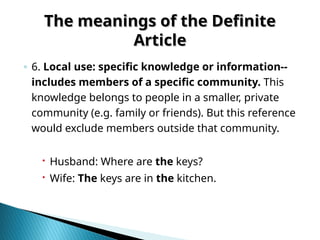
◦ 6. Local use: specific knowledge or information--
includes members of a specific community. This
knowledge belongs to people in a smaller, private
community (e.g. family or friends). But this reference
would exclude members outside that community.
 Husband: Where are the keys?
 Wife: The keys are in the kitchen.
Modifiers between Articles and
Nouns
Nouns
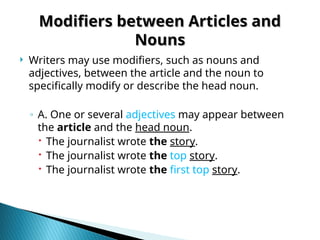
 Writers may use modifiers, such as nouns and
adjectives, between the article and the noun to
specifically modify or describe the head noun.
◦ A. One or several adjectives may appear between
the article and the head noun.
 The journalist wrote the story.
 The journalist wrote the top story.
 The journalist wrote the first top story.
Modifiers between Articles and
Nouns
Nouns
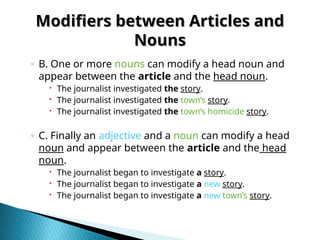
◦ B. One or more nouns can modify a head noun and
appear between the article and the head noun.
 The journalist investigated the story.
 The journalist investigated the town’s story.
 The journalist investigated the town’s homicide story.
◦ C. Finally an adjective and a noun can modify a head
noun and appear between the article and the head
noun.
 The journalist began to investigate a story.
 The journalist began to investigate a new story.
 The journalist began to investigate a new town’s story.
Conclusion of Articles
 That concludes the presentation on articles.
Now let’s turn to some article activities!
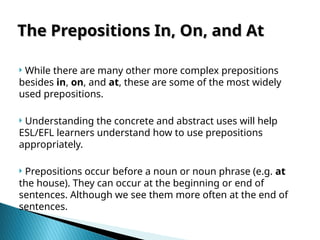
The Prepositions In, On, and At
 While there are many other more complex prepositions
besides in, on, and at, these are some of the most widely
used prepositions.
 Understanding the concrete and abstract uses will help
ESL/EFL learners understand how to use prepositions
appropriately.
 Prepositions occur before a noun or noun phrase (e.g. at
the house). They can occur at the beginning or end of
sentences. Although we see them more often at the end of
sentences.
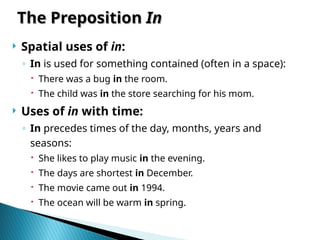
The Preposition
The Preposition In
In
 Spatial uses of in:
◦ In is used for something contained (often in a space):
 There was a bug in the room.
 The child was in the store searching for his mom.
 Uses of in with time:
◦ In precedes times of the day, months, years and
seasons:
 She likes to play music in the evening.
 The days are shortest in December.
 The movie came out in 1994.
 The ocean will be warm in spring.
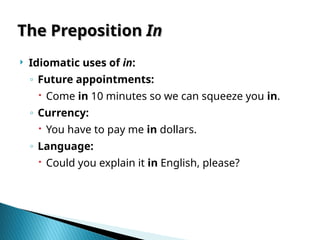
The Preposition
The Preposition In
In
 Idiomatic uses of in:
◦ Future appointments:
 Come in 10 minutes so we can squeeze you in.
◦ Currency:
 You have to pay me in dollars.
◦ Language:
 Could you explain it in English, please?
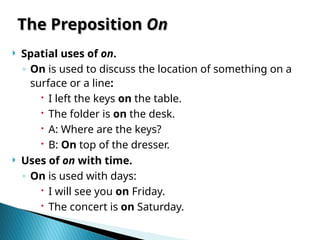
The Preposition
The Preposition On
On
 Spatial uses of on.
◦ On is used to discuss the location of something on a
surface or a line:
 I left the keys on the table.
 The folder is on the desk.
 A: Where are the keys?
 B: On top of the dresser.
 Uses of on with time.
◦ On is used with days:
 I will see you on Friday.
 The concert is on Saturday.
28
The Preposition On
The Preposition On
 Idiomatic Uses of On.
◦ Communicative:
 I listened to it on the radio.
 I watched the news on T.V.
◦ Concerning something:
 I read a book on magic.
 The lecture was on modern art.
 I worked on my homework all night.
30
The Preposition
The Preposition At
At
 Spatial/Directional uses of at:
◦ At precedes a point of intersection:
 We were waiting at the corner for the bus.
◦ At precedes a general area:
 Let’s meet at the movie theater.
◦ At precedes a target:
 I threw a shoe at the alarm clock.
 Uses of at with time:
◦ At precedes a specific time of day.
 My plane arrives at 7:00 p.m.
 The movie starts at noon.
 At midnight, I have to be in bed.
The Preposition
The Preposition At
At
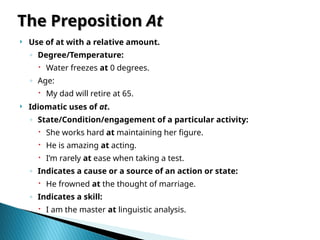
 Use of at with a relative amount.
◦ Degree/Temperature:
 Water freezes at 0 degrees.
◦ Age:
 My dad will retire at 65.
 Idiomatic uses of at.
◦ State/Condition/engagement of a particular activity:
 She works hard at maintaining her figure.
 He is amazing at acting.
 I’m rarely at ease when taking a test.
◦ Indicates a cause or a source of an action or state:
 He frowned at the thought of marriage.
◦ Indicates a skill:
 I am the master at linguistic analysis.
Conclusion
Conclusion
 While proper article and preposition usage can
confuse many writers—especially ESL students—
everyone must learn how to use these
grammatical devices properly in academic
writing.
 Hopefully, you will feel more comfortable using
articles and the prepositions in, on and at in
your writing!
 Are there any questions?
Resources
Resources
 Preposition resource:
 http://owl.english.purdue.edu/owl/resource/594/
01/
 Article resource:
 http://owl.english.purdue.edu/owl/resource/540/
01/
 For additional help make an appointment at
PEGS!
References
References
Angeli, E., Berry, C., & Brizee, A. (2011, March 23). Prepositions for time, place, and
introducing objects. Retrieved from
http://owl.english.purdue.edu/owl/resource/594/01/
Angeli, E., Brizee, A., & Lynch, P. (2011, March 03). Using articles.
Retrieved from http://owl.english.purdue.edu/owl/resource/540/01/
Freeman, D. L., & Murcia, M. C.(1999). The grammar book. (2nd ed.) Heinle & Heinle
 Publishers
Strauch, A. O., & Young, A. R. (1994). Nitty gritty grammar sentence
 essentials for writers. New York, NY: St. Martin’s Press, Inc.
G & C, M.,& N., W. (2012). article. In Merriam-webster Springfield, MA:Merriam-
 webster Inc. Retrieved from http://www.merriam- webser.com/
 dictionary/articles
articles (1).nuons -articles- détermines
  • 1.
    Disclaimer Disclaimer All workshops andworkshop materials, etc. are the sole property of PEGS and cannot be published, copied, or disseminated without prior written approval from PEGS and are for student and faculty use only. 1
  • 2.
    ESL Grammar: TheBasics on Articles and ESL Grammar: The Basics on Articles and Prepositions ( Prepositions (In, On, At In, On, At). ). Julie Hunsberger PEGS workshop March 22nd , 2012
  • 3.
    Why articles andprepositions? Why articles and prepositions?  At one time English had a complex system of noun endings. Over time those noun endings were lost, and articles and prepositions took their place. Prepositions and articles caused rigid word order in English.  While many languages do not have articles (e.g. Chinese, Russian), many Western European languages, like English, do. It is important that ESL learners learn to use them properly.  All languages have prepositions. However, English has a rather large amount. The nuances found between their usage makes them difficult to learn (if you are not a native English speaker).
  • 4.
     According tothe Merriam-Webster dictionary online, grammatical articles are: ◦ “Any of a small set of words or affixes (as a, an, and the) used with nouns to limit or give definiteness to the application.” ◦ In other words, articles are words that occur before nouns to describe or determine the noun (e.g. specific/non specific).  The singular indefinite article is a or an.  The plural indefinite article is some.  The definite article is the. What are articles? What are articles?
  • 6.
     We usearticles before common nouns. ◦ Common nouns are non-specific (i.e. people, places, things, and ideas). When do we use articles? When do we use articles? People Places Things Ideas mom garage stove development dad house kitchen analysis sister store oven solution brother yard microwave collection
  • 7.
     Indefinite articlesoccur before singular nouns that are countable things. A/an is roughly equivalent to one. ◦ A boat=one boat  If the article occurs before a noun with a vowel sound you would use an. ◦ An apple a day keeps the doctor away.  If the article occurs before a noun with a consonant sound you would use a. o A uniform is worn at many schools. o A cat is sleeping on the couch. Singular Common Count nouns Singular Common Count nouns
  • 8.
    Common Count Nouns CommonCount Nouns  Common Nouns: If the common nouns are also count nouns they can take the indefinite and definite articles in all forms a/an, ø (no article) some, the depending on the situation. Correct Use singular/plural Incorrect use singular/plural an apple singular an apples plural the apple(s) singular/plural a apple plural apples plural (ø) a apples plural a boat singular an boat singular some apples plural some apple singular some boats plural some boat singular
  • 9.
    When do weuse articles? When do we use articles?  We also use articles before proper nouns. Proper nouns are specific (i.e. names of people, places, or things) Names of People Names of Places Names of things Whitney Houston Los Angeles St. Patty’s Day Michael Jackson Paris Golden Retriever Johnny Depp Hurst Castle General Motors Dr. Furtado The Lost Coast La-Z-Boy
  • 10.
     Proper Nouns:Take either the definite article the or no article ø. They are inherently definite. They can never take the singular indefinite article. These nouns are an exception to the previous rule because they are countable but can never take the singular indefinite article. Proper Nouns Proper Nouns Correct Use singular/ plural Incorrect Use singular/plural The Golden Retriever is a friendly dog. singular Golden Retriever is a friendly dog. singular Dr. Smith is a good professor. singular A Golden Retriever is a friendly dog. singular Golden retrievers are friendly dogs. plural A Dr. Smith is a good professor. singular
  • 11.
     Non-Count nounsare non-countable (i.e. you can’t say one furniture). They are singular in subject, they do not take the indefinite article a/an nor do they have plural inflection. Non-Count nouns may take the indefinite article some, the definite article the, or no article ø. Non-Count Nouns Non-Count Nouns Correct Use singular/plural Incorrect Use singular/plural the furniture singular the furnitures plural furniture singular furnitures plural the information singular the informations plural information singular informations plural some furniture singular/plural a information singular some information singular/plural a furniture singular
  • 12.
     The distinctionbetween the two types of nouns is problematic for ESL/EFL learners because countability and non-countability is somewhat arbitrary. ◦ Look at the previous examples of non-count nouns:  Furniture  Information ◦ In English these are considered non-count nouns but in Spanish and French they are count nouns. The Count and Non-Count The Count and Non-Count Distinction Distinction
  • 13.
    Non-Count and CountNouns Non-Count and Count Nouns  Both plural count nouns and non-count nouns can take the indefinite plural article some or no article ø. If a count noun takes ø it has a plural inflection. Non-Count Nouns singular/plural Count Nouns singular/plural water singular beverages plural some water singular/plural some beverages plural luggage singular suitcases plural some luggage singular/plural some suitcases plural
  • 14.
    The Meanings ofthe Indefinite The Meanings of the Indefinite Article a/an Article a/an  We use the indefinite article to: ◦ 1. Introduce new information into the discourse. For example, use the indefinite article a/an before a count noun if it’s the first sentence of a paragraph.  I ate an apple on Wednesday. ◦ 2. We also use the indefinite article a/an in non- specific noun phrases, where the identity of the noun is unknown.  Let’s rent a movie.
  • 15.
    The Meanings ofSome and No The Meanings of Some and No Article ø Article ø ‣ Non-Specific noun phrases can also be marked with some and ø (no article) if the noun is plural. o Sugar makes candy delicious (non-count) o I need some stamps (plural count noun) o I need stamps. (plural count noun) o The difference between some and using no article is that ø represents an unspecific quantity. On the other hand, some imposes a number of stamps even though the amount is still unspecific.
  • 16.
    Other Uses ofSome Other Uses of Some  Watch out for some because it does not always function as an article; sometimes it functions as a determiner that is stressed. ◦ Particle/quantitative use: Some of the cats ran out of the house. ◦ Emphatic: That was some party! ◦ Presentative: Some guy came to the door who wanted to come to the party. (Some=a certain one and often conveys a negative meaning or affect).
  • 17.
    The Meanings ofthe Definite The Meanings of the Definite Article Article  Most instances of the definite article are non- generic meaning they are specific.  Uses of the are usually specific to a particular community or include a set of shared knowledge.  Now let’s look at how we use the in discourse.
  • 18.
    The meanings ofthe Definite The meanings of the Definite Article Article  We use the definite article the to: ◦ 1. Express old information: recall in the first example of using the indefinite article a/an for new information, in which some brand new noun was being introduced into the discourse. If that noun is expressed again, use the definite article to show that the information is already known.  I ate an apple on Wednesday. The apple was red, juicy, and delicious.
  • 19.
    The meanings ofthe Definite The meanings of the Definite Article Article  We also use the definite article when: ◦ 2. The general community understands the noun as common knowledge:  The Sun, The moon, The Earth ◦ 3. Immediate Situational Use:  Don’t go in there. The stench is awful. ◦ 4. Perceptual situational use: the noun is visible, audible, etc.  Pass me the salt, please. ◦ 5. Local use: General knowledge or information: includes members of the same community.  The museum, the church, the bar
  • 20.
    The meanings ofthe Definite The meanings of the Definite Article Article ◦ 6. Local use: specific knowledge or information-- includes members of a specific community. This knowledge belongs to people in a smaller, private community (e.g. family or friends). But this reference would exclude members outside that community.  Husband: Where are the keys?  Wife: The keys are in the kitchen.
  • 21.
    Modifiers between Articlesand Modifiers between Articles and Nouns Nouns  Writers may use modifiers, such as nouns and adjectives, between the article and the noun to specifically modify or describe the head noun. ◦ A. One or several adjectives may appear between the article and the head noun.  The journalist wrote the story.  The journalist wrote the top story.  The journalist wrote the first top story.
  • 22.
    Modifiers between Articlesand Modifiers between Articles and Nouns Nouns ◦ B. One or more nouns can modify a head noun and appear between the article and the head noun.  The journalist investigated the story.  The journalist investigated the town’s story.  The journalist investigated the town’s homicide story. ◦ C. Finally an adjective and a noun can modify a head noun and appear between the article and the head noun.  The journalist began to investigate a story.  The journalist began to investigate a new story.  The journalist began to investigate a new town’s story.
  • 23.
    Conclusion of Articles Conclusionof Articles  That concludes the presentation on articles. Now let’s turn to some article activities!
  • 24.
    The Prepositions In,On, and At The Prepositions In, On, and At  While there are many other more complex prepositions besides in, on, and at, these are some of the most widely used prepositions.  Understanding the concrete and abstract uses will help ESL/EFL learners understand how to use prepositions appropriately.  Prepositions occur before a noun or noun phrase (e.g. at the house). They can occur at the beginning or end of sentences. Although we see them more often at the end of sentences.
  • 25.
    The Preposition The PrepositionIn In  Spatial uses of in: ◦ In is used for something contained (often in a space):  There was a bug in the room.  The child was in the store searching for his mom.  Uses of in with time: ◦ In precedes times of the day, months, years and seasons:  She likes to play music in the evening.  The days are shortest in December.  The movie came out in 1994.  The ocean will be warm in spring.
  • 26.
    The Preposition The PrepositionIn In  Idiomatic uses of in: ◦ Future appointments:  Come in 10 minutes so we can squeeze you in. ◦ Currency:  You have to pay me in dollars. ◦ Language:  Could you explain it in English, please?
  • 27.
    The Preposition The PrepositionOn On  Spatial uses of on. ◦ On is used to discuss the location of something on a surface or a line:  I left the keys on the table.  The folder is on the desk.  A: Where are the keys?  B: On top of the dresser.  Uses of on with time. ◦ On is used with days:  I will see you on Friday.  The concert is on Saturday.
  • 28.
    28 The Preposition On ThePreposition On  Idiomatic Uses of On. ◦ Communicative:  I listened to it on the radio.  I watched the news on T.V. ◦ Concerning something:  I read a book on magic.  The lecture was on modern art.  I worked on my homework all night.
  • 30.
    30 The Preposition The PrepositionAt At  Spatial/Directional uses of at: ◦ At precedes a point of intersection:  We were waiting at the corner for the bus. ◦ At precedes a general area:  Let’s meet at the movie theater. ◦ At precedes a target:  I threw a shoe at the alarm clock.  Uses of at with time: ◦ At precedes a specific time of day.  My plane arrives at 7:00 p.m.  The movie starts at noon.  At midnight, I have to be in bed.
  • 31.
    The Preposition The PrepositionAt At  Use of at with a relative amount. ◦ Degree/Temperature:  Water freezes at 0 degrees. ◦ Age:  My dad will retire at 65.  Idiomatic uses of at. ◦ State/Condition/engagement of a particular activity:  She works hard at maintaining her figure.  He is amazing at acting.  I’m rarely at ease when taking a test. ◦ Indicates a cause or a source of an action or state:  He frowned at the thought of marriage. ◦ Indicates a skill:  I am the master at linguistic analysis.
  • 32.
    Conclusion Conclusion  While properarticle and preposition usage can confuse many writers—especially ESL students— everyone must learn how to use these grammatical devices properly in academic writing.  Hopefully, you will feel more comfortable using articles and the prepositions in, on and at in your writing!  Are there any questions?
  • 33.
    Resources Resources  Preposition resource: http://owl.english.purdue.edu/owl/resource/594/ 01/  Article resource:  http://owl.english.purdue.edu/owl/resource/540/ 01/  For additional help make an appointment at PEGS!
  • 34.
    References References Angeli, E., Berry,C., & Brizee, A. (2011, March 23). Prepositions for time, place, and introducing objects. Retrieved from http://owl.english.purdue.edu/owl/resource/594/01/ Angeli, E., Brizee, A., & Lynch, P. (2011, March 03). Using articles. Retrieved from http://owl.english.purdue.edu/owl/resource/540/01/ Freeman, D. L., & Murcia, M. C.(1999). The grammar book. (2nd ed.) Heinle & Heinle  Publishers Strauch, A. O., & Young, A. R. (1994). Nitty gritty grammar sentence  essentials for writers. New York, NY: St. Martin’s Press, Inc. G & C, M.,& N., W. (2012). article. In Merriam-webster Springfield, MA:Merriam-  webster Inc. Retrieved from http://www.merriam- webser.com/  dictionary/articles