101 Must Techniques for BAs
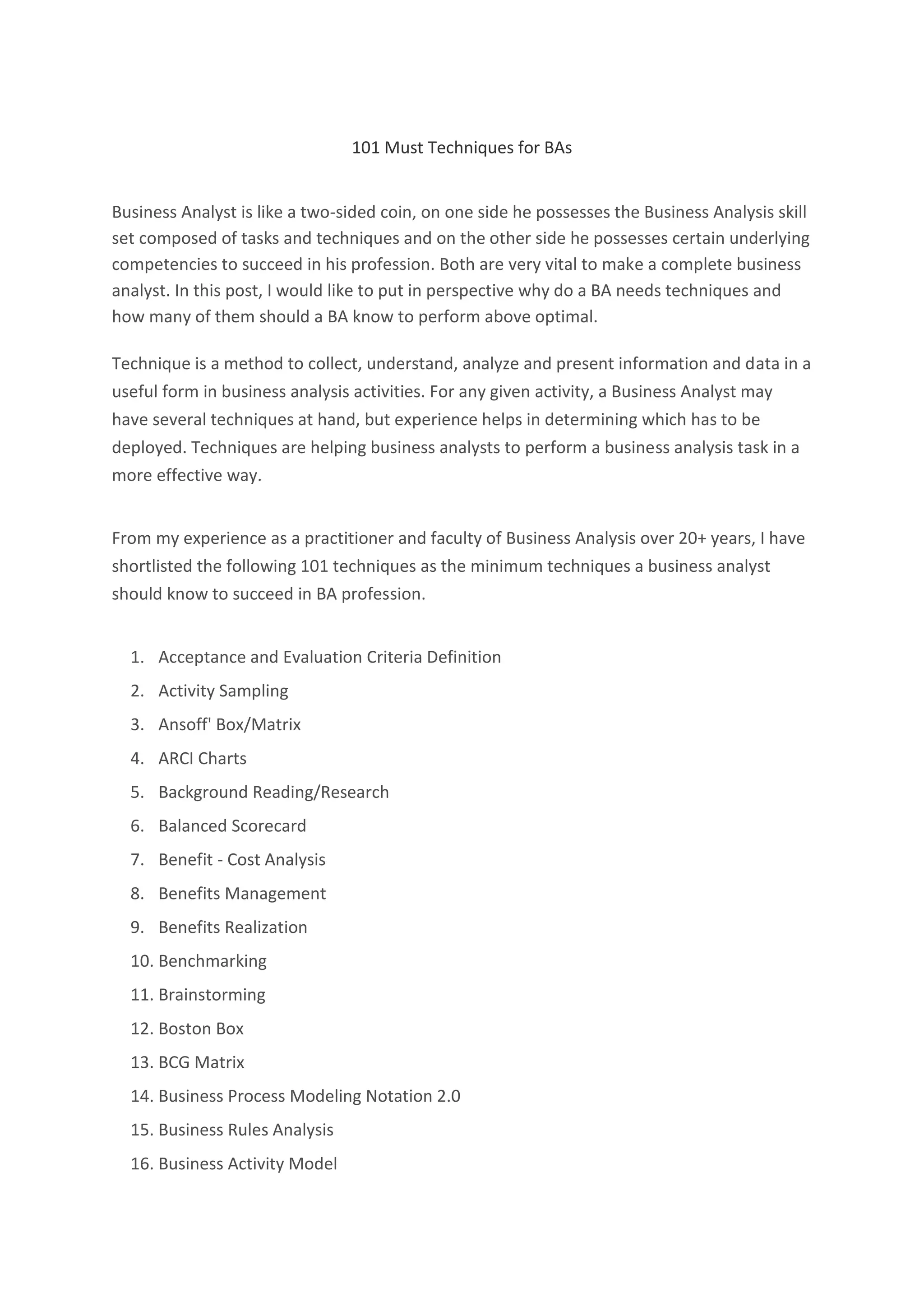
Business Analyst is like a two-sided coin, on one side he possesses the Business Analysis skill
set composed of tasks and techniques and on the other side he possesses certain underlying
competencies to succeed in his profession. Both are very vital to make a complete business
analyst. In this post, I would like to put in perspective why do a BA needs techniques and
how many of them should a BA know to perform above optimal.
Technique is a method to collect, understand, analyze and present information and data in a
useful form in business analysis activities. For any given activity, a Business Analyst may
have several techniques at hand, but experience helps in determining which has to be
deployed. Techniques are helping business analysts to perform a business analysis task in a
more effective way.
From my experience as a practitioner and faculty of Business Analysis over 20+ years, I have
shortlisted the following 101 techniques as the minimum techniques a business analyst
should know to succeed in BA profession.
1. Acceptance and Evaluation Criteria Definition
2. Activity Sampling
3. Ansoff' Box/Matrix
4. ARCI Charts
5. Background Reading/Research
6. Balanced Scorecard
7. Benefit - Cost Analysis
8. Benefits Management
9. Benefits Realization
10. Benchmarking
11. Brainstorming
12. Boston Box
13. BCG Matrix
14. Business Process Modeling Notation 2.0
15. Business Rules Analysis
16. Business Activity Model
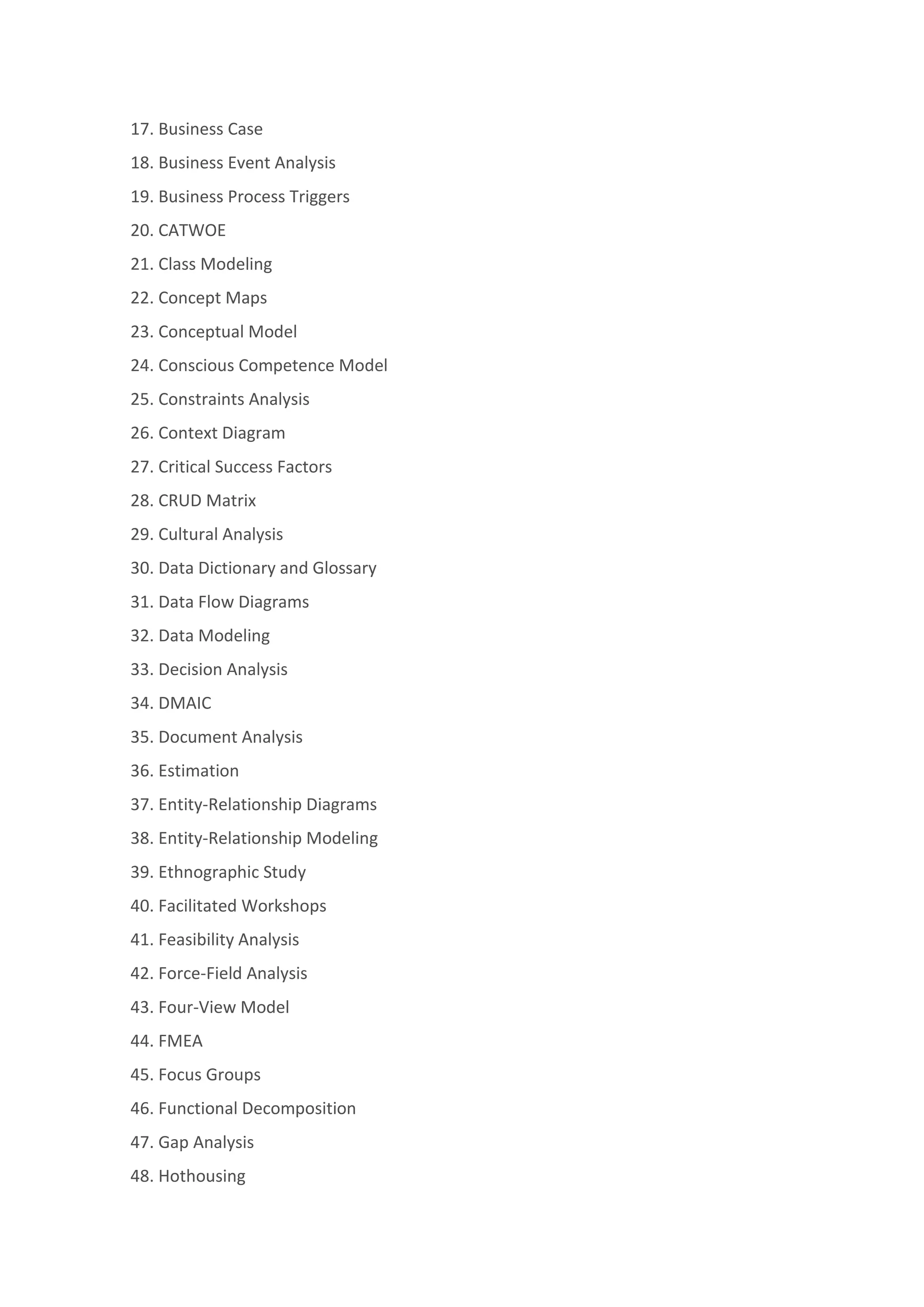
17. Business Case
18. Business Event Analysis
19. Business Process Triggers
20. CATWOE
21. Class Modeling
22. Concept Maps
23. Conceptual Model
24. Conscious Competence Model
25. Constraints Analysis
26. Context Diagram
27. Critical Success Factors
28. CRUD Matrix
29. Cultural Analysis
30. Data Dictionary and Glossary
31. Data Flow Diagrams
32. Data Modeling
33. Decision Analysis
34. DMAIC
35. Document Analysis
36. Estimation
37. Entity-Relationship Diagrams
38. Entity-Relationship Modeling
39. Ethnographic Study
40. Facilitated Workshops
41. Feasibility Analysis
42. Force-Field Analysis
43. Four-View Model
44. FMEA
45. Focus Groups
46. Functional Decomposition
47. Gap Analysis
48. Hothousing
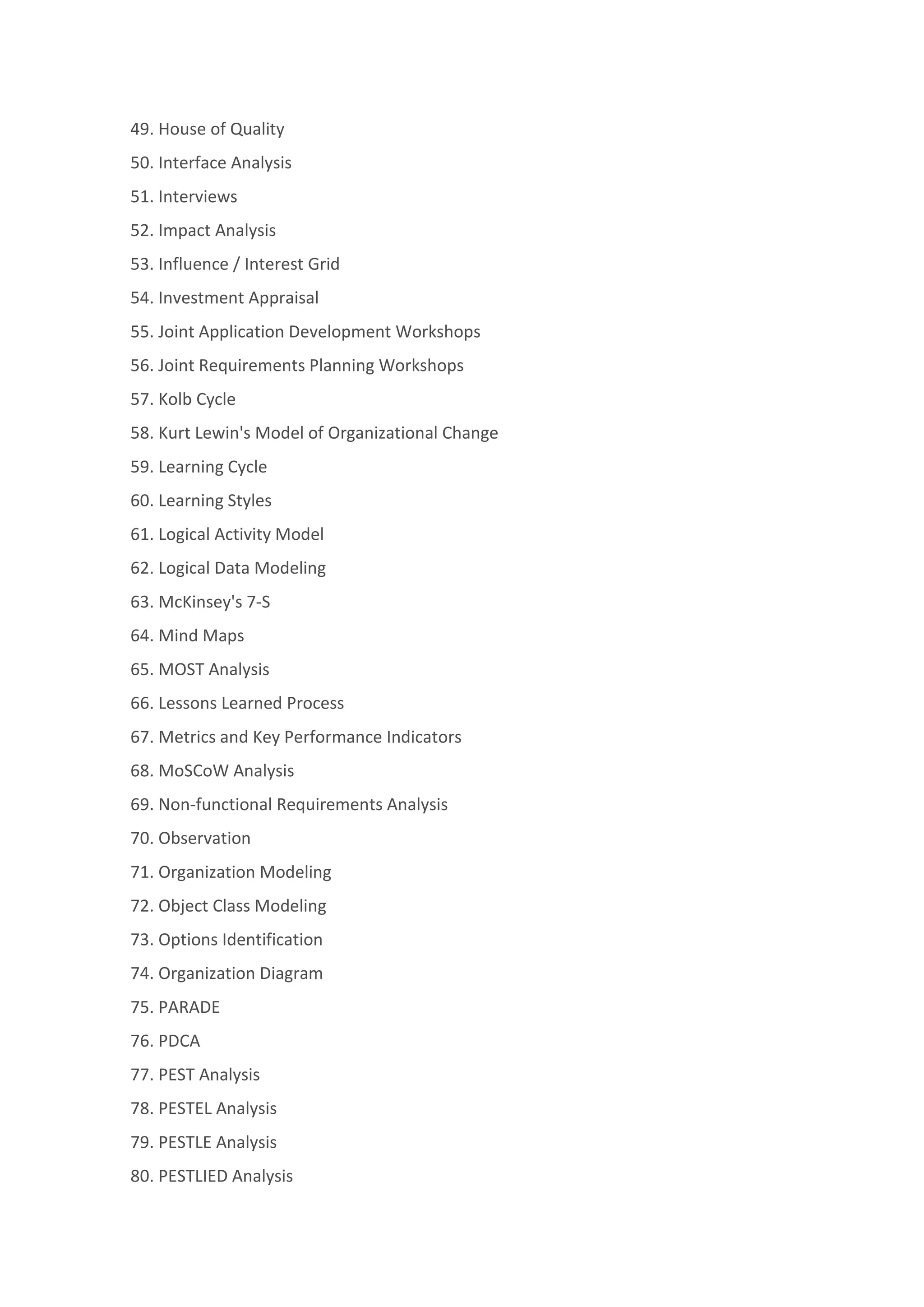
49. House of Quality
50. Interface Analysis
51. Interviews
52. Impact Analysis
53. Influence / Interest Grid
54. Investment Appraisal
55. Joint Application Development Workshops
56. Joint Requirements Planning Workshops
57. Kolb Cycle
58. Kurt Lewin's Model of Organizational Change
59. Learning Cycle
60. Learning Styles
61. Logical Activity Model
62. Logical Data Modeling
63. McKinsey's 7-S
64. Mind Maps
65. MOST Analysis
66. Lessons Learned Process
67. Metrics and Key Performance Indicators
68. MoSCoW Analysis
69. Non-functional Requirements Analysis
70. Observation
71. Organization Modeling
72. Object Class Modeling
73. Options Identification
74. Organization Diagram
75. PARADE
76. PDCA
77. PEST Analysis
78. PESTEL Analysis
79. PESTLE Analysis
80. PESTLIED Analysis
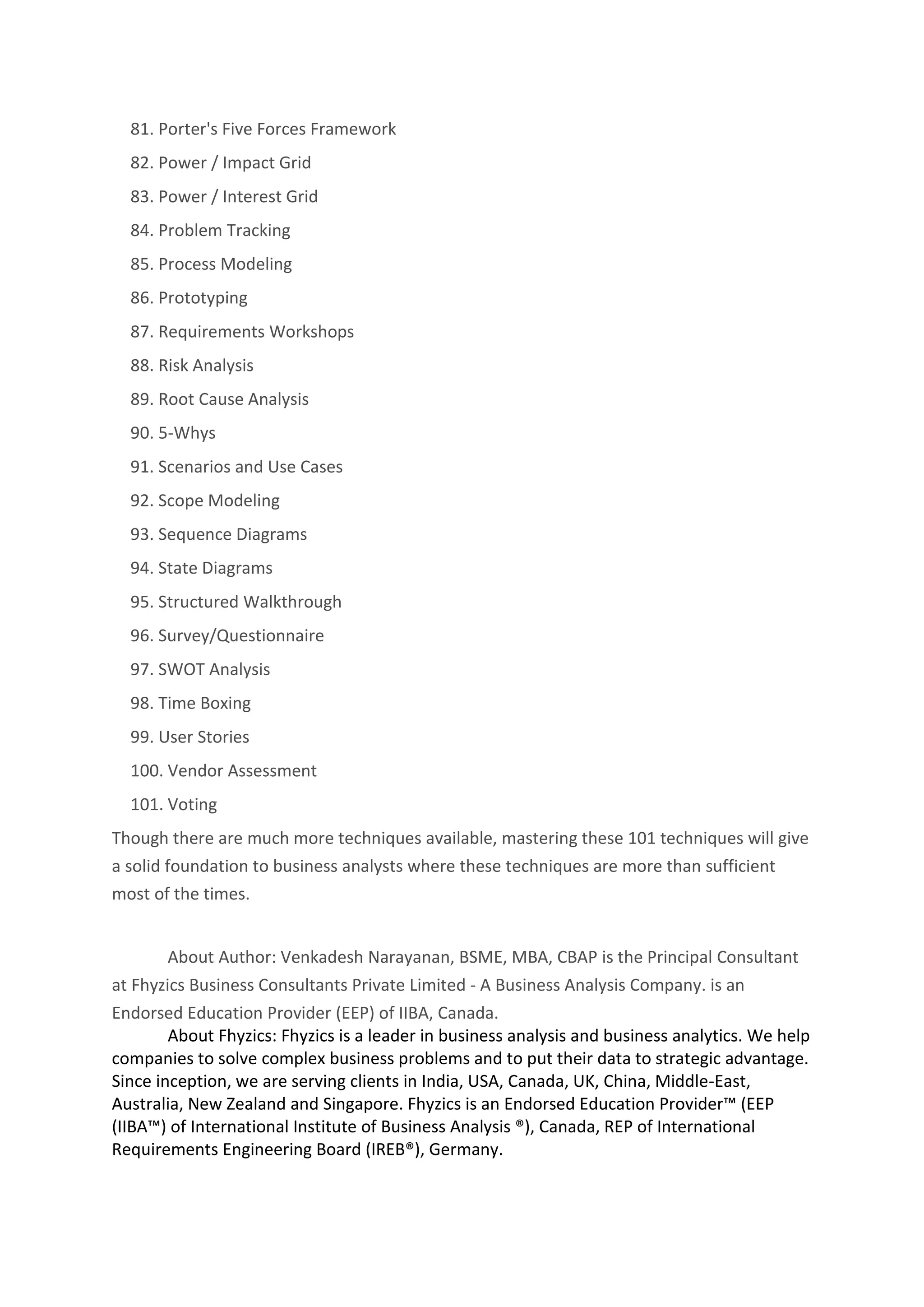
81. Porter's Five Forces Framework
82. Power / Impact Grid
83. Power / Interest Grid
84. Problem Tracking
85. Process Modeling
86. Prototyping
87. Requirements Workshops
88. Risk Analysis
89. Root Cause Analysis
90. 5-Whys
91. Scenarios and Use Cases
92. Scope Modeling
93. Sequence Diagrams
94. State Diagrams
95. Structured Walkthrough
96. Survey/Questionnaire
97. SWOT Analysis
98. Time Boxing
99. User Stories
100. Vendor Assessment
101. Voting
Though there are much more techniques available, mastering these 101 techniques will give
a solid foundation to business analysts where these techniques are more than sufficient
most of the times.
About Author: Venkadesh Narayanan, BSME, MBA, CBAP is the Principal Consultant
at Fhyzics Business Consultants Private Limited - A Business Analysis Company. is an
Endorsed Education Provider (EEP) of IIBA, Canada.
About Fhyzics: Fhyzics is a leader in business analysis and business analytics. We help
companies to solve complex business problems and to put their data to strategic advantage.
Since inception, we are serving clients in India, USA, Canada, UK, China, Middle-East,
Australia, New Zealand and Singapore. Fhyzics is an Endorsed Education Provider™ (EEP
(IIBA™) of International Institute of Business Analysis ®), Canada, REP of International
Requirements Engineering Board (IREB®), Germany.

Business Analyst Course

  • 1.
    101 Must Techniquesfor BAs Business Analyst is like a two-sided coin, on one side he possesses the Business Analysis skill set composed of tasks and techniques and on the other side he possesses certain underlying competencies to succeed in his profession. Both are very vital to make a complete business analyst. In this post, I would like to put in perspective why do a BA needs techniques and how many of them should a BA know to perform above optimal. Technique is a method to collect, understand, analyze and present information and data in a useful form in business analysis activities. For any given activity, a Business Analyst may have several techniques at hand, but experience helps in determining which has to be deployed. Techniques are helping business analysts to perform a business analysis task in a more effective way. From my experience as a practitioner and faculty of Business Analysis over 20+ years, I have shortlisted the following 101 techniques as the minimum techniques a business analyst should know to succeed in BA profession. 1. Acceptance and Evaluation Criteria Definition 2. Activity Sampling 3. Ansoff' Box/Matrix 4. ARCI Charts 5. Background Reading/Research 6. Balanced Scorecard 7. Benefit - Cost Analysis 8. Benefits Management 9. Benefits Realization 10. Benchmarking 11. Brainstorming 12. Boston Box 13. BCG Matrix 14. Business Process Modeling Notation 2.0 15. Business Rules Analysis 16. Business Activity Model
  • 2.
    17. Business Case 18.Business Event Analysis 19. Business Process Triggers 20. CATWOE 21. Class Modeling 22. Concept Maps 23. Conceptual Model 24. Conscious Competence Model 25. Constraints Analysis 26. Context Diagram 27. Critical Success Factors 28. CRUD Matrix 29. Cultural Analysis 30. Data Dictionary and Glossary 31. Data Flow Diagrams 32. Data Modeling 33. Decision Analysis 34. DMAIC 35. Document Analysis 36. Estimation 37. Entity-Relationship Diagrams 38. Entity-Relationship Modeling 39. Ethnographic Study 40. Facilitated Workshops 41. Feasibility Analysis 42. Force-Field Analysis 43. Four-View Model 44. FMEA 45. Focus Groups 46. Functional Decomposition 47. Gap Analysis 48. Hothousing
  • 3.
    49. House ofQuality 50. Interface Analysis 51. Interviews 52. Impact Analysis 53. Influence / Interest Grid 54. Investment Appraisal 55. Joint Application Development Workshops 56. Joint Requirements Planning Workshops 57. Kolb Cycle 58. Kurt Lewin's Model of Organizational Change 59. Learning Cycle 60. Learning Styles 61. Logical Activity Model 62. Logical Data Modeling 63. McKinsey's 7-S 64. Mind Maps 65. MOST Analysis 66. Lessons Learned Process 67. Metrics and Key Performance Indicators 68. MoSCoW Analysis 69. Non-functional Requirements Analysis 70. Observation 71. Organization Modeling 72. Object Class Modeling 73. Options Identification 74. Organization Diagram 75. PARADE 76. PDCA 77. PEST Analysis 78. PESTEL Analysis 79. PESTLE Analysis 80. PESTLIED Analysis
  • 4.
    81. Porter's FiveForces Framework 82. Power / Impact Grid 83. Power / Interest Grid 84. Problem Tracking 85. Process Modeling 86. Prototyping 87. Requirements Workshops 88. Risk Analysis 89. Root Cause Analysis 90. 5-Whys 91. Scenarios and Use Cases 92. Scope Modeling 93. Sequence Diagrams 94. State Diagrams 95. Structured Walkthrough 96. Survey/Questionnaire 97. SWOT Analysis 98. Time Boxing 99. User Stories 100. Vendor Assessment 101. Voting Though there are much more techniques available, mastering these 101 techniques will give a solid foundation to business analysts where these techniques are more than sufficient most of the times. About Author: Venkadesh Narayanan, BSME, MBA, CBAP is the Principal Consultant at Fhyzics Business Consultants Private Limited - A Business Analysis Company. is an Endorsed Education Provider (EEP) of IIBA, Canada. About Fhyzics: Fhyzics is a leader in business analysis and business analytics. We help companies to solve complex business problems and to put their data to strategic advantage. Since inception, we are serving clients in India, USA, Canada, UK, China, Middle-East, Australia, New Zealand and Singapore. Fhyzics is an Endorsed Education Provider™ (EEP (IIBA™) of International Institute of Business Analysis ®), Canada, REP of International Requirements Engineering Board (IREB®), Germany.